


Introduction: What Did Helena Blavatsky Want Us to Discover?
Helena Blavatsky sits beside a table crowded with papers. Before we can discuss the mysteries of existence, we have to find somewhere to put the tea.
It is an ordinary difficulty in the company of a woman who devoted her life to extraordinary questions.
What are we? What might religious traditions reveal when we study them beyond familiar boundaries? Does consciousness belong at the center of our account of existence? And what happens when someone takes these questions seriously enough to build books, an organization, and a life around them?
Blavatsky helped found the Theosophical Society in 1875. Her correspondence and publications, preserved in collections such as Harvard Library’s Theosophy Collections, document an intellectual undertaking that crossed countries, religious traditions, and disciplines. Behind the public reputation was a working author exchanging letters, gathering material, and trying to persuade readers that unfamiliar teachings deserved sustained attention.
Meeting that author requires more than collecting striking claims.
It means letting her explain what she was trying to accomplish. It means asking for an example when a term becomes difficult, hearing the distinction between two apparently similar ideas, and discovering what made the work worth such persistent effort.
In the preface to The Secret Doctrine, Blavatsky sets out an ambitious attempt to connect questions about nature, humanity, religion, and ancient thought. What does an undertaking of that scale look like from the writing desk, before the finished volumes reach their readers?
Then there is the smaller volume beside the manuscript piles. The Voice of the Silence raises questions about spiritual aspiration and compassion. What relation does that intimate discipline have to a vast account of the cosmos?
Across five fictional meetings, Nick Sasaki brings those questions to the woman behind the work. There is room for disagreement, laughter, careful explanation, and the occasional answer that makes the next question harder.
We begin in a New York parlor, where several people with different convictions are about to enter the same room.
What could make their meeting worthwhile?
Disclaimer: This is a fictional interview with the historical Helena Blavatsky. Dialogue, private exchanges, and scene details are creative reconstructions informed by her writings and historical accounts. Her spiritual teachings are presented as beliefs and philosophical proposals, not established scientific facts. No historical quotation or endorsement is implied.
Topic 1: The Woman Who Opened a Door to Spiritual Inquiry

New York, 1875.
Someone has brought more chairs than the parlor can comfortably accommodate. Two stand against a bookcase; another blocks part of the doorway. On a table, newspapers compete with correspondence, a cup, and a small dish that has collected ash.
Helena Blavatsky studies the arrangement with the expression of someone confronting a philosophical error.
Helena Blavatsky
That chair must move. A society devoted to inquiry should at least permit people to enter the room.
Nick shifts it beside his own.
Nick Sasaki
There. Now the problem belongs to whoever tries to leave.
Helena Blavatsky
A considerable improvement.
She clears a place for his cup, moving several letters without putting them in any recognizable order.
Nick Sasaki
Have these people come mainly to hear you?
Helena Blavatsky
Some. Others have come to hear themselves. We must provide opportunities for both.
What Were You Trying to Find?
Nick Sasaki
Before the books and the reputation, what were you trying to find that the life available to you could not provide?
She looks at him for a moment before answering.
Helena Blavatsky
Room to pursue a question without being told that the question itself was an offense.
People prepare your life before you are old enough to object. Your family has expectations. Your social position has expectations. Religious authorities have answers ready for inquiries you have not yet made.
There are people who find sufficient nourishment within those arrangements. I did not.
Nick Sasaki
Was it the answers you resisted, or being told to accept them?
Helena Blavatsky
An answer may be true. Being commanded to repeat it does not make it knowledge.
Suppose a child is taught that the soul exists. The child learns the sentence, receives approval, and repeats it faithfully for fifty years.
What has that person examined? What does the word signify? What relation does it have to consciousness, to death, to the life being lived?
These questions remain. Correct repetition has not disposed of them.
Nick Sasaki
You could have rejected religion and gone in another direction.
Helena Blavatsky
Certainly. But rejection can become a habit as mechanical as obedience.
Someone tells you, “Our explanation is complete.” You become dissatisfied and visit another room. There you are informed, “Everything in the first room is nonsense, and our explanation is complete.”
I should like a window.
Nick smiles.
Nick Sasaki
What kept the spiritual questions alive for you? What made you think there was something worth finding?
Helena Blavatsky
Human experience contains more than our convenient accounts of it.
Consider consciousness. Consider the persistence of religious inquiry across peoples who have never spoken to one another. Consider those moments when a person’s ordinary sense of self seems insufficient to describe what is being experienced.
None of that licenses us to believe every marvelous story. It gives us subjects for investigation.
And there are philosophical traditions that have treated these subjects with great seriousness. One need not begin from the assumption that every generation before ours was merely confused.
Nick Sasaki
When you encounter something extraordinary, what do you do with it? Trust it? Question it?
Helena Blavatsky
Ask what occurred before deciding what it means.
People frequently reverse that order. They have an explanation they desire, then place an experience inside it.
A religious person may see a divine intervention. A Spiritualist may identify a departed person. Someone else may declare the entire affair impossible without examining it.
Each has arrived carrying a label.
Nick Sasaki
Would you apply that caution to your own experiences?
Helena Blavatsky
I ought to. Having an experience does not grant a person immunity from error in explaining it.
You may be certain that something happened and still be mistaken about its cause.
Nick Sasaki
That distinction matters. People often hear a person question their explanation and feel their entire experience is being denied.
Helena Blavatsky
Yes. Then the discussion becomes a struggle over personal dignity, and the original question disappears.
She reaches for her cup, finds a folded paper resting against it, and removes the paper.
Nick Sasaki
This search has asked a great deal of your life. What made it worth continuing?
Helena Blavatsky
The questions did not become less interesting.
What is a human being? What survives the changes through which we pass? Is nature exhausted by what our present instruments register?
One may grow tired. The question does not grow tired with one.
Nick Sasaki
Did you ever wish you could be satisfied with something simpler?
Helena Blavatsky
Frequently, when dealing with printers, correspondents, and people who mistake an appointment for a suggestion.
But a simpler schedule would not necessarily produce a simpler mind.
What Can Happen When Different Beliefs Meet?
From beyond the room comes the sound of a brief disagreement about the time of the next meeting. Blavatsky listens, then gives Nick a dry look.
Helena Blavatsky
We have begun with the mysteries of the clock.
Nick Sasaki
You’re bringing people with very different beliefs into the same room. What do you hope might happen between them?
Helena Blavatsky
That they might discover someone else has considered a question they have neglected.
It sounds modest. In practice, it can be an unpleasant discovery.
A man may be quite comfortable dismissing an entire tradition until he meets someone capable of explaining it. Then he must either learn something or invent a reason to stop listening.
Nick Sasaki
What gets people past that resistance?
Helena Blavatsky
Sometimes a question they cannot answer.
Sometimes the recognition that the person opposite them is neither foolish nor wicked.
We make strangers convenient. We give them a few characteristics and argue with those. An actual person is more troublesome.
Nick Sasaki
Have you found that learning about another belief can change the way someone sees their own?
Helena Blavatsky
It can reveal assumptions.
A person may believe that a certain account of the soul is the only account anyone has seriously proposed. Then another tradition offers distinctions for which the person has no familiar vocabulary.
The first response may be impatience: “Why do you require so many terms?”
But perhaps those terms distinguish things that the reader has been placing together carelessly.
Nick Sasaki
So difficulty might be a sign that you have encountered a new question.
Helena Blavatsky
It might. Or the author may be writing badly. We must leave that possibility open.
She laughs before Nick can respond.
Nick Sasaki
What happens when the disagreement is real? Two people listen carefully and still reach different conclusions.
Helena Blavatsky
Then we have two people who disagree.
Why must a useful meeting end in agreement?
One may discover the exact point of difference. That is an achievement. Before the conversation, each may have been objecting to something the other never believed.
Nick Sasaki
Would you welcome someone who doubted spiritual claims altogether?
Helena Blavatsky
If that person came prepared to examine the subject.
Doubt can be intellectually honest. It can be an excuse for refusing attention. Belief has the same possibilities.
An enthusiast who accepts everything may require more correction than a skeptical visitor.
Nick Sasaki
That might surprise people who expect a room like this to reward belief.
Helena Blavatsky
Belief is easy to obtain if one makes no demands upon it.
I am interested in what a person can investigate, compare, and think through. A visitor who says, “I cannot accept this yet; explain the distinction,” gives us something to work with.
The visitor who declares every account magnificent may have heard very little.
Nick Sasaki
You speak forcefully. Could someone feel free to disagree with you here?
Blavatsky raises an eyebrow.
Helena Blavatsky
You appear to be surviving.
Nick Sasaki
I have chosen my chair carefully.
Helena Blavatsky
Then continue.
Nick Sasaki
My point is that a strong personality can become the center of a group. People may start asking what you believe instead of examining the subject themselves.
Her expression becomes more serious.
Helena Blavatsky
That is a real difficulty.
A person may provoke inquiry and then become an obstacle to it if students begin treating personal approval as their measure of truth.
I have convictions. I do not propose to conceal them. But my conviction cannot perform another person’s thinking.
Nick Sasaki
How do you keep that distinction alive?
Helena Blavatsky
Ask people to give reasons. Ask them to read beyond the person standing before them. Permit a question to remain unsettled when it is unsettled.
And do not mistake loyalty for evidence.
Why Build a Society Around the Search?
Nick Sasaki
You could study, write, and receive visitors without creating an organization. What did you want a society to make possible that a church, a scientific society, or a private reading group could not?
Helena Blavatsky
Continuity, for one thing.
An interesting evening ends. People return home, correspondence stops, a promising inquiry disappears beneath ordinary business.
An association can keep a question alive. People can exchange books, compare reports, locate someone with relevant knowledge, and discover that an apparent mystery has already been examined elsewhere.
Nick Sasaki
That sounds practical.
Helena Blavatsky
Inquiry has practical requirements. Someone must obtain the book. Someone must answer the letter. Someone must distinguish an original account from a story repeated six times.
People enjoy the mysterious conclusion. They are less enthusiastic about the work required before reaching it.
Nick Sasaki
What about the human side of it? You have used the idea of fellowship. What does that mean in a room where people may disagree about almost everything?
Helena Blavatsky
That disagreement need not cancel our obligations to one another.
A person does not have to share my account of existence before I recognize that the person has a claim upon my consideration.
We are accustomed to placing humanity inside smaller loyalties: nation, class, religious community. Those attachments can become excuses for treating everyone outside them as secondary.
An association such as this can attempt a different practice, however imperfectly.
Nick Sasaki
What would that practice look like during an ordinary meeting?
Helena Blavatsky
Let the unfamiliar person speak.
Do not assume that social rank establishes intellectual rank.
Do not hear an accent and conclude that you have measured a mind.
And when someone describes a tradition you know chiefly through its opponents, recognize the limits of your preparation.
Nick Sasaki
That last one could change a great many conversations.
Helena Blavatsky
It could make them longer. People would have to learn something before delivering their verdict.
There is a knock at the door. Blavatsky answers a brief question about a borrowed volume, then returns to her chair.
Nick Sasaki
What concerns you most about the people this project might attract?
Helena Blavatsky
The desire to receive something extraordinary without undertaking anything demanding.
A person wants a revelation, a faculty, a secret. The wish to become exceptional may be quite ordinary vanity wearing unfamiliar clothes.
Nick Sasaki
How would you speak to someone who arrived with that hope?
Helena Blavatsky
I would ask what they wanted to know and why.
The answer might become more interesting after the first reply. People say they seek knowledge. Sometimes they seek reassurance. Sometimes distinction. Sometimes relief from grief.
Those are different needs. Treating them as one inquiry helps nobody.
Nick Sasaki
What would make you think a meeting here had gone well?
Helena Blavatsky
Someone asking a better question than the one they brought.
Perhaps someone recognizing that a person they had dismissed deserved a hearing.
I would accept either as a useful evening. We need not demand a new account of the universe before supper.
Nick Sasaki
You keep returning to the need to hear traditions in their own terms. I want to test that with an example.
Suppose I encounter an Indian teaching about the self. My instinct is to translate it into something familiar, perhaps the soul as I have heard it described.
What might I lose in that translation?
Blavatsky shifts forward. For the first time, she leaves the correspondence entirely alone.
Helena Blavatsky
Begin with the word you have just used.
When you say “self,” what do you mean?
Nick Sasaki
My memories, my character, the person experiencing this conversation.
Helena Blavatsky
Good. You have already named several things.
Now we can ask whether they are the same thing.
Topic 2: Bringing Religious Traditions into Conversation

Adyar, 1883.
Beyond the veranda, a path disappears between trees. From somewhere inside the house comes the sound of pages being turned, followed by a brief exchange about a missing volume.
A book rests open on the table. Nick has placed a finger beside a passage, then withdrawn it, uncertain whether he has found an answer or another question.
Nick Sasaki
Last time, you asked what I meant by the self. I gave you my memories, my character, the person experiencing the conversation.
You said I had named several things.
Helena Blavatsky
And have you separated them?
Nick Sasaki
I was hoping you might help.
Helena Blavatsky
A sensible improvement upon hoping I had forgotten.
What Were Western Readers Missing?
Nick Sasaki
What was one idea from Indian philosophy that you wished Western readers would take seriously, and what did they tend to miss about it?
Helena Blavatsky
Let us remain with your answer.
You named memories. Yet you have forgotten much of your life.
You named character. Yet you hope your character can change.
You named the person experiencing the conversation. That brings us closer to a question: what is the relation between experience and the one who knows it?
Certain Indian philosophical traditions pursue that question with considerable discipline. They do not merely give the soul a different name.
Nick Sasaki
My instinct would be to hear a word such as Atman and think, “That must mean the soul.” What gets lost?
Helena Blavatsky
Perhaps the very distinction the teaching is asking you to examine.
“Soul” arrives with associations. Your listener may picture a small, invisible personality carrying familiar memories beyond death.
In an Advaita account, Atman cannot be reduced to that picture. The inquiry concerns the deepest self and its relation to ultimate reality. Your social identity, changing emotions, and private collection of preferences do not exhaust the subject.
Nick Sasaki
Does that mean the person I spend most of my day thinking about is not the deepest part of me?
Helena Blavatsky
That would be a useful beginning.
But I would have you notice the method too. You examine what changes, what can be observed, what you identify with, and what your identification assumes.
A reader who merely replaces “soul” with “Atman” may have learned a word without encountering the inquiry.
Nick Sasaki
I can see the attraction. We spend so much time defending a description of ourselves. This asks whether the description reaches all the way down.
Helena Blavatsky
Yes. A person may defend an opinion as if the continued existence of the self depends upon it.
Then, ten years later, the opinion is abandoned. The person remains available to defend another.
Nick laughs.
Nick Sasaki
You would want Western readers to see this as serious philosophy, rather than an exotic belief.
Helena Blavatsky
Precisely. There are distinctions, arguments, schools, objections, and long traditions of commentary.
One must read thinkers as thinkers. Admiring their robes is insufficient.
Nick Sasaki
But you said “certain traditions.” We should not treat Indian philosophy as one voice.
Helena Blavatsky
Certainly not. An Advaita account of the self and a Buddhist analysis of the person cannot be made identical merely by placing them on the same shelf.
If a reader encounters disagreement, let the disagreement become interesting.
Nick Sasaki
Then what was your role? You were writing for readers who might never open these books on their own.
Helena Blavatsky
To provoke attention. To argue that material being dismissed deserved examination. To direct readers beyond the little circle of authorities they already recognized.
That does not make me the owner of the traditions I discuss.
The people who have studied and preserved them have voices. A European must learn to hear those voices without requiring another European to authorize every sentence.
Nick Sasaki
That seems like a useful measure of success for your work: whether people become curious enough to read beyond you.
Helena Blavatsky
A doorway has performed its office when someone passes through it. There is no need to worship the door.
Which Connections Are Worth Taking Seriously?
A light breeze lifts the corner of a loose sheet. Blavatsky secures it beneath the book.
Nick Sasaki
You look for a shared foundation beneath religions. How do you decide which similarities matter and which are only surface resemblance?
Helena Blavatsky
By asking more than whether two stories contain similar objects.
A serpent appears in many traditions. That observation is a beginning, at most.
What does the serpent represent? Wisdom? Danger? Renewal? What happens around it? What teaching does the story communicate to those who preserve it?
If you remove a symbol from its setting, you can make it agree with almost anything.
Nick Sasaki
So two traditions using the same image might be saying different things.
Helena Blavatsky
Yes. And two traditions using different images might be addressing a related question.
Comparison requires attention in both directions.
Nick Sasaki
Give me something deeper than a shared image.
Helena Blavatsky
Consider accounts of human life as more than bodily existence. That is a broad resemblance. Then examine how each tradition distinguishes the elements of the person, explains death, and relates moral conduct to what follows.
Now you have material for a serious comparison. You may discover correspondences. You will encounter differences too.
The question becomes whether a proposed connection explains those details or merely ignores them.
Nick Sasaki
What leads you from those comparisons to the idea of an older common wisdom?
Helena Blavatsky
I believe that traditions preserve portions of a deeper teaching, expressed through different languages, symbols, and institutions.
It is a substantial claim. I cannot establish it by pointing to two similar pictures and announcing the case closed.
My work attempts to bring together a much wider body of material.
Nick Sasaki
But if you expect to find a shared teaching, could that expectation affect what you notice?
She studies him, then nods.
Helena Blavatsky
Yes. A conviction directs attention. That is one reason the particulars matter.
You should ask whether my reading does justice to the teaching being discussed. You should examine the passage, the translation, and the argument.
Respecting an author does not require surrendering that work.
Nick Sasaki
I like that distinction. I want to discover what made your contribution valuable. I still need to follow how you reached it.
Helena Blavatsky
Otherwise you would be collecting my conclusions.
Nick Sasaki
What do readers gain from your approach when a particular connection remains uncertain?
Helena Blavatsky
They may begin asking questions they had never thought to ask.
Why is a myth treated as childish when its philosophical implications have barely been examined? Why should one civilization’s account of existence be called philosophy and another’s dismissed before it is read?
A proposed connection may require correction. The effort can still expose a prejudice that had been passing unnoticed.
Nick Sasaki
Your contribution, then, can include changing what readers consider worthy of study.
Helena Blavatsky
That would be worth doing.
But let us avoid flattering the reader for being broad-minded. A person may praise every religion and know very little about any of them.
Nick Sasaki
What would you ask that person?
Helena Blavatsky
Which teaching have you studied closely enough to have a difficult question about it?
Nick looks down at the open book.
Nick Sasaki
That reduces the number of religions most of us can claim to know.
Helena Blavatsky
It improves the quality of the next conversation.
Can You Learn Without Abandoning Your Faith?
Nick Sasaki
Can someone learn deeply from another religion without abandoning their own? What would that kind of study ask of them?
Helena Blavatsky
Patience with unfamiliar terms. Willingness to be corrected. Some restraint in announcing that the new teaching is merely a version of something already familiar.
A Christian can study Buddhist thought without immediately searching for a Christian equivalent of every concept.
For a time, let the teaching retain its own questions.
Nick Sasaki
What makes that difficult?
Helena Blavatsky
Familiar language provides comfort. It can create the feeling that one has grasped something before the work has begun.
Suppose a visitor hears a teaching about liberation and says, “Yes, salvation. I know what that means.”
But what is the condition from which liberation is sought? How is it described? What practices belong to it? What account of the person supports it?
The visitor may have concealed several questions beneath one familiar word.
Nick Sasaki
Could the reverse happen? Someone becomes so attracted to another tradition that they dismiss everything they grew up with.
Helena Blavatsky
Quite easily. Distance can make another culture appear free of the human difficulties one knows at home.
A person grows tired of religious disputes in one country, encounters a beautiful passage from another, and concludes that no disputes exist there.
Closer acquaintance is instructive.
Nick Sasaki
Then neither rejection nor admiration is enough.
Helena Blavatsky
They are reactions. Study asks more.
You may discover something profound in a tradition whose institutions you find imperfect. You may encounter a convincing criticism from someone with whom you disagree on other matters.
The mind must be allowed to make distinctions.
Nick Sasaki
What happens to a person’s original faith through serious comparison?
Helena Blavatsky
There is no single result.
Some beliefs may become more thoughtful. Some may be abandoned. A familiar practice may acquire a meaning that had escaped the person for years.
But inquiry must be permitted to affect the inquirer. If every conclusion is fixed beforehand, we are arranging information around an existing position.
Nick Sasaki
A person could hear that and worry that studying another religion puts their loyalties at risk.
Helena Blavatsky
What kind of loyalty requires ignorance of one’s neighbor?
One can love a tradition enough to examine it carefully. One can recognize wisdom elsewhere without pretending that every disagreement has vanished.
Nick Sasaki
What about people who preserve these teachings? What do we owe them when bringing their ideas to a new audience?
Helena Blavatsky
More than gratitude delivered in the introduction.
We owe them attention to what they actually say. Recognition that a tradition contains its own learning, debates, and standards of interpretation.
The writer who carries ideas between languages must remain answerable to the material. It is an awkward position. One will make mistakes. That is a reason to accept correction, rather than a reason to claim authority beyond correction.
Nick Sasaki
You make this sound more demanding than gathering beautiful teachings from different places.
Helena Blavatsky
Beautiful teachings are readily gathered. Put them in a small volume and people will congratulate themselves on agreeing.
The harder work begins when a teaching disturbs a cherished assumption.
Nick Sasaki
For you, was that work mainly about bringing religions closer together, or finding an account of existence large enough to connect them?
She turns the book slightly, leaving the page visible between them.
Helena Blavatsky
The second question kept pressing upon the first.
Religions speak about the person, nature, origin, death, consciousness. If we compare them seriously, we eventually have to examine the relations between those subjects.
Nick Sasaki
And that is where your larger project begins.
Helena Blavatsky
Where it becomes difficult to postpone.
Nick Sasaki
Then I want to see how you build that account. At what point does a collection of connections become a coherent picture?
Blavatsky closes the book, keeping one finger between its pages.
Helena Blavatsky
Before we build the picture, we must ask what we have assumed about the observer.
Topic 3: The Vision Behind The Secret Doctrine

Würzburg, winter 1885–1886.
Pale daylight reaches across a writing desk crowded with manuscript pages. A heavy book holds down one corner of a loose sheet. Another lies open beside a page covered in corrections.
Nick pauses at the doorway.
Nick Sasaki
Is there a safe place to put my coat?
Helena Blavatsky
On the chair.
Nick Sasaki
Under the papers?
Helena Blavatsky
You see the difficulty.
She gathers the pages herself, examines the top sheet, and adds a correction before moving them.
Nick Sasaki
You found something you wanted to change?
Helena Blavatsky
I found something that would permit a reader to misunderstand me with complete confidence.
Why Put the Universe and the Human Mind in One Account?
Nick Sasaki
At Adyar, you said we needed to examine the observer before building a picture of existence. Now you’re working on a manuscript that connects cosmic origins, consciousness, mythology, and humanity.
What makes you think those subjects belong in one account?
Helena Blavatsky
The separation is useful for certain purposes. We divide subjects so that we can examine them.
But nature has not agreed to become a collection of university departments.
The human being who studies the stars belongs to the same existence as the stars. Consciousness enters every observation. Our accounts of origins contain assumptions about what can exist, what can be known, and what counts as an explanation.
I wish to examine those assumptions together.
Nick Sasaki
Where would you say an ordinary account becomes incomplete?
Helena Blavatsky
Consider an account that describes the conditions associated with consciousness and then treats consciousness itself as fully explained.
We may learn a great deal about an instrument without having answered every question about the experience occurring through it.
Or consider the reverse error: someone speaks grandly about spirit and neglects everything that careful observation can teach.
I am interested in a relation between these inquiries.
Nick Sasaki
When you use the word consciousness, should I think of the voice in my head?
Helena Blavatsky
No. That is one of the confusions we must remove.
Your familiar thinking has particular contents: an appointment, an irritation, a recollection. In the account I am developing, consciousness cannot be restricted to those passing activities.
But neither should you picture a human mind enlarged until it fills the sky.
Nick Sasaki
Then the first challenge is getting readers to stop placing a familiar object behind an unfamiliar word.
Helena Blavatsky
Yes. They hear “universal” and make something enormous. They hear “spiritual” and make something invisible.
The result may retain every limitation of their original picture.
Nick Sasaki
Where do myths enter this? Some readers might expect you to leave them behind once the philosophical discussion begins.
Helena Blavatsky
That assumes a story cannot carry philosophical thought.
A tradition may express a relation through a birth, a marriage, a conflict, a separation. The reader who asks only whether the event occurred as described may miss another question: what does the structure of the story communicate?
Nick Sasaki
Could you give me a simple example without asking me to accept the whole system?
Helena Blavatsky
Take an account in which an undivided condition gives rise to distinctions.
Read it literally, and you may find a peculiar history. Read it symbolically, and you can ask how a tradition conceived the relation between unity and multiplicity.
That does not mean every story has one hidden translation. Symbols require attention to their setting.
Nick Sasaki
What excites you about putting these materials together?
She looks down at the page beneath her hand.
Helena Blavatsky
The possibility that something treated as scattered superstition contains an intellectual structure.
That a reader might discover questions where he expected only curiosities.
I want the reader to feel the scale of the inquiry: existence, nature, humanity, the meaning of consciousness. Then I must persuade him to examine particulars. Magnitude alone proves nothing.
What Is the First Idea a Reader Needs?
Nick Sasaki
Suppose I sit down with this manuscript knowing almost none of the terms. What is the first idea I need before the rest begins making sense?
Helena Blavatsky
Distinguish the ultimate ground of existence from any particular thing that exists.
Nick Sasaki
What do you mean by “ground”?
Helena Blavatsky
That upon which the account depends, rather than another object within the account.
If we speak of something absolute, it cannot possess the boundaries through which we identify an ordinary thing.
Yet the mind immediately supplies boundaries. It asks where this absolute is, when it began, what shape it has.
Those questions import conditions belonging to the changing universe into what is proposed as beyond those conditions.
Nick Sasaki
Then asking what happened before the universe might already contain a problem.
Helena Blavatsky
Precisely. The word “before” assumes a relation in time.
If time itself belongs to the conditions under discussion, you cannot simply carry your clock beyond them.
Nick Sasaki
But we have to use words such as beginning.
Helena Blavatsky
We do. Language is unavoidable. Carelessness is optional.
A term may direct thought without providing a literal picture. The reader must be allowed to recognize the limit.
She picks up a pencil and writes a single word on a scrap of paper.
Helena Blavatsky
There. “Infinity.”
A very small piece of paper has accommodated it.
Nick Sasaki
The word is doing something the paper cannot.
Helena Blavatsky
And your mind can use the word without possessing an adequate image of what it signifies.
That should make us cautious about mistaking verbal familiarity for knowledge.
Nick Sasaki
What comes after that first distinction?
Helena Blavatsky
Periodicity. Manifestation and withdrawal. The account does not treat the present arrangement of existence as the sole event conceivable.
Nick Sasaki
Are you saying everything repeats exactly?
Helena Blavatsky
No. Recurrence need not mean an identical replay.
A cycle describes an ordered relation between phases. It does not require every event within one phase to reproduce every detail of a previous one.
Human beings encounter rhythms in nature. My account extends periodicity into a much larger metaphysical conception.
Nick Sasaki
That extension matters. Seeing a rhythm nearby does not establish that the whole cosmos follows your account.
Helena Blavatsky
Correct. An illustration can help you grasp a proposition without proving the proposition.
I should prefer a reader who notices that distinction to one who accepts an argument I have not made.
Nick Sasaki
And where does humanity enter?
Helena Blavatsky
Within the same existence. Our spiritual nature is not introduced as a foreign addition to an otherwise unrelated universe.
I propose a fundamental continuity, with development through different conditions and forms.
The person, in this account, belongs to a much longer process than a single biography reveals.
Nick Sasaki
Does that mean the book is asking readers to change the scale on which they think about themselves?
Helena Blavatsky
Yes. But first they must know what they are being asked to examine.
If I give them an unfamiliar scale and leave every term undefined, I have produced bewilderment. Some readers will mistake that sensation for profundity.
Nick Sasaki
You sound suspicious of being admired for being difficult.
Helena Blavatsky
Difficulty may belong to the subject. It should not become the author’s decoration.
How Do You Turn That Vision into a Book?
Nick looks at a sheet bearing several crossed-out lines.
Nick Sasaki
Take me through the work. How do you turn something you believe you perceive into language another person can follow?
Helena Blavatsky
With considerable resistance from the language.
One term brings the associations of a particular religion. Another has acquired a narrow philosophical meaning. A third has been translated differently by several writers.
If I borrow it, I inherit the confusion. If I explain every difficulty at once, the sentence becomes a chapter.
Nick Sasaki
Do you begin with the argument or with the material you want to discuss?
Helena Blavatsky
Both demand attention. A structure without sufficient material becomes assertion. Material without structure becomes a warehouse.
I must decide what the reader needs first, which connection can be followed now, and which explanation must wait.
Then another passage reveals that the earlier distinction was insufficient.
She touches the corrected page.
Helena Blavatsky
This is why a manuscript appears to multiply after one has written it.
Nick Sasaki
What makes you keep a reference?
Helena Blavatsky
Its relevance to the argument. Does it clarify a teaching, preserve a useful distinction, reveal a correspondence that deserves examination?
A famous name cannot perform those tasks merely by appearing at the bottom of the page.
Nick Sasaki
But a reader might see a great many references and feel the case has been established through sheer volume.
Helena Blavatsky
Then the reader must ask what each reference supports.
A quotation can establish that an author wrote something. Whether the statement is accurate, whether I interpret it properly, and what follows from it are further questions.
Nick Sasaki
That puts a demanding task on your reader.
Helena Blavatsky
The subject asks for participation.
I cannot examine every assumption on the reader’s behalf. At some point the reader must stop, compare, and think.
Still, I owe that reader a route through the work. Asking for effort does not excuse poor exposition.
Nick Sasaki
What is the most frustrating kind of response you could receive?
Helena Blavatsky
A verdict delivered before acquaintance.
That includes praise.
Someone may declare the work magnificent without being able to explain a single proposition. What conversation can follow?
Give me a reader who says, “I have followed you this far, and here I cannot see the connection.”
Now we have a place to begin.
Nick Sasaki
What would you want that reader to appreciate about the attempt, apart from agreeing with it?
For a moment, the room is quiet except for a sound from the street below.
Helena Blavatsky
That the human questions are large enough to deserve sustained thought.
That ancient writings need not be intellectually empty merely through being ancient.
That our place in existence remains a serious subject of inquiry, whatever answer a reader reaches.
I want to offer a coherent account. Its ambition is considerable. The work must still be examined page by page.
Nick Sasaki
When you spend so much time with the cosmic scale, does the individual person ever start to feel insignificant?
Helena Blavatsky
Only if size is your measure of significance.
Your grief does not become unreal when an astronomer describes a distant star.
A larger account must have room for the person asking the question. Otherwise it has omitted the very consciousness through which it is being considered.
Nick Sasaki
Then let me bring it back to the person in this chair.
You have described a deeper continuity, something that reaches beyond a single biography. But nearly everything I call myself belongs to this biography: the people I love, what I remember, what I have tried to do.
If those things change or disappear, what exactly continues?
Blavatsky draws a clean sheet from beneath the manuscript.
Helena Blavatsky
We will need to separate two terms.
She writes them with space between them.
Personality. Individuality.
Nick Sasaki
They sound almost interchangeable.
Helena Blavatsky
Yes. That is where the trouble begins.
Topic 4: A Larger View of the Human Life

London, 1889.
Rain has darkened the windows at 17 Lansdowne Road. Blavatsky sits with a cushion behind her back. A visitor has recently departed, leaving a chair at an angle and a question about a borrowed book unanswered.
Nick opens his notebook. On a fresh page he writes two words.
Personality. Individuality.
Helena Blavatsky
You have brought them with you.
Nick Sasaki
I thought writing them down might make the distinction easier.
Helena Blavatsky
Has it?
Nick Sasaki
My handwriting is clearer than my thinking.
Helena Blavatsky
Then we have identified where to begin.
Who Is the “I”?
Nick Sasaki
You distinguish the personality from a more enduring individuality. What is the difference, and which one do I mean when I say “I”?
Helena Blavatsky
In ordinary conversation, you mean the person with your name: the memories you can recall, your habits, affections, fears, occupation, and position among other people.
That is the personality of this life.
When I speak of an enduring individuality, I refer to a deeper continuity associated with the spiritual and intellectual nature of the human being. I do not mean that every characteristic of the present personality continues unchanged.
Nick Sasaki
That could sound as if the familiar person is just a disguise.
Helena Blavatsky
Then “disguise” would be an unfortunate word.
A disguise conceals someone without necessarily contributing anything. A human life, in our account, supplies experience through which development occurs.
The personality is temporary. It is not meaningless.
Nick Sasaki
What makes the distinction useful during life? Before we get to death or rebirth.
Helena Blavatsky
It asks you to examine the different directions of your own mind.
You can pursue an immediate satisfaction and recognize that it conflicts with something you value more deeply. You can observe your anger without approving its proposed action. You can sacrifice an advantage for a principle.
The word “I” appears on several sides of such an argument.
Nick Sasaki
“I want this,” and “I should not do this.”
Helena Blavatsky
Yes. Which of those statements expresses the whole person?
Our teaching examines the mind in its attachments to passing desires and in its capacity to turn toward the spiritual.
Nick Sasaki
Is that what you mean by the higher self?
Helena Blavatsky
We must be careful with the terms.
In the terminology I use, the Higher Self is not simply a better-behaved personality. Atma refers to the universal spiritual principle. Buddhi concerns its spiritual vehicle. Manas is the thinking principle, with its capacity to associate with the spiritual or become absorbed in personal desire.
Nick Sasaki
Let me see if I can follow without memorizing the vocabulary. You are describing something universal, a spiritual dimension of the person, and a mind that can turn in different directions.
Helena Blavatsky
That gives us a beginning. The distinctions become more exact as we proceed.
Nick Sasaki
What I find interesting is that your account does not make my strongest feeling the final authority on who I am.
Helena Blavatsky
A feeling can be intense and temporary. Intensity does not establish permanence.
Nor does the quietness of an aspiration make it insignificant.
A person may spend an entire day occupied with irritation and still recognize, in one unguarded moment, that another way of living is possible.
Nick Sasaki
Would you say that moment reveals the deeper self?
Helena Blavatsky
I would say it invites examination. Do not attach an impressive label to every agreeable moment.
The distinction is meant to assist discrimination, not provide flattering names for our moods.
Nick looks at the two words in his notebook.
Nick Sasaki
Then the enduring individuality is not my current personality enlarged and made immortal.
Helena Blavatsky
Precisely. Otherwise eternity would be obliged to preserve every prejudice you have acquired.
Nick Sasaki
Some of those have already become embarrassing.
Helena Blavatsky
Then you can appreciate the difficulty.
What Carries Forward Without Memory?
Nick Sasaki
If we do not ordinarily remember previous lives, what do you believe carries forward from one life to another?
Helena Blavatsky
We teach a continuity of the spiritual individuality, with the assimilation of what experience has contributed to it.
Do not picture the transfer of a complete personal archive into another infant.
The relation is more concerned with the enduring significance of experience than with the preservation of every circumstance in which it occurred.
Nick Sasaki
“Significance” still feels abstract. Suppose someone spends years learning patience through caring for another person. What would remain?
Helena Blavatsky
Within our account, the spiritual fruit of that experience: what has been developed through love, thought, aspiration, and conduct.
The names and dates are not the whole of what occurred.
You know this to some extent within one life. You possess capacities whose many occasions of development you cannot recall.
Nick Sasaki
That helps me grasp the proposal. It does not establish that the capacity came from another life.
Helena Blavatsky
Correct. The comparison explains a distinction. The doctrine requires its own examination.
Nick Sasaki
But here is the difficulty I keep returning to. If the next personality does not remember being me, why call that continuity mine?
Helena Blavatsky
You are asking from the standpoint of the personality, which naturally identifies itself with what it can remember.
Our teaching places the continuity at another level. Successive personalities are related through the enduring individuality.
Whether you accept that account will depend partly upon whether you accept its distinction between the personal and the spiritual intellect.
Nick Sasaki
So you would not solve my objection simply by saying, “You have forgotten things before.”
Helena Blavatsky
No. Forgetfulness alone proves no such doctrine.
It does show that memory and identity require more careful examination than people sometimes give them.
Nick Sasaki
What about love? When people ask what survives, they may care less about their accomplishments than whether a relationship has meant something beyond its brief duration.
Blavatsky settles back against the cushion.
Helena Blavatsky
And a philosophy of human continuity must take that question seriously.
In our teaching, love that reaches beyond personal appetite belongs to what has spiritual significance. A relationship cannot be measured solely by the number of days two people occupied the same house.
Nick Sasaki
Your account includes an interval after death before another birth. What happens there?
Helena Blavatsky
We speak of a condition called Devachan, associated with the assimilation of the nobler experience and aspirations of the life just ended.
It should not be pictured as another earthly city in which everyone resumes ordinary business. It is a subjective state within the larger account of the soul’s development.
Nick Sasaki
Would the person experience loved ones as present?
Helena Blavatsky
In our description, cherished spiritual affections belong to that experience. But you must not turn the description into a map of physical meetings.
The account concerns consciousness under conditions different from waking bodily life.
Nick Sasaki
Then you are offering a way of thinking about the value of love, without saying the whole familiar household continues exactly as it was.
Helena Blavatsky
Yes. People ask permanence to preserve everything they recognize. Yet much of what they recognize has been a source of suffering.
A serious account must distinguish what is loved from every limitation through which that love was expressed.
Does Karma Leave Room for Freedom?
The rain becomes briefly louder. Nick waits for a cart to pass outside before continuing.
Nick Sasaki
How does karma connect a person’s past with their freedom to make a different choice now?
Helena Blavatsky
Karma concerns the relation between action and consequence. It is not a judge deciding what punishment would be satisfying.
Every action enters conditions already in motion and contributes to what follows.
Freedom, in this discussion, does not mean acting without conditions. It concerns the choices possible within them and the direction given to future action.
Nick Sasaki
Give me something ordinary.
Helena Blavatsky
A person repeatedly responds to criticism with anger.
The response affects other people. They become guarded or hostile. Those reactions become part of the circumstances of the next encounter. The person then declares that everyone is unpleasant.
Nick Sasaki
The result of the habit starts looking like evidence that the habit is justified.
Helena Blavatsky
Exactly.
But recognition introduces another possibility. The person may pause, examine the criticism, or respond differently.
The previous consequences do not vanish. A new action has entered the sequence.
Nick Sasaki
Does your account extend beyond personal habits?
Helena Blavatsky
Certainly. People live within families, communities, and nations. Their actions intersect.
You cannot isolate one life from every other life and then claim to have explained its circumstances.
A decision made by a few people may affect thousands who had no part in making it.
Nick Sasaki
That matters when we talk about suffering. How would you explain karma to someone whose life has been deeply unfair, without implying they deserve what happened?
Helena Blavatsky
Begin by recognizing what you do not know.
Knowing the doctrine does not give you access to a stranger’s entire history. You cannot look at an injured person and announce that you have calculated the cause.
That would be presumption dressed as philosophy.
Nick Sasaki
Yet someone might say, “There must be a reason, so I should accept it.”
Helena Blavatsky
A cause is not a command to remain passive.
If a roof has fallen through neglect, recognizing consequences should lead you to repair the roof. It does not sanctify the neglect.
If another person suffers through injustice, your opportunity to assist is part of the present situation. Your response has consequences too.
Nick Sasaki
Then karma does not remove responsibility from the person witnessing the harm.
Helena Blavatsky
It makes indifference difficult to excuse.
You cannot appeal to universal relations when explaining another person’s suffering, then declare yourself unrelated when help is required.
Nick closes his notebook for a moment.
Nick Sasaki
What I am hearing across these ideas is a larger scale of responsibility. The person is more than the current personality. A life contributes to something longer. Actions do not end at the edge of the person performing them.
Helena Blavatsky
That is a fair account of the direction.
Nick Sasaki
But a person could accept every word of it and remain remarkably difficult to live with.
She gives him a quick, amused look.
Helena Blavatsky
You have met students of philosophy.
Nick Sasaki
I have met people. This seems to travel widely.
Helena Blavatsky
Then we have reached the next difficulty.
A doctrine can occupy the memory without changing the motive.
Nick Sasaki
How would someone discover that in themselves? They might sincerely believe all this study has made them more spiritual.
Blavatsky reaches for a letter, then leaves it unopened.
Helena Blavatsky
Ask what they are seeking when they study.
Then observe what happens when they do not receive it.
Topic 5: The Wisdom She Wanted People to Live

London, spring 1891.
At 19 Avenue Road, correspondence occupies one end of a table. A small volume rests near Blavatsky’s hand. From the adjoining room comes a question about an address, followed by the sound of someone searching through papers.
Nick waits as she finishes a letter. She reads its final sentence again, makes a correction, and places it aside.
Nick Sasaki
Do the letters ever stop?
Helena Blavatsky
Occasionally the postman does.
Nick Sasaki
Last time, you said a doctrine could occupy the memory without changing the motive. I have been thinking about that.
Someone could follow everything we discussed, acquire the vocabulary, explain the distinctions, and still be difficult to live with.
Helena Blavatsky
They might become difficult to live with in several languages.
Why Can Study Leave a Person Unchanged?
Nick Sasaki
A person can read spiritual books for years and remain just as jealous, frightened, or self-absorbed. What has failed to happen?
Helena Blavatsky
Perhaps the person has never examined what the study is serving.
Learning can satisfy curiosity. It can provide distinction. It can give someone an agreeable place in a group. None of those results necessarily requires a change of character.
The question is what happens when the teaching encounters a desire the student has no wish to surrender.
Nick Sasaki
Give me an example.
Helena Blavatsky
A student speaks eloquently about the spiritual unity of humanity.
Then another student receives praise, and our philosopher spends the afternoon explaining why it was undeserved.
The doctrine has been remembered. Its application has become inconvenient.
Nick Sasaki
The person might not notice the contradiction.
Helena Blavatsky
Quite. The mind is capable of preparing excellent explanations for its own conduct.
Jealousy becomes discernment. Resentment becomes devotion to justice. The desire to control others becomes concern for their development.
Nick Sasaki
How does someone catch that without becoming suspicious of every feeling they have?
Helena Blavatsky
Look patiently at the particular action.
What are you seeking? What result would disappoint you? Would you still perform the service if another person received the credit?
One need not pronounce judgment upon the entire soul before breakfast. Begin with something you can actually observe.
Nick Sasaki
That sounds much more concrete than asking whether I am becoming spiritually advanced.
Helena Blavatsky
The larger question invites a flattering answer.
The smaller question may catch you with your hand still on the prize.
Nick laughs, then looks at the small book beside her.
Nick Sasaki
Does this explain the difference between your more philosophical writing and The Voice of the Silence?
Helena Blavatsky
They make different demands upon the reader.
A philosophical exposition asks you to follow distinctions and relations. A text of spiritual discipline asks what your aspiration requires of you.
You may enjoy an account of the universe without welcoming an instruction that reaches directly into your habits.
Nick Sasaki
What does the quieter form let you express?
Helena Blavatsky
Attention, motive, compassion, the difficulty of ceasing to make oneself the center of every inquiry.
The reader must pause. A sentence may be easy to repeat and difficult to live with.
Nick Sasaki
Some people might hear that and think they should stop studying until they become better people.
Helena Blavatsky
Then they have found another delay.
Study and conduct should correct one another. Experience gives you questions to bring to the teaching. The teaching may reveal something you failed to notice in experience.
Do not demand a finished character before beginning. You will have arranged a very comfortable postponement.
What Counts as Spiritual Growth?
A voice calls from the adjoining room. Blavatsky supplies the missing address without consulting the correspondence.
Nick Sasaki
You can find that immediately, yet the letters look completely disordered.
Helena Blavatsky
Their appearance is their own affair.
Nick Sasaki
You draw a sharp distinction between unusual abilities and spiritual maturity. What would convince you that someone was truly growing?
Helena Blavatsky
A sustained change in the direction of the life.
Less absorption in personal advantage. Greater capacity to consider another person without immediately asking what the encounter offers oneself.
And the willingness to undertake the discipline that a genuine aspiration demands.
Nick Sasaki
Why do unusual abilities attract so much attention?
Helena Blavatsky
They promise distinction.
A person may wish to perceive something others cannot perceive, perform something others cannot perform, or possess knowledge that makes other people dependent upon them.
Such ambitions can be intensely personal. Calling the subject spiritual does not alter the ambition.
Nick Sasaki
What if the person has an extraordinary experience without seeking it?
Helena Blavatsky
Then an extraordinary experience has occurred.
We still have questions about its nature, its interpretation, and the person’s response.
An experience does not confer complete wisdom. It may make the need for discrimination more pressing.
Nick Sasaki
Would you discourage someone from investigating it?
Helena Blavatsky
I would ask them to investigate without surrendering judgment or neglecting their responsibilities.
People sometimes mistake fascination for a calling. They become absorbed in an unusual occurrence and lose interest in everything that previously required patience.
But daily conduct has not ceased to matter.
Nick Sasaki
In your writing, the deeper spiritual discipline has a different aim from acquiring faculties.
Helena Blavatsky
Yes. What I call Atma-Vidya concerns spiritual knowledge and the transformation required for it.
The ambition to acquire an exceptional faculty may leave the personal self in command. That self can become more demanding through success.
The deeper discipline challenges its claim to occupy the center.
Nick Sasaki
Is that where compassion enters?
Helena Blavatsky
Compassion belongs to the substance of the discipline.
If your account of existence joins you to other beings, yet your aspiration concerns only your own escape from difficulty, there is something to examine.
What kind of wisdom would make another person’s suffering less significant to you?
Nick Sasaki
Some spiritual seekers might answer that they need to withdraw from people to make progress.
Helena Blavatsky
Solitude has uses. Concentration has uses. But withdrawal can conceal impatience, fear, or a wish to avoid obligations.
One must ask what the withdrawal serves.
A person may seek silence to examine the mind. Another may seek it so that nobody can contradict him.
The room will be quiet in either case.
Nick Sasaki
Then how do you recognize compassion beyond good intentions?
Helena Blavatsky
By attention and action.
You must notice something about the actual person before you. What is needed? What can you responsibly offer? What consequence might follow?
Feeling deeply about humanity can coexist with ignoring the person who has interrupted your afternoon.
Nick Sasaki
Could someone become too severe with themselves in trying to live this way?
Helena Blavatsky
Certainly. Self-occupation can take the form of endless condemnation.
The person continues to think chiefly of the self, now with a mournful expression.
Recognize an error. Repair what you can. Learn enough to act differently. There is work beyond the contemplation of your own deficiencies.
Nick Sasaki
And helping someone does not require pretending that every relationship is agreeable.
Helena Blavatsky
No. Assistance may require refusal, correction, or an inconvenient truth.
But examine the motive. There is a difference between correcting an error and enjoying another person’s humiliation.
What Would Make the Work Worthwhile?
Nick turns a page in his notebook. The questions he has prepared occupy several lines. He studies them, then closes the book.
Nick Sasaki
We have talked about your Society, the traditions you wanted people to take seriously, your account of the cosmos, and the continuity of human life.
What would make you feel that a reader had received something valuable from your work, without ever joining your Society or accepting every teaching?
Blavatsky rests her hand beside the small volume.
Helena Blavatsky
That the reader had become more willing to examine and less willing to dismiss.
Perhaps an ancient philosophy would receive a hearing. Perhaps a person from another nation would cease to appear as merely the representative of a prejudice.
Perhaps the reader would ask a more searching question about the life being lived.
These would be valuable results.
Nick Sasaki
Would you be disappointed if they rejected reincarnation or your larger account of existence?
Helena Blavatsky
I should ask what they had examined and why they rejected it.
Naturally I wish the teachings to be studied seriously. I have devoted considerable labor to presenting them.
But agreement obtained through personal attachment is uncertain material. An honest objection gives an inquiry somewhere to proceed.
Nick Sasaki
What do you most want readers to recognize about the scope of the work?
Helena Blavatsky
That inquiry across religious and philosophical boundaries can be undertaken with seriousness.
That the human being deserves examination beyond a catalogue of appetites and social functions.
And that spiritual study asks something of the student.
I have tried to place these questions before people who might otherwise never encounter them together.
Nick Sasaki
That last part seems to connect the books and the Society. The books open the questions; the Society gives people somewhere to pursue them with others.
Helena Blavatsky
That is one hope.
An organization requires constant attention if it is to remain useful. It can become occupied with its own position, its disagreements, the importance of its members.
Its existence alone is no guarantee of service.
The question remains: what work is being done, and for whom?
Nick Sasaki
Suppose someone reads this conversation and feels a real desire to begin. They have a household, work, obligations, limited time. Where could they start tomorrow?
Helena Blavatsky
Choose something definite.
Study a passage carefully enough to formulate a question. Attend to an obligation you have been avoiding. Examine a judgment you have repeated without investigation.
And do something useful without requiring the act to establish your spiritual importance.
Nick Sasaki
A quiet beginning.
Helena Blavatsky
A beginning that can occur.
People sometimes prepare for a transformed life by neglecting the life available to them.
Nick Sasaki
What keeps someone going when the results are slow?
Helena Blavatsky
A purpose deeper than the wish to feel exceptional.
If your interest is chiefly in your own advancement, every uneventful week becomes an insult. If the inquiry matters, you can continue studying. If another person’s welfare matters, useful work remains available.
Nick Sasaki
After spending time with you, I think the books could leave a reader with two very different impressions.
One person might see an enormous collection of unfamiliar ideas. Another might see an invitation to reconsider what a human life can mean.
Helena Blavatsky
The second reader must still do the reading.
Nick laughs.
Nick Sasaki
You were not going to let me make that too easy.
Helena Blavatsky
You have spent several visits asking for distinctions. I should hate to disappoint you now.
From the adjoining room, someone asks whether a letter is ready. Blavatsky glances at the sheet she corrected when Nick arrived.
Nick Sasaki
One final question. What would you like a person to carry away after meeting you?
She considers him without reaching for the letter.
Helena Blavatsky
The desire to look more closely.
At a teaching they have dismissed. At a person they have reduced to a label. At a motive they have preferred to leave unexamined.
There is enough there to occupy an attentive life.
Nick rises and moves his chair back. As he gathers his notebook, Blavatsky picks up the letter, reads the address, and calls to the person waiting outside.
Helena Blavatsky
Yes. This one is ready.
She hands it over, then notices Nick looking at the small volume on the table.
Helena Blavatsky
Take your question with you.
Nick Sasaki
Which one?
Helena Blavatsky
The one you cannot answer quickly.
Next: MFS, the Main Introduction, Final Thoughts, and Short Bios.
Final Thoughts

Helena Blavatsky emerges from these conversations as a woman attempting something larger than the transmission of unusual ideas.
She wanted readers to reconsider what deserved their attention.
A tradition dismissed through hearsay might contain rigorous thought. A religious story treated as a curiosity might raise a philosophical question. A familiar word such as “self” might conceal distinctions that change the entire discussion.
Her contribution becomes easier to appreciate when we watch her work: bringing people together, directing attention to neglected material, attempting a synthesis, and wrestling with language that could never comfortably contain the scope of her ambition.
The writing room matters as much as the cosmic vision. Pages require correction. Terms require explanation. An author must decide what a reader needs first. Those ordinary demands give human scale to an extraordinary undertaking.
The conversation about identity brings that undertaking closer still. Whatever a reader concludes about reincarnation or spiritual individuality, the questions reach into recognizable experience. How much of the person we defend is habit? What gives a relationship lasting significance? What freedom remains within circumstances we did not choose?
The final meeting asks what becomes of inquiry after the book is closed.
Here, the distinction between knowledge and transformation gives the series its practical weight. A person can acquire sophisticated explanations without becoming more attentive, generous, or honest. The question is whether learning reaches the motives through which daily life is lived.
For this conversation, appreciation means giving Blavatsky enough space to reveal the substance of her project. Readers can encounter its ambition, examine its proposals, and recognize the determination behind its creation.
They need not reach identical conclusions to find the meeting worthwhile.
Perhaps the most valuable result is a question pursued with greater patience, a tradition approached with greater care, or a person heard beyond the label we first assigned them.
Disclaimer: These reflections interpret a fictional conversation, not an actual meeting or authenticated statement from Blavatsky. Appreciation of her historical contribution does not establish her metaphysical or paranormal claims. Readers are encouraged to distinguish documented history, spiritual belief, and creative reconstruction.
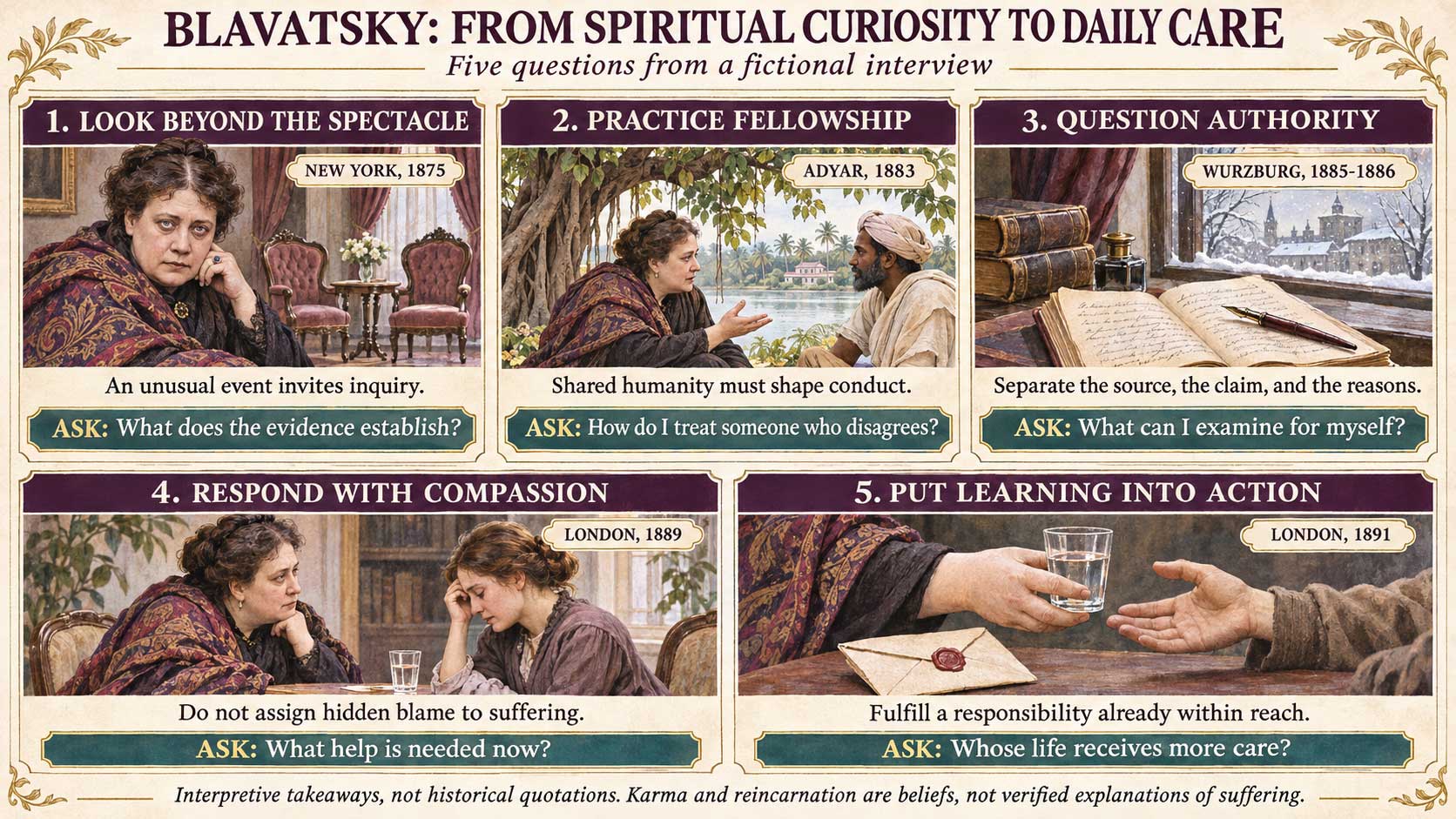
Short Bios:
Helena Petrovna Blavatsky: Helena Petrovna Blavatsky (1831–1891) was a Russian-born author and cofounder of the Theosophical Society. Her major works include Isis Unveiled, The Secret Doctrine, The Key to Theosophy, and The Voice of the Silence. She sought to connect religious, philosophical, and spiritual inquiry through the teachings she presented as Theosophy. The Theosophical Society’s biographical overview provides further background and access to her writings.
Nick Sasaki: Nick Sasaki is the creator of ImaginaryTalks.com, where fictional conversations bring historical figures and consequential ideas into accessible, personal exchanges. His interviews seek to help readers appreciate a guest’s contributions through curiosity, thoughtful questions, humor, and human connection.
Leave a Reply