
Introduction
Middlemarch by George Eliot: What If the Characters Met Again After Death?
What if Dorothea Brooke could finally ask Edward Casaubon whether he had ever truly loved her?
What if Lydgate and Rosamond could confront the question that haunted their marriage: Who was really responsible for their unhappiness?
And what if the characters of George Eliot's Middlemarch could meet once more, with their entire lives behind them, and say the things they never managed to say while they were alive?
In this imaginary conversation, nine unforgettable characters return to Lowick, the home where Dorothea once hoped to begin a meaningful marriage.
There are no reputations left to protect. No fortunes to inherit. No social positions to defend.
Yet the old wounds remain.
When the Characters of Middlemarch Speak Again
First published in 1871–1872, George Eliot's Middlemarch is one of the great novels about human ambition, marriage, disappointment, and the complicated relationship between our intentions and our actions.
Its characters rarely set out to destroy their own happiness. Most begin with understandable hopes.
Dorothea longs to devote herself to a noble purpose. Casaubon dreams of intellectual greatness. Lydgate hopes to transform medicine. Rosamond wants a beautiful, secure life. Fred Vincy must learn how to become worthy of Mary's trust.
And Nicholas Bulstrode discovers how easily religious conviction can become a shelter for self-deception.
Their choices gradually shape lives very different from the ones they imagined.
But what would happen if they could finally understand the consequences?
Five Questions They Never Fully Answered
This fictional reunion unfolds through five continuous conversations:
Did You Ever Love Me, or Only the Person You Wanted Me to Be? Dorothea and Casaubon confront the expectations that poisoned their marriage, while Lydgate and Rosamond recognize an uncomfortable resemblance.
You Blame Me for Your Failure. But What About Your Own Choices? Lydgate and Rosamond revisit their marriage without allowing either person to claim complete innocence.
Can You Forgive Someone Who Never Admitted What They Did? Bulstrode faces the harm concealed beneath his religious justifications, while Harriet reveals why loyalty does not require denying wrongdoing.
Why Did the Ordinary Couple Find the Happiness We Could Not? Fred and Mary challenge the belief that a successful life must be grand, wealthy, or admired.
If You Could Live Your Life Again, What Would You Change? All nine characters confront their regrets and discover that the value of a life cannot always be measured by its greatest ambition.
Beyond the Original Novel
These conversations do not appear in George Eliot's book. They are original fictional scenes inspired by its characters, relationships, and moral questions.
The aim is not to rewrite their histories or give everyone a perfect reconciliation.
Casaubon remains proud and defensive. Rosamond does not suddenly abandon her love of comfort. Lydgate cannot simply forget the career he might have had. Bulstrode's remorse does not undo the harm he caused.
Instead, the characters are given something they rarely possessed in life: the opportunity to listen without the pressures of Middlemarch society surrounding them.
The original novel remains essential to understanding their choices. Readers can explore the complete text of Middlemarch at Project Gutenberg and learn more about George Eliot's life and literary achievements at Encyclopaedia Britannica.
At the heart of these imagined conversations lies a question that extends far beyond nineteenth-century England:
What if the most important measure of our lives is not what we accomplished, but how we treated the people who shared them?
The reunion begins in Casaubon's drawing room, where Dorothea stands before the desk that once represented everything she hoped her marriage would become.
(Note: This is an imaginary conversation, a creative exploration of an idea, and not a real speech or event.)

Topic 1: Did You Ever Love Me, or Only the Person You Wanted Me to Be?
The drawing room at Lowick was almost exactly as Dorothea remembered it.
The same heavy curtains. The same dark furniture. The same shelves crowded with books that had once seemed to contain all the wisdom of the ancient world.
Even the desk remained in its familiar position beside the window.
Dorothea stood before it, examining a stack of papers.
Casaubon: "I would prefer that those remain undisturbed."
She turned.
Edward Casaubon stood in the doorway, looking considerably less surprised to see her than she was to see him.
Dorothea: "I wasn't going to touch them."
Casaubon: "You were always interested in my papers."
Dorothea: "I was interested in helping you."
Casaubon: "Yes. You frequently expressed that desire."
Something in his tone brought back an old sensation, one Dorothea had nearly forgotten: the feeling of having offered something precious and somehow caused offense.
Dorothea: "You say that as though it were a fault."
Casaubon: "I say it as a statement of fact."
Dorothea: "Did you ever wonder why I wanted to help you so much?"
Casaubon: "You admired intellectual achievement."
Dorothea: "I admired yours."
He glanced at the papers.
Casaubon: "An admiration which, I believe, did not survive close acquaintance."
Dorothea studied him.
Dorothea: "Is that what you thought?"
Casaubon: "I was not entirely unaware of your disappointment."
Dorothea: "I was disappointed that you wouldn't let me come near you."
Casaubon: "You were my wife."
Dorothea: "I know what I was called, Edward. I am asking whether you ever allowed me to be anything more."
He stiffened.
Casaubon: "I hardly think such language is justified."
Dorothea: "Then tell me what I have misunderstood."
A voice came from the doorway.
Will Ladislaw: "That could take some time."
Casaubon turned sharply.
Casaubon: "I see that my cousin has lost none of his talent for arriving where he is least wanted."
Will: "And you have lost none of your talent for making a room uncomfortable."
Dorothea: "Will."
There was enough warning in her voice to make him stop.
Will: "Very well. I shall behave."
Casaubon: "A novelty worth observing."
Will pulled out a chair.
Will: "You know, Dorothea, I have often wondered what you saw in him."
Dorothea: "Then you might have asked me."
Will: "I did. More than once, in different ways."
Dorothea: "No. You told me what you thought I ought to see."
Will opened his mouth, then closed it.
Casaubon looked almost pleased.
Dorothea: "When I first met Edward, I believed he had devoted his life to something important. I thought he possessed a knowledge I lacked. I wanted to learn from him."
Will: "You wanted to worship him."
Dorothea: "Perhaps I did."
The admission surprised both men.
Dorothea: "I was very young. I believed that if a person devoted himself to a great purpose, everything else about him must somehow be great as well."
Casaubon: "And you discovered otherwise."
Dorothea: "I discovered that knowledge and kindness are not the same thing."
Casaubon looked away.
Dorothea: "But I was unfair to you in one respect. I had invented a man in my imagination before I knew the real one."
Casaubon: "At last, an acknowledgment."
Dorothea: "Please don't mistake it for an accusation against myself alone."
The door opened again.
Tertius Lydgate entered, followed by Rosamond, who paused to examine the room with an expression of mild disapproval.
Rosamond: "I had forgotten how gloomy Lowick was."
Will: "We were just discussing the disappointments of marriage."
Rosamond: "Then perhaps the room is appropriate."
Lydgate gave her a quick look.
Lydgate: "Must you begin immediately?"
Rosamond: "I merely made an observation."
Will: "A very good one."
Casaubon: "I had hoped this gathering might permit a degree of serious conversation."
Rosamond: "I am perfectly capable of serious conversation, Mr. Casaubon."
Lydgate: "When it suits you."
Rosamond sat down.
Rosamond: "And there it is."
Dorothea: "What is?"
Rosamond: "That tone. Tertius always believed he was being reasonable when he spoke to me as though I were a troublesome child."
Lydgate: "You frequently behaved as though practical matters were beneath your attention."
Rosamond: "And you frequently behaved as though my wishes were beneath yours."
Will glanced at Dorothea.
Will: "It appears our conversation has acquired another marriage."
Dorothea: "Perhaps we have all come to discuss the same mistake."
Lydgate: "Which mistake?"
Dorothea: "Marrying someone we did not truly know."
Rosamond looked at her husband.
Rosamond: "I certainly did not know Tertius."
Lydgate: "You knew I intended to devote myself to medicine."
Rosamond: "I knew you were a gentleman with an excellent education and a promising career. I did not know that you expected your wife to find happiness in unpaid bills and an increasingly uncomfortable house."
Lydgate: "I did not expect unpaid bills either."
Rosamond: "Yet somehow they became my duty to endure without complaint."
Lydgate: "I expected you to understand that our circumstances required sacrifices."
Rosamond: "You expected me to become a different woman after we married."
That silenced him briefly.
Dorothea: "Did you?"
Lydgate: "I expected a certain degree of cooperation. That is hardly unreasonable."
Rosamond: "You expected admiration when you came home and obedience when you disagreed with me."
Lydgate: "And you expected an income I had never promised you."
Rosamond: "I expected a husband who knew how to provide for the life he had invited me to share."
Will: "You both seem to have married a future rather than a person."
Lydgate: "That is a clever phrase, Ladislaw. It does not explain what one ought to do when the future collapses."
Dorothea: "Perhaps one begins by asking whether the other person is frightened."
Rosamond turned toward her.
Rosamond: "You were always very generous in your interpretations of people."
Dorothea: "Not always."
Rosamond: "You were generous to me when you had every reason not to be."
Dorothea remembered the painful misunderstanding that had once brought her to Rosamond's home.
Dorothea: "You were unhappy. I could see that."
Rosamond: "So were you."
Dorothea: "Yes."
Rosamond: "Yet you asked about my suffering before speaking of your own. I have never forgotten that."
Lydgate looked at his wife with surprise. Such admissions had rarely come easily to her.
Casaubon: "Compassion is admirable, provided it does not prevent a clear assessment of responsibility."
Will: "An interesting observation from you."
Casaubon: "I beg your pardon?"
Will: "You demanded that Dorothea devote herself to your work. You became jealous of her friendship with me. And after your death, you attempted to influence whom she might marry."
Casaubon: "I took precautions against circumstances I had reason to distrust."
Dorothea: "Edward, you never asked whether your suspicions were true."
Casaubon: "I observed what was before me."
Dorothea: "You observed Will speaking to me. You observed that I enjoyed his company. You decided what those things meant."
Casaubon: "I was not blind to the possibility of impropriety."
Will: "There was none."
Casaubon: "Your assurance is hardly conclusive."
Dorothea: "Then take mine."
Casaubon fell silent.
Dorothea: "I was faithful to you. I wanted our marriage to succeed. Even when I was miserable, I wanted to find some way of making you happy."
Casaubon: "Your conduct was not always reassuring."
Dorothea: "What could I have done to reassure you?"
Casaubon: "You might have shown greater confidence in my judgment."
Dorothea: "I tried."
Casaubon: "You questioned my work."
Dorothea: "I asked how I could help."
Casaubon: "You did not comprehend the scope of the undertaking."
Dorothea: "Then you might have taught me."
His fingers moved restlessly against the arm of his chair.
Dorothea: "I was willing to spend years learning whatever you needed me to learn. But every time I approached you, you seemed to feel that I was examining you."
Casaubon: "You cannot appreciate the difficulties of scholarship when one's work is subject to constant misunderstanding."
Will: "Your work was not merely misunderstood, sir. Its foundations were already becoming obsolete."
Casaubon: "I shall not submit my intellectual career to your judgment."
Dorothea: "Will, please."
Will: "He is still using the same excuse."
Dorothea: "I know. But I am asking about something else."
She turned back to Casaubon.
Dorothea: "Were you afraid that I would discover you were not the great scholar I believed you to be?"
Casaubon stared at her.
Casaubon: "That is an exceedingly impertinent question."
Dorothea: "I am sorry if it hurts you."
Casaubon: "It does not hurt me. It merely demonstrates the inadequacy of your understanding."
Rosamond: "That sounds very familiar."
Lydgate shifted in his chair.
Rosamond: "Whenever I asked Tertius something he disliked, I was informed that I did not understand."
Lydgate: "You often did not."
Rosamond: "Possibly. But it is a convenient explanation for a man who does not wish to answer."
For the first time, Will looked at Rosamond with something approaching appreciation.
Lydgate: "You speak as though I had never listened to you."
Rosamond: "You listened when I agreed with you."
Lydgate: "And you disregarded me whenever the truth was unpleasant."
Rosamond: "I disliked being told that the life I had been promised was no longer possible."
Lydgate: "It was never promised."
Rosamond: "Not in words, perhaps."
Dorothea considered this.
Dorothea: "That may be the cruelest part of it. We make promises in our minds and expect the other person to keep them."
Will: "But surely we must imagine something when we fall in love."
Dorothea: "Of course. We imagine a future together. The mistake is believing the other person has agreed to every detail of it."
Will: "Did you imagine a different future with me?"
Dorothea smiled faintly.
Dorothea: "I imagined a life in which I could speak freely."
Will: "Only that?"
Dorothea: "You know very well it was not only that."
Will: "I should hope so."
Dorothea: "But I must ask you something, Will. Did you love me as I was, or did you love the idea of rescuing me?"
He looked genuinely startled.
Will: "Rescuing you?"
Dorothea: "You thought I was trapped in a terrible marriage. You admired my goodness. You were angry on my behalf. Sometimes I wondered whether you loved me, or the woman you imagined I might become once I was free."
Will: "I never wanted to make you into anything."
Dorothea: "Never?"
Will hesitated.
Will: "I wanted you to stop sacrificing yourself for people who could not appreciate it."
Dorothea: "And if I had continued?"
Will: "I would have argued with you."
Dorothea: "I know."
Will: "Repeatedly."
She laughed.
Dorothea: "I know that too."
Will: "But I would not have forbidden you."
Casaubon gave a small, irritated movement.
Will: "There is a difference."
Dorothea: "Yes. There is."
Lydgate leaned forward.
Lydgate: "I wonder whether that distinction is quite so simple. A husband and wife cannot live as entirely independent beings. One person's decisions affect the other."
Mary Garth, passing the open doorway, paused when she heard him.
Mary: "That is perfectly true. It does not follow that one person should make all the decisions."
Fred appeared behind her.
Fred Vincy: "I should advise everyone to listen to Mary on that subject. She has considerable experience correcting foolish husbands."
Mary: "One husband, Fred. And he provided more than enough experience."
Fred: "I was hoping you would say he had improved."
Mary: "He has. But we are not here to discuss him yet."
Fred grinned and led her toward the adjoining room.
Their brief interruption left a trace of laughter behind.
Rosamond watched them go.
Rosamond: "Mary always knew exactly what she wanted."
Lydgate: "She knew what she would not tolerate."
Rosamond: "Perhaps those are the same thing."
Dorothea: "Did you know what you wanted, Rosamond?"
Rosamond: "Certainly. A pleasant home, a respected husband, beautiful things, and a life without constant anxiety over money."
Dorothea: "And did you know what Tertius wanted?"
Rosamond: "To become a great physician."
Dorothea: "What did that mean to him?"
Rosamond considered the question.
Rosamond: "I thought it meant he would become successful."
Lydgate: "It meant I wanted to improve medicine. I wanted to investigate disease properly, to understand what other physicians were content merely to treat."
Rosamond: "And I admired you for it."
Lydgate: "Until it required something of you."
Rosamond: "Until I discovered that your ambitions occupied nearly all the space in our marriage."
Lydgate: "That is unfair."
Rosamond: "Is it?"
Lydgate: "I worked for our future."
Rosamond: "You worked for the future you wanted. You assumed I would be happy inside it."
He looked down at his hands.
Dorothea: "Tertius, when you imagined marrying Rosamond, what did you believe she would bring to your life?"
Lydgate: "Beauty. Grace. Affection. A peaceful home."
Rosamond: "There. You see?"
Lydgate: "See what?"
Rosamond: "You have described everything I was supposed to provide for you. You have said nothing about the life I hoped to have."
Lydgate was silent.
Rosamond: "You wanted a beautiful wife who would make your home agreeable while you devoted yourself to important work."
Lydgate: "I wanted a wife who understood me."
Rosamond: "But you did not think understanding me was equally important."
The accusation hung in the room.
Casaubon: "It seems to me that marriage is becoming an impossible institution under these requirements. Each party must apparently anticipate every desire of the other."
Dorothea: "No, Edward. We are saying that each must be willing to discover what those desires are."
Casaubon: "And if they prove incompatible?"
Dorothea: "Then it is better to know the truth than spend a lifetime punishing one another for it."
Casaubon looked at her with an expression she could not quite interpret.
Casaubon: "You speak as though the truth were always easily obtained."
Dorothea: "It is not."
Casaubon: "There are things a person cannot readily confess, even to himself."
Dorothea waited.
Casaubon: "A man may have invested so much of his existence in a particular undertaking that to question it is to question the value of his entire life."
Will looked toward the desk, but this time he said nothing.
Casaubon: "If others have placed expectations upon him, expectations he did not solicit, the burden becomes greater."
Dorothea: "I did place expectations upon you."
Casaubon: "You did."
Dorothea: "I believed you could teach me how to live a useful life."
Casaubon: "And I found myself married to a young woman who expected greatness from me at every turn."
Dorothea: "I would have loved you without greatness."
Casaubon looked up.
Casaubon: "Would you?"
Dorothea: "I believe so. But you never let me discover the man beneath the scholar."
Casaubon: "Perhaps there was very little else to discover."
It was spoken so quietly that Dorothea almost missed it.
Will shifted in his chair, suddenly uncomfortable.
Dorothea: "Edward."
Casaubon: "I am not asking for pity."
Dorothea: "I know."
Casaubon: "I was accustomed to being regarded as a man of learning. Your admiration initially pleased me. But as time passed, I became conscious that you expected something from me that I could not easily provide."
Dorothea: "Affection?"
He hesitated.
Casaubon: "Confidence. Certainty. A sense of purpose that I myself did not always possess."
Dorothea: "I never knew you doubted yourself."
Casaubon: "I took considerable pains to ensure that you did not."
Will: "And in doing so, you made her believe that she was the problem."
Casaubon turned toward him.
Casaubon: "Must you always interpret my conduct in the least charitable manner?"
Will: "I have just heard you describe how carefully you concealed your uncertainty from her. What interpretation would you prefer?"
Dorothea: "Will, let him finish."
Casaubon studied Dorothea for a long moment.
Casaubon: "I did not know how to bear your disappointment."
Dorothea: "So you made me afraid to express it."
He did not answer.
Dorothea: "I spent so much time trying to become a better wife that I scarcely noticed how unhappy I had become."
Casaubon: "I was unhappy too."
Dorothea: "I know that now."
Casaubon: "I do not suppose knowing it alters your judgment."
Dorothea: "It alters my understanding. That is not quite the same thing."
Rosamond looked at Lydgate.
Rosamond: "I wonder whether we might have spoken like this."
Lydgate: "We spoke often enough."
Rosamond: "We argued. We defended ourselves. We told each other what had gone wrong."
Lydgate: "And what would you have wished to say instead?"
She thought for a while.
Rosamond: "That I was frightened."
Lydgate looked at her.
Rosamond: "I was frightened of losing the life I had imagined. Frightened of being pitied. Frightened that everyone would discover I had married a man who could not provide what I expected."
Lydgate: "I wish you had told me."
Rosamond: "Would you have listened?"
He began to answer, then stopped.
Lydgate: "I cannot say that I always listened well."
Rosamond lowered her eyes.
Rosamond: "Neither did I."
There was no embrace, no sudden transformation. But for a moment they were speaking without trying to win.
Dorothea turned toward Casaubon again.
Dorothea: "May I ask you one last question?"
Casaubon: "You have asked several."
Dorothea: "I know."
She sat opposite him, close enough that he could no longer avoid looking at her without deliberately turning away.
Dorothea: "Was there ever a moment in our marriage when you were simply happy that I loved you?"
Casaubon stared at the fire.
A log shifted, sending a small shower of sparks upward.
Casaubon: "I remember the early days of our acquaintance."
Dorothea: "Yes?"
Casaubon: "You listened to me with such attention."
Dorothea waited.
Casaubon: "It was agreeable to be listened to."
Dorothea: "I am asking whether you were happy to be loved."
Casaubon: "I am attempting to answer."
Dorothea: "Forgive me."
He looked down at his hands.
Casaubon: "There was an evening at Lowick. You had been reading beside the fire. I had been working for some hours. You brought me a cup of tea."
Dorothea remembered.
Casaubon: "You did not ask about the work. You did not offer assistance. You merely placed the cup beside me and returned to your chair."
Dorothea: "I thought you wished to be left alone."
Casaubon: "I did."
A long silence followed.
Casaubon: "Yet I remember being conscious that I was not alone."
Dorothea's eyes filled, though she did not look away.
Casaubon: "I cannot tell you whether that answers your question."
Dorothea: "It does."
Will stood near the window, looking out at the darkening garden.
Rosamond sat quietly beside Lydgate.
No one seemed eager to interrupt.
At last Casaubon reached toward the papers on his desk, then withdrew his hand.
Casaubon: "I suppose I might have told you."
Dorothea: "Yes."
Casaubon: "It did not occur to me that such a small matter required explanation."
Dorothea: "It would not have been a small matter to me."
He looked at her, and this time he did not turn away.
The fire burned steadily between them.
For years Dorothea had imagined that the tragedy of their marriage lay in the greatness she had sought and failed to find.
Now she saw something sadder: two people who had occasionally reached toward each other, but had mistaken the distance between them for proof that reaching was useless.
She could not recover their lost years.
Neither could he.
But for the first time, she understood that the man who had seemed incapable of receiving love had, at least once, felt its warmth.
And had never known how to say so.
Topic 2: You Blame Me for Your Failure. But What About Your Own Choices?
The fire had burned lower.
Lydgate rose from his chair and wandered toward Casaubon's desk, where an old medical volume lay beneath a pile of papers.
He picked it up, turned several pages, and stopped at an illustration of the human heart.
Lydgate: "Extraordinary. We understood so little."
Rosamond: "You said that rather often."
Lydgate: "And I was right."
Rosamond: "You were usually right about medicine. That was never our difficulty."
Lydgate: "What, then, was our difficulty?"
Rosamond regarded him.
Rosamond: "You were always so certain that your work would justify everything else."
He closed the book.
Lydgate: "My work was not some foolish indulgence, Rosamond. I wanted to understand disease. I wanted to practice medicine without merely repeating what other men had done for generations."
Rosamond: "I know what you wanted."
Lydgate: "Do you? I sometimes doubted it."
Rosamond: "You wanted to become a great physician. You wanted everyone to recognize your ability. And you wanted a wife who would admire you while asking very little in return."
Lydgate: "That is a remarkably uncharitable account."
Rosamond: "It is the account I lived."
Dorothea looked from one to the other.
Dorothea: "Perhaps you both remember different parts of the same marriage."
Lydgate: "I remember trying to keep us from ruin."
Rosamond: "And I remember being told that everything I valued was extravagant."
Lydgate: "Some of it was extravagant."
Rosamond: "Then you ought not to have encouraged me to believe we could afford it."
Lydgate: "I was mistaken about our prospects."
Rosamond: "Precisely."
The word was so quietly delivered that it irritated him more than an accusation would have.
Lydgate: "I have admitted that I made mistakes. But you cannot seriously suggest that my financial misjudgments excuse your conduct."
Rosamond: "Which conduct would you like to discuss first? My furniture? My visits? My refusal to be cheerful when you told me we must leave our house?"
Lydgate: "Your interference with arrangements I had made to settle our debts."
Rosamond: "You mean the arrangements you made without considering how they would affect me."
Lydgate: "They affected both of us. That was rather the point."
Rosamond: "You speak as though you were the only person entitled to make decisions."
Lydgate: "Someone had to confront reality."
A voice came from the adjoining room.
Mary Garth: "That is a dangerous sentence, Mr. Lydgate. It generally means the speaker has appointed himself reality's sole representative."
Mary entered carrying a fresh pot of tea. Fred followed with a plate of biscuits.
Fred Vincy: "I can testify that Mary has never permitted me to hold that position."
Mary: "You never applied for it."
Fred: "I was considering doing so."
Mary: "Then I have saved you the trouble."
Fred placed the biscuits on the table.
Fred: "I heard something about debts. If you require an expert on making them, I was once exceptionally qualified."
Lydgate: "I doubt this is a suitable occasion for humor."
Fred: "It rarely was when the creditors came."
Mary gave him a look.
Fred: "Very well. I shall be serious."
He sat down.
Fred: "Though I should warn you that seriousness was never my strongest quality."
Mary: "That is why I married you only after you acquired some others."
Rosamond watched her brother and Mary exchange a familiar smile.
Rosamond: "You make everything sound very simple."
Mary: "It was not simple."
Rosamond: "You had a husband willing to change for you."
Mary: "Fred had to change for himself. I merely declined to marry him while he was determined to remain irresponsible."
Fred: "She was quite firm about it."
Mary: "You had already given me considerable reason."
Fred: "I had."
The ease with which he admitted it seemed to trouble Rosamond.
Rosamond: "You speak as though becoming responsible were a matter of deciding to be so."
Fred: "No. Deciding was the easy part. Getting up every morning and doing the work was less entertaining."
Lydgate: "Fred's situation was hardly comparable to mine."
Fred: "No. I was fortunate enough to have Caleb Garth teach me a trade I could make useful. I did not have your medical ambitions."
Mary: "And you were fortunate enough to stop imagining that someone else's money would arrange your future."
Fred nodded.
Fred: "That too."
Lydgate returned the medical volume to the desk.
Lydgate: "You are all overlooking something. I had genuine ability. My ambitions were not fantasies. I might have contributed something important to medicine."
Dorothea: "I believe that."
He turned toward her.
Dorothea: "I believed it when you were in Middlemarch, and I believe it now."
Lydgate: "Then you understand what was lost."
Dorothea: "I understand that you lost something precious. But I am not certain that Rosamond was the only reason."
His expression hardened.
Lydgate: "I never said she was the only reason."
Rosamond: "You did not need to."
Lydgate: "You seem determined to make me responsible for everything."
Mary: "Perhaps the difficulty is that each of you has spent so many years defending your own account that you have forgotten to examine it."
Lydgate: "And what would you have me examine?"
Mary: "Your debts, for a beginning."
Fred shifted uncomfortably.
Fred: "Mary has an alarming habit of beginning with the least pleasant subject."
Mary: "It is often the one everyone has been avoiding."
Lydgate: "I was establishing a practice. Certain expenses were unavoidable."
Mary: "Some expenses, certainly. Were all of them?"
Lydgate did not answer immediately.
Mary: "You wanted to be independent of Middlemarch society. Yet you married into a family whose expectations were shaped by that society. You took a fine house. You furnished it handsomely. You assumed your income would soon support it."
Lydgate: "I underestimated the difficulty of building a practice."
Mary: "Yes."
Lydgate: "And I was not the first young professional to do so."
Mary: "No. But that does not make the mistake disappear."
Rosamond's expression brightened slightly.
Mary: "Nor does it excuse what Rosamond did afterward."
The brightness vanished.
Rosamond: "I beg your pardon?"
Mary: "You knew the debts were serious. You knew Tertius was trying to arrange a way out. Yet you acted against his plans without telling him."
Rosamond: "I was trying to preserve our home."
Mary: "By concealing your decisions from your husband?"
Rosamond: "He had already decided everything without me."
Mary: "Then you ought to have confronted him openly."
Rosamond: "You make confrontation sound very easy."
Mary: "It is not easy. It is merely better than pretending an unpleasant fact does not exist."
Rosamond looked toward the window.
Rosamond: "You never understood what it was like to be admired by everyone and then discover that they were beginning to pity you."
Mary: "No. I was never admired by everyone."
Fred laughed before he could stop himself.
Mary: "Thank you, Fred."
Fred: "I was laughing at the absurdity of anyone failing to admire you."
Mary: "A remarkable recovery."
Even Rosamond smiled faintly.
Then she looked at Lydgate.
Rosamond: "You do not know how humiliating it was. People noticed everything. The servants, the furniture, whether I entertained, whether I wore the same dress too often. I had been brought up to believe that a respectable marriage meant security."
Lydgate: "And I had been brought up to believe that a respectable marriage meant affection and mutual support."
Rosamond: "Then perhaps we were both badly educated."
Will, who had been listening near the fireplace, spoke for the first time.
Will Ladislaw: "That may be the most sensible thing either of you has said."
Lydgate: "You were never required to maintain a medical practice, Ladislaw."
Will: "No. But I have known what it means to be judged by one's position and prospects."
Rosamond: "And you were fortunate enough to marry a woman who did not require luxury."
Will: "Dorothea never cared much for luxury."
Dorothea: "I cared for other things that could be equally unreasonable."
Will: "Such as?"
Dorothea: "Great purposes. Noble sacrifices. The belief that wanting to do good was enough to make me wise."
Mary: "You have at least learned to laugh at yourself."
Dorothea: "Not as readily as I should like."
Lydgate sat down again.
Lydgate: "I sometimes think everyone remembers my failures more clearly than my work."
Dorothea moved closer.
Dorothea: "I remember your work."
Lydgate: "You remember what I hoped to do."
Dorothea: "I remember the hospital. I remember how seriously you took the suffering of your patients. I remember that you were willing to challenge practices you believed were wrong."
Lydgate: "And yet I never became the man I intended to become."
Rosamond: "You became a successful physician."
He looked at her.
Lydgate: "Successful in a fashionable practice. That was not the same thing."
Rosamond: "It was not nothing."
Lydgate: "No. But I knew what I might have done."
Rosamond: "You never allowed yourself to enjoy what you had accomplished."
Lydgate: "You were perfectly capable of enjoying it."
She flinched.
Dorothea noticed.
Dorothea: "Tertius, that was cruel."
Lydgate: "Perhaps. But I am tired of pretending that our marriage was an equal partnership in disappointment."
Rosamond: "You need not pretend. You have never pretended."
Lydgate: "You deliberately undermined my attempts to manage our finances."
Rosamond: "And you made me feel that I had ruined your life merely by wanting to be happy."
Lydgate: "You wanted happiness on terms we could not afford."
Rosamond: "You wanted greatness on terms I could not endure."
Silence followed.
Fred put down his biscuit.
Fred: "I think there is something both of you are avoiding."
Lydgate: "Enlighten us."
Fred: "You each believed the other ought to find happiness in your own ambition."
Rosamond: "I never asked Tertius to enjoy furniture."
Fred: "No. You asked him to enjoy the life that furniture represented."
Mary: "And Tertius expected you to find sufficient satisfaction in the importance of his medical work."
Lydgate: "A husband ought to be able to expect some sympathy for his profession."
Mary: "Of course. But sympathy is not the same as surrendering every personal wish."
Rosamond: "Thank you."
Mary: "Nor is having personal wishes a license to deceive your husband."
Rosamond sighed.
Rosamond: "You are remarkably determined to be fair to everyone."
Mary: "I am trying to be fair to the facts. It is less agreeable."
Lydgate leaned back.
Lydgate: "Then let us consider the facts. I was drawn into financial trouble. I attempted to find a practical solution. Rosamond resisted it. My reputation suffered further through the Bulstrode affair. My prospects in Middlemarch were ruined."
Dorothea: "Your reputation suffered unjustly in that affair."
Lydgate: "You were one of the few who believed so."
Dorothea: "I knew that suspicion was not proof."
Lydgate: "And your kindness helped us when we most needed it."
He looked at Rosamond.
Lydgate: "But kindness could not restore the career I had imagined."
Rosamond: "You speak as though the only important loss was yours."
Lydgate: "What did you lose, Rosamond?"
Her face became very still.
Rosamond: "The belief that my husband was pleased to have married me."
Lydgate looked at her.
Rosamond: "At first, you admired everything about me. You liked the way I dressed. You liked my music. You liked that other people thought me beautiful."
Lydgate: "I loved you."
Rosamond: "I believe you did. But when our troubles began, everything you had admired became evidence against me."
Lydgate: "Your conduct changed."
Rosamond: "So did yours."
She paused.
Rosamond: "I remember watching you come home and seeing disappointment before you had even spoken to me. Sometimes I had done nothing that day to deserve it. You were disappointed with your work, with your debts, with Middlemarch. But I was there, and you could be disappointed with me."
Lydgate's expression softened, though he remained guarded.
Lydgate: "I did not know you felt that."
Rosamond: "You did not ask."
Lydgate: "Would you have told me?"
She considered the question.
Rosamond: "Probably not."
Mary looked at her with interest.
Rosamond: "I had been taught to be agreeable. To be accomplished. To make a good impression. I had not been taught how to tell a man that I was afraid of him."
Lydgate: "Afraid of me?"
Rosamond: "Not that you would strike me. That you would look at me as though I were foolish. That you would tell me I understood nothing. That you would make me feel ashamed of wanting things that had always seemed perfectly natural."
Lydgate: "I wish you had told me."
Rosamond: "I wish you had been someone I could tell."
He looked away.
For a while, the only sound was the faint ticking of the clock.
Then Dorothea spoke.
Dorothea: "I remember coming to your house, Rosamond, when I had misunderstood what I saw between you and Will."
Rosamond lowered her eyes.
Dorothea: "I was terribly unhappy. Yet when we spoke, I began to understand how unhappy you were."
Rosamond: "You were kinder than I deserved."
Dorothea: "I don't think kindness must always be deserved."
Rosamond: "I had allowed you to believe something that was not true."
Dorothea: "And you told me the truth."
Rosamond: "Eventually."
Dorothea: "Yes."
Rosamond looked toward Will.
Rosamond: "I liked being admired. I knew Will admired me. I enjoyed it, even when I knew it meant something different to him."
Will: "I was foolish enough to make my feelings difficult to misunderstand."
Rosamond: "You were fond of Dorothea. I knew that too."
Will: "You knew it better than I wished."
Rosamond: "I did not want you, Will. Not in the way you wanted Dorothea. I wanted to feel that someone could still look at me with pleasure."
Lydgate's face changed.
Lydgate: "Was I so unpleasant to live with?"
Rosamond: "Sometimes."
He swallowed.
Rosamond: "And sometimes I made it impossible for you to be otherwise."
Mary said nothing. There was nothing to improve in that admission.
Lydgate rubbed his forehead.
Lydgate: "I have spent years imagining what might have happened if I had never married."
Rosamond: "I know."
Lydgate: "I imagined that I would have remained in Middlemarch, continued my research, and perhaps made some discovery worth remembering."
Dorothea: "Perhaps you would have."
Lydgate: "You need not flatter me."
Dorothea: "I am not flattering you. I am saying it was possible."
Mary: "But it was not certain."
Lydgate looked at her.
Mary: "You were proud before you married. You underestimated money before you married. You were impatient with people who did not think as you did. Rosamond did not invent those qualities."
He opened his mouth, then stopped.
Mary: "You had ability. I do not doubt it. But ability is not protection against one's own mistakes."
Fred: "I can confirm that. I possessed a great many talents for avoiding work, and none of them protected me from consequences."
Mary: "You possessed a talent for expecting consequences to be postponed."
Fred: "An excellent description."
Lydgate almost smiled.
Lydgate: "You make a persuasive case, Mrs. Garth."
Mary: "I am not trying to win a case."
Lydgate: "No?"
Mary: "I am trying to persuade you to stop treating the life you never lived as though it were a fact."
That struck him harder than she expected.
Lydgate: "The life I never lived."
Mary: "You know what happened in your actual life. You cannot know what would have happened in the other one."
Lydgate: "I might have accomplished more."
Mary: "Yes."
Lydgate: "I might have remained independent."
Mary: "Yes."
Lydgate: "I might have been happy."
Mary: "Yes. And you might have made different mistakes."
He stared at the medical volume on the desk.
Lydgate: "It is a difficult thing to surrender the belief that one was meant for something greater."
Dorothea: "I understand that very well."
Rosamond studied her husband.
Rosamond: "I never wanted you to fail, Tertius."
Lydgate: "I know you did not wish for failure."
Rosamond: "That is not quite the same thing."
Lydgate: "No."
Rosamond: "I wanted you to succeed. I wanted people to admire you. I wanted to be proud of you."
Lydgate: "Provided success brought you the life you expected."
She did not deny it.
Rosamond: "Yes. I suppose that is true."
Lydgate: "And I wanted you to love my work, provided it never required me to understand what you wanted."
Rosamond looked up sharply.
He continued before she could speak.
Lydgate: "I had always imagined that a wife would make the rest of life easier. I did not consider that marriage itself might require as much attention and discipline as a profession."
Fred: "More, sometimes."
Mary looked at him.
Fred: "I am speaking from experience."
Mary: "Then I am pleased to hear you have acquired some."
Lydgate smiled faintly, then turned back to Rosamond.
Lydgate: "I cannot pretend that your actions did not hurt me."
Rosamond: "Nor can I pretend that yours did not hurt me."
Lydgate: "I know."
She looked at him for a long time.
Rosamond: "There is something I have never asked you."
Lydgate: "What is it?"
Rosamond: "When you thought about the life you might have lived without me, did you ever imagine that I might have been happier without you?"
He stared at her.
Lydgate: "I suppose I assumed you would have found another husband."
Rosamond: "A richer one?"
He hesitated.
Lydgate: "Possibly."
Rosamond: "Someone who would have given me the house and the clothes and the comforts I wanted?"
Lydgate: "Is that not what you wished?"
Rosamond: "It is what I thought I wished."
Lydgate: "And now?"
Rosamond looked down at her hands.
Rosamond: "I don't know."
The simplicity of the answer seemed to surprise her.
Rosamond: "I know I wanted comfort. I know I wanted admiration. But I wonder whether I might have wanted something else if anyone had ever taught me to imagine it."
Dorothea moved closer.
Dorothea: "You can ask yourself that now."
Rosamond: "It seems rather late."
Dorothea: "Perhaps. But it is not too late to understand."
Rosamond smiled sadly.
Rosamond: "You always make understanding sound like a gift."
Dorothea: "Sometimes it is. Sometimes it hurts."
Lydgate rose and went back to the desk.
He opened the medical volume again, studying the illustration of the heart.
Lydgate: "I used to think the tragedy of my life was that I had not become the physician I intended to be."
No one interrupted.
Lydgate: "I still regret it. I believe I always shall."
He closed the book.
Lydgate: "But perhaps there was another failure I was less willing to examine."
Rosamond watched him.
Lydgate: "I spent so much time imagining the discoveries I might make about the human body that I neglected to understand the person who shared my home."
Rosamond: "You were not the only one who neglected that."
Lydgate: "No."
He placed the book carefully on the desk.
Lydgate: "I don't know whether we could have been happy, Rosamond."
Rosamond: "Neither do I."
Lydgate: "We wanted such different things."
Rosamond: "And we were both rather determined to have them."
For a moment, they smiled at each other with something like the affection they had known before marriage became a contest of disappointed expectations.
Fred rose to replenish the fire.
Fred: "I think I have learned something important this evening."
Mary: "That would be a pleasant surprise."
Fred: "That I was exceedingly fortunate you refused to marry me when I first asked."
Mary: "You were."
Fred: "You might have been less severe about it."
Mary: "You might have been less foolish."
Fred: "A fair point."
He put another log on the fire.
Lydgate looked at them, then at Rosamond.
Lydgate: "I once thought that if I had chosen a different wife, I would have become a different man."
Rosamond: "And do you still think so?"
He considered the question carefully.
Lydgate: "I think I might have lived a different life."
He paused.
Lydgate: "But I would still have been myself."
Rosamond nodded.
Rosamond: "Yes. I suppose we both would."
Outside, the rain had begun again, gently this time.
No one offered a final verdict on their marriage. There was no fair division of blame that could restore the years they had spent hurting each other.
Lydgate still believed he had lost a great opportunity. Rosamond still remembered how lonely and frightened she had been.
Neither memory canceled the other.
But for the first time, they had stopped asking whose disappointment mattered more.
And in the quiet that followed, that was enough.
Topic 3: Can You Forgive Someone Who Never Admitted What They Did?
The rain had stopped, but the windows of Lowick were still wet.
Lydgate remained beside the desk, one hand resting on the medical volume he had just closed. Rosamond sat near the fire. Dorothea was pouring fresh tea when Nicholas Bulstrode entered the room.
His wife, Harriet, followed him.
Bulstrode surveyed the gathering with the uneasy expression of a man who had entered a room in which his name had recently been spoken.
Bulstrode: "I trust I am not interrupting."
Dorothea: "Not at all. Please come in."
Harriet: "Thank you, Mrs. Ladislaw."
Dorothea smiled and moved two chairs closer to the fire.
Bulstrode noticed Lydgate standing beside the desk.
Bulstrode: "Dr. Lydgate."
Lydgate: "Mr. Bulstrode."
Their greeting was perfectly civil.
Neither man moved to shake hands.
Harriet: "You were discussing something serious, I think."
Rosamond: "Marriage. Disappointment. The usual subjects."
Will: "And the difficulty of admitting one's own mistakes."
Bulstrode removed his spectacles and began polishing them.
Bulstrode: "An admirable subject, provided it is approached with humility."
Lydgate: "Humility is a quality I have heard praised by many men who were reluctant to practice it."
Bulstrode stopped polishing his spectacles.
Bulstrode: "I presume that observation is intended for me."
Lydgate: "You may decide for yourself."
Dorothea: "Tertius."
Lydgate: "I am not proposing to quarrel. But if we are to speak honestly, I would prefer not to begin with sermons."
Bulstrode replaced his spectacles.
Bulstrode: "I have never claimed to be free from sin."
Lydgate: "No. You were always very willing to acknowledge that mankind was sinful."
Will: "Mankind in general is much easier to accuse than oneself in particular."
Casaubon, who had been reading quietly, looked up.
Casaubon: "Must every observation become a personal attack?"
Will: "Not every observation. Only those that deserve an answer."
Harriet: "Mr. Ladislaw, I think my husband understands that his conduct is being questioned."
Her voice was quiet, but Will immediately fell silent.
Harriet turned toward Bulstrode.
Harriet: "Nicholas, perhaps it would be better to hear what Dr. Lydgate wishes to say."
Bulstrode sat down.
Bulstrode: "Very well."
Lydgate remained standing.
Lydgate: "I have often wondered whether you ever understood what happened to me."
Bulstrode: "I am well aware that your reputation suffered during the unfortunate circumstances surrounding Mr. Raffles."
Lydgate: "Unfortunate circumstances?"
Bulstrode: "I am not attempting to diminish your suffering."
Lydgate: "You gave me money when I was desperate. Shortly afterward, Raffles died under circumstances that brought suspicion upon us both. The town concluded that I had been bought."
Bulstrode: "I did not intend that interpretation."
Lydgate: "Your intentions did not prevent it."
Bulstrode: "Nor was I responsible for every malicious conclusion reached by our neighbors."
Lydgate: "No. But you knew far more about Raffles than I did. You knew why his presence threatened you. And you allowed me to remain ignorant while my professional judgment became entangled in your private affairs."
Bulstrode's fingers tightened around the arms of his chair.
Bulstrode: "You are speaking as though I deliberately planned your disgrace."
Lydgate: "I am speaking of what you concealed."
Harriet: "Nicholas, did you ever tell Dr. Lydgate the whole truth?"
Bulstrode looked at his wife.
Bulstrode: "My dear, the circumstances were exceedingly complicated."
Harriet: "I know they were."
Bulstrode: "There were matters concerning my former life that I had long believed were best left undisturbed."
Harriet: "That was not what I asked."
He looked down.
Dorothea placed the teapot on the table.
Dorothea: "Perhaps we should begin with what you believed you were protecting."
Bulstrode: "My family. My position. The institutions to which I had devoted considerable resources."
Will: "And yourself."
Bulstrode: "Naturally, my own reputation was involved. A man's reputation is not a matter of indifference when others depend upon him."
Lydgate: "That is precisely how you justified everything, isn't it? Your interests were never merely your interests. They were always connected to some greater good."
Bulstrode: "I gave generously to charitable and religious causes."
Lydgate: "You did."
Bulstrode: "I supported medical improvements in Middlemarch."
Lydgate: "You did that too."
Bulstrode: "Then I fail to see why those facts should be dismissed."
Lydgate: "They should not be dismissed. But neither should they be used to erase the rest."
Bulstrode looked toward Dorothea, perhaps hoping for a gentler interpretation.
Bulstrode: "You have always understood the importance of charitable work, Mrs. Ladislaw."
Dorothea: "Yes. But I have never believed that doing good in one place gives us permission to do wrong in another."
Bulstrode: "I did not regard my conduct in those terms."
Dorothea: "I know. That is what troubles me."
He seemed genuinely surprised.
Dorothea: "When you wished to do something, did you sometimes persuade yourself that God must wish it too?"
Bulstrode: "I sought divine guidance in my decisions."
Dorothea: "Did you ever fear that you might be mistaking your own wishes for that guidance?"
Bulstrode: "Every sincere believer must guard against self-deception."
Dorothea: "Did you?"
Bulstrode opened his mouth, but no answer came immediately.
Casaubon closed his book.
Casaubon: "There is a danger in conducting moral inquiries as though a man's motives were transparent even to himself."
Will: "For once, I agree with you."
Casaubon appeared displeased by the agreement.
Will: "But that makes it more important to examine what a man actually did."
Casaubon: "Actions cannot always be judged without considering their circumstances."
Lydgate: "Certainly. Yet circumstances cannot excuse every action."
Harriet: "And sometimes the people who suffer most are those who knew nothing of the circumstances."
Everyone turned toward her.
Harriet sat with her hands folded in her lap.
Harriet: "I did not know about Nicholas's former dealings. I did not know what had happened to the people connected with them. I believed I understood the man I had married."
Bulstrode looked at her.
Bulstrode: "Harriet, I have never denied the pain I caused you."
Harriet: "You have acknowledged that I was hurt. It is not quite the same thing."
He lowered his eyes.
Harriet: "When the truth began to emerge, I was frightened. I was ashamed. I wondered whether everyone who looked at me believed I had known."
Rosamond: "I remember that feeling."
Harriet turned toward her.
Rosamond: "When people began whispering about Tertius, I could hardly bear to go out. I felt that everyone was examining my face to see whether I knew something."
Harriet: "Yes."
Rosamond: "I wanted the whole matter to disappear."
Harriet: "So did I."
Lydgate: "And I wanted someone to tell the truth."
Bulstrode shifted in his chair.
Bulstrode: "Dr. Lydgate, I did not ask you to alter your treatment of Raffles."
Lydgate: "No. You did not."
Bulstrode: "You prescribed his treatment according to your medical judgment."
Lydgate: "I did."
Bulstrode: "Then surely you must acknowledge that I did not direct your professional decisions."
Lydgate: "I acknowledge it. But after I left, the treatment was not followed as I had instructed."
Harriet turned toward her husband.
Harriet: "Nicholas?"
Bulstrode stared at the carpet.
Harriet: "I know that Mr. Raffles died. I know there were questions about the care he received. But I would like to hear you speak of it plainly."
Bulstrode: "He was gravely ill."
Lydgate: "Yes."
Bulstrode: "His condition was dangerous. I had reason to believe he might die regardless of the measures taken."
Lydgate: "That was possible."
Bulstrode: "I was under considerable distress."
Lydgate: "You were."
Bulstrode: "I had not slept properly. I was fearful of what his disclosures might bring upon my family."
Harriet: "Nicholas."
He looked at her.
Harriet: "What did you do?"
For a long moment, he said nothing.
Bulstrode: "I did not ensure that your instructions were followed."
Lydgate remained motionless.
Bulstrode: "And when Raffles demanded brandy, I allowed it to be given to him."
Harriet's face became very pale.
Lydgate: "Against my instructions."
Bulstrode: "Yes."
Lydgate: "You knew the treatment I had prescribed."
Bulstrode: "Yes."
Lydgate: "And you knew that his death would protect you from further disclosures."
Bulstrode's voice became strained.
Bulstrode: "I did not know that he would die."
Lydgate: "I did not say you knew."
Bulstrode: "I never resolved upon murder."
Lydgate: "I have not accused you of making such a resolution."
Bulstrode: "Then what is it you demand of me?"
Lydgate: "That you stop describing your conduct as though it were merely a series of unfortunate events."
The room fell silent.
Bulstrode looked toward the window.
Bulstrode: "I was afraid."
Harriet: "I know."
Bulstrode: "I had built a life. I had a family. I had sought to use my position for good purposes. Then a man from my past appeared, determined to destroy everything."
Will: "A man who knew things you had done."
Bulstrode: "Yes."
Will: "That is rather different from a man inventing accusations."
Bulstrode: "You cannot imagine what it is to see an entire existence threatened."
Dorothea: "Perhaps none of us can imagine your fear exactly. But fear does not make another person's life less valuable."
Bulstrode covered his face with one hand.
Bulstrode: "I know that now."
Lydgate: "Do you?"
Bulstrode looked up sharply.
Lydgate: "I am asking sincerely. Do you regret what happened because Raffles died, or because his death failed to protect you?"
Harriet: "Tertius."
It was the first time she had addressed him by his Christian name.
Harriet: "That is a terrible question."
Lydgate: "Yes."
Harriet: "But I think it is one Nicholas must answer."
Bulstrode looked at his wife as though she had abandoned him.
Bulstrode: "Harriet, surely you do not believe—"
Harriet: "I do not know what passed through your mind that night."
Bulstrode: "I have told you I was afraid."
Harriet: "I believe you. But I have lived with that question too."
His expression changed.
Bulstrode: "You never said so."
Harriet: "You never asked."
The words seemed to strike him more deeply than Lydgate's accusations.
Harriet: "After the scandal, I saw how miserable you were. I knew you were ashamed. I wanted to comfort you. But there were questions I was afraid to ask because I did not know whether I could bear the answers."
Bulstrode: "And yet you remained with me."
Harriet: "Yes."
Bulstrode: "You forgave me."
She looked at him for a long moment.
Harriet: "I loved you."
Bulstrode: "Is that not forgiveness?"
Harriet: "It may be part of it. But I do not think love makes every question disappear."
Rosamond leaned forward.
Rosamond: "Did you never consider leaving him?"
Harriet considered her answer.
Harriet: "I considered what my life had become. I considered the man I believed I knew, and the things I had discovered about him. I considered our children, our home, and the years we had shared."
Rosamond: "And you decided to stay."
Harriet: "I did."
Rosamond: "I do not know whether I could have done that."
Harriet: "Nor can I say what I would have done in your circumstances."
Rosamond: "But how could you trust him afterward?"
Harriet looked toward her husband.
Harriet: "Not in precisely the same way."
Bulstrode's face tightened.
Harriet: "Trust is not something one can command oneself to feel. I could choose to remain beside Nicholas. I could choose not to humiliate him. I could remember the kindnesses he had shown me. But I could not simply return to the ignorance in which I had lived before."
Dorothea: "That must have been terribly lonely."
Harriet: "At times."
Bulstrode: "I did not know."
Harriet: "There was much you did not know about my suffering, Nicholas. You were occupied with your own."
He lowered his head.
Casaubon stirred uneasily.
Casaubon: "There is something almost impossible in the demand that a person should fully comprehend the suffering of another."
Dorothea: "Yes. But we can try."
Casaubon: "Trying does not guarantee success."
Dorothea: "No. It does not."
She looked at him, remembering their earlier conversation.
Dorothea: "But refusing to try guarantees that we remain strangers."
Casaubon looked away.
Bulstrode drew a long breath.
Bulstrode: "I suppose you all believe that I used religion as an excuse for selfishness."
Will: "At times, yes."
Bulstrode: "You have never been sympathetic to my religious convictions."
Will: "My objection is not that you believed in God. It is that you seemed so certain God approved of whatever benefited Nicholas Bulstrode."
Bulstrode: "That is an offensive simplification."
Will: "Then tell us where it is wrong."
Bulstrode began to speak, but Dorothea interrupted gently.
Dorothea: "Nicholas, may I ask something?"
Bulstrode: "Certainly."
Dorothea: "When you prayed, did you ever ask God to change your heart? Or did you mostly ask Him to make your plans succeed?"
Bulstrode looked startled.
Bulstrode: "I prayed for guidance, forgiveness, and the advancement of righteous causes."
Dorothea: "I believe you did. But did you ever consider that the guidance you needed might require you to give up something you desperately wanted to keep?"
He stared at her.
Dorothea: "Your money. Your reputation. The respect of your neighbors. Even the image you had of yourself as a good man."
Bulstrode: "A man cannot be expected to abandon every responsibility merely to satisfy the accusations of others."
Dorothea: "I am not speaking of accusations. I am speaking of conscience."
Lydgate sat down.
Lydgate: "There was a time when I believed my medical ambitions justified nearly every sacrifice I asked of others."
Rosamond looked at him.
Lydgate: "I told myself that my work was important, which it was. But that made it easier to dismiss objections as ignorance or selfishness."
Rosamond: "You are comparing yourself to Mr. Bulstrode?"
Lydgate: "Not in the seriousness of our actions. I am speaking of the habit of mind."
Dorothea: "That is what frightens me most about self-deception. It does not always begin with an intention to do wrong."
Casaubon: "Indeed. A man may become so persuaded of the importance of his undertaking that criticism appears indistinguishable from hostility."
Will glanced toward him.
Will: "You are speaking of scholarship?"
Casaubon: "Among other things."
Dorothea said nothing, but her expression softened.
Bulstrode: "Then perhaps you can understand something of my position, Mr. Casaubon."
Casaubon: "I can understand the impulse to protect one's life's work from destruction."
Lydgate: "But understanding an impulse does not justify acting upon it."
Casaubon: "I did not say that it did."
Harriet looked toward Lydgate.
Harriet: "Dr. Lydgate, may I ask you something?"
Lydgate: "Of course."
Harriet: "Do you forgive Nicholas for what happened to your reputation?"
Lydgate was silent for several moments.
Lydgate: "I do not know."
Bulstrode looked at him.
Lydgate: "I have tried to distinguish what he intended from what happened. I know that the town was eager to believe the worst of me. I know my own decisions placed me in a vulnerable position."
He paused.
Lydgate: "But I cannot forget that I trusted him with my professional reputation while he concealed facts that would have changed my judgment."
Harriet: "I understand."
Lydgate: "I no longer wish him to suffer. If that is part of forgiveness, perhaps I have managed it."
Bulstrode: "But you do not absolve me."
Lydgate: "No."
Bulstrode: "Then what would satisfy you?"
Lydgate: "I am not certain satisfaction is possible. Raffles is dead. My years in Middlemarch cannot be restored. Your wife's suffering cannot be undone."
He leaned forward.
Lydgate: "But you could stop asking whether we have forgiven you long enough to consider what you actually did."
Bulstrode looked at him, then slowly lowered his gaze.
Bulstrode: "I have spent much of my life explaining myself."
Will: "You have been remarkably accomplished at it."
Harriet: "Mr. Ladislaw."
Will bowed his head slightly.
Will: "Forgive me."
Bulstrode did not respond immediately.
Bulstrode: "When I was young, I became involved in business practices that I knew were not entirely honorable. I persuaded myself that I could use the resulting wealth for better purposes."
He spoke slowly, as though each sentence required an effort.
Bulstrode: "Later, when I had an opportunity to act differently, I chose what preserved my advantage. I told myself that my charitable work justified the decision."
Harriet watched him without moving.
Bulstrode: "I believed that if I devoted enough of my life to worthy causes, the earlier wrongs might somehow be absorbed into the good."
Dorothea: "But the people who suffered those wrongs remained real."
Bulstrode: "Yes."
Lydgate: "And Raffles?"
Bulstrode's voice became almost inaudible.
Bulstrode: "When he was ill, I knew that his death would relieve me of a terrible danger."
He stopped.
No one spoke.
Bulstrode: "I did not resolve to kill him. I did not begin that night with such an intention."
Lydgate: "I understand."
Bulstrode: "But I cannot deny that the possibility of his death entered my thoughts as a deliverance."
Harriet closed her eyes.
Bulstrode: "And when I failed to ensure that your instructions were followed, I cannot honestly say that I was thinking only of what was best for him."
The clock on the mantel ticked steadily.
Bulstrode: "I have prayed for forgiveness. I have wished that night had never occurred. But I see now that I often prayed to be relieved of the consequences before I had fully faced the wrong."
Harriet opened her eyes.
Harriet: "Nicholas."
He turned toward her.
Harriet: "That is the first time I have heard you speak of it without defending yourself."
His expression crumpled.
Bulstrode: "I am ashamed."
Harriet: "I know."
Bulstrode: "I have brought shame upon you."
Harriet: "Yes."
He looked at her, startled by the directness.
Harriet: "You have. But that is not the whole of our life together."
Bulstrode: "I do not deserve your loyalty."
Harriet: "Perhaps not."
Rosamond drew in a quiet breath.
Harriet reached across the space between their chairs.
Harriet: "But I did not remain with you because I believed you deserved a reward."
Bulstrode stared at her outstretched hand.
Harriet: "I remained because I loved you, and because I believed that even a man who had done terrible wrong might still choose to live differently."
Bulstrode: "You believed I could become a better man?"
Harriet: "I hoped you would."
Bulstrode: "And did I?"
Harriet did not answer immediately.
Harriet: "You became quieter. You became less certain of your own righteousness. But I think you remained afraid of looking too closely at what you had done."
He nodded slowly.
Harriet: "Perhaps tonight you have looked a little more closely."
Bulstrode took her hand.
Dorothea watched them, her eyes bright.
Rosamond: "I used to think forgiveness meant deciding that something no longer mattered."
Harriet: "I do not think that is possible when it has mattered so much."
Rosamond: "Then what does it mean?"
Harriet considered the question.
Harriet: "I can only tell you what it meant for me. I refused to let Nicholas's worst actions become the only things I remembered about him."
Dorothea: "Without pretending they had not happened."
Harriet: "Yes."
Lydgate: "That is a difficult balance."
Harriet: "It was."
Bulstrode: "I fear I have demanded forgiveness as though it were another debt owed to me."
Harriet looked at him.
Harriet: "Then perhaps you can begin by no longer demanding it."
He nodded.
Bulstrode: "I shall try."
Will: "That would be a beginning."
This time there was no sarcasm in his voice.
Casaubon rose from his chair and moved toward the window.
Casaubon: "It is strange how readily we recognize the errors of others when they resemble our own."
Dorothea looked at him.
Dorothea: "Yes."
He did not turn around.
Casaubon: "And how much less readily we recognize them in ourselves."
Lydgate looked toward Bulstrode.
Lydgate: "I cannot tell you that everything is forgiven."
Bulstrode: "I understand."
Lydgate: "But I am glad you have spoken plainly."
Bulstrode: "I wish I had done so when it might have made a difference."
Lydgate: "So do I."
There was nothing more to say between them.
Harriet remained beside her husband, her hand resting in his.
The gesture was neither a verdict nor an acquittal.
It did not restore Raffles's life. It did not erase Lydgate's disgrace. It did not give Harriet back the years in which she had believed her husband was a different man.
But it meant that she had chosen not to withdraw every kindness from a man who had finally begun to face himself.
Bulstrode looked at their joined hands.
For much of his life, he had believed that goodness could be accumulated like wealth, that enough charitable acts might outweigh the wrongs he wished to forget.
Now, sitting beside the woman who knew his shame and had remained, he understood something he had long resisted.
Her love was not proof of his innocence.
It was a responsibility.
And for once, he did not try to explain it away.
Topic 4: Why Did the Ordinary Couple Find the Happiness We Could Not?
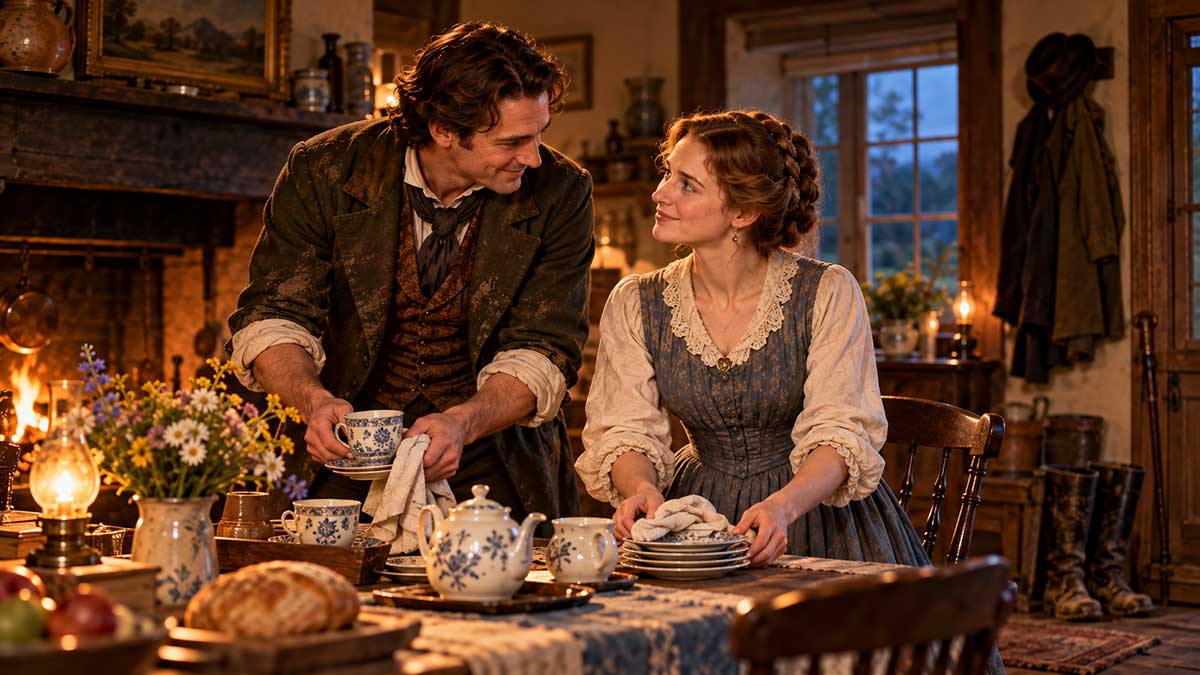
For some time after Bulstrode's confession, nobody spoke.
Harriet had taken her husband into the adjoining room. The door remained slightly open, and the low murmur of their voices could occasionally be heard.
Fred Vincy, who had been sitting near the fire, surveyed the solemn faces around him.
Fred: "Well, I think we have established that nearly everyone in Middlemarch had a difficult marriage."
Mary: "Not everyone, Fred."
Fred: "Precisely. Which is why I thought this might be an excellent moment to discuss ours."
Mary: "I was afraid you would."
Fred: "I have been waiting all evening for someone to notice that I was a remarkably successful husband."
Rosamond: "Fred, you were not a remarkably successful anything when you first proposed to Mary."
Fred: "My dear sister, must you always begin with the historical record?"
Mary: "I find it useful."
Fred: "I was hoping that after death we might be permitted to revise certain portions of it."
Will: "I suspect Mary would object."
Mary: "Only to the inaccurate portions."
Fred looked around the room.
Fred: "You see what I have endured? Years of marriage to a woman who remembers everything."
Dorothea: "And yet you seem very happy."
Fred: "There is no accounting for taste."
Mary gave him a look.
Fred: "Mine, I mean. My taste is excellent."
Even Lydgate laughed.
Rosamond watched her brother with a mixture of affection and curiosity.
Rosamond: "You really were happy, weren't you?"
Fred's smile softened.
Fred: "Yes."
Rosamond: "I used to think you had settled for very little."
Fred: "I know."
Rosamond: "You might have had a gentleman's life. Instead, you went about managing land, dealing with farmers, worrying over crops and rents."
Fred: "I rather enjoyed it."
Rosamond: "You came home tired and covered in mud."
Fred: "Not every evening."
Mary: "Frequently enough."
Fred: "And yet Mary continued to receive me."
Mary: "After you had removed your boots."
Rosamond shook her head.
Rosamond: "I could never understand it."
Fred: "That is because you were always more interested in the drawing room than in what happened outside it."
Rosamond: "There is nothing wrong with wanting a beautiful home."
Mary: "Of course not. But a beautiful home is rather less pleasant when everyone inside it is miserable."
Lydgate glanced at Rosamond.
She noticed.
Rosamond: "You needn't look at me, Tertius."
Lydgate: "I said nothing."
Rosamond: "You have become very expressive when you say nothing."
Will: "A useful accomplishment. Casaubon practiced it for years."
Casaubon looked up from his book.
Casaubon: "I should be grateful if my name were not introduced into every frivolous exchange."
Fred: "Then you must help us by making one yourself."
Casaubon: "One what?"
Fred: "A frivolous exchange."
Casaubon: "I have never considered frivolity a desirable accomplishment."
Mary: "That is unfortunate. It can make a difficult day considerably more bearable."
Casaubon returned to his book, though Dorothea thought she detected the faintest change in his expression.
Lydgate: "I admit I find your marriage rather puzzling, Fred."
Fred: "That makes two of us. I never quite understood how I persuaded Mary to marry me."
Mary: "You didn't persuade me."
Fred: "There, you see?"
Mary: "You finally became someone I could reasonably marry."
Fred leaned back.
Fred: "A much less romantic description."
Dorothea: "I think it is rather romantic."
Mary: "You would, Dorothea. You have always been inclined to see noble possibilities in people."
Dorothea: "And you saw possibilities in Fred."
Mary: "I saw a good heart and a very poor set of habits."
Fred: "A fair assessment."
Mary: "He was kind. He could be generous. He was amusing. But he expected life to arrange itself around his wishes."
Fred: "It was an agreeable expectation while it lasted."
Mary: "Until other people had to pay for it."
Fred's smile faded a little.
Fred: "Yes."
He looked at Lydgate.
Fred: "I once borrowed money I could not repay and placed Caleb Garth in a very difficult position. Mary had every reason to despise me for that."
Mary: "I didn't despise you."
Fred: "You were exceedingly angry."
Mary: "That is quite different."
Fred: "It did not feel different at the time."
Mary: "You had harmed people who trusted you. I was not going to pretend otherwise simply because I loved you."
Rosamond leaned forward.
Rosamond: "There. That is what I find interesting."
Mary: "What?"
Rosamond: "You loved Fred, yet you refused to accept him as he was."
Mary: "I accepted that he was irresponsible. I simply refused to marry an irresponsible man."
Rosamond: "Isn't that a way of demanding that someone change?"
Mary: "I did not demand that Fred become a different person for my benefit. I told him what I could and could not build a life upon."
Rosamond: "That sounds very much like a condition."
Mary: "It was."
Fred nodded.
Fred: "An unmistakable one."
Rosamond: "Then why is Mary's condition admirable, while Tertius's expectations of me are considered unreasonable?"
The room grew quieter.
Mary considered the question seriously.
Mary: "That is fair to ask."
Rosamond looked surprised.
Mary: "There is nothing wrong with wanting certain qualities in a husband or wife. Tertius was entitled to hope for a partner who understood his work. You were entitled to hope for a comfortable life."
Rosamond: "Exactly."
Mary: "But neither of you was entitled to marry the other and then behave as though your expectations had already been agreed upon."
Lydgate: "And how was Fred's situation different?"
Mary: "I told him before we married that I would not accept a life built upon idleness and expectations of inherited money. He was free to choose otherwise."
Fred: "Though I found the alternative extremely unattractive."
Mary: "That was your concern."
Fred: "And a powerful concern it was."
Dorothea: "Did you change because you were afraid of losing Mary?"
Fred thought for a moment.
Fred: "At first? Very much."
Mary: "I suspected as much."
Fred: "You were not subtle about making the consequences clear."
Mary: "You required clarity."
Fred: "But something happened after I began working with your father."
He looked toward the window, where the last light of the afternoon lay across the wet garden.
Fred: "I discovered that I liked being useful."
Mary turned toward him.
Fred: "I had always wanted people to think well of me. I had never particularly wanted to do the things that would justify their good opinion."
Will: "An affliction more common than most people admit."
Fred: "I was remarkably gifted at it."
Fred: "But when Caleb trusted me with real work, I found I wanted to deserve that trust. There were people depending upon me. Things had to be done whether I was in the mood or not."
Lydgate: "You discovered professional ambition."
Fred: "Perhaps. Though it did not look much like yours."
Lydgate: "You must understand that my ambitions involved scientific discovery."
Fred: "And mine involved knowing whether a field would drain properly."
Lydgate: "Hardly comparable."
Mary: "They needn't be comparable to be worthwhile."
Lydgate: "I did not say Fred's work lacked value."
Mary: "No. But you sounded as though it were a consolation prize for a man without greater talents."
Lydgate hesitated.
Lydgate: "I suppose I have always measured success by what a person might contribute beyond his immediate circumstances."
Fred: "So did I, once. I thought being a gentleman meant not having to work."
Rosamond: "You were brought up to expect a certain position."
Fred: "Yes. And I spent a good many years waiting for that position to arrive."
Mary: "Preferably without effort."
Fred: "Preferably."
Dorothea: "But your work mattered to the people around you."
Fred: "I hope it did. I helped manage land, dealt with tenants, learned something about farming. I was never famous."
Mary: "You were never in danger of it."
Fred: "Thank you, my dear."
Mary: "You're welcome."
Fred: "But I was useful. And when I came home, I generally knew why I was tired."
Lydgate looked down at his hands.
Lydgate: "There is something enviable in that."
Rosamond: "You never thought so when we were young."
Lydgate: "No."
Rosamond: "You thought Fred was wasting his opportunities."
Lydgate: "I thought he was capable of better things than living upon expectations."
Fred: "And you were right."
Lydgate: "But I did not imagine that working the land would satisfy him."
Fred: "Neither did I."
Mary: "People sometimes discover what suits them only after they stop insisting that something grander must be waiting."
Casaubon closed his book.
Casaubon: "That is a rather dangerous principle. If everyone were satisfied with ordinary occupations, much intellectual advancement would never occur."
Mary: "I did not say everyone should abandon ambition."
Casaubon: "You seem to suggest that contentment is superior to achievement."
Mary: "No. I suggest that achievement is a poor substitute for contentment when it costs a person everything else."
Casaubon frowned.
Casaubon: "Some undertakings demand sacrifice."
Dorothea: "They do. But we ought to ask who is making the sacrifice."
Casaubon looked toward her.
Dorothea: "Sometimes the person with the great ambition is not the one paying the highest price."
For a moment, nobody spoke.
Then Fred cleared his throat.
Fred: "I should like to defend ambition, if I may."
Will: "Please do. I am curious to hear how you intend to manage it."
Fred: "I had a very great ambition."
Mary: "To avoid work?"
Fred: "After that one."
Mary: "Ah."
Fred: "I wanted Mary to be happy with me."
Mary's expression changed.
Fred: "Not merely happy that I loved her. Happy to have chosen me. Happy when I came through the door. Happy that our children had me for a father."
Mary: "Fred."
Fred: "It was rather an ambitious undertaking, considering my beginnings."
Mary: "It was."
Fred: "And I did not always succeed."
Mary: "No."
Fred: "But I was willing to keep trying."
She reached for his hand.
Mary: "That made all the difference."
Rosamond watched them.
Rosamond: "You make it sound as though happiness were simply a matter of choosing the right person."
Mary: "It isn't."
Rosamond: "Then what is it?"
Mary thought for a while.
Mary: "I don't believe there is one answer. But I know that Fred and I were able to be disappointed in each other without deciding that our marriage had been a mistake."
Lydgate looked up.
Mary: "When Fred was foolish, I could tell him so. When I was unreasonable, he could tell me. We did not enjoy those conversations, but we usually survived them."
Fred: "I should point out that Mary was unreasonable considerably less often."
Mary: "That is very wise of you."
Fred: "I have learned a great deal."
Mary: "And I was never required to pretend that he was perfect."
Rosamond: "I never expected Tertius to be perfect."
Lydgate: "You expected me to be successful."
Rosamond: "And you expected me to be agreeable."
Mary: "Perhaps the trouble was that neither of you knew how to disappoint the other safely."
Rosamond looked at her.
Rosamond: "What do you mean?"
Mary: "When Fred disappointed me, I was angry. But I did not believe the whole of our future had disappeared. And when I disappointed him, he did not have to conclude that I had stopped loving him."
Fred: "Though there were occasions when I wondered."
Mary: "You wondered whether I would marry you. That was a perfectly sensible uncertainty."
Fred: "Painfully sensible."
Mary: "Once we were married, we knew we would have to live with the fact that neither of us was always delightful."
Will: "A principle Dorothea and I have found useful."
Dorothea laughed.
Dorothea: "Will has never lacked opinions."
Will: "And Dorothea has never lacked causes worth defending."
Dorothea: "You make that sound troublesome."
Will: "Occasionally, it was."
Dorothea: "You supported me."
Will: "Most of the time."
Dorothea: "You argued with me."
Will: "Quite frequently."
Dorothea: "And I argued with you."
Will: "With considerable conviction."
Rosamond: "Yet you were happy?"
Dorothea looked at Will.
Dorothea: "Yes."
Will: "Very."
Rosamond: "Even though Dorothea gave up so much to marry you?"
Will's expression became serious.
Will: "I never forgot what she gave up."
Dorothea: "I made that choice."
Will: "I know. But I would have been a poor husband if I had treated it as a sacrifice that entitled me to everything afterward."
Lydgate looked at him thoughtfully.
Lydgate: "That is an interesting distinction."
Will: "I did not want Dorothea to spend the rest of her life proving that she had made the right decision."
Dorothea: "And I did not want Will to feel that he must become a great man to justify my choice."
She paused.
Dorothea: "I had already made that mistake once."
Casaubon shifted in his chair but did not interrupt.
Rosamond looked from Dorothea to Mary.
Rosamond: "You both seem to have been fortunate in the men you married."
Mary raised an eyebrow.
Mary: "Eventually."
Fred nodded.
Fred: "An important qualification."
Rosamond: "Perhaps that is all there is to it. Some women marry men who are suited to them. Others do not."
Mary: "There is luck in it. Certainly."
Rosamond: "More than you care to admit."
Mary: "Perhaps. But luck did not make Fred responsible. He had to become responsible."
Fred: "And luck did not make Mary patient. She had to practice that with considerable effort."
Mary: "I am not sure I succeeded."
Fred: "You succeeded often enough."
Rosamond looked into the fire.
Rosamond: "I wonder whether I could ever have been happy with a man like Fred."
Fred looked startled.
Fred: "Rosy, I am your brother."
Rosamond: "I did not mean you personally."
Fred: "A relief."
Rosamond: "I mean someone content with ordinary work and an ordinary home."
Mary: "Perhaps not."
Rosamond turned toward her.
Mary: "And there is no shame in admitting it. You wanted a different kind of life. The difficulty was not that your desires were different from mine."
Rosamond: "What was it, then?"
Mary: "You treated the life you wanted as though it were something another person was obliged to provide."
Rosamond looked away.
Mary continued gently.
Mary: "I wanted a good husband. But I knew I could not make Fred good by wishing it. He had to choose what kind of man he would become."
Fred: "And she was perfectly prepared to let me discover the consequences if I chose badly."
Mary: "I was."
Fred: "That was the terrifying part."
Mary: "I thought it was the fair part."
Dorothea: "There is a great difference between loving someone and taking responsibility for all their choices."
Mary: "Exactly."
Lydgate: "Yet a marriage requires each person to take responsibility for the other's welfare."
Mary: "Of course. But not for the other's character."
Lydgate: "I am not certain that distinction is always clear."
Mary: "It isn't. That is why we must keep talking."
Fred looked at her with mock alarm.
Fred: "Keep talking? After all these years?"
Mary: "I am afraid so."
Fred: "Then marriage is a more demanding institution than I had supposed."
Mary: "You have only just discovered this?"
Their laughter came easily.
Casaubon watched them for a moment.
Casaubon: "You appear to place considerable importance upon these small exchanges."
Fred: "I do."
Casaubon: "They seem to accomplish very little."
Fred considered the remark.
Fred: "Perhaps they do not accomplish anything you could put into a book."
Casaubon: "I was not suggesting—"
Fred: "But I think they accomplished something in our house."
Mary looked at him.
Fred: "When I came home after a difficult day, Mary could make me laugh at myself. When she was tired, I could sometimes make her laugh too. We had worries, certainly. There were bills and children and things that went wrong."
He paused.
Fred: "But we were not afraid of one another."
The words settled over the room.
Lydgate looked toward Rosamond.
She did not meet his eyes.
Fred: "I think that was the best part."
Dorothea: "Being able to be yourself?"
Fred: "Yes. Even when yourself was not especially impressive."
Mary: "Which happened with some regularity."
Fred: "And still happens, apparently."
He smiled at her.
Fred: "I never had to come home pretending I was a greater man than I was."
Dorothea glanced toward Casaubon.
For once, he did not appear offended.
Casaubon: "There may be more wisdom in such a household than I previously allowed."
Fred blinked.
Fred: "Good heavens."
Will: "Did Edward Casaubon just compliment someone?"
Casaubon: "I merely observed that domestic harmony may have certain advantages."
Mary: "We shall accept that as a compliment."
Fred: "And treasure it."
Even Casaubon allowed the faintest smile.
The light outside had faded, leaving the windows dark enough to reflect the room.
Fred rose and stretched.
Fred: "I should like to make one final confession."
Mary: "Only one?"
Fred: "For the present."
He looked around the room.
Fred: "When I was young, I thought happiness would arrive when I had enough money to stop worrying about work."
Mary: "A very convenient dream."
Fred: "Then I thought it would arrive when Mary finally agreed to marry me."
Mary: "A more respectable ambition."
Fred: "But after we married, I discovered that happiness was not something that arrived and stayed forever."
He glanced at her.
Fred: "It was in the things we did every day. In work that needed doing. In children who needed us. In quarrels we managed to settle. In coming home and finding someone who was pleased to see us."
Mary: "Most evenings."
Fred: "Most evenings."
He took her hand.
Fred: "I suppose I never became a particularly important man."
Mary: "You were important to us."
Fred looked at her.
For once, he had no joke ready.
Mary: "And you were useful to more people than you know."
He squeezed her hand.
Fred: "That will do."
Mary: "Will it?"
Fred: "Very nicely."
Rosamond watched them in silence.
For years she had regarded her brother's life as a retreat from the possibilities that ought to have been his. He had married a woman without fortune, worked at an occupation that brought little social distinction, and seemed content with a household that would never impress the fashionable world.
She had pitied him a little.
Now she wondered whether she had mistaken the absence of grandeur for the absence of happiness.
Lydgate, too, was quiet.
He had once believed that an ordinary life would be a kind of defeat. He still valued the scientific ambitions that had animated his youth. He would not pretend that a pleasant home could have replaced the work he had hoped to accomplish.
Yet he could see something he had overlooked.
Fred had not abandoned ambition altogether.
He had found something worth becoming better for, and then done the work of becoming better.
Mary rose to take away the empty cups.
Fred immediately stood to help her.
Mary: "You needn't carry everything."
Fred: "I know."
Mary: "Then why are you doing it?"
Fred: "Because I can."
She smiled.
Together they carried the tea things toward the adjoining room, arguing quietly over which of them was more likely to drop the tray.
Their voices faded down the corridor.
The others remained beside the fire.
Nothing extraordinary had happened.
No great discovery had been announced. No fortune had been won. No famous book had been completed.
A husband had helped his wife carry the cups.
And somehow, after everything that had been said that evening, it seemed a rather beautiful thing.
Topic 5: If You Could Live Your Life Again, What Would You Change?
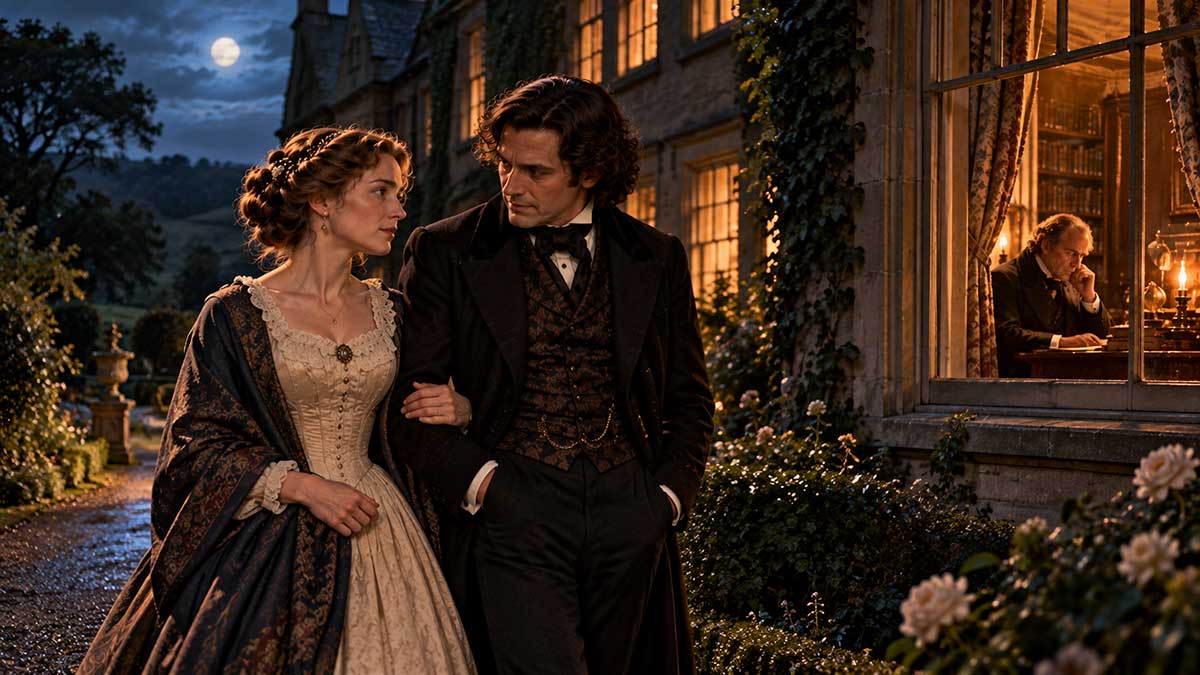
By the time Fred and Mary returned with the empty tea tray, the rain had stopped.
The windows of Lowick reflected the firelight. Beyond them, the garden lay dark and still.
All nine guests were together again.
Nicholas Bulstrode sat beside Harriet, looking tired. Casaubon had returned to his desk but had not opened another book. Lydgate stood by the window, his hands clasped behind his back.
Fred surveyed the room.
Fred: "I must say, this has been the most extraordinary evening I can remember."
Mary: "You said that after our wedding."
Fred: "That was extraordinary in a more agreeable way."
Rosamond: "You have spent much of this evening being corrected by your wife."
Fred: "Which makes it remarkably similar to the rest of my married life."
Mary: "And yet you survived."
Fred: "More than survived. I became an improved specimen."
Lydgate turned from the window.
Lydgate: "I wonder whether improvement is really so easy to recognize."
Fred: "In my case, it was unmistakable."
Lydgate: "You changed your habits. You found useful work. You married the woman you loved. You had the satisfaction of seeing your decisions lead somewhere worthwhile."
Fred: "Not every decision."
Lydgate: "Enough of them."
He looked back toward the garden.
Lydgate: "Some of us were less fortunate."
Dorothea: "You are thinking of your work again."
Lydgate: "I have been thinking of it all evening."
Will: "You cannot be expected to forget the greatest disappointment of your life."
Lydgate: "No. But I wonder what it says about me that even now, with the whole of my life behind me, I still imagine the one I might have lived."
Mary: "It says you are human."
Lydgate: "I would have preferred a more distinguished explanation."
Fred: "I have found being human quite troublesome myself."
Lydgate smiled faintly.
Lydgate: "Tell me something. If you could live your life again, would you make the same choices?"
Fred considered.
Fred: "Not all of them. I should certainly avoid losing money I did not possess."
Mary: "That would have spared several people considerable anxiety."
Fred: "I should begin working sooner. I should listen to your father more carefully. And I should spend less time believing that my future depended upon an inheritance."
Mary: "You have given this some thought."
Fred: "I have had plenty of time."
Lydgate: "But you would still choose the same life?"
Fred looked at Mary.
Fred: "If I could arrive at the same marriage without causing so much trouble along the way, I should be delighted."
Mary: "And I should be grateful."
Rosamond: "That is easy to say when you were happy with the outcome."
Fred: "True."
Rosamond: "The question is rather different for those of us who were not."
Her words were directed toward Lydgate, but she did not look at him.
Dorothea: "Would you choose differently, Rosamond?"
Rosamond: "I suppose I would marry someone who could afford the life I wanted."
Mary: "Would that have made you happy?"
Rosamond: "It would have removed a great many causes of unhappiness."
Mary: "That is not quite the same thing."
Rosamond: "Must you always make these distinctions?"
Mary: "Only when they matter."
Rosamond sighed.
Rosamond: "I might have married someone less ambitious, less impatient, and more willing to enjoy ordinary pleasures."
Lydgate: "You would have found him dull within six months."
Rosamond: "You cannot know that."
Lydgate: "I knew you rather well."
Rosamond: "You knew the parts of me that disappointed you."
Lydgate looked down.
Rosamond: "I do not know whether another marriage would have made me happy. I know only that I was unhappy in ours."
She paused.
Rosamond: "And I know that I contributed to it."
Lydgate looked at her with surprise.
Rosamond: "I am not going to pretend that I became an entirely different woman. I still like beautiful things. I still think comfort matters. I still dislike being contradicted."
Fred: "A family characteristic."
Rosamond: "You are hardly in a position to criticize."
Fred: "I was referring to myself."
She smiled briefly.
Rosamond: "But I wonder whether I might have learned to be less frightened of disappointment."
Dorothea: "That would have changed a great deal."
Rosamond: "Perhaps. Though I suspect Tertius would still have expected me to admire his medical investigations."
Lydgate: "I should have hoped you would take some interest."
Rosamond: "And I should have hoped you would take some interest in the curtains."
Fred laughed.
Mary: "There is something to be said for a husband who notices when the curtains are changed."
Will: "I have learned that it is safest to notice."
Dorothea: "You have not always succeeded."
Will: "No. But I have developed a talent for apologizing."
Casaubon stirred in his chair.
Casaubon: "I find this conversation increasingly occupied with domestic trivialities."
Will: "That may be because domestic trivialities occupied rather more of our lives than we expected."
Casaubon: "Some of us had intellectual responsibilities."
Dorothea: "Edward, may I ask whether you would live your life differently?"
He looked at her.
Casaubon: "The question is too broad to admit a satisfactory answer."
Fred: "That sounds like a no."
Casaubon: "It sounds like an objection to an imprecise question."
Mary: "Then let us make it precise. Would you marry Dorothea again?"
The room fell silent.
Casaubon looked genuinely alarmed.
Casaubon: "I hardly think that a proper inquiry."
Mary: "It is the one everyone is wondering about."
Dorothea: "Mary, he needn't answer."
Casaubon: "I am perfectly capable of answering, if I choose."
Will: "Then we shall wait."
Dorothea: "Will."
Casaubon rose and walked toward the fireplace.
Casaubon: "When I married Dorothea, I believed she would be a suitable companion in my intellectual life."
Dorothea: "I believed that too."
Casaubon: "I underestimated the demands of marriage."
Mary: "That appears to have been a common difficulty."
Casaubon: "I had lived alone for many years. I was accustomed to arranging my time and work according to my own judgment."
He glanced at Dorothea.
Casaubon: "I did not anticipate how greatly another person's expectations might disturb that arrangement."
Dorothea: "Nor did I anticipate how little room there would be for mine."
Casaubon: "Yes."
The admission came without resistance.
Casaubon: "If I had understood what marriage required, I might have hesitated."
Will: "You might have spared her considerable suffering."
Casaubon: "I am aware of that."
Will looked startled.
Casaubon continued.
Casaubon: "But I cannot honestly say that I would have preferred never to know her."
Dorothea's expression softened.
Casaubon: "There were moments when her presence gave me comfort. I was poorly equipped to acknowledge them."
Dorothea: "I wish you had."
Casaubon: "So do I."
He returned to his chair.
Casaubon: "I suppose that is my answer."
Fred: "A surprisingly good one."
Casaubon: "I did not ask for your assessment."
Fred: "No, sir. But you have it."
Mary nudged him.
Dorothea: "I would change many things about my first marriage. But I am not certain I would erase it."
Will turned toward her.
Will: "You would marry Casaubon again?"
Dorothea: "I did not say that."
Will: "You said you would not erase it."
Dorothea: "I learned things through that suffering that I might never have learned otherwise."
Will: "You need not have suffered to become good."
Dorothea: "No. And I would never tell someone else that suffering is necessary for goodness."
She looked toward Casaubon.
Dorothea: "But the life I lived shaped the person I became. I cannot separate every mistake from everything that followed."
Will: "I suppose I should be grateful that you do not wish to erase the circumstances that brought us together."
Dorothea: "You may be grateful that I married you despite your tendency to argue with me."
Will: "I have always considered that one of my most attractive qualities."
Mary: "A remarkable opinion."
Will: "One I share with very few people."
The laughter faded when Lydgate spoke again.
Lydgate: "I know exactly what I would change."
Dorothea: "What?"
Lydgate: "I would not allow myself to become dependent upon Bulstrode."
Bulstrode lowered his eyes.
Lydgate: "I would manage my finances more carefully. I would recognize the dangers of professional isolation. I would be less contemptuous of men whose cooperation I needed."
Mary: "Those sound like useful lessons."
Lydgate: "And I would devote myself more completely to research."
Rosamond: "There it is."
He looked at her.
Rosamond: "Even in your second life, there would be little room for a wife."
Lydgate: "I have not said whether I would marry."
Rosamond: "Exactly."
He seemed about to respond sharply, then stopped.
Lydgate: "I do not know what I would do about marriage."
Rosamond: "At least that is an honest answer."
Lydgate: "I loved you, Rosamond."
Rosamond: "I know."
Lydgate: "But I was not prepared for the kind of marriage we had."
Rosamond: "Neither was I."
Lydgate: "If I could live again, I should want to understand that before asking anyone to share my life."
Rosamond nodded.
Rosamond: "That might have saved us both a great deal of pain."
Harriet, who had been listening quietly, spoke.
Harriet: "I wonder whether we are asking the wrong question."
Dorothea: "What do you mean?"
Harriet: "We keep asking what we would change if we could begin again. But none of us can begin again."
Fred: "Not even here, apparently."
Harriet: "No."
She glanced toward Bulstrode.
Harriet: "Perhaps the more difficult question is what we understand now that we refused to understand then."
Bulstrode looked at her.
Bulstrode: "I understand that I was too willing to believe my good works justified my private decisions."
Harriet: "Yes."
Bulstrode: "And that I caused suffering I might have prevented."
Lydgate: "You did."
Bulstrode accepted the words without protest.
Bulstrode: "I spent much of my life seeking assurance that I was a righteous man."
Dorothea: "And now?"
Bulstrode: "Now I think I should have been more concerned with whether I was acting rightly in the particular matter before me."
Mary: "That is a more manageable ambition."
Bulstrode: "It is also a more demanding one."
Harriet: "Yes."
Dorothea looked around the room.
Dorothea: "Perhaps we all wanted to become something extraordinary."
Fred: "Not all of us."
Mary: "You wanted to become a gentleman of leisure."
Fred: "An extraordinary achievement, if managed without an income."
Dorothea: "I wanted to devote my life to some great purpose. Edward wanted to complete a work of scholarship. Tertius wanted to transform medicine. Rosamond wanted a beautiful life."
Will: "And I wanted to be a man worthy of your love."
She looked at him.
Will: "Though I confess I did not always know what that meant."
Dorothea: "Neither did I."
Lydgate: "There is nothing wrong with wanting greatness."
Mary: "No."
Lydgate: "Then why does it seem that those of us who wanted the most accomplished the least?"
Fred: "I am not certain you accomplished the least."
Lydgate: "You know what I mean."
Fred: "I do. But I think you are making the same mistake again."
Lydgate: "Which mistake?"
Fred: "You are measuring your whole life against the one achievement you did not make."
Lydgate looked at him.
Fred: "You treated patients. You relieved suffering. You worked as a physician for years. I know it was not the life you imagined."
Lydgate: "It was not."
Fred: "But surely some of the people you helped were grateful that you became the doctor you did."
Lydgate was silent.
Fred: "I doubt a patient who recovered under your care spent much time wondering whether you had written a great medical treatise."
Lydgate: "That is a rather sentimental argument."
Mary: "It is also a practical one."
Lydgate: "I might have discovered something that would have benefited thousands."
Mary: "You might have. And that loss matters."
She leaned forward.
Mary: "But the people you actually helped matter too."
Lydgate looked toward the medical volume on the desk.
Lydgate: "I rarely allowed myself to think of it that way."
Dorothea: "Neither did I."
Will turned toward her.
Will: "Dorothea, you helped more people than you know."
Dorothea: "I wanted to do so much more."
Will: "I know."
Dorothea: "When I was young, I imagined that I might build something lasting. Improve the lives of the poor. Change the conditions under which people lived."
Mary: "You did help people."
Dorothea: "Yes. But I sometimes wondered whether I had allowed my life to become too small."
Will looked pained.
Will: "You never had a small life."
Dorothea: "I do not mean that I regretted marrying you."
Will: "I know."
Dorothea: "I loved our life. I loved our family. I was proud of your work. But there were moments when I remembered the young woman I had been, and I wondered what she would think of me."
Rosamond: "She might have been disappointed."
Everyone turned toward her.
Will: "Rosamond!"
Rosamond: "I do not mean to be cruel."
Dorothea: "Let her speak."
Rosamond: "The young Dorothea wanted to accomplish something grand. She might have looked at your later life and wondered why you had not done more."
Dorothea considered the words.
Dorothea: "Yes. I think she might."
Rosamond: "Then perhaps she would have been wrong."
Dorothea looked up.
Rosamond: "I once thought that if a woman's life did not look impressive from the outside, she must have failed to obtain what she deserved."
She glanced at Fred and Mary.
Rosamond: "I was wrong about my brother's life."
Fred smiled.
Rosamond: "Do not look so pleased. I was wrong about many things."
Fred: "I was merely enjoying a rare moment of agreement."
Rosamond: "And perhaps I was wrong about yours too, Dorothea."
Dorothea reached toward her.
Dorothea: "Thank you."
Rosamond took her hand briefly.
Rosamond: "You once came to me when you had every reason to think badly of me. You were hurt, yet you tried to understand my unhappiness."
She paused.
Rosamond: "I have remembered that conversation far more often than you might imagine."
Dorothea: "I am glad."
Rosamond: "It changed the way I saw you. And, for a little while, the way I saw myself."
Dorothea's eyes filled.
Rosamond: "You may not have accomplished everything you intended. But you did something good for me that day."
Dorothea: "It seemed such a small thing."
Rosamond: "It was not small to me."
The room became quiet.
Casaubon watched Dorothea from his chair.
Casaubon: "I believe I have spent my entire life misunderstanding the word 'lasting.'"
Dorothea turned toward him.
Casaubon: "I wished to produce a work that would survive me. A scholarly achievement by which my name might be remembered."
Will: "Your Key to All Mythologies."
Casaubon: "Yes."
He looked toward the shelves.
Casaubon: "I devoted years to it. I feared criticism. I feared that others would complete the work before me, or demonstrate that my methods were inadequate."
Dorothea: "You were very unhappy."
Casaubon: "I was often anxious."
Will: "And you allowed that anxiety to govern nearly everything."
Casaubon did not protest.
Casaubon: "I believed that if I completed the work, the sacrifices would be justified."
Mary: "Did you ever consider what would happen if you completed it and still felt dissatisfied?"
He looked at her.
Casaubon: "No."
Mary: "Perhaps that was the danger."
Casaubon stared at the fire.
Casaubon: "I spent years attempting to understand the beliefs of people who had lived centuries before me."
He paused.
Casaubon: "And I scarcely understood the young woman sitting across the table."
Dorothea looked at him.
Casaubon: "I cannot say that this discovery is agreeable."
Dorothea: "Truth is not always agreeable."
Casaubon: "No."
He folded his hands.
Casaubon: "But perhaps it is preferable to remaining mistaken."
Will glanced at Dorothea.
For once, he had no sarcastic remark to offer.
Harriet looked toward her husband.
Harriet: "I think there is something else we have overlooked."
Bulstrode: "What is that?"
Harriet: "We have spoken a great deal about the things we wished to accomplish. But very little about the people who helped us become whatever we were."
Fred: "I should begin with Caleb Garth."
Mary: "You should."
Fred: "He trusted me when I had given him excellent reasons not to."
Mary: "He believed you could learn to work honestly."
Fred: "And he was patient enough to teach me."
Lydgate: "I should name Dorothea."
She looked startled.
Lydgate: "When the town believed I had been corrupted, you refused to accept suspicion as proof. You helped me when I had little reason to expect kindness from anyone."
Dorothea: "I only did what I believed was right."
Lydgate: "That is precisely why I remember it."
Rosamond looked toward Mary.
Rosamond: "I suppose I should thank you for being so difficult."
Mary raised an eyebrow.
Mary: "I beg your pardon?"
Rosamond: "You never flattered Fred. You expected him to become responsible. And you were right."
Fred: "Rosy, I am deeply moved."
Rosamond: "Do not become unbearable."
Fred: "Too late, I fear."
Harriet smiled.
Bulstrode turned toward her.
Bulstrode: "And I should thank my wife."
Harriet: "You have thanked me many times."
Bulstrode: "For remaining with me."
Harriet: "Yes."
Bulstrode: "But I do not think I have thanked you for refusing to pretend that I was innocent."
Harriet looked at him steadily.
Bulstrode: "You could have comforted me with explanations. You could have told me that others were cruel, that my intentions were misunderstood, that my charitable work outweighed my mistakes."
Harriet: "I could have."
Bulstrode: "Instead, you remained beside me while allowing the truth to remain true."
She reached for his hand.
Harriet: "That was the only way I knew how to love you honestly."
Bulstrode bowed his head.
The clock struck the hour.
Nobody counted the chimes.
Outside, the clouds had begun to part, and a pale moon appeared above the trees.
Fred rose to add another log to the fire, then stopped.
Fred: "Do we need it?"
Mary: "I think the room is warm enough."
Fred: "Then I shall resist the temptation to be useful."
Mary: "A temptation you have overcome on many occasions."
Fred: "And yet you married me."
Mary: "Yes."
Fred: "Remarkable woman."
He sat beside her.
Lydgate looked around the room.
Lydgate: "I wonder whether any of us would be satisfied if we could live again."
Rosamond: "I doubt it."
Will: "We should merely discover new reasons for regret."
Mary: "Very likely."
Dorothea: "But perhaps we would be kinder."
Casaubon: "That is not certain."
Dorothea: "No."
She smiled faintly.
Dorothea: "But it is something worth hoping for."
Casaubon looked toward the desk where his unfinished papers remained.
He rose slowly, crossed the room, and placed his hand upon the topmost volume.
For a moment, Dorothea thought he intended to open it.
Instead, he closed the cover and left it where it was.
Casaubon: "I believe I have done enough work for one lifetime."
Will stared at him.
Will: "I never expected to hear you say that."
Casaubon: "Neither did I."
Fred laughed softly.
Casaubon returned to his chair.
Dorothea looked at the faces around her.
There was the husband she had once worshipped, the man she had later loved, the physician whose hopes had been so painfully diminished, the beautiful woman who had wanted a life without disappointment, the brother and sister-in-law who had found happiness through ordinary work, and the couple whose marriage had endured a terrible moral failure.
Each had wanted something.
Each had misunderstood something.
Each had hurt someone, or been hurt, or both.
And yet none of their lives could be contained within the simple words success and failure.
Dorothea: "May I tell you something I have been thinking?"
Fred: "Please do."
Dorothea: "When I was young, I believed that a meaningful life must be devoted to something extraordinary."
She glanced toward Casaubon.
Dorothea: "I thought greatness was something one could recognize from a distance. A great scholar. A great reformer. A great physician. Someone whose work would be remembered long after they were gone."
Lydgate listened quietly.
Dorothea: "I still believe that such work can matter enormously. I would never wish to diminish it."
She looked toward Fred and Mary.
Dorothea: "But I think I was wrong to imagine that goodness becomes less important when it is ordinary."
Mary smiled.
Dorothea: "Caleb Garth did not need to become famous to change Fred's life. Harriet did not need public recognition for the courage it took to remain compassionate. A physician who relieves one person's suffering has done something real, even if his name never appears in a great medical history."
Lydgate looked down.
Dorothea: "And perhaps a woman who listens to another woman in distress has accomplished something worthwhile, even if nobody else ever knows it happened."
Rosamond's eyes glistened.
Dorothea: "I spent so much of my youth asking what great thing I might do with my life."
She paused.
Dorothea: "I wish I had asked more often what good I might do for the person standing in front of me."
Will took her hand.
Will: "You did that more often than you realize."
Dorothea: "Perhaps."
Casaubon studied her.
Casaubon: "You speak of greatness as though it were a quality of attention rather than achievement."
Dorothea: "Sometimes I think it is."
Casaubon: "An interesting proposition."
Will: "Careful, Dorothea. He may begin another book."
A small ripple of laughter passed through the room.
Casaubon looked at Will.
Casaubon: "I assure you, Ladislaw, I have no intention of beginning another scholarly undertaking."
Fred: "Then this evening has accomplished a miracle."
Even Casaubon smiled.
The laughter faded naturally.
No one hurried to speak again.
At length, Harriet rose.
Harriet: "Nicholas, I think we should go."
Bulstrode stood beside her.
Bulstrode: "Yes, my dear."
He turned toward Lydgate.
Bulstrode: "Dr. Lydgate."
Lydgate: "Mr. Bulstrode."
For a moment, it seemed that Bulstrode might offer another explanation or apology.
Instead, he simply bowed his head.
Lydgate returned the gesture.
It was not forgiveness.
But neither was it contempt.
Harriet took her husband's arm, and they left the room together.
Fred and Mary followed a little later, still discussing whether Fred had exaggerated his accomplishments as a husband.
Rosamond lingered beside Lydgate.
Rosamond: "Do you think we would have been happier if we had known all this when we married?"
Lydgate: "I think we might have been less certain of ourselves."
Rosamond: "That would have been a beginning."
Lydgate: "Yes."
He offered her his arm.
After a moment, she took it.
They walked out without another word.
Will moved toward the doorway, then noticed that Dorothea remained beside the fire.
Casaubon was still seated.
Will: "Dorothea?"
Dorothea: "Just a moment."
Will understood and stepped outside.
Dorothea turned toward her first husband.
Dorothea: "Edward."
Casaubon: "Yes?"
Dorothea: "I hope you know that I never wished you to fail."
He looked at her.
Casaubon: "I know."
Dorothea: "I wanted you to be happy."
Casaubon: "I believe that now."
She nodded.
Dorothea: "Good night."
Casaubon: "Dorothea."
She stopped.
He glanced toward the desk.
Casaubon: "There is something I should have said to you many years ago."
She waited.
Casaubon: "You were very kind to me."
Dorothea's expression changed.
Casaubon: "I did not always know how to receive it."
She crossed the room and took his hand.
Dorothea: "Good night, Edward."
He held her hand for a moment.
Casaubon: "Good night."
Dorothea left the drawing room.
Casaubon remained alone.
The books were still there. The papers were still unfinished. The great work he had hoped would secure his name remained incomplete.
But for once, he did not reach for it.
He sat beside the dying fire, remembering a young woman who had once brought him tea while he worked.
He had scarcely looked up at the time.
Now, at last, he remembered the kindness.
Outside, Dorothea found Will waiting beneath the trees.
He offered his arm.
Will: "Are you ready?"
She looked back once toward the lighted windows of Lowick.
Dorothea: "Yes."
They walked together into the quiet night.
And somewhere beyond the house, beyond the ambitions and disappointments that had once seemed so enormous, the lives they had touched continued to matter.
Not every kindness had been remembered.
Not every sacrifice had been recognized.
Not every good deed had changed the world in a way that could be measured.
But the world had been changed nonetheless.
And perhaps that was enough.
Final Thoughts: What Makes a Life Worth Living?
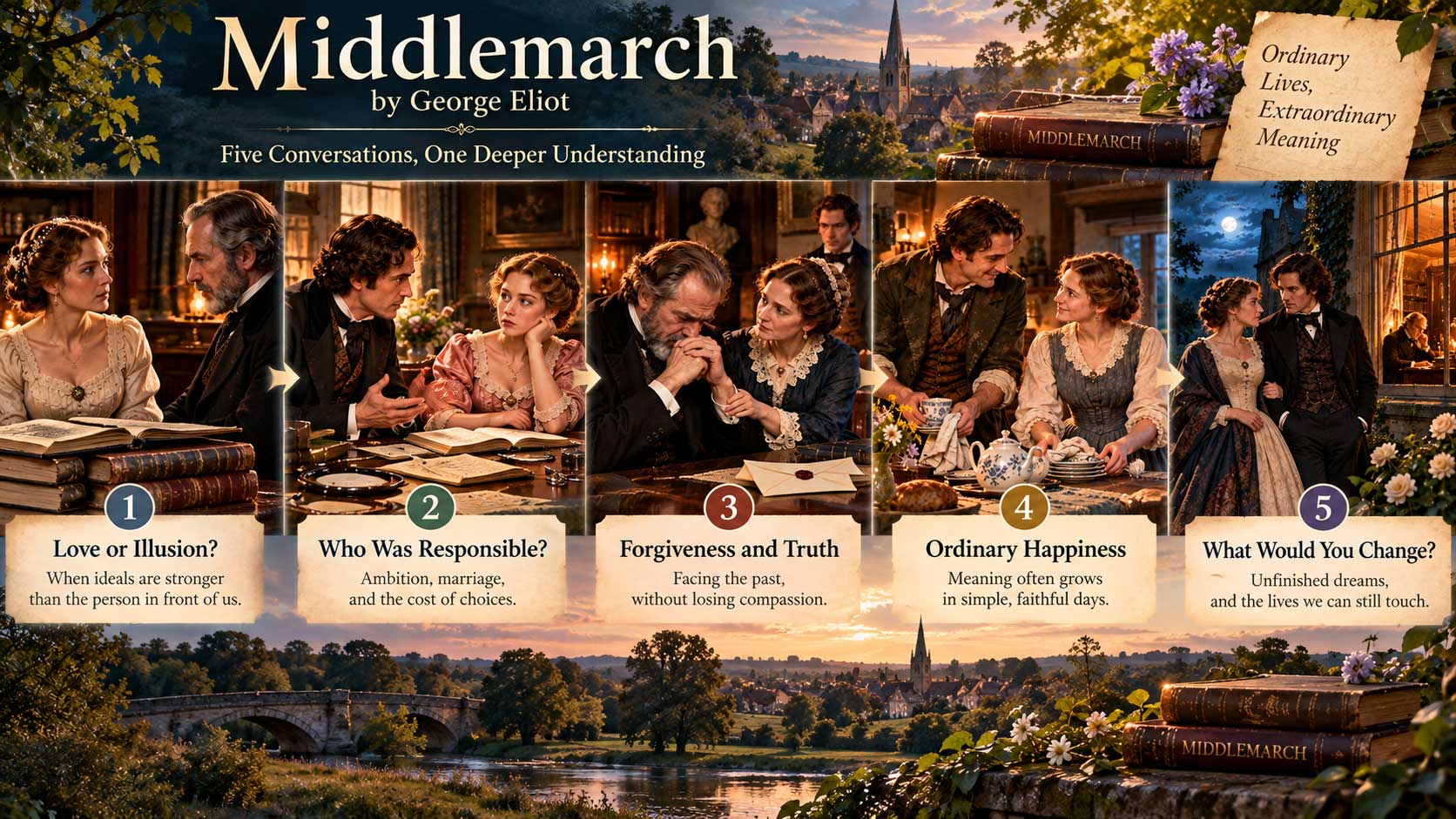
When the last conversation ends, Casaubon's books remain unfinished. Lydgate has not recovered his lost scientific ambitions. Rosamond has not become a completely different woman. And Bulstrode cannot undo the suffering caused by his choices.
Yet something has changed.
For one evening, these characters have stopped defending the lives they intended to live and begun examining the lives they actually lived.
That distinction lies at the heart of Middlemarch.
Love Is Not the Same as Admiration
Dorothea admired the man she imagined Casaubon to be. Lydgate fell in love with Rosamond's beauty and grace, expecting her to share his priorities. Rosamond admired the future she believed Lydgate would provide.
Each discovered that the real person was different from the imagined one.
Perhaps one of the hardest lessons in marriage is learning to love someone without demanding that they become the person we originally hoped to marry.
This does not mean tolerating dishonesty, cruelty, or irresponsibility. Mary Garth demonstrates that love can be accompanied by firm standards.
But there is a difference between encouraging someone to become responsible and trying to remake that person according to our own dreams.
Understanding Does Not Erase Responsibility
Bulstrode's conversation raises a different question.
Can we understand why someone acted wrongly without excusing what they did?
Harriet's answer is neither simple condemnation nor automatic forgiveness.
She remains loyal to her husband while refusing to deny his wrongdoing.
Lydgate, too, begins to recognize that his professional disappointment cannot be blamed entirely on Rosamond. His ambition was admirable, but his pride and poor financial judgment had consequences.
The most difficult kind of self-understanding may begin when we stop asking who caused our unhappiness and start examining the choices that were genuinely ours.
The Extraordinary Value of an Ordinary Life
Fred and Mary provide the emotional counterweight to the other characters.
They do not achieve fame or fortune. Their happiness is found in useful work, mutual respect, family life, humor, and the willingness to face unpleasant truths together.
Their marriage is not free from disappointment.
It is simply a marriage in which disappointment does not automatically become resentment.
And that brings us to the final question.
If our greatest ambitions remain unfulfilled, does that mean our lives have failed?
George Eliot's answer is more generous than that.
The conclusion of Middlemarch directs our attention toward the countless acts of goodness that never enter the history books. Its final pages suggest that the well-being of the world depends, in part, on people whose contributions are never widely celebrated.
Dorothea may not become the great reformer she once imagined. Lydgate may not make the scientific discoveries he hoped for. Fred may never be considered an important man.
Yet their lives cannot be measured solely by the distance between their dreams and their achievements.
A doctor relieves a patient's suffering.
A husband learns to become dependable.
A wife refuses to abandon compassion.
A woman listens to another person's pain when she has every reason to think only of her own.
These acts may not make anyone famous.
But they matter to the people whose lives they touch.
One Last Question for the Reader
Imagine meeting someone you once loved, disappointed, or misunderstood.
Suppose you could speak without needing to win the argument.
Would you ask why they hurt you?
Would you explain why you acted as you did?
Or would you finally ask a question that never occurred to you when you were together?
What was life like for you when I was so occupied with my own?
Perhaps we cannot return to our past and correct every mistake.
But we can become more attentive to the people who are still with us.
We can listen before judging. Admit a mistake before defending it. Appreciate a kindness before it becomes a memory.
And we can remember that a meaningful life need not be extraordinary in the eyes of the world.
Sometimes it is enough to make another person's ordinary day a little better.
Short Bios:
Dorothea Brooke — An idealistic young woman who longs to devote her life to something meaningful. Her disappointing marriage to Casaubon, growing self-knowledge, and eventual love for Will Ladislaw form one of the novel's central stories. In this imagined reunion, she asks whether love can survive the collapse of an idealized image.
Edward Casaubon — A scholarly clergyman devoted to his unfinished Key to All Mythologies. Proud, insecure, and emotionally reserved, he struggles to accept Dorothea's independence. His imagined return explores the loneliness beneath his intellectual ambition.
Will Ladislaw — Casaubon's young relative, an artistic and politically engaged man whose affection for Dorothea grows into love. Passionate and outspoken, he challenges Casaubon's possessiveness while discovering that he, too, must respect Dorothea's freedom.
Tertius Lydgate — A gifted physician who arrives in Middlemarch hoping to advance medical science. His marriage, debts, professional conflicts, and association with Bulstrode frustrate his ambitions. Here, he confronts the possibility that his failures cannot be explained by circumstances alone.
Rosamond Vincy — Fred Vincy's beautiful, socially ambitious sister and Lydgate's wife. Accustomed to admiration and comfort, she struggles when marriage fails to provide the life she expected. Her imagined conversations reveal the fears and disappointments beneath her polished manner without excusing her choices.
Fred Vincy — Rosamond's charming but initially irresponsible brother. Through his love for Mary Garth and his work under Caleb Garth, he learns responsibility and finds satisfaction in a practical occupation. His humor brings warmth to the reunion.
Mary Garth — The intelligent, practical daughter of Caleb and Susan Garth. Honest, affectionate, and unwilling to flatter Fred into complacency, she demonstrates how love and personal responsibility can strengthen each other.
Nicholas Bulstrode — A wealthy banker and influential religious figure whose concealed past eventually threatens his reputation. His conduct surrounding John Raffles exposes the danger of using moral certainty to protect personal interests. In this fictional reunion, he faces questions he once avoided.
Harriet Bulstrode — Bulstrode's devoted wife and a member of the Vincy family. When her husband's past is exposed, she chooses to remain beside him. Her loyalty offers one of the novel's most moving examples of compassion in the presence of painful truth.
About the Author
George Eliot (Mary Ann Evans) (1819–1880) was an English novelist celebrated for her psychological insight, moral complexity, and portrayal of ordinary lives. Her major works include Adam Bede, The Mill on the Floss, Silas Marner, and Middlemarch. Published in 1871–1872, Middlemarch remains one of the most influential novels in English literature.
Editorial note: This article is an original fictional conversation inspired by George Eliot's Middlemarch. The posthumous reunion, dialogue, and reflections are imagined, not passages from the original novel.
Leave a Reply