
Introduction
What if one of the most respected scientists of the eighteenth century told you he’d spent the last twenty-seven years of his life visiting heaven and hell, and could prove it?
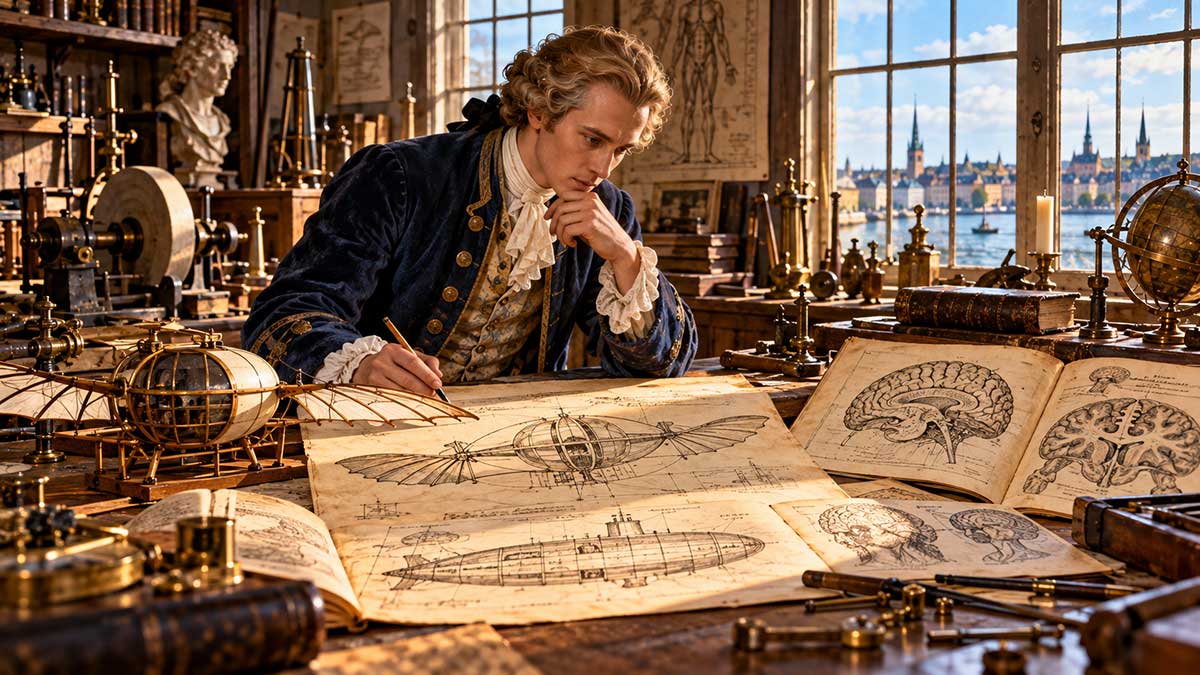
Emanuel Swedenborg was a Swedish nobleman, a mining engineer for the king, an inventor who sketched a flying machine in 1714, and an anatomist who studied the brain decades ahead of his time. Then, in his mid-fifties, a door opened. He said he could speak with angels and with the dead, and he spent the rest of his life writing down what he saw. In a time of hellfire sermons, he described a God who condemns no one, a heaven open to good people of every faith, and children who die being raised by angels who love them.
His claims weren’t only words. He described a fire in Stockholm, in real time, from 300 miles away. He found a widow’s lost receipt with a message from her dead husband. He told a queen a secret only she and her late brother knew. The great philosopher Immanuel Kant investigated all three. The Society for Psychical Research still includes him in its encyclopedia of psychic phenomena.
His ideas also reached my own backyard. Johnny Appleseed carried Swedenborg’s books across the Ohio frontier along with his apple seeds, as American Heritage tells it, and his followers founded a college an hour from my home. Years ago, after talking with a psychic who attends a Swedenborgian church, I visited one myself. When I read about Swedenborg’s experiences, they didn’t strike me as strange. They sounded like what genuinely gifted people describe today.
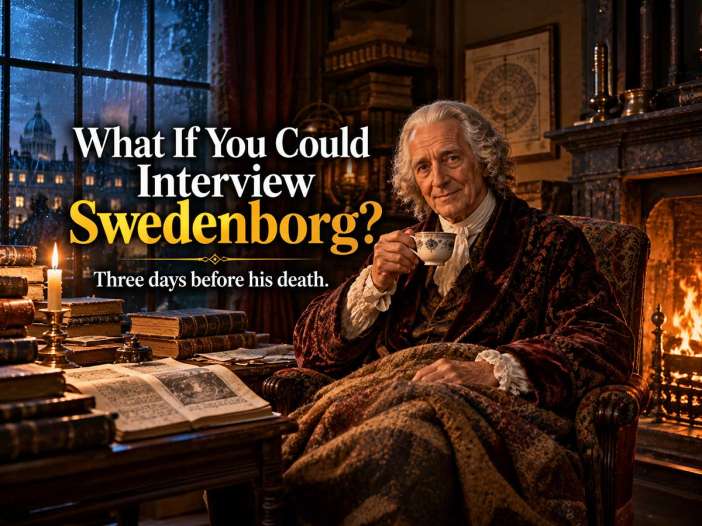
So I went to see him at the very end of his life: London, March 1772, in a rented room above a wigmaker’s shop, three days before the date he had already announced for his own death. We talk shop, two people who know this territory: how his gift opened, how he trained it, what he saw in those famous readings, and above all, what he saw waiting for us after death, including what happens to children who die.
Like every ImaginaryTalks episode, this conversation is sincere imagination, grounded in the historical record and in Swedenborg’s own words, not a claim to channel anyone. But if you’ve ever lost someone, or wondered what you’ll find when it’s your turn, pull a chair up to his coal fire. He has three days, and he says that’s plenty.
(Note: This is an imaginary conversation, a creative exploration of an idea, and not a real speech or event.)
Topic 1: The Engineer Who Looked for the Soul
Clerkenwell, London. Thursday, March 26, 1772, late afternoon. Rain drips from the eaves of a narrow brick house in Great Bath Street. In the shop window, wigs sit on wooden heads. Richard Shearsmith, a stout wigmaker with powder on his sleeves, leads Nick up a steep staircase.
Richard Shearsmith: Mind the fourth step, sir, it complains. He’s been expecting someone all day. Told my wife at breakfast a visitor was coming from very far off. I said, from Sweden? He said, farther. (He lowers his voice.) He says things like that. You get used to it.
He knocks and opens the door. A small room, warm and close. A coal fire glows in the grate. Papers and Latin books are stacked on every surface. By the fire, in a worn velvet dressing gown, sits an old man with a long, pale face and bright, amused eyes. His left hand rests in his lap and doesn’t move much.
Emanuel Swedenborg: Mr. Shearsmith, you may stop announcing him. I know who he is.
Richard Shearsmith: Yes, sir. Coffee, sir?
Emanuel Swedenborg: Always.
Shearsmith withdraws. Swedenborg gestures with his good hand to a chair across from him.
Emanuel Swedenborg: Mr. Sasaki. Sit, please. You’ll forgive me for not rising. Since December, half of me has been slow to take orders.
Nick Sasaki: I’m glad you’re receiving visitors at all.
Emanuel Swedenborg: I receive a great many. Most of them don’t use the stairs. (He studies Nick with open curiosity.) You’ve come a long way. From a country that doesn’t exist yet, if I’m not mistaken, and from a year I can’t quite make out.
Nick Sasaki: From Ohio. In America. Two hundred and fifty-four years from now.
Emanuel Swedenborg: (Delighted.) Ohio. I like the sound of it. Tell me, what day is it today? I lose track in this room.
Nick Sasaki: Thursday. The twenty-sixth of March.
Swedenborg nods slowly, and smiles to himself.
Emanuel Swedenborg: Thursday. Then we have three days. Plenty of time for a good conversation.
Nick doesn’t answer. Swedenborg settles back in his chair as if the matter were closed.
Nick Sasaki: I’ll tell you how I see your life, and you can tell me where I’m wrong. For thirty years, you were looking for the soul. You looked in metals and mines. You looked at the stars. And finally you looked inside the human skull, with a scalpel, trying to find the exact place where the soul lives.
Emanuel Swedenborg: (Raises an eyebrow.) Most people describe me as an engineer who went mad.
Nick Sasaki: Most people haven’t read your notes on the brain.
Emanuel Swedenborg: Ha. True. (He leans forward a little.) You’re not wrong. I didn’t know that’s what I was doing at the time. I thought I was doing science. But yes. Every road I took ended in the same question. What is it that’s alive in us? Where does it sit? How does it touch the body?
Nick Sasaki: Start with the young man. What were you like at twenty-two?
Emanuel Swedenborg: Insufferable. (He laughs.) I sailed to London in 1710, and nearly died on the way: the ship was stopped for fear of plague, and I came ashore against orders. They could have hanged me. Then I spent four years in this city devouring everything. Newton’s new science. Astronomy. I lodged with craftsmen so I could learn their trades: lens grinding, watchmaking, bookbinding, cabinetmaking. I wanted to understand how everything was made.
Nick Sasaki: And you started inventing.
Emanuel Swedenborg: Oh, a whole list. I wrote to my brother-in-law boasting of them. A water clock. A boat that could go under the water and attack an enemy ship. And a machine to fly in the air.
Nick Sasaki: A flying machine. In 1714.
Emanuel Swedenborg: An oval frame, with a canopy, and a man in the middle working wings like oars. (He waves his good hand.) It would never have flown. A man’s arms are too weak. I knew it, really. But I published the design anyway, in the first scientific journal Sweden ever had, which I also started. I was young enough to think that writing a thing down was halfway to doing it.
Nick Sasaki: People are flying now. Every day. In machines bigger than this house.
Swedenborg goes very still.
Emanuel Swedenborg: Every day?
Nick Sasaki: Millions of people. I flew here, in a sense.
Emanuel Swedenborg: (Quietly.) Then my oval frame wasn’t foolish. Only early. (He shakes his head, smiling.) Don’t tell me more. I’ll want to see drawings, and I haven’t the time.
He shifts in his chair, wincing slightly.
Nick Sasaki: Then there was the king.
Emanuel Swedenborg: Charles the Twelfth. A soldier, through and through, and yet he loved mathematics. He gave me a post on the Board of Mines. And when he wanted to besiege a fortress in Norway in 1718, I helped design a way to move warships overland, on rollers, across the hills, so he could launch them where the enemy didn’t expect. (Pause.) He was shot in the trenches at that fortress, that same winter. One bullet, in the dark. Everything changed for Sweden in a night.
Nick Sasaki: And for you?
Emanuel Swedenborg: The next year, his sister the queen made my family noble. Swedberg became Swedenborg. A seat in the House of Nobles. Thirty years on the Board of Mines. Books on copper, iron, the planets, the origins of the world. And then the body. The blood, the nerves, the brain.
Nick Sasaki: Why the brain?
Emanuel Swedenborg: Because I’d run out of other places to look. (He taps his temple.) I studied every anatomy I could find. I watched dissections. I came to believe the outer layer of the brain, the cortex, was where the mind does its finest work. The physicians of my day thought it was mostly packing. I’ve heard since that I may have been right.
Nick Sasaki: You were. And did you find it? The soul?
Emanuel Swedenborg: No. (He smiles.) I found that I was looking in the wrong direction. You can’t find the soul by cutting. It’s like trying to find the music by opening the violin.
The rain picks up against the window. Swedenborg looks toward it for a moment.
Nick Sasaki: Here’s what I want to push on. You had a brilliant career. Respected scientist, nobleman, a royal official for thirty years. And in your late fifties you walked away from all of it to write books about angels. Your colleagues must have thought you’d lost your mind.
Emanuel Swedenborg: Some still do. Some say so in print.
Nick Sasaki: So was it worth it? Honestly.
Emanuel Swedenborg: (He considers this seriously.) Let me tell you what I lost first, so you know I’m not pretending. I lost my reputation among men whose opinion I’d valued for decades. I lost easy conversation. When you tell a dinner table you spoke with a dead man yesterday, the dinner table changes. I published my books without my name, at my own expense, and sold almost none of them. In Sweden, they put two of my friends on trial for heresy because they agreed with me. (He pauses.) I lost a quiet old age.
Nick Sasaki: And what did you gain?
Emanuel Swedenborg: Everything I’d been looking for. (He says it simply.) For thirty years I asked where the soul lives. Then one day the door opened, and I didn’t need to ask anymore. Imagine searching your whole life for a house, describing it, measuring the land where you think it must be, and then being invited inside. Would you go back to measuring the land?
Nick Sasaki: No.
Emanuel Swedenborg: No. (A small smile.) But I’ll admit something to you. Some evenings I miss the measuring. It was simpler. Nobody laughed at a man for weighing copper.
The door opens. Mrs. Shearsmith, a brisk woman with a tray, comes in with a pot of coffee and two cups. She sets them down and pokes the fire without asking.
Mrs. Shearsmith: You’ll let it go out again, sir, talking.
Emanuel Swedenborg: I never let it go out, Mrs. Shearsmith. It goes out on its own, out of spite.
Mrs. Shearsmith: Hmph. (To Nick.) Make him drink it hot. He lets it go cold while he stares at the wall.
Emanuel Swedenborg: I’m not staring at the wall.
Mrs. Shearsmith: Then I’d rather not know what you’re staring at. (She leaves.)
Swedenborg pours, carefully, with his good hand. Nick reaches over and steadies the cup without comment. Swedenborg nods his thanks.
Nick Sasaki: Here’s something you might enjoy. A few years ago, I visited one of your churches.
Emanuel Swedenborg: (Looks up sharply.) One of my what?
Nick Sasaki: A Swedenborgian church. In Ohio. I’d been talking with a psychic, a woman who sees things the way you did, and she told me she attends there. I was curious, so I went once.
Emanuel Swedenborg: (Sets down his cup, amazed.) There’s a church? With my name on it?
Nick Sasaki: More than one. Your readers call it the New Church.
Emanuel Swedenborg: (He laughs, half embarrassed, half moved.) I never wanted a church. I wanted the old churches to read what I’d written and understand it. (He shakes his head.) And a woman with the gift goes there. That’s a good sign, I think. Better than if it were only scholars.
Nick Sasaki: Do you go to church yourself?
Emanuel Swedenborg: Sometimes, to the Swedish church here in London. But I’ll confess something. I have no peace there.
Nick Sasaki: Why?
Emanuel Swedenborg: Because the spirits keep contradicting the preacher. (Deadpan.) He says one thing from the pulpit, and someone just behind my shoulder says, “That isn’t true,” or “That isn’t what it means.” It’s very hard to concentrate on a sermon with commentary.
Nick laughs out loud. Swedenborg allows himself a satisfied smile.
Nick Sasaki: For me, the spiritual life has never been about institutions. It’s about direct experience, what happens between a person and God when nobody’s watching. So I have to ask you: does someone with your gift even belong in a church?
Emanuel Swedenborg: (He thinks for a while before answering.) I’ll give you an answer you might not expect. Yes. Most people don’t have the gift, and they shouldn’t have to wait for it. A church gives them the words, and the songs, and a reason to be kind to each other on a Sunday when they don’t feel like it. That’s no small thing. My father was a bishop. He believed every word of it, and he was a good man.
Nick Sasaki: But you don’t have peace there.
Emanuel Swedenborg: No. Because a church is built for people who believe. And I’m not able to believe anymore. (A pause.) I see. Once you’ve seen, sitting in a pew while someone describes heaven secondhand is like listening to a man describe the sea to a sailor.
Nick Sasaki: Then the woman in Ohio and you have something in common.
Emanuel Swedenborg: (Smiles.) Then tell her from me: she’s welcome to be restless in church. It’s part of the gift.
He lifts his cup, finds the coffee has cooled, and grimaces.
Emanuel Swedenborg: Don’t tell Mrs. Shearsmith.
Topic 2: “Eat Not So Much”
The rain has settled into a steady patter. Swedenborg has given up on his cold coffee and holds the cup in his lap, warming his good hand against the china out of habit. The fire ticks.
Nick Sasaki: I’ve spent time with people who have the gift, and almost every one of them describes a door that opened. Usually not gently. Usually in a crisis. Yours opened in your mid-fifties, after a lifetime of science. Before the famous night in London, there were the dreams.
Emanuel Swedenborg: (Exhales.) The dreams. Yes. I kept a journal of them, in 1743 and 1744, while I was traveling. Private. I hope no one ever reads it.
Nick Sasaki: People have.
Emanuel Swedenborg: (Closes his eyes briefly.) Of course they have. Then they know I was in a terrible state. I wrote down everything: the beautiful dreams, the frightening ones, the shameful ones. Temptations I won’t describe to you. I’d lie down at night and find myself in a kind of trance before sleep, or just after waking, and things would come. Faces. Voices. Moments of joy so strong I’d tremble, and then nights of such darkness I thought I was being torn apart.
Nick Sasaki: The people I know describe something similar at the beginning. A season of chaos before the gift settles.
Emanuel Swedenborg: Do they? (He seems genuinely relieved.) I thought I was alone in that. I thought it meant I was unworthy. Then, in Holland, in the spring of 1744, at night, I saw Christ. I fell on my face. I can’t describe it better than that, and I’ve tried in Latin for twenty-eight years.
Nick Sasaki: And a year later, London.
Emanuel Swedenborg: A year later, London. (A rueful half-smile appears.) You want the tavern story.
Nick Sasaki: Everybody wants the tavern story.
Emanuel Swedenborg: It’s not dignified.
Nick Sasaki: That’s why I believe it.
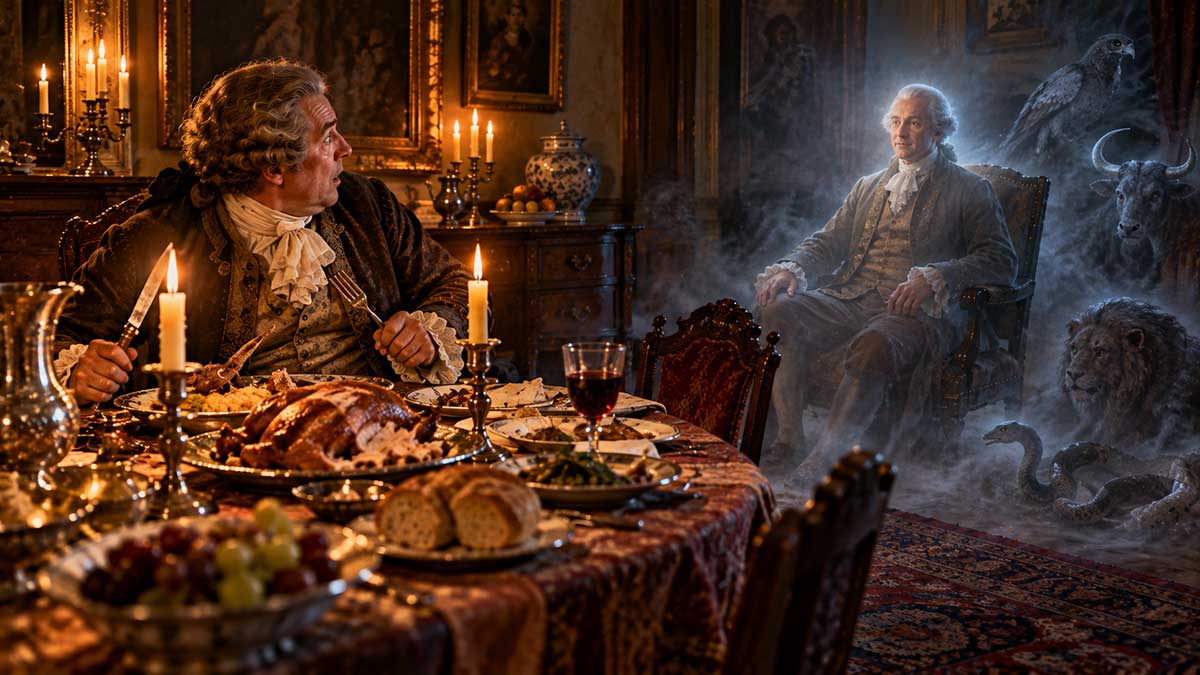
Emanuel Swedenborg: (Laughs.) Very well. April 1745. I’d been working all day on a large book about the animal kingdom, three volumes, very serious. I went to an inn near my lodgings and took a private room, and I ordered a large dinner. Late. I was hungry, I was alone, and I ate like a man who’d been working since dawn.
Nick Sasaki: And then?
Emanuel Swedenborg: Toward the end of the meal, a kind of mist came over my eyes. The room darkened. And on the floor, I saw creatures crawling. Snakes, frogs, horrible things. I sat very still, because I’m a scientist and I wanted to observe whether I’d gone mad. Then the darkness cleared, and in the corner of the room sat a man, perfectly calm, looking at me. And he said, quite clearly:
Nick Sasaki: “Eat not so much.”
Emanuel Swedenborg: (Spreads his good hand.) Four words. That’s all. Then the mist came again, and when it lifted, I was alone.
Nick Sasaki: I have to tell you, I spent years running health food stores. I approve of the message completely.
Swedenborg throws his head back and laughs, a high, delighted sound that ends in a cough. He waves away Nick’s concern.
Emanuel Swedenborg: A man who sold healthy food! Then you’d have been the only person in London on my side that night.
Nick Sasaki: But I’ll be honest with you, because my readers will be thinking it. A skeptic would hear that story and say: an exhausted man in his fifties ate a huge dinner late at night, saw some shadows, and had a bad night’s digestion.
Emanuel Swedenborg: (Still smiling, but leaning forward now.) Yes. And if that were the whole story, he’d be right. I’d have said so myself, the next morning. I went home frightened, and I didn’t sleep well, and I thought, perhaps it was the meal.
Nick Sasaki: And the next night?
Emanuel Swedenborg: The next night, the same man came again. Not in a tavern, not after any dinner. In my room. And this time he wasn’t sitting in a corner. He was filled with light. He told me who he was, the Lord, the Creator and Redeemer of the world, and that he’d chosen me to explain to people the inner, spiritual meaning of Scripture. That he would guide what I wrote. (He pauses.) And from that night on, the door stayed open. For twenty-seven years. Every day. I’ve spoken with spirits this morning, while Mrs. Shearsmith was making the bed.
Nick Sasaki: So the dinner was the knock.
Emanuel Swedenborg: The dinner was the knock. (He nods slowly.) And I’ve often thought the first words were chosen with care. Not “You are a prophet.” Not “Behold, I am the Lord.” “Eat not so much.” Something small. Something practical. Something a proud man would find a little humiliating. If he’d begun with trumpets, I’d have become insufferable. Again.
Nick laughs. Swedenborg looks pleased.
Nick Sasaki: I want to ask how you actually did it. The method. Because the people I know have methods. They meditate, they quiet the mind, they pray, they breathe in particular ways, some of them before every reading. How did you get there?
Emanuel Swedenborg: (His face becomes animated, a scientist describing his favorite experiment.) Breath. Everything begins with breath. When I was a child, saying my prayers in the morning and the evening, I noticed something. If I let my breathing grow very slow and quiet, almost stopped, the prayers went deeper. Later, as a student of the body, I studied how the breath and the heartbeat move together. And I found that when they fall into the same rhythm, the ordinary mind begins to fade, as if it were stepping out of the way.
Nick Sasaki: People do that now. They call it breathwork. There are whole schools of it, from India, from Tibet.
Emanuel Swedenborg: (Fascinated.) From India? Then the ancients knew it there. I suspected the earliest people breathed this way naturally, and that we forgot. (He leans back.) There are two kinds of breath, Mr. Sasaki. The breath of the lungs, which you need to speak. And an inner breath, very quiet, almost imperceptible, which I believe continues even after the body dies. In the beginning I had to work at it. Later, it simply happened to me. It was as if someone else were breathing me, gently, from the inside, and I didn’t have to try at all.
Nick Sasaki: And when you were in that state?
Emanuel Swedenborg: The door was open. Most easily at the edges of sleep. Just before I drifted off, or just as I woke. That borderland is very thin. Many people pass through it every night and never notice anything at all, because they’re in such a hurry to fall asleep, or to get up.
Nick Sasaki: The people I know talk about that borderland too. Some of them keep a notebook by the bed for exactly that reason.
Emanuel Swedenborg: As I did. (He studies Nick with sharp interest.) Now it’s my turn. Tell me about them, these people with the gift. When they receive something, do they see it? Or hear it? Or simply know?
Nick Sasaki: All three. Some see images, some hear words, some just know, suddenly, the way you know your own name. They have names for each now. Most have one strength and a little of the others.
Emanuel Swedenborg: For me it was all three at once. I saw, I heard, I knew. Sometimes I even smelled things, or felt the spirits’ moods in my own body, as warmth or cold. (He tilts his head.) Do they doubt themselves?
Nick Sasaki: The good ones do. Constantly. The ones who never doubt are usually the ones I trust least.
Emanuel Swedenborg: (Points at him with approval.) Yes. That’s exactly right. I doubted for years. I tested what I received against Scripture, against reason, against what other spirits told me. The spirits lie, you know. Not all of them. But some love to pretend to be someone important. A sensible person checks.
Nick Sasaki: I’ll ask you the hard one. Do you think they should charge money? Most of them do now. It’s how they live.
Emanuel Swedenborg: (Considers this seriously.) I never took a coin for it. But I had my pension from the Board of Mines, and an inheritance, and I’ve lived simply. Look at this room. It’s no palace. So I’m careful not to judge someone who has no pension. (Pause.) A gift isn’t spoiled by bread. It’s spoiled by greed. If a woman sits with a grieving widow and helps her, and the widow pays her for her time, I see no harm in it. If someone tells the widow only what she wants to hear, to keep her coming back, then the spirits who help him are not the kind you’d want in your house.
Nick Sasaki: A person has to eat.
Emanuel Swedenborg: (Dryly.) A person has to eat. Just not so much.
Nick laughs. Swedenborg smiles and looks toward the rain-streaked window for a long moment.
Emanuel Swedenborg: You know, you’ve given me something today without meaning to. You talk about these people as if there are many of them. Ordinary people. Women in Ohio. People who keep notebooks by the bed.
Nick Sasaki: There are many.
Emanuel Swedenborg: (Quietly.) For twenty-seven years, I was very nearly the only one I knew. People came to see me the way they’d go to see a two-headed calf. If it’s common now, if it’s simply a part of life that some people have, the way some people have an ear for music, then I’m glad. Truly. It was a very lonely thing to be the only one.
Topic 3: The Fire, the Queen, and the Receipt

Swedenborg has asked Nick to add a few lumps of coal to the fire. The room grows brighter. Outside, the rain has eased, and somewhere below a door bangs as Shearsmith closes his shop for the evening.
Nick Sasaki: There are three stories about you that people still tell, more than two centuries later. When I first read them, I didn’t think of them as miracles. I thought of them as readings. Three different kinds, the same kinds the gifted people I know still do. Seeing something happening far away. Bringing a practical message from someone who’s died. And telling a person something only they and the dead could know.
Emanuel Swedenborg: (Interested.) You sort them like a naturalist sorts beetles.
Nick Sasaki: It helps me understand them. Start with the fire.
Emanuel Swedenborg: (Settles back.) July 1759. I’d just landed in Gothenburg from England, and a merchant there invited me to dinner with fifteen or so guests. A pleasant evening. Around six o’clock, I began to feel uneasy. I excused myself and went outside.
Nick Sasaki: What did you feel, before you saw anything?
Emanuel Swedenborg: Heat. And dread. The way you feel when someone you love is in danger and you don’t yet know who. And then I saw it, the way you see a thing in a dream, but clearer. Stockholm. The southern district, by the water. A fire, spreading fast through the wooden houses. I could see which streets.
Nick Sasaki: Three hundred miles away.
Emanuel Swedenborg: Distance doesn’t mean much in that state. It’s like asking how far away a memory is. (He looks into the coals.) I came back to the table, and I suppose I was pale, because they all stopped talking. I told them a terrible fire had broken out in Stockholm, and it was spreading. I told them a friend’s house had already burned. I named him. And I told them it was moving toward my own house.
Nick Sasaki: Your manuscripts were there.
Emanuel Swedenborg: My manuscripts, my garden, my whole life’s work. (His good hand tightens on the arm of the chair.) I kept going out and coming back in. The guests were frightened, some of them had family in Stockholm. And then, at about eight o’clock, I came back inside and said, “Thank God. The fire is out. It stopped three doors from my house.”
Nick Sasaki: And nobody could check.
Emanuel Swedenborg: Not for two days. The roads were slow. By the next morning the whole town was talking, and the governor sent for me and made me describe everything again: how it started, how it spread, when it ended. Then the messenger arrived from Stockholm with letters, and it was exactly as I’d said. (He shrugs slightly.) After that, people in Gothenburg looked at me differently in the street. Some crossed themselves.
Nick Sasaki: What did it feel like, afterward?
Emanuel Swedenborg: Relief that my house was safe. And something less pleasant. (He considers.) It was the only time anyone saw it happen in front of them. For years I’d written about heaven and hell, and nobody cared. Then I describe a fire, and suddenly I’m famous. People wanted the fire. They didn’t want heaven.
Nick Sasaki: People still want the fire.
Emanuel Swedenborg: (Sighs.) I imagine they always will.
He shifts his weak hand in his lap, arranging it more comfortably.
Nick Sasaki: The second kind of reading. The widow and the receipt.
Emanuel Swedenborg: Madame de Marteville. Her husband had been the Dutch ambassador in Stockholm, and he died. A while later, a merchant came to her demanding payment of a large debt, which she was sure her husband had already paid. But she couldn’t find the receipt anywhere. If she couldn’t produce it, she’d have to pay the whole sum again.
Nick Sasaki: So she came to you.
Emanuel Swedenborg: As a last resort. I think she was half embarrassed to ask. She told me everything, and asked if I could speak with her husband. I said I’d try. Some days later, I met him in the spiritual world, and he told me the receipt was in a secret compartment of the writing desk he used to use. I gave her the message. She looked, and there it was, with some other important papers.
Nick Sasaki: That’s what my friends would call evidential mediumship. A message that can be checked in the physical world.
Emanuel Swedenborg: (Nods.) It’s the most useful kind, and the least glamorous. No visions of glory. A dead man saying, “Look in the desk.” But it saved a widow a great deal of money and a great deal of fear. I’ve always thought that was a good use of the gift.
Nick Sasaki: The dead man must have been relieved too.
Emanuel Swedenborg: (Smiles.) He was. The dead worry about what they left undone more than people imagine. Unpaid debts, unsaid words. It weighs on them, at first.
There’s a pause. Swedenborg’s expression grows more careful.
Nick Sasaki: And the third. The Queen.
Emanuel Swedenborg: Louisa Ulrika. (He says the name with respect.) A very intelligent woman, and very skeptical. She’d been raised in Prussia among philosophers who laughed at religion. When she met me at court, she asked, half joking, whether I’d seen her brother, the Prussian prince, who had died. I said no. She asked me to give him a message, if I happened to meet him.
Nick Sasaki: A test.
Emanuel Swedenborg: A test, and partly a joke at my expense. But I met him. Some days later I came back to court and asked to speak with her alone. I told her what he’d said. (A pause.) She went white. She had to sit down. She said that only God and her brother could know what I’d just told her.
Nick Sasaki: And what did you tell her?
Emanuel Swedenborg: (Gently, but with complete firmness.) That’s the one question I won’t answer. Not to you, not to anyone.
Nick Sasaki: That’s exactly what I want to push on. After that, I’ve read, the most powerful men in the country came to your door for days, in their carriages, asking what the secret was. If you’d told them, all of Sweden would have believed you. Every word you’d ever written. You could have proved everything in one afternoon. Why keep it?
Emanuel Swedenborg: Because it wasn’t mine.
He lets that sit for a moment.
Emanuel Swedenborg: It belonged to her, and to her brother. He trusted me to carry a message to his sister, not to the whole court. If I’d used it to win an argument, I’d have betrayed both of them, the living and the dead. And I’d have proved something else entirely: that a man who speaks with the dead can’t be trusted with what they say.
Nick Sasaki: The good mediums I know follow the same rule. What comes through in a reading belongs to the person who receives it.
Emanuel Swedenborg: Then they understand the most important part. (He looks at Nick steadily.) People think the gift is the seeing. It isn’t. The gift is what you do with what you see. Anyone can carry a secret. The question is whether you’ll carry it all the way to the grave. (A faint smile.) Which in my case is not very far now.
Nick doesn’t answer that. Swedenborg goes on as if he hadn’t said it.
Nick Sasaki: Then there’s Kant.
Emanuel Swedenborg: (Raises his eyebrows.) The philosopher in Königsberg.
Nick Sasaki: He’s considered one of the greatest thinkers who ever lived now. And he investigated you. He wrote letters, he sent a merchant to interview you and the witnesses in Stockholm and Gothenburg. He wrote to a friend that he couldn’t see what anyone could bring against the fire story. And then, a few years later, he published a book mocking you. Anonymously. (He leans forward.) I’ll tell you what I think. I think he was jealous. He found that the stories held up, he couldn’t explain them, and it frightened him. So he made fun of you instead.
Emanuel Swedenborg: (Shakes his head slowly.) No. I don’t think so. And I’d ask you not to say it.
Nick Sasaki: Why not?
Emanuel Swedenborg: Because he was right to doubt me. (He holds up his good hand.) Think, Mr. Sasaki. Europe is full of frauds. Men who claim to speak with angels so they can sell potions. Women who pretend to call up dead husbands so they can empty a widow’s purse. Every city has them. Who protects ordinary people from them?
Nick Sasaki: People like Kant.
Emanuel Swedenborg: People like Kant. Men who say: show me. Men who ask for witnesses and dates. Doubt is the guard at the door. Without it, every charlatan in Europe walks into the house and calls himself a prophet. (He pauses.) He looked carefully. He found something he couldn’t explain, and instead of pretending it was explained, he drew a line and said: beyond this, I won’t go. That isn’t jealousy. That’s a careful man protecting his own mind. I’d rather have one honest doubter than a hundred people who believe me because it’s exciting.
Nick sits back. He thinks about it for a moment.
Nick Sasaki: You’re right. I wanted a villain, and he isn’t one.
Emanuel Swedenborg: (Mildly.) Most people want a villain. It makes the story simpler.
Nick Sasaki: Did his book hurt you?
Emanuel Swedenborg: A little, at the time. Nobody enjoys being laughed at by a clever man. (He shrugs.) But I never felt I needed to answer him. What I’d seen didn’t depend on whether Königsberg approved of it. The fire burned whether he believed in it or not. And it stopped three doors from my house whether he believed in it or not.
Topic 4: What Happens When We Die

Evening has fallen. The rain has stopped, and the window is dark except for the faint glow of a lamp across the street. Swedenborg has asked Nick to light the candle on the table. The fire has burned down to a low red bed of coals, and neither man moves to add more.
Nick Sasaki: Most of the people who’ll read this conversation have one question underneath all the others. Many of them have lost someone. A parent, a husband, a wife. Some have lost a child. They don’t want theology. They want to know what happened to the person they loved, and what will happen to them. Tell it simply, if you would. The way you’d tell it to someone sitting at a graveside.
Emanuel Swedenborg: (He’s quiet for a moment, then nods.) Then I’ll begin with the most important thing. Dying is mostly waking up.
Nick Sasaki: Waking up.
Emanuel Swedenborg: The body stops, and the person inside simply wakes, very soon afterward, in the spiritual world. Most people don’t even realize at first that they’ve died. They’re still themselves. They have a body, it seems to them; they can see and hear and touch. They’re often surprised it feels so ordinary.
Nick Sasaki: Where do they wake up?
Emanuel Swedenborg: Not in heaven, and not in hell. In a place between, which I call the world of spirits. A kind of meeting place. That’s where everyone arrives first. And very often, the first thing that happens is that they’re met by people they knew. Friends. Family. A husband finds his wife, if she died before him. People talk, they recognize each other, they’re glad.
Nick Sasaki: So the reunion people hope for is real.
Emanuel Swedenborg: It’s real. But it’s only the beginning. (He leans forward slightly.) At first, people live much as they did in the world: their manners, their habits, their outward face. But slowly, over time, the outside falls away, and what’s underneath comes to the surface. What they truly loved. Not what they said they loved. Not what they pretended in church. What they actually loved, in their hearts, when no one was looking.
Nick Sasaki: You call that the ruling love.
Emanuel Swedenborg: Every person has one love that rules all the others. For some it’s love of God and other people. For some it’s love of themselves, or of money, or of power over others. In this world we can hide it, even from ourselves. There, it can’t be hidden. And that ruling love decides where a person goes.
Nick Sasaki: Not God.
Emanuel Swedenborg: (Firmly.) God condemns no one. Ever. I’ve watched it happen a thousand times. A person goes where their love leads them, freely, the way water finds its level. Someone who loves to dominate others feels uncomfortable among angels, who love to serve. The light hurts their eyes. They turn away, of their own will, toward people like themselves. That’s all hell is: people who love the same dark things, living together. And they prefer it. It feels like home to them.
Nick Sasaki: And the devils?
Emanuel Swedenborg: There are no devils that God created. Every spirit in hell was once a man or a woman on earth. And every angel in heaven was once a human being too, living an ordinary life, washing dishes, working, raising children.
Nick Sasaki: I’ll tell you where I stand. I’ve always believed that all religions come from one God. Different doors, different languages, the same source. Most of the churches of your time taught that only Christians, maybe only their own kind of Christians, could be saved. What did you see?
Emanuel Swedenborg: (Without hesitation.) I saw what you believe. Good people of every faith find their way to heaven. I’ve met people there who never heard the name of Christ, and they’re angels, because they lived by their conscience and loved what was good. What matters is not which church you belonged to. It’s what you loved, and how you lived. (A small smile.) The bishops in Sweden didn’t care for that part.
Nick Sasaki: I imagine not.
Swedenborg shifts in his chair, and his weak hand slides off his lap. Nick leans over and gently replaces it. Swedenborg nods without comment.
Nick Sasaki: Now I have to ask you something difficult. You wrote a whole book about married love. You said it’s the heart of heaven, that true married love continues forever, after death. But you never married. How can a bachelor know that?
Emanuel Swedenborg: (A long silence. He looks into the coals.) That’s a fair question. People have asked it less kindly.
Nick Sasaki: I’m asking it kindly.
Emanuel Swedenborg: I know. (He exhales.) When I was a young man, I worked with the great engineer Christopher Polhem. He had a daughter, Emerentia. Very bright, very lively. I fell in love with her, completely. Her father loved me like a son, and he wanted the marriage. He even had her sign a written promise to marry me.
Nick Sasaki: But she didn’t want to.
Emanuel Swedenborg: She was very young, and she didn’t love me. She tried to hide it, for her father’s sake, but I saw how unhappy she was. (Quietly.) I couldn’t marry a girl who wept at the thought of me. So I gave the promise back to her. And I made a vow to myself that I’d never again fix my heart on any woman. Then I left Sweden and traveled for a long time.
Nick Sasaki: And you kept that vow.
Emanuel Swedenborg: I kept it. Perhaps too well. (He gives a faint smile.) She married someone else, and had nine children, and lived a good life. She died some years ago. Her children came to visit me once in my garden in Stockholm. I told them I could speak with their mother whenever I wished.
Nick Sasaki: How did they take that?
Emanuel Swedenborg: Politely. (He almost laughs.) Swedes are very polite.
Nick Sasaki: So how could you write about married love?
Emanuel Swedenborg: Because I saw it. Thousands of couples, in heaven, who had loved each other on earth and continued to love each other there, growing closer and more beautiful together, year after year. I didn’t need to be married to see it, any more than an astronomer needs to live on the moon to describe it. (Pause.) But I won’t pretend it didn’t sometimes make me feel like a man standing outside a lit window on a cold night.
Nick Sasaki: Were you lonely?
Emanuel Swedenborg: Sometimes. Yes. (He says it plainly.) Not often. I had the spirits and the angels for company, more than any man could want. But they’re not the same as a woman who knows how you take your coffee. (A pause, then something lighter.) There’s a lady I’ve told a friend I expect to be my wife in heaven. A dear friend in Stockholm, a countess, the wife of an old friend of mine. She died three years ago. We were very close, in the most proper way.
Nick Sasaki: And you think she’s waiting?
Emanuel Swedenborg: (With a quiet, almost shy smile.) I’ll find out on Sunday.
Nick looks at him. Swedenborg meets his gaze calmly, then looks back at the coals as if he’d said nothing unusual at all.
Nick Sasaki: I want to ask about children. Some of the people reading this have lost a child. There’s no grief like it. What did you see?
Emanuel Swedenborg: (His voice softens.) This, I’m sure of above almost anything else. Every child who dies, anywhere in the world, of any faith, or none, is taken straight up into heaven. Immediately. There’s no waiting for them, no judgment, no world of spirits. They’re given to angels who loved children when they lived on earth, women mostly, who were mothers, or who wished they could have been. And those women take them as their own.
Nick Sasaki: And the children stay children?
Emanuel Swedenborg: No. They grow up. They learn, they play, they’re taught, they grow into men and women, into angels. Many of them grow up never even knowing that they were born on earth, until they’re told. (He looks at Nick directly.) I’ve met them. Grown. Beautiful. Happy. Tell your readers who’ve lost a child: their child is not lost. Their child is being raised with great love, and the day will come when they meet again.
Neither man speaks for a moment. A cart rattles past outside.
Nick Sasaki: And what do people do in heaven? My readers will want to know that too. Most people imagine either an endless church service or sitting on clouds.
Emanuel Swedenborg: (Laughs.) Either one would be hell for most people. Imagine singing hymns for all eternity. You’d go mad in a week. No. Heaven is a kingdom of uses. Everyone there is useful. Everyone does something they love that helps others. Some teach. Some care for children. Some welcome the newly dead and help them understand where they are. Some govern, some build, some make beautiful things.
Nick Sasaki: So people keep working.
Emanuel Swedenborg: People keep doing what they love most, but for others instead of for themselves. That’s the whole difference between heaven and earth. On earth, a man may be a fine doctor because he loves money. In heaven, he’s a fine doctor because he loves to heal. The work can look the same. The heart is different.
Nick Sasaki: That sounds like something a person could start practicing now.
Emanuel Swedenborg: It is. That’s the secret. Everyone thinks heaven is a reward for being extraordinary. It isn’t. It’s a continuation of being kind. It’s not nearly as hard as people think to live a life that leads to heaven. You don’t have to retreat to a monastery or punish yourself. You simply have to do your ordinary work honestly, love the people in front of you, and want good things for others. Do that for a lifetime, and you’ll feel at home there the moment you arrive.
The candle gutters. Swedenborg watches the flame steady itself.
Emanuel Swedenborg: People are always so frightened of dying, Mr. Sasaki. I understand. I was too, once. But when you’ve seen it happen to thousands of people, you notice something. Almost every one of them, when they wake up, says the same thing. Something like, “Oh. Is that all?”
Topic 5: The Seeds He Planted
The candle has burned down a finger’s width. Swedenborg has asked for a blanket over his knees, and Nick has tucked it around him. Outside, a light rain has begun again, soft against the glass.
Nick Sasaki: You’ve spent the evening telling me about the world you can see. I’d like to tell you about one you can’t. What happened to your books after you.
Emanuel Swedenborg: (Wary, but curious.) They’re burned in Sweden, I expect.
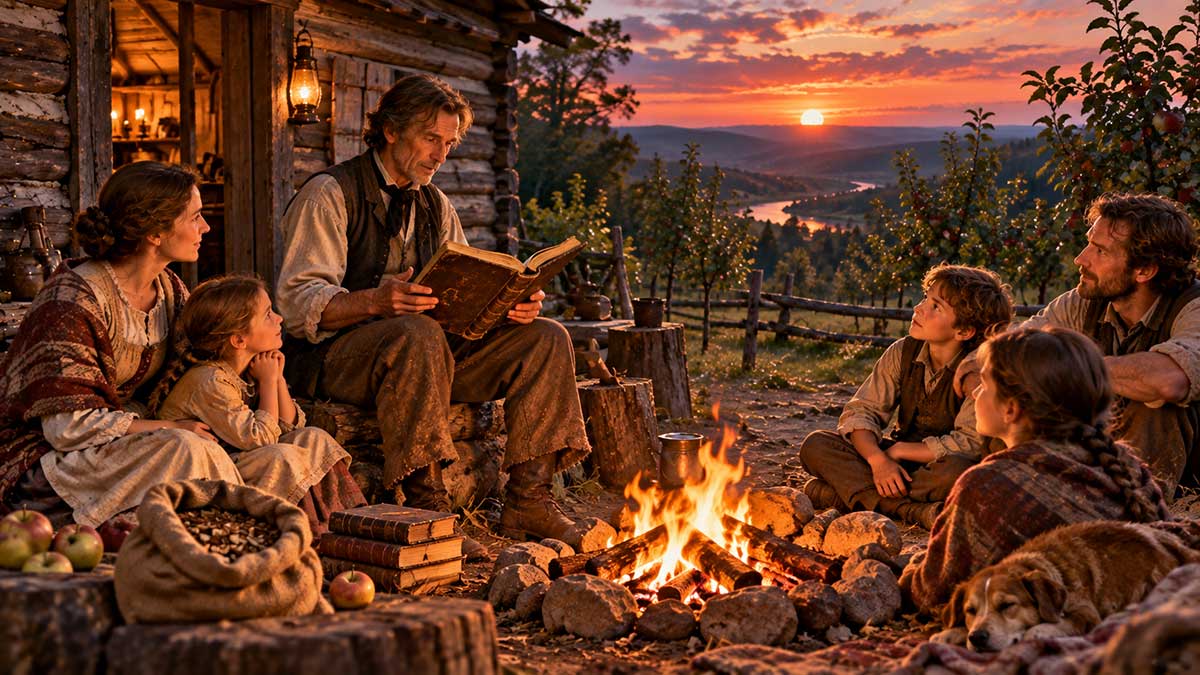
Nick Sasaki: Some were, for a while. But listen. About fifty years from now, in America, there’s a man named John Chapman. People call him Johnny Appleseed. He walks barefoot through the wilderness, through Pennsylvania and Ohio and Indiana, planting apple orchards ahead of the settlers. He won’t eat meat. He won’t even kill a rattlesnake. And in his pack, along with the apple seeds, he carries your books.
Emanuel Swedenborg: (Stares at him.) My books?
Nick Sasaki: He hands them out to families in log cabins on the frontier. Reads them aloud by their fires. Wherever he goes in Ohio, little groups of your readers spring up, in at least twelve counties. People there say he planted the seed, and they don’t mean apples.
Emanuel Swedenborg: (A slow, astonished smile spreads across his face.) A barefoot man. In the forest. With apples and my Latin.
Nick Sasaki: Translated into English by then.
Emanuel Swedenborg: Thank God. My Latin is very heavy for a log cabin. (He shakes his head.) I wrote those books for bishops and professors, and none of them read them. And a man who won’t kill a snake carries them into the wilderness. That’s exactly how heaven works, you know. It never goes through the front door.
Nick Sasaki: There’s more. Your followers in Ohio found a college, in a town called Urbana. It lasts a hundred and seventy years. It’s about an hour’s drive from my house.
Emanuel Swedenborg: (Laughing.) An hour’s drive. I don’t know what that means, but I’ll take it as close.
Nick Sasaki: And there’s a woman, born in America in the next century. She loses her sight and her hearing as a baby. She can’t see or hear anything at all. She learns to speak, to read, to write books, and becomes one of the most admired women in the world. And it’s in your writings that she finds her faith. She writes that you gave her light in her darkness.
Swedenborg says nothing for a moment. His good hand presses the blanket flat.
Emanuel Swedenborg: Blind and deaf.
Nick Sasaki: Completely.
Emanuel Swedenborg: (Barely above a whisper.) Then she could see better than Kant. (He clears his throat.) Go on. You have more. I can tell.
Nick Sasaki: About two hundred years from now, a doctor named Raymond Moody interviews people who nearly died and were brought back. Hundreds of them, over time thousands, all over the world. Doctors now can bring people back from death in ways you can’t imagine. And these people describe leaving the body, being met by those they loved, a being of light, a review of their lives. In his book, Moody has a section on you. He says your descriptions match what they report, two centuries before them.
Emanuel Swedenborg: (Very still.) Ordinary people? Not seers?
Nick Sasaki: Ordinary people. Teachers, mechanics, housewives, children.
Emanuel Swedenborg: Then it was never only mine. (He closes his eyes briefly.) That’s what I always hoped. That I wasn’t seeing something strange. That I was only seeing early what everyone will see eventually. (He opens them.) And a Swiss doctor, I suppose, will try to explain me?
Nick Sasaki: (Surprised.) There is one. He writes about your fire in Stockholm. He calls it synchronicity.
Emanuel Swedenborg: (Amused.) Of course he does. They always need a new word.
Nick Sasaki: There’s one more thing. I’m not sure whether to tell you.
Emanuel Swedenborg: Then you’d better.
Nick Sasaki: You’ll be buried in the Swedish church here in London. And some years later, a man breaks into the vault and steals your skull.
A pause. Swedenborg’s eyebrows climb.
Emanuel Swedenborg: My skull.
Nick Sasaki: People thought it would be valuable. Scientists in those days studied the shapes of heads to measure genius. It’s stolen, returned, swapped for the wrong one by mistake, and the real one turns up years later in a shop in Wales. Finally, in 1978, it’s sold at auction in London. The Royal Swedish Academy of Sciences buys it. For five thousand five hundred pounds.
Swedenborg stares at him, then begins to laugh, a deep, helpless laugh that shakes the blanket and brings a cough, and keeps going after the cough.
Emanuel Swedenborg: Oh, that’s marvelous. That’s the best thing you’ve told me all evening. (He wipes his eyes with his good hand.) I spent thirty years telling people the body is only clothing. A coat we take off at the door. And they fight over my hat! (Still laughing.) And the Academy buys it. The same Academy that thought I’d gone mad. Well. At least someone in Sweden finally paid for one of my works.
Nick laughs with him. Eventually Swedenborg settles, still smiling.
Emanuel Swedenborg: Where do they put the rest of me?
Nick Sasaki: In 1908, they bring you home to Sweden, to the cathedral in Uppsala, with ceremony.
Emanuel Swedenborg: (Softly.) Uppsala. Where I was a student. (He nods slowly.) That’s kind of them.
Nick Sasaki: So I’ll ask you. When you were writing, alone, publishing without your name, selling almost nothing, what did you hope your books would do?
Emanuel Swedenborg: (He thinks for a long time.) Very little, honestly. I hoped a few people would read them and be less afraid of dying. I hoped a few clergymen would see that God isn’t cruel. I hoped someone grieving a child might find a page and stop weeping for an hour. (He looks toward the window.) I didn’t hope for apple orchards, or a blind woman, or a college in Ohio. That’s more than I asked for. It usually is, with the Lord. He’s not a man who gives you exactly what you ordered.
Nick Sasaki: Now I have to push on one thing, because it’s the part even your most loyal readers struggle with today. You wrote about meeting spirits from Mercury, Venus, Mars, Jupiter, Saturn, and the Moon. You described the people who lived there. And today we’ve looked very closely at those worlds. There are no people on Mars, or on the Moon. Nobody.
Emanuel Swedenborg: (Calmly.) I didn’t say I’d been to Mars. I said I spoke with spirits who told me they came from there.
Nick Sasaki: I know. And here’s what I think. Even the most gifted people I know sometimes misread what they receive. They get the feeling right and the label wrong. Maybe the spirits were real, and the names were yours. You were a man of your century, and in your century everyone assumed the planets were full of people.
Emanuel Swedenborg: That’s possible. (Pause.) But it’s also possible that “Mars” means something to a spirit that it doesn’t mean to an astronomer. When a spirit tells me where it comes from, it isn’t handing me a map. You assume your astronomers have seen everything. I assume the spirits did not lie to me. We may both be wrong.
Nick Sasaki: I’m not convinced.
Emanuel Swedenborg: (With a small shrug.) I’m not asking you to be. (He smiles.) You can ask me again when you get there. I’ll introduce you.
Nick laughs, shakes his head, and lets it rest.
The candle flickers. Swedenborg watches it. When Nick speaks again, his voice is lower.
Nick Sasaki: There’s a letter. A preacher named John Wesley wrote to you this winter. He said he’d been wanting to meet you, and he’d come after a long preaching journey, six months from now. And you wrote back that it would be too late. That you’d go into the world of spirits on the twenty-ninth of this month.
Emanuel Swedenborg: Sunday.
Nick Sasaki: Sunday. (He hesitates.) How do you know?
Emanuel Swedenborg: The same way I knew about the fire. I was shown. (He says it plainly, without drama.) You don’t need to look so careful, Mr. Sasaki. You knew when you climbed the stairs. I saw it in your face when you told me the date.
Nick Sasaki: Are you afraid?
Emanuel Swedenborg: (He considers the question honestly.) Of the dying, a little. The body doesn’t like it; it’s built not to. I’ve watched it in others. There’s a struggle at the end, sometimes. (Pause.) Of what comes after? No. How could I be? I’ve been visiting for twenty-seven years. Imagine traveling to a city every day for most of your life, and finally being told you can stay. (A faint smile.) I’m a little curious to see who comes to meet me. And whether a certain countess remembers how I take my coffee.
There’s a knock. Mrs. Shearsmith opens the door partway, a cloth over her arm.
Mrs. Shearsmith: Supper’s on the table, sir. Will the gentleman be staying?
Emanuel Swedenborg: (Before Nick can answer.) No, Mrs. Shearsmith. He has a long way to travel.
She looks at Nick, then at the old man, and seems to decide not to ask.
Emanuel Swedenborg: And so do I.
Mrs. Shearsmith: Not before supper, you don’t. (She leaves the door ajar and goes clattering down the stairs.)
Swedenborg chuckles softly. Then he settles back in the chair. His eyes close. His breathing slows, and slows again, until it’s barely visible beneath the blanket, falling into the gentle rhythm he described hours ago. The lines of his face ease. After a moment, he smiles, faintly, at something Nick can’t see.
Nick watches him. Then he stands, takes his coat from the back of the chair, and pulls the blanket a little higher over the old man’s knees. He blows out the candle, leaving the red glow of the coals.
On the stairs, he passes the smell of supper and the sound of Shearsmith whistling in the kitchen. He opens the street door and steps out into the soft London rain.
Final Thoughts

The line I keep coming back to is the smallest one. When people wake up after death, Swedenborg said, almost all of them say the same thing: “Oh. Is that all?”
We spend so much of our lives afraid of that moment. We avoid talking about it, avoid thinking about it, and when it comes close to someone we love, we feel helpless. Swedenborg, who said he’d watched it thousands of times, describes something gentler: a waking, a reunion, and then a slow revealing of who we truly are.
That last part is the one worth sitting with. In his view, no one is sent anywhere. We simply go where our love leads us. Not the love we talk about, but the love we actually live, day after day, when no one is watching. Heaven isn’t a reward for being extraordinary. It’s a continuation of being kind.
Which means the most important preparation for death has nothing to do with doctrine, and everything to do with Tuesday afternoon. How we treat the person in front of us. Whether our work, whatever it is, helps someone. Whether we want good things for others, even people who’ll never thank us.
I also left that room thinking about something lighter. A man who had seen heaven still let his landlady scold him about cold coffee, still laughed until he coughed about his stolen skull, still defended the philosopher who mocked him. Whatever he saw on the other side didn’t make him grand. It made him gentle, and funny, and unafraid.
So here’s the question I’ll leave with you. If your ruling love were revealed tomorrow, what would it turn out to be?
Short Bios:
Nick Sasaki is the creator and host of ImaginaryTalks.com. After 25 years of building businesses, he turned to building bridges between eras, ideas, and the questions people carry, drawn especially to spirituality, the soul’s journey, and what lies beyond ordinary explanation. He meets each guest as a fellow seeker, asking the questions readers wish they could ask someone long gone. About Nick and ImaginaryTalks
Emanuel Swedenborg (1688–1772) was a Swedish scientist, engineer, and nobleman who, in his mid-fifties, began reporting visions of heaven, hell, and the spiritual world. His books, including Heaven and Hell (1758), influenced William Blake, Ralph Waldo Emerson, Helen Keller, and Johnny Appleseed, and inspired the New Church that still carries his ideas. He died in London on March 29, 1772, the date he had predicted, and his remains rest in Uppsala Cathedral. Emanuel Swedenborg chronology, Swedenborg Society
Leave a Reply