
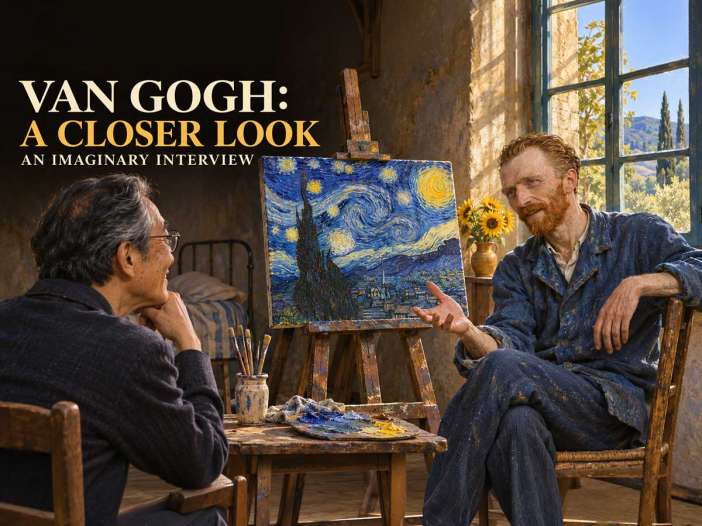
Introduction
Vincent van Gogh’s The Starry Night is one of the first paintings I want to see when I visit MoMA in New York. I know the image before I arrive. Still, standing in front of it feels different. There is the physical paint, the movement across the sky, and some small part of the picture I have scarcely noticed before.
I wanted to begin this conversation with that affection. If I could sit beside Vincent, I would ask him to show me how he made something that keeps bringing me back.
MoMA’s account of the painting gives us a fascinating starting point: a night scene developed in daytime sessions, bringing observation together with memory and invention. The view mattered, but the canvas became something he had to construct. How did he judge those changes? What did he want another person to receive from them?
His career gives those questions a much wider reach. He committed himself to art at twenty-seven and spent roughly a decade developing the work we know. He studied, experimented, argued, formed attachments, and found subjects in people and places that might otherwise pass unnoticed.
The Van Gogh Museum and Huygens Institute’s edition of his letters lets us approach that working life through his own accounts. There is uncertainty in them, but there is excitement too: pictures he wanted to attempt, discoveries he wanted to share, and people whose company mattered.
Our fictional meeting takes place outside ordinary time, across five reconstructed settings. We can bring paintings from different years together and speak about their later audiences.
We begin beside The Starry Night. From there, I want to follow the questions that arise naturally, meeting an artist through what he notices, cares about, and tries to make.
Disclaimer: This is a fictional interview informed by paintings, letters, and historical research. Vincent van Gogh’s dialogue, actions, and responses to modern audiences are invented, not historical quotations or a recorded meeting.
Topic 1: Vincent, How Did You Make This Sky?
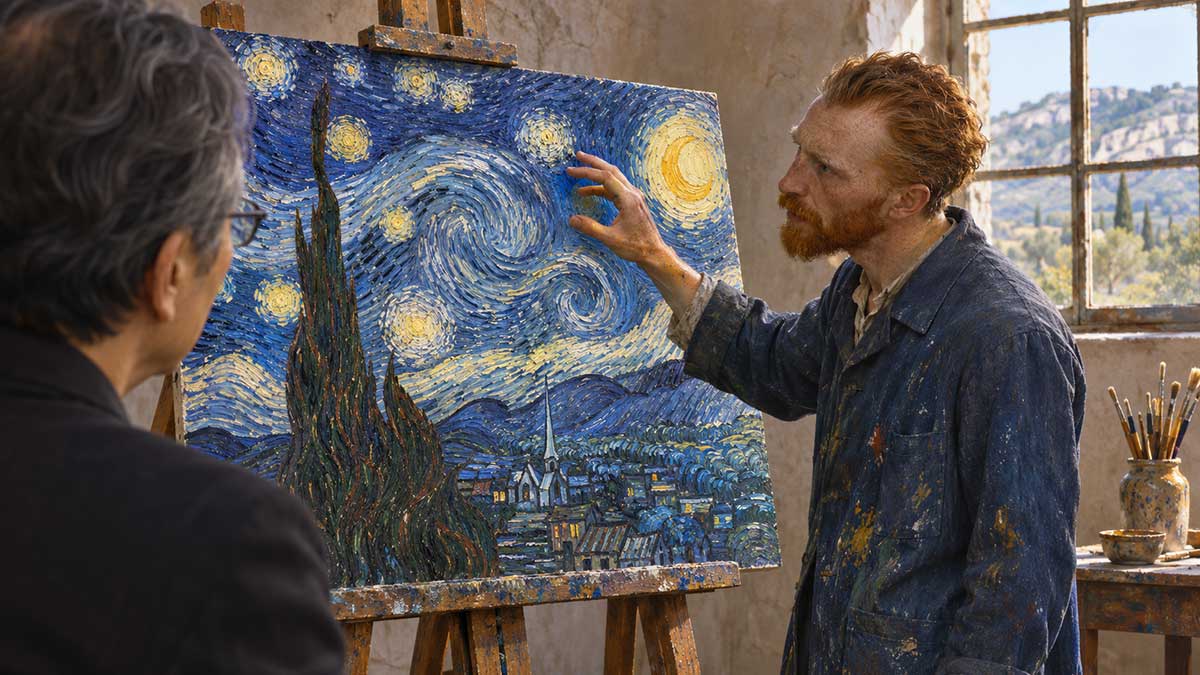
Saint-Rémy. Afternoon light falls across a plain table. Beside the window stands The Starry Night. Nick has seen it in reproductions and at MoMA, yet he pauses before taking the chair Vincent has pulled out for him.
Nick Sasaki
When I visit MoMA in New York, this is one of the first paintings I want to see. I know it’s going to be there. I know what it looks like. And I still want to stand in front of it.
There’s something about it I can’t quite explain.
Vincent van Gogh
Does it look the same each time?
Nick Sasaki
The painting does. What I notice changes.
Sometimes I go straight to those stars. Sometimes it’s that enormous movement across the sky. When I get close, I start looking at the paint itself.
If you were standing beside me in the museum, where would you tell me to look first?
Vincent van Gogh
At the place that has already caught you. You said the stars. Choose one.
Nick Sasaki
That bright one, just above and to the right of the tree.
Vincent van Gogh
Now look at the blue immediately around it.
Nick Sasaki
There are rings. I usually think of the light as yellow, but there’s much more going on around it.
Vincent van Gogh
Yes. Your eye does not receive the light separately from those surrounding marks. The pale touches and the blues act together.
Move back a little.
Nick takes two steps away from the canvas.
Nick Sasaki
The separate marks start coming together.
Vincent van Gogh
And the star becomes more present.
Nick Sasaki
That’s it. It feels present. A photograph can show me a beautiful night sky, but this feels different. Almost as if the sky is coming closer.
Vincent van Gogh
The marks are close to you. The thing they represent is far away. Painting lets both remain before your eyes.
Nick Sasaki
Take me back to the beginning, then. What was actually outside your window, and how did you turn that view into this?
Vincent turns briefly to the window.
Vincent van Gogh
I watched the countryside at different hours. Before sunrise, the morning star could look extraordinarily large. I wrote to Theo about that.
There were the hills, the ground nearer the building, changes in the sky. Familiar things could become quite absorbing if I stayed with them.
This picture draws on those observations. But the scene has been brought together and altered.
Nick Sasaki
The village wasn’t right there?
Vincent van Gogh
It was not the village seen from that window. Other views and memories entered the picture.
Nick Sasaki
And the church looks Dutch.
Vincent van Gogh
You bring things with you. A building you have known can find its way into another place.
Nick Sasaki
I had thought you might have been sitting at the window one night, painting what was happening outside.
Vincent van Gogh
I worked on the canvas during the day.
Nick Sasaki
That changes the way I picture you making it.
Vincent van Gogh
It gives me daylight in which to see my colors.
Nick Sasaki
Fair point.
Vincent smiles and shifts his chair so that both men can see the canvas.
Vincent van Gogh
What I had observed still mattered. In the studio I could put one part against another and consider the whole arrangement.
Memory is not a cupboard in which a view waits unchanged. When you paint, you must give it a form.
Nick Sasaki
Show me what bringing the tree closer did for the picture.
Vincent van Gogh
Stand there. Hold up your hand so that it hides the cypress from your view.
From several feet away, Nick raises his hand, screening the left side of the painting.
Nick Sasaki
It becomes a much wider, more open view.
Vincent van Gogh
Now lower your hand.
Nick Sasaki
The tree pulls everything back together. It gives me a place near the front to stand.
I hadn’t realized how much I was relying on it.
Vincent van Gogh
Its dark shape has a great deal to do. It rises beside the lights and cuts into the sky. There is considerable weight on that side of the canvas.
Nick Sasaki
Yet the top feels almost like a flame.
Vincent van Gogh
A cypress gives you that difficulty: a substantial tree with a shape that keeps rising and narrowing. You must look at its particular character.
If you paint only your idea of “a tree,” you have thrown away much of what interested you.
Nick Sasaki
What about the houses? When I look down from the sky, I feel quieter.
Vincent van Gogh
Look at their edges. Roofs, walls, little divisions. Your eye encounters corners and shorter enclosed shapes.
Then follow the hills behind them.
Nick Sasaki
They start carrying me across the picture again.
Vincent van Gogh
You see how much can happen before we assign a meaning to anything.
Nick Sasaki
That’s interesting. I came wanting to ask what the painting means, and now I’m looking at what it does.
But I want to get much closer to how you did it. These marks make the sky feel as if it is moving. Could you take one small section and explain how you painted it?
Vincent picks up a dry brush and a scrap of paper.
Vincent van Gogh
Look around this light. The marks follow a direction, but they vary. Some are longer, some shorter. Some assert themselves more strongly.
If I made them all alike, I would have a pattern that soon became tiresome.
He traces a short curve above the paper, then turns the brush.
Nick Sasaki
You’re changing the angle of the brush too.
Vincent van Gogh
The broad side leaves one kind of mark. The edge leaves another. Pressure changes it. The amount of paint changes it.
But your hand must remain answerable to your eye. You make a mark, then look at what it has done.
Nick Sasaki
It looks so confident that I forget there was any judging involved.
Vincent van Gogh
A mark can be made in a moment. The ability to judge it takes much longer.
I had spent years drawing, studying paintings, working with color. A quick passage of painting carries that work into it.
Nick Sasaki
So if I tried to copy the motion of your hand, I’d be missing most of the process.
Vincent van Gogh
You might produce a very energetic mess.
Nick Sasaki
I suspect I would.
Vincent van Gogh
Then you would have something definite to improve.
Nick laughs, and Vincent sets the brush down.
Nick Sasaki
What tells you a mark needs changing?
Vincent van Gogh
It may interrupt its neighbors or attract attention in the wrong place. Sometimes a passage pleases you, and you discover that it harms everything around it.
Then you must change the part you liked. That is irritating.
Nick Sasaki
From the finished painting, I picture this extraordinary flow, everything coming out exactly as it should.
Vincent van Gogh
You are giving the afternoon rather better manners than it may have had.
Nick Sasaki
And the thick paint? That’s something I love about seeing it in person. A screen doesn’t give me the same experience.
Vincent van Gogh
You can see the material standing above the canvas. The brush leaves evidence of its passage.
Thick application is called impasto. But you must still ask what the thickness contributes. More paint does not guarantee a better picture.
Nick Sasaki
The surface catches the museum light too.
Vincent van Gogh
Yes. Even the light in the room becomes part of how you see the surface.
Nick returns to the chair. For a few moments, neither man speaks.
Nick Sasaki
Did you keep feeling the same way about it afterward?
Vincent van Gogh
No. I could defend what I had attempted and still question the exaggeration. Those judgments did not remain fixed.
Nick Sasaki
That surprises me. Those are some of the things people love most.
Vincent van Gogh
Someone can value a quality I am uncertain about. That is possible.
Nick Sasaki
People don’t just recognize this picture. They make time for it. I do.
Vincent van Gogh
Then let us use some of that time well.
Look once more at the blue. You began with the stars, but the sky gives them their place.
Nick Sasaki
I can see more differences in it now. It had felt like one great movement. There are so many smaller decisions inside it.
Your early paintings were much darker. How did you get from those colors to being able to do this?
Historical note: the editors of letter 822 identify The Starry Night as the likely reference in a later criticism of oversized stars. They note that Vincent had defended the painting in earlier letters.
Vincent reaches for a folder beneath the table. A corner of a Japanese print appears between its covers.
Vincent van Gogh
Let us put a few pictures beside one another.
Topic 2: Learning to See in Color
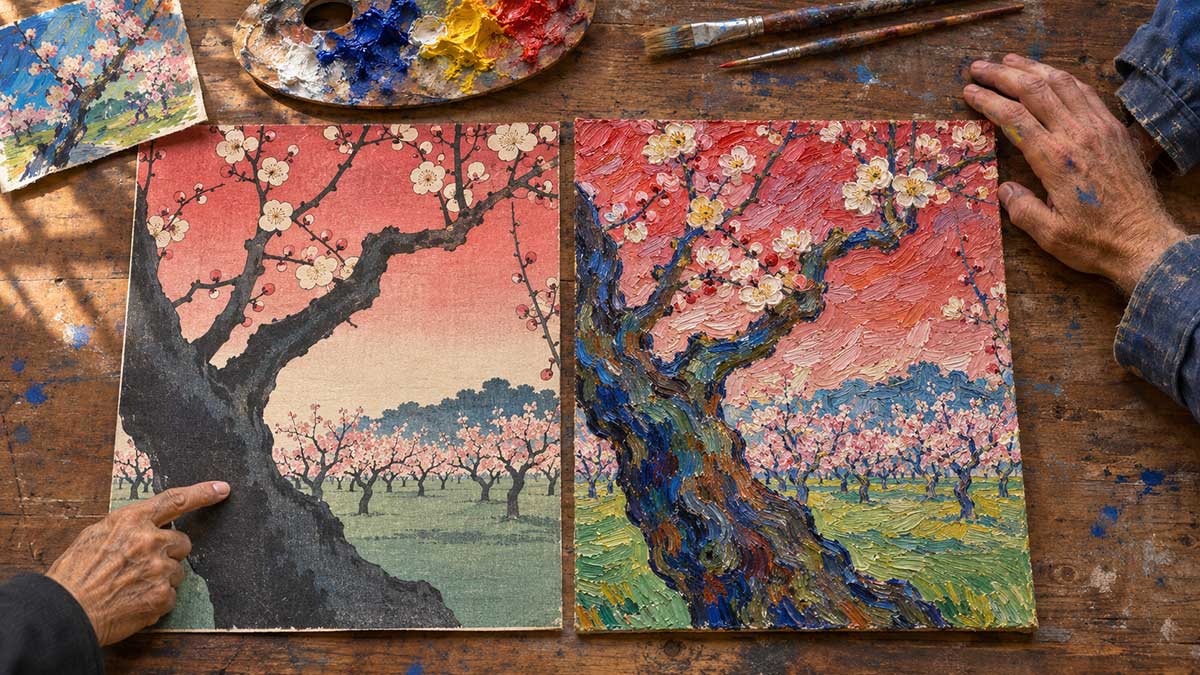
Vincent opens the folder. Prints slide onto the table, their crisp shapes beside the crowded marks of his paintings. The room becomes a reconstructed Paris workroom: a mirror near the window, a small vase, canvases turned against the wall. Pictures from different years have been brought together for comparison.
Nick places a reproduction of The Potato Eaters beside one of Vincent’s later self-portraits.
Nick Sasaki
If I didn’t know these were both yours, I might think they came from two different painters.
What did you encounter that changed the way you painted?
Vincent van Gogh
Paris made it difficult to remain satisfied with what I already knew.
I had spent a long time with darker colors. Then I saw paintings in which light was made through quite different relationships. Colors stood beside one another more openly. Shadows contained things I had been overlooking.
There were experiments I needed to try for myself.
Nick Sasaki
Were you immediately attracted to them?
Vincent van Gogh
Attracted, puzzled, sometimes resistant. Seeing another painter’s success does not tell you how to achieve it.
You can admire the result and still misunderstand the work that produced it.
Nick Sasaki
What would you actually do after seeing a painting that interested you?
Vincent van Gogh
Go back to my own work with a problem. Try different touches. Put colors beside one another. Paint flowers and see what happened between the flowers and their background.
A bouquet gave me quite enough difficulty for an afternoon.
Nick Sasaki
I tend to think of a flower painting as a painter choosing something beautiful.
Vincent van Gogh
Certainly. And beauty gives you work to do.
You have petals catching light, leaves overlapping, a vase that must sit on the table. You choose a background and discover that it changes every flower in front of it.
Nick Sasaki
So you weren’t simply adding brighter paint to your old method.
Vincent van Gogh
That would have been convenient.
He picks up two small painted studies and holds them beside one another.
Vincent van Gogh
Suppose I like a yellow in one picture. I cannot expect it to do the same thing in another. Look at what surrounds it.
Nick Sasaki
The same yellow can seem stronger or weaker?
Vincent van Gogh
Warmer, colder, duller, more insistent. Its quantity matters too. A little touch can be sufficient. A large area demands something different from the rest of the canvas.
Nick Sasaki
And you used your own face for that.
Vincent turns a self-portrait toward him.
Vincent van Gogh
It was available.
Nick Sasaki
A dependable model.
Vincent van Gogh
A model with no fee. That helped.
Nick Sasaki
People look at these portraits and search your expression for what was happening in your life.
Vincent van Gogh
They may find something to think about. But I was painting too.
Look at the marks beside the cheek. Then look at the background. There are problems of color and direction here that would have occupied me regardless of whose face I was painting.
Nick Sasaki
Did using yourself make you less cautious?
Vincent van Gogh
I could experiment without asking someone to sit through every unsuccessful attempt.
Though I could still become thoroughly tired of the face in the mirror.
Nick laughs and reaches for a print Vincent has placed near the vase.
Nick Sasaki
Let’s look at this. Show me something in a Japanese print that you began using in your own pictures.
Vincent brings forward Hiroshige’s image of a flowering plum tree, then places his painted version beside it.
Vincent van Gogh
Start with the trunk. It comes close to you and occupies a great part of the image. The branches continue beyond its edges.
You do not need the entire tree laid out before you to feel its presence.
Nick Sasaki
The cropping makes it feel bigger.
Vincent van Gogh
And gives the picture a particular arrangement. Now look through the spaces between the branches. There is a view beyond them.
Your attention moves between what is very near and what is far away.
Nick Sasaki
I can see how that would change what you looked for outdoors.
Vincent van Gogh
Yes, that was exciting. A great trunk could cross the view, and the picture could still open behind it. I wanted to try that freedom: bring something close, cut a branch at the edge, let the distance appear through it.
I was looking for things to paint with those possibilities in mind.
Nick Sasaki
You painted your own version to learn from it?
Vincent van Gogh
Yes. Working through an image makes you attend to decisions that admiration alone lets you pass over.
Nick Sasaki
Yet your version feels like a painting, with a different kind of surface.
Vincent van Gogh
It is made in paint. I had to work with what that material would do.
Nick Sasaki
Did you think about going to Japan?
Vincent van Gogh
I was deeply interested in it, but my acquaintance was through images and accounts. I never saw the country.
At times I found things in southern France that answered to what those prints had led me to seek: clear forms, light, color.
Nick Sasaki
There must have been a difference between the Japan you pictured and the place people actually lived.
Vincent van Gogh
There must. I could learn from the prints before me. My ideas about the lives behind them were another matter.
Nick Sasaki
What I find fascinating is that you could stay in France and have another country’s art change what you noticed around you.
Vincent puts the two tree pictures aside and brings out a reproduction of the first version of The Bedroom, painted in Arles in 1888.
Vincent van Gogh
And what I did with a room.
Nick Sasaki
This is one I want to spend time with. You wanted it to suggest rest. Take me through one color decision that helped you try to do that.
Vincent van Gogh
The pale violet walls beside the yellow of the bed and chairs. Look at the size of those areas.
The furniture has a clear presence. I wanted the colors stated plainly and the forms simplified. I reduced the shadows.
Nick Sasaki
Pale violet? The walls in this reproduction look blue.
Historical note: the first painting’s originally violet walls and doors have changed color. Museum research documents the loss of red tones; reproductions of its present surface do not show the original color relationships.
Vincent van Gogh
I described them to Theo as pale violet. That is the relationship I was working with: those walls and the yellow furniture. I wanted the broad areas to have their effect.
Nick Sasaki
I like that it feels lived in. But I have to admit, some of the angles seem restless to me.
Vincent van Gogh
Show me.
Nick indicates the floor and the bed without touching the surface.
Nick Sasaki
Here. My eye feels pulled into the room. It isn’t quite the calm I would expect from the word rest.
Vincent van Gogh
Then we should look at that response. I can tell you what I hoped to do. I cannot make you receive it exactly as I intended.
Nick Sasaki
Would you want to change it if several people said the same thing?
Vincent van Gogh
I would want to know what they were seeing. Then I would examine the picture again.
A criticism can point to something worth attending to. It can equally ask you to make a different painting from the one you want to make.
Nick Sasaki
How do you tell which it is?
Vincent van Gogh
With difficulty.
He looks at the reproduction for a moment.
Vincent van Gogh
I might argue first and think about it afterward.
Nick Sasaki
Do you ever find yourself changing something the next morning after defending it all evening?
Vincent van Gogh
I would not care to keep an account of those occasions.
Nick looks from The Bedroom to the earlier painting of the family at its meal.
Nick Sasaki
I’m seeing how much you changed. The color, the marks, the arrangement. You kept learning new ways to make a picture.
But this earlier one still holds me. Those people around the table. I don’t feel that the darker colors are simply something you outgrew.
Vincent van Gogh
They belonged to what I was attempting there. The painting has its own demands.
Nick Sasaki
Then let’s give it some time.
Who were the people you wanted me to see in that room?
Vincent draws the reproduction closer and places a study of a work-worn hand beside it.
Topic 3: People Worth Looking At
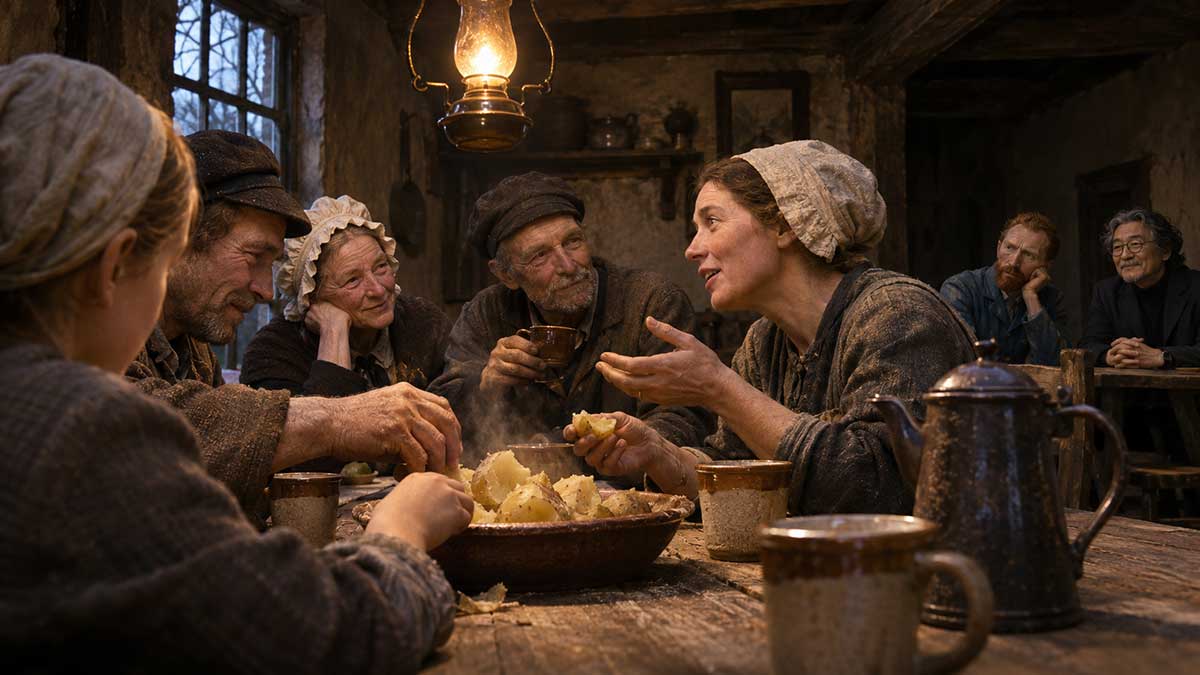
The workroom becomes Vincent’s studio in Nuenen. Studies of heads and hands cover part of a wall. On the table, a reproduction of The Potato Eaters lies beside the drawing Vincent has just brought forward. Nick bends over it, following the reach of a hand into the shared dish.
Vincent van Gogh
I knew people in Nuenen who worked the land. I went to their homes and made studies. The De Groot household was among them.
The picture grew out of that acquaintance and the work I did there.
Nick Sasaki
When I look at The Starry Night, I’m caught immediately. With this, I have to give it a little more time.
Then I begin to feel the room. The light, the people leaning toward the table.
What drew you to this family and this particular meal?
Vincent van Gogh
The connection between their work and the food before them.
Look at the hands. I wanted a viewer to feel that these were the hands with which they had worked the ground. Now they were reaching for the meal that work had earned.
That mattered to me.
Nick Sasaki
You could have shown them working outside. Why choose the moment afterward?
Vincent van Gogh
The meal brings them together. Their gestures meet around something shared.
There is the dish, the drink being poured, the little light overhead. You can follow the attention passing across the table.
Nick Sasaki
I’m noticing the cups now. And the person with her back to us.
I can’t see her face, yet she makes me feel nearer the table.
Vincent van Gogh
Her place in the group matters. The back of a head can contribute to the arrangement as much as a face.
Five figures in one interior give you a great deal to bring together.
Nick moves his chair closer to the table.
Nick Sasaki
The faces are rougher than the faces people usually choose for a beautiful painting.
Was that something you wanted me to notice?
Vincent van Gogh
I wanted the character of their lives to remain present. I was interested in faces altered by work, weather, age.
I did not want to tidy them into a prettiness that would make the whole thing false to my purpose.
Nick Sasaki
There’s a kind of closeness in it. I’m looking into a room I would probably never have entered.
Vincent van Gogh
Then spend some time there.
There are things worth looking at that do not announce themselves through elegance. I had seen that in paintings I admired, and I wanted to attempt it in my own work.
Nick Sasaki
Which painters gave you that feeling?
Vincent van Gogh
Millet. Breton. Painters who made the lives of people working the land occupy their pictures seriously.
Their work could stay with me after I had put a reproduction away.
Nick Sasaki
You once went to Breton’s studio, didn’t you?
Vincent van Gogh
I went to Courrières. It was a difficult trip. I had little money and walked much of the way.
I reached the studio.
Nick Sasaki
What happened when you met him?
Vincent van Gogh
I did not meet him.
Nick Sasaki
You didn’t go in?
Vincent van Gogh
I did not dare introduce myself.
Nick looks up from the painting.
Nick Sasaki
After going all that way?
Vincent van Gogh
Yes. I had managed the road rather better than the introduction.
Nick Sasaki
I can picture you standing there, still trying to decide whether to knock.
Vincent van Gogh
There was. He did not make a particularly successful visit.
Nick Sasaki
But the admiration stayed.
Vincent van Gogh
The pictures still gave me something to think about. I could return to my own drawing.
Vincent draws several studies out from beneath the larger reproduction.
Nick Sasaki
You spent a winter studying heads and hands before this painting. What did those repeated sessions teach you about the people that you might have missed on the first day?
Vincent van Gogh
They made my first impressions insufficient.
You arrive with an idea of a face. Then the actual head has its own shape. The cheek meets the mouth in a way you have not attended to. The light catches one part and leaves another difficult to distinguish.
You must replace what you expected with what is there.
Nick Sasaki
Did a familiar face become easier?
Vincent van Gogh
In some respects. You knew more of it. But familiarity could make you careless too.
You might think you had settled something that still needed looking at.
Nick Sasaki
Show me in one of the hands.
Vincent places a study so that Nick can compare it with a hand in the painting.
Vincent van Gogh
Follow the hand into the wrist. Then consider what the fingers are doing.
A hand holding something has a task. Its shape comes partly from that task. You must attend to the object and the hand together.
Nick Sasaki
I was looking at the size of the hands. You’re making me notice their actions.
Vincent van Gogh
A large hand doing nothing convincingly would not have helped me.
Nick Sasaki
And the repeated studies let you carry those actions into the group?
Vincent van Gogh
They gave me material to work with. Heads, hands, light, the interior. Then I still had to bring the parts into a single picture.
I wanted to attempt a composition of some consequence: five figures sharing a room, connected through their gestures and that light. I wanted the studies to become something larger.
There was ambition in it. I wanted Theo to put the picture before people who knew paintings. Let them see what I was attempting.
Nick Sasaki
I can see the determination in it. Everyone has a place, and that small light has to reach the whole group.
Vincent van Gogh
It gives you a center. Then you have to follow how the light meets the different heads and hands.
The room is dark, but darkness still contains differences. It cannot all become the same brown.
Nick remains over the reproduction for a moment before Vincent brings forward a portrait of Joseph Roulin.
Nick Sasaki
We’re in a very different kind of picture now.
Vincent van Gogh
Yes. Here is Roulin.
Nick Sasaki
The beard, the uniform, that background. There’s so much character in him.
When you painted someone you knew, what made the portrait feel true to that person?
Vincent van Gogh
Likeness was part of it. But I wanted more than the measurement of features.
With Roulin there was a man I knew. A postal employee, a father, someone with opinions and a presence I valued. That acquaintance entered what I wanted from the portrait.
Nick Sasaki
What did you enjoy about him?
Vincent van Gogh
His company. Here was someone I wanted to see again, someone with opinions, a household, a life that continued beyond a sitting. You have spent the day occupied with your own canvas, and another person brings a different life into the room.
Then there was that head. The beard alone gave me a considerable undertaking.
Nick Sasaki
You painted his family too.
Vincent van Gogh
His wife and their children. An entire family gave me different ages, different faces, different things to attempt.
Their company mattered to me in Arles.
Nick Sasaki
What do you do with affection? You can’t just paint “I like this man.”
Vincent van Gogh
No. You must paint a head, a beard, a coat. Choose the background. Attend to the colors beside the face.
The affection gives you a reason to care about those decisions.
Nick Sasaki
His uniform tells me his job before I know anything about him. But I keep coming back to the face.
Vincent van Gogh
The blue coat and its gold details gave me something splendid to paint. Then you come to the face and that great beard. I wanted him to occupy the picture fully, to have a presence you could spend time with. Someone might begin with the uniform and stay for the man.
Nick Sasaki
And if the background isn’t the room he was sitting in?
Vincent van Gogh
It can still belong to the portrait. I wanted colors and arrangements that contributed to the presence of the person.
A likeness can be recognizable and leave you with very little desire to keep looking. I wanted the picture to have a life for the viewer.
Nick Sasaki
Do you think we sometimes pass people without really seeing them?
Vincent van Gogh
We must. A painter has the opportunity to remain with someone longer.
That opportunity ought to produce something. More attention, a better drawing, a color you would not have found if you had hurried away.
Nick Sasaki
I’m thinking of your postman becoming someone I can meet through a painting.
Vincent van Gogh
You can meet what I made from looking at him. There was more to Roulin than I could put into a canvas.
Nick looks at the unoccupied chair beside Vincent.
Nick Sasaki
What was it like to have people near your work when the sitting was over? When you planned the Yellow House, what were you hoping would happen after the painting was done for the day?
Vincent rests Roulin’s portrait against the wall. He pulls the empty chair closer to the table.
Topic 4: A Room for Friendship
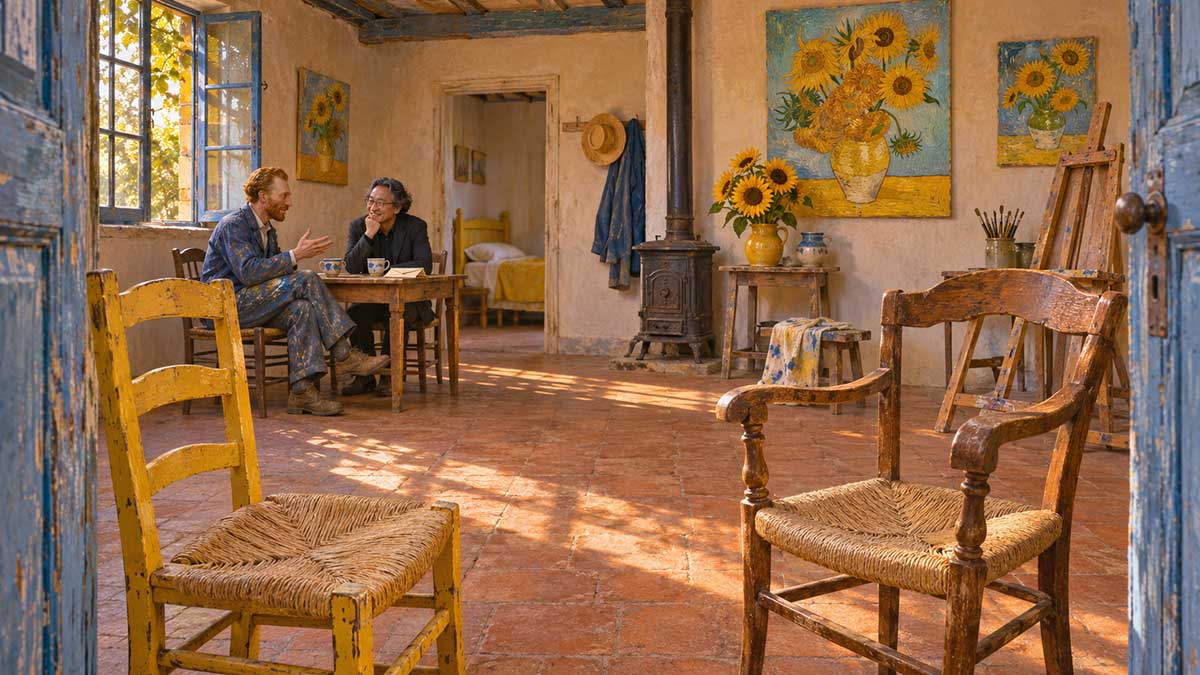
The chair Vincent has pulled toward the table now stands on the tiled floor of the Yellow House. Sunflowers hang nearby. Through an open doorway Nick can see another room, simply furnished. Letters and drawings share the table with two cups.
Vincent van Gogh
Someone to come back with a picture. Someone who had spent the day looking and working, and wanted to talk about it.
I wanted that conversation to have a place.
Nick Sasaki
When you pictured an ordinary day here, what did you hope it would be like?
Vincent van Gogh
There would be work to do. We might go out to different subjects, or one painter might remain inside. Then there would be something to look at when we returned.
Food, a bed, room for supplies. Those things had to be arranged too.
Nick Sasaki
That sounds simple when you list it.
Vincent van Gogh
Try furnishing a house and paying for everything a painter uses. It soon becomes less simple.
I wrote to Theo about the arrangements. There were expenses to meet, what could be shared, what would make it possible for someone to stay.
Nick Sasaki
So the artists’ community began with furniture and bills.
Vincent van Gogh
A visitor cannot sleep on your enthusiasm.
Nick laughs and turns his chair toward the sunflowers.
Nick Sasaki
What did you want these sunflowers to bring into the room?
Vincent van Gogh
I wanted paintings that could belong together. I was absorbed in the yellows, the differences I could make among them.
And there were the flowers themselves. You have some opening, some fully out, others changing and drooping. They ask for different treatment.
Nick Sasaki
I hadn’t thought much about how different the flowers are from one another. I tend to remember “the sunflowers” as one bright thing.
Vincent van Gogh
Look at the heads. One presents its center, another turns away. Petals spread differently. A stem has to carry a particular weight.
There is quite a gathering in a vase.
Nick Sasaki
Did you choose them partly for their brightness?
Vincent van Gogh
The color interested me greatly. But a yellow flower does not paint itself. You must find differences within what could become a very monotonous picture.
I wanted those differences in the heads and stems to remain visible. Look at how differently they occupy the vase.
Nick Sasaki
You were preparing for Gauguin. Did you picture him coming into the room and looking at these?
Vincent van Gogh
Yes. I cared about what he would see here.
I wanted him to find work on the walls, evidence of what occupied me. There was pleasure in preparing for his arrival.
Nick Sasaki
He liked them.
Vincent van Gogh
He admired them.
Nick Sasaki
And later wanted another.
Vincent van Gogh
He already had two of my earlier sunflower pictures from Paris. He wanted one of the ones made here too.
I wrote quite plainly that I intended to keep them.
Nick Sasaki
There was a limit.
Vincent van Gogh
There was.
Vincent’s answer comes so quickly that Nick smiles.
Nick Sasaki
You sound quite pleased with yourself for keeping them.
Vincent van Gogh
I had put work into them. His admiration mattered to me, certainly. But an admired colleague does not become entitled to everything he admires.
Nick looks from the sunflowers to a pair of reproductions resting against the wall.
Nick Sasaki
Those are the two chairs you painted.
Vincent van Gogh
Mine and Gauguin’s.
Nick Sasaki
They feel like two people have just stepped out.
Your pipe and tobacco are on yours. His has books and a candle.
Vincent van Gogh
They were conceived as a pair. One turns one way, the other the opposite way. My plain chair in daylight; his armchair with its books and candle, a night effect.
I wanted them seen together. An empty chair can make you think of its occupant, but here you have two quite different arrangements. Each picture changes the company the other keeps.
Nick Sasaki
You could say something about each of you without painting either face.
Vincent van Gogh
Yes. I could choose a chair, objects, a kind of light, and attempt something about a person through that gathering. It interested me greatly that a room could hold such a presence without a face in it.
Nick Sasaki
It makes the whole household feel more present. We’re talking about an artists’ community, but I can see where two particular men would sit.
Vincent van Gogh
Two particular men presented quite enough difficulty.
Nick Sasaki
What happened to your work when another painter was here to look at it and argue with you?
Vincent van Gogh
A judgment arrived much sooner. You did not have to put a drawing in an envelope and wait for a reply.
Sometimes you wanted that judgment. Sometimes you wished the other man would attend to his own canvas.
Nick Sasaki
What sort of disagreement reached into the painting itself?
Vincent van Gogh
How far to work from what was before us. What memory and invention could contribute. What a picture should retain from nature.
Gauguin had his methods and convictions. I had mine. Living together put those questions near at hand.
Nick Sasaki
Could you try his approach without feeling you had surrendered your own?
Vincent van Gogh
I could try something and judge the result. An experiment did not oblige me to accept every argument that had led to it.
But influence reaches you. You can resist a painter’s opinion and still find that something he said remains in your head the next morning.
Nick Sasaki
Would that annoy you?
Vincent van Gogh
It could. Particularly if I wanted to disagree and found I had work to do before I could.
Nick Sasaki
What did you value in the exchange?
Vincent van Gogh
That these matters were worth arguing about. We both cared about painting.
There were pictures, ideas, things attempted. I could see another painter working through decisions. There is much in that which a finished canvas alone does not show you.
Nick Sasaki
You wanted companionship, but it wasn’t simply someone reassuring you.
Vincent van Gogh
I wanted work to come from the arrangement. Conversation could encourage it, disturb it, send it in another direction.
Constant agreement would not have made a very interesting household.
Nick Sasaki
I doubt anyone was in danger of constant agreement here.
Vincent glances at the two cups.
Vincent van Gogh
No.
Nick Sasaki
We know how painfully this period ended. When you look back at your hopes for the house, what do you want me to keep in view?
Vincent takes a moment before answering.
Vincent van Gogh
That there was work here I valued. That I wanted the arrangement to succeed.
My illness became serious. The household broke apart. I could not simply continue the life I had pictured.
But you have been looking at paintings made during that time. Give those their attention too.
Nick Sasaki
I think seeing the rooms and the pictures together changes the story for me. I can picture you making preparations, wanting someone to arrive.
It makes the hope feel real.
Vincent van Gogh
It was real. The practical difficulties were real too.
Nick Sasaki
Where was Theo in all of this?
Vincent van Gogh
In the letters, the arrangements, the money, the pictures I sent him. He was involved from a distance in what happened here.
You could look around the room without seeing him and still be looking at things his support helped make possible.
Nick Sasaki
What did he give you that money alone could not?
Vincent van Gogh
Someone to tell what I was doing. I could write about a picture in progress, what I needed, what I hoped to attempt next.
He knew paintings and the business of art. His replies came from someone who could take the work seriously.
And he was my brother.
Nick Sasaki
Did that make the support easier to receive?
Vincent van Gogh
It made it intimate. I could ask things of him and worry about asking them. I knew there were demands on his life beyond my next canvas.
I wanted the work to amount to something. I wanted him to have reason to believe in it.
Nick Sasaki
Could you tell him when you thought you had made a good picture?
Vincent van Gogh
Yes. I could be quite eager to tell him.
Nick Sasaki
We hear so much about your doubts. I like picturing you writing to him with something you were excited to show.
Vincent van Gogh
There were such letters. There were days of work I wanted him to know about.
You would get a poor account of a painter by collecting only his discouragements.
Nick looks down at the letters on the table.
Vincent draws one letter from the pile. Nick notices a reproduction of white blossoms beneath it.
Nick Sasaki
Then Theo’s household changed. He and Jo had a son.
Vincent van Gogh
Yes. They named him Vincent.
Nick Sasaki
And you began a painting for them.
Vincent sets the letter beside the picture. Nick leans forward to look at the branches against the blue sky.
Topic 5: What a Painting Can Give Someone
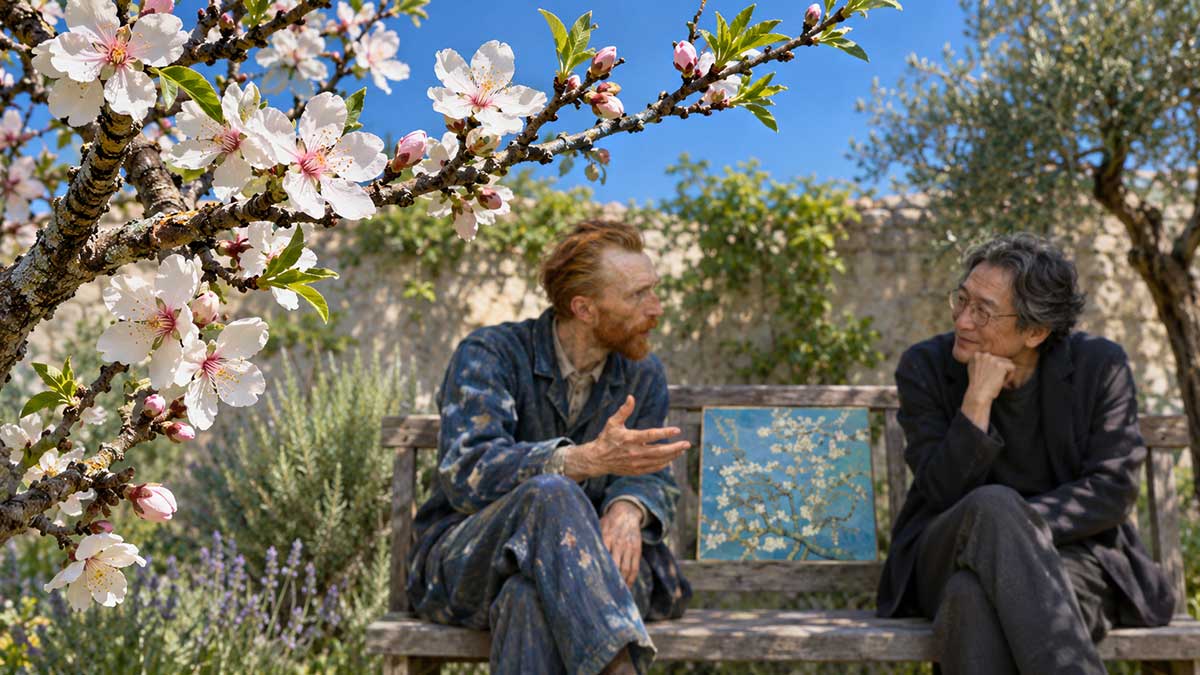
The table gives way to a bench in the Saint-Rémy garden. Vincent places the picture of almond branches where both men can see it. Nearby, a real branch casts small patches of shade across the ground. Nick looks from the white blossoms to the letter Vincent has brought with him.
Nick Sasaki
When you heard about Theo and Jo’s baby, how did you decide what to paint for them?
Vincent van Gogh
I began a picture of flowering almond branches against a blue sky. Something for them to have in their bedroom.
The birth gave me an occasion to make something for their household.
Nick Sasaki
They had named him Vincent.
Vincent van Gogh
Yes.
Nick Sasaki
What was it like to receive that news after everything that had happened?
Vincent van Gogh
Theo was a father. My younger brother had a son.
I had sent him so many accounts of my work and requests for what I needed. Now I wanted to send something for this child and his parents. A picture that would have its place beside their new life together.
Nick Sasaki
I like that the painting would be in a room they used every day.
Vincent van Gogh
That was the intention. A picture can become familiar through living with it. They might see it in the morning, or notice a passage after scarcely looking at it for several days.
Nick Sasaki
It feels so full of possibility to me. The branches seem to keep going beyond the edges.
Vincent van Gogh
There is room for your eye to follow them. Then you find the flowers and the little areas of sky between them.
Nick studies a cluster of blossoms near a fork in the branch.
Nick Sasaki
We’ve talked a great deal about how you painted. I want to ask what you hoped all that work might contribute.
You had once wanted to serve people through religious work. What place did that wish have in your life as a painter?
Vincent van Gogh
I had wanted to be useful. That question did not leave me when I began drawing.
I had lived near people whose work was hard and whose circumstances troubled me. I continued to care about those lives. They were among the things I wanted to paint.
But my relations with religion had changed. There were things I resisted, things I remained attached to, questions I continued to turn over.
Nick Sasaki
What remained especially important to you?
Vincent van Gogh
Christ remained a figure I thought about deeply.
I wrote to Bernard about thinking of him as an artist, someone whose work was in human beings themselves. I was struck by the scale of that idea: a life affecting other lives so profoundly.
Nick Sasaki
That’s a remarkable way for a painter to look at him. What did it open up for you?
Vincent van Gogh
A way of considering creation beyond the objects artists make. What a person might bring into the lives of others.
But I was a painter. I had my particular work before me. A great thought could occupy me, and then I still had to return to a canvas and attempt something within my reach.
Nick Sasaki
Did that make a picture of a worker or an ordinary room feel connected to larger questions?
Vincent van Gogh
It could. I was interested in what was enduring in a person, something you might feel in a portrait.
I wanted to find ways of expressing that through the picture itself, through its color and character.
Nick Sasaki
Without having to explain everything beside it.
Vincent van Gogh
Yes. Though I explained quite a great deal in letters.
Nick Sasaki
Fortunately for those of us who want to ask you questions.
Vincent smiles and looks down at the letter.
Vincent van Gogh
You would have had fewer particulars without them.
Nick Sasaki
Did nature offer you something you had been seeking through religion?
Vincent van Gogh
There were experiences in looking at nature that mattered greatly to me. Trees, fields, the sky, the return of flowers.
I could be occupied by them beyond the practical question of what I would paint. Yet painting gave me a way to remain with what I had seen and work on it.
I would hesitate to make the change in my life sound orderly. One belief did not simply take the place of another. There were old attachments and new difficulties.
A breeze moves the branch above them. Nick waits for its shadow to pass over the bench before speaking again.
Nick Sasaki
You wrote about wanting your paintings to offer consolation. What could a picture give someone having a difficult day?
Vincent van Gogh
Something worth attending to. A person in a portrait whose presence interests him. A color he takes pleasure in. A familiar thing shown with care.
He might want the picture near him. He might return to it.
That is something a painter can hope for.
Nick Sasaki
Does consolation have to feel peaceful?
Vincent van Gogh
I do not think it must. A picture can be serious, even troubling, and still give you a reason to stay with it.
Someone might recognize a life or a feeling he has not seen attended to elsewhere. The painting has taken it seriously.
Nick Sasaki
Can you tell whether that happens?
Vincent van Gogh
Sometimes someone tells you. Often you do not know.
You make the work and send it out. It enters a room you may never see, and someone looks at it in circumstances you know nothing about.
Nick Sasaki
That describes what happened between you and me.
Vincent van Gogh
Tell me.
Nick Sasaki
I go into a museum in New York, a place far from where you painted. There are people around me, conversations, other paintings I want to see.
Then I stand in front of your sky.
For a little time, I’m absorbed in it. I’m interested in something I can’t exhaust in one look. That matters to me.
Vincent van Gogh
And you have kept returning.
Nick Sasaki
Yes. I think that’s the part I most wanted you to know.
Vincent van Gogh
I am glad you have told me.
For a moment Vincent leaves the picture alone, his hands resting on his knees.
Nick Sasaki
Did making the paintings give you consolation too?
Vincent van Gogh
There were days when work gave me something definite to do and something I wanted to continue. I could become absorbed in a subject. I could be pleased with a passage, eager to tell Theo about it.
There were other days when I was unable to work. I would not want you to forget how much those interruptions cost me.
But the pleasures were real. A color found, a subject that held my attention, a picture I wanted to send. Those belonged to my life too.
Nick Sasaki
I think people can become so moved by the tragedy of your life that they miss the pleasure you took in the work.
Vincent van Gogh
Then give those pleasures their place. I was eager about things. I wanted the next canvas, the next attempt, news from Theo.
Here was a child to welcome. That mattered to me.
Nick Sasaki
I will.
Nick looks again at Almond Blossom. This time he follows one branch until it passes beyond the edge.
Nick Sasaki
Before I go, what would you want me to notice on my next visit to MoMA?
Vincent van Gogh
You began with the stars. Give the village a little more of your time.
Look at the small roofs and the spaces between them. See how the hills sit behind the houses. Then step back until the parts come together again.
Nick Sasaki
I’ll be looking for the decisions you made.
Vincent van Gogh
Look for what the picture gives you too. You need not turn every visit into an examination.
Nick Sasaki
That’s a relief. I was beginning to acquire homework.
Vincent van Gogh
You asked a painter a great many questions. There was some risk.
Nick laughs. He rises, then looks toward the garden path.
Nick Sasaki
Thank you, Vincent. I came here wanting to know how you made a painting I love. I’m leaving wanting to spend more time with the others.
Vincent van Gogh
Start with the one you want to look at. There will be enough to occupy you.
At the gate, Nick pauses beside a branch extending across the path. He looks at its leaves, then through them at the small pieces of sky.
When he turns back, Vincent has lifted Almond Blossom from the bench. He angles it toward the light and studies a passage near the flowers.
Final Thoughts
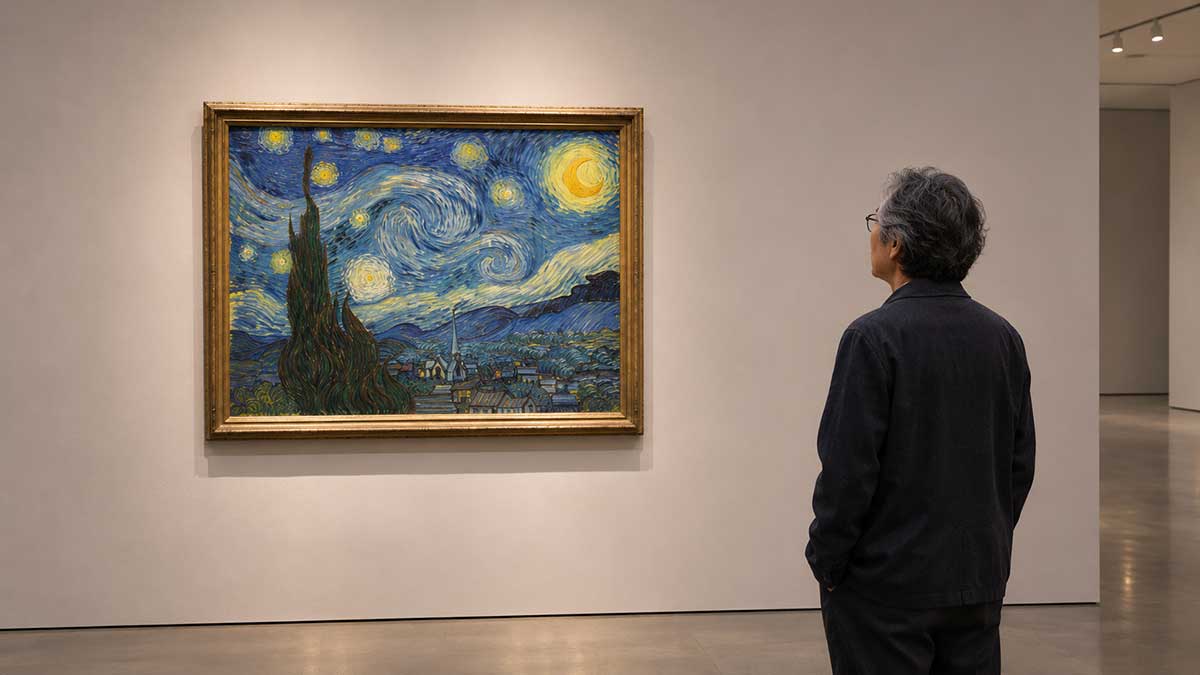
Vincent van Gogh has given me a different kind of anticipation about my next museum visit.
I know I will still want to see The Starry Night. Yet I am curious about what will happen after the first familiar recognition. Perhaps a passage that once seemed incidental will hold me longer. Perhaps I will spend more time with a picture I have previously passed on my way to a favorite.
That seems a valuable result of this fictional conversation. Affection has become curiosity, and curiosity gives me reasons to return.
There is a difference between recognizing an image and spending time with a painting. Reproductions let us carry pictures into our homes and daily lives. In a gallery, we meet scale, surface, distance, and the company of other viewers. I enjoy that encounter more when I allow myself to notice something before deciding what it ought to mean.
I needn’t arrive with a new interpretation each time. Some visits may simply renew the pleasure that brought me there in the first place.
Research can deepen the experience. Learning who sat for a portrait or why a painting was made gives the image another connection with human life. The museum’s account of Jo van Gogh-Bonger’s work adds a further dimension: the audience Vincent reaches today owes much to someone who helped preserve, exhibit, and explain what he left. She prepared his letters for publication in 1914. Our encounter with his work has a history of care behind it.
I find that worth keeping in mind. We tend to speak of a famous painter as if the pictures arrived before us by themselves. There were people who made work possible, people who kept it, and people who helped others see its value. Their efforts become part of the life of a painting.
The conversation has left me thinking about my role as an interviewer too. A prepared question can open a door. Listening to the answer decides how long we remain there. With Vincent, the most rewarding turns often begin with something small: an object, a gesture, a practical difficulty, a person he wants to talk about.
I want to bring that patience to other guests. Their achievements deserve attention to the choices and attachments through which the work took shape. A familiar reputation can be a starting point, with room left for a person to surprise us.
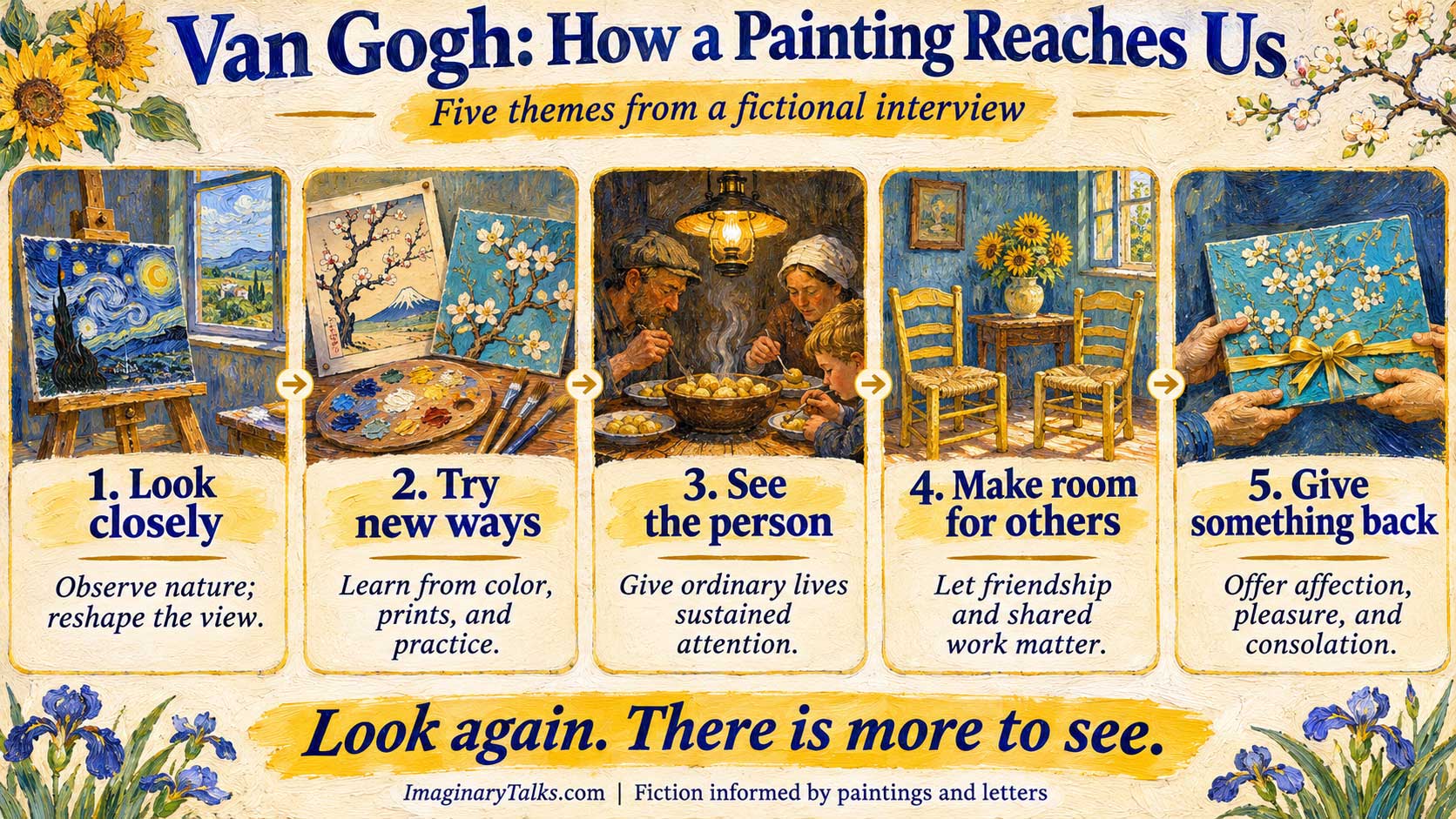
For readers, there need be no test at the end of this article. You might want to look up one of the paintings, read a letter, or spend a little more time with a picture you already know. The letters are available to explore, and they let Vincent speak in his documented words beyond the fictional voice used here.
I will take something quieter with me: the possibility that familiarity has left more to discover than I realized.
A painting can remain the same object and offer a different encounter when we return. That is part of what I love about going back. I look forward to seeing what catches my attention next.
Disclaimer: These final thoughts are Nick Sasaki’s reflections on a fictional conversation. They do not represent a recorded exchange with Vincent van Gogh or verified statements by him.
Short Bios:
Vincent van Gogh: Vincent van Gogh (1853–1890) was a Dutch painter whose expressive color, distinctive brushwork, and attention to everyday life helped shape modern art. During an artistic career of roughly ten years, he painted working people, friends, rooms, flowers, and the countryside. His works include The Starry Night, Sunflowers, The Potato Eaters, and Almond Blossom. His correspondence records his studies, ambitions, practical difficulties, and relationships with Theo and fellow artists. The Van Gogh Museum’s biographical resources provide an introduction to his life and artistic development.
Nick Sasaki: Nick Sasaki is the creator of ImaginaryTalks.com, a publishing project that brings historical figures, artists, writers, and thinkers into fictional conversation. His interviews begin with personal curiosity and explore the work, ideas, relationships, and achievements that make a guest worth meeting. He aims to help readers appreciate people across different periods and traditions through approachable questions, human stories, and sustained attention to their contributions. In this series, Nick serves as interviewer, following each guest’s answers into a broader conversation about creativity, purpose, and the things people leave for others.
Disclaimer: These bios provide background on the participants. Their meeting, dialogue, and actions in this article are fictional.
Leave a Reply