
Introduction
Before We Forget How to Connect: 30 Questions About What Makes Us Feel Truly Known
What if the greatest communication problem is not that people don't know how to speak, but that we gradually stop being curious about the people we love?
Vinh Giang's forthcoming book, Before We Forget How to Connect: Be Heard, Be Seen, and Communicate with Confidence, raises questions about voice, storytelling, listening, confidence, body language, and human connection.
The book has not yet been published, so this conversation does not claim to explain its unpublished contents. Instead, Part 2 begins with the questions raised by Vinh's publicly available ideas and asks six researchers and communication thinkers to examine them from very different directions.
Are great communicators born or made?
Why can two people hear the same sentence and understand completely different things?
Can someone love us deeply yet fail to understand us?
Why do strangers sometimes learn things about us that our own families don't know?
Does remembering someone's story make them feel valued?
Can familiarity quietly destroy curiosity?
Are smartphones weakening relationships, or allowing relationships that once would have disappeared to survive across distance?
Can AI help us communicate better with other humans?
And what does it actually mean to feel that another person truly knows us?
Across five conversations, something unexpected happens.
The discussion begins with communication skills.
It ends somewhere much deeper.
Perhaps connection is not mainly about becoming more impressive.
Perhaps it begins when we become more interested.
And perhaps one of the greatest dangers in a long relationship is reaching the point where we quietly decide:
I already know you.
(Note: This is an imaginary conversation, a creative exploration of an idea, and not a real speech or event.)
Topic 1: Is This Really My Personality, or Just the Way I Learned to Communicate?

The room feels different from the first conversation.
No stage. No presentation screen filled with communication techniques. Just seven chairs arranged loosely in a semicircle.
Sarah Chen sits forward.
Sarah Chen: I want to begin with a sentence millions of people have probably said about themselves.
"I'm just not good with people."
Maybe it's:
"I'm shy."
"I'm awkward."
"I'm not interesting."
"I'm terrible at small talk."
"I'm not confident."
"I'm not a good storyteller."
"I'm not someone people listen to."
When does a description of our behavior become a definition of who we are?
Charles Duhigg: Sometimes remarkably quickly.
We experience a few difficult conversations. Maybe we don't know what to say at a party. Maybe somebody else is naturally funny and relaxed, and we compare ourselves with them.
Eventually we stop saying, "That conversation didn't go well."
We say, "I'm bad at conversation."
That's a major psychological shift.
An event has become an identity.
Nicholas Epley: And we're often constructing that identity from incomplete information.
Think about someone who walks into a room where they don't know anyone.
They want to talk.
Other people may want to talk to them.
But they predict rejection.
So they remain quiet.
Then they leave and think, "See? Nobody was interested in talking to me."
Sarah: But nobody rejected them.
Nicholas: Exactly.
They may have behaved according to a prediction that was never properly tested.
Alison Wood Brooks: There's another interesting possibility.
People sometimes think being good at conversation means being fascinating.
So they enter conversations asking themselves:
"What interesting thing can I say?"
That's a tremendous burden.
A different question is:
"What interesting thing can I discover about this person?"
Suddenly you don't have to perform nearly as much.
Sarah: So a person who thinks, "I'm boring," may be asking the wrong question?
Alison: Potentially.
A good conversation doesn't require two people continuously proving how interesting they are.
Curiosity can carry an enormous amount of the interaction.
Harry Reis: And there's an important relational piece here.
People tend to feel closer when they experience another person as responsive to them, meaning they feel understood, validated, and cared for.
So communication isn't simply:
"Did I say something impressive?"
It includes:
"Did something happen between us that communicated that your experience mattered to me?"
That person doesn't necessarily need extraordinary charisma.
They need responsiveness.
Sarah writes something on the board.
INTERESTING PERSON
Then beneath it:
INTERESTED PERSON
She looks at the group.
Sarah: Those are not the same thing.
Alison: No.
And the second may sometimes matter considerably more.
Question 1: Are Great Communicators Born, or Can Communication Really Be Learned?
Sarah: This is one of the questions raised by Vinh Giang's public story.
He has described himself as painfully shy growing up. English was his third language. Yet communication eventually became his life's work.
So let's deal with the obvious question.
Are some people simply born good at this?
Charles: People certainly differ.
Some people are naturally more socially comfortable. Some are more verbally fluent. Some enjoy novelty and meeting strangers. Some process social situations quickly.
We shouldn't pretend those differences don't exist.
But conversation contains behaviors.
Behaviors can be practiced.
Recognizing what kind of conversation someone wants to have can be practiced.
Listening can be practiced.
Asking questions can be practiced.
Storytelling can be practiced.
Sarah: So the mistake would be saying personality doesn't matter.
Charles: Yes.
The stronger statement is that personality doesn't dictate every conversational behavior available to you.
Harry: I'd add something.
A person's goal doesn't have to be becoming a "great communicator."
That's a very individualistic way to frame this.
Maybe the goal is becoming someone with whom other people feel safe communicating.
Those aren't necessarily identical skills.
Sarah stops writing.
Sarah: Explain that.
Harry: Suppose you're extremely articulate.
You tell wonderful stories.
You're funny.
You're confident.
You dominate every dinner conversation.
People may think you're impressive.
But do they feel understood around you?
That's a different measure.
Nicholas: And there's a wonderful irony here.
The desire to make a good impression can sometimes interfere with connecting.
You're monitoring yourself.
"Was that funny?"
"Do they like me?"
"Am I sounding intelligent?"
"Should I tell this story?"
Part of your attention is pointed inward.
Sarah: Meaning the more desperately I'm trying to connect, the less attention I may have available for the other person.
Nicholas: Sometimes, yes.
Question 2: Can a Shy Person Become Charismatic Without Becoming Someone Else?
Sarah: Let's say I'm genuinely introverted.
I like quiet.
Large groups exhaust me.
I don't want to become the loudest person in the room.
Why should I?
Alison: You shouldn't.
Sarah: Then what would improvement look like?
Alison: Maybe being able to enter the conversation you want to enter.
Maybe asking the question you're afraid to ask.
Maybe telling someone you're interested in what they're saying.
Maybe following up instead of retreating.
None of those requires becoming loud.
Harry: I'd question the word "charismatic," too.
What experience are we actually trying to create?
Someone can be extremely quiet and make another person feel profoundly attended to.
Think about someone you've spoken with who hardly said anything, yet somehow you walked away thinking:
"That person really listened to me."
Would we call that charisma?
Perhaps.
Perhaps not.
But relationally, something important happened.
John Gottman: This becomes very visible in couples.
Successful connection isn't built entirely from grand conversations.
Often it's tiny moments.
Someone looks out the window and says:
"That's a beautiful bird."
Their partner has choices.
Ignore it.
Say, "Hmm."
Look up and say:
"Where?"
That tiny response may seem trivial.
But relationships contain thousands of these little opportunities to turn toward one another.
Sarah: So maybe communication isn't mainly about producing extraordinary moments.
John: Much of relationship life certainly isn't.
It's Tuesday morning.
Someone is making coffee.
Someone sighs.
Someone says, "Long day today."
Does the other person notice?
That's where much of connection lives.
Question 3: Can Changing the Way We Communicate Change the Way We See Ourselves?
Sarah: Let me push this further.
Suppose I've believed for thirty years:
"I'm shy."
Then I learn to speak comfortably.
I become better at telling stories.
I ask better questions.
I stop avoiding strangers.
At what point do I stop calling myself shy?
Nicholas: Maybe you don't have to.
Sarah: Interesting.
Nicholas: The label may still describe something real about your internal experience.
The danger comes when the label becomes a prediction.
"I'm shy, therefore I cannot speak."
"I'm introverted, therefore I cannot lead."
"I'm socially awkward, therefore people won't enjoy talking with me."
Those conclusions don't automatically follow.
Charles: We should distinguish preference from capacity.
"I prefer small groups."
That's different from:
"I cannot communicate in large groups."
Alison: And behavior can create new evidence about yourself.
If you've always thought, "I can't talk to strangers," and then you have ten surprisingly enjoyable conversations with strangers, your internal story now has competing evidence.
Sarah: So confidence may sometimes arrive after behavior rather than before it.
Alison: Yes.
Waiting until you feel completely confident can become a very long wait.
Question 4: How Much Does Voice Affect How Other People Experience Us?
Sarah: Let's move into one of Vinh's major public teaching areas.
Voice.
If I say:
"I'm glad you're here."
How much information have I communicated?
Charles: Not enough to know what you meant.
Sarah: Exactly.
"I'm glad you're here."
She repeats it warmly.
Then flatly.
Then impatiently.
Then softly, almost emotionally.
The panel smiles.
Sarah: Four identical sentences.
Four different conversations.
Harry: This illustrates why relationships operate through more than literal semantic content.
People are continuously trying to infer:
What does this person mean?
How do they feel?
How do they feel about me?
Nicholas: But here's where caution becomes valuable.
Humans infer mental states constantly.
We're sometimes right.
We're sometimes wrong.
The voice gives us evidence.
It doesn't give us direct access to another mind.
Sarah: So if my wife says something in a certain tone and I think, "She's angry," I may be right.
Nicholas: Yes.
Sarah: But I might be wrong.
Nicholas: Certainly.
Sarah: What's the better response?
Nicholas: Ask.
Sarah laughs.
Sarah: That seems embarrassingly simple.
Nicholas: Humans often prefer inference.
We like believing we know.
Question 5: How Much Can We Trust Body Language?
Sarah: This seems connected.
The internet is filled with claims like:
"If someone crosses their arms, they're defensive."
"If they look away, they're lying."
"If they touch their face, they're nervous."
How much should we trust these rules?
Nicholas: Context matters enormously.
A behavior doesn't arrive with subtitles.
Crossed arms could mean:
"I'm defensive."
Or:
"I'm cold."
Or:
"This chair has no armrests."
Everyone laughs.
Nicholas: Humans want simple decoding systems.
They're appealing.
But another person isn't a puzzle with one universal answer key.
Harry: And there's a relational danger.
If I decide what your body means without asking you, I can become less curious.
Sarah: That's our word again.
Curiosity.
Harry: Yes.
Observation can open curiosity.
Certainty can close it.
Sarah: So instead of:
"You're obviously angry."
Maybe:
"You seem quieter than usual. Is something bothering you?"
Harry: That's a very different interaction.
The first tells the other person what they're experiencing.
The second invites them to tell you.
Question 6: When Does Improving Communication Become Performance?
The room becomes quieter.
Sarah: Here's the question that bothers me most in this topic.
Suppose I learn everything.
Better voice.
Better posture.
Better gestures.
Better storytelling.
Better questions.
Better eye contact.
Better listening techniques.
At some point, couldn't I become very skilled at appearing connected?
Jeff Hancock: Absolutely.
And technology may intensify that problem.
We can now receive assistance composing messages, apologies, dating profiles, professional responses, perhaps eventually real-time conversational suggestions.
The outward communication may improve.
But then we have to ask where authenticity resides.
Is authenticity in spontaneous wording?
In intention?
In emotion?
In authorship?
Those are becoming harder questions.
Sarah: Suppose AI helps me write a beautiful apology to my wife.
Is the apology less authentic?
Jeff: I wouldn't automatically say that.
Maybe you genuinely feel remorse but struggle to articulate it.
Assistance might help you express something real.
Harry: The wife's experience matters too.
If the words accurately represent what you feel and you're willing to stand behind them, perhaps the tool helped communication.
But if the words simulate emotional insight you don't actually possess, that's different.
Charles: This existed before AI.
People have always borrowed words.
Love letters.
Greeting cards.
Wedding vows.
Poetry.
Advice from friends.
The deeper question is whether the communication represents something genuine.
Sarah: So technique isn't the enemy of authenticity.
Harry: No.
But technique cannot substitute for caring.
Silence.
Sarah looks at the board.
INTERESTING PERSON
INTERESTED PERSON
Below it she writes:
PERFORMANCE
and then:
PRESENCE
Sarah: Maybe that's where Topic 1 has brought us.
We began with:
"Can I change how I communicate?"
But perhaps that's not the hardest question.
The harder question might be:
"If I become better at communication, what am I becoming better at?"
Getting attention?
Persuading people?
Appearing confident?
Making people like me?
Or becoming more capable of meeting another human being?
Harry: Those outcomes can overlap.
But they aren't interchangeable.
John: And in long relationships, performance becomes very difficult to sustain anyway.
Eventually you're tired.
Eventually you're sick.
Eventually you've had a terrible day.
Eventually the polished version disappears.
Then the relationship encounters the ordinary person.
Sarah: Maybe that's where connection really gets tested.
John: Very often.
Alison: And perhaps that's good news for someone who thinks they aren't charismatic enough.
They may be solving the wrong problem.
Maybe the question isn't:
"How do I become more impressive?"
Maybe it's:
"How do I become more interested?"
Nicholas: And:
"How willing am I to discover that my assumptions about another person are wrong?"
Harry: And:
"Does this person experience me as someone who understands and cares about what matters to them?"
Sarah turns toward the board one final time.
She crosses out neither PERFORMANCE nor PRESENCE.
Instead, she draws a line between them.
Sarah: Perhaps we need some performance.
We learn language.
We practice stories.
We learn how to use our voice.
We learn how to ask better questions.
But those skills may only take us to the doorway.
What happens after that depends on whether there's actually another person we're interested in meeting.
She looks around the room.
Sarah: So perhaps the first question shouldn't be:
"How can I become a better communicator?"
It might be:
"When I communicate, am I trying to be noticed, or am I trying to notice?"
For a moment, nobody answers.
And perhaps that is the right place for the conversation to end.
Topic 2: You Heard My Words. Why Didn't You Understand Me?

The room is quieter than before.
On the board, Sarah has left one sentence from the previous conversation:
AM I TRYING TO BE NOTICED, OR AM I TRYING TO NOTICE?
She stands beside it for several seconds.
Then underneath, she writes:
"THAT'S NOT WHAT I MEANT."
Sarah Chen: I suspect almost everyone has said this.
Maybe during an argument with a spouse.
Maybe talking with a child.
Maybe at work.
You say something.
The other person reacts.
And suddenly you realize they heard something completely different from what you thought you communicated.
So you say:
"That's not what I meant."
And they say:
"Well, that's what you said."
Who is right?
Nicholas Epley: Potentially both.
Sarah: That's not going to make the argument easier.
The group laughs.
Nicholas: Probably not.
But there's an important distinction between intention and interpretation.
You have privileged access to your intention.
The listener doesn't.
The listener receives your words, your voice, your expression, the situation, their history with you, their expectations, and their own emotional state.
From those signals, they infer what you meant.
Sarah: So communication isn't like sending a file from one computer to another.
Nicholas: No.
The other person doesn't receive your thought.
They receive evidence about your thought.
Then their mind constructs an interpretation.
Sarah writes:
WHAT I FEEL
↓
WHAT I THINK
↓
WHAT I INTEND
↓
WHAT I SAY
↓
WHAT YOU HEAR
↓
WHAT YOU INTERPRET
↓
WHAT YOU REMEMBER
She turns back toward the panel.
Sarah: Seven stages.
That seems like a lot of opportunities for trouble.
Charles Duhigg: It is.
And sometimes two people aren't merely interpreting the same words differently.
They're having different kinds of conversations.
One person wants emotional acknowledgment.
The other person thinks they're being asked to solve a practical problem.
Sarah: Give me an example.
Charles: Your spouse comes home and says:
"My boss criticized me in front of everyone today."
You immediately say:
"Then you should talk to HR."
That might be sensible advice.
But perhaps your spouse wasn't asking:
"What should I do?"
Perhaps they were saying:
"That hurt."
And what they wanted was:
"That sounds awful. What happened?"
Harry Reis: That's where responsiveness matters.
The response can be intelligent and still fail relationally.
Sarah: That's an interesting sentence.
Harry: You can give someone a perfectly reasonable answer to the wrong emotional question.
Question 7: Why Can Two People Hear the Same Sentence and Understand Completely Different Things?
Sarah: Let's make this uncomfortable.
A wife says to her husband:
"You never listen to me."
What does she mean?
John Gottman: We'd need to ask her.
Sarah: Good answer.
Everyone laughs.
John: She may mean literally that he interrupts.
She may mean he forgets things she tells him.
She may mean he immediately offers solutions.
She may mean she doesn't feel emotionally understood.
She may mean something happened five minutes ago.
Or she may be expressing frustration accumulated over years.
The sentence alone isn't enough.
Nicholas: But notice what her husband may hear.
"You are a bad husband."
Sarah: Even though she didn't say that.
Nicholas: Correct.
And then he responds to the accusation he believes he heard rather than the experience she was trying to communicate.
Sarah: So he says:
"That's ridiculous. I listen to you all the time."
Harry: Now she's likely to feel less heard.
Sarah: So she says:
"See? You're doing it right now."
The room laughs again.
Charles: And now the argument is no longer about whatever started it.
It's about the conversation itself.
Sarah: That's painfully familiar.
Question 8: Which Matters More, Our Words or How We Say Them?
Sarah turns toward John.
Sarah: Imagine I say to my husband:
"Do whatever you want."
What did I communicate?
John: I would advise the husband to gather more information.
Laughter fills the room.
Sarah: Excellent survival instincts.
She says it again, cheerfully.
"Do whatever you want."
Then coldly.
"Do whatever you want."
Then quietly, sounding hurt.
"Do whatever you want."
Harry: The literal content remains stable.
The relational message changes dramatically.
Sarah: What do you mean by relational message?
Harry: The words convey information.
But communication between people often carries another layer:
What does this interaction say about us?
Are you angry with me?
Do you respect me?
Are you withdrawing?
Do you care?
Am I safe telling you this?
Are you rejecting me?
That's part of what people are continuously interpreting.
Nicholas: And this is precisely where confidence can become dangerous.
We often become very certain about what another person's tone means.
Sometimes we're right.
Sometimes we're not.
Sarah: So again:
Ask.
Nicholas: Yes.
Sarah: Humans really don't like doing that, do we?
Nicholas: We often prefer believing we've already figured the other person out.
Question 9: Why Does Emotion Sometimes Speak More Clearly Than Words?
Sarah: Someone asks:
"Are you okay?"
And I say:
"I'm fine."
Everyone knows where this is going.
Sarah: Am I fine?
Alison Wood Brooks: We have insufficient data.
Sarah: Very scientific.
Alison: Thank you.
The room laughs.
Alison: But this is where follow-up questions matter.
You could accept "I'm fine" as the end of the conversation.
Or you could notice something doesn't fit.
"You seem quieter than usual. Are you sure?"
That second question communicates something beyond curiosity.
It communicates:
"I noticed."
Harry: Which can be very important relationally.
Sarah: But couldn't that become intrusive?
Alison: Certainly.
Curiosity doesn't mean interrogation.
A good conversational partner has to notice whether the other person wants to continue.
Harry: Responsiveness includes respecting boundaries.
Feeling seen isn't the same as feeling inspected.
Sarah pauses.
Then writes:
SEEN ≠ INSPECTED
Sarah: That's an important distinction.
Question 10: Why Can Stories Help Us Understand Someone Better Than Facts?
Sarah: Suppose someone tells me:
"My father wasn't around much when I was growing up."
I understand the information.
But then they say:
"When I was eight, I used to stay awake listening for his car in the driveway. Most nights I fell asleep before he came home."
Something changes.
Why?
Charles: The second version gives you a scene.
You can mentally enter it.
There's a child.
A bedroom.
Nighttime.
Waiting.
The abstract statement becomes human experience.
Harry: And storytelling can reveal meaning.
Maybe the adult isn't merely telling you:
"My father worked late."
Maybe they're telling you:
"I spent years wondering whether I mattered enough for him to come home."
Those are very different levels of disclosure.
Sarah: And if I immediately say:
"Well, he was probably working hard to support the family."
Harry: You may be factually correct.
And relationally, you may have missed what was being entrusted to you.
Silence.
Sarah: "Entrusted" is an interesting word.
Harry: Personal stories can be disclosures.
Someone is allowing you access to something meaningful about their inner experience.
How you respond matters.
Question 11: Can Storytelling Become Manipulation?
Sarah: Now I want to challenge everything we just said.
If stories are so effective at transporting us into someone's experience, aren't they dangerous?
Jeff Hancock: They certainly can be used strategically.
Emotion can increase persuasion.
A vivid individual story may feel more compelling than statistics describing thousands of people.
But emotional vividness doesn't establish factual truth.
Nicholas: This connects to a broader feature of human cognition.
We understand other people partly through narratives.
But a coherent story can create confidence beyond what the evidence deserves.
Sarah: So someone can make me feel that I understand what happened when I actually understand only their version of what happened.
Nicholas: Exactly.
Charles: Which doesn't make storytelling bad.
It means storytelling is powerful enough to require responsibility.
Sarah: What separates connection from manipulation?
The group grows quiet.
Harry: Perhaps one distinction is whether the storyteller is inviting you into their experience or attempting to control your interpretation.
Jeff: Intent matters, but outcome matters too.
Someone may not consciously intend manipulation.
They may sincerely believe the story they are telling.
John: Couples do this constantly.
Not necessarily maliciously.
Each person develops a story about the relationship.
"I'm the one who always tries."
"She's the one who withdraws."
"He doesn't care."
"I'm the responsible one."
Over time those stories can become very powerful.
Sarah: And then new events get interpreted through the old story.
John: Exactly.
Question 12: Why Do Difficult Conversations Go Wrong So Quickly?
Sarah erases the board.
She writes two sentences.
PERSON A: "I WANT YOU TO UNDERSTAND ME."
PERSON B: "I NEED TO DEFEND MYSELF."
She steps away.
Sarah: Is this the anatomy of an argument?
John: It can be.
Sarah: Let's say a wife tells her husband:
"I feel lonely lately."
He hears:
"You've failed as a husband."
So he says:
"I spend every free minute with you."
She replies:
"That's not what I'm talking about."
He says:
"Then what do you want from me?"
Now they're fighting.
Where did it go wrong?
Harry: Her first sentence contained vulnerability.
"I feel lonely."
His interpretation converted vulnerability into accusation.
Then his defense made her vulnerability harder to continue expressing.
Nicholas: And this shows how interpretation can change the trajectory of an interaction.
He didn't respond directly to:
"I feel lonely."
He responded to something closer to:
"You're responsible for my loneliness."
Sarah: Which she didn't actually say.
Nicholas: Correct.
John: And once defensiveness enters, each person's attention often shifts.
They're no longer trying to understand.
They're trying to establish their own innocence.
Sarah: That's powerful.
The conversation becomes a courtroom.
John: In a sense.
Evidence appears.
"Last Tuesday I..."
"But you always..."
"I never said..."
"You did exactly the same thing..."
Now both people are building cases.
Charles: And perhaps neither person wanted a trial.
One person wanted connection.
Sarah returns to the board.
Under the communication chain she writes:
INTENTION ≠ IMPACT
Sarah: We hear that phrase frequently.
But I want to ask something difficult.
If my intention was good, how responsible am I for the impact?
Harry: Good intentions matter.
But the other person's experience matters too.
If someone tells you:
"That hurt me,"
responding:
"But I didn't mean to hurt you"
may explain your intention.
It doesn't erase their experience.
Sarah: But what if their interpretation is unfair?
Nicholas: Then you have two pieces of information worth discussing.
Your intention.
Their interpretation.
The mistake is assuming one automatically cancels the other.
Sarah: So maybe:
"I didn't mean it that way. But I can see that you heard it that way. Can we figure out what happened?"
Harry: That creates much more room.
The room becomes quiet again.
Sarah looks at the long chain still written on the board:
FEEL
↓
THINK
↓
INTEND
↓
SAY
↓
HEAR
↓
INTERPRET
↓
REMEMBER
Then she adds one final word.
↓
RESPOND
Sarah: I started this conversation thinking communication was about transmitting meaning.
Now I'm wondering whether that definition is too simple.
Maybe communication isn't successful when the correct sentence leaves my mouth.
Maybe it isn't successful when the correct sentence enters your ears.
Maybe something else has to happen.
Alison: Curiosity can help bridge the uncertainty.
Nicholas: Humility too.
The recognition that my interpretation of you may be wrong.
Harry: And responsiveness.
The attempt to understand what the experience means to the person sharing it.
John: Especially when the person matters to us.
Sarah looks at John.
Sarah: Isn't that strange?
You'd think the people who matter most would receive our greatest curiosity.
John: You would.
Sarah: But sometimes they receive our greatest certainty.
Nobody responds immediately.
Sarah slowly writes one last sentence:
THE LONGER I KNOW YOU, THE EASIER IT BECOMES TO BELIEVE I ALREADY UNDERSTAND YOU.
She looks back at the panel.
Sarah: Maybe that's where our next problem begins.
A stranger says something unexpected and we ask:
"What do you mean?"
Our spouse says something unexpected and we say:
"I know exactly what you mean."
Our child says:
"You don't understand me."
And we reply:
"Of course I understand you. I'm your parent."
Maybe love doesn't automatically make us better interpreters.
Maybe sometimes it makes us more confident interpreters.
And those are not the same thing.
She circles one word in the communication chain.
INTERPRET
Then underneath it she writes:
"Could I be wrong?"
For several seconds, nobody speaks.
Perhaps one of the most important communication skills isn't knowing how to express ourselves.
It may be retaining enough humility to wonder whether the person we love has been saying something we haven't yet learned how to hear.
Topic 3: Why Do We Sometimes Stop Discovering the People We Love?

The sentence from the previous conversation is still on the board.
"COULD I BE WRONG?"
Sarah Chen walks toward it but doesn't erase it.
Instead, she writes underneath:
"I KNOW YOU."
She turns toward the panel.
Sarah Chen: Those three words can be beautiful.
A husband says to his wife:
"I know you."
A mother says it to her daughter.
A lifelong friend says it to another friend.
It can mean:
I've seen you frightened.
I've seen you fail.
I've seen you succeed.
I know what makes you laugh.
I know what hurts you.
I know the stories you tell.
I know the stories you don't tell.
I've watched you become who you are.
But I've been wondering whether those same three words can eventually become dangerous.
Harry Reis: When they change from knowledge into certainty.
Sarah: That's exactly what I'm wondering.
At what point does:
"I know you"
quietly become:
"There is nothing left for me to discover about you"?
Nobody answers immediately.
Question 13: Why Do We Listen to Respond Instead of Listening to Discover?
Sarah: Let's begin with something ordinary.
My husband starts telling me a story I've heard before.
Within fifteen seconds, I know where it's going.
What happens inside my mind?
Charles Duhigg: Prediction.
Humans predict constantly.
It's useful.
We recognize patterns.
We anticipate what comes next.
The difficulty arises when prediction replaces attention.
Sarah: Meaning I'm no longer listening to what he's saying.
I'm listening to what I expect him to say.
Charles: Exactly.
Nicholas Epley: And familiarity gives us tremendous confidence in those predictions.
With strangers, we know we lack information.
With people close to us, we possess enormous amounts of information.
That can make us believe our mental model is extremely accurate.
Sarah: And it probably is more accurate.
Nicholas: Often, yes.
That's important.
We shouldn't pretend strangers know each other better than spouses do.
Long relationships create real knowledge.
The problem is assuming that knowledge is complete.
Harry: Or current.
Sarah turns toward him.
Harry: You may understand who your spouse was ten years ago extremely well.
That doesn't guarantee you've noticed everything that has changed since then.
Sarah writes:
KNOWLEDGE CAN BE TRUE AND OUTDATED.
Sarah: That's uncomfortable.
Harry: It should be.
Question 14: Can Listening Actually Be Trained?
Sarah: Let's say someone has spent forty years interrupting.
They finish people's sentences.
They immediately give advice.
They tell their own related story.
Can they genuinely learn to listen differently?
Alison Wood Brooks: Conversational behavior can change.
One simple place to begin is what happens after another person finishes speaking.
Do you redirect the conversation toward yourself?
Or do you ask something that helps the other person continue?
Sarah: For example?
Alison: Someone says:
"I've been having a difficult time at work."
You could say:
"I know. My job has been terrible lately too."
Or:
"What has been the hardest part?"
Both responses can be natural.
But they move the conversation in different directions.
Sarah: One says:
"Your story reminds me of my story."
The other says:
"Stay with your story."
Alison: That's a useful way of putting it.
Harry: Neither response is inherently wrong. Mutual disclosure can create closeness too.
The question is whether the other person has actually had space to be received.
Sarah: So listening isn't simply staying silent.
Harry: Definitely not.
Silence can be attentive.
Silence can be bored.
Silence can be judgmental.
Silence can mean:
"I'm waiting for you to stop."
The quality of attention matters.
Question 15: Can We Listen Deeply Without Agreeing?
Sarah: This may be one of the hardest ones.
Someone I love tells me something I strongly disagree with.
What does good listening require?
Charles: First, recognizing what kind of conversation is happening.
If someone is sharing an emotional experience and you immediately debate the factual proposition surrounding it, you may be entering a different conversation from the one they are trying to have.
Sarah: Give me an example.
Charles: Your adult son says:
"I hated that school."
You remember paying for the school.
You remember excellent teachers.
You remember him having friends.
So you respond:
"That's ridiculous. You loved that school."
Now you're arguing about historical accuracy.
Maybe what he was trying to tell you was:
"I felt miserable there in ways you never knew."
The conversation never reaches that point.
The room becomes very quiet.
Harry: Understanding someone's experience does not require endorsing every conclusion they draw from it.
You can say:
"I remember that period differently. But I want to understand what it was like for you."
Sarah: That sentence seems incredibly important for families.
John Gottman: It is important for couples too.
Two people can experience the same marriage differently.
You don't have to surrender your own experience to acknowledge your partner's.
Sarah writes:
YOUR EXPERIENCE DOES NOT ERASE MINE.
Then:
MINE DOES NOT ERASE YOURS.
Question 16: Does Remembering What Someone Tells Us Make Them Feel More Valued?
Sarah: Suppose I tell Alison that my daughter has an important interview tomorrow.
She listens.
Two weeks later she asks:
"How did your daughter's interview go?"
Why can such a tiny question feel surprisingly meaningful?
Harry: It creates continuity.
What mattered to you during one conversation remained important enough to reappear in another.
Sarah: Almost like part of my life continued inside your mind after I left.
Harry smiles.
Harry: That's beautifully stated.
Nicholas: But we should avoid turning memory into a moral test.
People forget.
Memory is imperfect.
Someone can care deeply about you and forget a detail.
Sarah: That's important.
So:
Remembering can communicate care.
But:
Forgetting doesn't automatically prove absence of care.
Nicholas: Exactly.
Jeff Hancock: Technology complicates this too.
Increasingly, systems can remember enormous quantities of information about us.
Birthdays.
Preferences.
Past conversations.
Names.
Purchases.
Questions.
Potentially every interaction.
Sarah: Which creates a strange question.
If an AI remembers everything I ever told it, does that mean it knows me better than my husband who forgets half of it?
Jeff: That depends heavily on what we mean by "know."
Harry: Retrieval isn't necessarily relationship.
Sarah: Explain.
Harry: Knowing facts about someone and being responsive to their lived experience aren't identical.
A database might contain more information about you than your closest friend.
We wouldn't normally describe the database as your closest relationship.
Sarah: So memory matters.
But memory alone isn't enough.
Harry: Correct.
Question 17: Why Do Two People Remember the Same Relationship Differently?
Sarah takes two photographs from an envelope.
She places them on the table.
One shows a family at a beach.
The other shows a family dinner.
Sarah: Imagine two siblings looking at this beach photograph.
One says:
"Our childhood was wonderful."
The other says:
"I hated those vacations."
Who's telling the truth?
Nicholas: Potentially both.
Memory is reconstructive.
People attend to different things.
They assign different meanings.
Their emotional experiences differ.
Later experiences can shape how earlier periods are remembered.
Sarah: What happens when families insist on one official version?
Harry: Someone may feel that their experience is being erased.
Sarah: Parents do this sometimes.
"I gave you everything."
"Your childhood was wonderful."
"You were always happy."
John: Couples do it too.
"We were happy then."
"No, you were happy then."
Sarah stops.
Sarah: That's quite a sentence.
John: Yes.
Sarah: Maybe one of the most loving things we can do is allow someone to remember our shared life differently.
Harry: Provided we distinguish acknowledging their experience from automatically agreeing with every factual claim.
Sarah: Right.
Maybe:
"That's not how I remember it. But I want to hear how you remember it."
Harry: That keeps both realities in the conversation.
Question 18: Why Do Strangers Sometimes Learn Things Our Families Don't Know?
Sarah: This fascinates me.
Someone meets a stranger on an airplane.
Two hours later, they've told this person something they've never told their brother.
Why?
Alison: Strangers sometimes possess an advantage.
They have fewer assumptions.
Nicholas: And sometimes lower relational consequences.
If I tell a stranger something surprising about myself, I may never see them again.
If I tell my spouse, parent, or child, the disclosure may alter an important relationship.
Harry: There's another factor.
People close to us carry established versions of us.
The responsible daughter.
The funny brother.
The successful father.
The difficult child.
The strong wife.
Revealing something inconsistent with that role can feel risky.
Sarah: Like the father everyone depends on saying:
"I'm scared."
Harry: Exactly.
Or the adult child everyone considers successful saying:
"I don't know what I'm doing with my life."
Sarah: So sometimes being known can make it harder to reveal something new.
Nicholas: Yes.
The other person's existing knowledge can become a constraint.
Question 19: Can Familiarity Make Us Less Curious?
Sarah looks toward Alison.
Sarah: This is probably your question.
A couple's first date might last three hours.
They ask everything.
Where did you grow up?
What do you want?
What are you afraid of?
What kind of family did you have?
Twenty-five years later, dinner can become:
"Did you pay the electric bill?"
"Yes."
"Did you call the dentist?"
"Tomorrow."
"What time is Sarah coming?"
"Seven."
What happened to the questions?
Alison: Some of it is perfectly normal.
Shared lives require coordination.
But curiosity can diminish when we believe we already possess the answers.
Sarah: So give me a question for someone I've known twenty-five years.
Alison: Maybe:
"What's something you've been thinking about lately that I probably don't know about?"
Harry: That's good.
John: I'd add:
"What has been taking up most of your emotional energy lately?"
Charles: Or:
"Is there anything you've changed your mind about recently?"
Sarah smiles.
Sarah: Those are very different from:
"How was your day?"
Alison: "How was your day?" can still work.
The issue is whether we're genuinely interested in the answer.
Question 20: Can Someone Love Us Deeply and Still Fail to Understand Us?
The mood changes.
Sarah: I think this one hurts.
Can someone genuinely love me and still not understand me?
Harry: Of course.
Love doesn't produce perfect psychological accuracy.
Sarah: Parents can love their children and misunderstand them.
Harry: Yes.
Sarah: Spouses too.
Harry: Certainly.
Sarah: Then why does misunderstanding by someone we love hurt more than misunderstanding by a stranger?
Harry: Perhaps partly because we expect people close to us to understand us.
Being known is one of the things intimacy promises.
So when someone central to our life doesn't recognize something important about us, the disappointment carries relational meaning.
Nicholas: There can be another problem.
The closer we are, the more confident we may become in our ability to read each other's minds.
Confidence and accuracy don't always rise together.
Sarah: So:
"I love you"
doesn't necessarily mean:
"I understand you."
Harry: No.
But love may motivate:
"Help me understand."
Question 21: Why Do Parents Sometimes Keep Talking to the Child They Remember?
Sarah doesn't immediately ask the next question.
She looks down at her notes.
Sarah: Let's make this personal.
A father has a son.
At eight, the boy is shy.
At thirteen, uncertain.
At seventeen, searching.
Then he leaves home.
He begins having experiences his father isn't there to witness.
He meets people the father doesn't know.
He reads things the father hasn't read.
He struggles privately.
He discovers abilities.
His beliefs change.
His fears change.
His dreams change.
Then he comes home.
Who does the father see?
Silence.
Harry: Ideally?
The person who returned.
Sarah: And realistically?
Harry: Sometimes the child who left.
Nicholas: Parents possess an enormous archive.
Thousands of memories.
That knowledge is precious.
But it can create powerful expectations about who the child is.
Sarah: "You've always been shy."
"You've never liked that."
"You're not the kind of person who..."
Nicholas: Exactly.
Those statements may once have been accurate.
The problem is turning historical observations into permanent identities.
John: Long-term partners do the same thing.
"You never..."
"You always..."
"You're just..."
Those words freeze people.
Sarah: Maybe that's why being seen isn't simply having someone recognize who we are.
Maybe it's having someone notice when we've changed.
Nobody speaks for several seconds.
Question 22: What Should We Ask Someone We've Known for Twenty Years?
Sarah erases nearly everything on the board.
She leaves only:
I KNOW YOU.
Then underneath she writes:
DO I?
Sarah: Final question.
You have one evening with someone you've known for twenty years.
Your husband.
Your wife.
Your mother.
Your father.
Your closest friend.
Your adult child.
You aren't allowed to talk about schedules, money, chores, appointments, work logistics, or what you're watching on television.
What do you ask?
Alison: I'd ask:
"What's something about your life right now that you wish people asked you about more?"
Sarah nods.
Charles: Mine would be:
"What conversation have you been wanting to have but haven't known how to start?"
Jeff: I'd ask:
"What has changed about your life recently that I may have missed?"
Nicholas: Mine would be slightly uncomfortable:
"What's something about you that you think I misunderstand?"
Sarah looks toward John.
John: I'd ask:
"When do you feel closest to me lately?"
Then Harry.
He thinks for a moment.
Harry: I'd ask:
"What part of you do you think I haven't been paying enough attention to?"
The room goes silent.
Sarah writes all five questions on the board.
Then beneath them:
THERE IS STILL SOMETHING ABOUT YOU I DON'T KNOW.
She sits down.
Sarah: Maybe familiarity isn't the problem.
Maybe certainty is.
Knowing someone for twenty years gives us something a stranger could never possess.
History.
Shared memories.
Private jokes.
Losses.
Arguments.
Birthdays.
Hospitals.
Vacations.
Mistakes.
Forgiveness.
Ordinary Tuesdays.
That's extraordinary knowledge.
But perhaps love asks us to hold that knowledge differently.
Not as a completed biography.
As an unfinished one.
She looks at the sentence:
I KNOW YOU.
Then adds one word.
I KNOW YOU... TODAY?
She laughs softly.
Sarah: That's grammatically terrible.
Alison: But psychologically interesting.
Sarah crosses it out.
Then writes something simpler:
WHO ARE YOU BECOMING?
Nobody laughs this time.
Sarah: Maybe that's a question we should occasionally ask the people closest to us.
Not necessarily aloud.
Maybe simply by the way we listen.
The person across the breakfast table isn't exactly the person we married.
The woman who raised us isn't only our mother.
The man telling the same old story isn't only our father.
The adult child who comes home isn't the child who left.
And perhaps one of the quiet tragedies of a long relationship is continuing to love someone deeply while slowly losing curiosity about who they are becoming.
Harry looks at the board.
Harry: Then perhaps one of the quiet gifts of a long relationship is the opposite.
Sarah: What would that be?
Harry: Being known for years...
He pauses.
Harry: ...without ever being considered finished.
Sarah looks again at the board.
WHO ARE YOU BECOMING?
And for once, she adds nothing beneath it.
Topic 4: Are Technology and AI Changing What Connection Means?

When the group returns, there is something unusual in the middle of the room.
A small dinner table.
Four chairs.
Four plates.
Four glasses.
And four smartphones.
Sarah Chen picks up one of the phones and places it face down.
Then she picks up another and places it face up.
A notification appears.
She doesn't touch it.
Sarah Chen: Two identical phones.
One is doing nothing.
The other just changed what happened inside my mind.
Jeff Hancock: Without you touching it.
Sarah: Exactly.
Someone somewhere else just entered this room.
The group becomes quiet.
Sarah writes on the board:
HERE
Then on the opposite side:
SOMEWHERE ELSE
Between them she places the phone.
Sarah: For most of human history, if someone was sitting across from you, they possessed something almost automatically.
Your physical presence.
Now someone thousands of miles away can enter the conversation instantly.
That can be wonderful.
It can be terrible.
So I don't want to ask whether technology is destroying human connection.
That's too easy.
I want to ask something harder.
What kind of connection does technology create, and what kind does it displace?
Question 23: Are Smartphones Weakening Conversation, or Creating New Kinds of Conversation?
Sarah: Jeff, let's begin with the contradiction.
A grandmother lives in Tokyo.
Her granddaughter lives in Ohio.
They video-call every Sunday.
Without modern technology, perhaps they would speak occasionally by telephone.
Now the grandmother watches the child grow up.
That seems like genuine connection.
Jeff: It can be.
Digital communication allows relationships to continue across distance in ways earlier generations couldn't easily maintain.
Geographic separation doesn't have to mean relational disappearance.
Sarah: Now change the scene.
The granddaughter visits the grandmother in Tokyo.
They're sitting together.
And the granddaughter spends dinner looking at her phone.
Same technology.
Completely different effect.
Jeff: Right.
The question isn't simply what the device is.
It's what the device is doing in that particular interaction.
Sarah walks to the board.
She draws four boxes.
CONNECTS ME TO SOMEONE WHO IS ABSENT
DISTRACTS ME FROM SOMEONE WHO IS PRESENT
HELPS ME PREPARE TO CONNECT
HELPS ME AVOID CONNECTING
Sarah: Could this be our framework?
Jeff: It's useful.
A technology can occupy different boxes at different times.
Charles Duhigg: And sometimes several simultaneously.
Imagine someone texting their spouse:
"I need to tell you something tonight, but I'm having trouble finding the words."
The phone isn't replacing the difficult conversation.
It's opening the door to it.
Harry Reis: That's important.
Technology can sometimes lower the threshold for disclosure.
Someone may find it easier to begin writing something emotionally difficult than saying it spontaneously.
Sarah: So texting isn't necessarily inferior communication.
Harry: No.
The relevant question is what happens relationally.
Question 24: Why Can We Communicate With More People Than Ever and Still Feel Lonely?
Sarah takes the phone from the table.
She scrolls.
Sarah: Imagine someone has:
1,200 Facebook friends.
700 Instagram followers.
Six group chats.
Thirty text conversations.
Coworkers on Slack.
Family on WhatsApp.
Neighbors on another app.
And they feel profoundly lonely.
How?
Harry: Number of contacts and quality of relationships are different variables.
Sarah: So connection isn't arithmetic.
Harry: Certainly not simple arithmetic.
You can interact with many people without experiencing the responsiveness we discussed earlier.
You can receive attention without feeling understood.
Nicholas Epley: And visibility isn't identical to being known.
Thousands of people might know something about you.
That doesn't necessarily mean anyone knows you deeply.
Sarah: That's interesting.
Social media can make us highly visible.
Yet we can remain psychologically hidden.
Jeff: It can work in the other direction too.
People sometimes disclose things online they find difficult to discuss face-to-face.
They can find communities around experiences that are rare in their immediate environment.
We shouldn't romanticize offline life.
Sarah: That's important.
A teenager in a small town who feels completely alone may discover online that thousands of people share an experience.
Jeff: Exactly.
Technology can create belonging that geography denied.
Sarah writes:
CONTACT ≠ CONNECTION
Then beneath it:
BUT CONTACT CAN BECOME CONNECTION.
Question 25: Can an Online Relationship Be as Meaningful as a Face-to-Face Relationship?
Sarah: Let's make the question harder.
Two people meet online.
They talk every night for three years.
They share fears, dreams, grief, jokes, family problems.
They have never physically met.
Is that relationship real?
Harry: Of course it's real.
Sarah: As real as an offline friendship?
Harry: I wouldn't reduce relationship quality to a single medium.
What matters includes responsiveness, disclosure, trust, support, mutuality, continuity, and many other factors.
Jeff: People have formed meaningful relationships through letters for centuries.
Digital communication didn't invent mediated intimacy.
It changed its speed, scale, and forms.
Charles: And different channels support different kinds of conversation.
Sometimes writing gives people time to think.
A person may express something beautifully in a message that they couldn't articulate immediately in speech.
Sarah: But something is missing.
Jeff: Some cues are missing.
Physical presence carries information.
Timing.
Movement.
Touch.
Shared surroundings.
Small spontaneous moments.
Different media preserve and remove different parts of communication.
Sarah: So perhaps asking:
"Is online connection real?"
is the wrong question.
Maybe:
"What does this medium allow these two people to share, and what does it prevent them from sharing?"
Jeff: Much better.
Question 26: Is Technology Changing Our Ability to Give Sustained Attention?
Sarah's phone lights up again.
This time she turns it over.
Sarah: I didn't read the message.
But part of my attention went there.
Nicholas: That's important.
Attention can shift before conscious engagement.
Sarah: And the person sitting across from me may notice.
Harry: Which gives the phone relational meaning.
Sarah: Meaning?
Harry: Imagine telling your spouse something vulnerable.
Their phone lights up.
They look down.
Only two seconds.
But what might you experience?
Sarah: "Something else became more important than what I was saying."
Harry: Possibly.
The phone didn't merely interrupt information transfer.
It altered the experience of responsiveness.
John Gottman: Small moments matter enormously in relationships.
Someone makes a bid for attention.
The partner responds, misses it, ignores it, or turns away.
Technology creates many new opportunities for attention to move elsewhere during those moments.
Sarah: But we're blaming the phone again.
Jeff: And we shouldn't.
Books can distract us.
Television can distract us.
Work can distract us.
Our own thoughts can distract us.
Sarah: True.
I can put my phone in another room and still completely ignore my husband.
Everyone laughs.
Jeff: Technology has particular characteristics that make interruption easier and more frequent, but distraction itself isn't new.
Sarah replaces the phone on the table.
Then writes:
ATTENTION IS RELATIONAL.
Sarah: Maybe attention isn't merely something happening inside my brain.
When I give attention to someone, they experience something too.
Harry: Exactly.
Question 27: Can AI Help Us Become Better Human Communicators?
Sarah walks to another board.
She writes:
"I NEED TO APOLOGIZE TO MY SON."
Sarah: Imagine I know I need to have this conversation.
But every version I construct sounds defensive.
So I talk to an AI.
I say:
"Help me understand why this apology sounds like I'm making excuses."
The AI points out:
"You keep explaining your intention before acknowledging his hurt."
I rewrite it.
Then I call my son.
Did AI interfere with human connection?
Or help create it?
Jeff: Potentially help.
AI can serve as preparation.
It can help people organize thoughts, rehearse conversations, explore how wording may be interpreted, or practice speaking when they're anxious.
Charles: We already prepare for important conversations.
We ask friends:
"How should I say this?"
We rehearse in the shower.
We write notes.
AI adds another form of rehearsal.
Harry: The important part is what happens when you meet your son.
If AI helps you arrive more capable of listening, that's very different from using AI to avoid the conversation entirely.
Sarah points toward the four boxes from earlier.
HELPS ME PREPARE TO CONNECT.
HELPS ME AVOID CONNECTING.
Sarah: Same tool.
Different use.
Jeff: Exactly.
Alison Wood Brooks: AI might help people generate questions too.
But there is a risk.
Good questions aren't merely sentences with question marks.
Curiosity involves caring about the answer.
Sarah: That's an important distinction.
An AI can give me twenty wonderful questions to ask my wife.
But if I'm waiting impatiently while she answers, nothing has improved.
Alison: Precisely.
Question 28: Could AI Make Human Relationships Feel Too Difficult?
The room becomes noticeably quieter.
Sarah sits rather than standing.
Sarah: Here's the question that worries me more.
Human beings are inconvenient.
Everyone smiles.
Sarah: My husband can be tired.
My child may not want to talk.
My friend may misunderstand me.
Someone interrupts.
Someone becomes defensive.
Someone gives terrible advice.
Someone forgets what I told them.
Someone disagrees.
Someone wants to talk when I don't.
Human relationships require negotiation with another independent mind.
Now suppose I become accustomed to a conversational system that is available whenever I want.
Patient.
Responsive.
Interested.
Rarely bored.
Never needs to leave for work.
Doesn't have its own bad day in the human sense.
Could human beings begin to feel... exhausting?
Jeff: That's a serious question.
We're entering territory where social norms and patterns are still developing.
We should be careful about confident predictions.
Sarah: Fair.
So let's treat it as a question rather than an answer.
Harry: There's a philosophical difference worth considering.
Human intimacy involves mutual vulnerability.
Another person has needs too.
They can reject you.
They can disappoint you.
You can disappoint them.
Repair becomes part of the relationship.
Sarah: An AI relationship could simulate some elements of that.
Harry: Yes.
But the structure is different when the other participant isn't another human being living an independent human life.
Nicholas: And this connects to something we've discussed throughout these conversations.
Part of knowing another person involves discovering that they aren't exactly who we expected them to be.
Sarah: AI can surprise me too.
Nicholas: Certainly.
But human surprise has a particular significance.
Your spouse changes their mind.
Your son develops a belief you never expected.
Your mother reveals a story you've never heard.
Another human being continuously exceeds your mental model of them.
Sarah: Which is sometimes frustrating.
Nicholas: Very.
Everyone laughs.
Nicholas: But perhaps frustration is occasionally evidence that another mind exists outside our expectations.
Sarah doesn't respond immediately.
Then she writes:
A RELATIONSHIP IS NOT JUST SOMEONE RESPONDING TO ME.
Below it:
IT IS ME RESPONDING TO SOMEONE ELSE.
The room becomes still.
Sarah looks at the dinner table.
Four chairs.
Four phones.
She picks up all four phones and places them in a small stack.
Sarah: I thought Topic 4 would be about technology.
I'm not sure it was.
Jeff: What was it about?
Sarah: Attention.
Maybe availability.
Maybe friction.
Maybe choice.
She returns to the first board.
CONNECTS ME TO SOMEONE WHO IS ABSENT
DISTRACTS ME FROM SOMEONE WHO IS PRESENT
HELPS ME PREPARE TO CONNECT
HELPS ME AVOID CONNECTING
Sarah draws a large bracket around all four.
Then writes:
WHAT IS THIS TECHNOLOGY DOING TO THIS RELATIONSHIP, RIGHT NOW?
Sarah: Maybe that's a better question than:
"Is technology good for connection?"
A phone can carry my mother's face across an ocean.
The same phone can make me miss the expression on my wife's face across the table.
AI can help me find the words to apologize.
It can potentially become a place where I hide from having to apologize.
A text can begin a conversation I'm afraid to start.
It can help me avoid the conversation I'm afraid to finish.
Technology doesn't occupy one fixed place between isolation and connection.
Its role changes depending on what we're asking it to do.
Harry: And perhaps who we're neglecting when we do it.
Sarah nods.
She walks back toward the dinner table and sits.
Sarah: There's one more thing.
When someone I love is sitting across from me, they're giving me something technology can multiply but cannot manufacture.
A portion of their finite life.
Five minutes.
An hour.
An evening.
They're never getting that time back.
Neither am I.
She looks at the empty chair opposite her.
Sarah: Maybe that's why attention can feel so much like love.
It says:
"Of all the places my mind could be right now, for this moment, I'm choosing to be here with you."
Sarah reaches for the phone.
For a second, it looks as though she's going to check it.
Instead, she switches it off.
And leaves it on the table.
Topic 5: What Makes Someone Feel That We Truly Know Them?

There is no writing on the board when the group returns.
No phones on the table.
No photographs.
No diagrams.
Sarah Chen is already sitting.
She looks at the six guests but says nothing.
Five seconds pass.
Ten.
Fifteen.
Twenty.
Nobody interrupts the silence.
Finally, Sarah speaks.
Sarah Chen: That was twenty seconds.
It felt longer.
Charles Duhigg: Much longer.
Sarah: Nobody tried to fill it.
Nobody checked a phone.
Nobody asked whether something was wrong.
You simply waited.
She looks around the room.
Sarah: We've spent four conversations asking how humans communicate.
How we change.
How we misunderstand.
How familiarity changes curiosity.
How technology competes for attention.
But I've started wondering whether we've been approaching the problem from the wrong direction.
We've been asking:
How can I make you understand me?
What happens if we reverse it?
She walks to the board.
HOW CAN I UNDERSTAND YOU?
Question 29: What Does It Actually Mean to Feel Seen?
Sarah: Harry, your research keeps bringing us back to an idea that I think sits underneath everything we've discussed.
Responsiveness.
What does that actually mean between two people?
Harry Reis: In close relationships, an important experience is perceiving that another person understands you, validates you, and cares for you.
Sarah: Let's separate those.
Understands me.
Validates me.
Cares for me.
Could someone understand me without validating me?
Harry: Certainly.
Sarah: Could someone validate my emotional experience without agreeing with my conclusion?
Harry: Yes.
Sarah: Could someone care deeply about me and still misunderstand me?
Harry: Absolutely.
Sarah writes:
UNDERSTOOD
VALIDATED
CARED FOR
She looks at them.
Sarah: Maybe "being seen" isn't one thing.
Maybe it's an experience produced by several things happening together.
Nicholas Epley: And there's another distinction worth making.
Feeling understood doesn't guarantee that someone has understood you perfectly.
Sarah: That's fascinating.
So my husband could misunderstand me but respond in a way that makes me feel understood.
Nicholas: Conceivably.
And the reverse can happen.
Someone may have a fairly accurate understanding of you but communicate it so poorly that you don't experience them as understanding you at all.
Sarah: So connection isn't simply what exists in my mind about you.
It involves what happens between us.
Harry: Yes.
Sarah writes:
I UNDERSTAND YOU
Then:
YOU FEEL UNDERSTOOD BY ME
She draws a line between them.
Sarah: Maybe much of relationship life happens inside that gap.
"I Already Know What You're Going to Say"
Sarah: John, suppose a wife begins telling her husband something.
He interrupts:
"I know exactly what you're going to say."
Why can that sentence hurt?
John Gottman: It closes the interaction.
Instead of turning toward the person, you're turning toward your prediction of the person.
Sarah: But suppose he actually does know what she's going to say.
John: Then listening costs him very little.
Everyone smiles.
Sarah: That's a wonderful answer.
John: Knowing the ending doesn't mean the telling has no value.
People don't speak only to transfer information.
Sometimes telling is itself part of connection.
Harry: Think about grief.
Someone may tell the same story about a person who died many times.
The listener already knows the story.
But the storyteller may not be giving you information.
They may be revisiting something emotionally meaningful.
Sarah: So saying:
"You've already told me that"
may be factually correct and relationally irrelevant.
Harry: Sometimes.
The Story We've Heard Twenty Times
Sarah places an imaginary scene before them.
Sarah: Your father is eighty-seven.
He begins telling you the same story again.
You've heard it twenty times.
You know exactly where it's going.
What should you do?
Charles: It depends.
Sarah: Naturally.
The room laughs.
Charles: But I'd ask what function the story is serving.
Why this story?
Why now?
What does it mean to him?
Alison Wood Brooks: And perhaps there's a question you've never asked about it.
Sarah: Such as?
Alison: Instead of listening for what happened, ask:
"How did you feel when that happened?"
Or:
"Did Grandma know you felt that way?"
Or:
"What happened the next morning?"
A familiar story can contain unexplored rooms.
Sarah grows quiet.
Sarah: That's beautiful.
A familiar story can contain unexplored rooms.
What If This Is the Last Time?
Sarah remains silent for a moment.
Then her voice changes.
Sarah: There's another way to hear the repeated story.
What if this is the last time your father tells it?
Nobody speaks.
Harry: That changes the experience.
Sarah: The story didn't change.
The listener did.
Nicholas: Context changes meaning.
Sarah: Yesterday:
"Dad is telling that story again."
Today:
"I would give anything to hear that story again."
Silence settles across the room.
Sarah doesn't hurry past it.
Can Listening Be an Act of Love?
Sarah: We've talked a great deal about listening as a communication skill.
I think that definition may now be too small.
Harry?
Harry: Listening can certainly communicate responsiveness.
It can convey:
"What you're experiencing matters enough for me to attend to it."
Sarah: But attention is costly.
Harry: Yes.
Sarah: That's what struck me in Topic 4.
Time is finite.
Attention is finite.
So when I listen to someone for thirty minutes, I'm giving them something I cannot recover.
Charles: Which may be partly why genuine attention carries emotional significance.
Sarah: Then perhaps listening isn't simply a technique.
Sometimes it's a gift.
Listening Does Not Mean Surrendering Yourself
Sarah: I want to protect this conversation from becoming sentimental.
What if the person I'm listening to is wrong?
What if they're unfair?
What if their memory contradicts mine?
What if they're blaming me for something I genuinely don't believe I did?
John: Listening doesn't require abandoning your own reality.
Harry: Nor does validation mean agreeing with every claim.
Sarah: Give me language.
John: Perhaps:
"I remember that differently. But I want to understand why you experienced it that way."
Sarah: That sentence keeps two people in the room.
John: Exactly.
Nicholas: Intellectual humility matters here.
My memory is not infallible.
Neither is yours.
The goal doesn't have to be deciding immediately whose internal reconstruction wins.
What If Certainty Is More Dangerous Than Distraction?
Sarah stands.
She writes:
DISTRACTION
Then:
CERTAINTY
Sarah: Throughout this project, we've worried about phones.
But I'm starting to wonder whether certainty can be more damaging than distraction.
Jeff Hancock: What do you mean?
Sarah: If I'm distracted, perhaps eventually I'll put the phone down.
But if I think:
"I already know you,"
why would I ask another question?
Alison: That's an important difference.
Curiosity requires some awareness that information is missing.
Sarah: So the sentence:
"I know my husband"
can represent intimacy.
But:
"I know everything important about my husband"
could quietly end discovery.
Harry: Yes.
Sarah: Perhaps the dangerous word isn't "know."
It's "finished."
What Should We Ask Someone We Love Tonight?
Sarah takes six blank cards.
She gives one to each guest.
Sarah: One question.
No research explanation.
No theory.
Imagine someone has been married twenty-five years.
Or they have an adult child.
Or an aging parent.
Or a friend they've known since college.
Give them one question to ask tonight.
She looks toward Alison first.
Alison Wood Brooks:
"What's something you've been thinking about lately that you haven't told me?"
Sarah looks toward Nicholas.
Nicholas Epley:
"What's something about you that you think I still misunderstand?"
John.
John Gottman:
"When have you felt closest to me lately?"
Charles.
Charles Duhigg:
"Is there a conversation you've been wanting us to have?"
Jeff.
Jeff Hancock:
"What's changed in your life recently that I might have missed?"
Finally, Harry.
He waits.
Then:
Harry Reis:
"What part of your life right now do you wish I understood better?"
Sarah looks at the six cards.
Sarah: None of these asks:
"How was your day?"
Alison: There's nothing wrong with asking how someone's day was.
Sarah: Fair.
Alison: The question is whether you're prepared to hear an answer longer than "fine."
Question 30: Can We Ever Completely Know Another Human Being?
Sarah returns to the empty board.
She writes:
CAN I EVER COMPLETELY KNOW YOU?
Sarah: Nicholas?
Nicholas: Probably not.
Sarah: Harry?
Harry: I wouldn't make complete knowledge the goal.
Sarah: John?
John: After decades together, people can know one another extraordinarily well.
But people continue changing.
Sarah: Alison?
Alison: Which means there remain questions worth asking.
Sarah: Charles?
Charles: And conversations we haven't had yet.
Sarah: Jeff?
Jeff: And new environments may reveal parts of people that neither person has previously encountered.
Sarah looks at the board.
Sarah: Then maybe we've been using the wrong definition of intimacy.
Maybe intimacy isn't:
I finally know you completely.
Maybe it's:
I remain willing to know you incompletely.
Harry tilts his head slightly.
Harry: I'd modify that.
Sarah: Please.
Harry: I remain willing to keep knowing you.
Sarah smiles.
She erases her sentence.
Then writes his.
I REMAIN WILLING TO KEEP KNOWING YOU.
The Experiment
Sarah: Let's test something.
She turns toward Alison.
Sarah: Alison, tell me something small about yourself.
Nothing profound.
Alison: I walked here this morning instead of taking a car.
Sarah: Why?
Alison: The weather was beautiful.
Sarah: What did you notice?
Alison: The air was cooler than I expected.
Sarah: What else?
Alison: There was a father walking with a little boy.
Sarah: Why do you remember them?
Alison pauses.
Alison: The boy kept stopping.
Leaves.
A dog.
A truck.
Everything interested him.
The father kept waiting.
Sarah doesn't say anything.
Alison: Actually...
She smiles.
Alison: That's probably why I noticed them.
Sarah: Why?
Alison: The father wasn't rushing him.
Every time the boy stopped, the father stopped too.
Nobody speaks.
Sarah: We began with:
"I walked here."
Four questions later, we're talking about a father giving his son time to notice the world.
Alison: Yes.
Sarah: Maybe people aren't always hiding their depth.
Maybe sometimes nobody asks the second question.
The Difference Between Knowing Facts and Knowing a Person
Sarah writes:
WHAT DO YOU DO?
Then:
WHAT MATTERS TO YOU?
WHERE DID YOU GROW UP?
Then:
WHAT DID GROWING UP THERE DO TO YOU?
ARE YOU MARRIED?
Then:
WHAT HAVE YOU LEARNED ABOUT LOVE?
DO YOU HAVE CHILDREN?
Then:
HOW HAVE YOUR CHILDREN CHANGED YOU?
Sarah: Facts aren't meaningless.
They can open doors.
But perhaps connection begins when curiosity moves from biography into meaning.
Harry: And when disclosure receives a responsive answer.
Sarah: Right.
Asking profound questions and ignoring the answers isn't intimacy.
The Final Test
Sarah returns to the frameworks from the previous conversations.
She writes the first:
Presence
↓
Attention
↓
Listening
↓
Understanding
↓
Memory
↓
Curiosity
↓
Recognition
↓
Trust
↓
Vulnerability
↓
Connection
Beside it she writes the second:
Expression
↓
Reception
↓
Interpretation
↓
Memory
↓
Curiosity
↓
Vulnerability
↓
Continuity
↓
Connection
She studies them.
Then slowly erases everything except one word appearing in both.
CURIOSITY
Sarah: We began Part 2 with communication.
Voice.
Confidence.
Body language.
Storytelling.
Listening.
Then something strange happened.
The further we went, the less this seemed to be about speaking.
And the more it became about curiosity.
Nicholas: Curiosity contains humility.
It acknowledges:
"I don't completely know what's happening inside you."
Alison: And it produces questions.
Harry: But the questions have to lead somewhere.
Toward responsiveness.
John: Especially after years together.
Jeff: Especially when competing sources of attention are everywhere.
Charles: And especially when two people think they're having the same conversation but aren't.
Sarah sits down again.
One Last Conversation
Sarah: Imagine a couple married fifty years.
They've raised children.
Paid mortgages.
Buried parents.
Changed jobs.
Had arguments.
Taken vacations.
Sat in hospitals.
Celebrated birthdays.
Forgiven things.
Failed to forgive other things.
Shared perhaps eighteen thousand dinners.
One evening, one of them begins telling a story.
The other person has heard it before.
Many times.
There are two possible responses.
Sarah looks toward the empty chair opposite her.
The first:
"You've told me this already."
She waits.
Then the second:
"Tell me again."
Nobody moves.
Sarah: Those two sentences contain two completely different ideas about love.
One says:
I already possess this information.
The other says:
Your experience is still worth receiving.
Sarah turns toward the board.
Only CURIOSITY remains.
Sarah: Perhaps being deeply known doesn't mean finding someone who knows everything about us.
Maybe it means finding someone who remembers enough to care, listens enough to notice, and remains curious enough to realize that we're still changing.
Someone who can look at us after five years, twenty years, fifty years and still think:
There is something about you I haven't discovered yet.
She leaves the marker beside the board.
No one adds anything.
And perhaps that is where Part 2 needed to end.
Final Thoughts
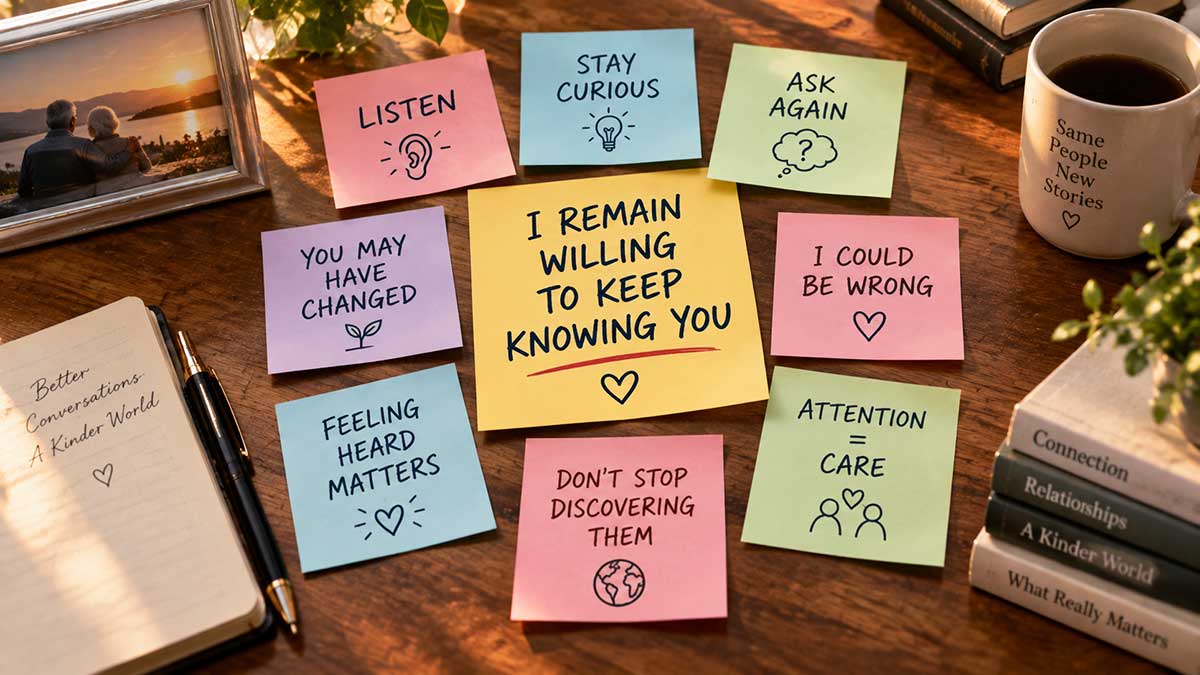
We began Part 2 by asking whether communication can be learned.
We ended by asking whether another human being can ever be completely known.
Somewhere between those two questions, communication stopped looking like a collection of techniques.
Voice matters.
Words matter.
Stories matter.
Questions matter.
Body language matters.
But none of them guarantees connection.
A person can become an extraordinary speaker and remain a poor listener.
Someone can learn the perfect questions without caring about the answers.
A person can remember every fact about us without responding to what those facts mean.
Someone can love us deeply and still misunderstand us.
And perhaps one of the strangest problems appears after years of closeness.
We stop asking.
A stranger tells us something surprising and we say:
"What do you mean?"
Our spouse says something surprising and we think:
"I know exactly what you mean."
Our adult child says:
"You don't understand me."
And we answer:
"Of course I understand you. I'm your parent."
The very history that allows us to know someone deeply can eventually convince us that there is nothing left to discover.
Yet people don't remain still.
The person we married continues changing.
Our parents continue carrying memories we have never heard.
Our children become adults outside our presence.
Our closest friends develop fears, hopes, beliefs, disappointments, and dreams they may never have told us.
Perhaps intimacy therefore isn't:
I know you.
Perhaps it is:
I remain willing to keep knowing you.
That may explain why curiosity became the word left on our board at the end of the conversation.
Curiosity says:
I may have misunderstood you.
Your memory may differ from mine.
Something about you may have changed.
There may be another question I haven't asked.
There may be another room inside a story I've heard twenty times.
Technology complicates this further.
A phone can carry the face of someone we love across an ocean.
The same phone can pull our attention away from the person sitting across the table.
AI may help us prepare an apology, organize difficult thoughts, rehearse a conversation, or find words we couldn't find ourselves.
Yet no technology can remove the central challenge of human relationships:
Another person possesses an inner life that does not belong to us.
They can surprise us.
Disagree with us.
Misunderstand us.
Change.
And perhaps that difficulty is part of what makes human connection meaningful.
After five years, twenty years, or fifty years, maybe one of the deepest forms of love is still being able to look at another person and think:
There is something about you I haven't discovered yet.
And then asking another question.
Short Bios:
Sarah Chen, Moderator
A fictional moderator created for this conversation. Sarah represents the curious listener who keeps moving the discussion from communication techniques toward the human experiences beneath them.
Harry Reis
A psychologist and relationship researcher known for major work on intimacy, close relationships, responsiveness, self-disclosure, and the experience of feeling understood, validated, and cared for.
Nicholas Epley
A behavioral scientist and psychologist whose research examines how humans understand other minds, why people misread one another, perspective-taking, social cognition, and interpersonal connection.
Alison Wood Brooks
A Harvard behavioral scientist whose research explores conversation, question-asking, follow-up questions, social interaction, and the behaviors that can make conversations more meaningful.
John Gottman
A psychologist widely known for decades of research involving couples, conflict, friendship, emotional responsiveness, repair, and the small everyday interactions that shape long-term relationships.
Charles Duhigg
A journalist and author of Supercommunicators, whose work examines why conversations succeed or fail and how recognizing different kinds of conversations can help people understand one another.
Jeff Hancock
A Stanford communication researcher whose work examines interpersonal communication, social media, trust, deception, technology, and the growing role of artificial intelligence in human communication.
Leave a Reply