

Introduction
What if the life we are waiting for is already happening?
We often imagine that happiness is just one achievement, one relationship, one change, one moment of approval, or one answer away. We tell ourselves that when something finally changes, we will relax. We will feel secure. We will know who we are. We will begin living.
Anthony de Mello’s Awareness challenges that assumption. He suggests that much of our suffering comes not simply from what happens to us, but from the expectations, identities, fears, attachments, and stories we unknowingly carry into what happens.
In Parts 1 and 2 of this trilogy, we explored those ideas through humor, conversation, psychology, spirituality, love, suffering, and faith. Part 3 moves into ordinary modern lives. These five original stories are not retellings of de Mello’s book. They ask what his central challenge might look like when someone has to live it.
No one here becomes perfectly awakened. They simply begin noticing something they could not see before.
And sometimes, that small moment of seeing changes everything.
(Note: This is an imaginary conversation, a creative exploration of an idea, and not a real speech or event.)

Story 1: The Number That Kept Moving
At 2:17 on Monday afternoon, Daniel Park became worth more money than he had ever imagined owning.
The number sat on the final page of a document he had already read twelve times.
$10,400,000.
Not the value of the company.
His share.
After everything.
Daniel stared at it.
His attorney, Rebecca, tapped the signature line.
"This is the glamorous part."
Daniel looked up.
"What?"
"You sign your name."
"That's it?"
"That's it."
Twenty years reduced to a blue rectangle on a screen.
Daniel picked up the stylus.
For a second, his hand didn't move.
He remembered the first office he had rented above a Vietnamese restaurant in Seattle. Six hundred square feet. Two desks from Craigslist. A printer that worked only when kicked near the paper tray.
He remembered sleeping on the office floor before a product launch.
He remembered telling his wife, Hannah, "Give me two years."
That had been seventeen years ago.
He remembered payroll weeks when he had quietly transferred money from their savings account without telling her how close things were.
He remembered their first million-dollar year.
Their first twenty employees.
Their first serious acquisition offer, which he had rejected.
He remembered telling Hannah afterward:
"Ten million."
"What?"
"If I can walk away with ten million, we're done."
Hannah had laughed.
"You said that about one million."
"This is different."
"Of course."
Now the number was $10.4 million.
Daniel signed.
Rebecca extended her hand.
"Congratulations."
His business partner slapped him on the back.
Someone opened champagne.
Someone else took a photograph.
Daniel looked again at the number.
He had expected something physical.
A release in his chest.
A wave of relief.
Maybe tears.
Instead he felt strangely quiet.
Then his phone rang.
Hannah.
He answered.
"Hey."
"Well?"
Daniel looked around the conference room.
People were smiling at him.
"We did it."
There was silence on the other end.
Then Hannah screamed.
Daniel laughed.
She started crying.
"Oh my God, Daniel."
"I know."
"You did it."
"We did it."
"No. You did this."
"Hannah..."
"I'm serious. I'm so proud of you."
There it was.
Proud.
Something moved inside him.
For the first time that afternoon, the number felt real.
That evening, Hannah had arranged dinner at home.
Their daughters, Sophie and Emma, had made a sign and taped it crookedly above the kitchen doorway.
CONGRATS DAD!!!
Underneath, Emma had added:
YOU'RE FINALLY UNEMPLOYED
Daniel stood beneath it laughing.
"Who told you I'm unemployed?"
"You sold your company," Emma said.
"I can start another one."
Hannah pointed a serving spoon at him.
"Don't even joke."
"I'm kidding."
Nobody believed him.
They opened a bottle of champagne that Daniel had been saving for eleven years.
"How much did that cost?" Sophie asked.
"Too much."
"How much?"
"Three hundred dollars."
She stared at him.
"For a drink?"
"Your father bought it when three hundred dollars was a lot of money," Hannah said.
Daniel looked at her.
"It still is."
Emma lifted her glass of sparkling cider.
"Not to you."
Everyone laughed.
Daniel did too.
But for some reason, the sentence stayed with him.
Not to you.
After dinner they talked about what they might do.
Italy.
A bigger house.
College without worrying about tuition.
Maybe a boat.
"No boat," Hannah said.
"Why?"
"You hate boats."
"I could learn to like boats."
"Why?"
Daniel didn't have an answer.
Emma suggested a Lamborghini.
Hannah vetoed that too.
"Why are you spending all Dad's money?" Sophie asked.
"It's family money," Emma said.
Daniel smiled.
Family money.
Ten point four million dollars.
He liked hearing it.
For the next twelve days, Daniel was happier than he had been in years.
He slept until seven.
He went to the gym without checking Slack between sets.
He took Hannah to lunch on a Tuesday.
He picked Emma up from school.
He bought a watch he had wanted for years, then felt guilty about the price for approximately four hours.
He checked his investment account more often than necessary.
Sometimes he simply looked at the balance.
Not to do anything.
Just to see it.
The number was beautiful.
He had done it.
Twenty years.
Done.
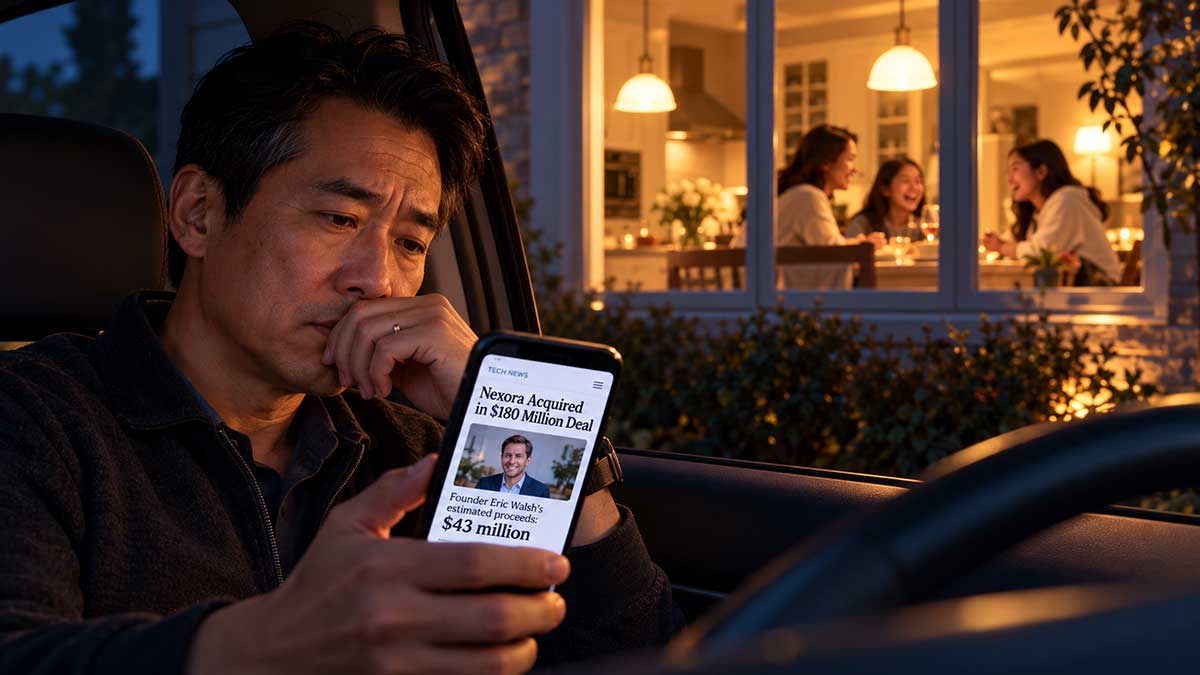
Then, on the thirteenth day, Daniel saw the headline.
He was sitting in his car outside his house.
He had just returned from meeting an old employee for coffee.
His phone buzzed.
A business newsletter.
He almost cleared the notification.
Then he saw the name.
NEXORA ACQUIRED IN $180 MILLION DEAL
Daniel stopped.
Nexora.
He knew the founder.
Eric Walsh.
They had started their companies around the same time.
They had spoken at the same conference nine years earlier.
Daniel tapped.
He read quickly.
Then slowly.
Then again.
Eric's estimated personal proceeds:
$43 million.
Daniel stared at the screen.
Forty-three.
He calculated automatically.
More than four times his exit.
He opened LinkedIn.
Eric had posted a photograph of his team.
Couldn't be prouder of what we've built together. This was never about the money...
Daniel stopped reading.
"Of course it wasn't."
He scrolled.
Congratulations.
Well deserved.
Visionary founder.
Incredible journey.
Legend.
Daniel clicked Eric's profile.
He didn't know why.
He already knew who Eric was.
He looked at the company history.
Employee count.
Funding rounds.
Growth.
He searched for the acquisition.
Another article estimated the deal slightly higher.
Daniel calculated Eric's possible ownership again.
Maybe forty-seven million.
Maybe fifty.
He searched one more article.
Then another.
His phone rang.
Hannah.
He declined it.
He wanted to finish reading.
A few minutes later, he looked up.
Through the kitchen window, he could see Hannah and the girls.
Emma was doing something that made Sophie laugh.
Hannah turned toward the driveway.
Daniel instinctively lowered his phone.
He didn't know why.
She saw him and waved.
Daniel waved back.
Then he looked once more at the headline.
$180 MILLION DEAL
The $10.4 million in his own account had not changed.
Not by a cent.
Yet somehow, sitting in the car, it had become smaller.
"You're quiet."
Hannah was brushing her teeth.
Daniel was in bed looking at his phone.
"I'm fine."
She looked at him through the mirror.
"You've been 'fine' for three days."
"I'm just thinking."
"About?"
"Nothing."
Hannah rinsed her mouth.
"Eric?"
Daniel looked up.
"What?"
She turned around.
"Eric Walsh."
"Why would I be thinking about Eric?"
"Because you've mentioned his acquisition four times."
"I mentioned it once."
"You mentioned it at dinner."
"That's once."
"Then you told Sophie."
"She asked about tech companies."
"She's sixteen."
"She was interested."
"She was trapped in the car with you."
Daniel put down his phone.
"What's your point?"
Hannah sat on the edge of the bed.
"Nothing."
"No, say it."
She studied him.
"Two weeks ago you were the happiest I've seen you in years."
"I am happy."
"Okay."
"I am."
"I believe you."
"No, you don't."
Hannah smiled.
"I've been married to you for twenty-one years. I'm allowed not to believe you occasionally."
Daniel looked away.
She waited.
Finally he said, "Forty-three million."
"What?"
"Eric probably walked away with forty-three million."
"I know."
"You know?"
"You told me."
Daniel stared at the ceiling.
"Four times."
He almost smiled.
Hannah touched his leg.
"Can I ask you something?"
"What?"
"If ten million didn't make you feel like enough..."
Daniel turned toward her.
"...what number will?"
"That's not what this is about."
"Okay."
"It's not."
"Okay."
Daniel sat up.
"Twenty."
Hannah blinked.
"What?"
"Twenty million."
There was silence.
Daniel heard the answer after he had already said it.
Hannah didn't laugh.
That made it worse.
She simply looked at him.
Twenty.
Two weeks earlier, ten had represented freedom.
Now twenty represented enough.
Daniel got out of bed.
"I'm getting water."
The kitchen was dark.
He opened the refrigerator and stood looking inside without seeing anything.
Then, for reasons he could not explain, he remembered a report card.
He was twelve.
His father was sitting at the kitchen table in their small apartment outside Tacoma.
Daniel placed the report card in front of him.
Five A's.
One B.
His father looked down.
Daniel watched his face.
His father had immigrated to the United States with almost nothing. He worked six days a week managing a small grocery store. He came home smelling faintly of cardboard boxes, vegetables and cold air from the refrigerated section.
He rarely complained.
He rarely praised.
He studied the report card.
Then smiled.
Daniel remembered that smile.
Even now.
"You did good."
Daniel felt his whole body lift.
Then his father touched the B.
"What happened here?"
It wasn't cruel.
That was what Daniel understood now.
His father wasn't trying to hurt him.
He wanted his son to have opportunities he had never had.
"Next time," his father said, "all A's."
Daniel nodded.
"Okay."
His father handed the paper back.
Then he opened the newspaper.
Daniel stood there for another second.
Five A's.
One B.
Next time.
All A's.
Daniel closed the refrigerator.
He had never thought of that moment as important.
Maybe it wasn't.
One memory did not explain a life.
His father had loved him.
Daniel knew that.
He had driven him to soccer practices after ten-hour shifts. Paid for college when he couldn't afford it. Called every Sunday after Daniel moved away.
This wasn't a story about a cold father damaging his son.
It was something quieter.
Daniel had learned something.
Maybe from his father.
Maybe from school.
Maybe from America.
Maybe from himself.
There was always a next level.
All A's.
A good university.
A good job.
A six-figure salary.
A million dollars.
A successful company.
Ten million.
Twenty.
Forty-three.
He suddenly wondered what number Eric Walsh was thinking about tonight.
Daniel laughed.
Alone in the kitchen.
Not loudly.
Just enough that Hannah called from upstairs.
"You okay?"
"Yeah."
"What are you doing?"
Daniel looked at the glass of water he had forgotten to fill.
"Apparently nothing."
Three months later, Daniel bought a Lamborghini.
He returned it four days later.
Hannah never let him forget it.
"I told you."
"You were right."
"Say it again."
"You were right."
"Slower."
Daniel laughed.
He discovered retirement was unbearable.
At first he played golf.
Then he organized the garage.
Then reorganized it.
Then Hannah found him one morning making a spreadsheet about household electricity consumption.
"You need a job."
"I don't need a job."
"You made a dashboard for our electric bill."
"It identified inefficiencies."
"Daniel."
"It did."
She kissed him.
"Please start another company."
He stared at her.
"I thought you didn't want me to."
"I've reconsidered."
"Why?"
"I'd like my husband back."
A month later, Daniel rented a small office.
Not because he needed one.
He wanted one.
Two desks.
A whiteboard.
A coffee machine.
The first morning, he sat alone staring at an idea he had been thinking about for months.
There was no valuation.
No investor.
No acquisition plan.
No employees.
Just a problem.
He began writing on the whiteboard.
Two hours disappeared.
Then three.
At noon, Daniel stepped back.
The board was covered with arrows, boxes, crossed-out words and terrible handwriting.
He smiled.
He had forgotten how much he loved this part.
Before the company existed.
Before anyone cared.
Before there was anything to measure.
His phone buzzed.
A business alert.
He glanced at it.
A startup founder he knew had raised:
$80 million.
Daniel opened the article.
He felt it immediately.
That small tightening.
Almost physical.
Eighty.
He looked at the founder's photograph.
Young.
Probably thirty-four.
Daniel was forty-six.
His mind began working.
Valuation.
Ownership.
Growth rate.
How much had the founder raised previously?
Daniel's thumb moved toward the search bar.
Then he stopped.
Not because he shouldn't look.
Not because comparison was evil.
Not because money didn't matter.
He simply noticed what was happening.
The number was moving again.
Daniel looked at the article for another few seconds.
Then closed it.
On the whiteboard was a problem he genuinely wanted to solve.
He picked up the marker.
His phone buzzed again.
This time it was Emma.
Movie tonight? Sophie says you promised.
Daniel smiled.
He typed:
7:30. I'll make popcorn.
Three dots appeared.
Then:
Your popcorn sucks. Mom makes it.
Daniel laughed.
He returned to the whiteboard.
That evening, he closed his laptop at six forty-five.
No final email.
No checking LinkedIn.
No looking at his account.
He drove home.
Through the kitchen window, he could see Hannah and the girls arguing about which movie to watch.
For a moment he remained in the driveway.
It was almost the same view he had seen three months earlier while sitting in the car reading about Eric's $43 million.
Same window.
Same house.
Same family.
Daniel reached for his phone.
Then stopped.
He wasn't sure what he had intended to check.
He left it in his pocket.
Inside, Emma shouted:
"Dad! Tell Sophie we're not watching that."
"Watching what?"
"It doesn't matter. She's wrong."
Sophie yelled from the living room.
"Don't listen to her!"
Hannah appeared carrying a bowl.
"You're late."
"It's 7:26."
"Movie starts at 7:30."
"I have four minutes."
Daniel took the bowl.
"Is this popcorn?"
"Yes."
"I could have made it."
Three voices answered simultaneously.
"No."
Daniel laughed.
He sat between his daughters.
The lights went down.
Ten minutes into the movie, his phone vibrated in his pocket.
He felt it.
For a second, he wondered who it was.
An investor?
Business news?
Maybe Eric.
The thought was enough to make him smile.
He left the phone where it was.
Emma reached into the popcorn bowl without looking away from the screen.
Daniel did the same.
Their hands collided.
"Move."
"You move."
"I'm watching."
"So am I."
She pushed his hand away.
Daniel took another handful.
Nothing extraordinary happened.
Nobody applauded.
No document waited for his signature.
No account balance changed.
No number told him whether the evening mattered.
And for once, Daniel didn't ask one to.
Story 2: The Bedroom at the End of the Hall
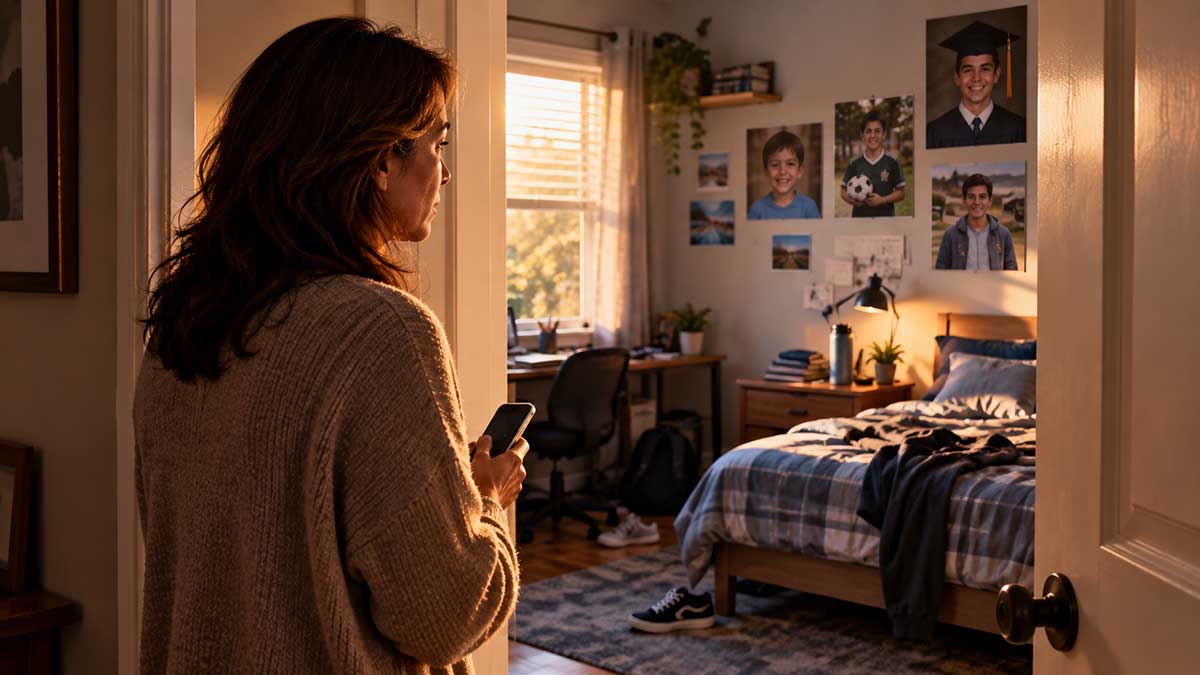
On Tuesday morning, Elena Martinez walked past her son's bedroom and noticed that the door was open.
She stopped.
Mateo had been gone for twenty-three days.
The room looked almost exactly as it had the morning he left.
The gray comforter was crooked.
One sneaker lay beneath the desk. The other was beside the closet.
Three books were stacked on the nightstand.
A half-empty bottle of water sat beside them.
Elena had considered throwing it away several times.
She hadn't.
She stepped inside.
There was dust on the desk.
She ran one finger through it.
"That's disgusting."
She said it aloud, as though Mateo were still there to defend himself.
Then she smiled.
On the wall above the desk were photographs.
Mateo at six, missing two front teeth.
Mateo at eleven holding a soccer trophy.
Mateo at fifteen pretending not to smile while Elena kissed his cheek.
Mateo at eighteen in his graduation gown.
She looked at the last photograph longest.
Three weeks earlier, she had helped load his clothes into the car.
Austin to College Station wasn't far.
Less than two hours.
Elena had reminded herself of that repeatedly.
Not another country.
Not another state.
Not even a plane ride.
Less than two hours.
Still, when Mateo's car disappeared at the end of their street, she had stood in the driveway until there was nothing left to see.
Her husband Carlos had come up behind her.
"He'll be back."
"I know."
"Thanksgiving."
"I know."
"Probably before Thanksgiving."
"I know."
Carlos put his arm around her.
Elena had started crying.
"I'm happy for him."
"I know."
"I am."
"I know."
"Then why am I crying?"
Carlos kissed the side of her head.
"Because you're his mother."
At the time, that answer had been enough.
Three weeks later, Elena wasn't so sure.
At 10:43 that morning, she checked Mateo's location.
Library.
Good.
At 11:16, she checked again.
Student center.
At 12:02:
Dormitory.
At 12:47:
Off campus.
Elena zoomed in.
Some restaurant.
She searched the name.
Burgers.
4.2 stars.
She looked at the menu.
Then stopped.
"What am I doing?"
She locked the phone.
Five minutes later, she unlocked it.
Mateo was still at the restaurant.
She texted him.
How's your day? 
No response.
At 1:31:
Did you eat lunch?
She deleted it before sending.
At 2:08, Mateo's icon moved back toward campus.
Still no response.
At 3:14, she opened Instagram.
Mateo had posted a photograph.
Four boys and three girls around a table.
Everyone smiling.
The burger restaurant.
Elena enlarged the photograph.
She didn't recognize any of them.
A girl with long dark hair was sitting beside Mateo.
Very close beside Mateo.
Elena stared.
Then laughed at herself.
"Stop."
She put the phone down.
Thirty seconds later, she picked it up again.
She tapped the girl's profile.
Private.
"Of course."
"What are you doing?"
Elena nearly dropped the phone.
Carlos stood in the kitchen doorway.
"Nothing."
"You look guilty."
"I'm not guilty."
"Then what are you doing?"
Elena turned the screen toward him.
"Who's this?"
Carlos leaned closer.
"Mateo."
"Not Mateo."
"The girl?"
"Yes."
"I have no idea."
"Exactly."
Carlos looked at her.
"Should I know?"
"Don't you think he'd tell us if he were dating someone?"
"He's been gone three weeks."
"So?"
"So maybe she's a friend."
"She's sitting very close."
Carlos examined the photograph again.
"Elena."
"What?"
"You're investigating the physical distance between college freshmen in an Instagram photo."
"I'm observing."
"You're zooming."
"There is a difference."
Carlos kissed her forehead and opened the refrigerator.
"You need a hobby."
"I have hobbies."
"Name one."
Elena stared at him.
Carlos waited.
"Cooking."
"That's feeding us."
"Gardening."
"You killed the basil."
"It was August in Texas."
Carlos nodded solemnly.
"A terrible loss."
Elena threw a dish towel at him.
Mateo called Thursday night.
Elena answered before the second ring.
"Hi!"
"Hey, Mom."
"How are you?"
"Good."
"How are classes?"
"Good."
"Are you eating?"
"Yes."
"Sleeping?"
"Mostly."
"What does mostly mean?"
"Mom."
"I'm asking."
"I'm sleeping."
"How's chemistry?"
"It's fine."
"You said the professor was difficult."
"He's okay."
"Did you talk to your advisor?"
"Not yet."
"You said Tuesday."
"I'll do it."
"When?"
"I don't know."
"You should make the appointment before they fill up."
"I know."
"And your laundry?"
Silence.
"What?"
"Nothing."
"Did you do laundry?"
"Yes."
"Colors separately?"
Mateo laughed.
"Mom."
"I'm serious. You ruined those white shirts last year."
"I know how to do laundry."
"You put a red sock in with whites."
"I was seventeen."
"That was six months ago."
"Exactly. I've grown."
Elena laughed.
For a moment, everything felt normal.
Then she remembered the photograph.
"So..."
Mateo groaned.
"What?"
"Nothing."
"Mom."
"Who's the girl?"
"What girl?"
"The girl from the burger place."
Silence.
"You saw that?"
"You posted it."
"Yeah, but..."
"But what?"
"Nothing."
"Who is she?"
"Her name is Ava."
"Ava."
"Yes."
"Where is she from?"
"I don't know. Dallas?"
"You don't know?"
"I've known her two weeks."
"Are you dating?"
"No."
"Does she like you?"
"How would I know?"
"Trust me, you'd know."
"Mom."
"I'm just asking."
"Can we not do this?"
Elena felt something tighten.
"I'm interested in your life."
"I know."
"I barely hear from you anymore."
"We talked Sunday."
"It's Thursday."
"That's four days."
"Exactly."
Mateo exhaled.
"Mom, I have to go."
Already.
The word appeared in Elena's mind before she could stop it.
"Where?"
"Some people are going out."
"Who?"
"Friends."
"Is Ava going?"
"Mom."
"I'm kidding."
She wasn't entirely.
"Okay. Have fun."
"I will."
"Be careful."
"I will."
"Don't drink and drive."
"I won't."
"And call me this weekend."
"I will."
"Promise?"
"Yes."
"I love you."
"Love you too."
The call ended.
Elena stared at the screen.
12 minutes, 41 seconds.
Twelve minutes.
She had waited four days for twelve minutes.
Sunday passed without a call.
At 8:15 that evening, Elena texted:
Everything okay?
At 8:46:
Just checking
At 9:02, three dots appeared.
Then disappeared.
At 9:11:
Sorry Mom. Busy day. Call tomorrow? Love you
Elena read it.
Then read it again.
She typed:
Of course sweetheart! Have fun!
She deleted it.
Typed:
Would have been nice to hear your voice.
Deleted.
Typed:
Sure. Love you too.
She sent that.
Carlos was reading on the sofa.
"He didn't call?"
"No."
"He'll call tomorrow."
"I know."
She opened the television menu.
Nothing looked interesting.
After several minutes, Carlos said:
"You're angry."
"I'm not angry."
"Okay."
"Why does everyone think I'm angry when I'm not angry?"
Carlos lowered his book.
Elena looked at him.
"Don't."
He raised the book again.
She lasted perhaps thirty seconds.
"I spent eighteen years making sure that kid had everything."
Carlos lowered the book slowly.
"He knows."
"I went to every soccer game."
"I know."
"I stayed up helping him with school projects that he didn't start until ten o'clock."
"I remember."
"Who took him to the emergency room when he broke his wrist?"
"You."
"Who slept in that terrible chair?"
"You."
"Who made his lunch every day?"
"You."
"Who..."
Elena stopped.
Carlos waited.
She heard herself.
A strange embarrassment passed through her.
"That's not what I mean."
"I know."
She stood.
"I'm going to bed."
Mateo called Monday afternoon.
Elena let it ring three times.
She hated herself for doing that.
"Hello?"
"Hey."
"Hi."
"You okay?"
"Of course."
"You sound weird."
"I'm fine."
"Okay."
Silence.
Mateo tried again.
"What did you guys do this weekend?"
"Nothing much."
"Did Dad watch the Cowboys?"
"Of course."
"Did he yell at the TV?"
"Of course."
Mateo laughed.
Elena smiled despite herself.
Then the conversation slowed.
She could feel him preparing to leave it.
"So, Mom..."
There it was.
"You're going?"
"I've got a study group."
"Okay."
Another silence.
"Mom?"
"What?"
"Can I say something?"
The tone changed.
Elena sat down.
"Sure."
"I don't want you to get mad."
"Why would I get mad?"
"I don't know."
"Just say it."
Mateo was quiet.
Then:
"Sometimes I don't call because I know you'll be sad when I hang up."
Elena didn't understand at first.
"What?"
"I don't mean that badly."
"I'm not sad when you hang up."
"Mom."
"I'm not."
"You are."
"No, I..."
"You always say, 'Already?' Or you ask when I'm calling again. Or you get quiet."
"I'm your mother. I miss you."
"I know."
"Is that wrong now?"
"No."
"Then what are you saying?"
"I'm not saying it's wrong."
"Then what?"
Mateo hesitated.
"I just feel bad."
"About what?"
"Being happy here."
The words landed harder than anything before them.
Elena said nothing.
Mateo rushed to fill the silence.
"Not because of you. That's not what I mean. I know you're happy for me. I just..."
His voice became smaller.
"Sometimes it feels like if I'm having a really good time here, you're lonely at home."
Elena looked toward the hallway.
From where she sat, she could see the edge of his open bedroom door.
"So you don't call."
"Sometimes."
She swallowed.
"I'm sorry."
"No, Mom. I shouldn't have said it like that."
"No."
"I didn't mean..."
"No, Mateo."
Her eyes filled.
"You should go to your study group."
"Are you mad?"
"No."
"Are you sure?"
"I'm sure."
"Mom..."
"Go."
"I love you."
Elena closed her eyes.
"I love you too."
When the call ended, she didn't move.
For two days, she was angry.
At Mateo.
At college.
At herself.
At Carlos, briefly, for saying almost nothing when she told him.
"That's all you have to say?"
"What do you want me to say?"
"I don't know."
Carlos thought.
"He loves you."
"I know that."
"And you love him."
"Obviously."
"Maybe that's enough for tonight."
It wasn't.
Elena slept badly.
On Wednesday morning, she entered Mateo's room.
She sat on the bed.
For years she had said the same thing.
I just want him to be happy.
She believed it.
She still believed it.
She wanted him to make friends.
She wanted him to fall in love someday.
She wanted him to find work he cared about.
She wanted him to travel.
To build a life.
To become independent.
She wanted all of it.
So why did evidence that it was happening hurt?
Elena looked at the photographs.
Mateo at six.
Eleven.
Fifteen.
Eighteen.
She suddenly saw what photographs did.
They kept people still.
Mateo at six would always be six.
The boy with missing teeth would never tell her he didn't need help.
The eleven-year-old would always want her at his soccer game.
The fifteen-year-old could pretend to hate her kisses while secretly leaning toward her.
But the real Mateo wouldn't stay in any photograph.
He was moving.
That was what she had raised him to do.
And somewhere along the way, without ever deciding to, Elena had built so much of herself around being his mother that his independence felt almost like her disappearance.
She covered her face.
"Oh."
The word escaped before she knew she was saying it.
It wasn't only:
I miss my son.
There was something underneath it.
Something harder to admit.
I miss being needed by my son.
Elena cried then.
Not dramatically.
Quietly.
Sitting on the edge of his unmade bed.
She didn't become a different mother.
That would have been easier.
She still checked Mateo's location.
She tried not to.
Sometimes she succeeded.
Sometimes she didn't.
When he called, she still asked whether he was eating.
She stopped asking about laundry.
Mostly.
She met a friend for lunch.
She replanted the basil.
It died again.
Carlos suggested plastic plants.
She told him to shut up.
She began taking a ceramics class on Wednesday evenings.
The first bowl she made leaned noticeably to the left.
Mateo saw it during a video call.
"What is that?"
"A bowl."
"No, seriously."
"You're not getting one for Christmas."
"Thank God."
She laughed.
The calls became easier.
Sometimes Mateo called for forty minutes.
Sometimes seven.
Once he called only because he needed his Social Security number.
Elena managed not to take it personally.
Mostly.
Thanksgiving arrived.
Mateo came through the front door carrying an enormous laundry bag.
Elena stared at it.
"I thought you knew how to do laundry."
"I do."
"Then what is that?"
"Efficiency."
She hit him with a dish towel.
He hugged her.
A real hug.
Longer than she expected.
For four days, the house felt full again.
Mateo slept late.
Left dishes everywhere.
Ate everything.
Argued with Carlos about football.
Went out with high school friends.
And, to Elena's surprise, annoyed her.
By Saturday she found herself thinking:
When is he going back?
Then she laughed so loudly that Mateo called from the other room.
"What's funny?"
"Nothing!"
Sunday came too quickly.
Mateo loaded his car.
Elena stood in the driveway.
Carlos hugged him first.
Then Elena.
She held him.
For a moment he was six again.
Then eleven.
Then fifteen.
Then eighteen.
Then none of them.
He was Mateo.
Now.
"Call me when you get there."
"I will."
"Not while you're driving."
"I know."
"And..."
She stopped.
Mateo smiled.
"And what?"
There were at least fifteen things.
Eat better.
Sleep more.
Call your advisor.
Be careful with Ava.
Don't drink too much.
Wash your sheets.
Call me.
Need me.
Instead Elena touched his cheek.
"Have fun."
Mateo looked slightly suspicious.
"That's it?"
"That's it."
"Who are you?"
"Get out of here."
He laughed.
Then he got into the car.
Elena watched until the taillights disappeared.
She cried.
Carlos put his arm around her.
"You okay?"
"No."
He looked at her.
Elena wiped her face.
Then smiled.
"But I will be."
Twenty-three minutes later, Elena was in the kitchen when she reached for her phone.
Location.
She stopped.
Her thumb hovered.
He should be somewhere near Bastrop by now.
She could check.
Just once.
She put the phone down.
Carlos looked over from the coffee machine.
"What?"
"Nothing."
Five minutes passed.
Elena picked up the phone.
She checked.
Mateo was moving east on Highway 21.
Safe.
She laughed.
Carlos looked at her.
"You checked, didn't you?"
"Mind your business."
He smiled.
Elena put the phone down again.
She walked toward the hallway.
Mateo's bedroom door was open.
She stopped.
For a moment she almost went inside.
Instead she reached out and gently pulled the door halfway closed.
Not shut.
Not open.
Halfway.
Then she went back to the kitchen.
Carlos handed her a cup of coffee.
They stood together near the window.
Outside, the late-November leaves moved in the wind.
Elena took a sip.
Her phone was on the counter behind her.
For several minutes, she forgot it was there.
Story 3: 1,284 Likes

At 8:14 Wednesday morning, Maya Chen posted a photograph of herself not drinking coffee.
The coffee was in front of her.
That was different.
She was sitting at a small table outside a café in Silver Lake, wearing a cream sweater she had bought specifically because it looked effortless.
The photograph had taken twenty-three attempts.
In the first, her eyes were closed.
In the fourth, the coffee cup covered too much of her face.
In the ninth, a man in a Dodgers cap walked behind her.
In the fourteenth, she looked "posed."
In the nineteenth, she looked like she was trying not to look posed.
Number twenty-three was perfect.
Maya looked away from the camera, laughing at something that had not happened.
The caption:
slow mornings  learning to enjoy the little things
She posted it.
Then enjoyed absolutely nothing for the next eleven minutes.
She refreshed.
47 likes.
Refresh.
86.
A comment.
obsessed 
Another.
where is the sweater from??
Refresh.
143.
Maya took an actual sip of coffee.
Cold.
She made a face.
Her friend Zoe, sitting across from her, looked up.
"You know you've checked that six times."
"Checked what?"
Zoe stared at her.
Maya put the phone down.
"I'm working."
"You're drinking coffee."
"This is part of my work."
"You haven't drunk the coffee."
"It's bad."
"You ordered it."
"I ordered it because the cup was cute."
Zoe looked at the cup.
Then at Maya.
"Sometimes I worry about you."
Maya laughed.
Her phone buzzed.
She looked.
287 likes.
Good.
By noon, the post had 1,284 likes.
Very good.
Maya knew she shouldn't care about numbers.
She said this often.
Sometimes publicly.
She had once posted an entire video about not letting social media determine your self-worth.
It had performed extremely well.
Her account had 186,000 followers.
Not famous-famous.
But enough that restaurants occasionally gave her free meals, clothing brands sent boxes to her apartment, and strangers recognized her perhaps twice a month.
She had built the account over four years.
Fashion at first.
Then lifestyle.
Then travel.
Then wellness.
Then something she called "intentional living," which she wasn't completely sure how to define.
Brands liked it.
Her followers liked it.
Maya liked it too.
Usually.
At 3:20 that afternoon, she posted another photograph.
This one she loved.
No professional lighting.
No planned outfit.
She had been walking near Echo Park when she saw an elderly man playing chess with a little boy.
The boy was laughing.
The man was pretending to be devastated by a move.
Behind them, late-afternoon sunlight came through the trees.
Maya had asked permission and taken the photograph.
It felt alive.
She wrote:
Some moments don't need much explaining.
She posted it.
Thirty minutes later:
92 likes.
Strange.
She refreshed.
104.
An hour:
137.
Maybe Instagram wasn't distributing it.
She checked analytics.
Poor reach.
She changed the hashtags.
Two hours:
216.
Maya stared at the photograph.
Something about it now bothered her.
Maybe the composition wasn't as good as she'd thought.
The background was messy.
The boy's shirt was too bright.
She considered deleting it.
At 6:07, she did.
That evening, Maya met Zoe for dinner.
"Where's the chess picture?"
Maya looked up.
"What?"
"You deleted it."
"It wasn't performing."
"You said you loved it."
"I did."
"So?"
"It didn't fit the feed."
Zoe chewed slowly.
"You know your feed isn't a museum, right?"
"Brands look at consistency."
"Okay."
"It's literally my job."
"I said okay."
The waiter brought their food.
Before Zoe could touch hers, Maya said:
"Wait."
Zoe froze with her fork halfway to the plate.
Maya stood.
"Move your water."
"Why?"
"It's reflecting the light."
Zoe moved it.
"Your hand."
"What about my hand?"
"It's in the shot."
Zoe removed her hand.
Maya took three photographs.
Then two more.
She sat.
Zoe reached for the food.
"Wait."
"Oh my God."
"One more."
"Maya."
"The first one is blurry."
"I am going to die of starvation while you document my dinner."
Maya laughed.
"Okay, okay."
Zoe took a bite.
Maya edited the photograph.
"Maya."
"I'm listening."
"I didn't say anything."
Maya looked up.
Zoe smiled.
"Exactly."
On Thursday morning, an email arrived from one of Maya's biggest sponsors.
They were "moving in a different creative direction."
Maya read the sentence six times.
It was polite.
Almost aggressively polite.
They loved working with her.
They appreciated the partnership.
They wished her continued success.
They were still dropping her.
She opened Instagram.
Her follower count:
185,742.
She knew yesterday's number.
185,911.
She had lost 169 followers.
That wasn't unusual.
Accounts fluctuated.
She knew this.
Still, she refreshed.
185,739.
Three more.
"Seriously?"
She opened analytics.
Engagement down.
Reach down.
Profile visits down.
Her phone buzzed.
A comment on a video she had posted two days earlier.
She's trying way too hard.
Maya stared.
She clicked the account.
Private.
Forty-three followers.
No profile picture.
She went back.
Read the comment again.
She's trying way too hard.
Maya put down the phone.
Picked it up.
Read it again.
There were 327 other comments.
Most positive.
She ignored them.
She's trying way too hard.
At lunch, she read it again.
In the elevator, again.
Before bed, again.
Seventeen times.
She knew this because, at some point, she had started counting.
Maya's grandmother arrived Friday afternoon.
Nai Nai was seventy-eight and lived in Monterey Park.
She regarded most of Maya's work with affectionate confusion.
"So people pay you to wear shirt?"
"Sometimes."
"And then?"
"I post it."
"And they buy shirt?"
"Hopefully."
Nai Nai considered this.
"Good business."
"Thank you."
"In China, your great-grandfather sold noodles."
"I know."
"He had to make noodles."
"Yes."
"You wear shirt."
"Yes."
Nai Nai nodded.
"Better business."
Maya laughed.
They went for dim sum.
Nai Nai complained that Los Angeles traffic had become impossible.
She had been making this complaint since 1997.
After lunch they walked through a botanical garden.
Maya photographed flowers.
A pond.
Nai Nai pretending to smell a flower that had no scent.
Then she asked a stranger to take a photograph of them together.
Maya wrapped an arm around her grandmother.
Nai Nai leaned against her.
The stranger took three.
The second was beautiful.
Not perfect.
Beautiful.
Nai Nai's eyes were slightly closed.
Maya had a crease near her mouth she didn't like.
But they looked happy.
Back at Maya's apartment, Nai Nai asked to see it.
Maya handed her the phone.
"Oh."
Nai Nai smiled.
"This one."
"You like it?"
"Very much."
Maya sat beside her.
She opened the editing app.
Exposure.
Contrast.
Warmth.
She softened the shadows.
Then opened another tool.
Her finger moved across her own face.
Nai Nai watched.
"What are you doing?"
"Editing."
"Why?"
"The lighting's weird."
"It looks fine."
"I'm just fixing it."
Maya smoothed the skin beneath her eyes.
Then removed a small blemish from her chin.
Nai Nai leaned closer.
"Do me too."
Maya laughed.
"You want me to?"
"Yes. Make me thirty."
"That's a different app."
Nai Nai laughed.
Maya softened a line near her grandmother's cheek.
Then another.
Nai Nai stopped laughing.
"What are you doing there?"
"Just smoothing."
"Why?"
"You said make you thirty."
"I was joking."
Maya smiled.
"I know."
Nai Nai looked at the original.
Then the edited version.
Back and forth.
"Original."
"Really?"
"Yes."
"The lighting is better on this one."
Nai Nai pointed at the original.
"This is us."
"They're both us."
"No."
She enlarged the photograph.
Her wrinkled hand touched the screen.
"This is me."
Then she pointed at Maya.
"This is you."
Maya smiled.
"I know."
Nai Nai looked genuinely puzzled.
"What's wrong with us?"
"Nothing."
"Then why are you fixing us?"
Maya opened her mouth.
Nothing came out.
Nai Nai handed back the phone.
"Send me original."
That night, Maya lay in bed scrolling.
She passed a model in Bali.
A couple in Paris.
A woman showing her morning routine in a kitchen larger than Maya's apartment.
A twenty-two-year-old entrepreneur announcing her second company.
A fitness creator with perfect abs.
A travel influencer standing alone on a beach that Maya knew had probably been crowded.
Everyone looked happy.
Maya knew better.
That was the strange part.
She knew how photographs worked.
She knew the twenty seconds outside the frame.
She knew the fights before couple photographs.
The clutter pushed out of view.
The food gone cold.
The forty-seven rejected images.
The captions rewritten eight times.
She knew all of it.
And it still worked on her.
She opened her own profile.
There she was.
Coffee.
Italy.
A rooftop.
Yoga.
A hotel.
A dress.
A beach.
A smoothie.
A laugh.
Maya stared at the woman on the screen.
She knew exactly how to be her.
That frightened her more than she expected.
The next morning, Nai Nai woke at 6:12.
Maya knew this because she heard cupboards opening.
She walked into the kitchen.
Her grandmother was examining three bags of coffee.
"Why so many?"
"They're different."
"They're all coffee."
"Please don't start."
Nai Nai held up one bag.
"Which one?"
Maya pointed.
They drank coffee near the window.
No photographs.
Later they drove west.
Nai Nai wanted to see the ocean.
"You've seen the ocean."
"I want to see again."
"You live in California."
"So?"
Maya couldn't argue with that.
They reached the beach in late afternoon.
The air was cool.
Nai Nai removed her shoes and carried them.
Maya did the same.
They walked.
At first Maya photographed everything.
Waves.
Footprints.
Nai Nai.
A dog chasing a ball.
A surfer.
Then the sun began dropping.
The sky changed slowly.
Gold.
Orange.
Pink.
The water caught all of it.
Maya stopped.
She knew exactly what the photograph could look like.
Vertical.
Nai Nai slightly left of center.
Sun behind her.
Maybe silhouette.
Perfect Reel opening.
Her hand went automatically toward her phone.
She pulled it out.
Opened the camera.
Raised it.
Then stopped.
Through the screen, the sunset was beautiful.
Maya lowered the phone.
The actual sunset was enormous.
Nai Nai looked at her.
"Aren't you taking picture?"
"In a minute."
They watched.
A wave reached their feet.
Nai Nai jumped backward.
Maya laughed.
"You've been to the ocean before."
"Water still cold."
Maya put the phone into her pocket.
Nai Nai noticed.
"No picture?"
Maya thought.
"I want to see it first."
Her grandmother nodded as though this were perfectly reasonable.
For several minutes, neither spoke.
Maya noticed the wind moving her hair.
The cold water around her ankles.
A little girl screaming happily whenever a wave approached.
Nai Nai's hand beside hers.
She reached over and held it.
No one photographed them.
That evening Maya posted the photograph from the botanical garden.
The original.
Nai Nai's eyes half closed.
The crease beside Maya's mouth.
The uneven light.
No smoothing.
No reshaping.
No filter.
The caption was simple.
My grandmother came to visit.
Maya posted it.
Then turned the phone face down.
She made tea.
Nai Nai was watching television.
Maya sat beside her.
Ten minutes passed.
Then fifteen.
At twenty, Maya remembered the post.
Her hand reached toward the phone.
She stopped.
Then picked it up anyway.
418 likes.
Low.
Very low.
Her stomach dropped.
There it was.
Immediate.
Automatic.
Almost embarrassing in its speed.
Maya stared at the number.
For one second, she hated the photograph.
She considered changing the caption.
Maybe archive it.
Maybe repost tomorrow morning when engagement was better.
Then she looked at Nai Nai.
Her grandmother had fallen asleep.
Mouth slightly open.
One hand resting on her stomach.
Maya smiled.
She looked again at the photograph.
Nai Nai's eyes were nearly closed.
Maya's face wasn't perfect.
The light was uneven.
She felt the disappointment.
She didn't argue with it.
Didn't tell herself she was shallow.
Didn't announce that numbers no longer mattered.
They did matter.
Part of her job depended on them.
And she liked being liked.
That was true too.
She simply noticed how quickly 418 had tried to become something larger than 418.
Unsuccessful.
Uninteresting.
Unwanted.
Not enough.
Maya looked at the number again.
Then at the photograph.
Two women in a garden.
One seventy-eight.
One twenty-four.
Both laughing.
Nothing was wrong with them.
She locked the phone.
A few minutes later, Nai Nai woke.
"What time?"
"Almost ten."
"Why you let me sleep?"
"You looked comfortable."
Nai Nai sat up.
"Picture?"
"What picture?"
"Our picture."
"Oh."
Maya handed her the phone.
Nai Nai looked at the post.
"Very nice."
She squinted.
"What is 418?"
"Likes."
"Good?"
Maya started to answer.
Then laughed.
"I don't know."
Nai Nai shrugged.
"Picture still good."
She handed the phone back.
Maya looked at it.
"Yeah."
She placed it on the table.
"Picture's still good."
Outside the apartment window, Los Angeles glittered.
Thousands of lights.
Thousands of rooms.
Thousands of people looking at screens, photographs, numbers, each other, themselves.
Maya sat beside her grandmother.
Her phone buzzed.
Neither of them reached for it.
Story 4: The Red Light
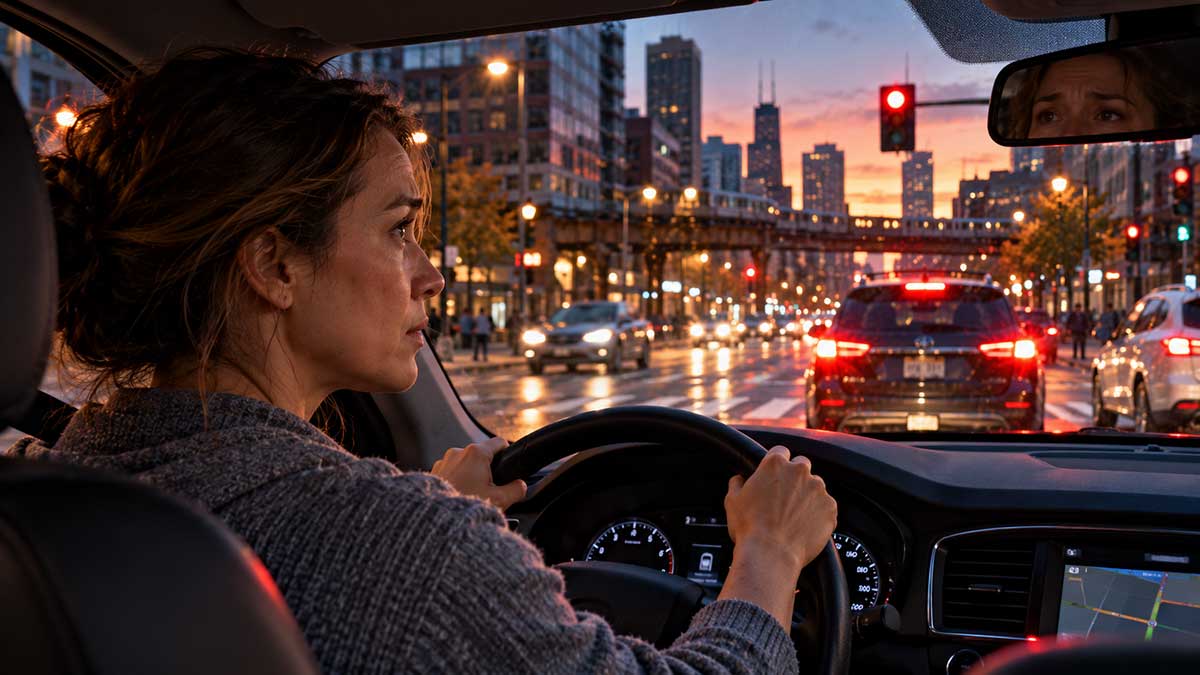
The light turned yellow.
Rachel Morgan's right foot moved toward the brake before she had time to think.
Yellow became red.
She stopped.
Nothing happened.
That was the problem.
Nothing happened, and her body reacted as though everything had.
Her fingers tightened around the steering wheel.
Her shoulders rose.
Her heart began beating harder.
She checked the rearview mirror.
A pickup truck behind her.
Too close.
She looked left.
Then right.
Then left again.
Cross traffic moved through the intersection.
A blue sedan.
A delivery van.
A white SUV.
Rachel watched every vehicle.
Not casually.
She tracked them.
Speed.
Distance.
Direction.
Possibility.
Her breathing became shallow.
"You're okay."
She said it aloud.
Her therapist had told her not to argue with the fear.
Rachel argued anyway.
"You're okay. You're okay. You're okay."
Her body remained unconvinced.
The cross light turned yellow.
Rachel's stomach tightened.
Three.
Two.
One.
Her light turned green.
She didn't move.
A horn sounded behind her.
Rachel jumped.
The pickup driver raised one hand.
Not angrily.
Just:
Go.
Rachel pressed the accelerator.
She crossed the intersection.
Twenty seconds later, she pulled into a pharmacy parking lot and began crying.
Fourteen months earlier, a man named Peter Collins had run a red light at 47 miles per hour.
Rachel knew his name from the police report.
She knew his speed from the accident reconstruction.
She knew he had been looking down at his phone.
She knew he had no alcohol in his system.
She knew his insurance company.
She knew the make and model of his car.
She knew more about Peter Collins than she wanted to know about almost anyone.
What she did not remember was seeing him.
Rachel remembered entering the intersection.
Then sound.
Not one sound.
Several at once.
Metal folding.
Glass breaking.
Something exploding.
Her own voice, perhaps.
Then silence.
Then a woman's face outside the driver's-side window.
"Don't move."
Rachel remembered asking:
"What happened?"
The woman said:
"An ambulance is coming."
"What happened?"
"Don't move."
"My leg."
"I know."
"What happened?"
The woman reached through the broken window and held Rachel's hand.
"You were in an accident."
Rachel looked down.
Blood.
Then darkness.
Her body healed remarkably well.
That was what everyone said.
Remarkably.
Two surgeries.
Physical therapy.
Nine months before she could walk without thinking about walking.
A thin scar along her left thigh.
A smaller one near her collarbone.
"You're lucky," people told her.
They were right.
Rachel knew they were right.
The doctors had told her what could have happened.
The paramedics had told her.
Her mother had told her approximately four hundred times.
Rachel was alive.
She could walk.
She had returned to teaching.
She had twenty-two third graders who shouted "MISS MORGAN!" every morning as though she had been missing for years instead of seventeen hours.
She was lucky.
She was grateful.
And she was terrified of red lights.
At first she avoided driving completely.
Her sister drove her to physical therapy.
Friends brought groceries.
Rachel used delivery apps.
When she returned to work, another teacher picked her up.
Eventually that became embarrassing.
At least Rachel thought it should be embarrassing.
Her friend Nicole disagreed.
"You almost died."
"I know."
"So maybe we don't have to worry about whether your transportation arrangements are elegant."
"I'm thirty-eight."
"Congratulations."
"I should be able to drive."
"Eventually."
"What if eventually never happens?"
Nicole looked at her.
"Then we'll figure that out too."
Rachel hated that answer.
She wanted:
You'll definitely be fine.
Nobody could promise that.
Her therapist was named Dr. Patel.
On their fourth session, Rachel said:
"I know the intersection isn't dangerous."
Dr. Patel tilted her head.
"Isn't it?"
Rachel frowned.
"You know what I mean."
"I think I do."
"It's a normal intersection."
"Where people sometimes have accidents."
"That's not helping."
"I'm not trying to convince you that nothing bad can happen."
Rachel looked at her.
"Then what are we doing?"
"Helping your body learn that something bad isn't happening every time."
Rachel was quiet.
That distinction irritated her.
Then interested her.
Then irritated her again.
Dr. Patel taught her grounding exercises.
Feet against the floor.
Notice five things.
Notice breath.
Notice sound.
Feel the chair.
Look around.
Orient to the room.
Rachel found all of this profoundly unimpressive.
"I almost died, and you're telling me to notice furniture."
"At the moment, yes."
Rachel laughed despite herself.
They started small.
Sit in the driver's seat.
No driving.
Then start the engine.
Then drive around the block with Nicole.
Then two blocks.
Then a quiet road.
Then an intersection.
The first time Rachel approached a traffic light as the driver, it was green.
She drove through.
Her entire body shook afterward.
Nicole said nothing.
Rachel pulled over.
"This is ridiculous."
"No."
"I drove through a green light."
"Yes."
"People do that approximately nine million times a day."
"Probably."
"I feel like I climbed Everest."
Nicole smiled.
"Then congratulations on Everest."
Rachel laughed.
Then cried.
Nicole waited.
Months passed.
Rachel drove again.
Not everywhere.
She developed routes.
Routes with fewer major intersections.
Routes with protected left turns.
Routes where she knew the traffic patterns.
Her GPS sometimes suggested a seven-minute route.
Rachel took nineteen.
She told herself this was temporary.
Then she stopped calling it temporary.
At school, nobody knew the extent of it.
Her students knew she had been in an accident.
They had made cards.
One said:
I HOPE YOUR BONES GET GOOD.
Rachel kept that one in her desk.
Another:
PLEASE DON'T DIE.
Also a keeper.
Children were refreshingly inefficient at euphemism.
One Thursday, a student named Lily stayed behind after dismissal.
"Miss Morgan?"
"Yes?"
"Are you scared of cars?"
Rachel stopped packing papers.
"Why?"
"My mom said you were in a bad car crash."
"Your mom talks too much."
Lily considered this.
"She does."
Rachel smiled.
"Sometimes I'm scared."
Lily nodded.
"I'm scared of dogs."
"All dogs?"
"Big ones."
"What about small ones?"
"Some small ones are mean."
"That's true."
"My aunt has a big dog. He likes me."
"Okay."
"But I'm still scared."
Rachel looked at her.
"What do you do?"
Lily shrugged.
"I pet him when I'm ready."
Then she ran out.
Rachel stood alone in the classroom.
She wrote the sentence on a sticky note.
When I'm ready.
She put it inside her desk.
The intersection where the accident happened was at Monroe and 8th.
Rachel had not driven through it in fourteen months.
She had passed nearby.
Never through.
She could avoid it indefinitely.
Chicago contained other roads.
Dr. Patel never told her she had to go back.
That almost made Rachel want to.
On Thursday afternoon, she left school at 4:18.
Her normal route home required a right turn on Harrison.
Rachel approached Harrison.
The light was green.
She could turn.
Instead she continued straight.
Her hands tightened immediately.
"No."
She almost laughed.
She wasn't even there yet.
Her body had recognized the direction.
She continued.
At Monroe, she could still turn away.
She didn't.
Two blocks.
One.
Then she saw it.
The intersection looked insulting in its ordinariness.
Gas station.
Pharmacy.
Bus stop.
A man carrying groceries.
A woman pushing a stroller.
Cars.
The same traffic lights.
Rachel's heart began pounding.
Her left leg felt strange.
Not pain.
Memory.
She slowed.
The light ahead was green.
"Please change."
She didn't know whether she wanted green or red.
It changed yellow.
Rachel stopped.
Red.
Her breathing shortened.
She looked left.
This was where Peter Collins had come from.
Her mind produced the car instantly.
Silver.
Moving too fast.
Phone in his hand.
Impact.
Glass.
Blood.
The woman's voice.
Don't move.
Rachel gripped the steering wheel.
Her therapist's voice appeared next.
Not magically.
Annoyingly.
Where are you now?
Rachel looked down.
Her hands.
Steering wheel.
She felt her back against the seat.
Her right foot on the brake.
She looked through the windshield.
Red light.
Gas station.
Man with groceries.
Woman with stroller.
A bus pulling away.
Her heart was racing.
That was happening now.
Her hands were shaking.
That was happening now.
Peter Collins was not coming through the intersection.
That was not happening now.
Rachel inhaled.
Her body remained frightened.
"Okay."
She wasn't sure whether she was speaking to herself or her body.
"You're scared."
A tear rolled down her cheek.
"Okay."
The cross traffic slowed.
Yellow.
Rachel's stomach tightened.
Red.
Her light changed.
Green.
Rachel did not move.
One second.
Two.
A horn sounded behind her.
Her entire body jumped.
"Oh, screw you!"
She shouted it so loudly that she surprised herself.
Then she laughed.
The driver behind her honked again.
"Yes, yes!"
Rachel looked left.
Right.
Left.
Nothing coming.
She pressed the accelerator.
The car entered the intersection.
Halfway through, Rachel stopped breathing.
Then she was across.
Just like that.
No revelation.
No music.
No great wave of peace.
She drove another block.
Then another.
At the next safe place, she pulled over.
Her hands were trembling so badly she could barely put the car in park.
She cried.
Then she called Nicole.
Nicole answered.
"Hey."
"I did it."
"What?"
"Monroe and 8th."
Silence.
Then:
"You drove through?"
"Yes."
"Oh my God."
"I almost threw up."
Nicole laughed.
Rachel laughed too.
"I was terrified."
"But you did it."
Rachel looked through the windshield.
Cars moved past.
People crossed the street.
A cyclist yelled at a taxi.
Life continued with complete indifference to her breakthrough.
"I was still terrified," Rachel said.
Nicole's voice softened.
"Maybe you didn't have to stop being terrified."
Rachel looked at her shaking hands.
"No."
Maybe she didn't.
The next week, Rachel was driving home when a black SUV cut abruptly into her lane.
She slammed the brake.
The tires chirped.
Her heart exploded.
For one second she wasn't on that road.
She was back there.
Metal.
Glass.
Blood.
Rachel pulled into a parking lot.
She sat gripping the wheel.
"No."
The word came out angry.
"No, no, no."
She had been doing better.
She had driven through Monroe and 8th.
She had driven to the grocery store alone.
She had even driven at night.
This wasn't supposed to happen again.
Her eyes filled.
"I thought I was past this."
She heard the sentence.
Then stopped.
Past.
As though healing were another intersection.
Red.
Yellow.
Green.
And once green, always green.
Rachel leaned back.
Her heart was still racing.
She noticed it.
She noticed her hands.
She noticed anger.
Fear.
Disappointment.
She noticed that she wanted all of them gone.
Then she noticed something else.
She was in a grocery store parking lot.
A shopping cart rolled slowly across an empty parking space.
Someone had abandoned it.
A teenager in an apron came jogging after it.
Rachel watched him catch the cart just before it hit a car.
He raised both hands in victory although nobody was watching.
Rachel laughed.
The fear was still there.
That surprised her.
She could laugh and still be afraid.
Apparently the body could hold more than one thing at once.
She waited until her hands steadied.
Then drove home.
Friday morning, Rachel was running late.
Her alarm hadn't gone off.
She spilled coffee on her blouse.
She changed.
Couldn't find her keys.
Found them in her hand.
By the time she got into the car, she had twelve minutes to make a seventeen-minute drive.
"Perfect."
She took the normal route.
Not the safe route.
She didn't decide to be brave.
She simply didn't have time for the extra seven minutes.
Halfway to school, she stopped at a red light.
She looked at the clock.
8:03.
"Come on."
Her fingers tapped the steering wheel.
A song played on the radio.
Someone behind her sneezed so violently she could hear it through both cars.
Rachel smiled.
The light turned green.
She drove.
Three blocks later, she realized something.
She had stopped at a red light.
And she had been annoyed.
Not terrified.
Annoyed.
She almost laughed.
Then another thought arrived.
I'm getting better.
Immediately behind it:
What if it comes back?
Rachel noticed that too.
"Good morning to you as well," she said to her own mind.
She kept driving.
At 8:11, Rachel entered her classroom.
Twenty-two children were already making enough noise for forty-four.
"MISS MORGAN!"
Lily ran toward her.
"Walk."
Lily converted the run into something that was technically walking but spiritually still a run.
"I made you something."
She handed Rachel a folded sheet of construction paper.
On the front was a badly drawn dog.
Inside:
I PETTED MAX YESTERDAY. I WAS STILL SCARED BUT I DID IT.
Rachel stared at it.
Lily looked proud.
"That's your aunt's dog?"
"Yes."
"The big one?"
"Very big."
"And you were scared?"
"Yes."
"But you petted him."
Lily nodded.
"When I was ready."
Rachel smiled.
"That's pretty brave."
Lily shrugged.
"He's soft."
Then she ran away.
"Walk!"
"Sorry!"
Rachel placed the card beside the old one.
I HOPE YOUR BONES GET GOOD.
She stood looking at the two messages.
Then the bell rang.
The children scrambled toward their seats.
Rachel turned to the whiteboard.
"Okay, everybody. Math."
Twenty-two groans.
"Oh, relax. Fractions have never killed anyone."
A boy in the back raised his hand.
"My dad says fractions killed his GPA."
Rachel laughed.
"Your dad needs to stop helping with homework."
The class began.
Outside the windows, traffic moved along the street.
Red.
Green.
Red again.
Rachel didn't notice.
For nearly an hour, she forgot to be afraid.
Story 5: The Man Who Knew Everything About God

Thomas Bennett knew what he believed about almost everything.
He believed God was personal.
He believed Jesus Christ was the Son of God.
He believed prayer mattered.
He believed Scripture mattered.
He believed forgiveness was commanded but not always easy.
He believed heaven was real.
He believed suffering could have meaning even when human beings could not see it.
He believed faith without love was empty.
And, if you gave him enough time, Thomas could explain why he believed every one of those things.
At sixty-eight, he had spent more than fifty years studying Christianity.
Not professionally.
Thomas had owned a small accounting firm in Asheville, North Carolina, before retiring.
Theology was simply what he loved.
His shelves held Bible commentaries, histories of Christianity, books about prayer, apologetics, church fathers, Christian mystics and comparative religion.
He listened to sermons while driving.
Podcasts while walking.
Audiobooks while cooking.
He had read the Bible cover to cover eleven times.
People at church came to him with questions.
Sometimes even the pastor did.
Thomas liked that.
He would never have admitted how much.
On Saturday morning, a young man named Caleb caught him after Bible study.
"Mr. Bennett?"
"Thomas."
"Can I ask you something?"
"Of course."
Caleb was twenty-seven and had recently become a father.
He looked exhausted.
"My wife asked me something last night."
Thomas waited.
"She asked why God let her mother die."
Thomas nodded slowly.
Cancer.
He knew the story.
"I'm sorry."
"Thanks."
Caleb looked toward the emptying church hallway.
"I didn't know what to tell her."
Thomas placed one hand on his shoulder.
"Sometimes suffering isn't something we can understand from where we're standing."
Caleb nodded.
Thomas continued.
"We see a small part of the picture. God sees the whole."
He spoke about free will.
A fallen world.
Human limitation.
The difference between God causing suffering and allowing it.
The Book of Job.
Christ suffering with humanity.
Hope beyond death.
Caleb listened.
Thomas had said variations of these things many times.
They were good answers.
He believed them.
When he finished, Caleb nodded.
"Thanks."
"Does that help?"
"A little."
Thomas smiled.
"Sometimes faith means trusting before understanding."
Caleb thanked him again and left.
Thomas watched him walk toward the parking lot.
Something about the conversation bothered him.
He couldn't identify what.
That evening, Thomas and his wife Margaret ate soup at the kitchen table.
They had been married forty-two years.
Margaret had learned that Thomas could turn almost any subject into theology.
Bird migration.
Mortgage rates.
Baseball.
A broken dishwasher.
Once, during an argument about whether they needed a new refrigerator, Thomas had somehow mentioned Saint Augustine.
Margaret had stared at him.
"Did Augustine have a refrigerator?"
"No."
"Then leave him out of this."
Thomas had.
Reluctantly.
Now Margaret dipped bread into her soup.
"How was Bible study?"
"Good."
"Caleb was there?"
"Yes."
"How's Anna?"
"Not good."
Margaret nodded.
"Her mother."
"Yes."
Thomas told her about the conversation.
Margaret listened.
When he finished, she asked:
"What did Caleb need?"
Thomas frowned.
"What do you mean?"
"You gave him a lot of answers."
"He asked a theological question."
"Did he?"
"His wife asked why God let her mother die."
Margaret tore off another piece of bread.
"Maybe."
Thomas waited.
She ate.
"Maybe what?"
"Maybe she was asking why her mother died."
"That's what I said."
"No."
Margaret looked at him.
"Maybe she wasn't asking for an explanation."
Thomas leaned back.
"What was she asking for?"
"I don't know."
"Then how can you say..."
"I can't."
Margaret smiled.
"That's my point."
Thomas looked at her.
"You've become very philosophical."
"I've been married to you for forty-two years. Something was bound to rub off."
Thomas laughed.
They ate quietly for a moment.
Then Margaret said:
"Can I ask you something?"
"Apparently."
"When was the last time you were actually with God?"
Thomas stopped.
"What?"
"When were you last simply with God?"
"This morning."
"What happened this morning?"
"I prayed."
"What did you do?"
Thomas frowned.
"I just told you."
"You prayed."
"Yes."
"What did you pray?"
"The Lord's Prayer. Then I prayed for the children, you, the church, several people who are sick..."
Margaret nodded.
"And then?"
"I read Matthew."
"And then?"
"I read a commentary."
Margaret took another spoonful of soup.
Thomas stared at her.
"What exactly are you asking me?"
She thought for a moment.
"When was the last time you stopped explaining God long enough to be with Him?"
Thomas felt irritation rise almost immediately.
"I don't separate those things."
"I'm not asking you to."
"Studying God is part of knowing God."
"I know."
"Scripture matters."
"I know."
"Jesus himself taught..."
"Tom."
Margaret's voice was gentle.
That made him more irritated.
"I'm not attacking your faith."
"It sounds like you are."
"I'm asking when you were last quiet."
"I am quiet."
Margaret raised her eyebrows.
Thomas almost laughed.
Instead he stood and carried his bowl to the sink.
"I'm going to read."
"Of course you are."
He turned.
Margaret was smiling.
He pointed at her.
"That was unnecessary."
"Probably."
Thomas read for forty minutes.
He remembered almost none of it.
The question kept returning.
When was the last time you stopped explaining God long enough to be with Him?
It was a badly constructed question.
He decided that first.
What did with God even mean?
God was omnipresent.
One was always with God.
Theologically, Margaret's distinction was imprecise.
Thomas found this comforting.
He picked up another book.
Five minutes later he realized he was reading the same paragraph for the third time.
He closed it.
Thomas had been fourteen when his father died.
Heart attack.
Forty-six years old.
No warning.
His father ate breakfast on Monday morning.
By Monday afternoon, he was dead.
Thomas remembered the adults talking quietly in the kitchen.
His mother crying behind a closed bedroom door.
Casseroles arriving.
Men from church carrying folding chairs into the house.
He remembered lying awake thinking:
Where did he go?
That question terrified him.
A pastor named Reverend Collins came to the house.
He sat beside Thomas on the back steps.
Thomas asked him:
"Where is my dad?"
Reverend Collins did not say, "Don't worry."
He did not say, "Everything happens for a reason."
He sat there for a long time.
Then he said:
"I believe your father is with God."
"How do you know?"
"I believe Jesus."
"How do you know Jesus is right?"
Reverend Collins smiled sadly.
"That's a much bigger question."
Thomas asked it anyway.
The pastor stayed almost two hours.
Something happened to Thomas during that conversation.
The world had become chaotic overnight.
Reverend Collins gave him a place to stand.
Scripture.
Christ.
Resurrection.
Hope.
Thomas began reading.
Then studying.
Then reading more.
He discovered that questions had answers.
And when answers produced new questions, those had answers too.
Not always complete answers.
But structures.
Ideas.
Traditions.
Words.
Theology had not imprisoned Thomas.
It had rescued him.
That mattered.
He would never mock it.
But sitting in his chair fifty-four years later, Thomas wondered whether something that once gave him a place to stand had gradually become a place where he refused to move.
On Sunday, the pastor preached about the Good Samaritan.
Thomas had heard perhaps thirty sermons on the parable.
He knew the historical context.
He knew the relationship between Jews and Samaritans.
He knew the legal expert's question.
He knew the Greek word translated as compassion.
Halfway through the sermon, Thomas realized he was evaluating it.
Good opening.
Weak transition.
Useful historical point.
Missed an opportunity in verse 33.
He stopped.
The pastor was still speaking.
Thomas had not heard the last two minutes.
Margaret sat beside him.
She didn't look over.
Thomas wondered if she somehow knew.
On Monday morning, he walked three miles.
He put on headphones.
A podcast began.
Two theologians were discussing contemplative prayer.
Thomas listened for eleven minutes.
Then laughed.
He removed the headphones.
"Unbelievable."
He had been listening to two people talk about silence.
He put the headphones in his pocket.
The morning felt oddly empty.
No voice.
No teaching.
No information.
Just shoes against pavement.
A truck passing.
Wind.
A dog barking behind a fence.
After perhaps thirty seconds, Thomas's mind began supplying its own podcast.
He thought about Sunday's sermon.
Then Caleb.
Then a theological disagreement he'd read online.
Then whether contemplative prayer could become too subjective.
Then whether...
Thomas stopped walking.
"Oh."
A woman jogging toward him moved to the other side of the path.
"Sorry," Thomas said.
She waved.
He continued walking.
For perhaps ten seconds, he listened.
Then his mind started again.
Thomas laughed.
Wednesday evening, Caleb came to the house.
He had brought back a book Thomas had lent him.
They sat on the porch.
"How's Anna?"
"Rough."
"I'm sorry."
Caleb nodded.
"She asked me another question."
Thomas smiled.
"I may be running out of books."
Caleb didn't smile.
Thomas immediately regretted the joke.
"What did she ask?"
Caleb looked toward the yard.
"She asked if I ever get angry at God."
Thomas felt an answer forming.
Anger toward God appeared throughout Scripture.
The Psalms contained lament.
Job protested.
Faith could include struggle.
Thomas knew exactly what to say.
Then Caleb continued.
"I told her no."
Thomas waited.
"But that wasn't true."
Caleb rubbed his hands together.
"I'm furious."
Thomas's prepared answer remained ready.
He could feel it.
Almost like words lined up behind a door.
He didn't open it.
Caleb looked at him.
"I prayed for her mom every day."
Thomas nodded.
"I really believed she'd get better."
Another nod.
"Everybody kept telling us to have faith."
Caleb's eyes filled.
"So we did."
Thomas wanted to speak.
Instead he waited.
Caleb wiped his face.
"I don't even know what I'm asking."
Thomas remembered Margaret.
Maybe he wasn't asking for an explanation.
"I don't know what to tell you," Thomas said.
Caleb looked surprised.
Thomas was surprised too.
They sat quietly.
After a while, Thomas said:
"I was angry when my father died."
"You were?"
"Very."
"At God?"
"Yes."
"What happened?"
Thomas looked across the yard.
"I spent fifty years learning how to answer that question."
Caleb waited.
Thomas smiled.
"I'm not sure I've ever actually answered it."
Caleb laughed softly.
Then Thomas did something he almost never did when someone came to him with a spiritual problem.
He asked:
"What do you miss most about her?"
Caleb looked down.
"My mother-in-law?"
"Yes."
For the next forty minutes, Caleb talked.
About her terrible singing.
Her lasagna.
The way she called every Sunday morning.
How she bought Christmas gifts in July.
How she had held their newborn daughter for the first time.
Thomas mostly listened.
When Caleb left, he hugged him.
No books changed hands.
Thursday morning, Thomas woke at 5:48.
Margaret was asleep.
He went downstairs.
Made coffee.
Picked up his Bible.
Then walked outside.
The air was cold enough that he almost returned for a jacket.
He sat in a wooden chair behind the house.
Bible on his lap.
Coffee beside him.
Dark sky.
Thomas opened to Matthew.
He read three verses.
Then Margaret's question returned.
He closed the Bible.
Immediately another thought appeared.
This is silly.
Thomas smiled.
Then:
You should pray.
Then:
This is prayer.
Then:
Is it?
Then:
What exactly counts as prayer?
Thomas laughed quietly.
"Good Lord."
Even his attempt at silence had become a theological debate.
He placed the Bible on the table beside him.
He did nothing.
For approximately eight seconds.
Then he began thinking about breakfast.
He noticed.
A few seconds later, Caleb.
He noticed.
Then his father.
He noticed.
Then whether noticing thoughts was compatible with Christian prayer.
Thomas shook his head.
"Stop."
Then he realized that stop was another thought.
He laughed again.
A bird called somewhere in the dark.
Thomas looked toward the trees.
Another bird answered.
He didn't know the species.
Normally he might have reached for his phone.
He didn't.
The eastern sky had begun changing.
Not dramatically.
Black softened into deep blue.
Then gray.
A thin line of orange appeared behind the trees.
Thomas took a sip of coffee.
Cold.
He had forgotten it was there.
He felt the air against his face.
A car started somewhere down the street.
A branch moved.
Another bird called.
Thomas thought about God.
Then noticed that he was thinking about God.
For once, he did not follow the thought.
The sky became brighter.
He remembered his father.
Not the funeral.
Not theology.
His father.
Standing at a grill.
Laughing.
Calling Thomas over to show him how to flip a hamburger without breaking it.
Thomas hadn't remembered that in years.
His eyes filled.
He didn't know why.
Perhaps grief.
Perhaps gratitude.
Perhaps age.
Perhaps all three.
He did not try to name it.
The sun reached the tops of the trees.
Thomas began crying.
Nothing supernatural happened.
No voice.
No vision.
No answer.
The heavens did not open.
He did not suddenly understand suffering.
He did not discover a hidden truth beneath Christianity.
He did not become certain that all religions were secretly the same.
He did not become uncertain that his own faith was true.
He simply sat there.
And for several minutes, Thomas Bennett had nothing to explain.
The back door opened.
Margaret stepped outside wearing a robe.
She saw his face.
"Are you okay?"
Thomas nodded.
She came closer.
"Why are you crying?"
He laughed.
"I don't know."
Margaret sat beside him.
They watched the trees.
After a minute, she noticed the closed Bible.
"Interesting."
Thomas looked at her.
"Don't ruin this."
Margaret smiled.
They sat quietly.
Several minutes passed.
Then she asked:
"What are you thinking about?"
Thomas almost answered.
He could have said presence.
Grace.
Mystery.
Contemplation.
God.
His father.
Love.
He could have found a verse.
Probably several.
Instead he looked at the sunrise.
"Nothing important."
Margaret laughed.
Thomas did too.
The next morning, Thomas returned outside.
He brought his Bible.
He opened it immediately.
Habits were habits.
He read.
Then he reached for a commentary.
Halfway toward it, he stopped.
He smiled.
Not because commentaries were bad.
He loved commentaries.
He would probably read one later.
He simply noticed the speed of his hand.
The hunger to explain.
He returned to the passage.
This time he read it slowly.
A bird landed on the fence.
Thomas looked up.
The bird remained there.
Small.
Brown.
Completely uninterested in theology.
Thomas watched it.
After a moment, it flew away.
He returned to the page.
That same morning, several thousand miles of ordinary life were already underway.
In Seattle, Daniel Park opened a business article announcing another enormous acquisition.
He felt the familiar tightening.
He read halfway.
Then closed it.
His daughter had texted him a photograph of the world's ugliest pancakes.
Daniel laughed.
He called her.
In Austin, Elena Martinez saw Mateo's name appear on her phone.
She smiled immediately.
She let it ring twice before answering.
Not to prove anything.
She was carrying groceries.
"Hey, Mom."
"Hey, sweetheart."
In Los Angeles, Maya Chen stood outside a bakery beneath an unexpectedly beautiful morning sky.
She pulled out her phone.
Raised it.
Then lowered it.
She looked first.
A few seconds later, she took the photograph anyway.
And enjoyed taking it.
In Chicago, Rachel Morgan waited at a red light.
Her hands rested loosely on the steering wheel.
Then a truck approached the intersection too quickly.
Rachel's body tightened.
She noticed.
The truck stopped.
Rachel exhaled.
Her light turned green.
She drove.
And in North Carolina, Thomas sat beside Margaret as morning entered the yard.
None of them had escaped themselves.
Daniel would compare again.
Elena would worry again.
Maya would check the numbers again.
Rachel would become afraid again.
Thomas would disappear into explanations again.
They would forget.
That was almost certain.
Perhaps that was why the small moments mattered.
A phone left untouched.
A child allowed to leave.
A sunset seen before it was photographed.
A frightened body recognized without being obeyed.
A Bible closed for a few minutes beneath a changing sky.
Thomas heard another bird.
He looked toward the sound.
Margaret reached across the space between their chairs and took his hand.
Thomas held hers.
The sun rose.
For once, nobody needed it to mean anything.
Final Thoughts
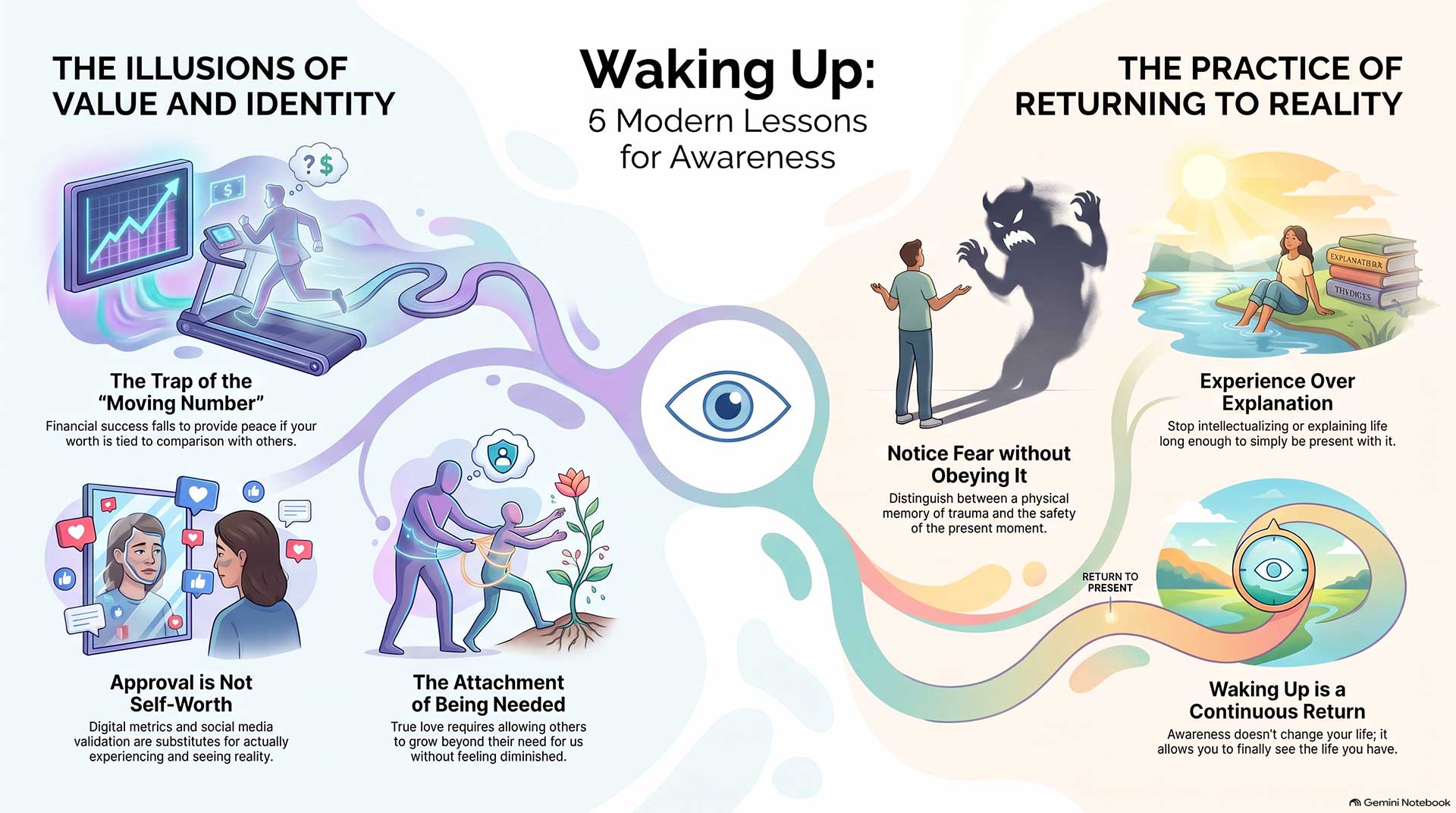
Perhaps waking up is not one great spiritual event.
It may happen when a number stops determining our worth. When we love someone enough to let them grow beyond their need for us. When approval feels wonderful but no longer tells us who we are. When fear remains present but does not automatically decide where we can go. When even our deepest beliefs stop being substitutes for actually experiencing the life before us.
Daniel still compares.
Elena still worries.
Maya still checks.
Rachel still feels afraid.
Thomas still thinks and explains.
None of them has arrived anywhere.
That may be the point.
Awareness does not necessarily give us a different life. It may allow us to finally see the life we already have.
We forget.
We become absorbed again.
We chase, hold, compare, fear, explain.
Then something happens.
We notice.
And for one small moment, we are here.
Perhaps waking up is simply learning to return.
Again.
And again.
Short Bios:
Anthony de Mello (1931–1987) was an Indian Jesuit priest, psychotherapist, retreat leader, and spiritual teacher. His talks drew from Christian spirituality as well as insights and stories associated with Eastern religious traditions. Awareness, published posthumously from his spoken conferences, became one of his best-known works. Its recurring challenge is simple but demanding: wake up, observe what is happening within you, and begin seeing reality without automatically confusing it with conditioning, attachment, expectation, or self-created stories.
Daniel is a fictional forty-six-year-old Korean-American entrepreneur whose long-awaited financial success forces him to confront a surprising question: what happens when the number that was supposed to make you feel successful finally arrives, and it still isn't enough?
Elena is a fictional fifty-two-year-old mother facing the departure of her only son for college. Her story explores the delicate boundary between deep love and the unconscious desire to remain necessary to someone we love.
Maya is a fictional twenty-four-year-old content creator whose life has gradually become measurable in followers, engagement, photographs, and approval. Her story asks what happens when being seen by thousands of people begins to interfere with simply seeing.
Rachel is a fictional thirty-eight-year-old elementary-school teacher recovering from a serious automobile accident. Her story explores awareness from a different direction: not as a denial of real suffering, but as one way of distinguishing present reality from what a frightened body still remembers.
Thomas is a fictional sixty-eight-year-old lifelong Christian who has spent decades studying and explaining his faith. His story asks whether knowing many things about God and being present with God are always the same experience.
Disclaimer
This article is a fictional, AI-assisted creative work inspired by themes explored in Anthony de Mello’s Awareness. Daniel Park, Elena Martinez, Maya Chen, Rachel Morgan, and Thomas Bennett are fictional characters. Their stories are original and are not found in de Mello’s book. The interpretations presented here are intended to encourage reflection rather than represent definitive statements of de Mello’s views.
Leave a Reply