
Introduction
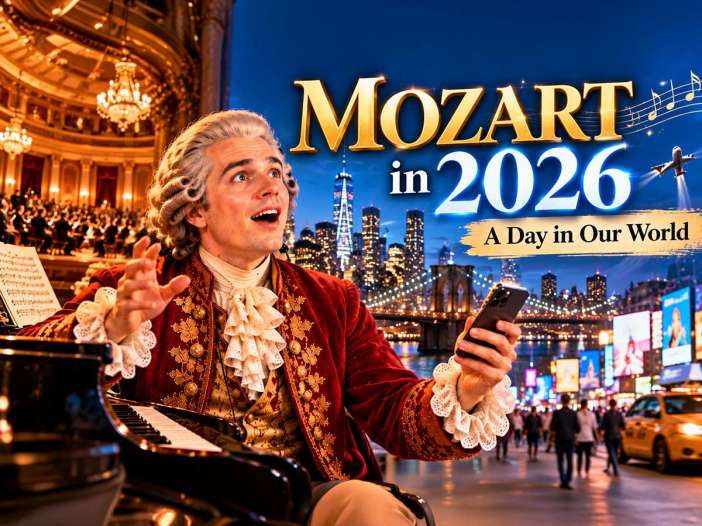
What would happen if Mozart were given one ordinary day in 2026?
He would see electric light, hot water, airplanes, recorded music, smartphones, modern medicine, artificial intelligence, and a city filled with things people in 1790 could barely imagine.
But the deeper surprise might be this: we have grown so used to these things that we barely notice them.
Through Mozart’s eyes, an ordinary day in New York begins to look very different.
(Note: This is an imaginary conversation, a creative exploration of an idea, and not a real speech or event.)
Vienna, 1790 | 11:08 PM | Tomorrow, You Can Go to 2026
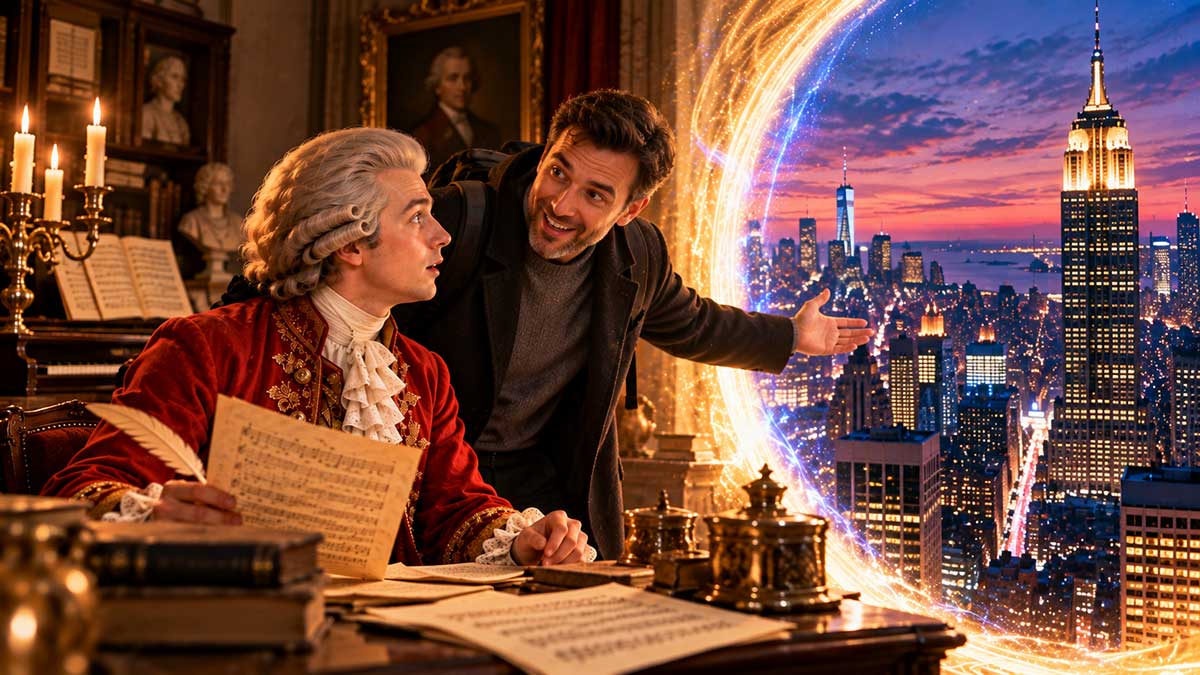
“Mr. Mozart. Tomorrow, you can go to the year 2026.”
Wolfgang Amadeus Mozart stopped writing.
His quill remained suspended above the unfinished page.
For several seconds he said nothing.
Then he looked up.
“2026?”
“Yes.”
Mozart studied the stranger standing in his room.
“What year is it now?”
“1790.”
“I know what year it is.”
The stranger smiled.
Mozart put down his quill.
“So you are telling me that tomorrow I can travel…”
He calculated silently.
“More than two hundred years into the future?”
“About 236 years.”
Mozart laughed.
“That is a very good story.”
“It isn't a story.”
The smile slowly disappeared from Mozart's face.
“How long?”
“One day.”
“One day?”
“You'll arrive in the morning. At midnight, you return.”
Mozart leaned forward.
“Where?”
“New York.”
“New York?”
“In America.”
Mozart knew of the young country across the Atlantic, but that only made the proposition stranger.
Then the questions began.
“Is there still music?”
“Yes.”
“Orchestras?”
“Yes.”
“Pianos?”
“Yes.”
“Opera?”
“Yes.”
Mozart visibly relaxed.
“Good. At least civilization survives.”
The stranger laughed.
Mozart didn't.
He had another question.
This one came more quietly.
“What about my music?”
The stranger said nothing.
Mozart leaned closer.
“My music. Do people in 2026 know it?”
No answer.
“Has it disappeared?”
Still nothing.
“Why aren't you answering?”
“Because tomorrow you can find out for yourself.”
Mozart looked back at the manuscript on his desk.
A few moments earlier those notes had seemed terribly important.
Now he wondered whether anyone would even know they existed 236 years later.
For the first time that evening, Mozart could no longer concentrate.
Vienna, 1790 | 11:47 PM | How Could He Possibly Sleep?
Mozart went to bed.
Ten minutes later he got up.
He walked to the window.
Returned to bed.
Got up again.
What would music sound like in 2026?
Were there new instruments?
Had someone invented something greater than the piano?
Could orchestras have hundreds of musicians?
Could people make sounds that were impossible in 1790?
And the composers.
Surely there would be extraordinary composers after him.
Hundreds.
Thousands.
Perhaps someone had written music so beautiful that Mozart himself would sound primitive.
He smiled at the thought.
Part of him wanted that to be true.
Then another thought came.
Perhaps nobody listened to Mozart anymore.
Two hundred and thirty-six years was a very long time.
Everyone he knew would be gone.
His audience would be gone.
His city would be different.
His language might even sound different.
Perhaps his manuscripts would be lost.
Perhaps his name would appear in an old book.
Perhaps not even that.
Mozart returned to bed.
Closed his eyes.
Opened them again.
One question refused to leave him.
Will anyone remember me?
New York City, 2026 | 7:03 AM | Is This a Palace?
Mozart opened his eyes.
A white ceiling.
He sat up immediately.
“This is it?”
“This is 2026.”
He looked around.
The room seemed surprisingly ordinary.
No gold walls.
No strange metallic furniture.
No machines floating through the air.
No servants.
Mozart frowned.
“This is the future?”
“Give it a minute.”
The guide walked toward the wall and pressed a switch.
Click.
The entire room filled with light.
Mozart froze.
“What did you do?”
“Turned on the light.”
“Where is the flame?”
“There isn't one.”
“The candle?”
“No candle.”
“Oil?”
“No oil.”
Mozart walked over to the switch.
He pressed it.
Darkness.
Again.
Light.
Again.
Darkness.
Again.
Light.
“Who can afford this?”
“Almost everyone.”
Mozart turned around.
“Everyone?”
“Pretty much.”
He pressed the switch again.
The guide sighed.
“You're going to break it.”
Mozart grinned.
A few minutes later he stood in the bathroom.
The guide turned a faucet.
Water appeared instantly.
Mozart put his hand underneath.
Warm.
He pulled it away.
“Hot water!”
The guide moved the handle.
Cold.
Mozart tried it himself.
Warm.
Cold.
Warm.
Cold.
“You choose the temperature?”
“Yes.”
“Every morning?”
“Yes.”
The shower fascinated him.
So did the toilet.
Then he learned that the entire apartment could be warmed during winter and cooled during summer.
“You control the weather inside the house?”
“Not exactly.”
“It sounds exactly like controlling the weather inside the house.”
Then came the refrigerator.
Mozart opened the door.
Milk.
Eggs.
Cheese.
Meat.
Fruit.
Vegetables.
Juice.
Food preserved in the middle of an ordinary kitchen.
He picked up an orange.
“Where did this come from?”
“Probably somewhere much warmer than New York.”
He picked up another item.
“And this?”
“Another state. Maybe another country.”
Mozart looked through the window.
Manhattan rose around him.
Buildings taller than anything he had imagined.
Hundreds of windows.
Thousands of people living above the streets.
He looked back at the refrigerator.
The electric lights.
The running water.
“This is a palace?”
“No.”
“A home for aristocrats?”
“No.”
“Then who lives here?”
“Ordinary people.”
Mozart stared at him.
“Your ordinary people live very well.”
The guide smiled.
“Sometimes we forget that.”
Mozart looked again at the light switch.
“I wouldn't.”
8:06 AM | Where Are the Musicians?
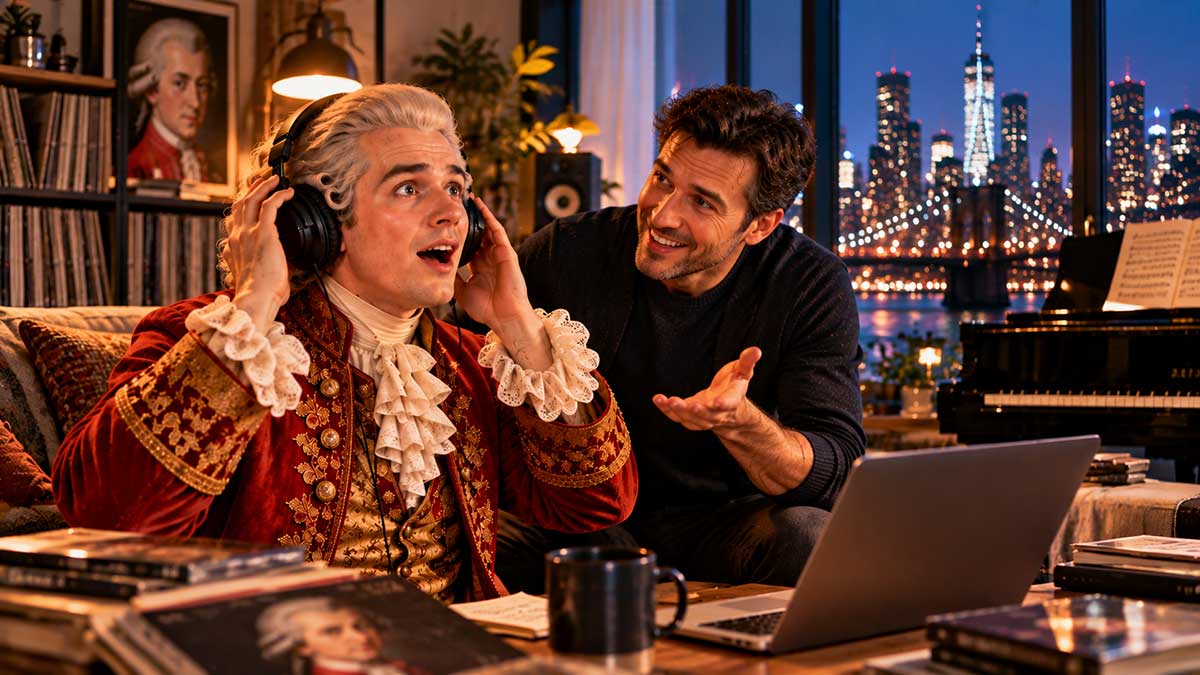
The guide handed Mozart a pair of headphones.
“What are these?”
“Put them over your ears.”
Mozart did.
His face changed immediately.
An orchestra.
He ripped the headphones off.
Silence.
He looked around the apartment.
No musicians.
He put them back on.
Orchestra.
Off.
Silence.
On.
Orchestra.
Mozart stood.
“Where are they?”
“Who?”
“The musicians!”
“They aren't here.”
“I can hear violins.”
“Yes.”
“Woodwinds.”
“Yes.”
“An entire orchestra!”
“Yes.”
Mozart checked behind the sofa.
The guide started laughing.
“This isn't funny.”
“It's a little funny.”
“Where are the musicians?”
“This performance was recorded.”
Mozart stared at him.
“Recorded?”
“They played it once. Their performance was captured and saved. Now we can listen to it whenever we want.”
“You saved the performance?”
“Yes.”
“The sound?”
“Yes.”
Mozart slowly looked down at the headphones.
“How many performances can you save?”
“Millions.”
“Millions?”
“Probably far more.”
Mozart sat down.
Then another thought struck him.
“What if the musician dies?”
“If the recording survives, we can still hear the performance.”
Mozart's expression changed.
“A dead musician can still play?”
“In a way.”
He slowly put the headphones back on.
The orchestra returned.
Mozart closed his eyes.
This time he didn't remove them.
Several minutes passed.
When the music ended, he remained still.
Finally he whispered:
“You learned how to preserve sound.”
For a composer from 1790, it may have been the first true miracle of the day.
9:12 AM | MOZART
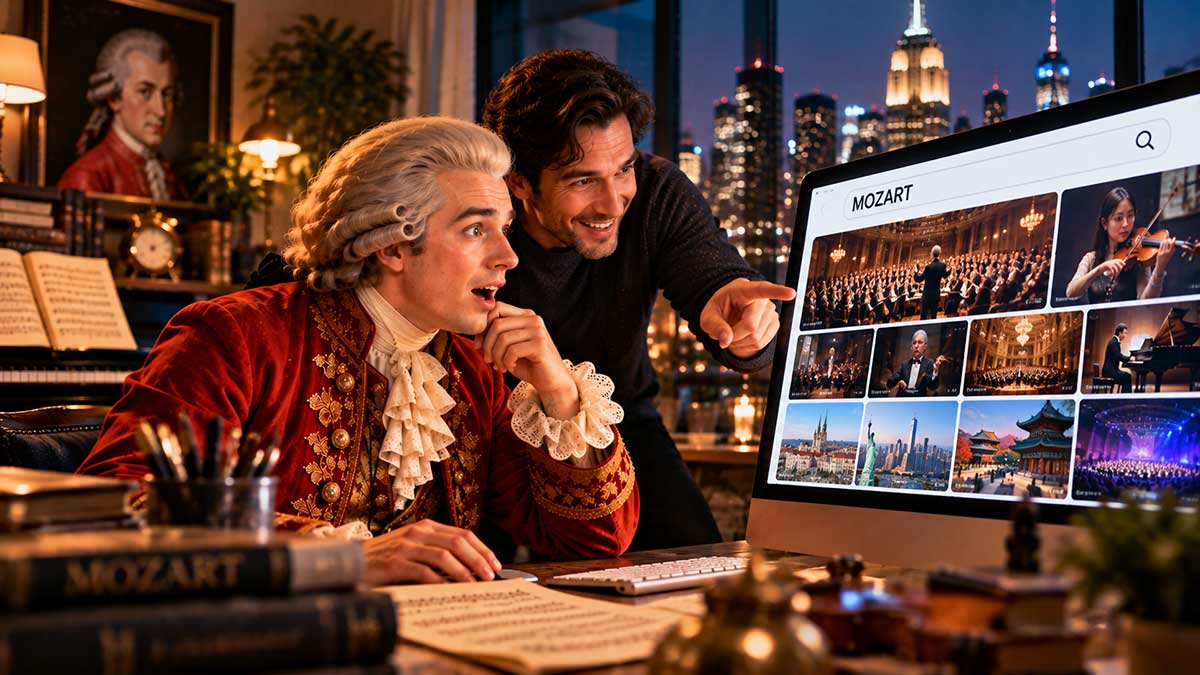
The guide opened a laptop.
Mozart stared at the screen.
“What is that?”
“A computer.”
“What does it do?”
“How much time do you have?”
Mozart laughed.
“One day.”
“Then we don't have enough time.”
The guide opened a search engine.
“You can search for almost anything.”
“Anything?”
“Try me.”
Mozart thought.
Then smiled.
“All right.”
The guide typed:
MOZART
Enter.
Mozart stopped smiling.
His face appeared everywhere.
Portraits.
Books.
Scores.
Recordings.
Concerts.
Operas.
Articles.
Videos.
Mozart leaned toward the screen.
“That's me.”
“Yes.”
Scroll.
Vienna.
London.
Paris.
Tokyo.
Seoul.
Los Angeles.
New York.
A Japanese child played his music.
A Korean orchestra performed one of his works.
An American teenager practiced one of his sonatas.
Thousands sang his Requiem.
Mozart pointed.
“Who is she?”
“A girl in America.”
“She knows my music?”
“Yes.”
“Has she ever been to Vienna?”
“Probably not.”
“Does she speak German?”
“I have no idea.”
Yet she knew Mozart.
The girl reached the final note.
She smiled toward the camera.
Mozart smiled back.
“Good.”
Then his eyes caught something else.
Wolfgang Amadeus Mozart
1756-1791
He stared.
“1791?”
The guide said nothing.
Mozart calculated.
His voice became quieter.
“That's next year.”
Silence.
“So I die next year?”
The guide didn't need to answer.
Mozart looked back at the screen.
His death date sat at the top.
Beneath it were concerts scheduled for 2026.
For a moment, Mozart seemed unable to reconcile the two.
He would be gone.
Yet there were people 235 years later buying tickets to hear his music.
He scrolled again.
Another orchestra.
Another child.
Another country.
Another century.
Finally he said:
“So something remains.”
He continued watching.
11:03 AM | Now Let Me Try
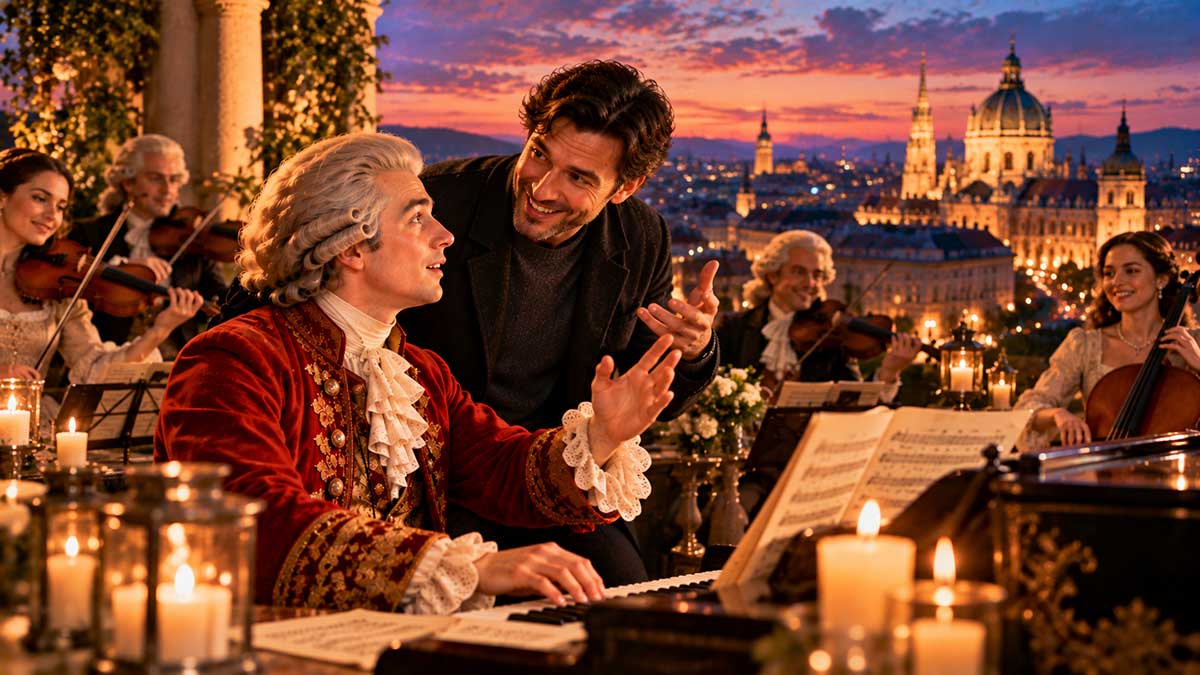
A modern grand piano waited for him.
Mozart sat.
Pressed one key.
Then another.
A chord.
A phrase.
Then suddenly his fingers were running across the keyboard.
He stopped.
“Very good.”
He played again.
Then looked toward the recording equipment.
“Can you do that thing?”
“What thing?”
“Save me.”
“Record you?”
“Yes.”
The button was pressed.
Mozart played.
The recording ended.
Seconds later, his own performance came through the speakers.
Mozart burst out laughing.
“That's me!”
“Yes.”
“Again.”
They played it again.
Mozart sat at the piano and added another melody over his recording.
Two Mozart performances now played simultaneously.
He stopped.
“There are two of me!”
Another track.
“Three!”
Another.
“Four!”
Mozart was laughing like a child.
“Can we make twenty?”
For the first time that day, he wasn't observing 2026.
He was playing with it.
Synthesizers came next.
Strings without strings.
Organs without pipes.
Sounds Mozart could not identify.
Then artificial intelligence.
Mozart played a short melody.
The computer continued it.
He listened.
His eyebrows rose.
Then lowered.
“No.”
“No?”
“That part is lazy.”
The guide laughed.
Another version.
Mozart listened.
“Better.”
He leaned closer to the computer.
“Who wrote that?”
“The AI.”
“No. Who is the composer?”
“That gets complicated.”
Mozart looked at the computer.
Then at his piano.
“If this machine can compose…”
He paused.
“What exactly is a composer?”
This time 2026 had no easy answer for him.
1:18 PM | How Many Kings Live in New York?
Mozart stepped onto a Manhattan street.
He stopped almost immediately.
Cars.
Buses.
Skyscrapers.
Traffic lights.
Digital billboards.
People everywhere.
He stared upward.
“How tall is that?”
The answer meant almost nothing to him.
An elevator carried him dozens of floors in moments.
A smartphone showed exactly where he was.
A camera captured an image instantly.
A person touched a screen and food later appeared at a door.
An airplane crossed the sky.
Mozart pointed.
“That one.”
“Airplane.”
“People are inside?”
“Yes.”
“How many?”
“Maybe a few hundred.”
Mozart stared upward.
“A few hundred people are flying over New York?”
“Yes.”
“And this is normal?”
“Yes.”
“Every day?”
“Every minute.”
Then came the supermarket.
Mozart entered.
And stopped.
Fruit from warm climates.
Vegetables.
Fresh meat.
Frozen food.
Coffee.
Tea.
Chocolate.
Spices.
Bread.
Fish.
Food from across the country and around the world.
He walked down one aisle.
Then another.
Then another.
“Who is this for?”
“Customers.”
“No. Who is allowed to buy it?”
“Anyone.”
“Anyone?”
“Yes.”
Mozart looked around.
“No invitation?”
“No.”
“No title?”
“No.”
“No royal household?”
“No.”
He looked down the seemingly endless aisle.
“How many kings live in New York?”
The guide laughed.
Mozart was completely serious.
3:37 PM | So Many People
The subway doors opened.
Mozart stepped inside.
People everywhere.
Standing shoulder to shoulder.
Sitting inches apart.
Yet almost nobody spoke.
Mozart leaned toward the guide.
“Do these people know one another?”
“Mostly not.”
Mozart looked around.
“Then why are they sitting so close together?”
“Because this is the subway.”
“That doesn't explain anything.”
Someone wore earbuds.
Another person read.
Someone slept.
Several stared at phones.
One woman was video-calling her mother thousands of miles away.
Mozart watched.
“She can see her?”
“Right now.”
“And speak to her?”
“Yes.”
“From here?”
“Yes.”
Across from her, another passenger sat silently beside someone for twenty minutes without exchanging a word.
Mozart looked around.
A hundred people might occupy the same train.
One could be speaking to someone across an ocean.
Another could be listening to a singer who died decades earlier.
Another could be messaging someone two streets away.
Another could be completely alone.
For the first time Mozart seemed to understand something strange about 2026.
Distance had become smaller.
Loneliness had not necessarily followed.
4:52 PM | Everyone Has Their Own Newspaper
Then Mozart discovered social media.
He loved it immediately.
“Wait.”
Scroll.
“Anyone can put something here?”
“Yes.”
“Anyone?”
“Pretty much.”
“Without a publisher?”
“Yes.”
“Without asking the emperor?”
“Definitely.”
Mozart grinned.
“Everyone has their own newspaper!”
He scrolled.
Vacations.
Beautiful homes.
Restaurants.
Weddings.
Children.
Promotions.
Cars.
Achievements.
Perfect photographs.
“How many lives can I see?”
“Millions.”
“Millions?”
“If you want.”
Mozart kept scrolling.
Then something began to bother him.
“These are their lives?”
“Parts of them.”
“Which parts?”
“The parts they choose to show.”
Mozart thought.
“So perhaps the beautiful dinner, but not the argument afterward?”
“Exactly.”
“The vacation, but not the debt?”
“Sometimes.”
“The smiling photograph, but not the lonely evening?”
“Sometimes.”
Mozart kept scrolling.
“And people compare themselves to these?”
“Yes.”
“To millions of carefully chosen moments?”
“Yes.”
“And sometimes they decide their own life isn't good enough?”
“Yes.”
Mozart slowly handed the phone back.
“You can see more human lives than any person in history.”
“Probably.”
“And somehow this can make you appreciate your own life less?”
“Sometimes.”
Mozart shook his head.
“That is a very strange miracle.”
6:03 PM | Hundreds of Contacts
Daniel was thirty-two.
He lived alone in New York.
He had a good job.
A comfortable apartment.
Heating.
Air conditioning.
A refrigerator filled with food.
Entertainment from around the world.
Music whenever he wanted it.
Food delivered to his door.
A smartphone containing hundreds of names.
Mozart looked around.
“You are wealthy.”
Daniel laughed.
“Not really.”
“You have hot water?”
“Yes.”
“Every day?”
“Yes.”
“You can make this room warm in winter?”
“Yes.”
“Cold in summer?”
“Yes.”
“You have enough food?”
“Yes.”
“You can listen to any orchestra you want?”
“Pretty much.”
Mozart pointed to Daniel's phone.
“And that can contact people?”
“Yes.”
“How many?”
Daniel opened his contacts.
“Hundreds, I guess.”
“Hundreds?”
“Sure.”
“And they can contact you?”
“Yes.”
“Then you must have people around you constantly.”
Daniel hesitated.
“Not exactly.”
Mozart waited.
Daniel gave a small laugh.
“Some weekends I barely talk to anyone.”
Mozart looked at the phone.
Then at Daniel.
“This can reach hundreds of people?”
“Yes.”
“People across New York?”
“Yes.”
“Across America?”
“Yes.”
“Across the world?”
“Yes.”
“And sometimes you're lonely?”
Daniel shrugged.
“Sometimes.”
Mozart stared at him.
There was no criticism in his expression.
Only confusion.
Then Mozart sat beside him.
“In my time, you could be lonely because someone was three days away.”
Daniel nodded.
Mozart held up the phone.
“In your time, someone can be three seconds away.”
He put it down.
“And you can still be lonely.”
Daniel smiled.
“Apparently.”
Mozart leaned back.
“Human beings are very complicated.”
Daniel laughed.
“That hasn't changed.”
8:06 PM | 235 Years Later
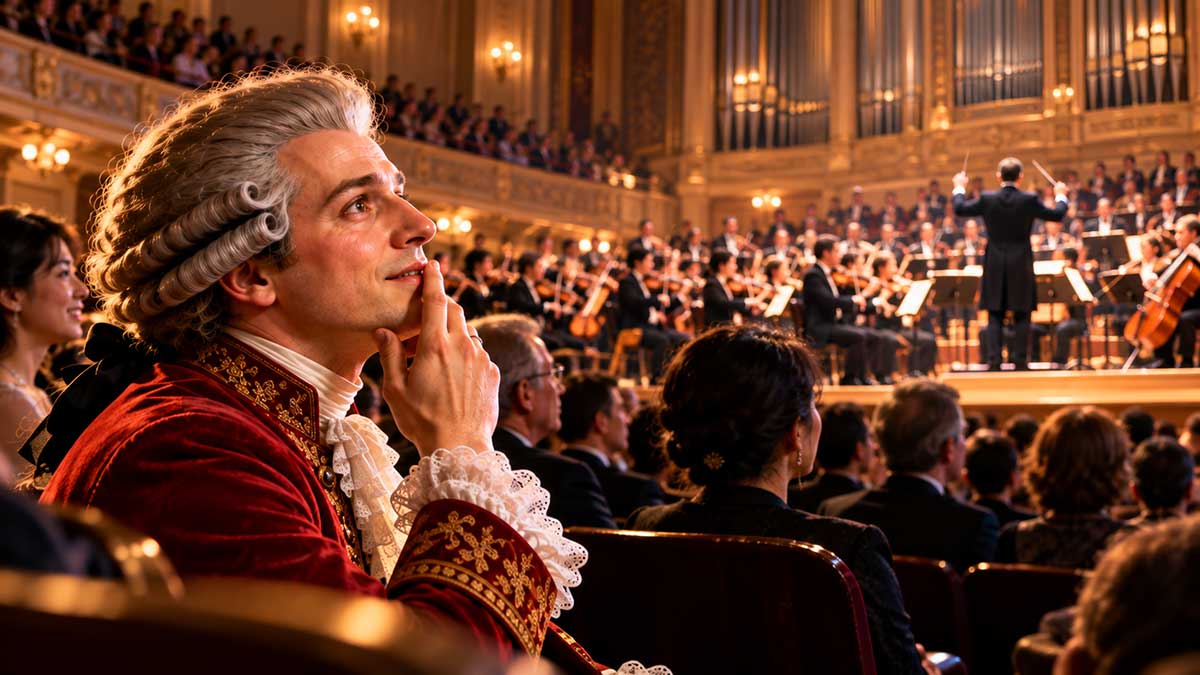
That evening Mozart entered Carnegie Hall.
He had not been told what would be performed.
He sat anonymously among the audience.
Nobody turned around.
Nobody recognized him.
The orchestra entered.
Applause.
The conductor raised the baton.
The first notes began.
Mozart became perfectly still.
He knew them.
Of course he knew them.
They were his.
At first, he listened like a composer.
He watched the strings.
Listened to the woodwinds.
Followed the tempo.
At one point his eyebrow rose.
Perhaps he would have taken that passage differently.
But slowly Mozart stopped watching the orchestra.
He began watching the audience.
An elderly couple.
A young woman sitting alone.
A family.
Tourists.
New Yorkers.
People of different ages.
People whose ancestors in Mozart's lifetime had lived thousands of miles apart.
Now they were sitting together.
Listening to him.
A child near Mozart quietly followed the melody.
Mozart leaned toward him.
“You know this?”
The child nodded.
“My mom plays it in the car.”
Mozart blinked.
“In the car?”
“Yeah.”
The child returned his attention to the stage.
Mozart didn't.
For some reason, that sentence affected him more than the millions of search results.
His music wasn't merely preserved.
It wasn't locked inside a museum.
It wasn't something only scholars studied.
A mother played it in the car.
A child knew the melody.
Somebody listened to it while cooking.
Someone studied to it.
Someone played it when they were lonely.
Someone practiced it badly.
Someone practiced it beautifully.
Two hundred and thirty-five years after Mozart's death, his music had become part of ordinary human life.
The final note faded.
Silence.
Then the hall erupted.
Applause.
Mozart remained seated.
He looked around.
All these strangers.
For a few minutes they had felt something together.
Mozart whispered:
“Something really did remain.”
Then he smiled.
“Not just the notes.”
10:42 PM | One Thing Hasn't Changed
Later, Mozart looked over New York at night.
Millions of lights.
Cars below.
Airplanes in the distance.
Windows stacked high into the darkness.
He had become much quieter.
“You can cross an ocean in hours?”
“Yes.”
“You can speak to someone on the other side of the Earth?”
“Yes.”
“You can preserve music after the musicians die?”
“Yes.”
“You can see inside the human body?”
“Yes.”
“You can cure diseases that killed people in my time?”
“Many of them.”
“You carry access to more knowledge than the greatest libraries I've ever seen?”
“Yes.”
Mozart looked down at the city.
“And people still hurt one another?”
“Yes.”
“Still fight?”
“Yes.”
“Still hate people they don't understand?”
“Sometimes.”
Mozart shook his head.
Not angrily.
Sadly, perhaps.
Or simply puzzled.
“You learned how to speak to someone on the other side of the Earth.”
He looked toward the people far below.
“Why is understanding the person beside you still so difficult?”
The guide didn't answer.
Mozart smiled faintly.
“Perhaps not everything changes in 236 years.”
Then he looked toward another apartment building.
Hundreds of illuminated windows.
Hundreds of lives.
“Still…”
“What?”
“This morning I thought the greatest invention of your age might be electricity.”
He smiled.
“Then I thought it was recording music.”
He looked toward the sky.
“Then perhaps airplanes.”
“And now?”
Mozart thought.
“I don't know yet.”
The guide checked the time.
“You have about an hour.”
11:57 PM | The Greatest Miracle
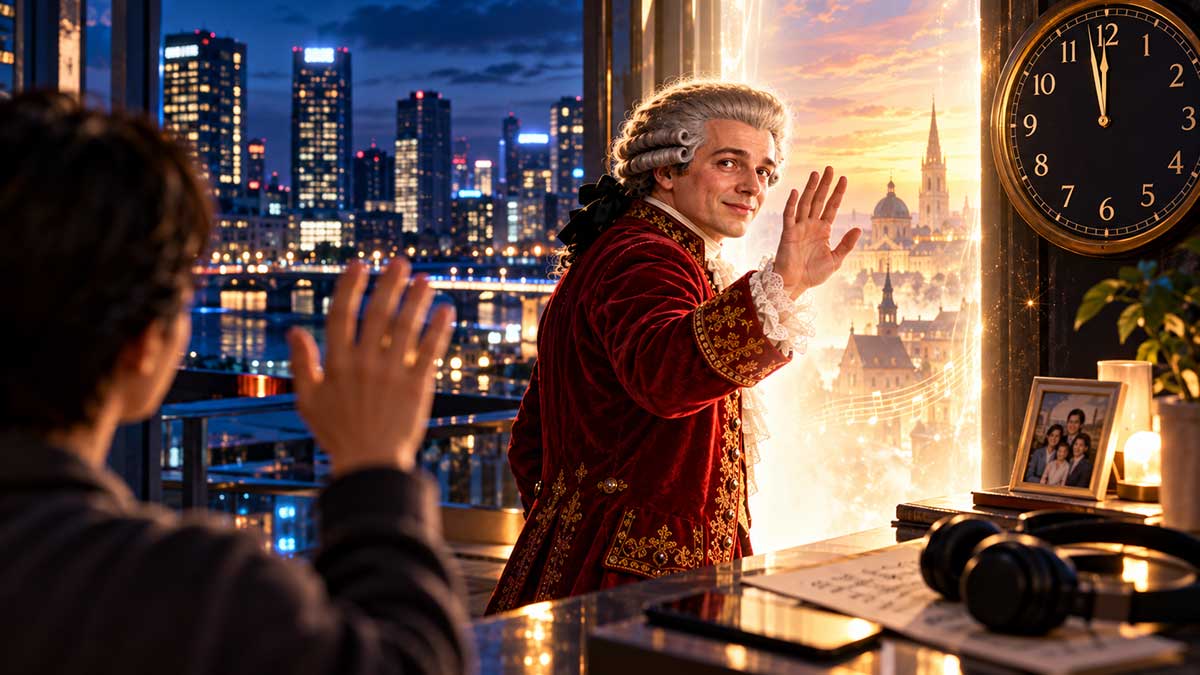
“Three minutes.”
Mozart turned sharply.
“Three?”
“That's all.”
He looked over New York.
For the first time all day, he seemed reluctant to ask another question.
The guide asked one instead.
“Of everything you saw today, what was the greatest miracle?”
Mozart smiled.
“Only one?”
“Only one.”
He thought.
“Preserving music.”
Then shook his head.
“No.”
“Airplanes?”
“No.”
“Modern medicine?”
“Astonishing.”
“But?”
“No.”
“Artificial intelligence?”
Mozart made a face.
“Certainly not.”
They laughed.
“Finding out your music is still played 235 years after your death?”
Mozart became quiet.
“That…”
He looked toward the city.
“That made me happier than I can explain.”
“But it wasn't the greatest miracle?”
“No.”
“Then what was?”
Mozart didn't answer.
Instead he began asking questions.
“Tomorrow morning, will these lights still come on?”
“Yes.”
“People will turn a handle and get hot water?”
“Yes.”
“They can open a box and find food kept fresh?”
“Yes.”
“They can listen to almost any music they want?”
“Yes.”
“They can hear the voices of people who are gone?”
“Yes.”
“If someone they love lives thousands of miles away, they can see that person's face?”
“Yes.”
“If their mother lives across the country, they can call her?”
“Yes.”
“And if they really want to see her, they can get on one of those flying machines?”
“Yes.”
“If they're sick, they have doctors and medicines I couldn't imagine?”
“Yes.”
Mozart nodded.
“Can Daniel call someone tonight?”
“Yes.”
“Can someone who hasn't spoken to a friend in five years call them?”
“Yes.”
“Can someone apologize?”
“Yes.”
“Can someone forgive?”
“Sometimes.”
“Can someone tell another person, ‘I miss you’?”
“Yes.”
“Can someone who spent yesterday badly make a different decision today?”
“Yes.”
Mozart smiled.
“Then perhaps that's it.”
“What?”
“Your greatest miracle isn't everything you have.”
He looked at the lights of New York.
“It's that you're still here to use it.”
The clock moved.
11:58.
The guide said:
“And tomorrow?”
Mozart looked at him.
“Tomorrow?”
“Yes.”
Mozart shook his head.
“Why are you giving today away so quickly?”
The guide didn't answer.
11:59.
Mozart looked around one final time.
The lights.
The buildings.
The distant sound of traffic.
A plane moving through the night sky.
Somewhere in the city, music was playing.
Somewhere, someone was alone.
Somewhere, someone was laughing with a friend.
Somewhere, someone was calling home.
Mozart smiled.
“You people live in an extraordinary age.”
The guide smiled back.
“We don't always feel that way.”
“I noticed.”
A few seconds remained.
Mozart extended his hand.
“Then perhaps you should look at it once in a while through the eyes of someone from 1790.”
12:00.
He was gone.
The Next Morning | 7:03 AM | Today Is Here
Daniel's alarm sounded.
He opened his eyes.
Same ceiling.
Same apartment.
Same New York morning.
He reached for his phone.
Notifications.
Email.
News.
Messages.
Social media.
His thumb moved automatically toward the first app.
Then stopped.
He put the phone down.
For a few seconds he simply lay there.
Then he reached toward the wall.
Click.
The room filled with light.
He looked at the bulb.
Normally he wouldn't have noticed it.
He went into the bathroom.
Turned the faucet.
Warm water.
He stood there for a moment with his hand underneath it.
Then the kitchen.
He opened the refrigerator.
Food.
He made coffee.
Outside the window, New York was already moving.
Cars.
Buses.
People.
Millions of ordinary mornings beginning at once.
Daniel picked up his phone.
For a moment, his thumb hovered over social media again.
Then he opened his contacts instead.
Scrolled.
Stopped.
One name.
Someone he had once spoken to all the time.
Someone he kept meaning to call.
Next week.
Next month.
When things slowed down.
When he had more time.
Daniel stared at the name.
Then pressed:
Call.
The phone rang.
Once.
Twice.
Three times.
We don't need to know whether anyone answered.
Mozart was given one day in 2026.
We were given this one.
The lights came on this morning.
The water was warm.
Music written centuries ago is waiting whenever we want to hear it.
Someone we love may still be reachable.
There are places we can still go.
Words we can still say.
People we can still forgive.
People we can still call.
Tomorrow has not been promised.
But today is here.
Final Thoughts
Mozart was given only one day in 2026.
We get something he did not.
We get to wake up here again.
The lights work. Warm water comes from the faucet. Music from centuries ago is waiting for us. Someone we love may still be reachable.
The point is not that modern life is perfect.
It is that even a difficult day can contain things earlier generations would have considered impossible.
And while today is still here, there may still be time to call someone, say something, forgive something, begin something, or simply notice what has been in front of us all along.
Short Bios:
Wolfgang Amadeus Mozart (1756–1791)
Austrian composer and pianist whose work includes symphonies, concertos, chamber music, sacred music, and opera. In this fictional story, Mozart travels from 1790 to New York City in 2026 for one day.
The Guide (Fictional Character)
A fictional companion who introduces Mozart to modern life and helps him understand the technology, customs, and contradictions of 2026.
Daniel (Fictional Character)
A 32-year-old New Yorker who appears to have many of the comforts and connections of modern life, yet still experiences periods of loneliness. His encounter with Mozart helps bring the story’s final question back to everyday life.
Note
This story is a fictional work inspired by the historical life and music of Wolfgang Amadeus Mozart. Mozart’s visit to 2026, his conversations, reactions, and encounters with modern characters are imagined for storytelling purposes.
Leave a Reply