
Main Introduction
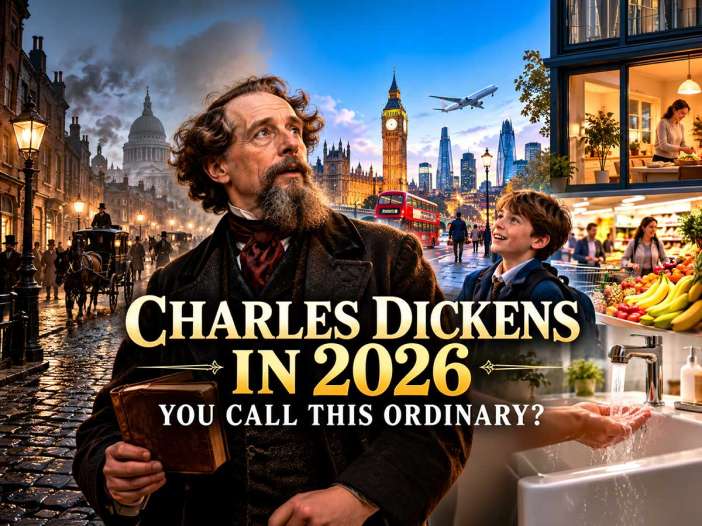
What would Charles Dickens think if he could return to London for just one day in 2026?
He would certainly be astonished by airplanes, smartphones, modern medicine, and a city transformed beyond recognition. But perhaps the things that would surprise him most are the things we barely notice at all: clean water, warm homes, abundant food, children going to school, and ordinary families expecting tomorrow to be much like today.
Through Dickens’s eyes, we may discover that some of the greatest miracles of modern life are the ones we stopped calling miracles long ago.
(Note: This is an imaginary conversation, a creative exploration of an idea, and not a real speech or event.)
11:18 PM | Tomorrow, You Can Go to 2026
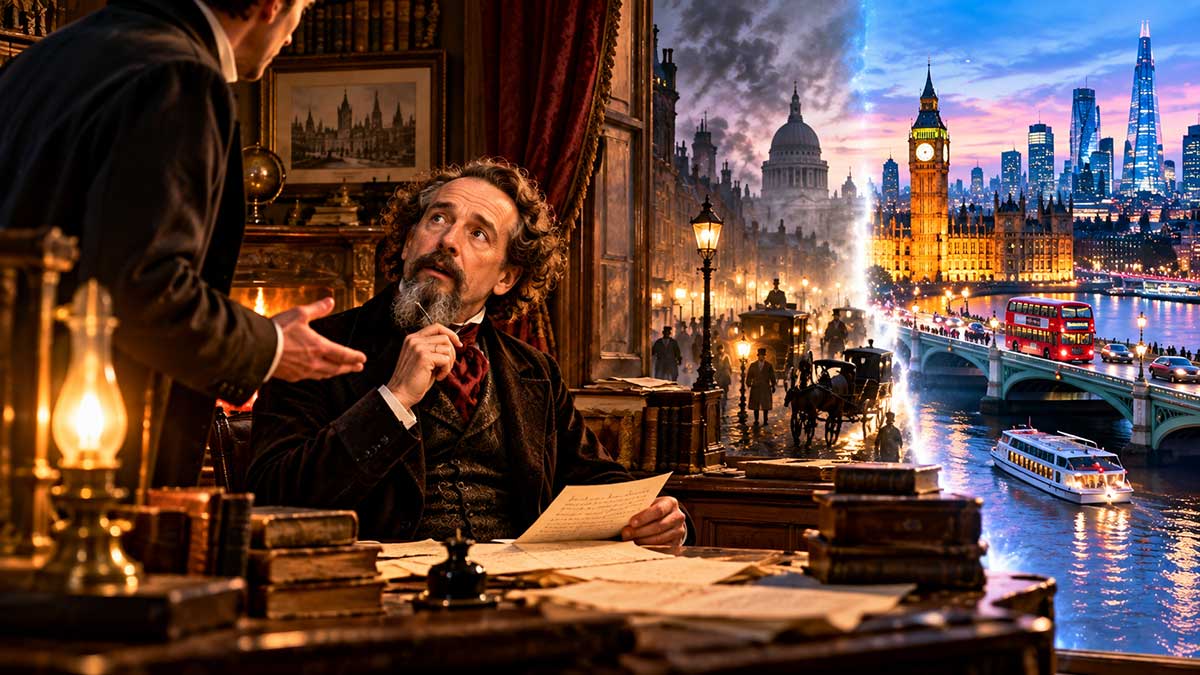
London, 1843.
Charles Dickens sat at his desk long after the rest of the house had grown quiet.
A fire burned beside him. Ink stained his fingers. Outside, wheels rattled over wet streets and horses moved through the darkness.
Then came a knock.
Dickens looked toward the door.
“Come in.”
A stranger entered.
“Mr. Dickens.”
“Yes?”
“I have something rather unusual to tell you.”
Dickens put down his pen.
“Good. Ordinary things are terribly difficult to write about.”
The stranger smiled.
“Tomorrow, you can go to the year 2026.”
Dickens stared at him.
Then laughed.
“I see.”
“I’m serious.”
“2026?”
“Yes.”
Dickens leaned back.
“For how long?”
“One day.”
“And where?”
“London.”
The smile disappeared.
“London?”
“Yes.”
Dickens leaned forward.
“The Thames?”
“Still there.”
“Covent Garden?”
“Still there.”
“The theatres?”
“Very much so.”
Dickens stood.
“What does London look like?”
“You’ll see.”
“How do people travel?”
“You’ll see.”
“Do they still read books?”
The stranger smiled.
“You’ll see.”
Dickens was enjoying this now.
Then his expression changed.
“And the poor?”
The stranger didn't answer immediately.
Dickens noticed.
“And the children?”
“Tomorrow,” the stranger said quietly, “you can see for yourself.”
Dickens looked toward the dark window.
“Then I should very much like to go.”
12:06 AM | What Became of London?
Dickens could not sleep.
He imagined London two centuries into the future.
Buildings taller than church steeples.
Carriages without horses.
Machines perhaps beyond anything he could imagine.
Maybe human beings had even learned to fly.
But those were not the thoughts that kept returning.
He remembered children.
Children selling things in the streets.
Children working.
Children hungry.
And then, inevitably, he remembered himself.
Twelve years old.
Warren’s Blacking Factory.
Bottles.
Labels.
Long hours.
Rats.
The humiliation had never entirely left him.
Dickens stared into the darkness.
Had London become richer?
Almost certainly.
But had it become better?
That was another question.
7:02 AM | Whose House Is This?
Dickens opened his eyes.
The room was warm.
That was the first thing he noticed.
No fire.
No servant tending a grate.
Yet the entire room was warm.
He sat up.
Beside him was a small lamp.
The Guide touched a switch.
Light filled the room instantly.
Dickens blinked.
“Again.”
Click.
Dark.
Click.
Light.
Dickens grinned.
“Again.”
“Mr. Dickens, we have quite a lot to see today.”
“Once more.”
Click.
Dark.
Click.
Light.
Dickens laughed.
“Excellent.”
A few minutes later he stood in the bathroom.
The Guide turned a tap.
Water appeared.
Dickens put his hand beneath it.
Cold.
Then the Guide turned another control.
Dickens tried again.
His eyes widened.
“Warm.”
“Yes.”
“Immediately?”
“Yes.”
“Every morning?”
“Yes.”
Dickens looked around.
Shower.
Sink.
Flush toilet.
Clean towels.
Soap.
“Where does the waste go?”
“Underground.”
“And the drinking water?”
“Different pipes.”
Dickens stared at the tap.
Then at the Guide.
“Whose house is this?”
“A woman named Sarah lives here with her twelve-year-old son, Oliver.”
“What does her husband do?”
“She isn't married.”
Dickens hesitated.
“What does she do?”
“She works in an office.”
He looked around again.
“Is she wealthy?”
“No.”
“Then whose servants manage all this?”
“She doesn't have servants.”
Dickens pointed toward the warm room.
“The fires?”
“No fires.”
“The hot water?”
“Automatic.”
“The washing?”
The Guide showed him the washing machine.
Dickens stared through the glass door.
Finally he said:
“You have a very unusual definition of poverty and wealth.”
The Guide smiled.
“This is a fairly ordinary home.”
Dickens looked around again.
“Ordinary?”
7:48 AM | Breakfast From the World
Oliver was sitting at the kitchen table staring at his phone.
He barely looked up.
“Morning.”
Dickens studied him.
“Good morning.”
On the table were toast, eggs, cereal, coffee, orange juice and bananas.
Dickens picked up a banana.
“Where did this come from?”
The Guide told him.
“And the coffee?”
Another part of the world.
“The oranges?”
Another country.
Dickens slowly surveyed the table.
“How expensive is this breakfast?”
Oliver shrugged.
“I don't know.”
Dickens looked at him.
“You don't know?”
“Mum buys it.”
Oliver returned to his phone.
Dickens looked again at the banana.
Oliver looked at a video.
Two people at the same breakfast table.
One fascinated by fruit.
The other bored by access to much of the accumulated knowledge and entertainment of humanity.
Dickens looked at the Guide.
The Guide said nothing.
8:17 AM | Where Does He Work?
Oliver stood and pulled on his backpack.
Dickens watched him.
“Where does the boy work?”
Sarah stopped.
“Work?”
“Yes. His employment.”
“He doesn't work.”
Dickens looked at Oliver.
“How old are you?”
“Twelve.”
Dickens waited.
Sarah finally understood.
“He's going to school.”
“For the morning?”
“All day.”
Dickens looked at Oliver.
“And tomorrow?”
“School.”
“The following day?”
Oliver groaned.
“School.”
Dickens smiled slightly.
“And what do you do there?”
“Maths. English. Science. History.”
“History?”
“Yes.”
Dickens brightened.
“Excellent subject.”
Oliver rolled his eyes.
Dickens watched him walk toward the door.
Twelve years old.
A backpack full of books.
Not bottles of blacking.
Dickens said nothing.
9:26 AM | Where Are the Horses?
London exploded around him.
Cars.
Buses.
Traffic lights.
Glass buildings.
Screens.
Bicycles.
Dickens turned in every direction.
A double-decker bus passed.
“No horses.”
“No.”
“How does it move?”
The Guide began explaining.
Dickens stopped him.
“No, no. I haven't the entire day.”
They descended underground.
A train arrived.
Dickens stepped aboard.
Minutes later they emerged somewhere else in London.
He looked back.
“How far did we travel?”
The Guide told him.
Dickens shook his head.
Then an airplane crossed the sky.
He stopped walking.
“What is that?”
“An airplane.”
“There are people inside?”
“Yes.”
“How many?”
“Perhaps two hundred.”
Dickens stared upward until it disappeared.
“Where are they going?”
“Could be another country. Perhaps another continent.”
Dickens remained silent.
Oliver tugged at his sleeve.
“Come on. We're going to Tesco.”
Dickens looked down.
“What is Tesco?”
10:41 AM | What Celebration Is Tomorrow?
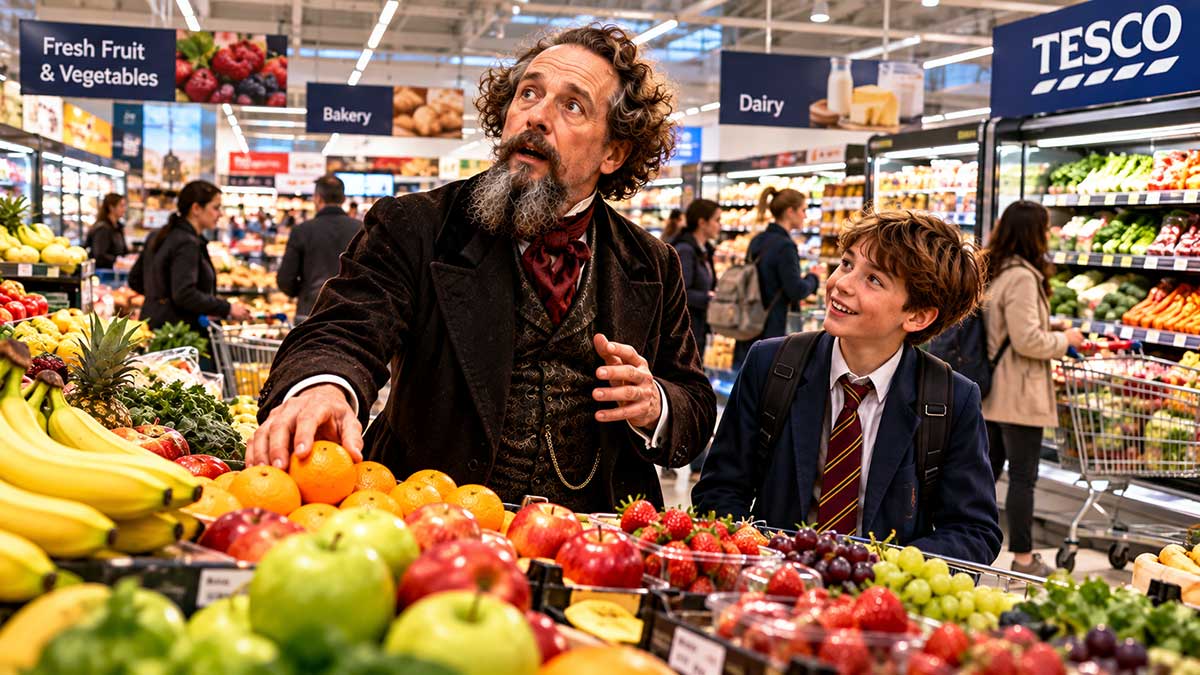
The doors opened automatically.
Dickens stopped.
Then he walked inside.
And stopped again.
Fruit.
Vegetables.
Bread.
Meat.
Fish.
Milk.
Cheese.
Tea.
Coffee.
Chocolate.
Rice.
Spices.
Food stretched aisle after aisle beneath bright lights.
Dickens picked up an orange.
Then grapes.
Then stared at strawberries.
He passed refrigerators filled with food.
Then freezers.
He turned slowly.
“What celebration is tomorrow?”
Oliver looked confused.
“What?”
“Christmas?”
“No.”
“A wedding?”
“No.”
Dickens gestured around him.
“Then why is there so much food?”
Oliver looked at the Guide.
Then back at Dickens.
“It’s just Tesco.”
Dickens stared at him.
“Just Tesco?”
“Yeah.”
People pushed shopping carts around them without looking particularly impressed.
Dickens watched a woman casually choose between six kinds of bread.
A man compared several varieties of coffee.
A child asked for strawberries.
Dickens looked around again.
“Extraordinary.”
Oliver shrugged.
“It's a supermarket.”
Dickens smiled.
“I believe that is what I find extraordinary.”
11:16 AM | Then Why Can't She Buy It?
Near the checkout, Dickens noticed a woman studying the price of something.
She put it back.
A little later he saw a collection point for a food bank.
“What is that?”
The Guide explained.
Dickens's expression changed.
“There are people without sufficient food?”
“Yes.”
“In this London?”
“Yes.”
Dickens looked back at the overflowing aisles.
“So Want survived.”
“Yes.”
For the first time that morning, Dickens looked deeply disappointed.
Then an older man placed several cans into the donation box.
Dickens watched.
“Does he know the family who will receive those?”
“No.”
Another shopper added pasta.
Another added cereal.
“They give food to people they have never met?”
“Yes.”
Dickens watched for another moment.
“So Want survived.”
He paused.
“But apparently generosity did as well.”
12:34 PM | All of Them?
The school was noisy.
Dickens loved it immediately.
Children hurried through corridors.
A science class was conducting an experiment.
Another group worked on computers.
Girls and boys studied together.
Children from many backgrounds filled the classrooms.
Dickens entered the library.
Rows of books.
Computers.
Tables filled with students.
He turned to the Guide.
“Which children are permitted to attend?”
“All of them.”
Dickens misunderstood.
“No, I mean which families can afford it?”
“This is a state school.”
“And those whose parents have little money?”
“They go to school too.”
Dickens looked through the glass at a classroom.
“All of them?”
“Yes.”
He watched silently.
Oliver appeared beside him.
“You look like you've never seen a school.”
“I have seen schools.”
Dickens looked at him.
“I have simply never seen this one.”
1:42 PM | When I Was Twelve
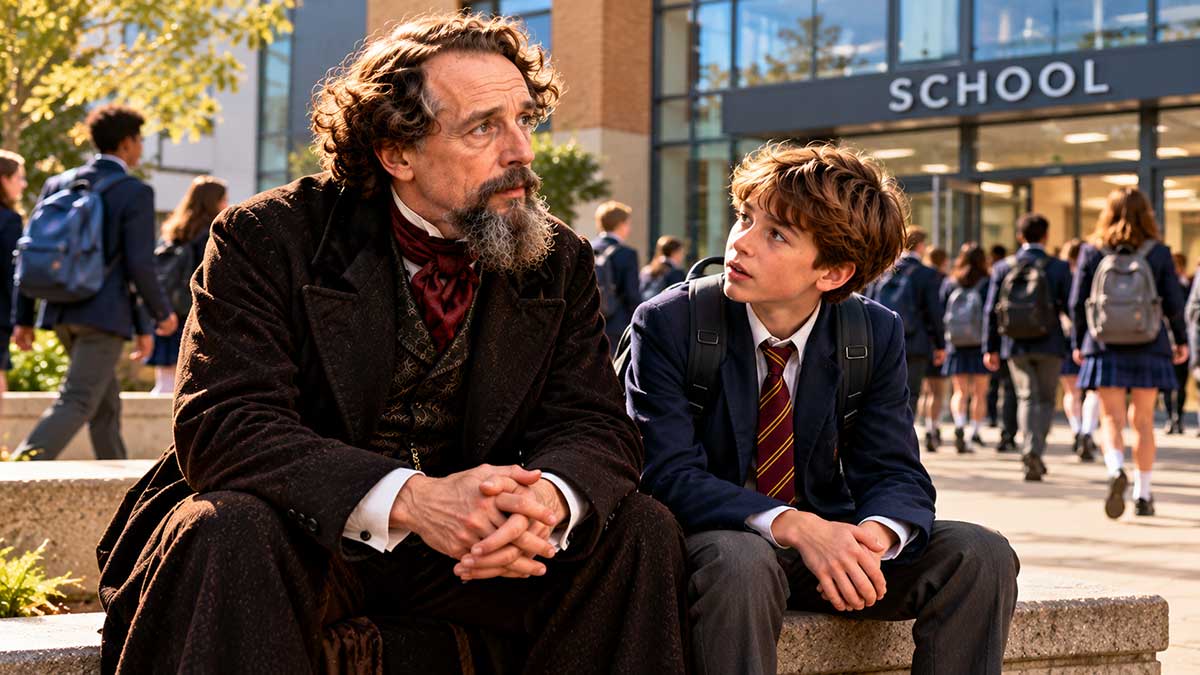
They sat outside eating lunch.
Oliver sighed.
“I hate Mondays.”
Dickens smiled.
“Why?”
“School.”
“Ah.”
“So much homework.”
Dickens nodded.
“I believe you.”
Oliver seemed surprised.
“You do?”
“Of course. Something need not be the worst thing in the world to be difficult.”
Oliver liked that answer.
Then Dickens said:
“When I was your age, I worked in a factory.”
Oliver laughed.
Dickens didn't.
“You're serious?”
“Yes.”
“What did you do?”
“I pasted labels onto bottles of blacking.”
“For how long?”
“Long days.”
“How old were you?”
“Twelve.”
Oliver stopped eating.
“My age?”
“Yes.”
“Why weren't you in school?”
Dickens looked toward the school building.
“My family had difficulties. My father was imprisoned for debt.”
Oliver stared.
“There were rats in the building where I worked.”
“At twelve?”
“At twelve.”
Neither spoke for a moment.
Then a bell rang.
Children groaned and started walking back inside.
Oliver stood.
Normally he would have complained.
This time he looked at the school.
Then at Dickens.
And went inside.
Dickens watched him go.
3:07 PM | You Carry All These Books?
Later, Oliver handed Dickens his phone.
“Try this.”
Dickens held it carefully.
“What exactly is it?”
“That could take a while.”
Oliver showed him books.
Maps.
Newspapers.
Dictionaries.
Photographs.
Music.
Videos.
Dickens stared.
“You carry all these books?”
“Sort of.”
“How many?”
“Millions, probably.”
Dickens looked suspicious.
Then Oliver typed:
CHARLES DICKENS.
Dickens froze.
His portrait appeared.
Then his books.
Oliver Twist.
Great Expectations.
David Copperfield.
A Tale of Two Cities.
A Christmas Carol.
Translations.
Films.
Stage productions.
Schools.
Museums.
Dickens stared for a long time.
“They still read them?”
Oliver hesitated.
“We had to read A Christmas Carol last year.”
Dickens turned.
“Had to?”
Oliver smiled.
“It was actually pretty good.”
Dickens raised an eyebrow.
“Actually?”
Oliver laughed.
Dickens handed the phone back.
“I see criticism has survived into the future.”
5:11 PM | Will She Live?
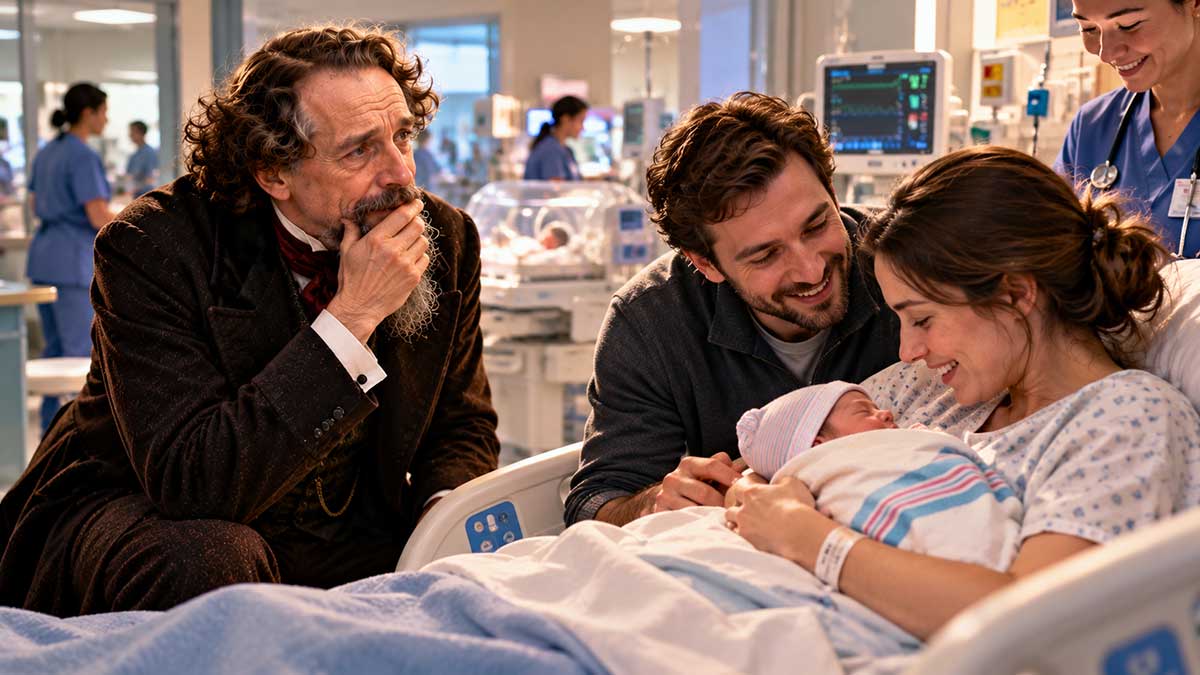
The hospital quieted Dickens.
He noticed cleanliness before anything else.
Bright corridors.
Clean sheets.
Doctors washing their hands.
Nurses checking monitors.
Machines could look inside the human body.
Medicines could fight infections that once terrified families.
Operations could be performed while patients felt no pain.
Dickens asked question after question.
Then he noticed a couple preparing to leave.
The mother held a small baby.
Dickens watched them.
“Was she ill?”
The Guide nodded.
“She needed special care after she was born.”
Dickens watched the father adjust the baby's blanket.
“And now?”
“They're going home.”
Dickens hesitated.
“Will she live?”
The Guide looked at him.
“That’s the plan.”
Dickens said nothing.
The parents walked past.
The mother smiled at him.
Dickens smiled back.
He watched them disappear through the doors.
“That’s the plan,” he repeated softly.
7:04 PM | Show Me More Ordinary Things
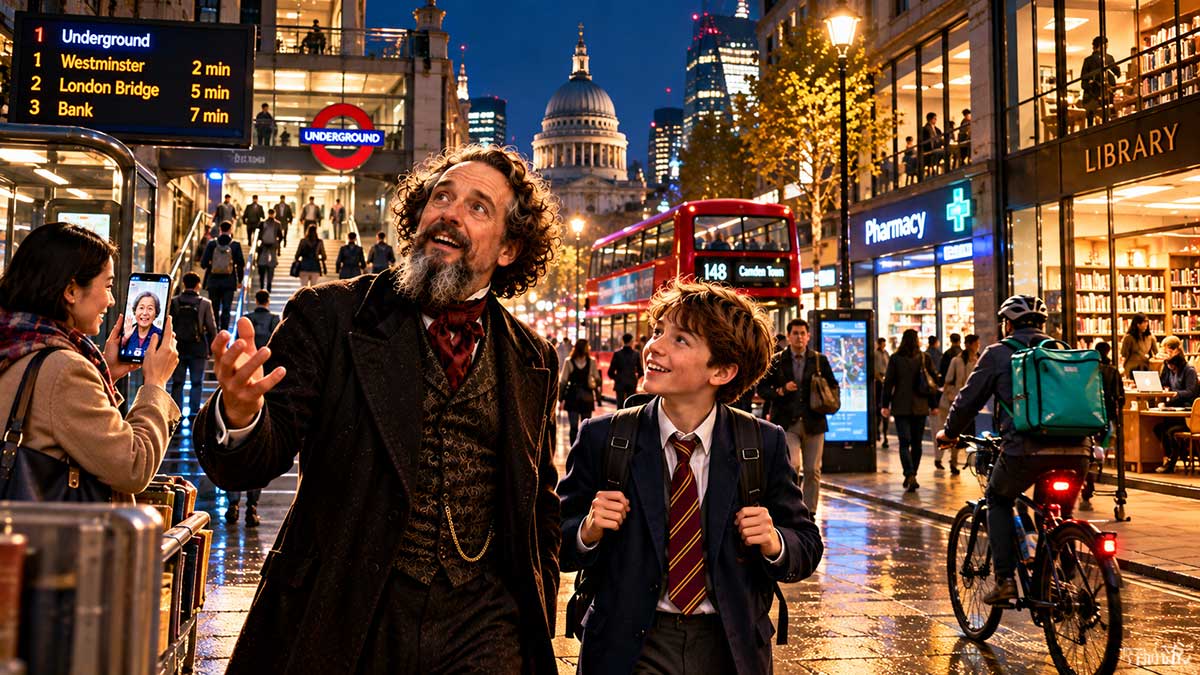
Outside the hospital, the Guide asked:
“What would you like to see next?”
Dickens thought.
Then his eyes brightened.
“Show me more ordinary things.”
Oliver laughed.
“What does that mean?”
“Show me things you consider completely unremarkable.”
Oliver thought.
They began walking.
Streetlights.
Dickens stopped.
A public library.
He stopped.
An elevator.
He stopped.
A pharmacy.
He stopped.
A wheelchair user boarded an accessible bus.
Dickens watched.
A woman checked tomorrow's weather on her phone.
Dickens asked how she knew.
A man video-called his daughter overseas.
Dickens stared at the screen.
“You can see her?”
“Yes.”
“Now?”
“Yes.”
“Across an ocean?”
“Yes.”
They passed a laundrette.
A refrigerator in a shop.
Prescription glasses.
An ambulance.
A cash machine.
A train departure board.
GPS directing someone through London.
A delivery driver carrying dinner to someone's door.
Dickens turned to Oliver.
“And all of this is ordinary?”
“Pretty much.”
Dickens shook his head.
“More.”
Oliver laughed.
They kept walking.
8:36 PM | Forty Minutes?
Back at the flat, Sarah looked at her phone.
“Dinner's late.”
Dickens looked concerned.
“What happened?”
“Nothing. Delivery's taking forever.”
“How long?”
“Forty minutes.”
Dickens frowned.
“Someone is bringing your dinner here?”
“Yes.”
“To the house?”
“Yes.”
“And you are angry because this requires forty minutes?”
Oliver started laughing.
Sarah looked slightly embarrassed.
“It sounds bad when you say it like that.”
Later Oliver complained that the Wi-Fi was slow.
Dickens asked what Wi-Fi did.
Oliver explained.
“And normally information travels to this device instantly?”
“Basically.”
“How long is it taking now?”
Oliver checked.
“Maybe two seconds.”
Dickens stared at him.
Oliver started laughing again.
“Okay, okay. I get it.”
But Dickens wasn't laughing.
He looked thoughtful.
“I don't think you are ungrateful.”
Oliver looked surprised.
“No?”
“No.”
Dickens sat back.
“I think human beings simply become accustomed to whatever miracles surround them.”
10:19 PM | London Is Not Finished
They took one final walk.
London glittered around them.
But Dickens noticed something beneath an awning.
A man sleeping outside.
He stopped.
Farther down the street, an ambulance pulled away.
A woman sat alone at a bus stop crying.
Dickens watched the city differently now.
Oliver put his hands in his pockets.
“I guess we're not doing that great.”
Dickens looked at him.
“I did not say that.”
Oliver waited.
Dickens looked back at the man beneath the awning.
“A better world need not be a perfect world.”
They continued walking.
“If suffering remains, there is still work to do.”
Oliver nodded.
Dickens looked at the lights of London.
“But it would be a strange mistake to believe that because you have not finished the journey, you have traveled nowhere.”
11:57 PM | What Was the Greatest Miracle?
They stood outside Oliver's home.
Three minutes remained.
The Guide turned to Dickens.
“Mr. Dickens.”
“Yes?”
“Of everything you saw today, what was the greatest miracle?”
Dickens smiled.
“The flying machine was impressive.”
“The airplane?”
“Yes. Though rather noisy.”
“Was that the greatest?”
“No.”
“Electricity?”
“No.”
“Modern medicine?”
Dickens looked toward the hospital in the distance.
“Almost beyond belief.”
“But not the greatest?”
“No.”
“Your books surviving?”
Dickens laughed.
“My vanity would very much like me to choose that.”
Oliver smiled.
Then Dickens looked at him.
Twelve years old.
Warm coat.
School backpack.
A light glowing in the window behind him.
Tomorrow there would be breakfast.
Hot water.
School.
Books.
Heat.
A bed.
Dickens's expression changed.
“I know my answer.”
The Guide waited.
“The ordinary life.”
Oliver frowned.
“My life?”
“Yes.”
Dickens looked at him.
“You keep showing me miracles and calling them ordinary.”
Nobody spoke.
Dickens continued.
“A child goes to school instead of a factory.”
Oliver looked down at his backpack.
“Clean water enters his home.”
Dickens glanced toward the house.
“Waste leaves it.”
“Food from across the world waits around the corner.”
“His room is warm.”
“Books are everywhere.”
“People can speak across oceans.”
“Medicines exist for illnesses that once terrified entire families.”
He paused.
“And parents take a sick baby home from a hospital expecting her to grow old.”
The Guide said nothing.
Dickens looked around at London.
“And tomorrow morning, you expect all of this to happen again.”
He smiled.
“Perhaps your greatest miracle is that you have lived among miracles long enough to stop calling them miracles.”
Oliver looked toward his house.
11:59 PM.
Dickens turned to him.
“You do not have to love school every day.”
Oliver smiled.
“Good.”
Dickens touched the boy's backpack.
“But every once in a while…”
He paused.
“…remember where you're going.”
Midnight.
Dickens was gone.
7:02 AM | Ordinary
The alarm sounded.
Oliver groaned.
Monday.
He reached for his phone.
Then stopped.
He got out of bed.
Bathroom.
He turned the tap.
Warm water flowed over his hands.
Oliver watched it for a moment.
Downstairs, he opened the refrigerator.
Cold air touched his face.
Milk.
Eggs.
Fruit.
Food.
His mother looked at him.
“What are you doing?”
“Nothing.”
He poured cereal.
His phone buzzed.
A message from a friend.
Outside, a bus approached.
Oliver put on his backpack.
His mother called after him.
“You're going to miss it!”
He ran outside.
The doors opened.
He climbed aboard.
The same house.
The same water.
The same breakfast.
The same school.
The same London.
Nothing had changed.
Except perhaps the meaning of one word.
Ordinary.
Charles Dickens was given one day in 2026.
Then he had to go back.
We get to stay.
And tomorrow morning, if the light comes on…
if the water runs warm…
if there is something to eat…
somewhere to sleep…
someone we can reach…
something we can learn…
and another day waiting outside…
perhaps the miracle was never very far away.
Perhaps we simply became used to it.
Final Thoughts
Charles Dickens returned to his own century.
We get to stay.
Tomorrow morning, we may turn on a light, take a warm shower, open a refrigerator, send a message across the world, travel safely to work or school, and barely think about any of it.
Our world is not perfect. Suffering has not disappeared, and there is still much to improve.
But perhaps gratitude does not require believing everything is perfect.
Perhaps it begins simply by noticing how extraordinary so much of our ordinary life already is.
Short Bios:
Charles Dickens (1812–1870)
English novelist and social commentator whose works include Oliver Twist, David Copperfield, Great Expectations, A Tale of Two Cities, and A Christmas Carol. His childhood experience working in a blacking factory helped shape his lifelong concern with poverty, childhood, inequality, and human dignity.
Oliver
A fictional 12-year-old London schoolboy living in 2026. His completely ordinary modern life becomes extraordinary when Dickens begins asking questions about things Oliver has never thought twice about.
The Guide
A fictional companion who gives Charles Dickens one day in 2026 and helps him navigate modern London without telling him what he is supposed to think.
Note
This is a fictional story inspired by the life, writings, experiences, and social concerns of Charles Dickens. Dickens’s visit to 2026, his conversations with Oliver and the Guide, and his reactions to modern London are imagined. Historical details are used as a foundation for exploring how extraordinary many aspects of everyday modern life might appear to someone from Dickens’s world.
Leave a Reply