
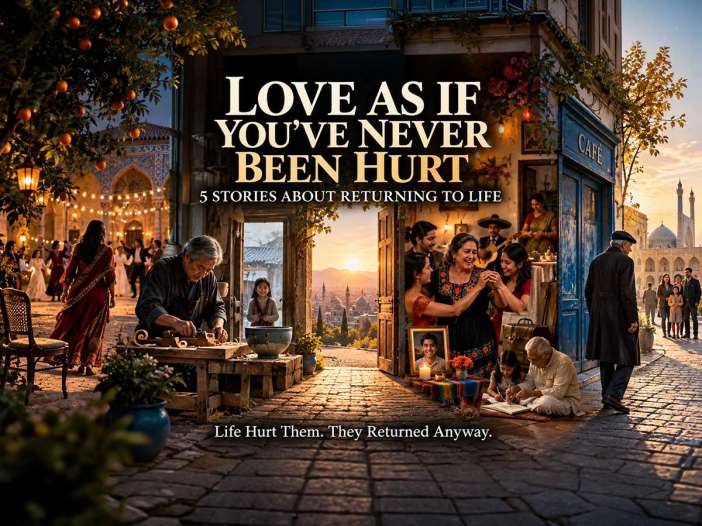
Introduction
What If Healing Is Not About Getting Over the Hurt, but Returning to Life?
What does it really mean to love as if you've never been hurt?
Surely it cannot mean forgetting.
A person who has been betrayed cannot simply erase betrayal.
A grieving mother cannot pretend her child never died.
A craftsman cannot restore the fingers he lost.
A father cannot answer every question suffering has left behind.
An old man cannot prevent everything he loves from eventually changing or disappearing.
So perhaps the invitation is not to become innocent again.
Perhaps it is something more difficult.
To return.
Pain has a way of making us step outside our own lives.
After betrayal, we stop trusting.
After failure, we stop creating.
After death, we become afraid of joy.
After tragedy, we may spend years demanding an answer before allowing ourselves to live again.
And when we finally understand that everything we love is temporary, we may wonder whether loving anything deeply is worth the risk.
These five stories take those questions into five different cultural worlds, drawing inspiration from poets represented in Ryu Si-hwa's Love As If You've Never Been Hurt.
In the Persian world inspired by Rumi, a woman who has protected herself from love for years must decide whether she will remain seated at her sister's wedding.
In Japan, inspired by Ishikawa Takuboku, a master carpenter who has lost two fingers must discover whether being damaged means being finished.
In Mexico, inspired by Octavio Paz, a mother grieving her teenage son confronts the guilt she feels when laughter returns.
In India, inspired by Kabir, a father travels from teacher to teacher searching for an explanation for his son's death while the living people who love him wait at home.
And finally, returning to the Persian world through Omar Khayyam, an eighty-one-year-old café owner must close the place that has contained nearly his entire adult life.
None of them is completely healed.
That is important.
The woman is still afraid.
The carpenter's fingers do not grow back.
The mother's son remains dead.
The father never receives the answer he wanted.
The café closes.
Yet something happens in every story.
Someone acts.
She dances.
He makes.
She laughs.
He comes home.
He lets go and walks forward.
Perhaps healing does not always happen before we return to life.
Sometimes returning is part of how healing begins.
The wound can come with us.
It just doesn't get to lead.
(Note: This is an imaginary conversation, a creative exploration of an idea, and not a real speech or event.)
Story 1: The Empty Chair at the Wedding
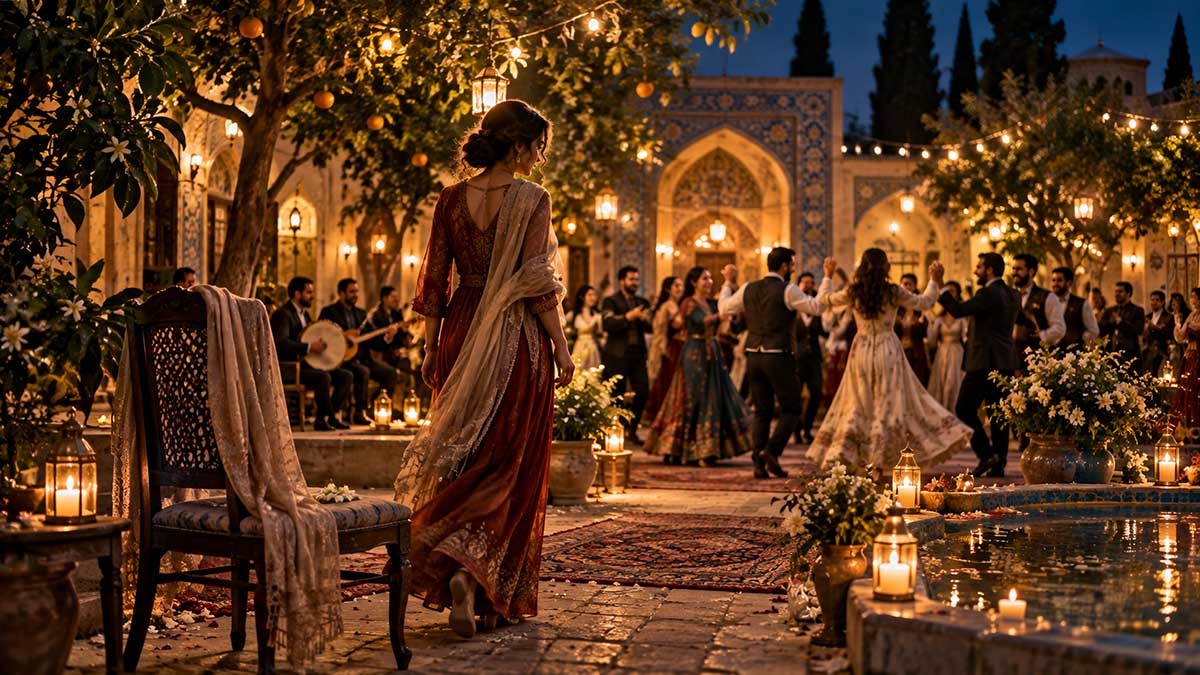
By nine o'clock, everyone was dancing except Leila.
From her chair near the edge of the courtyard, she watched her younger sister disappear into a circle of cousins, aunts, childhood friends, and women Leila had not seen since university.
Niloofar's wedding dress moved through them like white water.
Someone clapped.
Someone shouted her name.
The music grew louder.
An aunt who had spent most of the evening complaining about her knees was suddenly dancing as though knees were an invention she had never agreed to.
Leila smiled.
She even laughed.
But she did not get up.
The wedding was being held in the courtyard of an old family property outside Shiraz, where high walls kept the celebration private and orange trees leaned over strings of warm lights. Platters of rice, herbs, lamb, fruit, sweets, and half-finished glasses of tea crowded the tables.
Beyond the walls, the night was cool.
Inside them, everyone seemed determined to make enough noise for the entire city.
“Leila!”
Her cousin Parisa was waving at her from the dance floor.
“Come!”
Leila shook her head and lifted her tea.
Parisa pointed accusingly at her.
Leila pointed at her shoes.
It was a convincing excuse. The heels were ridiculous.
Parisa laughed and returned to the dancing.
Leila took another sip.
She had become very good at declining things pleasantly.
That was one of the skills she had acquired in the last five years.
She had been thirty when Arman left.
People always said it that way.
Arman left.
As though he had walked out of a room.
The truth was less dramatic.
There had been no screaming.
No broken dishes.
No final embrace at an airport.
He had received an opportunity abroad and left Iran before they married. At first they spoke every day.
Then every other day.
Then when schedules allowed.
Then when he was less tired.
Then when work became less demanding.
Then when things settled down.
Leila had accepted every explanation because love, she believed, required patience.
One night, sitting on her bed with her laptop open, she saw a photograph posted by someone she didn't know.
Arman was in it.
So was another woman.
There was nothing unmistakably romantic about the photograph.
That almost made it worse.
The woman was simply standing beside him in a kitchen, laughing.
Her hand rested lightly against his chest.
Leila stared at that hand for a very long time.
When she called him, he didn't deny it.
There were apologies.
There were explanations.
There was distance.
There was loneliness.
There were sentences beginning with, “I never meant to...”
There were sentences ending with, “...just happened.”
And finally there was the sentence Leila remembered most clearly.
“I don't know what you want me to say.”
She had thought about that sentence for years.
At the time, she wanted him to say something that could reverse time.
She wanted words powerful enough to return her to the woman she had been five minutes before seeing the photograph.
There were no such words.
So eventually she stopped asking for them.
The strange thing was that Leila recovered beautifully.
At least that was what everyone said.
She kept her job.
She was promoted twice.
She traveled.
She bought her own apartment.
She learned to sleep diagonally across the bed.
She developed opinions about coffee.
She took her mother to Isfahan.
She remembered birthdays.
She hosted dinners.
She became the friend other women called after midnight when their own relationships were falling apart.
“You're so strong,” they told her.
Leila had learned to accept the compliment.
Strength, she discovered, was sometimes just pain that had become socially presentable.
She dated occasionally.
There was nothing obviously wrong with the men.
That was almost inconvenient.
One was kind.
One was funny.
One remembered that she hated raisins in rice.
One wanted to introduce her to his family.
That relationship lasted seven months.
When he began speaking about the future, Leila found reasons the relationship could not work.
They were reasonable reasons.
She had become excellent at reasonable reasons.
He was too dependent on his family.
Their work schedules were incompatible.
They wanted different things.
He was too serious.
Another man was not serious enough.
One lived too far away.
One lived too close to his parents.
One sent too many messages.
One did not send enough.
Leila never told herself she was afraid.
She simply had standards now.
That was the phrase she preferred.
I have standards now.
And it was partly true.
Pain had taught her useful things.
She knew what dishonesty looked like.
She knew that love without boundaries could become self-abandonment.
She knew that forgiveness and trust were not the same thing.
She knew that leaving could sometimes be healthier than staying.
All of that was wisdom.
But somewhere along the way, wisdom had quietly hired fear as its assistant.
Leila had not noticed when the assistant took over the office.
“Why aren't you dancing?”
The voice came from beside her.
Leila looked up.
Her great-aunt Mahin stood there holding a small plate containing one pistachio sweet.
At seventy-eight, Mahin was tiny, silver-haired, and perpetually unimpressed.
“My shoes,” Leila said.
Mahin looked down.
“Take them off.”
Leila laughed.
“I'll dance later.”
“No, you won't.”
“What?”
“You've been saying that for two hours.”
Mahin sat beside her.
Across the courtyard, Niloofar's new husband was being pulled into the dancing by three cousins.
Mahin ate half the sweet.
“Your sister looks happy.”
“She is.”
“Good man?”
“I think so.”
“You think so?”
“I hope so.”
Mahin turned toward her.
“That is a different answer.”
Leila smiled.
“You interrogate everyone at weddings?”
“Only people hiding at the edge.”
“I'm not hiding.”
Mahin looked around them.
There were three empty chairs, a handbag, a discarded shawl and Leila.
“Of course not.”
Leila laughed again.
Mahin finished the sweet.
Then she asked, “Do you remember your uncle dancing?”
Leila did.
Uncle Farhad had died eight years earlier.
He had been a terrible dancer.
Not charmingly terrible.
Actually terrible.
He danced too fast when the music was slow and too slowly when it was fast.
“He was embarrassing,” Leila said.
“He was.”
“You used to yell at him.”
“I used to tell him he had no rhythm.”
“He didn't.”
Mahin smiled.
“No.”
For a moment they watched the wedding.
Then Mahin said, “I would give almost anything to be embarrassed by him one more time.”
Leila looked at her.
Mahin's eyes remained on the dancers.
There was no performance in her sadness.
No lesson being prepared.
She was simply telling the truth.
After a while Leila said, “Do you still miss him?”
“Every day.”
“Even now?”
Mahin turned.
“What do you think happens? You love someone for forty-six years and then after a respectable mourning period your heart receives a certificate?”
Leila laughed softly.
Mahin did not.
“No,” she said. “You carry it.”
“The sadness?”
“The love.”
Leila looked away.
On the dance floor, Niloofar had thrown her head back laughing.
Leila suddenly remembered her sister at seven years old, standing on Leila's feet while Leila moved them both around their parents' living room.
She remembered Niloofar at thirteen, crying because a boy at school had called her ugly.
At nineteen, stealing Leila's lipstick.
At twenty-six, calling at one in the morning to say she thought she had met someone.
And now there she was.
A bride.
Leila felt something tighten inside her.
Mahin touched her hand.
“You know,” she said, “I don't think you're afraid of dancing.”
Leila looked at her.
“I'm not afraid of dancing.”
“I know.”
Mahin stood.
She did not explain.
She simply walked away.
At 9:37, Leila went inside to find somewhere quiet.
She told herself she needed the bathroom.
Instead, she found an empty bedroom at the back of the house.
Someone's coat lay across the bed.
Wedding gifts were stacked against the wall.
Leila closed the door.
For a few seconds, the music became distant.
She looked at herself in the mirror.
Thirty-five.
She had noticed recently that the face in mirrors had begun surprising her.
Not because she looked old.
Because she still expected to see thirty.
The woman who had been waiting for Arman.
Five years.
It seemed both enormous and embarrassingly small.
Her phone vibrated.
A message from her sister.
WHERE ARE YOU???
Then another.
I'm getting married once. Come dance with me.
Leila smiled.
She typed:
Coming.
She did not send it.
Instead she sat on the edge of the bed.
Her eyes landed on an empty chair near the window.
For reasons she could not explain, she remembered the first wedding she and Arman had attended together.
They had been dating less than a year.
He had pulled her onto the dance floor.
She had resisted because she felt self-conscious.
“Nobody's looking at you,” he had said.
“Everyone's looking.”
“Then let them.”
He had danced badly on purpose until she laughed.
For years, that memory had felt stolen.
As though everything beautiful that happened before the betrayal had been retroactively contaminated by what happened after.
She had wanted the past to become simple.
Either he had loved her or he had not.
Either the relationship had been real or it had been false.
Either she had been foolish or she had been loved.
But life refused to become that clean.
Perhaps he had loved her.
Perhaps he had also failed her.
Perhaps she had been happy.
Perhaps she had also been deceived.
Perhaps two things could be true without canceling each other.
Leila looked again at the message.
I'm getting married once. Come dance with me.
She suddenly understood something that made her angry.
Arman had left five years ago.
Yet he was here.
Not literally.
But here.
At her sister's wedding.
Sitting in this room with her.
Keeping her away from the music.
She had spent five years believing she was protecting herself from another betrayal.
But Arman was no longer asking anything from her.
He wasn't preventing her from dating.
He wasn't preventing her from trusting.
He wasn't preventing her from dancing.
She was doing that.
And for the first time, the realization did not feel empowering.
It felt humiliating.
She stood.
Then sat again.
“No,” she whispered.
She did not know whether she was speaking to herself, to Arman, or to the frightened woman she had become.
Her eyes filled.
“I don't want to do this anymore.”
There was no answer.
Of course there wasn't.
This was not the kind of moment in which the universe spoke.
The music continued outside.
Someone laughed in the hallway.
A child ran past the door.
Life was not waiting for Leila to finish understanding it.
That, suddenly, seemed important.
She wiped her face.
Then she took off her shoes.
When Leila returned to the courtyard barefoot, nobody noticed.
That disappointed her slightly.
Some part of her had expected the world to recognize that something monumental had happened in the bedroom.
Instead, an uncle was arguing about dessert.
Two children were chasing each other around a table.
Someone was taking a photograph.
A waiter nearly walked into her.
Life had continued without ceremony.
Then Niloofar saw her.
“Finally!”
She reached out.
Leila stopped.
It was only for a second.
But she felt it.
The old instinct.
Stay here.
Smile.
Watch.
You can love people without needing them too much.
You can celebrate without surrendering.
You can stand close enough to life to feel its warmth without stepping into the fire.
Safe.
Then Leila looked at her sister's hand.
She took it.
Niloofar pulled her into the circle.
The music was fast.
Leila immediately lost the rhythm.
Her cousins cheered.
“Oh, shut up,” she shouted, laughing.
Someone turned the music louder.
She moved awkwardly at first.
Then less awkwardly.
Someone spun her.
Someone nearly stepped on her foot.
Her aunt Mahin was dancing now too, badly enough to honor her late husband.
Leila laughed.
And then, without warning, she began to cry.
Niloofar saw her.
Her smile disappeared.
“What happened?”
Leila shook her head.
“Nothing.”
“Leila.”
“Nothing happened.”
“Why are you crying?”
Leila looked around.
At her sister.
At the lights.
At the orange trees.
At Mahin.
At all these people dancing badly under a dark sky.
She tried to answer.
But how could she explain it?
She was crying for Arman.
She was crying for the woman she had been before him.
She was crying for the woman she had become afterward.
She was crying because her sister was beautiful.
Because Uncle Farhad was dead.
Because Aunt Mahin was still dancing.
Because weddings ended.
Because marriages ended.
Because people died.
Because people betrayed one another.
Because people also stayed.
Because nothing came with guarantees.
Because she had spent five years waiting for a guarantee before stepping back into a life that had never offered one.
So Leila gave the only answer she could.
“I'm happy.”
Niloofar stared at her.
“You're crying.”
“I know.”
Then her sister began laughing.
And somehow that made Leila laugh too.
They danced while Leila cried.
Nobody tried to fix it.
Much later, after midnight, Leila returned to her table.
The courtyard was messier now.
Half-empty glasses.
Crushed napkins.
Abandoned shoes.
Wilted flowers.
A celebration already becoming a memory.
Her feet hurt.
Her hair had come loose.
Her makeup was probably ruined.
She felt exhausted.
Mahin sat beside her again.
Neither woman spoke for a while.
Then Mahin asked, “Better?”
Leila considered the question.
“No.”
Mahin nodded.
“Good.”
Leila laughed.
“What kind of answer is that?”
“An honest one.”
Mahin poured tea.
Leila looked toward the dance floor.
People were still moving.
“I thought something would change,” Leila said.
“Something did.”
“I still feel the same.”
“Of course.”
“I still don't trust people easily.”
“Why should you?”
“I still think about him.”
“Probably.”
“I might always think about him.”
Mahin shrugged.
“Then think about him.”
Leila looked at her.
“That's your advice?”
“My advice is to stop making everything a problem that needs to disappear.”
Leila was quiet.
Mahin pushed a glass of tea toward her.
“You danced.”
Leila looked down at her bare feet.
“Yes.”
“That is enough for tonight.”
Three weeks later, Leila met a man for coffee.
His name was Dariush.
A friend had been trying to introduce them for months.
Previously, Leila had found six reasons not to meet him.
This time she found four.
She went anyway.
He was not extraordinary.
This relieved her.
He talked too much when nervous.
He had an annoying habit of stirring his coffee long after the sugar had dissolved.
He made her laugh twice.
Once unintentionally.
At the end, he asked if she wanted to meet again.
Leila felt the familiar machinery begin.
Evaluate.
Predict.
Protect.
Find the problem before the problem finds you.
She looked at him.
She did not know whether he was trustworthy.
She did not know whether she would love him.
She did not know whether he would hurt her.
She did not know whether she might hurt him.
She knew almost nothing.
Five years earlier, that uncertainty would have terrified her.
Now it merely frightened her.
There was a difference.
“Yes,” she said.
Dariush smiled.
“Really?”
“Don't make me reconsider.”
He laughed.
They walked outside.
At the corner they went in opposite directions.
Nothing dramatic happened.
No music.
No revelation.
No certainty.
Leila walked home alone.
Halfway there, she passed a restaurant where a wedding was taking place.
Music escaped each time someone opened the door.
For a moment she stopped.
Through the window she could see people dancing.
She thought about Arman.
The thought still hurt.
Perhaps it always would, a little.
But something had changed.
The memory no longer felt like an instruction.
It was only a memory.
Leila continued walking.
She understood now that loving as though she had never been hurt could never mean becoming the woman she had been before.
That woman was gone.
And perhaps she did not need to return to her.
She could be wiser.
More careful.
More honest.
She could have boundaries.
She could leave when she was mistreated.
She could say no.
She could remember everything.
And still say yes sometimes.
The wound did not have to disappear.
It simply did not have to go first.
Leila reached her apartment building and opened the door.
Behind her, faintly, the wedding music continued.
She smiled.
Then she stepped inside.
The man who broke her heart had left her once.
She would not spend the rest of her life leaving with him.
Original-Book Connection
Love As If You've Never Been Hurt does not have to mean forgetting betrayal or returning to innocence. The deeper invitation is to participate in life without allowing yesterday's wound to govern every tomorrow. Like the poetry gathered by Ryu Si-hwa, Leila's story asks whether love can coexist with impermanence, grief, uncertainty, and memory. Her healing is not proven by what she understands. It is proven by what she does: she gets out of the chair and dances.
Story 2: The Carpenter's Cracked Bowl
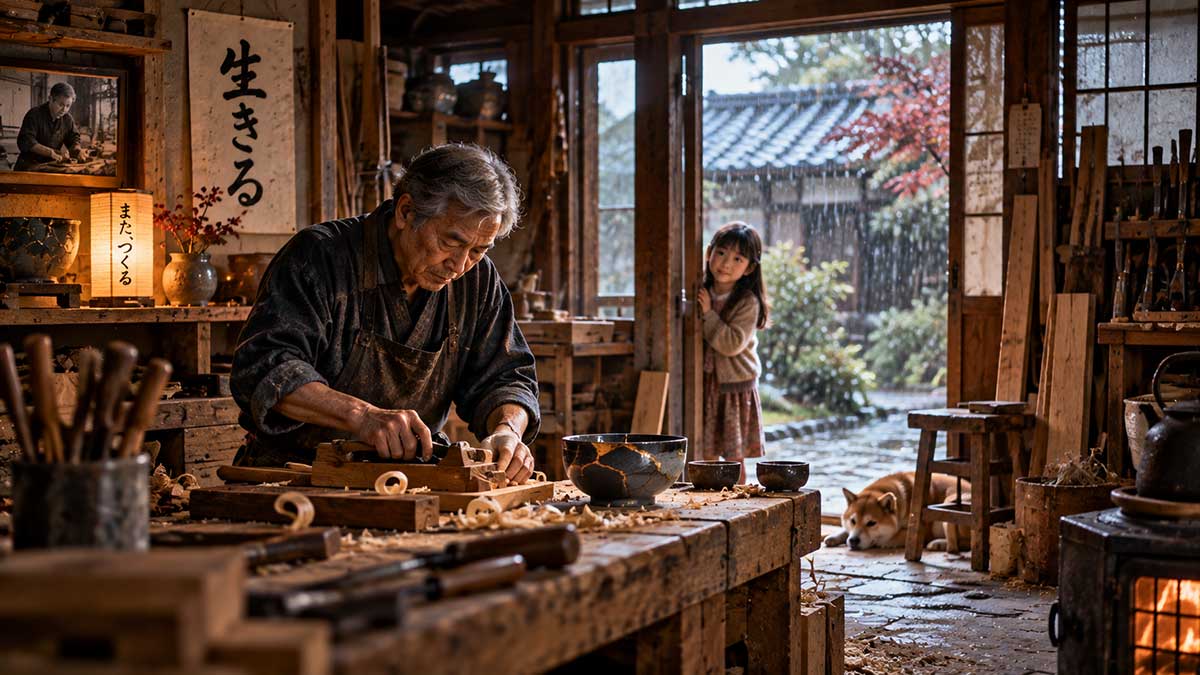
For forty-two years, Kenji Mori believed that a good craftsman could tell the truth with his hands.
A joint either fit or it did not.
A surface was either level or it was not.
Wood remembered every mistake.
You could hide a bad cut under paint, but the wood knew.
Kenji liked that about it.
People could flatter.
People could lie.
Wood could not.
Every morning before seven, he opened the sliding door to his workshop behind the family house in Kanazawa.
He sharpened his tools.
He swept the floor.
He ran his fingers across whatever piece of timber he had chosen for the day.
Cedar.
Hinoki.
Keyaki.
He liked beginning before the neighborhood fully woke.
The quiet made him feel that the world was still unfinished.
Then, one November morning, his left hand entered the blade.
It happened so quickly that afterward he could not remember whether he had shouted.
He remembered the machine stopping.
He remembered seeing blood on pale wood.
He remembered thinking, absurdly:
I have ruined the board.
Then he looked at his hand.
Two fingers were gone.
The doctor said he was fortunate.
Kenji hated that word.
Fortunate.
The blade had missed the thumb.
The tendons in the remaining fingers could still function.
There had been no major infection.
Rehabilitation would help.
“You'll be able to do many things again,” the doctor told him.
Many things.
Not everything.
Kenji heard only the difference.
His wife, Akiko, sat beside him in the hospital and held his uninjured hand.
“You're alive,” she said.
He knew what she meant.
He also knew she was right.
That made him angrier.
Because gratitude felt like another demand.
Be grateful.
Be strong.
Accept it.
Move on.
He did not want to move anywhere.
He wanted his fingers back.
For the first month, everyone came to visit.
Former apprentices.
Customers.
Neighbors.
His daughter from Tokyo.
His son from Nagoya.
His granddaughter Hana, who was eleven and spoke to him as if nothing terrible had happened.
She brought him a paper crane with one wing slightly shorter than the other.
“I made it on the train,” she said.
Kenji examined it.
“The fold is wrong.”
Hana stared at him.
Akiko slapped his arm.
“What?”
“She knows I don't lie.”
Hana took the crane back.
“I like it wrong.”
“That does not make it right.”
“It can still fly.”
“It is paper.”
“That is not the point.”
Kenji looked at Akiko.
Akiko smiled.
“You deserve each other.”
He returned home after twenty-three days.
But he did not return to the workshop.
At first, everyone understood.
He was healing.
Then winter passed.
Spring arrived.
The plum tree behind the house bloomed.
The workshop remained closed.
Kenji told people he was thinking.
He told others he was recovering.
He told his former apprentice Sato that he was deciding what to do with the business.
What he did not say was simpler.
He was afraid to touch the tools.
Not because of the blade.
Because of what would happen if he discovered he could no longer make anything worthy of his name.
Kenji had spent his life believing that craftsmanship meant control.
The hand moved.
The blade followed.
The joint met.
The surface became smooth.
His body had been part of the instrument.
Now one part of the instrument was missing.
He did not know who he was without precision.
So he stopped finding out.
The workshop began to change without him.
Dust gathered.
Wood dried.
A spider built a web between the leg of a workbench and a stack of offcuts.
The calendar still showed November.
Akiko asked once whether she should clean.
“No.”
“Then you clean.”
“I will.”
He did not.
In June, Hana came to stay for a week.
Her parents were busy, and school had ended.
She filled the quiet house instantly.
Shoes in the wrong place.
Juice glasses left half full.
Music from her phone.
Questions asked from one room while she was already moving into another.
Kenji found her exhausting.
He loved her completely.
On the third afternoon, rain began.
Hana grew bored.
“Let's make something.”
“No.”
“Why?”
“Because I said no.”
“That is not a reason.”
“It is when you're eleven.”
She looked toward the back of the house.
“The workshop?”
“No.”
“Why?”
“Hana.”
“You never let me go in.”
“Correct.”
“So today would be special.”
“No.”
She narrowed her eyes.
Kenji recognized the expression.
His daughter had made the same face at eleven.
“Grandma says you're stubborn.”
“Your grandmother has poor judgment.”
“She married you.”
Kenji almost smiled.
Almost.
Then Hana ran away.
A few minutes later he heard a sound from the sitting room.
Ceramic striking wood.
Then the floor.
Then breaking.
Silence.
“Hana?”
No answer.
Kenji stood.
He found her kneeling beside the low cabinet.
In front of her lay three pieces of a shallow ceramic bowl.
Blue glaze.
White interior.
A thin crack now dividing the painted branches across the surface.
Kenji stopped.
Hana looked terrified.
“I didn't mean to.”
He knew the bowl.
Of course he knew it.
Akiko had bought it during their honeymoon in Mashiko more than forty years earlier.
They had carried it home wrapped in newspaper.
For years, Akiko served pickles in it.
Then nuts.
Then small sweets when guests came.
It had survived three houses, two children, earthquakes, a move, grandchildren.
Until Hana.
“I'm sorry,” she said.
Kenji said nothing.
Her eyes filled.
“Grandpa?”
He looked at the pieces.
Then at her.
He wanted to be angry.
Anger was familiar.
Anger was easier than sadness.
Instead he sighed.
“Get the newspaper.”
“What?”
“Newspaper.”
“Why?”
“We'll fix it.”
Her face changed instantly.
“You can fix it?”
Kenji looked at the broken bowl.
“No.”
Hana frowned.
“You just said”
“I said we'll fix it. I did not say it will become what it was.”
They carried the pieces to the kitchen table.
Akiko came in and stopped.
“Oh.”
Hana lowered her head.
“I broke it.”
Akiko picked up one piece.
For a long moment she said nothing.
Then she smiled faintly.
“I always wondered which grandchild would do it.”
Hana looked up.
“You're not mad?”
“I might be tomorrow.”
Kenji examined the breaks.
Clean enough.
They could be joined.
Hana asked, “Are we going to do that gold thing?”
“What gold thing?”
“When broken bowls have gold in the cracks.”
“Kintsugi?”
“Yes.”
“No.”
“Why?”
“We don't have the materials.”
“We can buy them.”
“No.”
“Why not?”
“Because we are fixing a bowl, not opening an art gallery.”
Hana crossed her arms.
“So how?”
“With what we have.”
They used ordinary ceramic adhesive.
Kenji hated it.
It dried too quickly.
His left hand could not stabilize the pieces the way he wanted.
The bowl slipped once.
The seam shifted.
“Stop moving,” he muttered.
“I am not moving,” Hana said.
“I'm talking to the bowl.”
Akiko laughed from the sink.
Kenji tried again.
His remaining fingers cramped.
The old instinct demanded exactness.
Align.
Press.
Hold.
But he could not create the pressure he once could.
Hana supported one side.
He supported the other.
Together they held the pieces.
When the adhesive set, the repair was visible.
Very visible.
One side sat slightly higher than the other.
A thin white line showed where the break had been.
Kenji stared at it.
“It is ugly,” he said.
Hana gasped.
“Grandpa.”
“It is.”
“I like it.”
“You have poor standards.”
She lifted the bowl carefully.
“Will it work?”
“Probably.”
“That is enough.”
Kenji looked at her.
She had said it casually.
As if the sentence meant nothing.
But it stayed with him.
That is enough.
That evening, Akiko served cucumber pickles in the repaired bowl.
Kenji objected.
“You shouldn't use it yet.”
“The adhesive is cured.”
“It may break.”
“Everything may break.”
He glared at her.
She met his eyes.
Then placed the bowl on the table.
Hana took a pickle.
The bowl held.
Nothing happened.
That irritated Kenji more than he expected.
The bowl had broken.
They had repaired it badly.
And somehow dinner continued.
The next morning he woke at 5:41.
Akiko was asleep.
Rain tapped softly against the window.
Kenji lay still.
He thought about the bowl.
Then he thought about the workshop.
At 6:12, he got dressed.
He stood in the hallway for almost a minute before opening the back door.
The garden smelled wet.
The workshop waited across the stones.
He had crossed that distance thousands of times.
Now it felt longer.
He reached the sliding door.
His right hand rested on the frame.
For a moment, he almost turned around.
Then he opened it.
The air inside smelled of cedar, dust and machine oil.
Nothing had changed.
Everything had changed.
His tools hung where he had left them.
The calendar still showed November.
He walked to the workbench.
Dust covered the surface.
He ran his right hand through it.
Then his left.
The shortened fingers left an uneven trail.
Kenji stared at the marks.
For the first time since the accident, he did not immediately look away.
He started small.
A simple wooden tray.
Nothing commissioned.
Nothing important.
He chose a piece of cedar that had been sitting for years.
At first he tried to work exactly as before.
That failed.
His grip slipped.
The chisel angle was wrong.
He dropped a clamp.
His left hand tired after fifteen minutes.
He swore.
Loudly.
Akiko opened the workshop door.
“You're alive?”
“Unfortunately.”
She looked at the bench.
Then at him.
She smiled.
“Don't.”
“I didn't say anything.”
“You were going to.”
“I was going to ask if you want tea.”
“No.”
“Fine.”
She left.
Ten minutes later she returned with tea anyway.
The tray took six days.
Before the accident, Kenji could have finished it in one.
The corners were not identical.
One edge was slightly thicker.
A small gouge near the underside bothered him so much that he considered throwing the entire thing away.
He placed it beside the scrap bin.
He stood there for almost five minutes.
Then Hana's voice appeared in his memory.
Will it work?
He hated that question.
A craftsman should not ask only whether something works.
Beauty mattered.
Care mattered.
Precision mattered.
He still believed that.
But perhaps there was another question.
Does imperfection erase everything else that remains?
Kenji picked up the tray.
He ran his thumb across the uneven edge.
He thought about his hand.
The answer came reluctantly.
No.
A week later, Sato visited.
He had trained under Kenji twenty years earlier and now ran a successful shop of his own.
He saw the tray on the bench.
“You made this?”
Kenji grunted.
Sato picked it up.
Kenji watched his eyes move immediately toward the flaws.
Of course he saw them.
He was a craftsman.
“Well?” Kenji asked.
Sato turned it over.
“This corner is heavy.”
“I know.”
“And this edge.”
“I know.”
“The finish is uneven here.”
“I know.”
Sato put the tray down.
Kenji felt heat rise in his face.
Then Sato said, “It's good to see your work again.”
Kenji looked away.
“It is not good work.”
“No.”
The answer came too quickly.
Kenji glared at him.
Sato smiled.
“It isn't your old work.”
“No.”
“But you are not your old body.”
Kenji's face hardened.
Sato immediately bowed his head slightly.
“Sorry.”
“No. Continue.”
Sato hesitated.
Then said, “Maybe the mistake is asking this hand to prove it is still the other hand.”
The workshop became very quiet.
Kenji looked down.
His missing fingers were impossible not to see.
For months, every time he looked at his hand he saw subtraction.
Two fingers gone.
Strength gone.
Speed gone.
Control gone.
But his thumb remained.
His palm remained.
Three fingers remained.
Experience remained.
Judgment remained.
Forty-two years remained.
Why had he been measuring himself only by what was missing?
Kenji picked up the tray.
“Still ugly,” he said.
Sato nodded.
“A little.”
Kenji laughed for the first time in the workshop since November.
He began working every morning again.
Not full days.
At first, two hours.
Then three.
He changed the height of the workbench.
Sato helped him modify two clamps.
Kenji invented ways to brace wood with his forearm.
Some techniques worked.
Others failed spectacularly.
Once, a small cabinet door fell to the floor and split.
Kenji stared at it for ten seconds.
Then he sat down.
Akiko, listening from the house, waited for the explosion.
None came.
After a while Kenji said quietly:
“Well.”
She appeared at the door.
“Well what?”
“I suppose we make another.”
Akiko smiled.
He pointed at her.
“Do not make that face.”
“What face?”
“The proud wife face.”
“I have no idea what you're talking about.”
“You've been making it for forty-seven years.”
By autumn, people began asking whether Kenji would accept commissions again.
He refused most.
Then an old customer asked for a small writing desk for her grandson.
Kenji almost said no.
Instead he asked:
“When do you need it?”
There was a long pause.
Then she answered.
Kenji wrote the date down.
His handwriting looked strange now.
He accepted the job.
The desk took nearly twice as long as expected.
Kenji struggled with one joint in particular.
Before the accident, he would never have accepted the result.
He remade it once.
Then twice.
The third attempt still did not satisfy him.
He stood alone in the workshop after sunset, staring at it.
His younger self seemed to stand beside him.
Not the young apprentice.
The master.
The man from one year earlier.
The man with ten fingers.
He could almost hear him.
Not good enough.
Kenji touched the joint.
He agreed.
It was not as good as before.
That fact hurt.
He did not need to lie about it.
Loss was loss.
Acceptance did not mean pretending nothing had been taken.
He had lost something real.
But then he asked himself another question.
Is this desk worthy of the boy who will use it?
He examined the whole piece.
The surface.
The balance.
The drawer.
The grain.
The way afternoon light would fall across the top.
Yes.
It was.
Not perfect.
Worthy.
That difference saved it.
When the desk was finished, Kenji did something he had avoided with everything he made after the accident.
He turned it over.
On the underside, he took the small branding iron containing his name.
MORI KENJI
He heated it.
His hand trembled slightly.
For decades, signing a piece had been automatic.
Now it felt like a declaration.
This is mine.
Not the work I used to make.
Not the work another man would make.
Mine.
He pressed the mark into the wood.
The smell of heat and cedar rose.
When he lifted the iron, the letters were slightly uneven.
Kenji stared at them.
Then he smiled.
He left them exactly as they were.
That winter, Hana returned.
The first thing she did was run to the kitchen.
“Where is the bowl?”
Akiko pointed to the cabinet.
Hana took it down.
The repaired crack was still obvious.
“See?” she said to Kenji. “It survived.”
Kenji took the bowl.
He examined the seam.
“Barely.”
Hana rolled her eyes.
Then she followed him to the workshop.
This time he did not tell her to stay outside.
She stood just inside the door.
The room had changed.
New clamps.
Lower work surfaces.
Handles wrapped differently.
Several unfinished pieces.
Wood shavings on the floor.
The old calendar was gone.
A new one hung in its place.
Hana noticed a small wooden box on the bench.
“Did you make that?”
“Yes.”
She picked it up.
One corner was slightly uneven.
She smiled.
“You're getting worse.”
Kenji stared at her.
Then he laughed.
“Out.”
“What?”
“Get out of my workshop.”
“You invited me.”
“I have reconsidered.”
She ran outside laughing.
Kenji watched her go.
Then he looked around the workshop.
For months after the accident, he had thought returning meant getting back what he had lost.
His old speed.
His old hand.
His old precision.
His old self.
But perhaps returning did not mean going backward.
Perhaps it meant entering the same room as a changed person.
His hand would never be what it had been.
He would never make exactly the same work.
There would always be things he could no longer do.
He no longer needed those facts to be different.
On the workbench lay a small stool he had started that morning.
One leg still needed shaping.
Kenji sat down.
He adjusted the wood beneath his left forearm.
He picked up the plane with his right hand.
Outside, Hana was calling for him.
Akiko was telling her not to shout.
Rain began tapping lightly against the workshop roof.
Kenji placed the blade against the wood.
For a moment he simply held it there.
Then he pushed.
A thin curl of cedar lifted.
Not perfectly even.
Not the way it once would have been.
But clean enough.
Beautiful enough.
His.
Kenji watched the shaving fall to the floor.
Then he made another.
And another.
He had thought the accident had ended his work.
It had ended one way of working.
That was not the same thing.
He had confused being damaged with being finished.
The wood had known better.
Original-Book Connection
This story is inspired by Ishikawa Takuboku, the Japanese poet from Japan, whose deeply personal poetry often turned ordinary life, disappointment, loneliness, work, poverty, and human frailty into something intimate and recognizable. The Japanese setting also allows the story to draw naturally from traditions of craftsmanship and from a cultural sensitivity to imperfection, repair, transience, and the marks that time leaves behind.
In Love As If You've Never Been Hurt, the invitation is not to pretend that loss never changed us. Kenji cannot recover the fingers he lost, and the story never asks him to call the accident a gift. What changes is his relationship to what remains.
His return is therefore not psychological first. It is physical.
He opens the workshop door. He picks up the tool. He makes something again.
The cracked bowl becomes important not because broken things are automatically more beautiful, but because it shows him something harder: an object can be damaged, visibly repaired, and still have a life afterward.
So can a person.
Story 3: The Birthday Party She Almost Cancelled
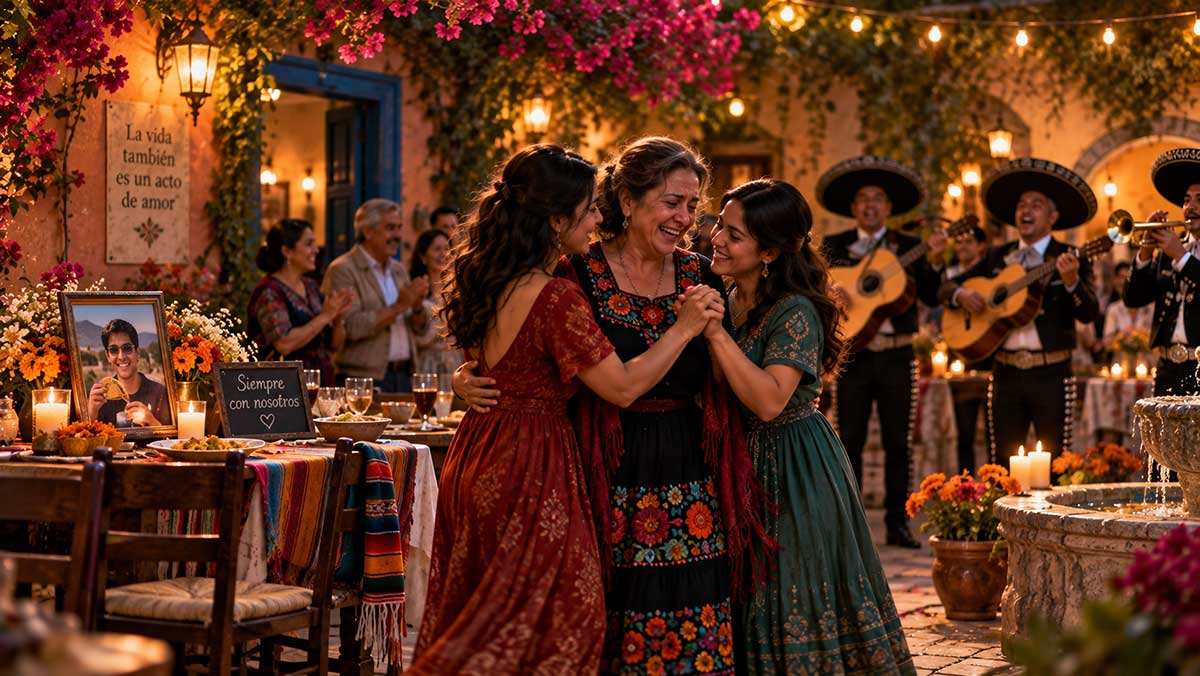
Three weeks before her fiftieth birthday, Elena told her daughters there would be no party.
Sofía continued chopping onions.
Lucía stopped.
“What?”
“No party.”
They were standing in Elena's kitchen in Coyoacán on a Sunday afternoon, preparing lunch. Outside the open window, someone was selling tamales from a cart, calling into the street. A dog barked from a neighboring courtyard. Somewhere farther away, church bells marked the hour.
Sofía did not look up.
“Mamá.”
“I don't want one.”
“You said that last year.”
“I didn't have one last year.”
“Exactly.”
Elena opened the refrigerator.
“I don't like birthdays anymore.”
Lucía leaned against the counter.
“You used to celebrate your birthday for an entire week.”
“That was when I was younger.”
“You celebrated forty-seven for nine days.”
“That is an exaggeration.”
“You had three cakes.”
“People brought them.”
“You specifically requested the tres leches.”
Elena took out a pitcher of water.
“I am turning fifty. I don't need balloons.”
“No balloons,” Sofía said.
“No music.”
Sofía stopped chopping.
“No music?”
“No party.”
“Mamá.”
“I said no.”
The knife hit the cutting board harder than necessary.
Elena looked at her older daughter.
Sofía looked back.
Neither woman said the name.
They did not have to.
Mateo had been dead for two years.
He had been seventeen.
That sentence still seemed grammatically wrong to Elena.
He had been seventeen.
Seventeen was not supposed to become past tense.
He was supposed to become eighteen.
Then nineteen.
He was supposed to fail an exam and pretend he did not care.
He was supposed to bring home someone Elena would secretly evaluate while pretending not to.
He was supposed to complain about university.
He was supposed to become embarrassed when Elena showed childhood photographs.
He was supposed to grow a terrible beard.
He was supposed to turn thirty and still be seventeen somewhere in her mind.
Instead, on a wet Thursday evening in August, a truck ran a red light.
The police officer used words Elena would later forget.
Intersection.
Impact.
Ambulance.
Hospital.
She remembered only one sentence.
“Are you Mateo Hernández's mother?”
Everything before that question belonged to one life.
Everything after belonged to another.
For the first year, people were patient.
They brought food.
They called.
They sat with her.
They said Mateo's name carefully.
Then life began doing what life does.
It continued.
People returned to work.
Children graduated.
Babies were born.
Couples divorced.
Neighbors renovated kitchens.
Sofía became engaged.
Lucía changed jobs.
Christmas came.
Then another.
Elena learned something she had never understood before grief:
The world does not stop when your world stops.
At first, this seemed cruel.
Later, it seemed impossible.
Eventually, she understood it was simply true.
She returned to work six months after Mateo died.
She laughed for the first time there.
A colleague named Rafael made an absurd comment during a meeting.
Elena laughed automatically.
The sound came out before she could stop it.
Everyone became quiet.
Not because they thought she had done something wrong.
Because they had forgotten what her laugh sounded like.
Elena excused herself.
She went into the bathroom.
Locked the stall.
And cried.
Not because she was sad.
Because she had laughed.
For the rest of that day, she felt guilty.
It was as though Mateo had been standing somewhere beyond her sight, watching.
Already?
She knew that was irrational.
Mateo would not have wanted her miserable.
People told her this constantly.
“He would want you to be happy.”
She hated that sentence.
Nobody knew what Mateo would want.
Mateo once wanted to eat cereal for dinner for eleven consecutive days.
Mateo wanted a motorcycle.
Mateo wanted to quit school at sixteen and become a musician despite knowing approximately four guitar chords.
Death had turned him into a wise spiritual advisor.
Elena preferred the actual boy.
Complicated.
Funny.
Selfish sometimes.
Tender sometimes.
Terrible at remembering to replace the milk.
Alive.
Two years after his death, Elena could function.
She could talk about him.
Sometimes.
She could look at photographs.
Most days.
She could pass the intersection.
If she took the other lane.
People called this progress.
Elena wasn't sure.
What she knew was that she had quietly removed celebration from her life.
Not happiness exactly.
She still enjoyed things.
Coffee.
Rain.
Old movies.
Walking through the market early in the morning.
But celebration was different.
Celebration was public.
Celebration said:
Something is good, and I am willing to say so loudly.
Elena was no longer comfortable making that declaration.
“We already reserved the courtyard,” Sofía said.
Elena froze.
“You what?”
Lucía closed her eyes.
“Sofía.”
“What? She was going to find out.”
“You reserved something?”
“It can be canceled.”
“Cancel it.”
“Mamá.”
“Cancel it.”
“We invited people.”
Elena stared at her.
“You invited people?”
“Family.”
“Without asking me?”
“And friends.”
“Sofía.”
“And Tía Carmen.”
“You invited Carmen? She'll bring half of Puebla.”
“Probably.”
Elena put both hands on the kitchen counter.
“I said I don't want a party.”
Sofía's face changed.
“What don't you want?”
“A party.”
“No. What don't you want?”
Elena knew where this was going.
“Don't.”
“You haven't celebrated anything for two years.”
“That isn't true.”
“You came to my engagement dinner and left before dessert.”
“I had a headache.”
“You skipped Lucía's promotion dinner.”
“I was sick.”
“You stopped dancing.”
Elena looked at her.
Lucía whispered, “Sofía.”
But Sofía continued.
“You don't even play music when you cook anymore.”
“That is ridiculous.”
“Is it?”
“Yes.”
“When was the last time you danced?”
“I am fifty years old.”
“You are forty-nine.”
“For three more weeks.”
Sofía put the knife down.
“Mateo died, Mamá.”
Elena's entire body stiffened.
“I know.”
“He died.”
“I know.”
“And it was horrible.”
“Stop.”
“It is still horrible.”
“I said stop.”
“But we didn't.”
The kitchen went silent.
Elena stared at her daughter.
Sofía's eyes were wet now.
“We didn't die.”
Elena stepped back as though she had been struck.
Lucía covered her mouth.
Sofía was crying.
“So what are we supposed to do?”
Elena's voice came out low.
“Don't you dare tell me how to grieve my son.”
“He was my brother.”
“I carried him.”
“And I loved him!”
“You think I don't know that?”
“Then why does your grief get to decide everything?”
Elena said nothing.
Sofía wiped her face angrily.
“Sometimes I feel guilty when I'm happy around you.”
That landed differently.
Elena's anger faltered.
“What?”
“When something good happens, I think about how to tell you.”
“Sofía”
“When Daniel proposed, the first thing I thought was that Mateo wouldn't be there. And then I thought about you finding out he wouldn't be there. And suddenly I felt guilty for being engaged.”
Elena stared at her.
“I never wanted that.”
“I know.”
Lucía was crying now too.
“It's true,” she said.
Elena turned.
“You too?”
Lucía nodded.
“Sometimes.”
The three women stood around the onions.
Elena suddenly noticed the absurdity of it.
The onions were making all of them cry too.
Mateo would have made a joke about that.
The thought almost made her smile.
She stopped it.
Sofía saw.
That somehow made her angrier.
Then she asked the question.
Quietly this time.
Not as an accusation.
Almost as a plea.
“Mamá, how long do we have to be sad before you believe we loved him enough?”
Elena looked at her daughter.
There are sentences that enter through the ears.
Others enter somewhere else.
This one seemed to pass directly into the place Elena had been protecting for two years.
She sat down.
Nobody spoke.
Finally Elena said:
“I don't know.”
It was the first honest answer she had given about the party.
They did not cancel it.
Elena did not exactly agree either.
For three weeks, the party existed in a strange diplomatic territory.
Sofía planned.
Lucía negotiated.
Elena objected.
“No giant fifty.”
“Fine.”
“No embarrassing photographs.”
“Fine.”
“No speeches.”
“We'll see.”
“No mariachi.”
Sofía looked at Lucía.
Lucía looked at the ceiling.
“No mariachi,” Elena repeated.
“Fine.”
Elena knew they were lying.
The morning of her birthday, she woke at 5:18.
Before opening her eyes, she knew what day it was.
Fifty.
She lay in bed.
On the nightstand was a photograph of the three children taken eleven years earlier.
Sofía, nineteen.
Lucía, sixteen.
Mateo, six.
He was missing one front tooth.
Elena picked up the photograph.
“I'm having a party tonight,” she told him.
The room remained silent.
“I don't know if that's okay.”
Immediately she felt foolish.
Okay with whom?
With Mateo?
With God?
With herself?
She placed the photograph down.
Then picked it up again.
“I still miss you.”
Her voice broke.
“That hasn't changed.”
She waited.
Nothing.
She had learned that grief rarely answered questions.
It simply sat beside them.
By seven that evening, the courtyard behind Sofía's apartment was full.
Tía Carmen had indeed brought half of Puebla.
Children ran between tables.
Someone's baby was asleep beneath a jacket.
An uncle had already spilled something.
There were flowers.
Candles.
Food.
Too much food.
Exactly as Elena had feared.
She stood near the kitchen door greeting people.
“You look beautiful.”
“Thank you.”
“Fifty!”
“Apparently.”
“You don't look fifty.”
“I paid everyone here to say that.”
People laughed.
Elena performed adequately.
Then she noticed a small table near the wall.
There was a photograph of Mateo.
Not a funeral photograph.
Not a solemn one.
He was fourteen, wearing sunglasses much too large for his face, holding a taco in one hand and giving the camera a ridiculous expression.
Beside the photograph was a small candle.
Elena stopped.
Sofía appeared beside her.
“If you want me to remove it”
“No.”
“You sure?”
Elena touched the edge of the frame.
“Yes.”
For the first time that evening, she meant it.
Dinner passed.
Then cake.
There were speeches despite the treaty.
Lucía spoke first.
Then Daniel.
Then Carmen spoke for approximately seventeen minutes.
Elena survived.
She even laughed once.
Then she heard the trumpets.
Her head snapped toward Sofía.
Sofía looked guilty.
“No.”
“Mamá”
“You promised.”
“I said fine.”
“That means you promised.”
“It absolutely does not.”
The mariachi musicians entered through the gate.
Everyone applauded.
Elena wanted to disappear.
Then they began playing.
Of course it was that song.
Mateo used to hate it.
Elena loved it.
Whenever she played it in the kitchen, he would groan theatrically.
“Again?”
“Yes.”
“This song is older than electricity.”
“Then leave.”
“I live here.”
“Unfortunately.”
Sometimes she would grab him.
He would resist.
She would force him to dance.
He would make his body deliberately limp so she had to drag him around the kitchen.
Then eventually he would laugh.
The trumpets filled the courtyard.
Elena stood completely still.
Someone began singing along.
Then Carmen started dancing.
Of course Carmen started dancing.
Sofía reached toward Elena.
Elena stepped back.
“No.”
“Okay.”
“I can't.”
“Okay.”
The music continued.
Elena looked at Mateo's photograph.
The ridiculous sunglasses.
The taco.
That face.
She felt the old equation return.
If you dance, you are leaving him behind.
If you laugh, you are forgetting.
If you enjoy this, then perhaps the loss was survivable.
And if the loss was survivable, perhaps the love was not as enormous as you believed.
She knew this was nonsense.
Grief does not always care what you know.
Then she remembered Sofía's question.
How long do we have to be sad before you believe we loved him enough?
Elena looked at her daughters.
Both were watching her.
Not pushing.
Waiting.
She thought suddenly of all the things Mateo had missed in two years.
Sofía's engagement.
Lucía's promotion.
Christmas.
Birthdays.
Rainstorms.
Bad movies.
Arguments.
New songs.
Ordinary Tuesdays.
She had always imagined herself remaining loyal to him by standing beside the place where his life stopped.
But what if love did not require her to stop there too?
That thought frightened her.
Because it felt like movement.
And movement felt like leaving.
Then another thought came.
Perhaps there was a difference between leaving someone and carrying them somewhere new.
Elena took one step.
Sofía smiled.
“Don't.”
“What?”
“Don't make a big deal.”
“I didn't”
“I'm serious.”
Sofía closed her mouth.
Elena took another step.
Then another.
Carmen saw her.
Unfortunately, Carmen made a very big deal.
“Elena!”
Everyone turned.
“Oh, for God's sake,” Elena muttered.
People laughed.
Someone took her hand.
Then someone else.
And suddenly she was inside the circle.
At first she barely moved.
Then the rhythm found her.
Or perhaps her body remembered something her mind had forbidden.
A step.
Another.
Turn.
Clap.
Sofía was laughing.
Lucía was singing badly.
Carmen was shouting instructions nobody needed.
Elena moved.
And then it happened.
She laughed.
Not politely.
Not carefully.
A real laugh.
It came from somewhere deep and surprised her on the way out.
For one second she felt nothing but joy.
Pure, uncomplicated joy.
Then guilt struck.
So fast it was almost physical.
Her laugh collapsed.
Her face changed.
Sofía saw.
“Mamá?”
Elena began crying.
The musicians continued.
Someone motioned for them to stop.
“No,” Elena said.
Nobody heard.
She raised her voice.
“No. Keep playing.”
The music continued.
Elena cried.
Then, absurdly, she laughed again.
Now she was doing both.
Crying and laughing.
She covered her face.
“I look insane.”
Lucía hugged her.
“You've looked worse.”
Elena laughed harder.
Then cried harder.
She looked toward Mateo's photograph.
For two years she had imagined grief and joy standing on opposite sides of a door.
If she allowed one in, the other would have to leave.
But they were both here.
The grief had not disappeared.
Her son was still dead.
Nothing about the music changed that.
Nothing about laughter changed it.
Nothing ever would.
And yet the courtyard was full.
Her daughters were alive.
Her family was alive.
She was alive.
The terrible thing was true.
And so was this.
Elena danced.
After midnight, most of the guests left.
The courtyard looked exhausted.
Paper napkins under chairs.
Empty bottles.
Half a cake.
Children sleeping across adults.
The musicians were gone.
Elena sat alone for a moment.
Her feet hurt.
She was fifty.
She looked at Mateo's photograph.
“I laughed,” she said.
The boy in the photograph continued holding his taco.
Elena smiled.
“I really laughed.”
She waited for guilt.
It came.
But smaller this time.
Or perhaps not smaller.
Perhaps something else had grown around it.
She reached for the photograph.
“I still love you.”
That sentence felt almost unnecessary.
Of course she did.
She had believed for two years that pain was evidence.
That the depth of her suffering somehow measured the depth of her love.
But what kind of love demanded that everyone left behind remain broken?
She kissed two fingers and touched them to Mateo's face.
Then she blew out the candle.
Not because she was finished grieving.
Because it was late.
That difference mattered.
The next morning, Elena woke with a headache.
There were twenty-three messages on her phone.
Photographs.
Videos.
One showed her dancing.
She almost deleted it.
Her hair was wild.
Her face was wet from crying.
Carmen appeared behind her shouting something.
It was not flattering.
Elena watched it again.
Then again.
In the video she was laughing.
For a moment she could hear Mateo.
Again?
She smiled.
“Yes,” she whispered.
“Again.”
Months later, Sofía got married.
There was an empty place in the first row where Mateo should have been.
Elena noticed it immediately.
Of course she did.
Absence had become one of the ways she saw rooms.
During the reception, someone played music.
Elena felt sadness rise.
She let it.
Then Carmen appeared.
“No,” Elena said.
“I haven't asked anything.”
“I know your face.”
“Dance.”
Elena looked toward the empty chair.
Then toward her daughters.
She stood.
This time nobody applauded.
Nobody stared.
Nobody understood that anything important was happening.
Good.
Elena preferred it that way.
She joined the dance.
The empty chair remained empty.
It always would.
But the dance floor was not.
And for the first time, Elena understood that these two truths did not have to defeat each other.
She could miss him and laugh.
Remember him and celebrate.
Carry him and keep moving.
Grief had not become smaller.
Her life had begun growing around it again.
Original-Book Connection
This story is inspired by Octavio Paz, the Nobel Prize-winning poet and essayist from Mexico, whose writing repeatedly explored love, solitude, time, death, human connection, and the strange tension between our temporary individual lives and our longing to belong to something larger. Setting Elena's story in Mexico also allows grief and celebration to exist visibly beside one another rather than forcing the story to choose between them.
Within the spirit of Ryu Si-hwa's Love As If You've Never Been Hurt, Elena's struggle asks a difficult question: Does becoming joyful again mean we have loved the dead less? The story rejects that equation. It does not turn Mateo's death into a lesson, nor does it suggest that grief should end.
Elena's transformation is demonstrated through action.
She celebrates. She laughs. She dances.
Her son's chair remains empty.
That is the loss.
She gets out of her own chair anyway.
That is the return.
Grief does not necessarily become smaller.
Sometimes life becomes larger around it.
Story 4: The Man Who Wouldn't Open the Door
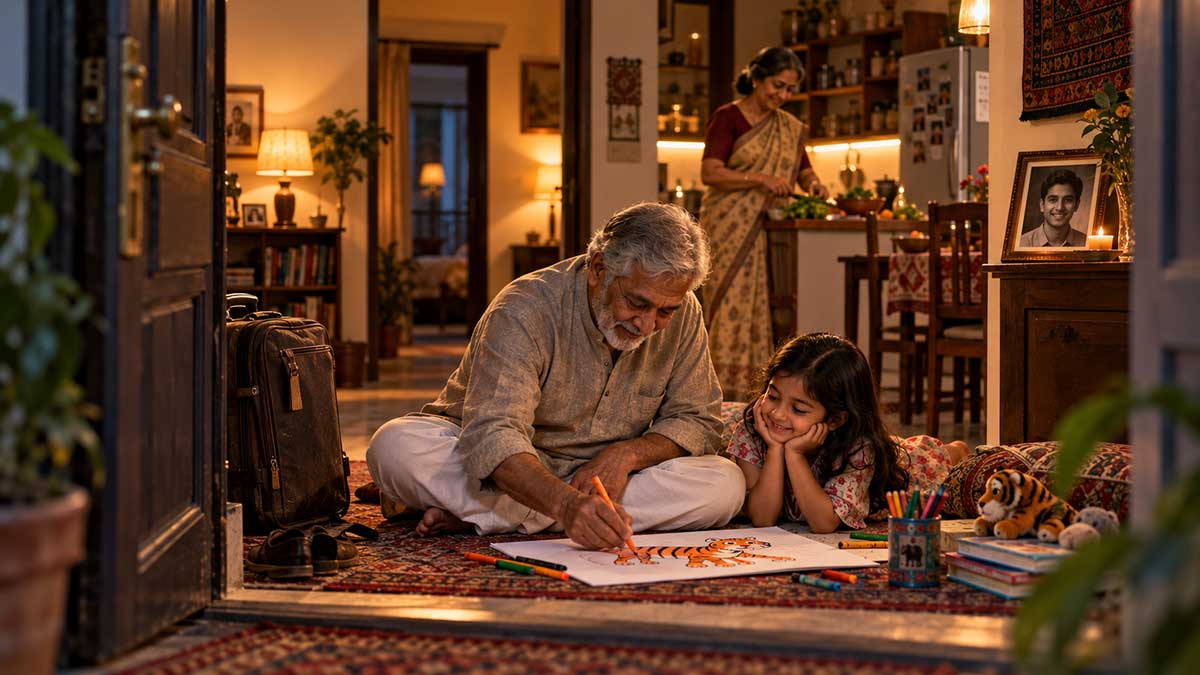
For three years after his son died, Arun Mehta searched for the reason.
He searched in temples.
He searched in books.
He searched in meditation halls.
He searched in conversations with priests, monks, gurus, philosophers, therapists, astrologers, professors and one retired physicist his cousin insisted had discovered something important about consciousness.
He traveled from Delhi to Rishikesh.
From Rishikesh to Varanasi.
He attended a retreat near Dharamshala.
He listened to lectures online from people in California.
He read the Bhagavad Gita twice.
Then the Upanishads.
Then books about karma.
Then books rejecting simplistic ideas about karma.
Then books about reincarnation.
Then books written by people who claimed to remember previous lives.
Then books written by scientists explaining why they probably did not.
His wife, Mira, watched the books multiply.
At first, she was glad.
Anything was better than the silence.
Then she realized the books were another kind of silence.
Their son, Rohan, had been twenty-four.
He was not sick.
He was not reckless.
He was not supposed to die.
That was important to Arun.
If Rohan had been ill, perhaps there would have been a story.
A diagnosis.
Treatment.
Hope.
Preparation.
A final conversation.
If he had been reckless, perhaps Arun could have blamed something.
Drugs.
Alcohol.
Speed.
Bad judgment.
But Rohan died on an ordinary road on an ordinary afternoon because a driver lost control of a truck in heavy rain.
Rohan had been returning from work.
He had called Mira forty minutes earlier.
“What are we having for dinner?”
“Rajma.”
“Again?”
“You complained last week when I made something else.”
“I contain contradictions.”
Those were the last words Mira heard him say.
She remembered laughing.
For months afterward, she hated herself for laughing.
Then she hated herself for hating the laugh.
Eventually she understood that grief could turn almost anything into evidence against you.
Arun had been in a meeting when his phone rang.
He rejected the call.
It rang again.
He rejected it again.
The third time, he stepped outside.
By the time he reached the hospital, Rohan was dead.
That fact divided Arun's life into two categories.
Before I rejected the call.
After I rejected the call.
It did not matter that answering earlier would have changed nothing.
He knew that.
Knowledge was useless.
His son had died while Arun was discussing quarterly projections.
For months, he dreamed of the phone ringing.
In the dream he always answered.
Rohan was always alive.
Then Arun woke.
At first, he asked the obvious question.
Why Rohan?
Later, the question became more sophisticated.
Was suffering random?
Did karma operate across lifetimes?
Did consciousness survive death?
Was there divine intention?
Was free will compatible with destiny?
Could a universe governed by moral intelligence permit meaningless tragedy?
If everything was connected, what connected a truck skidding in rain to a twenty-four-year-old man coming home for dinner?
The questions became more elegant.
The pain beneath them did not.
Mira grieved differently.
She cried.
She became angry.
She stopped cooking rajma for eleven months.
Then one evening she cooked it again.
Arun could not understand how she did that.
Their daughter, Priya, grieved differently too.
She was twenty-nine when Rohan died.
Six months later, she returned to work.
A year later, she became pregnant.
When she told her parents, Mira cried and hugged her.
Arun hugged her too.
Then went into the bathroom and vomited.
The thought of a new child entering the family felt unbearable.
Not because he did not want the baby.
Because life was behaving as if it had permission to continue.
Priya named her daughter Tara.
Arun loved Tara immediately.
This annoyed him.
He had wanted his grief to make him unavailable to ordinary happiness.
Instead, his granddaughter's fingers wrapped around his index finger in the hospital and his body betrayed him.
He felt joy.
Then grief.
Then guilt.
Then love.
All within seconds.
Human beings, he discovered, were badly designed for emotional purity.
When Tara was two, she began calling him Nana.
When she was three, she learned to video call him by herself.
When she was four, she stopped asking why Uncle Rohan was not in family photographs.
She simply understood that he was the uncle who had died before she was born.
Arun hated how naturally children accepted impossible things.
One Sunday afternoon, Tara was drawing on the floor of Arun and Mira's apartment.
She drew five people.
“Who is that?” Arun asked.
“Mamma.”
“And that?”
“Papa.”
“That one?”
“Nani.”
“And this handsome man?”
Tara giggled.
“That's you.”
Arun pointed to the fifth figure.
It was standing slightly away from the others.
“And him?”
“Uncle Rohan.”
Arun stopped.
“How do you know what he looks like?”
“Pictures.”
She continued coloring.
Then she said, “Nani says he was funny.”
“He was.”
“Funnier than Papa?”
“Much.”
From the kitchen, Mira shouted, “Don't start family trouble.”
Tara laughed.
Arun looked at the drawing.
“Why is Rohan over there?”
Tara shrugged.
“No space.”
That was all.
No symbolism.
No metaphysics.
No message from the universe.
There had simply been no space on the paper.
Arun stared at the drawing for a long time.
A month later, he left for another retreat.
Mira stood in the bedroom while he packed.
“How long?”
“Five days.”
“Where?”
“Near Rishikesh.”
“Again?”
“This teacher is different.”
“You said that about the last one.”
“He has an interesting understanding of nonduality.”
Mira sat on the bed.
Arun folded a shirt.
“You could come.”
“No.”
“You might like him.”
“No.”
“He isn't dogmatic.”
“I don't care.”
Arun stopped folding.
“What is that supposed to mean?”
“It means I don't care.”
“You used to care about these things.”
“I used to care about many things.”
He waited.
Mira looked tired.
Not angry.
That was worse.
She said, “Tara's school performance is Friday.”
“I'll be back Saturday.”
“Yes.”
“I didn't know.”
“Priya told you.”
“When?”
“Tuesday.”
“I had a lot going on.”
Mira laughed once.
There was no humor in it.
“What?”
“Nothing.”
“Say it.”
She looked at the suitcase.
“You have a lot going on.”
“What is that supposed to mean?”
“You're searching for Rohan everywhere except where he isn't.”
Arun stared at her.
“That makes no sense.”
“I know.”
“Then why say it?”
“Because nothing makes sense anymore, Arun.”
He closed the suitcase harder than necessary.
“I am trying to understand.”
“I know.”
“You act as if that's wrong.”
“I didn't say it was wrong.”
“You think I should just accept it.”
“No.”
“You think I should move on.”
“No.”
“Then what do you want from me?”
Mira's eyes filled.
“I want you to come home.”
“I am home.”
She shook her head.
“No. You sleep here.”
The retreat center sat above the river.
The mornings were beautiful.
Arun resented that.
At dawn, mist hung over the water.
Bells sounded somewhere in the distance.
Participants gathered in silence.
The teacher was an elderly man named Dev, though everyone called him Devji.
He had a white beard, simple clothes and an irritating habit of allowing long silences after questions.
On the third afternoon, participants could speak with him individually.
Arun had prepared.
He had written six questions.
He began with the largest.
“If consciousness is not separate from ultimate reality, how should we understand apparently meaningless individual suffering?”
Devji looked at him.
Arun waited.
The old man said, “What happened?”
The question irritated him.
He had not come for therapy.
“My son died.”
“How long ago?”
“Three years.”
“How old?”
“Twenty-four.”
Devji nodded.
“I'm sorry.”
Arun felt disappointment.
Everyone said that.
“I am trying to understand whether his death had meaning.”
Devji remained silent.
Arun continued.
“If there is an underlying order to existence, then either what happened was part of that order or”
“I don't know.”
Arun stopped.
“What?”
“I don't know why your son died.”
“I understand that you cannot know the specific”
“No. I mean I don't know.”
Arun stared at him.
“I came here because I was told you teach about”
“I teach many things.”
“Then what is the point of all this if you cannot answer the most basic question?”
“Which question?”
“Why do innocent people suffer?”
Devji looked toward the river.
“I have heard many answers.”
“That isn't what I asked.”
“No.”
“What do you believe?”
“I believe people often become cruel when they are too certain why another person suffers.”
Arun's jaw tightened.
“So suffering is meaningless?”
“I did not say that.”
“Then it has meaning?”
“I did not say that either.”
“This is evasive.”
“Yes.”
Arun blinked.
He had not expected agreement.
Devji smiled faintly.
“Some questions deserve humility more than answers.”
“That is convenient.”
“It is.”
Arun stood.
“I think this was a mistake.”
“Probably.”
Arun stared at him.
The old man was infuriating.
He picked up his notebook.
Then Devji asked:
“Who is waiting for you at home?”
Arun stopped.
“What?”
“Who is waiting for you?”
“My wife.”
“Who else?”
“My daughter lives nearby.”
“Who else?”
“My granddaughter.”
“How old?”
“Four.”
Devji nodded.
“Does she like you?”
The question was so ridiculous that Arun almost laughed.
“Yes.”
“Why?”
“I don't know.”
“Another mystery.”
Arun did not smile.
Devji leaned back.
“You have traveled far to ask why the dead were taken.”
Arun's face hardened.
“Do not trivialize my son.”
“I am not.”
“You didn't know him.”
“No.”
“Then don't talk about him as if”
“I am talking about you.”
Arun became quiet.
Devji continued.
“Perhaps you will spend the rest of your life asking why your son died.”
“Maybe.”
“You may find an answer.”
Arun waited.
“You may not.”
The river moved below them.
Then the old man asked:
“If no answer comes, how many living people must wait with you?”
Arun said nothing.
That evening, he did not attend meditation.
He sat alone in his room.
He was angry.
At Devji.
At Mira.
At the truck driver.
At rain.
At God, if God existed.
At himself.
At Rohan, briefly, which filled him with shame.
At the universe for creating fathers who could outlive sons.
He opened his phone.
There were photographs from Tara's school performance.
Priya had sent them.
Tara stood on a stage dressed as a tree.
A very bad tree.
Green cardboard leaves surrounded her face.
Her expression suggested she had already reconsidered a career in theater.
Arun laughed.
Then he saw a video.
He pressed play.
Children were singing.
Tara was mostly not.
She was scanning the audience.
Then she saw someone.
Her face lit up.
“Nani!”
The camera moved.
Mira sat alone.
She waved.
The video ended.
Arun watched it again.
Then again.
There should have been someone sitting beside Mira.
He had been beside a river asking why his dead son was gone.
His wife had been alone watching their granddaughter pretend to be a tree.
The comparison felt almost insulting.
One was enormous.
The other trivial.
Death.
A school performance.
God.
Cardboard leaves.
The meaning of suffering.
An empty chair.
Yet for the first time Arun wondered whether he had misunderstood scale.
Perhaps a life was not built only from enormous questions.
Perhaps it was built mostly from things too small to seem important until they were gone.
At breakfast, Devji saw him.
“You're leaving.”
Arun looked down at his bag.
“How did you know?”
“Your suitcase is a clue.”
Arun almost smiled.
“I still think your answer was unsatisfactory.”
“Good.”
“You really don't know?”
“No.”
“After all these years?”
“I know many explanations.”
“Which one is true?”
Devji poured tea.
“I told you.”
Arun sighed.
Then he asked, “So what am I supposed to do?”
Devji looked genuinely puzzled.
“About what?”
“My grief.”
“I don't know.”
“My questions.”
“Keep them.”
“My anger?”
“Keep that too, if it is honest.”
“That is your spiritual advice?”
“No.”
“Then what is?”
Devji lifted his tea.
“Your granddaughter was a tree yesterday.”
Arun stared at him.
“How do you know that?”
“You told one of the volunteers.”
“Oh.”
“Go home.”
Mira was cutting cauliflower when Arun opened the apartment door.
She looked toward the hallway.
“You're early.”
“Yes.”
“Is everything okay?”
“No.”
She waited.
Arun put his suitcase down.
“I still don't understand.”
Mira returned to the cauliflower.
“I know.”
“I thought maybe if I understood why it happened”
“I know.”
“I thought”
His voice broke.
Mira stopped cutting.
Arun stood near the door.
For three years, he had imagined grief as a problem somewhere ahead of him.
If he traveled far enough intellectually, spiritually, emotionally, perhaps he would reach the answer.
Instead, he had gone in circles.
The answer remained where it had always been.
Absent.
He looked at his wife.
“I don't know why Rohan died.”
Mira's face changed.
It was such an obvious sentence.
But Arun had never said it like this.
Without adding a theory.
Without following it with a book.
Without turning it into a question.
“I don't know,” he repeated.
Mira put down the knife.
“Neither do I.”
Arun began crying.
Not elegantly.
Not spiritually.
He bent forward and covered his face.
Mira crossed the kitchen.
She held him.
For a while neither spoke.
Then she said:
“You missed a terrible performance.”
Arun laughed against her shoulder.
“I saw the video.”
“She was the worst tree.”
“I noticed.”
“She forgot every word.”
“She looked beautiful.”
“She looked ridiculous.”
They both laughed.
Then both cried.
Neither emotion solved the other.
The next afternoon, Tara came over.
She ran inside.
“Nana!”
Arun crouched.
She collided with him.
“I saw your performance.”
“You weren't there.”
The accusation was immediate.
“No.”
“Why?”
Arun considered inventing something.
Instead he said:
“I thought I had somewhere more important to be.”
Tara frowned.
“Where?”
“Far away.”
“Why?”
“I was looking for something.”
“Did you find it?”
Arun looked toward Mira.
She was listening from the kitchen.
“No.”
Tara shrugged.
“Okay.”
Children were mercilessly uninterested in existential failure.
She took his hand.
“Help me.”
“With what?”
“Homework.”
“I just came back from a spiritual retreat.”
“I need a tiger.”
“What?”
“I have to draw a tiger.”
“I cannot draw.”
“You can try.”
Arun almost said no.
Then stopped.
“All right.”
They sat on the floor.
Tara handed him an orange pencil.
His tiger looked like a sick dog.
Tara stared at it.
“That is bad.”
“I warned you.”
She laughed.
“Again.”
So Arun drew another.
Weeks passed.
Arun did not become a different man.
He still read.
He still meditated.
He still asked questions.
Sometimes he still woke at three in the morning thinking about the unanswered phone call.
Sometimes he hated the truck driver.
Sometimes he imagined alternate universes in which Rohan had left work five minutes later.
Sometimes he stood before his son's photograph and demanded an explanation from God.
No explanation came.
But gradually, Arun stopped treating uncertainty as a waiting room.
He attended Tara's next school event.
He had dinner with Priya.
He cooked rajma with Mira for the first time since Rohan died.
At the table, nobody mentioned why that mattered.
They ate.
That was enough.
One evening, Priya asked him something he had dreaded.
“Tara wants to know more about Rohan.”
Arun looked up.
“What did you tell her?”
“That she should ask you.”
“Why me?”
“Because you tell the best stories about him.”
Arun almost refused.
Talking about Rohan still opened places he could not control.
Then Tara climbed onto the sofa.
“Was Uncle Rohan funny?”
“Yes.”
“Tell me.”
Arun looked at Mira.
She sat across the room.
Waiting.
He began.
“When Rohan was fourteen, he decided he could cook.”
Mira immediately groaned.
“Oh no.”
“What?” Tara asked.
“He nearly destroyed the kitchen.”
“I did not nearly destroy the kitchen,” Arun said.
“You weren't home.”
“Exactly. Therefore I cannot be held responsible.”
Tara laughed.
Arun continued.
He told one story.
Then another.
Then another.
Rohan entered the room through memory.
Not as a tragedy.
As a boy.
Messy.
Funny.
Impatient.
Alive in all the ways memory could still allow.
Arun cried once.
He did not stop.
Months later, Arun returned briefly to Rishikesh.
Not searching this time.
He was traveling with Mira.
They sat beside the river in the evening.
Mira asked:
“Do you still want to know?”
Arun knew exactly what she meant.
“Yes.”
“Me too.”
“Do you think we ever will?”
“I don't know.”
Arun nodded.
There it was again.
I don't know.
Once, those words had felt like defeat.
Now they felt almost spacious.
The river continued moving.
After a while Mira said:
“Priya wants us home Sunday.”
“Why?”
“Tara's birthday.”
Arun looked at her.
“How old?”
“Five.”
“Already?”
Mira smiled.
“Life is rude that way.”
They sat quietly.
Arun thought about Rohan.
Twenty-four forever.
Tara turning five.
Mira beside him.
The river.
The unanswered question.
All of it belonged to the same life.
He had spent three years believing that he could not return until he understood why he had been forced to leave.
He knew better now.
Some doors did not open because you found the answer.
Sometimes you opened them yourself.
On Sunday, Arun stood outside Priya's apartment holding a badly wrapped birthday present.
He could hear children shouting inside.
He could smell food.
Someone was playing music.
For one brief moment, grief arrived with astonishing force.
Rohan should have been here.
The sentence was as true as ever.
Arun closed his eyes.
He did not replace it with another sentence.
He did not tell himself everything happened for a reason.
He did not tell himself Rohan was in a better place.
He did not explain God's plan.
He did not explain karma.
He did not explain anything.
Rohan should have been here.
Arun allowed the truth to remain unfinished.
Then the door opened.
Tara stood there wearing a paper crown.
“Nana!”
Behind her were Mira, Priya, family, noise, cake, arguments, life.
Tara grabbed his hand.
“You're late.”
“I know.”
“Come.”
Arun looked once down the empty hallway.
For years he had traveled thousands of miles searching for meaning.
He still did not know why his son had died.
Perhaps he never would.
But there were people inside this room whom he loved.
And they were still alive.
Arun stepped through the door.
This time, he came home.
Original-Book Connection
This story is inspired especially by Kabir, the fifteenth-century mystic poet associated with India, whose verses challenged religious divisions, empty ritual, spiritual pride, and the human tendency to search far away for what may already be present in ordinary life. Kabir's poetry speaks across Hindu and Muslim traditions and repeatedly brings the sacred back from abstraction into immediate human experience.
That makes India the natural setting for Arun's story. He travels toward holy places and increasingly sophisticated explanations, yet the story deliberately refuses to give him a theological solution to his son's death. Neither Kabir nor Ryu Si-hwa's anthology needs to be reduced to the claim that suffering happens for a hidden good reason. Arun is allowed to say the more difficult words:
I don't know.
In the spirit of Love As If You've Never Been Hurt, his return begins when he stops making an answer the admission price for reentering life.
His transformation is therefore visible in something almost embarrassingly ordinary.
He comes home. He sits with his family. He draws the terrible tiger. He tells stories about his son. And when another door opens, he walks through it.
Arun never discovers why Rohan died.
He discovers something else:
An unanswered question does not have to become an unlived life.
Story 5: The Last Day of the Café
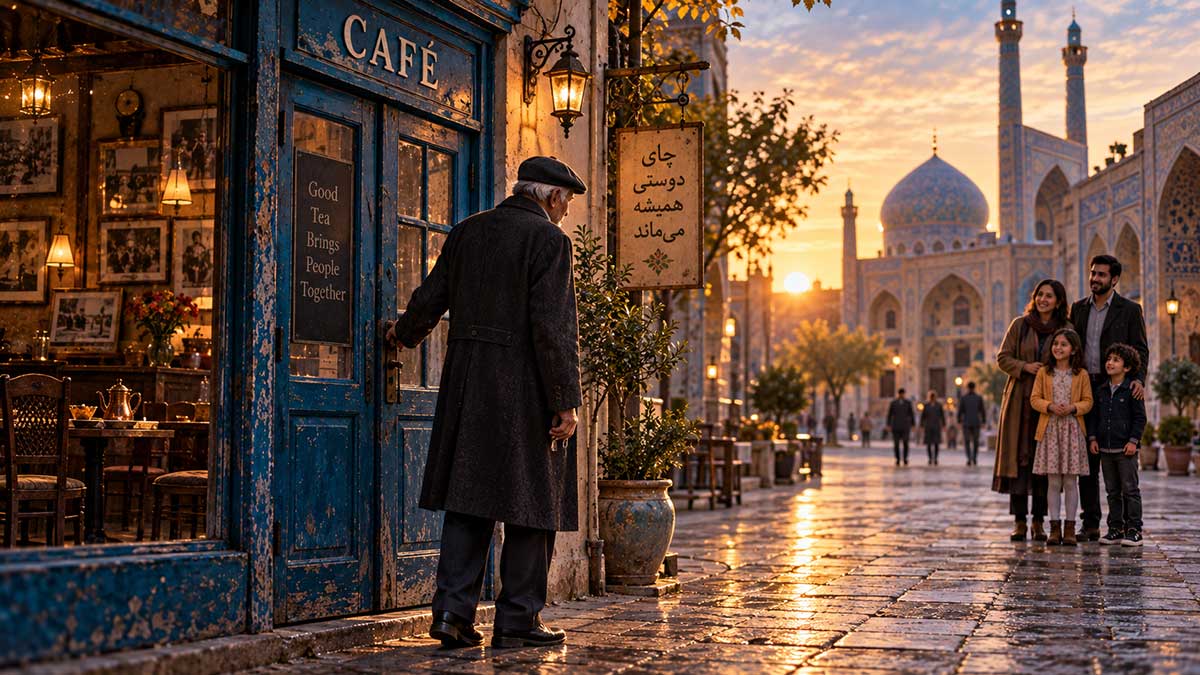
On the morning he learned the café would close, Reza Farhadi did what he had done almost every morning for fifty-seven years.
He unlocked the blue door at 5:47.
He turned on the lights.
He opened the shutters.
He filled the kettle.
He checked the tea.
He wiped a counter that was already clean.
Then he stood in the middle of the room and listened.
Every old building had a morning sound.
The pipes clicked.
The refrigerator hummed.
A delivery truck groaned somewhere in the street.
Outside, Isfahan was waking.
Reza breathed in the familiar mixture of tea, coffee, old wood, cardamom and yesterday's cooking.
He was eighty-one years old.
His knees hurt.
His right shoulder complained whenever he lifted anything heavy.
His hearing was worse than he admitted.
His doctor had told him to work less.
His daughter had told him to retire.
His son had told him to sell.
His grandchildren had told him approximately nothing because they assumed the café would exist forever.
So had Reza.
At 10:16 that morning, a man wearing a gray suit entered carrying an envelope.
By 10:31, forever had acquired an expiration date.
The building had been sold.
Reza did not understand at first.
Or rather, he understood the words but refused the sentence they formed.
The café occupied the ground floor of a building that had belonged to the same family for generations.
That family had sold it to a development company.
The leases would not be renewed.
Reza had four months.
“What do you mean, not renewed?”
The man in the gray suit remained polite.
“I'm sorry.”
“My lease has been renewed every time.”
“Yes.”
“For fifty-seven years.”
“I understand.”
“No, you don't.”
The man lowered his eyes.
Reza hated him for being respectful.
It would have been easier if he were cruel.
“You cannot close this place.”
“I am not closing it.”
“You just said”
“The new owners have other plans for the building.”
“What plans?”
“I don't have those details.”
“Then tell them to come here.”
“I can give you”
“Tell them to come drink tea with me.”
“Mr. Farhadi”
“Then they can explain why the tea needs to stop.”
His son, Kamran, arrived that afternoon.
“You need a lawyer.”
“I have a lawyer.”
“You haven't spoken to him in eight years.”
“He is still a lawyer.”
“He is ninety.”
“Experience.”
Kamran closed his eyes.
“Baba.”
“They cannot do this.”
“They own the building.”
“I have rights.”
“Yes.”
“I have been here longer than the man who sold it has been alive.”
“I know.”
“His grandfather used to sit at that table.”
Reza pointed toward the corner.
“Every Thursday. Tea with two sugars. He cheated at backgammon.”
“I know.”
“He would be ashamed.”
“He is also dead.”
Reza glared at his son.
“That does not make him correct.”
For the next six weeks, Reza fought.
He hired a lawyer who was not ninety.
He contacted former customers.
A petition circulated.
Someone wrote an article.
A local television reporter came.
Reza stood outside the blue door and said things about history, community and greed.
All of them were true.
Customers congratulated him.
“Don't give up.”
“Fight them.”
“This place belongs to the city.”
Reza liked those sentences.
Especially the last one.
This place belongs to the city.
It sounded larger than:
I am afraid to lose it.
The café had been opened by Reza's father, Hossein, when Reza was fourteen.
At first Reza hated working there.
He wanted to become an engineer.
His father wanted free labor.
So every afternoon after school, Reza carried trays, washed glasses and listened to old men argue about politics.
He learned very early that tea became cold much faster when people discussed government.
At twenty-four, Reza married Laleh.
At twenty-six, his father had a heart attack.
Reza temporarily took over the café.
Temporary lasted fifty-five years.
He never became an engineer.
For a while he resented that.
Then less.
Then not at all.
The café became the geography of his life.
His children did homework at table seven.
Laleh kept accounts behind the counter.
Kamran took his first steps between two chairs.
Their daughter, Nasrin, learned multiplication by counting sugar cubes.
Reza's father died upstairs.
His mother drank tea by the window every afternoon until she was too weak to come.
Young men proposed marriage there.
Old men played backgammon.
Students studied for examinations.
Couples argued.
Friends reconciled.
Strangers waited out rain.
Tourists became lost.
Regulars became old.
Some stopped coming.
At first Reza asked where they were.
Eventually he learned not to ask too quickly.
Laleh died eleven years before the letter arrived.
Cancer.
Nine months from diagnosis to funeral.
Afterward, Reza began opening the café earlier.
Nobody asked why.
Everyone knew.
At home, Laleh was absent.
At the café, she was everywhere.
Her handwriting remained on an old inventory sheet.
Her favorite cup was still behind the counter.
There was a burn mark near the kitchen where she once dropped a pan.
Table four wobbled because she had insisted it did not need replacing.
When Reza stood behind the counter, he could almost believe he had not outlived her.
Perhaps that was why the café became impossible to leave.
The legal challenge failed.
The petition failed.
The newspaper article was forgotten.
The television station moved on to another story.
Reza received the final notice.
Thirty days.
Kamran read it twice.
“I'm sorry.”
Reza sat at table four.
The wobbling one.
“We appeal.”
“The lawyer says there's nowhere to appeal.”
“Then we find another lawyer.”
“Baba.”
“We contact the city.”
“We did.”
“The heritage office.”
“We did.”
“Someone.”
Kamran sat across from him.
“Baba.”
Reza looked at his son.
“What?”
“Do you even want to keep working here?”
The question offended him.
“What kind of question is that?”
“A serious one.”
“This is my café.”
“I know.”
“I built this.”
“I know.”
“My father”
“I know.”
“You know nothing.”
Kamran leaned back.
There it was.
The sentence fathers use when sons become old enough to understand too much.
Reza immediately regretted it.
Kamran looked toward the counter.
Then he said:
“You complain about your knees every day.”
“So?”
“You fall asleep after lunch.”
“I am eighty-one.”
“You've been talking about reducing hours for five years.”
“That is different.”
“How?”
Reza did not answer.
Kamran continued carefully.
“If they offered you another twenty-year lease tomorrow, would you want it?”
“Yes.”
“Twenty years?”
“Yes.”
“You'll be one hundred and one.”
“I have good genes.”
“Grandfather died at sixty-eight.”
“Your mother's family.”
Kamran laughed despite himself.
Reza did not.
Then his son asked:
“Are you fighting to keep the café open, or are you fighting because you don't know who you are if it closes?”
Reza looked toward the blue door.
“Go home.”
“Baba”
“Go.”
That night, Reza remained after closing.
He turned off most of the lights.
The café became unfamiliar in darkness.
He walked from table to table.
Table one.
Two.
Three.
Four.
He put his hand on the chair where his father used to sit.
Then the place where Laleh balanced the accounts.
He opened the drawer beneath the counter.
Old receipts.
Photographs.
A broken pen.
A matchbox from a restaurant that had closed thirty years earlier.
He found a photograph of himself at twenty-seven.
Laleh stood beside him.
Young.
Laughing.
Reza stared.
He had forgotten how dark his hair had been.
He had also forgotten that the café once looked new.
That disturbed him.
Everything he now considered permanent had once been new.
And everything new eventually became old.
Perhaps old things became precious partly because they had survived long enough for people to mistake survival for permanence.
Reza sat alone.
He imagined the café demolished.
Or renovated beyond recognition.
New walls.
New lights.
Some fashionable place serving drinks he could not pronounce.
The thought made him furious.
Then frightened.
Then sad.
Finally, beneath all three, he found something else.
Exhaustion.
He was tired.
Not of the café.
Never of the café.
He was tired of trying to prevent time from touching it.
The next morning, Nasrin came in.
She was fifty-three now.
Reza still occasionally thought of her as twelve.
“I have an idea,” she said.
“No.”
“You haven't heard it.”
“If it involves moving the café, no.”
“It doesn't.”
“If it involves retirement, no.”
“It doesn't.”
“If it involves a commemorative plaque”
“Baba.”
“What?”
“What do you want the last day to be?”
Reza stopped.
“There will not be a last day.”
Nasrin said nothing.
He hated her silence because it resembled her mother's.
Finally he said:
“What idea?”
“Make everything free.”
Reza stared at her.
“What?”
“Tea. Coffee. Food. Everything.”
“Absolutely not.”
“Why?”
“Do you know what things cost?”
“You're closing.”
“That is not a reason to become stupid.”
“Invite everyone.”
“Everyone who?”
“Everyone.”
“That is not a category.”
“Old customers. Former employees. Neighbors. People who grew up here.”
“No.”
“People will come.”
“No.”
“We'll pay.”
“Who is we?”
“Me and Kamran.”
“Definitely no.”
“Your grandchildren want to help.”
“Those children have never worked a full day.”
“They're adults.”
“That remains disputed.”
Nasrin smiled.
Reza tried not to.
Then she said:
“Baba, you spent six weeks fighting the last day.”
He looked at her.
“Maybe you should decide what it looks like.”
The idea bothered him for three days.
On the fourth, he wrote a sign.
He threw it away.
He wrote another.
Too sentimental.
Another.
Too formal.
Finally:
LAST DAY.
COME HAVE TEA WITH US.
NO CHARGE.
BRING A STORY IF YOU HAVE ONE.
He taped it to the blue door.
Then immediately considered removing it.
A customer read it.
“Last day?”
Reza sighed.
“Yes.”
“When?”
Reza pointed to the date.
The man looked at him.
“I'm sorry.”
Reza surprised himself.
“Don't be.”
Word traveled faster than expected.
Former customers called from Tehran.
Someone messaged from Canada.
A man living in Germany sent a photograph of himself at the café in 1989.
A woman wrote:
My husband asked me to marry him at table six. He died four years ago. Please don't let anyone sit there on the last day until I arrive.
Reza wrote back:
I will save it.
Another message came from a former employee.
You fired me in 1997. Can I still come?
Reza answered:
You deserved it. Come.
The final morning arrived.
Reza woke before his alarm.
For several seconds he did not remember.
Then he did.
He dressed carefully.
White shirt.
Dark trousers.
The jacket Laleh always liked.
He walked to the café.
The street was still quiet.
He stood before the blue door.
His hand rested on the key.
For fifty-seven years, opening this door had meant the day was beginning.
Today it meant something else.
He unlocked it.
By eight, every table was full.
By ten, people were standing outside.
Kamran made tea.
Badly.
Nasrin handled food.
Competently.
Three grandchildren took orders even though there were no bills.
People arrived carrying photographs.
One man brought an old menu.
Someone brought a backgammon board.
A retired teacher sat in the corner and cried.
Two former employees argued about which of them Reza disliked more.
Reza settled it.
“Both equally.”
At noon, the woman who had written about table six arrived.
Her name was Farideh.
She was seventy-four.
Reza recognized her only after she showed him a photograph.
There she was at twenty-three.
Beside her stood a young man with enormous glasses.
“My husband,” she said.
“You married him?”
“For forty-eight years.”
“He still wore those glasses?”
“Unfortunately.”
She sat at table six.
For a while she placed her hand on the empty chair across from her.
Then she ordered two teas.
Reza brought them himself.
She looked at the second glass.
“He isn't going to drink that.”
“I know.”
“Wasteful.”
“It's free.”
She laughed.
Then cried.
Reza sat with her for five minutes.
They did not try to make either emotion leave.
In the afternoon, an elderly man named Mahmoud arrived with his grandson.
Mahmoud had played backgammon with Reza's father.
“You're still alive?” Reza asked.
“Unfortunately.”
They embraced.
Mahmoud pointed to the grandson.
“This idiot is studying engineering.”
Reza looked at the young man.
“I was going to be an engineer.”
“What happened?”
Reza gestured around them.
“This.”
The young man smiled.
“Do you regret it?”
Reza opened his mouth.
For most of his life, he had answered automatically.
No.
This time he considered it.
“Sometimes.”
The young man seemed surprised.
Reza continued:
“But regret is not the same as wishing it never happened.”
Mahmoud nodded.
Reza looked around the café.
“I lost one life.”
Then he smiled.
“I got this one.”
Near sunset, someone placed an old song on the speakers.
Laleh's song.
Reza turned immediately.
“Who put this on?”
Nasrin raised her hand.
“Turn it off.”
“No.”
“Nasrin.”
“No.”
Reza glared.
Then the music continued.
He saw Laleh at twenty-four.
At thirty.
At forty-seven.
At sixty.
Standing behind the counter.
Scolding him.
Laughing.
Counting money.
Telling him to go home.
Telling him he was impossible.
He closed his eyes.
For years, he had treated the café like a container holding everyone he had lost.
His father.
His mother.
Laleh.
Customers.
Friends.
Perhaps that was why closing it felt like losing them again.
Then he felt someone's hand.
Nasrin.
“Dance with me.”
“No.”
“You danced at my wedding.”
“Under protest.”
“Come.”
“I don't dance.”
“Neither do I.”
“That is obvious.”
She pulled him away from the counter.
People noticed.
Someone clapped.
Reza pointed angrily.
“Anyone who claps pays for tea.”
The room laughed.
He moved slowly with his daughter.
His knees hurt.
His shoulder hurt.
His heart hurt.
All three seemed equally entitled to be there.
By eleven, the crowd thinned.
By midnight, only family remained.
They cleaned.
Reza objected to how badly everyone stacked the glasses.
Then realized it no longer mattered.
At 12:43, Kamran switched off the kitchen light.
At 12:51, Nasrin carried out the final box.
At 12:58, Reza stood alone inside.
“Baba?” Kamran called.
“One minute.”
The room was quiet.
Tables.
Chairs.
Counter.
Blue door.
Reza walked to table four.
He pressed down.
It wobbled.
He laughed.
“Laleh.”
He could almost hear her.
It doesn't need replacing.
He sat.
For the last time.
He expected something.
A revelation.
Peace.
Perhaps even the sensation of Laleh beside him.
Nothing came.
Only sadness.
Enormous sadness.
Reza let it come.
He did not ask it to become gratitude.
He did not ask it to become wisdom.
He did not ask it to become anything.
After a while, he stood.
He touched the counter.
“Thank you,” he said.
He was not sure whether he meant the café, his father, Laleh, God, life or all of them.
Perhaps it did not matter.
He turned off the final light.
Outside, Kamran and Nasrin waited.
Reza pulled the blue door shut.
He inserted the key.
His hand trembled.
He turned it.
The lock clicked.
Fifty-seven years ended with a sound small enough to miss.
Reza kept his hand on the key.
Kamran approached.
“You all right?”
Reza looked at the blue door.
“No.”
Kamran waited.
Reza took the key out.
Then he looked at his children.
“But it was a beautiful day.”
Nasrin began crying.
“Oh, don't start,” Reza said.
“You're crying.”
“I am eighty-one. My eyes leak.”
She hugged him.
Kamran joined them.
Reza complained until they released him.
Then all three stood on the pavement.
Nobody knew what to do next.
For fifty-seven years, Reza always knew what came after closing.
Go home.
Sleep.
Return tomorrow.
There was no tomorrow for the café.
That emptiness frightened him.
Then his grandson called from across the street.
“Grandpa!”
“What?”
“We're getting breakfast.”
“It is one in the morning.”
“Then very early breakfast.”
“That is stupid.”
“Are you coming?”
Reza looked at the café.
Then across the street.
His family was waiting.
For a moment he almost said no.
He wanted to remain beside the door.
To stand guard.
As though leaving would make the ending more final.
Then he remembered something Nasrin had said.
You spent six weeks fighting the last day. Maybe you should decide what it looks like.
Perhaps that was true of more than one day.
Reza put the key in his pocket.
He crossed the street.
The next morning, he woke at 5:32.
His body had spent fifty-seven years learning when to wake.
For a moment, he panicked.
He was late.
Then he remembered.
There was nowhere he had to be.
He lay in bed staring at the ceiling.
This was the moment he had feared.
Not the closing.
After.
Silence.
No customers.
No kettle.
No blue door.
He felt suddenly ancient.
Then his phone rang.
Nasrin.
He considered ignoring it.
He answered.
“What?”
“Good morning to you too.”
“Why are you calling?”
“Breakfast.”
“I ate.”
“You're lying.”
“I am eighty-one. Show respect.”
“Come downstairs.”
“What?”
“Downstairs.”
Reza went to the window.
Nasrin stood on the pavement below with two cups of tea.
Beside her was Kamran.
And Tara, one of the grandchildren.
And little Arash, his great-grandson, who was four and currently believed Reza's primary function was buying sweets.
Reza opened the window.
“What are you doing?”
“Waiting.”
“For what?”
“You.”
“I am not dressed.”
“We've seen worse.”
Reza closed the window.
He looked around his bedroom.
Laleh's photograph stood on the dresser.
He walked to it.
For years, he had thought the café kept him close to everything that mattered.
Maybe it had.
But perhaps love was not stored in buildings.
Perhaps buildings only gave love somewhere to happen for a while.
His father's café had lasted fifty-seven years under Reza.
His marriage had lasted forty-six.
Rohan at table three had been a customer for thirty-nine.
Some friendships lasted decades.
Some lasted one afternoon.
Tea lasted minutes.
A song lasted four.
A life lasted however long it lasted.
None of those durations told you whether something mattered.
Reza touched Laleh's photograph.
“We closed.”
She smiled back from twenty years earlier.
“I know. You would have told me to do it five years ago.”
He could imagine her answer.
Ten.
He laughed.
Then dressed.
Six months later, the café was gone.
Not the building.
The café.
The blue door had been painted black.
The sign removed.
The interior stripped.
Reza avoided the street.
Then one afternoon he found himself nearby with Arash.
“That's your café,” the boy said.
“Was.”
“Can we go inside?”
“No.”
“Why?”
“It isn't mine.”
Arash considered this.
Then asked the question only a four-year-old would consider relevant.
“Can we get ice cream?”
Reza looked at the building.
For months he had imagined this moment.
He expected devastation.
Instead he felt something quieter.
Sadness.
Love.
A strange gratitude.
And irritation that someone had painted the door black.
“Terrible color,” he said.
“What?”
“Nothing.”
He took Arash's hand.
They walked toward the ice cream shop.
After several steps, Reza turned back.
The building stood where it had always stood.
He thought of his father.
Laleh.
The customers.
Table four.
The last day.
He understood then that endings had always been inside the café.
Every glass of tea emptied.
Every customer eventually stood.
Every evening he closed the door.
He had simply never believed the café itself would have to do the same.
Perhaps that was why people loved things as though they could keep them.
And perhaps learning that they could not keep them did not make the love foolish.
Maybe it made the love urgent.
Arash pulled his hand.
“Grandpa.”
“What?”
“You're slow.”
“You're short.”
“Come on.”
Reza smiled.
He turned away from the old café.
Then he walked forward.
Not because he had stopped loving what was behind him.
Because he had not.
Not because losing it had become easy.
Because it had not.
Not because everything that ends is secretly replaced by something better.
It isn't.
He walked because there was still somewhere to go.
Something did not have to last forever to have been worth loving.
And an ending did not require him to end with it.
Original-Book Connection
This story is inspired by Omar Khayyam, the Persian poet, mathematician and astronomer born in Nishapur, in present-day Iran. His Rubaiyat became famous far beyond Persia for its meditations on time, mortality, fleeting pleasure, uncertainty, and the strange urgency created by knowing that human life cannot be held forever. For that reason, Reza's story remains in Iran, allowing the final story to return the collection to the broader Persian literary world.
Within the spirit of Ryu Si-hwa's Love As If You've Never Been Hurt, Reza faces perhaps the largest version of the question confronting all five characters: Why love something that you know you will eventually lose?
The story does not answer by pretending endings are beautiful. Reza does not discover that losing the café is secretly better for him. He does not stop grieving Laleh. He does not become grateful that the building was sold.
The café closes.
That loss is real.
But impermanence does not cancel the decades of love that came before it.
Reza's transformation is once again expressed through action.
He unlocks the café one final time. He welcomes everyone in. He locks it for the last time. And then he turns around and walks away.
Story 1 returned to the dance.
Story 2 returned to making.
Story 3 returned to celebration.
Story 4 returned home.
Story 5 discovers that sometimes returning to life means releasing what cannot return with us.
The café remains behind.
Reza walks forward.
And that brings all five stories back to the deeper invitation behind Love As If You've Never Been Hurt:
Life will hurt us.
Life will take things from us.
Life will end things we desperately want to keep.
Love them anyway.
And when life asks us to return, return.
Final Thoughts
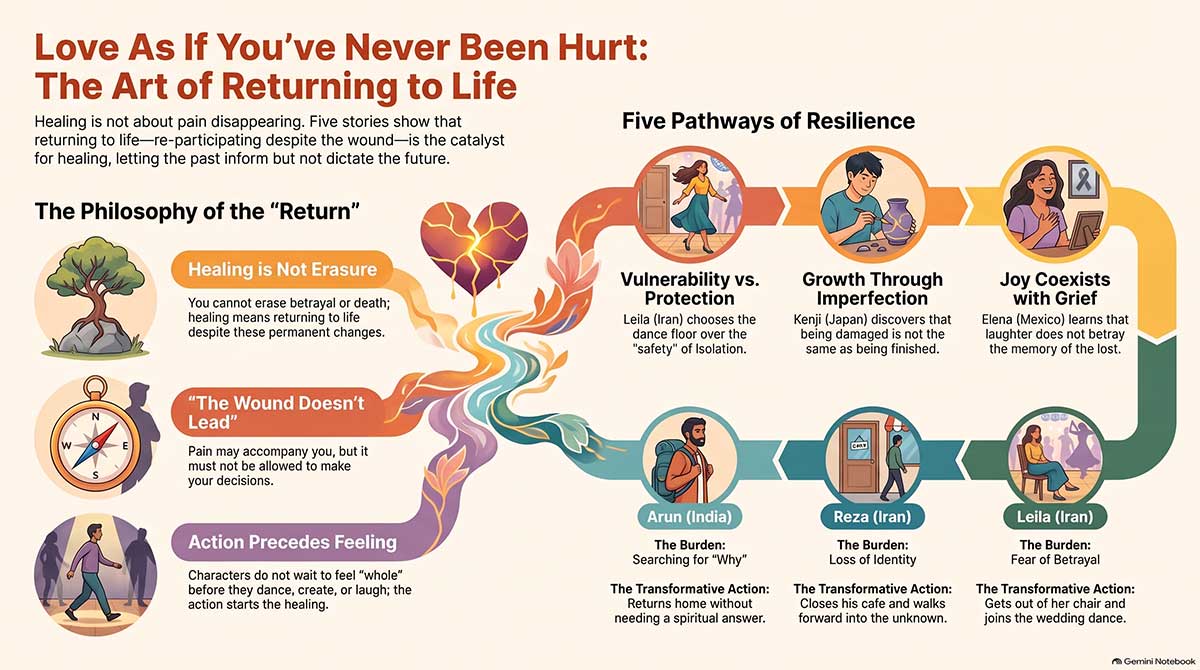
Life Hurt Them. They Returned Anyway.
Across five countries and five very different lives, the characters in these stories eventually face the same choice.
Not whether they can erase what happened.
They cannot.
Not whether they can become the people they were before.
They cannot do that either.
The question is simpler:
Will I remain outside my life because life once hurt me, or will I enter again?
Leila enters the dance.
For years she believes she is protecting herself from another betrayal. Eventually she realizes that the man who left her once has been allowed to keep leaving with her every time she refuses vulnerability.
So she dances.
Not because she trusts the world again.
Because she refuses to let an old wound make every new decision.
Kenji enters his workshop.
His hand will never work as it once did. His new craftsmanship is slower and less precise.
He does not pretend otherwise.
But he discovers an important distinction:
Being damaged is not the same as being finished.
So he makes something.
Elena returns to celebration.
Her son's chair remains empty.
She laughs anyway.
Then she cries because she laughed.
Then she laughs while crying.
And she discovers that joy does not betray grief.
The heart is large enough to hold both.
Her grief does not necessarily become smaller.
Her life becomes larger around it.
Arun returns home.
He has crossed India searching for an explanation for why his son died.
No explanation satisfies him.
Eventually he encounters perhaps the most difficult spiritual answer:
I don't know.
For years he treated those words as failure.
Eventually they become freedom.
He does not have to understand everything before sitting beside his wife, helping his granddaughter with homework, telling stories about his son, or walking through an open door.
An unanswered question does not have to become an unlived life.
And Reza closes the café.
Perhaps his return is the strangest because there is nothing to recover.
The café really ends.
The door really locks.
The place he loves cannot accompany him.
Yet he learns that impermanence does not invalidate love.
A cup of tea matters even though it empties.
A song matters even though it ends.
A marriage matters even though one person dies first.
A café can matter even though one night its door closes forever.
A life can matter for precisely the same reason.
Something does not have to last forever to have been worth loving.
That may bring us closer to the deeper meaning of the title.
Love As If You've Never Been Hurt cannot realistically mean:
Forget the wound.
Forget the betrayal.
Forget the dead.
Forget what life taught you.
Become innocent again.
Perhaps it means:
Remember everything, and still participate.
Keep your wisdom.
Keep your boundaries.
Keep the scar.
Keep the questions.
Keep the memories.
But do not give them complete authority over what happens next.
Because perhaps the sequence of healing is not always:
Hurt → Heal → Return to Life
Sometimes it is:
Hurt → Still Hurting → Take One Step → Life Enters Again → Keep Going
The woman does not heal and then dance.
She dances while healing.
The carpenter does not become whole and then create.
He creates with the hand he has.
The mother does not finish grieving and then laugh.
She laughs while missing her son.
The father does not find the answer and then return home.
He returns without the answer.
The café owner does not defeat impermanence.
He loves, loses, locks the door, and walks forward.
Maybe that is why action matters so much.
Sometimes the body takes the first step before the heart is ready.
A hand reaches for another hand.
A workshop door opens.
A woman stands up.
A father comes home.
An old man crosses the street.
Small actions.
But perhaps a human life is changed through small actions more often than through great revelations.
All five stories contain a threshold.
And on one side of that threshold is the understandable desire to protect ourselves from being hurt again.
On the other is life.
There are no guarantees waiting there.
Love may fail.
Bodies may break.
People we love will die.
Questions may remain unanswered.
Everything we build will eventually belong to someone else, change beyond recognition, or disappear.
The five characters step through anyway.
Not because the darkness disappeared.
Because light entered it.
And perhaps that is the invitation running beneath all five stories:
The wound may remain.
The empty chair may remain.
The unanswered question may remain.
Love anyway.
Make something anyway.
Laugh anyway.
Come home anyway.
Walk forward anyway.
Life hurt them.
They returned anyway.
Short Bios:
Leila | The Empty Chair at the Wedding
A thirty-five-year-old Iranian woman whose former fiancé's betrayal taught her how to protect herself so well that she nearly stopped participating in love altogether. Her return begins when she leaves her chair and joins the dance.
Kenji Mori | The Carpenter's Cracked Bowl
A veteran Japanese craftsman who loses two fingers in an accident and believes his creative life has ended. A badly repaired bowl and an impatient granddaughter slowly bring him back through the workshop door.
Elena Hernández | The Birthday Party She Almost Cancelled
A Mexican mother approaching fifty who has spent two years grieving her teenage son. She fears that celebrating again might diminish her love for him, until laughter and grief unexpectedly occupy the same moment.
Arun Mehta | The Man Who Wouldn't Open the Door
An Indian father who responds to his son's sudden death by searching relentlessly for spiritual and philosophical explanations. His deepest change begins not when he finds an answer, but when he accepts that he may never have one and goes home.
Reza Farhadi | The Last Day of the Café
An eighty-one-year-old Iranian café owner whose family business has contained nearly every important relationship and memory of his adult life. When the café must close, he discovers that letting something end does not mean it was meaningless, and that loving what is gone does not require ending with it.
Leave a Reply