
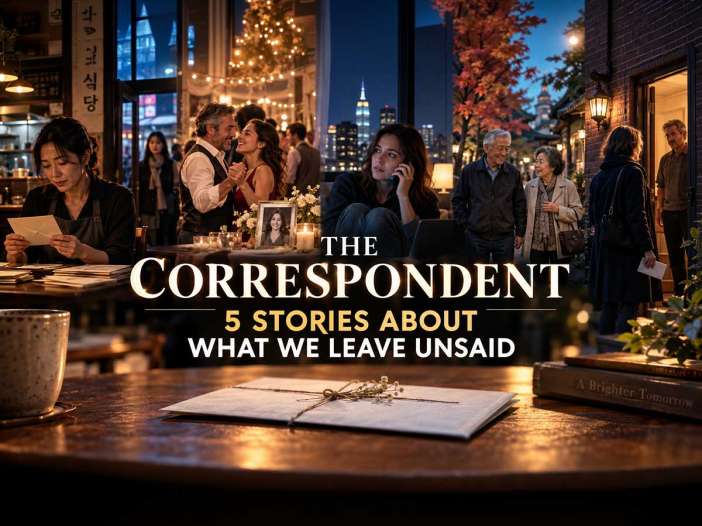
Introduction
What if the most important words in your life are the ones you keep assuming you can say later?
Virginia Evans's The Correspondent is built around letters, but its deeper subject is human connection.
Its characters reveal something easy to miss in ordinary life: we do not know ourselves entirely from the inside. Other people remember versions of us we cannot see. Grief can become tangled with loyalty. Silence can feel safer than an answer. Independence can become protection against intimacy. An apology can remain postponed until there is nobody left to receive it.
These five modern short stories take those ideas far beyond the original novel.
In Seoul, a restaurant owner discovers that her employees remember a very different woman from the person she thought she had been.
In Buenos Aires, a widowed father realizes he has confused continuing to suffer with continuing to love his late wife.
In New York, a journalist who has written 317 unsent emails to her estranged father discovers that writing the truth is easier than allowing another person to answer.
In Tokyo, a retired engineer who has spent his life solving other people's problems confronts a disturbing question: If nobody needs me anymore, can I still believe I matter?
And in France, a hospice nurse who has watched hundreds of people run out of time realizes she has spent eleven years behaving as though she has unlimited time with her own brother.
None of these stories retells The Correspondent.
Instead, they magnify its central human questions.
How different are intention and impact?
Can we remember the dead without remaining trapped beside them?
What changes when another person is allowed to challenge the story we tell about ourselves?
Can we receive love without earning it through usefulness?
And how long should we wait before saying what we already know needs to be said?
Across all five stories, the answer does not arrive through a grand revelation.
It arrives through small movements.
Ji-won opens another envelope.
Mateo keeps dancing.
Naomi answers the phone.
Hiroshi leaves his toolbox behind.
Claire takes the train.
Sometimes a life changes when someone moves a few inches closer to another person.
(Note: This is an imaginary conversation, a creative exploration of an idea, and not a real speech or event.)
Story 1: The Reviews We Never Read
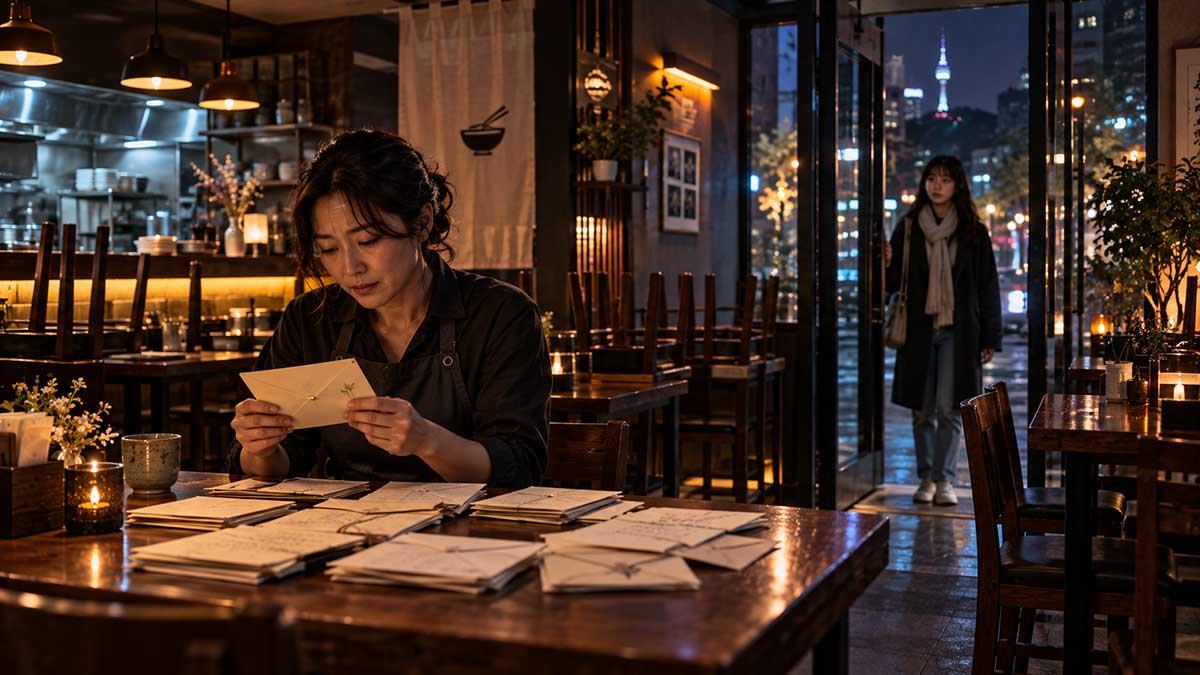
At 11:38 p.m., Han Ji-won opened the first envelope.
The restaurant had been closed for nearly two hours, but she had not turned off the kitchen lights.
She told herself she had forgotten.
Ji-won did not forget things.
For seventeen years, forgetting had been something other people did.
Servers forgot table numbers.
Suppliers forgot delivery times.
Young cooks forgot that sesame oil continued cooking garlic after the pan left the flame.
Ji-won remembered everything.
She remembered which customer was allergic to shellfish, which dishwasher sent half his salary to his mother in Daegu, which waitress was studying for the civil service examination, and which cook pretended not to be frightened when his wife went into premature labor.
She remembered all of it.
Tomorrow, none of it would belong to her.
The restaurant had been sold.
At ten the next morning, Ji-won would hand over the keys to a man twelve years younger than she was who planned to keep the restaurant's name but replace the handwritten menus with QR codes.
She had already decided she disliked him.
Her employees had held a farewell dinner that evening.
There had been too much food, too much soju, and entirely too much crying.
Before leaving, one of the servers had placed an old wooden box in front of her.
Ji-won recognized it immediately.
It had belonged to her grandmother.
For years Ji-won had kept handwritten recipes inside it.
Now the recipes were gone.
Inside were thirty-one envelopes.
"What's this?"
"Reviews," someone said.
Ji-won frowned.
"Of what?"
Everyone laughed.
"Of you."
She had almost thrown the box at them.
Instead she carried it home.
Then she carried it back.
Her apartment seemed like the wrong place to read thirty-one reviews of herself.
So now she sat alone at Table Seven.
She opened the first envelope.
Chef Han,
I will remember the night you made seaweed soup for me after closing because you found out it was my birthday.
You told me there were leftover ingredients.
There weren't.
Thank you.
Jae-ho
Ji-won stared at it.
"Idiot," she whispered.
There had been leftover ingredients.
Probably.
She opened the second.
You yelled at me for putting a wet knife in the drawer.
I thought you were insane.
Six months later I saw what rust did to my father's knives.
You were still insane.
But you were right.
Ji-won laughed.
She knew exactly who had written that one.
The third was from a dishwasher who had worked there nine years earlier.
He had come to the farewell dinner just to see her.
My daughter was born at 2:16 in the morning.
You paid for the taxi to the hospital.
You paid me for the shift.
You told everyone there had been an accounting error.
There was no accounting error.
I never thanked you properly.
My daughter is nine now.
Her name is Hana.
Thank you.
Ji-won folded the letter.
She did not immediately open another.
The refrigerator hummed behind the kitchen doors.
Somewhere outside, a bus groaned along the street.
Seoul continued without noticing that Han Ji-won had stopped working.
She opened another envelope.
Then another.
Some made her laugh.
One employee remembered Ji-won chasing a delivery driver three blocks after he brought the wrong mushrooms.
Another remembered her sleeping on sacks of rice during the restaurant's first winter since the heating system had failed and she couldn't afford a repairman.
Someone wrote:
You taught me how to taste salt instead of measuring it.
Another:
You taught me that "almost clean" means dirty.
Then came:
I was afraid of you for two years.
Ji-won stopped.
She read it again.
I was afraid of you for two years.
Every time you walked behind my station, my shoulders tightened.
I would hear your shoes and start checking everything.
Eventually I realized you weren't trying to frighten me.
I don't think you knew you were frightening me.
Maybe that's why I'm writing this.
You should know.
Ji-won felt irritation rise before she had finished.
"Then you should have told me."
She placed the letter facedown.
The next one said:
You changed my life.
The next:
I almost quit six times.
Another:
You were the first boss who treated me like I could become good at something.
Another:
Sometimes working for you made me feel like nothing I did was enough.
Ji-won began stacking the letters into two piles.
She did not consciously decide to do this.
One pile contained the reasonable letters.
The other contained the ones whose writers had misunderstood her.
After several minutes she noticed what she was doing.
She stared at the two piles.
Then she combined them again.
"Ridiculous."
She opened another.
You were kinder than you wanted anyone to know.
That annoyed her too.
Kindness wasn't something to advertise.
If someone needed help, you helped.
If you announced it afterward, the act became partly about you.
Her father had taught her that.
He had run a tiny noodle shop in Busan for thirty-four years.
When Ji-won was twelve, she once saw him give an old customer an envelope filled with cash.
On the walk home she asked why.
Her father said the man's wife was sick.
"How much did you give him?"
Her father stopped walking.
He looked at her as though she had asked how much air was in the sky.
"Enough."
She never forgot that.
Ji-won had built her life around enough.
Enough money.
Enough food.
Enough sleep.
Enough praise.
Too much praise made people soft.
Too much comfort made people careless.
Too much talking turned intentions into performance.
She believed actions were cleaner.
Actions couldn't lie.
At 12:21 a.m., Ji-won opened envelope number twenty-three.
She knew the handwriting before she finished unfolding the page.
Min-seo.
Ji-won sat straighter.
The letter was short.
Chef Han,
I spent five years believing you disliked me.
I still don't know whether I was wrong.
But I learned more from you than anyone I have ever worked for.
I wish both things didn't have to be true.
Min-seo
Ji-won read it twice.
Then a third time.
"What?"
She actually said it aloud.
She looked toward the empty kitchen as if Min-seo might be standing there.
"Disliked you?"
Ji-won stood.
The chair scraped loudly across the floor.
She walked into the kitchen.
Min-seo's station had already been cleaned.
Of all the people who had worked for Ji-won, Min-seo was the last person who should have believed she was disliked.
Five years earlier, Min-seo had been twenty-two.
On her third week she had ruined a pot of doenjang jjigae.
At least everyone else thought she had ruined it.
She had added grated pear.
One of the senior cooks laughed.
Ji-won tasted it.
Then tasted it again.
It wasn't ready.
It wasn't balanced.
But something was there.
Instinct.
Not technique.
Technique could be taught.
Instinct was harder.
Ji-won remembered thinking:
This girl might become extraordinary.
The next morning she moved Min-seo onto a harder station.
Two months later, harder again.
She corrected her constantly.
Too slow.
Too salty.
Again.
Cut it again.
Taste it.
No, actually taste it.
Why are you serving something you wouldn't pay for?
Again.
Again.
Again.
When another restaurant tried to hire Min-seo, Ji-won quietly raised her salary.
When Min-seo's mother needed surgery, Ji-won rearranged the schedule so Min-seo could disappear for eleven days without losing income.
When a famous chef visited and asked which young cook he should watch, Ji-won pointed toward Min-seo without hesitation.
She had never told Min-seo any of this.
Why would she?
Wasn't it obvious?
Ji-won returned to Table Seven and picked up the letter.
I spent five years believing you disliked me.
"How could you possibly think that?"
The front door rattled.
Ji-won froze.
A key entered the lock.
The door opened.
Min-seo stepped inside.
She saw Ji-won.
Stopped.
Then saw the wooden box.
"Oh."
Ji-won held the letter.
Min-seo closed her eyes.
"Oh, no."
"What are you doing here?"
"My knife."
"What knife?"
"My good knife."
"You have twelve knives."
"Eleven now."
Min-seo walked quickly toward the kitchen.
Ji-won followed.
"Min-seo."
"Tomorrow is fine."
"You said I disliked you."
Min-seo stopped.
Her back remained turned.
"I thought they were anonymous."
"You signed it."
"I realized that afterward."
"You worked here five years."
"Yes."
"Five years."
"I can count."
"You thought I disliked you for five years?"
Min-seo turned around.
"Please don't make this my final memory of the restaurant."
Ji-won almost laughed.
Instead she said:
"That's ridiculous."
Min-seo's face changed.
Only slightly.
Ji-won knew that expression.
She had seen it hundreds of times.
Usually after criticism.
Ji-won continued.
"I gave you the fish station after eight months."
Min-seo stared at her.
"Yes."
"Nobody gets fish after eight months."
"I know."
"I put you on ordering."
"Yes."
"I sent you to Osaka."
"Yes."
"Who did I send to meet Chef Park when he came here?"
"Me."
"Exactly."
Min-seo looked tired now.
Ji-won heard herself building the case.
Evidence.
Exhibit A.
Exhibit B.
Exhibit C.
Proof that Min-seo's memory was incorrect.
Ji-won could win this argument.
She knew she could.
Then she remembered another letter.
I don't think you knew you were frightening me.
And another.
Sometimes working for you made me feel like nothing I did was enough.
And Min-seo's:
I wish both things didn't have to be true.
Ji-won stopped.
Min-seo waited.
The refrigerator compressor switched off.
For the first time that night, the kitchen was completely silent.
Ji-won lowered the letter.
"What was it like?"
Min-seo frowned.
"What?"
"Working for me."
"You just read the letter."
"No."
Ji-won pulled out a stool.
She sat.
"What was it actually like?"
Min-seo searched Ji-won's face.
"Are you asking?"
"Yes."
"Or are you asking so you can tell me why I'm wrong?"
Ji-won opened her mouth.
Closed it.
"Probably both."
Min-seo laughed.
Ji-won did too.
Then Ji-won said:
"I'll try not to do the second one."
Min-seo remained standing.
Finally she leaned against the stainless-steel counter.
"At first I thought you hated me."
"Why?"
Ji-won caught herself.
"Sorry. Go ahead."
Min-seo smiled faintly.
"You corrected everything."
"I corrected everyone."
"Not like me."
Ji-won wanted to object.
She didn't.
"You would taste my food and make this face."
"What face?"
Min-seo imitated her.
Ji-won looked horrified.
"I don't do that."
Min-seo raised an eyebrow.
Ji-won sighed.
"Continue."
"Everyone else would finish cleaning and leave. You'd make me stay and prep the next morning's stock."
"Since you needed..."
Ji-won stopped herself.
Min-seo noticed.
"Since I needed what?"
"Keep going."
Min-seo looked down at her hands.
"I thought I was always one mistake away from being fired."
Ji-won's stomach tightened.
"I never considered firing you."
"I know that now."
"How?"
"Jun-ho told me."
Ji-won made a mental note to kill Jun-ho.
"He said another restaurant tried to hire me and you raised my salary before I even knew about the offer."
Ji-won looked away.
"He wasn't supposed to tell you."
"Why?"
"Since then it becomes..."
She struggled for the word.
"Performance."
Min-seo studied her.
"Chef."
"What?"
"People can't know what you don't tell them."
Ji-won said nothing.
It was such an obvious sentence that she almost resented it.
Min-seo continued.
"I know you helped my family."
Ji-won looked up sharply.
"Who told you?"
"My mother."
"Your mother talks too much."
"She likes you."
"Your mother barely knows me."
"She knows you paid me for eleven days when I wasn't here."
"I changed the schedule."
"You changed payroll too."
Ji-won looked toward the sink.
Min-seo laughed softly.
"This is what I mean."
"What?"
"You do things that say one thing. Then your face says something else."
"My face is my face."
"Your face has made grown men reconsider their careers."
Ji-won laughed despite herself.
Min-seo became serious again.
"You know what the strangest part was?"
Ji-won waited.
"The harder you were on me, the more I wanted you to tell me I was good."
That sentence landed differently.
Min-seo looked embarrassed after saying it.
Ji-won remembered herself at twenty-seven.
Her father's noodle shop.
A Saturday afternoon.
She had made broth alone for the first time.
Her father tasted it.
He said nothing.
He finished the bowl.
For years Ji-won had remembered that silence as the greatest compliment he ever gave her.
Suddenly another possibility appeared.
Perhaps it had been a compliment.
Perhaps she had simply needed it to be.
"What would you have wanted me to say?" Ji-won asked.
Min-seo smiled.
"Once?"
"Once."
"Maybe, 'Good job.'"
"I've said that."
"Twice."
"In five years?"
"Maybe three times."
"That's not true."
"It became a restaurant event."
Ji-won shook her head.
"Young people need constant applause."
Min-seo laughed.
"There she is."
Ji-won laughed too.
Then Min-seo went to her drawer and retrieved the missing knife.
She wrapped it carefully.
"I should go."
"Wait."
Ji-won walked into the tiny office behind the kitchen.
There were only three things left inside.
A calculator.
A photograph of her father.
And the old recipe notebook.
The cover was dark brown, stained by oil, broth, fingerprints, and time.
Her grandmother had begun it.
Her father had added to it.
Ji-won had filled more than half.
Measurements appeared beside corrections.
Dates beside ingredients.
Entire recipes had been crossed out and rebuilt.
Ji-won returned to the kitchen.
She held it toward Min-seo.
Min-seo stared.
"No."
"Take it."
"No."
"I'm giving it to you."
"I know. That's why I'm saying no."
Ji-won pushed it into her hands.
Min-seo looked genuinely frightened.
"Chef, you don't let anyone touch this."
"I know."
"Your grandmother..."
"I know."
"Your father..."
"I know."
"What am I supposed to do with it?"
Ji-won considered this.
"Correct it."
Min-seo stared at her.
Then she laughed.
"That might be the nicest thing you've ever said to me."
"Don't become emotional."
"I'm already emotional."
"Do it outside."
Min-seo hugged the notebook against her chest.
She walked toward the door.
Then stopped.
"Chef?"
Ji-won looked up.
"I never disliked you either."
Ji-won frowned.
"Why would you dislike me?"
Min-seo stared at her.
Then both women began laughing.
Min-seo left.
The door closed.
Ji-won stood alone again.
For seventeen years, she had believed actions were cleaner than words.
Perhaps she had been partly right.
Actions mattered.
But actions still required interpretation.
She had given Min-seo harder work and meant:
I believe in you.
Min-seo had received:
You keep disappointing me.
Neither woman had lied.
That frightened Ji-won.
It comforted her too.
If another person's memory could reveal something she had never intended, perhaps it could reveal kindness she had never recognized either.
Ji-won returned to Table Seven.
Twenty-two letters were open.
Nine remained.
She looked at the clock.
1:43 a.m.
Tomorrow someone else would own the restaurant.
For once, Ji-won had nothing left to prepare.
She picked up envelope twenty-four.
She almost opened it.
Then stopped.
She took out her phone.
Min-seo had probably reached the subway by now.
Ji-won typed:
You were never the weakest cook in my kitchen.
She stared at it.
Deleted it.
Typed again.
I pushed you harder than the others since I thought you could become better than I ever was. I should have told you that years ago.
She stared at that too.
Then added:
Good job.
She hesitated.
Then:
Very good job.
Ji-won pressed send.
Three dots appeared almost immediately.
Min-seo was typing.
Ji-won felt a ridiculous urge to turn the phone facedown.
Instead she watched.
The dots disappeared.
Returned.
Disappeared again.
Finally the message arrived.
Thank you, Chef. I needed that five years ago.
Ji-won winced.
Another message appeared.
But tonight is good too.
Ji-won read it twice.
Then she placed the phone beside the wooden box.
She picked up envelope twenty-four.
For the first time that night, she did not wonder whether the person inside had remembered her correctly.
She wondered what they had seen.
Ji-won opened the envelope.
And began to read.
Connection to The Correspondent
Ji-won's story magnifies one of the central discoveries in The Correspondent: no person possesses the complete account of who they have been. Like Sybil, Ji-won learns that intention and impact can produce two sincere but different memories. Part 2 pushed this further through narrative identity: relationships do more than observe us, they reveal parts of us unavailable from the inside. Virginia Evans's larger invitation remains beneath Ji-won's final choice. Connection begins when we stop merely explaining ourselves and become willing to receive another person's answer.
Story 2: The Birthday Cake in the Freezer
The lights went out at 6:17 on the hottest evening of the year.
Mateo Álvarez was standing in his kitchen cutting a lemon when the refrigerator stopped humming.
The ceiling fan slowed.
The radio went silent.
Across the courtyard, somebody shouted from an open window.
"Again?"
Another voice answered with something Mateo's mother would have considered inappropriate.
Mateo put down the knife.
He waited.
Buenos Aires had suffered outages before.
Usually the electricity returned within minutes.
He looked at the refrigerator.
More precisely, he looked at the freezer above it.
"Come on."
Nothing.
He opened the freezer door.
Cold air escaped against his face.
Chicken.
Frozen spinach.
Ice trays.
A bag of empanadas his daughter Lucía had brought months earlier.
And behind everything, inside a small plastic container wrapped in two layers of aluminum foil, was a slice of cake.
Mateo touched the container.
Still frozen.
He closed the door.
"Don't open it again," he told himself.
He found candles.
He waited.
At 7:10, the electricity was still out.
At 8:30, the apartment had become unbearable.
Mateo sat shirtless beside the window, listening to voices rise from the street.
At 9:45, he opened the freezer again.
The ice cream had softened.
The cake was still cold.
"You're fine," he whispered.
At 11:20, water began dripping from beneath the refrigerator.
Mateo knew.
Still, he opened the freezer.
The aluminum foil felt wet.
"No."
He pulled out the container.
Inside was a small piece of chocolate cake with white frosting.
Seven years old.
It had been made for Elena's forty-fifth birthday.
She had never tasted it.
Three days before her birthday, Elena had complained of a headache.
Mateo told her she had been working too much.
She told him he worried too much.
The next morning she collapsed in the bathroom.
By afternoon she was in intensive care.
Two days later, she was dead.
The bakery called the following morning.
"Señor Álvarez? We have the birthday cake for Elena."
Mateo stood in the hallway holding the telephone.
He had forgotten about it.
For some reason, he went to collect it.
The young woman behind the bakery counter smiled when he entered.
"Happy birthday to Elena."
Mateo stared at her.
Then the manager came from the back and recognized him.
News traveled quickly in their neighborhood.
The manager whispered something to the young woman.
Her face changed.
Nobody knew what to do with the cake.
So Mateo took it home.
That evening, Lucía was nineteen.
She sat at the kitchen table wearing one of her mother's sweaters.
Neither of them spoke.
Mateo cut the cake.
He placed a slice in front of Lucía.
She shook her head.
He couldn't eat either.
The following morning, he threw most of it away.
One slice remained.
He wrapped it.
Put it in the freezer.
He told himself he would throw it away later.
Seven years passed.
Every year on Elena's birthday, Mateo removed the slice.
He placed it on one of the white plates from their wedding set.
He put a candle beside it.
He did not light the candle.
At first Lucía joined him.
They looked through photographs.
They told stories.
They cried.
The second year, they did it again.
The third year, Lucía brought wine.
The fourth year, she arrived late.
The fifth year, she asked if they could have dinner somewhere else afterward.
The sixth year, she came with a man named Tomás.
Mateo disliked him immediately.
This was unfair.
Tomás was polite.
He brought flowers.
He listened when Mateo talked.
He washed dishes without being asked.
There was almost nothing to dislike.
Which made disliking him harder.
The seventh year, Lucía called two weeks before Elena's birthday.
"Papa, are you sitting down?"
"Why?"
"Just sit."
"I'm cutting onions."
"Put the knife down."
"Are you pregnant?"
"What?"
"Are you?"
"No!"
"Then why do I need to sit?"
"Tomás and I are getting married."
Mateo smiled before he could stop himself.
Then he cried.
He hated crying on the telephone.
Lucía cried too.
For several minutes neither could speak.
Then she said:
"We picked a date."
"When?"
There was a pause.
"November fourteenth."
Mateo's smile disappeared.
Elena's birthday.
"No."
"Papa."
"No."
"It was the date the church had available."
"Choose another church."
"The reception hall is available."
"Choose another hall."
"Tomás's grandparents are coming from Spain."
"They have airplanes on other days."
"Papa."
"No."
Her voice changed.
"Why?"
Mateo couldn't believe she had asked.
"That's your mother's birthday."
"I know."
"Then why would you do this?"
"I thought..."
"What?"
"I thought it could be beautiful."
Mateo stood.
"Beautiful?"
"Yes."
"To get married on the day your mother should have turned fifty-two?"
"I thought she could be part of it."
"She cannot be part of it."
Silence.
Mateo immediately wished he could pull the sentence back.
Lucía spoke quietly.
"I know that."
"Lucía..."
"No. I know she's dead."
"I didn't mean..."
"I have known for seven years."
"That's not what I meant."
"What did you mean?"
Mateo could not explain it.
He only knew that something about music, flowers, champagne, and people dancing on Elena's birthday felt obscene.
"I won't go."
The silence on the other end changed again.
"You're my father."
"Choose another date."
"You're serious?"
"Yes."
"Then don't come."
She hung up.
They did not speak for twenty-six days.
Mateo counted.
He told himself he wasn't counting.
On day eight, he typed:
Your mother would never have chosen that date.
He deleted it.
On day twelve:
Can we talk?
Deleted.
On day seventeen, Tomás called.
Mateo did not answer.
On day twenty-three, Lucía sent him a photograph of wedding invitations.
He stared at the date.
NOVEMBER 14.
He put the phone facedown.
Now, on day twenty-six, the electricity had failed.
And Elena's cake was melting.
Mateo peeled away the aluminum foil.
The frosting had collapsed against one side of the container.
The cake itself was wet.
He touched it.
His finger sank into something that had once been firm.
"No."
He put the container back into the freezer.
Then removed it again.
He found ice in the sink.
Melted.
He checked the freezer for anything still solid.
Nothing.
Mateo took the cake downstairs.
Maybe the café on the corner had a generator.
Closed.
The grocery store?
Dark.
He walked two blocks carrying a seven-year-old piece of cake through a city without electricity.
People sat outside their buildings.
Children played with flashlights.
Someone had brought a guitar onto a balcony.
A woman laughed when Mateo hurried past.
He wanted to shout at her.
Didn't she understand?
Something was being lost.
He returned home.
The cake had begun slipping apart inside the container.
Mateo sat on the kitchen floor.
He held it in both hands.
And cried.
Not the quiet tears he permitted himself on Elena's birthday.
He cried with his entire body.
Seven years collapsed.
The hospital.
The telephone.
The bakery.
Lucía in her mother's sweater.
The empty side of the bed.
The first Christmas.
The first time he forgot Elena was dead and called her name from another room.
The first time he laughed afterward and immediately felt ashamed.
The first time he noticed another woman was beautiful.
The horror he felt at himself.
Lucía moving out.
Lucía bringing Tomás home.
November fourteenth.
The cake.
The stupid cake.
The door opened.
"Papa?"
Mateo looked up.
Lucía stood there holding a flashlight.
She saw him on the floor.
Then the container.
"Oh."
Mateo wiped his face.
"What are you doing here?"
"Tomás said your neighborhood lost electricity."
"I'm fine."
"You didn't answer your phone."
"My battery died."
She looked at the cake.
Mateo pulled it closer.
"It's ruined."
Lucía sat on the floor across from him.
For a moment neither spoke.
"I tried to find ice."
Lucía nodded.
"The café is closed."
"I saw."
"The grocery store too."
"I know."
"It's ruined."
"I know, Papa."
He looked at her.
"You don't care."
Lucía's expression changed.
"Don't."
"You wanted to have a wedding on her birthday."
"Don't do that."
"You've moved on."
Lucía stared at him.
Then she began crying.
Mateo had expected anger.
Not this.
"I've moved on?"
"Lucía..."
"You think I moved on?"
She stood.
"I was nineteen."
"I know."
"No, you don't."
"I lost my wife."
"And I lost my mother!"
The words filled the dark kitchen.
Mateo looked at her.
Lucía wiped her face with both hands.
"I lost her too."
"I know."
"Do you?"
"Of course."
"Then tell me something."
"What?"
"What's the first thing I did after she died?"
Mateo tried to remember.
"You stayed here."
"No."
"You..."
"I made coffee."
Mateo frowned.
"You made coffee?"
"For you."
He could see it now.
Lucía in Elena's sweater.
The kitchen.
A cup in front of him.
"I don't remember."
"I do."
She sat again.
"You wouldn't eat."
Mateo said nothing.
"I learned how to make the eggs she made you."
"Lucía..."
"I started calling Abuela every night since you couldn't."
He looked down.
"I filled out paperwork."
"You were nineteen."
"I know how old I was."
Mateo closed his eyes.
"I cancelled Mama's dentist appointment."
He looked at her.
"Nobody remembered."
Her voice broke.
"I called and said she wouldn't be coming."
Mateo felt something inside him give way.
Not break.
Something had been broken for years.
This was different.
A door opening inside a room he had forgotten existed.
"I didn't know."
"No."
"Why didn't you tell me?"
Lucía laughed through her tears.
"Tell you what?"
"That you were..."
He couldn't finish.
"Grieving?"
She looked at the ruined cake between them.
"There wasn't room."
Mateo stared at her.
"What does that mean?"
Lucía hesitated.
Then she said it.
"You needed me to be okay."
"No."
"Yes."
"I never said that."
"You didn't have to."
"I would never..."
"Papa."
He stopped.
She spoke more softly.
"You were destroyed."
"I loved her."
"So did I."
"I know."
"But every year, November fourteenth became the saddest day in our family."
"It was her birthday."
"It was her birthday when she was alive too."
Mateo looked at her.
Lucía continued.
"Mama loved birthdays."
He almost smiled.
That was true.
Elena treated birthdays as personal holidays.
Cake at breakfast.
Music too loud.
Flowers bought for herself.
She once made Mateo wear a paper crown through an entire dinner since the restaurant had forgotten his birthday dessert.
"She would hate this," Lucía said.
"What?"
"The cake."
Mateo stiffened.
"Don't."
"She would."
"You don't know that."
"Papa, Mama threw out yogurt one day after the expiration date."
Despite himself, Mateo laughed.
It escaped before he could stop it.
Lucía laughed too.
Then both cried harder.
For a few seconds Mateo could hear Elena laughing with them.
Not literally.
He knew that.
But he remembered it so clearly that the kitchen seemed less empty.
Mateo looked at the cake.
"What am I supposed to do with it?"
Lucía wiped her eyes.
"I don't know."
"I can't throw it in the garbage."
"Then don't."
"Where do I put it?"
Lucía thought.
Then she looked toward the balcony.
"Mama's lemon tree."
Elena had planted the tree eleven years earlier.
It had nearly died twice.
Mateo had threatened to replace it.
Elena refused.
"Give it time."
The tree now stood taller than Mateo.
At midnight, father and daughter carried the cake downstairs into the courtyard.
The electricity had not returned.
Neighbors sat outside talking.
Nobody asked what Mateo and Lucía were doing.
Mateo found a small garden shovel.
Lucía held the flashlight.
He dug beneath the lemon tree.
The soil was dry.
His back hurt.
Lucía offered to take over.
"No."
"Papa."
"I've got it."
She rolled her eyes.
"Of course you do."
He looked up.
For the first time in twenty-six days, they smiled at each other.
Mateo removed the cake from the plastic container.
It barely resembled cake anymore.
He placed it into the hole.
Lucía crouched beside him.
"Wait."
"What?"
She disappeared upstairs.
Five minutes later she returned holding a candle.
The same kind Mateo placed beside the cake every year.
She pushed it into the soft frosting.
Then lit it.
Father and daughter watched the tiny flame.
"Should we sing?" Lucía asked.
Mateo laughed.
"No."
"Mama would."
"Your mother couldn't sing."
"Neither can you."
"Exactly."
They sang anyway.
Quietly.
Badly.
Happy birthday to Elena.
When they finished, Mateo didn't know what to do.
Lucía did.
"Make a wish."
"It's not my birthday."
"Make one."
Mateo closed his eyes.
He wished he had been kinder to his daughter.
Then he blew out the candle.
They buried the cake.
The electricity returned at 2:13 a.m.
Mateo was sitting at the kitchen table with Lucía.
They had opened a bottle of wine.
"You really won't come?" she asked.
Mateo stared at his glass.
"To the wedding?"
"Yes."
He looked toward the freezer.
Empty now.
"Tell me why you chose the date."
"I told you."
"The church."
"That was part of it."
"What was the other part?"
Lucía looked surprised.
Mateo waited.
She took a sip.
"I didn't want Mama's birthday to become a funeral every year."
He said nothing.
"I thought..."
She looked embarrassed.
"I thought maybe we could give the day something else too."
"Replace her?"
"No."
Lucía reached across the table.
"Add something."
Mateo looked at their hands.
Add something.
He had been treating memory like a room with limited space.
If joy entered, perhaps grief had to leave.
If Lucía married on Elena's birthday, perhaps Elena would disappear.
If Mateo laughed, perhaps he had forgotten.
If he loved life, perhaps he had loved his wife less.
But Lucía was proposing something else.
Not subtraction.
Addition.
"I'll come," he said.
Lucía squeezed his hand.
"You better."
"I have conditions."
She groaned.
"Of course."
"I give a speech."
"No."
"I'm your father."
"That's exactly why I'm saying no."
"I'll keep it short."
"Three minutes."
"Seven."
"Four."
"Five."
"Fine."
Mateo smiled.
"And your mother's photograph."
"I already planned it."
He looked at her.
"Where?"
"Family table."
He looked away quickly.
"Good."
November fourteenth arrived warm and bright.
Mateo woke at 5:42 a.m.
For seven years, his first thought on that date had been:
Elena should be here.
This year it was too.
He went downstairs.
The lemon tree had three ripe lemons.
Mateo touched one.
"Happy birthday," he said.
Then he added:
"Our daughter is getting married today."
He stood there for a moment.
He waited for guilt.
It came.
Smaller than before.
He let it come.
Then he went upstairs to dress.
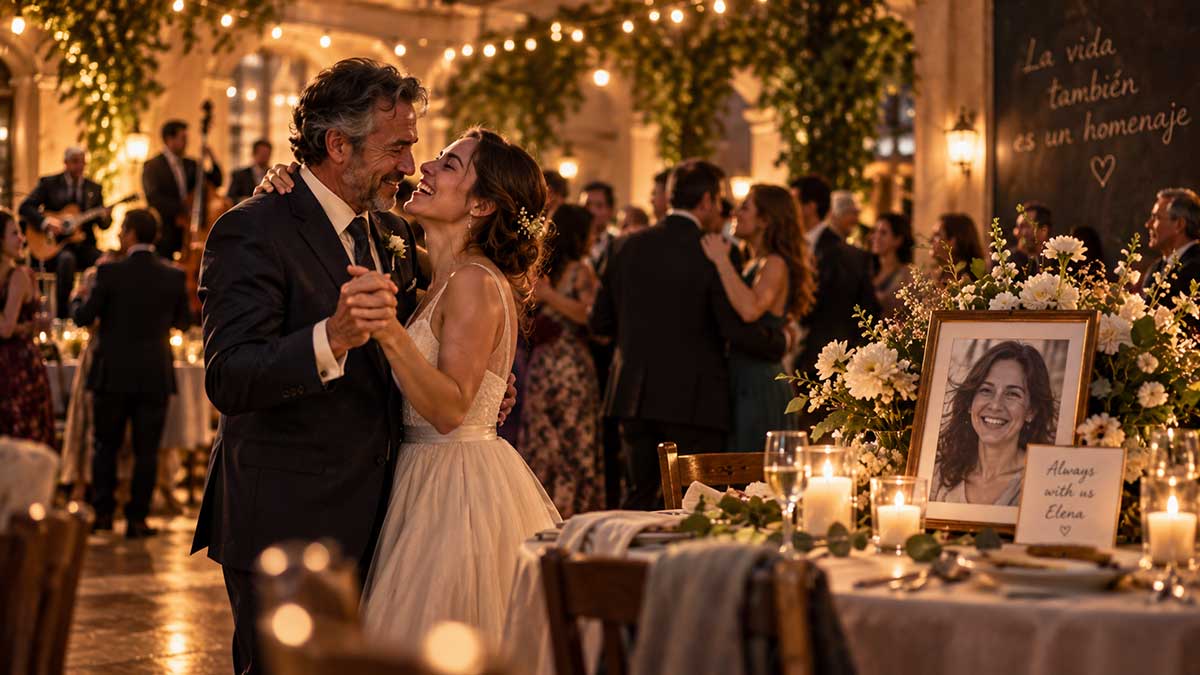
At the reception, Elena's photograph stood beside a vase of white flowers.
Not hidden.
Not worshipped.
Present.
Lucía had chosen a photograph Mateo had forgotten.
Elena was forty.
Wind had blown her hair across her face.
She was laughing at whoever held the camera.
Mateo stood before it.
"She chose well," he whispered.
He didn't know whether he meant the photograph, the wedding date, Tomás, or all three.
Later, Mateo gave his five-minute speech.
It lasted eleven.
Lucía shouted from the table.
"Papa!"
Everyone laughed.
Mateo raised his glass.
"I want to say something about my wife."
The room became quiet.
"Elena should have been fifty-two today."
Lucía lowered her eyes.
Mateo continued.
"For seven years, I thought the best way to love someone who died was to keep one part of life exactly where they left it."
He looked at Elena's photograph.
"I was wrong."
His voice shook.
"I don't think love asks us to stop the clock."
He looked at Lucía.
"I think love asks us to carry people into whatever happens next."
Lucía was crying.
"So today Elena is here."
Mateo touched his chest.
"Not instead of this wedding."
He looked around the room.
"Inside it."
He raised his glass.
"To Lucía and Tomás."
Everyone stood.
"And happy birthday, Elena."
Glasses rose.
For once, the words did not feel contradictory.
Much later, music filled the room.
Mateo sat watching couples dance.
Lucía appeared in front of him.
"Come."
"No."
"Papa."
"I danced already."
"You walked in a circle during the father-daughter dance."
"That was dancing."
"Come."
She pulled him up.
Mateo resisted for approximately three seconds.
Then he followed her.
The song was fast.
Too fast.
Lucía laughed at him.
He deliberately danced worse.
She laughed harder.
Then Mateo laughed.
Really laughed.
For a fraction of a second, something inside him whispered:
How can you be this happy today?
He knew that voice.
He had obeyed it for seven years.
Mateo looked across the room.
Elena's photograph stood among the flowers.
He remembered the cake.
The hospital.
Her hand in his.
Her terrible singing.
The lemon tree.
The life they had.
The life he still had.
He placed one hand over his heart.
Not as an apology.
As a greeting.
Then he turned back to his daughter.
And kept dancing.
Connection to The Correspondent
Mateo's story magnifies the grief at the center of The Correspondent. Like Sybil after Gilbert's death, he begins to confuse continuing pain with continuing love. Lucía reveals another truth from Parts 1 and 2: one person's grief can become so large that another person's grief disappears from view. The thawing cake transforms the stone motif into a new question. We do not have to discard the people we lost, but remembering them does not require freezing our own lives at the moment they left.
Story 3: Draft 317

Naomi Brooks knew exactly what she would say to her father if she ever spoke to him again.
She had practiced for twelve years.
There were 317 versions.
The first was written when she was twenty-two.
The latest had been written last Tuesday.
None had been sent.
Naomi kept them in an email folder labeled:
DRAFTS - DAD
At 8:14 on a rainy Thursday morning in Manhattan, someone stole the laptop containing all of them.
Naomi had been sitting in a coffee shop on West 72nd Street.
She was an investigative journalist, which meant she had developed several habits she considered evidence of professional intelligence.
Never sit with your back to the entrance.
Never leave documents unattended.
Never trust the first explanation.
Always know where the exits are.
She had broken three of those rules since she needed the bathroom.
When she returned, the laptop was gone.
"My computer."
The barista looked up.
"What?"
"My computer was right there."
Naomi pointed toward the empty table.
A half-finished coffee remained beside her notebook.
"Did somebody move it?"
"No."
"Did you see anyone?"
The barista looked toward the door.
"There was a guy."
"What guy?"
"I don't know. A guy."
Naomi stared at him.
"You work in a coffee shop in Manhattan. Can you narrow that down?"
He frowned.
"Blue jacket?"
Naomi grabbed her coat and ran outside.
Rain.
Umbrellas.
Buses.
People moving in every direction.
No blue jacket.
She stood on the sidewalk.
Her first thought should have been about work.
She had confidential notes on that computer.
Interview transcripts.
Source material.
A nearly completed investigation that had taken four months.
Instead, her first thought was:
The letters.
Three hundred and seventeen letters to David Brooks.
Her father.
She felt physically sick.
Then she remembered everything was backed up.
She leaned against the building.
"Idiot."
A woman passing beneath an umbrella glanced at her.
Naomi didn't care.
The letters were safe.
Safe.
That word bothered her.
The police officer who took the report asked whether the laptop contained sensitive information.
"Yes."
"Financial?"
"No."
"Personal identification?"
"Some."
"Work documents?"
"Yes."
"Anything else?"
Naomi hesitated.
"No."
The officer continued typing.
She almost laughed.
Anything else?
Only twelve years of arguments with a man who had never heard them.
Naomi bought a replacement laptop that afternoon.
By evening she had restored her files.
At 11:06 p.m., she opened:
DRAFTS - DAD
She sorted them by date.
The first had been written on October 3, twelve years earlier.
She opened it.
Dad,
Mom says you aren't coming back.
I don't know whether she means tonight or ever.
Please call me.
Naomi stared at the screen.
She had forgotten how short the first one was.
The second was written six days later.
I saw your car outside the apartment yesterday.
Why didn't you come upstairs?
The third:
Mom says I shouldn't contact you until things settle down.
What does that mean?
The fourth was angry.
The fifth was worse.
By draft seventeen, Naomi had discovered sarcasm.
By draft thirty-eight, she had become cruel.
By draft sixty-two, she had stopped asking him to come back.
Draft ninety-one began:
I hope someday you understand what you did.
Draft 143:
You missed my graduation.
Draft 177:
I got the job at the Times.
You probably don't know that.
Draft 214 was written after too much wine.
Did you ever miss me?
Four words.
She had stared at that one for nearly an hour before closing the laptop.
Draft 261 began:
I don't hate you anymore.
I don't know what replaced it.
She had never finished it.
Naomi scrolled.
317 versions.
Twelve years.
She knew his lines too.
She had supplied them herself.
In some drafts, her father apologized.
In others, he defended himself.
Sometimes she imagined him blaming her mother.
Sometimes he blamed Naomi.
In one particularly satisfying version, he begged her forgiveness and Naomi refused.
She had rehearsed that one several times.
Her father was remarkably cooperative inside her drafts.
He always said exactly what Naomi needed him to say so she could deliver the response she had already prepared.
She closed the laptop.
For the first time, that felt strange.
The next morning Naomi called her mother.
"Why did Dad leave?"
Silence.
Then:
"Good morning to you too."
"I'm serious."
"So am I. Good morning."
"Good morning. Why did Dad leave?"
Her mother sighed.
"Naomi."
"I want to know."
"You know."
"No. I know what I've been told."
"What's the difference?"
Naomi looked at the restored laptop.
"I don't know anymore."
Her mother became quieter.
"What happened?"
"My laptop was stolen."
"What does that have to do with your father?"
"Nothing."
Another pause.
Her mother knew her too well.
"Are you writing to him again?"
Naomi looked at the folder.
"I've been writing to him for twelve years."
"Naomi."
"I don't send them."
"I know."
"You know?"
"You used to do it on the family computer."
Naomi closed her eyes.
"Please tell me you didn't read them."
"I didn't."
"Thank God."
"I saw the filenames."
"What filenames?"
"'Dad Is a Coward.'"
Naomi covered her face.
"I was twenty-three."
"'Things I Will Say If He Comes to My Wedding.'"
"I wasn't engaged."
"I know."
"'Final Letter to Dad.'"
Naomi remembered that one.
"Which final letter?"
"Exactly."
Naomi laughed despite herself.
Then her mother said:
"He hurt me too."
The laughter disappeared.
"I know."
"No. I mean, your father and I hurt each other."
"Mom."
"I'm not defending him."
"Then don't."
"I'm saying marriages can end in ways children don't completely see."
"I wasn't a child. I was twenty-two."
"You were our child."
Naomi said nothing.
Her mother continued.
"Your father should have handled things differently."
"That's vague."
"Yes."
"You always do that."
"Do what?"
"Protect him."
"I'm not protecting him."
"Then tell me what happened."
Her mother was silent for several seconds.
Then:
"Ask him."
Naomi almost laughed.
"That's convenient."
"Maybe."
"You know we don't speak."
"I know."
"He left."
"I know."
"He stopped calling."
Her mother did not answer.
"Mom?"
"Ask him."
That evening Naomi opened a new message.
To: David Brooks
She knew his email address.
She had always known it.
She typed:
Dad,
Then stopped.
She began again.
I've spent twelve years trying to understand why you disappeared from my life.
Too accusatory.
Deleted.
I don't know whether you want to hear from me.
Too weak.
Deleted.
There are things I need to say.
Too dramatic.
Deleted.
Naomi laughed.
She had written hundreds of letters.
Apparently she had no idea how to write one.
At 1:17 a.m., she typed:
Would you tell me what happened to us?
She counted the words.
Eight.
She almost added:
From your perspective.
Deleted it.
He would know whose perspective she meant.
She almost added:
I'm not saying I forgive you.
Deleted.
Then:
I need the truth.
Deleted.
That sounded like an interrogation.
Naomi stared at the message.
Eight words.
Her finger hovered over SEND.
She closed the laptop.
At 1:42 she opened it again.
The message was still there.
At 2:03 she made tea.
At 2:26 she opened Draft 214.
Did you ever miss me?
At 2:41 she returned to the new email.
At 2:43 she pressed send.
Nothing happened.
No thunder.
No emotional collapse.
No music.
The email moved into SENT.
Naomi stared at the empty screen.
Then panic arrived.
She tried to remember whether Gmail had an unsend function.
Too late.
"Fantastic."
She went to bed.
She did not sleep.
At 6:12 a.m., her phone buzzed.
David Brooks
Naomi sat up.
Email.
She opened it.
Naomi,
Yes.
I will tell you anything you want to know.
I have wanted to contact you for years.
I didn't think I had the right.
Dad
Naomi read the third sentence again.
I have wanted to contact you for years.
Anger arrived so quickly she almost admired it.
She began typing.
You had my phone number.
Deleted.
That's a convenient excuse.
Deleted.
Parents don't need permission to contact their children.
She kept that one for thirty seconds.
Deleted.
Then she wrote:
Tell me what happened.
She sent it.
His response came two hours later.
It was 1,846 words.
Naomi knew since she pasted it into a document and checked.
She read it once.
Then again.
By the third reading, she had created a list.
Things that are false.
Things that are probably false.
Things Mom would dispute.
Things he conveniently forgot.
Things I don't remember.
She was halfway through creating a sixth category when she stopped.
This was how she worked.
Evidence.
Claims.
Contradictions.
Sources.
It had made her an excellent journalist.
It was making her a terrible daughter.
She returned to the email.
Her father described the marriage collapsing slowly.
Arguments.
Money.
Resentment.
A relationship with another woman that he admitted had begun emotionally before the marriage ended.
Naomi hated him for that sentence.
Good.
Something familiar.
Then came the part she didn't recognize.
Her father said he had returned to the apartment three times after leaving.
Once Naomi refused to come downstairs.
Once her mother told him Naomi was too angry to see him.
Once he sat in his car for almost two hours.
Naomi remembered the car.
Draft number two.
I saw your car outside the apartment yesterday.
Why didn't you come upstairs?
She kept reading.
Her father wrote:
Your mother told me you needed space. I called several times. You didn't answer. I sent two emails. You didn't respond.
Eventually I convinced myself that contacting you was making things worse.
I thought you wanted me to leave you alone.
Naomi stopped.
She read it again.
I thought you wanted me to leave you alone.
"No."
She said it aloud.
"No."
She searched her old email account.
Nothing.
Then she remembered.
At twenty-two she had blocked him.
She had forgotten.
Or perhaps she had remembered the action without remembering its significance.
She called her mother.
"Did you tell Dad I wanted him to leave me alone?"
Her mother was quiet.
"I told him you were angry."
"That's not what I asked."
"I don't remember exactly."
"He says you told him I needed space."
"You did."
"For twelve years?"
"Of course not."
"Then why didn't he call?"
"You need to ask him."
"I am asking you."
"And that's the problem."
Naomi stopped.
"What?"
"You keep asking me what your father thought."
Her mother's voice softened.
"I don't know what your father thought."
"But you were married to him."
"That doesn't mean I lived inside his head."
Naomi looked at the email.
Neither did she.
Yet she had spent twelve years there.
She wrote back.
I don't remember it that way.
Her hands stopped.
She wanted to write:
Since that's not what happened.
Instead:
I don't remember it that way.
But I want to hear how you do.
She stared at the words.
They felt dangerous.
Not forgiving.
Not agreeing.
Not surrendering.
Dangerous for another reason.
They created space.
She sent them.
Her father replied:
Thank you.
Can I call you?
Naomi did not answer.
She went to work.
At noon she interviewed a city official who contradicted something he had said three weeks earlier.
Naomi caught him immediately.
At 2:00 she reviewed documents.
At 4:30 her editor asked why she had missed a deadline for the first time in six years.
At 6:15 she took the subway home.
Her father's question remained unanswered.
Can I call you?
She opened Draft 317.
Written last Tuesday.
Dad,
I have built an entire version of you from your absence.
Maybe that's what happens when someone leaves. The empty space doesn't stay empty. We fill it.
I filled you with every explanation that hurt enough to make sense.
You didn't love me.
You were selfish.
You forgot me.
I became easier to abandon than your new life was to resist.
I don't know which one is true anymore.
Maybe I don't want to know.
Naomi had forgotten writing that last sentence.
Maybe I don't want to know.
There it was.
The first honest sentence in 317 drafts.
She had always told herself she wanted answers.
But answers were unpredictable.
Her drafts were safe.
Draft-David could not tell her something that complicated her anger.
He couldn't say he had been ashamed.
He couldn't say he had tried.
He couldn't say he had failed.
He couldn't blame her.
He couldn't blame himself differently from the way she blamed him.
He couldn't remember a different childhood.
He couldn't say:
I loved you.
That might have been the most dangerous answer of all.
Since then Naomi would have to decide what to do with twelve years of believing he hadn't.
At 9:08 p.m., Naomi wrote:
Call me tomorrow at 7.
She deleted it.
Why tomorrow?
She typed:
You can call now.
Sent.
Her heart began pounding immediately.
She put the phone on the kitchen counter.
Then walked into the bedroom.
That was ridiculous.
She returned.
The phone remained silent.
Five minutes.
Ten.
Twenty.
Naomi became angry.
Of course.
He had asked permission and now he wasn't calling.
Typical.
She began constructing the next draft.
Then the phone rang.
DAD
Naomi stared at it.
The name looked strange.
She had never deleted his contact.
Twelve years.
New phones.
New apartments.
New jobs.
Three hundred and seventeen letters.
His number had traveled through every version of her life.
The phone continued ringing.
Naomi picked it up.
Her thumb hovered over the green circle.
She suddenly understood something that embarrassed her.
Writing had never been the frightening part.
She had written everything.
Anger.
Love.
Accusation.
Questions.
Memories.
She had even written forgiveness in one draft just to see what it looked like.
The frightening part was this:
Her father was about to become a person again.
Not a character.
Not a defendant.
Not the recipient of a letter he would never read.
A person.
A person could answer.
Naomi touched the screen.
"Hello?"
Silence.
Then breathing.
"Naomi?"
His voice was older.
That was the first thing she noticed.
She had preserved his voice at fifty-three.
The man speaking was sixty-five.
"Hi, Dad."
Another silence.
Then:
"Hi."
Naomi sat on the kitchen floor.
Neither knew what came next.
For once, she had not written it.
Her father spoke first.
"I don't know where to start."
Naomi looked at her laptop.
Three hundred and seventeen drafts waited inside.
She closed it.
"Neither do I."
Her father gave a small laugh.
Naomi remembered that laugh.
She had forgotten she remembered it.
"Maybe," she said, "tell me about the day you came back to the apartment."
"You remember that?"
"I remember seeing your car."
"I remember sitting in it."
"Why didn't you come upstairs?"
He took a breath.
Then he began.
Naomi listened.
Several times she wanted to interrupt.
Once she did.
Once she told him something he remembered was wrong.
He disagreed.
She became angry.
He became defensive.
They stopped.
Started again.
At 8:14, exactly one hour after the call began, her father said:
"I need to tell you something."
"What?"
"I did miss you."
Naomi closed her eyes.
"I wondered."
"I know."
"No, you don't."
"You're right."
That answer surprised her.
He continued.
"I missed your graduation."
"Yes."
"I knew when it was."
Naomi's eyes opened.
"What?"
"I knew."
"Then why weren't you there?"
"I thought you didn't want me there."
"You keep saying that."
"I know."
"Did you ever ask me?"
Silence.
"No."
Naomi felt the old anger rise.
This time she didn't hide it.
"You should have."
"I know."
"You should have called."
"I know."
"You were my father."
"I know."
"You don't get to say you stayed away for me."
"I know."
Naomi stopped.
She had expected a defense.
It never came.
Her father spoke quietly.
"I was ashamed, Naomi."
She waited.
"And after enough time passed, calling became harder. Then every year made it worse. I kept thinking I needed the right explanation."
Naomi almost laughed.
"What?"
"I said I kept waiting until I knew what to say."
Naomi looked at the closed laptop.
"That's stupid."
"I know."
"I wrote you 317 emails."
Her father was silent.
"What?"
"Three hundred and seventeen."
"You sent me one."
"I know."
"What happened to the other 316?"
"Nothing."
A pause.
Then her father began laughing.
Naomi felt offended.
"This isn't funny."
"I'm sorry."
He continued laughing.
"You waited twelve years to send an email, and I waited twelve years to make a phone call."
Naomi tried not to laugh.
Failed.
For several seconds they laughed together.
It did not repair twelve years.
It did not resolve the divorce.
It did not make his choices acceptable.
It did not make Naomi's memories false.
It did not make his memories true.
It was simply laughter.
Shared.
Unwritten.
Real.
They spoke for two hours and thirteen minutes.
When the call ended, Naomi sat alone.
She opened her laptop.
DRAFTS - DAD
She considered deleting them.
She didn't.
Those letters were real too.
They contained who she had been at twenty-two.
Twenty-seven.
Thirty.
Thirty-four.
Angry Naomi.
Abandoned Naomi.
Successful Naomi.
Lonely Naomi.
Naomi who wanted nothing from her father.
Naomi who wanted four words:
Did you ever miss me?
She created a new folder.
She named it:
LETTERS I NEEDED TO WRITE
Then she moved all 317 drafts into it.
The folder was no longer addressed to her father.
Maybe it never had been.
Her phone buzzed.
A message.
Dad: Thank you for answering.
Naomi looked at it.
She typed:
Thank you for calling.
Then stopped.
Added:
I am still angry.
She pressed send.
A moment later:
Dad: I know.
Then:
Dad: Can I call again Sunday?
Naomi stared at the question.
She could already feel the old machinery starting.
What would they discuss?
What if he contradicted her again?
What if her mother became angry?
What if Naomi discovered something she didn't want to know?
What if he disappointed her?
What if she disappointed him?
She began mentally writing the conversation.
Then stopped.
She typed one word.
Yes.
Sent.
Naomi closed the laptop.
There would be another conversation.
She had no idea what either of them would say.
For the first time in twelve years, that felt less frightening than comforting.
Connection to The Correspondent
Naomi's 317 drafts magnify one of the deepest ideas from The Correspondent: expression and correspondence are not the same thing. Writing can help us name anger, grief, fear, and longing, yet a relationship changes when another person is allowed to answer. Like Sybil, Naomi discovers that her memory can be sincere without being complete. Virginia Evans's larger pillar appears in Naomi's smallest action. She stops writing both sides of the relationship and finally makes room for another human voice.
Story 4: Nobody Needs Mr. Tanaka
At 7:12 every morning, Hiroshi Tanaka checked his telephone.
He did not call this checking his telephone.
He called it checking the weather.
The weather required approximately eight seconds.
Afterward he checked LINE.
Then email.
Then missed calls.
Then LINE again, in case something had arrived during the previous forty seconds.
On Tuesday morning there was nothing.
No missed calls.
No messages from his daughter.
No questions from his son.
No former colleagues asking whether he remembered the load calculations for a bridge designed in 1998.
Nothing.
Hiroshi restarted the phone.
Still nothing.
He placed it facedown.
"Good."
He said this aloud.
Peace.
That was what retirement was supposed to provide.
Peace.
He poured tea.
Three minutes later he checked the phone again.
For forty-six years, people had needed Hiroshi Tanaka.
He was a civil engineer.
More precisely, he was the engineer people called when another engineer said:
"We have a problem."
Hiroshi liked problems.
Problems respected rules.
A bridge did not become offended when corrected.
Concrete did not accuse you of being emotionally unavailable.
Steel did not ask why you never said what you felt.
A structure either carried its load or it did not.
Hiroshi understood load.
He had built his entire life around carrying it.
When his children were young, he paid the mortgage, tuition, piano lessons, basketball fees, dental bills, and one spectacularly expensive mistake involving his son's first car.
When his mother reached ninety, Hiroshi handled her hospital appointments.
When his wife, Yumi, developed arthritis, Hiroshi carried groceries, changed lightbulbs, opened jars, booked taxis, and rearranged furniture before she asked.
When Yumi died three years earlier, Hiroshi discovered something unsettling.
There was nobody beside him to ask for anything.
His daughter Aya lived in Yokohama.
His son Kenji lived in Singapore.
His mother had died six months after Yumi.
His company gave him a beautiful retirement clock.
Then they stopped calling.
At first former colleagues contacted him constantly.
"Tanaka-san, do you remember the retaining wall project?"
"Tanaka-san, can I ask about the old specifications?"
"Tanaka-san, where are the original calculations?"
Each call made Hiroshi sit straighter.
He kept notebooks beside the telephone.
Then younger engineers learned where the files were.
Calls became weekly.
Then monthly.
Then almost never.
Hiroshi had spent forty-six years teaching people how to work without him.
Apparently he had succeeded.
He hated it.
At 10:26 that Tuesday morning, someone knocked.
Three short knocks.
Hiroshi opened the door.
Keiko Sato from apartment 704 stood outside holding a jar of strawberry jam.
Mrs. Sato was seventy-nine.
She wore a yellow cardigan, large glasses, and the expression of someone already disappointed in his answer.
"Tanaka-san."
"Sato-san."
She held up the jar.
"This is defective."
Hiroshi examined it.
"It's jam."
"I know it's jam."
"Then what's defective?"
"It won't open."
"That doesn't mean it's defective."
"It means it's useless."
Hiroshi took the jar.
The lid was tight.
He wrapped a dish towel around it and twisted.
Nothing.
Mrs. Sato folded her arms.
"You see?"
Hiroshi went into the kitchen, ran hot water over the lid, dried it, tapped the edge lightly, and twisted again.
Pop.
Mrs. Sato smiled.
"I knew you could fix it."
Hiroshi handed it back.
"Opening a jar is not fixing."
"It was closed. Now it is open."
She considered this.
"Sounds fixed."
She left.
Hiroshi closed the door.
He realized he was smiling.
The following Thursday, she returned.
Her phone screen was too dark.
Hiroshi adjusted the brightness.
The Thursday after that, a cabinet hinge was loose.
Hiroshi brought his tools upstairs.
The cabinet was old.
He removed the hinge, cleaned the screw holes, inserted small wooden plugs, reset the screws, adjusted the door, and tested it six times.
Mrs. Sato watched.
"You could have tightened the screw."
"It would become loose again."
"Eventually."
"Correct."
"Everything becomes loose eventually."
Hiroshi looked at her.
"Not if maintained properly."
Mrs. Sato smiled.
"You really are an engineer."
The next Thursday, her television remote stopped working.
Batteries.
The week after that, she couldn't print a train ticket.
The week after that, her balcony door stuck.
Every Thursday, there was something.
Hiroshi began keeping Thursday mornings free.
He did not admit this to himself.
At 9:30 he would make sure he was dressed.
At 9:45 he cleaned the kitchen.
At 10:00 he placed his toolbox near the entrance.
At 10:15 he told himself Mrs. Sato was probably not coming.
Usually she knocked between 10:20 and 10:40.
Hiroshi became useful again.
One Thursday at 10:48, there was no knock.
At 11:03, Hiroshi checked the hallway.
Empty.
At 11:17, he went downstairs to check the mail.
Nothing.
At 11:31, he returned.
At 11:44, he considered going upstairs.
Then stopped himself.
What would he say?
Hello, I noticed you haven't brought me anything broken today.
Ridiculous.
At 12:06, someone knocked.
Hiroshi opened the door immediately.
Mrs. Sato stood there.
Empty-handed.
He looked at her hands.
"What happened?"
"Nothing."
"Where is it?"
"Where is what?"
"The thing."
"What thing?"
"The broken thing."
Mrs. Sato stared at him.
"I don't have a broken thing."
Hiroshi frowned.
"Then why are you here?"
She blinked.
Then laughed.
"Tanaka-san."
"What?"
"Would you like coffee?"
"Your coffee machine is broken?"
"No."
"Then..."
"I am asking whether you would like to have coffee with me."
Hiroshi looked behind her as though another person might explain the situation.
"Why?"
Mrs. Sato stopped smiling.
"Why?"
"Yes."
"Since I would like coffee."
"You can make coffee upstairs."
"I know."
"Then why come here?"
She studied him for several seconds.
"Are you busy?"
Hiroshi almost said yes.
He was not.
"No."
"Good."
She turned.
"Get your shoes."
They went to a small café six blocks away.
Mrs. Sato ordered cake.
Hiroshi did not.
She ate half of hers and pushed the remaining half toward him.
"I don't want it."
"You've been staring at it."
"I was not."
"You were."
"I was looking at the plate."
"The cake is on the plate."
Hiroshi ate the cake.
Mrs. Sato smiled.
They spoke for an hour.
No problems.
No repairs.
No instructions.
Hiroshi found the experience strangely exhausting.
The next Thursday, Mrs. Sato invited him to a chamber concert.
"I don't like classical music."
"You told me your wife loved Mozart."
"Yumi liked Mozart."
"So you have heard Mozart."
"Hearing and liking are different."
"Good. You can explain afterward why you disliked it."
He went.
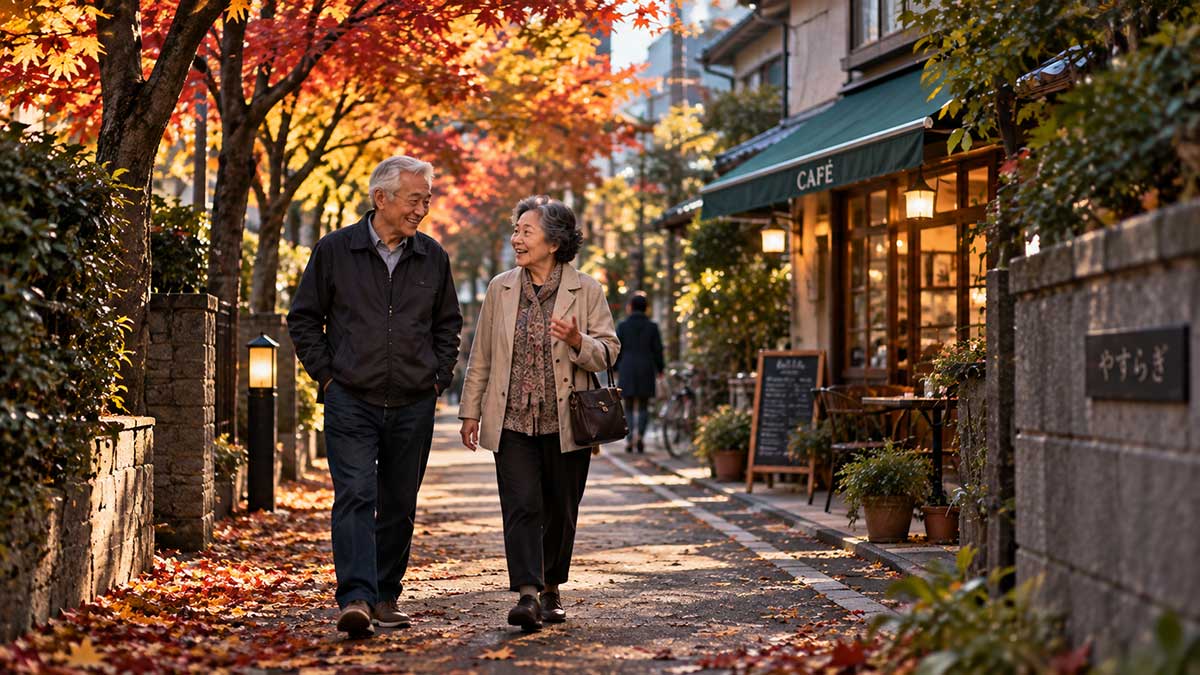
The Thursday after that they walked through Shinjuku Gyoen.
Mrs. Sato complained about his walking speed.
"You walk like someone is timing you."
"I walk normally."
"No. You walk as if the station doors are closing."
She deliberately slowed down.
Hiroshi reluctantly matched her pace.
They stopped beneath a tree.
Nothing happened.
Nobody needed anything.
They simply stood there.
Hiroshi was beginning to suspect Mrs. Sato was doing this deliberately.
One afternoon she handed him a novel.
"You should read this."
"What is it about?"
"People."
"That's vague."
"Most novels are about people."
"Is there a mystery?"
"No."
"Historical?"
"No."
"Technical?"
She stared at him.
"It's a novel."
"I know."
"Read it."
He did.
It was terrible.
The following Thursday he returned it with eleven sticky notes marking factual inconsistencies.
Mrs. Sato laughed so hard she began coughing.
"You annotated it?"
"The author doesn't know how elevators work."
"That's what you took from the book?"
"There are regulations."
"It's fiction."
"Gravity isn't fictional."
Mrs. Sato wiped tears from her eyes.
"Tanaka-san, you're impossible."
Hiroshi felt unexpectedly pleased.
Months passed.
His daughter Aya called one Sunday.
"What have you been doing?"
"Nothing."
"Really?"
"Mostly."
"You're never home when I call Thursdays."
Hiroshi became defensive.
"I have appointments."
"What appointments?"
"Things."
"What things?"
"Why are you interrogating me?"
Aya laughed.
"Do you have a girlfriend?"
Hiroshi nearly dropped the telephone.
"Don't be ridiculous."
"Oh my God."
"There is no 'oh my God.'"
"You do."
"I do not."
"What's her name?"
"There is no her."
"Papa."
"She is a neighbor."
Aya screamed.
"Stop that."
"How old is she?"
"This conversation is over."
"Does she like you?"
"Goodbye."
"Papa!"
He hung up.
Thirty seconds later his phone buzzed.
Aya: 
Hiroshi stared at the hearts.
He did not reply.
Then he smiled.
The question came in October.
They were sitting beside the Sumida River with canned coffee.
Mrs. Sato had spent twenty minutes describing a disagreement with her sister.
Hiroshi had offered four solutions.
She rejected all four.
"Then why are you telling me?"
"Since I'm annoyed."
"Do you want advice?"
"No."
"Then what am I supposed to do?"
"Listen."
"I am listening."
"No. You're waiting for an opening to fix something."
Hiroshi looked offended.
"I am trying to help."
"I don't need help."
"Then why tell me?"
Mrs. Sato sighed.
"Tanaka-san."
"What?"
"Must everyone require a reason to enjoy you?"
Hiroshi looked at her.
"What does that mean?"
"It means I like sitting here with you."
"Why?"
"There you go again."
"It's a reasonable question."
"No, it isn't."
"Everything has a reason."
"Fine."
She began counting on her fingers.
"You are funny."
"I am not funny."
"You're very funny. Mostly accidentally."
Hiroshi frowned.
"You listen, eventually."
"Eventually?"
"You know a surprising amount about drainage."
"That is useful information."
"Not during dinner."
She continued.
"You loved your wife."
Hiroshi became quiet.
"You love your children."
He looked at the river.
"You pretend you don't like cake."
"I don't."
"You always eat half of mine."
"Since you waste food."
"Of course."
She smiled.
"And I enjoy you."
Hiroshi stared at his coffee can.
There was no task inside that sentence.
No condition.
No invoice.
No reason he could measure.
It made him deeply uncomfortable.
Mrs. Sato noticed.
"Why does that bother you?"
"It doesn't."
"It does."
Hiroshi said nothing.
She did not force him to answer.
They watched the river.
Two weeks later, Mrs. Sato did not knock on Thursday.
This time Hiroshi waited until 10:42.
Then he went upstairs.
He knocked.
No answer.
Again.
"Sato-san?"
Nothing.
He called her.
A phone rang inside.
Hiroshi's chest tightened.
He used the spare key she had given him after the balcony-door incident.
Mrs. Sato was in bed.
Pale.
Sweating.
"Sato-san."
She opened her eyes.
"You're loud."
"What's wrong?"
"Fever."
"How high?"
"I don't know."
"Why didn't you call?"
"I was sleeping."
Hiroshi immediately began moving.
Thermometer.
Water.
Hospital card.
Medication list.
Phone charger.
Shoes.
He called a clinic.
No appointment.
He found another.
He packed a bag.
Mrs. Sato watched him.
"Tanaka-san."
"What?"
"Sit down."
"We need to leave in fifteen minutes."
"Sit."
"We don't have time."
"Hiroshi."
He stopped.
She had never called him by his first name.
He sat.
"I have a cold."
"You have a fever."
"Yes."
"You could become dehydrated."
"I know."
"You live alone."
"So do you."
"That's different."
"Why?"
He couldn't answer.
Mrs. Sato closed her eyes.
"I don't need all this."
Hiroshi looked around.
Bag.
Medicine.
Water.
Documents.
His toolbox mentality had returned.
Problem identified.
System activated.
Solution underway.
"What do you need?"
Mrs. Sato opened her eyes.
"Sit here for ten minutes."
"Then we'll go."
"Fine."
He sat.
Ten minutes passed.
She fell asleep.
Hiroshi watched her breathing.
There was nothing to repair.
No screw to tighten.
No calculation.
No structural load to redistribute.
He could only sit beside another human being.
It felt useless.
Then Mrs. Sato's hand moved across the blanket.
Without opening her eyes, she touched his hand.
Hiroshi froze.
She held it.
That was all.
For the first time in years, Hiroshi did nothing.
He did it for forty-three minutes.
Mrs. Sato had influenza.
The doctor sent her home.
Hiroshi brought soup.
She complained it lacked salt.
He added salt.
She complained he added too much.
He threatened to leave.
She told him he wouldn't.
She was correct.
Within a week she was walking downstairs again.
Two weeks later they returned to the café.
Mrs. Sato ordered cake.
Hiroshi ordered his own.
She looked shocked.
"Are you ill?"
"Eat your cake."
Winter arrived.
One Sunday morning Hiroshi's phone rang.
Aya.
He answered.
"What's wrong?"
"Nothing."
"Are the children okay?"
"Yes."
"Your husband?"
"Yes."
"Car?"
"Fine."
"House?"
"Fine."
"Then what happened?"
Aya laughed.
"Nothing happened."
Hiroshi frowned.
"Then why are you calling?"
There was a pause.
"I just wanted to hear your voice."
Hiroshi looked across his apartment.
For years, that sentence would have confused him.
Perhaps even irritated him.
Calls were for information.
Questions.
Plans.
Problems.
Something requiring action.
He sat beside the window.
"Good," he said.
Aya waited.
Hiroshi looked at his hands.
Hands that had drawn bridges.
Fixed cabinets.
Carried groceries.
Signed school forms.
Held Yumi's hand in a hospital room.
Opened jam jars.
Prepared medicine.
Hands that had spent a lifetime proving he was useful.
He rested them quietly in his lap.
"Tell me something," he said.
"What?"
"Anything."
Aya laughed.
"Anything?"
"Yes."
She began telling him about his grandson's school play.
Hiroshi listened.
He did not offer advice.
He did not solve anything.
Twenty minutes later, Aya said:
"Papa?"
"Yes?"
"You sound different."
"Different how?"
"I don't know."
Hiroshi looked toward the ceiling.
Mrs. Sato was somewhere above him.
Probably finding something else to criticize.
"Maybe I'm retired."
Aya laughed.
"You've been retired four years."
"I'm slow."
"Apparently."
They spoke another fifteen minutes.
Afterward Hiroshi did not immediately put down the phone.
He opened his contacts.
His son's name appeared.
Kenji.
Hiroshi hesitated.
Kenji was busy.
Singapore was expensive.
He had two children.
A demanding job.
There was no reason to bother him.
No emergency.
No question.
No problem.
Hiroshi pressed CALL.
Kenji answered after four rings.
"Dad? Is everything okay?"
"Yes."
"What's wrong?"
"Nothing."
A pause.
"Are you sure?"
"Yes."
Another pause.
"Then why are you calling?"
Hiroshi smiled.
He finally understood how absurd the question sounded.
"I wanted to hear your voice."
Silence.
For a moment Hiroshi worried he had said something wrong.
Then Kenji spoke.
His voice had changed.
Softer.
"Oh."
Hiroshi waited.
"Dad?"
"Yes?"
"I wanted to hear yours too."
That Thursday, Mrs. Sato knocked at 10:31.
Hiroshi opened the door.
She held a small wooden clock.
"It stopped."
Hiroshi took it.
He turned it over.
"You need a battery."
"I know."
"Then why bring it to me?"
Mrs. Sato smiled.
Hiroshi looked at the clock.
Then at her.
He understood.
"You have coffee?"
"Yes."
"Cake?"
"Maybe."
He handed the clock back.
"Aren't you going to fix it?"
"Later."
Mrs. Sato raised an eyebrow.
Hiroshi stepped into the hallway and closed his door.
He left the toolbox inside.
Connection to The Correspondent
Hiroshi's story magnifies Sybil's fear of aging, dependence, and declining usefulness. Part 2 asked what remains when the roles that once made us necessary begin to disappear. Hiroshi discovers that usefulness can provide identity, yet it can also become protection from the vulnerability of simply being wanted. Like Sybil learning to receive care, he learns that connection does not always require a task. Virginia Evans's larger idea survives in that change: sometimes another person's presence is not a problem to solve. It is the reason for showing up.
Story 5: The 11:47 Train
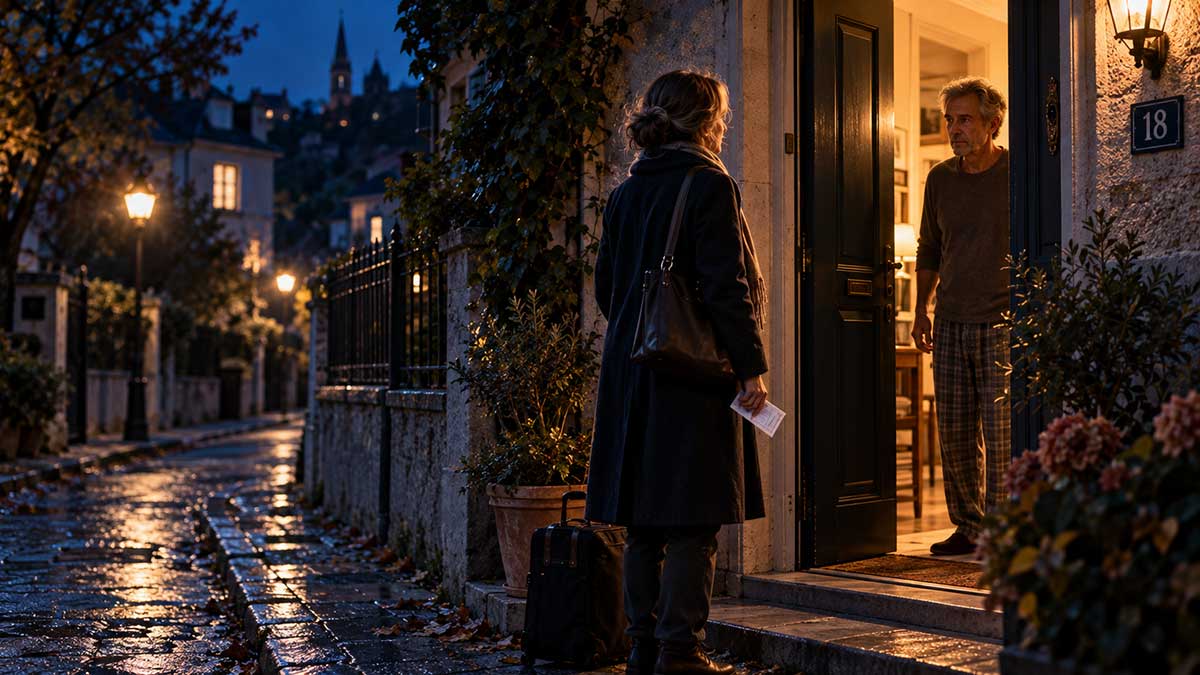
At 10:36 p.m., André Leclerc asked Claire Moreau to mail five letters after he died.
Claire looked at the envelopes arranged across his blanket.
Five.
Each bore a name.
Émilie.
Thomas.
Luc.
Margot.
Sophie.
André was seventy-one.
Pancreatic cancer had reduced him to a narrow shape beneath white hospital sheets, but his handwriting remained surprisingly beautiful.
Claire picked up the first envelope.
"Why can't you mail them yourself?"
André smiled.
"You know why."
"No. I know you're dying. That's different."
He laughed.
Claire had been a hospice nurse for thirty-two years.
She had learned that dying people did not require everyone around them to behave solemnly.
Some wanted prayers.
Some wanted silence.
Some wanted morphine.
Some wanted their children.
Some wanted cigarettes.
One man had asked Claire to bring him a cheeseburger despite being unable to swallow.
André wanted letters.
"Why wait?" Claire asked.
"I was afraid."
"Of what?"
"Answers."
Claire looked at him.
André closed his eyes.
"I thought silence was temporary."
He took a slow breath.
"Then one day I realized I had been silent for twenty years."
Claire said nothing.
André opened his eyes again.
"Do you have anyone like that?"
Claire immediately thought of Marc.
"No."
André smiled.
"Liar."
"You're very rude for a dying man."
"I have limited time to improve."
Claire laughed.
She gathered the five envelopes.
"I'll mail them."
"Promise?"
"Promise."
André nodded.
His eyes closed.
At 3:18 the following morning, André Leclerc died.
Claire had seen hundreds of people die.
She knew the sounds.
The pauses.
The final changes in breathing.
She knew how families sometimes kept speaking after the person could no longer answer.
She knew the strange quiet that entered a room afterward.
She knew how to remove medical equipment without making the body seem like an object.
She knew when to touch a shoulder.
When to leave.
When to say nothing.
Death did not frighten Claire.
Living people were more difficult.
At 7:20 that morning, she finished her shift.
The five letters were inside her handbag.
She walked to a postbox.
Her hand reached toward the opening.
Then stopped.
She looked at André's handwriting.
Twenty years.
Claire returned the letters to her bag.
She would mail them later.
Her younger brother Marc lived two hours away by train.
They had not spoken in eleven years.
If anyone asked why, Claire had an answer.
The inheritance.
That was technically true.
Their mother had died eleven years earlier.
She left Claire and Marc a small house outside Lille, several pieces of jewelry, savings, furniture, and a blue ceramic bowl that neither of them initially wanted.
The argument began over the house.
Marc wanted to sell.
Claire wanted to keep it.
Then it became about money.
Then their mother's final months.
Then who had visited more.
Then who had sacrificed more.
Then who had always been their mother's favorite.
Then childhood.
Then Marc's divorce.
Then Claire's first marriage.
By the end, they were arguing about things that had happened when they were twelve.
The blue bowl broke during the argument.
Claire still remembered the sound.
Marc had knocked it from the table accidentally.
It shattered against the kitchen floor.
Their mother's bowl.
Claire screamed at him.
Marc told her she cared more about objects than people.
Claire slapped him.
Marc stared at her.
Then he left.
That was eleven years ago.
Neither apologized.
At first Claire expected him to call.
Then she decided he should call.
After six months she thought about calling him.
After one year it became harder.
After two years, much harder.
By five years, contacting him required an explanation for five years.
By ten, it required an explanation for ten.
Silence accumulated interest.
Claire had almost called many times.
When her daughter got married.
When Marc turned fifty.
When Claire became a grandmother.
When France won the World Cup.
When their childhood dog appeared unexpectedly in an old photograph.
When Claire found one of Marc's school notebooks in a box.
When she heard their mother's favorite song in a supermarket and cried beside the vegetables.
Each time she thought:
Tomorrow.
Or:
Sunday.
Or:
Christmas.
Or:
His birthday.
She had never thought:
Never.
That was the trick.
She had never chosen permanent estrangement.
She had simply chosen one more day of silence thousands of times.
Three days after André died, Claire mailed four letters.
She kept the fifth.
Sophie.
She did not open it.
She would never violate that.
She simply carried it.
At work.
On the Métro.
At the supermarket.
At home.
Five days.
On the sixth day, Claire searched for Sophie online.
Then stopped herself.
"This is ridiculous."
She mailed the letter.
That evening, she searched for Marc.
She knew his address.
She knew his telephone number too.
Like Naomi with her father, Claire had never deleted it.
She opened their old messages.
The last one was eleven years old.
Marc: I don't want to do this anymore.
Claire's reply:
Claire: Then don't.
That was it.
Eleven years compressed into four words.
Then don't.
Claire read them again.
She wondered how many relationships ended without anyone deciding they should end.
Two weeks later, an envelope arrived at the hospice.
It was addressed to Claire.
Inside was a note.
Dear Madame Moreau,
My father André told me about you.
I received his letter yesterday.
I had not spoken to him in fourteen years.
I don't know what to do with everything he wrote.
Some of it made me angry.
Some of it I wish he had said when he was alive.
I wish I could answer him.
Thank you for sending it.
Sophie Leclerc
Claire sat in the staff room reading the note.
One sentence would not release her.
I wish I could answer him.
She read it again.
André had finally said what he needed to say.
But he had waited until the conversation could travel in only one direction.
Claire folded the note.
For the first time in eleven years, she asked herself a different question.
Not:
What would I say to Marc?
But:
What if Marc has something to say to me?
That night Claire finished work at 10:58.
She walked toward Gare du Nord.
Her apartment was in the opposite direction.
She knew this.
Her feet continued.
Inside the station, people hurried beneath the departure board.
Claire looked up.
11:47.
A train north.
Not exactly to Marc's town, but close enough.
She could connect from there.
Claire checked the time.
11:16.
Thirty-one minutes.
She took out her phone.
Opened Marc's contact.
Her thumb hovered over CALL.
She put the phone away.
"No."
She bought a ticket.
On the train, Claire began writing.
She had brought hospital stationery.
She wrote:
Marc,
I have thought about you every day for eleven years.
She crossed it out.
Too sentimental.
Again.
Marc,
I want to apologize for what happened after Maman died.
She stopped.
Too vague.
Again.
I was grieving and overwhelmed.
Claire stared at the sentence.
It sounded like an excuse.
She tore the page.
Again.
You hurt me.
She laughed.
"Excellent beginning, Claire."
The man across the aisle glanced at her.
She ignored him.
She tried again.
I hurt you too.
Better.
Then:
I should never have slapped you.
True.
You should not have said what you said about Maman.
She crossed that out.
The apology was already becoming an argument.
Claire tore the page.
She wrote for almost an hour.
Four pages.
Six pages.
One page.
Half a page.
Every version attempted to explain eleven years.
Every version failed.
She finally put down the pen.
Outside, darkness covered the countryside.
Claire saw her reflection in the train window.
Sixty next year.
She remembered herself at forty-eight, standing in their mother's kitchen.
She had thought she would always have time.
At fifty she thought the same.
Fifty-five.
Fifty-eight.
Time had not announced itself leaving.
It had simply left.
Claire looked at the ticket receipt beside her.
She turned it over.
She wrote:
Marc,
I don't remember anymore which one of us was right.
I remember that you are my brother.
If you'll open the door, I'm outside.
She read it.
Three sentences.
She folded the receipt and placed it in her coat pocket.
It was 1:21 a.m. when Claire reached Marc's street.
The neighborhood was silent.
She had been there only once since he moved.
That was nine years ago.
She had driven past his house.
She never told anyone.
Number 18.
Dark.
Claire stood across the street.
This was insane.
He could be away.
He could be asleep.
He could have someone with him.
He could refuse to answer.
He could open the door and tell her to leave.
He could have spent eleven years becoming someone who no longer wanted a sister.
Claire's body suddenly felt very heavy.
She had cared for dying people who would have given everything for one more conversation.
Yet standing twenty meters from her living brother's door felt almost impossible.
She crossed the street.
Walked up the path.
Stopped.
Her hand rose toward the bell.
Dropped.
She waited.
Nothing.
Of course nothing.
She had not rung it.
Claire laughed nervously.
"You're ridiculous."
She pressed the bell.
Nothing.
She waited.
Pressed again.
A light came on upstairs.
Claire's heart began pounding.
Movement behind a curtain.
Then a downstairs light.
The door opened.
Marc stood there.
He wore pajama trousers and an old gray T-shirt.
His hair had become almost completely white.
Claire had not expected that.
In her mind Marc was still forty-five.
He looked at her.
She looked at him.
Neither spoke.
Eleven years stood between them.
Claire had prepared three sentences.
She remembered none of them.
"Marc."
"What happened?"
"Nothing."
"Are you sick?"
"No."
"Is Élodie okay?"
"Yes."
"The children?"
"Everyone is fine."
Marc stared at her.
"Then what are you doing here?"
Claire reached into her pocket.
She felt the folded receipt.
She did not take it out.
"I'm sorry."
Marc's face changed.
Claire continued before courage disappeared.
"I shouldn't have slapped you."
Marc said nothing.
"I shouldn't have said what I said."
Still nothing.
"I was angry about Maman. I was angry at you. I was angry at myself. I don't even remember half of what we were fighting about anymore."
"I do."
Claire nodded.
"Okay."
Marc looked surprised.
She had expected herself to defend.
Instead she said:
"Then maybe you can tell me someday."
"Someday?"
Claire almost laughed.
"Bad choice of word."
Marc's mouth moved slightly.
Almost a smile.
Claire felt tears coming.
"I don't want to do this anymore."
Marc's expression hardened.
Claire realized what she had said.
His final message.
I don't want to do this anymore.
Her reply:
Then don't.
"No," she said quickly. "I mean this."
She gestured between them.
"Not speaking."
Marc looked away.
Claire waited.
He rubbed his face.
"You took long enough."
The sentence hit her.
She nodded.
"I know."
Then she saw his shoulders move.
Marc was crying.
Claire had seen her brother cry only three times.
When their father died.
When his first child was born.
When their mother died.
Now four.
Claire began crying too.
"I'm sorry," she said again.
Marc wiped his face angrily.
"I almost called you."
"When?"
"About a thousand times."
Claire laughed through her tears.
"So did I."
"Then why didn't you?"
"Why didn't you?"
For one dangerous second, the old machinery returned.
Who should have called?
Who caused this?
Who waited longer?
Who was more wrong?
Claire could feel the argument waiting for them exactly where they had left it eleven years earlier.
She almost entered it.
Then she remembered André.
Five envelopes.
Sophie.
I wish I could answer him.
Claire looked at Marc.
He was alive.
That changed everything.
"I don't know," she said.
Marc stared at her.
"I was proud."
He looked down.
"Me too."
"I was angry."
"Me too."
"I thought you should call."
"I thought you should call."
Claire laughed.
"So we solved that."
Marc laughed too.
It sounded rusty.
Then familiar.
Painfully familiar.
Claire suddenly remembered them at seventeen and fourteen, laughing in the back seat of their parents' car after Marc had accidentally said something obscene in front of their grandmother.
She had forgotten that laugh.
Or thought she had.
Marc looked at her suitcase.
"You brought luggage?"
"No."
"Nothing?"
"No."
"You came here after one in the morning with nothing?"
"I have a toothbrush."
"Of course."
"I'm a nurse."
Marc shook his head.
"You're insane."
"Probably."
He stood in the doorway.
Claire suddenly became aware that he had not invited her inside.
Perhaps this was as far as the night would go.
She had apologized.
He had answered.
That might be all she was entitled to.
"Okay," Claire said.
"What?"
"I should find a hotel."
"At this hour?"
"I'll manage."
She stepped backward.
Marc frowned.
"Claire."
"Yes?"
"Where are you going?"
"I just said."
He looked irritated.
Some things had not changed.
"Come inside."
Claire stopped.
Marc stepped aside.
The hallway behind him was warm.
A pair of shoes sat near the wall.
Photographs she could not see clearly hung farther inside.
A life had happened there without her.
Eleven years of birthdays.
Christmas mornings.
Illnesses.
Arguments.
Ordinary Tuesdays.
She could never recover them.
Marc could never recover hers.
That was the cost.
No apology could refund time.
Claire walked toward the door.
Then stopped beside him.
"I have something."
She pulled the receipt from her pocket.
Marc unfolded it.
He read the three sentences.
When he finished, he looked at her.
"You were outside."
"Yes."
"So the last sentence was technically accurate."
Claire stared at him.
"That's what you got from it?"
"I'm tired."
She laughed.
He folded the receipt carefully.
He did not give it back.
Claire noticed.
She said nothing.
Marc stepped farther inside.
Claire crossed the threshold.
The door closed behind her.
At 8:06 the next morning, Claire woke on Marc's sofa.
For several seconds she did not know where she was.
Then she smelled coffee.
Marc stood in the kitchen.
"You still drink it black?"
"Yes."
"That's terrible."
"You drink it with sugar?"
"Two."
"At your age?"
"Good morning to you too."
He handed her a cup.
They sat at the kitchen table.
Morning light entered through the window.
Claire looked around.
Photographs covered one wall.
Marc's children.
Grandchildren.
Holidays.
A woman Claire assumed was his partner.
A dog.
Eleven years.
Marc followed her eyes.
"There's a lot you don't know."
Claire nodded.
"There's a lot you don't know either."
"I suppose."
Neither apologized for that.
Not yet.
Marc drank his coffee.
Then he said:
"Do you remember the blue bowl?"
Claire almost dropped her cup.
"Of course."
"I didn't knock it over."
Claire stared at him.
"Don't start."
"I'm serious."
"You hit the table."
"You pushed the box."
"I did not."
"You absolutely did."
"You broke it."
"You broke it."
They stared at each other.
Then Marc smiled.
Claire tried not to.
Failed.
"Eleven years," she said.
"What?"
"We lost eleven years over an argument and neither of us can even agree who broke the stupid bowl."
"It was you."
"Drink your coffee."
Marc laughed.
Claire did too.
The argument was not solved.
Their history was not repaired.
Forgiveness had not arrived overnight.
There would be difficult conversations.
Some memories would collide.
Some apologies would hurt.
Some answers might make things worse before they became better.
Claire knew all of that.
She had spent thirty-two years around people who believed death made relationships simple.
It did not.
Death simply ended the opportunity to continue them.
Marc was sitting across from her.
Alive.
Annoying.
Older.
Real.
There was still an opportunity.
Claire reached for another piece of toast.
Marc slapped her hand away.
"That's mine."
"You have four."
"I made two for you."
"You always were selfish."
"You slapped me."
"Eleven years ago."
"I remember."
"So do I."
They looked at each other.
Claire smiled.
"Good."
Marc frowned.
"What's good?"
"That you remember."
He looked confused.
Claire didn't explain.
She ate his toast.
That afternoon Claire returned to Paris.
At Gare du Nord, she passed the same postbox where she had almost mailed André's five letters weeks earlier.
She stopped.
People moved around her.
Claire thought of André.
Of Sophie.
Of her mother.
Of Marc standing in his doorway.
Then she took out her phone.
There were people she loved who already knew she loved them.
At least she assumed they knew.
Her daughter Élodie was first.
Claire typed:
I had a strange night. I'll tell you later. I just wanted to tell you I love you.
She pressed send.
Then another message.
To an old friend she had not seen in eight months.
Lunch next week? I've missed you.
Sent.
Then Marc.
She considered writing something profound.
Instead:
You still owe me toast.
His reply arrived before she left the station.
You still owe me eleven years.
Claire stopped walking.
Then another message appeared.
Let's not make it twelve.
Claire stood beneath the enormous station clock.
For most of her life, clocks had meant schedules.
Medication.
Trains.
Appointments.
Shift changes.
Time remaining.
This one meant something else.
Not that time was running out.
It always was.
It meant there was still some left.
Claire put the phone in her pocket.
And went home.
Connection to The Correspondent
Claire's story carries Virginia Evans's central invitation into its most direct modern form. Like Sybil, Claire discovers that love, apology, and grief cannot complete themselves privately. Parts 1 and 2 repeatedly asked what happens when people postpone the words that matter. André waits until his daughter can no longer answer him; Claire chooses differently. Her reunion with Marc does not erase eleven years or guarantee forgiveness. It restores something more basic: the possibility of response. There is still time, but only if someone uses it.
Final Thoughts
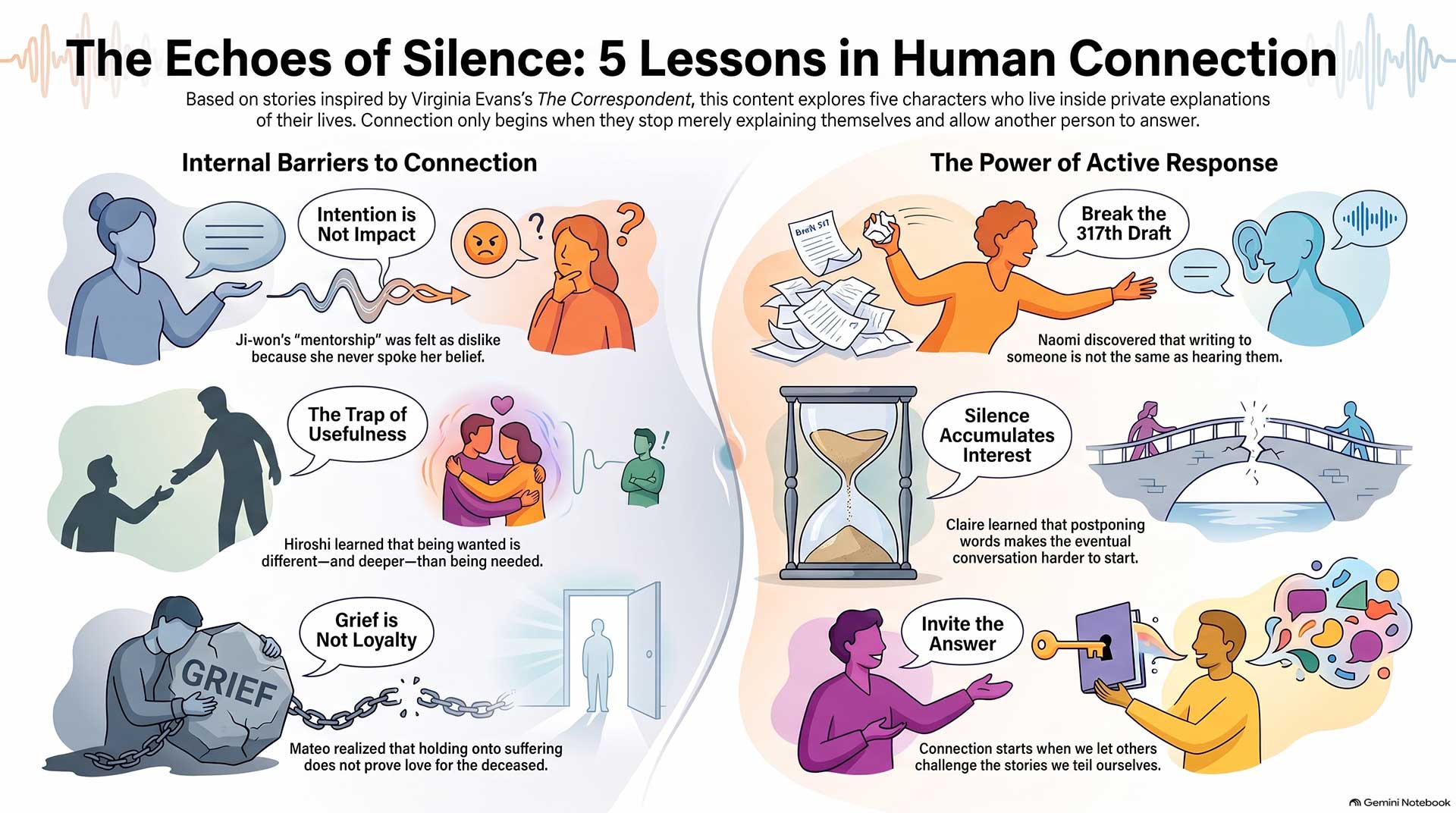
The five protagonists believe they have five different problems.
Ji-won thinks people misunderstood her.
Mateo thinks his grief keeps Elena close.
Naomi thinks she already knows why her father disappeared.
Hiroshi thinks usefulness proves his value.
Claire thinks there will be time later.
Yet each has done something similar.
They have built a private explanation of their life and lived inside it for years.
Then another person answers.
Min-seo tells Ji-won what it actually felt like to work for her.
Lucía tells Mateo that she lost her mother too.
Naomi's father remembers their separation differently.
Mrs. Sato likes Hiroshi without requiring anything from him.
Marc opens the door.
None of these responses magically fixes the past.
That matters.
An apology cannot restore eleven missing years.
A conversation cannot return a dead mother.
Hearing another person's memory does not automatically make our own memory false.
Being forgiven does not erase responsibility.
And continuing to live does not mean we have stopped loving someone who died.
What changes is the possibility of relationship.
This may be one of the most beautiful ideas beneath Virginia Evans's novel.
A letter says:
This is what I remember.
This is what I felt.
This is who I think I am.
But correspondence adds something much more difficult:
Now you may answer.
That is what each protagonist finally permits.
And perhaps that is why the five endings are actions rather than conclusions.
Open the envelope.
Bury the cake.
Answer the phone.
Sit beside someone without fixing them.
Take the train.
The perfect words may never come.
The perfect moment probably will not either.
Someone may already know you love them.
Tell them anyway.
Someone may know you are sorry.
Say it anyway.
Someone may have hurt you.
Ask what they remember.
Someone may not need you.
Let them want you.
Someone may be waiting for you to cross a distance that has existed far too long.
There may still be time.
Use it.
Short Bios:
Virginia Evans
Virginia Evans is the author of The Correspondent. Her epistolary novel explores grief, aging, memory, family, loneliness, forgiveness, and the relationships through which people come to see themselves more fully. Evans has spoken about the importance of reaching toward people we love, repairing connection where possible, and saying what should not remain unsaid.
Han Ji-won
A 42-year-old Seoul restaurant owner whose high standards conceal affection she rarely expresses. On her final night as an owner, thirty-one employee letters force her to encounter versions of herself she never knew existed.
Mateo Álvarez
A 51-year-old widower in Buenos Aires who has preserved a slice of his late wife's birthday cake for seven years. His daughter Lucía forces him to confront whether suffering has become his way of proving that his love remains.
Naomi Brooks
A 34-year-old New York investigative journalist who has written 317 unsent emails to her estranged father. Her carefully constructed account of their separation changes when she finally lets the real man answer.
Hiroshi Tanaka
A 74-year-old retired civil engineer in Tokyo who has measured much of his worth through solving other people's problems. His neighbor Keiko Sato introduces him to something far less measurable: being wanted without being needed.
Claire Moreau
A 58-year-old French hospice nurse who knows professionally that time with another person can disappear without warning. After eleven silent years with her brother Marc, she finally confronts the contradiction between what she knows about mortality and how she has lived.
Leave a Reply