
Introduction
What if the most interesting questions about spiritual guidance begin only after we stop asking whether it exists?
In Guided: The Secret Path to an Illuminated Life, psychic medium Laura Lynne Jackson argues that human beings are surrounded by a "Team of Light," which may include deceased loved ones, spirit guides, angelic beings, and God energy. Through intuition, synchronicity, signs, unexpected encounters, and inner knowing, she believes this unseen support can gently direct our lives.
But Jackson's ideas raise questions that reach far beyond the book.
Who exactly is doing the guiding?
How can we distinguish intuition from fear or imagination?
When does coincidence become a sign?
Should signs influence major life decisions?
If every person is guided, why do terrible things happen?
And if deceased loved ones remain available to us, what happens when reincarnation enters the picture?
To explore these questions, this ImaginaryTalks discussion brings Laura Lynne Jackson together with several prominent mediums and spiritual figures whose views sometimes overlap and sometimes move in very different directions.
James Van Praagh and John Edward place strong value on identifiable evidence from deceased personalities. Theresa Caputo and Matt Fraser focus heavily on continuing relationships, grief, and messages from the Other Side. Edgar Cayce brings ideas about God, reincarnation, soul development, free will, and spiritual discernment. Dolores Cannon takes the discussion into the Higher Self, pre-birth planning, multiple incarnations, and a much larger model of consciousness.
The purpose is not to make them agree.
The most revealing moments may come when people who all accept some form of spiritual reality discover that they mean very different things when they use words such as spirit, guide, soul, intuition, purpose, and afterlife.
Across five conversations, the group moves from signs and guidance into questions about suffering, identity, reincarnation, free will, God, and the purpose of human life.
The central question gradually changes.
It begins as:
"Am I being guided?"
It ends somewhere deeper:
"If I am being guided, what am I being guided to become?"
(Note: This is an imaginary conversation, a creative exploration of an idea, and not a real speech or event.)
Topic 1: Who Is Really Guiding Us? The Mystery of the Team of Light

Moderator: Laura, I want to begin with one phrase from Guided that seems simple when we first hear it, but becomes much more complicated the longer we sit with it.
You call it our Team of Light.
For somebody reading the book for the first time, what do you mean by that?
Laura Lynne Jackson: I mean that none of us comes into this life alone.
We tend to think of ourselves as isolated individuals moving through a difficult physical world, trying to make the correct decisions with limited information.
I don't experience us that way.
I experience us as profoundly connected.
There is God energy. There are guides. There can be angelic beings. There are our loved ones who have crossed. There are people in our physical lives who appear at exactly the moment we need them.
There are different forms of assistance.
I use the phrase Team of Light because I want people to recognize that love surrounds them from more directions than they realize.
Moderator: But the moment you say that, I already have the question many readers would ask.
If I'm walking tomorrow morning and suddenly have a very strong thought:
"Call your sister."
Who said that?
Laura: That is the question.
And sometimes you may never know.
John Edward: I think that part matters.
People want the spiritual world to function like caller ID.
Your mother is calling.
Your grandfather is calling.
Your guide is calling.
I don't think it always works that cleanly.
James Van Praagh: Yet there can be distinctions.
When I communicate with a deceased personality, there is often a recognizable quality to that personality.
The personality doesn't simply dissolve.
A mother may still feel like the mother.
She may have her mannerisms.
Her humor.
Her concern for her children.
Certain memories.
Certain ways of expressing herself.
Those things can carry through.
Theresa Caputo: Yes.
People sometimes think that once somebody dies they become this completely different being.
In my experience, your father is still your father.
Your sister is still your sister.
They don't suddenly become strangers simply because they've left their physical bodies.
Matt Fraser: Their perspective can change, though.
They may see their life differently.
They may understand things they couldn't understand here.
They may recognize pain they caused.
They may understand relationships more clearly.
But the personality is still recognizable.
Moderator: Edgar, does that fit your view?
Is a deceased loved one simply the same personality continuing somewhere else?
Edgar Cayce: The personality is real, yet it is not the entirety of the soul.
A human being tends to identify himself with one earthly existence.
The soul has a longer history.
The personality may be compared with one chapter in a much larger story.
What survives is not less than the individual personality.
It is more.
Laura: I love that distinction.
Moderator: Dolores, I suspect you would take it farther.
Dolores Cannon: Much farther.
People think of themselves as a single person living a single life.
That is the perspective available from inside the physical body.
But when individuals in deep hypnosis moved beyond ordinary conscious awareness, they often described something far larger.
They might call it the Higher Self.
The Oversoul.
The Subconscious.
Those words were imperfect attempts to describe a larger level of consciousness.
The person sitting in the chair was one expression of something much bigger.
Moderator: Then let me make the question uncomfortable.
Laura says she has a Team of Light.
Dolores says there may be a much larger Self.
Edgar speaks about the soul.
John and James communicate with recognizable deceased personalities.
Are we talking about five different things?
Or are we slicing one reality into different categories?
Dolores: That depends on the level from which you're looking.
From the human level, grandmother is grandmother.
From a larger level, grandmother is much more than the human identity her family knew.
Both can be true.
James: I agree up to a point.
But I would be careful about making the individual personality disappear into some giant consciousness.
When someone comes through and gives a piece of evidence that only the family understands, that individuality matters.
If somebody says, "Your father is here," and then describes his favorite chair, his nickname for his daughter, and the strange joke he made every Christmas, that isn't an abstract cosmic consciousness.
That person has identity.
Dolores: I am not saying identity vanishes.
I'm saying identity is nested inside something larger.
John: That may actually resolve some things.
A lot of people think reincarnation contradicts mediumship.
"If my mother has reincarnated, how can you talk to my mother?"
That assumes consciousness can occupy only one position at one time.
Maybe that's a physical assumption we're applying to something nonphysical.
Moderator: Laura, when you experience someone's Team of Light, do you distinguish a deceased loved one from a guide?
Laura: Often, yes.
A loved one feels personal.
There is an emotional signature.
There are memories.
There is a relationship.
A guide can feel different.
The relationship isn't based on a shared physical lifetime in the same way.
The guidance may feel broader.
Moderator: Can a guide have once been human?
Laura: I believe that is possible.
Matt: This is one of those areas where mediums can disagree.
Some people define guides very narrowly.
Others use the term for nearly any spiritual assistance.
I've found that those labels can sometimes create more confusion than clarity.
Theresa: Most people grieving somebody they love aren't asking for a metaphysical classification.
They want to know:
"Is my son okay?"
"Does my mother know I love her?"
"Did my husband hear what I said at his funeral?"
Those are the questions that matter in the beginning.
Moderator: That's important.
But Guided asks us to move beyond reassurance.
If my deceased mother is now part of my Team of Light, can she actually guide my life?
Or can she simply love me?
Theresa: Love can be guidance.
Moderator: Explain that.
Theresa: Sometimes people think guidance means instructions.
Take this job.
Marry this person.
Move to Florida.
Don't get on that airplane.
Maybe sometimes someone experiences something that direct.
But many messages aren't commands.
They remind the living person of who they are.
They restore confidence.
They heal guilt.
They let somebody stop living from fear.
That can change a person's direction without a spirit telling them which highway to take.
Laura: Yes.
That is very close to how I see it.
Our Team of Light isn't controlling us.
They aren't puppeteers.
They help us remember ourselves.
Edgar: Free will remains essential.
A spiritual being who respects the soul does not abolish choice.
Guidance is not coercion.
Moderator: Then let's introduce God.
Laura, you include God energy within the Team of Light.
Edgar, your worldview placed God at the center.
Yet modern spiritual language sometimes puts God, Universe, Source, guides, angels, loved ones, and Higher Self into one basket.
Does that blur distinctions that matter?
Edgar: Very much so.
A guide is not God.
An angel is not God.
A deceased relative is not God.
Human beings may receive assistance through many channels, but the source of life itself is greater than any intermediary.
One must be careful not to worship the messenger.
Laura: I agree that God is not simply one more member of a committee.
When I use Team of Light, I don't mean that God and my grandmother occupy identical spiritual positions.
I'm trying to give readers language that allows them to feel supported.
Moderator: Dolores, what would you say about God?
Dolores: The sessions often used words like Source or Creator.
The descriptions pointed to an originating consciousness from which everything comes.
People argued over vocabulary.
God.
Creator.
Source.
The name mattered less than what they were trying to describe.
Edgar: Names may vary, but relationship matters.
If all distinctions disappear, discernment becomes difficult.
Dolores: That's fair.
But human religions can become trapped in names too.
People can spend centuries fighting over terminology while describing experiences that may overlap far more than they realize.
Moderator: Now we are getting somewhere.
Suppose a Christian says:
"That voice was the Holy Spirit."
A medium says:
"That was your guide."
Someone influenced by Dolores says:
"That was your Higher Self."
A Buddhist might describe intuitive awareness in entirely different language.
Could all four people have experienced something related?
Laura: I think they could.
Edgar: They could, but one should not assume equivalence merely because the experiences feel similar.
John: That's the tension.
We have to leave room for two possibilities.
Different cultures may use different language for similar phenomena.
And different phenomena may feel similar to the person receiving them.
James: Which is why evidence matters.
Moderator: You keep returning to evidence.
James: I do.
Spirituality becomes vague very easily.
People can make anything mean anything.
If I say, "Your father is around you," that's comforting.
If I describe something very precise that I could not reasonably know, now we have something to examine.
Moderator: Does that standard work for guidance?
Suppose somebody wakes up feeling:
"I shouldn't go to work today."
There is no deceased father identifying himself.
There is no verifiable detail.
Should they trust that?
James: I would not automatically tell them yes.
Laura: Neither would I.
Moderator: That might surprise some readers.
Laura: Spiritual guidance should not make people abandon common sense.
People sometimes hear "trust your intuition" and think it means every feeling is sacred instruction.
That is not what I mean.
Fear can speak loudly.
Trauma can speak loudly.
Desire can speak loudly.
The ego can speak loudly.
Guidance often has a different quality.
Matt: And sometimes people ask mediums to make decisions that belong to them.
"Should I divorce my husband?"
"Should I quit my job?"
"Should I sell my house?"
That's not what mediumship should become.
Theresa: Exactly.
Your loved ones aren't trying to live your life for you.
Moderator: But if they're part of the Team of Light, why wouldn't they tell you what to do?
Theresa: Because then it wouldn't be your life.
Edgar: Choice is part of the soul's development.
If every difficult decision were answered from the unseen world, much of earthly life would lose its purpose.
Dolores: People come here to experience limitation.
They come into a condition where they do not consciously remember everything.
If you arrived knowing every answer, many lessons would disappear.
Moderator: That raises a strange thought.
Maybe uncertainty is intentional.
Laura: I think uncertainty can have value.
We want signs that erase all doubt.
But perhaps we're meant to participate.
We notice.
We feel.
We choose.
We learn.
Moderator: Then why have guides at all?
If they won't tell us the answer, what are they doing?
Laura: Helping us become more ourselves.
Moderator: That sounds beautiful.
It is still vague.
Laura: Then let me make it practical.
Suppose someone has always wanted to paint.
They keep suppressing it.
They're practical.
They have responsibilities.
They tell themselves it is childish.
Then a friend unexpectedly gives them painting supplies.
They hear a conversation about creativity.
They find an old drawing they made as a child.
They meet someone who invites them to an art class.
None of those things commands them.
But together they awaken something.
Maybe guidance isn't:
"Quit your job tomorrow and become an artist."
Maybe guidance is:
"Pay attention. This part of you is still alive."
John: That is a much healthier way to think about signs.
Moderator: Edgar, would you call that divine guidance?
Edgar: It could be.
The test would partly lie in what it produces.
Does it lead the person toward greater love?
Greater service?
Greater responsibility?
Greater truth?
Or does it feed vanity, selfishness, obsession, or escape?
Moderator: So the quality of the guidance can be judged by its fruit.
Edgar: Yes.
Laura: I like that very much.
Moderator: Dolores, would you use the same standard?
Dolores: I would ask whether it moves the person closer to the purpose they came to experience.
Edgar: And I would ask how that purpose relates to God.
Dolores: We may be using different language around a similar center.
Edgar: Perhaps.
But language can reveal genuine differences too.
Moderator: Good. I don't want to smooth those differences away.
Let's make this harder.
Could a deceased loved one give bad advice?
Theresa: Deceased doesn't mean suddenly perfect.
John: That's important.
Death doesn't automatically turn everyone into an all-knowing spiritual master.
James: Precisely.
Matt: People assume someone crosses over and instantly knows every secret of the universe.
That's not how I would describe it.
Moderator: Then why trust Grandma?
Theresa: You trust her love.
That doesn't mean you make her your financial advisor.
Laura: That's beautifully said.
Moderator: Could Grandma say, "Don't marry him," and be wrong?
John: I wouldn't build mediumship around that kind of instruction.
James: Nor would I.
Moderator: That tells me something important.
There may be a difference between connection and authority.
Laura: Yes.
A loved one can be present without becoming the authority over your choices.
Moderator: What about guides?
Do guides have greater authority?
Edgar: A guide should still not replace conscience, reason, or one's relationship with God.
Dolores: The Higher Self is different from an ordinary guide in my framework.
It is part of the larger consciousness of the person.
Moderator: Then if the Higher Self knows more than the everyday self, why wouldn't we obey it?
Dolores: Because the earthly personality still came here to choose.
Information may be available.
Living remains the person's responsibility.
Moderator: I notice everyone keeps returning to free will.
Laura: Because guidance without free will becomes control.
Moderator: Laura, your title is Guided, not Controlled.
Laura: Exactly.
Moderator: Let me bring in another reader concern.
How do I know the guide is good?
Many spiritual traditions warn about deceptive spirits.
Does everyone here believe all spiritual communication is safe?
James: No one should approach anything spiritual without discernment.
John: And emotional stability matters.
If somebody begins believing every thought is a command from the dead, that's not healthy spirituality.
Theresa: Fear shouldn't be cultivated either.
People can become so frightened of doing something wrong spiritually that they stop trusting themselves altogether.
Matt: Intention matters.
The way you approach this matters.
Edgar: Prayer matters.
Alignment with God matters.
The desire for truth matters.
Seeking phenomena merely for fascination can become a distraction.
Laura: I agree.
My work is not about getting people addicted to signs.
It's about helping them live with more love and less fear.
Moderator: That may be one of the distinctions readers miss.
The goal of Guided isn't to turn daily life into an endless scavenger hunt for supernatural messages.
Laura: Exactly.
If you're spending every waking hour asking:
"Was that bird my mother?"
"Was that number my guide?"
"Was that song a message?"
you may stop actually living.
Signs should reconnect you with life, not remove you from it.
Moderator: Then the Team of Light isn't supposed to become a replacement for human relationships either.
Laura: No.
Our physical relationships matter enormously.
Sometimes the guidance comes through the living.
A friend calls.
A stranger says the right thing.
A teacher opens a door.
A child asks a question that changes you.
Your Team of Light doesn't exist in competition with the human world.
Dolores: The separation between physical and spiritual may be less absolute than people think.
Moderator: Meaning?
Dolores: People ask:
"Was that person sent by Spirit?"
They assume there must be two possibilities.
Either it was an ordinary human encounter, or it was spiritually arranged.
Why can't it be both?
John: That's something I've seen repeatedly.
People can become signs for each other without knowing it.
James: A five-minute conversation can redirect a life.
Theresa: And the person delivering the message may go home without realizing anything happened.
Moderator: That makes the Team of Light larger than a group of invisible beings standing around us.
Laura: Much larger.
It is connection itself.
Moderator: Yet I want to keep one distinction from disappearing.
If every helpful person, every intuition, every coincidence, every deceased loved one, every guide, every angel, the Higher Self, and God can all be described as guidance, isn't the idea so broad that almost anything can fit inside it?
Laura: That's a fair challenge.
Which is why I don't think the lesson is to label everything.
The lesson is to become more attentive.
Moderator: To what?
Laura: To love.
To connection.
To the things that make you more alive.
To the quiet nudges that ask you to become more courageous, more creative, more compassionate.
To moments that open rather than diminish you.
Edgar: And to truth.
Laura: Yes.
Moderator: James, is that enough for you?
James: I would still want discernment and evidence when someone makes specific claims about spirit communication.
But for personal guidance, life cannot be reduced to laboratory proof.
People have to develop judgment.
John: And humility.
One of the healthiest sentences in spiritual work is:
"I could be wrong."
Theresa: I wish more people said that.
Matt: Me too.
Moderator: Laura, do you say it?
Laura: Of course.
Being a medium doesn't make me infallible.
Moderator: Does that weaken your confidence in Guided?
Laura: No.
It deepens it.
Guidance isn't about achieving perfect certainty.
It's about relationship.
You learn the language over time.
You become quieter.
You become more attentive.
You notice what consistently moves you toward love instead of fear.
You stop demanding that every message arrive with proof attached.
But you don't surrender your intelligence either.
Moderator: Edgar, does that satisfy you?
Edgar: If love is joined with truth, humility, responsibility, and God, it is a worthy path.
Dolores: And I would say the person eventually discovers that the guide they were searching for outside themselves was connected to something much larger within them.
Laura: And I would say both can be true.
We can receive love from beyond ourselves and discover something sacred within ourselves at the same time.
Moderator: Then perhaps the mystery isn't solved.
We still don't know exactly where the sudden thought comes from.
God.
A guide.
Mother.
Higher Self.
Subconscious mind.
Some meeting point among them.
But perhaps the most mature spiritual question isn't immediately:
"Who sent this?"
Perhaps it is:
"What is this asking me to become?"
Laura: Yes.
That is where guidance becomes meaningful.
Edgar: And the answer should lead toward greater light.
Dolores: Greater awareness.
James: Greater truth.
Theresa: Greater love.
John: And greater responsibility for your own life.
Moderator: Maybe that is the boundary worth keeping.
We may be guided.
But we are still the ones who must live the life.
Topic 2: Sign, Coincidence, or Direction? When Should We Actually Follow What We Receive?

Moderator: Laura, in Signs, much of the emotional force came from the idea that people we love may still be able to reach us.
A song.
A bird.
A number.
An object.
A phrase appearing at exactly the right moment.
But Guided seems to take one more step.
A sign does not simply say:
"I am here."
Sometimes it appears to say:
"Look this way."
Is that fair?
Laura Lynne Jackson: Very fair.
A sign can comfort you.
It can remind you that love continues.
But sometimes signs become part of a sequence.
They begin to move you.
Not force you.
Move you.
Moderator: Give me an example.
Laura: Suppose someone has been thinking for years about writing.
They dismiss it.
They tell themselves they are too old.
Then they meet someone who says, "You should write."
A book falls off a shelf about writing.
They find an old journal.
A friend randomly invites them to a writing workshop.
Any one of those things could be coincidence.
But something inside the person begins waking up.
That is where I would say:
Pay attention.
John Edward: I like that phrase more than:
"Obey the sign."
Laura: Absolutely.
Moderator: That difference feels important.
John: Very.
People sometimes want spiritual signs to function like traffic signals.
Green means go.
Red means stop.
Spirit doesn't always work that way.
James Van Praagh: And human beings can become very suggestible once they want an answer.
If someone desperately wants to believe a relationship is meant to continue, they may start treating every song lyric as confirmation.
Theresa Caputo: Yes.
Grief can do the same thing.
When you miss someone terribly, you can become hyperaware of anything connected to them.
That does not mean the experience is meaningless.
But emotion can magnify everything.
Moderator: Laura, how do you separate a genuine sign from that?
Laura: Sometimes you cannot immediately.
That is part of being human.
I look for meaning, timing, repetition, emotional resonance, and whether the experience opens something healthy in the person.
Moderator: But those are still subjective.
Laura: They are.
Moderator: James, does that bother you?
James: It depends on what claim is being made.
If somebody says:
"This song played and it made me feel close to my husband."
I don't need to prove anything.
That experience helped them.
If somebody says:
"My husband from the spirit world is telling me to invest my retirement savings in this company."
Now I want a much higher standard.
Moderator: So the stakes matter.
James: Very much.
Matt Fraser: That's where people can get into trouble.
A meaningful sign can become a command in their mind.
Those are not the same thing.
Moderator: Theresa, when someone tells you:
"I keep seeing cardinals. Is that my mother?"
what do you say?
Theresa: I might ask what cardinals meant to their mother.
Was there a connection?
Did she love them?
Did something happen involving one?
Or did the person simply read online that cardinals mean deceased loved ones?
Personal meaning matters.
Moderator: That's interesting.
So if the symbol means nothing personally, you're less convinced?
Theresa: I wouldn't automatically dismiss it.
But I wouldn't say every cardinal is somebody's mother either.
John: Social media has turned spiritual symbolism into a giant dictionary.
Butterfly means this.
Dragonfly means that.
Feather means this.
Number 444 means that.
It can become very mechanical.
Laura: Exactly.
A real sign is often deeply personal.
It can be almost absurdly specific.
Moderator: Such as?
Laura: Something only you and the person who died would connect.
A private phrase.
A strange object.
A song attached to one precise memory.
A symbol you asked for privately.
That kind of specificity can feel very different from simply seeing a common bird.
Moderator: Edgar, what would you make of all this?
Edgar Cayce: The human mind seeks meaning.
That can be sacred.
It can be misleading.
A sign should never become a substitute for wisdom.
Moderator: Then how should it function?
Edgar: As an invitation to examine the self.
What is being awakened?
What is being asked of the conscience?
Does the experience lead toward patience, love, service, responsibility?
Or toward fixation?
Dolores Cannon: I would add that synchronicity can place someone in contact with a path they had already intended before entering this life.
Moderator: Intended before birth?
Dolores: Yes.
From the larger perspective, people may arrange certain possibilities.
Not every detail.
But certain meetings.
Certain turning points.
Certain opportunities.
Then, from the human level, they experience them as accidents.
Moderator: Laura, do you go that far?
Laura: I think we can be led into encounters that matter deeply.
Whether every one of those was literally planned before birth, I don't pretend to know.
Moderator: Good. Let's stay with that difference.
Dolores sees some events as potentially connected to pre-birth planning.
Laura sees meaningful guidance but remains more cautious about how much was arranged.
Edgar emphasizes what the sign produces in the person's character.
James wants stronger evidence when the claim becomes concrete.
John warns against turning symbolism into a codebook.
Already, everyone believes something meaningful may be happening, but you are not saying the same thing.
Matt: That's exactly right.
Moderator: Then let's ask the harder question.
Why are signs so indirect?
If my mother is alive somewhere after death and wants me to know she is okay, why send me a song?
Why not say:
"Nick, it's Mom. I'm fine."
Why all the ambiguity?
Theresa: Sometimes people do feel something very direct.
Moderator: But usually not that direct.
Theresa: No.
John: Mediumship itself is translation.
I don't hear everything like a person standing beside me speaking normal sentences.
Information can come through images, impressions, emotions, memories, symbols.
James: It has to pass through the medium's own mind.
That matters.
Moderator: So one reason for ambiguity could simply be the communication channel.
James: Yes.
Laura: I think there is another reason.
We are meant to participate.
Moderator: Meaning?
Laura: If every spiritual truth arrived with undeniable proof, life would be very different.
There would be no need to develop trust.
No need to listen.
No need to choose.
Edgar: Free will would still exist, but the conditions of choice would change.
Moderator: Do you think God deliberately preserves uncertainty?
Edgar: There is value in seeking.
Faith that requires no inner response becomes mere observation.
Dolores: The veil has a purpose.
People come into physical life without complete memory.
If they remembered everything about why they came, much of the experience would be altered.
Moderator: So ambiguity might be part of the design.
Dolores: Yes.
Moderator: John, do you buy that?
John: Partly.
But I wouldn't use "the veil" to explain every weak message.
Sometimes a medium simply isn't getting enough information.
Sometimes people stretch meaning too far.
We should be able to admit that.
James: Completely.
Moderator: Laura, what do you think of that?
Laura: I agree.
Spiritual language can become an excuse for imprecision if we're not careful.
Moderator: That's one of the most interesting things happening here.
You are all protecting the possibility of signs from becoming unfalsifiable.
Laura: It has to stay grounded.
Moderator: Then let me give you a scenario.
A woman is unhappy in her marriage.
For three weeks she keeps seeing the word "freedom."
A billboard.
A book title.
A song.
A stranger says, "Sometimes you have to choose freedom."
She starts thinking:
"My Team of Light is telling me to leave my husband."
What do you tell her?
Theresa: Slow down.
John: Definitely slow down.
James: A sign should never replace serious thought about a major decision.
Laura: I would ask:
What is the sign awakening in you?
Maybe the message isn't:
"Leave your husband."
Maybe the word "freedom" is asking:
"Where in your life do you feel trapped?"
That could lead to a conversation.
Therapy.
A boundary.
A change inside the marriage.
Or yes, possibly leaving.
But the sign itself does not necessarily give the final instruction.
Moderator: That is a much more subtle interpretation.
Laura: It has to be.
Matt: People want certainty.
That is why spiritual answers can become attractive.
"Tell me what Spirit wants me to do."
But sometimes the medium's most responsible answer is:
"You need to decide."
Moderator: Dolores, would the Higher Self know the answer?
Dolores: From the larger level, it may understand what experiences are available through different choices.
But even then, the human personality came to make choices.
Moderator: So the Higher Self might know more, but still not dictate.
Dolores: Correct.
Edgar: Spiritual growth requires willing participation.
Moderator: What if the sign concerns danger?
A mother wakes up at 3:00 in the morning feeling:
"Call my son."
Should she call?
Laura: I would.
James: So would I.
John: Same.
Moderator: Why is that different?
Laura: The cost of checking is small.
Moderator: Ah.
So practical risk enters the equation.
Laura: Of course.
If you feel:
"Call your son,"
you call.
If you feel:
"Sell your house tomorrow and send all the money to someone you met online,"
you do not say:
"Well, intuition told me."
Theresa: Exactly.
Moderator: That sounds almost obvious when you say it that way.
John: Yet people do make extreme decisions in the name of spiritual guidance.
Moderator: Then should we have a rule?
The larger the consequence, the stronger the evidence required?
James: I would support that.
Laura: I would too.
Edgar: Wisdom requires proportional judgment.
Moderator: Let me make the scenario more difficult.
A man is offered a job in another state.
Logically, the job looks good.
Better pay.
Good company.
His family supports the move.
But every time he considers accepting it, he feels a deep sense of dread.
There are no signs.
No deceased relative.
No repeating numbers.
Just dread.
What should he trust?
Laura: He should explore the dread.
Not automatically obey it.
Explore it.
Moderator: How?
Laura: Ask what it feels like.
Fear of change?
Fear of leaving family?
Or something quieter saying:
"This is not your path"?
John: The emotional texture matters.
Anxiety and intuition can feel very different once you learn yourself.
Moderator: Can they?
People with anxiety might say they cannot tell the difference.
John: That's true.
Which is why spiritual advice needs to be careful.
Matt: Sometimes you need time.
If the feeling is real guidance, it does not always need an immediate dramatic response.
Theresa: And talk to people you trust.
Moderator: That's another point.
Spiritual guidance does not have to be privately interpreted in isolation.
Theresa: No.
Isolation can make people spiral.
Edgar: Counsel has always mattered in spiritual traditions.
Moderator: Laura, does community help test signs?
Laura: Absolutely.
Someone who loves you and knows you well can sometimes see when you're being led by fear.
Moderator: Let's move into coincidence.
Suppose someone asks their deceased father:
"If you're really around me, show me a yellow rose."
The next day they pass a florist with yellow roses in the window.
Sign?
Laura: Maybe.
Moderator: That's it?
Laura: Maybe.
Moderator: People want more than that.
Laura: I know.
But I don't want to manufacture certainty.
James: Good answer.
Moderator: Two days later, their sister, who knows nothing about the request, mails them a card with a yellow rose on the front.
Laura: Now I'm paying more attention.
John: Me too.
Moderator: Then at dinner a stranger at the next table says:
"My father always loved yellow roses."
Theresa: At that point I'd probably laugh.
Moderator: Why?
Theresa: Sometimes the repetition becomes so oddly specific that you stop needing to argue with it.
Moderator: But someone skeptical could still say probability produces strange clusters.
James: They could.
Moderator: Do you need to prove them wrong?
James: No.
Moderator: That's interesting.
James: A personal spiritual experience does not need to become a universal proof claim.
That's where people get tangled.
Laura: Exactly.
The sign may be for the person who asked.
Not for the world.
Moderator: So private meaning and public evidence are different categories.
James: Very different.
Moderator: Edgar, would you agree?
Edgar: Yes.
But private meaning still needs discernment.
A person can sincerely misinterpret an experience.
Moderator: Let's talk about confirmation bias.
If I ask for a blue butterfly and then spend the next week searching everywhere for blue butterflies, I am more likely to see one.
Does that weaken the sign?
Laura: It can.
Moderator: So should people stop looking?
Laura: I tell people to ask, then release it.
Don't obsess.
Live your life.
Let the sign come to you.
John: That's much healthier.
Theresa: And sometimes it comes in a way you did not expect.
Moderator: What if it never comes?
Laura: That does not mean your loved one isn't there.
Moderator: This is one of the hardest reader questions.
Someone asks for a sign from their child who died.
Nothing happens.
Another person says:
"I get signs from my husband every week."
Why?
Laura: I don't know every reason.
I think receptivity differs.
Grief can make people numb.
People can miss signs.
Communication may differ.
But I would never tell a grieving parent:
"Your child isn't sending signs because you're not spiritually developed enough."
That would be cruel.
Theresa: Very cruel.
James: Agreed.
Moderator: Could there simply be no sign?
Laura: Yes.
Moderator: And the person should not manufacture one?
Laura: Correct.
Moderator: That answer matters.
Edgar: Silence has spiritual meaning too.
Moderator: What do you mean?
Edgar: Human beings often assume guidance must arrive as an event.
Sometimes growth occurs in the absence of an answer.
Dolores: Or the person's path requires them to develop inner trust rather than constant external confirmation.
Moderator: But that explanation can become impossible to test.
If the sign comes, it means guidance.
If no sign comes, that means guidance too.
Dolores: That is fair.
Moderator: How do we avoid making every possible outcome proof of the same theory?
James: By being willing to say:
"We don't know."
Laura: Yes.
John: That phrase again.
Moderator: Maybe "I don't know" is becoming the most spiritually important phrase in this conversation.
Theresa: It should be used more often.
Moderator: Matt, what about repeating numbers?
People see 111, 222, 444.
Do those numbers have universal meanings?
Matt: I think personal context matters more than universal lists.
Moderator: So you would not say:
"444 always means your angels are near"?
Matt: I would be careful with that.
Laura: Me too.
Moderator: Then why are universal angel-number interpretations so popular?
John: People like systems.
James: Systems make uncertainty feel manageable.
Theresa: And they give people immediate answers.
Moderator: Edgar, would you distrust that?
Edgar: I would distrust any system that encourages a person to surrender reason.
Symbols can have meaning.
But meaning emerges through context.
Moderator: Laura, one of the ideas in Guided is that life can begin to look like a trail of breadcrumbs.
You follow one thing.
It leads to another.
Then another.
At what point does following breadcrumbs become overinterpretation?
Laura: When you stop living and start decoding everything.
Moderator: That's a good boundary.
Laura: Signs should make you more present in life.
Not less present.
Moderator: Suppose somebody spends two hours every morning journaling every number, dream, bird, song, coincidence, and stranger they encounter.
Healthy?
Laura: Maybe for a short period of reflection.
But if their whole life becomes interpretation, I would worry.
John: Same.
Theresa: Spirituality should not become compulsive.
Moderator: So there can be sign addiction.
Matt: Absolutely.
Moderator: What does that look like?
Matt: Someone cannot make a decision without asking for a sign.
They ask:
"Should I order this?"
"Should I call her?"
"Should I drive today?"
They keep asking until they receive the answer they want.
At that point the signs are not creating freedom.
They are creating dependence.
Edgar: And dependence upon signs can weaken the very faculty one seeks to develop.
Moderator: Which faculty?
Edgar: Discernment.
Laura: Yes.
The goal is not to become dependent on external confirmation.
The goal is to become more connected.
Moderator: Dolores, would you say more connected to the Higher Self?
Dolores: Yes.
Eventually the person may need fewer external signs because the inner connection becomes clearer.
Moderator: That sounds like a progression.
At first:
"Show me something."
Later:
"Help me notice."
Later still:
"I trust the deeper direction without demanding constant proof."
Laura: That's very close to how I see it.
Moderator: Then maybe Guided is not really teaching people how to collect more signs.
Laura: No.
Moderator: It is teaching them how to need fewer?
Laura: In a way, yes.
James: That's interesting.
Theresa: I like that.
Moderator: Let me ask each of you one quick question.
A sign appears.
What is the first thing you ask?
James?
James: Is there anything specific or verifiable about it?
Moderator: John?
John: What does it mean personally to you?
Moderator: Theresa?
Theresa: What did you feel before you started analyzing it?
Moderator: Matt?
Matt: Is this bringing peace and clarity, or creating obsession and fear?
Moderator: Edgar?
Edgar: What fruit does it produce in your life?
Moderator: Dolores?
Dolores: What larger pattern might it be pointing toward?
Moderator: Laura?
Laura: Does it make you more open to love, connection, creativity, courage, and life?
Moderator: Those answers are strikingly different.
Evidence.
Personal meaning.
Feeling.
Mental health.
Character.
Life pattern.
Connection.
Maybe that tells us something.
A genuine sign may not be defined by one feature.
It may need to survive several questions.
Does it mean something?
Does it fit the context?
Does it remain healthy?
Does it respect free will?
Does it lead somewhere constructive?
Can I hold it lightly without forcing certainty?
Laura: Yes.
Moderator: Then perhaps the safest question after receiving a sign is not:
"What is Spirit telling me to do?"
Maybe it is:
"What is this inviting me to notice?"
Laura: Exactly.
Moderator: That leaves the door open.
But it leaves your hands on the steering wheel.
Edgar: As they should remain.
Theresa: Your loved ones can walk with you.
They shouldn't have to walk for you.
John: And a sign can comfort you without becoming an order.
James: Meaning does not require blind obedience.
Dolores: Sometimes one small synchronicity simply asks you to look more closely at your own life.
Laura: And once you look, the choice is still yours.
Moderator: Then perhaps that is the difference between being guided and being controlled.
A sign may point.
It may reassure.
It may awaken.
It may make us notice a door we had overlooked.
But it does not remove the responsibility of deciding whether to walk through it.
Topic 3: Intuition, Imagination, Fear, or Spirit? How Do We Know What Voice We Are Hearing?

Moderator: Laura, I think we have reached the question that may be hardest to answer honestly.
In Guided, you encourage people to listen more carefully to intuition.
You distinguish that quieter inner knowing from what you sometimes call the "monkey mind," the constant stream of fear, analysis, prediction, argument, memory, and worry.
That sounds clear when we describe it afterward.
But when somebody is actually living through a difficult moment, it may not feel clear at all.
A woman wakes up with the thought:
"Something is wrong with my daughter."
Is that intuition?
Anxiety?
Maternal fear?
A message from Spirit?
A memory her subconscious mind has connected with something?
How can she know?
Laura Lynne Jackson: Sometimes she cannot know immediately.
I think that is the first thing we have to admit.
People want a formula.
Intuition feels like this.
Fear feels like that.
Spirit sounds like this.
Your imagination sounds like that.
There are patterns, but human beings are complicated.
Moderator: What pattern do you notice most often?
Laura: Intuition tends to arrive simply.
It doesn't usually argue its case.
It can be very quiet.
You suddenly know something.
Then your mind starts talking about what you just knew.
That second part is often where confusion enters.
John Edward: That's very familiar to mediums too.
The first impression can be incredibly quick.
Then the analytical mind jumps in.
"Why would I be seeing that?"
"That makes no sense."
"Maybe I'm wrong."
"Maybe it means something else."
You can contaminate the original information by trying too hard to understand it.
James Van Praagh: Which is why learning mediumship requires learning your own mind.
You need to know your tendencies.
Your fears.
Your biases.
Your expectations.
Otherwise you can't tell what belongs to you and what may be coming from elsewhere.
Moderator: So becoming more intuitive might require becoming more self-aware.
James: Very much.
Theresa Caputo: And people sometimes assume mediums never doubt anything.
That's not true.
You can receive something and think:
"What in the world does that mean?"
Moderator: What do you do then?
Theresa: I give what I'm getting without trying to make it prettier.
If I see a red shoe, I might say:
"I'm seeing a red shoe."
I don't immediately turn that into:
"Your mother wants you to walk a new path."
Maybe it literally means a red shoe.
Moderator: That's interesting.
You're resisting interpretation.
Theresa: When possible, yes.
Interpretation is where you can get yourself into trouble.
James: Exactly.
Evidence can be strange.
If I receive something oddly specific, I want to preserve its oddness.
The moment I convert it into a spiritual metaphor, I may lose the very thing that could make it meaningful to the recipient.
Moderator: Matt, is that how you work too?
Matt Fraser: Very often.
People expect messages from the Other Side to sound poetic.
Sometimes they are very ordinary.
Someone shows me a kitchen table.
A blue truck.
A dog with one ear that stood up strangely.
A phrase.
A nickname.
Those ordinary details can matter more than a grand spiritual statement.
Moderator: Laura, your book is aimed at people who are not professional mediums.
They may have no training in separating impressions from interpretation.
If a reader says:
"I keep feeling that I should quit my job,"
how would you help that person test whether it is intuition?
Laura: I would ask them to become curious rather than immediately obedient.
Where does the feeling appear in the body?
When does it arise?
Does it disappear when the person becomes calm?
Does it grow clearer when fear settles?
Has the feeling remained consistent over time?
Does it seem connected to something deeper that the person has been ignoring?
Moderator: Why does calm matter?
Laura: Fear can be loud.
Intuition doesn't usually need to shout.
Moderator: Edgar, would you agree with that?
Edgar Cayce: In broad terms, yes.
Yet one must not assume that every peaceful impression is therefore true.
A person can become peacefully convinced of something mistaken.
Discernment requires more than feeling.
Moderator: What does it require?
Edgar: Prayer.
Reflection.
Reason.
Character.
The consequences of the choice.
The effect upon others.
One should ask whether the guidance leads toward love, truth, responsibility, patience, humility.
Dolores Cannon: I would include whether the message feels connected to a larger purpose.
Edgar: Provided purpose is not used as an excuse for selfishness.
Dolores: Certainly.
Moderator: That's worth staying with.
People often say:
"My intuition tells me this is my path."
That statement can end every argument.
How can anybody challenge it?
John: That's one reason I don't think "intuition" should become a magic word.
Sometimes your intuition is good.
Sometimes you're scared.
Sometimes you want something.
Sometimes you don't want something.
Sometimes you're projecting.
Theresa: People can call desire intuition very easily.
Moderator: Give me an example.
Theresa: Somebody wants their ex-partner back.
They start feeling:
"We're meant to be together."
Then they see his favorite number.
They hear their old song.
They dream about him.
Now everything is confirming what they already want.
Moderator: And the person says, "I just know."
Theresa: Yes.
Moderator: Could that still be genuine intuition?
Theresa: It could.
But wanting something very badly makes discernment harder.
Laura: That's why I like asking whether the feeling opens you or contracts you.
Real guidance tends to move you toward greater life.
Fear tends to narrow the world.
Moderator: But sometimes correct intuition could tell you something frightening.
"Don't get in that car."
"Go to the doctor."
"Something is wrong."
That would contract you, wouldn't it?
Laura: Emotionally, perhaps.
But the quality can still be different.
It may be urgent without being chaotic.
John: That's a good distinction.
Urgent and panicked are not identical.
Moderator: James, suppose you suddenly feel:
"Call your brother now."
No reason.
No evidence.
Would you call?
James: Yes.
Moderator: Why?
James: The cost is low.
Moderator: We came back to that principle from Topic 2.
James: It matters.
If the intuitive action is simple and harmless, follow it.
Call.
Check.
Pay attention.
If the supposed intuition asks you to destroy your marriage, empty your bank account, reject medical treatment, or cut off your family, then slow down.
Moderator: So the seriousness of the decision should influence how much confirmation we require.
James: Absolutely.
Matt: That is where spirituality needs common sense.
Moderator: Dolores, how would your Higher Self concept fit here?
Dolores: In the sessions, people often reached a level of consciousness that seemed to know much more than the conscious personality.
It could explain patterns the person had not understood.
Relationships.
Fears.
Life choices.
Sometimes physical conditions.
From that larger level, experiences could look very different.
Moderator: But how does an ordinary person know whether a thought came from that Higher Self?
Dolores: They may not know with certainty.
Meditation, quieting the conscious mind, dreams, and altered states can sometimes give access to deeper material.
Moderator: Could the subconscious mind imitate a Higher Self?
Dolores: Certainly the conscious personality can interfere.
Moderator: Then we're back to the same problem.
Whatever system we use, some part of the human mind interprets the message.
Laura: Yes.
And I think that's something spiritual teachers sometimes understate.
The receiver matters.
Moderator: John, when you receive information from someone who has died, how much of the final message is the spirit, and how much is John Edward?
John: That's the million-dollar question.
I receive impressions through my own symbolic vocabulary.
If Spirit shows me something, my brain still has to translate it.
Moderator: So the communication isn't like copying a file.
John: No.
It is filtered.
James: Every medium has a vocabulary.
A symbol may mean one thing to me and another thing to John.
Moderator: Can you give an example?
James: Suppose I repeatedly see roses when someone died around an anniversary connected with love.
Another medium may have learned through experience that roses indicate a grandmother.
The image isn't a universal dictionary.
The medium learns how information tends to arrive through their own system.
Moderator: Then the medium is part receiver, part translator.
Laura: Exactly.
Moderator: Translators can make mistakes.
Laura: Of course.
Moderator: I want to hear everyone say that plainly, because readers rarely hear mediums discuss error.
Can a genuine medium be wrong?
James: Yes.
John: Absolutely.
Theresa: Yes.
Matt: Yes.
Laura: Yes.
Moderator: Edgar?
Edgar: Any human interpreter can err.
Moderator: Dolores?
Dolores: Human interpretation is never beyond error.
Moderator: Then let me ask something that may be uncomfortable.
If genuine mediums can be wrong, how do we distinguish a genuine medium having an inaccurate reading from somebody who simply has no genuine ability?
James: Patterns.
Moderator: Explain.
James: One statement proves very little.
Look at the quality of information across time.
Is the medium consistently producing specific material that recipients recognize?
Do they admit misses?
Do they ask leading questions?
Do they fish for information?
Do they change the story every time the recipient says no?
You look at the whole pattern.
John: And a good medium doesn't need every statement to be accepted immediately.
Sometimes the recipient doesn't understand something until later.
But we shouldn't use that as an excuse for everything either.
Moderator: Meaning you cannot say:
"If you don't understand it now, you will someday,"
every time you're wrong.
John: Exactly.
Theresa: Sometimes a no is a no.
Moderator: That sounds obvious, yet it seems important.
Theresa: It is.
Matt: The ego gets involved.
Mediums are human.
Nobody likes being wrong in front of a room full of people.
Moderator: Does ego interfere with spiritual communication?
Matt: It can.
Laura: Certainly.
Moderator: How?
Laura: If I desperately need to be right, I may start forcing meaning.
If I need people to think I'm gifted, I may resist saying:
"I'm not getting this clearly."
Humility protects the work.
Edgar: Humility protects all spiritual work.
Moderator: Then perhaps one of the strongest signs of a trustworthy medium isn't confidence.
It may be comfort with uncertainty.
James: I would agree.
Moderator: That's almost the opposite of what people expect.
They want the medium who sounds certain.
James: Certainty is persuasive.
It isn't the same as accuracy.
John: Exactly.
Moderator: Let's create a test.
Two respected mediums read the same woman.
One says:
"Your father is very close to you."
Another says:
"I don't sense your father. I sense your grandmother."
What happened?
Theresa: Several possibilities.
Moderator: Give me some.
Theresa: Maybe both are present.
Maybe one came through more strongly at different times.
Maybe one medium interpreted the connection incorrectly.
Maybe one was simply wrong.
Matt: Different spirits may step forward depending on what needs to be discussed.
James: The medium's own strengths matter too.
One person may receive visual information more clearly.
Another may receive emotional or bodily information.
Moderator: Dolores, could the larger consciousness make different aspects available to different mediums?
Dolores: That would fit the broader model.
Moderator: Edgar, does that explanation satisfy you?
Edgar: It is possible, but one should guard against creating explanations merely to preserve a belief.
Moderator: That's strong.
Edgar: If every contradiction can be explained after the fact, truth becomes difficult to distinguish from imagination.
Laura: I agree.
Moderator: Laura, you agree with Edgar that spiritual explanations can become self-protecting?
Laura: Absolutely.
We should be willing to examine ourselves.
Moderator: Let's push that further.
Five mediums read the same person.
They give five completely different descriptions.
At what point should we simply say:
"Something is wrong here"?
James: At some point, yes.
John: Yes.
Theresa: Yes.
Moderator: That matters.
This discussion isn't saying every spiritual claim deserves automatic acceptance.
Laura: No.
Being open-minded doesn't mean accepting everything.
Moderator: Nor does skepticism mean rejecting everything.
Laura: Correct.
Moderator: I want to move from professional mediums back to the reader at home.
Suppose I am sitting quietly and suddenly hear, internally:
"Your mother is with you."
How do I know I didn't generate that thought myself?
Laura: You might not know.
Moderator: Again, that's your answer?
Laura: Sometimes that's the honest answer.
But ask what happened around it.
Did the thought arrive unexpectedly?
Was it accompanied by something meaningful?
Did it carry a quality different from your usual thinking?
Did it bring a sense of recognition?
Was there information attached that you could not easily explain?
Then hold the experience gently.
You don't need to turn every moment into a declaration.
Moderator: Hold it gently.
I like that phrase.
Laura: We can become desperate to label experiences.
"That was definitely my mother."
Maybe it was.
Maybe it wasn't.
Could you still receive the love of the moment without forcing certainty?
Theresa: That's beautiful.
Moderator: Would you say the same thing about dreams?
People frequently dream about someone who died.
Some dreams feel ordinary.
Others feel completely different.
Theresa: Yes.
People describe visitation dreams as incredibly vivid.
The loved one may look healthy.
There may be a sense of peace.
The person wakes up feeling they were really together.
Moderator: Are all vivid dreams visitations?
Theresa: No.
Moderator: How do we know?
Theresa: Again, sometimes we don't.
John: People don't like that answer, but it's true.
Moderator: It seems this entire topic is dismantling certainty.
Laura: Maybe that's healthy.
Moderator: Yet Guided asks people to trust.
How do you build trust without certainty?
Laura: Through experience.
One moment isn't everything.
You notice patterns.
You learn how your intuition behaves.
You see what happens when you follow certain impressions.
You see what happens when you ignore them.
Over time you develop a relationship with your inner life.
Moderator: Almost like learning another person's voice.
Laura: Yes.
At first every sound is confusing.
Over time you recognize certain qualities.
Edgar: Yet one should continue testing.
Laura: Agreed.
Moderator: Edgar, you keep insisting on testing.
What would spiritual testing look like for an ordinary person?
Edgar: Ask whether the guidance produces patience, compassion, honesty, responsibility, courage, and service.
Ask whether it is consistent with the highest values you know.
Ask whether it demands that you surrender judgment.
Ask whether it inflates your sense of superiority.
A message that tells you:
"You alone have been chosen. Everyone who questions you is spiritually blind,"
deserves great caution.
Moderator: That's a powerful warning.
Dolores: Yes.
Moderator: Why do spiritually oriented people sometimes become convinced they have special access to truth?
John: Ego loves spirituality too.
Theresa: Absolutely.
James: Maybe especially spirituality.
Moderator: Why especially?
James: Being told you are special feels good.
Being told you have secret knowledge feels good.
Being told invisible beings chose you feels good.
That's why humility matters.
Laura: Spiritual guidance should connect you to other people, not make you feel above them.
Moderator: Dolores, some material associated with channeling and regression contains huge claims about humanity, cosmic history, extraterrestrial beings, future events.
How should someone evaluate an extraordinary spiritual claim that cannot be verified?
Dolores: I always told people they did not have to believe everything.
Take what resonates.
Set aside what doesn't.
Moderator: But we are trying to distinguish resonance from truth.
Something can resonate deeply and still be false.
Dolores: Yes.
Resonance isn't proof.
Moderator: I'm glad you said that.
Edgar: Truth should never fear examination.
Moderator: Laura, could something false feel deeply loving?
Laura: Yes.
Moderator: Then "it felt loving" isn't enough either.
Laura: No.
Moderator: Could something true feel uncomfortable?
Laura: Certainly.
Moderator: Then perhaps none of these single tests works.
Peace.
Love.
Resonance.
Specificity.
Evidence.
Repetition.
None of them alone is enough.
James: Correct.
Moderator: Maybe discernment is cumulative.
Edgar: That is a better word.
Moderator: Let's talk about mental health carefully.
Suppose someone begins saying:
"Spirit speaks to me constantly."
"Every license plate is a message."
"The television talks directly to me."
"People on the street are secretly delivering guidance."
At what point should spiritual interpretation stop and concern begin?
Laura: When the experience is creating fear, dysfunction, isolation, compulsion, or loss of contact with ordinary reality, I would want that person to get support.
John: Absolutely.
Theresa: Yes.
James: Spirituality should never prevent someone from seeking appropriate help.
Moderator: So saying "maybe you're psychic" is not always compassionate.
Laura: Correct.
Moderator: That seems very important.
Laura: People deserve support appropriate to what they're experiencing.
Matt: And nobody should be encouraged to stop medication or treatment simply because somebody labels their experience spiritual.
Moderator: Edgar?
Edgar: Body, mind, and spirit should be treated with care.
One need not deny spiritual possibility to respect human health.
Moderator: This may be one of the places where responsible mediumship matters most.
James: Yes.
Moderator: Theresa, do clients ever ask you whether a thought came from a deceased person?
Theresa: Constantly.
Moderator: Can you always tell them?
Theresa: No.
Sometimes I can validate something very clearly.
Sometimes I tell them to trust what the experience meant to them.
Sometimes I don't know.
Moderator: There it is again.
Theresa: "I don't know" is not a failure.
John: It's one of the most truthful things anyone can say.
Moderator: Laura, imagine a reader finishes Guided and says:
"I want to become more intuitive starting tomorrow. What should I do?"
What would you tell them?
Laura: Spend some time every day without noise.
Walk.
Sit outside.
Create something.
Pray if prayer is part of your life.
Meditate if that helps you.
Notice your immediate impressions before your analytical mind begins explaining them.
Keep a journal.
Then review it later.
Don't only record the times you were right.
Record the times you were wrong.
Moderator: I love that last part.
Laura: Otherwise you're training confirmation bias rather than intuition.
James: Exactly.
Moderator: So an intuition journal should include misses.
Laura: Yes.
If you felt certain something would happen and it didn't, write that down too.
Learn yourself honestly.
Moderator: John, what would you add?
John: Stop trying so hard.
People can strain to receive.
Relax.
Notice.
Don't force.
Moderator: James?
James: Ask for specificity.
If you think you're receiving something, don't immediately reinterpret it.
Write exactly what you got.
Moderator: Theresa?
Theresa: Pay attention to how your body responds, but don't treat every body sensation as Spirit.
Moderator: Matt?
Matt: Keep your life grounded.
Relationships.
Work.
Family.
Sleep.
Health.
Spiritual practice should fit inside life, not consume it.
Moderator: Edgar?
Edgar: Seek truth more than phenomena.
Moderator: Dolores?
Dolores: Become curious about the larger self, but don't be frightened by mystery.
Moderator: Laura?
Laura: Let intuition lead you toward a fuller life, not a smaller one.
Moderator: There is something striking about all these answers.
None of you said:
"Learn how to receive more messages."
Laura: No.
Moderator: You said:
Know yourself.
Stay grounded.
Record what happens.
Accept mistakes.
Ask for evidence when possible.
Do not force interpretation.
Remain humble.
Keep living.
James: That's a much healthier foundation.
Moderator: Then perhaps the goal is not becoming certain that every inner voice comes from Spirit.
Maybe the goal is becoming honest enough to recognize how many voices already exist inside us.
Fear.
Memory.
Hope.
Ego.
Trauma.
Habit.
Love.
Intuition.
Conscience.
Desire.
And perhaps, sometimes, something that feels as if it came from beyond us.
Laura: Yes.
Moderator: The difficult part is that they can sometimes sound very similar.
Laura: They can.
Moderator: Then the spiritually mature person may not be the one who says:
"I always know."
It may be the person who can say:
"This feels meaningful. I will listen carefully. I will test it. I will remain open. And I will leave room for the possibility that I am wrong."
Edgar: Humility and discernment belong together.
James: So do intuition and evidence.
Theresa: So do love and common sense.
John: So do openness and questioning.
Dolores: So do mystery and curiosity.
Matt: And spiritual connection should still leave you capable of living your human life.
Laura: Exactly.
Moderator: Then perhaps learning to hear guidance is not about making the inner voice louder.
It is about becoming quiet enough, honest enough, and humble enough to hear what is there without immediately turning every thought into a message from somewhere else.
Topic 4: If We Are Guided, Why Can Life Go So Terribly Wrong?

Moderator: Laura, there is a question I think we have to confront before we can fully accept the central promise of Guided.
The title itself suggests that we are not moving through life alone.
There is help.
There is direction.
There is a Team of Light.
There may be loved ones watching us.
There may be guides.
There may be God.
Yet human life can become devastating.
A child dies.
Someone is born into war.
Someone spends years caring for a spouse with dementia.
A family loses everything.
Someone prays for decades and hears nothing.
Someone else seems to receive perfect synchronicities at exactly the right moments.
If we are all guided, why can life look so completely unguided?
Laura Lynne Jackson: I think that is one of the hardest questions.
And I would never want the idea of guidance to become a way of explaining away someone's pain.
If somebody has just lost a child, I don't think the first thing they need to hear is:
"This happened for a reason."
That can be deeply painful.
Theresa Caputo: I completely agree.
People say that phrase very quickly.
Sometimes they mean well.
But when you're grieving, it can sound like someone is trying to make your loss acceptable.
Moderator: So you would not tell every grieving person that the death was planned?
Laura: No.
I don't claim to know that.
Moderator: Dolores, you may see this differently.
Much of your work includes ideas about pre-birth planning, soul agreements, and people choosing certain experiences before entering physical life.
Dolores Cannon: Yes.
In many sessions, people described choosing certain conditions before birth.
Certain parents.
Certain relationships.
Certain challenges.
Certain opportunities for growth.
From the human perspective, these experiences could look tragic.
From the larger perspective, the soul sometimes understood them differently.
Moderator: Then let me ask the question people often find disturbing.
Does that mean someone chose abuse?
Dolores: That question needs great care.
The material I encountered sometimes suggested souls agreed to difficult circumstances.
But that does not excuse the person committing abuse.
The human being who harms another still makes choices and bears responsibility for those choices.
Moderator: Yet if the victim chose the circumstance before birth, couldn't someone use that idea to say:
"You asked for this."
Dolores: They should not.
Edgar Cayce: Such an interpretation can become spiritually dangerous.
Moderator: Edgar, explain.
Edgar: Karma and soul development were never meant to justify cruelty.
Human beings hear the word karma and sometimes turn it into punishment.
"You are suffering, so you must deserve it."
That is a misunderstanding.
The proper response to another person's suffering is compassion and service.
Not judgment.
Moderator: Then what does karma mean in your view?
Edgar: Cause and effect across the soul's development.
But human beings remain free.
Conditions may arise from many sources.
Past choices.
Present choices.
Other people's choices.
Collective conditions.
Natural events.
Physical bodies.
One should be very cautious before claiming to know why another person suffers.
James Van Praagh: That's the issue for me.
People like explanations.
Suffering feels unbearable when it seems meaningless.
So spiritual systems can quickly produce explanations.
Past life.
Soul contract.
Karma.
Destiny.
Lesson.
But sometimes we need to admit that we don't know.
Moderator: Laura, do you think everything happens for a reason?
Laura: I would phrase it differently.
I think meaning can emerge from almost anything.
That doesn't necessarily mean everything was deliberately arranged to happen.
Moderator: That's an important distinction.
Laura: Yes.
A terrible event can change your life.
You may grow from it.
You may help others later.
You may discover strength you never knew you had.
But saying growth came from the event is different from saying the event was sent to you so you could grow.
John Edward: That's a distinction people often skip.
Moderator: Give me an example.
John: Suppose someone loses a spouse unexpectedly.
Years later, they create a grief-support organization that helps thousands of people.
You can say:
"Something meaningful came from the loss."
That does not require saying:
"Your spouse had to die so you could start that organization."
Those are very different statements.
Theresa: Exactly.
The second one can sound almost cruel.
Matt Fraser: People want to connect the dots backward.
When something good grows from pain, they assume the pain must have been necessary.
Maybe it was.
Maybe it wasn't.
We don't always know.
Moderator: Dolores, does that challenge your idea of pre-birth planning?
Dolores: It challenges simplistic interpretations of it.
A soul may choose certain conditions without choosing every detail.
There may be points of possibility.
Human free will changes what happens.
The choices of many people intersect.
Moderator: So a soul plan might be more like a map with possibilities than a script.
Dolores: That is closer.
Moderator: Laura, does that fit your idea of guidance?
Laura: Very much.
I don't experience life as a screenplay where every line has already been written.
Guidance makes more sense to me if there are real choices.
Moderator: Then the Team of Light doesn't know exactly what we'll do?
Laura: I don't know exactly how knowledge works on the Other Side.
But I think they can help us without controlling us.
Moderator: Suppose they can see that I'm about to make a terrible decision.
Why don't they stop me?
Laura: Sometimes they may try to get our attention.
Moderator: And if I ignore them?
Laura: Then you still have free will.
Moderator: That sounds fair when the decision is mine.
What about when someone else's decision destroys my life?
A drunk driver crosses the center line.
A violent person hurts a child.
A government starts a war.
A criminal kills someone.
Where is guidance there?
Edgar: Free will does not belong to one person alone.
You live in a world filled with other wills.
Their choices can affect you.
Moderator: Then not everything that happens to me reflects my own spiritual path.
Edgar: Correct.
Moderator: That's significant.
Edgar: Human beings sometimes assume that if something enters their life, they must have spiritually attracted it.
That idea can become deeply harmful.
Laura: I agree.
Theresa: So do I.
Moderator: Then let's say this very clearly.
If someone is abused, assaulted, robbed, betrayed, or harmed, that does not mean they spiritually caused the other person's behavior.
Laura: Correct.
John: Absolutely.
James: Yes.
Matt: Completely.
Moderator: Dolores?
Dolores: Yes.
The person who commits the act remains responsible.
Moderator: Good.
Now let's move into another difficult area.
What about children?
A child dies at five.
People sometimes say:
"That soul completed its mission."
Do any of you believe that?
Theresa: I've encountered families who find comfort in that idea.
But I would never impose it on someone.
Matt: Same.
Moderator: Laura?
Laura: I believe a short life can have enormous meaning.
But I don't think we should pretend to know why every child dies.
Moderator: Edgar?
Edgar: Length of life is not the sole measure of a soul's value or influence.
A brief life may transform many others.
Yet human beings should not turn that possibility into certainty regarding another person's tragedy.
Moderator: Dolores?
Dolores: Some sessions described short lives as purposeful.
A soul might come for a brief experience.
It might affect a family.
It might complete something.
But again, that is a larger perspective.
A grieving parent experiences the loss from the human level.
That pain deserves respect.
Moderator: I think that phrase matters:
"the human level."
Spiritual systems sometimes rush people out of the human level.
Your child died.
But don't worry, the soul continues.
Your spouse died.
But they're still with you.
Your life collapsed.
But your Higher Self planned it.
Is there a danger of using spiritual beliefs to avoid grief?
Laura: Absolutely.
Theresa: Yes.
James: Definitely.
Moderator: What does that look like?
Theresa: Someone loses a loved one and feels pressure to be spiritually positive.
They think:
"I shouldn't be devastated. I know they're still here."
But you're allowed to miss their physical presence.
You're allowed to cry.
You're allowed to be angry.
Laura: Knowing that love continues does not remove grief.
Moderator: It may actually make the grief stranger.
Laura: Yes.
You can believe somebody still exists and still desperately want to hug them.
John: Mediumship isn't a replacement for grief.
Moderator: That's important.
John: It can help some people.
It can give reassurance.
But it doesn't erase the human loss.
Moderator: Edgar, where does God fit into suffering?
This is an ancient question.
If God is loving and has greater knowledge than we do, why allow such pain?
Edgar: Human freedom carries consequence.
Physical existence carries limitation.
Bodies become ill.
Nature changes.
People make choices.
Souls develop through how they respond.
But one should be cautious about trying to explain the mind of God from within one human life.
Moderator: Does God intervene?
Edgar: I believe divine help is available.
But intervention does not always mean removal of the difficulty.
Moderator: Then what does help look like?
Edgar: Strength.
Insight.
People arriving at the right moment.
Courage.
Forgiveness.
A door opening.
A change of heart.
Sometimes circumstances change.
Sometimes the person changes within the circumstances.
Laura: That is very close to how I think about guidance.
Moderator: But couldn't someone say that's just redefining guidance after the fact?
You pray for the illness to disappear.
It doesn't.
Then someone says:
"God gave you strength instead."
How do we know we haven't simply changed the definition so that guidance always wins?
James: That's a fair question.
Laura: It is.
Moderator: So?
Laura: We have to leave room for mystery.
Not every unanswered prayer needs a spiritual explanation.
Sometimes the honest response is:
"I don't know why this happened."
Moderator: You keep coming back to that.
Laura: I think spiritual maturity requires it.
Moderator: Matt, do spirits ever explain why something terrible happened?
Matt: Sometimes messages can give context.
Someone may communicate that they don't blame the living.
They may acknowledge choices they made.
They may give perspective on an accident.
But I would be very careful about turning one person's reading into a universal theory of suffering.
Moderator: Theresa?
Theresa: Same.
Sometimes the healing message isn't:
"Here is why I died."
It's:
"I'm okay."
"I love you."
"Stop blaming yourself."
That can be enough.
Moderator: Maybe readers ask for cosmic explanations when the deceased person is trying to heal something much more personal.
Theresa: Exactly.
Moderator: Let's talk about people who don't seem to receive guidance at all.
Suppose one person says:
"Every time I need help, something happens. I meet the right person. I hear the right song. I get a sign."
Another person says:
"I've begged for help for twenty years. Nothing."
Are some people more guided than others?
Laura: I don't believe so.
Moderator: Then why the difference?
Laura: Receptivity may differ.
Circumstances differ.
People notice things differently.
Some people receive very subtle guidance.
But I want to be careful here.
I do not want to say to someone who feels abandoned:
"You just aren't spiritually open enough."
Moderator: That could become another form of blame.
Laura: Exactly.
James: And some people naturally have more fortunate circumstances.
We shouldn't spiritualize every advantage.
Moderator: Say more.
James: Someone has supportive parents, money, education, health, good timing.
Another person grows up surrounded by instability.
The first person may experience more open doors.
That doesn't automatically mean they have a better relationship with Spirit.
Moderator: That's a very important point.
A fortunate life isn't proof of spiritual favor.
James: Correct.
Edgar: Material ease should never be confused with spiritual advancement.
Moderator: Nor suffering with spiritual failure.
Edgar: Correct.
Dolores: Some difficult lives may involve tremendous soul development.
Moderator: But we're back near the dangerous edge.
If we say difficult lives create soul development, someone might romanticize suffering.
Dolores: Then we need the distinction again.
Learning can occur through suffering.
That does not mean we should preserve suffering.
Moderator: Good.
If poverty teaches resilience, we should still fight poverty.
Dolores: Yes.
Moderator: If illness deepens compassion, we should still treat illness.
Dolores: Yes.
Moderator: If grief creates wisdom, we should still care for the grieving.
Dolores: Yes.
Edgar: Service remains essential.
Moderator: Laura, does your Team of Light ever guide us into helping someone else rather than helping ourselves?
Laura: Constantly, I think.
Sometimes the guidance is:
"Call that person."
"Help there."
"Say something."
"Show up."
We assume guidance should improve our own lives.
But sometimes we are the answer to somebody else's prayer.
Moderator: That may be one of the most beautiful ideas we've touched.
Theresa: Yes.
Moderator: A stranger appears in my life at exactly the right moment.
I think:
"My Team of Light sent them."
But perhaps their guidance was telling them:
"Go talk to that stranger."
Laura: Exactly.
John: Guidance can move through people in both directions.
Moderator: Then maybe the Team of Light is not always saving us from hardship.
Sometimes it is moving other human beings into the hardship with us.
Laura: Yes.
Moderator: That is quite different.
Laura: It is.
Moderator: Let's bring in homelessness.
A reader asked a very good question.
What does "living a guided life" mean for someone sleeping under a bridge?
Someone with severe addiction?
Someone experiencing psychosis?
Someone who doesn't know where the next meal comes from?
Are we really going to tell that person to watch for synchronicities?
Laura: No.
Sometimes guidance looks like food.
Shelter.
Treatment.
A person who cares.
A safe place.
A second chance.
Moderator: So guidance can be very practical.
Laura: Completely.
Edgar: Spirit without service is incomplete.
Moderator: Theresa, if someone's immediate problem is survival, spiritual language may sound almost insulting.
Theresa: Yes.
If someone is hungry, feed them.
You don't begin with:
"Let's talk about your soul contract."
Moderator: Thank you.
James: That's where spiritual communities sometimes lose perspective.
Moderator: How?
James: They become fascinated with signs, dimensions, guides, past lives.
Meanwhile somebody sitting beside them needs actual help.
Laura: The illuminated life should make us more available to other people, not less.
Moderator: Then perhaps one test of spiritual guidance is whether it makes us useful.
Edgar: Service is one of the highest tests.
Dolores: I would agree.
Moderator: Let's move into life purpose.
Suppose someone ignores what appears to be their path for forty years.
They stay in a job they hate.
They never create what they dreamed of creating.
They remain in fear.
At age seventy, they suddenly realize:
"I have wasted my life."
Can they miss their purpose?
Laura: I don't think it's ever too late to move toward what is true.
Moderator: But they may have lost forty years.
Laura: Yes.
Choices have consequences.
Guidance doesn't erase time.
Moderator: So you do believe we can ignore guidance.
Laura: Certainly.
Moderator: Could someone ignore it their entire life?
Laura: Yes.
Moderator: Then the Team of Light can fail.
Laura: I wouldn't describe it as their failure.
They are guiding, not controlling.
Moderator: Fair.
The person can refuse the path.
Laura: Yes.
Edgar: Free will must include the possibility of choosing poorly.
Otherwise it is not free.
Moderator: Dolores, what happens then?
If the soul came with an intended purpose and never fulfills it?
Dolores: The larger consciousness learns from that too.
There may be another opportunity.
Another life.
Another way of approaching the same theme.
Moderator: So failure itself becomes experience.
Dolores: Yes.
Moderator: Edgar, would your reincarnation model agree?
Edgar: The soul continues learning.
But reincarnation should not become an excuse to waste the present life.
Moderator: That's a good warning.
"I'll fix it next lifetime."
Edgar: Precisely.
The life before you is the life for which you are currently responsible.
Moderator: John, do deceased people ever express regret about ignoring opportunities?
John: Yes.
People can come through with awareness of what they wish they had done differently.
Relationships they neglected.
Apologies they never made.
Time they wasted.
Moderator: Does that mean regret survives death?
John: Awareness survives.
But the quality of regret may change.
There can be greater perspective.
Theresa: I often find that loved ones want the living to stop repeating their mistakes.
Moderator: Such as?
Theresa: Someone who worked constantly may say:
"Spend time with your family."
Someone who never expressed love may push their child to say what needs to be said.
Someone who held a grudge may encourage forgiveness.
Moderator: That's fascinating.
A deceased person may become part of someone else's guidance partly through recognizing their own missed opportunities.
Laura: Yes.
Moderator: So the Team of Light may include beings who learned imperfectly too.
Laura: I think so.
Moderator: That makes them less like flawless celestial authorities and more like companions with broader perspective.
James: That's closer to how I would see loved ones who have crossed.
Moderator: Let's examine another phrase:
"Everything happens for a reason."
I want each of you to answer quickly.
Laura?
Laura: I would say everything can become meaningful, but I would not claim every event was deliberately arranged.
Moderator: James?
James: Too simple.
Moderator: John?
John: I don't use it as a blanket explanation.
Moderator: Theresa?
Theresa: Never say it casually to somebody grieving.
Moderator: Matt?
Matt: Meaning can come later. Don't force it early.
Moderator: Edgar?
Edgar: Cause and purpose are not identical.
Moderator: Dolores?
Dolores: Some events may connect to larger planning. I would not claim to know the plan behind every event.
Moderator: Good.
Now another phrase:
"You chose this before you were born."
Laura?
Laura: I would never say that to someone as a certainty.
Moderator: Theresa?
Theresa: No.
Moderator: James?
James: Dangerous when used carelessly.
Moderator: Edgar?
Edgar: One should not claim knowledge one does not possess.
Moderator: Dolores?
Dolores: The concept appears in my work, but applying it personally to another person's tragedy without deeper context can cause harm.
Moderator: That distinction feels essential.
A metaphysical possibility is not permission to diagnose somebody else's suffering.
Dolores: Correct.
Moderator: Let's turn the question around.
Can suffering ever produce something that comfort cannot?
Edgar: Yes.
Moderator: Such as?
Edgar: Compassion born from experience.
Patience.
Humility.
Dependence upon something greater than the ego.
A clearer sense of what truly matters.
Laura: I agree, but I would say joy can teach too.
Moderator: Good.
Spiritual growth does not require pain.
Laura: Exactly.
We sometimes romanticize suffering as if it is the only teacher.
Love teaches.
Beauty teaches.
Creativity teaches.
Friendship teaches.
Parenthood teaches.
Wonder teaches.
Theresa: Laughter teaches.
John: Success can teach.
James: Receiving can teach.
Moderator: Dolores, could a soul choose a joyful life for growth?
Dolores: Certainly.
Moderator: I'm glad we're saying that.
Some spiritual systems almost make happiness sound suspicious.
Laura: I don't believe we're here merely to suffer.
Moderator: What do you think we're here to do?
Laura: Love.
Create.
Connect.
Learn.
Help each other.
Experience being alive.
Moderator: Then if hardship comes, guidance may help us move through it.
But hardship itself does not automatically prove we are on the correct path.
Laura: Right.
Moderator: Nor does an easy life prove we are.
Laura: Right.
Moderator: Suppose a person feels trapped in a painful marriage and says:
"Maybe this suffering is part of my soul lesson, so I should stay."
What do you say?
Laura: Be very careful.
Spiritual ideas should never become chains.
Theresa: Yes.
Moderator: Could leaving be the lesson?
Laura: Of course.
Edgar: A lesson in courage may require departure.
Moderator: Could staying be the lesson?
Edgar: In another circumstance, perhaps.
Moderator: So no universal rule.
Edgar: Correct.
Moderator: That's frustrating.
John: People want universal rules because they eliminate responsibility.
Moderator: Explain.
John: If the rule says:
"Never leave hardship because it's your soul lesson,"
I don't have to decide.
If the rule says:
"Always follow discomfort away,"
I don't have to decide.
Life is harder than that.
Moderator: Guidance keeps returning us to responsibility.
Laura: Yes.
Moderator: That may be one of the unexpected messages of Guided.
People might think guidance means fewer difficult decisions.
But maybe it means becoming more conscious inside difficult decisions.
Laura: That's beautifully put.
Moderator: Let's talk about unanswered prayer.
Edgar, someone prays for healing.
Thousands of people pray.
The person dies.
Was the prayer unanswered?
Edgar: From the human request, yes.
The requested physical outcome did not occur.
One should not pretend otherwise.
Moderator: I appreciate that.
Edgar: Yet prayer may still affect the people involved in ways not measured solely by physical recovery.
Moderator: Laura, would signs after death then be part of that continuing relationship?
Laura: They can be.
Moderator: But again, some people receive none.
Laura: Yes.
Moderator: So we cannot promise signs either.
Laura: No.
Moderator: What can we promise?
Laura: I wouldn't use the word promise lightly.
I can say what I believe.
I believe love continues.
I believe consciousness continues.
I believe we are connected.
I believe help is available.
But I cannot promise somebody exactly how that help will appear.
Moderator: That's a much more modest claim than people might expect from a medium.
Laura: I think it needs to be.
James: Certainty sells.
Humility serves.
Moderator: That's worth repeating.
Theresa: Yes.
Moderator: Let's imagine someone listening to us right now whose life genuinely feels ruined.
They lost someone.
Their marriage ended.
Their health changed.
They lost money.
Their future looks nothing like the future they expected.
What does Guided offer that person without insulting their pain?
Laura?
Laura: I would not begin by telling them their life is secretly perfect.
I would not tell them they chose all of this.
I would not tell them to look for a butterfly.
I would say:
You do not have to know what this means yet.
You do not have to turn pain into wisdom today.
You do not have to pretend you're grateful.
But your story may still be moving.
There may still be people you have not met.
Love you have not experienced.
Things you have not created.
Parts of yourself you have not discovered.
Help may arrive in forms you cannot yet see.
Moderator: That's very different from:
"Everything happens for a reason."
Laura: Yes.
It leaves the future open.
Dolores: And sometimes the larger pattern becomes visible only much later.
Edgar: Meaning is often understood in retrospect.
John: Sometimes not at all.
Moderator: Good. Say more.
John: We have to leave room for that too.
Some people never receive a satisfying explanation.
Theresa: And they can still build a meaningful life.
Moderator: So healing does not require solving the cosmic mystery.
Theresa: Exactly.
Moderator: That's powerful.
Maybe we spend too much time asking:
"Why did this happen?"
when the question eventually becomes:
"What can I do with the life that remains?"
Laura: Yes.
Moderator: Edgar?
Edgar: That is where free will becomes sacred.
You may not control every circumstance.
You do participate in what you do next.
Dolores: And that choice can change the direction of everything that follows.
James: That's guidance I can get behind.
Moderator: Laura, one final question.
If you could revise one misunderstanding readers might take from the title Guided, what would it be?
Laura: I would want them to understand that being guided does not mean being protected from every painful experience.
It doesn't mean every door opens.
It doesn't mean every prayer receives the answer we requested.
It doesn't mean we never get lost.
Guidance means we are not alone inside the life we are living.
Moderator: Not alone.
Laura: Yes.
And sometimes the guidance is not:
"Here is how to escape the storm."
Sometimes it is:
"Here is who will stand beside you in it."
Theresa: That's very true.
Moderator: Maybe that changes the question.
Instead of asking:
"If I'm guided, why did this terrible thing happen?"
we might sometimes ask:
"Now that this has happened, where can love, help, courage, truth, and meaning still enter?"
Edgar: That question keeps both faith and responsibility alive.
Dolores: And it leaves room for a larger purpose without forcing one.
James: It leaves room for evidence and uncertainty.
John: It leaves room for being human.
Matt: It leaves room for grief.
Theresa: And hope.
Laura: Yes.
Moderator: Perhaps guidance is easiest to believe when the road opens exactly where we hoped.
Its meaning becomes much harder when the road closes, the map disappears, and life becomes something we never would have chosen.
Maybe that is where the idea of guidance must become deeper than signs and synchronicities.
Not a promise that nothing terrible will happen.
Not a claim that every tragedy was secretly requested.
Not an excuse for suffering.
Something quieter.
The possibility that pain does not have to be the final author of what a life becomes.
Topic 5: Why Are We Here, and Who Are We After This Life Ends?

Moderator: Laura, we have spent four conversations asking who guides us, how signs work, how we distinguish intuition from imagination, and what guidance means when life becomes painful.
But all of those questions seem to lead here.
Why are we here?
What is this life actually for?
Laura Lynne Jackson: Yes.
That is where Guided leads for me.
Signs matter.
Connection with loved ones matters.
Intuition matters.
But none of those things is the final destination.
The larger question is:
How are you living?
Are you expressing what you came here to express?
Are you loving?
Are you creating?
Are you connecting?
Are you helping?
Are you allowing yourself to become more fully who you are?
Moderator: You say "what you came here to express."
That sounds as if something existed before birth.
Laura: I believe we come here with gifts.
I believe there is purpose.
I don't necessarily think everyone has one single assignment printed somewhere before birth.
Moderator: So purpose might be broader than occupation.
Laura: Much broader.
Someone may think:
"My purpose is to become a doctor."
Perhaps.
But maybe the deeper purpose involves compassion, healing, courage, learning to receive love, helping people feel less alone.
The profession could be one expression of that.
Moderator: Dolores, your work went much further into pre-birth planning.
Dolores Cannon: Yes.
People in deep states frequently described planning aspects of incarnation.
They spoke about choosing families.
Relationships.
Challenges.
Certain meetings.
Areas of growth.
The human personality enters life without consciously remembering all of that.
Moderator: Why forget?
Dolores: If you entered remembering every agreement and every lesson, the experience would change completely.
You might treat life like an examination for which you already had the answers.
Edgar Cayce: Forgetfulness can serve free choice.
The soul carries tendencies and experiences from other lives, but the present personality must still choose.
Moderator: Edgar, did you see human purpose as something chosen before birth?
Edgar: The soul enters conditions that provide opportunities for development.
But purpose should not be reduced to fate.
The person participates.
Moderator: That distinction keeps returning.
Purpose without predestination.
Guidance without control.
Laura: Yes.
Moderator: James, when deceased people communicate, do they ever talk about whether they fulfilled their purpose?
James Van Praagh: They can.
But it isn't usually presented like a checklist.
"I completed seven out of nine spiritual objectives."
What often comes through is awareness.
They see relationships differently.
They see what mattered.
They may recognize where they withheld love.
Where fear controlled them.
Where they failed to say something.
Where they spent too much energy on things that became meaningless after death.
Moderator: What becomes meaningless?
James: Status can look very different.
Possessions.
Arguments.
Resentments.
The need to impress people.
A lot of what consumes us here can lose importance very quickly.
Theresa Caputo: Loved ones often come through wanting to repair something emotional.
"Please tell her I'm sorry."
"Tell him I loved him."
"Tell them I know what they did for me."
You rarely hear someone desperate to discuss their résumé.
Moderator: That's fascinating.
We spend enormous amounts of life trying to achieve things that may barely matter once life ends.
John Edward: Achievement can matter.
But meaning and achievement aren't identical.
Moderator: Give me the difference.
John: Someone can accomplish very little publicly and still profoundly affect a family.
A grandmother may never become famous.
But every person in that family may carry her kindness for decades.
What was her impact?
You can't measure it with income or recognition.
Matt Fraser: Some of the people who seem least important publicly become incredibly important privately.
A parent.
A sibling.
A teacher.
A neighbor.
A friend who showed up at the right moment.
Moderator: Laura, that fits Guided very closely.
Laura: It does.
We often think purpose has to be grand.
It doesn't.
Your purpose may unfold through how you treat people.
Through what you create.
Through raising a child.
Through caring for someone.
Through speaking truth at one critical moment.
Moderator: Then perhaps millions of people are searching for their purpose when they are already living pieces of it.
Laura: Exactly.
Moderator: Dolores, does every soul have one purpose?
Dolores: I would say there can be several layers.
A soul may want certain experiences.
Certain growth.
Certain relationships.
Certain forms of service.
It may enter with possibilities rather than one narrow assignment.
Moderator: Suppose someone never discovers any of them.
Dolores: Experience still occurs.
The larger consciousness learns.
Edgar: But one should not become careless with that idea.
The present life matters.
Moderator: Meaning?
Edgar: Saying:
"The soul will have another chance,"
can become an excuse for avoiding responsibility now.
You have this day.
This relationship.
This opportunity.
What will you do with it?
Moderator: Laura, if someone came to you at age eighty and said:
"I wasted my life. I never found my purpose,"
what would you say?
Laura: I would ask:
"Who did you love?"
"Who did you help?"
"What did you survive?"
"What did you learn?"
"Whose life changed because you were here?"
People often define purpose too narrowly.
Moderator: What if the person says:
"Nobody. I lived selfishly."
Laura: Then they are alive right now.
That matters.
One honest apology could change something.
One act of love could change something.
One conversation could change something.
Purpose doesn't disappear simply because you discovered it late.
Theresa: I love that.
Moderator: John, do people on the Other Side regret waiting too long?
John: Sometimes.
But the message isn't usually:
"Feel guilty forever."
It is:
"Don't waste the time you still have."
Moderator: That makes death oddly practical.
John: It can.
Moderator: Let's move into the question that readers keep asking once mediumship and reincarnation meet.
Suppose my mother dies in 1995.
In 2026, a medium communicates with her.
The medium gives details only my mother would know.
Then Dolores or Edgar tells me reincarnation is real.
Maybe my mother has already reincarnated.
Who is talking to the medium?
James: That's one of the most interesting questions.
Moderator: Good. I want everyone to answer it differently if you genuinely see it differently.
Laura?
Laura: I don't think consciousness is limited in the way physical bodies are limited.
I don't think we can assume:
"If Mother reincarnates, Mother disappears from the Other Side."
Our human model may be too small.
Moderator: But what remains?
Her personality?
Her memories?
Some imprint?
Laura: I believe the relationship remains accessible.
Love remains accessible.
Moderator: James?
James: When a personality comes through with recognizable evidence, I treat that personality as real.
If reincarnation occurs, I don't think that necessarily erases the identity that existed before.
Moderator: John?
John: We assume consciousness has to be in one place at one time since that is how physical life works.
Maybe that assumption doesn't apply after death.
Moderator: Dolores?
Dolores: This is where the Oversoul concept becomes useful.
The earthly personality is one expression of a larger consciousness.
Another incarnation can occur without erasing the former identity.
Think of the larger self as capable of expressing through more than one life.
Moderator: So Mother may reincarnate, yet the larger consciousness still contains the identity her daughter knew.
Dolores: Yes.
Moderator: Edgar?
Edgar: The soul is greater than one personality.
Each life contributes to the soul.
The personality does not need to be imagined as annihilated simply because the soul continues.
Moderator: Theresa, does that fit what you experience?
Theresa: I don't spend a lot of time trying to map it intellectually.
If someone's mother comes through and gives me things the daughter recognizes, then that connection is what matters in that moment.
Moderator: That's very practical.
Theresa: Grieving people often aren't asking:
"Explain the architecture of consciousness."
They want to know:
"Is Mom still Mom?"
Moderator: And your answer?
Theresa: From what I experience, yes.
Moderator: Matt?
Matt: Personality continues.
People often expect the dead to become completely transformed.
But loved ones can still have humor.
Preferences.
Ways of speaking.
They can still feel familiar.
Moderator: Then I want to press the contradiction harder.
If Mother is still Mother after death, and Mother reincarnates as a boy in Brazil, is she now both?
Dolores: From the larger perspective, yes, though our ordinary language struggles with that.
Moderator: Laura?
Laura: I think consciousness may be capable of something much larger than our everyday mind can picture.
Moderator: Edgar?
Edgar: Human ideas of time may create much of the difficulty.
Moderator: Meaning the Other Side may not experience time as we do.
Edgar: Correct.
Moderator: Then perhaps asking:
"Has Mother reincarnated yet?"
assumes a linear sequence that may not operate the same way beyond physical life.
Edgar: Precisely.
John: That's where our vocabulary starts breaking down.
Moderator: Dolores, did your work suggest multiple lives could somehow coexist from the perspective of a larger consciousness?
Dolores: Yes.
What we experience as past, present, and future may not appear so separate at another level.
Moderator: That changes everything.
If time isn't linear there, then "past life" may be a human label.
Dolores: Correct.
Moderator: Laura, does that fit your Team of Light?
Laura: It could.
I don't claim to have a complete map.
But I don't think the Other Side is simply Earth without bodies.
Moderator: That's a good phrase.
James: Yes.
Moderator: We tend to picture heaven as a neighborhood where everybody we knew continues living normally.
Grandma is still Grandma.
Dad is still Dad.
Everyone waits for us.
But reincarnation creates a much stranger picture.
James: It does.
Moderator: Could one consciousness maintain many identities?
Dolores: Yes.
Edgar: The soul contains much more than the present personality remembers.
Moderator: Then who am I really?
Nick?
The soul containing Nick?
The Higher Self?
Every incarnation together?
Something created by God?
Laura: Maybe all of those descriptions point to different levels of identity.
Moderator: That's an important answer.
I can be genuinely Nick without Nick being the entirety of what I am.
Laura: Yes.
Moderator: James, does that threaten individuality?
James: It shouldn't.
Being part of something larger doesn't necessarily erase what makes you distinct.
Moderator: Dolores?
Dolores: Exactly.
People fear that merging with a greater consciousness means disappearing.
But connection and individuality need not cancel each other.
Moderator: Edgar, where does God enter this?
Edgar: The soul comes from God and seeks alignment with God.
Individuality has meaning within that relationship.
Moderator: Do we eventually become God?
Edgar: No.
Union with divine purpose should not be confused with becoming the Creator.
Dolores: I would phrase the connection differently, but I agree that language can become careless here.
Moderator: Laura, when people use the word "Source," do you think some distinctions disappear?
Laura: Sometimes.
Words help.
Then they can limit us.
For me, the practical question remains:
Does your spiritual belief make you more loving?
More connected?
More compassionate?
More honest?
Moderator: We keep returning from metaphysics to life.
Laura: We have to.
Otherwise spirituality becomes an escape.
Moderator: Good.
Let's ask a difficult purpose question.
Does every person have to accomplish something?
Suppose someone is born with profound disabilities.
They never have a career.
They never write a book.
They never raise children.
They require care every day of their life.
Did they fail to fulfill a purpose?
Laura: Absolutely not.
Moderator: Then what might purpose mean there?
Laura: Presence itself can transform people.
Receiving love can have meaning.
Giving love can have meaning.
The person's existence may change an entire family.
But I want to be careful not to turn them into a lesson for everyone else.
Their life has value in itself.
Theresa: Yes.
Moderator: Edgar?
Edgar: Worth is not measured by productivity.
Moderator: That is a major statement in a culture obsessed with achievement.
Edgar: A soul's value does not rise or fall according to worldly accomplishment.
Moderator: Dolores?
Dolores: Some lives may be chosen for experiences that make little sense from society's standards of success.
Moderator: John, do deceased people ever communicate pride in things their living relatives considered small?
John: All the time.
Being present with a parent.
Taking care of someone.
Forgiving.
Making peace.
Raising a child.
The things that matter often aren't dramatic.
Moderator: Theresa?
Theresa: A mother may come through and thank her daughter for brushing her hair when she was sick.
That's the thing she mentions.
Not the expensive funeral.
The hair brushing.
Moderator: That is powerful.
Theresa: Tiny acts can carry enormous love.
Moderator: Then maybe an illuminated life isn't necessarily spectacular.
Laura: Exactly.
Moderator: Could someone live an illuminated life and never consciously receive a sign?
Laura: Yes.
Moderator: Never see a medium?
Laura: Yes.
Moderator: Never believe in an afterlife?
Laura: Yes.
Moderator: That's interesting.
Then belief in your metaphysics isn't required to live what you call an illuminated life.
Laura: No.
Someone can live with extraordinary love, creativity, generosity, courage, and connection without using my language at all.
Moderator: Edgar, could an atheist live a spiritually meaningful life?
Edgar: The actions of love and service matter deeply.
God is not limited by human labels.
Moderator: Dolores?
Dolores: Yes.
Moderator: So perhaps spiritual truth is sometimes lived before it is named.
Laura: I believe that.
Moderator: Let's return to purpose.
What if my purpose conflicts with my family's expectations?
Suppose I feel drawn toward art.
My parents want me to become a physician.
Am I betraying them if I follow what feels like my path?
Laura: Purpose may require courage.
But feeling drawn somewhere does not absolve you of responsibility.
You still have to make thoughtful choices.
Moderator: Could family itself be part of the purpose?
Laura: Certainly.
Moderator: Could staying in a practical career be the right decision?
Laura: Yes.
Moderator: Then there is no romantic formula where the authentic path always means breaking free from convention.
Laura: Correct.
John: Sometimes maturity means staying.
Sometimes it means leaving.
Moderator: Again, no simple rule.
John: Life doesn't give many.
Moderator: Matt, what do spirits say about career success?
Matt: They rarely seem impressed by titles.
Moderator: Money?
Matt: Money itself isn't condemned.
What matters is what it became in the person's life.
Did it create freedom?
Fear?
Generosity?
Obsession?
Security?
Control?
Moderator: James, what about fame?
James: Fame doesn't seem to carry much weight after death.
Moderator: That's humbling.
James: Very.
Moderator: Laura, could someone achieve everything society admires and still miss their deeper purpose?
Laura: Of course.
Moderator: Could someone appear unsuccessful and fulfill it beautifully?
Laura: Absolutely.
Moderator: Then how do we measure an illuminated life?
Laura: I don't think it can be measured externally.
Moderator: Let's try anyway.
At the end of life, what would matter?
Laura?
Laura: How deeply did you love?
How fully did you allow yourself to live?
Did you share what was yours to share?
Did you let fear close you, or did you keep opening?
Moderator: James?
James: Relationships.
Truth.
Whether you learned to give and receive love.
Moderator: John?
John: Whether you became more conscious of how your choices affected other people.
Moderator: Theresa?
Theresa: Love people now.
Say it now.
Forgive when you can.
Stop assuming you have unlimited time.
Moderator: Matt?
Matt: Did you live authentically?
Did you spend your life trying to impress everyone, or did you actually live?
Moderator: Edgar?
Edgar: Did you express love, service, patience, forgiveness, faith, and responsibility in the opportunities placed before you?
Moderator: Dolores?
Dolores: Did the soul gain the experiences it came to explore?
Did consciousness grow through the life?
Moderator: Interesting.
Nobody said:
How famous were you?
How rich were you?
How many followers did you have?
How many awards did you win?
Laura: Those things may be part of a life.
They aren't the measure of the life.
Moderator: What about creation?
Laura, you speak about creativity as part of being guided.
Why?
Laura: Creation is one way we participate in life rather than merely consume it.
You don't have to paint.
You can create a family culture.
A garden.
A business.
A meal.
A friendship.
A solution.
A story.
A beautiful room.
A new way of helping someone.
Creativity is much broader than art.
Moderator: Could creating something be spiritual?
Laura: Deeply.
Edgar: Creation reflects the soul's capacity to express.
Moderator: Dolores?
Dolores: The larger consciousness explores itself through experience and creation.
Moderator: What about love?
Why does every path seem to return there?
Theresa: Because that's what people miss when someone dies.
They don't say:
"I wish Dad had earned another promotion."
They say:
"I wish I could hear his laugh."
John: Death reorganizes priorities instantly.
James: Love becomes very visible when physical life disappears.
Moderator: Laura, maybe death is the ultimate editor.
It removes a lot of what seemed important.
Laura: Yes.
Moderator: Then perhaps imagining our own death can help us live.
Laura: I think so, if it makes us more present rather than fearful.
Moderator: Let me ask everyone a very personal philosophical question.
When I die, do I remain me?
James?
James: Yes.
John: Yes.
Theresa: Yes.
Matt: Yes.
Laura: Yes, but more than the version of you that you currently know.
Moderator: Edgar?
Edgar: The soul retains what has been gained through personality, yet the soul is greater than one incarnation.
Moderator: Dolores?
Dolores: You discover that the person you called "me" was real, but partial.
Moderator: Partial.
That word changes the question.
Maybe death does not destroy the self.
Maybe it reveals that the self was larger than we thought.
Dolores: That is how I would put it.
Moderator: Then reincarnation does not necessarily mean becoming someone else.
It may mean the larger self expressing another life.
Dolores: Yes.
Moderator: Laura, what happens to relationships then?
If my wife and I have been together for decades, does that relationship dissolve when our larger identities become apparent?
Laura: I don't believe love disappears.
I think connection expands.
Moderator: Could souls meet across multiple lives?
Laura: I believe that's possible.
Edgar: Relationships can continue across incarnations.
Dolores: Very often.
Moderator: Are roles fixed?
Could my mother in one life be my daughter in another?
Dolores: Yes.
Edgar: Such patterns can occur.
Moderator: That creates a fascinating idea.
Maybe we don't simply meet the same people again.
We meet the same souls through different relationships.
Dolores: Exactly.
Moderator: Theresa, does that resonate with your work?
Theresa: I hear people describe relationships that feel instantly familiar.
I don't claim to map every past-life connection, but I understand why people interpret some bonds that way.
Moderator: John?
John: There are relationships that feel deeper than the amount of time people have known each other.
What that means is another question.
Moderator: Laura, does Guided imply that certain people are placed in our lives?
Laura: Yes, I think certain encounters can become part of our guidance.
Moderator: Then perhaps our Team of Light includes people who don't know they're guiding us.
Laura: Absolutely.
Moderator: A teacher.
A stranger.
A child.
A difficult person.
Laura: Yes.
Moderator: A difficult person too?
Laura: Sometimes they reveal something we need to see.
But I want to keep the distinction from Topic 4.
That does not mean every harmful person was spiritually assigned to us.
Moderator: Good.
Meaning can emerge without turning every painful relationship into destiny.
Laura: Exactly.
Moderator: Let's come back to the illuminated life.
Suppose someone never discovers the nature of consciousness.
Never settles the question of reincarnation.
Never proves mediumship.
Never knows whether their signs came from Spirit.
Can they still live fully?
Laura: Completely.
Moderator: Then what is the practical value of all this?
Laura: It can remind you that life is larger than fear.
That relationships may be deeper than physical time.
That love may not end at death.
That you can listen more carefully.
That your choices matter.
That creativity matters.
That connection matters.
That you may be supported in ways you cannot always see.
Moderator: Edgar?
Edgar: Spiritual knowledge should improve conduct.
If it does not change how one lives, it has little value.
Moderator: Dolores?
Dolores: Knowing you are more than one lifetime can change how you view fear and death.
Moderator: James?
James: Knowing death may not end relationship can change grief.
Moderator: Theresa?
Theresa: And it can make you stop waiting to say what needs to be said.
Moderator: John?
John: It can make you accountable.
If consciousness continues, perhaps what we do with this life matters more, not less.
Moderator: Matt?
Matt: It can make death less frightening and life more precious at the same time.
Moderator: Laura, I want to end with one question from your title.
What exactly is an illuminated life?
Laura: It isn't a perfect life.
It isn't a life without grief.
It isn't a life where every sign is clear.
It isn't a life where you always know what to do.
For me, it is a life where you become increasingly aware of connection.
You listen.
You love.
You create.
You allow yourself to receive help.
You offer help.
You become less governed by fear.
You become more willing to live from what feels true and loving.
Moderator: And if someone reaches the end and still has regrets?
Laura: I think most people will.
Moderator: Then they failed?
Laura: No.
Being human isn't about achieving spiritual perfection.
Edgar: Growth continues.
Dolores: Experience continues.
James: Love continues.
Theresa: Connection continues.
John: And the story may be larger than the chapter we can currently see.
Moderator: Maybe that is the final shift Guided asks us to make.
At first we want a sign.
Then we want proof.
Then we want instructions.
Then we want to know why suffering happens.
Eventually we arrive at a different question:
"What am I doing with the life I have?"
If consciousness continues, the question becomes more urgent, not less.
If the people we love remain connected to us, love becomes more urgent, not less.
If there is purpose, our choices become more meaningful, not less.
And if we are greater than this one personality, that does not make this personality insignificant.
It may make this brief human life astonishingly precious.
Laura: Yes.
Moderator: Perhaps we are not here merely to discover whether another life exists.
Perhaps we are here to learn how fully this one can be lived.
Final Thoughts
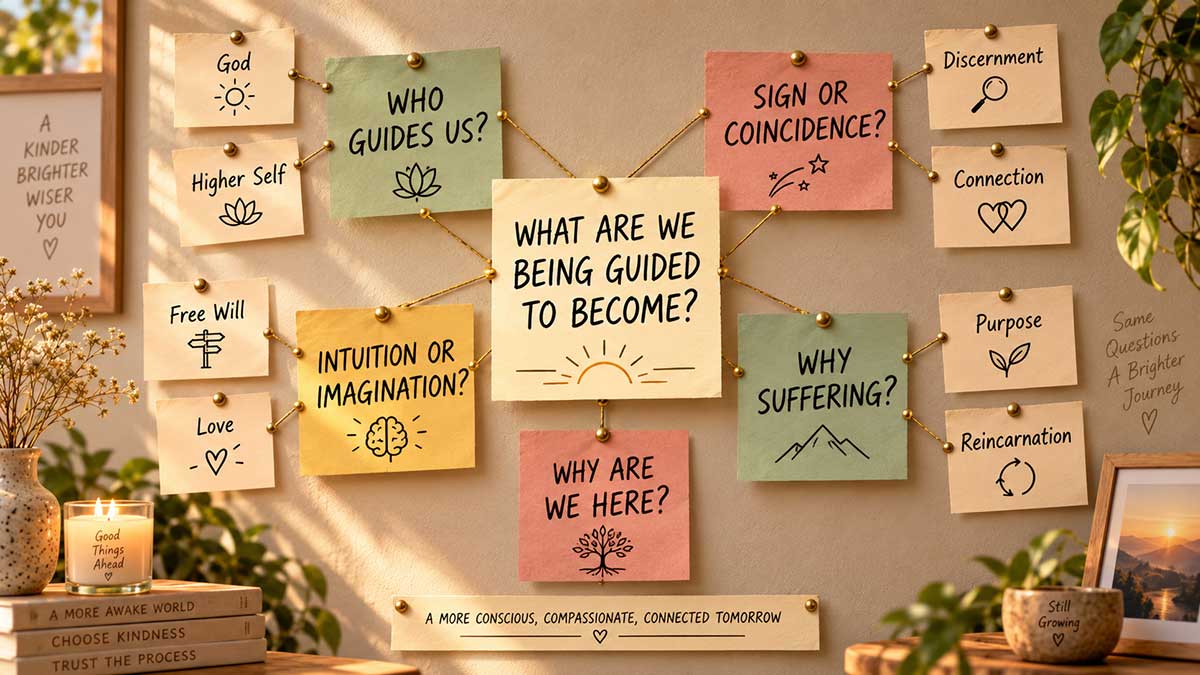
Guided begins with an encouraging idea: we are not alone.
But our conversations revealed that this statement creates far more questions than it answers.
Laura Lynne Jackson's Team of Light does not appear to function like an invisible group giving us instructions. Guidance, in her view, is gentler. It may appear through intuition, synchronicities, people, creativity, unexpected opportunities, or moments that cause us to notice something we had ignored.
The other guests complicated that picture.
A deceased loved one may remain recognizably themselves, yet Edgar Cayce reminds us that one earthly personality may be only one chapter in a much larger soul history.
Dolores Cannon pushes the idea further. The person we call "me" may be one expression of a much greater consciousness, sometimes described as the Higher Self or Oversoul.
This creates one of the most fascinating questions raised by the entire discussion.
If someone dies, communicates through a medium, and later reincarnates, who is communicating?
Perhaps our assumption that consciousness must exist in one place, inside one identity, at one moment is itself the problem.
The conversations revealed another lesson: spiritual openness requires discernment.
A coincidence is not automatically a sign.
An inner voice is not automatically intuition.
A peaceful feeling is not automatically truth.
A medium can receive something incorrectly.
A powerful spiritual experience can still be misinterpreted.
Several guests repeatedly returned to a surprisingly humble phrase:
"I don't know."
That may be one of the healthiest spiritual statements a person can make.
The discussion of suffering changed the meaning of guidance further.
Being guided does not necessarily mean being protected from loss, illness, betrayal, grief, or wrong choices.
Nor does suffering automatically prove that a person chose their pain before birth.
Meaning can grow from tragedy without requiring us to claim that tragedy was deliberately arranged.
Sometimes guidance may not remove the storm.
It may appear through the person who enters the storm beside us.
And perhaps the deepest idea from Guided has little to do with receiving supernatural messages.
If signs, mediumship, reincarnation, and spiritual guidance are real, their value may lie in how they change the way we live now.
Love becomes more important.
Relationships become more important.
Creativity becomes more important.
Service becomes more important.
The courage to say what needs to be said becomes more important.
The willingness to forgive becomes more important.
And death, strangely, can make this life feel more precious rather than less.
Perhaps an illuminated life is not one in which every mystery is solved.
It may be a life in which we become increasingly awake to connection, increasingly honest about what we do not know, increasingly willing to love, and increasingly conscious of what we are doing with the time we have.
The signs may point.
The guides may accompany us.
The people we have lost may remain closer than we think.
But no guide can live this life in our place.
That part remains ours.
Short Bios:
Laura Lynne Jackson
Laura Lynne Jackson is a psychic medium and bestselling author of The Light Between Us, Signs, and Guided. Her work focuses on communication with deceased loved ones, intuition, synchronicity, spiritual guidance, and what she calls our "Team of Light." In Guided, she shifts the focus from simply recognizing signs to asking how spiritual guidance might shape the way we live.
James Van Praagh
James Van Praagh is a medium and bestselling author widely known for his work involving communication with deceased loved ones. His books include Talking to Heaven. His approach often stresses recognizable details and evidence connected to the identity of the person communicating.
John Edward
John Edward is a psychic medium, author, and television personality known for public demonstrations of mediumship. His work focuses on communication with deceased personalities through impressions, symbols, memories, and identifying information that can carry meaning for surviving family members.
Theresa Caputo
Theresa Caputo is a medium and bestselling author known through Long Island Medium. Much of her work centers on grief, healing, continuing relationships with deceased loved ones, and helping people find peace after loss.
Matt Fraser
Matt Fraser is a psychic medium and bestselling author whose work often explores heaven, death, the survival of personality, and communication with deceased loved ones. His books include We Never Die.
Edgar Cayce
Edgar Cayce was an American psychic often called the "Sleeping Prophet." During trance readings, he discussed health, dreams, reincarnation, karma, soul development, free will, spiritual guidance, and humanity's relationship with God. His work became influential in modern discussions of reincarnation and spiritual consciousness.
Dolores Cannon
Dolores Cannon was a hypnotherapist and author best known for developing Quantum Healing Hypnosis Technique, or QHHT. Through thousands of regression sessions, she explored past lives, pre-birth planning, the Higher Self, the between-life state, reincarnation, soul purpose, and broader theories of consciousness.
Leave a Reply