
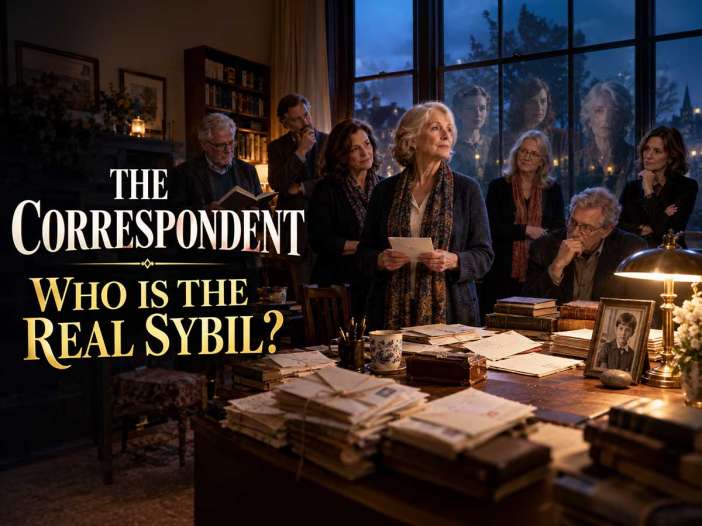
Introduction
What if the story you tell about yourself is true, but incomplete?
In Part 1 of our exploration of Virginia Evans's The Correspondent, Sybil Van Antwerp confronted the people who know different versions of her. Fiona remembers the mother shaped by grief. Rosalie remembers an earlier Sybil. Harry discovers vulnerability beneath her fierce independence. Theodore encounters a woman who may still have new chapters ahead.
Now we ask what psychology and research can reveal about those relationships.
Virginia Evans joins researchers Dan P. McAdams, Laura Carstensen, James W. Pennebaker, Dennis Klass, and Lydia Woodyatt to examine five questions beneath Sybil's correspondence:
Can two people remember the same family history differently and both be sincere?
When does grief become part of identity?
Why can we write truths we cannot say aloud?
What happens when aging changes the roles that once made us feel necessary?
And can an apology arriving decades late still matter?
At the center is Gilbert, Sybil's son who died at eight.
The question is not whether Sybil should "get over" him. It is whether she can continue loving Gilbert without using suffering as proof that he mattered.
And beneath every discussion sits one final question:
What are we leaving unsaid to people who may not always be here to receive it?
(Note: This is an imaginary conversation, a creative exploration of an idea, and not a real speech or event.)
Topic 1: Who Are We When Everyone Remembers Us Differently?
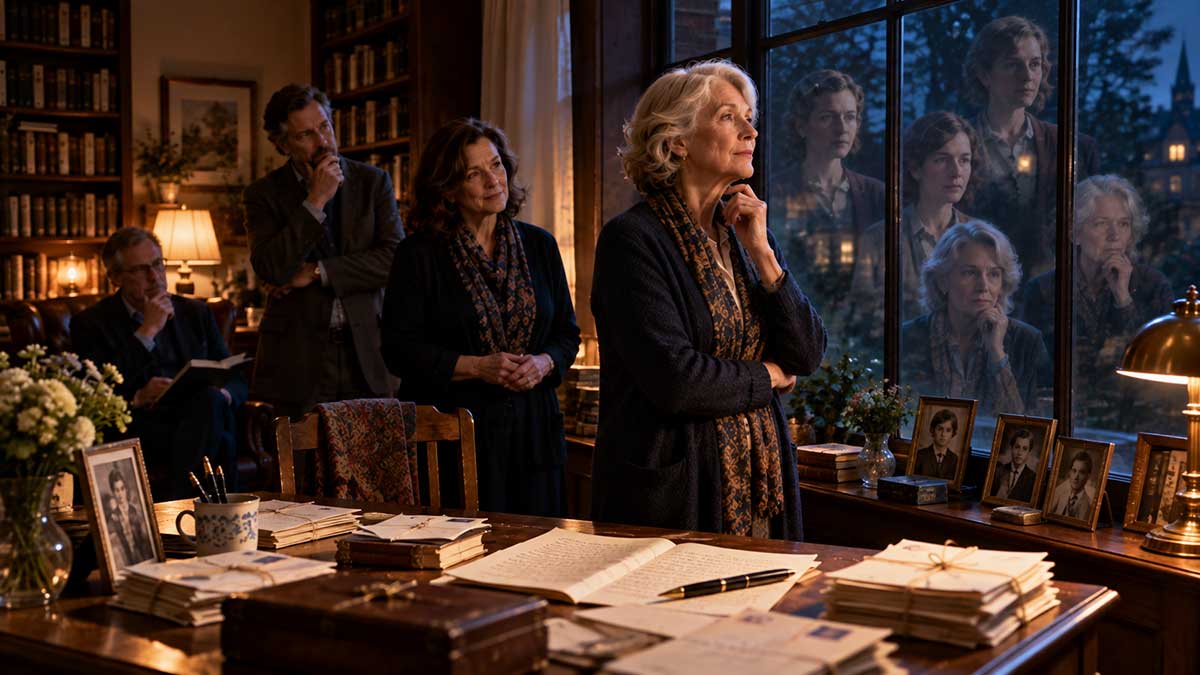
The room does not look like an academic seminar.
Virginia Evans is standing beside Sybil Van Antwerp's writing desk.
Letters lie everywhere.
Some are folded neatly inside envelopes. Others remain open. A fountain pen rests across an unfinished page. Books cover one wall. Near the window sits a photograph of Gilbert.
Dan McAdams picks up one of the envelopes but does not open it.
Laura Carstensen is looking at the bookshelves.
James Pennebaker studies the desk.
Dennis Klass notices the photograph.
Lydia Woodyatt has stopped beside a stack of correspondence.
They have entered Sybil's life through the objects she left behind.
TheModerator stands near the window.
Moderator: Virginia, you once described something about Sybil that seems almost like the operating principle of this entire novel.
None of us can completely see ourselves.
We need other people to hold up mirrors.
Is that what these letters are doing?
Virginia Evans: Very much so.
When Sybil writes to different people, different parts of her appear. That was one of the pleasures of writing her this way. Rosalie has access to one Sybil. Fiona has another. Harry has another.
Theodore meets someone those earlier people could not have known in exactly the same way.
McAdams: Which immediately makes me suspicious of the question we're about to ask.
Moderator: Which question?
McAdams: "Who is the real Sybil?"
It sounds reasonable.
Psychologically, it may be the wrong question.
Evans: Why?
McAdams: It assumes there must be one authentic Sybil hidden underneath all the others.
Almost like peeling layers from an onion until we reach the true person at the center.
But human identity may not work like that.
The Sybil who writes to Harry isn't necessarily pretending.
The Sybil Fiona remembers isn't necessarily false.
The Sybil Theodore encounters isn't necessarily the "new real Sybil."
They may all be Sybil.
Carstensen: And time matters.
The person Theodore encounters exists at a different point in Sybil's life.
Age changes circumstances.
Loss changes circumstances.
Our perception of remaining time changes.
Relationships change.
So Theodore cannot meet precisely the same woman Rosalie knew decades earlier.
Evans: That's very close to how I thought about her.
I didn't want one correspondent who could explain Sybil.
I needed different people.
Moderator: Then let's begin there.
Question 1: If everyone remembers a different Sybil, is there one "real" Sybil?
Pennebaker: I'd like to start with the letters themselves.
Virginia, when Sybil writes, she gets to select.
Evans: Of course.
Pennebaker: That's psychologically interesting.
Every act of writing involves selection.
What happened?
What matters?
What can I admit?
What do I omit?
What explanation do I give?
What words do I choose?
So every letter is revealing, but every letter is incomplete.
McAdams: That's true of autobiography more broadly.
People construct stories about their lives.
We take enormous numbers of experiences and organize some of them into narratives that help explain how we became who we are.
We don't carry a perfect recording of our lives inside our heads.
We interpret.
Evans: Which sounds very much like Sybil.
McAdams: Extremely much.
Sybil is an accomplished narrator of Sybil.
Evans: I like that.
McAdams: But being an accomplished narrator doesn't mean being an omniscient narrator.
Carstensen: Nor an unreliable narrator in the simplistic sense.
McAdams: Exactly.
That's important.
We shouldn't jump from "her account is incomplete" to "her account is dishonest."
Moderator: So Sybil can tell the truth about herself and still fail to see herself accurately?
McAdams: Certainly.
All of us can.
Evans: That's where the other correspondents became so important to me.
Someone writes back.
And suddenly the reader learns something Sybil didn't provide.
Pennebaker: Which means the incoming letters have a different psychological function from the outgoing ones.
Evans: How so?
Pennebaker: When Sybil writes, she organizes herself.
When somebody writes back, that organization can be disturbed.
McAdams: Yes.
That's excellent.
Pennebaker: Fiona can effectively say, "That isn't the whole story."
Harry can reveal something Sybil did not realize she had communicated.
Rosalie can remember something Sybil no longer emphasizes.
Evans: And the reader gets all of it.
Moderator: Which gives the reader an unusual position.
We may know more about Sybil than any individual correspondent does.
McAdams: Perhaps.
But I'd make one correction.
We have more perspectives.
That doesn't necessarily mean we possess the final truth.
Evans: I agree.
I don't think there is a final file somewhere labeled:
"SYBIL VAN ANTWERP: COMPLETE."
Carstensen: There couldn't be.
She's still living.
She's still forming relationships.
She's still responding to circumstances.
She's still changing.
Moderator: Then perhaps Theodore is especially important.
He doesn't simply reveal a hidden Sybil.
His relationship with her helps create a Sybil who did not previously exist.
McAdams turns toward Carstensen.
McAdams: That's the distinction.
Relationships do not simply reveal identity.
Sometimes relationships participate in creating it.
Carstensen: Yes.
And that becomes very important later in life.
People sometimes speak about older adults as though personality and identity have already been completed.
The story happened.
Now there is simply an epilogue.
But Sybil doesn't behave that way.
Evans: No.
She's unfinished.
Carstensen: Precisely.
Theodore isn't excavating an old Sybil.
He's participating in the life of a current one.
A new relationship creates new experiences, and new experiences can change how earlier experiences are interpreted.
McAdams: Which means even the past can change psychologically.
Moderator: The event doesn't change.
McAdams: Correct.
But its meaning can.
A person may understand something at seventy-five that she could not understand at forty-five.
The historical event remains fixed.
Its place within the life story may change dramatically.
Evans looks at the letters on the desk.
Evans: That feels very true to Sybil.
She has strong opinions.
She has strong explanations.
Then other people keep complicating them.
Woodyatt: Which can be uncomfortable.
Moderator: Why?
Woodyatt: Since sometimes our explanations protect our moral identity.
If I tell myself, "I did that to protect you," that's a story about my intention.
Then the person I protected says:
"It hurt me."
Now I have two truths to accommodate.
My intention may have been loving.
The consequence may still have been painful.
A mature account of myself needs room for both.
The room becomes quiet.
Dennis Klass has been looking at Gilbert's photograph.
Klass: And sometimes one event becomes so large that it reorganizes the entire life story.
Nobody asks what he means.
Everyone knows which photograph he is looking at.
Question 2: Can Fiona and Sybil remember the same family history differently and both be sincere?
Moderator: Let's bring Fiona into this.
Sybil may remember herself after Gilbert's death as a mother trying to survive and perhaps trying to protect her remaining child.
Fiona may remember something very different.
Can both accounts be sincere?
McAdams: Yes.
And this is where people often get into trouble with family memory.
We think disagreement means someone must possess the correct recording.
But autobiographical memory isn't a surveillance camera.
Two people can experience the same household from completely different psychological positions.
Klass: Especially after bereavement.
Sybil lost a son.
Fiona lost a brother.
Those are not interchangeable losses.
They occur inside the same family tragedy, but the relationships to the deceased are different.
Then Fiona experiences another loss layered onto the first.
Her mother changes.
Evans: Yes.
That's very important.
Klass: Fiona may not have language for that as a child.
She doesn't necessarily think:
"My mother is experiencing catastrophic parental bereavement."
She experiences:
"My mother is somewhere I cannot reach."
Carstensen: Children interpret behavior through the capacities available to them at that age.
McAdams: Then later they reinterpret childhood through adult knowledge.
So Fiona's story can change too.
Moderator: Meaning Fiona isn't holding one fixed memory either.
McAdams: Correct.
Nobody in this novel owns a perfectly preserved past.
Evans: Which makes correspondence interesting.
A letter can preserve what someone thought at a particular moment.
Pennebaker: Yes.
That's one reason written records are fascinating.
Memory changes.
But the old letter sits there saying:
"This is what I wrote then."
You may no longer agree with yourself.
Evans: Or you may be embarrassed by yourself.
Pennebaker: Frequently.
They laugh.
Moderator: Let's make the disagreement harder.
Suppose Sybil says:
"I was protecting Fiona."
And Fiona says:
"You abandoned me emotionally."
Can both statements be true?
Woodyatt: They can, if we're careful about what each statement describes.
"I was protecting Fiona" describes Sybil's perceived intention.
"You abandoned me emotionally" describes Fiona's experience.
The mistake would be allowing intention to erase impact.
McAdams: Or allowing impact to prove there was never loving intention.
Woodyatt: Exactly.
Moral maturity often requires tolerating that tension.
I meant well.
I caused pain.
Both may be true.
Evans: That's Sybil.
She isn't a monster.
She isn't a saint.
McAdams: Nor does she need to be categorized as either.
Evans: I sometimes think readers want a verdict on characters.
Was she a good mother?
Was she difficult?
Was she likable?
But people are more interesting than verdicts.
Klass: Grief makes verdicts particularly dangerous.
It can explain behavior.
That doesn't mean every consequence disappears.
Woodyatt: That's an important distinction.
Explanation is not absolution.
Moderator: And consequence is not necessarily proof of malicious intention.
Woodyatt: Correct.
Carstensen: Which means Fiona and Sybil can eventually do something more interesting than decide who remembers correctly.
They can become curious about each other's memories.
Evans: Yes.
That is much closer to what I care about.
Moderator: Instead of:
"Which of us is right?"
Carstensen: Ask:
"What was it like to be you when this happened?"
Evans looks at her.
Evans: That's beautiful.
McAdams: And psychologically significant.
You temporarily enter someone else's autobiographical story.
Not to surrender your own.
To recognize that yours was never the only one.
Question 3: Can another person know something important about us that introspection cannot reveal?
Moderator: Virginia, this brings us directly back to your mirror idea.
Can Fiona know something about Sybil that Sybil doesn't know?
Evans: Absolutely.
Moderator: Can Harry?
Evans: Yes.
Moderator: Rosalie?
Evans: Certainly.
Moderator: Theodore?
Evans: Yes.
McAdams: Then perhaps we should ask what each mirror shows.
Moderator: Let's do exactly that.
What does Rosalie see?
Evans: History.
She knows a Sybil extending far behind the present moment.
McAdams: So Rosalie protects continuity.
She can remember versions of Sybil that Sybil's current story may minimize.
Moderator: Harry?
Evans: Curiosity.
Tenderness too.
There are things Sybil can discuss with him that expose parts of her that might surprise other people.
Pennebaker: Harry may benefit from the medium itself.
Their correspondence creates a particular kind of emotional space.
Moderator: Fiona?
Nobody answers immediately.
Woodyatt: Consequence.
Evans turns toward her.
Woodyatt: Fiona knows what it was like to be loved by Sybil.
That means she knows both the love and the injuries contained inside that relationship.
She knows what Sybil's choices felt like from the receiving side.
Sybil cannot know that through introspection alone.
McAdams: That's an important mirror.
Not:
"Who did I intend to be?"
But:
"Who was I in your life?"
Moderator: Theodore?
Carstensen smiles.
Carstensen: Possibility.
Moderator: Explain.
Carstensen: Theodore sees someone Sybil may not yet know how to describe.
A woman who can still form attachment.
Still receive companionship.
Still change.
Still have a future.
McAdams: So each relationship provides a different temporal perspective.
Rosalie carries Sybil's past.
Fiona carries consequences across time.
Harry reveals a present emotional capacity.
Theodore opens a possible future.
Evans: That's wonderful.
I didn't diagram it that way when writing, but I recognize it.
Moderator: And Gilbert?
The atmosphere changes.
Klass looks again at the photograph.
Klass: Gilbert is a mirror that cannot answer.
Silence.
Klass: Everyone else can challenge Sybil's interpretation.
Gilbert cannot.
She can remember him.
Speak to him internally.
Write toward him.
Construct meanings around his death.
But he cannot write back and say:
"Mother, that's not what I would want for you."
Evans: Yes.
Klass: That makes the relationship psychologically different.
Continuing bonds can be deeply meaningful.
But the deceased cannot participate in the same reciprocal correction available in relationships with the living.
McAdams: Which means Sybil may have had extraordinary control over Gilbert's place in her life story.
Klass: Exactly.
She becomes both sides of the conversation.
Pennebaker glances at the piles of letters.
Pennebaker: And Sybil is a woman accustomed to writing letters that receive answers.
Gilbert's is the correspondence that cannot.
Nobody speaks for several seconds.
Moderator: Perhaps that is why the living correspondents matter so much.
They can answer.
They can disagree.
They can forgive.
They can refuse forgiveness.
They can surprise her.
They can tell her:
"That isn't how I remember it."
Or:
"You mattered more than you knew."
Or:
"You hurt me."
Or:
"I still want you here."
Woodyatt: And every answer requires Sybil to decide whether she will revise the story.
McAdams: That's the key.
A life story isn't mature merely when it becomes coherent.
It also needs to remain capable of revision when new truth arrives.
Evans: That feels very close to the woman I wrote.
Sybil believes in letters.
But perhaps she has to learn that correspondence isn't just sending.
It's receiving.
Pennebaker: And receiving means surrendering editorial control.
Evans smiles.
Evans: Sybil would hate that phrase.
Pennebaker: Which may be why she needs it.
They laugh softly.
Then Carstensen walks toward the window.
The glass has become dark enough to reflect everyone standing in the room.
For a moment Evans, McAdams, Carstensen, Pennebaker, Klass, Woodyatt, and the photograph of Gilbert all appear within the same pane.
Moderator: So which reflection is Sybil?
McAdams: None of them alone.
Carstensen: And perhaps not all of them added together either.
Evans: There is still the person she hasn't become yet.
TheModerator looks back at Gilbert's photograph.
Moderator: But there is one version of Sybil that seems to have influenced nearly every other version.
The mother who survived the death of her eight-year-old son.
Dennis Klass remains beside the photograph.
Klass: Then our next question shouldn't be whether she should have stopped grieving.
Moderator: What should it be?
Klass: We should ask what happens when grief lives beside you for so long that you can no longer tell where grief ends and personality begins.
The room falls silent.
On Sybil's desk sits an unanswered letter.
Beside it lies the small stone.
Topic 1 Realization
Perhaps there is no single hidden Sybil waiting to be uncovered.
There is the Sybil she remembers.
The Sybil Fiona experienced.
The Sybil Rosalie remembers.
The Sybil Harry discovers.
The Sybil Theodore may still help call into existence.
And the Sybil Gilbert can no longer correct.
Other people do more than remember us.
They preserve versions of us we cannot access alone.
Sometimes they reveal our kindness.
Sometimes our damage.
Sometimes possibilities we have stopped seeing.
And sometimes they return a piece of our own story with a note written across it:
There is more.
Topic 2: When Grief Becomes Part of Identity
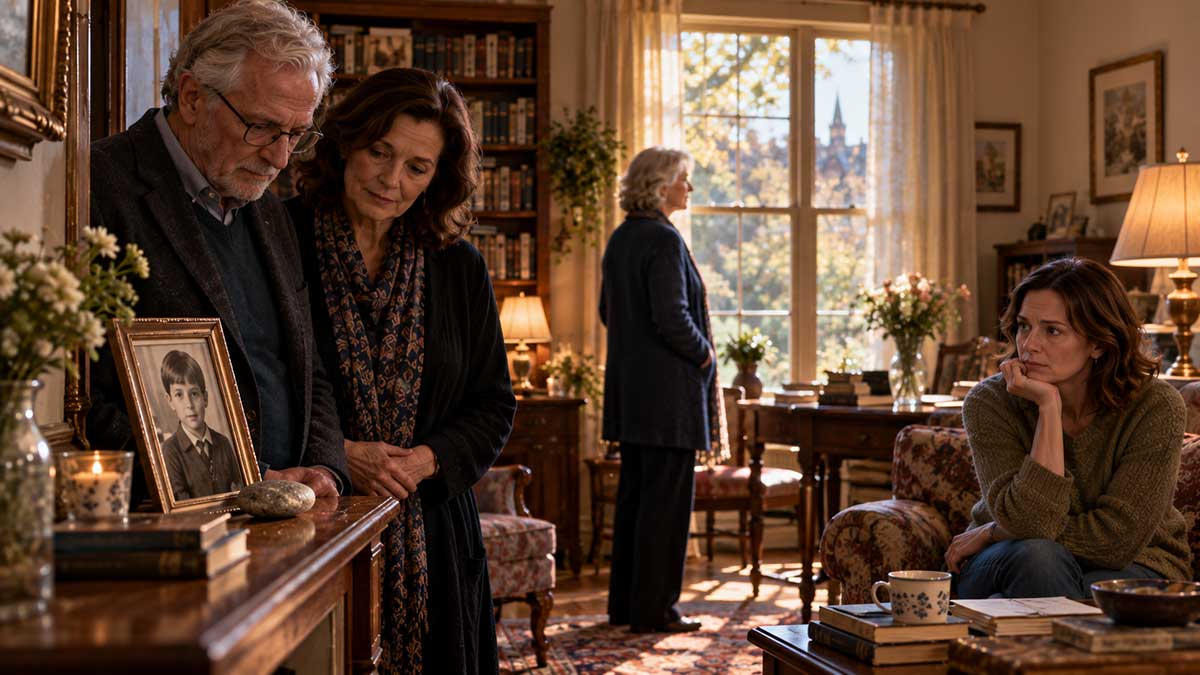
Nobody has moved the photograph.
Gilbert is still eight years old.
He will always be eight years old.
The scholars have moved from Sybil's writing desk into the quieter part of the house. Afternoon light falls across the floor. Dennis Klass stands nearest the photograph. Lydia Woodyatt remains beside the desk.
Virginia Evans looks at Gilbert longer than anyone else.
TheModerator notices.
Moderator: Virginia, before we discuss Sybil's grief, there is something we know about the creation of Gilbert that changes how we approach him.
You have spoken about two fears that entered this novel.
One was blindness.
The other was losing a child.
Your own son was eight when you were writing.
Gilbert is eight when he dies.
Virginia Evans: Yes.
Moderator: Why make the fear that specific?
Evans pauses.
Evans: I had heard the idea that writers write from what they know or what they fear.
When I thought about Sybil, I realized I had written directly into two of my greatest fears.
Losing a child was one.
So I didn't want Gilbert's death to be abstract.
I wanted to write close to the fear.
Klass: That matters.
A child's death is not merely one more bereavement among many.
It can disrupt assumptions about time itself.
Parents expect children to outlive them.
The expected sequence has been violated.
McAdams: And when something that large happens, it can become a central event in the story a person tells about an entire life.
Moderator: Which brings us to the first question.
Question 1: When does grief stop being something we experience and become part of who we think we are?
Klass: I want to be careful with the wording.
Grief becoming part of identity isn't necessarily unhealthy.
When someone deeply important dies, that relationship has already shaped you.
Why would death erase that influence?
Moderator: So you don't want Sybil to "let Gilbert go."
Klass: I don't find that particularly useful.
What would it mean?
Forget him?
Stop loving him?
Stop thinking about him?
Remove him from the family story?
Gilbert existed.
He was Sybil's son.
That fact cannot become untrue.
Carstensen: Nor should emotional health require pretending it can.
Klass: Right.
The more interesting question concerns the form that continuing relationship takes.
Does remembering Gilbert help Sybil remain connected to love?
Or does remembering Gilbert repeatedly return her to punishment?
Those are very different experiences.
Evans: I think Sybil has trouble separating them.
Klass: I agree.
McAdams: There may be a narrative reason.
Imagine Sybil's life story before Gilbert dies.
She is one kind of person moving through one kind of story.
Then Gilbert dies.
The event is so large that everything may become organized around:
before Gilbert
and
after Gilbert.
Evans: Yes.
McAdams: That happens with major life events.
They become temporal landmarks.
But something else can happen.
A person can move from saying:
"Something terrible happened to me."
to:
"This terrible event explains who I am."
Moderator: Is that necessarily a problem?
McAdams: No.
Sometimes major adversity genuinely changes identity.
The question is whether the resulting story becomes too narrow.
Carstensen: Meaning?
McAdams: Suppose Sybil's story becomes:
"I am the mother who lost Gilbert."
That's true.
But she is Fiona's mother too.
Rosalie's friend.
A professional.
A reader.
A correspondent.
A woman Harry comes to trust.
A woman Theodore comes to know.
A person still capable of new attachment.
If one true sentence becomes the only sentence allowed to organize every other sentence, identity can become constricted.
Evans looks toward the photograph.
Evans: "I am the mother whose son died" is true.
But "I am the mother whose daughter lived" is true too.
Nobody speaks.
Klass: That's important.
Moderator: And Fiona may have spent years waiting for the second sentence.
Evans: Yes.
Woodyatt: This is where grief enters moral territory.
Sybil's suffering deserves compassion.
But Fiona's suffering does not disappear merely since we understand Sybil's.
Klass: Absolutely.
Woodyatt: I want to protect that distinction throughout this conversation.
If we explain every action through bereavement, we risk making Fiona invisible again.
Evans: Which would repeat Sybil's mistake.
Woodyatt: Exactly.
That is the danger.
Moderator: So grief can explain behavior without erasing consequence.
Woodyatt: Yes.
And consequence can be real without turning the grieving person into a villain.
McAdams: We keep returning to the same capacity.
Can Sybil hold two truths at once?
Klass: Perhaps three.
I loved Gilbert.
I was devastated when he died.
And my devastation affected people who were still alive.
The room becomes very still.
Moderator: Dennis, there is another idea from grief research that seems particularly important here.
The relationship with the dead can continue.
Klass: Yes.
Human beings often maintain bonds with people who have died.
Through memories.
Objects.
Stories.
Rituals.
Inner conversations.
Values.
Places.
Sometimes people mentally ask what the deceased would think.
Sometimes they continue telling the deceased about their lives.
None of that automatically means someone has failed to grieve.
Pennebaker: Letters can become part of that too.
Klass: Certainly.
Pennebaker: You can write to someone who cannot physically receive the letter.
Moderator: Which is fascinating in a novel built around correspondence.
Evans: Very much.
Moderator: Sybil spends her life writing to people who can answer.
Gilbert cannot.
Klass: And that difference may matter enormously.
With Fiona, Sybil can say:
"This is what happened."
Fiona can answer:
"No. That's not how it felt to me."
Gilbert cannot provide that correction.
McAdams: Meaning Sybil has far greater narrative control over her continuing relationship with Gilbert.
Klass: Yes.
And that can permit love.
But it can permit guilt to repeat itself too.
Question 2: Can guilt feel safer than accepting that some losses were never within our control?
Woodyatt immediately raises a hand.
Woodyatt: I want to challenge the question before answering it.
Moderator: Please.
Woodyatt: We shouldn't assume guilt is merely a psychological defense against randomness.
Sometimes people feel guilty since they did something they genuinely regret.
We need to distinguish actual responsibility from imagined responsibility.
Klass: I agree.
Woodyatt: Sybil has several kinds of guilt.
There is guilt connected with Gilbert.
There is guilt about how grief affected Fiona.
There are professional and relational choices elsewhere in her life.
Those should not be thrown into one container labeled:
"Sybil feels guilty."
McAdams: Yet Sybil herself may have done exactly that.
Woodyatt: Yes.
And that is the problem.
Moderator: Let's separate them.
Gilbert first.
Woodyatt: Ask:
What exactly does Sybil believe she should have done differently?
Was it realistically within her control?
What did she know then?
What does she know now?
Is she judging her earlier self with information acquired afterward?
Those questions matter.
Klass: And bereaved parents often revisit alternatives.
What if?
What if?
What if?
The mind returns to the branching point.
Pennebaker: Almost rewriting the story repeatedly.
McAdams: Counterfactual autobiography.
Moderator: Why?
Klass considers this.
Klass: One possible reason is attachment.
If I keep returning to the moment, I remain psychologically near the person.
Another is meaning.
The mind wants an event this enormous to make sense.
And another can be control.
If I can identify one decision that caused everything, the universe becomes comprehensible again.
Woodyatt: But here is the paradox.
Taking responsibility can feel terrible.
Yet helplessness can feel even worse.
Moderator: Explain.
Woodyatt: "It was my fault" is painful.
But it contains a hidden proposition:
I had power.
If I had acted differently, the ending could have changed.
Now compare that with:
I loved my child. I tried to protect my child. And there are terrible things love cannot prevent.
That can be terrifying.
Evans: Yes.
That's the fear.
Carstensen: It also changes how a person approaches later relationships.
Once the universe has demonstrated that attachment does not guarantee safety, loving anyone becomes risky.
Klass: Exactly.
Moderator: So after Gilbert, Sybil may not simply fear another death.
She may fear loving someone enough that another loss could destroy her.
Evans: I think that's very close to her.
McAdams: Which can then be narrated as independence.
Carstensen: Or self-sufficiency.
Pennebaker: Or privacy.
Woodyatt: Or control.
Moderator: Different words for fear?
Carstensen: Sometimes.
But we shouldn't reduce every independent trait Sybil possesses to trauma.
She may genuinely value independence.
The question is when a value becomes armor.
Evans smiles slightly.
Evans: Sybil would insist hers is a value.
McAdams: Of course she would.
Evans: Very forcefully.
A small laugh moves through the room.
Then Evans looks at Gilbert again.
It disappears.
Moderator: There is something almost unbearable about the logic we've reached.
If Sybil stops blaming herself, she has to accept that she may never have possessed the ability to save Gilbert.
Klass: Yes.
Moderator: Could that feel like losing him again?
Klass: It could.
If guilt has become one of the primary ways she remains connected to him, reducing guilt may feel like reducing the relationship.
Woodyatt: This is where self-forgiveness becomes complicated.
People sometimes resist self-forgiveness since suffering feels morally appropriate.
"If I stop hurting, perhaps I am saying what happened didn't matter."
Evans: That sounds like Sybil.
Woodyatt: Yet endless self-punishment does not repair the past.
Moderator: Nor return Gilbert.
Woodyatt: No.
And it may injure people who remain.
Fiona enters the conversation without being physically present.
Everyone knows it.
Question 3: Can Sybil keep loving Gilbert without continuing to punish herself?
Dennis Klass walks to the desk.
The small stone from the previous conversation remains there.
He picks it up.
Klass: We've been using this stone.
I think it's useful if we don't push the metaphor too far.
Suppose this represents Gilbert.
Woodyatt: Or grief.
Klass: Better.
Let it represent the grief attached to loving Gilbert.
Now there are several things Sybil could do.
He holds it out.
Klass: She could throw it away.
That would be the old fantasy that healing means eliminating the bond.
I don't think that's necessary.
He closes his hand around it.
Klass: She could grip it constantly.
Carry it into every relationship.
Sleep with it.
Eat with it.
Bring it into every conversation.
Never open her hand.
Eventually the stone begins shaping how the hand itself rests.
McAdams: Grief becoming identity.
Klass: Yes.
Then there is another possibility.
He places the stone gently beside Gilbert's photograph.
Klass: Put it somewhere meaningful.
Return to it.
Touch it.
Tell the story.
Cry beside it.
Speak Gilbert's name.
And then walk into another room without taking it every time.
Nobody says anything.
Evans's eyes remain on the stone.
Moderator: Does leaving the stone there mean loving Gilbert less?
Klass: No.
That's the point.
Love and suffering are not identical.
Woodyatt: Nor are guilt and loyalty.
McAdams: Nor are memory and imprisonment.
Carstensen: Nor is continuing one's life a betrayal of someone whose life ended.
Evans looks up.
Evans: That last one is important.
Moderator: Why?
Evans: Sybil has lived a long time.
That matters.
There can be guilt in surviving.
There can be guilt in happiness.
In laughing.
In falling in love.
In discovering that something beautiful happened on a day when someone you loved remained dead.
Klass: That's one of grief's painful contradictions.
The world resumes ordinary activity.
The bereaved person may initially experience that as almost offensive.
People buy groceries.
Children laugh.
Someone complains about traffic.
Spring comes.
And the person is still dead.
Pennebaker: Then eventually you participate in ordinary life again.
Klass: Yes.
And sometimes that produces guilt.
How could I enjoy this?
Moderator: Since Gilbert cannot?
Klass: Perhaps.
Or since enjoyment seems to suggest that life has moved beyond him.
Carstensen: But life continuing does not mean the relationship has been erased.
McAdams: Gilbert can remain a chapter without being the final chapter.
Evans: That's Sybil's problem.
She sometimes writes as though the most important sentence has already been written.
Moderator: And Theodore?
Evans: Theodore proves there can still be another sentence.
Carstensen: So does Harry.
Evans: Yes.
McAdams: And Fiona perhaps most of all.
Evans nods.
Moderator: I want to return to Fiona.
Part 1 gave us a devastating possibility.
Sybil may have thought:
I lost my child.
But Fiona could have experienced:
I lost my brother, and then I lost part of my mother.
Klass: That is the family dimension of bereavement.
The death belongs to everyone, but differently.
Woodyatt: Which means Sybil's repair cannot consist solely of forgiving herself.
She must recognize Fiona.
Moderator: What would recognition sound like?
Woodyatt thinks.
Woodyatt: Perhaps:
"I was suffering terribly."
Pause.
"And you suffered from what happened to me."
Another pause.
"My suffering explains why I disappeared from you."
Then:
"It does not mean you deserved to lose me too."
Nobody speaks.
Evans: Yes.
McAdams: Notice what has happened there.
Sybil's life story becomes larger.
She doesn't have to delete her own suffering to admit Fiona's.
Klass: Nor delete Gilbert to see Fiona.
Moderator: That's perhaps the key.
For years, Sybil may have unconsciously treated attention like a competition between the dead child and the living one.
Carstensen: Yet love doesn't require that choice.
Klass: Exactly.
Remembering Gilbert does not require overlooking Fiona.
Loving Fiona does not betray Gilbert.
Laughing does not betray Gilbert.
Theodore does not betray Gilbert.
A peaceful afternoon does not betray Gilbert.
Living does not betray Gilbert.
Evans looks down.
Evans: "Living does not betray Gilbert."
She repeats it more quietly.
Evans: That's it.
The light in the room has shifted.
Gilbert's photograph remains exactly where it was.
Nothing about him has changed.
He is still eight.
The stone is still beside him.
But it is no longer in anyone's hand.
Moderator: Dan, if Sybil could incorporate this into her life story, what would change?
McAdams: Perhaps one sentence.
Moderator: Which one?
McAdams: Instead of:
"Gilbert died, and I became the woman who carried that death."
Perhaps:
"Gilbert lived, I loved him, he died, his death changed me, I hurt people when I was grieving, I remained alive, and my life continued to contain love."
Evans exhales.
Evans: That's much harder.
McAdams: Yes.
But it's a larger story.
Woodyatt: And a more responsible one.
It neither excuses her nor condemns her forever.
Klass: And Gilbert remains inside it.
Carstensen: So does Fiona.
Evans: So does Sybil.
Topic 2 Realization
The problem was never that Sybil remembered Gilbert too much.
Perhaps the problem was that grief, guilt, memory, and love became so tightly bound together that she could no longer distinguish them.
Grief said:
I miss him.
Love said:
He mattered.
Guilt said:
I should have saved him.
Fear said:
If I love this deeply again, I could lose this deeply again.
And loyalty whispered:
If you become happy, perhaps you have left him behind.
For decades those voices may have sounded like one voice.
They are not.
Sybil can remember without punishing herself.
She can regret without making regret her identity.
She can acknowledge Fiona's wounds without denying her own.
She can allow another person to matter without replacing Gilbert.
And she can put down the stone without throwing it away.
Gilbert remains eight years old in the photograph.
Sybil does not have to remain the same woman she became on the day he died.
TheModerator looks across the desk at the stacks of correspondence.
Moderator: There is one thing I still don't understand.
Sybil could carry some of these thoughts for decades without saying them to the people closest to her.
Yet she could write extraordinary things on paper.
Why?
James Pennebaker reaches for one of the unopened envelopes.
He does not open it.
Pennebaker: That may be the next question.
What becomes possible when another human being is not standing in front of us?
And what becomes possible when we finally press "send," seal the envelope, or place the letter in someone else's hands?
Topic 3: Why Writing Lets Us Say What Speech Cannot
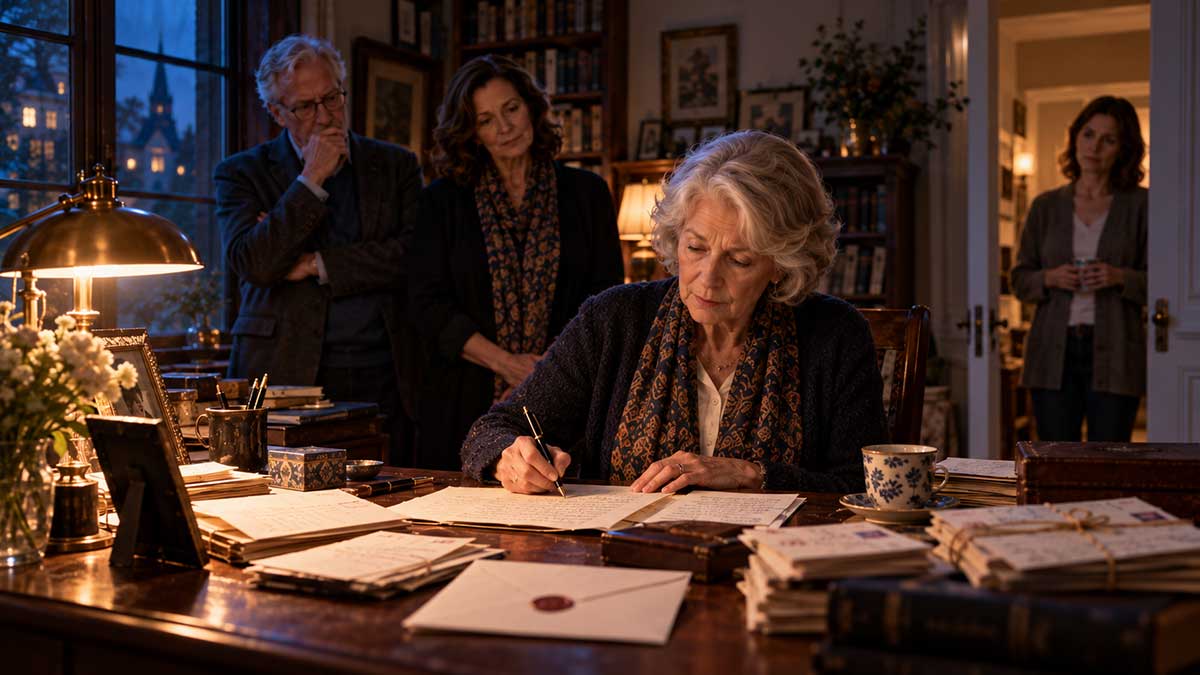
The unopened envelope remains in James Pennebaker's hand.
He turns it over.
No one knows what is inside.
That seems appropriate.
Sybil Van Antwerp's house is filled with words, yet the most interesting words may be the ones hovering between private thought and another human being.
Virginia Evans sits at Sybil's writing desk.
Dan McAdams stands beside the shelves. Laura Carstensen has taken the chair near the window. Dennis Klass remains close to Gilbert's photograph. Lydia Woodyatt looks at the sealed envelope in Pennebaker's hand.
The stone from their previous discussion is still beside the photograph.
Nobody is carrying it.
Moderator: James, you ended our last conversation with a strange question.
What becomes possible when another human being is not standing in front of us?
Sybil can write things she struggles to say.
Why?
Pennebaker: Start with something very simple.
Conversation is fast.
Writing can be slow.
Evans: Very slow, in Sybil's case.
Pennebaker: And that difference changes what we can do with emotion.
If I'm talking to you face-to-face, I'm processing my thoughts and your reactions at the same time.
I see your expression.
I hear your voice.
You interrupt.
I become embarrassed.
You ask something I wasn't prepared to answer.
I may retreat.
Writing changes that environment.
Moderator: The other person disappears temporarily.
Pennebaker: Yes.
And paradoxically, that can make it easier to approach them emotionally.
Question 1: Why can writing make us brave enough to say what speech cannot?
Moderator: Virginia, why letters?
You could have written Sybil's story conventionally.
Evans: I had wanted to write a novel in letters.
I loved what correspondence could reveal.
A letter feels thoughtful.
Someone has sat down and decided:
I'm going to say this to you.
There's deliberateness to it.
Pennebaker: And Sybil benefits enormously from deliberateness.
Evans: She does.
Pennebaker: Look at what writing gives her.
She chooses when the conversation begins.
She chooses the words.
She chooses what she reveals.
She can stop.
She can reconsider.
She can rewrite.
She can decide whether the letter leaves the desk.
Woodyatt: She also doesn't have to watch the recipient's face.
Pennebaker: Exactly.
Moderator: That sounds less like courage and more like control.
Pennebaker smiles.
Pennebaker: Why must it be one or the other?
Evans: That's Sybil again.
McAdams: Much of her strength contains that ambiguity.
Independence can be genuine strength and protection.
Writing can be genuine vulnerability and controlled vulnerability.
Moderator: So perhaps the letter allows Sybil to approach an emotional boundary without surrendering all control.
Pennebaker: Yes.
Think about saying:
"I'm afraid."
Face-to-face, the words leave your mouth and immediately become part of another person's experience.
You cannot retrieve them.
Their face changes.
They may reach for you.
They may ask:
"What are you afraid of?"
Now the conversation has escaped your control.
Carstensen: And being reached for may itself be frightening to someone who has spent decades protecting independence.
Evans: That's very Sybil.
Moderator: But on paper?
Pennebaker: She can write:
"I'm afraid."
Then stare at the sentence for twenty minutes.
Evans: Cross it out.
Pennebaker: Rewrite it.
Evans: Make it sound more intelligent.
They laugh.
McAdams: That's important.
Sybil can narrate vulnerability before she has to experience its interpersonal consequences.
Moderator: Narrate vulnerability.
That's a fascinating phrase.
McAdams: Writing converts experience into story.
Something that previously existed as fear, sensation, memory, confusion, perhaps shame, becomes:
This happened.
I felt this.
This is what I think it means.
The moment we put experience into language, we begin organizing it.
Pennebaker: That's one of the reasons expressive writing has been studied so extensively.
Language gives form to experience.
Moderator: Does that mean writing heals?
Pennebaker: I would be cautious with a claim that broad.
Writing can help in some circumstances and for some people. Effects vary.
What interests me here is the process.
Writing requires translating experience into words.
That translation itself can change how someone thinks about what happened.
Evans: Which may explain something about Sybil.
She doesn't always know what she thinks until she writes.
Pennebaker: Many people don't.
Moderator: Then perhaps Sybil isn't simply recording a finished thought.
She's discovering it.
McAdams: Precisely.
A letter can be a laboratory for identity.
Evans: Sybil would object to being studied in a laboratory.
McAdams: Naturally.
Evans: Especially her own.
Another small laugh.
Then Woodyatt looks again at the envelope.
Woodyatt: But we should recognize the limitation.
Writing can help Sybil discover:
"I hurt Fiona."
That is meaningful.
But Fiona has not yet received anything.
Moderator: Which takes us to the harder problem.
Question 2: Is an unsent letter communication, or is it conversation with oneself?
Pennebaker places the envelope on the desk.
Pennebaker: If nobody receives it, I wouldn't call it interpersonal communication in the ordinary sense.
But that doesn't make it meaningless.
Moderator: What has happened?
Pennebaker: The writer may have articulated something previously unarticulated.
That's psychologically significant.
McAdams: The writer may have revised the internal story.
Klass: Or continued a relationship with someone who cannot receive a physical letter.
Everyone looks toward Gilbert.
Moderator: Gilbert again.
Klass: He belongs here.
Suppose Sybil writes him a letter.
She tells him:
I miss you.
I have blamed myself.
Fiona grew up.
I failed her in certain ways.
I laughed yesterday.
I fell in love again.
I thought that meant I was leaving you.
I don't think that anymore.
Gilbert cannot answer.
But the act may still change Sybil's relationship with his memory.
Pennebaker: Yes.
That letter functions differently.
Moderator: But suppose she writes the same kind of letter to Fiona and never sends it.
Woodyatt: Then we need a sharper distinction.
The letter may change Sybil.
It does nothing directly for Fiona.
Evans: That's important.
Woodyatt: Sybil could write the most beautiful apology ever written.
She could cry.
She could understand herself differently.
She could feel tremendous relief.
Then put the letter in a drawer.
Fiona still hasn't heard:
"I'm sorry."
Moderator: So private expression and relational repair are different.
Woodyatt: Very different.
Pennebaker: Which doesn't diminish private writing.
It simply gives it the correct function.
McAdams: Perhaps there are stages.
First:
I admit something to myself.
Then:
I allow you to know it.
Then:
I allow your response to affect me.
The room goes quiet.
Evans: That third one is the hardest for Sybil.
Moderator: Harder than sending?
Evans: I think so.
She knows how to send letters.
She's been doing it her entire life.
But what happens when somebody answers in a way she doesn't like?
McAdams: Then correspondence becomes dangerous.
Moderator: Dangerous?
McAdams: To the story she tells about herself.
Pennebaker picks up the envelope again.
Pennebaker: Think about the difference between a journal and a letter.
A journal belongs entirely to you.
A letter begins with you, but once sent, it enters another person's psychological life.
Woodyatt: And you lose authority over what it means.
Evans: Yes.
You might intend tenderness.
They might experience intrusion.
You might intend explanation.
They might hear excuse.
You might intend apology.
They might not forgive you.
Moderator: Which means sending the letter involves risk.
Woodyatt: Real risk.
If your apology requires forgiveness, then perhaps it isn't entirely an apology.
It may be a request for emotional relief.
Moderator: That's uncomfortable.
Woodyatt: It should be.
Evans: Sybil would appreciate you.
Woodyatt: I'm not certain Sybil would appreciate me.
Evans: Eventually.
They laugh.
Carstensen: There's another dimension here.
Moderator: Which is?
Carstensen: Time.
A younger person may think:
I can tell her later.
I'll call next month.
We'll resolve this eventually.
When future time begins to feel limited, postponement changes meaning.
Moderator: The unsent letter becomes more dangerous.
Carstensen: Yes.
There may eventually be no recipient.
Klass glances toward Gilbert again.
Nobody misses it.
Klass: Then the unsent letter becomes the only kind available.
The laughter disappears.
Evans: That's one reason communication feels precious to me.
There is an opportunity when someone is here.
That opportunity is not permanent.
Question 3: Does the deepest change occur when we write the truth, send it, or allow another person's answer to change us?
Moderator: Dan proposed three stages.
Admit something to yourself.
Allow another person to know it.
Allow their response to affect you.
Which one matters most?
Pennebaker: I don't think we need a winner.
They perform different psychological functions.
Moderator: Let's test them with Sybil.
Stage one.
She writes:
"I was frightened after Gilbert died."
Pennebaker: Recognition.
McAdams: Narrative revision.
Moderator: Stage two.
She sends Fiona:
"I was frightened after Gilbert died, and I withdrew from you."
Woodyatt: Accountability begins.
Moderator: Fiona answers:
"You didn't simply withdraw. I felt abandoned."
Silence.
Moderator: Stage three.
What happens now?
McAdams: Now Sybil has a choice.
Evans: There she is.
McAdams: She can defend the existing story.
"I was grieving."
"I did the best I could."
"You don't understand what I was going through."
All of those statements might contain truth.
But they can function as walls.
Woodyatt: Or she can say:
"Tell me what it was like for you."
Carstensen: That sentence changes everything.
Moderator: Why?
Carstensen: Sybil stops explaining herself long enough to become curious about Fiona.
Pennebaker: She receives instead of transmits.
McAdams: And Fiona's account becomes new information entering Sybil's life story.
Moderator: So correspondence is not completed by sending.
Pennebaker: No.
Moderator: It requires receiving.
Pennebaker: If we're talking about reciprocal correspondence, yes.
Evans: That's one of the things I love about letters.
A letter goes away from you.
Then something may come back.
Moderator: Something you cannot edit.
Evans: Exactly.
McAdams: And that may be the deepest challenge to identity.
Other people return versions of us we did not authorize.
Woodyatt moves closer to Sybil's desk.
Woodyatt: Let's make this harder.
Suppose Fiona never answers.
Moderator: Has Sybil's apology failed?
Woodyatt: Not necessarily.
If Sybil genuinely acknowledged harm and sent the apology without demanding anything from Fiona, the moral act still occurred.
But Sybil doesn't get to manufacture Fiona's response.
Moderator: No forgiveness required.
Woodyatt: Correct.
Moderator: No reconciliation required.
Woodyatt: Correct.
Moderator: No reassurance that Sybil is actually a good person.
Woodyatt: Definitely not.
Evans: That's difficult.
Woodyatt: Yes.
Real accountability relinquishes control.
Pennebaker lifts the envelope.
Pennebaker: Which makes this object more interesting.
Before I send it, I control nearly everything.
After I send it, I control almost nothing.
McAdams: That may explain why people keep important letters in drawers.
Moderator: They aren't necessarily afraid of what they've written.
McAdams: They may be afraid of what comes back.
The afternoon has faded.
Carstensen turns on a lamp.
Warm light spreads across the desk.
The windows become darker.
Everyone's reflection slowly appears in the glass.
Moderator: Virginia, you have described letters as something almost physical in their emotional meaning.
Not simply words.
An artifact.
A piece of someone's interior life.
Evans: That's how I feel about them.
Someone touched that paper.
Their handwriting is there.
They chose those words.
They thought of you when you weren't physically with them.
I find that deeply moving.
Pennebaker: Which makes receiving a letter different from merely receiving information.
Evans: Yes.
A handwritten letter says:
I spent part of my life making this for you.
Carstensen: Time itself becomes part of the gift.
Evans: Exactly.
Moderator: Then perhaps Sybil's obsession with correspondence isn't simply nostalgia.
McAdams: It fits her psychology beautifully.
Letters allow connection across distance.
Pennebaker: But controlled distance.
Woodyatt: Until the answer arrives.
Evans: Yes.
Moderator: There it is again.
The answer.
Dennis Klass has said almost nothing for several minutes.
He now reaches toward Gilbert's photograph but stops before touching it.
Klass: There is one correspondence Sybil can never complete in the ordinary way.
Everyone looks at him.
Klass: She can write Gilbert forever.
But she will never receive the letter that says:
"Mother, you can stop blaming yourself now."
Evans looks down.
Moderator: So where can that answer come from?
Klass: That's complicated.
From herself, perhaps.
From the living.
From a changed relationship with memory.
From whatever spiritual framework a person holds.
But Gilbert himself cannot physically provide the answer Sybil may have spent decades wanting.
McAdams: Which means she may eventually have to write a new ending without pretending Gilbert wrote it for her.
Woodyatt: And without using his silence to condemn herself.
That sentence hangs in the room.
Evans: That's very important.
Moderator: Explain, Lydia.
Woodyatt: Gilbert's inability to answer cannot be treated as evidence that he refuses to forgive her.
Silence from the dead is silence.
Sybil supplies the interpretation.
Klass: Yes.
Woodyatt: If she hears accusation in that silence, the accusation may be hers.
McAdams: Another story.
Woodyatt: Exactly.
Pennebaker finally places the unopened envelope back on the desk.
Moderator: We began by asking why writing can make us braver.
Perhaps we've discovered something unexpected.
Writing may actually be the safer half of correspondence.
Pennebaker: Sometimes.
Moderator: The dangerous part is the answer.
McAdams: Since the answer proves another consciousness exists outside our story.
Carstensen: Someone who may see us differently.
Woodyatt: Someone we may have hurt.
Klass: Someone we may lose.
Evans: Or someone who may love us differently from what we expected.
The Moderator looks at Evans.
Moderator: That possibility frightens Sybil too, doesn't it?
Evans smiles.
Evans: Very much.
Topic 3 Realization
Sybil has spent decades writing.
That does not necessarily mean she has spent decades surrendering herself to relationship.
Writing gives her something precious:
time to think,
space to recognize emotion,
language for experience,
and enough distance to become vulnerable.
Yet correspondence asks for something more.
First:
Tell yourself the truth.
Then:
Let another person know it.
Then comes the part Sybil cannot control:
Let them answer.
An unsent letter can change the writer.
A sent letter can change a relationship.
An answer can change the story both people thought they knew.
Perhaps this is why The Correspondent could not simply be a collection of Sybil's private journals.
She needs correspondents.
She needs people capable of saying:
I remember differently.
You hurt me.
I forgive you.
I don't forgive you yet.
I missed you.
I need you.
Or perhaps the sentence Sybil finds hardest to receive:
You don't need to do anything for me. I simply want you here.
Laura Carstensen looks at Sybil's chair.
Carstensen: That may become increasingly difficult for her.
Moderator: Why?
Carstensen: Since Sybil is approaching a stage of life when she may have fewer opportunities to prove her value through competence.
Her eyesight is changing.
Her independence is threatened.
Her roles are changing.
Soon she may face a question no letter can answer for her.
Moderator: Which question?
Carstensen looks across the room at the empty chair.
Carstensen:
Who am I when I can no longer do everything that made me feel necessary?
Outside the window, darkness has arrived.
Inside, the lamp remains on.
Topic 4: What Happens When Life Becomes Quiet?

Night has settled over Sybil's house.
The lamp on her writing desk remains on.
Outside the window, the street has become difficult to distinguish from the darkness beyond it. Reflections of the people inside have replaced the view.
Laura Carstensen stands closest to the window.
Virginia Evans is beside Sybil's chair.
Dan McAdams has returned one of the letters to its envelope. James Pennebaker closes a book he had been examining. Dennis Klass remains near Gilbert's photograph. Lydia Woodyatt sits quietly near the desk.
The Moderator looks at the reading lamp.
Moderator: Virginia, Gilbert came from one of your deepest fears.
There was another.
Evans: Blindness.
Moderator: Your fear of losing your sight.
Evans: Yes.
Moderator: I think we need to begin by respecting that literally.
Sybil reads.
She writes.
She drives.
She loves books.
She has built enormous portions of her life around things eyesight makes possible.
So perhaps we shouldn't immediately ask what blindness symbolizes.
Evans: I agree.
Carstensen: That's important.
Physical loss is real.
We don't need to convert it into metaphor before acknowledging what the person may actually lose.
Moderator: Yet Sybil's response suggests something beyond eyesight frightens her.
Carstensen: Yes.
Moderator: What?
Carstensen looks at Sybil's empty chair.
Carstensen: Dependence.
Question 1: What frightens Sybil more about blindness: losing sight or losing independence?
Moderator: Virginia, what does independence mean to Sybil?
Evans: Almost everything.
She has built her life around competence.
She takes care of herself.
She has opinions.
She makes decisions.
She doesn't like feeling helpless.
McAdams: Independence is part of her identity story.
Evans: Absolutely.
Moderator: Then losing eyesight threatens more than reading.
McAdams: Potentially.
If Sybil's internal story says:
I am the woman who manages herself,
then needing another person to drive her somewhere isn't simply transportation.
It can feel like evidence against the identity she has constructed.
Carstensen: This is where we should distinguish several things.
Needing assistance with one activity does not mean losing personhood.
It does not mean losing dignity.
It does not mean losing every form of autonomy.
But people can experience it that way.
Moderator: Sybil certainly might.
Evans: She would.
Pennebaker: Especially since asking requires disclosure.
Moderator: How?
Pennebaker: Consider the sentence:
"I can't see this. Could you read it to me?"
That is information.
But for Sybil it may feel like confession.
Woodyatt: It reveals need.
Pennebaker: Yes.
And she cannot edit the need away.
Moderator: Interesting.
She can spend twenty minutes perfecting a letter about fear.
But eventually she may simply need to say:
"Please help me."
Carstensen: Exactly.
And that may require a form of vulnerability that eloquence cannot disguise.
McAdams: There is something else.
If an ability is deeply connected to identity, losing it can require narrative reconstruction.
Moderator: Meaning?
McAdams: Suppose someone says:
"I am a reader."
Then vision changes.
Does that identity disappear?
Perhaps reading changes form.
Someone reads aloud.
Audio becomes part of reading.
Technology assists.
But psychologically the person has to separate:
the activity as I used to perform it
from
the value the activity represented.
Evans: That's beautiful.
Sybil doesn't love the physical movement of her eyes across paper.
She loves books.
Pennebaker: Ideas.
Evans: Language.
McAdams: Stories.
Carstensen: Connection.
Moderator: So the question becomes:
If the method changes, does Sybil still recognize herself?
McAdams: Exactly.
The Moderator turns to Evans.
Moderator: There is a moment we reached in Part 1 that keeps returning to me.
Fiona essentially wanted permission to care for her mother.
Sybil thought refusing help protected Fiona.
Woodyatt: Which resembles the pattern we saw earlier.
Intention and experience separate.
Moderator: Sybil thinks:
"I don't want to burden you."
Fiona may hear:
"I don't trust you enough to need you."
Carstensen: Yes.
Receiving care is relational.
Moderator: We often treat giving as the loving act.
Carstensen: Receiving can be one too.
That can be difficult for people who are comfortable occupying the role of helper.
Woodyatt: Giving lets me remain competent.
Receiving lets you see my limitation.
Pennebaker: Giving often preserves control.
Receiving requires trust.
Evans looks at the empty chair.
Evans: Sybil would rather make you dinner than let you drive her to the doctor.
Carstensen: Which may tell us something.
Moderator: That she is generous?
Carstensen: Yes.
And perhaps that generosity is safer for her than dependence.
Question 2: If the roles that once made us necessary disappear, where does our sense of value come from?
The question changes the atmosphere.
McAdams walks toward the shelves.
McAdams: Let's list some of Sybil's identities.
Professional.
Evans: Yes.
McAdams: Mother.
Klass: Bereaved mother.
Pennebaker: Correspondent.
Carstensen: Friend.
Woodyatt: Adviser.
Evans: Reader.
Moderator: Wife.
McAdams: Independent woman.
He pauses.
McAdams: How many of those contain an activity?
Moderator: Most of them.
McAdams: Exactly.
We often describe ourselves through what we do.
Carstensen: And later life can challenge that.
Career changes or ends.
Children become adults.
Physical abilities may change.
People we cared for may die.
The number of people who depend on us can decrease.
Moderator: Which sounds like loss.
Carstensen: It can be.
But there is another question:
Must a person be necessary to be valuable?
Nobody answers immediately.
Evans: Sybil might say yes without realizing she's saying it.
McAdams: I think so.
Moderator: Why?
Evans: Being useful gives her evidence.
If someone needs advice, she knows why she's there.
If someone needs help, she knows her role.
If there's a problem, she can solve it.
Woodyatt: Usefulness gives her a contract.
Moderator: A contract?
Woodyatt: I do something for you.
My place becomes justified.
Being loved without providing something can feel much less predictable.
Carstensen: And much more vulnerable.
Moderator: So perhaps usefulness can become another form of control.
Woodyatt: Sometimes.
Evans: Sybil is collecting quite a lot of armor tonight.
McAdams: Independence.
Competence.
Usefulness.
Letters.
Pennebaker: Don't blame the letters.
They laugh.
Evans: I won't.
Carstensen sits in Sybil's chair.
Carstensen: There is a common mistake in how we think about later life.
We can look at a smaller social network and assume something has gone wrong.
But people can become more selective.
When time feels increasingly finite, emotionally meaningful relationships may become more important.
Moderator: Less breadth, more significance.
Carstensen: That can happen.
The critical issue isn't simply:
How many people are around Sybil?
Ask:
Who matters to her?
Who can she call?
Who knows her?
Whom does she permit to know her?
Evans: That last one is the problem.
Carstensen: Yes.
A person can have people nearby and remain lonely if the parts that most need companionship remain inaccessible.
Moderator: Virginia, you have described an undercurrent of quiet loneliness in Sybil.
Evans: Yes.
I had observed something in older women whose lives had become quieter.
People may still be around.
Yet there can be loneliness.
Carstensen: And we need to distinguish several experiences.
Solitude can be chosen and pleasurable.
Social isolation concerns the objective amount of contact.
Loneliness is subjective.
A person can be physically alone without feeling lonely.
A person can sit at a crowded table and feel profoundly lonely.
Pennebaker: Which means the number of letters doesn't tell us whether Sybil feels connected.
Carstensen: Correct.
Moderator: She can correspond constantly and still have a room inside herself nobody enters.
McAdams: Especially if correspondence permits selective disclosure.
Evans: Yes.
Moderator: Then perhaps quiet loneliness isn't simply caused by people disappearing.
Some of it may come from Sybil's refusal to let people enter certain rooms.
Evans takes a moment.
Evans: I think that's fair.
Klass: Grief can create one of those rooms.
Woodyatt: Shame can create another.
Pennebaker: Fear.
McAdams: Identity.
Carstensen: And habit.
Moderator: Habit?
Carstensen: If you protect yourself for thirty years, protection can stop feeling like something you're doing.
It simply feels like who you are.
McAdams looks across at her.
McAdams: Which takes us straight back to Topic 1.
Carstensen: Exactly.
Some things we call personality may partly be adaptations we practiced until they became familiar.
Moderator: We should be cautious there.
Carstensen: Very.
I'm not saying Sybil's personality can be explained by grief or fear.
I'm saying long-practiced ways of relating can become deeply integrated into identity.
Question 3: What if nobody needs you anymore, but people still deeply want you in their lives?
The room becomes quiet again.
Moderator: This may be the hardest question for Sybil.
Evans: I think it is.
Moderator: Let's begin with Theodore.
What does Theodore need Sybil to do for him?
Evans smiles.
Evans: Not very much.
Moderator: Then why is he there?
Evans: He likes her.
Carstensen: There it is.
Moderator: That's almost embarrassingly simple.
Carstensen: And perhaps terrifying.
Moderator: Why terrifying?
Carstensen: There is no task.
No professional role.
No maternal obligation.
No crisis.
No transaction.
He enjoys her company.
He wants to be with her.
Woodyatt: Sybil cannot earn that through competence.
McAdams: Nor fully explain it through usefulness.
Pennebaker: She has to receive it.
Evans: Which we've already established she doesn't particularly enjoy.
Moderator: She enjoys receiving letters.
Pennebaker: Letters don't drive you to the doctor.
Evans laughs.
Evans: Fair.
Moderator: Harry.
Does Harry need Sybil?
Evans: Their relationship has meaning for both of them.
But I wouldn't reduce it to need.
McAdams: He sees her.
Moderator: Rosalie?
Evans: History.
Affection.
Shared interests.
Friendship.
Moderator: Fiona?
Evans does not answer immediately.
Evans: Fiona may be the hardest.
Moderator: Why?
Evans: Sybil knows how to be Fiona's mother when mother means doing something.
What happens when her adult daughter simply wants her?
That is different.
Carstensen: And now the direction of care may reverse in certain practical ways.
Moderator: Fiona drives.
Reads something.
Checks on her.
Helps with an appointment.
Carstensen: Yes.
Sybil could interpret that as role reversal and loss.
Or she could interpret it as relationship changing form.
McAdams: That requires revising what "mother" means.
Moderator: Motherhood doesn't disappear when the daughter helps the mother.
McAdams: No.
The story simply becomes larger.
Woodyatt: And receiving Fiona's care may give Fiona something too.
Moderator: What?
Woodyatt: The opportunity to express love.
We sometimes think refusing help is generous.
But refusing every offer can deny the other person a meaningful role in the relationship.
Evans: That's very important.
Carstensen: If Fiona says:
"Let me take you."
and Sybil says:
"No, I'll manage."
Sybil hears:
"I refuse to burden my daughter."
Fiona may hear:
"There is still no place for me inside your vulnerability."
The room becomes completely quiet.
Moderator: Which sounds disturbingly similar to what happened after Gilbert.
Woodyatt: Yes.
Different circumstances.
Similar relational pattern.
McAdams: Sybil protects by excluding.
Evans: And then wonders why she's lonely.
No one laughs this time.
The Moderator walks toward the dark window.
Everyone is visible in its reflection.
The outside world has nearly disappeared.
Moderator: Laura, is this what Evans means by life becoming quiet?
Carstensen: Perhaps partly.
But I wouldn't treat quietness as inherently tragic.
Quiet can create attention.
When fewer roles demand you, questions that were easy to avoid may become harder to escape.
Who do I love?
Who loves me?
What relationships remain unfinished?
What do I want from the time I have?
Moderator: So quiet can expose loneliness.
Carstensen: Yes.
It can expose meaning too.
McAdams: And permit narrative revision.
Pennebaker: More time for letters.
Evans: James will save the postal service single-handedly.
They laugh.
Moderator: Virginia, do you think Sybil believes her best years are behind her?
Evans thinks for a moment.
Evans: Perhaps at certain points.
But I don't think the novel agrees with her.
Carstensen: That's important.
Moderator: Why?
Carstensen: We often define "best years" through achievement.
Career.
Physical ability.
Productivity.
Acquisition.
But another period of life may contain different forms of value.
A conversation that finally happens.
A relationship repaired.
A new companionship.
A book experienced differently at seventy than at thirty.
Allowing someone to care for you.
Saying something you have postponed for forty years.
McAdams: Or revising the meaning of something that happened decades earlier.
Klass: Remembering Gilbert differently.
Woodyatt: Apologizing without demanding forgiveness.
Pennebaker: Sending the letter.
Moderator: Receiving the answer.
Evans: Yes.
Receiving the answer.
Carstensen looks at Sybil's desk.
Carstensen: Perhaps the question isn't whether Sybil has enough time left to create another enormous chapter.
Moderator: What is it?
Carstensen: Whether she remains open to being changed by whatever pages remain.
McAdams: That's beautifully put.
Evans: And very Sybil.
The Moderator turns off the overhead light.
Only the reading lamp remains.
The room becomes smaller.
Warmer.
The photograph of Gilbert remains visible.
So does the stone.
So do the letters.
Moderator: Suppose Sybil's eyesight worsens tomorrow.
Theodore comes over.
He opens a book.
And he says:
"Would you like me to read?"
What does Sybil lose if she says yes?
Carstensen: Some independence in the narrowest sense.
Moderator: What might she gain?
Carstensen: An evening with Theodore.
Pennebaker: A book.
McAdams: A new memory.
Woodyatt: Trust.
Klass: Life continuing.
Evans looks at the empty chair beside the lamp.
Evans: And perhaps the discovery that being cared for doesn't make her smaller.
Topic 4 Realization
Sybil's fear of blindness is real.
She may lose abilities that have shaped her daily life for decades.
That loss should not be romanticized.
Yet eyesight threatens something else Sybil has guarded fiercely:
the identity of the woman who manages alone.
For much of her life, usefulness gave Sybil a clear place.
Someone needed advice.
Someone needed a mother.
Someone needed a professional.
Someone needed a letter.
She knew what to do.
Later life asks a stranger question:
What if you have value when you aren't doing anything for anyone?
Theodore may sit beside her simply since he wants to.
Harry may write simply since he thinks of her.
Rosalie may remain simply since friendship accumulated across years matters.
Fiona may offer help not from obligation, but love.
Sybil does not need to earn every place she occupies.
And perhaps receiving care is not the opposite of independence.
Sometimes it is evidence that a relationship has become safe enough to contain need.
The house has become quieter.
That does not mean it has become empty.
Sybil may lose some ways of reading.
Theodore can read aloud.
She may drive less.
Fiona can drive.
She may need to ask for help.
Someone may be grateful she asked.
The frightening question of later life may not be:
"What happens when nobody needs me?"
It may be:
"Can I believe I am still worth loving when being needed is no longer the proof?"
The Moderator looks at the letters spread across Sybil's desk.
Moderator: If time feels shorter, perhaps another question becomes harder to avoid.
How many of these letters can Sybil afford to leave unwritten?
Woodyatt looks at the empty sheet of paper.
Woodyatt: And if she finally writes them, we need to ask whether words arriving late can still repair anything.
The reading lamp remains on.
There is enough light for one more letter.
Topic 5: Can Words Spoken Late Still Change Anything?
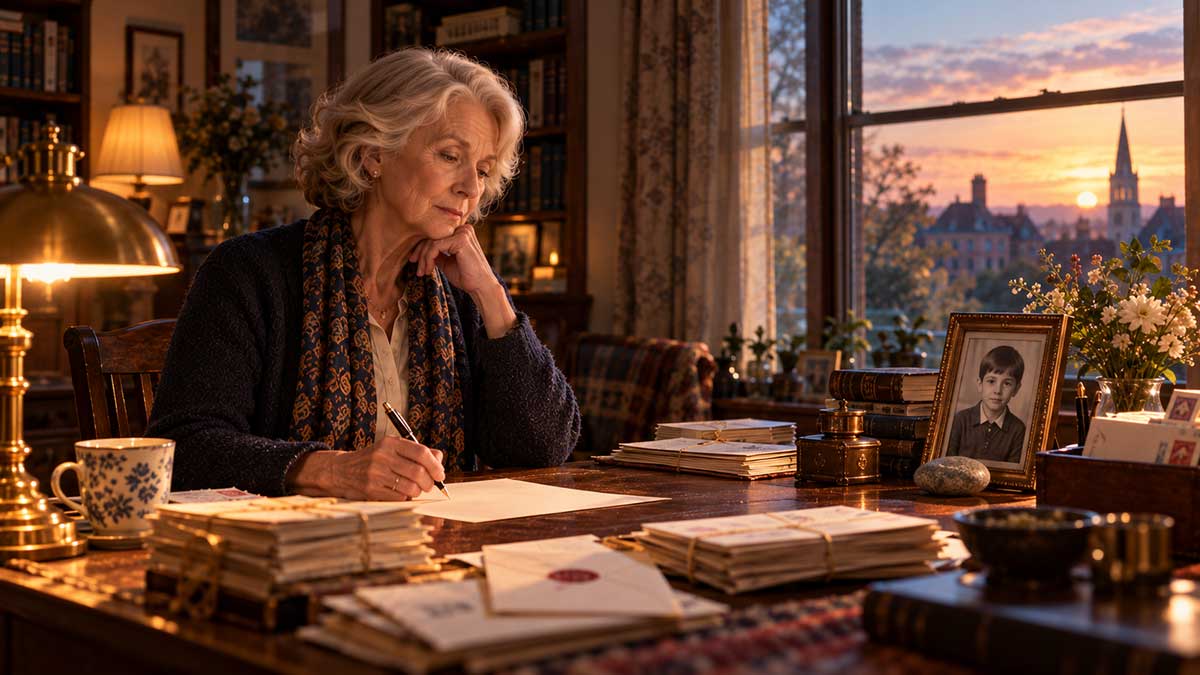
The reading lamp remains on.
The rest of Sybil's house is dark.
On the desk lies a blank sheet of paper.
Beside it are the letters already written, the letters answered, the letters saved, and the letters nobody knows about.
The small stone remains near Gilbert's photograph.
No one has touched it since the last conversation.
Lydia Woodyatt stands nearest the desk now.
Virginia Evans sits quietly beside the window. Dan McAdams leans against the shelves. Laura Carstensen watches the darkness outside. James Pennebaker holds one of Sybil's fountain pens without writing. Dennis Klass remains beside Gilbert.
The Moderator looks around the room.
Moderator: Every topic has brought us here.
We began with identity.
Then grief.
Then writing.
Then aging.
Now time itself is part of the conversation.
Virginia, if Sybil has spent decades corresponding with people, why might the most important letters still be the hardest ones to write?
Evans: Since the important ones can change relationships.
You can write beautifully about books, ideas, memories.
But when you write:
"I was wrong."
or:
"I hurt you."
or:
"I need you."
or:
"I love you."
you give another person something they can answer.
Woodyatt: And some answers may be painful.
Moderator: Which means the final obstacle isn't vocabulary.
Pennebaker: No.
Sybil has plenty of vocabulary.
McAdams: The obstacle is what the truth may require afterward.
Question 1: What makes an apology morally meaningful when the past cannot be changed?
Moderator: Lydia, let's begin with Fiona.
Sybil cannot change Fiona's childhood.
She cannot erase the years after Gilbert died.
What can an apology actually do?
Woodyatt: It depends on what Sybil expects from it.
If the purpose is:
"Please make me feel like a good mother again,"
then Fiona is being asked to care for Sybil's guilt.
That is not much of an apology.
Evans: That's important.
Woodyatt: A meaningful apology begins elsewhere.
It names what happened.
It recognizes impact.
It accepts responsibility for the part that genuinely belongs to the speaker.
And it leaves the recipient free.
Moderator: Free to forgive?
Woodyatt: Or not.
Moderator: Free to reconcile?
Woodyatt: Or not.
Moderator: Free to say the apology came too late?
Woodyatt: Yes.
That freedom matters.
McAdams: So an apology alters the speaker's life story too.
Woodyatt: It can.
Someone moves from:
"I had reasons."
to:
"I had reasons, and I still caused harm."
That is a more demanding moral narrative.
Evans: Sybil would struggle with that.
Woodyatt: Most people do.
Moderator: James, does writing help here?
Pennebaker: It can help Sybil clarify what she wants to say before emotion overwhelms the conversation.
But the written form doesn't guarantee sincerity.
A beautifully written apology can still avoid accountability.
Moderator: What might that avoidance sound like?
Pennebaker: Something like:
"I'm sorry you felt abandoned."
Woodyatt winces.
Woodyatt: Yes.
That centers the recipient's reaction without naming the speaker's act.
Moderator: Better?
Woodyatt: Perhaps:
"After Gilbert died, I shut you out. I told myself I was protecting you. I can see now that my withdrawal left you alone with your own grief. I am sorry."
Nobody speaks for a moment.
Evans: That sounds painfully close.
Moderator: Would Fiona have to forgive her?
Woodyatt: No.
Moderator: Then what changes?
Woodyatt: Sybil stops requiring Fiona to carry a false version of the past.
She says:
"I see what happened to you."
Recognition can matter even when restoration is incomplete.
Moderator: What about Daan?
Woodyatt: Different relationship.
Different harm.
Different moral history.
We should resist turning apology into a universal script.
McAdams: Which returns us to Topic 1.
Different relationships reveal different moral versions of Sybil.
Woodyatt: Yes.
With one person, the needed words may be:
"I failed to see you."
With another:
"I made a decision that hurt you."
With another:
"I was afraid and pretended I wasn't."
Moral repair is relationship-specific.
Moderator: So one grand confession does not clean the whole slate.
Woodyatt: No.
Human relationships are not accounting ledgers.
Question 2: Is self-forgiveness possible without turning responsibility into self-exoneration?
The Moderator looks at the stone.
Moderator: This may be Sybil's most dangerous question.
What does it mean to forgive yourself when some guilt is justified and some is not?
Woodyatt: First, separate responsibility from identity.
Moderator: Explain.
Woodyatt: There is a difference between:
"I did something wrong."
and:
"I am nothing but the worst thing I did."
If self-forgiveness means denying wrongdoing, it becomes evasion.
If responsibility means eternal self-condemnation, there is no moral growth either.
McAdams: That distinction fits narrative identity beautifully.
A mature life story has to include failures without making them the entire plot.
Klass: And grief complicates that.
Some of Sybil's guilt may concern actual choices.
Some may concern Gilbert's death itself.
Those are not equivalent.
Moderator: Dennis, say more.
Klass: Suppose Sybil regrets shutting Fiona out after Gilbert died.
That is something she can examine morally.
But if she also believes she should somehow have prevented Gilbert's death when the event was beyond her control, that guilt functions differently.
Woodyatt: One may require accountability.
The other may require relinquishing an impossible responsibility.
Moderator: And Sybil has bundled them together.
Evans: I think she has.
McAdams: Which creates a powerful but very narrow story:
"I failed."
Moderator: Everywhere.
McAdams: Exactly.
If every painful outcome becomes evidence of personal failure, then guilt takes over the whole identity.
Pennebaker puts down the pen.
Pennebaker: There's something interesting about writing here.
The sentence:
"It was my fault"
is short.
Simple.
It closes the story.
Moderator: And the more accurate story?
Pennebaker: Usually longer.
McAdams: Much longer.
Woodyatt: Painfully longer.
Moderator: What might Sybil's longer version sound like?
McAdams takes a moment.
McAdams: Perhaps:
"Gilbert died. I loved him. I could not save him. His death devastated me. I withdrew from Fiona. I hurt people. Some of that belongs to grief. Some belongs to choices I made. I can regret those choices without claiming control over the tragedy itself. I am still responsible for what was mine. I am not responsible for everything."
Evans looks down.
Evans: That's much harder than saying, "It was my fault."
Woodyatt: Exactly.
Moderator: Why?
Woodyatt: Since total guilt can feel strangely clean.
One verdict.
One defendant.
One sentence.
Reality is messier.
Klass: Love.
Chance.
Loss.
Responsibility.
Helplessness.
Survival.
All mixed together.
Moderator: So self-forgiveness may require more responsibility, not less.
Woodyatt: In a mature form, yes.
You face what belongs to you.
You stop claiming what does not.
Then you decide what kind of person you want to be now.
Question 3: If mortality suddenly became visible, what would Sybil realize she had been foolishly leaving unsaid?
Carstensen turns from the window.
Carstensen: This is where time changes motivation.
When the future feels indefinite, postponement is easy.
Later.
Next month.
Someday.
When remaining time feels limited, "later" becomes a different word.
Moderator: Virginia, this seems close to what you wanted readers to feel.
Evans: Yes.
If there is someone you need to reach out to, reach out.
If there's something you need to say in love, say it.
If you need to ask forgiveness, ask.
Don't assume unlimited time.
Moderator: Then let's make it personal for Sybil.
One year.
Suppose she knows she has one year left.
Not as punishment.
Not as tragedy.
Simply one year.
What becomes urgent?
Evans: Fiona.
Moderator: What does she need to say?
Evans thinks for a long time.
Evans: Maybe something very simple.
"I saw your pain too late."
Woodyatt nods.
Evans: And:
"I loved you even when I failed to show it in the form you needed."
Moderator: Theodore?
Carstensen smiles faintly.
Carstensen: Perhaps:
"Stay."
Moderator: Just that?
Carstensen: For Sybil, that could be enormous.
Not advice.
Not usefulness.
Not control.
Just:
"Stay."
Moderator: Harry?
Pennebaker: Maybe:
"You changed me."
McAdams: That's a beautiful thing to tell someone.
It acknowledges that relationship is not one-way.
Moderator: Rosalie?
Evans: Gratitude.
For history.
For knowing who Sybil was before some of the harder chapters.
Moderator: Daan?
Woodyatt answers carefully.
Woodyatt: Whatever truth belongs to that relationship, without asking him to make Sybil feel better about it.
Moderator: And Gilbert?
Everyone looks toward the photograph.
Klass speaks first.
Klass: That's the one letter I would want to hear.
The room grows quieter.
The Moderator pulls the blank paper closer.
Moderator: Virginia, what might Sybil write?
Evans looks at Gilbert's photograph.
Evans: I think she might finally stop apologizing to him.
Nobody moves.
Moderator: What would she say instead?
Evans speaks slowly.
Evans:
"You were eight.
You were here.
I loved you completely.
After you died, I thought suffering was one way of remaining loyal to you.
I thought if I stopped hurting, perhaps I was leaving you.
I was wrong.
Fiona grew up.
She had a life.
I should have seen more of it.
I had a life too.
There were books.
Friends.
Letters.
People I did not expect to love.
There was laughter after you.
I am no longer going to apologize for that.
I loved you.
I love you.
And I lived."
Nobody speaks.
Klass looks at the stone.
Klass: That is continuing bond without permanent punishment.
Woodyatt: And it does not require Gilbert to absolve her.
McAdams: It changes the narrative from:
"My life ended morally when yours ended"
to:
"Your life remains part of mine, but it is not the only part."
Moderator: Virginia, I want to go one step further.
Sybil has spent a lifetime writing to other people.
What if the final letter is to herself?
Evans smiles very slightly.
Evans: She would hate that assignment.
Pennebaker: Which is why she should do it.
They laugh softly.
Moderator: Dan, what would the purpose be?
McAdams: To integrate the different Sybils we have spent five topics discovering.
Not to select the nicest one.
To make room for all of them.
Woodyatt: Including the one who caused harm.
Klass: The one who grieved.
Carstensen: The one who is aging.
Pennebaker: The one who kept writing.
Evans: The one who is still here.
The Moderator looks at the blank sheet.
Moderator: Then what does she write?
No one answers.
The Moderator turns toward Evans.
Moderator: Virginia?
Evans does not look at the paper.
She looks at Sybil's chair.
Then she begins.
Evans:
"Sybil,
You spent years believing strength meant needing very little.
It did not.
You believed protection meant keeping fear away from the people you loved.
Sometimes it meant keeping yourself away from them too.
You confused grief with loyalty.
Guilt with responsibility.
Control with safety.
Independence with dignity.
Silence with protection.
Loneliness with self-sufficiency.
You were wrong about some things.
You hurt people.
You loved people.
Sometimes both were true in the same relationship.
Gilbert was here.
Nothing will make that smaller.
You do not need to make your own life smaller to prove he mattered.
Fiona is still here.
Look at her.
Do not spend the rest of your life explaining why you could not reach her.
Reach her now.
Let Theodore read to you.
Let someone drive.
Let someone worry.
Let someone help.
Let someone love you without giving you a job first.
You do not need to be useful every minute to deserve a place in someone's life.
There is a stone you have carried for a long time.
Do not throw it away.
Do not pretend it never mattered.
Put it down.
Sit beside it when you need to.
Tell the story.
Say his name.
Then stand up again.
There are still letters to write."
The room is silent.
Moderator: Would Sybil send that letter?
Evans shakes her head.
Evans: There would be nowhere to send it.
Pennebaker: Does that matter?
Evans looks around the room.
Evans: Maybe not.
Someone heard it.
Carstensen turns toward the window.
The reflections of everyone in the room remain visible.
McAdams looks at them.
McAdams: Topic 1 asked which Sybil is real.
I think we have an answer now.
Moderator: Which one?
McAdams: The answer was never one version.
The task was integration.
The woman who loved Gilbert.
The woman who failed Fiona.
The woman Fiona still loves.
The friend.
The professional.
The frightened woman.
The stubborn woman.
The correspondent.
The aging woman.
The woman Theodore wants beside him.
The person capable of regret.
The person capable of change.
All of them.
Woodyatt: Responsibility without reduction.
Klass: Grief without permanent imprisonment.
Carstensen: Aging without declaring life finished.
Pennebaker: Expression that becomes relationship.
Evans: And connection.
Final Question
The Moderator does not look at Sybil's desk now.
The question is no longer about Sybil alone.
Moderator: I want each of you to forget the novel for a moment.
Suppose you knew someone you deeply loved would be gone one year from today.
What would you stop leaving unsaid?
Nobody answers immediately.
Carstensen lowers her eyes.
Pennebaker puts the fountain pen back on the desk.
Woodyatt folds her hands.
McAdams looks at the reflections in the glass.
Klass looks at Gilbert.
Evans finally speaks.
Evans: I think I would stop assuming they already knew.
The Moderator says nothing.
Evans continues.
Evans: We tell ourselves:
They know I love them.
They know I'm grateful.
They know I'm sorry.
They know what they meant to me.
Maybe they do.
But sometimes we should say it anyway.
Pennebaker: Or write it.
Evans: Yes.
Write it.
Carstensen: And don't wait for a perfect moment.
Woodyatt: Nor a guaranteed response.
Klass: Since eventually there may be no response available.
McAdams: And the words we say become part of another person's story.
The Moderator looks at the desk one last time.
Letters everywhere.
Fragments of a life sent outward.
Some affectionate.
Some difficult.
Some ordinary.
Some painful.
Every one of them evidence that at one moment, one human being turned attention toward another.
Moderator: Perhaps that's why correspondence matters so much in this novel.
A letter cannot undo death.
It cannot rewrite childhood.
It cannot guarantee forgiveness.
It cannot force reconciliation.
It cannot protect anyone from loss.
But it can do one thing.
It can cross the distance between two people and say:
I thought of you.
I remembered.
I was wrong.
Thank you.
I miss you.
I love you.
I'm still here.
Virginia Evans looks at Sybil's empty chair.
Evans: And sometimes that's enough to begin.
Topic 5 Realization
Sybil's life cannot be repaired by finding one perfect sentence.
Some losses are permanent.
Some consequences remain.
Some people may forgive her.
Others may not.
The purpose of apology is not to force the past to become painless.
The purpose of responsibility is not to condemn the self forever.
The purpose of self-forgiveness is not to declare innocence.
And the purpose of correspondence is not to control the answer.
What remains possible is smaller and more human.
Tell the truth.
Name the harm.
Ask forgiveness without demanding it.
Say thank you.
Say I love you.
Accept help.
Receive the reply.
Keep Gilbert without disappearing beside him.
Let Fiona carry her own memories.
Let Theodore come close.
Let Harry matter.
Let Rosalie remember.
Let the life story grow larger than its worst chapter.
Sybil has spent decades sending pieces of herself into the lives of other people.
The people around her have been sending pieces back.
Perhaps that is the deepest answer Part 2 gives us.
We do not discover ourselves alone.
We become more complete when another person can answer:
This is who you were to me.
And we are still capable of responding:
Then let me tell you who I want to be now.
The stone remains beside Gilbert's photograph.
Nobody picks it up.
The lamp remains on.
There is still enough light to write.
Final Thoughts
Five discussions began with Sybil.
They end with something much larger.
McAdams helps us see that identity is an evolving life story. Other people may carry pieces of us that our own autobiography misses.
Klass helps separate remembering the dead from remaining imprisoned by grief. Sybil does not need to forget Gilbert. She can keep him without carrying the stone every moment.
Pennebaker helps explain why writing can give difficult emotions language. Yet writing is only one part of correspondence. Sending allows another person to know us. Receiving their answer means surrendering control.
Carstensen helps us see Sybil's later years differently. A quieter life is not necessarily an empty one. The question may shift from "Who needs me?" to "Who still wants to share their time with me?"
Woodyatt gives us the final distinction. Self-forgiveness is not pretending we did nothing wrong. Sybil can accept responsibility for the harm that belongs to her without accepting responsibility for every tragedy that occurred around her.
This leads back to Virginia Evans's central concern: human connection.
A letter cannot return Gilbert.
An apology cannot rewrite Fiona's childhood.
Love cannot guarantee forgiveness.
But words can still cross the distance between two people.
I was wrong.
Thank you.
I miss you.
I love you.
Please stay.
Perhaps Sybil's deepest discovery is that correspondence was never simply about expressing herself.
It was about allowing another human being to answer.
And perhaps the question The Correspondent leaves with us is very simple:
Who already knows what you feel, but still deserves to hear you say it?
Short Bios:
Virginia Evans
Author of The Correspondent. Evans has described human connection as central to the novel and has discussed how personal fears, including losing a child and blindness, influenced Sybil's story.
Dan P. McAdams
Psychologist known for research on narrative identity and the life stories people construct to connect memory, identity, and the future.
Laura Carstensen
Psychologist and aging researcher known for socioemotional selectivity theory, examining how perceptions of time affect emotional priorities and relationships.
James W. Pennebaker
Psychologist known for research into expressive writing and how putting difficult experiences into language can affect emotional processing.
Dennis Klass
Bereavement scholar associated with continuing-bonds theory, which examines how relationships with people who have died can continue through memory, identity, ritual, and inner connection.
Lydia Woodyatt
Psychologist whose research examines self-forgiveness, responsibility, moral identity, and repair after wrongdoing.
Sybil Van Antwerp
The central character of The Correspondent, whose letters gradually reveal a life shaped by intelligence, grief, independence, friendship, regret, aging, and an enduring desire for connection.
Gilbert
Sybil's son, who died at eight. His absence remains one of the defining emotional presences in Sybil's life and raises the question of how the living can remember the dead without surrendering their own lives.
Leave a Reply