

Introduction
What if fighting is not always a sign that a relationship is failing?
In The Art of Fighting: The Transformative Power of Conflict, Priya Parker challenges one of our deepest assumptions about relationships: that peace is good and conflict is bad. Sometimes silence preserves harmony. Sometimes it slowly creates distance. Sometimes an argument damages a relationship. Sometimes it reveals what two people were too afraid to say.
At the center of Parker's work is a deeply human question:
How do we fight with people we still want to belong to?
To explore that question, Parker is joined by six thinkers whose work approaches conflict from different directions: Amanda Ripley on high conflict, Sheila Heen on difficult conversations, Daniel Shapiro on identity, William Ury on negotiation, Donna Hicks on dignity, and Oren Jay Sofer on mindful communication.
Across five conversations, they explore love, silence, belonging, confrontation, forgiveness, and what remains after something between two people has broken.
(Note: This is an imaginary conversation, a creative exploration of an idea, and not a real speech or event.)
Topic 1: Why Do We Fight Most With the People We Love?

Moderator: Priya, I want to begin with something almost everyone has experienced.
A stranger can say something rude to me, and perhaps I'm irritated for ten minutes.
My wife can say six words in exactly the wrong tone, and I'm thinking about them three days later.
Why?
Priya Parker: Because she matters.
That's almost embarrassingly simple, but I think we forget it.
Conflict often appears where there is attachment. When somebody matters to us, their actions carry meaning that the same actions from a stranger would never carry.
The argument might sound like it's about dishes.
Or arriving late.
Or forgetting to call.
Or spending money.
But underneath the argument is often something closer to:
"Do I matter to you?"
"Do you see me?"
"Can I depend on you?"
"Do I belong here?"
And this is why I became interested in what happens when people who want to belong to one another find themselves in conflict.
William Ury: I would go one step further.
The thing people say they're fighting about is frequently not the thing they're fighting about.
Moderator: Give me an ordinary example.
William Ury: A couple is driving to a restaurant.
The husband says, "Turn left."
The wife says, "No, it's faster if we go straight."
He says, "I know where I'm going."
She says, "You always do this."
Now they're fighting.
Is this really about navigation?
Moderator: Probably not anymore.
William Ury: Exactly.
The positions are:
"Turn left."
"Go straight."
But the interests may be completely different.
Perhaps she feels he never listens to her.
Perhaps he feels she constantly questions his judgment.
Now the argument isn't about arriving at the restaurant.
It is about recognition.
Autonomy.
Respect.
You can't resolve the deeper conflict by proving which road was three minutes faster.
Sheila Heen: And I would separate that into three conversations.
The first is:
"What happened?"
He says, "You questioned me."
She says, "I was helping you."
That's the factual argument.
The second conversation is about feelings.
He feels criticized.
She feels dismissed.
Then underneath both is the identity conversation.
He may be hearing:
"My wife thinks I'm incompetent."
She may be hearing:
"My husband doesn't value my judgment."
That's why these tiny disagreements become enormous.
People think they're defending facts.
They're often defending themselves.
Moderator: So when someone says, "You forgot our anniversary," the deepest sentence might not be about the anniversary.
Sheila Heen: Exactly.
It might be:
"Am I important to you?"
And that is a frightening question to ask directly.
So instead we say:
"You forgot again."
Priya Parker: This is where I think conflict becomes strangely intimate.
To say that you've hurt me is to admit that you have the capacity to hurt me.
That means I've given you access to something vulnerable.
If you were irrelevant to me, I wouldn't need this conversation.
Donna Hicks: And often what has been injured is dignity.
People sometimes think dignity means being treated politely.
It's much deeper.
Human beings need to feel recognized.
Included.
Heard.
Taken seriously.
Treated fairly.
When those things are violated, something powerful happens inside us.
Moderator: Let me make this more uncomfortable.
Suppose my adult son doesn't call very often.
I finally say:
"You never call me anymore."
He immediately responds:
"Dad, I called you last Sunday."
Who's right?
Donna Hicks: Possibly both.
Moderator: How?
Donna Hicks: Your son is answering the literal accusation.
You're expressing something else.
You may really be saying:
"I miss you."
Or:
"I'm afraid I'm becoming less important in your life."
Or:
"Your life is moving forward, and I don't know where I fit anymore."
Those aren't accusations.
They're vulnerabilities.
But vulnerability is harder to express.
Sheila Heen: This is such an important point.
"You never call" invites a factual defense.
"I miss you" invites a completely different conversation.
William Ury: One is a position.
The other reveals an interest.
Priya Parker: And the second carries more risk.
If I say, "You never call," I can remain angry.
If I say, "I miss you," I've exposed myself.
Now you can reject me.
Moderator: That's interesting.
Maybe anger sometimes protects us from having to say the more vulnerable sentence.
Oren Jay Sofer: Very often.
And this is where I would slow everything down.
Suppose your son says:
"Dad, I have my own life. I can't call you all the time."
Notice what happens inside you before you answer.
Your chest tightens.
Your face gets warm.
Your mind immediately starts producing evidence.
"After everything I've done for you..."
"When you needed me, I was always there..."
"One day you'll understand..."
There may be a tiny interval before all of that.
If you can become aware of it, you have a choice.
Moderator: Between what?
Oren Jay Sofer: Between reacting from the wound and speaking from the need.
Instead of:
"Fine. Don't call me."
you might discover:
"I'm having a harder time adjusting to how much your life has changed than I expected."
That's a radically different conversation.
Priya Parker: And notice what just happened.
The conflict didn't disappear.
The truth became clearer.
That's what I mean when I say I'm not interested in eliminating conflict.
I want us to become better at entering it.
Amanda Ripley: But here's where I want to introduce a warning.
Not all conflict stays healthy.
There is ordinary conflict, which can be useful.
Then there is what I call high conflict.
High conflict develops its own gravity.
Eventually we're no longer trying to solve the original problem.
We're trying to defeat the other person.
Moderator: How would I know I've crossed that line?
Amanda Ripley: One sign is that complexity disappears.
The other person becomes entirely wrong.
You become entirely right.
Curiosity collapses.
You start interpreting everything they do as evidence supporting the story you've already created about them.
Your husband isn't a person who forgot something.
He's selfish.
Your daughter isn't a person making a decision you dislike.
She's ungrateful.
Your colleague isn't mistaken.
He's toxic.
Once people become characters in our moral story, conflict changes.
Priya Parker: That's exactly why I use the phrase healthy heat.
I don't want no heat.
But I don't want the house burning down either.
Moderator: Daniel, you've studied conflicts that become almost impossible to negotiate. What happens psychologically when we cross that line?
Daniel Shapiro: Identity enters.
Human beings don't simply have opinions.
We construct identities around some of those opinions.
Once you threaten something sacred to my identity, I may experience your disagreement differently.
You aren't merely saying:
"I disagree with your belief."
I may hear:
"People like you are stupid."
Or:
"Your family is wrong."
Or:
"Your religion is backward."
Or:
"Your way of life has no place here."
Now I'm not defending an idea.
I'm defending myself.
Moderator: And that's when what you call the Tribes Effect can emerge?
Daniel Shapiro: Yes.
The relationship becomes adversarial.
We become increasingly self-righteous.
We close ourselves to information from the other side.
And something fascinating happens.
We often believe the other person is responsible for the entire conflict.
Amanda Ripley: That's where conflict starts feeding itself.
Daniel Shapiro: Precisely.
And this happens in families just as easily as it happens between nations.
Moderator: Let me bring this back to love.
Suppose a mother and daughter have a major disagreement.
The mother says:
"I'm telling you this because I love you."
The daughter says:
"If you loved me, you'd accept my decision."
They both invoke love.
Who's right?
Priya Parker: That is the interesting question.
Love doesn't automatically tell us what to do.
Sometimes love asks us to speak.
Sometimes love asks us to listen.
Sometimes love asks us to stop controlling.
Sometimes love asks us to confront.
The problem begins when we assume:
"If you loved me, you would agree with me."
Daniel Shapiro: There is a deep tension here between affiliation and autonomy.
I want to belong to you.
And I want to remain myself.
Those two desires can collide.
The mother may experience the daughter's independence as rejection.
The daughter may experience the mother's concern as control.
Yet both may desperately want the relationship.
Donna Hicks: Which means dignity becomes vital.
The mother can disagree with the daughter's decision without treating her daughter as incapable of directing her own life.
The daughter can assert independence without humiliating her mother for caring.
Protecting dignity doesn't require agreement.
Moderator: Priya, here's where I want to challenge the premise.
What about the person who says:
"No. Fighting isn't love. If you love somebody, you don't hurt them."
Priya Parker: I understand that impulse deeply.
I'm conflict-averse myself.
But I think we have to distinguish causing unnecessary harm from creating discomfort.
Those aren't the same thing.
Sometimes telling the truth creates discomfort.
Setting a boundary creates discomfort.
Saying "I disagree" creates discomfort.
Saying "That hurt me" creates discomfort.
If our definition of love becomes:
"Never make someone I love uncomfortable,"
then honesty becomes almost impossible.
Amanda Ripley: And suppressed disagreement doesn't necessarily disappear.
Sometimes it waits.
Sheila Heen: Or changes form.
Moderator: Into what?
Sheila Heen: Distance.
Sarcasm.
Withdrawal.
Resentment.
Passive aggression.
Indifference.
You can stop fighting without resolving anything.
Moderator: That makes me think of something sad.
Perhaps the most dangerous moment in a marriage isn't always when two people are shouting.
Maybe it's when one of them finally thinks:
"What's the point of bringing it up anymore?"
Priya Parker: Yes.
Because there's a difference between:
"I don't want to fight with you."
and:
"You're no longer worth fighting with."
Those sentences sound similar from outside.
Emotionally, they're worlds apart.
Oren Jay Sofer: And there is another possibility.
Sometimes someone stops fighting because they've realized the method of fighting isn't working.
Silence can be withdrawal.
But a pause can be wisdom.
We need enough awareness to know which is happening.
William Ury: That's where going to the balcony matters.
Before entering the argument, ask:
"What am I trying to accomplish?"
If the answer is:
"I want her to admit I'm right,"
that's useful information.
If the answer is:
"I want us to feel close again,"
then you might choose very different words.
Moderator: Donna, earlier you separated dignity from respect.
Could you explain that here?
Donna Hicks: Respect is often connected to admiration or behavior.
Dignity is inherent.
You may lose respect for something someone has done.
You don't need to strip them of their humanity.
That distinction becomes extraordinarily important during conflict.
People often believe:
"If I acknowledge your dignity, I'm validating what you did."
No.
You can say:
"What you did was unacceptable."
and still communicate:
"You remain a human being worthy of being heard."
Moderator: That's difficult when we're angry.
Donna Hicks: Of course.
Conflict tempts us to humiliate.
Humiliation feels like victory for about five minutes.
Then it becomes fuel for the next conflict.
Amanda Ripley: That's exactly how high conflict grows.
Every humiliation creates another story.
"See? I knew what kind of person she was."
Then the other person retaliates.
Now you have two people collecting evidence against each other.
Priya Parker: And eventually the original conflict disappears.
Moderator: Meaning?
Priya Parker: They don't remember what they're fighting for.
They only remember whom they're fighting against.
Moderator: That's a powerful distinction.
Fighting for something versus fighting against someone.
William Ury: Exactly.
Ask:
"What am I fighting for?"
Maybe:
"I want my marriage to feel like a partnership."
"I want my father to see me as an adult."
"I want my friend to understand why I felt abandoned."
Those are interests.
But if the answer becomes:
"I want him to suffer."
we're somewhere else.
Amanda Ripley: And if you're unable to imagine anything good about the other person, pay attention.
That's often a warning sign.
Moderator: Priya, then perhaps the title The Art of Fighting can be misunderstood.
Maybe the art isn't learning how to fight harder.
Priya Parker: No.
It's learning how to stay human inside the fight.
Oren Jay Sofer: And letting the other person remain human too.
Daniel Shapiro: Especially when something important about your identity feels threatened.
Donna Hicks: Especially when you believe they've violated your dignity.
Sheila Heen: Especially when the argument you're having isn't actually the conversation you need to have.
There was a brief silence around the table.
The Moderator looked down at his notes.
Moderator: I started this conversation asking why we fight most with people we love.
I'm beginning to wonder whether that's the wrong question.
Maybe the more revealing question is:
Why can the people we love hurt us in ways strangers cannot?
Priya Parker: Because belonging creates vulnerability.
To belong is to give another person some ability to affect you.
Moderator: Which sounds frightening when you put it that way.
Priya Parker: It is.
But what's the alternative?
A life where nobody can hurt you would require a life where nobody gets close enough to matter.
Oren Jay Sofer: Protection from pain can become protection from intimacy.
Sheila Heen: And sometimes the accusation is simply the vulnerable sentence wearing armor.
"You never listen to me" may mean:
"I want to matter to you."
"You never call" may mean:
"I miss you."
"You don't understand me" may mean:
"Please know me."
William Ury: Which is why discovering the need changes the conversation.
Donna Hicks: And recognizing dignity changes how we respond.
Daniel Shapiro: Recognizing identity changes what we think is at stake.
Amanda Ripley: And remembering complexity keeps disagreement from turning the person we love into the enemy.
Moderator: Then perhaps the first task in a serious fight isn't deciding who's right.
Maybe it's discovering what the fight is trying to protect.
Priya Parker: Yes.
Sometimes underneath anger is something surprisingly tender.
Fear.
Belonging.
Recognition.
Trust.
Love.
The argument is merely where those things became visible.
Moderator: So perhaps when two people who love each other find themselves fighting, there is one question worth asking before anything else:
“What are we afraid of losing?”
Topic 2: When Peace Is Actually Distance

The room had become quiet after the previous conversation.
The Moderator looked around the table.
Moderator: I want to begin this one with a marriage that looks almost perfect from the outside.
Twenty-eight years together.
They rarely raise their voices.
Their children say, "Mom and Dad never fight."
Friends admire them.
They go to dinner together. They attend family events together. They sleep in the same bed.
But something changed years ago.
She stopped telling him when he hurt her.
He stopped asking what was wrong.
They discovered which subjects caused trouble, and gradually they stopped discussing them.
Eventually they became extraordinarily good at living together without disturbing each other.
Are they at peace?
Priya Parker: Maybe.
But that's exactly the kind of peace we need to examine.
There is genuine peace.
And there is what I call unhealthy peace.
From the outside they can look identical.
Moderator: What makes the second one unhealthy?
Priya Parker: What had to disappear to maintain it.
If peace requires that neither person say what actually matters, then we're paying for harmony with intimacy.
Sheila Heen: I'd want to know when the difficult conversations stopped.
That's often revealing.
Maybe early in the marriage she would say:
"When you do that, I feel dismissed."
He'd defend himself.
They'd argue.
She'd try again six months later.
Same result.
Eventually she stops.
He thinks:
"Things have gotten better. We don't fight anymore."
She thinks:
"There's no point."
Those are completely different interpretations of the same silence.
Moderator: That's painful.
One person experiences the absence of conflict as improvement.
The other experiences it as surrender.
Sheila Heen: Exactly.
And sometimes neither realizes how far apart they've become until something finally exposes it.
Amanda Ripley: We should be careful here, though.
Not fighting doesn't automatically indicate a problem.
Some people genuinely don't need much confrontation.
Some couples have learned each other's rhythms.
Some families let small things go.
That's healthy.
Priya Parker: Completely.
I'm not proposing that everybody manufacture conflict.
Amanda Ripley: The question is whether curiosity remains.
Can I still ask you something difficult?
Can you surprise me?
Can I disagree with you without fearing that the relationship itself is threatened?
If yes, quiet can be peaceful.
If no, quiet may be containment.
Moderator: Donna, how does dignity enter this?
Donna Hicks: Silence can sometimes protect dignity.
But it can also conceal repeated dignity violations.
Suppose someone continually interrupts his spouse.
She initially objects.
"Please let me finish."
He laughs.
"You're too sensitive."
She tries again another time.
"You don't listen to me."
He rolls his eyes.
Eventually she stops complaining.
Has the problem disappeared?
No.
She may have concluded:
"My voice doesn't matter here."
That's a dignity wound.
And once someone begins feeling invisible inside a relationship, resentment can become profound.
Moderator: Yet the husband might genuinely think everything is fine.
Donna Hicks: Yes.
That's why the absence of complaint is not proof of the absence of injury.
Oren Jay Sofer: There's another layer.
People sometimes remain silent because they don't know how to express what they're experiencing without attacking.
They think their choices are:
"Say nothing."
or:
"Explode."
But there is enormous territory between those two.
Moderator: Give us an example.
Oren Jay Sofer: Suppose your partner is constantly looking at a phone while you're speaking.
You could say:
"You're addicted to that stupid phone. You never listen."
That's accusation.
You could say nothing.
That's suppression.
Or you could notice what is happening inside yourself.
Maybe you're hurt.
Maybe lonely.
Then say:
"When I'm telling you something and you keep looking at the phone, I feel disconnected from you. I'd really like your attention for a few minutes."
That doesn't guarantee a pleasant response.
But now you're communicating the experience rather than prosecuting the person.
William Ury: And notice the interest underneath it.
The phone isn't really the issue.
The underlying interest is:
"I want connection."
Moderator: Which resembles our previous discussion.
William Ury: Yes, because many conflicts become much more workable once people stop defending positions and reveal interests.
"Put your phone down."
is a demand.
"I miss having your attention."
is an interest.
Those sentences create different emotional reactions.
Moderator: But here's something I've noticed.
Sometimes people don't speak because they're afraid that if they begin, everything will come out.
Ten years of resentment.
Priya Parker: Absolutely.
That's one reason avoidance becomes self-reinforcing.
The longer something remains unspoken, the more dangerous the conversation feels.
At first you're avoiding one disagreement.
Five years later you're avoiding an entire history.
Moderator: Let's create another family.
A father has a daughter in her thirties.
He strongly disagrees with several decisions she's made.
Years ago, every conversation about those decisions became painful.
So eventually he decides:
"She's an adult. I'm never discussing this again."
Their relationship becomes pleasant.
Birthdays.
Christmas.
Restaurants.
Grandchildren.
Weather.
Movies.
Everything except the thing both know they cannot discuss.
Is that healthy restraint or unhealthy peace?
Daniel Shapiro: We can't answer without knowing what the silence means to each person.
Perhaps the father has genuinely accepted:
"Her life belongs to her."
Then the silence may represent autonomy and respect.
But perhaps he thinks:
"If she knew what I really thought, she'd reject me."
And perhaps the daughter thinks:
"Dad only loves the version of me that doesn't talk about this."
Now identity has entered the relationship.
Moderator: So the same behavior can have completely different meanings.
Daniel Shapiro: Precisely.
Conflict is rarely just behavior.
It's the meaning attached to the behavior.
Donna Hicks: I would ask the daughter:
"Do you feel fully seen by your father?"
And I'd ask the father:
"Can you recognize your daughter's dignity while disagreeing with her choices?"
Those answers tell us much more than whether they argue.
Moderator: Suppose he says:
"Of course I love her. She's my daughter."
Donna Hicks: Love and recognition aren't identical.
Someone can sincerely love you and still fail to see you as you experience yourself.
That can be deeply painful.
Sheila Heen: This is where the identity conversation becomes enormous.
The daughter may not simply want:
"Dad, stop criticizing this decision."
She may want:
"Dad, can you know who I've become and still want me?"
The father may have his own identity question:
"Can I disagree with my daughter without becoming a bad father?"
Now we have two frightened people.
One fears rejection.
The other fears losing his role.
And because neither wants to damage the relationship, they talk about the weather.
Moderator: That's almost tragic.
Priya Parker: And very human.
We often avoid conflict for noble reasons.
That's important.
People don't always avoid difficult conversations because they're cowardly.
Sometimes they are trying to protect something precious.
Moderator: Which creates the paradox.
Priya Parker: Yes.
The strategy we use to protect the relationship can eventually make the relationship less real.
Amanda Ripley: But I want to protect avoidance from becoming the villain here.
Sometimes avoidance is wise.
Moderator: Give me a case.
Amanda Ripley: Your ninety-year-old uncle makes the same irritating comment every Thanksgiving.
You've challenged him four times.
Nothing changes.
You could spend every Thanksgiving recreating the same argument.
Or you could decide:
"I'm not spending the limited time I have with this person fighting about this anymore."
That's different from suppressing something central to your identity.
William Ury: Exactly.
Not every interest deserves equal investment.
Priya Parker: I sometimes think of this as strategic avoidance.
There are things we consciously decide not to engage.
The key word is consciously.
Moderator: Then how do I know the difference?
How do I know whether I'm wisely letting something go or slowly abandoning myself?
There was a short pause.
Oren Jay Sofer: Notice whether the issue continues living inside you.
Moderator: Meaning?
Oren Jay Sofer: You tell yourself:
"I've let it go."
But every time the person does it again, your body tightens.
You replay conversations while driving.
You imagine arguments in the shower.
You complain about the person to everyone except the person.
You withdraw affection.
You become sarcastic.
Perhaps you haven't let it go.
Perhaps you've simply stopped speaking about it.
Sheila Heen: That's an important distinction.
Acceptance changes our relationship to the issue.
Suppression keeps the issue alive underground.
Amanda Ripley: And underground conflict can still organize the relationship.
People develop elaborate systems around things they supposedly aren't fighting about.
"Don't mention money around Dad."
"Don't talk about religion with Grandma."
"Don't ask why Michael left the company."
"Don't mention what happened at the wedding."
Eventually everyone knows the rules.
Nobody knows how the rules began.
Priya Parker: Groups become organized around their silences.
That's something I find fascinating.
What a group cannot discuss can tell you as much about that group as what it openly celebrates.
Moderator: That's a powerful thought.
A family might tell you its values by showing you the photographs on the wall.
But perhaps you could learn even more by asking:
"What are you forbidden to talk about at dinner?"
Daniel Shapiro: Absolutely.
Taboos often reveal sacred dimensions of identity.
Certain topics feel dangerous precisely because people believe discussing them threatens the group itself.
Moderator: So the taboo protects belonging.
Daniel Shapiro: Yes.
But it can simultaneously imprison the people who belong.
Moderator: Let's make this harder.
Suppose a woman says:
"My marriage is peaceful because I've learned not to expect anything from my husband."
What do you hear?
Donna Hicks: Grief.
Sheila Heen: Loss.
Oren Jay Sofer: Withdrawal.
Priya Parker: And possibly the end of conflict rather than the resolution of conflict.
Moderator: That's a brutal distinction.
Priya Parker: But an important one.
Two people can stop fighting because they've reached peace.
Or they can stop fighting because hope has disappeared.
William Ury: Think about what negotiation requires.
You negotiate when you believe there is some possibility of influencing what happens next.
If I completely abandon that possibility, I may stop asking.
So sometimes conflict is evidence that I still believe something can change.
Moderator: Meaning the argument itself may contain hope.
William Ury: Sometimes, yes.
"I'm angry that you don't listen to me" contains an implicit wish:
"I still want you to listen."
Indifference contains no such request.
Priya Parker: That's why I resist the idea that conflict automatically means a relationship is unhealthy.
Sometimes conflict means:
"I haven't given up on us."
The Moderator sat back.
Moderator: Let me introduce something that may be even more uncomfortable.
What if people don't hide themselves merely to avoid fighting?
What if they hide themselves because they want to be loved?
Suppose I discover early in a relationship:
"When I show this part of myself, people become uncomfortable."
So I stop showing it.
Everyone likes me.
I belong everywhere.
But nobody actually knows me.
Oren Jay Sofer: Then belonging has been purchased with concealment.
Donna Hicks: And eventually the person may feel unseen.
Sheila Heen: Which creates a terrible internal contradiction:
"They love me."
and
"They don't know me."
Both statements can feel true.
Moderator: Is that loneliness?
Priya Parker: I think it can be one of its deepest forms.
We usually picture loneliness as somebody sitting alone in an empty apartment.
But there is another kind.
You're sitting at a table filled with people who love you.
You're laughing.
Everyone believes you're happy.
And you're thinking:
"If I told them what I actually think, I don't know whether I'd still have a seat at this table."
That is profound loneliness.
Daniel Shapiro: And now we arrive at the tension between affiliation and autonomy.
Human beings want both.
I want to belong.
And:
I want to be myself.
Those desires coexist beautifully until the group asks us to choose.
Moderator: And then?
Daniel Shapiro: Then conflict becomes almost inevitable.
Because the question is no longer:
"Do we agree?"
The question becomes:
"Can I remain myself and still remain one of you?"
Amanda Ripley: That question can become dangerous if people feel forced into binary identities.
"Choose us or choose them."
"Agree or leave."
"If you really loved me, you'd believe what I believe."
That is how ordinary disagreement can begin moving into high conflict.
Complex human beings get reduced to camps.
Moderator: Priya, I'm starting to think unhealthy peace has a hidden price.
You avoid the explosion.
But perhaps you gradually lose truth.
Priya Parker: Sometimes.
And I want to be careful here because truth without care can become cruelty.
"I'm just being honest" has excused enormous amounts of unnecessary harm.
Healthy conflict isn't dumping every thought onto another person.
The question is:
What truth does this relationship need in order to remain real?
That's very different.
Donna Hicks: And can that truth be expressed without violating dignity?
Oren Jay Sofer: Can it be spoken with awareness of intention?
William Ury: Can we identify what we're actually seeking?
Sheila Heen: Can we recognize which conversation we're having?
Daniel Shapiro: Can both people retain identity and belonging?
Amanda Ripley: Can we remain curious enough that neither person becomes the enemy?
The Moderator was quiet for several seconds.
Moderator: Then perhaps the question isn't:
"Do healthy relationships fight?"
Maybe it's:
"Can this relationship tolerate truth?"
Priya Parker: I like that.
Because a relationship that can tolerate truth doesn't necessarily need constant conflict.
Sometimes truth produces disagreement.
Sometimes understanding.
Sometimes laughter.
Sometimes grief.
Sometimes separation.
But at least the relationship is dealing with something real.
Moderator: And perhaps that explains something I've always found strange.
Two people can have an enormous argument and feel closer the next morning.
Two other people can have a perfectly pleasant dinner and feel miles apart.
Sheila Heen: Because closeness isn't measured by volume.
Donna Hicks: Nor is peace measured by silence.
Oren Jay Sofer: Presence matters.
William Ury: Honesty matters.
Daniel Shapiro: Freedom to remain oneself matters.
Amanda Ripley: Curiosity matters.
Moderator: Priya, give me one final distinction.
How can someone sitting at home tonight ask whether the peace in an important relationship is genuine peace or unhealthy peace?
Priya Parker: I might ask something very simple:
"Is there something important I no longer tell this person because I've stopped believing they can hear it?"
The room went still.
Priya Parker: If the answer is no, wonderful.
Maybe you really have found peace.
But if someone immediately comes to mind, don't automatically start a confrontation.
Become curious.
What stopped you from speaking?
What are you protecting?
What are you afraid would happen?
What do you wish this person could understand?
And perhaps the hardest question:
Do you still want them to know you?
Moderator: Because if I do...
Priya Parker: Then the silence itself may eventually become something worth talking about.
The absence of fighting can mean that a wound has healed.
It can also mean that someone has stopped touching the wound because they've stopped believing it can heal.
Peace isn't simply the absence of angry words.
Sometimes genuine peace begins when two people finally become safe enough to say the words they've been avoiding.
Topic 3: How Much of Myself Must I Give Up to Belong?

The Moderator waited before speaking.
Moderator: I want to begin with a seventeen-year-old boy.
Every Sunday, he sits beside his parents in the same religious community where he grew up.
His grandparents belong there.
His closest friends belong there.
His parents met there.
His childhood memories are there.
People have known him since he was a baby.
But something has changed.
He no longer believes everything he once believed.
Nobody knows.
Every Sunday he sits there thinking:
"If I tell them what I really think, will I still belong here?"
Daniel, what kind of conflict is he experiencing?
Daniel Shapiro: A conflict between two profound human needs.
Affiliation and autonomy.
He wants connection.
He wants family.
He wants community.
And he wants the freedom to form his own identity.
The tragedy is that he may believe he has to choose between them.
Moderator: Meaning:
"Either I remain one of you..."
Daniel Shapiro: "...or I remain myself."
That's an extraordinarily painful choice.
Priya Parker: And this is why belonging interests me so much.
Every group has boundaries.
That's unavoidable.
A group with absolutely no boundaries isn't really a group.
But the difficult question is:
What does this group require from me before it allows me to belong?
Sometimes the requirements are explicit.
Sometimes they're invisible.
Moderator: Invisible how?
Priya Parker: Nobody tells the boy:
"You aren't allowed to question this."
But he notices what happens when someone else questions it.
The room changes.
People become uncomfortable.
Someone changes the subject.
Perhaps a parent says:
"Why would anyone think that?"
Nobody is talking about him.
Yet he learns the rule.
Amanda Ripley: Human beings are remarkably good at detecting those rules.
We constantly scan our groups.
What can I say here?
What will earn approval?
What will make everyone uncomfortable?
Who is safe to question?
Which stories are permitted?
Eventually those signals become part of identity.
Moderator: Donna, suppose the parents would say:
"That's ridiculous. Of course we'd still love him. He's our son."
But the boy still doesn't feel safe telling them.
Who's responsible for that?
Donna Hicks: That's where we need nuance.
The parents may sincerely love him.
Their intention isn't necessarily rejection.
But dignity isn't determined solely by intention.
Recognition matters.
The boy is asking:
"Can you recognize me as a person with an inner life that belongs to me?"
That's different from:
"Will you continue loving me?"
Moderator: So he might know they love him and still fear being unseen.
Donna Hicks: Absolutely.
Love can coexist with attempts to control.
Love can coexist with misunderstanding.
Love can coexist with disappointment.
That's why saying "But I love you" doesn't automatically resolve a dignity injury.
Sheila Heen: There's another identity conversation occurring inside the parents.
Suppose their son says:
"I don't believe this anymore."
They may hear much more than the sentence he actually said.
Moderator: Such as?
Sheila Heen: Perhaps:
"You failed as parents."
Or:
"Everything you taught me was meaningless."
Or:
"I'm rejecting our family."
Or:
"I'm rejecting you."
So now everyone is defending an identity.
The son thinks:
"Can I be myself?"
The parents think:
"Were we good parents?"
And they're trying to answer completely different questions in the same conversation.
William Ury: Which is why we need to uncover interests.
The son's position might be:
"I'm not going anymore."
The parents' position:
"You need to continue."
Those positions collide.
But what does the son need?
Perhaps honesty.
Autonomy.
Acceptance.
What do the parents need?
Connection.
Continuity.
Confidence that the family won't disappear.
Once those deeper interests become visible, the situation may contain more possibilities than either side initially sees.
Moderator: Oren, what happens emotionally at the moment the son finally says it?
Oren Jay Sofer: Everyone's nervous system may become activated.
The father might immediately say:
"Where did you get these ideas?"
The mother might begin crying.
The son interprets the tears as:
"I'm hurting my mother simply by being honest."
Now he may retreat.
Or become defensive.
This is where presence matters.
Can anyone tolerate the discomfort long enough to discover what the others actually mean?
Priya Parker: This is healthy heat.
The goal isn't to make the conversation comfortable.
It may be uncomfortable.
The question is whether the relationship can contain that discomfort without demanding that somebody disappear.
Moderator: That sentence interests me.
"Without demanding that somebody disappear."
Because people don't always physically leave.
Sometimes they remain but hide part of themselves.
Priya Parker: Exactly.
You can belong physically while disappearing psychologically.
Moderator: Let's move away from religion.
A woman has been married for twenty-two years.
When they married, she wanted the life they created.
Children.
Home.
Stability.
Her husband built his life around that shared vision.
Now the children are older.
She says:
"I want something different."
Maybe she wants to return to school.
Start a business.
Live somewhere else.
Travel alone occasionally.
Her husband says:
"This isn't the woman I married."
Is he wrong?
Sheila Heen: Maybe not.
She may genuinely have changed.
Moderator: Then does he have a legitimate complaint?
Sheila Heen: He has legitimate feelings.
That's different from having ownership over who she becomes.
Daniel Shapiro: This is another affiliation-autonomy collision.
Relationships create shared identities.
Husband and wife.
Parents.
Family.
Those identities become meaningful.
Then one person changes.
The other can experience that change almost as a threat to the shared identity.
Moderator: So the husband might not simply be saying:
"I don't want you to travel."
Daniel Shapiro: He may be asking:
"If you become this new person, what happens to us?"
That's a much more vulnerable question.
Donna Hicks: And the wife may hear:
"You're not allowed to become anything I didn't approve twenty-two years ago."
Now her dignity and autonomy feel threatened.
Both people become frightened.
Fear often comes out sounding like accusation.
Moderator: Priya, this raises a problem for the entire idea of belonging.
Every lasting relationship requires compromise.
If everyone says:
"I must always be completely myself,"
how can marriage, family, community, or friendship survive?
Priya Parker: That's exactly the tension.
I don't think healthy belonging means unlimited individual expression.
Belonging requires obligations.
You can't have meaningful relationships without considering other people.
But there's a difference between:
"I change some of my behavior because I care about us."
and:
"I erase something central about myself so that you'll continue accepting me."
The difficulty is determining where that boundary lies.
William Ury: Sometimes people frame compromise incorrectly.
They think:
"Either I get what I want or you get what you want."
But once we understand the underlying interests, possibilities can appear.
The wife may need exploration.
The husband may need security.
Those interests aren't automatically incompatible.
Moderator: Maybe she travels for a month rather than leaving permanently.
William Ury: Perhaps.
Or perhaps the answer is something neither has considered.
The important thing is not jumping from conflicting positions to:
"Our relationship cannot survive."
Amanda Ripley: Yet sometimes it can't.
We shouldn't pretend every difference has a creative solution.
There are genuine incompatibilities.
The danger is when people turn incompatibility into moral condemnation.
Moderator: Explain.
Amanda Ripley: Instead of:
"We want fundamentally different lives,"
it becomes:
"You're selfish."
"You're controlling."
"You're abandoning the family."
"You're holding me back."
Now each person needs the other to become morally wrong before they can justify their own position.
That's fertile ground for high conflict.
Priya Parker: That's an important distinction.
Sometimes healthy conflict doesn't save the old relationship.
Sometimes it reveals what the relationship has become.
The Moderator looked around the table.
Moderator: Let's talk about friendship.
Four women have been friends since college.
Twenty-five years.
They've attended each other's weddings.
Their children know one another.
Every summer they take a trip together.
Then one woman changes dramatically.
Her values change.
Her lifestyle changes.
Maybe her beliefs change.
The others begin saying privately:
"She's not the same person anymore."
At what point does a friendship have the right to say:
"You're no longer one of us"?
Donna Hicks: A group can determine its boundaries.
But dignity asks how it does that.
There is an enormous difference between:
"Our lives have moved in different directions."
and:
"There is something wrong with you."
Daniel Shapiro: Groups often develop what we might call sacred values.
They may never have written them down.
But violate one and suddenly everyone discovers that it existed.
Moderator: Such as loyalty.
Daniel Shapiro: Yes.
Or honesty.
Faith.
Family.
Tradition.
Independence.
When someone challenges a sacred value, people may experience it as an assault on identity.
That's when the Tribes Effect can emerge.
The former friend isn't merely different.
She becomes:
"One of them."
Amanda Ripley: And that phrase is dangerous.
"She's become one of those people."
The person disappears.
The category replaces her.
Moderator: We've probably all done that.
Amanda Ripley: Of course.
It's psychologically efficient.
Complexity is tiring.
Categories are easy.
But intimacy requires complexity.
Oren Jay Sofer: And genuine listening becomes difficult once I've decided who you are.
If I'm listening only for evidence supporting my judgment of you, I'm no longer really listening.
Moderator: Let me challenge all of you.
Isn't there a point where tolerance becomes meaningless?
Suppose someone says:
"If you truly accept me, you must accept everything I believe and everything I do."
Surely no relationship can function that way.
Donna Hicks: Acceptance of dignity doesn't mean approval of behavior.
That's exactly why I distinguish dignity from respect.
I can affirm your humanity without endorsing every choice you make.
Priya Parker: Belonging doesn't require agreement either.
But belonging does require clarity about boundaries.
Healthy groups need to be able to say:
"This is what we're about."
The danger comes when boundaries remain hidden until someone crosses them.
Sheila Heen: There's another difficult piece.
Sometimes when people say:
"Accept me as I am,"
they actually mean:
"Never give me feedback that threatens my identity."
That's impossible.
Relationships change us.
Good relationships sometimes show us things about ourselves we would rather not see.
Moderator: So complete acceptance isn't necessarily love.
Sheila Heen: Not if it means complete absence of challenge.
Think about someone you love making a destructive choice.
Remaining silent may feel accepting.
But perhaps your relationship is strong enough for you to say:
"I love you, and I'm worried about what you're doing."
The important question is whether you can say that without turning:
"I'm worried about your choice"
into:
"You are a bad person."
William Ury: Separate the person from the problem.
It's one of the oldest principles in negotiation, but it's extraordinarily difficult when identity is involved.
Moderator: Let's return to our seventeen-year-old.
Suppose he finally tells his parents.
The father sits silently.
The mother cries.
Nobody shouts.
Then the father says:
"I don't agree with you. I may never agree with you. But I want to understand how you got here."
What just happened?
Daniel Shapiro: He protected affiliation without surrendering his own identity.
He didn't say:
"Your beliefs are now mine."
He said:
"Your difference doesn't automatically remove you from us."
That's psychologically significant.
Donna Hicks: He recognized his son's dignity.
Oren Jay Sofer: And he chose curiosity over immediate reaction.
Sheila Heen: He opened the identity conversation rather than closing it.
William Ury: He created space for interests beneath positions.
Amanda Ripley: He prevented disagreement from becoming binary.
Priya Parker: And he allowed healthy heat.
Moderator: Now change one sentence.
The father says:
"As long as you live in this house, you will believe what this family believes."
Daniel Shapiro: Now affiliation is being made conditional upon surrendering autonomy.
Moderator: Yet the father might sincerely believe he's protecting his son.
Daniel Shapiro: Of course.
That's what makes these conflicts difficult.
People frequently cause harm while protecting something they love.
Priya Parker: That's why curiosity about intention isn't enough.
We must examine impact too.
"I did this because I love you" doesn't end the conversation.
Sometimes it begins it.
The Moderator paused.
Moderator: I keep returning to one question.
How much should love ask us to change?
Oren Jay Sofer: Love changes us naturally.
The question is whether the change comes from care or fear.
Moderator: Explain that.
Oren Jay Sofer: I may change something because:
"Your wellbeing matters to me."
That's different from:
"If I don't change this, you won't love me anymore."
Externally the behavior may look identical.
Internally the experience is completely different.
Donna Hicks: One preserves dignity.
The other can threaten it.
William Ury: One can represent voluntary accommodation.
The other may feel like coercion.
Moderator: So perhaps compromise isn't the problem.
Fear is.
Priya Parker: Sometimes.
Healthy belonging gives people enough security to disagree.
Unhealthy belonging can require constant proof of loyalty.
Amanda Ripley: And once disagreement becomes evidence of betrayal, you're moving into dangerous territory.
A healthy group can survive someone saying:
"I don't know."
"I disagree."
"I've changed my mind."
"I need to think about this."
When those sentences become threatening, the group has a problem.
Moderator: What about families?
Can a family survive radically different beliefs?
Daniel Shapiro: It depends partly on what the family believes family means.
If family means:
"We share the same worldview,"
difference becomes existential.
If family means:
"We remain connected through difference,"
there is more room.
Neither model is psychologically effortless.
Moderator: And religious communities?
Priya Parker: Every community has boundaries. That's legitimate.
The meaningful question is whether people know where those boundaries are and whether disagreement can occur without humiliation.
Moderator: Friendships?
Amanda Ripley: Friendship requires voluntary connection. Sometimes people grow apart.
But before concluding:
"We've become too different,"
I'd ask whether difference is really the problem.
Sometimes what destroys friendship isn't disagreement.
It's contempt.
Donna Hicks: Yes.
Contempt communicates:
"You are beneath me."
Dignity cannot thrive there.
Moderator: Marriage?
Sheila Heen: Perhaps one of marriage's hardest truths is that you don't remain married to the exact person you originally married.
People change.
The identity conversation never completely ends.
Who am I now?
Who are you now?
Who are we now?
The room became quiet again.
Moderator: Priya, I think I see why conflict becomes unavoidable.
If people never changed, perhaps belonging would be easy.
But we keep becoming different people.
Priya Parker: Yes.
And groups change too.
The question isn't whether change will happen.
It's whether our relationships have enough capacity to renegotiate belonging when it does.
Moderator: Then perhaps the seventeen-year-old boy isn't the only person afraid.
He's thinking:
"If I tell them who I'm becoming, will I still belong?"
His parents may secretly be thinking:
"If he becomes someone different, will we still be his family?"
Sheila Heen: Exactly.
Both sides can fear abandonment.
They simply express it differently.
Oren Jay Sofer: Which is why listening matters so much.
Behind:
"You don't understand me"
may be:
"Please don't lose me."
Behind:
"Why can't you stay the way you were?"
may be:
"I'm afraid I'm losing you."
William Ury: Once those interests become visible, the conversation changes.
Amanda Ripley: Complexity returns.
Donna Hicks: Dignity returns.
Daniel Shapiro: Identity no longer has to be defended as aggressively.
Moderator: And perhaps that gives us a different definition of belonging.
Not:
"You belong because you're like us."
Not:
"You belong only if you never change."
But something more difficult.
The Moderator turned to Parker.
Moderator: What would you call it?
Priya Parker: Perhaps:
"You belong enough to tell us where you're different."
The Moderator smiled slightly.
Moderator: That's beautiful.
Because then disagreement isn't automatically exile.
Priya Parker: Right.
And belonging isn't permission to control someone either.
It becomes an ongoing negotiation between:
Who am I?
Who are you?
and
Who are we together?
No relationship answers those questions once.
We answer them repeatedly as people change.
The deepest test of belonging may arrive precisely when someone we love finally says:
“This is who I am now. Is there still room for me here?”
Topic 4: Which Fights Are Worth Having?

The Moderator looked around the table.
Moderator: We've spent three conversations making a case for conflict.
Now I want to make the opposite case.
Maybe sometimes we should just shut up.
A few people laughed.
Moderator: I'm serious.
Not every irritating comment deserves a confrontation.
Not every misunderstanding needs a two-hour conversation.
Not every person who hurts us deserves access to our emotional life.
And sometimes, perhaps the healthiest response is simply:
"I'm letting this go."
Priya, how do we know which fights deserve us?
Priya Parker: That's one of the hardest questions in the book.
The art of fighting isn't merely knowing how to enter conflict.
It's knowing whether to enter it at all.
Moderator: Then give me a test.
Priya Parker: I don't think there is one universal test.
But I'd begin with:
What is at stake?
What happens if you don't have this conversation?
If the answer is:
"Probably nothing,"
perhaps let it go.
But if the answer is:
"I'll become more resentful."
"I'll trust this person less."
"I'll have to hide an important part of myself."
"This will keep happening."
then silence has a cost.
William Ury: I'd add another question.
What do you want to accomplish?
People often enter conflict without answering that.
They know they're angry.
They know what the other person did.
But they haven't asked:
"What would a successful outcome look like?"
Moderator: Isn't the answer usually, "I want them to understand that they were wrong"?
William Ury: Exactly.
And that's frequently where trouble begins.
Suppose your goal is:
"I want my brother to admit he was selfish."
You've made your success dependent upon controlling his conclusion.
But perhaps your deeper interest is:
"I want this behavior to stop."
Or:
"I want him to understand how it affected me."
Or:
"I need a boundary."
Those goals create very different conversations.
Moderator: Let's try a real-life type of situation.
Two brothers inherit their parents' house.
One brother did most of the caregiving during their mother's final years.
The other lived three thousand miles away.
The will divides everything equally.
The caregiving brother is furious.
He says:
"How is that fair? I gave five years of my life."
The other says:
"Mom made the decision. Don't blame me."
Worth fighting about?
Donna Hicks: Almost certainly worth talking about.
But perhaps not primarily because of the money.
Moderator: What then?
Donna Hicks: Recognition.
The caregiving brother may be saying:
"Did anybody see what I sacrificed?"
If everyone immediately turns the conversation into percentages and property values, his deeper injury remains invisible.
Sheila Heen: This is a perfect example of the three conversations.
The "What Happened?" conversation:
"Who did what?"
The feelings conversation:
"I'm exhausted, hurt and resentful."
Then identity:
"Was I a good son?"
"Did my sacrifice matter?"
"Does my brother think I was foolish for staying?"
You can settle the estate and leave the real conflict untouched.
William Ury: Which means the position might be:
"I deserve sixty percent."
The interest might be:
"I need acknowledgment."
Those aren't identical.
Moderator: So perhaps he could receive fifty percent and still feel heard.
William Ury: Possibly.
Or receive sixty percent and remain bitter.
Money can't always resolve an emotional debt.
Amanda Ripley: But this example can move very quickly into high conflict.
Now each brother starts collecting history.
"You were always Mom's favorite."
"You left when Dad got sick."
"You never appreciated me."
"You always played the martyr."
Suddenly they're not discussing the house.
They're litigating forty years of childhood.
Moderator: And that's when you would say the conflict has changed?
Amanda Ripley: Yes.
The original disagreement becomes a portal into an identity war.
Each brother begins constructing a story in which he is the reasonable one and the other is fundamentally defective.
That's dangerous.
Moderator: How do you stop it?
Amanda Ripley: One step is noticing when you've become addicted to the conflict.
Moderator: Addicted?
Amanda Ripley: High conflict can become strangely compelling.
You replay conversations.
You recruit allies.
You check what the other person is doing.
You tell the story repeatedly.
Each retelling makes your role more innocent and theirs more malicious.
Eventually the conflict gives you purpose.
That's when I'd want someone to ask:
"What is this fight doing to you?"
Daniel Shapiro: That's close to what I call vertigo.
You become consumed by the conflict.
Your field of vision narrows.
Everything starts revolving around it.
Moderator: So you can enter a fight to protect something important and eventually damage the very thing you wanted to protect.
Daniel Shapiro: Absolutely.
A father fights to protect his relationship with his daughter and becomes so controlling that she stops calling.
A spouse fights to save a marriage and turns every evening into an interrogation.
A leader fights to preserve a community and destroys trust inside it.
The original intention may be understandable.
The process becomes destructive.
Priya Parker: That's why healthy heat needs containment.
More heat isn't always better.
Moderator: Oren, let's make it even more ordinary.
My friend makes an insensitive joke at dinner.
I'm offended.
Should I say something?
Oren Jay Sofer: Before deciding, I would become curious about your internal reaction.
Why did the joke affect you?
What need or value was touched?
What is your relationship with this person?
What do you hope would happen if you spoke?
Then ask whether you're capable of speaking from that place right now.
Moderator: Meaning I might wait.
Oren Jay Sofer: Yes.
Immediate confrontation isn't automatically courageous.
Sometimes waiting thirty minutes is wise.
Sometimes waiting until tomorrow is wise.
Sometimes choosing not to address it is wise.
The question is whether the choice comes from clarity or fear.
Moderator: That's an important distinction.
I'm choosing not to fight.
versus
I'm afraid to fight.
Priya Parker: Exactly.
Strategic avoidance is intentional.
Unhealthy avoidance is often governed by fear.
Moderator: What if I know the other person will never change?
My father is eighty-five.
We've had the same disagreement for thirty years.
Do I really need one more conversation?
William Ury: Maybe not.
You don't have to negotiate every difference.
Donna Hicks: But ask whether you need him to change, or whether you need to say something for your own integrity.
Those are different needs.
Moderator: So sometimes the conversation isn't:
"I expect you to become different."
It is:
"I need you to know how this affected me."
Donna Hicks: Yes.
And sometimes you don't need that either.
Wisdom includes knowing when recognition from another person is unlikely to come.
Sheila Heen: That's painful because we often enter difficult conversations hoping for a particular response.
"I'm sorry."
"I didn't realize."
"You're right."
But we can't control whether we receive it.
Sometimes the other person says:
"I don't remember that."
Or:
"That's not what happened."
Or:
"You're exaggerating."
Then what?
If our healing depends entirely upon their agreement with our version of events, we've given them enormous control.
Moderator: That brings us to forgiveness.
Does forgiveness require confrontation?
Priya Parker: No.
Moderator: Does it require an apology?
Donna Hicks: No.
Moderator: Does it require reconciliation?
Donna Hicks: Definitely not.
The Moderator leaned forward.
Moderator: Let's stay there.
People often put those words together:
forgiveness
reconciliation
restoration
Are they actually different?
Donna Hicks: Very different.
You can release your desire for revenge without restoring a relationship.
You can recognize someone's humanity without trusting them again.
You can forgive someone and still say:
"You cannot have the same access to my life that you once had."
Oren Jay Sofer: Forgiveness can be an internal process.
Reconciliation requires participation from more than one person.
Moderator: That's a major distinction.
I can forgive alone.
I cannot reconcile alone.
Priya Parker: Exactly.
And this matters enormously when people have been seriously harmed.
We shouldn't romanticize conflict by implying every rupture can become beautiful if everyone just communicates better.
Some relationships need boundaries.
Some need distance.
Some need to end.
Moderator: Suppose my closest friend betrays something I told him privately.
I confront him.
He says:
"You're overreacting."
I explain why it hurt.
He says:
"You're too sensitive."
I try again.
Same response.
How many times am I required to keep fighting for the friendship?
Amanda Ripley: You're not.
Moderator: When do I stop?
Amanda Ripley: I'd look for evidence of movement.
Is curiosity increasing?
Is complexity increasing?
Is either person capable of seeing the other's experience?
Or are you simply repeating the same cycle?
Repetition isn't the same as persistence.
Sometimes we're not working through conflict.
We're reenacting it.
Daniel Shapiro: That's where repetition compulsion becomes relevant.
People can become trapped in familiar patterns.
One pursues.
One withdraws.
The pursuer becomes more intense.
The withdrawer retreats further.
That makes the pursuer more frightened.
So the pursuer becomes still more intense.
Each person's strategy produces exactly the behavior they fear in the other.
Moderator: That's almost cruel.
Daniel Shapiro: It's deeply human.
Sheila Heen: And each person tells a completely different story.
The pursuer says:
"I have to push because you never communicate."
The withdrawer says:
"I have to withdraw because you never stop pushing."
Both stories contain truth.
Neither sees the loop.
Priya Parker: Sometimes the most transformative move is to stop arguing about who's responsible and examine the pattern both people are creating.
Moderator: But doesn't that risk false equivalence?
What if one person really did something terrible?
Donna Hicks: Then responsibility matters.
Recognizing a relational pattern does not mean distributing blame equally.
If one person violates another person's dignity, harms them, abuses them, or betrays trust, we should name that accurately.
Healthy conflict isn't pretending everyone contributed equally.
Moderator: That's important.
Donna Hicks: Very.
Sometimes "both sides" language becomes another way of avoiding accountability.
Oren Jay Sofer: Compassion doesn't require confusion.
We can understand why someone behaved a certain way and still say the behavior was harmful.
Moderator: Let's go somewhere harder.
When does fighting for a relationship become refusing to let a relationship die?
The room became quiet.
Priya Parker: That's where Cleave becomes important.
The word itself contains two directions.
To cling.
And to split apart.
Sometimes conflict brings people closer.
Sometimes it reveals that separation is necessary.
Moderator: But we celebrate people who "never gave up."
Marriage books say fight for your marriage.
Parents say never give up on your children.
Friends say real friendship survives anything.
Religion often praises forgiveness.
When does perseverance become denial?
William Ury: When your commitment to a particular outcome prevents you from seeing reality.
Going to the balcony can help.
Step outside the immediate struggle.
Ask:
"What am I actually trying to preserve?"
Perhaps you're fighting for the relationship that existed ten years ago rather than the relationship that exists today.
Sheila Heen: Or you're fighting for an identity.
"I'm someone whose marriage doesn't fail."
"I'm someone who never abandons friends."
"I'm a parent who keeps the family together."
Then ending the relationship threatens your identity.
That can make it difficult to evaluate the relationship itself.
Daniel Shapiro: Which is why identity conflicts feel nonnegotiable.
Leaving isn't merely losing the relationship.
It may feel like losing part of yourself.
Moderator: Priya, can leaving ever be an act of love?
Priya Parker: Sometimes.
Not sentimental love.
But love that recognizes reality.
Sometimes saying:
"We cannot continue like this"
is more truthful than endlessly pretending another repair attempt will change something neither person is willing or able to change.
Donna Hicks: And sometimes leaving is necessary to protect dignity.
Moderator: Yet I don't want us to make leaving sound easy.
Priya Parker: It isn't.
Cleave contains grief.
Something can be right to end and still be heartbreaking.
Those truths can coexist.
Amanda Ripley: And ending the relationship doesn't necessarily end the conflict inside you.
You can leave physically and continue fighting the person in your head for twenty years.
Moderator: That's striking.
Amanda Ripley: Which means sometimes the final fight isn't with them.
It's with the story you've been carrying.
Oren Jay Sofer: At some point the question may become:
"Can I stop requiring the past to have been different?"
That isn't approval.
It's recognizing that reality has already happened.
The Moderator sat silently for a moment.
Moderator: I want to return to the brothers with the house.
Suppose they spend two years fighting.
Lawyers become involved.
Their children stop seeing one another.
Christmas separates into two gatherings.
Eventually they sell the house.
Each receives exactly half.
They've both "won" legally.
But the brothers no longer speak.
What happened?
William Ury: They negotiated the position and lost the interest.
Moderator: Explain.
William Ury: The position concerned property.
The deeper interests may have included recognition, family, fairness, memory, dignity.
They successfully divided the asset and perhaps destroyed everything surrounding it.
Donna Hicks: Nobody asked what the house represented.
Maybe it wasn't a house.
Maybe it was:
"Who loved Mom more?"
"Whose sacrifice mattered?"
"Who really belonged?"
"Who was the good son?"
You can't divide those questions fifty-fifty.
Sheila Heen: And that's why difficult conversations become difficult.
The thing we're arguing about often carries emotional meaning far beyond its literal value.
Moderator: So before entering a fight, perhaps we should ask not one question but several.
Priya, what would yours be?
Priya Parker: What happens if I remain silent?
William Ury: What am I actually trying to accomplish?
Sheila Heen: What conversation am I really trying to have?
Donna Hicks: Has dignity been injured, and can I protect dignity while addressing it?
Daniel Shapiro: What identity or sacred value feels threatened?
Amanda Ripley: Am I still trying to solve something, or has the conflict itself taken over?
Oren Jay Sofer: Can I speak from clarity rather than reaction?
The Moderator looked at the seven answers written across his page.
Moderator: Maybe that's the problem with the phrase "Pick your battles."
It makes life sound like a war.
Perhaps the deeper question isn't:
"Which battle can I win?"
It's:
"Which conversation is worth the cost of having, and which silence is worth the cost of keeping?"
Priya Parker: Yes.
Because both have costs.
Speaking has a cost.
Silence has a cost.
Staying has a cost.
Leaving has a cost.
Forgiving has a cost.
Refusing to forgive has a cost.
Maturity isn't finding the choice without pain.
Sometimes there isn't one.
It's becoming clear about which pain serves something you still value.
Moderator: Then maybe courage has two forms.
Sometimes courage says:
"We need to talk."
And sometimes courage says:
"I'm no longer going to fight this."
Priya Parker: Yes.
The art isn't learning to fight more often.
It's learning to recognize what is worth fighting for.
There is a profound difference between fighting because we cannot tolerate losing and fighting because something deserves our care.
Sometimes love asks us to confront.
Sometimes dignity asks us to leave.
Sometimes wisdom asks us to let go.
And knowing which voice we're hearing may be the hardest part of fighting well.
Topic 5: Can Something Broken Become Stronger at the Broken Place?
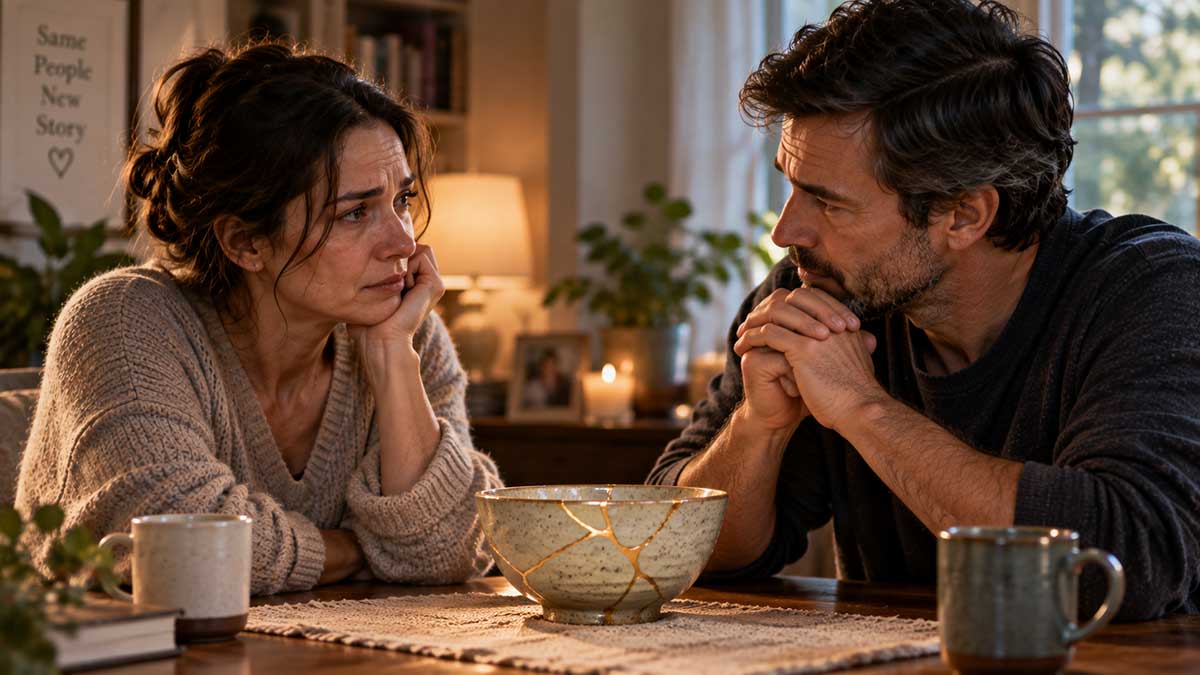
For several moments, nobody spoke.
The Moderator looked at the words still written on his page from the previous conversation:
Speaking. Silence. Staying. Leaving. Forgiving.
Then he looked up.
Moderator: We've talked about why we fight, why we avoid fighting, what belonging costs, and which fights deserve us.
But eventually the fight happens.
Something is said.
Something is discovered.
Trust breaks.
Maybe somebody leaves.
So I want to begin with the morning after the worst argument two people have ever had.
They wake up.
The argument is over.
But the relationship they had yesterday no longer exists.
What now?
Priya Parker: That may be where the most important part begins.
We often imagine successful conflict as restoration.
"How do we get back to normal?"
But sometimes normal was the problem.
Moderator: Meaning?
Priya Parker: The old relationship may have depended upon things remaining unsaid.
Perhaps one person was accommodating too much.
Perhaps resentment was hidden.
Perhaps there was an assumption neither person had ever examined.
The rupture exposes it.
So I wouldn't always ask:
"How do we get back?"
I might ask:
"What relationship can we build now that we know this?"
Sheila Heen: That's difficult because after conflict people desperately want certainty.
"Are we okay?"
"Do you still love me?"
"Are you leaving?"
"Can we forget this happened?"
But sometimes we don't know yet.
A difficult conversation can reveal information that takes time to absorb.
Moderator: Such as?
Sheila Heen: Your spouse tells you they've been unhappy for years.
Your best friend tells you they've resented something you did ten years ago.
Your adult child tells you there are parts of their childhood they experienced very differently from you.
You cannot unknow those things.
The relationship has changed simply because the information now exists.
Donna Hicks: And sometimes the first instinct is to defend yourself.
A daughter says:
"Dad, something you did when I was younger really hurt me."
The father immediately says:
"That's not what happened."
Perhaps he's correct about some facts.
But before debating the facts, there is another possibility:
"I didn't know you experienced it that way."
That doesn't require him to confess to something he doesn't believe he did.
It recognizes her experience.
Moderator: That seems small.
Donna Hicks: It can be enormous.
People often think repair begins with agreement.
Sometimes repair begins with recognition.
William Ury: That's where listening becomes a negotiation tool.
We tend to believe that if I acknowledge your perspective, I've surrendered mine.
But understanding is not agreement.
I can say:
"I understand why you experienced it that way,"
without saying:
"Your interpretation is the only correct interpretation."
That creates a bridge.
Moderator: Amanda, what happens when people can't do that?
Amanda Ripley: They remain trapped in competing stories.
"I was the victim."
"No, I was."
"You started it."
"No, you did."
Every new conversation becomes another trial.
Each person arrives carrying evidence.
The goal becomes proving the other person's story false.
That can keep high conflict alive indefinitely.
Moderator: So how do they escape?
Amanda Ripley: Complexity has to return.
Perhaps:
"I was hurt, and I hurt you."
"I had good intentions, and my actions still caused damage."
"You behaved badly, and you're not entirely a bad person."
"I love you, and I don't trust you right now."
High conflict hates sentences containing and.
It prefers either/or.
Repair often requires and.
Priya Parker: That's beautiful.
And that's very close to what interests me about cleaving.
Something can be broken and still connected.
Something can be loved and still need to change.
Moderator: Let's create a marriage.
A husband discovers that his wife has been hiding serious financial decisions from him.
Not an affair.
Not violence.
But years of secrecy around money.
He discovers everything.
She apologizes.
He says:
"I forgive you."
Three months later, every time she buys something, he becomes suspicious.
Has he forgiven her?
Oren Jay Sofer: Perhaps.
But forgiveness and trust aren't identical.
Moderator: Explain.
Oren Jay Sofer: Forgiveness may mean:
"I'm releasing my desire to punish you."
Trust asks another question:
"Do I believe you're safe to rely upon again?"
That may require evidence over time.
Donna Hicks: This distinction is critical.
People sometimes pressure injured people:
"If you've forgiven me, why are you still bringing it up?"
But repair doesn't erase consequences.
If dignity or trust has been seriously violated, the person who caused the injury may need to tolerate a period where trust is rebuilt.
Moderator: So saying "I'm sorry" doesn't restore everything.
Donna Hicks: No.
A genuine apology can open the door.
Walking through it may take much longer.
Sheila Heen: And the injured husband has his own work.
If he chooses to stay, at some point he must decide whether he's genuinely participating in rebuilding or simply remaining in the marriage while continually prosecuting the old case.
Moderator: That's uncomfortable.
Sheila Heen: It should be.
Repair creates responsibilities for both people, but those responsibilities aren't necessarily equal.
The person who broke trust may carry greater responsibility for rebuilding it.
Yet if the relationship continues, both people eventually have to participate in whatever comes next.
Daniel Shapiro: Identity enters here too.
The husband may be struggling with:
"What does it say about me that I didn't know?"
"Was I foolish?"
"Am I weak if I forgive?"
The wife may be struggling with:
"Am I permanently the person who betrayed him?"
If those identity questions remain unexamined, they can sabotage repair.
Moderator: That's interesting.
Sometimes we're not merely forgiving what someone did.
We're deciding whether to allow them to become someone different from the person who did it.
Daniel Shapiro: Yes.
And whether we allow ourselves to become different too.
Priya Parker: Which is why returning to the old relationship may be impossible.
Perhaps that's good.
The old marriage contained secrecy.
Why restore that marriage?
Build another one.
Moderator: Another marriage between the same two people.
Priya Parker: Exactly.
The Moderator smiled.
Moderator: That sounds almost like remarriage without divorce.
Priya Parker: In a sense.
The assumptions change.
The boundaries change.
The expectations change.
Perhaps the intimacy changes.
You're not pretending the rupture never occurred.
You're building with knowledge you didn't have before.
William Ury: And this is where the bridge matters.
A bridge isn't asking someone to leap instantly from:
"I don't trust you"
to:
"Everything is fine."
You create steps.
Transparency.
Small commitments.
Follow-through.
Repeated evidence.
Trust often returns through behavior rather than argument.
Moderator: Donna, what does genuine repair require from the person who caused harm?
Donna Hicks: One of the most powerful things is resisting self-protection long enough to recognize the other person's experience.
People often apologize like this:
"I'm sorry you felt hurt."
That can sound as if the problem was the other person's feelings.
Or:
"I'm sorry, but you did things too."
Now the apology has become a negotiation.
Repair asks whether I can face the possibility that my actions violated someone's dignity without immediately protecting my own image of myself.
Moderator: Why is that so difficult?
Donna Hicks: Because admitting harm threatens our own dignity and identity.
Most people want to think:
"I'm a good person."
Then someone says:
"You hurt me."
We hear:
"You're a bad person."
So we defend ourselves.
Sheila Heen: That's the identity conversation again.
If I believe only bad people hurt others, then evidence that I hurt someone becomes psychologically threatening.
But if I can hold:
"I'm a decent person who caused real harm,"
I have much more room to take responsibility.
Amanda Ripley: There's that word again.
And.
Moderator: Right.
"I love you, and I hurt you."
Sheila Heen: Exactly.
Moderator: Let's make the relationship parent and adult child.
A sixty-year-old mother has a forty-year-old son.
For years, he has carried anger about his childhood.
Finally he tells her.
She listens.
Then she says:
"I did the best I could."
What do you hear?
Donna Hicks: It depends on what comes next.
If she means:
"Therefore you have no right to be hurt,"
the conversation closes.
If she means:
"I did the best I could, and I'm beginning to understand that my best still hurt you,"
the conversation opens.
The Moderator sat back.
Moderator: That's a remarkable difference created by one word.
Amanda Ripley: And.
Oren Jay Sofer: We have difficulty holding two realities.
The mother may genuinely have done everything she knew how to do.
The child may genuinely have been wounded.
One truth doesn't have to erase the other.
Moderator: What if the son wants her to say:
"I was a terrible mother."
and she doesn't believe that?
Sheila Heen: Then forcing that confession probably won't create genuine repair.
The question becomes whether he needs her to agree with his judgment or whether he needs her to understand his experience.
Those are different.
William Ury: Again, position and interest.
Position:
"Admit you were a terrible mother."
Possible interest:
"Please acknowledge that what happened to me was real."
Once you discover that difference, possibilities emerge.
Moderator: But what if she never understands?
Priya Parker: Then we encounter one of the hardest truths about conflict.
Not every relationship gets the ending we want.
There was a pause.
Moderator: Let's stay there.
Because so much advice about conflict ends beautifully.
People cry.
They apologize.
They embrace.
Music plays.
But real life doesn't always do that.
Priya Parker: No.
Sometimes you tell the truth and the person rejects it.
Sometimes you apologize and they don't forgive you.
Sometimes you forgive and still cannot trust.
Sometimes two people understand each other perfectly and still conclude they cannot remain together.
That's part of Cleave too.
Moderator: So understanding doesn't guarantee reconciliation.
Priya Parker: No.
Sometimes understanding produces separation.
Daniel Shapiro: And separation can create an identity crisis.
Imagine two best friends who have known each other for thirty years.
Their friendship ends.
People say:
"Just move on."
But you're not merely losing another person.
You're losing someone who remembers versions of you that no longer exist.
They remember your wedding.
Your first job.
Your parents when they were alive.
Your children when they were babies.
When that relationship disappears, part of your autobiographical identity can feel as though it disappears too.
Moderator: That's something we rarely acknowledge.
Some people carry pieces of our history.
Daniel Shapiro: Exactly.
Which is why ending a relationship can feel like losing part of oneself.
Oren Jay Sofer: And sometimes healing requires allowing grief rather than converting grief into anger.
Anger can feel powerful.
Grief admits:
"Something I loved is gone."
That's much harder.
Amanda Ripley: Anger can keep the relationship psychologically alive.
You may not speak to someone for ten years, but if you're still arguing with them every morning in your imagination, the conflict remains part of your life.
Moderator: Then perhaps letting go isn't saying:
"What happened didn't matter."
Oren Jay Sofer: No.
It may mean:
"What happened matters, but I no longer want it organizing my life."
Donna Hicks: And you can preserve someone's dignity from a distance.
You don't need to hate someone simply because you can no longer live closely with them.
Moderator: That sounds almost contradictory.
"I love you, but I cannot remain in this relationship."
Priya Parker: Human relationships contain contradictions.
We shouldn't be afraid of them.
Love doesn't always mean access.
Forgiveness doesn't always mean reunion.
Understanding doesn't always mean agreement.
Repair doesn't always mean restoration.
And endings don't necessarily mean the relationship was meaningless.
The Moderator looked down.
Moderator: I think that's one of the saddest things we've said.
A relationship can end without having been a failure.
Priya Parker: Yes.
Some relationships accomplish something important and still end.
Moderator: Then let's return to the opposite possibility.
Can a relationship actually become stronger because it broke?
Not merely survive.
Stronger.
Sheila Heen: Yes, because sometimes the rupture destroys an illusion.
Before the conflict:
"We never disagree."
After:
"We disagree profoundly, and now we know we can survive it."
That's a different kind of trust.
Donna Hicks: Before:
"You'll love me because I've never disappointed you."
After:
"You've seen me fail, I've taken responsibility, and we're still here."
That's deeper.
Daniel Shapiro: Before:
"We belong because we're alike."
After:
"We discovered significant differences and chose affiliation anyway."
That creates a more resilient identity.
William Ury: Before:
"We avoid difficult subjects."
After:
"We know how to cross the bridge."
Amanda Ripley: Before:
"You're the person I imagined you were."
After:
"You're more complicated than I thought, and so am I."
Complexity can deepen love.
Oren Jay Sofer: Before:
"I need you never to hurt me."
After:
"I know hurt can happen, and I know we have some capacity to meet it."
That doesn't make harm desirable.
It makes the relationship less dependent on perfection.
Moderator: Priya?
Priya Parker: Before:
"We belong because nothing has tested us."
After:
"We know what our belonging can withstand."
Silence settled over the table.
This time nobody seemed eager to break it.
Finally the Moderator spoke.
Moderator: There's an image from Japanese pottery that people often use when talking about broken things.
Kintsugi.
A bowl breaks.
It's repaired, and the fracture remains visible.
People sometimes say the repaired bowl becomes more beautiful because of the break.
But I've always wondered whether we romanticize that idea.
Because surely some broken bowls cannot be repaired.
Priya Parker: Exactly.
And we shouldn't romanticize breaking.
The goal isn't to damage relationships so they become deeper.
Some breaks destroy.
Some wounds permanently change what is possible.
But some ruptures reveal something that the relationship needed to know.
Moderator: Then maybe the important part of that image isn't the gold.
It's that the crack isn't hidden.
Donna Hicks: Yes.
Repair that requires pretending nothing happened isn't really repair.
Sheila Heen: The history becomes part of the relationship.
"This happened to us."
Not:
"This never happened."
Moderator: And perhaps that's what trust after conflict really means.
Not:
"You will never hurt me."
But:
"If something breaks between us, I believe we can face what actually happened."
Oren Jay Sofer: That's a much more mature form of trust.
Moderator: Priya, we've spent five conversations beginning with fighting.
But I'm not sure we're really talking about fighting anymore.
Priya Parker: Maybe we never were.
Moderator: What were we talking about?
She thought for a moment.
Priya Parker: Belonging.
Whether relationships are strong enough to contain truth.
Whether we can remain connected without requiring sameness.
Whether we can disagree without destroying dignity.
Whether we can recognize when to stay and when to leave.
Whether, after rupture, we can create something truthful from what remains.
Moderator: Then perhaps the question isn't:
"Can something broken become exactly what it was before?"
Priya Parker: No.
Sometimes it shouldn't.
Moderator: Maybe the better question is:
"Now that we know what broke us, what can we become?"
Priya nodded.
Priya Parker: That's the question.
Because after a real conflict, there may be no road back.
There may only be a road forward.
Sometimes two people walk that road together.
Sometimes they walk separately.
But either way, the conflict has revealed something.
Who we are.
What we need.
What we can forgive.
What we cannot continue.
What we are willing to change.
And what we cannot surrender without losing ourselves.
The Moderator looked once more around the table.
Moderator: So perhaps the art of fighting isn't really about winning fights.
William Ury: No.
Donna Hicks: Or avoiding them.
Amanda Ripley: Or remaining angry enough to prove something mattered.
Sheila Heen: Or getting everyone to agree on exactly what happened.
Daniel Shapiro: Or surrendering identity in order to preserve belonging.
Oren Jay Sofer: It may be learning how to remain present when something precious becomes uncertain.
The Moderator turned back to Parker.
Moderator: And what remains after the fight?
Priya Parker: Hopefully, something more truthful.
Sometimes reconciliation.
Sometimes a boundary.
Sometimes forgiveness.
Sometimes grief.
Sometimes a new relationship between the same two people.
And sometimes two people who love one another discovering that love and belonging no longer have to take the same form.
A relationship does not become stronger merely because it survived a rupture.
It becomes stronger when the people inside it can look at the rupture without hiding it, learn what it revealed, and decide with open eyes what deserves to be built from there.
The crack may remain.
But if the relationship continues, it no longer has to pretend it was never broken.
Final Thoughts

We began by asking why the people we love can hurt us more deeply than strangers.
The answer gradually became clear.
Because they matter.
Behind "You never call" may be "Do I still matter to you?"
Behind "You never listen" may be "Do you really see me?"
Behind anger may be fear. Behind criticism may be longing. Behind a seemingly insignificant argument may be a desperate attempt to protect belonging.
Then we discovered something more troubling.
The opposite of conflict is not always peace.
Sometimes it is distance.
Two people can stop arguing because they have reached understanding. They can also stop arguing because one of them has stopped believing that being understood is possible.
From there, the conversation reached an even deeper tension:
I want to belong to you, but I also need to remain myself.
Every marriage, friendship, family, and community eventually encounters some version of that problem. How much should we change for the people we love? When does compromise become self-erasure? Can someone disagree with us deeply and still belong with us?
Our guests showed that healthy conflict requires more than better arguments.
William Ury asks us to look beneath positions for the needs underneath them.
Sheila Heen reminds us that beneath arguments about what happened are often conversations about feelings and identity.
Donna Hicks asks whether someone's dignity has been injured.
Daniel Shapiro asks what part of identity feels threatened.
Amanda Ripley warns us to notice when disagreement becomes high conflict and the person we love slowly becomes "the enemy."
Oren Jay Sofer asks whether we can remain present long enough to hear what the other person is actually saying.
And Parker brings those insights back to one central question:
Can truth and belonging coexist?
Perhaps that is the real art of fighting.
Not learning how to win.
Not confronting every irritation.
Not preserving every relationship at any cost.
It is learning which truths need to be spoken, which differences can be carried together, which wounds can be repaired, and which relationships may need to change.
Sometimes a fight ends with reconciliation.
Sometimes with forgiveness.
Sometimes with a boundary.
Sometimes with separation.
And sometimes two people discover something extraordinary:
They no longer have to return to the relationship they had before.
They can build a new one.
The goal after conflict may not be:
"How do we get back to normal?"
The better question may be:
"Now that we know what is true about each other, what kind of relationship is still possible?"
Short Bios:
Priya Parker
Priya Parker is a conflict-resolution facilitator and the author of The Art of Fighting and The Art of Gathering. Her work explores how people come together, navigate difference, and remain connected when disagreement challenges their sense of belonging.
Amanda Ripley
Amanda Ripley is a journalist and the author of High Conflict: Why We Get Trapped and How We Get Out. Her work distinguishes productive disagreement from conflicts that become self-perpetuating, identity-driven, and increasingly difficult to escape.
Sheila Heen
Sheila Heen is a Harvard Law School lecturer and coauthor of Difficult Conversations. Her work examines the layers beneath difficult exchanges, especially the interaction between facts, emotions, and personal identity.
Daniel Shapiro
Daniel Shapiro is a psychologist, negotiation expert, and author of Negotiating the Nonnegotiable. His work focuses on emotionally charged conflicts involving identity, belonging, autonomy, and what he calls the Tribes Effect.
William Ury
William Ury is a negotiation expert, coauthor of Getting to Yes, and author of Possible. His work emphasizes looking beneath stated positions to understand the deeper interests people are trying to protect.
Donna Hicks
Donna Hicks is a conflict-resolution specialist and author of Dignity: Its Essential Role in Resolving Conflict. Her work explores how violations of dignity can fuel conflict and how recognition of human dignity can help damaged relationships heal.
Oren Jay Sofer
Oren Jay Sofer is a teacher and author of Say What You Mean. His work combines mindfulness, careful listening, and compassionate communication to help people remain present and speak clearly during emotionally difficult conversations.
Leave a Reply