
Introduction
What does it really mean to "wake up"?
In Awareness, Anthony de Mello argues that much of human life is lived almost automatically. We inherit ideas about success, happiness, love, identity, religion, and even ourselves, then gradually forget that we inherited them. We begin treating our conditioning as reality.
But some of de Mello's most memorable ideas become much more difficult when applied to real life. Can we love deeply without attachment? If we lose someone we love, is grief something to observe or something that deserves to be fully felt? Can we pursue money, achievement, and recognition without becoming psychologically dependent on them? Is awareness enough when suffering comes from trauma, abuse, or injustice? And where do de Mello's ideas ultimately lead us spiritually?
In this imaginary conversation, de Mello meets psychologists, contemplatives, Buddhist teachers, and Christian thinkers who take those questions seriously. Some discover surprising similarities between his insights and modern psychology. Others challenge his language and assumptions. Religious differences remain real rather than being smoothed away.
The purpose is not to decide whether Anthony de Mello was right about everything.
It is to ask a more personal question:
How much of my life am I actually seeing, and how much am I simply repeating without noticing?
Perhaps awareness begins with discovering the difference.
(Note: This is an imaginary conversation, a creative exploration of an idea, and not a real speech or event.)
Topic 1: Wake Up
Are We Really Asleep?
Morning arrived quietly at the retreat house.
Beyond the veranda, the grass was still wet with dew. A thin mist floated above the lake, and somewhere beyond the trees a bird repeated the same three notes as though it had been assigned the opening music for the day.
A long wooden table had been set with coffee, tea, fruit, bread, and several untouched notebooks.
Anthony de Mello sat at one end of the table holding a cup of coffee.
Around him were Steven Hayes, Sue Johnson, Thich Nhat Hanh, the Dalai Lama, Richard Rohr, and a Catholic theologian who had already opened his notebook.
Anthony looked around the table.
"So," he said. "Which one of you is awake?"
The Dalai Lama laughed.
Richard Rohr smiled. "It's a little early to make such a claim."
Steven Hayes reached for his coffee. "I was going to say I am, but now I'm suspicious."
"Good," Anthony said. "Suspicion is progress."
Sue Johnson looked toward the lake.
"You mean awake in your sense of the word."
"No," Anthony replied. "I mean awake."
She laughed. "That's exactly the kind of answer that gets psychologists irritated."
"Wonderful. You're awake enough to be irritated."
More laughter.
The Catholic theologian leaned forward.
"But this is actually important, Anthony. You use the word asleep very strongly. You aren't merely saying people are distracted."
"No."
"You're saying something is fundamentally wrong with the way most people perceive reality."
Anthony considered that.
"I would say they aren't seeing reality. They're seeing their programming."
Hayes immediately responded.
"Then we should probably begin there."
Anthony smiled.
"I thought we already had."
What Does It Mean to Be Asleep?
Hayes put down his cup.
"Let's make your claim concrete. Someone gets up in the morning, loves his family, goes to work, pays his bills, helps his neighbors, watches television, goes to church on Sunday, comes home and goes to sleep."
"Sounds exhausting," Anthony said.
A few people laughed.
Hayes continued.
"Why is this person asleep?"
Anthony pointed toward the garden.
"Suppose that man believes he must be successful."
"That's common."
"Why?"
Hayes paused.
Anthony continued.
"Why does he need success? What does success mean? How much success is enough? Who taught him what success looks like?"
Sue joined in.
"Parents could be part of it."
"Of course."
"Peers."
"Yes."
"Culture."
"Yes."
"Economic circumstances."
"Yes."
Anthony looked around the table.
"And perhaps nobody ever told him explicitly. He watched. His father became excited when he brought home good grades. His mother became embarrassed when he behaved badly in front of relatives. Teachers praised certain children. Television showed him beautiful people living beautiful lives. Religion told him which behaviors made him good. His friends taught him which clothes were embarrassing. His employer taught him what achievement looked like."
He tapped the table gently.
"After twenty or thirty years, he no longer says, 'I was taught that this is success.'"
Anthony tapped his chest.
"He says, 'This is success.'"
Thich Nhat Hanh nodded slowly.
"We inherit many ways of seeing. We receive them from our families and from society. Sometimes we suffer from them without recognizing where they came from."
Anthony turned toward him.
"Exactly."
The Catholic theologian raised a finger.
"But we need an important qualification. Not everything we inherit is illusion."
"Certainly."
"We inherit language. Moral traditions. Stories. Religious practices. Knowledge accumulated by generations."
"Yes."
"Then conditioning cannot itself be the problem."
Anthony smiled broadly.
"Excellent."
The theologian looked surprised.
"You agree?"
"Completely."
"That was easier than expected."
"Don't worry. We'll disagree later."
The Dalai Lama laughed.
Anthony continued.
"The problem isn't that you've been conditioned. You could hardly become human without being conditioned. The problem is that you don't know you're conditioned."
Hayes leaned forward.
"That distinction interests me."
Anthony picked up a spoon.
"This is a spoon."
Everyone looked at him.
"I was taught to call this a spoon. That's useful. Imagine ordering breakfast without shared words."
He put it down.
"But now suppose somebody taught me, 'People with expensive spoons are important.'"
Rohr laughed.
Anthony continued.
"And suppose I believe it."
He pointed toward the theologian's spoon.
"His spoon is more expensive than mine."
The theologian examined it.
"I don't think it is."
"It doesn't matter. I'm already suffering."
Laughter moved around the table.
Anthony became more serious.
"That's how quickly the mind moves. We see something, then immediately add a story."
The Dalai Lama nodded.
"In Buddhist thought, ignorance is not simply lack of information. We misunderstand how things exist, including ourselves."
Anthony turned toward him.
"Yes."
The theologian interjected.
"But we should be careful not to make Christian sin, Buddhist ignorance, psychological conditioning, and your concept of sleep identical."
Anthony nodded.
"Good."
"They overlap in interesting ways, but they aren't the same doctrines."
"Agreed."
Rohr smiled.
"And Christianity has its own language for this. The false self, for example, describes the identity we construct around status, roles, control, belonging, reputation."
Anthony looked at him.
"And then we spend our lives protecting it."
"Often."
"Even religiously."
Rohr smiled. "Especially religiously."
The theologian laughed.
"I knew I was going to have work to do today."
Sue looked at Anthony.
"I want to make this less philosophical."
"Please."
"Take a twelve-year-old girl."
Anthony nodded.
"She walks into school wearing something she loves. Two girls laugh at her clothes."
Anthony's expression changed.
"Good example."
"She goes home and never wears them again."
"Yes."
"She's not making a philosophical decision. Her nervous system is learning something about belonging."
Anthony listened carefully.
Sue continued.
"Humans are social creatures. Being accepted isn't merely vanity. For most of human history, belonging to a group had survival value."
"So you're defending her programming?"
"I'm saying some of what you call programming emerged for reasons."
Anthony nodded.
"Of course."
"Then telling her, 'You're asleep because you care what people think,' could become cruel."
Anthony remained quiet for a moment.
Then he said, "I wouldn't tell her not to care."
Sue waited.
"I would want her someday to see what happened."
"What do you mean?"
"Two girls laughed. That is what happened."
He paused.
"Then her mind learned: If people laugh at what I wear, there is something wrong with me."
Sue nodded cautiously.
Anthony continued.
"The first thing happened outside her. The second happened inside her."
Hayes entered.
"That's very close to something psychology can work with. Humans don't merely experience events. We create verbal relations around events. We tell stories about what they mean."
Anthony smiled.
"And eventually we forget they're stories."
"Yes."
Hayes pointed toward him.
"That's where your language and mine start getting surprisingly close."
Anthony leaned back.
"I knew psychology would eventually catch up."
Hayes laughed.
"Let's not get carried away."
Who Is Watching?
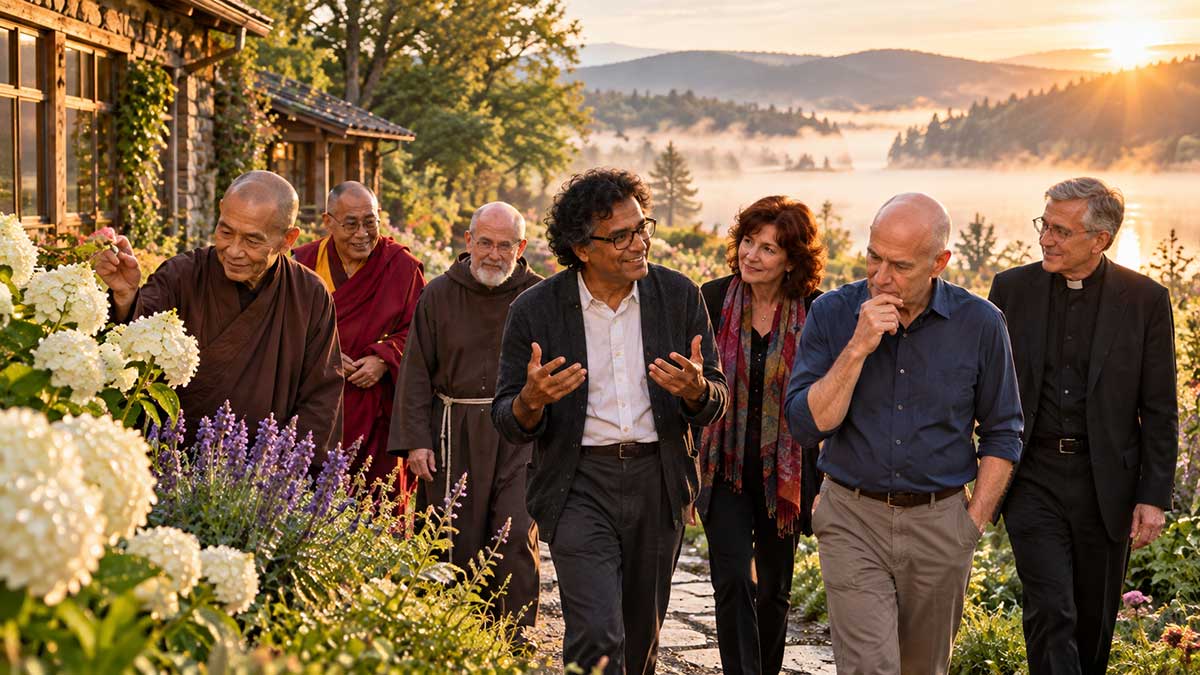
They left the table after breakfast and walked slowly through the garden.
A stone path curved between flowering shrubs and tall trees. The mist above the lake was beginning to disappear.
For several minutes, nobody spoke.
Then Anthony stopped.
"Steven."
Hayes looked at him.
"You're thinking."
"Yes."
"How do you know?"
Hayes smiled. "I can notice that I'm thinking."
Anthony turned toward the others.
"There."
Sue laughed. "There what?"
"The entire problem."
"That's convenient."
Anthony looked back at Hayes.
"If you can notice a thought, are you the thought?"
Hayes took his time.
"I'd phrase that carefully."
"Psychologists always do."
"That's why we're invited to these things."
Everyone laughed.
Hayes continued.
"In ACT, we often help people notice thoughts as thoughts rather than treat every thought as literal truth."
He looked toward the lake.
"Someone might have the thought, 'I'm a failure.'"
Anthony nodded.
"Instead of I am a failure, the person can begin noticing, I'm having the thought that I'm a failure."
Anthony's face brightened.
"Wonderful."
"That little shift can create psychological space."
Anthony stopped walking.
"Say those two again."
Hayes did.
"I am a failure."
Then:
"I'm having the thought that I'm a failure."
Anthony looked around.
"Do you hear it?"
Rohr nodded.
"The first becomes identity."
"Exactly."
"The second becomes something being observed."
Anthony pointed toward Hayes.
"And if you're observing it, something extraordinary has happened."
The Catholic theologian spoke.
"But now we arrive at a dangerous philosophical leap."
Anthony turned.
"Here we go."
Everyone laughed.
The theologian continued.
"From 'I can observe my thoughts,' it doesn't automatically follow that we've proven some particular metaphysical theory of the self."
"Agreed."
Anthony's answer came so quickly that the theologian stopped.
"You agree again?"
"You're disappointed."
"A little."
Anthony smiled.
"People desperately want me to tell them what the observer is."
Thich Nhat Hanh had been walking silently near the edge of the group.
He finally spoke.
"The wish to find a permanent observer can itself become another attachment."
Anthony turned toward him.
"Yes."
Thich Nhat Hanh picked up a fallen leaf.
"When we look deeply into ourselves, we find parents, ancestors, culture, food, language, relationships, memories, body, consciousness. We don't find an isolated self existing separately from everything else."
Rohr listened closely.
"And the Christian contemplative tradition might use very different language."
"Yes," said Thich Nhat Hanh.
Rohr continued.
"We may speak about the deepest identity being grounded in God rather than the constructed identities we defend."
The Dalai Lama smiled.
"And Buddhists may become uncomfortable if that is interpreted as discovering an eternal independent self."
Rohr nodded.
"Exactly."
Anthony looked delighted.
Sue noticed.
"You look very happy that nobody agrees."
"This is wonderful."
"Why?"
"Because now perhaps nobody can memorize the answer."
They laughed.
Anthony stopped beneath a large tree.
"Suppose I tell you, 'You are pure consciousness.'"
He pointed around the group.
"Tomorrow there will be seven people walking around saying, 'I am pure consciousness.'"
The Dalai Lama laughed loudly.
Anthony continued.
"Or I tell you, 'You are the observer.'"
He adopted a solemn voice.
"'I am the Observer.'"
Rohr laughed.
Anthony clasped his hands dramatically.
"Or, 'You are the eternal soul beyond thought.'"
The theologian said, "That one could start several centuries of argument."
"Exactly!"
Anthony laughed.
"Do you see what the mind does? It takes a discovery and turns it into a label."
Hayes nodded.
"And then the label can become another conceptualized self."
Anthony pointed at him.
"There you go again, making my jokes sound respectable."
Is There a Real "Me" Underneath Everything?
Sue sat on a low stone wall.
"But Anthony, people do need some coherent sense of self."
The others stopped.
"A person who's been traumatized, for example, may already have a fragmented sense of identity. Telling them their identity isn't real could be destabilizing."
Anthony sat beside her.
"Then don't tell them that."
Sue looked at him.
"Really?"
"Why would you?"
"Some people reading spiritual books do exactly that."
"Then they're reading badly."
That answer quieted the group.
Anthony continued.
"If someone is drowning, you don't give them a lecture about the illusion of water."
Hayes smiled.
"That's probably the best clinical guideline you've given us this morning."
Anthony laughed.
Sue continued.
"So awakening can't mean destroying personality."
"No."
"Or abandoning relationships."
"No."
"Or pretending personal history doesn't matter."
"No."
"What does it mean, then?"
Anthony looked at her.
"Seeing."
She waited.
"Seeing what?"
"Everything you just mentioned."
He gestured toward her.
"Your history. Your fears. Your roles. Your wounds. Your desires. Your beliefs."
Then he touched his chest.
"But seeing them rather than being completely swallowed by them."
The group resumed walking.
The Dalai Lama said, "There is practical wisdom in that. When anger arises, if there is some awareness of anger, there is already more freedom than when anger completely controls the mind."
Anthony nodded.
"You don't say, 'I am anger.'"
Hayes added, "You notice anger is present."
"Yes."
Rohr said, "The same could apply to status."
Anthony turned.
"Absolutely."
"I am a priest."
"I am a professor."
"I am a successful businessman."
"I am a failure."
"I am conservative."
"I am progressive."
"I am beautiful."
"I am unattractive."
"I am important."
"I am nobody."
Anthony stopped again.
"Labels aren't useless."
He looked around.
"They become dangerous when you forget they're labels."
How Would We Know If Someone Were Awake?
By the time they reached the lake, sunlight had broken through the morning haze.
Several wooden chairs faced the water.
Everyone sat.
Hayes looked at Anthony.
"I want to challenge the whole premise."
"Please."
"You keep talking about waking up. How would we know if anyone actually had?"
Anthony smiled.
"Ah."
"Otherwise awakening can become impossible to test. Someone announces, 'I've awakened.' What does that mean?"
The Dalai Lama chuckled.
"Perhaps if someone announces it very frequently, that is evidence in the opposite direction."
The entire group laughed.
Anthony pointed at him.
"Exactly."
Rohr joined in.
"Spiritual identity can become one of the strongest identities."
"The ego loves spirituality," Anthony said.
"Why?"
"Because now it can become spiritually superior."
Anthony straightened himself and adopted an exaggerated serene expression.
"'I no longer judge people.'"
He looked around disdainfully.
"'Unlike all these judgmental people.'"
The group erupted.
Even the theologian was laughing.
Anthony continued.
"'I have no ego.'"
He paused.
"'And I'm extremely proud of that.'"
More laughter.
Sue shook her head.
"Then give us something observable."
Anthony looked toward Hayes.
"You started this. You tell me."
Hayes considered it.
"Greater psychological flexibility."
Anthony nodded.
"Meaning?"
"The person can experience difficult thoughts and emotions without automatically allowing them to dictate behavior. They can remain connected to values and respond more flexibly."
Anthony looked toward Sue.
"Your turn."
She thought.
"I'd look at relationships."
"How?"
"Can the person be emotionally present? Can they risk vulnerability? Can they receive love? Can they repair a relationship after hurting someone?"
Anthony nodded slowly.
Thich Nhat Hanh said, "I would look for presence."
Everyone turned toward him.
"Can this person actually listen?"
Silence.
"Can they drink tea and know they are drinking tea?"
Anthony smiled.
"Very difficult."
Thich Nhat Hanh smiled too.
"Can they look at another person without immediately seeing only their judgment about that person?"
Rohr spoke next.
"I would look for decreasing compulsion to defend the constructed self."
The theologian added, "And from a Christian perspective, awakening that produces no greater love of God and neighbor would be questionable."
The Dalai Lama said, "Compassion."
Anthony nodded.
Hayes looked at him.
"What would you add?"
Anthony thought.
"Humor."
Sue laughed. "Humor?"
"Absolutely."
"Why?"
"Because when you finally see some of your programming, it's hilarious."
He looked around the circle.
"You've spent twenty years desperately trying to impress people you don't even like."
Laughter.
"You bought things you didn't particularly want so strangers would think you're successful."
Hayes smiled.
"You've replayed an insult from 1997 four thousand times."
Rohr laughed.
"You've won imaginary arguments in the shower."
Even Thich Nhat Hanh laughed at that.
Anthony continued.
"You've spent half your life worrying about what people think of you."
He leaned forward.
"And those people are spending half their lives worrying about what you think of them."
The Dalai Lama was laughing openly now.
Anthony spread his hands.
"How can you see all that and not laugh?"
The laughter slowly faded.
Sue looked toward the lake.
"But someone can become aware of all of that and still fall back into it."
"Of course."
"Then awakening isn't permanent?"
Anthony shrugged.
"Are you permanently awake every morning?"
Hayes smiled.
"No."
"You wake up. Then perhaps you fall asleep again."
Anthony looked at each person.
"Then you wake up again."
Rohr nodded.
"That makes awakening less like an achievement."
"Yes."
"And more like returning."
Anthony smiled.
"Now you're making it sound beautiful."
The Garden Experiment
Anthony suddenly stood.
"Let's try something."
Hayes looked suspicious.
"An experiment?"
"Yes. Very scientific."
"Now I'm really suspicious."
Anthony led them away from the lake and back toward the garden.
"Five minutes."
"What are we doing?" Sue asked.
"Walking."
"We've been walking all morning."
"That's why you're already highly trained."
They entered the garden.
Anthony stopped.
"For five minutes, look without immediately naming."
Hayes raised an eyebrow.
"No labeling?"
"Try."
Anthony pointed toward a tree.
"Don't immediately say tree."
Toward a flower.
"Don't immediately say rose, pretty, red, I like that, my grandmother grew those."
He pointed toward the sky.
"Don't say beautiful morning."
The theologian smiled.
"You realize language is going to appear automatically."
"Exactly."
"So we're going to fail."
Anthony grinned.
"Now you understand the exercise."
They separated.
For a while there was only the sound of footsteps, birds and wind moving through leaves.
Sue stopped beside a flower.
Hayes watched sunlight moving across the surface of the lake.
Rohr stood beneath a tree.
The Dalai Lama examined a small insect crossing the stone path.
Thich Nhat Hanh walked slowly.
The theologian looked upward through the branches.
Anthony watched everyone.
Perhaps thirty seconds passed.
Then Hayes started laughing.
Anthony walked toward him.
"What happened?"
"I caught myself describing the exercise to myself."
"What did you say?"
Hayes laughed.
"I thought, 'I'm doing surprisingly well at not thinking.'"
Anthony burst out laughing.
The others heard them and returned.
Sue asked, "What happened?"
Anthony pointed at Hayes.
"He became proud of his awakening."
"I did not."
"After thirty seconds."
"I said I was doing well."
"Exactly."
The Dalai Lama laughed.
Rohr said, "We may need a certificate."
Anthony nodded enthusiastically.
"Steven Hayes, officially awakened at 9:47 this morning."
Hayes shook his head.
"This is why psychologists shouldn't attend retreats with comedians disguised as Jesuits."
The group began walking again.
A few steps later, the Catholic theologian said quietly:
"Anthony."
"Yes?"
"I think I understand something about what you're calling sleep."
Anthony waited.
"It's not that thinking is wrong."
"No."
"Or culture."
"No."
"Or identity."
"No."
"Or even conditioning."
Anthony nodded.
The theologian continued.
"It's forgetting that we're doing all of those things."
Anthony smiled.
Nobody spoke for several seconds.
Then Sue said, "And perhaps awakening is noticing them without immediately needing to destroy them."
Anthony turned toward her.
"Very good."
Hayes added, "With enough space to choose what happens next."
Thich Nhat Hanh said softly, "And enough presence to see what is here."
The Dalai Lama added, "Perhaps with greater compassion."
Rohr looked toward Anthony.
"You've got quite a definition now."
Anthony shook his head.
"No."
"No?"
"We've got six new things to become attached to."
They laughed again.
Anthony walked ahead of them.
At the edge of the garden, a narrow path descended toward the lake.
Sue caught up with him.
"So after an entire morning discussing awakening, your conclusion is that we're still asleep?"
Anthony looked at her.
"Sometimes."
"And sometimes awake?"
"Sometimes."
"How do I know which?"
Anthony pointed toward the path beneath their feet.
"Right now, do you know you're walking?"
Sue looked down.
Then back at him.
"Yes."
Anthony smiled.
"Good."
They continued toward the water.
A few seconds passed.
Sue laughed.
"What?"
"I started thinking about what you just said and stopped noticing that I was walking."
Anthony laughed.
"Welcome back."
And the group continued down the path toward the lake, each person a little less certain that waking up was something one accomplished once, and a little more curious about how often, in the middle of an ordinary day, one might simply notice that one had fallen asleep again.
Topic 2: Love
Can You Love Without Attachment?
The path from the garden descended toward the lake.
By now the morning mist had disappeared. Sunlight scattered across the water, and a breeze moved through the tall grass along the shore.
Anthony walked several steps ahead of everyone.
Sue Johnson caught up with him.
"I've been waiting for this one."
Anthony looked at her.
"That sounds dangerous."
"It may be."
"Wonderful."
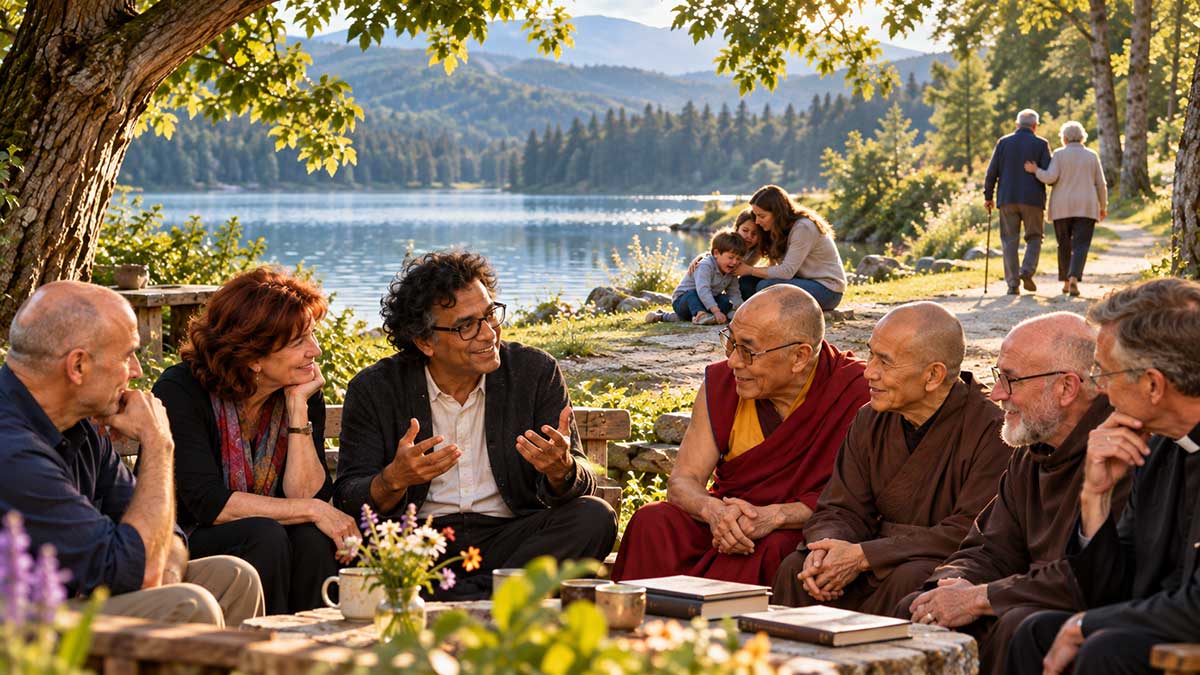
They reached a large tree near the water. Several wooden benches had been placed beneath it, but nobody seemed interested in arranging themselves formally. The Dalai Lama and Thich Nhat Hanh sat near the trunk. Steven Hayes remained standing for a moment, looking across the lake. Richard Rohr settled onto a bench beside the Catholic theologian.
Sue remained beside Anthony.
"Yesterday I reread some of your ideas about attachment."
Anthony smiled.
"And you survived?"
"Barely."
Everyone laughed.
Sue sat down.
"You sometimes make attachment sound like one of the great causes of human misery."
"It is."
"And I have spent much of my professional life helping people form stronger emotional attachments."
Anthony's smile widened.
"Then one of us has wasted his life."
"Or," Sue replied, "one of us is using the word attachment very differently."
Anthony looked delighted.
"Now we're getting somewhere."
Is It Love, or Do I Need Something From You?
A family was walking along the opposite side of the lake.
A little boy ran ahead of his parents, stopped to examine something near the water, then turned to make sure they were still behind him.
Sue pointed toward him.
"Look."
Everyone watched.
"He runs away. Then he checks."
Anthony nodded.
"He wants to know they're still there."
"Exactly."
The boy saw his parents and ran forward again.
Sue continued.
"That isn't pathology. That's attachment."
Anthony watched the child disappear behind several trees.
"Good."
"Human beings are relational creatures. A child needs caregivers. Adults need connection. We seek comfort from people we trust. We miss people. We depend on one another."
Anthony nodded.
"So far I agree with everything you've said."
Sue laughed.
"You're making this difficult."
"You wanted a fight?"
"A small one."
"We have all morning."
Hayes smiled.
Sue turned toward Anthony.
"Then tell me what you mean by attachment."
Anthony thought for a moment.
"Suppose I say to you, 'I love you.'"
"All right."
"But what I secretly mean is, 'I need you to behave in certain ways so I can feel good about myself.'"
Sue listened.
"I need your affection."
Anthony raised another finger.
"I need your approval."
Another.
"I need your loyalty."
Another.
"I need you never to leave."
Another.
"I need you to become the person I imagined you would become."
He lowered his hand.
"Then I call all of that love."
Sue said, "Some of those needs aren't unreasonable."
"Exactly."
Anthony's answer surprised her.
"A marriage generally includes expectations of fidelity."
"Yes."
"A parent should expect certain behavior from a child."
"Certainly."
"Friends expect some degree of loyalty."
"Of course."
Sue studied him.
"Then expectation isn't necessarily attachment."
"No."
"Need isn't necessarily attachment."
"No."
"Dependence isn't automatically attachment."
"No."
Sue laughed.
"You realize you're destroying half the arguments people have with your book."
Anthony smiled.
"Perhaps they should have invited you sooner."
Rohr leaned forward.
"Then where does it cross the line?"
Anthony looked toward the lake.
"When your psychological existence becomes dependent upon getting what you demand."
Hayes responded immediately.
"That's much more precise."
Anthony continued.
"I may prefer that you admire me."
He looked toward Sue.
"I may enjoy your admiration enormously."
"Thank you."
"But if you stop admiring me and I suddenly feel that I am nobody..."
He touched his chest.
"...then I have handed you enormous power."
Sue nodded.
"But relationships do affect our sense of self."
"Certainly."
"Especially intimate relationships."
"Yes."
"So you can't completely separate the self from relationship."
Anthony smiled.
"I don't want to."
Thich Nhat Hanh had been listening quietly.
He spoke.
"When we love someone, we must learn to see them."
Anthony turned toward him.
"Yes."
"Often we don't see the person. We see our idea of the person."
Anthony's face brightened.
"Exactly."
Thich Nhat Hanh continued.
"We have an image of who our partner should be. We have an image of our child. When the real person does not match the image, suffering begins."
Sue nodded.
"That I agree with completely."
Rohr said, "Parents do this all the time."
Anthony laughed.
"Children too."
"True."
Anthony adopted the voice of an indignant adult child.
"My mother is supposed to understand me!"
Then the voice of the mother:
"After everything I've done for you!"
Then the child:
"You never listen!"
Then the mother:
"I listen constantly! That's why I know you're wrong!"
Everyone laughed.
Anthony returned to his normal voice.
"Wonderful family love."
The Dalai Lama smiled.
"There is affection there."
"Of course."
"And attachment."
"Often."
"And expectation."
"Plenty."
"And genuine care."
"Absolutely."
The Dalai Lama looked around the group.
"These can exist together."
Anthony nodded.
"That's important."
Sue picked up the thought.
"Exactly. Human relationships aren't pure categories. A mother can deeply love her child and still try to control her. A husband can love his wife and still fear losing her. Someone can feel compassion, jealousy, gratitude and possessiveness toward the same person."
Anthony smiled.
"Sometimes before breakfast."
"Exactly."
"I Only Want You to Be Happy"
A young couple walked past them along the path.
They were arguing quietly.
Nobody could hear the words, but their body language told enough of the story. The woman walked several steps ahead. The man followed, explaining something with increasingly animated hands.
Anthony watched them.
"There's one of my favorite sentences."
Sue looked at him.
"What?"
"I only want you to be happy."
Rohr laughed immediately.
Anthony continued.
"It sounds beautiful."
"It can be beautiful."
"Yes. And sometimes it means..."
He changed his voice.
"I only want you to be happy doing what I think will make you happy."
The theologian laughed.
Anthony continued.
"Marry anyone you want."
A pause.
"Within reason."
More laughter.
"Choose any career you want."
Another pause.
"Have you considered medicine?"
Sue laughed.
Anthony looked toward the group.
"Parents can spend eighteen years telling a child, 'Be yourself,' then become terrified when the child actually does."
Rohr nodded.
"Religious communities can do the same thing."
The theologian looked at him.
"I knew you would eventually get there."
Anthony smiled.
"Families, religions, nations, marriages. We all say, 'I love you.' Then somewhere underneath it can be, 'Please confirm my world.'"
Hayes spoke.
"That's psychologically interesting. Other people often become part of the story we have constructed about ourselves."
Anthony turned toward him.
"Explain."
"I may have a story that says, 'I'm a successful father.'"
Anthony nodded.
"Then my child makes a life choice I didn't expect."
"And suddenly I'm upset."
"Not merely out of concern for the child. Their choice may threaten my identity."
Anthony pointed at Hayes.
"Exactly."
Sue added, "Yet we shouldn't assume every parental concern is disguised narcissism."
"Certainly not."
"If your child is making a dangerous choice, love may require intervention."
"Yes."
"So freedom from attachment doesn't mean never interfering."
Anthony shook his head.
"No."
"It doesn't mean, 'Do whatever you want. I'm spiritually detached.'"
"No."
Sue smiled.
"Good. I wanted that on record."
Anthony laughed.
Do Humans Actually Need One Another?
Sue became more serious.
"Now I want to push harder."
"Please."
"You sometimes say things that can sound like we shouldn't need anyone."
Anthony listened.
"That troubles me."
"Why?"
"Because people do need people."
Anthony nodded.
"Children certainly do."
"Adults too."
"Yes."
Sue leaned forward.
"When a person is frightened, the presence of someone trusted can change the experience. When people feel securely connected, they can explore the world more freely."
Anthony looked interested.
"So secure attachment can create freedom?"
"Exactly."
Anthony smiled.
"Now that's interesting."
Sue continued.
"People sometimes imagine attachment theory says, 'I can't live without you.' That's not secure attachment. Secure attachment can sound more like, 'I know I can reach for you. I know you're there. That security helps me face the world.'"
Anthony remained quiet.
The Dalai Lama smiled.
"There is no contradiction in receiving support from others."
Thich Nhat Hanh added, "We exist through relationship. Even this cup of tea contains clouds, rain, soil, sunlight, farmers, transportation, countless conditions."
Anthony lifted his coffee.
"And mine contains caffeine, which is currently my most important relationship."
Everyone laughed.
Thich Nhat Hanh smiled.
Anthony turned back to Sue.
"So perhaps we're using one word for two things."
"I think so."
"Your attachment can mean secure emotional bonding."
"Yes."
"And mine often means..."
He searched for the right words.
"...making something outside myself a condition for psychological completeness."
Sue nodded slowly.
"That's much closer."
Hayes said, "We might call some forms of that rigid psychological dependence."
Anthony pointed at him.
"Psychologists always need extra syllables."
"They're billable."
The table erupted in laughter.
Sue waited for it to settle.
"Then let me give you a harder example."
Anthony nodded.
"A husband comes home devastated after losing his job."
"Yes."
"He reaches for his wife."
"Good."
"She comforts him."
"Good."
"He says, 'I don't know what I would do without you.'"
Anthony waited.
"Attachment?"
Anthony smiled.
"Maybe."
Sue laughed.
"That's annoyingly reasonable."
"What happens next?"
"What do you mean?"
"Does he mean, 'Your presence is deeply important to me'?"
"Perhaps."
"Or does he mean, 'Without you, there would be no self here capable of continuing'?"
Sue thought.
"Those aren't the same."
"No."
Anthony looked around.
"Words deceive us. Need. Love. Attachment. Dependence. We argue over words."
He tapped his chest.
"Look at what's actually happening."
Can I Belong to You Without Owning You?
Rohr spoke.
"I think there's another dimension."
Anthony looked toward him.
"Love wants union."
"Yes."
"Yet mature love doesn't erase difference."
Anthony nodded.
Rohr continued.
"If I love you only when you reflect me back to myself, perhaps I'm not encountering you at all."
Thich Nhat Hanh smiled.
"To love someone is to understand them."
Sue added, "And to let yourself be known by them."
Anthony turned toward her.
"That's important."
"Love isn't only observing the other person without attachment. Intimacy requires vulnerability."
"Yes."
"You can be hurt."
"Certainly."
"You can be rejected."
"Yes."
"You can lose someone."
Anthony nodded.
Sue looked directly at him.
"So freedom cannot mean invulnerability."
Anthony's face became serious.
"No."
That single word changed the conversation.
Sue continued.
"Sometimes spiritual language about detachment sounds as though the goal is to become impossible to hurt."
Anthony shook his head.
"That isn't freedom."
"What is it?"
"Armor."
Nobody spoke for a moment.
Anthony looked toward the water.
"If you never love, perhaps nobody can break your heart."
He paused.
"But then you haven't discovered freedom. You've discovered avoidance."
Sue smiled slightly.
"Now we agree."
Anthony looked at her.
"We've been agreeing all morning. You're just disappointed."
She laughed.
The Dalai Lama said, "Compassion makes us vulnerable to the suffering of others. If we were completely indifferent, we wouldn't call that enlightenment."
Anthony nodded.
Rohr added, "Christian love is hardly a promise that you'll never suffer."
The theologian spoke.
"Quite the opposite."
What Happens When the Person You Love Dies?
The laughter disappeared almost naturally.
Sue looked across the lake for a long time.
Then she asked the question everyone knew was coming.
"Anthony, what if they die?"
Anthony said nothing.
Sue continued.
"Not a casual friend."
He nodded.
"Your wife."
Silence.
"Your husband."
The breeze moved through the leaves above them.
"Your mother."
Anthony looked down.
"Your child."
Nobody moved.
Sue's voice softened.
"You've loved someone for forty or fifty years. You wake beside them every morning. Their voice is part of your world. Their face is part of home."
Anthony listened.
"Then they're gone."
Sue waited.
"Are you going to tell that person their devastation is attachment?"
Anthony looked at her.
"No."
Sue's expression changed slightly.
"No?"
"No."
"What would you tell them?"
Anthony took a long breath.
"I might not tell them anything."
The answer seemed to surprise everyone.
Anthony continued.
"Sometimes the most loving thing you can do with someone's suffering is not explain it."
Thich Nhat Hanh lowered his eyes.
Sue nodded.
Anthony looked toward the lake.
"If someone has just lost a child and I walk in saying, 'Your suffering comes from attachment,' I may have understood a concept and missed the human being."
Rohr whispered, "Yes."
The theologian nodded.
Sue asked, "Then where does your teaching fit?"
"Later, perhaps."
"How much later?"
Anthony smiled sadly.
"That's not mine to decide."
Silence returned.
A bird landed near the water and quickly flew away again.
Hayes finally spoke.
"Grief itself isn't pathology."
Sue nodded.
"No. Grief reflects the importance of the bond."
Anthony listened.
Sue continued.
"When someone has been woven into your life, losing them changes your world. You don't simply remove a person. Daily patterns, expectations, touch, memory, identity, plans for the future, all of it changes."
Anthony nodded.
"Of course."
"So pain doesn't necessarily mean something has gone spiritually wrong."
"No."
"That's important."
"Very."
Anthony looked at her.
"But perhaps we can still examine what the mind does with pain."
Sue waited.
Anthony continued.
"There is pain."
He placed one hand over his heart.
"I miss you."
He let the words remain there.
"I want to hear your voice again."
Another pause.
"I wish you were sitting beside me."
Anthony looked down.
"That's human."
Sue nodded.
"Yes."
"Then sometimes another voice appears."
Anthony's tone changed.
"This must not have happened."
The group remained silent.
"Life had no right to do this."
Another pause.
"I cannot live now."
Anthony looked back toward Sue.
"Perhaps awareness doesn't remove the first pain."
"What does it do?"
"It helps us notice what else the mind is adding."
Sue thought carefully.
"But even 'I cannot live now' can be part of acute grief."
"Certainly."
"So we shouldn't turn this into another judgment."
Anthony nodded immediately.
"Exactly."
She continued.
"A grieving person shouldn't have to think, 'Now I'm grieving incorrectly.'"
Anthony almost winced.
"That would be terrible."
Rohr said quietly, "Spirituality can become cruel when it turns suffering into evidence of spiritual failure."
Anthony looked at him.
"Yes."
Thich Nhat Hanh spoke gently.
"Sometimes we sit with suffering before we understand anything."
Anthony nodded.
"And perhaps understanding comes without words."
The Elderly Couple
Farther down the lakeside path, an elderly couple appeared.
They walked very slowly.
The man used a cane. The woman held his other arm.
At one point he stopped.
She stopped too.
He said something nobody in the group could hear.
She laughed.
Then he laughed.
They continued.
Everyone watched.
Anthony smiled.
"There."
Sue looked at him.
"What?"
"Attachment."
She laughed.
"Whose definition?"
"That's the problem."
The group laughed softly.
They watched the couple take another few steps.
Anthony said, "He depends on her."
"Probably."
"She depends on him."
"Probably."
"They've built a life together."
"Maybe fifty years."
"If one dies, the other may suffer terribly."
"Yes."
Anthony watched them.
"And none of that means the love is defective."
Sue turned toward him.
"Then what would freedom look like inside that love?"
Anthony thought for a moment.
"Perhaps..."
He watched the couple disappear slowly around the bend.
"...I don't ask you to become smaller so I can feel secure."
Sue listened.
"I don't need to control your soul."
Rohr smiled.
"I don't love only the version of you that serves my identity."
Thich Nhat Hanh added, "I continue learning to see you."
Hayes said, "I can notice fear of losing you without letting that fear control every moment I have with you."
The Dalai Lama said, "And your happiness matters to me, not only the happiness you provide to me."
Sue looked around at them.
"That sounds remarkably like secure love."
Anthony smiled.
"Then perhaps we've solved the problem."
Hayes laughed.
"Careful."
"Why?"
"You'll become attached to the solution."
Anthony laughed.
A Child Falls
They began walking back toward the retreat house.
The family they had seen earlier was still near the lake.
The little boy was running along the path.
His shoe caught against the edge of a stone.
He fell.
For one second he looked surprised.
Then his face crumpled.
"Mommy!"
His mother ran toward him.
She knelt, pulled him into her arms and held him.
Nobody in Anthony's group spoke.
The boy cried against his mother's shoulder.
She rubbed his back.
After perhaps half a minute, he lifted his head.
She said something.
He nodded.
Soon he was standing again.
A minute later, he was running.
Sue looked at Anthony.
"Attachment."
Anthony nodded.
"Yes."
"Healthy attachment."
"Yes."
"He needed her."
"Yes."
"She helped regulate his fear."
"Yes."
Sue smiled.
"You're not going to argue with me?"
Anthony looked at the boy running ahead again.
"No."
They walked several more steps.
Then Anthony said, "Notice something."
"What?"
"He ran away from her again."
Sue looked toward the child.
Anthony smiled.
"Perhaps that's what good love does."
Sue waited.
"It gives you somewhere safe to return..."
He looked toward the boy disappearing around another bend.
"...and enough freedom to run."
Sue smiled.
Nobody tried to improve the sentence.
They continued toward the retreat house.
After a while, the Catholic theologian spoke from behind them.
"So have we decided whether love requires attachment?"
Anthony turned around while still walking.
"No."
"Excellent."
"Why excellent?"
Anthony grinned.
"Because now we're finally asking a better question."
"What question?"
Anthony stopped.
Everyone stopped with him.
He looked from Sue to Thich Nhat Hanh, then toward the lake where the mother and child were becoming smaller in the distance.
"Can I love you deeply..."
He paused.
"...without turning you into something I own?"
No one answered.
Anthony nodded toward the path.
And they kept walking.
Topic 3: Happiness
Can You Want Something Without Needing It?
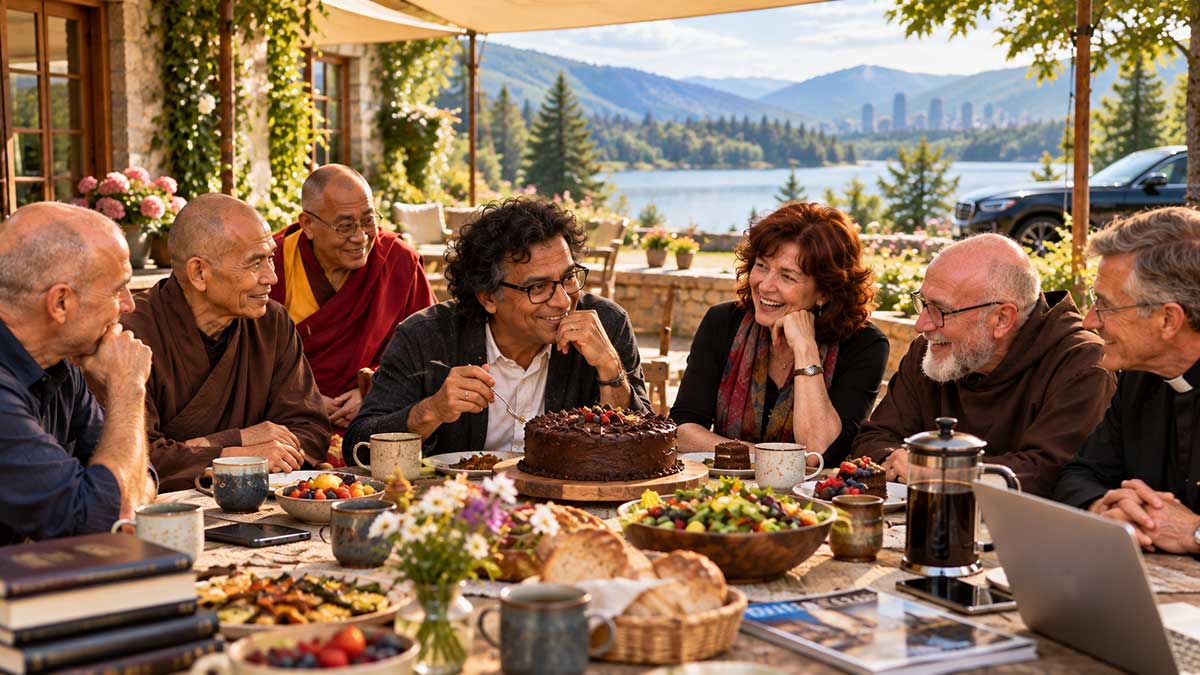
By the time the group returned to the retreat house, lunch had been set outside beneath a long canvas awning.
The table looked almost suspiciously generous.
Fresh bread. Soup. Roasted vegetables. Rice. Salad. Fruit. Several dishes nobody could immediately identify.
At the far end sat a chocolate cake.
Anthony saw it.
Sue Johnson saw Anthony see it.
She smiled.
"Careful."
Anthony looked at her.
"About what?"
"Attachment."
Anthony pulled out his chair.
"This is not attachment."
"What is it?"
"Awareness."
"Of the cake?"
"Deep awareness."
The Dalai Lama laughed.
Steven Hayes sat across from Anthony.
"You've been looking at it for ten seconds."
"I'm practicing presence."
Richard Rohr shook his head.
"This is going to be a long lunch."
Anthony looked again at the cake.
"I hope so."
"I'll Be Happy When..."
For several minutes, conversation gave way to eating.
Then Anthony put down his fork.
"Do you know one of the most dangerous sentences in the world?"
The Catholic theologian looked concerned.
"I'm afraid to ask."
Anthony leaned forward.
"I'll be happy when..."
Hayes smiled.
"That's a productive one."
Anthony pointed toward him.
"You've heard it?"
"I think everyone has."
Anthony looked around the table.
"I'll be happy when I graduate."
He moved to the next imaginary person.
"I'll be happy when I get married."
Then:
"I'll be happy when we have children."
Then:
"I'll be happy when the children finally leave."
Sue laughed.
Anthony continued.
"I'll be happy when I get promoted."
"I'll be happy when I make enough money."
"I'll be happy when I retire."
He paused.
"Then I'll finally enjoy my life."
Rohr said, "And then you're seventy."
Anthony nodded.
"And somebody says, 'Where did it go?'"
The laughter faded.
Anthony looked around the table.
"Where did what go?"
"Life," said Sue.
"No."
She looked at him.
Anthony tapped the table.
"Life didn't go anywhere."
He pointed around them.
"It was here."
A breeze moved the edge of the tablecloth.
"You were somewhere else."
Hayes leaned forward.
"Usually in the future."
"Exactly."
Anthony looked toward the cake again.
"Or waiting for dessert."
Sue laughed.
Does Getting What We Want Make Us Happy?
Hayes picked up the conversation.
"Let's challenge your claim."
"Please."
"External circumstances matter."
"Certainly."
"Money matters."
"Yes."
"Health matters."
"Yes."
"Relationships matter."
"Yes."
"Safety matters."
"Yes."
Hayes smiled.
"You aren't making this easy."
Anthony laughed.
"What did you expect me to say?"
"Something like, 'Nothing outside you can ever make you happy.'"
Anthony tilted his head.
"People love sentences like that."
"Do you?"
"I distrust almost every sentence people love putting on posters."
The Dalai Lama laughed.
Anthony continued.
"If someone hasn't eaten in two days and you give them food, their external circumstances matter very much."
"Good."
"If someone is sleeping on the street in winter and you give them shelter, don't tell them shelter is an illusion."
Rohr smiled.
"If someone is seriously ill, medical care matters."
"Of course."
"If someone is trapped in violence, safety matters."
"Absolutely."
Hayes nodded.
"Then what are you attacking?"
Anthony looked at him.
"The belief that the next thing will finally complete me."
Hayes waited.
Anthony continued.
"Money is useful."
"Yes."
"Very useful."
"Yes."
"But suppose I say, 'When I have one million dollars, then I will know I'm successful.'"
Rohr smiled.
Anthony continued.
"I reach one million."
"Then what?"
"Two million."
The Dalai Lama laughed.
"Then five."
"Then ten."
"Then perhaps someone I know has twenty."
Anthony pointed at him.
"Now my ten has become a tragedy."
Everyone laughed.
Sue said, "Comparison changes the experience."
"Constantly."
Anthony leaned toward her.
"You were happy with your house."
"Yes."
"Then your neighbor renovated."
Sue laughed.
Anthony continued.
"You loved your car."
"Until?"
"Your friend bought a better one."
Rohr joined in.
"You were proud of your book."
Anthony looked at him.
"Until someone else's book sold more copies."
Rohr nodded.
"That one hurt."
Everyone laughed.
Anthony spread his hands.
"Look at the madness."
The Catholic theologian said, "But wanting improvement isn't madness."
"No."
"Wanting financial security isn't madness."
"No."
"Wanting excellence isn't madness."
"No."
"Then we need a distinction."
Anthony smiled.
"Exactly."
Pleasure, Happiness and the New Phone
Hayes picked up his phone from beside his plate.
"Let's use this."
Anthony nodded.
"Good."
"Suppose I've been waiting for the newest phone."
"Very spiritual."
"I watch reviews. I compare models. I preorder it."
"Naturally."
"It arrives."
Anthony leaned forward.
"Beautiful."
"I open the box."
"Ecstasy."
"I turn it on."
"Enlightenment."
The table erupted.
Hayes continued.
"For several days, I'm excited."
Anthony nodded.
"Then?"
"It becomes my phone."
Anthony sat back.
"There."
Hayes looked around the table.
"Psychology has studied versions of this. People adapt to changes. The new circumstance becomes increasingly normal."
Anthony nodded.
"So the phone wasn't lying."
"What do you mean?"
"It gave you pleasure."
"Yes."
"Nothing wrong with pleasure."
"Agreed."
Anthony pointed toward the phone.
"The mistake was asking it to give you something it could never give."
"Permanent fulfillment."
"Exactly."
The Dalai Lama said, "Sensory pleasure is temporary by nature."
Anthony nodded.
"Which isn't a criticism."
"No."
"Chocolate cake is temporary."
Sue looked toward the cake.
"We've noticed."
Anthony ignored her.
"A sunset is temporary."
Thich Nhat Hanh said, "A flower is temporary."
"A vacation is temporary."
Rohr added, "Success is temporary."
Anthony looked at him.
"Everything changes."
Thich Nhat Hanh nodded.
"Impermanence does not make something meaningless."
Anthony smiled.
"Exactly."
He lifted his glass.
"If you demand permanence from something temporary, you're not enjoying it."
He took a sip.
"You're negotiating with it."
Is Ambition a Problem?
The Catholic theologian leaned back.
"Here's where I think many readers might misunderstand you."
Anthony looked toward him.
"They could read Awareness and conclude that wanting success itself is spiritually immature."
"Yes."
"Is ambition bad?"
Anthony smiled.
"What do you want to achieve?"
The theologian laughed.
"Don't turn this around."
"You asked."
Hayes stepped in.
"Let's make it more difficult."
"Good."
"Imagine an Olympic athlete."
Anthony nodded.
"She has trained since childhood."
"Yes."
"She wants the gold medal."
"Naturally."
"Not casually."
"Good."
"She wants it so much that she wakes at five every morning, controls her diet, sacrifices social life, trains through pain, studies competitors, travels constantly."
Anthony nodded.
"Excellent."
Hayes looked directly at him.
"Attached?"
Anthony thought.
"Maybe."
Hayes laughed.
"Again?"
"Why do you want easy answers?"
"Because I'm a psychologist."
"No psychologist wants easy answers. You'd be unemployed."
The group laughed.
Hayes continued.
"Then how do we know?"
Anthony looked toward the lake beyond the lawn.
"Ask her who she becomes if she loses."
Hayes paused.
Anthony turned back.
"If she loses the race and says, 'I'm heartbroken'..."
He nodded.
"Human."
"I'm disappointed."
He nodded again.
"I trained for ten years and wanted this terribly."
"Human."
Anthony's voice changed.
"I didn't win, therefore I am nothing."
He stopped.
The table grew quieter.
"There."
Hayes nodded.
"The outcome has fused with identity."
"Yes."
Anthony leaned forward.
"Want the medal."
He tapped the table.
"Train."
Another tap.
"Sacrifice."
Another.
"Give everything."
Then he opened his hands.
"But don't ask the medal to tell you who you are."
Rohr smiled.
"That's a very different argument from giving up ambition."
"Of course."
Hayes said, "It sounds surprisingly compatible with values-based action."
Anthony groaned.
"Please don't turn me into a therapy model."
Hayes laughed.
"But there's a connection."
"Fine."
Hayes continued.
"In ACT, the goal isn't to eliminate desire or difficult emotion. We ask what matters deeply enough that you're willing to act for it."
Anthony nodded.
"So the athlete can care intensely."
"Absolutely."
"And fail."
"Yes."
"And continue being a human being."
"Preferably."
Anthony smiled.
"Very sophisticated psychology."
What About the Entrepreneur?
Sue took some salad.
"Let's use another example."
"Please."
"An entrepreneur."
Anthony nodded.
"Excellent. They're always suffering."
The table laughed.
Sue continued.
"He starts a company."
"Yes."
"He wants to build something enormous."
"Good."
"He wants money."
"Fine."
"He wants recognition."
Anthony hesitated.
"Interesting."
Sue caught it.
"Why did you hesitate?"
"Recognition is delicious."
"So is cake."
Anthony glanced at the cake.
"Don't distract me."
She laughed.
Anthony continued.
"There's nothing wrong with enjoying recognition."
"But?"
"Watch what happens when you don't get it."
Hayes nodded.
Anthony continued.
"Suppose the entrepreneur builds something useful. Makes millions. Employs thousands. Enjoys creating. Wonderful."
He paused.
"Then somebody writes one negative article."
Rohr laughed.
"And?"
Anthony leaned forward.
"He spends the next three days reading the comments."
Everyone laughed.
"Ten thousand customers love the company."
Anthony held up one finger.
"One stranger writes, 'This guy is an idiot.'"
He stared dramatically at an imaginary phone.
"WHO IS THIS PERSON?"
The Dalai Lama laughed loudly.
Anthony continued.
"Let me see his profile."
Sue was laughing now.
"He has forty-three followers!"
Anthony slapped the table.
"AND HE THINKS I'M AN IDIOT?"
The group broke apart.
Even Thich Nhat Hanh was smiling broadly.
Anthony waited.
Then he said quietly:
"Who owns whom?"
The laughter faded.
Hayes looked at him.
"That's the question, isn't it?"
Anthony nodded.
"You think you own the company."
He pointed toward the imaginary entrepreneur.
"But perhaps the company owns your identity."
Rohr added, "Or your reputation owns you."
"Yes."
The theologian said, "Or your success."
"Yes."
Sue asked, "Could family do the same thing?"
Anthony looked toward her.
"Certainly."
"My children must succeed so I can feel successful."
"Yes."
"My marriage must look happy."
"Yes."
"My husband must admire me."
"Yes."
"My parents must approve of my choices."
"Yes."
Anthony looked around.
"Anything can become your master."
Does Detachment Kill Motivation?
The Dalai Lama had been listening quietly.
He spoke.
"Some people fear that if they release attachment to results, they will lose motivation."
Anthony nodded.
"Very common."
"If I no longer need success, why work?"
"Exactly."
"If I don't need praise, why create?"
"Yes."
"If winning doesn't determine my happiness, why compete?"
Anthony looked at Hayes.
"You answer."
Hayes smiled.
"Because something can matter without becoming a psychological demand."
Anthony nodded.
"Good."
Hayes continued.
"I can value writing without requiring every reader to approve of me."
"Yes."
"I can value parenting without controlling my child's entire future."
"Yes."
"I can value achievement without making achievement the measure of whether I deserve to exist."
"Exactly."
Thich Nhat Hanh said, "When we are fully present, we can put great care into what we do without being imprisoned by the outcome."
Rohr added, "Perhaps detachment can improve action."
Sue looked toward him.
"How?"
"If my identity isn't completely at stake, I may see reality more clearly."
Anthony nodded enthusiastically.
"Yes!"
Rohr continued.
"If my business is failing but my identity is 'successful entrepreneur,' I may refuse to admit the business is failing."
Hayes said, "That's psychological rigidity."
"If my marriage is struggling but I need everyone to believe we're the perfect couple..."
Sue finished the thought.
"...we may avoid getting help."
Anthony pointed toward her.
"Exactly."
The theologian added, "If my religious beliefs become inseparable from my ego..."
Rohr smiled.
"I was waiting."
The theologian laughed.
"...then any question may feel like a personal attack."
Anthony looked around the table.
"So perhaps attachment doesn't create greater commitment."
He paused.
"Sometimes it prevents us from seeing what commitment requires."
How Do I Know When Desire Has Become Attachment?
Sue returned to the practical question.
"Then give us a test."
Anthony looked suspicious.
"A test?"
"Something ordinary people can use."
"I don't like tests."
"You've been testing us all day."
"That's different."
"How?"
"I'm enjoying myself."
She laughed.
"Give us something."
Anthony thought.
"Fine."
Everyone waited.
Anthony asked:
"What happens when you don't get what you want?"
Hayes nodded immediately.
Anthony continued.
"You want the promotion."
He held up one hand.
"You don't get it."
"Disappointment," Sue said.
"Natural."
"Anger?"
"Maybe."
"Sadness?"
"Certainly."
Anthony nodded.
"But then watch."
He tapped his chest.
"Does the mind say..."
"I'm disappointed that I didn't get the promotion."
He paused.
"Or..."
"I'm a failure."
Silence.
Anthony continued.
"Someone else got what I deserved."
Another pause.
"Nobody respects me."
Another.
"My life is going nowhere."
He looked around the table.
"One event."
Then he moved his hands outward.
"A hundred stories."
Hayes said, "That's where awareness enters."
Anthony smiled.
"Finally."
"What?"
"You said it instead of me."
The Dalai Lama laughed.
Sue asked, "So attachment is revealed by our reaction?"
"Often."
"But strong disappointment doesn't necessarily mean unhealthy attachment."
"No."
"You can desperately want something."
"Yes."
"You can grieve losing it."
"Yes."
"You can even be angry."
"Yes."
"And still be psychologically free?"
Anthony thought.
"Freedom isn't never having reactions."
He looked toward her.
"It's seeing them."
Sue nodded.
"And then?"
"Perhaps not obeying every one of them."
Hayes smiled.
"Now you're definitely doing ACT."
Anthony sighed.
"I knew inviting psychologists was a mistake."
The Last Piece of Cake
Lunch was nearly finished.
The plates had been cleared.
Coffee arrived.
Then someone brought the chocolate cake to the center of the table.
Anthony sat up.
Sue noticed.
"Here we go."
Slices were distributed.
Conversation temporarily stopped.
Anthony took a bite.
He closed his eyes.
Nobody said anything.
He opened them.
"What?"
Hayes smiled.
"Are you happy?"
"Extremely."
"Anthony."
"What?"
"Your entire argument."
Anthony looked at the cake.
"Yes."
Hayes waited.
Anthony took another bite.
"This cake is making me happy."
Everyone laughed.
Sue pointed at him.
"You're admitting it."
"Of course."
"What happens when it's gone?"
Anthony looked at his remaining cake.
Then toward hers.
Sue immediately moved her plate farther away.
The table erupted.
Anthony laughed.
"That's the question."
"What?"
"Can I enjoy this completely..."
He took another bite.
"...without demanding that it last forever?"
Thich Nhat Hanh smiled.
Anthony continued.
"Can I love the taste without needing another slice?"
He glanced at the cake.
"That's more difficult."
More laughter.
He put down his fork.
"Can I enjoy money without asking money to tell me I'm important?"
The room quieted.
"Can I enjoy success without asking success to tell me I'm worthy?"
He looked toward Hayes.
"Can I enjoy praise without asking praise to tell me who I am?"
Toward Sue.
"Can I love someone without demanding that they complete me?"
Then toward everyone.
"Can I want something enormously..."
He paused.
"...without making my happiness hostage to it?"
Nobody answered immediately.
The Dalai Lama smiled.
"That sounds less like having no desire."
Anthony nodded.
"Much less."
"And more like freedom inside desire."
Anthony looked at him.
"Yes."
The Catholic theologian leaned back.
"Then perhaps 'I don't want anything' isn't necessarily spiritual maturity."
Anthony laughed.
"It could be depression."
The entire table erupted.
Rohr nearly spilled his coffee.
When the laughter settled, Hayes looked at Anthony.
"So you're not asking people to stop wanting."
"No."
"You're asking them to notice what they've asked their wants to provide."
Anthony smiled.
"Very good."
Sue pointed toward the remaining cake.
"And what are you asking that cake to provide?"
Anthony looked at it solemnly.
"At the moment?"
"Yes."
"Another ten minutes of pleasure."
She laughed.
"Healthy desire?"
Anthony reached for a second slice.
"We're about to find out."
The group laughed again.
Beyond the awning, clouds were beginning to gather over the lake.
The bright morning had slowly changed.
A low roll of thunder sounded somewhere in the distance.
Hayes looked toward the darkening sky.
"Looks like rain."
Anthony followed his gaze.
The conversation around the table grew quieter.
They had spent lunch discussing the suffering created when human beings didn't get what they wanted.
Soon they would have to confront a harder question.
What about suffering that nobody had wanted in the first place?
Anthony looked at the approaching clouds.
Then he took another bite of cake.
Topic 4: Suffering
Is Awareness Enough?
The rain arrived before anyone finished their coffee.
At first it was gentle, a scattering of drops against the canvas awning.
Then the sky opened.
Everyone gathered plates, cups and notebooks and hurried inside the retreat house.
Anthony carried the remaining chocolate cake.
Sue Johnson noticed.
"Priorities."
"Awareness."
"Of course."
Thunder rolled across the lake.
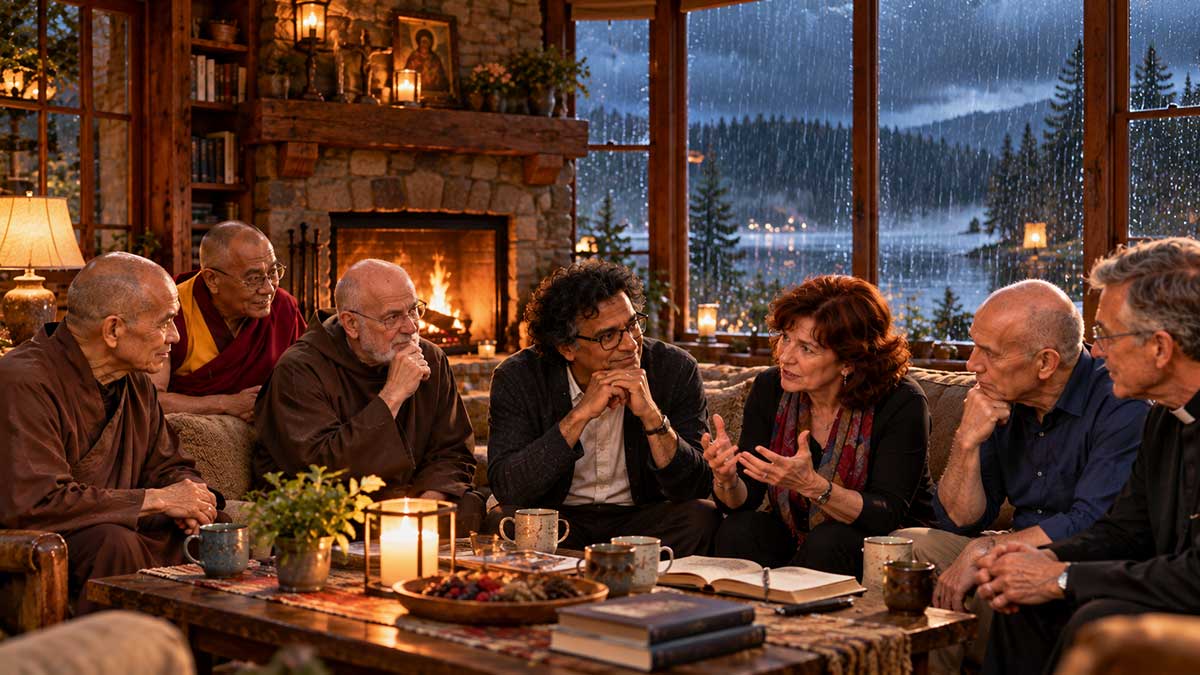
Inside, the retreat house had a large sitting room with old wooden beams and a stone fireplace. Someone lit a fire. Chairs were pulled into an imperfect circle.
For several minutes, nobody spoke.
Rain struck the windows.
The warmth of lunch had disappeared with the sunlight.
Steven Hayes looked at Anthony.
"There's a question I've been waiting to ask."
Anthony placed the cake safely on a side table.
"That sounds ominous."
"It is."
Anthony sat.
Hayes leaned forward.
"Is awareness enough?"
Anthony didn't answer immediately.
"Enough for what?"
"Exactly."
Hayes looked around the room.
"You've spent much of the day telling us to observe."
"Yes."
"Observe our thoughts."
"Yes."
"Our fears."
"Yes."
"Our anger."
"Yes."
"Our attachments."
"Yes."
"Our conditioning."
"Yes."
Hayes paused.
"What if the person sitting across from you has been traumatized?"
The room became still.
Anthony's expression changed.
Hayes continued.
"What if they're not merely worried about something?"
Another roll of thunder sounded.
"What if something terrible actually happened?"
Can We Really Just Observe Our Pain?
Anthony leaned back.
"Give me an example."
Hayes thought.
"A woman is driving home."
Anthony nodded.
"Another car runs a red light."
"Yes."
"There's a collision."
"Yes."
"She survives."
Anthony waited.
"Months later, physically, she's recovered."
"But?"
"Every time she approaches an intersection, her body reacts."
Anthony listened.
"Her heart races. Her muscles tighten. She becomes hyperalert."
Sue added, "She may intellectually know she's safe."
"Exactly," Hayes said. "But her body learned something."
Anthony nodded.
"Intersection means danger."
"Yes."
Hayes looked directly at him.
"Do you tell her, 'Just observe your fear'?"
Anthony was quiet.
Finally he said, "I might begin there."
"Begin."
"Yes."
"Not end."
Anthony shook his head.
"No."
Hayes smiled slightly.
"That's an important distinction."
Anthony looked around the circle.
"I sometimes speak strongly because people spend their lives running from what they feel."
He pointed toward his chest.
"Fear appears."
He moved his hand away rapidly.
"Get rid of it."
Another motion.
"Distract me."
Another.
"Give me something to eat."
He glanced toward the cake.
Sue laughed softly.
Anthony continued.
"Give me alcohol."
"Give me entertainment."
"Give me somebody to blame."
"Give me a spiritual teaching that makes the feeling disappear."
He stopped.
"Anything except..."
Anthony placed both hands on his knees.
"Let me see what is happening."
Hayes nodded.
"That part I strongly understand."
Anthony looked at him.
"But?"
"But observation doesn't automatically resolve everything."
"Of course not."
Sue entered.
"That's where I think some readers could misunderstand you."
Anthony nodded.
"Someone hears, 'Observe your suffering,' and thinks they're supposed to become detached from it."
"Yes."
"Or they believe continuing to suffer means they've failed to become aware."
Anthony frowned.
"That's terrible."
"It happens."
Anthony looked toward the fire.
"Then perhaps we should say this clearly."
Everyone waited.
"Awareness is not a command to stop hurting."
The room remained silent.
Anthony continued.
"It's an invitation to notice what is happening while you hurt."
What If the Body Remembers?
Sue leaned forward.
"Let's go further."
Anthony nodded.
"Imagine a child grows up in a frightening home."
The rain intensified against the windows.
"Maybe one parent is violent."
Anthony listened.
"The child learns to watch faces."
Sue demonstrated with her eyes.
"Is Dad angry?"
A glance toward an imaginary doorway.
"How hard did he close the door?"
Another.
"How is Mom speaking?"
Another.
"Is tonight safe?"
Nobody moved.
Sue continued.
"That child grows up."
Anthony nodded.
"Now he's forty."
"Yes."
"His wife closes a cabinet loudly."
Sue snapped her fingers.
"His body reacts."
Anthony waited.
"He may know she's not his father."
"Yes."
"He may know he's safe."
"Yes."
"But some part of him has learned to detect danger very quickly."
Anthony nodded.
Sue asked, "Is that programming?"
"In one sense, yes."
"Is it sleep?"
Anthony hesitated.
"Not the way I'd want to use the word."
Sue nodded.
"Good."
Anthony looked at her.
"Why?"
"Because calling a survival response 'sleep' could sound as though the person simply failed to wake up."
Anthony's face softened.
"Fair."
Hayes added, "Some reactions developed precisely to protect us."
Anthony nodded.
"Then awareness must include compassion toward the mechanism."
Sue looked at him.
"Say more."
Anthony thought.
"Instead of..."
His voice hardened.
"Why am I like this?"
Then softer:
"Ah. My body learned something."
Sue nodded.
Anthony continued.
"It was trying to protect me."
The room became very quiet.
"Perhaps it doesn't know yet that the danger has passed."
Sue smiled gently.
"That's much closer."
Anthony looked at her.
"So awareness doesn't say, 'You shouldn't be afraid.'"
"No."
"It says..."
He paused.
"Fear is here."
Hayes added, "And now we can decide how to respond to it."
Anthony nodded.
The Second Arrow
The Dalai Lama had been listening.
"There is an old Buddhist image that may help."
Anthony turned toward him.
"The arrows?"
The Dalai Lama smiled.
"Yes."
Anthony gestured for him to continue.
"The first arrow is the pain that comes to us."
He paused.
"Illness."
"Loss."
"Injury."
"Rejection."
"Fear."
"Death."
He looked around the room.
"Then sometimes the mind shoots another arrow."
Anthony nodded.
The Dalai Lama continued.
"Why me?"
"This should never have happened."
"My life is ruined."
"I cannot bear this."
Hayes said, "That maps onto something psychologically useful."
Sue raised a hand slightly.
"But we need to be careful."
Everyone looked at her.
"A grieving person may say, 'My life is ruined,' and for that moment, it may genuinely feel ruined."
Anthony nodded.
"We shouldn't turn the second arrow into another accusation."
"Exactly."
Sue continued.
"Now you're suffering incorrectly."
Anthony shook his head.
"No."
Hayes said, "The purpose isn't to judge the thought. It's to notice what the thought is doing."
Anthony pointed toward him.
"Yes."
He looked around the room.
"That's awareness."
The theologian spoke.
"Yet suffering can have causes outside the mind."
Anthony nodded.
"Certainly."
"That's where spiritual teachings sometimes become dangerous."
Anthony looked at him.
"Go on."
"If someone is oppressed, abused or exploited, telling them the problem is their interpretation may protect the person causing the harm."
The room grew quiet again.
Anthony leaned forward.
"Then don't tell them that."
The theologian continued.
"Suppose a woman is being abused by her husband."
"Yes."
"You wouldn't say, 'Observe your reaction. Your suffering comes from attachment to how you think your husband should behave.'"
Anthony stared at him.
"No."
"Why not?"
"Because her husband needs to stop abusing her."
The answer came without hesitation.
Hayes smiled faintly.
"Good."
Anthony continued.
"And she may need to leave."
Sue nodded.
"Yes."
"She may need protection."
"Yes."
"She may need friends, police, shelter, legal help, therapy."
"Yes."
Anthony spread his hands.
"Reality matters."
Acceptance Does Not Mean Approval
Rohr leaned forward.
"Then we need to rescue another word."
Anthony smiled.
"Which one?"
"Acceptance."
Hayes laughed.
"That's one of ours too."
Anthony looked between them.
"Everyone is stealing everybody's vocabulary today."
Rohr continued.
"People hear 'accept reality' and imagine passivity."
Anthony nodded.
Hayes said, "In psychological work, acceptance doesn't mean approving of something or refusing to change it."
"Exactly," Anthony said.
Hayes continued.
"It means beginning with what is actually here."
Anthony looked toward the window.
"Rain."
Hayes nodded.
"If I stand outside shouting, 'It must not rain,' I'm fighting a fact."
Anthony smiled.
"If you open an umbrella, you're also responding to the fact."
"Exactly."
Anthony turned toward the theologian.
"So perhaps this helps with your question."
"How?"
Anthony held out one hand.
"This is happening."
Then the other.
"And I am going to do something about it."
The theologian nodded.
"Those can coexist."
"Of course."
Rohr added, "Jesus accepting the reality of suffering didn't mean indifference to suffering."
The theologian nodded.
"Christianity contains a strong tradition of action on behalf of others."
The Dalai Lama said, "Compassion itself requires response."
Anthony looked around the circle.
"Then why do people imagine awareness means sitting quietly while the house burns down?"
Hayes smiled.
"Some spiritual language can sound that way."
Anthony pointed toward the fireplace.
"If that fire spreads to the curtains, please don't observe it."
Everyone laughed.
"Put it out."
What About Anger?
Sue looked toward Anthony.
"Let's use anger."
"Good."
"Someone betrays me."
Anthony nodded.
"I'm furious."
"Yes."
"You tell me to observe the anger."
"Yes."
"What does that mean?"
Anthony thought.
"It means you don't immediately become the anger."
Sue waited.
Anthony continued.
"Your body is hot."
"Yes."
"Your jaw tightens."
"Yes."
"Thoughts appear."
"How could he do this?"
"I'll show him."
"I'll never forgive him."
Sue nodded.
Anthony continued.
"You notice."
"And then?"
"Perhaps you wait."
"How long?"
Anthony laughed.
"Long enough not to send the message."
Hayes laughed loudly.
Sue smiled.
"That may be your most practical teaching yet."
Anthony continued.
"Have you ever written a message while angry?"
Everyone raised some version of a hand.
Anthony nodded.
"Wonderful."
"Have you ever been grateful the next morning that you didn't send it?"
More hands.
"Awareness."
Hayes said, "There's something important there. The feeling isn't the same thing as the action."
Anthony nodded.
"Exactly."
"You can feel anger without automatically obeying anger."
"Yes."
Sue added, "And anger may contain information."
Anthony turned toward her.
"Certainly."
"It may tell you a boundary was crossed."
"Yes."
"It may tell you something matters."
"Yes."
"It may motivate action."
"Yes."
"So we're not trying to eliminate anger."
Anthony smiled.
"Why would you?"
"Some spiritual traditions make anger sound like failure."
"Then people become angry about being angry."
The Dalai Lama laughed.
Anthony continued.
"Now you have two problems."
Hayes said, "And perhaps shame on top of both."
"Three."
Sue smiled.
"And then frustration that awareness isn't working."
"Four."
Rohr laughed.
"Spirituality is going very well."
Can Awareness Become Avoidance?
Thich Nhat Hanh spoke quietly.
"Mindfulness must include what is painful."
Anthony nodded.
"We cannot use awareness only to escape."
Hayes looked interested.
"That's important."
Thich Nhat Hanh continued.
"If someone says, 'I am observing my suffering,' but refuses to touch the suffering, that is not deep awareness."
Anthony looked toward him.
"Yes."
Sue added, "People can intellectualize pain."
Anthony nodded.
"They become experts on themselves."
Hayes smiled.
"Without changing."
"Exactly."
Anthony adopted a serious voice.
"I understand completely why I sabotage every relationship."
He paused.
"I've understood it for twenty years."
Laughter.
Sue said, "Insight isn't always transformation."
Anthony looked at her.
"That's uncomfortable."
"It should be."
"Good."
Hayes continued.
"Someone may understand every childhood influence and still repeat the same behavior."
"Yes."
"Someone can observe anxiety and still need treatment."
"Yes."
"Someone can meditate and still need medication."
Anthony nodded.
"Of course."
"Someone can pray and still need therapy."
"Yes."
The theologian smiled.
"I appreciate that one."
Anthony looked around the room.
"Why must we turn everything into competition?"
Nobody answered.
"Prayer or therapy."
He raised two hands as though weighing them.
"Meditation or medication."
Another imaginary choice.
"Spirituality or psychology."
He dropped his hands.
"Use what helps you see and live."
What About Injustice?
The theologian leaned forward again.
"I want to return to the larger world."
Anthony nodded.
"Suppose an entire community suffers injustice."
"Yes."
"If we tell them to find peace inside themselves, we may make them easier to oppress."
Anthony's expression became serious.
"True."
Rohr added, "Contemplation without action can become comfortable."
The Dalai Lama nodded.
"Inner peace should not mean indifference."
Hayes looked toward Anthony.
"Can an awakened person protest?"
Anthony laughed.
"I hope so."
"Can they become angry about injustice?"
"Certainly."
"Can they fight?"
Anthony paused.
"Now the word becomes dangerous."
Hayes nodded.
"Fight politically. Organize. Resist. Challenge."
"Of course."
Anthony leaned forward.
"But awareness may change the quality of the action."
"How?"
Anthony thought.
"I can oppose what you're doing without needing to turn you into a monster."
The theologian listened closely.
"I can fight injustice without letting hatred become my identity."
Rohr nodded.
"That's difficult."
"Extremely."
The Dalai Lama said, "Compassion does not require agreeing with harmful action."
Anthony nodded.
"And opposing someone doesn't require becoming psychologically consumed by them."
Hayes added, "Which may even make action more effective."
Anthony looked at him.
"Perhaps."
The Person Who Cannot Forgive
Sue sat back.
"Here's another difficult one."
Anthony smiled.
"You're enjoying this."
"I am."
"Go ahead."
"Someone was badly betrayed."
Anthony nodded.
"Years have passed."
"Yes."
"They remain angry."
"Yes."
"Everyone tells them, 'You need to forgive for your own sake.'"
Anthony winced.
"You don't like that?"
"I don't like spiritual deadlines."
Sue smiled.
"What would you say?"
Anthony thought.
"Notice the anger."
"Again?"
"Yes."
"What if it stays?"
"Notice that too."
"What if they never forgive?"
Anthony paused.
"Then perhaps they don't."
Sue looked surprised.
"You wouldn't insist?"
"No."
Rohr leaned forward.
"That's interesting."
Anthony continued.
"Forgiveness that is forced because a spiritual teacher says you must forgive may simply become another performance."
The theologian said, "Christian theology places enormous importance on forgiveness."
"Yes."
"But genuine forgiveness cannot simply be emotional pretending."
"Exactly."
Sue nodded.
"Sometimes healing begins with acknowledging, 'What happened to me was wrong.'"
Anthony looked at her.
"Yes."
"Not immediately explaining it away."
"Yes."
"Not rushing toward compassion for the person who caused it."
"Yes."
Anthony leaned back.
"Awareness begins with truth."
The room became quiet.
"Not with being nice."
Is Awareness Enough?
The rain had softened.
Hayes looked toward the window.
Then back at Anthony.
"I want to return to my first question."
Anthony nodded.
"Is awareness enough?"
Anthony looked into the fire.
"No."
The answer was so simple that nobody responded at first.
Hayes waited.
Anthony continued.
"Not if by awareness you mean sitting there noticing."
Hayes nodded.
"What else?"
"Sometimes action."
Sue said, "Sometimes relationship."
"Yes."
Hayes said, "Sometimes skills."
"Yes."
"Therapy."
"Yes."
The theologian said, "Community."
"Yes."
Rohr said, "Prayer."
Anthony smiled.
"Yes."
The Dalai Lama said, "Compassion."
"Yes."
Sue added, "Sometimes protection."
Anthony nodded.
"Absolutely."
Hayes looked at him.
"Then why put so much emphasis on awareness?"
Anthony looked toward him.
"Because without seeing, how do you know what action is needed?"
Silence.
Anthony continued.
"If I'm angry and don't know I'm angry, anger chooses."
He pointed toward Hayes.
"If I'm frightened and don't know I'm frightened, fear chooses."
Toward Sue.
"If I'm wounded and don't know I'm wounded, the wound may choose."
Toward Rohr.
"If I need approval and don't know I need approval, approval chooses."
Then toward himself.
"If I'm conditioned and don't know I'm conditioned, conditioning chooses."
He sat back.
"Awareness doesn't do everything."
The fire cracked.
"But perhaps it gives you the possibility of choosing what happens next."
Hayes smiled.
"That I can work with."
Anthony laughed.
"Finally, psychological approval."
After the Rain
Several minutes passed before anyone noticed that the rain had stopped.
The room had grown unusually quiet.
Anthony looked toward the windows.
A pale strip of evening light had appeared beneath the clouds.
He stood.
Nobody asked why.
Anthony walked to the door and opened it.
Cool air entered the room.
The smell of wet grass and earth came with it.
Outside, drops still fell from the trees.
The lake was almost perfectly still.
Anthony stepped onto the veranda.
One by one, the others followed.
No one carried a notebook.
Sue stood beside him.
"So awareness isn't enough."
Anthony looked at the wet landscape.
"No."
"But it's necessary?"
Anthony smiled.
"Careful."
"Why?"
"You're trying to make another rule."
She laughed.
Hayes joined them.
"Then what can we safely say?"
Anthony looked at the dark clouds moving away across the lake.
"Something hurts."
He paused.
"See it."
A drop fell from the roof.
"If you need help, get help."
Another.
"If something needs changing, change it."
The theologian said, "And if it cannot be changed?"
Anthony looked toward him.
"Then perhaps we learn what it means to live with what is."
Nobody spoke.
The Dalai Lama stepped outside.
Thich Nhat Hanh followed.
Rohr stood near the railing.
The clouds had opened just enough for the final light of the day to touch the water.
Anthony looked at the group.
"We keep asking whether awareness will make suffering disappear."
He shook his head.
"Maybe that's the wrong promise."
Sue looked toward him.
"What is the promise?"
Anthony watched the lake.
"No promise."
A faint smile crossed his face.
"Just the possibility that when suffering comes, we might see what is happening..."
He touched his chest.
"...without immediately becoming everything the suffering tells us we are."
For several moments, nobody answered.
Somewhere beyond the retreat house, water dripped steadily from the trees.
Night was beginning to arrive.
And for the first time that day, the question waiting for them was no longer primarily psychological.
They had talked about the self.
Love.
Happiness.
Suffering.
Sooner or later, someone was going to ask the question that had followed Anthony de Mello for much of his life:
Where, in all of this, was God?
Topic 5: God
Does Awakening Lead Beyond Religion or Deeper Into It?
Night came slowly over the retreat house.
The clouds that had brought the afternoon rain had moved east, leaving a sky washed unusually clear.
Someone had lit a small fire outside.
There were no tables now.
No notebooks.
No coffee cups.
No one had arranged the chairs into a circle, yet somehow a circle had formed.
Anthony de Mello sat nearest the fire.
Sue Johnson and Steven Hayes sat together on a wooden bench. Richard Rohr had taken a chair slightly behind them. Thich Nhat Hanh and the Dalai Lama sat quietly opposite the flames.
The Catholic theologian stood for a while looking upward.
Then he sat.
For several minutes, nobody spoke.
The fire cracked.
Somewhere near the lake, frogs had begun their evening chorus.
Anthony looked around.
"This is much better."
Hayes smiled.
"Than what?"
"Talking."
Sue laughed.
"You've been talking all day."
"Exactly. I'm exhausted."
The theologian smiled.
"I'm afraid I have one more question."
Anthony sighed theatrically.
"I knew inviting a theologian was dangerous."
"It concerns you."
"Even worse."
The theologian leaned forward.
"Anthony..."
He paused.
"Were you still teaching Christianity?"
Nobody laughed.
Anthony looked into the fire.
"Ah."
The theologian waited.
Anthony smiled faintly.
"So we've finally arrived."
Was Anthony de Mello Still Teaching Christianity?
Rohr shifted in his chair.
The theologian continued.
"You were a Jesuit priest."
"Yes."
"Jesus was central to your spiritual formation."
"Yes."
"You taught Christian retreats."
"Yes."
"Yet your work drew deeply from Buddhist stories, Hindu thought, Taoist wisdom, psychology and other traditions."
"Yes."
"And some of your later language about God, self and religious doctrine created serious concerns within the Catholic Church."
Anthony nodded.
"Yes."
The theologian looked directly at him.
"So what were you doing?"
Anthony smiled.
"Trying to wake people up."
"That's not quite an answer."
"It's the answer you're getting."
The Dalai Lama laughed.
The theologian smiled.
"I expected that."
Anthony leaned forward.
"Let me ask you something."
"All right."
"Can a person know every doctrine about bread..."
He paused.
"...and still be hungry?"
The theologian nodded.
"Certainly."
"Can someone study water without drinking?"
"Yes."
"Can someone explain love without loving?"
"Yes."
Anthony looked around the fire.
"Then can someone know theology without knowing God?"
The theologian didn't answer immediately.
"Yes."
Anthony sat back.
"That's what concerned me."
The theologian nodded slowly.
"But the reverse question matters too."
Anthony waited.
"Can someone have an intense spiritual experience and misunderstand what they've experienced?"
Anthony smiled.
"Of course."
"Then doctrine isn't necessarily the enemy of experience."
"No."
"It can help interpret experience."
"Yes."
The theologian leaned forward.
"That's important."
Anthony nodded.
"I never said theology was useless."
Rohr laughed softly.
"You occasionally came close."
Anthony grinned.
"Perhaps I was trying to keep theologians awake."
The theologian laughed.
"Then congratulations."
Can Religion Put Us to Sleep?
Rohr looked toward Anthony.
"There's another side to this."
Anthony nodded.
"Religion can become part of the constructed identity."
"Very easily."
Rohr continued.
"I am Catholic."
Anthony nodded.
"I am Protestant."
"Yes."
"I am Buddhist."
"Yes."
"I am Hindu."
"Yes."
"I am Muslim."
"Yes."
Rohr looked around the circle.
"These identities can carry profound traditions, communities and wisdom."
Anthony nodded.
"And?"
"They can become ego."
Anthony smiled.
"Of course."
The theologian entered.
"But that doesn't make religious identity false."
"No," Anthony said.
"Or meaningless."
"No."
"Or something an awakened person must transcend."
Anthony tilted his head.
"Depends what you mean by transcend."
The theologian smiled.
"I knew we'd get here."
Anthony laughed.
He pointed toward himself.
"I am Indian."
"Yes."
"I was a Jesuit."
"Yes."
"I was a priest."
"Yes."
"Those things mattered."
"Yes."
"But if I cannot see another human being except through the label I've placed on them..."
Anthony shook his head.
"...then my label has blinded me."
The Dalai Lama nodded.
"This happens easily."
Anthony continued.
"I meet someone and immediately..."
He began counting on his fingers.
"Christian."
"Atheist."
"Conservative."
"Liberal."
"Rich."
"Poor."
"Educated."
"Ignorant."
He lowered his hand.
"Sometimes we've completely explained the person before they've opened their mouth."
Hayes smiled.
"Humans categorize very quickly."
"Useful?"
"Often."
"Dangerous?"
"Often."
Anthony smiled.
"Good."
Sue said, "It's similar to what we discussed this morning."
Anthony looked toward her.
"Exactly."
"The problem isn't necessarily having categories."
"No."
"It's forgetting that the person is larger than the category."
Anthony pointed toward her.
"Yes."
Are All Religions Saying the Same Thing?
The fire settled lower.
The Dalai Lama added another piece of wood.
Anthony watched the sparks rise.
Rohr spoke.
"Then we reach the question people inevitably ask in conversations like this."
Anthony groaned.
"Which one?"
"Are all religions basically saying the same thing?"
Anthony laughed.
"Terrible question."
The theologian laughed too.
"On that, we agree."
Sue looked between them.
"Why terrible?"
The theologian answered first.
"Because religions make genuinely different claims."
He turned toward the Dalai Lama.
"Christianity speaks of a personal Creator."
The Dalai Lama nodded.
"Traditional Buddhism does not require such a Creator."
The theologian continued.
"Christianity makes specific claims about Jesus Christ."
"Yes."
"Islam makes different claims about Jesus."
"Yes."
"Hindu traditions contain still other understandings of ultimate reality."
Thich Nhat Hanh listened quietly.
The theologian continued.
"These differences aren't simply vocabulary."
Anthony nodded.
"Good."
Sue looked surprised.
"You agree?"
"Of course."
She smiled.
"You seem to enjoy surprising people tonight."
Anthony leaned toward her.
"If every religion taught exactly the same thing, why would we need so many words?"
The Dalai Lama laughed.
Rohr said, "Yet mystical traditions sometimes report experiences that sound remarkably similar."
Anthony turned toward him.
"Yes."
"Silence."
"Yes."
"Loss of egoic boundaries."
"Yes."
"Compassion."
"Yes."
"Profound interconnectedness."
"Yes."
"A sense that ordinary conceptual thinking cannot capture reality."
Anthony nodded.
"Yes."
The theologian raised a hand.
"Similarities don't prove identity."
Rohr nodded.
"I agree."
The Dalai Lama spoke.
"We should respect differences."
Everyone turned toward him.
"If a Christian has a deep relationship with God, it isn't necessary for a Buddhist to tell the Christian that this experience is secretly Buddhism."
Anthony smiled.
"Excellent."
The Dalai Lama continued.
"And a Christian should not need to tell a Buddhist that Buddhist experience is secretly Christianity."
The theologian nodded.
"Agreed."
Anthony looked around the circle.
"Look at that."
"What?" Sue asked.
"We've achieved interreligious peace."
The group laughed.
Anthony pointed toward the fire.
"For approximately twelve seconds."
One Mountain or Many?
Hayes looked around.
"I'm the psychologist here, so perhaps I'm allowed to ask the naive question."
Anthony smiled.
"Those are usually the best."
Hayes continued.
"People often use the mountain metaphor."
Anthony nodded reluctantly.
"Many paths up one mountain."
"Exactly."
Rohr smiled.
"Different religions climbing toward the same summit."
Hayes looked around.
"Useful or misleading?"
The theologian answered immediately.
"Potentially misleading."
"Why?"
"Who has seen the entire mountain?"
Hayes smiled.
"Good point."
The theologian continued.
"The metaphor assumes its conclusion. Someone standing above all religions declares that every tradition is unknowingly climbing toward the same destination."
Anthony looked delighted.
"Very good."
The theologian turned toward him.
"You're enjoying this far too much."
"I enjoy good arguments."
Thich Nhat Hanh spoke softly.
"Perhaps we don't need to decide that every path reaches the same summit."
Everyone turned toward him.
"We can walk deeply on our own path and still learn from another person's path."
Anthony nodded.
"Yes."
Thich Nhat Hanh continued.
"If I understand my own tradition deeply, perhaps I become less frightened by yours."
Rohr smiled.
"And perhaps more capable of recognizing wisdom in it."
The theologian added, "Without pretending the differences don't matter."
Anthony looked around.
"Now we're getting somewhere."
Hayes laughed.
"Where?"
Anthony smiled.
"I have no idea."
What Did Jesus Mean by Waking Up?
Rohr turned toward Anthony.
"Let me bring Jesus directly into this."
Anthony nodded.
"Please."
"You frequently used Jesus' teachings."
"Yes."
"Do you see your idea of awakening as Christian?"
Anthony thought.
"I see much in Jesus that wakes people."
"Such as?"
Anthony looked into the fire.
"Look at the people Jesus sees."
He paused.
"People society has already labeled."
"The sinner."
"The tax collector."
"The foreigner."
"The sick."
"The poor."
"The religious hypocrite."
Anthony looked toward the theologian.
"He repeatedly breaks people's categories."
The theologian nodded.
"Yes."
Anthony continued.
"He asks people to look."
Rohr said, "And he constantly attacks religious performance."
Anthony smiled.
"Exactly."
Rohr continued.
"People who look righteous."
"Yes."
"People who know religious rules."
"Yes."
"People who use religion to protect status."
"Yes."
Anthony leaned forward.
"You can use God to avoid God."
The sentence hung in the night.
The theologian looked at him.
"Explain."
Anthony thought.
"I can become so attached to my ideas about God..."
He pointed toward his head.
"...that I stop looking."
The theologian listened.
"I defend my doctrine."
"Doctrine can matter."
"Certainly."
"I defend my institution."
"Institutions can matter."
"Yes."
"I defend my identity."
Anthony paused.
"And somewhere in all that defending, perhaps I stop loving."
Rohr nodded slowly.
The theologian said, "Christianity itself contains warnings about exactly that."
Anthony smiled.
"Good."
"But I would still resist the idea that Christianity is merely an invitation to awareness."
Anthony nodded.
"It makes claims about God, creation, Christ, salvation and resurrection."
"Yes."
"Those claims matter."
"Yes."
The theologian smiled.
"You aren't going to fight me?"
Anthony laughed.
"Would that make you happy?"
"A little."
Could a Buddhist and a Christian Experience the Same Silence?
The fire had burned down again.
Nobody added wood this time.
Above them, more stars had appeared.
Sue looked upward.
"I have a question."
Anthony turned toward her.
"Suppose a Christian contemplative sits in complete silence."
"Yes."
"And a Buddhist meditator sits in complete silence."
"Yes."
"Both report a profound sense of peace, loss of ordinary self-consciousness and compassion."
She looked toward the theologian.
"Did they experience the same thing?"
He smiled.
"I don't know."
Sue looked toward the Dalai Lama.
He smiled too.
"I don't know."
She turned toward Anthony.
Anthony laughed.
"Why are you looking at me?"
"You're supposed to have the provocative answer."
Anthony thought.
"Maybe."
Sue waited.
"Maybe not."
She laughed.
"That's terrible."
Anthony smiled.
"What if the need to decide is itself getting in the way of looking?"
The theologian responded.
"And what if refusing to decide becomes a way of avoiding genuine differences?"
Anthony pointed toward him.
"Excellent."
Rohr laughed.
"Nobody gets out tonight."
Hayes said, "Perhaps the experience and the interpretation can be distinguished."
Everyone looked toward him.
"Two people can have experiences with similarities. Their conceptual frameworks may interpret those experiences differently."
Anthony nodded.
"Interesting."
Hayes continued.
"Psychology can study reports of experience."
"Yes."
"But psychology cannot simply settle the metaphysical question of what ultimate reality is."
Anthony smiled.
"Finally, a psychologist who knows when to stop."
Hayes laughed.
"I walked directly into that."
Is God an Experience?
The theologian turned toward Anthony.
"Let me ask you something directly."
Anthony nodded.
"Is God merely an experience?"
"No."
The answer came quickly.
The theologian seemed surprised.
Anthony continued.
"If I have an experience and say, 'That experience is God,' I've already trapped God inside my experience."
Rohr smiled.
"Good."
Anthony continued.
"Then tomorrow I don't have the experience."
He spread his hands.
"Where did God go?"
The theologian nodded.
Anthony looked toward the sky.
"People become attached to spiritual experiences too."
The Dalai Lama smiled.
"Very much."
Anthony closed his eyes dramatically.
"Last Tuesday during meditation I experienced infinite peace."
He opened one eye.
"I've been trying to get Tuesday back ever since."
The group laughed.
Thich Nhat Hanh smiled.
"Then Tuesday becomes another attachment."
Anthony pointed toward him.
"Exactly."
Rohr said, "The spiritual life can become another achievement system."
Anthony nodded.
"I had a mystical experience."
"I reached a higher level."
"I am awakened."
"I am enlightened."
He sighed.
"Same ego."
He smiled.
"Better vocabulary."
Could De Mello Make Someone a Better Christian?
The theologian looked toward Anthony.
"Here's perhaps the question that matters most to many Christian readers."
Anthony waited.
"Could your teachings make someone a deeper Christian?"
Anthony smiled.
"You should ask the Christian."
"Suppose I'm asking you."
Anthony thought.
"I hope they make someone more awake."
The theologian smiled.
"You're avoiding the word."
"Perhaps."
"Why?"
Anthony leaned back.
"If someone reads me and becomes less loving..."
He paused.
"...throw the book away."
Sue smiled.
"If someone becomes less compassionate..."
"Throw it away."
"If they become spiritually arrogant?"
"Burn it."
The theologian laughed.
"Careful. You're going to create a book-burning controversy."
Anthony grinned.
"Fine. Recycle it."
Everyone laughed.
Anthony continued.
"If someone reads Awareness and begins seeing their hypocrisy..."
He touched his chest.
"...good."
"If they notice how much they depend on approval..."
"Good."
"If they begin listening to their spouse rather than merely waiting to speak..."
Sue smiled.
"Very good."
"If they become less afraid of people who believe differently..."
He looked toward the theologian.
"Good."
"If they pray more honestly..."
Rohr nodded.
"Good."
Anthony continued.
"If they become more loving..."
He paused.
"Then perhaps something worthwhile happened."
The theologian said, "Yet that doesn't answer every doctrinal question."
"No."
"And those questions still matter."
"Yes."
"Then someone could find genuine spiritual wisdom in your work and still disagree with some of your theology."
Anthony smiled.
"Please."
The theologian laughed.
"Please?"
"Disagree."
Anthony looked around the fire.
"Why must you agree with me?"
Hayes smiled.
"Most authors prefer it."
"Then they're attached."
The group laughed.
Could It Deepen Other Faiths?
The Dalai Lama spoke.
"The same question could be asked differently."
Anthony nodded.
"Could these ideas help a Buddhist practice more deeply?"
"Perhaps."
"A Hindu?"
"Perhaps."
"A Muslim?"
"Perhaps."
"A Jew?"
"Perhaps."
Sue asked, "What would determine that?"
Anthony looked at her.
"What happens to the person."
"Not what label they adopt?"
"Exactly."
The theologian raised a finger.
"Yet their tradition may still need to evaluate whether particular teachings are compatible with its beliefs."
Anthony nodded.
"Certainly."
"Then we can hold both."
"What two things?"
The theologian thought.
"Something can contain spiritual insight..."
Anthony nodded.
"...without every theological claim being compatible with every religion."
Anthony smiled.
"Very good."
The theologian laughed.
"Have I passed?"
"No certificates tonight."
What If Religion Itself Is the Attachment?
Hayes looked toward Anthony.
"One more difficult question."
Anthony smiled.
"You've all said that five times."
"What if my religion becomes the thing I'm attached to?"
Anthony became quiet.
Hayes continued.
"My identity."
"Yes."
"My tribe."
"Yes."
"My source of superiority."
"Yes."
"My protection against uncertainty."
"Yes."
"What then?"
Anthony looked into the dying fire.
"Then perhaps God must save you from your religion."
The theologian raised his eyebrows.
Rohr smiled.
"That's going to need explanation."
Anthony laughed.
"I knew it."
He continued.
"I don't mean abandon religion."
"Good."
"I mean religion can become another possession."
Anthony placed an imaginary object against his chest.
"My truth."
"My God."
"My people."
"My salvation."
"My certainty."
He tightened his grip.
"And suddenly the thing meant to open me to God has become another wall protecting me from everything unfamiliar."
The theologian nodded slowly.
"That danger exists."
Anthony looked at him.
"Inside every tradition?"
"Yes."
"Inside atheism?"
Hayes smiled.
"Certainly."
"Inside spirituality?"
Rohr laughed.
"Especially."
"Inside Buddhism?"
The Dalai Lama smiled.
"Of course."
Anthony spread his hands.
"Wonderful. We finally agree."
Then What Is God?
The fire was nearly gone.
Only glowing embers remained.
Stars filled the sky above them.
Nobody spoke for a long time.
Then Sue asked quietly:
"Anthony."
"Yes?"
"After everything we've talked about..."
She hesitated.
"What is God?"
Anthony looked at her.
Then at the theologian.
Then Rohr.
Then Thich Nhat Hanh.
Then the Dalai Lama.
Then Hayes.
Finally, he looked upward.
"Would you like a definition?"
Sue smiled.
"I suppose that's a trap."
"Probably."
The theologian said, "Definitions aren't always traps."
Anthony nodded.
"No. Sometimes they're useful."
"But?"
"But if you're thirsty..."
He looked toward Sue.
"...the definition of water isn't water."
Nobody responded.
Anthony stood.
He walked several steps away from the fire.
The others watched.
He looked upward again.
Then he turned toward them.
"Come."
Nobody asked where.
They stood and followed him away from the remaining light of the retreat house.
They walked across the wet grass.
Their shoes became damp.
The lake ahead of them reflected scattered stars.
Anthony stopped near the shore.
"Look."
Everyone looked.
For several seconds, nothing happened.
Then the theologian spoke.
"The sky is remarkably clear."
Anthony raised one finger.
The theologian stopped.
A few people smiled.
They looked again.
A frog called from somewhere along the shoreline.
Wind moved gently through the trees.
The water shifted.
Sue glanced toward Anthony.
He didn't say anything.
A minute passed.
Perhaps two.
Hayes finally whispered, "Are we supposed to be doing something?"
Anthony smiled.
There was barely enough light to see his face.
"No."
They remained there.
No one discussed Christianity.
No one explained Buddhism.
No one debated whether mystical traditions reached the same reality.
Nobody defined awareness.
Nobody tried to determine whether the person beside them was awake.
They simply stood.
After some time, the theologian quietly said:
"I still think doctrine matters."
Anthony looked toward him.
"I know."
Thich Nhat Hanh said:
"And silence matters."
Anthony nodded.
Rohr added:
"Love matters."
Sue smiled.
"Relationship matters."
Hayes said:
"Action matters."
The Dalai Lama said:
"Compassion matters."
Everyone looked at Anthony.
He laughed.
"What?"
"Your turn," Sue said.
Anthony looked around at them.
Then toward the lake.
"Seeing."
The group became quiet again.
Anthony smiled.
"And now we've created seven more words to argue about tomorrow."
Laughter moved gently through the darkness.
It wasn't loud.
Nobody needed it to be.
They remained beside the lake for a little longer.
Then, one by one, they began walking back toward the retreat house.
Anthony stayed behind for several seconds.
Sue noticed and waited for him.
When he finally caught up, she asked:
"After all this, do you think we're awake?"
Anthony laughed.
"Sometimes."
"That's the same answer you gave this morning."
"Yes."
"Have we learned nothing?"
Anthony stopped.
He pointed toward the wet grass beneath their feet.
"Do you know you're walking?"
Sue looked down.
She could feel the damp ground beneath her shoes.
"Yes."
Anthony smiled.
They continued.
A few steps later, Sue began thinking about what she would say when they reached the house.
Then she caught herself.
She laughed.
Anthony looked at her.
"Asleep?"
"For a moment."
Anthony nodded.
"Welcome back."
They walked on.
No final revelation arrived.
No one became enlightened beneath the stars.
No religion disappeared.
No theological disagreement was solved.
The psychologist remained a psychologist.
The Catholic remained Catholic.
The Buddhists remained Buddhist.
The Christian contemplative remained Christian.
Anthony remained difficult to categorize.
Yet for a few quiet moments beside a dark lake, nobody seemed particularly interested in categorizing anyone.
They simply walked together through the night.
And they noticed that they were walking.
Final Thoughts
They began the day with Anthony de Mello asking a deceptively simple question:
"Which one of you is awake?"
By nightfall, nobody had produced a final definition of awakening.
Perhaps that was appropriate.
They discovered that awareness does not require abandoning personality, relationships, ambition, emotion, religion, or desire. Secure attachment can help human beings flourish. Grief does not prove spiritual failure. Money and achievement can matter. Trauma cannot always be resolved by simply observing it. Acceptance does not mean passivity. Religious traditions can share profound insights without becoming interchangeable.
De Mello's challenge survived these objections, but in a more careful form.
Notice.
Notice when disappointment becomes identity.
Notice when love quietly becomes possession.
Notice when praise begins determining your worth.
Notice when fear chooses before you realize you are afraid.
Notice when a religious label prevents you from seeing the human being standing in front of you.
Awareness may not eliminate suffering or answer every theological question.
It may simply create a small space between what happens and the story we immediately tell ourselves about what happens.
And inside that space, sometimes, there is freedom.
At the end of the evening, Anthony asked Sue whether she knew she was walking.
She did.
A few moments later, her mind wandered.
Then she noticed.
Perhaps awakening is not a permanent destination after all.
Perhaps we fall asleep.
We notice.
And we wake up again.
Short Bios:
Anthony de Mello (1931–1987) was an Indian Jesuit priest, psychotherapist, retreat leader, and spiritual teacher known for combining Christian spirituality with stories and insights drawn from Eastern traditions and psychology. His talks frequently used humor, paradox, and short stories to challenge assumptions about happiness, attachment, identity, and religion. Awareness, published after his death, became one of his best-known works.
Steven C. Hayes is an American psychologist and a major developer of Acceptance and Commitment Therapy, commonly known as ACT. His work explores psychological flexibility, acceptance, values, and how people can change their relationship with difficult thoughts and emotions rather than automatically being controlled by them.
Sue Johnson (1947–2024) was a clinical psychologist best known for developing Emotionally Focused Therapy for couples. Drawing heavily on attachment theory, her work explored the human need for secure emotional connection and the ways intimate relationships can provide safety, belonging, and resilience.
Thich Nhat Hanh (1926–2022) was a Vietnamese Zen Buddhist monk, teacher, writer, and peace activist who became one of the world's best-known teachers of mindfulness. His teachings emphasized presence, compassion, interbeing, mindful living, and loving without reducing another person to our expectations of them.
Tenzin Gyatso, the 14th Dalai Lama, is the spiritual leader associated with Tibetan Buddhism and a widely known teacher on compassion, happiness, ethics, and the training of the mind. His teachings frequently distinguish compassion and genuine affection from possessive attachment.
Richard Rohr is an American Franciscan friar and Christian contemplative teacher. His work frequently explores contemplation, transformation, ego, the false self, spiritual maturity, and the relationship between mystical experience and Christian faith.
The Catholic theologian in this imaginary conversation represents a serious Catholic theological perspective rather than one specific historical person. This voice allows the discussion to examine questions surrounding God, Christ, revelation, mystical experience, religious pluralism, and the Catholic response to some of Anthony de Mello's later teachings without turning the conversation into a simple debate between supporters and critics.
Imaginary Conversation Disclaimer
This article presents a fictional, AI-assisted imaginary conversation created for educational and reflective purposes. Anthony de Mello, Steven C. Hayes, Sue Johnson, Thich Nhat Hanh, the Dalai Lama, Richard Rohr, and the other represented voices did not participate in this conversation. The dialogue is imagined from publicly available information about their work, teachings, and perspectives. It should not be interpreted as authentic quotations or as statements these individuals actually made in this setting.
Leave a Reply