


Introduction
What can a poem actually do when something in life cannot be fixed?
That question lies at the center of this second exploration of Love As If You've Never Been Hurt, the anthology edited by Korean poet Ryu Si-hwa.
In Part 1, we approached the collection through an imagined conversation about wounds, healing, love, mortality, and the challenge of participating in life after suffering.
But Part 2 asks a harder question:
Were we right?
Instead of simply accepting the beautiful ideas that emerged from that conversation, we invited scholars, psychologists, translators, and researchers to challenge them.
Is it accurate to call this a book about healing?
Can poetry really heal anyone?
Does seeing life as "one pattern" help us integrate suffering, or could that idea accidentally romanticize tragedy?
Can wisdom travel across cultures without losing its original meaning?
Why can we understand a truth intellectually for decades and then suddenly encounter a poem that makes us feel what we already knew?
And after reading seventy-seven poems, what is actually supposed to change?
An important distinction guides this discussion.
Ryu Si-hwa did not write all seventy-seven poems. He gathered and edited voices from different centuries, cultures, religions, and literary traditions. We therefore cannot assume that Rumi, Kabir, Omar Khayyam, Ishikawa Takuboku, and the anthology's many other voices share one philosophy.
Perhaps that diversity is precisely the point.
Universality does not require sameness.
Our panel includes Ryu Si-hwa as the central literary witness; Edward Hirsch on poetry and reading; Brother Anthony of Taizé on Korean literature and translation; Robert A. Neimeyer on grief and meaning reconstruction; Kristin Neff on self-compassion; Dacher Keltner on awe and attention; and Mark Epstein on the meeting place between psychology and contemplative thought.
Throughout the discussion, our skeptical Moderator keeps asking one essential question:
"Is that really in the anthology, or are we putting it there?"
Across five conversations, the panel follows a movement:
WOUND → RECOGNITION → ENLARGEMENT → AWAKENING → PARTICIPATION
And gradually, a hypothesis emerges.
Perhaps poetry does not primarily heal by removing suffering.
Perhaps sometimes it helps by giving suffering language, reducing its loneliness, and enlarging the world around it.
The dark thread does not have to become gold.
Some losses remain losses.
Some questions remain unanswered.
Some things should never have happened.
But the dark thread does not necessarily have to become the entire cloth.
And perhaps that is where poetry begins to return us to life.
(Note: This is an imaginary conversation, a creative exploration of an idea, and not a real speech or event.)
Topic 1: What Did Ryu Si-hwa Actually Build?
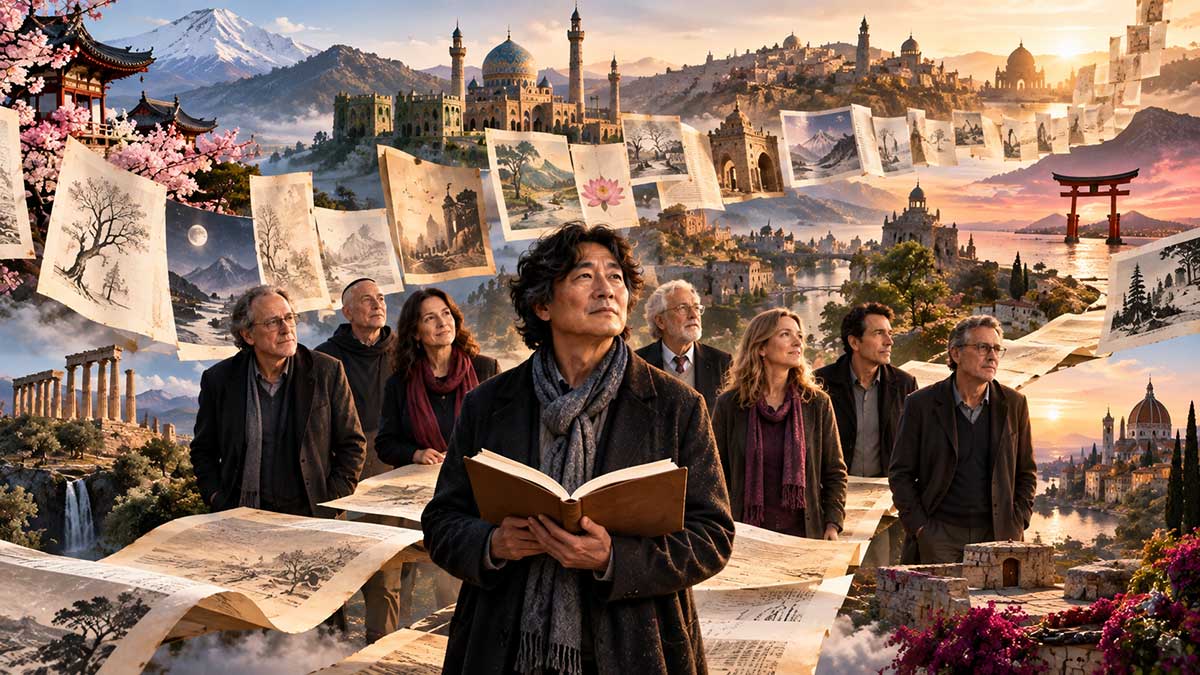
The following is an imagined scholarly conversation. Ryu Si-hwa's dialogue is fictionalized for exploration and should not be read as direct quotation. Documented ideas from his writings and interviews provide context, but the conversation itself is creative.
The room is unusually quiet.
There is no conference table.
The participants are walking through what looks almost like a physical version of the anthology itself.
A narrow path winds through changing landscapes.
On one side, Persian desert.
Farther ahead, a Korean mountain trail.
Then a Japanese fishing village.
A small chapel.
A field of wildflowers.
A crowded street.
An empty chair.
An old craftsman's workshop.
A grave.
Children running through tall grass.
And scattered everywhere, pages.
Seventy-seven of them.
Some bearing famous names.
Others almost forgotten.
Some carrying no famous name at all.
The Moderator stops.
Moderator: Before we talk about healing, psychology, grief, spirituality, or awakening, I want to ask something embarrassingly basic.
What exactly are we discussing?
Because people may pick up Love As If You've Never Been Hurt and think they are reading Ryu Si-hwa's philosophy.
But these aren't seventy-seven poems written by Ryu Si-hwa.
Ryu Si-hwa: No.
Moderator: They're poems you gathered.
Ryu Si-hwa: Yes.
Moderator: Different poets.
Different centuries.
Different cultures.
Different religions.
Different ideas about love.
Different ideas about death.
Different ideas about God.
Some famous.
Some anonymous.
Some literary.
Some closer to prayer or song.
So before we ask what this anthology means, shouldn't we ask a more fundamental question?
Why are these people in the same book?
Edward Hirsch bends down and picks up one of the pages.
Edward Hirsch: That may be the most important place to begin.
An anthology is never completely neutral.
The editor chooses.
One poem enters.
Another does not.
This poem precedes that one.
A title is chosen.
A beginning is created.
An ending is created.
Even silence between two poems can become meaningful.
Brother Anthony: And when the poems cross languages, another layer appears.
The reader is not encountering some perfectly untouched object that has traveled through time.
There has been selection.
Translation.
Cultural mediation.
Sometimes adaptation.
Sometimes attribution histories that are complicated.
So we should be cautious about imagining seventy-seven poets sitting around a table agreeing with one another.
Moderator: Good.
Because that's exactly what worries me.
We did something like that in Part 1.
We brought Rumi, Kabir, Khayyam, Paz, Takuboku, and others into conversation.
It was illuminating.
But historically, they weren't collaborators.
Brother Anthony: Of course not.
Moderator: And they didn't necessarily believe the same things.
Brother Anthony: Certainly not.
Mark Epstein: Which may actually make the anthology more interesting.
Moderator: How?
Mark Epstein: Because perhaps agreement isn't the point.
We often approach spiritual literature with a strange desire to make everyone agree.
The mystic agrees with the psychologist.
The Buddhist agrees with the Christian.
The Sufi agrees with the secular poet.
The ancient agrees with the modern.
Eventually everybody is supposedly saying, "Love is the answer."
It sounds harmonious.
But sometimes harmony is produced by removing all the interesting differences.
Brother Anthony: Exactly.
Universality does not require sameness.
The fact that two human beings separated by a thousand years recognize grief does not mean they possess identical explanations of grief.
The recognition can be shared while the worldview remains different.
Moderator: Ryu, then let me ask you directly.
Why put these voices together?
Ryu looks down the path.
Ryu Si-hwa: Perhaps because a human life is already like this path.
We do not learn from one voice.
A mother says something.
A teacher says something.
A stranger says something.
A book says something.
A person who hurts us teaches us something, though perhaps not intentionally.
A child says one sentence at breakfast and we remember it for thirty years.
We travel somewhere and meet someone for twenty minutes.
We never see that person again.
But something remains.
Why should a book about life pretend that wisdom comes from only one kind of person?
Dacher Keltner: That's interesting because it changes the function of the anthology.
It isn't necessarily constructing a system.
It may be expanding the reader's field of perception.
Moderator: But that's already an interpretation.
Keltner: Yes.
Moderator: Good.
I want us to keep saying that.
Because otherwise we're going to fall in love with our own explanation.
Kristin Neff smiles.
Kristin Neff: You may be the least relaxing moderator I've ever encountered.
Moderator: That's my job.
A little laughter passes through the group.
They continue walking.
A page turns in the wind.
Question 1: Why Bring Together Such Radically Different Voices?
Moderator: Let's make the question sharper.
Why should a poem from one religious tradition sit beside a poem from another?
Why should a celebrated poet sit beside an anonymous voice?
Why should mystical poetry sit beside ordinary human suffering?
Why not simply create a collection of the greatest love poems?
Ryu Si-hwa: Because life does not arrive categorized.
You may be thinking about God in the morning and money in the afternoon.
You may attend a funeral and then become hungry.
You may love someone and resent them in the same hour.
You may experience something sacred while washing dishes.
You may be grieving and suddenly laugh.
The mind likes categories.
Life is less obedient.
Robert Neimeyer: That's psychologically important.
People often assume coherence means emotional consistency.
If I'm grieving, I should be sad.
If I'm healing, I should be improving.
If I love someone, I shouldn't feel anger.
If I've accepted a loss, I shouldn't still cry.
But actual human experience is much more complicated.
Contradictory states coexist.
Moderator: So you're saying the anthology resembles psychological life because it contains contradictions?
Neimeyer: I'm saying that is one possible way of reading it.
Moderator: Thank you.
One possible way.
Hirsch: There's another literary reason.
A good anthology can create meaning through juxtaposition.
Imagine reading a poem about death.
Then immediately afterward, a poem about spring.
The second poem has not changed.
But because you just read about death, spring may now feel different.
Moderator: So the editor can create meaning without writing a new poem.
Hirsch: Precisely.
Arrangement becomes a form of authorship, though we should distinguish editorial authorship from writing the poems themselves.
Brother Anthony: And this is particularly important in translation anthologies.
The editor becomes a kind of host.
He invites voices into a new linguistic home.
But a responsible host doesn't pretend all the guests are the same person.
Moderator: That's a wonderful metaphor.
But let me challenge it.
What if the host rearranges the guests so much that they begin saying what the host wants them to say?
Brother Anthony pauses.
Brother Anthony: That danger is real.
Moderator: Especially when readers don't know the original languages.
Brother Anthony: Absolutely.
A translated anthology always asks for trust.
That is why context matters.
Attribution matters.
Translation choices matter.
Historical differences matter.
We should enjoy the conversation without pretending mediation has disappeared.
Ryu Si-hwa: But there is another possibility.
A poem can leave the place where it was written and enter another person's life.
Not unchanged.
But alive.
Brother Anthony: I agree.
Translation is not necessarily betrayal because it changes something.
If complete preservation were the requirement, translation would be impossible.
The question becomes whether the new poem creates a responsible relationship with the old one.
Hirsch: Poems have always traveled.
Across languages.
Across centuries.
Across religions.
Across people who interpret them differently.
The extraordinary thing is that a voice from another century can become intimate to someone the poet could never have imagined.
Moderator: But why include anonymous or ordinary voices beside famous poets?
Ryu stops.
Ryu Si-hwa: Because fame and truth are not the same thing.
Silence.
Ryu Si-hwa: Sometimes a person who has never published a book understands one moment of life completely.
Keltner: That resonates with research on awe and wisdom more broadly.
Extraordinary experiences aren't restricted to extraordinary people.
Moderator: But let's stay with the anthology.
Keltner: Fair enough.
Ryu smiles.
Ryu Si-hwa: A shepherd can look at the moon.
A mother can lose a child.
A carpenter can understand work.
A traveler can understand loneliness.
A dying person can understand time.
Why would poetry require a university appointment before those experiences become worthy of language?
Brother Anthony: And many literary traditions did not historically separate poetry from song, prayer, proverb, ritual, oral memory, and ordinary speech as neatly as modern academic categories sometimes do.
Moderator: Then maybe one reason for the anthology's range is that Ryu isn't asking:
"Who are the seventy-seven greatest poets?"
He's asking:
"Which voices help illuminate human life?"
Hirsch: That's a much more interesting anthology.
They reach a place where dozens of threads hang from wooden frames.
Different colors.
Different textures.
Some silk.
Some rough fiber.
Some bright.
Some nearly black.
The Moderator touches one.
Moderator: Which brings us to the phrase we've been using since our research.
"Healing and awakening."
Question 2: Is “Healing and Awakening” Really the Philosophy of the Anthology?
Moderator: Contemporary descriptions of the book emphasize 치유와 깨달음.
Healing and awakening.
Those sound wonderful.
Possibly too wonderful.
What do they actually mean?
Neff: My first concern is the word "healing."
People hear healing and imagine a before-and-after story.
I was wounded.
I healed.
Now I'm fine.
Neimeyer: Especially in grief.
Neff: Exactly.
It can quietly create another standard against which suffering people judge themselves.
"Why am I still grieving?"
"Why am I still angry?"
"Why haven't I healed?"
Epstein: And spiritual traditions can make this worse.
Moderator: Really?
Epstein: Certainly.
Spiritual language can become another way of rejecting experience.
"I shouldn't be angry."
"I should be detached."
"I should forgive."
"I should transcend this."
"I should be peaceful."
Now the person is suffering twice.
First from what happened.
Then from believing a spiritually developed person wouldn't feel what they feel.
Moderator: So healing itself can become a form of pressure.
Neff: Absolutely.
Ryu Si-hwa: Then perhaps we should not begin by defining healing as becoming undamaged.
Moderator: What would you call it?
Ryu thinks for a moment.
Ryu Si-hwa: Listening.
Moderator: Listening?
Ryu Si-hwa: Before healing, perhaps something must first be heard.
Pain that has no language becomes very lonely.
A poem sometimes says:
"I know this place."
That may not cure anything.
But the person is no longer completely alone there.
Hirsch looks toward him.
Hirsch: That is where poetry becomes difficult to translate into psychological categories.
A poem isn't necessarily an intervention.
Sometimes it is an encounter.
Neimeyer: But encounters can change us.
Hirsch: Certainly.
I'm only resisting the assumption that the poem must justify itself by producing a measurable therapeutic outcome.
Moderator: That's important.
Because otherwise we're basically asking:
"How many points did Rumi reduce your anxiety?"
The group laughs.
Hirsch: Exactly.
That would be a fairly depressing future for poetry.
Keltner: Although we shouldn't swing too far in the other direction.
Psychological research can help us understand mechanisms through which encounters with language, beauty, awe, or recognition influence well-being.
Hirsch: Of course.
Keltner: But the research shouldn't become the definition of the experience.
Moderator: So what about "awakening"?
Epstein: I would separate awakening from healing immediately.
Moderator: Why?
Epstein: Because awakening can involve seeing something more clearly, and what you see may not make you feel better.
Moderator: That's interesting.
Epstein: Imagine realizing that your parents are aging.
That's awakening.
It may increase sadness.
Imagine realizing how much of your life you've spent distracted.
Awakening.
Not pleasant.
Imagine realizing that someone you love will die.
Awakening.
Imagine recognizing your own selfishness.
Again, awakening.
Neff: Or recognizing how cruelly you've been speaking to yourself for twenty years.
Epstein: Exactly.
Awakening does not necessarily begin with relief.
Sometimes it begins with discomfort.
Keltner: Awe has a similar dimension.
People sometimes think awe means feeling wonderful in front of a sunset.
But awe can also contain fear, vastness, uncertainty, even confrontation with mortality.
Moderator: So maybe healing and awakening can pull in different directions.
Neimeyer: At least temporarily.
Moderator: Healing might comfort me.
Awakening might disturb me.
Hirsch: And a powerful poem may do both.
Moderator: Ryu, did you intend readers to feel better?
Ryu laughs softly.
Ryu Si-hwa: I would be suspicious of any poem whose only job was to make me feel better.
Moderator: Why?
Ryu Si-hwa: Because sometimes I need to feel worse about something I have stopped seeing.
A pause.
Ryu Si-hwa: Perhaps I have neglected someone.
Perhaps I have wasted time.
Perhaps I have become indifferent.
Perhaps I have stopped noticing beauty.
Perhaps I am living according to fear.
A poem that wakes me may make me uncomfortable.
But that discomfort can also return me to life.
Moderator: That's a very different definition of healing.
Ryu Si-hwa: Perhaps healing is sometimes comfort.
Perhaps sometimes it is disturbance.
Hirsch: That's poetry.
Moderator: Then maybe "healing and awakening" shouldn't be treated as two promises.
Brother Anthony: I would prefer two directions of encounter.
Moderator: Explain.
Brother Anthony: One poem may accompany your suffering.
Another may interrupt your certainty.
One says:
"You are not alone."
Another says:
"Look again."
That is a much richer anthology than one offering seventy-seven consolations.
The Moderator writes something down.
Moderator: Recognition and interruption.
Hirsch: Yes.
Moderator: I like that more than "healing" already.
Neff: Don't throw healing away too quickly.
Moderator: Why not?
Neff: Because recognition itself can be deeply healing.
Common humanity matters.
When people suffer, they often experience not only pain but isolation.
"Something is wrong with me."
"Nobody understands."
"Everyone else is living normally."
Recognition can loosen that isolation.
Neimeyer: And narrative matters.
A loss can shatter the story a person believed they were living.
Sometimes language helps reconstruct a world.
Not necessarily the old world.
A new one.
Moderator: So we may eventually discover that healing isn't one thing.
Neimeyer: I would strongly expect that.
They continue walking.
Ahead stands a doorway.
Above it hangs only the title:
LOVE AS IF YOU'VE NEVER BEEN HURT
The Moderator looks at it for a long time.
Moderator: I think this doorway may have caused some trouble.
Question 3: Does the Title Mislead Us?
Moderator: Suppose I know nothing about the book.
I see this title.
Love As If You've Never Been Hurt.
What do I assume?
Neff: Relationships.
Neimeyer: Betrayal.
Epstein: Forgiveness.
Keltner: Emotional openness.
Hirsch: Probably heartbreak.
Moderator: Exactly.
Maybe an ex-boyfriend.
Maybe divorce.
Maybe learning to trust again.
Maybe boundaries.
Maybe trauma.
That's where we began Part 1.
And those questions were legitimate.
But then we looked at the whole anthology.
Prayer.
Mortality.
Nature.
Work.
Aging.
Silence.
God.
Motherhood.
Identity.
Repentance.
Courage.
Blessing.
Dance.
Suddenly heartbreak looked like one room in a much larger house.
Ryu Si-hwa: Yes.
Moderator: So did the title become bigger than the book?
Hirsch: Or smaller.
Moderator: What do you mean?
Hirsch: The popular interpretation may have made the title smaller.
"Love again after heartbreak."
That's emotionally recognizable.
But the line can be heard more radically.
Can you participate in life after life has demonstrated that participation is dangerous?
Epstein: That's much larger.
Hirsch: Exactly.
Love knowing love can end.
Work knowing success is temporary.
Sing knowing no song lasts.
Dance knowing the body ages.
Live knowing you will die.
The Moderator turns toward Ryu.
Moderator: That sounds much closer to what we discovered in Part 1.
The movement of the title poem isn't simply:
hurt,
heal,
love again.
It's built around verbs.
Dance.
Love.
Sing.
Work.
Live.
Ryu Si-hwa: Which changes the question.
Moderator: From what?
Ryu Si-hwa: From:
"How do I avoid being hurt again?"
to:
"Knowing that life can hurt me, will I still enter it?"
Nobody speaks for several seconds.
Epstein: That's the existential problem.
Neff: And psychologically, it's also the problem of avoidance.
Avoidance usually begins intelligently.
Something hurts.
We learn.
We protect ourselves.
But protection can generalize.
One betrayal becomes distrust.
One humiliation becomes silence.
One failure becomes refusal to try.
One loss becomes refusal to love.
Moderator: But I want to protect against another extreme.
There are situations where refusing to re-enter something is wisdom.
Neff: Absolutely.
Moderator: An abusive relationship.
Neff: Leave.
Moderator: A dangerous environment.
Neff: Protect yourself.
Moderator: Someone repeatedly violating boundaries.
Neff: Participation in life does not mean participation in every relationship.
Epstein: That's crucial.
Acceptance does not mean availability.
Compassion does not mean access.
Moderator: Good.
Because inspirational language becomes dangerous when it removes discernment.
Brother Anthony: Which is another reason cultural and textual context matter.
A line detached from a poem can become a slogan.
A slogan wants to travel alone.
A poem has neighbors.
Hirsch: Beautifully put.
Brother Anthony: And this particular line has seventy-six neighbors.
The Moderator smiles.
Moderator: That may be the best argument we've made so far.
Love as if you've never been hurt has seventy-six neighbors.
Ryu Si-hwa: And perhaps they prevent it from becoming foolish.
Moderator: Explain.
Ryu Si-hwa: Because the other poems remind us that life includes death.
Old age.
Distance.
Prayer.
Loneliness.
Work.
Nature.
Regret.
Faith.
Doubt.
The title cannot mean:
"Nothing bad will happen."
The rest of the anthology disproves that immediately.
Neimeyer: Nor can it mean:
"Return to who you were before suffering."
Because mortality alone makes that impossible.
Keltner: And perhaps that's where attention enters.
The person who has suffered can become narrowed around the threat.
Understandably.
But the world contains more than the threat.
Moderator: We're approaching our pattern metaphor again.
Keltner: Yes.
Moderator: Not yet.
That's Topic 3.
Keltner laughs.
Keltner: I'll wait.
The group passes through the doorway.
On the other side is not a romantic scene.
There is an old woman watering flowers.
A young father carrying a sleeping child.
A man working alone at a desk.
Someone praying.
Someone crying.
Someone sweeping a floor.
Two friends laughing.
A woman standing beside a hospital bed.
A boy running after a dog.
An elderly couple walking slowly uphill.
A funeral procession.
A wedding.
A person dancing alone.
Moderator: Looking at this, I'm beginning to wonder whether we've been asking the wrong question about the title.
Maybe the question isn't:
How can I love as though nobody ever hurt me?
Maybe it's:
How can I remain capable of loving life after discovering what life contains?
Ryu looks around.
Ryu Si-hwa: That is closer.
Moderator: But you won't say that's the definitive meaning.
Ryu Si-hwa: No.
Moderator: You're becoming very difficult to interview.
Ryu Si-hwa: Perhaps the poems are teaching me.
They laugh.
Hirsch looks back toward the seventy-seven pages scattered along the path.
Hirsch: There's something else we should notice.
We keep asking what the anthology says.
Maybe that verb is wrong.
Moderator: What would you use?
Hirsch: What does the anthology do?
The Moderator stops.
Hirsch: What happens to a reader moving from poem to poem?
Where does attention move?
What emotions are activated?
What memories surface?
What contradictions remain unresolved?
What does the reader notice afterward that they didn't notice before?
That may be more faithful to poetry than reducing seventy-seven poems to one sentence.
Brother Anthony: Especially across seventy-seven different voices.
Moderator: Then maybe our first conclusion is that there isn't one conclusion.
Epstein: Careful.
That can become another cliché.
Moderator: Fair.
Epstein: There may be patterns without there being a doctrine.
Neimeyer: Recurring human problems without one solution.
Neff: Shared suffering without identical responses.
Keltner: Shared capacities for wonder without identical beliefs.
Brother Anthony: Connections across cultures without erasing cultural difference.
Hirsch: A conversation without consensus.
The Moderator looks toward Ryu.
Moderator: Is that what you built?
Ryu takes his time.
Ryu Si-hwa: Perhaps I built a place where voices could meet.
Moderator: And what are readers supposed to find there?
Ryu Si-hwa: I don't know what they will find.
Moderator: That's an inconvenient answer.
Ryu Si-hwa: It is the only honest one.
He picks up one of the pages.
Ryu Si-hwa: A person reads a poem at twenty-five.
Nothing happens.
They read it again at forty.
Something happens.
At sixty-five, the same poem may become another poem.
Hirsch: Because the reader has changed.
Ryu Si-hwa: Yes.
Moderator: So the seventy-eighth voice in the anthology is the reader.
Silence.
Hirsch smiles.
Hirsch: Now you're talking like a poet.
Moderator: Don't tell anyone.
Closing: A Conversation, Not a Doctrine
The path opens onto a hill.
From there, the seventy-seven pages seem smaller.
No longer isolated objects.
They form something resembling a loose constellation.
Not a straight line.
Not a textbook.
Not commandments.
Not seventy-seven versions of the same belief.
A constellation.
The Moderator looks over the group.
Moderator: Let me see if I can summarize what we've learned without destroying it.
First:
Ryu Si-hwa did not write these seventy-seven poems.
He selected and brought them together.
So we must distinguish the poets' meanings from Ryu's editorial choices.
Second:
The anthology's enormous cultural and historical range does not mean all these voices agree.
Universality does not require sameness.
Third:
"Healing and awakening" may describe important movements within the anthology, but neither word should be treated simplistically.
Healing does not necessarily mean becoming undamaged.
Awakening does not necessarily mean feeling better.
Fourth:
The title is not the entire book.
Love As If You've Never Been Hurt may be the doorway.
But behind it stand mortality, grief, prayer, nature, work, aging, faith, doubt, beauty, loneliness, courage, blessing, and ordinary life.
Fifth:
Perhaps the anthology's unity is not a doctrine.
Perhaps it is a recurring set of human questions.
How do we love?
How do we suffer?
How do we lose?
How do we notice?
How do we continue?
How do we live?
Neimeyer nods.
Neimeyer: I would accept that provisionally.
Moderator: Provisionally?
Neimeyer: You told us not to fall in love with our interpretation.
Moderator: I'm beginning to regret that rule.
They laugh.
Then the Moderator becomes serious.
Moderator: But now we have a problem.
If Ryu gathered these poems around healing and awakening, and if we're going to use the word healing throughout this conversation, we have to stop speaking poetically for a moment.
We need to ask what healing actually means.
Suppose a mother loses her child.
A poem cannot return the child.
Suppose a marriage collapses.
A poem cannot undo the betrayal.
Suppose someone lives with trauma.
A beautiful metaphor is not psychotherapy.
Suppose grief remains for thirty years.
Are we going to call that person unhealed?
No one answers immediately.
The Moderator looks at Ryu.
Moderator: You said poetry can give wounds a voice.
But is giving the wound a voice really healing?
Ryu looks toward the scattered pages.
Then back at the Moderator.
Ryu Si-hwa: Perhaps that depends on what we think healing is.
The Moderator closes the book in his hands.
Moderator: Good.
Then that's where we go next.
Topic 2: Can Poetry Really Heal Us?
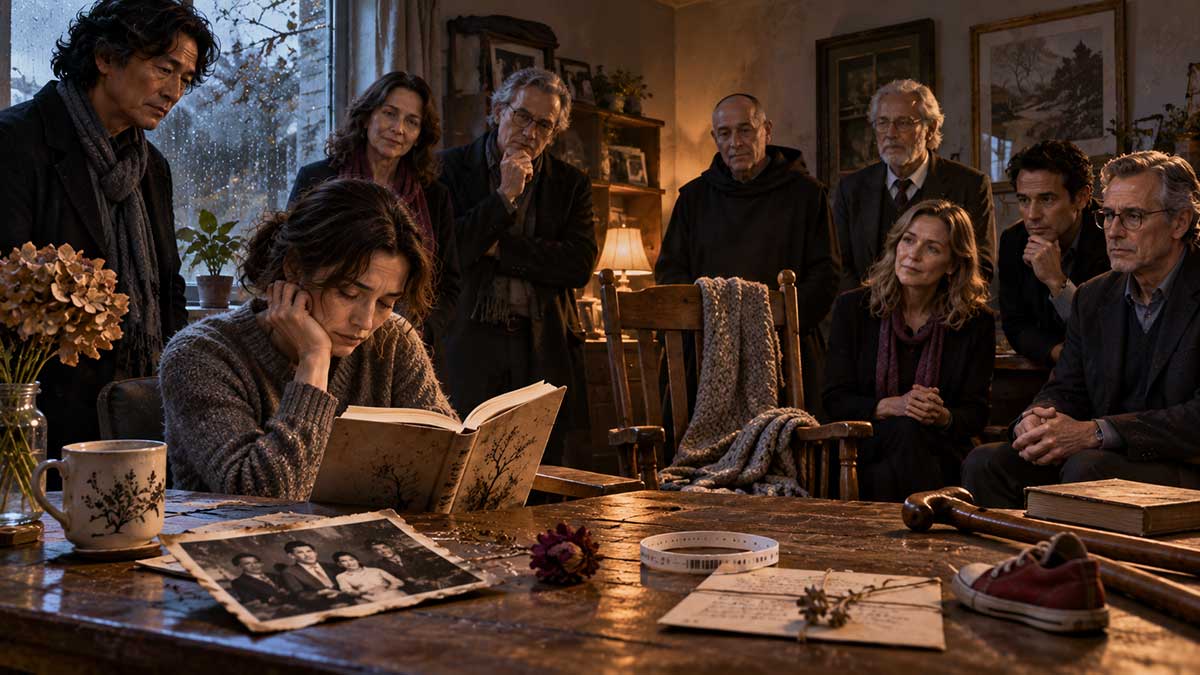
The following is an imagined scholarly conversation. Dialogue attributed to living or historical figures is fictionalized for exploration and should not be read as direct quotation.
The landscape has changed.
The seventy-seven pages are no longer scattered along a path.
They now hang from thin threads inside a quiet old house.
Some move slightly whenever a window opens.
Outside, rain falls.
Inside, there are no bookshelves filled with answers.
Instead, there are signs of interrupted lives.
A child's shoe.
A wedding photograph turned facedown.
A walking cane.
An unopened letter.
A hospital bracelet.
An old man's watch.
A dried flower pressed between pages.
And near the window, an empty chair.
The Moderator looks around.
Moderator: This is where beautiful language becomes dangerous.
Everyone turns toward him.
Moderator: "Healing poetry."
"Healing words."
"Poetry heals."
We say these things easily.
But imagine telling a mother whose child has died:
"Here. Read this poem. It will heal you."
I find that almost offensive.
Robert Neimeyer: It certainly could be.
Moderator: Or someone with severe trauma.
Or someone whose spouse died after fifty years.
Or someone living with chronic illness.
Or someone who survived abuse.
What exactly are we promising when we use the word healing?
Kristin Neff: Perhaps that's the problem.
We often use one word for many different processes.
Moderator: Then let's separate them.
Edward Hirsch: Before we do, I want to defend poetry from us.
Moderator: From us?
Hirsch: Yes.
We've assembled psychologists, psychiatrists, researchers, scholars.
We're about to put poetry on an examination table and ask:
"What are your therapeutic outcomes?"
Maybe poetry doesn't need to pass that examination.
Dacher Keltner: That's fair.
Hirsch: A poem isn't defective because it doesn't lower someone's depression score.
A poem can be valuable because it is beautiful.
Because it tells the truth.
Because it gives form to experience.
Because it creates language where previously there was silence.
Because it connects one consciousness to another.
Moderator: So poetry doesn't have to heal.
Hirsch: Exactly.
And ironically, once we stop demanding that it heal, we may understand better the ways it sometimes does.
Ryu Si-hwa looks toward one of the suspended pages.
Ryu Si-hwa: Perhaps we should begin there.
Question 1: What Do We Actually Mean When We Say a Poem “Heals”?
Moderator: Let's define our terms.
Robert, if a psychologist says someone is healing, what does that mean?
Neimeyer: I would resist a single definition.
Especially in bereavement.
Healing may involve adaptation to a changed world.
Reconstructing meaning.
Reconstructing identity.
Maintaining a transformed relationship with someone who died.
Finding ways to participate in life while continuing to carry grief.
Moderator: So healing doesn't necessarily mean the pain disappears.
Neimeyer: Certainly not.
Moderator: Kristin?
Neff: From a self-compassion perspective, sometimes an important change is simply how a person relates to their suffering.
Imagine two people experiencing the same painful emotion.
One says:
"I'm hurting."
The other says:
"I'm hurting, and I shouldn't be hurting. I'm weak. Something is wrong with me. Everyone else has moved on. Why can't I?"
The second person is experiencing the original pain plus self-judgment.
Moderator: So self-compassion doesn't necessarily remove the first pain.
Neff: No.
It may stop us from adding unnecessary suffering to suffering.
Mark Epstein: That distinction appears in many contemplative traditions too.
Pain occurs.
Then the mind constructs an enormous structure around pain.
"This shouldn't be happening."
"This must stop."
"I cannot live if this continues."
"This proves something about me."
"This proves something about the universe."
Sometimes the secondary structure becomes more imprisoning than the original emotion.
Moderator: But careful.
Suppose someone is abused.
I don't want us saying:
"The real problem isn't what happened. It's the story you're telling about it."
Epstein: Nor should we.
Neff: Absolutely not.
Neimeyer: Reality matters.
Harm matters.
Justice matters.
Safety matters.
Moderator: Good.
Because psychological language can accidentally relocate responsibility from the person who caused harm to the person who has to recover from it.
Neff: Which would be another injury.
Ryu Si-hwa: Perhaps poetry sometimes helps because it does not immediately ask the wounded person to improve.
The Moderator turns toward him.
Moderator: Explain.
Ryu Si-hwa: Advice often begins with movement.
Do this.
Think this.
Forgive.
Let go.
Move on.
Be grateful.
Heal.
But a poem can sometimes simply sit beside the person.
Hirsch: Yes.
Ryu Si-hwa: It says:
"This exists."
The rain continues outside.
Ryu Si-hwa: Sometimes that is enough for one night.
No one speaks.
Then Hirsch says quietly:
Hirsch: That is one of poetry's oldest functions.
Not solution.
Recognition.
Moderator: But recognition isn't healing.
Neff: Why not?
Moderator: Because nothing has changed.
Neff: Something may have changed.
Moderator: What?
Neff: Isolation.
That answer lands differently.
Neff: If I believe I'm the only person who feels this way, suffering can become shame.
Then I encounter another human voice saying:
"I have been here too."
The circumstances may be completely different.
But suddenly my suffering belongs to the human condition rather than proving I am defective.
Moderator: That's what you call common humanity.
Neff: Yes.
Hirsch: Poetry has been doing that for thousands of years without using that terminology.
Brother Anthony: And across languages.
Which is one of the astonishing things about literature.
Someone living centuries ago in another culture describes an emotion.
The poem crosses history.
Then translation.
Then geography.
And eventually someone sitting alone in Seoul or Columbus or London reads it and thinks:
"Yes."
Moderator: One syllable.
Brother Anthony: Sometimes that's enough.
Keltner: Recognition also changes attention.
Pain narrows attention.
Fear narrows attention.
Grief can narrow attention.
Not always, but often.
A powerful aesthetic experience can briefly alter that field.
Moderator: So now we're getting several possible meanings of healing.
Recognition.
Reduced isolation.
Self-compassion.
Meaning reconstruction.
Expanded attention.
Epstein: And perhaps increased capacity to remain present with something difficult.
Moderator: That's already six.
Hirsch: Which should make us suspicious of the word.
Moderator: Because?
Hirsch: Because once a word means six things, people can make claims that sound scientific while remaining completely vague.
Moderator: Excellent.
So let's establish a rule.
Whenever someone says:
"Poetry heals,"
I want to ask:
"What exactly do you mean by heal?"
Neimeyer: Good rule.
Neff: Agreed.
Ryu Si-hwa: Yes.
The Moderator walks toward the empty chair.
A photograph rests beside it.
A mother and a young boy.
Moderator: Then let's test our theories against something they cannot easily survive.
Question 2: What Can Poetry Do When Nothing Can Be Fixed?
Moderator: A mother's son dies.
Let's say he is twenty-two.
An accident.
No warning.
She reads poetry.
She cries.
She finds a poem that expresses exactly what she cannot say.
Thirty years later, she still misses him.
Did the poetry heal her?
Neimeyer: I would first question the premise that her continuing grief indicates failure to heal.
Moderator: Good.
Let's stay there.
Why are we so obsessed with closure?
Neimeyer: Because closure offers a reassuring narrative.
Something happened.
We processed it.
We completed grief.
We moved forward.
The story has an ending.
But attachment doesn't necessarily work that way.
A relationship with someone who dies can continue internally in altered form.
Moderator: Meaning what?
Neimeyer: The person remains part of identity.
Memory.
Values.
Family stories.
Ritual.
Decisions.
Sometimes even an internal conversation.
The relationship changes.
It doesn't necessarily vanish.
Moderator: So the goal isn't forgetting.
Neimeyer: Certainly not.
Epstein: Nor should acceptance be confused with emotional disappearance.
Moderator: Then why does grief sometimes feel like something we're supposed to graduate from?
Neff: Social pressure.
Discomfort with suffering.
Comparison.
And often compassion fatigue among people surrounding the bereaved.
At first everyone understands.
Six months later:
"Are you doing better?"
A year later:
"Maybe it's time."
Moderator: Time for what?
Neff: Exactly.
Ryu Si-hwa: Perhaps this is where a poem has an advantage over a person.
Moderator: That's an unusual statement.
Ryu Si-hwa: A poem does not become impatient because you read it again.
Silence.
Ryu Si-hwa: You can return twenty years later.
The poem does not say:
"You're still here?"
Hirsch looks down.
Hirsch: That's beautiful.
Moderator: And also true.
Brother Anthony: The reader changes while the poem waits.
Moderator: But we're still avoiding my question.
What did the poem heal?
Neimeyer: Perhaps nothing, if by healing you mean eliminating grief.
Moderator: Good.
Neimeyer: But perhaps it helped the mother construct a language for the relationship she continues to have with her son.
Perhaps it gave her permission to grieve.
Perhaps it helped integrate the loss into a larger life story.
Perhaps it reduced isolation.
Perhaps it allowed contradictory emotions to coexist.
Love.
Anger.
Gratitude.
Despair.
Memory.
Joy.
Moderator: Joy?
Neimeyer: Certainly.
Grief and joy aren't mutually exclusive.
Moderator: But joy can feel like betrayal.
Neff: Very often.
Moderator: A mother laughs at a wedding.
Then suddenly thinks:
"How can I laugh when my son is dead?"
Neff: Exactly.
And self-compassion might ask whether love for the dead truly requires permanent refusal of joy.
Epstein: Or whether suffering has quietly become a loyalty ritual.
Moderator: That's strong.
Epstein: It happens.
"If I stop suffering, perhaps I am leaving you behind."
Neimeyer: Continuing bonds research helps us imagine another possibility.
You don't necessarily maintain the relationship through suffering alone.
You can carry the person into joy.
Moderator: That connects directly to our Part 1 empty-chair image.
The chair remains empty.
The family still eats.
Children still laugh.
The grandmother still notices the chair.
Neimeyer: Exactly.
The absence did not disappear.
Life continued to accumulate around it.
The Moderator turns toward Ryu.
Moderator: We used a line earlier:
"Grief doesn't necessarily become smaller. Life becomes larger around it."
Would you call that healing?
Ryu considers it.
Ryu Si-hwa: I might call it living.
Moderator: That's interesting.
Ryu Si-hwa: Perhaps we sometimes confuse healing with living.
Maybe a person is still wounded.
Still grieving.
Still uncertain.
But they cook dinner.
They love someone.
They plant something.
They travel.
They work.
They laugh.
They remember.
They cry.
They continue.
Do we need to decide exactly which day healing occurred?
Epstein: That's a very important question.
Moderator: Because maybe healing isn't an event.
Neimeyer: Often it isn't.
Neff: Nor is it linear.
Moderator: Then perhaps the better question isn't:
"When will I be healed?"
Maybe:
"How do I live while this remains part of me?"
Epstein: Yes.
Hirsch: And poetry is unusually comfortable with questions that don't resolve.
Moderator: Unlike self-help.
Hirsch: Often.
Moderator: Unlike psychology?
Neimeyer smiles.
Neimeyer: Good psychology should also tolerate unresolved questions.
Moderator: I'll hold you to that.
A page hanging near the window turns slowly.
The Moderator reads it silently.
Then looks toward Hirsch.
Moderator: Why poetry?
Why not simply tell someone:
"Other people have experienced grief too. Your emotions are normal."
That's clear.
Accurate.
Useful.
Why write a poem?
Question 3: Why Can a Poem Reach Somewhere Advice Cannot?
Hirsch: Because information and experience are not the same thing.
Moderator: Explain.
Hirsch: You can know that everyone dies.
You knew it at fifteen.
You know it at thirty.
You know it at sixty-five.
The proposition hasn't changed.
But one morning you look at your mother's hands.
And suddenly you know it differently.
Moderator: So the difference is emotional?
Hirsch: More than emotional.
Embodied.
Imagined.
Remembered.
Personal.
A poem can create an experience in language rather than merely transmit a proposition.
Keltner: That's important from the standpoint of attention too.
Facts can remain abstract.
Images can make something perceptually vivid.
Hirsch: Exactly.
"Your parents will die."
That's information.
A poem describes a father folding his reading glasses and placing them on the same table every night.
Suddenly mortality has a table.
A pair of glasses.
A hand.
A ritual.
A person.
Moderator: That's powerful.
Brother Anthony: And dangerous.
Moderator: Dangerous?
Brother Anthony: Because powerful imagery can make readers believe emotional force equals truth.
A beautiful poem can express a terrible idea beautifully.
Hirsch: Absolutely.
Brother Anthony: We should not romanticize poetry itself.
Poetry has been used for nationalism.
War.
Propaganda.
Exclusion.
Religious certainty.
Idealization.
Sentimentality.
Moderator: Excellent.
So poetry isn't morally superior to prose.
Brother Anthony: Certainly not.
Hirsch: Nor does beauty guarantee wisdom.
Moderator: That's another guardrail.
Keltner: But aesthetic experience can alter attention regardless of whether we ultimately endorse the message.
Moderator: Which brings us to Ryu's idea of awakening.
Maybe poetry isn't always telling us what to believe.
Maybe it's making us notice something.
Ryu Si-hwa: Yes.
Moderator: But if I notice something, why call that healing?
Ryu Si-hwa: Perhaps we shouldn't always.
The Moderator smiles.
Moderator: Thank you.
We're making progress.
Ryu Si-hwa: Sometimes a poem heals.
Sometimes it disturbs.
Sometimes it accompanies.
Sometimes it awakens.
Sometimes it confuses.
Sometimes it fails.
Sometimes the reader is not ready.
Sometimes the poem is not good.
Hirsch: Finally, someone has defended bad poetry.
Laughter.
Ryu Si-hwa: Even bad poems exist.
Moderator: Seventy-eight great truths from today's conversation.
They laugh again.
Then Hirsch becomes serious.
Hirsch: But there is something poetry does exceptionally well.
It allows contradiction to remain alive.
Moderator: Give me an example.
Hirsch: "I love you, and I am angry with you."
"I miss you, and part of me is relieved you're gone."
"I forgive you, and I don't want you back."
"I am grateful for my life, and I hate what happened."
"I am healing, and I still hurt."
Advice often wants to choose one side.
Poetry can hold both.
Neimeyer: That is very close to actual grief.
Neff: And actual self-compassion.
Epstein: And actual contemplative practice.
Moderator: There you go again. Everyone is agreeing.
Epstein: Then let me disagree.
Moderator: Please.
Epstein: Poetry can also become avoidance.
Moderator: How?
Epstein: You can read beautiful poems about forgiveness instead of having the difficult conversation.
You can read about presence while remaining glued to your phone.
You can read mystical poetry about universal love while treating your spouse badly.
You can read about impermanence and still refuse to visit your aging father.
You can become extraordinarily sophisticated about suffering while refusing to feel your own.
Ryu Si-hwa: Yes.
Moderator: So poetry can become another hiding place.
Epstein: Anything can.
Therapy can.
Meditation can.
Religion can.
Intellectual analysis can.
Even healing can.
Moderator: Healing can become avoidance?
Epstein: Certainly.
"I can't begin my life yet. I'm still healing."
Five years.
Ten years.
Always preparing to live.
Always understanding oneself more deeply.
Never stepping outside.
Neff: We should be careful there.
Some people genuinely need long periods of recovery.
Epstein: Absolutely.
I'm not prescribing a timetable.
I'm describing a possibility.
At some point, self-protection can become an identity.
Moderator: That's exactly where Part 1 eventually went.
The wound begins as an event.
Then becomes a story.
Then a worldview.
Then a future.
Neimeyer: Which is why meaning reconstruction matters.
Not to erase the original event.
But to prevent the event from becoming the only possible organizing principle of identity.
Moderator: So now we're getting close to our hypothesis.
Perhaps poetry helps not because it repairs the wound.
Perhaps it enlarges the world around the wound.
Keltner: That's the formulation I find most interesting.
Moderator: Why?
Keltner: Because attention is finite.
When people are threatened, grieving, depressed, anxious, or traumatized, attention can become dominated by certain signals.
Again, we shouldn't generalize too crudely.
But human attention can narrow around danger and loss.
An encounter with beauty, nature, art, awe, another person, or a poem may temporarily widen that field.
The wound remains.
But something else becomes visible too.
Moderator: A tree.
Keltner: Yes.
Moderator: A child's laugh.
Keltner: Yes.
Moderator: Dinner.
Keltner: Yes.
Moderator: Music.
Keltner: Yes.
Moderator: The person sitting beside you.
Keltner: Exactly.
Ryu Si-hwa: The rest of the pattern.
Everyone becomes quiet.
The Skeptic's Challenge
The Moderator walks toward a black thread stretched across one of the pages.
Moderator: I need to challenge all of this before we fall in love with it.
Suppose someone reads this article and says:
"Wonderful. So when you're traumatized, look at a tree."
That's insulting.
Keltner: Completely.
Moderator: "Your child died? Notice the sunset."
Insulting.
Neimeyer: Yes.
Moderator: "Your marriage ended? Practice gratitude."
Neff: Potentially very harmful.
Moderator: Then how do we talk about enlargement without minimizing the wound?
Ryu answers first.
Ryu Si-hwa: By never asking the tree to explain the death.
Silence.
Moderator: Say more.
Ryu Si-hwa: The sunset does not justify what happened.
Beauty is not compensation.
A child's laughter does not cancel another child's death.
The world does not become fair because flowers bloom.
Keltner: Exactly.
Awe isn't an argument.
Ryu Si-hwa: But must grief require us to stop seeing the flowers?
Moderator: No.
Ryu Si-hwa: Then perhaps both can exist.
Neimeyer: That's psychologically much more defensible.
The continuing life does not invalidate the continuing bond.
Neff: And self-compassion doesn't demand positivity.
It allows pain to be pain.
Epstein: Acceptance says:
"This is here."
It does not say:
"This is good."
Moderator: That's another distinction worth keeping.
Acceptance is not approval.
Neimeyer: And meaning after suffering is not necessarily meaning for suffering.
Moderator: There it is.
That's probably one of the most important sentences in Part 2.
The group continues walking.
Does Suffering Need a Lesson?
Moderator: Let me ask something more uncomfortable.
Does suffering have to teach us anything?
Neff: No.
Neimeyer: No.
Epstein: No.
The speed of their answers makes the Moderator laugh.
Moderator: Good.
Because our culture loves turning tragedy into curriculum.
"What did cancer teach you?"
"What did losing your child teach you?"
"What did betrayal teach you?"
Maybe the person wants to say:
"It taught me that cancer is terrible."
Neimeyer: That's legitimate.
Neff: People should not be pressured into post-traumatic growth narratives.
Moderator: So the dark thread does not need to become gold.
Ryu Si-hwa: No.
Moderator: It can remain black.
Ryu Si-hwa: Yes.
Moderator: Then what changes?
Ryu looks at the hanging pages around them.
Ryu Si-hwa: Perhaps eventually you see that there are other threads.
The Moderator says nothing.
Ryu Si-hwa: Not better threads.
Not compensation.
Not explanations.
Simply other threads.
Love.
Work.
Rain.
Friendship.
Anger.
Aging.
Food.
Prayer.
Doubt.
A dog waiting by the door.
A person who still calls you.
A morning you did not expect to enjoy.
Keltner: That's enlargement.
Ryu Si-hwa: Perhaps.
Hirsch: And that may be where the anthology itself becomes important.
One poem about suffering.
Then another voice.
Then another.
Then another.
The reader cannot remain permanently inside one poem because the book keeps turning pages.
Moderator: That's fascinating.
The physical act of reading an anthology becomes almost metaphorical.
You have to turn the page.
Hirsch: Yes.
But the previous poem doesn't disappear.
Neimeyer: Just as previous chapters of a life don't disappear.
Moderator: Careful.
We're approaching Topic 3 again.
Hirsch: Perhaps the anthology is taking us there whether you like it or not.
When Should Someone Seek More Than Poetry?
The Moderator suddenly stops.
Moderator: One more question.
And this matters.
When is poetry not enough?
Neff: Often.
Neimeyer: Absolutely.
Epstein: Yes.
Moderator: Say it clearly.
Neimeyer: Severe or persistent psychological distress may require professional assessment and treatment.
Neff: Poetry can complement care.
It should not automatically replace evidence-based treatment.
Epstein: The same is true of meditation, spirituality, religious practice, and philosophy.
Moderator: Good.
Because I don't want someone reading this and deciding that a Rumi anthology is a treatment plan for PTSD.
Hirsch: Nor should Rumi be burdened with that job.
Brother Anthony: Or Ryu's anthology.
Moderator: So our position is:
Poetry can accompany.
It may help people name experience.
It may reduce isolation.
It may stimulate reflection.
It may participate in meaning-making.
It may change attention.
Poetry-based interventions show promising psychological evidence.
But an anthology is not automatically psychotherapy.
Neimeyer: Precisely.
Neff: Yes.
Epstein: Agreed.
Hirsch: And poetry remains valuable even when it heals nothing.
The Moderator looks at him.
Moderator: I think that's important enough to repeat.
Hirsch: Poetry remains valuable even when it heals nothing.
Closing: Perhaps Healing Is the Wrong First Question
The rain has stopped.
Nobody noticed when.
Water still runs from the roof.
Outside the window, the world looks exactly as it did before.
Wet road.
Trees.
Clouds.
A woman walking under an umbrella.
A delivery truck.
Someone opening a café.
Nothing has been transformed.
And yet everyone stands at the window.
Moderator: We began by asking:
Can poetry really heal us?
I'm less certain now that this is the best question.
Hirsch: Good.
Moderator: We discovered that "healing" can mean too many things.
Cure.
Adaptation.
Recognition.
Reduced isolation.
Self-compassion.
Meaning reconstruction.
Expanded attention.
Renewed participation.
Those aren't identical.
Neimeyer: No.
Moderator: We also discovered that grief doesn't necessarily need to disappear.
A relationship with someone who died can continue in another form.
Neimeyer: Yes.
Moderator: We discovered that joy doesn't necessarily betray grief.
Neff: Yes.
Moderator: We discovered that poetry can give language to something without solving it.
Hirsch: Yes.
Moderator: And that being understood can matter even when nothing can be fixed.
Neff: Yes.
Moderator: But poetry can also sentimentalize suffering.
Become avoidance.
Be culturally misunderstood.
Be badly translated.
Carry bad ideas beautifully.
And become dangerous when treated as a substitute for necessary care.
Brother Anthony: Correct.
The Moderator turns toward Ryu.
Moderator: Then I'm going to change our question.
Maybe we shouldn't ask:
Can poetry heal the wound?
Maybe we should ask:
Can poetry change the relationship between the wound and the rest of the life?
Ryu remains silent for a while.
Then:
Ryu Si-hwa: Yes.
Moderator: You sound unusually certain.
Ryu Si-hwa: Because now you are asking about the whole life.
He walks toward the loom.
There is the black thread.
Still black.
Nobody has repaired it.
Nobody has painted it gold.
Nobody has explained why it had to be there.
But around it are dozens of other colors.
Ryu touches the cloth.
Ryu Si-hwa: Perhaps the mistake is believing healing requires this thread to disappear.
Moderator: Then what does it require?
Ryu Si-hwa: Maybe nothing from the thread.
The Moderator waits.
Ryu gestures toward the entire cloth.
Ryu Si-hwa: Maybe we need to see what else is here.
The Moderator looks at the pattern.
Moderator: Which finally brings us to the phrase you placed at the end of the anthology.
삶을 하나의 무늬로 바라보라.
See life as one pattern.
Ryu nods.
Moderator: But now I'm suspicious of that phrase too.
Ryu smiles.
Ryu Si-hwa: Good.
Moderator: Because if we aren't careful, "life is a pattern" becomes another beautiful way of saying:
"Everything happens for a reason."
And I don't believe we've established that at all.
Neimeyer: We haven't.
Epstein: Nor should we.
Moderator: Then Topic 3 has one very difficult question to answer.
The black thread remains between his fingers.
Topic 3: Can Suffering Belong to Life Without Becoming the Meaning of Life?
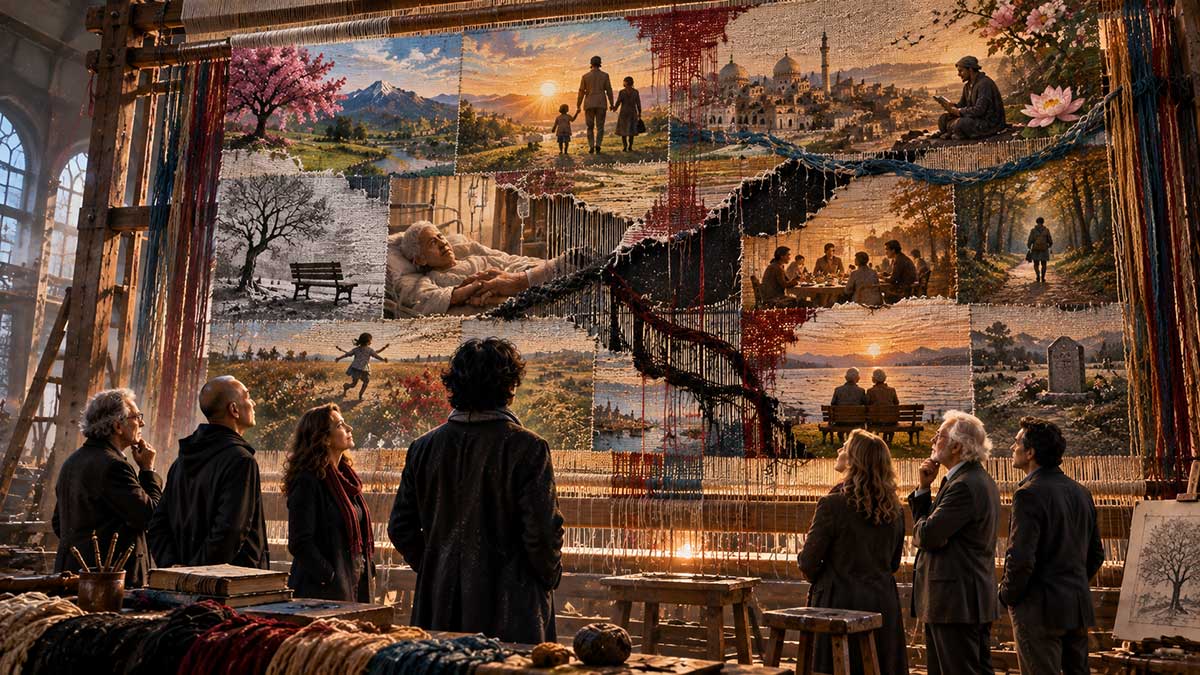
The following is an imagined scholarly conversation. Dialogue attributed to living or historical figures is fictionalized for exploration and should not be read as direct quotation.
The loom remains in the center of the room.
The cloth hanging from it is unfinished.
Gold.
Blue.
Green.
White.
Red.
And running through all of them, a black thread.
Nobody has removed it.
Nobody has hidden it.
Nobody has turned it into something beautiful.
The Moderator stands before it.
Moderator: I think we have reached the most dangerous idea in this entire conversation.
Ryu Si-hwa looks at him.
Moderator: Your commentary asks us to see life as one pattern.
It is a beautiful image.
Perhaps too beautiful.
Suppose the black thread is disappointment.
Fine.
Suppose it is an embarrassing failure.
Fine.
A divorce.
Harder.
Cancer.
Harder still.
A child killed by a drunk driver.
War.
Sexual abuse.
A parent beating a child.
A murder.
Now tell me:
What exactly are we supposed to do with the metaphor?
Nobody answers immediately.
Moderator: Because if we say:
"Look at the beautiful pattern,"
I want to throw the tapestry away.
Robert Neimeyer: As you should, if that's what the metaphor means.
Moderator: Then let's find out.
Question 1: Does Seeing Suffering as Part of a Pattern Romanticize Tragedy?
Moderator: Ryu, I'll start with you.
When we say suffering belongs to the pattern of a life, aren't we dangerously close to saying suffering was necessary?
Ryu Si-hwa: No.
Moderator: Why not?
Ryu Si-hwa: Because belonging to what happened is not the same as belonging to what should have happened.
The Moderator pauses.
Moderator: Say that again.
Ryu Si-hwa: Something can belong to my life because it happened to me.
That does not mean it should have happened.
Mark Epstein: That's the distinction between reality and justification.
Moderator: Give me an example.
Epstein: Suppose someone loses a child.
Eventually they may reach a point where they can say:
"My child died."
That is acceptance of reality.
It does not mean:
"My child was supposed to die."
It does not mean:
"The universe needed this."
It does not mean:
"This happened to teach me something."
It means:
"This is now part of the reality I have to live."
Kristin Neff: And forcing someone beyond that can become cruelty disguised as wisdom.
Moderator: Meaning?
Neff: Imagine telling a grieving parent:
"Everything happens for a reason."
Maybe the speaker is trying to comfort them.
But the grieving person may hear:
"Your child's death was necessary."
That's not compassion.
Neimeyer: Meaning-making is often misunderstood this way.
After major loss, people frequently struggle to reconstruct a world that has been shattered.
But reconstructing meaning after a loss is different from discovering a cosmic reason for the loss.
Moderator: There it is again.
Meaning after suffering is not the same as meaning for suffering.
Neimeyer: Exactly.
Moderator: So someone could build a meaningful life after tragedy while still saying:
"This tragedy was meaningless."
Neimeyer: Absolutely.
Moderator: That's important.
Edward Hirsch: Literature understands this unusually well because literature doesn't always demand explanation.
A poem can say:
"This happened."
And remain there.
Moderator: Without a moral?
Hirsch: Without a moral.
Moderator: Without growth?
Hirsch: Without growth.
Moderator: Without redemption?
Hirsch: Without redemption.
Moderator: That's almost radical now.
Hirsch: Perhaps because we have become uncomfortable with suffering that doesn't become useful.
Neff: Yes.
There's tremendous pressure to produce something from pain.
Wisdom.
Strength.
Gratitude.
Purpose.
A foundation.
A memoir.
A lesson.
Moderator: Post-traumatic entrepreneurship.
A few people laugh uneasily.
Neff: Exactly.
Sometimes the compassionate response is:
"This was terrible."
Period.
Ryu Si-hwa: Poetry sometimes knows when to stop speaking.
The Moderator looks at him.
Ryu Si-hwa: A poem does not always explain the grave.
Sometimes it places a flower beside it.
Moderator: But isn't even that making something beautiful out of death?
Hirsch: Not necessarily.
Beauty beside suffering is different from beauty because of suffering.
Silence.
Moderator: That's subtle.
Hirsch: But essential.
The flower does not justify the grave.
Dacher Keltner: Nor does wonder erase grief.
Human emotional life isn't a single channel.
We can encounter beauty while grieving.
We can experience awe while frightened.
We can laugh during mourning.
Those experiences do not logically cancel one another.
Moderator: Then perhaps the first thing we need to remove from the pattern metaphor is the idea that every thread contributes to some perfect design.
Epstein: Yes.
Moderator: Because that's the hidden theological assumption.
If it's a pattern, someone must have designed it.
Brother Anthony: Not necessarily.
Moderator: Explain.
Brother Anthony: "Pattern" can describe what emerges from accumulated experience without making a claim about cosmic authorship.
That distinction becomes especially important when metaphors travel between spiritual traditions.
A reader may hear providence.
Another may hear karma.
Another may hear fate.
Another may hear psychological integration.
Another may hear nothing supernatural at all.
We shouldn't force one metaphysics onto the image.
Moderator: Excellent.
So:
Life as a pattern does not automatically mean life as a plan.
Brother Anthony: Precisely.
Ryu Si-hwa: Yes.
The Moderator looks again at the cloth.
Moderator: That changes it considerably.
The Black Thread
The Moderator touches the black thread.
Moderator: In Part 1 we came up with a line:
"The dark thread does not have to become gold. It simply is not the whole cloth."
I still like it.
But now I want to attack it.
What if the dark thread really does dominate the cloth?
A woman is abused for twenty years.
A refugee loses almost everything.
Someone develops a disabling illness at twenty-five.
A parent loses three children.
Are we allowed to say:
"It's only one thread"?
Neimeyer: No.
Moderator: Good.
Neimeyer: Some losses reorganize an entire life.
Calling them "one thread" could minimize their magnitude.
Neff: The metaphor needs flexibility.
Some threads are enormous.
Some alter the entire design.
Epstein: Some tear the cloth.
Everyone becomes quiet.
Moderator: That's better.
Some suffering doesn't simply add another color.
It tears something.
Epstein: Yes.
The question then isn't:
"How do we pretend the tear is decorative?"
It is:
"How do we live with a torn cloth?"
Ryu Si-hwa: Perhaps sometimes we do not weave over the tear.
Moderator: What do we do?
Ryu Si-hwa: Leave it visible.
Moderator: Like a scar.
Ryu Si-hwa: Perhaps.
Neff: But let's be careful with scar metaphors too.
People love scars because scars imply the wound has closed.
Some wounds remain active.
Moderator: Excellent correction.
Neff: Someone may have recurring trauma symptoms.
Someone may continue grieving.
Someone may live with chronic pain.
Someone may face ongoing discrimination or danger.
We shouldn't insist everything becomes scar tissue.
Moderator: Then our metaphor has to accommodate:
dark threads,
large dark sections,
tears,
unfinished areas,
and wounds that are still open.
Hirsch: Now it sounds more like an actual human life.
Question 2: Can We Accept a Life We Would Never Have Chosen?
They leave the loom.
Ahead are two doors.
Above the first:
THE LIFE I EXPECTED
Above the second:
THE LIFE THAT HAPPENED
The Moderator stands between them.
Moderator: I think this may be one of the cruelest distances a human being experiences.
The distance between these two doors.
Neimeyer nods.
Moderator: A woman expects to grow old with her husband.
He dies at fifty-two.
A father expects his son to graduate.
The son dies at seventeen.
Someone expects a healthy body.
Then receives a diagnosis.
Someone expects children.
They cannot have them.
Someone expects a career.
The company closes.
Someone expects reconciliation.
The other person never comes back.
What happens psychologically when the future we were living toward disappears?
Neimeyer: In profound loss, we don't only lose a person or circumstance.
We can lose an anticipated future.
A role.
An identity.
A world of assumptions.
Moderator: So grief can be grief for something that never happened.
Neimeyer: Very much so.
Moderator: The grandchildren that never came.
The anniversary that never happened.
The retirement trip.
The apology.
The wedding.
The future Christmases.
Neimeyer: Exactly.
Neff: Which is why telling someone to "accept reality" too quickly can be harsh.
They're not merely accepting one fact.
They may be mourning an entire imagined life.
Epstein: But eventually the distinction between reality and expectation becomes central.
Moderator: How?
Epstein: Because suffering can become amplified by continually demanding that reality conform to the life that no longer exists.
Moderator: That sounds dangerously close to blaming the sufferer again.
Epstein: Only if we confuse compassion with dishonesty.
There is a time to grieve the lost future.
Maybe a very long time.
But there may also come a question:
Can I inhabit the life that remains?
The room becomes still.
Moderator: That's harder than "move on."
Epstein: Much harder.
"Move on" often means leave something behind.
This asks:
Can I carry what happened while inhabiting what is still here?
Neimeyer: That's closer to reconstruction.
The old life narrative may no longer work.
A new narrative has to accommodate the loss.
Moderator: But isn't "new narrative" a clinical way of saying:
"Tell yourself a better story"?
Neimeyer: No.
The new story must respect reality.
If my wife died, the new narrative cannot be:
"It was all for the best."
It may simply become:
"I was her husband for forty years. I still love her. She is dead. I am alive. I don't know what the next chapter is."
Moderator: That's painfully honest.
Neimeyer: Exactly.
Meaning reconstruction isn't necessarily optimism.
It can begin with coherence.
"What happened?"
"Who am I now?"
"What remains?"
"What has changed?"
"What matters now?"
Ryu Si-hwa: And perhaps:
"What is still asking to be lived?"
Everyone turns toward him.
Moderator: That's a beautiful question.
But let's make it concrete.
Suppose I'm seventy.
My wife dies.
I don't want a new relationship.
I don't want a new adventure.
I miss her.
Why must something still be "asking to be lived"?
Ryu Si-hwa: It doesn't have to be large.
Breakfast may be asking to be eaten.
The Moderator smiles slightly.
Ryu Si-hwa: A dog may be asking to be walked.
A granddaughter may be asking to tell you something.
A plant may need water.
A friend may call.
There may be sunlight on the floor.
I do not mean that grief must become a project.
Moderator: So "living" doesn't mean reinventing yourself.
Ryu Si-hwa: No.
Sometimes living means making tea.
Hirsch: That's where poetry often succeeds.
It returns enormous questions to particular things.
Cup.
Window.
Hand.
Chair.
Rain.
Brother Anthony: And this is where culturally specific poetry can be powerful.
The universal enters through the particular.
Not through abstraction.
Moderator: So maybe accepting the life I didn't choose doesn't mean loving everything about it.
Neff: Absolutely not.
Moderator: I can say:
"I wish this were different."
and simultaneously:
"This is my life."
Epstein: Yes.
Moderator: That's a strange combination.
Epstein: It's adulthood.
A few people laugh.
The Imaginary Life
The Moderator opens the door marked THE LIFE I EXPECTED.
Inside is almost nothing.
A projection.
A perfect family photograph.
A successful career.
Healthy bodies.
Children nearby.
No estrangement.
No accidents.
No diagnoses.
No funerals too early.
No betrayal.
No regrets.
Moderator: This room is beautiful.
Neff: And imaginary.
Moderator: That's the problem.
They enter.
Moderator: How much suffering comes from comparing actual life to this room?
Neff: Quite a lot.
But again, comparison isn't irrational.
People legitimately grieve what they expected.
Keltner: Yet constant comparison can also make existing life perceptually invisible.
Moderator: Explain.
Keltner: If attention is always directed toward what should be here, it becomes harder to perceive what is here.
Moderator: So the imagined life can compete with the actual life.
Keltner: Yes.
Ryu Si-hwa: Sometimes we spend years waiting for life to return.
Moderator: To what?
Ryu Si-hwa: To the plan.
Silence.
Ryu Si-hwa: But perhaps the plan is gone.
And life is still happening.
The Moderator looks at the perfect photograph.
Moderator: That's brutal.
Ryu Si-hwa: Reality sometimes is.
Moderator: Then the question becomes:
Can I love a life I would not have chosen?
Epstein: Yes.
Moderator: Not approve of everything.
Epstein: No.
Moderator: Not be grateful for everything.
Neff: No.
Moderator: Not believe everything happened for a reason.
Neimeyer: No.
Moderator: Not stop grieving what should have been.
Neimeyer: No.
Moderator: Simply:
Can I eventually enter the life that exists?
Ryu Si-hwa: Yes.
Question 3: When Does an Event Become an Identity?
They leave the imaginary room.
Outside stands a large blackboard.
On it:
HE LEFT ME.
The Moderator points to it.
Moderator: Let's say this sentence is true.
A partner leaves.
Then beneath it he writes:
PEOPLE LEAVE ME.
Then:
I CANNOT TRUST PEOPLE.
Then:
LOVE IS DANGEROUS.
Then:
I AM BETTER OFF ALONE.
Then:
THIS IS WHO I AM.
The group studies the progression.
Moderator: Where did the event end and the identity begin?
Neff: Excellent question.
Neimeyer: There may not be one clear boundary.
Humans construct meaning from events.
That's unavoidable.
Moderator: So storytelling itself isn't the problem.
Neimeyer: No.
We need narratives.
But narratives can become rigid.
Epstein: The mind loves turning experience into law.
Moderator: One person betrayed me.
Therefore?
Epstein: People cannot be trusted.
Moderator: I failed once.
Neff: I am a failure.
Moderator: Someone rejected me.
Neff: I am unlovable.
Moderator: My child died.
Neimeyer hesitates.
Neimeyer: The world is no longer safe.
Moderator: Which may feel completely true.
Neimeyer: Yes.
And sometimes the world genuinely is less safe than we imagined.
Healing doesn't require returning to naive assumptions.
Moderator: Important.
Because I don't want psychology to tell people:
"Your negative beliefs are irrational."
Sometimes they learned something real.
Neimeyer: Exactly.
Loss can teach us truths we would rather not know.
Children can die.
Healthy people can become ill.
Love can end.
Trust can be violated.
Epstein: Awakening isn't always reassuring.
Moderator: We said that in Topic 1.
Epstein: And here it becomes concrete.
A mature life cannot depend upon pretending vulnerability is gone.
Moderator: Then what changes?
Epstein: Perhaps:
"Because people can betray me, I will never trust"
becomes:
"Because people can betray me, trust will involve discernment and risk."
Neff: That's psychological flexibility.
Moderator: Not returning to innocence.
Neff: No.
Moderator: Becoming capable of openness without pretending danger doesn't exist.
Neff: Exactly.
The Moderator erases the last line:
THIS IS WHO I AM.
He replaces it with:
THIS IS SOMETHING THAT HAPPENED TO ME.
Everyone looks at it.
Moderator: Too simplistic?
Neimeyer: Sometimes.
Major experiences can genuinely become part of identity.
Moderator: So we shouldn't say:
"This doesn't define you."
Neimeyer: Not automatically.
A person may say:
"Being a widow is part of who I am."
"Being a survivor is part of who I am."
"Being the mother of the child who died is part of who I am."
We shouldn't take that identity away.
Moderator: Then maybe the question isn't whether the event defines me.
Maybe:
Does it define all of me?
Neimeyer: Much better.
Ryu Si-hwa: One thread can belong to the pattern without becoming the entire pattern.
Moderator: Unless it is a very large thread.
Ryu Si-hwa: Yes.
Moderator: Or a tear.
Ryu Si-hwa: Yes.
Moderator: We're improving the metaphor.
When Protection Becomes a Prison
Moderator: Let's return to self-protection.
Suppose someone is betrayed.
They become cautious.
That seems reasonable.
Neff: Yes.
Moderator: When does reasonable protection become imprisonment?
Epstein: When the strategy designed to prevent pain begins preventing life.
Moderator: Examples.
Epstein: Avoiding one dangerous person protects you.
Avoiding intimacy forever may imprison you.
Neff: Refusing repeated mistreatment is a boundary.
Assuming everyone will mistreat you may become a prison.
Neimeyer: Avoiding the road where an accident happened may be understandable initially.
Eventually, if avoidance expands into more and more areas of life, the person's world can shrink dramatically.
Moderator: But who decides when the protection has become too much?
Neff: Ideally not an outsider issuing a timetable.
Moderator: Good.
Neff: The person can begin asking:
"Is this protection still serving me?"
"What is it costing me?"
"What do I want my life to contain?"
Moderator: That's much better than:
"Get over it."
Neff: Considerably.
Ryu Si-hwa: Perhaps another question:
"Did I choose this wall today, or did the person who hurt me choose it years ago?"
The Moderator looks at him.
Moderator: That's uncomfortable.
Ryu Si-hwa: It should be.
Moderator: Because if I allow the betrayal to determine that I never love again, part of my future is still being controlled by the person who betrayed me.
Epstein: Potentially, yes.
Moderator: But again, nobody is required to remarry, date, reconcile, or trust a particular person.
Neff: Correct.
Moderator: Participation has many forms.
Keltner: Exactly.
The life that enlarges around suffering does not have to resemble the life that existed before suffering.
Does Acceptance Kill the Desire for Justice?
The Moderator writes another word on the board.
JUSTICE
Moderator: Here's another problem.
If I accept what happened, do I become passive?
Suppose someone harmed me.
Shouldn't anger motivate justice?
Neff: It can.
Epstein: Acceptance does not require passivity.
Moderator: Then why does acceptance sound so passive?
Epstein: Because we confuse accepting reality with approving behavior.
If someone steals from me, accepting reality means:
"They stole from me."
Then I may call the police.
Set a boundary.
End the relationship.
Seek restitution.
Warn someone.
Moderator: So acceptance can actually precede action.
Epstein: Often.
Denial makes effective action difficult.
Neff: Compassion also doesn't require abandoning accountability.
You can recognize someone's humanity and still say:
"You cannot continue doing this."
Moderator: That preserves one of our Part 1 safeguards.
Compassion does not equal access.
Neff: Exactly.
Neimeyer: And meaning reconstruction after violence should never erase social or moral responsibility.
Moderator: Good.
Because otherwise "life as one pattern" becomes politically and morally anesthetizing.
Brother Anthony: Which is why metaphors should never replace judgment.
Does Everything Eventually Become Meaningful?
The Moderator turns back toward the cloth.
Moderator: I want a yes-or-no answer from everyone.
Does everything eventually become meaningful?
Neimeyer: No.
Neff: No.
Keltner: No.
Epstein: No.
Hirsch: No.
Brother Anthony: No.
The Moderator looks at Ryu.
Ryu waits.
Ryu Si-hwa: No.
Moderator: Good.
Then what are we doing?
Hirsch: Perhaps meaning isn't something hidden inside every event waiting to be discovered.
Neimeyer: Sometimes meaning is constructed in the life that follows.
Moderator: That's very different.
Neimeyer: Yes.
Moderator: The event doesn't contain the lesson.
Neimeyer: Not necessarily.
Moderator: The person may create something afterward.
Neimeyer: Exactly.
Moderator: A parent whose child is killed by a drunk driver might campaign against drunk driving.
Neimeyer: Yes.
Moderator: But that does not mean the child died so the parent could become an activist.
Neimeyer: Precisely.
Moderator: That's the distinction.
Meaning can emerge from what happened without explaining why it happened.
Neimeyer: Exactly.
Ryu Si-hwa: A flower growing beside a grave does not explain the grave.
The room becomes silent again.
Ryu Si-hwa: It is simply another living thing.
The Pattern Reconsidered
They return to the loom.
But now the cloth looks different.
Not because it changed.
Because their understanding of it did.
The Moderator touches the black thread.
Moderator: At the beginning, I thought "See life as one pattern" might mean:
"Eventually everything fits."
I no longer think that.
Hirsch: Nor do I.
Moderator: Some things never fit.
Neimeyer: Yes.
Moderator: Some questions remain unanswered.
Epstein: Yes.
Moderator: Some relationships never reconcile.
Neff: Yes.
Moderator: Some losses remain losses.
Neimeyer: Yes.
Moderator: Some wounds remain active.
Neff: Yes.
Moderator: Some injustice should continue to disturb us.
Epstein: Absolutely.
Moderator: Then perhaps seeing life as one pattern means something much less comforting.
Ryu waits.
Moderator: It means refusing to remove from our life the parts we wish had never happened.
Not because they were good.
Not because they were necessary.
Not because someone planned them.
Simply because they happened.
Ryu Si-hwa: Yes.
Moderator: And simultaneously refusing to let those events erase everything else that also happened.
Ryu Si-hwa: Yes.
Moderator: Love.
Ryu Si-hwa: Yes.
Moderator: Friendship.
Ryu Si-hwa: Yes.
Moderator: Work.
Ryu Si-hwa: Yes.
Moderator: Beauty.
Ryu Si-hwa: Yes.
Moderator: Failure.
Ryu Si-hwa: Yes.
Moderator: Regret.
Ryu Si-hwa: Yes.
Moderator: Laughter.
Ryu Si-hwa: Yes.
Moderator: Ordinary Tuesday.
Ryu smiles.
Ryu Si-hwa: Especially Tuesday.
The Life That Happened
The two doors remain.
THE LIFE I EXPECTED
and
THE LIFE THAT HAPPENED
The Moderator closes the first.
Not angrily.
Carefully.
Moderator: Maybe this door never disappears.
Neimeyer: Probably not.
Moderator: Sometimes I may still open it.
Imagine.
Grieve.
Wonder.
Neimeyer: Yes.
Moderator: But I cannot live inside it.
Epstein: No.
The Moderator turns toward the second door.
He opens it.
There is no magnificent revelation behind it.
A kitchen.
Dishes.
Bills.
A dog asleep on the floor.
A photograph of someone who died.
Medicine on a counter.
A half-read book.
A text message from a daughter.
Rain against a window.
Laundry.
A birthday card.
A cracked bowl.
A pair of walking shoes.
Moderator: That's it?
Ryu laughs.
Ryu Si-hwa: What were you expecting?
Moderator: Enlightenment.
Epstein: Check the laundry basket.
They laugh.
The Moderator walks inside.
Moderator: This is strangely disappointing.
Ryu Si-hwa: That may be why people keep looking elsewhere.
Moderator: But this is the life that happened.
Ryu Si-hwa: Yes.
Moderator: Not the life that should have happened.
Ryu Si-hwa: No.
Moderator: Not the perfect life.
Ryu Si-hwa: No.
Moderator: Not the healed life.
Ryu Si-hwa: No.
Moderator: Just my life.
Ryu Si-hwa: Yes.
The Moderator looks at the photograph.
Then the dog.
Then the rain.
Then the unanswered message.
He picks up the phone.
Doesn't answer yet.
Just holds it.
Closing: The Dark Thread Does Not Have to Become Gold
Later, everyone returns to the loom.
The Moderator stands before the cloth one final time.
Moderator: I think our metaphor survived.
Barely.
But it changed.
Seeing life as one pattern does not mean:
Everything happens for a reason.
It does not mean:
Every tragedy contains a gift.
It does not mean:
Suffering makes us stronger.
It does not mean:
We should be grateful for everything.
It does not mean:
Forgive everyone.
It does not mean:
Accept injustice.
It does not mean:
The universe planned the wound.
It does not mean:
Every thread eventually becomes beautiful.
Neimeyer: Good.
Moderator: Instead, perhaps it means:
This happened.
And this happened too.
I lost someone.
And I was loved.
I failed.
And I helped someone.
I was betrayed.
And someone else remained faithful.
I became ill.
And there were mornings when sunlight still entered the room.
I regret something.
And I may still repair something.
I am grieving.
And I laughed yesterday.
I wish my life had been different.
And this is still my life.
No one speaks.
The Moderator touches the black thread.
Moderator: The dark thread does not have to become gold.
Ryu nods.
Moderator: But perhaps wisdom begins when I stop mistaking the dark thread for the entire cloth.
Ryu Si-hwa: Yes.
Moderator: Unless, for a while, it really is almost the entire cloth.
Neff: Then we sit with that too.
Neimeyer: Yes.
Moderator: We don't rush the person.
Neff: No.
Moderator: We don't demand perspective.
Neff: No.
Moderator: We don't demand gratitude.
Neff: No.
Moderator: We don't demand meaning.
Neimeyer: No.
Moderator: We wait.
Ryu looks toward the cloth.
Ryu Si-hwa: And perhaps one day another color becomes visible.
Moderator: Not because the black disappeared.
Ryu Si-hwa: No.
Moderator: Because the eye became capable of seeing more than one thing again.
Keltner looks up.
Keltner: That word matters.
Moderator: Which word?
Keltner: Seeing.
Hirsch turns toward him.
Hirsch: Yes.
The Moderator understands where they are going.
For three topics, they have talked about:
healing,
grief,
meaning,
acceptance,
identity,
suffering,
and life.
But perhaps the anthology is doing something even more basic.
Changing what the reader sees.
The Moderator looks at Ryu.
Moderator: Maybe we've spent too much time asking what poetry tells us.
Hirsch: I think so.
Moderator: Maybe the more interesting question is what poetry makes visible.
Hirsch picks up one of the seventy-seven pages.
Hirsch: Now we're finally ready to talk about poetry.
The Moderator smiles.
Topic 4: Why Can a Poem Change Us When Advice Cannot?
The following is an imagined scholarly conversation. Dialogue attributed to living or historical figures is fictionalized for exploration and should not be read as direct quotation.
The loom is gone.
So are the two doors.
The group now stands inside an ordinary house.
Nothing appears symbolic.
A kettle sits on the stove.
A half-finished cup of tea rests on the table.
Reading glasses lie beside a newspaper.
Someone has left a sweater over the back of a chair.
A dog sleeps near the window.
Outside, a tree moves gently in the wind.
On the refrigerator is a photograph of a family taken perhaps fifteen years ago.
Everyone in the photograph is younger.
The Moderator studies it.
Moderator: This may be the least dramatic room we've entered.
Edward Hirsch: Which may make it the most important.
Moderator: Why?
Hirsch points toward the reading glasses.
Hirsch: Because most of life looks like this.
The Moderator picks them up.
Moderator: We already know everything this room could teach us.
Parents age.
Children grow up.
Bodies change.
People die.
Time passes.
Pay attention.
Love people while they're here.
We know all of this.
Dacher Keltner: Intellectually.
Moderator: Exactly.
So why don't we live as though we know it?
Nobody answers immediately.
The kettle begins to whistle.
Ryu Si-hwa turns off the stove.
Ryu Si-hwa: Perhaps knowing something is not the same as seeing it.
Question 1: What Can Metaphor Do That Direct Explanation Cannot?
The Moderator writes two sentences on a small chalkboard.
LIFE IS SHORT.
Then:
MY FATHER'S READING GLASSES ARE STILL BESIDE HIS CHAIR.
Everyone looks at them.
Moderator: The first sentence contains the idea.
The second barely explains anything.
Yet the second one does something to me.
Why?
Hirsch: Because the first sentence gives you a proposition.
The second gives you an image.
Moderator: But isn't an image simply a less efficient way of delivering the same information?
Hirsch: Only if information is the purpose.
Moderator: Then what is the purpose?
Hirsch: Experience.
He picks up the glasses.
Hirsch: "Life is short" can remain outside you.
You can agree with it.
Nod.
Repeat it.
Put it on a coffee mug.
But these glasses require imagination.
Whose glasses?
Why are they still there?
Where is the father?
Did he die?
Is he upstairs?
Did someone forget to move them?
Suddenly the reader participates.
Moderator: So ambiguity creates participation.
Hirsch: Sometimes.
Brother Anthony: And this is where metaphor becomes complicated in translation.
A direct proposition can often travel relatively cleanly.
An image carries cultural associations.
A flower.
A bird.
A season.
A color.
A religious symbol.
A particular food.
Even silence can mean something different depending on cultural context.
Moderator: So metaphor gives us more.
But it can also lose more.
Brother Anthony: Precisely.
Ryu Si-hwa: Or change.
Brother Anthony: Yes.
Translation isn't necessarily a failed attempt to preserve everything.
Sometimes the translated poem becomes another literary event.
But we should know that mediation has occurred.
Moderator: Ryu, you've spoken elsewhere about metaphor allowing multiple layers of interpretation.
Why is that valuable?
Ryu Si-hwa: Because human experience has layers.
If I say:
"Grief is difficult,"
you understand.
But perhaps nothing happens.
If I say:
"There is an empty chair at dinner,"
you may remember your own chair.
Moderator: So the poem doesn't tell me whose chair to imagine.
Ryu Si-hwa: No.
It leaves a space.
Hirsch: And the reader enters that space.
Moderator: But here's my skeptical question.
Is ambiguity actually profound?
Or do we sometimes call things profound because they're vague?
Hirsch laughs.
Hirsch: Absolutely.
Bad poetry has been hiding behind ambiguity for centuries.
Moderator: Thank you.
Hirsch: Difficulty isn't automatically depth.
Obscurity isn't automatically wisdom.
A poem can be incomprehensible because it is complex.
It can also be incomprehensible because it isn't very good.
Brother Anthony: And readers can overinterpret.
Moderator: That's important for us.
We could read a poem about rain and produce a twenty-page theory about grief, impermanence, baptism, erotic desire, climate anxiety, and the Korean national psyche.
Brother Anthony: Please don't.
Everyone laughs.
Moderator: So how do we know when an interpretation is responsible?
Hirsch: The poem must resist you.
Moderator: Explain.
Hirsch: Interpretation isn't simply asking:
"What can I make this poem mean?"
It's asking:
"What does the language actually permit?"
Words.
Images.
Structure.
Historical context.
Tone.
Form.
Contradictions.
What is present.
What is absent.
A responsible reading remains accountable to the text.
Moderator: Which is exactly the discipline we need for this anthology.
We cannot simply say:
"This poem supports our WOUND → RECOGNITION → ENLARGEMENT theory."
Hirsch: Correct.
Moderator: Maybe it doesn't.
Hirsch: Correct.
Moderator: Maybe the poet disagrees with us.
Brother Anthony: Very possibly.
Moderator: Good.
Then Part 2 has another rule:
The anthology should challenge our framework, not merely illustrate it.
Ryu nods.
The Sentence You Already Knew
The Moderator erases the board.
He writes:
YOUR PARENTS WILL DIE.
Nobody speaks.
Moderator: I knew this when I was ten.
I knew it at twenty.
I knew it at forty.
But there comes an age when the sentence changes.
The words are identical.
What changed?
Robert Neimeyer: You did.
Moderator: Exactly.
Which brings us to our second question.
Question 2: Why Can We Understand Something for Years Before Suddenly Feeling That It Is True?
Moderator: Let's say someone reads a poem about aging at twenty-five.
Interesting.
Maybe beautiful.
Then reads the same poem at sixty-five.
And suddenly has to put the book down.
Why?
Neimeyer: Because meaning is autobiographical.
We don't encounter language in isolation.
We encounter it through accumulated experience.
At twenty-five, "my mother is aging" may be largely conceptual.
At sixty-five, perhaps you've watched her walk more slowly.
You've noticed the voice change.
Maybe you've started calculating how many visits remain.
The words now connect to lived experience.
Kristin Neff: And perhaps to your own aging.
Moderator: Yes.
At twenty-five, old age is something that happens to old people.
At sixty-five, you realize you've entered the sentence.
Mark Epstein: Which is why certain truths cannot be fully understood in advance.
You can know them.
But you haven't inhabited them.
Moderator: That sounds like Ryu's emphasis on lived experience.
Ryu Si-hwa: There are things books can prepare us to recognize.
But they cannot experience them for us.
Moderator: So what is the book doing?
Ryu Si-hwa: Waiting.
Moderator: Waiting?
Ryu Si-hwa: Perhaps.
A poem waits until your life catches up with it.
Silence.
Hirsch: That's very close to the experience of rereading.
The poem seems to have changed.
But the printed words haven't moved.
The reader brings a different biography to them.
Moderator: Then does the wisdom belong to the poem or the reader?
Hirsch: Both.
Moderator: Convenient answer.
Hirsch: Necessary answer.
A poem unread is potential.
A reader without a poem has another kind of potential.
The encounter produces something neither possesses alone.
Brother Anthony: Translation adds yet another participant.
The original poet.
The translator.
The editor.
The reader.
Sometimes centuries of previous interpretation.
Moderator: So when I read Khayyam in English, I may be reading:
Khayyam,
plus Persian textual history,
plus FitzGerald,
plus Victorian England,
plus modern publishing,
plus myself.
Brother Anthony: Which is precisely why saying "Khayyam believed X" can become hazardous.
Moderator: Then our anthology is far less simple than it looks.
Brother Anthony: All anthologies are.
The Moderator walks toward the family photograph on the refrigerator.
Two adults.
Five children.
Everyone younger.
He looks at it for a long time.
Moderator: There's another strange thing.
You can live with someone for twenty years and barely notice that they're changing.
Then you see an old photograph.
Suddenly fifteen years collapse into one second.
Keltner: That's an attention shift.
Moderator: Explain.
Keltner: Familiarity makes perception efficient.
We stop consciously noticing what remains constant around us.
That's useful.
Otherwise every morning your kitchen would overwhelm you as if you'd entered a new universe.
But the cost of familiarity is invisibility.
Moderator: We stop seeing what is always there.
Keltner: Often.
Moderator: Our spouse.
Keltner: Yes.
Moderator: Our house.
Keltner: Yes.
Moderator: Our dog.
Keltner: Yes.
Moderator: Our own hands.
Keltner: Yes.
Moderator: Our mother.
Keltner: Yes.
Moderator: Until something changes.
Keltner: Or until something interrupts habitual perception.
Moderator: Such as poetry.
Keltner: Potentially.
Hirsch: That's one of poetry's great abilities.
It can make the familiar strange enough to be seen again.
The Cup of Tea
Ryu pours tea into several cups.
The Moderator watches the steam.
Moderator: This is becoming suspiciously poetic.
Ryu Si-hwa: It's only tea.
Moderator: That's exactly what a poet would say.
They laugh.
Ryu slides a cup toward him.
Ryu Si-hwa: How many cups of tea have you had in your life?
Moderator: Thousands.
Ryu Si-hwa: How many do you remember?
The Moderator looks at the cup.
Moderator: Almost none.
Ryu Si-hwa: And one day you will drink your last one.
Moderator: That's cheerful.
Ryu Si-hwa: You asked why poetry matters.
The Moderator laughs.
Ryu Si-hwa: Poetry sometimes makes an ordinary cup visible before it becomes a memory.
The room quiets.
Keltner: That's very close to what interests me about awe and wonder.
Awe isn't only about enormous landscapes.
It can emerge when our usual mental categories are disrupted and we encounter something with fresh attention.
Moderator: But surely we're not supposed to walk around overwhelmed by every cup.
Keltner: No.
That would be exhausting.
Moderator: Then what's the balance?
Keltner: Perhaps not constant wonder.
Recoverable wonder.
The ability to become surprised again.
Moderator: That's good.
Recoverable wonder.
Ryu Si-hwa: Maybe poetry practices that ability.
Advice Versus Encounter
The Moderator writes another pair of sentences.
APPRECIATE YOUR FAMILY.
Then:
ONE DAY SOMEONE WILL SET THE TABLE AND NOT PUT YOUR PLATE THERE.
The room changes.
Moderator: That's almost unfair.
Hirsch: Poetry often is.
Moderator: The first tells me what to do.
The second makes me imagine my absence.
Neimeyer: Which may activate mortality awareness.
Moderator: But notice something.
The second sentence never says:
"Therefore appreciate your family."
Hirsch: Exactly.
It trusts the reader.
Moderator: Advice closes the circuit.
Hirsch: Often.
Moderator: Poetry leaves it open.
Hirsch: Often.
Moderator: That may explain why advice can produce resistance.
Someone tells me:
"Call your mother."
I think:
"You don't know my mother."
But a poem shows an old telephone beside an empty bed.
Suddenly I decide for myself.
Neff: Autonomy matters.
Epstein: And discovery can penetrate where instruction cannot.
Moderator: But now I want to challenge poetry again.
What if my mother was abusive?
Then the empty-bed poem could manipulate me into guilt.
Neff: Exactly.
Moderator: So emotional power doesn't make the implied action correct.
Hirsch: Absolutely.
The poem opens an experience.
Judgment still belongs to the reader.
Brother Anthony: Context again.
Moderator: So a mature reader doesn't surrender agency to beauty.
Brother Anthony: Precisely.
Question 3: Can Wisdom Cross Cultures Without Becoming Something Else?
The walls of the house begin to open.
Beyond one window appears a Persian landscape.
Another reveals India.
Another Japan.
Another Korea.
Another Mexico.
Another a North American forest.
The Moderator looks around.
Moderator: This may be the most difficult literary question in the anthology.
Ryu deliberately gathered voices across enormous distances.
We love saying:
"Look how universal human beings are."
But universality can become a way of erasing difference.
Brother Anthony: Very easily.
Moderator: So let's confront it.
Can wisdom actually cross cultures?
Brother Anthony: Yes.
But not without changing.
Moderator: That sounds almost contradictory.
Brother Anthony: It isn't.
Suppose a Korean reader encounters a Persian poem.
The reader may recognize longing.
That recognition is real.
But the theological, historical, linguistic, and literary world from which that longing emerged may remain very different.
Moderator: So I can recognize the emotion without fully possessing its context.
Brother Anthony: Exactly.
Humility is essential.
Moderator: Let's take Rumi.
Modern Western readers often encounter Rumi as a universal poet of love.
Epstein: Sometimes almost as a spiritual lifestyle brand.
Moderator: Right.
But Rumi existed within an Islamic and Sufi world.
Brother Anthony: Yes.
Removing that context can make him easier to consume while making him less historically Rumi.
Moderator: Kabir presents another challenge.
Brother Anthony: Very much so.
Moderator: Khayyam another.
Brother Anthony: Especially through translation history.
Moderator: Takuboku another.
Brother Anthony: Yes.
Moderator: Then isn't an anthology like this inherently risky?
Brother Anthony: Of course.
But risk is not necessarily an argument against encounter.
Moderator: Explain.
Brother Anthony: The alternative would be strange.
"Never read anyone outside your own language because you cannot perfectly recover their world."
Then literature stops traveling.
Instead we need two movements.
Recognition and humility.
Moderator: Meaning?
Brother Anthony: Recognition says:
"Something in this poem reaches me."
Humility says:
"My response is not the total meaning of this poem."
Hirsch: That's beautifully put.
Moderator: And it fits the anthology.
I can read Kabir and recognize something about spiritual searching.
But I should not immediately conclude:
"Kabir agrees with my theology."
Brother Anthony: Exactly.
Moderator: I can read Rumi and be moved by love without claiming:
"Rumi meant exactly what modern therapeutic culture means by love."
Brother Anthony: Correct.
Moderator: I can read Takuboku and recognize loneliness without turning him into a Buddhist teacher, Christian mystic, or positive psychologist.
Brother Anthony: Please don't.
They laugh.
Moderator: So the deeper principle becomes:
Universality does not require sameness.
Brother Anthony: Yes.
Ryu Si-hwa: Perhaps that is why many voices matter.
If every poem said the same thing, we would only need one.
Are We Creating a Religion of Everything?
Moderator: I want to push this further.
There is a modern spiritual habit I distrust.
Take Rumi.
Kabir.
Jesus.
Buddha.
Laozi.
Indigenous wisdom.
Psychology.
Quantum physics if we're feeling adventurous.
Put everything in a blender.
Then announce:
"They all teach that we are one."
Everyone laughs.
Epstein: You've summarized a substantial publishing category.
Moderator: Exactly.
Does this anthology risk doing that?
Ryu takes his time.
Ryu Si-hwa: It can, if the reader insists upon it.
Moderator: But does the anthology itself insist upon it?
Ryu Si-hwa: I don't think seventy-seven voices need to become one voice.
Hirsch: That's the literary answer too.
Polyphony matters.
Moderator: Polyphony.
Hirsch: Many voices sounding together without becoming identical.
Brother Anthony: A choir does not require everyone to sing the same note.
Moderator: That's a much better metaphor than melting pot.
Hirsch: And disagreement may itself be valuable.
One poem may praise solitude.
Another intimacy.
One surrender.
Another resistance.
One faith.
Another doubt.
One transcendence.
Another ordinary physical life.
Moderator: Then perhaps the anthology's job isn't to resolve those contradictions.
Hirsch: Perhaps it intensifies them.
Epstein: Which is much closer to actual life.
When Poetry Fails
The Moderator picks up one of the hanging pages.
Moderator: We've spent a long time praising poetry.
Let's make a list of when it fails.
Hirsch: Excellent.
Moderator: I'll start.
When it's sentimental.
Brother Anthony: When translation removes crucial context.
Neff: When inspirational language invalidates genuine suffering.
Neimeyer: When a reader is pressured to find meaning before they're ready.
Epstein: When spiritual language becomes avoidance.
Keltner: When wonder becomes a demand to feel positive.
Hirsch: When beauty disguises a bad idea.
Brother Anthony: When universality erases cultural difference.
Moderator: When a quotation is ripped from its poem and becomes a social-media slogan.
Ryu smiles.
Ryu Si-hwa: When people spend so much time reading about life that they forget to live it.
The Moderator points at him.
Moderator: That one is going in Topic 5.
Ryu Si-hwa: I suspected it might.
What Does Awakening Actually Mean?
Evening has arrived almost unnoticed.
The room is darker.
Nobody turns on the lights.
Outside, the tree has become a silhouette.
Moderator: We've been using the word awakening since Topic 1.
I think we're finally ready to define it.
Not religious enlightenment.
Not necessarily psychological healing.
What might awakening mean in the context of this anthology?
Keltner: Attention.
Hirsch: Recognition.
Neimeyer: Reinterpretation.
Neff: Awareness without immediate judgment.
Epstein: Seeing habitual mental constructions as constructions.
Brother Anthony: Encountering another perspective without assuming it is identical to your own.
The Moderator turns toward Ryu.
Moderator: Your answer?
Ryu looks toward the family photograph.
Ryu Si-hwa: Seeing what was already there.
Silence.
Moderator: That's almost too simple.
Ryu Si-hwa: Most difficult things are.
Moderator: Give me an example.
Ryu points toward the photograph.
Ryu Si-hwa: Your family was aging yesterday.
Moderator: Yes.
Ryu Si-hwa: The tree was beautiful yesterday.
Moderator: Yes.
Ryu Si-hwa: Your body was temporary yesterday.
Moderator: Yes.
Ryu Si-hwa: The person you love was mortal yesterday.
Moderator: Yes.
Ryu Si-hwa: Your life was happening yesterday.
The Moderator does not answer.
Ryu Si-hwa: Nothing became true today.
Perhaps you simply noticed.
The Poem and the Sixty-Five-Year-Old Reader
The Moderator sits down.
Moderator: Let's return to the reader at sixty-five.
He reads a poem he could have read at twenty-five.
Same words.
Different life.
His children have grown.
Maybe one has left home.
His mother is older.
Friends have died.
His marriage contains decades that the younger version of himself couldn't imagine.
His body has begun sending reminders.
The future feels shorter than the past.
He reads:
"Life is brief."
Why does he suddenly cry?
Neimeyer: Because the sentence now has witnesses.
Moderator: Witnesses?
Neimeyer: His memories.
Hirsch: His biography has entered the poem.
Keltner: And perhaps the poem reorganizes attention around experiences he normally keeps separated.
Childhood.
Parenthood.
Aging.
Loss.
Love.
Time.
For a moment they become one perceptual field.
Moderator: A pattern.
Neimeyer: Perhaps.
Moderator: So the poem hasn't given him new information.
Hirsch: No.
Moderator: It has given old information a new depth.
Hirsch: Yes.
Ryu Si-hwa: Or perhaps his life has finally given the poem depth.
The Moderator looks at him.
Moderator: That's better.
The Last Test
The Moderator picks up the cup of tea.
It is cold now.
Moderator: We began Topic 4 asking why poetry can change us when advice cannot.
I think the question was slightly unfair.
Advice can change people.
Therapy can change people.
Conversation can change people.
Research can change people.
Experience can change people.
Poetry has no monopoly.
Hirsch: Thank you.
Moderator: But poetry has a particular capacity.
It can compress an enormous human experience into an image.
Then leave enough empty space for the reader's life to enter.
Hirsch: Yes.
Moderator: It can make familiar things strange enough to see again.
Keltner: Yes.
Moderator: It can hold contradiction without rushing to solve it.
Neimeyer: Yes.
Moderator: It can connect strangers across centuries.
Brother Anthony: Yes.
Moderator: It can give language to experiences that resist explanation.
Neff: Yes.
Moderator: And sometimes it can awaken something the reader already knew but had stopped noticing.
Epstein: Yes.
Moderator: But it can also manipulate.
Sentimentalize.
Distort.
Flatten cultures.
Hide bad ideas inside beautiful language.
And become another form of avoidance.
Hirsch: Yes.
Moderator: So poetry deserves neither worship nor dismissal.
Hirsch: Precisely.
Closing: Nothing Changed. Everything Became Visible.
Night has fallen.
The Moderator finally switches on a lamp.
The same room appears.
Nothing has changed.
The reading glasses are still on the table.
The sweater still hangs over the chair.
The dog is still asleep.
The tree remains outside.
The photograph remains on the refrigerator.
The cup of tea is cold.
The Moderator looks around.
Moderator: That's strange.
Keltner: What?
Moderator: We've spent all this time talking.
And nothing in the room changed.
Ryu smiles.
Ryu Si-hwa: Are you sure?
The Moderator looks again.
At the glasses.
The photograph.
The sleeping dog.
His own hand.
The window.
The empty chair.
Moderator: Nothing changed.
Ryu Si-hwa: Yes.
A long pause.
Moderator: But everything became visible.
Hirsch smiles.
Hirsch: There you are.
The Moderator looks toward the seventy-seven poems.
For the first time, he does not ask:
What do they mean?
He asks:
What do they make me notice?
And perhaps that is the difference between information and awakening.
Information adds something to what we know.
Awakening may change what we can see.
The Moderator turns toward Ryu.
Moderator: But now we have another problem.
Ryu Si-hwa: Of course.
Moderator: Suppose I finish all seventy-seven poems.
I understand metaphor.
I appreciate translation.
I recognize suffering.
I notice beauty.
I experience awe.
I become very sophisticated about impermanence.
Then I close the book...
...and spend three hours staring at my phone.
Everyone laughs.
Epstein: Entirely possible.
Moderator: I ignore my wife.
Postpone calling my mother.
Complain about work.
Stay angry at my brother.
Walk past the sunset.
Barely notice the dog.
Keep waiting for the "real" part of my life to begin.
Then what exactly did awakening accomplish?
Ryu looks toward the door.
Ryu Si-hwa: Perhaps nothing.
Moderator: Nothing?
Ryu Si-hwa: Unless you walk through that door.
The Moderator looks at it.
Outside is not a temple.
Not a mountain.
Not enlightenment.
Just an ordinary street.
People going home.
Someone carrying groceries.
A child holding a parent's hand.
A tired nurse getting into a car.
An old man walking slowly.
A dog pulling at its leash.
Lights appearing in kitchen windows.
Dinner being prepared.
Life.
The Moderator closes the anthology.
Moderator: Then perhaps the final question isn't about poetry at all.
Ryu nods.
Topic 5: What Does the Anthology Ultimately Ask Us to Do?
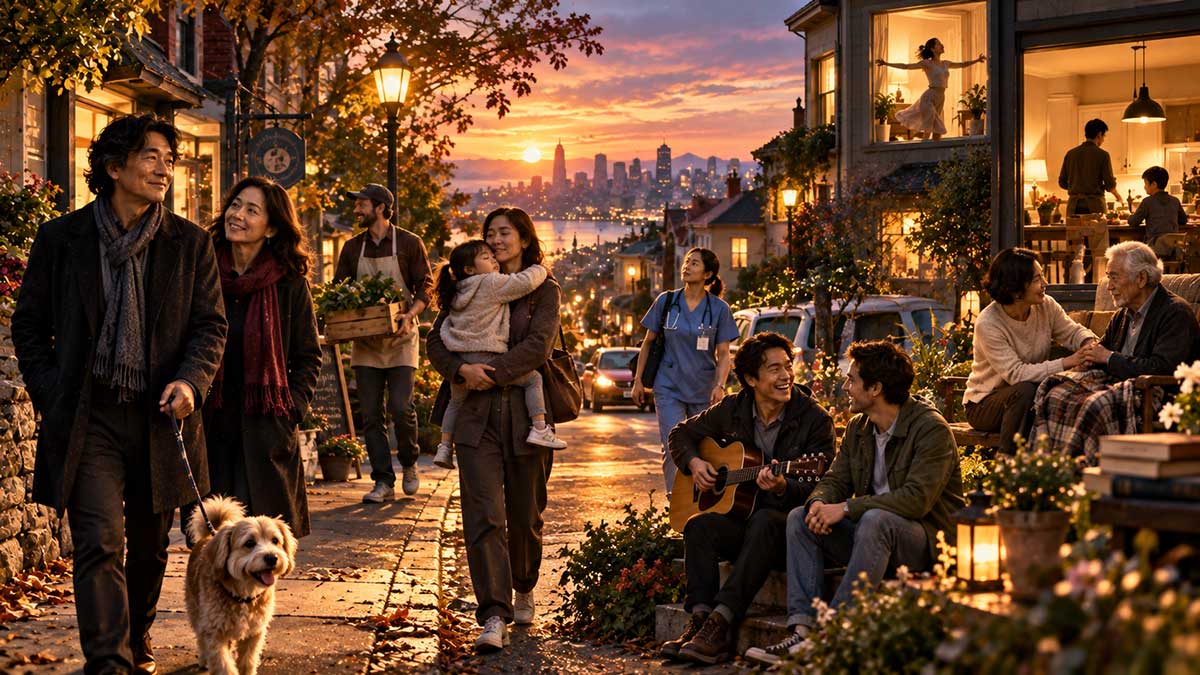
The following is an imagined scholarly conversation. Dialogue attributed to living or historical figures is fictionalized for exploration and should not be read as direct quotation.
The door opens.
There is no symbolic landscape on the other side.
No loom.
No seventy-seven pages floating in the air.
No two doors marked with philosophical choices.
Just a street.
Late afternoon.
Cars passing.
A grocery store.
A woman pushing a stroller.
A delivery driver carrying two boxes.
An elderly man walking slowly with a cane.
Someone arguing on a phone.
Someone laughing.
A teenager wearing headphones.
A tired-looking nurse climbing into her car.
A dog pulling its owner toward a tree.
People going home.
The Moderator steps outside.
Moderator: That's disappointing.
Ryu Si-hwa: Again?
Moderator: I thought after four topics we might at least get a mountain.
Mark Epstein: Mountains are overrated.
Dacher Keltner: I wouldn't go that far.
They laugh.
The Moderator looks down the street.
Moderator: So this is where the anthology sends us?
Ryu Si-hwa: Where else would it send us?
Moderator: Back here?
Ryu Si-hwa: Yes.
Moderator: Bills?
Ryu Si-hwa: Yes.
Moderator: Work?
Ryu Si-hwa: Yes.
Moderator: Aging parents?
Ryu Si-hwa: Yes.
Moderator: Difficult marriages?
Ryu Si-hwa: Sometimes.
Moderator: Laundry?
Ryu Si-hwa: Unfortunately.
Moderator: Grief?
Ryu Si-hwa: Yes.
Moderator: Ordinary Tuesday?
Ryu smiles.
Ryu Si-hwa: Especially Tuesday.
After Seventy-Seven Poems, What Changes?
They begin walking.
Moderator: Let me summarize where we've been.
Topic 1 asked what you actually built.
We discovered that this anthology is not seventy-seven versions of one philosophy.
It is a conversation.
Topic 2 asked whether poetry can heal.
We discovered that healing may mean many different things and that poetry should not be confused with clinical treatment.
Topic 3 asked whether suffering can belong to life without becoming the meaning of life.
We arrived at:
Life as a pattern does not mean life as a plan.
Topic 4 asked what poetry can do that advice often cannot.
We arrived at:
Nothing changed. Everything became visible.
Now comes the question I've been postponing.
So what?
Edward Hirsch smiles.
Edward Hirsch: The most dangerous question for literature.
Moderator: It should be.
Because I can read beautiful poems about mortality for thirty years and still waste enormous amounts of time.
I can understand compassion and treat someone badly.
I can understand impermanence and postpone everything important.
I can understand gratitude and complain constantly.
I can understand love and fail to express it.
I can understand presence while staring at my phone.
So what is the point of understanding?
Epstein: There may not be one unless understanding enters behavior.
Moderator: That's unusually severe.
Epstein: Spiritual knowledge is particularly vulnerable to becoming decorative.
Moderator: Decorative wisdom.
Epstein: Exactly.
We collect concepts.
Impermanence.
Presence.
Nonattachment.
Compassion.
Awakening.
We become sophisticated in discussing them.
Then someone cuts us off in traffic.
Moderator: And enlightenment ends.
Epstein: Frequently.
Everyone laughs.
Kristin Neff: But we should be careful not to create another perfection standard.
Moderator: Meaning?
Neff: "If you've really understood compassion, you'll always behave compassionately."
No.
People remain people.
We fail.
We become irritated.
We forget.
We become defensive.
The question is not whether awakening makes us perfect.
Maybe it changes how quickly we notice that we've fallen asleep again.
The Moderator stops.
Moderator: That's good.
Awakening doesn't mean never falling asleep again.
Neff: Exactly.
Moderator: It may mean noticing sooner.
Neff: And responding differently when we notice.
Question 1: Can Poetry Restore Our Capacity to Notice Ordinary Life?
They pass a small café.
An elderly couple sits outside.
Neither is speaking.
The woman breaks a pastry in half and places one half on the man's plate.
He doesn't look surprised.
Perhaps she has done it a thousand times.
Keltner watches them.
Keltner: There.
Moderator: There what?
Keltner: Something most people would walk past.
Moderator: An old couple eating pastry.
Keltner: Exactly.
Moderator: You're going to make that profound, aren't you?
Keltner: I don't have to.
Look again.
They do.
The woman wipes a crumb from the man's sleeve.
He moves her coffee slightly away from the edge of the table.
Neither says anything.
The Moderator watches.
Moderator: All right.
Keltner: What changed?
Moderator: Nothing.
Keltner: Exactly.
Moderator: Topic 4 all over again.
Keltner: Attention changes the experienced world.
Moderator: Is that awe?
Keltner: Not necessarily.
We should distinguish awe, gratitude, beauty, wonder, tenderness, and appreciation.
But they share something important.
Attention.
Ryu Si-hwa: Perhaps one of the deepest forms of poverty is losing the ability to praise what remains.
The Moderator immediately turns.
Moderator: Careful.
Suppose someone's life is terrible.
Are we going to tell them:
"You aren't appreciating enough"?
Ryu Si-hwa: No.
Neff: Gratitude can become coercive very quickly.
Moderator: Exactly.
"You have cancer, but be grateful."
"You lost your job, but someone has it worse."
"Your marriage is miserable, but appreciate what you have."
I hate that.
Neff: So do I.
Gratitude should never be used to invalidate pain.
Keltner: Nor should wonder.
Moderator: Then what are we saying?
Ryu looks again at the couple.
Ryu Si-hwa: Not:
"Be grateful."
Perhaps simply:
"Look again."
The Moderator repeats it.
Moderator: Look again.
Ryu Si-hwa: Perhaps there is pain.
Look.
Perhaps there is beauty.
Look.
Perhaps there is loneliness.
Look.
Perhaps there is someone sitting beside you.
Look.
We do not decide in advance what must be found.
Hirsch: That's very close to poetry.
A good poem doesn't necessarily tell the reader what to see.
It intensifies seeing.
Moderator: Then maybe the anthology isn't primarily giving seventy-seven answers.
It's seventy-seven interruptions.
Hirsch: I like that.
Moderator: Interruptions to what?
Hirsch: Habit.
Keltner: Automatic attention.
Neff: Self-judgment.
Epstein: Certainty.
Robert Neimeyer: Isolation.
Brother Anthony: Cultural assumptions.
Ryu Si-hwa: Sleep.
How Much of Life Do We Actually Notice?
They continue walking.
A father passes them carrying a sleeping little girl.
Her head rests on his shoulder.
Moderator: He probably wants her to grow up sometimes.
Neff: Probably.
Moderator: No more diapers.
No more tantrums.
No more driving everywhere.
No more school schedules.
Then she grows up.
And he would give almost anything for one more night carrying her like that.
Neimeyer: That's the paradox of time.
Moderator: We keep wanting the current chapter to finish.
Then later we miss it.
Ryu Si-hwa: Perhaps because we often recognize a season only after it becomes memory.
The Moderator watches the father disappear down the street.
Moderator: That's painful.
Ryu Si-hwa: Yes.
Moderator: Can poetry help?
Ryu Si-hwa: Sometimes it can say:
This is a season before the season knows it is ending.
Silence.
Hirsch: That's why poetry and mortality are so deeply connected.
Attention becomes urgent because nothing remains.
Moderator: So impermanence isn't only depressing.
Epstein: It can intensify value.
Moderator: Because the cup matters partly because it is temporary.
Epstein: Perhaps.
Moderator: The dog matters because one day the leash will hang by itself.
Keltner: Yes.
Moderator: The child's voice matters because it will change.
Neimeyer: Yes.
Moderator: My mother's phone call matters because there will eventually be a last one.
Nobody responds immediately.
Ryu Si-hwa: Yes.
Question 2: When Does Protecting Ourselves From Pain Begin Protecting Us From Life?
They reach a small park.
Children are playing.
A man sits alone on a bench.
He watches people but speaks to no one.
Moderator: Topic 3 gave us another difficult question.
Protection.
Someone hurts me.
I build a wall.
Initially the wall saves me.
When does it become a prison?
Epstein: When avoiding pain becomes more important than participating in life.
Moderator: That's still abstract.
Let's make it concrete.
Someone is betrayed in marriage.
What should they do?
Neff: Whatever safety and recovery require initially.
Moderator: Maybe no dating.
Neff: Certainly.
Moderator: Maybe years.
Neff: Possibly.
Moderator: But one day they meet someone kind.
Then what?
Neff: There is no universal answer.
Moderator: Good.
Neff: But they might ask:
"Am I saying no because I genuinely don't want this?"
or:
"Am I saying no because someone from my past is still making the decision?"
The Moderator looks toward Ryu.
Moderator: We encountered that idea before.
Ryu Si-hwa: Yes.
Moderator: It's uncomfortable because it means a person who hurt me twenty years ago may still be governing my life without being present.
Epstein: Fear can preserve a relationship with the past.
Moderator: That's interesting.
Hatred can too.
Epstein: Certainly.
Moderator: So can resentment.
Epstein: Yes.
Moderator: But forgiveness isn't mandatory.
Neff: Correct.
Moderator: Reconciliation isn't mandatory.
Neff: Correct.
Moderator: Trust isn't mandatory.
Neff: Correct.
Moderator: Then what is?
Neff: Nothing.
The Moderator looks surprised.
Neff: That's important.
There is no moral requirement that someone become romantically open again.
No requirement to reconcile.
No requirement to forgive on someone else's timetable.
No requirement to become inspiring.
The question is about agency.
Moderator: Am I choosing my life?
Neff: Exactly.
Moderator: Or is the wound choosing it?
Neff: Sometimes.
Moderator: That's much more precise.
Ryu Si-hwa: Perhaps the wound can come with you.
It simply does not always have to lead.
The Moderator looks at him.
Moderator: That may be one of our central lines.
The wound can come with you. It just doesn't get to lead.
Fear Is Allowed to Come
Moderator: But people often wait to participate until fear disappears.
Epstein: Yes.
Moderator: "When I'm confident, I'll start."
"When I'm healed, I'll date."
"When I'm ready, I'll travel."
"When I'm less anxious, I'll speak."
"When I know what I'm doing, I'll create."
"When grief becomes smaller, I'll celebrate."
"When life calms down, I'll live."
Neimeyer: And sometimes life never calms down.
Moderator: Exactly.
So what then?
Neff: Perhaps fear doesn't need to disappear.
Moderator: That's very different from self-help culture.
Neff: Courage is not necessarily fearlessness.
Epstein: Nor is participation.
Moderator: Then here's the question:
What would I choose if fear were allowed to come with me but were no longer allowed to make every decision?
Nobody speaks for a moment.
Ryu Si-hwa: That is close to living.
Does “Live Fully” Become Another Burden?
The Moderator suddenly laughs.
Moderator: I see another problem coming.
Hirsch: Naturally.
Moderator: We're about to tell readers:
"Live fully!"
"Be present!"
"Notice everything!"
"Love deeply!"
"Dance!"
"Travel!"
"Call your mother!"
"Watch every sunset!"
That's exhausting.
Everyone laughs.
Neff: Yes.
Moderator: Now I've failed at living fully because I spent Sunday watching television.
Neff: Exactly.
Moderator: So how do we prevent participation from becoming another optimization project?
Epstein: By abandoning the fantasy that living fully means living dramatically.
Moderator: Explain.
Epstein: You may spend the day doing laundry.
That doesn't mean you missed life.
The laundry was part of life.
Ryu Si-hwa: Work is one of the verbs too.
Moderator: That's important.
Dance.
Love.
Sing.
Work.
Live.
People remember dance and love.
They forget work.
Brother Anthony: Because ordinary labor isn't as marketable as spiritual ecstasy.
Moderator: Exactly.
Ryu Si-hwa: But someone has to cook.
Someone has to clean.
Someone has to earn money.
Someone has to care for an aging parent.
Someone has to take medicine.
Someone has to repair the roof.
Someone has to sit beside the hospital bed.
These are not interruptions to life.
Moderator: They are life.
Ryu Si-hwa: Yes.
The Myth of the Extraordinary Life
They pass a billboard advertising a tropical vacation.
The Moderator points at it.
Moderator: There's another modern problem.
We're constantly shown extraordinary lives.
Beautiful destinations.
Beautiful bodies.
Beautiful meals.
Success.
Adventure.
Transformation.
Then we look at Tuesday.
Email.
Traffic.
Dinner.
Laundry.
And Tuesday feels like failure.
Keltner: Comparison can dramatically shape perception.
Moderator: Social media intensifies it.
I'm comparing the inside of my Tuesday with someone else's edited Saturday in Santorini.
Neff: And then ordinary life begins to feel insufficient.
Ryu Si-hwa: But most of life is ordinary.
Moderator: Takuboku would approve.
Hirsch: Very much.
Moderator: So if I cannot love ordinary life, I cannot love most of my life.
Nobody answers.
The sentence hangs there.
Epstein: That's probably true.
Moderator: That's almost frightening.
Because I've spent enormous amounts of time waiting for exceptional moments.
Vacations.
Achievements.
Milestones.
Big dinners.
Birthdays.
Weddings.
Trips.
But mathematically, those are tiny fractions of a life.
Ryu Si-hwa: Perhaps the question is not how to make every day extraordinary.
Moderator: What is it?
Ryu Si-hwa: Whether an ordinary day is allowed to count.
Question 3: After Seventy-Seven Poems, What Should Be Different?
The sun is beginning to set.
The group reaches a crossroads.
No signs point toward enlightenment.
One road leads toward homes.
Another toward shops.
Another toward offices.
The Moderator stops.
Moderator: All right.
Final question.
Seventy-seven poems.
Forty-one centuries.
Different cultures.
Different religions.
Love.
Death.
Nature.
Work.
Prayer.
Loss.
Silence.
Aging.
Courage.
Blessing.
Dance.
We finish the anthology.
What should be different?
Robert?
Neimeyer: Perhaps the story becomes larger than the loss.
Moderator: Kristin?
Neff: Perhaps we become less cruel toward the imperfect person who has to live our life.
Moderator: Dacher?
Keltner: Perhaps we recover some capacity to be surprised by the world.
Moderator: Mark?
Epstein: Perhaps we stop requiring reality to become different before we participate in it.
Moderator: Brother Anthony?
Brother Anthony: Perhaps another person's poem reminds us that our own way of seeing is not the only possible way.
Moderator: Edward?
Hirsch looks toward the evening sky.
Hirsch: Perhaps the poem disappears.
Moderator: Disappears?
Hirsch: Yes.
The poem has done its work when you look up from the page.
The tree becomes more visible.
The person beside you becomes more visible.
Your own life becomes more visible.
Moderator: Ryu?
Ryu does not answer immediately.
He looks toward the houses.
Kitchen lights are beginning to appear.
Ryu Si-hwa: Close the book.
The Moderator laughs.
Moderator: That's your answer?
Ryu Si-hwa: Yes.
Moderator: After eight years gathering poems, your final instruction is to stop reading them?
Ryu Si-hwa: Eventually.
Moderator: Why?
Ryu Si-hwa: Because the poem is not the destination.
Dance. Love. Sing. Work. Live.
The Moderator opens the anthology one last time.
Moderator: We kept returning to the movement in the title poem.
Not theories.
Verbs.
Dance.
Love.
Sing.
Work.
Live.
Maybe we've underestimated that.
Epstein: Probably.
Moderator: These aren't instructions to understand life.
They're instructions to participate in it.
Ryu Si-hwa: Yes.
Moderator: Dance doesn't necessarily mean literally dancing.
Ryu Si-hwa: No.
Moderator: It might mean allowing joy.
Neff: Or play.
Moderator: Love might mean romance.
But also friendship.
Family.
Service.
Attention.
Care.
Neff: Yes.
Moderator: Sing might mean expression.
Creating something.
Speaking honestly.
Writing.
Making music.
Telling someone what matters.
Hirsch: Yes.
Moderator: Work might mean profession.
Craft.
Providing.
Caring.
Building.
Repairing.
Contributing.
Ryu Si-hwa: Yes.
Moderator: And live?
Nobody answers.
The Moderator looks around.
Moderator: Maybe everything else.
What Does Participation Look Like Tomorrow Morning?
Moderator: I want to make this painfully practical.
Not someday.
Tomorrow.
What does participation look like?
Ryu Si-hwa: Read one poem.
Then close the book.
Moderator: And?
Ryu Si-hwa: Notice what happens next.
Neff: Speak to yourself once with the same kindness you would offer someone you love.
Neimeyer: Tell one story about someone you lost that contains more than the fact that they died.
Keltner: Notice something ordinary that surprises you.
Brother Anthony: Read something from a voice outside your own cultural assumptions and resist immediately turning it into yourself.
Hirsch: Read one poem slowly enough that you don't need to summarize it.
Epstein: Notice one moment when you're waiting for reality to become different before allowing yourself to live.
Moderator: Mine?
He thinks.
Moderator: Put the phone down when someone I love is talking.
Ryu Si-hwa: Good.
Moderator: That's embarrassingly small.
Ryu Si-hwa: Most of life is.
What If Tomorrow Is Terrible?
The Moderator's expression changes.
Moderator: One final objection.
Suppose tomorrow isn't beautiful.
No sunset revelation.
No family dinner.
No dancing.
Tomorrow is chemotherapy.
Tomorrow is divorce court.
Tomorrow is a funeral.
Tomorrow is panic.
Tomorrow is loneliness.
Tomorrow I can barely get out of bed.
What does participation mean then?
Neff answers first.
Neff: Surviving tomorrow can be participation.
Neimeyer: Crying can be participation.
Epstein: Asking for help can be participation.
Keltner: Looking out the window for thirty seconds can be participation.
Hirsch: Reading one line and putting the book down can be participation.
Brother Anthony: Silence can be participation.
The Moderator looks toward Ryu.
Ryu Si-hwa: Breathing until tomorrow can be enough.
Silence.
Moderator: So even "live fully" has to be handled carefully.
Neff: Yes.
Moderator: Some days full participation means dancing.
Other days it means getting through the day.
Neff: Exactly.
Moderator: That's much more humane.
The Final Test: What Are You Waiting For?
Night has arrived.
One by one, the others begin walking toward their separate roads.
But the Moderator remains beside Ryu.
Moderator: I think I finally understand something about the title.
Maybe.
Ryu Si-hwa: That's dangerous.
Moderator: I know.
They smile.
Moderator: At the beginning, Love As If You've Never Been Hurt sounded impossible.
Even irresponsible.
Because people have been hurt.
They remember.
They change.
Some never completely heal.
So we kept modifying the title.
Love while remembering.
Love with boundaries.
Love without naivety.
Live with grief.
Carry the wound.
See the pattern.
But perhaps the title's deepest challenge isn't really about forgetting the wound at all.
Ryu listens.
Moderator: Maybe it's asking:
How much of the life still available to me will I surrender to what has already happened?
Ryu says nothing.
Moderator: That's harsher.
Ryu Si-hwa: Yes.
Moderator: Because I can't change what happened.
Ryu Si-hwa: No.
Moderator: I may not even be able to make sense of it.
Ryu Si-hwa: No.
Moderator: I may carry it forever.
Ryu Si-hwa: Yes.
Moderator: But there is still a question about today.
Ryu Si-hwa: Yes.
Moderator: Who gets today?
The wound?
Fear?
Regret?
The person who hurt me?
The future I'm waiting for?
Or the life that's actually here?
Ryu looks down the street.
Ryu Si-hwa: Perhaps that is the question.
Closing: The Poem Has Finished. Your Life Hasn't.
The group has almost disappeared into the distance.
The Moderator opens the anthology one final time.
He looks at the pages.
Then closes it.
No revelation.
No music.
No light from heaven.
His phone vibrates.
He looks at the screen.
Someone he loves.
For a moment, habit almost wins.
Later.
I'll call later.
Then he remembers the reading glasses.
The empty chair.
The black thread.
The cup of tea.
The photograph.
The old couple dividing the pastry.
The father carrying the sleeping child.
The dog pulling at the leash.
The ordinary street.
He answers.
Moderator: Hello?
He begins walking home.
Behind him, Ryu says nothing.
He doesn't need to.
The anthology has finished speaking.
Now the reader has to answer.
Not with an interpretation.
Not with a theory.
Not with a quotation.
With a life.
Perhaps imperfectly.
Perhaps while grieving.
Perhaps while afraid.
Perhaps still wounded.
But participating.
Because the final destination of the anthology may not be healing.
It may not even be awakening.
Perhaps both are movements toward something simpler.
Something harder.
Participation.
Dance.
Love.
Sing.
Work.
Live.
Not when every wound disappears.
Not when every question is answered.
Not when life finally becomes the life you expected.
Not when you become fearless.
Not when you become perfect.
Now.
The poem has finished.
Your life hasn't.
Final Thoughts
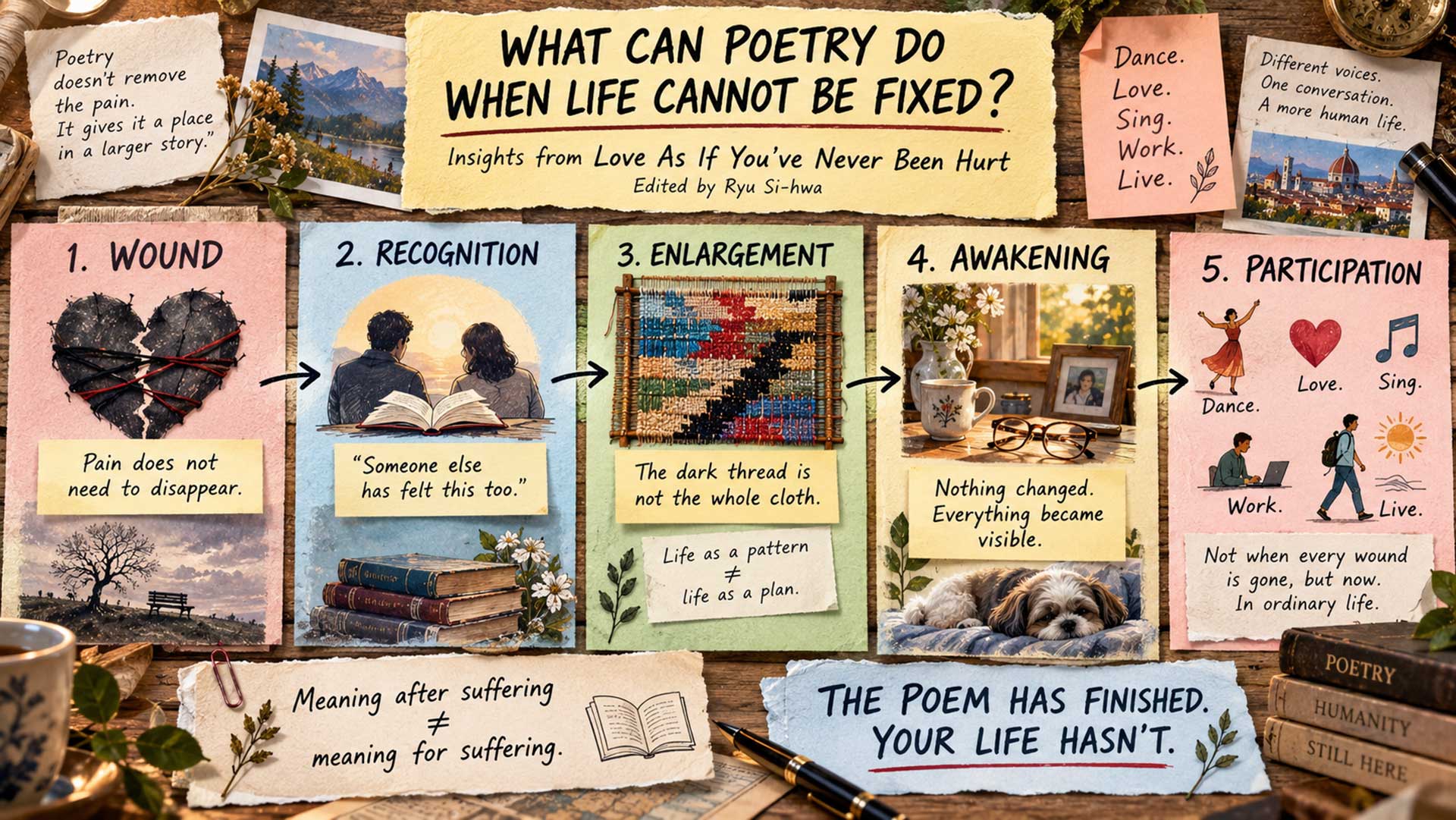
We began Part 2 by asking what Ryu Si-hwa actually built.
We ended by closing the book.
Between those two moments, nearly every comforting idea we carried into the discussion was challenged.
We learned that an anthology is not a single doctrine. Seventy-seven poems do not become one philosophy simply because one editor places them together.
We questioned the word healing itself.
Healing does not necessarily mean returning to the person we were before suffering. Grief may remain. Memory may remain. Love for someone who died may remain.
Sometimes the more useful question is not:
"When will this stop hurting?"
but:
"How do I live while this remains part of me?"
That brought us to perhaps the most difficult distinction in the entire conversation:
Meaning after suffering is not the same as meaning for suffering.
We do not need to believe that tragedy happened for a reason.
We do not need to turn every wound into wisdom.
We do not need to make the dark thread gold.
Seeing life as one pattern does not mean seeing life as one predetermined plan.
It can simply mean acknowledging:
This happened. And this happened too.
There was grief.
And love.
Failure.
And friendship.
Illness.
And sunlight.
Regret.
And another opportunity to repair something.
An empty chair.
And people still sitting around the table.
Then our attention shifted from healing to poetry itself.
Why can a poem sometimes reach us when advice cannot?
Perhaps because advice often explains while poetry invites us to experience.
A poem can make an aging parent's hand visible again.
A child's voice.
A sleeping dog.
A cup of tea.
An empty chair.
The person sitting beside us.
The same poem may mean almost nothing at twenty-five and become overwhelming at sixty-five, not because the words changed, but because the reader did.
That may be one form of awakening.
Not necessarily learning something new, but seeing what was already there.
Yet even awakening is not the destination.
A person can read about impermanence while wasting years.
Read about compassion while neglecting someone.
Read about presence while staring at a phone.
Read about life while postponing life.
So eventually the anthology must be closed.
The reader has to return to the kitchen.
The marriage.
The aging parent.
The child leaving home.
The work.
The hospital room.
The bills.
The grief.
The friendship.
The dog waiting by the door.
The ordinary Tuesday.
That is why the final movement of this conversation became:
Participation.
Not constant happiness.
Not fearlessness.
Not spiritual perfection.
Not pretending everything is beautiful.
Participation may mean dancing.
It may mean creating.
It may mean apologizing.
It may mean doing your work carefully.
It may mean calling someone.
It may mean allowing yourself to laugh while still grieving.
And on a terrible day, participation may simply mean asking for help, crying honestly, or surviving until tomorrow.
Perhaps this is the more mature meaning we can carry away from Love As If You've Never Been Hurt:
Do not wait for the wound to disappear before allowing yourself to have a life around it.
The wound can come with you.
It simply does not always have to lead.
Dance.
Love.
Sing.
Work.
Live.
The anthology eventually has to end.
Your life doesn't.
Short Bios:
Ryu Si-hwa
South Korean poet, translator, essayist, and editor of Love As If You've Never Been Hurt. In this conversation, he serves as the central literary witness to the anthology's selection, themes, and larger questions about poetry, lived experience, healing, awakening, and attention.
Edward Hirsch
American poet, critic, and author of How to Read a Poem. He helps explore why poetry cannot be reduced to information and how metaphor, imagery, ambiguity, memory, and the reader's own experience participate in creating meaning.
Brother Anthony of Taizé (An Sonjae)
Scholar and translator of Korean literature who has spent decades bringing Korean poetry and literature to English-language readers. He helps the discussion confront translation, cultural context, and the danger of making writers from different traditions sound artificially identical.
Robert A. Neimeyer
Psychologist and influential researcher on grief, bereavement, meaning reconstruction, identity, and continuing bonds after loss. He challenges the assumption that healing requires forgetting, closure, or the disappearance of grief.
Kristin Neff
Psychologist known for pioneering research on self-compassion. She brings attention to self-judgment, common humanity, emotional suffering, and the possibility of responding compassionately to pain without denying responsibility or reality.
Dacher Keltner
Psychologist and researcher known for his work on awe, emotion, compassion, beauty, and human connection. He helps examine how suffering can narrow attention and how wonder and renewed perception may enlarge our awareness of life.
Mark Epstein
Psychiatrist and author whose work explores the relationship between psychotherapy and Buddhist thought. He helps distinguish acceptance from resignation and challenges the use of spirituality, healing, or self-understanding as ways of avoiding life.
Moderator
The skeptical reader. Rather than allowing the panel to turn the anthology into a comforting philosophy, the Moderator repeatedly asks whether an interpretation is genuinely supported, whether suffering is being romanticized, and whether beautiful language is hiding difficult realities.
Leave a Reply