
Introduction
What did Tolstoy want us to see when he placed a frightened soldier, a young woman at a ball, a dying father, and a household preparing supper inside the same enormous book? Perhaps he wanted to question the stories we use to decide what matters: greatness, romance, certainty, success, and even happiness.
In this fictional conversation, Leo Tolstoy meets Gary Saul Morson, Isaiah Berlin, Donna Tussing Orwin, Rosamund Bartlett, Caryl Emerson, and Larissa Volokhonsky at Yasnaya Polyana. Their dialogue is invented, informed by the novel and published writings. It is not a recovered interview, and the participants do not speak with one voice.
They examine why life refuses a tidy plot, what responsibility survives our limited control, and why Pierre and Andrei cannot settle their lives through ideas alone. Natasha’s fulfillment and Sonya’s overlooked needs bring the discussion close to home. Pierre’s public commitments and Nikolenka’s dream then reopen questions the marriages cannot close.
Part 1 lets the characters speak from their loves, losses, and unfinished obligations. This second part asks what Tolstoy’s artistic choices reveal, and where readers can question his judgments. Part 3 will carry these tensions into five contemporary stories.
The invitation is to return to the novel with sharper attention, then ask what our own explanations might have left outside the frame.
(Note: This is an imaginary conversation, a creative exploration of an idea, and not a real speech or event.)
Topic 1: Why Tolstoy Refused to Give Life One Plot
An imaginary conversation inspired by War and Peace and writings about it. The dialogue is fictional, not a historical transcript.
The study window stood open a few inches. Beyond it, a branch moved against the pale afternoon sky. On the desk lay an open copy of War and Peace, several handwritten pages, and a cup that had gone cold.
Gary Saul Morson turned a page, then another.
Gary Saul Morson: A reader becomes attached to Natasha. You take them to an army. They begin to care about a soldier. You take them back to a drawing room. Then, just when they think they know what sort of book they are reading, you begin arguing about history.
Leo Tolstoy: You make it sound like a man being moved from room to room against his wishes.
Morson: Some readers might recognize that description.
Tolstoy: Then I should ask which room they believe contains life.
Caryl Emerson smiled, but kept her finger between two pages.
Caryl Emerson: Every novelist chooses rooms. The question is why you chose so many, and why you insist that we cross between them so often.
Tolstoy: A young man may believe his life concerns a battle. His mother believes it concerns whether he comes home. A creditor has a third opinion. Must I accept the young man’s account simply since he carries a sword?
Isaiah Berlin: No. Yet you eventually offer an account that is larger than all three. Your resistance to their certainty does not prevent certainty of your own.
Tolstoy looked across the desk.
Tolstoy: We have hardly opened the book, and you have already accused me.
Berlin: I have admired you first. That may make the accusation harder to dismiss.
Larissa Volokhonsky: Before we decide whether the whole is too certain, we should attend to how often the language changes what we think we have seen. A room looks different through another person’s eyes. A familiar name returns in a different situation. The reader has to adjust.
Morson: And sometimes resents the adjustment. Let us begin there. Why does this book need so many people and so many kinds of scenes?
Tolstoy: Tell me which people you would remove.
Morson: That is an effective defense, but perhaps an unfair question. The reader does not yet know whom they will need.
Emerson: Nor whom the book will teach them to neglect. We call someone a minor character, then become accustomed to giving that person a minor portion of our concern.
Tolstoy: A person does not become small through receiving fewer pages.
Emerson: Yet fewer pages can make them small to us. You cannot escape the consequences of your own attention.
Tolstoy drew the cold cup closer, noticed it, and left it untouched.
Morson: Tushin is useful here. To someone following commanders and campaigns, he could appear incidental. Near his battery, the scale changes. His difficulty becomes immediate. We see conduct that a larger account might fail to register fairly.
Berlin: A novelist can restore significance to someone an official account diminishes. But that restoration is a judgment. It is not merely life entering the page unarranged.
Morson: Agreed. My claim is narrower: the arrangement can teach us to question the arrangement we brought with us.
Volokhonsky: That questioning happens sentence by sentence. The reader expects a military event to sound a certain way. Then the narration brings us near a body, an awkward movement, a mistaken impression. The event loses the vocabulary in which we first expected to contain it.
Tolstoy: A battle does not wait for a man to know what it means before it frightens him.
Emerson: Nor does a household wait for him to finish being frightened before it needs money, food, or an answer to a letter.
Morson: So the movement between rooms is doing moral work. We cannot remain indefinitely inside the experience that most interests us.
Berlin: It can do that work. But readers may feel another effect. They may become convinced that the novelist, who sees all these rooms, occupies a place above the limitations he gives everyone else.
Tolstoy: Would you prefer that I pretend to know less than I can show?
Berlin: I would prefer that we examine the difference between showing many things and possessing their final explanation.
For a moment only the branch at the window moved.
Volokhonsky: The hunt makes that distinction interesting. We do not need to translate every movement into a proposition about history. The people are doing something. Their attention has its own rhythm and objects. Natasha’s dance cannot be exhausted by saying what lesson it represents.
Emerson: Yet readers often ask precisely that: what does it represent? They want a scene to justify the time they spent reading it.
Morson: We sometimes treat our lives that way too. A day must contribute to a larger achievement. Otherwise we call it wasted.
Tolstoy glanced at the manuscript pages.
Tolstoy: A person may spend years preparing to become someone, and fail to notice the person they are becoming through the preparation.
Berlin: That is persuasive. It is still an interpretation of the day.
Tolstoy: You intend to leave me no sentence uncontested.
Berlin: Only the sentences that threaten to become answers to everything.
Morson turned to a passage near Borodino.
Morson: What changes when we see an event through a person’s confusion rather than an explanation written afterward?
Volokhonsky: The reader loses a certain privilege. We usually approach a historical battle knowing that it has a name, a date, and a place in a sequence. The person standing there has immediate impressions. Some are mistaken. Some matter intensely and will scarcely appear in a later account.
Emerson: Pierre gives us an especially revealing version of this. His expectations do not equip him to comprehend what he enters. We may recognize his inadequacy before he does.
Tolstoy: And still want the battle to furnish him with an answer.
Morson: Or furnish us with one. We know where the event belongs historically. We can mistake that knowledge for knowing what it was to be there.
Berlin: But the person there cannot explain everything either. Confusion does not become a superior history simply through being sincere.
Tolstoy: No. The man who is afraid does not know the whole battle. My objection begins when the man writing afterward speaks as if the whole battle were available to him.
Berlin: Then your disagreement concerns the degree of certainty, rather than the legitimacy of explanation itself.
Tolstoy paused.
Tolstoy: At least let the explanation account for what its neatness has removed.
Volokhonsky: And let the language preserve uncertainty where the scene requires it. A translation can make an awkward movement more graceful, a repetition less insistent, a shift less abrupt. Each change may seem small. Together they can give the reader a smoother kind of knowledge than the passage offers.
Emerson: We should not turn awkwardness into a virtue on every occasion. Yet smoothing has a cost when it makes a person appear more consistent than they are.
Morson: That cost reaches beyond books. Suppose I tell you why a friendship ended. I select the incidents that support the ending I already know. The friendship’s other possible futures disappear from my account.
Berlin: Or you discover a pattern you could not see earlier. Retrospection can correct ignorance; it can create false inevitability too.
Morson: Yes. I do not want us to forbid explanation. I want us to distinguish a discovered pattern from a claim that no other future was possible.
Emerson: There is a further difficulty. A coherent account may be the only way someone can speak about a painful experience at all. We cannot demand that every grieving person preserve all the uncertainty for our benefit.
Morson lowered his hand from the page.
Morson: That changes my example. The teller’s need matters too.
Tolstoy: A man defending himself may tell a false story. A man trying to live after a loss may need a story. Those are different acts, even when their sentences resemble each other.
Berlin: And literature can help us hear the difference. That is one reason I hesitate when literature becomes a doctrine that claims to settle the conditions of every act.
Morson: Which brings us to your objection. Does Tolstoy trust life’s uncertainty, or still want one explanation that can settle it?
Berlin: I think the novelist sees a multitude of particulars with extraordinary force. His account of history seeks something more unified. My question is whether the theory does justice to the perception.
Tolstoy: You would have me describe Napoleon’s confidence, show its inadequacy, and stop before asking what really produces the event.
Berlin: I would have you ask. I would question any claim that the answer has exhausted what your own scenes reveal.
Emerson: We should question Berlin’s division too. Perhaps the historical passages and the domestic scenes are not two separate Tolstoys. Perhaps each makes a difficulty visible that the other cannot resolve.
Volokhonsky: They inhabit the same book. The change in register can be disruptive without being accidental. Readers hear the argument after encountering people who make its terms harder to accept simply.
Morson: Then the interruption can run in both directions. Philosophy interrupts the story. The story interrupts philosophy’s confidence.
Berlin considered that.
Berlin: That is a better formulation than treating the characters as illustrations. Yet it leaves a serious question about what the argument finally asks us to believe.
Tolstoy: It should leave a serious question. A pleasant story can let a reader escape the question entirely.
Emerson: A forceful explanation can let the author escape it too.
Tolstoy’s expression sharpened, then softened into a brief smile.
Tolstoy: You have chosen your company carefully, Gary Saul.
Morson: I was hoping someone would say that to me as well.
He closed the book halfway, keeping a finger inside it.
Morson: Let me test my own preference for ordinary moments. If we say the meaning is already present in a meal, a dance, or a small act of care, we may neglect conditions those acts cannot repair. A household needs more than our attention to its beauty.
Berlin: Now you have found a scene that troubles your position.
Morson: Several. But I still think the novel asks us to look before deciding that we know what sort of thing we are seeing.
Volokhonsky: And to look again when the viewpoint changes.
Emerson gently drew the cup away from a manuscript page beneath it. A faint damp circle had formed near the edge.
Emerson: What was on this page?
Tolstoy took it, reading the first lines.
Tolstoy: An argument.
Berlin: About what?
Tolstoy: Wait. The ink is still wet here.
He lifted the sheet toward the window. The others moved their hands clear of the desk, leaving him room.
Topic 2: Who Makes History, and How Free Are We?
An imaginary conversation inspired by War and Peace and writings about it. The dialogue is fictional, not a historical transcript.
Tolstoy left the damp page beside the window. Outside, the garden path had begun to dry, though dark patches remained beneath the trees.
Donna Tussing Orwin joined them at the doorway. Larissa Volokhonsky stayed in the study with the open novel; Caryl Emerson carried her copy into the garden.
Isaiah Berlin waited until they had passed the first tree.
Isaiah Berlin: You asked that an explanation account for what its neatness removes. I would like to apply that request to your own argument about history.
Leo Tolstoy: I suspected you had brought it outside with you.
Berlin: It travels easily. If the actions of a ruler arise from circumstances he does not command, what exactly are we condemning when we condemn him?
Donna Tussing Orwin: His conduct, perhaps. Responsibility for an act need not require authorship of every condition surrounding it.
Berlin: That is sensible. But is it consistent with the strongest version of Tolstoy’s argument? If the act itself follows necessarily from those conditions, you have moved the difficulty rather than answered it.
Gary Saul Morson: Let us keep that difficulty. We should not give ourselves an easier philosophy than the book gives us.
Tolstoy stopped beside a low branch and lifted it so Emerson could pass.
Caryl Emerson: And let us keep the people whom the philosophy judges. Napoleon fares very differently from Kutuzov. If nobody controls a battle, why does one man’s confidence deserve ridicule and another man’s restraint deserve admiration?
Tolstoy: Their relation to what is happening differs.
Emerson: Then their relation matters, even when neither produces the whole event.
Tolstoy: Of course it matters. A man can mistake the movement around him for the obedience of the world to his wishes.
Berlin: Or correctly recognize that he does not command it. But under your account, both responses may be necessary. Why admire the second?
Tolstoy: Would necessity make blindness into sight?
Berlin: No. It might change whether blindness deserves blame.
Morson looked back toward the house.
Morson: We have at least three questions inside that disagreement: what caused the event, what the participant perceived, and how the participant treated other people. We keep moving between them.
Orwin: And the novel moves between them. It can question a man’s claim to have caused a victory and still reveal something ugly in his delight at the suffering before him.
Emerson: That distinction helps with Napoleon. It does not yet justify everything the book grants Kutuzov.
Tolstoy: What do you think it grants him?
Emerson: A privileged closeness to the reality of events. His restraint often receives a dignity that other people’s inactivity would not receive. A reader can reasonably ask whether you have replaced the hero who commands with the hero who knows when command is useless.
Tolstoy walked several steps before answering.
Tolstoy: Would you have me refuse to distinguish between a useful judgment and a vain one?
Emerson: I would have us examine how your narration persuades us to make the distinction. The book’s Kutuzov is an artistic and historical judgment. He cannot certify that judgment himself.
Berlin: That is well put. Your attack on conventional heroic history can itself acquire a hero.
Morson: Tushin complicates the matter. He acts with limited knowledge. His battery matters. Later, an account assembled above him may fail to recognize what happened there.
Orwin: Which means limited knowledge does not make action worthless. Nor does a report’s failure to recognize it erase its consequence.
Tolstoy: The soldier does not need to possess the history of the battle before doing what is before him.
Berlin: Certainly. But we must resist turning that practical truth into a solution to historical necessity. I can accept the importance of his conduct and still ask whether he could have acted otherwise.
Emerson opened her copy, shielding the pages from a light gust.
Emerson: Readers often feel precisely that division. They follow a person through a decision and experience its uncertainty. Then they reach the argument and feel that the uncertainty has been withdrawn from them.
Morson: As if a door that appeared open has been declared painted on the wall.
Berlin: Yes. And the reader may feel cheated, rather than merely instructed.
Tolstoy: Or the reader mistakes ignorance of the causes for absence of causes.
Orwin: That is a serious objection. Yet knowing that a choice has causes does not, by itself, establish that there was only one possible choice. We need to say what kind of necessity we mean.
Tolstoy turned toward her.
Tolstoy: You would leave a gap in the account.
Orwin: I would leave a question where the account has not earned an answer.
They had reached a fork in the path. Morson chose the narrower side, then stopped when he saw a shallow pool across it.
Berlin: A modest defeat for intention.
Morson: And an opportunity for a less ambitious route.
They turned together, their order changing as they did.
Morson: Let us take a decision whose moral weight the reader feels immediately. The Rostovs’ carts. Their possessions matter to them. Wounded men need transport. What are we judging when the household changes what the carts will carry?
Orwin: What they attend to, what they relinquish, and whose need they permit to alter their plans.
Tolstoy: They cease to treat their belongings as the whole of their situation.
Emerson: Yet they are not simply free of their situation. They have carts to offer. Other people do not. Their act depends on resources and relationships they did not create at that moment.
Morson: So the act is situated. That does not make the wounded men less grateful for the space.
Berlin: Gratitude is one thing. Desert is another. We may value a beneficial act without having settled what its author deserves.
Orwin: True. But living with other people requires judgments before that settlement arrives. A mother cannot suspend every response to her child’s conduct until she has solved freedom.
Berlin: I agree. My concern is what we claim those judgments establish.
Tolstoy: Then perhaps you demand from judgment the same completeness I deny to the historian.
Berlin smiled briefly.
Berlin: That is a fair challenge. But your narrative makes judgments with considerable force. I am asking what sustains that force within your philosophy.
Emerson: Let us choose a less comforting example. Natasha’s attempt to leave with Anatole. We can examine youth, loneliness, pressure, fantasy, and the conditions of her engagement. At what point does explanation become an attempt to remove her responsibility?
Morson: Or an attempt to make her wholly responsible for conditions shared by several people?
Orwin: Both errors are possible. We can recognize that she causes harm without treating every consequence as hers alone. Anatole’s conduct does not disappear when we attend to Natasha’s susceptibility.
Tolstoy: Nor does her pain disappear when we recognize her conduct.
Berlin: This is where your novelist’s perception is so persuasive. You allow us to see an act from several positions without making all those positions equivalent.
Emerson: And that is why the argument troubles readers. They fear that the philosophy will flatten distinctions the story taught them to make.
Tolstoy: The historical question concerns an immense connection of actions. You cannot simply enlarge the explanation of one person’s decision until it explains the movement of nations.
Orwin: Then the scale matters. But a change of scale is something we must demonstrate, rather than invoke whenever the accounts collide.
Morson nodded.
Morson: We should keep that demand. Otherwise we can rescue any contradiction by placing its halves at different distances.
The path narrowed beside a hedge. For several steps they walked without speaking.
Morson: I think readers want two assurances that may be difficult to give together. They want to hear that they did not control everything that happened to them. They want to hear that what they do now still matters.
Orwin: Those wishes arise from different wounds. Someone who has been harmed may carry responsibility that belongs elsewhere. Someone who has harmed another person may be eager to distribute responsibility until their own part disappears.
Emerson: The same sentence about circumstances can comfort one person and excuse another.
Berlin: Which is a reason to be cautious about turning a historical thesis into advice for everyone.
Tolstoy: And a reason to put people into the book. An argument alone cannot tell you whom you are speaking to.
Morson: But the reader reaches your second epilogue after becoming attached to those people. Why end there? Why ask us to judge the characters, then question how free anyone is?
Tolstoy rested a hand on the wooden gate beside the path.
Tolstoy: If I stopped where marriages and households appear to settle the story, a reader could carry away the same habits of explanation with which they entered. A few individuals desire things, act, and produce the result. History becomes a larger version of that arrangement.
Berlin: So the epilogue prevents the apparent resolution from becoming an account of how the whole works.
Tolstoy: It requires another examination.
Emerson: Yet requiring the examination does not settle its result. A reader can take your challenge seriously and reject your proposed account.
Tolstoy: Then let the rejection answer the question, rather than dismiss it as an interruption.
Orwin: That seems a fairer invitation. The reader need not accept the philosophy to recognize the problem it raises.
Morson: And need not call the philosophy useless when it fails to explain why one frightened person helps another. Its failure there may reveal a limit, rather than erase its value everywhere.
Berlin: Provided we admit the limit. My objection is to a theory that claims the whole and then asks its finest observations to live under that claim.
Tolstoy looked at him steadily.
Tolstoy: You remain dissatisfied.
Berlin: Yes. Less impatient, perhaps. Dissatisfied.
Emerson: That is a respectable place for a reader to stand.
At the bend ahead, a worker approached carrying a shallow crate of fallen apples. The path offered little room. Morson stepped onto the grass; Emerson drew her book close. Tolstoy held the gate open.
One apple rolled from the crate and stopped near Berlin’s shoe. He bent, picked it up, and placed it back among the others.
The worker thanked them and continued toward the house.
Tolstoy: Did you require an answer before picking it up?
Berlin: No. Nor does picking it up supply the answer.
Orwin: What it supplied was the apple.
Morson laughed softly. Berlin brushed a little soil from his fingers.
Tolstoy still held the gate. Emerson passed through, then turned to take it from him so he could follow.
Topic 3: Why Pierre and Andrei Cannot Think Their Way to Peace
An imaginary conversation inspired by War and Peace and writings about it. The dialogue is fictional, not a historical transcript.
When they returned to the house, Rosamund Bartlett was standing beside the study window. Larissa Volokhonsky had moved the damp manuscript onto a clear section of the desk.
Berlin and Emerson remained near the doorway, still discussing Kutuzov. Tolstoy led Morson and Donna Tussing Orwin into the quieter room adjoining the study. Bartlett and Volokhonsky followed.
A bowl of apples stood on a side table. The window was open, and a curtain stirred against the sill.
Gary Saul Morson: Pierre can explain his latest conviction with great confidence. A little later, he needs another one. What is he hoping an answer will do for him?
Donna Tussing Orwin: Give his life a form he can inhabit. He has resources, impulses, and dissatisfaction. A conviction offers a way to bring those things together.
Leo Tolstoy: It can offer him a flattering picture of the person he is about to become.
Rosamund Bartlett: Yet we should not make the desire itself contemptible. Wanting to become less selfish is a serious wish. A reader may recognize it very closely.
Tolstoy: I do not object to the wish. I object when wishing to become good makes a man less attentive to what he is doing.
Larissa Volokhonsky: Or when the vocabulary of goodness arrives before the practice. Pierre can speak convincingly within a new system. The narration can place that speech beside circumstances he has not grasped.
Morson: His attempts to improve the lives of his peasants are painful in that respect. His intentions and the account presented to him do not give him reliable knowledge of the results.
Orwin: Which is a moral failure that cannot be repaired merely by having a better intention. He must learn how his actions reach other people.
Tolstoy took an apple from the bowl and turned it in his hand.
Tolstoy: A man may be delighted by the thought that he has helped someone. That delight can make him reluctant to examine whether he has.
Bartlett: That is a useful distinction. But the author must submit to it too. A novelist may be delighted by a discovery about life and become reluctant to ask whom it fails to help.
Tolstoy set the apple down.
Tolstoy: You have been speaking with Isaiah.
Bartlett: I have been reading Pierre.
Volokhonsky smiled and opened the novel on her lap.
Morson: Why do his answers keep failing to become a way of living? Does he choose the wrong answers, or ask too much of any answer?
Orwin: Both possibilities matter. A belief can be inadequate. A person can expect even a worthwhile belief to do work that still requires patience, self-knowledge, and attention to consequences.
Bartlett: His position changes too. An answer adopted in one situation cannot simply be carried untouched into another. Marriage, shame, danger, and captivity make different demands.
Tolstoy: Yet he often wishes to begin again as if the new conviction could dismiss the man who adopted the old one.
Morson: That is a familiar temptation. We want a new purpose to release us from unfinished obligations.
Volokhonsky: Pierre’s earlier selves do not vanish so conveniently. The reader remembers them. His new confidence reaches us with the memory of a previous confidence still attached.
Orwin: And we need that memory without becoming cynical. Otherwise every sincere attempt begins to look foolish simply since it might fail.
Morson: Then let us be precise about the failure. Pierre does not fail merely by changing his mind.
Orwin: No. Revision may be necessary. The question is whether he becomes more responsive to life or simply more skilled at explaining himself.
Tolstoy looked toward the open window.
Tolstoy: There are things a man cannot discover through another hour of discussing himself.
Bartlett: But silence is no guarantee either. A person can remain deeply absorbed in himself without saying a word.
Morson: Which brings us to Karataev. What does he give Pierre that an argument cannot, and what does he leave unanswered?
Volokhonsky rested a finger beside the passage.
Volokhonsky: We should begin by recalling how we receive him. We meet him through a narration closely bound to Pierre’s experience and later memory. His significance for Pierre is not identical to a complete account of Karataev’s own life.
Bartlett: That matters enormously. A reader can turn the person into an answer and forget that he is a person.
Tolstoy: Pierre encounters a man who does not require him to become remarkable before sharing food with him.
Orwin: There is a relief in that. So much of Pierre’s earlier life concerns how he appears, what he should accomplish, or which role he should occupy. Here another human being addresses an immediate need.
Morson: He is hungry. He is frightened. Someone speaks to him without making those conditions into a judgment of his worth.
The curtain lifted, then settled.
Bartlett: We must be careful about what follows. The comfort of that encounter does not make captivity good. Nor does it establish that Pierre needed catastrophe to become capable of gratitude.
Tolstoy: What he finds does not excuse what was done to him.
Orwin: Nor what happens to Karataev. His death resists a comforting account of the episode.
Morson was quiet for a moment.
Morson: Yes. It is easy to speak of Karataev’s gift to Pierre and let the cost of his own life recede. We should not let Pierre’s survival become the measure of the whole encounter.
Volokhonsky: The remembered figure can acquire a completeness that the living person could never possess. We need to notice the movement between encounter and memory.
Bartlett: And ask what the memory cannot tell Pierre to do. Acceptance does not determine every obligation he will meet after release.
Tolstoy: Must an encounter provide instructions for every future circumstance before it can change him?
Bartlett: Certainly not. I am resisting the reader’s temptation to demand exactly that.
Orwin: Karataev can change the way Pierre inhabits a moment without settling every question of conduct. There is a difference between finding life bearable and deciding what justice requires.
Morson: A reader who is anxious may hear the first and feel relief. A reader who is being mistreated may need us to say that relief does not forbid action.
Tolstoy: You fear that peace can become obedience.
Orwin: It can be used that way. Especially when one person prescribes it to another.
Tolstoy leaned back in his chair.
Tolstoy: Then let the reader attend to what Pierre experiences, rather than borrow a command from it.
Volokhonsky: And resist replacing that experience with a sentence that sounds easy to repeat.
Morson: Something similar happens with Andrei, but the difficulty changes. His final compassion can sound like the culmination of wisdom. For Natasha and Marya, it is inseparable from losing him.
Bartlett: Their presence prevents his inward state from becoming the only truth in the room.
Tolstoy: You think I neglect them?
Bartlett: I think the reader may neglect them when praising him.
Tolstoy lowered his eyes to the bowl of apples.
Morson: Does Andrei’s final compassion bring him closer to life, or farther from the people who still need him?
Orwin: We should begin before the final room. The sky at Austerlitz loosens the hold of an ambition. It does not furnish a lasting settlement. Later, the oak and his renewed interest in life make a different movement possible.
Volokhonsky: Keeping those moments distinct matters. Readers can arrange them into one ascent, as if each were simply a higher version of the last. The intervening experience resists that arrangement.
Tolstoy: He learns that the man he admired is smaller than the life he had placed beneath him. But discovering the inadequacy of an ambition does not tell him immediately how to live.
Bartlett: Nor remove his pride, hurt, or capacity for harsh judgment.
Morson: His response to Anatole in the surgical station is so striking for that reason. An enemy becomes a suffering person before him.
Orwin: The compassion breaks a particular boundary. Yet we must ask what happens when love becomes so universal that attachment to these particular people begins to loosen.
Tolstoy: Would you insist that he preserve hatred so he can remain attached?
Orwin: No. I am asking whether release from hatred and release from earthly attachment are necessarily the same discovery.
Tolstoy did not answer at once.
Bartlett: Marya and Natasha might need that distinction. They can welcome the end of his hatred and still ache for his response to them.
Volokhonsky: Their attention is full of signs. A look, a change in tone, a distance they cannot quite overcome. The scene asks the reader to remain with those particular perceptions.
Morson: Suppose a reader says, “He has reached peace. Why can they not accept it?” What would we say?
Orwin: That grief is not an error corrected by someone else’s spiritual discovery.
The room grew still.
Bartlett: They are losing a person. Their pain does not demonstrate that they have failed to learn his lesson.
Tolstoy: And his distance does not necessarily demonstrate a failure to love them. A dying person may no longer be able to meet every demand of the living.
Orwin: I agree. That is why I would hesitate to make his state an ideal for someone who is still able to participate in life. The circumstances matter.
Morson: So we need generosity in both directions. We cannot demand that Andrei keep returning every attachment. We cannot demand that Natasha and Marya turn their loss into serenity.
Volokhonsky: And we should let the scene preserve what cannot be exchanged between them. Their experiences touch, but they do not become identical.
Bartlett reached for an apple, then left it where it was.
Bartlett: Natasha later meets another grief: her mother’s after Petya’s death. That movement seems important. She does not resolve death. She becomes occupied with someone who needs her.
Orwin: Which gives care a different meaning from a theory of suffering. There is something she can do, though there is much she cannot change.
Tolstoy: Her own pain is not erased. It ceases to be the only thing asking something of her.
Morson: That is close to what I want to say about Pierre too. His changed attention may matter more than whether he possesses a final answer.
Bartlett: Yet we should not give usefulness the task of proving a grieving person’s worth. Someone who cannot care for another person today still deserves care.
Morson nodded slowly.
Morson: Yes. I moved too quickly from receiving life to doing something with it.
Orwin: The novel offers more than one condition of dependence. Pierre receives companionship. Andrei receives care. Natasha receives care and later provides it. None of those positions is a complete description of a person.
Tolstoy: Nor a permanent rank.
A stronger draft moved through the window. Volokhonsky held the loose page inside her book before it could lift.
Tolstoy rose and reached for the window frame.
Tolstoy: Are you cold?
Volokhonsky: A little.
He began to close it. Bartlett looked toward the garden.
Bartlett: Could we leave a small opening? The air helps me.
Tolstoy paused, then adjusted the frame. Orwin moved a folded shawl from the back of her chair and offered it to Volokhonsky.
Morson reached for the apple Bartlett had considered and placed the bowl within easier reach of her.
She took it this time.
Bartlett: Thank you.
Tolstoy sat down again. The curtain moved less now, but the leaves outside remained visible through the narrow opening.
Topic 4: Natasha, Sonya, and the Cost of Tolstoy’s Happy Families
An imaginary conversation inspired by War and Peace and writings about it. The dialogue is fictional, not a historical transcript.
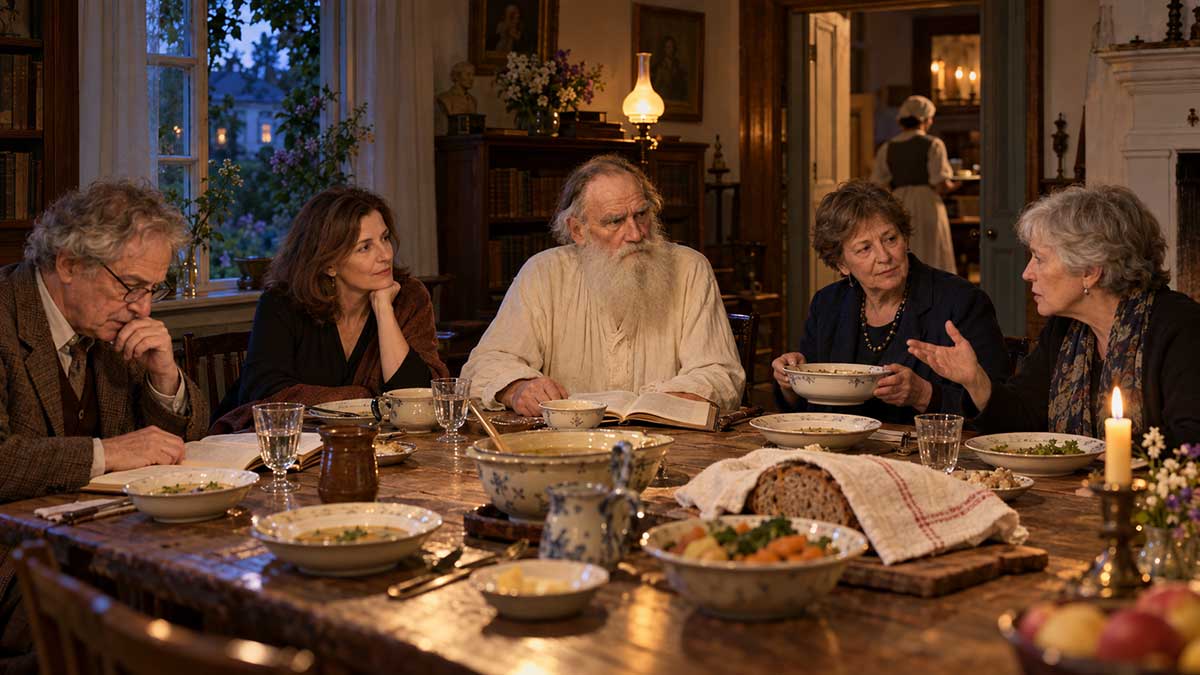
The supper table had been laid beside a window overlooking the garden. A loaf of bread rested under a cloth. There were bowls of soup, a dish of vegetables, and five places with room enough between them for the books.
Larissa Volokhonsky took her shawl back to the study. Caryl Emerson returned carrying the volume she had brought into the garden.
Rosamund Bartlett sat where she could still see the trees. Donna Tussing Orwin moved a bowl away from the edge of the table before taking her seat.
Tolstoy reached for the bread.
Caryl Emerson: We have spoken about people receiving care. I would like to ask what happens when a person’s place in a family depends on providing it.
Tolstoy stopped with his hand on the cloth.
Leo Tolstoy: You mean Sonya.
Emerson: I do. But Natasha must enter the question too. The ending invites us to recognize happiness in the household. Readers do not all recognize the same thing.
Gary Saul Morson: Some see a life becoming fuller. Others feel that the young woman they loved has been diminished. We should hear both without deciding in advance which reader has failed.
Rosamund Bartlett: Nor should we assume that devotion to children means a woman has ceased to be herself. Readers whose lives center on family deserve a more generous account than that.
Donna Tussing Orwin: Yet generosity toward those readers cannot settle the question of how the narrator presents Natasha. A chosen commitment and a prescribed ideal are different things.
Tolstoy broke the loaf and offered part of it to Bartlett.
Tolstoy: Would you prefer that she remain forever at her first ball?
Emerson: No. That question gives us only two possibilities: preserve the girl unchanged or accept your portrait of the wife without objection. There are other ways a woman might grow.
Morson: What bothers a reader may be less the loss of youthful elegance than the apparent narrowing of what the book allows us to value.
Tolstoy: She has not lost the capacity to love. She has people whose lives are bound to hers.
Bartlett: That is real. So is the shift in emphasis. Earlier we encounter her through singing, movement, responsiveness, mistakes, and changing attachments. The epilogue asks us to regard her differently. We can ask what that shift reveals and what it leaves out.
Orwin: Has Natasha found a fuller life, or has the narrator narrowed what we are allowed to value in her? The answer need not be entirely one or the other.
Tolstoy: You grant that she can be happy, then question the happiness I show.
Orwin: I question whether her happiness justifies every claim made around it. A particular woman can flourish in a household without her life becoming the standard by which other women must be judged.
Morson passed the bread to Emerson.
Morson: There is another point in Natasha’s favor. She remains capable of attending closely to Pierre. The marriage is not simply the end of her participation in his life.
Emerson: Yes. We should not turn her into an inert figure to make our objection easier. She perceives him, responds to him, and exerts an influence within their relationship.
Bartlett: Yet influence within a marriage is not the same as having every possibility available. What the book values and what it permits remain questions.
Tolstoy: No life contains every possibility.
Bartlett: True. The question is who is praised for relinquishing possibilities, who keeps theirs, and who relinquishes them without receiving much praise at all.
Tolstoy glanced toward Emerson’s book.
Tolstoy: Now we are back with Sonya.
Emerson: We never left her.
For several moments they ate without speaking. Morson opened his copy beside his plate.
Morson: Sonya gives up a claim on Nikolai. His eventual household has a place for her, but scarcely the future she once hoped for. Why does her devotion lead to so little room for a life of her own?
Tolstoy: Must every devotion end in the reward the person expected?
Emerson: No. A novel does not owe every good person a marriage. But we can question how it interprets the lack of a reward, and how comfortably the others live beside it.
Orwin: Her action has motives and circumstances. She is not a pure emblem of sacrifice. That makes her more interesting, not less deserving of attention.
Bartlett: Her position is dependent from the beginning. The family shelters her, but that shelter comes with unequal standing. An apparent choice made inside dependency cannot be read exactly like a choice made with money and secure alternatives.
Tolstoy: You would make her circumstances the whole of her character.
Bartlett: I would refuse to make her character the explanation for all her circumstances.
Emerson turned a page.
Emerson: The sterile-flower comparison is especially difficult. We should identify who says it, then attend to what the narration does around it. Attribution to a character does not automatically free the surrounding account from scrutiny.
Morson: The reader may initially hear a household explaining why it need not feel troubled. Sonya is assigned a nature that supposedly makes her deprivation less serious.
Orwin: Which can become a dangerous kind of reassurance. We decide that someone has little need of what we have not given them.
Tolstoy placed his spoon on the edge of his bowl.
Tolstoy: Would it be kinder to insist that she remain consumed by what she cannot have?
Emerson: That is another pair of alternatives that excludes the question. She can adapt to her life, and the people around her can still owe her more recognition and opportunity.
Bartlett: A person’s capacity to endure deprivation does not establish that the deprivation was harmless.
Morson looked down at the passage for a long moment.
Morson: I have often argued for attention to ordinary life. Sonya tests that argument. If we celebrate the household’s small acts of care without asking who repeatedly supplies them, our attention can become selective.
Orwin: Care can be genuine and uneven. We need not declare the entire family false to recognize an unfair arrangement within it.
Tolstoy: Nor should you assume that Sonya would choose the life you choose for her.
Orwin: Agreed. We should ask what she wants, rather than substitute our preferred independence for the family’s preferred service.
Emerson: That would already change the terms. Ask her, and permit an answer that inconveniences everyone else.
Outside, someone crossed the garden carrying an empty basket. Bartlett watched until the figure passed beyond the window.
Bartlett: Readers ask why the family could not help her find another marriage. That question recognizes the lack of alternatives, but it can reproduce the assumption that a husband is the only future worth offering.
Morson: What could they offer instead?
Bartlett: We must not invent a simple modern remedy for her historical position. But we can examine resources, security, acknowledgment, and the freedom to refuse a task. The family has more room to act than the phrase “that is her nature” suggests.
Tolstoy: You are proposing changes to the family.
Bartlett: I am asking why its comfort should define the limit of her possibilities.
Orwin: A practical test might be whether she can say no without risking her place. If every refusal appears ungrateful, her devotion is difficult to distinguish from an obligation she cannot safely question.
Morson: And if she chooses to stay?
Emerson: Then staying deserves to be heard as her choice. It must not become evidence that she never needed another one.
Tolstoy lifted the bread cloth and folded it beside the loaf.
Tolstoy: There is cruelty in families. There is dependence. Yet people can make a home together through duties that no one could perform alone. You risk describing every obligation as a loss of freedom.
Orwin: That is a fair warning. Responsibility can give a life shape and meaning. The issue is whether its burdens can be discussed and shared.
Bartlett: And whether devotion is met with devotion. Someone who regularly meets other people’s needs has needs of their own.
Emerson: We should examine Nikolai here. His estate work gives his life an intelligible purpose. His marriage to Marya contains affection and a serious relationship. Yet those gains do not retroactively make every earlier obligation disappear.
Morson: So growth does not erase a debt to someone whose prospects were narrowed along the way.
Tolstoy: Nor does an earlier failure erase every later good.
Emerson: I agree. That is exactly why we should resist one verdict about him. He can become capable in one respect and remain limited in another.
The exchange eased slightly. Orwin reached for the vegetables.
Orwin: What makes a household good for every person who helps sustain it? Perhaps we should ask that without using the word happiness for a moment.
Morson: Why set it aside?
Orwin: It can make us defend a picture instead of examining an arrangement. Who eats? Who rests? Who can speak without being dismissed? Whose plans are treated as real plans?
Bartlett: Who has a life when the household no longer needs their present service?
Emerson: Who is allowed to change?
Tolstoy looked from one speaker to another.
Tolstoy: And who stays when care becomes exhausting rather than attractive?
The question quieted the table.
Orwin: Yes. That belongs here. Freedom cannot mean that every difficult need becomes someone else’s problem.
Morson: Nor can duty mean one dependable person receives every difficult need.
Bartlett: A family may begin by admiring someone’s generosity and end by planning around it so completely that it no longer notices what it costs.
Emerson: Then gratitude becomes strangely inadequate. They thank the person for doing what they have made it almost impossible for the person to stop doing.
Tolstoy’s hand rested beside his bowl.
Tolstoy: You do not think affection can answer that.
Emerson: Affection can help someone hear the question. It cannot answer on the other person’s behalf.
Morson: I want to return to Natasha before we make her merely a beneficiary of Sonya’s loss. She gives care too. She is not exempt from fatigue or constraint simply since the narrator approves of her household life.
Bartlett: That matters. Sonya and Natasha need not compete for our sympathy. Recognizing one woman’s deprivation does not require denying another woman’s fulfillment or labor.
Orwin: And neither should disappear inside an argument about what women are supposed to want. Their particular lives are the test.
Tolstoy drew his book closer.
Tolstoy: Then your objection is not that the family is incapable of happiness.
Bartlett: No. It is that happiness must not prevent inquiry into the conditions sustaining it.
Emerson: Especially when the person who pays part of the cost is asked to accept that she was never suited to anything else.
Tolstoy opened the epilogue and remained silent.
A woman entered with a fresh dish. Morson moved his book to make room. She set the dish down and reached for an empty bowl near Bartlett.
Bartlett: Thank you.
The woman smiled briefly and carried the bowl away. Bartlett watched the steam rising from the fresh dish.
Bartlett: I hope the people who prepared this have time to eat something warm themselves.
No one followed the exchange with a declaration about what it meant. Emerson watched the door, then returned her eyes to the open book.
Emerson: A question at the table is a beginning. We should be careful what we allow it to count as.
Tolstoy put his thumb against the page to hold it open.
Tolstoy: Read the passage you wanted me to answer.
Topic 5: Why War and Peace Does Not End in Peace
An imaginary conversation inspired by War and Peace and writings about it. The dialogue is fictional, not a historical transcript.
Emerson read the passage about Sonya, then left the book open. Tolstoy listened without interrupting. When she finished, his thumb remained against the page.
The light outside had faded. Donna Tussing Orwin carried her plate into the adjoining room, where Volokhonsky was waiting. Isaiah Berlin took the vacant chair, drawing it close enough to hear without leaning across the table.
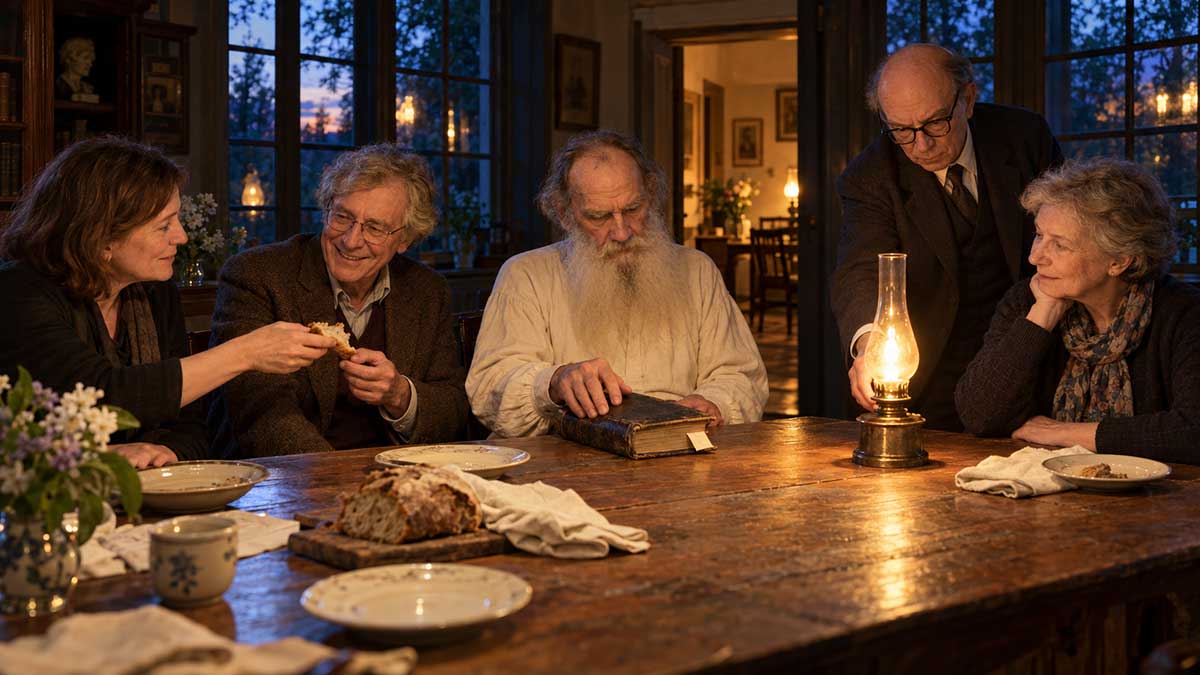
There was bread left between them. Someone had brought a lamp.
Isaiah Berlin: Have you acquitted the family?
Caryl Emerson: We have asked whether acquittal is the right ambition.
Rosamund Bartlett: A household can be worth loving and still require changes its happiest members have not considered.
Leo Tolstoy: You have made happiness work very hard this evening.
Gary Saul Morson: Perhaps your ending does too. Pierre has a household he loves. Then the book gives him concerns that cannot be confined to it. Why is that there?
Tolstoy took his hand from the page.
Tolstoy: Would a marriage remove the conditions under which the married people live?
Berlin: No. But readers can feel a difficulty. Pierre has learned something through captivity that appears to release him from his earlier obsessions. Now he returns to organizing, judging public affairs, proposing action. Has he found a new expression of that discovery, or resumed an old habit?
Morson: Does his return to public concerns betray his peace, or show what that peace makes possible?
Emerson: We should resist deciding from the subject alone. Political activity need not be vanity. Domestic satisfaction need not be wisdom. We have to examine how he attends to people in each situation.
Bartlett: And keep the times distinct. Pierre’s possible future belongs to the world of the epilogue. It is not a statement that every later conviction of Tolstoy has already been resolved within him.
Tolstoy: You are determined to keep me from borrowing my own future.
Bartlett: Nor let the reader borrow it for you.
Morson looked toward the book between them.
Morson: Pierre’s gratitude has not made the world outside his home satisfactory. It may have made him more capable of participating in it. Yet we should keep Berlin’s suspicion: he has mistaken a proposed role for a completed moral life before.
Berlin: Precisely. The fact that an intention is public-spirited does not settle the matter. He may discover a need, then become intoxicated by the importance of being the person who answers it.
Tolstoy: And he may remain at home, admiring his gratitude, as other people endure what he prefers not to examine.
Emerson: Those are real risks in both directions. We should not allow either to excuse the other.
Bartlett: Pierre’s family does not stand outside the consequences of his action. Nor does it stand outside the consequences of his inaction. That makes the decision harder than choosing between selfish comfort and noble engagement.
Berlin reached for the bread, then offered it to Tolstoy first.
Berlin: We might say that peace cannot perform the work of judgment. It can alter the person making a judgment, but it does not give him infallibility.
Morson: That seems important for Karataev. The question of his approval appears within the household conversation. Yet the remembered man cannot be summoned to resolve every disagreement Pierre will face.
Emerson: Natasha’s response matters there. The marriage contains an exchange about what Pierre has become. She is not merely the domestic figure beside a man who has resumed a meaningful life elsewhere.
Bartlett: Which corrects a temptation from our earlier discussion. We can criticize the narrator’s portrait of her without overlooking the discernment she brings to this relationship.
Tolstoy: You have given her some room back.
Emerson: It was there in the book. Our argument had to make room for it.
The lamp flame shifted when someone opened a door beyond the room. Morson held the page down with the back of his hand.
Morson: Nikolai gives Pierre a more severe test. He does not simply dislike the idea. His loyalty could place him against Pierre, even within this extended family. What do they owe each other when conscience and loyalty pull them apart?
Berlin: To take the conflict seriously. Affection does not make their commitments harmless. Nikolai’s declaration points toward a circumstance in which the state could demand action against someone he knows and loves.
Tolstoy: Nikolai does not think his oath becomes optional when obedience is painful.
Emerson: Nor should we treat that as an empty preference. His sense of obligation has a history. Yet the seriousness of an oath does not establish that every act done under it is right.
Bartlett: Pierre’s conviction needs the same examination. Feeling that a cause is right cannot settle what he may demand of his companions or expose his family to.
Morson: Then neither man gets to say, “My commitment is sincere, so the consequences are someone else’s question.”
Berlin: Yes. But there may still be a point at which inquiry leaves them opposed. We should not offer a reassuring conversation that pretends careful listening always produces agreement.
Tolstoy: Nor should a family require its members to have no convictions that might disturb supper.
Emerson: It can require them to hear the consequences of those convictions. Nikolai should have to hear what obedience might do to Pierre. Pierre should have to hear what his proposed action might demand of Nikolai.
Bartlett: And the people beyond the two men should not become scenery. Spouses, children, dependents, and strangers can bear costs that the men discussing duty scarcely name.
Tolstoy lifted his eyes from the table.
Tolstoy: Would you make the fear of hurting someone a reason never to act?
Bartlett: No. I would make it a reason to account for them honestly.
Berlin: An honest account may still end in a decision someone else cannot forgive.
The sentence stayed with them. Emerson closed her book a little, then opened it again.
Emerson: That is why the ending matters. These people are close, but closeness has not abolished history. The marriage plots do not protect them from incompatible duties.
Morson: It changes how we read the happiness. We need not call it false. We must call it vulnerable.
Tolstoy: A reader who requires invulnerable happiness will find little of it among living people.
Bartlett: Yet vulnerability alone is not the final note. There is a child listening.
Morson turned toward the last pages of the first epilogue.
Morson: Nikolenka. Does he inherit a wiser hope, or the same hunger for greatness that wounded his father?
Bartlett: He inherits fragments before he can judge them. An absent father, an admired adult, words about public affairs, an image of meaningful action. His dream gathers those fragments into something more compelling than the conversation he overheard.
Berlin: And it returns us to the beginning of our encounter. A child wants his life to become a story with a place for greatness. The novel has spent so much time questioning precisely that desire.
Tolstoy: Should the child begin with the fatigue of an old man?
Berlin: No. But his hope need not be wise simply since it is young.
Emerson: Nor doomed simply since it resembles an earlier ambition. If we assign his future now, we commit the retrospective error before there is even a past to explain.
Morson smiled briefly.
Morson: That is a useful objection to both of us.
Bartlett: The dream can hold promise and danger together. We cannot know which actions will grow from it. We can ask what the adults are teaching him to admire.
Tolstoy: He cannot be protected from every longing.
Bartlett: Protection is not the only task. Someone can help him distinguish being admired from being useful, devotion from imitation, and courage from the desire to appear courageous.
Emerson: Someone can let him ask about his father without making the dead man an impossible standard.
Tolstoy’s expression changed. He looked toward the dark window, where the lamp had made a reflection of the room.
Tolstoy: A child can love a person whom he scarcely had time to know. The people around him cannot fill that absence merely by providing a sensible account.
Morson: They can stay near him as he tries to live with it.
Berlin: And admit what they do not know. The uncertainty may be kinder than a heroic portrait that makes every ordinary disappointment feel like a betrayal.
Bartlett: It gives him permission to become someone other than the answer to another person’s unfinished life.
Emerson looked at the place where the dream ended.
Emerson: This does not feel like a simple failure to finish the story. It feels like a refusal to let the adults’ settlement count as the child’s conclusion.
Morson: The household continues. Another person is only beginning to ask what a life might be.
Berlin: Then the ending has not escaped ambition. It has placed ambition where we cannot yet give it a verdict.
Tolstoy: You still wish me to pronounce one.
Berlin: I think I am learning why I should resist wishing that.
Tolstoy smiled, but did not press the concession.
The soup bowls had been taken away. A folded napkin lay between two books, and the last piece of bread remained on the plate.
Morson: We began by asking what our stories hide. I would now hesitate to say that the answer is simply ordinary life. A story can hide ordinary care. It can hide the cost of that care. It can hide a public duty by making a home appear sufficient. It can hide a home by making a public cause appear sufficient.
Emerson: Then the question follows us into whatever answer we prefer.
Bartlett: Especially the answer that makes us feel good about ourselves.
Tolstoy: And what would you have the reader do with such suspicion? Distrust every affection, every intention, every moment of peace?
Morson: Attend more closely before converting it into proof.
Berlin: And permit a judgment to remain revisable. I would keep my objection to your historical theory. But I would return to the lives it has not exhausted.
Tolstoy: You are leaving me with an objection and an invitation.
Berlin: I think that is what your book has left me.
Bartlett moved her chair slightly. The woman who had served the fresh dish earlier returned for the remaining plates. Morson lifted his books out of her way, then gathered the plates nearest him into a manageable stack.
Tolstoy reached for the bread plate. The woman gestured toward it, indicating that it could stay. He set it down again.
After she left, he looked at the chair that had been moved.
Tolstoy: It is easier to discuss what another person needs than to ask.
Emerson: Asking can disturb a very satisfactory explanation.
Bartlett took the remaining piece of bread and broke it, offering half to Morson. He accepted it without moving the book back between them.
Berlin rose to bring the lamp closer. From the adjoining room came the sound of another conversation, followed by laughter.
Tolstoy closed the novel, keeping a small slip of paper at the passage Emerson had asked him to answer.
Tolstoy: Leave that marked.
The supper table was nearly clear. The place beside Bartlett’s chair remained open, and the lamp gave them enough light to see one another.
Final Thoughts
Tolstoy’s book does not require us to choose between loving a life and questioning it. A family can offer genuine happiness and still overlook someone’s needs. A conviction can inspire courage and still conceal vanity. Peace can deepen gratitude without deciding what we owe to people beyond our home.
The scholars leave their disagreements intact. Berlin remains troubled by the historical theory. Sonya’s position does not become fair through a sympathetic remark. Natasha’s fulfillment deserves attention without becoming a prescription for everyone. Nikolenka’s hope remains a beginning whose consequences nobody can yet know.
What changes is the care with which the speakers make their claims. They return to scenes, revise an example, hear an objection, and notice a person their explanation had almost passed over. Even Tolstoy leaves a difficult passage marked.
That unfinished bookmark may be the right image to carry away. We need stories to make sense of experience, but we can keep a place for what those stories have not answered. We can value a household and ask who sustains it. We can act on a conviction and listen to those who will bear its cost. We can love someone without deciding in advance what their life must mean.
Short Bios:
Leo Tolstoy
Russian novelist and thinker, author of War and Peace and Anna Karenina. In this fictional exchange, his artistic intentions meet questions about historical explanation, moral responsibility, and domestic happiness.
Gary Saul Morson
Literary scholar and author of Hidden in Plain View: Narrative and Creative Potentials in War and Peace. He moderates by returning broad claims to particular scenes and overlooked actions.
Isaiah Berlin
Philosopher and historian of ideas whose The Hedgehog and the Fox examines Tolstoy’s view of history. His fictional role tests the tension between many-sided perception and unified explanation.
Donna Tussing Orwin
Tolstoy scholar and author of Tolstoy’s Art and Thought, 1847–1880. Her fictional role examines moral judgment, lived experience, care, and the limits of philosophical certainty.
Rosamund Bartlett
Biographer, translator, and author of Tolstoy: A Russian Life. Her fictional role brings historical context to questions about changing convictions, household obligations, and the next generation.
Caryl Emerson
Scholar of Russian literature whose work includes Tolstoy and other Russian classics. Her fictional role questions easy verdicts, distinguishes competing readings, and presses for attention to neglected perspectives.
Larissa Volokhonsky
Co-translator of War and Peace with Richard Pevear. Her fictional role brings close attention to language, viewpoint, repetition, and the difference between a character’s judgment and the narration.
Leave a Reply