

Introduction
What if the life we keep trying to reach is making us overlook the people already beside us?
In Leo Tolstoy’s War and Peace, ambition, love, faith, and family unfold within events no individual can fully control. People pursue recognition, belonging, certainty, and happiness. Then life interrupts. A battle changes the meaning of glory. A broken promise exposes the distance between feeling love and caring responsibly. A quiet act of service asks whether anyone has noticed the person performing it.
This first part of our trilogy brings Pierre Bezukhov, Andrei Bolkonsky, Natasha Rostova, Marya Bolkonskaya, Nikolai Rostov, Sonya, and Platon Karataev into an imagined gathering at a Russian country house. Across their conversations, they revisit what they wanted, whom they hurt, and what they still hope to protect. Their memories do not produce a single answer. Forgiveness, loyalty, grief, and peace mean different things to people who have paid different costs.
Part 2 turns to scholars and interpreters to examine Tolstoy’s artistic choices and unresolved questions. Part 3 carries those discoveries into five original modern stories about ambition, trust, crisis, care, and belonging.
This is a fictional conversation inspired by the novel. The dialogue is newly written, not quoted from Tolstoy; its premise allows surviving and deceased characters to meet.
(Note: This is an imaginary conversation, a creative exploration of an idea, and not a real speech or event.)
Topic 1: The Life We Thought Would Make Us Happy
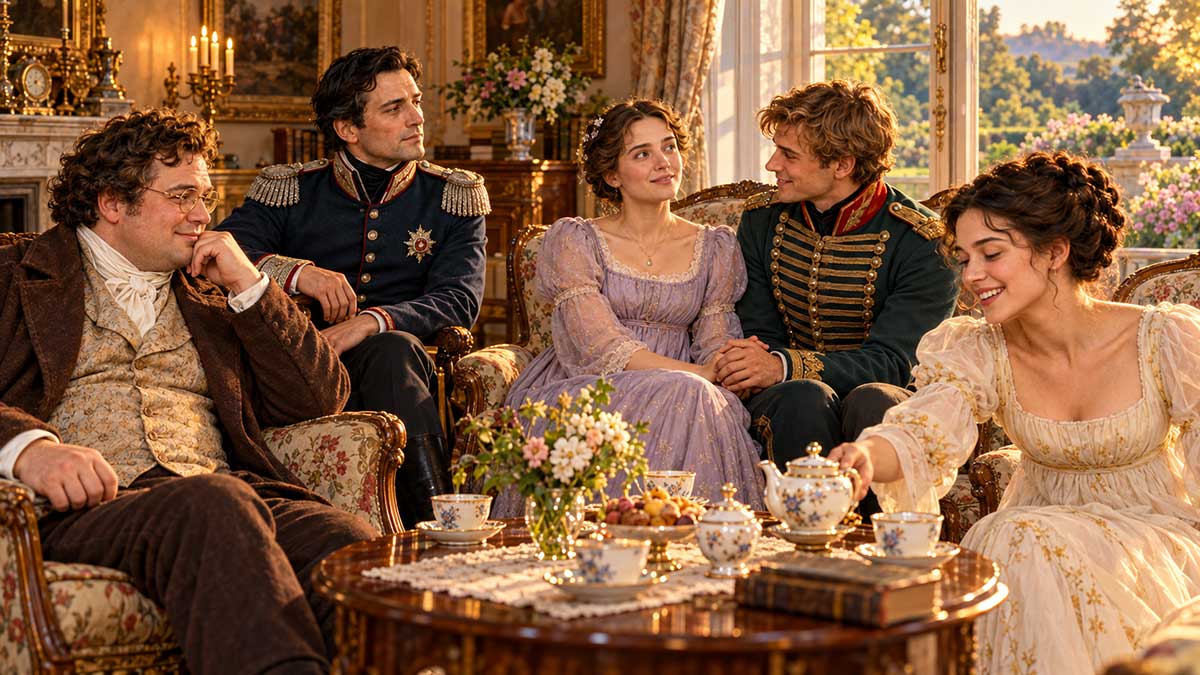
This fictional conversation brings together characters from Leo Tolstoy’s War and Peace after the novel’s events. The dialogue is newly written, inspired by their experiences and characterization.
Late afternoon rested on the country house. Through an open window came the smell of damp earth and the faint scrape of a gardener’s spade.
Pierre had chosen a chair too small for him. He shifted, discovered that the armrest had caught his coat, and abandoned the attempt to look comfortable.
Natasha watched him with a smile.
Natasha: You look as if the chair has asked you a difficult question.
Pierre: It has asked whether I belong in it. I have been considering that question in various forms for most of my life.
Nikolai: Try a larger chair.
Andrei: There is Nikolai’s philosophy. A difficulty appears; he orders the appropriate furniture.
Nikolai: And the difficulty disappears. You two would write to each other about the chair until winter.
Marya smiled. Pierre freed his coat.
Pierre: I meant to ask something quite simple.
Andrei: That usually means we should prepare ourselves.
Pierre: When did each of us first decide that happiness was somewhere we had not yet reached?
Natasha’s smile changed.
Natasha: You assume we decided. I think I simply ran after it.
Pierre: Yes. That may be closer. When my father died, people suddenly became attentive to everything I said. Before that, I could make a remark and see someone looking over my shoulder for a more suitable person. Afterward, the same remark became interesting.
Nikolai: You had become rich.
Pierre: I knew that. Yet I still enjoyed believing I had become interesting.
Andrei: What did you expect the money to give you?
Pierre: Freedom. A place. Some assurance that I would cease making a fool of myself.
Natasha laughed softly.
Pierre: You see how unsuccessful it was.
Natasha: I am laughing at the assurance. I would miss you terribly if you stopped making a fool of yourself.
Andrei: The money was only the beginning. You wanted a life that would justify you.
Pierre looked at him.
Pierre: Justify me to whom?
Andrei: That was the difficulty. You never quite chose your judge.
For a moment, Pierre said nothing.
Pierre: And you chose yours?
Andrei turned his eyes toward the window.
Andrei: I chose an audience. I wanted a moment after which no one could mistake me for an ordinary man.
Nikolai: A victory.
Andrei: My victory. There is a difference.
Nikolai: You did want to serve.
Andrei: I wanted several things. Service was one. Escape was another. I was capable of putting the more respectable word first.
Natasha leaned forward.
Natasha: Escape from what?
Andrei: Rooms such as this. Visits. Congratulations. The same conversation conducted by people who had already decided what everyone should say. A life arranged before I had agreed to live it.
Pierre: And marriage?
Andrei’s hand became still against the arm of his chair.
Andrei: Yes.
No one hurried to speak.
Andrei: I believed there must be something greater than the life waiting at home. At Austerlitz, I thought I had reached the moment I wanted. Then I was lying on the ground, looking at the sky, and the whole business appeared extraordinarily small.
Nikolai: It did not become small to the men who were still fighting.
Andrei: No. I am describing what happened to my ambition. Their danger remained.
Nikolai: I am glad you distinguish them. A man can grow ashamed of his own desire for glory and begin speaking as if courage itself were a mistake.
Andrei: Courage was never the mistake. I mistook being admired for having lived well.
Marya lowered her eyes.
Marya: Those can resemble each other from a distance.
Pierre: And from close by?
Marya: From close by, someone usually knows the difference.
Natasha looked from Marya to Andrei, then spoke quickly, almost protectively.
Natasha: I did not want people to admire me in that way. At the ball, I wanted someone to come and ask me to dance. It seemed unbearable that everyone could see me and no one would choose me.
Andrei: I remember.
Natasha: You remember asking. I remember the time before you asked. Every minute became a judgment. I thought that if the evening went badly, something had been decided about my whole life.
She gave a small, embarrassed laugh.
Natasha: It sounds absurd when I say it here.
Pierre: It did not feel absurd then.
Natasha: No. It felt enormous. Then you came, and suddenly the room was different. I thought happiness had arrived and would know how to stay.
Andrei’s expression softened, but she continued before he could answer.
Natasha: Please do not make that memory solemn. I was happy. Whatever happened afterward, I was happy.
Andrei: I would not take it from you.
Nikolai: Nor should anyone. We speak of youthful hopes as if surviving them proves they were foolish. I was happy in the regiment. I knew where to stand, what to do, whom to trust. At home, every difficulty opened into six more.
Pierre: You found certainty there?
Nikolai: Enough for the morning. Sometimes that is a great deal.
Andrei: And the emperor?
Nikolai breathed out.
Nikolai: Yes. I wanted his approval. I wanted to belong to something I could respect without examining it every hour.
Pierre: Did it make your life complete?
Nikolai: No. But it gave part of my life a form. I will not pretend that was worthless.
Outside, the gardener set down his spade. The sudden absence of its scraping drew their attention to the quiet.
Pierre: Perhaps complete is the wrong word. Perhaps we each asked one thing to do too much.
Natasha: Love.
Andrei: Achievement.
Nikolai: Loyalty, perhaps.
Marya reached for the teapot. Natasha held out her cup, and the conversation briefly became ordinary: a little more tea, no sugar, the plate passed across.
Pierre watched Marya pour.
Pierre: There is another part of this I find less pleasant. When I pursued those things, I thought mainly of what they would give me. I rarely asked who would have to endure my pursuit.
Andrei looked down.
Andrei: Lise.
Her name altered the room.
Andrei: I let my impatience become the atmosphere she lived in. She could not say something cheerful without encountering my weariness. I thought I was being honest about society. She had to receive that honesty at breakfast.
Marya put down the teapot.
Marya: She was frightened.
Andrei: I know.
Marya: You know now.
He accepted the correction without looking away.
Andrei: Yes.
Marya: At home, we waited for news of you. She waited with her own fears, and with a child coming. Your absence was filled with things you could not see.
Andrei: I wanted to return as someone changed.
Marya: She needed you to return.
Natasha’s fingers tightened around her cup.
Andrei: When I came back, she died. I could no longer speak to the person who had lived beside my discontent. I was left with her face and all the answers I had prepared too late.
Pierre started to speak, then stopped.
Andrei: You need not make it useful, Pierre.
Pierre: I was going to say something about regret.
Andrei: I know.
Pierre: I will let it remain regret.
Nikolai stared at the floor.
Nikolai: My father paid my gambling debt.
Natasha: Nikolai.
Nikolai: Let me say it. I dreaded telling him. Then I told him, and he began thinking about how to find the money. I felt relief before I felt anything else.
Pierre: You were young.
Nikolai: Young enough to lose it. Old enough to let him pay.
He rubbed his thumb against his palm.
Nikolai: I remember the relief more clearly than I wish. The disaster had moved from my hands to his. I could breathe again. He had to begin worrying.
Marya: You later took responsibility for the family.
Nikolai: Yes. That does not change the first moment.
Natasha: It changes what you did with the rest of your life.
Nikolai: It does. I am grateful for that.
Natasha set her cup down.
Natasha: I hurt people who trusted me. At the time, my feelings seemed to explain everything. If I felt something strongly enough, I thought it must tell me what was true.
Andrei watched her quietly.
Natasha: I know that is not an excuse.
Andrei: You need not argue against an accusation I have not made.
Natasha: I still hear it sometimes.
The words came more slowly.
Natasha: I wanted happiness immediately. Waiting seemed like being left outside my own life. Then someone offered me certainty, and I mistook it for love.
Pierre: You were deceived.
Natasha: Yes. And I made decisions. Both things happened.
Marya looked at her with a tenderness that did not interrupt.
Natasha: I cannot remove what I did. I can become someone who notices more before she acts. That is slower than saying I have changed.
Andrei: Much slower.
Natasha: You always did prefer difficult terms.
A faint smile passed between them.
Pierre rose and went to the larger chair beside the window.
Nikolai: Progress.
Pierre: Practical philosophy has its merits.
He sat, then turned back to Marya.
Pierre: You said someone close by knows the difference between being admired and living well. Did you spend your life knowing it for other people?
Marya: I spent much of it trying to decide whether I was being selfish.
Natasha: For wanting what?
Marya: That depended on the day. To leave a room. To stay in it. To be praised. To escape praise. To have someone speak to me gently without my first doing something worthy of gentleness.
Andrei’s face changed.
Andrei: Marya.
Marya: I loved our father. I knew there was affection in him. I searched for it in every mood.
Andrei: He made that search hard.
Marya: Yes. And I sometimes made a virtue of continuing it. If I was patient enough, perhaps I would receive what I wanted. Then, when I became angry, I was ashamed of the anger.
Pierre: Did faith help you?
Marya: It helped me endure. At times, I used it to rebuke myself for needing anything.
Nikolai shifted closer.
Nikolai: You were allowed to need affection.
Marya: I did not always know how to believe that.
Natasha: I needed it so openly that everyone knew.
Marya: I envied you.
Natasha looked startled.
Marya: Your delight. Your ability to enter a room and want something from life without first apologizing to God for wanting it.
Natasha: I was not always good at knowing what to want.
Marya: Neither was I. Our mistakes had different appearances.
The gardener began working again.
Pierre listened to the scrape outside.
Pierre: I once believed that a proper system would prevent mine. I joined the Freemasons. I wanted to become useful and good. I returned from my estates believing I had improved people’s lives.
Andrei: You believed your managers.
Pierre: I believed the account that made my intentions look successful. It was pleasant to leave with a good opinion of myself.
Nikolai: Estates do not improve through a good opinion.
Pierre: No. There are people living under every line of an account. I saw the lines more readily than the people.
Marya: And intentions can become another form of admiration.
Pierre: Admiration supplied by oneself. Very economical.
Natasha smiled, but Pierre’s eyes remained on the garden.
Pierre: I should like to be useful without needing usefulness to prove that I deserve to exist.
Andrei studied him.
Andrei: You will probably continue needing both.
Pierre: You offer such comfort.
Andrei: I offer you the chance to notice it.
Nikolai: And to ask whether the work has actually been done.
Natasha: And to come home afterward.
Pierre turned toward her.
Natasha: You can spend a whole evening loving humanity and fail to hear one person calling you from the next room.
He nodded.
Pierre: I have done that.
Natasha: I know.
There was affection in the exchange, and something firmer than affection.
Andrei rested his hands together.
Andrei: What hopes survive this examination?
Pierre: I still want people to suffer less. I still want to help change things. I should only like to become harder to deceive, particularly by myself.
Nikolai: I want a household in which debts are paid and people can depend on what I say. I want the land managed well. Those are ambitions too.
Pierre: What does managed well mean for the people who work it?
Nikolai looked at him.
Nikolai: A question I have to answer through conduct. I cannot settle it by telling you that I am a good master.
Marya: Or by allowing us to tell you.
He glanced at her, then nodded.
Natasha leaned back.
Natasha: I still want joy.
Andrei: You say that as if someone intends to forbid it.
Natasha: People become suspicious of joy after sorrow. They ask whether it is deep enough, deserved enough, respectful enough. I do not want to spend my life proving that I have grieved properly before I am allowed to laugh.
Marya’s eyes filled.
Natasha: I want to love the people who are here. I want to hear a child laugh without immediately fearing the day he will stop. I know I cannot keep everything. I would still like to receive it.
Andrei looked toward the open window.
Andrei: I would defend the wish to do something worthy. I would examine more carefully the wish that everyone should know I had done it.
Pierre: And the sky?
Andrei: It did not tell me to abandon every purpose. It showed me how small a purpose becomes when it requires the whole world to applaud.
Natasha turned to Marya.
Natasha: We are doing it again.
Marya: What?
Natasha: Speaking of our hopes and letting you listen.
Pierre lowered his head.
Pierre: Yes. Marya, what would you still ask of life for yourself?
She hesitated. Nikolai began to reach for her hand, then left his own open beside hers.
Marya: I would like to be wanted when there is nothing I need to do.
No one answered immediately.
Marya: I would like to sit with the people I love without wondering whether I have earned my place by being useful.
Nikolai took her hand.
Nikolai: Sit here.
She looked at him.
Nikolai: You have not poured my tea.
A small laugh escaped her.
Nikolai: You may continue neglecting it.
Natasha moved the teapot away from Marya.
Pierre looked around the room, searching for words. Then he let the search go.
Marya settled back into her chair. Beyond the window, the gardener lifted his spade and moved to another patch of earth.
For once, she did not rise to ask whether anyone needed anything.
Topic 2: When Love Wounds the People It Wants to Hold

The garden paths were still damp from an earlier shower. Near the house, white flowers caught the last light. Farther away, the trees had already begun to disappear into shadow.
Sonya sat on the end of a bench, leaving enough space for two people beside her. Natasha took that space without asking. Marya settled in a chair facing them.
Pierre remained standing until Andrei glanced at him.
Andrei: If you intend to ask us something painful, you might at least sit down.
Pierre: I had hoped the question would become less painful if I took a little longer to ask it.
Natasha: Has that ever worked?
Pierre: No.
He sat.
Pierre: Can love remain real when the person expressing it has acted cruelly?
Natasha looked at Andrei. Sonya looked at the path.
Andrei: Real to whom?
Pierre: To the person who feels it. To the person who receives it.
Andrei: Those are two questions.
Natasha: And sometimes two different answers.
A breeze moved through the flowers.
Natasha: When I hurt you, I did not think I had stopped being someone capable of love. But that would have been a very poor thing to say to you.
Andrei: It would.
Natasha: You would have heard me asking you to admire a feeling that had done nothing to protect you.
Pierre: A feeling can be genuine and still fail someone.
Sonya: Yes. People are often quite sincere when they ask you to wait.
Pierre turned toward her.
Sonya: I did not mean only Andrei.
Natasha’s hand moved toward Sonya’s, then paused.
Andrei: I asked Natasha to wait a year.
Marya: Our father required it.
Andrei: I accepted it.
Natasha: You gave me permission to change my mind.
Andrei: I thought that was fair.
Natasha: It was fair in words. I did not know how to tell you that the words made me feel less held.
Andrei: Would you have preferred a promise you could not withdraw?
Natasha: At the time, perhaps. I was young enough to mistake being unable to leave for being unable to lose you.
She looked down at the wet stones.
Natasha: I would not ask for that now.
Marya: You were being asked to live within a decision made by people far away from you.
Andrei: I was part of that decision. I will not hide behind my father.
Natasha: Nor can I hide behind your absence. There were many things I could have done. I could have written honestly. I could have told my father I was unhappy. I could have listened to Sonya.
Sonya remained still.
Natasha: You tried to make me listen.
Sonya: I did.
Natasha: I treated you as if your love for me had become interference.
Sonya: You thought I was standing between you and your happiness.
Natasha: Yes.
Sonya: I was standing between you and a carriage.
Andrei lowered his eyes. Pierre rubbed his hands together.
Sonya: A carriage with a man who could not marry you. That mattered more than whether you thought I was a good cousin that night.
Natasha: I know.
Sonya: You did not know then. I could not make you know merely by loving you.
The directness of the words left Natasha silent.
Pierre: Anatole concealed his marriage. Hélène helped him. You were being deceived.
Natasha: I was. And I was willing to believe what gave me the answer I wanted.
Marya: Both truths can remain.
Andrei: I did not leave much room for either when I returned.
He looked at Natasha.
Andrei: I knew you had broken the engagement. I knew who the man was. Everything else seemed an attempt to make the injury smaller.
Natasha: I was ashamed before you spoke to me. Afterward, I thought shame was all that remained of me.
Andrei: I wanted you to know that something had been destroyed.
Natasha: I knew.
Andrei: I wanted you to know it as I knew it.
Pierre: Is that possible?
Andrei watched a branch moving above the bench.
Andrei: No. But people who are hurt demand it all the same.
Marya: Sometimes they want acknowledgment. Sometimes they want the other person to remain in pain until their own pain ends.
Andrei: I had more of the second wish than I would once have admitted.
Natasha: I cannot ask you to say your pain was pride.
Andrei: I have not said that. I loved you. I expected a future with you. Losing it hurt. Pride helped me decide what to do with the hurt.
Pierre leaned forward.
Pierre: What would forgiveness have required from you then?
Andrei: More than I could give.
Marya: And what would reconciliation have required?
Andrei: Trust. A willingness to put my life beside hers again. Those did not follow merely from deciding that I should be generous.
Natasha: I wanted forgiveness to make everything return. I wanted the future back with it.
Sonya: People often ask one word to restore a great deal.
Natasha: Yes.
Sonya: A person may forgive you and still refuse what you want.
Natasha nodded slowly.
Natasha: I could not have borne hearing that then.
Sonya: You might still have needed to hear it.
Marya looked at Sonya with new attention.
Marya: You have had to know that without anyone explaining it kindly.
Sonya’s expression tightened.
Sonya: I have had to know several things kindly explained by people who received what I lost.
Marya absorbed the answer.
Marya: Yes.
The house behind them had begun to glow at its windows. Somewhere inside, a door opened and closed.
Pierre: Natasha, when you found Andrei among the wounded, what did you hope for?
Natasha: First, that he would live. Before I saw him, I was afraid he would refuse to let me come near him. Then I saw how ill he was, and the fear changed. I wanted him to need something I could bring.
Andrei: You brought more than you knew.
Natasha: I brought water. I listened. I tried to move quietly. Some hours, that was all I knew how to do.
Pierre: Did you think you were earning forgiveness?
Natasha: Sometimes. I wish I could say I never did. But when a person is suffering in front of you, your own account of yourself becomes harder to keep attending to.
She turned to Andrei.
Natasha: There were moments when I forgot to ask whether you loved me. I was watching your breathing.
He looked at her for a long time.
Andrei: That was a mercy.
Natasha: Then you would look at me, and I would want everything again.
Marya’s eyes shone.
Marya: We do not become free of wanting merely by caring well.
Pierre: Perhaps care becomes more honest when we admit that.
Sonya: Or when the person being cared for does not have to satisfy the wanting.
Pierre stopped.
Sonya: I do not mean that we should ask nothing from one another. I mean that service can carry a hope no one has agreed to fulfill.
Natasha turned fully toward her.
Natasha: Are you speaking about Nikolai?
Sonya: Yes.
No one moved to soften his name.
Sonya: I loved him. I did not merely enjoy being faithful. I wanted to marry him. I wanted a home in which I was his wife, not someone whose presence had become customary.
Marya: I know.
Sonya looked at her.
Sonya: You know what happened. I am not certain anyone knows how long I lived inside what I thought would happen.
Marya clasped her hands.
Marya: Tell us.
Sonya: There were days when a remark from him could keep me happy for weeks. A kindness could become a promise. I knew his family needed money. I knew I had none. I began feeling that my existence was something love would have to overcome.
Natasha: You were part of our family.
Sonya: I was. That gave me a place and made it difficult to object to the place I was given.
Natasha looked away.
Sonya: Your mother had been good to me. Your father had been good to me. I could not forget that when your mother looked at me and saw a marriage that would make everything harder.
Pierre: Gratitude made it difficult to speak.
Sonya: Gratitude, affection, dependence. I could not separate them neatly. Nor could I arrange a life elsewhere merely by wishing for one.
Marya: And the letter releasing him?
Sonya drew a breath.
Sonya: I wrote it.
Natasha: You wanted to help us.
Sonya: I did. I wanted to be generous. I wanted the pressure to stop. I wanted him to choose me without being bound.
She pressed her fingers together.
Sonya: Some part of me believed that freeing him might bring him back.
The garden grew quiet around them.
Sonya: There. It sounds less beautiful when I say the whole of it.
Marya: It sounds like something written by a person.
Sonya looked at her, surprised.
Marya: You need not remove your hope from the letter to deserve our tenderness.
Sonya: I have sometimes wished I had been less tender toward everyone else.
Natasha blinked, then nodded.
Natasha: I can see why.
Sonya: Can you?
Natasha: I am trying.
Sonya studied her face.
Sonya: Then let me say something without answering it for me. I was jealous.
Marya’s gaze did not move.
Sonya: Of you. Of your happiness with him. Of your children. Of the ease with which people could speak of your future once ours had disappeared.
Marya: You may say it.
Sonya: I wished you well and was hurt that you were well. I did not know where to put those feelings. If I showed only affection, people thought I had ceased suffering. If I showed sorrow, I feared I would poison the house.
Pierre: And we praised your goodness.
Sonya: Yes. Goodness was a room with very little air in it.
Natasha’s eyes filled.
Natasha: I spoke about you as if I knew what you could feel. As if your life could be explained by saying you were different from us.
Sonya waited.
Natasha: I made your disappointment easier for me to look at.
Sonya: You did.
Natasha accepted the words.
Natasha: I am sorry.
Sonya looked toward the house.
Sonya: I hear you.
The answer offered neither punishment nor immediate relief.
Andrei shifted in his chair.
Andrei: If Nikolai had married you out of obligation, would that have given you what you wanted?
Sonya: No.
Andrei: Then some part of the loss could not have been prevented without asking someone else to live falsely.
Sonya: I know. I am not asking Marya to surrender her marriage. I am asking you to see that something can be right for two people and still wound a third.
Marya: And that our happiness does not make your sorrow unreasonable.
Sonya nodded.
Pierre: What do we owe you, then?
For the first time, Sonya looked impatient.
Sonya: Must I tell everyone how to be kind to me?
Pierre lowered his head.
Pierre: No.
Sonya: You are asking sincerely. I know that. But I have spent a long time making things easier for this family. Now I am to make my unhappiness easier to answer.
Natasha: You do not have to answer tonight.
Sonya: Thank you.
A servant appeared at the garden door carrying a shawl. Sonya rose instinctively.
Marya: Please stay. She is bringing it to you.
Sonya sat again.
The servant laid the shawl across her shoulders and withdrew. Sonya held its edges together without speaking.
Andrei: There is a danger in asking what we owe someone. We can begin looking for an amount that will settle the matter.
Pierre: Money. An apology. A kindness.
Andrei: Any of them may be necessary. None guarantees that the person will cease to hurt.
Marya: Nor should our kindness depend on that result.
Natasha: I keep wanting Sonya to smile at me.
Sonya turned toward her.
Natasha: I am saying it so I can stop asking you silently.
Something in Sonya’s face loosened, but she did not smile.
Sonya: That is better.
Pierre watched the two women.
Pierre: When I came to you after Anatole had gone, Natasha, I did not know what could be repaired. I only knew I could not bear to see you treated as if the worst thing you had done was the whole of you.
Natasha: You gave me a place to stand.
Pierre: I wanted more than that. I loved you. My kindness was not free of desire.
Natasha: I know that now.
Pierre: Would it have been less kind if you had never loved me?
Natasha: Only if you had made me repay it.
He sat back, taking in the answer.
Marya: Perhaps that is something all of us must watch. The moment when love begins keeping an account.
Sonya: An account can be kept by the person who gives or by the people who receive. I have heard sacrifices remembered very warmly when another sacrifice was needed.
Marya’s voice was quiet.
Marya: I will watch for that in our house.
Sonya: You may miss it.
Marya: Then I hope you will tell me.
Sonya: And if I do not speak gently?
Marya hesitated. The hesitation mattered.
Marya: I hope I will listen before deciding that gentleness was the most important thing missing.
Andrei looked at his sister.
Andrei: That will be difficult.
Marya: Yes.
Natasha reached for Sonya’s hand again. This time she stopped with her palm resting open on the bench between them.
Natasha: I would like to be near you. You need not make that comfortable for me.
Sonya looked at the offered hand.
Sonya: Sometimes I still want to talk about him.
Marya nodded.
Sonya: Sometimes I want an evening in which no one mentions him. Sometimes I want to leave the room without someone wondering whether I am unhappy.
Natasha: And sometimes?
Sonya: Sometimes I am unhappy.
Natasha’s hand remained where it was.
Sonya: I would like that to be allowed without becoming the explanation for everything I do.
A bird moved in the hedge, shaking a few drops from the leaves.
Pierre opened his mouth, then closed it. There was no need to decide what the evening had taught them before Sonya had finished living it.
After a time, she placed her hand beside Natasha’s. Their fingers touched.
Sonya: Stay a little longer.
Natasha settled back against the bench.
Natasha: Yes.
They remained in the gathering dusk, and no one asked Sonya whether she felt better.
Topic 3: War, Fear, and the Limits of Control

A lantern hung beside the courtyard door. Its light reached the nearest wheel of an empty cart, leaving the rest in shadow.
Natasha stood beside it, one hand on the wooden side. Nikolai examined a strap hanging loose beneath the seat.
Pierre had brought chairs outside. Andrei chose the one facing the open gate. Karataev sat near the lantern, turning a small piece of bread in his hands.
Pierre: At Borodino, I kept thinking someone must know what was happening.
Nikolai: Someone knew what was happening where he stood.
Pierre: I meant the whole of it.
Andrei: You were looking for a man with a view of the entire battlefield and a mind large enough to contain every frightened person on it.
Pierre: Yes. Put that way, it sounds unreasonable.
Nikolai: It sounds like a civilian arriving at a battle.
Pierre smiled briefly.
Pierre: That is exactly what it was.
Karataev brushed a crumb from his coat.
Karataev: And did you find him?
Pierre: No.
Karataev: You found the men beside you.
Pierre looked at him.
Pierre: I did. At the battery, they were doing things I scarcely understood. Carrying, loading, shouting. They could laugh, and then something would happen that made laughter impossible. I did not know when I was in the way.
Nikolai: You probably were.
Pierre: Frequently.
Natasha: Did they tell you to leave?
Pierre: Some laughed at me. Some made room. I began wanting them to like me. It seems a strange thing to remember from such a place.
Andrei: It is a human thing to remember.
Pierre: I had gone to see a battle. Then I found myself among men whose faces mattered to me. The words I had arrived with stopped fitting.
Nikolai rested the strap on the seat.
Nikolai: The first time I was wounded, I thought about how impossible it was that someone should want to kill me.
Natasha: You?
Nikolai: Yes. Me. Our family loved me. My friends knew me. I carried all that affection into a place where it meant nothing to the man approaching.
He looked toward the gate.
Nikolai: I wanted to get away. That was the thought. Afterward, there were more respectable ways of speaking about it.
Andrei: Men sometimes spend the rest of their lives improving the account of a few minutes.
Nikolai: You make that sound contemptible.
Andrei: I have done it.
Nikolai: Then say that first.
Andrei inclined his head.
Andrei: I have done it. I remember wanting an action to look a certain way before I had performed it. It is difficult to admit how much of courage can be watched by an audience inside one’s own head.
Natasha: Does that make the courage less real?
Andrei: No. It makes the person less simple.
Karataev broke his bread into two pieces and offered one to Pierre. Pierre accepted it before seeming to notice what he had done.
He held it in his palm.
Pierre: There were times in captivity when I could think of little beyond the next piece of food.
Karataev: You were hungry.
Pierre: Before that, I would have thought such a life terribly diminished.
Karataev: It was a hard life.
Pierre: Yet food could give me happiness I had not found at a table covered with it.
Karataev nodded.
Karataev: A hungry man tastes his bread.
Andrei: A man can taste his bread without being imprisoned.
Pierre: I know.
Andrei: It matters that you know.
Pierre looked down at the piece in his hand.
Pierre: I am describing what I found. I sometimes speak as if finding it explains what happened.
Natasha: Does it?
Pierre: No.
The loose strap tapped against the cart.
Pierre: When the prisoners were shot in Moscow, I could not understand how the world could continue around it. There were people carrying out orders, arranging where men should stand. Each action had a person doing it. Yet I could not find anyone who seemed to hold the whole act in his hands.
Nikolai: Orders do not carry themselves out.
Pierre: No.
Nikolai: A man still raises the weapon.
Andrei: And another man gave him the order. And another established the procedure. Every person can describe a smaller part than the thing that was done.
Natasha: Is that how no one becomes responsible?
Andrei: It can be.
Nikolai: But an army cannot function if every soldier decides each order afresh.
Natasha: Then what does he do when the order is terrible?
Nikolai did not answer immediately.
Nikolai: I do not have an answer that makes it easy.
Andrei: There is no reason it should become easy.
Nikolai: Easy was not what I meant. Men depend on each other in battle. One man’s obedience may keep another alive. You cannot speak of it only as surrendering thought.
Pierre: And you cannot let dependence settle every question.
Nikolai turned toward him.
Nikolai: I know you think that.
Pierre: I am asking what happens when each person believes the responsibility belongs somewhere above him.
Karataev looked at the bread still uneaten in Pierre’s hand.
Karataev: Eat it, dear fellow. You need not wait until we have settled the army.
Pierre let out a breath that was almost a laugh. He ate.
Natasha drew her hand along the cart’s edge.
Natasha: When we were leaving Moscow, the carts were already full. Everything had a place. Someone knew which things were valuable and which things could travel together. Then there were wounded men who had no place.
Nikolai: You made Father take the possessions out.
Natasha: I could not bear the arrangement. We had space for things that could not feel anything, and people waiting to be left behind.
Andrei: You did not know I was among them.
Natasha: No.
She looked at him.
Natasha: I am grateful for that.
He understood before she explained.
Natasha: I would hate to think I needed to recognize you before the carts became unbearable to me.
Pierre: You saw what could be done.
Natasha: I saw one thing. I did not know how to feed everyone or where we would go. I was frightened about that later.
Nikolai: Someone had to be frightened about it immediately. Horses tire. Roads close. A cart can carry only so much.
Natasha: Would you have kept the possessions?
Nikolai: No. I am saying that compassion still needs horses.
Natasha considered him, then nodded.
Natasha: Yes.
Nikolai: Someone must find them, prepare them, decide the road, and get people moving. Seeing the right thing is the beginning of work.
Pierre: I had a very different plan in Moscow.
Andrei’s expression changed.
Andrei: Napoleon.
Pierre: I had convinced myself that I ought to kill him. I found significance in numbers, in names, in coincidences. I believed I had discovered what I was meant to do.
Nikolai: That was your plan?
Pierre: It scarcely deserves the word.
Natasha: You never told me all of that.
Pierre: It is difficult to recount without discovering how foolish I was.
Andrei: Continue.
Pierre: I wanted an act that would explain my life. Then there was a child in danger, and a woman being threatened. Those people had no knowledge of the explanation I had prepared. They needed help.
Karataev: People can be troublesome that way.
Pierre looked at him, then laughed.
Pierre: Yes.
Karataev: They arrive before you have finished thinking.
Andrei: And occasionally save you from what you intended to do.
Pierre: Helping them did not prevent my arrest.
Nikolai: Nor does arrest make the help foolish.
Natasha: Is that what we are asking? What remains worth doing when it cannot make us safe?
Andrei rested his elbows on his knees.
Andrei: At Borodino, there were moments when safety had ceased to be something a man could arrange. A regiment could be placed, moved, held. A shell could still arrive where a person stood.
Pierre: Did you know you would be wounded?
Andrei: No. I knew I could be. Those are different forms of knowledge.
Nikolai: One lets you go on standing.
Andrei: Until you cannot.
The lantern flame shifted. Natasha watched its movement through the glass.
Natasha: I keep thinking of Petya going forward.
Nikolai’s hand closed around the cart strap.
Nikolai: So do I.
Natasha: He wanted to be useful. He wanted the men to like him. He was so pleased to be included.
Pierre glanced down.
Pierre: I spoke of wanting the men at the battery to like me.
Natasha: Yes. I heard you.
Nikolai: Petya was still a boy.
Natasha: He did not want us to call him one.
Nikolai: That did not make him grown.
For a time, the only sound was a horse moving in the stable.
Natasha: People could tell us where he died. How he moved. Who was there. I wanted an account that would somehow leave him alive at the end.
Nikolai’s eyes remained on the strap.
Nikolai: There is always a moment before it happens. I return to that moment. Someone could have held him back. He could have waited. The shot could have missed.
Andrei: Yes.
Nikolai: Then I begin arguing with things that have already happened.
Andrei: Yes.
Nikolai: Is that all you can say?
Andrei looked directly at him.
Andrei: I will not tell you that his death becomes necessary when viewed from a sufficient distance.
Nikolai released the strap.
Natasha: Thank you.
Pierre rubbed a crumb between his fingers.
Pierre: I have spoken of captivity as if it gave me my life back.
Karataev: You came home.
Pierre: You did not.
Karataev looked at him without reproach.
Pierre: Every time I say what I learned, I fear I am putting your death inside the lesson.
Karataev: You did not choose my death.
Pierre: I kept walking.
The words seemed to cost him more than the longer speeches.
Pierre: I heard the shot. I did not turn back.
No one moved.
Pierre: I can explain why. I was exhausted. I was afraid. Men were dying beside the road. All of those things are true. They do not remove the sound.
Karataev set the remaining bread on his knee.
Karataev: You have kept it with you a long time.
Pierre: Yes.
Karataev: And you have kept other things.
Pierre looked at the bread.
Karataev: We shared food. We spoke. You listened to my stories. Those things happened too.
Pierre: I do not want them to excuse me.
Karataev: Must every memory sit in judgment?
Andrei watched Pierre’s face.
Andrei: There are things you cannot repair by continuing to suffer over them.
Pierre: That is easier to say about another person.
Andrei: Yes.
Natasha left the cart and sat beside Pierre.
Natasha: You can remember loving him without saying it made what happened good.
Pierre nodded, but his eyes remained wet.
Nikolai: And you can remember being afraid. I would trust that account more than one in which you had somehow become incapable of fear.
Pierre: I did not become incapable of it.
Karataev: You were cold as well.
Pierre laughed once, unexpectedly, through his tears.
Pierre: Terribly cold.
Karataev: There. We have recovered something everyone here can believe.
The laughter faded gently.
Natasha: After Petya died, I helped Mother. Sometimes people speak of that as if caring for her healed me.
Andrei: Did it?
Natasha: It gave me something to do with my hands. It gave me someone whose pain I could not leave alone. There were hours when that helped. There were hours when her grief made everything worse.
She looked toward Nikolai.
Natasha: Petya did not become less dead when I became useful.
Nikolai: No.
Natasha: I would like us to be careful with that. We can tell the truth about what helped us live without saying the loss was sent to help us.
Andrei briefly looked toward the house.
Andrei: Some people find faith through those events. Others lose it. The event itself does not become just through either result.
Pierre: Karataev, did accepting what happened mean that you thought it was right?
Karataev considered the question.
Karataev: If a man beside me had no food, I did not think it right to eat all mine. If it was raining, we tried to find shelter. There were things to do.
Pierre: And the things we could not change?
Karataev: We still had to pass the night.
Nikolai looked up.
Nikolai: That I understand.
Karataev: Sometimes a man speaks as if he must agree to the whole world before he can offer another man a place near the fire.
Pierre sat quietly.
Natasha: You did not need the whole world explained before you shared your bread.
Karataev: He looked hungry.
Andrei: Pierre often requires a philosophy before permitting himself to notice that.
Pierre: I am attempting to improve.
Nikolai: You ate the bread. We can record a beginning.
Natasha smiled, then looked again at the cart.
Natasha: How many could it carry?
Nikolai stood.
Nikolai: That depends on whether they can sit. Whether someone must lie down. How far we are going.
He walked to the wheel and tested the rim.
Natasha: You see? I ask how many people, and you see the wheel.
Nikolai: If it breaks, the people remain on the road.
She came beside him.
Natasha: Then show me what you look for.
Nikolai ran his hand along the wood and pointed to the joint.
Pierre rose more slowly. He picked up the loose strap, unsure where it belonged.
Andrei took the other end.
Andrei: Here.
They held it between them as Nikolai explained.
Karataev wrapped the last piece of bread and placed it where it would not be crushed.
Natasha looked into the empty cart. For a moment, her face tightened with a memory none of them asked her to name.
Then she turned to Nikolai.
Natasha: Someone would need a blanket underneath.
He nodded.
Nikolai: More than one.
Pierre went back toward the house to find them.
Topic 4: Forgiveness, Grief, and Staying Beside Someone
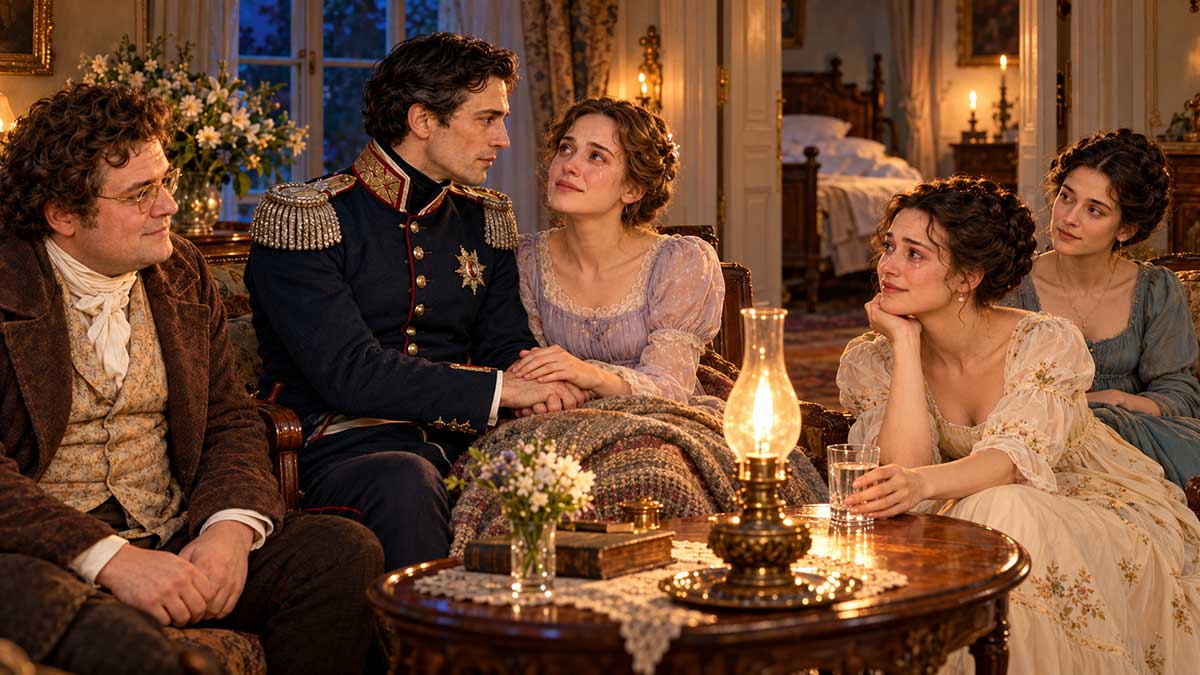
Pierre returned with the blankets folded against his chest. At the courtyard door, Marya took the uppermost one.
Marya: This is enough for tonight.
He followed her into the small sitting room adjoining a bedroom. A lamp stood beside a glass of water. Sonya had drawn a chair away from the doorway so that no one would have to squeeze past it.
Natasha came in behind Andrei. She paused at the sight of the bed through the open door, then sat near the lamp.
Pierre placed the remaining blankets on a bench.
Pierre: I went looking for something useful and returned with rather too much.
Sonya: Leave them there. Someone may be cold later.
Andrei looked at the glass of water.
Andrei: There was a time when that could occupy a whole conversation.
Natasha: Whether you wanted it. Whether it was cool enough. Whether lifting your head would hurt.
Marya: Whether you had already had some.
Natasha nodded.
Natasha: We could become very serious about a glass.
Pierre sat across from Andrei.
Pierre: You have spoken of forgiveness. I keep thinking of the hospital, when you saw Anatole.
Andrei’s gaze remained on the water.
Andrei: I recognized him after I had seen his suffering.
Pierre: Was that what changed everything?
Andrei: Everything is too large a word.
Pierre: Then what changed?
Andrei: The use I had made of him in my thoughts. Before that, he was the man I wanted to find. I could think of his face and feel my life narrow around the desire to confront him. In the hospital, he was a wounded man. There was no room in his pain for the account I had prepared.
Natasha: Did you think of me?
He looked toward her.
Andrei: Yes. But I did not forgive him merely as a way of forgiving you.
Natasha: I was going to ask that.
Andrei: They were different things.
Marya: You pitied someone who had hurt you.
Andrei: More than pity, perhaps. I cannot make it precise without making it smaller.
Sonya: Did you need him to be sorry?
Andrei: At that moment, no.
Sonya: Or to know what you had felt?
Andrei: No.
Pierre: Then you had given up asking him to repair the injury.
Andrei considered that.
Andrei: I had stopped wishing to add to his suffering. That I can say with confidence.
Sonya nodded.
Sonya: That is already something.
Natasha traced the edge of the table with one finger.
Natasha: When I came to you, I needed you to know that I was sorry.
Andrei: I knew.
Natasha: I had rehearsed things. Then I saw you and could hardly speak.
Pierre: Did the things you had rehearsed seem false?
Natasha: Some were true. They simply belonged to a room in which we were both well.
Marya looked through the bedroom door.
Marya: Illness changes the size of an explanation.
Natasha: Yes. I wanted to tell him everything. Then he moved, and I thought only of whether I had made him uncomfortable.
Andrei: I was glad you were there.
Natasha closed her eyes briefly.
Natasha: I know. I still like hearing it.
Pierre: Your forgiveness of Anatole did not require an answer from him. With Natasha, there was an answer.
Andrei: There was someone I wanted near me.
Sonya: That is a different gift.
Andrei: Yes.
Sonya: It matters to distinguish them. Otherwise, people begin asking forgiveness to restore a place they no longer have.
Marya leaned forward.
Marya: Or they feel that forgiving someone requires opening the door again.
Pierre: Can the door remain closed?
Marya: It can. A person may cease wishing harm and still know that living together would bring more harm.
Natasha: I wanted both. Forgiveness and the open door.
Sonya: You received both for a time.
Natasha looked at her.
Natasha: Yes.
Sonya’s voice held no accusation.
Sonya: I am glad you had that time.
Natasha reached across and touched her wrist.
Natasha: Thank you.
Pierre shifted his chair nearer.
Pierre: I find it difficult to know what love can do when someone cannot recover. We keep wanting care to produce an answer.
Marya: Sometimes we cannot know yet whether recovery is possible.
Natasha: That was the hardest part. A little strength could become an entire future in my mind. If he spoke more easily, I began thinking of things we might do. Then a bad night would take them away.
Andrei: I knew you were watching me.
Natasha: Did it trouble you?
Andrei: Sometimes.
She took her hand from the table.
Andrei: Your fear was in the room. I could not fail to see it.
Natasha: I tried to hide it.
Andrei: I know.
Marya: You were afraid of grieving him before he had gone.
Natasha: And afraid that if I admitted he might die, I would somehow stop helping him live.
Pierre: As if hope were a duty you could neglect.
Natasha: Yes. I thought I had to be strong enough for two people.
Sonya: Then who was allowed to be strong for you?
Natasha looked down.
Natasha: I did not ask very well.
Marya: You could scarcely leave him.
Natasha: When I did leave, I listened for someone calling me. I could be eating and feel ashamed of tasting the food.
Andrei’s face tightened.
Andrei: Natasha.
Natasha: I know you would not have asked that of me.
Andrei: I would have asked you to eat.
Natasha: You could ask it. I could agree. Then I would sit outside the room and think of you alone inside it.
Sonya rose and moved the glass nearer Natasha.
Natasha glanced at it, almost smiling.
Natasha: You see? Still the glass.
Sonya: Drink a little.
She did.
Pierre: Those tasks can look very small when someone recounts them afterward.
Sonya: They do not feel small at the time. A dry mouth is a dry mouth. Someone has to notice it.
Marya: And a person can be frightened by being left alone for five minutes.
Andrei: Or need those five minutes.
Natasha set down the glass.
Natasha: Yes. I did not always know which.
Andrei: Nor could I always tell you.
Pierre: Then care requires guessing.
Sonya: Guessing, asking, getting it wrong, trying again. And someone to take your place when you are too tired to notice.
Marya looked at Natasha.
Marya: I sometimes watched you sleeping and wondered how long it had been since you had slept properly.
Natasha: It never seemed the right time.
Sonya: There is always another hour to get through. That can become the whole of a person’s thinking.
Andrei rested his hand on the arm of his chair.
Andrei: You speak of my suffering. I hear how much of it traveled beyond me.
Marya: You did not put it there deliberately.
Andrei: That does not make it less real.
Marya nodded.
Marya: No.
The lamp flame rose as Pierre adjusted the wick. He lowered it again.
Natasha watched Andrei.
Natasha: There was a change in you that I did not know how to speak about.
Andrei: I know.
Natasha: At first, I thought I had done something. You became quiet in a different way. You were gentle, but I could no longer reach you as I had before.
Pierre: Less pain?
Natasha: I cannot tell you that. Less longing, perhaps. I was full of longing. You seemed to be leaving it behind.
Andrei looked through the doorway.
Andrei: The things I had clung to were loosening. I felt less afraid.
Marya: We felt more afraid.
He turned toward his sister.
Marya: I recognized something in what you said. I could hear the faith I had wished you would find. Yet I wanted to interrupt it. I wanted you to ask about tomorrow in an ordinary way.
Andrei: You thought I was beyond you.
Marya: I thought I was losing my brother. Calling it anything more beautiful did not stop that.
He reached for her hand.
Andrei: You may call it losing your brother.
Her eyes filled.
Marya: Thank you.
Natasha sat very still.
Natasha: I wanted your love to make you stay.
Andrei’s fingers tightened around Marya’s.
Andrei: I could not promise that.
Natasha: I know. But I thought it anyway. I thought of how much I loved you, and it seemed impossible that none of it could hold you here.
Pierre: We have such confidence in love until we ask it to do something it cannot do.
Sonya: Then sometimes we begin doubting what it did do.
Natasha looked at her.
Sonya: You were there. He knew it. There were hours in which he did not have to endure being ill without you.
Andrei nodded.
Andrei: Yes.
Sonya: His death does not remove those hours.
Natasha pressed her lips together.
Natasha: I can believe that when you say it. Alone, I begin thinking of what I failed to notice.
Marya: A look. A breath. Something you might have done sooner.
Natasha: Yes.
Marya: I do that too.
Pierre’s eyes moved between them.
Pierre: Is there a way to stop?
Sonya: Perhaps there are evenings when it stops. I would not promise more than that.
Andrei let go of Marya’s hand slowly.
Andrei: There was a dream. A door I could not keep closed. I woke with less fear of what was beyond it.
Natasha’s gaze lowered.
Andrei: I have difficulty telling you that without hearing what it meant to you.
Natasha: Tell us.
He waited.
Natasha: I do not want you to change your memory so mine will hurt less.
Andrei: It felt like release.
Marya wiped her eyes.
Marya: I believe you.
Andrei: And you wished I had not found it yet.
Marya: Yes.
Natasha: Yes.
Andrei breathed out.
Andrei: Then both memories belong in this room.
Pierre looked toward the door of the bedroom. It stood open, revealing a pillow and the pale fold of a sheet.
Pierre: I used to think that becoming more loving would bring a person closer to everyone.
Marya: Sometimes it does.
Natasha: Sometimes I wanted him to love me less widely.
Andrei turned to her.
She held his gaze.
Natasha: I wanted to be particular. I wanted a look that meant he could not bear to leave me. It sounds selfish.
Andrei: It sounds like you wanted the man you loved.
Natasha: Yes.
Andrei: You did not owe my dying thoughts complete agreement.
She drew a breath.
Natasha: I wish I had known I could say that.
Marya: Perhaps we thought that loving you meant following you wherever your mind went.
Andrei: You had lives here. You had my son.
Marya’s hand tightened around her handkerchief.
Marya: He needed things I could still give. Breakfast. Lessons. Someone to listen when he spoke of you. There were mornings when I resented having to know what time it was.
Pierre: The household continued.
Marya: Yes. A child could need his coat buttoned on a day when I could hardly bear to stand. He had done nothing wrong by needing it.
Sonya: And you had done nothing wrong by finding it hard.
Marya looked at her.
Sonya: Someone can love a child and wish, for a moment, that no one would ask anything of her.
Marya nodded.
Marya: I wished that.
Natasha: When Mother was grieving Petya, I sometimes wanted her to sleep so I could leave the room. Then I felt ashamed of the relief.
Sonya: Did you leave?
Natasha: Sometimes.
Sonya: And return?
Natasha: Yes.
Sonya: Then she was cared for by someone who needed to leave and came back. That is what happened.
Pierre rubbed his forehead.
Pierre: You keep making room for the parts we would rather remove from the account.
Sonya: I have spent some time being easier to love in other people’s accounts.
Natasha met her eyes.
Natasha: We heard you in the garden.
Sonya: I know.
There was quiet affection in her answer.
Andrei looked at the folded blanket on Marya’s lap.
Andrei: What would you have wanted me to know? Then, beside the bed.
Marya ran her fingers along the seam.
Marya: That I wanted more time. I knew you could not give it. I still wanted you to know.
He nodded.
Marya: And that I was angry. At the illness, at the war, at the fact that knowing what to pray did not make prayer easy.
Andrei: You could have told me.
Marya: I was afraid of burdening you.
Andrei: We each tried to spare the other and left things unsaid.
Natasha’s voice was low.
Natasha: I would have wanted you to know that I was tired.
He looked at her.
Natasha: And that being tired did not mean I wanted less of you.
Andrei: I would have believed you.
Natasha: I think I needed to believe myself first.
Pierre shifted forward.
Pierre: Would hearing those things have made you less peaceful?
Andrei considered him for a long moment.
Andrei: Perhaps. But you are speaking of peace as if it were something delicate that everyone else had to protect from truth.
Marya: We did protect you.
Andrei: You cared for me. You could have let me care a little for you.
Natasha’s tears came without an effort to conceal them.
Natasha: I did not want to use any of the time.
Andrei’s eyes softened.
Andrei: Telling me you were tired would have been time together.
She covered her face briefly.
Sonya moved her chair nearer, making no attempt to stop the tears.
Pierre sat back. For once, he seemed to have forgotten the question he might ask next.
After a time, Natasha lowered her hands.
Natasha: There were good hours.
Marya: Yes.
Natasha: I keep remembering the worst ones first. There were hours when he rested, and I sat there, and I was glad to be allowed to sit there.
Andrei: I remember your presence.
Natasha: You do?
Andrei: It did not all disappear into pain.
She looked at him steadily.
Andrei: There was a person beside me whom I loved. I knew that.
Natasha nodded. Her face remained wet.
The lamp made a small sound. Sonya glanced at it, then at the glass.
Sonya: Shall I bring fresh water?
Natasha: In a moment.
Sonya settled back.
Marya unfolded the blanket and placed it across her knees. One corner fell onto the floor. Andrei bent to lift it, but she caught his hand before he could rise.
Marya: Leave it.
He looked at her.
She held his hand between both of hers.
Marya: Sit with me.
Andrei stayed.
Natasha reached for the glass herself. No one hurried to help her, and no one mistook that for leaving her alone.
Topic 5: Peace That Still Asks Something of Us
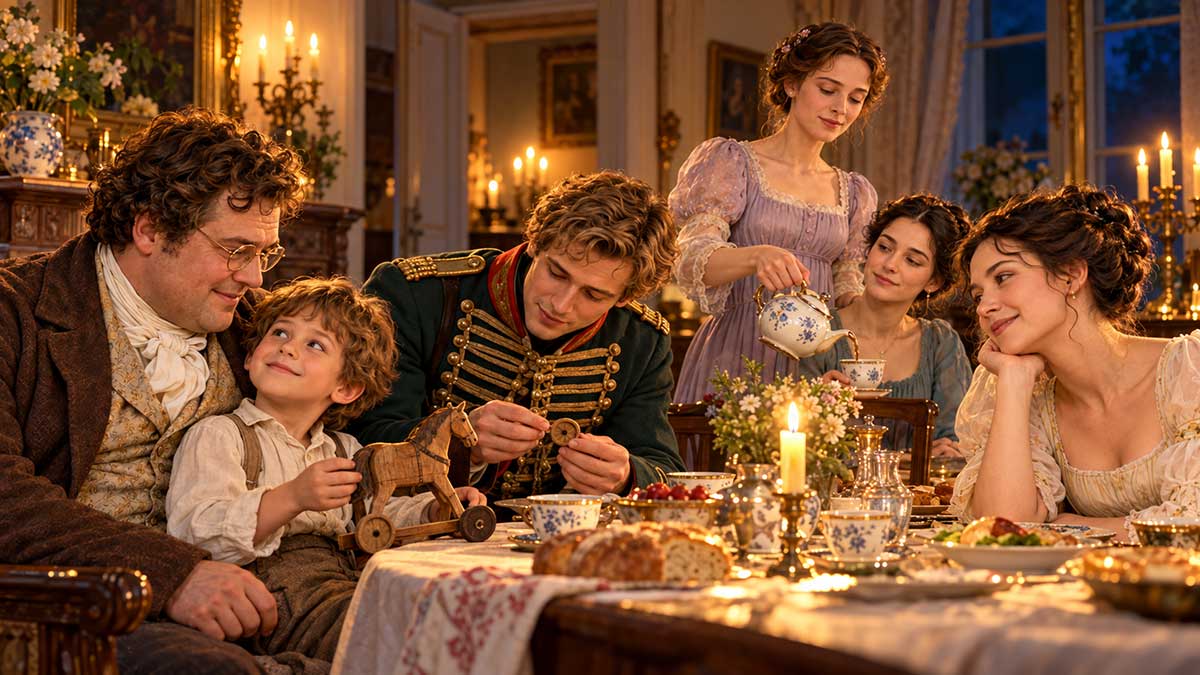
The supper table had been laid near an open door. From a room farther down the passage came the sound of children arguing over a wooden horse.
Natasha listened, decided the dispute had not yet become serious, and sat.
Pierre reached for the bread. Nikolai moved the plate closer before he could catch his sleeve in the candle.
Nikolai: We have already lost one chair to your difficulties. Let us preserve the table.
Pierre: The chair survived.
Natasha: It looked relieved when you left it.
Marya smiled. Sonya began serving from a dish beside her.
Marya: Sonya, will you pass that here?
Sonya handed it over.
Marya served her first.
For an instant, Sonya looked as if she were about to object. Then she rested her hands in her lap.
Pierre noticed. He left the moment alone.
Pierre: There were mornings after captivity when waking in a bed seemed almost impossible. A clean shirt. Food I did not have to wait for in fear. I thought I could never become careless with such things again.
Natasha: And then you did.
Pierre: Yes.
Nikolai: That is why beds are useful. Eventually, you can sleep in them without having a revelation.
Pierre laughed.
Pierre: You have a gift for reducing my discoveries to their proper size.
Nikolai: I am trying to let you keep them. You ask gratitude to remain at the same pitch every morning. A man would be exhausted before breakfast.
Marya: Gratitude may become a habit of conduct. It need not always be a feeling.
Natasha: Then what does it do?
Marya looked at the serving dish.
Marya: Sometimes it notices who has not eaten.
Sonya glanced at her, then picked up her fork.
Pierre leaned back.
Pierre: That sounds simple.
Sonya: Until everyone assumes someone else has noticed.
The children in the passage fell quiet. Natasha turned her head, listening.
Nikolai: Is that better or worse?
Natasha: We will find out.
She waited a moment longer, then returned to her supper.
Pierre: What makes this life enough? A table, children nearby, people we know so well that we can guess what they will say.
Natasha: You cannot always guess.
Pierre: No. That has been made clear tonight.
Natasha: You ask whether it is enough as if something must happen to make the evening worthy of you.
He looked at her.
Natasha: Sometimes I want an evening in which nothing important happens. A child eats. Someone tells me something foolish. We go to bed without receiving dreadful news.
Nikolai: I would call that an excellent evening.
Pierre: So would I.
Natasha: Would you remain in it?
Pierre set down his knife.
Pierre: You think I am often elsewhere.
Natasha: You can be sitting opposite me and already be in Petersburg, correcting a man who has not yet spoken.
Nikolai laughed.
Nikolai: I have met him there. He is usually correcting me.
Pierre: I do think about things that are not in the room.
Natasha: I know. I love that in you. Sometimes I am tired of competing with things that are not in the room.
Marya watched them quietly.
Pierre: When you have called me and I have not heard, I have sometimes thought, afterward, that you could have called louder.
Natasha raised her eyebrows.
Pierre: I am discovering that this is a poor defense.
Sonya: Particularly if the person has already called twice.
Pierre: You have all kept records.
Natasha: We have ears.
He smiled, then looked toward the passage.
Pierre: What were the children arguing about?
Natasha: Which of them owned the horse.
Pierre: It belongs to all of them.
Nikolai: That will settle nothing.
Marya: It may explain the disagreement.
A small voice rose again, followed by a louder answer.
Natasha started to stand.
Sonya moved at the same time.
They looked at each other.
Sonya sat back first.
Natasha went to the door and called a few words down the passage. The argument continued at a lower volume.
When she returned, her plate had cooled.
Pierre: I could have gone.
Natasha: Yes.
She took up her fork.
Pierre looked at his own warm supper.
Pierre: I did not think of it.
Natasha: I know.
There was no accusation in her voice. That made the fact harder for him to avoid.
Nikolai: A household works through knowing who does what. If every task requires a discussion, nothing gets done.
Sonya: And if no task ever requires a discussion, one person can spend years doing what everyone expects.
Nikolai turned toward her.
Nikolai: I did not mean that you should do everything.
Sonya: You need not mean it for it to happen.
He looked at the dish Marya had taken from her.
Nikolai: No.
Marya: Sometimes I know Sonya will remember something, so I allow myself to forget it.
Natasha: Mother’s shawl. A letter. Which child has been coughing.
Sonya: Whether there is hot water. Whether someone has eaten. The things are small until they are missed.
Pierre: And then we notice.
Sonya: We notice the missing thing.
Marya put down her fork.
Marya: We may still fail to notice the person.
Sonya nodded.
Nikolai was silent for several moments.
Nikolai: I have thought that giving you a place in the house was an expression of affection.
Sonya: It can be.
Nikolai: And you have not always experienced it that way.
Sonya: I have often been glad to live with you. I would like that to remain true without requiring me to be glad about everything.
He accepted this slowly.
Nikolai: What would you change?
Sonya looked at him, wary.
Nikolai: I am asking about the house. Something we can actually do.
She considered.
Sonya: When I leave a room, do not immediately ask where I am going or what you need before I go.
Natasha lowered her eyes.
Sonya: Sometimes I have gone upstairs to read. Then I have remembered three things and come back down. Someone sees me and gives me a fourth.
Marya: I have done that.
Sonya: I know.
Nikolai: Then we must learn to keep the fourth thing for ourselves.
Sonya: Yes. And perhaps the first three.
Nikolai nodded.
Pierre reached for the dish, then stopped.
Pierre: Is this how we change a household? A little awkwardly, with each person discovering that his innocence was not doing much useful work?
Natasha: You could begin by serving yourself.
He did.
For a time, they ate. Through the door came the scrape of small feet and an elaborate explanation of why one child’s claim to the horse was older than another’s.
Nikolai shook his head.
Nikolai: They are already historians.
Pierre: Each has selected the events that establish his right.
Marya: And omitted the moment when he took it from someone else.
Sonya laughed.
The sound drew Natasha’s eyes, but she did not turn it into a question.
Pierre took a drink.
Pierre: I do not want to lose this. Yet I cannot believe that loving our own table is the whole of what we owe.
Nikolai’s expression changed.
Nikolai: Here we are.
Pierre: You expected it.
Nikolai: You have been circling it since the bread.
Pierre: There are men whose cruelty is permitted by their office. There are abuses everyone knows about and calls inevitable. I cannot return home, close the door, and decide that the children’s happiness settles the matter.
Nikolai: Nor do I ask you to. Help people. Use your money. Attend to what is under your care.
Pierre: Some harms are under the care of men who will not attend to them.
Nikolai: And you believe an association of men such as yourself will set everything right.
Pierre: I believe good men should work together.
Nikolai: So does every group convinced that it knows what is wrong with the country.
Pierre leaned forward.
Pierre: That cannot be an argument for leaving everything as it is.
Nikolai: It is an argument for asking what follows your first fine meeting.
Marya: Let him answer.
Nikolai glanced at her, then sat back.
Pierre: Investigation. Agreement about particular abuses. Mutual support. The courage to act when being alone makes action impossible.
Nikolai: And who decides what you may demand from the rest of us?
Pierre: Who decides now?
Nikolai: Men who hold offices under a government to which I gave my oath.
Pierre: An office does not make a judgment right.
Nikolai: Nor does your conscience make it binding on everyone.
The room became still.
Natasha looked toward the passage. The children were no longer arguing. One was singing a few words to himself.
Natasha: You are both speaking of people who are absent. What would each of you ask from someone sitting here?
Pierre looked at Nikolai.
Pierre: I would ask him to consider whether obedience can become an excuse.
Nikolai’s face tightened.
Nikolai: And I would ask him to consider whether certainty that he is doing good can become one.
Pierre started to answer, then stopped.
Marya took a slow breath.
Marya: Neither question is small.
Sonya: Who pays when either of you answers wrongly?
Both men turned toward her.
Sonya: You have each spoken as if the danger belongs mainly to the other man’s idea. There will be people living beneath the decisions.
Pierre lowered his gaze to the table.
Pierre: Yes.
Nikolai: I know responsibility has consequences.
Sonya: You know it when you are managing an estate. Pierre knows it when he speaks of prisoners. I am asking you to keep knowing it when you feel certain.
Nikolai looked toward Marya.
Nikolai: You think I feel certain too easily.
Marya: Sometimes. I have seen you become angry before you have understood what someone is asking.
He drew a breath through his nose.
Marya: You are doing it now.
Natasha glanced at Pierre.
Natasha: And you are preparing a very good answer instead of hearing one.
He closed his mouth.
Sonya looked between them.
Sonya: I have a question.
Pierre: Ask it.
Sonya: If your disagreement became dangerous, would you still remember this table?
Nikolai’s expression hardened, then changed.
Pierre looked at him steadily.
Nikolai: Affection does not release me from every duty.
Pierre: I know.
Nikolai: Do you? You sometimes think that if I loved you enough, I would arrive at your conclusion.
Pierre considered him.
Pierre: I have thought that.
Nikolai: I could think the same of you.
Pierre: Yes.
Neither offered an easy promise.
Marya rested her hand beside Nikolai’s.
Marya: I do not ask you to pretend that the oath means nothing. I ask you to hear the man before you decide what the oath requires against him.
Nikolai looked at her hand.
Nikolai: I can hear him.
Natasha: Tonight.
He looked up.
Natasha: Keep doing it.
Pierre leaned back. The intensity had left his voice, but the disagreement remained.
Pierre: I cannot promise to stop wanting change.
Nikolai: I would distrust you if you promised it merely to make supper pleasant.
Pierre: And I cannot make you agree by explaining myself once more.
Nikolai: That discovery may improve several suppers.
Pierre laughed. Nikolai’s mouth moved into a reluctant smile.
Sonya returned to her food.
Marya watched her husband for a moment, then spoke.
Marya: When I write about the children, I often discover how quickly I have explained something I did not understand. One is difficult, another obedient, another affectionate. The words become convenient. Then something happens and the child escapes them.
Natasha: Thank goodness.
Marya: Yes. But I have sometimes been irritated at having my explanation disturbed.
Pierre: We would like people to remain where our account puts them.
Sonya: Some places are comfortable for the person doing the putting.
Marya met her eyes.
Marya: I am trying to leave more room.
Sonya: I see that.
Nikolai reached for his glass.
Nikolai: I do not know how to make a peaceful house if no one agrees about anything.
Natasha: We agree about many things.
Nikolai: Until Pierre has eaten enough to remember society.
Pierre: I could remain hungry. It has been recommended before.
Natasha: Please do not. You become difficult in a less interesting way.
Sonya laughed again.
Natasha let herself enjoy it.
Pierre: There is something I wanted to say about ordinary life.
Nikolai: Only one thing?
Pierre: For the moment.
He looked around the table.
Pierre: When I came home, I thought appreciating life would mean feeling its goodness more strongly. Tonight, it seems to include letting someone tell me where I have failed to attend to it.
Natasha: That can be unpleasant.
Pierre: Very.
Marya: And the person telling you may fail in other ways.
Pierre: Yes.
Sonya: Then perhaps no one has to become perfectly good before we can live together honestly.
Nikolai considered her.
Nikolai: I would settle for hearing a complaint before it has become a history.
Sonya lifted her eyebrows.
Sonya: Then receive the small ones well.
He nodded.
Nikolai: I will try.
A child appeared in the doorway holding the wooden horse by one leg.
He stood silently, surveying the adults. Natasha moved her chair back, but Pierre had already risen.
Pierre: What has happened?
The child held up the horse. One wheel hung crookedly from its axle.
Nikolai put out his hand.
Nikolai: Bring it here.
The child came forward. Pierre crouched beside him, his coat pooling awkwardly on the floor.
Pierre: Did it fall?
The child nodded, then began an account involving the table, the younger child, and a rule that apparently no one else had known.
Nikolai examined the wheel.
Nikolai: This can be mended.
Natasha: Tomorrow?
Nikolai: Tonight, if I can find the right piece of wood.
Sonya began to rise.
Marya touched her arm lightly.
Marya: Let him find it.
Sonya sat back.
The child leaned against Pierre’s shoulder and watched Nikolai turn the horse over.
Pierre remained crouching after his knees had begun to complain.
Natasha slid a chair closer with her foot.
Natasha: You may sit and still listen.
He took the chair. The child stayed beside him.
Nikolai asked where the missing piece had fallen. Natasha pointed toward the passage. He went to look.
At the table, Sonya finished the last warm mouthful on her plate.
Marya poured her a little more tea.
No one had settled the future of the country. A wheel had come loose, a child had brought it to them, and this time the work did not fall to the first person who stood up.
Final Thoughts
The gathering ends with a damaged toy, a child waiting beside the table, and adults deciding who will help. Their disagreements remain. The work is shared a little differently.
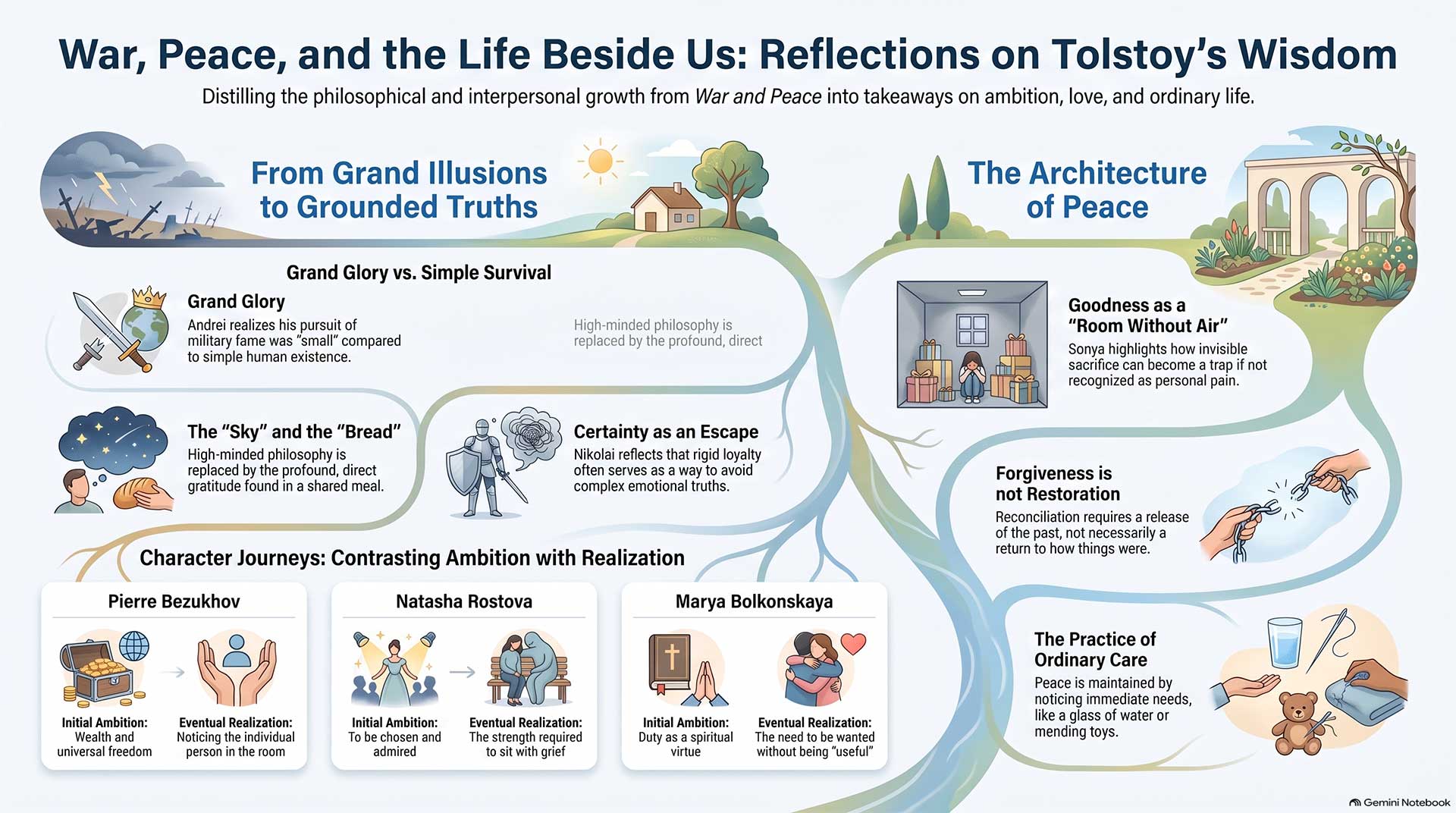
That modest change matters. Pierre’s concern for humanity becomes more credible when he hears someone nearby. Nikolai’s loyalty gains depth when it leaves room for another person’s question. Natasha’s care includes the admission that she can be tired. Marya discovers that affection need not be earned through constant usefulness. Sonya can speak without making her disappointment easier for everyone else.
Andrei’s presence reminds them of what attention cannot restore. Forgiveness does not return the years. Good care cannot promise recovery. Gratitude does not make a death necessary. The people who continue living must carry love without asking it to explain every loss.
Yet there is room for laughter, food, children, useful work, and hopes that survive their earlier mistakes.
Perhaps peace begins in moments when we become less certain that we have already seen the person beside us. We listen again. We notice who has not eaten. We take our turn with the work. Someone who usually rises to help gets to finish her supper.
Short Bios:
Pierre Bezukhov
An awkward, generous nobleman whose inherited fortune cannot settle his search for meaning. Marriage, moral disappointment, war, and captivity reshape him. He brings sincere questions to the gathering, yet must face the distance between loving humanity and noticing an individual.
Prince Andrei Bolkonsky
A gifted, proud officer who initially seeks distinction beyond domestic life. Austerlitz, his wife’s death, his relationship with Natasha, and his final wound transform his outlook. His voice joins penetrating judgment with regret, forgiveness, and the painful limits of what love can preserve.
Natasha Rostova
An impulsive, affectionate young woman whose delight in life coexists with serious mistakes. Betrayal, nursing, and family grief deepen her capacity for care. She brings emotional immediacy to the conversations and defends the possibility of joy after sorrow.
Princess Marya Bolkonskaya
Andrei’s sister, whose faith and devotion develop within a demanding household. Her gentleness contains longing, anger, and a desire to be loved for herself. She asks whether duty leaves enough room for the person performing it.
Nikolai Rostov
Natasha’s brother, a cavalry officer who later takes responsibility for his family and estate. Loyal, practical, and sometimes quick to anger, he challenges ideals that lack workable consequences. His disagreements with Pierre test the relationship between conscience, obedience, and affection.
Sonya
The Rostovs’ orphaned cousin, whose love for Nikolai does not lead to marriage. Her devotion helps sustain the household, often with insufficient recognition. Here, she speaks about dependence, unequal sacrifice, and the difference between having a place and being fully seen.
Platon Karataev
A Russian soldier whom Pierre meets in French captivity. His companionship, stories, and everyday generosity profoundly affect Pierre. He grounds the discussion in food, warmth, and shared hardship, leaving others to question what acceptance means when injustice remains.
Leave a Reply