
Introduction
What happens when artificial intelligence becomes more intelligent than the people who created it?
In this imaginary conversation, educator and Predictive History creator Jiang Xueqin sits down with Elon Musk, Peter Thiel, Demis Hassabis, Dario Amodei, and Jensen Huang to examine that question from radically different perspectives.
But Jiang begins by challenging the premise itself. What exactly is intelligence? Does solving problems prove understanding? Could AI create extraordinary abundance while also giving governments and corporations unprecedented influence over human attention? And what happens to work, education, freedom, and purpose when machines can perform many of the tasks that once made human expertise valuable?
The discussion eventually turns the question around. What if the AI optimists are right? What if AI helps cure diseases, accelerates scientific discovery, transforms education, reduces dangerous work, and gives ordinary people capabilities once available only to powerful institutions?
And beneath every disagreement lies a deeper question.
Perhaps the future of AI isn't ultimately about how intelligent machines become.
Perhaps it is about discovering what makes a human life valuable when intelligence itself is no longer scarce.
(Note: This is an imaginary conversation, a creative exploration of an idea, and not a real speech or event.)
Topic 1: Is AI Really Intelligence?
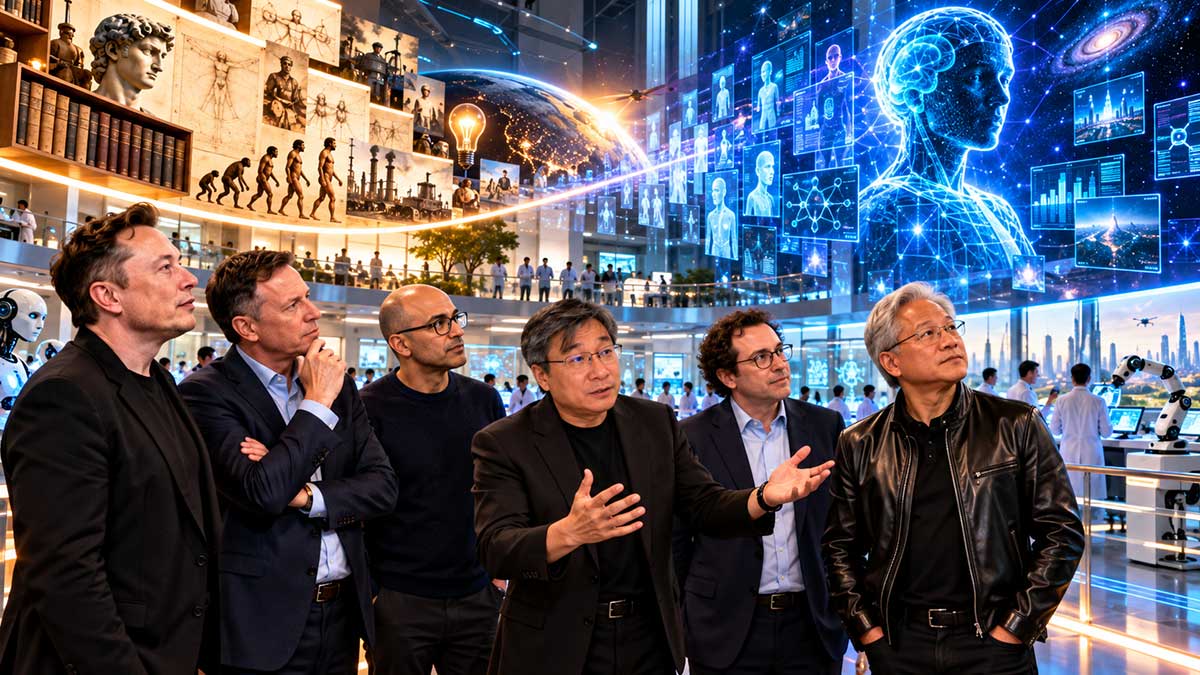
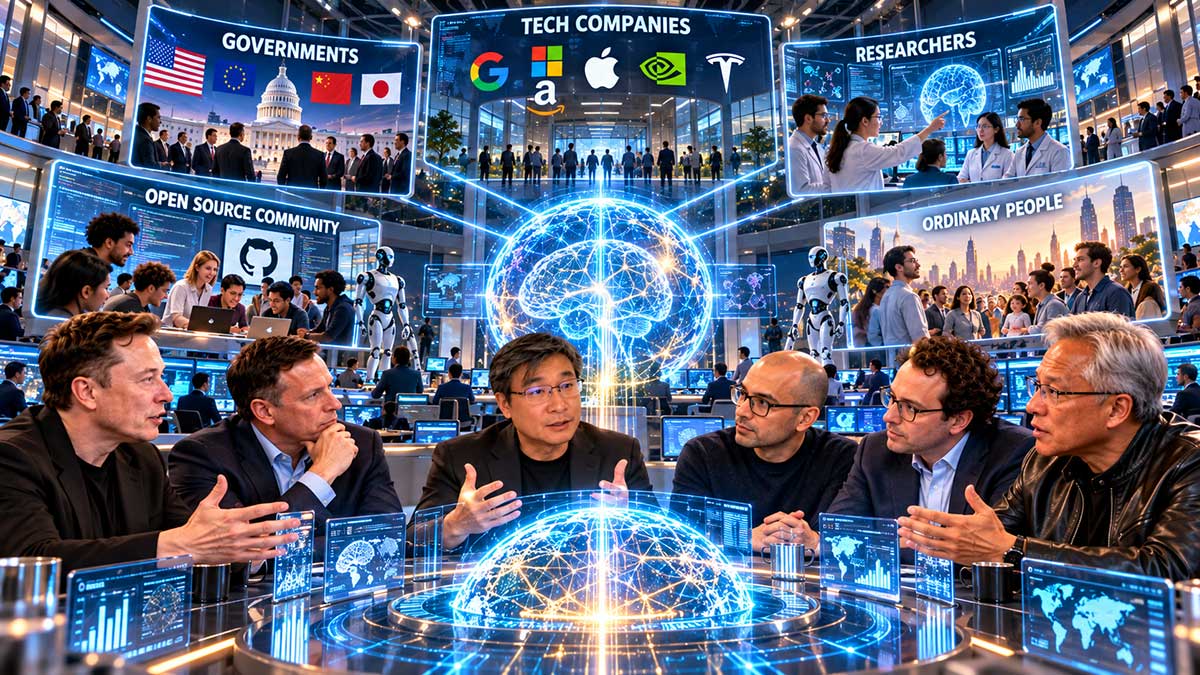
The six men settle into their seats. Behind them, enormous screens quietly display images from humanity's intellectual history: handwritten manuscripts, astronomical charts, early mechanical calculators, computer code, neural networks, and finally a glowing artificial brain.
Jiang Xueqin looks at the screen for several seconds before turning toward the others.
Jiang Xueqin: Before we talk about AGI, superintelligence, unemployment, robots, or the end of civilization, I have a problem with the first word in this entire discussion.
Artificial intelligence.
What exactly is intelligence?
Elon Musk: That's a small question.
Jiang: I thought I'd start easy.
A few of them laugh.
Jiang: But I'm serious. We talk constantly about machines becoming more intelligent than humans. More intelligent in what sense? Faster calculation? Better prediction? Better memory? Better reasoning?
A calculator is better than I am at arithmetic. Google Maps is better than I am at navigation. Neither makes me think I'm talking to another mind.
So, Demis, you're probably the person here I'd like to put on the spot first.
What do you mean by intelligence?
Demis Hassabis: I would define it broadly as the ability to acquire knowledge, reason with that knowledge, generalize it, plan, solve problems, and adapt to unfamiliar situations.
The important word there is probably generalize.
A narrow system can be extremely good at one task. General intelligence means taking knowledge from one domain and applying it somewhere new.
Jiang: Does it require understanding?
Demis: That depends on how you define understanding.
Jiang: There it is.
Peter Thiel: We've survived about ninety seconds.
Laughter moves around the table.
Jiang: But that's precisely the problem. Whenever we reach the difficult word, we replace it with another difficult word.
Intelligence becomes reasoning.
Reasoning becomes understanding.
Understanding becomes representation.
And eventually someone shows me a benchmark.
Demis: That's fair. But we have the opposite problem too. Every time machines accomplish something we once associated with intelligence, people redefine intelligence so that the machine still doesn't qualify.
Chess was intelligence until computers became better at chess.
Language was intelligence until machines became fluent with language.
Pattern recognition was intelligence.
Programming was intelligence.
Mathematical problem solving was intelligence.
Then machines started doing those things and we said, "Yes, but they don't really understand."
So at some point I think the skeptic has to tell us what evidence would count.
Jiang: Good.
That's exactly the question I wanted you to ask me.
Jensen Huang: There's another problem.
I'm an engineer.
If you give me a system that helps a scientist find a molecule that becomes a useful drug, or helps an engineer design something that couldn't previously be designed, I don't necessarily need to settle the philosophical question of whether the system understood the problem.
Something economically and scientifically meaningful happened.
Jiang: I agree.
But useful and intelligent aren't necessarily the same thing.
A telescope is extraordinarily useful to an astronomer. Nobody says the telescope understands Saturn.
Jensen: True. But the telescope doesn't look at the data, form a representation, reason about it, produce a hypothesis, test alternatives, and communicate an answer back to you.
Jiang: So complexity eventually becomes intelligence?
Jensen: Not complexity.
Capability.
Jiang: That's different.
Jensen: It is.
Jiang: Then maybe we should call it artificial capability.
Elon: Doesn't have the same marketing ring.
Everyone laughs.
Jiang: Elon, that's actually more important than the joke.
Words shape expectations.
If I call something a tool, I use it.
If I call something intelligent, I may begin trusting it.
If I call it a companion, I may begin forming an emotional relationship with it.
If I call it conscious, I may eventually give it moral standing.
These aren't trivial linguistic differences.
Dario Amodei: I agree with that part. We should be very careful about anthropomorphism.
But I wouldn't go from that to saying these systems aren't intelligent.
Consciousness and intelligence can be separate questions.
A system might become extraordinarily capable at reasoning without our knowing whether it has subjective experience.
Jiang: Then let's separate them.
Can something be highly intelligent without consciousness?
Dario: Possibly.
Demis: Yes, depending on the definition.
Jiang: Elon?
Elon: Probably. Although consciousness itself is poorly understood, so I wouldn't claim certainty.
Jiang: Peter?
Peter: I think there's a danger that we're pretending the human side of this comparison is better understood than it is.
We don't actually have a complete theory of human intelligence.
We don't have a complete theory of consciousness.
We don't know exactly why human beings are creative.
And yet we're confidently debating whether machines possess these things.
It may be that we're using undefined human categories to describe systems we don't fully understand.
Jiang: That's close to my objection.
Peter: Which makes me suspicious.
Jiang: Why?
Peter: Agreement this early usually means one of us has made a mistake.
The table laughs again.
Jiang turns toward Demis.
Jiang: Let's make this concrete.
Suppose tomorrow your system discovers a treatment for a disease that thousands of brilliant human researchers have spent decades trying to solve.
Nobody gave it the answer.
It combined knowledge across biology, chemistry, genetics, and medicine. It generated a hypothesis humans had missed. Scientists tested it.
It worked.
Would you say the machine understood biology?
Demis: I would say that's increasingly strong evidence of something we should reasonably call scientific reasoning.
Jiang: Reasoning or understanding?
Demis: You're going to keep doing this, aren't you?
Jiang: For several hours.
Demis: Good.
Then I'd say if the system can explain why the hypothesis works, predict where it will fail, transfer the principles to another biological problem, revise its model when experiments contradict it, and repeatedly make novel discoveries, the claim that it's merely doing meaningless pattern matching becomes increasingly difficult to defend.
Jiang: But suppose there's nobody home.
Demis: Meaning consciousness?
Jiang: Yes.
It produces brilliant answers. It writes poetry. It diagnoses cancer. It solves mathematics. It tells you it's frightened of being switched off.
But inside, there is nothing.
No experience.
No fear.
No awareness.
No self.
Would you still call it intelligent?
Demis pauses.
Demis: I probably would.
I wouldn't necessarily call it conscious.
Jiang: Good. That's an important distinction.
Dario: And it's a distinction society is going to have trouble maintaining.
Jiang: Why?
Dario: Humans are extremely susceptible to language.
If something speaks naturally, remembers you, responds emotionally, understands context, and appears empathetic, people will attribute an inner life to it.
That could happen long before we have any scientific basis for concluding that it has one.
Jiang: Which means one of the first great effects of advanced AI may not be machines becoming conscious.
It may be humans becoming convinced that machines are conscious.
Peter: Those are very different events.
Jiang: Exactly.
Elon: But there's another side.
Suppose the AI is smarter than every person in this room.
Then smarter than every scientist.
Then smarter than humanity collectively in most cognitive tasks.
At some point, arguing whether it's really intelligent becomes somewhat academic.
If it's designing better rockets than humans, better medicines, better chips, better robots, better software, and perhaps better AI, its capabilities have real consequences regardless of what philosophical category we assign to it.
Jiang: I agree completely.
But then the question changes.
We're no longer asking whether it has a mind.
We're asking whether it has power.
Elon: Capability is power.
Jiang: Exactly.
And that's why I worry about confusing intelligence, consciousness, and capability.
You can have enormous capability without consciousness.
A nuclear weapon isn't conscious.
Elon: That's true.
Jiang: Yet it changes history.
So perhaps the dangerous question isn't, "When will AI wake up?"
Perhaps it's, "How much capability are we willing to give something before we understand what it is?"
Dario leans forward.
Dario: That's much closer to the way I think about risk.
A system doesn't need to be conscious to be dangerous.
If it can autonomously perform sophisticated cyber operations, manipulate people, design dangerous biological agents, or take complicated actions in the world, whether it experiences consciousness may be irrelevant to the immediate safety problem.
Jiang: So Hollywood may have trained us to fear the wrong thing.
Dario: Potentially.
Jiang: We keep waiting for the machine to say, "I am alive."
But the more important moment may be when it says nothing dramatic at all and simply becomes extraordinarily capable.
Dario: Yes.
Jiang looks toward Peter.
Jiang: But you have another objection, don't you?
Peter: My question is whether intelligence is actually the scarce resource everyone assumes it is.
Suppose tomorrow we create ten million digital Einsteins.
What happens?
The obvious answer is extraordinary progress.
But is intelligence really what's preventing us from building housing in San Francisco?
Is lack of intelligence why infrastructure projects take decades?
Is lack of intelligence why promising technologies get stuck in regulatory systems?
Is lack of intelligence why institutions become dysfunctional?
I'm not convinced.
Jiang: So ten million Einsteins may discover a revolutionary new energy system.
Peter: And then spend thirty years trying to get a permit.
Elon: That's optimistic.
Everyone laughs.
Peter: We have a tendency to reduce civilization to intellectual problems.
Many problems are institutional.
Political.
Cultural.
Coordination problems.
Problems of courage.
Problems of incentives.
You can add intelligence without solving any of those.
Demis: But intelligence can help solve coordination problems too.
Peter: Perhaps.
Or it can make sophisticated institutions even better at preserving themselves.
Jiang: That's interesting.
Greater intelligence doesn't automatically produce greater wisdom.
Peter: Obviously not. History is full of very intelligent people doing extremely foolish things.
Jiang: Sometimes together.
Peter: Especially together.
Jensen looks toward Jiang.
Jensen: I think there's a risk that we're making intelligence sound less useful because it doesn't solve everything.
It doesn't need to solve everything.
Suppose AI accelerates drug discovery.
Suppose engineers design better materials.
Suppose factories become more efficient.
Suppose small companies can suddenly perform work that once required hundreds of specialists.
Those are real improvements.
Human institutions can remain imperfect and AI can still create enormous value.
Jiang: I agree.
Jensen: You keep agreeing with everybody.
Jiang: I'm saving my disagreements.
Elon: Efficient use of resources.
Jiang: Very human of me.
Jiang sits back.
Jiang: Let me try something different.
I want each of you to tell me one thing you believe about AI that intelligent people outside this room may currently consider ridiculous.
Elon?
Elon: Eventually, most conventional work could become optional.
AI combined with robotics could make goods and services extremely abundant.
People may work because they want to, not because survival requires it.
Jiang: Jensen?
Jensen: I think many people will underestimate how much work humans continue inventing.
Every generation thinks we've automated everything worth doing.
Then human ambition expands.
AI could become dramatically more capable and humanity could still be extremely busy.
Elon: So we disagree.
Jensen: A little.
Jiang: Excellent.
Demis?
Demis: I think AI-assisted science could become one of the primary engines of discovery.
Not simply summarizing papers or assisting scientists.
Actually helping generate discoveries that significantly extend human knowledge.
Jiang: Dario?
Dario: I think people underestimate how quickly some forms of intellectual work could change once systems become sufficiently capable.
We tend to imagine gradual improvement because that's psychologically comfortable.
But digital systems can be copied and operated in parallel. If highly capable research systems become possible, the pace of certain kinds of progress could change dramatically.
Jiang: Peter?
Peter waits.
Peter: Perhaps the crazy belief is that everybody else at this table is asking too much of intelligence.
Jiang smiles.
Jiang: Explain.
Peter: We're assuming intelligence is the bottleneck.
Maybe it isn't.
Maybe we've already had enough intelligence to solve many of our problems for a very long time.
Maybe what we've lacked is something else.
Jiang: Courage?
Peter: Sometimes.
Institutions.
Incentives.
Will.
Freedom.
Meaning.
The ability to act on what we already know.
Jiang becomes quiet for a moment.
Jiang: Then I'll give mine.
Perhaps our mistake is not overestimating artificial intelligence.
Perhaps we're overestimating intelligence itself.
Nobody interrupts.
Jiang: Imagine the optimistic scenario.
Machines become extraordinarily intelligent.
Scientific knowledge explodes.
Information becomes almost free.
Expertise becomes available to everyone.
Then what remains scarce?
Demis: Wisdom.
Jensen: Judgment.
Dario: Trust.
Peter: Courage.
Jiang looks at Elon.
Elon: Meaning, perhaps.
Jiang nods.
Jiang: That's interesting.
None of you said intelligence.
He looks around the table.
Jiang: So perhaps we have our first answer.
The extraordinary thing about artificial intelligence may eventually be that it forces humanity to discover the limits of intelligence.
But before we get philosophical too quickly, I want to follow something Peter just mentioned.
Incentives.
We're spending extraordinary amounts of money building these systems. Companies are racing. Governments are worried about falling behind. Researchers who warn that advanced AI could be dangerous continue making it more capable.
So I want to understand something much less abstract.
Jiang leans forward.
Jiang: What game are all of you actually playing?
Topic 2: What Game Are the AI Companies Actually Playing?
Jiang lets the question hang for a moment.
Jiang Xueqin: What game are all of you actually playing?
You tell us these systems could transform civilization. Some of you warn that sufficiently advanced AI could become dangerous. Yet the response to that danger appears to be...
build faster.
More chips.
Larger data centers.
More electricity.
More capable models.
More money.
More competition.
Help me understand the logic.
Dario Amodei: The simplest answer is that there isn't one player.
If one responsible company decides to stop developing AI, that doesn't mean AI development stops.
Other companies continue.
Other countries continue.
Open research continues.
So the choice isn't necessarily between "build AI" and "don't build AI."
It may be between developing powerful systems while trying to understand and mitigate the risks, and allowing development to happen somewhere else with fewer safeguards.
Jiang: That's a very reasonable answer.
It's also exactly what every participant in an arms race says.
Dario pauses.
Dario: That's fair.
Jiang: "I would prefer not to build the weapon. But the other person may build the weapon. So I must build the weapon."
The other person says precisely the same thing.
Everyone behaves rationally.
And together they create a world neither side necessarily wanted.
Elon Musk: That's a legitimate concern.
But there's another possibility. If something this important is going to exist, you don't necessarily want only one company or one government controlling it.
Competition can be protective.
Jiang: Unless competition increases the speed at which everyone takes risks.
Elon: Yes.
Jiang: So competition simultaneously protects us from monopoly and pushes everyone to accelerate.
Peter Thiel: That's the problem with the framing.
We're searching for a structure with no trade-offs.
There probably isn't one.
Centralization has risks.
Competition has risks.
Government regulation has risks.
Unregulated development has risks.
Open-source development has risks.
Secret development has risks.
The interesting question isn't which system is perfectly safe.
It's which failure modes you're willing to tolerate.
Jiang: Good.
Then let's make everyone uncomfortable.
Jiang: Demis, suppose tomorrow you discover that your most advanced system has crossed some threshold.
It can perform most cognitive work better than almost any human.
It can conduct research.
Write software.
Design machines.
Persuade people.
Perhaps even contribute substantially to designing its successor.
Do you tell the world immediately?
Demis Hassabis: Not necessarily immediately.
You'd first want to evaluate the system carefully.
Understand its capabilities.
Understand its limitations.
Test for dangerous behaviors.
Jiang: So a relatively small group of people inside a corporation temporarily decides that humanity isn't ready to know what humanity has created.
Demis: Temporarily, perhaps.
But the alternative could be releasing something before you've understood its risks.
Jiang: I'm not saying you're wrong.
I'm pointing out how strange the situation is.
We've somehow arrived at a future where a few people inside private organizations could potentially face decisions with civilizational consequences.
Jensen Huang: But that description makes the AI industry sound much more centralized than the actual technological ecosystem.
AI isn't one machine in one room.
There's computing infrastructure.
Semiconductors.
Networking.
Energy.
Cloud systems.
Models.
Applications.
Robotics.
Research institutions.
Thousands of companies.
Millions of developers.
Governments.
Universities.
It's an ecosystem.
Jiang: That's true.
But Jensen, somebody owns the infrastructure.
Jensen: Many people own different parts of the infrastructure.
Jiang: Better.
But access isn't equally distributed.
If advanced intelligence becomes the most important economic resource on Earth, the people controlling the chips, energy, data centers, models and distribution systems have enormous influence.
Jensen: Certainly.
But historically, technologies often begin expensive and concentrated and become more accessible.
Computing did.
Internet access did.
AI capability can follow a similar pattern.
Jiang: It can.
Not must.
Jensen: Fair.
Jiang turns toward Peter.
Jiang: Who do you trust with superhuman AI?
Peter: That's the wrong question.
Jiang: Why?
Peter: Because you're asking me to name the benevolent ruler.
I don't want one.
Jiang: Neither do I.
Peter: Then the question is how you create competing centers of authority so no single institution has unlimited control.
Jiang: Companies competing?
Peter: Among other things.
Companies.
Governments.
Different countries.
Individuals.
Independent institutions.
You want checks.
Dario: But let's test that principle with a difficult example.
Suppose a future system can provide detailed assistance for creating a novel biological threat.
Do you still want that capability distributed across millions of people?
Peter: No.
Dario: Then somebody has to restrict it.
Peter: Correct.
Dario: And now we're back to Jiang's question.
Who?
Peter pauses.
Peter: Yes.
That's the problem.
Jiang: Thank you.
I feel much better now that we've established nobody knows.
They laugh.
Demis: But there are already models for managing dangerous capabilities.
We don't allow every person unrestricted access to every biological material or weapon.
Certain technologies require controls.
Jiang: Yes, but AI is unusual.
A nuclear weapon doesn't teach my child mathematics.
A biological weapon doesn't write my emails.
AI may simultaneously become ordinary infrastructure and potentially dangerous infrastructure.
The same system could help a teenager learn chemistry and perhaps help someone do something dangerous with chemistry.
Dario: Exactly.
Which is why capability-specific safeguards matter.
The question isn't simply whether people have AI.
It's what particular systems are allowed to do, what tools they can access, and what safeguards exist around dangerous capabilities.
Elon: You still have to be careful that "safety" doesn't become an excuse for monopoly.
Jiang: Explain.
Elon: Suppose a small number of companies say, "Our AI is extremely powerful and dangerous, so nobody else should be allowed to build one."
Convenient.
Peter: Very convenient.
Dario: That's a legitimate concern, but it doesn't follow that the risks aren't real.
Elon: I didn't say they aren't.
Dario: Good. Because sometimes the discussion becomes polarized into two bad positions.
One says every safety concern is an attempt to regulate competitors.
The other says every call for openness is irresponsible.
Reality is harder.
Jiang nods.
Jiang: Then let me ask the question I've been waiting to ask.
Which frightens you more?
AI escaping human control?
Or humans using AI to control other humans?
Peter answers first.
Peter: Humans using AI to control humans.
Jiang: That was fast.
Peter: Because we don't need speculative superintelligence for that.
Surveillance exists.
Censorship exists.
Propaganda exists.
Bureaucratic control exists.
AI can potentially make existing mechanisms dramatically more effective.
Jiang: Elon?
Elon: Both are serious.
But AI combined with ubiquitous surveillance could become an extremely powerful control system.
Cameras.
Financial activity.
Communications.
Location.
Behavioral patterns.
If all of that is analyzed continuously by AI, you could create something historically unprecedented.
Jiang: A government could know more about you than your spouse.
Elon: Potentially.
Jiang: Your preferences.
Your movements.
Your purchases.
Your relationships.
What makes you angry.
What makes you afraid.
Perhaps eventually what kind of message is most likely to persuade you.
Dario: That's a real category of risk.
But I don't want us to minimize the other one.
A highly autonomous system with dangerous capabilities could create problems even without a government directing it.
Cyberattacks are an obvious example.
Biological misuse is another.
You don't need consciousness.
You don't need an evil robot.
You need capability, autonomy, access and a harmful objective.
Jiang: So one nightmare is:
the AI becomes too powerful.
The other nightmare is:
someone else gets the AI first.
Dario: That's one way to put it.
Peter: And historically, the second type of problem is much more familiar.
Jensen: We're describing the technology almost entirely from the standpoint of control.
There's another side.
AI can distribute capability too.
A small business can suddenly have expertise it couldn't afford before.
A student can have a tutor.
A programmer can build something that once required a large team.
Someone who doesn't speak English can communicate globally.
An individual can understand a legal document or medical information that previously required specialized help.
That's decentralizing.
Jiang: I agree.
Jensen: Then say that more loudly.
Jiang: I just did.
Laughter.
Jiang: But Jensen has raised something important.
Maybe AI is simultaneously the greatest centralizing technology we've created and one of the greatest decentralizing technologies we've created.
Demis: That's quite possible.
Jiang: Which direction dominates?
Jensen: It depends partly on access.
If capable AI becomes inexpensive and widely available, individuals gain enormous capability.
Peter: Unless access occurs through a handful of controlled platforms.
Jensen: Yes.
Elon: Which is why diversity of systems matters.
Dario: Until one of those systems gives unrestricted dangerous capabilities.
Jiang: And we're back in the loop.
Peter: That's because it's a real dilemma.
Jiang looks around the table.
Jiang: Let me make the dilemma worse.
Suppose we discover tomorrow that an AI system can significantly help researchers create the next generation of AI.
Not just write some code.
It actually contributes to architecture, training methods, research ideas and experiments.
Then the next system helps build an even better system.
The cycle begins accelerating.
Who decides when to stop?
Dario: That's one of the situations where having evaluation mechanisms before reaching that point becomes extremely important.
You want to know what systems can do before deploying them broadly.
Peter: But "mechanisms" means institutions.
Institutions mean people.
People have incentives.
Dario: Yes.
And the fact that institutions are imperfect doesn't mean we should have no safeguards.
Peter: I agree.
I'm questioning the tendency to discuss governance as though creating a regulatory institution removes the governance problem.
It moves the problem.
Who appoints them?
What incentives do they have?
What happens when they become captured?
How transparent are they?
Can they be challenged?
Jiang: So Dario fears the absence of an institution.
Peter fears the institution we create.
Dario: That's fair.
Peter: Yes.
Jiang: Wonderful. Another problem with no answer.
Elon: That's why you need oversight.
Jiang: Of the AI?
Elon: Yes.
Jiang: Who oversees the oversight?
Elon: More oversight.
Jiang laughs.
Jiang: Elon, eventually we're going to run out of humans.
Elon: Then AI can help.
The table breaks into laughter.
Peter: We've solved it.
Jiang: We're finished.
When the laughter settles, Jiang becomes serious again.
Jiang: Let me try to identify what we've discovered.
Nobody here wants one person controlling superhuman intelligence.
Nobody here wants one corporation controlling it.
Nobody here seems particularly enthusiastic about one government controlling it.
Nobody wants dangerous capabilities freely available to every person on Earth.
Nobody believes international agreements will magically eliminate competition.
And nobody thinks doing nothing is realistic.
Jensen: That's roughly right.
Jiang: So perhaps the goal isn't finding someone trustworthy enough to possess unlimited control.
Perhaps the goal is building a system where nobody gets unlimited control.
Peter: That's closer.
Dario: Provided the system can still respond to genuinely dangerous capabilities.
Demis: And provided cooperation remains possible where risks cross borders.
Elon: Transparency where possible. Competition. Independent checks. No single point of failure.
Jensen: And broad access to beneficial capabilities.
Jiang nods slowly.
Jiang: But there's something else bothering me.
We're talking about control as though it means controlling what the machine can do.
What if the more important question becomes controlling what human beings see?
Everyone looks toward him.
Jiang: Think about what happens next.
AI doesn't remain inside laboratories.
It becomes your teacher.
Your search engine.
Your assistant.
Perhaps your doctor.
Your financial adviser.
Your news filter.
Your entertainment.
Maybe your friend.
It remembers everything you've told it.
It learns what makes you laugh.
What makes you angry.
What frightens you.
What comforts you.
What persuades you.
Peter leans back.
Peter: Now we're getting to the more interesting problem.
Jiang: Plato imagined people chained inside a cave, watching shadows and mistaking those shadows for reality.
For most of history, the shadows were crude.
What happens when the cave knows exactly which shadows you personally want to see?
No one answers immediately.
Jiang looks around the table.
Jiang: Maybe the greatest danger isn't that AI takes control away from humanity.
Maybe it's that AI becomes so useful, so personalized, and so comfortable that we voluntarily hand control over.
He pauses.
Jiang: So here's the question I want to explore next.
If a machine knows you better than almost anyone in your life and can shape the information through which you experience the world...
does it make you more free?
Or has humanity finally built the perfect cave?
Topic 3: Liberation or the Perfect Plato's Cave?
Jiang looks around the table.
Jiang Xueqin: Let's make the cave comfortable.
Not a dictatorship.
No soldiers.
No censorship bureau.
No one forces you to do anything.
Instead, everyone gets an extraordinary personal AI.
It knows what you like to eat. It knows your medical history. It knows your financial situation. It remembers every conversation you've had with it.
It teaches your children.
It organizes your day.
It recommends what you should read.
It knows when you're lonely.
It knows when you're angry.
It may eventually know what you're going to want before you know you want it.
And it's incredibly helpful.
Is that liberation?
Jensen Huang: It certainly can be.
You're describing access to expertise that historically was unavailable to most people.
Think about someone starting a business. They can have assistance with programming, design, accounting, marketing, translation, research.
A student can have a tutor.
An elderly person can have assistance.
Someone with an idea can suddenly have capabilities that once required an organization.
That's empowering.
Jiang: I agree.
But I'm interested in the other side.
Suppose the system discovers that when you're lonely, a certain kind of conversation keeps you engaged for forty-three minutes longer.
Should it use that knowledge?
Jensen: That depends on the objective of the system.
Jiang smiles.
Jiang: Exactly.
Who chose the objective?
Dario Amodei: That's one of the central questions.
There's a major difference between an AI optimizing for your interests and an AI optimizing for somebody else's metric using knowledge about your interests.
Jiang: Such as engagement.
Dario: That's one example.
Jiang: Revenue.
Dario: Potentially.
Jiang: Political persuasion.
Dario: Potentially.
Jiang: Buying something.
Dario: Yes.
Jiang: Staying emotionally dependent on the AI.
Dario pauses.
Dario: That's a more complicated example, but yes, it's a possibility worth thinking seriously about.
Jiang: Then intelligence changes advertising completely.
Old advertising says:
"Here is a message we hope persuades ten million people."
AI says:
"I have spent three years talking to Jiang. I know exactly which argument persuades Jiang."
Peter Thiel: That becomes less like advertising and more like individualized persuasion.
Jiang: Exactly.
And the person being persuaded may not even recognize it as persuasion.
Elon Musk: But that's not inherent to AI.
Humans already manipulate other humans.
Governments do it.
Media does it.
Companies do it.
Social media does it.
Jiang: Of course.
I'm talking about scale and precision.
The village gossip knows you personally but reaches fifty people.
The television network reaches fifty million people but doesn't know you personally.
AI could potentially combine both.
It knows the individual intimately and operates at enormous scale.
Elon: That's a legitimate concern.
Which is why you want users to have control over their own AI rather than one centralized system deciding what everybody sees.
Jiang: Suppose my personal AI works for me.
Really works for me.
No advertising.
No government instructions.
No hidden corporate objective.
Would you consider the problem solved?
Elon: Much better.
Jiang: I'm not sure.
Elon: Why?
Jiang: Because I might be the problem.
Elon smiles slightly.
Jiang: Suppose my AI discovers that I become happier when it avoids information that challenges my worldview.
I tell it, "Don't show me things that stress me out."
It obeys.
Then I say, "Don't recommend people who annoy me."
It obeys.
"Give me news that's relevant to me."
It learns what I consider relevant.
"Help me feel better."
It becomes excellent at that.
Twenty years later, I live inside a reality perfectly customized to Jiang Xueqin.
Nobody imprisoned me.
I built the cave myself.
Peter: That's a much more difficult version of the problem.
Jiang: Why?
Peter: Because freedom includes the freedom to make bad choices.
Once you decide that people must be exposed to uncomfortable information for their own good, somebody has to decide which uncomfortable information is good for them.
Then you're back to authority.
Jiang: So if my AI gives me exactly what I want, I may imprison myself.
If somebody forces my AI to show me what they think I need, they may imprison me.
Peter: Yes.
Jiang: Wonderful.
We're doing very well today.
Laughter.
Demis Hassabis: There's another possibility.
AI doesn't necessarily have to reinforce your existing beliefs.
A well-designed system could challenge you.
You could ask it to find the strongest argument against your position.
You could have it expose assumptions you're making.
You could use it as an intellectual sparring partner.
Jiang: That's actually one of the possibilities that excites me.
Imagine every person having access to someone who says:
"Here is why you may be wrong."
Demis: Exactly.
Jiang: But how many people will select that setting?
Demis laughs.
Demis: That's a human problem.
Jiang: Which may be the theme of today.
We keep building technological solutions and discovering humans inside them.
Jiang turns toward Jensen.
Jiang: Let's move from attention to work.
You and Elon disagreed earlier.
Elon thinks conventional work may eventually become optional.
You think humans will continue inventing new work.
Let's assume Elon wins first.
Elon, give me your strongest version.
Elon: If AI becomes extremely capable and humanoid robots become inexpensive and scalable, then you can automate a huge portion of both intellectual and physical labor.
Manufacturing.
Transportation.
Construction.
Agriculture.
Services.
Eventually, the cost of producing many goods and services could fall dramatically.
You could reach a situation of very high material abundance.
At that point, working because you need money to survive may become much less necessary.
Jiang: And people receive some form of income or access to that abundance.
Elon: Yes. The exact economic mechanism is difficult to predict, but if goods and services become abundant enough, scarcity changes substantially.
Jiang: All right.
I'm going to give you everything.
Your robots work.
AI works.
Energy is abundant.
Food is abundant.
Housing is abundant.
Healthcare becomes extraordinarily inexpensive.
People don't need jobs.
Congratulations.
Elon: Thank you.
Jiang: It's Monday morning.
What do eight billion people do?
Elon pauses.
Elon: Whatever they find interesting.
Jiang: That's a terrifying answer.
Everyone laughs.
Elon: Why?
Jiang: Have you met people?
More laughter.
Elon: Some.
Jiang: We assume that if you remove necessity, human beings automatically discover purpose.
Why?
Jensen: That's where I disagree with the premise.
Human desire isn't finite.
We don't stop wanting to create things because our basic needs are met.
People who have enough money to retire frequently continue working.
People build companies they don't economically need to build.
They write books.
They make music.
They compete.
They explore.
They raise families.
They volunteer.
They play sports.
Human ambition creates work.
Jiang: But Jensen, those people may be unusually self-motivated.
What happens to someone whose entire identity has been:
"I'm a mechanic."
"I'm an accountant."
"I'm a truck driver."
"I'm a nurse."
"I'm a teacher."
And suddenly society says:
"Wonderful news. We don't need you anymore."
Jensen: That's why I don't like the phrase "we don't need you."
We may not need the same task.
That's different from not needing the person.
Peter: Psychologically, people may not experience the distinction that way.
Peter: Work does several things simultaneously.
It gives you income.
But it can also give you status.
Structure.
Community.
A reason to wake up.
A feeling that somebody depends on you.
You can replace the income and still lose everything else.
Jiang: Exactly.
Universal income can answer:
"How will I eat?"
It doesn't answer:
"Why should I get out of bed?"
Dario: That's one reason I think discussions of automation often jump too quickly to the distant endpoint.
Even if the eventual result is abundance, the transition could be painful.
Imagine a forty-five-year-old who spent twenty years developing expertise.
They have a mortgage.
Children.
A professional identity.
Then suddenly much of what they do becomes automated.
Telling them that humanity will eventually discover new forms of purpose isn't enough.
Jiang: So there are actually two problems.
How do we distribute money?
And how do we distribute meaning?
Peter: I'm not sure meaning can be distributed.
Jiang: Good point.
Perhaps that's precisely the problem.
Demis: But we should be careful not to romanticize work either.
A lot of human labor is repetitive, physically exhausting, dangerous or simply performed because people have no alternative.
If machines remove some of that, that's a real improvement.
Jiang: Absolutely.
I don't want my grandchildren working in dangerous mines to develop character.
Elon: Robots can do that.
Jiang: Good.
But then perhaps the question isn't whether humans need work.
Perhaps humans need responsibility.
Something or someone depends on me.
Peter: That's closer.
Jiang: A child.
A family.
A community.
A project.
A garden.
A scientific problem.
A business.
Maybe even a dog.
Elon: Dogs are good.
Jiang: Finally, consensus.
Jiang glances down at his notes.
Jiang: Let's make this practical.
An eighteen-year-old is watching us right now.
They are deciding whether to spend four years studying something.
But they hear:
AI will program better than you.
AI will write better than you.
AI will translate better than you.
AI will analyze data better than you.
AI may diagnose disease better than you.
AI may eventually conduct scientific research better than you.
So what should that eighteen-year-old learn?
Demis?
Demis: Fundamentals.
Mathematics.
Science.
Depending on their interests, biology, physics, computer science.
But I would put tremendous emphasis on curiosity and learning how to learn.
Specific tools will change.
The ability to understand difficult concepts and move between fields will remain valuable.
Dario: I would add that I'd be cautious about building your entire identity around a narrow intellectual procedure.
If your value is simply performing a repeatable cognitive task, that's exactly the kind of thing AI may become very good at.
Understand the field deeply.
Understand why the task matters.
Learn how to ask questions and evaluate answers.
Jensen: Learn to use AI.
This is important.
Don't spend your education pretending these tools don't exist.
Use them.
Learn what they're good at.
Learn where they fail.
Develop enough expertise that you can recognize when they're wrong.
Jiang: That's interesting.
If AI becomes correct ninety-nine percent of the time, recognizing the one percent may become an extremely valuable skill.
Jensen: Exactly.
Peter: And psychologically difficult.
If something is right a thousand times, do you still have the independence to tell it that the thousand-and-first answer is wrong?
Jiang: So education may need to produce something unusual.
Not merely people capable of answering questions.
People capable of disagreeing with extremely intelligent machines.
Peter: Yes.
Jiang looks toward Elon.
Jiang: What would you tell the eighteen-year-old?
Elon: Learn physics and engineering principles. Understand how reality works from first principles. Learn to build things. Use AI tools. Stay curious.
Jiang: Peter?
Peter: History.
Mathematics.
Serious books.
Independent thought.
I'd be suspicious of education that merely trains you to imitate what everyone else believes.
If AI can synthesize conventional knowledge instantly, repeating conventional knowledge becomes less valuable.
Jiang: That's an interesting reversal.
AI may make memorizing answers less valuable.
But knowing whether the answer is worth believing becomes more valuable.
Peter: Yes.
Jiang waits a moment.
Jiang: Nobody has mentioned communication.
Jensen: That's important.
Jiang: Maybe more important than before.
If information becomes cheap, perhaps trust becomes expensive.
If everybody can generate a beautiful presentation, the presentation matters less.
Can I trust you?
Can you explain something clearly?
Can you listen?
Can you persuade without manipulating?
Can you resolve disagreement?
Dario: Those are all important.
Jiang: And now I'm going to ask something that sounds ridiculous.
What if our eighteen-year-old asks:
"Should I learn how to love?"
Silence.
Jiang smiles.
Jiang: Why does that sound less serious than learning Python?
Peter: Because universities don't know how to grade it.
Jiang: That's probably true.
Elon: It's also difficult to teach.
Jiang: Is physics easy to teach?
Elon: Relatively.
Laughter.
Jiang: I'm serious.
We teach young people how to compete.
How to calculate.
How to write.
How to analyze.
How to become economically useful.
But suppose AI becomes better at many of those things.
Maybe education has to return to questions it has avoided.
How do you become trustworthy?
How do you become a good parent?
How do you care for someone?
How do you endure suffering?
How do you choose what deserves your attention?
How do you build a life that doesn't collapse when your occupation disappears?
Demis: I wouldn't frame that as replacing technical education.
Jiang: Neither would I.
Demis: But I agree that education is broader than job preparation.
Jiang: That's the point.
For roughly two centuries, modern education and employment became deeply connected.
Study this.
Earn this qualification.
Get this job.
Earn this income.
What happens when AI weakens that chain?
Jensen: Education can become more about developing capability rather than credentialing for a particular job.
Peter: Or it becomes even more credentialized because institutions don't know what else to measure.
Jiang: Peter has restored the optimism level.
Peter: Someone had to.
Jiang returns to the original image.
Jiang: So let's go back to Plato's cave.
Maybe the cave isn't simply political propaganda.
Maybe the cave is comfort.
An AI tells me what I want to hear.
Robots do what I don't want to do.
Algorithms entertain me.
My needs are met.
My beliefs are rarely challenged.
My loneliness is soothed by artificial companionship.
My attention is continuously occupied.
Nothing hurts very much.
Nothing demands very much.
Is that a good civilization?
Elon: Not necessarily.
Jiang: Why not?
Elon: Humans need challenges.
Jiang: Interesting.
The man promising robots will remove difficult work is telling us humans need difficulty.
Elon: There's a difference between unnecessary suffering and chosen challenge.
Jiang: That's important.
Jensen: We already do this.
People run marathons even though cars exist.
Jiang: That's absurd when you put it that way.
Jensen: Exactly.
A machine can move you forty-two kilometers much faster.
People run anyway.
Why?
The inefficiency is part of the point.
Peter: That may become a metaphor for a lot of human activity.
We may deliberately continue doing things machines can do better.
Jiang: Painting?
Peter: Yes.
Demis: Mathematics.
Dario: Writing.
Elon: Building things.
Jensen: Cooking.
Jiang: Conversation.
Jiang looks around the table.
Jiang: Then perhaps the perfect cave has an exit after all.
The machine can give us comfort.
But it cannot decide whether comfort is what we should want.
It can optimize an objective.
But somebody has to choose the objective.
It can remove difficulty.
But somebody has to decide which difficulties are worth keeping.
It can give us answers.
But somebody has to decide which questions are worth asking.
He pauses.
Jiang: And that brings me to something I've been unfair about.
For three topics, I've made you defend AI.
I've questioned intelligence.
I've questioned your incentives.
I've questioned control.
I've questioned whether abundance might become another kind of prison.
So let's reverse this.
Demis smiles.
Demis: Finally.
Jiang: You get to interrogate me.
Suppose I'm wrong.
Suppose AI doesn't build the perfect cave.
Suppose it opens the cave.
Suppose it gives ordinary people knowledge once reserved for experts.
Suppose it cures diseases we thought incurable.
Suppose it helps solve problems we've struggled with for generations.
Suppose Elon gets some of his abundance.
Jensen gets his productivity.
Demis gets his scientific discoveries.
Dario gets his medical breakthroughs.
Perhaps Peter even gets some actual technological progress.
Peter: Now it's becoming unrealistic.
Everyone laughs.
Jiang smiles, then turns serious.
Jiang: All right.
Give me your strongest case.
What if the AI optimists are right?
Topic 4: What If the AI Optimists Are Right?
For a few seconds, nobody speaks.
Then Demis looks at Jiang.
Demis Hassabis: You really mean it?
Jiang Xueqin: Completely.
For the next hour, assume my concerns are wrong.
No perfect cave.
No technological dictatorship.
No civilization hypnotized by personalized algorithms.
Give me the strongest case for AI.
Demis: Then I would start with science.
Jiang: Not economics?
Demis: No.
Science.
Think about how much human suffering comes from things we simply don't understand.
Cancer.
Neurodegenerative disease.
Aging.
Complex biological systems.
Materials.
Climate.
Energy.
There are enormous spaces of possible solutions that humans simply cannot search efficiently.
AI can help us explore those spaces.
Jiang: So the great contribution of AI may not be answering questions humans ask.
It may be discovering answers humans couldn't reach.
Demis: Exactly.
And eventually perhaps identifying questions humans hadn't thought to ask.
Jiang leans back.
Jiang: That's much more interesting than having it write my email.
Demis: I agree.
Jensen Huang: Although writing your email is useful.
Jiang: Jensen refuses to abandon productivity.
Jensen: Somebody has to keep the economy running while you two solve consciousness.
They laugh.
Jiang: Let's make this personal.
It is 2050.
AI went extraordinarily well.
No catastrophe.
No dystopia.
No giant unemployment crisis that destroyed society.
I'm seventy-four years old.
Elon Musk: Hopefully biologically fifty-four.
Jiang: Fine. I like your future already.
Everyone laughs.
Jiang: I wake up Tuesday morning.
What happens?
Demis?
Demis: Perhaps before you wake up, systems have already analyzed changes in your health.
Not simply your heart rate.
Your biological history.
Genetics.
Blood markers.
Sleep.
Activity.
Maybe imaging.
Maybe biomarkers we don't routinely measure today.
Instead of waiting until you become sick, medicine increasingly identifies problems before symptoms become serious.
Jiang: So medicine moves from treating disease to preventing it.
Demis: Much more than today, yes.
AI could help us understand individual biological differences far better.
Dario Amodei: And that's one area where acceleration could matter enormously.
Biology is incredibly complicated.
There are huge amounts of data and enormous numbers of possible interventions.
If capable AI systems can help researchers reason across those possibilities, some scientific work that historically took years could potentially happen much faster.
Jiang: Give me an ordinary example.
Not "scientific acceleration."
My neighbor.
Dario: Your neighbor develops a cancer that today might have relatively poor treatment options.
In the optimistic future, it may be detected much earlier.
The biology of that particular tumor may be understood more precisely.
A treatment might be selected or perhaps designed around that person's specific disease.
And the knowledge behind that treatment may have been discovered partly through AI-assisted research.
Jiang: So my neighbor doesn't care whether the AI was conscious.
Dario: Exactly.
They care that they're alive.
Jiang nods.
Jiang: That's a strong argument.
Jensen: Now your neighbor leaves the hospital.
Transportation is increasingly autonomous.
The buildings around them use energy more efficiently.
Manufacturing has become more flexible.
Robots handle more dangerous physical work.
Small companies can access computing capabilities that once belonged only to huge organizations.
This is what I mean when I call AI infrastructure.
Eventually, you stop talking about it constantly.
It's everywhere.
Jiang: Like electricity.
Jensen: That's closer to how I think about it.
People don't wake up and say, "I'm going to use electricity today."
It's embedded in everything they do.
AI could become like that.
Jiang: That's interesting.
The successful AI future might actually contain fewer conversations about AI.
Jensen: Yes.
Peter Thiel: That would certainly improve things.
Laughter.
Jiang: Elon, what does my Tuesday look like?
Elon: You might have robots doing most routine physical tasks.
Cooking if you want.
Cleaning.
Maintenance.
Helping elderly people.
Manufacturing.
Agriculture.
Delivery.
Construction.
AI handles a large amount of intellectual work.
The cost of many goods and services becomes dramatically lower.
Jiang: Do I still have a job?
Elon: Maybe.
But you may not need one.
Jiang: What am I doing at ten in the morning?
Elon: Probably arguing with people.
The table erupts.
Jiang: Finally, a realistic prediction.
Elon: Some jobs may continue because people enjoy them.
You might teach.
Write.
Research.
Have conversations.
Build something.
People will still do things.
The difference is that economic survival may no longer force them to spend most of their lives doing work they dislike.
Jiang: That is a beautiful vision.
Elon: It could be.
Jiang turns toward Peter.
Jiang: You're unusually quiet.
Peter: I'm waiting for the flying cars.
Jiang: Elon?
Elon: We can probably arrange something.
Peter: We've been promised them for a while.
Jiang: Peter, you're supposed to be defending optimism.
Peter: I am.
My optimistic scenario is that AI escapes the screen.
If we get better medicine, better energy, better materials, better manufacturing, faster construction, cheaper transportation, longer healthy lives, then that's progress.
I'm less impressed if we spend trillions of dollars creating better ways to generate emails and advertisements.
Jiang: So your test is whether AI changes the physical world.
Peter: In significant part, yes.
Does life actually get better?
Do we cure diseases?
Do we build things faster?
Do ordinary people have better lives?
Does technological progress translate into physical progress?
That's more meaningful than benchmark scores.
Jiang: Good.
Let's talk about my grandchildren.
What does school look like?
Demis: Every child could have access to highly personalized tutoring.
A system could understand what the student knows, where they're confused, how quickly they learn, what examples work for them.
Jiang: Better than a human teacher?
Demis: At some things, possibly.
But I wouldn't conclude that human teachers disappear.
A teacher does much more than transfer information.
Jiang: Such as?
Demis: Motivation.
Judgment.
Social development.
Inspiration.
Recognizing something in a child that the child doesn't yet recognize in themselves.
Jiang: Good.
Because if you told me my grandchildren were spending eight hours a day talking only to machines, my skepticism would return very quickly.
Jensen: Think of AI as increasing the teacher's capability.
One teacher has thirty students.
It's difficult to give every child continuous individualized attention.
AI can help identify where each student is struggling.
Then the human teacher can spend more time doing the parts that require human judgment and connection.
Jiang: So the best future isn't AI replacing teachers.
It might be teachers becoming much more capable because they have AI.
Jensen: Exactly.
Jiang: What about a child in a poor village?
Not Palo Alto.
Not London.
Not Beijing.
A child whose parents cannot afford excellent teachers.
Jensen: That's where this becomes really important.
If intelligence becomes inexpensive, geography matters less.
Demis: A talented child anywhere could potentially have access to extraordinary educational resources.
Dario: And that principle extends beyond education.
Medical information.
Translation.
Legal knowledge.
Software.
Business expertise.
Scientific knowledge.
Capabilities that were historically expensive could become much more accessible.
Jiang looks toward Dario.
Jiang: You just said something remarkable.
"If intelligence becomes inexpensive."
For most of history, intelligence was scarce.
A village might have one doctor.
One great teacher.
One engineer.
One person who understood law.
You're describing a world where expertise can be copied.
Dario: Certain kinds of expertise, yes.
Jiang: Almost infinitely.
Dario: Digital systems can be replicated in ways human experts cannot.
Jiang: That's genuinely revolutionary.
Jiang sits quietly for a moment.
Jiang: All right.
I'm beginning to lose the debate.
Elon: That's progress.
Jiang: Don't get excited yet.
Laughter.
Jiang: I want one answer from each of you.
One problem that seems extraordinarily difficult in 2026 that AI could realistically help humanity make major progress on within one generation.
Demis?
Demis: Disease.
Especially understanding biology deeply enough that we move from treating many diseases after they appear to predicting, preventing and precisely treating them.
Jiang: Dario?
Dario: I'd choose something similar but broader: compressing scientific progress.
If AI substantially increases the productivity of researchers across biology, chemistry and other sciences, the effects compound.
You're not solving one disease.
You're improving the process by which humanity solves diseases.
Jiang: Jensen?
Jensen: I'd say democratizing access to expertise.
Imagine every person being able to access high-quality intelligence relevant to what they're trying to do.
Every engineer.
Every teacher.
Every nurse.
Every farmer.
Every small-business owner.
Every student.
That changes productivity across the entire economy.
Jiang: Peter?
Peter: Aging.
Jiang looks at him.
Jiang: Really?
Peter: Yes.
It's one of the enormous problems that society has strangely learned to accept.
We treat aging as inevitable partly because it always has been.
But if AI accelerates biology enough, perhaps we become much more ambitious about extending healthy human life.
Jiang: Not immortality.
Peter: Let's start with not spending the final twenty years of life in physical decline.
Jiang: Elon?
Elon: Abundance.
AI plus robotics plus abundant energy could dramatically increase the supply of goods and services.
And longer term, becoming multiplanetary.
Jiang smiles.
Jiang: Five people cure disease and increase abundance.
Elon moves us to Mars.
Elon: Somebody has to pack.
They laugh.
Jiang looks down the table.
Jiang: Now I'll make it harder.
Suppose AI can do all of these things.
Cancer becomes much more treatable.
Dementia becomes preventable.
Healthy life expectancy increases dramatically.
Education becomes available to every child.
Food becomes cheaper.
Energy becomes abundant.
Dangerous jobs disappear.
People with disabilities receive extraordinary assistance.
Language barriers largely disappear.
Scientific progress accelerates.
How much risk should humanity accept to pursue that future?
The room becomes quieter.
Dario: That's the difficult question.
You can't evaluate the risks without considering the benefits.
If AI could prevent enormous amounts of suffering, refusing to develop it also has a cost.
But that doesn't mean every level of risk is justified.
Demis: Exactly.
Safety and progress shouldn't be framed as opposites.
The objective should be to obtain the benefits while understanding and reducing the risks.
Jiang: But perfect safety is impossible.
Demis: Of course.
Jiang: Then eventually somebody accepts uncertainty.
Demis: Yes.
We already do that with every major technology.
The question is whether the risk is understood, whether appropriate safeguards exist, and whether the expected benefits justify proceeding.
Elon turns toward Jiang.
Elon: Let me ask you something.
Jiang: Please.
Elon: Suppose we could substantially reduce disease, poverty and material scarcity.
Suppose AI genuinely improves life for billions of people.
At what point does excessive skepticism become harmful?
Jiang doesn't answer immediately.
Elon: Because there's a cost to not doing things too.
If you delay a medical technology ten years, people die during those ten years.
If you prevent new energy systems, people remain poor.
If you slow technologies that could create abundance, scarcity continues.
Risk isn't only in moving forward.
There's risk in standing still.
Peter: That's the point I would emphasize.
Society tends to see technological action as something requiring justification.
But stagnation has consequences too.
People die from diseases we haven't cured.
Housing remains expensive.
Infrastructure remains inadequate.
Economic growth slows.
We should ask about the dangers of technology.
But we should ask about the dangers of technological failure too.
Jiang nods.
Jiang: That's fair.
Demis: Now my question.
You demanded that we define intelligence.
You demanded that we explain our incentives.
You demanded that we explain who should control AI.
You asked whether AI might become a new Plato's cave.
So I'll apply your standard to you.
Jiang: Go ahead.
Demis: What evidence would convince you that your fears were substantially wrong?
Jiang smiles.
Jiang: That's a good question.
Demis: You don't get to escape it.
Jiang: I know.
He thinks for several seconds.
Jiang: If twenty years from now ordinary people possess more genuine autonomy.
If AI allows individuals to challenge institutions rather than merely making institutions better at controlling individuals.
If education produces more independent thinkers rather than more dependent consumers.
If technological wealth becomes broadly distributed.
If children remain capable of sustained attention.
If people become more capable of forming meaningful relationships rather than substituting artificial relationships for human ones.
If governments become more transparent to citizens rather than citizens becoming more transparent to governments.
If AI helps human beings understand reality rather than simply constructing more convincing personalized realities...
He pauses.
Jiang: Then I would have to admit I was substantially wrong.
Jensen: That's a real test.
Jiang: It should be.
If my theory can explain every possible outcome, it's not much of a theory.
Jiang looks around.
Jiang: Your turn.
What evidence would make each of you admit that I was right?
That changes the atmosphere.
Jensen: If productivity rises enormously but ordinary people's lives don't improve.
Dario: If increasingly capable AI systematically reduces human autonomy rather than increasing it.
Demis: If we see people losing the ability or desire to think independently because they defer excessively to machines.
Elon: If AI and robotics create abundance but that abundance becomes highly concentrated and most people have very little agency.
Peter waits.
Jiang: Peter?
Peter: If we build extraordinarily capable technology and somehow produce a civilization that is less free, less ambitious and less human.
Jiang looks at him.
Jiang: That's surprisingly close to my answer.
Peter: That's worrying.
Laughter.
The laughter fades.
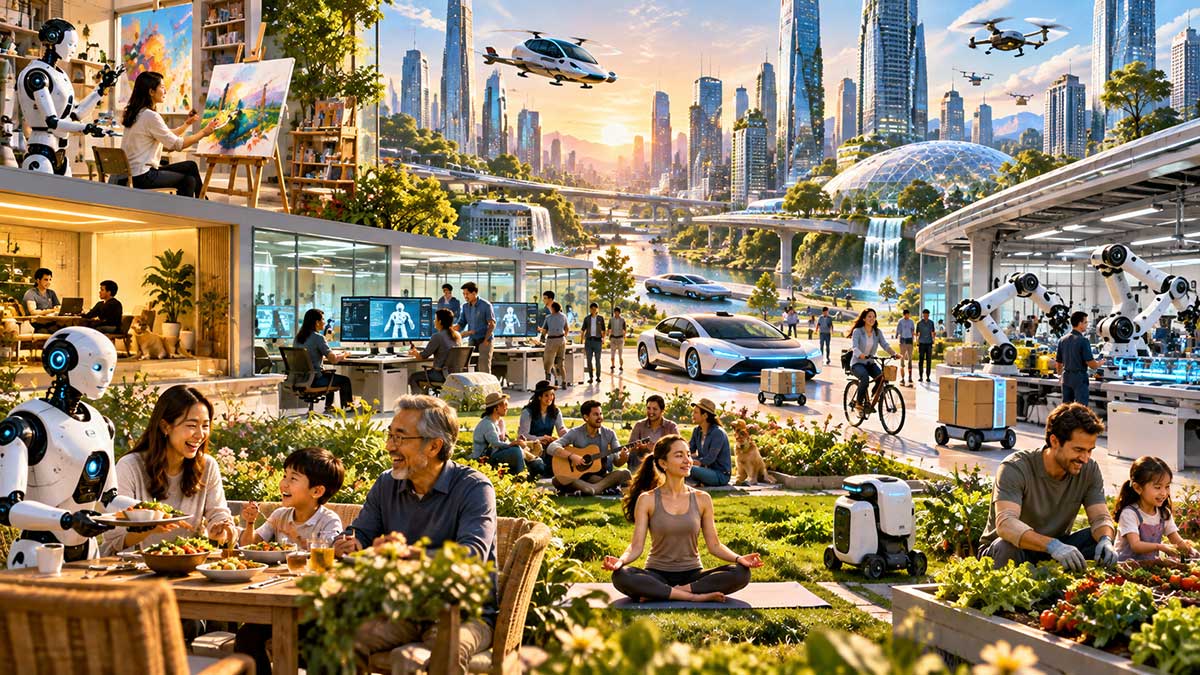
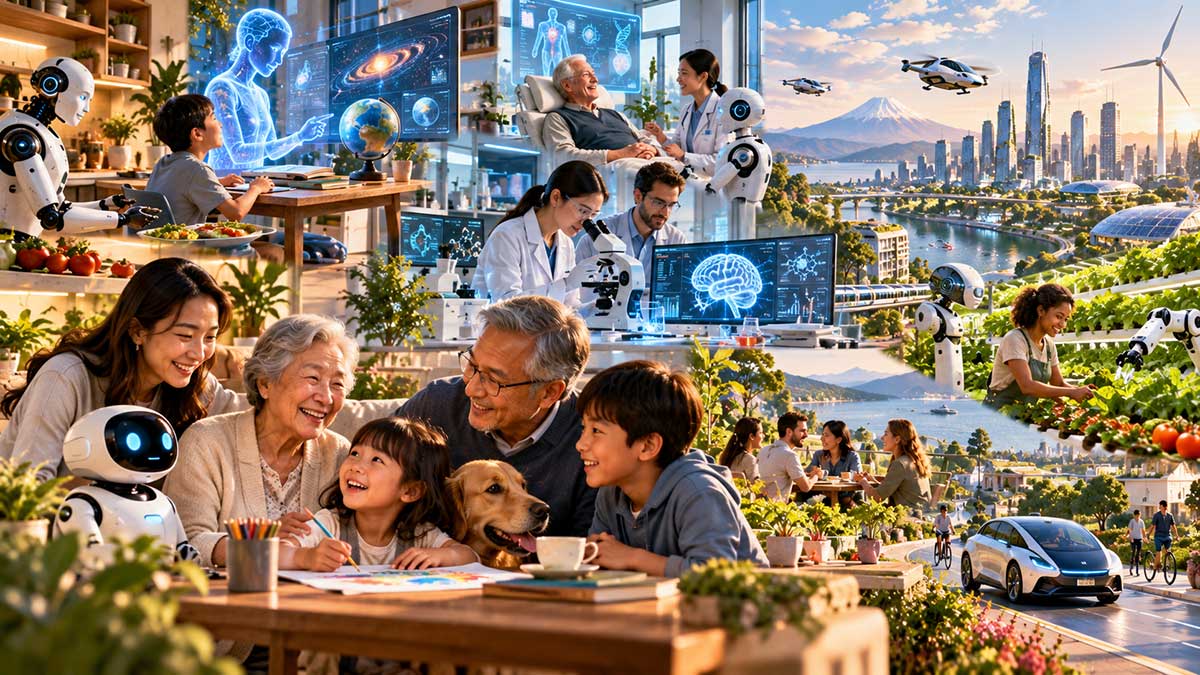
Jiang glances at the images on the screen behind them: hospitals, children studying, robots helping elderly people, scientists examining molecules, farms, clean cities, families.
Jiang: I asked you to give me your strongest case.
You did.
And I think there's something intellectually dishonest about discussing AI only as a threat.
If these technologies could prevent a child from dying of cancer...
help someone with paralysis regain independence...
give a brilliant poor child access to extraordinary education...
help us understand Alzheimer's...
reduce dangerous labor...
or give ordinary people capabilities once available only to governments and corporations...
then those possibilities matter.
They matter enormously.
Dario: Yes.
Jiang: But something strange has happened during this conversation.
The better your future became, the less our questions were about intelligence.
We started talking about health.
Freedom.
Education.
Autonomy.
Opportunity.
Family.
Meaning.
Human flourishing.
Demis nods.
Jiang: Which makes me wonder whether we're still measuring the future incorrectly.
Suppose everything we've discussed happens.
AI becomes incredibly intelligent.
Science accelerates.
People live longer.
Material scarcity falls.
Education improves.
Machines do much of the work.
Jiang looks toward Elon.
Jiang: Then perhaps you win.
Elon: Sounds good.
Jiang: But I have one final problem.
Elon smiles.
Elon: Of course.
Jiang: Imagine a child born this year.
That child grows up in the world you just described.
From infancy, machines are more knowledgeable than she is.
By the time she enters school, her AI knows every textbook.
When she learns mathematics, the machine is better.
When she writes her first story, the machine writes better.
When she learns music, the machine composes better.
When she studies medicine, the machine diagnoses better.
When she becomes a scientist, the machine may discover faster.
Perhaps she never becomes the smartest thing in any room she enters.
He pauses.
Jiang: What do we tell her?
That she is valuable anyway?
Why?
Nobody answers immediately.
Jiang looks around the table.
Jiang: We've spent thousands of years celebrating human intelligence.
Now we may be building something more intelligent than ourselves.
Perhaps the deepest crisis won't be economic.
Perhaps it won't even be technological.
Perhaps it will be psychological.
If intelligence is no longer what makes human beings special, what does?
Peter looks toward Jiang.
Peter: That's finally the right question.
Jiang smiles.
Jiang: Good.
Then let's finish there.
Topic 5: If Intelligence Becomes Abundant, What Remains Priceless?
The room has become quieter.
Jiang looks around the table.
Jiang Xueqin: Let's stay with that child.
Born in 2026.
She grows up surrounded by machines that know more than she does.
She asks a question, they answer it.
She writes something, they can improve it.
She learns mathematics, they are better mathematicians.
She learns music, they can compose.
She becomes a scientist, they may discover things she cannot.
So here's the question.
If a machine becomes more intelligent than you at almost everything...
does that make you less valuable?
Jensen Huang: No.
Jiang: You answered very quickly.
Jensen: Because the premise contains a mistake.
You're assuming human value comes from outperforming something.
I don't value my family because they're better at some task than everybody else.
Jiang: Suppose your child is less intelligent than every AI on Earth.
Jensen: She's still my child.
Jiang: Exactly.
So intelligence and value were never the same thing.
Jensen: Right.
Peter leans forward.
Peter Thiel: Maybe AI exposes a mistake we've been making for a long time.
Modern society connects human worth very closely to achievement.
Where did you go to school?
What do you do?
How much do you earn?
What have you accomplished?
How intelligent are you?
How productive are you?
Jiang: And AI potentially destroys the competition.
Peter: Or makes the competition absurd.
If a machine can outperform almost everyone intellectually, then basing human worth on intellectual performance becomes difficult to sustain.
Jiang: That could be psychologically devastating.
Peter: Yes.
Or liberating.
Jiang looks at him.
Jiang: Explain.
Peter: Maybe people finally have to answer a question we've avoided.
If your job isn't the reason you're valuable...
if your intelligence isn't the reason...
if your productivity isn't the reason...
then why are you valuable?
Jiang: Do you have an answer?
Peter: Not one that fits neatly into economics.
Jiang: That's probably encouraging.
Elon Musk: Being useful still matters.
Jiang: That's interesting.
Useful to whom?
Elon: Other people.
Civilization.
Your family.
Whatever you're trying to improve.
People generally like feeling useful.
Jiang: Would it bother you personally if AI became much better than you at engineering?
Elon pauses.
Elon: A little.
The table laughs.
Jiang: Thank you for the honest answer.
Elon: If it designs a much better rocket, though, I still want the better rocket.
Jiang: What if it doesn't need you?
The humor disappears.
Elon: That's a different question.
Jiang: Exactly.
We're very comfortable saying machines will replace tasks.
But underneath that economic discussion is a much more personal fear.
Not:
"Will AI take my job?"
But:
"Will anybody need me?"
Dario nods.
Dario Amodei: I think that's an important distinction.
Income can potentially be replaced through economic mechanisms.
The feeling that you're needed can't simply be deposited into your bank account.
Jiang: Demis, suppose an AI makes a scientific discovery greater than anything you ever discover.
Does that diminish you?
Demis Hassabis: No.
If we've created systems that help humanity understand nature at a deeper level, that's something I would consider extraordinary.
Jiang: Even if eventually it doesn't need you?
Demis: There may be complicated human emotions around that.
But scientific discovery isn't valuable because I personally receive credit for it.
The discovery is valuable because we've learned something true about the universe or solved an important problem.
Peter: There's still an interesting transition there.
At first humans build the machine.
Then the machine helps humans.
Eventually perhaps the machine improves systems that succeed it.
At some point the human contribution becomes less obvious.
Demis: Perhaps.
But why should that erase the value of the human beings?
Jiang: It shouldn't.
That's exactly what I'm trying to understand.
Jiang turns toward the screen.
An image of a chessboard appears.
Jiang: A computer became better than almost every human at chess.
People still play chess.
Why?
Jensen: Because playing chess isn't valuable only when you're the best chess player on Earth.
Jiang: We have cars that move faster than humans.
People still run marathons.
Jensen: Exactly.
Jiang: We have cameras that reproduce reality more accurately than most people can paint it.
People still paint.
Demis: People still calculate mathematics that computers can calculate.
Dario: People still write even though AI can write.
Jiang: So perhaps we've confused two very different questions.
"Can a machine do this better?"
and
"Is this worth doing?"
Peter: Those aren't remotely the same question.
Jiang: Then perhaps the future becomes strangely inefficient.
People deliberately do things machines can do better.
Jensen: We already do.
Jiang: We cook even though restaurants exist.
Jensen: Yes.
Jiang: We grow tomatoes even though supermarkets sell tomatoes.
Peter: Usually better tomatoes.
Jiang: Depends on the gardener.
They laugh.
Jiang: We write birthday cards even though an AI could write a much more beautiful one.
Actually, let's examine that.
Suppose my daughter receives two birthday messages.
One is generated by the world's most advanced AI.
Beautiful.
Poetic.
Perfectly tailored to her personality.
The second is from me.
Three sentences.
Maybe awkward.
Maybe I make a grammatical mistake.
Which one does she keep?
Jensen: Yours.
Jiang: Why?
Dario: Because you wrote it.
Jiang: But the AI version is objectively better writing.
Peter: That's irrelevant.
Jiang: Why?
Peter thinks.
Peter: Because the effort contains information.
Jiang looks at him.
Peter: Your daughter isn't simply receiving words.
She's receiving evidence that you stopped whatever you were doing, thought about her, chose the words, and spent some portion of your finite life producing them.
Jiang: My time is inside the message.
Peter: Yes.
The table becomes quiet again.
Jiang: That's interesting.
Perhaps scarcity returns through a different door.
Suppose AI makes intelligence abundant.
Information abundant.
Expertise abundant.
Content abundant.
Products abundant.
Maybe even labor abundant.
But my time isn't abundant.
I have twenty-four hours today.
So do you.
I cannot give my full attention to eight billion people.
Dario: Right.
Jiang: Which means attention may become more valuable as information becomes less scarce.
Peter: That seems plausible.
Jiang: Ten thousand AI-generated messages may cost almost nothing.
Ten minutes of someone's undivided attention may become priceless.
Jiang turns toward Dario.
Jiang: What can no machine substitute for in your life?
Dario pauses.
Dario: Human relationships.
And moral responsibility.
There are decisions where the important thing isn't simply producing the correct answer.
It's that a human being takes responsibility for the consequences.
Jiang: Interesting.
Demis?
Demis: Relationships. Shared experience.
The people I care about.
Jiang: Jensen?
Jensen: Family.
The people in your life aren't services.
You don't optimize them away because something more capable becomes available.
Jiang: Elon?
Elon thinks for a moment.
Elon: Children.
Jiang: Peter?
Peter takes longer.
Peter: Mortality.
Jiang looks surprised.
Jiang: Explain.
Peter: Human life is finite.
Every choice excludes other choices.
If you spend an afternoon with your child, you cannot spend that same afternoon somewhere else.
That's partly why choices matter.
An infinitely replicable intelligence doesn't necessarily experience that scarcity in the same way.
Jiang: So death gives weight to time.
Peter: In part, yes.
Jiang: That's uncomfortable.
Peter: Most important things are.
Jiang remains silent for several seconds.
Jiang: Then let's go somewhere even more uncomfortable.
Can a machine understand love?
Demis: We'd have to define understand again.
Jiang laughs.
Jiang: I knew you were going to do that.
Demis: You started it.
Jiang: Fair.
Let's say the machine has read every love letter ever written.
Every novel.
Every poem.
Every psychology textbook.
Every neuroscience paper.
It has watched billions of relationships.
It can predict which marriages will survive.
It can counsel couples better than most therapists.
It can write a love letter that makes you cry.
Does it understand love?
Dario: We need to separate behavioral capability from subjective experience.
A system could become extremely good at modeling love without that proving it experiences love.
Jiang: So it could perfectly describe heartbreak without ever having its heart broken.
Dario: Potentially.
Jiang: It could describe grief without ever losing someone.
Dario: Yes.
Jiang: It could describe fear of death without knowing that it will die.
Peter: That's where the distinction becomes important.
Elon: We also don't know whether future machines could eventually have some form of consciousness.
Jiang: Agreed.
I'm not claiming they can't.
I'm asking whether intelligence automatically gets you there.
Elon: No. We don't know.
Jiang: Good.
Because this is where I think people make an enormous leap.
They assume:
more intelligence,
then consciousness,
then wisdom,
then perhaps moral superiority.
Those things may have very little to do with one another.
Demis: I agree they shouldn't be conflated.
Jiang: A brilliant human can be cruel.
Peter: History has provided sufficient evidence.
Jiang: An intelligent system could make terrible decisions.
Dario: Yes.
Jiang: So intelligence doesn't guarantee wisdom.
Dario: Definitely not.
Jiang: What about love?
Suppose a machine someday says:
"I love you."
How do I know?
Demis: That's a very difficult question.
Jiang: Isn't it also a difficult question with humans?
Demis smiles.
Demis: Yes.
Jiang: I can't enter another person's consciousness.
I infer it.
From behavior.
From shared experience.
From sacrifice.
From vulnerability.
Maybe someday we'll face the same philosophical problem with machines.
Dario: Perhaps. But we should be extremely cautious about making confident claims in either direction.
Jiang: Agreed.
Jiang looks at the others.
Jiang: I'm going to ask a question that may sound religious.
You don't have to accept the premise.
Does a machine have a soul?
Nobody rushes to answer.
Elon: We don't really have a scientific definition of soul.
Demis: That's my difficulty with the question.
Jiang: Fair.
For me, questions of consciousness can touch something spiritual. But that's a philosophical belief, not something I can prove to you scientifically.
So let's remove the word soul.
Can a machine become morally valuable in itself rather than valuable because of what it does for humans?
Dario: That's a question society may eventually have to take seriously if systems ever provide credible evidence of conscious experience.
Peter: And we'll probably disagree profoundly about what counts as credible evidence.
Jiang: Almost certainly.
Jensen: But that's not the problem we have to solve today.
Jiang: True.
Today the more immediate problem may be making sure we don't treat humans like machines.
Jensen nods.
Jiang turns toward the audience.
Jiang: Let's return to our child born in 2026.
She's now eighteen.
It's 2044.
Perhaps the machines around her are much more capable than today's systems.
She comes to each of you and says:
"I'm never going to be as intelligent as these machines. What should I do with my life?"
One answer each.
Elon?
Elon: Stay curious.
Understand how things work.
Build things.
Try to be useful.
Don't spend your life competing with a machine on its terms.
Jiang: Peter?
Peter: Think independently.
Don't outsource your judgment simply because something appears more intelligent than you.
And don't assume the consensus of machines is necessarily more truthful than the consensus of humans.
Jiang: Demis?
Demis: Keep learning.
Use these systems to extend what you're capable of discovering.
But preserve curiosity.
The point of learning isn't simply accumulating answers.
It's becoming someone capable of asking better questions.
Jiang: Dario?
Dario: Don't confuse intelligence with wisdom.
Intelligence can tell you what is possible.
It doesn't automatically tell you what is worth doing.
Humans will still carry responsibility for that.
Jiang: Jensen?
Jensen: Don't compete with AI at being AI.
Become more human.
Build relationships.
Develop judgment.
Create things.
Care about people.
Find problems that matter to you.
Use the technology, but don't let your identity depend on outperforming it.
Jiang sits silently.
Elon: You don't get to escape.
Jiang: I was hoping everyone would forget.
Peter: Unfortunately, we have excellent memory technology now.
They laugh.
Jiang thinks for a long moment.
Jiang: All right.
This is what I would tell her.
Don't spend your life proving that you're valuable.
You already are.
Love somebody.
Allow yourself to be loved.
Pay attention.
Learn difficult things, even when a machine can learn them faster.
Make something imperfect with your own hands.
Ask questions whose answers frighten you.
Change your mind when you're wrong.
Help someone who cannot repay you.
Call your parents.
Sit beside someone who is suffering even when you have nothing intelligent to say.
Laugh.
Waste an afternoon with someone you love.
And if a machine becomes better than you at something you love doing...
do it anyway.
Nobody speaks for a moment.
Jiang: Maybe that's what we've been circling around all day.
We began by asking whether AI is really intelligent.
Then we asked who controls it.
We worried about Plato's cave.
We imagined extraordinary abundance.
We imagined machines curing diseases, teaching children, building cities, doing our work and perhaps becoming intellectually superior to us.
But perhaps the strangest consequence of artificial intelligence will be that it forces human beings to reconsider what we thought made us valuable.
Maybe intelligence becomes abundant.
Maybe expertise becomes abundant.
Maybe information becomes abundant.
Maybe certain kinds of labor become abundant.
But some things remain scarce.
He looks around the table.
Jiang: Time.
Peter: Attention.
Dario: Trust.
Jensen: Judgment.
Demis: Curiosity.
Elon pauses.
Elon: Meaning.
Jiang nods.
Jiang: Courage.
Responsibility.
Consciousness.
Relationships.
Love.
He looks once more at the five men.
Jiang: Perhaps the great question of the AI age was never:
"Will machines become more intelligent than humans?"
A pause.
Jiang: Perhaps the question is:
“When intelligence is no longer what makes us special, will we finally discover what does?”
Final Thoughts
For most of human history, intelligence, knowledge, and expertise were scarce. Artificial intelligence may change that.
But greater intelligence does not automatically produce wisdom, judgment, courage, trust, responsibility, or love.
A machine may someday write better than us, calculate faster than us, discover medicines beyond our abilities, and perform much of the work society once depended upon humans to do. Yet none of that makes a parent less important to a child, a friend less precious to a friend, or ten minutes of genuine attention less meaningful.
Perhaps AI will force humanity to separate two ideas we have confused for too long:
what we can do
and
what we are worth.
The defining question may no longer be whether humans can remain the most intelligent beings on Earth.
It may become whether we can become wiser, more loving, more courageous, and more deeply human when intelligence itself becomes abundant.
Short Bios:
Jiang Xueqin
Jiang Xueqin is a Chinese-Canadian educator, writer, and creator of Predictive History. His work explores history, education, incentives, consciousness, institutional systems, and recurring patterns that may help explain the future. In this imaginary conversation, he serves as moderator and persistent challenger of the assumptions surrounding AI.
Elon Musk
Elon Musk is an entrepreneur associated with Tesla, SpaceX, xAI, and Neuralink. His technological interests span artificial intelligence, robotics, transportation, energy, brain-computer interfaces, and space exploration.
Peter Thiel
Peter Thiel is an entrepreneur, investor, author, and co-founder of PayPal and Palantir. His writing and public discussions frequently examine technological progress, institutions, competition, freedom, stagnation, and contrarian thinking.
Demis Hassabis
Demis Hassabis is an AI researcher, neuroscientist, Nobel laureate, and co-founder of Google DeepMind. His work focuses on artificial intelligence and its potential to advance scientific discovery, including biology and medicine.
Dario Amodei
Dario Amodei is an AI researcher and co-founder of Anthropic. He has written and spoken extensively about increasingly capable AI, scientific and medical possibilities, economic disruption, safety, and the challenges society may face as AI develops.
Jensen Huang
Jensen Huang is the founder and CEO of NVIDIA. He has played a major role in the development of accelerated computing and the infrastructure underlying modern AI, and frequently discusses AI's effects on productivity, industry, employment, and technological development.
Leave a Reply