
Introduction
Politics can begin with ideas about taxes, immigration, education, healthcare, war, religion, or the role of government. Yet disagreement sometimes becomes something far more personal. A person stops merely supporting a position and begins identifying with a political team. From there, criticism of the party can feel like criticism of the self.
Sports offer a revealing comparison. An Ohio State fan can feel genuine joy when Michigan loses, despite never stepping onto the field. The words "we won" show how easily human beings extend their identity into a group.
What happens when the same instinct enters politics?
This imaginary conversation brings together social psychologists and researchers who have studied group identity, moral judgment, partisan polarization, competition, emotion, and reasoning. Rather than asking which political side is correct, they explore a more uncomfortable question: Can we recognize tribal thinking in ourselves before criticizing it in everyone else?
(Note: This is an imaginary conversation, a creative exploration of an idea, and not a real speech or event.)
Topic 1: Why Do Humans Create "Us" and "Them"?
The room feels almost too friendly for the subject they are about to discuss.
On the screen behind the guests is a photograph from Columbus in late November. Scarlet everywhere. Students in Ohio State sweatshirts walk past campus signs where one particular letter has been crossed out.
M.
The moderator looks at the photograph and smiles.
Moderator: Before we talk about Republicans or Democrats, liberals or conservatives, I want to start with something much safer.
Michigan.
Jonathan Haidt: You said safer. I'm not sure everyone in Columbus would agree.
Moderator: Fair point.
The room laughs.
Moderator: Every year around the Ohio State-Michigan game, you see this ritual. People cover the letter M. Someone might see a sign saying "Market" and suddenly that M has become unacceptable.
Think about how strange that is.
The letter hasn't done anything.
Henri Tajfel: Which is precisely why it is such a useful place to begin.
Moderator: Why?
Tajfel: Since it strips away many explanations we normally use for conflict. There doesn't need to be a serious disagreement. There doesn't need to be a moral offense. There doesn't even need to be personal hostility.
Sometimes people simply need categories.
Us.
Them.
Once those categories become psychologically meaningful, behavior can begin to change.
Haidt: And sports are wonderful examples since everyone admits what's happening.
A person says, "We're going to beat Michigan."
But who is "we"?
Did you practice this morning?
Moderator: No.
Haidt: Are you playing defensive tackle?
Moderator: Definitely no.
Haidt: Did the coach call you about Saturday?
Moderator: Still waiting.
Laughter moves around the table.
Haidt: Yet if Ohio State wins, you might say, "We won!"
That little word, we, is doing enormous psychological work.
Mina Cikara: And notice what happens emotionally.
If your team scores, you feel something.
If your team loses, you feel something.
Your body can react to an event you didn't physically participate in.
Moderator: But that's what fascinates me.
Suppose Michigan scores a touchdown.
Nothing has happened to me.
My house is still there.
My family is fine.
My bank account hasn't changed.
Yet I might feel terrible.
Cikara: Since the boundary of the self can psychologically extend beyond the individual.
We care about what happens to groups with which we identify.
Peter Ditto: And nobody finds that particularly irrational when it's football.
Moderator: That's interesting.
Ditto: If somebody says, "My daughter graduated from Ohio State, I've followed the Buckeyes for forty years, and I was devastated when they lost," nobody says, "You need psychological treatment."
We understand it.
Haidt: More than that, we enjoy it.
Take away identification and much of sports becomes less interesting.
Imagine watching twenty-two strangers move a ball around when you don't care who wins.
Moderator: That's exactly how my wife watches football.
Everyone laughs.
Haidt: Then she may actually be the rational person in the room.
Moderator: Henri, your experiments went much further than football teams, didn't they?
Tajfel: We wanted to know how little was required before people began distinguishing between an ingroup and an outgroup.
You might expect hostility to require meaningful differences.
Religion.
Language.
History.
Resources.
Perhaps some previous injustice.
But people can show ingroup favoritism after being divided using remarkably trivial criteria.
Moderator: That's the part I find almost unbelievable.
You're saying we don't necessarily need Michigan and Ohio State.
We could almost invent two meaningless groups?
Tajfel: Yes.
Moderator: Let's try it.
Everyone on this half of the table is...
He looks around the room.
Moderator: Triangle people.
And everyone over here is...
David Rand: Please don't say circles.
Moderator: Circle people.
Rand: I knew it.
Moderator: Already offended?
Rand: Deeply.
The table breaks into laughter again.
Moderator: But seriously, if we lived together long enough as triangles and circles, would we start caring?
Tajfel: Under some conditions, surprisingly little can be enough for favoritism to emerge.
But we must be precise. Categorization doesn't automatically produce hatred or violence.
That distinction is very important.
Shanto Iyengar: Yes. Otherwise we leave people with a misleading lesson that merely having groups creates hostility.
Humans categorize constantly.
Young and old.
Local and foreign.
Buckeye and Wolverine.
Groups themselves aren't the whole problem.
Muzafer Sherif: Competition changes matters considerably.
Moderator: And that's where your famous summer camp experiment enters our conversation.
Sherif: Boys were placed into groups at a summer camp. They developed identities, names, loyalties.
Then competition was introduced.
Now there were winners and losers.
The relationship between the groups deteriorated.
Moderator: So let's slow that down.
At first:
"We are us."
Then:
"They are them."
Then somebody introduces a scoreboard.
Sherif: Yes.
Moderator: And now:
"If they win, we lose."
Sherif: That is a very different relationship.
Cikara: Which is why sports are such an elegant illustration.
The structure is explicitly zero-sum.
Ohio State cannot defeat Michigan and Michigan simultaneously defeat Ohio State in the same game.
Your desired outcome requires the opponent's undesired outcome.
Moderator: Which creates something psychologically fascinating.
I don't merely enjoy Ohio State scoring.
I might enjoy Michigan fumbling.
Cikara: Correct.
Moderator: But those aren't quite the same emotion.
Cikara: No.
One is pleasure from your group's success.
The other can involve pleasure connected to a rival's setback.
That distinction will matter later when we discuss politics.
Moderator: Let's resist politics for another minute.
I want to understand the sports version completely.
Suppose Ohio State isn't playing.
Michigan plays another team.
Why might an Ohio State fan still want Michigan to lose?
Haidt: Now you've reached identity.
The rival has become part of the story you tell about your own group.
Ditto: Think about how odd that is from a purely individual perspective.
You may be sitting at home in Columbus hoping that twenty-year-old strangers in another state fail at something.
Moderator: When you describe it like that, sports fans sound insane.
Rand: That's why sports fans don't describe it like that.
More laughter.
Moderator: Let me make the question harder.
Why would evolution produce creatures like this?
Why aren't humans simply individuals?
Haidt: Humans survived through cooperation.
We aren't solitary creatures.
Our ancestors depended upon other people for food, protection, child-rearing, knowledge, defense and countless other things.
Group attachment isn't some strange corruption that suddenly appeared with political parties.
It reaches very deeply into human social life.
Sherif: Cooperation within groups can accomplish things individuals cannot.
Moderator: So tribalism isn't automatically evil.
Haidt: I would strongly resist treating it that way.
Look around at some of the best experiences people have.
Families.
Religious communities.
Military units.
Neighborhoods.
Sports teams.
Schools.
Nations.
People sacrifice for one another partly since they experience something larger than the isolated self.
Tajfel: The distinction we should maintain is between identification and hostility.
They are related under certain circumstances, but they aren't identical.
Moderator: So I can love Ohio State without hating Michigan.
Tajfel: Certainly.
Moderator: I can love America without hating another country.
Tajfel: Yes.
Moderator: I can love my religion without believing people from every other religion are terrible.
Haidt: Precisely.
Moderator: Then perhaps we've been asking the wrong question.
Maybe the question isn't:
"Why do humans form tribes?"
Maybe it is:
"Why does loving our tribe sometimes turn into hostility against another tribe?"
The room grows quieter.
Sherif: Competition is one answer.
Iyengar: Perceived threat is another.
Cikara: Emotion.
Ditto: Identity protection.
Haidt: Moralization.
Rand: Information environments can matter too.
Moderator: That's already a long list.
He turns back to the photograph of Ohio State-Michigan week.
Moderator: There's something beautiful about that picture too.
That's what I don't want us to miss.
People are laughing.
Friends are together.
Parents bring their children.
Former students come back decades later.
People who have never met hug after a touchdown.
So the same psychological mechanism capable of dividing people can connect them.
Haidt: That's fundamental.
If you tried to eliminate tribal psychology completely, you might eliminate things you would desperately miss.
Moderator: Then perhaps we shouldn't ask how to eliminate tribes.
Rand: Perhaps we should ask how to prevent group loyalty from overriding judgment.
Moderator: We're getting close to politics now.
Ditto: You weren't going to keep us away forever.
Moderator: Not quite yet.
One more experiment.
Imagine I'm watching Ohio State-Michigan.
Michigan makes a spectacular play.
Clearly legal.
Clearly brilliant.
But I'm an Ohio State fan.
What happens?
Cikara: You may admire it.
Moderator: May?
Cikara: You may discover some suddenly sophisticated reasons why it wasn't actually that impressive.
Everyone laughs.
Ditto: Now we're getting somewhere.
Moderator: So my identity might affect how I interpret what my eyes just saw?
Ditto: Potentially, yes.
Moderator: And if the referee makes a close call benefiting Ohio State?
Haidt: Excellent officiating.
Moderator: Same call benefits Michigan?
Haidt: National investigation.
The room erupts.
Moderator: That's funny precisely since everyone recognizes it.
Haidt: Exactly.
Moderator: And perhaps that's why sports give us such a useful mirror.
We can laugh when we catch ourselves doing it.
"My team got robbed!"
"The referee hates us!"
"The other team's fans are obnoxious!"
We understand that our loyalty is influencing our perception.
But somewhere outside the stadium, something changes.
The jerseys disappear.
The scoreboard disappears.
The game becomes serious.
Taxes.
Immigration.
Education.
Crime.
War.
Religion.
Rights.
The future of our children.
And perhaps we stop laughing at our own tribal instincts.
Iyengar: Now the identity can carry much greater stakes.
Moderator: Which leaves me with one uncomfortable thought.
Maybe politics didn't invent tribalism at all.
Maybe politics discovered one of the oldest buttons in the human mind and learned how easily it could be pressed.
Tajfel: And once pressed, the critical question becomes what the group means to the individual.
Moderator: So before asking whether Republicans are right or Democrats are right, perhaps there is an earlier question each of us has to ask:
When I say "we," who exactly have I allowed inside that word?
And maybe an equally revealing question:
When I say "they," what have I stopped seeing about the individual people on the other side?
Topic 2: When Does "I Believe This" Become "This Is Who I Am"?
The photograph of the Ohio State-Michigan rivalry disappears from the screen.
In its place are two very plain sentences:
I usually vote Democratic.
I usually vote Republican.
The moderator studies them for a moment.
Moderator: These don't sound especially dangerous.
Shanto Iyengar: They aren't.
Moderator: They're almost boring.
Iyengar: Which is useful.
Moderator: Now let's change one word.
The screen changes.
I am a Democrat.
I am a Republican.
The moderator turns back to the table.
Moderator: What just happened?
Jonathan Haidt: Grammar happened.
Peter Ditto: Psychology happened.
Henri Tajfel: Categorization happened.
Moderator: All from the word am?
Tajfel: Potentially. "I vote for" describes an action. "I am" can describe identity.
Moderator: So "I vote Republican" and "I am Republican" may sound similar, but psychologically they don't have to be the same thing.
Iyengar: Correct.
Research on affective polarization treats partisanship partly as a social identity, not merely a bundle of policy preferences. That distinction helps explain why political disagreement can sometimes spill into dislike or distrust of people associated with the opposing party. (Annual Reviews)
Moderator: Let's make that personal.
Suppose somebody tells me:
"Nick, your opinion about taxes is wrong."
I may argue.
But suppose they say:
"People like you are what's wrong with America."
Haidt: Very different experience.
Moderator: Now I'm not defending taxes anymore.
Haidt: You may feel you're defending yourself.
Ditto: Or your family, your community, your values, your intelligence, your morality.
Moderator: That's a lot to place inside one political label.
Ditto: Human beings are very talented at packing things into labels.
Moderator: Henri, let's return to social identity for a moment.
If I identify strongly with a group, what happens when the group is criticized?
Tajfel: The group can become psychologically relevant to how the person sees himself or herself.
That doesn't mean every criticism is experienced personally. Strength of identification matters. Context matters.
But once group membership becomes meaningful to the self, evaluation of the group can carry emotional weight.
Moderator: So imagine someone saying:
"Ohio State's football team was terrible Saturday."
That might sting.
But:
"Ohio State fans are ignorant."
Now I'm included.
Cikara: Yes.
Moderator: Politics works similarly?
Iyengar: It can.
Partisan polarization isn't solely disagreement over what government should do. Research has documented hostility aimed at the opposing partisan group itself. (Annual Reviews)
Moderator: That's an enormous difference.
"I disagree with your immigration policy."
versus
"I don't like people like you."
Iyengar: Exactly.
Moderator: One is disagreement.
The other is relationship.
Iyengar: Yes.
The moderator walks to the screen again.
Two enormous boxes appear.
DEMOCRATS
REPUBLICANS
Moderator: Let's put America into two boxes.
David Rand: This should go well.
Moderator: What could possibly go wrong?
Laughter.
Moderator: Into the Democratic box I'll put:
A union worker in Pennsylvania.
A progressive student in California.
A Catholic grandmother in Ohio.
A wealthy business owner in New York.
A Black churchgoer in Georgia.
A moderate suburban voter.
Haidt: Already quite a strange dinner party.
Moderator: Now Republicans.
An evangelical pastor.
A libertarian entrepreneur.
A rural farmer.
A suburban accountant.
A traditional conservative.
A Trump enthusiast.
A Republican who dislikes Trump.
Ditto: Another peaceful dinner.
Moderator: And yet once we say "Democrats" or "Republicans," don't we sometimes forget everyone inside those boxes is different?
Tajfel: Categories simplify the social environment.
That can be useful.
You cannot process every individual as though you've never encountered another human before.
But categories can lead us to overlook variation within groups.
Moderator: Which produces something I see all the time.
Someone says:
"Democrats believe..."
or
"Republicans want..."
Millions of people suddenly receive one brain.
Rand: That should immediately make us cautious.
Moderator: Since no group of tens of millions of people thinks exactly alike.
Iyengar: Certainly.
And political research distinguishes ideological disagreement from partisan animosity for that reason. Party labels can carry social meaning beyond the exact policy positions of every individual member. (Annual Reviews)
Moderator: Let me try something uncomfortable.
Suppose I meet someone at a barbecue.
I know almost nothing about him.
Then he tells me he voted Republican.
What happens in my brain?
Haidt: Depends on you.
Moderator: Fine. Suppose I'm strongly Democratic.
Haidt: Then information associated with that category may become accessible.
Moderator: Guns.
Abortion.
Trump.
Immigration.
Religion.
Climate.
Haidt: Perhaps.
Moderator: And suppose I'm strongly Republican and he tells me he votes Democratic.
Now another collection appears.
Taxes.
Government.
Biden.
Abortion.
Climate.
Immigration.
Ditto: Notice what you've done.
Moderator: What?
Ditto: You met one person and immediately populated him with positions he never told you he holds.
Moderator: That's good.
Or terrible.
Rand: Both.
Moderator: I know one fact.
I manufacture fifteen more.
Tajfel: Categories make prediction possible.
But prediction can become stereotyping.
Moderator: So the category is useful until I confuse the category with the person.
Tajfel: That's one way to state the danger.
Moderator: Dan, where does identity protection enter this?
Dan Kahan: Political and cultural beliefs can become entangled with membership in groups that matter to people.
Then changing a belief may carry consequences beyond the belief itself.
Moderator: Give me a normal example.
Kahan: Suppose your closest friends, your family, your church, your neighborhood, your online community, almost everyone you respect, shares a political view.
Now suppose you begin doubting that view.
Moderator: That's not merely:
"I changed my mind."
Kahan: Correct.
You may anticipate social consequences.
Moderator: People might say:
"What's happened to you?"
Kahan: Yes.
Moderator: "You've changed."
Kahan: Yes.
Moderator: "You've gone over to the other side."
Kahan: Exactly.
The room grows quieter.
Moderator: That's much more powerful than a debate.
Haidt: Humans care enormously about belonging.
Moderator: So sometimes the hidden question underneath:
"Is this argument true?"
might actually be:
"If I believe this, what happens to my place among my people?"
Ditto: Sometimes.
But we need to avoid turning this into a theory explaining every political belief.
People sincerely reason about policy.
People change positions from evidence.
People disagree for legitimate reasons.
Moderator: That's critical.
We shouldn't say:
"Anyone who disagrees with me is just protecting their identity."
Ditto: That would become another form of bias.
Rand: And a convenient one.
You could dismiss any opponent without listening to the argument.
Moderator: Which is exactly what this conversation is trying to prevent.
Moderator: Let me ask something harder.
Can intelligence protect us from this?
Kahan: Not automatically.
Reasoning ability doesn't guarantee neutrality.
A capable reasoner can use reasoning to test a belief.
But reasoning can sometimes be recruited to defend a position someone already feels committed to.
Moderator: So being smarter doesn't necessarily mean:
"I'm less biased."
It might sometimes mean:
"I'm better at building arguments."
Kahan: That possibility deserves serious attention.
Haidt: Think of a lawyer.
A brilliant lawyer can create an excellent case.
But the lawyer may begin with a client and then build the argument.
Moderator: Which brings us to a dangerous possibility.
What if I think I'm a judge...
but I'm actually my tribe's lawyer?
Ditto: That's a very useful question.
Moderator: Every new fact enters the courtroom.
If it helps my side:
"Excellent evidence."
If it hurts my side:
"Let's examine the source."
Everyone laughs.
Moderator: We've all seen that.
A story hurts the opposing party:
"Everybody needs to see this!"
A story hurts our party:
"Who funded this study?"
Rand: Skepticism is good.
Selective skepticism is another matter.
Moderator: That's the phrase.
Selective skepticism.
Moderator: Mina, what happens emotionally when politics becomes identity?
Cikara: Emotion can become tied to group outcomes.
Moderator: Similar to sports?
Cikara: There can be parallels, though political stakes and contexts differ.
Moderator: Let's say an election result appears.
Before I know anything about what the winning politician will actually accomplish, I already feel something.
Relief.
Fear.
Joy.
Anger.
Cikara: Group affiliation can shape emotional reactions.
More broadly, research on emotion and politics finds that emotions interact with polarization, attitudes, and political information processing. (Annual Reviews)
Moderator: So politics isn't happening only in the rational part of the mind.
Haidt: Very little important human behavior happens only there.
Moderator: Fair enough.
The moderator erases the two party labels from the screen.
Now there are just two words:
US
THEM
Moderator: This may be the real political map.
Not left and right.
Not red and blue.
Just:
Us.
Them.
Tajfel: That distinction can become psychologically powerful.
Moderator: And once somebody enters "them," we may stop seeing all the differences within that group.
Iyengar: Which matters since partisan animosity can become directed at ordinary citizens, not merely politicians or policies. (Annual Reviews)
Moderator: That's the part that bothers me.
A politician says something stupid.
Fine.
Criticize the politician.
A policy fails.
Criticize the policy.
But suddenly a person you've never met is stupid since they belong to the same party?
Rand: That is where categorization becomes a poor substitute for individual information.
Moderator: Suppose I meet two neighbors.
One Democrat.
One Republican.
Both take care of their elderly parents.
Both love their children.
Both donate to charity.
Both worry about healthcare.
Both hate seeing people suffer.
Both want their children safe.
Yet give them two political labels and suddenly they may believe the other person lives in a completely different moral universe.
Haidt: Human moral disagreement is real.
But perceived differences between groups can become larger than actual differences between individuals.
Moderator: Which means our categories can sometimes hide common ground.
Moderator: I want to test everybody at this table.
Finish this sentence:
The dangerous moment isn't when someone says:
"I disagree with that party."
The dangerous moment begins when...
Iyengar: ...disagreement becomes generalized dislike of the people associated with the party.
Tajfel: ...category replaces individuality.
Cikara: ...another group's pain becomes emotionally rewarding.
Kahan: ...protecting identity becomes more important than examining evidence.
Ditto: ...we recognize bias everywhere except in ourselves.
Rand: ...accuracy becomes secondary to defending a conclusion.
Sherif: ...competition makes cooperation appear impossible.
Haidt: ...we forget that the person across from us is more than a political label.
The moderator looks at the two words still glowing on the screen.
US.
THEM.
Moderator: Maybe that's why political division can become so personal.
We begin with:
"I believe this."
Then somewhere along the way it can become:
"People like me believe this."
Then:
"Good people believe this."
And eventually:
"What kind of person would believe what they believe?"
The room goes silent.
Moderator: Perhaps that's the moment disagreement changes into something else.
A belief has stopped being something we carry.
It has started carrying our identity.
And once that happens, changing our minds may feel less like correcting an opinion and more like changing who we are.
Topic 3: Would You Still Support the Idea If You Didn't Know Who Proposed It?
The words US and THEM disappear from the screen.
A new sentence appears.
No photograph.
No political party.
No politician's name.
Just a proposal.
Moderator: I'm going to try an experiment.
Peter Ditto: On us?
Moderator: On everyone reading this conversation.
Jonathan Haidt: Much safer.
Moderator: Here's the proposal:
"The government should close a tax loophole that allows some wealthy individuals to pay a lower effective tax rate."
Don't answer out loud.
Just notice your first reaction.
Good idea?
Bad idea?
Needs details?
Too much government?
Fairness?
Now I'm going to put a politician's name underneath it.
David Rand: Which politician?
Moderator: That's exactly the problem.
The table laughs.
Moderator: I'm not going to tell you.
Suppose I say it came from a Democratic president.
Did anything happen inside you?
Now erase that.
Suppose I say it came from a Republican president.
Did anything happen?
Ditto: And notice that the proposal hasn't changed.
Moderator: Not one word.
Ditto: But the information surrounding it has.
Moderator: Which raises the question I've been waiting to ask:
Why can identical words feel different after we discover who said them?
Question 1: Why Can the Messenger Change How We Hear the Message?
Ditto: Human beings don't evaluate every claim in isolation.
We use context.
Who said it?
Do we trust that person?
What group does the person belong to?
What might their motives be?
Those aren't inherently foolish questions.
Moderator: That's important.
If somebody has lied to me twenty times, knowing who's speaking should matter.
Rand: Certainly.
Source credibility is legitimate information.
Moderator: Then when does it become bias?
Rand: When the label substitutes for evaluating the claim itself.
Moderator: Give me the difference.
Rand: Suppose a scientist makes a claim. Examining expertise, evidence, methods and conflicts of interest can be reasonable.
But if your reasoning becomes:
"My side said it, so probably true."
or:
"Their side said it, so probably false."
you've moved into something different.
Haidt: And often we don't experience ourselves doing that.
That's what makes this conversation interesting.
From inside our own minds, our reasoning usually feels like reasoning.
Moderator: Nobody wakes up and says:
"Today I'm going to be irrational."
Haidt: Exactly.
Moderator: Nobody says:
"I'm going to carefully examine all available evidence and then believe whatever my political tribe wants."
Ditto: That would at least be refreshingly self-aware.
The table laughs.
The moderator changes the screen.
POLICY A
No party.
No politician.
No photograph.
Moderator: Let's make the experiment harder.
Suppose everyone reads Policy A anonymously.
We record their reactions.
Then tomorrow they see exactly the same proposal with a political party attached.
What interests me isn't whether everybody changes their opinion.
Surely they won't.
What interests me is whether some people's reasoning changes.
Ditto: That's closer to the right question.
Political psychology has repeatedly examined how partisan attachments can influence how people seek, interpret, believe and remember information. But we shouldn't turn that into the crude claim that policy content never matters. It does.
Moderator: So party identity isn't a magic switch.
Ditto: No.
Rand: People possess substantive beliefs too.
They care about taxes, immigration, abortion, healthcare, guns, education, foreign policy and many other issues for reasons that cannot simply be reduced to party identity.
Moderator: That's important for fairness.
We're not saying:
"People don't really have political principles."
Rand: Correct.
Moderator: We're asking:
"When does identity begin leaning on the scale?"
Haidt: Much better.
Moderator: Let me create a fictional politician.
President Smith.
Cikara: Very electable name.
Moderator: President Smith introduces Policy X.
Half the country hates it.
People say:
"Unconstitutional."
"Reckless."
"Terrible precedent."
"An abuse of presidential authority."
Ten years later, President Jones from the opposing party does something substantially similar.
Some of the people who condemned Smith now defend Jones.
Some people who defended Smith now condemn Jones.
What happened?
Ditto: Potentially several things.
Circumstances may genuinely differ.
The details may differ.
Consequences may differ.
People may have learned something during those ten years.
Moderator: Good.
I want all those possibilities on the table.
Ditto: They must be.
Otherwise we would commit the same error we're criticizing.
Moderator: Explain that.
Ditto: We'd look at somebody changing a political judgment and immediately declare:
"Hypocrite!"
But perhaps there really is a relevant difference.
Rand: Context matters.
Moderator: So intellectual fairness requires us to ask:
Is there a meaningful difference?
Not immediately assume there isn't.
Ditto: Precisely.
Moderator: But suppose there really isn't.
Same principle.
Comparable circumstances.
Only the party changed.
Haidt: Then you have created a very interesting mirror.
Question 2: Why Can We Condemn Something From "Them" and Defend It From "Us"?
The moderator places two cards on the table.
One reads:
YOUR PARTY
The other:
OTHER PARTY
Moderator: Here's my test.
Don't tell me what party you're in.
Take something you strongly criticized when the opposing party did it.
Now imagine your preferred party doing precisely the same thing.
Same circumstances.
Same consequences.
Same legal questions.
Same everything.
Does your moral judgment remain exactly the same?
Silence.
Moderator: That's harder than the Ohio State question.
Haidt: Considerably.
Moderator: In football I don't pretend to be impartial.
I say:
"I'm a Buckeye fan."
If the referee makes a close call against Ohio State, I'm upset.
Everyone understands.
But politically we often believe we're the referee.
Haidt: That's a good distinction.
Moderator: Maybe we're actually fans wearing referee shirts.
The table laughs.
Kahan: And possessing greater reasoning ability doesn't automatically remove identity-related reasoning.
Moderator: Let's return to that. It bothered me in Topic 2.
I'd like to believe that if I'm intelligent and informed, I'll catch myself.
Kahan: Knowledge and reflection can certainly help. Yet intelligence alone doesn't guarantee impartiality.
Moderator: Could it sometimes make things worse?
Kahan: A capable reasoner can be very capable at finding arguments supporting a conclusion.
The question is what that reasoning ability is being used for.
Moderator: So intelligence can be used in two directions.
"Help me discover whether I'm wrong."
or:
"Help me prove why I'm right."
Kahan: Yes.
Haidt: Think again about the lawyer.
A skilled lawyer can find weaknesses in the opposition's case very effectively.
Moderator: That's when something funny happens online.
My side posts a favorable study:
"SCIENCE!"
Their side posts a favorable study:
"Who funded it?"
Laughter.
Rand: Asking who funded research can be a perfectly legitimate question.
Moderator: Of course.
Rand: The interesting part is whether you ask it consistently.
Moderator: Ah.
Not:
"Did I scrutinize their evidence?"
But:
"Did I scrutinize mine equally?"
Rand: Exactly.
The moderator writes four words on the screen:
SAME ACTION
SAME STANDARD?
Moderator: This may be one of the simplest political tests imaginable.
Not:
"Was my side justified?"
Not:
"Is the other side hypocritical?"
Just:
Would I apply the same standard if the names were reversed?
Ditto: That's a valuable self-check.
Moderator: Yet I can already see how people will misuse it.
Haidt: How?
Moderator: They'll send it to somebody from the other party.
Everyone laughs.
Moderator: "You need to read Topic 3!"
Ditto: Exactly.
Moderator: Which means we've discovered another problem.
I can learn everything we're discussing today and use it entirely as ammunition against somebody else.
Ditto: That's one of the traps.
Moderator: Confirmation bias?
"That's my brother-in-law."
Motivated reasoning?
"That's Democrats."
Tribalism?
"That's Republicans."
Haidt: And somehow the one human being who escaped every psychological bias...
Moderator: ...is me.
Haidt: Remarkable luck.
Question 3: How Can I Detect Tribal Thinking in Myself?
Moderator: This might be the hardest question in the entire conversation.
How do I catch myself?
Not Democrats.
Not Republicans.
Not someone screaming on television.
Me.
Rand: One approach is to deliberately create conditions that favor accuracy.
Moderator: Such as?
Rand: Ask what evidence would change your mind.
Moderator: That's interesting.
Suppose I say:
"Nothing could change my mind."
Ditto: Then you may no longer be describing an empirical belief.
Moderator: Meaning?
Ditto: If no possible evidence counts against a claim, evidence isn't doing much work in maintaining it.
Moderator: Let's make a test from that.
The screen changes.
THE EVIDENCE TEST
What evidence, if true, would make me reconsider my position?
Moderator: If my answer is "nothing," warning light.
Rand: At minimum, examine why.
The next card appears.
THE PARTY-SWAP TEST
If the opposing party did exactly what my party just did, would I react the same way?
Moderator: This one could hurt.
Haidt: That's probably useful.
Moderator: Suppose my immediate response is:
"But that's different!"
Ditto: Maybe it is.
Moderator: So then I have to explain exactly how.
Ditto: Yes.
Moderator: Not just feel that it's different.
Ditto: Right.
Moderator: That's fair.
Another card.
THE NAME-REMOVAL TEST
Would I evaluate this proposal differently if I didn't know who proposed it?
Moderator: This is my favorite.
Strip away the politician.
Strip away the party.
Strip away the red and blue graphics.
Just give me the proposal.
Rand: It won't work perfectly for every issue. Political actors' records and implementation capacity can legitimately matter.
Moderator: But for examining a principle...
Rand: It can be revealing.
Another card.
THE BEST-ARGUMENT TEST
Can I explain the opposing position in words that a reasonable person holding that position would accept?
Moderator: I like this one too.
Suppose I'm against a policy.
Can I explain why an intelligent, decent person might support it?
Haidt: That forces you to encounter their reasoning rather than a caricature.
Moderator: Instead of:
"They support it since they're stupid."
"They support it since they're racist."
"They support it since they're communist."
"They support it since they're greedy."
Ditto: Those explanations are psychologically convenient.
Moderator: Since then I never have to listen.
Haidt: Exactly.
One final card appears.
THE OWN-TEAM TEST
Can I identify something important that my political side gets wrong?
Nobody speaks for a moment.
Moderator: That silence was longer.
Cikara: Interesting, isn't it?
Moderator: If I can immediately list twenty terrible things about the opposing party...
but can't think of one serious mistake from my own...
Ditto: That tells you something worth examining.
Moderator: It doesn't prove my political beliefs are wrong.
Rand: Correct.
Moderator: That's critical.
Maybe one side really is more correct on a particular issue.
Maybe the evidence strongly supports one policy.
Fairness doesn't require pretending every argument is equally good.
Rand: Exactly.
Moderator: It requires that I don't change my method of judgment depending upon whose jersey somebody is wearing.
Haidt: That's the deeper principle.
The moderator returns to the original anonymous proposal.
POLICY A
Underneath it, he writes:
Who proposed this?
Then he crosses out the question.
He replaces it with:
Is it a good idea?
Moderator: Perhaps this is one tiny habit worth practicing.
When somebody presents a political idea, wait a moment before asking who said it.
Ask:
What exactly is being proposed?
What evidence supports it?
What might go wrong?
Who benefits?
Who bears the cost?
Has anything similar been tried?
What happened?
Then, after doing some of that work, learn who proposed it.
Kahan: You're attempting to separate evaluation from identity cues.
Moderator: At least for a few minutes.
I'm not pretending we can erase identity.
Haidt: Nor should you expect to.
Moderator: But perhaps we can occasionally catch the moment when the jersey enters the room.
He looks back at the Ohio State photograph from Topic 1.
Moderator: During an Ohio State-Michigan game, I know I'm wearing scarlet.
That's part of the fun.
Politics becomes more dangerous when I'm wearing the political equivalent of scarlet...
and genuinely believe I'm wearing a referee's uniform.
The table becomes quiet.
Moderator: Maybe intellectual independence doesn't mean having no political loyalties.
Maybe it means being able to look at your own side and say:
"If I would condemn this when they did it, I have to examine why I'm defending it when we do it."
And perhaps the most revealing political question isn't:
"Can I prove the other side is wrong?"
It's:
"What would I believe about this if nobody had told me which side I was supposed to be on?"
Topic 4: Why Does Watching the Other Side Lose Feel So Good?
The screen goes black.
Then a football scoreboard appears.
OHIO STATE 27
MICHIGAN 24
Fourth quarter.
Michigan has the ball.
Thirty seconds remaining.
The quarterback drops back.
He throws.
Intercepted.
The room erupts with an imaginary roar from more than one hundred thousand people.
The moderator waits for the sound to fade.
Moderator: Ohio State didn't score.
Mina Cikara: Correct.
Moderator: Nobody from Ohio State made a spectacular offensive play.
Cikara: Correct.
Moderator: Michigan simply failed.
Jonathan Haidt: And Columbus celebrates.
Moderator: That's what I want to understand.
It's easy to explain why I feel good when my team scores.
But why should I feel good when the other team suffers a setback?
Peter Ditto: Now you're asking a more uncomfortable question.
Moderator: And I'm afraid we're about to leave football again.
Question 1: Why Can Another Group's Failure Feel Like Our Victory?
Cikara: Rivalries create relationships between outcomes.
If your identity is strongly connected with one group, events affecting a rival group can acquire emotional significance for you.
Moderator: There's actually a word for enjoying another person's misfortune.
Cikara: Schadenfreude.
Moderator: Wonderful German efficiency. One word for something we'd rather pretend we don't experience.
The table laughs.
Moderator: But let's be fair. Enjoying Michigan losing a football game isn't the same thing as enjoying someone's real suffering.
Cikara: Absolutely not. We need that distinction.
Moderator: Yet perhaps sports allow us to observe the mechanism safely.
Haidt: Yes. Rivalry makes the structure unusually visible.
Moderator: My team's success feels good.
My rival's failure can feel good.
And sometimes...
He pauses.
...my rival's failure feels really good.
Ditto: Every sports fan reading this just thought of a particular team.
Moderator: That's probably true.
David Rand: And none of them thought of themselves as tribal.
Laughter.
Moderator: Let's make it stranger.
Ohio State finishes its game.
Michigan plays someone else later.
Ohio State isn't involved.
I still want Michigan to lose.
Why?
Cikara: The rival's outcome can remain relevant to your group identity, status, comparison, rankings, future competition, or simply the rivalry itself.
Moderator: Some of those reasons are rational.
If Michigan losing improves Ohio State's standing, there's an obvious connection.
Rand: Yes.
Moderator: But suppose it changes absolutely nothing.
Ohio State gains nothing.
Michigan's loss has zero practical benefit for me.
And I still smile.
Haidt: Then we're seeing how deeply relational group identity can become.
Moderator: Their loss feels good partly since they're them.
Cikara: Under certain conditions, yes.
The scoreboard disappears.
Two anonymous boxes replace it.
GROUP A
GROUP B
Moderator: Muzafer, let's return to your summer camp.
What happens when groups compete?
Muzafer Sherif: Competition can transform how groups perceive and behave toward one another.
When desirable outcomes are structured so one group's success means another group's failure, hostility can grow.
Moderator: That's what sports deliberately create.
One trophy.
Two teams.
Sherif: Yes.
Moderator: We enjoy that structure.
Nobody watches the Super Bowl hoping both teams win.
Haidt: That would be a disappointing ending.
Moderator: "Congratulations. Everyone gets the Lombardi Trophy."
Ditto: Ratings may suffer.
The table laughs.
Moderator: Competition requires winners and losers.
But now let's move into politics.
The screen changes again.
ELECTION NIGHT
Red and blue shapes begin filling a fictional map.
Moderator: Elections have the same structure.
One candidate wins.
The other loses.
Shanto Iyengar: Electoral competition necessarily involves winners and losers.
Moderator: So some sports psychology seems almost inevitable.
My candidate wins.
I'm happy.
Your candidate loses.
You're unhappy.
Nothing mysterious yet.
But what happens after the election?
The game is supposedly over.
Now the winner has to govern everybody.
Iyengar: And partisan identity doesn't disappear when the election ends.
Moderator: That's where something starts bothering me.
Suppose the opposing party's president proposes something that actually works.
If it improves my life, shouldn't I be happy?
Rand: From an outcome-oriented perspective, yes.
Moderator: But psychologically, could there be another voice saying:
"Wait. If this works, they get credit."
Ditto: Certainly that incentive can exist politically.
Moderator: Now we have a strange conflict.
What is good for me as a citizen might feel bad for me as a partisan.
The table becomes quiet.
Haidt: That's an important distinction.
Question 2: What Happens When Politics Becomes a Scoreboard?
The moderator puts two imaginary scoreboards on the screen.
COUNTRY
Jobs
Safety
Education
Health
Prosperity
Peace
Beside it:
PARTY
Wins
Losses
Polls
Seats
Scandals
Viral moments
Moderator: Which scoreboard are we watching?
Iyengar: Political communication often highlights competition, conflict, electoral consequences, approval, winners and losers.
Moderator: "Who won the debate?"
"Who had the worst week?"
"Which party gets blamed?"
"Who destroyed whom?"
Ditto: Those questions make politics resemble competition.
Moderator: But here's my concern.
Suppose unemployment falls.
Do I ask:
"That's good. Why did it happen?"
Or:
"Does this help their party?"
Suppose crime falls.
"Wonderful."
Or:
"Who gets credit?"
Suppose immigration improves.
Suppose inflation falls.
Suppose a war ends.
Suppose schools improve.
At what point do I stop asking whether something is good and start asking whether it's good for my team?
Rand: That's precisely where accuracy-oriented reasoning and identity-oriented reasoning can diverge.
Moderator: So politics contains two possible victories.
Haidt: Explain.
Moderator: Victory number one:
My party wins.
Victory number two:
The problem gets solved.
Those aren't necessarily the same thing.
Sherif: No.
Moderator: In fact, sometimes solving the problem might politically benefit the opposing side.
Ditto: Yes.
Moderator: And that's when tribal psychology faces a test.
Moderator: Let's create an absurdly simple example.
The opposing party controls the government.
Tomorrow morning they announce a policy.
Against all expectations, it works beautifully.
Crime drops.
People find jobs.
Families have more money.
No major unintended harm appears.
Everything gets measurably better.
Would I celebrate?
Rand: One would hope so.
Moderator: That's not an answer.
Laughter.
Rand: Fair.
Moderator: If my first thought is:
"This is terrible. They're going to get credit for this..."
something has gone wrong.
Haidt: You've prioritized partisan competition over the outcome.
Moderator: Yet I suspect this can happen without someone consciously thinking those words.
Ditto: Certainly.
People can interpret evidence in ways that feel sincere to them.
Moderator: Which makes it much harder to detect.
The moderator looks at Cikara.
Moderator: Mina, here's the darker version.
Can we become so attached to defeating another group that we prefer an outcome that's worse for everyone if it means the rival loses?
Cikara: Humans can sometimes make costly choices in intergroup contexts. But we should be careful about generalizing from experimental findings to every political disagreement.
Moderator: Fair.
So let's phrase it as a question rather than an accusation.
At what point does:
"I want us to win"
become:
"I need them to lose"?
And then:
"Their loss matters more to me than our shared outcome."
Sherif: That is where competitive relationships can become destructive.
Question 3: When Does Rivalry Become Hatred?
The screen returns to Ohio Stadium.
Two fans stand beside each other.
One in scarlet.
One in maize and blue.
Moderator: Most sports rivalry is harmless.
You tease each other.
You cover M's.
You yell at the television.
Monday morning comes.
You go back to work.
Maybe your boss graduated from Michigan.
You survive.
Haidt: Usually.
Moderator: But once in a while sports rivalry turns violent.
What changes?
Cikara: No single mechanism explains every incident. Alcohol, crowd dynamics, anonymity, provocation, perceived threat, group norms and individual differences can all matter.
Moderator: So we shouldn't say:
"Tribal identity causes violence."
Cikara: Correct.
That would be far too broad.
Moderator: Most passionate fans never become violent.
Cikara: Exactly.
Moderator: Most strongly partisan people never become violent either.
Iyengar: Correct.
Moderator: Yet there must be warning signs before rivalry becomes something uglier.
Haidt: Contempt is one worth watching.
Moderator: Explain.
Haidt: Disagreement says:
"I think you're wrong."
Contempt moves closer to:
"There's something wrong with people like you."
Moderator: That's familiar from Topic 2.
Haidt: Yes.
Once people are defined primarily through an opposing group identity, curiosity becomes harder.
The moderator writes a progression on the screen.
DISAGREEMENT
↓
RIVALRY
↓
DISTRUST
↓
CONTEMPT
↓
DEHUMANIZATION
Moderator: Does everybody travel down this road?
Everyone: No.
Moderator: Good.
I wanted that very clear.
But if someone does begin moving down it, something important is changing.
At the beginning:
"I think your policy is wrong."
Later:
"I think your party is bad."
Later:
"I think people in your party are bad."
Eventually:
"I don't care what happens to people like you."
The room goes silent.
Cikara: That final transition is particularly serious.
Moderator: Since now the human being has disappeared behind the category.
Tajfel: The individual becomes primarily an outgroup member.
Moderator: I want to try another test.
Suppose a natural disaster hits an American city.
You learn that most people there vote differently from you.
Does that change how much you care?
Rand: It shouldn't.
Moderator: Suppose a factory closes in a county dominated by the opposing party.
Do I think:
"Those families are hurting."
Or do I think:
"That's what they get for voting that way."
Ditto: That's where political identity can begin interfering with ordinary human sympathy.
Moderator: That's much more serious than arguing over taxes.
Haidt: Yes.
Moderator: Since now politics has changed the moral value I assign to another person's pain.
Nobody jokes this time.
The moderator walks back to the two scoreboards.
COUNTRY
and
PARTY
Moderator: Maybe there's a simple diagnostic question here.
When something happens politically, ask:
If nobody received political credit for this, would I still want it to happen?
Rand: That's a very interesting test.
Moderator: Peace agreement.
No party gets credit.
Want it?
Lower crime.
Nobody gets credit.
Want it?
More jobs.
Nobody gets credit.
Want them?
Better schools.
Nobody gets credit.
Want them?
Haidt: You are removing the scoreboard.
Moderator: Exactly.
And here's another.
Suppose the opposing party deserves credit.
Do I still want the good outcome?
That one is harder.
Sherif: There is another part of my research we haven't discussed.
Moderator: I've been waiting for you to bring it up.
Sherif: Competition wasn't the end of the Robbers Cave story.
Moderator: This may be the most hopeful part.
Sherif: Hostility between the groups wasn't effectively overcome simply through pleasant contact.
Conditions were created involving goals requiring cooperation.
Moderator: Problems neither group could solve alone.
Sherif: Yes. Superordinate goals.
Moderator: That's fascinating.
So telling two hostile groups:
"Please like each other"
isn't necessarily enough.
Sherif: Shared goals can change the relationship.
Moderator: Suddenly the other group isn't merely an opponent.
They're needed.
Sherif: Exactly.
The moderator looks again at the fictional American map.
Moderator: Maybe that's one difference between sports and a country.
Ohio State genuinely needs Michigan to lose on game day.
That's the game.
But Republicans and Democrats don't live in separate stadiums.
They share bridges.
Hospitals.
Schools.
Businesses.
Neighborhoods.
The economy.
National security.
Natural disasters.
Children who will inherit the same country.
Iyengar: Political competition is real, but citizens remain mutually dependent.
Moderator: Which means applying pure sports logic to politics creates a strange contradiction.
In football:
For us to win, they must lose.
But in a society:
If half the country genuinely loses...
can the other half really call that victory?
The table stays silent.
Moderator: Perhaps there's nothing wrong with cheering when your candidate wins.
Nothing wrong with having a political home.
Nothing wrong with campaigning passionately.
Nothing wrong with believing the opposing party is seriously mistaken.
But there's a question that may tell us when political competition has started taking something from us:
Do I still want something good to happen if the other side gets the credit?
Because the moment I would rather watch the problem continue than watch my opponent solve it, I'm no longer simply defending my principles.
I've started watching politics like a scoreboard.
And unlike Ohio State-Michigan, when the political game ends, we don't get to leave the stadium and go home to separate countries.
We are already home.
Topic 5: Can I Belong to a Tribe Without Giving It Ownership of My Mind?
For the first time all evening, the screen is completely empty.
No Ohio State logo.
No Michigan colors.
No red states.
No blue states.
No Democrats.
No Republicans.
Just a blank white screen.
The moderator turns to the guests.
Moderator: We've spent four topics examining everybody's brain.
Now I want to examine mine.
Peter Ditto: This should be interesting.
Moderator: I'm serious.
It's easy for me to listen to everything you've said and think:
"I know people exactly like that."
Jonathan Haidt: Of course.
Moderator: The biased person is always somebody else.
The tribal person is somebody else.
The person blindly defending his party is somebody else.
Ditto: Which is one reason learning about bias doesn't automatically eliminate it.
Moderator: In fact, I can learn everything you've taught me tonight and become worse.
David Rand: How?
Moderator: I can turn psychology into a weapon.
"My opponent has confirmation bias."
"My brother-in-law is engaging in motivated reasoning."
"Those people have been manipulated by their tribe."
"I'm the independent thinker."
The table laughs.
Haidt: And apparently you're the only one.
Moderator: Apparently.
Then the moderator writes one sentence on the screen.
WHAT IF I'M DOING IT TOO?
Nobody laughs.
Question 1: Can I Have Strong Political Beliefs and Still Think Independently?
Moderator: I want to clear something up immediately.
After five topics, I don't want readers concluding:
"The enlightened person shouldn't have strong political opinions."
That can't be the lesson.
Rand: It isn't.
Moderator: Someone can passionately believe taxes should be lower.
Someone else can passionately believe certain taxes should be higher.
Someone can favor stricter immigration enforcement.
Someone else can favor broader legal immigration.
Someone can favor greater government involvement in healthcare.
Someone else can favor a larger role for markets.
These aren't necessarily psychological disorders.
Haidt: Of course not.
People can reach different conclusions from different values, experiences, interests, assumptions and interpretations of evidence.
Moderator: So intellectual independence doesn't mean standing exactly halfway between every position.
Rand: Certainly not.
Moderator: Good.
Since sometimes the evidence won't be halfway.
If one person says two plus two equals four and somebody else says seventeen, fairness doesn't require saying ten and a half.
Ditto: Correct.
Moderator: And if one political claim is supported much better by evidence than another, treating them as equally credible isn't neutrality.
Rand: Right.
Moderator: Then what are we actually trying to protect?
Ditto: Your capacity to evaluate the claim independently of your desire for your group to be right.
The moderator pauses.
Moderator: That's much harder.
Moderator: Henri, can I strongly identify with a group without surrendering individuality?
Henri Tajfel: Group identity doesn't erase personal identity.
People possess many identities simultaneously.
Moderator: That's interesting.
I'm never just one thing.
Tajfel: Precisely.
Moderator: I can be an Ohioan.
An American.
A parent.
A Christian.
A businessperson.
A Japanese American.
An Ohio State supporter.
A neighbor.
A friend.
Maybe Republican.
Maybe Democrat.
Maybe independent.
Tajfel: And which identity becomes psychologically prominent can depend upon context.
Moderator: That's important.
Politics often acts as if the party label explains the entire person.
But it's one identity among many.
Haidt: And people who disagree politically may share many other identities.
Moderator: Maybe the person I call "the other side" politically is on my side in fifteen other parts of life.
Tajfel: Quite possibly.
Moderator: Shanto, could someone have a strong partisan identity and still criticize their own party?
Shanto Iyengar: Certainly. Partisan identity doesn't imply absolute agreement with every politician or every policy.
Moderator: Then perhaps that's one sign of healthy membership.
I can say:
"These are my people."
And still say:
"They're wrong about this."
Haidt: Yes.
Moderator: That's what we expect in families.
I love my children.
That doesn't require believing everything they do is correct.
I love my country.
That doesn't require believing every decision my country makes is correct.
I can love my church without believing every member behaves perfectly.
Why should political belonging require anything different?
Ditto: It doesn't have to.
The moderator writes:
LOYALTY ≠ OBEDIENCE
Moderator: Maybe we've confused these.
Haidt: Loyalty itself is a meaningful moral value for many people.
Moderator: But loyalty can include criticism.
Haidt: Certainly.
Moderator: Perhaps sometimes criticism is loyalty.
If I see my group doing something that violates the principles that made me join it, remaining silent isn't necessarily loyalty.
Rand: You are distinguishing loyalty to people from commitment to principles.
Moderator: Yes.
And those can collide.
Question 2: How Can I Catch Tribal Thinking in Myself?
Five cards appear on the table.
The moderator picks up the first.
1. THE NAME-REMOVAL TEST
Moderator: We've already used this.
Remove the politician.
Remove the party.
Read the proposal.
What do I think?
Then reveal the name.
Did my reaction change?
Ditto: And if it did, don't immediately conclude that you're biased.
Moderator: Right. Ask why.
Maybe the person's record matters.
Maybe implementation matters.
Maybe trust matters.
But make myself explain the difference.
Rand: That's the key.
The second card.
2. THE PARTY-SWAP TEST
Moderator: My party just did something controversial.
Ask:
If the opposing party did exactly this, how would I react?
Haidt: And make the hypothetical genuinely identical.
Moderator: That's harder than it sounds.
Our brains are excellent at inventing differences.
Ditto: Especially convenient ones.
Moderator: If my answer changes, I have to explain why.
Maybe there's a legitimate reason.
Maybe there isn't.
Third card.
3. THE EVIDENCE TEST
Moderator: Ask:
What evidence could change my mind?
Rand: An extremely useful question.
Moderator: Suppose my answer is:
"Nothing."
Ditto: Then ask what kind of belief you're holding.
Moderator: There may be moral commitments that aren't resolved by empirical evidence.
Rand: Yes.
Moderator: But if I'm making a factual claim about crime, economics, climate, immigration, healthcare or anything measurable, and literally no imaginable evidence could alter my conclusion...
I'm probably not conducting an investigation anymore.
Ditto: That's worth examining.
Fourth card.
4. THE BEST-ARGUMENT TEST
Moderator: This may be my favorite.
Before criticizing the opposing position, explain it so fairly that someone who genuinely holds it says:
"Yes. That's why I believe it."
Haidt: That is far harder than defeating a caricature.
Moderator: Suppose I'm discussing immigration.
Can I explain the strongest humane argument for stricter enforcement?
Can I explain the strongest humane argument for protecting immigrants?
Not the stupid version.
Not the cruel version.
Not the version that gets laughs from my friends.
The strongest one.
Haidt: Now you're practicing moral perspective-taking.
Moderator: And something interesting might happen.
I may still disagree completely.
But I can no longer tell myself:
"No decent person could possibly believe that."
The fifth card remains.
5. THE OWN-TEAM TEST
Moderator: This one frightens me most.
Name three important things your political side has gotten wrong.
Silence.
Moderator: Why is everybody looking at me?
Cikara: Your experiment.
Laughter.
Moderator: Fine.
But here's what fascinates me.
Ask someone what's wrong with the opposing party and you may need to bring lunch.
Ask what's wrong with their own party...
Ditto: Suddenly everyone has another appointment.
The table laughs again.
Moderator: If I can produce fifty examples of stupidity, corruption, hypocrisy and dishonesty from the other side, but somehow my side has maintained a flawless record across decades...
that would be an extraordinary historical achievement.
Rand: Or an indication that you're applying different levels of scrutiny.
Moderator: Exactly.
Question 3: What Would Politics Look Like If Solving the Problem Mattered More Than Winning?
Moderator: Muzafer, I want to return to you.
We ended Topic 4 with the boys at Robbers Cave needing one another.
Muzafer Sherif: Yes.
Moderator: I keep thinking about that.
They didn't become friends through someone lecturing them:
"Stop being tribal."
They encountered problems requiring cooperation.
Sherif: Shared goals changed the relationship between the groups.
Moderator: Then maybe America has a strange problem.
We already have shared goals.
Sherif: Certainly.
Moderator: Safe neighborhoods.
Good schools.
Healthy children.
Jobs.
Affordable homes.
A functioning economy.
Protection from enemies.
Clean communities.
Better futures for our children.
People disagree intensely about how to achieve those things.
But many desired outcomes overlap.
Rand: That's an important distinction.
Agreement about goals doesn't imply agreement about methods.
Moderator: Exactly.
Maybe two neighbors both want fewer people dying from drugs.
One believes policy A will work.
The other believes policy B will work.
They argue fiercely.
But somewhere during the argument they forget:
They're trying to save the same person.
The room grows quiet.
Moderator: Perhaps political arguments sometimes begin with shared concern and end with mutual hatred.
Haidt: That's possible.
Moderator: One person says:
"I care about poor families, so I support this."
Another says:
"I care about poor families, so I oppose that and support something else."
Five minutes later:
"You don't care about poor people."
Ditto: We infer motives from conclusions.
Moderator: That's huge.
Instead of saying:
"We share a goal but disagree about the method,"
we say:
"If you don't support my method, you must oppose my goal."
Rand: And that shuts down inquiry very quickly.
The moderator returns to the Ohio State-Michigan photograph one last time.
Moderator: I'm beginning to think our sports comparison has one final lesson.
On Saturday, I can be completely unreasonable.
Haidt: Finally, permission.
Moderator: Scarlet everywhere.
Cover the M's.
Cheer.
Complain about the referee.
Enjoy the rivalry.
For three hours, the scoreboard really matters.
Then the game ends.
Cikara: Politics doesn't end so neatly.
Moderator: Exactly.
There's no final whistle.
The Republican and Democrat still live next door.
Their children go to school together Monday morning.
They work in the same hospital.
Drive the same highways.
Shop in the same stores.
Pay taxes to the same governments.
Their sons and daughters may serve in the same military.
When a tornado hits, it doesn't check voter registration.
When a bridge collapses, it doesn't ask which candidate you supported.
When the economy crashes, unemployment doesn't choose a political party.
And when the country succeeds, the benefits aren't required to stop at a county line.
The photograph disappears.
One final question appears.
CAN I LOVE MY TEAM WITHOUT HATING YOURS?
Moderator: Maybe that's still too easy.
The sentence changes.
CAN I LOVE MY TEAM AND ADMIT WHEN YOURS IS RIGHT?
Nobody speaks.
Moderator: Harder.
The sentence changes again.
CAN I ADMIT WHEN MY TEAM IS WRONG?
Ditto: Harder still.
Moderator: And maybe the hardest one...
The screen changes one final time.
IF THE TRUTH HURTS MY TEAM, DO I STILL WANT TO KNOW IT?
Silence.
Haidt: Now you've reached the real question.
Moderator: Maybe that's where intellectual freedom lives.
Not in having no tribe.
Not in pretending every political position is equally good.
Not in refusing to choose sides.
Not in becoming indifferent.
I can care deeply.
I can vote.
I can campaign.
I can argue.
I can believe the opposing policy would genuinely hurt people.
I can belong.
But there must remain some small room inside my mind where my party isn't allowed to enter.
A room where evidence can embarrass me.
Where an opponent can teach me something.
Where my friends can be wrong.
Where my political heroes can disappoint me.
Where changing my mind isn't betrayal.
Where saying "I was wrong" isn't defeat.
The moderator looks around the table.
Moderator: Maybe political freedom begins much earlier than the voting booth.
It begins with the ability to look at the people wearing your own jersey and say:
"I still belong with you. But on this, I think you're wrong."
And then look across at someone wearing the other jersey and say:
"I still disagree with you on many things. But on this, I think you're right."
The screen goes dark.
For once, there is no scoreboard.
No winner.
No loser.
Just one question left for each person to answer privately:
Do I have a political identity, or has my political identity begun to have me?
Final Thoughts
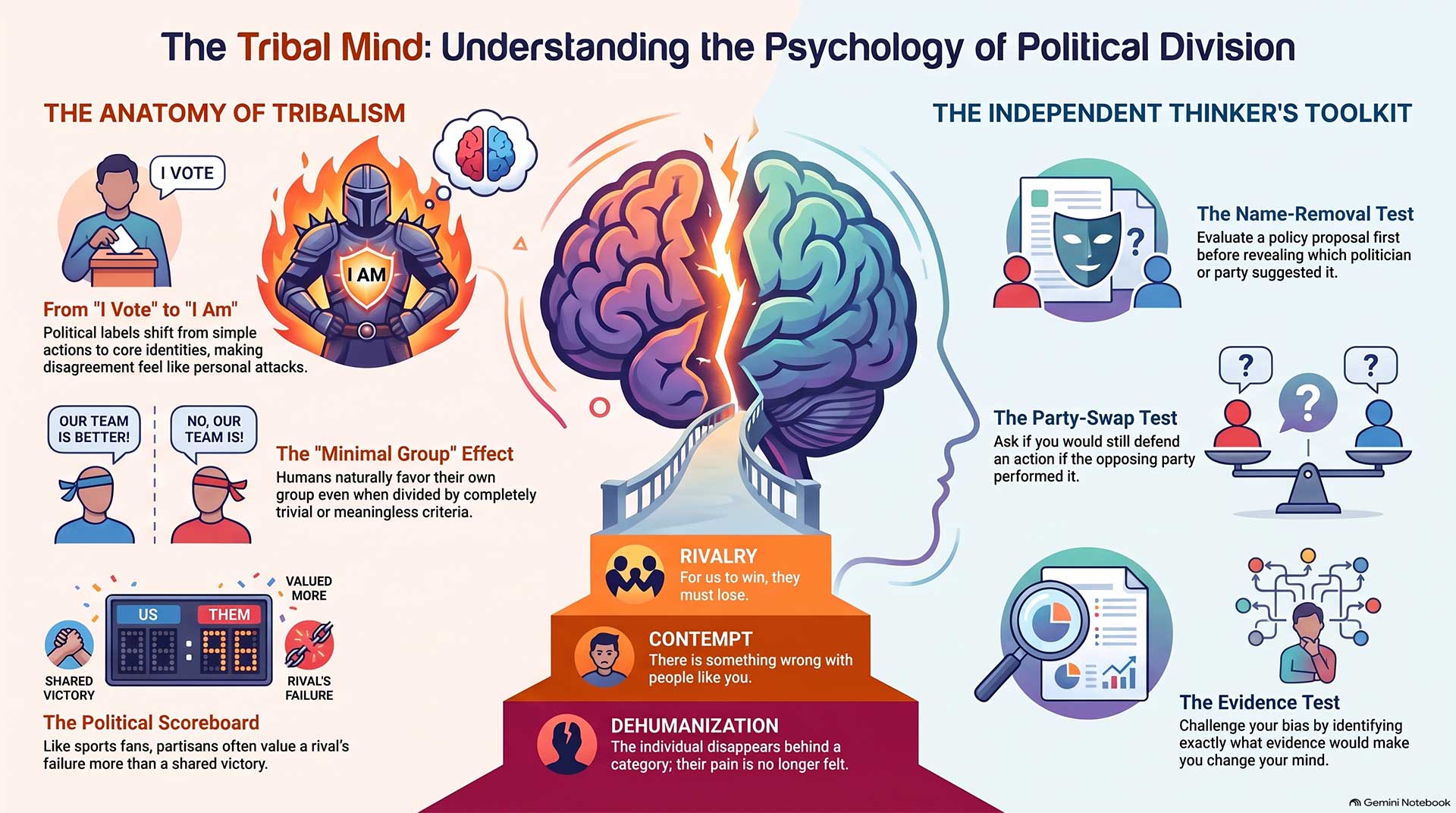
Perhaps the deepest lesson from this conversation is that tribalism itself isn't the enemy.
Human beings belong.
We belong to families, religions, countries, schools, neighborhoods, generations, sports teams, political movements, and countless smaller communities. These identities can create friendship, loyalty, sacrifice, meaning, and cooperation.
The danger begins when belonging changes the rules we use to determine what is true.
If an action is wrong when the opposing party does it, but acceptable when our party does it, the political label may have begun influencing the standard.
If evidence supporting our side deserves immediate belief, but evidence against our side receives endless scrutiny, the jersey may already be affecting the referee.
If we celebrate a national problem getting worse since it damages the opposing party, politics has crossed an especially troubling line. We have confused our party winning with our society succeeding.
Yet perhaps the hardest lesson is much more personal.
Learning about confirmation bias doesn't help much if we use it only to diagnose our opponents.
Learning about tribalism doesn't help much if our immediate reaction is:
"That's exactly what the other side does."
A better test may begin with ourselves:
Would I feel the same way if the parties were reversed?
What evidence could change my mind?
Can I describe the opposing argument fairly enough that someone who believes it recognizes their own position?
Can I name something important my own side gets wrong?
And perhaps hardest of all:
If the truth hurts my team, do I still want to know it?
Political independence doesn't require abandoning political beliefs or refusing to choose a side.
It may require something more difficult:
belonging without surrendering the freedom to disagree with the people to whom we belong.
Short Bios:
Jonathan Haidt
Social psychologist and author of The Righteous Mind. Haidt studies morality, intuition, group identity, and why intelligent people can reach sharply different moral and political conclusions.
Henri Tajfel
Social psychologist whose work helped establish social identity theory. His minimal-group research showed how surprisingly little may be required for people to begin favoring members of their own group.
Muzafer Sherif
Social psychologist known for the Robbers Cave experiment, which examined competition, intergroup hostility, and how shared goals can help opposing groups cooperate.
Shanto Iyengar
Political scientist whose research has examined partisan identity and affective polarization, including how political disagreement can develop into negative feelings about supporters of the opposing party.
Peter Ditto
Psychologist known for research involving motivated reasoning and political judgment. His work helps illuminate how people can scrutinize inconvenient evidence differently from evidence supporting beliefs they already hold.
Dan Kahan
Scholar whose research has examined how cultural and group identities can interact with people's interpretations of contested information.
Mina Cikara
Social psychologist who studies intergroup relationships and emotions, including how group membership can influence people's emotional reactions to the successes and setbacks of others.
David Rand
Researcher whose work examines human judgment, cooperation, misinformation, and reasoning. He brings an important counterpoint to purely pessimistic accounts of human thinking: people can respond to evidence and accuracy-focused reflection.
Moderator
A curious observer who begins with Ohio State-Michigan football and gradually discovers that spotting tribal behavior in someone else is much easier than recognizing it in oneself.
Leave a Reply