
Introduction: Nelson Mandela and the Difficult Meaning of Freedom
What does it really take to turn enemies into fellow citizens?
In February 1990, Nelson Mandela walked out of prison after more than twenty-seven years of imprisonment. The world watched a man who had become an international symbol of resistance to apartheid take his first steps into a new chapter of his life.
But Mandela's release was not the end of South Africa's struggle. It was the beginning of an extraordinarily difficult political transition.
The country remained divided by decades of racial discrimination, unequal opportunities, and violence. Millions of Black South Africans had been denied basic political rights. Many white South Africans feared what majority rule might mean for their future. The possibility of further bloodshed was real.
Mandela faced a question that few leaders ever confront: How do you negotiate a shared future with representatives of the very government that imprisoned you?
His answer was more complicated than forgiveness.
Before becoming a symbol of reconciliation, Mandela had been a young man who left his rural upbringing for Johannesburg, studied law, helped organize resistance to apartheid, and eventually supported sabotage after years of nonviolent political activity and government repression.
He was arrested, tried, and sentenced to life imprisonment.
During his imprisonment, his mother died. His eldest son was killed in a car accident. Mandela was denied permission to attend either funeral. His children grew up through years of separation, and relationships changed in ways that political freedom could never fully repair.
Yet he continued to participate in the struggle for a democratic South Africa.
Released in 1990, Mandela worked with fellow leaders, political opponents, and negotiators to help establish a constitutional democracy. In 1994, South Africans participated in their first national democratic election based on universal adult suffrage, and Mandela became the country's first Black president.
His presidency brought historic political changes, but it did not eliminate poverty, unemployment, or the economic inequalities inherited from apartheid. His administration's response to HIV/AIDS would later face serious criticism.
These achievements and shortcomings belong to the same history.
In this imagined conversation, Nick Sasaki meets Mandela across five stages of his extraordinary life, beginning in the hills of Qunu and ending in a peaceful Johannesburg garden.
Their conversations explore his childhood ambitions, the decision to resist apartheid, the personal losses of imprisonment, the political challenges of reconciliation, and the unfinished responsibilities of democratic leadership.
Along the way, Nick discovers a man who could be humorous, stubborn, thoughtful, affectionate, and capable of difficult decisions.
The goal is not to portray Mandela as a flawless hero or reduce him to a lesson about forgiveness.
It is to encounter the human being behind the public figure and ask what his experiences might teach us about freedom, justice, responsibility, and the possibility of living together after profound division.
For historical background, readers can explore the Nelson Mandela Foundation's biography, Mandela's 1964 Rivonia Trial statement, and the South African government's account of his 1994 presidential inauguration.
Fictional Conversation Disclaimer
This article is an imagined interview created for historical exploration and reflection. Nelson Mandela did not participate in these conversations with Nick Sasaki, and the dialogue, personal reflections, gestures, and settings are fictional reconstructions rather than authentic quotations or endorsements. Documented events provide the historical foundation, but readers should consult primary sources for Mandela's actual words and views.
Topic 1: Before Mandela Became Mandela
Opening
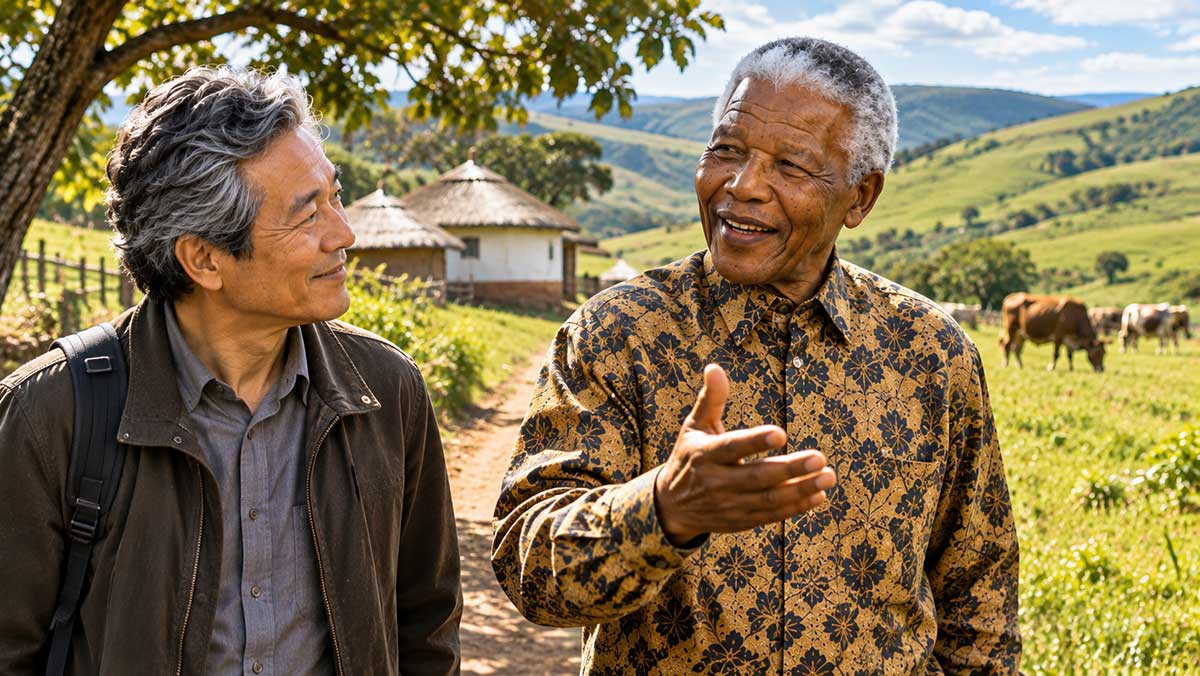
Qunu, Eastern Cape, South Africa. A clear morning in the late 1990s.
The hills roll gently beneath the morning sun. A narrow footpath winds through the grass, passing scattered homes and grazing cattle. Somewhere in the distance, children are calling to one another.
Nelson Mandela stands beside a wooden fence, looking across the countryside where he spent part of his childhood. He is in his late seventies, dressed simply, his silver hair catching the sunlight.
When Nick approaches, Mandela turns with a broad smile.
Nelson Mandela: Nick! Welcome to Qunu. You have come a long way to visit an old man.
Nick Sasaki: Mr. Mandela, I've wanted to meet you for a very long time.
Nelson Mandela: Then you must call me Nelson. If you keep calling me Mr. Mandela, I shall begin to feel as though I am back in court.
Nick laughs, and Mandela gestures toward the path.
Nick: Nelson it is. I expected to meet you in Johannesburg, perhaps in an office surrounded by books. I didn't expect to find you standing beside a field.
Mandela: Ah, but this is where you should begin. Before the speeches, before the prison, before people began placing my face on posters, there was a boy running through these hills.
Nick: And what was that boy like?
Mandela: He was not nearly as wise as people now pretend.
Mandela chuckles.
Mandela: He was proud. Sometimes stubborn. He enjoyed games, stories, and the company of other boys. He did not spend his childhood planning to become president of South Africa.
Nick: That's the boy I'd like to meet today.
Mandela: Then come. We have some walking to do.
Question 1: What did you dream of becoming before you entered politics?
They follow the path through the grass. Mandela walks at an unhurried pace, occasionally pointing toward the hills.
Nick: When you were growing up here, what did you think your future would look like?
Mandela: My childhood was shaped by the traditions of the Thembu people. I was born in Mvezo, but Qunu became the place I remembered with particular affection.
My father, Gadla Henry Mphakanyiswa, was a counselor to the Thembu royal family. After his death, I came under the guardianship of Regent Jongintaba Dalindyebo at Mqhekezweni.
That changed my life.
Nick: You were still a child.
Mandela: Yes. And suddenly I found myself living in a household where important matters were discussed, where visitors arrived with disputes, and where I could observe traditional leadership.
I remember the regent listening to the men who came to speak. He did not simply announce his opinion at the beginning. He allowed others to express themselves.
I carried that example with me.
Nick: Did you already think of yourself as someone who might lead?
Mandela: I was aware of my family's connection to traditional leadership, but my ambitions were much more ordinary.
I wanted an education. I wanted to make something of myself.
And like many young men, I was interested in the opportunities beyond the place where I had grown up.
Nick: Were you a good student?
Mandela: Not always a model of obedience.
He smiles.
Mandela: At the University College of Fort Hare, I became involved in a student dispute concerning representation on the student council. I would not accept the conditions placed upon my return.
Nick: So you were getting into trouble before you became a revolutionary.
Mandela: That depends on whether you believe refusing an instruction is always trouble.
Nick: I have five children. I've heard that argument before.
Mandela laughs.
Mandela: Then you know that young people are very skilled at explaining their principles after they have disobeyed you.
Nick: What happened after Fort Hare?
Mandela: The regent expected me to return and follow the path he had prepared. He had arranged marriages for his son Justice and for me.
We were not enthusiastic.
Nick: That's putting it gently, isn't it?
Mandela: Very gently.
Mandela stops beside the fence and looks at Nick with amusement.
Mandela: Justice and I decided that Johannesburg offered a more attractive future.
Nick: You ran away?
Mandela: We left without the regent's permission. I would not recommend that every young man follow our example.
Nick: Did you feel guilty?
Mandela: I knew that we had disappointed a man who had treated me with great generosity. That was not a small matter.
But I was young, and I wanted to decide the direction of my own life.
Nick: So before you fought for the freedom of millions, you were trying to claim some freedom for yourself.
Mandela: There is a difference between those struggles, Nick. I would not compare my youthful disagreement with the regent to the oppression suffered by our people.
But perhaps the experience helped me recognize something about myself.
I did not easily accept a future chosen entirely by someone else.
They resume walking.
Nick: What happened to that ambitious young man when he reached Johannesburg?
Mandela: He discovered that the city had very little interest in his ambitions.
Question 2: How did Johannesburg change the way you saw your country?
The path reaches a shaded area beneath a broad tree. Two chairs have been placed nearby. Mandela sits and gestures for Nick to join him.
Nick: You arrived in Johannesburg in 1941. What struck you first?
Mandela: The scale of the city. The mines, the buildings, the movement of people.
And the extraordinary inequalities.
I had grown up knowing that South Africa was divided by race. But Johannesburg brought those divisions into my daily experience in a different way.
A Black man could work in the mines, build the city, serve its households, and contribute to its wealth, yet remain subject to restrictions on where he could live, move, and seek opportunities.
Nick: Were you angry?
Mandela: I was learning.
Anger alone does not explain how a person becomes politically active. Sometimes it begins with seeing something that had previously seemed distant and realizing that it governs the lives of people around you.
Nick: Who helped you see it?
Mandela: Walter Sisulu was especially important.
He helped me find work and introduced me to people who widened my political education.
Through him, I met activists and thinkers who challenged my assumptions.
At the law firm of Witkin, Sidelsky and Eidelman, I worked as an articled clerk. I continued my studies, and I began to encounter people whose experiences differed greatly from my own.
Nick: What assumptions did they challenge?
Mandela: I had been shaped by the traditions and loyalties of my upbringing. In Johannesburg, I encountered a much wider political world.
I met people who debated African nationalism, socialism, communism, trade unionism, and the future of South Africa.
I did not agree with everyone. Sometimes I disagreed strongly.
But I was forced to think beyond my own circumstances.
Nick: Did you ever feel overwhelmed?
Mandela: Of course. I was a young man trying to earn a living and study law. I had little money. There were practical problems to solve every day.
Politics did not arrive as a grand revelation. It entered through conversations, friendships, and the realities of ordinary life.
Nick: You eventually became close to Oliver Tambo.
Mandela: Oliver was an extraordinary man. Thoughtful, disciplined, deeply committed to education and justice.
We became friends and political colleagues.
Later, we established a law practice together in Johannesburg.
Nick: Mandela and Tambo. Two Black lawyers representing people who often had nowhere else to turn.
Mandela: We were among the very few Black attorneys in that environment. Our clients came with problems created or intensified by discriminatory laws.
Pass offenses. Housing restrictions. Employment disputes. Families struggling against a system that interfered with the most ordinary parts of their lives.
Nick: That must have changed your view of the law itself.
Mandela: It taught me that the existence of a law does not make that law just.
A government may use legal language to organize discrimination. A courtroom may follow proper procedures and still operate within an unjust system.
Nick: That's a difficult lesson for someone studying to become a lawyer.
Mandela: It is an essential lesson.
But I do not want to give the impression that I understood everything immediately.
I was influenced by people around me. I made mistakes. My political views developed through argument and experience.
Nick: Was there someone who made you particularly uncomfortable by challenging your thinking?
Mandela: Many people.
He laughs softly.
Mandela: Walter Sisulu had a talent for introducing me to people who disagreed with me.
And Oliver Tambo was not a man who accepted a weak argument simply to preserve a friendship.
Nick: I think I would have enjoyed sitting in on those conversations.
Mandela: You might have needed considerable patience. Young political activists can speak for a very long time.
Nick: Unlike the two of us?
Mandela smiles broadly.
Mandela: I was waiting for you to notice.
Question 3: When did fighting apartheid become more important than the life you had planned?
The sun has climbed higher. A breeze moves through the branches above them. Mandela looks across the countryside for a moment before answering.
Nick: You wanted an education, a career, and a family. At what point did political struggle begin to take precedence over those ambitions?
Mandela: It was not a single moment.
I joined the African National Congress in 1944, the same year that I married Evelyn Mase.
With Walter Sisulu, Oliver Tambo, Anton Lembede, and others, I helped establish the ANC Youth League.
We believed that the ANC needed a more active and assertive approach to African political demands.
Nick: You were still in your twenties.
Mandela: Yes. We were impatient with the slow pace of change.
But we did not all agree about methods or ideology. Our debates were often intense.
Nick: What changed when the National Party came to office in 1948?
Mandela: Racial discrimination already existed throughout South African society. The National Party developed apartheid into an increasingly systematic structure of racial separation and white political domination.
The consequences were felt in homes, workplaces, schools, and communities.
It became increasingly difficult to imagine that a person could pursue an ordinary professional life without confronting the political system surrounding it.
Nick: But you had a wife and children. Surely part of you wanted to protect that private life.
Mandela: A family has needs that political speeches cannot satisfy.
Children need their father. A wife needs a husband who is present, not simply a man who speaks about noble causes.
I did not always fulfill those responsibilities as I should have.
Nick: That's something I'd like to return to when we talk about your years in prison.
Mandela: We should. The people closest to a political activist often bear burdens they did not choose.
Nick: In 1952, you became deeply involved in the Defiance Campaign against unjust laws.
Mandela: The campaign was organized around disciplined nonviolent resistance to discriminatory legislation.
Volunteers deliberately defied selected laws and accepted arrest to expose the injustice of the system.
I served as volunteer-in-chief.
It required organization, training, and a willingness to face punishment.
Nick: Were you optimistic?
Mandela: We believed mass action could awaken political consciousness and demonstrate the determination of ordinary people.
But I was not under the illusion that the government would simply surrender its authority after witnessing a few demonstrations.
Nick: Did you believe peaceful resistance could eventually succeed?
Mandela: At that stage, we were committed to methods of nonviolent mass protest.
Our movement had to organize people, build solidarity, and challenge the legitimacy of discriminatory rule.
The question of other methods emerged later under different circumstances.
Nick: So you don't want me to jump ahead to the man who helped establish an armed organization.
Mandela: Not yet.
He smiles, but his voice remains serious.
Mandela: If you begin there, you may miss the years of political work that came before it.
You must understand what people attempted, what they experienced, and how the government's repression changed the choices confronting the movement.
Nick: Fair enough.
Let me ask you something more personal.
When you look back at the young man who arrived in Johannesburg, did he know how much his political commitments would eventually cost?
Mandela: No.
He knew that injustice existed. He wanted to contribute to changing it.
But he could not have known the full consequences for his family, his colleagues, or himself.
Nick: Would you warn him?
Mandela looks toward the hills. For a few moments, neither man speaks.
Mandela: I would tell him to listen more carefully to the people who loved him.
And I would remind him that political convictions must be tested by the way we treat other human beings, including those who depend upon us.
He turns back to Nick.
Mandela: But I would not tell him to accept apartheid.
Nick: No. I didn't think you would.
Closing
The morning has grown warm. A group of children passes along a distant path, their voices drifting across the grass.
Nick: Nelson, I came here expecting to meet a young revolutionary. Instead, I've met a student who got into trouble, a young man who ran away from an arranged marriage, a lawyer trying to earn a living, and someone whose friends kept challenging his ideas.
Mandela: That is much closer to the truth than the picture of a boy who was born knowing he would become president.
Nick: What strikes me is that your political convictions developed through relationships. Walter Sisulu, Oliver Tambo, the people you met in Johannesburg, the clients who came to your office.
Mandela: No person makes history alone, Nick.
And no person develops his convictions without being influenced by others.
Nick: There's one thing I want to ask before we leave Qunu.
When you think of the boy who played in these hills, what do you miss most?
Mandela watches the children disappear around a bend in the path.
Mandela: Childhood offers a kind of freedom that we often recognize only after it has passed.
There were responsibilities, of course. There were hardships.
But there was the pleasure of being young, of running with friends, of discovering the world without knowing everything that lay ahead.
He smiles.
Mandela: And I miss being able to run as quickly as those children.
Nick: I know that feeling.
They laugh together.
Mandela: Come, Nick. We have spoken enough about the boy.
The young man in Johannesburg was beginning to discover that the government would not tolerate the changes he and his colleagues demanded.
That is where our next conversation becomes more difficult.
Nick: The decision to resist.
Mandela: Yes. And the question of what a person should do when peaceful efforts are met with increasing repression.
They begin walking back along the path, the morning sun stretching their shadows across the grass.
Topic 2: When Peaceful Protest Was No Longer Enough
Opening
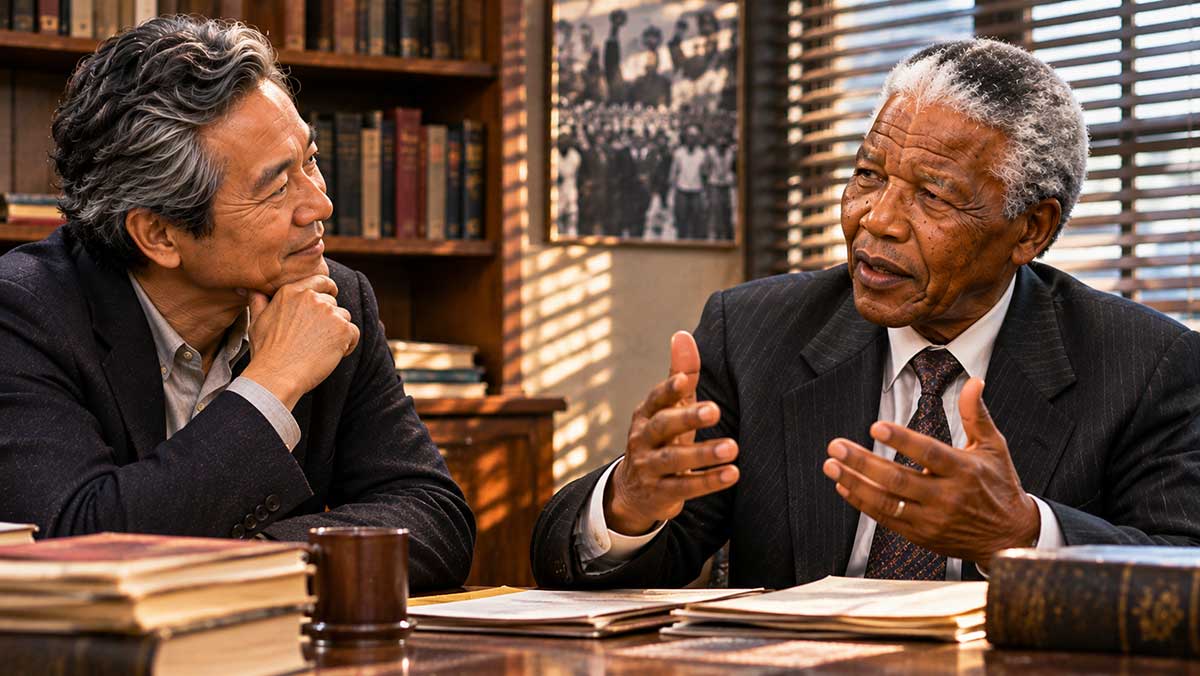
Johannesburg, South Africa. An imagined retrospective conversation in a modest office reminiscent of the early 1960s.
Late-afternoon sunlight filters through wooden blinds, casting narrow bands of light across a desk crowded with legal papers. Beyond the window, traffic moves through the city. A faded map of South Africa hangs on the wall.
Nelson Mandela stands beside a bookshelf, examining an old legal volume. Nick enters carrying two cups of tea.
Nick Sasaki: I thought you might appreciate something warm before we begin.
Nelson Mandela: Thank you, Nick. You are becoming a very considerate host.
Nick: I'm trying. Last time, you made me walk through the hills of Qunu.
Mandela: And you survived.
They laugh. Mandela accepts his tea and settles into a chair.
Nick: Nelson, when we were in Qunu, we talked about your early years in Johannesburg, your work as a lawyer, and the Defiance Campaign.
Today I want to ask about a much harder decision.
You began with organized nonviolent resistance. But eventually you helped establish an armed organization.
How did that happen?
Mandela: It was not a decision made suddenly, Nick. Nor was it a decision made by one man.
For years, we had organized protests, petitions, strikes, and campaigns of civil disobedience. We had sought to demonstrate that apartheid was unjust and that South Africans should enjoy equal political rights.
But the government's response grew increasingly severe.
Nick: And you began to question whether peaceful methods were enough.
Mandela: We began to question whether we could continue asking people to accept repression indefinitely without considering other forms of resistance.
That was a very serious question.
Mandela sets his cup on the table.
Mandela: And I think we should examine it carefully.
Question 4: What convinced you that nonviolent resistance alone could no longer succeed?
Nick: You helped organize the Defiance Campaign in 1952. Thousands of people deliberately broke discriminatory laws and accepted arrest.
What happened over the following years that changed your thinking?
Mandela: The Defiance Campaign demonstrated the courage and discipline of ordinary people. Men and women accepted imprisonment rather than cooperate with laws they considered unjust.
It was an important experience for our movement.
But the government did not respond by granting political equality. It introduced further restrictions and used police authority to suppress opposition.
In 1956, I was among 156 activists arrested and charged with treason. That trial continued for years.
Nick: You were trying to practice law and raise a family, and suddenly you were spending years defending yourself in court.
Mandela: Yes. The prosecution disrupted our lives, though it created opportunities for political colleagues from different backgrounds to work together.
The trial ultimately ended in acquittals.
Nick: Then came Sharpeville.
Mandela's expression grows serious.
Mandela: On March 21, 1960, police opened fire on people protesting pass laws at Sharpeville. Sixty-nine people were killed.
The demonstration was organized by the Pan Africanist Congress, not the ANC. That distinction matters. Many organizations and communities contributed to the struggle against apartheid.
Nick: What did Sharpeville change?
Mandela: It exposed the government's willingness to use deadly force against protesters.
Soon afterward, the ANC and PAC were banned.
Our organizations could no longer operate openly as before.
Nick: Did you feel that peaceful protest had failed?
Mandela: I would distinguish between the value of peaceful protest and the question of whether it remained sufficient under those circumstances.
Nonviolent campaigns had mobilized people and exposed injustice. Their achievements were real.
But we faced a government that refused meaningful political reform and increasingly restricted lawful opposition.
We had to consider what would happen if every avenue of peaceful resistance were closed.
Nick: Let me challenge you.
Someone could say that adopting violence risks destroying the moral legitimacy of a movement. That once you begin using force, you may become what you are fighting.
Mandela: That concern deserves serious attention.
But we must examine the circumstances confronting people who were denied political rights.
If a government maintains domination through force, what choices remain available to those who resist it?
I am not suggesting that every response becomes justified. Quite the opposite.
The methods chosen matter enormously.
Nick: Were you frightened by where this could lead?
Mandela: I understood that the consequences could be grave.
People could be imprisoned. They could be killed. The movement itself could be damaged.
And there were disagreements about the appropriate course.
We were not a collection of men who all thought alike.
Nick: Did you ever wonder whether you were moving too quickly?
Mandela: We had spent many years seeking change through nonviolent methods.
The question was not simply whether we were impatient. It was whether the government intended to permit any meaningful peaceful challenge to its authority.
Nick: And your answer?
Mandela: By 1961, I believed that the movement needed to consider a different strategy.
But deciding to resist through sabotage did not remove our responsibility to consider its human consequences.
Question 5: How did you decide where resistance should draw its moral boundaries?
Mandela rises and walks toward the window. The city continues its ordinary afternoon activity below.
Nick: In 1961, you helped establish Umkhonto we Sizwe, often called MK, the armed wing associated with the ANC.
Why sabotage?
Mandela: We considered different forms of resistance.
Sabotage was selected initially because it could target installations and infrastructure while seeking to avoid the loss of human life.
The intention was to demonstrate that the government could not maintain apartheid without facing organized resistance.
Nick: You weren't trying to start by attacking ordinary people.
Mandela: Our initial strategy was to avoid casualties.
That distinction was fundamental to the reasoning we presented.
We wanted to place pressure on the government and create conditions in which political change might become possible.
Nick: But sabotage is still dangerous. You cannot guarantee that nobody will be hurt.
Mandela: No. Such risks must never be dismissed.
A person who decides to participate in armed resistance assumes a serious responsibility.
It would be dishonest to pretend otherwise.
Nick: Did everyone in the ANC agree?
Mandela: There were important debates within the liberation movement about the use of force.
We had colleagues with different political traditions, religious convictions, and views about strategy.
The decision developed through discussions among people who had devoted years to the struggle.
Nick: I want to ask something that might sound uncomfortable.
Once a movement accepts sabotage, what prevents it from moving further? What stops the justification from becoming broader and broader?
Mandela: That is precisely why political objectives and moral judgment must remain central.
Our goal was not violence for its own sake. It was to end racial domination and establish a democratic society.
But you are correct that armed struggles can change over time. Decisions made under one set of circumstances can create consequences that their participants did not fully anticipate.
Nick: Looking back, do you think people sometimes make their cause so sacred that they stop questioning their methods?
Mandela: Any political movement must guard against that danger.
Believing that your objective is just does not mean that every action taken in its name is justified.
Nick: Did you personally struggle with that?
Mandela: I had to consider what methods I believed were defensible and what consequences might follow.
But I would not want to invent a private moral drama that makes me the only person responsible for those decisions.
We were working within a movement. Other people took risks, offered arguments, and carried responsibilities of their own.
Nick: That's interesting. Every time I try to make this story about you, you bring other people back into it.
Mandela turns from the window and smiles.
Mandela: Perhaps you should invite Walter Sisulu or Oliver Tambo to your next interview.
Nick: I may take you up on that.
Mandela: They would correct some of my recollections.
Nick: That could be entertaining.
Mandela laughs and returns to his chair.
Nick: Let me ask one last thing about this decision.
Did supporting sabotage change the way you thought about yourself?
Mandela: I had already accepted that political resistance could demand personal sacrifice.
But the decision to support an armed organization carried different legal and political consequences.
I knew that the government would regard such activity as a grave threat.
And I knew that arrest might mean losing my freedom for a very long time.
Nick: You couldn't have known just how long.
Mandela: No.
Not then.
Question 6: When you faced the possibility of execution at Rivonia, what mattered more than your own survival?
The room has grown quieter. The sunlight has shifted across the desk, leaving the legal papers in shadow.
Nick: You were arrested in August 1962 and sentenced to five years in prison.
Then, after the police raid at Liliesleaf Farm in Rivonia in 1963, you and other defendants faced additional charges that could carry the death penalty.
What do you remember most clearly about that period?
Mandela: The seriousness of the charges.
The Rivonia Trial concerned sabotage and allegations of plans to overthrow the government through violent revolution.
The prosecution presented documents and other evidence recovered during the raid.
We understood that the court could impose death sentences.
Nick: Were you afraid of dying?
Mandela: I knew death was a possibility.
But I do not think it would be accurate to describe courage as the absence of fear.
The question was what we should say and do when facing that possibility.
Nick: You decided to speak from the dock.
Mandela: Yes.
On April 20, 1964, I delivered a statement explaining the political circumstances that had led us to resistance.
I spoke about the history of racial oppression, the ANC's efforts to pursue change, and the reasoning behind the formation of MK.
I wanted the court, and the wider public, to understand our objectives.
Nick: Your statement ended with your willingness to die for the ideal of a democratic and free society.
That is an extraordinary thing to say when the death penalty is a real possibility.
Mandela: The ideal was not merely my personal ambition.
It concerned a country in which people could live together with equal political rights and opportunities, without one racial group dominating another.
That was the future for which we had struggled.
Nick: Did you think about your children?
Mandela looks down at his hands.
Mandela: My family was never separate from the consequences of my political life.
My children were growing up during years of arrests, restrictions, and absence.
They had needs that I could not always meet.
Nick: That's the part I find difficult.
You were prepared to sacrifice your own life for a political ideal. But your children were being asked to sacrifice something too, without having chosen it.
Mandela: Yes.
And that is not a difficulty we should conceal.
Public commitment can place a heavy burden on those closest to us.
A person may believe his political responsibilities are necessary and still recognize that his family has suffered.
Nick: Did you ever think about asking for mercy?
Mandela: Our defense was concerned with explaining the political character of the struggle and challenging the government's account of our actions.
I did not wish to renounce the principles for which I had worked merely to obtain a more favorable sentence.
Nick: On June 12, 1964, you and seven other defendants were sentenced to life imprisonment rather than death.
What was your first thought?
Mandela: We had escaped execution.
But life imprisonment meant that we faced an uncertain future.
We did not know whether we would ever leave prison.
Nick: You were forty-five.
Mandela: Yes.
Nick: A man with children, friends, ambitions, and a country he hoped to change.
And suddenly the future was reduced to prison walls.
Mandela: The struggle did not end with our imprisonment.
Others continued the work outside. Our families endured the consequences. Our colleagues organized under increasingly difficult conditions.
We were prisoners, but the movement was larger than the men who had been sentenced.
Nick: Still, for you personally, everything was about to change.
Mandela: Very much so.
Closing
The last sunlight catches the edge of the desk. Mandela closes the legal volume he had been examining earlier.
Nick: Nelson, I came into this conversation with a simple question: Why did you abandon peaceful resistance?
But I can see now that the question itself was too simple.
Mandela: It is better to ask what happened to peaceful political activity under apartheid, and how the liberation movement responded.
Nick: You didn't begin by choosing sabotage. There were years of protest, arrests, trials, and increasing repression.
Mandela: Yes. And the decision to use sabotage was not free of risks or moral responsibilities.
We should not pretend that difficult decisions become simple merely because we believe our cause is just.
Nick: I appreciate that you don't try to make every choice sound easy.
Mandela: Nick, when people look backward, they sometimes see a clear road where those who lived through the events saw uncertainty.
Nick: That's something I want to keep in mind.
Mandela places the book back on the shelf.
Nick: At the end of the Rivonia Trial, you faced life imprisonment. You couldn't know that you would eventually become president.
Mandela: No. We could only continue to believe that South Africa might one day become a democratic country.
Nick: And the next chapter of your life would last more than a quarter of a century.
Mandela: Twenty-seven years in prison, across several institutions.
A very long time, Nick.
He gives a small, reflective smile.
Mandela: Long enough to learn that a man can spend years arguing with himself.
Nick: Were you any good at winning those arguments?
Mandela: Not always.
They share a quiet laugh.
Nick: Next time, I'd like to meet you at Robben Island.
Not to ask how you became a symbol, but what those years actually felt like.
Mandela: Then we must speak about the people who were there with me.
And the people who were waiting outside.
Nick nods. The two men leave the office together as the city's evening sounds rise beyond the window.
Topic 3: The Years That Could Never Be Returned
Opening
Robben Island, South Africa. An imagined visit in the late 1990s, several years after Nelson Mandela's release from prison.
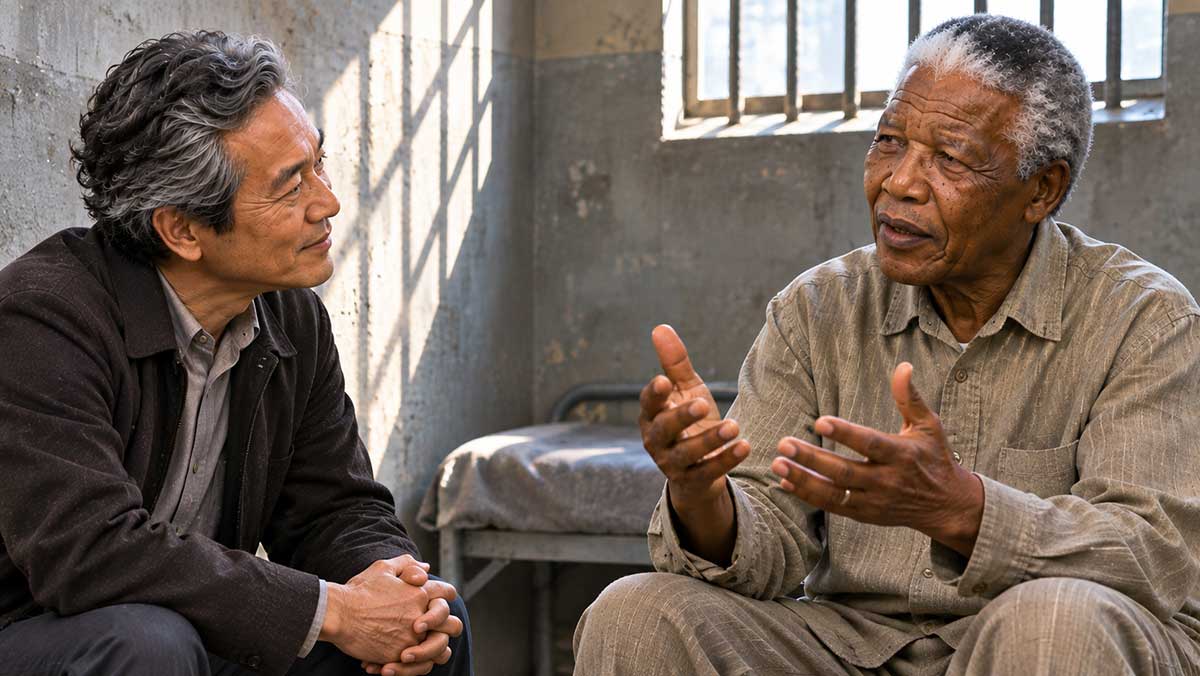
The ferry has departed, leaving the island unusually quiet. A cold Atlantic wind moves across the prison courtyard. Beyond the walls, seabirds circle above the water, and Table Mountain rises faintly across the bay.
Nelson Mandela stands near the entrance to the cell where he spent much of his imprisonment. He has been here before as a free man, but the surroundings still command his attention.
Nick approaches slowly, carrying a light jacket.
Nick Sasaki: Nelson, I brought you something. It's colder than I expected.
Nelson Mandela: Thank you, Nick. You are becoming a very thoughtful young man.
Nick: Young man? I'm beginning to like these interviews more and more.
Mandela laughs.
Mandela: You see? I have already improved your day.
Nick offers the jacket, but Mandela gestures toward the prison building.
Mandela: Come. There is something I want you to see.
They walk along the corridor until they reach a small cell. Inside are a thin sleeping mat, blankets, and a simple bucket, arranged to represent the conditions of Mandela's earlier imprisonment.
Nick: You lived in a cell like this?
Mandela: For many years, yes. Conditions changed over time, and the prisons where I was held were not all the same. But this small space was part of my life on Robben Island.
Nick: I knew the dimensions. I'd seen photographs. But standing here is different.
Mandela: Photographs cannot tell you everything.
Nick looks at the narrow floor.
Nick: Twenty-seven years.
Mandela: Eighteen of those years were spent on this island. The remainder were spent in other prisons.
Nick: People often speak about those years as though they were one long test of patience.
Mandela: Then they miss much of the story.
There were friendships, arguments, studies, disappointments, and small victories. There were men who showed extraordinary courage. There were men who suffered terribly.
And there were families beyond these walls.
Mandela pauses at the doorway.
Mandela: Those families paid a price that prison records cannot adequately measure.
Question 7: What was the hardest part of prison that the outside world never truly saw?
They enter the courtyard. The wind carries the smell of the sea.
Nick: Nelson, when people talk about your imprisonment, they often mention the hard labor, the isolation, and the small cell.
What was the hardest part that people outside never really saw?
Mandela: Separation.
Not simply the distance between the prison and the mainland, but the separation from the ordinary lives of those we loved.
A prisoner may learn to live within a routine. He wakes, works, eats, studies when permitted, and returns to his cell.
But outside, life continues without him.
Children grow. Parents age. Families encounter difficulties. Decisions must be made.
And he is absent.
Nick: Did you find yourself thinking about ordinary things?
Mandela: Very often.
A child's progress at school. A family member's health. Whether a letter had arrived. Whether a visit would be permitted.
Things that might seem small to a person who can return home each evening become enormously significant when contact is restricted.
Nick: What was a typical day like during your early years here?
Mandela: We rose early. Our days were controlled by prison regulations.
We performed physical labor, including work in the lime quarry. The glare from the limestone was severe, and the conditions could be harsh.
Food, clothing, and other provisions were initially unequal among prisoners under the prison's racial classifications.
We challenged such conditions through complaints, petitions, and collective action.
Nick: You were fighting apartheid even inside prison.
Mandela: The prison authorities had considerable control over our lives, but we still had choices about how we treated one another and how we responded to unfair conditions.
We argued for better treatment, access to reading materials, and opportunities to study.
Some improvements came only after years of persistence.
Nick: Did you ever get tired of fighting over things that should have been basic human rights?
Mandela: Of course it could be exhausting.
But a small improvement could matter greatly to the men living under those conditions.
We were not negotiating abstractions. We were asking for things that affected our daily lives.
Nick: I've heard Robben Island described as a university.
Mandela: People sometimes call it Robben Island University.
We taught one another. Men with knowledge of history, politics, languages, and law shared what they knew.
There were disagreements, naturally.
He smiles.
Mandela: Political prisoners are not always the easiest students. Many believe they should be the lecturer.
Nick: Were you one of them?
Mandela: I may occasionally have expressed an opinion.
Nick: Occasionally?
Mandela laughs.
Mandela: You are becoming rather impertinent, Nick.
Nick: I'm learning from you.
Mandela: Then I must be more careful.
They continue walking.
Nick: Did those discussions help you remain connected to the world?
Mandela: They helped us remain intellectually active.
But we should not romanticize imprisonment. Education did not make the loss of freedom acceptable.
It was something we created within the limits imposed upon us.
Nick: What about your relationships with the other prisoners?
Mandela: They were essential.
Walter Sisulu, Ahmed Kathrada, Govan Mbeki, Raymond Mhlaba, and many others brought different experiences and perspectives.
We shared political commitments, but we did not always agree.
There were arguments about strategy, ideology, and the future.
Nick: Real arguments?
Mandela: Very real.
Nick: That's reassuring. Sometimes history makes it sound as though everyone who fought apartheid agreed about everything.
Mandela: That would be a most inaccurate history.
Mandela looks across the courtyard.
Mandela: But disagreements could exist alongside friendship and mutual respect.
We knew that our circumstances were shared.
And we knew that outside these walls, people continued to struggle.
Question 8: What did losing your mother and son without being able to say goodbye do to you?
They stop near a sheltered corner of the courtyard. The wind has strengthened, and Nick pulls his jacket closer.
Nick: Nelson, there's something I've wanted to ask since we began this interview.
I know it may be painful.
Mandela: You may ask.
Nick: Your mother died in 1968.
The following year, your eldest son, Thembekile, was killed in a car accident.
You weren't permitted to attend either funeral.
Mandela remains silent for a moment.
Mandela: Yes.
My mother had visited me in prison. I knew she was growing older.
When she died, I could not return home to join the family in mourning.
Then came the news of my son's death.
Thembekile was twenty-four.
Nick: Twenty-four.
Mandela: He was a young man with a life that should have continued.
Nick: Did you ask permission to attend his funeral?
Mandela: I did. Permission was refused.
Nick: I have children, Nelson.
And I keep thinking about what it would mean to receive that news and then be told that I couldn't even attend my own son's funeral.
I don't know how a father carries that.
Mandela: There is no answer that makes such a loss acceptable.
A parent expects to protect his child. He expects, at the very least, to be present during the important moments of that child's life.
Imprisonment had already taken much of that opportunity from me.
And then my son was gone.
Nick: Did you blame yourself for not being there?
Mandela: My political commitments and imprisonment had consequences for my family. I could not ignore that.
But I would be cautious about reducing a family's suffering to one simple explanation.
My children had their own lives and experiences. Their mother and other relatives carried responsibilities that I could not fulfill.
They deserve to be recognized as people in their own right, not simply as figures in the story of my imprisonment.
Nick: That's fair.
Nick looks down at the ground.
Nick: Sometimes, when someone becomes a great historical figure, the sacrifices made by their family are described almost as though they were necessary parts of the achievement.
Mandela: Families do not experience absence as a historical achievement.
A child who misses his father does not receive comfort from knowing that strangers admire him.
Nick: That's a difficult sentence to hear.
Mandela: It is a difficult reality.
Nick: Did letters help?
Mandela: Letters were precious.
But correspondence was restricted, censored, and sometimes delayed or withheld. Regulations changed over the years.
A letter might contain only a small account of someone's life, yet I would read it with great attention.
Nick: What would you most want to hear?
Mandela: The ordinary details.
How the children were doing. What they were studying. Whether someone was well.
Those details helped make the people I loved present in my thoughts.
Nick: Did you try to sound strong when you wrote back?
Mandela: I wanted to offer encouragement and affection, but my letters could express concern, sadness, and frustration too.
We should not pretend that a prisoner is always composed.
Nick: I'm glad you said that.
I was worried you'd tell me that suffering made you stronger and leave it there.
Mandela gives him a gentle smile.
Mandela: Suffering does not become good merely because someone survives it.
Nick: Did you ever think about all the years you would never get back?
Mandela: The years were passing whether I counted them or not.
My children were growing older. Relationships were changing. People I loved were dying.
There was no way to recover that time.
For several moments, they listen to the wind.
Nick: I don't think I have another question about your son.
Mandela: That is perfectly acceptable, Nick.
They remain together in silence.
Question 9: How did your relationship with your fellow prisoners and jailers change over the years?
Later, they walk toward the limestone quarry. The pale stone reflects the afternoon light.
Nick: Nelson, earlier you spoke about the men who were imprisoned with you.
But I want to ask about the people who guarded you.
How did your relationship with the prison officers change over time?
Mandela: It varied considerably.
Some officers treated prisoners harshly. Others behaved more professionally, and some developed more respectful relationships with us.
We had to recognize that they were individuals, though they served within an oppressive institution.
Nick: Was that difficult?
Mandela: Very.
There is a difference between opposing a system and refusing to recognize the humanity of every person associated with it.
But recognizing someone's humanity does not mean excusing his conduct.
Nick: Did you ever become friendly with a guard?
Mandela: Over time, there were officers with whom I could speak more openly.
During my later imprisonment, particularly at Pollsmoor and Victor Verster, my circumstances changed, and I had different kinds of contact with prison officials.
But those later relationships should not erase the harsh treatment prisoners endured, especially during earlier years.
Nick: What helped you communicate with people who had authority over you?
Mandela: I tried to understand their position and speak to them in a way that preserved my own dignity.
I had studied Afrikaans and sought to learn about Afrikaner history and culture.
Knowing another person's language can help you understand how he sees the world.
Nick: That's interesting.
You were trying to understand the people whose government had imprisoned you.
Mandela: If we wanted a future in which South Africans lived together, we had to learn about one another.
That did not require agreement.
It required serious attention.
Nick: Was there a moment when you realized that the guards weren't all the same?
Mandela: Such realizations developed through experience.
I would not claim there was one dramatic moment when everything changed.
People reveal themselves through their actions over time.
Nick: Did any of them surprise you?
Mandela: Certainly.
But I must be careful not to turn individual acts of courtesy into proof that the prison system was humane.
The system remained unjust.
Nick: That's an important distinction.
Mandela: It is.
Nick: Let me ask you something harder.
When you began thinking about negotiating with the government, did your experience with prison officers influence you?
Mandela: My years in prison gave me opportunities to observe people who represented the state.
I learned that individuals could be approached differently and that communication might be possible across profound political divisions.
But negotiations did not arise simply from personal relationships with guards.
They emerged from a wider political struggle, changes within South Africa, international pressure, and the recognition that the conflict required a political settlement.
Nick: So you were learning about your opponents, but the country outside was changing too.
Mandela: Precisely.
The struggle continued beyond these walls.
Our imprisonment was one part of a much larger history.
Nick: When did you begin to believe you might actually leave prison?
Mandela: There were developments over the years that suggested change might become possible.
But hope and certainty are very different things.
I could not know when I would be released or what South Africa would look like when that happened.
Nick: Were you ever offered freedom under conditions you couldn't accept?
Mandela: In 1985, President P. W. Botha offered a form of conditional release that required me to reject violence.
I would not accept conditions that left the fundamental political situation unchanged and demanded concessions from prisoners without addressing the denial of freedom to our people.
My daughter Zindzi publicly read my response.
Nick: She became your voice outside prison.
Mandela: She spoke on my behalf at an important moment.
And she had already lived through years of separation from her father.
Nick: Did that make you proud?
Mandela: Her courage and independence were qualities I valued deeply.
But again, Nick, we should remember the burden placed upon the families of political prisoners.
Nick: You're right.
They reach a point overlooking the quarry.
Nick: There's something remarkable about standing here.
You were confined on this island for eighteen years. Yet later you would sit across from government leaders and negotiate the future of South Africa.
Mandela: That future was not created by my imprisonment alone.
It depended on the work of countless people, many of whom never became famous.
Nick: And still, your own thinking had changed.
Mandela: Experience changes a person.
But the central objective remained: a democratic South Africa in which political rights did not depend on race.
Closing
The afternoon light begins to soften. Nick and Mandela return toward the prison courtyard. The distant mainland is visible across the water.
Nick: Nelson, I came here expecting to ask how you survived twenty-seven years in prison.
But I think that question misses something.
Mandela: What does it miss?
Nick: It makes the story sound as though those years belonged only to you.
But they belonged to your children too. Your wives, your mother, your friends, and the people who continued the struggle outside.
Mandela: Yes.
Imprisonment affects many lives beyond the person who occupies the cell.
Nick: I keep thinking about your son.
And about the years you couldn't spend with your daughters.
I don't want to turn that into a lesson about perseverance.
Mandela: Then do not.
Mandela rests a hand briefly on Nick's shoulder.
Mandela: Some losses deserve to be acknowledged without being explained away.
Nick: Thank you for speaking about them.
Mandela: Thank you for listening.
They walk a little farther.
Nick: One thing still puzzles me.
After all these years, how could you sit across from the people who represented the government that imprisoned you and begin negotiating?
Mandela: That was not a simple matter of personal forgiveness.
There were political realities, disagreements within our movement, violence across the country, and difficult questions about the future.
Nick: And you had to find a way forward without abandoning what you had fought for.
Mandela: Yes.
Nick: Then that's where I'd like to go next.
Not to another prison cell, but to the negotiating table.
Mandela looks across the water toward Cape Town.
Mandela: Very well, Nick.
But when we speak about negotiations, you must be prepared for a story with many participants.
Nick: I'm beginning to expect that from you.
Mandela smiles.
Mandela: Good. You are learning.
They leave the courtyard together. Behind them, the prison walls stand silent, holding the history of years that no one could return.
Topic 4: Making Peace With Former Enemies
Opening
Cape Town, South Africa. An imagined retrospective conversation in the late 1990s.
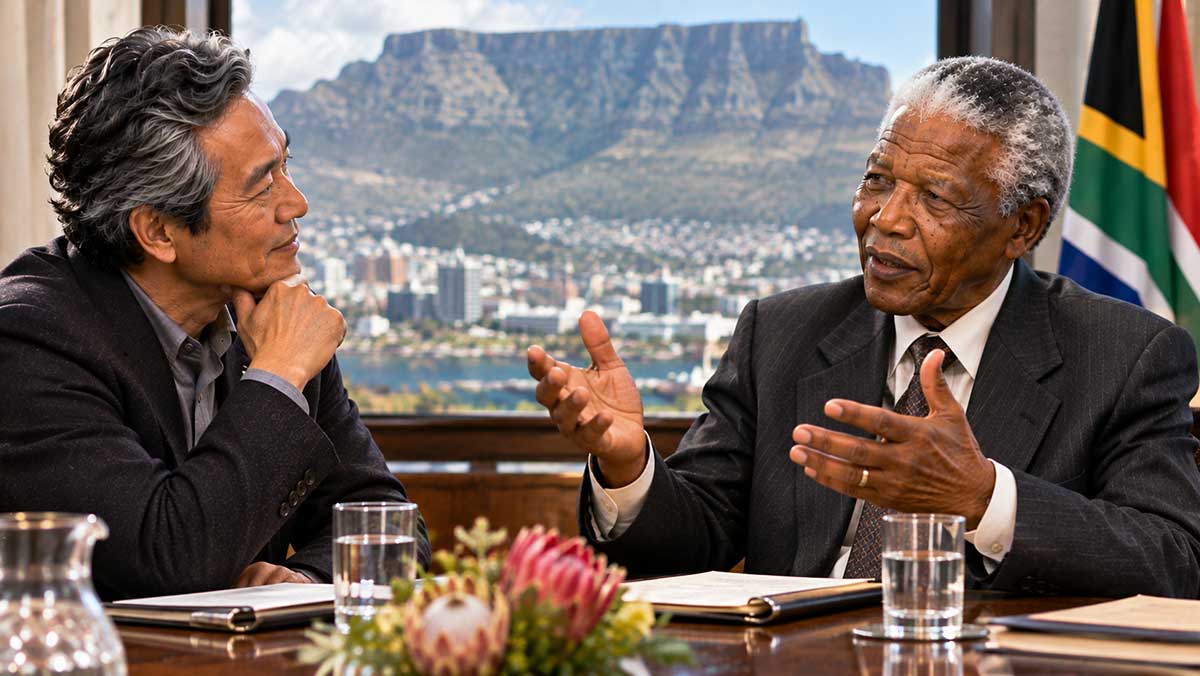
Afternoon light enters a quiet meeting room overlooking the city. Table Mountain stands beyond the windows. A polished wooden table occupies the center of the room, with several empty chairs arranged around it.
Nelson Mandela stands near the window, holding a folder of historical documents. Nick enters and notices the empty chairs.
Nick Sasaki: Nelson, this is quite a change from Robben Island.
Nelson Mandela: Yes, Nick. The chairs are considerably more comfortable.
Nick: And I notice nobody has locked the door.
Mandela smiles.
Mandela: A very welcome improvement.
They shake hands and sit across from one another.
Nick: Last time, we talked about your years in prison. Today, I want to understand something that still amazes me.
After twenty-seven years behind bars, you eventually sat down with representatives of the government that had imprisoned you.
You negotiated with people who had defended the system you spent your life fighting.
How did you do that?
Mandela: We must begin by recognizing that negotiations were not simply a personal encounter between former enemies.
South Africa was experiencing a profound political crisis. The liberation movement continued its struggle, communities faced terrible violence, and the government increasingly recognized that apartheid could not provide a stable future.
We had to find a political settlement.
Nick: But you had every reason to distrust the people across the table.
Mandela: Distrust was real.
Yet refusing to speak would not, by itself, bring freedom to our people.
Nick: So the question wasn't whether you liked them.
Mandela: Precisely.
Mandela opens the folder.
Mandela: The question was whether we could establish a democratic South Africa without allowing the conflict to destroy the country we hoped to build.
Question 10: What made you willing to negotiate with representatives of the government that imprisoned you?
Nick: Nelson, when did you begin seriously considering negotiations?
Mandela: During the 1980s, the situation was changing.
Resistance inside South Africa intensified. International opposition to apartheid grew. Economic pressures increased, and the government faced a crisis of legitimacy.
By the middle of that decade, I believed that discussions might help open a path to a political settlement.
Nick: But you were still a prisoner.
Mandela: Yes.
I began exploring contact with government representatives from prison.
It was a delicate undertaking.
Nick: Did your fellow ANC leaders know what you were doing?
Mandela: Not all of them knew immediately.
I understood that such contacts could be controversial, particularly when conducted by a prisoner who could not freely consult the movement's leadership.
I did not possess a mandate to negotiate a final settlement on behalf of the ANC.
My purpose was to explore whether meaningful talks might become possible.
Nick: Were you worried that your colleagues would think you were acting behind their backs?
Mandela: That was a serious concern.
Our movement depended on collective leadership. I had no right to substitute my personal judgment for the decisions of the organization.
But I believed there was value in testing whether the government was prepared to discuss fundamental change.
Nick: What were you asking for?
Mandela: The central issue was political equality.
The government had to accept that apartheid could not continue and that the people of South Africa must be able to choose their government through a democratic process.
Without that, discussions would accomplish little.
Nick: Did you ever sit across from someone and think, "You helped keep me in prison, and now you're asking me to trust you"?
Mandela: Trust could not be assumed.
It had to be tested through actions.
A government could speak about reform yet continue to restrict political organizations, detain activists, and deny equal rights.
We needed more than courteous conversations.
Nick: You met President P. W. Botha in 1989, before your release.
Mandela: Yes. That meeting was part of the developing contacts.
Later, F. W. de Klerk became president, and the political situation changed further.
In February 1990, he announced the unbanning of the ANC and other organizations and the intention to release me.
Nick: When you heard that, did you believe the government was finally serious?
Mandela: It was an important development, but it was a beginning.
There were still political prisoners, discriminatory laws, and fundamental questions about the transfer of political authority.
Nick: And after your release, you were no longer negotiating as a prisoner.
Mandela: I could work openly with my colleagues.
Oliver Tambo, Walter Sisulu, Cyril Ramaphosa, and many others had essential responsibilities.
The ANC's negotiating positions were developed collectively.
Nick: I want to ask something personal.
You spent decades fighting this government. Was there any part of you that wanted to make its leaders suffer as you had suffered?
Mandela studies Nick for a moment.
Mandela: Nick, I would be cautious about claiming that I never experienced anger or resentment.
But political decisions cannot be based simply on a desire to reverse personal suffering.
We were not seeking to exchange white domination for Black domination.
We wanted a democratic system in which every citizen possessed equal political rights.
Nick: So you didn't have to forgive every individual before you could negotiate.
Mandela: No.
Negotiation was a political responsibility.
Personal feelings and public obligations are related, but they are not identical.
Nick: That distinction changes the way I see your story.
Mandela: Good.
Mandela closes the folder.
Mandela: History becomes misleading when complicated political decisions are reduced to one man's feelings.
Question 11: How did you persuade people who feared one another to accept a shared democratic future?
The afternoon light shifts across the table. Mandela pours water into two glasses.
Nick: South Africa was deeply divided.
Many Black South Africans feared that the government would never surrender its privileges.
Many white South Africans feared what majority rule might mean for their families and communities.
How did you begin to address those fears?
Mandela: We had to establish a clear political principle.
Every adult citizen should have the right to vote, regardless of race.
That principle could not be abandoned.
But we recognized that many people feared what a new political order might bring.
Nick: What did you say to white South Africans who feared losing everything?
Mandela: We explained that democracy was not intended to replace one system of racial domination with another.
A democratic constitution would protect the rights of all citizens.
The law should not discriminate against a person because he was white, Black, Indian, or Coloured.
Nick: But words alone wouldn't have been enough.
Mandela: Certainly not.
There had to be institutions capable of protecting those rights.
Negotiators discussed constitutional principles, the structure of government, an independent judiciary, and arrangements for the transition.
These were practical questions with enormous consequences.
Nick: Did you ever feel that the talks might collapse?
Mandela: More than once.
The country experienced severe political violence during the transition.
There were killings in townships and hostels, clashes involving rival political organizations, and attacks that threatened to derail negotiations.
Nick: I want to talk about one event.
In April 1993, Chris Hani was assassinated.
He was an important leader in the anti-apartheid struggle.
Mandela: Yes.
Chris was widely respected and loved. His murder created extraordinary anger and grief.
There was a real danger that the country would descend into further violence.
Nick: You addressed the nation.
Mandela: I appealed for restraint and emphasized the importance of continuing toward a democratic future.
But I was not the only person working to prevent violence.
Community leaders, political organizations, religious figures, and ordinary citizens played essential roles.
Nick: Did you worry that people would stop listening to calls for restraint?
Mandela: Certainly.
People had endured decades of oppression. Many had lost relatives and friends.
It would have been unreasonable to expect that anger could simply disappear.
Nick: Then what made your appeal different from asking people to be patient again?
Mandela: The difference was that a political transition was underway.
We were working toward elections in which all South Africans could participate.
People needed to see that there was a credible path to change.
Without that, appeals for restraint would have carried far less weight.
Nick: You were asking people to trust a process that hadn't yet delivered freedom.
Mandela: We were asking them to help make that process succeed.
And we had to demonstrate that the negotiations were producing real progress.
Nick: What about the Inkatha Freedom Party and the violence involving ANC and Inkatha supporters?
Mandela: That conflict caused terrible suffering.
Political rivalry, local struggles, and the involvement of elements within the security forces contributed to a deeply dangerous situation.
The violence cannot be explained through one simple cause.
Nick: Were there people in your own movement who thought negotiation was a mistake?
Mandela: There were serious disagreements about strategy and the concessions that might be necessary.
Some feared that negotiations would preserve too much of the existing order.
Others worried that continued conflict would make a peaceful transition impossible.
Those concerns had to be debated.
Nick: Did you ever lose your temper during negotiations?
Mandela smiles slightly.
Mandela: I was not always as patient as people now imagine.
Nick: I suspected that.
Mandela: There were moments of sharp disagreement, including public confrontations with President de Klerk.
Respectful negotiation does not require pretending that serious disagreements do not exist.
Nick: That's reassuring. I was beginning to think you simply smiled at everyone until they agreed with you.
Mandela laughs.
Mandela: If that method had worked, South Africa's negotiations would have been much shorter.
Nick: What finally made the election possible?
Mandela: No single event can explain it.
There were years of organizing, negotiations, political pressure, difficult compromises, and efforts to contain violence.
The interim constitutional settlement provided a framework for elections and the transition to democratic government.
In April 1994, South Africans voted in a national election based on universal adult suffrage.
Nick: People waited in long lines.
Mandela: Yes.
For many, it was the first opportunity to participate in choosing the national government.
Nick: After everything they'd endured, they stood in line to cast a ballot.
Mandela: That was a profound moment.
But we must not forget that the right to vote was the beginning of democratic citizenship, not the completion of every struggle for equality.
Question 12: What compromises troubled you most as South Africa approached its first democratic election?
Mandela leans back in his chair. The room is quiet except for the distant sounds of the city.
Nick: Nelson, every negotiation involves compromise.
What were the hardest compromises for you?
Mandela: One of the central challenges was how to establish majority rule without creating a collapse of the institutions needed to govern the country.
We had to consider the civil service, security forces, courts, and economic institutions.
A new democratic government could not simply assume that these structures would disappear overnight.
Nick: So some of the people who had served the apartheid government would remain in their positions.
Mandela: Yes, under transitional arrangements and the developing constitutional order.
That created understandable concerns.
Many people had suffered under those institutions. They wanted accountability and change.
At the same time, the country required functioning administration and public services.
Nick: Was that difficult to explain to people who had spent their lives fighting apartheid?
Mandela: It was.
People had sacrificed enormously. They wanted to see the system transformed.
We had to explain why some changes would occur immediately and others would require time.
Nick: Were you ever worried that compromise would preserve too much of the old system?
Mandela: That was a legitimate concern.
Political democracy could remove racial restrictions on voting and public office, but economic inequalities would not disappear automatically.
Land ownership, employment, housing, education, and access to resources remained deeply unequal.
Nick: Did you believe the political settlement would allow you to address those problems later?
Mandela: We believed democratic government would create opportunities for reform that apartheid had denied.
But achieving those reforms would require policy choices, resources, and sustained effort.
It would not be easy.
Nick: Let me ask a difficult question.
Did the negotiations secure political freedom at the expense of economic justice?
Mandela considers the question.
Mandela: That is a serious criticism, and it deserves examination.
The settlement established democratic institutions and equal political rights. Those achievements were substantial.
But they did not immediately transform the distribution of wealth and economic opportunity.
We should judge the transition by what it accomplished and by what remained unresolved.
Nick: Were there compromises you later wished had been different?
Mandela: It is tempting to look backward and imagine that every decision could have produced a better outcome.
But negotiators must act within the circumstances they face.
The country was experiencing violence. Trust was limited. Institutions were uncertain.
We had to make decisions without knowing everything that would follow.
Nick: What about accountability for crimes committed under apartheid?
Mandela: That question was central to the transition.
South Africa later established the Truth and Reconciliation Commission, chaired by Archbishop Desmond Tutu.
The commission sought to investigate serious human rights violations and provide opportunities for public testimony.
Under specified conditions, perpetrators could apply for amnesty.
Nick: Some victims believed that was too lenient.
Mandela: Yes.
The process raised difficult questions about truth, justice, punishment, and national reconciliation.
There was no simple way to satisfy every demand.
Nick: Did reconciliation sometimes ask too much of victims?
Mandela: We must be careful not to demand forgiveness from people who have suffered.
A democratic society has responsibilities to victims that cannot be fulfilled merely by asking them to reconcile.
Nick: That's something I wanted to hear.
I worry that people sometimes use your story to tell victims they should forgive quickly and move on.
Mandela: My experience should not be used to silence those who seek justice.
The purpose of reconciliation is not to pretend that injustice did not occur.
It is to establish conditions in which people can live together without continuing the same cycle of domination.
Nick: And that takes more than a handshake.
Mandela: Considerably more.
Nick: Nelson, when you finally saw South Africans voting in April 1994, did you feel the negotiations had been worth it?
Mandela: The election represented an extraordinary achievement by the people of South Africa.
It demonstrated that a democratic transition was possible.
But the work of building a just society was only beginning.
Closing
The sun begins to sink behind Table Mountain. The meeting room grows dim, and the city lights gradually appear.
Nick: Nelson, I think I came here with the wrong picture in my mind.
I imagined you walking out of prison, forgiving your enemies, and somehow persuading everyone to live together.
Mandela: That would make a very short history book.
Nick laughs.
Nick: And a misleading one.
Mandela: Very misleading.
Nick: What I see now is a much harder story.
Negotiations that began before your release. Colleagues who disagreed. Communities facing terrible violence. Compromises that left some people deeply dissatisfied.
Mandela: Yes.
And many people working toward a democratic future, often at considerable personal risk.
Nick: You didn't have to become friends with every person across the negotiating table.
Mandela: No.
We had to establish political arrangements that allowed South Africans to become equal citizens.
Personal friendship could not be the foundation of constitutional rights.
Nick: That's a distinction I won't forget.
Mandela stands and walks toward the window.
Nick: There's one question I'd like to save for our final conversation.
You helped South Africa achieve democratic elections. Then you became president.
What happened when the man who had spent decades fighting the government suddenly became responsible for running it?
Mandela: Ah, Nick.
He turns with a smile.
Mandela: That is when many of the difficulties became even more practical.
Nick: Practical?
Mandela: People needed homes, schools, employment, healthcare, and safe communities.
A president cannot solve those problems with speeches alone.
Nick: And you were seventy-five when you became president.
Mandela: Seventy-five, yes.
Nick: Most people that age are thinking about retirement.
Mandela: I had already spent twenty-seven years in a government institution. Perhaps I should have been entitled to a pension.
Nick bursts into laughter.
Nick: I think you earned one.
Mandela: Unfortunately, the people of South Africa had other plans.
They share a smile.
Nick: Then next time, I'd like to meet you after the presidency.
Somewhere quiet. No negotiating table. No cameras.
Just two friends talking about what freedom actually achieved.
Mandela: That sounds pleasant.
But do not expect me to avoid your difficult questions.
Nick: I wouldn't dream of it.
The two men leave the meeting room together. Outside, Cape Town continues its evening routine, a city in a country still learning how to live with its hard-won democracy.
Topic 5: Freedom Was Only the Beginning
Opening
Johannesburg, South Africa. An imagined afternoon in the early 2000s, several years after Nelson Mandela stepped down from the presidency.
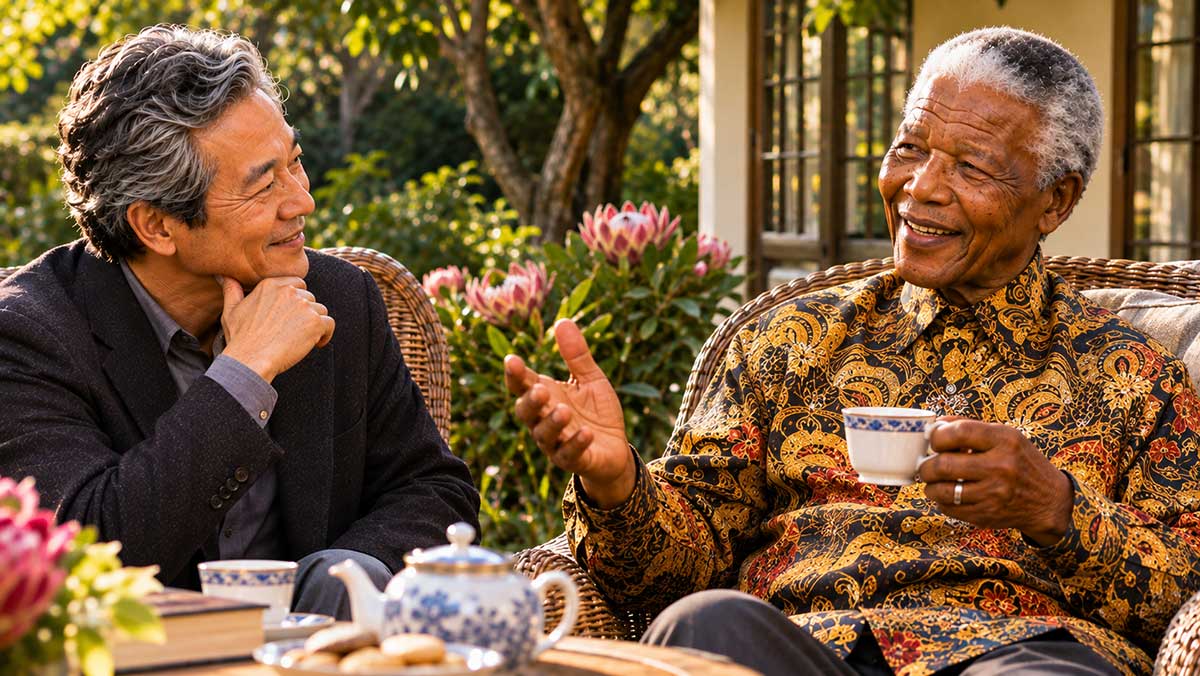
Sunlight filters through the trees of a quiet garden at Mandela's home. Purple flowers sway beside a stone pathway. Two wicker chairs sit beneath a shaded veranda, with a small table between them.
Mandela is already seated when Nick arrives. He wears a colorful patterned shirt and is studying a newspaper through his reading glasses.
Nick Sasaki: Nelson, I've finally found you somewhere without prison walls, government officials, or negotiating tables.
Nelson Mandela: And you look disappointed, Nick.
Nick: Not at all. This is exactly what I was hoping for.
Mandela: Good. Then perhaps today you will allow an old man to enjoy his retirement.
Nick: I was planning to ask you fifteen more questions.
Mandela lowers his newspaper and gives Nick a look of theatrical alarm.
Mandela: Fifteen? My goodness. I thought we had already completed the difficult part of this friendship.
They laugh as Nick takes the chair opposite him.
Nick: Just three questions today. I promise.
Mandela: Ah. Then we may remain friends.
Nick pours tea into two cups.
Nick: Nelson, we've talked about the boy who grew up in Qunu, the young lawyer in Johannesburg, the decision to resist apartheid, your years in prison, and the negotiations that helped bring democracy to South Africa.
But there's one part of your story we haven't really explored.
You spent most of your adult life fighting a government. Then, in 1994, you became responsible for leading one.
Mandela: Yes. And I discovered that criticizing a government and governing a country are rather different occupations.
Nick: I can believe that.
Mandela: When you are campaigning, you may explain what must change. When you are president, people quite reasonably ask when the change will arrive.
Nick: And they don't want to wait.
Mandela: Nor should we expect people who have suffered for generations to be satisfied with promises alone.
Mandela sets aside his newspaper.
Mandela: Political freedom was an extraordinary achievement. But it was the beginning of another responsibility.
Question 13: What did becoming president allow you to change, and what remained beyond your reach?
Nick: On May 10, 1994, you became South Africa's first Black president.
You were seventy-five years old.
After everything you had experienced, what did you most want to accomplish?
Mandela: We needed to establish a democratic government that could serve all South Africans.
That meant protecting the constitutional transition, building confidence in the new institutions, and addressing the enormous inequalities inherited from apartheid.
People needed homes, electricity, clean water, healthcare, education, and employment.
Nick: The expectations must have been overwhelming.
Mandela: They were enormous, and they were understandable.
For decades, millions of South Africans had been denied opportunities that others enjoyed.
The election changed who could participate in government. But it did not immediately change the conditions in which everyone lived.
Nick: What did your administration actually manage to accomplish?
Mandela: We began implementing the Reconstruction and Development Programme, which sought to address basic needs and economic development.
Housing construction expanded. More households gained access to electricity and water. Healthcare services were extended, including free public healthcare for pregnant women and young children.
The country adopted a new democratic constitution in 1996.
These were important developments.
Nick: But the problems were far from solved.
Mandela: Very far.
Poverty remained widespread. Unemployment was serious. Educational inequalities were deeply rooted.
And the economic divisions created by apartheid could not be eliminated through legislation alone.
Nick: Did you underestimate how difficult it would be?
Mandela: We understood that the problems were substantial.
But governing revealed practical difficulties that political opposition does not always expose.
Resources were limited. Institutions needed reform. Economic policy involved difficult choices.
And different communities had different expectations.
Nick: Your government eventually adopted the Growth, Employment and Redistribution strategy in 1996.
Some people criticized it for placing too much emphasis on fiscal restraint and market-oriented policies.
Mandela: There were genuine disagreements about economic policy.
The government sought investment, stability, and growth, but critics questioned whether our approach would produce the redistribution and employment that people urgently needed.
Those criticisms deserve serious consideration.
Nick: If you could return to those years, would you do anything differently?
Mandela looks across the garden before answering.
Mandela: It is easier to identify the limitations of a policy after observing its consequences.
I would want us to examine where our decisions succeeded, where they fell short, and whose needs remained unmet.
A government should not regard criticism as an insult to its historical achievements.
Nick: That sounds almost harder than admitting a personal mistake.
Mandela: Political leaders can become very attached to their own explanations.
He smiles.
Mandela: I have not been entirely free of that weakness myself.
Nick: I'm glad you admitted it.
Mandela: Do not look so pleased, Nick. You may discover similar weaknesses in yourself.
Nick: My family has already pointed out a few.
Mandela laughs.
Nick: There's another subject I want to ask about.
HIV/AIDS.
Your administration has been criticized for not responding strongly enough to the growing epidemic.
Mandela: That criticism is an important part of evaluating those years.
HIV/AIDS was becoming a devastating public health crisis. The government did take some steps, but our response was insufficient in important respects.
Greater urgency, public leadership, and effective prevention and treatment policies were needed.
Nick: Later, you became much more outspoken about AIDS.
Mandela: Yes.
After leaving office, I devoted greater public attention to the epidemic and to reducing the stigma surrounding it.
In 2005, after my son Makgatho died from an AIDS-related illness, I spoke publicly about the cause of his death.
Nick: That must have been deeply personal.
Mandela: It was a family tragedy.
And I believed that silence and shame surrounding the disease were harming many families.
Nick: Do you think you should have spoken more forcefully when you were president?
Mandela: The record of the epidemic during those years gives us serious reasons to question whether enough was done.
A leader must accept that decisions and omissions can have consequences beyond his intentions.
Nick: I appreciate your willingness to face that.
I don't want this interview to become a celebration where we overlook the people who were still suffering.
Mandela: Nor should it.
A democratic government must be judged by the lives of the people it serves, including those who remain poor, ill, or excluded.
Question 14: Did reconciliation achieve what you had hoped for the people who suffered under apartheid?
The garden grows quieter as the afternoon heat begins to ease. Mandela reaches for his tea.
Nick: Nelson, throughout our conversations, we've kept returning to reconciliation.
People around the world admire the way you reached out to white South Africans after apartheid.
But I wonder whether reconciliation sometimes moved faster than justice.
Mandela: What do you mean?
Nick: A Black South African family might have gained the right to vote in 1994 but continued living in poverty, without adequate housing or good schools.
Meanwhile, some people who had benefited from apartheid retained their wealth and opportunities.
Would that family feel that reconciliation had truly changed its life?
Mandela: That is a fair question.
Political equality is indispensable. Without it, people cannot participate as equal citizens in deciding the future of their country.
But political rights do not automatically provide economic security.
A democratic society must address both.
Nick: Did you worry that the language of national unity could make people uncomfortable about demanding more?
Mandela: Unity should never mean that people must remain silent about injustice.
The right to criticize government, organize politically, and demand reform is part of democracy.
Nick: Then what did reconciliation mean to you?
Mandela: It meant seeking a country in which people who had been separated by law and political domination could live together under equal citizenship.
It did not mean pretending that apartheid had caused no harm.
Nor did it mean that every victim was obliged to forgive those responsible.
Nick: Let's talk about the Truth and Reconciliation Commission.
Archbishop Desmond Tutu chaired it, and victims gave testimony about terrible abuses.
Some perpetrators received amnesty after meeting the legal requirements.
Do you think that process provided justice?
Mandela: It provided an important opportunity to investigate abuses, establish parts of the historical record, and allow victims to speak publicly.
But it was not a complete answer to the demands of justice.
Some victims wanted prosecutions and punishment. Others sought information about missing relatives or acknowledgment of what had happened.
The process had limitations, including difficulties surrounding reparations and accountability.
Nick: Did you ever worry that the country was asking victims to carry too much of the burden of reconciliation?
Mandela: We should not treat victims' suffering as a convenient instrument for national unity.
Their rights and experiences must remain central.
Reconciliation cannot be meaningful if those who suffered are expected to remain silent.
Nick: I think that's the part of your legacy people sometimes miss.
They hear the word forgiveness and assume the story is finished.
Mandela: But a country does not become just simply by changing the language its leaders use.
Institutions, opportunities, and relationships must change.
Nick: You did something that surprised many people during the 1995 Rugby World Cup.
You wore the Springbok jersey, which had long been associated with white South African identity.
Mandela: Rugby held a special place in the lives of many white South Africans, particularly Afrikaners.
For many Black South Africans, the Springbok emblem had represented exclusion.
Supporting the national team offered an opportunity to encourage a different sense of belonging.
Nick: Did you enjoy rugby?
Mandela smiles.
Mandela: I had to learn enough to follow it properly.
Nick: So you became president and immediately had homework.
Mandela: A president has many subjects to study, Nick.
They laugh.
Nick: That gesture became one of the most famous moments of your presidency.
But a rugby victory couldn't fix poverty or inequality.
Mandela: Of course not.
A symbolic gesture may help people see one another differently. It cannot substitute for social and economic reform.
Nick: Do you think South Africans sometimes expected too much from you personally?
Mandela: I became a symbol of hopes that belonged to millions of people.
That was a responsibility, but it could create unrealistic expectations.
No individual can repair every injustice or resolve every division.
Nick: Yet you were willing to step down after one presidential term.
You could have sought another.
Mandela: I believed it was important for democratic leadership to continue beyond one person.
South Africa needed institutions that could function without depending upon Nelson Mandela.
Nick: Was it difficult to give up the presidency?
Mandela: I had spent many years wanting freedom from government supervision.
He gives Nick a mischievous smile.
Mandela: It would have been rather strange to insist that I must now remain in government forever.
Nick: Fair point.
Mandela: And I had other things I wished to do with my remaining years.
Question 15: When you looked back on your life, what did you wish you could have given your family?
The afternoon light turns golden. Somewhere beyond the garden, a door opens and closes. Mandela watches a bird settle on a branch.
Nick: Nelson, we've spent a lot of time discussing what you gave your country.
For our final question, I'd like to ask about what you couldn't give your family.
You missed so much of your children's lives.
When you looked back, what did you wish had been different?
Mandela sets his cup down.
Mandela: I would have wished for more time with them.
There are ordinary experiences that cannot be recovered.
Watching a child grow. Being present during difficulties. Sharing celebrations. Offering guidance when it is needed.
My political commitments and imprisonment made many of those things impossible.
Nick: You once described your family as having suffered terribly through your absence.
Mandela: They did suffer.
And we must remember that the lives of my wives and children were shaped by their own choices and circumstances, not simply by their relationship to me.
Evelyn carried enormous family responsibilities during the early years of my political activity.
Winnie faced persecution, restrictions, and difficulties of her own, and our relationship later ended in divorce.
My children grew up in circumstances that were often painful.
Nick: Did becoming president give you an opportunity to repair those relationships?
Mandela: Some relationships could be strengthened. Others had been affected by too many years of separation and change.
A family does not simply return to the way it was because one person is released from prison or becomes president.
Nick: That's something I hadn't really considered.
The world celebrated your release in 1990, but your family couldn't simply start over.
Mandela: Precisely.
A public event may have a clear date. A family relationship develops over many years.
Nick: You married Graça Machel in 1998, on your eightieth birthday.
Mandela: Yes.
Nick: Did you ever think you'd find companionship again at eighty?
Mandela laughs warmly.
Mandela: Nick, you must never assume that an old man has finished surprising himself.
Nick: That's encouraging.
Mandela: Graça brought great companionship and happiness into my later life.
She had her own remarkable history and public responsibilities. I admired her deeply.
Nick: When you were younger, did you ever picture yourself sitting peacefully in a garden like this?
Mandela: During prison, the future was uncertain.
I could not know whether I would live to see democracy in South Africa, much less enjoy retirement.
Nick: And now here you are.
Mandela: Here I am.
He gestures toward the trees.
Mandela: With a visitor who continues asking difficult questions.
Nick: Just one more.
Mandela: Ah, I knew your promise of three questions could not be trusted.
Nick laughs.
Nick: It's really the question that brought us together.
What does it take to turn enemies into fellow citizens?
Mandela leans back, considering.
Mandela: A shared political future requires more than affection between individuals.
It requires equal rights, institutions that protect those rights, and a willingness to resolve disagreements without returning to domination.
People must be able to disagree about history, policy, and the future without losing their place in the nation.
Nick: Is forgiveness necessary?
Mandela: Personal forgiveness may help some people. Others may not be ready, or may never choose it.
The state cannot require a particular feeling from its citizens.
But it can establish laws and institutions that allow people to live together without one group ruling over another.
Nick: And what happens when economic inequality continues to divide them?
Mandela: Then the work remains unfinished.
Political democracy creates opportunities to address injustice. It does not guarantee that every opportunity will be used wisely.
Nick: So reconciliation isn't an event.
Mandela: It is an ongoing responsibility.
And it belongs to more than the president.
Nick: Does that mean you never considered your work complete?
Mandela: I knew that South Africa's future would depend upon generations who came after us.
They would have to make decisions we could not make for them.
Nick: What would you want those generations to do differently?
Mandela: I would want them to examine our achievements and our mistakes with equal seriousness.
They should defend democratic institutions, challenge inequality, and hold their leaders accountable.
And they should never believe that admiration for a historical figure is a substitute for their own responsibilities.
Nick smiles.
Nick: Even admiration for Nelson Mandela?
Mandela: Especially admiration for Nelson Mandela.
They laugh together.
Closing
The sun is low now, casting long shadows across the garden. Mandela rises slowly from his chair, and Nick stands beside him.
Nick: Nelson, when we began this interview in Qunu, you told me that the young boy running through those hills never expected to become president.
Mandela: That is true.
Nick: We've followed that boy through Johannesburg, the struggle against apartheid, twenty-seven years of imprisonment, negotiations, and the presidency.
But the part I'll carry with me is something much more personal.
You helped change your country, yet there were things you couldn't recover.
Your son's life. The years with your children. The ordinary moments that passed without you.
Mandela: Those losses were real, Nick.
And they should not disappear behind the public story.
Nick: I think people sometimes want historical figures to be perfect.
We want their sacrifices to have clear meanings, their decisions to be correct, and their lives to end with everything resolved.
Mandela: But human lives do not follow such convenient patterns.
He smiles gently.
Mandela: And a country is much more complicated than a single human life.
Nick: You've made that clear to me.
They begin walking along the garden path.
Nick: There's something else I've been thinking about.
You spent much of your life trying to create a South Africa where people of different races could live together as equals.
But you never expected them all to agree.
Mandela: Certainly not.
A democracy in which everyone agrees would be a very unusual democracy.
Nick: Perhaps a very quiet one.
Mandela: Or one in which people were afraid to speak.
Nick nods.
Nick: That's an important distinction.
Mandela: The right to disagree is part of freedom.
What matters is whether people can exercise that right without being denied their dignity or citizenship.
They reach the garden gate.
Nick: Nelson, thank you for spending this time with me.
I came hoping to meet the man behind the historical figure.
And I think I did.
Mandela: I have enjoyed our conversations, Nick.
You have asked difficult questions, but you have listened to the answers.
Nick: And you've corrected me more than once.
Mandela: Only when necessary.
Mandela's eyes brighten.
Nick: Which was quite often.
Mandela: You said it, not I.
They laugh.
Nick: Before I go, may I ask you something completely ordinary?
Mandela: Of course.
Nick: Are you happy here?
Mandela looks back toward the garden, the trees, and the house.
Mandela: I am grateful for the companionship and opportunities of these later years.
There are memories that bring sorrow, and there is work that remains for others to carry forward.
But I have been fortunate to see changes in South Africa that once seemed very distant.
He turns toward Nick.
Mandela: And today I have enjoyed the company of a new friend.
Nick: The feeling is mutual.
They shake hands warmly.
Mandela: Safe travels, Nick.
Nick: Thank you, Nelson.
Nick begins walking away, then turns back.
Nick: One last thing.
Mandela: Another question?
Nick: No. Just a promise.
If I come back, I'll leave my notebook at home.
Mandela laughs.
Mandela: Then you will be most welcome.
Nick walks down the path as the evening light settles over the garden. Mandela remains by the gate for a moment before turning toward the house.
The conversation ends, but the question that brought them together remains for every generation to answer: how can people who inherit a divided society build a future in which no one must surrender their dignity to belong?
Final Thoughts: The Freedom That Remains Unfinished
Nelson Mandela's life is often remembered through a handful of extraordinary moments: his statement from the dock during the Rivonia Trial, his release from prison in 1990, the long lines of voters in 1994, and his inauguration as South Africa's first Black president.
Each moment deserves its place in history.
But the deeper story lies in the difficult decisions between those milestones.
Mandela helped organize resistance against a government that denied political equality to the majority of its population. When peaceful campaigns encountered increasing repression, he supported sabotage, accepting the risks and moral responsibilities of that decision.
He then spent twenty-seven years in prison, separated from his family and deprived of experiences that no political victory could restore.
His mother died. His eldest son died. His children grew older without their father beside them.
Those losses should not be transformed into convenient examples of personal growth. They were genuine human tragedies, and they remained part of his life long after his release.
The democratic transition that followed was neither inevitable nor the accomplishment of one individual. It required the courage and work of countless South Africans, including activists, community leaders, negotiators, and ordinary citizens who continued demanding political equality.
Mandela played a central role, but his leadership operated within that wider movement.
His presidency demonstrated both the possibilities and limitations of political transformation. South Africa established democratic institutions and constitutional protections, yet poverty, unemployment, unequal opportunities, and the consequences of apartheid continued to shape everyday life.
The Truth and Reconciliation Commission brought many painful experiences into public view, but truth-telling did not resolve every demand for accountability, reparations, or justice.
This is why Mandela's story cannot be reduced to a simple instruction to forgive.
Reconciliation is not the erasure of wrongdoing, and political equality is not the automatic end of inequality.
Perhaps the most revealing aspect of Mandela's life is that he helped establish a democratic political order without claiming that his personal leadership could complete the country's transformation.
He stepped down after one presidential term, leaving the future of South Africa to institutions, elected successors, and its citizens.
For readers today, the question is not whether we could endure what Mandela endured or make every decision he made.
It is whether we are willing to examine our own societies with similar seriousness.
Can people defend their convictions without denying the dignity of those who disagree? Can a nation confront historical injustice without treating its citizens as permanent enemies? Can political freedom become meaningful in the ordinary lives of families who still struggle?
Mandela's history does not provide easy answers.
It gives us something more demanding: a record of courage, disagreement, sacrifice, compromise, achievement, and unfinished responsibility.
And perhaps that is where our imagined conversation should leave us.
Not with the belief that one extraordinary man solved the problem of human division, but with a question that belongs to every generation:
What are we prepared to do so that people who inherit a divided society can become equal citizens with a shared future?
For further exploration, see the Nelson Mandela Foundation, the United Nations' Nelson Mandela resources, and the South African History Online archive.
Fictional Conversation Disclaimer
The preceding interview is a work of historical fiction, not an authentic conversation or a record of Nelson Mandela's exact words, private thoughts, or endorsement. Its dialogue and scenes are imagined, drawing upon documented events and published historical sources; interpretations expressed by the fictional Mandela should not be mistaken for verified statements by the historical person.
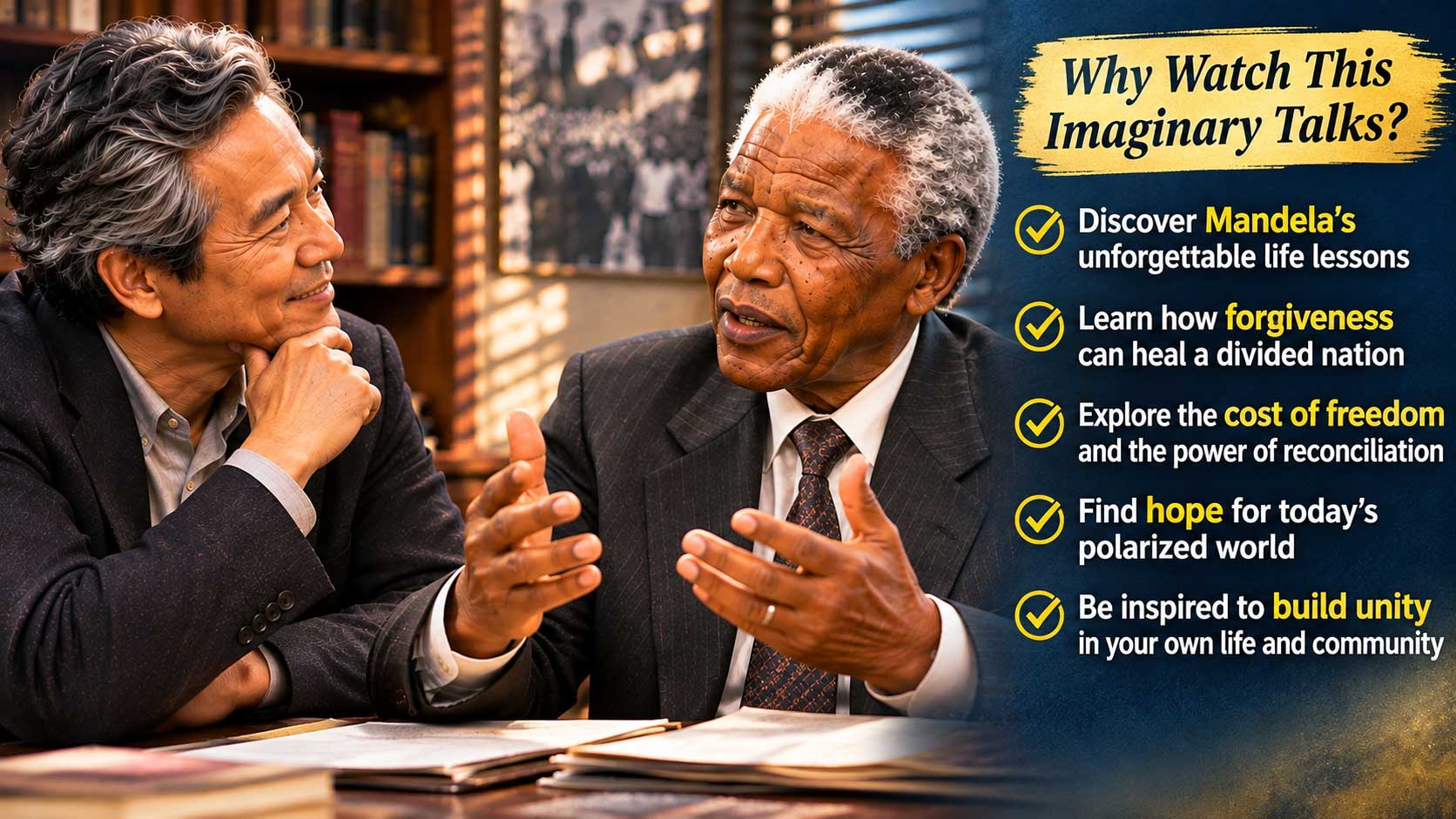
Short Bios:
Nelson Mandela (1918–2013)
Nelson Rolihlahla Mandela was a South African anti-apartheid leader, lawyer, political prisoner, and the country's first Black president. Born on July 18, 1918, in Mvezo, he became active in the African National Congress and helped establish its Youth League in 1944. He later participated in the organization of Umkhonto we Sizwe, which began a campaign of sabotage against apartheid in 1961.
Imprisoned from 1962 until February 11, 1990, Mandela became an international symbol of resistance to racial domination. He played a central role in negotiations that helped establish democratic government in South Africa, shared the 1993 Nobel Peace Prize with F. W. de Klerk, and served as president from 1994 to 1999.
Mandela continued supporting humanitarian and social causes after leaving office. He died on December 5, 2013, at the age of ninety-five. His legacy includes both his contributions to democratic equality and ongoing debates about the social and economic transformation of South Africa.
Nick Sasaki (Interviewer)
Nick Sasaki is the creator of ImaginaryTalks.com, a creative project that brings historical figures, thinkers, authors, and influential personalities into imagined conversations about important human questions.
Through historically informed fictional interviews, Nick explores the experiences, convictions, accomplishments, and contradictions of individuals whose lives continue to influence the present.
His conversational approach combines curiosity, warmth, thoughtful questions, and a desire to encounter the person behind the public image. ImaginaryTalks invites readers to reflect on history, human dignity, relationships, and the choices that shape our shared future.
Leave a Reply