
Introduction
Main Introduction
What happened to Rosa Parks after she refused to give up her seat? Most Americans know the beginning of the story. On December 1, 1955, a 42-year-old Black woman in Montgomery, Alabama, refused a bus driver's order to surrender her seat. She was arrested, a community rose in protest, and the Montgomery Bus Boycott helped change American history. But what happened to Rosa after the crowds went home? What became of her marriage, her livelihood, and the convictions that had shaped her long before that afternoon?
The familiar story often presents Rosa Parks as a quiet, exhausted seamstress whose unexpected refusal awakened a movement. The real history is richer and more challenging. Rosa had spent years working with the NAACP, investigating racial injustice, seeking voting rights, and mentoring young people. The Library of Congress exhibition, Rosa Parks: In Her Own Words, drawing on her personal papers, reveals a determined activist whose work began long before she became internationally famous. Her refusal was not the beginning of her commitment to justice. It was one moment in a lifetime of resistance.
That lifetime began in Alabama, where Rosa Louise McCauley grew up surrounded by family love and the dangers of racial violence. Her mother believed deeply in education, and her grandfather defended the family against threats from white supremacists. Rosa later married Raymond Parks, a barber involved in efforts to defend the Scottsboro Boys. Together they built a marriage shaped by ordinary responsibilities and a shared concern for justice. Their relationship reminds us that Rosa Parks was a daughter, granddaughter, wife, and friend before she became a national symbol.
Her activism brought her into contact with people whose stories deserve recognition in their own right. In 1944, she investigated the sexual assault of Recy Taylor, a Black woman who was denied justice despite a campaign demanding accountability. Rosa worked with young people through the Montgomery NAACP Youth Council and participated in efforts to challenge discriminatory voting practices. Her experiences help explain why the popular account of a woman who was merely too tired to stand is misleading. As her recollections in the Rosa Parks oral history preserved by Harvard's Schlesinger Library demonstrate, she understood the system she was challenging.
The Montgomery Bus Boycott was never the achievement of one person alone. Jo Ann Robinson and the Women's Political Council helped mobilize the community, E. D. Nixon and local ministers organized support, Martin Luther King Jr. became a prominent leader, and thousands of residents walked or arranged transportation for more than a year. Women including Claudette Colvin, Aurelia Browder, Susie McDonald, and Mary Louise Smith played important roles in challenging bus segregation. The federal lawsuit Browder v. Gayle brought the legal ruling that ended segregation on Montgomery's buses. Their contributions belong alongside Rosa's courage.
Yet victory did not bring Rosa and Raymond financial security. They experienced employment losses, threats, and prolonged hardship, eventually leaving Montgomery for Detroit in 1957. Rosa continued working for civil rights, supported new movements for racial and economic justice, and served in Congressman John Conyers's Detroit office for more than two decades. After Raymond's death in 1977, she helped establish an institute bearing both their names to educate young people. The decades after Montgomery were not a footnote. They were an essential part of her life's work.
In this fictional conversation, Nick Sasaki meets an 82-year-old Rosa Parks in Detroit in 1995. Rather than beginning with the famous bus ride, he asks about the people who shaped her childhood, the man she loved, the injustices she confronted, and the personal costs of becoming a public symbol. Their conversation moves through five chapters of her life, guided by documented history but written as an intimate meeting between two people. The central question is not simply why Rosa Parks refused to move. It is how she lived before that decision, what it cost her afterward, and what she hoped future generations would learn from the rest of her life.
Fictional Conversation Disclaimer
This interview is a work of historical fiction. The meeting between Nick Sasaki and Rosa Parks, including all dialogue, gestures, and personal exchanges, is imagined rather than an authentic transcript. Historical events are informed by published records and recollections, but the fictional responses do not constitute verified quotations, personal testimony, or endorsement by Rosa Parks, her family, or associated organizations.
Topic 1: Before the World Knew Her Name
Opening
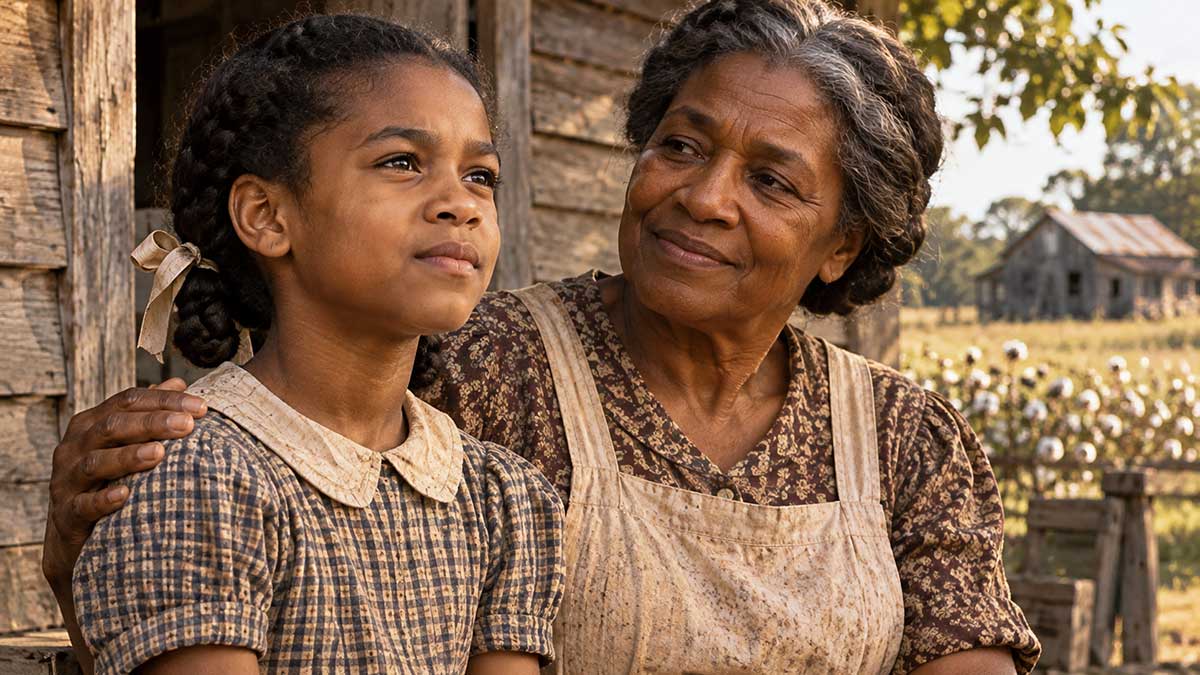
Detroit, autumn 1995. Afternoon sunlight falls softly across a modest living room. A few family photographs rest on a nearby table. Rosa Parks, now 82, sits comfortably in an armchair. Across from her is Nick Sasaki, who has come not simply to ask about a famous bus ride, but to meet the woman whose life stretched far beyond it.
This meeting and its dialogue are imagined. The historical events discussed are drawn from Rosa Parks's documented life and recollections.
Nick Sasaki: Mrs. Parks, thank you for welcoming me. I have to admit, I've been looking forward to this conversation, but I've been wondering how to begin.
Rosa Parks: Well, that's a curious thing to hear from someone who's come to ask questions.
Nick: (Laughs.) Fair enough. I suppose I'm a little nervous.
Rosa: You needn't be. We're just two people having a conversation.
Nick: That's exactly what I hoped for. You know, most people would probably begin by asking you about December 1, 1955.
Rosa: Yes, I've noticed that date comes up rather often.
Nick: (Smiles.) I thought we might give it a little rest.
Rosa: I don't believe it will mind.
Nick: I'd like to begin with a girl named Rosa McCauley. Before the photographs, before the marches, before anyone outside your community knew your name.
Rosa: Well, she had a life, too.
Nick: That's the life I'd like to hear about.
Question 1: When You Remember Your Childhood, What Comes Back First?
Nick: Rosa, when you close your eyes and think about growing up in Alabama, what's the first thing you remember? Not the history-book version. Just home.
Rosa: My family. My mother, my grandparents, my younger brother. The place where we lived in Pine Level.
I was born in Tuskegee in 1913, but much of my childhood was spent with my mother's family after my parents separated.
My mother was a teacher. She believed very strongly in education. My grandparents had lived through difficult times, and they understood what it meant to have to protect yourself and your family.
Nick: What was your mother like?
Rosa: She was a woman who took her responsibilities seriously. She wanted her children to learn and to have opportunities she knew were not easily available to us.
There were many things she couldn't change about the world around us. But she could teach us to respect ourselves.
Nick: Was she strict?
Rosa: She expected us to behave properly.
Nick: (Laughs.) That's a careful answer.
Rosa: Well, she was a teacher. You might imagine she expected us to pay attention.
Nick: My mother would have liked her.
Rosa: Then perhaps they would have had a few things to discuss.
Nick: What about your grandfather? I've read that he was a strong influence on you.
Rosa: My grandfather, Sylvester Edwards, was a man who believed in defending his family.
I remember the fear of the Ku Klux Klan. There were nights when we knew that danger might come. My grandfather kept a shotgun close by.
That was part of the world I grew up in.
Nick: It's difficult to picture a little girl living with that kind of fear.
Rosa: Children notice more than adults sometimes think.
You learn when people are afraid. You learn what can happen when someone believes he has the right to hurt you simply for being who you are.
Nick: Did you feel safe with your grandfather?
Rosa: I knew he would do what he could to protect us.
But feeling protected by your family is not the same thing as living in a safe society.
Nick: That's a distinction I hadn't thought about.
Rosa: A child ought to be able to think about school and friends and ordinary things. She ought not to have to wonder whether someone might come to harm her family.
Nick: When you look back, do you remember happiness, too?
Rosa: Of course. We were a family. There were ordinary days, people to care about, things to learn.
I would not want you to think my childhood was nothing but fear.
Nick: I'm glad you said that. Sometimes when we tell the story of someone who lived through terrible injustice, we make every memory about the injustice.
Rosa: But people still live their lives. They have children to raise, meals to prepare, work to do.
The unfairness is there, but it is not the whole of who they are.
Nick: I think that's something I want to keep in mind throughout our conversation.
Rosa: Then we're off to a reasonable start.
Question 2: How Did You Learn That Being Treated as Inferior Did Not Make You Inferior?
Nick: You've spoken about your family teaching you self-respect. But I wonder how a young girl makes sense of a society that keeps telling her she's less important than someone else.
Did you ever believe what the segregation laws seemed to be saying about you?
Rosa: No. I knew the treatment was wrong.
I couldn't always do anything about it, especially when I was young. But I did not believe that being treated unfairly meant I deserved it.
Nick: Was there a moment when you began resisting that treatment?
Rosa: I remember an incident from childhood involving a white boy who threatened me.
I stood up for myself. I was not willing to accept that he could simply do whatever he pleased to me.
Nick: Were you frightened?
Rosa: There were reasons to be frightened. That did not mean I thought his behavior was right.
Nick: That's interesting. People often speak about courage as though you have to stop feeling afraid.
Rosa: Fear doesn't decide whether something is right or wrong.
Nick: Did you ever get into trouble for speaking your mind?
Rosa: I learned that speaking your mind could have consequences.
In those days, a Black child could be punished for things that a white child might do without a second thought.
You had to understand the world you were living in.
Nick: You attended the Montgomery Industrial School for Girls. What do you remember about that experience?
Rosa: Education mattered to me. The school encouraged us to learn and to conduct ourselves with dignity.
But my schooling was interrupted. There were family members who needed care, and I had responsibilities at home.
Nick: Was leaving school disappointing?
Rosa: I wanted to continue my education. I did eventually return to my studies and earn my high school diploma after I married.
Nick: In 1933, wasn't it?
Rosa: Yes.
Nick: I admire that. It must have taken determination.
Rosa: It took making the effort when I had the opportunity.
Nick: Did you ever think about becoming a teacher like your mother?
Rosa: I respected teaching. My mother's work made a lasting impression on me.
But opportunities for Black women were limited. You could have ambitions and still find many doors closed.
Nick: What did you want most as a young woman?
Rosa: To live with dignity. To have an education. To be able to work and take care of the people I loved.
Those may sound like ordinary wishes.
Nick: They do. And that's what makes it painful to think about how difficult society made them.
Rosa: They should have been ordinary things available to everyone.
Nick: I keep thinking about that little girl in Pine Level. She couldn't have known what her life would become.
Rosa: No. And I wouldn't want you to look at every part of her childhood as though it were leading to one particular day in Montgomery.
Nick: You're right. That would be unfair to the rest of your life.
Rosa: A life is made up of many days.
Question 3: Who Was Raymond Parks Before He Became Your Husband?
Nick: I'd love to hear about Raymond.
Rosa: (Her expression softens.) Raymond was a very important person in my life.
Nick: You met him when you were a young woman?
Rosa: Yes. He was a barber, and he was interested in civil rights long before many people were willing to speak openly about such things.
He was involved in efforts to help the Scottsboro Boys, the nine young Black men who were falsely accused of raping two white women in Alabama.
It was dangerous work.
Nick: What first attracted you to him?
Rosa: I respected his concern for other people and his willingness to stand up against injustice.
He believed that what was happening to those young men was wrong, and he was prepared to do something about it.
Nick: Was he serious all the time?
Rosa: (Smiles.) No one is serious every moment.
Nick: I'm relieved to hear that.
Rosa: But he did take important matters seriously.
Nick: When you were getting to know him, did you talk about politics and civil rights?
Rosa: Those matters were part of his life. They became part of our shared life, too.
Nick: Was it unusual for a young couple to spend time discussing such dangerous issues?
Rosa: Black families were affected by those issues whether they discussed them or not.
The question was whether you would accept the situation or try to change it.
Nick: You married in December 1932.
Rosa: December eighteenth.
Nick: Do you remember what you hoped your marriage would be like?
Rosa: I hoped we would build a good life together. We cared about each other, and we shared certain convictions.
Like other married couples, we had responsibilities and difficulties. We had to earn a living.
Nick: Raymond encouraged you to complete your education, didn't he?
Rosa: He supported my education, yes. I completed high school the following year.
Nick: That says something about the partnership you were building.
Rosa: He understood that education mattered to me.
Nick: I sometimes wonder whether people who later become famous for a great act of courage know, early in life, that they're destined for something extraordinary.
Rosa: I don't think we should talk about destiny too easily.
We were two people trying to make a life together in a society that placed many restrictions on us.
We did not know what the years ahead would bring.
Nick: If you could go back and speak to that young Rosa, just before she married Raymond, what would you tell her?
Rosa: (She considers the question.)
I might tell her to value the people who care for her, to continue learning, and not to lose sight of what she believes is right.
But I don't suppose she would have wanted an older woman telling her everything about the future.
Nick: (Laughs.) You think she would have been stubborn?
Rosa: She might have had a mind of her own.
Nick: I suspect she did.
Rosa: That isn't always a bad thing.
Closing
The afternoon light has shifted across the room. Nick glances at the family photographs, then returns his attention to Rosa.
Nick: Rosa, I have to tell you something. I came here thinking I knew the broad outline of your life. But hearing about your mother, your grandfather, your education, and Raymond makes me realize how little that outline tells us.
Rosa: Most lives cannot be explained by one event.
Nick: I'm beginning to see that.
And there's something about Raymond that interests me. You were both concerned about injustice long before the Montgomery Bus Boycott.
I'd like to understand how that concern became part of your everyday lives.
Rosa: It wasn't always easy to separate everyday life from those concerns.
Nick: I suppose not.
Rosa: There were people who needed help. There were things happening in Alabama that ought not to have been happening.
Raymond was already involved in that work when we married. In time, I became involved more deeply myself.
Nick: Did you ever wish you could simply ignore what was happening and live a quiet life?
Rosa: (She pauses.)
There were responsibilities we had to meet, like anyone else. We worked, cared for family, and tried to get along.
But ignoring injustice did not make it disappear.
Nick: Then I'd like to hear about those years. Before the bus, before the boycott, when you were doing work most of the country knew nothing about.
Rosa: There is quite a bit to tell.
Nick: Good. I was hoping you'd say that.
Rosa settles back in her chair. Nick leans forward, curious about the years when her commitment to justice took shape through difficult, often unrecognized work.
Their conversation continues.
Topic 2: The Courage Nobody Saw
Opening
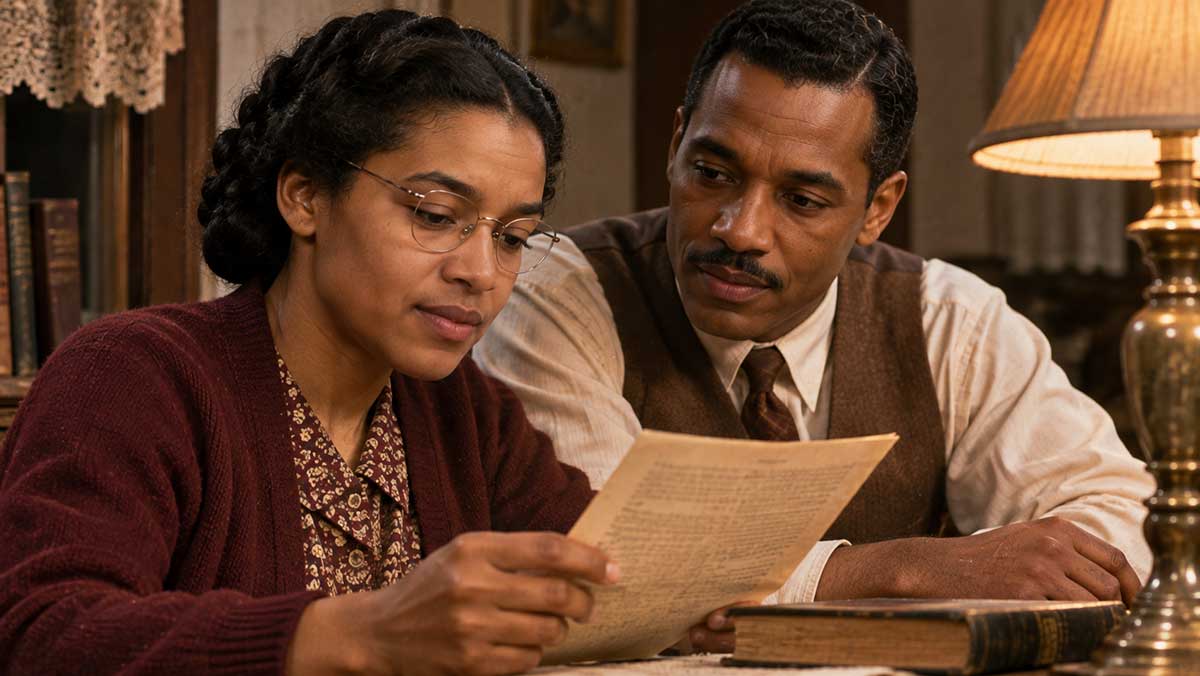
Detroit, autumn 1995. The afternoon has grown quieter. Rosa Parks sits across from Nick Sasaki, who has just heard about her childhood in Alabama, her mother's devotion to education, and the young barber named Raymond Parks who became her husband.
Nick has begun to recognize something unexpected about Rosa. She speaks calmly, sometimes with a gentle smile, but beneath her measured words lies a lifetime of determination.
Nick Sasaki: Rosa, something has been on my mind since you told me about Raymond.
Rosa Parks: What's that?
Nick: When people talk about your courage, they almost always begin with the bus in 1955. But Raymond was already involved in civil rights work when you met him. And you were doing important work long before anyone outside Montgomery knew your name.
Rosa: Yes. There were many people working for change before the boycott. Most of them never became famous.
Nick: That's what interests me. I wonder how many courageous people history has forgotten simply because nobody was there to take their photograph.
Rosa: Quite a few, I expect.
Nick: (Smiles.) You said that without even thinking.
Rosa: Well, I knew some of them.
Nick: Then I'd like to hear about those people. And I'd like to understand how you became involved in their work.
Rosa: We can begin with Raymond. He had a good deal to do with that.
Question 1: How Did Your Marriage Become Part of the Fight for Justice?
Nick: You mentioned that Raymond was involved in the Scottsboro Boys case when you met him. For someone unfamiliar with that history, what was happening in Alabama?
Rosa: In 1931, nine young Black men were accused of raping two white women on a train. The accusations led to arrests, trials, and death sentences.
There was a great deal of prejudice surrounding the case. People were demanding punishment before the young men had received anything resembling fair treatment.
Raymond was involved in efforts to support their defense.
Nick: That sounds dangerous, especially in Alabama at that time.
Rosa: It was dangerous. People could face threats or violence simply for trying to help someone accused of a crime.
Nick: Did Raymond ever tell you he was afraid?
Rosa: I wouldn't claim to know every feeling he had. But he understood the risks.
He believed those young men deserved justice.
Nick: What did you admire most about that?
Rosa: He was willing to concern himself with people who needed help.
It's one thing to say something is wrong. It's another to spend your time trying to do something about it.
Nick: Was there ever a moment when you thought, "I married this man because he has a good heart, but I wish he would stop putting himself in danger"?
Rosa: (Smiles slightly.) You do ask rather personal questions.
Nick: I'm afraid I do.
Rosa: We had to think about safety. But the danger was not something Raymond created by caring about justice.
It was already there.
Nick: That's an interesting distinction.
Rosa: If people had to stop doing what was right whenever someone threatened them, very little would ever change.
Nick: How did your own involvement begin?
Rosa: I had experienced discrimination since childhood. I knew the unfairness of segregation.
But through Raymond and other people involved in civil rights work, I learned more about organized efforts to challenge it.
Later, I became involved with the NAACP in Montgomery.
Nick: In 1943, you became the branch secretary.
Rosa: Yes. E. D. Nixon was an important leader in the branch. He was involved in efforts to secure voting rights and challenge discrimination.
I worked with him and others.
Nick: When people hear the word "secretary," they might picture someone sitting at a desk taking notes.
Rosa: There were notes to take.
Nick: (Laughs.) Of course.
Rosa: And letters to write. Meetings to arrange. Records to keep.
But the work involved much more than that. People came to us with problems. We tried to help them.
Nick: Did you enjoy that work?
Rosa: I believed it needed to be done.
Some of it was difficult. You heard about terrible things happening to people. You couldn't always get the results you wanted.
Nick: What was the hardest part?
Rosa: Knowing that someone had been treated unjustly and finding that the authorities were unwilling to act.
Nick: Did you ever feel that you were getting nowhere?
Rosa: There were disappointments.
But you couldn't measure everything by whether one particular effort succeeded. There were people who still needed help the following day.
Nick: That sounds exhausting.
Rosa: It was work. Sometimes discouraging work.
Nick: Yet you continued.
Rosa: Yes.
Nick: I think there's something about that kind of persistence people don't always appreciate. It's easier to celebrate one dramatic moment than years of difficult work.
Rosa: A movement depends on people who are willing to do the work when no one is watching.
Nick: And you were one of them.
Rosa: I was one among many.
Question 2: What Did the Recy Taylor Case Teach You About Justice?
Nick: Rosa, there's an experience from 1944 that I want to ask about carefully.
You investigated the case of a young Black woman named Recy Taylor.
Rosa: Yes. Mrs. Taylor lived in Abbeville, Alabama.
Nick: She was abducted and sexually assaulted by six white men while returning from church.
Rosa: That is what happened.
Nick: I find it difficult to comprehend the cruelty of that crime. And then the failure of the justice system to hold the men accountable.
How did you become involved?
Rosa: I was sent to investigate what had happened and to speak with Mrs. Taylor.
We wanted the truth to be known and the people responsible to be brought to justice.
Nick: What do you remember about meeting her?
Rosa: I would not want to put words in her mouth or speak for her private feelings.
But she was a woman who had suffered a terrible wrong. She deserved to be heard, and she deserved justice.
Nick: What happened after your investigation?
Rosa: People organized to demand that the case be taken seriously. There was a committee working for justice for Recy Taylor.
The campaign received attention beyond Alabama.
But the men were not convicted.
Nick: Did that make you angry?
Rosa: I was deeply concerned about the injustice.
You have to understand that Black women could be subjected to terrible violence, and there was often very little protection for them under the law.
Their complaints were not treated with the seriousness they deserved.
Nick: I've been thinking about something. When people discuss civil rights history, they often focus on voting, schools, buses, and public accommodations.
But what you're describing is much more personal. It's about whether a woman can walk home from church without fearing violence.
Rosa: Yes.
And whether the law will protect her if she is harmed.
Nick: Did you believe the investigation could make a difference?
Rosa: We hoped that public attention would help bring justice.
It did not bring the outcome Mrs. Taylor deserved. But people across the country learned what had happened.
Nick: How did you live with that kind of disappointment?
Rosa: You did what you could, and then you had to continue.
There were other cases. Other people needed assistance.
Nick: That sounds almost unbearably difficult.
Rosa: It was difficult. But I don't want you to think the work was only about the people doing the investigating.
Mrs. Taylor had to live with what happened to her.
She was the person who deserved justice.
Nick: You're right. I was asking about how the experience affected you, and you brought me back to her.
Rosa: She should not be forgotten.
Nick: No, she shouldn't.
Nick falls silent for a moment. Rosa does not rush to fill the pause.
Nick: Rosa, did experiences like this change the way you understood segregation?
Rosa: Segregation was more than separate seats or separate schools.
It was part of a system that denied Black people equal treatment and protection.
If you wanted to challenge that system, you had to look at what was happening to people throughout their lives.
Nick: So when you later refused to move on that bus, you already knew how much larger the struggle was.
Rosa: I had been involved in civil rights work for years by then.
Nick: I wish more people knew that.
Rosa: Then perhaps they'll learn.
Question 3: Why Did You Spend So Much Time Helping Young People?
Nick: There's another part of your life that surprised me during my research.
You spent years working with young people through the NAACP Youth Council.
Rosa: Yes. That work was important to me.
Nick: You helped revive the Montgomery youth council in 1949, didn't you?
Rosa: We worked to bring young people together and help them learn about their rights.
Nick: What were they like?
Rosa: They were young people. They had questions, opinions, and ideas about how things ought to be.
Nick: (Smiles.) I suspect they didn't always agree with you.
Rosa: Young people don't always agree with their elders.
Nick: That's certainly true.
Rosa: But they needed opportunities to learn and participate.
We organized educational activities and encouraged them to become involved in challenging discrimination.
Nick: I've read that the youth council challenged segregation at Montgomery's public library.
Rosa: Access to books and education should not have depended on a person's race.
We wanted young people to understand that they had rights and could work together to challenge unfair treatment.
Nick: Did they ever make you feel hopeful?
Rosa: I believed education and participation could help prepare them for the future.
Young people needed to know that they were capable of making a difference.
Nick: Here's something I find remarkable. In the days before your arrest in December 1955, you were helping prepare for a youth conference.
Rosa: Yes, I was involved in that work.
Nick: So the week the world remembers as the beginning of your story was actually an ordinary week in the middle of years of organizing.
Rosa: There was a great deal going on before that Thursday afternoon.
Nick: Did you ever imagine that some of the young people you worked with might one day lead the civil rights movement?
Rosa: I hoped they would continue working for justice.
But they had their own lives and decisions to make.
Nick: Did working with them change you?
Rosa: It reminded me that the future would belong to them.
Adults had a responsibility to help them learn, but we couldn't make every decision for them.
Nick: That reminds me of something you said earlier about your mother. She couldn't change every part of the world you were growing up in, but she could help you learn and respect yourself.
Rosa: My mother valued education.
Nick: And here you were, years later, helping another generation.
Rosa: I suppose you could see a connection.
Nick: (Smiles.) I was hoping you might.
Rosa: You seem rather pleased when you discover one.
Nick: Guilty.
Rosa: Well, I won't discourage you.
Nick: Rosa, there's something else I want to ask.
When you were doing all this work, did you ever think about how history might remember you?
Rosa: No. I was concerned with the work that needed to be done.
Nick: You weren't trying to become famous.
Rosa: That was not my purpose.
Nick: Then what did you hope would happen?
Rosa: I hoped that people would be treated fairly, that they could vote without discrimination, that young people would have better opportunities, and that the law would protect everyone equally.
There was much to be done.
Nick: And by 1955, after all those years, you were still working at it.
Rosa: Yes.
Closing
Outside, the afternoon light has begun to fade. Nick looks down at the notes resting on his knee, then closes the notebook.
Nick: Rosa, can I tell you what strikes me most about everything you've shared?
Rosa: Please do.
Nick: For years, you were helping people whose names many Americans would never know. You worked on voting rights, investigated violence, supported young people, and tried to persuade authorities to treat people fairly.
And much of that work brought disappointment.
Rosa: There were victories, too. But progress was often slow.
Nick: Did you ever consider giving it up?
Rosa: There were responsibilities at home and work. I couldn't spend every hour on civil rights activities.
But the problems were still there.
Nick: You know, I came here wanting to ask why you refused to move on that bus.
Now I'm beginning to wonder how you managed to keep going for so many years before that day.
Rosa: There were many people doing the same.
Nick: I know. And I want to hear about them, too.
Nick pauses, thinking about the woman who has been sitting across from him all afternoon.
Nick: There's something I'd like to ask next, if you're comfortable discussing it.
Rosa: What is it?
Nick: December 1, 1955.
Rosa: (She gives a small, knowing smile.) I wondered when we'd get there.
Nick: (Laughs softly.) I've been trying not to rush.
Rosa: That's quite all right.
Nick: But now that I know more about the years before it, I think I may hear the story differently.
Rosa: Then let's talk about what happened.
The room grows quiet again. For the first time that afternoon, Nick prepares to ask about the bus ride that made Rosa Parks famous, now knowing that her decision belonged to a much longer history of resistance.
Their conversation continues.
Topic 3: December 1, 1955, Why She Stayed Seated
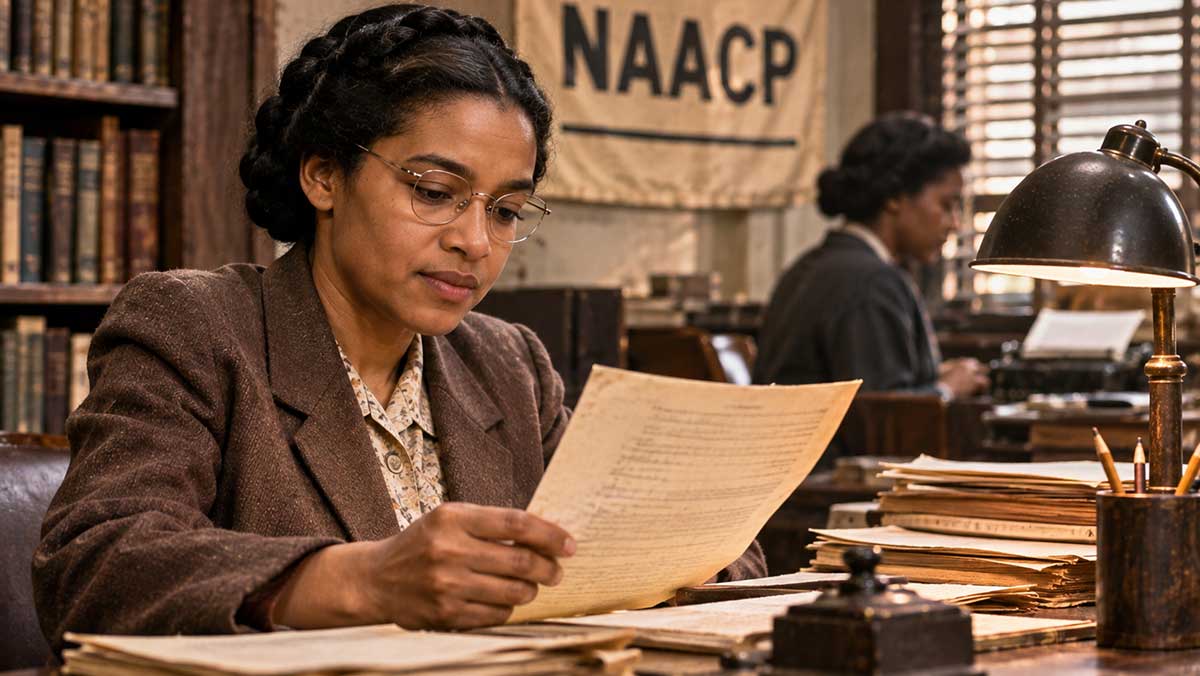
Opening
Detroit, autumn 1995. The afternoon light has softened, and the room has grown quieter. Rosa Parks sits across from Nick Sasaki, who has spent the past hour learning about her childhood, her marriage to Raymond, and the years she devoted to civil rights work before the Montgomery Bus Boycott.
Nick sets his notebook aside. For the first time, he is about to ask about the Thursday afternoon that changed American history.
Nick Sasaki: Rosa, I think I owe you a confession.
Rosa Parks: What's that?
Nick: Before today, whenever I thought about you, I pictured that famous bus. A woman sitting quietly, refusing to move.
Rosa: You're not the only one.
Nick: But after hearing about your grandfather, Raymond, the NAACP, Recy Taylor, and those young people you worked with, that picture feels incomplete.
Rosa: There was a good deal of life before that afternoon.
Nick: And I think that's what makes me want to hear about it now. Not as some isolated act of heroism, but as something that happened to a woman who had already spent years confronting injustice.
Rosa: Well, it was an ordinary Thursday when it began.
Nick: Then let's begin there.
Question 1: Rosa, Can You Take Me Back to That Thursday Afternoon?
Nick: It's December 1, 1955. You're forty-two years old, working as a seamstress at Montgomery Fair. What do you remember about leaving work that day?
Rosa: I had finished my work and was going home. I boarded the Cleveland Avenue bus.
I paid my fare and took a seat in the section where Black passengers were permitted to sit.
Nick: There's something I want to clarify, since I've heard people tell this story differently. You weren't sitting in the front section reserved for white passengers, were you?
Rosa: No. I was seated behind that section, in the first row where Black passengers could sit.
Nick: And at first, there wasn't a problem?
Rosa: I was sitting there as the bus continued along its route.
Then more passengers boarded, and the seats reserved for white passengers became occupied.
The driver wanted the row where I was sitting to be made available.
Nick: The driver was James Blake.
Rosa: Yes.
Nick: You'd encountered him before, hadn't you?
Rosa: I had. Years earlier, I had an unpleasant experience with him.
He had required me to get off the bus after paying my fare and enter through the rear door. I did not appreciate that treatment.
Nick: And then, years later, you found yourself on his bus again.
Rosa: Yes.
Nick: Did you recognize him when you boarded?
Rosa: Not at first. I became aware of who he was afterward.
Nick: What happened when he told your row to move?
Rosa: There were four of us sitting in that row. The other three passengers moved.
I remained seated.
Nick: Do you remember what you were thinking?
Rosa: I knew I was not going to give up my seat.
I had paid my fare. I was sitting where I was permitted to sit. I did not believe I should have to move simply to accommodate another passenger because of race.
Nick: Were you angry?
Rosa: I was tired of being treated that way.
But I don't want people to misunderstand what I mean by tired.
Nick: We'll come back to that. First, what did the driver do when you refused?
Rosa: He asked whether I was going to stand up. I told him no.
He said he would have me arrested.
I told him he could do that.
Nick: That sounds like a very short conversation.
Rosa: It did not require a great many words.
Nick: (Smiles faintly.) I suppose it didn't.
But Rosa, I have to ask. Did your heart start racing? Did you think about what might happen when the police arrived?
Rosa: I knew that refusing could lead to arrest. I had lived in Alabama long enough to understand the risks.
I would not want to pretend I knew everything that would follow.
Nick: Of course.
Rosa: The police came, and I was arrested.
Nick: I've read that one of the officers asked why you wouldn't stand.
Rosa: I asked why we were being treated that way.
I did not receive an answer that justified the treatment.
Nick: And then they took you away.
Rosa: Yes.
Nick: I keep picturing the other passengers, the driver, the police officers. It must have been a strange moment, sitting there with everyone watching.
Rosa: It was not the first time a Black person had been treated unfairly on a Montgomery bus.
That is something I want you to understand.
Nick: You're right. The event was extraordinary in its consequences, but the discrimination itself was painfully familiar.
Rosa: Very familiar.
Question 2: Were You Simply Too Tired to Give Up Your Seat?
Nick: Rosa, there's a story that has been repeated for decades. You were a hardworking seamstress, exhausted after a long day, and your feet hurt too much to stand.
Is that what happened?
Rosa: No. That is not the reason I refused.
I was not more physically tired than I usually was at the end of a working day.
I was tired of giving in to unfair treatment.
Nick: That's a very different story.
Rosa: It is.
Nick: Why do you think the other version became so popular?
Rosa: I can't tell you everything that led people to repeat it.
But I can tell you that my decision was not simply a matter of being physically uncomfortable.
Nick: You've told me about years of civil rights work. The NAACP, voting rights, Recy Taylor, the young people you mentored.
Did all those experiences come together in that moment?
Rosa: Those experiences were part of my life. I had seen discrimination in many forms.
But I wasn't sitting on the bus reviewing every case I had worked on.
I knew the treatment was wrong, and I decided not to accept it.
Nick: I appreciate that answer. I was about to turn your entire life into a dramatic moment inside your head.
Rosa: (Smiles.) You might have made it rather crowded in there.
Nick: (Laughs.) Fair point.
Rosa: Sometimes a person simply makes a decision.
Nick: You had attended the Highlander Folk School earlier that year, where people discussed racial integration and social change.
Did that experience affect how you viewed the possibility of change?
Rosa: Highlander was an opportunity to meet people who were working to address injustice.
It was encouraging to see people of different races working together.
Nick: Did you leave thinking Montgomery was about to change?
Rosa: I knew change would require a great deal of work.
Nick: There's another person I want to mention: Claudette Colvin.
She was only fifteen when she refused to surrender her bus seat earlier that year.
Rosa: Claudette had been arrested in March.
Nick: And she wasn't the only woman who resisted segregation on Montgomery buses.
Rosa: No. There were others.
Nick: Mary Louise Smith, for example.
Rosa: Yes.
Nick: I think readers should know that. Otherwise, they might believe you were the first person who ever challenged those rules.
Rosa: The struggle did not begin with me.
Nick: Some people might wonder whether your arrest had been planned by the NAACP.
Rosa: I did not board the bus that afternoon with a plan to be arrested.
Nick: Yet you understood the injustice and had years of organizing experience.
Rosa: Yes. Those things are both true.
Nick: That's an important distinction.
A spontaneous encounter does not necessarily mean an uninformed decision.
Rosa: I knew what segregation meant. I had lived with it all my life.
Nick: Rosa, can I ask you something personal?
Rosa: Go ahead.
Nick: Did you ever wish that someone else had been the person sitting in that seat that day?
Rosa: (She considers the question.)
I would not want anyone to be subjected to discrimination.
But I was the person there that afternoon. I made my decision.
Nick: You don't sound like someone who spent a great deal of time wondering what history would make of it.
Rosa: I did not know what history would make of it.
Nick: You were thinking about what was right in front of you.
Rosa: Yes.
Question 3: What Did You Think About the Other Passengers Who Moved?
Nick: There's something from your oral history that stayed with me.
When you were asked whether you resented the other Black passengers who moved from the row, you said you didn't.
Rosa: That's right.
Nick: Why not?
Rosa: I understood the position they were in.
People knew that refusing a driver's instructions could lead to trouble. They had jobs, families, and responsibilities.
I was not going to condemn them for moving.
Nick: Even when you were the one being arrested?
Rosa: Their moving did not make the segregation system right.
And their fear did not make them bad people.
Nick: That's a remarkable distinction.
Rosa: I don't think it's remarkable to recognize that people face different circumstances.
Nick: (Smiles.) You have a way of making my dramatic questions sound rather ordinary.
Rosa: Perhaps you ask too many dramatic questions.
Nick: (Laughs.) I think you may be right.
Rosa: People have asked me many questions about that day. But I would not want the story told as though everyone who didn't resist at that moment lacked courage.
Nick: What happened after the police took you into custody?
Rosa: I was taken to the police station, where I was processed.
Later, E. D. Nixon and Clifford Durr helped arrange for my release on bond.
Nick: Raymond must have been worried.
Rosa: My family was concerned about what had happened.
Nick: Did you know, that evening, that the community might organize a boycott?
Rosa: There had been discussions and efforts to address the treatment of Black passengers for some time.
But I did not know exactly what would happen after my arrest.
Nick: Jo Ann Robinson and the Women's Political Council moved very quickly, didn't they?
Rosa: They played an important part in organizing the response.
Nick: Robinson and other women helped distribute thousands of notices calling for a bus boycott.
Rosa: Yes. Many people worked very hard.
Nick: And E. D. Nixon, local ministers, and community leaders helped bring people together.
Rosa: The boycott required cooperation.
Nick: You were arrested on Thursday, and by Monday, December 5, thousands of Black residents were refusing to ride Montgomery's buses.
Rosa: People had endured unfair treatment for a long time. They were ready to make their concerns known.
Nick: When you saw that response, did it surprise you?
Rosa: It was encouraging to see people act together.
Nick: I've wondered whether you felt the weight of being the person whose arrest had helped bring everyone together.
Rosa: I understood that my case had become important.
But the boycott was not something one person could carry out alone.
Nick: That's what I find so interesting. Your decision was personal, but the response became collective.
Rosa: People walked. They arranged transportation. They supported one another.
There were many sacrifices.
Nick: And you had no idea it would last 381 days.
Rosa: No. We did not know at the beginning how long it would take.
Nick: Rosa, when you think about that bus now, forty years later, what do you most wish people understood?
Rosa: I would want them to understand that the unfair treatment of Black passengers had been going on for many years.
I was not the first to object.
And I would want them to know that the changes in Montgomery came through the efforts of many people.
Nick: Not simply one woman refusing to move.
Rosa: No. One person can take a stand, but changing a system requires more than that.
Nick: Thank you for helping me see the difference.
Closing
For a moment, neither speaks. Outside, the late-afternoon light has begun to turn golden.
Nick: Rosa, I think I understand something now that I didn't understand when I walked in.
Rosa: What's that?
Nick: The famous photograph shows you sitting on a bus. But it doesn't show your grandfather protecting your family, Raymond working for justice, your years with the NAACP, or the people whose suffering you tried to bring to public attention.
And it doesn't show the thousands of people who later walked rather than accept segregation.
Rosa: Photographs can only show so much.
Nick: (Smiles.) That's true.
I think people sometimes want history to fit into one picture.
Rosa: History is usually more complicated than that.
Nick: There's something else I'd like to understand.
People often tell the Montgomery Bus Boycott as a story with a happy ending. The buses were desegregated, the movement succeeded, and Rosa Parks became a national symbol.
But I know your own life didn't suddenly become easy.
Rosa: No. It did not.
Nick: You and Raymond faced serious difficulties afterward.
Rosa: We did.
Nick: Would you be willing to tell me about those years?
Rosa: Yes. They're part of the story, too.
Nick: Then that's where I'd like to go next.
Rosa folds her hands in her lap. Nick leaves his notebook closed, ready to listen to a chapter of her life that received far less public attention than the afternoon on the bus.
Their conversation continues.
Topic 4: The Hidden Price of a Historic Victory
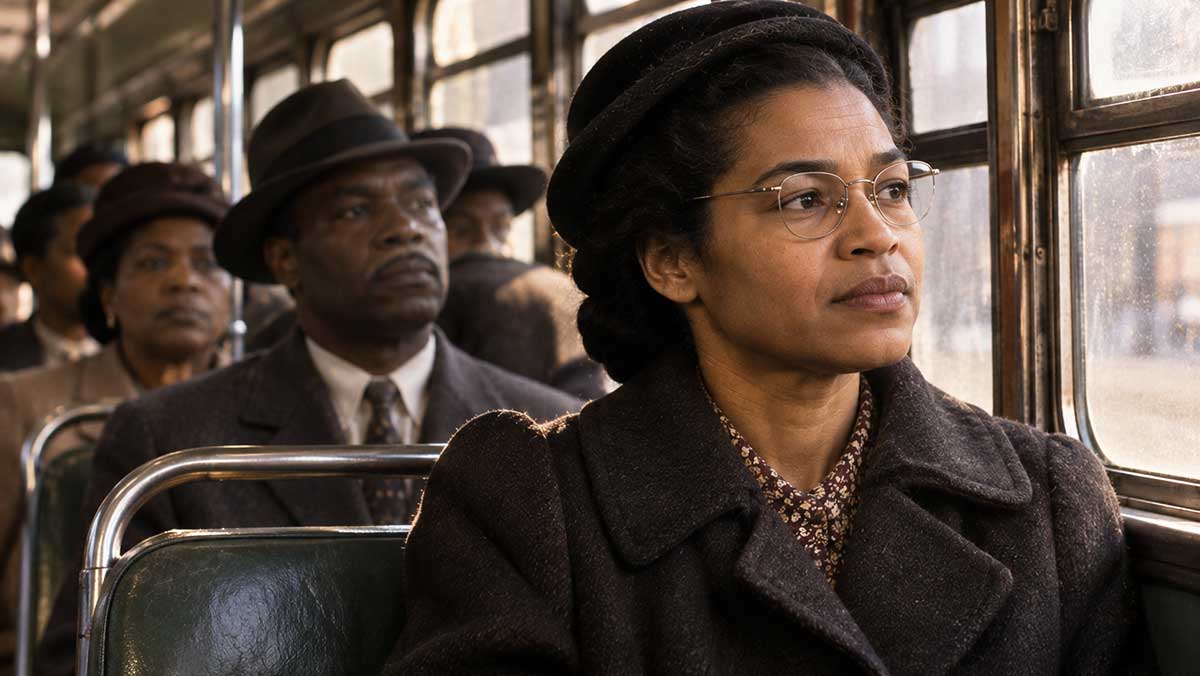
Opening
Detroit, autumn 1995. The afternoon has grown quieter. Rosa Parks sits across from Nick Sasaki, who has just heard her account of December 1, 1955, the day she refused to surrender her bus seat in Montgomery, Alabama.
Nick looks at the elderly woman before him. He has spent years knowing her as a symbol of courage. Yet the more they talk, the more he realizes that the famous photograph of Rosa sitting on a bus reveals very little about the difficult years that followed.
Nick Sasaki: Rosa, may I ask you something that might sound a little strange?
Rosa Parks: You've asked several strange questions already. One more won't hurt.
Nick: (Laughs.) Fair enough.
When I was younger, I learned that you refused to give up your seat, the Black community organized a boycott, Martin Luther King Jr. became a national leader, and eventually the buses were desegregated.
It was presented almost like a storybook ending.
Rosa: History doesn't always end where the history books stop.
Nick: That's what I've been thinking.
The boycott succeeded. But you lost your job. Raymond lost his work. Your family faced threats, and you eventually had to leave Montgomery.
How can someone become a national hero and still struggle to make a living?
Rosa: Those were difficult years. There were many things people didn't see.
Nick: Would you tell me about them?
Rosa: Yes. But let's begin with the people who made the boycott possible.
Nick: I'd like that.
Question 1: When the Boycott Began, Did You Know What Your Arrest Would Set in Motion?
Nick: You were arrested on Thursday, December 1. By Monday, December 5, thousands of Black residents were refusing to ride Montgomery's buses.
How did everything happen so quickly?
Rosa: People had been working on the problem of bus segregation for years.
The Women's Political Council had been discussing the unfair treatment of Black passengers. Jo Ann Robinson was one of the people who had worked very hard on that issue.
After my arrest, she and other women helped prepare and distribute notices calling for a boycott.
Nick: They moved almost immediately.
Rosa: They understood that the community was ready to protest.
E. D. Nixon and other leaders helped organize support. Ministers became involved. People met in churches and discussed what needed to be done.
It was not something that began from nothing on December first.
Nick: And then there was a young minister named Martin Luther King Jr.
Rosa: Dr. King was the pastor of Dexter Avenue Baptist Church. He became president of the Montgomery Improvement Association, which was formed to coordinate the boycott.
He was a gifted speaker, and he helped give the movement a strong public voice.
Nick: What was your impression of him?
Rosa: He was a young man with considerable ability and a serious commitment to the cause.
But he would not have been able to sustain the boycott by himself.
Nick: That's something I keep discovering in your story. Every time I mention a famous person, you remind me of the people working beside them.
Rosa: They deserve to be remembered.
Nick: What was the first day of the boycott like?
Rosa: The response was very encouraging. So many people stayed off the buses.
Some walked long distances. Others found rides with friends or neighbors.
People made arrangements to help one another get to work and take care of their families.
Nick: I read that some people walked miles every day.
Rosa: They did. And it wasn't always pleasant weather.
Nick: I complain when I have to walk from the far end of a parking lot.
Rosa: (Smiles.) Then you might have found Montgomery rather challenging.
Nick: I certainly would.
But seriously, how did people keep doing it? A day or two is one thing. A week is difficult. More than a year seems extraordinary.
Rosa: They were determined to change the treatment they had endured.
There were carpools. Drivers volunteered their time. Churches and community members helped organize transportation.
People contributed what they could.
Nick: You worked with the transportation system yourself, didn't you?
Rosa: For a time, I helped dispatch cars.
There were many details to manage. Drivers had to know where to go, and people needed to get to their destinations.
Nick: That's an image I've never seen in a school textbook. Rosa Parks sitting at a desk trying to get everyone to work on time.
Rosa: (Smiles.) There was a good deal of practical work involved.
Nick: Did anyone ever complain about having to wait for a ride?
Rosa: People had difficulties, certainly.
But we had all spent years dealing with buses that sometimes passed Black passengers without stopping or treated them disrespectfully.
There were reasons people were willing to make the effort.
Nick: So the boycott wasn't sustained by speeches alone.
Rosa: No. Speeches could encourage people, but someone still had to arrange the transportation.
Nick: That's such an important part of the story.
Rosa: The people who walked, drove, organized, and contributed made the boycott possible.
Nick: Did you ever worry that people might simply become exhausted and return to the buses?
Rosa: We knew it was difficult to continue indefinitely.
There were pressures on the community. Some people lost employment or faced threats. The authorities tried to stop the protest.
But people continued.
Nick: And you were arrested again during the boycott, along with other organizers.
Rosa: Yes. The authorities used the law against people participating in the protest.
Nick: It must have been discouraging to see the government respond that way.
Rosa: We had learned that the law was not always applied fairly.
That was part of what we were trying to change.
Nick: Rosa, when you think about those 381 days, is there one kind of person you wish the world remembered more often?
Rosa: The ordinary people who kept going.
The woman who had to get to work in the morning. The man who used his car to help his neighbors. The families who made sacrifices without expecting recognition.
They were important.
Nick: I think I'd like to remember them that way.
Not just a crowd in a photograph, but people with tired feet, worried families, and jobs they couldn't afford to lose.
Rosa: Yes. They were people living their lives, just as you and I do.
Question 2: What Did Becoming Famous Cost You and Raymond?
Nick: Rosa, there's something about your story that genuinely troubles me.
In January 1956, only weeks after your arrest, you lost your job at Montgomery Fair.
Rosa: Yes. I had worked there as a tailor's assistant.
Nick: Was that frightening?
Rosa: Losing employment was a serious matter. We needed an income.
Nick: And Raymond's work was affected, too.
Rosa: He was working as a barber at Maxwell Air Force Base.
There was hostility over my arrest and the boycott. Customers made unpleasant remarks. He was told that the boycott could not be discussed in the shop.
Eventually, he left that work.
Nick: So both of you were suddenly facing financial uncertainty.
Rosa: We had a difficult time finding steady employment in Montgomery afterward.
Nick: People across the country were learning your name, yet you and Raymond were struggling to pay your bills.
Rosa: Public attention did not provide a regular income.
Nick: That's a sentence I wish more people heard.
Rosa: (Smiles faintly.) Fame doesn't pay the grocery bill by itself.
Nick: No, it doesn't.
Did people assume that the civil rights organizations were taking care of you financially?
Rosa: I can't say what everyone assumed. But we did have financial difficulties.
There were people who helped us, and there were people who were generous. Still, the situation was hard.
Nick: And yet you spent much of 1956 traveling to raise support for the boycott.
Rosa: I went to different cities, spoke at meetings, and helped raise funds.
People wanted to know what was happening in Montgomery.
Nick: You traveled to places like New York, Chicago, Los Angeles, and Seattle.
Rosa: Yes. There were many meetings.
Nick: Was it strange to travel around the country as a celebrated civil rights figure and then return home to unemployment?
Rosa: It was a demanding time.
The work was important, but traveling was tiring. I missed being with my family.
Nick: Did Raymond support your traveling?
Rosa: We shared a commitment to the work. But being apart was difficult.
Nick: I think about the two of you as a young couple, the way you described yourselves earlier.
You wanted to build a life together. Work, a home, family, ordinary happiness.
Then suddenly the whole country wanted something from you.
Rosa: We had responsibilities to each other and to our family. Those responsibilities didn't disappear when the boycott began.
Nick: Did you ever sit down together and ask whether all of this had become too much?
Rosa: We had to discuss our circumstances and decide what we could do.
I wouldn't want to invent a particular conversation for you. But I can tell you the difficulties were real.
Nick: I appreciate that.
I think I sometimes want history to give me a perfect private moment, a husband and wife sitting together and saying exactly the right thing.
Rosa: Real life doesn't always provide those moments.
Nick: No. Sometimes people are simply trying to get through the week.
Rosa: That's true.
Nick: Were you afraid for your safety?
Rosa: There were threats against us. We had reason to be concerned.
Nick: Did you ever regret refusing to move?
Rosa: I did not believe I had been wrong to refuse unfair treatment.
That didn't make the consequences easy.
Nick: There's something very human about that distinction.
You can believe in a decision and still suffer from what follows.
Rosa: Yes.
Nick: And you weren't the only one suffering. Raymond hadn't been sitting on that bus, but his life changed, too.
Rosa: He shared in the difficulties.
Nick: I want to give him his proper place in this story.
Not simply as the husband of Rosa Parks, but as someone who had been committed to justice long before December 1955 and who paid a personal price afterward.
Rosa: I would be glad for people to know more about Raymond.
Nick notices the gentleness in her expression. He resists the temptation to ask her to describe a private moment that neither of them can recover with certainty.
Nick: Thank you for telling me about him.
Rosa: You're welcome.
Question 3: When Montgomery Finally Won, Why Did You Have to Leave?
Nick: The boycott continued for 381 days. Then the federal courts ruled against bus segregation in Browder v. Gayle.
I'd like to ask about that case, since many people may assume your own criminal case was the one that ended segregation.
Rosa: The federal lawsuit was a separate case.
Nick: And it involved women whose names deserve to be remembered: Aurelia Browder, Claudette Colvin, Susie McDonald, and Mary Louise Smith.
Rosa: Yes. Their participation was important.
Nick: They challenged the constitutionality of segregated buses. The federal courts ruled in their favor, and the Supreme Court upheld the result.
Rosa: That decision helped bring the segregation of Montgomery's buses to an end.
Nick: On December 21, 1956, Black passengers could finally ride without the old seating restrictions.
After more than a year of walking and organizing, what did that victory mean to you?
Rosa: It was an important achievement.
People had worked very hard. They had endured threats and difficulties. The decision showed that the system could be challenged successfully.
Nick: Did Montgomery feel like a different city?
Rosa: Some things had changed. But segregation on the buses was not the only problem.
There were still difficulties with employment, housing, voting rights, and treatment under the law.
Nick: So the legal victory didn't suddenly make everyday life fair.
Rosa: No. There was more work to do.
Nick: I suppose I shouldn't be surprised. Yet the way history is often told makes it sound as though everyone went home and lived happily ever after.
Rosa: That would have been pleasant.
Nick: (Laughs softly.) Yes, it would.
But your family couldn't remain in Montgomery.
Rosa: We had been unable to find steady work, and there were continuing threats.
In 1957, Raymond, my mother, and I moved to Detroit, where my brother Sylvester lived.
Nick: Was it painful to leave Alabama?
Rosa: Alabama was where I had grown up. It was where Raymond and I had made our home and where we had worked for so many years.
Leaving was a major change.
Nick: And Detroit wasn't an immediate solution.
Rosa: No. Finding employment was difficult there, too.
Nick: I've read that you took a job at Hampton Institute in Virginia.
Rosa: In October 1957, I went to Hampton to work as a hostess at the Holly Tree Inn.
I hoped Raymond and my mother might be able to join me there.
Nick: But that didn't happen.
Rosa: No. The living arrangements did not work out as I had hoped.
Nick: So after everything the family had endured, you were separated from Raymond and your mother for work.
Rosa: Yes. I was in Virginia, and they were in Detroit.
Nick: Your letters to Raymond from that period still exist.
Rosa: We wrote to one another.
Nick: There's something about that which moves me more than a photograph of a large rally.
A woman who helped change American history, sitting alone after work, writing to her husband in another state.
Rosa: Families have had to live apart for employment for a long time.
Nick: I know. But I think the public forgets that you had to face those same ordinary difficulties.
Rosa: We did.
Nick: You returned to Detroit at the end of 1958.
Rosa: Yes. I wanted to be with my family.
Nick: And the financial troubles continued.
Rosa: For some years.
Nick: Rosa, can I ask you a question that might be unfair?
Rosa: You may ask it.
Nick: After everything you had given to the movement, did you ever feel that the country had celebrated what you did but forgotten the woman who did it?
Rosa looks at him thoughtfully.
Rosa: There were times when we needed help, certainly.
But I don't want to speak as though every person who supported the movement had an obligation to solve our personal difficulties.
Many people were struggling themselves.
Nick: That's fair.
Rosa: What I would want people to recognize is that participating in a movement can have lasting consequences.
The people who make sacrifices still have families. They still need work and medical care and a place to live.
Nick: I think that's one of the most important things you've told me today.
Rosa: Then I'm glad we discussed it.
Nick: And there's something else.
You helped bring about a victory in Montgomery, but when you moved to Detroit, you discovered that discrimination hadn't disappeared simply by crossing a state line.
Rosa: No. It had not.
Nick: So your work wasn't finished.
Rosa: There was still a great deal to do.
Closing
The light outside has begun to fade. Nick glances at his notebook, then closes it again. He no longer feels the need to keep every question in front of him.
Nick: Rosa, may I tell you what surprised me most about this part of your life?
Rosa: Certainly.
Nick: I expected the boycott to be the hardest part.
The walking, the threats, the arrests, the uncertainty.
But what came afterward seems terribly difficult in a different way.
You had helped achieve something historic, yet you and Raymond still had to find work, pay your expenses, and decide where your family could live.
Rosa: Yes. Those were practical problems, and they mattered.
Nick: It makes me think about the people we celebrate.
We remember the day they did something extraordinary. We don't always ask how they lived the following year.
Rosa: People have lives beyond the events for which they become known.
Nick: You said something like that when we first started talking.
Rosa: Perhaps you're beginning to believe me.
Nick: (Laughs.) I am.
Rosa smiles, and for a moment the conversation feels less like an interview than a visit between friends.
Nick: There's something I'd like to ask next.
You arrived in Detroit hoping to build a more stable life. But you didn't simply disappear from public life.
You kept working for civil rights. You became involved in new struggles. You eventually worked for Congressman John Conyers.
And you continued caring about young people.
Rosa: Yes. Detroit became home, and there was important work to do there.
Nick: Then I think that's where we should go next.
Not back to the bus.
Forward, into the rest of your life.
Rosa: (Smiles.) That sounds like a good idea.
Nick settles back into his chair. The woman across from him has spent the afternoon describing a childhood, a marriage, years of organizing, a historic arrest, and a victory that brought consequences few people expected.
But there are still decades of her life to discover.
Their conversation continues.
Topic 5: The Life She Lived After the Bus
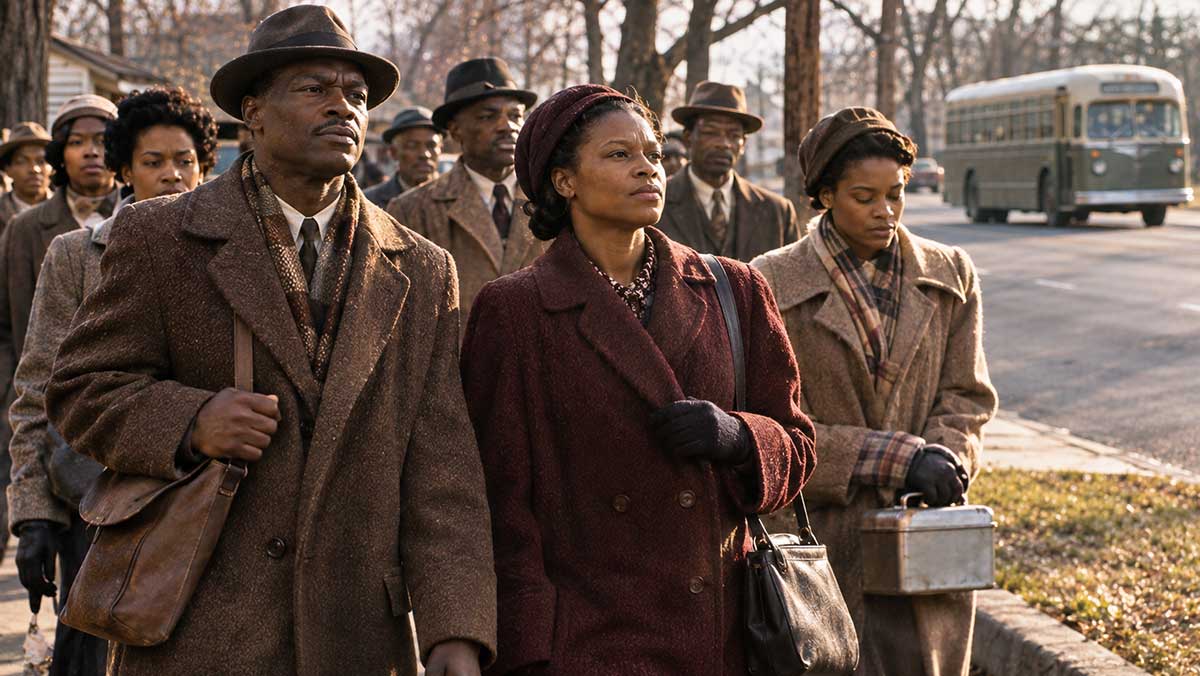
Opening
Detroit, autumn 1995. Evening approaches. The light coming through the living-room window has grown softer, and the photographs on the nearby table have taken on a gentle glow.
For several hours, Rosa Parks has spoken with Nick Sasaki about her childhood, her marriage to Raymond, her years with the NAACP, the Montgomery Bus Boycott, and the difficult circumstances that brought her family to Detroit.
Nick looks at the woman sitting across from him. She is eighty-two years old. The world remembers what she did at forty-two, but nearly four decades have passed since that afternoon on the bus.
Nick Sasaki: Rosa, something occurred to me when you told me about moving to Detroit.
Rosa Parks: What's that?
Nick: You were forty-four when you arrived here in 1957. Most people probably think of that as the end of your famous story.
But you had another thirty-eight years of living ahead of you, right up to this afternoon.
Rosa: (Smiles.) Yes, I managed to keep myself occupied.
Nick: That's putting it mildly.
You marched, organized, worked for Congressman John Conyers, spoke out against injustice, and started an institute for young people.
And somewhere in the middle of all that, you still had to live an ordinary life.
Rosa: There was always something that needed doing.
Nick: I think that's what I'd like to talk about now.
Not what happened on the bus.
What happened to Rosa Parks afterward.
Rosa: Well, Detroit gave me plenty to think about.
Question 1: When You Moved to Detroit, What Did You Discover About Freedom in the North?
Nick: Rosa, you left Alabama partly to escape the threats and difficulties you and Raymond faced after the boycott.
When you arrived in Detroit, did you feel that you'd finally reached a place where racial discrimination would no longer shape your life?
Rosa: No. Detroit was different from Montgomery, but there were serious problems here, too.
Black people faced discrimination in housing and employment. There were difficulties with schools and relations with the police.
You didn't have the same segregation signs you saw in the South, but that didn't mean everyone was treated equally.
Nick: That must have been disappointing.
Rosa: We had hoped to find more opportunities. And there were opportunities here.
But moving to another city didn't settle every problem.
Nick: I suppose people in the North liked to think segregation was something happening somewhere else.
Rosa: Some people did.
But if a family couldn't find a decent place to live because of its race, that was discrimination, regardless of whether there was a sign on the door.
Nick: You participated in the March on Washington in 1963.
Rosa: Yes.
Nick: And the Selma voting-rights demonstrations in 1965.
Rosa: I went to Selma, too.
Nick: So you were still involved in the struggles taking place in the South.
Rosa: I had not forgotten the people there. And the work was connected.
Nick: Then in 1964, you helped John Conyers during his campaign for Congress.
Rosa: Yes. I supported his campaign.
Nick: After he was elected, he offered you a position in his Detroit office.
Rosa: I began working there in 1965.
Nick: What was an ordinary day like?
Rosa: There were telephone calls to answer, people coming into the office, correspondence, appointments, and requests for assistance.
People needed help with government matters. Sometimes they had difficulties getting services or dealing with agencies.
We tried to direct them to the right people and help resolve their problems.
Nick: You worked there until 1988. Twenty-three years.
Rosa: Yes.
Nick: Did people ever come in, recognize you, and forget why they'd visited?
Rosa: (Smiles.) People did recognize me.
Nick: I can picture someone walking into the office to ask about a government form and suddenly realizing Rosa Parks is sitting behind the desk.
Rosa: They still needed help with the form.
Nick: (Laughs.) Of course they did.
Rosa: Recognition didn't mean the office work stopped.
Nick: Did working there change the way you saw the problems facing ordinary Americans?
Rosa: It gave me opportunities to hear about people's difficulties.
Housing, employment, health care, education. These things affected families every day.
Nick: There's a photograph of you and Congressman Conyers picketing outside General Motors headquarters in 1986.
You were protesting plant closings that threatened thousands of jobs.
Rosa: Those workers were concerned about losing their livelihoods.
Nick: You were seventy-three years old.
Rosa: People don't stop needing jobs when you get older.
Nick: (Laughs.) No, they don't.
But I find that remarkable. Thirty-one years after your arrest, you were still standing outside a building protesting an injustice.
Rosa: There were people who needed support.
Nick: You supported causes that some people might not associate with the familiar image of Rosa Parks.
You opposed the Vietnam War, supported people seeking justice within the prison system, and participated in the growing Black freedom movements of the 1960s and 1970s.
Rosa: I was concerned about people being treated unjustly, whether that happened in Alabama, Detroit, or somewhere else.
Nick: What did you think when younger activists began using more forceful language about Black freedom and self-determination?
Rosa: Young people were responding to conditions they knew.
There were different approaches to the struggle, and people did not always agree.
But I understood why they were dissatisfied with the slow pace of change.
Nick: You weren't someone who believed the movement should have stopped when the buses were desegregated.
Rosa: There was no reason to stop. There were still problems that needed attention.
Nick: What about the terrible events in Detroit in 1967?
Rosa: That was a very difficult time for the city.
There was anger over police treatment and living conditions. People were killed, homes and businesses were damaged, and families suffered.
Nick: You and Raymond were living here when it happened.
Rosa: Yes. We saw the effects in our own neighborhood.
Nick: And you continued helping people through Congressman Conyers's office.
Rosa: We tried to assist where we could.
Nick: Did those events make you question whether the country had made real progress?
Rosa: Progress had been made, but there were serious injustices that remained.
You could not ignore those conditions simply by pointing to laws that had changed.
Nick: I think I'm beginning to see why you never regarded Montgomery as the finish line.
Rosa: It was an important achievement. But it was one part of a much larger effort.
Nick: And Detroit became another place where you continued that effort.
Rosa: Yes. It became my home.
Question 2: What Would You Want Young People to Know About Raymond Parks?
Nick glances toward the family photographs. For a moment, he hesitates.
Nick: Rosa, I'd like to ask you about Raymond again.
Rosa: All right.
Nick: We began our conversation with the young man you married in 1932. You've told me about his involvement in the Scottsboro case, his support for your education, and the difficult years you shared after Montgomery.
He died in 1977.
Rosa: Yes.
Nick: I'm sorry.
Rosa: Thank you.
Nick: You were married for almost forty-five years.
Rosa: We shared a great deal of our lives.
Nick: When you think about Raymond today, what would you most want people to know about him?
Rosa: That he was a man who cared about justice.
He was involved in civil rights work long before my arrest. He believed people deserved fair treatment, and he was willing to help others.
I would not want his life to be remembered simply through mine.
Nick: That's something I've been thinking about.
People know your name, but many have never heard much about Raymond's own work.
Rosa: He deserves to be remembered for what he did.
Nick: Did you ever wish the two of you could have had an easier life?
Rosa: I think most people would prefer fewer difficulties.
We had our share.
Nick: (Smiles gently.) That's a reasonable answer.
Rosa: We had to work, take care of family, and manage the circumstances we faced.
There were good years and difficult years.
Nick: I don't want to pretend that I know what it feels like to lose someone after sharing so much of life together.
But I wonder what happens to all the little things you once shared.
The conversations at the end of the day. The ordinary routines. Having someone who remembers the same people and places you do.
Rosa looks at him quietly.
Rosa: When you've shared many years with someone, that person is part of so much of your life.
You don't forget those years.
Nick: No, I suppose you don't.
Rosa: Raymond knew me before the boycott. He knew the work we were doing and the difficulties we had faced.
We had a history together that went back long before the public attention.
Nick: That's something no newspaper headline could capture.
Rosa: No.
Nick allows the silence to remain for a moment.
Nick: Ten years after Raymond died, you helped establish the Rosa and Raymond Parks Institute for Self Development.
Why did you want his name to be part of it?
Rosa: Raymond believed in helping people. We both cared about education and opportunities for young people.
I wanted his name and his commitment to be remembered.
Nick: You founded the institute with Elaine Steele in 1987.
Rosa: Yes. Elaine has been a good friend and has worked very hard with me.
Nick: What do the young people do through the institute?
Rosa: We want them to learn about history, their responsibilities, and the opportunities they have to contribute to society.
We began educational programs, including the Pathways to Freedom tours.
Nick: Those tours take young people to places connected with the Underground Railroad and the civil rights movement.
Rosa: Yes. They can learn about the people who came before them and what those people experienced.
Nick: I love that idea.
You spent your younger years helping the NAACP Youth Council in Montgomery. Now, decades later, you're still teaching young people about their history.
Rosa: Young people need to know what happened before they were born.
Nick: Do they ask you about the bus?
Rosa: Of course.
Nick: (Laughs.) You really can't escape that question, can you?
Rosa: It does seem to follow me.
Nick: What do you most enjoy about spending time with them?
Rosa: I like seeing them become interested in learning.
They have questions. Sometimes they want to know why things were the way they were.
Those are good questions.
Nick: Do you think children today appreciate what earlier generations sacrificed?
Rosa: Some do. Others may not know enough about the history.
That's one reason we have educational programs.
Nick: I think Raymond would have appreciated that.
Rosa: I hope he would.
Nick: And I think it's beautiful that the institute carries both your names.
Not simply as a memorial, but as something that helps living children.
Rosa: That was the purpose. We wanted the work to continue.
Question 3: What Do You Hope People Will Remember About Rosa Parks a Hundred Years From Now?
Nick: Rosa, I have one final question.
But before I ask it, there's something I'd like to tell you.
Rosa: Go ahead.
Nick: When I arrived, I thought I was coming to meet the woman who refused to give up her seat.
Now I feel I've met a little girl in Alabama, a young woman who fell in love with a barber named Raymond, a determined NAACP organizer, a woman who tried to help Recy Taylor, and someone who spent decades helping people whose names history may never record.
And I've met a woman who still cares deeply about young people.
Rosa: Well, you've certainly been listening.
Nick: (Laughs.) I've tried.
But here's what troubles me.
A hundred years from now, children may still learn that Rosa Parks refused to move on a bus.
What if that's all they learn?
Rosa: Then they won't have learned very much about the struggle.
Nick: What would you want them to know?
Rosa: I would want them to know that many people worked for change.
The Montgomery Bus Boycott was possible through the efforts of the community.
People made sacrifices. They walked, organized transportation, attended meetings, raised money, and continued even when they were threatened.
And the work did not end when the buses were desegregated.
Nick: What about your own life?
Rosa: I hope people will know that I tried to do what I believed was right.
I was involved in civil rights work before my arrest, and I continued afterward.
There were many people who helped me and worked beside me.
Nick: You've received so many honors over the years. The NAACP Spingarn Medal, honorary degrees, recognition from people around the world.
Does any of that feel strange when you think about the young woman who was simply trying to make a living in Montgomery?
Rosa: It has been an honor to receive recognition.
But I never wanted people to think the struggle was the work of one person.
Nick: You published Rosa Parks: My Story in 1992 and Quiet Strength in 1994.
In Quiet Strength, you spoke about the importance of faith in your life.
What has your faith meant to you through everything you've experienced?
Rosa: My Christian faith has been very important to me.
I learned about faith when I was young, and it remained part of my life.
Prayer and trust in God helped me through difficult times.
Nick: Did you ever struggle to reconcile that faith with the cruelty you witnessed?
Rosa: I knew people could do terrible things to one another.
But I did not believe that hatred and injustice were what God wanted for us.
Nick: I find that moving.
You experienced so much unfairness, yet you continued working for a better society.
Rosa: There were many people who were kind and helpful, too.
I wouldn't want you to forget them.
Nick: You're right.
I think we've spent a lot of time talking about people who caused suffering. But there were people who helped others, who opened their homes, who gave rides during the boycott, who taught children, and who supported families in trouble.
Rosa: Yes. There were many such people.
Nick: Rosa, do you believe people can learn to treat one another differently?
Rosa: I believe education and experience can make a difference.
But people have to be willing to act.
Nick: What would you say to a young person who sees something unfair happening but feels too small to change it?
Rosa: I would encourage that young person to learn about the situation, to seek help from others, and to find a constructive way to respond.
One person may not be able to change everything. But people working together can accomplish a great deal.
Nick: And what if they're afraid?
Rosa: They should not be ashamed of being afraid.
They should think carefully about what they can do and find others who will stand with them.
Nick: That reminds me of something you said about the passengers who moved from your row on the bus.
You didn't condemn them for being afraid.
Rosa: People face different circumstances.
Nick: I think that's one of the things I'll remember most about you.
You were willing to resist, but you didn't expect everyone else to be fearless.
Rosa: I never thought of myself as someone without fears.
Nick: Rosa, may I ask one more thing?
Rosa: You said the last one was your final question.
Nick: (Laughs.) I know. I'm not very good at endings.
Rosa: I've begun to notice.
Nick: Then perhaps this really will be the last.
When you look back over eighty-two years, what gives you the greatest satisfaction?
Rosa considers the question. She looks briefly toward the photographs on the table.
Rosa: I'm grateful for the people who have been part of my life.
My family, Raymond, the people I worked with, and the young people I have had the opportunity to help.
There have been difficulties, but there have been good things, too.
And I'm glad I was able to take part in work that helped bring about changes for the better.
Nick: That's a beautiful answer.
Rosa: It's my answer.
Nick: (Smiles.) And that's what makes it beautiful.
Closing
The room has grown dim. Outside, evening has settled over Detroit. Nick realizes that he has been sitting with Rosa Parks for much longer than he intended.
Nick: Rosa, I should probably let you rest.
Rosa: That might be a good idea. You've kept me talking for quite some time.
Nick: (Laughs.) I'm sorry about that.
Rosa: I didn't say I minded.
Nick: Thank you.
I came here hoping to learn something about courage. But I've learned much more about the people who shaped your life, the people you tried to help, and the years of work that followed your famous arrest.
Rosa: I'm glad we had the opportunity to talk.
Nick: There's something I want to promise you.
When I tell your story, I won't begin and end with the bus.
I'll tell people about Raymond. About your mother and grandparents. About the young people you mentored. About Recy Taylor and the people who worked for justice before the boycott.
And I'll tell them that you continued working long after Montgomery.
Rosa: I would be glad for people to know more of that history.
Nick: I think they need to.
Nick stands. Rosa rises slowly from her chair.
Nick: Mrs. Parks, may I shake your hand?
Rosa: Of course.
They shake hands.
Nick: Thank you for spending this afternoon with me.
Rosa: You're very welcome, Nick.
Nick: I hope I've asked the right questions.
Rosa: You've asked quite a few.
Nick: (Laughs.) That's true.
Rosa: And I hope you'll continue asking questions about history.
Nick: I will.
Nick picks up his notebook. At the doorway, he turns back.
Nick: Rosa?
Rosa: Yes?
Nick: I'm glad we talked about the rest of your life.
She smiles.
Rosa: So am I.
Nick steps into the cool Detroit evening.
He thinks about the young girl in Pine Level, the marriage that lasted nearly forty-five years, the women who organized in Montgomery, the families who walked for more than a year, and the children now learning their history through the institute bearing Rosa and Raymond's names.
He had come to meet a woman remembered for remaining seated.
He leaves thinking about everything she continued to do after she stood up and walked off that bus.
And about the countless people whose lives helped make her story possible.
Final Thoughts
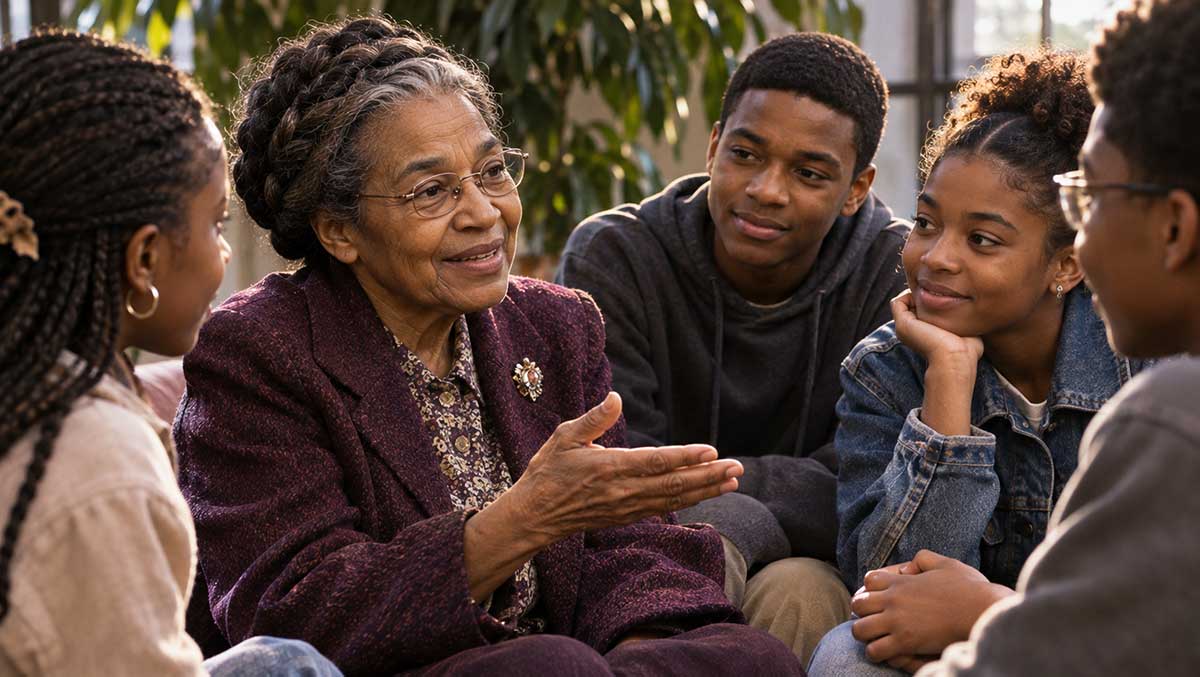
When Nick Sasaki leaves Rosa Parks's fictional Detroit home, the familiar image of a woman seated on a Montgomery bus has acquired an entirely different meaning. The woman in that photograph was once a little girl who watched her grandfather protect their family, a young wife who shared Raymond Parks's concern for justice, and an organizer who worked for people whose names rarely appeared in newspapers. Her life did not begin with a refusal, and her contribution to history did not end with a victory. Perhaps the greatest limitation of the familiar Rosa Parks story is that it asks us to admire one extraordinary moment without fully appreciating the extraordinary persistence surrounding it.
One of the most revealing aspects of Rosa's life is the distance between her quiet public manner and the determination evident in her work. She challenged discrimination through voting-rights efforts, NAACP organizing, investigations of racial violence, and education. Her involvement in the campaign for Recy Taylor demonstrated a commitment to women who were denied equal protection under the law. Historian Jeanne Theoharis explores this larger history in The Rebellious Life of Mrs. Rosa Parks, challenging the simplified portrait of Rosa as an accidental activist. Her story reminds us that a calm voice can express profound conviction, and that resistance may take the form of years of patient, difficult work.
The Montgomery Bus Boycott reveals another lesson: individual decisions acquire historical significance through the actions of communities. Rosa's arrest helped bring a long-standing injustice into sharper focus, but thousands of people transformed protest into sustained collective action. They walked to work, arranged carpools, contributed money, attended meetings, and accepted personal risks. Organizers such as Jo Ann Robinson and E. D. Nixon, together with ministers, volunteers, and ordinary residents, sustained the movement. The National Park Service's history of the Montgomery Bus Boycott helps place Rosa's refusal within that larger community effort. The achievement belonged to people who supported one another through hundreds of difficult days.
Yet the most uncomfortable part of Rosa's story may be what happened after the victory. The public celebrated her, but Rosa and Raymond faced unemployment, threats, financial hardship, and separation as they searched for stability. The movement's success did not erase their personal difficulties. This contrast invites a question that extends beyond the civil rights movement: What responsibility does a society have to the people whose sacrifices it celebrates? Public recognition can preserve someone's place in history without meeting the practical needs of that person's life. Remembering the costs of resistance means paying attention to families, livelihoods, health, and the years that follow the headlines.
Raymond Parks deserves a place in that remembrance. He was an activist before Rosa's arrest, supported her education, and shared decades of family responsibilities and political commitment. Their marriage experienced difficulties that cannot be reduced to a simple inspirational story. After Raymond's death, Rosa helped create the Rosa and Raymond Parks Institute for Self Development, connecting their shared history to the education of young people. The institute's work suggests an especially meaningful way to honor those who came before us: helping another generation learn what happened, ask difficult questions, and take responsibility for the future. Love and remembrance become more than private feelings when they inspire constructive service to others.
Rosa's later years in Detroit challenge the notion that racial equality was achieved when Montgomery's buses were desegregated. She continued advocating for civil rights, economic opportunity, and fair treatment, working in Congressman John Conyers's office and participating in campaigns that addressed injustices beyond the South. The Library of Congress's collection of Rosa Parks's papers preserves evidence of this continuing commitment. Her life reminds us that legal victories matter enormously, but the work of making those victories meaningful in ordinary people's lives can continue for generations.
What remains most moving about Rosa Parks is not an image of perfect fearlessness. It is the possibility of remaining committed to human dignity through disappointment, grief, financial uncertainty, and the ordinary responsibilities of daily life. She was not alone, and she did not need to be. Family members, fellow organizers, neighbors, and younger generations were part of her story. If we remember Rosa Parks only as the woman who would not stand, we overlook the woman who spent decades helping others find their footing. Her legacy asks something more meaningful than admiration: What are we prepared to do, together, when we see another person's dignity being denied?
Fictional Conversation Disclaimer
The preceding interview and its closing scene are fictional reconstructions, not actual conversations or authenticated statements by Rosa Parks. The historical reflections draw on documented events and published research, but imagined dialogue and private emotional responses must not be treated as factual quotations or evidence of endorsement by Rosa Parks, her family, or any institution.
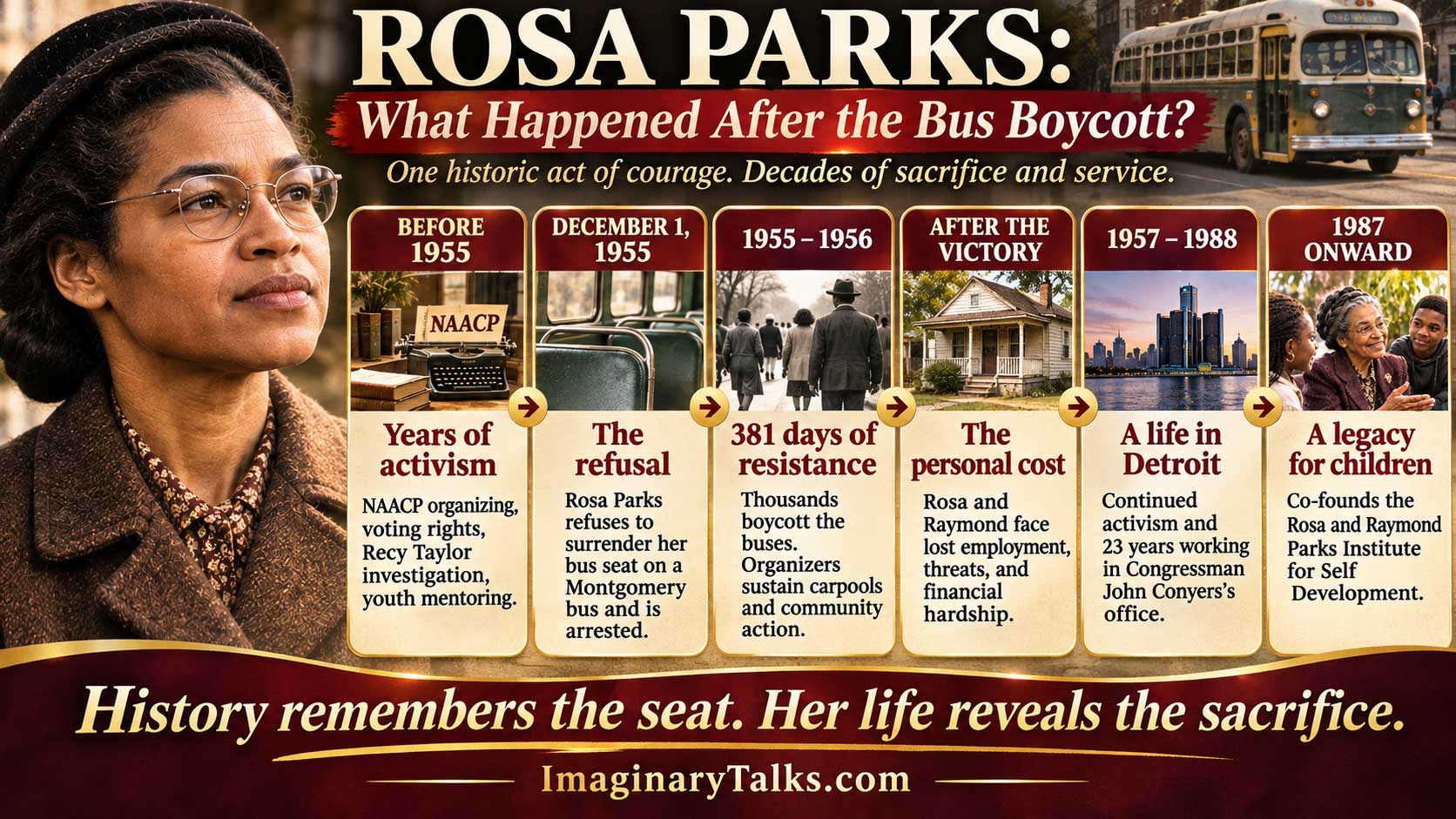
Short Bios:
Rosa Parks (1913–2005)
Rosa Louise McCauley Parks was an American civil rights activist whose refusal to surrender her bus seat on December 1, 1955, helped initiate the Montgomery Bus Boycott. Born in Tuskegee, Alabama, she grew up under racial segregation and became involved in organized civil rights work years before her arrest. As secretary of the Montgomery NAACP, she worked on voting rights, investigated racial injustice, and helped mentor young people. After moving to Detroit in 1957, she continued her activism and worked for Congressman John Conyers from 1965 to 1988. Her later efforts included co-founding the Rosa and Raymond Parks Institute for Self Development. She received the Presidential Medal of Freedom in 1996 and the Congressional Gold Medal in 1999. Her life and personal writings are preserved in the Library of Congress Rosa Parks Papers.
Nick Sasaki (Fictional Interviewer)
Nick Sasaki is the creator of ImaginaryTalks.com, a project that brings historical figures, writers, thinkers, and influential personalities into fictional conversations grounded in research. His interviews explore the experiences, convictions, relationships, and human questions behind familiar public achievements. In this imagined meeting with Rosa Parks, Nick approaches her as a curious visitor rather than a formal historian, hoping to discover the woman beyond the famous bus incident. The dialogue attributed to Nick is part of the creative work and does not describe an actual meeting.
Raymond Parks (1903–1977)
Raymond Parks was a barber and civil rights activist who married Rosa Parks in 1932. Before Rosa's famous arrest, he participated in efforts connected to the defense of the Scottsboro Boys, nine Black teenagers accused of rape in Alabama in 1931. Raymond supported Rosa's education and shared her commitment to racial justice. Their family experienced financial hardship and threats following the Montgomery Bus Boycott, eventually relocating to Detroit. His political involvement and partnership with Rosa are reflected in the Library of Congress exhibition on Rosa Parks's early life and activism.
Jo Ann Robinson (1912–1992)
Jo Ann Gibson Robinson was an educator, civil rights organizer, and leader of Montgomery's Women's Political Council. Long before December 1955, she worked to challenge the mistreatment of Black bus passengers. Following Rosa Parks's arrest, Robinson and other activists prepared and distributed thousands of notices encouraging a one-day boycott, helping mobilize the community. Her work was central to the early organization of the Montgomery Bus Boycott. Learn more through the Martin Luther King, Jr. Research and Education Institute at Stanford University.
Recy Taylor (1919–2017)
Recy Taylor was a Black American woman whose abduction and sexual assault by six white men in Alabama in 1944 became the subject of a major campaign demanding justice. Rosa Parks investigated her case through the NAACP and helped organize public pressure for accountability. Although the perpetrators were not convicted, Taylor's case exposed the widespread failure to protect Black women from racial and sexual violence. Her experience and the campaign for justice are discussed in the Library of Congress exhibition on Rosa Parks's early activism.
Claudette Colvin (1939–2026)
Claudette Colvin was a civil rights activist who, at age fifteen, refused to surrender her seat on a segregated Montgomery bus on March 2, 1955, nine months before Rosa Parks's arrest. Her resistance challenged discriminatory seating practices and contributed to the growing movement against segregation. She later became one of the plaintiffs in Browder v. Gayle, the federal case that successfully challenged Montgomery's segregated bus system. Her role is part of the history documented by the National Park Service.
Leave a Reply