
Introduction
What if you could sit across from Anne Frank and ask her a question that history books rarely answer? Not how she died, not what her diary means to the world, but something far more personal: “Anne, who were you before everyone knew your name?” Would she tell you about her friends? Would she laugh about her teachers? Would she complain about her older sister? Or would she surprise you by asking why everyone seems to know so much about her diary and so little about the girl who wrote it?
Anne Frank was born on June 12, 1929, in Frankfurt am Main, Germany. Her family moved to Amsterdam as Nazi antisemitism threatened Jewish life in Germany. Following the German occupation of the Netherlands, increasingly severe restrictions stripped Jewish residents of their rights and freedoms. In July 1942, Anne's family went into hiding in the Secret Annex behind Otto Frank's business premises. For more than two years, eight people lived there under the constant threat of discovery. The Anne Frank House's account of her life documents the events that shaped her childhood and the years she spent in hiding.
But Anne was never simply a girl waiting for history to happen to her. She was outspoken, funny, observant, sometimes impatient, and eager to be taken seriously. She loved stories, friendships, conversations, and the excitement of growing older. She could be sharply critical of the people closest to her, then reconsider her own judgments. Her diary reveals a teenager trying to discover who she was, how she related to others, and what kind of woman she might become. That developing personality is one of the most remarkable aspects of her writing.
Anne had literary ambitions that extended far beyond keeping a private diary. Following a Dutch government-in-exile radio appeal in March 1944 encouraging people to preserve records of the occupation, she began rewriting her diary for possible publication. She revised descriptions, reconsidered earlier passages, and worked toward a book she intended to call Het Achterhuis, commonly translated as The Secret Annex. The Anne Frank House's examination of her original and revised manuscripts reveals how seriously she approached the craft of writing. She was not simply recording her experiences. She was becoming an author.
On August 4, 1944, the people hiding in the Annex were arrested. Anne was deported through Westerbork to Auschwitz-Birkenau and later transferred to Bergen-Belsen, where she and her sister Margot died in early 1945. Anne was fifteen. Their father, Otto Frank, was the only member of their immediate family to survive the Holocaust. The United States Holocaust Memorial Museum's biography of Anne Frank places her story within the Nazi persecution and systematic murder of Europe's Jews. That history must never disappear behind the worldwide fame of her diary.
Yet something else deserves attention. Anne did not know, when she wrote about her ambitions, that she would never reach adulthood. She expected to experience the future she described. She wanted to write books, meet people, discover love, travel, make mistakes, and learn what kind of person she might become. Her life was not intended to be a finished story at fifteen. She was still discovering its possibilities.
In this five-part imaginary interview, Nick Sasaki meets Anne in a series of fictional Amsterdam settings. Their conversation begins in a sunny garden, where Anne quickly reveals her humor and her talent for teasing an overly serious interviewer. They move through memories of Otto, Edith, Margot, Peter, and the people who helped the family in hiding. Anne discusses her relationship with Kitty, her literary ambitions, and the writing she hoped to accomplish. Later, the conversation turns to Nazi persecution, antisemitism, human cruelty, and the difficult questions that remain after the Holocaust.
The final meeting returns to the garden at sunset. Nick asks Anne about the life she never had the opportunity to live. Yet the conversation does not demand that she offer a comforting answer or a grand message to humanity. Anne is free to be curious, uncertain, playful, thoughtful, or disappointed. She may challenge Nick's assumptions, laugh at his questions, or ask questions of her own. This is not an attempt to speak for the historical Anne Frank. It is an imaginative invitation to encounter her as a person whose life contained far more than the tragedy by which the world remembers her.
Fictional Conversation Disclaimer
This interview is a work of historical fiction.
The conversations between Nick Sasaki and Anne Frank are entirely imagined. Anne Frank died in 1945, and no meeting between her and Nick Sasaki ever occurred. All dialogue attributed to Anne, including her responses to events after her death, personal reflections, jokes, and questions, is fictional. These passages must not be interpreted as authentic quotations, documented testimony, or statements of Anne Frank's actual beliefs.
The historical background draws upon Anne's surviving writings and established research concerning her family, literary ambitions, life in hiding, arrest, deportation, and death. The imaginary meeting places, posthumous perspective, and conversations about the present are creative devices. Where historical records leave questions unresolved, the fiction does not claim to provide factual answers.
Readers seeking Anne Frank's authentic voice are encouraged to read her diary and consult the original historical materials preserved and explained by the Anne Frank House and the United States Holocaust Memorial Museum.
Topic 1. Anne, Who Were You Before the World Knew Your Name?
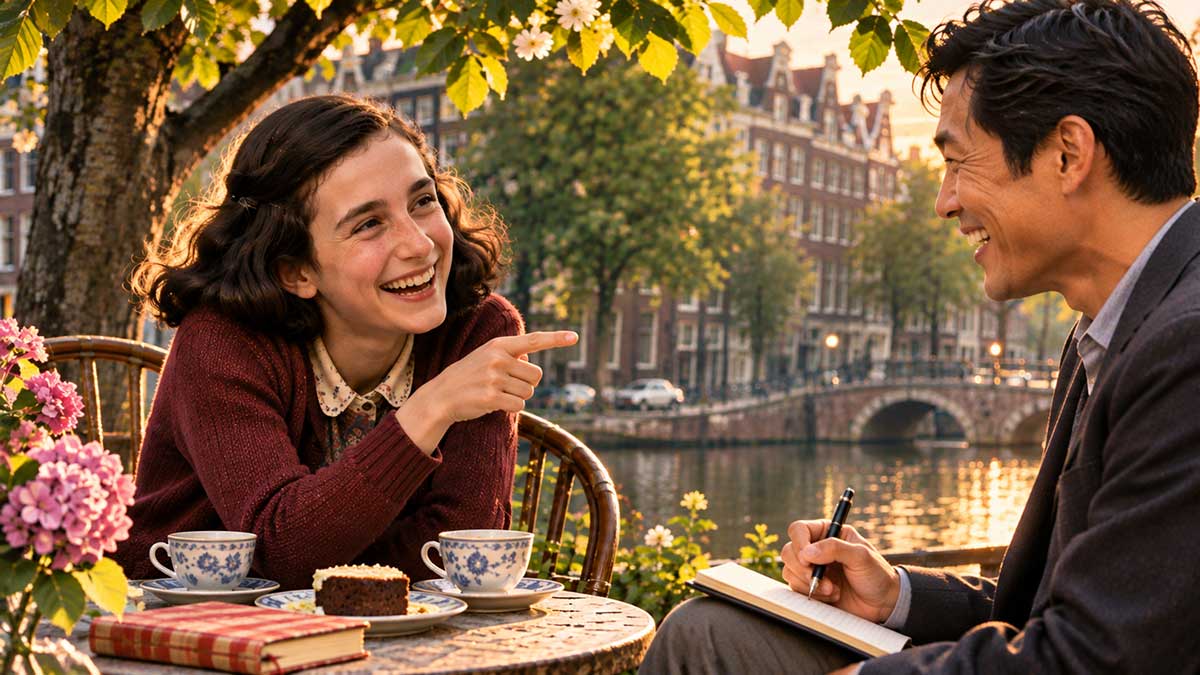
Amsterdam, a peaceful spring morning.
The canal is almost perfectly still. Sunlight filters through the leaves of a chestnut tree, scattering little patches of gold across the garden path. Somewhere nearby, a bicycle bell rings. A few birds argue noisily in the branches.
Two chairs stand beside a small wooden table. On it rests a notebook with a red-and-white checkered cover.
Nick Sasaki is looking at the water when he hears footsteps behind him.
A girl approaches, her dark hair neatly arranged, her eyes bright with curiosity. She looks about fifteen. There is something lively about her expression, as though she has already thought of three questions and is deciding which one to ask first.
Anne Frank: Excuse me. Are you the gentleman who wanted to talk to me?
Nick Sasaki: I am. You must be Anne.
Anne Frank: That's usually what people call me. Unless I've done something wrong.
Nick: (laughing) Have you?
Anne: Not yet. But we've only just met.
Nick: Then I'd better be careful.
Anne: You look very serious. Are you always this serious?
Nick: Actually, I was a little nervous about meeting you.
Anne: Nervous? Why?
Nick: Well, you're Anne Frank.
Anne: (glancing around) Yes, we've established that. Is there something especially frightening about me?
Nick: No, no. Quite the opposite. I've wanted to meet you for a long time.
Anne: Then you shouldn't look so worried. Sit down. It's a beautiful morning, and I don't intend to waste it watching a grown man be nervous.
Nick laughs and takes his seat. Anne sits opposite him, then immediately turns to watch a duck gliding along the canal.
Anne: Do you know what I like about ducks?
Nick: What?
Anne: They always look terribly important, even when they're doing absolutely nothing.
Nick: (laughing) I never thought about that.
Anne: That's the trouble with grown-ups. You miss so many interesting things.
Nick: I suspect you're going to teach me quite a bit today.
Anne: Oh, I hope not. That sounds exhausting. Can't we just talk?
Nick: That's exactly what I was hoping.
Anne smiles.
For a moment, neither speaks. The garden feels wonderfully ordinary.
And that, Nick realizes, is where he wants to begin.
Question 1. Who Was Anne Before the Diary?
Nick: Anne, everybody seems to know your diary. But I want to know you. What kind of girl were you when nobody was watching?
Anne: (grinning) When nobody was watching? That's a dangerous question.
Nick: Why?
Anne: People behave much better when someone is watching them.
Nick: Including you?
Anne: Especially me.
Nick: So you were a troublemaker?
Anne: I prefer interesting.
Nick: (laughing) Of course.
Anne: I talked too much. That's what my teachers said. Apparently, there is a proper amount of talking a girl should do, and I was always exceeding it.
Nick: I've heard about that. Didn't one of your teachers make you write an essay about being a chatterbox?
Anne: Mr. Keesing! Yes. He thought writing essays would cure me of talking.
Nick: Did it?
Anne: Obviously not. Here I am, talking to you.
They both laugh.
Anne: He was rather clever, though. I liked him. Eventually, he seemed to accept that talking was part of my nature.
Nick: Did you enjoy school?
Anne: Some parts. I liked my friends. I liked learning things that interested me. And I liked having an audience.
Nick: An audience?
Anne: Well, if you have something funny to say, what's the point if nobody hears it?
Nick: You sound like someone who might have enjoyed being on stage.
Anne: Perhaps. But I think I would have preferred writing the play.
Nick: Really?
Anne: Then I could give everyone the lines I wanted them to say.
Nick: (laughing) That sounds like a writer.
Anne: Or a very bossy girl. Sometimes there's not much difference.
Nick watches her laugh. He had expected intelligence and sensitivity. He had not expected to feel so quickly as though he were speaking with an old friend.
Nick: Tell me about your friends. What were you like together?
Anne: Oh, we talked about everything. School, teachers, boys, what people were wearing, who liked whom. All the terribly important subjects.
Nick: Boys were already terribly important?
Anne: (raising an eyebrow) Nick, I was thirteen, not three.
Nick: Fair enough.
Anne: There was always some boy who thought he was very impressive. And usually a group of girls pretending not to notice him.
Nick: Were you one of those girls?
Anne: I was much too curious to pretend I didn't notice things.
Nick: Did you ever fall in love?
Anne: I had crushes. Some were rather silly. But they didn't feel silly at the time.
Nick: They never do.
Anne: Exactly! Finally, an adult who understands something.
Nick: I'll take that as a compliment.
Anne: You should. I don't give them away constantly.
A breeze moves through the garden. Anne reaches up to keep a strand of hair out of her eyes.
Nick: What about Margot? You and your sister were quite different, weren't you?
Anne: Very different.
Nick: How so?
Anne: Margot was clever, quiet, responsible. The sort of girl adults could point to and say, "Why can't you be more like her?"
Nick: Did they say that?
Anne: Sometimes it certainly felt that way.
Nick: That must have been frustrating.
Anne: It was. But I should be fair to Margot. It wasn't her fault that she was good at being Margot.
Nick: And you were good at being Anne?
Anne: (smiling) I was certainly determined to try.
Nick: What do you think people misunderstood about you?
Anne considers the question.
Anne: They thought that if I was laughing, I couldn't be serious. If I was talking, I couldn't be thinking. If I was being difficult, I must simply be a difficult person.
Nick: And that wasn't true?
Anne: Sometimes I really was difficult.
Nick: (laughing) I appreciate the honesty.
Anne: But there was more happening inside me than people could see.
She looks at the notebook on the table.
Anne: I could be cheerful and unhappy on the same day. I could love someone and be furious with them. I could say something clever and then spend hours worrying that I'd said something foolish.
Nick: That sounds very human.
Anne: I should hope so. What else would I be?
Nick smiles.
Nick: I think people sometimes remember you as a very serious girl.
Anne: How dreadful.
Nick: Dreadful?
Anne: Imagine being remembered forever as serious! I'd much rather people knew I could make someone laugh.
Nick: Then I'm glad we started here.
Anne: So am I.
She looks toward the canal.
Anne: You know, Nick, there's something strange about being remembered.
Nick: What's that?
Anne: People think they know you from the things you leave behind. But even when you write honestly, you never put every part of yourself on the page.
Nick: What part of you do you think they missed?
Anne smiles mischievously.
Anne: Well, you'll have to keep talking to me to find out.
Question 2. What Did Freedom Feel Like Before It Disappeared?
The sun rises a little higher. Across the canal, a woman passes on a bicycle with a basket of flowers.
Anne watches her.
Nick: You seem to like watching people go by.
Anne: I do. Everyone is going somewhere. I always wonder where.
Nick: If you could follow that woman on her bicycle, where would you go?
Anne: Anywhere I pleased.
Nick: Anywhere?
Anne: Well, perhaps not into the canal.
Nick: (laughing) A sensible restriction.
Anne: But I would like to wander without someone telling me where I was allowed to go.
Her expression changes slightly.
Nick: Anne, when you think about your childhood in Amsterdam, what's one ordinary thing you loved doing that people today might never think twice about?
Anne: Going outside.
Nick: Just going outside?
Anne: Just going outside.
She looks at him as though the answer should be obvious.
Anne: Going to school. Visiting friends. Walking through the streets. Looking in shop windows. Being able to decide, on a perfectly ordinary afternoon, that you wanted to go somewhere.
Nick: Things most of us hardly notice.
Anne: Yes. You don't usually wake up thinking, "How wonderful, I'm permitted to walk down this street."
Nick: Until someone tells you that you can't.
Anne: Exactly.
She folds her hands in her lap.
Anne: At first, the restrictions came one after another. You couldn't do this. You couldn't go there. You couldn't attend that school. You couldn't use certain places.
Nick: And all of it simply for being Jewish.
Anne: Yes.
Nick: How did that feel?
Anne: Unfair. Confusing. Sometimes humiliating.
She pauses.
Anne: I was still the same girl. I hadn't suddenly become someone different. Yet the rules treated me as though I had.
Nick: Did you understand why people hated Jews?
Anne: I understood that people had been taught terrible things about us. But understanding that someone believes a lie doesn't make the lie sensible.
Nick: Did you ever wonder whether the people who accepted those rules really believed them?
Anne: Some did. Some were afraid. Some preferred not to think about what was happening.
She looks directly at him.
Anne: But Nick, being afraid and being cruel are not the same thing. And neither is the same as helping.
Nick: That's true.
Anne: People made different choices. We knew people who helped us. I don't want them forgotten.
Nick: We won't forget them.
Anne: Good.
For a while, they listen to the birds.
Nick: Do you remember the day you received your diary?
Anne brightens.
Anne: Of course! My thirteenth birthday.
Nick: June 12, 1942.
Anne: You've done your homework.
Nick: A little.
Anne: I had seen the diary in a shop window. I liked it immediately. The checkered cover was quite pretty, don't you think?
Nick: Very distinctive.
Anne: I didn't know it would become so important.
Nick: What did you expect to write about?
Anne: Everything. My friends, school, things that annoyed me, things I couldn't say aloud.
Nick: Did you already know you wanted to become a writer?
Anne: I liked writing. But wanting to write and believing you can become a writer are different things.
Nick: How?
Anne: One is something you enjoy. The other is a future you must somehow make real.
Nick looks at the diary.
Nick: Less than a month after your birthday, your family went into hiding.
Anne nods.
Anne: Yes.
Nick: When you look back, does that birthday feel different now?
Anne: It does. But I don't want it to be remembered only as the birthday before we disappeared.
Nick: What would you rather remember?
Anne: That I was happy to receive my diary. That I was thirteen. That I had friends and presents and things to look forward to.
She smiles faintly.
Anne: It was my birthday, Nick. I didn't know it was supposed to become a sad story.
Nick says nothing for a moment.
Nick: You're right.
Anne: People sometimes look backward and make every happy moment into a warning of what came later.
Nick: And you don't want that?
Anne: I want the happy moments to remain happy.
A small bird lands near the table, hops twice, and flies away.
Anne watches it disappear.
Anne: There. He can go wherever he likes.
Nick: You envy him?
Anne: A little. Though I wouldn't want to eat worms.
Nick laughs, grateful for the sudden humor.
Anne: You see? Freedom has its disadvantages, too.
Question 3. What Did You Imagine Your Future Would Be?
The morning has grown warmer. Anne moves her chair slightly into the shade.
Nick: Anne, before you knew how your life would turn out, what did you dream about becoming?
Anne: A writer.
She answers so quickly that Nick laughs.
Nick: No hesitation at all.
Anne: Why should there be?
Nick: What kind of writer?
Anne: A journalist, perhaps. Or someone who wrote books. I wanted to write things people would read.
Nick: What would you write about?
Anne: People, mostly. They're endlessly interesting, aren't they?
Nick: They certainly are.
Anne: Especially when they think nobody is paying attention.
Nick: Like your duck?
Anne: (laughing) Exactly. Though people are usually more complicated than ducks.
Nick: Usually.
Anne: I liked stories. I liked observing how people behaved. I liked trying to understand why someone said one thing when they meant another.
Nick: Did you think you were talented?
Anne: Sometimes.
Nick: Only sometimes?
Anne: Some days I thought I could write something wonderful. Other days I read what I'd written and wondered why anyone would bother with it.
Nick: That sounds familiar to anyone who creates something.
Anne: Does it ever stop?
Nick: I'm not sure it does.
Anne: How disappointing.
They laugh.
Nick: Did you want to be famous?
Anne considers the question.
Anne: I wanted my writing to matter. I wanted to accomplish something. I didn't want to live and leave nothing behind.
Nick: Did you think about that often?
Anne: More as I grew older. I began to understand that writing could be more than something I did for myself.
Nick: You revised your diary with the hope of publishing it.
Anne: Yes. I wanted it to become a real book. Not simply pages hidden away in a drawer.
Nick: What would you have called it?
Anne: The Secret Annex.
Nick: That's a good title.
Anne: I thought so.
Nick: (smiling) You're not shy about your work.
Anne: Why should I pretend not to care about something I worked hard on?
Nick: Fair point.
Anne leans forward.
Anne: Nick, may I ask you something?
Nick: Anything.
Anne: Do people still write diaries?
Nick: Yes, but many people write on phones and computers now.
Anne: Phones?
Nick: Little devices people carry in their pockets. They can write, send messages, take photographs, and speak with people far away.
Anne: All in one little machine?
Nick: That's right.
Anne: That sounds terribly convenient.
Nick: It is.
Anne: And terribly distracting.
Nick: (laughing) You're absolutely right.
Anne: Imagine trying to write a serious diary when the machine keeps demanding your attention.
Nick: That's exactly what happens.
Anne: Then perhaps my notebook was better.
Nick: In some ways, I think it was.
Anne: Can people still write letters?
Nick: Of course, though many send messages electronically.
Anne: That's a pity. There's something lovely about receiving a letter someone has taken time to write.
Nick: I agree.
Anne: Do people still read books?
Nick: Millions of them.
Anne: Good.
She looks relieved.
Anne: I was beginning to worry about your century.
Nick: (laughing) There are reasons to worry, but books are still here.
Anne: Then perhaps there's hope for it.
Nick glances at the diary resting between them.
He knows something Anne is about to discover in a later conversation. Her writing did reach the world.
But he doesn't want to rush.
Nick: Anne, suppose you had been able to live the life you imagined. What would you have wanted besides writing?
Anne: Oh, lots of things.
Nick: Such as?
Anne: Traveling. Meeting people. Having a place of my own someday. Going to the theater. Seeing the world beyond the streets I knew.
Nick: Would you have wanted a family?
Anne: Perhaps. I was still young, Nick. I hadn't decided everything.
Nick: That's fair.
Anne: I wanted the chance to find out.
The words settle quietly between them.
Nick: The chance to find out.
Anne: Yes. Isn't that what growing up is supposed to be?
Nick: I think so.
Anne: You try things. You make mistakes. You discover that something you thought was wonderful is actually rather dull. You change your mind. You fall in love with the wrong person, perhaps, and then learn something.
Nick: You've thought about this quite a bit.
Anne: I had plenty of time to think.
She glances toward the canal.
Anne: But thinking about living isn't quite the same as living, is it?
Nick looks at her.
Nick: No. It isn't.
A long, gentle silence follows.
Then Anne turns back to him.
Anne: Nick, you said you were nervous about meeting me.
Nick: I was.
Anne: Are you still?
Nick: Not anymore.
Anne: Good. I was worried I'd have to entertain you all morning.
Nick: You've done a remarkable job.
Anne: (laughing) Well, somebody had to.
Nick smiles.
Nick: May I tell you something?
Anne: Of course.
Nick: I thought I knew quite a bit about Anne Frank before today.
Anne: And now?
Nick: Now I realize how much I didn't know.
Anne tilts her head.
Anne: That's not such a bad thing.
Nick: No?
Anne: No. It means you're listening.
Nick looks at the girl sitting across from him, so full of humor, curiosity, and unfinished possibilities.
Nick: Anne, can we talk again?
Anne: Certainly. But next time, I want to ask some questions, too.
Nick: Deal.
Anne: And don't spend the whole time looking so solemn. I promise I'm much more interesting when people let me be funny.
Nick: I'll keep that in mind.
Anne stands and walks a few steps toward the canal. She watches a pair of ducks disappear beneath a low stone bridge.
Anne: Nick?
Nick: Yes?
Anne: Next time, perhaps we could talk about my family.
Nick: I'd like that.
Anne: They weren't always easy to live with.
She turns toward him with a small smile.
Anne: Neither was I.
Nick laughs.
Nick: I had a feeling.
Anne: Good. Then we're getting to know each other.
The morning continues around them. A bicycle passes. Leaves stir overhead. Somewhere across the canal, someone calls to a friend.
For this brief imagined meeting, Anne is not a photograph, a memorial, or a name in a history book.
She is a girl who loves stories, laughs at her own jokes, and has a thousand things she still wants to do.
And for now, the conversation is only beginning.
End of Topic 1
Fictional Conversation Disclaimer
This conversation between Nick Sasaki and Anne Frank is entirely fictional. Anne Frank died during the Holocaust in 1945, and no such meeting occurred. Her dialogue, reactions, and imagined reflections are creative reconstructions, not authentic quotations or documented testimony. Historical details concerning her childhood, school experiences, diary, Nazi persecution, and literary ambitions are informed by her surviving writings and established historical research. The imagined setting and posthumous perspective are literary devices intended to explore her humanity with respect for the historical record.
Topic 2. The People We Love, and the Things We Never Got to Say
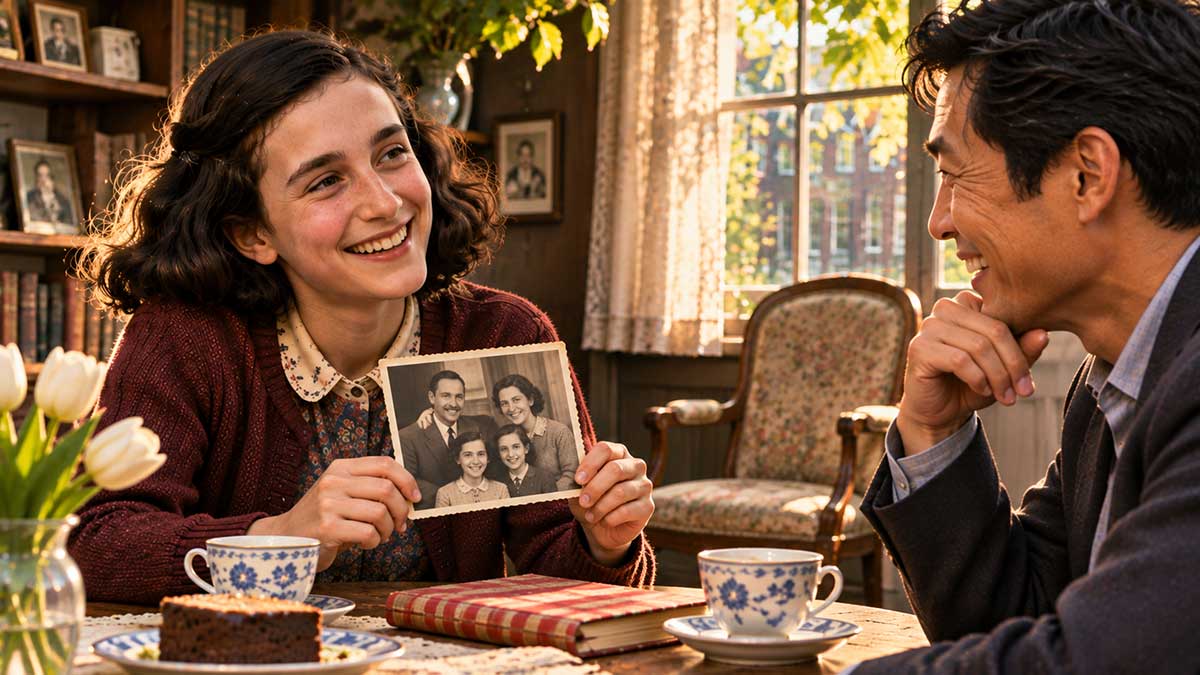
Amsterdam, a quiet sitting room on a late spring afternoon.
The room is warm with afternoon sunlight. Beyond the open window, the distant sound of a bicycle bell drifts through the streets of Amsterdam. A vase of white tulips stands on a wooden table beside a small collection of family photographs.
Anne Frank is already there when Nick arrives.
She is sitting cross-legged in a large armchair, examining one of the photographs. Her dark hair falls slightly across her forehead.
Anne Frank: Nick, you're late.
Nick Sasaki: Am I?
Anne: Three minutes.
Nick: You've been counting?
Anne: Of course. I had nothing better to do.
Nick: I find that difficult to believe.
Anne: Well, I was looking at these photographs. But saying I had nothing better to do makes you feel more guilty.
Nick: (laughing) You're very good at that.
Anne: I've had practice.
Nick sits opposite her.
Nick: Last time, you told me you weren't always easy to live with.
Anne: Did I really admit that?
Nick: You did.
Anne: How unfortunate. I must be becoming too honest.
Nick: I thought we could talk about your family today.
Anne glances at the photographs again.
Anne: My family.
She lifts one of the pictures.
Anne: You know what's strange about photographs?
Nick: What's that?
Anne: Everyone looks so well behaved.
Nick: Even you?
Anne: Especially me. A photograph can make me look like a perfectly respectable young lady.
Nick: And you weren't?
Anne: I had my moments.
She smiles, but her expression softens as she studies the faces.
Anne: There were four of us. Pim, Mummy, Margot, and me.
Nick: Pim was your father?
Anne: Yes. Daddy. Otto Frank, if you want to be terribly formal.
Nick: I think I'll stick with Pim.
Anne: Good. He would like that.
She places the photograph between them.
Question 4. What Did Your Family Mean to You?
Nick: Anne, tell me about your family. Not the family from the history books, but the people you knew at home. What were they really like?
Anne: (smiling) How much time do you have?
Nick: As much as you need.
Anne: You may regret saying that.
Nick: I'll take my chances.
Anne: Well, Daddy was the person I felt closest to. He was patient. He listened. He didn't always agree with me, naturally, but he could make me feel that my thoughts were worth hearing.
Nick: Did he understand you better than anyone else?
Anne: I thought he did.
She pauses.
Anne: But perhaps I expected too much of him sometimes.
Nick: In what way?
Anne: I wanted him to understand everything without my having to explain it. That's rather unfair, isn't it?
Nick: I think many children want that from their parents.
Anne: And sometimes adults want it from children, too.
Nick: That's true.
Anne: Daddy could be very calm. Even when the rest of us were upset, he tried to keep things together.
Nick: Did that make you feel safe?
Anne: Often. But I wonder now how much he kept to himself.
Nick: You mean his own fears?
Anne: Yes. We were all frightened at different times. But he had to think about food, money, the business, the helpers, the danger to everyone.
Nick: That's a great deal for one person.
Anne: It was.
Anne runs her finger along the edge of the photograph.
Anne: I sometimes think children believe their parents are simply parents. We forget they are people who get tired, who worry, who don't always know what to do.
Nick: When did you begin seeing that?
Anne: I was beginning to. I hadn't finished.
Nick notices the last sentence but doesn't interrupt.
Nick: What about your mother?
Anne leans back.
Anne: Ah. Mummy.
Nick: That sounded complicated.
Anne: It was complicated.
Nick: Tell me.
Anne: We were different. I often felt she didn't understand me, and I didn't always try very hard to understand her.
Nick: What caused the disagreements?
Anne: Oh, everything. My behavior, my opinions, how I spoke to people. Sometimes she would say something quite ordinary, and I would hear it as criticism.
Nick: Did you feel she preferred Margot?
Anne: Sometimes I felt Margot was the daughter everyone wished I would become.
Nick: That must have hurt.
Anne: It did. But feelings aren't always the same as facts, are they?
Nick: No.
Anne: Margot was quieter. She was responsible. She did things properly. I was always making noise, asking questions, and getting myself into trouble.
Nick: Did your mother love you?
Anne: Yes.
The answer comes without hesitation.
Anne: I didn't always feel understood by her. That's different from not being loved.
Nick: That's an important distinction.
Anne: I wish I'd understood it better when I was younger.
She looks down.
Nick: What do you remember about Margot?
Anne smiles.
Anne: She was clever. Very clever. And much more disciplined than I was.
Nick: Were you jealous?
Anne: Sometimes.
Nick: Of what?
Anne: How easily she seemed to do things that were difficult for me. Being patient. Staying quiet. Making adults pleased with her.
Nick: Did you ever feel you were competing?
Anne: Yes, but perhaps the competition existed more in my head than in hers.
Nick: Did she ever tease you?
Anne: Not nearly enough. I think she should have teased me more.
Nick: Why?
Anne: It would have made her less perfect.
Nick laughs.
Anne: No, that's unfair. She wasn't perfect. Nobody is. But she was my older sister, and I was forever measuring myself against her.
Nick: Did you love her?
Anne: Of course.
Anne looks almost surprised by the question.
Anne: You can love someone and still be annoyed with them.
Nick: I know that very well.
Anne: Do you have brothers or sisters?
Nick: Yes, and I have children, too.
Anne: Then you must know how noisy families can be.
Nick: Very noisy.
Anne: Good. Then you understand.
She laughs, and Nick joins her.
For a moment, the room feels like an ordinary family sitting room, filled with the familiar warmth of affectionate complaints.
Then Anne looks at the photograph again.
Anne: You know what I miss about having a family?
Nick: What?
Anne: Not the important occasions.
Nick: No?
Anne: The little things. Someone asking whether you've eaten. Someone complaining that you've left something lying around. Hearing another person moving about in the next room.
She smiles faintly.
Anne: Even the arguments.
Nick: You miss the arguments?
Anne: Not all of them.
Nick: (laughing) Fair enough.
Anne: But an argument means there's still someone there to argue with.
Nick remains quiet.
Anne sets the photograph down.
Anne: That sounds rather sad, doesn't it?
Nick: It sounds like you miss them.
Anne: I do.
Question 5. Were There Things You Wished You Could Say?
Outside, clouds briefly cover the sun. The room becomes quieter, its warm colors turning soft and gray.
Anne picks up a photograph of Edith.
Nick: Anne, you wrote very honestly about your mother and sister. Looking back now, are there things you wish they could have understood about you, or things you wish you had understood about them?
Anne studies her mother's face.
Anne: That's a difficult question.
Nick: We don't have to rush.
Anne: I know.
She sits quietly for a moment.
Anne: When you're young, you can become terribly certain that you're right.
Nick: I remember.
Anne: Do you still do that?
Nick: More often than I should.
Anne: (smiling) Good. I was worried it might be only teenagers.
Nick: Unfortunately, no.
Anne: I wrote things about Mummy when I was angry. Sometimes very harsh things.
Nick: You were honest about your feelings.
Anne: Yes, but being honest about a feeling doesn't mean the feeling tells the whole truth.
Nick nods.
Anne: I thought she was unfair. Sometimes perhaps she was. But I could be unfair, too.
Nick: Did your feelings change as you grew older?
Anne: They were changing. I began to see that I had judged her too quickly in some ways.
Nick: What do you think you missed?
Anne: Her worries. Her loneliness. How difficult it must have been to live in that place with everyone frightened and irritable.
She glances toward the window.
Anne: I was so busy wanting her to understand me that I didn't always wonder whether anyone understood her.
Nick: That's a painful realization.
Anne: Yes.
Nick: If she were sitting here now, what would you want to say?
Anne looks toward the empty chair near the window.
She opens her mouth, then closes it.
Anne: I don't know.
Nick waits.
Anne: Perhaps I'd ask her a question.
Nick: What question?
Anne: "Mummy, were you happy before all of this happened?"
Nick looks at her.
Anne: I knew her as my mother. I knew what annoyed me about her. I knew the things she told me to do.
Her voice becomes quieter.
Anne: But I didn't know very much about the girl she had once been.
Nick: That's something many children discover only when they grow older.
Anne: Then I would have liked to grow older.
The words are simple.
Nick feels their weight but doesn't try to soften them.
Nick: I wish you had.
Anne nods.
For a little while, neither speaks.
Then she looks back at him.
Anne: You know, Nick, I don't want to pretend I would suddenly have become a perfect daughter.
Nick: I wouldn't expect that.
Anne: I probably would have argued with her again the very next day.
Nick: (smiling) Probably.
Anne: But perhaps I would have learned to argue more kindly.
Nick: That would have been something.
Anne: Yes.
She sets the photograph down.
Nick: What about your father? Is there something you wish you could tell him?
Anne's expression changes.
Anne: Daddy.
She takes a slow breath.
Anne: You told me he survived.
Nick: Yes. He survived Auschwitz. He returned to Amsterdam.
Anne: But Mummy didn't. And Margot and I didn't.
Nick: No.
Anne: He came back alone.
Nick nods.
Anne: I find that very hard to think about.
Nick: I can understand why.
Anne: I always thought of Daddy as the person who protected us. But there are some things even a loving father cannot protect his children from.
Nick: That's true.
Anne: I would want him to know that I never blamed him.
She pauses.
Anne: And I'd want to thank him for trying so hard.
Nick looks down at his hands.
Nick: Anne, your father did something important after the war.
Anne: What?
Nick: He helped preserve your writing. He worked to have your diary published.
Anne stares at him.
Anne: Daddy published my diary?
Nick: Yes.
Anne: My diary?
Nick: Your writing reached readers far beyond Amsterdam.
For several seconds, Anne says nothing.
Then she gives a small, astonished laugh.
Anne: Well.
Nick: Well?
Anne: I suppose he finally had to admit I could write.
Nick laughs softly.
Anne smiles, but her eyes remain on the photograph.
Anne: He must have been terribly sad.
Nick: He was.
Anne: And he still did that for me.
Nick: Yes.
Anne places the photograph carefully on the table.
Anne: Then I would want to tell him something very simple.
Nick: What?
Anne: "Thank you, Pim."
She looks away.
Anne: And perhaps I'd ask him to tell me everything he remembered about us. Not the terrible things. Just the ordinary things.
Nick: Such as?
Anne: What we were like at dinner. Whether I made him laugh. Whether Margot ever surprised him. What Mummy liked to do when she wasn't worrying about us.
Her voice grows softer.
Anne: I'd like to hear our family described by someone who loved all of us.
Nick lets the silence remain.
Question 6. Who Helped You Feel Less Alone?
The clouds begin to part. Sunlight returns to the room, touching the white tulips.
Anne notices another photograph, this one of a young boy.
Nick: Is that Peter?
Anne: (smiling) Yes.
Nick: Peter van Pels.
Anne: You're very well informed.
Nick: I try.
Anne: Should I be worried about how much you've read?
Nick: Perhaps a little.
Anne: Oh dear. I suppose there are no secrets left.
Nick: Anne, when life became frightening, who made you feel that you weren't facing everything by yourself?
Anne: Different people at different times.
Nick: Tell me about Peter.
Anne: Peter was quiet. At first, I didn't think we had very much in common.
Nick: But that changed.
Anne: Yes. We began talking more. It was nice to have someone closer to my own age.
Nick: Did you fall in love with him?
Anne smiles and looks toward the ceiling.
Anne: Must you ask so directly?
Nick: You told me you preferred honest questions.
Anne: I did, didn't I?
She laughs.
Anne: I cared about him. I enjoyed being with him. Sometimes I thought he understood me in a way the adults didn't.
Nick: And later?
Anne: Later, I wasn't so certain.
Nick: What changed?
Anne: I wanted to talk about things that mattered deeply to me. Sometimes I felt he couldn't quite meet me there.
Nick: Did that disappoint you?
Anne: A little.
Nick: But you still valued him?
Anne: Of course. He was kind to me.
She pauses.
Anne: And Nick, when you're living in hiding, a small kindness can mean a great deal.
Nick: What kind of kindness?
Anne: Someone listening. Someone noticing that you're unhappy. Someone sitting beside you without asking you to explain everything.
Nick: Did Peter give you that?
Anne: Sometimes.
Nick: Do you think you would have remained close if you'd both survived?
Anne considers the question.
Anne: I don't know.
Nick: Really?
Anne: Why should I pretend to know?
Nick: Fair enough.
Anne: Perhaps we would have remained friends. Perhaps we would have discovered that we were very different people.
Nick: And that would have been okay?
Anne: Yes. I would have liked the chance to discover it.
Nick nods.
Nick: What about the people who helped your family?
Anne's face brightens.
Anne: Miep. Bep. Mr. Kugler. Mr. Kleiman.
Nick: They took enormous risks.
Anne: They did.
Nick: What do you remember most about them?
Anne: That they kept coming back.
Nick: Coming back?
Anne: Think about it, Nick. Every day there was danger. They had their own lives and worries. Yet they brought us food, books, news, and whatever they could manage.
Nick: And they knew what could happen if they were caught.
Anne: Yes.
Nick: Did you ever wonder why they helped?
Anne: Sometimes. But I think they saw us as people who needed help.
Nick: That sounds simple.
Anne: It should be simple.
She looks at him seriously.
Anne: But it wasn't simple in those days.
Nick: No.
Anne: They were brave. I don't want anyone to forget that.
Nick: I don't think they will.
Anne looks toward the window.
Anne: Do you know what I would have liked to do for Miep?
Nick: What?
Anne: Something ordinary.
Nick: Such as?
Anne: Invite her to dinner. Cook something for her. Perhaps make a terrible meal and apologize for it.
Nick laughs.
Anne: She spent so much time bringing things to us. I would have liked to give something back.
Nick: That's a lovely thought.
Anne: It would probably have been a dreadful dinner.
Nick: I'm sure she would have appreciated it.
Anne: Then perhaps I'd have asked Margot to do the cooking.
They both laugh.
The sound fills the quiet room.
After a moment, Nick notices the red-checkered diary resting on a small side table.
Nick: Anne, there was someone else you spoke to when you felt alone.
Anne follows his gaze.
Anne: Kitty.
Nick: Yes.
Anne: My imaginary friend.
Nick: Did writing to Kitty make you feel less lonely?
Anne: It helped me say things I couldn't always say to other people.
Nick: Was Kitty like a real friend to you?
Anne: In a way. But she was a friend I created through writing.
Nick: Someone who would listen without interrupting?
Anne: Exactly.
She smiles mischievously.
Anne: Unlike certain interviewers.
Nick: (laughing) Have I been interrupting?
Anne: Only a little.
Nick: I'll try to improve.
Anne: Good. Kitty never interrupted me once.
Nick: That's difficult competition.
Anne: Very difficult.
Anne picks up the diary and turns it over in her hands.
Anne: You know, Nick, I sometimes wonder whether people understand why I wrote so much.
Nick: Why do you think you did?
Anne: I wanted to sort out my thoughts. I wanted somewhere to put my feelings. And later, I wanted to make something worthwhile from what I had written.
Nick: Did you ever feel that the diary knew you better than your family did?
Anne considers this.
Anne: A diary only knows what you choose to tell it.
Nick: That's true.
Anne: But sometimes writing helps you discover things you didn't know you were thinking.
Nick: I'd love to talk more about that.
Anne: Then we should.
She closes the diary.
Anne: But not today. We've already talked about half my family and nearly all my embarrassing feelings.
Nick: (laughing) I suppose that's enough for one afternoon.
Anne: Quite enough.
Nick stands, but Anne remains seated for a moment, looking at the photographs.
Nick: Anne?
Anne: Yes?
Nick: What are you thinking about?
She smiles faintly.
Anne: Something you said earlier.
Nick: What was that?
Anne: You said Daddy came back.
Nick: Yes.
Anne: I keep picturing him opening a door and expecting to hear us.
Nick sits down again.
Anne looks at the family photograph.
Anne: I know he understood what had happened. But knowing something and getting used to it aren't the same.
Nick: No, they aren't.
Anne: I hope he wasn't lonely all the time.
Nick: He had people who cared about him. He later remarried, and he spent much of his life helping others learn about your story.
Anne nods slowly.
Anne: I'm glad he had someone.
She looks up.
Anne: Did he ever stop missing us?
Nick takes a moment before answering.
Nick: I don't think love disappears simply because someone is gone.
Anne considers his words.
Anne: No. I don't think it does either.
She rises and returns the photograph to the table.
Anne: You know what's funny, Nick?
Nick: What?
Anne: When I was younger, I sometimes wished everyone would leave me alone.
Nick: That's fairly common.
Anne: I wanted my own room, my own thoughts, my own life.
She smiles.
Anne: And now, if I could have one more ordinary afternoon, I think I'd like a noisy house.
Nick: With everyone talking at once?
Anne: Yes.
Nick: Even your mother telling you what to do?
Anne laughs.
Anne: Especially that.
Then she shakes her head.
Anne: No, perhaps not especially. Let's not exaggerate.
Nick laughs with her.
Outside, the afternoon light has begun to turn golden.
Anne walks toward the window and looks down at the street.
Anne: Nick, may I ask you something?
Nick: Of course.
Anne: When you go home today, will you do something for me?
Nick: What would you like?
Anne: If someone you love is there, spend a little time with them.
Nick: I can do that.
Anne: You don't have to say anything clever. Just sit together. Ask them about their day.
She turns back toward him.
Anne: And perhaps listen to the answer.
Nick smiles.
Nick: I will.
Anne looks pleased.
Anne: Good. Then I haven't wasted your afternoon after all.
Nick: Not even a minute of it.
She picks up the diary again.
Anne: Next time, Nick, I'd like to talk about writing.
Nick: I was hoping you'd say that.
Anne: I have rather a lot to say about it.
Nick: Somehow, that doesn't surprise me.
Anne: (laughing) You're getting to know me.
The two friends walk toward the doorway.
Behind them, the photographs remain on the table, four faces captured in a moment when tomorrow still seemed possible.
And somewhere within the pages of Anne's diary, the young writer is waiting to be heard.
End of Topic 2
Fictional Conversation Disclaimer
This conversation between Nick Sasaki and Anne Frank is entirely fictional. Anne Frank died during the Holocaust in 1945, and no such meeting occurred. Her dialogue, imagined posthumous reflections, and personal reactions are creative reconstructions rather than authentic quotations or documented testimony. Historical elements involving Otto, Edith, Margot, Peter van Pels, Anne's diary, and the helpers who supported the people in hiding are informed by Anne's surviving writings and established historical research. The imagined conversation does not establish what Anne would have felt or said had she survived.
Topic 3. The Writer Who Had So Much More to Say
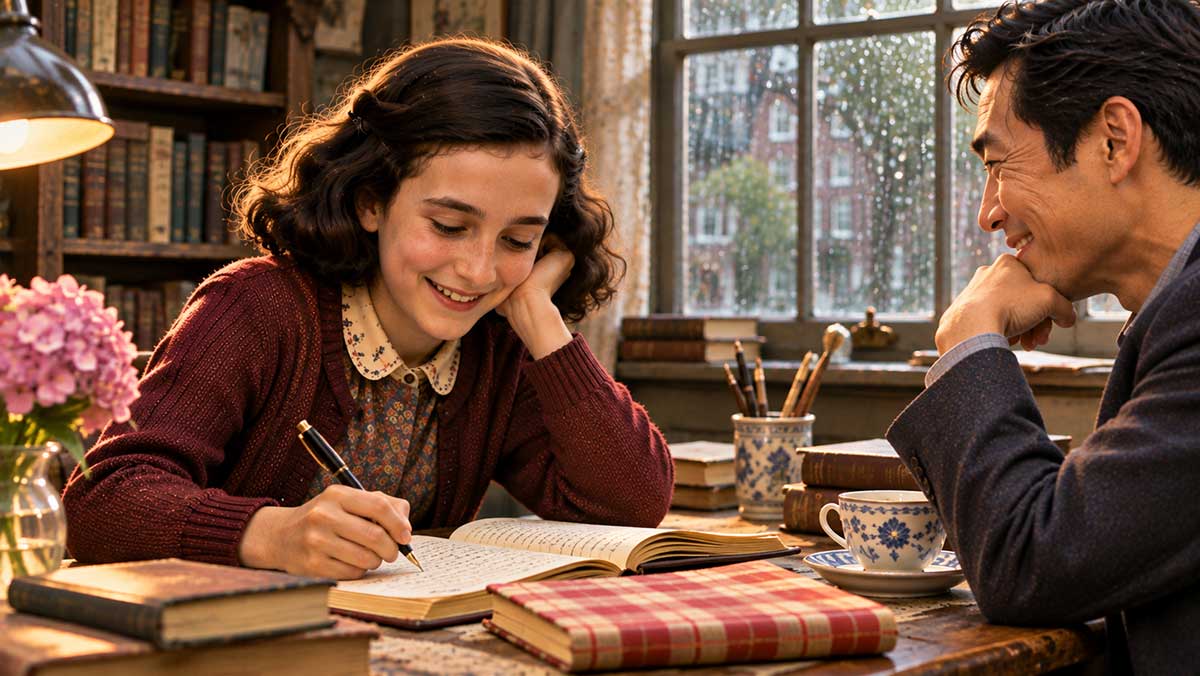
Amsterdam, a small writer's study on a rainy afternoon.
Rain taps gently against the windows of an old Amsterdam house. Beyond the glass, bicycles pass along the wet cobblestones, their riders hurrying beneath dark umbrellas.
Inside, the room smells faintly of old books and freshly brewed tea.
A wooden desk stands beside the window. Several notebooks lie scattered across its surface, along with a fountain pen, a stack of blank paper, and a familiar red-and-white checkered diary.
Anne Frank is standing before a bookshelf when Nick Sasaki enters.
She is holding a thick novel, examining it with considerable suspicion.
Nick Sasaki: Anne, what are you reading?
Anne Frank: I'm trying to decide whether this book is worth reading.
Nick: How far have you gotten?
Anne: The first page.
Nick: That's not very far.
Anne: It's far enough to know the author likes long sentences.
Nick: Is that a problem?
Anne: Not necessarily. But if a sentence takes half a page to tell me someone opened a door, I begin to wonder whether the door was worth opening.
Nick laughs.
Nick: You're a demanding reader.
Anne: I intend to become an even more demanding writer.
Nick: That sounds dangerous.
Anne: Only for people who publish boring books.
She returns the novel to its shelf.
Anne: Now, tell me something. Do you read much?
Nick: Quite a bit.
Anne: Good. Then we can have a proper conversation.
Nick: And if I didn't?
Anne: I'd have to recommend a few books before we began.
Nick: (laughing) I'm glad I passed the examination.
Anne settles into a chair near the desk.
Anne: I like this room. It's quiet, but not the sort of quiet that makes you feel lonely.
Nick: What's the difference?
Anne: Some rooms are quiet when nobody has anything to say. This one feels quiet because someone is thinking.
Nick looks at the notebooks.
Nick: I thought you'd enjoy being surrounded by books.
Anne: I do. Though I might have arranged them differently.
Nick: What's wrong with the arrangement?
Anne: Nothing, if you enjoy spending half an hour finding what you're looking for.
Nick smiles and sits opposite her.
Nick: Last time, you said there was something you wanted to talk about.
Anne: Writing.
Nick: Exactly.
Anne: Good. I was hoping you hadn't forgotten.
She picks up the fountain pen and examines its nib.
Anne: You know, Nick, people sometimes think writing is a very peaceful occupation.
Nick: Isn't it?
Anne: Not when you're arguing with yourself over every sentence.
Question 7. Why Did Writing Become So Important to You?
Nick: Anne, you had people around you, but you still turned to your diary. What could you tell Kitty that you couldn't tell anyone else?
Anne: Almost anything.
Nick: Anything?
Anne: Well, anything I was brave enough to write down.
Nick: Why was that easier than speaking?
Anne: When you speak, people interrupt. They misunderstand. They become offended. Sometimes they answer a question you haven't even finished asking.
Nick: That happens often.
Anne: With a diary, you can finish your thought.
Nick: And Kitty never argued with you.
Anne: Exactly. She was an excellent listener.
Nick: But she couldn't answer you.
Anne: That's true.
Anne turns the pen between her fingers.
Anne: Sometimes I wanted an answer. Other times I simply wanted someone to listen.
Nick: Did you feel lonely?
Anne: Yes, at times. But I wasn't lonely every minute. That's something people should know.
Nick: What do you mean?
Anne: People may picture us sitting in the Annex being miserable from morning until night. There were terrible worries, certainly. But we laughed, argued, read books, celebrated birthdays, and complained about one another.
Nick: Ordinary life continuing under extraordinary circumstances.
Anne: Yes. And sometimes the ordinary parts were what kept us going.
Nick: What did you write about when you were happy?
Anne: Oh, all sorts of things. School memories. People I liked. People I didn't like. Funny little incidents. Things I hoped would happen.
Nick: And when you were unhappy?
Anne: Then I wrote about that, too.
Nick: Did writing make you feel better?
Anne: Sometimes. I could put something on paper and look at it instead of carrying it around inside me.
Nick: Did that help you see things differently?
Anne: Often. A feeling can seem enormous when it's trapped inside your head. Once you've written it down, you can examine it.
Nick: Like holding it at a distance?
Anne: Yes. And sometimes you discover that you were being rather foolish.
Nick: Did you ever read something you'd written and think, "Anne, what on earth were you thinking?"
Anne: Frequently.
They laugh.
Anne: That's one of the embarrassing things about keeping a diary. You leave evidence of your own stupidity.
Nick: But you left evidence of your growth, too.
Anne: I hope so.
She looks at the red-checkered diary.
Anne: I wasn't the same girl at fifteen that I had been at thirteen.
Nick: How had you changed?
Anne: I thought more about other people. I became more interested in why I felt certain things. I began questioning my own judgments.
Nick: Including what you'd written about your mother?
Anne: Yes. We talked about that last time.
Nick: We did.
Anne: I could be terribly harsh when I was angry. Later, I sometimes realized I'd been unfair.
Nick: Did you ever wish you could erase those entries?
Anne: Some of them, perhaps. But then I wonder whether erasing every mistake would leave a very honest picture of anyone.
Nick: That's a good question.
Anne: A diary isn't a photograph of a perfect person. It's a record of someone changing.
Nick nods.
Nick: Anne, you often wrote about having different sides to yourself.
Anne: Yes.
Nick: The Anne people saw, and the Anne you felt you were inside.
Anne becomes thoughtful.
Anne: People liked the cheerful Anne. The one who joked and talked and made everyone laugh.
Nick: And the other Anne?
Anne: She was quieter. More serious. Sometimes frightened. Sometimes terribly uncertain.
Nick: Did you feel people wouldn't understand her?
Anne: I worried they might laugh at her.
Nick: Really?
Anne: Yes. Isn't that strange? I could make jokes about almost anything, but I was afraid someone might make a joke about my deepest feelings.
Nick: That doesn't sound strange to me.
Anne: No?
Nick: Sometimes the people who make everyone laugh are the ones who most carefully protect their private thoughts.
Anne studies him.
Anne: You may be more observant than I first thought.
Nick: I'll take that as another compliment.
Anne: Don't become conceited.
Nick laughs.
Nick: I'll try not to.
Anne looks toward the rain.
Anne: You know, I sometimes wanted people to see that quieter part of me. But when I tried, I didn't always know how.
Nick: Did Kitty help?
Anne: Yes. On paper, I could be serious without worrying that someone would immediately tease me.
Nick: So the diary wasn't simply a place to record your life.
Anne: No. It was a place to discover what I thought about my life.
She pauses, then smiles.
Anne: Though I still enjoyed complaining about people.
Nick: I noticed.
Anne: You read my diary?
Nick: Yes.
Anne: All of it?
Nick: A published version.
Anne: Oh dear.
Nick: What?
Anne: Then you know rather too much about me.
Nick: Perhaps.
Anne: I should be allowed to read your diary. That would make things fair.
Nick: I don't think you'd find mine nearly as interesting.
Anne: Let me be the judge of that.
Question 8. When Did You Begin Thinking of Yourself as a Writer?
The rain grows heavier for a few minutes. Anne moves to the desk and opens a notebook.
Nick: Anne, at some point, you weren't simply keeping a diary anymore. You were rewriting it for readers. What changed?
Anne: I began thinking that what we were experiencing might be worth telling other people about.
Nick: Do you remember what inspired that idea?
Anne: There was a radio broadcast in March 1944. A Dutch government minister in exile spoke about preserving diaries and letters from the war.
Nick: Gerrit Bolkestein.
Anne: Yes. He wanted people to keep records of what had happened under occupation.
Nick: And you began thinking about publishing your diary?
Anne: I did. The thought excited me.
Nick: Why?
Anne: I'd always wanted to write. Suddenly, the things I'd been recording might become something more.
Nick: A book.
Anne: Exactly.
Nick: You called it The Secret Annex.
Anne: Het Achterhuis.
Nick: Did you begin rewriting everything?
Anne: I went back through my entries. I changed things, added descriptions, removed some parts, and thought about how a reader might experience the story.
Nick: That sounds like serious editorial work.
Anne: Of course it was serious.
Nick: I didn't mean to suggest otherwise.
Anne: (smiling) Good. People sometimes think young girls only write about their feelings.
Nick: And you were thinking about structure, characters, and publication.
Anne: Yes. I wanted it to be readable. Interesting. Worth someone's time.
Nick: Did you ever think, "I might actually become a published author"?
Anne: I hoped so.
Nick: How did that feel?
Anne: Exciting. Frightening. Rather wonderful.
Nick: Did you imagine people reading your work?
Anne: Certainly.
Nick: What did you picture?
Anne: Perhaps someone sitting by a window with my book. Perhaps a reviewer saying something intelligent about it.
Nick: And what if the reviewer disliked it?
Anne: Then I would probably dislike the reviewer.
Nick laughs.
Anne: For a little while, at least.
Nick: Would you have accepted criticism?
Anne: If it was useful. I don't see why I should enjoy criticism simply for the sake of appearing mature.
Nick: Fair enough.
Anne: But if someone showed me how to make a sentence better, I'd listen.
Nick: Were you hard on your own writing?
Anne: Very.
Nick: What would make you rewrite something?
Anne: If it sounded clumsy. If it didn't say what I meant. If I thought I could make it more interesting.
Nick: Did you ever write a sentence you were particularly proud of?
Anne: Yes.
Nick: What did you do?
Anne: Read it again, of course.
Nick: (laughing) More than once?
Anne: Naturally. If you've written something good, you should be allowed to enjoy it.
Nick: I like that.
Anne: But then you must go back to work.
She taps the notebook.
Anne: That's the difficult part. One good sentence doesn't make a book.
Nick: Did you have other writing projects?
Anne: I wrote stories, too. And I collected sentences and passages that interested me.
Nick: You were building a writer's life.
Anne: I was trying to.
Nick looks at her thoughtfully.
Nick: Anne, I think many people know you as the girl who kept a diary. Fewer realize how deliberately you worked to become an author.
Anne: That's disappointing.
Nick: Is it?
Anne: A little. Keeping a diary and writing a book aren't quite the same thing.
Nick: What would you want readers to know?
Anne: That I cared about writing. I worked at it. I wanted to improve.
She pauses.
Anne: And I had plans beyond the diary.
Nick: What kind of plans?
Anne: More stories. Perhaps articles. Perhaps novels. I wanted to find out what I could do.
Nick: Did you ever worry that you weren't good enough?
Anne: Of course.
Nick: What did you do when you felt that way?
Anne: I kept writing.
Nick: That's a simple answer.
Anne: Sometimes simple answers are the most useful ones.
She glances at Nick's notebook.
Anne: Speaking of writing, what have you been putting down all afternoon?
Nick: Notes from our conversation.
Anne: May I see?
Nick: If you'd like.
Anne reaches across the desk and examines the page.
Anne: Hmm.
Nick: What?
Anne: You've written, "Anne explains why writing mattered."
Nick: That's right.
Anne: That's a terribly dull sentence.
Nick bursts out laughing.
Nick: It isn't meant to be published.
Anne: I should hope not.
Nick: How would you improve it?
Anne takes his pen and writes beneath the sentence.
Anne: There.
Nick reads aloud.
Nick: "Anne argues with a notebook and occasionally wins."
Anne grins.
Anne: Much better.
Nick: You're hired as my editor.
Anne: What's the salary?
Nick: I hadn't thought about that.
Anne: Then you're already a very suspicious employer.
Question 9. What Would You Want to Write Next?
The rain begins to ease. Pale afternoon light spreads across the desk.
Nick takes a fresh notebook from a drawer and places it in front of Anne.
Nick: Anne, suppose I gave you a fresh notebook and told you that you could write anything you wanted. What story would you begin?
Anne looks at the blank pages.
Anne: Anything?
Nick: Anything.
Anne: That's almost too much freedom.
Nick: I thought writers liked freedom.
Anne: We do. But a blank page can be rather frightening.
Nick: Why?
Anne: It could become something wonderful. Or something dreadful. And you won't know until you begin.
She opens the notebook.
Anne: Perhaps I'd write about a girl who wants to become a writer.
Nick: That sounds familiar.
Anne: She would be much better behaved than I was.
Nick: Really?
Anne: No. That would make her terribly boring.
Nick laughs.
Anne: Perhaps she'd be stubborn. Clever sometimes, foolish other times. Always getting into arguments.
Nick: And what would happen to her?
Anne: I don't know yet.
Nick: You don't?
Anne: Nick, I've only just invented her.
Nick: Fair point.
Anne: Perhaps she would travel. Meet people. Fall in love. Make a great many mistakes.
Nick: Would she become a writer?
Anne: I hope so. But perhaps she'd discover something else she loved.
Nick: Would you want to write about the war again?
Anne grows thoughtful.
Anne: Perhaps. But I wouldn't want every book I wrote to be about the same terrible years.
Nick: What else interests you?
Anne: People. Their secrets. Their contradictions. The way someone can be brave one day and frightened the next.
Nick: You'd make a good novelist.
Anne: I should like to find out.
She runs her hand across the blank page.
Anne: May I ask you something, Nick?
Nick: Of course.
Anne: What happened to my book?
Nick looks at her.
Nick: Your diary was published in Dutch in 1947, through your father's efforts. It was later translated into many languages.
Anne stares at him.
Anne: Many languages?
Nick: Yes.
Anne: German?
Nick: Yes.
Anne: English?
Nick: Yes.
Anne: French?
Nick: Yes.
Anne: How many?
Nick: More than seventy languages over the years.
Anne sits back.
Anne: That's an extraordinary number of dictionaries.
Nick laughs softly.
Anne: People really read it?
Nick: Millions of people.
She looks down at her hands.
Anne: Millions.
For once, she seems unable to find a quick reply.
Nick: What are you thinking?
Anne: I'm trying to picture that many people.
Nick: It's difficult.
Anne: Did they like it?
Nick: Many were deeply moved by it. It became one of the most widely read accounts of life under Nazi persecution.
Anne: But did they think it was well written?
Nick smiles.
Nick: Yes, Anne. Many people admire your writing itself.
She looks relieved.
Anne: Good.
Then she frowns.
Anne: But I have another question.
Nick: Go ahead.
Anne: Did they understand that I was trying to become a writer? Or did they read it only because of what happened to us?
Nick takes a moment.
Nick: I think readers have approached your diary in different ways. Some first encounter it as history. Others recognize your voice, your humor, your observations, and the care you took with your words.
Anne: I hope they see both.
Nick: I think that's a fair hope.
Anne: I wouldn't want them to forget what happened. But I wouldn't want them to forget that I was writing, either.
Nick: That's one reason I wanted to talk with you about it.
Anne smiles.
Anne: Then perhaps you're not such a bad interviewer after all.
Nick: High praise.
Anne: Don't let it go to your head.
She looks at the notebook again.
Anne: Nick, may I tell you something rather selfish?
Nick: Please do.
Anne: I'm glad my book was published. Truly glad.
She pauses.
Anne: But I wish I'd been able to write the next one.
Nick looks at her without speaking.
Anne: And the one after that.
She turns a page.
Anne: I wonder whether I would have become better. Whether I would have learned to write characters who were nothing like me. Whether I might have written something funny enough to make a stranger laugh on a train.
Nick: I would have liked to read those books.
Anne: So would I.
A faint smile crosses her face.
Anne: Though I suppose I'd have had to write them first.
Nick: That does tend to be the difficult part.
Anne: Exactly.
The rain has stopped completely.
Anne closes the notebook and looks out at the street below.
Anne: Tell me something about your time.
Nick: What would you like to know?
Anne: Can anyone publish a book now?
Nick: More people have the opportunity to publish than ever before. Some work with traditional publishers. Others publish independently.
Anne: Independently?
Nick: They can write a book and make it available to readers without first being accepted by a publishing company.
Anne's eyes widen.
Anne: Really?
Nick: Really.
Anne: That sounds wonderful.
Nick: It can be.
Anne: And frightening for publishers, I should think.
Nick: (laughing) Sometimes.
Anne: Do people still write by hand?
Nick: Some do.
Anne: Good. I wouldn't want the fountain pen to disappear.
She lifts the pen from the desk.
Anne: There's something satisfying about ink on paper.
Nick: I agree.
Anne: You can see your mistakes.
Nick: That isn't always satisfying.
Anne: No, but at least they're yours.
Nick laughs.
Anne places the pen beside the notebook.
Anne: You know what I'd like to do?
Nick: What?
Anne: Spend an entire afternoon in a bookshop.
Nick: Just browsing?
Anne: Browsing, reading, arguing with the books in my head, deciding which ones deserve my money.
Nick: Sounds like a perfect afternoon.
Anne: And perhaps afterward I'd sit in a café and write.
Nick: What would you write?
Anne: Whatever came into my head.
Nick: No plan?
Anne: Not everything needs a plan, Nick.
Nick: You're right.
Anne: Sometimes you have to sit down and see what happens.
She smiles.
Anne: That's what makes writing interesting.
Nick begins gathering his notes.
Nick: Anne, I think we've covered quite a lot today.
Anne: Have we?
Nick: Your diary, Kitty, your revisions, your ambitions, your future books.
Anne: We haven't discussed whether you intend to pay me for improving your notes.
Nick: I was hoping you'd forgotten.
Anne: Writers never forget unpaid work.
Nick laughs.
Nick: I'll buy you a cup of tea.
Anne: With cake?
Nick: With cake.
Anne: Then we have an agreement.
She stands and carries the fresh notebook toward the window.
Nick: Anne, are you keeping that?
Anne: Naturally.
Nick: What will you do with it?
Anne: I haven't decided.
Nick: Another diary?
Anne: Perhaps. Or a story.
She looks down at the blank first page.
Anne: Or perhaps I'll write something about a rather curious gentleman who keeps asking me questions.
Nick: Should I be worried?
Anne: Very.
Nick: Will I be the hero?
Anne: That depends on how you behave.
Nick smiles.
Nick: Fair enough.
Anne opens the notebook and writes a few words.
Nick: What did you write?
Anne: The beginning.
Nick: Of what?
Anne: I don't know yet.
She closes the notebook before he can look.
Anne: You'll have to wait.
Outside, sunlight breaks through the clouds, illuminating the wet rooftops of Amsterdam.
Nick watches Anne standing beside the window, a new notebook in her hands and another unwritten story taking shape in her imagination.
Nick: Anne, before I go, there's one more thing I'd like to ask.
Anne: You're always saying that.
Nick: I know.
Anne: Go on, then.
Nick: When you were writing in the Annex, did you ever think about how strange it was that the world outside continued without knowing you were there?
Anne looks out over the street.
Anne: Yes.
Nick: What did that feel like?
Anne: Sometimes I felt terribly small. As though our whole world had shrunk to a few rooms, and everything beyond them was moving on without us.
Nick: And yet you kept writing.
Anne: Yes.
Nick: Why?
She thinks for a moment.
Anne: I suppose writing was one thing I could still do for myself.
Nick: Even when so much else had been taken away.
Anne: Yes.
She looks at him.
Anne: But Nick, I don't want you to think writing made everything bearable.
Nick: I don't.
Anne: It helped. That isn't the same thing.
Nick: You're right.
Anne nods.
Anne: Good.
She glances once more at the notebook.
Anne: Next time, perhaps we should talk about the things that were harder to write about.
Nick: If you're comfortable doing that.
Anne: I don't know whether I'll be comfortable.
She gives him a small, serious smile.
Anne: But I think I'd like to try.
Nick nods.
Nick: Then we'll take our time.
Anne returns the smile.
Anne: And you can bring the cake.
Nick: I won't forget.
Anne: See that you don't.
The door closes gently behind Nick.
Anne remains at the desk, listening to the last drops of rain falling from the roof.
Then she opens the notebook again.
The first page is no longer blank.
End of Topic 3
Fictional Conversation Disclaimer
This conversation between Nick Sasaki and Anne Frank is entirely fictional. Anne Frank died during the Holocaust in 1945, and no such meeting occurred. Her dialogue, imagined posthumous reflections, literary opinions, and reactions to her diary's later publication are creative reconstructions, not authentic quotations or documented testimony. Historical details concerning her diary, her fictional correspondent Kitty, her literary ambitions, the March 1944 radio appeal, and her subsequent revisions are grounded in her surviving writings and established historical research. The imagined notebook, conversation, and unwritten future books are literary devices, not historical events.
Topic 4. How Could Human Beings Do This to One Another?
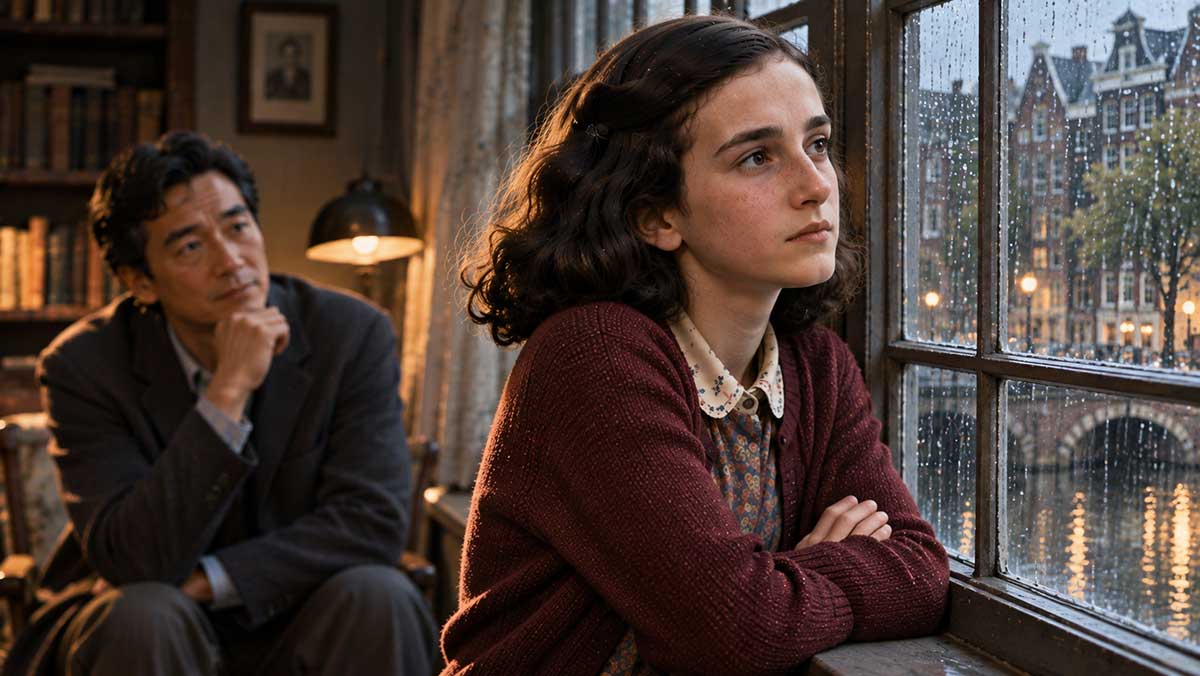
Amsterdam, an upper room overlooking the rooftops, early evening.
The sky above Amsterdam is gray.
From the window of a quiet upper room, rows of narrow houses stretch toward the canal. Rain has darkened the rooftops, and a faint breeze moves the branches of a chestnut tree beyond the neighboring buildings.
Below, a bicycle passes. A woman carries a bag of groceries. Two children hurry along the pavement, laughing as they try to avoid the puddles.
Anne Frank stands beside the window, watching them.
Nick Sasaki enters carrying two cups of tea and a small plate of cake.
Anne Frank: You remembered.
Nick Sasaki: The cake?
Anne: Naturally. I was beginning to wonder whether you were a man of your word.
Nick: I wouldn't dare disappoint my editor.
Anne: Good. Writers must be treated properly.
Nick sets the plate on a small table.
Nick: I wasn't sure what kind you liked.
Anne: Is that chocolate?
Nick: Yes.
Anne: Then you've made an excellent decision.
She takes a small piece and sits in the chair beside the window.
Anne: I like this room.
Nick: What do you like about it?
Anne: The view.
Nick: The rooftops?
Anne: The people.
She points toward the street.
Anne: Look at those children. They're arguing about something.
Nick: How can you tell?
Anne: One is walking ahead and refusing to look at the other. That's a very clear sign.
Nick laughs.
Nick: You notice everything.
Anne: Not everything. But I like watching people.
The children disappear around a corner.
Anne: I used to wonder what was happening in all the houses I could see from the Annex. People eating dinner, talking, getting ready for bed. Ordinary things.
Nick: Did watching them make you feel connected to the outside world?
Anne: Sometimes. Other times it made me feel terribly far away.
She looks at the empty street.
Anne: It's strange, isn't it? A person can be only a few streets away and still be living in a completely different world.
Nick sits opposite her.
Nick: Anne, today I'd like to talk about something difficult.
Anne: I thought you might.
Nick: We don't have to answer everything.
Anne: I know.
She puts down her cake.
Anne: But I don't want you to be so careful that we can't talk honestly.
Nick: Fair enough.
Anne: Good. Ask me.
Question 10. How Did the World You Knew Change?
Nick: Anne, when did you first realize that being Jewish was going to change what you were allowed to do, and how other people treated you?
Anne looks toward the window.
Anne: It wasn't one single moment.
Nick: What do you mean?
Anne: The rules kept coming. One after another.
She counts quietly on her fingers.
Anne: Jews couldn't go to certain places. We couldn't use public swimming pools. We couldn't go to the cinema. We had to attend Jewish schools. We had to wear the yellow star.
Nick: How did you feel when you had to wear it?
Anne: Angry.
Nick: Angry?
Anne: Yes. Why shouldn't I have been?
Nick: Of course.
Anne: It was as though someone had decided that being Jewish was the only thing anyone needed to know about me.
Nick: Instead of seeing Anne.
Anne: Exactly.
She leans forward.
Anne: I was still the same girl who liked talking in class, reading books, laughing with friends, and thinking about boys.
Nick: Yet the rules treated you differently.
Anne: They did more than that. They made it clear that we weren't supposed to belong.
Nick: Did your friends understand what was happening?
Anne: Some did. Some couldn't do very much. And I don't think any of us understood how far things would go.
Nick: Were you frightened?
Anne: Sometimes. But children don't spend every minute thinking about politics and danger. I still worried about school and friendships and whether someone liked me.
Nick: Did that ever seem strange to you?
Anne: No. Why should it?
Nick: I suppose it shouldn't.
Anne: If terrible things are happening around you, you don't suddenly stop being yourself.
Nick nods.
Nick: Your family left Germany when you were very young.
Anne: Yes. We came to the Netherlands hoping to build a life there.
Nick: Did Amsterdam feel like home?
Anne: It did. I had friends, school, familiar streets. I spoke Dutch. It was my city.
Nick: Then Germany invaded the Netherlands in 1940.
Anne: Yes.
She pauses.
Anne: I was ten.
Nick: What do you remember about the changes that followed?
Anne: Adults becoming more worried. Rules appearing. Things we had done without thinking becoming forbidden.
Nick: Was there a moment when you understood that the restrictions were not going to stop?
Anne: I don't know that I understood it all at once. We kept trying to live with each new rule.
Nick: Until your family went into hiding.
Anne: Yes.
Nick: July 1942.
Anne: Just after my thirteenth birthday.
She looks down at her hands.
Anne: Margot received a summons to report for what the authorities called labor service. My parents knew we couldn't wait.
Nick: So you left home.
Anne: We did.
Nick: What was hardest about leaving?
Anne thinks for a moment.
Anne: Not being able to say a proper goodbye.
Nick: To your friends?
Anne: To friends, to places, to the life we had.
She glances at the street below.
Anne: You can't explain to everyone that you're disappearing. You simply go.
Nick: Did you think you would return?
Anne: I hoped we would.
Nick: Did you imagine how long you'd be hiding?
Anne: No. How could I?
She gives him a small, rueful smile.
Anne: If someone had told me how long it would be, I might have asked for more books.
Nick laughs softly.
Anne: And perhaps a better supply of patience.
Nick: Did you have much patience?
Anne: Very little, according to certain members of my family.
Nick: I think I've heard that before.
Anne: Then don't make me repeat myself.
They share a brief smile.
Anne looks toward the window again.
Anne: You know what bothered me about the restrictions?
Nick: What?
Anne: The people making them didn't know me.
Nick: No.
Anne: They didn't know whether I was kind or selfish, clever or foolish, funny or dull. None of that mattered.
Nick: They judged you for being Jewish.
Anne: Yes. And they wanted everyone else to do the same.
She turns toward him.
Anne: Nick, can I ask you something?
Nick: Of course.
Anne: When you see someone walking down the street, how much do you really know about them?
Nick: Almost nothing.
Anne: Exactly. Yet people can become so certain about strangers.
Nick: Have you ever caught yourself doing that?
Anne raises an eyebrow.
Anne: Of course. I was quite capable of deciding someone was ridiculous before I'd spoken to them.
Nick: (laughing) At least you're honest.
Anne: But deciding that someone is ridiculous isn't the same as deciding they have no right to live freely.
Her expression grows serious.
Anne: That is a terrible difference.
Question 11. What Did You Struggle Most to Understand About People?
A church bell sounds somewhere in the distance.
Anne waits until the last note fades.
Nick: Anne, you wrote about kindness and cruelty. What confused you most about how people could treat one another?
Anne: How ordinary people could accept terrible things.
Nick: Ordinary people?
Anne: Yes. Not everyone who supported the Nazis looked like a monster from a storybook.
Nick: What troubles you about that?
Anne: If cruelty came only from people who were obviously wicked, perhaps it would be easier to recognize.
Nick: But it doesn't.
Anne: No.
She folds her hands.
Anne: People can be polite to their neighbors and still believe terrible lies about strangers. They can love their own families and help destroy someone else's.
Nick remains silent for a moment.
Nick: Did you ever wonder what made them believe those lies?
Anne: Fear, perhaps. Hatred. The desire to belong. The wish to blame someone for their troubles.
Nick: Do you think they knew what they were doing?
Anne: Some certainly did. Others may have preferred not to ask questions.
Nick: Is there a difference?
Anne: There is a difference between planning a crime and refusing to see one. But the people being harmed still suffer.
Nick nods.
Nick: Did you hate the people who persecuted Jews?
Anne looks at him carefully.
Anne: That's a large question.
Nick: I know.
Anne: There were times when I was furious. There were times when I was frightened. And there were things I couldn't begin to understand.
Nick: Did you ever feel that hatred might take over?
Anne: I was trying to make sense of a world that seemed to have lost its senses.
She pauses.
Anne: But I don't want to pretend that I knew everything about human nature. I was fifteen.
Nick: You were still learning.
Anne: Yes. And I didn't live to see how the war ended.
Nick looks down.
Nick: There's a passage from your diary that people quote often. You wrote that you still believed people were good at heart.
Anne nods.
Anne: I remember writing about my ideals and how difficult it was to hold on to them.
Nick: Some people treat that sentence as the whole message of your life.
Anne: Do they?
Nick: Sometimes.
Anne considers this.
Anne: That's a great deal to ask of one sentence.
Nick: What do you mean?
Anne: A diary is full of thoughts written on different days. Some hopeful. Some angry. Some frightened. Some foolish.
Nick: So one sentence can't represent everything you felt.
Anne: How could it?
Nick: Do you still believe people are good at heart?
Anne studies him.
Anne: Nick, are you asking what I believed when I wrote those words, or what I would believe after learning everything that happened?
Nick pauses.
Nick: That's a fair distinction.
Anne: They're not the same question.
Nick: Then let me ask the first one. What did you mean when you wrote about goodness?
Anne: I was struggling to hold on to my ideals. I could see terrible things happening, but I didn't want to believe that cruelty was the only truth about people.
Nick: And the second question?
Anne looks toward the rooftops.
Anne: I don't know that I can give you a neat answer.
Nick: You don't have to.
Anne: I know people helped us. I know others persecuted us. I know there were people who risked their lives for Jewish families, and people who participated in their destruction.
She turns back to him.
Anne: I wouldn't want the courage of the helpers to make anyone forget the crimes. And I wouldn't want the crimes to make anyone forget the helpers.
Nick: Both were real.
Anne: Yes.
Nick: Does that leave you hopeful?
Anne: It leaves me with questions.
Nick smiles gently.
Nick: I can live with questions.
Anne: Good. Then perhaps you're becoming a better interviewer.
He laughs softly.
Nick: Thank you.
Anne picks up her cup of tea.
Anne: May I ask you something else?
Nick: Please.
Anne: Why do people like simple answers so much?
Nick: Perhaps they're easier to live with.
Anne: But are they true?
Nick: Not always.
Anne: Then perhaps we should be less afraid of difficult answers.
She takes a sip.
Anne: Or of admitting we don't know.
Nick: I agree.
Anne: There. We've agreed on something. How unusual.
Nick laughs.
A little silence follows.
Nick: Anne, there's something I want to ask about the people who helped your family.
Anne: Miep and the others?
Nick: Yes. Did their kindness change how you thought about humanity?
Anne: Their help mattered enormously. But I don't think they were helping us to prove a theory about human goodness.
Nick: What do you think they were doing?
Anne: Helping people they knew were in danger.
Nick: That sounds simple.
Anne: Their actions were anything but easy.
She looks at him seriously.
Anne: They had to make choices. They took risks. They returned day after day.
Nick: You mentioned that when we talked about your family.
Anne: And I'll mention it again.
Nick: (smiling) Fair enough.
Anne: They deserve to be remembered.
Nick: They do.
Anne: But so do the people who weren't rescued.
Nick's smile fades.
Nick: Yes.
Anne: I don't want people to think that every frightened family found someone willing or able to help.
Nick: Many didn't.
Anne: I know.
She looks out the window.
Anne: We were fortunate to have people who cared about us. And still, we weren't safe.
Nick lets her words remain in the quiet room.
Question 12. What Would You Want to Ask People Living Today?
The clouds begin to thin. A pale strip of evening sunlight appears between two buildings.
Nick walks toward the window and stands beside Anne.
Below, the street has grown busier. A tram passes in the distance. A father walks with a young child holding his hand.
Nick: Anne, you've had the chance to see a world you never lived in. Is there something you would want to ask the people living in it?
Anne watches the child.
Anne: Many things.
Nick: Where would you begin?
Anne: Are Jewish children safe?
Nick looks at her.
Anne: Can they go to school without being afraid? Can they walk through their neighborhoods without someone threatening them for being Jewish?
Nick: Many Jewish children live freely, but antisemitism still exists. There have been attacks, threats, and discrimination.
Anne looks troubled.
Anne: Still?
Nick: Yes.
Anne: After everything?
Nick: After everything.
She looks away.
Anne: That's difficult to hear.
Nick waits.
Anne: Do children learn about what happened to us?
Nick: Many do. Your diary is read in schools around the world. Museums and memorials preserve the history of the Holocaust.
Anne: Do they learn about the other people who were murdered?
Nick: Yes. Holocaust education includes the six million Jews murdered by Nazi Germany and its collaborators, including approximately one and a half million Jewish children, and the persecution and murder of other groups.
Anne closes her eyes for a moment.
Anne: Six million.
She opens them again.
Anne: It's a number too large to picture.
Nick: I know.
Anne: And every person had a name.
Nick: Yes.
Anne: A family. Perhaps a favorite book. A friend who made them laugh.
Nick nods.
Anne: I don't know how anyone can hold so many lives in their mind.
Nick: Perhaps that's why individual stories matter.
Anne turns toward him.
Anne: But Nick, I wouldn't want people to read only mine.
Nick: Why?
Anne: There were so many others.
She looks at the street below.
Anne: Girls who wanted to become teachers. Boys who wanted to play football. Mothers, fathers, grandparents. People who wrote letters and people who never had the chance.
Nick: You're right.
Anne: If people know my name, perhaps they could learn another name, too.
Nick: I think that's a good question to leave readers with.
Anne gives him a small smile.
Anne: There you go again.
Nick: What?
Anne: Turning everything I say into a lesson.
Nick laughs, a little embarrassed.
Nick: You're right. I'm sorry.
Anne: You don't have to apologize. Just talk to me.
Nick: Fair enough.
Anne: I have another question.
Nick: Go ahead.
Anne: Do people still hate one another for being different?
Nick: Yes. Prejudice and persecution haven't disappeared.
Anne: Do they still make laws that treat some people as less worthy than others?
Nick: In some places, yes.
Anne shakes her head.
Anne: I hoped people might have learned more.
Nick: Some have. Others haven't.
Anne: That sounds like people.
Nick: What do you mean?
Anne: Capable of learning and capable of forgetting.
She thinks for a moment.
Anne: Do you know what I would like to ask someone who reads my diary today?
Nick: What?
Anne: What surprised you?
Nick: Surprised them?
Anne: Yes. Did they expect me to be serious all the time? Did they know I could be vain or stubborn? Did they notice how often I changed my mind?
Nick: Those are interesting questions.
Anne: I'd want to know whether they met a real girl in those pages, or only the girl they expected to find.
Nick looks at her.
Nick: What if someone says your diary changed their life?
Anne raises her eyebrows.
Anne: I'd be curious how.
Nick: You wouldn't simply be pleased?
Anne: I might be. But I'd want to know what they meant.
Nick: What would you ask?
Anne: Did they begin writing? Did they become interested in history? Did they think differently about someone they knew?
She pauses.
Anne: Or did they simply feel sad for a little while?
Nick: Is that not enough?
Anne: Feeling sad isn't wrong. But I don't know what it tells me about how they understood the book.
Nick nods.
Anne: Perhaps some readers would tell me things I hadn't thought of at all.
Nick: I think they would.
Anne: I'd like that.
She smiles.
Anne: Writers are curious about their readers, you know.
Nick: I can see that.
The last of the sunlight reaches the windowsill.
Anne returns to her chair and picks up the piece of chocolate cake she left unfinished.
Anne: It's gone a little dry.
Nick: I'm sorry.
Anne: You should be. We spent too long discussing humanity.
Nick laughs.
Nick: I'll bring a fresh piece next time.
Anne: See that you do.
She takes a bite anyway.
Nick: Anne, may I ask one final question?
Anne: You said that last time.
Nick: I know.
Anne: And the time before.
Nick: Probably.
Anne: Very well. One more.
Nick sits opposite her.
Nick: When you look back at your younger self, the girl writing in the Annex, is there something you wish people would stop assuming about her?
Anne considers the question carefully.
Anne: That she knew how her story would end.
Nick remains still.
Anne: When I wrote about the future, I meant a future I hoped to live in.
Nick: Yes.
Anne: When I wrote about becoming a writer, I meant writing more books. When I wrote about people, I was trying to understand the world around me.
She looks down at the diary beside her chair.
Anne: I wasn't writing a farewell.
Nick says nothing.
Anne: I was writing because I was alive.
Outside, the church bell begins to ring again.
Anne listens until it fades.
Nick: Thank you for telling me that.
Anne: You're welcome.
She looks at him with a faint smile.
Anne: But don't look so terribly sad, Nick.
Nick: I'm trying not to.
Anne: You needn't pretend with me.
He nods.
Anne: I know this isn't an easy conversation.
Nick: No.
Anne: It wasn't an easy life.
She pauses.
Anne: But it wasn't only terrible, either. There were people I loved. There were things that made me laugh. There were mornings when the sky was beautiful.
Nick looks toward the window.
Nick: Like this one?
Anne: Not quite. This one is rather gray.
Nick laughs.
Anne smiles.
Anne: But the rain has stopped. That's something.
She rises and walks toward the door.
Nick: Anne, before we meet again, is there anything you'd like to talk about?
She turns back.
Anne: Yes.
Nick: What?
Anne: My future.
Nick looks at her.
Anne: We've talked about the life I had. My family, my writing, the people around me, and the things that happened.
She glances toward the street.
Anne: But there's a whole life I never got to discover.
Nick: I know.
Anne: I wonder what I would have done with it.
Nick smiles gently.
Nick: Then that's what we'll talk about next time.
Anne nods.
Anne: Good.
She opens the door, then pauses.
Anne: And Nick?
Nick: Yes?
Anne: Bring fresh cake.
Nick: I promise.
Anne: Chocolate.
Nick: Chocolate.
She gives him one last mischievous smile.
Anne: You really are becoming easier to train.
Nick laughs as she disappears into the hallway.
The room falls quiet.
Beyond the window, Amsterdam continues into the evening. People hurry home. Windows light up. A child calls from the street.
For a moment, Nick looks at the empty chair where Anne had been sitting.
He thinks about the young girl who asked whether Jewish children are safe, who refused to let a single hopeful sentence explain her entire life, and who wanted people to recognize that she had been writing about a future she expected to experience.
He closes his notebook.
There will be time for one more conversation.
And this time, Anne has already chosen what she wants to discuss.
End of Topic 4
Fictional Conversation Disclaimer
This conversation between Nick Sasaki and Anne Frank is entirely fictional. Anne Frank died during the Holocaust in 1945, and no such meeting occurred. Her dialogue, questions about the present, imagined posthumous reflections, and emotional reactions are creative reconstructions rather than authentic quotations or documented testimony. Historical references to Nazi antisemitic restrictions, the Frank family's move into hiding, the people who helped them, and Anne's surviving diary are grounded in established historical research. Anne's documented statement about believing in human goodness is discussed in paraphrase rather than presented as a complete account of her views. The imagined setting and present-day exchange are literary devices. The conversation does not claim to establish what Anne would have thought about events occurring after her death.
Topic 5. Anne, What Would You Do With the Life You Never Had?
Amsterdam, the same garden beside the canal, at sunset.
The garden looks almost exactly as it did when Nick Sasaki first met Anne Frank.
The same wooden chairs stand beneath the chestnut tree. The same narrow canal reflects the houses across the water. A bicycle bell rings somewhere beyond the garden wall.
But the light has changed.
The afternoon sun hangs low over Amsterdam, turning the water golden. A few fallen leaves rest on the garden path, and a gentle breeze carries the scent of flowers from a nearby courtyard.
On the little table between the chairs sit two cups of tea, a plate of chocolate cake, and a red-and-white checkered diary.
Beside it lies a new notebook.
Its pages are blank.
Nick is arranging the cups when Anne arrives.
Anne Frank: Nick!
Nick Sasaki: Anne. There you are.
Anne: I have a complaint.
Nick: Already?
Anne: Yes. A very serious one.
Nick: What have I done?
Anne: You've put the cake too far away from my chair.
Nick laughs and moves the plate closer.
Nick: Better?
Anne: Much better. I was beginning to question our friendship.
Nick: I wouldn't want that.
Anne sits and examines the cake.
Anne: Chocolate again. Excellent. You do learn.
Nick: I've had a very demanding teacher.
Anne: I prefer inspiring.
Nick: Of course.
She takes a bite, then looks around the garden.
Anne: We're back where we started.
Nick: We are.
Anne: I like that.
Nick: Why?
Anne: The first time we met, you looked as though you were about to interview the Queen of England.
Nick: I was nervous.
Anne: Terribly nervous.
Nick: You've mentioned that several times.
Anne: It's one of my favorite memories of you.
Nick laughs.
Anne: But you're different now.
Nick: Am I?
Anne: You laugh more. And you don't look quite so frightened when I ask you a question.
Nick: I've discovered that you're not nearly as intimidating as I expected.
Anne: How disappointing. I'll have to work harder.
They smile.
For a few moments, they sit quietly, watching the sunlight move across the canal.
Anne: Nick?
Nick: Yes?
Anne: Last time, I said I wanted to talk about my future.
Nick: You did.
Anne: I've been thinking about it.
Nick: What have you been thinking?
Anne glances at the blank notebook.
Anne: That it's a very strange thing to discuss a future that never happened.
Nick nods.
Nick: We don't have to pretend we know what it would have been.
Anne: Good. I wouldn't like that.
Nick: Why not?
Anne: People are always changing. I was changing. Who knows what sort of woman I might have become?
She smiles.
Anne: Perhaps a very sensible one.
Nick: I find that difficult to picture.
Anne: (laughing) So do I.
Question 13. How Does It Feel to Know That Your Words Survived?
Nick: Anne, your father helped publish your diary. People all over the world have read it. What would you want to know about the way they understand you?
Anne looks at the red-checkered diary.
Anne: I think I'd want to know what they remember.
Nick: What do you mean?
Anne: When they finish reading, what stays with them? The hiding place? The fear? My family? The things I wrote about myself?
Nick: Different readers remember different things.
Anne: Do they remember that I could be funny?
Nick: Many do.
Anne: Good. I'd hate to think everyone spent the entire book feeling sorry for me.
Nick: Some people do feel very sad when they read it.
Anne: I can understand that.
She pauses.
Anne: But I wasn't sad all the time.
Nick: You've told me that before.
Anne: Then perhaps you should write it down.
Nick: I already have.
Anne: Excellent.
Nick smiles.
Nick: Your diary has been translated into more than seventy languages.
Anne: I still find that astonishing.
Nick: It's been adapted for the stage and screen, too.
Anne's eyebrows rise.
Anne: The stage?
Nick: Yes.
Anne: Actors pretending to be us?
Nick: That's right.
Anne: Oh, goodness.
She looks genuinely startled.
Anne: Do they make me terribly serious?
Nick: Different productions portray you differently.
Anne: I hope they give me a few good jokes.
Nick: I think some do.
Anne: And who plays Margot?
Nick: Different actresses.
Anne: I wonder whether Margot would enjoy seeing herself on stage.
Nick: What do you think?
Anne: She might be embarrassed. I would probably have a thousand complaints about the script.
Nick laughs.
Anne: I'd sit in the audience thinking, "I never said that," or "I would have said that much better."
Nick: That sounds like you.
Anne: Naturally.
She takes another bite of cake.
Anne: Tell me something. Do people read my diary as a book written by a young girl, or as a historical document?
Nick: Both. Some study it to learn about Nazi persecution and the Holocaust. Others study your writing, your personality, and how you revised the manuscript.
Anne: I'm glad they notice the revisions.
Nick: You worked hard on them.
Anne: I did.
Nick: Your father had to make editorial decisions when preparing the diary for publication. Later editions and scholarship have helped readers distinguish between your original entries, your revisions, and the published text.
Anne considers this.
Anne: I wonder what I would have chosen if I'd been there to finish it.
Nick: That's something we can't know.
Anne: No.
She opens the diary.
Anne: There are things I wrote when I was angry. Things I later thought about differently. Things I might have changed again.
Nick: Does it trouble you that strangers can read such private thoughts?
Anne: It might.
She pauses.
Anne: But I wanted to publish a book. I can't pretend I never thought about readers.
Nick: There's a difference between choosing what to publish and having someone else make that decision.
Anne: Yes. That's what makes it complicated.
She runs her fingers over the cover.
Anne: I would want readers to know that the girl who began this diary was still growing up.
Nick: Not a finished person.
Anne: Exactly.
Nick: Do you think people sometimes turn you into a symbol?
Anne: What sort of symbol?
Nick: Courage. Hope. Innocence. Sometimes they speak about you as though you represent a single idea.
Anne tilts her head.
Anne: That sounds rather uncomfortable.
Nick: Why?
Anne: A symbol isn't allowed to be ordinary.
Nick: And you want to be ordinary?
Anne: I want to be allowed to be myself.
She smiles faintly.
Anne: Including the parts that aren't especially admirable.
Nick: Such as?
Anne: Being impatient. Being jealous. Saying foolish things. Thinking I knew more than I did.
Nick: Those things make you human.
Anne: Then perhaps people should let me remain human.
Nick nods.
Anne: May I ask you something?
Nick: Anything.
Anne: Do people know what happened to Daddy after the war?
Nick: Yes. He survived, returned to Amsterdam, and devoted much of his later life to preserving your writing and helping people learn about the persecution your family experienced.
Anne looks toward the canal.
Anne: I wish I could have seen him grow old.
Nick says nothing.
Anne: I wonder whether he still laughed at the same things.
Nick: I don't know.
Anne: Whether he still made that patient face when I talked too much.
She smiles at the memory.
Anne: He was very good at that face.
Nick: What face?
Anne straightens her shoulders, folds her hands, and adopts an exaggerated expression of gentle parental resignation.
Anne: This one.
Nick bursts out laughing.
Nick: I can picture it.
Anne: Poor Pim. He had to listen to so many of my opinions.
Her smile lingers.
Anne: I hope he knew I loved him.
Nick: From what we know of your relationship, I think he did.
Anne looks relieved, but she doesn't ask Nick to say more.
Instead, she closes the diary.
Anne: I'm glad the book exists.
Nick: I am, too.
Anne: But I wish Daddy had been able to publish it for a happier reason.
Nick nods.
Nick: So do I.
Question 14. What Ordinary Life Would You Have Wanted?
The sun slips lower, and the garden begins to glow with amber light.
Anne notices a young couple walking beside the canal. They stop near a bridge, laughing about something Nick cannot hear.
Nick: Anne, if you could have grown older, what are some of the simple things you would have looked forward to?
Anne watches the couple.
Anne: Growing older, for one thing.
Nick: (smiling) Fair enough.
Anne: I'm serious.
Nick: I know.
Anne: I wanted to find out what being twenty was like. And thirty. Perhaps even forty.
Nick: Forty sounds very old when you're fifteen.
Anne: It does.
She looks at him mischievously.
Anne: How old are you, Nick?
Nick: Old enough to know that forty isn't very old.
Anne: Oh dear. Then I must be speaking with an ancient gentleman.
Nick laughs.
Anne: Tell me, does growing older make people wiser?
Nick: Sometimes.
Anne: Only sometimes?
Nick: Age doesn't automatically make someone wise.
Anne: How disappointing. I was hoping there would be some reward for all those birthdays.
Nick: There are rewards.
Anne: Such as?
Nick: More experiences. More chances to learn. People you haven't met yet.
Anne thinks about that.
Anne: I would have liked those things.
Nick: What else?
Anne: Traveling.
Nick: Where?
Anne: Paris, perhaps. London. Somewhere with beautiful buildings and interesting people.
Nick: Would you have returned to Germany?
Anne considers the question.
Anne: I don't know. It was where I was born, but we left when I was very young. I would have had complicated feelings about returning.
Nick: That's understandable.
Anne: I think I would have wanted to see many places before deciding where to live.
Nick: Would you have stayed in Amsterdam?
Anne: Perhaps. I loved Amsterdam.
She looks across the canal.
Anne: But I would have wanted the freedom to leave and return whenever I pleased.
Nick: What about your writing?
Anne brightens.
Anne: I would have needed a desk.
Nick: Just a desk?
Anne: A good desk. Near a window.
Nick: Like the one we used last time?
Anne: Yes, but with better bookshelves.
Nick: What was wrong with those bookshelves?
Anne: Nick, we've discussed this. They were arranged terribly.
He laughs.
Anne: I would have liked to work for a newspaper. Perhaps write articles about people and places.
Nick: Would you have wanted to interview people?
Anne: Oh, certainly.
Nick: Then perhaps we'd have exchanged chairs.
Anne's eyes brighten.
Anne: Now there's an interesting thought.
Nick: You interviewing me?
Anne: Yes. I could ask all the questions you've been avoiding.
Nick: What have I been avoiding?
Anne: We'll find out later.
Nick laughs.
Anne: I might have written novels, too.
Nick: About what?
Anne: Families. Friendships. People who think they understand themselves and discover they don't.
Nick: That sounds like something you'd enjoy exploring.
Anne: I think so.
She pauses.
Anne: And I would have liked to write something funny.
Nick: A comedy?
Anne: Perhaps. Something that made people laugh on a difficult day.
Nick: You already do that.
Anne: Then I would have wanted to become better at it.
A breeze moves the branches above them.
Nick: What about love?
Anne gives him a suspicious look.
Anne: There it is.
Nick: What?
Anne: The question about boys.
Nick: I was wondering when you'd accuse me of that.
Anne: You always look so innocent before asking something embarrassing.
Nick: (laughing) Do I?
Anne: Terribly innocent.
She considers the question.
Anne: I would have liked to fall in love.
Nick: With Peter?
Anne: Perhaps. Perhaps not.
Nick: You don't think you would have stayed together?
Anne: Nick, we were young. We were living in a very unusual situation.
Nick: That's true.
Anne: I cared about him. But I don't know what would have happened if we'd been able to live ordinary lives.
Nick: Would you have wanted to marry?
Anne: Maybe.
Nick: Have children?
Anne: Maybe.
Nick: You're giving me a lot of maybes.
Anne: That's what the future is made of.
Nick smiles.
Anne: I don't want you to decide my whole life for me.
Nick: I wouldn't dream of it.
Anne: Good.
She looks toward the couple on the bridge.
Anne: Perhaps I would have fallen in love with someone completely unexpected.
Nick: What kind of person?
Anne: Someone who could make me laugh.
Nick: That seems important to you.
Anne: Very.
Nick: Anything else?
Anne: Someone who would listen when I had something serious to say.
Nick: Both laughter and seriousness.
Anne: Yes. I don't see why a person should have to choose.
She looks at Nick.
Anne: And I would have wanted someone who didn't expect me to stop writing.
Nick: I suspect that would have been nonnegotiable.
Anne: Absolutely.
They laugh.
Then Anne grows quiet.
Anne: Do you know what else I would have liked?
Nick: Tell me.
Anne: A completely boring Tuesday.
Nick smiles.
Nick: A boring Tuesday?
Anne: Yes.
Nick: What would you do?
Anne: Wake up late. Complain about the weather. Eat breakfast. Go to work. Perhaps argue with someone over something unimportant.
Nick: And then?
Anne: Come home. Read a book. Write a little. Go to bed.
Nick: That sounds ordinary.
Anne: Exactly.
She looks at the water.
Anne: I would have liked to have enough ordinary days that I could afford to waste one.
Nick feels the words settle between them.
Nick: I wish you'd had them.
Anne nods.
Anne: So do I.
A few moments pass.
Then she turns toward him.
Anne: Nick, what did you want to become when you were fifteen?
Nick: I had dreams, but they changed as I grew older.
Anne: Did you become the person you expected?
Nick: Not exactly.
Anne: Are you disappointed?
Nick considers the question.
Nick: In some ways, things turned out better than I expected. In others, I made mistakes and had to change direction.
Anne smiles.
Anne: That sounds interesting.
Nick: It has been.
Anne: You see? That's what I wanted.
Nick: What?
Anne: The chance to be surprised by my own life.
Nick looks at her.
Anne: Not to know everything in advance. Just to find out.
She smiles faintly.
Anne: Perhaps I would have become a wonderful writer. Perhaps I would have written a dreadful novel and spent years pretending it was misunderstood.
Nick laughs.
Anne: Perhaps I would have had three children who never listened to me.
Nick: That sounds possible.
Anne: Perhaps I would have been a terrible cook.
Nick: You mentioned that before.
Anne: I have a suspicion about it.
Nick: Based on what?
Anne: I think I would have been too impatient to follow recipes properly.
Nick laughs again.
Anne looks pleased.
Anne: You see? There were so many things left to discover.
Question 15. Is There Something You Wish I Had Asked?
The sun touches the rooftops across the canal.
The garden is quieter now. The children who were playing nearby have gone home, and the air has begun to cool.
Nick closes his notebook.
Anne notices.
Anne: Are we finished?
Nick: Almost.
Anne: You always say that before asking another question.
Nick: I know.
Anne: Very well. What is it?
Nick smiles.
Nick: Anne, we've talked about so much. But I've been the one asking most of the questions. Is there something important to you that I haven't asked about?
Anne looks surprised.
Anne: Anything?
Nick: Anything.
Anne: That's rather generous.
Nick: It's your conversation, too.
She thinks for a moment.
Anne: You haven't asked whether I enjoyed meeting you.
Nick laughs.
Nick: That's true. Did you?
Anne: I haven't decided.
Nick: After five conversations?
Anne: I like to be thorough.
Nick: Fair enough.
She smiles.
Anne: Yes, Nick. I enjoyed meeting you.
Nick: I'm glad.
Anne: But I do have something I want to ask.
Nick: Go ahead.
Anne looks down at the diary.
Anne: When people read my book, do they know how young I was?
Nick: Yes. Your age is an important part of how people encounter your story.
Anne: I don't mean whether they know the number.
Nick: What do you mean?
Anne: Do they understand it?
Nick waits.
Anne: Do they remember what they were like at thirteen? At fourteen? How much they still didn't know?
Nick: Some probably do.
Anne: I hope so.
She touches the diary.
Anne: Sometimes I was so certain of myself. I could write something very confidently in the morning and feel quite differently by evening.
Nick: That's part of growing up.
Anne: Yes.
She looks at him.
Anne: I wonder whether people are too hard on the girl who wrote those pages.
Nick: Some may be.
Anne: Or perhaps too kind.
Nick: Too kind?
Anne: Perhaps they excuse everything I wrote simply because they know what happened to me.
Nick considers that.
Anne: I don't need to be perfect, Nick.
Nick: No, you don't.
Anne: I would rather they saw me clearly.
Nick: What would that mean to you?
Anne: Seeing a girl who was sometimes brave and sometimes frightened. Sometimes generous and sometimes selfish. Someone who wanted to be loved but didn't always know how to love other people properly.
She pauses.
Anne: Someone who was still learning.
Nick nods.
Anne: That's what I'd like.
For a moment, the only sound is the gentle movement of water against the canal wall.
Then Anne looks at him again.
Anne: May I ask you something more difficult?
Nick: Of course.
Anne: When you first decided you wanted to meet me, what did you think I would be like?
Nick takes a breath.
Nick: I expected someone thoughtful, courageous, and deeply sensitive.
Anne: How terribly respectable.
Nick laughs.
Anne: Did you expect me to be funny?
Nick: Not nearly this funny.
Anne: Good. I'm pleased to have surprised you.
Nick: You surprised me in many ways.
Anne: Such as?
Nick: You were more outspoken than I expected. More playful. And much more interested in asking questions than simply answering mine.
Anne: Well, why should you have all the fun?
Nick: Exactly.
Anne smiles.
Nick: I think I began by seeing you as someone from history.
Anne: And now?
Nick: Now I think of you as Anne.
She considers his answer.
Anne: That's much better.
Nick: I'm glad.
Anne: History can make people seem very far away.
Nick: It can.
Anne: But I wasn't far away from the people who knew me.
She glances toward the garden path.
Anne: I was right there, making noise and getting into arguments.
Nick: And writing.
Anne: And writing.
She smiles.
Anne: Always writing.
Nick looks at the new notebook beside the diary.
Nick: Anne, you brought that notebook from our last conversation.
Anne: I did.
Nick: Have you written anything in it?
Anne: A little.
Nick: May I ask what?
Anne: You may ask.
Nick: Will you tell me?
Anne: Not necessarily.
Nick laughs.
Anne: Writers are allowed to keep some secrets.
Nick: Of course.
Anne opens the notebook and studies the first page.
Anne: I've been thinking about a story.
Nick: What kind of story?
Anne: A girl meets a man who thinks he knows everything about her.
Nick: That sounds suspiciously familiar.
Anne: The man asks far too many questions.
Nick: I see.
Anne: And the girl spends most of the story teaching him how to listen.
Nick laughs.
Nick: Does he improve?
Anne: Slowly.
Nick: Does the story have a happy ending?
Anne looks up.
Anne: I haven't written the ending.
Nick: Why not?
Anne: I'm not ready.
She closes the notebook.
Anne: Besides, not every conversation needs to end with a grand speech.
Nick: You're right.
Anne: Sometimes people simply finish their tea and say goodbye.
Nick looks at the empty cups.
Nick: Then perhaps we should do that.
Anne nods.
But neither moves immediately.
The sun has almost disappeared behind the houses.
Anne: Nick?
Nick: Yes?
Anne: There's one more thing.
Nick: I'm listening.
She looks at the canal.
Anne: When people think about me, I hope they don't spend all their time wondering how I died.
Nick remains silent.
Anne: I know that what happened matters. It matters terribly.
Nick: Yes.
Anne: But I hope they'll wonder about the things I wanted to do, too.
Nick: Such as writing more books?
Anne: Yes. And traveling. And having friends. And making mistakes.
She smiles faintly.
Anne: And perhaps becoming a very difficult old woman.
Nick laughs softly.
Nick: I think you might have been magnificent at that.
Anne: Thank you. I would have practiced.
She looks toward the garden gate.
Anne: I wonder whether I would have liked being old.
Nick: What do you think?
Anne: I think I would have complained about it.
Nick: Probably.
Anne: But I would have enjoyed having something new to complain about.
They laugh together.
Then Anne grows thoughtful.
Anne: You know, Nick, I don't want people to think my life was valuable only after it became a book.
Nick: I understand.
Anne: It mattered before that.
Nick: Yes.
Anne: When I was playing with friends. When I was laughing with Daddy. When I was arguing with Mummy. When I was writing something nobody else had read.
She pauses.
Anne: It mattered when it was simply my life.
Nick nods.
He has no question to ask.
And for once, Anne seems perfectly content with his silence.
A breeze moves through the chestnut tree.
Somewhere across the canal, a window opens and a woman calls someone inside for dinner.
Anne smiles at the sound.
Anne: There. Someone's being told to come home.
Nick: Sounds like it.
Anne: I used to complain when people interrupted me for dinner.
Nick: Would you complain now?
Anne thinks for a moment.
Anne: Probably.
Nick laughs.
Anne: But perhaps I'd come a little sooner.
She stands and picks up the new notebook.
Nick rises, too.
Nick: Anne, thank you for spending this time with me.
Anne: You're welcome.
Nick: I learned a great deal.
Anne: About history?
Nick: About you.
Anne smiles.
Anne: Good. That's what I was hoping.
She takes a few steps toward the garden gate, then turns back.
Anne: Nick?
Nick: Yes?
Anne: Don't forget to read something funny now and then.
Nick: I won't.
Anne: And if you ever write a book about our conversations, make sure you don't leave out my best jokes.
Nick: I promise.
Anne: You can leave out a few of my worst ones.
Nick: How will I know which are the worst?
Anne: I'll tell you.
Nick laughs.
Anne gives him a small wave.
Anne: Goodbye, Nick.
Nick: Goodbye, Anne.
She walks down the garden path, the notebook tucked beneath her arm.
At the gate, she stops to look back once more.
Anne: Oh, and Nick?
Nick: Yes?
Anne: You still owe me a proper interview where I ask all the questions.
Nick: I'd like that.
Anne: Good. I'll prepare some difficult ones.
She smiles, then disappears beyond the gate.
Nick remains beside the table.
The red-checkered diary is still there.
He looks at it for a moment, then toward the path where Anne walked away.
He thinks about the girl who wanted to become a writer, the daughter who argued with her mother, the sister who compared herself with Margot, the teenager who fell in love, laughed at jokes, and dreamed of ordinary Tuesdays.
He thinks about the books she never wrote.
Then he closes his own notebook.
The garden is nearly dark now.
Across the canal, lights begin appearing in the windows of the houses.
Somewhere, a family is sitting down to dinner.
A child is telling a story.
Someone is laughing.
And on a small wooden table beneath the chestnut tree, a diary remains, filled with the words of a girl who once believed she had a lifetime of stories ahead of her.
End of Topic 5
Fictional Conversation Disclaimer
This conversation between Nick Sasaki and Anne Frank is entirely fictional. Anne Frank died during the Holocaust in 1945, and no such meeting occurred. Her dialogue, imagined posthumous reflections, responses to her diary's publication, and thoughts about the future are creative reconstructions rather than authentic quotations or documented testimony. Historical references to her literary ambitions, family relationships, diary revisions, and the publication of her writing are informed by established research and her surviving manuscripts. The imagined garden, notebook, and conversation are literary devices. The story does not claim to establish what Anne would have thought, felt, or said after her death.
Final Thoughts
When I first imagined sitting down with Anne Frank, I thought about the extraordinary history surrounding her name. I knew that our conversation would eventually reach the Secret Annex, the persecution of Jewish families, and the terrible events that ended her life. What I did not want was to begin there. I wanted to meet Anne before asking her to revisit the suffering that has become inseparable from her memory.
So our imaginary meeting began with laughter. Anne teased me for being nervous. She talked about school, her teachers, her friends, and her talent for talking too much. She seemed far more interested in enjoying the morning than in being treated like a historical figure. Of course, these exchanges were fictional. Yet I hoped they would encourage readers to return to her authentic writing and discover the humor, candor, and lively personality already present in her diary.
Our conversations about family stayed with me. Anne's relationship with her mother, Edith, was difficult at times. She admired her father, Otto, and often compared herself with her quieter older sister, Margot. These were not perfectly harmonious relationships, nor did they need to be. The Anne Frank House's analysis of her diary revisions shows how Anne reconsidered some of her earlier descriptions of her mother and her feelings about Peter van Pels. Those changes reveal a young person still learning how to see other people.
I was equally struck by Anne's ambition to become a writer. She was not simply fortunate that someone preserved her diary. She had begun transforming her writing into a manuscript intended for publication. Her stories, revisions, and literary plans suggest how much more she wanted to create. The Anne Frank House's collection of her surviving works offers a fuller picture of that ambition. When I think about the books she might have written at twenty-five or forty, I am reminded that we know only the beginning of her possible literary career.
The fourth conversation was the hardest. Anne's experiences cannot be separated from the Holocaust or softened into a general discussion about people being unkind. Nazi Germany and its collaborators persecuted and murdered Jews through deliberate policies of exclusion, deportation, and genocide. Anne's diary survived, but millions of Jewish lives were destroyed, along with countless unwritten stories. The United States Holocaust Memorial Museum's account of Anne's diary and its survival helps place her writing within that history. I wanted our imaginary exchange to acknowledge the people who helped the Frank family without pretending their courage could erase what happened.
One of the most difficult questions was how Anne might respond to learning that her diary became famous. I cannot know. I can only wonder whether she would feel proud of her writing, curious about her readers, troubled by the exposure of her private thoughts, or surprised by the many ways people interpret her life. Her imagined responses in this interview are possibilities, not historical conclusions. I hope readers will approach them with that distinction clearly in mind.
The moment that affected me most came in our fictional final conversation, when Anne imagined an ordinary Tuesday. Nothing extraordinary happened. She could wake up late, complain about the weather, go to work, read a book, and perhaps write a little before bed. I found myself thinking about how easily we overlook the simple freedom to have another ordinary day. Anne never had the opportunity to discover what adulthood would bring. She never learned what kind of writer, friend, partner, or older woman she might become.
I don't want to decide what readers should take away from Anne's story. Some may be moved by her literary talent. Others may think about her family, the history of antisemitism, the courage of the people who helped those in hiding, or the experiences of young people living through war and persecution. For me, this imaginary conversation began with a question about who Anne really was. It ends with an even stronger desire to listen to the voice she left behind, not merely as a symbol of history, but as a young writer whose thoughts, questions, contradictions, and ambitions still deserve our attention.
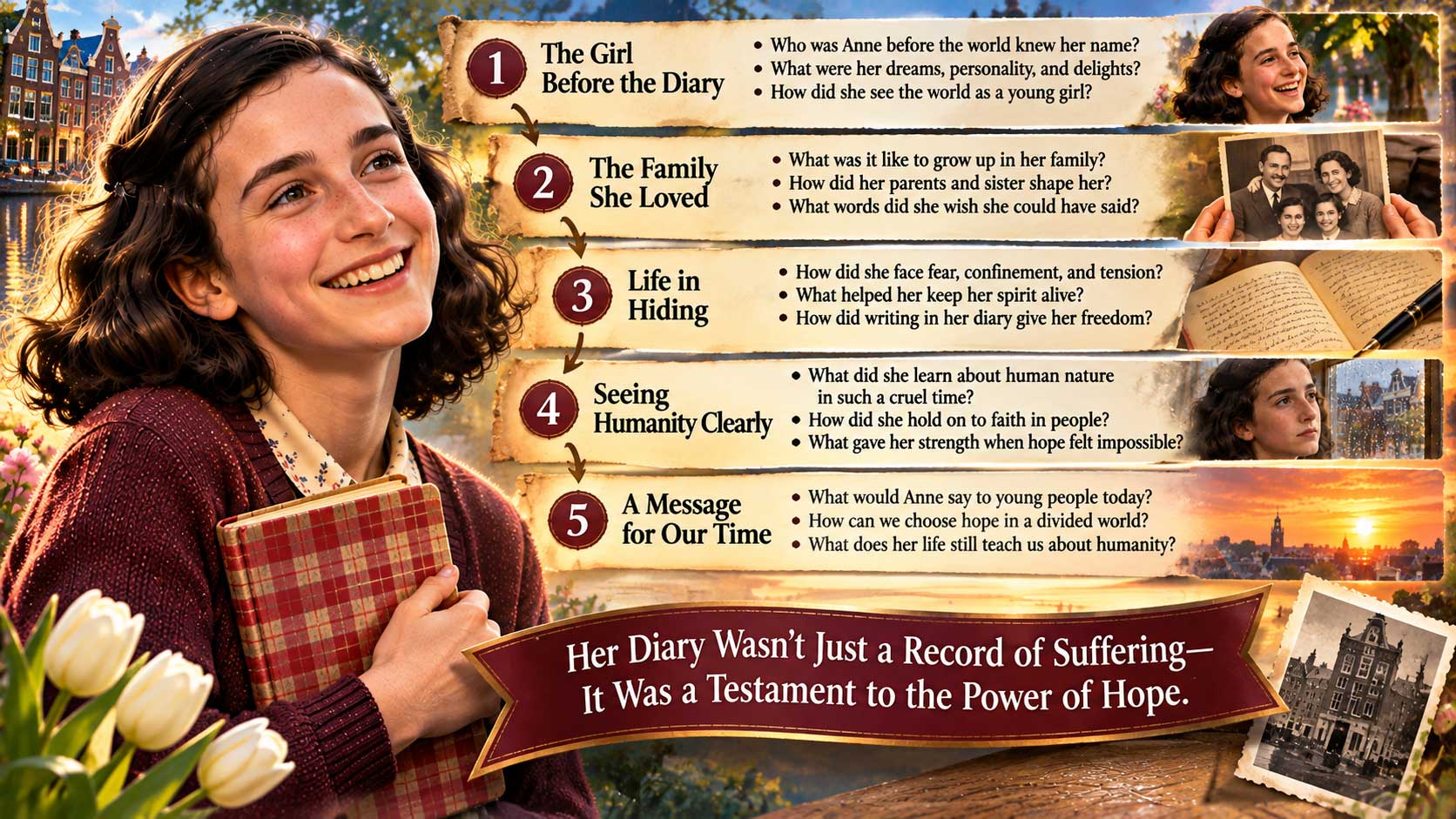
Short Bios:
Anne Frank (1929–1945)
Anne Frank was a Jewish German-born diarist and aspiring writer whose family moved to Amsterdam after the Nazis came to power in Germany. In July 1942, she entered hiding with her family in the Secret Annex, where she continued writing her diary, stories, and reflections. In 1944, she began revising her diary with the intention of publishing a book after the war. Following her arrest in August 1944, she was deported to Nazi concentration camps and died at Bergen-Belsen in early 1945, aged fifteen. Her father, Otto Frank, arranged for her diary to be published in 1947. Her writings remain among the most widely read firsthand accounts associated with the Holocaust.
Learn more: Anne Frank House, Who Was Anne Frank? | United States Holocaust Memorial Museum, Anne Frank Biography
Nick Sasaki
Nick Sasaki is the creator of ImaginaryTalks.com, a creative storytelling platform that brings historical figures, writers, thinkers, and other influential people into fictional conversations. His interviews explore the personalities, experiences, ambitions, and unanswered questions behind familiar names. Through imaginative dialogue informed by research, he invites readers to consider different perspectives and encounter historical subjects in a more personal way.
In this fictional interview, Nick approaches Anne Frank with curiosity and warmth, giving her room to express humor, uncertainty, disagreement, and the ambitions of a young writer whose life ended far too soon.
Leave a Reply