
Introduction
A Christian father refuses to welcome his daughter's Muslim fiancé into his home. He believes he is protecting his faith in Jesus Christ. His daughter believes he has rejected someone she loves without ever trying to know him. As the weeks pass, family dinners become painfully quiet, and the chair where she once sat remains empty. The father continues attending church, reading his Bible, and praying. Yet a troubling question begins to follow him: What if the way he is defending his faith is contradicting the very teachings of Jesus he wants to uphold?
What does it truly mean to be a Christian? Is it believing that Jesus Christ is the Son of God? Following His commandments? Receiving God's grace and seeking forgiveness? Loving one's neighbor, including those whose beliefs differ from our own? These questions are closely connected, but they are not identical. Christianity has distinctive theological convictions that cannot simply be replaced with a general message about kindness. At the same time, Jesus' commandment to love God and one's neighbor, recorded in Matthew 22:34–40, challenges believers to consider whether their actions reflect the faith they profess.
To explore these questions, Nick Sasaki brings together six remarkable figures in an imaginary monastery: Archbishop Desmond Tutu, the 14th Dalai Lama, Jalaluddin Rumi, Confucius, Mahatma Gandhi, and Rabbi Abraham Joshua Heschel. Each approaches the conversation through a distinct religious or philosophical tradition. Their differences are not obstacles to be conveniently erased. Instead, they become an opportunity to examine Christian discipleship from perspectives that Christians may rarely encounter in the same conversation.
Archbishop Desmond Tutu brings the discussion back repeatedly to Jesus Christ, grace, repentance, forgiveness, and the Christian responsibility to confront injustice. His opposition to apartheid was deeply connected to his Christian convictions. Recognized with the 1984 Nobel Peace Prize, Tutu demonstrated that religious faith can inspire moral courage in the face of oppression. Yet his perspective raises a demanding question: What happens when Christians defend their religious identity more fiercely than they practice the love and humility their faith requires?
Rabbi Abraham Joshua Heschel introduces another essential dimension. Jesus was Jewish, and Christianity emerged from a Jewish historical and religious setting. But Judaism is not simply an earlier chapter of Christianity. It remains a living tradition with its own covenantal identity, obligations, and interpretations of scripture. Heschel, who escaped Nazi persecution and later participated in the American civil rights movement alongside Martin Luther King Jr., challenges Christians to confront antisemitism and the dangers of religious arrogance. His life and public work are documented by Stanford University's Martin Luther King, Jr. Research and Education Institute.
The other four guests broaden the discussion without pretending that their teachings are interchangeable. The Dalai Lama approaches compassion through Buddhist philosophy and the recognition of human suffering. Rumi examines love, humility, and spiritual transformation through Islamic devotion. Gandhi challenges the use of violence and coercion in the name of righteous causes, drawing upon his commitment to truth and nonviolence. Confucius asks whether religious and moral principles are visible in the way people actually treat their families, neighbors, and communities. Their perspectives bring fresh questions to Christian beliefs without requiring Christianity to abandon its distinctive understanding of Jesus.
Across five conversations, the setting moves from a sunlit monastery library to a peaceful garden, a rain-soaked stone walkway, and a candlelit dining room. The participants explore what it means to follow Jesus, whether people can love one another without accepting the same religious teachings, why religion has sometimes been used to justify persecution, and what genuine repentance and reconciliation demand. The discussion becomes increasingly personal when Nick introduces the fictional story of Daniel, his daughter Emily, and her Muslim fiancé Amir. Daniel's fear of an interfaith marriage gradually becomes a test of his own character, his relationship with his daughter, and his willingness to examine the difference between sincere conviction and harmful conduct.
At the heart of this imaginary gathering is a question that reaches beyond religious debate: Can we remain faithful to what we believe without losing our capacity to love those who believe differently? The six guests do not arrive at one shared theology. Their disagreements about Jesus, God, revelation, and religious obligation remain meaningful. Yet their conversations reveal why honesty, humility, compassion, and moral responsibility matter when faith becomes difficult. The most revealing moment may not occur during an argument about scripture, but when a father finally opens his front door to the young man he once refused to meet.
Fictional Conversation Disclaimer
This article is an entirely fictional conversation created for ImaginaryTalks.com. The monastery gathering, dialogue, personal interactions, emotional responses, and family story involving Daniel, Emily, Margaret, and Amir are imagined. The historical participants did not take part in this discussion, and their fictional statements are not authentic quotations or endorsements, including by the living 14th Dalai Lama. The conversation draws upon documented biographies, religious traditions, and historical events, but interpretations of how these figures might respond are creative reconstructions. Readers should consult the linked sources for verified historical information.
Topic 1: What Does It Really Mean to Be a True Christian?
Opening: A Question at the Monastery
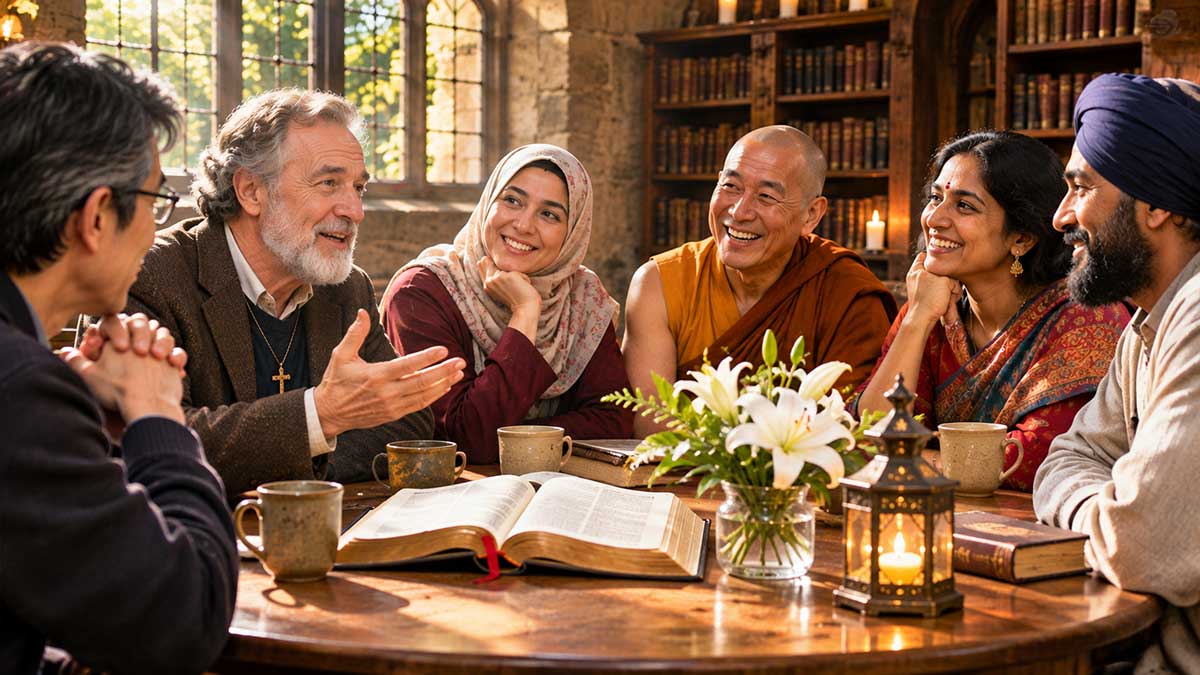
The first rays of morning sunlight entered the old monastery library through tall arched windows.
Golden light fell across shelves of weathered books, a stone fireplace, and a round wooden table. At its center lay an open Bible, its thin pages moving gently in the breeze.
Seven chairs surrounded the table.
Nick Sasaki had invited six extraordinary guests: Archbishop Desmond Tutu, the 14th Dalai Lama, Jalaluddin Rumi, Confucius, Mahatma Gandhi, and Rabbi Abraham Joshua Heschel.
They came from different centuries and religious traditions. In ordinary history, this gathering could never have happened. But here, in this imaginary meeting, they had come together to consider a question that continued to trouble believers and nonbelievers alike.
What does it really mean to be a true Christian?
Archbishop Tutu looked around the room with a broad smile.
Desmond Tutu: "Well, Nick, you've assembled quite a gathering! I hope you've arranged for lunch. Looking at these gentlemen, I suspect we could spend several days on your question."
Nick Sasaki: "I was hoping we'd finish before dinner."
Dalai Lama: "Then perhaps you should ask easier questions!"
Everyone laughed.
Nick: "I'm glad we're starting this way. I don't want this to feel like a religious examination. I want us to talk as friends, ask difficult questions, and learn from one another."
He looked around the table.
Nick: "I believe humanity is one family under one God. That's a conviction very close to my heart. But I know we don't all share the same beliefs, and I don't want anyone here to pretend otherwise."
Abraham Joshua Heschel: "Then we have a promising beginning. Respect for another person need not require the surrender of one's own convictions."
Nick: "Exactly."
Nick glanced at the open Bible.
Nick: "I've met Christians whose kindness made me feel closer to God. I've met others who spoke constantly about Jesus but seemed unable to show compassion to someone who believed differently."
He paused.
Nick: "And I've met people outside Christianity whose kindness and moral courage were extraordinary."
Mahatma Gandhi: "Then perhaps your question concerns both religious identity and the way a person lives."
Nick: "Yes. Are they the same thing? Can someone be a good person without being Christian? Can someone sincerely believe in Jesus and still fail to follow His teachings?"
Tutu leaned forward, his smile softening.
Tutu: "Ah, Nick. Now we have a question worth staying for."
Question 1. Archbishop Tutu, when Jesus called people to follow Him, what did He ask them to become?
Nick: "Archbishop, I'd like to begin with you. When Jesus called people to follow Him, what was He asking them to become? Was it primarily about believing certain things, living a certain way, or something deeper?"
Tutu: "I would begin with Jesus Himself."
He rested his hands on the table.
Tutu: "Christianity is not simply a collection of beautiful moral instructions. It is centered upon Jesus Christ, upon who Christians believe He is, what God has done through Him, and what it means to respond to His call."
Nick: "So being Christian is more than being kind."
Tutu: "Certainly. A person can be wonderfully kind without being Christian. Christianity makes particular claims about Jesus, His life, His death, and His resurrection. Christians believe that God's grace reaches us through Christ and calls us into a transformed relationship with God and our neighbors."
Nick: "But when people look at Christians, shouldn't they be able to recognize something of Jesus in their behavior?"
Tutu: "They should hope to see the fruits of faith. But let us be careful. Christians are not people who have already achieved perfection."
He smiled.
Tutu: "If perfection were the entrance requirement for the Church, I fear the building would be rather empty."
The guests laughed.
Nick: "Including the archbishop?"
Tutu: "Especially the archbishop! I should have to stand outside and ask whether anyone had remembered to leave the door open."
Dalai Lama: "Then perhaps I could bring you some tea."
Tutu: "And I would accept it with gratitude!"
Their laughter filled the library.
Nick: "But seriously, Archbishop, what's the relationship between faith and conduct?"
Tutu: "Christian discipleship involves faith, grace, repentance, and the continuing effort to live according to Christ's teachings. Love is not a substitute for faith in Christ, but neither should faith become an excuse for failing to love."
Nick: "Could you explain that through something Jesus taught?"
Tutu: "Consider His command to love one's enemies."
Nick leaned forward.
Tutu: "It is easy to love someone who loves you. It is easy to be generous to someone who admires you. But Jesus challenges His followers to love beyond those comfortable boundaries."
Nick: "Even someone who hates you?"
Tutu: "Yes. And that is a demanding teaching. It does not mean approving injustice or allowing someone to continue harming others. It means refusing to let hatred determine the way we regard another human being."
Gandhi: "That teaching from the Sermon on the Mount made a profound impression upon me."
Nick: "I was hoping you'd speak about that, Gandhi."
Gandhi: "Jesus' teachings concerning love, nonretaliation, and the treatment of enemies challenged me deeply. They resonated with my own search for truth and nonviolence."
Nick: "Yet you remained Hindu."
Gandhi: "Yes. I could admire the moral teachings of Jesus without adopting the Christian understanding of His divine identity."
Tutu: "And that is an honest distinction. Gandhi, you and I might agree about the moral seriousness of loving an enemy, yet disagree about who Jesus is and what His life means."
Gandhi: "Certainly."
Nick: "Then here's a difficult question. If Gandhi follows the teaching of loving his enemies more faithfully than a Christian who hates his enemies, who is closer to what Jesus wanted?"
Tutu considered the question.
Tutu: "We must distinguish two matters. Christian identity concerns faith in Christ. Christian discipleship concerns how that faith is lived. I would not claim the authority to judge the final standing of either person before God."
Nick: "But you would question the Christian's behavior."
Tutu: "Very seriously. Jesus' teaching should challenge a Christian who treats others with contempt."
Nick: "So saying 'I believe in Jesus' doesn't make every action I take an expression of His teachings."
Tutu: "Exactly. Faith calls for a continuing response. When we fail, we must recognize the failure, repent, and seek to change."
Confucius: "May I ask a question?"
Nick: "Please."
Confucius: "If a person speaks continually of goodness but neglects the proper treatment of those nearest to him, what should others make of his character?"
Nick: "You would judge the sincerity of his words by his conduct."
Confucius: "Words deserve examination through action. Humaneness is not established merely by declaring oneself humane."
Nick: "What if the person sincerely wishes to be good but keeps failing?"
Confucius: "Then he must continue the work of cultivating his character. Recognition of failure should lead to correction."
Tutu: "There is an interesting point of contact there. But Christianity places particular importance on grace. We are not simply improving ourselves through moral effort. We depend upon God's forgiveness and love."
Confucius: "Then our explanations of moral development differ."
Tutu: "They do."
Confucius: "Yet both explanations appear to demand that a person's conduct be taken seriously."
Tutu: "Indeed."
Nick smiled.
Nick: "I appreciate that exchange. You're finding something meaningful to discuss without pretending you believe exactly the same thing."
Dalai Lama: "In Buddhist practice, we speak of training the mind and developing compassion. A person may sincerely wish to be compassionate and still become angry."
Nick: "You get angry?"
Dalai Lama: "Of course! I am a human being."
Nick: "That's reassuring."
Dalai Lama: "Perhaps you expected something more impressive?"
Nick: "I was hoping you'd tell me the secret to never becoming irritated."
Dalai Lama: "If you discover it, please tell me."
The laughter returned.
Rumi: "The human heart is capable of speaking beautifully about devotion while remaining occupied with its own importance."
Nick: "So spiritual pride can become an obstacle."
Rumi: "Yes. The person who seeks God must examine the self that wishes to be admired for seeking Him. Devotion asks more of us than the appearance of holiness."
Nick: "Archbishop, that brings me to something I find troubling. A Christian might attend church every Sunday, pray every day, and study the Bible carefully, yet treat a Muslim or Jewish neighbor with suspicion or contempt."
Tutu: "Then that Christian needs to return to the teachings of Jesus with greater humility."
Nick: "Would you say that person isn't a real Christian?"
Tutu: "I would be cautious about making such a declaration. I can challenge conduct that contradicts Christian teaching without pretending to know the whole condition of another person's soul."
Nick: "So the question 'Who is a true Christian?' can become dangerous if we use it mainly to judge other people."
Tutu: "Yes. It is often more fruitful to ask whether we ourselves are becoming more faithful followers of Christ."
Nick looked down at the Bible.
Nick: "That's a different question."
Tutu: "And perhaps a more uncomfortable one."
Question 2. Rabbi Heschel, what do Christians need to appreciate about the Jewish religious tradition in which Jesus lived and taught?
Nick turned toward Rabbi Heschel, who had been listening attentively.
Nick: "Rabbi, I have a confession to make."
Heschel: "Please."
Nick: "When I first thought about this gathering, I invited representatives of Christianity, Buddhism, Islam, Hinduism, and Confucian thought."
He hesitated.
Nick: "I nearly forgot Judaism."
A brief silence followed.
Nick: "And we're discussing Jesus. Looking back, I can't believe I overlooked something so fundamental."
Heschel regarded him thoughtfully.
Heschel: "Perhaps the oversight offers us an opportunity to examine how easily a religious tradition can become invisible when others tell its story."
Nick: "That's fair."
Heschel: "But let us not remain occupied with the oversight. What matters is whether we are willing to learn."
Nick: "Then let me ask you directly. What do Christians need to appreciate about the Jewish tradition in which Jesus lived and taught?"
Heschel: "They should begin with the recognition that Jesus was a Jew."
He glanced toward the open Bible.
Heschel: "His life unfolded within Jewish history, Jewish scripture, Jewish worship, and Jewish religious concerns. His teachings cannot be separated from that setting."
Nick: "Sometimes Christians speak as though Jesus introduced love and compassion into a world that had never known them."
Heschel: "That would be a serious misunderstanding."
Nick: "Why?"
Heschel: "The Hebrew scriptures contain profound commandments concerning love, justice, mercy, and responsibility toward others. The commandment to love one's neighbor appears in Leviticus. The prophets repeatedly confronted those who neglected the poor, oppressed the vulnerable, or treated worship as a substitute for righteousness."
Nick: "So when Jesus taught people to love God and their neighbors, He was drawing upon a living Jewish tradition."
Heschel: "Yes. Christians interpret His teachings within their understanding of Christ. Jews approach the scriptures through their own religious tradition. Those interpretations differ, but the Jewish origins should not be forgotten."
Tutu: "I agree. Christians must remember that Jesus belonged to the Jewish people. His earliest followers were Jewish, and the scriptures He knew were Jewish scriptures."
Nick: "Rabbi, let me ask something that may sound uncomfortable. Do you ever feel that Christians treat Judaism merely as a preparation for Christianity?"
Heschel: "We should distinguish between how Christians understand their own religious history and how they regard Judaism as a living tradition."
Nick: "What distinction would you make?"
Heschel: "Christian theology may interpret Jewish scripture in relation to Jesus. But Jews do not understand their faith simply as an unfinished version of Christianity. Judaism has its own covenantal commitments, religious life, and continuing relationship with God."
Nick: "So when I invite you to this table, I shouldn't ask you merely to explain Christianity's origins."
Heschel: "I would hope to be heard as a Jewish thinker speaking from Judaism itself."
Nick: "That's exactly what I want."
Heschel: "Then let us examine another question."
Nick: "Please."
Heschel: "Why do you suppose it is possible for a person to study religious teachings about love and still fail to recognize the suffering of another human being?"
Nick paused.
Nick: "Perhaps the person becomes more concerned with defending beliefs than practicing them."
Heschel: "That may happen. The Hebrew prophets were deeply concerned with the separation of worship from justice. Religious observance cannot become an excuse for moral indifference."
Nick: "Can you give us an example?"
Heschel: "Consider the prophetic tradition represented by Isaiah and Amos. The prophets challenged communities that maintained religious practices while tolerating oppression and injustice."
Nick: "So the problem wasn't that people had stopped practicing religion."
Heschel: "The problem could be that religious practice had become separated from the obligations of righteousness."
Tutu: "That speaks to a painful part of Christian history as well. People have sometimes claimed to defend Christianity while participating in injustice."
Nick: "Including apartheid."
Tutu: "Yes. Some defended racial separation through religious arguments, though other Christians resisted it from deeply held Christian convictions."
Nick: "Rabbi, you stood alongside Martin Luther King Jr. during the American civil rights movement."
Heschel: "The struggle against racial injustice demanded moral attention."
Nick: "You were Jewish. King was Christian. You didn't agree about Jesus."
Heschel: "No. But we could recognize the moral urgency of opposing racial injustice."
Nick: "Did that require either of you to set aside your religion?"
Heschel: "Our religious commitments helped inform our moral responsibilities. Cooperation did not require the disappearance of our differences."
Nick: "That's a powerful example of what we're discussing."
Rumi: "There is a question here that concerns every person who speaks of devotion to God."
Nick: "What question?"
Rumi: "Does devotion turn the person away from arrogance, or does the person use religious language to conceal it?"
Nick: "And you would approach that through your Islamic faith."
Rumi: "Yes. My reflections upon love, spiritual discipline, and the transformation of the heart belong within devotion to God as understood through Islam. They should not be separated from that foundation."
Heschel: "That distinction deserves respect. Religious traditions may encounter similar moral questions without offering identical theological answers."
Nick: "Rabbi, I'd like to ask one more thing. Christians believe Jesus is the Messiah and Son of God. Judaism does not accept those claims in the same way."
Heschel: "That is a substantial difference."
Nick: "Can we acknowledge it openly without damaging our friendship?"
Heschel: "We should. A friendship built upon the concealment of essential differences would be a fragile friendship."
Tutu: "And I would not want Rabbi Heschel to pretend to believe what he does not believe merely to make me comfortable."
Heschel: "Nor would I ask you to conceal your Christian convictions."
Nick: "So the challenge is to remain honest without becoming hostile."
Heschel: "Yes. And honesty should include the willingness to examine our own religious communities when they have failed morally."
Nick nodded slowly.
Nick: "I invited you here to help me ask what makes someone a true Christian. You've reminded me that the question cannot be answered responsibly without recognizing Jesus' Jewish world and the continuing dignity of Jewish religious life."
Heschel: "Then our conversation has begun to accomplish something worthwhile."
Question 3. If someone professes faith in Jesus but treats people of other religions with contempt, what does that reveal about their discipleship?
The morning sunlight had shifted across the table.
Beyond the tall windows, birds moved among the trees in the monastery garden. Inside, the atmosphere remained friendly, but the questions had become more demanding.
Nick turned toward Tutu.
Nick: "Archbishop, I want to return to the original question, but from a different direction."
Tutu: "Go ahead."
Nick: "Suppose someone says, 'I believe Jesus Christ is the Son of God. I believe salvation comes through Him. I attend church, pray, and study the Bible.'"
He paused.
Nick: "But that person treats Muslims, Jews, Buddhists, or Hindus with contempt."
Nick: "What does that reveal about their Christian discipleship?"
Tutu: "It reveals a serious contradiction between their professed faith and their conduct."
Nick: "Would you tell them they are wrong about Jesus?"
Tutu: "Not necessarily. Their theological confession may reflect Christian teaching. But possessing a correct statement of belief does not mean every attitude or action has been shaped by that belief."
Nick: "So a person can be theologically convinced and morally mistaken."
Tutu: "Certainly."
Nick: "What if the person says, 'I love these people, but I believe their religions are wrong'?"
Tutu: "Then we should ask what that love means in practice."
Nick: "What would you look for?"
Tutu: "Does the person listen? Does the person speak truthfully without humiliation? Does the person offer help when someone suffers? Does the person recognize the other's dignity?"
Nick: "But some Christians worry that respecting another religion means accepting its teachings."
Tutu: "Respecting a person and affirming every religious claim are not identical."
Heschel: "I would add something."
Nick: "Please."
Heschel: "Respect cannot mean merely tolerating another person while privately regarding that person's humanity as inferior."
Nick: "So there's a difference between saying 'I'll tolerate you' and genuinely recognizing someone's dignity."
Heschel: "Yes. The other person is not simply an object upon which we demonstrate our generosity."
Nick thought for a moment.
Nick: "That challenges something in me. Sometimes people speak of tolerance as though the tolerant person occupies a higher position and graciously permits everyone else to exist."
Heschel: "A relationship founded upon superiority may not be as respectful as it appears."
Dalai Lama: "Perhaps we should begin by remembering that the other person is a human being, like ourselves."
Nick: "Before thinking about religion?"
Dalai Lama: "We need not forget religion. But we can recognize that the person wishes to be happy and does not wish to suffer."
Nick: "What if I believe the person's religious views are mistaken?"
Dalai Lama: "You may disagree. Yet disagreement does not remove the need for compassion."
Nick: "Would you ever challenge someone's beliefs?"
Dalai Lama: "There can be respectful discussion. But I would not want a person to abandon a religion merely through pressure or confusion. Religious commitment deserves serious thought."
Nick: "Gandhi, you spent years resisting injustice. How do you distinguish loving someone from accepting what that person does?"
Gandhi: "We must be willing to oppose wrongdoing without treating the wrongdoer as someone beyond moral concern."
Nick: "Is that possible when the person has caused terrible suffering?"
Gandhi: "It is difficult. Nonviolence is not passive acceptance of injustice. It demands courage, discipline, and a refusal to make hatred the foundation of our actions."
Nick: "Archbishop, you've spoken about forgiveness in the context of apartheid. Could you forgive someone who sincerely believed racial separation was God's will?"
Tutu: "Forgiveness is not the same as approving what someone has done. Nor does it remove the need for truth and accountability."
Nick: "But would you still recognize the person's humanity?"
Tutu: "Yes. That recognition is part of what makes reconciliation possible, though reconciliation itself may require a long and difficult process."
Nick: "So loving an enemy doesn't mean pretending there was no injustice."
Tutu: "Exactly."
Confucius: "A person who seeks to act rightly must distinguish between respect for others and approval of improper conduct."
Nick: "How would you advise someone who becomes angry whenever another person challenges their beliefs?"
Confucius: "I would encourage the person to examine his own character. Does he respond with thoughtfulness? Does he listen? Does he allow resentment to govern his conduct?"
Nick: "That's difficult when the disagreement feels personal."
Confucius: "Then the need for self-cultivation is especially clear."
Rumi: "A person may believe that he is defending something sacred, yet fail to recognize how much of his anger arises from pride."
Nick: "How can we tell the difference?"
Rumi: "We must examine ourselves sincerely. Does our devotion make us more humble before God, or more occupied with proving our superiority?"
Nick: "That question could make a lot of religious people uncomfortable."
Tutu: "Including those of us sitting here."
Nick: "I was going to say that."
Tutu: "Then I have saved you the trouble!"
Everyone laughed.
Nick smiled, then grew thoughtful.
Nick: "I want to make this more personal."
The others turned toward him.
Nick: "Suppose a Christian father learns that his daughter has fallen in love with a Muslim man."
Nick: "The father believes Jesus is the Son of God. He worries about his daughter's future, her marriage, and the religious upbringing of her children."
Nick: "He becomes frightened. Perhaps angry."
Tutu: "Those concerns may be deeply meaningful to him."
Nick: "Yes. But then he tells his daughter that her boyfriend is not welcome in their home."
Heschel: "Has he met the young man?"
Nick: "No."
Heschel: "Then he has judged someone without knowing him."
Nick: "The father says he's protecting his Christian faith."
Tutu: "I would ask whether refusing to recognize the young man's humanity is truly an expression of Christian discipleship."
Nick: "What if the father says, 'I cannot approve of this relationship'?"
Tutu: "He can express his concerns honestly. But expressing a religious conviction is different from humiliating or rejecting another human being."
Gandhi: "And the daughter has a conscience of her own."
Nick: "So we should hear her voice, too."
Heschel: "Certainly. She must not disappear from the conversation simply because others are debating her future."
Dalai Lama: "The father's fear may cause suffering for everyone involved."
Nick: "And he may not recognize that until the relationship is badly damaged."
Confucius: "Then he must examine whether his conduct has fulfilled his responsibilities as a father."
Nick: "Archbishop, what would Jesus ask of that father?"
Tutu considered the question.
Tutu: "I would invite him to return to Jesus' teachings and examine his own heart. Has he acted with love? Has he listened? Has he treated his daughter and the young man with dignity? Has fear become an excuse for cruelty?"
Nick: "Would he have to abandon his belief that Jesus is the Christ?"
Tutu: "No. He would need to consider how faithfully he is living in response to Christ."
Nick: "So the question is not simply whether he has the right beliefs."
Tutu: "It is whether those beliefs are helping shape a life of faith, repentance, and love."
Nick was quiet for a moment.
Nick: "I think that's what I was searching for when we began."
Tutu: "And what have you found?"
Nick: "That being a Christian isn't simply being nice. It involves faith in Jesus Christ, grace, and a serious commitment to following Him."
He paused.
Nick: "But claiming to follow Jesus doesn't give someone permission to despise people who believe differently."
Tutu: "That is a meaningful distinction."
Nick: "And perhaps the question 'Am I a true Christian?' should make me examine myself before I use it to judge somebody else."
Heschel: "Self-examination is a demanding beginning."
Gandhi: "And it must continue through our conduct."
Dalai Lama: "With compassion."
Confucius: "And sincerity."
Rumi: "Without allowing pride to disguise itself as devotion."
Tutu smiled.
Tutu: "Well, Nick, I think we have given you enough to think about until lunch."
Nick: "At least until lunch."
Dalai Lama: "Perhaps longer."
Everyone laughed.
Closing: A Friendship That Does Not Require Agreement
The monastery bells sounded in the distance.
Nick gently closed the Bible, leaving a ribbon between its pages.
The conversation had not produced a simple formula for determining who was a true Christian. Instead, it had revealed a question that reached into the heart of Christian discipleship.
For Archbishop Tutu, Christianity remained centered on Jesus Christ, God's grace, repentance, and a life transformed by faith. Love was not a replacement for Christian belief. It was one of the ways that faith should become visible in human relationships.
Rabbi Heschel had reminded the gathering that Jesus lived within Jewish history and that Judaism remained a living religious tradition deserving respect in its own right.
Gandhi, Confucius, Rumi, and the Dalai Lama had approached the moral questions from their own distinctive traditions, sometimes finding points of contact without claiming theological agreement.
Nick looked around the table.
Nick: "I want to thank all of you. You've helped me see that this question is much deeper than I expected."
Tutu: "The difficult questions usually are."
Nick: "But something else has happened."
Dalai Lama: "What is that?"
Nick: "I feel that we're becoming friends."
Tutu: "A very encouraging development."
Nick: "Yet we disagree about some of the most important questions in human life."
Heschel: "Friendship need not depend upon complete agreement."
Nick: "But what happens when the disagreement concerns something we believe is eternally important?"
Heschel considered the question.
Heschel: "Then our willingness to respect one another may be tested more deeply."
Nick: "And if I believe Jesus is the Christ, but my friend does not?"
Tutu: "You can remain faithful to Christ while treating your friend with genuine love."
Nick: "But can that friendship survive a serious conversation about our differences?"
Dalai Lama: "Perhaps we should find out."
Tutu rose from his chair and looked toward the monastery garden.
Tutu: "An excellent suggestion. And I believe there is tea waiting outside."
Nick: "You seem very interested in the refreshments, Archbishop."
Tutu: "Nick, spiritual conversations are demanding work. One must maintain one's strength."
The guests laughed as they rose from the table.
Sunlight now filled the monastery garden, illuminating the flowering trees and the small reflecting pool.
Nick followed the others toward the open doors.
He had begun the morning wondering what it meant to be a true Christian.
Now another question had taken hold of him.
Could people love one another deeply without accepting one another's religion?
And could a friendship remain genuine when neither person was willing to surrender what they believed to be true?
The seven companions stepped into the sunlight, carrying their convictions with them.
Their next conversation would begin with those differences still fully intact.
Topic 2: Can You Love Someone Without Accepting Their Religion?
Opening: Friendship Beneath the Flowering Trees
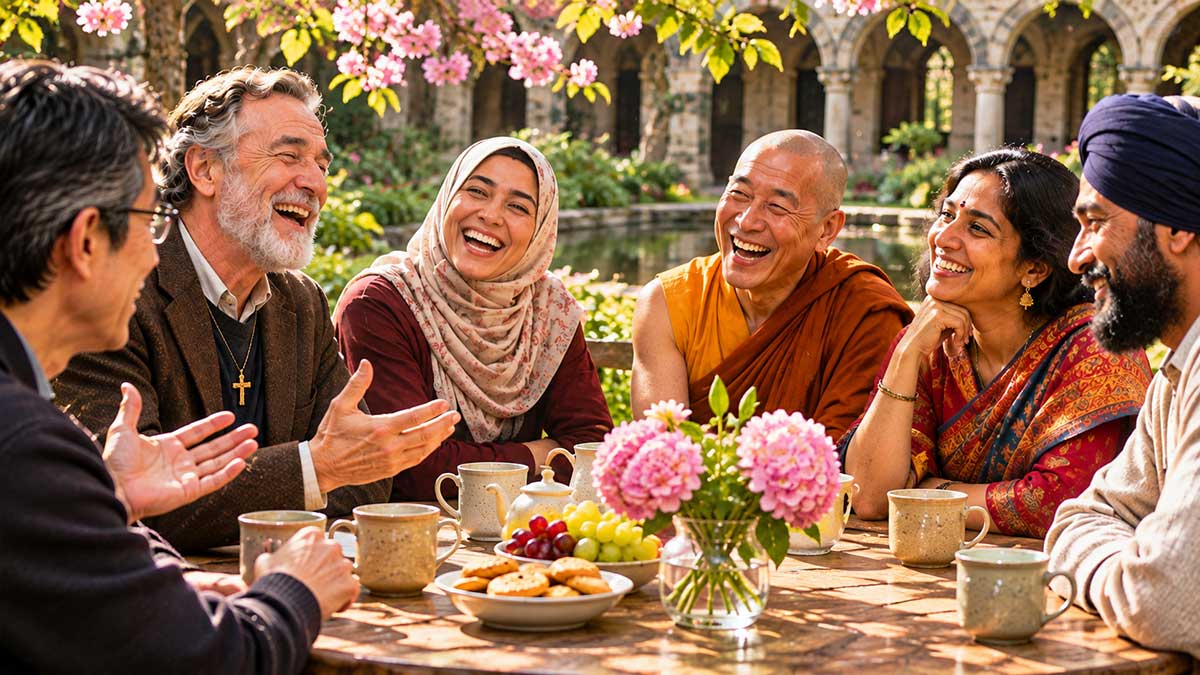
The monastery garden was filled with the gentle warmth of midday.
Sunlight filtered through flowering branches, scattering patches of gold across the stone courtyard. A narrow stream flowed into a small reflecting pool, and the scent of roses drifted through the open arches.
At the center of the garden stood a round wooden table.
Seven chairs surrounded it.
Nick Sasaki arrived with Archbishop Desmond Tutu, the Dalai Lama, Jalaluddin Rumi, Confucius, Mahatma Gandhi, and Rabbi Abraham Joshua Heschel.
Their morning conversation had begun with a question about Christian discipleship. They had examined faith in Jesus Christ, the Jewish foundations of His teachings, and the moral responsibilities that accompany religious conviction.
Now, as they settled beneath the flowering trees, Nick found himself facing a question that felt less theological and more personal.
Could people who believed fundamentally different things about God genuinely love one another?
Archbishop Tutu reached for the teapot.
Desmond Tutu: "Well, my friends, I believe our first conversation was a success."
Nick Sasaki: "What makes you say that?"
Tutu: "We discussed religion for several hours, and nobody tried to throw anyone else out of the monastery."
Dalai Lama: "The day is still young."
Everyone laughed.
Nick: "I was hoping we could maintain our good record."
Tutu: "Then perhaps we should begin with tea. Tea has a wonderful way of encouraging patience."
Gandhi: "Patience is valuable, but it does not remove the need for honest disagreement."
Tutu: "Ah, Gandhi. You are determined to make us work before we eat."
Gandhi: "I thought that was why we came."
Nick: "It is. But I appreciate the tea."
Nick looked around the table.
Nick: "There's something remarkable about this gathering. Archbishop Tutu believes Jesus Christ is the Son of God. Rabbi Heschel does not share that belief. Rumi approaches God through Islam. The Dalai Lama approaches spiritual life through Buddhism. Gandhi and Confucius bring still different traditions."
He paused.
Nick: "Yet I feel comfortable sitting with all of you."
Dalai Lama: "That is good."
Nick: "But I wonder whether our friendship would survive if we stopped being polite and began discussing the things we truly disagree about."
Heschel placed his cup on the table.
Abraham Joshua Heschel: "Perhaps that is precisely what a genuine friendship should be able to withstand."
Question 4. Dalai Lama, what makes friendship across different religious convictions possible?
Nick: "Your Holiness, I'd like to begin with you. You've spent much of your life meeting people from different religious traditions. You've spoken often about compassion and religious harmony."
Nick: "What makes genuine friendship possible when two people disagree about something as fundamental as God?"
Dalai Lama: "I think we should begin with something very ordinary. Before we identify another person as Christian, Buddhist, Muslim, Hindu, or Jewish, that person is a human being."
Nick: "And that matters more than the label?"
Dalai Lama: "It is a necessary beginning. The person wishes to be happy and does not wish to suffer. We share that experience."
Nick: "But our religious beliefs can shape our entire lives."
Dalai Lama: "Yes. I would not ask you to treat those differences as unimportant. Religious traditions offer different explanations of reality, and we should be honest about them."
Nick: "Then let me ask something difficult. I believe in one God who created humanity. You don't share that belief in the same way."
Dalai Lama: "Correct. Buddhist philosophy does not depend upon belief in a creator God."
Nick: "So when I say we're one family under one God, you may appreciate the intention, but you don't accept the theology."
Dalai Lama: "I can appreciate your concern for humanity. I would explain our connection through interdependence and compassion."
Nick: "Would you ever try to persuade me that Buddhism offers a better explanation?"
Dalai Lama: "We can discuss philosophical questions seriously. But I would be cautious about encouraging someone to change religion without careful reflection. A person may find deep meaning in a tradition that differs from mine."
Nick: "That sounds very respectful."
Dalai Lama: "Respect does not mean I agree with every belief."
Nick: "What if I sincerely believe that faith in Jesus Christ is necessary for salvation?"
Dalai Lama: "Then that is an important part of your Christian conviction. I would not pretend to share it. But I can still recognize your kindness, your concern for others, and your humanity."
Tutu: "And I can recognize yours, Your Holiness."
Dalai Lama: "Very good. We are making progress."
Tutu: "Though I must say, we still disagree about some rather substantial matters."
Dalai Lama: "Yes. But you make good company."
The guests laughed.
Nick: "Archbishop, let me ask you something. If you believe Jesus is the Son of God, can you be close friends with someone who rejects that belief?"
Tutu: "Certainly. My faith in Christ is not weakened simply by sitting beside someone who believes differently."
Nick: "But some Christians fear that friendship means compromise."
Tutu: "Then I would ask what they mean by compromise. If friendship requires me to deny Christ, that would present a serious problem for my conscience. But sharing a meal, listening, helping someone in need, and developing affection for another human being do not require me to abandon my faith."
Nick: "What if the other person openly says Christianity is mistaken?"
Tutu: "I may disagree. I may explain why. But disagreement need not destroy friendship."
Gandhi: "There is a danger in making agreement the condition for human affection. If we do so, we may begin to regard everyone who disagrees with us as an opponent."
Nick: "But Gandhi, you devoted your life to truth. You didn't believe every opinion was equally correct."
Gandhi: "No. The search for truth demands seriousness. Yet I must remain aware of my own limitations and refuse to use coercion as a substitute for persuasion."
Confucius: "Friendship should encourage sincerity and moral improvement. A person who offers agreement merely to please another may not be acting as a faithful friend."
Nick: "So sometimes a good friend tells you that you're wrong."
Confucius: "If the correction is offered with sincerity and proper consideration."
Nick: "And if the friend refuses to listen?"
Confucius: "One should examine whether further argument will be useful. Repeated insistence does not necessarily produce wisdom."
Nick: "That's something I need to learn."
Tutu: "You and several billion others, Nick."
Laughter moved around the table.
Nick: "Your Holiness, can I ask a more personal question? Have you ever met someone whose religious convictions you disagreed with but whose character you deeply admired?"
Dalai Lama: "Certainly. I have met many religious practitioners whose dedication, kindness, and discipline deserve respect. Their traditions may differ from Buddhism, but I can appreciate the qualities they cultivate."
Nick: "So you don't need to believe their religion is correct in every respect to recognize goodness in their lives."
Dalai Lama: "Exactly."
Nick: "And that recognition can become friendship."
Dalai Lama: "Yes. Friendship grows when we see the human being rather than only the difference."
Nick looked around the table.
Nick: "I think we've established something important. We can remain committed to our own traditions and still become friends."
He paused.
Nick: "But I suspect the next question will be harder."
Heschel: "Then perhaps we should ask it."
Question 5. Rumi, how does devotion to God shape the way a person should treat someone whose faith differs?
A gentle breeze stirred the flowering branches.
Several petals drifted onto the table, settling beside the teacups.
Nick turned toward Rumi.
Nick: "Rumi, your poetry has reached people far beyond the Muslim world. Many readers encounter your words about love without knowing much about your religious life."
Rumi: "Poetry may travel farther than the circumstances in which it was composed."
Nick: "That's true. But I don't want to turn you into a poet who simply says all religions are the same."
Rumi: "Then we should speak of the faith that shaped my life."
Nick: "Please."
Rumi: "My religious life was formed within Islam. The Qur'an, prayer, devotion to God, spiritual discipline, and the teachings of the Prophet Muhammad were not incidental matters."
Nick: "So when you speak of love, you're speaking from within that tradition."
Rumi: "Yes. Love is not merely affection between human beings. It can become part of the soul's longing for God and its struggle against pride and selfishness."
Nick: "What does that mean for someone who follows another religion?"
Rumi: "The person who seeks God must examine the condition of his own heart. Does his devotion lead him to humility? Or does he use religious language to magnify himself?"
Nick: "Suppose a Muslim believes Christianity is mistaken about Jesus. Can that Muslim still love a Christian sincerely?"
Rumi: "A person may remain committed to Islamic teaching while recognizing moral responsibilities toward others. Disagreement does not grant permission for cruelty."
Nick: "But wouldn't the theological difference remain?"
Rumi: "Certainly. Islam honors Jesus as a prophet and Messiah, but does not affirm the Christian doctrine of His divinity. That difference should not be concealed beneath pleasant words."
Tutu: "And I appreciate your honesty. As a Christian, I cannot simply reduce Jesus to a moral teacher or prophet."
Rumi: "Then we should not pretend that our convictions are identical."
Nick: "Yet here you are, sitting together."
Tutu: "And enjoying one another's company."
Rumi: "Friendship need not depend upon the disappearance of difference."
Nick: "Rumi, you've spoken about the struggle against pride. But is it possible to be proud of one's religion in a healthy way?"
Rumi: "Gratitude for one's religious inheritance is not the same as arrogance. The danger begins when a person uses devotion as proof of personal superiority."
Nick: "So someone might say, 'My religion teaches the truth,' without saying, 'I am better than everyone who disagrees.'"
Rumi: "Yes. The second claim concerns the self in a way that deserves careful examination."
Heschel: "I would add that humility should not be confused with uncertainty about every conviction."
Nick: "What do you mean?"
Heschel: "A person can be deeply committed to a religious tradition and still recognize that personal righteousness is not established merely by possessing that commitment."
Rumi: "There is wisdom in examining the self before claiming superiority over others."
Nick: "Let me bring this down to everyday life."
Nick leaned forward.
Nick: "Suppose my Muslim neighbor and I disagree about Jesus. We've discussed it several times, and neither of us has changed our mind."
Nick: "Then one day his wife becomes seriously ill."
Nick: "What should I do?"
Rumi: "You should recognize the suffering before you."
Nick: "Bring food? Help with errands? Visit the family?"
Rumi: "Those may be sincere expressions of care."
Nick: "But what if I secretly hope my kindness will persuade him to become Christian?"
Tutu raised his eyebrows.
Tutu: "Ah. Now we have reached a very interesting question."
Nick: "I thought you might say that."
Tutu: "Christians may sincerely wish to share their faith. But we must examine whether our concern for another person is genuine or whether we are treating that person merely as someone to be converted."
Nick: "Is there a difference between sharing faith out of love and helping someone because I want them to convert?"
Tutu: "There can be. If I offer help only on the condition that someone responds favorably to my religious message, I have made my compassion conditional."
Nick: "What if I help without conditions but still hope the person will eventually accept Christianity?"
Tutu: "You may hold that hope. But the person's dignity and freedom must not depend upon fulfilling it."
Heschel: "And the person receiving help should not be made to feel that gratitude requires religious agreement."
Nick: "That's a distinction I hadn't fully considered."
Gandhi: "The means by which we pursue a goal matter. We should examine whether our conduct respects the conscience of the other person."
Nick: "Rumi, could religious devotion become an obstacle to love if we're more interested in defending ourselves than helping someone?"
Rumi: "The heart can become occupied with its own importance. A person may speak of serving God while seeking recognition for himself."
Nick: "How do we correct that?"
Rumi: "Through sincere self-examination, spiritual discipline, and the willingness to confront pride."
Nick: "So the problem isn't that someone loves God too much."
Rumi: "The problem may be that the person has mistaken love of the self for devotion to God."
Nick was silent for a moment.
Nick: "That is a difficult distinction."
Rumi: "The most demanding questions are often the ones we must ask ourselves."
Dalai Lama: "And perhaps we should ask them with some kindness toward ourselves. If we become discouraged whenever we discover pride or anger, we may stop practicing."
Rumi: "The recognition of one's shortcomings need not become despair."
Nick: "So humility doesn't mean hating ourselves."
Dalai Lama: "No. It means seeing more clearly."
Confucius: "And correcting our conduct where correction is needed."
Tutu: "I believe we have found several reasons to remain humble."
Nick: "Especially you, Archbishop?"
Tutu: "Oh, Nick, I have had many years of practice discovering my shortcomings."
Everyone laughed.
Question 6. Rabbi Heschel, where should we draw the distinction between respecting someone's faith and agreeing that their religious claims are true?
The afternoon sunlight shimmered across the reflecting pool.
A small bird landed beside the fountain, drank briefly, and flew into the branches above.
Nick turned toward Heschel.
Nick: "Rabbi, we've spoken about friendship, compassion, and humility. But I want to ask something that may make our conversation less comfortable."
Heschel: "Then we should not avoid it."
Nick: "Where should we draw the line between respecting someone's religion and agreeing that its teachings are true?"
Heschel: "We must begin by recognizing that respect and agreement are different moral and intellectual acts."
Nick: "Can you explain?"
Heschel: "I may respect a person's religious sincerity, conscience, and dignity without accepting the theological claims that person makes. To suggest otherwise would turn respect into a demand for intellectual dishonesty."
Nick: "So if I say, 'I believe Jesus is the Messiah,' and you say, 'I do not accept that claim,' we can still respect one another."
Heschel: "Yes. But let us not pretend that the disagreement is insignificant."
Nick: "Why not?"
Heschel: "Religious identity is not simply a matter of personal preference. It may shape a person's relationship with God, sacred obligations, family life, worship, history, and the meaning of existence."
Nick: "So respecting someone means taking their religious commitments seriously, not treating them as decorative differences."
Heschel: "Precisely."
Nick: "Archbishop Tutu, can I ask you a difficult question?"
Tutu: "Of course."
Nick: "If you believe Jesus Christ is the Son of God and the source of salvation, how do you approach someone who sincerely rejects that belief?"
Tutu: "I remain faithful to my Christian conviction. I can explain it honestly. But I must also recognize that the other person has a conscience and dignity that I am called to respect."
Heschel: "May I challenge that answer?"
Tutu: "Please do."
Heschel: "Suppose a Christian says to a Jewish friend, 'I respect you deeply, but I regard your religious life as incomplete until you accept Jesus.'"
The garden became quiet.
Heschel: "The Christian may believe he is speaking lovingly. But has he considered what it means for the Jewish person to hear that his covenantal life is being judged entirely through another religion's understanding?"
Tutu considered the question.
Tutu: "That is a serious challenge. I cannot deny that Christian theology makes claims about Jesus that Judaism does not accept. But I can recognize that the way those claims are expressed may wound another person or fail to take their religious life seriously."
Nick: "So what should the Christian do?"
Tutu: "Speak honestly, but listen honestly, too. Do not presume that the other person has never considered the question. Do not treat friendship as an opportunity to repeat the same argument until the person gives in."
Heschel: "That would be a more respectful beginning."
Nick: "Rabbi, would you ever tell a Christian that their understanding of God is mistaken?"
Heschel: "There are theological claims Judaism does not affirm. Serious religious dialogue must permit us to acknowledge those differences."
Nick: "Then how do we prevent disagreement from becoming rejection?"
Heschel: "By refusing to reduce the person to the disagreement."
Nick: "That sounds simple, but I think it's very difficult."
Heschel: "It is difficult precisely when the disagreement concerns something sacred."
Gandhi: "May I ask a question of both of you?"
Nick: "Please."
Gandhi: "If each person believes his religious conviction is true, what responsibility does he have to examine his own errors?"
Tutu: "A Christian should remain willing to examine his conduct, interpretations, and assumptions, even when his faith in Christ remains firm."
Heschel: "And a Jew must take seriously the demands of study, interpretation, and moral responsibility within Jewish religious life."
Gandhi: "Then perhaps conviction and humility are not enemies."
Heschel: "Not necessarily. But humility must not become a convenient way to avoid serious disagreement."
Nick: "That's a good point. Sometimes people say, 'All religions are really the same,' simply to avoid an uncomfortable conversation."
Dalai Lama: "But religions are not all the same. Their philosophies differ, and those differences can be meaningful."
Nick: "Would you say religious harmony requires us to stop debating those differences?"
Dalai Lama: "No. We can discuss them respectfully. But the purpose should be learning and clarity, not humiliation."
Confucius: "A sincere exchange requires attention to what the other person actually says. If one listens only to prepare a reply, little is learned."
Nick: "I think that's a common problem."
Confucius: "Then it deserves correction."
Nick smiled.
Nick: "You have a way of making everything sound like homework."
Confucius: "If the work is necessary, why should that trouble you?"
The guests laughed.
Nick leaned back in his chair.
Nick: "I want to share something personal."
The others listened.
Nick: "I believe humanity is one family under one God. Sometimes I think about the old story of several people touching different parts of an elephant and describing what they believe the whole animal must be."
Nick: "It reminds me that my own perspective may be limited."
He looked toward Heschel.
Nick: "But I don't want to use that story to tell you that Judaism and Christianity are simply different descriptions of the same religious truth."
Heschel: "That would be an important distinction."
Nick: "Why?"
Heschel: "The parable can encourage humility about the limits of human perception. But it does not establish that every religious claim is equally correct or that all traditions describe an identical reality."
Nick: "So it's a reminder to be humble, not proof that every religion is the same."
Heschel: "That is a more careful interpretation."
Dalai Lama: "And Buddhism does not begin with the same understanding of a creator God found in your faith."
Nick: "Yes. I respect that."
Rumi: "Nor should Islamic devotion be reduced to a general feeling of spiritual unity detached from revelation, worship, and religious obligation."
Nick: "Then I need to be careful not to turn my personal hope for human unity into an explanation that everyone else must accept."
Heschel: "That is a meaningful recognition."
Nick: "But let me ask all of you something."
He looked around the table.
Nick: "Suppose we spend the next ten years discussing religion and never agree about Jesus, God, revelation, or salvation."
Nick: "Could we still remain friends?"
Dalai Lama: "I would certainly hope so."
Gandhi: "Friendship can endure disagreement when people remain committed to truth and nonviolence."
Confucius: "The sincerity of a relationship is demonstrated through conduct over time."
Rumi: "The heart must remain open to humility without abandoning devotion."
Heschel: "I would not ask friendship to erase conviction. I would ask it to honor the dignity of those who hold different convictions."
Tutu: "And I would invite everyone back tomorrow."
Nick: "Even if we still disagree?"
Tutu: "Especially then. We might discover something new."
Dalai Lama: "And perhaps the tea will be better."
Everyone laughed.
Nick: "You two seem determined to turn this monastery into a restaurant."
Tutu: "Nick, good conversation deserves good hospitality."
Closing: The Courage to Remain Friends
The afternoon sun began to disappear behind the flowering trees.
A gentle breeze crossed the courtyard, carrying the scent of damp earth and blossoms.
The seven companions remained around the wooden table, their teacups nearly empty.
No one had changed religions.
No theological dispute had been settled.
Yet the conversation had moved beyond polite declarations of tolerance.
The Dalai Lama had explained that compassion could begin with shared humanity without requiring identical religious philosophies. Rumi had rooted his reflections on love in Islamic devotion and the struggle against spiritual pride. Gandhi had challenged the guests to examine the relationship between conviction and nonviolence. Confucius had emphasized sincerity and responsible conduct.
And Rabbi Heschel had insisted upon something that could not be overlooked: genuine respect must allow religious differences to remain real.
Nick looked toward Tutu and Heschel.
Nick: "I think the most meaningful part of today's conversation was when you challenged one another."
Tutu: "Ah, you enjoyed seeing us disagree?"
Nick: "I did."
Tutu: "How very mischievous of you."
Everyone laughed.
Nick: "But seriously, neither of you changed your beliefs about Jesus. You didn't pretend the disagreement was unimportant."
Heschel: "Nor did we need to treat one another as enemies."
Nick: "That's what moved me."
He looked around the table.
Nick: "I believe humanity is one family under one God. But I can't demand that everyone accept my understanding of that belief before I treat them with love."
Dalai Lama: "That is a meaningful expression of your conviction."
Nick: "And I can't claim to respect someone if I refuse to listen when they tell me what their religion actually means to them."
Heschel: "Respect requires attention."
Gandhi: "And a willingness to examine our own conduct."
Confucius: "Sincerity must be practiced."
Rumi: "Humility must accompany devotion."
Tutu: "And friendship must be allowed to grow."
Nick smiled.
Nick: "Then perhaps we've learned something worth carrying into the world."
The monastery bells began to ring.
Beyond the garden walls, dark clouds were gathering.
Nick noticed them and grew thoughtful.
Nick: "There's something troubling me, though."
The others turned toward him.
Nick: "If friendship across religions is possible, why has religion so often become a reason for people to hurt one another?"
The laughter faded.
Nick: "We've spoken about compassion, love, and respect. But history is filled with religious persecution, prejudice, and violence."
He looked toward Heschel, then Gandhi and Tutu.
Nick: "Some of the worst things people have done to one another were carried out by people who believed they were defending something sacred."
Heschel watched the approaching clouds.
Heschel: "Then perhaps we must examine what happens when religious conviction becomes separated from moral responsibility."
Gandhi: "And when people convince themselves that a righteous goal excuses harmful methods."
Tutu: "And when fear becomes stronger than love."
The first drops of rain touched the stone courtyard.
Nick rose from his chair.
Nick: "I think our next conversation may be the hardest one yet."
The seven companions gathered their books and cups and walked toward the covered stone walkway.
Their friendship had survived honest disagreement.
Now they would confront a more painful question:
Why do people who believe in love sometimes practice hatred?
Topic 3: Why Do People Who Believe in Love Sometimes Practice Hatred?
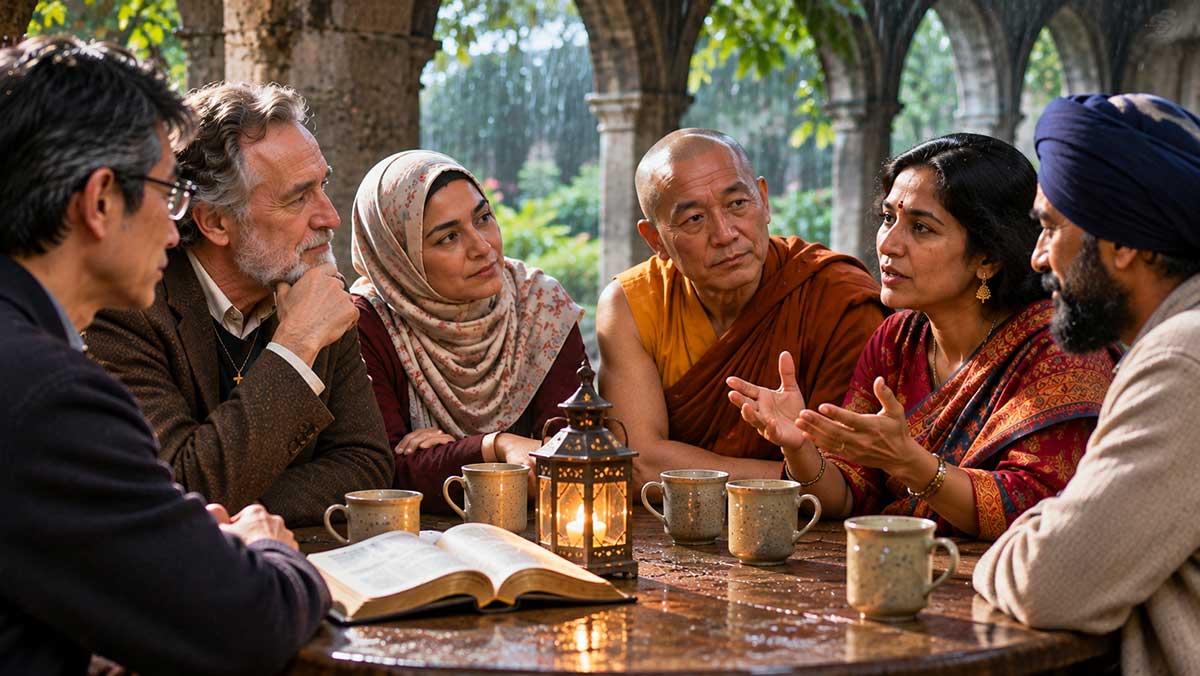
Opening: The Rain Begins to Fall
The first drops of rain struck the monastery courtyard shortly after the seven companions left the garden.
By the time they reached the covered stone walkway, the gentle afternoon breeze had become a cold wind. Rainwater streamed from the tiled roof, falling into the narrow channels beside the ancient walls.
Nick Sasaki stood beneath an archway with Archbishop Desmond Tutu, the Dalai Lama, Jalaluddin Rumi, Confucius, Mahatma Gandhi, and Rabbi Abraham Joshua Heschel.
The laughter from their earlier conversation had faded.
Beyond the arches, dark clouds covered the hills.
Nick watched the rain for a moment before speaking.
Nick Sasaki: "I wish we could spend the entire afternoon talking about friendship."
Desmond Tutu: "That would be pleasant."
Nick: "But there's something we can't ignore."
Abraham Joshua Heschel: "Then we should face it."
Nick: "We've talked about love, compassion, and respect. Every tradition represented here has teachings that encourage people to examine how they treat others."
He looked around at the six guests.
Nick: "Yet history is filled with religious persecution, hatred, and violence."
Mahatma Gandhi: "Yes."
Nick: "Christians have persecuted Jews. Hindus and Muslims have killed one another. Religious institutions have sometimes supported oppression. People have committed terrible acts while believing they were defending something sacred."
He paused.
Nick: "How does that happen?"
A gust of wind sent rain across the courtyard.
Dalai Lama: "Human beings can become deeply attached to their own group. Fear and anger can make it difficult to recognize the suffering of others."
Confucius: "A person may speak of virtue without cultivating it."
Jalaluddin Rumi: "And the self may conceal its pride beneath the language of devotion."
Nick turned toward Heschel.
Nick: "Rabbi, I think we need to begin with one of the most painful examples in religious history."
Heschel looked out at the rain.
Heschel: "Then let us speak carefully. Human suffering must not become merely an illustration for an argument."
Nick nodded.
Nick: "You're right."
The seven companions moved farther beneath the covered walkway, where a row of wooden benches faced the rain-darkened garden.
Their conversation was about to become much more personal.
Question 7. Rabbi Heschel, what does the history of antisemitism teach us about the dangers of religious prejudice and moral indifference?
Nick: "Rabbi Heschel, I want to ask you about antisemitism."
Heschel: "Please."
Nick: "For centuries, Jews have experienced persecution in societies that identified themselves as Christian. Some Christians even used religious arguments to justify hostility toward Jewish communities."
Nick: "How can people who profess faith in Jesus, who was Himself Jewish, participate in hatred toward Jews?"
Heschel remained silent for a moment.
Heschel: "We must begin by refusing to treat antisemitism as a minor failure of religious manners. It has involved exclusion, humiliation, persecution, and murder."
Nick: "And it has a long history."
Heschel: "Yes. Anti-Jewish hostility developed through different historical circumstances, including religious prejudice, social exclusion, political manipulation, and racial ideologies. These forms were not identical, but their consequences could be devastating."
Nick: "I think some Christians are uncomfortable discussing the history of Christian antisemitism."
Heschel: "Discomfort does not relieve us of the responsibility to confront historical truth."
Nick: "What should Christians recognize?"
Heschel: "That Jews are not merely figures within Christian scripture. We are a living people with our own history, religious obligations, and continuing spiritual tradition."
Nick: "We discussed that earlier."
Heschel: "And it becomes particularly important when religious interpretations are used to deny the dignity of living human beings."
Tutu: "As Christians, we must confront the ways our own communities have failed to live according to the teachings we profess."
Nick: "Archbishop, does acknowledging Christian antisemitism threaten Christian faith?"
Tutu: "It should challenge Christian arrogance and wrongdoing. Repentance is not an abandonment of Christ. It is part of taking His call seriously."
Nick: "Rabbi, may I ask about your own life?"
Heschel: "Yes."
Nick: "You were born in Warsaw. You studied in Germany. Then the Nazis came to prominence, and you were forced to leave."
Heschel: "My life was shaped by the destruction of the European Jewish world in which I had grown up."
Nick: "You were deported from Germany to Poland in 1938, and you eventually reached the United States in 1940."
Heschel: "Yes."
Nick: "Members of your family were killed during the Holocaust."
Heschel lowered his gaze.
Heschel: "The destruction reached into my family, as it did into countless Jewish families. But we must not allow even the suffering of one family to obscure the enormous human catastrophe."
Nick waited before speaking again.
Nick: "I want to be careful here. I can't know everything you felt privately. But I find it difficult to comprehend what it would mean to lose family members while watching the destruction of the community that shaped your childhood."
Heschel: "The Holocaust confronts humanity with questions that cannot be answered through easy consolation."
Nick: "What questions?"
Heschel: "How human beings become capable of treating other human beings as objects of contempt. How institutions participate in injustice. How ordinary people learn to ignore the suffering taking place around them."
Nick: "You seem especially concerned about the people who stand by."
Heschel: "Moral responsibility does not belong solely to those who directly commit acts of violence. We must examine what happens when people recognize injustice but refuse to respond."
Nick: "But what can an ordinary person do when a government or an entire society becomes hostile?"
Heschel: "The circumstances may be dangerous, and the possibilities for resistance differ. We should not casually judge people who faced extreme threats. Yet the difficulty of action should deepen our concern for moral courage rather than make indifference acceptable."
Gandhi: "There is an important distinction there. We should not speak lightly about the courage demanded of people living under terror."
Nick: "You're right. It's easy to ask what someone should have done when we weren't the ones facing the danger."
Heschel: "Historical reflection requires humility. But humility must not become an excuse to forget the victims."
Rain continued to fall beyond the arches.
Nick: "Rabbi, something troubles me. The Nazis were driven by a racial ideology, but Europe already had centuries of anti-Jewish religious prejudice."
Heschel: "The Holocaust should not be reduced to a single explanation. Nazi antisemitism had its own racial and political character. Yet the long history of anti-Jewish hostility forms part of the historical setting that must be examined."
Nick: "So we shouldn't simply say, 'That had nothing to do with Christian history.'"
Heschel: "Nor should we claim that every Christian supported persecution. Historical responsibility demands distinctions, not convenient simplifications."
Tutu: "There were Christians who resisted Nazi persecution, and Christians who participated in or accommodated injustice. We must be willing to examine both."
Nick: "Archbishop, I appreciate that you're not trying to defend Christianity by denying its failures."
Tutu: "Christian faith does not require the defense of every action taken in its name."
Nick: "Rabbi, you later stood beside Martin Luther King Jr. during the American civil rights movement."
Heschel: "Yes."
Nick: "Why did the struggle against racial injustice in America matter so deeply to you?"
Heschel: "The suffering of another community cannot be dismissed simply for being outside one's own. Jewish prophetic teachings demand concern for justice."
Nick: "You and King came from different religious traditions."
Heschel: "We did."
Nick: "Yet you marched together."
Heschel: "Yes. Religious difference did not prevent cooperation in the struggle against racial injustice."
Nick: "That's extraordinary to me. After witnessing the destruction of European Jewish life, you still believed in standing beside people from other communities."
Heschel: "We should be cautious about turning suffering into a simple lesson. A person's response to catastrophe cannot be reduced to an inspirational story."
Nick nodded.
Nick: "That's fair."
Heschel: "What matters here is the obligation to recognize the suffering of others and to respond with moral seriousness."
Dalai Lama: "There is something important in that. When we recognize another person's suffering, compassion can extend beyond our own group."
Nick: "But why is that so difficult?"
Dalai Lama: "Attachment to identity can become mixed with fear. We begin to think only of our own community and forget the humanity of others."
Confucius: "A person who neglects humaneness cannot claim that proper conduct has been fulfilled merely through outward observance."
Rumi: "And devotion becomes distorted when the heart is occupied with hatred."
Nick: "Rabbi, if you could ask Christians to learn one thing from the history of antisemitism, what would it be?"
Heschel: "I would ask them to examine how religious conviction is expressed toward living people. Do their words and actions protect human dignity, or do they contribute to contempt?"
Nick looked toward the rain.
Nick: "That's a question every religious community should ask."
Heschel: "Yes. But each community must confront its own history honestly. Responsibility cannot be fulfilled merely by pointing toward the failures of others."
Question 8. Gandhi, why do people sometimes use religious conviction to justify violence or humiliation?
The rain intensified.
Water spilled from the roof in narrow streams, striking the stone pavement with a steady rhythm.
Nick turned toward Gandhi.
Nick: "Gandhi, I want to ask you about something that must have caused you tremendous anguish."
Gandhi: "What is that?"
Nick: "You devoted much of your life to nonviolence and the pursuit of truth. Yet during the partition of India in 1947, Hindus, Muslims, and Sikhs suffered terrible communal violence."
Gandhi: "The violence exposed how deeply fear, hatred, and the desire for retaliation could overcome human relationships."
Nick: "People who had lived near one another for generations became enemies."
Gandhi: "Communities were divided by political conflict, distrust, and fear. Religious identity became entangled with struggles over security and political authority."
Nick: "But these were people who believed in God or followed traditions that taught moral responsibility."
Gandhi: "Religious belief does not automatically prevent a person from yielding to anger or collective hatred."
Nick: "Why not?"
Gandhi: "A person may convince himself that violence is justified by the righteousness of his cause. Once that happens, he may stop examining whether his methods are consistent with the truth he claims to defend."
Nick: "So someone might say, 'I'm defending my religion,' when what he's really doing is taking revenge."
Gandhi: "Yes. The language of religious duty can become entangled with fear, anger, and the desire to punish."
Nick: "Can you tell us about your work in Calcutta?"
Gandhi: "In 1947, I sought to encourage peace between Hindus and Muslims amid terrible communal tensions. When violence returned, I undertook a fast, appealing to the conscience of the communities involved."
Nick: "You were an elderly man by then."
Gandhi: "The need for reconciliation did not disappear with age."
Nick: "But did the fast solve the violence?"
Gandhi: "It contributed to a temporary restoration of peace in Calcutta. We should not confuse that achievement with a permanent resolution of the wider communal conflict."
Nick: "That's an important distinction."
Gandhi: "Peace cannot rest upon a single gesture. People must continue to resist the fear and resentment that produce violence."
Nick: "What would you say to a Hindu who believed Muslims threatened his community?"
Gandhi: "I would ask him to examine the conduct he was considering. Fear for one's community does not justify attacking innocent people."
Nick: "And to a Muslim who believed Hindus were his enemies?"
Gandhi: "The same moral responsibility applies. The suffering of one community does not justify cruelty toward another."
Nick: "But what about people who have already lost loved ones? How can we ask them not to retaliate?"
Gandhi paused.
Gandhi: "Their suffering must be recognized. We should not speak as though restraint is easy. Yet retaliation against innocent people creates further suffering and does not restore those who have been lost."
Nick: "So nonviolence isn't simply refusing to fight."
Gandhi: "It is a disciplined commitment to pursue truth and resist injustice without surrendering to hatred."
Tutu: "And it requires enormous courage."
Gandhi: "Yes. We should never confuse nonviolence with cowardice."
Nick: "Gandhi, I want to challenge you on something."
Gandhi: "Please."
Nick: "You spoke about truth and nonviolence throughout your life. But you were a human being with limitations. Some of your own views and decisions have been criticized."
Gandhi: "Then they should be examined. A person's commitment to moral principles does not place his conduct beyond criticism."
Nick: "So we shouldn't turn you into a flawless saint."
Gandhi: "No person should be exempt from moral examination."
Heschel: "That is an important principle. Reverence for a moral leader must not prevent honest assessment of the leader's actions."
Nick: "I think that applies to religious founders, teachers, and institutions in different ways."
Heschel: "Historical figures and institutions must be examined with care, using evidence rather than convenient assumptions."
Nick: "Gandhi, can I ask a more personal question?"
Gandhi: "Certainly."
Nick: "What would you say to someone who feels hatred rising in their heart after being mistreated by a person from another religion?"
Gandhi: "I would encourage that person to recognize the injury without allowing the desire for revenge to govern the response."
Nick: "But what if the anger feels justified?"
Gandhi: "The existence of a grievance does not establish that every response to it is just."
Nick: "That's difficult."
Gandhi: "It is. Moral discipline is tested most seriously when we believe we have been wronged."
Dalai Lama: "Anger can make the mind focus narrowly upon the person who caused suffering. Compassion requires a broader view, but it does not mean denying the harm."
Nick: "Can someone practice compassion and still demand justice?"
Dalai Lama: "Certainly. Compassion need not mean passivity."
Confucius: "Justice and proper conduct require discernment. One must distinguish between correcting wrongdoing and acting from resentment."
Rumi: "And the person who invokes God to justify hatred should examine whether pride has taken possession of the heart."
Nick: "Rumi, I want to ask you something. When people say they're acting for God, how can they know they aren't simply defending their own ego?"
Rumi: "They must examine their motives with sincerity. Religious language can become a shelter for vanity when a person refuses to confront the self."
Nick: "So the danger isn't confined to one religion."
Rumi: "The struggle against pride is a human struggle."
Nick: "Gandhi, let me return to the people who were killing one another during partition."
Gandhi: "Yes."
Nick: "Did they need a new religion?"
Gandhi: "They needed to confront the hatred, fear, and violence that were destroying their communities. Religious identity alone could not accomplish that."
Nick: "And what would have made reconciliation possible?"
Gandhi: "An end to violence, protection for those in danger, recognition of wrongdoing, and sustained efforts to rebuild trust."
Nick: "Not simply telling everyone to love one another."
Gandhi: "Love without responsibility can become an empty declaration."
Nick was silent.
Beyond the arches, rainwater flowed across the courtyard stones.
Nick: "I think we're approaching the hardest part of this discussion."
Tutu: "Which is?"
Nick: "What happens when the people who should be teaching love are the ones participating in injustice?"
Question 9. Archbishop Tutu, what must a religious community do when its own members or institutions have participated in injustice?
Tutu looked toward the darkened garden.
For several moments, he said nothing.
Then he turned back to Nick.
Tutu: "It must begin by telling the truth."
Nick: "Even when the truth damages the reputation of the religious institution?"
Tutu: "Especially when the institution has caused harm. Protecting an institution's image cannot take precedence over the dignity of those who have suffered."
Nick: "I want to talk about apartheid."
Tutu: "Yes."
Nick: "South Africa's apartheid system enforced racial separation and denied fundamental rights to the Black majority and other oppressed communities."
Tutu: "It was a system of profound injustice."
Nick: "And some Christians defended it."
Tutu: "Yes. Religious arguments were used to support racial oppression. Yet other Christians opposed apartheid from their understanding of the Gospel."
Nick: "How did you respond when people claimed apartheid was consistent with Christianity?"
Tutu: "I challenged the claim that racial domination could be reconciled with the dignity of human beings before God."
Nick: "You wrote to South African leaders, spoke publicly against apartheid, and supported international pressure."
Tutu: "The struggle demanded more than private disapproval."
Nick: "You warned Prime Minister B. J. Vorster in 1976 about the consequences of the conditions imposed upon Black South Africans."
Tutu: "The injustice was not something that could be treated as an unfortunate misunderstanding. It demanded a response."
Nick: "And later you became chair of South Africa's Truth and Reconciliation Commission."
Tutu: "Yes."
Nick: "I want to understand something about that work. People often associate you with forgiveness. But did forgiveness mean that those responsible for atrocities could simply say they were sorry and walk away?"
Tutu: "No. The commission was established to investigate gross human rights violations and provide a public process through which truth could be heard."
Nick: "So truth came before any meaningful discussion of reconciliation."
Tutu: "The recognition of what happened was indispensable. Victims deserved to be heard, and wrongdoing had to be acknowledged."
Heschel: "May I ask you a question, Archbishop?"
Tutu: "Of course."
Heschel: "When a society speaks of reconciliation, how does it prevent the language of forgiveness from becoming another burden placed upon victims?"
The question hung in the air.
Tutu considered it carefully.
Tutu: "That is a necessary concern. We must not demand that victims provide forgiveness simply to make the rest of society comfortable."
Heschel: "Nor should the desire for national healing silence those who continue to suffer."
Tutu: "No. Their suffering must be taken seriously. Forgiveness cannot be manufactured through public pressure."
Nick: "So a victim has the right to say, 'I'm not ready to forgive.'"
Tutu: "Yes. We may hope for forgiveness and reconciliation, but we cannot compel them."
Nick: "What about justice?"
Tutu: "Justice remains necessary. Reconciliation cannot mean pretending that wrongdoing never occurred."
Heschel: "And what of restitution?"
Tutu: "Where harm has been done, the responsibilities of repair and accountability deserve serious attention. A declaration of regret is not automatically sufficient."
Nick: "That's something I think people often miss. We talk about forgiveness as though it's a beautiful emotional moment. But the person who was harmed may still be living with the consequences."
Tutu: "Exactly. Forgiveness should not become a convenient way for the wrongdoer to escape responsibility."
Gandhi: "Nor should reconciliation be treated as a substitute for changing the conditions that allowed injustice to continue."
Nick: "So if a religious institution has participated in oppression, it needs to do more than issue an apology."
Tutu: "It should acknowledge the harm, listen to those affected, examine its practices, and take meaningful steps to prevent further injustice."
Nick: "Would you expect religious leaders to admit their own failures publicly?"
Tutu: "When their actions or institutions have caused public harm, honest acknowledgment may be necessary."
Nick: "That requires humility."
Tutu: "And courage."
Nick: "Archbishop, I want to ask something difficult. What if a church says, 'We have the correct doctrine, so our institution must be protected at all costs'?"
Tutu: "Then it has confused loyalty to an institution with faithfulness to Christ."
Nick: "That's a strong statement."
Tutu: "Christian discipleship cannot be reduced to defending the reputation of religious leaders. Jesus' teachings challenge hypocrisy and call His followers to care for those who are vulnerable."
Nick: "So when the church itself causes harm, Christian faith should provide reasons to confront it."
Tutu: "Yes. Repentance is not a threat to authentic faith."
Nick: "Rabbi Heschel, would you say something similar from your Jewish perspective?"
Heschel: "The prophetic tradition demands that religious life remain accountable to justice. Worship cannot become a shield behind which people hide from moral responsibility."
Nick: "And if a community believes it has been chosen by God?"
Heschel: "Religious responsibility should not be transformed into a claim of exemption from moral obligations."
Nick: "Gandhi, what about a movement that claims its cause is just but uses cruel methods?"
Gandhi: "It must examine whether its methods contradict the truth it claims to pursue."
Nick: "Your Holiness, can compassion survive when we confront people who have committed terrible acts?"
Dalai Lama: "Compassion does not require us to approve harmful behavior. We can oppose wrongdoing firmly while recognizing that hatred may deepen suffering."
Nick: "Confucius, what if leaders refuse to acknowledge their mistakes?"
Confucius: "Then their example may damage the moral character of those who follow them. Leadership requires conduct worthy of trust."
Nick: "Rumi, what happens when religious leaders become more concerned with appearing holy than actually living faithfully?"
Rumi: "The appearance of devotion can become a veil for pride. The person who refuses to examine himself may mistake admiration for spiritual achievement."
Nick looked around the gathering.
Nick: "It seems that every tradition here is challenging the temptation to use religion as a shield against criticism."
Heschel: "But let us remain careful. We should not suggest that all traditions have identical teachings or identical histories. Each must confront its own responsibilities."
Nick: "Yes. I don't want to erase the differences."
He turned toward Tutu.
Nick: "Archbishop, after everything you've witnessed, do you still believe human beings can reconcile?"
Tutu: "I do believe reconciliation is possible. But possibility is not a guarantee."
Nick: "What makes the difference?"
Tutu: "Truth, accountability, willingness to change, and the difficult work of rebuilding trust."
Nick: "And forgiveness?"
Tutu: "Forgiveness may be part of that process. But we must never use it to deny the suffering of victims or excuse those responsible."
Nick: "So reconciliation isn't simply an emotional feeling."
Tutu: "No. It requires moral action."
The rain began to soften.
For the first time in nearly an hour, sunlight appeared faintly through the clouds.
Nick watched it touch the wet stone courtyard.
Nick: "I think something has become clearer to me."
Tutu: "What is that?"
Nick: "Religious hatred doesn't begin only when someone commits an act of violence. It can begin when we stop seeing another person as fully human."
Heschel: "And when we become willing to ignore the consequences of that failure."
Gandhi: "Or when we persuade ourselves that a righteous cause justifies cruelty."
Dalai Lama: "Fear and anger can make that process easier."
Confucius: "The failure to cultivate virtue can become visible in destructive conduct."
Rumi: "And pride can disguise itself as devotion."
Nick: "Archbishop, then perhaps the greatest danger is not that people believe too deeply."
Tutu: "It may be that people use the language of faith while refusing the responsibilities that faith places upon them."
Nick looked at the six guests.
Nick: "That is a painful thought."
Tutu: "Yes."
Nick: "But perhaps it's one we need to face."
Closing: The Door We Refuse to Open
The rain finally stopped.
Water continued to drip from the monastery roof, falling into small pools along the stone walkway. The clouds were breaking apart, and a pale evening light appeared over the distant hills.
The seven companions remained seated beneath the arches.
Their conversation had moved from religious friendship into some of humanity's darkest history.
Rabbi Heschel had challenged them to confront antisemitism, the Holocaust, and the danger of moral indifference without reducing suffering to an easy lesson.
Gandhi had reflected upon communal violence during India's partition and the difficulty of pursuing truth without surrendering to hatred.
Archbishop Tutu had drawn upon the struggle against apartheid and South Africa's efforts to confront its violent past, insisting that reconciliation could never be separated from truth and accountability.
The other guests had examined fear, pride, moral cultivation, and the responsibilities that accompany spiritual conviction.
Nick looked toward the garden.
Nick: "I have to admit, this conversation has been heavier than I expected."
Tutu: "It has."
Nick: "But I'm grateful we didn't avoid it."
Heschel: "A friendship that cannot face painful truths may remain comfortable, but it will not necessarily become deeper."
Nick: "I think you're right."
He paused.
Nick: "There's something I want to ask next, but it isn't about nations or religious institutions."
Gandhi: "What is it?"
Nick: "It's about a family."
The guests turned toward him.
Nick: "A Christian father loves his daughter. He raised her in the church, taught her to pray, and hoped she would marry someone who shared their faith."
Nick: "Then she falls in love with a Muslim man."
Tutu: "Ah."
Nick: "The father becomes frightened. He worries about her future, her children, and what the marriage might mean for her Christian faith."
Heschel: "Those concerns may deserve serious discussion."
Nick: "Yes. But instead of talking with his daughter and getting to know the young man, he refuses to welcome him."
Dalai Lama: "And what happens to the daughter?"
Nick: "She begins staying away from home."
Confucius: "Then the relationship between father and daughter has already been harmed."
Nick: "The father insists that he's defending his faith."
Gandhi: "But he must still examine whether his conduct is just."
Nick: "Exactly."
Nick looked toward Tutu.
Nick: "Archbishop, what if the father truly believes he's doing what Jesus would want?"
Tutu remained quiet for a moment.
Tutu: "Then perhaps we should ask what Jesus' teachings require of him, rather than accepting the father's interpretation without question."
Nick: "And what if the father discovers that his fear has caused him to reject someone who genuinely loves his daughter?"
Heschel: "We should hear the daughter's voice, too."
Nick nodded.
Nick: "Yes. We must."
The monastery bells began to ring.
A warm glow appeared through the windows of the dining room, where candles were being lit for the evening meal.
Tutu rose slowly.
Tutu: "Well, Nick, I suspect our next conversation will bring these questions very close to home."
Nick: "It will."
Tutu: "Then perhaps we should continue inside."
The guests stood and walked along the covered passage toward the monastery dining room.
Behind them, the rain-soaked garden grew quiet.
Ahead, a long wooden table waited beneath the candlelight.
Nick thought about a father who believed he was protecting his religion.
A daughter who wanted to be loved without surrendering her conscience.
And a young Muslim man who had never been given the opportunity to introduce himself.
The next conversation would ask whether love could find a way through that pain.
When love and faith collide, what would Jesus ask of us?
Topic 4: When Love and Faith Collide, What Would Jesus Ask of Us?
Opening: The Empty Chair at the Dinner Table
Evening settled over the monastery.
The afternoon rain had stopped, leaving the stone courtyard glistening beneath the last light of day. Inside the dining room, candles flickered along a long wooden table. A small fire burned in the hearth, and the scent of freshly baked bread filled the air.
Nick Sasaki sat with Archbishop Desmond Tutu, the Dalai Lama, Jalaluddin Rumi, Confucius, Mahatma Gandhi, and Rabbi Abraham Joshua Heschel.
Seven chairs surrounded their table.
Seven cups of tea waited beside the bread.
But Nick was thinking about an eighth chair.
An empty chair at another family's dinner table.
Nick Sasaki: "Before we begin, I'd like to tell you a story."
Desmond Tutu: "A true story?"
Nick: "A fictional one. But I think the emotions will feel familiar to many families."
Tutu: "Then please, tell us."
Nick glanced toward the fire.
Nick: "There's a Christian father named Daniel. He loves his daughter, Emily. He raised her in the church, taught her to pray, and always hoped she would marry someone who shared their faith."
Nick: "Then Emily falls in love with a Muslim man named Amir."
Dalai Lama: "Ah."
Nick: "Amir is kind, thoughtful, and serious about his own religion. He respects Emily's Christian faith. Neither of them is planning to convert."
Nick: "But Daniel is devastated."
Mahatma Gandhi: "What does he fear?"
Nick: "He fears losing his daughter. He worries about their future children, about worship, about whether Emily will gradually abandon Christianity."
Abraham Joshua Heschel: "Those are questions with genuine religious significance."
Nick: "Yes. I don't want to pretend Daniel's concerns are foolish."
Nick paused.
Nick: "But Daniel refuses to meet Amir. He tells Emily that he cannot welcome the young man into his home."
Tutu: "And what happens to Emily?"
Nick: "She stops coming to Sunday dinner."
The room grew quiet.
Nick: "For twenty-six years, Daniel had always kept a place for his daughter at the family table. Now her chair sits empty."
Tutu looked down at the bread before him.
Tutu: "Then the father's fear has already cost him something precious."
Question 10. Archbishop Tutu, how should a Christian father respond when his daughter wishes to marry a Muslim man and he believes the marriage conflicts with his faith?
Nick: "Archbishop, I want to be fair to Daniel. He's not pretending to be religious. He sincerely believes in Jesus Christ. He believes marriage is sacred. He worries that his daughter is making a decision that could affect her spiritual life and her children's future."
Nick: "What would you say to him?"
Tutu: "I would begin by listening to him. His concerns deserve to be heard. A parent may have deep hopes for a child's spiritual life, and those hopes can be rooted in sincere faith."
Nick: "So you wouldn't simply tell him to stop worrying?"
Tutu: "No. But I would ask him whether rejecting his daughter is truly helping her."
Nick: "He might say, 'If I welcome Amir, I'm telling Emily that I approve of the marriage.'"
Tutu: "Then I would ask whether welcoming a human being necessarily means approving every decision that person makes."
Nick: "Daniel doesn't see the distinction."
Tutu: "Perhaps he needs help seeing it."
Nick: "He says, 'Jesus is the way, the truth, and the life. How can I accept a marriage in which my daughter's husband does not believe that?'"
Tutu: "He is expressing a conviction that matters deeply within Christianity. We should not pretend that Christians have no serious theological concerns about marriage across religious traditions."
Nick: "But?"
Tutu: "But his conviction does not give him permission to treat Amir as though he lacks dignity. Nor does it release Daniel from his responsibility to love his daughter."
Nick: "What if Daniel says he's refusing the relationship out of love?"
Tutu: "Then I would ask what his love is producing. Is it creating a space for honest conversation? Or is it driving his daughter away?"
Nick: "That's painful."
Tutu: "Yes. Love can require us to examine whether our actions are accomplishing what we claim to desire."
Heschel: "May I add something?"
Nick: "Please."
Heschel: "Religious identity is not a trivial matter. Marriage may involve questions of covenant, family continuity, worship, and the religious upbringing of children. We should not dismiss those concerns simply to make the story more comfortable."
Nick: "I agree. What would you want Daniel to ask Emily?"
Heschel: "He might ask how she and Amir intend to honor one another's religious commitments. What will happen when they disagree? How will they approach family traditions? Have they considered the obligations they are accepting?"
Nick: "Those sound like reasonable questions."
Heschel: "They can be reasonable when asked with respect rather than used as instruments of intimidation."
Gandhi: "There is a difference between offering counsel and attempting to control another person's conscience."
Nick: "But Daniel is her father. Doesn't he have a responsibility to guide her?"
Gandhi: "He may offer his convictions honestly. Yet Emily is an adult with her own moral responsibility. His love should not become a claim of ownership over her life."
Confucius: "A parent-child relationship carries serious duties on both sides. But the quality of the relationship matters. Guidance without trust may become difficult to receive."
Nick: "That's something I think many parents struggle with. They spend years teaching their children, protecting them, helping them make decisions. Then one day the child becomes an adult and chooses something the parent would never have chosen."
Dalai Lama: "And fear may arise."
Nick: "Yes. Fear of losing the child. Fear that everything you taught them has been rejected."
Dalai Lama: "But if fear controls our actions, we may cause the very suffering we wish to prevent."
Nick looked toward Tutu.
Nick: "Archbishop, let me ask you directly. If Daniel truly believes Emily is making a spiritual mistake, should he tell her?"
Tutu: "He can speak honestly. Love does not require silence about deeply held convictions. But he should listen with the same seriousness with which he hopes to be heard."
Nick: "And he should meet Amir?"
Tutu: "I would encourage him to do so."
Nick: "Why?"
Tutu: "How can he claim to know the young man's character if he refuses even to sit with him?"
Nick: "Daniel might say, 'I already know what he believes.'"
Tutu: "Knowing someone's religious identity is not the same as knowing the person."
Nick sat quietly.
Nick: "That's the heart of this story, isn't it?"
Tutu: "Perhaps it is where the story must begin."
Nick: "Let me tell you something Daniel hasn't admitted to Emily."
The others listened.
Nick: "After their argument, Daniel goes to church one Sunday. The sermon is about the Good Samaritan."
Nick: "He listens as the pastor speaks about a man who helped a wounded stranger when others passed by."
Nick: "Daniel knows the story well. He's heard it since childhood."
Nick: "But this time, one question troubles him."
Nick: "'What if the person I refuse to welcome is the very person Jesus is asking me to see as my neighbor?'"
Tutu: "Ah."
Nick: "He doesn't suddenly change his mind. He still worries about Emily's marriage. But for the first time, he begins questioning his own conduct."
Heschel: "That is important. The moral change begins before the young man performs any extraordinary act."
Nick: "Exactly. I don't want Amir's worth to depend upon proving himself."
Tutu: "Nor should it."
Question 11. Gandhi and Rabbi Heschel, what can genuine love require when family loyalty, religious conviction, and personal conscience come into conflict?
Nick reached for his cup of tea but did not drink.
Nick: "Let me continue the story."
The others leaned in.
Nick: "Emily visits her father one afternoon. She has come alone because Daniel still refuses to meet Amir."
Nick: "Daniel tells her, 'I raised you to follow Jesus. I never thought you would choose a husband who doesn't believe in Him.'"
Nick: "Emily answers, 'Dad, I haven't stopped believing in Jesus.'"
He paused.
Nick: "Daniel says, 'Then why are you doing this?'"
Nick: "And Emily asks him something he isn't prepared to hear."
Nick looked around the table.
Nick: "'Dad, do you love me only when I make the choices you would make?'"
No one spoke for a moment.
Nick: "Gandhi, how should Daniel respond?"
Gandhi: "He should examine whether his conduct is consistent with the love he professes."
Nick: "But he believes he's protecting her."
Gandhi: "Protection can become coercion when we refuse to recognize another person's conscience."
Nick: "So what should he say?"
Gandhi: "Perhaps he should begin by acknowledging that his daughter's question deserves an honest answer."
Nick: "And if the honest answer is that he cannot accept her decision?"
Gandhi: "He may continue to disagree. But disagreement does not require humiliation or the withdrawal of affection."
Heschel: "I would ask Daniel to consider what he means by love. Does he regard his daughter as a person before God, or only as someone whose decisions must confirm his own convictions?"
Nick: "That's a difficult question for a parent."
Heschel: "It is. Yet moral responsibility often becomes most demanding within our closest relationships."
Nick: "Rabbi, you've spoken about the dignity of human beings. Does that mean Daniel has no right to express his religious concerns?"
Heschel: "No. He has the right to express them. Emily has the right to take them seriously, question them, or disagree. Respect requires recognizing the moral agency of both."
Nick: "And Amir?"
Heschel: "He, too, must be treated as a person with his own conscience and religious commitments."
Nick: "Let me introduce him more fully."
Nick leaned forward.
Nick: "Amir grew up in a Muslim family. His faith matters to him. He prays, tries to live honestly, and believes that his responsibilities toward family and neighbors are part of his religious life."
Nick: "He loves Emily, but he doesn't want her to abandon Christianity for him."
Rumi: "Then he, too, must consider what sincerity requires. Respecting another person's faith cannot be merely a promise made before marriage. It must become part of daily life."
Nick: "Exactly. Emily and Amir have discussed children. They know there will be difficult decisions. They haven't solved everything, but they're willing to keep talking."
Heschel: "That is more believable than pretending that affection automatically resolves every religious difference."
Nick: "Daniel doesn't know about those conversations. He hasn't asked."
Confucius: "Then his judgment is being formed without sufficient knowledge of the people involved."
Nick: "And Emily feels that her father has stopped seeing her as a daughter and started seeing her as a problem."
Tutu lowered his eyes.
Tutu: "That is heartbreaking."
Nick: "One evening Emily calls Daniel. She asks whether she and Amir can come for dinner."
Nick: "Daniel says, 'You can come. He cannot.'"
Nick: "Emily answers, 'Then I won't come either.'"
The fire crackled softly.
Nick: "For the first time in her life, Emily spends Christmas away from her parents."
Dalai Lama: "The suffering is spreading."
Nick: "Yes. Daniel is lonely. Emily is hurt. Amir feels responsible for a family conflict he never wanted."
Gandhi: "And none of them can resolve it through force."
Nick: "What should Emily do? Should she keep trying to persuade her father?"
Gandhi: "She may continue to communicate if she wishes. But she should not be required to endure repeated humiliation to prove her love."
Heschel: "Nor should she be made solely responsible for repairing a relationship damaged by her father's choices."
Nick: "That's important. Sometimes we tell the person who has been rejected to be more patient, more forgiving, more loving."
Tutu: "When the person who caused the harm may be the one who most needs to change."
Nick: "So Emily can love her father and still establish boundaries."
Gandhi: "Yes. Nonviolence does not mean surrendering one's dignity."
Confucius: "Respectful relationships require responsibilities to be fulfilled, not merely demanded."
Nick: "And Daniel?"
Heschel: "He must decide whether his fear is preventing him from fulfilling his responsibilities as a father."
Nick: "What if he's too proud to apologize?"
Rumi: "Then pride may become a heavier burden than the disagreement itself."
Nick: "I suspect that's where Daniel is. He misses his daughter terribly. But every time he thinks about calling her, he remembers what he said, and he doesn't know how to take it back."
Tutu: "Then perhaps he needs the courage to begin with a simple acknowledgment."
Nick: "Such as?"
Tutu: "'Emily, I have hurt you. I am sorry. I still have questions, but I want to listen.'"
Nick nodded.
Nick: "Those words would mean so much to her."
Tutu: "And they would not require him to abandon his Christian faith."
Nick: "But I want Emily to have a voice beyond asking her father to accept Amir."
He paused.
Nick: "She writes Daniel a letter."
Nick: "In it, she says, 'Dad, I know you're afraid for my faith. But I need you to hear what I believe, too.'"
Nick: "'I still pray. I still love Jesus. I still care about the things you taught me. But I'm an adult, and I have to make decisions before God with my own conscience.'"
Nick: "'Amir and I have talked about how we will practice our faiths, how we will celebrate holidays, and how we will raise children. We don't have every answer. But we're taking those questions seriously.'"
Nick: "'I don't need you to agree with every decision. I need you to stop treating the man I love as someone unworthy of entering our home.'"
Heschel nodded slowly.
Heschel: "Now we hear the daughter's own moral reasoning."
Nick: "Daniel reads the letter several times."
Nick: "He still disagrees with her decision. But he begins to recognize that he has never truly listened to her."
Gandhi: "That recognition may become the beginning of change."
Nick: "And yet he still doesn't call."
Dalai Lama: "Fear and pride can remain strong, even after we recognize our mistakes."
Nick: "Exactly. He knows something needs to change. He just doesn't know how to begin."
Question 12. If the young man cares for the father during a serious illness, can the father welcome him into the family without pretending their religious differences have disappeared?
The room had grown darker. A monastery attendant quietly added another log to the fire.
Nick waited until the attendant had left.
Nick: "There's another part of the story."
He looked toward Tutu.
Nick: "Several months pass. Daniel still hasn't reconciled with Emily."
Nick: "But something has changed."
Nick: "He keeps her letter beside his Bible. Sometimes he takes it out and reads it again."
Nick: "One Sunday, after church, he tells Margaret, his wife, 'I think I've been wrong about how I've treated Emily.'"
Nick: "Margaret asks, 'Then why haven't you called her?'"
Nick: "Daniel doesn't have an answer."
Tutu: "Ah. Sometimes the person who loves us knows exactly which question to ask."
Nick: "Margaret has been asking it for months."
The guests smiled.
Nick: "Then one afternoon, Daniel becomes seriously ill."
The room grew quiet.
Nick: "Margaret finds him confused and struggling to stand. She calls emergency services, and Daniel is taken to the hospital."
Nick: "Emily is at work when she receives the news. Amir is closer to the hospital."
Nick: "He goes immediately."
Dalai Lama: "Without being asked?"
Nick: "Yes."
Nick: "Amir stays with Margaret while Daniel receives treatment. He brings her food, helps contact relatives, and makes sure Emily knows what's happening."
Nick: "Over the following days, Amir keeps returning."
Nick: "Daniel is conscious now, but weak. He sees Amir sitting beside the bed."
Nick paused.
Nick: "Daniel asks, 'Why are you here?'"
Nick: "Amir answers, 'Emily loves you. You're her father. I wanted to help.'"
The dining room became still.
Nick: "Archbishop, what do you think Daniel feels in that moment?"
Tutu: "In this fictional story, perhaps Daniel recognizes the distance between the young man he feared and the person actually sitting beside him."
Nick: "He had pictured Amir as a threat."
Tutu: "And now he sees someone caring for his family."
Nick: "Daniel says, 'You know I don't approve of your religion.'"
Nick: "Amir replies, 'I know we believe differently. I didn't come here to argue about that.'"
Nick: "Then he adjusts Daniel's blanket and asks whether he needs water."
Nick looked toward Gandhi.
Nick: "Gandhi, is this what you mean when you speak about the moral significance of our actions?"
Gandhi: "Amir's conduct demonstrates care without demanding agreement. He has an opportunity to retaliate against someone who rejected him, yet he chooses to help."
Nick: "He doesn't say, 'Now you see that Muslims can be good people.'"
Gandhi: "No. His actions speak without requiring that declaration."
Heschel: "But we should be careful about something."
Nick: "What is that?"
Heschel: "Amir should not have to perform extraordinary acts of kindness to earn recognition of his humanity."
Nick stopped.
Nick: "You're right."
Heschel: "His dignity existed before Daniel became ill. Daniel's failure was not that he had insufficient evidence of Amir's goodness. It was that he refused to recognize him as a person worthy of respect."
Nick: "That's an important correction."
Tutu: "Yes. The illness may become the occasion for Daniel to act upon what he had already begun to recognize."
Nick: "I don't want readers to think that a Muslim man has to save a Christian father's life before being accepted."
Tutu: "Then let the story make clear that Daniel has something to repent of."
Nick: "And Amir isn't responsible for fixing Daniel."
Heschel: "Precisely."
Nick continued.
Nick: "One evening, after several days in the hospital, Daniel asks Amir to sit beside him."
Nick: "He says, 'I've treated you badly.'"
Nick: "Amir doesn't answer immediately."
Nick: "Daniel continues, 'I was afraid that if I welcomed you, I'd be betraying everything I believe.'"
Nick: "Amir says, 'I never wanted you to betray your faith. I only wanted you to know me.'"
Tutu's expression softened.
Tutu: "That is a meaningful moment."
Nick: "Daniel begins to cry."
Nick: "He tells Amir, 'I don't know how we'll resolve every question about religion. But I know I was wrong to refuse to meet you. I was wrong to hurt Emily.'"
Nick: "And then he says, 'I'm sorry.'"
For a moment, the only sound was the fire.
Dalai Lama: "An apology can open a door."
Nick: "But it doesn't repair everything immediately."
Heschel: "No. Trust must be rebuilt through continued conduct."
Nick: "Amir tells Daniel, 'I appreciate your apology. But I need you to know that Emily has been hurting for a long time.'"
Nick: "Daniel says, 'I know.'"
Nick: "Amir answers, 'I don't think you do. Not yet.'"
The guests remained quiet.
Nick: "I think that's important. Amir doesn't simply forgive everything and pretend the past has disappeared."
Gandhi: "Reconciliation should not require the person who was rejected to conceal the harm."
Tutu: "Nor should an apology be treated as a demand for immediate forgiveness."
Nick: "A few days later, Emily visits her father. Daniel asks her to sit down."
Nick: "He says, 'I thought I was protecting you. But I was so frightened of losing you that I pushed you away.'"
Nick: "Emily begins crying."
Nick: "She tells him, 'Dad, I never stopped loving you. But I needed you to respect that this is my life.'"
Nick: "Daniel answers, 'I know. And I didn't.'"
Gandhi: "That acknowledgment matters."
Nick: "Then Emily says something else."
Nick: "'I don't want Amir to have to prove himself by taking care of you. I wanted you to know him long before this happened.'"
Heschel: "Good. Her voice must be heard."
Nick: "Daniel agrees. He apologizes to her, too."
Nick: "But Emily doesn't immediately say everything is fine."
Nick: "She tells him, 'I want us to have a relationship. But I need to know you won't use your faith to make me feel ashamed every time we disagree.'"
Nick: "Daniel says, 'I can't promise we'll never disagree. But I can promise to listen and to treat you and Amir with respect.'"
Confucius: "That promise will need to be demonstrated through conduct."
Nick: "Exactly."
Nick: "Over the following weeks, Daniel begins calling Emily again. They talk about ordinary things. Her work. Her mother. His recovery."
Nick: "Sometimes they discuss religion, and those conversations are still difficult."
Nick: "Daniel asks how Emily and Amir intend to raise children. Emily explains that they have discussed the issue seriously but still have decisions to make."
Nick: "Daniel says he remains concerned."
Nick: "Emily tells him she knows."
Nick: "And for the first time, they continue talking instead of ending the conversation in anger."
Heschel: "That is a more credible sign of reconciliation than a single dramatic declaration."
Nick: "A month later, Daniel is recovering at home."
Nick: "Emily and Amir come for Sunday dinner."
Nick looked around the table.
Nick: "Margaret has prepared far too much food."
Tutu: "A very promising sign."
Everyone laughed softly.
Nick: "Daniel opens the front door. Amir stands beside Emily, looking a little nervous."
Nick: "For a moment, nobody knows what to say."
Nick: "Then Daniel reaches out his hand."
Nick: "'Amir, welcome.'"
Nick: "Amir shakes it."
Nick: "And Daniel says, 'Would you both come in?'"
Nick paused.
Nick: "At the dinner table, Daniel asks Amir about his family, his work, and his faith. Not as an interrogation, but as someone who finally wants to know him."
Nick: "Amir asks Daniel about his church and what Christianity means to him."
Nick: "They disagree about Jesus."
Nick: "But this time, neither man treats the disagreement as a reason to end the conversation."
Nick: "Emily watches them talking."
Nick: "Then she notices something."
Nick: "For the first time in nearly a year, there is no empty chair at the table."
The room fell silent.
Tutu slowly nodded.
Tutu: "That is a beautiful moment."
Nick: "But it's not the end of their difficulties."
Heschel: "Nor should it be."
Nick: "Daniel still worries about religious differences in the marriage. Emily and Amir still have difficult decisions ahead. They haven't agreed on every question."
Gandhi: "But they have begun approaching those questions without coercion."
Confucius: "Trust is cultivated through repeated conduct."
Dalai Lama: "Compassion must continue after the emotional moment has passed."
Rumi: "And humility must remain when pride is tempted to return."
Nick: "Archbishop, I want to ask the question in our title. What would Jesus ask of Daniel?"
Tutu considered it carefully.
Tutu: "I would invite Daniel to examine his conduct in the light of Jesus' teachings. Has he loved his daughter? Has he treated Amir as a neighbor? Has he allowed fear to become an excuse for cruelty? Is he willing to repent and seek reconciliation?"
Nick: "Would you tell him he has to abandon his beliefs about Jesus?"
Tutu: "No. I would encourage him to live those beliefs more faithfully."
Nick: "And if Daniel says, 'But Amir still doesn't believe Jesus is the Son of God'?"
Tutu: "Then that remains a genuine theological difference. Christian love does not require Daniel to deny it. But neither does that difference justify contempt."
Nick: "So welcoming Amir isn't the same as saying every religion is true."
Tutu: "Correct. It is recognizing the dignity of the person standing before you."
Nick looked down at his hands.
Nick: "I think the part that moves me most is that Daniel didn't lose his daughter by welcoming Amir."
He paused.
Nick: "He began finding his way back to her."
Closing: The Chair That Was No Longer Empty
The candles had burned low.
Outside, the last traces of rainwater slipped from the monastery roof. Inside, the seven companions remained around the dining table, their cups untouched for several minutes.
Nick looked toward the empty space between two chairs.
Nick: "When I first pictured this story, I thought the most moving moment would be Amir caring for Daniel in the hospital."
Tutu: "And now?"
Nick: "Now I think it's the moment Daniel opens the door and says, 'Welcome.'"
Heschel: "Perhaps the deepest change occurred earlier, when Daniel began recognizing the wrong he had done."
Gandhi: "The welcome becomes meaningful when it grows from that recognition."
Dalai Lama: "And when it continues through everyday kindness."
Confucius: "A single gesture may begin reconciliation. Sustained conduct gives it substance."
Rumi: "The heart may discover that pride has kept it from receiving the kindness already before it."
Nick nodded.
Nick: "What strikes me is that no one had to abandon their faith."
Tutu: "And no one had to pretend the differences were insignificant."
Nick: "Daniel remained Christian. Amir remained Muslim. Emily retained her own Christian faith and her freedom to make decisions about her life."
Heschel: "Their relationship changed when they began treating one another with greater honesty and respect."
Nick: "I believe humanity is one family under one God. But sometimes that conviction can sound enormous and abstract."
He looked toward the fireplace.
Nick: "Tonight, it feels much smaller. Like a father opening his front door. Like a daughter returning to the dinner table. Like a young man finally being welcomed by his future family."
Tutu: "And perhaps that is where great changes often begin, Nick. In ordinary human relationships."
Nick: "Archbishop, do you think Daniel became a better Christian through this experience?"
Tutu: "I would say he took a meaningful step toward living more faithfully by the love, humility, and repentance that Christianity asks of him."
Nick: "Not by changing what he believed about Jesus."
Tutu: "But by examining how those beliefs were shaping his conduct."
The fire settled into glowing embers.
Nick smiled faintly.
Nick: "I keep thinking about Emily's chair."
Dalai Lama: "It is no longer empty."
Nick: "No."
For a moment, no one spoke.
Then Tutu reached for the remaining bread.
Tutu: "Well, my friends, if we are going to become one human family, I suggest we begin by making sure nobody leaves the table hungry."
The guests laughed, and the heaviness of the evening gave way to warmth.
Nick looked around at the six people who had gathered with him.
Their convictions remained different. Their histories were separated by centuries. Their beliefs about God, Jesus, and spiritual truth had not become identical.
Yet they had spent the day listening, questioning, laughing, and confronting difficult truths together.
As the candles flickered, Nick found himself wondering whether the reconciliation of one family might offer a glimpse of something much larger.
Could the world's religions learn to live together without abandoning their deepest convictions?
Could humanity become one family without becoming one religion?
That would be their final conversation, when the morning sun returned to the monastery garden.
Topic 5: Can We Become One Human Family Without Becoming One Religion?
Opening: The Morning After the Rain
The monastery garden was quiet when Nick Sasaki stepped outside.
The rain had ended during the night. Tiny droplets clung to the rose petals, and a pale mist drifted above the reflecting pool. Beyond the stone walls, the first sunlight touched the distant hills.
Seven chairs stood beneath the flowering trees.
The same chairs that had welcomed six remarkable guests the previous morning.
Archbishop Desmond Tutu arrived first, carrying a cup of tea.
Desmond Tutu: "Good morning, Nick. I see you've returned to the scene of our earlier disagreements."
Nick Sasaki: "I thought the garden deserved another chance."
Tutu: "A wise decision. It seems much more agreeable without the rain."
The Dalai Lama appeared beside him.
Dalai Lama: "Perhaps the rain was simply encouraging us to move indoors."
Tutu: "And fortunately, there was dinner waiting."
Nick: "I should have known you'd remember the food."
Tutu: "Nick, after yesterday's conversations, I believe we earned it."
Their laughter carried across the garden.
Soon, Rabbi Abraham Joshua Heschel, Jalaluddin Rumi, Mahatma Gandhi, and Confucius joined them.
They settled around the table as the sun rose higher.
Nick looked at the six guests.
They had spent the previous day discussing Christian discipleship, friendship across religious differences, antisemitism, religious violence, moral responsibility, and a fictional family divided by an interfaith relationship.
They had laughed together.
They had challenged one another.
They had confronted painful questions.
Yet no one had abandoned their religious convictions.
Nick glanced toward the seven chairs.
Nick: "Yesterday, we talked about an empty chair at a family dinner table."
Heschel: "And a father who eventually recognized that he had treated his daughter and her fiancé unjustly."
Nick: "Yes. But I keep wondering whether the same principle could apply to humanity."
Gandhi: "In what way?"
Nick: "We have different religions, cultures, histories, and beliefs. Sometimes those differences are profound."
He paused.
Nick: "But do they have to keep us from becoming one human family?"
Tutu leaned forward.
Tutu: "Now that, Nick, is a question worthy of our final morning."
Question 13. Can humanity build lasting peace without requiring people to surrender their deepest religious convictions?
Nick: "I'd like to begin with something very personal."
He looked around the table.
Nick: "I believe humanity is one family under one God. That conviction shapes how I see the purpose of human life and the possibility of world peace."
Nick: "I believe God is the parent of all humanity, and that people of every nation and religion belong to one human family."
He turned toward the Dalai Lama.
Nick: "But I know you don't share my understanding of a creator God."
Dalai Lama: "That is correct. Buddhist philosophy approaches the nature of existence differently."
Nick: "And Rabbi Heschel, your Jewish understanding of covenant and religious obligation is different from my Christian beliefs."
Heschel: "Yes."
Nick: "Archbishop Tutu, you and I share a Christian faith, but even Christians disagree about many theological questions."
Tutu: "We certainly do."
Nick: "So here's what I want to ask everyone."
He leaned forward.
Nick: "Can humanity build lasting peace without requiring people to surrender their deepest religious convictions?"
Gandhi: "I believe peace must allow people to follow their conscience. Religious conviction cannot be made genuine through coercion."
Nick: "But what happens when two communities believe contradictory things?"
Gandhi: "They must learn to live with disagreement without turning it into a justification for violence."
Nick: "Is that enough for peace?"
Gandhi: "It is necessary, but not sufficient. Peace requires justice, self-discipline, and the willingness to confront wrongdoing within one's own community."
Confucius: "Harmony should not be confused with uniformity."
Nick: "What do you mean?"
Confucius: "People may fulfill different roles and hold different perspectives while maintaining relationships through sincerity, respect, and proper conduct. Agreement in every matter is not the foundation of a well-ordered human community."
Nick: "So harmony doesn't mean everyone thinks alike."
Confucius: "No. A person who merely repeats what others wish to hear may appear agreeable without acting sincerely."
Nick: "That reminds me of our earlier conversation about friendship."
Confucius: "Then perhaps the lesson deserves further attention."
Nick smiled.
Nick: "You never let me escape my homework."
Confucius: "Learning requires continued effort."
The guests laughed.
Nick: "Your Holiness, how would you answer the question?"
Dalai Lama: "I believe compassion can provide a foundation for cooperation among people with different religious beliefs."
Nick: "Without agreeing about God?"
Dalai Lama: "Yes. We can recognize that human beings experience suffering and seek happiness. We can work together to reduce suffering."
Nick: "But is compassion alone enough?"
Dalai Lama: "Compassion should lead to action. We need education, patience, and practical efforts to resolve conflict."
Nick: "And what about people who believe their religion is the only true path?"
Dalai Lama: "They may remain committed to their tradition. But they should consider how their conduct affects others."
Nick: "Rumi, what would you say?"
Rumi: "The person who seeks God must be careful not to mistake pride for devotion."
Nick: "Does that mean religious differences don't matter?"
Rumi: "No. My religious life is rooted in Islam. Prayer, revelation, and devotion to God are not matters I would discard merely to create agreement."
Nick: "Then what can unite people?"
Rumi: "A person may recognize moral obligations toward others without claiming that every religious teaching is identical. Humility can make room for sincere human relationships."
Nick: "Archbishop Tutu, I think your Christian faith gives you a particular understanding of human unity."
Tutu: "It does. I believe every human being possesses dignity before God. My Christian faith calls me to recognize that dignity and to resist injustice."
Nick: "And you believe Jesus Christ is central to that faith."
Tutu: "Absolutely. Christianity is not simply a moral philosophy that can be separated from Christ."
Nick: "Rabbi Heschel, do you agree with the archbishop's description of humanity?"
Heschel: "I share a profound concern for human dignity and moral responsibility. But my Jewish understanding of God, covenant, and religious obligation is not identical to Christian theology."
Nick: "Could you explain the difference?"
Heschel: "For Judaism, the covenantal life of the Jewish people is not merely a preliminary stage awaiting fulfillment through Christian belief. It is a living religious tradition with its own obligations before God."
Tutu: "And Christianity understands Jesus Christ in a way that Judaism does not."
Heschel: "Precisely."
Nick: "Then I want to ask both of you something difficult."
He looked from one to the other.
Nick: "Archbishop, if you believe Jesus is the Son of God, and Rabbi Heschel does not, can you both speak of one human family without suggesting that your religious differences are unimportant?"
Tutu: "I believe we can. My Christian conviction remains intact. I do not need Rabbi Heschel to affirm it before I recognize his dignity or cherish his friendship."
Heschel: "And I can respect Archbishop Tutu's sincerity without accepting Christian claims about Jesus."
Nick: "But what if the archbishop says that the fullest understanding of humanity's relationship with God is found in Christ?"
Heschel: "Then I would disagree."
The garden became quiet.
Nick: "Would that disagreement trouble you?"
Heschel: "It would be a serious theological disagreement. I would not ask the archbishop to conceal it. But neither would I allow his conviction to define Judaism on Judaism's behalf."
Tutu nodded.
Tutu: "That is fair."
Nick: "Archbishop, would you still say what you believe?"
Tutu: "Yes. I would speak of Christ with conviction. But I would seek to do so without treating Rabbi Heschel as inferior."
Nick: "And Rabbi, would you challenge him?"
Heschel: "Certainly, if the conversation called for it."
Nick: "So you might spend the rest of your lives disagreeing."
Tutu: "We might."
Nick: "And still remain friends?"
Tutu smiled.
Tutu: "Nick, I should be deeply disappointed if friendship required us to stop thinking."
Heschel smiled in return.
Heschel: "On that point, Archbishop, we agree."
The guests laughed.
Nick: "I think that may be the most meaningful disagreement we've had."
Gandhi: "It is meaningful that neither man has demanded the other's surrender."
Dalai Lama: "And neither has become angry."
Tutu: "Not yet, Your Holiness."
Dalai Lama: "Then we should continue carefully."
Laughter returned to the garden.
Nick looked toward the distant hills.
Nick: "I still believe humanity is one family under one God."
He paused.
Nick: "But I recognize that my conviction cannot become a condition for treating everyone as family."
Heschel: "That distinction matters."
Nick: "I don't need everyone to agree with my theology before I recognize their humanity."
Tutu: "And you need not abandon your theology to do so."
Question 14. What must each of us change in our own hearts before asking the world to become more compassionate?
The sun rose above the monastery walls.
Birds moved through the branches, and the last traces of mist began to disappear from the reflecting pool.
Nick looked around the table.
Nick: "We've spent a great deal of time discussing what religious communities should do."
Nick: "But I'd like to bring the question closer to home."
Gandhi: "That is often where the most demanding work begins."
Nick: "What must each of us change in our own hearts before asking the world to become more compassionate?"
Confucius: "We should begin by examining our own conduct."
Nick: "What should we look for?"
Confucius: "Whether our words correspond to our actions. Whether we treat those closest to us with sincerity. Whether we correct our faults when they become apparent."
Nick: "So before criticizing the world, I should examine how I treat my family."
Confucius: "The cultivation of character is not separate from ordinary relationships."
Nick: "That brings me back to Daniel, Emily, and Amir."
Confucius: "Their story illustrates how failures of judgment can damage family relationships."
Nick: "Daniel believed he was defending his faith, but he was hurting the people he loved."
Confucius: "His recognition of that failure was important. But his continuing conduct will determine whether trust is restored."
Nick: "Gandhi, what would you add?"
Gandhi: "We should examine the relationship between our principles and our methods."
Nick: "Can you explain?"
Gandhi: "A person may desire peace but speak with cruelty. A person may claim to defend truth while refusing to listen. We must consider whether the methods we choose are consistent with the moral ends we seek."
Nick: "So if I want a peaceful world but constantly fight with my family, there's a contradiction."
Gandhi: "There may be. The contradiction deserves examination."
Nick: "But what if someone has genuinely wronged me?"
Gandhi: "You may oppose wrongdoing and seek justice. Nonviolence does not require passive acceptance of harm. It asks us to resist without allowing hatred to determine our conduct."
Nick: "Your Holiness, what would you ask people to change?"
Dalai Lama: "I would encourage them to become more aware of their own anger and fear."
Nick: "Why those emotions?"
Dalai Lama: "When anger becomes strong, we may see another person only as an enemy. We forget that the person has many qualities and experiences beyond the conflict."
Nick: "How do we change that?"
Dalai Lama: "Through practice. We can examine our reactions, develop patience, and cultivate compassion."
Nick: "Does compassion mean we stop disagreeing?"
Dalai Lama: "No. We may disagree firmly. But we should try not to let anger control our judgment."
Nick: "Rumi, what must change in the heart?"
Rumi: "The self must become less occupied with its own importance."
Nick: "You keep returning to pride."
Rumi: "Pride can make devotion into a performance. A person may seek admiration for appearing righteous rather than sincerely examining the condition of the heart."
Nick: "So humility is not merely speaking softly."
Rumi: "No. It is recognizing the need for spiritual transformation and refusing to make the self the center of devotion."
Nick: "Rabbi Heschel?"
Heschel: "I would ask people to examine their willingness to respond to suffering."
Nick: "Not simply whether they feel compassion?"
Heschel: "Feeling concern is not sufficient when moral responsibility demands action."
Nick: "Can you give an example?"
Heschel: "A person may express sorrow about injustice while remaining unwilling to challenge it within his own community."
Nick: "So moral responsibility may require us to speak when silence would be easier."
Heschel: "Yes. But we should examine the circumstances carefully. Moral courage is not merely the performance of public indignation."
Nick: "What is it, then?"
Heschel: "A serious response to the obligations placed upon us by the suffering and dignity of other human beings."
Nick: "Archbishop Tutu, what would you ask Christians to change?"
Tutu: "I would ask them to examine whether their faith in Christ is making them more willing to love, forgive, repent, and seek justice."
Nick: "What if a Christian has been cruel to someone of another religion?"
Tutu: "Then that person should acknowledge the harm and seek to change."
Nick: "And if the other person doesn't forgive?"
Tutu: "The Christian must still take responsibility. An apology does not entitle us to forgiveness."
Nick: "That's a difficult lesson."
Tutu: "Yes. But repentance is not merely feeling sorry. It involves turning away from wrongdoing."
Nick looked toward the flowering trees.
Nick: "I think we've been talking about world peace as though it's something that begins with governments, treaties, and international organizations."
Gandhi: "Those institutions matter."
Nick: "Of course. But perhaps the moral habits that make peace possible begin in much smaller places."
Confucius: "The conduct of individuals and families can influence the character of communities."
Nick: "A dinner table."
Tutu: "Yes."
Nick: "A conversation between neighbors."
Dalai Lama: "Yes."
Nick: "An apology we've been avoiding."
Heschel: "Or a responsibility we've been refusing to face."
Nick smiled faintly.
Nick: "I think I know what I need to work on."
Tutu: "Excellent. Then perhaps you can tell us."
Nick: "I was hoping you'd let me keep that private."
Tutu: "Nick, you invited six people here to examine the human heart. Surely you didn't expect to escape examination yourself!"
Everyone laughed.
Nick: "I suppose not."
He grew thoughtful.
Nick: "I need to listen more carefully when someone disagrees with me. I need to recognize when I'm trying to win an argument instead of learning something."
Heschel: "That is a worthwhile beginning."
Nick: "And I need to remember that love isn't simply a feeling I have about humanity."
Nick: "It's something I have to practice with the person standing in front of me."
Question 15. If you could leave one message for someone struggling to love a person of another faith, what would you say?
The monastery bells rang softly in the distance.
The sun had risen fully, illuminating the garden and the seven chairs beneath the flowering trees.
Nick looked at the six guests.
Nick: "We've reached our final question."
Tutu: "Already?"
Nick: "I'm afraid so."
Tutu: "A pity. I was beginning to enjoy myself."
Dalai Lama: "Only beginning?"
Tutu: "Well, perhaps I have enjoyed myself from the start."
Everyone laughed.
Nick smiled, then grew serious.
Nick: "I want to ask each of you something simple."
Nick: "Somewhere in the world right now, there's a person struggling to love someone whose religion is different from their own."
Nick: "Maybe it's a parent and child. A husband and wife. Two neighbors. Two old friends."
Nick: "They may care deeply about each other, but their beliefs have become a source of pain."
He paused.
Nick: "If you could leave that person one message, what would you say?"
He turned first to Confucius.
Confucius: "Examine your conduct before demanding correction from another."
Nick: "What would that look like?"
Confucius: "Listen carefully. Speak sincerely. Fulfill your responsibilities. Do not allow resentment to replace the cultivation of character."
Nick: "So begin with the kind of person I am becoming."
Confucius: "Yes."
Nick turned toward Gandhi.
Gandhi: "Do not surrender your conscience, but do not use your convictions as permission to harm another."
Nick: "And if the other person has hurt me?"
Gandhi: "Seek truth and justice without making revenge your guide."
Nick: "Thank you."
He turned toward the Dalai Lama.
Dalai Lama: "Remember that the person before you wishes to be happy and does not wish to suffer."
Nick: "Even if their beliefs seem completely mistaken to me?"
Dalai Lama: "Yes. You may disagree. But you can still practice compassion."
Nick: "And if compassion feels difficult?"
Dalai Lama: "Then practice a little more."
Nick: "You make it sound so simple."
Dalai Lama: "Simple to explain. Not always simple to do."
The guests laughed.
Nick turned toward Rumi.
Nick: "Rumi?"
Rumi: "Examine whether your devotion has made you humble before God or proud before other people."
Nick: "And if I discover pride?"
Rumi: "Then let that recognition become an invitation to spiritual discipline and sincere change."
Nick: "So love begins with an honest examination of the heart."
Rumi: "The heart must not become so occupied with its own righteousness that it forgets the responsibilities of devotion."
Nick turned toward Heschel.
Nick: "Rabbi?"
Heschel: "Do not confuse disagreement with permission for indifference."
Nick: "What do you mean?"
Heschel: "You may disagree with another person's religious convictions. But when that person suffers, the disagreement does not remove your moral responsibility."
Nick: "And what if the person refuses to respect my faith?"
Heschel: "You may establish necessary boundaries. Respect does not require surrendering your dignity. But neither should another person's failure become an excuse for abandoning your own moral obligations."
Nick: "That's something I want to carry with me."
Finally, Nick turned toward Tutu.
Nick: "Archbishop, I'd like you to have the last word among our guests."
Tutu: "A dangerous privilege, Nick. You may never get me to stop talking."
The guests laughed.
Nick: "I'll take the risk."
Tutu looked around the garden.
Tutu: "If you are a Christian, begin with Jesus Christ."
He paused.
Tutu: "Remember the grace you believe you have received. Remember His call to love God and your neighbor. Remember His challenge to love even those who oppose you."
Nick: "And if the person believes something very different?"
Tutu: "You need not pretend that the difference has disappeared. You may speak honestly about Christ. But you must examine whether your conduct reflects the love, humility, and repentance that Christian discipleship demands."
Nick: "What if you've already hurt someone?"
Tutu: "Then have the courage to acknowledge it. Seek forgiveness without demanding it. Make room for reconciliation where it becomes possible."
Nick was quiet.
Nick: "That brings me back to Daniel."
Tutu: "Yes."
Nick: "The Christian father who couldn't welcome his daughter's Muslim fiancé."
Tutu: "And who eventually recognized that his fear had caused him to hurt the people he loved."
Nick: "The moment I keep returning to is when Daniel opens the door."
Heschel: "Not simply because Amir had helped him during his illness."
Nick: "No. Amir deserved dignity long before that."
Gandhi: "And Emily deserved to be heard as an adult with her own conscience."
Nick: "Daniel still believed in Jesus. Amir still believed in Islam. Emily still had difficult decisions ahead."
Confucius: "Their reconciliation would depend upon continued sincerity and responsible conduct."
Dalai Lama: "But they had begun to reduce the suffering between them."
Rumi: "And pride no longer had to determine the relationship."
Nick looked around the table.
Nick: "I think that story may be the answer I've been searching for."
Tutu: "Which answer?"
Nick: "Not an answer to every theological disagreement."
He smiled.
Nick: "An answer to what we can do when we love someone and still disagree."
Heschel: "Then perhaps the question has become more practical."
Nick: "Yes."
Nick: "Can we make room for one another without pretending we're the same?"
Tutu looked at the six companions seated around him.
Tutu: "Well, Nick, we have spent two days demonstrating that it is at least possible to begin."
Dalai Lama: "And we have not run out of tea."
Tutu: "A very encouraging sign."
The guests laughed.
Closing: Seven Chairs Beneath the Morning Sun
The monastery garden glowed in the morning light.
The rain had washed the dust from the stone paths. The flowers stood open beneath the sun, and the reflecting pool mirrored the pale blue sky.
Seven chairs remained around the table.
Nick looked at the six extraordinary guests who had shared this imaginary gathering.
They had not reached agreement about the nature of God, the identity of Jesus Christ, salvation, revelation, or the foundations of spiritual life.
Nor had they attempted to conceal those differences.
Archbishop Tutu remained firmly rooted in Christian faith.
Rabbi Heschel remained committed to Judaism and its covenantal life.
The Dalai Lama approached compassion through Buddhist philosophy.
Rumi's reflections on devotion remained grounded in Islam.
Gandhi continued to emphasize truth, conscience, and nonviolence.
Confucius returned to the cultivation of character and the responsibilities of human relationships.
Yet something meaningful had happened.
They had listened to one another.
They had challenged one another.
They had laughed together.
And when the conversation became painful, they had remained at the table.
Nick stood.
Nick: "I want to thank all of you."
The guests rose with him.
Nick: "When we began, I asked what it means to be a true Christian."
Tutu: "And what have you discovered?"
Nick considered the question.
Nick: "That Christian faith is centered on Jesus Christ, not simply on being a good person."
Nick: "But following Jesus calls Christians to examine how they love, forgive, repent, and treat people who believe differently."
Tutu nodded.
Nick: "I've learned that respecting another religion doesn't require me to agree with its teachings."
He turned toward Heschel.
Nick: "And that genuine respect means listening to people as they describe their own faith, rather than defining it for them."
Heschel: "That is a meaningful lesson."
Nick: "I've learned that religious conviction can inspire extraordinary courage and compassion, but that people can use religion to excuse fear, pride, and injustice."
Gandhi: "Then we must continue examining our conduct."
Nick: "And I've learned that reconciliation requires more than beautiful words."
Confucius: "It requires sustained action."
Nick: "I still believe humanity is one family under one God."
He looked around the table.
Nick: "I know that not everyone here shares that belief."
Dalai Lama: "But we can appreciate your concern for humanity."
Nick: "And I can appreciate your compassion without asking you to accept my theology."
Rumi: "Then our differences have not prevented sincere conversation."
Nick: "No."
He smiled.
Nick: "And I think we've become friends."
Tutu stepped forward and embraced him.
Tutu: "My dear Nick, I should certainly hope so."
The Dalai Lama approached with a broad smile.
Dalai Lama: "Next time, perhaps fewer difficult questions."
Nick: "You don't mean that."
Dalai Lama: "No."
They laughed.
Gandhi shook Nick's hand.
Gandhi: "Continue asking questions that require you to examine your own conduct."
Nick: "I will try."
Confucius inclined his head.
Confucius: "And continue the work of learning."
Nick: "I suspect that work never ends."
Confucius: "A wise observation."
Rumi offered a gentle farewell.
Rumi: "May your search for truth remain accompanied by humility."
Nick: "Thank you."
Finally, Heschel stepped forward.
Nick: "Rabbi, I'm especially grateful you joined us."
Heschel: "And I am grateful that our differences were permitted to remain meaningful."
Nick: "I think that's what made this gathering real to me."
Heschel: "Then carry that lesson into your next conversation."
Nick nodded.
The six guests began walking along the garden path.
Tutu and the Dalai Lama continued talking and laughing. Gandhi and Confucius exchanged a few quiet words. Rumi paused beside the reflecting pool, and Heschel looked once more toward the monastery library.
Nick remained beneath the flowering trees.
He looked at the seven chairs.
For a moment, he thought about Daniel's family.
A father who had feared losing his faith.
A daughter who had feared losing her father.
A young man who had wanted nothing more than to be welcomed as a human being.
And a dinner table where an empty chair had finally been filled.
Nick smiled.
Perhaps humanity would never agree about every religious question.
Perhaps some disagreements would remain unresolved for centuries.
But that did not mean people had to stop listening, stop caring, or stop making room for one another.
The sun rose higher over the monastery.
The seven chairs stood quietly beneath the trees.
And Nick carried one final question with him:
If we cannot agree about God, can we still learn to treat one another as members of one human family?
The answer would not be found in a declaration alone.
It would be found in the way people chose to live with one another.
And perhaps it would begin with something as simple as opening a door, offering a chair, and saying:
"You're welcome here."
Final Thoughts: When Faith Is Tested by Love

What does it mean to be a true Christian? This imaginary conversation does not reduce the answer to being kind, tolerant, or agreeable. Christianity is rooted in faith in Jesus Christ, His life and teachings, His death and resurrection, and the grace of God. Christian traditions differ in how they explain salvation, discipleship, and the relationship between faith and works. Yet Jesus' teachings repeatedly confront His followers with the responsibilities of love, mercy, humility, and repentance. The question is not simply whether someone can explain Christian doctrine correctly. It is whether that person's life reflects a sincere commitment to following Christ.
Archbishop Tutu's perspective gives this question particular weight. His opposition to apartheid reminds us that religious faith can inspire people to challenge injustice, sometimes at considerable personal risk. Yet religious institutions and communities have sometimes defended the very injustices they should have confronted. Tutu's later leadership of South Africa's Truth and Reconciliation Commission illustrates the difficulty of seeking reconciliation without ignoring wrongdoing. The Nelson Mandela Foundation's biography of Desmond Tutu provides historical context for his public work. His example invites Christians to examine whether loyalty to an institution has ever taken precedence over truth, accountability, and the dignity of those who have suffered.
Rabbi Heschel brings an equally serious challenge. The history of antisemitism, including anti-Jewish hostility within Christian societies, cannot be dismissed as a minor failure of religious manners. It requires honest historical examination. Heschel's participation in the American civil rights movement demonstrates a commitment to justice that extended beyond his own religious community. His conversation with Tutu is especially meaningful when the two disagree about Jesus. Tutu remains committed to the Christian confession of Christ, and Heschel remains committed to Judaism. Neither is asked to surrender his convictions. Their exchange suggests that religious friendship can remain genuine without requiring theological agreement.
The Dalai Lama, Rumi, Gandhi, and Confucius each challenge a different human weakness. The Dalai Lama draws attention to anger and the difficulty of recognizing another person's suffering when fear takes control. Rumi examines the pride that can hide beneath religious devotion. Gandhi warns that a righteous cause does not justify cruel methods, and Confucius directs attention to the cultivation of character through everyday conduct. Their teachings do not become Christian teachings simply through their inclusion in this gathering. Instead, their questions invite Christians to reflect more carefully on how their own convictions are lived.
The most personal lesson emerges through Daniel's family. Daniel genuinely believes that his daughter's marriage to a Muslim man raises serious spiritual questions. His concerns about worship, future children, and the continuity of Christian faith are not dismissed. But he makes a damaging mistake when he refuses to know Amir and attempts to control Emily's adult choices through rejection. His change begins when he hears the parable of the Good Samaritan in Luke 10:25–37 and starts questioning whether his behavior toward Amir reflects Jesus' teachings about loving one's neighbor.
Amir's later kindness during Daniel's illness gives the father an opportunity to act upon what he has already begun to recognize. Yet Amir's human dignity never depended upon performing an extraordinary act of service. Emily's conscience and independence deserve equal recognition. When Daniel apologizes, the family does not instantly resolve every disagreement. Emily and Amir still face serious decisions about marriage, religious practice, and children. Daniel remains Christian, and Amir remains Muslim. What changes is their willingness to listen, acknowledge harm, respect boundaries, and rebuild trust. Their reconciliation is meaningful precisely since it does not require anyone to pretend that the differences have disappeared.
Perhaps one of the most demanding lessons is that forgiveness and reconciliation are not identical. Forgiveness cannot be forced from someone who has suffered, and an apology does not automatically restore trust. Repentance requires more than regret; it calls for a change in conduct. This applies to families, religious communities, and institutions that have participated in injustice. A person may sincerely believe in God's love while still needing to confront the harm caused by fear, pride, prejudice, or indifference. Faith becomes more credible when it inspires that difficult self-examination rather than providing an excuse to avoid it.
The conversation ends where its emotional story began: at a dinner table. Daniel opens his door. Emily returns home. Amir is welcomed. The family has not discovered a simple solution to every religious disagreement, but they have begun to treat one another with greater dignity and care. For Christians, the enduring question is whether faith in Jesus Christ is leading them to become more faithful to His teachings, particularly when love demands humility, courage, and repentance. And for readers of every tradition, one question remains: Is there someone in your life whom you have stopped listening to, someone for whom you might still be able to open the door?
Fictional Conversation Disclaimer
The reflections above interpret an imaginary discussion, not an actual meeting or recorded exchange among the participants. All dialogue and the family narrative are fictional, and no historical or living guest has endorsed the statements attributed to them. References to documented events, including apartheid, the Holocaust, the civil rights movement, and India's partition, provide historical context rather than evidence that these figures discussed this particular story. Religious perspectives are presented as creative interpretations informed by their respective traditions, and readers should distinguish those interpretations from authentic quotations, established historical facts, and the participants' documented beliefs.
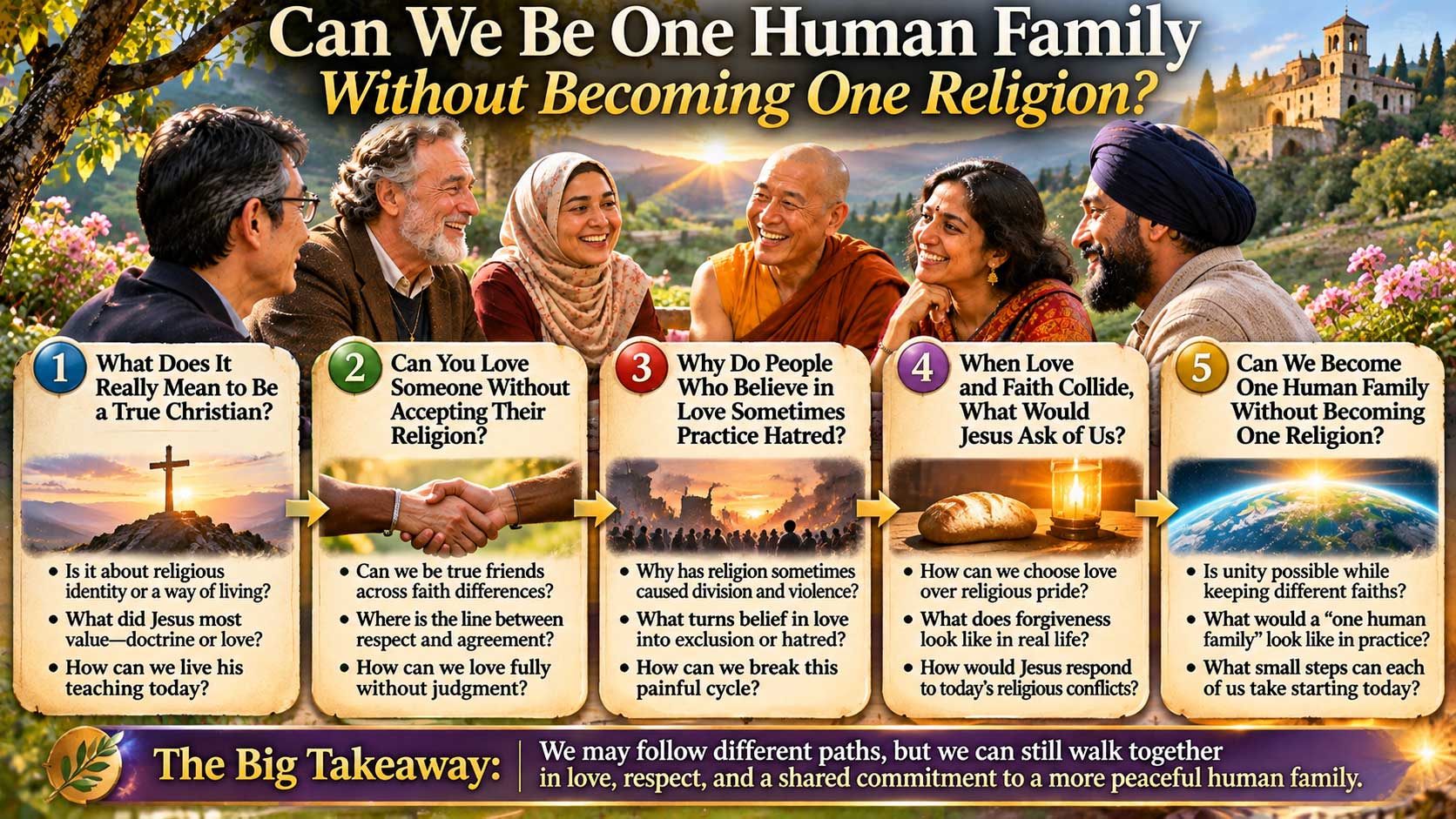
Short Bios:
Nick Sasaki: Moderator and Creator of ImaginaryTalks
Nick Sasaki is the creator of ImaginaryTalks.com, a creative platform exploring human experience, history, faith, philosophy, and meaningful questions through fictional conversations. His guiding conviction is One Family Under God, the belief that humanity shares a common divine parent and should strive to live as one human family. In this conversation, Nick serves as moderator, bringing personal curiosity, Christian faith, and a commitment to respectful dialogue across religious differences.
Archbishop Desmond Tutu (1931–2021): Christianity
Desmond Mpilo Tutu was a South African Anglican archbishop, theologian, and human rights advocate who became one of the most prominent opponents of apartheid. He received the Nobel Peace Prize in 1984 and later chaired South Africa's Truth and Reconciliation Commission. His Christian faith informed his commitment to human dignity, justice, forgiveness, and reconciliation. Learn more through the South African government's biography of Desmond Tutu and the Nobel Peace Prize profile.
The 14th Dalai Lama (1935–): Tibetan Buddhism
Tenzin Gyatso, the 14th Dalai Lama, is the Tibetan Buddhist spiritual leader known for his teachings on compassion, nonviolence, human responsibility, and interreligious dialogue. Born in Tibet in 1935, he went into exile in India in 1959 and received the Nobel Peace Prize in 1989. His Buddhist perspective emphasizes compassion, interdependence, and the cultivation of the mind without adopting a creator-God theology. Read his official biography.
Jalaluddin Rumi (1207–1273): Islam and Sufism
Jalaluddin Muhammad Rumi was a Persian-language poet, Islamic scholar, and Sufi spiritual teacher whose writings explore devotion to God, love, humility, and spiritual transformation. His celebrated Masnavi is among the most influential works of Sufi literature. Rumi's teachings emerged from a deeply Islamic religious setting, and his spiritual ideas should be read in connection with that tradition. Learn more through Encyclopaedia Britannica's biography of Rumi.
Confucius (551–479 BCE): Confucian Thought
Confucius, also known as Kongzi, was an influential Chinese teacher and philosopher whose teachings shaped East Asian ethical and social thought. He emphasized ren (humaneness), li (ritual propriety), moral cultivation, sincerity, and the responsibilities that sustain family and social relationships. His teachings were preserved and developed through the Confucian tradition, most famously in the Analects. Read the Stanford Encyclopedia of Philosophy's entry on Confucius.
Mahatma Gandhi (1869–1948): Hinduism and Nonviolence
Mohandas Karamchand Gandhi, widely known as Mahatma Gandhi, was a leader of India's independence movement and an influential advocate of satyagraha, or nonviolent resistance grounded in the pursuit of truth. His religious and moral thought drew heavily from Hindu traditions and engaged with other faiths, including Christianity. Gandhi's life and legacy remain subjects of serious historical study, including criticism of some of his views and decisions. Learn more through Encyclopaedia Britannica's biography of Gandhi.
Rabbi Abraham Joshua Heschel (1907–1972): Judaism
Abraham Joshua Heschel was a Polish-born American rabbi, Jewish theologian, philosopher, and civil rights advocate. After escaping Nazi persecution in Europe, he became an influential teacher of Jewish theology and ethics in the United States. He joined Martin Luther King Jr. in the struggle for racial justice, including the 1965 Selma-to-Montgomery march. His writings emphasized religious awe, covenantal responsibility, and the moral urgency of responding to human suffering. Read his biography at Stanford University's Martin Luther King, Jr. Research and Education Institute.
Leave a Reply