
Introduction
What if Abraham Lincoln's greatest lesson wasn't that he was always right, but that he was willing to confront what he had gotten wrong?
We remember Abraham Lincoln as the president who preserved the Union and helped bring slavery to an end. His face appears on monuments, currency, and in classrooms across America. His speeches continue to inspire generations. Yet the familiar image of Lincoln as a wise, compassionate leader can obscure the complicated human being behind it. He was ambitious, humorous, stubborn, sometimes uncertain, and shaped by the prejudices of his time. His convictions developed through years of political conflict, personal grief, and encounters with people who challenged his beliefs.
Our imaginary interview begins in Springfield, Illinois, in 1846, long before the presidency. Lincoln is a thirty-seven-year-old lawyer preparing for his first term in Congress. He loves books, tells stories, enjoys making people laugh, and speaks warmly about his wife and two young sons. He has experienced failure and disappointment, yet remains determined to accomplish something useful with his life. Meeting this younger Lincoln reveals a man whose intelligence was shaped by limited schooling, relentless curiosity, and the encouragement of people who believed in him.
Twelve years later, our friendship faces its first serious test. During the Lincoln-Douglas debates of 1858, Lincoln publicly opposes slavery's expansion while rejecting full political and social equality for Black Americans. Nick challenges the contradiction between Lincoln's defense of natural rights and his unwillingness to support equal voting rights. Lincoln refuses to surrender his position simply to satisfy his friend. Their disagreement exposes a difficult truth: a person can recognize a profound injustice and still fail to accept the full implications of the principles he defends.
By December 1862, the country is engulfed in civil war, and Lincoln has endured the death of his beloved son Willie. Military defeats, grieving families, and the approaching Emancipation Proclamation weigh upon him. He has reviewed hundreds of death sentences arising from the U.S.-Dakota War, declining to approve most of them while authorizing executions that remain deeply controversial. Our conversation moves beyond the familiar image of presidential courage to examine the human consequences of leadership. What does responsibility mean when a decision made in Washington can determine whether someone lives or dies?
In August 1864, Lincoln faces the possibility of losing reelection. The Democratic convention is meeting in Chicago, Union armies are fighting costly campaigns, and the future of emancipation remains uncertain. Frederick Douglass has challenged the unequal treatment of Black soldiers and pressed the president to confront the realities of slavery more directly. Meanwhile, enslaved families are seeking freedom, Black soldiers are fighting for the Union, and abolitionists are demanding lasting change. Lincoln is helping transform the nation, but the people struggling for freedom are transforming his thinking too.
Our final meeting takes place on March 5, 1865, the morning after Lincoln's Second Inaugural Address. The war is approaching its end, yet the future of millions of formerly enslaved people remains unsettled. Frederick Douglass has attended the inaugural reception, and Lincoln has begun reconsidering the political rights he rejected in Charleston years earlier. Their conversation returns to the questions of racial equality, forgiveness, faith, and national reconciliation. Lincoln has changed, but he has not become a flawless champion of every principle we recognize today. His progress is meaningful precisely when we acknowledge both how far he traveled and how much remained unfinished.
Across five imagined meetings, Nick Sasaki and Abraham Lincoln develop a friendship built on warmth, humor, disagreement, and mutual respect. They begin with books and ambition, confront slavery and racial inequality, share moments of grief, and consider what it means to rebuild a divided nation. This is neither an attempt to place Lincoln beyond criticism nor to diminish his extraordinary achievements. It is an invitation to meet him as a human being, to recognize the people who helped shape his decisions, and to consider whether the willingness to keep learning may be among the most valuable qualities a leader can possess.
Fictional Conversation Disclaimer: This article presents an imaginative historical interview, not an authentic transcript. The meetings, friendship, private conversations, and dialogue between Nick Sasaki and Abraham Lincoln are fictional. Documented events and historical positions provide the foundation, but invented remarks must not be attributed to Lincoln as genuine quotations or interpreted as his endorsement of this work.
Topic 1: The Man Before the Monument
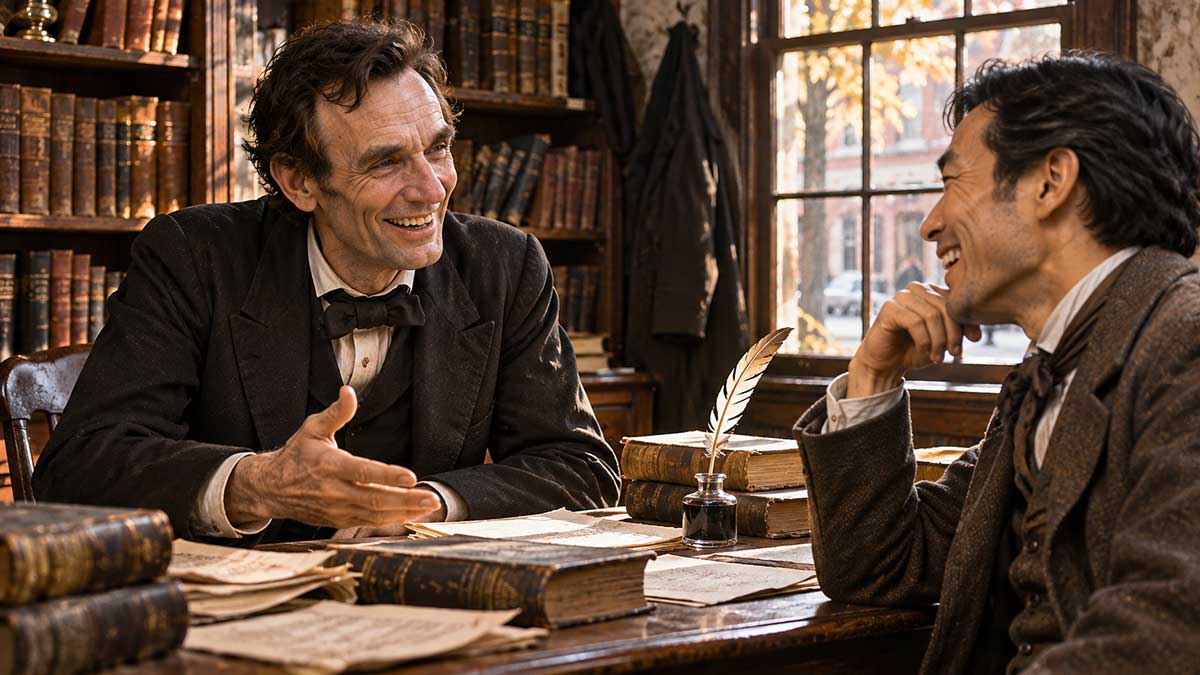
Springfield, Illinois, autumn 1846. Late afternoon.
The autumn sunlight falls across the streets of Springfield, where wagons rattle over uneven roads and neighbors greet one another outside small shops.
Abraham Lincoln is thirty-seven years old. He has recently been elected to the United States House of Representatives, though his congressional term will not begin until March 1847. For now, he remains a practicing lawyer, husband, and father, living far from the national prominence that awaits him.
His law office is modest, crowded with books, legal documents, and the ordinary disorder of a busy practice. His dark hair is untidy, his face clean-shaven, and his long frame seems almost too large for the furniture.
There is no famous beard, no presidential desk, and no monument.
Only a young lawyer with an unusual mind, a lively sense of humor, and ambitions he has not yet fully explained, even to himself.
Opening
Nick Sasaki pauses outside the law office, listening to the sound of someone speaking inside.
Abraham Lincoln: Now, there's a fellow who believed he could win his case merely by talking longer than the other man.
A second voice laughs.
Abraham Lincoln: Unfortunately for him, the judge had already made up his mind, and the fellow's own lawyer was beginning to wish he'd lose.
More laughter follows.
Nick knocks.
Abraham Lincoln: Come in!
Nick opens the door and finds a tall, thin man standing beside a desk piled with papers. Another visitor is collecting his hat, still smiling.
Abraham Lincoln: Well, sir, you've arrived just in time. My friend here was about to escape before I could tell him another story.
Nick Sasaki: Then perhaps I should have come earlier.
Abraham Lincoln: Perhaps. But I warn you, once I get started, a man may find it easier to leave Springfield than to leave this office.
The visitor laughs, bids Lincoln farewell, and steps into the street.
Lincoln turns toward Nick.
Abraham Lincoln: Abraham Lincoln. And you are?
Nick Sasaki: Nick Sasaki. I've heard quite a bit about you.
Abraham Lincoln: I hope you've had the good sense to believe only half of it.
Nick Sasaki: Which half?
Abraham Lincoln: That's the difficulty. I've never been able to determine it myself.
Nick laughs.
Nick Sasaki: I'm glad to meet you, Mr. Lincoln.
Abraham Lincoln: And I'm pleased to meet you, Nick. Sit down, if you can find a chair that hasn't been claimed by the law.
Nick moves a stack of papers from a chair.
Nick Sasaki: Is this how you organize your office?
Abraham Lincoln: Organize? I believe you've mistaken me for another lawyer.
Nick Sasaki: How do you find anything?
Abraham Lincoln: I generally begin by looking where it ought to be. When that fails, I look where it ought not to be. The second method is often more successful.
They laugh.
Nick takes his seat.
Nick Sasaki: Congratulations on your election to Congress.
Abraham Lincoln: Thank you. I hope the voters won't have cause to regret their judgment.
Nick Sasaki: Are you excited?
Abraham Lincoln: Certainly. Though I suspect Congress is a place where good intentions go to become lengthy speeches.
Nick Sasaki: You sound as though you've already been there.
Abraham Lincoln: No, but I've heard enough speeches to form a reasonable suspicion.
Nick smiles.
Nick Sasaki: Mr. Lincoln, I've been looking forward to meeting you. Not simply the politician, but the man who became him.
Abraham Lincoln: Well, you'll find the man is considerably easier to meet than the politician is to explain.
Question 1: How Did a Boy With Almost No Schooling Educate Himself?
Nick Sasaki: You grew up with very little formal schooling, yet you've become a successful lawyer. How did that happen?
Abraham Lincoln: By a good deal of reading, a good deal of work, and the kindness of people who helped me along.
Nick Sasaki: Did you have a teacher who changed your life?
Abraham Lincoln: I had several teachers for short periods. None had me long enough to claim much credit, I suppose.
Nick Sasaki: But someone must have encouraged you.
Abraham Lincoln: My stepmother, Sarah Bush Lincoln, did a great deal in that respect. She was kind to me and encouraged my interest in books.
Nick Sasaki: What made you so eager to read?
Lincoln settles into his chair.
Abraham Lincoln: I found that a book could tell me something I didn't know. And once I discovered how much I didn't know, there was no end to the trouble.
Nick Sasaki: (Smiling) Trouble?
Abraham Lincoln: Yes. A man may be perfectly content with his ignorance until someone gives him a little knowledge. Then he begins wanting more.
Nick Sasaki: What did you read?
Abraham Lincoln: Whatever I could get. The Bible, Aesop's Fables, biographies, histories, and other books that came within reach.
Nick Sasaki: Aesop's Fables. Is that where you learned to tell stories?
Abraham Lincoln: It may have helped. A good story can carry an idea farther than a long explanation.
Nick Sasaki: Give me an example.
Lincoln smiles.
Abraham Lincoln: Well, take the old fable of the fox and the grapes. The fox cannot reach the grapes, so he decides they must be sour.
Nick Sasaki: I know that one.
Abraham Lincoln: I've met a good many men who behave in much the same fashion. When they cannot obtain an office, they declare the office worthless. When they win it, they discover it was important all along.
Nick laughs.
Nick Sasaki: Are you speaking from experience?
Abraham Lincoln: I've lost enough elections to appreciate the fox's reasoning.
Nick Sasaki: But you didn't stop trying.
Abraham Lincoln: No. I had things I wanted to accomplish.
Nick Sasaki: You taught yourself enough law to become an attorney. Was that difficult?
Abraham Lincoln: It required study. I borrowed books and read them as carefully as I could. I had help from men who knew more than I did.
Nick Sasaki: Did you ever feel embarrassed that you hadn't received the education other lawyers had?
Lincoln considers the question.
Abraham Lincoln: I knew my schooling had been limited. But I couldn't change the schooling I'd already missed. I could only decide what to learn next.
Nick Sasaki: That's a practical answer.
Abraham Lincoln: It seemed more useful than spending my days regretting what I hadn't been given.
Nick Sasaki: People may someday describe you as a self-made man.
Lincoln shakes his head.
Abraham Lincoln: I hope they won't forget the people who helped me.
Nick Sasaki: Why does that matter to you?
Abraham Lincoln: My stepmother encouraged me. Neighbors lent me books. Other men gave me opportunities. I worked hard, certainly, but I didn't build a life entirely by myself.
Nick Sasaki: So you don't believe success belongs to one person alone.
Abraham Lincoln: A man ought to take responsibility for his efforts. But he ought to recognize a kindness when he receives one.
Nick looks around the office.
Nick Sasaki: It's remarkable. You began with so little formal education, and now you're going to Congress.
Abraham Lincoln: Yes, and I expect Congress will soon discover how much I still have to learn.
Question 2: What Was Abraham Lincoln Really Ambitious For?
The afternoon light moves across the desk.
Nick notices several political newspapers among the legal documents.
Nick Sasaki: Mr. Lincoln, you seem to have wanted a public career for a long time.
Abraham Lincoln: I have.
Nick Sasaki: Why?
Lincoln leans back.
Abraham Lincoln: I suppose I've always wanted to make something of myself and be of some use to other people.
Nick Sasaki: Is that ambition?
Abraham Lincoln: Certainly. I see no reason to pretend otherwise.
Nick Sasaki: Some people say ambition is selfish.
Abraham Lincoln: It can be. A man may desire office merely for the satisfaction of holding it.
Nick Sasaki: And you?
Abraham Lincoln: I enjoy public life. I won't deny it. I like argument, I like meeting people, and I believe government can accomplish useful things.
Nick Sasaki: What useful things?
Abraham Lincoln: Better roads, canals, railroads, schools, and laws that permit people to improve their circumstances.
Nick Sasaki: You believe government should help create opportunity.
Abraham Lincoln: I believe it can undertake certain works that individuals cannot accomplish so readily on their own.
Nick Sasaki: What about people who are born poor?
Abraham Lincoln: I know something of that condition. A man ought to have the opportunity to improve his lot through honest labor.
Nick Sasaki: But opportunity isn't distributed equally.
Lincoln nods.
Abraham Lincoln: No. It isn't.
Nick Sasaki: Does that trouble you?
Abraham Lincoln: It does. A country ought not to make a man's beginnings the final measure of what he may become.
Nick Sasaki: Yet slavery exists in this country.
Lincoln's expression grows serious.
Abraham Lincoln: Yes.
Nick Sasaki: How can a nation praise opportunity when millions of people are held in bondage?
Lincoln is quiet for a moment.
Abraham Lincoln: Slavery is a great wrong. I have never regarded it as a good thing.
Nick Sasaki: Then why doesn't the government abolish it?
Abraham Lincoln: The Constitution and the political arrangements of the country place limits upon what Congress may do. The question of slavery in the territories is one matter. Slavery within the states where it already exists presents another.
Nick Sasaki: But the moral question is the same.
Abraham Lincoln: The moral wrong does not disappear merely through a legal distinction. Yet a legislator must consider what authority he possesses.
Nick Sasaki: That sounds frustrating.
Abraham Lincoln: It is. But frustration does not give a man permission to disregard the Constitution.
Nick studies him.
Nick Sasaki: You sound like someone who wants to change the country but is very conscious of its limits.
Abraham Lincoln: I want to accomplish what I can within the government we have.
Nick Sasaki: Do you think you might someday become president?
Lincoln bursts into laughter.
Abraham Lincoln: President? Nick, I haven't even reached Washington as a congressman, and you're already preparing to move me into the White House.
Nick Sasaki: I'm asking about your ambition.
Abraham Lincoln: Well, a man may dream beyond his present circumstances. But I'd be a fool to spend all my time admiring a future that hasn't arrived.
Nick Sasaki: Then what do you hope to accomplish in Congress?
Abraham Lincoln: I hope to represent my constituents honorably, speak plainly, and support measures I believe will benefit the country.
Nick Sasaki: That's all?
Abraham Lincoln: If I manage those things, it will be more than some members of Congress accomplish.
Nick laughs.
Nick Sasaki: You're not afraid to make fun of politicians.
Abraham Lincoln: I've been one long enough to know the profession deserves occasional correction.
Question 3: What Kind of Husband and Father Was Lincoln Before the Presidency?
A clock strikes in the distance.
Nick glances toward the window.
Nick Sasaki: I don't want to keep you from your family.
Abraham Lincoln: Mary will certainly appreciate your consideration.
Nick Sasaki: How is she?
Abraham Lincoln: Well, thank you. We have two lively boys at home.
Nick Sasaki: Robert and Eddie?
Abraham Lincoln: Yes. Robert is three now, and Eddie was born this spring.
Nick Sasaki: Congratulations.
Abraham Lincoln: Thank you. I suspect that raising children may require more wisdom than practicing law.
Nick Sasaki: Why do you say that?
Abraham Lincoln: In court, a man may appeal to a judge. At home, I have yet to discover the proper authority to whom one appeals when a small child refuses to cooperate.
Nick laughs.
Nick Sasaki: Perhaps Mary knows.
Abraham Lincoln: She usually has a better understanding of household affairs than I do.
Nick Sasaki: What do you enjoy most about being a father?
Lincoln smiles.
Abraham Lincoln: The boys are a pleasure to me. Robert is growing quickly, and Eddie is still very small. They bring life into the house.
Nick Sasaki: Do you spend much time with them?
Abraham Lincoln: As much as my work permits. The law takes me away from home, especially when I travel the circuit.
Nick Sasaki: Does that trouble you?
Abraham Lincoln: I miss them when I'm gone. But a man must provide for his family, and my work requires travel.
Nick Sasaki: Is Mary comfortable with your political ambitions?
Lincoln considers the question.
Abraham Lincoln: Mary has a lively interest in politics. She is intelligent and has opinions of her own.
Nick Sasaki: Strong opinions?
Lincoln smiles.
Abraham Lincoln: I should say so.
Nick Sasaki: And you always agree?
Abraham Lincoln: Nick, I've practiced law long enough to know that agreement between two intelligent people is not guaranteed.
Nick laughs.
Nick Sasaki: Then marriage has taught you something about debate.
Abraham Lincoln: It has certainly given me opportunities to practice.
They share a smile.
Nick Sasaki: You seem very fond of her.
Abraham Lincoln: I am.
Nick Sasaki: What do you hope your sons will learn from you?
Lincoln looks toward the window.
Abraham Lincoln: I hope they'll learn to think for themselves, to work honestly, and to treat other people fairly.
Nick Sasaki: Would you want them to become politicians?
Abraham Lincoln: I should prefer that they become good men. If they then choose politics, I'll hope they survive the experience.
Nick laughs.
Nick Sasaki: You speak about public service with great seriousness, but you never seem to take yourself too seriously.
Abraham Lincoln: A man ought to know the difference.
Nick Sasaki: What's the difference?
Abraham Lincoln: His responsibilities may be important. That doesn't mean every opinion he holds is equally important.
Nick smiles.
Nick Sasaki: I think I'll remember that.
Abraham Lincoln: Then this visit has accomplished something useful.
Closing
The afternoon is giving way to evening.
Lincoln rises from his chair, and Nick stands beside him.
Nick Sasaki: Mr. Lincoln, I came here expecting to meet an ambitious lawyer and newly elected congressman.
Abraham Lincoln: And what did you find?
Nick Sasaki: A man who loves books, enjoys making people laugh, cares deeply about his family, and wants his life to mean something.
Lincoln smiles.
Abraham Lincoln: That's a generous assessment. I hope I can live up to it.
Nick Sasaki: I hope we can meet again.
Abraham Lincoln: I'd like that.
They shake hands.
Nick Sasaki: Perhaps when you return from Washington.
Abraham Lincoln: If Congress hasn't worn me out by then.
Nick Sasaki: I doubt it will.
Abraham Lincoln: You have more confidence in me than I have earned.
Nick moves toward the door, then stops.
Nick Sasaki: One last question.
Lincoln raises an eyebrow.
Abraham Lincoln: I was beginning to suspect there would be one.
Nick Sasaki: What would you say to someone who wants to accomplish something important but doesn't know where to begin?
Lincoln considers the question.
Abraham Lincoln: I'd tell him to begin with the work before him. Learn what he can, do it honestly, and don't be too proud to accept help.
Nick Sasaki: And if he fails?
Abraham Lincoln: Then he may discover something useful about what not to do next time.
Nick Sasaki: That's encouraging.
Abraham Lincoln: I hope so. I've had enough failures to know they needn't be the end of a man's efforts.
Nick smiles.
Nick Sasaki: Thank you, Mr. Lincoln.
Abraham Lincoln: Call me Abraham next time.
Nick Sasaki: Then you must call me Nick.
Abraham Lincoln: I believe I've already taken that liberty.
They laugh.
Nick steps into the cool autumn evening.
Behind him, Abraham Lincoln returns to his cluttered desk, where unfinished legal work waits beneath a stack of newspapers.
There is no sign of the terrible war that will someday consume the nation, no indication of the grief he will endure, and no reason for either man to suspect how profoundly his political convictions will be tested.
For now, he is simply Abraham Lincoln: a lawyer, a husband, a father, and a man preparing to leave Springfield for Congress.
Nick walks away with the feeling that he has met someone worth knowing.
Not a perfect man.
Not a man who possesses every answer.
But a man who is still learning, still laughing, and still hoping to make something useful of his life.
Topic 2: The Limits of His Beliefs
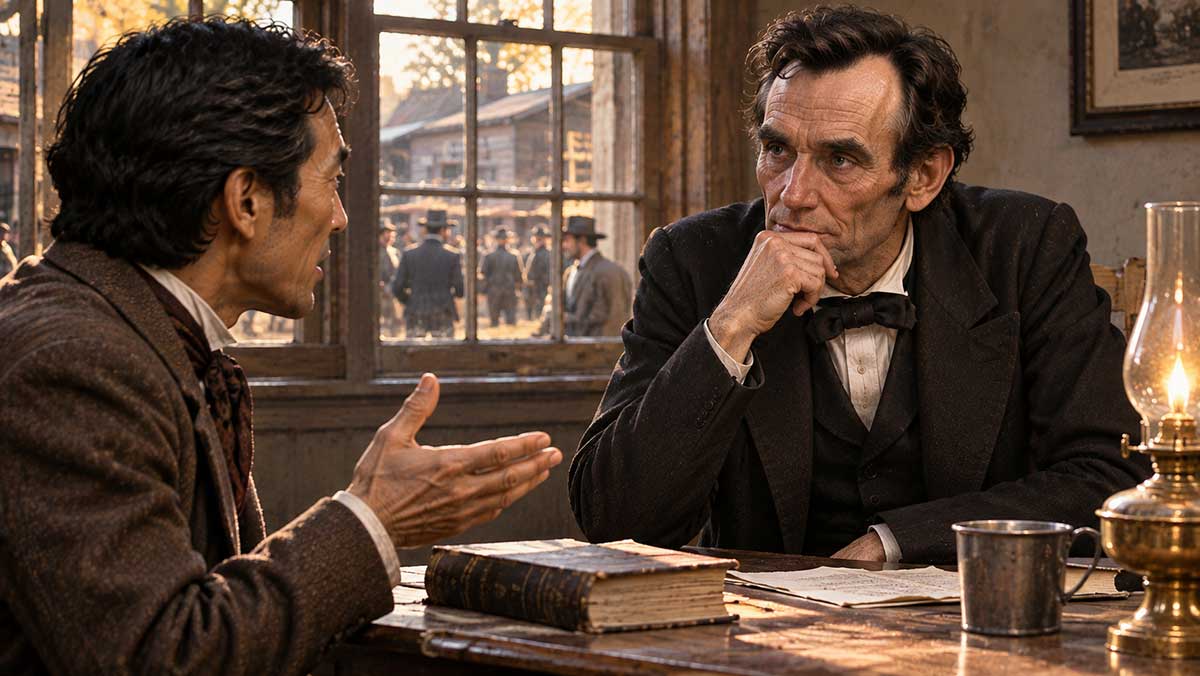
Charleston, Illinois, September 18, 1858. Early evening.
Twelve years have passed since Nick Sasaki first met Abraham Lincoln in a cluttered law office in Springfield.
Lincoln is now forty-nine years old. His face is still clean-shaven, his dark hair increasingly unruly, and his tall frame familiar to anyone who has attended his political speeches.
Earlier today, he stood before a large crowd in Charleston for the fourth of seven debates against Senator Stephen A. Douglas. The two men are competing for a United States Senate seat, but their arguments concern a question much larger than the election: the future of slavery in America.
Lincoln opposes the expansion of slavery into the western territories. He believes slavery is morally wrong and argues that the Declaration of Independence's promise of natural rights extends to Black Americans.
Yet during today's debate, Lincoln publicly rejected full political and social equality between Black and white Americans. He stated that he did not support Black men voting, serving on juries, holding public office, or marrying white people.
The contradiction is difficult to ignore.
Nick has come to Charleston to see his old friend again. But this time, friendship will not prevent him from asking questions that Lincoln may find uncomfortable.
Opening
The late afternoon crowd has begun to disperse.
Wagons roll along the dusty streets, and groups of men continue arguing about the debate outside taverns and storefronts.
Lincoln sits in a modest room near the debate grounds, removing his coat and stretching his long legs.
A knock comes at the door.
Abraham Lincoln: Come in!
Nick enters.
Nick Sasaki: Abraham!
Lincoln looks up, then breaks into a broad smile.
Abraham Lincoln: Nick! Well, I'll be. I thought the crowd had finally exhausted every man in Illinois who wished to argue with me.
Nick Sasaki: I'm afraid there's one more.
Abraham Lincoln: Then I ought to have the door locked before you get started.
They laugh and shake hands warmly.
Nick Sasaki: It's been twelve years.
Abraham Lincoln: Twelve years? Then I hope you've spent them more profitably than I have.
Nick Sasaki: You don't think you've accomplished much?
Abraham Lincoln: I've practiced law, served a term in Congress, lost a few elections, and made a respectable collection of political enemies. It's a fair amount of activity, though not all of it has produced the results I intended.
Nick Sasaki: I heard your debate today.
Lincoln's smile becomes more thoughtful.
Abraham Lincoln: Then you've already had enough of my speeches for one afternoon.
Nick Sasaki: Your arguments were powerful.
Abraham Lincoln: Some people seemed to think so. Others appeared ready to throw me out of the county.
Nick Sasaki: I want to ask you about something you said.
Lincoln studies his friend's expression.
Abraham Lincoln: I suspected you hadn't come merely to congratulate me.
Nick Sasaki: No. And I think you know why.
Lincoln gestures toward the chair opposite him.
Abraham Lincoln: Sit down, Nick. If we're to disagree, we may as well do it comfortably.
Question 4: How Could Lincoln Oppose Slavery but Reject Racial Equality?
Nick Sasaki: Abraham, today you said you oppose slavery. Yet you stated that you don't support Black people having the same political and social rights as white people. How do you reconcile those positions?
Lincoln leans back.
Abraham Lincoln: I have always regarded slavery as wrong. But I do not hold that opposition to slavery requires me to support complete political and social equality between the races.
Nick Sasaki: Why not?
Abraham Lincoln: The two questions are distinct. A man may believe another man ought not to be enslaved without believing that every political privilege must be extended to him.
Nick Sasaki: But you believe the Declaration of Independence applies to Black Americans.
Abraham Lincoln: I believe its statement that all men are created equal includes them in the possession of natural rights, the right to life, liberty, and the pursuit of happiness.
Nick Sasaki: Then why shouldn't those rights include the right to vote?
Abraham Lincoln: The Declaration does not establish that every person must possess identical political privileges. The qualifications for voting have long been determined by the laws of the states.
Nick Sasaki: But those laws were written by people who already possessed political influence.
Abraham Lincoln: That is true.
Nick Sasaki: Then isn't there a problem? You're saying Black Americans possess natural rights, but you're willing to leave the protection of those rights in the hands of people who may deny them.
Lincoln considers the question.
Abraham Lincoln: I understand the difficulty you're raising. But I must distinguish the principle that no man has a right to enslave another from the question of how political authority is distributed.
Nick Sasaki: Suppose I tell you a story.
Abraham Lincoln: I'd be pleased to hear one. I usually have to supply them myself.
Nick Sasaki: A farmer tells his hired worker, "You have the same natural right to the fruits of your labor that I do." But then the farmer says, "You cannot vote on the rules that determine whether I may take those fruits away."
Lincoln listens.
Nick Sasaki: Has the farmer really respected the worker's rights?
Abraham Lincoln: He has acknowledged the right, but your example raises the question of how that right is to be protected.
Nick Sasaki: Exactly.
Abraham Lincoln: Yet I would caution against treating every distinction in political privileges as equivalent to slavery.
Nick Sasaki: I'm not saying they're identical. I'm asking whether the line between natural rights and political rights can survive its own logic.
Lincoln looks at Nick for a long moment.
Abraham Lincoln: It is a serious question.
Nick Sasaki: Then answer it seriously.
Lincoln sits forward.
Abraham Lincoln: Very well. I believe a Black man has the same natural right as a white man to eat the bread his own labor earns. I believe slavery violates that right. But I do not now advocate placing Black and white citizens upon the same footing in every political and social respect.
Nick Sasaki: Then we disagree.
Abraham Lincoln: We do.
Nick Sasaki: And I think your position leaves Black Americans vulnerable to the very injustice you oppose.
Abraham Lincoln: You have stated your objection plainly.
Nick Sasaki: Does it trouble you?
Abraham Lincoln: I do not dismiss it. But I cannot tell you that I have adopted your conclusion.
Nick nods.
Nick Sasaki: I appreciate your willingness to say what you actually believe.
Abraham Lincoln: Friendship would be a poor bargain if it required either of us to pretend agreement.
Question 5: Can a Politician Defend Justice Without Losing the People?
Outside, the sounds of the crowd have grown quieter.
Nick watches Lincoln pour a glass of water.
Nick Sasaki: Abraham, I wonder how much of what you said today reflects your convictions and how much reflects what Illinois voters are willing to hear.
Lincoln sets down the pitcher.
Abraham Lincoln: Both matter in politics.
Nick Sasaki: But which matters more?
Abraham Lincoln: A man must decide what he believes is right. Then he must consider what authority he possesses and what he can persuade the public to support.
Nick Sasaki: What if the public is wrong?
Abraham Lincoln: Then persuasion becomes more difficult, not less necessary.
Nick Sasaki: Suppose you knew a position was morally right but taking it would cost you the election.
Abraham Lincoln: I should hope not to abandon a principle merely for office. But I would be foolish to imagine that winning an election has no bearing on what a politician can accomplish.
Nick Sasaki: Isn't there a danger that political calculation becomes an excuse for moral compromise?
Lincoln smiles faintly.
Abraham Lincoln: Certainly. There is a danger in almost everything a politician does, including talking too much.
Nick Sasaki: You've had some experience with that.
Abraham Lincoln: More than my opponents would care to hear.
Nick smiles, but his expression quickly grows serious.
Nick Sasaki: Abraham, I want to know where you draw the line.
Abraham Lincoln: Between what?
Nick Sasaki: Between compromise that helps you accomplish something good and compromise that makes you part of the injustice.
Lincoln considers the question.
Abraham Lincoln: I would draw it at abandoning the principle that slavery is wrong and ought not to be extended.
Nick Sasaki: But you aren't proposing to abolish slavery everywhere it exists.
Abraham Lincoln: I do not believe Congress possesses unlimited authority over slavery within the states. The federal government must act within its constitutional responsibilities.
Nick Sasaki: And what about the territories?
Abraham Lincoln: Congress has authority there, and I believe slavery should be prevented from spreading.
Nick Sasaki: Stephen Douglas argues that settlers should decide the matter for themselves.
Abraham Lincoln: He calls it popular sovereignty.
Nick Sasaki: Why do you reject it?
Lincoln leans forward.
Abraham Lincoln: Suppose a man claims the right to decide whether he may take another man's horse. Would you call that a proper exercise of self-government?
Nick Sasaki: Of course not.
Abraham Lincoln: Then why should a community's right to govern itself include the right to make one man the property of another?
Nick smiles.
Nick Sasaki: That's the Abraham Lincoln I remember. You make an argument sound simple by telling a story.
Abraham Lincoln: I find it helps to bring a question down from the clouds and set it where ordinary men can examine it.
Nick Sasaki: But your own position still leaves slavery untouched in states where it already exists.
Abraham Lincoln: I have not claimed that the problem can be settled at once. I believe we must place slavery where the public mind can rest in the belief that it is moving toward eventual extinction.
Nick Sasaki: And if the public refuses?
Abraham Lincoln: Then the argument must continue.
Nick Sasaki: Even if you lose?
Abraham Lincoln: Even if I lose.
Nick studies him.
Nick Sasaki: You sound determined.
Abraham Lincoln: I am.
Question 6: Does the Declaration of Independence Apply to Everyone?
The evening shadows lengthen across the room.
Nick glances toward the window, where the last groups of spectators are making their way home.
Nick Sasaki: Abraham, I want to return to the Declaration of Independence.
Abraham Lincoln: A document worth returning to.
Nick Sasaki: You believe its promise of equality applies to Black Americans.
Abraham Lincoln: In the natural rights I have described, yes.
Nick Sasaki: But many Americans believe the Declaration was written only for white men.
Abraham Lincoln: I disagree with that interpretation.
Nick Sasaki: Why?
Lincoln sits upright.
Abraham Lincoln: The authors of the Declaration did not mean that all men were equal in every respect. They knew that men differed in strength, intelligence, and circumstances. But they meant to establish a principle that no man is naturally entitled to rule another without justification.
Nick Sasaki: Then why was slavery permitted to continue?
Abraham Lincoln: The founders inherited an institution that contradicted the principle they announced. Their failure to remove it does not make the principle meaningless.
Nick Sasaki: But isn't that exactly the problem? America declares equality while practicing inequality.
Abraham Lincoln: It is a contradiction the country must confront.
Nick Sasaki: Do you believe the Declaration was a promise to future generations?
Abraham Lincoln: I believe it established a standard by which the country could judge its conduct.
Nick Sasaki: A standard the country hasn't yet met.
Abraham Lincoln: Yes.
Nick pauses.
Nick Sasaki: Abraham, let me ask you something difficult.
Abraham Lincoln: You have been doing that for the better part of an hour.
Nick Sasaki: (Smiling) Then one more won't hurt.
Abraham Lincoln: I shall trust your judgment.
Nick Sasaki: Suppose a Black man came into this room and asked you, "Mr. Lincoln, if I am your equal in natural rights, why should I accept a government in which I have no vote?"
Lincoln is silent for a moment.
Abraham Lincoln: I would tell him that I believe he is entitled to the fruits of his labor and to freedom from slavery. I would not promise him that I support every political right he seeks.
Nick Sasaki: Would you expect him to be satisfied?
Abraham Lincoln: No.
Nick Sasaki: Would you blame him for wanting more?
Lincoln looks toward the window.
Abraham Lincoln: I would not be surprised that a man wishes to secure his rights as fully as he can.
Nick Sasaki: Then perhaps he sees something in the Declaration that you haven't fully accepted.
Lincoln turns back.
Abraham Lincoln: Perhaps he draws conclusions from it that I am not prepared to endorse.
Nick Sasaki: That's a careful distinction.
Abraham Lincoln: It is the distinction I can honestly make.
Nick leans back.
Nick Sasaki: Abraham, I believe your opposition to slavery is sincere. But I think the principles you're defending may eventually demand more of you than you're prepared to give today.
Lincoln considers the remark.
Abraham Lincoln: That may be so. I cannot tell you what every future circumstance will require.
Nick Sasaki: Then I hope you'll keep asking yourself the question.
Abraham Lincoln: And I expect you'll keep asking it of me.
Nick Sasaki: I will.
Lincoln smiles.
Abraham Lincoln: Then I shall have to prepare myself.
Closing
The room has grown dim.
Lincoln rises and puts on his coat.
Abraham Lincoln: Well, Nick, you've given me a more demanding examination than some of the men who stood opposite me on the platform today.
Nick Sasaki: I hope I haven't spoiled our reunion.
Abraham Lincoln: Not at all.
They walk toward the door.
Nick Sasaki: We disagreed about something important.
Abraham Lincoln: Yes.
Nick Sasaki: And I still believe you're wrong.
Lincoln smiles.
Abraham Lincoln: I had gathered as much.
Nick Sasaki: But I'm glad we talked.
Abraham Lincoln: So am I.
Outside, the evening air is cool.
The streets of Charleston are quieter now, though the arguments from the debate will continue in newspapers and homes across Illinois.
Nick Sasaki: Abraham, I don't know whether you'll win this election.
Abraham Lincoln: Neither do I.
Nick Sasaki: But I hope you'll continue challenging slavery.
Abraham Lincoln: I intend to.
Nick Sasaki: And I hope you'll continue examining your own beliefs.
Lincoln looks at his friend.
Abraham Lincoln: A man ought not to be so certain of his wisdom that he refuses to learn.
Nick Sasaki: Then perhaps there's hope for both of us.
Abraham Lincoln: I should think so.
They shake hands.
Nick Sasaki: Until next time, Abraham.
Abraham Lincoln: Until next time, Nick.
Nick walks away through the gathering darkness.
He has met the same man who welcomed him into a Springfield law office twelve years earlier: thoughtful, ambitious, humorous, and willing to engage with difficult questions.
But he has discovered something more troubling.
Lincoln's opposition to slavery is genuine, yet his understanding of racial equality remains limited. His defense of natural rights reaches farther than his willingness to support political equality.
Nick cannot resolve that contradiction for him.
Nor can he know how the coming years will test Lincoln's beliefs.
The country is moving toward a crisis neither man can fully foresee.
And the question Nick leaves behind in Charleston will return in a different form years later:
Can a person remain faithful to a moral principle without eventually accepting where that principle leads?
Topic 3: The Cost of Being President
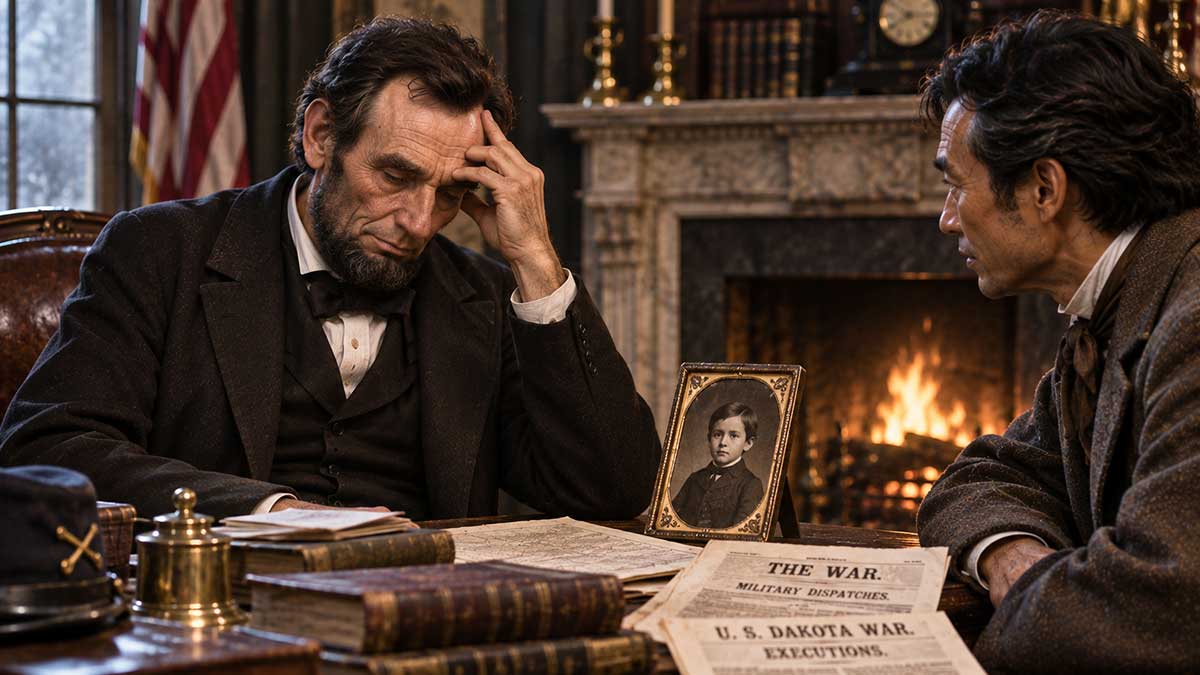
Executive Mansion, Washington, D.C., December 27, 1862. A winter evening.
Four years have passed since Nick last spoke with Abraham Lincoln in Charleston, Illinois.
The country is at war with itself. Thousands of soldiers have died, the Union has suffered a devastating defeat at Fredericksburg, and Lincoln is preparing to issue the final Emancipation Proclamation on January 1.
But the burdens of the presidency extend far beyond the battlefield.
Earlier this evening, a telegram from Minnesota confirmed that thirty-eight Dakota men were executed yesterday in Mankato. Lincoln had personally reviewed the death sentences arising from the U.S.-Dakota War and authorized those executions.
And there is another sorrow that no official document can measure. In February, Lincoln and Mary lost their eleven-year-old son, Willie.
Tonight, Nick returns to the Executive Mansion to meet an old friend carrying responsibilities that have become almost unimaginable.
Opening
The fire burns low in Lincoln's office.
Military maps cover a table. Letters from generals, government officials, and ordinary citizens lie in uneven piles. A lamp casts a warm circle of light across the president's desk.
Lincoln sits with a document in his hands.
When Nick enters, he looks up.
Abraham Lincoln: Nick! Well, this is a welcome surprise.
Nick Sasaki: Abraham. It's good to see you.
Abraham Lincoln: Come in. I would offer you a comfortable chair, but I'm afraid the government has not yet discovered how to furnish one.
Nick Sasaki: (Laughing) You've been president nearly two years, and you haven't fixed that?
Abraham Lincoln: I've considered making it my highest priority. Unfortunately, the generals keep distracting me with their wars.
They shake hands.
Nick notices the changes immediately.
Lincoln's face is thinner, his eyes tired, and his movements slower than he remembers.
Nick Sasaki: You look as though you haven't had much rest.
Abraham Lincoln: I've been getting some sleep. Whether it's enough to satisfy a physician is another matter.
Nick Sasaki: How are you holding up?
Lincoln looks at the papers.
Abraham Lincoln: Some days better than others. The country has given me a great deal to think about.
Nick Sasaki: I can see that.
Abraham Lincoln: But I'm glad you've come. Sit down, and for a little while we can pretend that these papers know how to wait their turn.
Nick takes a seat.
For a moment, they talk about Springfield, the old law office, and friends they both remember.
Then Nick's expression becomes serious.
Question 7: How Does a Grieving Father Lead a Nation at War?
Nick Sasaki: Abraham, I've wanted to tell you how sorry I am about Willie.
Lincoln's smile fades.
Abraham Lincoln: Thank you, Nick.
Nick Sasaki: I remember when we first met. Robert was a little boy, and Eddie was still an infant. You spoke about them with such affection.
Abraham Lincoln: Yes. Those were happy days.
Nick Sasaki: Then you lost Eddie. And now Willie.
Lincoln lowers his eyes.
Abraham Lincoln: Yes.
Nick waits.
Nick Sasaki: What was Willie like?
Lincoln sits quietly for a moment.
Abraham Lincoln: He had a fine mind. He was curious about everything. Books, numbers, the workings of things.
A faint smile appears.
Abraham Lincoln: He took a particular interest in railroads. He liked drawing up timetables, arranging the departures and arrivals of trains as though he were responsible for the entire railway system.
Nick Sasaki: Really?
Abraham Lincoln: He could make quite a business of it. I believe he might have managed the trains more successfully than some men manage the armies.
Nick smiles gently.
Nick Sasaki: That sounds like a wonderful little boy.
Abraham Lincoln: He was.
Lincoln looks toward the fire.
Abraham Lincoln: He enjoyed writing too. After our friend Senator Baker was killed in battle, Willie wrote verses about him.
Nick Sasaki: At eleven years old?
Abraham Lincoln: He was ten then. He had a feeling for words.
Nick Sasaki: Like his father.
Lincoln's expression softens.
Abraham Lincoln: He was his own person, Nick. That's what I wish people could have known.
Nick says nothing.
Abraham Lincoln: People remember a president's children as part of the president's story. But a father remembers the little things. What interested them. What made them laugh. The questions they asked.
His voice grows quieter.
Abraham Lincoln: And how much life they still had before them.
The room falls silent.
Nick watches the fire.
Nick Sasaki: I don't think there's anything I can say that will make that easier.
Abraham Lincoln: No. But you needn't try.
For a moment, they sit together without speaking.
Nick Sasaki: Abraham, there's something I've been wondering.
Abraham Lincoln: Go ahead.
Nick Sasaki: Every day you receive reports of soldiers dying. Each one is somebody's Willie. Somebody's Robert. Somebody's son.
Lincoln nods.
Nick Sasaki: Has losing Willie changed the way you think about those families?
Abraham Lincoln: A father who has buried a child cannot read such reports without knowing that there is more behind every name than the army can put on paper.
Nick Sasaki: Yet you still have to send men into battle.
Abraham Lincoln: I do.
Nick Sasaki: How do you bear that?
Abraham Lincoln: I cannot tell you that I bear it easily. But I have a responsibility to the country and to the men already fighting. If I shrink from every difficult decision, I may cause still greater suffering.
Nick Sasaki: Do you ever feel guilty for continuing the war?
Abraham Lincoln: I feel the weight of what the war costs. But I must consider what would follow if the rebellion succeeded.
Nick Sasaki: Sometimes I think people expect leaders to be strong every moment.
Lincoln looks at him.
Abraham Lincoln: Then people expect something no human being can provide.
Nick Sasaki: Who comforts you when you're grieving?
Lincoln considers the question.
Abraham Lincoln: Mary and I have both suffered. We have friends, and there are people who have shown us kindness. But sorrow is not something another person can simply take away.
Nick Sasaki: No.
Abraham Lincoln: A man may have duties waiting for him and still carry grief into the room where he performs them.
Nick nods slowly.
Nick Sasaki: I think that's what I see in you tonight.
Lincoln offers a tired smile.
Abraham Lincoln: Well, I hope you see a little of the old fellow too.
Nick Sasaki: I do.
Abraham Lincoln: Good. I should hate to think the presidency had swallowed him entirely.
Question 8: How Do You Choose When Every Decision May Cost Lives?
Lincoln rises and moves toward a military map.
Nick follows him.
Nick Sasaki: Abraham, I heard about Fredericksburg. The losses were terrible.
Abraham Lincoln: They were.
Nick Sasaki: General Burnside's army attacked entrenched Confederate positions and suffered thousands of casualties.
Abraham Lincoln: Yes. It was a grievous disappointment.
Nick Sasaki: Do you think the attack should have been made?
Lincoln studies the map.
Abraham Lincoln: I have had reason to question the judgment behind it. But I must be careful about claiming that every answer was obvious beforehand.
Nick Sasaki: Yet someone has to be responsible.
Abraham Lincoln: Certainly. The president cannot escape responsibility for the conduct of the war merely by pointing to his generals.
Nick Sasaki: Then how do you make the next decision? Another attack might cost thousands more lives.
Abraham Lincoln: And doing nothing may give the enemy time to strengthen his position. A war cannot be won by refusing every risk.
Nick Sasaki: But how do you know when the risk is justified?
Abraham Lincoln: You gather the best information available. You listen to the men who know the ground and the armies. Then you make a judgment.
Nick Sasaki: And if the judgment is wrong?
Abraham Lincoln: Then you must learn from it and make another.
Nick Sasaki: That sounds terribly unforgiving.
Abraham Lincoln: War is unforgiving.
Nick looks at the map.
Nick Sasaki: You know, in Springfield you once told me that ambition could bring a man into public life but couldn't tell him what to do once he arrived.
Lincoln smiles.
Abraham Lincoln: I seem to have been an unusually sensible fellow before I became president.
Nick Sasaki: (Laughing) You were.
Abraham Lincoln: I wish he were here to advise me now.
They share a brief laugh.
Then Nick grows serious.
Nick Sasaki: Abraham, what would you say to a father who believes his son died for nothing?
Lincoln turns away from the map.
Abraham Lincoln: I would not begin by telling him that his grief is mistaken.
Nick Sasaki: What would you tell him?
Abraham Lincoln: That I believe the preservation of this Union matters to the future of free government. And that the men who have died in its service have made sacrifices the country must not treat lightly.
Nick Sasaki: Would you expect him to accept that?
Abraham Lincoln: No. He has lost his son. I have no right to demand that he find comfort in my explanation.
Nick Sasaki: Then how do you continue believing in the cause?
Abraham Lincoln: Nick, if the Union can be destroyed whenever men refuse to accept the result of an election, the experiment of government by the people is in grave danger.
Nick Sasaki: You believe that is worth fighting for.
Abraham Lincoln: I do. And I believe the war has made the question of slavery impossible to leave where it stood before.
Nick Sasaki: You're preparing to issue the final Emancipation Proclamation.
Abraham Lincoln: Yes.
Nick Sasaki: Some people say you should have done it sooner.
Abraham Lincoln: Some do. Others say I should never have done it at all.
Nick Sasaki: What do you say?
Lincoln looks directly at him.
Abraham Lincoln: I believe it is a necessary measure in this war, and I intend to carry it forward.
Nick Sasaki: Without hesitation?
Abraham Lincoln: I have considered it long enough to know its importance. I do not expect it to end slavery everywhere at once, but it will place the government firmly against slavery in the areas covered by the proclamation.
Nick studies him.
Nick Sasaki: That's one of the clearest answers you've ever given me.
Abraham Lincoln: Then perhaps you ought to write it down before I return to my usual habit of talking too much.
Nick smiles.
Question 9: Can Justice Survive When a Nation Is Afraid?
Lincoln returns to his desk.
Among the documents lies a telegram received earlier that evening.
Nick notices his expression change.
Nick Sasaki: Is something wrong?
Lincoln picks up the telegram.
Abraham Lincoln: News from Minnesota.
Nick Sasaki: About the Dakota prisoners?
Abraham Lincoln: Yes. General Sibley reports that the thirty-eight men whose executions I authorized were hanged yesterday at Mankato.
Nick looks at him.
Nick Sasaki: All thirty-eight?
Abraham Lincoln: Yes.
Lincoln places the telegram on the desk.
Nick Sasaki: I know you reviewed hundreds of death sentences.
Abraham Lincoln: Three hundred and three men had been sentenced to death. I ordered the records examined and approved thirty-nine executions. One man was later reprieved.
Nick Sasaki: You refused to approve the others.
Abraham Lincoln: Yes.
Nick Sasaki: Some people will say you saved hundreds of lives. Others will ask why thirty-eight men had to die.
Lincoln meets his gaze.
Abraham Lincoln: They are entitled to ask.
Nick Sasaki: How did you decide?
Abraham Lincoln: I sought to distinguish those convicted of attacks upon civilians from those whose cases concerned participation in battle. I would not approve executions simply for having fought against our forces.
Nick Sasaki: But the trials themselves were deeply troubling.
Abraham Lincoln: The proceedings were conducted by a military commission under extraordinary circumstances.
Nick Sasaki: Some trials lasted only minutes. Many defendants had little opportunity to defend themselves. There were serious language barriers.
Abraham Lincoln: I know the records were far from what one would expect in an ordinary court.
Nick Sasaki: Then how could you be certain the convictions were reliable?
Lincoln pauses.
Abraham Lincoln: I could not personally retry every case. I had the records examined and made my decision from the evidence presented.
Nick Sasaki: But thirty-eight lives depended on that evidence.
Abraham Lincoln: Yes. And I will not pretend that is a small matter.
Nick leans forward.
Nick Sasaki: Abraham, I want to acknowledge the suffering of the settlers. Families were killed. Children lost parents. Those crimes deserve serious attention.
Abraham Lincoln: They do.
Nick Sasaki: But Dakota families were suffering too. Their people had endured broken agreements, the loss of land, and hunger. Some had been driven to desperation before the fighting began.
Abraham Lincoln: There have been grave failures in the government's dealings with the tribes.
Nick Sasaki: Then why does the discussion so often begin with the violence and ignore what came before it?
Lincoln considers the question.
Abraham Lincoln: The country ought to examine the causes of the conflict, not merely its consequences. But those causes do not excuse the killing of civilians.
Nick Sasaki: I agree. And the killing of civilians does not excuse an unfair trial.
Lincoln looks at him steadily.
Abraham Lincoln: No. It does not.
A silence follows.
Nick Sasaki: You were under enormous pressure from Minnesota to approve the executions.
Abraham Lincoln: I was.
Nick Sasaki: Were you afraid that refusing them would cause more violence?
Abraham Lincoln: I had to consider the anger in the state and the possibility of further disorder. But I would not permit public anger alone to determine the fate of every prisoner.
Nick Sasaki: Yet you approved thirty-nine.
Abraham Lincoln: I did. That decision is mine to answer for.
Nick sits back.
Nick Sasaki: I respect your willingness to say that. But I still wonder whether the government gave those men the justice they deserved.
Abraham Lincoln: I understand why you question it.
Nick Sasaki: What about the Dakota people who weren't involved in the attacks? Women, children, and families who have lost their homes?
Abraham Lincoln: Their treatment is a matter the government must address. The consequences of this conflict reach far beyond those who were tried.
Nick Sasaki: Do you think the country will treat them fairly?
Lincoln looks toward the window.
Abraham Lincoln: I cannot promise that it will. But I believe the government must be judged by how it treats people who have little ability to protect themselves.
Nick Sasaki: Including those who cannot vote?
Lincoln turns back.
Abraham Lincoln: Including them.
Nick remembers Charleston, four years earlier, and their disagreement about who should possess political rights.
Nick Sasaki: Abraham, that matters to me.
Abraham Lincoln: I know it does.
Nick Sasaki: I think history may remember that you declined to approve most of the death sentences. But I hope it remembers the Dakota families too.
Abraham Lincoln: Their suffering should not be forgotten.
Nick glances at the telegram.
Nick Sasaki: Thirty-eight men died yesterday. I don't know what to say about that.
Lincoln folds the document.
Abraham Lincoln: Nor do I have words that can undo it.
For a long moment, neither man speaks.
Closing
The fire has nearly burned out.
Lincoln returns to his chair, and Nick stands to leave.
Nick Sasaki: Abraham, I came here thinking about how much responsibility you carry. But tonight I keep thinking about the people who live with the consequences of decisions made in this room.
Abraham Lincoln: They are never far from my thoughts.
Nick Sasaki: Willie. The soldiers at Fredericksburg. The Dakota prisoners. The enslaved families waiting for freedom.
Lincoln nods.
Nick Sasaki: They're all different stories. But each one involves people whose lives matter far beyond the reports written about them.
Abraham Lincoln: Yes.
Nick Sasaki: I don't envy you.
Lincoln gives a weary smile.
Abraham Lincoln: That makes two of us.
Nick laughs softly.
Nick Sasaki: You still have your sense of humor.
Abraham Lincoln: I've found it useful. A man who cannot laugh occasionally may find himself unable to endure the rest.
Nick offers his hand.
Nick Sasaki: I hope the coming year brings something better.
Abraham Lincoln: So do I.
Nick Sasaki: And I hope the proclamation accomplishes what you intend.
Lincoln shakes his hand.
Abraham Lincoln: It is one step in a much larger undertaking. There will be more work after it.
Nick Sasaki: Then I hope you'll have the strength for it.
Abraham Lincoln: I'll do what I can.
Nick walks toward the doorway, then turns.
Nick Sasaki: Abraham, when we first met, you wanted to do something useful with your life.
Lincoln smiles faintly.
Abraham Lincoln: I remember.
Nick Sasaki: I think you still do.
Abraham Lincoln: More than ever.
They exchange a final nod.
Outside, the winter air is bitterly cold.
Nick remembers Willie and his imaginary railway journeys, the military maps, and the telegram from Minnesota.
The man he met in Springfield once spoke eagerly about books, ambition, and the possibilities of the future.
Now he must make decisions that no amount of reading could have fully prepared him to make.
In a few days, Lincoln will sign the final Emancipation Proclamation.
But tonight, the president is still sitting at his desk, surrounded by unfinished work and the human consequences of decisions already made.
And Nick leaves with a question that will remain with him long after the visit:
What does it mean to lead justly when every available decision may leave someone suffering?
Topic 4: Who Changed Abraham Lincoln?
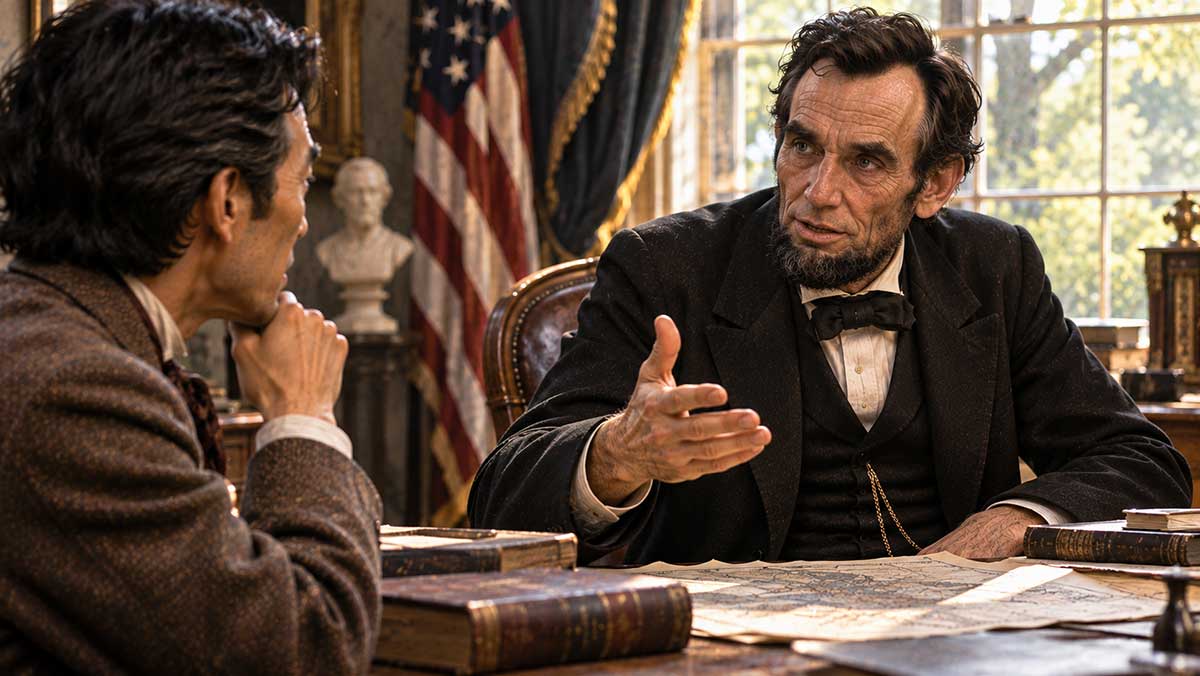
Executive Mansion, Washington, D.C., August 30, 1864. Late afternoon.
The summer heat hangs over Washington. The Civil War has entered its fourth year, and Abraham Lincoln faces one of the most uncertain moments of his presidency.
Union armies are fighting outside Atlanta. General Grant's forces remain locked in a costly campaign against Robert E. Lee in Virginia. The war has brought extraordinary suffering, and many Northern voters are weary of it.
In Chicago, the Democratic National Convention is underway. George B. McClellan, Lincoln's former commanding general, is expected to become the party's presidential nominee. Lincoln has privately acknowledged that his own reelection is far from certain.
Yet the struggle against slavery has reached a turning point. The Emancipation Proclamation has been in effect since January 1863. Black soldiers are serving in Union armies, enslaved people continue escaping from Confederate territory, and abolitionists are pressing the government to make freedom permanent.
Eleven days earlier, Lincoln met with Frederick Douglass, asking him to consider how more enslaved people might reach freedom if Lincoln lost the election. Douglass responded with a letter dated August 29.
Nick returns to the Executive Mansion to meet an old friend whose future, like the country's, remains uncertain.
Opening
A warm breeze moves the curtains beside Lincoln's office window.
The president stands over a desk covered with military dispatches, correspondence, and newspapers. One newspaper carries reports from the Democratic convention in Chicago.
Lincoln looks up as Nick enters.
Abraham Lincoln: Nick! You've come back.
Nick Sasaki: I promised I would.
Abraham Lincoln: Yes, but I've discovered that a promise made to a president is sometimes worth less than the paper it isn't written on.
Nick Sasaki: (Laughing) Then I'm glad I kept mine.
Abraham Lincoln: So am I. Sit down. You may be the first visitor today who hasn't come to tell me how to conduct the war.
Nick Sasaki: I wouldn't be too certain of that.
Lincoln laughs.
Abraham Lincoln: There it is. I knew you hadn't traveled all this way merely to admire the furniture.
They shake hands warmly.
Nick notices a folded document lying near the president's papers.
Nick Sasaki: You look tired, Abraham.
Abraham Lincoln: I've had better summers.
Nick Sasaki: The war?
Abraham Lincoln: The war, the election, and a great many people who believe they could manage both more successfully than I have.
Nick Sasaki: The Democrats are meeting in Chicago.
Abraham Lincoln: They are.
Nick Sasaki: And McClellan may become their candidate.
Lincoln gives a faint smile.
Abraham Lincoln: It would not surprise me.
Nick Sasaki: A general you once appointed to command the Army of the Potomac may now run against you for president.
Abraham Lincoln: Politics has a way of bringing old acquaintances together under unusual circumstances.
Nick Sasaki: Are you worried?
Lincoln looks directly at him.
Abraham Lincoln: Yes.
Nick seems surprised by the immediate answer.
Nick Sasaki: You didn't even hesitate.
Abraham Lincoln: Nick, a man who cannot recognize a difficult election when it stands before him has no business asking people to vote for him.
Nick Sasaki: You think you might lose?
Abraham Lincoln: I do.
Nick Sasaki: And what would happen to emancipation?
Lincoln's expression becomes serious.
Abraham Lincoln: That is precisely what concerns me.
Question 10: What Can a President Learn from Someone Who Challenges Him?
Nick Sasaki: Abraham, I heard Frederick Douglass visited you again.
Abraham Lincoln: He did, on the nineteenth.
Nick Sasaki: What did you discuss?
Abraham Lincoln: The possibility that I may be defeated in November, and what might be done to help enslaved people reach freedom before a change of administration.
Nick Sasaki: You asked him to help?
Abraham Lincoln: I asked him to consider how such an effort might be organized.
Nick Sasaki: That's remarkable. Douglass has criticized you repeatedly.
Lincoln smiles.
Abraham Lincoln: Nick, if I refused to speak with everyone who has criticized me, this office would be a very lonely place.
Nick Sasaki: (Laughing) Perhaps a little quieter.
Abraham Lincoln: Considerably quieter. But I doubt the country would be better served.
Nick Sasaki: What do you admire about Douglass?
Abraham Lincoln: He is intelligent, determined, and deeply committed to the freedom of his people. He has spoken plainly about the government's shortcomings.
Nick Sasaki: Sometimes very plainly.
Abraham Lincoln: Yes. He has not been inclined to soften his criticism merely to spare my feelings.
Nick Sasaki: And you respect that?
Abraham Lincoln: I respect a man who brings serious arguments to a serious question.
Nick Sasaki: When he visited you last year, he challenged the unequal treatment of Black soldiers.
Abraham Lincoln: He did.
Nick Sasaki: Their pay was lower. They faced restrictions on promotion, and Confederate forces threatened them with particularly cruel treatment if captured.
Abraham Lincoln: Those were grave matters.
Nick Sasaki: Two of Douglass's own sons served in the Fifty-Fourth Massachusetts. He wasn't discussing strangers.
Abraham Lincoln: No. He had encouraged men to enlist, and he had every reason to concern himself with their treatment.
Nick Sasaki: Did his criticism change your thinking?
Lincoln leans back.
Abraham Lincoln: It helped bring the urgency of those questions before me. But I would not say that Mr. Douglass alone brought about the changes that followed.
Nick Sasaki: Congress passed equal-pay legislation earlier this summer.
Abraham Lincoln: Yes, and it was an important correction.
Nick Sasaki: Yet Black soldiers are still fighting for recognition.
Abraham Lincoln: They are. And their service is making an argument that cannot easily be answered by those who once doubted their courage.
Nick Sasaki: What argument?
Abraham Lincoln: That men who risk their lives for the Union have demonstrated their stake in its future.
Nick leans forward.
Nick Sasaki: Abraham, when we met in Charleston in 1858, you argued that Black men possessed natural rights but should not enjoy full political equality. Now Black soldiers are fighting to preserve the very government that denies many of them the vote.
Lincoln considers the question.
Abraham Lincoln: The war has brought that contradiction into sharper view.
Nick Sasaki: Has Douglass helped you see it?
Abraham Lincoln: He has pressed me to consider the rights and treatment of Black Americans with a force born of his own experience. I cannot claim to know slavery as he knows it.
Nick Sasaki: That sounds like an important lesson for a president.
Abraham Lincoln: It is an important lesson for any man. The fellow who believes his office makes him the wisest person in every room is likely to make himself a considerable nuisance.
Nick Sasaki: (Laughing) Have you met many such fellows?
Abraham Lincoln: Washington seems to produce them in generous quantities.
Nick laughs, and Lincoln smiles.
Nick Sasaki: Do you think you've become a better listener?
Abraham Lincoln: I hope so. Though I suspect my cabinet might offer differing testimony.
Nick Sasaki: What matters most when someone challenges you?
Abraham Lincoln: Whether there is truth in what he says. A man may dislike the criticism and still profit from it.
Nick Sasaki: That's not easy.
Abraham Lincoln: No. But neither is governing a country at war.
Question 11: Who Really Freed the Slaves?
Nick looks toward the military map on the wall.
Nick Sasaki: Abraham, history may someday remember you as the man who freed the slaves.
Lincoln raises an eyebrow.
Abraham Lincoln: History has not yet asked my opinion on the matter.
Nick Sasaki: (Smiling) Then let me ask it for history.
Abraham Lincoln: Proceed.
Nick Sasaki: The Emancipation Proclamation was your decision. But enslaved people were escaping to Union lines long before you issued it. Abolitionists had fought slavery for decades. Black soldiers are now risking their lives for freedom. How much of emancipation belongs to people who refused to wait for a president?
Lincoln folds his hands.
Abraham Lincoln: A great deal.
Nick Sasaki: You answered that quickly.
Abraham Lincoln: It is not a difficult point to recognize. The actions of enslaved people, the work of abolitionists, and the service of Black soldiers have all helped shape the course of this war.
Nick Sasaki: Then why do we tend to tell history through presidents and generals?
Abraham Lincoln: Perhaps it is easier to follow the actions of a few men whose names appear on official documents.
Nick Sasaki: But that leaves out the people whose courage made those documents meaningful.
Abraham Lincoln: It can.
Nick Sasaki: Think of a mother escaping with her children. She may have no map, no money, and no certainty that the Union soldiers will protect her. Yet she takes the risk.
Lincoln listens carefully.
Nick Sasaki: Or a formerly enslaved man who joins the army. He's not simply fighting to preserve a government. He may be fighting to free his wife, his children, and people he has never met.
Abraham Lincoln: Yes. And those men have given the Union a strength that ought not be underestimated.
Nick Sasaki: Do you believe the Union could win without Black soldiers?
Lincoln considers the question.
Abraham Lincoln: Their service has become important to our military effort. To discard that strength would be a grave mistake.
Nick Sasaki: And their courage changes the moral meaning of the war.
Abraham Lincoln: I believe it does. The preservation of the Union and the destruction of slavery have become closely connected.
Nick Sasaki: But the proclamation hasn't freed everyone.
Abraham Lincoln: No. It applies to designated areas in rebellion. Slavery remains lawful in some places beyond its reach.
Nick Sasaki: Then the work isn't finished.
Abraham Lincoln: Far from it.
Nick Sasaki: What must happen next?
Abraham Lincoln: Slavery must be placed beyond the possibility of restoration. A constitutional amendment would establish a firmer legal foundation.
Nick Sasaki: But Congress has not yet passed the amendment.
Abraham Lincoln: Not yet.
Nick Sasaki: And if McClellan wins?
Lincoln looks toward the newspaper from Chicago.
Abraham Lincoln: Then I cannot know what course the next administration will pursue. That uncertainty is one reason I asked Mr. Douglass to consider how more enslaved people might be helped to reach freedom now.
Nick Sasaki: You want to accomplish as much as possible before November.
Abraham Lincoln: Before the next administration takes office, if there is to be one.
Nick Sasaki: You've already accepted the possibility that you'll lose.
Abraham Lincoln: I have acknowledged it. I have not welcomed it.
Nick Sasaki: (Smiling) I understand the difference.
Lincoln picks up a folded paper from the desk.
Abraham Lincoln: A few days ago, I wrote down my expectation that the administration would probably be defeated. I put the paper aside for the time being.
Nick Sasaki: Why?
Abraham Lincoln: I wanted to record my judgment without making it a public declaration during the campaign.
Nick Sasaki: And if you lose, what will you do?
Abraham Lincoln: I shall have a duty to cooperate with the president-elect so that the country may be preserved between the election and the inauguration.
Nick studies him.
Nick Sasaki: You would help the man who defeats you?
Abraham Lincoln: The government does not belong to me. It belongs to the people.
Nick Sasaki: That's a powerful statement.
Abraham Lincoln: It is simply the principle upon which our elections depend.
Nick Sasaki: But if the new administration reverses your policies?
Lincoln's expression grows firm.
Abraham Lincoln: That is why I must do what I can now. I cannot surrender my present responsibilities merely out of fear of what may happen later.
Nick Sasaki: I think I understand something about you that I didn't see in Charleston.
Abraham Lincoln: What is that?
Nick Sasaki: Back then, you were concerned about what voters would permit you to say. Now you're thinking about what you must accomplish before those voters may remove you from office.
Lincoln considers the observation.
Abraham Lincoln: The circumstances are different. But I would not have you believe that public opinion has ceased to matter. A president must still govern within the law and the political conditions of his time.
Nick Sasaki: I know. But the responsibility seems to have changed you.
Abraham Lincoln: It has certainly given me more to answer for.
Question 12: When Is Changing Your Mind a Sign of Wisdom?
The afternoon light begins to fade.
Outside, the city remains hot and restless.
Nick Sasaki: Abraham, I want to return to a question from our first meeting.
Abraham Lincoln: The one about my books?
Nick Sasaki: No. The one about learning.
Abraham Lincoln: Ah. That is a dangerous subject for a man who has spent so much time making mistakes.
Nick Sasaki: (Smiling) You told me that a person ought to be willing to discover he was wrong.
Abraham Lincoln: That sounds like sound advice.
Nick Sasaki: Have you followed it?
Lincoln smiles.
Abraham Lincoln: Not as faithfully as I might wish.
Nick Sasaki: Let me give you an example. In 1862, you supported proposals for Black Americans to settle outside the United States. You spoke about colonization as a possible answer to the difficulties surrounding emancipation.
Abraham Lincoln: I did.
Nick Sasaki: Do you still believe that's the answer?
Lincoln looks thoughtful.
Abraham Lincoln: I have not made colonization the foundation of our present policy. The war has placed responsibilities before the government that cannot be settled simply by proposing that people leave the country.
Nick Sasaki: What responsibilities?
Abraham Lincoln: Toward those who have come within our lines, those who have been declared free, and those serving in our armies.
Nick Sasaki: Do you believe Black Americans should have a future in this country?
Abraham Lincoln: Many are building that future already. The government must reckon with their freedom and their service.
Nick Sasaki: And their political rights?
Lincoln pauses.
Abraham Lincoln: I have begun to consider whether some Black men ought to be admitted to the vote, particularly those who have served in our armies and those whose education may prepare them for the responsibility.
Nick leans forward.
Nick Sasaki: That's a significant change from Charleston.
Abraham Lincoln: It is a change in my thinking.
Nick Sasaki: What brought it about?
Abraham Lincoln: The war has compelled us to consider questions that could once be kept at a distance. When Black men fight for the Union, when formerly enslaved people seek protection from our government, and when men such as Frederick Douglass demand that we examine our policies, the questions become impossible to ignore.
Nick Sasaki: Then perhaps changing your mind isn't a sign of weakness.
Abraham Lincoln: It depends upon why a man changes it.
Nick Sasaki: What do you mean?
Abraham Lincoln: A man who changes his position merely to please the last person who spoke to him may have no position worth keeping. But a man who refuses to reconsider anything, regardless of the evidence before him, may be equally unfit for responsibility.
Nick Sasaki: So how do you tell the difference?
Abraham Lincoln: By asking whether the change brings him closer to the principle he ought to serve.
Nick thinks for a moment.
Nick Sasaki: Abraham, what principle has guided you through these changes?
Lincoln looks toward the map.
Abraham Lincoln: That the Union must be preserved, and that the country cannot indefinitely maintain slavery as though it were consistent with the promise of liberty upon which the nation was founded.
Nick Sasaki: Do you believe the country is closer to fulfilling that promise?
Abraham Lincoln: In some respects, yes. But the work is far from complete.
Nick Sasaki: And you may not be president long enough to finish it.
Abraham Lincoln: That is possible.
Nick Sasaki: Does that frighten you?
Abraham Lincoln: It concerns me deeply. But a man must not confuse his own political fortunes with the fate of the principles he serves.
Nick looks at his old friend.
Nick Sasaki: I think you've changed, Abraham.
Lincoln smiles.
Abraham Lincoln: I should hope so. It would be a poor return for all these years if I had learned nothing.
Closing
The late afternoon sun has nearly disappeared behind the buildings of Washington.
Lincoln gathers several papers into a pile, then stops when he notices Nick watching him.
Abraham Lincoln: What is it?
Nick Sasaki: Nothing. I was just thinking about that little law office in Springfield.
Abraham Lincoln: Ah, yes. A place where the papers were nearly as disorderly as they are here.
Nick Sasaki: And where you wanted to make something useful of your life.
Lincoln smiles faintly.
Abraham Lincoln: I remember.
Nick Sasaki: I think you have.
Abraham Lincoln: The work is not finished.
Nick Sasaki: No. But I think you're beginning to see how much of it depends on people beyond this office.
Abraham Lincoln: It always has.
Nick Sasaki: Frederick Douglass, Black soldiers, abolitionists, enslaved families who refused to wait for permission to seek freedom.
Abraham Lincoln: Yes. Their actions have helped determine what this government must confront.
Nick rises.
Nick Sasaki: I hope you win in November.
Abraham Lincoln: Thank you.
Nick Sasaki: But more than that, I hope the work of emancipation continues, whatever happens.
Lincoln stands and offers his hand.
Abraham Lincoln: So do I, Nick.
They shake hands.
Nick Sasaki: Perhaps next time we'll meet after the war is over.
Lincoln pauses.
Abraham Lincoln: I should welcome that more than I can say.
Nick Sasaki: And perhaps you won't have an election to worry about.
Abraham Lincoln: If that day comes, I may finally find time to read a book without someone asking me to appoint its author to office.
Nick laughs.
Nick Sasaki: Until next time, Abraham.
Abraham Lincoln: Until next time.
Nick leaves the Executive Mansion as evening settles over Washington.
The president returns to his desk. The Democratic convention is still underway in Chicago. The fighting outside Atlanta continues. The outcome of the election remains uncertain.
Within days, the political situation will change dramatically. McClellan will receive the Democratic nomination, and news of Atlanta's fall to Union forces will bring renewed hope to Lincoln's supporters.
But on this August afternoon, Lincoln knows none of that.
He knows only that the work of emancipation remains unfinished and that the future may soon pass into other hands.
Nick walks away thinking about the people who have helped shape that work.
Frederick Douglass did not wait for a president to tell him slavery was wrong. Enslaved families did not wait for permission to seek freedom. Black soldiers did not wait for equal treatment before risking their lives for the Union.
Lincoln's decisions mattered enormously.
So did the people who demanded that those decisions go further.
And perhaps that is one of history's most revealing lessons: a president may help change a nation, but the people struggling for justice can change the president too.
Topic 5: Can a Divided Nation Become One Again?
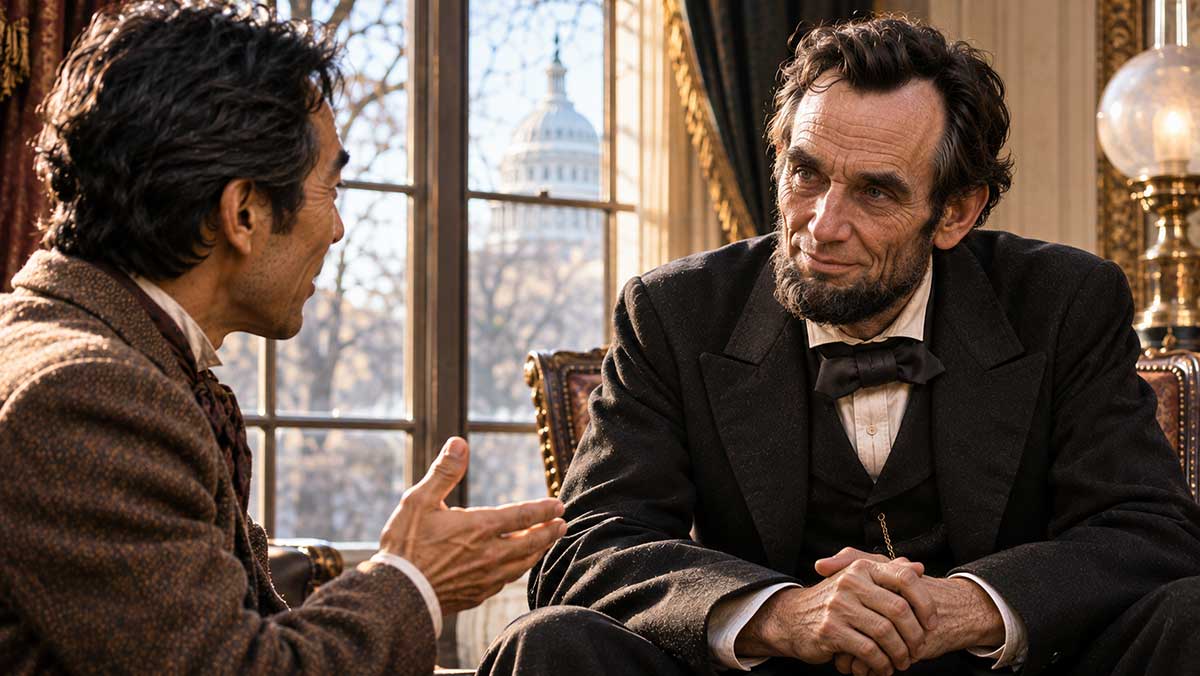
Executive Mansion, Washington, D.C., March 5, 1865. Early morning.
The morning sun reaches through the tall windows of the Executive Mansion. Washington is waking beneath a pale spring sky, and the sounds of carriage wheels carry faintly from the street.
Yesterday, Abraham Lincoln delivered his Second Inaugural Address. He spoke of slavery, war, divine judgment, and the responsibility to rebuild a wounded country.
The Civil War has not ended. The Thirteenth Amendment has passed Congress but awaits ratification. The freedom of millions of Black Americans remains vulnerable, and the future of the defeated Southern states is uncertain.
Lincoln is fifty-six years old. The lines on his face have deepened, and the burdens of the presidency are evident. Yet he remains the same man Nick first met in a Springfield law office nearly nineteen years earlier.
Opening
Abraham Lincoln: Nick! Come in. I was hoping you'd find your way here.
Nick Sasaki: Good morning, Abraham. Congratulations on yesterday.
Abraham Lincoln: Thank you. I trust you didn't find the speech too long.
Nick Sasaki: Too long? It was barely five minutes.
Abraham Lincoln: Then perhaps I've finally learned the virtue of stopping before the audience wishes I would.
Nick Sasaki: (Laughing) That would be quite an achievement for a politician.
Abraham Lincoln: Indeed. I ought to have learned it years ago. It might have saved the country a considerable amount of listening.
Nick takes a seat. On the desk lies a copy of the inaugural address.
Nick Sasaki: I thought it was one of the most moving speeches I've ever heard.
Abraham Lincoln: I hope it may do some good. We have a difficult task before us.
Nick Sasaki: I heard Frederick Douglass was at the reception last night.
Lincoln's expression brightens.
Abraham Lincoln: He was. And I'm glad of it.
Nick Sasaki: I understand he had trouble getting inside.
Abraham Lincoln: There was some difficulty at the entrance. But I was pleased to see him when he reached the room.
Nick Sasaki: Did you speak?
Abraham Lincoln: I wanted to know what he thought of the address.
Nick Sasaki: You had thousands of people waiting to greet you, and you wanted Frederick Douglass's opinion?
Abraham Lincoln: Why shouldn't I? He has spoken plainly to me before, and I have reason to value his judgment.
Nick Sasaki: What did he say?
Lincoln smiles.
Abraham Lincoln: He thought well of it. I was gratified.
Nick Sasaki: I remember our conversation last August. You were concerned about losing the election, and you asked Douglass to help consider ways for more enslaved people to reach freedom.
Abraham Lincoln: Those were anxious days.
Nick Sasaki: And now you're beginning a second term.
Abraham Lincoln: Yes. But an election victory doesn't finish the work that made the election important.
Nick nods.
Nick Sasaki: That's what I wanted to talk about.
Question 13: Can a Nation Forgive Without Forgetting?
Nick Sasaki: Abraham, yesterday you called for a future without malice. I understand the spirit behind those words. But the country has suffered terribly. Families have lost sons, slavery has torn families apart, and millions have lived without freedom. How can Americans forgive without forgetting what happened?
Lincoln looks toward the window.
Abraham Lincoln: I did not ask the country to forget slavery. I spoke of it plainly. We cannot heal a wound by pretending it was never there.
Nick Sasaki: Yet some people will hear your appeal for reconciliation and think you want the South forgiven without accountability.
Abraham Lincoln: Then they have misunderstood me. The rebellion must end, the Union must be restored, and slavery must not be allowed to return.
Nick Sasaki: That's a stronger answer than I expected.
Abraham Lincoln: Nick, I have spent four years trying to preserve this government. I don't intend to finish by leaving the cause of so much suffering untouched.
Nick Sasaki: But what happens to the people who were enslaved? What if the Southern states return to the Union and Black families remain poor, threatened, and unable to defend their rights?
Abraham Lincoln: Those questions must be faced. We have not finished our duty merely by announcing that a man is free.
Nick Sasaki: Then what does freedom require?
Abraham Lincoln: It requires that the law no longer recognize one man as another man's property. Beyond that, we must consider how free people are to live, work, raise families, and receive protection under the government.
Nick Sasaki: I worry about something. The people who suffered the most may be the first ones asked to forgive.
Lincoln grows thoughtful.
Abraham Lincoln: I would not command a person who has suffered cruelty to feel affection for the person who caused it.
Nick Sasaki: That's an important distinction.
Abraham Lincoln: But the government must still determine how the country is to live after the fighting ends. If every grievance is answered by another grievance, we may find ourselves unable to establish peace.
Nick Sasaki: I agree that revenge cannot be the foundation of a nation. But reconciliation requires more than the absence of revenge.
Abraham Lincoln: What would you require?
Nick Sasaki: Justice. Protection. An acknowledgment of the wrong. And a genuine change in how people are treated.
Abraham Lincoln: Those are serious demands.
Nick Sasaki: Think of a mother whose children were sold away from her. Nobody has the right to tell her that national unity matters more than her grief.
Lincoln is silent for a moment.
Abraham Lincoln: No. They do not.
Nick Sasaki: Forgiveness may happen in one person's heart. But reconciliation is something people must build together. Trust cannot return if the injustice continues.
Lincoln looks directly at Nick.
Abraham Lincoln: Then perhaps the question is not simply whether Americans can forgive one another. It is whether we can establish a peace worthy of being kept.
Nick Sasaki: Yes. That's exactly it.
Abraham Lincoln: And we must be careful not to mistake the surrender of an army for the settlement of every wrong that brought us here.
Nick smiles.
Nick Sasaki: Abraham, that's the Lincoln I came to see.
Abraham Lincoln: I should hope so. I've had no opportunity to exchange myself for a better one.
They share a brief laugh.
Question 14: What If God Is Not on Either Side?
Nick picks up the copy of the inaugural address.
Nick Sasaki: There's something else about yesterday's speech that moved me. You spoke about God without claiming that God had chosen the Union as His favorite side.
Abraham Lincoln: I believe we ought to be cautious about telling the Almighty what His purposes must be.
Nick Sasaki: Both North and South have prayed for victory. Both have read the Bible. Yet Americans have spent four years killing one another.
Abraham Lincoln: That is a terrible fact.
Nick Sasaki: Do you believe God is punishing the nation for slavery?
Abraham Lincoln: I have considered whether this war may be understood as a judgment upon the wrong of slavery. But I cannot tell you that I know the full purposes of Providence.
Nick Sasaki: Some people might call that uncertainty a weakness.
Abraham Lincoln: Then I fear they expect more certainty from a president than a president ought to possess.
Nick Sasaki: But you are certain slavery is wrong.
Abraham Lincoln: Yes. I do not need to know every purpose of Heaven to recognize that a man ought not to be held as another man's property.
Nick Sasaki: That's what I wanted to hear.
Abraham Lincoln: You have a habit of making me work for your approval.
Nick Sasaki: (Smiling) Only when the question matters.
Abraham Lincoln: Then I expect you will keep me busy.
Nick sets the paper down.
Nick Sasaki: Abraham, why do people find it so difficult to admit that their own side might be mistaken?
Abraham Lincoln: A man is very fond of his own opinions. He may become so attached to them that he treats any disagreement as a personal injury.
Nick Sasaki: You've encountered a few such men in Washington?
Abraham Lincoln: A few? Nick, I could fill a respectable-sized building with them and still have applicants waiting outside.
Nick laughs.
Abraham Lincoln: But I ought not speak too proudly. I have been stubborn myself.
Nick Sasaki: Have you?
Abraham Lincoln: Certainly. And there is a difference between firmness and stubbornness that a man may find easier to recognize in his neighbor than in himself.
Nick Sasaki: How do you recognize it?
Abraham Lincoln: Firmness serves a principle. Stubbornness may serve nothing more than a man's pride.
Nick considers that.
Nick Sasaki: Then perhaps humility doesn't mean being uncertain about everything. It means being willing to question yourself without abandoning what you know to be right.
Abraham Lincoln: I think that's well said.
Nick Sasaki: Yesterday, you didn't ask God to punish the South. You asked the nation to care for those wounded by the war.
Abraham Lincoln: We shall have wounded soldiers, widows, and children to care for long after the armies stop fighting.
Nick Sasaki: And formerly enslaved families whose lives have been torn apart.
Abraham Lincoln: Yes. The country's obligations do not end with the battlefield.
Nick Sasaki: I wish more people could hear that.
Abraham Lincoln: Then perhaps you should repeat it to them. You seem to have had considerable practice asking people to examine their convictions.
Nick Sasaki: Mostly you.
Abraham Lincoln: I had noticed.
Question 15: What Have You Learned That the Young Lincoln Did Not Know?
The morning has grown brighter. Lincoln's papers remain scattered across the desk, but neither man seems eager to return to them.
Nick Sasaki: Abraham, I have one final question. And it takes us back to Charleston in 1858.
Lincoln smiles knowingly.
Abraham Lincoln: I wondered when that evening would return to trouble me.
Nick Sasaki: You remember our disagreement?
Abraham Lincoln: Very well.
Nick Sasaki: You opposed slavery, but you said Black men should not vote or hold public office. I asked why a man who possessed natural rights should be denied the political rights needed to defend them.
Abraham Lincoln: I remember the question.
Nick Sasaki: Has your answer changed?
Lincoln takes a moment before speaking.
Abraham Lincoln: My thinking has moved beyond the position I defended in that debate.
Nick leans forward.
Nick Sasaki: In what way?
Abraham Lincoln: Last year, I wrote privately to Governor Hahn in Louisiana. I suggested that some Black men might be admitted to the vote, particularly those of education and those who had served gallantly in our armies.
Nick Sasaki: That's a considerable change from Charleston.
Abraham Lincoln: It is a change.
Nick Sasaki: What brought you there?
Abraham Lincoln: Consider the men who have fought for the Union. They have endured the dangers of war, and many have given their lives. It is difficult to argue that their service means nothing when the country considers who should have a voice in its government.
Nick Sasaki: Frederick Douglass has been making that argument for years.
Abraham Lincoln: He has. And others have pressed it too.
Nick Sasaki: Then let me ask you plainly. Were you wrong in Charleston?
Lincoln looks at Nick steadily.
Abraham Lincoln: I was wrong to think the question could remain where I left it. I did not then recognize how far the demands of this struggle would carry us.
Nick Sasaki: That means a great deal to hear.
Abraham Lincoln: But I will not pretend that I have settled every question of suffrage. What I suggested to Governor Hahn was limited. The country has not yet agreed upon the larger matter.
Nick Sasaki: I know. And I still believe the right to vote should not depend on race or education.
Abraham Lincoln: Then we have not reached complete agreement.
Nick Sasaki: No. But we have come a long way from Charleston.
Lincoln smiles.
Abraham Lincoln: Perhaps we have.
Nick Sasaki: What changed you most? The war? Frederick Douglass? The Black soldiers? The enslaved people who took freedom into their own hands?
Abraham Lincoln: I would not choose only one. The war has compelled us to confront questions that many Americans had preferred to leave unsettled. The actions of Black Americans have made those questions impossible to ignore.
Nick Sasaki: I think that's one of the most meaningful things you've said in all our conversations.
Abraham Lincoln: Then I am pleased to have finally provided something worth the trouble of your visits.
Nick laughs, then grows quiet.
Nick Sasaki: Abraham, when future generations remember you, what do you hope they learn?
Abraham Lincoln: That this Union was worth preserving, that slavery was wrong, and that the work of securing liberty cannot be left entirely to one man or one administration.
Nick Sasaki: What about your mistakes?
Abraham Lincoln: Let them examine those too. A man's public life ought to bear examination. I should prefer fair judgment to unthinking praise.
Nick Sasaki: I think that's how I'd want to remember you. Not as a perfect man, but as someone who continued learning when the stakes became enormous.
Abraham Lincoln: Then I hope you will remember that I had help. There are people whose names will never be carved upon monuments who have done more for this country than many whose names are well known.
Nick Sasaki: Including those who fought for freedom long before you issued the Emancipation Proclamation.
Abraham Lincoln: Yes.
Nick looks at his old friend.
Nick Sasaki: Do you ever wish you could return to Springfield? To that little law office where we first met?
Abraham Lincoln: I do think fondly of Springfield. I should welcome a time when the country is at peace and I may enjoy a quieter life.
Nick Sasaki: Perhaps we'll meet there again.
Abraham Lincoln: I should like that.
Closing
Lincoln rises, and Nick stands beside him.
For a moment, they look out the window at the morning light falling across Washington.
Nick Sasaki: Nearly nineteen years, Abraham.
Abraham Lincoln: A long acquaintance.
Nick Sasaki: We began with books and funny stories. Then came slavery, politics, war, grief, and questions neither of us knew how to answer.
Abraham Lincoln: You've certainly kept the questions coming.
Nick Sasaki: And you've kept answering them.
Abraham Lincoln: Not always to your satisfaction.
Nick Sasaki: No. But that's part of why our friendship has meant so much to me.
Lincoln turns toward him.
Abraham Lincoln: I have valued it too, Nick.
Nick Sasaki: When I first met you, you wanted to make something useful of your life.
Abraham Lincoln: I remember.
Nick Sasaki: I think you have.
Lincoln smiles gently.
Abraham Lincoln: The work is not finished.
Nick Sasaki: I know.
Abraham Lincoln: And it will not be finished by any one of us.
Nick nods.
Nick Sasaki: Then perhaps the best thing we can do is leave the next generation something worth continuing.
Abraham Lincoln: That would be a worthy hope.
They shake hands.
Nick Sasaki: Take care of yourself, Abraham.
Abraham Lincoln: And you, Nick.
Nick reaches the doorway.
Abraham Lincoln: One more thing.
Nick Sasaki: Yes?
Abraham Lincoln: If we meet again in Springfield, I hope you'll allow me to choose the subject of our conversation.
Nick Sasaki: (Laughing) What would you choose?
Abraham Lincoln: Something that doesn't require me to defend the entire government before breakfast.
Nick laughs.
Nick Sasaki: I'll consider it.
Abraham Lincoln: That's all I can reasonably ask.
Nick steps into the corridor.
He does not know that this will be their final meeting.
Six weeks later, Abraham Lincoln will be assassinated, just as the Civil War is approaching its end.
But on this March morning, the future remains unwritten.
The man in the Executive Mansion is not a monument. He is an old friend, still capable of laughter, still burdened by responsibility, and still learning from the people and events around him.
Nick remembers the young lawyer in Springfield, the politician in Charleston, the grieving father during the war, and the president who listened to Frederick Douglass.
What remains is not the image of a man who always knew the right answer.
It is the memory of someone whose principles were tested, whose limitations were exposed, and whose decisions helped move the nation closer to a promise it had not yet fulfilled.
And the work he leaves unfinished belongs to those who come after him.
Final Thoughts
What remains with me most is the image of two friends speaking across the years. I picture Abraham Lincoln standing in his cluttered Springfield law office, smiling at a joke, his tall frame awkwardly fitted to a chair, his mind filled with books, political ambitions, and hopes for his family. I picture the same man years later, sitting beside a fading fire in the Executive Mansion, carrying the grief of losing his son and the burden of decisions affecting thousands of lives. Between those moments, a nation changes, and so does the man who leads it. Yet something familiar remains: his curiosity, his humor, and his willingness to sit with a friend who does not always agree with him.
I began this imaginary friendship admiring Lincoln's determination to make something useful of his life. I leave it thinking about something more difficult: how a person responds when experience exposes the limits of his convictions. In Charleston, Lincoln defended natural rights but refused to support full political equality for Black Americans. I challenged him, and he did not give me the answer I wanted. Years later, his private consideration of limited Black male suffrage revealed a meaningful development in his thinking. It did not erase his earlier statements or settle the larger question of equal citizenship. But it showed that his political views were not fixed forever.
Perhaps the most important lesson is that people rarely change in isolation. Frederick Douglass challenged Lincoln directly. Black soldiers demonstrated their courage and their claim to citizenship through military service. Enslaved people risked their lives to escape bondage and secure freedom for their families. Abolitionists spent decades organizing, writing, speaking, and demanding justice. Lincoln's decisions were enormously consequential, but emancipation was never the achievement of one person alone. The struggle for freedom shaped the president as surely as the president's actions helped shape the struggle.
I was moved by Lincoln's grief as a father, especially when our imagined conversation turned to Willie. The little boy who loved books and railroads was more than a name in a presidential biography. He was a child whose life ended before his father could see the person he might become. That personal sorrow deepened the emotional meaning of the war, but it could not make Lincoln's decisions easier. The Dakota executions presented an especially painful reminder that leadership must be examined through the experiences of those who bear its consequences. Respecting Lincoln's humanity does not require us to excuse every decision he made.
Our final conversation brought me back to the difference between forgiveness and reconciliation. Forgiveness may begin within an individual's heart, but reconciliation requires people to confront the wrongs that have damaged their relationships. A country cannot simply declare itself united and expect those who suffered injustice to forget what happened. Lincoln's appeal for national healing in his Second Inaugural Address remains moving, yet its deepest challenge lies in the responsibilities that follow. Peace must offer more than an end to fighting. It must create conditions in which freedom can be protected and human dignity respected.
I think often about the humility expressed in Lincoln's reflections on God and the Civil War. He did not claim that victory would prove the North morally innocent or that he fully knew the purposes of divine judgment. There is something deeply meaningful about a leader who can act with conviction without pretending to possess every answer. Humility does not require abandoning one's principles. It requires recognizing that even sincere convictions must be examined in the light of truth, experience, and the suffering of others.
When Nick and Lincoln part for the last time, neither knows that their friendship has reached its final meeting. History tells us that Lincoln will be assassinated only weeks later, leaving the work of emancipation, Reconstruction, and equal citizenship unfinished. But I prefer to remember him in that final imagined moment, still capable of laughter, still concerned about the future, and still aware that the nation's work extends beyond his own lifetime. His legacy is not simply the story of what one extraordinary president accomplished. It is an invitation to consider what each generation must do with the freedoms, responsibilities, and unanswered questions it inherits.
Fictional Conversation Disclaimer: These reflections refer to an imagined series of meetings with Abraham Lincoln, not actual encounters or recorded private statements. Historical events and documented public positions inform the narrative, but Lincoln's fictional responses, personal admissions, and friendship with Nick Sasaki are creative interpretations rather than authentic quotations or endorsements.
Short Bios:
Abraham Lincoln (1809–1865)
Abraham Lincoln was the sixteenth president of the United States, serving from 1861 until his assassination in April 1865. Born in Kentucky and raised in Indiana and Illinois, he became a lawyer and politician before leading the nation through the Civil War. His presidency included the Emancipation Proclamation, support for the Thirteenth Amendment, and efforts to preserve the Union. His views on slavery, race, and citizenship developed over time, and his legacy remains central to the study of American democracy and emancipation.
Frederick Douglass (c. 1817–1895)
Frederick Douglass was an abolitionist, writer, orator, and advocate for Black civil and political rights. Born into slavery in Maryland, he escaped in 1838 and became one of the most influential voices against slavery in the United States. During the Civil War, he encouraged Black military enlistment, challenged unequal treatment of Black soldiers, and met with President Lincoln to discuss emancipation and related policies. Their relationship included disagreement, cooperation, and growing mutual respect.
Stephen A. Douglas (1813–1861)
Stephen A. Douglas was a United States senator from Illinois and a leading Democratic politician. He debated Lincoln seven times during their 1858 Senate contest, defending popular sovereignty as an approach to slavery in the territories. Douglas won reelection to the Senate, but the debates brought Lincoln wider national attention. Douglas later ran against Lincoln in the presidential election of 1860.
Mary Todd Lincoln (1818–1882)
Mary Todd Lincoln was Abraham Lincoln's wife and First Lady of the United States from 1861 to 1865. Educated and politically engaged, she married Lincoln in 1842, and they had four sons. She experienced the deaths of three of her children and the assassination of her husband. Her life has been the subject of extensive historical research, including the personal pressures she faced during the Civil War and her later years.
Nick Sasaki
Nick Sasaki is the creator and interviewer behind ImaginaryTalks.com, a project that brings historical figures, thinkers, and influential voices into fictional conversations. Through curiosity, respectful questioning, and historically informed storytelling, he explores the human experiences, difficult decisions, and enduring ideas behind their lives.
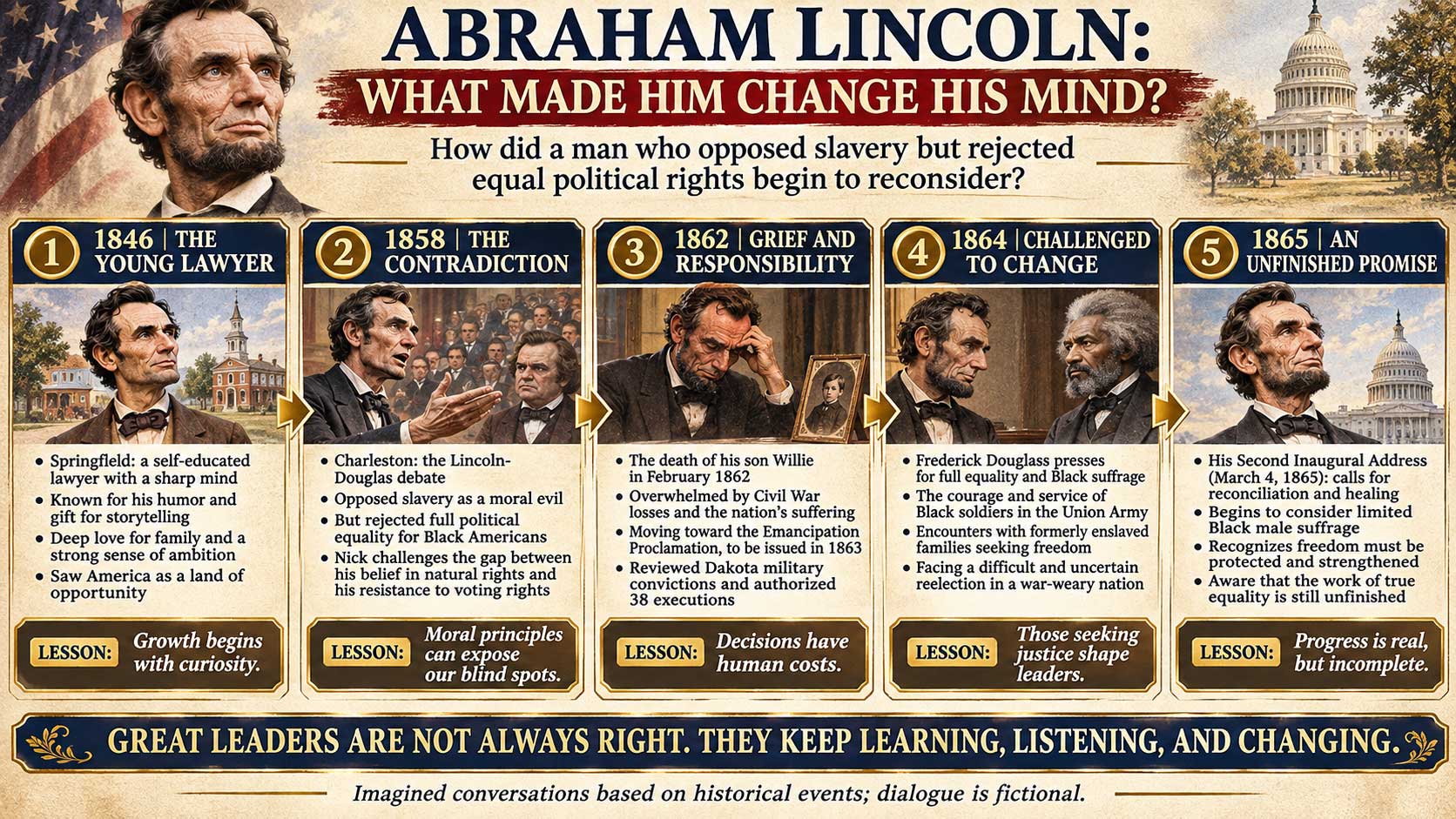
Leave a Reply