
Introduction
What happens when one of the funniest men in history begins to question whether humanity deserves its own confidence?
Mark Twain made generations of readers laugh at mischievous children, pompous adults, dishonest politicians, and the ridiculous habits of respectable society. Yet behind the famous white suit and magnificent mustache stood a man who had witnessed slavery, endured financial ruin, lost people he loved, and questioned whether civilization was becoming morally better at all.
Born Samuel Langhorne Clemens in 1835, Twain grew up beside the Mississippi River in Hannibal, Missouri. The river gave him adventure, characters, stories, and eventually a profession as a steamboat pilot. It taught him something more unsettling, too: what appears beautiful and harmless on the surface may conceal serious danger. His transformation from printer and riverboat pilot to internationally celebrated author is documented by the Mark Twain House & Museum.
His most enduring literary achievement may be Adventures of Huckleberry Finn, a novel that asks a disturbing moral question. What happens when a young boy's society teaches him that helping an enslaved man is sinful, yet his own experience tells him that the man deserves compassion and freedom? Through Huck and Jim, Twain exposed the terrible distance between socially accepted morality and genuine humanity. Readers can explore the original novel through Project Gutenberg, including the language and passages that continue to inspire both admiration and serious criticism.
But Twain's ability to recognize foolishness in others did not protect him from his own mistakes. His enthusiasm for the Paige typesetting machine and his troubled publishing ventures contributed to financial disaster. The celebrated writer found himself undertaking an exhausting international lecture tour to recover his finances and repay his creditors. His life became an extraordinary demonstration of the gap between intelligence and judgment. The Mark Twain Boyhood Home & Museum's historical timeline traces his achievements, reversals, and recoveries.
Beyond the public triumphs and humiliations stood a deeply personal story. Twain married Olivia Langdon, affectionately known as Livy, in 1870. Together they raised a family, built a beautiful home in Hartford, and shared years of affection, intellectual companionship, and creative activity. Their children knew a father quite different from the celebrity admired by the public. Yet their lives were marked by devastating losses, including the deaths of their son Langdon, daughter Susy, Livy herself, and eventually their daughter Jean. The humorist who could make an auditorium laugh could not protect those he loved from suffering.
These experiences formed part of a life already filled with difficult questions about religion, justice, and human nature. Twain challenged the use of Christianity to defend cruelty, criticized American imperialism, and questioned the assumption that technological progress automatically produces moral progress. Yet his friendships, family attachments, and affection for individual people complicate any attempt to portray him as someone who simply hated humanity.
In this five-part imaginary interview, Nick Sasaki meets Twain first beside the Mississippi River, then in his writing study, billiard room, family parlor, and finally on the veranda at Stormfield. Their conversations begin with childhood adventure and humor, move through conscience and personal failure, and arrive at difficult questions of love, suffering, God, and humanity's future. Nick brings his conviction that humanity is one family under one God, but Twain is free to question that belief. Neither man is required to abandon his convictions for a comfortable ending.
The central question is one Twain's life makes impossible to dismiss: After witnessing so much foolishness, injustice, and suffering, what can a person still find worth loving about humanity? The answer may be less straightforward than we expect. Perhaps the search for it begins with something Twain understood exceptionally well: our willingness to laugh at ourselves before we become too certain that we are right.
Fictional Conversation Disclaimer
This interview is a fictional conversation between Nick Sasaki and Mark Twain, inspired by Twain's documented life, writings, and historical experiences. The dialogue, personal reflections, and imagined encounters are creative interpretations, not authentic quotations, historical transcripts, or endorsements by Twain or his representatives.
Topic 1: The Boy Who Learned to Read the River and the World
Opening: The River That Never Stood Still
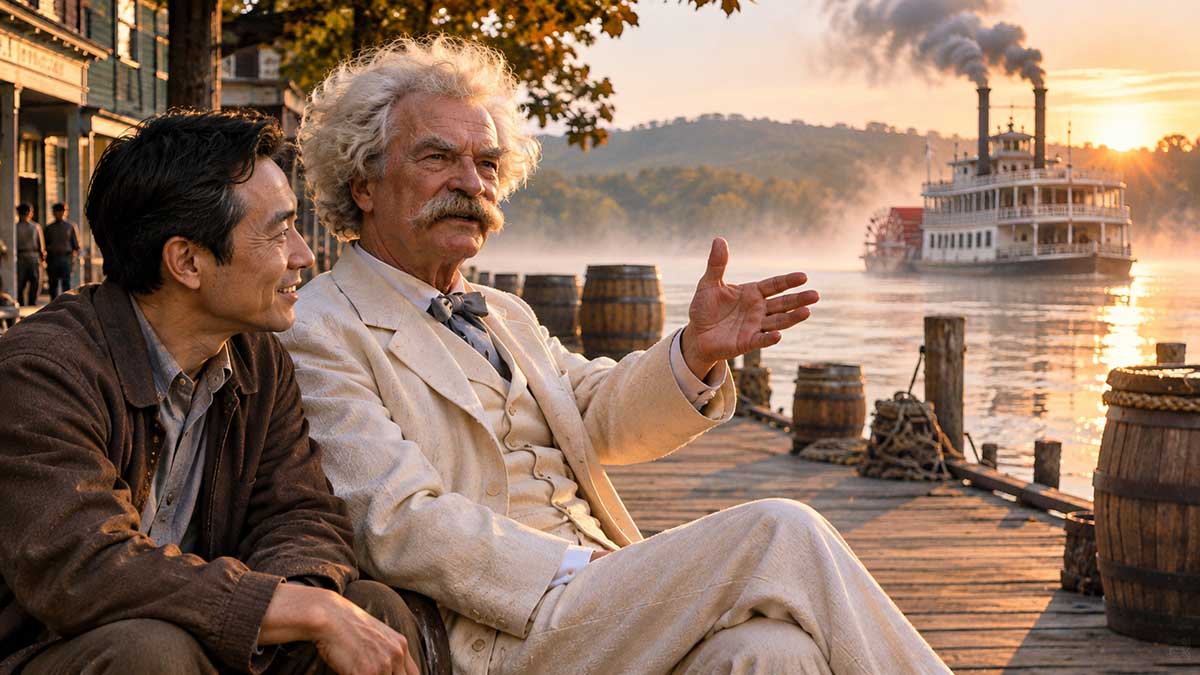
Hannibal, Missouri. Early morning.
The Mississippi River moves quietly beneath a thin blanket of mist. The morning sun has just begun to illuminate the water, turning the gentle currents into ribbons of gold.
A steamboat approaches in the distance, its paddlewheel disturbing the stillness. Somewhere along the wooden docks, a man calls to another as barrels are loaded aboard.
I stand beside an elderly gentleman wearing a white suit. His thick white mustache seems almost as expressive as his eyes, which carry the unmistakable sparkle of someone who has spent a lifetime noticing things other people overlook.
Mark Twain rests his hands on the railing, watching the river.
Nick Sasaki: Mr. Twain, I have to tell you, I've been looking forward to meeting you. But standing here beside this river, I have a question.
When you were a boy growing up in Hannibal, did you dream of becoming one of the most famous writers in the world? Or were you mostly looking for ways to get into trouble?
Mark Twain: (Chuckles.) My dear Nick, I don't believe I ever went looking for trouble. Trouble was an industrious creature, and it generally found me without assistance.
As for becoming a famous writer, no. A boy living beside the Mississippi had far more interesting ambitions.
Nick: Such as?
Twain: Becoming a steamboat pilot, naturally. There was a profession worthy of a boy's admiration. A pilot stood high above the water, commanded an enormous vessel, and possessed knowledge that ordinary mortals could scarcely comprehend.
And he was paid for it, which made the arrangement nearly perfect.
Nick: (Laughing.) So being a writer was your backup plan?
Twain: Not even that. Writing was something I fell into after discovering that several more respectable ways of earning a living had become unavailable.
Nick: That's encouraging for anyone trying to figure out what to do with their life.
Twain: Oh, most people eventually find their calling. The difficulty is that it frequently arrives disguised as a mistake.
We laugh, and for a moment we simply watch the steamboat approaching.
There is something wonderfully natural about talking with Twain. His humor does not feel like a performance. It feels like the way he examines the world.
Question 1. Were you born a storyteller, or did the Mississippi River turn you into one?
Nick: You grew up here in Hannibal, surrounded by steamboats, travelers, merchants, and all kinds of characters. What was it really like being a boy here?
Twain: To a boy, Hannibal was the center of the universe. I doubt the universe was aware of the distinction.
We had the river, the woods, the islands, the caves, and enough opportunities for mischief to keep several generations of boys occupied.
Of course, the grown people had an entirely different opinion of the place. They were concerned with work, money, religion, politics, and the conduct of their neighbors.
Especially the conduct of their neighbors.
Nick: (Laughs.) Some things never change.
Twain: Very little changes in human nature, Nick. We merely acquire more expensive methods of demonstrating it.
But the river was different. The river was alive.
Every day it brought strangers into town. Pilots, deckhands, merchants, gamblers, people traveling to places I could scarcely picture.
And each one carried stories.
Nick: Did you listen to them?
Twain: Whenever possible. Children are excellent listeners when the subject interests them and exceptionally poor listeners when it does not.
I had little patience for instructions about proper behavior. But give me a man who had survived a river accident, a traveler who had seen strange countries, or a fellow who claimed to have accomplished something impossible, and I was entirely at his disposal.
Nick: Even when you suspected the story wasn't true?
Twain: Especially then!
A truthful story tells you what happened. An extravagant story may tell you something about the person telling it.
A man who exaggerates is often revealing his ambitions, his insecurities, or his opinion of the intelligence of his audience.
Sometimes all three.
Nick: That's interesting. So you weren't just collecting stories. You were studying people.
Twain: I wouldn't give the boy that much credit. He was enjoying himself.
It was only later that I discovered I had been receiving an education.
Nick: What about Tom Sawyer? How much of him was you?
Twain: Tom was assembled from several boys, including myself. I have always considered it prudent to distribute responsibility for his behavior.
(He smiles.)
But the adventures, the superstitions, the freedom of those childhood days, much of that came from the world I knew.
Nick: I think that's why people still love Tom Sawyer. There's something universal about wanting to escape the rules for a little while.
Twain: Certainly. Childhood is a peculiar condition. Adults spend years instructing children to behave sensibly, and then spend the rest of their lives remembering how wonderful it was before they learned.
Nick: And you eventually became a riverboat pilot yourself.
Twain: Yes, and that was no small achievement.
I trained under Horace Bixby, a man who knew the Mississippi with an intimacy that seemed almost supernatural.
He taught me that a river pilot must remember an astonishing number of details. Sandbars, bends, landmarks, currents, depths, the appearance of the water in darkness.
And the river was forever changing.
Nick: That sounds terrifying. You're responsible for an enormous boat and everybody aboard it.
Twain: Precisely. A pilot who made a serious mistake could destroy a vessel and kill people.
The river did not excuse ignorance merely on the grounds that a man possessed a pleasing personality.
Nick: (Smiling.) A useful lesson.
Twain: One that ought to be distributed more widely.
Nick: Did learning the river change the way you saw the world?
Twain: It certainly changed the way I saw the river.
Before I learned navigation, the water was beautiful. Every ripple and reflection seemed mysterious.
Afterward, I saw signs of danger everywhere. A change in the surface might indicate a hidden obstruction. A pleasant-looking stretch of water might conceal a sandbar.
Knowledge gave me the ability to navigate, but it took something away from the scenery.
Nick: That's fascinating. You gained the ability to see what other people couldn't, but you lost some of the wonder.
Twain: Exactly.
Nick: Do you think the same thing happened when you began studying human nature?
Twain: (He looks at me with a small smile.) Ah, Nick. Now you are asking a dangerous question.
I spent much of my life learning to recognize the hidden obstacles in human character.
And I cannot claim the view became more beautiful.
Nick: But you never stopped watching.
Twain: No. Human beings are far too entertaining to ignore, even when they are behaving abominably.
We look out over the water again. The steamboat has drawn closer, its whistle echoing across the river.
For a moment, I can almost see the young Samuel Clemens standing here, dreaming of a life beyond Hannibal.
Question 2. You lost your father when you were eleven, and later your younger brother Henry. How did those experiences change you?
Nick: Mr. Twain, I want to ask about something more personal.
Your father died when you were only eleven. What do you remember about him?
Twain: My father was a serious man. John Marshall Clemens. A man of ambitions, principles, and financial difficulties.
He was not a man given to unnecessary displays of affection.
Nick: Was he strict?
Twain: He could be. I suspect he regarded the management of his children as one of life's more exhausting responsibilities.
I was not especially helpful in that regard.
(He pauses.)
But he worked hard, and he carried burdens that I did not fully comprehend as a child.
Nick: Did you understand what his death meant at that age?
Twain: A child understands that someone has disappeared. He does not necessarily comprehend all the consequences.
My father's death changed our family's circumstances. There were practical difficulties. Money was scarce. The future became uncertain.
I entered the printing trade while still young.
Nick: So childhood ended rather suddenly.
Twain: In some respects, yes.
But children are strange creatures. They can experience sorrow in the morning and become completely absorbed in an adventure by afternoon.
Adults sometimes mistake that for a lack of feeling.
I don't believe it is.
Nick: That's a beautiful observation.
You later lost your younger brother Henry in a steamboat accident. I've read about the explosion of the Pennsylvania in 1858.
You were working on the river at that time.
Twain: Yes.
Henry was aboard that boat. He was badly injured when the boilers exploded, and he died afterward.
He was nineteen.
Nick: I'm sorry.
Twain: (His expression grows quieter.) Thank you.
Henry was a good young man. Gentle in disposition, with much of his life still before him.
Nick: You wrote about a dream you had before his death. A dream that seemed to resemble what happened afterward.
Twain: I did.
I remembered dreaming of Henry lying in a metal coffin, with flowers upon him. When events later appeared to resemble that dream, the memory troubled me deeply.
Nick: Did you believe it was a premonition?
Twain: I could not explain it satisfactorily.
I have spent a considerable portion of my life doubting things that other people accept without hesitation. Yet I have encountered experiences that resisted my own explanations.
It is an uncomfortable position for a man who enjoys being certain.
Nick: Did it change how you thought about fate?
Twain: It made such questions difficult to dismiss.
But I would be cautious about pretending that a mysterious experience gives us a complete explanation of the universe.
People are remarkably talented at turning uncertainty into certainty, particularly when certainty offers comfort.
Nick: Did you ever feel responsible for Henry's death?
Twain: I have examined my part in the circumstances that placed him on that boat. The mind can return to such questions repeatedly.
What might have happened if one decision had been different? What if a journey had been delayed? What if someone had taken another position?
But the past does not negotiate.
Nick: That's a painful truth.
Twain: Yes.
And it is one of the few things I have found entirely immune to persuasion.
We fall silent.
A breeze moves across the river, carrying the distant sound of the steamboat's engines.
Nick: I think about how young you were. You'd already lost your father, and then your brother. Yet you went on to become one of the funniest men in America.
Did humor help you through difficult times?
Twain: Humor can be useful in difficult circumstances.
It allows a man to examine something painful without always standing directly in front of it.
But I would not have you believe that a joke repairs what has been lost.
It does not.
Nick: No, it doesn't.
Twain: Still, if a man can find something absurd in his predicament, he may discover that the predicament has not conquered every part of him.
Nick: So laughter can give us a little room to breathe.
Twain: That is a reasonable way of putting it.
And sometimes laughter is simply laughter. We needn't make it carry the entire burden of human philosophy.
Nick: (Laughing softly.) Fair enough.
Twain: I should hate to see humor turned into another solemn obligation.
Question 3. You grew up surrounded by slavery. When did you begin to question what everyone around you accepted?
The morning mist has lifted. Across the river, the distant shoreline is visible beneath the brightening sky.
I turn back to Twain.
Nick: There's something about your childhood I've been thinking about.
Hannibal sounds wonderful in so many ways. The river, the adventures, the characters.
But it was a town in a slave state. Your own family lived within that system.
As a boy, did you recognize that something was terribly wrong?
Twain: No, not in the way you are asking.
I grew up in a society where slavery was treated as an ordinary institution.
Children inherit the opinions of the people around them long before they possess the knowledge or independence to examine those opinions.
Nick: So it seemed normal?
Twain: It was presented as normal.
And that is one of the most dangerous qualities an injustice can possess.
A thing need not be reasonable, merciful, or honorable to become respectable. It need only be accepted by enough people for long enough.
Nick: That's frightening when you think about it.
Twain: It ought to be.
The people who defended slavery did not necessarily imagine themselves villains.
Many considered themselves decent, religious, respectable citizens.
Some could speak movingly about Christian charity and then accept the ownership of another human being.
Nick: How does a person live with that contradiction?
Twain: Frequently by failing to recognize it.
Human beings possess an extraordinary capacity to arrange their beliefs so that they may continue admiring themselves.
Nick: (Smiles sadly.) That sounds painfully familiar.
Twain: I should be surprised if it did not.
Nick: But something changed in you over time.
Your later writing challenged slavery and racial prejudice. Huckleberry Finn is probably the clearest example.
Was there a particular person or experience that opened your eyes?
Twain: I would be suspicious of any account that reduced such a change to one convenient moment.
I knew enslaved people during my childhood. I heard their voices, observed their lives, and absorbed far more than I understood at the time.
Later, distance and experience made it possible to question things I had once accepted.
But a man's conscience does not always awaken all at once.
Sometimes he discovers that a belief he has carried for years cannot survive honest examination.
Nick: Did you feel ashamed of what you once accepted?
Twain: There is little virtue in pretending that one's earlier ignorance never existed.
It is easy to condemn the errors of a society after one has escaped its influence.
The more difficult task is recognizing the errors of the society in which one presently lives.
Nick: That's exactly what I wanted to ask.
When I look at history, I wonder how ordinary people could accept things we now recognize as deeply wrong.
But then I have to ask myself: What are we accepting today that future generations will condemn?
Twain: (His eyes brighten.) Now there is a question worth asking.
Every generation considers itself unusually enlightened.
And every generation leaves behind an impressive collection of evidence to the contrary.
Nick: (Laughing.) You don't have much confidence in human progress, do you?
Twain: I have great confidence in humanity's ability to improve its machinery.
Its moral equipment has proved rather less dependable.
Nick: But surely people can change.
You changed.
Twain: People can reconsider their beliefs. They can learn. They can become more humane.
But I would not confuse the possibility of improvement with a guarantee of it.
Nick: Fair enough.
You know, I believe humanity is one family. Different races, cultures, nations, and religions, but ultimately one human family.
When I think about slavery, it seems like a terrible failure to recognize that simple truth.
Twain: It is a noble conviction, Nick.
But I would ask you something.
Nick: Please.
Twain: What happens when a man announces that humanity is one family, yet treats certain members of that family as though they possess less dignity than others?
Nick: Then his actions contradict his belief.
Twain: Precisely.
And if he continues doing so, I become less interested in the beauty of his declaration than in the condition of those he has injured.
Nick: I agree.
Twain: That is why I have often found the conduct of respectable people more instructive than their professions of virtue.
Nick: You know, Mr. Twain, there's something interesting here.
You began by talking about learning to navigate the Mississippi. How the river could look beautiful on the surface while hiding dangerous obstacles underneath.
And now we're talking about society. A community can look respectable, religious, and civilized, yet conceal terrible injustice.
Twain: (He studies the river for a moment.)
Yes. The comparison has merit.
A river pilot learns that appearances are insufficient.
Perhaps a civilization ought to learn the same lesson.
Nick: And how do we do that?
Twain: We might begin by listening more carefully to the people who suffer from the arrangements we find so comfortable.
Nick: That's a powerful answer.
Twain: It is an inconvenient answer. Those are often the ones worth examining.
Closing: What Lies Beneath the Surface
The steamboat has passed us now, moving steadily along the Mississippi. Its wake reaches the wooden dock, rocking the small boats tied along the shore.
Twain watches the movement with the attentive expression of a man who once knew this river as intimately as another man might know the streets of his hometown.
Nick: Mr. Twain, I came here expecting to hear wonderful stories about your childhood.
And I have.
But I think I've learned something else.
You grew up loving this river, and then you learned that its beauty could hide dangers. You grew up in a society that considered itself respectable, and later you began questioning its morality.
It seems your life taught you to look beneath the surface.
Twain: That is a fair observation.
Though I must confess, Nick, I have not always been equally successful at recognizing the hidden dangers in my own affairs.
Nick: (Laughs.) We'll get to your business investments soon enough.
Twain: I was afraid of that.
Nick: But before we do, I want to talk about something you accomplished that may be even more remarkable.
You created two boys, Tom Sawyer and Huckleberry Finn, who have lived in the imaginations of readers for generations.
And through Huck, you asked a question that still troubles people today.
What happens when your conscience tells you one thing, but everyone around you insists that you're wrong?
Twain: Ah, Huck.
A troublesome boy.
But sometimes a troublesome boy is precisely what a respectable society requires.
Nick: Then I think that's where we should go next.
Twain: Very well.
But I warn you, Nick, once we begin examining respectable society, we may find ourselves in need of a much longer conversation.
Nick: I was hoping you'd say that.
Twain smiles, and we begin walking along the riverbank.
The Mississippi continues moving behind us, carrying its stories, its memories, and its hidden depths.
And I find myself thinking that perhaps the greatest adventure of Mark Twain's life was not learning to navigate the river.
It was learning to question the world that had taught him how to think.
End of Topic 1.
Next: Topic 2, "When Everybody Is Wrong, Who Do You Trust?"
Topic 2: When Everybody Is Wrong, Who Do You Trust?
Opening: The Boy Who Refused to Be Respectable
Quarry Farm, Elmira, New York. A warm summer afternoon.
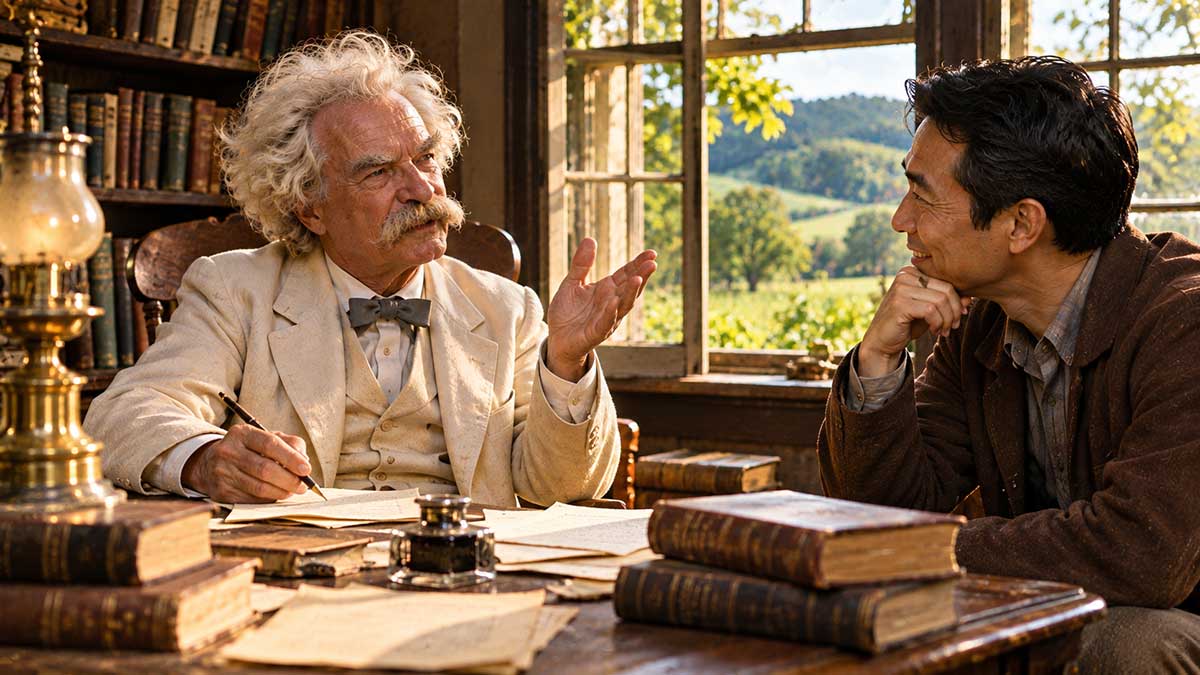
The windows of Mark Twain's writing study are open, allowing a gentle breeze to move through the room. Beyond the glass, the green hills of the Chemung Valley stretch into the distance.
The study is modest compared with the grand rooms of his Hartford home. Books are scattered across a wooden desk. Several sheets of manuscript paper lie beside a bottle of ink. A cigar rests nearby.
Twain sits in a chair, looking over a page with the suspicious expression of a man who has discovered that one of his own characters is misbehaving.
Nick Sasaki: Mr. Twain, I have a question.
Mark Twain: You have developed a habit of those, Nick. I had hoped the river might have exhausted your supply.
Nick: (Laughing.) Not even close.
I was looking at your manuscript, and something occurred to me.
You wrote about boys who lie, steal, skip school, play tricks on adults, and generally make themselves a nuisance.
And somehow, you turned them into American literary heroes.
How did you manage that?
Twain: By allowing them to behave like boys.
The remarkable thing is not that Tom Sawyer and Huck Finn became popular. It is that so many adults were surprised to discover children behaving in ways they themselves had behaved before acquiring respectable reputations.
Nick: So you were exposing the adults?
Twain: I was telling stories about children.
The exposure of adults was an unfortunate consequence.
Nick: (Smiling.) Unfortunate?
Twain: For the adults, certainly.
He sets the manuscript aside.
Twain: Come, Nick. Sit down. If we are going to discuss human nature, we may as well be comfortable. The subject is unpleasant enough without requiring us to stand.
I take the chair opposite him.
A few moments ago, we were two friends walking along the Mississippi. Now, surrounded by the pages of his most famous characters, I feel that we are entering another part of Twain's world.
And perhaps a more dangerous one.
Question 4. Why did you trust mischievous boys like Tom Sawyer and Huck Finn to tell truths that respectable adults couldn't?
Nick: Let's start with Tom Sawyer.
He's mischievous, clever, imaginative, and sometimes selfish. He gets into trouble constantly.
But people love him.
What made Tom such an interesting character for you?
Twain: Tom possesses several qualities that adults spend considerable effort removing from children.
He is curious, adventurous, imaginative, and suspicious of unnecessary authority.
He is also vain, manipulative, and quite capable of persuading another boy to perform his work for him.
Nick: (Laughing.) The famous fence-painting scene.
Twain: Ah, yes. Tom discovers that work becomes considerably more attractive when you convince other people it is a privilege.
Nick: That's practically a business lesson.
Twain: Indeed. Had Tom entered commerce, he might have become an extremely successful businessman.
I cannot promise that his customers would have shared his enthusiasm.
Nick: Did you see yourself in Tom?
Twain: Certainly. Tom was drawn from several boys I knew, including myself.
But I should be reluctant to accept sole responsibility for him. Some of his more objectionable qualities belonged to my companions.
Naturally, the admirable ones were mine.
Nick: (Laughing.) Naturally.
What about Huck Finn?
He feels very different from Tom.
Twain: He is.
Tom enjoys the adventures that come from breaking rules. Huck has spent much of his life outside the protection of those rules.
Tom can return to a respectable home when the game is finished.
Huck cannot so easily return to a world that has treated him as an undesirable boy.
Nick: That's an important difference.
Tom chooses adventure. Huck is often trying to survive.
Twain: Precisely.
And Huck has another advantage.
He has not been thoroughly educated into the opinions of respectable society.
Nick: You make education sound dangerous.
Twain: Education can be a splendid thing. But there is a difference between teaching a person how to think and teaching him which opinions he must hold.
The first may produce wisdom.
The second may produce a very confident fool.
Nick: (Smiling.) You've met a few of those?
Twain: I have encountered enough to suspect they are not an endangered species.
Nick: Why did you give Huck such an unusual voice?
His language doesn't sound like the formal literature people were accustomed to reading.
Twain: Huck speaks in the language of his own experience.
If I had forced him to speak like a professor, I should have lost the boy entirely.
A character must be allowed to possess his own mind, his own habits, his own understanding of the world.
Nick: So the language itself mattered.
Twain: Very much.
A man's speech may reveal his background, his education, his prejudices, his humor, and the company he keeps.
But one must be careful not to mistake polished speech for intelligence.
I have known men who could construct magnificent sentences without producing a single worthwhile thought.
Nick: (Laughing.) I think I've heard some of their speeches.
Twain: Then you have my sympathy.
Nick: There's something I find fascinating about Huck.
He's not particularly educated. He doesn't consider himself morally superior. In fact, he often believes he's doing something wrong.
Yet sometimes he seems to understand right and wrong better than the adults around him.
Twain: That is one of the central troubles of his situation.
Huck has inherited a moral system that teaches him certain things are right merely on account of their being accepted.
But his experience with Jim begins to interfere with what he has been taught.
Nick: And that brings us to the heart of the story.
Twain: Yes.
Though I warn you, Nick, once we begin discussing conscience, we may discover that the respectable people have considerably more explaining to do than the troublesome boys.
Question 5. Huck believes helping Jim escape is a sin, yet he chooses his friend. Is compassion sometimes more trustworthy than what religion or society teaches us?
The afternoon sunlight falls across the manuscript pages.
I glance at the familiar name written near the top of one sheet.
Huckleberry Finn.
Nick: Mr. Twain, there's a moment in Huckleberry Finn that has stayed with me.
Huck has been taught that helping Jim escape from slavery is wrong.
He believes he may be committing a terrible sin.
But he has traveled with Jim. He knows him as a person. He has experienced Jim's kindness and loyalty.
And eventually, Huck decides to help him anyway.
He says, "All right, then, I'll go to hell."
What were you trying to reveal through that moment?
Twain: Consider the boy's predicament.
He has been instructed by his society that slavery is legitimate and that helping an enslaved man escape is a moral offense.
His conscience, as he understands it, has been shaped by those teachings.
Yet he has come to know Jim.
And what he knows of Jim does not fit comfortably with what he has been taught about enslaved people.
Nick: Jim is no longer an abstract idea to him.
Twain: Exactly.
Jim is a man with feelings, memories, fears, affections, and hopes.
He is a father who longs for his family.
He is someone who has shown Huck kindness.
The difficulty arises when Huck's personal experience conflicts with the moral instruction he has received.
Nick: So Huck believes he's choosing evil, but readers recognize that he's choosing compassion.
Twain: That is the irony.
He has been taught to call a good action wicked.
And when he finally chooses to help Jim, he believes he is sacrificing his own salvation.
Nick: That's heartbreaking when you think about it.
Twain: It is a serious matter.
A society can corrupt a person's conscience so thoroughly that he feels guilty for doing what is humane.
Nick: I want to ask something about Jim himself.
Sometimes people discuss Huckleberry Finn as though Jim exists mainly to help Huck become a better person.
But Jim has his own life, his own family, and his own dream of freedom.
Was that important to you?
Twain: It must be important to any honest reading of the story.
Jim is not merely an instrument for the improvement of a white boy's character.
He has his own reasons for fleeing slavery.
He wants freedom. He wants his family. He fears being separated from those he loves.
His situation is not an adventure undertaken for amusement.
It concerns his life.
Nick: That's something I think we should spend more time recognizing.
Huck can treat the river as an adventure.
For Jim, the stakes are entirely different.
Twain: Yes.
The same river carries two people whose circumstances are profoundly unequal.
That difference must not disappear beneath the pleasures of the story.
Nick: Can I ask you a difficult question?
Twain: You have been doing so with increasing enthusiasm.
Nick: (Smiles.) Fair enough.
Your novel has been criticized for its racial language and for the way Jim is portrayed, particularly in the final chapters.
Some readers see a powerful condemnation of slavery. Others believe parts of the book undermine Jim's dignity.
How would you respond?
Twain: I should first want to know what those readers have observed.
A writer who expects every generation to admire his work without question is asking for a privilege no writer deserves.
I wrote about a society whose language and assumptions were often cruel.
But representing that cruelty does not excuse every choice I made as an author.
Nick: That's a thoughtful distinction.
Twain: If a reader believes I have failed to give Jim the dignity his circumstances demand, the criticism deserves examination.
It would be foolish to insist that a novel must be morally perfect merely on account of its author's intentions.
Nick: I appreciate that.
Now, there's something personal I want to explore.
I believe that human beings belong to one family under one God.
But history shows us people using religion to justify slavery, discrimination, and even violence.
When Huck believes helping Jim is a sin, is your criticism directed at Christianity itself, or at the way people used Christianity to defend injustice?
Twain: The distinction is worth examining.
I have been deeply troubled by the spectacle of people claiming divine approval for conduct that would disgrace an ordinary decent person.
A man may speak beautifully of love and mercy, then defend cruelty when cruelty serves his interests.
Nick: But doesn't that mean he's failing to practice his religion, rather than proving the religion itself is wrong?
Twain: It may.
But I would ask another question.
When a religious institution repeatedly lends its authority to injustice, how much responsibility does that institution bear?
Nick: I think it bears enormous responsibility.
Twain: Then we have found some agreement.
Nick: We have.
Though I would still argue that the failure of religious people doesn't necessarily invalidate the truth they claim to follow.
Twain: And I would ask how we distinguish that truth from the interpretations people construct around it.
Nick: That's a fair challenge.
Twain: You see, Nick, I am not particularly impressed when someone announces that he possesses the truth.
I become interested when I see what that conviction leads him to do.
Does it make him kinder?
More honest?
More willing to recognize another person's humanity?
Or does it merely provide him with an improved vocabulary for condemning his neighbors?
Nick: (Laughing softly.) That last one is painfully accurate.
Twain: It has enjoyed a long and prosperous career.
Nick: Let me ask one more thing about Huck.
He thinks he's going to hell for helping Jim.
But he helps him anyway.
Is that the moment Huck becomes truly free?
Twain: It is a moment in which he acts against the moral judgment his society has taught him to accept.
But I would be cautious about declaring his education complete.
A person may perform one courageous act and remain confused about many other things.
Nick: So moral courage doesn't mean you've suddenly become wise about everything.
Twain: Certainly not.
If one good decision made a man permanently wise, the world would be a far less troublesome place.
Nick: (Smiling.) You really don't let us congratulate ourselves for very long.
Twain: I consider it a public service.
Question 6. What happens when an entire society convinces itself that cruelty is goodness?
The room has grown warmer. Twain rises to open the window a little farther.
From outside comes the distant sound of birds and the movement of leaves.
Nick: Mr. Twain, I keep thinking about something.
Slavery wasn't defended only by people who openly admitted they were being cruel.
Many people believed they were respectable, moral, religious citizens.
How does an entire society convince itself that something so wrong is acceptable?
Twain: Through habit, interest, fear, and the comforting approval of one's neighbors.
A man is born into a particular arrangement of the world.
He is told that certain people possess authority, that certain customs are sacred, and that certain inequalities are natural.
If those arrangements benefit him, he may discover remarkably little enthusiasm for examining them.
Nick: So people often believe what is convenient for them to believe.
Twain: Frequently.
But convenience is not the only difficulty.
Belonging to a community can be a strong influence. People fear ridicule, exclusion, and the loss of their position.
A person may privately question an injustice yet remain silent when everyone around him approves of it.
Nick: That's something I see in the modern world too.
People are afraid to disagree with their own group.
Twain: Human beings have always been eager to join groups.
There is considerable comfort in being surrounded by people who assure you that you are correct.
The danger is that the assurance may become more important than the truth.
Nick: What about people who sincerely believe they're doing good?
Twain: Sincerity is a curious quality.
It can accompany great kindness.
It can accompany terrible cruelty.
A man may sincerely believe he is defending civilization when he is merely defending his privileges.
Nick: That reminds me of your story The Man That Corrupted Hadleyburg.
The town prides itself on being honest, but its reputation doesn't survive temptation very well.
Twain: Ah, Hadleyburg.
A community so confident in its virtue that it had neglected the inconvenience of testing it.
Nick: (Laughing.) You really enjoyed exposing hypocrisy.
Twain: I enjoyed observing the difference between a person's reputation and his conduct.
A reputation is often constructed from what people say about themselves.
Character becomes more visible when something valuable is at stake.
Nick: Do you think everybody has a price?
Twain: I would not claim to know the price of every person.
Some people have demonstrated extraordinary courage and integrity.
But I should hesitate before declaring myself immune to temptation.
That is usually the beginning of an expensive education.
Nick: (Smiling.) Is that a reference to your investments?
Twain: Nick, I was hoping we might postpone that particular subject.
Nick: Just a little longer.
But seriously, if people can be so blind to their own wrongdoing, how do we recognize our own blind spots?
Twain: One useful beginning is to listen to those who experience the consequences of our beliefs.
Not merely those who praise them.
If a system is said to be just, ask the people who suffer under it.
If a nation declares itself benevolent, examine what happens to those over whom it exercises control.
If a man insists that he is virtuous, observe how he treats someone who cannot benefit him.
Nick: That's an excellent test.
Twain: It is not infallible. Few tests of human character are.
But it may reveal things that public declarations conceal.
Nick: And what about humor?
You could have written serious philosophical essays condemning hypocrisy.
Instead, you often made people laugh.
Why?
Twain: I did write serious criticism, Nick. Sometimes the public was less enthusiastic about receiving it.
Humor offers certain advantages.
A person who refuses to listen to a sermon may willingly listen to a story.
He begins by laughing at a foolish character.
Then, if the story has been properly arranged, he discovers something unpleasant.
Nick: What's that?
Twain: He resembles the character.
Nick: (Laughs.) That's brilliant.
Twain: It is not always appreciated.
Nick: But does laughter actually change people?
Twain: Sometimes it may loosen their certainty.
A person who can laugh at his own foolishness has at least momentarily admitted that he might be wrong.
That is not a complete moral transformation.
But it is a beginning.
Nick: I like that.
I think there's something hopeful in the idea that we can change.
Not simply become better informed, but become more compassionate.
Twain: I should welcome evidence of such improvement.
But I would not recommend trusting every person who announces that he has become enlightened.
Nick: (Laughing.) You really are suspicious of everyone.
Twain: Not everyone.
Only those who have given me reason.
Unfortunately, the number has grown with experience.
Nick: Let me ask you one last thing.
If you could speak to a young person today who is beginning to question what their parents, teachers, or society have taught them, what would you say?
Twain: I would encourage the young person to examine those teachings carefully.
But I would not advise rejecting an idea merely on account of its age, any more than accepting it merely on account of its popularity.
Ask whether it is true.
Ask whom it benefits.
Ask whom it injures.
And pay particular attention when your conscience begins to object to something everyone around you finds perfectly respectable.
Nick: And if standing up for what's right makes you unpopular?
Twain: Then you may have discovered that popularity and virtue are not identical occupations.
Nick: (Smiling.) I think Huck Finn would appreciate that.
Twain: Huck might.
Tom Sawyer would probably find a way to sell tickets.
We both laugh.
For a moment, the seriousness of the conversation gives way to the same mischievous spirit that greeted me when I first entered the study.
Closing: The Trouble with Being Certain
The afternoon light has begun to soften.
Twain gathers the loose manuscript pages and places them in a neat stack, though I suspect the arrangement will not survive his next encounter with inspiration.
Nick: Mr. Twain, I think I understand something about your writing that I didn't fully appreciate before.
You weren't simply telling stories about mischievous boys.
You were asking whether the people who call themselves respectable actually deserve that reputation.
Twain: That question can produce uncomfortable results.
Nick: And through Huck and Jim, you showed how a person can be taught to feel guilty for doing something compassionate.
Twain: Yes. A society may teach its children to admire conduct that ought to trouble them.
Nick: But what strikes me most is that you don't seem willing to exempt yourself from criticism.
You recognize that you grew up accepting things you later questioned.
Twain: A man who spends his life examining the foolishness of others ought occasionally to examine his own.
Otherwise, he risks becoming his finest example.
Nick: (Laughing.) That may be the best thing you've said all afternoon.
Twain: I should hope not. I have been talking for quite some time.
Nick: There's one thing I'm curious about.
You were so good at recognizing human vanity, greed, and self-deception.
Did that make you better at avoiding those mistakes in your own life?
Twain looks at me for a moment.
Then he begins to laugh.
Not politely.
Not quietly.
He laughs with the unmistakable delight of a man who has just heard a particularly excellent joke.
Twain: Oh, Nick.
My dear fellow.
If recognizing foolishness were sufficient to prevent a man from committing it, I should have been one of the wealthiest and wisest creatures ever produced by civilization.
Nick: (Laughing.) But you weren't?
Twain: I managed the first part for a time.
The second remains open to dispute.
Nick: Now I really want to hear about your business ventures.
Twain: Then I suggest we move to the billiard room.
A man ought to have something pleasant to occupy his hands when recounting the destruction of his fortune.
Nick: That sounds like a plan.
Twain: And Nick?
Nick: Yes?
Twain: If I begin explaining how an extraordinary invention was certain to make me rich, I advise you to keep your wallet firmly closed.
We leave the study together, still laughing.
Behind us, the manuscripts remain on the desk, filled with characters who continue to challenge the moral certainty of the world around them.
And as I follow Twain toward our next conversation, one thought stays with me.
Perhaps the greatest danger is not ignorance itself.
Perhaps it is the moment we become so certain of our own goodness that we stop questioning it.
Topic 3: How Can a Brilliant Man Be Such a Fool?
Opening: A Very Expensive Education
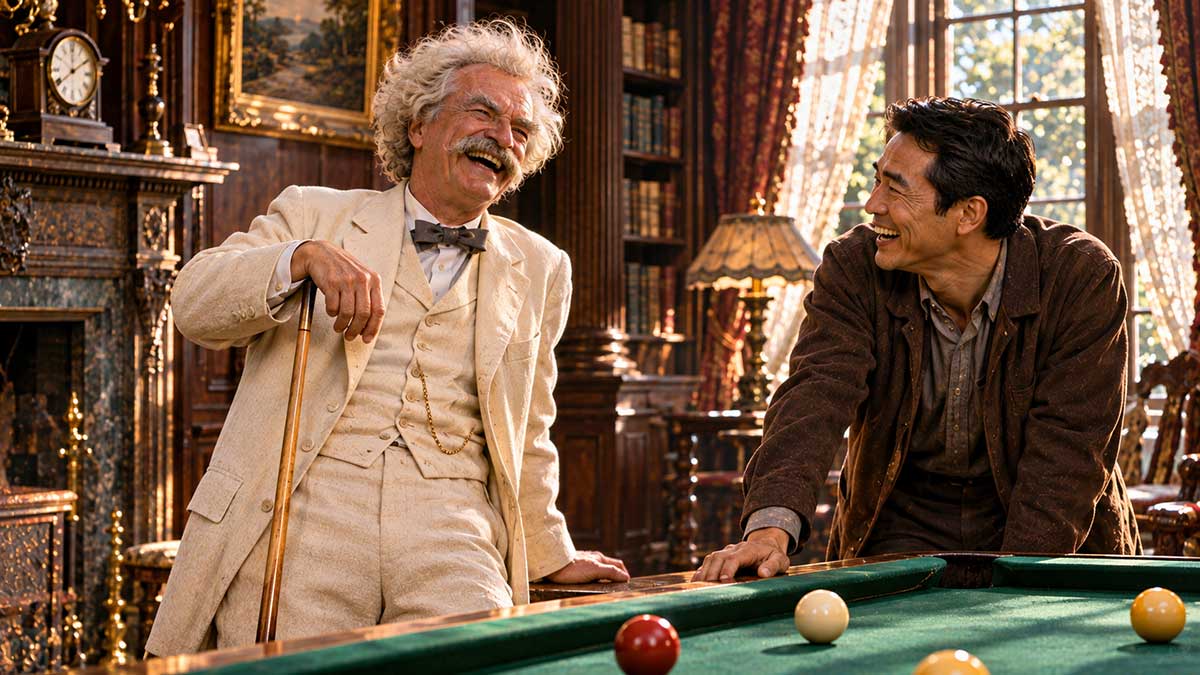
The billiard room, Mark Twain's Hartford home, Connecticut. Late afternoon.
The room smells faintly of tobacco and polished wood. Sunlight filters through tall windows, illuminating a billiard table covered in green felt. Books line the shelves, and a few comfortable chairs stand nearby.
Mark Twain is studying the billiard balls with the concentration of a general preparing for battle.
He leans forward, aims his cue, and strikes.
The white ball rolls across the table, narrowly misses its target, and settles against the cushion.
Twain straightens and looks at the table with deep suspicion.
Mark Twain: That table has been behaving dishonestly all afternoon.
Nick Sasaki: (Laughing.) I thought you were supposed to be good at billiards.
Twain: I am. The table is not.
Nick: Maybe you should invest in a better one.
Twain turns toward me.
Twain: Nick, after what you have been asking about human foolishness, I should have expected you to introduce the subject of investments.
Nick: I couldn't resist.
Twain: Neither could I. That was the difficulty.
We both laugh.
He hands me a cue and gestures toward the table.
Twain: Come. Let us see whether your skill at billiards exceeds your skill at asking embarrassing questions.
Nick: I wouldn't count on it.
Twain: Excellent. Then we are evenly matched.
As I prepare my first shot, I look around the room. This is the home of a man who achieved extraordinary success through his imagination and words.
Yet behind that success lies one of the most astonishing financial disasters in American literary history.
And I am beginning to suspect Twain has a few things to say about it.
Question 7. How did a printer and riverboat pilot become one of the most famous writers in the world?
Nick: Before we talk about how you lost your fortune, I want to understand how you made it.
You started as a printer, became a riverboat pilot, worked in mining country, and eventually became a famous writer.
Was there a moment when you realized storytelling could become your profession?
Twain: I should be pleased to tell you that I recognized my destiny at an early age and pursued it with unwavering determination.
Unfortunately, the facts are less flattering.
I became a printer partly through necessity. I became a riverboat pilot through admiration for the profession. I traveled west with ambitions that included discovering silver and becoming rich.
Writing entered the arrangement through a combination of opportunity, observation, and the failure of other enterprises to produce the desired results.
Nick: (Laughing.) So your career was a series of unexpected turns.
Twain: Life is remarkably efficient at revising a man's plans without consulting him.
Nick: What happened when you went west?
Twain: Nevada was full of men who expected to become wealthy.
That made it an excellent place to study human optimism.
Mining was particularly instructive. A man could possess a claim worth a fortune in the morning and discover by evening that his fortune consisted primarily of dirt.
Nick: Did you find any silver?
Twain: Not enough to make the occupation preferable to journalism.
Nick: And that's when you began working for the Territorial Enterprise?
Twain: Yes. Virginia City was an extraordinary place for a reporter.
There were miners, gamblers, speculators, politicians, and men whose stories improved dramatically whenever an audience gathered.
A newspaper reporter could scarcely ask for better material.
Nick: Was that when Mark Twain was born?
Twain: The name appeared in my journalism in 1863.
I borrowed it from the river, where the sounding call indicated two fathoms of water.
I thought it a suitable name for a man who had spent years trying to avoid running aground.
Nick: (Smiling.) Though financially, you eventually did run aground.
Twain: Nick, you are becoming an unpleasantly attentive student of my biography.
Nick: I'll take that as a compliment.
What about your famous jumping frog story?
Twain: That little frog proved more useful to my career than a great many human beings.
I heard the tale in California, shaped it into a story, and watched it travel farther than I had anticipated.
People enjoyed the absurdity of the situation and the solemn manner in which it was told.
Nick: That's something I love about your humor.
You can describe the most ridiculous event as though you're reporting a serious scientific discovery.
Twain: The world offers so many ridiculous events that a writer need not invent all of them.
He must merely present them in a manner that allows the audience to recognize their magnificence.
Nick: Then came The Innocents Abroad, and suddenly you were famous.
Twain: The book was a considerable success.
I had traveled through Europe and the Holy Land, observing the monuments, the guides, the customs, and the extraordinary expectations travelers brought with them.
I discovered that people often admired a thing more enthusiastically when someone had informed them that admiration was required.
Nick: You didn't like being told what to admire.
Twain: I prefer to reserve the privilege of forming my own opinion.
It is a habit that has occasionally made me unpopular.
Nick: Did fame surprise you?
Twain: It pleased me.
I see no reason to pretend otherwise.
A writer who claims to be entirely indifferent to whether anyone reads his work is making a statement that deserves investigation.
Nick: (Laughing.) So you enjoyed being famous.
Twain: I enjoyed success, recognition, comfortable living, and the satisfaction of discovering that people would pay to hear me speak.
But fame has peculiar effects.
People begin expecting a celebrated humorist to be amusing at all hours.
A man may be suffering from a headache, indigestion, or a perfectly respectable bad temper, and someone will approach him demanding a joke.
Nick: That must have been exhausting.
Twain: It could be.
There are moments when a humorist would appreciate the liberty of being dull.
Nick: Did you ever feel trapped by the public personality of Mark Twain?
Twain: There is a difference between the man who lives and the man the public believes it knows.
The public meets the writer through books, lectures, and carefully selected occasions.
His family encounters the less polished edition.
Nick: Which one was the real you?
Twain: Both, I suppose.
A man may possess several sides without any one of them being entirely false.
But the public is apt to become attached to whichever side entertains it most.
Nick: I like that answer.
You know, when I think about your success, I see someone who followed his curiosity rather than a perfect career plan.
Twain: Curiosity has served me well.
It has led me to people, places, and experiences that no sensible plan would have included.
Unfortunately, it has led me into certain financial arrangements that a sensible plan would have avoided.
Nick: (Grinning.) I was waiting for you to bring that up.
Twain: I thought I might as well surrender before the interrogation became more severe.
Question 8. You could spot foolishness in almost anybody. How did you manage to lose a fortune chasing inventions?
I take my shot.
The cue ball strikes another ball, which rolls slowly toward the pocket, stops at the edge, and refuses to fall.
Twain studies the result.
Twain: An excellent demonstration of the difference between expectation and reality.
Nick: You mean my shot?
Twain: I was thinking of my investments, but the comparison is instructive.
Nick: (Laughing.) All right, let's talk about the Paige typesetting machine.
What convinced you it would make you rich?
Twain: The machine was a remarkable piece of mechanical ingenuity.
James W. Paige had devised a typesetter capable of performing an astonishingly complicated series of operations.
I believed it might transform the printing industry.
And if it transformed the printing industry, naturally, I expected to benefit from the transformation.
Nick: So you weren't simply gambling. You believed in the technology.
Twain: Very much.
I had worked as a printer. I understood the labor involved in setting type by hand.
A successful machine could save enormous effort.
It seemed to me an invention with a magnificent future.
Nick: But it kept needing more money.
Twain: Yes.
A promising invention can develop an extraordinary appetite.
Each improvement seemed to bring success nearer.
Each difficulty appeared temporary.
And every additional investment seemed easier to justify when I considered what had already been spent.
Nick: That's interesting. You kept thinking, "I've already put so much into this. I can't stop now."
Twain: That is a fair description of the trap.
A man who has spent a fortune trying to prove himself correct may become reluctant to purchase the cheaper discovery that he was mistaken.
Nick: (Laughing.) That's painfully accurate.
Did anyone warn you?
Twain: There were reasons for caution, and people expressed doubts.
But I was impressed by the machine, by Paige's abilities, and by the possibilities I saw ahead.
Nick: Were you too optimistic?
Twain: Evidently.
Nick: Too stubborn?
Twain: Quite possibly.
Nick: Too confident in your own judgment?
Twain: Nick, if you intend to conduct the entire prosecution yourself, I should at least be permitted to select the jury.
Nick: (Laughing.) I'm trying to understand how a man who could expose human foolishness so brilliantly could make such an enormous mistake.
Twain: My dear fellow, observing foolishness does not confer immunity from it.
A physician may understand disease and still become ill.
A writer may understand vanity and still possess a generous supply of his own.
Nick: Did you want to become richer than you already were?
Twain: I certainly wanted the machine to succeed.
Wealth was attractive, but so was the prospect of participating in a great invention.
I admired mechanical progress.
I enjoyed the idea of helping bring something extraordinary into the world.
Nick: So it wasn't only greed.
Twain: Human motives are rarely so conveniently arranged.
Ambition, excitement, pride, hope, curiosity, and the desire for financial success can occupy the same mind without requesting separate accommodations.
Nick: That's something I recognize in myself.
When you see an exciting opportunity, especially something involving new technology, it's easy to believe you're looking at the future before everyone else recognizes it.
Twain: Precisely.
And if you are sufficiently enthusiastic, every obstacle becomes evidence that success is merely waiting for one final improvement.
Nick: Then one more investment.
Twain: And another.
Nick: And another.
Twain: You have grasped the essential business model.
We both burst into laughter.
Nick: But the Paige machine wasn't your only financial problem.
You had a publishing company too.
Twain: Yes. Charles L. Webster & Company.
The firm had an extraordinary success publishing General Grant's memoirs.
That was a substantial achievement, both commercially and personally.
Nick: You helped Grant's family financially through that publication.
Twain: The memoirs became a great success, and the royalties provided significant support to his widow and family.
Grant had completed his work under difficult circumstances.
I was glad the publication succeeded.
Nick: But your company eventually failed.
Twain: It did.
A successful book does not guarantee a successful publishing business.
There were poor decisions, financial difficulties, and ventures that failed to produce the expected returns.
The firm's collapse, combined with my other losses, brought me to bankruptcy.
Nick: In 1894.
Twain: Yes.
Nick: That must have been devastating.
Twain: It was a most unwelcome education.
Nick: What did you learn?
Twain: Among other things, that a man's ability to write a profitable book does not necessarily qualify him to manage every enterprise that attracts his imagination.
Nick: (Smiling.) That's a lesson a lot of successful people could use.
Twain: Then I hope they can obtain it at a lower price.
Question 9. When you lost your fortune, did you feel you had failed as a writer, a businessman, or a husband and father?
The billiard game has slowed.
Twain places his cue against the table and moves toward one of the chairs.
I sit opposite him.
For the first time since entering the room, the conversation becomes noticeably quieter.
Nick: Mr. Twain, we've been laughing about your investments.
But I want to ask something more serious.
You had achieved enormous success. You were famous around the world. You had a wife and children.
Then your finances collapsed.
What was the hardest part?
Twain: The loss of money was serious enough.
But financial failure is rarely confined to the person whose name appears on the accounts.
It affects a household. It creates obligations, uncertainty, and burdens for people who did not necessarily participate in the decisions that produced it.
Nick: Did you feel you had let your family down?
Twain: I had made decisions that placed our security at risk.
That was a responsibility I could not dismiss.
Nick: Your wife Olivia had supported you through so much.
How did she handle those years?
Twain: Livy was an extraordinary woman.
She possessed judgment, strength, and a seriousness of character that often complemented my own less predictable enthusiasms.
Our difficulties placed demands upon her.
I should not pretend that my ambitions were without consequences for the people closest to me.
Nick: You eventually went on a world lecture tour to recover financially.
That sounds exhausting.
Twain: It was.
I traveled through distant countries, speaking to audiences and earning the money necessary to meet my obligations.
Australia, New Zealand, India, South Africa, and other places.
It was an extraordinary experience.
But there is a difference between traveling because the world interests you and traveling when your creditors have developed an interest in you.
Nick: (Laughs softly.) You still found humor in it.
Twain: I found much that was interesting.
I met people, observed unfamiliar customs, and encountered the usual assortment of human absurdities.
But the work was demanding.
Nick: Why was repaying your creditors so important to you?
You had gone through bankruptcy. You could have treated the matter as legally settled.
Twain: Legal arrangements and personal obligations do not always feel identical.
I wanted the debts satisfied.
Nick: Was it about honor?
Twain: Honor may be part of it.
But I would be cautious about making myself sound more noble than the circumstances warrant.
I had made mistakes. Other people had claims arising from those mistakes. I wanted to put matters right.
Nick: Did rebuilding your finances restore your confidence?
Twain: It restored my ability to meet certain obligations.
Confidence is another matter.
A man may recover from a financial disaster without becoming permanently wise.
Nick: (Smiling.) You're speaking from experience?
Twain: From an abundance of it.
Nick: Let me ask you something.
When you were young, you wanted to become a riverboat pilot.
Later, you wanted to become a successful writer.
Then you became famous and wealthy.
But after everything that happened, what did success mean to you?
Twain looks toward the billiard table.
Twain: Success is an agreeable condition, Nick.
It is pleasant to have money, recognition, and the freedom to pursue one's interests.
I would not advise anyone to despise those things merely on account of their being desirable.
But a man may possess them and still make himself miserable.
And he may lose them without losing everything that gives his life meaning.
Nick: What mattered most to you?
Twain: The people I loved mattered greatly.
My work mattered.
Friendships mattered.
The pleasure of creating something worthwhile mattered.
But I cannot claim that I always arranged my priorities with perfect wisdom.
Nick: I appreciate your saying that.
Sometimes people look at successful individuals and assume they have figured everything out.
But they may be struggling with things nobody sees.
Twain: Certainly.
A public reputation is a poor instrument for measuring private happiness.
Nick: Did failure make you more compassionate toward other people who struggled?
Twain: It may make a man more conscious of his limitations.
But suffering does not automatically improve character.
Some people emerge from difficulty more generous.
Others become bitter.
A great deal depends upon what they choose to do with the experience.
Nick: That's an important distinction.
Twain: I have known successful men who were fools and unsuccessful men who possessed remarkable wisdom.
The difficulty is that society often assumes wealth provides evidence of intelligence.
Nick: And poverty provides evidence of failure.
Twain: Exactly.
Money is useful for purchasing things.
It is a less reliable measure of human worth.
Nick: You know, there's something I find encouraging about your story.
You made terrible financial mistakes, but you didn't simply give up.
You went out and worked.
You traveled around the world, faced audiences, and rebuilt your finances.
Twain: I had obligations to meet and a profession through which I could earn the necessary money.
I was fortunate to possess an audience willing to pay for my lectures.
Many people who suffer financial failure have no such advantage.
Nick: That's a fair point.
Twain: We should be careful about turning every successful recovery into proof that determination alone is sufficient.
Circumstances matter.
Opportunities matter.
Other people matter.
Nick: I respect that.
Let me ask one final question.
If you could go back and speak to the younger Mark Twain, the man about to invest another enormous sum in the Paige machine, what would you tell him?
Twain: (He considers the question.)
I might advise him to examine the accounts.
Nick: (Laughing.) That's it?
Twain: Very carefully.
Nick: No grand philosophical wisdom?
Twain: My dear Nick, if the younger man had been receptive to philosophical wisdom, he might have saved himself a great deal of money.
Nick: Would he have listened?
Twain: I doubt it.
He was a remarkably persuasive fellow, especially when speaking to himself.
We laugh again.
Then Twain looks at the billiard table with renewed interest.
Twain: Shall we finish the game?
Nick: I think you're winning.
Twain: A welcome change from the financial history we have been discussing.
Closing: The Things Money Cannot Restore
The afternoon sunlight has turned golden.
Twain takes another shot, and this time the ball drops cleanly into the pocket.
He raises his cue with the satisfaction of a man who has finally obtained justice.
Twain: There. You see? The table has recovered its integrity.
Nick: (Laughing.) Congratulations.
Twain: I knew it was only a temporary moral failure.
Nick: Mr. Twain, I came into this room thinking we would talk about money.
But I think we've really been talking about something else.
Twain: And what might that be?
Nick: Pride.
The desire to succeed.
The difficulty of admitting we're wrong.
And the responsibility we have toward the people who depend on us.
Twain: Those are expensive subjects.
Nick: Apparently.
But what strikes me is that your financial failures didn't erase your accomplishments.
You were still Mark Twain.
You still had your imagination, your humor, your ability to write.
Twain: Those abilities were fortunate possessions.
But I should not like to suggest that talent excuses a man from the consequences of his mistakes.
Nick: No. It doesn't.
I think what I admire is that you accepted responsibility and tried to make things right.
Twain rests the cue against the table.
Twain: A man may fail at something without surrendering the responsibility to respond to that failure.
That much, at least, is worth considering.
Nick: There's one thing you said earlier that I keep thinking about.
You mentioned that your wife Olivia stood beside you through difficult years.
We've talked about your childhood, your writing, and your career.
But I don't think I've really met the family man yet.
Twain: (His expression softens.) Ah, Livy.
Nick: I'd love to hear about her.
What was she like?
Twain: She was a remarkable woman, Nick.
And if you wish to know the better parts of my life, you will have to know something about her.
Nick: Then perhaps we should put down the billiard cues and sit somewhere quieter.
Twain: That would be agreeable.
Though I warn you, my wife possessed a considerably more accurate understanding of my character than the public ever did.
Nick: (Smiling.) I suspect that's true of many husbands.
Twain: Indeed.
The world may admire a man for his accomplishments.
His wife has had the opportunity to observe how he behaves when he cannot find his spectacles.
We both laugh.
Twain walks toward the doorway, then pauses.
Twain: Come along, Nick.
There are some stories worth telling that have very little to do with fame or fortune.
I follow him out of the billiard room.
Behind us remains the table where we laughed about ambition, foolishness, and financial failure.
Ahead lies a quieter room, and a different part of Samuel Clemens's life.
One filled with affection, family memories, and losses that no amount of money could ever repair.
Topic 4: What Happens When Even Laughter Cannot Help?
Opening: The Woman Who Knew Samuel Clemens
The family parlor, Mark Twain's Hartford home, Connecticut. Evening.
The laughter from the billiard room gradually fades as Mark Twain leads me down a quiet hallway.
Outside, the last light of the afternoon is disappearing behind the trees. Inside, the house glows with the warmth of lamplight.
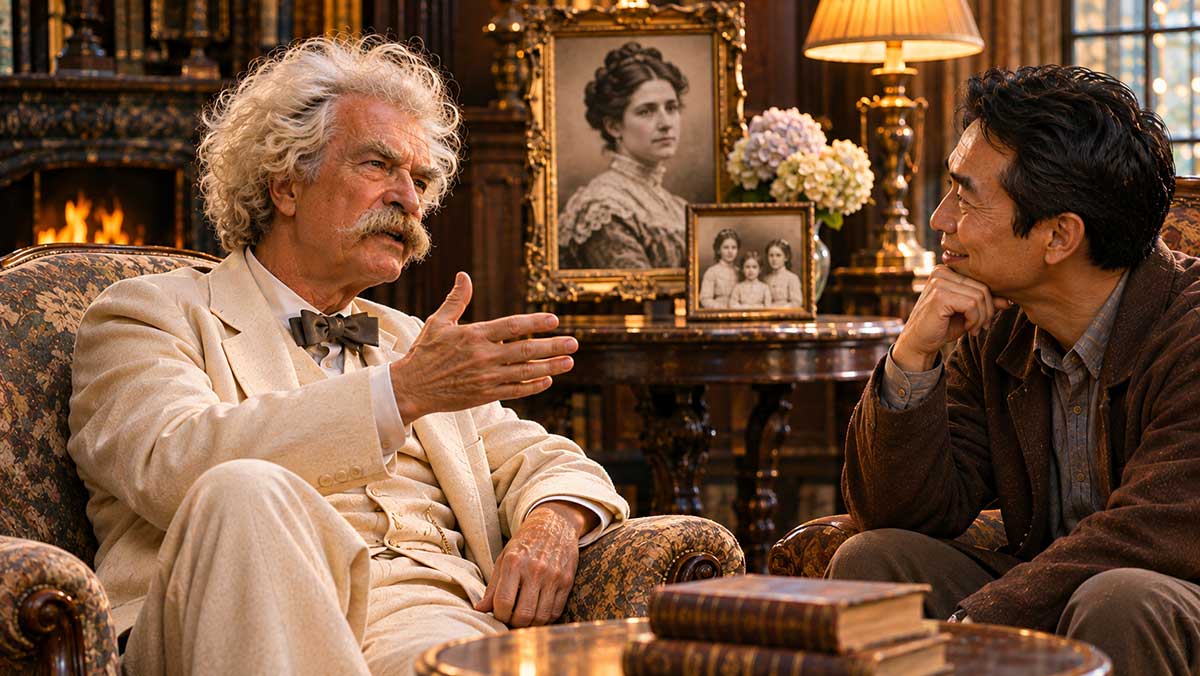
We enter a beautifully furnished parlor. Books rest on a small table, and several framed family portraits stand near the fireplace.
Twain pauses before one of the photographs.
For a moment, he seems less like the famous humorist whose words have entertained millions and more like an ordinary man returning to a room filled with memories.
Nick Sasaki: Is that Olivia?
Mark Twain: Yes. My Livy.
Nick: She's beautiful.
Twain: She was.
Though beauty was by no means the most remarkable thing about her.
Nick: You mentioned earlier that she knew you better than the public did.
Twain: A dangerous advantage for any wife married to a professional storyteller.
Nick: (Laughing.) Did she ever catch you exaggerating?
Twain: Nick, she possessed an inconvenient devotion to accuracy.
It was one of her many virtues, though I cannot pretend it always improved my stories.
Nick: So she kept you honest?
Twain: She made the attempt. It was a demanding occupation.
We laugh quietly.
Twain gestures toward a pair of chairs beside the fireplace.
Twain: Come. Sit down.
You have heard a great deal about Mark Twain this afternoon.
Perhaps it is time you became acquainted with Samuel Clemens.
I sit across from him.
The room feels different from the billiard room. There are no cues to distract us, no game to interrupt the conversation.
Only photographs, memories, and the soft light of evening.
Question 10. Before we talk about the difficult years, tell me about Livy. What made you fall in love with her?
Nick: Mr. Twain, let's go back to the beginning.
How did you meet Olivia Langdon?
Twain: Through her brother, Charles Langdon.
We became acquainted during the voyage aboard the Quaker City in 1867.
Charles showed me a photograph of his sister.
I was sufficiently impressed to develop an interest in meeting her.
Nick: (Smiling.) So you fell in love with a photograph?
Twain: I should hesitate to call it love at that stage.
But I was certainly willing to investigate the possibility.
Nick: And when you finally met her?
Twain: She was intelligent, thoughtful, deeply principled, and possessed of a refinement that I could not honestly claim for myself.
She came from a family whose moral convictions were serious and whose sympathies extended to causes such as abolition and social reform.
I admired her.
And I wanted very much to persuade her that I was a suitable husband.
Nick: Was that difficult?
Twain: Consider the evidence against me.
I had been a riverboat pilot, a western journalist, a traveler, and a professional humorist.
My manners were not always those of a drawing-room gentleman.
I possessed opinions, habits, and a reputation that might reasonably alarm a respectable family.
Nick: (Laughing.) So you had to convince them you were marriage material.
Twain: Precisely.
And I was not universally regarded as an obvious candidate.
Nick: What attracted you most to Livy?
Twain: Her mind.
Her character.
Her seriousness about matters that deserved seriousness.
She could recognize the absurdities of the world without losing her concern for what was right.
Nick: Did she laugh at your jokes?
Twain: She did.
Though she did not always approve of them.
Nick: (Laughing.) That must have been frustrating.
Twain: It was educational.
A man who marries someone who agrees with everything he says has deprived himself of an important opportunity for improvement.
Nick: Did she influence your writing?
Twain: Very much.
Livy read my manuscripts and offered judgments I valued.
She possessed a sensitivity to language and propriety that differed from my own.
Sometimes I accepted her suggestions.
Sometimes I resisted them.
Nick: Did you ever argue about your writing?
Twain: We could disagree.
But I trusted her judgment, and I knew she cared deeply about the work.
Nick: I find that interesting.
People sometimes think of great writers as solitary geniuses, creating everything entirely on their own.
But your marriage seems to have been part of your creative life.
Twain: A writer may sit alone at his desk, Nick, but that does not mean his life is solitary.
The people who love him, challenge him, encourage him, and endure his moods become part of the circumstances in which his work is made.
Nick: What was ordinary life like with Livy?
Not the famous parties or the public appearances.
Just the two of you at home.
Twain: We had conversations, family concerns, disagreements, amusements, and the countless small occupations that make up domestic life.
Our household was lively.
There were children, visitors, books, and more activity than a man might reasonably expect to manage.
Nick: Were you a good husband?
Twain smiles.
Twain: That is a question better addressed to my wife.
Nick: But what would you say?
Twain: I loved her deeply.
Whether I always expressed that love with sufficient patience and wisdom is another matter.
Nick: That's a very human answer.
Twain: I have found marriage to be an effective cure for the illusion that one is a flawless individual.
Nick: (Laughing.) I think many husbands would agree.
Twain: And a considerable number of wives would provide supporting evidence.
We both laugh.
Then I look again at Olivia's photograph.
Nick: You were married for thirty-four years.
When you think about all that time, what do you miss most?
Twain looks toward the portrait.
Twain: I would be reluctant to reduce a marriage to one favorite memory.
It is the accumulation of years that gives the relationship its character.
The conversations.
The familiar presence of another person.
The knowledge that someone understands your habits, your weaknesses, and the things you need not explain.
Nick: The ordinary moments.
Twain: Yes.
The ordinary moments are not always recognized as precious when they are occurring.
They become precious in memory.
I remain quiet for a moment.
There is something about the way he speaks of Olivia that makes the room feel even more intimate.
Question 11. Your daughter Susy wrote about you when she was young. What was it like seeing yourself through your child's eyes?
Nick: Mr. Twain, I'd love to hear about your children.
You and Livy had four children: Langdon, Susy, Clara, and Jean.
Twain: Yes.
Our son Langdon died when he was very young.
Then came our daughters.
Susy, Clara, and Jean brought a great deal of life into our household.
Nick: What kind of father were you?
Twain: An imperfect one, naturally.
But I enjoyed my children enormously.
They were entertaining, imaginative, and capable of expressing opinions about their father that the literary critics might have hesitated to publish.
Nick: (Laughing.) Especially Susy?
Twain: Especially Susy.
She undertook the remarkable project of writing a biography of me when she was still a child.
Nick: I love that.
Most children don't write biographies of their parents.
Twain: It was an unusual distinction.
And she possessed a sharp eye.
Nick: What did she notice about you?
Twain: She observed my habits, my temperament, my appearance, and my conduct within the household.
She did not always present her father in the manner a professional publicist might have preferred.
Nick: (Laughing.) So she knew the real Samuel Clemens.
Twain: She knew a version of him unavailable to the general public.
Children have a particular talent for observing the contradictions in their parents.
They hear what we say.
Then they watch what we do.
Nick: That's a dangerous combination.
Twain: Extremely.
Nick: Was Susy funny like you?
Twain: She possessed intelligence, imagination, and a lively personality of her own.
I would not want her remembered merely as a reflection of her father.
She was a person with her own interests and abilities.
Nick: I'm glad you said that.
Sometimes when we talk about famous people, their family members become supporting characters in the story.
But they had their own lives.
Twain: Of course.
Susy was not simply Mark Twain's daughter.
Nor were Clara and Jean.
Each had her own character, talents, difficulties, and hopes.
Nick: What about Clara?
Twain: Clara developed a serious interest in music and pursued a singing career.
She possessed determination and artistic ambition.
Nick: And Jean?
Twain: Jean loved animals and had a strong affection for living creatures.
She faced serious difficulties with her health, including epilepsy.
Her life required courage.
Nick: It sounds like you had a lively family.
Twain: We did.
There were moments of great happiness.
The house was filled with activity, laughter, and the ordinary disturbances of family life.
Nick: Did your children enjoy your stories?
Twain: They certainly knew that their father could tell stories.
Whether they considered him as impressive as the public did is another question.
Children are rarely intimidated by literary fame when the famous writer is the man who lives downstairs.
Nick: (Laughing.) That's wonderful.
You could be Mark Twain to the world, but at home you were just Dad.
Twain: Precisely.
And a father's literary reputation offers little assistance when a child has decided that he is being unreasonable.
Nick: Did being a father change the way you wrote?
Twain: Family life gave me experiences and observations that entered my imagination.
But I would not claim that every character or story can be traced to a single domestic influence.
Writing draws upon many sources.
Nick: There's something I've been thinking about.
You made millions of people laugh through your books and lectures.
But I wonder whether the laughter of your own children meant something different to you.
Twain studies me for a moment.
Twain: Public laughter tells a performer that he has pleased an audience.
The laughter of someone you love belongs to a different kind of relationship.
Nick: That's beautifully said.
Twain: Though I should not wish to discourage the public from laughing. It was an important source of income.
Nick: (Laughing.) There you are.
Twain: I feared I was becoming excessively sentimental.
Nick: No, I think we're getting to know you.
A quiet moment passes.
I look toward the family photographs again.
Nick: Susy died in 1896, when she was only twenty-four.
You were traveling overseas at the time.
Twain: Yes.
She died in Hartford while I was abroad.
Nick: That must have been unbearable.
Twain: It was a terrible loss.
Nick: I don't want to ask you to describe the pain.
I'd rather ask something else.
When you remember Susy, what would you want people to know about her?
Twain looks toward the window.
Twain: I would want them to know that she lived.
That she was intelligent, affectionate, and possessed a personality entirely her own.
Her death is part of her story.
But it is not the whole of it.
Nick: Thank you.
I think that's something we often forget when talking about people we've lost.
We become so focused on how they died that we forget to celebrate how they lived.
Twain: Yes.
And those who loved them remember far more than the final chapter.
We sit quietly.
The lamplight flickers against the walls.
For a moment, I feel that the most respectful thing I can do is simply remain beside him.
Question 12. After losing people you loved so deeply, how did you wrestle with the idea of a loving God?
Nick: Mr. Twain, may I ask you something about faith?
Twain: You may.
Though I warn you, Nick, my opinions on religion have not always improved my popularity.
Nick: (Smiling.) I've noticed.
You grew up in a Christian society. You had close friendships with religious people, including Reverend Joseph Twichell.
Yet your later writings became deeply critical of religious teachings and institutions.
What troubled you most?
Twain: A number of things.
The willingness of people to invoke divine authority for their own prejudices.
The contradictions between professed religious morality and actual human conduct.
And the difficulty of reconciling the suffering of innocent people with certain descriptions of a benevolent and all-powerful God.
Nick: Was your skepticism mainly the result of losing people you loved?
Twain: No single event explains the development of a person's beliefs.
My questions about religion existed long before the final tragedies of my life.
Experience may sharpen a question without having created it.
Nick: That's important.
I don't want to make the mistake of assuming you lost faith simply after losing your family.
Twain: That would be too convenient an explanation.
Nick: Let me share something about myself.
I believe in God.
And I believe that God's deepest desire is for human beings to love one another as one family.
But I struggle with suffering too.
When innocent children die, when families are separated, when people experience terrible injustice, I don't always know how to explain it.
Twain: Then you are at least willing to acknowledge the difficulty.
Nick: I am.
I don't think faith means pretending every question has an easy answer.
Twain: That is a more interesting position than the one adopted by those who regard every difficulty as already settled.
Nick: But I want to ask you something.
When religious people failed to practice love, did that make you question God, or did it make you question the people claiming to represent Him?
Twain: Both questions can arise.
If a man claims divine approval for cruelty, I question the man.
If a doctrine presents cruelty as consistent with perfect goodness, I question the doctrine.
And if someone tells me that every instance of innocent suffering belongs to a wise and benevolent plan, I may ask how he came to possess such intimate knowledge of that plan.
Nick: That's a fair question.
Twain: I have never been satisfied by explanations that require the sufferer to admire the arrangement.
Nick: I understand.
But could it be that God is loving, yet human beings misunderstand Him?
Twain: It could be proposed.
But then we must examine what evidence supports that understanding.
A beautiful possibility is not the same thing as a demonstrated truth.
Nick: I agree that we should examine our beliefs.
And I think genuine faith should make us more compassionate, not more judgmental.
Twain: That would be a welcome result.
Nick: You know, I think you and I agree about something important.
Whatever our beliefs about God, we should never use religion to justify cruelty.
Twain: On that point, Nick, we can find substantial agreement.
Nick: I want to ask about Reverend Twichell.
You were friends for many years, despite your different religious views.
How did that friendship work?
Twain: Joe Twichell was a dear friend.
We shared conversations, walks, travels, and many experiences.
Our friendship was not dependent upon complete agreement about theology.
Nick: Did you ever argue about religion?
Twain: We could discuss serious matters.
But friendship does not require every conversation to end with one participant surrendering his convictions.
Nick: (Smiling.) I like that.
Twain: It is a useful arrangement.
Otherwise, human beings would be obliged to restrict their friendships to people who already agreed with them.
And that would make the world even more tedious than it sometimes manages to be.
Nick: (Laughing.) You really do have a way of bringing humor back into serious conversations.
Twain: I consider it a necessary precaution.
Nick: Can I ask something more personal?
After losing Olivia, Susy, Langdon, and Jean, did you ever feel angry at God?
Twain remains quiet for a moment.
Twain: My writings contain anger, doubt, and severe questions about the moral order of the universe.
But I should be cautious about reducing the whole of my experience to one emotion.
Grief is not always anger.
Doubt is not always disbelief.
And love does not disappear merely on account of our inability to explain suffering.
Nick: That's profound.
Twain: It is difficult, Nick.
I would not claim to have resolved it.
Nick: Neither have I.
We sit together in silence.
Outside, the evening has deepened.
Nick: Mr. Twain, may I ask one final question?
Twain: Certainly.
Nick: After all those losses, did you ever feel that loving someone so deeply was almost too painful?
Twain looks at Olivia's photograph.
Twain: Love exposes a person to suffering.
That much is unavoidable.
But to avoid affection merely to protect oneself from grief would be a severe bargain.
Nick: So you wouldn't trade those years with Livy and your children to escape the pain?
Twain: I would not wish to imagine a life in which they had never been part of mine.
Nick: Thank you.
Twain: For what?
Nick: For letting me know them a little.
Twain looks at me, then smiles gently.
Twain: They deserve to be remembered.
Closing: The Man Behind the Mustache
The fire has burned low.
Twain rises and walks toward Olivia's portrait.
I remain seated for a moment, thinking about everything we have discussed.
The world remembers Mark Twain as a brilliant humorist.
But tonight I have met someone else.
A husband who loved his wife.
A father who delighted in his children.
A man whose extraordinary success could not protect his family from suffering.
And a thinker who refused to accept easy explanations for life's most painful questions.
Nick: Mr. Twain, can I tell you something?
Twain: Of course.
Nick: When we first met beside the Mississippi, I expected to laugh a lot.
And I have.
But I didn't expect to feel this close to your family.
Twain: They were the center of much that mattered in my life.
Nick: I think that's what I'll carry with me.
Not the fame.
Not the fortune.
The love.
Twain looks toward the photograph again.
Twain: Fame is an interesting arrangement, Nick.
It allows strangers to feel acquainted with a man they have never met.
But the people who share his ordinary days know a different story.
Nick: And that story may be the most important one.
Twain: It is certainly one worth hearing.
We walk slowly toward the doorway.
Nick: There's one more part of your life I want to explore.
You've spoken so honestly about your family and your questions about God.
But you were deeply troubled by the way human beings treated one another.
War, imperialism, racism, cruelty.
Sometimes your later writings sound almost despairing about humanity.
Twain: Humanity has provided me with a considerable amount of material for criticism.
Nick: (Smiling.) I can imagine.
But here's what I really want to know.
After seeing so much cruelty, and after experiencing so much suffering yourself, did you still believe human beings could become better?
Twain pauses at the doorway.
Twain: That, Nick, is a question deserving of a comfortable chair and a long evening.
Nick: Then let's find one.
Twain: I know just the place.
He smiles.
Twain: And I promise to bring my most charitable opinions of the human race.
Nick: (Laughing.) Should I be worried?
Twain: Only if you expect them to occupy much space.
We laugh together and step into the hallway.
Behind us, the quiet family parlor remains illuminated by the warm light of a single lamp.
Ahead lies our final conversation.
A conversation about civilization, conscience, war, God, and the possibility that humanity might someday become worthy of its own highest ideals.
Topic 5: After Everything, Do You Still Believe in Humanity?
Opening: An Old Man, a Beautiful Evening, and a Troubled World
Stormfield, Redding, Connecticut. Autumn 1909. Late afternoon.
The hills of Connecticut are turning gold and crimson beneath the autumn sun.
A gentle breeze moves through the trees surrounding Stormfield, the country home where Mark Twain has spent his final years.
On the veranda, two wooden chairs face the distant hills. A small table stands between them, holding a pitcher of water and two glasses.
Twain is already seated when I arrive.
His familiar white suit contrasts with the dark wood of the veranda. A cigar rests between his fingers, and his expression suggests he has been contemplating something either profoundly important or thoroughly ridiculous.
Possibly both.
Nick Sasaki: Mr. Twain, this is a beautiful place.
Mark Twain: Thank you, Nick. I have found that the countryside possesses several advantages over civilization.
Nick: Such as?
Twain: The trees rarely offer unsolicited advice. The hills do not pretend to understand international politics. And the birds, though frequently noisy, have not yet organized themselves into political parties.
Nick: (Laughing.) Give them time.
Twain: Heaven forbid. I should hate to see the robins accuse the bluebirds of threatening the future of the nation.
I sit beside him.
For a few moments, we watch the sunlight moving across the hills.
Nick: You know, we've covered quite a lot together.
Your childhood in Hannibal. The Mississippi River. Tom Sawyer and Huck Finn. Your success, your financial disasters, and your family.
Twain: A remarkable collection of triumphs and embarrassments.
Nick: And now I want to ask about the world you lived in.
You witnessed enormous changes during your lifetime.
Railroads, telegraphs, industrial machines, electricity, and new inventions.
Yet you became increasingly critical of civilization.
Twain: An interesting word, civilization.
It is frequently employed by people who are preparing to do something uncivilized.
Nick: (Smiling.) That's exactly what I want to talk about.
Twain leans back in his chair.
Twain: Very well, Nick. Let us examine the human race.
Though I suggest we keep our expectations modest. It has had several thousand years to prepare its defense.
Question 13. Why did a man who loved America become one of its fiercest critics?
Nick: Mr. Twain, you were deeply connected to America.
You grew up along the Mississippi, traveled across the country, wrote about American life, and became one of its most celebrated authors.
Yet later in life, you strongly criticized American imperialism, especially the war in the Philippines.
What changed?
Twain: I had seen a great deal of the world by then.
Travel is useful when it encourages a man to examine the assumptions he has inherited.
One may love one's country and still object when it behaves unjustly.
Indeed, affection for a country ought not require blindness to its conduct.
Nick: Did you initially support American expansion overseas?
Twain: I was at first inclined to think that American involvement in the Philippines might serve the cause of freedom.
But as I learned more about what was occurring, my judgment changed.
The language of liberation had become difficult to reconcile with the realities of conquest.
Nick: So you changed your mind.
Twain: A practice I recommend, though it has never been universally popular.
Nick: (Laughing.) People don't like admitting they were wrong.
Twain: They prefer to announce that circumstances have changed in a manner that makes their original opinion appear remarkably farsighted.
Nick: What troubled you most about the Philippine-American War?
Twain: The contradiction.
A nation that celebrated its own independence was denying another people the right to determine their future.
We spoke of liberty while exercising domination.
We praised civilization while employing violence to impose our authority.
Nick: Some Americans argued that their country was bringing progress and education to the Philippines.
Twain: That was among the justifications.
But a nation does not acquire the moral right to rule another people merely by announcing that its intentions are benevolent.
The people subjected to that rule are entitled to have something to say about the arrangement.
Nick: That's a powerful point.
But let me challenge you a little.
What if a country genuinely believes it can improve the lives of people elsewhere?
Twain: Then it may offer assistance.
It may share knowledge.
It may establish relationships based upon mutual consent.
But when benevolence arrives accompanied by soldiers and the denial of self-government, one is entitled to question its character.
Nick: So the difference is between helping people and controlling them.
Twain: A most useful distinction.
One that governments occasionally find inconvenient.
Nick: You joined the Anti-Imperialist League.
And you wrote To the Person Sitting in Darkness, criticizing the behavior of imperial nations and missionaries.
You were particularly troubled by people using Christianity to justify conquest.
Twain: Yes.
It was a remarkable spectacle.
Men would announce their devotion to a religion that preached mercy and then defend actions that inflicted enormous suffering.
They would speak of saving souls while showing insufficient concern for the bodies in which those souls resided.
Nick: I can see why that angered you.
As you know, I believe in God, and I believe humanity is one family.
But I agree that religion should never become an excuse for dominating or harming other people.
Twain: Then we have reached an agreeable point of understanding.
Nick: But I don't want to pretend every religious person supported imperialism.
Many Christians opposed slavery, war, and injustice.
Twain: Quite so.
And I have known religious people of admirable character.
My criticism is not improved by pretending that every believer is guilty of the same offenses.
Nick: I'm glad you make that distinction.
Twain: A critic who exaggerates his opponent's faults may weaken the very argument he wishes to defend.
Nick: You know, that's something I think we need today.
People often assume that criticizing their country means they don't love it.
But sometimes criticism comes from wanting the country to live up to its ideals.
Twain: Precisely.
Patriotism need not require a man to applaud every decision made by his government.
A country is not made more honorable by concealing its wrongs.
Nick: You were pretty fearless about criticizing powerful institutions.
Were you ever afraid of losing your popularity?
Twain: I was not indifferent to public opinion.
Nor was I always eager to publish every severe judgment I had written.
A man may possess strong convictions and still consider the consequences of expressing them.
Nick: That's interesting. People sometimes picture you as someone who said whatever he wanted without hesitation.
Twain: An attractive legend.
But legends are frequently more consistent than the people upon whom they are based.
Nick: (Laughing.) You don't even let yourself become a perfect hero.
Twain: I have spent too many years observing human nature to make that particular investment.
Nick: So what did you want Americans to recognize?
Twain: That noble words do not automatically make noble actions.
If we claim to believe in liberty, we must examine how we treat those whose liberty conflicts with our interests.
If we claim to represent civilization, we must examine the suffering caused in its name.
And if we claim to serve God, we should be especially cautious about attributing our ambitions to divine instruction.
Nick: That's something worth thinking about.
Twain takes a slow breath and looks across the hills.
Twain: It is easier to celebrate a principle than to accept the inconvenience of practicing it.
Question 14. Do you believe humanity is becoming morally better, or are we simply inventing more sophisticated ways to hurt one another?
Nick: Let me ask you something that I think is especially relevant to our own time.
You lived through enormous technological changes.
Steam engines, railroads, telegraphs, industrial machinery.
You were fascinated by inventions.
Yet you questioned whether civilization was actually becoming better.
Why?
Twain: I admired ingenuity.
A machine that performs useful work is a remarkable achievement.
The human mind is capable of extraordinary inventions.
But intelligence and morality are separate accomplishments.
A man may invent an astonishing device without becoming any kinder to his neighbor.
Nick: You experienced that fascination personally with the Paige typesetting machine.
Twain: Nick, must you continue reminding me of that unfortunate romance?
Nick: (Laughing.) I'm sorry. I couldn't resist.
Twain: The machine was more expensive than several of my other enthusiasms, but I remain impressed by mechanical ingenuity.
Nick: You know, in my time, we're developing machines that can perform tasks people once believed required human intelligence.
We call it artificial intelligence.
Twain: Artificial intelligence?
Nick: Yes.
Twain: How interesting.
I have encountered a considerable amount of the artificial variety in public life, though the intelligence was frequently missing.
Nick: (Laughing.) I knew you'd say something like that.
But seriously, technology is changing the world.
We can communicate instantly across enormous distances. We have medical advances, computers, and extraordinary scientific discoveries.
Yet we still have wars, hatred, greed, and terrible injustice.
Twain: Then the central question remains familiar.
What shall human beings do with their inventions?
A tool may serve a compassionate purpose or a cruel one.
Its mechanical sophistication does not determine the moral character of its owner.
Nick: So progress in technology doesn't necessarily mean progress in human character.
Twain: Precisely.
A civilization may become more efficient without becoming more humane.
It may acquire the ability to transport goods, transmit information, and manufacture weapons on an unprecedented scale.
But the question of how it treats human beings remains.
Nick: That reminds me of A Connecticut Yankee in King Arthur's Court.
You send a modern American into the world of King Arthur, where he introduces technology and tries to challenge the old social order.
But the story becomes increasingly violent.
Twain: The novel examines the arrogance of institutions, the abuses of inherited privilege, and the dangers that accompany modern ingenuity.
Hank Morgan possesses knowledge unavailable to the people around him.
But knowledge does not make him immune to pride or destructive decisions.
Nick: So even the person trying to improve society can become dangerous.
Twain: Certainly.
A man may begin with admirable intentions and become so convinced of his own superiority that he ceases to recognize the humanity of those who resist him.
Nick: That's a frightening possibility.
Twain: It is one of the recurring entertainments of history.
Nick: Do you think human beings are naturally selfish?
Twain: I have written at length about the motives governing human conduct.
People often explain their actions in ways that preserve a favorable opinion of themselves.
Even acts of generosity may involve complicated motives.
Nick: But does that mean genuine goodness doesn't exist?
Twain: It means we should examine our assumptions carefully.
I have known people who acted with courage, generosity, and compassion.
The existence of selfish motives does not erase the reality of kindness.
But neither should we imagine that human beings become morally admirable merely by describing themselves that way.
Nick: I believe people have the capacity to become better.
I think love can change us.
Not simply romantic love, but the kind of love that makes us care about someone else's happiness and suffering.
Twain: That is an attractive conviction.
Nick: You sound unconvinced.
Twain: I am interested in what happens when the conviction encounters difficulty.
It is easy to love humanity in the abstract.
The difficulty begins when humanity takes the form of an irritating neighbor, a political opponent, or a stranger whose interests conflict with our own.
Nick: (Smiling.) That's true.
Twain: A man may announce that he loves the entire human race and then become furious when someone occupies his favorite chair.
Nick: (Laughing.) You make it sound ridiculous.
Twain: Human beings frequently save me the trouble.
Nick: But maybe that's where real love begins.
Not with grand declarations, but with how we treat the person right in front of us.
Twain: That would be a sensible place to begin.
Nick: Do you think society can learn that lesson?
Twain: Individuals sometimes do.
Societies are more difficult creatures.
They are composed of individuals, yet they develop habits and institutions that allow responsibility to become wonderfully difficult to locate.
Nick: So who is responsible for changing things?
Twain: That is a question every generation must answer.
I should distrust anyone who claims that history guarantees moral improvement without requiring difficult choices from living people.
Nick: Then hope isn't enough.
Twain: Hope may be useful.
But it ought to be accompanied by attention, judgment, and conduct.
Nick: I like that.
Twain smiles.
Twain: I am pleased to have said something agreeable. It has been a demanding afternoon for my reputation.
Question 15. After everything you experienced, what did you still find worth loving about human beings?
The sun has nearly reached the horizon.
The hills are covered in a soft golden light, and the air has grown cooler.
For several moments, neither of us speaks.
Then I turn toward Twain.
Nick: Mr. Twain, may I ask you one final question?
Twain: You may, Nick.
Though I suspect from your expression that it will not concern billiards.
Nick: No.
We've talked about your childhood, your books, your financial failures, your family, your doubts about religion, and your criticism of humanity.
You've seen extraordinary things.
You've experienced tremendous success and terrible loss.
And you've spent much of your life exposing human foolishness.
So I want to ask you something very simple.
After everything, what did you still find worth loving about human beings?
Twain does not answer immediately.
He watches a bird settle on the railing at the far end of the veranda.
Twain: That is a larger question than it first appears.
Nick: Take your time.
Twain: I have often been disappointed by the human race.
Its appetite for cruelty, its vanity, its willingness to surrender judgment to custom and authority.
There are days when its achievements seem rather less impressive than its claims.
Nick: I can understand that.
Twain: But the human race is an abstraction.
The people one knows are not.
Nick: What do you mean?
Twain: I knew my wife.
I knew my children.
I knew friends who demonstrated loyalty, courage, humor, and affection.
I encountered people whose kindness required no audience.
These experiences do not erase the darker evidence about humanity.
But neither does the darker evidence erase them.
Nick: So you could be disappointed in humanity as a whole while still loving individual people.
Twain: There is no great difficulty in recognizing that both experiences may be real.
Nick: I think that's beautiful.
Twain: You are welcome to find it so.
But I would not wish to transform my affection for particular people into proof that the world is progressing toward perfection.
Nick: (Smiling.) You won't let me have an easy ending, will you?
Twain: Nick, I have spent my life distrusting easy endings.
They are often obtained by removing the inconvenient parts of the story.
Nick: Fair enough.
Let me ask you about your friendships.
You mentioned Reverend Twichell earlier.
You disagreed with him on religion, yet remained close friends for many years.
What made that possible?
Twain: Friendship is not a contest in which one participant must defeat the other.
Joe was a companion whose character and company I valued.
We could discuss serious matters without making agreement the price of affection.
Nick: That's something I wish more people could do.
Twain: It would make social life considerably more pleasant.
Though it might deprive certain public figures of their principal occupation.
Nick: (Laughing.) There you go again.
What about the young people who visited you in your later years?
You had friendships with children you called your Angel Fish.
Twain: Yes.
I enjoyed their company.
Children can be wonderfully direct, imaginative, and entertaining.
They have not always acquired the elaborate habits of social performance that adults consider necessary.
Nick: Did being around children remind you of your own childhood?
Twain: Perhaps in certain respects.
But I enjoyed their personalities in their own right.
A child is not merely a reminder of something an older person has lost.
Nick: That's a lovely distinction.
Twain: And children have an advantage over adults.
They are often willing to ask questions that respectable people have learned to avoid.
Nick: Like what?
Twain: Why something is done.
Why a rule exists.
Why an adult says one thing and does another.
Very troublesome questions.
Nick: (Laughing.) Sounds like Huck Finn.
Twain: Huck would have made an inconvenient guest at many respectable dinner tables.
Nick: Let me ask you something personal.
You know my belief that humanity is one family under one God.
I recognize that you have serious doubts about religion.
But I wonder whether we might agree on something deeper.
That every human being deserves dignity, and that love should matter more than pride, prejudice, or social status.
Twain: I should agree that human dignity deserves far more respect than it has ordinarily received.
And that cruelty becomes no more admirable when practiced by people of wealth, authority, or religious standing.
Nick: That's a meaningful point of agreement.
Twain: It is.
But I would not claim that our agreement resolves the philosophical questions separating us.
Nick: I wouldn't ask you to.
I think friendship can exist without complete agreement.
Twain: Then you and Joe Twichell might have enjoyed one another's company.
Nick: (Smiling.) I think I would have.
Twain: Though he was a better walker than many men I have known. You might have found yourself considerably exercised.
Nick: (Laughing.) I'll keep that in mind.
I have one last question.
If a young person were reading your books a hundred years after your death, what would you most want that person to question?
Twain: I should hesitate to instruct a reader to arrive at one particular conclusion.
But I would be pleased if the books encouraged curiosity.
If the reader became less willing to accept cruelty merely on account of its being customary.
If the reader questioned the moral certainty of people who have never examined their own assumptions.
And if the reader learned to recognize the humanity of someone whom society had taught him to disregard.
Nick: That's a remarkable legacy.
Twain: It would be a worthwhile one.
Nick: Do you think laughter helps us become better people?
Twain: It may help us recognize our foolishness.
But recognition is not the same as correction.
A man can laugh at his faults for fifty years without making any serious effort to improve them.
Nick: (Laughing.) You always have another layer.
Twain: It is a professional inconvenience.
Nick: Then perhaps the real challenge is what we do after we stop laughing.
Twain: That is worth considering.
We sit quietly as the sun disappears behind the hills.
For a moment, I think about the young boy who once stood beside the Mississippi, dreaming of adventure.
The riverboat pilot who learned that beautiful water could conceal danger.
The writer who created Huck Finn and Jim.
The businessman who lost a fortune.
The husband and father who loved his family.
And the old man beside me, still questioning the moral claims of civilization.
Nick: Mr. Twain, I want to thank you.
Twain: For enduring my opinions?
Nick: (Smiling.) For sharing them.
And for reminding me that humor can be more than entertainment.
Sometimes it can help us see ourselves more clearly.
Twain: That is a generous interpretation of my profession.
I shall endeavor not to contradict it immediately.
Nick: (Laughing.) I appreciate that.
Closing: The Last Laugh Belongs to the Living
The evening air has become cool.
Twain rises slowly from his chair, and I stand beside him.
For a while, we look across the darkening countryside.
Nick: Mr. Twain, can I tell you what surprised me most about our conversations?
Twain: Certainly.
Nick: I expected to meet one of the funniest men in history.
And I did.
But I also met someone who cared deeply about justice, someone who made mistakes, someone who loved his family, and someone who was willing to question what others accepted without thinking.
Twain: A rather complicated fellow, by your account.
Nick: (Smiling.) Very complicated.
Twain: I have always suspected that the simpler versions of my character were produced by people who had not spent sufficient time examining the evidence.
Nick: There's something I want to carry away from our time together.
You didn't always trust humanity's claims about itself.
But you kept observing, writing, questioning, and sometimes laughing.
Twain: A man must find occupations suitable to his temperament.
Nick: And perhaps you helped people become a little more honest about themselves.
Twain: Perhaps.
Though I should not claim responsibility for every improvement that has occurred since the publication of my books.
Nick: (Laughing.) Fair enough.
I extend my hand.
Nick: Thank you, Mr. Twain.
It's been a privilege getting to know you.
Twain takes my hand.
Twain: The pleasure has been mine, Nick.
You have asked some uncomfortable questions.
Nick: I hope that's a compliment.
Twain: In your case, I believe it is.
Nick: Before I go, may I ask one very small favor?
Twain: I shall consider it.
Nick: One last piece of advice.
Not for humanity.
Just for me.
Twain looks at me with a mischievous expression.
Twain: Very well.
When you find yourself absolutely certain that you are right, take a moment to consider whether you have overlooked something.
Nick: That's good advice.
Twain: And if someone approaches you with an investment guaranteed to produce an enormous fortune...
Nick: (Laughing.) Yes?
Twain: Ask to see the accounts.
We both laugh.
It is the same warm, unguarded laughter that began our friendship beside the Mississippi.
And somehow, after everything we have discussed, it feels like the most fitting way to part.
Twain returns to his chair as I walk down the veranda steps.
I look back once.
He raises a hand in farewell, then turns his attention to the distant hills.
The world will continue to argue about Mark Twain.
Some will remember the humorist.
Others will remember the critic of slavery, imperialism, and religious hypocrisy.
Still others will examine the contradictions in his character and the limitations of his writing.
But I will remember something more personal from our imagined meeting.
A man who understood that human beings are capable of extraordinary foolishness and extraordinary kindness.
A man who refused to pretend that suffering could be explained away with comforting words.
And a man who, after everything, still found reasons to tell stories, enjoy friendship, and laugh.
Perhaps that is one of the most valuable things Mark Twain leaves us.
Not a guarantee that humanity will become better.
But an invitation to question our certainty, recognize one another's dignity, and take responsibility for the way we live.
The last light fades from the hills.
And somewhere behind me, I hear the unmistakable sound of Mark Twain laughing.
Final Thoughts
We began beside the Mississippi River, where a mischievous young boy dreamed of becoming a steamboat pilot. We ended on a quiet veranda, where an aging writer confronted the moral failures of civilization. Between those two scenes lay a lifetime of laughter, ambition, discovery, love, mistakes, and grief. Yet the most striking feature of Twain's story may be that his questions remain so familiar. We have changed our machines, our institutions, and our methods of communication. Have we changed our hearts?
Twain's childhood reminds us that the beliefs we inherit are not necessarily the beliefs we would choose after careful examination. Growing up in a slaveholding society, Samuel Clemens absorbed assumptions that his later writing would challenge. In Huckleberry Finn, the conflict between Huck's learned conscience and his personal affection for Jim exposes a terrible possibility: people can sincerely believe they are behaving morally when they are participating in injustice. That challenge remains alive whenever communities confuse popularity, tradition, or authority with goodness.
His financial history offers another lesson. Twain could identify vanity, self-deception, and misplaced confidence with extraordinary precision, yet he remained vulnerable to them himself. His investments demonstrate that intelligence does not make a person immune to error. The value of his recovery lies less in a simple tale of perseverance than in his willingness to face obligations after serious mistakes. His life asks whether we can recognize our own limitations with the same clarity we bring to the faults of others.
Then there is the Samuel Clemens who existed beyond the public name. The husband of Livy, the father of Langdon, Susy, Clara, and Jean, the friend of Joseph Twichell, and the man whose private attachments gave his life meaning beyond literary achievement. The Mark Twain House's account of Olivia Langdon Clemens explores her intellectual influence and the importance of their marriage. These relationships remind us that the people we love are not supporting characters in our personal accomplishments. They possess lives, hopes, and dignity of their own.
Twain's suffering did not produce a neat explanation of God or the universe. His questions about religion were serious, persistent, and often severe. In our imaginary conversation, Nick's belief in one human family under one God meets Twain's skepticism without either man claiming a final victory. This disagreement matters. Genuine conversation does not require us to conceal our convictions, nor does it require us to treat disagreement as hostility. Friendship can survive difficult questions when each person remains willing to listen.
Twain's criticism of imperialism extends the same moral challenge beyond individual relationships. A nation may speak of freedom yet deny it to others. A religious institution may preach compassion yet defend violence. A technologically advanced society may still tolerate cruelty. Twain's anti-imperialist writings, including To the Person Sitting in Darkness, remind us that genuine patriotism can include serious criticism of a country's actions. The worth of an ideal must be tested by what happens to the people affected by it.
Perhaps the most difficult question concerns hope. Twain's late writings do not permit us to turn him into a cheerful prophet of inevitable human progress. His skepticism was too deep, his disappointments too substantial, and his observations too uncomfortable for that. Yet it would be equally misleading to erase his affection for his family, friends, children, and the many individual personalities who enriched his life. The historical record presents a man whose capacity for love coexisted with profound criticism of human conduct. We should resist the temptation to resolve that tension on his behalf.
What, then, can we carry away from this imaginary meeting? Perhaps a willingness to question inherited assumptions, to recognize the dignity of people our communities overlook, to accept responsibility for our mistakes, and to treat those we love with greater care. We need not share all of Twain's beliefs to learn from his questions. And we need not surrender hope merely on account of recognizing humanity's failures. The challenge is to make our convictions visible through our conduct, not merely through the beauty of our words.
I began this conversation wanting to meet the man who made the world laugh. I leave it thinking about the man who kept asking what human beings owe one another. His humor invites us closer; his criticism prevents us from becoming too comfortable; his personal story reminds us of what is at stake. Perhaps Twain's greatest gift is not that he tells us what to believe, but that he makes it harder for us to stop examining ourselves.
And if we can still laugh at our own foolishness, perhaps we have taken the first small step toward doing something about it.
Fictional Conversation Disclaimer
The preceding reflections are based on an imagined interview, not an actual conversation with Mark Twain. His fictional responses draw upon historical research and literary interpretation, but should not be treated as verified statements of his private thoughts, final beliefs, or personal endorsement of the views expressed.
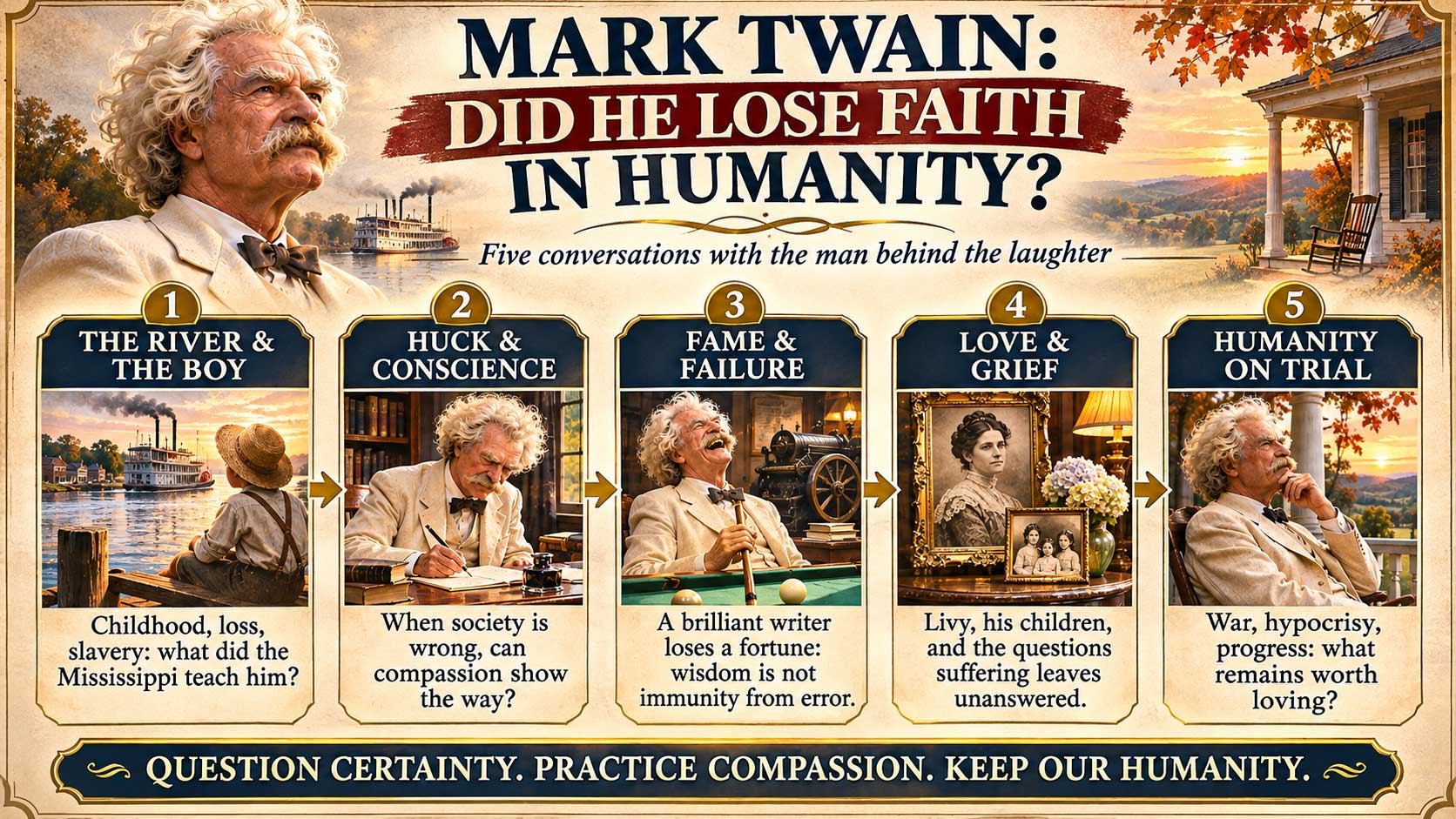
Short Bios:
Mark Twain (Samuel Langhorne Clemens, 1835–1910)
Mark Twain was an American novelist, humorist, journalist, lecturer, and social critic whose work transformed American literature. Born in Florida, Missouri, he grew up in Hannibal beside the Mississippi River and later worked as a printer, steamboat pilot, western reporter, and traveling lecturer. His best-known books include The Adventures of Tom Sawyer (1876), Adventures of Huckleberry Finn (1884–1885), Life on the Mississippi (1883), and A Connecticut Yankee in King Arthur's Court (1889).
Twain combined humor with pointed examinations of hypocrisy, slavery, class, imperialism, and moral certainty. His personal life included remarkable literary success, financial setbacks, devoted family relationships, and painful bereavements. He died in Redding, Connecticut, on April 21, 1910.
Learn more through the Mark Twain House & Museum biography and the Mark Twain Boyhood Home & Museum.
Olivia Langdon Clemens (1845–1904)
Olivia Louise Langdon Clemens, known as Livy, was Mark Twain's wife, intellectual companion, and an influential reader of his manuscripts. Raised in Elmira, New York, in a family involved in reform movements, she married Samuel Clemens in 1870. They had four children: Langdon, Susy, Clara, and Jean.
Livy's education, convictions, editorial judgment, and partnership shaped Twain's domestic and creative life. Their Hartford home became an important gathering place for family, friends, and literary visitors.
Read her biography at the Mark Twain House & Museum.
Olivia Susan "Susy" Clemens (1872–1896)
Susy Clemens was the eldest daughter of Samuel and Olivia Clemens. Intelligent, imaginative, and interested in literature, theater, and music, she began writing a biography of her father at age thirteen. Her observations provide a valuable perspective on the celebrated writer's domestic personality and family life.
Susy died of spinal meningitis in Hartford in 1896 at age twenty-four. Her life and writings offer a reminder that the Clemens children were distinctive individuals whose stories deserve attention beyond their father's fame.
Read about Susy and her siblings in the Mark Twain House's family history.
Joseph Hopkins Twichell (1838–1918)
Joseph Hopkins Twichell was an American Congregational minister and longtime friend of Mark Twain. The two shared walks, travels, conversations, and a friendship that endured across differences in religious outlook.
Twichell provides an important counterpoint to simplistic portrayals of Twain as uniformly hostile to religious believers. Their friendship reveals the possibility of intellectual disagreement within lasting personal affection.
Explore Twain's life and relationships through the scholarly resources of the Mark Twain Project at the University of California, Berkeley.
Nick Sasaki, Imaginary Interviewer
Nick Sasaki is the creator of ImaginaryTalks.com, a creative platform that brings historical figures, writers, thinkers, and other influential voices into fictional conversations about enduring human questions.
Through these imagined encounters, Nick seeks to explore the ideas, accomplishments, convictions, and personal experiences of his guests in a warm, curious, and thoughtful manner. His approach welcomes disagreement and difficult questions, guided by his personal conviction that humanity belongs to one family under one God.
The interviews are works of creative interpretation, intended to inspire curiosity, reflection, compassion, and further exploration of the real people and ideas behind the conversations.
Leave a Reply