
Introduction
What if one of the most courageous women in American history spent much of her early life wondering whether she was good enough?
Before Eleanor Roosevelt became America's First Lady, before she challenged racial discrimination, and before she helped lead the creation of the Universal Declaration of Human Rights, she was a young girl who struggled with insecurity, loneliness, and the loss of people she loved.
She was not born fearless.
And her extraordinary life did not follow a simple path from suffering to success.
Born into a privileged New York family in 1884, Eleanor lost both parents during childhood. At Allenswood, a school in England, she encountered the influential educator Marie Souvestre, who encouraged her to think independently and take her own ideas seriously.
Those experiences helped shape a woman who would spend much of her life questioning expectations, including the expectations placed upon herself.
Her marriage to Franklin D. Roosevelt brought love, family, political responsibility, and profound disappointment. When Eleanor discovered his relationship with Lucy Mercer in 1918, their marriage entered a different chapter.
Yet Eleanor's life cannot be explained through that betrayal alone.
She developed her own political interests, formed meaningful friendships, supported working women, and created a home at Val-Kill where she could pursue work and relationships beyond her official duties.
As First Lady from 1933 to 1945, she transformed public expectations of the position. She traveled across America during the Great Depression, listened to families facing hardship, wrote her widely read My Day newspaper column, and advocated for workers, women, and people facing racial discrimination.
Her willingness to challenge injustice sometimes placed her at odds with powerful institutions and with the political calculations of her husband's administration.
In 1939, she publicly resigned from the Daughters of the American Revolution after the organization refused to make Constitution Hall available to the celebrated Black singer Marian Anderson.
But Eleanor's record was not without limitations.
The Roosevelt administration's incarceration of Japanese Americans during World War II, the persistence of racial segregation, and the compromises of American politics reveal the difficult distance between moral principles and government action.
To appreciate Eleanor Roosevelt fully, we must be willing to examine both her courage and the moments when her influence fell short.
After Franklin's death in 1945, Eleanor began another remarkable chapter.
Appointed to the United States delegation to the United Nations, she chaired the UN Commission on Human Rights and played a leading role in the international collaboration that produced the Universal Declaration of Human Rights, adopted on December 10, 1948.
The Declaration affirmed a principle that remains central to the struggle for justice: every human being possesses dignity and rights.
Eleanor continued her public work into her final years, including serving as chair of President John F. Kennedy's Commission on the Status of Women.
She died in 1962, leaving behind achievements that were extraordinary and questions that remain unfinished.
In this imagined conversation, Nick Sasaki meets Eleanor Roosevelt across five meaningful settings: the gardens of Allenswood, her beloved Val-Kill cottage, the White House, the United Nations negotiations in Paris, and finally the quiet autumn garden of Val-Kill.
Their conversations explore fifteen questions about childhood, love, independence, conscience, injustice, human rights, friendship, regret, and the meaning of a worthwhile life.
Nick does not meet a flawless heroine.
He meets a woman who continued learning, questioning herself, and seeking ways to contribute throughout her life.
And perhaps that is what makes Eleanor Roosevelt's story so relevant today.
Her life raises a question that reaches far beyond politics or history:
What might become possible if we stopped waiting to feel fearless and began acting on what we believe matters?
Fictional Conversation Disclaimer
This article presents an imagined interview between Nick Sasaki and Eleanor Roosevelt. The dialogue, private reflections, and meetings are fictional reconstructions informed by historical research, not authentic quotations, documented conversations, or endorsements. Historical events and relationships are distinguished from interpretations where appropriate.
Topic 1: The Girl Who Learned to Find Her Voice
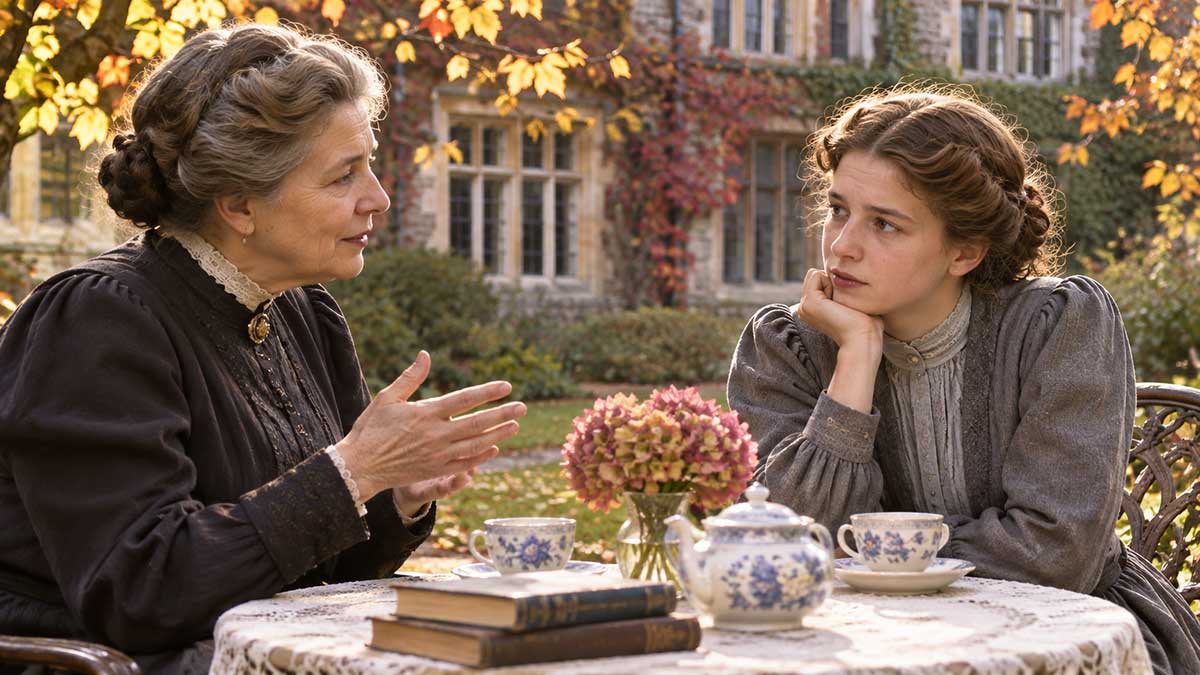
Opening: A Garden at Allenswood
Allenswood, Wimbledon, England. A quiet autumn afternoon.
The garden is peaceful, touched by the golden light of late afternoon. A narrow gravel path winds between carefully tended flowerbeds, and fallen leaves rustle gently beneath the trees.
Eleanor Roosevelt sits at a small garden table, a cup of tea resting beside her. She looks comfortable here, almost as if the years have slipped away.
This is where, as a young woman, she began discovering a world beyond the expectations of her family.
Nick approaches, and Eleanor rises with a welcoming smile.
Nick: Eleanor, thank you for meeting me here. I have to tell you, when I imagined sitting down with one of the most influential women of the twentieth century, I pictured the White House or the United Nations.
But here we are, in a school garden.
Eleanor Roosevelt: (Smiling) Perhaps that is a better place to begin.
The White House was a place where I worked. The United Nations was a place where I tried to accomplish something.
But Allenswood was a place where I began to discover what I might become.
Nick: That's interesting. Most people would probably say your life changed when you married Franklin Roosevelt.
Eleanor: Marriage certainly changed my life. But I think we make a mistake when we assume that a woman's story begins with the man she marries.
I had a life before Franklin. I had thoughts, fears, ambitions, and questions. And here, for the first time, I was encouraged to take those questions seriously.
Nick: I like that. So perhaps I should meet the Eleanor who existed before the famous Roosevelt name.
Eleanor: (Laughing softly) That would be a very good idea. She was rather different from the woman you have read about.
Nick: Different how?
Eleanor: Much less certain of herself, for one thing.
Though I should warn you, I never became entirely certain of myself.
Nick: That's reassuring. I was hoping you wouldn't tell me that great people wake up every morning feeling fearless.
Eleanor: Oh, goodness, no. If that were a requirement, I should never have accomplished anything.
They laugh. A light breeze moves through the garden, and Nick settles into the chair opposite her.
Question 1: What Was Life Really Like for the Little Girl Behind the Famous Woman?
Nick: Eleanor, people remember you as someone who challenged presidents, defended civil rights, and helped shape the Universal Declaration of Human Rights.
But when I read about your childhood, I discovered a very different picture.
You lost your mother when you were eight, your father when you were nine, and your younger brother not long afterward.
That's an extraordinary amount of loss for a child.
What was life really like for that little girl?
Eleanor: I think the first thing you must understand is that a child does not experience tragedy in the orderly way that an adult later describes it.
When people write biographies, they arrange events into chapters. First this happened, then that happened, and eventually the child became the adult.
But a child simply lives through each day.
I remember feeling awkward, uncertain, and often very conscious that I did not resemble the sort of pretty, charming little girl people seemed to admire.
My mother was beautiful. I was very aware of that.
And I was equally aware that I did not look like her.
Nick: Your mother sometimes called you "Granny," didn't she?
Eleanor: Yes. It was a family nickname connected with my rather serious appearance and manner.
I do not think every remark made by a parent is intended to wound a child. But children can be terribly sensitive to what adults consider harmless.
When you already feel different, even a small remark may remain with you.
Nick: Did you feel loved?
Eleanor looks down at her tea for a moment.
Eleanor: I loved my father very much.
He could make me feel that I was someone quite special. I treasured his affection.
But my father's life was troubled, and he was not always able to be the steady presence a child needs.
I learned very early that people we love can disappear from our lives.
Nick: Your father struggled with alcoholism.
Eleanor: Yes. And I think it is possible to love someone deeply and still recognize that their difficulties caused suffering.
Children often imagine that if they could somehow become better, more lovable, or more pleasing, the people they love might remain with them.
I cannot say that every feeling I had was so clearly formed at the time. But I know that I wanted very much to be loved and accepted.
Nick: That's heartbreaking.
Eleanor: It was painful. But I would not want you to imagine that my childhood consisted only of sadness.
There were people who cared for me. There were books, places, and experiences that stirred my curiosity.
And there was the possibility, which I did not yet fully appreciate, that my life might become something quite different from what I expected.
Nick: When I look at your later life, I'm struck by how often you noticed people who were overlooked.
Poor families, workers, children, people facing discrimination.
Do you think your own childhood made you more sensitive to people who felt unwanted?
Eleanor: Perhaps it contributed.
But I would be cautious about making everything that happened later the result of what happened when I was young.
I met people who taught me things. I witnessed injustice. I made mistakes and changed my mind.
A person's conscience must continue to develop.
If suffering automatically made people compassionate, the world would be a much kinder place than it is.
Nick: That's a powerful distinction.
Pain doesn't necessarily make us better people.
Eleanor: No. What matters is what we learn, whom we listen to, and what we choose to do.
Nick: Were you ever angry about what happened to your family?
Eleanor: I am sure there were feelings I did not know how to express. Children are not always able to name their emotions.
But I do not think it would be fair to describe my whole childhood through anger.
I missed my parents. I wanted affection. I wanted to belong.
And, like many young people, I had very little idea of what I might become.
Nick: It's strange sitting here with you now. I know the woman you became, but that little girl had no way of knowing any of it.
Eleanor: (Smiling) Fortunately, she did not.
If someone had told me that I would spend years in the White House and then argue with diplomats from across the world, I should probably have been terrified.
Nick: You might have refused the assignment.
Eleanor: I might have asked whether there was a quieter occupation available.
They laugh together.
Nick: And yet, here you are.
Eleanor: Here I am.
But we have not yet reached the part of the story where I began to discover that I could think for myself.
That happened in a place very much like this one.
Question 2: What Did Marie Souvestre See in You That You Could Not See in Yourself?
Nick: Let's talk about Marie Souvestre.
You came to Allenswood as a teenager, and by many accounts, she had an extraordinary influence on you.
What did she recognize in you that perhaps you hadn't yet recognized in yourself?
Eleanor: Mademoiselle Souvestre was a remarkable woman.
She did not believe that education consisted merely of filling a young person's head with facts.
She wanted us to think.
And she was quite willing to challenge our assumptions.
Nick: That sounds wonderful, unless you're the student being challenged.
Eleanor: (Laughing) Precisely.
She could be demanding. She expected us to have reasons for our opinions.
It was not enough to repeat what one's family believed or what society considered proper.
You had to examine an idea.
Nick: Were you comfortable doing that?
Eleanor: Not immediately.
I had been accustomed to worrying about whether I was pleasing other people.
Here, I discovered that an adult could value me for my mind.
That was an extraordinary experience.
Nick: Was she the first person who made you feel intellectually respected?
Eleanor: She was certainly among the most influential.
She encouraged me to read, to observe, to question, and to develop opinions of my own.
I had not understood how liberating that could be.
Nick: You traveled with her, too, didn't you?
Eleanor: Yes. Those experiences widened my view of the world.
Travel can be an education if one is willing to look beyond the familiar.
I began to see that people lived under different circumstances, that political questions affected ordinary lives, and that the assumptions of my own social circle were not universal truths.
Nick: That sounds like the beginning of the Eleanor Roosevelt who later traveled around America during the Depression.
Eleanor: There is a connection, certainly.
But it would be too simple to draw a straight line from one school experience to everything I later did.
I had many teachers, including people who never stood in a classroom.
Workers, mothers, young people, political organizers, and people whose lives were very different from mine.
Nick: I want to stay with something you said a moment ago.
You were used to worrying about pleasing people.
Then you met a teacher who wanted you to think independently.
Did that feel frightening?
Eleanor: At times, yes.
It can be uncomfortable to discover that you have opinions of your own, particularly when you have been raised to believe that being agreeable is one of your principal duties.
Nick: Especially for a young woman in your social position.
Eleanor: Certainly.
Girls were often expected to become accomplished, charming, and suitable for marriage.
There was nothing wrong with learning manners or enjoying society.
But I began to understand that a woman might have responsibilities and interests extending far beyond those expectations.
Nick: Did you ever disagree with Mademoiselle Souvestre?
Eleanor: (Smiling) She would have been disappointed if I had never learned to disagree.
That was part of her teaching.
An opinion is not worth very much if you have never examined why you hold it.
Nick: I love that.
Some teachers want students to give the correct answer.
She wanted you to develop the ability to question the answer.
Eleanor: Yes. And to recognize that one's own first impression might be wrong.
That is a lesson I continued learning throughout my life.
Nick: Can I ask something personal?
Eleanor: Of course.
Nick: When you were here, did you begin to like yourself?
Eleanor considers the question.
Eleanor: I began to discover that there were things I could do well.
That is not quite the same as suddenly becoming entirely comfortable with oneself.
Confidence develops unevenly.
You may become quite capable in one situation and still feel uncertain in another.
But I began to understand that I had something to contribute.
Nick: That sounds more meaningful than simply telling yourself you're wonderful.
Eleanor: (Laughing) I should have found that rather difficult to believe.
No, I think confidence grows when you discover that you can learn, act, and be useful.
Nick: Did you realize then that you might someday become a public leader?
Eleanor: Certainly not in the way you mean.
I was discovering possibilities, not planning a future at the United Nations.
Life rarely presents us with a complete map.
We take a step, learn something, and discover that another step is possible.
Nick: There's something beautiful about that.
You didn't need to know the whole future.
You just needed someone to help you see that you had a future worth exploring.
Eleanor: Yes.
And I would add that a good education should give every young person that opportunity, not merely those fortunate enough to attend a school like Allenswood.
Nick: There she is.
Eleanor: Who?
Nick: The Eleanor Roosevelt who turns a personal memory into a question about what society owes everyone else.
Eleanor: (Laughing warmly) I'm afraid that habit became rather difficult to break.
For a moment, they sit quietly, looking across the garden.
Question 3: When Did You Realize You Didn't Have to Become the Person Everyone Expected?
Nick: Eleanor, you've described a young woman who wanted acceptance, who worried about disappointing people, and who slowly discovered that her thoughts mattered.
But I wonder about the next step.
Was there a moment when you realized that you didn't have to become the person everyone expected you to be?
Eleanor: I do not think there was one great moment.
People often prefer stories in which someone experiences a sudden awakening and everything changes.
My experience was much less dramatic.
I grew. I made decisions. Sometimes I retreated. Sometimes I allowed other people's expectations to influence me more than they should have.
And sometimes I surprised myself.
Nick: What happened when you returned to New York?
Eleanor: I returned to a world that had certain expectations for young women of my background.
There were social obligations, family relationships, and the prospect of marriage.
But I had begun to think differently.
I became involved in work with young people and in social service activities.
Those experiences brought me into contact with lives far removed from the comfortable world in which I had grown up.
Nick: You worked with immigrant girls through the Junior League, including at the Rivington Street Settlement.
Eleanor: Yes. I found that work meaningful.
It was one thing to discuss social problems in the abstract. It was another to meet people and learn something about their circumstances.
Nick: Did you feel guilty about your privileged upbringing?
Eleanor: I became more aware of how fortunate I had been in material circumstances.
But guilt by itself accomplishes very little.
The question is what one does with the opportunities one has been given.
Nick: That sounds like something you've believed throughout your life.
Eleanor: I came to believe more strongly that privilege carries responsibility.
But my views developed over many years, and I was not always as informed or as courageous as I should have been.
Nick: That's something I appreciate about talking with you.
You don't seem interested in pretending you were always right.
Eleanor: That would be a very exhausting performance.
And not a convincing one.
Nick: (Laughing) Especially with historians examining every letter you ever wrote.
Eleanor: I should think they have enough material to keep themselves occupied.
Nick: Eleanor, let me ask you something.
Suppose you could sit beside the young girl who lost her parents, who felt awkward and uncertain, who worried that she wasn't beautiful enough or charming enough.
You know everything that lies ahead of her.
What would you want her to understand?
Eleanor grows thoughtful. The afternoon light has softened, and a few leaves drift across the path.
Eleanor: I would not want to tell her that everything would be easy.
It would not be true.
She would experience disappointment. She would make mistakes. She would sometimes feel frightened or uncertain.
But I would want her to know that her life need not be limited by the judgments of others.
She could learn.
She could find friends who valued her.
She could discover work that mattered.
And she could become more capable than she imagined.
Nick: Would you tell her that she was worthy of love?
Eleanor: I would hope she might come to believe that.
But I would not want her to spend her life waiting for someone else to give her permission to exist fully.
There is a great deal to be discovered in the world, and each person has something to contribute.
Nick: Do you think you ever completely stopped worrying about what people thought of you?
Eleanor: No.
I think it would be foolish to claim that I became entirely indifferent to criticism or rejection.
But I learned that the fear of criticism could not be allowed to determine every decision.
There were things more important than being liked.
Nick: Such as?
Eleanor: Doing what one believes is right.
Being willing to learn when one is wrong.
And recognizing that other people's lives matter just as much as one's own.
Nick: That's a remarkable change from the girl who wanted so badly to be accepted.
Eleanor: It was a long development, Nick.
And I would not want you to think I accomplished it entirely by myself.
I was fortunate in my teachers, my friends, and the opportunities I received.
Other people helped me find my voice.
Later, I tried to use that voice where it might be useful.
Nick: I think that's what moves me most.
You didn't become strong by deciding you no longer needed anyone.
You became stronger through relationships that helped you discover who you were.
Eleanor: That is a fair way of putting it.
Independence does not mean that we cease to need other people.
It means that we become more capable of making our own judgments and accepting responsibility for them.
Nick: And perhaps more capable of helping someone else discover their own voice.
Eleanor: Yes.
That would be a very worthwhile use of whatever confidence one has gained.
Closing: The First Steps Toward Independence
The sun has moved lower behind the trees. The garden is quiet, and the warmth of the afternoon is beginning to fade.
Nick: Eleanor, I came here expecting to learn how a shy young girl became a confident woman.
But I think I've learned something more interesting.
You didn't simply wake up one day without fear.
You met people who challenged you, discovered that your ideas mattered, and gradually learned to act despite your uncertainties.
Eleanor: I think that is closer to the truth.
And I hope you will remember that I had advantages many young people never receive.
An education, opportunities to travel, and people who encouraged me.
That is one reason I came to care so deeply about making such opportunities available to others.
Nick: There's something I'd like to ask before we leave.
When you think of Marie Souvestre now, what feeling comes first?
Eleanor: Gratitude.
She took a young girl seriously.
That may sound like a small thing, but it can have consequences extending far beyond what either the teacher or the student imagines.
Nick: I wonder how many lives might change if more adults did that.
Eleanor: A great many, I should think.
Nick rises from his chair, and Eleanor stands beside him.
Nick: Thank you for bringing me here. I feel as if I've met a part of you that most people never get to see.
Eleanor: And we have only begun.
You have not yet asked me about Franklin.
Nick: I was wondering when that subject would come up.
Eleanor: (Smiling) I suspected you were being unusually diplomatic.
Nick: I'm trying to learn from the best.
Eleanor: Then you must learn that diplomacy does not mean avoiding difficult questions.
It means finding a way to ask them so that people are willing to answer.
Nick: I'll keep that in mind.
They begin walking along the gravel path.
Eleanor: Next time, perhaps we should meet at Val-Kill.
It was a place where I could be surrounded by friends, work, and the ordinary pleasures of home.
And there is a great deal to tell you about how my life changed after I left this school.
Nick: I'd like that very much.
They continue through the garden, their conversation carrying naturally into the next chapter of Eleanor's life.
End of Topic 1.
Topic 2: Love, Betrayal, and the Freedom to Become Herself
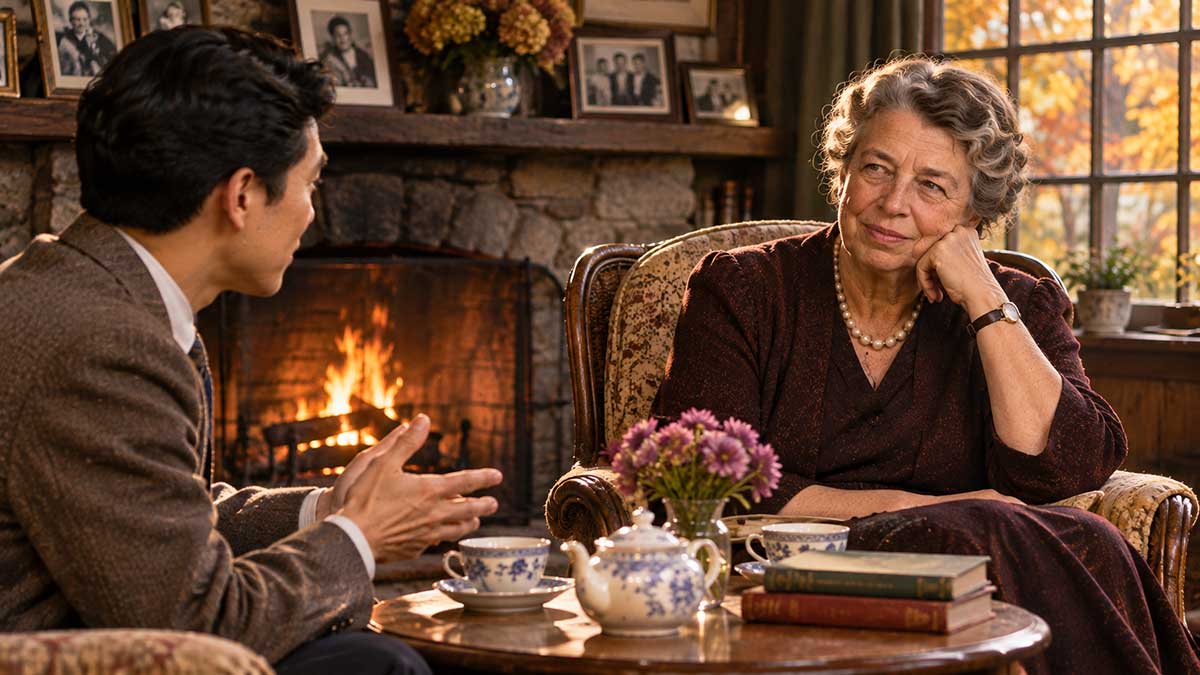
Opening: A Home Where Eleanor Could Be Herself
Val-Kill Cottage, Hyde Park, New York. An early autumn evening.
The small cottage is surrounded by trees beginning to turn gold and crimson. The last light of the afternoon falls across the windows, and the air carries the cool freshness of the Hudson Valley.
Inside, the atmosphere is warm and welcoming. Books, photographs, and comfortable furniture give the room a lived-in feeling. It is a home meant for conversation rather than ceremony.
Eleanor Roosevelt stands near the fireplace, arranging a few things on a side table.
Eleanor Roosevelt: Nick! Come in. I'm glad you found your way here.
Nick: Eleanor, this is wonderful. I expected something a little grander.
Eleanor: (Laughing) You sound disappointed.
Nick: Not at all. Actually, I like it better. It feels like a place where people can relax.
Eleanor: That's precisely what I wanted. The White House had its purposes, but it was never entirely one's own home. There were always schedules, visitors, obligations, and people who wanted something.
Here, I could invite friends, talk, work, and occasionally enjoy a little peace.
Nick: Occasionally?
Eleanor: (Smiling) I was not especially talented at doing nothing.
Nick: I've noticed that. You seem to have spent your entire life working.
Eleanor: Well, there was always something that needed doing.
But Val-Kill was important to me for another reason. It was a place I helped create, a place where my friendships and interests could have a life of their own.
Nick: When I look around, I can feel that.
You know, Eleanor, our last conversation was about a young girl learning to find her voice. But I'm curious about what happened after that.
You fell in love, got married, raised a family, and eventually became one of the most recognizable women in America.
Yet somewhere along the way, your marriage changed in a way you probably never expected.
Eleanor: Yes. Life has a way of altering our plans.
Nick: Would you mind if we talked about that?
Eleanor: Not at all. But I hope we can talk about more than disappointment. A marriage of many years is rarely explained by one event.
Nick: That's fair. I'd like to know about the love, too.
Eleanor: Then sit down. We have a good deal to discuss.
Nick settles into an armchair opposite Eleanor. For a moment, the room is quiet except for the soft crackling of the fire.
Question 4: When Love Changes, What Happens to the Person You Thought You Would Become?
Nick: Eleanor, let's go back to the beginning.
You married Franklin in 1905. You were twenty-one, and he was twenty-three.
What was it about him that made you fall in love?
Eleanor: Franklin had tremendous charm. He was cheerful, confident, and full of energy.
He enjoyed people, and people enjoyed him.
I was rather more serious, and certainly less comfortable in society.
I think his confidence attracted me. He seemed so certain that life would turn out well.
Nick: So he was the outgoing one, and you were the thoughtful one?
Eleanor: (Smiling) That is a fair description, though I hope I was not quite as solemn as some accounts make me appear.
Franklin could make almost anything seem like an adventure.
Nick: Did you feel that he understood you?
Eleanor: I believed we understood one another in important ways.
But when people are young and in love, they often know less about themselves and each other than they imagine.
We were no exception.
Nick: You had six children, though one died in infancy. You were raising a family, managing social expectations, and supporting Franklin's political ambitions.
That sounds exhausting.
Eleanor: It could be.
I loved my children, but motherhood did not always come naturally to me in the way people expected it should.
There were responsibilities, household arrangements, and the constant demands of family life.
And Franklin's mother, Sara, had very definite ideas about how things ought to be done.
Nick: I've read that she was quite involved in your marriage.
Eleanor: (With a knowing smile) Sara was a woman of considerable determination.
Nick: That sounds diplomatic.
Eleanor: I am trying to be kind.
They laugh.
Eleanor: She loved Franklin deeply and wanted to protect him. But she was accustomed to arranging things, and I had not yet learned how to insist upon arranging my own life.
Nick: That must have been difficult for someone who was still finding her confidence.
Eleanor: Yes. But again, it was a gradual education.
I had to learn that affection and obedience were not the same thing.
Nick: Then came 1918.
You discovered letters revealing Franklin's relationship with Lucy Mercer.
Eleanor, I don't want to turn a painful part of your life into a spectacle. But I do want to ask you something.
When you discovered those letters, what happened to the future you thought you were going to have?
Eleanor looks toward the fireplace before answering.
Eleanor: I think the discovery forced me to recognize that the marriage I had imagined was not the marriage I actually possessed.
That is a painful realization.
When you trust someone, you build a picture of your shared life. You make decisions based on that picture.
And then something happens that makes you question how much of it you understood.
Nick: Did you feel betrayed?
Eleanor: It would be difficult to describe such a discovery without acknowledging betrayal.
But I would not want to pretend that every thought I had at the time can now be neatly explained.
There were practical questions, family responsibilities, and feelings that did not disappear simply through making a decision.
Nick: Franklin apparently offered to end the relationship, and the marriage continued.
Did you stay for the children?
Eleanor: The children were certainly important. So were the circumstances of our lives and the commitments we had made.
But I would be cautious about reducing a complicated decision to a single reason.
We continued together, though our relationship changed.
Nick: Did you forgive him?
Eleanor: That depends on what you mean by forgiveness.
If you mean forgetting what happened, no. One does not simply erase an experience.
If you mean finding a way to continue living without allowing one disappointment to determine everything that follows, then perhaps that is closer to what I tried to do.
Nick: That's a very different kind of forgiveness.
Eleanor: I think people sometimes expect forgiveness to restore everything to its former condition.
But life does not always work that way.
You may continue to care for someone and still recognize that your relationship must change.
Nick: Did you ever stop loving Franklin?
Eleanor: Affection changes over a lifetime, Nick.
Franklin and I shared children, responsibilities, memories, and a great deal of work.
We did not always understand one another, and we certainly did not always agree.
But I would not describe our entire relationship through either romance or disappointment.
Nick: You know what strikes me?
People often tell stories about betrayal in which one person is the villain and the other is the victim.
But you seem reluctant to describe your life that way.
Eleanor: I do not think it is necessary to excuse someone's actions in order to recognize that human beings are more complicated than the worst thing they have done.
Nor is it necessary to deny one's own suffering.
Nick: That's an important distinction.
Eleanor: And there is something else.
I had to decide what kind of life I would lead.
That decision could not depend entirely on Franklin.
Nick nods, allowing the thought to settle.
Nick: I think that's where your story becomes particularly interesting.
You didn't simply remain Mrs. Franklin Roosevelt.
You became Eleanor Roosevelt.
Eleanor: (Smiling) I had always been Eleanor Roosevelt, Nick.
It simply took me some time to discover what that might mean.
Question 5: What Did Independence Come to Mean to You?
Nick: After 1918, your life gradually changed.
Then Franklin became seriously ill in 1921, and the paralysis that followed altered his political future.
Some people might have expected you to retreat into family life.
Instead, you became increasingly active in politics and public service.
How did that happen?
Eleanor: It was not something I planned in a single moment.
I had already become interested in social work and public questions.
And I had met women who were deeply involved in political organizing.
They were capable, knowledgeable, and determined.
I learned a great deal from them.
Nick: Women like Esther Lape, Elizabeth Read, and the people involved in the Women's Trade Union League?
Eleanor: Yes, and many others.
They helped me recognize that politics was not simply a matter of speeches and elections.
It involved organization, persistence, and attention to people's everyday lives.
Nick: Did Franklin encourage your political work?
Eleanor: Our interests sometimes supported one another, and sometimes they led us in different directions.
After his illness, I became more involved in political activities, and there were occasions when my work helped maintain connections important to his career.
But I was developing interests and commitments of my own.
Nick: I want to ask about his illness.
When Franklin became paralyzed, how did it affect your relationship?
Eleanor: It changed the practical circumstances of our lives enormously.
Franklin had always been physically active. His illness demanded tremendous adjustment.
There were questions about his health, his future, and what he would be able to do.
I admired his determination to remain engaged in public life.
But I would not want anyone to imagine that our family responded perfectly to every difficulty.
We were learning as we went along.
Nick: His mother reportedly hoped he might retire from politics.
Eleanor: Sara was understandably concerned about his health.
But Franklin had ambitions that did not disappear with his illness.
And I believed he should have the opportunity to pursue a meaningful public life.
Nick: Did helping him find his way forward help you find yours?
Eleanor: Perhaps our circumstances created opportunities for both of us to grow.
But my development was influenced by many people and experiences.
I would not want to suggest that my independence emerged entirely from Franklin's illness or from difficulties in our marriage.
Nick: That's something I keep noticing about you.
Whenever I try to identify one dramatic turning point, you remind me that life is more complicated.
Eleanor: (Laughing) I am afraid historians would have a very easy time if everything could be explained by one event.
Nick: Fair enough.
Let me ask it differently.
What did independence actually mean to you?
Was it the freedom to make your own decisions? To work? To travel? To have your own friendships?
Eleanor: All those things mattered.
But independence was not simply the freedom to do whatever I pleased.
It meant learning to accept responsibility for my own judgments.
It meant recognizing that I could contribute something through my work.
And it meant discovering that I did not have to measure my worth entirely through my role in someone else's life.
Nick: That last part feels significant.
Eleanor: For many women of my generation, marriage and family were treated as the principal measures of a successful life.
I cared deeply about my family.
But I came to believe that women should have opportunities to develop their abilities and participate fully in society.
Nick: Did that create tension with Franklin?
Eleanor: Certainly, there were disagreements.
Franklin was a politician, and politicians must consider what is possible, what will win support, and what compromises they are willing to make.
I sometimes believed he should move more quickly or speak more forcefully.
Nick: Did he ever tell you to be quiet?
Eleanor: (Smiling) Franklin was quite capable of expressing his opinions.
And I became increasingly capable of expressing mine.
Nick: That must have made for some interesting conversations.
Eleanor: It did.
Nick: But you remained partners politically.
Eleanor: We shared important commitments, particularly during the Depression and the war.
Yet partnership does not require agreement on every question.
In fact, there are times when a person serves a friend or family member best by speaking frankly.
Nick: That makes me think of your later civil rights work.
You sometimes took positions that created political difficulties for the administration.
Eleanor: Yes. And those decisions were not always simple.
I had to consider what I believed was right, what influence I possessed, and what consequences might follow.
Sometimes I acted effectively. Sometimes I did not accomplish what I hoped.
Nick: Were you ever afraid that your independence might cost you the relationships you valued?
Eleanor pauses.
Eleanor: I think most people fear losing affection or approval at some point in their lives.
But there comes a time when you must ask whether avoiding disagreement is worth surrendering your judgment.
That does not mean becoming indifferent to other people.
It means learning to disagree without abandoning either your principles or your humanity.
Nick: You know, Eleanor, I expected to hear a story about a woman who became independent after being hurt.
But what I'm hearing is a story about someone who kept learning from people, accepting responsibilities, and discovering new possibilities.
Eleanor: That is much closer to how I would want my life to be considered.
I was fortunate to know women who encouraged me to work and think independently.
And I found that public service gave me a sense of purpose.
Nick: Did you enjoy the work?
Eleanor: Very much.
Not every meeting, of course.
Nick: (Laughing) I was going to say, some of those political meetings must have been dreadful.
Eleanor: Some were very long indeed.
But I enjoyed meeting people, learning about their circumstances, and discovering how much could be accomplished when people organized themselves.
Nick: So independence wasn't about withdrawing from others.
Eleanor: Quite the opposite.
It allowed me to participate more fully in the lives of others.
Question 6: Who Gave You the Freedom to Be Eleanor, Rather Than Simply Mrs. Roosevelt?
The fire has burned lower. Eleanor rises to add another log, and Nick notices several photographs on a nearby table.
Nick: Eleanor, can I ask about your friends?
Eleanor: Of course.
Nick: When people tell your story, they spend so much time discussing Franklin that the other people in your life sometimes seem to disappear.
But you had remarkable friendships.
Nancy Cook, Marion Dickerman, Lorena Hickok, and many others.
What did those relationships mean to you?
Eleanor: A great deal.
Friendship was one of the great sustaining forces in my life.
I was fortunate to know people who shared my interests, challenged my thinking, and gave me companionship.
Nick: Let's start with Nancy Cook and Marion Dickerman.
They were important in creating Val-Kill, weren't they?
Eleanor: Yes.
Val-Kill developed through our shared interests and friendships.
It gave us a place to work, entertain friends, and pursue projects that mattered to us.
Nancy was talented and energetic. Marion had her own considerable abilities and interests.
They were not simply companions in my story. They were people with lives and accomplishments of their own.
Nick: And the Val-Kill furniture enterprise was part of that work?
Eleanor: Yes. We hoped to encourage traditional craftsmanship and create employment opportunities.
Not every ambition succeeded as we wished, but it was a meaningful effort.
Nick: I like that this place wasn't simply a retreat.
It was a place where you were trying to build something.
Eleanor: Exactly.
A home can be a place of rest, but it can be a place of activity and shared purpose, too.
Nick: What about Lorena Hickok?
You became very close to her.
Eleanor: Hick was a remarkable woman.
She had worked hard to establish herself as a journalist in a profession that did not always welcome women.
She understood politics, people, and the difficulties of making one's own way.
Our friendship became deeply important to me.
Nick: You exchanged thousands of letters.
Some were extraordinarily affectionate.
Historians have spent years discussing what your relationship meant.
I don't want to make assumptions about something so personal, but I do want to ask: What did Hick give you that you needed at that time in your life?
Eleanor looks at Nick thoughtfully.
Eleanor: I think one of the most valuable things a friendship can offer is the feeling that another person sees you as an individual.
Not simply as a wife, a mother, or a public figure.
But as yourself.
Hick knew something about the pressures of public life, and she had a directness that I appreciated.
We shared affection, conversation, and an interest in the world around us.
Nick: Did you feel understood by her?
Eleanor: In important ways, yes.
But no friendship should be reduced to a single explanation.
People may offer us different kinds of companionship at different times in our lives.
And those relationships can change.
Nick: That's fair.
I sometimes wonder whether people become so fascinated by the private relationships of famous individuals that they forget the individuals themselves.
Eleanor: (Smiling) I suspect that has always been true.
Nick: But I think it's important to acknowledge that love can take different forms.
Romantic love, friendship, family affection, shared commitment.
Sometimes the people who help us become ourselves aren't the people society expects.
Eleanor: That is certainly true.
I was fortunate to have people in my life who encouraged me, disagreed with me, and cared about what I was trying to accomplish.
I hope I gave something meaningful in return.
Nick: Did your friendships ever create difficulties?
Eleanor: Naturally.
Friendship does not make people immune to disagreement, jealousy, changing circumstances, or disappointment.
I would be giving you a very unrealistic picture if I suggested that all my relationships were harmonious.
Nick: That's refreshing.
Sometimes we talk about great people as if their personal lives were perfectly organized.
Eleanor: Mine certainly was not.
Nick: (Laughing) I'm beginning to appreciate that.
Let me ask something I've been thinking about since we arrived.
You were born into one of America's most prominent families.
You married a man who became president.
You lived in the White House.
But here, in this relatively modest cottage, you seem especially comfortable.
Why?
Eleanor: Perhaps it is easier to feel at home in a place where you have helped decide what the home should be.
The White House belonged to the country.
Hyde Park carried many family associations and traditions.
Val-Kill gave me room to create something of my own.
Nick: A place where you didn't have to perform a role?
Eleanor: Not entirely. I still had work, visitors, responsibilities, and expectations.
But it offered a degree of freedom I valued.
Nick: Did you ever feel lonely, even surrounded by so many people?
Eleanor considers the question.
Eleanor: I think loneliness is part of the human experience.
It does not necessarily disappear when one has a busy life or many acquaintances.
There is a difference between being surrounded by people and feeling truly known.
Nick: That's something many people struggle with today.
They have hundreds of contacts, yet very few people they can speak to honestly.
Eleanor: Then perhaps they should devote less attention to the number of people they know and more attention to the quality of their relationships.
Friendship requires time, interest, and a willingness to care about another person's life.
Nick: Did you ever learn to receive that kind of care yourself?
Eleanor: I hope I did, at least to some degree.
I was not always easy to know, and I certainly made mistakes in my relationships.
But I valued friendship deeply.
Nick: Eleanor, can I tell you something?
Eleanor: Please do.
Nick: When I first learned about Franklin's relationship with Lucy Mercer, I thought this chapter of your life would be mostly about betrayal.
But sitting here, I see something else.
It's about discovering that your life could contain many kinds of love, many kinds of purpose, and relationships that helped you grow.
Eleanor: I think that is a more generous and more accurate way to consider a long life.
We are shaped by disappointment, certainly.
But we are shaped by friendship, work, affection, and the choices we make afterward.
Nick: So the most important question isn't simply what happened to you.
It's what you chose to do with the life that remained.
Eleanor: Yes.
Though I would add that we must be careful not to expect everyone to respond to hardship in the same way.
People have different circumstances and different opportunities.
I had advantages that helped me build an independent life.
Many women of my generation did not possess those opportunities.
Nick: And that became part of your work for women's rights.
Eleanor: It did.
I came to believe that women should have greater freedom to develop their abilities, earn a living, and participate in public affairs.
Personal independence is valuable, but it should not remain a privilege reserved for a fortunate few.
Closing: The Home She Chose
Outside the cottage, the evening light has faded into a deep blue. The windows reflect the warmth of the room, and the fire has settled into a gentle glow.
Nick: Eleanor, I think I understand something about you that I didn't before.
You didn't become independent by cutting yourself off from people.
You became more independent through learning, work, friendship, and gradually accepting responsibility for your own decisions.
Eleanor: That is a fair description.
And I would not want anyone to think that independence means living without obligations to others.
Quite the opposite.
The more capable we become, the more we can contribute.
Nick: There's something else I admire.
You and Franklin continued to work together, even after your marriage changed.
That must have required patience.
Eleanor: It required adjustment from both of us.
We shared responsibilities, children, and a commitment to public service.
Our relationship was not simple, but it was an important part of both our lives.
Nick: Do you think you and Franklin understood each other better as the years passed?
Eleanor: In some ways, yes. In other ways, perhaps we remained quite different.
I do not believe that loving someone requires becoming exactly like them.
And I do not think a marriage should be judged only by whether it resembles an idealized picture.
Nick: That's an interesting thought.
Eleanor: We lived through extraordinary times together.
The Depression, war, political battles, family difficulties.
There was much that connected us, even when our lives followed different paths.
Nick: And somewhere along the way, you became a public voice in your own right.
Eleanor: Yes.
But that brought new responsibilities, and sometimes new disagreements.
Nick: Especially when you believed the country was failing to live up to its ideals.
Eleanor: Precisely.
It is one thing to believe in fairness when everyone around you agrees.
It is quite another to defend it when doing so makes people uncomfortable.
Nick: I have a feeling that's where our next conversation is going.
Eleanor: (Smiling) I suspect you are right.
Nick: Before I go, one last question.
If the young Eleanor from Allenswood could see you sitting here at Val-Kill, surrounded by books, photographs, and memories of so many friendships, what do you think would surprise her most?
Eleanor looks around the room.
Eleanor: Perhaps that she had found a place where she could be useful and feel at home.
And perhaps that the life she feared might be so limited had become so full of unexpected possibilities.
Nick: That's a beautiful thought.
Eleanor: Though she might be astonished by the number of letters waiting to be answered.
Nick: (Laughing) I was wondering about that enormous stack on your desk.
Eleanor: I am afraid it never becomes smaller for very long.
They stand, and Eleanor walks with Nick toward the door.
Nick: Thank you for trusting me with this part of your life.
Eleanor: Thank you for asking about the people who mattered to me, rather than simply the events that made headlines.
Nick: Next time, I'd like to talk about the moments when your conscience put you in conflict with the expectations of the country.
Marian Anderson. Civil rights. The difficult decisions you faced as First Lady.
Eleanor: Those are important subjects.
And I hope you will ask difficult questions.
Nick: I intend to.
Eleanor: Good. I should be disappointed if you did not.
She opens the door, and the cool evening air enters the cottage.
Eleanor: Until next time, Nick.
Nick: Until next time, Eleanor.
Nick steps outside. Behind him, the cottage glows warmly among the autumn trees.
It is not the White House, nor a monument to political achievement. It is a place shaped by friendship, independence, and the ordinary human desire to belong.
And it offers a glimpse of the woman who would soon challenge some of America's most deeply established injustices.
End of Topic 2.
Topic 3: When Conscience Becomes More Important Than Comfort
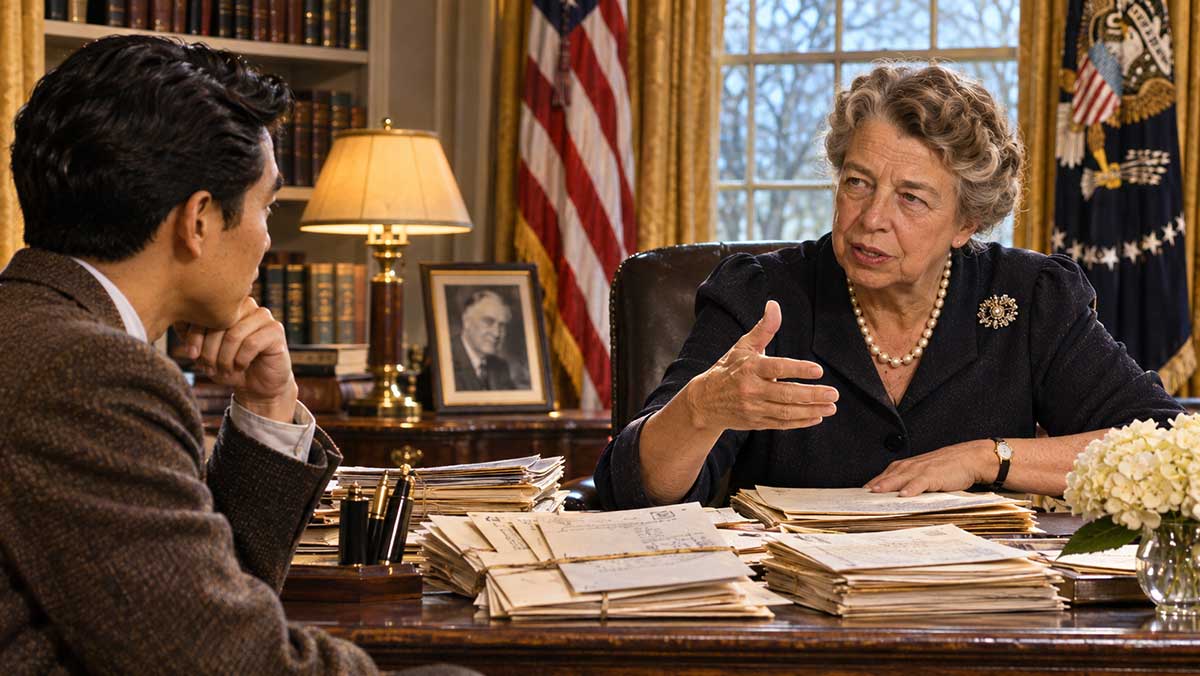
Opening: The Letters on Her Desk
The White House, Washington, D.C. An imagined late afternoon during Eleanor Roosevelt's years as First Lady.
The autumn sunlight stretches across a desk crowded with letters. Some are neatly stacked, others lie open beside handwritten notes. Through the tall windows, the gardens of the White House are beginning to fade into evening shadow.
Eleanor Roosevelt stands beside the desk, reading a letter. She looks up as Nick enters.
Eleanor Roosevelt: Nick! Come in. I was just trying to decide which of these letters requires my attention first.
Nick: Judging by that desk, you might need another lifetime.
Eleanor: (Laughing) I sometimes think the mail arrives faster than anyone could possibly answer it.
Nick: Are these letters from politicians?
Eleanor: Some are. But many come from ordinary Americans. Mothers, workers, young people, families who are struggling.
They write about things they need, things they fear, and things they hope someone in Washington might help change.
Nick: Do you read them yourself?
Eleanor: I read as many as I can. Of course, my staff helps with the enormous volume of correspondence. But I believe these letters are important.
They remind me that government decisions affect actual human lives.
Nick: I imagine some of the stories are heartbreaking.
Eleanor: Yes. And some are quite amusing. People are wonderfully direct when they believe you might be able to help them.
Nick: Have you ever received a letter that made you think, "What on earth am I supposed to do about this?"
Eleanor: (Smiling) More than once.
But I have learned that people do not always expect you to solve everything. Sometimes they simply want someone to recognize that their difficulties are real.
Nick: That's interesting. You had an extraordinary position. You could speak to the president almost whenever you wanted.
Yet you spent so much time listening to people who had very little influence.
Eleanor: I considered that part of my responsibility.
The president received reports from officials and advisers. I had opportunities to visit places and meet people whose experiences might not otherwise reach him directly.
Nick: And sometimes what you saw must have been very different from what officials told him.
Eleanor: Sometimes, yes.
Nick: Eleanor, our first conversation was about finding your voice. Our second was about learning to live independently.
Today I'd like to talk about what happened when you began using that voice publicly.
Especially when speaking up made people uncomfortable.
Eleanor: (Setting down the letter) Then I hope you will ask me some difficult questions.
Nick: I intend to.
Eleanor: Good. A conversation about conscience that avoids difficult questions would not be much of a conversation.
She gestures toward the chair opposite her desk. Nick sits, and Eleanor settles into her own chair, the letters still between them.
Question 7: What Did Ordinary Americans Teach You That Washington Could Not?
Nick: Eleanor, during the Great Depression, you traveled across the country visiting communities, factories, schools, hospitals, and struggling families.
You saw conditions that many people in Washington knew only through reports.
What did those ordinary Americans teach you?
Eleanor: They taught me that a country cannot be understood entirely from its capital.
You can read statistics about unemployment or poverty, but numbers do not tell you everything.
When you meet a family whose father has been unable to find work, or a young person who sees no opportunity ahead, the problem becomes more immediate.
You begin to ask not merely how many people are affected, but what their lives are actually like.
Nick: Was there a moment when you realized how disconnected Washington could be from the people it was supposed to serve?
Eleanor: I would not say that everyone in Washington was disconnected. Many people worked very hard to address the Depression.
But government is an enormous institution, and it can become absorbed in its own procedures.
I believed it was useful to bring back observations from the places I visited.
Nick: Franklin sometimes called you his eyes and ears, didn't he?
Eleanor: That is how our arrangement has often been described.
I certainly tried to tell him what I had seen and heard.
But I was not simply gathering information for Franklin. I was learning for myself.
Nick: That's an important difference.
Eleanor: Very important.
I met people whose experiences challenged my assumptions. And I learned that the people facing hardship often understood their own needs better than outsiders did.
Nick: Did you ever find yourself arriving somewhere thinking you knew what the problem was, then discovering you were wrong?
Eleanor: Certainly.
That is one reason I believe it is necessary to listen before offering solutions.
People in comfortable circumstances can become very confident about what others ought to do.
But confidence is not the same as knowledge.
Nick: You visited coal-mining communities, didn't you?
Eleanor: Yes. Mining communities faced difficult conditions, and the Depression made many of those difficulties worse.
I was struck by the hardships families endured and by their determination to continue.
But I would not want to romanticize poverty.
There is nothing noble about children lacking adequate food or families living without basic security.
Nick: I appreciate that distinction.
Sometimes people talk about the poor as if suffering automatically makes them stronger or more virtuous.
Eleanor: People can show extraordinary courage under difficult circumstances.
But that does not make the circumstances acceptable.
Our responsibility is not to admire people for enduring unnecessary suffering. It is to ask what can be done to improve their opportunities.
Nick: Did you ever feel helpless?
Eleanor: Of course.
There were many situations in which I could not provide the assistance people needed.
I had influence, but influence is not the same as authority.
I could draw attention to a problem, speak with officials, encourage organizations, or advocate for a policy.
But I could not simply order every difficulty to disappear.
Nick: That must have been frustrating.
Eleanor: It was.
And I think frustration can be useful if it leads you to work more effectively.
It becomes less useful when it simply turns into indignation.
Nick: Were you ever angry at people in government who seemed indifferent?
Eleanor: I was certainly capable of becoming impatient.
There were times when I thought a matter should be handled more quickly or with greater imagination.
But government involves competing demands, limited resources, and political disagreements.
I learned that persistence was often more effective than merely expressing outrage.
Nick: That's a little different from the image people have of you as a fearless crusader.
Eleanor: (Smiling) I hope I was persistent. I doubt I was always fearless.
And I certainly did not accomplish everything I hoped.
Nick: I want to ask about something you mentioned earlier.
You said people sometimes wrote simply wanting someone to recognize their difficulties.
Did listening to them change the way you thought about leadership?
Eleanor: Yes.
I came to believe that leadership requires more than giving instructions.
You must be willing to learn from the people affected by your decisions.
And you must recognize that no office, however important, gives its occupant complete knowledge.
Nick: That sounds almost obvious.
Eleanor: Many important truths sound obvious until we are asked to practice them.
Nick: (Laughing) That's a fair point.
Eleanor: It is easy to say that every person matters.
It is more demanding to arrange our institutions and policies so that their lives are treated as though they matter.
Nick: Eleanor, when you returned from those trips, did you ever sit down with Franklin and tell him something he didn't want to hear?
Eleanor: There were certainly occasions when I raised matters that were politically inconvenient.
Franklin had to consider what he believed could be accomplished.
I sometimes believed more should be attempted.
We did not always agree.
Nick: Did you ever think he was being too cautious?
Eleanor: Yes.
But I also knew that he carried responsibilities I did not.
That did not mean I had to abandon my own judgment.
Nick: So you could respect him and still challenge him.
Eleanor: I think respect sometimes requires precisely that.
Nick glances at the letters scattered across the desk.
Nick: You know, it's interesting. These letters aren't just pieces of paper to you.
They're people.
Eleanor: They represent people.
And it is important not to forget the difference.
Nick: What do you mean?
Eleanor: A letter can tell you something about a person's circumstances. But it cannot tell you everything.
You must be careful not to assume you understand an entire life from a few paragraphs.
That is true of individuals, and it is true of communities.
Nick: That's a lesson I think we could all use.
Eleanor: Then perhaps the letters have accomplished something today.
Question 8: When Marian Anderson Was Rejected, Why Did You Refuse to Remain Silent?
Nick: Eleanor, I'd like to talk about Marian Anderson.
In 1939, she was already an internationally respected contralto. Yet the Daughters of the American Revolution refused to make Constitution Hall available for her performance.
You were a member of that organization.
What went through your mind when you learned what had happened?
Eleanor: I believed the decision was wrong.
Miss Anderson was an extraordinary artist. To deny her the opportunity to perform in a hall on account of her race was a disgrace.
And I did not believe I could continue my membership without expressing my objection.
Nick: So you resigned.
Eleanor: Yes.
I made my decision public because I believed the issue deserved attention.
Nick: Was that difficult?
Eleanor: It was not a decision I made lightly.
The Daughters of the American Revolution was an established organization with many members who believed they were serving patriotic purposes.
But I could not reconcile its action with my own convictions.
Nick: Some people might have advised you to stay quiet.
After all, you were the First Lady. Your actions could create controversy for Franklin.
Eleanor: That was certainly a consideration.
But there are occasions when silence gives the impression of agreement.
And I did not wish my continued membership to be interpreted as approval of the decision.
Nick: Did you worry about the reaction?
Eleanor: I expected criticism.
One becomes accustomed to criticism in public life, though I cannot say it is always pleasant.
Nick: You weren't simply defending a singer, were you?
You were challenging something much larger.
Eleanor: The incident reflected a much broader injustice.
African Americans faced discrimination in education, employment, housing, political participation, and public accommodations.
The treatment of Miss Anderson was one visible example of a system that denied people equal opportunities.
Nick: Her concert at the Lincoln Memorial became an extraordinary moment.
Seventy-five thousand people gathered to hear her sing on Easter Sunday.
Eleanor: It was an important occasion.
But I would want to give proper recognition to Miss Anderson herself and to the many people who worked to make the concert possible.
Walter White of the NAACP, Secretary of the Interior Harold Ickes, and others played important roles.
The event was not the achievement of one person.
Nick: That's something I admire about your perspective.
You don't seem interested in claiming the entire story for yourself.
Eleanor: I should hope not.
Miss Anderson's artistry and dignity were central to what happened.
And Black Americans had been organizing and struggling for equal rights long before I became involved.
Nick: I want to ask about Mary McLeod Bethune.
You developed a close friendship and working relationship with her.
What did she teach you?
Eleanor: Mary was a remarkable educator and leader.
She understood the needs of Black communities through years of experience, and she possessed considerable political skill.
She did not need me to tell her what injustice looked like.
She needed people in positions of influence to listen and to act.
Nick: Did she ever challenge you?
Eleanor: Certainly.
Mary was not someone who hesitated to speak plainly.
And I respected her for that.
Nick: Did your friendship change the way you saw racial inequality?
Eleanor: It deepened my knowledge and strengthened my determination to address it.
But I would not suggest that my education on these matters came from one person alone.
I learned from many people, including those who had spent their lives confronting discrimination.
Nick: Eleanor, can I ask you something a little uncomfortable?
Eleanor: Please do.
Nick: You came from an extraordinarily privileged white family.
You had access to the president, national newspapers, and influential organizations.
How did you avoid assuming that you knew what was best for people whose lives were completely different from yours?
Eleanor sits back thoughtfully.
Eleanor: I do not think I always avoided that mistake.
It is very easy for someone in a privileged position to assume that good intentions are sufficient.
But good intentions do not replace knowledge.
And sympathy does not give one the right to speak for people who are perfectly capable of speaking for themselves.
Nick: That's an unusually candid answer.
Eleanor: I think it is important to recognize the limits of one's experience.
I could use my position to draw attention to injustice and support people working for change.
But the struggle for equal rights belonged first and foremost to those whose rights were being denied.
Nick: Did you ever feel that your position as First Lady limited how far you could go?
Eleanor: Yes.
I had opportunities that other people did not possess, but I also had responsibilities and political circumstances to consider.
Sometimes I believed I could accomplish more by working privately.
At other times, I thought a public statement was necessary.
I did not always judge correctly.
Nick: Were there times when you wished Franklin would take a stronger stand on civil rights?
Eleanor: Yes.
Franklin faced political pressures, including the influence of Southern Democrats whose support was important to his legislative program.
But political difficulty did not make racial injustice less serious.
Nick: Did that ever cause conflict between you?
Eleanor: We did not always agree about what should be done or when.
I understood that Franklin had to consider the consequences for his administration.
But I believed that the country had responsibilities it could not indefinitely postpone.
Nick: So you were trying to push him without undermining everything else he was attempting.
Eleanor: There were times when that was the practical question.
How could I encourage progress without losing the opportunity to influence decisions?
It was not always a comfortable position.
Nick: I can imagine.
Eleanor: And I would not want to suggest that every compromise was justified.
History must examine what was accomplished and what was left undone.
Nick: Eleanor, when you think about Marian Anderson standing before the Lincoln Memorial, what does that moment represent to you?
Eleanor: I think it represents both the dignity of an extraordinary artist and the injustice of a country that made such a concert necessary.
We should remember the beauty of the occasion.
But we should not allow that beauty to make us forget why she was performing there instead of in the hall originally sought for her.
Nick: That's a striking way to put it.
A beautiful moment born from an ugly injustice.
Eleanor: Yes.
And the real measure of progress is not whether we can celebrate one exceptional occasion.
It is whether we change the conditions that made the injustice possible.
For a moment, neither speaks. The room has grown quieter as the afternoon light fades.
Question 9: What Do You Do When Your Conscience Conflicts With the Government You Serve?
Nick: Eleanor, we've talked about the people you met during the Depression and your stand against racial discrimination.
But I want to ask about something even more difficult.
You were married to the president of the United States.
You loved your country, supported much of Franklin's work, and believed deeply in democracy.
Yet the Roosevelt administration made decisions that conflicted with some of the principles you defended.
How did you decide when loyalty required support and when conscience required disagreement?
Eleanor: That was one of the most difficult parts of public life.
I believed Franklin was trying to lead the country through extraordinary circumstances.
The Depression and the war placed enormous demands upon the government.
But supporting a president does not mean believing that every decision he makes is correct.
Nick: Let's discuss a painful example.
After Pearl Harbor, the government forcibly removed and incarcerated more than 120,000 people of Japanese ancestry, most of them American citizens.
Franklin signed Executive Order 9066 in February 1942, which enabled the military exclusion that led to their incarceration.
You later spoke against racial prejudice and defended the rights of Japanese Americans.
But you were also part of the administration.
How do you look at that contradiction?
Eleanor's expression becomes serious.
Eleanor: The treatment of Japanese Americans raises grave questions about fear, prejudice, and the responsibilities of a democratic government.
In wartime, people can become willing to accept measures they would otherwise recognize as unjust.
But fear does not remove our obligation to examine what we are doing to other human beings.
Nick: Did you believe the policy was wrong from the beginning?
Eleanor: I would want to be careful about presenting my position as simpler or more consistent than the historical record supports.
My public and private responses developed amid wartime pressures, and I did not prevent the government's actions.
I later argued against treating people as disloyal simply on account of their ancestry and urged Americans to reject prejudice.
But words of sympathy did not undo the suffering that had already occurred.
Nick: That's the part I find difficult.
You had access to Franklin. You could speak to him directly.
Yet thousands of families lost their homes, businesses, freedom, and dignity.
Wasn't there more you could have done?
Eleanor remains quiet for a moment.
Eleanor: That is a fair question.
Having access to the president was not the same as controlling his decisions.
But neither should influence be used as an excuse to avoid examining one's own responsibility.
I cannot claim that my efforts were sufficient simply because I cared about the people affected.
The consequences of government policy must be judged by what happened to those people, not merely by the intentions of those in office.
Nick: I appreciate your willingness to face that.
I don't want this conversation to become an exercise in judging the past from the comfort of the present.
But I don't want admiration for you or Franklin to prevent us from recognizing injustice.
Eleanor: Nor should it.
History becomes less useful when we insist that the people we admire must have been correct about everything.
Nick: Do you think people in positions of influence sometimes become too concerned with protecting their relationships?
Eleanor: Certainly.
Loyalty can be a virtue, but it can become dangerous when it prevents honest judgment.
One must ask whether loyalty is being given to a person, a political organization, or the principles that ought to guide both.
Nick: That's a difficult distinction.
Eleanor: It is.
And I do not think anyone should pretend that making it is always easy.
Nick: You once worked within a political system that depended heavily on Southern Democrats who defended segregation.
Franklin's administration pursued major economic reforms, yet federal civil rights legislation faced enormous resistance.
How did you live with that contradiction?
Eleanor: I believed the New Deal brought important assistance to many Americans.
But I was aware that discrimination limited who benefited and how.
The political strength of segregationist members of Congress created serious obstacles.
Franklin often calculated that challenging them directly might jeopardize other legislation.
I understood the political argument, but I did not always accept that it justified inaction.
Nick: Did you ever think he was making the wrong choice?
Eleanor: Yes.
We disagreed at times, and I tried to encourage him to do more.
But I was not always successful.
Nick: Were you disappointed in him?
Eleanor: There were decisions that disappointed me.
But I think it is possible to recognize someone's achievements and still acknowledge serious failures.
Franklin was a remarkable political leader.
He was not infallible.
Nick: Neither were you.
Eleanor: (Smiling slightly) Certainly not.
Nick: I'm glad you said that.
Sometimes when I read biographies, I feel as if the writer wants me to choose between loving a historical figure and criticizing them.
But I don't think those have to be opposites.
Eleanor: I agree.
Affection should not require blindness.
And criticism should not require the denial of everything worthwhile a person accomplished.
Nick: Eleanor, let me bring this closer to everyday life.
Most people will never be First Lady or have the president's ear.
But they face smaller versions of this dilemma.
A friend says something prejudiced. A colleague is treated unfairly. A family member makes a decision they believe is wrong.
Speaking up may cost them something.
What would you tell them?
Eleanor: I would begin by asking them to consider what they can actually do.
Sometimes speaking publicly is necessary.
Sometimes a private conversation may be more effective.
Sometimes one must organize with others, learn more about the issue, or support those already working for change.
But I would caution against confusing the appearance of courage with useful action.
Nick: What do you mean?
Eleanor: It is possible to make a dramatic statement that changes very little.
It is equally possible to work quietly and persistently until something important changes.
The question is not simply whether one has been bold.
It is whether one has acted responsibly and effectively.
Nick: That's a challenge to the way people often think about courage.
We admire the person who makes the dramatic speech.
Eleanor: Speeches can be valuable.
But they are not a substitute for work.
Nick: Did you ever get tired of fighting battles that seemed to make so little progress?
Eleanor: Of course.
There were days when progress seemed painfully slow.
And there were occasions when people I had hoped would help proved unwilling.
But I found that one could not spend too much time dwelling on disappointment.
There was usually another letter to answer, another person to meet, another opportunity to attempt something useful.
Nick: So you kept going.
Eleanor: I tried to.
Nick: What gave you hope?
Eleanor: People.
Not an abstract idea of humanity, but actual people.
I met individuals who worked under difficult circumstances without much recognition.
Teachers, organizers, workers, parents, and young people determined to improve their communities.
Their efforts reminded me that progress did not depend entirely on presidents or famous individuals.
Nick: That's interesting.
You spent years in the White House, but your faith in democracy came from ordinary citizens.
Eleanor: Democracy cannot survive through the efforts of leaders alone.
It depends on people accepting responsibility for the communities and institutions in which they live.
Nick: Eleanor, I want to ask one last question about conscience.
How do you know when you've done enough?
Eleanor looks toward the letters on her desk.
Eleanor: I am not sure one ever knows with complete certainty.
There are always limits to what a person can accomplish.
But I think we must be honest about whether we have acted from conviction or merely chosen what was comfortable.
And we must be willing to examine the consequences of our actions.
Nick: Even when that examination is painful?
Eleanor: Especially then.
It is much easier to defend our intentions than to confront our mistakes.
But if we cannot acknowledge where we have fallen short, how are we to improve?
Nick: That's something I wish more leaders would say.
Eleanor: (With a small smile) I suspect many leaders would prefer that you ask someone else.
Nick laughs, and Eleanor reaches for another letter.
Nick: You're going back to work already?
Eleanor: There is a woman in this letter who is worried about her family.
I think she deserves an answer.
Closing: The Courage to Remain Accountable
The last sunlight has disappeared beyond the White House gardens. A lamp casts a warm circle of light across Eleanor's desk.
Nick stands near the window, looking out at the darkening grounds.
Nick: Eleanor, when I came here today, I thought we would talk about courage.
I expected stories about the times you stood up against injustice.
But I think the most meaningful part of our conversation was when you acknowledged that you didn't always do enough.
Eleanor: It would be a very poor lesson if I encouraged people to believe that good intentions made them incapable of error.
Nick: Still, it must be difficult to look back and recognize that you could have acted differently.
Eleanor: Yes.
But I think we should be careful not to make regret the center of everything.
We must learn from our mistakes, but we must continue working.
There are people who need help now.
Nick: You know what I find remarkable?
You could have lived a very comfortable life.
You came from privilege, married into wealth, and became First Lady.
You could have attended ceremonies, given speeches, and avoided controversy.
Eleanor: (Smiling) I suspect I would have become terribly restless.
Nick: I believe that.
But you chose to visit struggling communities, challenge discrimination, and sometimes disagree with the president.
Why?
Eleanor: I had opportunities that many people did not.
And I came to believe that those opportunities carried responsibilities.
It would have been difficult to learn what I had learned about people's lives and then pretend I had seen nothing.
Nick: Was it worth the criticism?
Eleanor: I cannot say I enjoyed being criticized.
But I would rather be criticized for trying to address an injustice than remain comfortable through ignoring it.
Nick: Eleanor, I think there's something I want to take away from today.
Courage isn't simply standing up for what you believe.
It's being willing to question yourself, listen to people who know more than you do, and admit when your actions haven't matched your principles.
Eleanor: That is a demanding definition.
Nick: Too demanding?
Eleanor: (Laughing softly) No. Merely one that gives us all a great deal of work to do.
They walk toward the door.
Nick: Next time, I'd like to talk about the United Nations.
After everything the world experienced during the Second World War, you helped lead the effort to establish a universal declaration of human rights.
I want to know how you could still believe in humanity after witnessing so much suffering.
Eleanor: That is a question worth asking.
But I hope you will not imagine that the Declaration was the work of one woman.
There were remarkable people from many nations who contributed to it.
And we disagreed about a great many things.
Nick: That sounds like an interesting conversation.
Eleanor: It was often a very long conversation.
Nick: (Laughing) I have a feeling you enjoyed some of those arguments.
Eleanor: I enjoyed it when we made progress.
The arguments themselves could be rather tiresome.
Nick: Then perhaps we should meet in Paris.
Eleanor: A splendid idea.
Though I warn you, diplomacy requires patience.
Nick: After spending an afternoon with you, I think I'm beginning to learn that.
Eleanor opens the door and offers Nick a warm smile.
Eleanor: Until Paris, then.
Nick: Until Paris, Eleanor.
Nick steps into the evening.
Behind him, the desk remains covered with letters, each representing a life that might otherwise go unheard.
And in the quiet room, Eleanor Roosevelt returns to her work.
End of Topic 3.
Topic 4: Can Humanity Learn to Respect Every Human Life?
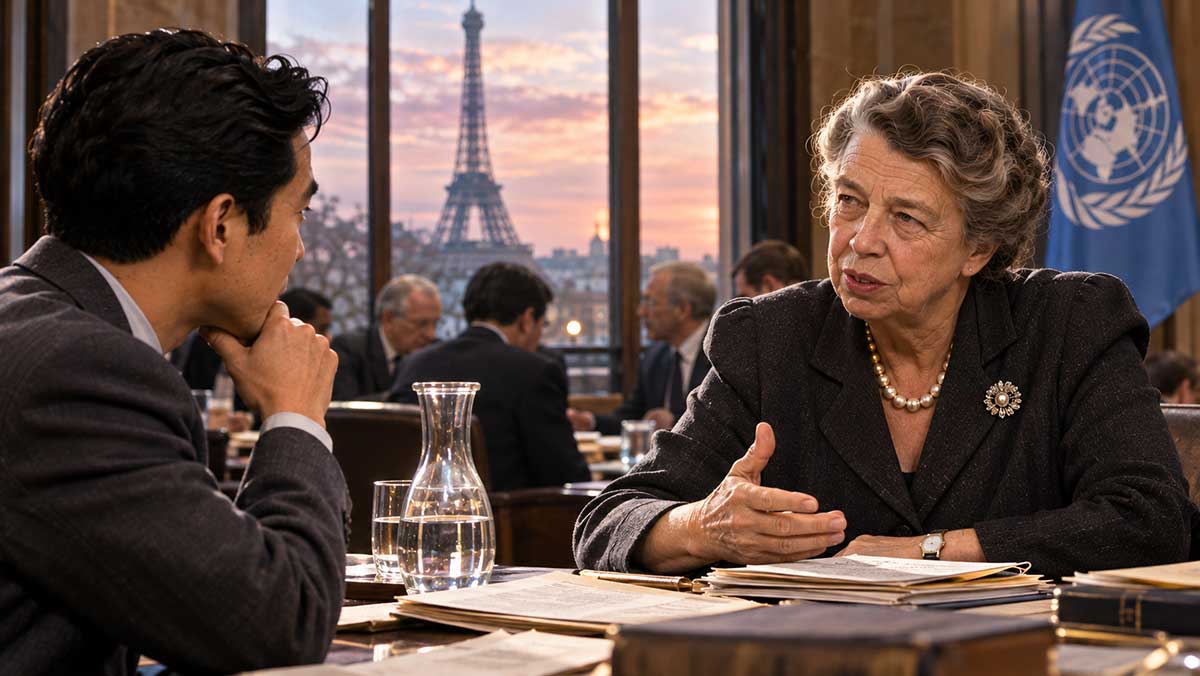
Opening: A Quiet Room in Paris
Palais de Chaillot, Paris, France. December 1948.
Outside the windows, Paris is settling into a cold winter evening. The Seine reflects the last pale light of the day, and the Eiffel Tower stands across the river, its iron silhouette rising against a gray-blue sky.
Inside the Palais de Chaillot, the corridors have grown quieter. Delegates from around the world have spent long hours debating the language of a document that might change how humanity thinks about freedom, justice, and dignity.
In a modest meeting room, Eleanor Roosevelt sits at a table covered with papers. Her glasses rest beside a stack of notes. A cup of tea has gone cold.
She looks up as Nick enters.
Eleanor Roosevelt: Nick! You've arrived at a rather interesting moment.
Nick: I can see that. I passed several gentlemen in the corridor who looked as though they had been arguing for three days.
Eleanor: (Laughing) Some of them have been arguing considerably longer.
Nick: Is that what diplomacy looks like?
Eleanor: Sometimes. Though I should say that disagreement is not necessarily a bad thing. It can mean that people care deeply about what is being decided.
Nick: And what exactly are you trying to decide?
Eleanor: Whether nations with very different histories, political systems, and beliefs can agree upon certain fundamental rights that belong to every human being.
Nick: That sounds almost impossible.
Eleanor: There have been moments when I thought so myself.
Nick: Yet here you are.
Eleanor: Here we are. And there is still work to be done.
Nick sits across from her, glancing at the documents spread across the table.
Nick: Eleanor, our last conversation was about conscience. You told me that speaking up is important, but that words alone aren't enough.
Now you're helping lead an effort to create a declaration built almost entirely from words.
Isn't that a contradiction?
Eleanor: (Smiling) An excellent question to begin with.
Words can be empty, certainly.
But they can also establish principles by which governments and individuals may be judged.
The difficulty is persuading people to take those principles seriously.
Nick: So the declaration isn't the end of the work.
Eleanor: No, Nick.
It is an attempt to establish a beginning.
Question 10: After the Holocaust and World War II, How Could You Still Believe in Humanity?
Nick: Eleanor, I want to begin with something that has troubled me.
The world has just experienced a catastrophe.
Millions died in the Second World War. The Holocaust revealed the systematic murder of six million Jews, alongside the persecution and killing of millions of other victims of Nazi policies.
Cities were destroyed. Families were separated. Entire communities disappeared.
And now, only a few years later, you're sitting here trying to persuade nations to agree that every human being possesses dignity and rights.
How could you still believe in humanity after everything humanity had done?
Eleanor folds her hands on the table.
Eleanor: I think we must begin by recognizing that the war revealed both the terrible cruelty human beings are capable of and the courage with which others resisted that cruelty.
It would be foolish to pretend that the atrocities did not happen.
But it would be equally foolish to conclude that cruelty is the whole story of humanity.
Nick: But doesn't the Holocaust challenge the very idea that people are fundamentally good?
Eleanor: It certainly challenges any comfortable assumption that civilization will automatically prevent barbarism.
Education, scientific progress, and sophisticated institutions do not guarantee moral conduct.
People can possess great knowledge and still commit terrible wrongs.
Nick: That's frightening.
Eleanor: It should be.
If we believe that progress is inevitable, we may become careless about protecting it.
Nick: So you don't believe history naturally moves in the right direction?
Eleanor: No. I believe progress requires effort.
Rights can be established and then violated.
Democratic institutions can be created and then weakened.
People must remain attentive to what their governments are doing and what is happening to their neighbors.
Nick: Did the war change your understanding of human rights?
Eleanor: It made the need for international standards more urgent.
The world had witnessed what could happen when a government treated certain groups of people as though they possessed no rights at all.
We could not simply return to the old assumption that the treatment of people within a nation's borders was entirely its own affair.
Nick: That's a remarkable change in thinking.
For centuries, governments claimed authority over their own populations.
Now you're saying the international community has a legitimate concern when a government abuses its people.
Eleanor: Yes.
Though we must be realistic about the difficulties.
Nations are protective of their sovereignty. They disagree about political and economic systems. They have different legal traditions.
And some governments are reluctant to accept standards that might expose their own practices to criticism.
Nick: Including the United States?
Eleanor: Including the United States.
Nick: I'm glad you said that.
America speaks about freedom and equality, yet segregation remains widespread. Many Black Americans face discrimination and barriers to voting.
How can the United States ask other nations to respect human rights when it hasn't fully honored those rights at home?
Eleanor: That is a serious contradiction.
And I believe Americans must be willing to confront it.
Our country's principles should be standards by which we examine our own conduct, not simply words we use to criticize others.
Nick: Did other delegates raise that issue?
Eleanor: Questions about racial discrimination, colonialism, and the gap between national ideals and national practices were very much part of the international discussion.
The United States was not exempt from scrutiny.
Nick: Was that embarrassing?
Eleanor: It could be uncomfortable.
But discomfort is not necessarily harmful.
Sometimes it is the beginning of a more honest examination.
Nick: Eleanor, I want to ask something more personal.
Franklin died in April 1945, just before the war in Europe ended.
You had spent years working beside him through the Depression and the war.
Did his death make you question whether you wanted to continue in public life?
Eleanor: His death brought a profound change to my life.
For many years, our work and responsibilities had been closely connected.
I had to consider what I could contribute independently.
When President Truman asked me to serve with the American delegation to the United Nations, I did not feel that I possessed all the qualifications one might wish for such a responsibility.
Nick: You were nervous?
Eleanor: Certainly.
I was entering a new field with experienced diplomats and people who had spent their careers studying international affairs.
Nick: That's extraordinary.
The woman who had been First Lady for twelve years was intimidated by diplomats.
Eleanor: (Laughing) I assure you, diplomats can be quite intimidating.
Nick: Did you ever feel like telling Truman he'd chosen the wrong person?
Eleanor: I had doubts about my qualifications.
But I also believed the work was important.
And I had learned that one does not always wait until one feels completely prepared before accepting responsibility.
Nick: What gave you confidence?
Eleanor: Preparation, experience, and the willingness to learn.
I listened carefully. I studied the issues. I worked with people who knew far more than I did about particular questions.
And gradually I became more capable.
Nick: So even at this stage of your life, you were still learning to find your voice.
Eleanor: (Smiling) I hope I shall never stop learning.
Nick: There's something moving about that.
The girl from Allenswood who was afraid of not being good enough is now helping lead an international discussion about human dignity.
Eleanor: It is an interesting comparison.
But I would remind you that this work involves many people, not simply me.
And we are not trying to establish that everyone is admirable or virtuous.
We are trying to establish that human rights belong to people whether or not they are admirable.
Nick: That's an important distinction.
Human dignity isn't something people earn by behaving well.
Eleanor: Precisely.
If rights depended entirely on whether those in authority approved of a person's conduct, they would not be universal rights.
Question 11: How Can People With Different Beliefs Agree on Universal Human Dignity?
Nick: Eleanor, this is the part of your work that fascinates me most.
You're sitting with delegates from countries that disagree about almost everything.
Religion, politics, economics, culture, the role of government.
Some represent liberal democracies. Others represent communist states or societies with very different philosophical traditions.
Yet you're trying to create a declaration that speaks to all humanity.
How do you find common ground without pretending everyone believes the same things?
Eleanor: By beginning with the practical question of what protections human beings require.
We do not have to agree on every philosophical explanation of human dignity to recognize that people should not be tortured, enslaved, or arbitrarily imprisoned.
Nick: But surely the reasons matter.
One person might say human rights come from God.
Another might say they come from human reason.
Someone else might ground them in social responsibility or political agreement.
Eleanor: Those differences matter greatly to the people who hold them.
But an international declaration cannot depend upon every nation accepting one religious or philosophical doctrine.
We must find language that people from different traditions can support.
Nick: That sounds difficult.
Eleanor: It is.
But the discussions have been intellectually stimulating.
We have learned that the same principle may be approached through very different traditions.
Nick: Tell me about some of the people involved.
Eleanor: Dr. P. C. Chang, representing China, has brought a broad knowledge of philosophy and culture to our discussions.
Charles Malik of Lebanon has contributed deeply to debates about the individual, society, and the philosophical foundations of rights.
René Cassin of France has played an important role in developing the text.
John Humphrey of Canada prepared an early draft through the United Nations Secretariat.
And there are many others whose contributions deserve recognition.
Nick: What about Hansa Mehta of India?
Eleanor: She has been an important advocate for language that clearly includes women.
The Declaration must not appear to grant universal rights in theory and then exclude half of humanity through its wording.
Nick: Article 1 begins, "All human beings are born free and equal in dignity and rights."
That seems obvious to us now, but the wording was carefully debated.
Eleanor: Yes.
Language matters.
When a document is intended to speak to all people, we must consider whom its words include and whom they might unintentionally leave out.
Nick: Did the delegates ever become personally frustrated with one another?
Eleanor: (Smiling) Frequently.
Nick: I thought so.
Eleanor: We had disagreements over political rights, economic rights, religious freedom, family responsibilities, and the relationship between individuals and governments.
Some discussions seemed to continue indefinitely.
Nick: Did you ever lose your patience?
Eleanor: I tried not to show it too often.
But I am not certain I always succeeded.
Nick: (Laughing) That makes me feel better.
Eleanor: One must remember that the purpose of a negotiation is not to prove that one is the cleverest person in the room.
It is to accomplish something worthwhile.
Nick: That's a lesson politicians could use.
Eleanor: And perhaps interviewers.
Nick: (Laughing) Fair enough.
Let me ask you a difficult question.
Suppose a nation agrees that human beings have dignity but insists that its traditions justify treating women differently from men.
Or that its political system requires restricting freedom of expression.
How far should cultural differences be respected?
Eleanor: Cultural traditions deserve serious consideration.
But the purpose of a universal declaration is to establish certain protections that should not disappear simply because a government or society finds them inconvenient.
If every practice could be justified by invoking tradition, the idea of universal rights would have very little meaning.
Nick: So there must be limits.
Eleanor: Yes.
But we must approach those disagreements with intelligence and patience.
It is not enough to announce that others are wrong and refuse to listen.
We must understand their arguments, explain our own, and seek agreement wherever possible.
Nick: Eleanor, I have a personal conviction that humanity belongs to one human family, even when we approach questions of God and truth differently.
When I look at this room, I see people struggling to recognize something they share beneath their differences.
Do you think that's a fair way to describe what you're trying to accomplish?
Eleanor: I think the idea of a common human family can be a meaningful way to express our shared responsibility.
But I would add that our task is to give that sentiment practical significance.
It is not enough to say that we belong to one family if we tolerate the abuse of some of its members.
Nick: That's a good challenge.
Eleanor: And I would be careful not to assume that everyone in this room understands human dignity through the same spiritual beliefs.
Some delegates approach the question through religion. Others through law, philosophy, or political experience.
Our achievement, if we succeed, will be that people who disagree on many fundamental questions can nevertheless affirm common standards.
Nick: So unity doesn't require everyone to think alike.
Eleanor: No.
Indeed, a society that requires everyone to think alike may find itself in considerable difficulty.
Nick: (Smiling) I suspect you would have some strong opinions about that.
Eleanor: I have been known to express an opinion occasionally.
Nick: Eleanor, what have these negotiations taught you about human nature?
Eleanor: That people can be stubborn, suspicious, proud, and sometimes terribly difficult.
But they can also be thoughtful, generous, and willing to reconsider their positions.
The challenge is to create circumstances in which cooperation becomes possible.
Nick: Have you ever been surprised by someone who disagreed with you?
Eleanor: Certainly.
Sometimes a person whose political views differ greatly from yours may make a valuable observation.
If you refuse to listen merely because of who is speaking, you may miss something important.
Nick: That sounds like the young woman Marie Souvestre encouraged to question her assumptions.
Eleanor: (Smiling) I should hope some of her lessons have remained with me.
Nick: Do you think the Declaration would have been weaker if only Americans and Europeans had written it?
Eleanor: It would certainly have lacked the breadth of perspectives that international participation has provided.
A document claiming universal significance should not be the product of one nation or one civilization alone.
Nick: That's something I hope people remember.
The Universal Declaration wasn't simply an American idea exported to the world.
Eleanor: No.
It emerged from international discussion, disagreement, and cooperation.
And that is part of its significance.
Question 12: What Good Are Human Rights If Governments Refuse to Honor Them?
The room has grown darker. Eleanor switches on a lamp, illuminating the papers between them.
Nick: Eleanor, I want to ask what may be the hardest question of all.
Suppose the General Assembly adopts this Declaration.
The newspapers celebrate. Delegates applaud. People speak about a new era of human rights.
But the next morning, millions of people are still living under oppressive governments.
Segregation still exists. Political prisoners remain behind bars. Women continue to face discrimination. People are still hungry.
What has actually changed?
Eleanor: That is precisely why we must not confuse the adoption of a declaration with the achievement of its principles.
The Declaration is not a treaty. It does not, by itself, create the same legal obligations as a ratified convention.
But it can establish a common standard against which governments and societies may be measured.
Nick: A standard without immediate enforcement.
Eleanor: Yes.
And that is a limitation we must recognize.
Nick: Doesn't that frustrate you?
Eleanor: Of course.
I should prefer that every government immediately respected the rights we are discussing.
But international progress rarely occurs through a single decision.
We must establish principles, encourage education, develop institutions, and continue working toward practical protections.
Nick: Let me challenge you.
What if a dictator signs a statement supporting human rights, then continues imprisoning political opponents?
Hasn't the Declaration become a convenient piece of propaganda?
Eleanor: It may be misused.
But a government that publicly accepts a principle can be challenged when its actions contradict that principle.
The Declaration gives citizens, organizations, and other nations a common language for identifying abuses.
Nick: But what if the government simply doesn't care?
Eleanor: Then the work becomes more difficult.
No document can eliminate cruelty or tyranny by itself.
The protection of rights depends upon political institutions, public opinion, education, and the willingness of people to defend those rights.
Nick: So ordinary citizens still matter.
Eleanor: Very much.
Human rights cannot remain an abstract concern discussed only in international meetings.
They must become meaningful in the places where people live.
Nick: That's interesting.
We started our conversations in a school garden.
Then we sat in your cottage and talked about marriage and independence.
At the White House, we discussed letters from ordinary Americans.
Now we're in Paris discussing the rights of all humanity.
Yet you keep bringing the conversation back to individual people.
Eleanor: Where else should it return?
Nick: What do you mean?
Eleanor: Governments and international organizations exist to serve human beings.
If we forget that, our discussions become exercises in administration rather than efforts to improve lives.
Nick: But how does an ordinary person defend human rights?
Most people don't have access to presidents or international conferences.
Eleanor: They can begin by learning what rights mean and recognizing when those rights are denied.
They can participate in civic organizations, support fair laws, challenge discrimination, and hold public officials accountable.
And they can examine how they treat people in their own communities.
Nick: That last part seems simple.
Eleanor: It is simple to describe.
It is not always simple to practice.
Nick: Eleanor, there's something I want to ask about your own country.
The United States is helping lead this international effort, but it has not fully addressed segregation and racial inequality at home.
Do you worry that other nations will see the Declaration as hypocrisy?
Eleanor: They have every reason to examine whether our actions correspond to our principles.
I believe the United States can contribute to international human rights, but that does not excuse our failures.
Indeed, the standards we support internationally should encourage us to address injustice within our own borders.
Nick: Would you support applying these principles to American laws and institutions, even when doing so creates political controversy?
Eleanor: I believe that is part of what makes the Declaration meaningful.
A principle that applies only to one's opponents is not truly universal.
Nick: That's a demanding standard.
Eleanor: It ought to be.
Nick: What about the Cold War?
The United States and Soviet Union are becoming increasingly hostile.
Both sides accuse the other of violating human rights.
Can the Declaration survive that political conflict?
Eleanor: The tensions are very real.
Different governments place different emphasis on civil liberties, political rights, and economic security.
But I believe the Declaration's strength lies partly in recognizing a broad range of rights.
People require freedom of thought and expression.
They require protection from arbitrary imprisonment.
They require opportunities for education, work, and basic security.
These concerns should not be treated as though one category makes the others unnecessary.
Nick: So freedom from government oppression and freedom from desperate poverty both matter.
Eleanor: Yes.
A person who possesses the formal right to participate in public life but lacks education or basic security may find it difficult to exercise that right effectively.
And a person whose material needs are met but who cannot speak freely or participate politically is not fully free.
Nick: That's an important balance.
Eleanor: I believe it is.
Nick: Eleanor, let me ask something personal.
You have spent years advocating for people whose lives you may never see improve.
Now you're working on a declaration that may take generations to influence the world.
How do you keep going when the results are so uncertain?
Eleanor looks toward the darkened windows.
Eleanor: I think one must learn to work without demanding immediate proof that every effort has succeeded.
That does not mean accepting failure or abandoning practical goals.
It means recognizing that some achievements require many people working across many years.
Nick: Does that ever feel lonely?
Eleanor: At times.
But I have been fortunate to work with people who share a commitment to these principles, even when we disagree about how to achieve them.
And I have learned that one person's work may contribute to something that others carry forward.
Nick: So you don't need to see the final result.
Eleanor: I should certainly like to see results.
I am not so patient that I have no desire for progress.
Nick: (Laughing) I was hoping you'd say that.
Eleanor: But I know that important work often remains unfinished.
We must do what we can in the time available to us.
Nick: Eleanor, if this Declaration is adopted, what will you feel?
Relief? Pride? Exhaustion?
Eleanor: Probably some combination of all three.
But I hope I shall remember that adoption is only the beginning.
Nick: And if it isn't adopted?
Eleanor: Then we shall have to consider what can be done next.
Nick: You make that sound almost easy.
Eleanor: (Smiling) I assure you, it is not.
But I have never found that worrying about the difficulty of a task makes it any easier to accomplish.
Nick smiles. Eleanor gathers several documents into a neat stack.
Closing: A Declaration, and a Beginning
The meeting room has grown quiet. Beyond the windows, the lights of Paris shimmer across the Seine.
Nick: Eleanor, when I came here, I expected to hear about a great diplomatic victory.
But what strikes me most is how uncertain the outcome still feels.
You're working with people who disagree about politics, religion, economics, and the meaning of freedom itself.
And somehow you're trying to establish something that belongs to everyone.
Eleanor: That is the hope.
But I would not call it a victory until we have accomplished something.
Nick: You really don't like celebrating early, do you?
Eleanor: (Laughing) I have learned that there is usually another meeting waiting.
Nick: I want to tell you something.
When I think about human rights, I often think about the dignity of people who have been forgotten.
A child who feels unwanted.
A family living in poverty.
Someone excluded on account of race or religion.
A person who has no influence and no one willing to listen.
Eleanor: Those are precisely the people whose rights must concern us.
Nick: And yet the Declaration is being negotiated by diplomats in a grand building in Paris.
Eleanor: Yes.
That is one of the challenges of international work.
We must translate the experiences and needs of ordinary people into principles that governments can recognize and act upon.
Nick: Do you think governments will ever truly respect every human life?
Eleanor pauses.
Eleanor: I do not know whether we shall ever achieve a world in which no person's rights are violated.
But I do know that the possibility of failure cannot be a reason to abandon the effort.
Nick: That's a hopeful answer.
Eleanor: I think it is a practical answer.
Hope is valuable when it encourages us to work.
It is less useful when it becomes an excuse to wait for someone else to solve our problems.
Nick: Eleanor, there's something I keep thinking about.
When you were a young girl at Allenswood, you learned that your own thoughts and abilities mattered.
Now you're helping establish a declaration that says every person's dignity matters.
It's almost as if your personal story and your public work have come together here.
Eleanor: There may be a connection.
But I would not want my personal story to overshadow the work of everyone who contributed to this Declaration.
Nor would I want people to believe that human rights depend upon one individual's experiences.
These principles must be able to stand on their own.
Nick: That's fair.
Eleanor: And I hope they will continue to be examined, debated, and defended long after those of us sitting in these rooms are gone.
Nick: Do you ever think about how future generations might judge your work?
Eleanor: I hope they will judge it honestly.
If we succeed in establishing a useful standard, I hope they will build upon it.
If we leave important questions unresolved, I hope they will address them.
And if they discover that we were mistaken about something, I hope they will have the courage to correct it.
Nick: You don't seem terribly concerned about protecting your reputation.
Eleanor: (Smiling) Reputations are often rather unreliable things.
I should prefer that people concern themselves with the work.
Eleanor rises and gathers her papers.
Nick: Are you going back to the negotiations?
Eleanor: Yes. There are still matters requiring attention.
Nick: I have one final question before you go.
After everything you've seen, all the suffering, political conflict, and human cruelty, what gives you the courage to keep believing that people can work together?
Eleanor looks at Nick with a thoughtful expression.
Eleanor: I have seen people behave with great selfishness and cruelty.
But I have also seen people act with extraordinary generosity and courage.
I have seen individuals devote their lives to improving conditions for people they may never meet.
And I have watched people who disagree profoundly discover that they can accomplish something together.
I do not believe cooperation is inevitable.
But I believe it is possible.
And that possibility is worth working for.
Nick: Thank you, Eleanor.
Eleanor: Thank you, Nick.
Nick: Next time, I'd like to meet somewhere quieter.
Perhaps back at Val-Kill.
Eleanor: That sounds very pleasant.
Nick: I'd like to ask what you think makes a life worthwhile, after all the work, the struggles, the friendships, and the disappointments.
Eleanor: (Smiling) That is a rather large question.
Nick: I've been saving it.
Eleanor: Then I shall look forward to our conversation.
She offers Nick her hand, then turns toward the corridor.
Eleanor: Now, if you'll excuse me, I have a few more people to persuade.
Nick: Good luck.
Eleanor: (With a playful smile) I shall need more than luck.
Nick watches her disappear into the corridor, carrying her papers.
Outside, Paris continues its ordinary evening.
Inside the Palais de Chaillot, representatives of nations divided by history, politics, and belief are attempting something extraordinary: to agree that every human being possesses dignity and rights.
The Declaration has not yet been adopted.
But the possibility of a common standard is beginning to take shape.
End of Topic 4.
Topic 5: The Courage to Leave the World Unfinished
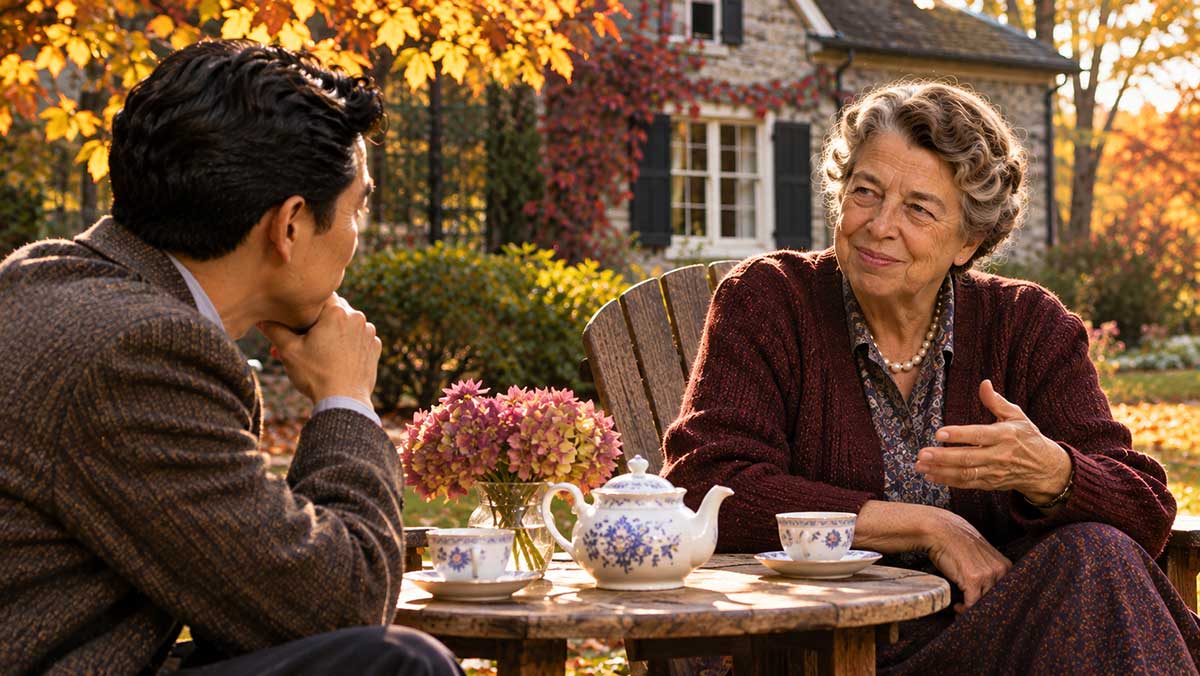
Opening: An Autumn Afternoon at Val-Kill
Val-Kill, Hyde Park, New York. An imagined afternoon in the early 1960s.
Autumn has returned to the Hudson Valley.
The trees surrounding Val-Kill are turning shades of gold, amber, and deep red. Fallen leaves gather along the garden paths, and the afternoon sunlight filters through branches that have begun to grow bare.
Two chairs sit beside a small table overlooking the garden. A teapot rests between them, along with a plate of biscuits.
Eleanor Roosevelt is already seated when Nick arrives. She wears a simple cardigan and looks out over the trees, enjoying a rare moment of quiet.
Eleanor Roosevelt: Nick! Come and sit down. I was beginning to wonder whether you had been detained by the diplomats in Paris.
Nick: (Laughing) I barely escaped. I think they're still debating the wording of something.
Eleanor: That would not surprise me.
Nick: It's good to see you again, Eleanor.
Eleanor: And you. Would you like some tea?
Nick: Please.
She pours a cup and hands it to him.
Nick: I have to say, this is a much more peaceful setting than the United Nations.
Eleanor: It is pleasant, isn't it?
Nick: Do you spend much time sitting out here?
Eleanor: Not nearly enough, I'm afraid.
Nick: That doesn't surprise me. You seem incapable of doing nothing.
Eleanor: (Smiling) I have been accused of that before.
Nick: Have you ever tried taking an entire day off?
Eleanor: I have tried.
Nick: And?
Eleanor: I usually discover something that needs doing.
They laugh.
Nick: Eleanor, we've talked about so much together.
Your childhood, Allenswood, Franklin, your friendships, the White House, civil rights, the war, and the Universal Declaration of Human Rights.
But today, I'd like to ask something different.
I want to know how you look back on your life.
Not as First Lady. Not as a diplomat.
Just as Eleanor.
Eleanor: (Looking at him thoughtfully) That may be the most difficult subject you've chosen.
Nick: More difficult than international diplomacy?
Eleanor: In diplomacy, one can occasionally blame the other delegates.
Nick: (Laughing) And when examining your own life?
Eleanor: One has rather fewer excuses.
They settle into their chairs as a gentle breeze moves through the garden.
Question 13: When You Look Back, What Are You Proudest Of, and What Would You Do Differently?
Nick: Eleanor, when people look at your life, they see extraordinary achievements.
You served as First Lady for twelve years. You helped advance civil rights and women's opportunities. You chaired the United Nations Commission on Human Rights.
You helped establish principles that continue to influence people around the globe.
But when you look back, what are you proudest of?
Eleanor considers the question.
Eleanor: I find it difficult to separate what I may have accomplished from the work of other people.
Much of what I did depended upon the efforts of friends, colleagues, organizers, and people who were willing to devote themselves to difficult causes.
I should not want to claim achievements that belonged to many.
Nick: I understand that. But surely there are things that give you satisfaction.
Eleanor: Yes.
I am grateful that I had opportunities to be useful.
I value the work we accomplished at the United Nations.
And I am glad that I was able to draw attention to some problems that might otherwise have received less notice.
But I think the most satisfying experiences often involved individual people.
Nick: What do you mean?
Eleanor: Meeting someone who had been struggling and discovering that an opportunity had opened for them.
Seeing young people become more confident.
Working with individuals who cared deeply about improving their communities.
Those experiences reminded me why public work mattered.
Nick: That's interesting.
You helped shape an international declaration, yet you keep coming back to individual lives.
Eleanor: An international declaration is valuable only insofar as it helps establish principles that can improve people's lives.
We must never become so fascinated by institutions that we forget whom they are meant to serve.
Nick: What about your work for women's rights?
In 1961, President Kennedy appointed you to chair the President's Commission on the Status of Women.
After everything you'd already accomplished, you were still working to improve women's opportunities.
Eleanor: Yes. I believed there remained much to be done.
Women had made important advances, but discrimination and unequal opportunities continued.
We needed to examine employment, education, legal protections, and the responsibilities women carried in family life.
Nick: Did you ever think, "I've done enough. Let someone else handle it"?
Eleanor: (Laughing) I suspect some of my friends wished I would say that occasionally.
Nick: But you couldn't?
Eleanor: I found it difficult to ignore work that seemed worthwhile.
And I was fortunate to remain involved in public questions.
Nick: Eleanor, I want to ask about something harder.
We've talked about your achievements. But what about your regrets?
When you look back, what do you wish you had done differently?
Eleanor looks toward the trees.
Eleanor: I think it would be dishonest for anyone to suggest that a long life contains no mistakes.
I made judgments that were imperfect.
There were times when I could have listened more carefully or acted more effectively.
And there were circumstances in which I did not accomplish what I hoped.
Nick: Are there particular decisions that trouble you?
Eleanor: I would not want to invent a tidy list of regrets simply to make my life appear more dramatic.
But I think the question of whether one has done enough for people facing injustice is always worth asking.
Nick: We discussed Japanese American incarceration during the war.
You acknowledged that your efforts did not prevent the suffering of thousands of families.
Is that an example of the kind of unfinished responsibility you're talking about?
Eleanor: It is an example of why we must judge public decisions by their consequences, not merely by the intentions of those who made them.
The treatment of Japanese Americans raised serious questions about prejudice and constitutional principles.
And it reminds us that a democracy can fail to protect people precisely when fear makes those protections most necessary.
Nick: What about racial equality?
You worked with civil rights leaders for decades, yet segregation and discrimination remained deeply entrenched.
Eleanor: Progress had been made, but the work was far from complete.
The struggle for equal rights required the leadership and persistence of people who faced discrimination directly.
I tried to contribute where I could, but I was never the central figure in that struggle.
Nick: Did you ever feel discouraged by how slowly things changed?
Eleanor: Certainly.
But discouragement is not a very useful place to remain.
If a problem persists, one must ask what can be done next.
Nick: What about your personal life?
Your marriage, your children, your friendships.
Do you ever wish you had given more time to the people closest to you?
Eleanor's expression softens.
Eleanor: Family relationships are rarely simple.
I loved my children, but I know that the demands of public life and my own limitations affected our relationships.
I was not always the mother I might have wished to be.
And I think many people, looking back, recognize moments when they could have been more patient or attentive.
Nick: That's a very human answer.
Eleanor: I should hope so.
Nick: I think people sometimes forget that you were a mother of five surviving children, with family responsibilities and private difficulties.
They see the public figure and assume you somehow managed everything perfectly.
Eleanor: I assure you, I did not.
Nick: (Smiling) That may be the most reassuring thing you've told me.
Eleanor: Then perhaps I have accomplished something useful this afternoon.
They laugh together.
Nick: Eleanor, if you could change one thing about how people remember you, what would it be?
Eleanor: I would hope they would not think of me as someone who possessed all the answers.
I learned through experience, and I changed my views as I encountered new information and new people.
If my life has any value as an example, perhaps it is that one can continue learning and contributing throughout one's years.
Nick: So you would rather be remembered as someone who kept trying than someone who always succeeded.
Eleanor: That is a fair way to put it.
And I hope people will remember the many others whose work made progress possible.
Question 14: What Would You Say to Someone Who Believes Their Voice Doesn't Matter?
Nick: Eleanor, I want to ask something that I think many people struggle with.
Most of us will never live in the White House or sit at the United Nations.
We don't have access to presidents, newspapers, or international organizations.
Sometimes the problems in the world seem so enormous that an ordinary person feels completely insignificant.
What would you say to someone who believes their voice doesn't matter?
Eleanor: I would begin by asking what they mean by making a difference.
If they imagine that meaningful action requires changing an entire nation at once, they may feel discouraged before they begin.
But there are many ways to contribute.
One can work in a school, support a community organization, help improve local conditions, or encourage others to participate in public life.
Nick: But those things seem small compared with the problems we face.
Eleanor: Small compared with what?
A teacher who helps a young person discover confidence may influence an entire life.
A community organization that improves conditions for a few families may accomplish something of genuine importance.
And many larger reforms begin with people who are willing to work on problems close to home.
Nick: That reminds me of Marie Souvestre.
Eleanor: Yes.
She did not know everything that would happen in my life.
But her influence was meaningful.
Nick: Do you think people underestimate what they can do?
Eleanor: Sometimes.
But I think we should be careful not to suggest that everyone possesses the same opportunities or resources.
Some people face enormous obstacles.
A person struggling to provide food for a family may not have the time or freedom to participate in public affairs as easily as someone with financial security.
That is one reason social and economic conditions matter.
Nick: So you're not simply telling people to try harder.
Eleanor: No.
We must work to create conditions in which more people can participate fully.
But within our circumstances, I believe most of us can find some useful contribution.
Nick: What about someone who is afraid?
Someone who wants to speak against injustice but worries about criticism or rejection.
Eleanor: Fear is not unusual.
I have experienced it myself.
But one can learn to act despite fear, particularly when one has prepared carefully and understands why the action matters.
Nick: Is courage something people are born with?
Eleanor: I think courage can be developed.
One becomes more capable through experience.
You begin with responsibilities you can manage, learn from mistakes, and gradually discover that you can face situations you once found intimidating.
Nick: That sounds like your own life.
Eleanor: In some respects, yes.
But I would not want to suggest that everyone must follow the same path.
Nick: Eleanor, I want to ask about young people.
You've spent much of your life encouraging education and civic participation.
What worries you most about the next generation?
Eleanor: I worry when young people become convinced that public affairs have nothing to do with them.
Democracy requires participation.
If citizens withdraw entirely from public responsibility, they leave decisions to others who may not share their concerns.
Nick: But many young people feel that politicians don't listen.
Eleanor: Then they must learn how institutions work and how to organize effectively.
It is not enough to express dissatisfaction.
One must develop the knowledge and persistence required to influence decisions.
Nick: You make citizenship sound like a responsibility, not merely a collection of rights.
Eleanor: Rights and responsibilities are closely connected.
We should defend our own freedoms, but we must recognize that others possess those freedoms, too.
Nick: What if the person whose rights are being denied is someone we dislike?
Eleanor: Then our principles are being tested.
It is easy to defend the rights of people with whom we agree.
The more difficult task is to recognize that those rights do not disappear when we disagree with someone.
Nick: That's something I wish more people would think about.
Eleanor: It is a lesson that must be learned repeatedly.
Nick: Eleanor, I sometimes wonder whether kindness is underestimated.
We talk about legislation, institutions, and political movements.
But a single act of kindness can change how someone sees the world.
Do you think kindness belongs in a conversation about human rights?
Eleanor: Certainly.
But I would distinguish personal kindness from the obligations of institutions.
A kind individual may help someone in need.
Yet we must still ask whether laws and social arrangements are fair.
We should not expect private generosity to compensate for every public injustice.
Nick: That's a good distinction.
Kindness matters, but it doesn't replace justice.
Eleanor: Precisely.
And justice should not be pursued without concern for the human beings involved.
Nick: Can I ask something personal?
Eleanor: Of course.
Nick: When you think about the young Eleanor who felt uncertain and overlooked, do you ever wish you could tell her how much her voice would eventually matter?
Eleanor smiles gently.
Eleanor: I think I would rather encourage her to begin using it.
She could not have known where life would lead.
But she could learn to speak, to listen, and to act.
That would have been enough for a beginning.
Nick: That's beautiful.
Eleanor: And I should remind her that listening is just as important as speaking.
Nick: You always manage to give me homework.
Eleanor: (Laughing) I had a very demanding teacher.
Question 15: After Everything You've Experienced, What Makes a Human Life Truly Worthwhile?
The afternoon sun has moved lower. A few leaves drift from the trees and settle on the grass.
Nick: Eleanor, I have one final question.
And I think it may be the most personal question I've asked you.
You've experienced extraordinary things.
Love and disappointment. The loss of people close to you. Marriage and motherhood. Friendship and political conflict.
You've met presidents, world leaders, workers, children, and people whose names history may never record.
You've seen war, suffering, injustice, and remarkable acts of courage.
After all of that, what do you believe makes a human life truly worthwhile?
Eleanor remains quiet for a moment, looking across the garden.
Eleanor: I think a worthwhile life involves continuing to learn, developing one's abilities, and finding ways to contribute to the lives of others.
But I would hesitate to offer a single formula.
People live under very different circumstances.
A person may lead a meaningful life without holding public office or accomplishing anything that attracts historical attention.
Nick: What about love?
Eleanor: Love matters greatly.
Affection, friendship, family relationships, and concern for others can give life richness and purpose.
But love is not always simple.
We may care deeply for people and still misunderstand them or disappoint them.
Nick: You've experienced that yourself.
Eleanor: Yes.
And I think one must learn to accept that relationships require patience and humility.
Nick: Do you think you became happier as you grew older?
Eleanor: I became more capable of recognizing what mattered to me.
That is not quite the same as saying I was always happy.
There were losses and disappointments throughout my life.
But I found satisfaction in work, friendships, and opportunities to be useful.
Nick: Did you ever feel at peace with yourself?
Eleanor: At times.
But I do not think peace requires believing that one has accomplished everything or made no mistakes.
Perhaps it involves accepting that life is imperfect and continuing to do what one believes is worthwhile.
Nick: That's an interesting way to describe peace.
Not the absence of problems, but the ability to live meaningfully among them.
Eleanor: Yes.
Though I should not want to make suffering sound desirable.
We ought to work to prevent unnecessary suffering wherever we can.
Nick: Eleanor, you've spent much of your life encouraging people to take responsibility for others.
But what about taking care of yourself?
Did you ever learn that you deserved rest, affection, and happiness, apart from what you could accomplish?
Eleanor looks at Nick with a small smile.
Eleanor: That is a question some of my friends might have enjoyed asking me.
Nick: I suspected as much.
Eleanor: I was often busy, and I know that I did not always find the best balance.
But I valued my friendships, my family, and the ordinary pleasures of life.
I enjoyed conversation, reading, travel, and being with people I cared about.
Nick: Did you ever feel that you had to earn your place in the world by being useful?
Eleanor: I think my sense of responsibility became an important part of who I was.
But I would not want anyone to believe that a person's dignity depends upon productivity.
A child, an elderly person, someone who is ill or unable to work, all possess human worth.
That is part of what we tried to affirm through our work on human rights.
Nick: I'm glad you said that.
Sometimes people hear stories about extraordinary individuals and come away feeling that their own lives are too ordinary to matter.
Eleanor: That would be a very unfortunate conclusion.
A life need not be famous to be meaningful.
Nick: Eleanor, do you ever think about death?
She looks toward the trees.
Eleanor: As one grows older, one naturally becomes more aware that time is limited.
I have lost many people who mattered deeply to me.
And I know that none of us can expect to remain indefinitely.
Nick: Does that frighten you?
Eleanor: I think most people have moments of uncertainty about what lies ahead.
But I prefer to concern myself with the responsibilities and opportunities that remain.
Nick: What would you want people to carry forward after you're gone?
Eleanor: I hope they will continue working for a society in which people are treated with dignity.
I hope they will defend democratic institutions, seek better opportunities for those who have been excluded, and recognize that human rights require continuing effort.
But I would not want them to spend too much time thinking about me.
There is work to be done.
Nick: (Smiling) You really can't help yourself, can you?
Eleanor: I'm afraid not.
Nick: Even your thoughts about legacy become a reminder to get back to work.
Eleanor: (Laughing) Perhaps that is my greatest failing.
Nick: I don't think it's a failing.
But I do think you deserve to hear something.
Eleanor: What is that?
Nick: You've given people an extraordinary example.
Not of perfection, but of someone who kept learning.
Someone who began life feeling uncertain and eventually found the courage to speak for people who had been ignored.
Someone who made mistakes, faced criticism, and still tried to do something meaningful.
And I think that matters.
Eleanor looks at him quietly.
Eleanor: Thank you, Nick.
That is very kind.
But I hope you will remember that I was fortunate in many ways.
I had opportunities, education, friendships, and circumstances that allowed me to contribute.
Many others worked just as hard, often with far less recognition.
Nick: I will remember that.
Eleanor: Then perhaps we have had a useful conversation.
Nick: More than useful.
I think I've learned something about what it means to live a good life.
Eleanor: And what have you learned?
Nick: That a good life isn't necessarily one without fear, regret, or disappointment.
It's a life in which we keep learning, keep caring, and keep trying to do something worthwhile for others.
Eleanor: I think that is a reasonable conclusion.
Nick: Reasonable?
Eleanor: (Smiling) You were hoping for something more enthusiastic?
Nick: Maybe just a little.
Eleanor: Very well. I think it is an excellent conclusion.
They laugh together.
Closing: The Work We Leave to Others
The sun is beginning to disappear behind the trees. The garden is bathed in soft amber light, and the air has grown cooler.
Nick and Eleanor remain seated for a few moments, enjoying the quiet.
Nick: Eleanor, there's something I want to ask before I go.
We've talked about your childhood, your marriage, your public work, and your hopes for humanity.
But I wonder whether there's something people misunderstand about you.
Something you wish they could see more clearly.
Eleanor: I think people sometimes forget that public figures are ordinary human beings.
They have strengths and weaknesses, private concerns, and relationships that do not fit neatly into historical accounts.
I was fortunate to have opportunities to serve.
But I was never free from uncertainty or error.
Nick: I think that's what makes your story meaningful.
You weren't born knowing how to become Eleanor Roosevelt.
You discovered it gradually.
Eleanor: As most people do.
Nick: And you're still discovering it.
Eleanor: (Smiling) I hope so.
Nick: Eleanor, may I tell you something personal?
Eleanor: Of course.
Nick: I began these conversations wanting to meet one of the most influential women in history.
But somewhere along the way, I stopped thinking of you as a historical figure.
I began thinking of you as a friend.
Eleanor smiles warmly.
Eleanor: That is a lovely thing to say.
And I have enjoyed our conversations very much.
You have asked thoughtful questions, including some that were not entirely comfortable.
Nick: I was worried about that.
Eleanor: You needn't have been.
A good friendship should allow room for honest questions.
Nick: I'm glad you feel that way.
Eleanor: And I hope you will continue asking them, not simply of historical figures, but of the people and institutions around you.
Nick: I will.
Eleanor reaches for the teapot.
Eleanor: More tea?
Nick: I probably should be going.
Eleanor: Nonsense. There is still some left.
Nick: (Laughing) You don't take no for an answer very easily.
Eleanor: I have been told that before.
She pours a little more tea, and they sit together as the light continues to fade.
Nick: Eleanor, I think I understand something now.
When people look at your life, they often focus on the extraordinary things you accomplished.
But perhaps the most meaningful part of your story is that you never stopped believing people could do better.
Eleanor: I believed people could learn.
And I believed they had responsibilities to one another.
But I never thought progress was guaranteed.
Nick: You had to keep working for it.
Eleanor: Yes.
And sometimes you had to accept that others would continue the work after you.
Nick: Does that bother you?
Eleanor: Not particularly.
No one person can accomplish everything.
We contribute what we can, and others build upon it.
Nick: That's a peaceful way to think about life.
Eleanor: It is a practical one.
Nick: (Smiling) You always bring me back to practicality.
Eleanor: Someone must.
They laugh.
Nick: Eleanor, thank you.
For your honesty, your warmth, and your willingness to let me see the woman behind the public figure.
Eleanor: Thank you, Nick.
And I hope you will remember something.
Nick: What's that?
Eleanor: Do not wait until you feel entirely prepared to do something useful.
There will always be more to learn.
Begin where you are, with the opportunities you have, and remain willing to grow.
Nick: I will.
They stand and walk slowly along the garden path toward the cottage.
A few leaves fall around them.
At the doorway, Nick turns to Eleanor.
Nick: Until we meet again?
Eleanor: (Smiling) I should like that.
And perhaps next time, you might tell me more about what you are doing with your own opportunities.
Nick: That sounds fair.
Eleanor: Good. I have asked you very few questions, considering how many you have asked me.
Nick: (Laughing) I have a feeling you'd be a formidable interviewer.
Eleanor: I have had some practice asking questions.
They exchange a warm smile.
Nick: Goodbye for now, Eleanor.
Eleanor: Goodbye for now, Nick.
Nick walks away from the cottage as the evening settles over Val-Kill.
Behind him, Eleanor remains at the doorway for a moment before returning inside, where books, letters, and unfinished work await.
Her life has been extraordinary, but it is not a story of perfection.
It is the story of a woman who learned to find her voice, discovered independence through difficult experiences, challenged injustice, and helped establish principles that reached far beyond her own lifetime.
And perhaps the most meaningful part of her legacy is not that she completed the work.
It is that she helped others recognize why the work must continue.
End of Topic 5.
Final Thoughts: The Courage to Keep Becoming
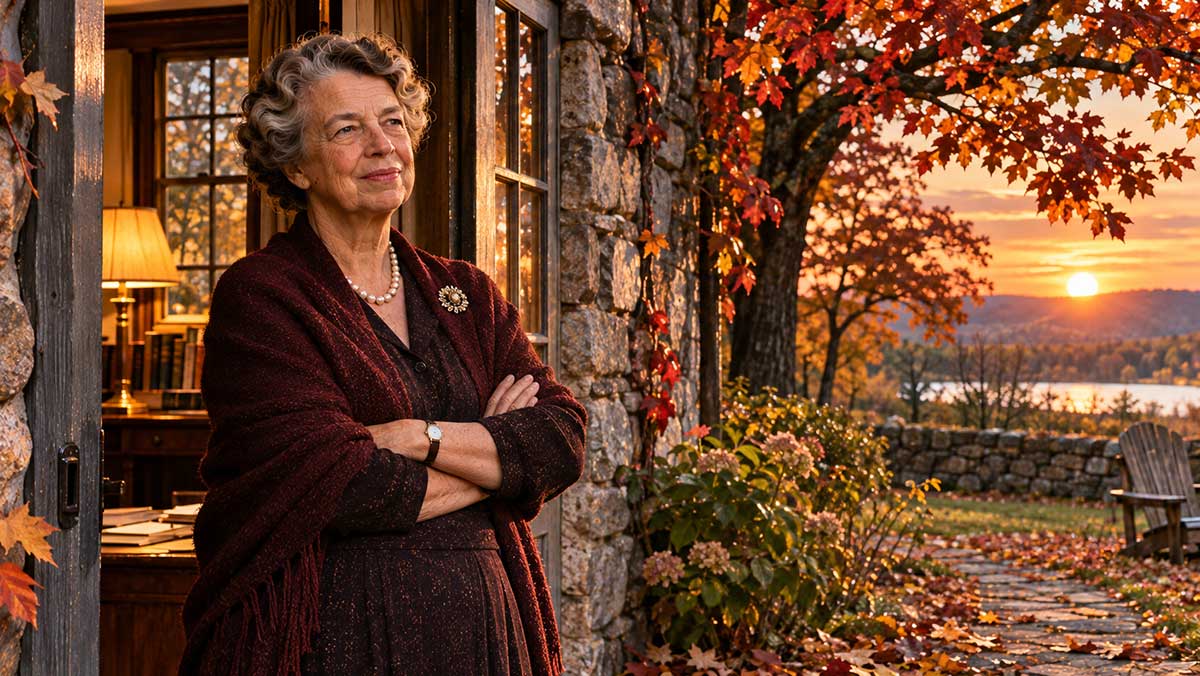
When Nick first met Eleanor Roosevelt in the quiet garden at Allenswood, he expected to discover how an insecure young girl became one of the most influential women in history.
But as their conversations unfolded, a different lesson emerged.
Eleanor's life was not the story of someone who conquered every fear, resolved every disappointment, or always knew the right thing to do.
It was the story of someone who kept growing.
At Allenswood, she discovered that her thoughts mattered.
At Val-Kill, she explored a life shaped by friendship, independence, and responsibilities of her own.
In the White House, she learned that conscience sometimes demanded uncomfortable choices, including challenging the institutions and people closest to her.
At the United Nations, she worked with individuals from different cultures and political traditions to establish shared principles of human dignity.
And in her later years, she continued asking what more could be done.
Across those conversations, five lessons stand out.
1. Our beginnings do not determine the limits of our lives.
Eleanor's childhood losses and insecurities were real. But they did not define everything she would become.
The encouragement of a teacher, the discovery of intellectual confidence, and the opportunities to serve others helped her develop abilities she once struggled to recognize.
Her experience reminds us that people can continue changing long after their earliest circumstances have shaped them.
2. Independence does not mean living without love.
Eleanor's marriage was complicated, and her relationships evolved throughout her life.
Yet friendship, family, and companionship remained deeply meaningful to her.
She discovered that independence could mean developing her own judgment and responsibilities without withdrawing from human connection.
3. Compassion must be willing to confront injustice.
Eleanor listened to people whose struggles were often overlooked.
But listening was only the beginning.
Her advocacy for civil rights, workers, and women's opportunities reflected a conviction that concern for others should lead to practical action.
Her failures and limitations remind us that good intentions must be examined alongside real consequences.
4. Human dignity cannot depend upon agreement.
The Universal Declaration of Human Rights emerged from negotiations among people with different political, religious, and philosophical convictions.
Its significance lies partly in their willingness to affirm common protections without requiring complete agreement about every underlying belief.
That lesson remains deeply relevant in a divided society.
5. A worthwhile life does not require finishing every task.
Eleanor did not live to see the end of racial discrimination, the full realization of women's equality, or universal respect for human rights.
She knew that progress depended on many people working across generations.
Her legacy was not the completion of humanity's moral work.
It was her contribution to that continuing effort.
There is something profoundly moving about the distance between the young girl who once doubted her worth and the woman who helped defend the worth of every human being.
Yet we should resist the temptation to turn that contrast into a perfect story.
Eleanor was privileged in ways many people were not. She made mistakes. Her relationships were complicated. Her political influence had limits.
She was a human being, not a symbol untouched by contradiction.
And that makes her example more meaningful.
We do not need to become perfect before we can contribute something worthwhile.
We can learn from people who challenge us.
We can acknowledge our mistakes without allowing them to define everything that follows.
We can defend the dignity of people whose beliefs or experiences differ from our own.
And we can recognize that the most meaningful contributions may be the ones whose results we never fully see.
At the end of their imagined meeting at Val-Kill, Nick leaves Eleanor among the autumn trees, with letters and unfinished work still waiting inside her cottage.
The image offers a fitting reflection on her life.
She had accomplished an extraordinary amount.
And there was still more to do.
Perhaps the question Eleanor Roosevelt leaves us with is not whether we can change the entire world.
Perhaps it is something closer to home:
Whose dignity can we defend, whose voice can we help others hear, and what worthwhile work can we begin today?
Fictional Conversation Disclaimer
The preceding reflections refer to an imagined conversation, not a historical interview. Eleanor Roosevelt's dialogue and personal responses were creatively reconstructed; they should not be treated as verified quotations, statements of private belief, or evidence of her endorsement. The historical interpretation draws on her documented life and public work.
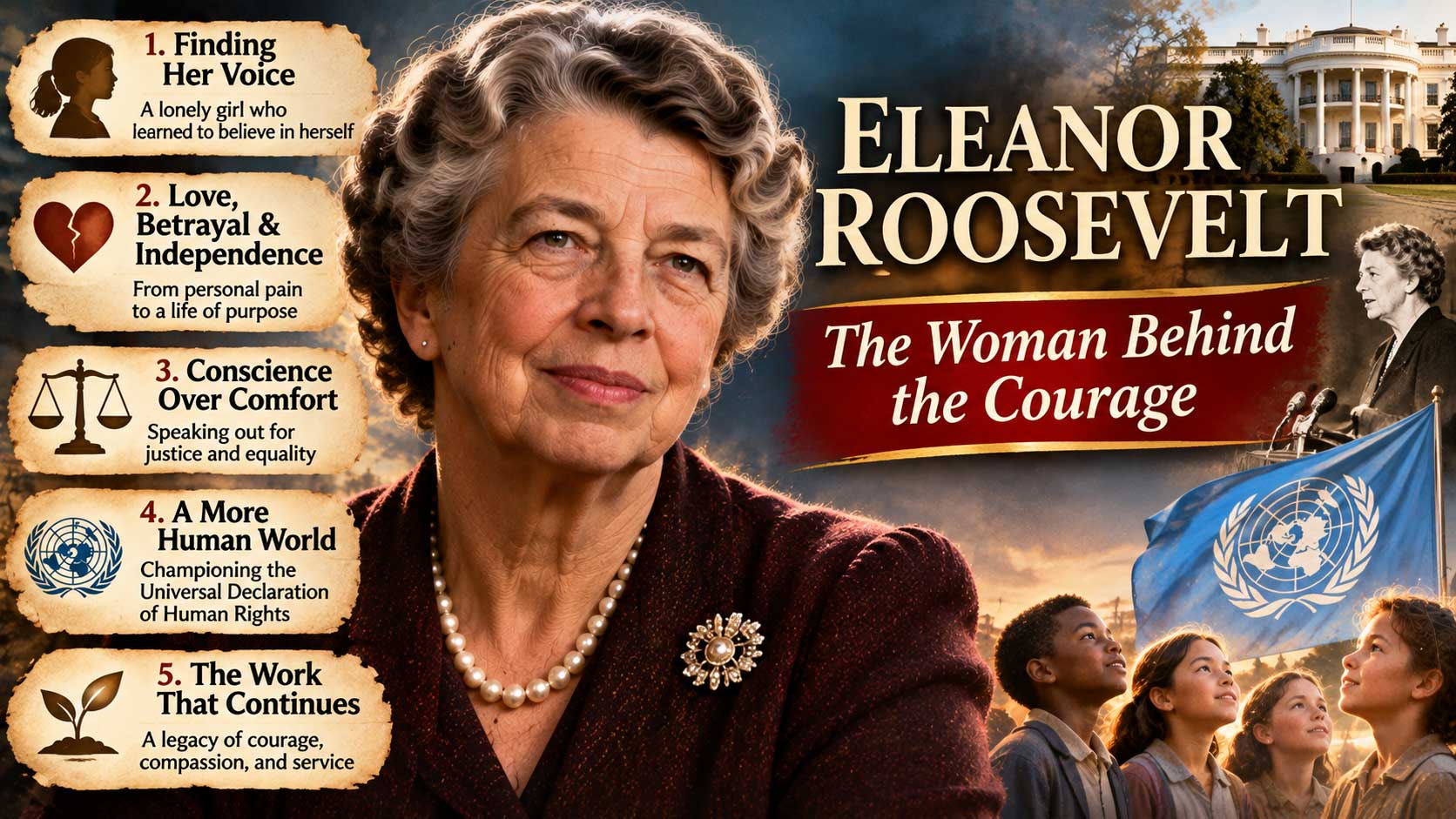
Short Bios:
Eleanor Roosevelt (1884–1962)
Anna Eleanor Roosevelt was an American political figure, diplomat, author, and human rights advocate. She served as First Lady of the United States from 1933 to 1945 during the presidency of her husband, Franklin D. Roosevelt.
Born in New York City, she studied at Allenswood in England, where educator Marie Souvestre helped encourage her intellectual independence. Eleanor later became active in social reform, women's political organizations, and labor advocacy.
As First Lady, she challenged traditional expectations through extensive travel, public speaking, journalism, and advocacy for civil rights and social welfare. Following Franklin's death, she served as a United States delegate to the United Nations and chaired the UN Commission on Human Rights during the drafting of the Universal Declaration of Human Rights.
She continued advocating for equality and civic responsibility until her death in 1962.
Franklin D. Roosevelt (1882–1945)
Franklin Delano Roosevelt was the 32nd president of the United States, serving from 1933 until his death in 1945. He led the nation through much of the Great Depression and World War II.
His New Deal policies reshaped the federal government's role in economic recovery and social welfare. His presidency included major achievements and serious controversies, including the mass incarceration of Japanese Americans during World War II.
His marriage to Eleanor Roosevelt combined family life, political collaboration, and significant personal difficulties.
Marie Souvestre (1830–1905)
Marie Souvestre was a French educator who directed Allenswood Academy in England. Known for encouraging independent thought, intellectual curiosity, and discussion of social questions, she became an important mentor to the young Eleanor Roosevelt.
Eleanor later credited her education under Souvestre with helping broaden her outlook and strengthen her confidence.
Lucy Mercer Rutherfurd (1891–1948)
Lucy Mercer Rutherfurd was an American socialite whose relationship with Franklin D. Roosevelt became a major turning point in the Roosevelt marriage.
Eleanor discovered evidence of their relationship in 1918. The Roosevelts remained married, but their relationship changed. Franklin and Lucy maintained a connection in later years.
Mary McLeod Bethune (1875–1955)
Mary McLeod Bethune was an American educator, civil rights leader, and government adviser. She founded a school for Black girls that later became part of Bethune-Cookman University and served as a prominent advocate for educational opportunity and racial equality.
She developed a close working relationship with Eleanor Roosevelt and was an influential member of the network of Black advisers associated with the Roosevelt administration.
Marian Anderson (1897–1993)
Marian Anderson was an internationally celebrated American contralto who became an important figure in the history of racial equality in the performing arts.
After the Daughters of the American Revolution refused to make Constitution Hall available for her 1939 performance, she sang at the Lincoln Memorial before a large integrated audience. The event became an enduring symbol of the struggle against racial discrimination.
Lorena Hickok (1893–1968)
Lorena Hickok was an American journalist who became a close friend and correspondent of Eleanor Roosevelt.
A successful reporter and political observer, Hickok later worked on projects connected to New Deal relief efforts. Her extensive correspondence with Eleanor reveals a deeply affectionate relationship, the precise intimate nature of which remains a subject of historical discussion.
Hansa Mehta (1897–1995)
Hansa Mehta was an Indian educator, women's rights advocate, diplomat, and participant in the drafting of the Universal Declaration of Human Rights.
She played an influential role in promoting inclusive language, including the wording of Article 1 affirming that all human beings are born free and equal in dignity and rights.
P. C. Chang (1892–1957)
Peng-chun Chang was a Chinese philosopher, educator, diplomat, and vice-chair of the United Nations Commission on Human Rights.
He contributed important cross-cultural and philosophical perspectives to the drafting of the Universal Declaration of Human Rights, encouraging consideration of traditions beyond Western political philosophy.
Charles Malik (1906–1987)
Charles Malik was a Lebanese philosopher, diplomat, and influential participant in the drafting of the Universal Declaration of Human Rights.
He contributed to debates about individual liberty, human dignity, and the philosophical foundations of international human rights protections.
Nick Sasaki
Nick Sasaki is the creator and interviewer behind ImaginaryTalks.com, a creative platform exploring history, philosophy, spirituality, literature, and human experience through fictional conversations.
His interviews bring historical figures and influential thinkers into thoughtful, accessible discussions about the questions that continue to shape human lives.
The conversations are imaginative works informed by research, intended to encourage curiosity, reflection, and a deeper appreciation of human dignity.
Leave a Reply