
Introduction: Charles Darwin, the Man Behind Evolution
What happens when a man discovers an explanation that changes humanity's view of life, yet cannot answer every question about its meaning? Charles Darwin is remembered as the scientist who transformed biology through his theory of evolution by natural selection. But behind the familiar portrait of an elderly gentleman with a long white beard was a curious young man who loved collecting beetles, struggled with medical studies, and once considered becoming an Anglican clergyman. His story is far more human, surprising, and emotionally compelling than the familiar account of a scientist challenging accepted beliefs.
In December 1831, Darwin boarded HMS Beagle for a voyage that would last nearly five years. His observations of South American fossils, geological formations, and the distinctive animals of the Galápagos Islands raised questions that continued to occupy him after returning to England. Contrary to the popular story, he did not suddenly discover natural selection while watching finches on the islands. His explanation developed gradually through years of research, reflection, and correspondence. As the Natural History Museum explains, natural selection concerns inherited differences that influence which organisms survive and reproduce under particular environmental conditions.
Darwin's achievement was extraordinary, but it was not accomplished in isolation. In 1858, Alfred Russel Wallace independently developed a closely related explanation, leading to the joint presentation of their work at the Linnean Society. The following year, Darwin published On the Origin of Species, presenting evidence that species change over generations and share evolutionary ancestry. Readers can explore the arguments in the original 1859 edition of On the Origin of Species. The book transformed scientific inquiry, yet Darwin himself recognized that important questions about inheritance, variation, and life's history remained unresolved.
Beyond his scientific achievements, Darwin was a husband and father whose private life deserves equal attention. He married Emma Wedgwood in 1839, and together they raised a large family. Emma was a committed Christian, and her husband's changing religious beliefs troubled her, particularly when she considered their hopes for eternal life. Their surviving correspondence, preserved through the Darwin Correspondence Project at Cambridge, reveals a relationship in which sincere religious differences existed alongside deep affection. Their story invites a question that remains relevant today: Can two people disagree about life's ultimate meaning and still build a loving, enduring marriage?
Darwin's life contained profound sorrow. In 1851, his beloved daughter Annie died at the age of ten. His grief was immense, but it would be historically misleading to suggest that her death alone caused him to abandon Christianity. His religious doubts had developed over many years, influenced by his examination of biblical claims, the natural world, and the problem of suffering. Darwin eventually found the description agnostic more appropriate than atheist. He questioned whether human beings could confidently answer the ultimate question of God's existence, even as his scientific work challenged traditional explanations of biological design.
His theory raised equally difficult questions about humanity. If human beings share ancestry with other animals, what makes us distinctive? Can compassion, cooperation, and morality develop through natural processes? Darwin opposed slavery and explored the origins of human sympathy, yet some of his writings reflected racial and sex-based assumptions that later scientific research has challenged. His legacy deserves neither uncritical admiration nor simplistic condemnation. It calls for an examination of both his achievements and his limitations, including the distinction between describing natural selection and using evolutionary language to justify social inequality.
In this imagined interview, Nick Sasaki meets Charles Darwin for a warm, thoughtful conversation about the man behind the theory. Across five topics, they explore his adventurous youth, the development of natural selection, his relationship with Emma, the loss of Annie, the meaning of human ancestry, and the discoveries of modern genetics that Darwin never lived to see. They approach disagreements about science and religion with curiosity rather than hostility. Did Darwin's discoveries change his belief in God? What did he learn about humanity? And what might he still want to discover if he could visit our world today? These are the questions that guide our imaginary conversation.
Fictional Conversation Disclaimer
This article presents an imagined, educational conversation inspired by Charles Darwin's documented life, scientific writings, and historical correspondence. The dialogue, emotional responses, and answers to contemporary questions are fictional reconstructions, not authentic quotations or endorsements. Historical facts are distinguished from speculative interpretations wherever necessary.
Topic 1: The Young Man Who Set Sail and Returned Changed
Opening
Nick Sasaki: Charles, welcome. It's a real pleasure to sit down with you.
I've been looking forward to this conversation. You've changed how humanity thinks about life on Earth, but I don't want to begin with your theory. I'd rather begin with the young man who had no idea what was waiting for him.
I understand you were quite an enthusiastic beetle collector.
Charles Darwin: (Laughs.) Enthusiastic is a rather charitable description, Nick. I was positively obsessed.
I remember once finding two particularly interesting beetles and holding one in each hand. Then I spotted a third, which appeared even more remarkable. Not wishing to lose any of them, I put one of the beetles into my mouth.
Nick: You put a beetle in your mouth?
Darwin: A dreadful decision. It released an exceedingly unpleasant fluid, which burned my tongue. I spat it out, and in the confusion, I lost the third beetle too.
Nick: (Laughing.) So one of history's greatest naturalists was defeated by three beetles.
Darwin: Entirely defeated! And I should like to say that I learned my lesson, though I cannot promise that my enthusiasm became much more sensible.
Nick: I love that story. We tend to picture you as this serious gentleman with a magnificent beard, sitting quietly and thinking about evolution. But you were once a young man chasing beetles and getting yourself into trouble.
Darwin: Oh, I was quite capable of getting into trouble. My father once told me that I cared for nothing but shooting, dogs, and rat-catching, and that I would be a disgrace to myself and my family.
He was a good man, and I believe he worried about my future. But I did not appear destined for any particularly distinguished career.
Nick: That's remarkable. Your father couldn't have known that the boy chasing beetles would someday change the history of science.
Darwin: Nor could the boy himself, I assure you.
Question 1: You Once Considered Becoming a Clergyman. What Drew You Into Natural History Instead?
Nick: Charles, here's something that might surprise people. Before you became famous for evolution, you actually considered becoming an Anglican clergyman.
How close did you come to taking that path?
Darwin: Quite close, in fact.
My father initially intended me for medicine, and I went to Edinburgh to study it. But I found the lectures rather dull, and surgery was deeply distressing. This was before the widespread use of effective anesthesia, you understand.
I attended two operations, one involving a child, and I could not bear to witness another.
Nick: That must have been terrible.
Darwin: It was. I eventually abandoned the prospect of becoming a physician.
My father then suggested that I enter the Church of England. At the time, I saw no serious objection. I examined the Christian doctrines I would be expected to affirm and found that I could accept them.
Indeed, becoming a country clergyman seemed a perfectly agreeable prospect. One could perform one's duties and still devote considerable time to natural history.
Nick: So you didn't see science and Christianity as enemies.
Darwin: Certainly not. Many excellent naturalists were clergymen. The study of nature was widely regarded as a worthy means of appreciating the Creator's works.
At Cambridge, I read William Paley's writings on natural theology. His arguments concerning the apparent design of living organisms impressed me greatly.
I was particularly taken with the clarity of his reasoning.
Nick: Paley was the philosopher who compared living things to a watch, wasn't he? The idea that if you find a watch, you naturally assume someone designed it.
Darwin: Precisely. And when one observes the intricate construction of an eye or the remarkable adaptations of an animal, the argument seems very persuasive.
At that stage of my life, I had no developed alternative explanation for such adaptations.
Nick: But something was already drawing you in another direction.
Darwin: My curiosity, I suppose.
I was fascinated by collecting specimens, observing insects, and examining the natural world. At Cambridge, I became acquainted with Professor John Stevens Henslow, a botanist whose friendship proved invaluable.
He was extraordinarily generous with his knowledge.
We took long walks together, discussing plants, insects, and geology. He encouraged me to observe carefully and not to accept conclusions merely on authority.
Nick: That sounds like the kind of teacher who changes someone's life without realizing it.
Darwin: Indeed. I owe him a great deal.
And it was Henslow who recommended me for the voyage of HMS Beagle.
Nick: So without him, we might never have had Darwin's theory of evolution?
Darwin: One must be careful with such claims. Another naturalist might have developed similar ideas, as Alfred Russel Wallace later demonstrated.
But I can certainly say that my own life would have been profoundly different.
Nick: I find something fascinating about that. You weren't searching for a way to overturn religion. You were following your curiosity.
Darwin: Yes. I did not begin with a determination to overthrow anyone's beliefs.
I wished to understand the natural world.
And I was fortunate enough to encounter people who encouraged me to keep asking questions.
Question 2: During the Beagle Voyage, Which Observations First Made You Question Accepted Explanations of Life?
Nick: Let's talk about that voyage.
You're twenty-two years old. It's December 1831. You're preparing to leave England aboard HMS Beagle.
Did you have any idea that you were about to spend nearly five years traveling around the world?
Darwin: I knew the voyage might be lengthy, but I scarcely understood what I was undertaking.
And I nearly did not go at all.
My father initially objected. He thought the expedition an unnecessary interruption to my future career.
Fortunately, my uncle Josiah Wedgwood helped persuade him to reconsider.
Nick: And Captain FitzRoy almost rejected you too, didn't he?
Darwin: (Smiling.) There is a story that he was troubled by the shape of my nose.
FitzRoy took an interest in physiognomy, the supposed science of judging character from facial features. He apparently doubted whether my nose suggested sufficient determination for the voyage.
Nick: (Laughing.) So you almost missed the trip that changed science over the shape of your nose?
Darwin: It would have been an extraordinary misfortune. Though I should add that FitzRoy ultimately treated me with much generosity.
Nick: What do you remember most about those first months?
Darwin: Seasickness, I'm afraid.
Nick: Really?
Darwin: Terrible seasickness. I suffered from it throughout much of the voyage.
But once ashore, I was delighted beyond description.
The tropical forests of Brazil were astonishing. The richness of vegetation, the insects, the birds, the extraordinary variety of living things. I had never seen anything comparable.
I remember feeling that no description could adequately convey the magnificence of such a forest.
Nick: At what point did you begin seeing something that didn't fit the explanations you'd been taught?
Darwin: It happened gradually.
In South America, I discovered fossil remains of enormous extinct mammals. Some bore remarkable resemblances to living animals found in the same region.
For example, there were extinct armored mammals whose structures recalled the armadillos I observed.
Why should extinct creatures resemble living species inhabiting the same continent?
It was a question that stayed with me.
Nick: That's interesting. It wasn't just that animals were different. It was that animals living in one place seemed connected to creatures that had lived there long before.
Darwin: Exactly.
I was also greatly influenced by geology.
Charles Lyell's writings had persuaded me that the Earth had undergone immense changes over extraordinarily long periods.
Then, in Chile, I experienced a powerful earthquake. I observed evidence that portions of the coastline had been raised.
Nick: You actually witnessed the Earth changing.
Darwin: Yes, and that was immensely instructive.
One could see that processes operating in the present might, over vast stretches of time, produce changes that seemed almost unimaginable.
Nick: Did you immediately connect that idea to living things?
Darwin: Not immediately.
It would be misleading to suggest that I stepped ashore one morning and suddenly understood evolution.
The observations accumulated. Their significance became clearer only after years of reflection.
At the time, I was collecting evidence without fully knowing what it would eventually reveal.
Nick: I like that distinction. We often hear stories about great discoveries as if everything happened in one dramatic moment.
Darwin: Scientific discoveries seldom unfold so neatly.
One observes something curious. One records it. Later, another observation gives it new significance.
And occasionally, after considerable effort, a pattern begins to emerge.
Question 3: Did You Really Discover Evolution on the Galápagos Islands?
Nick: Charles, I have to ask about the Galápagos Islands.
Most people have heard the story. You arrive on these remote islands, see finches with different beaks, and suddenly realize that species evolve.
Is that what happened?
Darwin: (Laughs softly.) I am afraid the truth is rather less dramatic.
The Galápagos Islands were certainly important, but I did not arrive at my theory of natural selection while standing among the finches.
Indeed, I did not initially appreciate the full significance of those birds.
Nick: Really? That's one of the most famous stories in science.
Darwin: And a rather misleading one.
I collected various birds, but I did not always recognize that certain specimens belonged to closely related species.
After returning to England, the distinguished ornithologist John Gould examined my collections and helped establish their relationships.
That was enormously valuable.
Nick: So another scientist helped you recognize what you'd actually collected.
Darwin: Precisely.
Science is not always the solitary enterprise people suppose.
But the mockingbirds were particularly interesting to me.
I noticed that birds from different islands showed differences, though they were plainly related.
And I learned that the giant tortoises differed between islands as well.
Nick: What was so troubling about that?
Darwin: Consider the geographical circumstances.
These islands lie relatively close to one another, yet certain animals differed from island to island.
At the same time, their inhabitants often resembled creatures from the South American mainland.
Why should that be?
If each species had been independently created for its particular location, one might ask why these geographical relationships were so pronounced.
But if species descended from earlier populations and changed over time, the pattern began to make sense.
Nick: So the important discovery wasn't simply that animals looked different. It was that their differences seemed to tell a story about where they came from.
Darwin: Very well expressed, Nick.
Their geographical distribution appeared to preserve traces of their history.
Yet I must stress that this interpretation developed after the voyage.
In 1837, I began keeping notebooks on what I called the transmutation of species.
I considered how species might branch from common ancestors.
In one notebook, I drew a small branching diagram and wrote the words "I think" above it.
Nick: I've seen that drawing. It's almost unbelievably simple.
Darwin: A modest sketch, certainly.
Nick: But what an extraordinary idea. Instead of life being a collection of completely separate creations, you were beginning to see it as an enormous family tree.
Darwin: Yes. A branching history of descent.
Some lineages continue. Others become extinct. New forms arise through modification over generations.
It was a profoundly different way of considering the relationships among living things.
Nick: I want to ask you something personal.
When you began to suspect that the accepted explanation of species might be wrong, were you frightened?
Darwin: I was certainly conscious that the subject was controversial.
But my immediate concern was whether the explanation was correct.
I knew that speculation without sufficient evidence would persuade few serious naturalists.
And I was quite capable of being mistaken.
Nick: That's something I admire. You didn't have all the answers, but you kept investigating.
Darwin: I had many more questions than answers.
And I should confess that the questions were often the most interesting part.
Nick: (Smiling.) I suspect you would have been a very difficult man to take on a casual walk. Every insect, every flower, every rock would have required an investigation.
Darwin: My companions might well agree with you.
Though I would maintain that a good walk is considerably improved by an interesting beetle.
Closing
Nick: Charles, I came into this conversation thinking about the man who changed biology. But I'm beginning to appreciate the young naturalist who simply couldn't stop being curious.
You studied theology, collected beetles, endured years of seasickness, explored South America, and returned home with questions that would occupy you for decades.
What strikes me is that you didn't leave England knowing you would change how humanity understood life.
Darwin: Not in the slightest.
When I boarded the Beagle, I hoped to become a competent naturalist. I wished to see the world and learn something of its extraordinary inhabitants.
I could not have imagined where those observations would lead.
Nick: And when you returned in 1836, the real intellectual work was just beginning.
Darwin: Very much so.
I had specimens, notebooks, geological observations, and a growing number of difficult questions.
But I did not yet possess a satisfactory explanation for how species changed.
That would require years of further thought.
Nick: Which brings us to something I've wanted to ask you from the beginning.
You eventually developed a theory that challenged deeply established ideas about life. Yet you waited more than twenty years after returning from the voyage before publishing On the Origin of Species.
Why?
Darwin: (Smiling thoughtfully.) Ah, Nick. That is a rather longer story.
And I suspect you will not be satisfied with a short answer.
Nick: (Laughing.) You know me already.
Darwin: Then perhaps we should begin with a small notebook, a branching tree, and a question that refused to leave me alone.
Topic 2: The Theory That Changed the Living World
Opening
Nick Sasaki: Charles, last time you left me with a small notebook, a branching tree, and a question that refused to leave you alone.
I have to tell you, I've been thinking about that drawing. Two little words, "I think," above a tree with branches.
It's remarkable that something so modest could represent such an enormous change in how we see life.
Charles Darwin: (Smiling.) It was not intended as a grand declaration, Nick. It was a working sketch, a means of arranging my thoughts.
I was considering whether species might be connected through common descent, branching into different forms over immense periods.
But a branching diagram was not yet an explanation of how those changes occurred.
Nick: That's what I want to understand. You had seen fossils, birds, tortoises, and geological changes. You suspected that species weren't fixed forever.
But there's a big difference between saying life changes and explaining how it changes.
Darwin: Precisely. And that distinction occupied me for a considerable time.
Many naturalists before me had entertained the possibility that species could change. My grandfather Erasmus Darwin had speculated about such matters, and Jean-Baptiste Lamarck had proposed his own explanations.
The question was whether one could identify a natural process capable of producing adaptation and the diversity of living forms.
Nick: And you found one.
Darwin: I developed an explanation, yes. But I hope you will permit me to describe how I arrived at it before declaring the matter settled.
Nick: (Laughing.) Fair enough. I suspect you're going to make me work for this answer.
Darwin: Only a little, Nick. Though I confess I have been known to spend several years investigating a question that another gentleman might consider suitable for an afternoon.
Question 1: What Was the Decisive Insight That Led You to Natural Selection?
Nick: Charles, let's start with the central discovery.
People hear the phrase "natural selection" all the time. But what did you actually realize that others had missed?
Darwin: Let us begin with something familiar.
Have you ever seen the extraordinary variety of domestic pigeons?
Nick: Pigeons? You mean the birds wandering around city parks?
Darwin: (Laughs.) Those are certainly pigeons, but I am thinking of the remarkable breeds developed by enthusiasts.
Some possess enormous crops. Others have elaborate feathers, unusual beaks, or distinctive forms of flight.
Yet these diverse breeds descend from the rock pigeon.
Human breeders, by choosing which birds reproduce, can gradually produce extraordinary changes.
Nick: So people were already changing animals through selective breeding.
Darwin: Indeed. Farmers and breeders had done so for generations.
I began to wonder whether something comparable might occur in nature without a human breeder directing the process.
Nick: But nature doesn't sit there deciding which animals should have babies.
Darwin: Quite right. Nature possesses no conscious intention in the matter.
That is an important point.
In 1838, I read Thomas Malthus's essay concerning population. He argued that populations have the capacity to increase beyond the resources available to support them.
I recognized that this principle applied throughout the living world.
Organisms produce more offspring than can ordinarily survive to reproduce.
Nick: So there's competition for food, space, and survival.
Darwin: Competition is one consequence, yes. But the broader principle is that individuals differ, and some inherited differences influence their chances of leaving offspring.
Consider a population of insects.
Some individuals may possess coloration that makes them less conspicuous to predators. Others may be more readily detected.
If that difference is inherited, and the less conspicuous insects leave more surviving offspring, their characteristics may become more common over successive generations.
Nick: And nobody has to plan it.
Darwin: Exactly.
There is no need for a conscious selector.
The preservation of advantageous inherited variations, together with the loss of others, can gradually alter a population.
I called this process natural selection.
Nick: Let me see if I've got it.
Living things aren't identical. Some differences help them survive and reproduce in a particular environment. Those traits can be passed down, and over many generations, the population changes.
Darwin: Very good.
Though I would add that a characteristic need not make an organism stronger, faster, or more aggressive.
Its value depends upon the conditions in which the organism lives.
A small, inconspicuous creature may succeed where a large and formidable one fails.
Nick: That's interesting. So the phrase "survival of the fittest" doesn't mean the toughest animal wins.
Darwin: Certainly not.
The expression was introduced by Herbert Spencer, and I later adopted it in certain editions of my work.
But fitness concerns suitability to particular conditions, including success in reproduction. It is not a judgment of moral worth or physical superiority.
Nick: I think that's one of the biggest misunderstandings about your theory.
People hear "survival of the fittest" and picture a world where the strongest dominate everyone else.
Darwin: Such an interpretation is far too narrow.
Consider a flowering plant whose structure allows it to be pollinated by a particular insect.
Or an animal whose coloring permits it to escape notice.
Success in nature may depend upon countless characteristics, many of which have little to do with physical strength.
Nick: What I find extraordinary is that this process can produce such intricate living things without anyone directing each individual change.
Darwin: That was precisely the explanatory possibility that interested me.
Yet the process operates over generations, and the accumulation of small inherited differences can require immense stretches of time.
It was necessary to ask whether such a process could account for the remarkable adaptations we observe.
And I knew there were serious difficulties to investigate.
Nick: Such as?
Darwin: The evolution of complex organs, the existence of sterile worker insects, the incompleteness of the fossil record, and the mechanisms by which characteristics are inherited.
I devoted considerable attention to such objections.
An explanation that cannot confront its difficulties is not a satisfactory scientific explanation.
Question 2: Why Did You Wait So Long to Publish, and What Happened When Wallace Reached a Similar Discovery?
Nick: Charles, here's something that puzzles me.
You had developed the basic idea of natural selection by 1838. You wrote an outline in 1842 and a longer essay in 1844.
But On the Origin of Species wasn't published until 1859.
Why wait so long?
Were you afraid of what people would say?
Darwin: I was certainly aware that the subject would provoke controversy.
But I would not wish you to suppose that I spent twenty years merely hiding from criticism.
I had a great deal of work to do.
Nick: What kind of work?
Darwin: I needed to establish that my explanation could account for many different classes of evidence.
The geographical distribution of organisms, their anatomical similarities, embryological development, fossils, domesticated varieties, and the intricate relationships among species.
I studied barnacles for approximately eight years.
Nick: Eight years studying barnacles?
Darwin: (Smiling.) I fear you sound less enthusiastic than I was.
Nick: (Laughing.) I'm trying to picture myself spending eight years looking at creatures attached to rocks.
Darwin: They proved extraordinarily instructive.
Their structures, development, and variation presented many questions about classification and relationships.
The work required patience, but it strengthened my knowledge of biological diversity.
Nick: So you weren't just delaying publication. You were building your case.
Darwin: Precisely.
I wished to present an explanation supported by a substantial body of evidence.
And I continued to encounter difficulties that required investigation.
Nick: Then something happened in 1858 that changed your timetable.
A letter arrived from Alfred Russel Wallace.
Darwin: Yes.
Wallace was a gifted naturalist conducting research in the Malay Archipelago.
He sent me an essay presenting an explanation of how species might change through a process remarkably similar to natural selection.
I was astonished.
Nick: You'd been working on this for twenty years, and suddenly another scientist independently arrives at almost the same idea.
What went through your mind?
Darwin: I recognized the extraordinary similarity between his reasoning and my own.
I had already communicated aspects of my theory to several colleagues, but Wallace's essay placed me in a difficult position.
I wished to act honorably toward him.
At the same time, I had devoted many years to developing the explanation.
Nick: Did you worry that you might lose credit for your discovery?
Darwin: Questions of priority naturally arose.
But I did not wish to behave unjustly.
I consulted Charles Lyell and Joseph Dalton Hooker, both of whom were familiar with my earlier work.
They arranged for material from my writings and Wallace's essay to be presented together at the Linnean Society in July 1858.
Nick: Was Wallace consulted before that presentation?
Darwin: The arrangements were made in England while Wallace was far away, and he could not participate in the decision beforehand.
That is an important circumstance.
Wallace later expressed satisfaction with the arrangement, but I would not wish his independent achievement to be diminished.
Nick: I appreciate you saying that.
There's another part of this story that I found heartbreaking.
Around the time of that presentation, your infant son died.
Darwin: (Quietly.) Yes. Charles Waring.
He was only eighteen months old.
His death occurred shortly before the papers were presented, and I was occupied with my family's grief.
I did not attend the meeting.
Nick: I'm sorry, Charles.
Darwin: Thank you, Nick.
Nick: It's strange how history works. People remember July 1858 as a milestone in science, but for you, it was a time of personal loss.
Darwin: Public events and private sorrows do not always observe separate calendars.
Nick: That's a powerful way to put it.
And then you began preparing the book that would make your name known around the world.
Darwin: Yes. I had been working on a much larger manuscript, but Wallace's essay made a shorter publication more urgent.
What became On the Origin of Species was intended as an abstract of a more extensive work.
Nick: And when it appeared in November 1859, did you know how much controversy it would create?
Darwin: I anticipated serious criticism.
But I could not predict the precise course of the debate.
Some naturalists recognized the explanatory strength of the theory. Others raised substantial objections.
I expected disagreement. I did not expect every reader to accept my conclusions immediately.
Nick: You were challenging an idea that had shaped how people understood life for generations.
Darwin: Yes, but I hoped the argument would be judged upon its evidence.
I was proposing an explanation of natural history, not asking readers to abandon every belief they held about the universe.
Question 3: What Do People Misunderstand Most About Natural Selection?
Nick: Charles, I want to bring this into the present.
Your theory became one of the foundations of modern biology. But people sometimes use evolution to explain why the rich deserve to be rich, why the strong should dominate the weak, or why compassion is somehow unnatural.
Is that what you meant?
Darwin: No. Such conclusions do not follow from the scientific explanation I proposed.
Natural selection describes processes affecting inherited variation and reproductive success.
It does not establish that whatever occurs in nature is morally desirable.
Nick: That's a distinction I wish more people understood.
Just since something happens in nature doesn't mean human beings ought to imitate it.
Darwin: Quite so.
Nature contains predation, disease, parasitism, and considerable suffering.
But one cannot derive a complete moral philosophy simply by observing which organisms reproduce successfully.
Nick: Yet human beings are part of nature too, according to your theory.
Doesn't that mean our morality must have some connection to our evolutionary history?
Darwin: I certainly believed so.
In The Descent of Man, I examined the social instincts and the development of moral capacities.
Many animals exhibit attachment to their offspring, cooperation with members of their groups, and behaviors that contribute to social life.
In human beings, such instincts are joined with memory, reflection, language, and the ability to consider the consequences of our actions.
Nick: So compassion isn't necessarily something that exists outside nature.
Darwin: Precisely.
Sympathy can be understood as part of our natural history.
And I considered the extension of sympathy beyond one's immediate companions to be among the nobler developments of human morality.
Nick: That surprises me a little.
People often describe Darwin's world as a brutal struggle where everyone fights for themselves.
But you're saying cooperation and care are part of the picture.
Darwin: Very much so.
Competition is important, but it is not the only relationship among living organisms.
Parents care for offspring. Social animals may warn one another of danger. Organisms participate in relationships of mutual benefit.
The natural world is far more intricate than a simple contest of strength.
Nick: There's something else I'd like to ask.
People sometimes say evolution means everything happened purely by chance.
Is that accurate?
Darwin: Not quite.
Variation supplies differences among organisms, and some of those differences may arise without regard to whether they will prove useful.
But natural selection is not simply a random process.
Inherited characteristics that influence reproductive success may become more or less common under particular conditions.
The process is shaped by the relationship between organisms and their environments.
Nick: And evolution doesn't mean every generation becomes better than the last?
Darwin: Certainly not.
There is no universal ladder upon which all organisms are climbing toward a single ideal form.
An adaptation useful under one set of conditions may become disadvantageous when circumstances change.
Nor should one imagine that every species must become more complex.
Nick: So human beings aren't necessarily the final destination of evolution.
Darwin: No scientific evidence establishes such a destination.
Human beings possess remarkable capacities, but our biological history connects us with the rest of life.
Nick: Let me ask something a little uncomfortable.
Your theory has been used to justify some terrible ideas, including racial superiority and the claim that certain people are naturally entitled to dominate others.
Did you ever consider that people might use your work in that way?
Darwin: I understood that scientific ideas could be interpreted in ways their authors had not intended.
But I must be careful not to speak as though I possessed knowledge of every later development.
I opposed slavery, and I regarded the suffering inflicted upon enslaved people with horror.
Yet my own writings reflected some assumptions about human differences that belonged to my century and deserve critical examination.
Nick: I appreciate that acknowledgment.
We should probably spend more time on those questions when we discuss humanity itself.
For now, I want to make sure I understand your scientific point.
Natural selection can help explain how living things change, but it doesn't tell us which human beings deserve dignity, freedom, or respect.
Darwin: That is a sound distinction.
Science can investigate the origins of our capacities and the consequences of our behavior.
But the question of how we ought to treat one another requires moral reflection.
Nick: Charles, I think that may be one of the most valuable things people can learn from this conversation.
Your theory was never simply a command to let the strong crush the weak.
Darwin: It was an attempt to explain the history and diversity of living organisms.
That task was difficult enough without making natural selection responsible for every moral or political claim later attached to its name.
Closing
Nick: Charles, I think I'm beginning to appreciate just how much work went into your discovery.
We often hear that Darwin came up with evolution, wrote a book, and changed the world.
But the reality was years of collecting evidence, examining difficult questions, studying barnacles, exchanging letters, and reconsidering your explanations.
Darwin: Yes. And I must remind you that the work was never mine alone.
I benefited from the observations of countless naturalists, breeders, geologists, and collectors.
Wallace independently recognized natural selection. Lyell, Hooker, Henslow, and many others contributed to my intellectual development.
Science advances through the efforts of many people, including those who disagree with one another.
Nick: There's something I find admirable about that.
You made an extraordinary discovery, but you didn't have all the answers.
You didn't know about DNA. You couldn't fully explain heredity. And you knew your theory had difficulties.
Darwin: Indeed.
I considered it essential to acknowledge difficulties rather than conceal them.
If an explanation is sound, further investigation should strengthen it or reveal where it requires correction.
Nick: I have one last thought before we move on.
You explained how species might change through natural processes. But for many people, your discovery raised a much more personal question.
If life develops through natural selection, what does that mean for the idea that God created living things?
Darwin: (Pauses.)
That is a different kind of question, Nick.
My scientific investigations led me to reconsider certain explanations of the natural world.
But questions about the existence of God, the nature of divine purpose, and the meaning of suffering are not identical to questions about how species change.
Nick: And those questions became deeply personal for you, didn't they?
Especially with Emma.
Darwin: Yes.
Emma's religious convictions were very important to her. My own views changed over time, and I knew that our differences caused her concern.
But she was my beloved wife, not an opponent in a philosophical dispute.
Nick: I'd like to talk about her next, if that's comfortable.
Not just about religion, but about your marriage, your children, and the man you were when you weren't working on your scientific theories.
Darwin: (Smiling gently.) I should be very pleased to speak of Emma.
There was considerably more to my life than natural selection, Nick.
And much that was dearer to me.
Topic 3: Emma, Annie, and the Question of God
Opening
Nick Sasaki: Charles, at the end of our last conversation, you said there was much in your life dearer to you than natural selection.
I haven't forgotten that.
We've spent a good deal of time discussing fossils, birds, barnacles, and your theory. But today, I'd like to talk about the people you loved.
Especially Emma.
Charles Darwin: (Smiling warmly.) Ah, Emma. A far more agreeable subject than barnacles, I assure you.
Though I hope you will not tell the barnacles I said so.
Nick: (Laughing.) Your secret is safe with me.
You and Emma were married for more than forty years. You raised a large family together, and she remained beside you through your long periods of illness and the controversies surrounding your work.
What was she like?
Darwin: Emma possessed a kindness and steadiness of character that I valued beyond anything I could adequately express.
She had a delightful sense of humor, a lively intelligence, and an extraordinary capacity for caring for others.
I was often unwell, sometimes unable to work for extended periods. Her patience with me was remarkable.
And she understood me exceedingly well.
Nick: I read that before proposing marriage, you actually made a list of reasons to marry and reasons not to marry.
Darwin: (Laughing.) Oh, dear. That unfortunate document has survived, has it?
Nick: It has! You considered whether marriage would interfere with your work, your freedom, and your time for reading.
Darwin: I fear I approached the matter with rather too much of the naturalist's habit of classification.
Nick: You even worried about having less money for books.
Darwin: A serious consideration for a young naturalist!
But I concluded that marriage offered companionship, children, and the affection of someone with whom to share one's life.
And I was fortunate enough to marry Emma.
Nick: It sounds like you made the right decision.
Darwin: Entirely. Though I suspect Emma might have wished that I spent rather less time examining worms in the garden.
Question 1: Emma Remained a Christian as Your Beliefs Changed. How Did You Live With That Difference?
Nick: Charles, there's something about your marriage that I find deeply moving.
Emma was a committed Christian. Her faith mattered enormously to her.
But your own beliefs changed over the years, and you gradually became less convinced of Christianity's central claims.
Did that difference ever create tension between you?
Darwin: It was a matter of genuine concern, particularly to Emma.
Before our marriage, she wrote to me about her religious convictions.
She worried that if I placed too much confidence in my own reasoning and rejected Christian revelation, we might not share the same hope of eternal life.
Nick: She was afraid that you might be separated after death.
Darwin: Yes.
And I understood that this was not a trivial concern to her.
It arose from her love for me and from beliefs she held sincerely.
Nick: How did you respond?
Darwin: I could not honestly profess convictions merely to relieve her anxiety.
But neither did I wish to treat her faith with contempt.
We did not always agree about religion, yet our affection and respect endured.
Nick: That's something I wish more people could learn.
Today, disagreements about religion can become so personal. People sometimes feel that loving someone means they must agree about everything.
But you and Emma found a way to remain close.
Darwin: We were fortunate in our affection for one another.
Emma did not require me to pretend certainty where I felt none.
And I did not regard her religious convictions as evidence of intellectual weakness.
She was an intelligent and thoughtful woman.
Nick: Did she ever try to persuade you to return to Christianity?
Darwin: She expressed her concerns and hopes, certainly.
But I would not wish to reduce our marriage to a continuous theological argument.
We had children to raise, a household to manage, friends to welcome, and the ordinary pleasures and difficulties of family life.
Our religious differences were real, but they were not the whole of our relationship.
Nick: I think that's what makes your story so meaningful.
You were both searching for truth, but you weren't always arriving at the same conclusions.
Darwin: Indeed.
And one must distinguish disagreement from a lack of affection.
Nick: Charles, may I ask you something more personal?
If you loved Emma so deeply, did you ever wish you could simply believe what she believed?
Darwin: (Reflecting.)
I certainly wished that my doubts did not cause her distress.
But belief is not something one can summon merely through an act of will.
I could not persuade myself that a proposition was true simply on account of the comfort it might bring.
Nor would it have been fair to Emma to offer her a conviction I did not genuinely possess.
Nick: So your honesty mattered, even when it was painful.
Darwin: I hoped to be honest with her, yes.
And I trusted that our love could accommodate questions upon which we did not agree.
Nick: That's a beautiful thought.
Two people can share a life without claiming to possess identical answers to every mystery.
Darwin: (Smiling.) I believe Emma would have expressed that more gracefully than I have.
Question 2: How Did Annie's Death and the Suffering You Observed in Nature Affect Your Questions About God?
Nick: Charles, I'd like to ask about your daughter Annie.
I know this is a painful subject, and I don't want to approach it carelessly.
She died when she was only ten years old.
Darwin: (Quietly.) Yes. Our dear Annie.
Nick: What was she like?
Darwin: She was a most affectionate child.
She possessed a remarkable sweetness of disposition, a lively spirit, and a tenderness toward others that delighted us.
She was fond of her brothers and sisters, and she brought great happiness into our home.
I remember her little expressions, her habits, the particular ways she showed affection.
Those memories remained precious to me.
Nick: I understand you wrote about her after she died.
Darwin: I did.
I wished to preserve something of her character, though no written description could adequately convey what she meant to us.
She had been ill, and we hoped that treatment and a change of surroundings might restore her health.
But she died at Malvern in April 1851.
Nick: I'm so sorry, Charles.
Darwin: Thank you.
Nick: I have children myself. I can't begin to think about what it would mean to lose one.
And I've wondered about something.
Many people assume that Annie's death was the moment you stopped believing in Christianity.
But your religious doubts had begun long before that, hadn't they?
Darwin: Yes. It would be misleading to describe my change of belief as the consequence of a single event.
My doubts developed gradually over many years.
I had begun questioning the reliability of certain biblical accounts and the grounds upon which Christian revelation was accepted.
The death of our daughter was a profound personal sorrow.
But one must not confuse the history of my grief with a simple explanation of my religious convictions.
Nick: Thank you for making that distinction.
I don't want to turn Annie's life into a convenient explanation for your beliefs.
She deserves to be remembered as your daughter, not merely as a turning point in a philosophical story.
Darwin: (Softly.) I am grateful for that, Nick.
Nick: There's another kind of suffering I want to ask about.
During your scientific work, you observed extraordinary beauty in nature.
But you saw cruelty too.
Predators killing prey, parasites living inside other creatures, animals suffering from disease.
Did that make it difficult to believe in a benevolent Creator?
Darwin: It certainly raised difficulties.
I found it hard to reconcile certain forms of suffering with the belief that every detail of nature had been individually arranged by an all-good and all-powerful being.
Consider the parasitic wasps whose larvae develop within the bodies of living caterpillars.
Their existence troubled me when I considered arguments that every adaptation reflected benevolent design.
Nick: That's a disturbing example.
Darwin: It is.
Natural selection provides an explanation for how such relationships may arise without supposing that every particular feature was separately intended.
But an explanation of a natural process does not automatically resolve the philosophical question of why suffering exists.
Nick: That's where I find myself thinking about God differently.
I believe there is a loving Creator, but I don't claim to understand why suffering is permitted.
And I wonder whether explaining the mechanism of life necessarily tells us anything final about its purpose.
Darwin: That is a reasonable distinction to examine.
My scientific investigations concerned the processes through which living forms arise and change.
The question of ultimate purpose is of another character.
One must be careful not to assume that an explanation of a mechanism settles every question that can be asked about it.
Nick: So you wouldn't say that natural selection, by itself, proves there is no God.
Darwin: No.
It challenges certain arguments for design, particularly those depending upon the separate creation of species and their individual adaptations.
But the broader question of whether the universe has an ultimate cause or purpose is not so readily settled.
Nick: I appreciate that.
I don't need you to agree with my beliefs. I want to know what your discoveries actually led you to conclude, and where you still had questions.
Darwin: That is a fair way to approach the matter.
And I should add that the beauty of nature remained a source of wonder to me, despite the suffering it contains.
The two observations are not easily separated.
Question 3: Why Did You Come to Prefer Agnostic Rather Than Atheist?
Nick: Charles, let's talk about something people still argue about today.
Were you an atheist?
Darwin: (Smiling slightly.) You do have a talent for asking a large question in very few words.
Nick: (Laughing.) I've been saving that one.
Darwin: My religious views changed considerably during my lifetime.
As a young man, I accepted Christianity. Later, I gradually ceased to believe that the Bible could be regarded as a reliable divine revelation in the traditional sense.
But the question of whether God exists is not identical to the question of whether Christianity's particular doctrines are true.
Nick: That's an important difference.
Darwin: Indeed.
At certain times, I found arguments concerning the existence of a First Cause compelling.
At other times, I questioned whether the human mind, which developed through natural processes, could confidently reach conclusions about the ultimate origin of existence.
I did not maintain one fixed philosophical position throughout my life.
Nick: But near the end, you said agnostic was the most accurate description.
Darwin: Yes. In correspondence, I indicated that I had never been an atheist in the sense of confidently denying God's existence.
I found the term agnostic increasingly appropriate.
It expressed uncertainty concerning questions for which I did not believe I possessed sufficient grounds for certainty.
Nick: Let me ask you something.
You spent your life examining evidence. If you couldn't find scientific evidence proving God's existence, did that mean you thought belief in God was unreasonable?
Darwin: I would distinguish between the absence of a scientific demonstration and a judgment about every possible philosophical argument.
One may examine the evidence available and remain unconvinced without claiming that all other people must reach the same conclusion.
I was conscious of the limits of my own reasoning.
Nick: I find that interesting, since people on both sides sometimes use your name as if you settled the entire question.
Some say Darwin proved God unnecessary.
Others say your discoveries can fit within God's creative work.
Darwin: Those are philosophical and theological interpretations that require their own arguments.
My theory concerns the descent and modification of living organisms.
It does not provide a scientific account of the first origin of life, nor does it establish a complete explanation of existence itself.
Nick: May I share something personal?
Darwin: Certainly.
Nick: I believe humanity is one family under one God.
For me, discovering how life developed doesn't necessarily diminish the possibility of a Creator.
In some ways, the extraordinary relationships among living things deepen my sense of wonder.
But I understand that this is my conviction, not something your theory scientifically establishes.
Darwin: And I respect your willingness to make that distinction.
A person may find spiritual meaning in the natural world.
Another may regard the same observations without drawing a theological conclusion.
The observations themselves must remain open to examination.
Nick: I think that's why I wanted to meet you.
I expected someone who might tell me that science had settled the question of God.
Instead, I'm meeting someone who seems quite comfortable admitting uncertainty.
Darwin: (Laughs gently.) Comfortable may be too strong a word.
Uncertainty can be exceedingly troublesome.
But it is preferable to claiming knowledge one does not possess.
Nick: Did you ever feel disappointed that science couldn't answer every question you had?
Darwin: I did not expect scientific inquiry to provide an answer to every possible question.
Its strength lies in investigating matters for which observations, comparisons, and tests can offer evidence.
I found satisfaction in discovering explanations that could be examined and corrected.
Yet I recognized that human knowledge remained incomplete.
Nick: And what about death?
Did you hope that you might see Emma and Annie again?
Darwin: (After a pause.)
Emma's Christian faith gave her convictions about eternal life that I could not share with the same confidence.
I would be reluctant to claim a certainty concerning my own private hopes that the surviving record cannot establish.
What I can say is that my affection for my family was among the deepest realities of my life.
Nick: That's enough, Charles.
I think sometimes we ask people to give us definite answers when the most truthful answer is that they don't know.
Darwin: Indeed.
And I hope that uncertainty need not prevent kindness between those who believe differently.
Closing
Nick: Charles, when we began this conversation, I thought we would be discussing whether evolution and God can coexist.
But I feel we've discovered something more personal.
You and Emma loved each other deeply, yet you didn't always share the same religious beliefs.
You lost Annie, and that grief remained part of your life.
And through your work, you encountered both the astonishing beauty of nature and the suffering within it.
Darwin: Yes.
Life contains much that inspires admiration and much that causes sorrow.
My scientific work did not make me indifferent to either.
Nick: What stays with me most is your relationship with Emma.
You didn't resolve your disagreements by pretending they didn't exist.
And you didn't let those differences define the whole of your marriage.
Darwin: Emma was an extraordinary companion.
Whatever questions remained unresolved between us, I was fortunate beyond measure to have shared my life with her.
Nick: I think she'd be pleased to hear you say that.
Darwin: (Smiling.) I hope so.
Though she might remind me that I could have expressed my gratitude more often and spent a little less time in the study.
Nick: (Laughing.) I suspect most husbands could hear that advice.
Charles, there's something I'd like to explore next.
Your theory didn't simply change how we understand plants and animals.
It changed how we think about ourselves.
If human beings share ancestry with other living creatures, what does that mean for our dignity, our morality, and our responsibility toward one another?
Darwin: Those questions occupied me greatly, particularly when I considered the origin of human beings and the development of their moral faculties.
Nick: And I want to ask you about something difficult too.
You opposed slavery, yet some of your writings about human differences reflected ideas that we would challenge today.
I don't want to ignore that.
Darwin: Nor should you.
Scientific ideas must be examined critically, including those proposed by their authors.
And the relationship between what nature does and what human beings ought to do requires careful thought.
Nick: Then that's where we'll go next.
Not simply how human beings evolved, but what it means to be human.
Darwin: A most interesting question, Nick.
And one for which I suspect neither of us will be satisfied with a very short answer.
Topic 4: What Does It Mean to Be Human?
Opening
Nick Sasaki: Charles, I've been thinking about something you said during our conversation about Emma and your family.
You spoke about love, grief, and the extraordinary bonds between human beings.
And that made me wonder about your theory.
If human beings evolved from earlier forms of life, does that change what makes us special?
Charles Darwin: (Smiling.) Ah, Nick. Now we are approaching a subject that caused considerable excitement when I published The Descent of Man in 1871.
Nick: I can believe that.
It's one thing to tell people that finches and tortoises have evolved. It's another to tell them that human beings share ancestry with other animals.
Darwin: Indeed.
In On the Origin of Species, I had said comparatively little about humanity. I suggested that the theory would eventually illuminate the origin and history of human beings.
But the implications were apparent to many readers.
Nick: And when you finally wrote about human evolution, people weren't exactly thrilled.
Darwin: Some were fascinated. Others were deeply offended.
There were caricatures depicting me as an ape, sometimes with a rather impressive beard.
Nick: (Laughing.) I've seen those drawings. I have to admit, the beard makes you recognizable.
Darwin: I suppose one must be grateful for small mercies.
Nick: But beneath the jokes was a serious question.
For centuries, many people believed human beings occupied a completely separate place in creation.
Then you came along and argued that we share a biological history with other living creatures.
Did you realize how deeply that might affect people's sense of human identity?
Darwin: I understood that the idea would challenge familiar assumptions.
But I hoped people would distinguish between explaining the natural history of humanity and making judgments about the worth of human life.
Those are not the same undertaking.
Question 1: If Humans Share Ancestry With Other Animals, What Makes Us Distinctive?
Nick: Charles, let's begin with the question everyone wants to ask.
Are human beings just another animal?
Darwin: In the biological sense, human beings belong to the animal kingdom.
Our anatomy, development, and numerous inherited characteristics connect us with other mammals, particularly the other primates.
But that does not mean there are no important differences among species.
Nick: What about intelligence?
We write books, build cities, create art, and ask questions about the universe.
Surely there's something extraordinary about that.
Darwin: Certainly.
Human beings possess remarkable capacities for language, abstract thought, memory, imagination, and cooperation.
The question is whether these capacities appeared entirely apart from the natural history of other animals, or whether they developed from earlier faculties through gradual modification.
I favored the latter explanation.
Nick: So you believed animals had some of the same mental abilities we do?
Darwin: In differing degrees, yes.
Anyone who has observed dogs, horses, or social animals closely can recognize memory, affection, fear, curiosity, and various forms of learning.
One must avoid attributing human thoughts to animals without evidence. But it would be equally mistaken to deny every resemblance between their mental lives and our own.
Nick: You loved dogs, didn't you?
Darwin: Very much.
Our dogs provided endless opportunities for observation.
I was particularly interested in how animals express emotions through their movements, facial expressions, and behavior.
Nick: I have a dog, and sometimes I feel that he understands exactly what I'm thinking.
Darwin: (Laughing.) I should be cautious about that conclusion, Nick.
But I would certainly encourage you to observe him carefully.
A dog may recognize familiar expressions, gestures, habits, and changes in your behavior without possessing precisely the same understanding that you do.
Nick: Fair enough. I'll try not to give him too much credit.
But here's the deeper question.
If our intelligence and emotions developed through evolution, does that make human life less meaningful?
Darwin: I see no reason why an explanation of the origin of a capacity must diminish its significance.
Consider human language.
To investigate how language developed is not to deny the beauty of poetry or the importance of communication.
Similarly, to investigate the natural history of affection does not make affection unreal.
Nick: That's interesting.
Knowing how something developed doesn't necessarily tell us what it means to us.
Darwin: Precisely.
My scientific argument concerned continuity between human beings and other animals.
It did not establish that human beings must regard themselves as insignificant.
Nick: I believe every human being has inherent dignity, and my faith gives me a particular reason for believing that.
But I can see how your work raises another question.
If we are biologically connected to other living creatures, perhaps that gives us greater responsibility for how we treat them.
Darwin: That is a moral conclusion one might consider.
I was deeply interested in the treatment of animals and in the extension of human sympathy.
Our capacity to recognize suffering beyond ourselves is surely worthy of serious attention.
Nick: So perhaps discovering that we're related to other forms of life doesn't have to make us feel smaller.
It might make us more conscious of our connections.
Darwin: That is one possible response, Nick.
Though I would prefer to let each reader consider the philosophical implications rather than claim that my scientific theory requires one particular moral conclusion.
Question 2: If Evolution Involves Competition, Where Do Compassion and Cooperation Come From?
Nick: Charles, here's something that has always bothered me about how people describe evolution.
We hear phrases like "the struggle for existence" and "survival of the fittest."
It sounds as if life is one enormous competition, where the winners survive and the losers disappear.
But human beings also care for the sick, protect children, help strangers, and sometimes sacrifice themselves for others.
How does that fit into your theory?
Darwin: The phrase "struggle for existence" was intended in a broad sense.
It includes competition, certainly, but it also describes the many relationships upon which survival and reproduction depend.
A plant growing in a dry region may struggle against drought. An animal may depend upon members of its group for protection.
Not every struggle is a direct contest between individuals.
Nick: And what about compassion?
Darwin: In The Descent of Man, I argued that social instincts played an important part in the development of the moral sense.
Animals that live in groups may benefit from mutual assistance, warning calls, parental care, and other forms of social behavior.
In human beings, these instincts are joined with developed intellectual faculties.
We can remember our actions, reflect upon their consequences, and consider the approval or disapproval of others.
Nick: So morality didn't simply appear out of nowhere.
Darwin: I proposed that it developed from capacities with a natural history.
But the existence of an evolutionary explanation does not mean that every moral judgment is automatically correct.
Human beings must still examine their conduct.
Nick: Let me ask you about something very personal.
You spent years struggling with illness.
Emma cared for you through much of that time.
From a narrow view of competition, someone might ask why people devote so much energy to caring for those who are vulnerable.
But to me, that's one of the most beautiful things human beings do.
Darwin: (Reflecting.)
Emma's care was among the greatest blessings of my life.
And I would be very reluctant to describe such devotion merely as a calculation of advantage.
One may investigate the natural origins of affection without pretending that affection is experienced as a mathematical transaction.
Nick: I like that.
You can study why love developed without reducing love to a formula.
Darwin: Quite so.
The naturalist examines how a capacity arose and how it operates.
The person experiencing affection knows it through the relationships of everyday life.
Those are different forms of inquiry.
Nick: You wrote about sympathy extending beyond our immediate families and communities.
Could you explain that?
Darwin: I considered the expansion of sympathy to be an important development in human moral life.
Our social instincts may initially be strongest toward those closest to us.
But reflection, habit, education, and experience can extend our concern to people outside our immediate circle.
I regarded sympathy for vulnerable people, for strangers, and even for animals as morally significant.
Nick: That speaks to something I believe very deeply.
We may come from different nations, cultures, and religions, but I believe we're ultimately one human family.
And I think the measure of our humanity is how we treat those who cannot repay us.
Darwin: Your conviction expresses a moral aspiration.
My scientific work suggests that human populations share a common evolutionary history.
But I would distinguish that biological conclusion from the religious meaning you give to the idea of one family.
Nick: That's fair.
I don't need you to adopt my theology to appreciate the value of compassion.
Darwin: Nor must people agree about every philosophical question before treating one another with kindness.
Nick: You know, Charles, I'm beginning to think that the phrase "survival of the fittest" has done your reputation a great deal of damage.
Darwin: (Laughing.) It has certainly encouraged some unfortunate simplifications.
Though I must accept some responsibility for adopting the expression myself.
A memorable phrase is not always a sufficiently precise one.
Question 3: How Do We Reconcile Your Opposition to Slavery With Your Views on Race and Human Differences?
Nick: Charles, I want to ask you a difficult question now.
We've talked about your scientific achievements and your concern for suffering.
But I don't want this interview to become a celebration that ignores the parts of your thinking we should examine critically.
You strongly opposed slavery.
Yet some of your writings about human races and differences between men and women reflected assumptions that many people today would find deeply troubling.
How do we reconcile those things?
Darwin: It is a fair question, Nick.
I grew up in a family with strong opposition to slavery.
During the Beagle voyage, I witnessed the conditions under which enslaved people lived in South America.
Those experiences strengthened my abhorrence of the institution.
Nick: What affected you most?
Darwin: The cruelty inflicted upon people who were denied their freedom and treated as property.
I encountered accounts and incidents that revealed how fear and violence sustained slavery.
Such treatment was deeply distressing to me.
Nick: And yet, in The Descent of Man, you sometimes described human populations in terms of higher and lower development.
You made claims about differences in intellectual capacities between men and women.
Those statements weren't simply neutral scientific observations.
Darwin: No scientist is free from the assumptions of his time.
I sought to examine human variation through natural history, but some of the comparisons and conclusions I drew reflected the limited evidence and prevailing judgments of nineteenth-century society.
Nick: I want to be careful here.
It's easy for us to sit in the present and condemn everyone who lived in the past.
But it's equally dangerous to excuse mistaken ideas simply by saying they were common at the time.
Darwin: I agree that a claim should be examined on its evidence, regardless of the reputation of the person who made it.
If my conclusions were mistaken, they should be corrected.
Nick: Modern genetics has shown that human populations are deeply connected and that traditional racial categories do not correspond to sharply separated biological divisions.
And the intellectual differences you attributed broadly to men and women cannot be established by the reasoning you used.
Would you be willing to reconsider those conclusions?
Darwin: If presented with evidence that undermined my earlier conclusions, the proper scientific response would be to examine it.
I cannot honestly claim knowledge of discoveries made after my lifetime.
But I would hope that my arguments would be judged by the same standards of evidence that I applied to others.
Nick: There's another issue.
People later used evolutionary language to defend imperialism, racial hierarchies, and the idea that society should abandon those who were struggling.
Some of those arguments became associated with social Darwinism.
Did your theory justify those political conclusions?
Darwin: The scientific explanation of natural selection does not, by itself, establish a moral right to dominate other people.
One must distinguish between describing a natural process and prescribing human conduct.
But I would not wish to pretend that scientific writings exist entirely apart from their social consequences.
Ideas may be interpreted, extended, and misused in ways that deserve examination.
Nick: I think that distinction matters.
We can recognize your extraordinary scientific contribution without accepting every statement you made.
And we can criticize the misuse of evolutionary ideas without denying the evidence for evolution.
Darwin: That is a reasonable approach.
A scientific explanation should not depend upon the personal perfection of its author.
Nor should admiration for an author prevent critical examination of his mistakes.
Nick: Charles, may I ask one final question on this?
If every human being shares a common evolutionary history, does that offer any scientific basis for believing that no group of people is fundamentally separate from the rest of humanity?
Darwin: Common descent establishes a profound biological connection among human populations.
It challenges the notion that different human groups possess entirely independent origins.
But the moral principle that all people deserve equal dignity is not established solely by tracing ancestry.
That principle requires ethical judgment.
Nick: And perhaps that's where science and moral philosophy have to speak to each other without pretending they're identical.
Darwin: Precisely.
Science may help us understand what human beings are and how we came to possess our capacities.
But it does not relieve us of the responsibility to decide how we ought to live.
Closing
Nick: Charles, this has been one of the most challenging parts of our conversation.
We began by asking whether human beings are simply another kind of animal.
But we ended up discussing language, love, compassion, slavery, prejudice, and human dignity.
Darwin: The study of humanity inevitably raises questions that extend beyond anatomy and natural history.
Our mental faculties, social instincts, and moral judgments are extraordinarily interesting subjects.
And there remains much to investigate.
Nick: What I appreciate is that your theory doesn't require us to see life as a contest in which the strong deserve everything and the vulnerable deserve nothing.
Darwin: No. That would be a misunderstanding of natural selection and an unjustified moral conclusion.
Nick: And I appreciate your willingness to examine the mistakes in your own thinking.
Darwin: I hope that every naturalist would recognize the necessity of correcting mistaken conclusions.
Though I should confess that discovering one's own errors is not always a pleasant experience.
Nick: (Laughing.) I don't think that's changed much in the modern world.
Charles, there's something else I've been thinking about.
You changed our understanding of life, but you lived before scientists discovered DNA.
You had no knowledge of genes in the modern sense, and you couldn't see the extraordinary molecular processes inside living cells.
Yet many of your central ideas have survived.
Darwin: That is gratifying to hear, though I would be most interested in learning which of my conclusions required correction.
Nick: That's exactly what I'd like to explore next.
If you could visit a modern laboratory, see DNA, learn about genetics, and examine the discoveries made since your death, what would surprise you most?
And after all your years of study, what questions would you still want to answer?
Darwin: (Smiling with renewed enthusiasm.)
Nick, you have just proposed something I should find exceedingly difficult to resist.
A modern laboratory, you say?
Nick: With microscopes and instruments you could scarcely have pictured in your lifetime.
Darwin: Then I suspect you would have considerable difficulty persuading me to leave.
Nick: (Laughing.) Somehow, Charles, I believe that.
Darwin: And if your modern scientists possess explanations for some of the problems that troubled me, I should be delighted to hear them.
But I hope they have not run out of questions.
Nick: Oh, I can promise you that.
We have more questions than ever.
Darwin: Excellent.
Then there is still plenty of work to be done.
Topic 5: What Darwin Still Cannot Explain
Opening
Nick Sasaki: Charles, I've been looking forward to this final part of our conversation.
We've talked about your voyage aboard the Beagle, the discovery of natural selection, your marriage to Emma, your changing religious beliefs, and what your theory means for humanity.
But I want to begin with something that made me smile when I was reading about your later years.
After becoming one of the most famous scientists in the world, you spent an extraordinary amount of time studying earthworms.
Charles Darwin: (Laughing.) Ah, yes. My earthworms.
I am pleased that you have finally arrived at a subject of genuine importance, Nick.
Nick: (Laughing.) I was hoping you'd say that.
You'd already changed the history of biology. You could have spent your remaining years enjoying your reputation.
Instead, you were watching worms pull leaves into the ground.
Darwin: And most instructive creatures they proved to be.
People tend to overlook the significance of small and apparently insignificant organisms.
Yet earthworms continually alter the soil. They bring fine material to the surface, bury objects, and contribute to changes in the landscape over long periods.
Nick: You even investigated how they pulled leaves into their burrows.
Darwin: Indeed. I wished to know whether their behavior could be explained entirely by simple responses or whether they exhibited a limited capacity to respond to the shapes of objects.
It was a fascinating problem.
Nick: I have to ask. Did Emma ever walk into the garden and find you conducting another experiment with worms?
Darwin: (Smiling.) She was thoroughly accustomed to my experiments by then.
Though I should not invent a particular conversation merely for the sake of a good story.
Nick: Fair enough. I think your actual experiments are entertaining enough.
What fascinates me is that you never seemed to lose your curiosity.
Darwin: There was always something more to investigate.
And the natural world is particularly generous in supplying questions to anyone willing to observe it closely.
Question 1: If You Could See Modern Genetics and DNA, What Would You Most Want to Investigate?
Nick: Charles, I have something extraordinary to show you.
Scientists today know that living organisms carry hereditary information in molecules called DNA.
We can examine genes, compare the genetic sequences of different species, and trace many evolutionary relationships using molecular evidence.
Darwin: (Leaning forward.)
You can examine the material through which inherited characteristics are transmitted?
Nick: Yes. Not perfectly in every detail, but to a degree that would have been unimaginable in your lifetime.
Darwin: Extraordinary.
The mechanism of inheritance was among the most troublesome questions in my work.
I understood that offspring generally resemble their parents, and that variations could be inherited.
But I lacked a satisfactory explanation of how inheritance operated.
Nick: You proposed something called pangenesis.
Darwin: Yes. It was a speculative hypothesis intended to account for inheritance, variation, and certain other phenomena.
I suggested that different parts of the body might contribute minute particles involved in reproduction.
But I recognized that the hypothesis required further investigation.
Nick: Modern genetics doesn't support that explanation as a general mechanism of heredity.
Instead, genes are segments of DNA, and inheritance involves the transmission of genetic information through reproductive cells.
Darwin: Then my hypothesis must yield to the evidence.
I should very much like to examine the experiments that established these conclusions.
Nick: There's another discovery I think you'll appreciate.
Scientists can compare DNA from humans and other animals.
And those comparisons provide powerful evidence of common ancestry.
Darwin: That would be of immense interest.
In my time, I relied upon anatomical similarities, embryological development, geographical distribution, fossils, and other observations.
To possess an independent means of investigating relationships among organisms would be extraordinarily valuable.
Nick: We can even reconstruct evolutionary relationships among organisms that look very different.
Darwin: Then I should wish to compare those findings with the relationships inferred from anatomy and development.
Where they agree, confidence in the explanation may increase.
Where they differ, one has a new problem to investigate.
Nick: I think you'd enjoy modern science.
Darwin: I suspect I should become a considerable nuisance to your scientists.
Nick: (Laughing.) You'd probably ask for access to every laboratory in the country.
Darwin: And I fear I should require a very patient guide.
Nick: But I want to tell you something else.
Modern evolutionary biology has gone beyond natural selection alone.
Scientists study genetic drift, mutation, gene flow, sexual selection, and developmental processes.
Some evolutionary changes occur through chance events rather than through natural selection.
Darwin: That is entirely appropriate.
I did not regard natural selection as the exclusive means through which all evolutionary changes occurred.
I considered other processes, though my explanations were necessarily limited by the knowledge available.
Nick: What do you think would surprise you most?
Darwin: (Reflecting.)
Perhaps the extraordinary detail with which inheritance can now be investigated.
But I suspect I should be equally interested in the difficulties that remain.
A new instrument does not merely answer old questions. It may reveal phenomena that no one previously knew to ask about.
Nick: That's certainly true.
We know far more about life than people did in your century, but new discoveries keep raising new questions.
Darwin: Then scientific inquiry remains in excellent health.
Question 2: Can Evolution Explain How Life Began, or Why Life Exists at All?
Nick: Charles, I'd like to return to something we touched on when discussing God.
Your theory explains how living organisms can change and diversify over generations.
But it doesn't explain how the first living system came into existence.
Is that correct?
Darwin: Yes.
The origin of the first living organisms and the subsequent evolution of their descendants are related subjects, but they are not identical questions.
My principal work concerned descent with modification and the processes through which species change.
Nick: You once speculated about life beginning in a small warm pond, didn't you?
Darwin: In a private letter to Joseph Hooker in 1871, I considered the possibility that certain chemical conditions might permit the formation of increasingly complex organic substances.
It was a speculation, not an established scientific explanation.
Nick: Today, scientists investigate how nonliving chemistry might have given rise to systems capable of reproduction and evolution.
They study early Earth environments, organic molecules, and possible pathways toward the first cells.
But we still don't have a complete, confirmed account of how life began.
Darwin: Then the appropriate course is continued investigation.
One must distinguish between a plausible hypothesis and a demonstrated explanation.
Nick: Here's where I want to ask something deeper.
Suppose scientists eventually explain every chemical step that led to the first living organism.
Would that answer why the universe exists, or why there is life rather than nothing?
Darwin: Not necessarily.
A scientific explanation of the processes through which life emerged would address one class of questions.
The question of why anything exists at all is philosophical in character, and it may not be resolved merely by extending our knowledge of natural processes.
Nick: That's how I see it too.
For me, the more we discover about the extraordinary organization of life, the more I wonder about its ultimate purpose.
I believe in a Creator, but I don't want to use scientific mysteries as proof of God simply on account of what science hasn't yet explained.
Darwin: That is a useful caution.
If one attributes a phenomenon to supernatural intervention merely on the grounds that no natural explanation is currently known, a later scientific discovery may undermine the argument.
One should distinguish an argument about ultimate existence from an explanation offered to fill a temporary gap in scientific knowledge.
Nick: That's an important distinction.
I don't want faith to depend on science remaining ignorant.
Darwin: Nor should scientific inquiry be required to pronounce upon every philosophical question before it can proceed.
Nick: Let me ask you something more personal.
When you looked at the extraordinary beauty of a flower, or the complexity of an orchid, did you ever feel that there must be something greater behind it all?
Darwin: My responses to nature were not always the same throughout my life.
As a young man, I found certain arguments for design persuasive.
Later, my understanding of natural selection changed how I interpreted biological adaptations.
I continued to appreciate the beauty and intricacy of living things, though I became less confident that such observations established the existence of a personal Creator.
Nick: So the sense of wonder remained, but your interpretation changed.
Darwin: That is a fair description.
And I should be cautious about presenting my own philosophical uncertainty as a conclusion that every other person must accept.
Nick: Charles, I respect that.
I think one of the problems with discussions about science and religion is that people sometimes feel they must choose a side before they're allowed to ask a question.
Darwin: A question should be examined according to its nature.
Scientific questions require evidence and investigation.
Philosophical and theological questions require arguments appropriate to their subjects.
There may be points of contact, but one should not confuse the methods or claim certainty beyond what the evidence permits.
Nick: I wish more conversations could begin there.
Not with people trying to defeat one another, but with a genuine desire to discover what is true.
Darwin: That would be a most agreeable beginning.
Question 3: After a Lifetime of Discovery, What Would You Most Want Future Generations to Learn?
Nick: Charles, we've covered an extraordinary amount of ground together.
But I want to end with you as a person, not just as the author of On the Origin of Species.
You experienced success and criticism. You made discoveries and mistakes. You loved your family and endured terrible losses.
And through it all, you continued investigating the natural world.
When you look back on your life, what do you think mattered most?
Darwin: (Reflecting.)
I should hesitate to reduce an entire life to one principle.
My scientific work occupied much of my attention, certainly.
But my family and the affection of those closest to me were of immeasurable importance.
I was fortunate in my marriage, my friendships, and the assistance I received from many generous colleagues.
Nick: You often spoke warmly of the people who helped you.
Darwin: I had much reason to be grateful.
Henslow encouraged my early interests.
Lyell and Hooker supported my investigations and offered valuable criticism.
Wallace independently arrived at an explanation resembling my own.
And Emma provided the companionship and care without which my life would have been very different.
Nick: What about your scientific achievements?
Are you proud of them?
Darwin: I am pleased that my work contributed to the investigation of natural history.
But I should not wish my conclusions to be preserved merely out of respect for my name.
If an argument is mistaken, it should be corrected.
If new evidence reveals a better explanation, that explanation deserves consideration.
Nick: That's interesting.
Most people want to be remembered for being right.
You seem more concerned with whether the investigation continues.
Darwin: A scientific theory should not become a monument that no one is permitted to question.
Its value depends upon its capacity to explain evidence and withstand examination.
Nick: Let me ask you about something you wrote in your autobiography.
You described having a habit of noticing facts that seemed to contradict your own conclusions.
Why was that so important to you?
Darwin: I had learned that observations unfavorable to a preferred explanation were particularly easy to forget.
A fact that supports one's theory is naturally welcome.
A fact that contradicts it is less agreeable.
So I made a practice of recording objections and contrary observations when they occurred to me.
Otherwise, I feared that my mind might quietly set them aside.
Nick: That's remarkable.
You understood that the human mind can protect its favorite ideas.
Darwin: I certainly observed that tendency in myself.
And I did not suppose that naturalists were exempt from ordinary human weaknesses.
Nick: I think that's something people today need to hear.
We live in a time when everyone seems certain about everything.
People defend their opinions, their political beliefs, their religions, and their favorite explanations.
But admitting that we might be wrong can feel almost impossible.
Darwin: It is not always pleasant.
Yet a willingness to examine contrary evidence is indispensable to serious inquiry.
Nick: Charles, I want to ask one final question.
If a young person came to you today and said, "I want to discover something important, but I'm not particularly brilliant. I don't know where to begin," what would you tell them?
Darwin: (Smiling.)
I should begin by asking what interests them.
What do they notice that others overlook?
What question returns to their thoughts, even when no one has instructed them to consider it?
I did not possess exceptional powers in every subject.
I was often slow to comprehend matters that others understood more readily.
But I could observe carefully, remain interested in a problem, and continue working upon it for a considerable time.
Nick: So curiosity and persistence can matter more than appearing brilliant.
Darwin: They mattered greatly in my own work.
Though one must acknowledge the importance of opportunity, education, colleagues, and the circumstances that permit a person to pursue an investigation.
I was fortunate in many respects.
Nick: I appreciate that you recognize those advantages.
Not everyone has the freedom to spend years studying nature.
Darwin: Quite so.
And scientific knowledge has benefited from the labor of many people whose names are less widely remembered than mine.
Nick: Charles, there's something I want to tell you.
Before we began, I thought of you primarily as the man who discovered natural selection.
Now, after spending this time with you, I see someone who was endlessly curious, deeply devoted to his family, sometimes uncertain, and willing to keep questioning his own ideas.
That's the Darwin I hope people will come to know.
Darwin: (Smiling warmly.)
You are very kind, Nick.
I should not wish to be portrayed as a man without faults or mistaken judgments.
But if my work encourages others to examine nature carefully and think independently, I should consider that a worthwhile legacy.
Closing
Nick: Charles, I have one last thing to ask before we say goodbye.
We've talked about how your discoveries changed humanity's understanding of life.
But do you think humanity has learned to appreciate life more deeply as a result?
Darwin: That is difficult for me to judge.
Scientific knowledge can reveal extraordinary relationships among living things.
It can show how organisms depend upon one another and how their histories extend across immense periods.
But whether people respond with greater care, humility, or responsibility is a matter of human choice.
Nick: That's a good answer.
Knowledge alone doesn't automatically make us wiser.
Darwin: No. And scientific achievement does not relieve us of the need for kindness, judgment, and moral reflection.
Nick: You know, I keep thinking about those earthworms.
You spent your final years studying creatures most people barely notice.
And you discovered that their small actions, repeated over long periods, could change the ground beneath our feet.
Darwin: They are remarkable little workers.
Though I suspect they would be quite indifferent to the praise.
Nick: (Laughing.) Probably.
But there's something beautiful about that.
You spent your life studying enormous changes that emerged from small processes.
And perhaps there's a lesson there for human beings too.
Our everyday actions may seem insignificant, but over time they can affect the lives of others in ways we never fully see.
Darwin: That is a thoughtful reflection, Nick.
I would distinguish it from a scientific conclusion about natural selection, but I see why the comparison appeals to you.
Nick: Fair enough. I won't blame you for my philosophy.
Darwin: (Laughing.) I am grateful.
Nick: Charles, thank you.
Thank you for your discoveries, for your willingness to question accepted ideas, and for being open about the things you didn't know.
And thank you for sharing something of Emma, Annie, and your family with us.
Darwin: It has been a pleasure, Nick.
I am grateful that you wished to know something of the man beyond his scientific publications.
Nick: Before you go, I have to ask.
If I gave you a choice between visiting a modern genetics laboratory and spending an afternoon exploring a beautiful garden, which would you choose?
Darwin: (Eyes brightening.)
Must I choose?
Nick: (Laughing.) I suppose not.
Darwin: Then I should propose the laboratory in the morning and the garden in the afternoon.
And perhaps, if we are fortunate, we might discover something interesting beneath a stone.
Nick: A beetle?
Darwin: Quite possibly.
Though after my youthful experience, I assure you I should keep it well away from my mouth.
Nick: (Laughing.) That's probably wise.
Charles, it's been a genuine pleasure.
Darwin: And mine, Nick.
Now, if you will excuse me, I believe you promised to show me this remarkable substance called DNA.
Nick: Right this way, my friend.
Darwin: Splendid. I have a great many questions.
Final Thoughts: What Charles Darwin Taught Me About Truth, Love, and Humility
I began this imaginary conversation expecting to explore one of history's greatest scientific discoveries. I wanted to ask Charles Darwin about evolution, natural selection, the origin of humanity, and whether his discoveries had changed his belief in God. But the more I considered his life, the more interested I became in a different question: What kind of person does it take to challenge a deeply established explanation of the world without becoming convinced that he possesses every answer? That question stayed with me long after our imagined conversation ended.
One quality I particularly admire in Darwin is his willingness to investigate evidence that challenged his own conclusions. In his autobiography, he described the importance of recording observations that appeared unfavorable to his theories, recognizing how easily such facts could otherwise be forgotten. I find this practice remarkable. It is easy to search for information that confirms what we already believe. It is much harder to welcome evidence that may require us to change our minds. What would happen to our public conversations if we became as interested in discovering our mistakes as we are in defending our opinions?
Darwin's relationship with Emma led me to reflect on another kind of courage: the courage to love someone whose deepest convictions differ from our own. Emma's religious concerns were not abstract philosophical objections. They were connected to her hopes for their future together. The letters preserved by the Darwin Correspondence Project reveal how seriously she considered her husband's doubts. Yet their marriage endured through illness, family responsibilities, scientific controversy, and personal loss. I wonder how many disagreements in our own lives might become less destructive if we approached them with the same desire to preserve affection without pretending that genuine differences do not exist.
The loss of Annie reminds me of the danger of turning another person's suffering into a convenient explanation for their beliefs. Historical narratives often seek one dramatic event that supposedly changes everything. But grief is not merely a device in an intellectual biography. Darwin's letter to Emma on the day Annie died, preserved in Cambridge's historical correspondence materials, reveals a grieving father trying to comfort his wife amid devastating sorrow. Before asking what Annie's death meant for Darwin's philosophy, I think we should recognize what it meant to a family that loved her. Are we sometimes too eager to extract lessons from suffering before honoring the people who experienced it?
Our discussion of evolution and religion left me considering the distinction between scientific explanations and questions of ultimate meaning. I believe in a loving Creator, and I do not see the investigation of natural processes as inherently opposed to that conviction. Yet I recognize that my belief is a philosophical and religious commitment, not a conclusion established by Darwin's theory. Natural selection helps explain how populations change over generations. It does not, by itself, answer why existence has meaning or whether God exists. I find it more valuable to recognize these distinctions than to force every discovery into an argument for or against faith.
I was equally challenged by the need to recognize Darwin's mistakes. His opposition to slavery was significant, but it did not prevent him from accepting some assumptions about human differences that deserve criticism. His scientific accomplishments do not make those assumptions correct. At the same time, the existence of such mistakes does not invalidate the evidence supporting evolution. The Natural History Museum's explanation of natural selection reminds us that scientific ideas must be evaluated through evidence rather than through the reputation of their authors. I believe this distinction is valuable far beyond biology. Can we admire a person's genuine achievements without defending everything they believed? Can we criticize historical errors without refusing to learn from those who made them?
Perhaps the most unexpected image I carry from this conversation is Darwin studying earthworms late in his life. After becoming internationally famous, he remained fascinated by creatures that most people scarcely noticed. That curiosity speaks to me more deeply than fame itself. Darwin did not need every discovery to bring public recognition. He continued asking questions, testing explanations, and observing the ordinary world with extraordinary attention. I began this interview thinking about a scientist who changed humanity's view of life. I finish it thinking about the value of remaining curious, even after achieving something remarkable. What beliefs are we willing to examine? Whose perspectives have we not yet heard? And what small, overlooked questions might lead us to discover something important? I would love to hear your thoughts in the comments.
Fictional Conversation Disclaimer
These Final Thoughts are Nick Sasaki's personal reflections on an imagined interview with Charles Darwin. The historical references are grounded in documented sources, but the conversation itself is fictional. No agreement with the author's religious, philosophical, or moral conclusions should be attributed to Darwin.
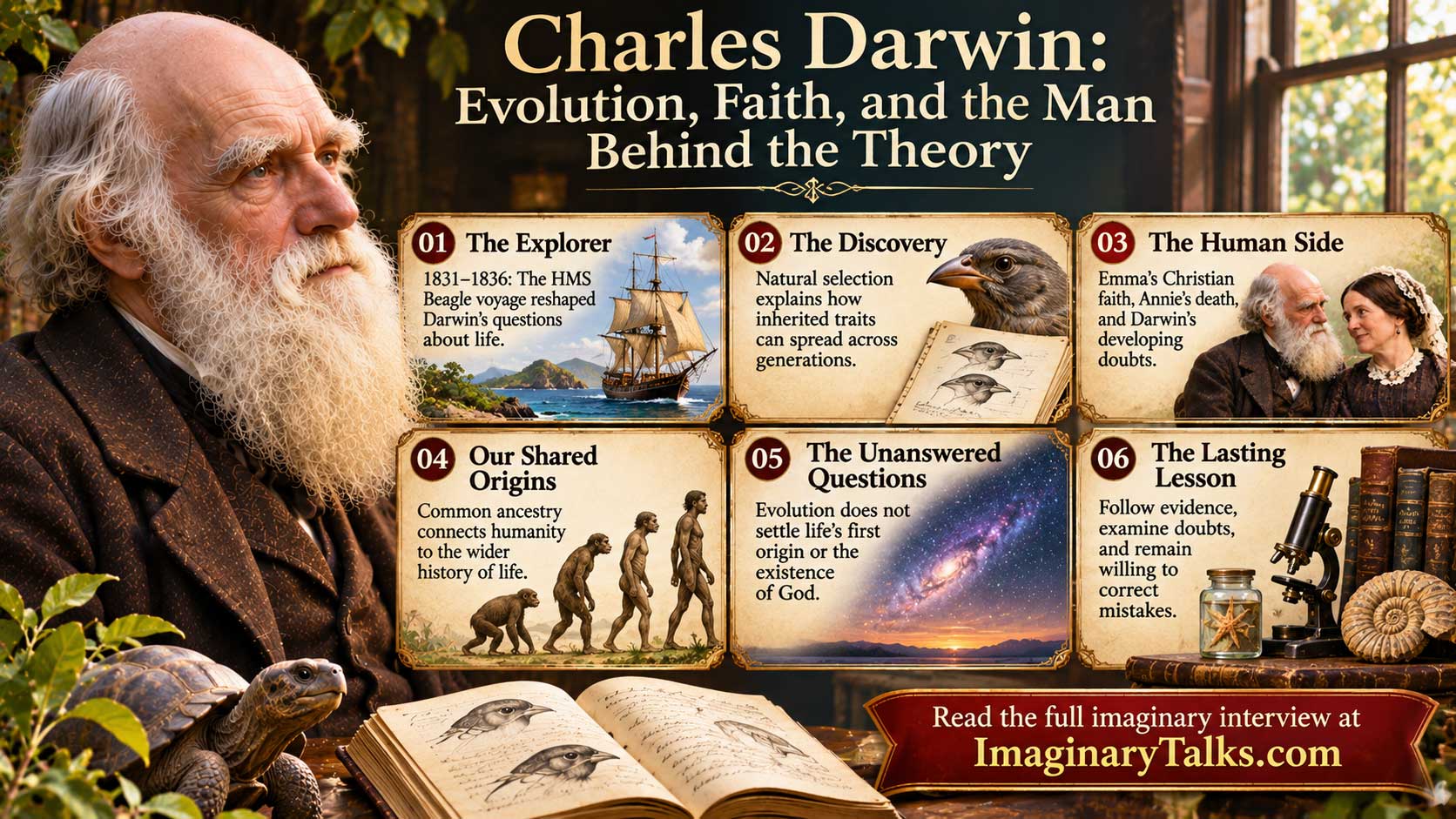
Short Bios:
Charles Darwin (1809–1882)
Charles Robert Darwin was an English naturalist whose theory of evolution by natural selection transformed modern biology. After studying at Edinburgh and Cambridge, he joined HMS Beagle on its expedition from 1831 to 1836. His research culminated in On the Origin of Species (1859), followed by The Descent of Man (1871) and numerous studies of plants, animals, and natural processes. Darwin married Emma Wedgwood in 1839, and they had ten children. He died in 1882 and was buried in Westminster Abbey. His scientific writings and historical materials are preserved in The Complete Work of Charles Darwin Online.
Emma Darwin (1808–1896)
Emma Wedgwood Darwin was Charles Darwin's wife, a member of the Wedgwood family, and a central figure in his personal life. A committed Christian, she expressed concern about her husband's developing religious doubts, particularly their implications for eternal life. Their surviving correspondence reveals both their differences and their enduring affection. Emma supported Charles through recurring illness and helped manage their large family and household. Her religious concerns can be explored through the Darwin Correspondence Project's collection on religion.
Alfred Russel Wallace (1823–1913)
Alfred Russel Wallace was a British naturalist, explorer, and biogeographer who independently developed the theory of evolution by natural selection. In 1858, Wallace sent Darwin an essay outlining a similar explanation of species change. Their work was jointly presented at the Linnean Society of London that year. Wallace made important contributions to the study of species distribution and geographical boundaries. His role in the discovery of natural selection is recognized by the Natural History Museum.
Charles Lyell (1797–1875)
Sir Charles Lyell was a Scottish geologist whose Principles of Geology profoundly influenced Darwin's thinking. Lyell argued that geological processes observable in the present could explain many features of Earth's past over immense periods. Darwin read his work during the Beagle voyage, and Lyell later helped arrange the 1858 presentation of Darwin's and Wallace's findings. His historical role is discussed in the Natural History Museum's account of the Darwin-Wallace paper.
John Stevens Henslow (1796–1861)
John Stevens Henslow was an English botanist, Anglican clergyman, and professor at the University of Cambridge. He became an influential mentor to the young Darwin, encouraging his interests in natural history and careful scientific observation. Henslow recommended Darwin for the voyage aboard HMS Beagle, helping create the opportunity that shaped Darwin's scientific career. His correspondence with Darwin forms part of the historical material preserved by the Darwin Correspondence Project.
Nick Sasaki
Nick Sasaki is the creator of ImaginaryTalks.com, a platform featuring imagined conversations with historical figures, scientists, philosophers, writers, and influential thinkers. Through historically informed fictional interviews, he explores their achievements, ideas, personal experiences, and enduring questions. His work encourages curiosity, thoughtful reflection, and meaningful conversations across different perspectives.
Leave a Reply