
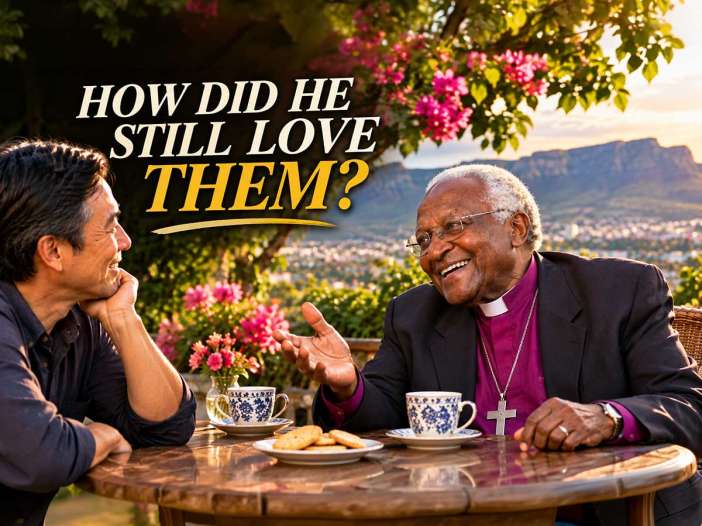
Introduction
Can you forgive someone who has caused unimaginable suffering? And can people who once regarded one another as enemies ever learn to live as one family?
These are questions that Archbishop Desmond Tutu carried into some of the darkest chapters of South African history. Yet anyone who remembers his infectious laughter, his mischievous smile, or his affectionate friendship with the Dalai Lama knows that there was something extraordinary about this man. He confronted cruelty without surrendering his love for humanity. He witnessed terrible suffering yet continued to speak about joy. He challenged those who held authority without losing his ability to embrace another person as a brother or sister. How did he do it? And what might his remarkable life teach us about our own?
Desmond Mpilo Tutu was born on October 7, 1931, in Klerksdorp, South Africa. His father was an educator, and his mother worked as a domestic worker. As a child, he experienced serious illness, including tuberculosis, and grew up amid the racial discrimination that shaped South African society long before apartheid became official government policy in 1948. He once hoped to become a physician, but financial limitations led him into teaching. Later, his opposition to the unequal education imposed on Black South Africans helped redirect his life into the Anglican ministry. The South African government's account of his life traces these formative experiences and the remarkable path that followed.
One childhood memory offers a glimpse into the values that shaped him. Tutu recalled watching the white Anglican priest Trevor Huddleston respectfully lift his hat to greet his mother. In a society where Black women were routinely denied such courtesy, the gesture made a lasting impression. It was not an elaborate speech about human equality. It was one person treating another with dignity. That simple encounter, documented in South African Broadcasting Corporation's biographical account, provides a deeply human starting point for this imaginary conversation.
As Tutu's responsibilities grew, so did his public opposition to apartheid. He became general secretary of the South African Council of Churches in 1978 and later Archbishop of Cape Town in 1986. He challenged racial discrimination, supported international pressure against the apartheid government, and called for a democratic society in which every person possessed equal dignity. In 1984, he received the Nobel Peace Prize for his leadership in the nonviolent struggle against apartheid. Yet the award did not end the suffering of the people he represented. Nelson Mandela remained imprisoned, apartheid continued, and Tutu's work was far from finished.
Following South Africa's democratic transition, Tutu took on one of the most emotionally demanding responsibilities of his life: chairing the Truth and Reconciliation Commission. Established in 1995, the commission heard testimony concerning killings, torture, disappearances, and other gross human rights violations committed during the apartheid era. Victims and families described losses that could never be undone. Perpetrators could seek amnesty under defined legal conditions, including full disclosure of qualifying politically motivated offenses. Tutu sometimes wept as he listened. The commission created an extensive historical record, yet its work raised enduring questions about justice, accountability, reparations, and the limits of reconciliation. Those questions remain visible in the official Truth and Reconciliation Commission reports.
But there was another side to Desmond Tutu that deserves equal attention. He was a husband to Leah, whom he married in 1955, and a father to four children. He was a man who enjoyed teasing his friends and whose laughter could fill a room. His friendship with the Dalai Lama became an extraordinary example of affection between two religious leaders whose spiritual traditions differed. Their conversations, captured in The Book of Joy, explored suffering, gratitude, compassion, and the possibility of finding joy amid life's difficulties. Tutu did not need everyone to share his Christian faith before recognizing their humanity. His friendship showed that deep convictions and genuine affection could exist together.
At the heart of Tutu's spiritual outlook was his Christian belief that human beings are loved by God, alongside the African ethical understanding of ubuntu: our humanity is inseparable from our relationships with others. For Tutu, unity did not require people to abandon their identities. It called them to recognize the dignity of those whose lives, beliefs, and histories differed from their own. He knew that such unity was difficult. South Africa's democratic transformation did not immediately resolve the country's economic inequalities or heal every wound left by apartheid. Yet he continued to believe that human beings could choose a different future.
In this five-part imaginary interview, Nick meets Desmond Tutu as a friend. Their conversation begins with the boy who once dreamed of becoming a doctor, follows the priest who challenged apartheid, enters the painful memories of the Truth and Reconciliation Commission, and explores his vision of forgiveness and human unity. Finally, they return to a quiet garden to speak about Leah, their children, friendship, laughter, and the ordinary joys of being alive. This is not an attempt to make Tutu into a flawless saint or to place modern words into the historical record. It is an invitation to encounter the humanity of a remarkable man, to listen to the convictions that shaped his life, and perhaps to leave the conversation feeling a little closer to one another.
Fictional Conversation Disclaimer
This is an imagined interview, not an actual conversation with Archbishop Desmond Tutu.
Desmond Tutu died on December 26, 2021. The dialogue, private encounters, garden conversations, emotional reactions, and responses attributed to him in this article are fictional reconstructions created for literary and educational purposes. They are not authentic quotations, recorded testimony, or statements personally endorsed by Tutu, his family, or organizations associated with his legacy.
The interview draws upon documented aspects of Tutu's life, public work, religious convictions, writings, and historical context. Some passages explore plausible personal reflections that cannot be verified as his actual private thoughts. The imagined settings and interactions with Nick are literary devices, not documented historical events.
Historical accounts of apartheid, the Truth and Reconciliation Commission, and the experiences of victims should be distinguished from the fictional dialogue. Readers seeking primary documentation are encouraged to consult the South African Department of Justice's TRC archive and the Desmond & Leah Tutu Legacy Foundation.
Topic 1: The Boy Who Discovered the Beauty of Every Human Being
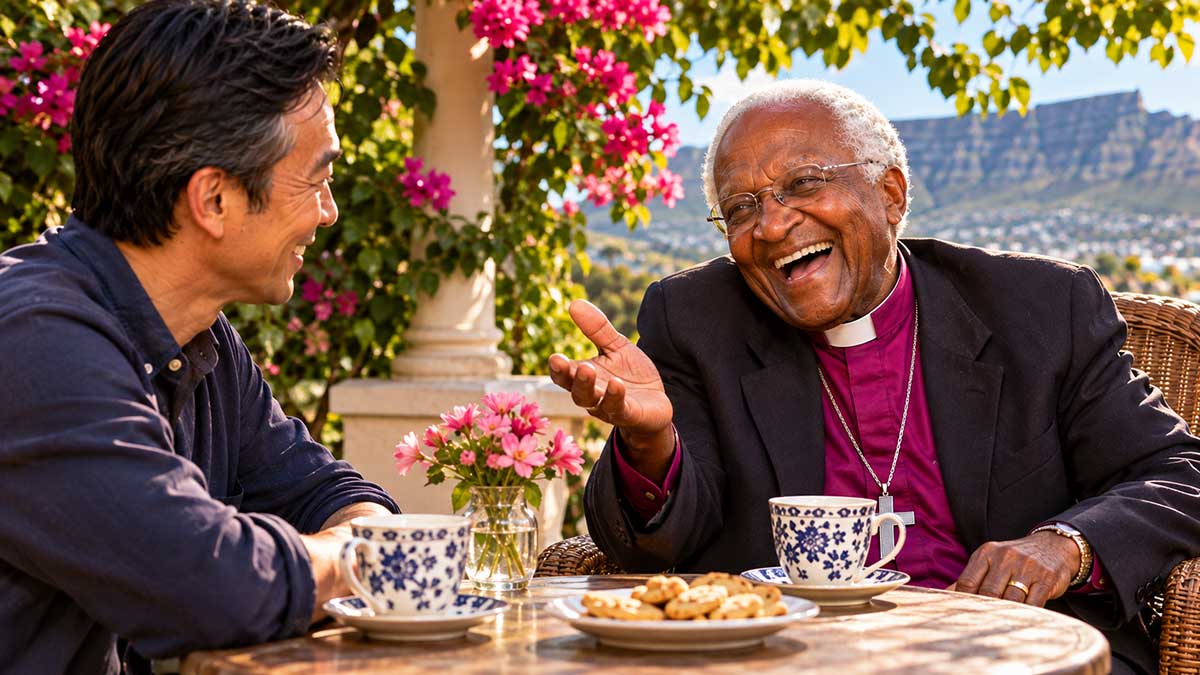
Opening: A Morning in the Garden
The morning sun falls gently across a garden veranda overlooking a quiet South African landscape. A few birds move among the flowering branches, and somewhere beyond the garden wall, the ordinary sounds of a waking neighborhood drift through the air.
Two cups of tea sit on a small wooden table.
Archbishop Desmond Tutu is already seated when Nick arrives. He wears his familiar clerical shirt, and his face brightens into a smile so generous that Nick finds himself smiling before either of them speaks.
Nick: Archbishop Tutu! What a pleasure to meet you.
Desmond Tutu: Oh, my dear fellow, please come, sit down! And don't look so serious. You are not here to confess your sins, are you?
Nick: (Laughing) Not today. Though I suppose I could keep you busy for quite a long time.
Desmond Tutu: Ah! Then perhaps we had better order more tea!
They laugh, and Nick settles into the chair opposite him.
Nick: I have been looking forward to meeting you. I've read about your life, and I've watched you speaking with people. What always strikes me is how easily you laugh.
Desmond Tutu: Well, you know, life gives us enough reasons to cry. We must not neglect the opportunities to laugh!
Nick: That's something I'd love to learn from you. But before we talk about the archbishop, the Nobel Peace Prize, or all the extraordinary things you accomplished, I'd like to meet the little boy who eventually became Desmond Tutu.
Desmond Tutu: (Chuckling) Oh dear. The little boy! You are going to uncover all my embarrassing secrets.
Nick: Only the good ones.
Desmond Tutu: Ah, but the embarrassing ones are often the best!
They share another laugh.
Question 1: Archbishop, what kind of little boy were you before the world knew your name?
Nick: Tell me about your childhood. What was your family like? What made you happy?
Desmond Tutu: I was born in Klerksdorp in 1931. My father, Zachariah, was a teacher. My mother, Aletta, worked very hard. We were not a wealthy family, you understand, but we had a home, we had one another, and we had the ordinary concerns of family life.
My father believed in education. He was a serious man in many respects, and I think the discipline of teaching was very much part of his character.
My mother was a remarkable woman. She worked in other people's homes, doing the kind of work that many people considered beneath their notice. Yet she possessed a dignity that no employer could give her or take away.
Nick: What do you remember most about her?
Desmond Tutu: Her perseverance. The way she cared for us. The ordinary things, you see.
When you are a child, you do not necessarily recognize the sacrifices your parents make. You see your mother going about her work, preparing things, looking after everyone, and you think this is simply how the world operates.
Only later do you begin to recognize how much love was being given to you every day.
Nick: That's so true. As children, we often don't recognize what our parents are doing for us until much later.
Desmond Tutu: Yes! And by then, of course, we have become parents ourselves, and our own children are busy taking us for granted!
He throws back his head and laughs.
Nick: (Laughing) So you were an ordinary boy in an ordinary family?
Desmond Tutu: Oh, wonderfully ordinary! I did not wake up each morning thinking, "One day I must become an archbishop and receive the Nobel Peace Prize."
Good heavens! I would have been quite unbearable!
Nick: Were you mischievous?
Desmond Tutu: I think most children have a little mischief in them. And I would be very suspicious of a child who never got into trouble!
But you must understand something about the world in which I grew up. We were children, yes, with our games and friendships and little ambitions. Yet around us was a society that insisted some human beings were more important than others.
That was the atmosphere of South Africa.
Nick: Did you understand that as a young boy?
Desmond Tutu: Not in the way an adult understands political systems.
Children first experience the world through what happens to them and the people they love. They notice who is treated kindly, who is spoken to harshly, who is welcomed, and who is made to feel unwelcome.
You do not need a university degree to recognize when someone is being humiliated.
Nick: And your family lived with that reality?
Desmond Tutu: Of course. Racial discrimination was woven into everyday life long before apartheid became the official policy of the government in 1948.
It shaped where people could live, what opportunities they had, and how they were treated.
Yet my childhood was not simply a story of discrimination. That would be terribly unfair to the people who loved me.
There was family. There was laughter. There were friendships. There were people who showed extraordinary kindness.
Those things were real, too.
Nick: I'm glad you said that. Sometimes when we read about someone who later becomes famous, we see their childhood only as preparation for what they eventually accomplished.
Desmond Tutu: Precisely! But a child is not merely an unfinished adult.
A child is already a person.
He pauses and looks out at the garden.
Desmond Tutu: Every child has a world inside them. Dreams, fears, questions, hopes. Every child deserves to be cherished.
Nick: Even the mischievous ones?
Desmond Tutu: Especially the mischievous ones!
His laughter returns, filling the veranda.
Question 2: Who first showed you what genuine love and kindness look like?
A breeze moves through the trees. Nick pours a little more tea into Tutu's cup.
Nick: You've spoken about your parents with such affection. Was there someone outside your family whose kindness stayed with you?
Desmond Tutu: Oh yes. Trevor Huddleston.
He was an Anglican priest, a member of the Community of the Resurrection, and he became a very important figure in my life.
Nick: What made him different?
Desmond Tutu: He treated Black people with a dignity that was astonishing in the South Africa of those days.
There is a memory I have often spoken about. I was walking with my mother when Father Huddleston encountered us. He lifted his hat in greeting to her.
Think of that.
A white priest showing that kind of courtesy to a Black woman in a society where Black people were so often treated as inferior.
Nick: Such a small gesture.
Desmond Tutu: Small? Ah, my friend, sometimes a gesture is small only to the person who performs it.
To the person receiving it, it can mean something enormous.
Nick: What did you feel?
Desmond Tutu: I was struck by the respect he showed her.
My mother did not suddenly become worthy of respect when he greeted her. She was already worthy of it. What mattered was that he recognized what was already true.
Nick: That's beautiful.
Desmond Tutu: And that is one of the great tragedies of prejudice. It persuades people that dignity is something they may distribute according to their preferences.
But dignity is not a prize awarded by the privileged.
It belongs to every human being.
Nick sits quietly for a moment.
Nick: You know, I think many of us remember someone who treated us kindly when they had no particular reason to do so. We may forget hundreds of other encounters, but that one stays with us.
Desmond Tutu: Yes. Kindness has a remarkable way of remaining in the memory.
And there is another thing. A person may never know how deeply a small act has affected someone else.
Father Huddleston could not have known every consequence of his example.
Nick: He probably didn't realize that a boy watching him would one day become Archbishop of Cape Town.
Desmond Tutu: (Laughing) No! And I suspect he would have been quite alarmed if someone had told him!
Nick: Your childhood wasn't always easy physically, either. You suffered some serious illnesses.
Desmond Tutu: Yes. I had polio as a child, and later tuberculosis. Tuberculosis was a frightening illness, particularly in those days.
I spent a considerable period in hospital.
Nick: That must have been terribly difficult for a young boy.
Desmond Tutu: It was a time of vulnerability. When you are ill, your world becomes very small. There is your bed, the people who care for you, the hope that you will recover.
You become aware of how dependent we are on others.
Nick: Did being ill change how you looked at people?
Desmond Tutu: I would be careful about pretending that I understood everything at the time.
A sick child is often simply a sick child, wanting to get well!
But looking back, I can recognize how much my life depended on the care of other people.
We like to think of ourselves as independent, don't we? Strong individuals who can manage everything.
And then illness comes, and suddenly we need someone to bring us water, sit beside us, or offer a reassuring word.
Nick: Sometimes just having someone sit beside you makes a difference.
Desmond Tutu: Oh yes. You do not always need an extraordinary speech.
Sometimes the most loving thing a person can do is remain present.
Nick: That reminds me of how much your mother must have worried when you were ill.
Desmond Tutu: I can scarcely begin to speak for everything she felt. But I know what it means for a family to have a sick child.
And I know how much we owe to people whose care is never celebrated in public.
We give prizes to famous people. We put their names in newspapers.
But there are mothers and fathers, nurses and teachers, ordinary people, who give their lives to caring for others without ever receiving an award.
Nick: And you became one of the people who received a very famous award.
Desmond Tutu: (Laughing) Yes! Which makes it especially important that I should not become too impressed with myself!
They laugh together.
Desmond Tutu: You see, Nick, I have been fortunate to receive honors. But the people who taught me about love were not necessarily people with titles.
Many were people whose names the wider world would never know.
He looks down briefly at his teacup.
Desmond Tutu: And their lives mattered just as much.
Question 3: You once dreamed of becoming a doctor. How did that young boy eventually find his calling?
Nick: There's something about your early life that surprised me. You originally wanted to become a doctor.
Desmond Tutu: Ah, yes! A doctor!
Nick: I can picture you walking into a hospital room and making all the patients laugh.
Desmond Tutu: (Laughing) Perhaps! Though I hope I would have remembered to examine them occasionally!
Nick: What attracted you to medicine?
Desmond Tutu: I was interested in helping people. Medicine seemed a wonderful way to do that.
And having experienced serious illness myself, I knew something of what it meant to need medical care.
I did well enough academically to pursue that ambition, but my family could not afford the training.
Nick: Was that disappointing?
Desmond Tutu: Of course it was disappointing. When you are young, you make plans. You picture the future taking a certain shape.
And then life tells you that the road you had chosen is not available.
Nick: What did you do?
Desmond Tutu: I became a teacher, following my father's profession.
Teaching was important work. You were dealing with young people, helping them develop their minds and discover what they might become.
I taught at school, and I married my dear Leah in 1955.
Nick: So your life was beginning to take shape.
Desmond Tutu: Yes. We were a young married couple. There were responsibilities, hopes, and all the ordinary concerns of building a life together.
But South Africa was changing in deeply troubling ways.
The government had introduced the Bantu Education system, which sought to prepare Black children for a restricted place in society.
Nick: And you couldn't accept that?
Desmond Tutu: I could not reconcile it with what education ought to mean.
A child comes into a classroom with possibilities that no government has the moral right to diminish simply on account of race.
Education should help children discover what they can become.
But here was a system built upon the assumption that Black children should expect less.
Nick: That must have been especially painful for someone who loved teaching.
Desmond Tutu: It was a serious matter of conscience.
Eventually I left teaching and entered theological training.
Nick: Was becoming a priest something you had always planned?
Desmond Tutu: Not in the straightforward way you might suppose.
My life did not follow a neat plan. There were opportunities I could not pursue, decisions I had to make, and people who helped me along the way.
I entered the ministry, was ordained, and later continued my theological studies in Britain.
But you must not picture all of this as a young man who knew exactly where his life was going.
I certainly did not know that I would one day be speaking to presidents, challenging governments, or receiving international awards.
Nick: Or having tea with me.
Desmond Tutu: Ah! That is surely the most unexpected development of all!
Both men burst into laughter.
Nick: Looking back, do you think you would have been happy as a doctor?
Desmond Tutu: I might have been very happy. There is great dignity in caring for people who are sick.
But we cannot live every possible life, can we?
We live the one that unfolds before us, and we must decide what to do with the opportunities and responsibilities we encounter.
Nick: You didn't become a doctor, but in a different way, you spent much of your life trying to help heal people.
Tutu considers the thought.
Desmond Tutu: That is a kind way of putting it.
But I would not want us to make the story too tidy.
A doctor treats illness. A teacher helps children learn. A priest has responsibilities of worship, pastoral care, and spiritual guidance.
And sometimes a priest finds that the suffering of the people around him demands that he speak publicly.
Nick: Is that what happened to you?
Desmond Tutu: Yes. Over time, I became increasingly convinced that faith could not be separated from the way human beings were being treated.
What could it mean to preach about God's love and then remain indifferent when people were humiliated?
What could it mean to speak about the dignity of God's children and then accept a system that denied that dignity to millions?
Nick: When you say "God's children," I can hear how personal that belief is for you.
Desmond Tutu: Oh, it is very personal.
For me, faith was never simply a collection of ideas to be discussed on a Sunday.
It had to do with the person standing in front of you.
The child who needed an education.
The mother who deserved respect.
The person who was frightened or ill.
The neighbor whom society told you to despise.
He leans forward slightly.
Desmond Tutu: If we say that human beings are precious in God's sight, then we must take that seriously when we meet one another.
Nick: I think that's what people feel when they listen to you. You speak about humanity with such affection.
Desmond Tutu: (Smiling) Ah, but humanity can be very troublesome!
Nick: (Laughing) Yes, we certainly can.
Desmond Tutu: We are capable of astonishing kindness, and we are capable of terrible cruelty.
That is why we must keep reminding one another of the dignity we share.
Not just in our speeches.
In our actions.
Closing: The Small Things That Stay With Us
The sunlight has shifted across the veranda. Their tea has grown cool, and the garden is filled with the soft sounds of late morning.
Nick looks at the man across from him, whose laughter seems never far away, even when he speaks about painful memories.
Nick: Archbishop, we've talked about your parents, Father Huddleston, your illness, and the dreams you had as a young man. I expected to hear about the beginnings of a remarkable life. But what stays with me most is that simple moment when Father Huddleston greeted your mother with respect.
Desmond Tutu: Yes. Such a small thing.
Nick: Yet you remembered it for the rest of your life.
Desmond Tutu: There are moments when someone reminds us of something we should never have forgotten.
That we belong to one another.
That the person before us is not beneath us.
That every human being is worthy of dignity.
He smiles.
Desmond Tutu: And sometimes all of that can be expressed by a gentleman lifting his hat.
Nick smiles back.
Nick: I wish more people understood that.
Desmond Tutu: Well, my dear Nick, perhaps we should begin by practicing it ourselves.
Nick: Fair enough.
Desmond Tutu: And perhaps by remembering to be kind to the person who brings us our tea!
Nick: (Laughing) I think that's an excellent place to start.
They share another warm laugh.
For a moment, neither feels the need to speak.
Then Nick glances toward the distant rooftops.
Nick: Archbishop, there's something I'd love to ask you next. You were such a warm, compassionate person, yet you eventually stood up against one of the most unjust political systems of your time.
How did that gentle boy become a man willing to challenge a government?
Tutu's smile softens. He sets down his cup.
Desmond Tutu: Ah, Nick. You see, sometimes love asks more of us than we ever expected.
The conversation continues.
Topic 2: When Love Demands the Courage to Resist
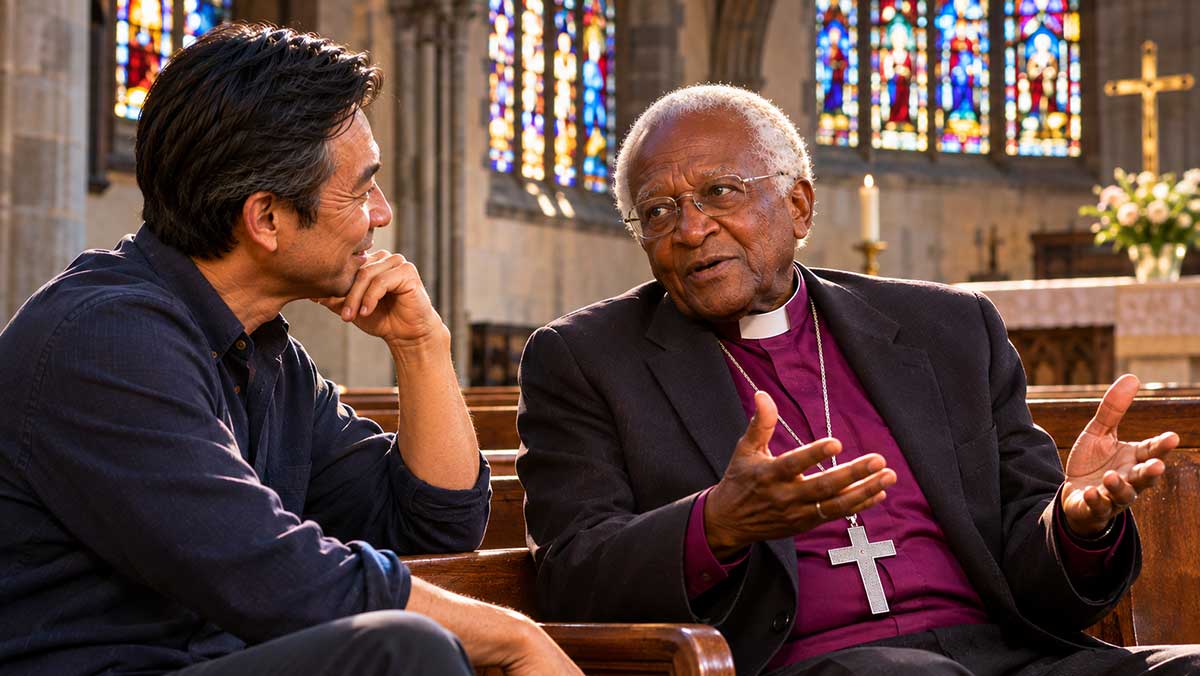
Opening: The Church Where Silence Was No Longer Possible
Late morning sunlight passes through the stained-glass windows of a quiet Anglican church in Cape Town. Colors fall across the wooden pews and the polished stone floor.
The morning service has ended. The last visitors have departed, leaving behind the faint scent of candle wax and old wood.
Desmond Tutu and Nick sit together near the front of the church.
For a moment, Tutu gazes at the altar. His face carries the peaceful expression of someone who has spent much of his life in places like this.
Nick: Archbishop, this is a beautiful church.
Desmond Tutu: Ah, yes. I have always loved churches. They can be wonderful places to pray, to sing, to find a little peace.
Nick: And occasionally to escape people asking difficult questions?
Desmond Tutu: (Laughing) Oh, my dear Nick! If only that were possible! Sometimes the most difficult questions are waiting for us right here.
Nick: I suppose that's true.
Desmond Tutu: You know, people sometimes think a priest spends his days speaking about heaven and leaving the troubles of the world outside the church doors.
But what happens when the people who come through those doors are hungry? Or frightened? Or being treated as though their lives have little value?
He turns toward Nick.
Desmond Tutu: You cannot simply tell them to come back next Sunday and sing a little louder.
Nick: You spent much of your life refusing to separate faith from what was happening outside these walls.
Desmond Tutu: Yes. Though I must tell you, I did not begin my ministry with some grand ambition to become a political figure.
Nick: That is exactly what I'd like to ask you about.
Tutu smiles.
Desmond Tutu: Ah! The notebook returns!
Nick: (Laughing) I'm afraid so.
Question 4: When did you realize that loving people meant standing against apartheid?
Nick: You left teaching partly in response to the Bantu Education system. Later, as a priest, you became one of apartheid's most prominent critics. How did that happen?
Desmond Tutu: It happened over time, Nick.
You must understand that apartheid was not simply a collection of unpleasant attitudes. It was a system of laws and institutions that organized people's lives according to racial classifications.
Where you could live. Where you could travel. What kind of education your children could receive. What opportunities were available to you.
It affected nearly every part of daily life.
Nick: And people were expected to accept it?
Desmond Tutu: The government certainly expected us to accept it!
He gives a short laugh, then grows serious.
Desmond Tutu: But consider what it meant for a Christian minister.
We proclaimed that human beings were created in God's image. We spoke of God's love for His children.
Then we walked outside and encountered a society that treated some of those children as though they were less worthy than others.
How could we reconcile those things?
Nick: Did you ever think that speaking out might distract you from your work as a priest?
Desmond Tutu: Some people believed that priests should stay away from politics.
But I would ask them a question.
If a child is denied a decent education on account of race, is that merely a political matter?
If a family is forcibly removed from its home, is that merely a political matter?
If someone is imprisoned for demanding basic human rights, should a priest say, "I am sorry, but that is outside my department"?
Nick: You couldn't do that.
Desmond Tutu: I could not accept that separation.
Faith had to mean something in the lives of real people.
And I was not alone. There were many religious leaders, community organizers, students, workers, and ordinary families who resisted apartheid.
Some paid a terrible price.
Nick: When you became general secretary of the South African Council of Churches in 1978, you gained a much larger public platform.
Desmond Tutu: Yes. The Council of Churches gave us an opportunity to speak collectively, to support people who were suffering, and to challenge injustice.
It was a very difficult period.
The events of Soweto in 1976 had revealed, with terrible clarity, the violence that the government was prepared to use against young people.
Nick: Students protesting their education.
Desmond Tutu: Children and young people who wanted to be treated with dignity.
Think of the parents.
They sent their children to school, expecting them to return home.
And then came the news of shootings, injuries, deaths.
He falls silent for a moment.
Desmond Tutu: When you think about apartheid only in terms of laws, you can miss the human suffering.
But every law affected somebody's child, somebody's mother, somebody's father.
Nick: You saw the families behind the headlines.
Desmond Tutu: That was what mattered.
The government could speak about order, security, and the preservation of its system.
But the people living under that system were not abstractions.
They were human beings.
Nick: Did your faith ever make you angry about what was happening?
Desmond Tutu: Oh, certainly!
People sometimes seem surprised that a religious person can become angry.
But why should love make us indifferent to cruelty?
If you love a child, you become angry when someone deliberately hurts that child.
If you care about your neighbors, you cannot be unconcerned when they are humiliated.
Nick: So anger wasn't necessarily the opposite of love?
Desmond Tutu: No. But anger is dangerous when we allow it to turn into hatred.
Anger may alert us that something is terribly wrong.
The question is what we do with it.
Do we use it to seek justice?
Or do we allow it to consume us until we begin treating other people as though they are no longer human?
Nick: That must have been difficult during apartheid.
Desmond Tutu: It was difficult. And I would never pretend otherwise.
But I believed that apartheid was wrong precisely on account of the dignity of human beings.
If I then denied the humanity of those who supported apartheid, I would be contradicting something fundamental in my own convictions.
He smiles gently.
Desmond Tutu: That did not mean I had to agree with them!
Nick: (Laughing) I don't think anyone could accuse you of agreeing with them.
Desmond Tutu: No, indeed!
His laughter echoes softly through the church.
Question 5: How did you find the courage to face people who hated what you stood for?
Nick: Archbishop, when I look at photographs of you speaking at protests or standing before enormous crowds, you seem so fearless.
Were you?
Desmond Tutu: (Laughing) Oh, my dear fellow, photographs can be very misleading!
Nick: So you were afraid sometimes?
Desmond Tutu: Of course. We were living in a country where people could be detained, beaten, imprisoned, or killed.
Many people involved in the struggle faced extraordinary danger.
It would be foolish to pretend that fear was absent.
Nick: What helped you continue?
Desmond Tutu: Faith was central to my life.
Prayer, worship, the support of colleagues, and the courage of ordinary people sustained me.
And there was something else.
When you see people who have so little, yet still stand up and say that they deserve to be treated as human beings, you cannot help being moved by their courage.
Nick: Did you ever feel responsible for encouraging people to take risks?
Desmond Tutu: That was a serious responsibility.
I was conscious that words spoken from a pulpit or at a public gathering could have consequences.
And those consequences were not always borne by the person speaking.
People could lose their jobs. Families could suffer. Young people could be arrested.
We had to think about those realities.
Nick: You became a strong advocate for international economic sanctions against South Africa.
Desmond Tutu: Yes. I believed that the international community should place pressure on the apartheid government.
There were people who objected that sanctions might cause economic hardship.
That was not an insignificant concern.
But we had to ask what would happen if the system continued without meaningful pressure.
Nick: How did you think about the ordinary workers and families who might suffer economically?
Desmond Tutu: Their suffering mattered.
I did not want people to lose their livelihoods.
But the existing system was already denying people opportunities, freedom, and dignity.
We had to consider whether international pressure could help bring about change.
It was not a decision to be treated lightly.
Nick: Were there moments when you felt that the struggle might never end?
Desmond Tutu: There were certainly times when progress seemed painfully slow.
You would see people marching, organizing, praying, appealing to the government.
And then another arrest. Another act of violence. Another disappointment.
It could be exhausting.
Nick: How did you keep going?
Desmond Tutu: Sometimes you must look beyond the immediate moment.
You remember the people for whom you are struggling.
You remember that injustice is not made acceptable simply by lasting a long time.
And you remember that you are not alone.
Nick: You were known for your sense of humor, even during these difficult years. Was laughter a way of coping?
Desmond Tutu: Laughter can be a wonderful gift.
It reminds us that those who oppress others do not possess every part of our lives.
They may control many things, but they need not control every moment of joy.
Nick: I love that.
Desmond Tutu: And sometimes the absurdity of human behavior is simply too much!
Imagine people creating elaborate laws to determine where someone may sit, walk, or live, all on account of the color of their skin.
What an extraordinary waste of human energy!
Nick: When you put it that way, it sounds ridiculous.
Desmond Tutu: It was ridiculous, and it was cruel.
We must never forget the cruelty.
But there are moments when laughter exposes the foolishness of prejudice.
Nick: Did you ever worry about what your family was going through?
Tutu's expression becomes more thoughtful.
Desmond Tutu: My public responsibilities affected our family, certainly.
Leah and our children lived with the demands and uncertainties of those years.
And Leah was not simply standing in the background. She had her own commitments and her own work.
She was a strong person.
Nick: We'll talk more about her later. I would love to hear about the woman who shared so much of your life.
Desmond Tutu: Ah, yes! You must be careful, Nick. Once I begin speaking about Leah, you may never get me to stop!
Nick: (Laughing) I'm looking forward to that.
Desmond Tutu: Good! Then we shall save some tea for later.
Question 6: When you received the Nobel Peace Prize, whose faces came to your mind?
The light has moved across the church floor. Nick looks toward the stained-glass windows before returning his attention to Tutu.
Nick: In 1984, you received the Nobel Peace Prize. What was that moment like?
Desmond Tutu: It was an extraordinary honor.
But I understood that the award was not simply about Desmond Tutu.
It drew international attention to the struggle against apartheid and to the people who had endured so much.
Nick: Did it feel like a victory?
Desmond Tutu: It was encouraging, certainly.
But apartheid had not ended.
Nelson Mandela was still imprisoned. Many others remained detained or restricted. Families were still suffering.
So the award was a moment of recognition, not the completion of the struggle.
Nick: When you stood before the world, were you thinking about the people back home?
Desmond Tutu: They were very much part of what the award represented.
The people who marched, organized, worshipped, cared for prisoners' families, and continued resisting despite the dangers.
There were so many whose courage would never be celebrated internationally.
Nick: Were there people you wished could have shared that moment with you?
Desmond Tutu: The recognition belonged to a struggle involving countless people.
I would not want to invent a private list of faces for you, but I can say that the people of South Africa, especially those suffering under apartheid, were central to what the honor meant.
Nick: That's what strikes me. The world saw one man receiving a prize, but behind him were millions of people whose lives were affected by the struggle.
Desmond Tutu: Yes.
And you know, there is something rather amusing about these grand occasions.
Nick: What's that?
Desmond Tutu: People dress you in splendid clothes, introduce you with very important titles, and suddenly everyone expects you to become terribly solemn!
Nick: (Laughing) And you couldn't manage that?
Desmond Tutu: I tried! But I am afraid I have never been entirely successful at appearing important.
Nick: I think that's part of why people love you.
Desmond Tutu: Oh, you are very kind.
He smiles, then continues more quietly.
Desmond Tutu: But there was a serious responsibility attached to that recognition.
If the world was listening, then we had to speak clearly about what was happening in South Africa.
We had to keep drawing attention to injustice.
Nick: Did the prize change how the government treated you?
Desmond Tutu: It increased my international visibility.
That visibility could offer a degree of protection and give our appeals greater reach, but it did not eliminate danger or hostility.
And it certainly did not mean the government suddenly agreed with me!
Nick: I can imagine.
Desmond Tutu: No, my dear fellow, they were not sending me flowers every morning!
Both men laugh.
Nick: Looking back, what do you think mattered most about those years?
Desmond Tutu: That people refused to surrender their dignity.
There were individuals who faced terrible circumstances and continued to believe that South Africa could become a different kind of country.
Not a country in which one racial group simply replaced another as the privileged rulers.
A country in which people could live together as equals.
Nick: Was that always your hope?
Desmond Tutu: Yes. We wanted an end to apartheid, but we needed something more than the removal of unjust laws.
We needed a society in which people could recognize one another's humanity.
Nick: Including the people who had supported apartheid?
Desmond Tutu: Including them.
That was one of the difficult parts.
It is relatively easy to speak about loving humanity when we are thinking only of people we like.
The challenge comes when we encounter those whose actions we find deeply wrong.
Nick: And you still believed they could change?
Desmond Tutu: I believed that people were capable of change.
That did not excuse what they had done.
It meant that we should not abandon the possibility of transformation.
He looks toward the altar.
Desmond Tutu: My faith taught me that no human being should be reduced entirely to the worst thing they have done.
But faith did not permit us to ignore the suffering they had caused.
Both truths mattered.
Closing: The Courage to Love
For a few moments, the church is quiet.
The sunlight has softened, and the distant sounds of Cape Town drift faintly through the open doors.
Nick: Archbishop, when we started talking, I was thinking about your courage. Standing against apartheid, speaking publicly, facing hostility.
But now I think there's something even more remarkable.
You were fighting a system that treated people as less than human, yet you refused to give up your belief in their humanity.
Desmond Tutu: That was certainly what I tried to do.
And I did not do it perfectly. No one does.
But I believed that if we wanted a different South Africa, we had to begin with a different understanding of one another.
Nick: Even when that was difficult.
Desmond Tutu: Especially when it was difficult.
He smiles.
Desmond Tutu: You know, Nick, loving people is a very troublesome business.
Nick: (Laughing) I'm beginning to see that.
Desmond Tutu: They disappoint you. They frustrate you. Sometimes they behave terribly.
And then, just when you are ready to give up on humanity, someone does something so generous, so courageous, so unexpectedly kind, that your heart is filled with gratitude again.
Nick: You've seen both sides of humanity.
Desmond Tutu: Oh yes.
And the struggle against apartheid taught us something important.
We could fight injustice without surrendering the belief that people were capable of becoming better than they had been.
Nick: You know, there's something I've been wanting to ask you since we began talking.
Desmond Tutu: Ah, another question! I should have known!
Nick: (Smiling) This one is difficult.
Desmond Tutu: Then perhaps I should sit down.
Nick: You already are.
Desmond Tutu: (Laughing) Excellent! I am prepared!
Nick smiles, then grows thoughtful.
Nick: After apartheid ended, you were asked to help a country confront terrible things people had done to one another.
You listened to stories of suffering that most of us can barely comprehend.
How could anyone carry that much pain and still believe in forgiveness?
Tutu's laughter fades into a gentle, reflective expression.
He looks down at his hands for a moment.
Desmond Tutu: Ah, Nick.
That is a very difficult question.
And it takes us to some of the most painful experiences of my life.
The conversation continues.
Topic 3: The Tears of Forgiveness
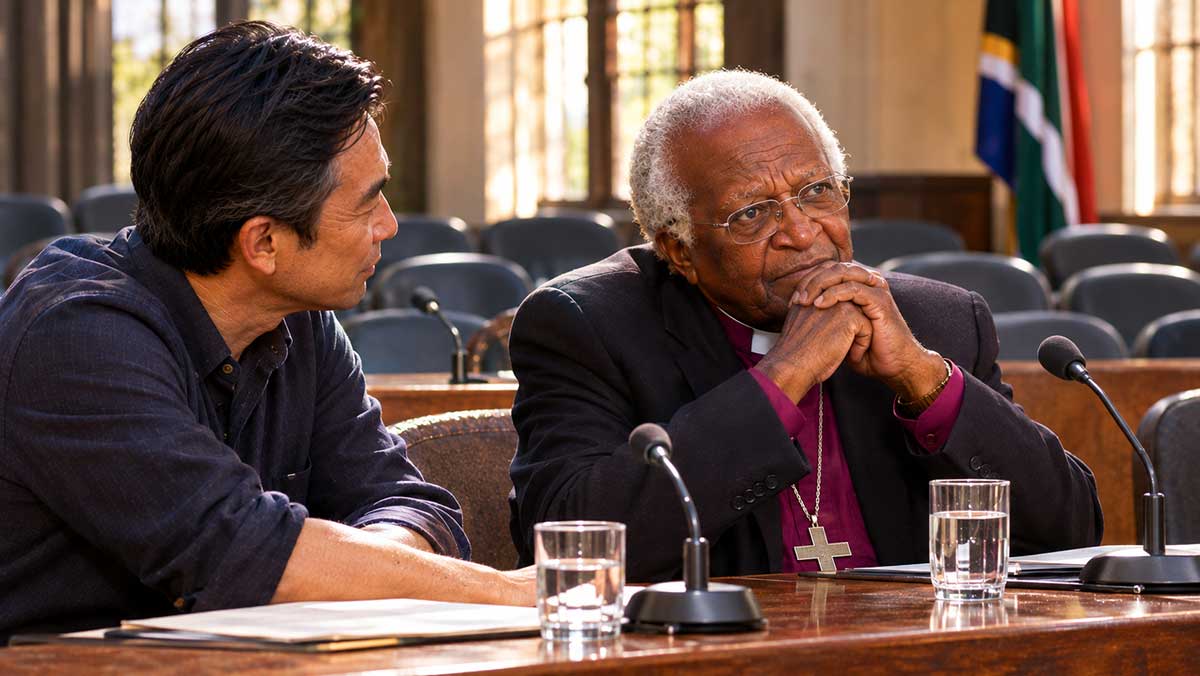
Opening: The Room Where People Told the Truth
The room is quiet now.
Afternoon sunlight enters through tall windows, falling across rows of empty wooden chairs. At the front stands a long table with several microphones. A glass of water sits beside a small stack of papers.
It is an imagined return to a room like those used for South Africa's Truth and Reconciliation Commission hearings.
For years, rooms such as this welcomed people who had carried terrible memories in silence. Some came to describe what had happened to their loved ones. Others came to acknowledge crimes they had committed. Many came hoping that someone, at last, would listen.
Desmond Tutu stands near the front of the room.
Nick watches him quietly.
The laughter that filled their earlier conversations has given way to a gentler stillness.
Nick: Archbishop, it's hard to believe how much pain was shared in rooms like this.
Desmond Tutu: Yes, Nick. So much suffering.
He looks across the empty chairs.
Desmond Tutu: People came carrying memories that had lived with them for years. Some had lost husbands, wives, children, parents. Others had survived imprisonment, torture, or terrible humiliation.
And for many, there had been no opportunity to tell their stories publicly.
Nick: It must have taken tremendous courage just to walk through those doors.
Desmond Tutu: Oh, yes.
Sometimes we speak about courage as though it belongs only to people who stand before great crowds or confront governments.
But think of a mother who has spent years wondering what happened to her child.
And then, one day, she sits before strangers and begins to speak.
That, too, is courage.
Nick: Were you ever afraid that listening to so much suffering would become overwhelming?
Tutu pulls out a chair.
Desmond Tutu: Come, my friend. Sit with me.
Nick sits beside him rather than across the table.
For a moment, they look out at the empty room together.
Question 7: Archbishop, when you listened to people describe their suffering, what stayed with you afterward?
Nick: You chaired the Truth and Reconciliation Commission beginning in the mid-1990s. You heard testimony from people whose lives had been shattered under apartheid.
What was it like to listen to them?
Desmond Tutu: It was a profound responsibility.
You must understand that the commission was not simply an exercise in collecting information.
These were human beings.
They were not statistics.
They were people who had loved someone, expected that person to come home, and then found their lives changed forever.
Nick: Did you ever feel that words were inadequate?
Desmond Tutu: Frequently.
What can you say to someone who has lost a child?
What sentence could possibly restore what has been taken?
There are moments when words seem terribly small.
Nick: Then what can you do?
Desmond Tutu: You can listen.
You can acknowledge the suffering.
You can refuse to turn away.
He pauses.
Desmond Tutu: For many years, people had been told, in one way or another, that their pain did not matter.
The commission offered a public opportunity for people to say what had happened to them and to have those experiences recognized.
That did not undo the harm.
But recognition mattered.
Nick: You sometimes cried during the hearings.
Desmond Tutu: Yes.
I was not always able to contain my emotions.
Nick: Did you ever feel embarrassed about crying in front of everyone?
Desmond Tutu: (Smiling faintly) Well, I suppose an archbishop is expected to maintain a certain dignity!
But I could hardly sit there listening to such terrible accounts and behave as though nothing had touched me.
Nick: Some people might say the chairman should remain detached.
Desmond Tutu: A commission must act fairly, of course.
But fairness does not require us to become indifferent to suffering.
We were dealing with people whose lives had been profoundly affected by violence.
Compassion was not an obstacle to recognizing their humanity.
Nick: Was there a particular testimony that stayed with you?
Desmond Tutu: There were many.
I would not want to select a story casually or speak as though I could represent everything a survivor experienced.
But I can tell you that the testimony revealed both terrible cruelty and remarkable human courage.
People spoke about killings, disappearances, torture, and the long years of uncertainty that followed.
And sometimes what struck me was the love that remained.
Nick: The love?
Desmond Tutu: Yes.
A person might speak about someone who had died, and suddenly you would hear about their laughter, their habits, the little things they used to do at home.
For a moment, the person who had been reduced to a victim in the public record became a husband, a daughter, a friend.
Someone who had been loved.
Nick: That's heartbreaking.
Desmond Tutu: It is.
And it reminds us that when a human life is taken, the loss extends far beyond one individual.
There are people who will never hear that person's voice again.
Children who will grow up without a parent.
Parents who will never see their child grow older.
Nick: How did you go home after hearing those stories?
Tutu is quiet for a moment.
Desmond Tutu: Prayer was important to me. My faith, my family, and the support of others sustained me.
But I would not want to suggest that there was some simple method by which the suffering disappeared at the end of the day.
These were serious matters.
And the people who had experienced the violence carried burdens far greater than those of us who listened.
Nick: You never wanted the attention to move away from them.
Desmond Tutu: Exactly.
The commission was not about the emotions of Desmond Tutu.
It was about the people of South Africa and the truth that needed to be acknowledged.
Nick: I appreciate that.
Desmond Tutu: And you know, Nick, sometimes listening is more difficult than speaking.
Nick: I think that's true.
Desmond Tutu: Especially for people like us who enjoy talking!
He smiles, and Nick laughs softly.
Nick: I'll accept that criticism.
Desmond Tutu: (Chuckling) Ah, good! Then we are making progress already.
Their laughter is brief, but it brings a little warmth back into the room.
Question 8: What would you say to someone whose heart has been hurt so deeply that forgiveness feels impossible?
Nick: Archbishop, may I ask you something very personal?
Desmond Tutu: Of course, my friend.
Nick: Suppose someone has lost a loved one through terrible violence.
Years pass. The person responsible has never apologized.
And someone tells the grieving family that they should forgive.
But they simply cannot.
What would you say to them?
Tutu leans back in his chair.
For several moments, he says nothing.
Desmond Tutu: First, I would want to listen.
I would not begin by giving them instructions.
Nick: You wouldn't tell them that forgiveness is their duty?
Desmond Tutu: I would be very careful about placing another burden on someone who has already suffered so much.
Forgiveness is a deeply personal matter.
It cannot be made meaningful by demanding it from someone.
Nick: But you believed so strongly in forgiveness.
Desmond Tutu: Yes, I did.
I believed forgiveness could open possibilities that revenge could not.
But that is not the same as saying that every wounded person must forgive immediately, or that their suffering should be minimized.
Nick: What if they say, "I want justice, not forgiveness"?
Desmond Tutu: Then we must take their demand for justice seriously.
Forgiveness does not make wrongdoing acceptable.
It does not mean that a murder was not a murder.
It does not restore a life that has been taken.
Nick: And it doesn't necessarily remove the need for accountability.
Desmond Tutu: Precisely.
The Truth and Reconciliation Commission operated within a particular legal and political framework.
Some perpetrators could apply for amnesty if they met the legal requirements, including full disclosure of politically motivated crimes.
But the commission's work was never simply a matter of asking victims to forget.
Nick: Still, some victims felt that the process did not give them enough justice.
Desmond Tutu: Yes. There were serious criticisms, and they must be heard.
No commission could undo the suffering of apartheid.
And the question of how a society repairs the damage of the past extends beyond testimony and amnesty.
Nick: If someone never receives an apology, can forgiveness still happen?
Desmond Tutu: It can be possible.
But I would not pretend that the absence of acknowledgment makes the task easy.
There is a difference between a person choosing to release hatred from their heart and two people rebuilding a relationship.
Reconciliation between people requires more than one person's willingness.
Nick: So forgiveness and reconciliation aren't exactly the same thing.
Desmond Tutu: No.
A person may seek freedom from bitterness without trusting the person who harmed them.
And trust, once destroyed, may require a long time to rebuild.
Sometimes it cannot be restored.
Nick: That's important.
Desmond Tutu: Very important.
We should not use beautiful words to hide difficult realities.
Nick: May I ask you something else?
Desmond Tutu: Ah, another difficult question?
Nick: I'm afraid so.
Desmond Tutu: (Smiling) Then I shall have to send you a bill for all this counseling!
Nick laughs.
Nick: What if the person who was hurt says, "I don't want to forgive. I want the person who did this to suffer as I have suffered"?
Desmond Tutu: I would recognize the depth of their pain.
Anger is a human response to injustice.
But I would gently ask whether causing more suffering could truly restore what was lost.
Nick: And if they say no, but they still want revenge?
Desmond Tutu: Then perhaps we continue talking.
Perhaps we listen a little longer.
We cannot always change a person's heart through a single conversation.
He looks at Nick.
Desmond Tutu: You know, we are often terribly impatient with one another.
We want people to heal according to our timetable.
We want them to arrive at forgiveness before they have even had the opportunity to speak about their pain.
But human hearts do not work like railway schedules.
Nick: (Smiling) That's a wonderful way of putting it.
Desmond Tutu: And I have never known a train to become more punctual simply through being shouted at!
They share a quiet laugh.
Nick: So what would you hope for that person?
Desmond Tutu: I would hope that their suffering would not have the final word over the rest of their life.
That they might find peace.
That they might receive justice where justice is possible.
And that, in time, they might discover a way to live without being imprisoned by what someone else did to them.
Nick: That's a very compassionate answer.
Desmond Tutu: It is what I would hope to offer.
But I would never claim that I could fully know the pain of every person who sat before us.
Each life is different.
Each loss is different.
And each person's response deserves respect.
Question 9: After everything you witnessed, what kept your heart from becoming filled with hatred?
The afternoon light has softened. Outside the windows, a bird settles briefly on a branch before flying away.
Nick: Archbishop, you've spent so much of your life confronting injustice.
You saw what apartheid did to people. You listened to heartbreaking testimony. You faced hostility from those who opposed you.
Yet you continued to speak about love and forgiveness.
How?
Tutu smiles gently.
Desmond Tutu: Ah, Nick. You make it sound as though I were some extraordinary creature who never became angry!
Nick: (Laughing) I was wondering about that.
Desmond Tutu: Oh, I became angry. Certainly.
I was deeply disturbed by the suffering caused by apartheid.
And I was not immune to frustration or disappointment.
Nick: Then what prevented that anger from becoming hatred?
Desmond Tutu: My faith was central.
I believed that every human being was created in God's image.
That included people whose actions I strongly condemned.
Nick: Even the people responsible for terrible cruelty?
Desmond Tutu: Yes.
And that was not an easy conviction to live by.
It is one thing to speak about human dignity when everyone around you is kind and agreeable.
It is another thing entirely when you are confronted by someone who has committed a dreadful act.
Nick: Did you ever feel that some people had lost their humanity?
Desmond Tutu: People can behave in profoundly inhuman ways.
But I believed that their capacity for moral change should not be dismissed.
That did not mean ignoring their crimes.
It meant refusing to conclude that they were incapable of becoming different people.
Nick: Did you ever see evidence that people could change?
Desmond Tutu: South Africa's transition itself showed that political and social relationships could change.
People who had lived under a system of racial domination began participating in a shared democracy.
That did not mean every heart had been transformed.
But it showed that history was not fixed forever.
Nick: What about the people who never changed?
Desmond Tutu: We could not force them to change.
But we could refuse to allow their hatred to determine our own understanding of humanity.
Nick: That sounds very difficult.
Desmond Tutu: It is.
And that is why I needed prayer.
Nick: What did prayer mean to you during those years?
Desmond Tutu: Prayer reminded me that I was not the center of the universe.
He chuckles.
Desmond Tutu: A very necessary reminder for an archbishop!
Nick: (Laughing) I can imagine.
Desmond Tutu: It reminded me of my dependence on God and my responsibilities toward other people.
It gave me space to recognize my own limitations.
I could not solve every problem.
I could not heal every wound.
I could not make every person behave as I wished.
Nick: But you could keep loving them.
Desmond Tutu: I could try.
And sometimes trying is the most honest thing we can say.
Nick: You often spoke about ubuntu, the idea that our humanity is connected.
Desmond Tutu: Yes.
Ubuntu reminds us that we become fully human through our relationships with other people.
Our lives are intertwined.
When we diminish another person, we diminish something in ourselves.
Nick: So hatred harms the person who hates, too?
Desmond Tutu: Hatred can imprison us.
It can narrow our lives until we see only the injury we have suffered and the person responsible.
But love can help us recognize that our lives are larger than the wrongs committed against us.
Nick: Does that mean love always wins?
Tutu laughs softly.
Desmond Tutu: Oh, my dear Nick, I wish life were that simple!
Love does not guarantee that every person will change.
It does not prevent every tragedy.
And it does not mean that justice will always be achieved in our lifetime.
Nick: Then why continue believing in it?
Desmond Tutu: What is the alternative?
To abandon the possibility of human goodness?
To decide that cruelty is the final truth about humanity?
I could not accept that.
He pauses.
Desmond Tutu: I had seen too much kindness.
Too much courage.
Too many people caring for one another in the most difficult circumstances.
Nick: Even during apartheid?
Desmond Tutu: Especially then.
People shared what little they had.
They comforted families who had lost loved ones.
They stood beside neighbors who were frightened.
They continued to care for one another when the system around them seemed determined to divide them.
Those acts mattered.
Nick: It sounds as though the kindness you saw helped you carry the cruelty you witnessed.
Desmond Tutu: Yes. That is a fair way of describing it.
Human beings are capable of terrible things.
But they are capable of extraordinary love, too.
And I did not want the cruelty to make me forget the love.
Nick sits quietly, absorbing his words.
Nick: Archbishop, may I tell you something?
Desmond Tutu: Of course.
Nick: I came here wanting to learn how you forgave people.
But listening to you, I'm beginning to think that forgiveness was part of something much larger.
You never stopped believing that people belonged to one another.
Tutu looks at him warmly.
Desmond Tutu: Yes, Nick.
That is very close to what I hoped people would recognize.
We belong to one another.
And when one person suffers, it should matter to the rest of us.
Closing: A Hand on the Shoulder
The room has grown quieter as the afternoon approaches evening.
Nick and Tutu rise from their chairs.
For a moment, they stand beside the long table where so many difficult stories might once have been told.
Nick: Archbishop, thank you for talking about this with me.
I know these are painful memories.
Desmond Tutu: Thank you for listening, my friend.
Nick: I keep thinking about the people who came to the commission.
Some of them may never have received the justice they hoped for.
Desmond Tutu: Yes.
And that is something we must not forget.
Reconciliation is not a magic word that makes suffering disappear.
It asks something of a society.
It asks us to tell the truth, to recognize what has happened, and to take seriously the responsibility of building a different future.
Nick: And for the individual person?
Desmond Tutu: We can offer compassion.
We can listen.
We can walk beside someone who is suffering without demanding that they reach a particular emotional destination before we are willing to love them.
He places a gentle hand on Nick's shoulder.
Desmond Tutu: Sometimes, my friend, love begins by simply refusing to leave someone alone in their pain.
Nick looks at him.
Nick: That's something I won't forget.
Tutu smiles.
Desmond Tutu: Good. Then perhaps I have earned another cup of tea!
Nick laughs.
Nick: I think you've earned an entire pot.
Desmond Tutu: Excellent! Now we are making real progress!
They walk slowly toward the doorway.
Outside, the late afternoon sun warms the garden paths.
Nick: Archbishop, there's something else I'd love to talk about.
Desmond Tutu: Ah, I suspected there would be!
Nick: You helped South Africa move from apartheid toward democracy. You spoke about a Rainbow Nation and about people learning to live together.
But I wonder what it really takes for people who have been divided for generations to begin seeing one another as family.
Tutu looks out at the light beyond the doorway.
Desmond Tutu: Ah, Nick. That is one of the great questions of our lives.
And perhaps it begins with something very simple.
Learning to see the person standing before us.
The conversation continues.
Topic 4: One Human Family Under a Loving Heavenly Father
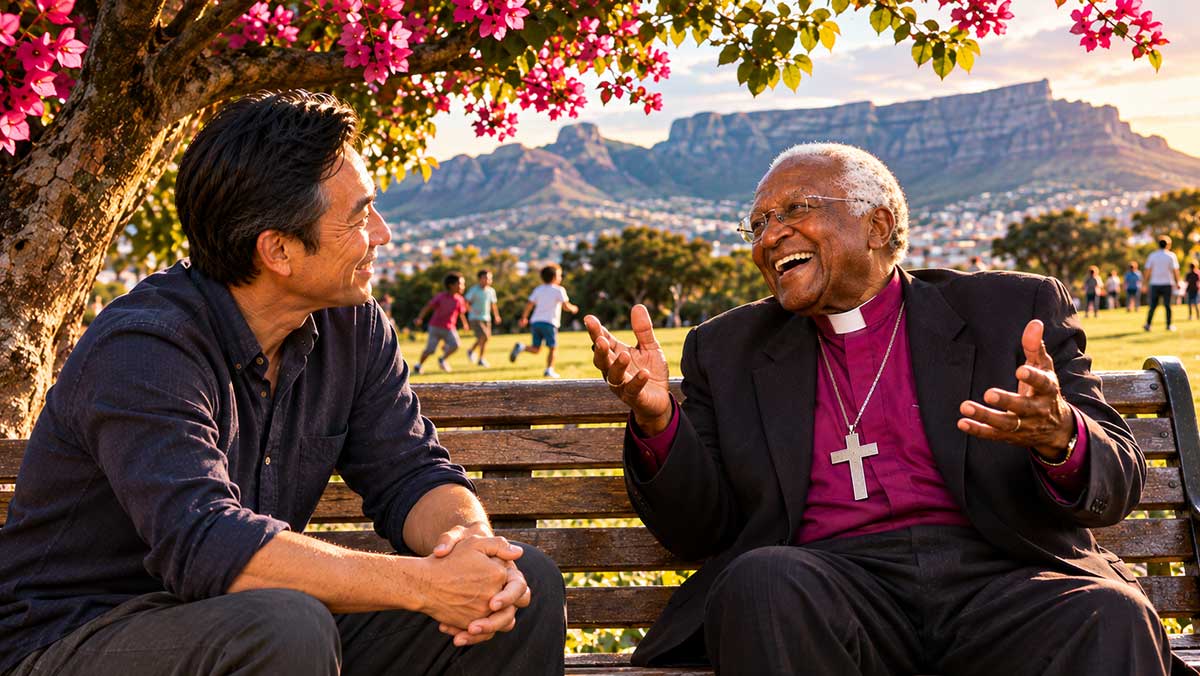
Opening: Beneath the Mountain, Beneath the Same Sky
The afternoon sun is beginning its slow descent over Cape Town.
Table Mountain rises in the distance, its broad summit resting beneath a pale blue sky. In a peaceful garden overlooking the city, flowers move gently in the breeze. Children play on a nearby lawn, and a few families stroll along the winding paths.
Desmond Tutu and Nick walk slowly beneath a row of trees.
They have left behind the quiet hearing room where they spoke about the suffering of apartheid and the difficult work of forgiveness.
The mood is lighter now.
A little boy runs past them, laughing as his father pretends he cannot catch him.
Tutu watches with delight.
Desmond Tutu: Ah, look at that! That poor father doesn't stand a chance!
Nick: (Laughing) I think he's letting the boy win.
Desmond Tutu: Of course he is! But the little fellow doesn't know that. He thinks he is the fastest boy in all of South Africa!
The child races back toward his father, who catches him and lifts him into the air.
Tutu laughs again.
Desmond Tutu: Wonderful! Absolutely wonderful!
Nick: You really love seeing children happy, don't you?
Desmond Tutu: Oh, yes. There is something beautiful about a child's laughter.
A child does not need a lecture about the meaning of joy. He simply laughs!
Nick: I wish adults could do that more often.
Desmond Tutu: (Grinning) My dear Nick, perhaps we should begin by behaving a little less like important adults!
Nick: I think you're already doing a pretty good job.
Desmond Tutu: Ah! Then there is hope for me yet!
They find an empty bench beneath a flowering tree.
From there, they can see the city stretching toward the sea.
For a moment, they sit quietly, watching the families in the garden.
Nick: Archbishop, after everything you've experienced, I find it remarkable that you still seem to enjoy people so much.
Desmond Tutu: Well, my friend, people are quite wonderful.
And quite impossible, sometimes!
Nick: (Laughing) That's certainly true.
Desmond Tutu: But I have never stopped being amazed by what human beings can become when they begin to recognize one another's dignity.
Nick: I'd love to hear more about that.
Tutu turns toward him with a smile.
Question 10: You spoke about ubuntu, the idea that our humanity is connected. When did that become real to you?
Nick: You've spoken about ubuntu throughout your life. But rather than asking you for a definition, I'd love to know what it meant in your own experience.
When did you really feel that people belonged to one another?
Desmond Tutu: Ah, Nick, that is a lovely question.
You know, ubuntu is not something I discovered in a textbook.
It is something that belongs to the way many African communities have traditionally understood human life.
We are people through other people.
Our humanity is bound up with the humanity of those around us.
Nick: What did that look like when you were growing up?
Desmond Tutu: Think of a family in which someone becomes ill.
The sick person cannot manage everything alone. Someone brings food. Someone sits beside the bed. Someone helps with the ordinary tasks of living.
And when that person recovers, perhaps one day they will be the one caring for someone else.
We are continually giving and receiving.
Nick: Like when you were sick as a boy.
Desmond Tutu: Yes.
When I had tuberculosis, I depended on the care of others.
There is nothing shameful about that.
It is part of being human.
Nick: Yet so much of society teaches us that we should be completely independent.
Desmond Tutu: Oh, yes! We like to imagine ourselves as wonderfully self-sufficient creatures.
He looks down at his hands, then smiles mischievously.
Desmond Tutu: But consider this morning. Did you grow the tea leaves for your breakfast?
Nick: No.
Desmond Tutu: Did you make your clothes?
Nick: No.
Desmond Tutu: Did you build the house where you slept?
Nick: (Laughing) No, Archbishop.
Desmond Tutu: Ah! Then I am afraid you are not nearly as independent as you thought!
They both laugh.
Desmond Tutu: Every day, we depend on people we may never meet.
Someone grows our food. Someone transports it. Someone teaches our children. Someone cares for us when we are ill.
Our lives are connected in ways we scarcely notice.
Nick: And yet we find so many reasons to divide ourselves.
Desmond Tutu: Yes.
Race. Nationality. Religion. Language. Wealth.
We invent categories, and then we begin treating those categories as though they determine the value of a human life.
But the person standing before you is not merely a member of a category.
They are a human being.
Nick: Was that part of what made apartheid so wrong to you?
Desmond Tutu: Very much so.
Apartheid was built upon separation and inequality.
It attempted to persuade people that some human beings were naturally entitled to privileges that others should be denied.
But if our humanity is interconnected, then humiliating another person damages the human relationships upon which society depends.
Nick: Did you ever see that connection appear unexpectedly during the struggle?
Desmond Tutu: There were people who crossed the boundaries apartheid tried to impose.
White South Africans who opposed racial discrimination.
Black South Africans who refused to surrender their dignity.
People who helped families facing persecution, who challenged unjust laws, who stood beside neighbors in danger.
Not everyone agreed about every method or political question.
But there were people who recognized that injustice against one group was a concern for the whole society.
Nick: And that gave you hope?
Desmond Tutu: Yes.
It showed that the divisions were not inevitable.
People could choose to behave differently.
Nick: I keep thinking about Father Huddleston lifting his hat to your mother.
Desmond Tutu: Ah, yes!
He smiles warmly.
Desmond Tutu: You see, Nick, we return to that little gesture.
One person recognizing the dignity of another.
It did not end racial discrimination.
But it revealed a different possibility.
Nick: That two people could meet simply as human beings.
Desmond Tutu: Precisely.
And perhaps that is where many important changes begin.
Not always with a grand declaration.
Sometimes with an act of respect.
Sometimes with a willingness to listen.
Sometimes with someone saying, "Come, sit beside me."
A breeze moves through the branches above them.
Tutu looks across the garden, where children from different families are playing together.
Desmond Tutu: Look at those little ones.
They are busy enjoying themselves.
They are not discussing the historical origins of racial classification!
Nick: (Laughing) No, I don't think they are.
Desmond Tutu: They want to play.
They want to be included.
They want someone to laugh with them.
And we adults spend an extraordinary amount of time making human relationships more difficult than they need to be.
Nick: Do you think children have something to teach us about unity?
Desmond Tutu: Certainly.
But children learn prejudice, too, when the adults around them teach it.
That is why our example matters.
What do children see when we encounter someone different from ourselves?
Do they see curiosity?
Do they see kindness?
Or do they see fear and contempt?
Nick: So unity begins at home.
Desmond Tutu: It begins wherever human beings encounter one another.
At home. At school. At work. In a church. On a bus.
He smiles.
Desmond Tutu: Even on a garden bench with a rather inquisitive Japanese gentleman!
Nick: (Laughing) I was wondering when you'd mention that.
Desmond Tutu: Ah, but you see, Nick, we are having a wonderful afternoon.
And I have not once needed to examine your passport!
They laugh together.
Question 11: Your friendship with the Dalai Lama brought so much laughter and affection. What did that friendship teach you about love and God?
A pair of birds lands on the grass nearby.
Tutu watches them for a moment, then turns back toward Nick.
Nick: Archbishop, there's something I've been looking forward to asking you.
Desmond Tutu: Oh dear. Should I be worried?
Nick: (Smiling) Not at all.
I've read The Book of Joy, the conversations you shared with the Dalai Lama.
And what stayed with me wasn't simply what the two of you said.
It was how much you enjoyed being together.
Desmond Tutu: Ah, yes!
His face brightens immediately.
Desmond Tutu: My dear friend, the Dalai Lama!
What a wonderful man.
Nick: You two seemed like mischievous schoolboys.
Desmond Tutu: (Laughing heartily) Oh, yes! And I suspect we were both very naughty schoolboys!
Nick: Watching you together, I sometimes wondered how anyone managed to keep the conversation on track.
Desmond Tutu: I am sure they had a terrible time!
He laughs again.
Desmond Tutu: But that is part of the joy of friendship, isn't it?
You can be completely comfortable with someone.
You can tease them.
You can laugh at yourself.
You do not need to spend every moment proving how important you are.
Nick: What did you love most about him?
Desmond Tutu: His warmth.
His compassion.
His willingness to laugh.
And the seriousness with which he approached the suffering of other people.
He was a Buddhist, and I was a Christian.
We did not pretend that our religious traditions were identical.
But we recognized in one another a sincere concern for human beings.
Nick: Did your religious differences ever make the friendship difficult?
Desmond Tutu: We could discuss our differences with affection and respect.
You do not have to abandon your own faith to appreciate the goodness of another person.
And friendship does not require that every disagreement disappear.
Nick: That's something I found beautiful about the two of you.
You seemed completely comfortable being yourselves.
Desmond Tutu: Yes.
And that is a great gift.
When you are with a true friend, you do not need to hide who you are.
Nick: May I share something personal?
Desmond Tutu: Of course, my friend.
Nick: When I read your conversations with the Dalai Lama, I felt close to you.
The way you speak about God as a loving Father resonates deeply with me.
It made me feel as though I were listening to a brother.
Tutu's expression softens.
Desmond Tutu: Ah, Nick. Thank you.
That is a very kind thing to say.
Nick: I'd love to know what that relationship with God has meant to you.
Desmond Tutu: My faith has been at the center of my life.
As a Christian, I believe that we are loved by God.
Not on account of our achievements.
Not on account of our social position.
Not on account of our race or nationality.
We are loved.
Nick: And that love extends to everyone?
Desmond Tutu: That is what I have believed.
And it has enormous implications.
If God loves human beings, then we cannot behave as though some of them are disposable.
We cannot claim to honor God and then treat His children with contempt.
Nick: Yet people have used religion to justify terrible things.
Desmond Tutu: Yes.
And that is one of the great tragedies of human history.
Religion can inspire extraordinary compassion.
But people can misuse religious language to defend their own interests, their prejudices, or their desire for control.
Nick: How do we recognize the difference?
Desmond Tutu: I would ask what happens to the people who are vulnerable.
Are they being treated with dignity?
Are they being loved?
Are those with influence using it to serve others, or to place themselves above them?
He pauses.
Desmond Tutu: We must be willing to examine ourselves.
It is easy to condemn the wrongdoing of other people.
It is much more uncomfortable to ask whether our own behavior reflects the love we proclaim.
Nick: Did your friendship with the Dalai Lama deepen that understanding?
Desmond Tutu: It was a beautiful reminder that compassion can be recognized across religious boundaries.
We could pray according to our own traditions, speak from our own convictions, and still share genuine affection.
Nick: And laugh constantly.
Desmond Tutu: (Laughing) Oh, yes! Especially that!
Nick: You know, I think many people expect religious leaders to be very serious.
Desmond Tutu: Ah, that is a terrible misunderstanding!
Nick: (Laughing) Is it?
Desmond Tutu: Of course!
If you believe that life is a gift, surely you should occasionally look delighted to be alive!
Nick bursts into laughter.
Desmond Tutu: Some people seem to think holiness requires a permanently miserable expression.
But why should that be?
Why should gratitude never produce laughter?
Nick: You certainly never seemed miserable when you were with the Dalai Lama.
Desmond Tutu: No!
And he was very good at teasing me.
Nick: You gave as good as you got.
Desmond Tutu: Naturally!
He grins.
Desmond Tutu: A friendship must have a little balance!
They laugh, then settle into a comfortable silence.
Nick: Archbishop, I think that's what moved me most about the two of you.
You didn't have to prove that you were united.
People could see the affection between you.
Desmond Tutu: Yes, Nick.
Friendship is not simply an idea.
It is something you experience.
You discover that another person matters to you.
You become concerned about their happiness.
Their suffering touches you.
And gradually, the boundaries that once seemed so important may become less frightening.
Nick: Like discovering a brother.
Desmond Tutu: (Smiling) Yes, my friend.
Like discovering a brother.
Question 12: You dreamed of a united South Africa. What experiences gave you hope that people who were once enemies could become brothers and sisters?
The sun is lower now, casting long shadows across the garden.
In the distance, Table Mountain is turning a softer shade of blue.
Nick: Archbishop, you spent decades opposing apartheid.
Then, in 1994, South Africa held its first democratic national elections with universal adult suffrage.
What was that moment like for you?
Tutu looks toward the city.
Desmond Tutu: Ah, Nick.
It was an extraordinary time.
For so long, Black South Africans had been denied the right to participate equally in choosing the government of their country.
And then, at last, people could vote together.
Nick: You must have been deeply moved.
Desmond Tutu: Yes.
Think of people who had lived their entire adult lives without that right.
People who had endured humiliation, discrimination, and violence.
And now they could stand in line and cast a ballot.
Nick: You called South Africa the Rainbow Nation.
Desmond Tutu: Yes.
It expressed the hope that people of different backgrounds could belong to one country without having to deny their differences.
We did not need everyone to become identical.
We needed people to recognize one another as equals.
Nick: Did you feel that the country had finally become the South Africa you dreamed of?
Desmond Tutu: We had achieved something enormously important.
But no, the work was not finished.
Political freedom did not immediately remove poverty.
It did not erase the consequences of generations of unequal education and opportunity.
It did not make every prejudice disappear.
Nick: Was that disappointing?
Desmond Tutu: There were disappointments, certainly.
And I spoke publicly when I believed leaders were failing to live up to the ideals of our democratic transition.
Nick: Even leaders who had helped defeat apartheid?
Desmond Tutu: Yes.
Love for one's country does not require silence when its leaders make mistakes.
If anything, genuine love may require us to speak.
Nick: Did that ever create difficulties in your relationships?
Desmond Tutu: Public criticism can certainly create disagreements.
But I did not believe that loyalty to a political party should come before the dignity of the people.
Nick: What about Nelson Mandela?
Tutu smiles.
Desmond Tutu: Ah, Madiba.
Nick: What did you admire about him?
Desmond Tutu: His contribution to South Africa's transition was extraordinary.
After so many years in prison, he helped guide the country toward democratic government.
He understood the importance of reconciliation in a society that had been divided for generations.
Nick: You and Mandela had different responsibilities.
Desmond Tutu: Yes.
He became president.
I remained a church leader.
Our responsibilities were not identical, and we did not have to agree about every matter.
But the possibility of a democratic South Africa was something we both cared deeply about.
Nick: Do you think Mandela's willingness to reach out to former opponents helped the country?
Desmond Tutu: His public commitment to reconciliation was significant.
It helped communicate that democratic change did not have to mean replacing one form of racial domination with another.
Nick: But the country still had enormous problems.
Desmond Tutu: Yes.
And that is why unity must be more than a beautiful phrase.
It must be expressed through the way people live.
Through education.
Through opportunities for children.
Through fair treatment.
Through the willingness to confront inequality.
Nick: So unity isn't simply people holding hands and saying they love each other.
Desmond Tutu: (Laughing) Well, holding hands can be very nice!
Nick: (Laughing) Of course.
Desmond Tutu: But if you hold someone's hand and then refuse to help when they are hungry, you have not accomplished very much.
Nick: That's true.
Desmond Tutu: Love must become visible in our actions.
If a child cannot attend a decent school, we should care.
If a family has no safe place to live, we should care.
If people are treated unfairly, we should care.
Nick: And if someone belongs to a different race or religion?
Desmond Tutu: We should care just as deeply.
He turns toward Nick.
Desmond Tutu: You see, my friend, the question is not whether we can persuade everyone to become exactly like us.
The question is whether we can learn to recognize the humanity of those who are different.
Nick: Have you ever felt that kind of unity in a very personal way?
Desmond Tutu: I have experienced friendship and kindness from people whose backgrounds were very different from my own.
And I have seen people act with compassion across divisions that others considered impossible to cross.
Those experiences helped sustain my hope.
Nick: Did you ever worry that humanity might never learn?
Desmond Tutu: Oh, certainly.
We can be terribly slow learners!
Nick: (Laughing) That's an understatement.
Desmond Tutu: Yes! We make the same mistakes again and again, and then we are surprised when the consequences are unpleasant!
He chuckles, then becomes thoughtful.
Desmond Tutu: But I have also seen societies change.
I lived long enough to witness apartheid end.
That did not solve every problem.
But it was a reminder that systems which appear permanent can be challenged and transformed.
Nick: So you never gave up on humanity.
Desmond Tutu: I tried not to.
And I would not want anyone to mistake hope for certainty that everything will turn out as we wish.
Hope is something we must continue to practice.
Nick: What gives you hope when you look at the next generation?
Tutu watches the children playing in the garden.
Desmond Tutu: Those little ones.
He smiles.
Desmond Tutu: Every child represents possibilities that we cannot fully foresee.
They may inherit our prejudices.
Or they may learn to treat one another with greater kindness.
Much depends on what we teach them, and on the example we set.
Nick: If you could tell those children one thing, what would it be?
Desmond Tutu: I would want them to know that they are precious.
And that the other children around them are precious, too.
He pauses.
Desmond Tutu: We must never teach a child that their dignity depends upon making someone else feel inferior.
Nick: That's beautiful.
Desmond Tutu: And perhaps we should teach them to laugh together.
Nick: You always come back to laughter.
Desmond Tutu: (Grinning) Naturally! It is one of my favorite subjects!
They laugh.
Closing: The Children Beneath the Same Sky
The afternoon has grown quiet.
A golden light settles over the garden, and the distant city begins to glow beneath Table Mountain.
Nick and Tutu remain on the bench, watching the families preparing to leave.
A little girl reaches for her father's hand. Nearby, two children who have been playing together exchange a cheerful goodbye before running back to their families.
Nick: Archbishop, when we began talking, I thought unity was something enormous.
Something that nations had to accomplish.
But listening to you, I'm beginning to see it in these small moments.
Desmond Tutu: Yes, Nick.
The great questions of humanity are often present in the ordinary ways we treat one another.
Nick: Like Father Huddleston lifting his hat to your mother.
Desmond Tutu: Ah, yes.
That little gesture again.
He smiles.
Desmond Tutu: It seems to have followed me all the way from childhood to this garden!
Nick: And perhaps it will follow some of our readers, too.
Desmond Tutu: I would be very happy if it did.
They sit quietly for a moment.
Nick: Archbishop, there's one more thing I've been thinking about.
Desmond Tutu: Only one? My dear Nick, you are improving!
Nick laughs.
Nick: We've talked about your childhood, the struggle against apartheid, the people who suffered, and your hope for a united humanity.
But there are people who knew you in a completely different way.
Your wife Leah. Your children. Your close friends.
I'd love to know what life was like when you weren't Archbishop Desmond Tutu.
Tutu's face brightens.
Desmond Tutu: Ah! Now you are asking about the truly important people!
Nick: (Smiling) I had a feeling you'd say that.
Desmond Tutu: Yes, my friend.
The world may know a person through speeches and awards.
But the people at home know whether you remembered to do the dishes!
Nick bursts into laughter.
Nick: Somehow I suspect Leah has a few stories.
Desmond Tutu: Oh, I am certain she does!
His laughter fills the garden once more.
The two friends rise from the bench and begin walking slowly along the path as the evening light settles over Cape Town.
The conversation continues.
Topic 5: The Man Who Never Stopped Laughing and Loving
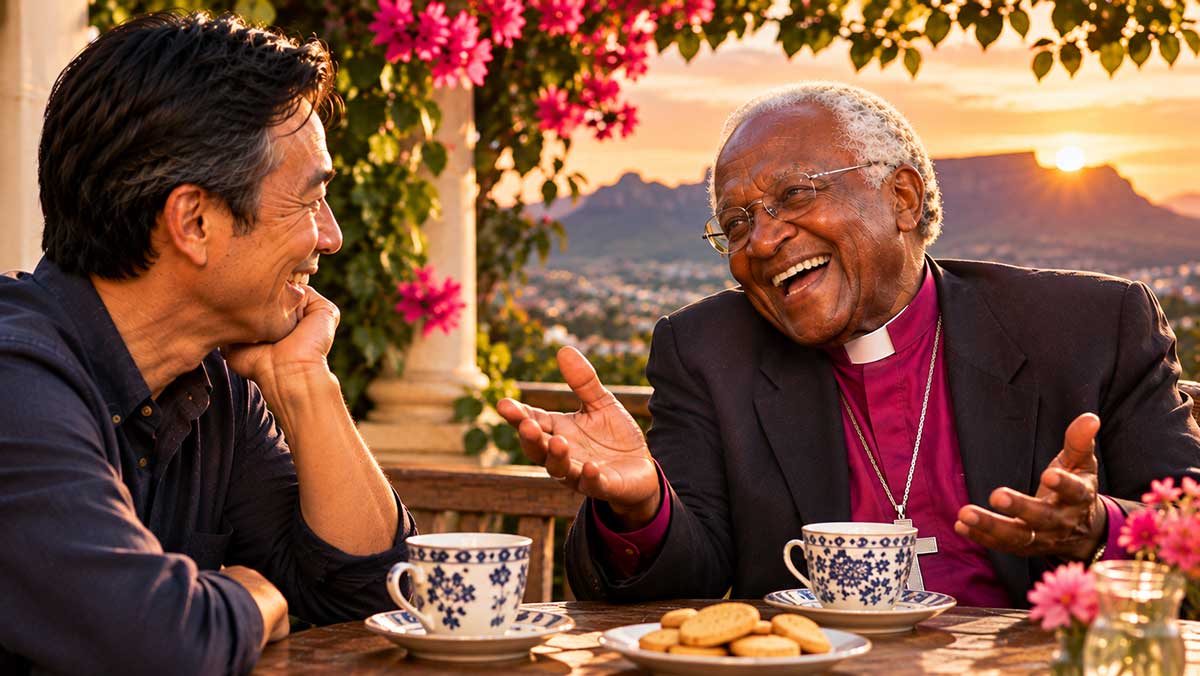
Opening: One More Cup of Tea
The sun is sinking behind the hills of Cape Town.
Golden light rests on the flowering branches surrounding the garden veranda where Nick and Archbishop Desmond Tutu began their conversation earlier that morning.
The two men return to the same small wooden table. Their empty cups have been replaced with fresh tea, and a plate of biscuits sits between them.
For a few moments, neither speaks.
They have spent the day remembering a childhood marked by kindness and discrimination, the long struggle against apartheid, the painful testimony of the Truth and Reconciliation Commission, and the extraordinary hope that human beings might learn to live as one family.
Now the garden feels peaceful.
Tutu lowers himself into his chair with a satisfied sigh.
Desmond Tutu: Ahhh! At last!
Nick: (Laughing) What's that?
Desmond Tutu: We have returned to civilization!
Nick: Civilization?
Desmond Tutu: Tea, biscuits, a comfortable chair, and no one demanding that I solve all the problems of the world!
Nick: Well, I can't promise the last part.
Desmond Tutu: Oh, dear Lord! This man never stops!
His laughter fills the veranda.
Nick: (Smiling) I promise, Archbishop, the difficult questions are mostly finished.
Desmond Tutu: Mostly?
Nick: Mostly.
Desmond Tutu: Ah! I shall have to remain vigilant!
Nick reaches for a biscuit.
Nick: You know, after spending the day with you, I think I understand something about why people love you so much.
Desmond Tutu: Oh? Is it my extraordinary good looks?
Nick: (Laughing) Naturally. That was the first thing I noticed.
Desmond Tutu: Excellent! I am glad we have established that!
They laugh together.
Nick: But seriously, I think people feel comfortable around you. You make them laugh, and then suddenly you're talking about something that touches their hearts.
Desmond Tutu: Well, Nick, people are not simply problems waiting to be solved.
We are human beings.
We need affection. We need friendship. We need opportunities to enjoy one another.
Nick: And you certainly seem to enjoy people.
Desmond Tutu: Oh, yes! Though I must confess, some people are rather more difficult to enjoy than others!
Nick: (Laughing) I'm sure you've met a few.
Desmond Tutu: A few? My dear fellow, I spent much of my life dealing with politicians!
Both men burst into laughter.
Then Nick leans back in his chair.
Nick: Archbishop, we've talked about the public part of your life. But I would love to hear about the people who knew you when you weren't standing before a crowd.
Tutu's expression softens.
Desmond Tutu: Ah. Now we are speaking about the truly important people.
Question 13: After all the years of struggle, what did coming home to Leah and your children mean to you?
Nick: You and Leah were married in 1955. You shared more than sixty years together.
That's an extraordinary part of your life.
Desmond Tutu: Ah, my dear Leah.
He smiles.
Desmond Tutu: Yes. We shared a long life together.
And I was very fortunate.
Nick: How did you first meet?
Desmond Tutu: We met when we were young, before all the titles and international attention.
I was working as a teacher, and Leah was training to become a teacher herself.
We married in 1955.
At that time, we were simply a young couple beginning our life together.
Nick: Did you have any idea what the future would bring?
Desmond Tutu: (Laughing) Good heavens, no!
If someone had told us everything that lay ahead, we might have needed to sit down for a very long time!
Nick: You eventually had four children.
Desmond Tutu: Yes. Trevor, Thandi, Nontombi Naomi, and Mpho.
They were an enormous part of our lives.
Nick: I imagine being the family of someone so publicly involved in the struggle against apartheid wasn't always easy.
Desmond Tutu: No. Public responsibilities can place considerable demands on a family.
There were periods of travel, uncertainty, and tension.
And Leah had her own commitments.
She was not simply waiting at home for her husband to return from important meetings.
Nick: She was active in her own right.
Desmond Tutu: Very much so.
She was involved in advocating for domestic workers, people whose labor was often taken for granted and whose rights deserved protection.
She understood the dignity of ordinary working people.
Nick: That seems very much in keeping with the convictions you shared.
Desmond Tutu: Yes.
But you know, Nick, when we speak about a marriage, we must be careful not to turn it into a grand public symbol.
A marriage is lived in ordinary days.
There are meals to prepare, children to raise, decisions to make, disagreements to work through.
Nick: Even for an archbishop?
Desmond Tutu: Especially for an archbishop!
He laughs.
Desmond Tutu: You may stand before a congregation and speak very eloquently about love.
Then you return home, and your wife reminds you that you have forgotten something you promised to do!
Nick: (Laughing) And suddenly the sermon becomes very practical.
Desmond Tutu: Exactly!
The true examination begins at home!
Nick: Did Leah keep you grounded?
Desmond Tutu: Our shared life certainly reminded me that public recognition is not the whole of a person.
At home, you are a husband and a father.
Your family knows you in ways that the public does not.
Nick: That's a beautiful distinction.
Desmond Tutu: It is an important one.
You may receive an award and have people applaud you.
But that does not excuse you from treating the people closest to you with kindness.
Nick: Sometimes those are the people we take for granted.
Desmond Tutu: Yes.
And that is unfortunate, isn't it?
We may be very patient with strangers, then become impatient with someone we love.
We may speak warmly to a crowd, then forget to listen carefully to a member of our own family.
Nick: Do you think your public responsibilities ever made that difficult?
Desmond Tutu: There were demands on my time, certainly.
I would not want to pretend that balancing family responsibilities with public work was always simple.
Leah and our children experienced the consequences of my commitments.
Their lives deserve recognition in their own right.
Nick: When you think about your children growing up, what do you remember most fondly?
Tutu smiles and considers the question.
Desmond Tutu: I would not want to invent a particular family memory simply to give you a charming story.
But I can speak about the affection of family life.
Watching children grow, discovering their personalities, seeing them become adults with convictions and responsibilities of their own.
There is something deeply moving about that.
Nick: Your daughter Mpho eventually became a priest.
Desmond Tutu: Yes, and she has pursued her own work in ministry and reconciliation.
She and I collaborated on The Book of Forgiving.
Nick: That must have been meaningful, working together on a subject so central to your life.
Desmond Tutu: It was an opportunity to explore forgiveness through the experiences and perspectives we brought to the work.
But she has her own voice, her own understanding, her own life.
That is something parents must learn to respect.
Nick: That our children don't belong to us forever.
Desmond Tutu: They are always our children, of course!
He laughs.
Desmond Tutu: But they become their own people.
And that is a wonderful thing.
Nick: Archbishop, you've spoken to enormous crowds and met world leaders.
But I wonder whether some of your happiest moments were simply ordinary family moments.
Desmond Tutu: I think there is great happiness to be found in ordinary life.
Sharing a meal.
Laughing together.
Being with people who know you and love you.
We must not become so impressed by extraordinary events that we overlook the gifts of everyday life.
Nick: And after a difficult day, coming home to people who care about you.
Desmond Tutu: Yes.
There is a particular comfort in belonging.
Not being admired from a distance, but being known.
He looks toward the garden.
Desmond Tutu: And being loved despite being known!
Nick laughs.
Nick: That's probably the greater achievement.
Desmond Tutu: (Laughing) Oh, indeed!
They sit together for a moment, enjoying their tea.
Question 14: You had such an extraordinary laugh. What were the little things in life that brought you the greatest joy?
Nick: Archbishop, I have to ask about your laughter.
Desmond Tutu: Ah! At last, a subject on which I am a recognized authority!
Nick: (Laughing) I think you may be.
I've seen photographs and videos of you with the Dalai Lama, and sometimes the two of you seem completely unable to stop laughing.
Desmond Tutu: Oh, my dear friend!
He begins laughing at the memory of their friendship.
Desmond Tutu: We had such wonderful times together.
Nick: What made that friendship so special?
Desmond Tutu: We enjoyed one another.
There was affection, mutual respect, and a shared concern for the suffering of others.
And we could tease each other!
Nick: You certainly did.
Desmond Tutu: Oh, yes!
He smiles broadly.
Desmond Tutu: People sometimes imagine that religious leaders must spend every waking moment looking solemn.
But I cannot see why that should be so.
Nick: You don't think seriousness and laughter are opposites?
Desmond Tutu: Not at all.
There are times when life demands our full seriousness.
We must recognize suffering. We must confront injustice.
But laughter can remind us that suffering is not the whole of human existence.
Nick: Was that important during the struggle against apartheid?
Desmond Tutu: Humor could help us endure difficult circumstances.
It could reveal the absurdity of prejudice.
And it could bring people together.
Nick: Did you ever find yourself laughing at something during a very serious occasion?
Desmond Tutu: (Grinning) My dear Nick, you are asking a man who spent decades attending church meetings!
Nick: (Laughing) That sounds dangerous.
Desmond Tutu: Oh, you have no idea!
Some meetings can become so solemn that you begin to wonder whether anyone remembers why they gathered in the first place!
They laugh together.
Nick: I think laughter makes people feel closer.
Desmond Tutu: It often does.
When two people laugh together, they may forget for a moment the titles, positions, and differences that usually separate them.
They are simply two human beings enjoying one another.
Nick: That's exactly how I felt watching you with the Dalai Lama.
You were a Christian archbishop. He was a Buddhist spiritual leader.
Yet you seemed like two brothers.
Desmond Tutu: Yes.
We did not need to become identical to love one another.
Our friendship was a reminder that affection and respect can exist across religious differences.
Nick: What did he teach you about joy?
Desmond Tutu: Our conversations explored the ways compassion, gratitude, generosity, and our relationships with other people contribute to joy.
We did not pretend that suffering could simply be wished away.
We both knew that human life includes loss and difficulty.
Nick: Yet you could still laugh.
Desmond Tutu: Yes.
Joy does not require us to deny pain.
It allows us to recognize that pain is not the only thing present in our lives.
Nick: That's something I find very moving.
Desmond Tutu: You know, Nick, sometimes people become so occupied with pursuing happiness that they overlook the happiness available in caring for another person.
Nick: What do you mean?
Desmond Tutu: Think of the pleasure of making someone smile.
Or comforting a friend.
Or seeing a child delighted by something simple.
There is joy in giving.
There is joy in recognizing that another person's happiness matters.
Nick: Is that why you seemed to enjoy meeting people so much?
Desmond Tutu: People can surprise us.
A person you have never met may offer an unexpected kindness.
Someone from a completely different background may become a dear friend.
And sometimes the people we expect to be terribly important turn out to be rather ordinary!
Nick: (Laughing) Like archbishops?
Desmond Tutu: Especially archbishops!
He throws back his head and laughs.
Nick: If we could spend an entire day together without talking about politics, religion, or any of the world's problems, what would you want to do?
Desmond Tutu: Ah, now that is a delightful question.
He pretends to consider it very seriously.
Desmond Tutu: First, I think we should have a good breakfast.
Nick: Agreed.
Desmond Tutu: Then perhaps we could spend time with friends and family.
Enjoy a pleasant conversation.
Share a meal.
And, of course, laugh at one another's terrible jokes!
Nick: I can supply plenty of those.
Desmond Tutu: Oh, I have already discovered that, my friend!
Nick laughs.
Nick: And in the evening?
Desmond Tutu: Perhaps we could sit somewhere peaceful and enjoy the company of people we love.
You see, Nick, a happy day need not be an extraordinary day.
Sometimes the ordinary things are quite enough.
Nick: I like that.
Desmond Tutu: Good!
He reaches for another biscuit.
Desmond Tutu: Now, if you will excuse me, I am going to demonstrate another simple pleasure of life.
Nick: (Laughing) Go right ahead.
Tutu takes a bite and smiles with obvious satisfaction.
Desmond Tutu: Ah! Excellent!
They laugh together as the last sunlight reaches the veranda.
Question 15: Archbishop, after everything you experienced, what would you most want people to carry in their hearts?
The evening has grown quieter.
The first lights are appearing in the distant houses, and a gentle breeze moves through the garden.
Nick sets down his cup.
Nick: Archbishop, may I ask you one final question?
Desmond Tutu: One final question?
He looks at Nick with exaggerated suspicion.
Desmond Tutu: Are you quite certain?
Nick: (Laughing) I think so.
Desmond Tutu: Ah, then I must prepare myself. It sounds terribly important!
Nick: We've spent the day talking about your life.
You grew up in a country divided by racial discrimination.
You wanted to become a doctor, but life took you in another direction.
You became a teacher, a priest, an archbishop, and one of the most recognized voices against apartheid.
You helped your country confront its painful history.
And through all of that, you continued to speak about forgiveness, human dignity, and love.
He pauses.
Nick: When you look back at everything, what would you most want people to carry in their hearts?
Tutu becomes thoughtful.
He looks out across the garden before answering.
Desmond Tutu: I would want people to recognize how precious human beings are.
Every one of us.
Not simply those who agree with us.
Not simply those who share our religion or nationality.
Every human being.
Nick: Even the people who have hurt us?
Desmond Tutu: Their actions may need to be confronted.
They may need to be held accountable.
But I would not want us to lose sight of the possibility that human beings can change.
Nick: You believed that throughout your life.
Desmond Tutu: I tried to live by that conviction.
And I saw evidence that change was possible.
South Africa's history was not fixed forever.
Apartheid ended.
People who had been denied political rights gained the opportunity to participate in a democratic society.
That was an extraordinary achievement, made possible through the sacrifices of many people.
Nick: But you never believed the work was finished.
Desmond Tutu: No.
We still had poverty, inequality, prejudice, and many other problems.
And humanity continues to face terrible divisions.
But we must not allow those difficulties to persuade us that love and justice are meaningless.
Nick: What about forgiveness?
Desmond Tutu: Forgiveness can be a profound gift.
But it must never become a convenient way of dismissing the suffering of victims.
We must listen to people who have been harmed.
We must take justice seriously.
And we must recognize that healing may take time.
Nick: Is there something you wish people understood better about unity?
Desmond Tutu: Unity does not mean that everyone must think alike.
We can have different cultures, beliefs, languages, and histories.
The question is whether we can recognize one another's dignity despite those differences.
Nick: You once described South Africa as a Rainbow Nation.
Desmond Tutu: Yes.
A rainbow is beautiful precisely on account of its different colors.
But a society cannot become united simply by calling itself a rainbow.
People must work to create relationships and institutions that respect human dignity.
Nick: Do you think humanity can ever truly become one family?
Tutu looks at him warmly.
Desmond Tutu: Nick, I believe our lives are already deeply connected.
The difficulty is that we so often fail to recognize it.
We behave as though the suffering of someone far away has nothing to do with us.
We imagine that our happiness can be built upon another person's humiliation.
But that is a terrible misunderstanding of what it means to be human.
Nick: So what would you ask us to do?
Desmond Tutu: Begin with the people around you.
Treat them with kindness.
Listen when they are suffering.
Stand against injustice.
Be willing to recognize when you have done wrong.
And do not become so certain of your own goodness that you forget to examine your heart.
Nick: Even if we're trying to do the right thing?
Desmond Tutu: Especially then!
He smiles.
Desmond Tutu: We human beings can become terribly proud of our virtue.
We must learn a little humility.
Nick: (Laughing) You always manage to bring us back to earth.
Desmond Tutu: Ah, it is a useful place to be!
They laugh softly.
Nick: Archbishop, there's something I want to thank you for.
Desmond Tutu: Oh?
Nick: You spent your life confronting terrible injustice, yet you never allowed that struggle to become your entire identity.
You remained a husband, a father, a friend.
You laughed.
You loved people.
And you continued to believe that humanity could become better than it had been.
Tutu listens quietly.
Nick: I think that's what I'll remember most about you.
Not simply what you accomplished.
But the kind of person you tried to be.
Tutu smiles gently.
Desmond Tutu: Thank you, Nick.
That is very kind.
But I hope you will remember that I was an ordinary human being, too.
I had my weaknesses.
I made mistakes.
I depended on the love and patience of others.
Nick: I think that makes your life even more meaningful.
Desmond Tutu: Perhaps.
He looks toward the last light in the sky.
Desmond Tutu: We are all learning how to love one another.
And none of us has finished learning.
Closing: Until We Meet Again, My Friend
The evening has settled over Cape Town.
The garden is quiet except for the gentle movement of leaves and the distant sounds of the city.
Nick and Tutu rise from their chairs.
For a moment, they stand beside the little table where they have shared so much laughter and conversation.
Nick: Archbishop, thank you for spending this day with me.
Desmond Tutu: Oh, Nick, it has been a pleasure.
And I must say, you ask a remarkable number of questions!
Nick: (Laughing) I hope I didn't exhaust you.
Desmond Tutu: Exhaust me? My dear fellow, I have survived church meetings that lasted far longer!
They both laugh.
Nick: I came here hoping to learn about your life.
But I feel as though I've made a friend.
Tutu's face brightens.
Desmond Tutu: Ah, Nick.
That is a lovely thing to say.
And I hope you know that friendship is not something we should take lightly.
It is one of life's great gifts.
Nick: I agree.
Tutu reaches out and warmly takes Nick's hands.
Desmond Tutu: Then let us be grateful for this afternoon.
For the laughter.
For the conversation.
And for the wonderful possibility that two people who began the day as strangers can end it as friends.
Nick: Thank you, Archbishop.
Desmond Tutu: Ah, please, my friend.
Desmond will do.
Nick smiles.
Nick: Thank you, Desmond.
Desmond Tutu: Much better!
He laughs.
They begin walking slowly along the garden path.
At the gate, Nick turns toward him one last time.
Nick: Desmond, I hope we can have another conversation someday.
Desmond Tutu: Oh, certainly!
But next time, my dear Nick, I shall be asking the questions!
Nick: (Laughing) That's a deal.
Desmond Tutu: And I shall expect excellent tea!
Nick: I'll make sure of it.
They share one final laugh.
Nick walks through the gate and turns back.
Desmond Tutu stands beneath the flowering branches, smiling and raising a hand in farewell.
The evening light settles softly over the garden.
And the friendship, like the conversation, feels larger than the afternoon that brought them together.
Final Thoughts: The Love That Outlived Apartheid
There is something unforgettable about a man who could speak of humanity's deepest wounds and then suddenly burst into laughter. Desmond Tutu's joy was never evidence that he had overlooked suffering. He knew too much about cruelty for that. His life reminds us that grief and gratitude can exist within the same human heart. We can mourn what has been lost without forgetting what remains beautiful. We can confront injustice without allowing hatred to become the center of our lives. And we can take the suffering of others seriously without losing the capacity to smile at a friend.
One of the most moving images from Tutu's childhood is not an image of political resistance or public achievement. It is the memory of Trevor Huddleston greeting his mother with respect. That small act offers a lesson that reaches far beyond South Africa. We may never know how deeply an ordinary kindness affects another person. A respectful greeting, a compassionate word, or the willingness to stand beside someone who has been humiliated can remain in a person's heart for decades. In Tutu's life, the recognition of human dignity became a lifelong calling.
His resistance to apartheid showed that love sometimes requires courage. It can be comforting to think of love only as gentleness, patience, or affection. But Tutu's example challenges that limited view. When children were denied equal educational opportunities, when families suffered under discriminatory laws, and when political violence threatened communities, remaining silent was not an adequate expression of compassion. His public life demonstrated that love for people may demand opposition to the systems that harm them. The Nobel Peace Prize's account of his work records the significance of his nonviolent leadership during those years.
Perhaps the hardest lesson comes from the Truth and Reconciliation Commission. Forgiveness can be beautiful, but it becomes deeply troubling when society expects victims to offer it without acknowledging their suffering. Tutu's work reminds us that truth matters. Justice matters. The grief of a mother who has lost her child matters. No inspiring statement can restore a stolen life or erase years of fear. The commission's achievements and shortcomings deserve to be remembered together. Its official findings and recommendations invite us to consider what meaningful reconciliation requires beyond the expression of forgiveness.
Tutu's vision of ubuntu offers another way of looking at human relationships. We do not exist as isolated individuals. We depend upon parents, teachers, friends, neighbors, strangers, and countless people whose names we may never learn. Our lives continually touch one another. Recognizing this connection does not require pretending that human beings never disagree. It asks us to care about what happens to others, especially when they are vulnerable. Tutu's life suggests that the measure of unity is not simply how warmly people speak about one another, but how they behave when another person's dignity is at stake.
His friendship with the Dalai Lama made that conviction visible in a different way. Here were two elderly spiritual leaders, one Christian and one Buddhist, who could tease each other, laugh freely, and speak with affection about the suffering of humanity. Their friendship did not erase their theological differences. It demonstrated that genuine respect can flourish without complete agreement. Perhaps that is why their laughter feels so moving. We see two human beings enjoying the simple gift of one another's company. In a world where religious identity has sometimes been used to justify division, such friendship offers a deeply welcome example.
And then there is Leah. Behind the public achievements stood a marriage that lasted more than six decades, children who grew into adults with lives of their own, and a family whose experiences cannot be reduced to the accomplishments of its most famous member. The Desmond & Leah Tutu Legacy Foundation preserves the histories of both Desmond and Leah, recognizing their individual commitments and shared life. This reminds us that the deepest meaning of a person's life may be found just as readily at a family table as at a podium. Public recognition has its place, but the ability to love and be loved remains a gift beyond any award.
Desmond Tutu did not live to see every division healed or every injustice corrected. He died in Cape Town in 2021, leaving a world still struggling with hatred, inequality, violence, and religious conflict. Yet his life leaves us with a question worth carrying into our own homes and relationships: What would change if we began treating every person as someone whose life truly mattered? Perhaps we would listen longer before judging. Perhaps we would find the courage to defend someone who is being mistreated. Perhaps we would recognize that forgiveness cannot be demanded, but compassion can always be offered. And perhaps, when we encounter someone whose beliefs or background differ from our own, we might discover the unexpected happiness of meeting a friend.
Short Bios:
Archbishop Desmond Mpilo Tutu (1931-2021)
Desmond Tutu was a South African Anglican archbishop, theologian, anti-apartheid activist, and recipient of the 1984 Nobel Peace Prize. Born in Klerksdorp, he worked as a teacher before entering the Anglican ministry. He became general secretary of the South African Council of Churches in 1978 and Archbishop of Cape Town in 1986. Following the end of apartheid, he chaired South Africa's Truth and Reconciliation Commission. He was widely recognized for his commitment to human dignity, reconciliation, Christian faith, and ubuntu, and for his remarkable humor and warmth. He married Nomalizo Leah Shenxane in 1955, and they raised four children.
Learn more: Desmond & Leah Tutu Legacy Foundation | Nobel Peace Prize biography
Nomalizo Leah Tutu (1933- )
Nomalizo Leah Tutu is a South African educator and advocate for domestic workers' rights. She married Desmond Tutu in 1955 and shared more than six decades of marriage with him. Leah pursued her own work supporting vulnerable workers and community initiatives, contributing to a family life shaped by service, faith, and social responsibility. She and Desmond raised four children: Trevor, Thandeka, Nontombi Naomi, and Mpho Andrea. Her life deserves recognition beyond her role as the archbishop's wife.
Learn more: University of Johannesburg: Tutu Family Life | Desmond & Leah Tutu Legacy Foundation
The 14th Dalai Lama (1935- )
Tenzin Gyatso, the 14th Dalai Lama, is a Tibetan Buddhist spiritual leader and recipient of the 1989 Nobel Peace Prize. His friendship with Desmond Tutu became widely known through their public meetings and The Book of Joy, created with Douglas Abrams. Their affectionate exchanges explored compassion, suffering, gratitude, and joy, offering an example of friendship across religious traditions. The Dalai Lama's Buddhist convictions and Tutu's Christian faith remained distinct, but their mutual affection became an important part of their shared public message.
Learn more: Official Dalai Lama website | Nobel Prize biography
Nelson Rolihlahla Mandela (1918-2013)
Nelson Mandela was a South African anti-apartheid leader, political prisoner, and the country's first Black president, serving from 1994 to 1999. He spent 27 years in prison and became an international symbol of the struggle against racial oppression. Mandela and Tutu held different public responsibilities during South Africa's democratic transition, but both advocated a future in which people of different racial backgrounds could participate as equals. Mandela received the 1993 Nobel Peace Prize jointly with F. W. de Klerk.
Learn more: Nelson Mandela Foundation | Nelson Mandela Foundation: Desmond Tutu biography
Nick Sasaki | ImaginaryTalks.com
Nick Sasaki is the creator of ImaginaryTalks.com, a creative project that brings historical figures, authors, thinkers, and other influential people into fictional conversations. His interviews seek to introduce readers to the human experiences behind public achievements through warmth, curiosity, and thoughtful questions. In this imagined encounter with Desmond Tutu, Nick serves as a friendly listener, allowing the archbishop's life, convictions, humor, and compassion to remain at the center of the story.
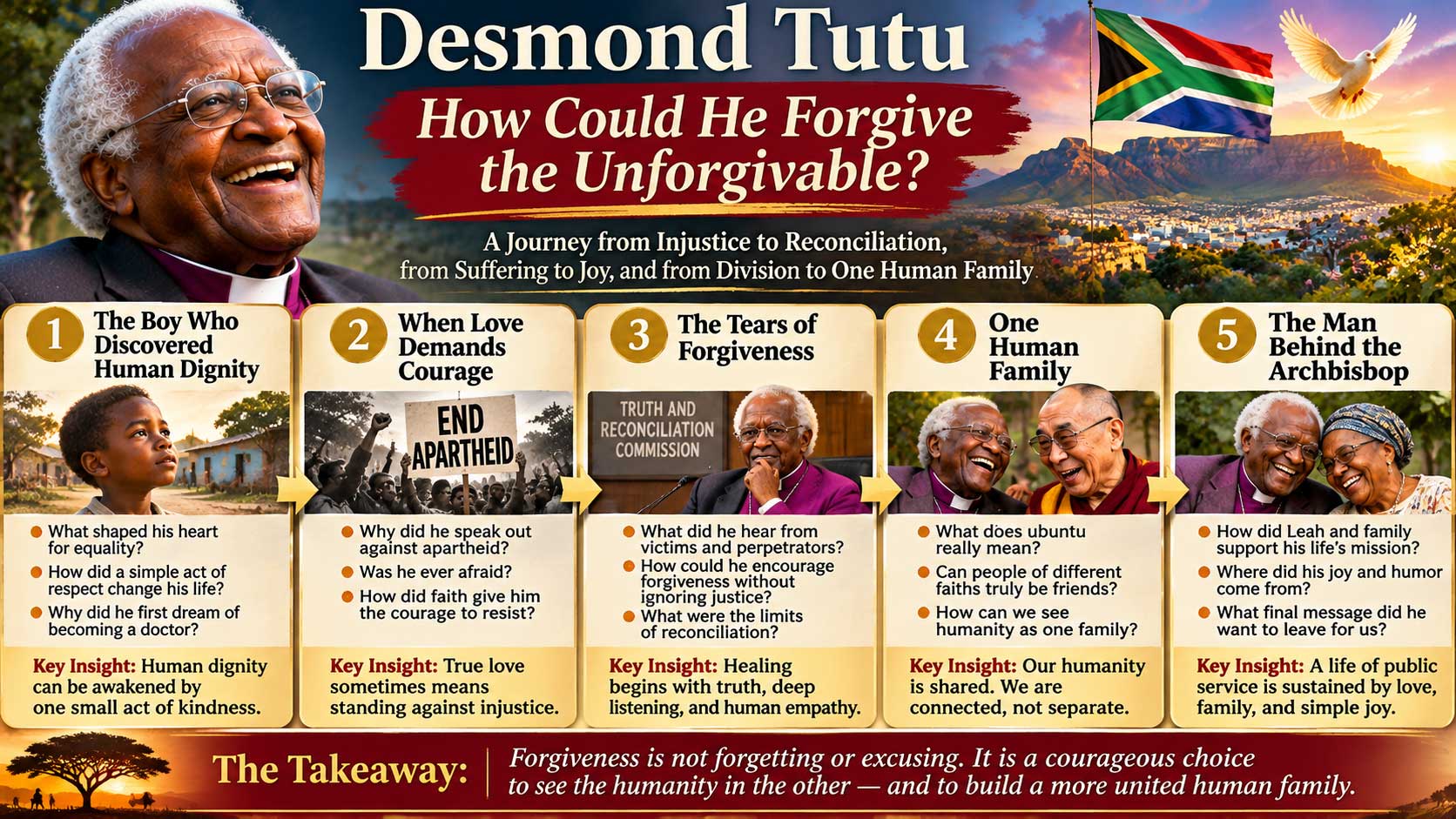
Leave a Reply