
Introduction
Imagine finally escaping a life where another human being could legally claim ownership of you.
You have risked everything. You have traveled through dangerous territory, uncertain whom to trust. At last, you reach freedom.
Then you make a decision almost impossible to comprehend.
You turn around and go back.
Not once. Not twice. Again and again.
That is what makes Harriet Tubman's story one of the most extraordinary chapters in American history.
But there is something even more remarkable about her life.
Her greatest accomplishment may not have been escaping slavery. It may have been refusing to forget those who remained enslaved.
Born Araminta Ross around 1822 on Maryland's Eastern Shore, Harriet Tubman entered a world in which her family could be separated and sold at any moment.
She experienced forced labor, violence, and a devastating childhood head injury that affected her for the rest of her life.
Yet she maintained a deep Christian faith and an enduring attachment to her family.
In 1849, she escaped slavery and reached Philadelphia.
She could have tried to build a quiet life away from the people who had enslaved her.
Instead, she returned to Maryland repeatedly to help others escape.
Modern historical estimates credit her with approximately thirteen rescue missions in which she personally guided around seventy people to freedom, with additional people receiving instructions and assistance through her work.
When the Civil War began, her service took another form.
She worked with the Union in South Carolina, providing care, scouting, and intelligence. In June 1863, she contributed to the Combahee River Raid, a military operation that liberated more than seven hundred enslaved people.
But her story did not end with the war.
In Auburn, New York, Tubman continued supporting family members, advocating for women's voting rights, and helping older and vulnerable people.
She experienced financial hardship and spent years seeking recognition for her wartime service.
The woman who had helped others reach freedom still needed help herself.
That raises a question we rarely ask about historical heroes:
Who takes care of the person who spends a lifetime taking care of everyone else?
In this imaginary interview, Nick Sasaki meets Harriet Tubman across five deeply personal conversations.
Their meeting begins on Maryland's Eastern Shore, where Harriet remembers her childhood as Minty, her parents, and the family members taken away by slavery.
The conversation then follows her escape, the dangerous decision to return for others, and the sorrow of those she could not rescue.
Beside South Carolina's Combahee River, they explore her wartime service and the countless people whose courage made liberation possible.
Later, on a quiet porch in Auburn, they discuss the years after the war, when Harriet continued caring for others despite her own hardships.
Finally, as the morning sun rises, Nick asks her three questions that bring the entire conversation together:
What does it mean to be truly free?
What did her faith teach her about the dignity of others?
And when she looks back on her extraordinary life, whose face does she remember first?
This is not simply a story about bravery.
It is a story about a mother trying to keep her children together. A daughter who remembered her parents. A sister who could not forget those left behind. A woman who trusted God and acted when others needed help.
And it invites us to confront a question that remains deeply relevant:
If we have the freedom to help someone who is suffering, what will we choose to do?
Fictional Conversation Disclaimer
This article presents an imagined conversation between Nick Sasaki and Harriet Tubman, not an authentic interview or a collection of verified historical quotations. The dialogue, settings, personal exchanges, and private reflections are fictional reconstructions informed by historical research. Documented events are distinguished from creative interpretation where appropriate, and the conversation does not imply Tubman's endorsement of any modern individual or viewpoint.
Topic 1: The Girl Who Refused to Forget Her Family
Opening: Before the World Knew Her Name
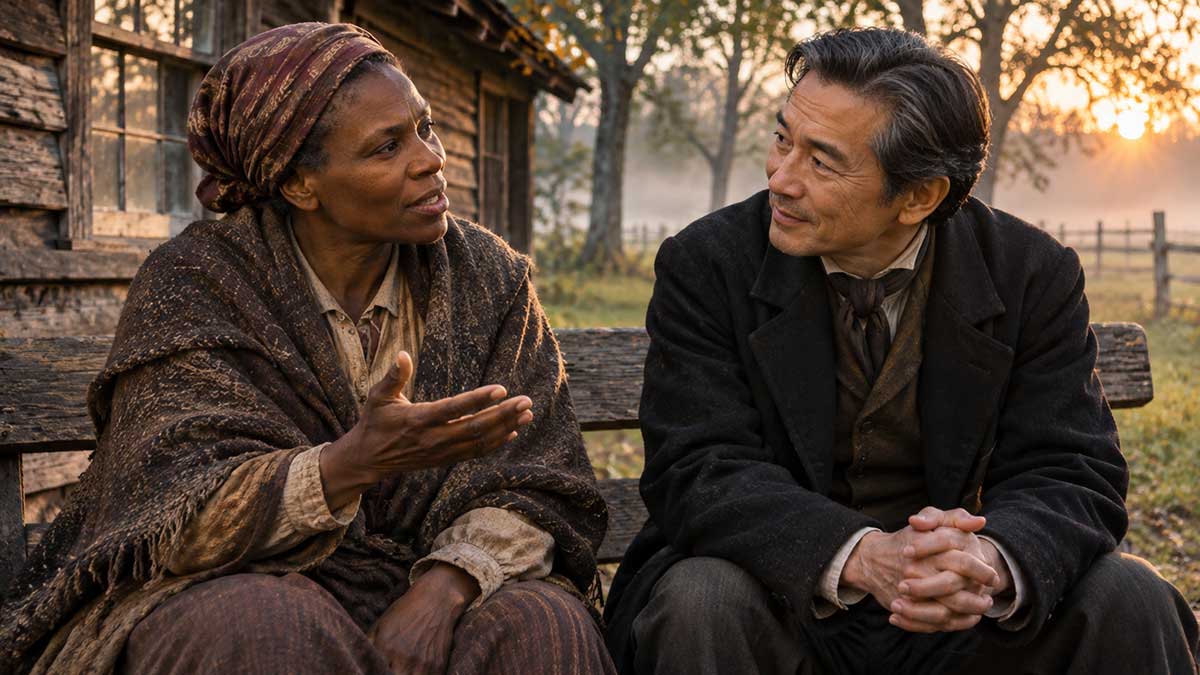
Maryland's Eastern Shore. Early morning.
The first light of dawn slips through the branches of tall trees. Beyond a narrow dirt path, a modest wooden cabin stands near the edge of a clearing. Mist hangs over the distant marshes, and birds are beginning to call.
The air smells of damp earth and pine.
I have come to meet a woman whose name would one day become synonymous with freedom.
But today, I don't want to begin with the Underground Railroad, the Civil War, or the hundreds of lives she helped change.
I want to meet the little girl who existed before any of that.
A woman stands near the path, looking toward the trees. She wears a simple dark dress and a neatly tied headscarf. Her face is strong, but her eyes are warm and alert.
She turns as I approach.
Nick Sasaki: Mrs. Tubman?
Harriet Tubman: That's me. And you must be Nick.
Nick: I am. It's an honor to meet you.
Harriet: Well, come on over here, then. No sense standing so far away if you've come to talk.
I laugh and walk toward her.
Nick: I've been looking forward to this conversation.
Harriet: Have you? Then I hope you've brought some good questions.
Nick: I have about a hundred.
She raises an eyebrow.
Harriet: A hundred? Lord have mercy. You planning to stay till Christmas?
We both laugh.
Nick: No, ma'am. I'll try to keep it to fifteen.
Harriet: Fifteen's still a fair number. But we'll see what we can do.
She gestures toward a simple wooden bench near the cabin.
We sit together. For a moment, neither of us speaks.
The sun is just beginning to touch the treetops.
Nick: Harriet, people know you as a great American hero. They know you helped enslaved people escape. They know about your courage.
But I was thinking about something.
Before you became Harriet Tubman, before anyone called you Moses, you were just a little girl.
And I wonder how often people stop to think about her.
Harriet looks toward the trees.
Harriet: Not often enough, I reckon.
Nick: Then that's where I'd like to begin.
She nods.
Harriet: All right, Nick. Let's begin there.
Question 1: Who Was Minty Before She Became Harriet Tubman?
Nick: Harriet, before the world knew you by that name, people called you Minty. What would you want me to know about that little girl?
Harriet: First thing I'd want you to know is that she belonged to a family.
People hear about slavery, and they hear about work, punishment, and people being sold. Those things were real. Terribly real.
But they ought to know we had mothers and fathers. Brothers and sisters. People we loved.
I was Araminta Ross. Minty, they called me.
My mother was Harriet Green. Folks called her Rit. My father was Ben Ross.
Those names matter to me.
Nick: Why do you say that?
Harriet: When people tell the story of someone who was enslaved, they sometimes begin with the person who claimed to own them.
I would rather begin with my mother.
Nick falls quiet.
Nick: That's a beautiful distinction.
What was your mother like?
Harriet: My mother had a hard life. She had children to look after, and there were people who believed they could decide whether those children stayed with her.
Think on that a moment.
A mother could hold her baby one day and hear that somebody meant to sell that child the next.
And what could she do?
She might plead. She might resist. She might try every way she knew to keep her family together.
But the law was against her.
Nick: Your mother resisted when someone tried to take one of her children, didn't she?
Harriet: That's how the story has been remembered. She wasn't a woman who would quietly agree to losing another child.
My mother knew what it meant to have children taken away.
She had already suffered that sorrow.
Nick: And your father?
Harriet's expression softens.
Harriet: My father knew the woods.
He worked with timber. He knew trees, waterways, and the land around us.
There was much a person could learn from watching him work.
Nick: Did he teach you about the outdoors?
Harriet: I learned a great deal from being out in that country. The woods, the marshes, the water, the changing seasons.
People who have never lived close to the land sometimes think a forest is just a great collection of trees.
But there's a difference between looking at a place and knowing it.
Nick: That's interesting. When I think about your later rescue missions, I think about how much that knowledge must have mattered.
Harriet: It mattered to know where you were going. It mattered to pay attention.
But don't go making every little thing in my childhood into a sign of what I would become.
Nick: Fair enough.
She smiles.
Harriet: I was a child before I was anything else.
Nick: I appreciate you saying that.
I suppose it's easy to look backward at someone famous and treat every childhood experience as preparation for greatness.
Harriet: A child doesn't know what history is going to call her.
She knows whether she's hungry.
She knows whether her mother is near.
She knows when somebody is kind to her.
And she knows when somebody is cruel.
I look down at my hands.
Nick: That's a much more human way to begin your story.
Harriet: Then perhaps we're beginning in the right place.
Question 2: What Could Slavery Never Take From Your Family?
The sunlight has reached the clearing. Somewhere in the distance, a bird gives a sharp call.
Nick: Harriet, one of the hardest things for me to comprehend is that families could be separated and sold away from one another.
Your family experienced that.
Three of your sisters were sold away.
How does a family live with something like that?
Harriet looks at me for a long moment.
Harriet: Tell me something, Nick.
Do you have children?
Nick: Yes, I do.
Harriet: Then you know what it is to love somebody whose life matters more to you than your own comfort.
Nick: I do.
Harriet: Now think of somebody coming to your door and telling you that one of those children is going away.
You don't get to decide where.
You don't know when you'll see that child again.
You may never hear from that child.
And the person taking your child believes the law gives him the right.
What would you say?
I open my mouth, then stop.
Nick: I don't know what I could say.
Harriet: That's closer to the truth than most speeches people make about it.
We knew what separation meant.
My sisters were taken from our family.
Their absence didn't end when the wagon disappeared down the road.
It stayed.
Nick: What do you mean?
Harriet: When a family loses someone that way, the empty place remains.
You still know that person belongs with you.
You still wonder where they are.
Whether they're hungry.
Whether somebody is hurting them.
Whether they're alive.
Nick is silent.
Nick: I think people sometimes talk about slavery in terms of laws, economics, and politics.
But hearing you describe it, I'm thinking about a mother who doesn't know where her daughter is sleeping tonight.
Harriet: That's part of what slavery was.
People were treated as things to be bought and sold.
But we were never things.
We were people.
Nick: Your mother tried to protect your family. Your father worked hard. You and your siblings loved one another.
Did those family bonds give you something the people who enslaved you couldn't control?
Harriet: They could separate us. They could make our lives terribly hard.
But they could not make my mother stop being my mother.
They could not make my sisters strangers to me.
They could not make me believe that a person became less human just by being called somebody's property.
Nick: That's an extraordinary distinction.
Harriet: It ought not to be extraordinary.
A mother loves her child. A sister remembers her brother.
That's ordinary human life.
What was extraordinary was a system that tried to tear those things apart.
Her words settle between us.
For a moment, I can hear only the morning birds.
Nick: Harriet, can I ask you something a little personal?
Harriet: You've been doing that since you arrived.
I laugh softly.
Nick: That's true.
When you thought about freedom as a young woman, was it mainly freedom for yourself?
Or was your family already part of what freedom meant to you?
Harriet: I wanted to be free.
There's no shame in saying that.
I wanted to live without somebody else claiming the right to sell me or decide my future.
But I had people I loved.
And once you know what freedom means, you cannot easily forget the people who are still waiting for it.
Nick: So your family was never separate from your idea of freedom.
Harriet: How could it be?
She looks toward the cabin.
Harriet: A person can get to a safe place and still have a heart full of people who aren't safe.
I think about my own family.
For a moment, the distance between our centuries seems much smaller.
Question 3: Where Did Your Faith Come From?
A light breeze moves through the trees.
Harriet adjusts her headscarf and looks toward the morning sky.
Nick: Harriet, there's something else I want to ask you about.
Your faith.
Throughout your life, you spoke about God, prayer, and being guided by Him.
Where did that relationship begin?
Harriet: Faith was part of the world I grew up in.
People prayed.
They spoke of God.
They knew the stories of the Bible, especially the stories of people suffering under bondage and hoping for deliverance.
When you have little control over what happens to you, prayer can become very close to your heart.
Nick: Did you feel that God was close to you when you were a child?
Harriet: I came to believe that God heard me.
That mattered.
There were people who could command my labor. There were people who could threaten me.
But when I prayed, I was speaking to Someone greater than any of them.
Nick: I find that deeply moving.
Can we talk about the injury you suffered when you were young?
Harriet nods.
Nick: An overseer threw a heavy weight toward another enslaved person, and it struck your head.
You were badly hurt.
Afterward, you experienced episodes of sudden sleep and vivid dreams or visions.
How did you make sense of those experiences?
Harriet: I knew I had been injured.
And I knew that afterward, my life was different.
There were times when sleep came over me without warning.
There were dreams and experiences I understood through my faith.
I believed God could guide me.
Nick: Did you ever wonder why such a terrible thing had happened to you?
Harriet: Nick, there's a difference between believing God can be with you in suffering and believing God wanted somebody to hurt you.
I wouldn't want those confused.
I sit quietly, considering her answer.
Nick: You're right.
Sometimes people hear a story of suffering followed by extraordinary achievements and say the suffering made the person great.
But the violence itself was wrong.
Harriet: Yes.
A child should not have to be struck in the head to become worthy of respect.
A child is already worthy.
Nick: That's something I hope our readers hear clearly.
I want to ask about your visions, too.
Some people might interpret them as spiritual experiences. Others might see them in relation to your injury.
How would you want us to approach that?
Harriet: I can tell you how I understood my own experiences.
I trusted God.
I prayed for guidance.
And I tried to act according to what I believed was right.
People may study the injury and discuss what it did to my body.
But they should not forget that faith was part of how I lived.
Nick: That seems fair.
I have my own strong belief in God, and I believe all people belong to one human family.
But I don't want to assume your experiences were identical to mine.
Harriet: Then ask me what I believed.
Nick: All right.
When you prayed, what did you ask God for?
Harriet: Help.
Strength.
A way through whatever stood before me.
And when I thought of people suffering, I prayed for them, too.
Nick: Did prayer make you less afraid?
Harriet: I wouldn't say faith meant there was nothing to fear.
There were real dangers.
Prayer did not make those dangers disappear.
But I believed I wasn't facing them without God.
Nick: So faith and action belonged together for you.
Harriet: If somebody is hungry, you can pray for them.
But if you've got bread, you ought to think about sharing it.
I smile.
Nick: That's a wonderfully practical answer.
Harriet: People have to eat, Nick.
We both laugh.
Then Harriet grows thoughtful.
Harriet: Faith wasn't something I wanted to keep locked away inside myself.
If I believed God cared for people, I had to think about what that meant for how I treated them.
Nick: Even people you didn't know?
Harriet: A stranger is still a person.
And a person in trouble may need somebody willing to help.
I look at her.
Nick: Harriet, I think I'm beginning to see something.
When people talk about your courage, they often make it sound like you suddenly became extraordinary one day.
But your life seems to have been shaped by things that were deeply personal.
Your mother.
Your father.
Your sisters.
Your faith.
Harriet: Those were parts of my life, yes.
But don't forget all the people who helped me along the way.
Nobody lives entirely alone.
Nick: I won't.
Closing: The First Meaning of Freedom
The morning has grown brighter.
Sunlight falls across the path, revealing the uneven ground and the roots of trees.
Harriet stands, and I rise beside her.
Nick: Harriet, when I arrived, I thought I was coming to meet the woman who helped so many people escape slavery.
But we've spent this morning talking about a little girl named Minty.
And I think that was exactly where we needed to begin.
Harriet: I'm glad you think so.
Nick: May I ask one last question before we continue?
Harriet: You told me you had fifteen. I expect there's still a good number left.
I laugh.
Nick: When you were growing up here, before you escaped, what did you think freedom would feel like?
Harriet looks down the path.
For a moment, she says nothing.
Then she turns toward me.
Harriet: I thought about what it would mean to belong to myself.
To go where I chose.
To work for my own living.
To wake up without somebody claiming the right to sell me.
She pauses.
Harriet: But there's something you ought to know, Nick.
Nick: What's that?
Harriet: When I finally reached freedom, I learned that being safe myself didn't mean my heart was at peace.
Nick: Why not?
She looks toward the distant trees.
Harriet: My family was still here.
The words hang quietly in the morning air.
Nick: And that's why you went back?
Harriet meets my eyes.
Harriet: That's a story worth talking about.
She starts walking along the path.
I follow.
Our conversation is only beginning.
Topic 2: She Was Free. Why Did She Go Back?
Opening: The Road Back to Maryland
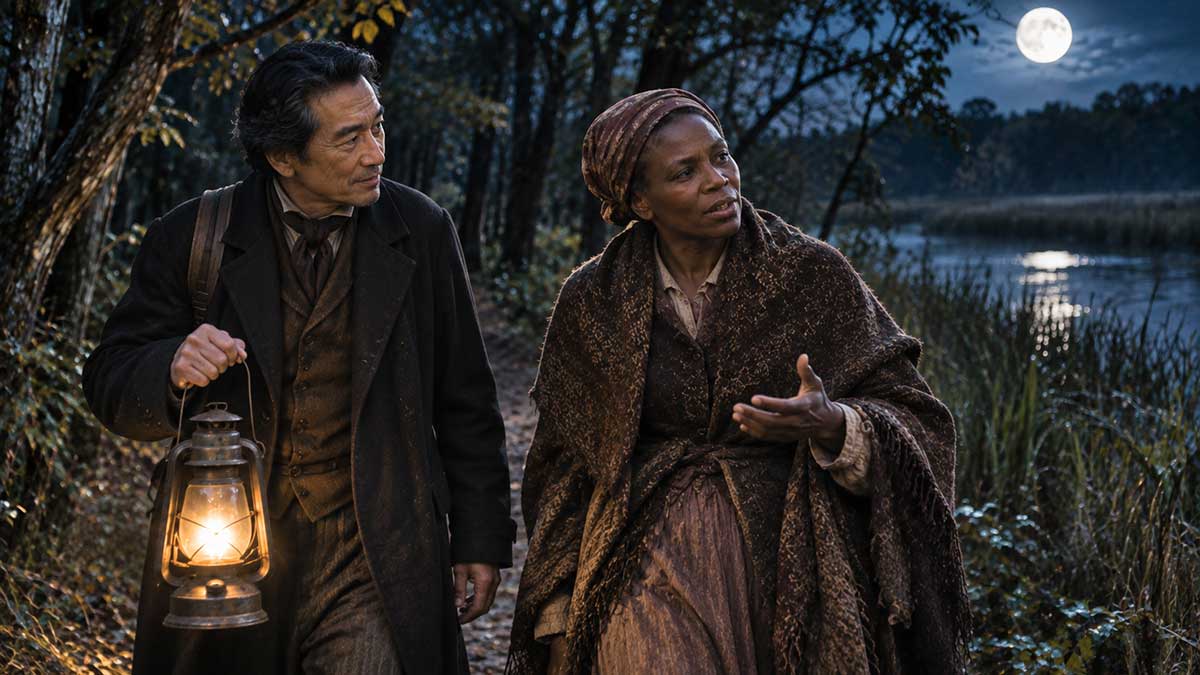
Maryland's Eastern Shore. A moonlit evening, in an imagined conversation beyond the boundaries of time.
The last light of sunset has disappeared behind the trees.
Harriet Tubman and I walk along a narrow woodland path. Tall pines rise on either side, their branches moving gently in the night breeze. Beyond the trees, marsh grass bends beside dark, still water.
The air is cool. Somewhere in the distance, an owl calls.
Harriet walks with the confidence of someone familiar with the countryside. I watch my footing, trying not to stumble over the roots.
Nick Sasaki: Harriet, can I ask you something?
Harriet Tubman: You've been asking questions all day, Nick. I don't suppose you're fixing to stop now.
Nick: Probably not.
She laughs.
Harriet: Then go on.
Nick: Do you ever get nervous walking through woods like these?
She glances at me.
Harriet: You nervous?
Nick: A little. I can barely see where I'm stepping.
Harriet: Then you'd best keep your eyes on the ground.
I nearly trip over a root.
Harriet stops and smiles.
Harriet: See? The ground's already trying to teach you something.
We laugh.
Then I look around at the darkening forest.
Nick: You know, when people hear about the Underground Railroad, they sometimes picture a secret path through the woods, with brave people following the North Star.
But the real story must have been much more dangerous and complicated.
Harriet: There wasn't one road that took everybody to freedom.
There were people who helped. Places where somebody might find shelter. Rivers, roads, towns, and stretches of country you had to pass through.
And there were people who would turn you in.
You had to think carefully.
Nick: And you had to trust the right people.
Harriet: Yes. Trust mattered.
But you had to be careful with it.
She looks down the path.
Harriet: Come on. There's a place farther along where we can sit.
We continue walking.
Tonight, I want to ask Harriet about one of the most extraordinary decisions of her life.
She escaped slavery in 1849.
She reached Philadelphia, where she was no longer legally enslaved under Pennsylvania law, though federal law still threatened freedom seekers.
She had achieved something that countless others desperately wanted.
Yet she returned to Maryland, again and again.
I want to know why.
Question 4: What Did Freedom Feel Like?
We reach a small clearing beside the marsh.
A fallen tree provides a place to sit. Moonlight reflects faintly on the water.
Nick: Harriet, let's go back to 1849.
You were about twenty-seven years old, though your exact birth date remains uncertain.
You had spent your entire life under slavery.
Then you decided to escape.
What brought you to that decision?
Harriet: I'd lived long enough knowing somebody else claimed the right to decide what happened to me.
I could be made to work.
I could be sent away.
I could be sold.
And after Edward Brodess died, there was more reason to fear what might happen to us.
I wasn't willing to wait quietly for somebody to decide my future.
Nick: You first tried escaping with two of your brothers.
Harriet: That's right.
Nick: But they turned back.
Harriet: They did.
Nick: Were you angry with them?
Harriet considers the question.
Harriet: Nick, it's easy to ask that when you're sitting safely beside me.
Think about what capture could mean.
Punishment. Sale. Separation from everybody you knew.
Fear was no small thing.
Nick: That's fair.
Harriet: I wanted to go on. But they turned back, and that first attempt ended.
Nick: Then you escaped on your own.
Harriet: I made another attempt, and this time I reached the North.
People helped me. I didn't get there entirely by myself.
Nick: Do you remember the moment you realized you had made it?
Harriet looks toward the moonlit water.
Harriet: I later told people how the morning looked when I crossed into freedom.
The sunlight seemed different. Everything looked beautiful.
I had reached a place where I could begin to live as a free woman.
Nick: That must have been overwhelming.
Harriet: It was a great change.
I could work for wages. I could make choices about my own life.
But freedom didn't mean there was no danger left.
Nick: The Fugitive Slave Act came the following year, in 1850.
Harriet: And it made the danger worse.
People who had escaped slavery could be seized and returned.
Even those living far from the plantations had reason to fear.
Nick: So reaching Pennsylvania wasn't the end of the struggle.
Harriet: No.
Nick: But there was something else.
Your family.
Harriet nods.
Nick: In later accounts, you described reaching freedom and then realizing you were alone.
Your parents, brothers, and sisters weren't there to share it with you.
What was that like?
She sits quietly for a moment.
Harriet: Think about arriving somewhere you've wanted to go for years.
You look around.
You've made it.
Then you think of the people you love.
And you know they're still living under the same danger you escaped.
Nick: So the joy of freedom came with loneliness.
Harriet: A person can be grateful for freedom and still grieve for those left behind.
Those feelings don't cancel each other.
Nick: Did you ever think, "I've done enough. I survived. I should build a life here"?
Harriet: I did begin building a life. I worked.
But I knew what was happening back in Maryland.
I couldn't stop thinking about my people.
Nick: Your husband, John Tubman, was still there, too.
Harriet: Yes.
Nick: He was already a free man when you married.
Harriet: He was.
Nick: Yet his freedom couldn't protect yours.
Harriet: Marriage didn't change the law that held me enslaved.
Nick: It's hard to comprehend a marriage in which one spouse could legally be sold away.
Harriet: That's what slavery did to families.
It made promises between people terribly uncertain.
I look across the marsh.
Nick: Harriet, when you reached Philadelphia, you had gained your freedom.
But you hadn't found peace.
Harriet: I had something precious.
I wanted the people I loved to have it, too.
Question 5: Why Would You Risk Everything to Go Back?
A breeze moves through the marsh grass.
Nick: Harriet, this is the question I've wanted to ask you since we met.
You escaped slavery.
You knew the danger.
You had a chance to live a different life.
Why did you go back?
Harriet turns toward me.
Harriet: Nick, suppose you got out of a burning house.
You reached the street. You were safe.
Then you looked back and saw your family still inside.
Would you simply walk away?
I shake my head.
Nick: No. I couldn't.
Harriet: Then you have some idea.
Nick: But you weren't facing one burning house.
You were facing an entire system of slavery.
And every time you returned, you risked being captured.
Harriet: I knew the danger.
I didn't go back thinking nobody could catch me.
Nick: Were you afraid?
Harriet: There were reasons to be afraid.
But fear wasn't the only thing that mattered.
Nick: What mattered more?
Harriet: The people who needed help.
She looks toward the trees.
Harriet: My first rescue journey brought my niece Kessiah, her children, and her husband to freedom.
Later I helped others, including members of my family.
There were people who wanted to leave but needed somebody who knew how to help them.
Nick: You eventually made about thirteen rescue journeys and personally guided approximately seventy people to freedom.
Those are the figures historians generally accept today.
Harriet: Seventy people aren't just a number, Nick.
Each one had a life.
People they loved.
Reasons they wanted to be free.
Nick: You're right.
Sometimes history turns human lives into statistics.
Harriet: Numbers have their place.
But don't forget the people.
Nick: How did you prepare for a rescue?
Harriet: You needed to know whom you could trust.
You needed to think about where people might travel and where they might find help.
You had to pay attention to danger.
And you had to remember that somebody traveling with you might be frightened, exhausted, or uncertain.
Nick: I suspect that's something people underestimate.
It's one thing to escape alone.
It's another to guide a group, including children and people who may never have traveled far from home.
Harriet: People don't all move at the same pace.
And when somebody is afraid, telling them not to be afraid doesn't settle the matter.
You have to help them keep going.
Nick: Did you ever have someone who wanted to turn back?
Harriet: People were frightened. That much is true.
But be careful with the stories you've heard about what I supposedly did to anyone who wanted to return.
Not every dramatic tale repeated about me can be proved.
Nick: You're referring to stories about threatening people with a gun?
Harriet: People have told many stories.
Some have grown larger with every telling.
You ought to ask which ones have good evidence.
Nick: That's an important correction.
I don't want to turn you into a legend at the expense of the truth.
Harriet: Then tell the truth about the danger, the planning, and the people who helped.
That's enough of a story.
I smile.
Nick: More than enough.
Can I ask about the people who helped you?
Harriet: Of course.
Nick: We often hear about you alone, moving through the darkness.
But you worked within a network.
Harriet: Yes.
There were free Black people, people who had escaped slavery, and abolitionists who offered help.
Some gave shelter.
Some provided information.
Some helped people continue north.
A rescue could depend on people whose names the world would never know.
Nick: Including people like Thomas Garrett and William Still.
Harriet: They were among those who helped freedom seekers.
Nick: And many others whose stories were never recorded.
Harriet: That's right.
Nick: What about Canada?
Harriet: For some people, Canada offered greater security from the laws that threatened them in the United States.
But getting there took time and help.
Nick: Harriet, I have to ask something.
How did you keep going when you were exhausted?
Harriet: You did what needed doing.
You rested when you could.
You paid attention.
You trusted God.
And you remembered why you had come.
Nick: Did you ever think about how extraordinary your actions were?
Harriet laughs.
Harriet: Nick, if somebody's trying to get across dangerous country without being caught, there's not much time for admiring herself.
I laugh with her.
Nick: Fair point.
Harriet: The work was to get people somewhere safer.
That was what mattered.
Nick: You know, I came into this conversation thinking about courage.
But now I'm thinking about responsibility.
You didn't simply feel compassion for people.
You acted on it.
Harriet: Feeling sorry for somebody doesn't carry them very far.
If you can help, you ought to consider what help you can give.
Nick: And sometimes helping required extraordinary risks.
Harriet: Sometimes it did.
Question 6: What About the People You Couldn't Save?
The night has grown quieter.
A pale moon hangs above the trees.
I have one more question, but I hesitate before asking it.
Nick: Harriet, we've talked about the people you helped reach freedom.
But there's another part of your story.
The people you couldn't bring home.
Harriet's expression becomes thoughtful.
Nick: Your sister Rachel was still enslaved in Maryland.
You tried to help her, but she died before you could bring her to freedom.
I can't begin to know what that meant to you.
Would you be willing to talk about her?
Harriet looks down at her hands.
Harriet: Rachel was my sister.
Before anybody writes a history about her, I want them to know that.
She wasn't simply somebody I failed to rescue.
She was part of my family.
Nick: Of course.
Harriet: People remember the ones who made it north.
And I'm glad they do.
But there were others who never got that chance.
Some were sold away.
Some died.
Some could not leave when the opportunity came.
Nick: Did those losses ever make you question what you were doing?
Harriet: I knew I couldn't free everybody by myself.
But that didn't mean I should stop helping the people I could reach.
Nick: That must have been a difficult truth to live with.
Harriet: There are limits to what one person can do.
You still have to decide what you're willing to do within those limits.
I sit quietly.
Nick: Harriet, I think about something you said earlier.
That a family can lose someone, but the empty place remains.
Harriet: Yes.
Nick: I suppose that was true even after you helped so many people escape.
There were still empty places.
Harriet: Freedom didn't bring every family back together.
It didn't undo what had happened.
Nick: And your first husband, John?
Harriet looks toward the water.
Harriet: When I returned hoping he would come north, he had made another life.
He didn't come with me.
Nick: That must have been painful.
Harriet: It was part of what happened.
But I don't want my whole life told as a collection of sorrows.
Nick: You're right.
Harriet: There were people who reached safety.
Families who found one another.
Children who had a chance to grow up without being enslaved.
There was joy in that, too.
Nick: I'm glad you said that.
I think people sometimes believe an emotional story has to be filled with suffering.
But perhaps some of the most moving moments were the moments of reunion.
Harriet: Think of a mother seeing her child safe.
Think of somebody realizing nobody there could lawfully claim to own them.
Those moments mattered.
Nick: Did you ever feel that your work was finished?
Harriet smiles faintly.
Harriet: There were still people enslaved.
How could the work be finished?
Nick: You were helping people one journey at a time.
Harriet: That was what I could do then.
Nick: But soon the entire country would be at war.
Harriet: Yes.
Nick: And your work would take a different form.
Harriet: It would.
Closing: The People Still Waiting
We rise from the fallen tree.
The moonlight has grown brighter, revealing the path ahead.
For a moment, we stand beside the marsh without speaking.
Nick: Harriet, when I first learned your story, I thought the most remarkable thing was that you escaped slavery.
Then I learned you went back to rescue others.
And I thought that was the remarkable thing.
But now I'm beginning to see something deeper.
You never stopped thinking about the people who were still waiting.
Harriet looks at me.
Harriet: People don't stop being your family just because you've reached a safer place.
Nick: No, they don't.
Harriet: And there were many people beyond my own family who deserved freedom.
Nick: I want to thank you for talking about the people you couldn't save.
I know those memories aren't easy to approach.
Harriet: Then remember them.
Not just the people whose names you know.
Remember the people whose names were never written down.
We begin walking back along the path.
This time, I watch the ground more carefully.
Harriet notices.
Harriet: You're getting better at walking through these woods.
Nick: I haven't fallen yet.
Harriet: The night's not over.
We laugh.
Then I ask one final question.
Nick: Harriet, after years of helping small groups escape, what did you think when the Civil War began?
She stops.
For a moment, she looks out toward the dark water.
Harriet: I knew there were people who had waited a long time for freedom.
And now the country was going to have to face what slavery had done.
Nick: You would soon be helping the Union in South Carolina.
Harriet: Yes.
Nick: And in 1863, you would take part in an operation that helped free more than seven hundred people.
Harriet turns toward me.
Harriet: Then perhaps it's time we talked about the war.
She starts walking again.
I follow her through the moonlit trees.
The story of Harriet Tubman's courage is about to grow far beyond the woodland paths of Maryland.
Topic 3: The Woman Who Helped Free Hundreds
Opening: The River That Carried People to Freedom
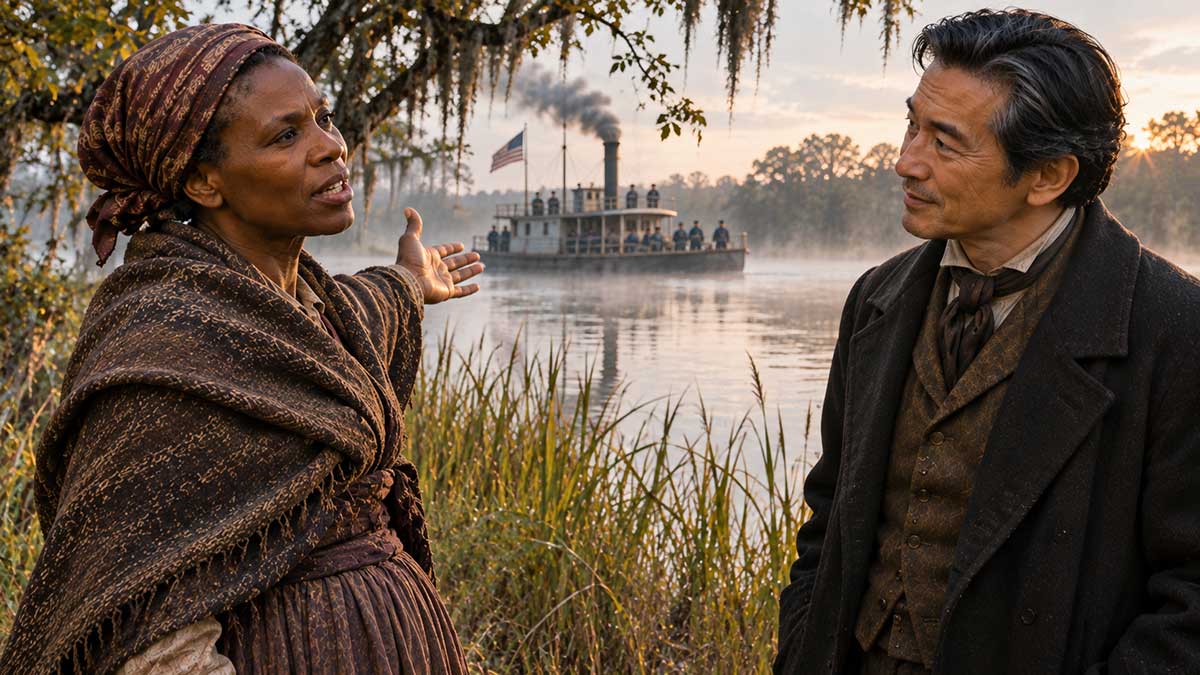
South Carolina, June 1863. An imagined meeting beside the Combahee River.
A thin veil of morning mist floats above the dark water.
The river bends through a broad expanse of marsh grass. Tall trees stand along the distant banks, their branches silhouetted against a pale blue sky.
A Union steamboat rests farther downriver.
I can hear men talking quietly near the vessel. Somewhere beyond the reeds, a bird calls.
Harriet Tubman stands beside me, studying the river.
She has exchanged the woodland paths of Maryland for the waterways of South Carolina.
I look at the broad river and try to picture what happened here.
Nick Sasaki: Harriet, this place feels different from Maryland.
Harriet Tubman: It is different.
Nick: The river's much wider than I expected.
Harriet: Water can be a road, Nick.
Nick: That's something I never really thought about.
Harriet: Well, people have been traveling by water a long time before you came along.
I laugh.
Nick: You're going to keep reminding me how little I know, aren't you?
Harriet: Only when you give me good reason.
She smiles.
I look toward the distant steamboat.
Nick: We've talked about your childhood and the journeys you made helping people escape slavery.
But now we're standing beside a river where you helped make something extraordinary happen.
In June 1863, a Union operation along the Combahee River liberated more than seven hundred enslaved people.
You played an important role in preparing for that raid.
Harriet: There were many people involved.
Nick: I know. And I want to understand their contributions, too.
But first, I want to know how you came to be here.
She turns toward me.
Harriet: Then we ought to begin with the war.
Question 7: How Did a Freedom Guide Become a Wartime Intelligence Operative?
Nick: Harriet, when the Civil War began in 1861, you had already spent years helping enslaved people escape.
How did you become involved in the Union war effort?
Harriet: Slavery was at the heart of that struggle.
I had seen what it did to families.
I had helped people escape from it.
When the war came, there was work to be done.
Nick: You went to South Carolina in 1862.
Harriet: Yes.
Nick: And you worked in several roles.
You helped care for sick people, supported the Union effort, and became involved in scouting and gathering information.
Harriet: People needed food, care, information, and help finding their way.
A war isn't fought by soldiers alone.
Nick: I think that's something we forget.
We remember generals and battles.
But we don't always remember the people who cared for the wounded or helped families survive.
Harriet: Those people mattered.
Nick: What was it like arriving in South Carolina?
You were far from Maryland, among people whose lives had been shaped by slavery in a different region.
Harriet: There were people who had escaped plantations, people who had lived under slavery all their lives, and people trying to build something new.
Some had families still in danger.
Some knew the rivers and the land.
Some had information the Union needed.
Nick: Did your experience with the Underground Railroad help you understand how to work with them?
Harriet: I'd learned that you couldn't help people without listening.
You needed to know what they knew.
Where danger might be.
Who could be trusted.
What somebody needed before they could move.
Nick: That sounds very much like intelligence work.
Harriet: You can give it a grand name if you like.
But much of it begins with paying attention.
I smile.
Nick: You have a way of making complicated things sound simple.
Harriet: Simple doesn't mean easy.
Nick: Fair point.
I look toward the river.
Nick: When people describe you as a spy, they sometimes picture you sneaking behind enemy lines like someone in a movie.
Is that the right way to think about your work?
Harriet shakes her head.
Harriet: You ought to think about all the people who knew things the army didn't.
People who worked on plantations.
People who knew the waterways.
People who understood where Confederate forces were stationed.
Their knowledge mattered.
Nick: And you helped connect that knowledge to Union operations.
Harriet: That was part of the work.
Nick: Were you surprised that people who had been enslaved possessed information valuable enough to influence military decisions?
Harriet gives me a long look.
Harriet: Why would I be surprised?
I realize immediately that I've asked the question poorly.
Nick: You're right. That came out wrong.
Harriet: Enslaved people weren't ignorant of the country around them.
They knew where they lived and worked.
They knew the rivers, the roads, the fields, and the people who controlled them.
Some had spent their whole lives learning things that soldiers arriving from somewhere else didn't know.
Nick: So the army needed to listen to them.
Harriet: Yes.
Nick: That's an important lesson.
People who have been denied freedom can still possess knowledge that others desperately need.
Harriet: Being enslaved never meant a person lacked intelligence.
It meant somebody else had the ability to deny that person liberty.
I nod.
Nick: Harriet, I appreciate that correction.
Harriet: Then keep asking questions.
Nick: I will.
Harriet: Good. I was beginning to think you'd run out.
We laugh.
Question 8: What Happened at the Combahee River?
The mist begins to lift.
Sunlight touches the river, turning the water silver.
Nick: Harriet, let's talk about the Combahee River Raid.
On the night of June 1 and into June 2, 1863, Union forces traveled up this river.
Colonel James Montgomery commanded the military operation, and Black Union soldiers took part.
You helped provide intelligence and guidance.
What made this operation possible?
Harriet: The Union needed information about the river.
Where vessels could travel.
Where dangers might lie.
Where Confederate forces were.
And where enslaved people might be reached.
People familiar with the country helped provide that knowledge.
Nick: The river had Confederate obstacles and defenses.
Harriet: Yes.
Nick: So planning mattered enormously.
Harriet: It did.
Nick: I want to be careful about something.
Some accounts make it sound as if you personally commanded the entire military operation.
But Colonel Montgomery commanded the troops, and your role involved intelligence, guidance, and coordination.
Harriet: Then tell it that way.
There is no need to take credit from one person to honor another.
Nick: That's a good way to put it.
What was the purpose of the raid?
Harriet: The Union wanted to strike Confederate resources and help enslaved people reach freedom.
Nick: The troops destroyed plantations and other Confederate property, and hundreds of enslaved people escaped to the Union vessels.
Historical estimates usually put the number liberated at more than seven hundred.
Harriet looks across the river.
Harriet: Think about those people, Nick.
Nick: What do you mean?
Harriet: Think about what it meant to leave.
Some had lived on those plantations all their lives.
Some had children with them.
Some had elderly family members.
They had to decide whether to trust what was happening and move toward the boats.
Nick: I suppose there must have been confusion and fear.
Harriet: It was a dangerous operation.
And the people escaping were taking a great risk.
Nick: We often tell the story from the perspective of the Union soldiers and their mission.
But for the people boarding those boats, this was the moment their lives might change forever.
Harriet: That's right.
Nick: Can I ask you something?
Harriet: Go ahead.
Nick: When you think about the raid, do you remember the military success first, or the people who escaped?
Harriet turns toward the water.
Harriet: I would want you to think about the people.
The men and women who had been held in slavery.
The children.
The families trying to reach the boats.
They weren't prizes taken from an enemy.
They were human beings seeking freedom.
I remain silent.
Nick: That's something I don't want readers to miss.
Harriet: Then don't let them miss it.
Nick: Harriet, in your earlier rescue journeys, you often guided small groups.
Here, hundreds of people were liberated in a single operation.
Did that change the way you thought about what was possible?
Harriet: The war created circumstances very different from the ones I'd known in Maryland.
There were soldiers and vessels.
There were organized operations.
And there were people who had been enslaved who could now help the Union and seek freedom.
The work had grown.
Nick: It must have been extraordinary to witness.
Harriet: It was a great event.
But freedom wasn't finished when the boats left the river.
Nick: What do you mean?
Harriet: People still needed food.
Shelter.
Work.
A way to care for their children.
And the war was still being fought.
Nick: So liberation was a beginning, not the end of their difficulties.
Harriet: Yes.
I look again toward the steamboat.
For the first time, I stop seeing it simply as a military vessel.
I picture families climbing aboard, carrying whatever they could bring, uncertain what waited for them beyond the river.
Nick: Harriet, I think I understand why you keep bringing me back to the people.
Harriet: That's where the story belongs.
Question 9: What Did Leadership Mean to You?
We walk slowly along the riverbank.
The morning sun has risen above the trees.
Nick: Harriet, people often call you a hero.
And I can understand why.
But after talking with you, I'm beginning to think that word can sometimes hide as much as it reveals.
Harriet: How so?
Nick: It can make a person's accomplishments seem almost magical.
As if you simply appeared in the right place, knew exactly what to do, and never made a mistake.
But your work depended on preparation, judgment, cooperation, and people trusting one another.
Harriet: That's closer to the truth.
Nick: So let me ask you something.
What did leadership mean to you?
Harriet considers the question.
Harriet: If people are depending on you, you ought to take that responsibility seriously.
You listen.
You pay attention.
You don't pretend to know what you don't know.
And you don't forget that other people may have something important to teach you.
Nick: That sounds very different from the way some people think about leadership.
Harriet: What do they think?
Nick: That the leader is the person who gives all the orders.
Harriet smiles.
Harriet: Somebody giving orders doesn't mean anybody ought to follow them.
I laugh.
Nick: That's true.
Harriet: A person needs to earn trust.
And if you expect people to take risks, you'd better understand what you're asking of them.
Nick: Did your faith influence the way you led?
Harriet: My faith influenced how I lived.
I believed God could guide me.
But I still had to listen to people, learn what I could, and do the work before me.
Nick: I appreciate that combination.
Faith and practical judgment.
Harriet: A person can pray for help and still need to look where she's walking.
I grin.
Nick: You haven't forgotten how I nearly tripped in Maryland.
Harriet: No, Nick. I haven't.
We laugh.
Nick: Harriet, there is something I want to ask you about the people who worked beside you.
Many of them were formerly enslaved people.
Some served in the Union Army.
Others provided information or helped families escape.
How would you want them remembered?
Harriet: As people who helped win freedom.
They had names.
Families.
Reasons for fighting.
They weren't simply standing behind somebody famous.
Nick: History often remembers a few individuals and forgets everyone around them.
Harriet: Then history ought to try harder.
Nick: That's a fair challenge.
I pause.
Nick: When you think about the Combahee River Raid, is there one lesson you would want someone living many generations later to learn?
Harriet: Don't look at one person and forget all the others.
And don't think freedom came without people taking risks to secure it.
Nick: You know, Harriet, I believe humanity is one family under God.
And when I look at your life, I see someone who acted as if the suffering of others mattered personally.
Harriet: I knew what slavery had done to my family.
And I knew other families were suffering, too.
You didn't have to be related to somebody to know that person deserved freedom.
Nick: That's a lesson our world still needs.
Harriet: Then perhaps your world ought to listen.
I smile.
Nick: I hope it will.
Closing: When the Boats Carried Hope
The sun is higher now.
The river glitters beneath the morning light.
A distant voice calls from the direction of the Union vessel.
Harriet and I stand beside the water.
Nick: Harriet, when we started talking in Maryland, I was thinking about one woman guiding people through the woods.
Now I'm looking at a river where hundreds of people were liberated during a single operation.
But I think you've taught me something important.
Harriet: What's that?
Nick: The story isn't just about how many people you helped.
It's about the lives behind those numbers.
The families.
The people who took risks.
The people who worked together.
And the people who finally had a chance to begin again.
Harriet nods.
Harriet: That's worth remembering.
Nick: I have one more question before we leave this place.
Harriet: You've always got one more.
I laugh.
Nick: After the Civil War ended, did you finally get to rest?
Harriet looks at me.
Then she laughs softly.
Harriet: Rest?
Nick: I had a feeling you might say that.
Harriet: There was still family to care for.
People who needed help.
And a life to make after the war.
Nick: So your work wasn't finished.
Harriet: No.
Nick: But the danger of rescue missions and wartime operations was behind you.
Surely life became easier.
Harriet's smile fades a little.
Harriet: Some things changed for the better.
But freedom didn't make every hardship disappear.
Nick: What happened?
She looks toward the distant shore.
Harriet: Come with me to Auburn, New York.
There's another part of my story you ought to hear.
Nick: I'd like that.
Harriet: People know about the journeys and the war.
But there's something else I spent a great deal of my life doing.
Nick: What's that?
Harriet turns toward me.
Harriet: Taking care of people.
We begin walking away from the river.
Behind us, the water continues flowing through the South Carolina marshes.
The story of Harriet Tubman's service is far from over.
Topic 4: Who Took Care of Harriet Tubman?
Opening: The House Where Freedom Found a Home
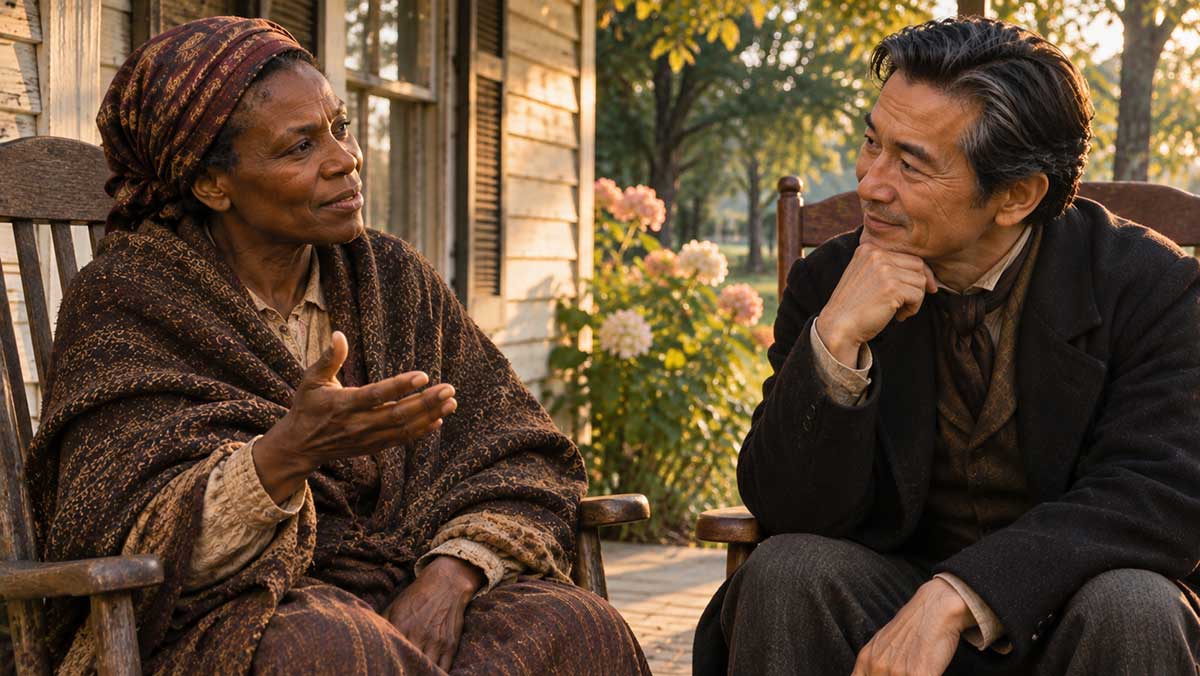
Auburn, New York. A warm afternoon in the early twentieth century, in an imagined meeting beyond the boundaries of time.
The afternoon sunlight falls gently across a modest wooden house surrounded by trees and a small garden.
A narrow path leads toward the front porch. The air carries the scent of freshly cut grass, and somewhere nearby, a bird sings.
This is Auburn, New York, where Harriet Tubman spent much of the latter part of her life.
The woman who once traveled through dangerous forests and helped guide enslaved people to freedom is now older.
Her steps are slower.
But when she sees me approaching, her face brightens.
Harriet Tubman: Nick! There you are.
Nick Sasaki: Harriet, it's wonderful to see you again.
Harriet: Well, come on up. Don't stand there admiring the house all afternoon.
I laugh and climb the porch steps.
Nick: I was just thinking how peaceful it feels here.
Harriet: Peaceful, is it?
Nick: Very.
She gives me an amused look.
Harriet: You haven't seen what happens when a house is full of people needing something.
Nick: I suppose peaceful doesn't necessarily mean quiet.
Harriet: Now you're learning.
We sit in two wooden chairs near the porch railing.
A small table stands between us.
I look toward the garden.
Nick: Harriet, when people tell your story, they often end with the Civil War.
You helped enslaved people escape. You served the Union. You helped make the Combahee River Raid possible.
And then the war ended.
It's almost as if the story stops there.
Harriet: But my life didn't stop, Nick.
Nick: Exactly.
And I have a feeling this part of your life deserves just as much attention.
Harriet settles into her chair.
Harriet: Then let's talk about it.
Question 10: What Kind of Life Did You Want After the War?
Nick: Harriet, after so many years of danger, rescue journeys, and wartime service, what kind of life did you hope to build?
Harriet looks across the yard.
Harriet: A home.
Somewhere my family could live.
Somewhere people could come when they needed help.
Somewhere I could do useful work.
Nick: That sounds simple.
Harriet: There's nothing small about having a home of your own.
Nick: You're right.
Especially after growing up in a system where your family could be separated at any moment.
Harriet: When you've known what it means to have people taken away, you don't take a home for granted.
Nick: You had purchased property here in Auburn before the war ended.
Harriet: Yes. William Seward helped make it possible for me to buy land here.
Nick: The same William Seward who served as Abraham Lincoln's secretary of state.
Harriet: That's right.
Nick: And you brought your parents north to live with you.
Harriet: I wanted them safe.
They'd spent so much of their lives working and worrying.
I wanted them to have a place where they could grow older without living under slavery.
Nick: That must have meant a great deal to you.
Harriet: It did.
Nick: There's something beautiful about that.
When you were a little girl, your parents tried to protect you.
Later, you were able to help protect them.
Harriet smiles softly.
Harriet: Families ought to care for one another when they can.
Nick: You later married Nelson Davis, a Civil War veteran.
Harriet: Yes.
Nick: And you adopted a daughter, Gertie.
Harriet: That's right.
Nick: I think people sometimes forget that you had a family life beyond your famous work.
You were a wife, a mother, a daughter, and a neighbor.
Harriet: I had people to love and people who loved me.
And I had plenty of work to do.
Nick: What was ordinary life like here?
Harriet laughs.
Harriet: Ordinary life?
Somebody needs food.
Somebody needs washing done.
Something in the house needs fixing.
Somebody comes to the door asking for help.
And just when you think you've finished one job, another appears.
Nick: That sounds remarkably familiar.
Harriet: You have a household, don't you?
Nick: I do.
Harriet: Then you ought to know.
We both laugh.
Nick: Did you enjoy having a home where people could gather?
Harriet: I cared about having people near me.
But keeping a household going takes money, food, work, and patience.
You can't live on good intentions alone.
Nick: That's an interesting point.
People admire your generosity, but generosity had a practical cost.
Harriet: Of course it did.
If somebody's hungry, you need food to feed them.
If somebody's sick, they may need care.
And if people are staying in your home, you need a way to keep the home standing.
Nick: Did you ever wish you could simply close the door and live quietly?
Harriet thinks for a moment.
Harriet: A quiet afternoon can be a fine thing.
But people came to me with needs.
I knew what it was to need help myself.
Nick: You never seemed to separate freedom from responsibility.
Harriet: Freedom gives a person the chance to make choices.
And those choices matter.
I look at the house.
For years, Harriet had risked her life helping people find freedom.
Now she was using the freedom she had gained to create a place where people could belong.
Question 11: Why Was Recognition So Difficult?
A light breeze moves across the porch.
Nick: Harriet, there's something about your later life that troubles me.
You gave so much to the Union during the Civil War.
You worked as a nurse, scout, and intelligence operative.
You helped make an operation possible that liberated hundreds of people.
Yet you spent years struggling financially.
How did that happen?
Harriet looks at me steadily.
Harriet: People can praise what you've done without helping you pay for what you need.
Nick: That's a painful truth.
Harriet: I had expenses.
People depended on me.
And the money I believed was owed for my wartime service wasn't easily obtained.
Nick: You spent years seeking compensation and recognition.
Harriet: Yes.
Nick: Later, you received a federal pension connected to Nelson Davis's military service, and eventually a higher pension after Congress acted.
But that wasn't the same as receiving full recognition and compensation for all your own wartime work.
Harriet: Those were different matters.
Nick: Did it hurt to see your service celebrated but not properly compensated?
Harriet pauses.
Harriet: I wanted what was fair.
And I wanted to be able to care for the people depending on me.
Nick: That seems like such a reasonable request.
Harriet: Reasonable things don't always come easily.
Nick: I suppose that's true in every century.
Harriet: Then perhaps every century has some work to do.
I smile.
Nick: Harriet, may I ask you a difficult question?
Harriet: You may ask it.
Nick: You spent so much of your life helping other people.
But who helped you?
Harriet looks toward the garden.
For a moment, I wonder whether I've asked too much.
Then she answers.
Harriet: There were people who helped me, Nick.
Don't forget them.
Nick: Tell me about them.
Harriet: Friends.
Neighbors.
People who believed in the work I was doing.
People who offered money, assistance, or encouragement.
There were people who supported my efforts when I couldn't manage everything alone.
Nick: So you weren't entirely abandoned.
Harriet: No.
But that doesn't mean life was easy.
Nick: I think that's an important distinction.
It would be tempting to tell your story as though everyone forgot you after the war.
But that wouldn't be accurate.
Harriet: Then don't tell it that way.
Nick: You had a community.
Yet you still faced real hardship.
Harriet: Yes.
Nick: Did you ever find it difficult to accept help?
Harriet considers the question.
Harriet: When you've spent years doing what you can for others, it can be hard to have needs of your own.
But nobody can do everything alone.
Nick: That's something I think many people need to hear.
Especially people who spend their lives caring for others.
Harriet: Then tell them that asking for help doesn't make a person less worthy.
I nod.
Nick: Harriet, you were involved in the movement for women's voting rights, too.
Harriet: Yes.
Nick: You worked alongside women who believed women deserved a voice in the government that made laws affecting their lives.
Harriet: Women had worked, suffered, raised families, and contributed to the country.
They deserved to be heard.
Nick: After fighting slavery, you continued supporting the rights of people whose voices were ignored.
Harriet: Freedom ought to mean something in everyday life.
Nick: Not simply freedom written into law.
Harriet: A law can change, but people still need the chance to live with dignity.
I sit back in my chair.
The woman beside me had lived through slavery, emancipation, and decades of social change.
Yet she continued asking what freedom meant for people who were still struggling.
Question 12: Why Did You Create a Home for Others?
The afternoon sunlight begins to soften.
A gentle breeze carries the sound of leaves rustling in the trees.
Nick: Harriet, there's one part of your later life I find especially moving.
You helped establish the Harriet Tubman Home for the Aged here in Auburn.
Why was that so important to you?
Harriet looks toward the house.
Harriet: There were older people who needed somewhere to live.
People who didn't have enough money.
People who needed care.
I wanted them to have a place.
Nick: You had spent years helping people escape slavery.
And later you devoted yourself to helping older and vulnerable people find safety.
Harriet: People need help at different times in their lives.
A person might need help reaching freedom.
Another might need food or shelter.
An older person might need somebody to care for them.
Nick: Did you see those as different kinds of service?
Harriet: The circumstances were different.
But the people still mattered.
Nick: You know, Harriet, I keep thinking about your childhood.
Your mother trying to keep her children together.
Your sisters being sold away.
Your family living under the threat of separation.
And now here you are, creating a home for people who might otherwise have nowhere to go.
Harriet listens quietly.
Nick: It's almost as if your life has come full circle.
Harriet: I wouldn't want you to make it sound too neat, Nick.
Nick: What do you mean?
Harriet: The suffering people endured wasn't something that needed to happen so I could build a home later.
Nick: You're right.
I'm sorry. I didn't mean it that way.
Harriet: I know.
She smiles gently.
Harriet: But it's worth remembering.
We can't make every sorrow into a beautiful lesson.
Sometimes a wrong thing is simply wrong.
And afterward, we decide what good we can still do.
I take a moment to absorb her words.
Nick: That's a much better way to express it.
You didn't need slavery to teach you that people deserved kindness.
You chose to help people in the circumstances you faced.
Harriet: Yes.
Nick: What did you hope the older people living here would feel?
Harriet: Safe.
Respected.
Cared for.
I wanted them to know they mattered.
Nick: Even when they could no longer work?
Harriet: A person's worth doesn't disappear when the person grows old.
Nick: That's something our society still struggles with.
People are often valued for what they produce.
And when they can no longer produce as much, they can become invisible.
Harriet: Then people ought to look more carefully.
Nick: At what?
Harriet: At the person sitting right in front of them.
The room grows quiet.
I look at Harriet.
Her hands rest in her lap.
These are hands that worked under slavery, helped people escape, cared for the sick, and labored to keep a household going.
Now, in her later years, she still thinks about people who need a place to belong.
Nick: Harriet, can I ask you something very personal?
Harriet: Go ahead.
Nick: After all these years of caring for others, did you ever feel tired?
Harriet laughs softly.
Harriet: Nick, I was human.
Nick: Of course.
Harriet: I got tired.
I had troubles.
I needed help.
And there were days when things didn't go the way I wanted.
Nick: I think that's one of the most important things you've told me.
Harriet: Why?
Nick: People admire you so much that they sometimes forget you were a person with ordinary human needs.
You needed rest.
You needed financial security.
You needed friendship.
You needed care.
Harriet: Everybody does.
Nick: Even Harriet Tubman.
She smiles.
Harriet: Especially when she's getting old.
We both laugh.
Closing: The Woman Behind the Legend
The sun has begun to descend behind the trees.
Long shadows stretch across the garden.
Harriet and I remain seated on the porch.
For a while, neither of us speaks.
Then I turn toward her.
Nick: Harriet, I came here thinking about a question.
Who took care of Harriet Tubman?
And I think I've learned something.
You weren't alone. There were people who loved you and supported you.
But your life was still difficult.
You faced financial hardship, family responsibilities, and the ordinary struggles of growing older.
Harriet: That's true.
Nick: And through those years, you continued helping others.
Harriet: I did what I could.
Nick: You know what strikes me most?
You spent years helping people escape from places where they weren't free.
Then you spent years helping people find a place where they could be safe.
Harriet looks toward the house.
Harriet: Everybody needs somewhere they belong.
Nick: I think that's what connects your entire life.
Not just courage.
Not just freedom.
Belonging.
She nods thoughtfully.
Nick: Harriet, there's one more thing I'd like to talk about before our time together ends.
Harriet: What's that?
Nick: We've talked about what you did.
But I want to ask what it all meant to you.
After slavery, the rescue journeys, the Civil War, and these years in Auburn, what did freedom come to mean?
Harriet looks toward the setting sun.
For a moment, she doesn't answer.
Then she turns back to me.
Harriet: Nick, we've talked about freedom from slavery.
But perhaps we ought to talk about what a person does with freedom once she has it.
Nick: I'd like that very much.
Harriet: Then come back in the morning.
Nick: Tomorrow?
Harriet: Early.
I smile.
Nick: How early?
Harriet: Early enough to see the sun rise.
Nick: You don't believe in sleeping late, do you?
Harriet laughs.
Harriet: I've got a feeling you've still got questions.
Nick: I do.
Harriet: Then don't keep an old woman waiting.
We stand.
I thank her for the afternoon.
As I walk away from the porch, I look back once more at the modest house.
For years, Harriet Tubman had helped people find their way to freedom.
Here in Auburn, she spent much of her later life helping people find something just as deeply human.
A place to call home.
Topic 5: What Does It Mean to Be Truly Free?
Opening: The Morning After
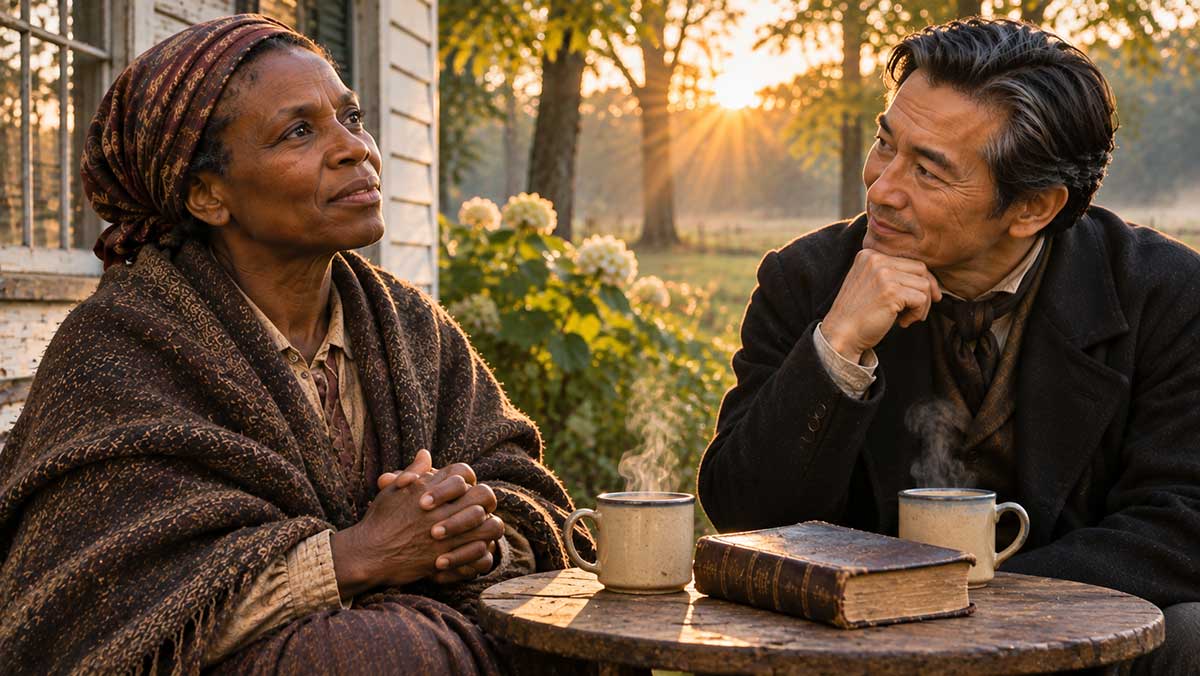
Auburn, New York. Early morning, in an imagined meeting beyond the boundaries of time.
The sun has not yet risen above the trees.
A thin layer of mist rests over the garden, and the grass glistens with dew. The old wooden house stands quietly in the blue light before dawn.
I approach the porch carrying two cups of warm tea.
Harriet Tubman is already sitting in her chair.
A worn Bible rests on the small table beside her.
She watches me climb the steps.
Harriet Tubman: Well, look who's here.
Nick Sasaki: Good morning, Harriet.
Harriet: I was beginning to wonder whether you'd forgotten what early meant.
Nick: I thought I was early.
Harriet: The birds have been awake longer than you.
I laugh and offer her a cup.
Nick: I brought tea. I thought that might earn me a little forgiveness.
She accepts it with a smile.
Harriet: That depends. Is it any good?
Nick: I was hoping you wouldn't ask.
She laughs.
I sit beside her.
For a moment, we watch the garden in silence.
Over the past several conversations, Harriet has taken me from the childhood world of Araminta Ross to the dangerous escape routes of Maryland, the Combahee River during the Civil War, and the years she spent caring for others in Auburn.
I came wanting to meet a legendary hero.
Instead, I've met a woman who loved her family, trusted God, made difficult decisions, experienced loss, and refused to stop caring about other people.
There are still three questions I want to ask.
But I find myself reluctant to begin.
Harriet notices.
Harriet: Something troubling you, Nick?
Nick: No. I was just thinking.
Harriet: You've been doing a great deal of that.
Nick: Is that a complaint?
Harriet: Depends on whether you're planning to ask another hundred questions.
We laugh.
Nick: Just three more.
Harriet: Then we'd better make them good ones.
Question 13: After Everything You Lived Through, What Did Freedom Come to Mean?
Nick: Harriet, when you were young, freedom meant escaping a system where another person claimed the right to own you.
Then you helped others escape.
During the Civil War, you helped the Union fight slavery.
And here in Auburn, you continued helping people who needed care.
After all of that, what did freedom come to mean to you?
Harriet looks out across the garden.
Harriet: Freedom meant being able to live as a person, not somebody's property.
To work for yourself.
To keep your family together.
To make choices about your own life.
Those are not small things, Nick.
Nick: No, they're not.
Harriet: When somebody can sell your child, freedom means something very plain.
When somebody can take the wages from your labor, freedom means something very plain.
When you can be punished for trying to leave, freedom means something very plain.
Nick: I think sometimes we speak about freedom so abstractly that we forget those realities.
Harriet: Then begin with the realities.
A mother ought to be able to hold her child without fearing that somebody will sell that child away.
A person ought to be able to work and receive fair payment.
A family ought to be able to live together without somebody claiming ownership over them.
Nick: But after slavery was abolished, those things weren't automatically secure for everyone.
Harriet: No.
People who had been enslaved needed land, work, education, safety, and the chance to build their lives.
Freedom was a great change.
But it didn't make every injustice disappear.
Nick: So legal freedom and the ability to live freely weren't always the same.
Harriet: A person can be free under the law and still face hunger, violence, or people determined to deny that freedom.
Nick: That reminds me of something you said yesterday.
You wanted older people to have a place where they felt safe and respected.
Harriet: Yes.
Nick: You were still thinking about freedom, in a sense.
Harriet: I was thinking about people who needed help.
Nick: You're very good at bringing me back from big ideas to real people.
Harriet smiles.
Harriet: Big ideas ought to mean something when somebody knocks on your door.
I laugh softly.
Nick: That's a wonderful answer.
Harriet: Well, it's a practical one.
Nick: Harriet, I believe all humanity belongs to one family under God.
And I sometimes wonder whether freedom is complete if we ignore the suffering of other people.
What do you think?
She turns toward me.
Harriet: Nick, I wouldn't want you to forget that people must first have the freedom that belongs to them.
A person shouldn't have to prove kindness or generosity to deserve liberty.
Nick: That's an important distinction.
Harriet: Nobody earned the right to enslave another person.
And nobody should have to earn the right not to be enslaved.
Nick: You're right.
Harriet: Once people are free, they can decide what kind of lives they want to build.
Some will raise families.
Some will work the land.
Some will teach.
Some will care for others.
Those choices belong to them.
Nick: And you chose to keep helping people.
Harriet: That was the work I believed I ought to do.
Nick: But you wouldn't demand that everyone live exactly as you did.
Harriet: I wouldn't want another person deciding everybody's life for them.
We sit quietly.
The first sunlight reaches the garden.
I realize that Harriet has gently challenged something in my question.
Freedom cannot depend on a person's willingness to sacrifice for others.
It belongs to every human being.
What we choose to do with it is another matter.
Question 14: What Did Your Faith Teach You About Other People?
A bird lands on the porch railing, pauses, and flies away.
Harriet watches it disappear into the trees.
Nick: Harriet, we've talked about your faith several times.
You believed God guided you, and prayer remained important throughout your life.
But I want to ask something deeper.
How did your relationship with God shape the way you treated other people?
Harriet rests her hands in her lap.
Harriet: I believed God heard prayer.
I believed He could guide me.
And I believed I had work to do.
Nick: Did you ever feel that your work was too much for one person?
Harriet: There were many things one person couldn't do.
But that didn't mean I should do nothing.
Nick: What did you do when you felt uncertain?
Harriet: I prayed.
I tried to learn what I needed to know.
And I went on with the work before me.
Nick: Your faith seems to have been very active.
Not something separate from everyday life.
Harriet: People need more than words.
If somebody is sick, that person may need care.
If somebody is hungry, that person needs food.
If somebody is in danger, that person may need help getting somewhere safe.
Nick: Do you think people sometimes use religion as a substitute for action?
Harriet thinks for a moment.
Harriet: People can say many things about what they believe.
But the way they treat others matters.
Nick: That reminds me of Jesus' teaching about caring for those who are hungry, sick, or in need.
Harriet: Those teachings meant something to me.
Nick: There's something I've wanted to ask you since our first conversation.
How did you reconcile your faith with the fact that some of the people who defended slavery claimed to be Christians?
Harriet looks directly at me.
Harriet: People used the Bible in different ways.
Some tried to use religion to defend slavery.
Others found in their faith a reason to oppose it.
Nick: That must have been deeply troubling.
Harriet: You can call something Christian, Nick, but that doesn't settle whether it is right.
Nick: So how would you judge it?
Harriet: Look at what it does to people.
Does it defend cruelty?
Does it excuse taking children from their mothers?
Does it tell a person that another human being may be bought and sold?
You ought to ask whether such things agree with the God you claim to worship.
I sit silently.
Nick: That's a question I think every religious person should be willing to face.
Harriet: Faith ought to make a person serious about how others are treated.
Nick: Harriet, did you ever hate the people who enslaved you?
She takes a moment before answering.
Harriet: Slavery was wrong.
And the people who maintained it were responsible for what they did.
I wouldn't want anybody to confuse opposing injustice with pretending injustice doesn't matter.
Nick: So forgiveness doesn't mean denying what happened.
Harriet: You can't make a wrong thing right merely by refusing to speak of it.
Nick: I agree.
I sometimes think that if people could truly see one another as brothers and sisters, many of the divisions that have caused suffering might begin to disappear.
Harriet listens.
Harriet: That's a hope worth thinking about.
But remember what we talked about in Maryland.
My sisters were sold away.
It wasn't enough for somebody to say we were all one family.
The selling had to stop.
Nick: You're right.
Harriet: Kind words matter.
But people need their rights protected.
They need safety.
They need the chance to live.
Nick: I appreciate you challenging me.
Harriet: Well, Nick, you came here asking questions. You can't expect me to agree with every one of your answers.
I laugh.
Nick: That's true.
And I wouldn't want you to.
She smiles.
Harriet: Good.
Nick: Then let me ask one more thing about faith.
After all the suffering you witnessed, did you still believe God was good?
Harriet looks toward the morning sky.
Harriet: I held on to my faith through difficult times.
That doesn't mean I had an answer for every sorrow.
Nick: Including the people you couldn't rescue.
Harriet: Yes.
Nick: Your sister Rachel.
Harriet nods.
Harriet: There were people I loved who suffered.
There were things I couldn't change.
But I didn't believe that meant I should stop praying or stop helping.
Nick: So faith didn't give you an explanation for every tragedy.
Harriet: It gave me something to hold on to as I faced them.
We fall silent.
The morning sun warms the porch.
For a moment, I don't feel the need to ask anything else.
Question 15: When You Look Back on Your Life, Whose Face Comes to Mind First?
The garden is bright now.
Harriet lifts her teacup, discovers it has grown cold, and gives me an amused look.
Harriet: You brought this tea a long time ago, Nick.
Nick: I know. I've been talking too much.
Harriet: You have been asking a good number of questions.
Nick: I have one left.
Harriet: Then make it count.
I take a breath.
Nick: Harriet, people remember you for the people you helped escape slavery.
They remember the Underground Railroad, the Combahee River Raid, and the home you established here.
But when you look back over your life, I wonder whether you think about those accomplishments the way history does.
Or whether you think about particular people.
I pause.
Nick: When you remember the people you've loved, helped, and lost, whose face comes to mind first?
Harriet looks toward the garden.
She doesn't answer immediately.
The birds continue singing.
At last, she speaks.
Harriet: My mother comes to mind.
I remain quiet.
Harriet: I think of my father, too.
And my brothers and sisters.
I think of the family we had, and the people who were taken away.
Nick: Your mother, Rit.
Harriet: Yes.
Nick: What would you want to tell her?
Harriet lowers her eyes.
Harriet: I'd want her to know I remembered.
Nick: Remembered what?
Harriet: That we belonged to one another.
That being separated didn't make us stop being family.
I feel a tightness in my throat.
Nick: Harriet, that's something I've been thinking about throughout our conversations.
You began life in a family that could be torn apart at any moment.
Then you spent years helping other families reach freedom.
And later you helped create a home for people who needed care.
Harriet: Those things were part of my life.
Nick: I wonder whether the deepest part of your story isn't simply that you fought against slavery.
It's that you refused to forget the people who were suffering.
Harriet considers my words.
Harriet: I wouldn't want people to remember me and forget the people who lived under slavery.
Nick: What would you want them to remember?
Harriet: That those people had lives.
Families.
Hopes.
They wanted to be free.
They wanted their children safe.
They wanted the chance to live.
Nick: And many of them never became famous.
Harriet: Most of them didn't.
Nick: Harriet, if someone reading our conversation today feels small or helpless in the face of suffering, what would you want that person to know?
She looks at me.
Harriet: I wouldn't tell somebody that one person can fix every wrong in the world.
That isn't true.
Nick: No, it isn't.
Harriet: But people can pay attention to what's happening around them.
They can help someone who needs help.
They can speak when something is wrong.
And they can work with others.
Nick: So a person doesn't have to become a famous hero to make a difference.
Harriet: Most of the people who helped freedom seekers weren't famous.
But their help mattered.
Nick: I think that's one of the most encouraging things you've told me.
Harriet smiles.
Harriet: Good.
Nick: Harriet, can I tell you something personal?
Harriet: Of course.
Nick: I began these conversations admiring your courage.
But now I admire something else just as much.
Your love for people.
Your determination to care for them.
And your willingness to keep helping, long after the world might have considered your greatest work finished.
Harriet: I had people who helped me, too.
Don't forget that.
Nick: I won't.
Harriet: Nobody does everything alone.
Nick: I think that's a fitting lesson for all of us.
Harriet looks toward the rising sun.
Harriet: Then perhaps we've had a worthwhile conversation.
Closing: The Freedom to Care
The morning has become bright and warm.
A gentle breeze moves through the garden.
Harriet and I rise from our chairs.
For a moment, I look at the woman standing beside me.
History remembers Harriet Tubman as a conductor of the Underground Railroad, a Union scout and intelligence operative, an abolitionist, and a champion of human freedom.
But I will remember something more personal from our imagined time together.
A daughter who remembered her mother.
A sister who grieved for those she couldn't bring home.
A woman who trusted God without pretending life was free from sorrow.
And a person who kept asking what she could do for others.
Nick: Harriet, thank you.
Harriet: For what?
Nick: For sharing your life with me.
For answering my questions.
And for reminding me that history is made of human beings, not just famous names.
She smiles.
Harriet: You're welcome, Nick.
Nick: I wish I could stay longer.
Harriet: You've been here a fair while already.
I laugh.
Nick: That's true.
Harriet: And you still haven't finished that tea.
I glance at the cup on the table.
Nick: I suppose I've been distracted.
Harriet: You've been thinking.
Nick: Guilty.
She laughs softly.
I turn toward the porch steps.
Then I stop.
Nick: Harriet?
Harriet: Yes?
Nick: When I go back to my own time, what do you think I should do with everything you've told me?
Harriet considers the question.
Harriet: Don't spend all your time talking about what I did.
Look around you.
See who needs help.
See who needs someone to listen.
See who needs a place to belong.
And do what you can.
I nod.
Nick: I'll try.
Harriet: That's a place to begin.
We exchange a warm farewell.
I walk down the porch steps and follow the garden path.
At the gate, I turn around.
Harriet is still standing on the porch.
She raises her hand.
I raise mine.
Then I continue down the road.
The morning sun shines across Auburn.
And as I walk, I find myself thinking about a question that has followed us from the beginning.
What does it mean to be truly free?
I came looking for an answer in the life of a woman who escaped slavery.
I leave thinking about the freedom to choose how we treat one another.
The freedom to protect human dignity.
The freedom to care.
And the people whose lives might change if we choose to act.
Harriet Tubman spent much of her life helping others reach freedom.
Her story invites us to ask what we will do with our own.
Final Thoughts: The Woman Who Never Forgot Those Left Behind
When I began this imaginary conversation with Harriet Tubman, I thought I knew what I admired most about her.
Her courage.
How could anyone fail to admire a woman who escaped slavery and then willingly returned to dangerous territory to help others reach freedom?
But as our conversations continued, something changed.
I began to see that courage was just one part of her story.
Behind it was something deeply human.
Love.
Love for her mother and father.
Love for her brothers and sisters.
Love for the people she helped escape.
And a deep concern for those who were suffering, including people she had never met.
What moved me most was the thought of Harriet reaching freedom in Philadelphia.
She had finally escaped the system that had controlled her life.
She could begin working for herself. She could make decisions about her future.
Yet the people she loved were still enslaved.
I found myself thinking about my own family.
If I reached safety but knew my children or other loved ones remained in danger, could I simply settle down and forget them?
I don't believe I could.
And perhaps that helps me appreciate Harriet's decision, without pretending I can fully comprehend the dangers she faced.
She went back.
Again and again.
But another part of her story touched me just as deeply.
After the Civil War, when her most famous achievements were behind her, Harriet continued caring for people.
She helped support her family.
She welcomed people who needed assistance.
She worked to provide care for older and vulnerable African Americans.
And she did these things amid financial difficulties of her own.
I find that remarkable.
We often celebrate people for extraordinary accomplishments.
But how often do we recognize the quiet acts of kindness that continue when public attention has moved elsewhere?
A meal prepared for someone who is hungry.
A home opened to someone who has nowhere to go.
A visit to an older person who feels forgotten.
A helping hand offered without expecting recognition.
These acts may never appear in history books.
Yet they can mean everything to the people who receive them.
There is another lesson from Harriet's life that I want to carry with me.
Her faith was not simply a collection of religious ideas.
She prayed. She believed God guided her. And she acted according to her convictions.
As a Christian, I find that deeply meaningful.
I believe that humanity is one family under God, that every person has inherent dignity, and that our lives should reflect love for one another.
But Harriet's story challenges me to go beyond expressing those beliefs.
It asks whether my actions reflect them.
And her life reminds me that spiritual language is never a substitute for protecting human dignity.
People can speak beautifully about love and still ignore injustice.
People can profess faith and fail to care for those who are suffering.
Harriet lived in a time when some people used Christianity to defend slavery, even as others drew upon their faith to oppose it.
That contradiction deserves serious reflection.
I cannot claim that Harriet shared every aspect of my theology, and I would not want to place my own beliefs into her mouth.
But her documented Christian convictions and her lifelong commitment to helping others leave me with a personal challenge:
If I believe every human being matters to God, how should I treat the people who need my help?
I was equally moved by another distinction that emerged during our imagined conversation.
Freedom is not something people must earn through goodness or service.
Every human being deserves freedom and dignity.
Harriet's actions remind me that what we choose to do with our freedom can become a meaningful expression of our values.
She did not liberate herself from slavery so that others could admire her.
She sought freedom, and she helped others pursue it.
Her story belongs to the many people who resisted slavery, built networks of assistance, served in the Union Army, and fought for their families' futures.
Harriet Tubman deserves recognition, but so do the countless people whose names history has not preserved.
That may be one of the most valuable lessons from her life.
We do not have to become famous to make a meaningful difference.
We do not have to rescue seventy people.
We do not have to accomplish something that changes the course of a nation.
We can begin with the person standing in front of us.
Someone who needs encouragement.
Someone who feels alone.
Someone who is struggling to care for a family member.
Someone who needs to know they have not been forgotten.
At the end of our fictional conversation, I pictured Harriet standing on the porch of her Auburn home.
An older woman who had experienced more than most of us can comprehend.
And I found myself thinking less about the extraordinary number of lives she helped change and more about the ordinary human relationships at the center of her story.
A daughter remembering her mother.
A sister remembering those she could not bring home.
A woman who spent her later years helping people find a place to belong.
Perhaps that is what I will remember most about Harriet Tubman.
She reached freedom, but she never forgot those who were still waiting.
And now, many generations later, her life invites us to look around and ask:
Who is still waiting for someone to care?
Fictional Conversation Disclaimer
The preceding Final Thoughts reflect Nick Sasaki's personal interpretations of a fictional encounter with Harriet Tubman. The interview dialogue and attributed private feelings are creative reconstructions, not authenticated historical statements or evidence of Tubman's endorsement of Nick's religious or philosophical views. Historical claims should be evaluated through reliable biographical research and primary sources.
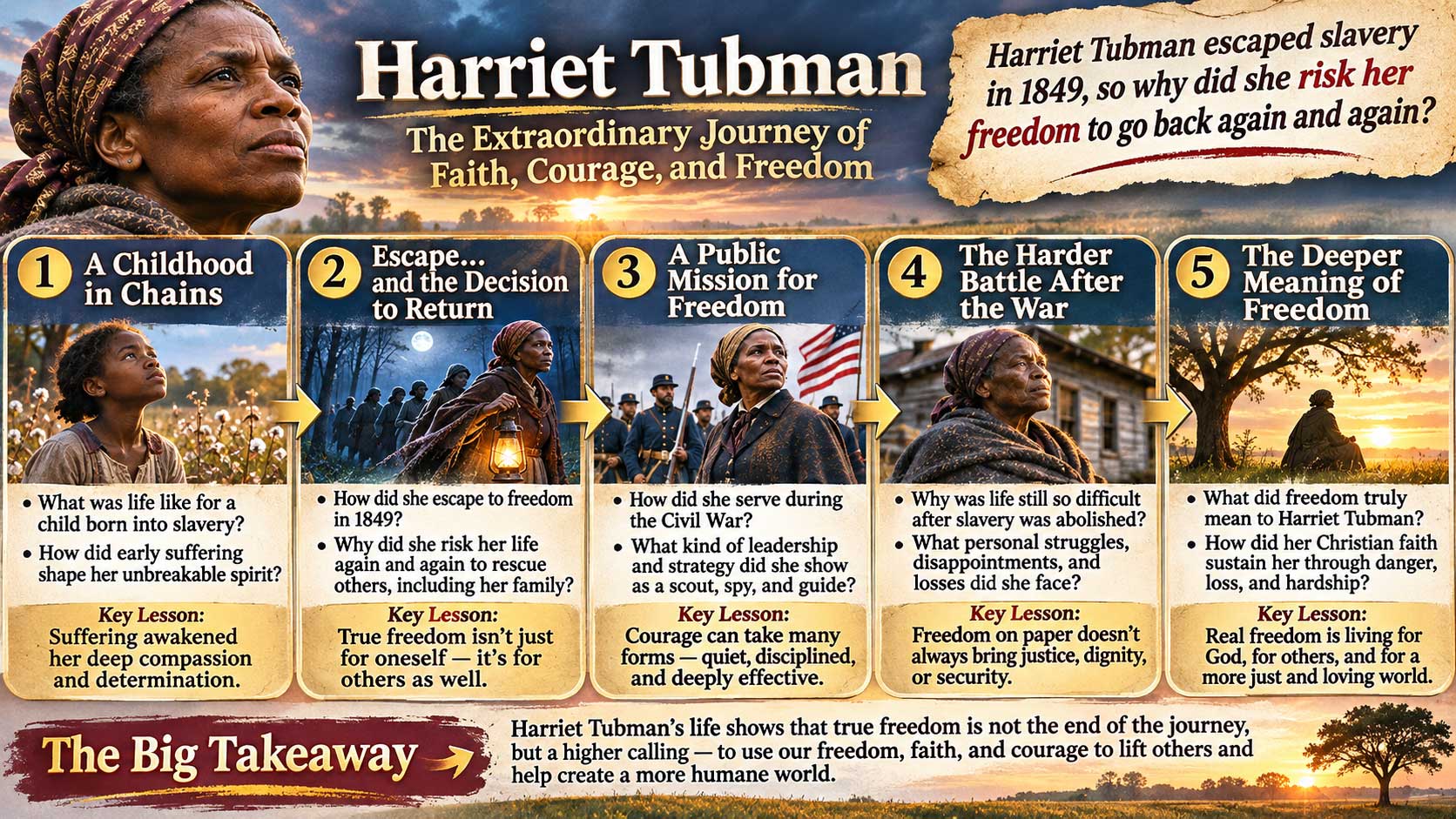
Short Bios:
Harriet Tubman (c. 1822–1913)
Harriet Tubman was an American abolitionist, Underground Railroad guide, Civil War nurse, scout, and intelligence operative, and advocate for women's voting rights. Born Araminta Ross into slavery in Maryland, she escaped in 1849 and subsequently returned to help family members and others reach freedom. Historians estimate that she personally guided approximately seventy people to freedom across about thirteen rescue missions. During the Civil War, she contributed intelligence and guidance to the 1863 Combahee River Raid, which liberated more than seven hundred enslaved people. In her later years, she supported her family and helped establish a home for older African Americans in Auburn, New York. She died on March 10, 1913.
Nick Sasaki
Nick Sasaki is the creator of ImaginaryTalks.com, a platform exploring history, philosophy, spirituality, literature, and human experience through fictional conversations with influential figures. His interviews seek to bring historical personalities closer to modern readers through thoughtful questions, emotional storytelling, and respectful curiosity. Guided by his belief in "One Family Under God," he hopes to encourage greater compassion, mutual respect, and a sense of shared humanity across cultures and traditions.
Leave a Reply