
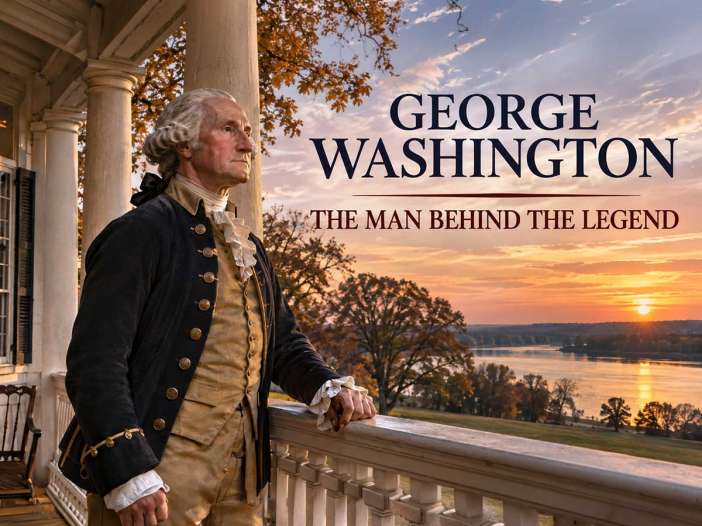
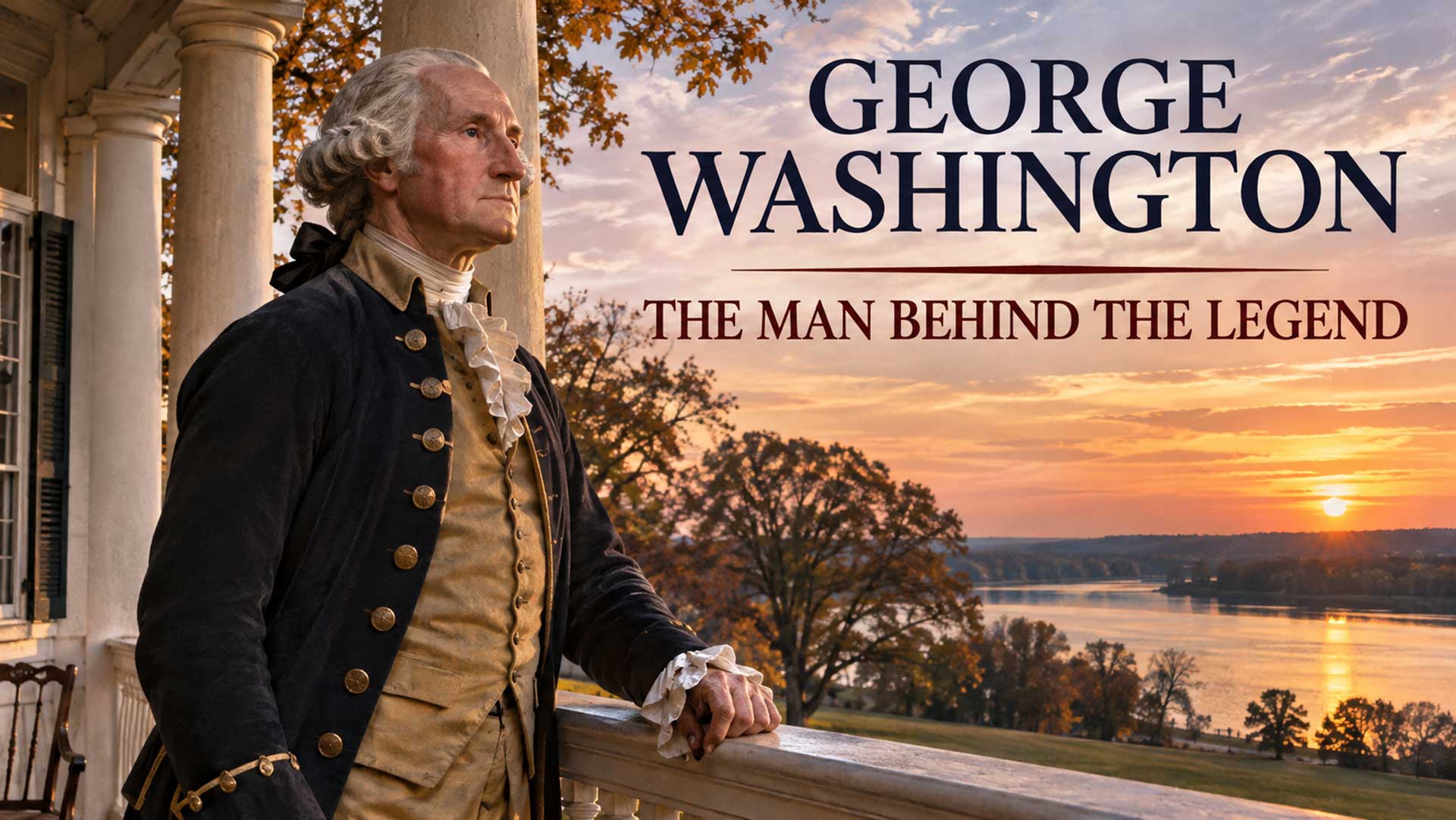
Introduction
What kind of man wins a revolution, becomes the most respected military leader in a new nation, and then voluntarily gives up his command? George Washington's life presents one of history's most fascinating questions about ambition, authority, and human character. Americans recognize his face on the dollar bill and his name in the nation's capital. Yet behind that familiar image was a man who experienced painful defeats, struggled with personal ambitions, loved his family, and made decisions that continue to invite admiration and criticism.
Born in Virginia in 1732, Washington did not begin life expecting to become the father of a nation. As a young surveyor, he sought professional advancement, property, and recognition within British colonial society. His early military career included serious mistakes and humiliating setbacks. The young officer who surrendered at Fort Necessity in 1754 could scarcely have anticipated that he would one day command an army against the British Empire. His remarkable transformation is documented through his correspondence, military records, and personal papers, many preserved in the National Archives' Founders Online collection.
Washington's leadership during the American Revolution was far more complicated than the heroic paintings suggest. His army suffered defeats, shortages, disease, and repeated threats of collapse. He made errors, learned from experience, and depended upon officers, ordinary soldiers, civilians, and foreign allies. French military and naval assistance proved indispensable to the American victory at Yorktown. Yet Washington's ability to preserve the Continental Army through years of uncertainty remains among his most significant accomplishments.
His decisions after the war were equally consequential. In December 1783, Washington resigned his military commission before Congress in Annapolis. He later returned to public service, presided over the Constitutional Convention, and became the first president of the United States. In 1797, he voluntarily left the presidency after two terms. These departures helped establish the principle that public authority belongs to constitutional institutions rather than permanently to an individual. His Farewell Address of 1796 reveals his concerns about political factionalism, national unity, and foreign commitments.
But Washington's achievements cannot be separated from the contradictions of the society he helped establish. He fought for American independence yet remained an enslaver throughout his lifetime. At Mount Vernon, hundreds of enslaved people worked under conditions that denied them control over their own lives. Ona Judge, an enslaved woman who escaped from the presidential household in 1796, was pursued by Washington's agents. His administration pursued territorial policies that brought suffering and dispossession to Native nations. These histories demand attention alongside his military and political accomplishments. George Washington's Mount Vernon provides historical research on slavery at his estate and the people whose lives were shaped by it.
There was another Washington beyond the battlefield and presidency. He enjoyed dancing, horseback riding, agriculture, entertaining friends, and managing Mount Vernon. He cared deeply for Martha and their extended family, experienced the deaths of loved ones, and repeatedly expressed his desire to return to private life. His surviving correspondence reveals a man attentive to practical details, conscious of his reputation, and capable of frustration, affection, and occasional humor. This human dimension offers a more intimate perspective than the solemn portraits through which most people encounter him.
In this five-part imaginary interview, Nick Sasaki meets George Washington across settings connected to his life: the study at Mount Vernon, the winter encampment at Valley Forge, the Maryland State House in Annapolis, the plantation grounds where the contradictions of liberty become unavoidable, and finally the piazza overlooking the Potomac River. Their conversations explore ambition, military failure, endurance, the surrender of authority, slavery, Native sovereignty, religious liberty, and the future of the republic. The goal is neither to place Washington beyond criticism nor to reduce his life to its failures, but to encounter him as a complicated human being whose choices helped shape a nation.
Fictional Conversation Disclaimer
This article presents an imagined conversation with George Washington for educational, historical, and creative exploration. The dialogue, personal responses, emotional expressions, and meeting scenes are fictional reconstructions, not authentic historical quotations or evidence of Washington's private thoughts, beliefs, or endorsement. Historical events and documented statements are distinguished from the author's interpretations wherever possible.
Topic 1: Before He Became George Washington
Opening
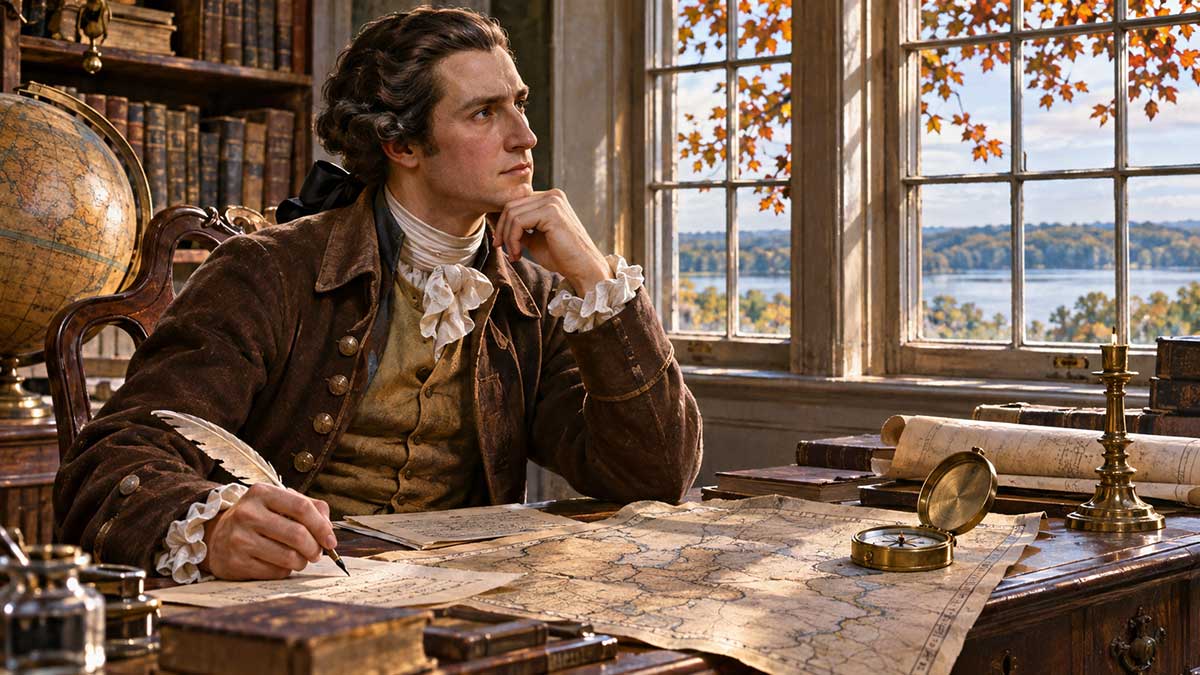
Mount Vernon, Virginia. Early morning.
The first sunlight of the day enters George Washington's study through the tall windows, illuminating a large surveying map spread across his desk. Beside it rest a brass compass, several carefully arranged papers, and a well-used writing instrument. Beyond the window, the grounds of Mount Vernon stretch toward the Potomac River. The distant sound of horses and the movement of people beginning their morning work drift through the cool air.
Washington stands beside the desk, examining a map of the Virginia frontier. He is dressed simply but carefully, his posture upright, his expression thoughtful. When Nick enters, Washington turns and offers a courteous greeting. The room feels less like the office of a national hero and more like the private refuge of a man who has spent his life attending to details.
Nick Sasaki: General Washington, welcome to Imaginary Talks. I have to admit, I've been looking forward to meeting you. But I have one small problem.
George Washington: Only one, Mr. Sasaki? Then you are already more fortunate than most generals.
Nick Sasaki: (Laughs.) Fair enough. The problem is that I've spent my entire life seeing you on the one-dollar bill. You always look so serious. I'm wondering if I'm allowed to make you laugh.
George Washington: I should hope so. I enjoyed good company, dancing, and an agreeable evening as much as any man. I would not wish to be remembered solely as a gentleman who never smiled.
Nick Sasaki: That's a relief. I was worried I'd have to stand at attention for the entire interview.
George Washington: That would make for a very tiresome conversation. Please, sit. You have come a considerable distance to ask your questions.
Washington gestures toward a chair near the desk. Nick sits, noticing the surveying instruments laid out between them.
Nick Sasaki: Thank you. You know, what fascinates me isn't just that you became America's first president. It's that you began your life as a young man in Virginia who had no idea there would ever be a United States.
George Washington: Indeed. The country you know did not exist when I was born. We were British subjects, and the opportunities before a young Virginian were quite different from those you might suppose today.
Nick Sasaki: That's where I'd love to begin. Not with the president. Not with the famous general. Just George Washington, the young man trying to find his place in the world.
Question 1: What Did You Want to Become Before America Existed?
Nick Sasaki: When you were seventeen, you were surveying land in Virginia. You weren't dreaming about becoming president, since the office didn't exist. What did you actually want from life?
George Washington: I wished to establish myself, sir. That is perhaps a plain answer, but an honest one. My father died when I was eleven. My elder half-brothers had enjoyed advantages I did not possess, including education in England. I was obliged to consider how I might make my way.
Nick Sasaki: So you felt you had something to prove?
George Washington: I certainly wished to be regarded as a gentleman of ability and consequence. In Virginia, one's family connections, property, conduct, and reputation carried considerable weight. I was conscious of these things from an early age.
Nick Sasaki: That surprises me a little. People see you as someone who was born to lead. But you're describing a young man trying to move up in society.
George Washington: I was born into a family of some standing, and I would not pretend otherwise. I had advantages that many others did not enjoy. Yet my prospects were not the same as those of my elder brothers. I had to discover where my own abilities might be useful.
Nick Sasaki: And surveying became your opportunity.
Washington rests a hand on the map and traces a line along the western Virginia frontier.
George Washington: It did. My brother Lawrence and the Fairfax family were influential in opening that path. Surveying required mathematics, patience, sound judgment, and a willingness to endure discomfort. The work took me into the western country, where distances were great, roads uncertain, and accommodations frequently less pleasant than one might desire.
Nick Sasaki: How unpleasant are we talking? No comfortable bed? No decent breakfast?
George Washington: (Smiles.) There were occasions when a dry place to sleep was a considerable luxury. A young surveyor soon learns that the wilderness has little regard for his expectations.
Nick Sasaki: I can picture you out there with your instruments, measuring land, trying to make a living. Did you enjoy it?
George Washington: I enjoyed the independence it afforded me, the exercise of my abilities, and the knowledge it brought. Land was an important source of wealth and standing in Virginia. Surveying allowed me to understand its possibilities.
Nick Sasaki: You were already thinking like a businessman.
George Washington: A prudent man ought to consider his prospects. I would not claim to have been indifferent to property or advancement.
Nick Sasaki: That's something I appreciate about this conversation already. You're not pretending you were born with some grand mission to save a nation.
George Washington: Such a claim would be absurd. At seventeen, I could scarcely have imagined the events that awaited us. I was concerned with establishing a respectable position in the world I knew.
Nick Sasaki: Your father died when you were young. Did that change how you approached life?
George Washington: His death altered the circumstances of our family. I was fortunate in the guidance of my brother Lawrence and others who took an interest in me. I learned early that opportunities were not always presented twice, and that a young man ought to make good use of those he received.
Nick Sasaki: I wonder whether that explains your attention to manners and reputation. You famously copied rules of civility when you were young.
George Washington: I copied many such rules as part of my education. They taught that a gentleman's behavior should show consideration for others and command respect through proper conduct. I did not always succeed in observing every principle as perfectly as I might have wished.
Nick Sasaki: (Laughs.) That sounds like a confession that young George Washington occasionally misbehaved.
George Washington: I would be reluctant to claim that I was the only faultless young man in Virginia.
Nick Sasaki: You know, General, I think people might like you more if they knew you had a sense of humor.
George Washington: Then I trust you will not spoil the discovery by making too much of it.
Question 2: What Did Your Earliest Military Failures Teach You?
Washington moves toward the window for a moment. Outside, a horse is being led across the grounds. He watches it briefly before returning to his chair. The conversation turns from the hopeful ambitions of youth to the difficult experiences of his early military career.
Nick Sasaki: Let's move forward a few years. You became involved in the struggle between Britain and France over territory in North America. And your first major military experiences were not exactly a series of victories.
George Washington: No, sir. They were not.
Nick Sasaki: In 1754, you led an attack on a French party at Jumonville Glen. Then your own force surrendered at Fort Necessity. Looking back, how do you understand those events?
George Washington: I was a young officer entrusted with responsibilities that exceeded my experience. The country was disputed, the movements of French forces caused alarm, and the intentions of those we encountered were not always clear to us. I acted according to my judgment at the time, but I had much yet to learn.
Nick Sasaki: The French regarded the attack as a serious provocation. Some historians connect it to the larger war that followed.
George Washington: The encounter became part of a conflict whose causes were much broader than the actions of one young officer. Britain and France had competing claims, and the Native nations of that region possessed their own interests and alliances. It would be foolish to pretend that I alone determined the course of such events. Yet I cannot deny that my actions had consequences.
Nick Sasaki: Did you realize how dangerous the situation had become?
George Washington: We understood that hostilities were possible. I did not possess the experience to appreciate every difficulty that might arise. At Fort Necessity, our position proved vulnerable, the weather was dreadful, and the enemy held advantages we could not overcome.
Nick Sasaki: You had to surrender.
George Washington: We did. It was a bitter experience.
Nick Sasaki: I want to ask something personal. You were ambitious, you wanted a military career, and suddenly you were associated with a defeat. Did that embarrass you?
George Washington: A man who values his reputation cannot be indifferent to failure. I was disappointed, and I had reason to examine my conduct. But disappointment is of little use unless it improves one's judgment.
Nick Sasaki: That's interesting. Many people respond to failure by blaming everybody else.
George Washington: Officers may have cause to criticize circumstances, supplies, or instructions. Yet they remain responsible for the decisions entrusted to them. Experience teaches lessons that ambition alone cannot supply.
Nick Sasaki: Then came General Braddock's expedition in 1755. That was another disaster.
George Washington: A terrible one. British regulars were defeated near the Monongahela, and General Braddock was mortally wounded. I served as one of his aides and witnessed the confusion and suffering of that engagement.
Nick Sasaki: You survived despite being exposed to enemy fire. That must have been extraordinary.
George Washington: I was fortunate to escape. Many brave men did not. Such an experience leaves an impression upon any officer who possesses a proper sense of responsibility.
Nick Sasaki: Did it change the way you thought about British military leadership?
George Washington: It demonstrated that established reputation and formal discipline did not guarantee success in every circumstance. The conditions of warfare in North America demanded attention to terrain, supply, intelligence, and the methods of one's adversaries.
Nick Sasaki: And you still wanted a commission in the regular British Army.
George Washington: I did. I believed military service offered an honorable path, and I wished to advance within it. I was disappointed that my efforts did not secure the recognition I sought.
Nick Sasaki: Here's what I find remarkable. The British military establishment didn't give you the position you wanted. Years later, you would command an army against Britain.
George Washington: History often produces circumstances that would appear improbable to those living through its earlier chapters.
Nick Sasaki: Were you angry with Britain?
George Washington: I had grievances concerning my treatment as a provincial officer. But it would be misleading to say that disappointment alone transformed me into an advocate of independence. That change came much later, through political disputes and events that altered my understanding of the relationship between Britain and the colonies.
Nick Sasaki: So the young Washington still considered himself a loyal British subject.
George Washington: Certainly. I served the Crown and sought distinction in its service. I did not imagine that I would one day take up arms against it.
Question 3: How Did a Loyal British Officer Become an American Revolutionary?
The morning has grown brighter. Washington returns to his desk and carefully rolls up the surveying map. A smaller map of the Atlantic colonies lies beneath it. Nick notices the change in scale, from the land of Washington's youth to the territory that would soon become a new nation.
Nick Sasaki: Let's talk about the years between your military service and the Revolution. In 1759, you married Martha Custis. Was that when you expected life to settle down?
George Washington: Marriage brought new responsibilities and great happiness. Martha was a woman of intelligence, sound judgment, and considerable strength of character. Our household was a substantial one, and I took my duties seriously.
Nick Sasaki: She already had two children, Jacky and Patsy.
George Washington: Yes. They became dear to me. I had no children of my own, but I took an active interest in their welfare and education. Family life brought pleasures and concerns quite distinct from those of military service.
Nick Sasaki: You sound more relaxed when you talk about home.
George Washington: Mount Vernon was a place to which I was deeply attached. I found satisfaction in improving the estate, examining crops, attending to buildings, and considering new methods of agriculture.
Nick Sasaki: So if history had gone differently, you might have spent your life farming, managing land, and raising a family.
George Washington: That would have been an honorable life. I had no reason in 1759 to suppose that I would command an army in a war for independence.
Nick Sasaki: But your estate depended on enslaved labor. We will discuss that more fully later. I don't want to describe Mount Vernon simply as a peaceful family retreat without acknowledging the people whose freedom was denied there.
George Washington: It would be inaccurate to describe the estate without recognizing the labor upon which it depended. The institution of slavery was deeply established in Virginia, and I participated in it. I understand that you intend to examine my conduct closely.
Nick Sasaki: I do. And I appreciate your willingness to discuss it. For now, I want to understand how your political thinking changed.
George Washington: Very well.
Nick Sasaki: You served in the Virginia House of Burgesses. At what point did you begin feeling that Britain was treating the colonies unfairly?
George Washington: The disputes over taxation, trade, and parliamentary authority developed over many years. We believed that the rights of the colonies, including the rights of their representative assemblies, were being threatened. Measures imposed from London increasingly appeared to us as violations of principles we had long considered our inheritance as British subjects.
Nick Sasaki: That's the part people sometimes miss. You weren't originally demanding independence. You were demanding rights you believed you already possessed.
George Washington: Precisely. For a considerable period, the dispute concerned the rights of British Americans within the empire. Independence was not the object with which every protest began.
Nick Sasaki: But eventually you concluded that reconciliation wasn't working.
George Washington: The successive controversies, the use of coercive measures, and the outbreak of armed conflict changed the circumstances. There came a point when defending what we regarded as our liberties required a course we had not initially desired.
Nick Sasaki: Did that feel like betraying Britain?
George Washington: I had served Britain faithfully. My family had lived under its government for generations. Such a separation was no small matter. Yet allegiance could not, in my judgment, require the surrender of rights we believed essential.
Nick Sasaki: I can see how complicated that must have been. You admired British military traditions, wanted recognition from British officers, and then found yourself preparing to fight them.
George Washington: It was a profound change. Men do not always foresee where their convictions and circumstances will lead them.
Nick Sasaki: In June 1775, the Continental Congress appointed you commander in chief. Did you feel ready?
George Washington: I was conscious of the magnitude of the undertaking and of my own limitations. I had military experience, but the command of an army confronting the forces of Great Britain was an entirely different responsibility.
Nick Sasaki: You accepted without taking a salary for your services, though Congress agreed to reimburse your expenses.
George Washington: I did not wish to profit personally from the appointment through a salary. I understood that my necessary expenses would be accounted for. But financial arrangements were hardly the chief concern. We had to organize, supply, and maintain an army capable of resisting a formidable opponent.
Nick Sasaki: What did Martha think?
Washington's expression softens. He glances toward the window, where the morning light now falls across the gardens.
George Washington: I wrote to her shortly after my appointment, expressing my concern at being separated from her and assuring her that I had not sought the position. I knew the separation would be difficult. I wished her to understand that I regarded the appointment as a duty I could not honorably decline.
Nick Sasaki: That's the first time in our conversation I really feel the weight of what was happening. You had a home you loved, a wife you cared about, a life you had built, and suddenly you were leaving it all behind.
George Washington: I had enjoyed the comforts of private life, Mr. Sasaki. I did not depart from them lightly.
Nick Sasaki: And you had no idea whether you'd ever return.
George Washington: The future was uncertain. We faced a military force of considerable experience and resources. I could not promise Martha, or myself, how long the struggle might last.
Nick Sasaki: When you look back at that moment, do you see the ambitious young officer finally receiving the great command he once wanted, or a different man accepting something he feared might overwhelm him?
George Washington: Perhaps you are describing two stages of the same life. I had once desired military distinction. By 1775, I had acquired responsibilities, attachments, and experience that made the prospect of command far more serious than it might have appeared in my youth. I could not approach it merely as an opportunity for advancement.
Nick Sasaki: That's a remarkable change.
George Washington: It is one thing to wish for responsibility when its burdens are distant. It is quite another to accept it when the consequences may fall upon thousands of men and the future of one's country.
Closing
The morning has advanced. From somewhere beyond the study comes the sound of a horse's hooves against the courtyard stones. Washington gathers the papers on his desk, then pauses beside the map of the colonies.
Nick Sasaki: General, I came into this conversation thinking of you as the man who led America to independence. But now I'm picturing a young surveyor trying to build a career, a soldier who suffered defeat, and a husband reluctant to leave his wife.
George Washington: Then perhaps we have made a useful beginning. A man's public actions are better understood when one considers the experiences that preceded them.
Nick Sasaki: I have to ask one last thing before we move on. When you left Mount Vernon in 1775, did you think the war might be over quickly?
George Washington: I knew that the undertaking was serious. I could not know how long it would continue or what sacrifices would be demanded. I hoped that our cause might be secured, but hope was no substitute for preparation.
Nick Sasaki: And the war lasted eight years.
George Washington: Eight years of difficulty, uncertainty, and sacrifice. There were moments when our prospects appeared exceedingly poor.
Nick Sasaki: I think that's where we should go next. People remember you crossing the Delaware and winning at Yorktown. But I want to hear about the days when nothing seemed to be going right.
George Washington: (Smiles faintly.) Then, Mr. Sasaki, you will find no shortage of material.
Nick Sasaki: (Laughs.) Somehow, I suspected you might say that.
George Washington: Let us begin with the army I was given. You may find that keeping it together was quite as demanding as confronting the enemy.
Nick Sasaki: That's exactly what I want to understand.
Washington sets the colonial map aside. For a moment, his eyes rest on the open doorway, and the quiet room seems far removed from the years of war that await their next conversation.
Topic 2: The General Who Refused to Give Up
Opening
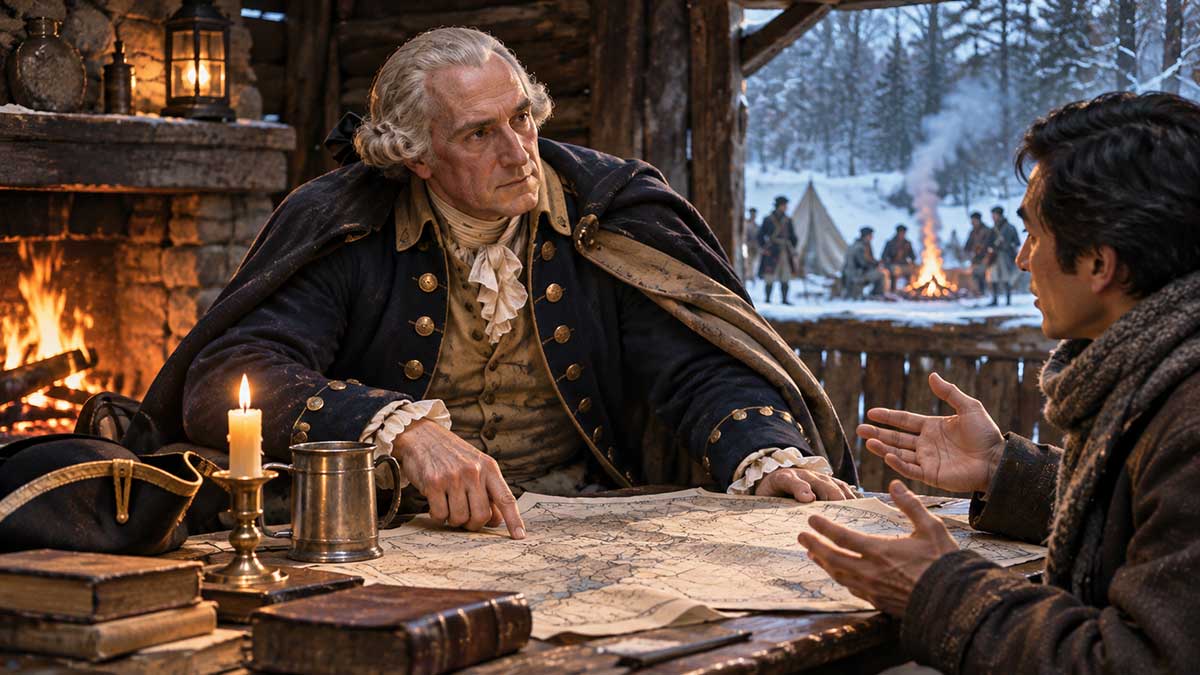
Valley Forge, Pennsylvania. A bitter winter evening, 1778.
Snow lies across the fields and wooded hills surrounding the Continental Army's encampment. Beyond the headquarters house, smoke rises from the chimneys of rough wooden huts. Soldiers move through the fading light, carrying firewood, tending horses, and making their way along frozen, muddy paths. Somewhere in the distance, an axe strikes timber. The wind carries the faint voices of men calling to one another.
Inside the stone farmhouse serving as Washington's headquarters, a fire burns in the hearth. Candlelight illuminates a table crowded with military maps, correspondence, and supply reports. A pair of riding gloves rests beside a folded dispatch. The room is warmer than the encampment outside, but the cold still finds its way through the windows.
George Washington stands near the table, studying a report. His expression is weary, his attention fixed upon the figures before him. When Nick enters, Washington sets the paper aside and gestures toward a chair near the fire.
George Washington: Mr. Sasaki. I trust the road did not prove too disagreeable.
Nick Sasaki: General, I've never been so grateful to see a fireplace. It's freezing out there.
George Washington: (Smiles.) Then you have acquired some small acquaintance with the circumstances of our army. Though I fear the men outside would regard this room as exceedingly comfortable.
Nick Sasaki: I passed several soldiers on my way here. Some looked exhausted. One was trying to repair his shoes.
George Washington: Such difficulties are unfortunately common. Our soldiers have endured much, and their necessities are not always supplied as they ought to be.
Nick Sasaki: I was thinking about our last conversation. You told me that keeping the army together was sometimes harder than fighting the British.
George Washington: Indeed. An army must eat, march, remain clothed, and preserve its discipline. It must be maintained in the field whether or not the enemy chooses to engage it.
Nick Sasaki: When we study the Revolution, we see paintings of you crossing the Delaware or accepting the British surrender at Yorktown. Everything looks so heroic. But standing here, surrounded by these supply reports, I get a very different impression.
George Washington: Paintings are generally more agreeable than the events they represent, Mr. Sasaki. The artist may arrange his subjects as he pleases. A general has considerably less control over his circumstances.
Nick Sasaki: (Laughs.) So the real Revolutionary War wasn't quite as picturesque?
George Washington: I assure you, sir, there was little beauty in a hungry army, a camp afflicted by disease, or men marching without adequate shoes.
Washington lifts one of the papers from the table, examines it briefly, and places it beside several others awaiting his attention.
Nick Sasaki: You commanded the Continental Army for eight years. You faced defeats, shortages, desertion, political disagreements, and constant uncertainty. Yet somehow, you kept going.
George Washington: The cause required perseverance. But I would not have you suppose that I sustained it by my efforts alone. Officers, soldiers, civilians, members of Congress, and eventually our French allies all contributed to its survival.
Nick Sasaki: I want to understand what those years actually felt like. Not the glorious version. The version where you woke up in the morning and wondered whether your army could survive another month.
George Washington: Then we must speak of some exceedingly difficult days.
Question 1: How Did You Keep Leading When Victory Seemed Impossible?
Nick Sasaki: Let's go back to 1776. The Declaration of Independence had just been adopted, but militarily, things were going badly. The British defeated your forces around New York, and you had to retreat across New Jersey. How close did the Revolution come to collapse?
George Washington: Our situation was exceedingly dangerous. The enemy possessed experienced troops, naval superiority, and substantial resources. Our own forces were inexperienced in many respects, and their enlistments were approaching expiration. We lost men, equipment, and territory. Confidence suffered greatly.
Nick Sasaki: Were you afraid that the army would simply disappear?
George Washington: I was deeply concerned that our strength would diminish before we could recover our position. An army cannot be maintained by patriotic declarations alone. Men require provisions, clothing, arms, compensation, and some reasonable expectation that their service will accomplish something.
Nick Sasaki: That's something we rarely hear about. We talk about courage and independence, but somebody had to find food, shoes, and ammunition.
George Washington: And wagons, horses, tents, blankets, medicines, and countless other necessities. I spent a considerable portion of the war corresponding about supplies. There were times when the want of these things threatened us as seriously as the enemy.
Nick Sasaki: Did you ever sit alone and think, "We cannot win this"?
George Washington: I cannot offer you a record of every private thought that passed through my mind. But I can say that our circumstances frequently gave us grave cause for concern. My responsibility was to consider what could still be done, even when the choices were disagreeable.
Nick Sasaki: You couldn't afford to panic.
George Washington: A commander who allows his apprehensions to govern his conduct may spread disorder throughout his army. Yet it would be equally dangerous to pretend that difficulties do not exist. One must see the danger plainly and then determine how to act.
Washington turns toward a map of New Jersey spread across the table. His finger follows the Delaware River, pausing near Trenton.
Nick Sasaki: Which brings us to Christmas night, 1776. You crossed the Delaware River and attacked the Hessian garrison at Trenton. Was that an act of desperation?
George Washington: Our situation demanded a decisive effort. The army's morale had suffered, and the expiration of enlistments threatened to reduce our numbers further. A successful attack might restore confidence and demonstrate that we remained capable of offensive action.
Nick Sasaki: The crossing itself sounds miserable. Freezing weather, darkness, ice in the river, and men who were already exhausted.
George Washington: It was a difficult undertaking. The weather impeded our movement, and the crossing required more time than anticipated. We depended upon the exertions of the men who managed the boats and the soldiers who endured the march.
Nick Sasaki: And then you won at Trenton.
George Washington: We achieved an important success. It did not decide the war, but it improved our prospects at a moment when encouragement was badly needed. Our subsequent success at Princeton further strengthened confidence.
Nick Sasaki: I've always wondered something. When you won at Trenton, did you feel relief, excitement, or were you already worrying about the next battle?
George Washington: A victory permits some satisfaction, certainly. But a commander must soon consider how to preserve its advantages. The enemy does not cease to exist merely on account of one defeat.
Nick Sasaki: (Laughs.) You're telling me you weren't the type to celebrate for three days.
George Washington: Three days would have afforded the British an excellent opportunity to correct our enthusiasm.
Nick Sasaki: Fair point. Now let's talk about Valley Forge. People imagine your soldiers freezing in the snow, but there was much more happening than simply surviving the winter.
George Washington: Indeed. During this winter, our army has suffered from inadequate clothing, irregular supplies, disease, and considerable hardship. Yet this encampment must become more than a place of suffering. We must improve the army's organization and discipline.
Nick Sasaki: Baron von Steuben is helping train the soldiers here, isn't he?
George Washington: He has brought valuable experience and an ability to establish more consistent methods of drill and discipline. I have reason to hope that his instruction will prove of great service to the army.
Nick Sasaki: Do you think the army is becoming something different?
George Washington: It is acquiring greater experience and cohesion. We still face serious difficulties, but the soldiers are learning what is expected of them and what they may accomplish together.
Nick Sasaki: You know what strikes me? You weren't winning all the battles. You were trying to keep the possibility of victory alive.
George Washington: That is a fair distinction. Were our principal army to be destroyed, the cause of independence might suffer a blow from which it could not readily recover. Preserving the army is therefore an object of the greatest consequence.
Nick Sasaki: So sometimes retreating was the right decision.
George Washington: A retreat may be necessary to preserve the means of future action. The difficulty lies in knowing when to stand, when to withdraw, and when an opportunity justifies the risk of attack.
Nick Sasaki: That sounds less glamorous than charging forward.
George Washington: Glamour is a poor provision for an army, Mr. Sasaki.
Outside, the sound of a wagon passing over frozen ground interrupts the quiet. Washington glances toward the window, then returns to the supply reports waiting on the table.
Question 2: What Did the War Cost You Personally?
The evening grows darker. A servant brings fresh candles, and the fire is tended. Through the window, the last figures moving between the soldiers' huts become silhouettes against the snow. Washington sets aside the military map, and Nick notices a letter lying among the official correspondence.
Nick Sasaki: General, we've talked about military strategy. But I want to ask about the man carrying all this responsibility. You spent much of those eight years away from Mount Vernon and Martha. What did that separation mean to you?
George Washington: I am deeply attached to my wife and to our home. Before accepting command, I had looked forward to the occupations of private life. The war has required me to surrender much of that comfort for an uncertain period.
Nick Sasaki: Martha sometimes joins you at winter headquarters, doesn't she?
George Washington: She does, and her presence is a great comfort. She travels considerable distances and endures accommodations far removed from the conveniences of Mount Vernon. I value her company exceedingly.
Nick Sasaki: I like picturing the two of you together during these winters. Not the general and the first lady, since she isn't the first lady yet. Just a husband and wife trying to spend time together.
George Washington: That is a more agreeable picture than many associated with military life. Martha has a remarkable ability to bring order and warmth to circumstances that are often unsettled.
Nick Sasaki: Do you talk about the war all evening?
George Washington: I should think she deserves some relief from military affairs. There are visitors to receive, correspondence to attend to, and opportunities for ordinary conversation. The company of family and friends remains precious.
Nick Sasaki: What do you miss most about Mount Vernon?
George Washington: Its familiar occupations. I take satisfaction in observing the progress of the farms, examining improvements, riding over the estate, and attending to matters that belong to my own household. During the war, I have been obliged to conduct much of that business through letters.
Nick Sasaki: You're running a plantation remotely while commanding an army.
George Washington: With varying degrees of satisfaction, I assure you.
Nick Sasaki: (Laughs.) Are you one of those people who sends detailed instructions about everything?
George Washington: I have been accused of attending rather closely to particulars.
Nick Sasaki: I suspect your estate managers know exactly what you expect.
George Washington: They certainly receive ample opportunity to discover it.
Nick Sasaki: But the estate is supported by enslaved workers. When you think of home as a place of comfort, their experience is very different.
George Washington: That distinction is necessary. The work of the estate depends upon people held in bondage, whose circumstances are not those of my family. My attachment to Mount Vernon should not obscure the conditions under which it operates.
Nick Sasaki: We'll return to that in our next discussions. For now, I want to understand another side of the war. You've lost people you knew, haven't you?
George Washington: Many. The army has endured death from battle, disease, exposure, and other hardships. I receive reports of suffering that no commander can regard with indifference. Men who have served faithfully are sometimes lost before they can see the result of their sacrifices.
Nick Sasaki: How do you deal with that? You can't simply go home and recover.
George Washington: There are duties that cannot be postponed. The wounded require attention, the army requires provisions, and new decisions await. Grief and concern do not suspend one's obligations.
Nick Sasaki: Do you ever become angry with Congress?
George Washington: I experience considerable frustration when the army's necessities are not met. Congress faces its own difficulties, and the states are often reluctant or unable to provide what is required. Yet the consequences fall heavily upon the soldiers.
Nick Sasaki: I've read that you can have quite a temper, despite your calm public appearance.
George Washington: (Pauses, then smiles.) I would not claim that my patience is inexhaustible.
Nick Sasaki: That's a diplomatic answer.
George Washington: A commander may find occasion for displeasure. The important question is whether he allows that displeasure to interfere with his judgment.
Nick Sasaki: Do you always succeed?
George Washington: Certainly not. I am as capable of error as any other man.
Nick Sasaki: I'm glad you said that. Sometimes history makes you sound almost impossibly composed.
George Washington: Then history has perhaps been too generous with its polish.
For a moment, Washington studies the letter on the table. The fire crackles softly, and the conversation becomes quieter.
Nick Sasaki: General, there's a loss that still lies ahead of you here at Valley Forge. In 1781, your stepson Jacky will become ill while serving near Yorktown and die shortly afterward. I know this is an unusual thing to bring into our conversation, but I want to ask about the personal cost of the years ahead.
George Washington: You speak of a sorrow I have not yet experienced in this setting, Mr. Sasaki. I cannot describe that future grief as though it were already mine. But I know what it is to care deeply for one's family, and I know that no success in war can make those we love less precious.
Nick Sasaki: That's fair. And it reminds me that, for the families of soldiers, every letter could bring news that changed their lives.
George Washington: Indeed. Their sacrifices are not confined to the battlefield. Those who wait at home endure uncertainties of their own.
Nick Sasaki: I think that's something readers need to see. Behind the victories are men with responsibilities and losses that can't be captured in a battlefield painting.
George Washington: The men who serve under my command have families and private concerns of their own. Their sacrifices are not less real for being less widely recorded.
Question 3: What Happened When Your Own Officers Began Losing Faith in Congress?
The fire has burned lower, and the candles cast long shadows across the walls. Nick looks toward Washington's spectacles resting near the correspondence. The conversation moves forward five years, from the winter at Valley Forge to March 1783, when the Continental Army stood at another dangerous crossroads.
Nick Sasaki: General, I want to take you to March 1783. The fighting had largely ended, but peace hadn't yet been formally concluded. Your officers were angry over unpaid compensation and uncertain promises of pensions. Some were discussing organized action against Congress.
George Washington: Their grievances were serious. Many officers had served for years under difficult conditions, and they had reason to be concerned about the fulfillment of commitments made to them.
Nick Sasaki: Yet the situation could have threatened the authority of the civilian government.
George Washington: That was my concern. The army had fought for the independence of the country. It would have been a grave misfortune if its officers, through their understandable dissatisfaction, adopted measures that endangered the principles for which they had struggled.
Nick Sasaki: This became known as the Newburgh crisis. You addressed the officers on March 15, 1783. Were you worried they might refuse to listen?
George Washington: I knew that passions had been stirred and that many officers felt deeply injured. I believed it necessary to speak to them directly, acknowledge their sacrifices, and urge them to trust that their claims could be pursued without threatening the civil authority.
Nick Sasaki: You prepared an address, but what people remember most is something that happened when you took out your spectacles.
George Washington: Ah, yes.
Nick Sasaki: According to eyewitness accounts, you asked the officers to excuse you for putting them on, explaining that you had grown gray and nearly blind in your country's service.
George Washington: My eyesight had suffered over the years, and I required assistance to read. The remark appears to have affected those present more deeply than I had anticipated.
Nick Sasaki: I find that moment incredibly moving. These officers had seen you commanding troops, riding through danger, and enduring the war. Suddenly, they saw you as an aging man whose body had paid a price.
George Washington: They had endured much themselves. We had shared years of hardship, uncertainty, and disappointment. Perhaps that small circumstance reminded them of what we had experienced together.
Nick Sasaki: Some accounts say officers were moved to tears.
George Washington: I would not presume to describe every man's feelings. But the meeting ended without the course of action that had caused such concern, and I was grateful for the restraint the officers displayed.
Nick Sasaki: What interests me is that you didn't threaten them. You didn't order soldiers to arrest the organizers. You appealed to their sense of honor and their shared experience.
George Washington: I believed the officers deserved to be addressed as men who had served their country with distinction. Their grievances did not make them enemies. My duty was to prevent their dissatisfaction from leading to a destructive course.
Nick Sasaki: That's a different kind of leadership from giving orders on a battlefield.
George Washington: An army cannot be sustained by commands alone. Confidence between officers and soldiers, and between the army and the government it serves, is indispensable.
Nick Sasaki: But let me challenge you. What if Congress had continued refusing to meet its obligations? How long could you expect the officers to remain patient?
George Washington: Their claims required serious attention, and I pressed Congress to consider them. I did not ask the officers to abandon their rights. I asked them to pursue those rights through means consistent with the cause they had defended.
Nick Sasaki: So you were trying to protect both the officers and the republic.
George Washington: Those obligations were not necessarily opposed. A government must honor its commitments, and an army must recognize the authority of civil institutions. If either principle is neglected, the consequences may be severe.
Nick Sasaki: I want to ask one more thing about that day. When you put on your spectacles, were you deliberately trying to move the officers emotionally?
George Washington: I cannot offer you certainty about every impression formed in that room. I had come to persuade the officers through reason, shared experience, and an appeal to their honor. The need for my spectacles was real. Whatever effect the moment produced, I was relieved that the meeting ended peacefully.
Nick Sasaki: That's an answer I appreciate. We don't need to turn every meaningful moment into a carefully planned performance.
George Washington: Nor should we overlook the judgment and character of the officers themselves. They made their own decisions.
Nick Sasaki: When I think about Newburgh, it changes how I see the end of the Revolution. Winning the war wasn't enough. You still had to prevent the army from becoming a danger to the government it had helped create.
George Washington: The achievement of independence would have been incomplete if we had failed to establish the proper relationship between military and civil authority.
Nick Sasaki: And just a few months later, you resigned your commission.
George Washington: I did.
Nick Sasaki: We'll come to that next. But first, I want to acknowledge something. You spent eight years trying to keep an army alive, and at the end, you had to persuade that same army to lay down its authority.
George Washington: The army's service was directed toward the independence of the country, not the establishment of military rule. Its honorable conclusion required that the soldiers return, so far as circumstances permitted, to the pursuits of civil life.
Closing
The candles have burned low. Washington rises from his chair and walks to the window. Outside, snow continues to fall over the quiet encampment. A few lanterns move slowly between the soldiers' huts, their light appearing and disappearing in the darkness.
Nick Sasaki: General, when we started this conversation, I expected to hear about battles. But what stays with me is the image of exhausted soldiers, Martha visiting winter headquarters, and you standing before your officers with a pair of spectacles.
George Washington: Those memories concern the people who sustained the struggle. The war was not the work of one commander, nor was its conclusion secured by one victory.
Nick Sasaki: I think people sometimes confuse perseverance with simply refusing to change course. But you retreated when you needed to, attacked when opportunity appeared, and relied on others when they had knowledge or abilities you needed.
George Washington: A commander who refuses to learn from circumstances will soon discover that circumstances have little patience with him.
Nick Sasaki: (Laughs.) I may borrow that thought.
George Washington: You are welcome to it, provided you do not attribute to me a wisdom greater than I possessed.
Nick Sasaki: Fair enough. Now, there's something I find extraordinary. After the war, you were one of the most respected men in America. You commanded the victorious army. You had enormous influence. Yet you chose to surrender your commission and return to Mount Vernon.
George Washington: The command had been entrusted to me for a particular purpose. With that purpose accomplished, it was proper that I return the authority to those from whom I had received it.
Nick Sasaki: You make it sound simple.
George Washington: The principle was clear. Its importance, I believe, was considerable.
Nick Sasaki: Then that's where I'd like to begin our next conversation. After spending so many years trying to win independence, what made you willing to give up the authority you had earned?
George Washington: An excellent question, Mr. Sasaki. And one that brings us from the difficulties of war to the responsibilities of peace.
Washington returns to the table and gently closes a folder of correspondence. For a moment, neither man speaks. Beyond the walls of the farmhouse, the army settles into another cold night, unaware of how much history will one day remember its suffering, its endurance, and the difficult decisions still to come.
Topic 3: The Man Who Gave Up Command
Opening
Maryland State House, Annapolis. December 23, 1783. Late afternoon.
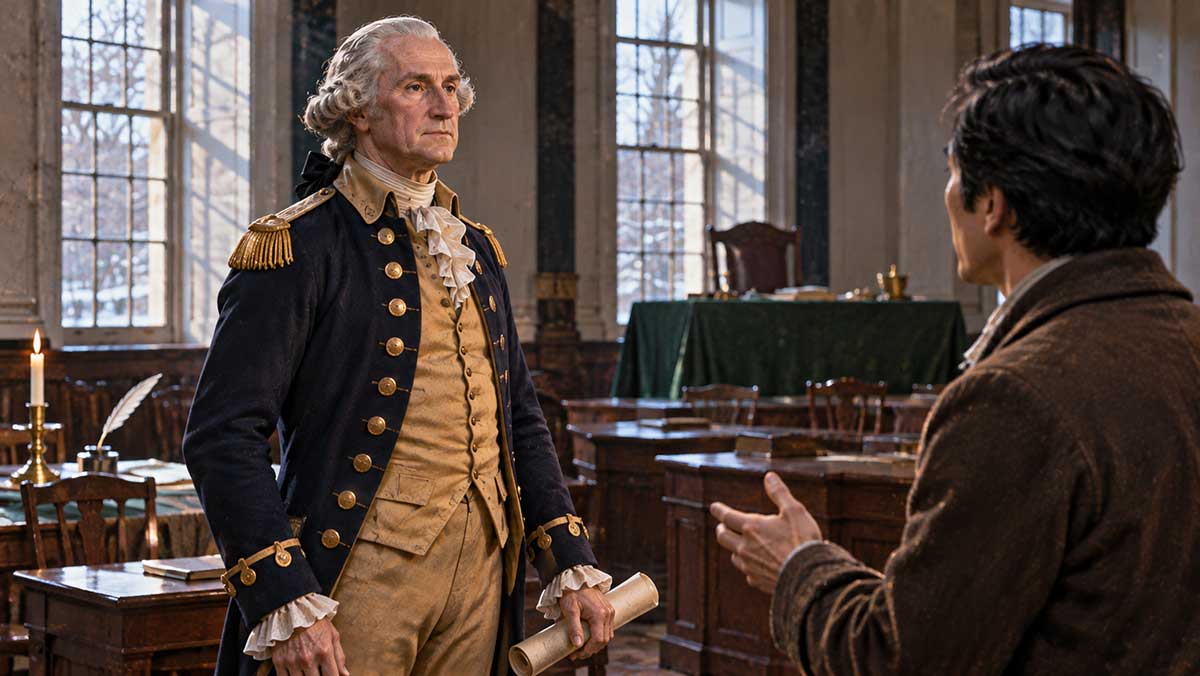
Winter sunlight enters the Old Senate Chamber through its tall windows, falling across the wooden floor and the desks where members of the Continental Congress have gathered. The formal proceedings have ended, and the chamber is nearly empty. The echoes of footsteps fade into the corridors. Outside, the December air is cold, and the streets of Annapolis are settling into the quiet of an early winter evening.
Only a short time earlier, George Washington stood in this room and surrendered his commission as commander in chief of the Continental Army. After more than eight years of war, the general who had led the American forces to independence had returned his authority to Congress.
Washington stands near the front of the chamber, his blue military coat carefully buttoned, his expression thoughtful. He looks toward the place where he delivered his resignation address. Nick approaches quietly, aware that he is entering a room where something extraordinary has just occurred.
Nick Sasaki: General Washington, I have to tell you, standing here gives me chills.
George Washington: The chamber is rather cold, Mr. Sasaki. I trust that is not entirely the cause.
Nick Sasaki: (Laughs.) No, General. It's what just happened here. You won a war against one of the strongest empires in the world. Your soldiers respected you. The American people admired you. And today, you walked into this room and gave up your command.
George Washington: I have returned the commission entrusted to me by Congress. The army's principal purpose has been accomplished, and I am grateful that I may now retire from public service.
Nick Sasaki: You know what's remarkable? Throughout history, we've seen military leaders win wars and then try to hold on to authority. Some become rulers themselves. But you did the opposite.
George Washington: I was appointed to command an army, not to govern the country. Those are very different responsibilities.
Nick Sasaki: You say that so calmly. Wasn't it difficult to walk away?
George Washington: I had long desired to return to private life. The difficulty was not in surrendering the commission, but in bearing the responsibilities that preceded this day.
Nick Sasaki: Then I'd love to understand what was going through your mind. Not just as a general, but as a man who had spent so many years carrying the fate of a nation on his shoulders.
Washington glances toward the empty seats of Congress, then gestures for Nick to accompany him toward a quieter corner of the chamber.
George Washington: Very well. Let us begin with the nature of the authority I was given.
Question 1: Why Did You Surrender Your Military Command After Winning Independence?
Nick Sasaki: General, let's start with the obvious question. After everything you accomplished, why didn't you hold on to your position?
George Washington: The command was never my personal possession. Congress appointed me to lead the army in defense of the American cause. When the war ended, the proper course was to return that commission to the civil authority from which it came.
Nick Sasaki: But you must have known how much influence you had. Many of your soldiers had followed you through terrible hardship. Some probably trusted you more than they trusted Congress.
George Washington: Their confidence was a great responsibility. It was not a license to disregard the government we had undertaken to defend.
Nick Sasaki: Were you ever tempted to think that you could govern the country better than the politicians?
George Washington: I was often dissatisfied with the conduct of public affairs, particularly when the army suffered from failures of supply and financial support. But dissatisfaction does not confer a right to assume authority that has not been granted.
Nick Sasaki: That's interesting. You weren't saying Congress was perfect. You were saying its authority had to be respected.
George Washington: Precisely. If every officer who believed himself more capable than the civil government could claim the right to rule, our independence would have accomplished little.
Nick Sasaki: I've heard the story that some people wanted you to become king. Is that true?
George Washington: In 1782, Colonel Lewis Nicola wrote to me expressing views that suggested a monarchical form of government. I rejected those sentiments in the strongest terms. I regarded them as inconsistent with the principles for which we had struggled.
Nick Sasaki: Did that proposal offend you?
George Washington: I considered it deeply improper. The army's sacrifices were not made so that we might replace one form of arbitrary rule with another.
Nick Sasaki: So you never seriously considered becoming king?
George Washington: I did not seek a crown. Nor should one mistake a suggestion made by an officer for a general desire throughout the army to establish a monarchy.
Nick Sasaki: That's an important distinction. Sometimes history turns a complicated situation into a simple story: George Washington could have been king, but he said no.
George Washington: History is often improved by resisting the temptation to make every event more dramatic than the evidence permits.
Nick Sasaki: (Smiles.) I suppose that's a warning for someone conducting an imaginary interview.
George Washington: A friendly warning, Mr. Sasaki.
Washington walks slowly toward the front of the chamber. His footsteps sound against the wooden floor.
Nick Sasaki: I want to ask about your resignation speech. You spoke of retiring from the service of your country and returning your commission to Congress. Was there a particular feeling you wanted to leave with the people in this room?
George Washington: I wished to express my gratitude for the assistance I had received, acknowledge the successful conclusion of the war, and formally return the authority entrusted to me. It was an occasion of considerable solemnity.
Nick Sasaki: Contemporary accounts describe the ceremony as emotional. You weren't simply handing in a resignation letter.
George Washington: We had endured many years of uncertainty and sacrifice. I was parting from an office that had occupied so much of my life. Such an occasion could scarcely be without feeling.
Nick Sasaki: And now you could finally go home.
George Washington: That prospect was exceedingly welcome. I had been absent from Mount Vernon for much of the war, and I longed to resume the occupations of private life.
Nick Sasaki: I keep thinking about the contrast. Here you are in this historic chamber, surrounded by the symbols of a new nation, and what you want most is to return to your farm.
George Washington: I had never ceased to value my home. Military command had been a duty, not the life I intended to pursue indefinitely.
Nick Sasaki: Do you think people sometimes underestimate how difficult it is to leave a position of influence?
George Washington: Men may become attached to the distinction and deference that accompany office. It is prudent to recognize that danger. Public authority ought to remain connected to the purpose for which it was entrusted.
Nick Sasaki: You know, General, I think this moment may be as important as any battle you won.
George Washington: I would not presume to measure it against the sacrifices of the army. But I believed it necessary that the military establishment return to its proper place under civil government.
Nick Sasaki: And perhaps the example mattered beyond your own lifetime.
George Washington: If the conduct of this day contributes to the preservation of republican government, I shall consider it a fortunate conclusion to my service.
Question 2: Why Did You Return to Public Life When You Wanted to Remain at Mount Vernon?
The winter light fades from the chamber. A faint glow remains along the upper windows, and the shadows of the desks stretch across the floor. Washington pauses near one of the windows, looking toward the streets of Annapolis.
Nick shifts the conversation forward several years, to a time when Washington's long-awaited retirement would be interrupted.
Nick Sasaki: General, here's something that puzzles me. You finally returned to Mount Vernon after the Revolution. You had your farm, your family, and the private life you wanted. Yet in 1787, you agreed to preside over the Constitutional Convention. Then in 1789, you became the first president of the United States. Why did you come back?
George Washington: The years following the war revealed serious weaknesses in our national arrangements. The government established under the Articles of Confederation lacked sufficient means to address many common concerns. Questions of finance, commerce, and the authority of the Union caused increasing anxiety.
Nick Sasaki: But you weren't eager to return to politics.
George Washington: I had retired with the intention of remaining in private life. I was reluctant to undertake another public responsibility. Yet I became persuaded that the condition of the country required serious attention.
Nick Sasaki: Was there a moment when you realized the Revolution might have been won militarily but lost politically?
George Washington: I would not identify a single moment. My concerns developed as I observed the difficulties confronting the states and the weakness of our common government. Independence alone could not provide the stability necessary for the country's future.
Nick Sasaki: You had spent eight years keeping an army together. Now you were worried about keeping thirteen states together.
George Washington: The circumstances were different, but the need for cooperation was no less apparent. The states had common interests that could not always be secured through separate action.
Nick Sasaki: When you attended the Constitutional Convention in Philadelphia, did you already know what kind of government would emerge?
George Washington: No. The delegates brought differing opinions and interests. The discussions required considerable compromise. I presided over the Convention, but the Constitution was the product of collective deliberation, not the work of one man.
Nick Sasaki: That's another thing I want readers to appreciate. You weren't sitting there dictating the Constitution.
George Washington: Certainly not. Men of considerable learning and experience contributed to its formation. My position required me to preside over their proceedings, not to substitute my judgment for every delegate's.
Nick Sasaki: And the final Constitution wasn't perfect.
George Washington: No human institution can reasonably be expected to satisfy every wish. The question was whether the proposed government offered a sounder foundation than the arrangement it would replace.
Nick Sasaki: One of its gravest compromises protected slavery. That contradiction was present at the nation's founding.
George Washington: Slavery was deeply implicated in the political arrangements of the states, and the Convention did not resolve the injustice of the institution. It is a matter that cannot be separated from an examination of the government we established.
Nick Sasaki: We'll discuss your personal responsibility in that more directly in our next conversation.
George Washington: I understand.
Nick Sasaki: Then came the presidency. You were unanimously chosen by the presidential electors in the first election. Did you feel honored or trapped?
George Washington: (Smiles faintly.) I was sensible of the honor, but I approached the office with considerable reluctance. I knew that the conduct of the first president would establish examples for those who followed.
Nick Sasaki: That must have been intimidating. There was no previous president to learn from.
George Washington: Precisely. The Constitution established the office, but many practical questions remained unsettled. How should the president communicate with Congress? How should the executive departments operate? What ceremonies were appropriate to a republic? These matters required judgment.
Nick Sasaki: You had to invent a lot of the job as you went along.
George Washington: We had to establish practices consistent with the Constitution and the character of republican government. I sought advice from capable men, though they did not always agree.
Nick Sasaki: That's an understatement. Alexander Hamilton and Thomas Jefferson could barely agree on the direction of the country.
George Washington: They held differing views concerning finance, constitutional interpretation, and the proper course of the government. Both possessed abilities of great value, but their disagreements were substantial.
Nick Sasaki: Did you ever wish you could send them both outside until they learned to get along?
George Washington: (A restrained smile.) There were occasions when greater harmony among gentlemen of ability would have been most welcome.
Nick Sasaki: (Laughs.) I can only picture those cabinet meetings.
George Washington: The conduct of government requires disagreement to be examined with care. Yet personal animosity can make that task unnecessarily difficult.
Nick Sasaki: Let me ask you something personal. You had spent your life seeking recognition, then earned more recognition than almost anyone in America. Did becoming president satisfy that younger ambition?
George Washington: I was conscious of the distinction associated with the office. I would not pretend to have been wholly indifferent to reputation. But the presidency brought responsibilities far greater than the honors attached to it.
Nick Sasaki: So the young man who wanted to rise in society eventually found himself wishing for an ordinary life again.
George Washington: There is some irony in that observation, Mr. Sasaki.
Nick Sasaki: I thought you might appreciate it.
George Washington: I appreciate it more readily now that you have spared me another election.
Question 3: How Do You Exercise Authority Without Allowing It to Become Personal Rule?
The chamber has grown quiet. Washington returns to the place where he surrendered his commission, and Nick notices the contrast between the empty room and the immense responsibilities they have been discussing.
Nick Sasaki: General, there's something I want to challenge. People often praise you for giving up authority. But during your presidency, you weren't afraid to use it. In 1794, you mobilized militia forces in response to the Whiskey Rebellion. That was a serious demonstration of federal authority.
George Washington: The laws of the United States had been enacted through the constitutional government. Resistance to their enforcement, particularly when accompanied by intimidation and violence, presented a serious challenge. I believed the government had a duty to uphold its laws.
Nick Sasaki: But some Americans thought the whiskey tax was unfair. They saw themselves as defending liberty against distant officials, just as the colonists had resisted British taxation.
George Washington: Citizens possessed the right to petition and seek changes through lawful means. The Constitution provided representative institutions for that purpose. But organized resistance that prevented the execution of federal law threatened the authority of the government established by the people.
Nick Sasaki: So you saw a difference between opposing a law and using force to prevent its enforcement.
George Washington: A distinction of great consequence. A republic cannot function if each group decides for itself which laws may be obeyed and which may be resisted through violence.
Nick Sasaki: Yet the government must be careful not to become oppressive itself.
George Washington: Certainly. Public authority must be exercised within constitutional limits. Its legitimacy depends upon the law and the institutions through which the people govern themselves.
Nick Sasaki: Did you worry about setting a precedent for future presidents to use military force against American citizens?
George Washington: Such a decision required careful consideration. I issued proclamations, pursued legal measures, and relied upon the procedures established by Congress. The use of militia forces was not a matter to be undertaken lightly.
Nick Sasaki: And the rebellion was suppressed without a major battle.
George Washington: The organized resistance dispersed. The object was to restore the execution of the laws, not to seek unnecessary bloodshed.
Nick Sasaki: Let me turn to another controversy. The Jay Treaty with Britain was deeply unpopular with many Americans. You supported it despite fierce criticism. Did you ever feel the public was turning against you?
George Washington: The treaty occasioned considerable opposition. I believed that preserving peace and maintaining the country's independence in foreign affairs required difficult decisions. The United States was not yet prepared for another major war.
Nick Sasaki: Did the criticism hurt?
George Washington: Public criticism was often disagreeable, particularly when it questioned motives I believed honorable. Yet an officer of government cannot expect universal approval. He must consider the interests of the country and act according to his judgment.
Nick Sasaki: You've mentioned reputation several times in our conversations. Did you ever worry that defending your reputation might influence your decisions?
George Washington: A concern for reputation may encourage a man to conduct himself honorably, but it may become a fault if he values praise above duty. I cannot claim that I was free from every human weakness. I can say that I sought to preserve the dignity of the offices entrusted to me.
Nick Sasaki: I appreciate that distinction. There's another difficult issue here. Your government pursued territorial expansion that harmed Native nations. The same federal authority you used to establish order among the states could be used against peoples who had never agreed to join your republic.
George Washington: The United States sought to establish its authority in western territories, and its policies brought it into conflict with Native nations that possessed their own claims and political interests. Those conflicts are part of the record of my administration and must be examined.
Nick Sasaki: We will examine them. I don't want our admiration for your restraint in leaving office to obscure how your government exercised authority over others.
George Washington: Then you must judge the conduct of the government by its actions, not merely by the intentions its officers professed.
Nick Sasaki: That's fair. Now let's talk about 1796. You announced that you would not seek another term. Why leave after two terms when the Constitution did not yet require it?
George Washington: I had long desired retirement, and I believed that the country could continue under other capable men. The presidency was not intended to become the permanent possession of any individual.
Nick Sasaki: Were you concerned that remaining in office indefinitely might make the presidency resemble a monarchy?
George Washington: The character of republican government depended upon constitutional institutions rather than personal attachment to a single leader. A peaceful transfer of office would demonstrate that the government could continue without my presence.
Nick Sasaki: That was a remarkable example to establish. You could have remained a central figure in American government for the rest of your life.
George Washington: I had already devoted many years to public service. The country had other men capable of serving it. I wished to return to Mount Vernon and leave the conduct of government to my successor.
Nick Sasaki: I have to ask something. When John Adams succeeded you in 1797, did you feel relieved?
George Washington: I was pleased that the transition occurred under the Constitution and that I could return to private life. The duties of the presidency had been demanding, and I had reason to welcome their conclusion.
Nick Sasaki: You had given up military command in 1783, then presidential office in 1797. Two extraordinary departures.
George Washington: Both offices were entrusted to me under different circumstances. In each case, I believed it proper to relinquish the responsibility when my service had reached its conclusion.
Nick Sasaki: What would you say to a leader who believes the country cannot survive without him?
George Washington: I should ask whether he has sufficient confidence in the institutions he professes to defend. A government that depends entirely upon the continued presence of one man stands upon an uncertain foundation.
Nick Sasaki: That's a question that still matters.
George Washington: The character of public institutions is tested not merely by the conduct of those who establish them, but by their ability to endure when those individuals depart.
Closing
The last daylight has disappeared from the windows of the Old Senate Chamber. A few candles illuminate the room, their reflections trembling against the polished wood. Beyond the doorway, footsteps echo briefly through the corridor before fading.
Washington stands near the place where he surrendered his commission. For a moment, Nick looks at the empty chamber, picturing the members of Congress gathered there earlier that day.
Nick Sasaki: General, I think I understand something about you that I didn't fully appreciate before. You weren't a man who avoided authority. You sought advancement when you were young, commanded an army, and later exercised the authority of the presidency. But you believed those responsibilities had limits.
George Washington: Public authority is a trust, Mr. Sasaki. It must be exercised with judgment and returned when the obligation has been fulfilled.
Nick Sasaki: And yet, here's what troubles me. A government can respect constitutional limits among its own citizens and still deny freedom or justice to others.
George Washington: The conduct of a government must be examined in its entirety. Its principles are of little value if they are never tested against its actions.
Nick Sasaki: That's where I want to go next. We've talked about your achievements, your sacrifices, and your willingness to leave office. But we haven't yet confronted the deepest contradiction in your life.
George Washington: You refer to slavery.
Nick Sasaki: Yes. You helped establish a nation founded on liberty, yet you held human beings in bondage. And the country's expansion came at a terrible cost to Native nations.
George Washington: Those matters deserve serious examination. I will not ask you to set them aside on account of my military or public service.
Nick Sasaki: Thank you, General. I want this to remain a conversation between friends, but friendship doesn't mean avoiding difficult questions.
George Washington: Nor should respect require silence concerning matters of consequence.
Nick Sasaki: Then perhaps we should leave this chamber and return to Mount Vernon. There are people whose lives were shaped by the decisions made there, and whose stories deserve to be heard.
George Washington: Very well, Mr. Sasaki. We shall speak of them.
Washington looks once more toward the chamber where Congress accepted his resignation. Then he turns toward the doorway. The room falls quiet behind them, leaving the question of authority unresolved in a deeper sense: surrendering an office is one measure of restraint, but the treatment of those who possess little authority is another.
Topic 4: The Contradictions of American Liberty
Opening
Mount Vernon, Virginia. Late autumn, 1799. Late afternoon.
The sun hangs low over the fields of Mount Vernon, casting long shadows across the paths and outbuildings. The air is cool, carrying the scent of damp earth and fallen leaves. Beyond the mansion's carefully maintained grounds, the working landscape of the plantation stretches toward the woods.
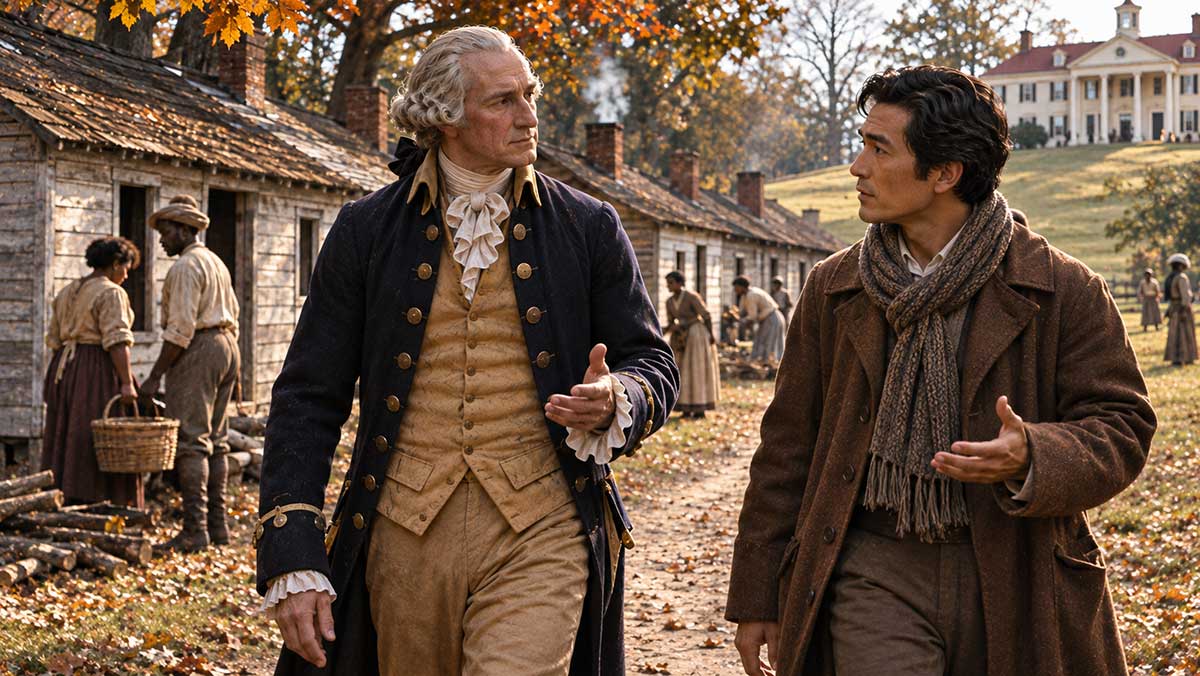
George Washington and Nick walk along a path near the quarters associated with the estate's enslaved workforce. A distant axe strikes wood. From another direction comes the sound of a wagon moving over uneven ground. The day's labor is drawing toward its close, but the plantation remains active.
The scene is peaceful at first glance. Yet its apparent tranquility conceals a fundamental reality: hundreds of people at Mount Vernon live under a system that denies them the freedom Washington helped secure for his country.
Washington carries a walking stick, occasionally using it to indicate a building or field. Nick has been unusually quiet since leaving the mansion. Washington notices.
George Washington: You have grown rather silent, Mr. Sasaki. I trust the walk has not exhausted you.
Nick Sasaki: No, General. I've been thinking about what we discussed in Annapolis.
George Washington: The surrender of my commission?
Nick Sasaki: Yes. We talked about how extraordinary it was for you to give up military command, and later the presidency. You helped establish the principle that no individual should possess unlimited political authority.
George Washington: I believed that the security of our republic required such restraint.
Nick Sasaki: And yet, here at Mount Vernon, there were people who had almost no authority over their own lives.
Washington stops walking. For a moment, the only sounds are the wind moving through the trees and the distant work continuing across the estate.
George Washington: You speak of the enslaved people who labor here.
Nick Sasaki: I do. And I want to be careful about how we have this conversation. I respect what you accomplished. But I don't want that respect to prevent me from asking questions that matter.
George Washington: Then ask them plainly.
Nick Sasaki: You fought for liberty. You helped create a republic. But you owned human beings. How did those two realities exist together in your life?
Washington looks across the plantation before answering.
Question 1: How Did You Reconcile Fighting for Liberty With Holding People in Slavery?
Nick Sasaki: General, when Americans read the Declaration of Independence, they encounter the idea that all men are created equal. You commanded the army fighting for that independence. Yet you continued to enslave people throughout your life. How do we make sense of that contradiction?
George Washington: It is a contradiction that cannot be dismissed by recounting my public service. I was born into a society in which slavery was deeply established. I inherited enslaved people when I was young, acquired others, and relied upon their labor in managing my estate. Those are facts of my life.
Nick Sasaki: But being born into a system doesn't mean you had no responsibility for participating in it.
George Washington: No. A man's circumstances may explain something of his conduct without absolving him of responsibility for it.
Nick Sasaki: When you spoke of liberty during the Revolution, did you think about the people here who didn't possess it?
George Washington: The language of liberty acquired increasing importance during those years, and the question of slavery became more difficult to disregard. My views changed over time. Yet the changes in my thinking did not immediately produce freedom for those held in bondage on this estate.
Nick Sasaki: That's what troubles me. You were capable of recognizing a problem, but recognition didn't necessarily change the lives of the people affected.
George Washington: You are correct to distinguish a man's expressed sentiments from his actions.
Nick Sasaki: I've read that by the end of your life, you had become increasingly uncomfortable with slavery. Is that supported by your letters?
George Washington: I wrote in 1786 of my wish to see a plan adopted for the abolition of slavery through legislative authority. I came to believe that the institution ought to end. Yet I remained a slaveholder, and my estate continued to depend upon enslaved labor.
Nick Sasaki: Did you ever consider freeing the people you personally owned during your lifetime?
George Washington: I considered the difficulties of emancipation, including the circumstances of families and the legal distinctions among those held here. But it would be misleading to present those difficulties as though they made every other course impossible. My decisions must be judged by what I did.
Nick Sasaki: Let's talk about those distinctions. Not everyone enslaved at Mount Vernon was legally yours to free.
George Washington: That is correct. Some belonged to the Custis estate and were held under the terms of Martha's first husband's estate. Others were held under different arrangements. I did not possess the same legal authority over every enslaved person living here.
Nick Sasaki: According to the 1799 census, there were 317 enslaved people at Mount Vernon. You personally owned 123, 153 were connected to the Custis estate, and 41 were rented from others.
George Washington: Those figures reflect the scale of the institution upon which this plantation depended.
Nick Sasaki: Three hundred and seventeen people. That's not a small household. That's an entire community of men, women, and children, each with a life of their own.
George Washington: They had families, relationships, occupations, and concerns beyond the work required of them. The estate's records cannot convey the entirety of their lives.
Nick Sasaki: And many of those families were vulnerable to separation. The legal distinction between your enslaved workers and the Custis estate's enslaved workers could divide husbands from wives and parents from children.
George Washington: That was a consequence of the different forms of ownership, and one that must be recognized.
Nick Sasaki: Your will provided for the emancipation of the people you owned after Martha's death, with certain provisions for those unable to support themselves. William Lee, who had served you for many years, was to be freed immediately. Why did you make those decisions?
George Washington: I had concluded that the people I owned should be emancipated, and I sought to provide for that in my will. I made separate provision for William Lee in recognition of his long service and circumstances.
Nick Sasaki: But you didn't free the others immediately.
George Washington: No. I directed that their emancipation occur after Martha's death.
Nick Sasaki: And that meant many people remained enslaved during your lifetime, despite your growing opposition to the institution.
George Washington: That is so.
Nick Sasaki: I don't want to ignore the significance of your will. But I don't want to turn it into a happy ending either. The people held by the Custis estate weren't freed by your will, and some families remained divided by legal ownership.
George Washington: My provisions did not extend to everyone held in bondage at Mount Vernon. That limitation is part of the record.
Nick looks toward the nearby buildings. A gust of wind lifts a few fallen leaves across the path.
Nick Sasaki: General, I think there's something especially difficult about this. You were willing to risk your life for political independence. You were willing to surrender military command and presidential office. Yet freeing the people you owned was something you postponed.
George Washington: My public decisions and my conduct concerning slavery do not present a consistent picture of liberty. I cannot ask you to judge one without considering the other.
Nick Sasaki: That may be the most difficult thing we've discussed so far.
George Washington: It is certainly among the matters for which my life deserves the closest examination.
Question 2: What Would You Say to Ona Judge, Who Escaped From Your Household to Claim Her Freedom?
They continue walking. The path leads past a small outbuilding, and the sounds of work gradually fade behind them. Washington's pace slows as Nick introduces the story of a woman whose decision challenged the authority of the presidential household.
Nick Sasaki: General, I want to talk about someone whose name deserves to be remembered: Ona Judge.
George Washington: She served in our household and escaped from Philadelphia in 1796.
Nick Sasaki: She was a young woman enslaved by the Custis estate, working as Martha's personal attendant. When she learned she might be given to Martha's granddaughter, she decided to leave. She escaped while you were president.
George Washington: She departed without our consent. Efforts were subsequently made to locate her and secure her return.
Nick Sasaki: She made it to New Hampshire, where she built a life outside your household. But she lived with the threat that she might be captured.
George Washington: She was sought after her departure. That is part of the historical record.
Nick Sasaki: Here's what I struggle with. You were president of a republic that celebrated freedom. Yet when Ona Judge chose freedom for herself, you tried to bring her back into slavery.
George Washington: My actions concerning her cannot be reconciled simply by referring to my public commitment to independence. I treated her departure as the loss of someone held under the laws of slavery and sought her return.
Nick Sasaki: And you knew that Pennsylvania had a gradual abolition law. Your household arranged for enslaved workers to be moved out of the state periodically, avoiding provisions that could have offered them a path to freedom.
George Washington: Those arrangements were made during my presidency. They demonstrate that my household sought to preserve its claims under slavery rather than permit those claims to be affected by Pennsylvania law.
Nick Sasaki: That makes the contradiction sharper. This wasn't just a young man following the customs of eighteenth-century Virginia. You were an experienced national leader making deliberate decisions.
George Washington: The decisions were mine to answer for, whatever the customs or laws of the period.
Nick Sasaki: I want to be fair to the historical record. We know you pursued Ona Judge. We don't know everything you privately thought about her. But we do know something important about her: she wanted to remain free.
George Washington: Her actions made that determination plain.
Nick Sasaki: Later in life, she spoke about her escape. She described her desire for freedom and her unwillingness to return to slavery. She didn't need permission from a president to know what freedom meant to her.
George Washington: She acted upon her own judgment and accepted the dangers that followed.
Nick Sasaki: If Ona Judge were standing here with us, what would you say to her?
Washington looks down at the path. The question remains unanswered for several moments.
George Washington: Mr. Sasaki, I cannot offer you words that were never spoken between us. The historical record preserves my efforts to recover her, not a conversation in which I acknowledged her claim to freedom. If you wish to understand what happened, those actions must not be replaced by a more comforting exchange of your invention.
Nick Sasaki: I appreciate that answer. It would be easy for us to write a beautiful scene in which you apologize and she forgives you. But that would be our imagination, not her history.
George Washington: And it would risk placing words in the mouth of a woman whose own testimony deserves attention.
Nick Sasaki: Exactly. Her story isn't simply a lesson about your conscience. It's the story of a woman who made a dangerous decision and refused to surrender the freedom she had claimed.
George Washington: Then her actions should be examined on their own terms.
Nick Sasaki: You know, General, this changes how I think about courage. We spent our last conversation discussing soldiers who crossed rivers and faced British guns. Ona Judge demonstrated another kind of courage.
George Washington: The dangers she faced were real, and her determination is evident in the account of her escape.
Nick Sasaki: She had no army. No political office. No public authority. Yet she resisted one of the most influential households in America.
George Washington: That is a significant contrast.
Nick Sasaki: I think readers should know her name just as they know yours.
George Washington: Then let the record of her life receive the attention it merits.
The conversation falls quiet. The distant sound of a wagon fades along the road. Nick and Washington stand for a moment without speaking, the question of Ona Judge's freedom remaining larger than anything either man could say.
Question 3: Did American Independence Come at the Expense of Native Nations?
The path turns toward a wooded rise overlooking the plantation's western fields. Beyond the trees, the land stretches into the distance. Washington stops near a fence, resting one hand on its upper rail.
Nick looks across the landscape before speaking.
Nick Sasaki: General, when you were young, you surveyed land on the Virginia frontier. We talked about how important land ownership was to your ambitions. But the land Europeans called the frontier wasn't empty. Native nations already lived there and possessed their own political systems and claims.
George Washington: That is correct. The western country was inhabited and claimed by Native peoples, whose interests were often in conflict with those of colonial settlers and imperial governments.
Nick Sasaki: Yet American history often describes westward expansion as if settlers were simply moving into unused territory.
George Washington: Such a description would fail to account for the nations already occupying and defending those lands.
Nick Sasaki: During the Revolution, you ordered the Sullivan expedition of 1779 against Haudenosaunee communities allied with Britain. American forces destroyed towns, crops, and food supplies. That caused enormous suffering.
George Washington: The expedition was directed against nations whose forces had participated in attacks along the frontier. Its operations included the destruction of settlements and provisions. Those actions had severe consequences for the communities affected.
Nick Sasaki: From your military perspective, you were trying to reduce attacks on American settlements. But from the perspective of the people whose homes and crops were destroyed, this was devastation.
George Washington: The military objectives of an expedition do not erase its consequences for those who suffer from it.
Nick Sasaki: Did you recognize that Native nations had their own right to independence?
George Washington: Native nations possessed governments, leaders, territories, and diplomatic relationships of their own. The United States dealt with them through treaties and negotiations, but our government pursued territorial objectives that often conflicted with their claims.
Nick Sasaki: That's the contradiction I want to examine. Americans insisted that Britain had no right to govern them without their consent. Yet the new United States expanded into lands claimed by Native peoples who had not consented to American rule.
George Washington: The expansion of the United States brought competing claims into conflict. American leaders frequently regarded settlement and territorial security as national interests. Native nations did not necessarily accept those claims, and they resisted them.
Nick Sasaki: During your presidency, the Northwest Indian War continued. American forces suffered major defeats before General Anthony Wayne's victory at Fallen Timbers in 1794. Then came the Treaty of Greenville in 1795.
George Washington: The conflict involved Native confederated forces determined to resist American expansion in the Ohio country. The treaty established terms under which large areas were ceded to the United States. Those events must be understood within the broader struggle over territory and sovereignty.
Nick Sasaki: The treaty was signed after a military defeat. That matters when we talk about consent.
George Washington: The circumstances under which agreements are made are essential to their interpretation.
Nick Sasaki: You sometimes advocated policies intended to reduce frontier violence, including regulated trade and treaty negotiations. Yet your administration still pursued expansion.
George Washington: The government employed diplomacy, regulation, and military force in its dealings with Native nations. Its stated desire for peace did not prevent policies that advanced American territorial interests at their expense.
Nick Sasaki: General, I'm trying to understand something about the founding generation. You believed deeply in American independence. But did that principle extend equally to peoples who were outside the political community you were creating?
George Washington: The republic we established did not extend its political rights equally to all who lived within or near its claimed territory. That limitation is apparent in the treatment of enslaved people and Native nations.
Nick Sasaki: I think that's where the word "liberty" becomes difficult. Liberty for whom? Independence for whom? Who gets to decide?
George Washington: Those questions expose the limits of the political arrangements of my time. They cannot be answered by speaking only of the freedoms enjoyed by those who held authority within the new nation.
Nick Sasaki: And we should remember that Native peoples weren't simply victims waiting for history to happen. They negotiated, formed alliances, resisted, and made decisions to protect their communities.
George Washington: Their actions shaped the course of events. They were political and military participants with interests of their own, not merely obstacles in the path of American settlement.
Nick Sasaki: That's an important distinction. When we tell the story only from Philadelphia, Yorktown, or Mount Vernon, we miss the people who experienced the founding of the United States very differently.
George Washington: Then a fuller history must include those perspectives.
Nick Sasaki: General, I came here hoping to understand how the man who helped establish American liberty could participate in systems that denied liberty to others. I don't think there's a simple answer.
George Washington: Nor should you expect one that makes every contradiction disappear.
Nick Sasaki: Perhaps the most meaningful thing we can do is refuse to hide the contradictions.
George Washington: A serious examination of history requires that its achievements and its injuries both remain visible.
Closing
The sun is nearly gone. A narrow band of gold remains above the trees, and the first evening chill settles over the fields. The sounds of the plantation have grown quieter, though the work of preparing for another day continues beyond the path.
Washington and Nick turn back toward the mansion. For a time, they walk without speaking.
Nick Sasaki: General, this has been the most difficult part of our conversation.
George Washington: I expected that it might be.
Nick Sasaki: We've discussed your courage, your leadership, and your willingness to surrender authority. But today we've talked about people whose freedom was restricted by decisions you made or policies you supported.
George Washington: Those decisions and policies belong to the history of my life no less than my military or public service.
Nick Sasaki: I don't want to pretend that one conversation can settle how history should judge you. But I do think it changes the questions we ask.
George Washington: In what manner?
Nick Sasaki: Instead of asking only whether you were a great leader, we have to ask who benefited from your leadership, who suffered under the institutions you helped preserve, and whose voices were missing from the story.
George Washington: Those are questions that require attention to the experiences of others, not merely to the reputation of the man being examined.
Nick Sasaki: And I think that's where Ona Judge's story matters so much. She didn't wait for history to decide whether she deserved freedom. She acted.
George Washington: Her escape was an act of determination, and the record of my response must stand beside it.
Nick Sasaki: You know, I still admire what you accomplished. But I feel differently about that admiration now. It's less comfortable. Maybe more serious.
George Washington: Respect need not require an absence of criticism, Mr. Sasaki.
Nick Sasaki: That's what I was hoping you'd understand.
They reach a point where the path divides, one direction leading toward the mansion and the other toward the plantation's working buildings.
Nick Sasaki: Before we finish, there's something I want to ask. You helped create a republic that spoke of liberty and equality, yet failed to extend those principles to everyone. What responsibility do future generations have when a nation's ideals are greater than the conduct of its founders?
George Washington: I cannot prescribe the judgments of generations I shall never know. But the principles a nation professes invite examination of its conduct. Those who inherit its institutions must decide whether they will merely repeat its declarations or consider what those declarations require of them.
Nick Sasaki: That's something I want our readers to think about. Not simply whether George Washington was a hero or a flawed man, but what it means to inherit a country with both extraordinary achievements and serious injustices.
George Washington: The history of a republic cannot be reduced to the reputation of one individual. Its future depends upon those who live within it and the decisions they make.
Nick Sasaki: Thank you for staying with these questions, General. I know they weren't easy.
George Washington: You have asked them with seriousness. That is sufficient reason to consider them.
Nick Sasaki: For our final conversation, I'd like to leave the fields and return to the river. I want to talk about your Farewell Address, your faith, and what you hoped America might become after you were gone.
George Washington: Then let us return to the house. The evening is growing cold, and I suspect you have more questions than daylight remaining.
Nick Sasaki: (Smiles.) You know me rather well by now.
George Washington: I am beginning to form that impression.
They continue toward Mount Vernon as the last light fades. Behind them lies a plantation whose history cannot be separated from the founding of the republic. Ahead waits the quiet of the Potomac and a final conversation about the future Washington hoped to leave behind.
Topic 5: The Republic He Left Behind
Opening
Mount Vernon, Virginia. Early December 1799. Late afternoon.
The sun is descending over the Potomac River, casting a pale golden light across the water. A cool breeze moves along the broad piazza of Mount Vernon, where a row of tall wooden columns frames the distant Maryland shoreline. The river flows quietly below, its surface reflecting the colors of the approaching evening.
Two chairs have been placed near the center of the piazza. A small table stands between them, holding a folded newspaper, a few letters, and a cup of tea that has begun to cool. From the mansion comes the faint sound of household activity. Somewhere beyond the lawn, a horse calls from the direction of the stables.
George Washington stands near the railing, looking across the river. He is sixty-seven years old, retired from the presidency for nearly three years. His hair has grown white, and his face bears the marks of a life spent in military service, political responsibility, and the management of his estate.
Nick joins him. After their difficult conversation about slavery and Native nations, neither man seems eager to begin with another argument. The quiet of the river offers a welcome change.
Nick Sasaki: General, I think this may be my favorite place we've visited.
George Washington: I am pleased to hear it, Mr. Sasaki. The view has afforded me satisfaction for many years.
Nick Sasaki: I can understand why you wanted to come home so badly. After battlefields, political meetings, and eight years as president, this must have felt like another world.
George Washington: Mount Vernon has always held a particular place in my affections. I find pleasure in its familiar occupations and in the prospect of passing my remaining years among family and friends.
Nick Sasaki: You know, we've spent our conversations discussing the most serious events of your life. Your ambition, the Revolution, your presidency, and the contradictions of American liberty. But standing here, I wonder whether we sometimes forget that you were a person who wanted to enjoy his own life.
George Washington: (Smiles.) I should hope that desire is not regarded as an extraordinary weakness.
Nick Sasaki: (Laughs.) No, General. I think it makes you more human.
George Washington: Then perhaps we may enjoy a conversation without requiring the entire weight of the republic to accompany us onto the piazza.
Nick Sasaki: I'll try. But I can't promise anything. I still have three questions.
George Washington: Only three? Then I shall consider myself fortunate.
They take their seats. For a moment, the river is the only thing moving before them.
Question 1: What Worried You Most About America's Future?
Nick Sasaki: General, in 1796, you published your Farewell Address. You warned Americans about political divisions, regional loyalties, and the dangers of becoming entangled in foreign conflicts. When you looked at the young republic, what concerned you most?
George Washington: I feared that the advantages gained through independence might be weakened by divisions among the people. The Union was of great importance to the security and prosperity of the country. If Americans allowed sectional interests or party animosities to become stronger than their attachment to the nation, the consequences could be grave.
Nick Sasaki: You were especially concerned about political parties.
George Washington: I had observed the growing influence of organized political factions. Differences of opinion are unavoidable in free government. But when attachment to a party becomes stronger than concern for the public good, men may begin to regard their fellow citizens as enemies.
Nick Sasaki: That's something that still feels familiar.
George Washington: Human nature does not change merely through the adoption of a constitution. Ambition, jealousy, resentment, and the desire for influence remain present in public affairs.
Nick Sasaki: But let me challenge you. Isn't disagreement part of freedom? If everyone has to agree for the sake of unity, couldn't that become another kind of oppression?
George Washington: I did not suppose that citizens would agree upon every question. Nor did I believe that liberty required the suppression of honest differences. My concern was with the spirit in which disagreements were conducted and the danger that organized factions might place their own success above the welfare of the republic.
Nick Sasaki: So you weren't asking Americans to stop disagreeing. You were asking them not to destroy the country over their disagreements.
George Washington: That is a reasonable expression of the concern.
Nick Sasaki: You worked with Alexander Hamilton and Thomas Jefferson, two brilliant men who had very different visions for America. Did their conflicts influence your thinking?
George Washington: Their disagreements concerned important questions of finance, constitutional authority, and foreign policy. I valued their abilities, but I was troubled when political differences became increasingly personal and bitter.
Nick Sasaki: Did you ever think the republic might fail?
George Washington: The success of our experiment was never guaranteed. The Constitution provided a framework for government, but its preservation depended upon the conduct of those entrusted with public responsibilities and the citizens who selected them.
Nick Sasaki: There's something I want to ask about your Farewell Address. You warned against permanent alliances with foreign nations. Some people interpret that as saying America should avoid the rest of the world entirely.
George Washington: That was not my meaning. I encouraged commercial relations and peaceful intercourse with other nations. My concern was that permanent political attachments might draw the United States into conflicts contrary to its own interests.
Nick Sasaki: Your Neutrality Proclamation of 1793 came during the war between revolutionary France and other European nations. That must have been a difficult decision, especially after France helped America win independence.
George Washington: France had rendered indispensable assistance during our struggle. The French alliance, and the efforts of French soldiers and sailors, contributed greatly to our success. Yet the circumstances of Europe had changed, and I believed the United States should avoid becoming involved in a war for which it was not prepared.
Nick Sasaki: Some Americans must have felt you were abandoning an old friend.
George Washington: There were strong opinions on both sides. But gratitude for past assistance did not remove the obligation to consider the country's present circumstances.
Nick Sasaki: That sounds like one of the hardest things about leadership. People want loyalty, but you have to decide what loyalty actually requires.
George Washington: A government must preserve its independence of judgment. Friendship with other nations is desirable, but it should not require the surrender of that independence.
Washington reaches for the folded newspaper on the table, then sets it aside without opening it.
Nick Sasaki: General, do you still follow political affairs closely?
George Washington: I remain interested in the condition of the country. Retirement has not deprived me of concern for its welfare.
Nick Sasaki: (Smiles.) So you haven't completely escaped politics.
George Washington: I fear that a man who has spent so many years in public service cannot entirely dismiss such matters from his thoughts.
Nick Sasaki: You know, when I read your Farewell Address, I hear a man who loved his country but didn't entirely trust human nature.
George Washington: I had witnessed enough of human conduct to recognize both its admirable qualities and its weaknesses. A republic must be established with an awareness of both.
Nick Sasaki: And what gives you hope?
George Washington: The capacity of citizens to govern themselves through institutions established by their consent. I had seen Americans endure extraordinary hardships in pursuit of independence. I hoped they would exercise comparable judgment in preserving it.
Nick Sasaki: You didn't expect perfection.
George Washington: Certainly not. But I hoped for sufficient wisdom to correct errors without destroying the institutions through which correction might be achieved.
Question 2: What Role Did Faith and Providence Play in Your Decisions?
The light begins to soften. A few birds cross the river, their silhouettes briefly visible against the pale sky. Washington sits quietly, his hands resting on the arms of his chair.
Nick Sasaki: General, I'd like to ask about something more personal. Throughout your public life, you spoke of Providence and the importance of religion and morality. What did faith mean to you?
George Washington: I believed that the affairs of mankind were not beyond the care of Providence. In my public addresses, I frequently acknowledged the assistance and protection of that higher authority. I regarded religion and morality as important supports of public and private conduct.
Nick Sasaki: Were those convictions especially important during the Revolution?
George Washington: The war presented many occasions for gratitude and reflection. We experienced dangers from which we escaped, and successes that depended upon circumstances beyond the control of any individual. I believed it proper to acknowledge Providence rather than attribute every favorable result to human ability alone.
Nick Sasaki: When you survived battles that killed so many others, did you wonder why you had been spared?
George Washington: I was conscious of the dangers through which I had passed. My correspondence reflects gratitude for preservation in circumstances of considerable peril. But I would be reluctant to claim certain knowledge of the particular purposes of Providence.
Nick Sasaki: I appreciate that. Sometimes people speak as if they know exactly what God intends.
George Washington: Men ought to exercise humility when considering matters beyond their complete comprehension.
Nick Sasaki: You attended Anglican services earlier in life and were associated with the Episcopal Church after independence. But historians still debate the details of your personal religious beliefs.
George Washington: My public conduct and writings provide evidence of my regard for religion, morality, and Providence. I did not leave behind a comprehensive statement resolving every theological question that later generations might wish to ask.
Nick Sasaki: That's fair. I don't want to put words in your mouth or assume you held beliefs you never clearly expressed.
George Washington: Then we are in agreement.
Nick Sasaki: One of the things I admire is your letter to the Hebrew Congregation in Newport, Rhode Island, in 1790. You affirmed that religious liberty wasn't simply permission granted by a majority to a minority. It was a right belonging to citizens.
George Washington: I believed the government of the United States should protect the rights of conscience. Religious difference ought not deprive peaceful citizens of the protection of the laws.
Nick Sasaki: That was a remarkable statement in an age when religious discrimination was common.
George Washington: The new government had an opportunity to establish a different example. Its citizens were not required to profess identical religious beliefs to enjoy the rights secured by the Constitution.
Nick Sasaki: Did you believe people of different religions could contribute equally to the country?
George Washington: I believed that the protection of conscience and the faithful discharge of civic duties were compatible with religious diversity. The government ought not impose religious tests that would exclude citizens from the rights properly belonging to them.
Nick Sasaki: You know, General, I have my own convictions about God and the human family. But I've learned that genuine respect begins with allowing another person to speak from his own experience.
George Washington: That is a sound principle for conversation, Mr. Sasaki.
Nick Sasaki: Let me ask something I haven't seen answered clearly in the historical record. Did you pray privately when you faced difficult decisions?
George Washington: My private devotional practices are not preserved in a manner that would permit every question to be answered with certainty. I can speak of my public acknowledgment of Providence and my belief in the importance of religious and moral duty. I would not wish you to mistake an imagined account of my private devotions for a documented fact.
Nick Sasaki: That's an answer I respect. There's a famous painting of you kneeling in prayer at Valley Forge, but that scene isn't firmly established by contemporary evidence.
George Washington: Then it should not be treated as a certain account merely on account of its popularity.
Nick Sasaki: It makes me wonder whether people sometimes want historical figures to confirm what they already believe.
George Washington: That temptation is not confined to questions of religion. Men may be inclined to discover in the lives of others the opinions they themselves most cherish.
Nick Sasaki: (Smiles.) You've given me something to think about.
George Washington: Then our conversation has served a useful purpose.
The breeze grows cooler. Washington adjusts his coat and looks toward the river, where the last sunlight is beginning to fade.
Question 3: After Everything You Accomplished, What Did You Most Want From the Years You Had Left?
Nick Sasaki: General, we've spent a great deal of time discussing the nation. But I want to return to you as a person. You're sixty-seven now. You've retired from the presidency. What do you want from the years ahead?
George Washington: I wish to enjoy the occupations of private life, attend to the affairs of my estate, and spend time among those to whom I am attached. I have long desired a period of tranquility after so many years of public responsibility.
Nick Sasaki: You sound like a man who has finally reached the life he wanted.
George Washington: I am grateful to be home. Yet I have discovered that retirement does not entirely relieve a man of obligations. There are matters concerning the estate, correspondence from friends and public figures, and concerns arising from the condition of the country.
Nick Sasaki: And in 1798, you accepted another military appointment when relations with France became dangerous.
George Washington: I agreed to serve as lieutenant general and commander of the provisional army during that crisis, though much of the organization and administration was conducted by others. I hoped that open war might be avoided.
Nick Sasaki: Even in retirement, the country kept calling you back.
George Washington: It has been difficult to decline every request for service. Yet I would be pleased if the remaining years of my life could be passed without another great public undertaking.
Nick Sasaki: What does an ordinary day at Mount Vernon look like for you?
George Washington: I rise early, attend to correspondence, examine the affairs of the farms, and consider improvements that may be made. I take pleasure in riding over the estate and observing its condition. Visitors and household matters occupy another portion of the day.
Nick Sasaki: Do you still enjoy experimenting with agriculture?
George Washington: Very much. I have long been interested in improving cultivation, studying different crops, and making more efficient use of the land. Agriculture is a subject of considerable importance to the prosperity of the country.
Nick Sasaki: You sound genuinely enthusiastic about it.
George Washington: A man may find satisfaction in observing the results of careful attention and practical experiment.
Nick Sasaki: I have to laugh. Most people would probably expect the first president to spend his retirement writing grand statements about the future of democracy. Instead, you're studying crop rotation.
George Washington: (Smiles.) A successful crop may provide a satisfaction more immediate than a political argument.
Nick Sasaki: (Laughs.) I believe you.
George Washington: Though I should caution you that agricultural experiments are not always as successful as their authors anticipate.
Nick Sasaki: So even George Washington has disappointing harvests.
George Washington: Nature is not inclined to grant special privileges to former presidents.
Nick Sasaki: I want to ask about Martha. You've been married for forty years. You've been through war, separation, the presidency, family losses, and enormous public responsibilities. What has her companionship meant to you?
George Washington: Martha has shared the burdens and changes of our life with constancy and strength. She has managed the household through circumstances that demanded considerable judgment. Her companionship has been among the greatest comforts of my life.
Nick Sasaki: Did you ever think about how different your life might have been if you'd never entered public service?
George Washington: It is natural to consider paths not taken. Yet I cannot know what circumstances might have arisen had I made different choices. I am grateful for the life that has been granted to me, though I have known its share of sorrow.
Nick Sasaki: You lost Patsy in 1773 and Jacky in 1781. Those must have been terrible experiences for you and Martha.
George Washington: Their deaths were grievous losses. No public distinction could compensate a family for such sorrow.
Nick Sasaki: And you helped raise Jacky's children afterward.
George Washington: Martha and I took an active interest in the children who came into our household. Their welfare and education were matters of great concern to us.
Nick Sasaki: There's something touching about that. The man remembered as the father of his country never had biological children, but he was still a father figure within his own family.
George Washington: Family relationships are not measured solely by birth. Affection, responsibility, and continued care have their own claims upon us.
Nick Sasaki: General, may I ask you something unusual?
George Washington: You have asked me a number of unusual questions already, Mr. Sasaki. I see no reason to stop now.
Nick Sasaki: (Laughs.) Fair enough. When future generations think about George Washington, what do you hope they remember?
George Washington: I should hope that my conduct is examined fairly, with regard to both the responsibilities I undertook and the errors I committed. I would not expect every decision to escape criticism. Nor would I wish the service of others to be forgotten in the telling of my own life.
Nick Sasaki: You know, that means a lot after our last conversation. We talked about slavery, Ona Judge, and Native nations. Those questions can't simply disappear when we turn to your legacy.
George Washington: They are part of the history that future generations must examine. My reputation cannot properly be separated from the full record of my conduct.
Nick Sasaki: I think that's what I've learned from spending time with you. I began by meeting a national monument. But now I see a man who wanted recognition, made mistakes, learned from failure, carried enormous responsibility, loved his family, and lived with contradictions he never fully resolved.
George Washington: That is a more human account than the image upon your currency, I suspect.
Nick Sasaki: (Smiles.) Much more human.
George Washington: Then perhaps our conversations have been worthwhile.
Closing
The sun has disappeared beyond the distant trees. The Potomac has turned a deep blue-gray, and the first lights are visible through the windows of Mount Vernon. The evening air has grown cold enough that Nick draws his coat more closely around him.
Washington rises from his chair and walks toward the railing. Nick joins him, and for a moment they look out over the river without speaking.
Nick Sasaki: General, before I leave, there's one final question I'd like to ask.
George Washington: You have been most persistent in your inquiries, Mr. Sasaki. I should be disappointed if you departed without one more.
Nick Sasaki: (Laughs.) Thank you. Here it is. You helped create a country that has survived far beyond your lifetime. But the United States has struggled with many of the same questions we discussed: political division, liberty, equality, the limits of government, and the treatment of people who have little influence. What do you think is the greatest responsibility of the generations who come after you?
George Washington: They must preserve the institutions through which they govern themselves and exercise the judgment necessary to correct their deficiencies. The work of establishing a republic does not end with the adoption of a constitution. Its character depends upon the conduct of those who inherit it.
Nick Sasaki: So the founding of America wasn't the completion of the work.
George Washington: It was the beginning of a difficult undertaking. The future could never be secured by the actions of the founding generation alone.
Nick Sasaki: I think that's a meaningful distinction. Sometimes we look at the founders as if they created something finished, something we only need to preserve exactly as it was. But the country they established had serious injustices from the beginning.
George Washington: The institutions of government must be judged by their capacity to serve the people and by the manner in which they are administered. Those who follow us will confront questions that our generation did not resolve.
Nick Sasaki: And perhaps questions you couldn't have anticipated.
George Washington: Undoubtedly. I would be surprised if the world remained unchanged after my departure.
Nick Sasaki: General, I want to thank you for something. You allowed me to ask difficult questions without making this feel like an argument. We disagreed about some things, and there were moments when I wasn't comfortable with your answers. But I feel I've come to know you better.
George Washington: I have appreciated the seriousness of your inquiries, Mr. Sasaki. You have been willing to consider my circumstances without surrendering your own judgment. That is a reasonable foundation for conversation.
Nick Sasaki: I think so too.
Washington looks toward the mansion, where warm light glows behind the windows.
George Washington: Martha will soon expect me indoors. I have kept you upon this piazza rather longer than the weather recommends.
Nick Sasaki: (Laughs.) I suppose I should let the first president enjoy his retirement.
George Washington: That would be a most welcome courtesy.
Nick Sasaki: One last thing. If I could go back and speak to that seventeen-year-old surveyor we met at the beginning of our conversations, what should I tell him?
Washington considers the question, his expression softening.
George Washington: I should be reluctant to burden a young man with knowledge of all that awaits him. He has much to learn through his own experience. Perhaps you might encourage him to attend carefully to his duties, value those who offer him sound counsel, and remember that reputation is earned through conduct rather than merely desired.
Nick Sasaki: That's a good message for a young man.
George Washington: It is counsel I might still find useful myself.
Nick Sasaki: (Smiles.) General, it's been a privilege.
George Washington: The pleasure has been mine, Mr. Sasaki. I wish you a safe return to your own time, and I trust you will remember Mount Vernon with some affection.
Nick Sasaki: I certainly will. And next time I see your face on a dollar bill, I think I'll smile.
George Washington: Then I hope the portrait will not discourage you.
They exchange a warm farewell. Nick walks toward the mansion, leaving Washington beside the railing for a few moments longer.
The former commander in chief, the first president, and the man whose name would become inseparable from the founding of the United States stands quietly overlooking the river. Beyond the Potomac, the evening settles over a nation still young, still divided in its promises and practices, and still uncertain of what it might become.
Washington turns toward the house. Inside, an ordinary evening awaits him.
For now, that is enough.
Final Thoughts: The Man Who Left, and the Nation That Remained
When I began this imaginary conversation with George Washington, I thought the most fascinating part of his life would be his decision to surrender authority. Here was a man who commanded the victorious army of the American Revolution, became the first president, and twice stepped away from extraordinary public responsibility. I expected to discover a lesson about leadership. What surprised me was how much more difficult the story became when I tried to look beyond those celebrated departures.
The Washington I encountered through historical research was not born with the certainty of his future greatness. He was an ambitious young Virginian who wanted recognition and opportunity. He suffered military failures before achieving distinction. He worried about his reputation, managed practical problems, and often longed for the comforts of home. I found myself wondering how many people who later become symbols of history begin with ordinary hopes that gradually place them in extraordinary circumstances.
His military career left me thinking about the difference between appearing strong and carrying responsibility. Washington's army did not survive through heroic speeches alone. It required food, supplies, discipline, difficult retreats, and the contributions of countless people whose names rarely appear in popular accounts. The winter at Valley Forge and the crisis among his officers at Newburgh reveal a commander confronting problems that could not be solved simply by winning a battle. The surviving documents in Founders Online make that daily burden visible through his correspondence.
Yet the most uncomfortable part of this project was confronting the distance between Washington's public defense of liberty and his conduct as an enslaver. Ona Judge's escape remains especially striking to me. She did not possess the authority, reputation, or military resources available to Washington. She acted under enormous personal risk to claim a freedom that his household denied her. Her story reminds me that history looks different depending upon whose experiences we choose to place at its center. The research preserved by Mount Vernon's Washington Library offers an opportunity to learn about the people whose lives were intertwined with his, rather than treating them merely as supporting figures in his biography.
I was left with a similar concern when considering Native nations. The independence of the United States was a remarkable political achievement, but its expansion involved conflicts with peoples who possessed their own communities, governments, territories, and claims to sovereignty. Washington's story cannot be understood solely through the perspective of those who gained independence from Britain. I think a more complete appreciation of American history requires us to examine the people who experienced the founding of the republic as a threat to their own freedom and security.
One of the most meaningful discoveries for me was Washington's attention to religious liberty. His 1790 letter to the Hebrew Congregation in Newport expressed a vision of citizenship in which religious minorities should enjoy rights rather than depend upon the tolerance of a dominant group. His precise private theology remains a matter of historical discussion, and I do not want to turn him into a spokesman for beliefs he never clearly expressed. What interests me is the possibility that people with different convictions can share a political community without surrendering their freedom of conscience.
At the end of our imagined meeting, I pictured Washington standing on the piazza at Mount Vernon, looking across the Potomac. I no longer saw only the commander or president. I saw an aging man who had lived through war, political conflict, family loss, public honor, and unresolved moral contradictions. His desire for a quieter life made him recognizable to me in a way that monuments never could. I was reminded that historical figures deserve neither automatic worship nor automatic dismissal. Their lives deserve careful examination, including the perspectives of those affected by their decisions.
I hope readers will carry several questions beyond this conversation. What makes a person worthy of public trust? Is surrendering authority sufficient evidence of good leadership, or must we examine how that authority was exercised? Can we admire a founder's achievements without excusing injustice? And perhaps most personally, what responsibilities do we inherit when the ideals passed down to us remain incompletely fulfilled? Washington's generation helped establish a republic, but it could not determine every choice that later generations would make. Those choices remain ours.
Fictional Conversation Disclaimer
The preceding reflections concern a fictional interview informed by historical research. Washington's dialogue, emotional responses, and personal reflections are imagined and should not be mistaken for documented quotations, verified private convictions, or endorsement of the author's views. Interpretations of his legacy remain open to historical debate, and readers are encouraged to consult original documents and scholarly research.
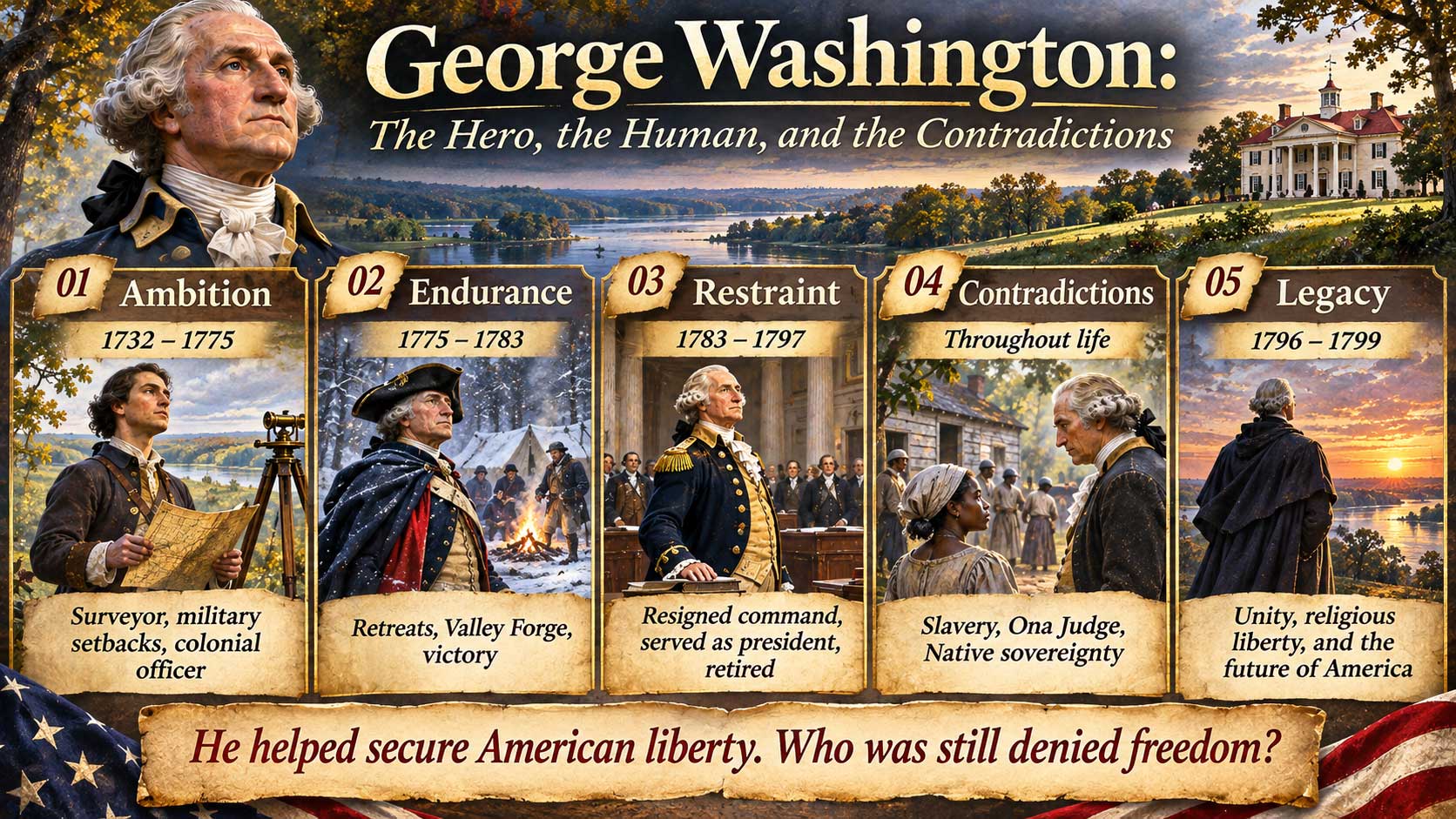
Short Bios:
George Washington (1732–1799)
George Washington was the commander in chief of the Continental Army during the American Revolutionary War, president of the Constitutional Convention of 1787, and the first president of the United States, serving from 1789 to 1797. His military leadership, commitment to civilian government, and voluntary departure from public office helped establish enduring American political precedents. A Virginia planter and enslaver, Washington's life included profound contradictions between the ideals of liberty and the practices of slavery and territorial expansion. He died at Mount Vernon on December 14, 1799.
Historical reference: George Washington's Mount Vernon: Life and Legacy
Nick Sasaki, Interviewer
Nick Sasaki is the creator of ImaginaryTalks.com, a platform that brings historical figures, thinkers, writers, and influential personalities into imagined conversations about questions that continue to matter. Through research-based storytelling, he seeks to explore human character, historical experience, moral responsibility, and the ideas that shape our lives.
Website: ImaginaryTalks.com
Leave a Reply