
Introduction
What if 2027 becomes the year humanity begins questioning everything it thought it knew about its past, its place in the universe, and the future waiting ahead? From predictions of extraterrestrial disclosure to warnings about political upheaval and the possibility of spiritual awakening, 2027 has attracted remarkable attention among several prominent psychic and spiritual commentators. But beneath the dramatic forecasts lies a more intriguing question: Are these individuals anticipating isolated events, or are they describing different aspects of a larger transformation?
Joseph Tittel, known for his psychic visions and annual predictions, has described 2027 as a possible period of extraordinary revelations. His impressions concern ancient Egypt, previously concealed information, religious history, government secrecy, and the possibility of extraterrestrial disclosure. Some of his predictions are unsettling, particularly those involving military conflict and environmental disasters. Others raise fascinating questions about discoveries that could challenge established interpretations of the past. His perspective invites us to consider what happens when unfamiliar information confronts deeply held beliefs.
British psychic Craig Hamilton-Parker approaches the coming years through predictions involving international politics, financial instability, and technological developments. His forecasts include potential conflict involving Iran, political changes in the United States and China, and major developments in artificial intelligence and quantum computing. He identifies 2027 as a significant period within a longer sequence of changes, some of which he anticipates becoming more serious in 2028. His predictions raise an important question: How prepared are modern institutions for disruptive changes that may occur across several areas of society?
Astrologer Pam Gregory offers a different perspective, focusing on cosmic cycles, collective consciousness, and humanity's spiritual development. One event central to her discussions is the total solar eclipse of August 2, 2027, which will cross Egypt near the ancient city of Luxor. In her conversation with Kelly Kolodney, they explored the spiritual significance they associate with this event and a planned worldwide gathering centered on meditation and collective intention. The eclipse is an established astronomical event; claims about its spiritual effects remain matters of personal belief and interpretation.
Darryl Anka, who presents teachings attributed to an entity called Bashar, has discussed a possible extraterrestrial-contact-related event around late 2026 or early 2027. His account extends into extraordinary ideas about consciousness, parallel realities, and the possibility that humanity's ancient history contains information not presently recognized by science. The scientific search for life beyond Earth is a legitimate and ongoing field of research, as reflected in NASA's exploration of the possibility of extraterrestrial life. Claims of existing extraterrestrial civilizations interacting with humanity, however, require evidence that has not been established.
Isabeau Maxwell brings a more hopeful and personal message. She describes 2026 as a period of preparation, self-examination, and releasing patterns that no longer serve people well. In her interpretation, 2027 represents the gradual beginning of a more positive era, marked by stronger intuition, healthier relationships, and a growing appreciation for community. Her perspective raises a question that can easily disappear beneath dramatic predictions: What would meaningful transformation actually look like in the everyday lives of ordinary people?
In this fictional ImaginaryTalks roundtable, Nick Sasaki welcomes all five guests to explore the deeper implications of their ideas. Rather than concentrating on which forecasts agree or conflict, the conversation allows each participant to develop a larger vision of humanity's future. Together, they examine ancient mysteries, religious questions, the prospect of extraterrestrial intelligence, global challenges, and the possibility of spiritual growth. Readers are invited to approach these subjects with curiosity while distinguishing documented knowledge from speculative claims. For example, the Smithsonian Institution's research into human origins provides a scientific foundation for considering claims about humanity's distant past. The discussion ultimately asks whether the most meaningful question about 2027 concerns what will happen to humanity, or what humanity might choose to become.
Fictional Conversation Disclaimer
This article is a fictional conversation created for educational and reflective purposes. The featured individuals did not participate in this discussion, and their dialogue must not be treated as authentic quotations or endorsements. Their publicly expressed ideas inspired the imagined exchanges, but the wording and interactions are creative reconstructions. Psychic predictions, channeling experiences, extraterrestrial claims, and disputed historical interpretations are not established facts.
Topic 1: Why Does 2027 Feel Like a Turning Point?
Opening
Nick Sasaki: Welcome, everyone. I have to tell you, I've been looking forward to this conversation.
I've spent quite a bit of time listening to each of you talk about 2027. Joseph, your visions about ancient Egypt, hidden history, and extraordinary revelations caught my attention. Craig, you've described some significant political and economic developments that could change the direction of entire nations. Pam, you've been speaking about a transformation in human consciousness, with the solar eclipse in August 2027 occupying a remarkable place in that story.
Darryl, you've discussed Bashar's prediction of an important event connected with extraterrestrial contact. And Isabeau, you've been telling people that after a difficult period of preparation, 2027 may mark the beginning of something much more hopeful.
Now, I could spend our entire conversation asking which prediction is correct. But that's not what interests me most.
I'm curious about something deeper.
Why does this particular year seem so meaningful to all of you? And more than that, what might these changes mean for humanity?
Joseph, let me start with you. Welcome.
Joseph Tittel: Thank you, Nick. It's wonderful to be here. And I think it's a fascinating time to be having this conversation.
Nick: Craig, welcome. You've certainly given us plenty to think about.
Craig Hamilton-Parker: Thank you, Nick. Yes, perhaps a little too much to think about at times! But I hope we can put some of those predictions into a broader perspective.
Nick: Pam, it's lovely to have you.
Pam Gregory: Thank you, Nick. It's a joy to be here. And I'm delighted we're approaching this with curiosity, rather than simply focusing on what might go wrong.
Nick: Darryl, welcome. I'm particularly interested in exploring the implications of some of the things Bashar has discussed.
Darryl Anka: Thank you. And I think that's a wonderful approach. The implications are often more interesting than the predictions themselves.
Nick: And Isabeau, welcome. Your perspective brings a sense of hope to the discussion.
Isabeau Maxwell: Thank you! I'm excited to be here. And yes, I think we could all use a little hope, couldn't we?
Nick: Absolutely.
You know, there's something rather extraordinary about having five people here who approach the future in such different ways. Yet all of you see this period as meaningful.
So rather than beginning with the most dramatic prediction, I'd like to begin with a simple question.
Question 1: What Makes 2027 Different from an Ordinary Year?
Nick: Joseph, when you were doing your predictions for 2027, you described a number of visions that suggest hidden things may be coming into the open. What makes this particular period stand out to you?
Joseph Tittel: Well, Nick, when I work with my visions, I often receive images that don't necessarily make complete sense immediately.
Sometimes they're very symbolic. Sometimes they're remarkably specific. And sometimes the meaning becomes clearer as events begin unfolding.
What caught my attention about 2027 was the recurring sense of revelation.
I kept coming back to things that had been concealed, things beneath the surface, information that people may not have had access to before.
That included ancient history, especially Egypt. But it extended beyond archaeology into governments, spirituality, and the possibility of extraordinary discoveries.
What interests me isn't simply the prospect of some sensational revelation.
It's what happens afterward.
Suppose something emerges that challenges a belief people have held their entire lives. How do they respond? Do they become frightened? Do they reject it? Or do they become curious enough to reconsider what they thought they knew?
Nick: That's interesting. You're describing revelations that might change our understanding of the past, but their consequences would unfold in the future.
Joseph: Exactly.
And I think that's why the spiritual side matters so much.
People can spend their lives believing they know the whole story. Then one discovery comes along and suddenly they're asking questions they never thought to ask.
I wouldn't want anyone to take every image I've described as an absolute certainty. Visions can require interpretation. But the repeated theme of things being revealed is what stands out to me.
Nick: Craig, Joseph is talking about changes in what people believe. Your predictions seem to involve changes in how the world actually operates. What stands out about 2027 from your perspective?
Craig Hamilton-Parker: Well, Nick, I tend to look at patterns across a number of areas.
I might see something connected with political leadership, then something concerning financial systems, international relationships, or technology.
And sometimes those impressions begin to suggest a larger pattern.
For me, 2027 feels like a period in which pressures that have been building for some time become much harder to ignore.
I have spoken about potential developments involving the United States, China, Iran, and international trade. I've spoken about artificial intelligence, financial instability, and changes that may become particularly serious in 2028.
But I don't see 2027 as an isolated year.
I see it as part of a sequence.
Nick: So you're saying the significance of 2027 may not be that everything happens within those twelve months. It might be a year when several longer developments become more visible.
Craig: Precisely.
A financial crisis, for example, doesn't necessarily begin on the day when people recognize it. The underlying conditions may have been developing for years.
The same applies to political change.
And there is another point. We should be careful not to assume that every disruptive development is automatically the end of something.
Sometimes an uncomfortable period becomes the beginning of a different arrangement.
I think the question is what new structures might emerge from the old ones.
Nick: Pam, you've been looking at this through astrology and a much larger spiritual framework. How do you see 2027?
Pam Gregory: Well, Nick, I tend to think in terms of longer cycles of change rather than individual calendar years.
For some time, I've been talking about humanity moving through an extraordinary period of transformation.
We can see many aspects of established life being questioned. People's relationship with authority, institutions, communities, and even their own sense of identity is changing.
And I believe there is an opportunity in that.
I don't mean that difficult events are desirable. Clearly, tremendous suffering exists in the world.
But I think we can become so focused on the difficulty that we miss the possibility of creating something different.
The total solar eclipse on August 2, 2027, is particularly fascinating to me.
Its path crosses Egypt, with an exceptionally long period of totality near Luxor. That's an actual astronomical event.
Now, my spiritual interpretation of that event is a separate matter. But I find the timing and symbolism deeply meaningful.
In my conversation with Kelly Kolodney, who channels Archangel Raphael, we discussed a global gathering intended to bring people together in meditation and shared intention during that eclipse.
For me, the exciting question isn't simply what happens in the sky.
It's what happens within people when they recognize an opportunity to come together.
Nick: That's a beautiful distinction.
The eclipse happens whether anyone pays attention to it or not. But the meaning people give to it, and what they choose to do together, is another story.
Pam: Exactly.
And I would love people to begin thinking about what they wish to contribute, rather than simply asking what the universe is going to do to them.
Nick: Darryl, Bashar has described something he calls a splitting prism, in which people move into increasingly different experiences of reality.
That's quite a different way of interpreting the changes we're discussing.
Could you explain it?
Darryl Anka: Certainly.
First, I would say that Bashar doesn't look at time in exactly the way we ordinarily think of it.
He describes physical reality as a series of parallel versions of Earth, with consciousness continuously shifting through them.
Now, that's a description of the framework he presents. I'm not suggesting everybody listening must accept it as established science.
But within that framework, the future isn't a single fixed destination.
It's a collection of possibilities.
What we're experiencing now, according to Bashar, is a period when people are becoming increasingly clear about what they believe, what they value, and what they choose.
He calls this a time of choosing.
Nick: And how does that relate to 2027?
Darryl: Bashar has discussed the period from 2020 to 2050 as a much larger transition.
Within that broader period, he has pointed to a potentially significant event involving extraterrestrial contact around the end of 2026 or the beginning of 2027.
He's described it as something that could make the reality of extraterrestrial intelligence much more apparent.
But he hasn't given us a complete picture of exactly what that event would look like.
And, within his framework, predictions represent possibilities rather than guarantees.
Nick: I find that fascinating. If I understand you correctly, you aren't simply waiting for something to happen in 2027. You're suggesting that our present choices are part of what determines the future we experience.
Darryl: Yes, that's the central idea.
And I think that's much more useful than sitting around waiting for something extraordinary to happen.
The question becomes, what kind of experience are you choosing to create right now?
Nick: Isabeau, you've been talking about this transition in a very personal way. You describe 2026 almost as a period of preparation, with 2027 bringing the possibility of release.
What do you mean by that?
Isabeau Maxwell: Oh, Nick, I love that you brought that up.
I've been talking about how people have been doing so much internal work.
They've been looking at their relationships. They've been reconsidering their jobs, their priorities, their choices.
And sometimes it's been frustrating.
You do all this work on yourself, you make these changes, you start recognizing things more clearly, and then you look around and think, "Okay, I'm ready. Why isn't anything happening yet?"
I've described 2026 using the example of one of those little toy cars that you pull backward before letting it go.
You're pulling it back, pulling it back, and you're thinking, "Can we please release this thing already?"
Nick: (Laughing.) I remember those cars.
Isabeau: Right? And that's how I've been describing the energy of 2026.
Then we get to 2027, and I feel that we're entering the period when that car can finally begin moving forward.
Now, that doesn't mean everything becomes perfect.
It means people may begin experiencing the results of changes they've already been making.
And what excites me is that I sense this isn't just about individual achievement. It's about community.
Moving from a constant focus on "me" toward a stronger awareness of "we."
Nick: That's interesting.
Joseph sees revelations. Craig sees changes in political and economic structures. Pam sees an opportunity for collective spiritual transformation. Darryl talks about choice and possible futures. And Isabeau sees people beginning to move forward after a difficult period.
I'm hearing something that I'd like to explore.
Perhaps we're talking about different dimensions of a larger human transition.
Not necessarily one event, and certainly not something we can claim is guaranteed.
But the possibility that many things people have taken for granted are being reconsidered.
Craig: I think that's a fair way of putting it.
Pam: Yes, and the important part for me is what people do with that opportunity.
Joseph: And what they may discover along the way.
Question 2: What Do You Sense Is Coming to an End?
Nick: Let's explore that a little further.
Craig, when you look at the political and economic predictions you've made, what do you think may be reaching a turning point?
Craig Hamilton-Parker: Well, one thing I keep returning to is the way established arrangements may become increasingly difficult to maintain.
Look at international relationships.
Countries are reassessing their economic interests, their alliances, their security, and their access to resources.
Technology is advancing very quickly, particularly artificial intelligence.
I have predicted a major announcement concerning artificial superintelligence, and significant developments in quantum computing.
Now, those possibilities have enormous implications for financial systems, national security, and even the nature of work.
And that's before we consider political developments.
What interests me is how these pressures interact.
A technological breakthrough can create economic disruption. Economic disruption can lead to political change. Political change can reshape international relationships.
It's a chain of possible consequences.
Nick: So the structures that worked for one period of history might not work in quite the same way for the next.
Craig: Exactly.
But I would avoid the simplistic idea that every existing structure is going to disappear.
Some institutions adapt. Some become stronger. Others decline.
And we have to be careful when interpreting predictions. A psychic impression might suggest a dramatic change, but the form that change takes can be difficult to identify beforehand.
Nick: Joseph, you've repeatedly returned to things that have been hidden becoming visible.
Do you think secrecy itself is becoming harder to maintain?
Joseph Tittel: That's an interesting way to ask it.
In my visions, I kept seeing the possibility of information emerging that had been concealed or misunderstood.
And it wasn't all the same kind of information.
Some of it concerned ancient civilizations. Some involved religion. Some involved governments and extraterrestrial subjects.
But there was this repeated sense of uncovering something.
Nick: Do you think people are ready for that?
Joseph: That's the question, isn't it?
People say they want the truth.
But what happens when something challenges a belief that has been part of their identity for decades?
You might welcome it.
Or you might feel threatened by it.
I think revelations, if they happen, may create very different responses.
Darryl Anka: If I could add something to that, Nick, I think there's a useful distinction between receiving information and being ready to integrate it.
Nick: Please go ahead.
Darryl: A person can be told something extraordinary, but that doesn't mean they know what to do with it.
Bashar has suggested that much of humanity's present difficulty comes from being confronted with choices that reveal what people truly believe.
For example, two individuals may hear the same information and interpret it in completely different ways.
One sees an opportunity.
The other sees a threat.
And from Bashar's perspective, the beliefs they hold play a significant role in the experiences they create.
Nick: That brings up something I've been wondering about.
We've lived through periods when people could disagree strongly but still maintain relationships and cooperate.
Today, many people seem to struggle to have conversations with anyone who sees the world differently.
Is there a danger that, as people become more convinced of their own views, they lose the ability to listen?
Darryl: That's a meaningful question.
And I think it relates to the choices we're talking about.
You can become clearer about what you believe without necessarily becoming hostile toward someone who believes something else.
The issue is whether your beliefs are helping you experience the kind of life you prefer.
Pam Gregory: Nick, I'd love to build on that.
I think people are becoming increasingly aware of what happens when they live in a constant state of fear and reactivity.
And that's something Kelly and I discussed extensively.
When people feel overwhelmed by frightening information, it can become difficult to respond thoughtfully.
So I believe part of what we have an opportunity to move beyond is the habit of allowing fear to dominate our attention.
That doesn't mean ignoring suffering or pretending everything is wonderful.
It means recognizing that we can be compassionate and engaged without being consumed by anxiety.
Nick: I like that distinction.
Someone can acknowledge a difficult reality and still choose a constructive response.
Pam: Absolutely.
And community matters enormously.
If people are frightened, isolated, and distrustful, it's much harder to create positive change.
But when they begin helping one another, listening to one another, and working together, something different becomes possible.
Isabeau Maxwell: That's exactly where my thoughts have been going.
When I talk about people recognizing what no longer belongs in their lives, I'm not necessarily talking about something dramatic.
Sometimes it's a job that hasn't been right for years.
Sometimes it's a friendship where you've been afraid to admit that the relationship has changed.
Sometimes it's just a belief about yourself.
Maybe you've spent twenty years telling yourself that you can't do something.
And then one day you begin asking, "Wait a minute. Is that actually true?"
Nick: So the thing coming to an end could be a personal limitation rather than a global institution.
Isabeau: Yes!
And that's a big deal.
We often think that transformation has to be something enormous, something that makes the news.
But think about someone who finally has the courage to make a meaningful change in their life.
That may change their family's future.
Their children may grow up seeing a completely different example of what a person can do.
I think those changes matter just as much as the large-scale ones.
Nick: I want to stay with that for a moment.
When we hear predictions about global transformation, we naturally think about governments, wars, technological discoveries, things on an enormous scale.
But people don't experience history only through headlines.
They experience it in their homes, at work, around the dinner table, and in their relationships.
Perhaps a new era, if one is beginning, will be recognized through both kinds of change.
Craig: I think that's quite possible.
And I would say that political and economic structures are ultimately experienced by ordinary people.
A change in an international trade agreement might sound distant, but it can affect employment, prices, investment, and family decisions.
The large-scale and personal consequences are connected.
Joseph: And the same could be true of revelations.
If some extraordinary information came to light, the real impact might be in the conversations people begin having with their families.
Nick: That's a thought I hadn't considered quite that way.
A discovery that makes international headlines might eventually lead to a father and daughter sitting together asking what they believe about God, history, or the universe.
Pam: And that conversation could be an opportunity for greater closeness.
Nick: I think that's the sort of possibility that makes this subject worth exploring.
Question 3: What Could Begin in Its Place?
Nick: We've talked about what may be ending.
Let's turn to what might begin.
Isabeau, you have such a hopeful way of describing 2027. I'd like to ask you a practical question.
If your sense of this new era is correct, what would it actually look like for an ordinary person?
Isabeau Maxwell: I think one of the first things they might notice is that they're not fighting themselves quite so much.
Let me explain.
Sometimes you know what you want.
You know a relationship needs to change. You know you want to do something different with your career. You know you want to become more confident.
But you're so accustomed to disappointment that you almost don't trust yourself to be hopeful.
You keep thinking, "What if something goes wrong?"
I've talked about this from my own life.
There was a period when I had left a long marriage, and I was living in my office. I didn't have much money, and everything felt terribly uncertain.
I remember becoming frightened by ordinary sounds.
And eventually I realized that I was reacting to dangers that weren't actually present in that moment.
I had been carrying so much fear from the past.
Nick: That must have been a difficult realization.
Isabeau: It was. But it became incredibly freeing.
I used a simple visualization.
I pictured a path.
Behind me was the past.
Ahead of me was the future.
And where I was standing was right now.
I looked at where I actually was, rather than everything I feared might happen, and realized I could begin to feel safe again.
That's why, when I talk about 2027, I don't want people to hear only this huge prediction about a new era.
I want them to recognize the possibility of a different experience in their own lives.
Maybe they begin trusting themselves again.
Maybe they become more hopeful.
Maybe they stop delaying something meaningful.
Nick: I appreciate that.
And it raises an interesting question for everyone.
Suppose 2027 does bring significant change. How will we recognize whether the change is genuinely positive?
Pam?
Pam Gregory: I think one meaningful indication would be greater compassion.
Do people become more conscious of the suffering of others?
Do they become more willing to help?
Do they recognize that the well-being of their community matters alongside their own well-being?
I would be delighted to see more people reconnecting with nature, experiencing stillness, and becoming more thoughtful about how they direct their attention.
In the discussion with Kelly, we talked about the intention behind gathering people during the eclipse.
For me, the opportunity is to bring people together around a shared commitment to love and goodwill.
Now, people will have different interpretations of what that means spiritually.
But the act of coming together in a spirit of generosity and care can be meaningful in its own right.
Nick: That sounds less like waiting for a miraculous event and more like participating in the kind of world you hope to see.
Pam: Very much so.
And I think it's something available to us now.
Nick: Darryl, I want to ask you about the larger picture.
Bashar has talked about humanity potentially entering a period of extraterrestrial contact.
If that possibility ever became reality, what might begin for our civilization?
Darryl Anka: Well, Nick, think about what happens when your understanding of your place in existence changes.
For much of human history, people have organized their lives around particular assumptions about who we are and what the universe is.
If credible evidence of intelligent life beyond Earth became publicly available, that could create extraordinary opportunities for learning.
There would be scientific questions.
There would be questions about consciousness and the nature of intelligence.
There would be cultural and philosophical questions.
And yes, there would be spiritual questions.
But one of the things Bashar has emphasized is that humanity's response matters.
Contact, within the scenario he describes, isn't simply an event where beings arrive and suddenly everybody's problems disappear.
It's part of a much longer process of developing our capacity to interact with something unfamiliar.
Nick: That's interesting. People sometimes talk about extraterrestrial contact as though everything would change overnight.
Darryl: And I wouldn't assume that.
In our conversation about the possibilities of contact, I've spoken about a transition that could take decades.
People would have to adjust.
Some would be excited.
Some would be frightened.
Some might reject the information entirely.
What interests me is how an encounter with something beyond our familiar experience might encourage us to reconsider the limits we've placed on ourselves.
Joseph Tittel: And that's where I see a connection to the revelations I was describing.
If there are discoveries that change people's understanding of history or the universe, they might start asking much larger questions.
What else don't we know?
What have we misunderstood?
What possibilities have we overlooked?
Nick: Craig, let me bring you in here.
We've been speaking about spiritual growth and extraordinary discoveries. Your predictions include a considerable amount of upheaval.
Do you see room for constructive developments?
Craig Hamilton-Parker: Certainly.
And I wouldn't want people to think that my predictions concern nothing but trouble.
I've spoken about advances in medical technology, artificial intelligence, energy, and industrial processes.
Some of those developments, if they occur, could offer real benefits.
For example, I described an impression of new technology that might allow oil to be used more efficiently and with less pollution.
I've spoken about potential developments in artificial intelligence that could change how people solve problems.
Of course, technological progress brings risks. A new capability may create problems that governments and institutions have difficulty managing.
But there are opportunities.
Nick: So what may begin isn't necessarily one entirely new civilization. It could be a period when discoveries reshape many parts of life.
Craig: Yes.
And I would say there's a distinction between predicting a change and knowing all its consequences.
We can consider possible developments, but how societies respond will depend on many human decisions.
Nick: That may be one of the most encouraging things we've discussed.
Whatever people believe about psychic abilities, we still have choices.
We can investigate extraordinary claims carefully.
We can treat one another with compassion.
We can work to improve our communities.
And we can remain curious about the future without assuming we already know exactly what will happen.
I'd like to finish this first part with a slightly different question.
Not another prediction.
Just one hope.
When you picture the end of 2027, what is one thing you would genuinely love to see humanity accomplish?
Joseph?
Joseph Tittel: I'd love to see people become more open to discovering the truth, wherever that leads.
If important revelations emerge, I hope people approach them with curiosity rather than immediately reacting with fear.
And I'd love to see those discoveries deepen people's spiritual lives rather than divide them.
Nick: Craig?
Craig Hamilton-Parker: I'd like to see greater wisdom in international relations.
We face serious questions concerning technology, security, and the economy.
I would be delighted if leaders found constructive solutions to some of those problems, particularly where cooperation might prevent suffering.
Nick: Pam?
Pam Gregory: More compassion.
More people recognizing that we can care for one another, live more consciously, and create communities where people feel supported.
I'd love to see that become more visible in everyday life.
Nick: Darryl?
Darryl Anka: Greater awareness that we have choices.
Whatever people make of Bashar's ideas, I think the possibility of becoming more conscious of our beliefs and actions is meaningful.
I'd love to see more people recognize that they don't have to keep repeating patterns that make them unhappy.
Nick: Isabeau?
Isabeau Maxwell: Oh, I love all of those answers.
For me, I'd love to see people giving themselves permission to be hopeful again.
Not pretending that everything is perfect.
Just allowing themselves to believe that good things can happen, that their lives can improve, and that they can help make life better for somebody else.
And I'd love to see people building stronger communities.
That would be wonderful.
Nick: You know, listening to all of you, I'm struck by something.
We began with predictions about an extraordinary year.
We've discussed hidden information, political changes, spiritual transformation, and the possibility of extraterrestrial contact.
Yet when I asked what you hoped to see, the answers became remarkably human.
Truth.
Wisdom.
Compassion.
Choice.
Hope.
Perhaps that's something worth carrying with us as we continue.
Closing
Nick Sasaki: Thank you, everyone.
I feel we've opened the door to a much larger conversation.
We're discussing 2027, but the questions aren't confined to one year.
They concern the direction of our civilization and the kind of people we may become.
And there's one subject I'd particularly like to explore next.
Joseph, you've spoken about possible discoveries in Egypt and revelations concerning ancient history. Pam, you've described the significance you attach to the August 2027 eclipse and the ancient landscape of Luxor. Darryl, you've shared Bashar's extraordinary claims concerning humanity's origins and the history that may still be unknown to us.
All of that raises a fascinating possibility.
What if one of the most significant discoveries of our future concerns something that happened thousands of years ago?
What if our understanding of humanity's past is incomplete?
And what would happen if compelling new evidence challenged some of the stories through which we understand ourselves?
That's where I'd love to take our conversation next.
Topic 2: What If Humanity Discovers Its History Is Incomplete?
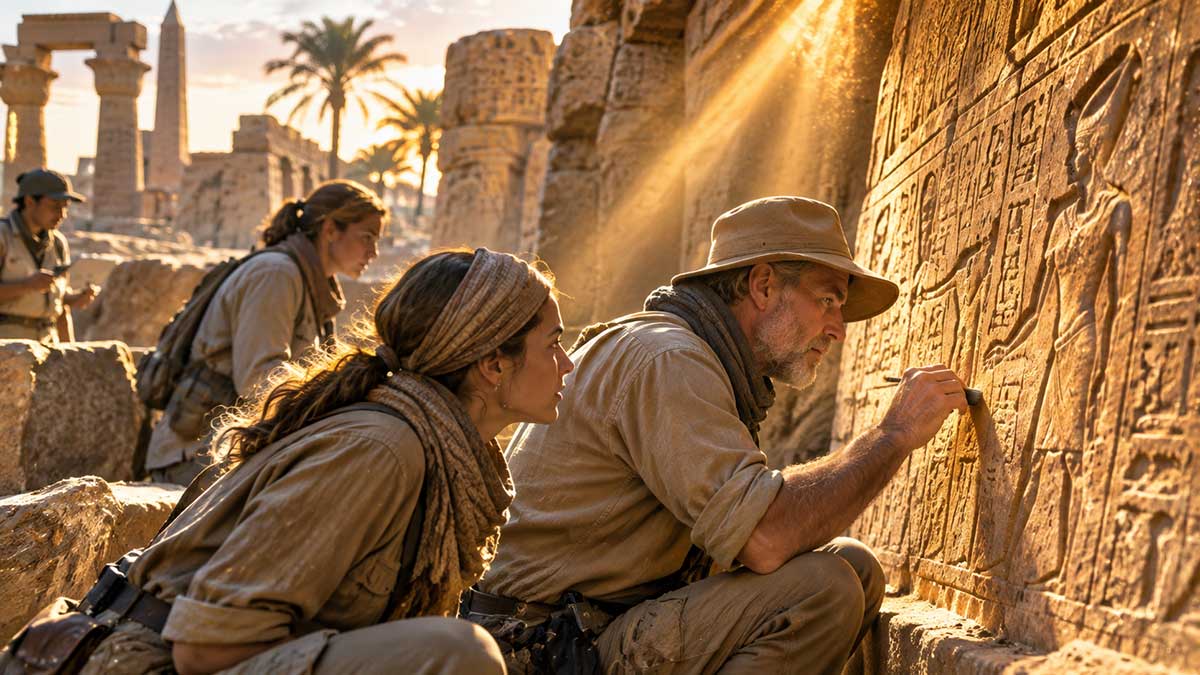
Opening
Nick Sasaki: Welcome back, everyone.
There's something I'd like to return to from our first conversation.
Joseph, you spoke about 2027 as a period when hidden information might come into the open. Pam, you described the remarkable solar eclipse that will cross Egypt on August 2, 2027. And Darryl, you introduced Bashar's extraordinary claim that humanity may eventually receive information about its own forgotten history.
I've been thinking about those ideas.
For thousands of years, people have looked at the pyramids, ancient temples, religious texts, and archaeological discoveries and asked a deceptively simple question: What really happened here?
And sometimes I wonder whether we appreciate just how much of our own history remains unknown.
We have extraordinary archaeological evidence. We have ancient writings and traditions. We have generations of researchers who have devoted their lives to reconstructing the past.
Yet there are still unanswered questions.
And I find myself wondering what might happen if a discovery challenged something we thought we understood.
Joseph, I'd like to begin with Egypt.
You described some unusual visions concerning ancient structures, hidden chambers, and information that may eventually emerge.
What makes Egypt such an important part of what you've been seeing?
Question 1: What Might Ancient Egypt Still Have to Teach Us?
Joseph Tittel: Well, Nick, Egypt kept coming into my awareness when I was working on my predictions.
And it wasn't simply the pyramids as we know them.
There were impressions of things beneath the surface, hidden passages, chambers, and information that hasn't yet become part of our ordinary understanding of ancient history.
When I receive something like that, I have to be careful about interpreting it.
An image may represent a physical discovery, or there may be something symbolic about it.
But the feeling I kept returning to was that there are aspects of the ancient world that we haven't fully uncovered.
Nick: When you say hidden chambers, are you picturing something that archaeologists could physically enter?
Joseph: That's one possibility.
I had impressions involving underground spaces and structures connected with Egypt's ancient monuments.
But I wouldn't want to tell people that a particular chamber has been discovered when it hasn't.
What interested me was the possibility of new archaeological discoveries that change how people think about the past.
Sometimes we assume that the big discoveries have already been made.
Then another discovery reminds us that there's still a great deal to learn.
Nick: I love that part of archaeology.
You can study a civilization for centuries, and then a single inscription or previously unknown tomb can introduce an entirely new question.
Of course, a discovery has to be examined carefully. An exciting theory isn't the same thing as evidence.
But I understand the fascination.
Pam, when you were speaking with Kelly Kolodney, Egypt came up in connection with the August 2027 eclipse.
What drew your attention to that particular place and moment?
Pam Gregory: Well, Nick, the eclipse itself is extraordinary.
On August 2, 2027, the path of totality crosses North Africa and the Middle East, including Egypt. Near Luxor, there will be an exceptionally long period of total darkness during the day.
That is a real astronomical event.
In my conversation with Kelly, she channeled what she identifies as Archangel Raphael, and the information she conveyed attached great spiritual significance to Luxor and to the ancient sacred spaces associated with Egypt.
I want to distinguish that channeled interpretation from the astronomical facts.
But the symbolism is fascinating.
You have a civilization with an extraordinary relationship to the Sun, the heavens, sacred architecture, and the cycles of life and death.
Then you have a rare celestial event passing across that landscape.
For someone interested in spiritual symbolism, it's a remarkable conjunction.
Nick: Egypt's ancient inhabitants paid close attention to the heavens.
And now, thousands of years later, people from around the world will gather to witness darkness falling over that landscape.
There's something moving about that continuity of human curiosity.
Pam: Yes, exactly.
And there's another dimension to it.
Kelly spoke about gathering 144,000 people online and in local communities around the world during the eclipse, holding a shared intention for love and positive transformation.
What interests me is the opportunity for human connection.
People may understand the event in very different ways, but they can still experience a sense of participation in something larger than their daily routines.
Nick: Darryl, I suspect Bashar would have an interesting perspective on why ancient civilizations fascinate us so much.
Darryl Anka: Well, he certainly talks about history in a way that challenges conventional assumptions.
One of the things Bashar has described is the possibility that our present knowledge represents only a portion of a much longer story.
Within his account, extraterrestrial civilizations have interacted with Earth in the distant past.
And he has suggested that when open contact eventually occurs, humanity may receive records of historical events that we're presently unaware of.
Now, I want to make clear that these are claims attributed to Bashar, not discoveries established by archaeology.
But consider the question they raise.
What would happen if you suddenly had access to information about events from thousands of years ago that had never been recorded in surviving human documents?
Nick: You mean something more complete than an ancient manuscript?
Darryl: Yes.
Bashar has spoken about the possibility of records that could show historical events directly.
Think about that as a hypothetical situation.
We reconstruct much of ancient history using surviving evidence.
But if you could somehow observe an event, you might discover that things happened differently from the way later generations described them.
Craig Hamilton-Parker: That's an interesting point, Darryl.
And it raises something we should consider about historical interpretation.
Even when we have written records, those records can reflect the perspectives of the people who created them.
A king's inscription may describe a great victory, but it doesn't necessarily tell you everything that occurred.
So historians have to compare different sources and look for supporting evidence.
Nick: Exactly.
An ancient king might tell us he won every battle.
His enemies might have written something rather different.
Craig: (Laughing.) Quite.
And I imagine that if we could actually observe every detail of ancient history, we might find some surprises.
But we'd need to be careful about what we considered authentic.
A photograph, a recording, or an object isn't automatically reliable simply for being presented to us.
We would still need to establish where it came from and whether it had been altered.
Nick: That's a particularly meaningful question now that artificial intelligence can create convincing images and videos.
Suppose somebody announced tomorrow that they'd discovered a recording of an ancient Egyptian ceremony.
The first question would be, "How on Earth was this recorded?"
The second would be, "Can you prove it's authentic?"
Joseph: And I think that's where discernment becomes important.
If something extraordinary does emerge, people may become excited.
But I wouldn't want them to accept every sensational claim simply on the strength of a dramatic presentation.
Isabeau Maxwell: Can I add something?
Nick: Please.
Isabeau: I think there's a beautiful human side to this conversation.
We're talking about ancient civilizations as though they're these distant mysteries.
But those people were living their lives.
They were raising children, worrying about their families, falling in love, losing people, celebrating things.
They had everyday experiences just like we do.
And sometimes when we look at an enormous monument, we forget the individual people who lived in the society that created it.
Nick: That's a wonderful point.
Isabeau: I mean, think about it.
Somewhere in ancient Egypt, thousands of years ago, there must have been a parent trying to get a child to go to sleep.
And the child probably wanted another story.
Nick: (Laughing.) Human civilization changes, but some things remain remarkably familiar.
Isabeau: Exactly!
I think if we could learn more about ordinary people in ancient civilizations, that would be just as meaningful as discovering another royal chamber.
Pam: I love that, Isabeau.
The human connection across time is extraordinary.
Nick: And perhaps that's something we should keep in mind.
When we speak about hidden history, we're not simply searching for spectacular discoveries.
We're searching for a deeper connection with the people who came before us.
Which brings me to an even more sensitive and fascinating part of this discussion.
Joseph, some of your predictions concern Jesus and the possibility of discoveries that could cause people to reconsider aspects of religious history.
I'd like to explore that carefully.
Question 2: How Would Genuinely New Discoveries Concerning Jesus or Human Origins Affect Our Beliefs?
Nick: Joseph, you've spoken about possible discoveries concerning Jesus and ancient Egypt.
For Christians, Jesus isn't simply an important historical figure. His life and teachings are central to their faith.
So I'd like to ask what you believe could be significant about the revelations you've envisioned.
Joseph Tittel: Well, Nick, I think this is an area where people need to be especially thoughtful.
I had impressions suggesting that new information concerning Jesus or the historical circumstances surrounding his life might emerge.
And I found the connection with Egypt interesting.
But I wouldn't want people to assume that I'm announcing a discovery that has already been verified.
These are predictions and impressions.
What interests me is the possibility that information could emerge that gives people a fuller picture of history.
And I don't think learning more about the historical world in which Jesus lived necessarily has to weaken someone's spiritual connection to his teachings.
Nick: That's worth exploring.
We know from historical scholarship that Jesus lived in the Jewish world of first-century Roman-ruled Judea and Galilee.
There are established historical sources, religious traditions, and many unanswered questions.
And the Gospel of Matthew includes the account of Jesus' family fleeing to Egypt.
But it would be a very different matter to claim that a newly discovered Egyptian document proves some extraordinary alternative history.
That would require evidence.
Joseph: Of course.
And that's why I think people should remain open without jumping to conclusions.
Nick: I'd like to ask everyone something.
Suppose a genuinely authentic archaeological discovery revealed a previously unknown detail about Jesus' life.
Not a sensational claim, but evidence that historians could examine.
Would that necessarily change the meaning of his teachings?
Pam?
Pam Gregory: That's a beautiful question.
My feeling is that people experience spiritual teachings on several levels.
There is the historical level, where we ask what happened and what evidence survives.
Then there is the personal level, where people ask what a teaching means in their own lives.
For someone who finds deep meaning in compassion, forgiveness, and love, learning a new historical detail might add to their appreciation rather than remove it.
Of course, people would respond differently depending on their beliefs.
But I think genuine spiritual growth involves being able to encounter new information without immediately becoming frightened.
Nick: Craig?
Craig Hamilton-Parker: I think religious history is a particularly interesting example of how evidence and interpretation interact.
A discovery might clarify a historical question.
But people could still disagree about its theological implications.
And we should distinguish those two things.
An archaeological object could tell us something about the culture or circumstances of a particular period.
It wouldn't automatically settle every question about God, faith, or spiritual experience.
Nick: That's a valuable distinction.
Craig: And I would hope that any genuine discovery would be studied carefully before people made extraordinary claims about what it meant.
History is too important to be rewritten simply to produce a sensational headline.
Nick: Darryl, you've brought an entirely different account of human origins into this discussion.
In your interview, you described Bashar's claims about an extraterrestrial civilization sometimes called the Anu and its alleged involvement in early humanity.
Could you explain that account and what you think it means?
Darryl Anka: Certainly.
According to Bashar's account, there were extraterrestrial beings who came to Earth in the distant past.
He describes a group that supposedly used advanced genetic methods involving existing hominids, contributing to the emergence of modern humanity.
He has connected that story with certain ancient traditions.
But again, I want to make an important distinction.
That is Bashar's account.
It is not an established scientific explanation of human evolution.
Nick: And mainstream evolutionary research explains the emergence of Homo sapiens through natural evolutionary processes supported by fossil, genetic, and archaeological evidence.
So we're discussing a claim that would require extraordinarily strong evidence to be accepted.
Darryl: Yes.
And I think it's reasonable for people to ask for evidence.
What fascinates me is the larger question of how our understanding of human identity might change if we ever discovered that our history involved something we hadn't previously recognized.
Nick: Let me ask you a hypothetical question.
Suppose tomorrow we found convincing evidence that intelligent life existed elsewhere in the universe.
That wouldn't automatically prove extraterrestrials had influenced human evolution.
Darryl: Correct.
Those are separate questions.
Nick: But suppose, much further down the line, evidence actually established some form of ancient contact.
Would that change what it means to be human?
Darryl: I think it would change how we understood aspects of our history.
But it wouldn't necessarily remove anything valuable about being human.
We would still have our relationships, our experiences, our creativity, our responsibilities.
What it might do is give us a much larger context for thinking about our place in existence.
Isabeau Maxwell: I really like that.
Can I bring it down to a personal level for a moment?
Nick: Please do.
Isabeau: Think about someone who discovers something unexpected about their family history.
Maybe they take a genealogy test, or an old family document turns up.
Suddenly they realize there's a part of their history they didn't know.
That can be exciting, confusing, or emotional.
But here's what interests me.
They're still the same person.
They still have to decide how to live, how to treat people, and what kind of relationships they want.
The new information becomes part of their story, but it doesn't take away their ability to choose what they do next.
Nick: That's an interesting comparison.
Of course, a family discovery and an extraordinary claim about human origins would require very different standards of evidence.
But emotionally, I understand what you're saying.
New information might change someone's sense of where they came from without determining who they have to become.
Isabeau: Yes. That's exactly it.
Joseph: And I think that relates to my interest in spiritual revelations.
Sometimes people are afraid that asking questions will destroy their faith.
But curiosity can lead to a deeper exploration of what they believe.
Nick: I agree that curiosity has an important place in spiritual life.
And I think it should be possible to ask serious historical questions while treating people's deepest convictions with respect.
Pam, you've talked about humanity rediscovering a deeper spiritual identity.
Does that require us to change our understanding of the past?
Pam Gregory: Not necessarily.
I think there are many paths through which people become more conscious of their connection with life and with one another.
Some people may experience that through religion.
Others through contemplation, nature, service, or personal experience.
A historical discovery might become part of that process.
But I wouldn't want to suggest that humanity has to wait for a dramatic archaeological announcement before people can become more compassionate or spiritually aware.
We can begin now.
Nick: That's a thoughtful point.
Perhaps the value of learning history is not simply accumulating information.
It may be discovering new ways to reflect on ourselves.
And that leads to my third question.
Question 3: Could Recovering Lost History Change Humanity's Future?
Nick: I'd like to try a thought experiment.
Suppose we could recover one completely authentic record from humanity's distant past.
We could ask it one question, and somehow receive a historically accurate answer.
What question would you choose?
Joseph, you've been thinking about Egypt and ancient history for some time. Let's begin with you.
Joseph Tittel: I think I'd want to know how much of the history of ancient civilizations we've misunderstood or haven't yet discovered.
I'd be fascinated to learn more about the origins and purposes of some of the structures that continue to puzzle people.
And I'd be especially interested in anything that could help clarify the historical connections between ancient cultures and spiritual traditions.
Nick: Would you want the answer to confirm your visions?
Joseph: I'd want to know the truth.
If an authentic discovery supported something I'd seen, that would be fascinating.
If it showed I had interpreted something incorrectly, I'd have to consider that too.
Nick: I appreciate that.
Craig, what would you ask?
Craig Hamilton-Parker: I think I might ask which decisions in history had the greatest consequences that the people making them never anticipated.
We tend to look backward and explain events as though their outcomes were obvious.
But the people living through those events didn't know what was coming.
A seemingly small decision might have changed the direction of an entire civilization.
I would find that enormously interesting.
Nick: That's a fascinating answer.
We usually want to know what happened.
You're asking how something that happened changed everything afterward.
Craig: Yes.
And perhaps studying those moments could make us wiser about the decisions we're making now.
Nick: Pam?
Pam Gregory: I'd love to understand more about the spiritual lives of ancient peoples.
Not simply their ceremonies or religious buildings, but their lived experiences of the sacred.
How did they understand their connection with nature?
How did they experience community?
What did they believe was their responsibility to future generations?
I think there may be things we could learn from how earlier societies related to the natural world.
Nick: That's lovely.
Darryl, I have a feeling your question might be quite expansive.
Darryl Anka: (Laughing.) Well, you may be right.
I'd want to know how consciousness has developed through human history and whether there are aspects of our experience that we still don't understand.
And, within Bashar's framework, I'd certainly be interested in learning whether any of the claims about historical extraterrestrial contact could be supported by independently verifiable evidence.
But there's another question I find interesting.
What would we do with that information?
Nick: You mean learning the answer might be less important than how we respond to it?
Darryl: In some ways, yes.
Consider a person who spends their entire life searching for an answer.
Eventually they find it.
Now what?
Their life doesn't stop.
They have to incorporate what they've learned into the way they live.
And I think that would apply on a much larger scale if humanity discovered something that fundamentally changed its historical understanding.
Nick: Isabeau?
Isabeau Maxwell: I think I'd ask something a little different.
I'd want to know how ordinary people found hope during some of the most difficult periods of human history.
Not just the kings and queens and famous people.
I want to know about the mother who was trying to keep her family together.
The person who lost everything and somehow started over.
The communities that took care of one another when things were really difficult.
What helped them keep going?
Nick: That's a wonderful question.
Isabeau: Thank you.
And it's not that I don't find the pyramids fascinating. I do!
But sometimes I think we forget how extraordinary ordinary people can be.
If we could learn how people helped one another through difficult times, I think those stories could be incredibly useful today.
Pam: Oh, Isabeau, I love that.
And I think it connects beautifully with the question of spiritual growth.
Compassion isn't confined to one century or civilization.
Craig: It's quite a valuable historical question too.
We often have extensive records concerning rulers and wars, yet much less information about the lives of ordinary people.
Nick: You know, listening to those answers, I realize something.
We began this topic with the possibility of hidden chambers and ancient secrets.
But now we're talking about wisdom, responsibility, consciousness, faith, and ordinary human lives.
It's interesting how quickly history becomes personal.
Let me ask a question that connects all of this to 2027.
Suppose a genuinely extraordinary historical discovery takes place next year.
What would you hope humanity does differently after learning about it?
Pam, could you begin?
Pam Gregory: I would hope it encourages humility.
There is so much we can learn, and so much we don't yet know.
Sometimes people become very attached to believing they've reached the final explanation.
But perhaps recognizing the limits of our knowledge can make us more receptive, more curious, and more compassionate.
And I think the ancient world can remind us that our relationship with Earth deserves care and attention.
Nick: Darryl?
Darryl Anka: I'd hope people recognize that learning something new doesn't have to be threatening.
If evidence supports a new explanation, we can investigate it.
If it doesn't, we can continue exploring.
And we can distinguish between an interesting possibility and something we actually know.
I think the willingness to keep learning is itself meaningful.
Nick: Craig?
Craig Hamilton-Parker: I'd hope the discovery would be handled responsibly.
People should have access to credible evidence, and researchers should be free to examine it.
I would be concerned if sensationalism got ahead of the facts.
But if a major discovery genuinely changed our historical knowledge, I'd hope it encouraged further research and international cooperation.
Nick: Joseph?
Joseph Tittel: I'd hope people remain curious and open.
If something important is discovered, let the evidence be examined.
And let people think about what it means for themselves.
I wouldn't want fear or sensational headlines to prevent people from exploring something meaningful.
Nick: Isabeau?
Isabeau Maxwell: I'd hope people become a little kinder.
I know that's not the most dramatic answer after we've been talking about ancient civilizations and extraordinary discoveries.
Nick: (Smiling.) I think it's a very good answer.
Isabeau: Thank you!
Here's how I look at it.
We can learn incredible things about the past, but if we still go home and treat the people in our lives terribly, what have we really gained?
Knowledge is wonderful.
But what matters to me is what we do with it.
Nick: That's a thought worth holding onto.
And I want to return to one point Darryl raised earlier.
He spoke about Bashar's claim that humanity might someday receive records of its ancient history from extraterrestrial beings.
Now, that's an extraordinary claim that remains unverified.
But as a hypothetical possibility, it leads to an interesting question.
What if humanity's next great discovery doesn't come from digging deeper into the Earth?
What if it comes from looking beyond it?
Darryl: Well, Nick, that would certainly open up a much larger conversation.
Nick: I suspect it would.
Joseph: And it connects with some of the other visions I've been discussing.
Pam: There are so many fascinating questions about humanity's relationship with the cosmos.
Craig: And the consequences for society could be quite significant.
Isabeau: Okay, now I'm really curious where we're going next!
Nick: (Laughing.) I think you can probably guess.
Closing
Nick Sasaki: Thank you, everyone.
I've really enjoyed this discussion.
We started with ancient Egypt, hidden chambers, and the possibility of remarkable archaeological discoveries.
Then we explored questions about Jesus, human origins, spiritual traditions, and the significance of historical evidence.
But what stayed with me most was something none of us planned.
When I asked what you'd most want to know about humanity's past, each of you gave a different answer.
Joseph wanted to understand what may remain undiscovered.
Craig wanted to know which decisions changed the direction of history.
Pam wondered about the spiritual lives of ancient peoples.
Darryl wanted to explore consciousness and the possibility of a much larger historical story.
And Isabeau wanted to know how ordinary people found hope.
Perhaps that tells us something important.
History isn't simply a collection of ancient dates and monuments.
It's the story of people trying to understand their world, make decisions, care for one another, and find meaning in their lives.
And the more we learn about them, the more questions we discover about ourselves.
But now I'd like to take our conversation into a very different direction.
Darryl, you've spoken about Bashar's prediction of an event connected with extraterrestrial contact around late 2026 or early 2027.
Joseph, you've described visions involving UFOs, governments, and possible revelations about beings beyond our ordinary experience.
Craig, you've discussed the possibility of new information emerging from government UFO records.
And Pam and Isabeau, I'm interested in how you think people might respond spiritually and emotionally if humanity encountered something truly extraordinary.
Let's consider the question that has fascinated people for generations.
What would happen if humanity discovered, beyond reasonable doubt, that we are not alone in the universe?
And perhaps more interesting still, what would that discovery teach us about ourselves?
Topic 3: What Would Extraterrestrial Contact Change?
Opening
Nick Sasaki: Welcome back, everyone.
I have to admit, this next subject has fascinated me for a very long time.
When I was growing up, the possibility of extraterrestrial life belonged largely to science fiction. We watched movies, read stories, and wondered whether intelligent beings might exist somewhere among the stars.
Today, the conversation feels somewhat different.
Scientists continue searching for signs of life beyond Earth. Governments have investigated unidentified aerial phenomena. And people from many spiritual traditions have their own interpretations of what might exist beyond our familiar experience.
But here's what really interests me.
Suppose we discovered something extraordinary.
Not another blurry photograph. Not another anonymous story about a mysterious spacecraft.
Suppose humanity encountered convincing, independently verifiable evidence that intelligent life exists beyond Earth.
What would that change?
Darryl, you've described Bashar's prediction of a significant event around the end of 2026 or beginning of 2027, something that could mark the first stages of open extraterrestrial contact.
Joseph, you've spoken about possible government revelations and beings that may already be interacting with humanity.
Craig, your predictions include the release of previously concealed UFO documents.
And Pam and Isabeau, I'm curious how you think such an experience might affect our spiritual lives and relationships.
Before we begin, I want to make one thing clear.
We're exploring extraordinary claims and hypothetical possibilities. None of us should confuse a prediction with established evidence.
But I don't think we should be afraid to ask extraordinary questions, either.
Darryl, let's start with you.
Question 1: What Kind of Event Would Truly Change Humanity's View of Extraterrestrial Life?
Nick Sasaki: Darryl, when I listened to your conversation with Alex Ferrari, something caught my attention.
You explained that Bashar had pointed to a possible UFO-related event around late 2026 or early 2027.
You seemed to be saying that whatever happened would be significant enough to make people seriously confront the possibility that humanity isn't alone.
What exactly are you expecting?
Darryl Anka: Well, Nick, the first thing I would clarify is that Bashar hasn't described the exact form of the event.
He hasn't said that a spacecraft will necessarily land on the White House lawn, or that extraterrestrial beings will suddenly appear on every television network.
What he has indicated is that some kind of event may occur around that period that brings humanity into a new stage of awareness concerning extraterrestrial intelligence.
He has described it as the beginning of open contact.
But open contact doesn't necessarily mean everything happens at once.
Nick: So we're not talking about an announcement followed by extraterrestrials walking around our neighborhoods the next morning?
Darryl: (Laughing.) I wouldn't assume that, no.
Bashar describes contact as a gradual process.
One of the ideas he's discussed is that humanity might first encounter beings who are more similar to us in appearance or in the way we experience reality.
Then, as people become accustomed to that possibility, they may become more comfortable with beings who are substantially different.
Within Bashar's framework, the issue involves our readiness to interact with unfamiliar forms of consciousness.
Nick: That's interesting. You're describing something almost like two civilizations learning to communicate.
If you meet somebody whose culture is completely unfamiliar, you don't necessarily understand everything about them during the first conversation.
Darryl: Precisely.
And Bashar has spoken about a much longer period of transformation, extending from approximately 2020 to 2050.
He has suggested that humanity could eventually become part of a wider extraterrestrial society.
Of course, we're discussing his claims. We're not presenting that outcome as an established fact.
But the larger idea is that contact, if it occurred, could involve a long period of adjustment and learning.
Nick: Joseph, I want to bring you into this.
You've spoken about a Galactic Federation and possible revelations concerning beings who may already be interacting with governments.
Could you explain what you saw and how you interpreted it?
Joseph Tittel: Well, Nick, some of the imagery I received was quite unusual.
I kept getting impressions connected with what I understood as a Galactic Federation, along with the possibility of information being revealed publicly.
There was this sense that certain things were already known behind the scenes.
I had impressions involving communication with people in government, including the White House.
And there were images suggesting that some beings might be able to appear in ways that resemble human beings.
Now, I realize how extraordinary that sounds.
Nick: It certainly raises some questions!
Joseph: (Laughing.) Yes, it does.
And I want people to understand that I'm describing what appeared in my visions and how I interpreted it.
I'm not claiming I can produce a verified government document proving that any of these interactions have occurred.
But the theme I kept encountering was disclosure.
Something that had been concealed becoming more widely known.
Nick: When you received those impressions, did you feel that the revelations would arrive all at once?
Joseph: Not necessarily.
I had a sense of information coming out in stages.
And I think there's an interesting question about how much people would be told at any one time.
If something extraordinary were happening, you can picture governments trying to decide how to communicate it.
There might be national security concerns, scientific questions, political consequences.
And people would naturally want to know whether they're being told the complete story.
Nick: Craig, that's where your prediction becomes particularly interesting.
You didn't describe an extraterrestrial landing. You talked about documents.
What was the impression you received?
Craig Hamilton-Parker: Yes, Nick.
I predicted that new information concerning UFOs or UAPs could emerge from government records.
What struck me was the possibility that certain documents had been withheld, lost, or deliberately destroyed.
I had impressions involving fragments of records, perhaps even photographs of documents that were difficult to read.
I wondered whether advances in technology might help researchers recover information from some of those materials.
But I would be cautious about what conclusions people draw.
A document suggesting that an institution concealed information would not automatically establish the existence of extraterrestrial beings.
Nick: That's an excellent distinction.
A government might conceal information for many reasons.
Perhaps it concerns military technology.
Perhaps officials were investigating something they couldn't explain.
Or perhaps there was simply a bureaucratic failure.
Craig: Exactly.
And I think that's what would make a genuine disclosure so interesting.
We would have to distinguish what was actually discovered from what people wanted it to mean.
If important documents emerged, they could raise new questions about previous investigations and official decisions.
But the evidence would still need careful examination.
Nick: Pam, I'm curious about your response.
In your conversation with Kelly Kolodney, the channeling attributed to Archangel Raphael included references to unusual lights or objects appearing in the sky, with a warning that some might be deceptive.
What interests you about that part of the message?
Pam Gregory: Well, Nick, I thought the emphasis on discernment was particularly meaningful.
Kelly's channeling included descriptions of unusual phenomena, and the message suggested that people should not assume every appearance was necessarily what it seemed.
Now, that is part of the spiritual material Kelly presented. It isn't something established through astronomical or scientific observation.
But I think it raises a useful question for everyone.
How do we remain curious without becoming so excited that we lose our ability to think carefully?
We're living at a time when images and videos can be manipulated with remarkable sophistication.
We can find ourselves reacting emotionally to something before we've established whether it's genuine.
Nick: That's true.
A strange light in the sky could be fascinating, but that doesn't automatically tell us what it is.
Pam: Quite.
And I would hope that people approach unfamiliar experiences with curiosity, calmness, and an openness to genuine inquiry.
We don't have to rush to a conclusion.
Isabeau Maxwell: Can I jump in for a second?
Nick: Of course.
Isabeau: I keep thinking about what happens when people encounter something they don't have a category for.
You know how someone tells you something surprising, and your brain almost refuses to process it?
You just sit there saying, "Wait. What?"
Nick: (Laughing.) I suspect there would be quite a bit of that.
Isabeau: Right?
And sometimes the first thing people need isn't somebody telling them what to believe.
It's just an opportunity to process what they're experiencing.
If something extraordinary happened, I'd want people to feel comfortable saying, "I don't know what this means yet."
That's a perfectly reasonable place to begin.
Darryl: I think that's an excellent point.
And within Bashar's description of contact, there is an emphasis on gradual adjustment.
The idea is not to overwhelm people with something they're completely unprepared to process.
Nick: Let me ask you something, Darryl.
Suppose Bashar's predicted event doesn't happen within that period.
Would you reconsider the prediction?
Darryl: Well, Bashar has always described predictions as probabilities based on existing conditions.
He doesn't present the future as something permanently fixed.
So within his framework, the absence of an event doesn't necessarily mean the possibility was never present.
But I understand why people would want to evaluate what was predicted and what actually occurred.
Nick: That's fair.
I think our responsibility is to keep the original prediction clear and see what happens.
And if something extraordinary does occur, we should ask whether it genuinely supports the claim rather than making it fit afterward.
But for now, I'd like to explore a much larger possibility.
Suppose contact really did occur.
What would that mean for our beliefs about humanity, God, and our place in the universe?
Question 2: How Might Extraterrestrial Contact Transform Our Ideas About God, Religion, and Human Identity?
Nick Sasaki: There's a question I've carried for a long time.
Human beings have developed extraordinary religious traditions.
We've asked where we came from, why we're here, what happens after death, and whether there is a divine purpose behind existence.
For billions of people, God is central to how they understand themselves.
So here's what I'm curious about.
If we discovered intelligent life beyond Earth, would that fundamentally challenge our spiritual beliefs?
Or might it deepen them?
Joseph, you've spoken about possible revelations concerning Jesus alongside your predictions about extraterrestrial disclosure.
How do those two subjects connect in your thinking?
Joseph Tittel: Well, Nick, both subjects raise questions about what we believe we know.
I've had impressions concerning possible revelations about Jesus and ancient history.
And I've separately had visions concerning extraterrestrial beings and government disclosure.
I wouldn't want people to assume that I know exactly how those subjects are connected.
But I do think that an extraordinary discovery could lead people to examine their spiritual beliefs in new ways.
Nick: Suppose we found compelling evidence of intelligent beings elsewhere in the universe.
Would that change what Jesus taught about loving one's neighbor?
Joseph: I don't see why it would have to.
The teachings people find meaningful could remain meaningful.
Perhaps the questions would concern how we understand humanity's place in creation.
Are we unique?
Are we part of something much larger?
And if intelligent life exists elsewhere, what would that suggest about the nature of existence?
Nick: That's what fascinates me.
Discovering that we're not the only intelligent beings in the universe wouldn't necessarily tell us whether God exists.
Those are different questions.
But it might change the way we think about creation.
Craig, how do you think religious communities might respond?
Craig Hamilton-Parker: I suspect there would be a tremendous variety of responses.
Some people might see extraterrestrial intelligence as entirely compatible with their faith.
Others might find it unsettling.
And theologians would undoubtedly begin asking new questions.
But I wouldn't assume that religious traditions would simply collapse.
They have survived enormous changes in human knowledge.
Consider the development of astronomy, the scientific study of evolution, and our increasing awareness of the scale of the universe.
Religious thinkers have continued to engage with those developments.
Nick: That's a thoughtful point.
The discovery of another civilization could create questions that religious scholars haven't previously needed to address in quite the same way.
Craig: Indeed.
And the response might depend heavily on what we actually discovered.
Evidence of microbial life on another planet is one thing.
Communication with an intelligent civilization possessing its own history and philosophical traditions is something else entirely.
Nick: Darryl, Bashar describes a universe containing many forms of consciousness and civilizations.
How does that perspective change the meaning of spirituality?
Darryl Anka: Well, in Bashar's description, consciousness is fundamental.
He presents physical reality as an expression of consciousness rather than consciousness being merely a product of physical processes.
And he describes his own civilization as experiencing reality in a way that includes dimensions we don't ordinarily perceive.
Those are extraordinary metaphysical claims.
But within that perspective, life is much more diverse than humanity currently recognizes.
Nick: And what about God?
Darryl: Bashar often uses terms such as Source or All That Is.
He describes every being as an expression of that larger existence.
So the existence of other intelligent civilizations wouldn't threaten that framework.
It would simply represent further expressions of existence.
Nick: I can see the philosophical appeal.
But I suspect Christians, Muslims, Jews, Hindus, Buddhists, and others might interpret contact through their own traditions.
Darryl: Certainly.
And I wouldn't expect everyone to adopt Bashar's explanations.
People would have to consider new information through their own experiences and beliefs.
Pam Gregory: Nick, I think there's something particularly beautiful in that question.
For me, spirituality involves recognizing a deeper connection with life.
And if we discovered that intelligent beings existed elsewhere, that might encourage greater humility.
We sometimes behave as though humanity occupies the center of everything.
An encounter with another civilization could remind us how much remains unknown.
Nick: Yes.
When we look at the stars, we're already confronted with an extraordinary universe.
But meeting another intelligence would make that reality much more personal.
Pam: Exactly.
And it could encourage us to rethink how we treat one another.
If we began identifying ourselves more strongly as inhabitants of Earth, perhaps some of our divisions would appear less significant.
Nick: Darryl, that's something you mentioned in your interview.
You suggested that contact might eventually encourage people to identify with Earth rather than primarily with individual nations.
Could you expand on that?
Darryl: Yes.
Bashar has suggested that humanity might gradually recognize itself as one planetary civilization.
If you encounter an intelligent society from another world, you may begin to see people from different Earth cultures as members of the same larger community.
That's the idea.
It doesn't mean everyone suddenly loses their cultural identity.
It means the context in which those identities exist becomes much larger.
Nick: That's an interesting possibility.
I love Japanese culture, and I value the experiences I've had living in different countries.
I wouldn't want humanity to lose its cultural richness.
But I can understand how encountering another civilization might remind us that we're all human beings sharing one planet.
Isabeau Maxwell: I love that, Nick.
And here's where my mind goes.
What if discovering another civilization made people appreciate the things they already have?
Their families.
Their communities.
The natural world.
Sometimes we don't recognize how precious something is until we see it from a different perspective.
Nick: That's beautiful.
Isabeau: Think about looking at Earth from space.
You see this incredible planet.
You don't see the little arguments happening between neighbors or the disagreements people had that morning.
You see a place where billions of lives are unfolding.
Now, picture discovering that somewhere else, another civilization has its own families, hopes, challenges, and relationships.
I think that could be deeply moving.
Nick: Let me ask everyone something.
Suppose the first intelligent beings we encountered were nothing like humans.
They didn't have faces we recognized.
Their bodies, communication, and social lives were completely unfamiliar.
Would we still be able to recognize something meaningful in them?
Craig: That would be one of the greatest challenges.
How would we establish communication?
How would we determine their intentions?
Could we understand their concepts of cooperation, responsibility, or even individuality?
I suspect those questions would occupy scientists and philosophers for a very long time.
Joseph: And I think people would naturally feel a mixture of fascination and uncertainty.
It would challenge our expectations.
Pam: I would hope we approached them with respect rather than immediately projecting our fears onto them.
Darryl: And that's part of what Bashar has discussed concerning readiness for contact.
Within his account, interaction with unfamiliar forms of intelligence requires a capacity to accept differences without automatically perceiving them as threats.
Isabeau: I keep coming back to kindness.
I know that sounds simple.
But if you meet somebody completely different from you, whether they're from another country or, in this hypothetical case, another planet, the first question might be whether you can approach them with respect.
Nick: I like that.
But there's another side to this.
What happens if the discovery is genuine and the world doesn't respond peacefully?
What if people become frightened?
What if countries compete for access?
What if some people welcome contact and others reject it?
Let's explore that.
Question 3: Could Extraterrestrial Contact Bring Humanity Together, or Create Entirely New Divisions?
Nick Sasaki: Craig, you've spent a great deal of time discussing geopolitics.
Suppose a government announced tomorrow that it had established communication with an intelligent extraterrestrial civilization.
What concerns would immediately come to mind?
Craig Hamilton-Parker: Well, Nick, I suspect the first issue would be information.
Who made the discovery?
What evidence is available?
Which governments have access to it?
And can other countries independently verify what is being reported?
If contact involved advanced technology, there would undoubtedly be questions about its possible military and economic implications.
Nick: You mean nations might compete to obtain whatever advantages that technology offered.
Craig: Quite possibly.
We already see intense international competition involving artificial intelligence, quantum computing, advanced manufacturing, and strategic resources.
Now consider the possibility of technology developed by a civilization far beyond our present capabilities.
Governments might regard that as an extraordinary opportunity.
But they might regard it as a security concern too.
Nick: So first contact might not automatically produce world peace.
Craig: I wouldn't count on it.
Human institutions have interests, responsibilities, and sometimes competing priorities.
A remarkable discovery wouldn't instantly erase those realities.
However, it might create opportunities for cooperation that previously seemed impossible.
The question would be whether political leaders were wise enough to recognize them.
Nick: Joseph, your visions included the possibility of contact already occurring behind closed doors.
Suppose governments had concealed something that significant.
What do you think would happen when people learned about it?
Joseph Tittel: I think trust would become a major issue.
People might be excited about the possibility of extraterrestrial life, but they would want to know why information had been withheld.
They'd ask who knew what, when they knew it, and why the public wasn't told.
And if some people believed information was still being concealed, it could create even more suspicion.
Nick: That's interesting.
The discovery itself might be extraordinary, but the public conversation could become focused on governments and secrecy.
Joseph: Exactly.
And that's part of why I kept sensing that the process of revelation could be complicated.
Even when people receive information, they may disagree about what it means or whether they're receiving the complete picture.
Nick: Darryl, Bashar's philosophy of parallel realities seems especially relevant here.
You describe people moving into increasingly different experiences based on their beliefs and choices.
Would contact bring everyone into one shared awareness, or could it deepen those differences?
Darryl Anka: Within Bashar's framework, people can experience different versions of reality that correspond with their overall orientation.
He's described a process in which individuals become increasingly aligned with the kinds of experiences they choose.
So, from that perspective, some people might experience contact as a wonderful opportunity.
Others might resist it so strongly that their experience of reality develops in another direction.
Nick: That's a difficult concept.
Are you suggesting that two people could effectively experience different worlds?
Darryl: That's what Bashar describes.
He doesn't present parallel realities merely as different opinions.
He describes them as distinct versions of physical experience.
Now, I understand that this is not something established by mainstream physics in the way he presents it.
But it's central to his explanation of why people can become increasingly divided in their perceptions.
Nick: Here's what I'm wondering.
Suppose one person welcomes the idea of extraterrestrial contact, and another person rejects it.
Do we really have to lose the ability to communicate with one another?
Darryl: Not necessarily.
People can hold different beliefs and still share enough common ground to interact constructively.
But Bashar's larger point is that choices matter.
If people continually reinforce particular attitudes and behaviors, they may find themselves moving in increasingly different directions.
Nick: I hope that whatever happens, we retain the ability to listen to one another.
Pam Gregory: Nick, I think that's a deeply meaningful hope.
And it's one reason I've been encouraging people not to become overwhelmed by fear.
When people are frightened, it can become harder to approach unfamiliar circumstances thoughtfully.
They may react before they've had an opportunity to understand what they're experiencing.
If an extraordinary event occurred, I would hope that we took time to observe, ask questions, and support one another.
Nick: What would that support look like?
Pam: It could begin with something very simple.
Being present with someone who's anxious.
Listening without immediately dismissing their feelings.
Taking time to distinguish reliable information from speculation.
And recognizing that people will process unfamiliar experiences at different speeds.
Isabeau Maxwell: Can I share something?
Nick: Absolutely.
Isabeau: I've been thinking about this whole conversation from the perspective of someone sitting at home with their family.
Let's say something extraordinary happened tomorrow.
There's an announcement.
Everybody's talking about it.
People are calling their friends, watching their phones, trying to figure out what it all means.
And you have a child who comes into the room and asks, "Are we going to be okay?"
What do you say?
Nick: That's a wonderful question.
What would you say?
Isabeau: I'd start by finding out what the child had heard.
Maybe they're frightened by something someone said online.
Maybe they've seen a dramatic video.
Maybe they're excited and asking a hundred questions.
I'd want to help them stay grounded in what we actually know.
And I'd want them to know that they don't have to figure everything out immediately.
Nick: That brings the whole subject back to something very human.
We've spent much of this conversation considering governments, civilizations, consciousness, and the universe.
But a child asking whether their family will be okay may be one of the most meaningful questions of all.
Let me ask each of you a more personal question.
Let's suppose that tomorrow morning, credible scientific evidence confirms the existence of an intelligent extraterrestrial civilization.
Not necessarily that anyone has visited Earth, but that another intelligent civilization exists.
What's the first thing you'd want to tell someone you love?
Joseph?
Joseph Tittel: I think I'd tell them that we should be curious.
I'd want to know what had actually been discovered and how scientists had established it.
And I'd probably say that we have an extraordinary amount to learn.
Nick: Craig?
Craig Hamilton-Parker: I think I'd say that we're witnessing a remarkable moment in human history.
But I'd encourage them to look carefully at the evidence and avoid being swept away by sensational claims.
There would be plenty of time to consider the implications.
Nick: Pam?
Pam Gregory: I'd tell them that the universe may be even more extraordinary than we previously recognized.
And I'd hope that our response would be guided by compassion and wonder rather than fear.
Nick: Darryl?
Darryl Anka: I think I'd be fascinated by the possibilities.
I'd want to know what we could learn from another civilization and how communication might eventually develop.
But I'd also want people to recognize that a discovery of this magnitude would require patience and thoughtful adjustment.
Nick: Isabeau?
Isabeau Maxwell: Oh, I'd probably say, "Well, that's something!"
Nick: (Laughing.) I can picture that.
Isabeau: Seriously!
And then I'd want to sit down and talk about it.
I'd want to hear what everyone was thinking.
Somebody might be excited. Somebody might be scared. Somebody might have a million questions.
I'd want us to be able to talk openly without anyone feeling embarrassed.
Nick: You know, I love those answers.
And there's something else I want to ask before we finish this topic.
Darryl, you spoke earlier about humanity potentially becoming part of a larger extraterrestrial society over the coming decades.
What do you think humanity could contribute to such a society?
We often talk about what advanced beings might teach us.
But what might we have to offer?
Darryl Anka: That's a wonderful question, Nick.
Bashar has described humanity as a civilization experiencing unusually intense contrasts and challenges.
Within his account, other civilizations are interested in how humans respond to limitation, uncertainty, conflict, and the possibility of transformation.
He suggests that our experiences may have value beyond what we recognize.
Now, that's his interpretation.
But I think the question itself is meaningful.
Human beings are capable of extraordinary creativity, resilience, affection, and discovery.
If we ever encountered another intelligence, I wouldn't want us to assume that our only role was to receive knowledge.
Nick: I find that deeply encouraging.
We're still learning how to live peacefully with one another.
We make mistakes.
We disagree.
Sometimes we behave in ways that are difficult to understand.
Yet we also have an extraordinary capacity to care, create, and learn.
Craig: And perhaps any genuine contact would provide a new reason to think seriously about those capacities.
Pam: It might help us recognize how precious life on Earth really is.
Joseph: And how much remains to be discovered.
Isabeau: I'd just hope we didn't forget to be good to one another in the middle of all the excitement.
Nick: (Smiling.) That's probably advice worth following whether extraterrestrials arrive or not.
Closing
Nick Sasaki: Thank you, everyone.
When we began, I thought we'd spend most of our time talking about spacecraft, secret documents, and predictions of contact.
And we certainly explored those possibilities.
But somewhere along the way, the conversation became about something much more personal.
We talked about how people respond to unfamiliar information.
We considered what extraterrestrial intelligence might mean for religion, spirituality, and our understanding of humanity.
We explored the possibility that contact could create new opportunities for cooperation, along with serious political and social challenges.
And then Isabeau brought us back to a child asking a parent whether everything would be okay.
That moment has stayed with me.
We can spend years asking whether intelligent life exists elsewhere.
But we have another question much closer to home.
What kind of civilization are we creating here?
If humanity ever encounters another intelligent society, what would we want that society to discover about us?
Would we want to be known for our conflicts?
Our suspicions?
Our competition for resources?
Or would we want others to recognize our capacity for compassion, creativity, courage, and cooperation?
Perhaps we don't need an extraterrestrial visitor to begin asking those questions.
But there's one more subject we need to explore before we can talk seriously about the future we hope to create.
Joseph and Craig, some of your predictions for 2027 involve conflict, financial instability, natural disasters, and enormous political changes.
Darryl, you've described humanity moving through a period of profound choices.
Pam and Isabeau, you've both spoken about finding hope and meaning during uncertain times.
So I'd like to bring our conversation back to Earth.
Back to the world people are living in right now.
If the coming years bring significant disruption, what might help humanity respond with greater wisdom?
Can a period of crisis become an opportunity for meaningful change?
And how do we face uncertainty without allowing fear to determine the way we live?
That's where I'd love to take our conversation next.
Topic 4: Can Humanity Transform Through a Period of Crisis?
Opening
Nick Sasaki: Welcome back, everyone.
We've had quite an extraordinary conversation so far.
We began by exploring why 2027 might represent a turning point. Then we considered the possibility of new discoveries about ancient history, and we just finished discussing what extraterrestrial contact might mean for humanity.
But there's another side to the future that we haven't explored in sufficient depth.
And it's a side that concerns me.
When I listened to Joseph's and Craig's predictions, I heard warnings about military conflicts, economic instability, natural disasters, and political tensions.
Some of those predictions are quite disturbing.
Yet when I listened to Pam, Darryl, and Isabeau, I heard something different. You spoke about humanity moving through a period of change that could lead to greater awareness, deeper relationships, and new possibilities.
I've been wondering whether these ideas might belong to a larger conversation.
History has shown us that difficult periods sometimes lead societies to reconsider their priorities, develop new technologies, and establish different ways of living.
But history has taught us something else.
Suffering doesn't automatically make people wiser.
Sometimes it brings people together. Sometimes it drives them further apart.
And sometimes the most important question isn't what happens to us, but what we decide to do afterward.
So today, I'd like to explore three things.
What are the warnings about 2027 really suggesting? What might humanity learn from difficult experiences? And how can ordinary people prepare for uncertainty without becoming overwhelmed by fear?
Craig, I'd like to begin with you.
Question 1: What Do the Warnings About War and Economic Disruption Tell Us?
Nick Sasaki: Craig, your predictions for 2027 cover an extraordinary range of developments.
You've spoken about Iran, China, changes in American political leadership, economic instability, technological breakthroughs, and the possibility of an even more difficult period in 2028.
When you consider these impressions together, what concerns you most?
Craig Hamilton-Parker: Well, Nick, what concerns me is the possibility of several major disruptions interacting with one another.
I don't necessarily see each event as something entirely separate.
Political instability can affect markets. Economic problems can influence international relations. Technological breakthroughs may introduce security problems that institutions aren't fully prepared to manage.
And when several pressures emerge within a relatively short period, governments can find themselves responding to one emergency after another.
I've spoken about 2027 as a significant year, but I believe 2028 may bring some of the more serious financial consequences.
Nick: I noticed that distinction in your predictions.
You weren't suggesting that everything reaches its peak during 2027.
Craig: No.
For example, I've described impressions of financial weakness developing during 2027, followed by a more serious banking crisis in 2028.
Now, these are predictions, not established outcomes.
But what I find interesting is the possibility that technological developments could interact with financial vulnerabilities.
I've discussed a potential breakthrough in quantum computing that might create new concerns about digital security and encryption.
At roughly the same time, I've anticipated significant advances in artificial intelligence.
If such developments emerged together, they could place tremendous pressure on systems that depend on secure digital information.
Nick: That's an interesting connection.
We tend to think of banking as a financial subject and artificial intelligence as a technological subject.
But modern banks depend on computer systems, encryption, communications networks, and public confidence.
A disruption in one area can affect several others.
Craig: Precisely.
And I think that's why predictions need to be considered within a broader context.
It's easy to focus on a dramatic headline.
But the real story may concern how institutions respond when their assumptions are challenged.
Nick: You've made some striking geopolitical predictions too.
You described possible American military operations involving Iran, including the possibility of action against Kharg Island.
You spoke about Saudi Arabia becoming involved, and you also anticipated greater American military activity against drug cartels in Colombia.
What connects those impressions for you?
Craig: I sense a period in which American foreign policy becomes more forceful in several regions.
In the case of Iran, I've described possible strikes against important infrastructure and an operation involving an island associated with oil exports.
I also had an impression concerning disruption to shipping in the Red Sea region.
Now, I'm interpreting images and impressions, and the exact details may be uncertain.
But the underlying concern is how a regional conflict might affect international trade and energy supplies.
Nick: That's something people sometimes overlook.
A military confrontation may occur thousands of miles away, yet the economic effects can reach families in countries that aren't directly involved.
Fuel prices rise. Shipping becomes more expensive. Businesses change their plans.
Craig: Quite.
And those pressures can influence political decisions elsewhere.
Nick: Joseph, you've described your own visions concerning Iran.
You mentioned the possibility of American ground operations, Saudi involvement, and serious military escalation.
What was the strongest impression you received?
Joseph Tittel: Nick, one of the things that concerned me was the intensity of the imagery.
I had visions suggesting military activity involving Iran, including the possibility of troops entering through several areas.
I also received disturbing impressions involving Saudi Arabia and the possibility of extremely dangerous weapons being used.
Those were among the more troubling things I described.
And I want to be careful here.
A vision isn't proof that an event is going to happen.
Sometimes the images are symbolic or the details require interpretation.
But when I receive something that seems serious, I feel a responsibility to share what I experienced.
Nick: You know, Joseph, that raises a question I've been wanting to ask.
When you receive a frightening vision, how do you decide what to do with it?
I'm thinking about the responsibility involved.
If you describe something dramatic, thousands of people might hear it.
Some may become anxious. Others may begin changing their plans.
How do you balance sharing an impression with recognizing that its meaning is uncertain?
Joseph: That's a very fair question.
And I think it's something anyone making predictions should consider.
I don't want people to live in fear.
I share what I receive, but I also try to explain that predictions aren't guarantees.
There's a difference between telling people what appeared in a vision and telling them that a particular event will definitely happen.
I think audiences need to understand that distinction.
Nick: I'm glad you said that.
Let me give you a practical example.
Suppose somebody living in New York hears your prediction about a severe winter storm.
Craig has mentioned major snow and cold affecting New York too.
It would be sensible for that person to pay attention to weather forecasts and maintain ordinary emergency supplies.
But it wouldn't be sensible to abandon their home simply on the strength of a psychic prediction.
Joseph: Right.
And I would never want somebody to make an extreme decision without reliable information.
Nick: Craig, would you agree?
Craig: Certainly.
Predictions can be considered, but people need to make important decisions using the best evidence available.
For weather, that means meteorological information. For financial matters, it means examining actual circumstances and seeking appropriate guidance.
Nick: Pam, I want to bring you in here.
You've spoken repeatedly about the emotional effect of frightening information.
How do you hear this discussion?
Pam Gregory: Well, Nick, I think it's perfectly reasonable to take serious concerns seriously.
If there's a genuine risk, we should respond intelligently.
But there's a difference between preparing for something and becoming consumed by it.
I think people are exposed to an enormous amount of information that encourages anxiety.
Sometimes we're presented with one alarming story after another, and before long our nervous systems are responding as though we're personally experiencing every crisis in the world.
That can become exhausting.
And it may make it harder to recognize what we can actually do.
Nick: That's interesting.
You're suggesting that being constantly informed isn't necessarily the same thing as being prepared.
Pam: Exactly.
Information can be valuable.
But if we're continually overwhelmed, we may lose the clarity needed to respond constructively.
In my conversation with Kelly Kolodney, we discussed the importance of simple practices that help people return to a calmer state.
Breathing, spending time in nature, meditation, and making meaningful connections with others can help people step away from constant anxiety.
These are ways of caring for ourselves while remaining aware of what's happening around us.
Nick: Isabeau, you've spoken about a similar experience, though you approach it from personal intuition.
Isabeau Maxwell: Yes, and I've been thinking about something as Craig and Joseph have been speaking.
Sometimes we're so afraid that another difficult thing is going to happen that we start living as though it's already happening.
You know what I mean?
You're sitting there having a perfectly ordinary Tuesday.
You've got your coffee. You're doing your work.
Then you start thinking about everything that might go wrong next month.
And suddenly, your perfectly ordinary Tuesday is ruined by a future that hasn't arrived.
Nick: (Laughing gently.) I've had Tuesdays like that.
Isabeau: Haven't we all?
And I'm not saying people shouldn't prepare.
Of course they should.
But I think we have to distinguish what is happening right now from what we're afraid might happen later.
That's why I teach the simple visualization of looking behind yourself toward the past, looking ahead toward the future, and recognizing where you're standing in the present.
Sometimes that little reminder can help you stop carrying every possible future problem into the moment you're living.
Nick: Darryl, how does Bashar's philosophy approach these kinds of predictions?
Darryl Anka: Well, within Bashar's framework, the future isn't a fixed sequence of events that everyone must experience in exactly the same way.
He describes possibilities that depend on the conditions and choices associated with different experiences of reality.
Now, that's his metaphysical model.
But one practical question we can take from it is whether our beliefs about the future are encouraging useful action.
If somebody hears a prediction about economic problems, what do they do?
Do they become frightened and stop living?
Or do they examine their circumstances and make thoughtful decisions?
Nick: I think that's an interesting distinction.
But let me challenge one part of it.
Suppose a war begins and people lose their homes.
I wouldn't want anyone to suggest that those people experienced suffering simply on account of their personal thoughts or beliefs.
Darryl: I think that's a very important concern, Nick.
And I wouldn't want a conversation about consciousness to become an excuse for judging people who are experiencing terrible circumstances.
Whatever philosophical interpretation someone holds, compassion and assistance remain meaningful responses.
Pam: I completely agree.
The suffering of others must never be treated as something we can dismiss through spiritual language.
Nick: Good.
That's something I feel strongly about.
We can explore the possibility that human choices influence the future without blaming people for events beyond their control.
Craig, Joseph, I appreciate you sharing the difficult parts of your predictions.
But I'd like to move into a question that may be just as important.
Suppose some serious disruptions do occur.
What might humanity learn from them?
And what would allow those lessons to become something constructive?
Question 2: Could Crises Motivate Meaningful Human Change?
Nick Sasaki: Pam, you and Kelly discussed the idea of humanity moving through a period of transformation.
You described old structures losing their hold and the possibility of people creating something different.
What do you mean by that?
Pam Gregory: Well, Nick, I think people sometimes reach a point when familiar ways of living no longer feel satisfactory.
They may recognize that certain patterns are producing unnecessary suffering, separation, or anxiety.
And that recognition can become the beginning of change.
I've spoken about humanity moving through a much larger transformation, which I interpret through astrology and spiritual experience.
But the part that interests me most is how people respond.
Do they continue repeating habits that have created problems?
Or do they begin asking what a more compassionate and cooperative way of living might look like?
Nick: Could you give me an example?
Pam: Certainly.
Think about how people relate to their communities.
Many of us have become accustomed to living quite separate lives.
We may know people through screens but hardly know the neighbors living beside us.
Kelly and I were discussing how people once visited one another more spontaneously, shared meals, and offered practical help.
There's something valuable about rediscovering those connections.
It doesn't require a global emergency.
But a difficult period might remind people how much they depend on one another.
Nick: I like that.
And I think many people discovered something similar during the pandemic.
Some relationships became stronger. Others suffered terribly.
There were generous acts of service, but there was isolation and conflict too.
So perhaps the important lesson isn't that a crisis automatically makes society better.
It's that people face choices about how they respond.
Pam: Yes.
And I believe those choices matter enormously.
Nick: Darryl, you've described Bashar's idea that humanity is moving through the end of one cycle and the beginning of another.
How does that relate to periods of upheaval?
Darryl Anka: Bashar has described humanity as being in a period when many of its long-standing patterns are becoming increasingly visible.
One of the ideas he shares is that we have an opportunity to examine the beliefs underlying those patterns.
For example, if societies continually respond to disagreements through violence, we might ask what assumptions make violence seem necessary or inevitable.
And if people repeatedly organize their relationships around fear, competition, or insecurity, we might examine whether different approaches are possible.
Nick: In your conversation with Alex Ferrari, you spoke about conflicts in the Middle East and the cycle of retaliation.
You suggested that people keep responding to the latest attack without addressing the deeper causes.
Darryl: Yes.
And that's something I think deserves attention.
If the response to every injury is another injury, the conflict may continue without resolving the underlying problem.
Now, real conflicts involve complicated histories, legitimate security concerns, and human suffering.
I'm not suggesting there's a simple spiritual formula that resolves them.
But I do think we need to ask whether continually repeating the same responses can produce the different outcomes people say they want.
Nick: That's a profound question.
Craig, when you look at your geopolitical predictions, do you see any opportunities for constructive change?
Craig Hamilton-Parker: Yes, absolutely.
And I think it's essential that we recognize those possibilities.
I've made predictions about serious conflicts, but I've also described potential breakthroughs in medical technology, artificial intelligence, and energy.
I spoke about a possible development involving oil that could make it more efficient and less polluting.
I had impressions concerning advances in artificial intelligence that could introduce unfamiliar capabilities.
And I've described possible medical breakthroughs involving new treatments.
Now, none of those forecasts should be treated as guaranteed scientific discoveries.
But I think it's worth considering that the future may contain remarkable achievements alongside significant difficulties.
Nick: That's something I'd like to explore.
We often remember historical periods through their crises.
But some of those periods were also times of extraordinary invention.
New ideas emerged in medicine, communications, engineering, and public health.
Craig: Indeed.
Though I would caution against suggesting that disasters are necessary to produce progress.
Scientific development can occur through cooperation, curiosity, and sustained investment without requiring a catastrophe.
Nick: I'm glad you made that distinction.
Joseph Tittel: And I think that's meaningful when we talk about predictions.
When people hear a vision about something frightening, they may focus entirely on that image.
But there can be other possibilities unfolding at the same time.
I've spoken about developments in medicine and technology too.
I wouldn't want the entire discussion of 2027 to consist of frightening headlines.
Nick: Joseph, let me ask you something.
If you had a vision involving a serious danger, but you could choose what you most wanted to see happen afterward, what would it be?
Joseph: I'd want people to come together.
If a community faced a difficult event, I'd hope neighbors would help one another.
I'd hope leaders would make responsible decisions.
And I'd hope people would learn something that helped prevent similar suffering in the future.
Nick: That's interesting.
And it brings me to something I've wondered about throughout our conversations.
Many predictions concern enormous events.
But the people who actually make a difference during a crisis are often ordinary individuals.
A neighbor checking on an elderly person during a snowstorm.
A family opening its home to somebody who needs shelter.
A volunteer helping distribute food after a flood.
Those people may never become famous.
Yet for someone they help, their actions can mean everything.
Isabeau Maxwell: Oh, Nick, I love that.
And I think that's exactly where people can begin making a difference.
Sometimes we get so focused on whether we're doing something enormous that we overlook what we can do right in front of us.
Maybe you can't change international relations.
But you can be present for a friend who's going through something difficult.
You can make a decision to rebuild a relationship.
You can help someone in your community.
And here's the thing: those actions are real.
You're not waiting for some future event to give you permission to be useful.
Nick: That's a beautiful way to put it.
Isabeau: And I want to say something about hope.
Hope doesn't have to mean pretending you know everything will work out exactly the way you want.
Sometimes it means recognizing that there's something worthwhile you can do today.
You may not have control over everything.
But you can still take a meaningful step.
Nick: Craig, could I ask you a broader question?
When you think about technological developments, particularly artificial intelligence, what qualities would you want governments and businesses to demonstrate during a period of extraordinary change?
Craig: Responsibility, certainly.
And an awareness that technological capability and wise use of technology are not necessarily the same thing.
A breakthrough may create enormous economic opportunities.
But institutions also have to consider security, employment, public trust, and unintended consequences.
I have predicted advances that could affect cybersecurity and financial systems.
If something like that occurred, I would hope governments and researchers cooperated to address the risks rather than making decisions solely through competition.
Nick: Darryl, you had an interesting discussion about artificial intelligence in your interview.
You explained that Bashar distinguishes between programmable AI and a hypothetical form of autonomous, conscious intelligence.
What interested you about that distinction?
Darryl: Well, Bashar's view is that if humanity ever creates a genuinely self-aware artificial being, it should consider the ethical implications of that being's autonomy.
He distinguishes that hypothetical possibility from the AI systems people currently program to perform tasks.
And he suggests that, in the event of genuine machine consciousness, we would need to consider questions of freedom and responsibility.
Now, that doesn't establish that any present AI system is conscious.
But the ethical question is interesting.
How would we recognize another form of intelligence?
And how would we choose to treat it?
Nick: That's fascinating.
We've been talking about extraterrestrial intelligence, and now we're discussing artificial intelligence.
Perhaps both possibilities challenge us to think about what intelligence really means.
Darryl: Exactly.
Pam Gregory: And I think compassion belongs in that discussion.
Technological development may change our capabilities, but we still have to consider the values guiding our decisions.
Nick: Joseph, what about your predictions concerning new medical technologies?
If you could see one positive development emerge from this period, would medical progress be high on your list?
Joseph: Absolutely.
I had impressions involving medical advancements, including technology associated with Switzerland.
And I would be delighted if innovations helped people who are suffering from serious conditions.
We often focus on political leaders and dramatic world events.
But breakthroughs that improve people's health or quality of life can be enormously meaningful.
Nick: I agree.
When somebody is suffering, a treatment that helps them return to ordinary life can be more important than any political headline.
Isabeau Maxwell: Yes.
And sometimes the thing people want most is beautifully ordinary.
To sit outside with their family.
To go for a walk.
To enjoy a meal with someone they love.
We talk about changing the future, but for many people, those simple experiences are what make life meaningful.
Nick: You know, I think we've discovered something valuable here.
When we ask whether difficult periods can lead to positive change, the answer isn't automatic.
It depends on many things.
Scientific research, responsible leadership, cooperation, courage, and countless individual decisions.
And perhaps one of the most meaningful things we can do is refuse to treat other people's suffering as merely part of an exciting prediction.
These events, if they occur, would affect real lives.
Craig: Very much so.
Pam: I agree completely.
Nick: Which brings us to a practical question.
Someone listening to this conversation may be wondering what to do with all these predictions.
How can they prepare for uncertainty without turning their lives into a constant state of anxiety?
Question 3: How Can Individuals and Communities Prepare Without Surrendering to Fear?
Nick Sasaki: Isabeau, I'd like to begin with you.
Suppose someone has spent the evening watching videos about 2027.
They've heard predictions about war, financial instability, natural disasters, extraterrestrial disclosure, and global transformation.
Now they're lying awake at night thinking about their family.
What would you want to tell them?
Isabeau Maxwell: First, I'd want to ask what they're actually experiencing.
Are they afraid of losing their job?
Are they worried about their children?
Are they feeling overwhelmed by things happening in the world?
Sometimes people say they're afraid of the future, but when you sit down and talk with them, there's something quite personal underneath that fear.
And I think recognizing that can be helpful.
Nick: How would you begin?
Isabeau: I'd begin with the present.
I'd ask them to take a moment and look around.
Where are you right now?
What's actually happening in this moment?
What do you know?
What are you assuming?
And what is something you can reasonably do?
I often teach the path exercise, where you picture the past behind you, the future ahead, and yourself standing in the present.
The reason I like it is that it can help interrupt that habit of mentally living through problems that haven't happened.
Nick: So instead of trying to solve every possible problem in 2027, you begin with your actual circumstances today.
Isabeau: Yes.
And then you ask what would genuinely improve your life.
If you've been meaning to organize important documents, do it.
If you need to have a conversation with your family about emergency plans, have that conversation.
If you've been avoiding a difficult financial decision, gather the information you need.
Those are ordinary things that can help people feel more prepared.
And afterward, give yourself permission to enjoy your life.
You don't have to spend every day waiting for disaster.
Nick: I like that balance.
Craig, you've spoken about possible economic instability in 2027 and 2028.
What would you say to someone wondering whether to make a major financial decision based on your predictions?
Craig Hamilton-Parker: I'd advise caution about using a psychic prediction as the sole basis for financial decisions.
People have different circumstances.
Some are approaching retirement. Others are starting businesses, paying mortgages, or supporting families.
A forecast about markets doesn't tell you what is appropriate for every individual.
I think the sensible approach is to examine your actual finances, understand the risks you're taking, and seek qualified advice where necessary.
Nick: That's particularly meaningful when discussing cryptocurrency.
Joseph, you made some predictions concerning Bitcoin, XRP, and changes in digital financial systems.
Craig has anticipated broader weakness in crypto markets.
People sometimes hear those statements and immediately start thinking about buying or selling.
How would you encourage them to respond?
Joseph Tittel: I would encourage people to do their own research.
I've shared impressions about Bitcoin, XRP, and the direction of financial technology.
But I wouldn't want somebody to risk money they can't afford to lose simply on the strength of something I predicted.
These markets can be volatile.
And the timing of predictions can be difficult.
Nick: That's a sensible distinction.
We can discuss a prediction without turning it into investment advice.
Joseph: Exactly.
Nick: Pam, you've spoken about staying calm during periods when frightening information seems to dominate public attention.
What practices have you personally found useful?
Pam Gregory: I find that simple practices can make an enormous difference.
For me, spending time in nature is particularly valuable.
I may sit quietly, focus on my breathing, or take time away from screens and news.
I also find meditation meaningful.
In my conversation with Kelly, we discussed having a simple practice you can return to when you feel overwhelmed.
Something familiar that helps you regain a sense of calm.
It might be breathing slowly, walking outdoors, or sitting quietly for a few minutes.
The specific practice may differ from one person to another.
Nick: You've talked about the importance of turning inward rather than continually reacting to everything happening outside.
Pam: Yes.
But I wouldn't want that to become an excuse for ignoring genuine responsibilities.
If someone needs help, we should help.
If there's a real emergency, we should respond appropriately.
I simply believe that a calmer state can make it easier to act thoughtfully.
Nick: Darryl, I want to ask about something you discussed in connection with the future economy.
Bashar describes a broader concept of abundance that isn't limited entirely to money.
Could you explain that?
Darryl Anka: Certainly.
Bashar often describes abundance as the ability to do what you need to do when you need to do it.
He suggests that support can come through many forms of exchange.
Money is one form, but people can receive support through cooperation, gifts, services, opportunities, or relationships.
Now, that isn't a substitute for practical financial planning.
But it can encourage people to recognize resources they might otherwise overlook.
Nick: You told Alex Ferrari a story about a photographer who wanted to visit and photograph sacred sites around the world.
She didn't have the money to fund the project herself.
Darryl: Yes.
The story concerns a photographer who approached an airline with an offer.
She would photograph destinations that could be used in the airline's promotional materials in exchange for assistance with travel.
According to the account I shared, the arrangement developed into a paid opportunity.
The point was that she recognized a possible exchange rather than assuming the only route to her goal was paying for everything herself.
Nick: That's an interesting example of creative problem-solving.
She had a valuable skill, and she found someone who could benefit from it.
Darryl: Exactly.
And I think people sometimes overlook what they have available.
A skill, a relationship, an idea, an opportunity to cooperate.
Those things can create possibilities.
Nick: That brings us back to community.
Suppose a family wants to prepare for ordinary emergencies, whether or not any psychic prediction comes true.
What would each of you encourage?
Craig?
Craig Hamilton-Parker: I'd encourage people to be sensible.
Stay informed through reliable sources.
Keep reasonable emergency supplies appropriate to where you live.
Understand your financial commitments.
And avoid extreme decisions driven by fear.
There's no need to abandon ordinary judgment simply on account of something a psychic has said.
Nick: Joseph?
Joseph Tittel: I'd say something similar.
Pay attention to your surroundings, know the kinds of emergencies that might realistically affect your area, and maintain a reasonable level of preparedness.
But don't let predictions become the center of your life.
Nick: Pam?
Pam Gregory: I'd encourage people to strengthen their relationships.
Get to know their neighbors.
Spend meaningful time with family and friends.
Find practices that help them remain calm and compassionate.
And participate in activities that contribute something positive to their communities.
Nick: Darryl?
Darryl Anka: I'd encourage people to examine their assumptions about what support is available.
Sometimes we isolate ourselves by believing we have to solve every problem alone.
Recognizing opportunities for cooperation can make an enormous difference.
Nick: Isabeau?
Isabeau Maxwell: I'd say, "Please don't forget to live."
Seriously.
Make your plans.
Take care of the things you need to take care of.
But don't postpone every joyful experience until you're absolutely certain nothing difficult will happen.
You could spend your entire life waiting for the perfect moment.
And that would be such a shame.
Nick: That's beautifully said.
You know, I'd like to ask one last question before we close.
Imagine that someone listening to us has a young child.
They want that child to grow up in a safe, peaceful world.
They can't control international politics or the global economy.
But they can influence the kind of home and community that child experiences.
What would you most want them to pass on?
Joseph Tittel: Curiosity.
I'd want children to feel comfortable asking questions and looking for truth.
Craig Hamilton-Parker: Good judgment.
The ability to examine information carefully and make responsible decisions.
Pam Gregory: Compassion.
A sense that other people's well-being matters.
Darryl Anka: Awareness of choice.
The recognition that their beliefs and actions can influence the direction of their lives.
Isabeau Maxwell: Confidence that they can begin again.
Life won't always go the way they expect.
But I'd want them to know that setbacks don't have to define the rest of their lives.
Nick: Thank you.
I think those are qualities worth cultivating in any year.
And perhaps the greatest gift we can offer the next generation isn't a guarantee that nothing difficult will happen.
It's a foundation that helps them respond with wisdom, courage, and care when life becomes uncertain.
Closing
Nick Sasaki: Thank you, everyone.
When we began this topic, we were discussing some unsettling predictions.
Military conflict.
Financial instability.
Technological disruption.
Natural disasters.
The possibility that familiar institutions may face extraordinary pressure.
And I think it's fair to say that these are serious subjects.
If any of these events occurs, it won't simply be another fascinating headline.
Real people may be affected.
Families, communities, businesses, and entire nations could face difficult decisions.
But our conversation has taken us somewhere I didn't entirely expect.
Craig helped us consider how political, financial, and technological changes can interact.
Joseph spoke about the responsibility of sharing visions and the importance of not treating uncertain predictions as guaranteed events.
Pam explored what happens when people reconnect with their communities and learn to respond more calmly to uncertainty.
Darryl introduced the possibility that our assumptions about support, cooperation, and choice may be narrower than they need to be.
And Isabeau brought us back to the person sitting at home, wondering whether it's safe to feel hopeful about tomorrow.
I've been thinking about that person.
Perhaps they're listening to us right now.
They have their own challenges, their own responsibilities, and people they love.
They may never know whether any particular prediction will come true until the moment has passed.
But they still have a life to live today.
And there are decisions they can make that have meaning regardless of what happens in 2027.
They can prepare responsibly.
They can seek reliable information.
They can strengthen relationships.
They can help people who need support.
And they can make room for happiness without pretending the world is free from difficulty.
There's one thing I'd like to explore before we finish our larger conversation.
We've spent four topics discussing what might happen to humanity.
We've talked about extraordinary discoveries, possible extraterrestrial contact, changes in civilization, and the challenges that may lie ahead.
But I'd like our final conversation to begin with a different question.
Instead of asking what 2027 might bring us, what if we asked what we hope to bring into 2027?
What kind of civilization would we like the next generation to inherit?
What qualities would we want humanity to develop?
And how much of that future can begin with the decisions we make in our own lives?
That's where I'd love to take our final topic.
What Future Should We Choose to Create?
Topic 5: What Future Should We Choose to Create?

Opening
Nick Sasaki: Welcome back, everyone.
We've covered quite a lot of ground together.
We began with a question about 2027. Why does this particular year seem so significant to people who approach the future through intuition, astrology, psychic visions, and channeling?
Then we explored the mysteries of ancient Egypt, the possibility of discoveries about our history, and some extraordinary claims concerning the origins of humanity.
We considered what extraterrestrial contact might mean for religion, science, governments, and our understanding of ourselves.
And in our last conversation, we confronted some difficult possibilities involving war, economic instability, technological disruption, and natural disasters.
I have to tell you something.
When I began researching your predictions, I expected to find a collection of fascinating forecasts about the future.
And I certainly found those.
But after spending this time with you, I've become interested in a different question.
What if the most meaningful thing about 2027 isn't simply what happens?
What if it's what we decide to do?
Now, I realize that's a complicated question.
None of us can control everything that happens in the world.
We can't prevent every disaster or resolve every international conflict through positive thinking.
But we do make decisions every day.
We decide how to treat people.
We decide what to believe, what to investigate, what to question, and what kind of lives we want to create.
And those choices have consequences.
Darryl, you've spoken extensively about Bashar's philosophy of possible futures.
I'd like to begin there.
Question 1: How Much Influence Do Human Choices Have Over the Future?
Nick Sasaki: Darryl, throughout our conversations, you've described Bashar's view that the future isn't entirely fixed.
You've talked about parallel realities, shifting probabilities, and the idea that our choices influence the experiences we have.
But I'd like to bring that down to something very practical.
Suppose someone listening to us is genuinely concerned about 2027.
They've heard predictions about financial problems, political conflict, and extraordinary discoveries.
What would Bashar encourage that person to do?
Darryl Anka: Well, Nick, one of the central ideas Bashar shares is that people can examine the beliefs through which they're interpreting their experiences.
He suggests that our beliefs influence how we perceive circumstances and what possibilities we recognize.
And he encourages people to act on their highest excitement to the best of their ability, without insisting on a particular outcome.
Now, that phrase can be misunderstood.
Nick: I was actually going to ask you about it.
When people hear "follow your excitement," they might think you're suggesting they simply do whatever feels good.
But I assume there's more to it than that.
Darryl: Yes, considerably more.
Bashar describes excitement as a kind of organizing principle within his philosophical framework.
The idea is to identify what genuinely inspires you, act on it responsibly, and then remain open to what happens next.
It isn't an instruction to ignore your responsibilities or pretend that difficult circumstances don't exist.
For example, if you're responsible for a family, acting on something meaningful doesn't mean abandoning your family to pursue an impulse.
It means considering how your interests, abilities, responsibilities, and opportunities can work together.
Nick: So there's a difference between excitement and recklessness.
Darryl: Exactly.
And there's another important distinction.
Bashar describes the future as containing many possibilities, but that doesn't mean people can simply demand any particular outcome and expect reality to obey them.
The way we interpret circumstances and respond to them matters.
Nick: Let me ask something I've been wondering about.
Suppose two people hear the same prediction about an economic crisis.
One becomes frightened and stops making plans.
The other takes a careful look at their finances, reduces unnecessary risks, and continues pursuing meaningful goals.
Would Bashar say they're moving in different directions?
Darryl: Within his framework, yes.
He would describe them as aligning with different possible experiences through their beliefs and actions.
But there's a useful practical observation here, regardless of whether someone accepts the parallel-reality explanation.
Those two people are behaving differently.
One is becoming immobilized by fear.
The other is responding thoughtfully to uncertainty.
That difference may affect their opportunities and decisions.
Nick: I can appreciate that without necessarily accepting every metaphysical explanation.
The actions are real, and their consequences can be real.
Darryl: Precisely.
Nick: Craig, I imagine you might see this question somewhat differently.
You make predictions about specific events, sometimes involving governments, elections, military operations, and economic developments.
How much room do you believe there is for human choice once you've received an impression of something happening?
Craig Hamilton-Parker: Well, Nick, I certainly don't believe that making a prediction removes human responsibility.
If I have an impression about a possible international conflict, that doesn't mean political leaders are suddenly incapable of making different decisions.
Nor does it mean every detail of the impression must unfold exactly as I interpreted it.
I think we need to be careful about the distinction between receiving a psychic impression and claiming to possess complete knowledge of the future.
Nick: That's interesting.
If you predicted a military confrontation and diplomacy prevented it, would you see that as a positive outcome?
Craig: Of course.
I'd much rather see a peaceful resolution than a prediction of conflict fulfilled.
I don't regard a war as something desirable simply for being consistent with an earlier impression.
Nick: I'm glad you said that.
Sometimes people become so interested in whether predictions come true that they almost forget what the event would mean for the people involved.
Craig: Quite.
And I think the responsible approach is to recognize uncertainty.
People can examine predictions, but their decisions should still be informed by evidence, experience, and careful judgment.
Nick: Joseph, I'd like to ask you a similar question.
When you receive a troubling vision, do you think sharing it might influence the outcome?
Joseph Tittel: That's an interesting question, Nick.
I think there's certainly a possibility that people respond to something they've heard.
But we need to be careful about claiming that a prediction has changed an event simply through being shared.
I don't think we can know that without evidence.
What I hope is that people take useful information from what I describe.
If a vision encourages someone to be better prepared, to pay attention, or to think more deeply about spiritual questions, that can be meaningful.
But I don't want people to assume that everything I see is inevitable.
Nick: And sometimes a vision might be interpreted incorrectly?
Joseph: Certainly.
That's part of working with symbolic impressions.
You might see something that appears to represent one event, and later realize there was another interpretation.
That's one reason I think humility matters.
Nick: Pam, you've spoken about collective intention and people participating in a shared spiritual transformation.
How do you see the relationship between individual choices and changes occurring on a much larger scale?
Pam Gregory: Well, Nick, I think one of the most encouraging ideas is that people don't have to wait for institutions to change before they begin living differently.
If we want more compassion, we can begin practicing compassion.
If we want stronger communities, we can begin developing relationships with the people around us.
If we want to experience a closer relationship with nature, we can spend time caring for the natural environment.
These are things people can actually do.
Nick: And how does that connect with the eclipse gathering you've been discussing?
Pam: The August 2, 2027 eclipse has become a focal point for people who wish to participate in a shared moment of meditation and intention.
Kelly Kolodney and I have discussed the idea of bringing together a large international community around that event.
People may have different spiritual interpretations of what such a gathering means.
But I think there's something worthwhile about people taking time to consider how they want to contribute to the world.
And perhaps they carry some of that intention into their daily lives afterward.
Nick: So the event itself is a moment.
But the actions that follow could continue much longer.
Pam: Exactly.
And I would hope people recognize that they don't need to wait until August 2027 to begin.
Nick: Isabeau, your message seems particularly relevant here.
You talked about people spending 2026 reassessing their lives, with 2027 becoming an opportunity to move forward.
How does someone recognize when it's time to make a meaningful change?
Isabeau Maxwell: Oh, Nick, that's such a good question.
And I think people often know more about what needs to change than they give themselves credit for.
They may not know the perfect solution.
They may not know exactly how everything will work out.
But sometimes they can recognize that something isn't right.
Maybe a relationship has changed.
Maybe they're doing work that no longer feels meaningful.
Maybe they've spent years putting their own hopes aside.
And the question becomes, "What would be a healthy next step?"
Not necessarily a giant leap.
Sometimes just one step.
Nick: You make it sound wonderfully manageable.
Isabeau: (Laughing.) Well, I'd love to tell you that every decision is easy, but we both know that's not true.
Sometimes you're scared.
Sometimes you don't know what's coming next.
And sometimes you make a decision and realize you need to adjust it.
But that's life.
You learn.
You reconsider.
You move forward.
Nick: You know, this reminds me of something important.
When we talk about choosing the future, we can make it sound like an enormous responsibility.
As though every individual must somehow solve humanity's problems.
But perhaps choosing a better future begins with a much smaller question.
What is one meaningful thing I can do today?
Isabeau: Yes!
And I think that's a wonderful place to begin.
Nick: Darryl, would you agree?
Darryl: Absolutely.
Within Bashar's philosophy, the emphasis is very much on acting from your present circumstances rather than trying to control every future outcome.
Nick: Good.
Then I'd like to explore what we actually mean by a better future.
We've been using words like spiritual growth, awakening, and transformation.
But what would those ideas look like in practice?
Question 2: What Would a Spiritually Mature Humanity Look Like?
Nick Sasaki: Pam, throughout your work, you've spoken about humanity moving into a new stage of awareness.
I'd like to ask you something that may sound simple, but I think it's quite important.
Suppose humanity really did experience a significant spiritual transformation during the coming years.
How would we recognize it?
What would people actually do differently?
Pam Gregory: I think one meaningful indication would be how we treat one another, Nick.
Are we becoming more compassionate?
Are we becoming more willing to listen?
Do we feel a deeper responsibility for the well-being of others and the natural world?
Those questions matter far more to me than whether someone uses a particular spiritual vocabulary.
We can talk endlessly about higher consciousness.
But if our behavior remains unkind or destructive, I think we need to ask what has actually changed.
Nick: I appreciate that.
Sometimes spiritual discussions become so abstract that it's difficult to know what the words mean.
Someone says humanity is moving into a higher frequency, or entering a new dimension.
But I'm interested in what happens when that person meets somebody they disagree with.
Pam: Precisely.
Can they remain respectful?
Can they listen?
Can they recognize another person's suffering?
Those are meaningful questions.
And I think our relationship with Earth belongs in the conversation too.
A spiritually mature society, as I would describe it, would recognize that we are intimately connected with the natural systems supporting life.
Nick: Isabeau, your recent discussion included an interesting distinction between individualism and community.
You described humanity moving from an emphasis on "I" toward a greater awareness of "we."
What would that look like?
Isabeau Maxwell: For me, it would look like people caring a little more about what happens beyond their own front doors.
Not in a way that makes everybody responsible for everybody else's decisions.
But in a way that recognizes we're connected.
Maybe you notice that a neighbor hasn't been outside for a few days, so you check on them.
Maybe you reach out to somebody who's been having a difficult time.
Maybe you celebrate another person's success without feeling that it takes something away from you.
Those things sound small.
But I think they add up.
Nick: I like that last example.
Celebrating another person's success without feeling diminished by it.
That's something we could probably all practice.
Isabeau: Absolutely!
And I think we spend too much time comparing ourselves with other people.
Someone has a better job.
Someone has a bigger house.
Someone seems happier.
And suddenly we're questioning whether our own lives are good enough.
But maybe spiritual growth includes learning to recognize the value of what we already have.
Nick: In your podcast, you shared a message you attributed to your guide, Peter.
You described a pile of rocks representing the things someone has been building in their life.
And the question wasn't simply whether the pile would collapse.
It was whether the things they were building were actually good for them.
Isabeau: Yes!
I loved that message.
We can become so focused on making something bigger that we forget to ask whether it's meaningful.
Is the relationship healthy?
Is the work satisfying?
Is the life you're creating something you actually want?
I think those are worthwhile questions.
Nick: Craig, we've been discussing spiritual maturity through personal behavior.
But what would maturity look like at the level of governments and institutions?
Craig Hamilton-Parker: Well, Nick, I would hope it would involve greater responsibility and a willingness to consider long-term consequences.
Political leaders frequently face incentives to concentrate on immediate victories.
But decisions concerning energy, technology, international security, and public finances may affect generations.
A more mature political culture would need to consider those longer consequences.
Nick: Could you give an example involving one of your predictions?
Craig: Certainly.
I've discussed the possibility of major advances in artificial intelligence and quantum computing.
Suppose a breakthrough created unprecedented capabilities for solving problems but introduced serious risks to cybersecurity.
A responsible response would involve investigating those risks, cooperating where appropriate, and establishing safeguards based on credible evidence.
It wouldn't be wise to ignore the dangers simply for commercial or political advantage.
Nick: So maturity involves thinking about the people who will live with the consequences of our decisions.
Craig: Exactly.
And being willing to reconsider when new information becomes available.
Nick: Joseph, your visions about possible historical revelations raise an interesting question about spiritual maturity.
Suppose someone encounters convincing evidence that challenges a belief they've held for their entire life.
What would you hope they do?
Joseph Tittel: I'd hope they'd remain curious.
I think people can become very attached to familiar explanations.
And when something challenges those explanations, the first response may be to reject it.
But we can ask questions.
We can investigate.
We can recognize that learning something new doesn't necessarily mean everything we've believed has been meaningless.
Nick: That's important.
There's a difference between being open-minded and accepting every extraordinary claim.
Joseph: Absolutely.
You can be open to possibilities and still ask for evidence.
Nick: Darryl, I want to explore a question that goes beyond individual spirituality.
Bashar describes humanity potentially entering a larger society involving extraterrestrial civilizations.
Within that vision, what would make humanity ready to participate?
Darryl Anka: Well, according to Bashar, one important part of readiness involves learning to interact with beings who may have experiences and assumptions very different from our own.
That includes respecting autonomy.
It includes recognizing that another being's perspective may be unfamiliar without automatically assuming it's threatening.
And it involves becoming more conscious of the beliefs that influence our responses.
Nick: There's something interesting about that.
We sometimes talk about being ready to meet extraterrestrials.
But we haven't fully learned how to live peacefully with other human beings.
Darryl: That's a reasonable observation.
And perhaps that's one reason the subject of contact raises such meaningful questions.
Before asking how we would respond to another civilization, we can examine how we respond to differences within our own.
Nick: I want to explore something personal here.
I was born in Japan and have spent much of my life between Japanese and American cultures.
One thing I've learned is that people can approach the same situation with very different assumptions.
Something considered polite in one culture may seem unusual in another.
And sometimes you realize that neither person intended to cause offense.
They simply understood the situation differently.
So I've often wondered whether a more mature humanity would become better at asking questions before making judgments.
Pam Gregory: I think that's a lovely example, Nick.
Curiosity can create space for connection.
Craig: And it's important in international relations too.
Misunderstandings can become serious when leaders assume that others interpret events in exactly the same way they do.
Isabeau Maxwell: And it's important in families!
You can live in the same house with somebody for years and still misunderstand what they meant.
Nick: (Laughing.) That's certainly true.
Isabeau: Sometimes you just need to ask, "Wait, what did you mean by that?"
It can save you an entire argument.
Nick: Darryl, let me ask you something.
If Bashar's descriptions of consciousness and parallel realities were somehow established as true, would that automatically make people more compassionate?
Darryl: No, I wouldn't assume that.
Information and behavior aren't the same thing.
Someone can adopt an extraordinary philosophy and still behave unkindly.
The question is how they apply what they believe.
Nick: I think that's a meaningful distinction.
And perhaps it applies to everything we've discussed.
Discovering ancient documents wouldn't automatically make us wiser.
Confirming extraterrestrial life wouldn't automatically make us peaceful.
Advancing technology wouldn't automatically make us responsible.
And hearing a spiritual message wouldn't automatically make us compassionate.
We would still have to decide what to do.
Pam: Yes.
And that's where I believe the real opportunity lies.
Nick: Joseph, do you think there is a danger that people become so fascinated with the extraordinary that they overlook the ordinary responsibilities of life?
Joseph: I think that can happen.
People may become fascinated by mysteries, predictions, and possibilities.
But they still have responsibilities to their families and communities.
If someone's interest in spiritual subjects helps them become more thoughtful or compassionate, that's wonderful.
But if they're continually frightened or distracted, perhaps they need to reconsider how they're approaching those subjects.
Nick: Craig?
Craig: I would agree.
One of the difficulties with predictions is that people may become overly focused on waiting for events.
But the present continues.
People still have decisions to make.
And there's a great deal of uncertainty in every forecast, psychic or otherwise.
Nick: Isabeau, I think you're going to have something to say about that.
Isabeau Maxwell: Oh, you know I do!
(Laughing.)
I think people sometimes spend so much time trying to figure out what's coming next that they forget they're already living.
They have this idea that life will begin when everything is finally settled.
When they get the right job.
When they have enough money.
When the kids grow up.
When the world becomes less complicated.
And then another year passes.
I don't want people to miss their lives waiting for some perfect future.
Nick: That's a powerful thought.
Perhaps a spiritually mature humanity wouldn't be one that knows everything.
Perhaps it would be one that recognizes how much remains unknown, yet still chooses to live thoughtfully and care for others.
Pam: I think that's beautifully expressed.
Nick: Thank you.
And now I'd like to bring our entire conversation to one final question.
We've discussed your predictions at length.
But for this last question, I'm going to ask you to put the predictions aside for a moment.
Not to forget them.
Just to speak from the heart.
Question 3: What Is the Single Most Meaningful Thing You Hope Humanity Will Learn During 2027?
Nick Sasaki: I'd like to begin with a thought experiment.
Picture a child growing up in 2027.
Perhaps they're ten years old.
They're curious about the world.
They're learning about history, science, religion, and the people around them.
They don't know what the future holds.
And neither do we.
Now picture that same child twenty or thirty years from now.
They're an adult, looking back on the period we're discussing today.
What is one lesson you'd hope humanity had learned by then?
Joseph, could we begin with you?
Joseph Tittel: I think I'd want that child to grow up in a world where people aren't afraid to seek the truth.
We've discussed the possibility of hidden information being revealed.
We've talked about ancient history, government secrecy, and extraordinary discoveries.
But for me, the deeper question is whether people are willing to examine what they believe.
I'd hope that child learns to ask questions.
To be curious.
To recognize that not everything they hear is necessarily true, but that unfamiliar ideas aren't automatically wrong either.
And I'd hope they develop a spiritual life that encourages compassion rather than fear.
Nick: That's an interesting combination.
Curiosity and compassion.
Joseph: Yes.
I think the world needs both.
Nick: Craig?
Craig Hamilton-Parker: I think I'd want that child to inherit a world where people have learned to exercise better judgment.
We're entering a period of extraordinary technological possibility.
Artificial intelligence may change many aspects of life.
Developments in medicine and computing could create remarkable opportunities.
But they may introduce risks too.
And political leaders will face decisions that affect large populations.
I'd hope we've learned that being capable of doing something doesn't automatically mean it's wise to do it.
Nick: That's a significant distinction.
Craig: It is.
I would want future generations to benefit from scientific progress without inheriting avoidable problems created through short-term thinking.
And I'd hope international relationships become more constructive.
No one can guarantee a world without conflict.
But responsible decisions can reduce the likelihood of unnecessary suffering.
Nick: Pam?
Pam Gregory: I'd want that child to grow up feeling connected.
Connected to family, community, nature, and the wider human family.
I think many people experience tremendous loneliness and separation.
And I would love to see humanity rediscover the value of belonging.
Not belonging through conformity.
Belonging through recognizing that we can respect one another's differences and still care for one another.
I'd hope children grow up knowing that their lives have meaning and that they can contribute something valuable to the world.
Nick: That's lovely.
And when you think about the August 2027 eclipse, does that hope influence what you want the gathering to accomplish?
Pam: Very much.
For me, the most meaningful outcome wouldn't be simply that a large number of people participated in one event.
It would be that some of them carried a deeper sense of connection into their everyday lives.
Perhaps they became more attentive to their communities.
Perhaps they made time for stillness.
Perhaps they approached others with greater kindness.
Those would be meaningful changes.
Nick: Darryl?
Darryl Anka: I think I'd want that child to recognize that they have choices.
Bashar's philosophy places tremendous emphasis on the relationship between beliefs, actions, and experience.
And within that framework, people can become more conscious of the assumptions guiding their lives.
But the broader question is meaningful regardless of whether someone accepts the metaphysical explanation.
Can we recognize that the stories we tell ourselves about what is possible may influence what we attempt?
Can we examine our assumptions rather than treating them as permanent limitations?
And can we develop the confidence to pursue meaningful experiences without demanding absolute certainty about every outcome?
Nick: I like that.
You're talking about agency.
Darryl: Yes.
And I think agency includes responsibility.
It isn't simply doing whatever you want without considering consequences.
It's becoming more conscious of the choices available to you and what those choices may create.
Nick: Isabeau?
Isabeau Maxwell: You know, Nick, listening to everyone, I'm thinking about that little child you described.
And I keep picturing them growing up with people who make them feel loved.
Not people who tell them that everything will always be easy.
Not people who promise they'll never experience disappointment.
But people who help them believe they can handle difficult things.
I think that's what I'd want humanity to learn.
That we can be hopeful without pretending life is perfect.
That we can support each other.
That we can recognize when something needs to change and have the courage to take a step.
And that we can enjoy the good things in our lives without constantly waiting for something bad to happen.
Nick: That's a beautiful answer.
Isabeau: Thank you.
And if I could say one more thing?
Nick: Please.
Isabeau: I would love for that child to grow up knowing they're allowed to be happy.
That sounds so simple.
But sometimes people feel guilty about being happy when there's suffering in the world.
They think that if they relax or enjoy something, they're somehow ignoring what other people are going through.
But I don't think those things have to be in conflict.
You can care deeply about others and still appreciate the wonderful things in your own life.
You can help somebody who's struggling and still enjoy dinner with your family.
You can be aware of uncertainty and still look forward to tomorrow.
I'd love for people to recognize that.
Nick: Thank you, Isabeau.
I'm going to sit with that for a moment.
Because I think there's something deeply human in what you've said.
We don't know what tomorrow will bring.
But that uncertainty doesn't have to prevent us from experiencing gratitude today.
And I want to thank all five of you for the way you've approached this conversation.
We've explored some extraordinary possibilities.
Some of your predictions may eventually correspond with real events.
Others may not.
Some concern possibilities that can't presently be verified.
And I think it's perfectly reasonable for people to remain skeptical, curious, or undecided.
But regardless of what happens, I believe the questions we've explored deserve serious attention.
What is truth?
How should we respond to unfamiliar knowledge?
What responsibilities do we have to one another?
And what kind of future do we want to leave behind?
Before we finish, I'd like to ask one very short follow-up.
Not a prediction about 2027.
Just a personal choice.
What's one thing each of you would encourage someone to do tomorrow morning?
Joseph?
Joseph Tittel: Ask a meaningful question.
Something you've been curious about but haven't taken the time to explore.
Nick: Craig?
Craig Hamilton-Parker: Think carefully about one decision that could affect your future, and consider its longer consequences.
Nick: Pam?
Pam Gregory: Spend a little time connecting with nature or someone you care about.
Nick: Darryl?
Darryl Anka: Identify something meaningful that genuinely inspires you and take one responsible step in that direction.
Nick: Isabeau?
Isabeau Maxwell: Find one thing in your life that's good right now, and give yourself permission to enjoy it.
Nick: (Smiling.) Those are five things I think most of us could do.
And none requires waiting for 2027.
Closing
Nick Sasaki: Well, everyone, I think we've reached a good place to leave our conversation.
Joseph, thank you for sharing your visions and for helping us explore the possibility that humanity still has extraordinary discoveries ahead.
Joseph Tittel: Thank you, Nick. I've really enjoyed being part of this discussion.
Nick: Craig, thank you for bringing your perspective on international affairs, technological change, and the consequences that major events could have for ordinary people.
Craig Hamilton-Parker: Thank you. It's been a pleasure, and I've appreciated the opportunity to explore these subjects in a broader context.
Nick: Pam, thank you for sharing your perspective on collective intention, spiritual growth, and the connections that bring people together.
Pam Gregory: Thank you, Nick. I've enjoyed the warmth and curiosity of this conversation.
Nick: Darryl, thank you for helping us explore Bashar's extraordinary ideas about consciousness, possible futures, and extraterrestrial contact.
Darryl Anka: Thank you. It's been a very interesting discussion, and I appreciate the thoughtful questions.
Nick: And Isabeau, thank you for continually bringing us back to everyday life, relationships, and the importance of allowing ourselves to experience hope.
Isabeau Maxwell: Thank you, Nick! I've loved being here.
Nick: You know, there's one last thought I'd like to share.
When I first began researching these predictions, I kept returning to the same question.
What's going to happen in 2027?
I wanted to know whether the world might experience extraordinary discoveries, political changes, spiritual developments, or something none of us had anticipated.
And I still find those possibilities fascinating.
But after spending this time together, I find myself thinking about something else.
There are people all over the world living through their own personal turning points right now.
Someone is beginning a new job.
Someone is raising a child.
Someone is caring for an aging parent.
Someone is recovering from a disappointment.
Someone is taking the first step toward a dream they've carried for years.
For those people, the future isn't simply a prediction.
It's something they encounter through the decisions they make and the lives they share with others.
And perhaps that's where our responsibility begins.
Not with knowing everything that's going to happen.
But with recognizing the people and possibilities already in front of us.
We may discover extraordinary things in 2027.
We may face difficult challenges.
We may find that some predictions were mistaken, others were closer to reality, and some questions remain unanswered.
But whatever happens, we can continue learning.
We can ask thoughtful questions.
We can care for one another.
And we can work to leave something meaningful for the generations that follow.
Thank you to our five guests for an extraordinary conversation.
And to everyone reading, I'd love to leave you with one final question.
If you could help create one meaningful change in the world before the end of 2027, what would you choose?
I hope you'll carry that question with you as we continue exploring the future together.
Final Thoughts
Beyond 2027: The Future Is Still a Human Question
After five conversations about extraordinary possibilities, one question deserves more attention than any prediction: If humanity discovered something that fundamentally changed its understanding of existence, would we have the wisdom to respond well? We often assume that new knowledge will naturally produce greater understanding. History suggests something more complicated. Discoveries can inspire cooperation and progress, but their meaning depends on how people interpret and use them. Knowledge and wisdom are related, yet they are not interchangeable.
Consider the prospect of learning something entirely unexpected about human origins. We have accumulated remarkable evidence through archaeology, genetics, and evolutionary biology, yet scientific inquiry continues to reveal new details about our distant ancestors. The Smithsonian Institution's Human Origins Program illustrates how discoveries can refine our account of humanity without requiring every unanswered question to be filled with speculation. Perhaps genuine openness to discovery means being willing to change our minds when compelling evidence appears, while resisting the temptation to accept an extraordinary explanation simply on account of its fascination.
The question becomes equally profound when we consider extraterrestrial intelligence. Humanity has long wondered whether life exists elsewhere, but finding an unexplained object is different from confirming an intelligent civilization beyond Earth. NASA's scientific examination of unidentified anomalous phenomena demonstrates the importance of gathering reliable data before drawing conclusions. If confirmation of another civilization ever occurs, the scientific discovery itself may be only the beginning. Questions about communication, ethics, cultural differences, and peaceful cooperation could occupy generations. We might discover something extraordinary about the universe while confronting familiar challenges within ourselves.
Then there is the possibility of serious disruption. Predictions about wars, economic turmoil, and natural disasters deserve careful treatment, particularly when people may feel frightened by them. A forecast does not establish that an event will occur, and no one should make consequential financial, medical, or safety decisions solely on a psychic claim. Yet uncertainty can encourage sensible preparation. Families can learn about realistic local hazards, strengthen emergency plans, and remain attentive to reliable information. Ready.gov's emergency preparedness guidance offers a practical starting point that does not depend on accepting any particular prediction. Preparing responsibly is different from allowing fear to determine the direction of our lives.
One of the most thought-provoking ideas emerging from this imagined discussion concerns spiritual maturity. We can speak about awakening, consciousness, and the transformation of humanity, but what would those concepts mean if we observed them in everyday behavior? Perhaps they would appear in the willingness to listen before judging, to help someone without expecting a reward, or to acknowledge uncertainty without becoming hostile. Spiritual claims remain open to interpretation. The kindness of a person who comforts someone in distress, however, is something we can recognize directly.
There is a temptation to regard a remarkable future as something that arrives from outside us: a technological breakthrough, an archaeological revelation, an extraterrestrial announcement, or an extraordinary celestial event. These possibilities can capture our attention, but a meaningful life cannot depend entirely on waiting for them. Human beings continue making decisions through ordinary experiences: raising children, caring for relatives, rebuilding trust, pursuing worthwhile work, and helping neighbors. Such acts rarely become international headlines, yet they contribute to the kind of society future generations will inherit.
We do not know whether 2027 will fulfill any of the dramatic predictions explored in this conversation. Some may prove mistaken, others may appear to correspond with later events, and certain spiritual claims may remain impossible to verify objectively. What we can carry forward is the willingness to investigate honestly, recognize the limits of our knowledge, and approach the future with thoughtful responsibility. The question is no longer simply whether five psychics have foreseen an extraordinary year. It is whether we are willing to help create a future that the next generation will be grateful to inherit.
Fictional Conversation Disclaimer
The preceding roundtable is an imagined discussion inspired by the featured individuals' publicly expressed perspectives, not a record of an actual meeting or their personal endorsements. Statements and interactions are creatively reconstructed. Predictions concerning 2027 and claims involving supernatural communication, ancient extraterrestrial activity, or spiritual transformation remain speculative, and readers should distinguish them from verified historical and scientific information.
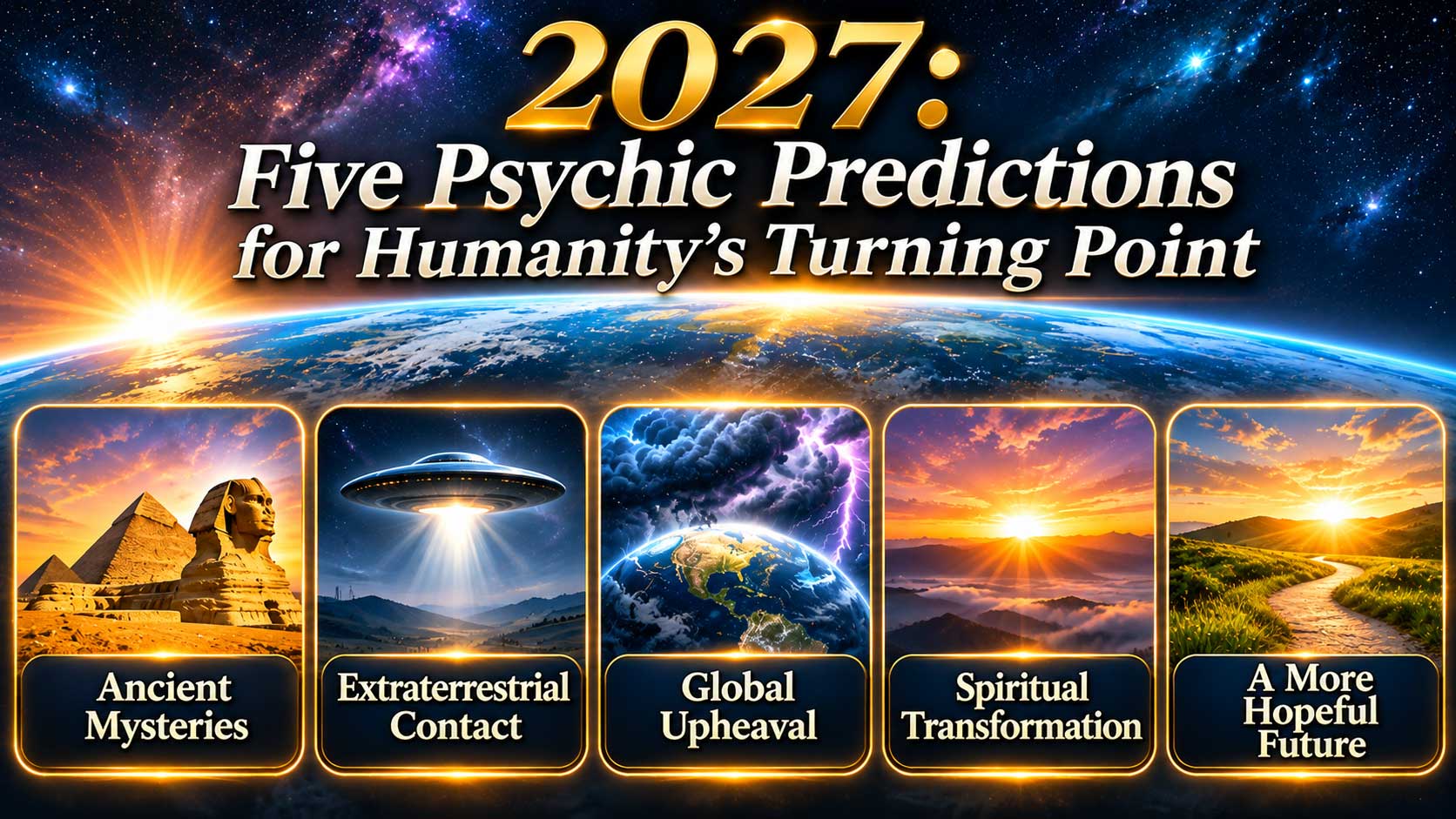
Short Bios:
Joseph Tittel
Joseph Tittel is an American psychic medium known for sharing predictions about world events, spiritual experiences, natural disasters, and unexplained phenomena. His work includes annual forecasts and discussions of impressions he describes receiving through psychic practices, including scrying. His 2027 predictions cover ancient Egypt, possible religious revelations, international conflicts, and extraterrestrial disclosure. Through his official SpiritmanJT website, he shares information about his work and public appearances. His predictions represent personal interpretations of psychic experiences rather than independently verified knowledge of future events.
Craig Hamilton-Parker
Craig Hamilton-Parker is a British psychic medium, author, and commentator known for predictions concerning politics, international affairs, economic developments, and major world events. He has appeared in television and online media and shares forecasts through public videos and spiritual discussions. His 2027 predictions include political changes, international conflict, emerging technologies, and possible financial disruption extending into 2028. More information about his background and work is available through his official biography. His claims should be evaluated using their original dates and wording rather than retrospective accounts of successful predictions.
Pam Gregory
Pam Gregory is a British astrologer, author, and educator who interprets astrological cycles through a spiritual and collective perspective. Her work explores planetary movements, social transformation, and humanity's relationship with consciousness and the natural environment. She has discussed the August 2, 2027 total solar eclipse and participated in conversations about collective meditation and spiritual renewal. Her writings and astrological educational materials are available through her official website, The Next Step. Her astrological interpretations are distinct from the established astronomical events upon which some of her discussions are based.
Darryl Anka
Darryl Anka is an American speaker, filmmaker, and channeler internationally known for presenting teachings attributed to an extraterrestrial entity called Bashar. His work explores consciousness, beliefs, personal choice, parallel realities, and alleged contact with extraterrestrial civilizations. Anka has discussed Bashar's prediction of a possible significant UFO-related event around late 2026 or early 2027 and a longer process of open contact. His background and the teachings he presents can be explored through the official Bashar website. Claims attributed to Bashar represent channeled spiritual material, not established scientific evidence.
Isabeau Maxwell
Isabeau Maxwell, often known as Beau Maxwell, is an American intuitive practitioner, author, and teacher who founded The SAGE Method, a program focused on intuitive development and spiritual awareness. She is the author of Cracking Open: Adventures of a Reluctant Medium and shares guidance concerning self-trust, relationships, emotional resilience, and personal growth. In her discussion about the transition from 2026 into 2027, Maxwell describes a gradual shift toward greater hope, community, and personal fulfillment. Her background, programs, and teachings can be explored through The SAGE Method's official website. Her predictions reflect her personal intuitive and spiritual interpretations.
Nick Sasaki
Nick Sasaki is a Japanese-American entrepreneur, digital publisher, and creator of ImaginaryTalks.com, a platform that brings historical figures, contemporary thinkers, spiritual leaders, and influential personalities together through fictional conversations. Drawing on more than two decades of experience in digital marketing and a lifelong interest in philosophy, faith, history, and human potential, Nick uses imaginative dialogue to explore meaningful questions about life and society. His mission is to encourage curiosity, compassion, and thoughtful conversations that inspire people to help create a better future.
Leave a Reply