
Introduction
What if the man who helped transform human communication could see what we have done with his invention?
Nearly six hundred years ago, in a workshop in Mainz, Germany, Johannes Gutenberg developed a printing system that would help change the course of European history.
Today, we can access millions of books, exchange ideas across continents in seconds, and ask artificial intelligence to generate entire pages of writing almost instantly.
Yet one question remains as relevant as ever:
Has humanity become wiser, or have we simply become better at producing and spreading information?
Gutenberg is often remembered as the inventor of the printing press. But that familiar description leaves out much of the story.
Printing and movable type existed in East Asia long before Gutenberg's lifetime. Chinese innovators developed woodblock printing and movable type, and Korean printers produced books using movable metal type centuries before Gutenberg's famous Bible.
Gutenberg's achievement was developing an influential European system that brought together metal type, casting methods, suitable ink, press technology, and skilled production techniques. His work helped make the reproduction of books more efficient and commercially viable in Europe.
Yet the man behind that achievement remains surprisingly mysterious.
We know that he came from Mainz, spent important years in Strasbourg, pursued commercial ventures, and undertook the extraordinarily ambitious project of printing a Latin Bible.
We know that his work required considerable investment and that a financial dispute with Johann Fust became one of the best-documented conflicts of his career.
But we know far less about his private thoughts.
What did he truly hope to accomplish?
What kept him working through uncertainty?
How did he think about faith, money, craftsmanship, and the people who would eventually read his books?
And what would he think if he could see the consequences of printing across the centuries?
In this imaginary conversation, Nick Sasaki meets Gutenberg in his workshop and begins with a simple question:
Who were you before the world knew your name?
Their encounter unfolds through five conversations.
They explore the young craftsman and entrepreneur, the technical challenges of movable-type printing, the magnificent Gutenberg Bible, and the financial pressures surrounding its production.
Then the conversation moves beyond Gutenberg's lifetime.
Nick introduces him to the Protestant Reformation, scientific publishing, the spread of education, censorship, and political propaganda.
Finally, Gutenberg encounters something almost unimaginable from the perspective of his century: a smartphone containing thousands of books, connected to a worldwide network through which information travels almost instantly.
He discovers artificial intelligence, machines that can generate convincing writing without necessarily producing reliable truth.
But this is more than a conversation about inventions.
It is about the human beings who create them, the people whose lives they affect, and the responsibilities that come with the ability to communicate.
It is about a craftsman whose name became famous, though the work depended on many hands and built upon a much longer human history of innovation.
And it is about the possibility that humanity's greatest challenge has never been producing more words.
Perhaps it has always been learning how to use those words with wisdom, humility, and love.
Join Nick Sasaki and Johannes Gutenberg for an imaginary conversation across six centuries, beginning with a single piece of metal type and ending with a question that every generation must answer for itself.
Fictional Conversation Disclaimer
This article is an imaginative historical conversation created for educational, philosophical, and storytelling purposes. Johannes Gutenberg's dialogue, personal reflections, emotional reactions, and interactions with Nick Sasaki are fictional, not authentic historical quotations or evidence of Gutenberg's endorsement of the ideas expressed. Documented historical events are distinguished from creative reconstruction where appropriate.
Topic 1: The Man Before the Machine

Opening: A Morning in Mainz
Mainz, Germany. An imagined morning in the middle of the fifteenth century.
The city is waking beneath a pale golden sky.
A cart rattles over the cobblestones. A baker opens his shutters, releasing the smell of warm bread into the street. Somewhere near the Rhine, church bells begin to ring.
Inside a modest workshop, a man bends over a wooden bench. Small metal objects lie scattered before him. His sleeves are rolled up, and his fingers are stained from work.
He looks up when a visitor appears at the doorway.
Nick Sasaki: Excuse me. Are you Johannes Gutenberg?
Johannes Gutenberg: That depends. Are you here to lend me money or collect it?
Nick: (Laughing) Neither, fortunately.
Gutenberg: Then you've already improved my morning. Come in.
Nick: I've traveled a very long way to meet you.
Gutenberg: From where?
Nick: From a place called America, about six hundred years in your future.
Gutenberg studies him for a moment.
Gutenberg: Six hundred years?
Nick: More or less.
Gutenberg: And you've come all that way to visit a workshop? Either the future is terribly dull, or I've done something remarkable.
Nick: A little of the second, I think.
Gutenberg: Well, you've certainly caught my attention. Sit down.
Nick pulls up a wooden stool. Gutenberg moves several pieces of metal aside.
Nick: Before we talk about what you invented, I'd like to know who you were before all of this.
Gutenberg: Before all of what?
Nick: Before the world knew your name.
Gutenberg smiles faintly.
Gutenberg: Ah. Then we should begin with a correction. Most of the world does not know my name.
Nick: That is going to change.
Gutenberg: You say that with extraordinary confidence.
Nick: I have a rather unfair advantage.
They laugh.
Question 1: Who Were You Before the World Knew Your Name?
Nick: Johannes, before anyone knew your name, what kind of life did you expect to live?
Gutenberg: An ordinary life, I suppose. Though I wonder whether anyone truly expects his own life to be ordinary.
I was born here in Mainz, into a family with a respectable position in the city. My father was connected with the mint. We were familiar with the affairs of merchants, craftsmen, and the men who governed Mainz.
I was not raised to believe that work was beneath me. But neither was I raised to believe that a man should spend his days chasing impossible dreams.
Nick: Did your family expect you to follow a particular profession?
Gutenberg: Families usually have expectations. They want their sons to be respectable, secure, and sensible.
I suspect I have not always satisfied those requirements.
Nick: (Smiling) Particularly the sensible part?
Gutenberg: Especially that part.
Nick: What was Mainz like when you were growing up?
Gutenberg: A city of merchants, craftsmen, churchmen, and arguments.
The Rhine brings trade. The cathedral brings religious authority. The guilds have their interests, the old families have theirs, and everyone seems quite certain that the city would be better governed if only the other fellows would listen.
Nick: That sounds surprisingly familiar.
Gutenberg: Has human nature improved in six hundred years?
Nick: We have made progress in many things.
Gutenberg: An interesting way of avoiding the question.
Nick laughs.
Nick: Fair enough. We still argue over money, politics, religion, and who should be in charge.
Gutenberg: Then at least I shall recognize something about your century.
Nick: Your family lived through political tensions here in Mainz. Did those conflicts influence your decisions?
Gutenberg: A city may look permanent, with its walls and towers and churches. But the fortunes of families can change remarkably quickly.
When disagreements become serious, a man learns that security is not always as solid as it appears.
You begin to think about where you might go, what skills you possess, and what you could build with your own hands.
Nick: Is that part of what drew you to craftsmanship?
Gutenberg: I would not claim one experience explains everything about a man.
But I have always found something satisfying about work that can be examined.
A merchant may promise you a fortune. A politician may promise you justice. A craftsman must eventually place his work on the table.
Then everyone can see whether it functions.
Nick: That's an interesting distinction.
Gutenberg: It is a useful one.
Nick: Did you enjoy working with metal?
Gutenberg: I enjoy what metal permits a skilled worker to accomplish.
Consider a coin.
Its design must be precise. The impression must be recognizable. The work must be repeatable.
Or consider a finely made piece of jewelry. A small error can spoil the whole object.
There is a kind of discipline in such work.
Nick: Precision.
Gutenberg: Precisely.
Nick: Was that something you learned early?
Gutenberg: I grew up in a world where such skills mattered. How much of my own ability came from particular teachers or particular experiences is harder to say.
But I learned to respect people who knew their materials.
A man who understands metal can do things that seem impossible to someone who has never held a tool.
Nick: You know, Johannes, in my time people often admire the person who comes up with an idea. We sometimes forget the people who actually make it work.
Gutenberg: Then your century may have more inventors than craftsmen.
Nick: Sometimes it feels that way.
Gutenberg: That sounds dangerous.
Nick: Why?
Gutenberg: Ideas are wonderfully light. They cost nothing to carry around in your head.
Making them real is considerably heavier.
Gutenberg picks up a small metal piece from the bench and turns it between his fingers.
Gutenberg: The world is full of things people say ought to exist.
The interesting question is who will spend the years required to make them.
Nick watches the small object in Gutenberg's hand.
Nick: I think I'm beginning to understand you.
Gutenberg: I wouldn't be too confident. My creditors have spent years trying.
Question 2: Were You an Inventor or a Businessman?
Nick: Johannes, you were involved in business ventures long before printing. Were you trying to invent something extraordinary, or were you simply trying to make a good living?
Gutenberg: Why must those be separate ambitions?
Nick: Good question.
Gutenberg: A man must eat. His workers must be paid. Materials cost money. A workshop does not survive on admiration.
If I develop a useful method, I would certainly like it to bring some income.
But if money were my only interest, I suspect I could have chosen an easier occupation.
Nick: You spent time in Strasbourg.
Gutenberg: Yes. A fine city. A place where a man might find opportunity if he had the right skills and knew the right people.
Nick: You were involved in a business making mirrors for pilgrims traveling to Aachen.
Gutenberg: Ah, the mirrors.
He gives a short laugh.
Nick: What was that business like?
Gutenberg: The idea was to manufacture small metal mirrors that pilgrims would value during the great pilgrimage.
Such objects could be sold to people who wished to bring something home from their religious visit.
It required materials, preparation, skilled work, and a judgment about demand.
Nick: And investors.
Gutenberg: Naturally.
Nick: Did you enjoy working with partners?
Gutenberg: A partner can provide what you lack.
One man has money. Another has knowledge. Another has customers or access to materials.
Together they may accomplish something none could manage alone.
But partnerships are not made easier by the fact that everyone begins with good intentions.
Nick: What makes them difficult?
Gutenberg: Different expectations.
One man wants results quickly. Another believes the work requires more time.
One considers a particular expense necessary. Another considers it wasteful.
And when money is involved, even a small misunderstanding can grow remarkably large.
Nick: That hasn't changed much.
Gutenberg: I begin to suspect your future is less advanced than you first suggested.
Nick: (Laughing) In human relationships, perhaps.
Gutenberg: Then tell me, do people in your century still borrow money for businesses?
Nick: Constantly.
Gutenberg: Do the lenders still expect repayment?
Nick: Very much so.
Gutenberg: Then I am beginning to feel at home.
They share a laugh.
Nick: What about the technical side of those early ventures? Did you enjoy solving manufacturing problems?
Gutenberg: Very much.
A customer sees the finished object. The craftsman sees all the difficulties hidden inside it.
How do you make many pieces consistent?
How do you avoid wasting expensive material?
How do you improve the process without sacrificing quality?
Those questions interest me.
Nick: So you were thinking about production, not simply individual craftsmanship.
Gutenberg: Of course.
Suppose I can make one excellent object. That proves something about my skill.
But suppose I can devise a method by which many excellent objects can be produced reliably.
That proves something different.
Nick: Something much bigger?
Gutenberg: Potentially.
Nick: Did you already see how that principle might apply to books?
Gutenberg looks toward the workbench.
Gutenberg: You seem remarkably interested in books.
Nick: I am.
Gutenberg: Then perhaps you have already guessed that I have been thinking about them.
Nick: For how long?
Gutenberg: Long enough to know that making a book is a more troublesome undertaking than most readers appreciate.
Nick: We know that you were engaged in confidential technical work in Strasbourg. Were you already developing your printing method there?
Gutenberg: You are asking me to open a locked chest, my friend.
Nick: I traveled six hundred years. Surely that earns me something.
Gutenberg: It earns you a seat and perhaps a cup of wine. It does not automatically earn you my workshop secrets.
Nick laughs.
Nick: Fair enough.
Gutenberg: But I will tell you this.
When a man is experimenting with something unfamiliar, he must be careful about what he promises.
An idea may seem magnificent in conversation.
Then you try to make it work, and the materials refuse to cooperate.
Nick: Have you experienced that often?
Gutenberg: Enough to respect the difference between confidence and proof.
Nick: That's something modern entrepreneurs still struggle with.
Gutenberg: Then perhaps I should write them a book.
Nick: You might have a very large audience.
Gutenberg: Now you're speaking my language.
For a moment, the two men sit comfortably, listening to the sounds of the workshop.
Nick: Johannes, when I look at your life, I see someone willing to take risks.
But I don't want to romanticize that. Risks affect other people, especially partners and workers.
Did you think about that responsibility?
Gutenberg: A workshop is never merely one man's ambition.
There are people whose labor makes the work possible.
There are people who supply the materials.
There are people who trust you with their money.
If you fail, you may disappoint more than yourself.
Nick: That must make decisions difficult.
Gutenberg: It should.
A man who feels no responsibility for the consequences of his decisions is not brave. He may simply be careless.
Nick: I like that distinction.
Gutenberg: Do not praise me too quickly. Knowing a principle and living by it are not always the same thing.
Nick smiles, appreciating the answer.
Question 3: What Made You Willing to Attempt the Difficult?
The morning has grown brighter. Sunlight reaches the workbench, illuminating tiny metal shavings.
Nick: Johannes, when you look back at those early years, what prepared you to attempt something so technically demanding?
Gutenberg: Perhaps the habit of noticing difficulties that other people have learned to accept.
Nick: What do you mean?
Gutenberg: Consider a manuscript.
A skilled scribe can produce a beautiful book. But the work requires an extraordinary amount of time.
If another person wants the same book, much of the labor must be repeated.
And if a third person wants it, the work begins again.
Nick: So you began questioning the process itself.
Gutenberg: That is one way of describing it.
A craftsman often asks whether a task can be performed more accurately, more consistently, or with less repeated labor.
But one must be careful. A process that works for a small object may not work for something as complicated as a book.
Nick: What makes books so difficult?
Gutenberg: Everything.
The letters must be legible. The lines must be straight. The pages must agree with one another.
The materials must withstand repeated use.
And the finished work must be worthy of the reader.
Nick: That's quite a challenge.
Gutenberg: You have no idea.
Nick: (Smiling) I was hoping you would show me.
Gutenberg: Patience. You have only just arrived.
Nick: Let me ask you something about patience.
When you face a difficult problem, how do you know whether to continue or walk away?
Gutenberg: A good question.
If you continue merely out of pride, you may waste years.
If you abandon every difficult task, you will accomplish very little.
The difficulty is knowing whether the obstacle is temporary or whether your entire approach is mistaken.
Nick: How do you tell the difference?
Gutenberg: By examining the work.
What has improved?
What remains impossible?
What can be tested?
What have I assumed without proof?
A craftsman must sometimes be willing to abandon a cherished method without abandoning the larger problem.
Nick: That's a powerful distinction.
Gutenberg: It is a practical distinction.
Nick: Did you ever worry that your ideas might never succeed?
Gutenberg: Any undertaking that requires substantial labor and money deserves serious concern.
A man who has no doubts about an untested method probably has not tested it enough.
Nick: But doubt doesn't necessarily stop you.
Gutenberg: Nor should it.
Doubt may tell you where to look more carefully.
Nick: Johannes, there's something I find moving about this.
In my century, people know you as a great inventor.
They see the finished achievement.
But they rarely think about the ordinary days before success, when nothing was guaranteed.
Gutenberg: That is true of many kinds of work, I suspect.
A cathedral stands for centuries, and people admire its towers.
How many remember the men who carried the stones?
Nick: Very few.
Gutenberg: Yet without them, there would be no cathedral.
Nick: Do you think history gives too much credit to famous individuals?
Gutenberg: History?
Gutenberg considers the word.
Gutenberg: I would not pretend to know how future generations will remember us.
But I know that no workshop runs on one pair of hands.
If something remarkable comes from this place, it will require the labor and skill of many people.
Nick: That matters to me.
I believe humanity is one family, and our greatest accomplishments are rarely the work of one person alone.
Gutenberg: One family?
Nick: Yes. Different nations, cultures, and traditions, but one human family.
Gutenberg: That is a generous vision.
Though I suspect families can disagree rather fiercely.
Nick: (Laughing) Mine certainly can.
Gutenberg: Then perhaps humanity truly is one family.
Both men laugh.
Nick: Johannes, may I ask you one more thing before we look at your invention?
Gutenberg: Of course.
Nick: If you could speak to a young person who has a difficult idea, someone who wants to create something meaningful but doesn't know whether it will succeed, what would you say?
Gutenberg sets down the metal piece he has been holding.
Gutenberg: I would ask whether the young person has actually begun the work.
Nick: And if the answer is no?
Gutenberg: Then I would suggest beginning.
Not with a magnificent announcement. Not with promises of future glory.
Begin with something small enough to test.
Learn what the materials will permit.
Find people who know things you do not.
And when the work proves more difficult than expected, do not be surprised.
Nick: You make it sound very practical.
Gutenberg: Most worthwhile work is.
Nick: What about having a dream?
Gutenberg: A dream may give a man a reason to begin.
But the work must carry him through the days when the dream feels very far away.
Nick sits quietly for a moment.
Nick: I think that's something people in my time need to hear.
Gutenberg: Then perhaps your journey has not been wasted.
Closing: The Door to the Workshop
Gutenberg rises from his stool and walks to a heavy wooden door at the rear of the room.
Gutenberg: Nick, you have asked a great many questions about my life.
Nick: I hope I haven't worn out my welcome.
Gutenberg: Not yet.
Nick: That's encouraging.
Gutenberg: But I suspect you did not travel six hundred years merely to discuss my childhood and business arrangements.
Nick: You're right.
Gutenberg: You want to see the printing.
Nick: Very much.
Gutenberg rests his hand on the door.
Gutenberg: Then you must understand something before we enter.
People sometimes look at a finished object and believe the idea behind it must have been simple.
A printed page may appear ordinary once it is placed in someone's hands.
But making such a page reliably is another matter entirely.
Nick: What was the hardest part?
Gutenberg: (Smiling) Ah. Now you are finally asking the right question.
He opens the door.
Beyond it stands a wooden press. Rows of metal type lie arranged on a workbench. Paper is stacked nearby, and the air carries the scent of ink and heated metal.
Nick steps inside.
For a moment, he says nothing.
Gutenberg: Well?
Nick: Johannes, I think I finally see why this took so much work.
Gutenberg: My friend, you have only seen the room.
He picks up a tiny metal letter and places it in Nick's palm.
Gutenberg: Now let me show you the problem.
And with that, the conversation moves from the man before the machine to the invention that would transform the circulation of knowledge.
End of Topic 1.
Historical note: This is a fictional conversation. Gutenberg's dialogue, private reflections, humor, and interactions with Nick Sasaki are imagined, not authentic historical quotations. The setting combines documented aspects of his life and printing activities with creative reconstruction. His precise early education, motivations, and experimental history remain uncertain.
Topic 2: The Impossible Invention
Opening: A Thousand Little Pieces of Metal
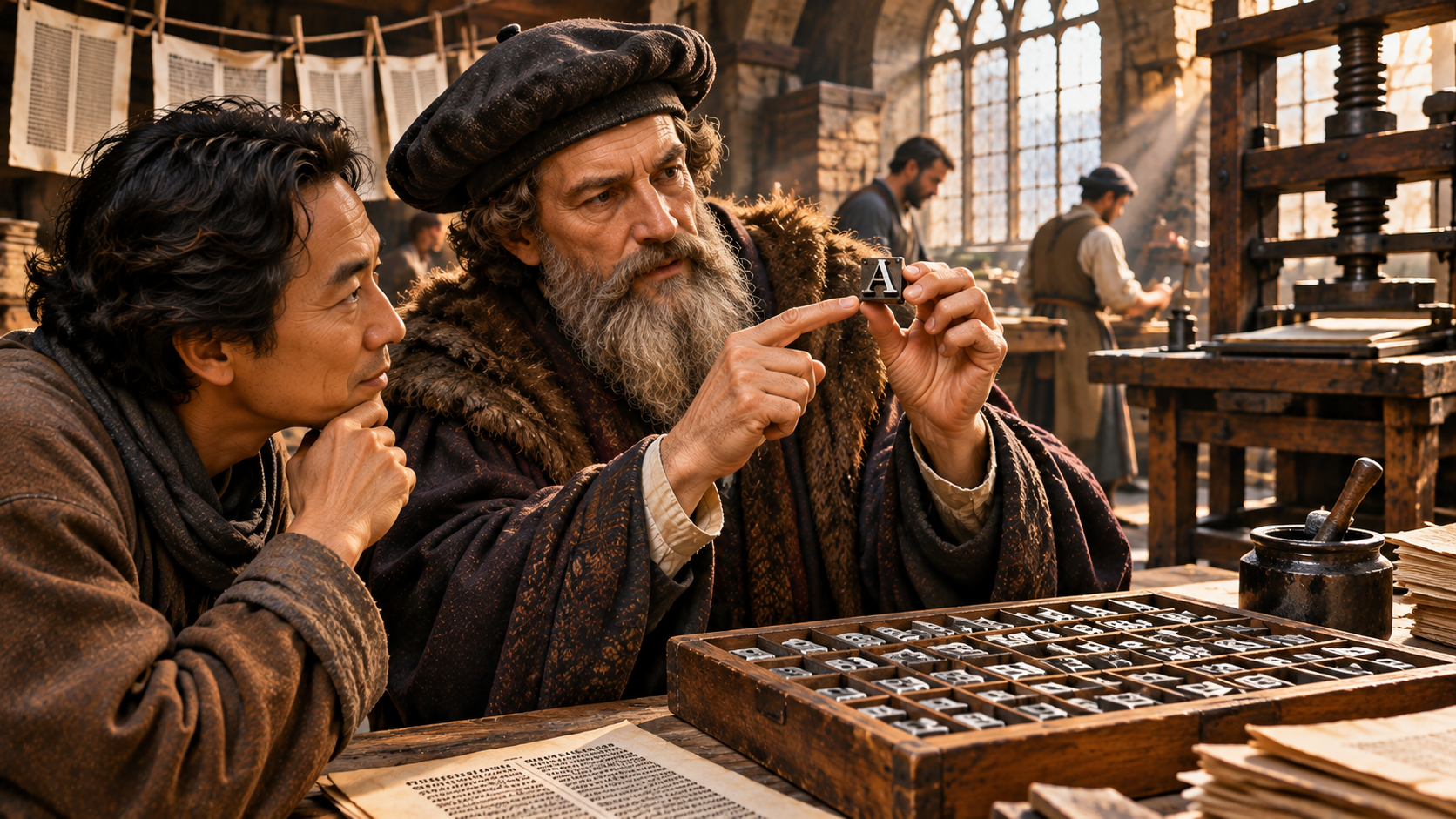
Mainz, Germany. An imagined afternoon in Gutenberg's printing workshop, around 1454.
Sunlight streams through a narrow window, illuminating thousands of tiny metal letters arranged in wooden trays.
The room smells of ink, oil, wood, and warm metal.
A heavy wooden press stands near the far wall. Sheets of paper hang nearby, and several workers move carefully between the benches.
Nick Sasaki stands beside Johannes Gutenberg, examining the small metal object Gutenberg has just placed in his hand.
Nick: Johannes, is this really a letter?
Gutenberg: It is.
Nick: It looks backward.
Gutenberg: That's a promising observation.
Nick: Promising?
Gutenberg: Yes. You have already discovered one of the first difficulties of printing.
Gutenberg takes the piece of type, turns it slightly, and holds it against the light.
Gutenberg: The letter must be reversed so that its impression appears correctly on the paper.
Nick: Of course. Like a mirror.
Gutenberg: Precisely.
Nick: So every one of these little pieces has to be made backward?
Gutenberg: Every character that requires it.
Nick: And how many do you need?
Gutenberg: More than you would care to count.
Nick: You're probably right.
Gutenberg: Yet you came six hundred years to see them. I would hate to disappoint you.
Nick laughs.
Nick: All right, Johannes. Show me how you changed the world.
Gutenberg: (Smiling) First, let me show you how difficult it is to print one decent page.
Question 4: How Did You Actually Make Printing Work?
Nick: Johannes, I understand the basic idea of movable letters. But looking around this workshop, I can see that making the whole system work must have been much harder. What was the biggest challenge?
Gutenberg: Which challenge would you like first?
Nick: There were that many?
Gutenberg: My friend, there were enough challenges to keep several men thoroughly occupied.
Let us begin with something simple.
He places several metal letters on the workbench.
Gutenberg: Suppose you want to print a page of Scripture.
You need hundreds of individual characters arranged into words, lines, and columns.
Each character must be the proper height. Each must fit beside the others. Each must leave a clear impression.
Now suppose one letter is slightly taller than its neighbors.
Nick: It would press harder into the paper?
Gutenberg: Exactly.
And if another letter is too short?
Nick: It might not print clearly.
Gutenberg: Very good. Perhaps I should employ you.
Nick: I should warn you that I'm not very good at making things with my hands.
Gutenberg: Then perhaps you should remain a visitor.
They laugh.
Nick: So the real problem wasn't making one letter. It was making thousands of letters that worked together.
Gutenberg: That is a much better way of describing it.
A single beautifully made letter is a curiosity.
A collection of letters that can be arranged, printed, taken apart, and used again is something far more useful.
Nick: How do you make them consistent?
Gutenberg: We need methods of shaping and casting metal with great precision.
A character begins with a carefully formed model. From it, one can prepare the means to cast repeated pieces of type.
The exact form of the work matters enormously.
Gutenberg gestures toward the metalworking tools.
Gutenberg: If the casting is poor, the letter is poor.
If the letter is poor, the page suffers.
And if the page suffers, the reader will not care how clever the inventor believes himself to be.
Nick: That's a rather unforgiving business.
Gutenberg: Metal is not interested in excuses.
Nick: (Laughing) I like that.
Gutenberg: Then write it down. Perhaps it will be useful in your century.
Nick: It certainly would.
Gutenberg walks toward the press.
Gutenberg: But consistent letters are only part of the problem.
We must arrange them into lines, hold them securely, apply ink, place the paper, and produce an even impression.
Then we must do it again.
And again.
And again.
Nick: How many times?
Gutenberg: As many as the work requires.
Nick: What about the ink? Couldn't you use the same ink that scribes use?
Gutenberg: Ink suited to a pen does not necessarily behave well on metal.
A scribe draws letters onto parchment or paper. We must coat the raised surfaces of our type and transfer the ink through pressure.
The ink must adhere properly and leave a clear mark.
Nick: So you needed something different.
Gutenberg: A suitable printing ink, yes.
And the pressure must be controlled. Too little, and the impression is weak. Too much, and the work may be spoiled.
Nick: It sounds like every part of the process depends on every other part.
Gutenberg: Now you are beginning to understand.
He motions toward the wooden press.
Gutenberg: A press is a useful machine. But without suitable type, ink, preparation, and skilled workers, it is merely an expensive arrangement of wood and iron.
Nick: That's interesting. People in my time often say you invented the printing press.
Gutenberg: And did I invent the idea of applying pressure with a screw?
Nick: No. Presses existed before your time.
Gutenberg: Then perhaps your historians should be more careful with their words.
Nick: I agree. Your achievement was developing a practical printing system.
Gutenberg: That is a description I can live with.
Nick: May I see a page printed?
Gutenberg: Certainly.
In this imagined demonstration, Gutenberg guides Nick to a prepared form of type.
A worker applies ink to the raised letters. A sheet is positioned, and the press is operated.
The wooden mechanism creaks.
When the sheet is lifted, two columns of dark Gothic letters appear on the paper.
Nick leans forward.
Nick: That's beautiful.
Gutenberg: Examine it carefully.
Nick: The letters look almost handwritten.
Gutenberg: That is intentional. Readers know the appearance of fine manuscripts. A printed book should not seem inferior merely on account of the method by which it was made.
Nick: And you can produce another page from the same arrangement?
Gutenberg: Another impression of this page, yes. Once we have finished with the type, it may be distributed and used for other pages.
Nick: So instead of copying the entire book by hand, you prepare the type and produce repeated impressions.
Gutenberg: Precisely.
Nick: Johannes, this is extraordinary.
Gutenberg: It is an extraordinary amount of work.
Nick: (Laughing) You really don't like making things sound easy, do you?
Gutenberg: I prefer that people understand what they are admiring.
Nick looks again at the printed sheet.
Nick: You know what strikes me? The finished page looks so simple. But there's an entire system of knowledge hidden behind it.
Gutenberg: That is true of many well-made things.
The better the work, the less the customer may notice the difficulties overcome in producing it.
Question 5: Were You Really the First?
Gutenberg begins returning several pieces of type to their compartments. Nick watches him for a moment before speaking.
Nick: Johannes, there's something I want to share with you. It might surprise you.
Gutenberg: You have already told me that you come from six hundred years in the future. I doubt you can surprise me much more.
Nick: Don't be too sure.
Gutenberg: Very well. Continue.
Nick: Long before your lifetime, people in China had developed woodblock printing and movable type.
And in Korea, printers were using movable metal type more than two centuries before your Bible.
Gutenberg stops working.
Gutenberg: Metal type?
Nick: Yes.
Gutenberg: For printing books?
Nick: Yes. One surviving Korean Buddhist book printed with movable metal type dates to 1377.
Gutenberg: Interesting.
He sets down the letter he has been holding.
Gutenberg: Tell me about their methods.
Nick: I wish I could show you their workshops. We know that Korean printers developed methods of casting metal type, but the exact historical techniques and their development are subjects of study.
Gutenberg: And these printers lived far from Mainz?
Nick: Very far. Across Asia.
Gutenberg: Remarkable.
Nick: Does it bother you to learn that someone developed movable metal type before you?
Gutenberg: Should it?
Nick: Some people might feel that their achievement had become less important.
Gutenberg: Why?
If another craftsman has solved a difficult problem, I would want to examine his solution.
Perhaps he discovered something I did not.
Perhaps I discovered something useful that he did not.
The important question is what can be learned.
Nick: I love that answer.
Gutenberg: Though I should remind you that I am speaking from curiosity, not from knowledge of these distant workshops.
Nick: Fair point.
Gutenberg: Do you know whether their methods reached Europe?
Nick: Historians have debated whether knowledge of Asian printing techniques influenced European developments. But we don't have conclusive evidence establishing that your system came from those earlier methods.
Gutenberg: Then we should not claim to know what we cannot establish.
Nick: Exactly.
Gutenberg: There is a lesson there for both of us.
Nick: I think so.
Nick picks up another metal letter.
Nick: Johannes, I believe human accomplishments belong to a much larger story than the fame of one person.
Different civilizations have contributed extraordinary things. Sometimes people discover similar solutions independently. Sometimes knowledge travels between cultures.
What matters is what humanity gains.
Gutenberg: That is an interesting way to look at invention.
Nick: I think of humanity as one family.
Gutenberg: You mentioned that earlier.
Nick: Yes. And I wonder whether our greatest achievements become even more meaningful when we recognize how much we learn from one another.
Gutenberg: I would certainly welcome the chance to learn from a skilled printer, wherever he lived.
But I must ask you something.
Nick: Of course.
Gutenberg: In your century, do people spend much time arguing over who deserves credit for an invention?
Nick: Oh, absolutely.
Gutenberg: And do those arguments improve the invention?
Nick: Not always.
Gutenberg: Then perhaps some of that energy could be spent at the workbench.
Nick bursts out laughing.
Nick: Johannes, you would fit right into some of our modern debates.
Gutenberg: I would prefer not to. I have enough disagreements here in Mainz.
Nick: (Smiling) Fair enough.
Gutenberg: But tell me, Nick. If these distant printers developed useful methods, did their work continue?
Nick: Yes. Printing traditions developed across East Asia, though their histories differed from Europe's.
Gutenberg: Then there is something worth admiring.
Not simply that a person discovered a method, but that others found ways to use and improve it.
Nick: That's a beautiful thought.
Gutenberg: It is a practical one.
An invention that no one can use accomplishes very little.
Nick looks across the workshop at the workers preparing another page.
Nick: So perhaps the real achievement isn't just inventing something. It's creating something other people can build upon.
Gutenberg: That is certainly one kind of achievement.
And sometimes the people who improve a method deserve as much admiration as the person who first proposed it.
Question 6: How Do You Keep Going When Nothing Works?
The afternoon light begins to soften.
One of the workers carefully removes a newly printed sheet. Another prepares fresh paper.
Gutenberg examines the impression, then places it beside an earlier sheet.
Nick: Johannes, when you're working on a difficult problem and the solution keeps escaping you, how do you decide whether to continue?
Gutenberg: You have chosen a question that every craftsman must face.
Nick: I think every entrepreneur faces it too.
Gutenberg: Then perhaps craftsmen and entrepreneurs have more in common than I realized.
Nick: What do you do when something doesn't work?
Gutenberg: First, I try to determine why.
That may sound obvious, but people often prefer to repeat an unsuccessful method rather than examine it.
Nick: Why do you think that happens?
Gutenberg: Pride, perhaps. Impatience. Or the belief that the next attempt must succeed simply on account of how much effort has already been spent.
Nick: We have a name for that in my century.
Gutenberg: Do you?
Nick: The sunk-cost fallacy.
Gutenberg: (Raising an eyebrow) Your century has an impressive talent for naming ordinary human foolishness.
Nick: (Laughing) We certainly do.
Gutenberg: Does giving it a name prevent people from making the mistake?
Nick: Unfortunately, no.
Gutenberg: Then perhaps the name is less useful than the lesson.
Nick: You've got me there.
Gutenberg places two printed sheets side by side.
Gutenberg: Look at these.
Nick: They appear almost identical.
Gutenberg: Almost.
He points to a faint difference in the impressions.
Gutenberg: The craftsman must notice what the casual observer overlooks.
If a line prints poorly, we should not immediately conclude that the entire method is worthless.
We examine the type, the ink, the pressure, the preparation.
We change what can be changed and observe the result.
Nick: One problem at a time.
Gutenberg: As much as possible.
Nick: But how do you know when you're wasting your time?
Gutenberg: That is harder.
There are problems that can be solved with greater skill or a different method.
There are others that cannot be solved with the resources available.
A man must be willing to admit the difference.
Nick: So persistence isn't simply refusing to quit.
Gutenberg: Certainly not.
A stubborn man may spend his entire life trying to open a locked door by pushing against the hinges.
A thoughtful man examines the lock.
Nick: I like that.
Gutenberg: And if the door has no lock, perhaps he should look for another entrance.
They laugh.
Nick: Johannes, may I ask you something personal?
Gutenberg: You have traveled rather far to avoid personal questions.
Nick: Did you ever feel that your ambition was too large for the life you had?
Gutenberg is quiet for a moment.
Gutenberg: I would say that any ambitious undertaking must eventually confront its limits.
Money is limited.
Time is limited.
The patience of other people is limited.
And a man's own judgment is imperfect.
Nick: That sounds like experience speaking.
Gutenberg: Perhaps.
Nick: What kept the work meaningful?
Gutenberg: The work itself can offer encouragement.
A clearer impression.
A better-fitting letter.
A process that becomes more reliable.
Small improvements may appear insignificant to someone waiting for a magnificent result.
But the craftsman knows what they represent.
Nick: Progress.
Gutenberg: Yes.
And progress need not announce itself with trumpets.
Sometimes it is simply the discovery that a problem which defeated you yesterday can be managed today.
Nick looks at the pages on the table.
Nick: There's something deeply human about that.
Gutenberg: About what?
Nick: The fact that we can spend years working on something without knowing how important it might eventually become.
Gutenberg: Or whether it will become important at all.
Nick: That's true.
Gutenberg: You have the advantage of knowing what comes later, Nick.
The people doing the work do not.
Nick: That's a good point.
Gutenberg: You see the finished story. We must live through the unfinished one.
Nick falls silent.
Outside, a church bell rings in the distance.
Nick: Johannes, I think that may be one of the most meaningful things you've said today.
Gutenberg: Then I am pleased.
But I hope you have found something useful in the workshop too.
Nick: More than you know.
Gutenberg: Good.
Gutenberg picks up the small metal letter that Nick struggled to recognize earlier.
Gutenberg: Here. Keep this for the moment.
Nick: Are you sure?
Gutenberg: Consider it a reminder.
Nick: Of what?
Gutenberg: That a page begins with small things arranged carefully.
Nick: And perhaps something greater can begin with a single small step.
Gutenberg: Perhaps. But do not forget the other letters. One character cannot make a book.
Nick smiles and closes his hand gently around the piece of type.
Closing: The First Pages of a New Age
The workshop is growing quieter as the afternoon approaches evening.
A worker carries several printed sheets to a nearby table. Gutenberg examines them, then looks toward a large volume resting beneath a protective cloth.
Nick: Johannes, may I ask one last question before we finish for today?
Gutenberg: Of course.
Nick: When you see a beautifully printed page, do you think about the machine that produced it, or about the person who will eventually read it?
Gutenberg considers the question.
Gutenberg: A craftsman must think about the machine and the process.
But the work would have little purpose if no one wished to read the result.
Nick: So the reader matters.
Gutenberg: Very much.
Nick: I think that's something inventors sometimes forget. The value of an invention isn't simply in the object. It's in what people can do with it.
Gutenberg: That is a reasonable observation.
Though I suspect the inventor must first make the object work.
Nick: (Laughing) You always bring me back to the practical side.
Gutenberg: Someone must.
Gutenberg walks toward the covered volume.
Gutenberg: You have seen the metal letters, the ink, and the press.
But there is something I would like you to examine.
He carefully lifts the cloth.
Beneath it lies a large printed Bible.
The pages are filled with elegant Gothic letters arranged in two precise columns. Decorative initials brighten the text.
Nick steps closer.
Nick: Johannes...
For a moment, he cannot find the words.
Gutenberg: Well?
Nick: It's magnificent.
Gutenberg: It has required a great deal of labor.
Nick: I can see that.
Gutenberg: And a great deal of money.
He says the last words with a small, knowing smile.
Nick: I was hoping we could talk about that.
Gutenberg: I suspected you might.
Nick: But first, there's something I want to ask.
Gutenberg: Go ahead.
Nick: Why the Bible?
Gutenberg looks down at the open pages.
For the first time that afternoon, he does not answer immediately.
Gutenberg: That, my friend, is a question worth discussing at some length.
The two men stand beside the great book as the final sunlight enters the workshop.
Their next conversation will explore the Bible, the ambition behind its creation, and the financial conflict that would become one of the most disputed chapters of Gutenberg's life.
End of Topic 2.
Historical note: This is a fictional conversation. Gutenberg's words, demonstrations, personal reflections, and interactions with Nick Sasaki are imagined rather than authentic historical quotations. Gutenberg developed an influential European movable-metal-type printing system, but printing and movable type existed earlier in East Asia. The precise sequence of Gutenberg's technical experiments is not fully documented. The workshop demonstration and specific exchanges are creative reconstructions grounded in historical printing practices.
Topic 3: The Bible and the Price of a Dream
Opening: A Book Worth More Than Gold
Mainz, Germany. An imagined evening in Gutenberg's printing workshop, around 1455.
The last light of day has disappeared behind the rooftops of Mainz.
Outside, the streets grow quiet. A church bell rings in the distance, and the footsteps of the final workers fade beyond the workshop door.
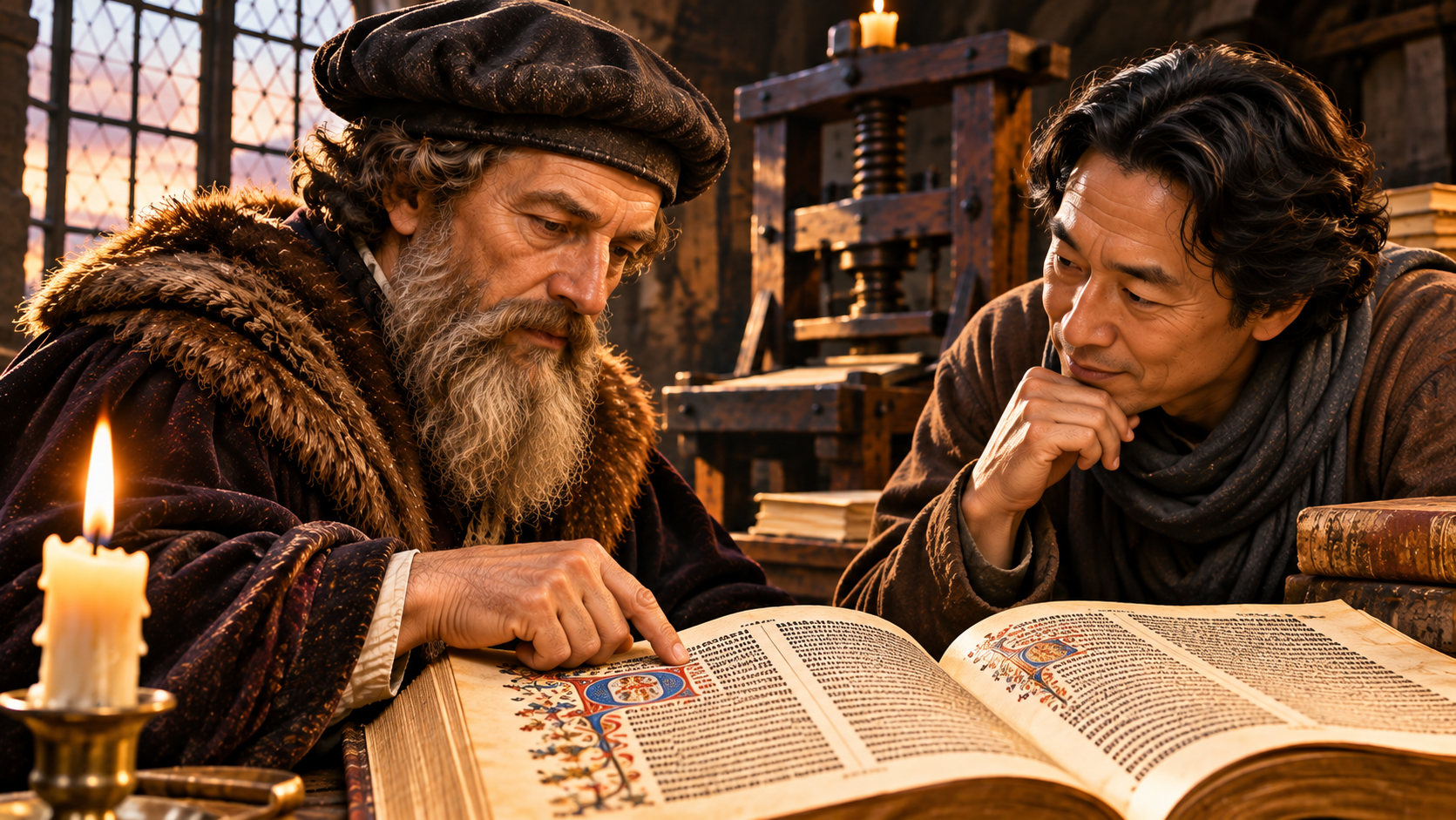
Inside, a single candle burns beside a large open Bible.
Its pages are magnificent.
Two columns of precisely printed Gothic letters fill each sheet. Delicate red and blue initials decorate the text, their colors glowing softly in the candlelight.
Nick Sasaki stands beside Johannes Gutenberg, studying the book.
For several moments, neither speaks.
Nick: Johannes, I have seen photographs of this Bible in my time. I've read about it. I thought I knew what to expect.
But seeing it here, in front of me...
Nick shakes his head.
Nick: It's extraordinary.
Gutenberg: You have been rather generous with that word today.
Nick: I know. But I mean it.
Gutenberg: Then I shall accept it.
Gutenberg carefully turns a page.
Nick: The letters are so precise. And the decoration is beautiful.
Gutenberg: The printed text provides the foundation. Skilled hands may then add color, initials, and ornamentation.
Nick: So even with your new printing method, people are still doing some of the work by hand.
Gutenberg: Of course. Why should a new method make every older skill worthless?
Nick: That's an interesting way to look at it.
Gutenberg: A book should be judged by what it offers the reader, not merely by how it was produced.
Nick: May I ask you something?
Gutenberg: You have asked so many questions that I would be disappointed if you stopped now.
Nick smiles.
Nick: Why the Bible?
Gutenberg looks down at the open pages.
Gutenberg: Ah.
He pulls out a chair.
Gutenberg: Sit down, Nick. That question deserves more than a hurried answer.
Question 7: Why Did You Choose the Bible?
Nick: Johannes, you could have printed so many different books. Why undertake something as demanding and magnificent as the Bible?
Gutenberg: Let me ask you something first.
If you had developed a new method for producing books, what would you choose to make?
Nick: That's a good question.
Something important, I suppose. Something people would want to read.
Gutenberg: And something they would value enough to purchase.
Nick: Naturally.
Gutenberg: Then you already understand part of the matter.
A Bible is among the most significant books in Christian Europe.
It is used in religious life, studied by learned men, and valued by institutions that possess the means to acquire substantial volumes.
Nick: So there was a commercial reason.
Gutenberg: There must be a commercial reason if a workshop is to survive.
Look around you.
He gestures toward the press and the workbenches.
Gutenberg: Metal must be purchased. Paper must be obtained. Workers must be paid. Tools must be made and maintained.
A large book requires an extraordinary amount of preparation.
It would be foolish to pretend that such an undertaking could exist without money.
Nick: But was it only about money?
Gutenberg: Would you have been satisfied if I said yes?
Nick: Probably not.
Gutenberg: Then perhaps you already suspect that human motives are rarely so simple.
He rests his hand beside the open Bible.
Gutenberg: Consider what we are attempting.
We are producing a book whose words have been preserved and copied through generations.
A book used in worship, study, and religious teaching.
If our method is to be taken seriously, should we not demonstrate that it can produce something worthy of such a text?
Nick: So the Bible was a demonstration of what printing could accomplish.
Gutenberg: That is one way to see it.
A poor book might convince people that the method itself was poor.
But a beautifully produced Bible could show that printed books need not be inferior to manuscripts.
Nick: I find that fascinating.
In my time, we often associate technological progress with making things faster and cheaper.
But you seem equally concerned with beauty.
Gutenberg: Why should usefulness and beauty be enemies?
Nick: They shouldn't be.
Gutenberg: Then perhaps your century has something to learn from ours.
Nick: (Laughing) We probably have quite a few things to learn.
Gutenberg: I am relieved to hear it.
Nick studies the Latin text.
Nick: Johannes, I want to ask you something more personal.
What does the Bible mean to you?
Gutenberg's expression grows thoughtful.
Gutenberg: You are asking about faith.
Nick: Yes.
Gutenberg: In my world, the Church is part of nearly every stage of life.
A child is baptized. Families gather for worship. The calendar follows religious seasons. The great churches shape the cities in which we live.
Scripture stands at the center of Christian teaching.
Nick: But I'm asking about your own heart.
Gutenberg: And that is a more difficult question.
A man may live within a religious society without finding it easy to explain every movement of his own soul.
Nick: That's true in my time too.
Gutenberg: Then perhaps some things have not changed.
Nick: I believe God is the parent of all humanity, and that people of different nations and traditions belong to one human family.
For me, the Bible is meaningful not simply as a historical text, but as a book that has shaped how people think about God, love, forgiveness, and our responsibility to one another.
Gutenberg: That is a generous way of speaking about faith.
Nick: Thank you.
But I'm curious about something.
When you were producing these pages, did you ever think that you might be serving God through your work?
Gutenberg looks at the Bible for a moment.
Gutenberg: Let me answer as a craftsman.
If a man undertakes to produce a sacred text, he should approach the work with seriousness.
Carelessness would be difficult to excuse.
Nick: So the quality of the work itself matters.
Gutenberg: Very much.
If the words are to be read, they must be clear.
If the book is to endure, it must be well made.
If people are to place confidence in the work, the printer must take responsibility for what he produces.
Nick: That's a beautiful answer.
Gutenberg: It is a practical one.
Nick: You keep saying that.
Gutenberg: Perhaps practical things can be beautiful too.
Nick smiles.
Nick: Johannes, I think we're beginning to agree on quite a lot.
Gutenberg: Then I should be careful. Agreement can make a conversation terribly dull.
They laugh.
Nick: Fair enough. Let me challenge you a little.
Your Bible is magnificent, but it is expensive. Most ordinary people in your time cannot afford a book like this.
And many cannot read Latin.
Did you ever think about making Scripture accessible to everyone?
Gutenberg: You are asking me to imagine a world quite different from the one in which I live.
Books require materials, labor, and money. Education is not equally available to all.
I cannot change those conditions merely by producing a fine Bible.
Nick: That's fair.
Gutenberg: But if books can be produced more efficiently, perhaps the possibilities will change.
How far they may change is difficult to know.
Nick: You have no idea how far.
Gutenberg: You keep saying things like that.
Nick: I know. Forgive me.
Gutenberg: I shall, provided you eventually explain yourself.
Question 8: What Did You Hope People Would Feel When They Opened Your Bible?
Gutenberg gently turns another page.
The candlelight moves across the black letters and painted initials.
Nick: Johannes, when someone opened one of these Bibles, what did you hope they would experience?
Gutenberg: First, I would hope they could read it.
Nick: (Laughing) You're determined to keep this practical.
Gutenberg: A book that cannot be read has failed in one of its most basic purposes.
Nick: Fair enough.
Gutenberg: But I understand your question.
You are asking whether the appearance of the book should inspire something beyond the recognition of its words.
Nick: Exactly.
Gutenberg: Then look at this page.
He points to the columns of text.
Gutenberg: The letters are arranged carefully. The spacing is considered. The proportions matter.
The page should possess order.
And the ornamentation should complement the text rather than distract from it.
Nick: There's a sense of harmony.
Gutenberg: Yes.
Nick: Do you think beauty can help people approach something sacred?
Gutenberg: Consider our cathedrals.
Their builders did not merely construct roofs to keep out the rain.
They created spaces intended to direct attention beyond ordinary concerns.
A beautifully made religious book may serve a related purpose.
Nick: I love that comparison.
Gutenberg: Though I hope my pages are easier to move than a cathedral.
Nick laughs.
Nick: Considerably easier.
Gutenberg: Then we have made progress.
They share a smile.
Nick: You know, Johannes, in my time people can read books on small electronic devices.
Gutenberg: Electronic?
Nick: I'll explain later.
Gutenberg: You have introduced several mysterious words today.
Nick: I promise we'll return to them.
But here's what interests me.
People can now carry thousands of books in their pockets.
Yet many still treasure physical books.
They like the feeling of paper, the appearance of the pages, even the smell.
Gutenberg: That does not surprise me.
Nick: Really?
Gutenberg: A book is an object made for human hands.
Its size, weight, and appearance are part of the experience of using it.
I should think people would notice such things.
Nick: That's exactly what many readers say.
Gutenberg: Then perhaps your century is not entirely lost.
Nick laughs again.
Nick: Johannes, may I ask something difficult?
Gutenberg: You seem to have developed a taste for difficult questions.
Nick: When you look at this Bible, do you feel proud?
Gutenberg pauses.
Gutenberg: It is satisfying to see careful work brought to completion.
But I would not wish to forget the many hands involved.
The men who prepare the type.
Those who operate the press.
Those who supply the materials.
Those who add decoration and bind the volumes.
A book of this kind does not appear through the efforts of one man.
Nick: That's something I admire about this whole undertaking.
We remember your name, but so many others contributed.
Gutenberg: Then I hope your historians remember them when they can.
Nick: Some do. But history often focuses on one person.
Gutenberg: That may make the story easier to tell.
It does not necessarily make it more accurate.
Nick nods slowly.
Nick: That's an important reminder for me too.
I tell stories about people from history. Sometimes it's tempting to make one person the hero of everything.
Gutenberg: And perhaps the people standing beside the hero deserve a place in the story.
Nick: They do.
For a moment, Nick looks around the empty workshop.
Nick: Johannes, there's something moving about this.
A group of people spent years working together to produce a book.
Centuries later, people still stand before surviving copies in museums and libraries.
Some are moved almost to tears.
Gutenberg: Tears?
Nick: Yes.
Gutenberg: Over a book?
Nick: Over the beauty, the history, and the human effort behind it.
Gutenberg looks again at the open pages.
Gutenberg: Then I hope those future visitors understand that such work was not accomplished easily.
Nick: I think many of them do.
Gutenberg: Good.
Nick: And I hope they understand something else.
Gutenberg: What is that?
Nick: That a book can carry more than words.
It can carry the labor, hopes, and devotion of people who lived long before us.
Gutenberg considers this.
Gutenberg: That is a thoughtful way to describe it.
Nick: Thank you.
Gutenberg: But you have been admiring this Bible for quite some time.
Perhaps I should tell you what it cost to produce.
Nick: I was just about to ask.
Gutenberg: I suspected as much.
Question 9: What Did the Financial Conflict Cost You?
Gutenberg closes the Bible carefully.
The candle has burned lower. Outside, a gust of wind moves through the narrow street.
Nick: Johannes, your partnership with Johann Fust ended in a serious financial dispute. Looking back, what would you want someone hearing about it centuries later to understand?
Gutenberg leans back in his chair.
Gutenberg: That an ambitious project can require more money than anyone wishes to discuss.
Nick: How much money are we talking about?
Gutenberg: Enough to make the accounting a serious matter.
Nick: Historical records from your time describe substantial loans from Fust.
One arrangement involved eight hundred guilders, and another concerned a similar sum.
Gutenberg: You have been studying my financial affairs rather closely.
Nick: I hope you don't mind.
Gutenberg: I would prefer that you had brought some of the money with you.
Nick laughs.
Nick: I'm afraid I didn't.
Gutenberg: Then we shall continue with questions.
Nick: Why was the project so expensive?
Gutenberg: Consider what must be prepared before a single completed Bible can be sold.
We need equipment.
We need metal.
We need paper or parchment.
We need skilled workers.
And we need time.
A great deal of time.
Nick: So money is going out long before money comes in.
Gutenberg: Precisely.
Nick: That's one of the hardest parts of building a business.
Gutenberg: Then I suppose your future entrepreneurs know something of my difficulties.
Nick: Very much so.
Gutenberg: Perhaps we should form a society.
Nick: (Laughing) A society of people who underestimate how much their projects will cost?
Gutenberg: I suspect membership would be considerable.
They laugh, but the mood gradually becomes more serious.
Nick: Johannes, what happened between you and Fust?
Gutenberg: We had an arrangement involving money and the printing enterprise.
Eventually, there was a dispute over the obligations arising from that arrangement.
Nick: He took legal action against you.
Gutenberg: Yes.
Nick: Did you feel betrayed?
Gutenberg studies Nick for a moment.
Gutenberg: That is a word people use when they have already decided who was right.
Nick: You're right. Let me ask it differently.
What made the disagreement so difficult?
Gutenberg: Money creates obligations.
A lender may believe that the terms are clear.
A craftsman managing a complicated enterprise may understand the expenditures and responsibilities differently.
And when the work is expensive, the disagreement can become substantial.
Nick: Do you think Fust was unreasonable?
Gutenberg: I would not ask you to judge a man solely from my account of a dispute.
Nick: That's fair.
Gutenberg: He provided financing. That was important.
Without sufficient resources, such an undertaking would be extraordinarily difficult.
But the relationship between financing and control is not always simple.
Nick: Especially when the inventor and the investor have different expectations.
Gutenberg: Precisely.
Nick: Johannes, in my time there's a popular story that Fust cheated you, took your printing business, and left you ruined.
Is that an accurate description?
Gutenberg: You tell me that people six hundred years from now have examined the records.
What do those records establish?
Nick: They establish that there was a legal dispute and that Fust eventually continued the major printing operation with Peter Schöffer.
But the surviving documents don't establish every detail of the settlement.
And they don't prove that Fust deliberately set out to destroy you financially.
Gutenberg: Then perhaps your storytellers should resist turning an incomplete record into a complete accusation.
Nick: I agree.
Gutenberg: A disagreement may be serious without making one party a villain in every respect.
Nick: That's a lesson we still need.
Nick looks at the closed Bible.
Nick: But regardless of the legal details, it must have been difficult to see the business relationship break apart after so much work.
Gutenberg: A man who invests years in an undertaking will naturally care about its future.
But I would ask you to remember something.
A dispute over money does not erase the work that has been accomplished.
Nick: That's true.
Gutenberg: Nor does it mean that the knowledge gained through years of labor suddenly disappears.
Nick: Did you continue working with printing afterward?
Gutenberg: There were further printing activities in Mainz, and I remained associated with the craft.
Nick: Historians in my time have connected you with later works, including a large Latin reference book called the Catholicon, printed in 1460.
Though they still debate the precise nature of your involvement.
Gutenberg: Your historians seem to enjoy uncertainty.
Nick: They don't always enjoy it. But the careful ones admit it.
Gutenberg: Then they have my respect.
Nick: Johannes, may I ask you something that matters to me personally?
Gutenberg: Of course.
Nick: I've spent many years working in business.
And I've learned that a person can have a meaningful vision and still make mistakes in how that vision is carried out.
Sometimes we become so attached to what we're trying to create that we overlook the people or practical obligations around us.
How should an inventor balance his dream with his responsibility to others?
Gutenberg folds his hands on the table.
Gutenberg: I would begin by refusing to pretend that those responsibilities are separate.
If a man employs workers, he must consider their wages.
If he borrows money, he must consider the terms.
If he makes promises, he must consider whether he can fulfill them.
The work may be important. But importance does not excuse every decision made in its pursuit.
Nick: That's a difficult standard.
Gutenberg: It should be.
Nick: Do you think ambition can make people blind?
Gutenberg: Certainly.
A man may become so absorbed in what he hopes to accomplish that he stops listening to those who question him.
Yet the opposite danger exists too.
He may listen to every objection until he loses the courage to attempt anything.
Nick: So what's the answer?
Gutenberg: Better judgment, I suppose.
Though if you discover a reliable method for producing that, I would be interested in investing.
Nick bursts out laughing.
Nick: Johannes, I think you and I could have some very interesting business conversations.
Gutenberg: Provided neither of us has to borrow money from the other.
They laugh together.
Nick: Let me ask one final question about this difficult chapter.
If someone in the future looks at your life and says, "Gutenberg was a failure as a businessman," what would you say?
Gutenberg looks toward the printing press.
Gutenberg: I would ask what they mean by failure.
Nick: Go on.
Gutenberg: If they mean that every financial arrangement was successful, then clearly there were serious difficulties.
If they mean that every ambition was fulfilled exactly as intended, I doubt many human lives would satisfy that standard.
But if they ask whether the work produced something useful, something others could continue developing...
He pauses.
Gutenberg: Then perhaps they should examine the books.
Nick follows his gaze to the Bible.
Nick: The books.
Gutenberg: Yes.
A man's accounts may tell one part of his story.
His work may tell another.
Neither should be ignored.
Nick sits quietly for several moments.
Nick: Johannes, I think people in my time need to hear that.
We often judge someone's life by money, fame, or whether they achieved everything they planned.
But perhaps a human life is larger than its financial results.
Gutenberg: I would hope so.
Nick: So would I.
Closing: What a Man Cannot See
The candle flickers as the evening grows late.
Nick and Gutenberg remain seated beside the closed Bible.
For a moment, the workshop feels far removed from the busy streets outside.
Nick: Johannes, we've spent a long time talking about this book.
Gutenberg: It has occupied a considerable portion of my life.
Nick: I can understand why.
But there's something I want to tell you.
Gutenberg: You have another secret from the future?
Nick: I suppose I do.
Gutenberg: Very well. I am listening.
Nick: Your printing system will spread far beyond Mainz.
Printers will establish workshops across Europe.
Books will become more widely available.
Scholars will exchange discoveries through printed pages.
Religious arguments will circulate in ways that transform Christianity.
And eventually, ordinary people in many parts of the world will own books that would have been unimaginable luxuries in your lifetime.
Gutenberg listens without interrupting.
Gutenberg: You are describing extraordinary changes.
Nick: Yes.
Gutenberg: And you believe this work will contribute to them?
Nick: Very much.
Gutenberg: Then I would like to understand how.
Nick: That's what I want to show you next.
Gutenberg: Show me?
Nick: Suppose we could walk through the centuries together.
Suppose I could show you the books that will be printed after your lifetime, the discoveries they will carry, and the arguments they will provoke.
Would you want to see them?
Gutenberg looks toward the press, then back at Nick.
Gutenberg: I would have many questions.
Nick: I was hoping you would.
Gutenberg: But I have one already.
Nick: What's that?
Gutenberg: You have told me that books will become more plentiful.
Will people become more thoughtful on account of having them?
Nick pauses.
Nick: That's a much harder question.
Gutenberg: I suspected it might be.
Nick: Perhaps we should explore it together.
Gutenberg rises and gently rests his hand on the Bible.
Gutenberg: Then let us see what becomes of these pages.
Nick stands beside him.
The workshop fades into the quiet of the evening.
Beyond its walls, centuries of human history wait to unfold.
And the man who helped transform European book production is about to encounter a world that his invention helped make possible, a world filled with extraordinary knowledge, bitter disagreement, magnificent discoveries, and questions that no machine can answer for humanity.
End of Topic 3.
Historical note: This is a fictional conversation. Gutenberg's words, religious reflections, emotional responses, and interactions with Nick Sasaki are imagined, not authentic historical quotations. The Gutenberg Bible was produced around 1454–1455. Its commercial and religious significance is historically grounded, but Gutenberg's private motivations are not reliably documented. The 1455 dispute with Johann Fust is established by surviving legal evidence, yet the complete settlement and both men's private intentions remain uncertain. Gutenberg's later association with the 1460 Catholicon is a matter of scholarly discussion.
Topic 4: The Revolution Beyond His Lifetime
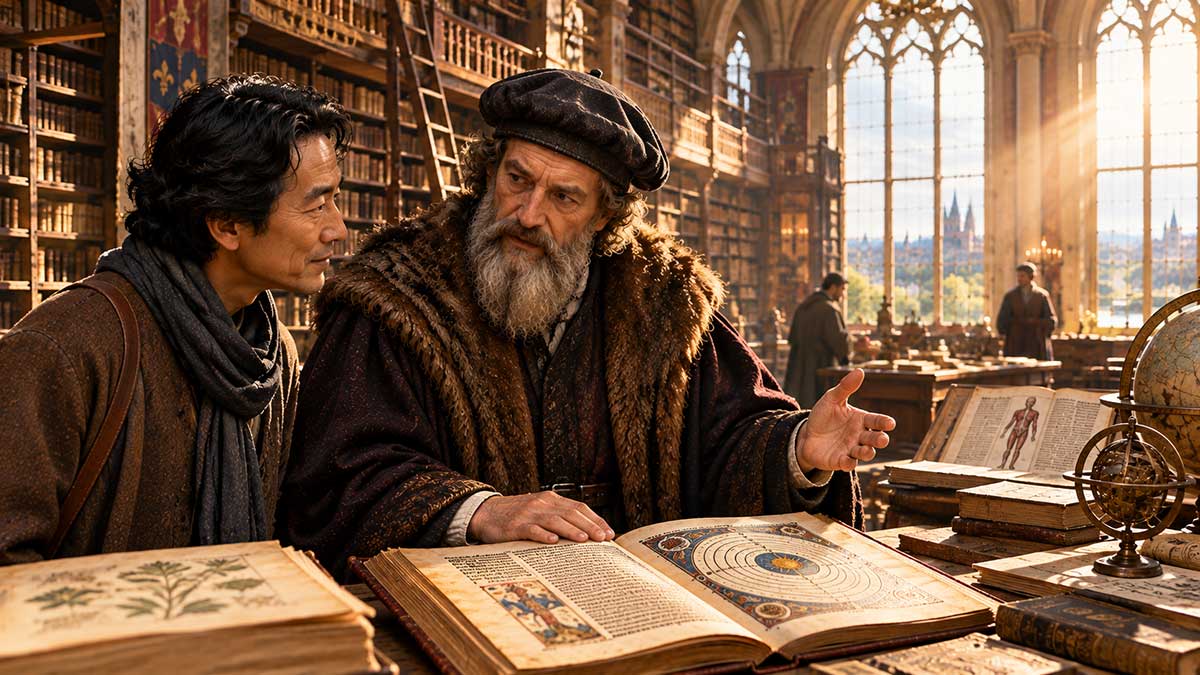
Opening: The Library That Should Not Exist
An imaginary library beyond ordinary time. Johannes Gutenberg and Nick Sasaki step out of the fifteenth-century workshop and into a hall filled with books from across six centuries.
The first thing Gutenberg notices is the silence.
No hammers striking metal. No wooden press creaking under pressure. No workers calling for fresh paper.
Only the faint sound of footsteps across a polished stone floor.
Then he looks up.
Shelves rise toward a vaulted ceiling, filled with thousands upon thousands of books. Some are bound in leather. Others are small and brightly colored. There are enormous scientific volumes, children's stories, religious texts, atlases, and books written in languages Gutenberg has never encountered.
Sunlight falls through tall windows.
Gutenberg stops walking.
Johannes Gutenberg: Nick...
Nick Sasaki: Yes?
Gutenberg: What is this place?
Nick: A library.
Gutenberg: I can see that it contains books. But how many?
Nick: More than we could count before dinner.
Gutenberg: And these are all manuscripts?
Nick: Almost none of them.
Gutenberg slowly turns toward him.
Gutenberg: Printed?
Nick: Printed.
Gutenberg: All of them?
Nick: Nearly all.
Gutenberg walks toward a shelf and removes a small book.
He turns it over, examines the binding, and opens it.
Gutenberg: The letters are remarkably small.
Nick: Printing methods continued improving after your lifetime.
Gutenberg: And the paper is thin.
Nick: Yes.
Gutenberg: Yet the impression is clear.
He turns several pages.
Gutenberg: How much does a book like this cost?
Nick: Some books in my time cost less than an ordinary meal.
Gutenberg looks up sharply.
Gutenberg: Less than a meal?
Nick: Yes.
Gutenberg: And people purchase them?
Nick: Millions of them.
He pauses.
Gutenberg: Then your world must contain an extraordinary number of readers.
Nick: It does. Though access to education and books is still unequal.
Gutenberg: I see.
Gutenberg carefully returns the book to its shelf.
Gutenberg: Nick, when you asked whether I wanted to see the future of printing, I expected perhaps a finer press.
I did not expect this.
Nick: And we haven't reached the most surprising part.
Gutenberg: You seem to enjoy saying that.
Nick: (Laughing) I admit it.
Gutenberg: Then show me what happened.
Question 10: Did Printing Change Christianity?
Nick leads Gutenberg toward a long wooden table.
Several books lie open beneath the sunlight. One is a Latin Bible. Nearby are early printed religious pamphlets, a German Bible, and works from the Protestant Reformation.
Gutenberg examines the pages.
Nick: Johannes, I want to begin with Christianity.
Gutenberg: A natural place to begin, considering the book we have just left behind.
Nick: Decades after your death, a German monk named Martin Luther challenged important teachings and practices of the Catholic Church.
Gutenberg: A monk?
Nick: Yes. In 1517, he became associated with a controversy over indulgences that developed into a much larger religious movement.
Gutenberg: And what has this to do with printing?
Nick: His writings were reproduced and circulated through printing presses.
Arguments that might once have traveled slowly through handwritten copies could reach many towns and cities.
Gutenberg: How many copies?
Nick: Enormous numbers by the standards of your century. Luther became one of the most widely published authors of his age.
Gutenberg examines a pamphlet.
Gutenberg: Such a small book.
Nick: Exactly. It was relatively inexpensive to produce and easier to distribute than a large Bible.
Gutenberg: And people read these arguments?
Nick: They read them, discussed them, argued over them, and sometimes fought over them.
Gutenberg: Fought?
Nick: Religious conflict became one of the defining features of European history in the centuries that followed.
Printing contributed to the circulation of competing religious ideas, though it was far from the only cause of those conflicts.
Gutenberg looks down at the pamphlet again.
Gutenberg: You are telling me that a method for producing books helped people challenge religious authorities?
Nick: Yes.
Gutenberg: Including the authorities responsible for preserving and teaching Scripture?
Nick: Including them.
Gutenberg remains silent for a moment.
Gutenberg: That is a serious matter.
Nick: What troubles you about it?
Gutenberg: I would first wish to know what was being taught.
A printed argument is not made true simply by appearing on a page.
Nick: That's exactly the problem.
Gutenberg: Then why should the method of printing determine whether the argument deserves belief?
Nick: It shouldn't.
But printing changes how many people can encounter an argument.
Gutenberg: Ah.
He taps the pamphlet lightly.
Gutenberg: So the printer gives the argument a wider audience.
Nick: Yes.
Gutenberg: But the reader must still judge it.
Nick: Ideally.
Gutenberg: And who teaches the reader to judge?
Nick smiles.
Nick: Johannes, that's a question we're still struggling with.
Gutenberg: Then perhaps you should have begun there.
They share a small laugh.
Nick: Let me ask you something more difficult.
In your time, the Catholic Church holds enormous religious authority.
What would you think about ordinary Christians reading Scripture in their own languages and reaching different conclusions from established church leaders?
Gutenberg: I would ask several questions.
Who prepared the translation?
Was it accurate?
Who was teaching the reader?
And what would happen if people disagreed about the meaning?
Nick: Those are precisely the kinds of questions people debated.
Gutenberg: Then I suspect the answers were not simple.
Nick: They weren't.
But printing helped make it possible for religious ideas to reach people beyond the institutions that had traditionally controlled much of their circulation.
Gutenberg: And did that bring Christians closer together?
Nick hesitates.
Nick: In some ways, it helped people engage more directly with religious texts.
In other ways, it intensified divisions.
Gutenberg: So the same method could contribute to devotion and disagreement.
Nick: Exactly.
Gutenberg: Interesting.
He looks toward the Latin Bible.
Gutenberg: When a craftsman makes a tool, he cannot assume that everyone who uses it will share his purposes.
Nick: That's what I wanted to explore with you.
Gutenberg: But I would not say that the tool is therefore meaningless.
A knife can prepare bread or injure a man.
The moral question concerns the person using it.
Nick: Yet the person who creates the tool may still have responsibilities.
Gutenberg: Certainly. We should discuss those responsibilities.
But first, Nick, I have a question for you.
Nick: Go ahead.
Gutenberg: In your century, after all these arguments, do Christians agree about what it means to follow Christ?
Nick smiles sadly.
Nick: Not entirely.
There are many traditions, denominations, and interpretations.
Gutenberg: And do they still read the Bible?
Nick: Very much.
Gutenberg: Then perhaps the challenge is not merely making the words available.
Nick: What do you think the challenge is?
Gutenberg: Helping human beings approach those words with wisdom, humility, and sincerity.
Nick looks at him thoughtfully.
Nick: That is something I care deeply about.
I believe faith should help us love one another, not simply prove that our own group is right.
Gutenberg: A worthy aspiration.
Though I suspect putting it into practice is harder than printing it.
Nick: (Laughing) Much harder.
Gutenberg: Then we have found another problem your machines cannot solve.
Question 11: What Happens When Discoveries Can Travel?
They continue walking through the library.
The religious volumes give way to books filled with diagrams, mathematical symbols, maps, and illustrations of the human body.
Gutenberg stops before an enormous astronomical volume.
Gutenberg: What is this?
Nick: A book about the heavens.
Gutenberg: Astronomy?
Nick: Yes. And this one contains an idea that challenged how Europeans understood the universe.
Nick opens a copy of Nicolaus Copernicus's On the Revolutions of the Heavenly Spheres.
Nick: This book was published in 1543, seventy-five years after your death.
Copernicus argued for a model in which Earth moves around the Sun.
Gutenberg: The Earth moves?
Nick: Yes.
Gutenberg: And the Sun does not travel around us each day?
Nick: The apparent daily motion of the Sun is largely explained by Earth's rotation.
Gutenberg studies the diagram.
Gutenberg: That is a remarkable claim.
Nick: It was.
Gutenberg: And how did he establish it?
Nick: Through mathematical reasoning and astronomical observations available in his time. Later scientists gathered further evidence and developed better models.
Gutenberg: Then this book did not settle the matter by itself.
Nick: No. Scientific progress took generations.
Gutenberg: Good. I should be suspicious of anyone who claimed to settle the entire heavens in a single volume.
Nick laughs.
Nick: Fair enough.
Gutenberg: But I can see why printing would be useful.
A scholar in one city could study the same diagram as a scholar in another.
Nick: Exactly.
Gutenberg: They could examine the argument, identify errors, and prepare responses.
Nick: Yes.
Gutenberg: And those responses could be printed too.
Nick: Now you're seeing it.
Gutenberg looks around the room.
Gutenberg: Then a book need not be the end of an argument.
It can become the beginning of a much larger conversation.
Nick: That's beautifully put.
Gutenberg: How many people could take part?
Nick: Eventually, scholars across continents.
Gutenberg: Continents?
Nick: Across the entire world.
Gutenberg looks genuinely astonished.
Gutenberg: You mean a scholar in Europe could exchange discoveries with someone in Asia?
Nick: Yes.
Gutenberg: Without traveling there?
Nick: Yes.
Gutenberg: Extraordinary.
He pauses.
Gutenberg: Though I imagine the letters must take a very long time to arrive.
Nick: At first, they did.
Later, communication became much faster.
Gutenberg: How much faster?
Nick: I'll show you in a little while.
Gutenberg: You are becoming rather tiresome with your secrets, Nick.
Nick: (Laughing) I promise it'll be worth the wait.
Nick leads him toward another display.
There are anatomical illustrations, botanical studies, printed maps, and mathematical treatises.
Nick: Johannes, think about what this means.
A physician can study a diagram of the human body.
An astronomer can compare observations.
A mathematician can examine another person's calculations.
A student can learn from someone who lived centuries earlier.
Gutenberg: But surely scholars could exchange manuscripts before printing.
Nick: They could, and they did.
Printing didn't create scholarship. It made reproducing and circulating many texts more efficient.
Gutenberg: An important distinction.
Nick: Yes.
Gutenberg: And what of mistakes?
Nick: What do you mean?
Gutenberg: Suppose a diagram is wrong.
If a scribe makes one incorrect copy, perhaps only a few people encounter the error.
But if a printer produces hundreds of copies...
Nick: Hundreds of people might learn the same mistake.
Gutenberg: Precisely.
Nick: That's one of the great problems of mass communication.
Gutenberg: Then printing can spread errors just as efficiently as discoveries.
Nick: It can.
Gutenberg: Does that trouble your scholars?
Nick: Very much. That's one reason they develop methods of checking evidence, repeating experiments, and challenging published claims.
Gutenberg: Sensible.
Nick: Yet those methods are imperfect.
Gutenberg: Of course. Human beings are involved.
Nick laughs.
Nick: Johannes, you have a wonderfully realistic view of people.
Gutenberg: I have dealt with investors.
Nick: (Laughing) That explains quite a lot.
They stop before a long shelf of books.
Nick: I want to tell you something that I think might move you.
Gutenberg: Go on.
Nick: There are people in my century who have never met their favorite authors.
Some of those authors died hundreds of years ago.
Yet their words have changed people's lives.
A person who feels lonely can find comfort in a book.
Someone who has lost hope can discover a new way of seeing the world.
A child born into poverty can encounter ideas that open possibilities far beyond the life they were born into.
Gutenberg listens quietly.
Nick: I think that's one of the most beautiful things about books.
They allow human beings to reach across distance and time.
Gutenberg: That is a remarkable thought.
Nick: And your work helped make that possible on a much larger scale.
Gutenberg: I would be pleased if the method proved useful.
But Nick, you must not give one man credit for everything that followed.
These books represent the labor of many generations.
Nick: You're right.
Gutenberg: Authors, scholars, printers, teachers, readers.
And, I suspect, many people whose names have been forgotten.
Nick: Yes.
Gutenberg: Then perhaps the greater achievement belongs to all of them.
Nick smiles.
Nick: I think that's exactly right.
Question 12: Can a Great Invention Be Used for Evil?
The two men enter a quieter section of the library.
Here, the books are different.
Some contain political arguments. Others document religious persecution, wars, revolutions, and campaigns of hatred.
There are printed proclamations, propaganda posters, and newspapers from troubled periods of history.
Gutenberg studies a display of conflicting pamphlets.
Gutenberg: These seem rather less peaceful than the scientific volumes.
Nick: They are.
Gutenberg: What happened?
Nick: Many things.
Printing helped people spread ideas that challenged injustice.
It helped communities organize, debate laws, and demand greater freedom.
But it was used to spread lies, prejudice, and hatred too.
Gutenberg: I see.
Nick: In some periods, governments and political movements used printed material to persuade people that entire groups of human beings were dangerous or inferior.
Gutenberg: And people believed them?
Nick: Some did.
Gutenberg: Even when the claims were false?
Nick: Yes.
Gutenberg looks down at a printed page.
Gutenberg: Then the ability to reproduce words does not guarantee that those words deserve to be believed.
Nick: Exactly.
Gutenberg: That seems obvious when you say it.
Nick: It does.
But when people see something repeated many times, they sometimes begin to assume it must be true.
Gutenberg: Because many copies exist?
Nick: Yes.
Gutenberg: That is a strange form of reasoning.
Nick: It is. But it's common.
Gutenberg slowly closes the book.
Gutenberg: Tell me, Nick. Do the people who print these falsehoods know they are false?
Nick: Sometimes. Other times, they sincerely believe what they're publishing.
Gutenberg: Then there are at least two problems.
Dishonesty and error.
Nick: Yes.
Gutenberg: And perhaps a third.
Nick: What's that?
Gutenberg: Readers who accept claims without examining them.
Nick: I think you're right.
Gutenberg: Then making books plentiful cannot solve the problem by itself.
Nick: No.
Gutenberg: But neither would preventing people from reading.
Nick: That's the difficult balance.
Gutenberg: Explain.
Nick: Some people argue that dangerous ideas should be restricted.
Others argue that authorities can abuse censorship to silence legitimate criticism.
And history gives us examples of both dangers.
Gutenberg: Then who decides what may be printed?
Nick: Different societies have answered that question differently.
Gutenberg: And have they found a perfect answer?
Nick: No.
Gutenberg: I suspected as much.
They walk slowly past the displays.
Nick: Johannes, I want to ask you something difficult.
Your printing methods eventually helped circulate education, religious devotion, scientific discoveries, and arguments for human freedom.
But they could spread hatred, falsehoods, and propaganda too.
How responsible is an inventor for what others do with an invention?
Gutenberg stops walking.
Gutenberg: That is a serious question.
Nick: I think so.
Gutenberg: Suppose a craftsman makes a knife.
He intends it for useful work.
Another person uses it to injure someone.
Should the craftsman be blamed?
Nick: Not automatically.
Gutenberg: But suppose the craftsman knows that a particular customer intends to use the knife for murder.
Would that change the matter?
Nick: Yes.
Gutenberg: Then responsibility may depend partly on what the maker knows, what he intends, and what choices remain within his control.
Nick: That's a thoughtful distinction.
Gutenberg: Yet I would hesitate to claim that a man bears responsibility for every action committed by people who use his work centuries after his death.
Nick: I agree.
But what about the printer?
The person who decides what words to reproduce?
Gutenberg: That seems a more immediate responsibility.
A printer cannot always know whether every claim is true.
But he can consider what he is being asked to publish.
Nick: Should he refuse to print certain things?
Gutenberg: Perhaps. But then we must return to your earlier question.
Who decides?
Nick: Exactly.
Gutenberg: A printer may refuse a work from conscience.
A ruler may forbid a work to protect his authority.
Those are not necessarily the same thing.
Nick: That's an excellent distinction.
Gutenberg: And I suspect a man who possesses the authority to silence others may not always use it wisely.
Nick: History certainly supports that concern.
Gutenberg examines another pamphlet.
Gutenberg: Nick, you have shown me extraordinary things.
Books that spread knowledge.
Books that encourage faith.
Books that challenge injustice.
And books that help people deceive and harm one another.
Nick: Yes.
Gutenberg: I begin to understand something.
Nick: What is that?
Gutenberg: You have spent much of this conversation telling me what printing made possible.
But perhaps possibility is not the same as goodness.
Nick looks at him thoughtfully.
Nick: That's exactly what I hoped we would discover together.
Gutenberg: Then perhaps the question is not whether people possess enough books.
Perhaps it is whether they possess enough judgment to use them well.
Nick: Wisdom.
Gutenberg: Yes.
Nick: Johannes, in my time, we have more access to information than any generation before us.
Yet we still struggle with truth, division, and hatred.
Gutenberg: Then I fear you have not solved the oldest human problems.
Nick: No, we haven't.
Gutenberg: Have you at least learned to disagree without fighting?
Nick hesitates.
Nick: Sometimes.
Gutenberg: Only sometimes?
Nick: I'm afraid so.
Gutenberg sighs softly.
Gutenberg: Six hundred years is a long time to remain so quarrelsome.
Nick: (Smiling) You sound disappointed.
Gutenberg: I am beginning to suspect that improving the tools of communication is easier than improving the people who use them.
Nick laughs quietly, then grows thoughtful.
Nick: Johannes, I believe human beings are meant to live as one family under God.
But when I look at history, I see how often we use our beliefs, our knowledge, and even our inventions to divide ourselves.
Sometimes I wonder whether our greatest problem is that we forget the humanity of the person on the other side.
Gutenberg: That is a difficult problem for any machine to solve.
Nick: Yes.
Gutenberg: Perhaps it requires something more personal.
Nick: Such as?
Gutenberg: Listening.
Patience.
The willingness to admit that one may be mistaken.
And perhaps the humility to recognize that another man may know something we do not.
Nick nods slowly.
Nick: I think that's a good place to begin.
Gutenberg: Then perhaps your century has not exhausted its opportunities for improvement.
Closing: The Question Hidden Inside Every Book
The afternoon light in the imaginary library begins to fade.
Nick and Gutenberg return to the long central hall.
Thousands of books surround them.
Gutenberg looks up at the shelves, taking in their extraordinary variety.
Gutenberg: Nick, when we first entered this place, I was astonished by the number of books.
Nick: I remember.
Gutenberg: I thought that such abundance must represent an extraordinary achievement.
Nick: And it does.
Gutenberg: Yes. But now I wonder whether the number of books is the most important measure.
Nick: What would you measure instead?
Gutenberg: What people learn from them.
What they do with that learning.
Whether the knowledge helps them live better lives.
Nick smiles.
Nick: That's a question I've been thinking about for a long time.
Gutenberg: Then perhaps we have both been asking it.
Gutenberg removes a small book from a nearby shelf.
Gutenberg: Tell me something.
In your century, can an ordinary person write a book?
Nick: Yes.
Gutenberg: Without belonging to a wealthy family?
Nick: Yes.
Gutenberg: Without owning a printing workshop?
Nick: Absolutely.
Gutenberg: Then who decides whether the book is published?
Nick: Sometimes a publishing company. But people can publish their own work too.
Gutenberg: Without a printer?
Nick: Without a traditional printer.
Gutenberg stares at him.
Gutenberg: Now you are speaking nonsense.
Nick laughs.
Nick: I know it sounds impossible.
Gutenberg: Books without printers?
Nick: Some books don't even need paper.
Gutenberg: Nick...
He looks genuinely bewildered.
Gutenberg: You have spent the entire day showing me the future of printing, and now you tell me that books no longer require printing?
Nick: Some do. Some don't.
Gutenberg: Then I insist on an explanation.
Nick: I think it's time.
Nick reaches into his pocket and removes a smartphone.
Gutenberg studies the small object.
Gutenberg: What is that?
Nick: Something I think you'll find very interesting.
Gutenberg: It looks like a polished stone.
Nick: In a way, it's a library.
Gutenberg: A library?
Nick: Yes.
Gutenberg: In your hand?
Nick touches the screen. It lights up.
Gutenberg takes an involuntary step closer.
Gutenberg: Good heavens.
Nick: Johannes, welcome to the twenty-first century.
Gutenberg stares at the glowing screen.
Then he looks up at Nick.
Gutenberg: I have a great many questions.
Nick: (Smiling) I was counting on that.
The two men stand together beneath the towering shelves, one holding a device that contains more written knowledge than Gutenberg could have encountered in a lifetime.
Their final conversation will explore a world where information travels instantly, machines can generate words, and humanity must confront a question that no printing press or computer can answer on its own:
Has greater access to knowledge made us wiser?
End of Topic 4.
Historical note: This is a fictional conversation. Gutenberg's words, reactions, opinions, and interactions with Nick Sasaki are imagined, not authentic historical quotations. The library outside ordinary time is an invented setting. The Protestant Reformation began after Gutenberg's death in 1468, and the publication of Copernicus's major astronomical work occurred in 1543. Printing contributed to the spread of religious, scientific, and political ideas, but these developments involved many other people, institutions, technologies, and historical conditions. Gutenberg's views on later religious movements, censorship, and modern concepts of freedom of expression are speculative.
Topic 5: What Have We Done With Knowledge?
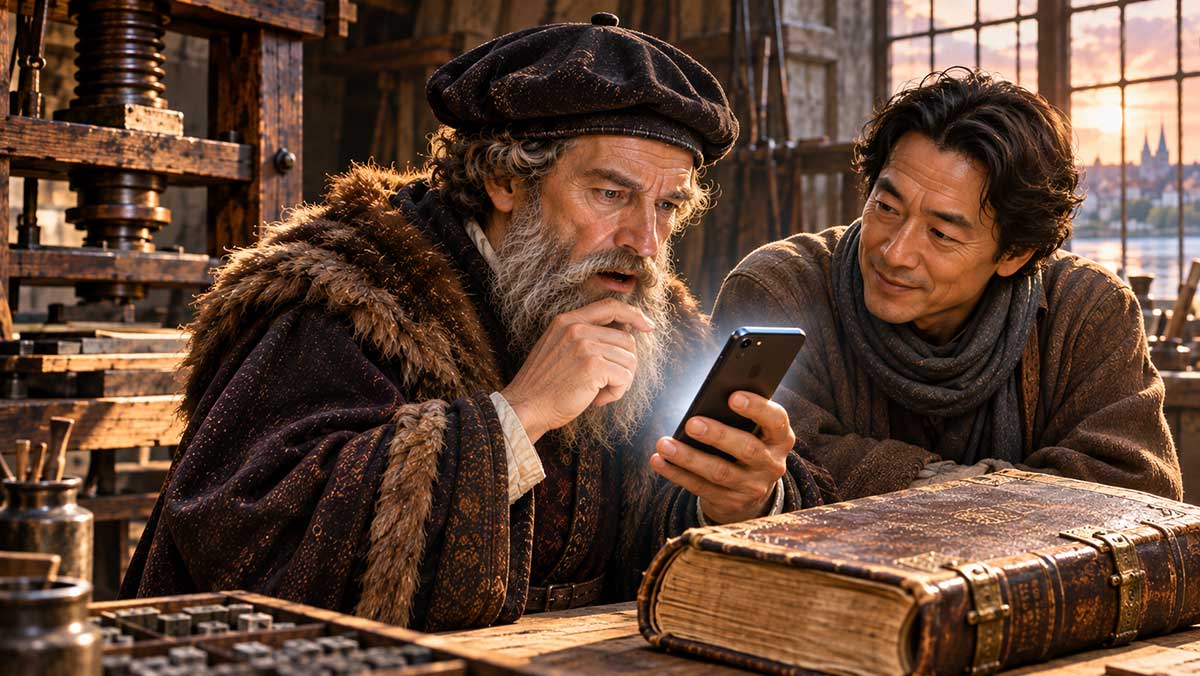
Opening: A Library in the Palm of a Hand
An imagined dawn in Gutenberg's workshop in Mainz. Nick Sasaki and Johannes Gutenberg have returned from their extraordinary visit to a library spanning six centuries.
The workshop is quiet.
Through the narrow windows, the first light of morning touches the wooden press. The tools rest where the workers left them. Small metal letters sit in their compartments, waiting to become words.
A large Bible lies closed on a nearby table.
Beside it rests something that belongs to another age.
A smartphone.
Gutenberg stands over the strange object, studying its smooth black surface.
Johannes Gutenberg: Nick, I have examined this thing from every side.
Nick Sasaki: And?
Gutenberg: I can find no place to put the paper.
Nick: (Laughing) It doesn't need paper.
Gutenberg: Nor can I see any letters.
Nick: They're inside.
Gutenberg: Inside?
Nick: In a manner of speaking.
Gutenberg: And you expect me to believe that this object contains books?
Nick: Thousands of them.
Gutenberg: Without paper, ink, or type?
Nick: Yes.
Gutenberg folds his arms.
Gutenberg: Nick, I have enjoyed our conversations. But I am beginning to suspect that you have a very unusual sense of humor.
Nick: Give me a moment.
Nick touches the screen.
Light fills the small rectangle. Words appear, arranged in clean, perfectly formed lines.
Gutenberg leans forward.
Gutenberg: Extraordinary.
Nick moves his finger across the glass. The words slide upward, and new paragraphs appear.
Gutenberg: Wait.
Nick: What?
Gutenberg: Do that again.
Nick scrolls.
Gutenberg: The page moves, but the object does not change.
Nick: Exactly.
Gutenberg: Where are the other pages?
Nick: They're stored electronically.
Gutenberg: You are using another mysterious word.
Nick: I know.
Gutenberg: Could you explain it without inventing three more?
Nick laughs.
Nick: I'll try.
He pulls up a chair.
Nick: Johannes, you've spent years developing a way to reproduce written words.
In my time, we've developed ways to store and display words using electrical signals and tiny electronic components.
Gutenberg: So the letters are formed by light?
Nick: Yes, on this screen.
Gutenberg: And you can change them?
Nick: Instantly.
Gutenberg: Without rearranging metal type?
Nick: Without touching a single piece of type.
Gutenberg slowly sits down.
Gutenberg: I believe I need a moment.
Nick: Take your time.
Gutenberg: Six hundred years of improvement, and you have finally found a way to put a printing workshop out of business.
Nick: (Laughing) People still print books.
Gutenberg: Good. I was beginning to worry about my colleagues.
They share a laugh.
Nick: But this little device has changed the way humanity communicates.
Gutenberg: Then I would like to understand it.
Nick: That's exactly what I hoped you'd say.
Question 13: What Is a Library in Your Pocket?
Nick: Johannes, this small object can contain thousands of books. And it can send words across the world almost instantly. What would you want to know first?
Gutenberg: How?
Nick: (Smiling) Of course.
Gutenberg: You expected me to ask something else?
Nick: I thought you might ask what people read.
Gutenberg: We shall come to that. First, tell me how the words travel.
Nick: Through something called the internet.
Gutenberg: Another mysterious word.
Nick: Think of it as an enormous network connecting computers around the world.
Gutenberg: Computers?
Nick: Machines that process and store information.
Gutenberg: And they communicate with one another?
Nick: Yes.
Gutenberg: Across cities?
Nick: Across countries and oceans.
Gutenberg: How long does it take?
Nick: Often less than a second.
Gutenberg stares at him.
Gutenberg: Less than a second?
Nick: Yes.
Gutenberg: To send a message from Mainz to a distant country?
Nick: Yes.
Gutenberg: Then what has become of the messengers?
Nick: We still have delivery services. But many messages no longer need someone to carry them physically.
Gutenberg looks toward the workshop door.
Gutenberg: A letter that travels without a messenger.
A book without paper.
A page that changes without a press.
He turns back toward Nick.
Gutenberg: Your century has made an extraordinary habit of removing the things I thought were necessary.
Nick: (Laughing) That's one way to describe progress.
Gutenberg: Show me another book.
Nick opens a digital edition of a classic work.
Gutenberg: And another.
Nick selects a different title.
Gutenberg: Again.
Nick changes the screen.
Gutenberg: Astonishing.
Nick: There's more.
Gutenberg: Of course there is.
Nick: People can publish their own writing and make it available to readers across the world.
They don't necessarily need a traditional publisher or a printing workshop.
Gutenberg: Anyone?
Nick: Almost anyone with access to the necessary technology.
Gutenberg: A farmer?
Nick: Yes.
Gutenberg: A craftsman?
Nick: Yes.
Gutenberg: A young student?
Nick: Absolutely.
Gutenberg sits quietly.
Gutenberg: That is a remarkable change.
Nick: It is.
Gutenberg: In my world, producing a book requires resources that few individuals possess.
If people can publish without those resources, many more voices may be heard.
Nick: Exactly.
Gutenberg: And do they have worthwhile things to say?
Nick smiles.
Nick: Some do.
Gutenberg: Only some?
Nick: Let's say the quality varies considerably.
Gutenberg: Ah.
Gutenberg chuckles.
Gutenberg: Then perhaps the difficulty of publishing once served as a kind of obstacle.
Not always a fair obstacle, I grant you.
But an obstacle nonetheless.
Nick: That's a fascinating observation.
Today, almost anyone can publish an opinion.
That gives people extraordinary freedom.
But it means we're surrounded by more information than we can possibly examine.
Gutenberg: Then how do you choose what to read?
Nick: That's one of our biggest challenges.
Gutenberg: Do you have librarians?
Nick: Yes.
Gutenberg: Scholars?
Nick: Yes.
Gutenberg: Teachers?
Nick: Of course.
Gutenberg: Then perhaps their work has become more necessary, not less.
Nick pauses.
Nick: Johannes, I think you're right.
Gutenberg: But tell me something.
Do people still love books?
Nick: Very much.
Gutenberg: Real books?
Nick: With paper and covers?
Gutenberg: Yes.
Nick: Millions of people still buy them.
Gutenberg: Good.
Nick: Some readers prefer electronic books. Others prefer paper. Many enjoy both.
Gutenberg: Then the new method has not entirely displaced the old.
Nick: No.
Gutenberg: That pleases me.
Nick reaches toward the large Bible.
Nick: There's something beautiful about this, Johannes.
Your printed Bible and my smartphone are separated by centuries of invention.
Yet both are attempts to help human beings share words.
Gutenberg: That much I can recognize.
Nick: And both raise the same question.
Gutenberg: Which is?
Nick: What will people do with those words?
Gutenberg looks at the glowing screen.
Gutenberg: Yes.
That seems the question worth asking.
Question 14: Can Machines Produce Wisdom?
The morning light grows stronger.
Nick places the smartphone on the table beside the Bible.
Nick: Johannes, there's something else I want to show you.
Gutenberg: I am beginning to fear that every time you say that, another part of my world disappears.
Nick: (Laughing) I promise your workshop is safe.
Gutenberg: Very well. Continue.
Nick: In my time, machines can generate writing, images, and even conversations.
We call some of this artificial intelligence, or AI.
Gutenberg: Artificial intelligence?
Nick: Yes.
Gutenberg: Do you mean a machine that thinks?
Nick: That's a question people debate.
Modern AI systems can recognize patterns in enormous amounts of information and generate responses that often resemble human writing.
But what those abilities tell us about thought or experience remains disputed.
Gutenberg: Then you have created machines whose abilities you do not entirely understand?
Nick: We understand many aspects of how they are built and trained, but there are still difficult questions about their behavior and capabilities.
Gutenberg: Interesting.
Nick: Let me demonstrate.
Nick types a request into an AI system, asking for a short explanation of Gutenberg's printing innovations.
Within moments, a paragraph appears.
Gutenberg leans closer.
Gutenberg: Who wrote that?
Nick: The AI generated it.
Gutenberg: How long did it take?
Nick: A few seconds.
Gutenberg: And you did not employ a scribe?
Nick: No.
Gutenberg: Nor a scholar?
Nick: No person wrote that particular response.
Gutenberg studies the words.
Gutenberg: Is it accurate?
Nick: Let's examine it.
They read the explanation together.
Gutenberg: This part describes the metal letters reasonably well.
But here it says I invented printing itself.
Nick: Good catch.
Gutenberg: We have already discussed printers in Asia who developed earlier methods.
Nick: Exactly.
Gutenberg: Then the machine has made a mistake.
Nick: Yes. AI can produce convincing statements that are false.
Gutenberg: Yet the words appear with the same confidence as the accurate ones.
Nick: That's one of the problems.
Gutenberg: Does the machine tell you when it is uncertain?
Nick: Sometimes. But not reliably enough to replace verification.
Gutenberg: Then it is a useful assistant that requires careful supervision.
Nick: That's a sensible way to approach it.
Gutenberg: Would you permit such a machine to prepare a Bible without anyone checking the text?
Nick: No.
Gutenberg: Why not?
Nick: A mistake could change the meaning.
Gutenberg: Precisely.
He gestures toward the printed Bible.
Gutenberg: We have spent considerable effort trying to produce consistent pages.
But consistency is not the same as correctness.
A perfectly printed error remains an error.
Nick: That's a remarkable connection.
Gutenberg: Is it?
Nick: Yes.
Your printing system made it easier to reproduce words.
AI makes it easier to generate words.
But neither guarantees that those words are true.
Gutenberg: Then the problem has changed in scale, but perhaps not entirely in nature.
Nick: Exactly.
Gutenberg: Who checks these machines?
Nick: Developers test them. Researchers study their behavior. People evaluate their outputs. But the systems are used in many situations, and mistakes still occur.
Gutenberg: And can anyone use them?
Nick: Many people can.
Gutenberg: Then I suspect they are being asked to do things their makers never anticipated.
Nick: Very much so.
Gutenberg: That sounds familiar.
Nick laughs.
Nick: It should.
Gutenberg: But tell me, Nick. If a machine can write a convincing explanation in seconds, what becomes of the person who has spent years studying the subject?
Nick: That's one of the questions people are asking.
Gutenberg: Does the machine possess that person's judgment?
Nick: It may reproduce some useful patterns from expert work, but that doesn't mean it has the same judgment or accountability.
Gutenberg: Then perhaps expertise remains valuable.
Nick: I believe it does.
Gutenberg: Good.
Nick: Yet some people worry that these machines will replace human work.
Gutenberg: And others hope they will make difficult work easier?
Nick: Yes.
Gutenberg: Then I recognize the disagreement.
Nick: From printing?
Gutenberg: From the introduction of any method that changes how labor is performed.
A new technique may create opportunities for some and threaten the livelihood of others.
The people who benefit may celebrate it.
The people who suffer may see it differently.
Nick: That's a very human way to look at it.
Gutenberg: I should hope so. I am human.
Nick laughs.
Nick: Fair point.
Gutenberg: But I have another question.
Nick: Go ahead.
Gutenberg: If your machines can produce so many words, why do people need to write anything themselves?
Nick thinks for a moment.
Nick: Perhaps for the same reason people still make things by hand.
Writing can be more than producing a finished result.
It can help us discover what we think.
Gutenberg: Explain.
Nick: Sometimes we don't know what we truly believe until we struggle to express it.
We write, reconsider, cross something out, and begin again.
The process changes us.
Gutenberg: Then the value lies partly in the work itself.
Nick: Yes.
Gutenberg: I understand that very well.
He picks up a piece of metal type.
Gutenberg: A man who has never made a letter may admire a printed page.
But the craftsman who has struggled to make the letter knows something different about the work.
Nick: Exactly.
Gutenberg: Perhaps your machines can save people labor.
But you should take care not to surrender every form of labor that helps people develop judgment.
Nick becomes quiet.
Nick: Johannes, I think that's one of the deepest concerns about AI.
We want machines to help us think.
But we don't want to stop thinking for ourselves.
Gutenberg: Then do not let them.
Nick: (Smiling) You make it sound simple.
Gutenberg: The principle may be simple.
Living by it is another matter.
They sit quietly for a moment.
Nick: Let me ask you something.
If you could send one message to the people building these systems, what would it be?
Gutenberg: I would ask them to remember the reader.
Nick: The reader?
Gutenberg: Yes.
In my workshop, it is easy to become absorbed in metal, ink, machinery, and the difficulties of production.
But the finished book will eventually reach another human being.
That person may trust what is written.
They may learn from it.
They may act upon it.
If your machines produce words that influence people's decisions, then the people who build and use those machines should take that responsibility seriously.
Nick: I couldn't agree more.
Gutenberg: Then perhaps the future of communication is not simply a question of what machines can accomplish.
Nick: What is it?
Gutenberg: What human beings ought to accomplish with their help.
Question 15: Have We Become Wiser?
The first full sunlight of morning enters the workshop.
The wooden press stands beside the table. The printed Bible rests near the glowing smartphone.
Gutenberg looks from one to the other.
Nick: Johannes, we've traveled through nearly six hundred years of history together.
You've seen how printing helped spread religious arguments, scientific discoveries, education, and political ideas.
You've seen how people can now communicate instantly across the world.
And you've seen machines that can generate more writing in a few seconds than a scribe might produce in many days.
Gutenberg: It has been an extraordinary visit.
Nick: But I want to ask you one final question.
Humanity has gained access to more information than people in your lifetime could have dreamed of.
Have we become wiser?
Gutenberg does not answer immediately.
He walks toward the window and looks out at the rooftops of Mainz.
Gutenberg: Nick, I do not know enough about your century to answer that fairly.
Nick: That's an honest answer.
Gutenberg: You have shown me remarkable accomplishments.
But you have told me about terrible conflicts too.
I cannot judge six hundred years of human history from a handful of examples.
Nick: That's true.
Gutenberg: But perhaps we should begin by asking what you mean by wisdom.
Nick: What would you say?
Gutenberg: Knowledge tells a craftsman how to make a sharp blade.
Wisdom asks when it should be used.
Knowledge tells a printer how to reproduce a thousand pages.
Wisdom asks whether those pages contain something worth spreading.
Nick: I like that distinction.
Gutenberg: Then perhaps wisdom involves judgment.
And judgment requires more than possessing information.
Nick: I agree.
Gutenberg: But tell me something, Nick.
In your century, do people have opportunities to learn from the lives of others?
Nick: More than ever.
Gutenberg: Can they study history?
Nick: Yes.
Gutenberg: Can they read the words of people who lived in distant countries and earlier centuries?
Nick: Absolutely.
Gutenberg: Then they possess extraordinary opportunities to become wiser.
Nick: Opportunities.
Gutenberg: Yes.
Whether they use those opportunities is another question.
Nick smiles thoughtfully.
Nick: Johannes, there's something I've wanted to tell you since we first met.
Gutenberg: Go on.
Nick: I believe humanity is one family under God.
And I believe our greatest challenge is learning to recognize one another as brothers and sisters.
We have different languages, cultures, religions, and histories.
But beneath those differences, we share the same longing to be loved, to belong, and to live meaningful lives.
Gutenberg: That is a large hope.
Nick: It is.
Gutenberg: And do you believe books can help people recognize that shared humanity?
Nick: I do.
A book can introduce us to someone we would never otherwise meet.
It can let us experience another person's suffering.
It can challenge our prejudices.
Sometimes a story can move us to tears and make us kinder.
Gutenberg: Then perhaps the printed word can serve a purpose greater than conveying information.
Nick: Yes.
Gutenberg: It can help one person encounter the experience of another.
Nick: Exactly.
Gutenberg looks toward the shelves of printed pages.
Gutenberg: But I suppose a book can do the opposite as well.
Nick: It can.
Gutenberg: It can teach a reader to despise someone he has never met.
Nick: Yes.
Gutenberg: Then the responsibility is considerable.
Nick: It is.
Gutenberg: Nick, may I ask you a question?
Nick: Of course.
Gutenberg: You have spoken about humanity as one family.
Do you believe people can learn to love those who disagree with them?
Nick pauses.
Nick: I believe we must try.
Gutenberg: Even when the disagreement concerns something deeply important?
Nick: Especially then.
That doesn't mean pretending every idea is equally true.
It means recognizing that the person holding a different belief is still a human being worthy of dignity.
Gutenberg: And how do you teach that?
Nick: Through families, education, faith, example, and perhaps through the stories we tell.
Gutenberg: Then you have your work before you.
Nick: (Smiling) I certainly do.
Gutenberg: But perhaps that is not such a bad thing.
Nick: What do you mean?
Gutenberg: A worthwhile task need not be completed in one lifetime.
Nick looks at him.
Gutenberg: Consider this workshop.
I can work on the methods of producing books.
Others may improve those methods.
Still others may use them to publish works I could never have conceived.
The work passes from one generation to another.
Nick: That's a beautiful way to see it.
Gutenberg: Perhaps the work of becoming wiser is similar.
One generation learns something.
The next may learn more.
Sometimes people make terrible mistakes.
But they need not abandon the effort.
Nick: Johannes, do you think humanity will ever reach a point where we no longer need to struggle with these questions?
Gutenberg: I doubt it.
Nick: Why?
Gutenberg: A new generation must learn how to live.
A new invention creates new possibilities.
New circumstances require new judgments.
Perhaps wisdom is not something humanity can simply manufacture and store away like a completed book.
Nick: Then what is it?
Gutenberg: Something people must continue practicing.
Nick sits quietly, considering the answer.
Nick: You know, Johannes, I came here wanting to meet the man who helped change the history of communication.
But I've discovered something else.
Gutenberg: What is that?
Nick: The story isn't really about a machine.
It's about people.
The people who created it.
The people who used it.
The people whose lives were changed by the words it carried.
Gutenberg: That seems reasonable.
Nick: And perhaps the most important question isn't how many books we can print or how much information we can store.
Gutenberg: What is it?
Nick: Whether all that knowledge helps us become better human beings.
Gutenberg looks at Nick for a long moment.
Gutenberg: Then I hope your century is still asking that question.
Nick: We are.
Gutenberg: Good.
Closing: One Small Letter
The workshop has grown bright with morning sunlight.
The city outside is waking.
A cart rattles over the cobblestones. Somewhere near the Rhine, church bells begin to ring.
The sounds remind Nick of the morning when he first arrived.
Gutenberg walks to the workbench and picks up a small piece of metal type.
Gutenberg: Nick, do you remember this?
Nick: Of course.
Gutenberg: You struggled to recognize the letter.
Nick: (Laughing) I remember that too.
Gutenberg: You have learned a little about printing since then.
Nick: Thanks to a very patient teacher.
Gutenberg: I would not go so far as to call myself patient.
They laugh.
Gutenberg places the letter beside the smartphone.
For a moment, the two objects rest together.
One is small, heavy, and made of metal.
The other is smooth, bright, and capable of displaying millions of words.
Six centuries of human invention separate them.
Gutenberg: This small letter cannot tell a story by itself.
Nick: No.
Gutenberg: It must be placed beside others.
Letters become words.
Words become sentences.
Sentences become pages.
And pages may become books.
Nick: And books can change lives.
Gutenberg: Perhaps.
He looks at Nick.
Gutenberg: But the words must eventually reach someone willing to read them.
Nick: Yes.
Gutenberg: And reading is not the same as learning.
Nick: No.
Gutenberg: Nor is learning always the same as living wisely.
Nick nods.
Nick: Johannes, I think you've just given me something I want to carry home.
Gutenberg: The metal letter?
Nick: (Smiling) That too.
But more than that.
You've reminded me that the tools we create are only part of the story.
What matters is what we choose to do with them.
Gutenberg considers this.
Gutenberg: Then perhaps your long visit has been worthwhile.
Nick: More than worthwhile.
Nick reaches out his hand.
Nick: Johannes, thank you.
For showing me your workshop.
For answering my questions.
And for helping me see your work through the eyes of the person who lived it.
Gutenberg shakes his hand warmly.
Gutenberg: You have been an unusual visitor, Nick.
Nick: I've been called worse.
Gutenberg: I am sure you have.
They laugh one last time.
Gutenberg: But I have enjoyed our conversation.
Nick: So have I.
Nick begins to gather his things.
Gutenberg watches him place the smartphone into his pocket.
Gutenberg: Nick?
Nick: Yes?
Gutenberg: Before you return to your century, may I ask one last question?
Nick: Anything.
Gutenberg: You told me that nearly anyone in your time can publish words for others to read.
Nick: That's right.
Gutenberg: And you told me that those words can travel across the world in an instant.
Nick: Yes.
Gutenberg pauses.
Gutenberg: Then tell me something.
Nick: What is it?
Gutenberg: When you have something important to say, how do you decide whether it is worth saying?
Nick looks at him, surprised.
For once, he has no immediate answer.
Outside, the church bells continue ringing.
Nick: I suppose I should ask whether it's true.
Gutenberg: A good beginning.
Nick: Whether it's useful.
Gutenberg: Yes.
Nick: And whether it might help someone.
Gutenberg smiles.
Gutenberg: Then perhaps you already know what to do when you return home.
Nick looks at the small piece of metal type resting on the table.
Nick: I think I do.
He gently places it back beside the press.
Nick: It belongs here.
Gutenberg: As do I.
The two men exchange a final smile.
Nick steps through the workshop doorway and into the morning light.
Behind him, Gutenberg returns to his bench.
There are letters to prepare.
Pages to print.
And work that remains unfinished.
The wooden press creaks once more.
A fresh sheet of paper receives its impression.
And somewhere, far beyond the walls of Mainz, the future waits for the words that human beings will choose to share.
End of Topic 5.
Historical note: This is a fictional conversation. Gutenberg's dialogue, personal convictions, reactions to modern technology, and interactions with Nick Sasaki are imaginative reconstructions, not authentic historical quotations or evidence of his endorsement. The smartphone, internet, AI demonstration, and cross-century encounter are fictional devices used to explore genuine questions about communication and responsibility. Gutenberg's historically documented achievements concern the development of an influential European movable-metal-type printing system, not the invention of printing itself, which had earlier traditions in East Asia.
Final Thoughts

When I first imagined meeting Johannes Gutenberg, I expected to encounter one of history's greatest inventors.
I wanted to ask him about movable metal type, the printing press, and the extraordinary achievement of producing his famous Bible.
But as our imaginary conversation unfolded, I found myself becoming interested in something more personal.
What does it mean to devote years of your life to something whose ultimate consequences you cannot possibly foresee?
Gutenberg lived in a world very different from ours.
Books were expensive. Producing them required substantial labor. Knowledge traveled through networks of scholars, religious institutions, merchants, and handwritten manuscripts.
He worked within that world, confronting technical challenges and commercial uncertainty.
He did not live to see the Protestant Reformation, the great scientific publications of later centuries, or the modern transformation of communication.
He could not have known that people centuries after his death would still be studying his printing methods and admiring surviving copies of his Bible.
That realization stayed with me.
Most of us will never know the full consequences of our work.
A teacher may never discover how deeply a lesson influenced a student.
A parent may never see all the ways a simple act of kindness shaped a child's future.
A writer may never meet the person who found hope in something they wrote.
And a craftsman working in a small workshop may contribute to changes far beyond anything he could have anticipated.
Gutenberg's story reminds me that meaningful work is not always measured by immediate recognition or financial success.
His printing enterprise encountered serious difficulties. His financial dispute with Johann Fust is part of the historical record.
Yet the methods associated with his work continued to develop, helping transform how books were produced and circulated throughout Europe.
There is another lesson here.
No great human achievement belongs entirely to one person.
Gutenberg's European printing system was part of a much longer history of human ingenuity.
Centuries earlier, Chinese and Korean innovators had developed remarkable printing technologies.
Gutenberg's own enterprise depended on skilled workers, financial supporters, craftsmen, and others whose contributions are not always fully preserved in historical records.
And the later influence of printing depended on countless authors, translators, educators, scientists, religious leaders, publishers, and readers.
Human progress is a shared accomplishment.
That thought connects deeply with something I believe: humanity is one family under God.
We come from different countries, cultures, and religious traditions. We speak different languages and see many questions differently.
Yet our accomplishments become greater when we learn from one another rather than treating human history as a competition over who deserves all the credit.
The story of printing offers a powerful example.
Knowledge does not have to remain confined within one community. It can travel, be examined, be improved, and become part of a larger human inheritance.
But our imaginary conversation raised a more troubling question.
What happens when the ability to spread information grows faster than our ability to judge it?
Printing helped circulate religious devotion, scholarship, and ideas that challenged established authority.
It contributed to scientific communication and the wider availability of books.
But printed material could spread hatred, falsehoods, and propaganda too.
The same methods that made valuable ideas easier to circulate could reproduce dangerous ones.
That tension has become even more significant in our time.
Today, we can publish a message and reach people across the world almost instantly.
We can access libraries that would have astonished scholars of earlier centuries.
Artificial intelligence can help us research, write, translate, and communicate.
Yet it can produce errors and convincing falsehoods.
And we still struggle to distinguish trustworthy information from manipulation.
We have become extraordinarily skilled at producing and distributing words.
But have we become equally skilled at listening?
At admitting when we are mistaken?
At treating someone who disagrees with us as a human being worthy of dignity?
These are questions that technology cannot settle for us.
They require personal judgment, moral responsibility, and a willingness to care about others.
Perhaps that is why the final image of our imaginary conversation means so much to me.
A small piece of metal type rests beside a smartphone.
One represents a major achievement in the history of European printing.
The other represents centuries of scientific and technological development.
Both can carry words.
Both can help human beings communicate.
But neither can decide whether those words will be used to encourage understanding or deepen division.
That decision belongs to us.
I believe the most meaningful purpose of communication is to help people recognize one another's humanity.
A book can introduce us to someone whose life is completely different from our own.
A story can awaken compassion.
A thoughtful conversation can soften prejudice.
A few sincere words can give hope to someone who has almost lost it.
And sometimes, learning about another person's suffering can move us to become kinder.
That is the kind of communication I hope Imaginary Talks can encourage.
Not simply the exchange of information, but the growth of understanding.
Not simply admiration for famous historical figures, but a deeper appreciation of the human experiences behind their achievements.
And not simply the pursuit of knowledge, but the desire to use knowledge for the sake of others.
I began this imaginary meeting wanting to learn how Gutenberg helped change the production of books.
I leave it with a different question:
If we can now share our words with almost anyone on Earth, what kind of words should we choose to share?
Words that humiliate or words that heal?
Words that deepen hatred or words that encourage understanding?
Words that divide people into enemies or words that remind us of our shared humanity?
We cannot control every consequence of what we create.
But we can take responsibility for our intentions, our actions, and the care with which we communicate.
And perhaps that is where wisdom begins.
Not with knowing everything.
But with recognizing that what we know should help us become more compassionate, more humble, and more responsible human beings.
One small letter can become part of a word.
A word can become part of a sentence.
A sentence can become part of a book.
And a book can change a human life.
The next chapter of humanity's story will depend less on how many words we can produce than on what we choose to do with them.
May the knowledge we share bring us closer to becoming one human family.
Fictional Conversation Disclaimer
The preceding interview and reflections use imagined dialogue to explore Johannes Gutenberg's life and historical influence; his fictional statements are not verified quotations, documented personal beliefs, or endorsements of modern technology, religious interpretations, or the author's views. Historical developments after Gutenberg's death, including the Reformation, modern science, the internet, and artificial intelligence, are presented through a fictional encounter and should not be mistaken for events he personally witnessed.
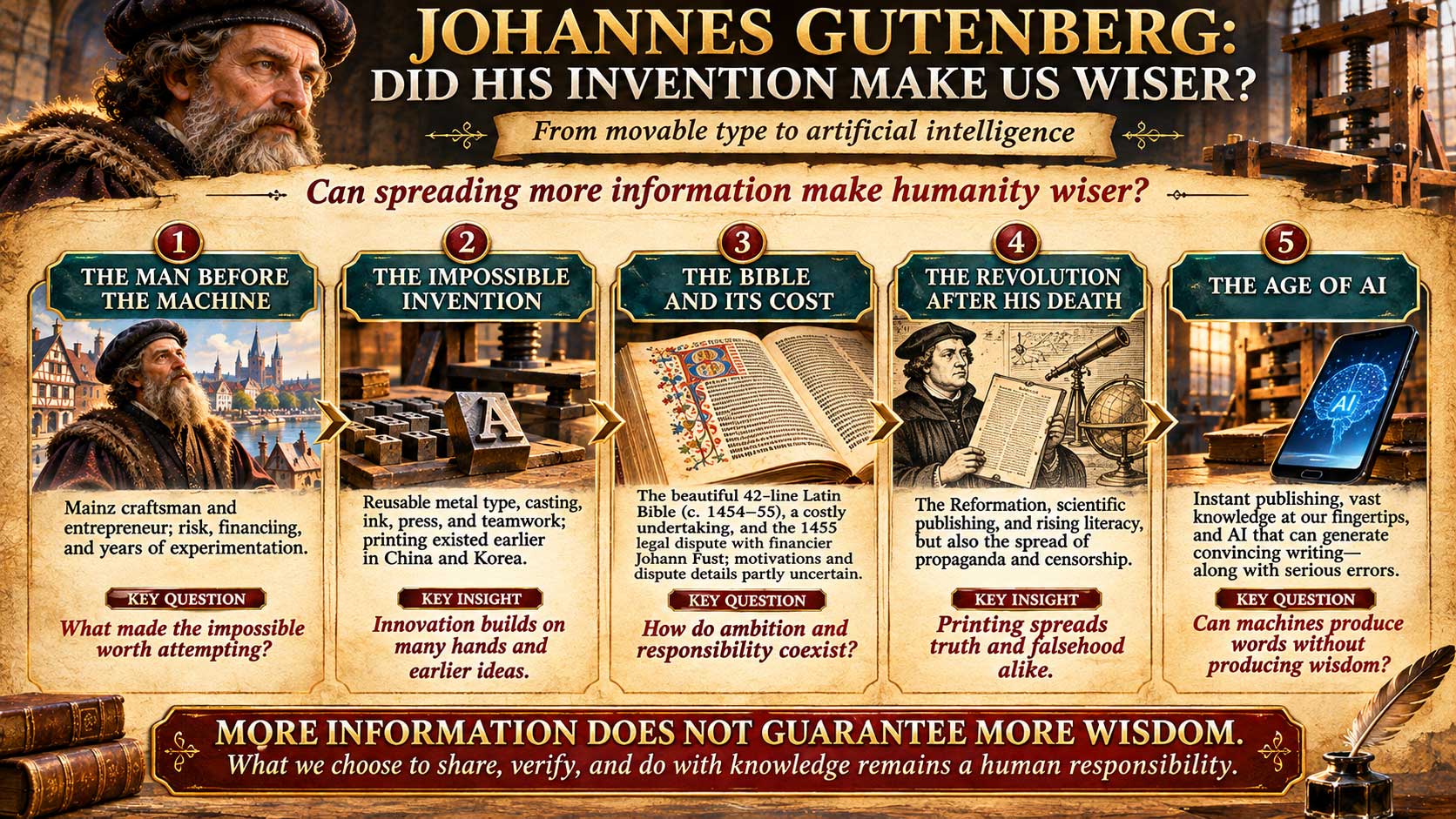
Short Bios:
Johannes Gutenberg (c. 1400–1468)
Johannes Gutenberg, born Johann Gensfleisch zur Laden zum Gutenberg, was a German craftsman, inventor, and entrepreneur from Mainz. He is celebrated for developing an influential European movable-metal-type printing system during the mid-fifteenth century.
His innovations combined precision metal type production, suitable printing ink, press technology, and organized methods of bookmaking. His best-known achievement is the Gutenberg Bible, produced around 1454–1455, one of the most celebrated early European printed books.
Gutenberg's work contributed to the growth of printing throughout Europe, influencing the circulation of religious, scholarly, scientific, and literary texts. Printing and movable type had earlier histories in East Asia, and Gutenberg's precise technical methods and private motivations remain subjects of historical study.
He died in Mainz on February 3, 1468.
Nick Sasaki, Interviewer
Nick Sasaki is the creator of ImaginaryTalks.com, a storytelling project that brings historical figures, thinkers, spiritual leaders, writers, and innovators into fictional conversations about questions that continue to shape human life.
Through imagined interviews grounded in historical research, he explores the personal experiences, achievements, ideas, and challenges of influential individuals.
His work is guided by a belief that humanity is one family under God and that meaningful conversations can encourage greater understanding, compassion, and respect across cultures, generations, and religious traditions.
Imaginary Talks seeks to connect imagination with the enduring human desire for truth, love, peace, and a more compassionate world.
Leave a Reply