
Introduction: Frederick Douglass Escaped Slavery. Why Wasn't That Enough?
Frederick Douglass escaped slavery in September 1838, using borrowed sailor's identification papers and extraordinary courage to travel north from Baltimore. He was only twenty years old. Every encounter with a stranger could have ended his escape, and a single close inspection of his papers might have returned him to bondage. Yet reaching New York did not bring complete security. He had escaped his enslaver, but he remained vulnerable to capture. Why would a man who had risked everything to become free spend the rest of his life fighting for the freedom of others?
Born enslaved in Maryland around 1818, Douglass experienced family separation, violence, and the systematic denial of education. Yet he discovered that learning to read could open possibilities slavery was designed to suppress. His mother, Harriet Bailey, his grandmother, Betsey Bailey, and the people he encountered during childhood shaped his earliest experiences. His own account of these formative years can be found in Narrative of the Life of Frederick Douglass, an American Slave.
His escape was not a solitary achievement. Anna Murray, a free Black woman in Baltimore, provided vital assistance. After Douglass reached New York, they married and began a new life together. Abolitionist David Ruggles and the family of Nathan and Mary Johnson helped them find greater security in New Bedford, Massachusetts. There, Douglass discovered the extraordinary meaning of earning wages for his own labor. Yet he soon recognized that personal freedom could not erase the injustice experienced by millions who remained enslaved.
By 1852, Douglass had become one of America's most formidable abolitionist speakers. At Corinthian Hall in Rochester, New York, he delivered his famous address, What to the Slave Is the Fourth of July?. With fierce irony and moral urgency, he challenged a nation that celebrated independence while denying liberty to millions. He confronted religious hypocrisy, questioned America's understanding of patriotism, and insisted that its founding principles must be examined against the reality of slavery.
During the Civil War, Douglass became a leading advocate for Black military service. His sons Lewis and Charles joined the Union Army, and Lewis participated in the devastating assault on Fort Wagner in July 1863. Weeks later, Douglass met President Abraham Lincoln and demanded equal pay, protection, and opportunities for advancement for Black soldiers. Their relationship revealed the tension between political caution and moral urgency, and the possibility of mutual respect between men who disagreed profoundly about the pace of change.
The abolition of slavery did not end Douglass's work. He continued defending equal citizenship, voting rights, and women's suffrage. He served as an American diplomat in Haiti, supported Ida B. Wells's campaign against lynching, and protested the exclusion of Black Americans from the 1893 World's Columbian Exposition. His later home, Cedar Hill, now preserved by the National Park Service, provides the setting for the final conversation in this series.
In this five-part imaginary interview, Nick Sasaki meets Frederick Douglass at defining moments across his life, exploring the frightened young man who risked everything, the brilliant speaker who confronted a nation, the father who watched his sons go to war, and the elderly reformer who refused to surrender hope. Their conversations raise questions that remain deeply relevant: What does courage look like when fear is real? Can we disagree without abandoning respect? And what responsibility do we bear when another person's freedom is threatened?
Fictional Conversation Disclaimer
This article presents an imagined conversation between Nick Sasaki and Frederick Douglass for educational, literary, and reflective purposes. All dialogue, personal exchanges, reconstructed scenes, and attributed private reflections are fictional, not authentic historical quotations, transcripts, or endorsements. Documented events, published writings, and historical scholarship inform the narrative, but some interpretations and emotional responses are creative reconstructions. Readers seeking Douglass's actual words and verified historical information should consult his original writings and reputable historical sources.
Topic 1: The Boy Who Discovered His Own Worth
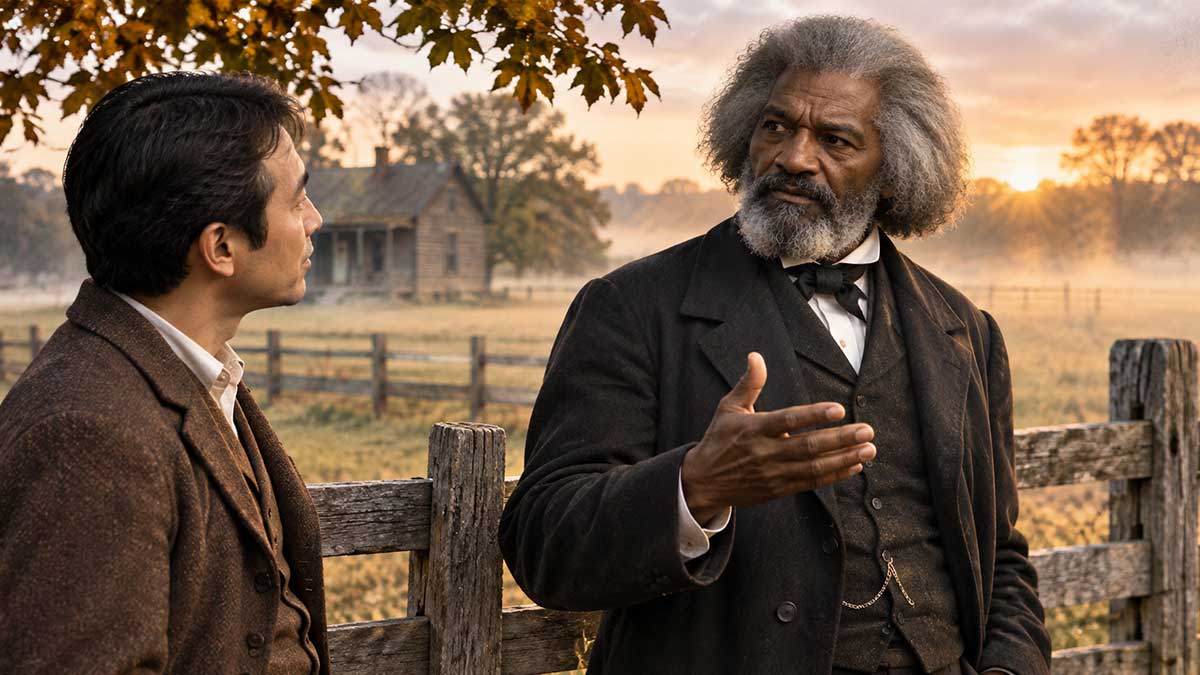
Opening: A Morning on Maryland's Eastern Shore
The morning mist is still rising over the fields of Maryland's Eastern Shore. A narrow dirt road stretches between weathered fences, and the first sunlight catches the tall grass.
Frederick Douglass stands beside me, looking across the countryside where his extraordinary life began.
He is an older man now, with silver hair, a commanding presence, and eyes that seem to have lost none of their intensity. Yet there is something gentle about the way he studies the distant fields.
For a moment, neither of us speaks.
Nick Sasaki: Frederick, thank you for meeting me here. I have to admit, I wondered whether bringing you back to Maryland was a good idea.
Frederick Douglass: (Smiling slightly.) I have returned to Maryland before, Mr. Sasaki. The soil itself has committed no crime against me.
Nick: (Laughing softly.) That's a fair point.
Douglass: It was the conduct of men upon that soil that made it a place of suffering. And yet, somewhere upon these shores, I first opened my eyes to the world.
Nick: Do you ever look at a place like this and think about how different your life might have been?
Douglass: One cannot help considering the accidents of birth. I entered this world without choosing my circumstances. But I have spent much of my life insisting that the circumstances of one's birth ought not determine the measure of one's humanity.
Nick: That's something I want to talk about. But before we get to the famous Frederick Douglass, the abolitionist and speaker, I'd like to meet the little boy who lived here.
Douglass turns from the fields toward me.
Douglass: Then we must begin with a boy who knew very little of the world, and far too little of his own family.
Question 1: What Did Family Separation Teach You About Love and Human Dignity?
Nick: Frederick, one thing that struck me when I read your autobiography was how little time you spent with your mother.
I have children myself. I can't picture a little boy growing up without being able to see his mother whenever he wanted.
What do you remember about her?
Douglass: Her name was Harriet Bailey.
I knew her chiefly through a few visits she made to me when I was very young. She was enslaved on another plantation, some twelve miles distant, and her labor was demanded of her during the day.
When she came, she walked those miles at night.
Nick: Twelve miles? After working all day?
Douglass: Yes. And she was obliged to return before morning.
Nick: That's heartbreaking.
Douglass: It was the arrangement of slavery. A mother might bring a child into the world, yet possess no recognized authority over where that child would live or whether she might see him.
Nick: Did you know she was coming? Would someone tell you?
Douglass: I cannot say that I remember such arrangements. My recollections of her are few. I was very young, and her visits were brief.
Nick: So when you think of your mother now, what stays with you?
Douglass looks across the fields.
Douglass: I know that she made those journeys. I know that she came when she could. That is more than a small thing.
But I must be careful not to pretend that I possess memories which slavery denied me the opportunity to form.
Nick: That's a powerful distinction.
Douglass: You see, Mr. Sasaki, people sometimes imagine that the cruelty of slavery consisted only of the whip, the chain, or the auction block.
Those were terrible enough.
But slavery entered the most intimate relations of human life. It interfered with the bond between mother and child. It made the ordinary affections of a family subject to another person's convenience.
Nick: And your mother died when you were still a child.
Douglass: Yes. I was about seven years old. I was not permitted to be with her during her illness, nor at her death or burial.
Nick: Did anyone sit down with you and explain what had happened?
Douglass: I remember no such kindness. I received the news much as I might have received news of the death of a stranger. That was not a reflection upon my mother's worth. It was a measure of how thoroughly we had been kept apart.
Nick remains silent for a moment.
Nick: There's something almost unbearable about that. A child should never have to learn that his mother has died in such a way.
Douglass: No child should.
Nick: But you did have your grandmother, didn't you?
Douglass: Ah, yes. My grandmother, Betsey Bailey.
There was affection in that part of my childhood. She cared for me when I was very young, and I knew her home before I understood much of the larger system surrounding us.
Nick: Was she the person who made you feel safe?
Douglass: She provided what comfort she could. But even that comfort was insecure.
I remember being taken from her home to Colonel Lloyd's plantation. I had not understood that I was to be left there.
Nick: She left without you?
Douglass: She did. I believe she understood that I would have resisted the separation had I known what was coming.
Nick: Oh, Frederick.
Douglass: (Quietly.) It was one of my earliest lessons in the nature of slavery. Even the affection of a grandmother could not protect a child from the claims of an owner.
Nick: Can I ask you something?
Douglass: Certainly.
Nick: When a child experiences that kind of separation, I wonder how he learns that he deserves love at all.
Douglass considers the question.
Douglass: I would hesitate to tell you precisely what passed through that child's mind. Memory does not grant us such perfect access.
But I can tell you what I came to recognize.
The wrong lay not in the child who was separated from his family. It lay in a system that presumed to own the child, the mother, and the grandmother alike.
Nick: In other words, the cruelty of the system said nothing about your value.
Douglass: Precisely.
A man may be treated as property without ever becoming property in the moral sense. The law may call him a slave. His owner may call him a slave. But neither can make the falsehood true.
Nick: That's an extraordinary thing to understand when the entire society around you insists otherwise.
Douglass: It was not an understanding I possessed fully as a small boy. It came through years of observation, struggle, and thought.
Nick: So you grew into it.
Douglass: I did. And that distinction matters. We must not turn a suffering child into a miniature philosopher merely to make a pleasing story.
Nick: (Smiling.) You're correcting my storytelling already.
Douglass: (With a faint smile.) I should hope you would permit me that liberty.
We both laugh.
The mist has begun to lift, revealing more of the distant fields.
Nick: Frederick, I think what moves me most is that your mother could not give you the childhood she might have wanted, but she still walked those miles to see you.
Douglass: Yes. Whatever slavery attempted to take from her, it did not extinguish her desire to see her child.
And we should remember that Harriet Bailey was more than the sorrowful mother in my story. She was a human being whose own life deserved freedom.
Nick: I'm glad you said that.
Douglass: Her life should not be valued merely for what it contributed to mine.
Question 2: When You Began Learning to Read, What Changed in the Way You Saw Yourself and the World?
We begin walking slowly along the road.
A breeze moves through the grass, and Douglass pauses beside the fence.
Nick: Frederick, there's another part of your childhood that fascinates me.
You were sent to Baltimore, and something happened there that changed your life.
You began learning to read.
Douglass: Yes. I was sent to live with Hugh and Sophia Auld.
Mrs. Auld initially treated me with a kindness I had not commonly experienced. She began teaching me the alphabet and words of a few letters.
Nick: She actually wanted you to learn?
Douglass: At first, yes. She had not yet learned to regard the education of an enslaved child as an offense against the institution of slavery.
Nick: But her husband stopped her.
Douglass: He did.
Mr. Auld discovered what she was doing and forbade her to continue. He explained that learning would make an enslaved person unmanageable and unfit to remain a slave.
Nick: He practically told you why education was dangerous to slavery.
Douglass: (Smiling.) That is exactly what he did.
He intended to prevent my education. Instead, he revealed its importance.
Nick: That's remarkable. The man trying to keep you ignorant accidentally became one of your teachers.
Douglass: An unwilling instructor, certainly.
Nick: (Laughing.) I can picture you standing there, listening, and suddenly realizing something.
Douglass: I did understand that he had disclosed a secret. If knowledge threatened the master's authority, then knowledge must contain something of great value to the slave.
Nick: What did you do after Sophia stopped teaching you?
Douglass: I continued learning by whatever means I could find.
I befriended white boys in the neighborhood and persuaded some to help me read. I made use of opportunities that presented themselves, sometimes carrying bread that I could share with boys who possessed knowledge I desired.
Nick: Bread for reading lessons?
Douglass: A useful exchange, was it not?
Nick: (Laughing.) I'd say it was one of the best bargains in history.
Douglass: I was fortunate that some of those boys were willing to help. But the larger lesson was that I must take responsibility for my own education.
Nick: And eventually you discovered The Columbian Orator.
Douglass: Yes. That book opened before me a world of argument and ideas.
I encountered speeches and dialogues concerning liberty, justice, and the rights of human beings.
I found language for thoughts that had begun to trouble me but that I had not yet learned to express.
Nick: Did reading make you happy?
Douglass pauses.
Douglass: That is an interesting question.
It gave me knowledge, certainly. But knowledge did not immediately give me happiness.
Nick: Why not?
Douglass: It made my condition more painfully clear.
Before I could fully comprehend the nature of slavery, I suffered under its burdens without possessing the means to examine them.
Reading taught me to understand the injustice that surrounded me.
It revealed the gulf between what I was and what the law permitted me to be.
Nick: So the more you learned, the more you understood how much had been taken from you.
Douglass: Yes.
I began to see possibilities that appeared beyond my reach. I learned to recognize freedom as something more than a vague desire, yet I had no clear means of obtaining it.
Nick: That must have been frustrating.
Douglass: It was a painful awakening.
There were times when I envied those who seemed less conscious of their condition. Knowledge had made me aware of a terrible wrong, but it had not yet shown me how to escape it.
Nick: That's something I don't think people always appreciate.
We often say education sets people free. But for you, education first made you more aware of your captivity.
Douglass: Quite so.
Knowledge may reveal the door long before it gives a man the means to open it.
Nick: That's a beautiful way of putting it.
Douglass: Yet I would never wish to return to ignorance.
Nick: Never?
Douglass: No. For ignorance might have made my condition easier to endure in certain moments, but it could not make that condition just.
The truth was painful. Nevertheless, it was the truth.
Nick: Frederick, can I ask something more personal?
Douglass: Of course.
Nick: When you were reading those speeches about liberty, did you ever wonder whether the men who wrote such beautiful words would have considered you their equal?
Douglass: I came to understand that men could proclaim principles greater than their own willingness to practice them.
That contradiction was not confined to the slaveholding states. It ran through much of American life.
Nick: And you eventually used those same principles to challenge the country.
Douglass: I did. But there was another discovery.
Nick: What was that?
Douglass: I learned that I could reason. I could examine an argument, recognize a contradiction, and form a judgment.
The institution of slavery depended upon treating me as someone whose thoughts and choices belonged to another.
Yet here was my own mind, working beyond the permission of my master.
Nick: Nobody could think your thoughts for you.
Douglass: They might attempt to control what I learned, what I said, or what I did.
But the discovery that I possessed a mind capable of independent judgment was of immense consequence.
Nick: You know, Frederick, that might be one of the most important moments in your entire life.
Not simply learning the alphabet, but realizing that you had the right to think for yourself.
Douglass: The right was always mine, Mr. Sasaki.
What changed was my ability to exercise it.
For a moment, we continue walking without speaking.
Then I turn to him.
Nick: And you were still just a boy.
Douglass: Yes.
Nick: It's astonishing what a child can discover when someone gives him even the smallest opening.
Douglass: Which is precisely why those who profit from oppression have so often feared the education of the oppressed.
Question 3: What Did You Discover About Yourself That the People Enslaving You Could Never Take Away?
The sun has risen higher now.
We reach a wooden gate overlooking the fields. Douglass rests one hand lightly upon the fence.
Nick: Frederick, I want to ask you something that connects everything we've talked about.
You were separated from your family. You were denied control over your own life. People tried to prevent you from learning.
Yet you eventually became someone who could stand before thousands of people and challenge the conscience of a nation.
Where did that strength begin?
Douglass: I would not say that it began in one moment.
Human character is formed through many experiences, some painful, some encouraging, and some whose meaning we recognize only years afterward.
Nick: Was there a moment when you began to see yourself differently?
Douglass: There were several.
Learning to read was one.
Witnessing the cruelty of slavery was another.
And later, my resistance to Edward Covey would become a turning point of great importance.
Nick: We'll talk about Covey when we discuss your struggle for freedom.
But before that confrontation, before your escape, was there something inside you that slavery simply couldn't destroy?
Douglass studies me for a moment.
Douglass: You ask as though the human spirit were a fortress that could never be breached.
I would be cautious with that picture.
Slavery could do terrible injury to the mind and spirit. It could produce fear, despair, humiliation, and submission. I witnessed those injuries in others, and I experienced their pressures myself.
Nick: That's fair. I don't want to make it sound as though a person can simply decide not to be hurt.
Douglass: Precisely.
It would be unjust to suggest that those who were broken by cruelty possessed less dignity than those who resisted it openly.
Nick: That's a distinction I hadn't considered.
Douglass: The worth of a human being does not depend upon his ability to perform acts of extraordinary courage.
A frightened child has dignity.
A man who has been beaten into submission has dignity.
A mother whose children have been taken from her has dignity.
Their humanity does not wait upon some heroic demonstration.
Nick: (Quietly.) I think that's one of the most important things you've said this morning.
Douglass: It is important to me that we do not mistake the achievements of a few for the measure of the many.
Nick: Then perhaps I should ask the question differently.
What did you come to believe about yourself that slavery had tried to make you forget?
Douglass: That I was a man.
Not a thing. Not a piece of merchandise. Not a creature whose existence was justified by another person's profit.
A man, possessing the same claim to liberty and moral responsibility as any other.
Nick: And nobody had to grant you that humanity.
Douglass: No. They could recognize it or deny it. They could respect it or violate it.
But they did not create it.
Nick: Frederick, I have to tell you something.
When I think about your life, I'm tempted to see it as a story about an extraordinary man overcoming impossible circumstances.
But listening to you, I realize that isn't quite the whole story.
Douglass: What do you think is missing?
Nick: The millions of people who never had the opportunity to escape, publish books, or stand before presidents.
They were just as human as you.
Douglass: Exactly.
And their lives must never disappear behind the fame of those whose names history has preserved.
Nick: Do you think people sometimes misunderstand courage?
Douglass: Very often.
They imagine courage only in dramatic acts: a man confronting an enemy, escaping danger, or speaking before a hostile crowd.
But consider the mother who continues to love her children when she cannot protect them.
Consider the enslaved man who risks punishment to learn a letter.
Consider the person who preserves some measure of kindness in a system organized around cruelty.
Those lives contain forms of courage that history may never record.
Nick: Your mother comes to mind.
Douglass: Mine too.
Nick: And your grandmother.
Douglass: Yes.
Nick: It's interesting. We started this conversation talking about the people you lost. Now we're talking about what they gave you.
Douglass: That is a worthy observation.
But we should be careful not to make suffering itself into a blessing.
I would gladly have preferred a childhood in which my mother could remain with me, my grandmother could care for me without fear of separation, and my education required no secrecy.
Nick: Of course.
Douglass: There is no virtue in the injustice that made those things impossible.
If strength emerged in resistance to that injustice, the credit belongs to the human beings who struggled, not to the institution that oppressed them.
Nick: That's an important correction.
I think people sometimes look at someone who overcame suffering and say the suffering made him great.
Douglass: Suffering may influence a life, but it does not deserve our gratitude merely for having occurred.
We should honor the person who endured it and seek to prevent others from suffering the same wrong.
I look toward the fields.
Nick: Frederick, there's something I want to ask before we leave this place.
Suppose you could speak to that little boy who was separated from his grandmother.
Not the famous Frederick Douglass speaking to an audience, but the older Frederick speaking to the child he once was.
What would you want him to know?
Douglass is quiet for several moments.
Douglass: (Softly.) I cannot claim to know exactly what I would have said to him.
But perhaps I would begin by telling him that the judgment of those who claimed to own him was not the judgment of Heaven.
That his mother was a human being worthy of honor.
That his grandmother's affection was not made less real by the cruelty that interrupted it.
And that there existed a world beyond the boundaries he had been taught to accept.
Nick: Would you tell him he was going to become famous?
Douglass laughs.
Douglass: I should hope not.
Nick: Really?
Douglass: Fame would have been a poor consolation to a frightened child.
Nick: Then what would you tell him?
Douglass: That he deserved to be free.
And that so did every other child living under the same injustice.
I look at him for a moment, unable to find an immediate reply.
Nick: That's much better than telling him he'd become famous.
Douglass: (Smiling.) I am pleased we agree.
Closing: The Road Beyond the Fields
The morning has grown bright. The mist is gone, and the road ahead is clearly visible.
We begin walking back toward the gate.
Nick: Frederick, I came here expecting to learn where your courage began.
But I think I've learned something else.
Douglass: And what is that?
Nick: That human dignity doesn't begin when someone becomes strong enough to defend it.
It was there all along.
Douglass: Yes. And the recognition of that truth places an obligation upon those who possess the ability to act.
Nick: To defend the dignity of others?
Douglass: To recognize it, certainly. And to oppose the conditions that deny it.
For what good is our admiration of human dignity if we remain indifferent when it is violated?
Nick: You never let me stop at the comfortable answer, do you?
Douglass: (Laughing.) Would you have invited me here if I did?
Nick: Probably not.
We reach the gate, but neither of us opens it immediately.
Nick: Frederick, next time I'd like to talk about the moment you began actively resisting slavery, especially your confrontation with Edward Covey.
Douglass: Ah. Mr. Covey.
His expression grows more serious.
Douglass: That is a chapter of my life I have never forgotten.
Nick: You once described that confrontation as a turning point.
Douglass: I did. But to understand its importance, we must first understand what had been done to me before I resisted.
Nick: Then that's where we'll begin.
Douglass places his hand upon the gate.
Douglass: Very well, my friend.
He looks once more across the Maryland fields.
Douglass: Today we have spoken of a boy who was learning to recognize his own humanity.
Next time, we may speak of what happened when that boy, grown older, determined that another man would no longer break his spirit.
The gate opens, and we continue down the road together.
Topic 2: The Courage to Become Free
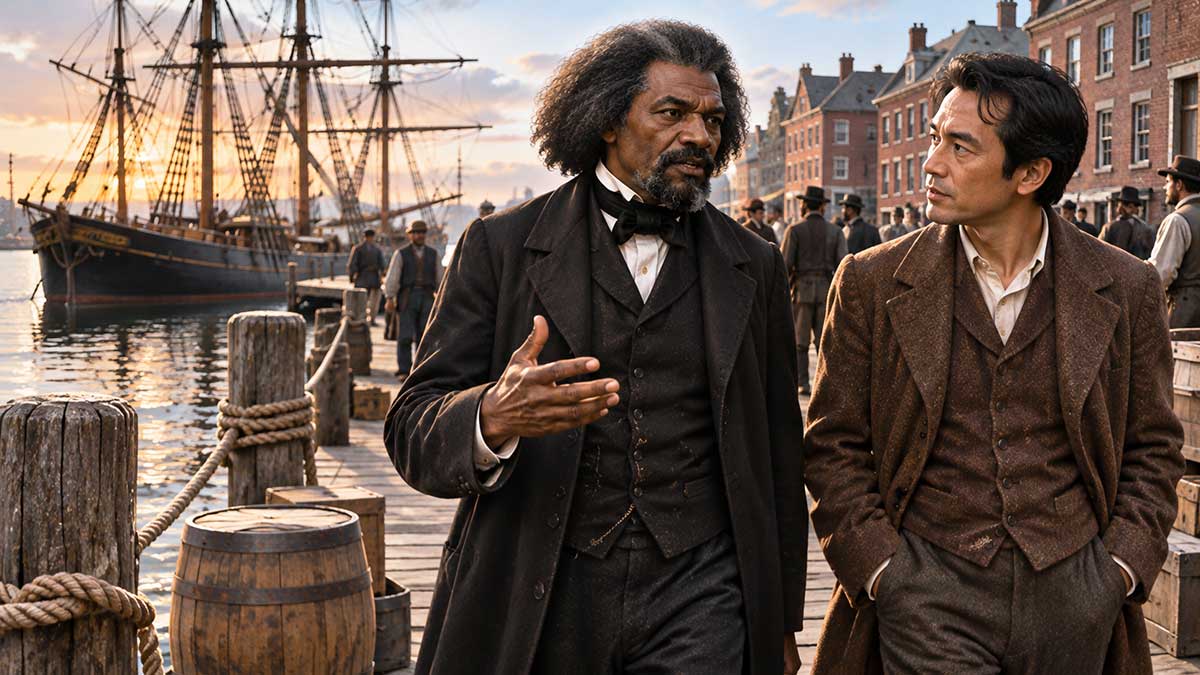
Opening: The Harbor Where Freedom Began
New Bedford, Massachusetts. Autumn 1892. Frederick Douglass, approximately 74 years old.
The morning sun rises over New Bedford harbor, turning the water a pale gold. Fishing boats and sailing vessels rest along the waterfront, their masts reaching into a sky still touched by the last traces of mist.
Frederick Douglass stands beside the harbor, looking across the water.
More than half a century has passed since he arrived here as a young fugitive with his new wife, Anna Murray Douglass.
His hair is now almost entirely white. His face carries the years, but his eyes remain alert, and his voice retains the authority that has challenged presidents, politicians, and entire audiences.
I join him near the waterfront.
Nick Sasaki: Frederick, when you first arrived here, did you ever think you'd return as one of the most recognized men in America?
Frederick Douglass: (Smiling.) I was considerably more interested in finding employment than in achieving fame.
Nick Sasaki: That's fair.
Frederick Douglass: A hungry man is seldom troubled by the absence of an audience.
We laugh.
Nick Sasaki: But look at this place. You arrived with almost nothing. Now you've traveled the world, written books, advised presidents, and helped change the country.
Frederick Douglass: And yet this harbor remains dear to me.
Here I began to discover what it meant to work without a master claiming the fruits of my labor.
Nick Sasaki: There's something I've wanted to ask you ever since we talked about your childhood.
You resisted Edward Covey. You taught yourself to read. You survived years of slavery.
But you still weren't free.
Frederick Douglass: No.
Nick Sasaki: What finally made you decide that staying was no longer possible?
Douglass looks across the harbor.
Frederick Douglass: That decision had been forming for years.
Nick Sasaki: Then let's go back to the beginning.
Question 4: When Did You Realize That Resisting Slavery Wasn't Enough, That You Had to Escape?
Nick Sasaki: Frederick, your resistance to Edward Covey was extraordinary. You refused to let him break your spirit.
But after that confrontation, you were still enslaved.
Frederick Douglass: Precisely. I had resisted one man's attempt to crush me. I had not escaped the institution that gave him such authority.
Nick Sasaki: Did that victory make you more determined to leave?
Frederick Douglass: It strengthened my conviction that I was a man, and that no other man possessed a rightful claim to own me.
But a conviction of freedom and the possession of freedom are different things.
Nick Sasaki: You had already attempted an escape before 1838.
Frederick Douglass: In 1836, several of us planned to flee from the Eastern Shore of Maryland. Our plan was discovered before we could carry it out.
We were arrested and imprisoned.
Nick Sasaki: That must have been terrifying.
Frederick Douglass: We faced the possibility of severe punishment and separation. There was reason to fear being sold away.
Nick Sasaki: And yet two years later, you tried again.
Frederick Douglass: Would you have me conclude that one failed attempt proved slavery to be my proper condition?
Nick Sasaki: No. But failure can make a person afraid to try again.
Frederick Douglass: Certainly. Fear is no stranger to courage.
Nick Sasaki: That's something I want to explore.
People often describe you as fearless. But I don't believe anyone can face the possibility of capture, imprisonment, or death without fear.
Frederick Douglass: Then you are wise not to believe it.
A man may recognize danger very clearly and still determine that submission is the greater evil.
Nick Sasaki: What made the second attempt different?
Frederick Douglass: By 1838, I was working in Baltimore as a ship caulker. I had learned something of the waterfront, the habits of sailors, and the movement of vessels.
I had earned money, though my labor remained subject to the demands of Hugh Auld.
And I had met Anna Murray.
Nick Sasaki: We'll come to Anna in a moment.
But first, I want to understand something about the decision itself.
You had friends in Baltimore. You knew the city. You had acquired a valuable trade.
Escaping meant abandoning nearly everything familiar.
Frederick Douglass: Familiarity is a poor compensation for bondage.
Nick Sasaki: But it must have been difficult to leave people you cared about.
Frederick Douglass: Very difficult.
One of slavery's cruelties was that it forced a man to choose between remaining near those he loved and pursuing the freedom to which he was entitled.
Nick Sasaki: That's heartbreaking.
Frederick Douglass: It is an indictment of the institution.
And let us not dress it in sentimental language. The enslaved person was not merely denied comfort. He was denied control over his own body, his labor, his movements, and the future of his family.
Nick Sasaki: You sound angry, even after all these years.
Frederick Douglass: Should the passage of time make injustice respectable?
Nick Sasaki: No. But I wonder whether anger can sustain a person for so long.
Frederick Douglass: Anger may awaken a man to wrong. It cannot, by itself, tell him how to build a life.
I needed more than indignation.
I needed a plan.
Nick Sasaki: And you found one.
Frederick Douglass: I found a possibility. There is a considerable difference.
Nick Sasaki: (Smiling.) I suspect you're about to tell me just how considerable.
Frederick Douglass: My young friend, there are few things more dangerous than a plan that looks simple when described after it has succeeded.
Question 5: What Really Happened on the Day You Escaped Slavery?
A ship's bell rings across the harbor.
Douglass watches a vessel moving slowly through the water.
Nick Sasaki: Frederick, September 3, 1838.
You were twenty years old.
Take me through that day.
Frederick Douglass: I had resolved to leave Baltimore and make my way north.
My plan required me to pass as a free Black sailor.
Nick Sasaki: How did you manage that?
Frederick Douglass: I borrowed a sailor's protection certificate from a free Black seaman.
Such a document identified its holder as an American sailor. It bore an official appearance, including the American eagle.
Nick Sasaki: But the description on the document didn't match you.
Frederick Douglass: Not closely enough to survive careful examination.
Nick Sasaki: So the entire escape could fail if someone looked at it for more than a few seconds.
Frederick Douglass: That was one of the dangers.
Nick Sasaki: What were you wearing?
Frederick Douglass: The clothing of a sailor. A red shirt, a black cravat, and a sailor's hat.
I knew something of sailors from my work around the Baltimore shipyards.
Nick Sasaki: Could you imitate the way they spoke?
Frederick Douglass: Well enough to hope that no one would demand an extended demonstration.
Nick Sasaki: (Laughing.) That's a rather dangerous performance.
Frederick Douglass: Indeed. The consequences of an unfavorable review would have been severe.
We share a brief smile.
Then his expression grows serious.
Frederick Douglass: I boarded the northbound train at Baltimore.
I had to avoid unnecessary scrutiny before departure. Once aboard, I still faced examination by the conductor.
Nick Sasaki: What happened when he reached you?
Frederick Douglass: He asked about my papers.
I presented the sailor's protection certificate.
He glanced at it and accepted it.
Nick Sasaki: Just like that?
Frederick Douglass: Just long enough to satisfy himself.
Nick Sasaki: Frederick, that's extraordinary. A man's entire future depended on a conductor not examining a document closely.
Frederick Douglass: Yes.
And that should tell you something about slavery.
A human being's freedom could be destroyed by the suspicion of a stranger.
Nick Sasaki: What were you thinking when he looked at the paper?
Frederick Douglass: I knew that a close inspection might expose me.
Nick Sasaki: Were your hands shaking?
Frederick Douglass: I cannot offer you a record of every movement of my hands. But I can tell you that I was acutely conscious of the danger.
Nick Sasaki: And when he moved on?
Frederick Douglass: I had passed one obstacle.
I had not yet reached safety.
Nick Sasaki: You were still in Maryland.
Frederick Douglass: Exactly.
Nick Sasaki: What happened next?
Frederick Douglass: I saw people during the trip who might have recognized me. One was a man familiar with the Baltimore shipyards.
Another dangerous encounter occurred during the passage north.
There were moments when recognition seemed entirely possible.
Nick Sasaki: Did anyone recognize you?
Frederick Douglass: I cannot say with certainty what every man perceived.
But I was not detained.
Nick Sasaki: That sounds almost impossible.
Frederick Douglass: Many things appear impossible until someone survives them.
But I would caution against mistaking a successful escape for proof that the danger was small.
Others attempted similar journeys and were captured.
Nick Sasaki: How did you travel after the train?
Frederick Douglass: My route took me through Delaware and onward toward Philadelphia, involving further transportation by water and rail.
Each change brought another possibility of discovery.
Nick Sasaki: And eventually you reached New York.
Frederick Douglass: Yes. I arrived there on September 4, 1838.
Nick Sasaki: Less than a day after leaving Baltimore.
Frederick Douglass: A remarkable change in circumstances within a remarkably short time.
Nick Sasaki: What did freedom feel like?
Douglass looks out over the harbor.
Frederick Douglass: Relief, certainly. Exhilaration. But there was another feeling that followed quickly.
Nick Sasaki: Fear?
Frederick Douglass: Yes.
New York was a free state, but a fugitive from slavery could still be seized and returned.
I had escaped from the immediate control of my enslaver. I had not escaped the reach of the laws that protected slavery.
Nick Sasaki: So you reached freedom, but couldn't fully trust it.
Frederick Douglass: That is a fair description.
Nick Sasaki: I want to ask you something.
When you finally realized you'd made it to New York, did you feel proud of yourself?
Frederick Douglass: I felt the extraordinary significance of having escaped.
But I was not inclined to believe that my success made me superior to those who remained enslaved.
Nick Sasaki: Why do you make that distinction?
Frederick Douglass: Consider the man who attempts escape and is captured. Is he less worthy of freedom than the man whose conductor fails to examine his papers?
Nick Sasaki: Of course not.
Frederick Douglass: Then let us celebrate courage without pretending that fortune played no part.
Nick Sasaki: That's a different way of looking at it.
Frederick Douglass: It is the only honest way I know.
Nick Sasaki: There's another part of the story I don't want to overlook.
You didn't accomplish this alone.
Frederick Douglass: No.
Nick Sasaki: Anna Murray.
At the mention of her name, Douglass turns from the harbor.
Frederick Douglass: Yes. Anna.
Question 6: How Did Anna Murray and the People Who Helped You Change the Meaning of Freedom?
Nick Sasaki: Frederick, I think Anna deserves more recognition than she usually receives.
Frederick Douglass: I would not dispute that.
Nick Sasaki: She was a free Black woman in Baltimore. She worked, saved money, and helped finance your escape.
Some accounts describe her selling a feather bed to help pay for your passage.
Frederick Douglass: Anna gave important assistance at a moment when I needed it greatly.
Nick Sasaki: And she took a risk herself.
Frederick Douglass: Helping an enslaved person escape could bring serious consequences.
Nick Sasaki: Here's what strikes me.
History often presents you as the solitary hero, the man who escaped through his own intelligence and determination.
But without Anna, the story might have been very different.
Frederick Douglass: Very different indeed.
Nick Sasaki: Did she ever remind you of that?
Douglass laughs.
Frederick Douglass: I think you are hoping for a private conversation between husband and wife that I cannot reproduce for your entertainment.
Nick Sasaki: (Laughing.) Perhaps a little.
Frederick Douglass: Then you must be content with knowing that Anna was indispensable to our early life together.
Nick Sasaki: Fair enough.
She came to New York after your escape.
Frederick Douglass: Yes.
We married there on September 15, 1838.
Nick Sasaki: Just twelve days after you left Baltimore.
Frederick Douglass: We had little reason to delay building a life together.
Nick Sasaki: But New York still wasn't safe.
Frederick Douglass: No. The danger of recapture remained.
Nick Sasaki: That's when David Ruggles entered the story.
Frederick Douglass: David Ruggles was a courageous abolitionist who assisted fugitives in New York.
He offered help when I was in an unfamiliar city and in need of trustworthy guidance.
Nick Sasaki: He helped you and Anna find a safer place.
Frederick Douglass: He encouraged us to continue to New Bedford.
And so we came here.
Douglass gestures toward the harbor.
Nick Sasaki: What do you remember about arriving?
Frederick Douglass: The town was unlike the world I had known in Maryland.
I saw evidence that free Black men could work, establish households, and participate in community life.
Yet I soon discovered that racial prejudice existed here too.
Nick Sasaki: Even in Massachusetts?
Frederick Douglass: Freedom from slavery did not mean freedom from discrimination.
I had learned the trade of ship caulking, but prejudice limited my opportunities to practice it.
I took other work.
Nick Sasaki: You must have been frustrated.
Frederick Douglass: Certainly. But there was a distinction of enormous importance.
The wages I earned belonged to me.
Nick Sasaki: No master could take them.
Frederick Douglass: That changed the meaning of labor.
Nick Sasaki: And Nathan Johnson helped you settle here.
Frederick Douglass: Nathan and Mary Johnson welcomed us and gave us assistance.
They were among the people whose generosity made our beginning in New Bedford possible.
Nick Sasaki: Nathan suggested the name Douglass, didn't he?
Frederick Douglass: He did.
I had used other names while escaping and afterward. Nathan suggested Douglass, drawing upon the name of a character in Sir Walter Scott's The Lady of the Lake.
Nick Sasaki: So the name the world knows you by was suggested by someone who helped you.
Frederick Douglass: Yes.
Nick Sasaki: There's something beautiful about that.
You escaped with borrowed papers, depended on the courage of Anna and others, and received a new surname from a man who welcomed you into his home.
Frederick Douglass: You are becoming sentimental again, Nick.
Nick Sasaki: (Laughing.) I suppose I am.
Frederick Douglass: Then permit me to complicate the picture.
Nick Sasaki: Please do.
Frederick Douglass: Assistance was vital. But those who helped me were not merely characters in the story of my escape.
Anna had her own life, her own labor, her own judgment.
David Ruggles devoted himself to helping many fugitives, not simply one man who later became famous.
The Johnsons extended hospitality when hospitality could have consequences.
Their actions deserve recognition in their own right.
Nick Sasaki: That's fair.
But I want to challenge something else.
You escaped slavery. You married Anna. You found work. You began a family.
Why didn't you simply build a peaceful private life?
Douglass studies me.
Frederick Douglass: What would you have had me forget?
Nick Sasaki: Nothing. But you had suffered so much. Surely you deserved some peace.
Frederick Douglass: I did deserve peace.
And so did those who remained enslaved.
Nick Sasaki: But you couldn't free everyone.
Frederick Douglass: No. Nor could I claim that every formerly enslaved person had an obligation to become a public reformer.
Some needed to recover, to work, to raise children, to live without the constant fear of separation.
That, too, was an expression of freedom.
Nick Sasaki: Then why did you choose a public fight?
Frederick Douglass: I began reading The Liberator, William Lloyd Garrison's antislavery newspaper.
I encountered arguments that gave language to convictions already deeply rooted in my experience.
I met people determined to oppose slavery.
And I knew something that could not be learned from books alone.
Nick Sasaki: What was that?
Frederick Douglass: I knew what slavery did to human beings.
I had witnessed its cruelty, endured its humiliations, and seen how it corrupted those who claimed authority over others.
Nick Sasaki: And you wanted the country to hear it from someone who had lived through it.
Frederick Douglass: I wanted slavery destroyed.
If my experience could help awaken others to its injustice, I had reason to speak.
Nick Sasaki: Did you already know you'd become a great speaker?
Douglass laughs.
Frederick Douglass: I assure you, the nation did not immediately gather at the docks of New Bedford demanding to hear Frederick Douglass.
Nick Sasaki: (Laughing.) That would have been quite a welcome.
Frederick Douglass: I began with ordinary work and participation in the antislavery community.
The public speaking came later.
Nick Sasaki: So when you arrived here, you weren't thinking about fame or historical importance.
Frederick Douglass: I was thinking about living as a free man.
Nick Sasaki: Yet eventually you devoted your life to helping others become free.
Frederick Douglass: My escape changed my circumstances. It did not change the injustice of slavery for those who remained within it.
Nick Sasaki: Frederick, I think I finally see why escaping wasn't enough for you.
Frederick Douglass: Tell me.
Nick Sasaki: You had discovered your own humanity long before you reached New York.
Escaping gave you the freedom to live according to that truth.
But you couldn't accept a society that continued denying the same truth to millions of others.
Douglass considers my words.
Frederick Douglass: That comes close.
But I would add something.
I did not fight slavery merely out of gratitude for my own escape.
I fought it because slavery was wrong.
Its wrongness did not depend upon whether I personally suffered from it.
Nick Sasaki: That's a much stronger principle.
Frederick Douglass: It must be.
Otherwise, justice becomes little more than a preference for our own comfort.
Closing: The First Wages of Freedom
The morning has brightened. Workers move along the waterfront, and the sound of tools carries from a nearby vessel.
Frederick watches them for a moment.
Nick Sasaki: When you look at this harbor now, what memory returns most strongly?
Frederick Douglass: I remember the extraordinary significance of earning money that no master could claim.
Nick Sasaki: Such a small thing to someone who's always been free.
Frederick Douglass: A small thing?
He smiles.
Frederick Douglass: To receive wages for one's own labor, to decide how they shall be spent, to know that the work of one's hands belongs to oneself, these are no small matters to a man who has been enslaved.
Nick Sasaki: You're right. I take that for granted.
Frederick Douglass: Most people take certain freedoms for granted until those freedoms are threatened.
Nick Sasaki: Frederick, there's one question I want to ask before we leave.
Suppose the twenty-year-old man who stepped off that train could see you standing here today.
What would you want him to know?
Douglass looks out across the water.
Frederick Douglass: I would want him to know that freedom brings responsibilities, but that those responsibilities do not diminish its worth.
I would want him to value the people who stood beside him.
And I would want him never to confuse his own good fortune with proof that those still enslaved lacked courage.
Nick Sasaki: Would you tell him how difficult the years ahead would be?
Frederick Douglass: Perhaps not all at once.
Nick Sasaki: (Smiling.) You'd let him enjoy his first morning of freedom?
Frederick Douglass: I think he had earned the right to enjoy it.
We stand quietly for a moment.
Then I turn to him.
Nick Sasaki: Frederick, there's something remarkable about your life.
The young man who escaped from Baltimore was trying to avoid being recognized.
Years later, the same man stood before enormous audiences demanding that America recognize the humanity of people it had enslaved.
Douglass smiles.
Frederick Douglass: There is some irony in that.
Nick Sasaki: A great deal, I'd say.
Frederick Douglass: Yet it was never my purpose merely to become a recognized man.
I wanted the institution of slavery brought before the conscience of the nation.
Nick Sasaki: And you did that with words.
Frederick Douglass: With words, certainly. But words must be joined to conviction and action.
Nick Sasaki: Which brings us to Rochester.
Frederick Douglass: Ah. The Fourth of July address.
Nick Sasaki: July 5, 1852.
Frederick Douglass: A day when I had no intention of allowing my audience to rest comfortably in its patriotic celebrations.
Nick Sasaki: (Laughing.) I suspect they discovered that rather quickly.
Frederick Douglass: Some of them may still be recovering.
We laugh together.
Then Frederick extends his hand.
Frederick Douglass: Come, Nick. There is much more to discuss.
I shake his hand and look once more across New Bedford harbor.
In September 1838, a young man arrived here with a new wife, an uncertain future, and the extraordinary possibility of living without a master.
He had won his freedom.
But the greatest struggle of his life was still ahead.
He had escaped slavery. Now he would challenge a nation to escape its own moral contradictions.
Topic 3: The Man Who Challenged America's Conscience
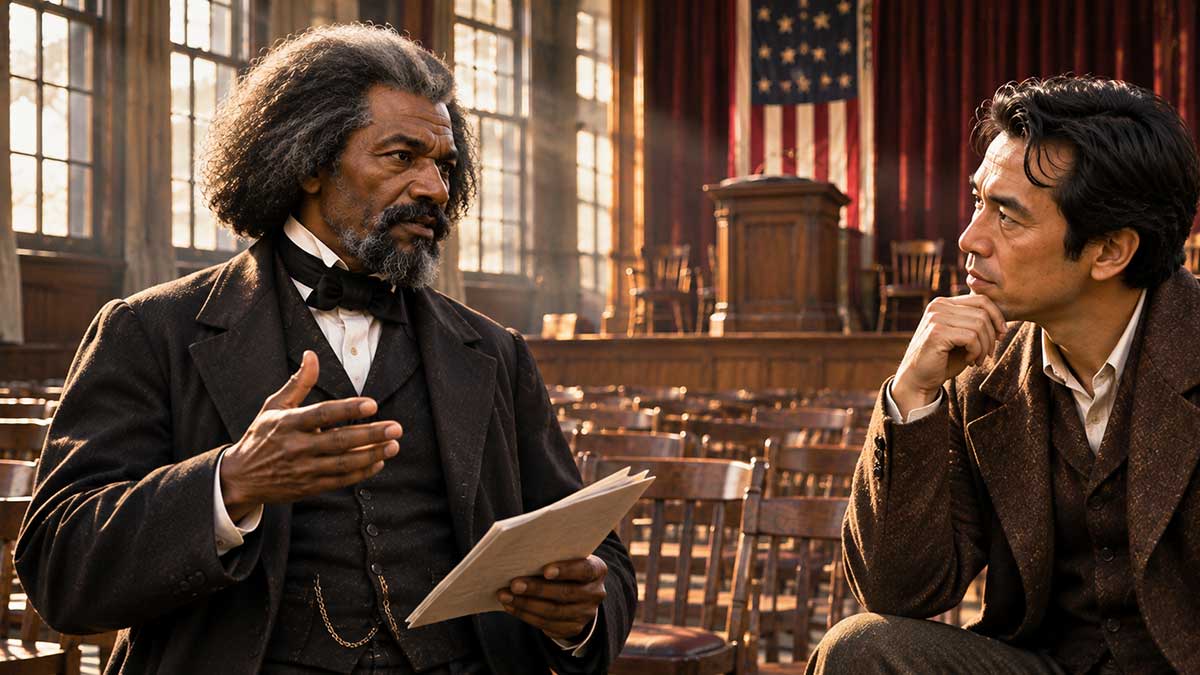
Opening: After the Applause
Corinthian Hall, Rochester, New York. July 5, 1852. Frederick Douglass, approximately 34 years old.
The audience has departed, but the atmosphere inside Corinthian Hall still feels charged.
Only a short time ago, Frederick Douglass stood before an audience gathered to commemorate American independence. Instead of offering the customary celebration, he delivered a devastating indictment of a nation that praised liberty while holding millions of human beings in slavery.
Now the great hall is nearly empty.
Afternoon sunlight falls across the wooden benches. A few programs lie abandoned on the seats.
Douglass stands near the platform, gathering his papers.
He is thirty-four years old, with dark hair, an intense gaze, and the bearing of a man who has just challenged the moral foundations of his country.
I approach him.
Nick Sasaki: Frederick, I think some people came here expecting a pleasant Fourth of July celebration.
Frederick Douglass: (Smiling.) Then I fear I have disappointed their expectations.
Nick Sasaki: Disappointed? You practically set the building on fire.
Frederick Douglass: Fortunately, the building remains standing. I should regret having to explain that particular misfortune to the owners.
We laugh.
Nick Sasaki: But seriously, you were furious up there.
Frederick Douglass: I spoke with feeling, certainly.
Nick Sasaki: Feeling? Frederick, you accused the nation of celebrating liberty while millions lived in chains.
You challenged its politicians, its churches, its patriotic ceremonies, and even the audience sitting before you.
Frederick Douglass: And which accusation would you have preferred that I omit?
Nick Sasaki: None. But I'm curious why you chose to make the speech so confrontational.
Douglass sets his papers down.
Frederick Douglass: Then perhaps we should begin with the occasion itself.
Question 7: Why Did You Turn America's Independence Celebration Into an Accusation?
Nick Sasaki: Frederick, I want to challenge your approach.
The people who invited you here were abolitionists. Many already opposed slavery.
Why confront them so fiercely?
Frederick Douglass: Because agreement in principle does not always produce action.
Nick Sasaki: But wouldn't a more encouraging speech have strengthened your allies?
Frederick Douglass: Encouragement has its place.
But consider what I was asked to celebrate.
A nation had proclaimed that human beings possessed rights that no government could justly take away. It had fought a revolution against tyranny. Its citizens gathered beneath flags, listened to patriotic addresses, and congratulated themselves upon their liberty.
Meanwhile, millions remained enslaved.
What would you have had me do? Praise the fireworks?
Nick Sasaki: (Smiling.) I suppose that would have been a rather short speech.
Frederick Douglass: It would certainly have been less troublesome.
Nick Sasaki: But there's a serious question here.
You were speaking to people who might help your cause. If you make them feel accused, won't some become defensive?
Frederick Douglass: Undoubtedly.
Nick Sasaki: Doesn't that concern you?
Frederick Douglass: It concerns me less than the possibility that they should leave this hall entirely comfortable with a national contradiction that ought to disturb every conscience.
Nick Sasaki: So you wanted discomfort.
Frederick Douglass: I wanted recognition.
A man may sit comfortably beside a burning house if he persuades himself that the flames are someone else's concern.
But once he understands that human beings are trapped inside, his comfort becomes a moral question.
Nick Sasaki: And you wanted your audience to see the people inside.
Frederick Douglass: Yes.
Not an abstraction called slavery.
Men, women, and children.
People whose labor was stolen, whose families could be separated, whose bodies could be beaten, and whose futures were placed at the mercy of others.
Nick Sasaki: There's something that struck me during your speech.
You didn't reject the ideals of the Declaration of Independence.
You used those ideals against the nation.
Frederick Douglass: Why should I surrender the language of liberty to men who refuse to practice it?
Nick Sasaki: That's an interesting way of putting it.
Frederick Douglass: America has proclaimed principles of extraordinary importance.
But principles do not become true in practice merely because they are printed upon parchment.
Nick Sasaki: Then your argument isn't that America's founding ideals are worthless.
Frederick Douglass: Certainly not.
My argument is that the nation must be judged by the very principles it professes.
Nick Sasaki: Let me push you a little.
Some Americans might say, "Douglass, our country is imperfect, but we're making progress. Give us time."
Frederick Douglass: Time?
Douglass turns toward the empty hall.
Frederick Douglass: How much time does a man require to determine whether another human being has the right to own him?
How many generations must pass before a mother may be secure against the sale of her child?
How many patriotic anniversaries must be celebrated before liberty ceases to be a privilege reserved for some?
Nick Sasaki: You don't believe gradual improvement is enough.
Frederick Douglass: Improvement is welcome wherever it occurs.
But the existence of improvement does not make the remaining injustice tolerable.
Nick Sasaki: So when people tell you to be patient...
Frederick Douglass: I ask them whether they would offer the same advice if the chains were upon their own wrists.
Nick Sasaki: That's difficult to answer.
Frederick Douglass: It ought to be.
Nick Sasaki: There's another question.
When you stood before the audience today, did you feel you were speaking as an American?
Douglass looks at me.
Frederick Douglass: I was born upon American soil. I have labored here, suffered here, and fought for the realization of the nation's professed principles.
But the laws of this country have denied people of my color the rights that others claim as their birthright.
Nick Sasaki: So what does Independence Day mean to you?
Frederick Douglass: It presents a question the nation cannot honestly evade.
Can a country celebrate its own liberation while maintaining the enslavement of others?
Nick Sasaki: And your answer?
Frederick Douglass: You heard it this afternoon.
Question 8: How Could a Christian Nation Defend Slavery in the Name of God?
We move from the platform to the front row of the hall.
A shaft of sunlight illuminates the empty seats.
Nick Sasaki: Frederick, one of the strongest parts of your speech was your criticism of American churches.
You weren't gentle.
Frederick Douglass: I had little reason to be gentle with religious institutions that lent their authority to slavery.
Nick Sasaki: But some churches were actively fighting slavery.
Frederick Douglass: And they deserve recognition for doing so.
Yet the existence of faithful Christians does not excuse those who use religion to defend cruelty.
Nick Sasaki: I want to approach this carefully.
Christianity teaches love, forgiveness, and the dignity of human beings.
How did people reconcile those teachings with owning slaves?
Douglass gives a short, incredulous laugh.
Frederick Douglass: Reconcile them?
My dear Nick, a man determined to justify his own conduct can make astonishing discoveries in the Scriptures.
He will search the Bible with extraordinary diligence for permission to keep another man in bondage.
He may overlook the command to love his neighbor, but he will discover, with remarkable speed, whatever passage he believes supports his authority.
Nick Sasaki: (Laughing.) You're describing a very selective reader.
Frederick Douglass: Selective indeed.
Imagine a preacher who spends Sunday praising the mercy of God and Monday demanding the punishment of an enslaved person who has attempted to escape.
Nick Sasaki: That's hypocrisy.
Frederick Douglass: It is worse than ordinary hypocrisy when the authority of religion is employed to silence the conscience of the oppressed.
Nick Sasaki: But here's where I want to challenge you.
If you attack churches so fiercely, might some people conclude that you're attacking Christianity itself?
Frederick Douglass: Then they should listen more carefully.
I have distinguished between the Christianity of Christ and the religion practiced by those who defend slavery.
Nick Sasaki: What is the difference?
Frederick Douglass: One calls human beings to mercy, justice, and love.
The other clothes oppression in religious language.
One asks us to recognize our neighbor.
The other finds elaborate reasons why a neighbor may be purchased, sold, beaten, or deprived of liberty.
Nick Sasaki: So you aren't rejecting faith.
Frederick Douglass: I am rejecting the use of faith as a shield for injustice.
Nick Sasaki: I think that's a distinction many people still struggle with.
Frederick Douglass: Then perhaps they should begin by examining conduct rather than professions.
Nick Sasaki: Meaning?
Frederick Douglass: If a man claims to love God but treats his fellow human beings with cruelty, what should we make of his profession?
Nick Sasaki: That his actions contradict his beliefs.
Frederick Douglass: Or at least the beliefs he publicly declares.
Nick Sasaki: But some people sincerely believe they're doing the right thing, even when they're terribly wrong.
Frederick Douglass: Sincerity does not transform injustice into virtue.
Nick Sasaki: No. But how do you change the mind of someone who believes God is on his side?
Douglass leans forward.
Frederick Douglass: You challenge the contradiction.
You ask whether the man who claims divine permission to enslave another would accept the same treatment for himself.
You ask whether his interpretation of Scripture has made him more compassionate or more cruel.
And you refuse to allow religious language to conceal the human suffering before your eyes.
Nick Sasaki: What if he refuses to listen?
Frederick Douglass: Then we continue speaking, organizing, writing, and acting.
A reformer cannot make the willingness of every opponent a condition of pursuing justice.
Nick Sasaki: There's something about your approach that fascinates me.
You don't seem interested in making people comfortable with their beliefs.
Frederick Douglass: Not when those beliefs are being used to excuse the suffering of others.
Nick Sasaki: But do you ever worry that righteous anger can become hatred?
Douglass pauses.
Frederick Douglass: Anger at injustice must not become an excuse for committing injustice ourselves.
But we should be careful not to demand that the oppressed demonstrate perfect serenity before we agree to hear their complaints.
Nick Sasaki: That's fair.
Frederick Douglass: A man whose house has been set ablaze may speak with considerable urgency.
I would be more concerned with extinguishing the fire than correcting his tone.
Nick Sasaki: (Smiling.) You do enjoy that image.
Frederick Douglass: It has the advantage of being difficult to misunderstand.
Nick Sasaki: Let me ask one final question about religion.
Do you believe faith can help bring an end to slavery?
Frederick Douglass: I believe religious conviction can inspire people to resist oppression, defend the vulnerable, and sacrifice for justice.
I have seen such conviction among abolitionists.
But religion becomes an obstacle when it teaches people to accept cruelty as part of a divinely ordained social order.
Nick Sasaki: So faith itself isn't the deciding factor.
Frederick Douglass: What people do with their faith matters enormously.
Nick Sasaki: And what would you say to a preacher who insists that slavery is supported by the Bible?
Douglass rises from his seat.
Frederick Douglass: I would ask him to look into the face of an enslaved mother whose child has been sold away.
Then I would ask him whether he possesses the courage to explain his theology to her.
For a moment, neither of us speaks.
Question 9: Why Did You Change Your Mind About the Constitution and Challenge Fellow Abolitionists?
The afternoon light has shifted toward the tall windows.
Douglass returns to the platform to gather the last of his papers.
Nick Sasaki: Frederick, there's something I've been wanting to ask you.
You've disagreed with slaveholders, politicians, and churches.
But you've also disagreed with people who helped you become an abolitionist.
Frederick Douglass: Yes.
Nick Sasaki: William Lloyd Garrison, for example.
You once accepted his interpretation of the Constitution as a document supporting slavery.
But you've changed your position.
Frederick Douglass: I have.
Nick Sasaki: Why?
Frederick Douglass: Because I came to believe that the Constitution, properly interpreted, need not be understood as a proslavery instrument.
Nick Sasaki: But the Constitution was written by men who permitted slavery to continue.
Frederick Douglass: That is true.
Nick Sasaki: And several provisions protected the political interests of slaveholding states.
Frederick Douglass: Yes.
Nick Sasaki: Then how can you argue that the Constitution is an antislavery document?
Douglass smiles slightly.
Frederick Douglass: Now we have reached a question worthy of serious examination.
Nick Sasaki: I'm glad you approve.
Frederick Douglass: Do not become too comfortable. I have not yet answered you.
We laugh.
Frederick Douglass: The intentions and compromises of those who framed a constitution are matters of historical importance.
But we must examine the actual language of the document and the principles by which it may legitimately be interpreted.
Nick Sasaki: And you believe that language can be read against slavery.
Frederick Douglass: I do.
The Constitution does not explicitly declare that one man may own another as property.
I believe its provisions, interpreted according to principles of liberty and justice, can support the destruction of slavery.
Nick Sasaki: But isn't that reading what you want into the document?
Frederick Douglass: It would be if I ignored its language or refused to confront the arguments of my opponents.
But I have studied the question and found the antislavery interpretation more persuasive.
Nick Sasaki: So this wasn't simply a political convenience.
Frederick Douglass: No.
Nick Sasaki: Yet Garrison and others strongly disagreed.
Frederick Douglass: They did.
Nick Sasaki: That must have been painful.
Garrison helped introduce you to the antislavery movement. He supported your early work.
Frederick Douglass: I remain grateful for the assistance I received.
But gratitude does not require intellectual submission.
Nick Sasaki: That's a striking statement.
Frederick Douglass: Why should it be striking?
Nick Sasaki: Many people find it difficult to disagree with someone who once helped them.
They feel disloyal.
Frederick Douglass: Loyalty to a friend should not demand disloyalty to one's judgment.
Nick Sasaki: But suppose your new interpretation is wrong.
Frederick Douglass: Then let it be answered by argument and evidence.
Nick Sasaki: You sound very confident.
Frederick Douglass: I am confident enough to defend my position, and I have changed my mind before.
Nick Sasaki: So you could change it again?
Frederick Douglass: If better reasoning persuaded me.
Nick Sasaki: I respect that.
But let me ask you something harder.
Did your disagreement with Garrison become personal?
Douglass looks toward the empty benches.
Frederick Douglass: There have been painful divisions within the abolitionist movement.
Differences over political action, constitutional interpretation, and the proper methods of reform have strained relationships.
Nick Sasaki: Did you ever regret speaking independently?
Frederick Douglass: I have regretted disagreements and their consequences.
But I could not accept that my usefulness to the cause depended upon surrendering my own judgment.
Nick Sasaki: There's something almost ironic about that.
You escaped a system that denied your freedom.
Then, within a movement devoted to freedom, you had to fight for the independence of your own thinking.
Frederick Douglass: (With a faint smile.) Human beings do not abandon all their habits merely by joining a righteous cause.
Nick Sasaki: That's a sharp observation.
Frederick Douglass: Reformers, too, may become attached to their own opinions.
Nick Sasaki: Including you?
Frederick Douglass: Certainly including me.
Nick Sasaki: Then how do you keep yourself honest?
Frederick Douglass: By examining arguments, listening to criticism, and refusing to make personal loyalty the final test of truth.
Nick Sasaki: Frederick, I want to return to your speech today.
You challenged Americans to live according to their highest principles.
But you're asking something similar of yourself, aren't you?
Frederick Douglass: Explain.
Nick Sasaki: You're saying that no person, no institution, and no movement should be exempt from serious moral examination.
Not even your own friends.
Not even your own earlier beliefs.
Frederick Douglass: That is a sound principle.
Nick Sasaki: But it can be lonely.
Frederick Douglass: Independence sometimes carries a cost.
Nick Sasaki: Is it worth paying?
Frederick Douglass: If the alternative is to silence one's conscience, I believe it is.
Nick Sasaki: And what if the people you disagree with are sincere and honorable?
Frederick Douglass: Then let us disagree without denying their sincerity or honor.
But let us not pretend that affection settles a question of justice.
Nick Sasaki: I like that.
Frederick Douglass: You have been unusually agreeable for the past several minutes.
Nick Sasaki: (Laughing.) Don't worry. I have another difficult question.
Frederick Douglass: Then there is hope for this conversation yet.
Nick Sasaki: Frederick, after everything you've experienced, do you still believe America can become a country worthy of its founding promises?
Douglass is quiet for a moment.
Frederick Douglass: I would not devote my life to reform if I believed the nation incapable of change.
But hope must not become an excuse for complacency.
Nick Sasaki: So you're hopeful, but not satisfied.
Frederick Douglass: I am determined.
Nick Sasaki: Is that different?
Frederick Douglass: Very different.
Hope may look toward a better future.
Determination asks what must be done to bring that future nearer.
Closing: The Speech That Refused to End
The hall is nearly silent.
Outside, Rochester continues its ordinary afternoon.
Frederick folds his papers and places them beneath his arm.
Nick Sasaki: Frederick, I think I understand your speech differently now.
When you stood before that audience, you weren't simply condemning America.
You were demanding that it become what it claimed to be.
Frederick Douglass: That is part of what I intended.
Nick Sasaki: But you must know that some people will call you unpatriotic.
Frederick Douglass: They may.
Nick Sasaki: Does that bother you?
Frederick Douglass: I do not measure love of country by the willingness to praise its faults.
If a nation commits injustice, those who expose it may serve its highest interests more faithfully than those who conceal it.
Nick Sasaki: That's a demanding definition of patriotism.
Frederick Douglass: Liberty is a demanding principle.
Nick Sasaki: Frederick, I have one last question.
You escaped slavery fourteen years ago.
You could have built a quieter life.
Instead, you've spent years traveling, speaking, writing, and confronting people who sometimes despise you.
What keeps you going?
Douglass looks toward the empty hall.
Frederick Douglass: I know what slavery is.
I know the humiliation of being treated as property.
I know what it means to be denied the right to direct one's own life.
And I know that millions remain in that condition.
Nick Sasaki: But you're only one man.
Frederick Douglass: One man can speak.
Others can organize, publish, petition, vote where they possess the franchise, and challenge the institutions that sustain injustice.
No single person can accomplish the whole work.
But each must decide whether to contribute.
Nick Sasaki: Do you ever feel that the country isn't listening?
Frederick Douglass: Frequently.
Nick Sasaki: Then how do you continue?
Frederick Douglass: By refusing to confuse resistance with defeat.
Nick Sasaki: That's a line worth remembering.
Frederick Douglass: Then remember it.
But do not merely admire it.
Nick Sasaki: (Smiling.) You never let me off easily.
Frederick Douglass: I should be a poor companion if I encouraged you to confuse admiration with action.
We walk toward the exit.
Nick Sasaki: Frederick, do you think your speech today will change anyone's mind?
Frederick Douglass: I cannot know.
But I hope it will make indifference more difficult.
Nick Sasaki: And if it doesn't?
Frederick Douglass: Then there will be other speeches, other meetings, other opportunities to press the argument.
Nick Sasaki: You're not planning to stop.
Frederick Douglass: Not while slavery remains.
At the doorway, I turn back toward the platform.
Only hours earlier, Douglass had stood there confronting the conscience of a nation.
Nick Sasaki: Frederick, when you spoke today, you sounded as though you were demanding an answer from America itself.
Frederick Douglass: In a sense, I was.
Nick Sasaki: What answer are you waiting for?
Douglass looks directly at me.
Frederick Douglass: I am waiting for the nation to demonstrate, through its laws and conduct, that its declarations of liberty were intended for all its people.
Nick Sasaki: And until then?
Frederick Douglass: Until then, we have work to do.
We shake hands.
As I step outside, I hear the ordinary sounds of Rochester: footsteps, carriage wheels, distant voices.
The speech has ended.
But the argument has not.
And within a decade, the nation will be torn apart by a war that forces the question Frederick Douglass has raised into the center of American life.
Can a country call itself free when it denies freedom to millions of its own people?
Topic 4: The Man Who Challenged Lincoln
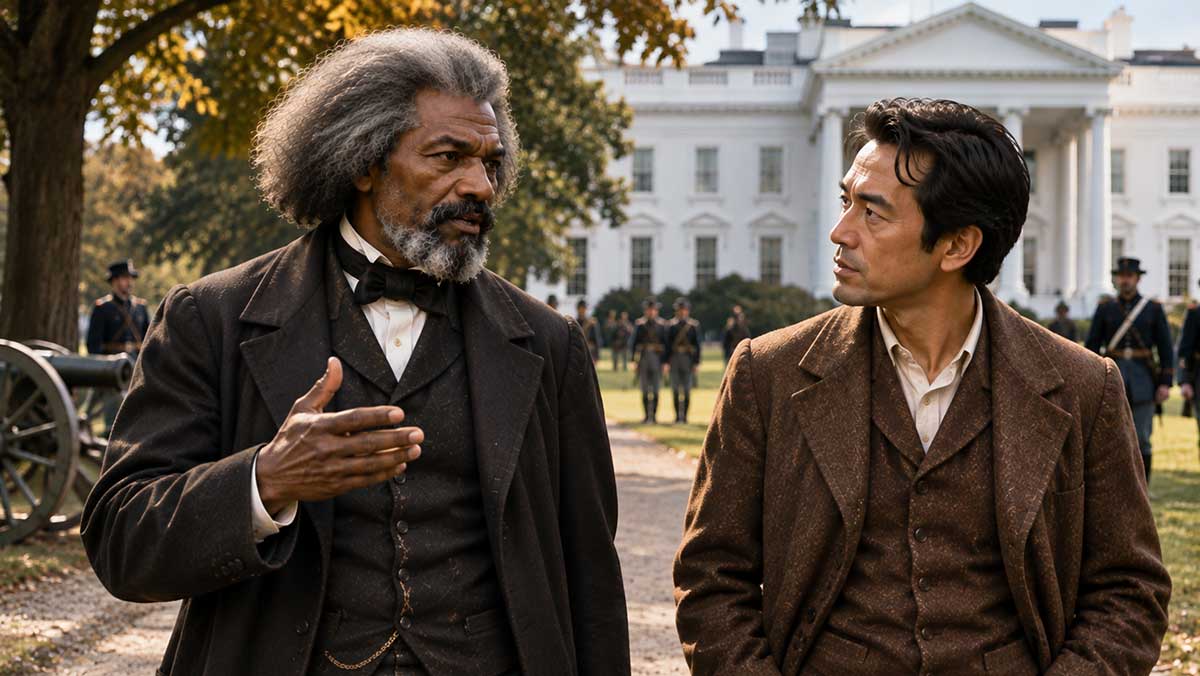
Opening: A Father's Demand at the White House
Washington, D.C. August 10, 1863. Frederick Douglass, approximately 45 years old.
The summer heat hangs over Washington. The Civil War has entered its third year, and the streets of the capital carry the restless energy of a nation fighting for its future.
Frederick Douglass emerges from the White House after meeting President Abraham Lincoln for the first time.
His dark hair is beginning to show traces of gray. He walks with the bearing of a man accustomed to addressing large audiences, but today he has spoken in a much smaller room, directly to the president of the United States.
Only twenty-three days have passed since the 54th Massachusetts Infantry assaulted Fort Wagner in South Carolina.
The attack was devastating. Colonel Robert Gould Shaw was killed, and the regiment suffered terrible casualties.
Among the soldiers who survived was Sergeant Major Lewis Douglass, Frederick's eldest son.
I meet Frederick along a shaded path outside the White House.
Nick Sasaki: Frederick! I've been waiting to hear how it went.
Frederick Douglass: (Removing his hat.) Then you have been waiting for news of a rather unusual meeting.
Nick Sasaki: You walked into the White House to challenge the president during a civil war. I imagine that qualifies as unusual.
Frederick Douglass: I did not go there to congratulate him.
Nick Sasaki: I didn't think you would.
Frederick Douglass: Yet I must tell you something. Mr. Lincoln received me with greater courtesy than I had expected.
Nick Sasaki: Considering how sharply you've criticized him, that surprises me.
Frederick Douglass: It surprised me as well. He spoke plainly, listened attentively, and showed none of the contempt that men of my color have so often encountered from those who possess authority.
Nick Sasaki: Did he agree with you?
Frederick Douglass: On some matters, we found common ground. On others, I left dissatisfied.
Nick Sasaki: Then I want to hear about both.
We begin walking.
Nick Sasaki: But before we talk about Lincoln, there's someone I want to ask about.
Frederick Douglass: Who?
Nick Sasaki: Your son Lewis.
Douglass stops.
Nick Sasaki: Three weeks ago, he was at Fort Wagner.
For a moment, the noise of Washington seems to recede.
Frederick Douglass: Yes. He was.
Nick Sasaki: Frederick, before you tell me what you said to the president, I want to know what it means for a father to send his son into a war like this.
Douglass looks down the path.
Frederick Douglass: Then we had better begin with what those men were fighting for.
Question 10: What Did You Most Want President Lincoln to Recognize About Black Soldiers and Their Families?
Nick Sasaki: You spent years demanding that Black men be permitted to fight for the Union. When the opportunity finally came, you encouraged them to enlist.
And your own sons answered that call.
Frederick Douglass: Lewis and Charles joined the 54th Massachusetts. I believed then, and believe now, that Black men must be allowed to participate in the struggle that will determine their future.
A nation cannot forever deny a people the rights of citizenship while expecting them to remain spectators in the defense of that nation.
Nick Sasaki: I agree with the principle. But I want to challenge the decision.
You knew the Confederate government threatened captured Black soldiers with treatment far worse than that faced by white prisoners.
You knew your sons might be killed or forced back into slavery.
Why encourage them to go?
Frederick Douglass: (Firmly.) Would you have preferred that they remain at home while other men fought to determine whether their people would remain enslaved?
Nick Sasaki: I'm asking as a father, Frederick. It's one thing to believe in a cause. It's another to watch your child walk into danger.
Frederick Douglass: And do you suppose I was ignorant of that distinction?
Nick Sasaki: No. That's why I'm asking.
Douglass studies me for a moment. His expression softens.
Frederick Douglass: You are right to ask it.
My sons are not arguments dressed in uniforms. They are human beings. Their lives are precious to me.
But consider the condition in which this war found us.
For generations, Black men had been told they were inferior, incapable of citizenship, unworthy of bearing arms. They were expected to submit to laws that denied their humanity.
Now the nation was fighting a war in which slavery stood at the center of the rebellion.
Should Black men have been denied the opportunity to take part in their own liberation?
Nick Sasaki: No. But having the right to fight and deciding whether to risk your son's life are two different questions.
Frederick Douglass: They are. And neither question is answered lightly.
Nick Sasaki: What did Fort Wagner change?
Douglass turns toward the distant street.
Frederick Douglass: The 54th Massachusetts marched against formidable Confederate defenses on Morris Island. They advanced under terrible fire. Colonel Shaw fell. Many of his men were killed, wounded, or captured.
Lewis survived, but the regiment paid dearly.
Nick Sasaki: When you learned what had happened, what frightened you most?
Frederick Douglass: The reports from such a battle were cause enough for grave concern.
But I will not pretend to recall every thought that passed through my mind. What I can tell you is that the risks facing Black soldiers were known before they entered combat.
And those risks have not been met with equal protection from the government they serve.
Nick Sasaki: That's what brought you here today.
Frederick Douglass: Yes.
I have encouraged Black men to enlist. I cannot then stand silently by when they are treated as lesser soldiers.
Nick Sasaki: Tell me what you demanded.
Frederick Douglass: Three things.
Equal pay for equal service.
Protection against the Confederate threat to murder, enslave, or otherwise mistreat captured Black soldiers.
And the opportunity for Black men to receive commissions and promotion according to their ability.
Nick Sasaki: Equal pay seems obvious.
Frederick Douglass: Then explain why it has proved so difficult for the government to recognize.
Nick Sasaki: The government might argue that it has to move cautiously. Many white Americans still oppose Black enlistment.
Frederick Douglass: And shall the prejudice of one man determine the wages of another?
A Black soldier may stand in the same line of battle, face the same cannon, and shed the same blood as a white soldier. Yet the government proposes to value his service less.
Does a bullet distinguish the color of the man it strikes?
Nick Sasaki: No.
Frederick Douglass: Then why should the government?
Nick Sasaki: What did Lincoln say?
Frederick Douglass: He argued that prejudice against Black soldiers was deeply rooted and that their admission into the army was itself an important advance. He believed the government had to proceed with care.
He spoke of the difficulties surrounding equal pay and suggested that the country was moving in the proper direction.
Nick Sasaki: Did that satisfy you?
Frederick Douglass: No.
Progress is welcome. But a soldier cannot purchase bread for his family with promises of future equality.
Nick Sasaki: That's fair. Yet Lincoln is responsible for holding the Union together. You're asking him to take steps that might provoke more opposition.
Frederick Douglass: I am asking him to recognize the men upon whom the Union increasingly depends.
There is a difference between caution that serves a worthy purpose and caution that becomes an excuse for continued injustice.
Nick Sasaki: Where do you think Lincoln falls?
Frederick Douglass: I believe he is struggling with that very distinction.
Nick Sasaki: So you don't think he's simply indifferent.
Frederick Douglass: No. I did not find him indifferent.
But sympathy does not pay a soldier. Courtesy does not protect a prisoner. Good intentions do not appoint a qualified Black officer.
Those things require decisions.
Nick Sasaki: What about captured soldiers?
Frederick Douglass: That question is especially grave.
The Confederate authorities have threatened to deny Black Union soldiers the treatment accorded to prisoners of war. Men captured in uniform may face enslavement or death.
The government must make clear that the lives of Black soldiers are not expendable.
Nick Sasaki: Lincoln has already issued a retaliation order, hasn't he?
Frederick Douglass: The administration has recently announced a policy of retaliation for unlawful treatment of Union soldiers, including Black troops. That is significant.
But a proclamation is not the same thing as protection secured in practice.
Nick Sasaki: So you wanted him to follow through.
Frederick Douglass: I wanted the Confederate authorities to know that the United States would not abandon its Black soldiers when they fell into enemy hands.
Nick Sasaki: And the commissions?
Frederick Douglass: If a Black man possesses the ability to lead, why should his color disqualify him?
Must the army reject capable officers merely to preserve the prejudices of men who have never commanded a regiment?
Nick Sasaki: Frederick, you sound angrier now than when we began.
Frederick Douglass: I have come from a meeting about men who may be asked to die for their country while that same country hesitates to treat them as equals.
Would you prefer a cheerful discussion?
Nick Sasaki: (Smiling slightly.) No. I think I understand your anger better now.
Frederick Douglass: Good.
Nick Sasaki: But I want to know something else.
When Lincoln listened to you today, did you feel that he truly recognized the men you were speaking for?
Douglass pauses.
Frederick Douglass: I believe he recognized the seriousness of my concerns.
Whether that recognition produces sufficient action remains to be seen.
Question 11: How Did Your View of Lincoln Change After Meeting Him Face-to-Face?
We continue along the path, passing beneath the shade of a large tree.
Nick Sasaki: Frederick, you've been one of Lincoln's sharpest critics.
Frederick Douglass: I have criticized his administration when I believed its policies fell short of what justice required.
Nick Sasaki: You've criticized him for moving too slowly against slavery. You opposed his earlier interest in colonization, the idea of encouraging Black Americans to leave the country.
Frederick Douglass: Yes.
Nick Sasaki: And now you've met him. Did he surprise you?
Frederick Douglass: He did.
I expected a president surrounded by the weight of his office. Instead, I encountered a man who spoke to me directly and without unnecessary ceremony.
He did not treat my presence as an intrusion.
Nick Sasaki: That's meaningful, especially in 1863.
Frederick Douglass: Very meaningful.
I have met men who speak eloquently of liberty and cannot bear to converse with a Black man as an equal.
Lincoln did not behave in that manner toward me.
Nick Sasaki: But you still disagree with him.
Frederick Douglass: Of course.
Nick Sasaki: Let me take Lincoln's side for a moment.
When he became president, seven states had already declared their secession. He inherited a divided nation and a military crisis.
If he had announced immediate emancipation everywhere at the beginning of the war, he might have lost vital support in the border states.
Wasn't his caution necessary?
Frederick Douglass: Necessary in every instance? That is a larger claim than I am prepared to accept.
Nick Sasaki: But surely you can recognize the danger.
Frederick Douglass: I recognize it. And I recognize that the president bears responsibilities I do not.
But consider the other danger.
What if the government had fought this war merely to restore the Union as it existed before the rebellion, leaving slavery undisturbed?
What sort of victory would that have been?
Nick Sasaki: A military victory without resolving the cause of the conflict.
Frederick Douglass: Exactly.
Nick Sasaki: Lincoln might say that saving the Union had to come first.
Frederick Douglass: And I would ask whether the Union could be securely saved without destroying the institution that had helped tear it apart.
Nick Sasaki: That's a strong argument.
But here's what troubles me.
You can demand the morally correct action. Lincoln has to find a way to accomplish it.
Isn't there a risk that someone in your position underestimates how difficult governing can be?
Douglass turns to face me.
Frederick Douglass: There is such a risk.
And there is an equal risk that those who govern become so occupied with calculating what is possible that they cease to ask what is right.
Nick Sasaki: So each of you needs something from the other.
Frederick Douglass: I would not claim that the president requires my instruction in every matter.
But those outside government have a duty to speak truths that officials may find inconvenient.
Nick Sasaki: Do you think Lincoln respects that?
Frederick Douglass: His conduct today gives me reason to believe he is willing to hear it.
Nick Sasaki: I find that fascinating.
You entered the White House prepared to confront a president whose policies you've attacked. Yet you came away respecting him more.
Frederick Douglass: Respect is not the same thing as agreement.
Nick Sasaki: No. But sometimes we forget that.
Frederick Douglass: Then we ought to recover the distinction.
A man may possess admirable qualities and still make decisions that deserve criticism.
Another may disagree with us and yet deserve a fair hearing.
Nick Sasaki: Let me ask you something more difficult.
Could your criticism of Lincoln have been unfair at times?
Douglass studies me.
Frederick Douglass: I have judged his policies from the position of a man who knows slavery's cruelty and believes its destruction cannot be delayed without grave consequences.
The president must weigh military and political circumstances beyond my immediate responsibility.
That difference does not make my criticisms unjust, but it does mean I should examine his circumstances carefully.
Nick Sasaki: That's an important admission.
Frederick Douglass: Do not mistake it for a surrender.
Nick Sasaki: (Laughing.) I wouldn't dare.
Douglass smiles.
Frederick Douglass: Good. We should remain on friendly terms.
Nick Sasaki: I have another question.
When you walked into Lincoln's office, did you feel you were speaking to a man who could become a great emancipator?
Frederick Douglass: I saw a man who had already taken an extraordinary step through the Emancipation Proclamation.
But the future remains unwritten.
The proclamation has changed the character of the war. Black men are entering the army. The nation is moving in directions that would have seemed extraordinary only a few years ago.
Whether the president will carry these changes far enough is a question his actions must answer.
Nick Sasaki: So you aren't ready to call him a hero.
Frederick Douglass: I am more interested in what he will do than in what title posterity may bestow upon him.
Nick Sasaki: That's a good answer.
Frederick Douglass: Then perhaps you will ask me a more difficult question.
Nick Sasaki: (Laughing.) You really do enjoy a challenge.
Frederick Douglass: I enjoy a conversation in which both men are awake.
Nick Sasaki: Fair enough.
I look back toward the White House.
Nick Sasaki: If Lincoln called you back tomorrow and said, "Mr. Douglass, I need your help persuading the country," would you help him?
Frederick Douglass: In any effort that genuinely advances emancipation and equal rights, I would be prepared to offer assistance.
But I would not purchase access to the president at the price of silence.
Nick Sasaki: You'd continue criticizing him when necessary.
Frederick Douglass: Certainly.
A president should not expect that receiving a visitor graciously has purchased the visitor's conscience.
Question 12: What Did the War Teach You About the Difference Between Political Leadership and Moral Leadership?
We find a quiet bench beneath the trees.
From somewhere beyond the grounds comes the distant sound of military movement through Washington.
Nick Sasaki: Frederick, there's something I've been thinking about since we began.
You and Lincoln want the Union to survive. You both recognize that slavery is central to this war.
Yet you approach the problem differently.
Is that the difference between moral leadership and political leadership?
Frederick Douglass: It is one difference, though I would not separate the two entirely.
A political leader must make decisions within the conditions of government.
A moral reformer must challenge the public conscience and press for principles that political institutions have neglected.
But neither role excuses a man from considering consequences.
Nick Sasaki: I want to test that.
Suppose you were president.
You had to keep the border states loyal, maintain an army, deal with Congress, and prevent the Confederacy from winning.
Would you move as quickly as you demand Lincoln should move?
Douglass laughs.
Frederick Douglass: You have chosen a convenient method of making my responsibilities more troublesome.
Nick Sasaki: (Smiling.) I thought it was a fair question.
Frederick Douglass: It is.
I cannot pretend to know every decision I would make under circumstances I have never occupied.
But I would hope that the preservation of the government did not become an excuse for forgetting the purpose a just government ought to serve.
Nick Sasaki: Then let me turn it around.
What if you were Lincoln's adviser rather than his critic?
Frederick Douglass: I would tell him that the nation's greatest source of strength may lie among the very people it has so long oppressed.
Let Black men fight.
Pay them fairly.
Protect them as soldiers.
Recognize their ability.
And do not ask them to defend a country that refuses to acknowledge their claim upon it.
Nick Sasaki: You believe Black soldiers can help change the nation's thinking.
Frederick Douglass: They already are.
Every man who serves with courage exposes the falsehood of those who insist Black Americans lack the qualities required for citizenship.
But I must insist upon something else.
Nick Sasaki: What's that?
Frederick Douglass: Their humanity does not depend upon their military service.
A man who cannot carry a rifle has no less right to freedom than one who charges a fortress.
Nick Sasaki: That's an important distinction.
Frederick Douglass: We must not replace one false standard of human worth with another.
Nick Sasaki: So their courage strengthens the argument for equal citizenship, but they shouldn't have to prove they're human by risking their lives.
Frederick Douglass: Exactly.
Nick Sasaki: Frederick, I want to return to Lewis.
Frederick Douglass: Very well.
Nick Sasaki: When you encouraged Black men to enlist, you told them their service could help secure freedom and citizenship.
But after Fort Wagner, what would you say to a mother whose son had been killed?
What could you possibly say that would make the sacrifice worthwhile?
Douglass is silent for a moment.
Frederick Douglass: I would not presume that any speech of mine could remove such a mother's grief.
Nor would I ask her to regard the loss of her son as a convenient illustration of my political arguments.
Nick Sasaki: Then what would you say?
Frederick Douglass: I would honor her son's service and recognize the terrible price her family had paid.
And I would insist that the nation owed its soldiers and their families more than words of praise.
Nick Sasaki: Meaning?
Frederick Douglass: Justice.
If the country accepts their sacrifice, it must not deny their rights.
If it praises their courage, it must not treat them as inferiors.
And if it sends them into battle, it must not abandon them when they fall into enemy hands.
Nick Sasaki: That's what you were fighting for in the White House today.
Frederick Douglass: Yes.
Nick Sasaki: I think I'm beginning to see something.
Your meeting with Lincoln wasn't simply about military policy.
Frederick Douglass: No.
Nick Sasaki: It was about whether the nation would recognize the humanity of the very men helping to save it.
Frederick Douglass: That is the heart of the matter.
Nick Sasaki: But let me push you once more.
You believe the war can destroy slavery. What happens if the Union wins and slavery ends, but white Americans still refuse to treat Black people as equals?
Douglass looks directly at me.
Frederick Douglass: Then the struggle will continue.
Nick Sasaki: For how long?
Frederick Douglass: For as long as justice requires.
Nick Sasaki: That could be the rest of your life.
Frederick Douglass: It may be.
Nick Sasaki: Does that ever exhaust you?
Frederick Douglass: A man may grow weary without surrendering his convictions.
And I should remind you that this work is not mine alone.
There are thousands who labor for emancipation, many without recognition or reward.
Some have suffered far more than I.
Nick Sasaki: But you have become one of the most recognized voices in the movement.
Frederick Douglass: Then I must use that opportunity responsibly.
Nick Sasaki: What do you most want Lincoln to understand before this war ends?
Frederick Douglass: That emancipation must be more than a measure of military necessity.
It must become a foundation for a nation in which Black Americans are recognized as free people entitled to the rights and protections of citizenship.
Nick Sasaki: Do you think he's capable of reaching that point?
Douglass looks toward the White House.
Frederick Douglass: I believe he is capable of growth.
What he will do remains to be seen.
Nick Sasaki: You sound cautiously hopeful.
Frederick Douglass: (Smiling.) I am hopeful enough to continue pressing him.
Closing: The Men Behind the Uniforms
The afternoon light has begun to soften.
Frederick and I rise from the bench and walk toward the gate.
The White House stands behind us, its windows catching the last bright sunlight of the day.
Nick Sasaki: Frederick, I came here expecting to hear about a confrontation between two famous men.
Frederick Douglass: And have I disappointed you?
Nick Sasaki: No. But the part that stays with me isn't the argument between you and Lincoln.
It's Lewis.
Douglass turns toward me.
Nick Sasaki: Your son survived Fort Wagner. Other fathers weren't so fortunate.
And today you went into the White House to speak for men whose lives were being treated as less valuable than those of their fellow soldiers.
Frederick Douglass: That is why I went.
Nick Sasaki: I think I finally understand something about your courage.
You weren't fearless. You knew what could happen to your sons.
But you believed the country had no right to ask for their lives and deny their equality.
Frederick Douglass: It is a contradiction that cannot be defended.
Nick Sasaki: Did Lincoln understand that when you left his office?
Frederick Douglass: He understood my argument.
Whether he will act upon it with sufficient determination is another question.
Nick Sasaki: You don't seem ready to give up on him.
Frederick Douglass: Nor am I prepared to excuse every delay.
Nick Sasaki: (Smiling.) I think Lincoln is going to hear from you again.
Frederick Douglass: He may find that I am a difficult man to discourage.
We laugh.
Then I look toward the White House.
Nick Sasaki: Frederick, do you think Lincoln realizes how extraordinary this meeting was?
Frederick Douglass: What do you mean?
Nick Sasaki: You were born enslaved in Maryland.
You were denied the right to learn.
You escaped, became a writer and abolitionist, and today you walked into the president's office to demand justice for soldiers fighting to save the country.
Frederick Douglass: It is an extraordinary contrast.
Nick Sasaki: I wonder what the boy you once were would think of this afternoon.
Douglass looks down the path.
Frederick Douglass: I should hope that he would recognize something more important than the distinction of entering the White House.
Nick Sasaki: What's that?
Frederick Douglass: That the country which once permitted him to be held as property is now being compelled to confront the claims of people it has so long oppressed.
Nick Sasaki: And that the fight isn't over.
Frederick Douglass: Far from it.
We reach the gate.
Nick Sasaki: Frederick, when we meet again, I'd like to visit you at Cedar Hill.
Frederick Douglass: Then I hope you will find me with a good library and sufficient time for conversation.
Nick Sasaki: I want to ask what happened after the war.
Whether the country fulfilled the promises being made now.
And what became of your hopes for Lincoln.
Frederick Douglass: Those are questions for the years ahead.
Nick Sasaki: I suspect some of the answers will be painful.
Frederick Douglass: Perhaps. But we must not refuse to examine history merely because it disappoints us.
I extend my hand.
Nick Sasaki: Thank you, Frederick.
Frederick Douglass: And thank you, my friend.
We shake hands.
Then, before turning away, I ask one final question.
Nick Sasaki: If you could leave Lincoln with one thought tonight, what would it be?
Douglass looks back at the White House.
Frederick Douglass: I would ask him to think of the men who marched against Fort Wagner.
Not merely as soldiers useful to the Union.
Not merely as evidence that Black men can fight.
But as fathers, sons, husbands, and brothers whose lives are as precious as those of any other Americans.
He pauses.
Frederick Douglass: And then I would ask him whether a nation worthy of their sacrifice can continue to treat them as anything less than equals.
We part at the gate.
As Frederick walks into the Washington evening, I look once more at the White House.
Inside, Abraham Lincoln faces decisions that will shape the nation's future.
Outside, Frederick Douglass carries the demands of men whose courage has already helped change the course of the war.
Neither man knows how the conflict will end.
But the question raised by their meeting cannot easily be set aside:
Can a nation ask people to sacrifice their lives for freedom while refusing to recognize their equal humanity?
Topic 5: The Freedom He Never Stopped Fighting For
Opening: The Battle That Outlived the War
Cedar Hill, Washington, D.C. Autumn 1893. Frederick Douglass, approximately 75 years old.
The afternoon sun falls across the Anacostia hills, illuminating the autumn trees surrounding Cedar Hill.
Inside Frederick Douglass's study, books fill the shelves. Papers rest in carefully arranged stacks across his desk. Through the windows, Washington stretches into the distance, a city transformed by the war that ended slavery nearly three decades earlier.
Douglass stands beside the window.
His once-dark hair is now a great white mane. His beard has grown fuller, and the years have left their marks upon his face.
Yet nothing about his presence suggests retirement.
At seventy-five, he remains a formidable figure, still writing, speaking, and challenging the conscience of a nation that has repeatedly disappointed him.
I enter the study.
Nick Sasaki: Frederick, I expected to find you enjoying a peaceful retirement.
Frederick Douglass: (Turning with a smile.) Then you have come to the wrong house.
Nick Sasaki: I can see that. You've got enough papers here to keep a newspaper office busy.
Frederick Douglass: An idle desk is a luxury I have not yet learned to appreciate.
Nick Sasaki: You're seventy-five years old. You've escaped slavery, helped bring about emancipation, advised presidents, served your country abroad, and become one of the most recognized Americans of your century.
Haven't you earned the right to rest?
Frederick Douglass: I have earned the right to choose how I spend my days.
And I choose not to spend them pretending that the work is finished.
Nick Sasaki: But slavery ended almost thirty years ago.
Douglass looks at me sharply.
Frederick Douglass: Is that your argument for declaring victory?
Nick Sasaki: No. I'm asking whether you can recognize how much has changed.
Frederick Douglass: I recognize it. I helped fight for those changes.
But you have arrived at a particularly interesting moment to ask whether the struggle is over.
Nick Sasaki: Why?
He gestures toward a pamphlet on his desk.
Frederick Douglass: Because this year, in Chicago, America has been celebrating its greatness before the world.
And we have had to ask why so many of its Black citizens have been excluded from that celebration.
I pick up the pamphlet.
Nick Sasaki: Then perhaps we should begin there.
Question 13: If Slavery Ended, Why Were Black Americans Still Fighting for Freedom?
Nick Sasaki: Frederick, let's start with what America accomplished.
The Thirteenth Amendment abolished slavery. The Fourteenth established birthright citizenship and equal protection. The Fifteenth prohibited denying voting rights on account of race, color, or previous condition of servitude.
Those were extraordinary changes.
Frederick Douglass: They were.
And they must never be dismissed as insignificant.
The destruction of slavery was an achievement of enormous consequence. Constitutional recognition of citizenship and voting rights created foundations upon which future generations could build.
Nick Sasaki: Then why does it seem you're still fighting the same battle?
Frederick Douglass: Because a right written into the Constitution is not always a right respected in the street, the courtroom, or the polling place.
Nick Sasaki: But the law has changed.
Frederick Douglass: And men have found ways to evade it.
Nick Sasaki: Such as?
Frederick Douglass: Violence. Intimidation. Discriminatory laws. Devices intended to keep Black citizens from voting. And the refusal of authorities to protect people whose rights they are sworn to defend.
Nick Sasaki: You're talking about the South.
Frederick Douglass: Much of the most brutal violence is concentrated there, but prejudice is not confined to one region.
Nick Sasaki: You sound more disappointed than you did when we spoke in 1852.
Frederick Douglass: Disappointed? Certainly.
But I have not forgotten the difference between a nation in which slavery is legally protected and one in which slavery has been abolished.
Progress is real.
So is the injustice that remains.
Nick Sasaki: Let me challenge you.
If you constantly point out America's failures, don't you risk convincing people that nothing has improved?
Frederick Douglass: Only if they refuse to listen to the whole argument.
We have abolished slavery. That is an immense victory.
We have recognized citizenship. Another victory.
But tell me, Nick, what meaning has the right to vote for a man who may be murdered for attempting to exercise it?
Nick Sasaki: Very little, if the government won't protect him.
Frederick Douglass: And what meaning has equal protection when the law is administered unequally?
Nick Sasaki: That's the contradiction.
Frederick Douglass: One of many.
Douglass takes the pamphlet from my hand.
Frederick Douglass: Have you heard of Ida B. Wells?
Nick Sasaki: Yes. The journalist investigating lynching.
Frederick Douglass: A courageous woman.
She has exposed the falsehoods used to excuse the murder of Black Americans.
She has demanded that the nation confront violence it would prefer to ignore.
Nick Sasaki: And you've supported her work.
Frederick Douglass: I have.
The country must not be permitted to treat mob murder as an unfortunate local disturbance.
Lynching is a direct assault upon justice, citizenship, and the protection of human life.
Nick Sasaki: Some people claim these killings are punishment for crimes.
Douglass's expression hardens.
Frederick Douglass: Then let them produce evidence and submit it to lawful examination.
A mob is not a court.
An accusation is not a conviction.
And no civilized government can permit men to seize another human being and murder him under the pretense of administering justice.
Nick Sasaki: But many Americans accept the stories used to justify the violence.
Frederick Douglass: Then those stories must be exposed.
That is part of the importance of Miss Wells's work.
She investigates. She publishes. She refuses to allow comfortable falsehoods to pass for truth.
Nick Sasaki: I can see why you admire her.
Frederick Douglass: She possesses courage, intelligence, and a willingness to confront public opinion.
Those are qualities our country urgently needs.
Nick Sasaki: And this pamphlet concerns the World's Fair?
Frederick Douglass: Yes.
The World's Columbian Exposition has gathered visitors from across the globe to admire America's achievements.
Yet Black Americans have been denied meaningful representation in its official exhibitions.
Nick Sasaki: So you and Ida B. Wells protested.
Frederick Douglass: Together with others, including Irvine Garland Penn and Ferdinand Barnett, we helped present The Reason Why the Colored American Is Not in the World's Columbian Exposition.
Nick Sasaki: You wanted visitors to see the America missing from the celebration.
Frederick Douglass: Exactly.
A nation that displays its industry, invention, and prosperity should not conceal the discrimination practiced against millions of its citizens.
Nick Sasaki: But you participated in the fair yourself, through the Haitian pavilion.
Frederick Douglass: I served as a commissioner representing Haiti at the exposition.
It was a position that allowed me to participate in the fair and speak to visitors.
Nick Sasaki: That's quite an irony.
You could represent Haiti, but Black Americans were being excluded from the official picture of American achievement.
Frederick Douglass: It was a contradiction worth exposing.
Nick Sasaki: Frederick, after all these years, doesn't it sometimes feel like the country takes one step forward and two steps backward?
Frederick Douglass: At times.
But I will not allow the reversals to erase the victories.
Nor will I allow the victories to excuse the reversals.
Nick Sasaki: So how do you keep hope alive?
Frederick Douglass: By remembering that progress was never a gift handed down without struggle.
The rights we possess were secured through the efforts and sacrifices of many people.
If they are threatened, they must be defended.
Nick Sasaki: Even at seventy-five?
Douglass smiles.
Frederick Douglass: I was not aware that injustice observed a retirement age.
We laugh.
Then I look again at the pamphlet.
Nick Sasaki: I think I understand why you're still working.
You didn't spend your life fighting merely to end the legal ownership of human beings.
You wanted the country to recognize their full citizenship and dignity.
Frederick Douglass: Yes.
And that work remains unfinished.
Question 14: What Did Lincoln, Haiti, and Your Own Changing Beliefs Teach You About Leadership?
I walk toward a shelf containing photographs and books.
Nick Sasaki: Frederick, I've wanted to return to a conversation we had outside the White House.
August 10, 1863.
You had just met Abraham Lincoln for the first time.
Frederick Douglass: I remember that meeting well.
Nick Sasaki: You respected the way he received you, but you were dissatisfied with his policies toward Black soldiers.
Frederick Douglass: Yes.
Nick Sasaki: Now, thirty years later, how do you judge him?
Douglass moves toward a chair.
Frederick Douglass: With gratitude for what he accomplished, and with an awareness of his limitations.
Nick Sasaki: You were deeply critical of him during the war.
Frederick Douglass: I believed he moved too slowly on matters of great importance.
He was, by his own political position and responsibilities, concerned above all with preserving the Union.
I was concerned with the destruction of slavery and the recognition of Black Americans as equal human beings.
Those aims increasingly came together as the war continued.
Nick Sasaki: But Lincoln changed.
Frederick Douglass: He did.
The Emancipation Proclamation transformed the war's meaning.
Black soldiers entered the Union Army.
And near the end of his life, Lincoln publicly expressed support for voting rights for at least some Black men, including those who had served as soldiers.
Nick Sasaki: That was a major change.
Frederick Douglass: It was.
Nick Sasaki: And then he was assassinated.
Douglass lowers his eyes.
Frederick Douglass: Yes.
Nick Sasaki: In 1876, you delivered a speech at the unveiling of the Freedmen's Memorial in Washington.
You praised Lincoln, but you didn't pretend he had been perfect.
Frederick Douglass: I believed the occasion required an honest judgment.
Lincoln was a great president, but his greatness did not require us to deny his hesitations or the differences between his priorities and ours.
Nick Sasaki: You described him as fundamentally a white man's president, judged from the standpoint of the abolitionist.
Frederick Douglass: That was part of my assessment.
Yet I recognized the extraordinary importance of what he accomplished under the conditions of his time.
Nick Sasaki: Some people might think that sounds contradictory.
Frederick Douglass: Only if they insist that historical figures must be either saints or villains.
Nick Sasaki: (Smiling.) You've never had much patience for that.
Frederick Douglass: History becomes useless when admiration requires blindness.
Nick Sasaki: But let me challenge you.
You demanded that Lincoln act faster. Now you recognize how difficult his position was.
Does that mean you were too hard on him?
Frederick Douglass: Not necessarily.
A reformer may press a president beyond what the president presently considers possible.
The president may resist, deliberate, and eventually move.
Both the pressure and the political decision may matter.
Nick Sasaki: So the tension between you wasn't necessarily harmful.
Frederick Douglass: It may have served a useful purpose.
Nick Sasaki: Did you ever become friends?
Frederick Douglass: We developed a relationship of mutual respect. I met him again and came to appreciate his character more deeply.
But I would not reduce our relationship to a pleasant personal friendship.
The matters we discussed were too serious for that.
Nick Sasaki: Fair enough.
There's another chapter of your life I want to ask about.
Haiti.
Frederick Douglass: Ah, Haiti.
Nick Sasaki: You served as United States Minister Resident and Consul General there from 1889 to 1891.
What did that experience teach you?
Frederick Douglass: Haiti occupies a remarkable place in the history of freedom.
Its people overthrew slavery and established an independent Black republic.
That achievement deserves far greater respect than it has often received.
Nick Sasaki: Yet Haiti has faced political instability, foreign pressure, and difficult economic conditions.
Frederick Douglass: It has.
And those difficulties should be examined seriously, without pretending that the nation's achievements are insignificant.
Nick Sasaki: Did serving as a diplomat change how you viewed America?
Frederick Douglass: It gave me another vantage point from which to consider the conduct of powerful nations toward weaker ones.
Nick Sasaki: Including American ambitions in the Caribbean?
Frederick Douglass: Yes.
The United States sought access to Môle-Saint-Nicolas for a naval station.
The negotiations raised difficult questions concerning Haiti's sovereignty and the intentions of American officials.
Nick Sasaki: You were caught between representing your country and respecting Haiti's independence.
Frederick Douglass: Diplomatic service requires a man to represent his government.
But it does not relieve him of the obligation to think seriously about justice and the rights of other nations.
Nick Sasaki: Did that conflict trouble you?
Frederick Douglass: There were disagreements and disappointments during my service.
I came to believe that American policy toward Haiti had not always been guided by the respect that nation deserved.
Nick Sasaki: You spent much of your life challenging America to respect Black people at home.
Then you found yourself confronting similar questions abroad.
Frederick Douglass: The principles of justice do not cease to apply at a national border.
Nick Sasaki: Frederick, there's a pattern in your life.
You challenged Garrison over the Constitution.
You challenged Lincoln over emancipation and Black soldiers.
You criticized American policy toward Haiti.
You even changed your own positions when you became convinced you had been mistaken.
Were you ever afraid of standing alone?
Douglass considers the question.
Frederick Douglass: No man should take pleasure in unnecessary isolation.
I have valued friendship, cooperation, and the support of fellow reformers.
But agreement purchased at the expense of conscience is too costly.
Nick Sasaki: That's a demanding way to live.
Frederick Douglass: It is.
Nick Sasaki: Did it cost you friendships?
Frederick Douglass: Some relationships were strained or broken by disagreement.
That is a real loss.
But intellectual independence would mean very little if we practiced it only when everyone applauded.
Nick Sasaki: So what makes a great leader?
Frederick Douglass: The willingness to recognize injustice, the courage to act against it, and the capacity to learn.
Nick Sasaki: Even when learning means admitting you were wrong?
Frederick Douglass: Especially then.
Nick Sasaki: And what makes a poor leader?
Douglass smiles.
Frederick Douglass: How much time have you reserved for the answer?
Nick Sasaki: (Laughing.) Perhaps we should save that for another afternoon.
Frederick Douglass: A wise decision.
Question 15: After a Lifetime of Fighting for Freedom, What Matters Most to You Now?
The light outside has softened.
Douglass moves toward a small table holding family photographs.
I follow him.
Nick Sasaki: Frederick, we've talked about slavery, freedom, presidents, and nations.
But I'd like to ask about your family.
Frederick Douglass: Then you are turning to a subject of great importance.
Nick Sasaki: Anna died in 1882.
You were married for more than forty years.
Frederick Douglass: Yes.
Nick Sasaki: She was there before the world knew your name.
She helped you escape. She came to New York. She built a home with you.
And through all those years of speeches, travel, controversy, and danger, she carried enormous responsibilities.
Frederick Douglass: Anna's contributions to our family were substantial.
Nick Sasaki: Do you think history has given her enough credit?
Frederick Douglass: No.
Public attention often follows the person who speaks from the platform, while the work that sustains a family receives far less recognition.
Nick Sasaki: And you were away from home frequently.
Frederick Douglass: I was.
Nick Sasaki: Did your public work come at a cost to your family?
Douglass is quiet.
Frederick Douglass: My work required long absences and brought demands upon our household.
It would be foolish to pretend that such a life placed no burden upon those closest to me.
Nick Sasaki: That's something I've been thinking about.
People admire someone who dedicates his life to a great cause.
But the family sometimes pays a price that the public never sees.
Frederick Douglass: That is true.
Nick Sasaki: Do you ever wonder whether you should have spent more time at home?
Douglass looks at the photographs.
Frederick Douglass: I can recognize the sacrifices involved without pretending that I can reconstruct every private moment or alter the past.
What matters is that Anna and our children were not merely supporting characters in my public life.
They had lives and concerns of their own.
Nick Sasaki: Your sons Lewis and Charles served during the Civil War. Your son Frederick Jr. contributed to the cause in other ways.
And your daughters Rosetta and Annie were part of the family's story too.
Frederick Douglass: Yes.
Annie died young, a sorrow that remained with our family.
Rosetta, Lewis, Frederick Jr., and Charles each had their own experiences and responsibilities.
Nick Sasaki: When people tell your story, they often talk about the famous abolitionist.
They don't always see the father.
Frederick Douglass: Public achievement is easier to record than the ordinary experiences of family life.
Nick Sasaki: And then, in 1884, you married Helen Pitts.
Frederick Douglass: Yes.
Nick Sasaki: Your marriage caused controversy.
Helen was white, and many people objected.
Frederick Douglass: They did.
Nick Sasaki: Including some members of your families.
Frederick Douglass: There was opposition and painful disagreement.
Nick Sasaki: You had spent decades fighting racial prejudice, and then people criticized your own marriage across racial lines.
Frederick Douglass: There is an irony in that.
Nick Sasaki: Did the criticism surprise you?
Frederick Douglass: I was familiar with the force of racial prejudice.
But familiarity does not make its effects pleasant.
Nick Sasaki: Why marry Helen, knowing the reaction you might face?
Frederick Douglass: Helen and I chose to marry.
I did not believe that racial prejudice should determine whom a person may love or marry.
Nick Sasaki: Some critics argued that your marriage betrayed your commitment to Black Americans.
Frederick Douglass: My commitment to equal rights did not require me to accept racial restrictions upon marriage.
Nick Sasaki: That's consistent with everything you've argued publicly.
Frederick Douglass: I should hope that my principles apply beyond the platform.
Nick Sasaki: Helen has been involved in women's rights, hasn't she?
Frederick Douglass: She has.
Nick Sasaki: And you've supported women's suffrage for decades.
You attended the Seneca Falls convention in 1848.
Frederick Douglass: I did.
I supported the resolution calling for women's voting rights.
Nick Sasaki: But you later disagreed with some women's rights leaders over the Fifteenth Amendment.
Frederick Douglass: Yes.
During Reconstruction, the question of voting rights became a source of painful division.
I believed the immediate danger facing Black men, including violence and exclusion from political life, made their enfranchisement urgently necessary.
Others argued that extending the vote to men without extending it to women perpetuated another injustice.
Nick Sasaki: Looking back, do you think that disagreement damaged the movement for equality?
Frederick Douglass: It created divisions among people who shared important principles.
I regret the bitterness that sometimes accompanied those disagreements.
But the urgency of Black male suffrage was real, and the injustice of denying women the vote was real.
Nick Sasaki: Could both causes have been pursued together?
Frederick Douglass: That was the hope of many reformers.
But political circumstances forced difficult decisions, and people disagreed about the proper course.
Nick Sasaki: You're still fighting for women's voting rights now.
Frederick Douglass: Yes.
I do not believe the possession of political rights should be determined by sex.
Nick Sasaki: Frederick, you've spent almost your entire adult life challenging people who claim that some human beings deserve fewer rights than others.
Frederick Douglass: That is a fair description.
Nick Sasaki: Yet people keep finding new reasons to divide themselves.
Race. Sex. Nationality. Religion.
Does it ever make you wonder whether human beings will ever learn?
Douglass walks toward the window.
Frederick Douglass: Human beings are capable of remarkable cruelty.
But they are capable of courage, generosity, sacrifice, and change.
I have witnessed both.
Nick Sasaki: Which has impressed you more?
Frederick Douglass: I would not attempt to measure them so simply.
But I know that institutions once considered permanent have fallen.
Slavery in this country was defended as natural, necessary, and divinely sanctioned.
Yet it was destroyed.
Nick Sasaki: And still the struggle continues.
Frederick Douglass: Yes.
Nick Sasaki: Frederick, I want to ask you something personal.
When you look back on your life, what are you proudest of?
Your escape?
Your speeches?
Your work during the Civil War?
Your influence on Lincoln?
Douglass turns toward me.
Frederick Douglass: I am grateful to have participated in the struggle against slavery and in the continuing effort to secure equal rights.
But I would not wish my life to be measured solely by public recognition.
Nick Sasaki: Then how would you measure it?
Frederick Douglass: By whether I have used the opportunities available to me in service of principles I believed just.
Nick Sasaki: And if you could speak to the young boy you once were in Maryland?
Frederick Douglass: I would want him to know that the condition imposed upon him did not define his worth.
Nick Sasaki: He couldn't have known what his life would become.
Frederick Douglass: No.
Nick Sasaki: He couldn't have known he'd escape, write books, meet presidents, or become one of the most influential voices of his century.
Frederick Douglass: Nor could he have known the sacrifices and disappointments that would accompany those experiences.
Nick Sasaki: But he kept moving forward.
Frederick Douglass: He did what he could with the circumstances before him.
Nick Sasaki: Frederick, there's one thing I want to understand.
You've already accomplished more than most people could hope to accomplish in several lifetimes.
Why continue?
Why keep fighting?
Douglass looks directly at me.
Frederick Douglass: Let me ask you a question.
Nick Sasaki: Please.
Frederick Douglass: Suppose you had been denied your freedom for twenty years.
Suppose you escaped, built a family, and found a measure of security.
Would the freedom of others cease to matter to you merely because you had obtained your own?
Nick Sasaki: No. I don't believe it would.
Frederick Douglass: Then you have your answer.
Nick Sasaki: But there are limits to what one person can do.
Frederick Douglass: Certainly.
No one can correct every injustice or carry every burden.
But each of us must decide how to respond to the wrongs we can recognize.
Nick Sasaki: So freedom brings responsibility.
Frederick Douglass: Freedom makes responsibility possible.
Nick Sasaki: That's a distinction I hadn't considered.
Frederick Douglass: A man who has been denied control over his life may possess a profound desire to act.
Once he is free, he must decide what to do with that liberty.
Nick Sasaki: And you chose to use yours for others.
Frederick Douglass: I chose to oppose slavery and injustice.
Others made sacrifices greater than mine. Many gave their lives.
I would not have my own efforts obscure theirs.
Nick Sasaki: You keep returning to that.
Frederick Douglass: To what?
Nick Sasaki: The people whose names history doesn't always remember.
Frederick Douglass: History should remember more than the famous.
Nick Sasaki: Frederick, after everything we've discussed, I think the most remarkable part of your life isn't that you escaped slavery.
It's that you refused to let your own escape become the end of the story.
Douglass smiles.
Frederick Douglass: That is a generous judgment.
Nick Sasaki: I mean it.
Frederick Douglass: Then permit me to leave you with a question.
Nick Sasaki: Go ahead.
Frederick Douglass: If you enjoy freedom today, what are you prepared to do when you see another human being denied it?
I am silent.
Douglass waits.
Nick Sasaki: I don't think I have a complete answer.
Frederick Douglass: Then perhaps it is a question worth carrying with you.
Closing: The Work That Remained
The late afternoon sun begins to disappear behind the hills.
Frederick and I walk onto the veranda overlooking Washington.
The Capitol dome is visible in the distance.
Nick Sasaki: Frederick, when we first met, I wanted to understand how a man could escape slavery and become one of America's greatest voices for freedom.
Now I think I understand something deeper.
Frederick Douglass: And what is that?
Nick Sasaki: You didn't become extraordinary simply by surviving what happened to you.
You became extraordinary through what you chose to do afterward.
Frederick Douglass: Be careful, Nick.
Nick Sasaki: About what?
Frederick Douglass: Do not turn survival into a competition for greatness.
There were enslaved people who never escaped, who never spoke before an audience, who never wrote a book.
Their lives possessed no less dignity than mine.
Nick Sasaki: You're right. I didn't mean to suggest otherwise.
Frederick Douglass: I know.
He smiles.
Frederick Douglass: But it is worth saying.
Nick Sasaki: Then let me put it differently.
Your life shows what one person can do when he refuses to accept injustice as inevitable.
Frederick Douglass: That is closer to what I would hope others might learn.
Nick Sasaki: And you never stopped changing your mind when you encountered a better argument.
Frederick Douglass: I have tried to remain willing to learn.
Nick Sasaki: You disagreed with friends, challenged presidents, defended people who had no political voice, and kept fighting long after slavery ended.
Frederick Douglass: I was fortunate to work alongside many courageous people.
Nick Sasaki: Including Anna.
Frederick Douglass: Including Anna.
Nick Sasaki: And the people who helped you escape.
Frederick Douglass: Yes.
Nick Sasaki: And those who fought beside you during the war and afterward.
Frederick Douglass: Many of whom deserve far greater recognition.
We stand quietly, looking across Washington.
Nick Sasaki: Frederick, do you think America will ever fully live up to its promises?
Douglass considers the distant Capitol.
Frederick Douglass: I cannot promise that it will.
But I have seen enough change in my lifetime to know that the future is not fixed.
Nick Sasaki: That's an encouraging thought.
Frederick Douglass: It is a demanding one.
Nick Sasaki: (Smiling.) You always manage to make hope sound like work.
Frederick Douglass: My friend, hope that requires nothing of us is a comfortable possession.
I prefer the kind that asks something of our lives.
We laugh softly.
Then I extend my hand.
Nick Sasaki: Thank you, Frederick. For your honesty, your humor, and your willingness to challenge me.
Frederick Douglass: And thank you for listening, even when I have made the conversation uncomfortable.
Nick Sasaki: Especially then.
We shake hands.
Frederick Douglass: Come back again, Nick. There are still many matters worth discussing.
Nick Sasaki: I will.
I leave Cedar Hill as the evening light settles over Washington.
Behind me, Frederick Douglass returns to his study.
At seventy-five, he has witnessed the destruction of slavery, the passage of constitutional amendments, the rise and retreat of Reconstruction, and the emergence of new generations determined to carry forward the struggle for equality.
He has seen triumphs that once seemed impossible.
He has witnessed betrayals that would have broken the confidence of a less determined man.
Yet his work continues.
Less than two years later, on February 20, 1895, Frederick Douglass will die in Washington after attending a women's rights meeting that day.
It is a fitting final chapter in the life of a man who never believed the fight for human dignity belonged to one race, one generation, or one cause.
He had escaped slavery more than half a century earlier.
But he had never stopped working to make freedom meaningful for others.
And perhaps that is the answer to the question with which our conversations began:
Frederick Douglass escaped slavery. Why wasn't that enough?
Because the freedom he sought was never meant to belong to him alone.
Final Thoughts: The Freedom That Was Never His Alone
When I think about Frederick Douglass after our imagined conversations, the first image that returns is not the celebrated abolitionist standing before an audience. It is a young man boarding a train in Baltimore with borrowed identification papers, knowing that one suspicious glance could destroy his hopes. He had no guarantee of success. He could not know what his future would become. Yet he acted. His escape reminds me that courage is not the absence of fear. It is the decision to move forward when fear has every reason to exist.
But Douglass's story cannot be told through individual courage alone. Anna Murray helped make his escape possible. David Ruggles offered protection when danger remained close. Nathan and Mary Johnson welcomed the newly married couple into a new community. His mother, grandmother, family, friends, and fellow abolitionists shaped his life in ways that public recognition can easily obscure. Behind the achievements of one remarkable individual stood many people whose sacrifices and kindness mattered deeply. Their contributions deserve recognition in their own right.
What struck me most about Douglass's public voice was his refusal to allow beautiful ideals to conceal ugly realities. He admired the principles of liberty expressed in America's founding documents, yet he demanded that the country confront the contradiction between those principles and slavery. He challenged churches that preached Christian love while defending human bondage. He questioned political leaders who spoke of freedom while delaying justice. His example reminds us that genuine love for a country, a faith, or an institution does not require silence about its failures.
His relationship with Abraham Lincoln offers another lesson. Douglass could recognize Lincoln's humanity, appreciate his accomplishments, and still challenge his decisions. Their disagreements were not simply arguments between competing personalities. They concerned the lives of Black soldiers, including Douglass's own sons, who faced unequal treatment while fighting for the Union. Years later, Douglass could honor Lincoln's extraordinary role in emancipation without pretending that the president had been free of limitations. Respect and disagreement were not enemies in his thinking. Both could exist within an honest relationship.
Perhaps the most difficult part of Douglass's story comes after emancipation. Slavery ended, constitutional rights expanded, and new opportunities emerged. Yet racial violence, discrimination, and political exclusion continued. At seventy-five, Douglass was still supporting Ida B. Wells's campaign against lynching and challenging America's treatment of Black citizens. His diplomatic experience in Haiti broadened his concern for national dignity and sovereignty. His lifelong support for women's suffrage demonstrated that his commitment to human rights could extend beyond the immediate struggles of his own community.
I was moved, too, by the quieter dimensions of his life. Anna Murray's years of devotion, the losses and responsibilities of family life, his marriage to Helen Pitts, and the controversies that followed remind us that historical figures are never simply collections of public achievements. Douglass was a husband, father, friend, and imperfect human being living through circumstances that demanded difficult choices. Recognizing those personal dimensions does not diminish his greatness. It makes his accomplishments more human and his sacrifices more meaningful.
Frederick Douglass died on February 20, 1895, after attending a women's rights meeting that day. There is something deeply moving about that final chapter: a man who had escaped slavery more than fifty years earlier was still engaged in the struggle for equal rights. His life leaves me with a question I cannot easily dismiss. If I enjoy freedoms that others fought to secure, what am I prepared to do when I see another human being denied those same freedoms? Perhaps the greatest tribute we can offer Frederick Douglass is not admiration alone, but a willingness to carry that question into our own lives.
Fictional Conversation Disclaimer
These Final Thoughts are the author's reflections on Frederick Douglass's documented life and the themes explored through an imagined interview. The conversations, emotional exchanges, reconstructed private responses, and scenes involving Nick Sasaki are fictional literary interpretations, not verified statements or endorsements by Douglass. Historical events are distinguished from creative dialogue through the accompanying context and source references; readers seeking authoritative accounts should consult primary documents and established historical research.
Short Bios:
Frederick Douglass (c. 1818–1895)
Frederick Douglass was an American abolitionist, writer, orator, newspaper publisher, and advocate for equal rights. Born enslaved in Maryland, he escaped in 1838 and became one of the most influential figures in the struggle against slavery. His major autobiographies include Narrative of the Life of Frederick Douglass (1845), My Bondage and My Freedom (1855), and Life and Times of Frederick Douglass (1881, revised 1892). He supported Black military service during the Civil War, met with Abraham Lincoln, and continued advocating for racial equality and women's rights after emancipation. His later home is preserved as the Frederick Douglass National Historic Site in Washington, D.C.
Nick Sasaki
Nick Sasaki is the creator of ImaginaryTalks.com, where historical figures, influential thinkers, and remarkable individuals come together in fictional conversations exploring humanity's most meaningful questions. Drawing on his interests in history, faith, philosophy, human relationships, and personal growth, he seeks to bring readers closer to the human experiences behind important ideas. His interviews encourage curiosity, independent thinking, compassion, and reflection on how we might live more meaningful lives.
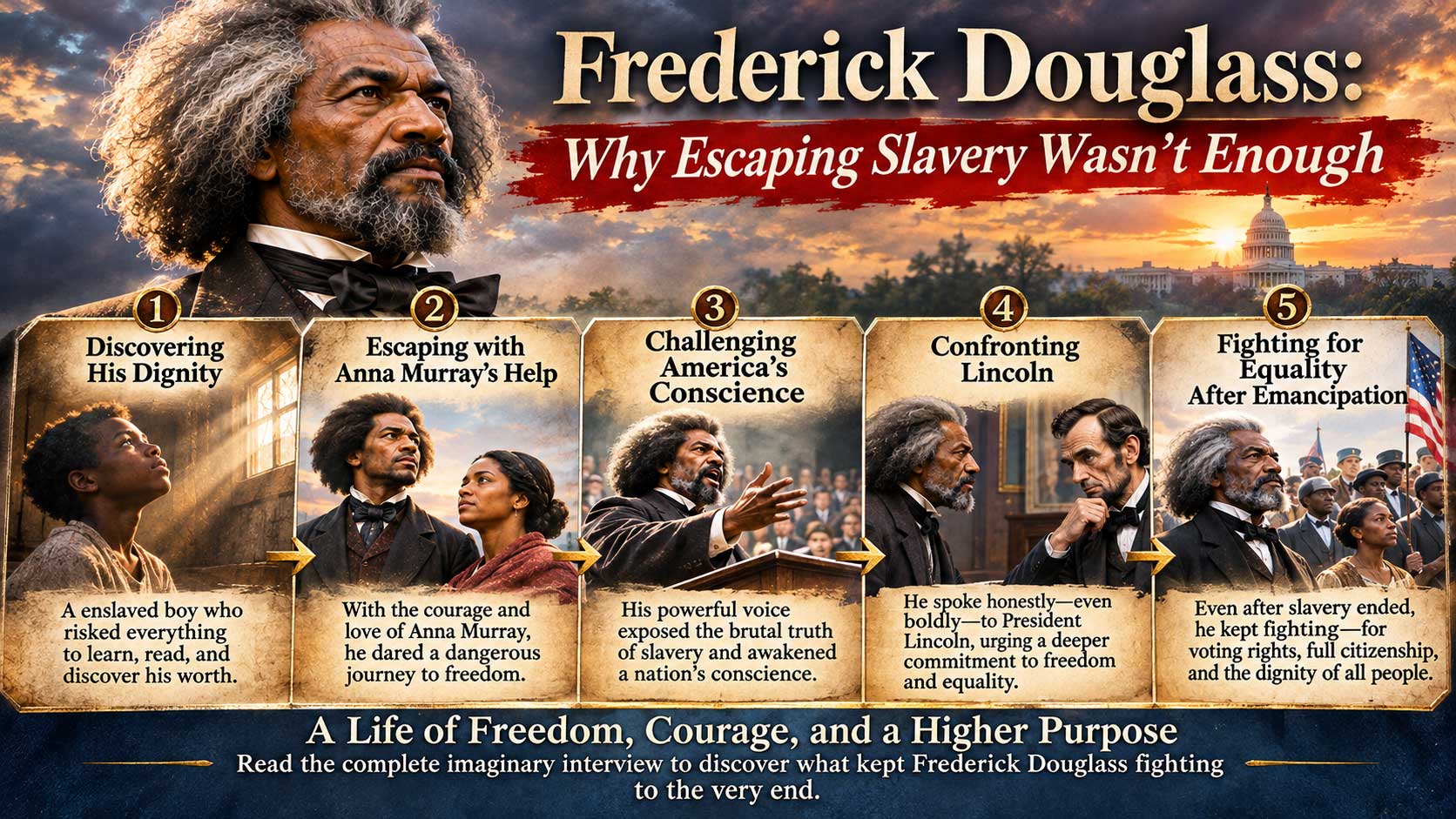
Leave a Reply