
Introduction: The Pilgrims Sought Freedom, but Whose Freedom?
What would make a father leave his young son behind, cross a dangerous ocean, and risk everything for his faith? And what happens when the freedom one family seeks begins to change the lives of families who were already there? These questions lie at the heart of William Bradford's extraordinary story.
In 1620, Bradford and his fellow travelers crossed the Atlantic aboard the Mayflower, hoping to establish a new community. They had endured religious persecution in England and difficult years in the Netherlands. But their dream came at a terrible cost. Bradford's wife, Dorothy, drowned before the settlement was established, and nearly half the Mayflower passengers died during their first winter.
Yet the Pilgrims survived, in part through the assistance of Indigenous people whose homeland they had entered. Plymouth stood at Patuxet, a Wampanoag community devastated by disease before the English arrived. Ousamequin, known as Massasoit, established an alliance with the settlers, and Tisquantum, known as Squanto, helped them communicate and adapt to their surroundings. These Indigenous leaders had their own histories, responsibilities, and reasons for their decisions.
William Bradford eventually became Plymouth's longtime governor and wrote Of Plimoth Plantation, preserving the story of his community's faith, hardships, and achievements. His writings reveal remarkable courage and devotion, but they raise difficult questions about religious authority, Indigenous rights, colonial expansion, and the dangers of believing one's own cause carries God's approval.
In this imaginary interview, I meet Bradford at five stages of his life, from his preparations in Leiden to his final years overlooking Plymouth Harbor. We explore the sacrifices of faith, the pain of losing loved ones, the Wampanoag alliance, the responsibilities of governing, and the legacy he hoped to leave his children.
What interests me most is the human story behind these events. Bradford was a father, a husband, a believer, and a leader who faced extraordinary circumstances. The Wampanoag were people with families, traditions, and aspirations of their own. Their histories became connected in ways neither community could fully foresee.
This is not an attempt to portray the Pilgrims as flawless heroes or to dismiss their extraordinary sacrifices. It is an invitation to look beyond the familiar Thanksgiving story and ask a deeper question: Can we honor the courage of our ancestors, acknowledge the suffering connected to their decisions, and learn to build a future where every family has a place at the table?
Fictional conversation disclaimer: This interview is an original work of historical fiction. The dialogue, personal reflections, and meetings between Nick Sasaki and William Bradford are imagined, not authentic quotations or endorsements. Documented historical events inform the narrative, but Bradford's private thoughts and responses to modern questions are fictional.
Topic 1: The Price of Faith
Leiden, Netherlands, Summer 1620
Opening
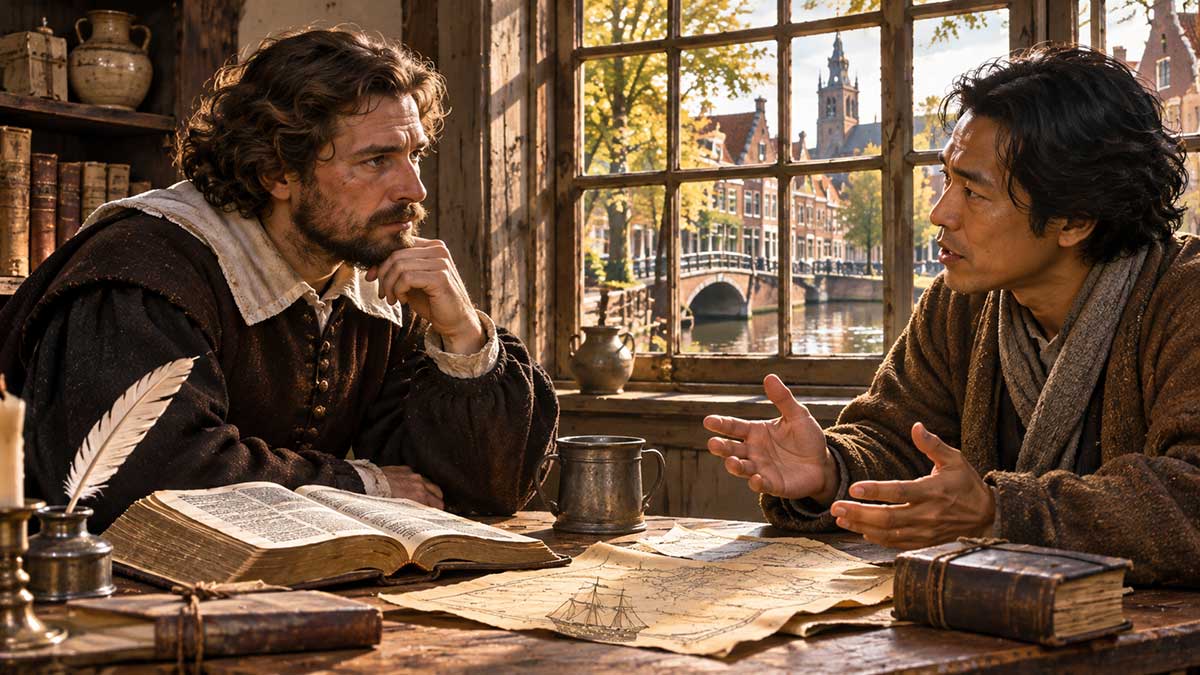
The late afternoon sunlight falls across the canals of Leiden, turning the water a soft golden color.
A small boat passes beneath a stone bridge. Somewhere nearby, a church bell rings. Merchants are closing their shops, children are running through the narrow streets, and the ordinary life of this Dutch city continues as it has for generations.
Inside a modest house, a man sits at a wooden table. There is a Bible beside him, along with several papers concerning a voyage across the Atlantic.
His name is William Bradford.
He is thirty years old, a husband, a father, and a member of a religious community that has already abandoned its homeland once.
Soon, he will leave this city for a continent he has never seen.
He cannot know what awaits him there.
I knock gently on the open door.
Nick: William Bradford?
Bradford: Yes, sir. Come in.
Nick: Nick Sasaki. Thank you for agreeing to speak with me.
Bradford: You're welcome, Nick. Though I confess I am curious what brings you here. We have had no shortage of visitors lately, most of them wishing to discuss ships, provisions, or money.
Nick: Well, I'm afraid I can't help you with the money.
Bradford: (Smiling) Then perhaps this will be a more pleasant conversation than most.
Nick: I hope so.
He gestures toward a chair.
Bradford: Please, sit. Have you come to ask about our voyage?
Nick: Yes. But more than that, I've come to understand the man who is willing to make it.
Bradford: I am not certain there is much about me worth such attention.
Nick: I wouldn't be so sure. You have a wife, a young son, and a life here. Yet you're preparing to cross an ocean to a place where you've never set foot.
Bradford: When you say it that way, it does sound rather unreasonable.
Nick: Does it?
Bradford: At times, yes.
We both laugh.
Nick: Good. Then perhaps we can begin there.
Question 1: Why Leave a Country Where You Can Already Worship Freely?
Nick: William, here's what I find fascinating. You left England partly to escape religious persecution. I can understand that. But now you're living in Holland, where you have much greater freedom to worship.
Why leave again? Why risk everything crossing the Atlantic?
Bradford: That is a fair question. And one that has occupied our congregation for a considerable time.
You must understand, Nick, we did not leave England out of hatred for our country. We loved England. It was our home.
But we could not in good conscience submit to certain practices of its established church.
We believed that Christ, through Scripture, had given His people a pattern for the ordering of His church. And we could not accept that a king, or bishops appointed under his authority, should determine matters of worship contrary to what we understood God's Word to teach.
Nick: So it wasn't simply that you wanted a different style of church service.
Bradford: No. It was a matter of conscience.
Nick: But you found that freedom here.
Bradford: In many respects, yes. The Dutch have shown us considerable kindness. We have been permitted to worship, to work, and to raise our families.
I would speak no ill of them.
But freedom from persecution does not mean freedom from hardship.
Nick: What kind of hardship?
Bradford: The labor is severe. Many among us work long hours merely to provide bread for their households.
Some are growing old before their time. Others who wish to join us cannot endure the conditions.
And we worry greatly about our children.
Nick: Your children?
Bradford: Yes. They grow up in a country that is not their own. Some are drawn away from their families and congregation. Others must labor so heavily that they have little opportunity for education or spiritual instruction.
We fear that, in time, our community may simply disappear.
Nick: Let me ask you something. Isn't that what happens when people move to another country? Their children begin adopting the language and culture around them.
Bradford: It is natural that they should learn from those among whom they live. We ourselves have learned much here.
But we are concerned with the preservation of our faith and the life of our congregation.
Nick: So you're trying to preserve more than religious freedom. You're trying to preserve a community.
Bradford: Precisely.
Nick: And you believe America offers that possibility?
Bradford: We hope it may.
I would not claim that we know what awaits us.
Nick: That surprises me a little. I expected you to say that God had promised you a new land.
Bradford: I would be cautious about making such a claim.
We believe our undertaking is lawful and that our purpose is worthy. We pray for God's blessing.
But prayer does not remove danger, nor does faith give a man knowledge of all that lies ahead.
Nick: That's interesting. You believe God may be guiding you, but you're not claiming to know exactly what God will do.
Bradford: Would it be wise for a man to pretend to know the whole counsel of God?
Nick: Probably not.
Bradford: Then we agree upon something already.
He smiles.
Nick: Let me challenge you on one point, though.
You said you're worried about your children becoming influenced by Dutch culture. But what if they find something good in that culture? What if God has something to teach you through people who live differently?
Bradford considers the question.
Bradford: We have certainly received good from the Dutch. Their hospitality has been of great benefit to us.
But receiving good from our neighbors is not the same as surrendering the convictions that brought us here.
Nick: Fair enough.
Bradford: Tell me, Nick. If you believed something to be true, and the world around you gradually persuaded your children to abandon it, would you not be concerned?
Nick: Yes, I would. But I would want them to believe it freely, not simply inherit it from me.
Bradford: And I would wish them to know the Scriptures and examine their faith seriously.
Yet a father must still consider what influences surround his children.
Nick: I see the tension.
You want them to choose the truth, but you also want to protect them from what you believe might lead them away from it.
Bradford: That is well expressed.
Nick: And somehow that concern has brought you to the point of crossing the Atlantic.
Bradford: Among other concerns, yes.
There is the possibility of renewed war here. There is the difficulty of sustaining our people. And there is our hope that we might establish a community in which our children can grow and our congregation continue.
We have not reached this decision lightly.
Nick: I believe you.
For a moment, neither of us speaks.
Outside the window, two children chase one another along the canal.
I notice Bradford watching them.
And I realize that our next question may be much more personal.
Question 2: How Could You Leave Your Young Son Behind?
Nick: William, may I ask you about your family?
Bradford: Of course.
Nick: You and Dorothy have a little boy. John.
Bradford: Yes.
Nick: And he isn't going with you.
Bradford: No. He is to remain here for the present.
Nick: That must have been a difficult decision.
Bradford: It is not one we have treated lightly.
Nick: How old is he now?
Bradford: Still very young.
Nick: I have children myself. And I keep thinking about what it would feel like to leave one of them behind, knowing I was about to cross an ocean.
Not knowing when I would see him again.
Bradford looks down briefly at the table.
Bradford: The voyage will be dangerous, Nick. And the first months in a new settlement may be harder still.
A small child would face dangers we hope to spare him.
Nick: So leaving him is a way of protecting him.
Bradford: That is our intention.
Nick: But what if something happens to you?
Bradford: That possibility exists.
Nick: And if something happens to Dorothy?
Bradford: The same.
Nick: That's what I struggle with.
You're making this enormous sacrifice for your faith, but your son hasn't chosen any of it.
He hasn't chosen to be separated from his parents.
He hasn't chosen to become part of this great religious undertaking.
Bradford: No, he has not.
Nick: Then how do you reconcile that?
Bradford: Every parent makes decisions for a child who cannot yet comprehend their consequences.
Some decisions are ordinary. Others carry great risk.
We must judge as wisely as we can, with the knowledge available to us.
Nick: But what if you're wrong?
Bradford: Then the consequences may be grievous.
Nick: Does that frighten you?
Bradford: I would not think a man wise who refused to consider such danger.
Nick: You know, William, I think people sometimes picture the Pilgrims as these fearless people who simply trusted God and marched forward.
But listening to you, I don't hear a man who has no fear.
I hear a man who knows the risks and is going anyway.
Bradford: Courage is not the absence of danger, Nick. Nor is faith a promise that we shall escape suffering.
Nick: That's a powerful distinction.
Bradford: Yet I would not have you think that our undertaking is solely mine, or that Dorothy has no conviction of her own.
Nick: I'm glad you said that. We often hear the men's names when people tell this history. But the women are making extraordinary sacrifices too.
Bradford: They are indeed.
Nick: What do you admire most about Dorothy?
Bradford pauses.
Bradford: You ask me to speak of my wife in a manner that is not easy to put into words.
I would rather her life and character be known through her own conduct than through my praises.
Nick: That's fair. I won't press you.
A quiet moment passes.
Nick: May I ask one more thing about John?
Bradford: Yes.
Nick: Suppose that years from now, when he's grown, he asks you, "Father, why did you leave me?"
What would you want him to know?
Bradford: I would want him to know that we did not cease to love him when we departed.
That our hope was to prepare a place where he might someday join us.
And that we sought to act for his welfare, though we could not know what the future would bring.
Nick: I think that's what every child would want to hear.
Bradford: Perhaps.
Nick: But children don't always judge their parents by their intentions.
Bradford: No. Nor should a parent expect that good intentions will erase every sorrow.
I sit quietly for a moment.
There is something deeply human about this man.
He speaks of providence and religious duty, but he must still face the same uncertainty that every parent faces when making a decision that will change a child's life.
Nick: William, I hope you see John again.
Bradford: As do I, Nick. As do I.
Question 3: How Do You Know It Is God's Will and Not Your Own Desire?
The light outside has begun to fade.
Bradford rises to adjust the window shutter, then returns to his chair.
Nick: William, I'd like to ask you something about faith itself.
You believe God is leading your community to establish a new settlement.
But how do you know?
Bradford: How does any Christian seek to know the will of God? Through Scripture, prayer, counsel, and the examination of conscience.
Nick: But people can pray sincerely and still make terrible mistakes.
Bradford: Certainly.
Nick: People can read the same Bible and reach completely different conclusions.
Bradford: That is true as well.
Nick: Then how can you be confident that this voyage is what God wants?
Bradford: Confidence must not be confused with certainty about every outcome.
We have considered our circumstances. We have sought counsel from our brethren. We have weighed the dangers against what we believe to be our duty.
And we have prayed.
Nick: But what if your desire to build a religious community is influencing what you think God is telling you?
Bradford: That is a danger every believer must guard against.
Nick: How?
Bradford: By examining whether our purposes agree with Scripture, by listening to wise counsel, and by remaining mindful that our own judgment may be imperfect.
Nick: Let me give you an example.
Suppose two groups of Christians both believe God is guiding them.
One believes God wants them to establish a settlement. Another believes God wants them to remain where they are.
They can't both be following the same instruction, can they?
Bradford: They may have different duties.
Nick: That's possible. But suppose they disagree over the same piece of land.
Both believe God has given it to them.
What then?
Bradford leans back.
Bradford: Then each must examine the justice of his claim. A declaration of divine favor does not, by itself, settle every question of right.
Nick: I'm glad to hear you say that.
Bradford: Why?
Nick: Let me explain.
I believe there is one God, and that all humanity belongs to one family under Him.
We may have different religions, different cultures, different ways of worshipping. But I believe we are still brothers and sisters.
Bradford: You speak of all mankind as one family?
Nick: Yes.
Bradford: There is truth in the common descent of mankind and in our obligation to treat others justly.
Yet I would distinguish that from the question of true worship and the covenant of Christ's church.
Nick: I expected you might.
Bradford: (Smiling) Then you are learning something of me.
Nick: I am.
But here's my concern.
If God is the Father of all humanity, how can one group claim His blessing for something that brings suffering to another?
Bradford: You ask a question that reaches beyond our present voyage.
Nick: It does. And I think it's a question we should carry with us.
Bradford: Then let us consider it carefully.
A man may undertake something with good intentions and yet cause harm through ignorance, pride, or error.
It would be foolish to believe that every action of a Christian is therefore righteous.
Nick: Exactly.
Bradford: But neither should we conclude that every undertaking involving hardship or conflict is necessarily unjust.
The question is whether the action itself is right, and whether those who undertake it act according to their duties before God.
Nick: So faith doesn't relieve you of the responsibility to examine your actions.
Bradford: I would say it increases that responsibility.
Nick: I like that.
Bradford: Yet I must ask you something in return.
Nick: Please.
Bradford: You speak of all humanity as one family. Does that mean you believe every religious teaching is equally true?
Nick: No. I don't believe every teaching is equally accurate.
I think people can sincerely seek God and still misunderstand Him. We all see only part of the truth.
Bradford: Then you admit that sincerity alone does not establish truth.
Nick: Absolutely.
Bradford: Good. For that is a matter upon which we agree.
Nick: But I would still say that our differences should never become an excuse to deny another person's dignity.
Bradford: And I would say that charity and justice are obligations of Christian life, though we may disagree about the boundaries of religious fellowship.
Nick: That's an honest difference.
Bradford: Better an honest difference than a false agreement, would you not say?
Nick: Every time.
We both smile.
Nick: William, there's one more thing I've been thinking about.
You are leaving a country where you have religious freedom, seeking a place where you can build a community according to your beliefs.
But there are already people living in the land you hope to reach.
Have you thought about what your arrival might mean for them?
Bradford grows thoughtful.
Bradford: We have considered the dangers of settling among peoples whose language and customs are unknown to us. And we must hope to establish relations that permit us to live in peace.
But I cannot pretend to know how such matters will unfold.
Nick: Do you think they might have hopes for their children just as you do for John?
Bradford: I see no reason to doubt that parents among them care for their children.
Nick: Then perhaps that's where we should begin when we talk about them.
Not with the differences in our religions or customs, but with what we share.
Bradford: There may be wisdom in beginning with what one can recognize in another.
Nick: I'm glad we can agree on that much.
Bradford: Yet we have spoken of the voyage as though it were already accomplished. There are still ships to prepare and many difficulties to settle.
Nick: You mean you haven't even left, and things are already going wrong?
Bradford: (Laughing softly) Let us say that arranging a voyage is a fine way to discover how many troubles men can create before setting foot aboard a ship.
Nick: That sounds familiar. Four hundred years from now, traveling with a family is still complicated.
Bradford: Then perhaps your age has not solved everything.
Nick: Not even close.
Closing
The evening light has almost disappeared from the canal.
Bradford gathers the papers from the table. Outside, the streets have grown quieter.
Nick: William, before I go, I want to thank you.
I came here thinking about the courage of the Pilgrims. But I think I've learned something more.
Bradford: And what is that?
Nick: That faith doesn't make difficult decisions simple.
You can believe deeply in something and still have to face the possibility that you might be wrong.
You can love your family and still make choices that cause them pain.
And you can sincerely seek God's will without knowing exactly where the road will lead.
Bradford: Those are weighty matters, Nick.
Nick: They are.
Bradford: I hope you will not judge our undertaking solely by the dangers we fear, nor by the success we may achieve.
Nick: How would you want me to judge it?
Bradford: By examining our purposes, our conduct, and the fruits of what we undertake.
Nick: I think that's fair.
We rise from the table.
Nick: I hope we can speak again.
Bradford: I should welcome it.
Nick: Next time, perhaps we can talk about what happens after you reach America.
Bradford: If God permits us to arrive.
Nick: Yes. If God permits.
He accompanies me to the doorway.
For a moment, I look back at the Bible on the table, the papers concerning the voyage, and the ordinary room that this family will soon leave behind.
Bradford is not yet a governor.
He has not written his great history.
He has not witnessed the terrible winter that will take so many lives.
He is simply a young father preparing to leave the familiar world behind.
And somewhere in Leiden, his little boy John is living through the final days before his parents depart.
As I step into the cool evening air, one question remains with me.
What happens when a man follows his faith into a future that will test everything he believes?
That is a question we will carry across the Atlantic.
End of Topic 1: The Price of Faith
Topic 2: When Heaven Seems Silent
Plymouth Colony, Late Winter 1621
Opening
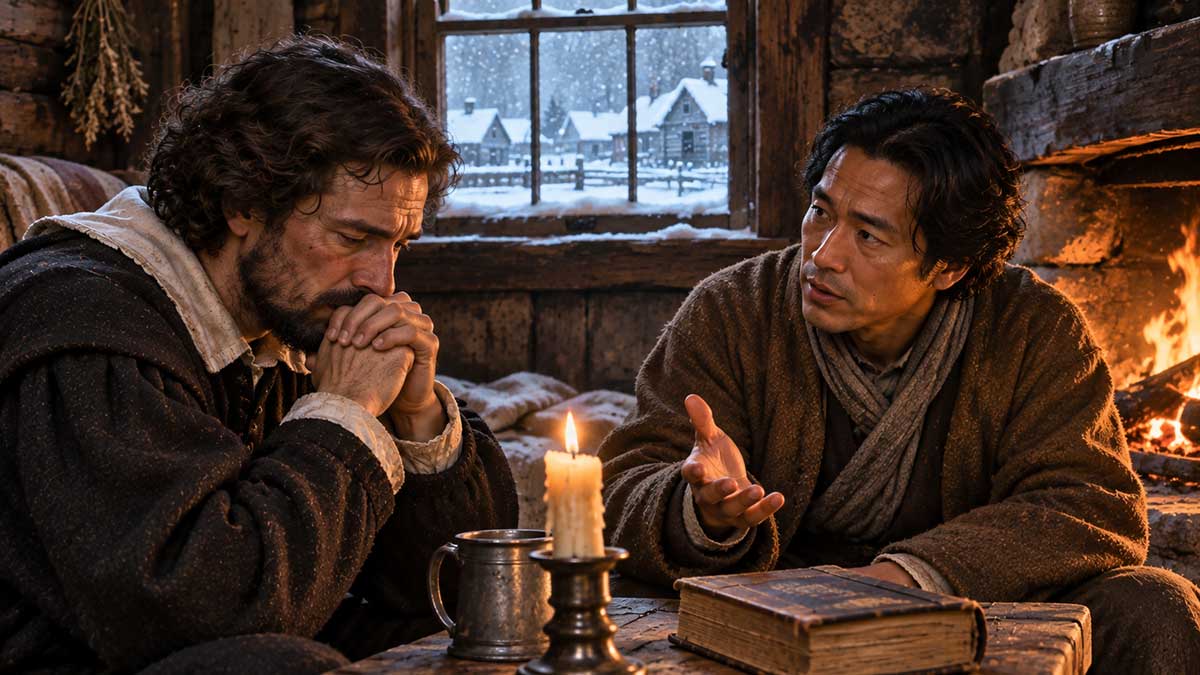
The wind comes in from the Atlantic with a bitterness that seems to pass straight through the walls.
Snow lies unevenly across the small settlement. The ground is frozen, the paths are muddy where the sun has briefly reached them, and smoke rises from a few rough timber dwellings.
This is not the flourishing Christian community William Bradford and his companions dreamed of establishing.
It is a place of sickness, hunger, and graves.
Only months earlier, the Mayflower had carried 102 passengers across the Atlantic. Now, nearly half of them are dead or dying.
Some have lost husbands. Others have lost wives, parents, or children.
And William Bradford has lost Dorothy.
She drowned while the Mayflower lay at anchor near Cape Cod, before the settlement at Plymouth was established.
Bradford himself has suffered serious illness.
Inside a modest dwelling, a small fire struggles against the cold. A wooden cup rests on the table. Beyond the shuttered window, the faint sounds of the settlement can be heard.
I find Bradford seated near the hearth.
He looks up as I enter.
Nick: William?
Bradford: Nick! You have found us again.
Nick: I told you I would.
Bradford: You have chosen a difficult season for a visit.
Nick: I can see that.
He gestures toward a stool near the fire.
Bradford: Come closer. There is little warmth to spare, but you are welcome to what we have.
Nick: Thank you.
I sit down and hold my hands toward the flames.
Nick: I thought Leiden was cold in the winter.
Bradford: (With a faint smile) Then New England has provided you with a useful comparison.
Nick: I think I prefer Leiden.
Bradford: At present, I might be persuaded to agree.
We share a small laugh.
But the laughter fades quickly.
I look around the room. There are few possessions. No comforts beyond what is necessary.
The man sitting across from me is no longer the hopeful traveler I met beside a Dutch canal.
He has reached the land he sought.
And the price has been terrible.
Question 4: When Your Wife Died, Did You Question God's Guidance?
Nick: William, before we talk about anything else, I want to say how sorry I am about Dorothy.
Bradford is quiet for a moment.
Bradford: Thank you, Nick.
Nick: When we met in Leiden, you spoke about leaving your son John behind. You hoped that one day your family would be reunited in a new home.
Now Dorothy is gone.
I can't begin to know what that has been like for you.
Bradford: There are sorrows for which words provide little relief.
Nick: May I ask you something difficult?
Bradford: You may ask.
Nick: When Dorothy died, did you ever wonder whether coming here had been a terrible mistake?
Bradford looks toward the fire.
Bradford: You ask me to examine a matter of great sorrow.
I would distinguish between the grief of losing someone dear and the judgment of whether an undertaking was right.
A man may suffer grievously in the course of a duty he believes just.
Nick: But how do you know the suffering wasn't a warning?
Bradford: How would you determine that, Nick?
Nick: I don't know. That's what I'm asking you.
Bradford: Then we must be careful.
If every hardship were proof that we had disobeyed God, what would we make of the sufferings of the apostles? Or of Christ Himself?
Nick: That's a fair point.
Bradford: The Scriptures do not promise that obedience will spare us from sorrow.
Nick: No. They certainly don't.
I think about that for a moment.
Nick: But here's what troubles me.
You believed God was guiding your people to America.
You prayed. You planned. You made sacrifices.
And then you arrived, and people began dying.
Your wife died before you even established the settlement.
How does a man continue trusting God when everything seems to be falling apart?
Bradford: Perhaps by remembering that our knowledge is limited.
We may believe an undertaking is right without knowing how it will end.
Nick: But doesn't that make faith almost impossible to test?
If things go well, we say God blessed us. If things go badly, we say God is testing us.
How do we avoid simply interpreting everything in a way that confirms what we already believe?
Bradford studies me.
Bradford: That is a serious question.
I would not say that every success proves God's approval, nor that every disaster proves His displeasure.
We must examine our actions by more than their immediate consequences.
Nick: By Scripture?
Bradford: By Scripture, certainly. And by the justice of our conduct, the counsel of others, and the duties laid upon us.
Nick: So if you believe God has called you somewhere, that doesn't mean everything you do afterward is automatically right.
Bradford: It would be a dangerous presumption to think so.
Nick: I'm glad you said that.
Bradford: Yet I would ask something of you, Nick.
Nick: Please.
Bradford: When you suffer a loss, do you believe that suffering must always have a meaning you can discover?
I hesitate.
Nick: No.
I used to think I needed an explanation for everything.
But the older I get, the more I realize that some things are beyond my comprehension.
Bradford: Then perhaps we are not so far apart.
Nick: Maybe not.
Bradford: We may seek God's wisdom without claiming to possess it completely.
Nick: William, do you mind if I ask about John?
Bradford: No.
Nick: Have you been able to send word to him?
Bradford: Communication across the ocean is no simple matter. We have scarcely established ourselves here.
Nick: I was thinking about what it will mean for him to learn that his mother is gone.
Bradford lowers his eyes.
I realize that I have asked a question for which neither of us has an easy answer.
Nick: I'm sorry. I don't mean to make this harder.
Bradford: You have asked about something that matters.
A silence settles between us.
Outside, the wind moves against the wooden walls.
For once, I don't try to fill the silence.
Question 5: What Does Christian Love Mean When Everyone Is Suffering?
A little later, Bradford places another small piece of wood on the fire.
Nick: William, can we talk about what happened here during the winter?
Bradford: Of course.
Nick: I've read that so many people became ill that only a handful remained healthy enough to care for the others.
Bradford: There were times when very few could perform the necessary work.
The sickness was widespread, and the labor of caring for the afflicted fell heavily upon those who remained able.
Nick: How did they manage?
Bradford: With great difficulty.
There were people to feed, fires to maintain, bedding to attend to, and the sick to comfort.
Some served others at considerable cost to themselves.
Nick: I read about two men in particular, Miles Standish and William Brewster.
Bradford nods.
Bradford: They were among those who cared faithfully for the sick.
Nick: What strikes me is that they weren't simply praying for people.
They were doing the work.
Preparing food. Keeping people warm. Helping them when they couldn't help themselves.
Bradford: Such service is a Christian duty.
Nick: I agree.
You know, William, people sometimes speak of faith as though it were mainly about what we believe.
But when someone is lying sick in a cold room, what matters is whether another person comes to help.
Bradford: Belief and conduct ought not to be separated.
Nick: Exactly.
Bradford: The apostle James speaks plainly about faith and works.
Nick: Yes, he does.
I look toward the doorway.
Nick: Can I ask you something personal?
Bradford: You have developed a habit of doing so.
Nick: (Laughing) I suppose I have.
Bradford: Continue, then.
Nick: When you were sick, what did it feel like to depend on other people for almost everything?
Bradford: Illness teaches a man the limits of his strength.
One may be accustomed to laboring, planning, and helping others. Then suddenly one cannot perform even ordinary tasks without assistance.
Nick: That's humbling.
Bradford: It can be.
Nick: Did it change the way you looked at the people around you?
Bradford: I would say that such circumstances reveal how much we depend upon one another.
A settlement cannot survive through the strength of one man.
Nick: That's something I wish more people understood.
We often celebrate the strongest individual, the boldest leader, the person who accomplishes something extraordinary.
But sometimes the most important person is the one who quietly stays beside someone who is suffering.
Bradford: There is great honor in faithful service.
Nick: And those people don't always get remembered.
Bradford: Then those who write histories should take care not to forget them.
I smile.
Nick: William, I hope you'll do exactly that.
Bradford: I shall endeavor to preserve what ought to be remembered.
He pauses.
Bradford: Yet I would caution you against imagining that every act of kindness was performed without weariness or frustration.
We are ordinary people, Nick. Sickness does not make every sufferer patient, nor every caregiver cheerful.
Nick: That's a good point.
Bradford: Charity may require perseverance when affection is difficult.
Nick: I love that.
Christian love isn't simply feeling affection for someone.
Sometimes it's getting up in the middle of the night to help them when you're exhausted.
Bradford: That is a fair description.
Nick: And perhaps doing it again the next night.
Bradford: And the next.
We both laugh softly.
Then I ask another question.
Nick: William, you've spoken about caring for members of your community. But what about people outside it?
Suppose someone who didn't share your religion was lying sick outside your door.
Would the same Christian duty apply?
Bradford considers the question.
Bradford: Our Lord taught mercy toward those in need. The parable of the Samaritan makes that plain.
Nick: So the obligation to love your neighbor isn't limited to members of your congregation.
Bradford: A Christian ought not to use differences of nation or condition as an excuse for cruelty.
Nick: What about differences of religion?
Bradford: We must distinguish between agreement in faith and the duty to act with justice and mercy.
Nick: I think that's a distinction worth remembering.
Bradford: Yet you seem to be leading me somewhere.
Nick: Perhaps I am.
Bradford: To the people who lived in this country before our arrival?
Nick: Yes.
Bradford: Then I suspect we shall have much to discuss.
Nick: We will.
For the moment, though, I want to stay with what you've told me about this winter.
Because I think the people who cared for the sick may have taught us something about the kind of faith that matters most.
Bradford: Then let us hope we learn from their example.
Question 6: What Would You Say to Someone Who Has Lost Hope?
The fire has burned low.
Outside, the wind has quieted, and a pale light remains above the western trees.
Nick: William, I'd like to ask one final question.
Imagine someone living hundreds of years from now.
Perhaps they've lost someone they love. Perhaps their family is struggling. Perhaps they prayed for something and the answer never came.
They feel abandoned by God.
What would you want to say to that person?
Bradford: I would first be cautious about speaking as though I understood another person's sorrow.
Nick: That's a good beginning.
Bradford: It is easy to offer counsel from a place of comfort.
Less easy to receive it when one is suffering.
Nick: Very true.
Bradford: I would remind such a person that the Scriptures contain many accounts of faithful people who suffered greatly.
The psalmists cried out in distress. Job questioned the calamities that befell him. Even our Lord knew sorrow.
Nick: So you're saying that feeling abandoned doesn't necessarily mean someone has lost faith.
Bradford: A cry of anguish may itself be directed toward God.
Nick: That's beautiful.
Bradford: Yet I would not ask a grieving person to pretend to be cheerful.
Nick: I'm glad you said that.
Sometimes people think that if they have strong faith, they shouldn't cry or feel despair.
Bradford: Our Lord wept.
Nick: Yes, He did.
Bradford: Then why should tears be treated as a failure of faith?
I sit quietly for a moment.
Nick: William, do you think there's a danger in telling suffering people that everything happens for a reason?
Bradford: There is danger in claiming knowledge we do not possess.
A man may believe that God governs His creation without claiming to know the particular purpose of every sorrow.
Nick: That distinction means a lot to me.
Bradford: It ought to make us humble.
Nick: And perhaps kinder.
Bradford: I should hope so.
Nick: Let me ask you something else.
You and your people came here hoping to build a new community.
But look around.
So many have died. Food is scarce. You're still trying to build shelter.
How do you keep going?
Bradford: We attend to the work before us.
Nick: Just like that?
Bradford: What else would you have us do?
Nick: I suppose I was hoping for something more dramatic.
Bradford smiles.
Bradford: Then I fear I shall disappoint you.
There is wood to gather, food to prepare, the sick to tend, and shelter to improve.
If we spend every hour contemplating the greatness of our troubles, who will perform the work?
Nick: That's actually a very practical answer.
Bradford: Faith need not make a man neglect practical duties.
Nick: So when life becomes overwhelming, begin with the next thing you can do.
Bradford: That may be a useful beginning.
Nick: And help someone else if you can.
Bradford: Certainly.
Nick: You know, William, I think that may be one of the most meaningful things you've said today.
Bradford: I am relieved that something I have said has proved useful.
We laugh.
Then I become serious again.
Nick: But what about the people who didn't survive?
I don't want us to speak about endurance as though those who lived were somehow more faithful than those who died.
Bradford's expression grows solemn.
Bradford: Nor should we.
Nick: Sometimes survival is treated as proof of God's special favor.
But many good and faithful people died here.
Bradford: They did.
Nick: And their lives mattered just as much.
Bradford: Yes.
Nick: Then perhaps the real lesson isn't that faith guarantees survival.
Perhaps it's that every human life deserves love and care, whether that person survives or not.
Bradford: I would not measure the worth of a soul by the length of its earthly days.
Nick: Neither would I.
We sit for a while without speaking.
The room is quiet now.
I think of the people who crossed the Atlantic filled with hope, only to die before seeing the settlement take root.
I think of Dorothy.
I think of John, far away in Leiden.
And I think of the men and women whose names history has largely forgotten.
Closing
As I prepare to leave, Bradford walks with me to the doorway.
The wind has eased.
Beyond the small settlement, the coastline stretches beneath a pale winter sky.
Nick: William, when I met you in Leiden, I asked what could make a man risk everything for his faith.
Today, I think I've seen what that risk really meant.
Bradford: We have paid dearly for our undertaking.
Nick: Yes.
But I think I've learned something about Christian faith from the people here.
Not simply from what they believed, but from the way they cared for one another.
Bradford: Their service deserves to be remembered.
Nick: It does.
I hesitate before asking one final question.
Nick: William, do you still believe coming here was the right decision?
He looks out across the settlement.
Bradford: We have endured much, Nick. And I cannot tell you what trials remain.
But I do not believe that hardship alone determines whether a cause is just.
We must continue to examine our conduct and fulfill the duties before us.
Nick: Even when the future is uncertain?
Bradford: Especially then.
Nick: I hope the spring brings better days.
Bradford: As do I.
Nick: And I hope you find people here who become friends.
Bradford: That would be a blessing.
We shake hands.
Nick: Take care of yourself, William.
Bradford: And you, Nick.
I step outside.
The cold air catches my breath.
Across the settlement, smoke rises from a handful of chimneys. Somewhere, a child calls for a parent.
I begin walking toward the shoreline.
The land is quiet, but it is not empty.
Beyond the English settlement are the homelands of the Wampanoag, whose communities have endured their own devastating losses.
The Pilgrims have come seeking a future.
The Wampanoag have a past, a present, and a future of their own.
And soon, these two peoples will have to decide what kind of relationship they can build.
As I look across the water, one question remains with me.
When someone helps save your life, what responsibility do you carry toward them afterward?
That is where our next conversation will begin.
End of Topic 2: When Heaven Seems Silent
Topic 3: The Land Was Not Empty
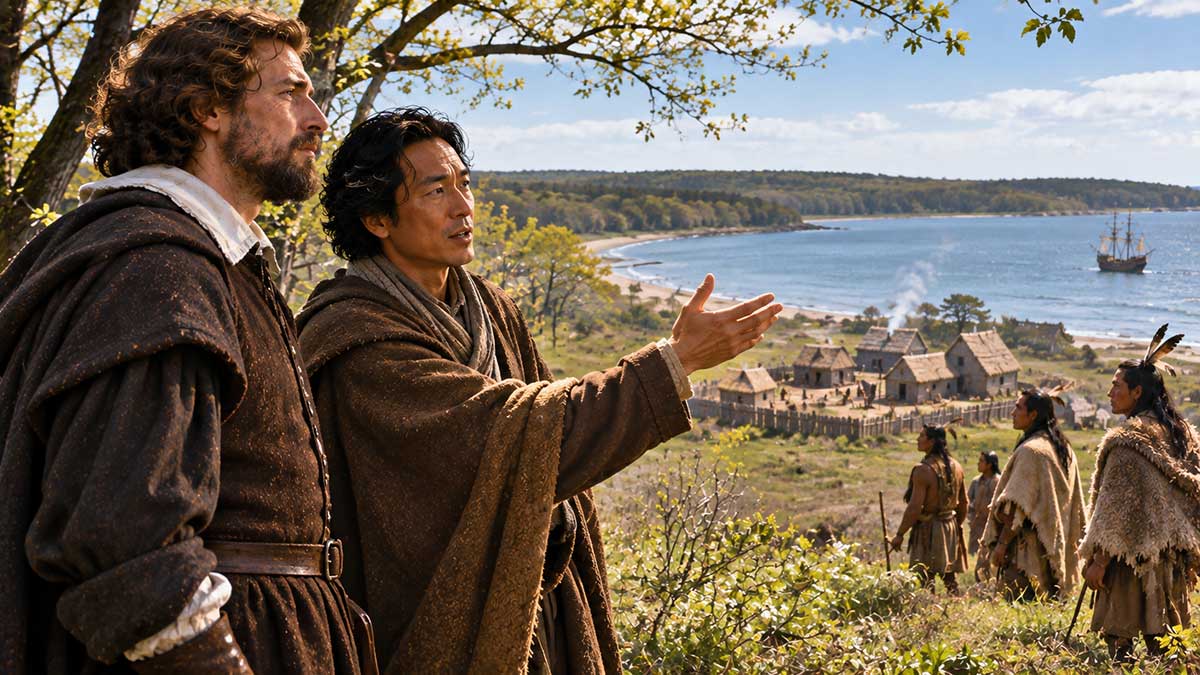
Patuxet/Plymouth, Spring 1621
Opening
Spring has finally come to Plymouth.
The snow has disappeared from the coastal paths. The earth is beginning to soften, and the first green shoots are appearing among the trees.
From a small rise overlooking the settlement, I can see the rough wooden dwellings the English have built near the harbor. Beyond them stretches a coastline that has been home to Indigenous peoples for countless generations.
The morning air carries the smell of salt water and damp earth.
William Bradford stands beside me, looking down toward the settlement.
He appears healthier than when I last saw him. The terrible winter has passed, though its losses remain painfully visible.
Nick: William, you look better than the last time I saw you.
Bradford: And you have chosen a more agreeable day for your visit.
Nick: I was beginning to think New England had only one season.
Bradford: Winter?
Nick: Exactly.
Bradford: (Smiling) I assure you, Nick, we were beginning to wonder the same.
We laugh.
Nick: How are the people doing?
Bradford: Those who remain have much work before them. We have begun to see signs of improvement, but the settlement is still fragile.
Nick: And you've had visitors.
Bradford: Indeed. Encounters we could scarcely have imagined when we first arrived.
Nick: I've been reading about Samoset, Tisquantum, and Ousamequin.
Bradford: Then you know something of the remarkable circumstances in which we find ourselves.
Nick: Some of them. But I want to hear how you see it.
He gestures toward the land below us.
Bradford: Then perhaps we should begin with what you see before you.
Nick: That's exactly what I was thinking.
For a moment, we stand silently.
The morning sunlight falls across the settlement, the surrounding woods, and the shoreline.
I realize that the same view can tell very different stories, depending on who is looking at it.
Question 7: Did You Realize You Were Entering Someone Else's Homeland?
Nick: William, when you first arrived here, what did you know about the people who had lived on this land before you?
Bradford: We knew that the country was inhabited by various peoples, though our knowledge of them was limited.
We had heard accounts from earlier voyages, but such reports did not prepare us fully for what we would encounter.
Nick: Did you know this place had a name?
Bradford: We have learned that the place where we settled was called Patuxet.
Nick: And that people lived here before you.
Bradford: Yes.
Nick: But by the time you arrived, much of the community was gone.
Bradford: We found evidence of former habitation. We have since learned that sickness had caused great mortality among the people of this region.
Nick: That must have been a strange discovery.
Bradford: It was certainly a matter of consequence.
Nick: William, I want to ask something that may be uncomfortable.
When you saw land where so many people had died, did you think of it as land God had made available for you?
Bradford looks toward the settlement.
Bradford: We have understood our preservation through many dangers as evidence of God's providence.
Yet you ask about the right by which land may be occupied, and that is a question requiring its own consideration.
Nick: That's exactly my concern.
You survived a dangerous voyage. You found a place to settle. From your perspective, that might feel like a blessing.
But from the perspective of the people who lived here, this was their home.
Bradford: I understand the distinction you are making.
Nick: Let me put it another way.
Suppose a terrible disease swept through your village in England.
Most of the people died. The survivors fled or joined relatives elsewhere.
Then strangers arrived, found the houses empty, and decided that God had given them the village.
Would you consider that just?
Bradford is silent for a moment.
Bradford: I would wish to know whether those strangers had any rightful claim, whether the land remained under the authority of others, and what agreements had been made.
Nick: So finding land without its former inhabitants doesn't automatically settle the question of ownership.
Bradford: I would not say that the mere absence of people answers every question of right.
Nick: I'm glad to hear you say that.
Bradford: But I must remind you that we have come under authority granted through our English arrangements, and we seek a place where our community may live.
Nick: I understand that. But those English arrangements were made by people across the ocean.
Did the Wampanoag agree to them?
Bradford: That is not a question I can answer by referring to an English patent alone.
Nick: That's important, William.
Because when I look at this land, I don't see an empty wilderness waiting for history to begin.
I see a place where families lived, children played, people prayed, and generations were buried.
Bradford follows my gaze toward the trees.
Bradford: You speak of them as you would speak of your own family.
Nick: Yes.
I believe every family deserves to have its history remembered.
Bradford: Then it is right to inquire into the history of those who dwelt here.
Nick: And to listen to their descendants.
Bradford: We must first learn how to communicate with those who are here.
Nick: Which brings me to the extraordinary people you've recently met.
Question 8: When Someone Helps Save Your Life, What Do You Owe Them?
We begin walking slowly along the rise.
Below us, a few settlers are working near the houses. The spring air is warmer, but the colony still bears the marks of the winter.
Nick: William, tell me about the first time Samoset appeared.
Bradford: It was a surprising encounter. He approached our settlement and greeted us in English.
Nick: That must have startled everyone.
Bradford: You may be certain it did.
Nick: I can picture it. You've spent months struggling to survive, uncertain what the people of this region think of you.
Then someone walks into your settlement and says hello in English.
Bradford: It was not what we expected.
Nick: How did he learn your language?
Bradford: Through contact with English fishermen farther along the coast, as we understood it.
Nick: And then Tisquantum came.
Bradford: Yes. He knew our language and became of considerable assistance to us.
Nick: His story is extraordinary, isn't it?
Bradford: What have you learned of it?
Nick: That he was taken from his homeland by an English captain years earlier.
He was carried across the ocean against his will.
Eventually, he returned, only to find that his own community had been devastated by disease.
And now he was helping English settlers survive in the very place where his people once lived.
Bradford listens carefully.
Bradford: His knowledge of the country and his ability to communicate have been of great benefit to us.
Nick: William, I keep thinking about what that must have meant for him.
You left your homeland voluntarily, hoping to create a better future.
Tisquantum was taken from his homeland without his consent.
You crossed the Atlantic seeking freedom.
He crossed it as a captive.
Bradford: Those are very different circumstances.
Nick: They are.
And yet your lives have become connected.
Bradford: Indeed.
Nick: Did you ever ask him what it felt like to return home and find his people gone?
Bradford pauses.
Bradford: I cannot claim to know all that he has suffered, nor would I presume to speak for him.
Nick: That's fair.
I wouldn't want you to invent his feelings.
But I hope someone listened to his story.
Bradford: There is much we have yet to learn of one another.
Nick: What has he taught your people?
Bradford: He has helped us communicate and understand matters necessary to living here, including the cultivation of crops and the character of the country.
Nick: So your survival depends, in part, on the knowledge of people who lived here long before you arrived.
Bradford: Their assistance has been valuable, certainly.
Nick: And then there's Ousamequin.
Bradford: The great sachem whom we have come to know as Massasoit.
Nick: Tell me about your agreement with him.
Bradford: Our leaders and his representatives have established terms for peaceful relations and mutual assistance.
The agreement provides that neither party should injure the other, that wrongdoing should be addressed, and that each should assist the other if attacked unjustly.
Nick: That sounds like more than a friendly greeting.
Bradford: It is an agreement of consequence.
Nick: What do you think Ousamequin wants from it?
Bradford: We cannot know every consideration that governs his decisions.
But it is reasonable to suppose that he seeks security and advantage for his people, just as we seek safety for ours.
Nick: That's something I want readers to appreciate.
Ousamequin wasn't simply a generous man who happened to help some hungry strangers.
He was a leader responsible for his people.
Bradford: As a ruler ought to be.
Nick: And his people had suffered terribly from disease.
Bradford: We understand that great mortality has afflicted this region.
Nick: So perhaps he saw an alliance with your settlement as a way to strengthen his position against rival groups.
Bradford: That may be among his considerations. I would not pretend to know his whole mind.
Nick: Fair enough.
I stop walking.
Nick: William, may I ask you something very simple?
Bradford: Of course.
Nick: If someone saves your life, what do you owe them?
Bradford: Gratitude, certainly.
Nick: Just gratitude?
Bradford: What else would you propose?
Nick: Loyalty. Fairness. A willingness to protect their family as they protected yours.
Bradford: Those are worthy obligations, provided they are exercised justly.
Nick: What about their children?
Bradford: What of them?
Nick: If a man helps save your children, shouldn't you care what happens to his?
Bradford: A man ought not to disregard the welfare of those with whom he has entered into friendship and agreement.
Nick: That's what I hoped you would say.
Bradford: Yet friendship between communities requires more than good intentions. It requires keeping promises and addressing disputes.
Nick: Yes. And that's much harder than sharing a meal.
Bradford: It can be.
Nick: Especially when land, security, and the future of your children are involved.
Bradford: Those are matters over which men may disagree sharply.
Nick: Then perhaps the real test of this alliance won't be whether you can celebrate together.
It will be whether you can remain fair to one another when your interests conflict.
Bradford considers this.
Bradford: That is a demanding test of any agreement.
Nick: But an important one.
Bradford: Indeed.
Question 9: Can Two Peoples Share a Future Without One Losing Its Home?
We reach a place where the land slopes gently toward the harbor.
The morning has grown brighter.
For a time, we watch the movement of people below.
Nick: William, I want to return to something we discussed in Leiden.
You told me you were leaving Europe to preserve your faith, your community, and the future of your children.
Bradford: I remember.
Nick: I understood your reasons.
But standing here now, I see another community with its own faith, traditions, and children.
The Wampanoag have lived in this region for generations.
What happens if the future you want for your children conflicts with the future they want for theirs?
Bradford: Then we must seek arrangements that permit us to live in peace.
Nick: But what if peaceful arrangements become difficult?
What if your settlement grows and needs more land?
Bradford: Such matters would require negotiation and just dealing.
Nick: And if the Wampanoag refuse?
Bradford: You are asking me to decide a dispute that has not yet arisen in the form you describe.
Nick: You're right.
I'm asking you to think ahead.
Bradford: Then let us consider the principle rather than presume the circumstances.
Nick: Good.
Here's my principle.
I believe all human beings belong to one family under one God.
That means the children of the Wampanoag are just as precious to God as the children of the Pilgrims.
Bradford: All men are God's creatures, though I would distinguish that truth from the particular covenant of the church.
Nick: I know we differ there.
But do you believe a Wampanoag father loves his children as deeply as an English father does?
Bradford: I have no reason to think otherwise.
Nick: And that a mother here grieves when she loses a child, just as an English mother does?
Bradford: Such sorrow is common to mankind.
Nick: Then what gives one family the right to take away another family's home?
Bradford turns toward me.
Bradford: You have framed the question as though the taking were already established.
Nick: Fair criticism.
Let me ask it differently.
What would make an English claim to this land just, in your eyes, if the people already living here did not consent?
Bradford: I would wish to examine the nature of the claim, the authority under which it was made, and the rights of those concerned.
Nick: And would their consent matter?
Bradford: Agreements and rightful possession are serious matters. I would not dismiss them.
Nick: But would you put their rights on equal footing with those of your own settlers?
Bradford takes a moment before answering.
Bradford: Nick, I will not pretend that our people and theirs understand authority, religion, and the ordering of society in precisely the same way.
We have come here with convictions of our own.
We believe our undertaking is lawful.
Yet I agree that differences between peoples do not relieve us of the obligation to act justly.
Nick: I appreciate that answer, even though I suspect we would disagree about what justice requires.
Bradford: Very likely.
Nick: And that's okay.
I'm not here to make you agree with everything I believe.
I'm here to understand you.
Bradford: Then you are a more patient visitor than some I have known.
Nick: (Laughing) Don't give me too much credit. I still have plenty of questions.
Bradford: That I do not doubt.
We laugh together.
Then I return to the matter before us.
Nick: William, may I tell you something about the future?
Bradford: You have hinted before that you know more of the years ahead than I do.
Nick: I do. But I don't want to overwhelm you with events you haven't lived through.
I will say only this: The relationship between English settlers and Indigenous peoples will become one of the most painful parts of American history.
There will be moments of cooperation, friendship, and mutual assistance.
There will be conflicts, broken agreements, violence, and enormous suffering.
Bradford: Those are grave things to foretell.
Nick: They are.
And I don't want to hold you responsible for events that happen after your lifetime.
But I do want to ask what you believe your generation owes to the people who are here now.
Bradford: We owe them just dealing and the faithful observance of our agreements.
Nick: And respect?
Bradford: Respect for rightful authority and conduct worthy of peaceful relations, certainly.
Nick: What about love?
Bradford: You return to the duties of Christian charity.
Nick: I do.
Bradford: Then I would ask you something in return.
Nick: Please.
Bradford: You speak of love between peoples. What would you have us do when their interests conflict and neither is willing to yield?
Nick: That's a difficult question.
Bradford: It is one that rulers cannot avoid.
Nick: I suppose I would begin by asking whether each side truly understands what the other stands to lose.
Bradford: A sensible beginning.
Nick: Then I would ask whether there is a solution that protects the dignity and security of both.
Bradford: And if no such solution is readily found?
Nick: Keep talking. Keep listening. Refuse to treat the other side as less than human.
Bradford: Those are worthy aims. But you have not yet answered how a ruler should act when a decision cannot be delayed.
Nick: You're right.
I don't have an easy answer.
Bradford: Nor should you expect every difficult question to yield one.
Nick: Perhaps that's why history matters so much.
We can examine what people did, what they believed, and what followed.
Then maybe we can make wiser decisions in our own time.
Bradford: If history teaches men to examine their conduct more carefully, it serves a useful purpose.
Nick: I think so too.
We stand together, looking toward the settlement.
Nick: William, I want to ask you one last thing.
When your people first arrived, you were strangers here.
You needed help.
You were vulnerable.
Do you think that experience might teach your community something about how to treat strangers in the future?
Bradford considers the question.
Bradford: A man who has known hardship ought to remember it when another comes to him in need.
Nick: That's beautiful.
Bradford: It is easier to speak such words than to live by them consistently.
Nick: Yes.
Bradford: And perhaps that is why we must continue to remind ourselves of our obligations.
Nick: I hope your people do.
Bradford: As do I.
Closing
The sun has risen higher above the harbor.
Below us, the small English settlement is coming fully awake.
People move between the dwellings. Smoke rises from cooking fires. The sounds of work drift across the hillside.
For the first time since my arrival in Plymouth, the place feels less like a camp struggling against death and more like a community beginning to live.
But I can no longer see it only through English eyes.
This land was Patuxet before the Pilgrims arrived.
Its people had homes, families, traditions, and histories long before the Mayflower crossed the Atlantic.
The epidemic that devastated the community did not erase that history.
Nick: William, thank you for walking with me today.
Bradford: I have enjoyed our conversation, though you have given me much to consider.
Nick: You have given me plenty to think about too.
Bradford: Then perhaps our discussion has been of mutual benefit.
Nick: I hope so.
We begin walking back toward the settlement.
Nick: You know, when I was growing up, I learned a very simple story about the Pilgrims and Native Americans.
The Pilgrims were hungry. The Native Americans helped them. Everyone shared a wonderful meal.
Bradford: A pleasant story.
Nick: It is.
But the real story is much deeper.
There were people here before you.
They had already endured terrible suffering.
They had political concerns of their own.
And when your communities met, neither side could know what the future would bring.
Bradford: That is true.
Nick: I think what moves me most is that both peoples had families they wanted to protect.
Bradford: A concern shared by many nations.
Nick: Exactly.
I stop and turn toward him.
Nick: William, I hope your alliance with Ousamequin brings peace.
Bradford: We shall endeavor to keep faith with those who keep faith with us.
Nick: And I hope you remember something.
Bradford: What is that?
Nick: When someone helps save your life, gratitude should last longer than the emergency.
Bradford looks at me thoughtfully.
Bradford: That is a sentiment worth remembering.
Nick: I think so.
We shake hands.
Bradford: Until we meet again, Nick.
Nick: Until then, William.
He turns toward the settlement.
I remain on the rise for a few moments longer.
The morning light spreads across the harbor and the surrounding woods.
Somewhere beyond those trees are Wampanoag families beginning their day.
Mothers preparing food.
Fathers considering the needs of their communities.
Children growing up in a homeland whose future will be changed by the arrival of strangers from across the ocean.
I think about Bradford's little son John, still far away in Europe.
And I think about the children of Patuxet who never lived to see this spring.
Different families.
Different histories.
Different beliefs.
But the same human longing to protect those we love.
As I begin walking down the hill, another question rises in my mind.
What happens when people who crossed an ocean seeking freedom begin making the laws for everyone around them?
That is where our next conversation must go.
End of Topic 3: The Land Was Not Empty
Topic 4: The Limits of Freedom
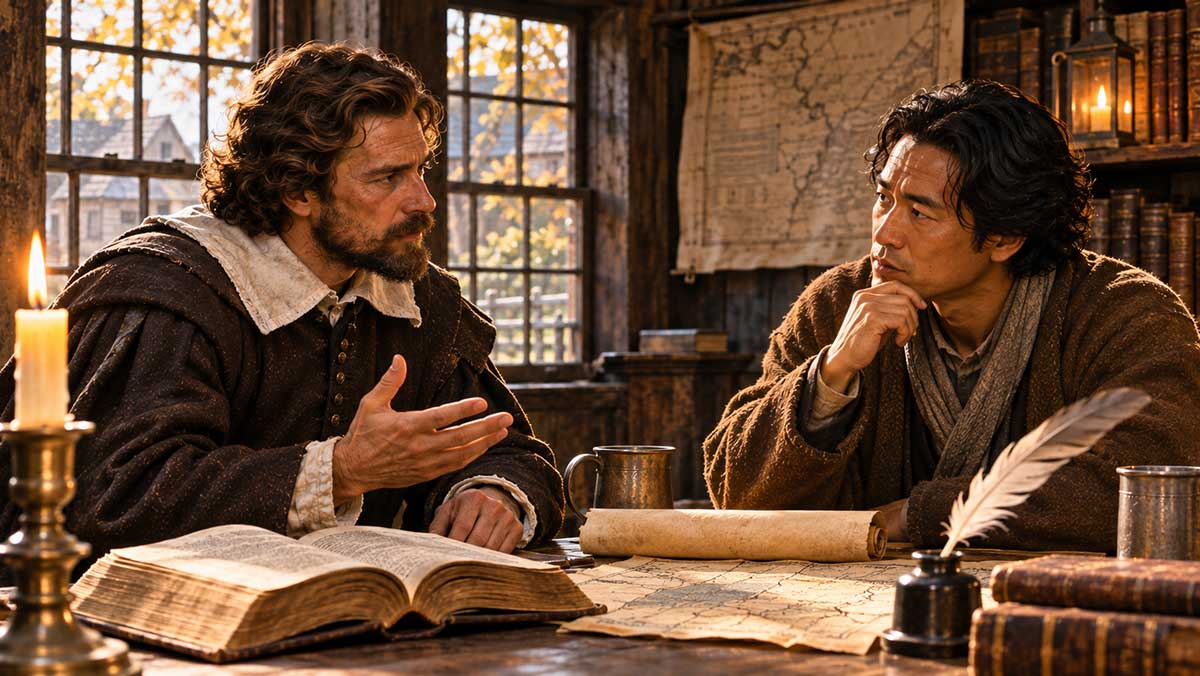
Plymouth Colony, Autumn 1638
Opening
Seventeen years have passed since William Bradford became governor of Plymouth Colony.
The settlement that once struggled to survive a bitter winter has grown into a community of farms, roads, homes, and neighboring towns.
The coastline is familiar now. The wilderness that frightened the first settlers has become part of their daily lives.
But something else has changed.
The Pilgrims who once sought freedom from religious authority now exercise authority over others.
They make laws. They settle disputes. They distribute land. They decide who may belong to their community and what conduct will be permitted.
And beyond Plymouth, English settlements continue to grow across lands long inhabited by Indigenous peoples.
It is a cool autumn evening when I arrive at Bradford's house.
A candle burns on a wooden table covered with correspondence and colonial records. A map of the surrounding region lies nearby.
Bradford is now in his late forties. His face carries the marks of experience, and his manner has become more measured.
He looks up as I enter.
Bradford: Nick! It has been some time.
Nick: William, it's good to see you again.
Bradford: And you. Though I suspect you have not come merely to inquire after my health.
Nick: You know me too well.
Bradford: (Smiling) Then I had better prepare myself.
Nick: I see you've been busy.
I gesture toward the papers on the table.
Bradford: A colony produces a surprising quantity of disputes for so small a population.
Nick: I thought you came here to escape trouble.
Bradford: We came here to establish a community, Nick. I fear communities and troubles are seldom strangers.
We laugh.
Nick: How different is your life now from the days in Leiden?
Bradford: In Leiden, we worried whether our congregation could endure. Here, we must consider how a growing settlement is to be governed.
Nick: And is governing harder than surviving?
Bradford considers the question.
Bradford: Hunger and sickness present immediate dangers. Government presents difficulties that may endure for generations.
Nick: That's an interesting distinction.
Bradford: A poor harvest may threaten a season. An unjust law may trouble a people long afterward.
Nick: Then perhaps we should talk about justice.
Bradford: I thought we might.
He moves a chair closer to the table.
Bradford: Sit, Nick. I suspect this conversation will not be brief.
Question 10: You Crossed an Ocean for Religious Freedom. Would You Grant That Freedom to Others?
Nick: William, I want to return to something you told me when we first met.
You left England partly because you could not accept the religious authority imposed upon your congregation.
Bradford: That is correct.
Nick: You wanted the freedom to worship according to your conscience.
Bradford: We sought to order our church according to the Word of God.
Nick: But now you're helping govern a colony.
And here's what I want to know.
If someone living in Plymouth disagrees with your religious beliefs, should that person have the same freedom of conscience that you demanded for yourself?
Bradford leans back in his chair.
Bradford: We must distinguish between the government of the church and the government of the civil community.
Nick: Explain that to me.
Bradford: Membership in our congregation is not a matter to be compelled by mere civil authority. A person ought not to be received into the church without a credible profession of faith.
But a civil community must still maintain order, protect its inhabitants, and restrain wrongdoing.
Nick: So someone could live here without belonging to your church?
Bradford: There are people among us whose circumstances and religious commitments differ from those of our original congregation.
Nick: But how far does that freedom extend?
Suppose someone says, "William, I believe in God, but I don't believe your church has the truth."
Would you allow that person to worship differently?
Bradford: You ask as though all differences were alike.
Some disagreements concern matters of practice. Others concern teachings we believe contrary to Scripture and dangerous to the peace of the community.
Nick: But who decides which beliefs are dangerous?
Bradford: That is precisely one of the difficulties of government.
Nick: And you're one of the people making those decisions.
Bradford: I have been entrusted with responsibilities in the colony, yes.
Nick: Doesn't that concern you?
You once lived under religious authorities who believed they were protecting the truth.
Now you have authority yourself.
How do you know you won't make the same mistakes?
Bradford studies me.
Bradford: A man who has suffered under unjust authority ought to be careful in exercising authority over others.
Nick: I agree completely.
Bradford: Yet I would caution you against assuming that all restrictions upon conduct are therefore persecution.
Nick: Fair enough.
Bradford: If a man steals, assaults his neighbor, or disturbs the public peace, the magistrate must act.
Nick: Of course.
But I'm asking about belief.
Not stealing. Not violence.
Belief.
What if someone peacefully believes something different?
Bradford: The question becomes whether his conduct remains peaceful and whether his teaching threatens obligations upon which the community depends.
Nick: That sounds like a dangerous door to open.
Bradford: Why?
Nick: Because almost any religious authority can claim that disagreement threatens the community.
The Church of England could have said the same about your congregation.
Bradford: And you believe the magistrate should have no concern with religion?
Nick: I believe the government should protect people's freedom to seek God according to their conscience, so long as they don't harm others.
Bradford: Even when their beliefs are gravely mistaken?
Nick: Yes.
Bradford: Then we have reached a serious difference between us.
Nick: I think we have.
Bradford: I do not regard religious truth as a matter of indifference. Nor would I wish a Christian community to abandon its responsibility to uphold what it believes God has commanded.
Nick: And I don't believe protecting someone's freedom means agreeing with their religion.
It means recognizing that conscience cannot be forced.
Bradford: There is something in that distinction worth considering.
But I would not promise that our understanding of civil authority will agree with yours.
Nick: I wouldn't ask you to pretend otherwise.
Bradford: Good.
Nick: William, can I ask you something a little uncomfortable?
Bradford: You have never allowed discomfort to prevent a question before.
Nick: (Laughing) That's true.
When you were being persecuted, you knew what it felt like to be the outsider.
Now that you're part of the governing authority, is it harder to see things from the outsider's perspective?
Bradford is quiet for a moment.
Bradford: Authority carries temptations that a man may not recognize until he possesses it.
Nick: Such as?
Bradford: Pride. Impatience. The belief that one's own judgment requires no correction.
Nick: Those sound familiar.
Bradford: Then perhaps your age has not entirely overcome them.
Nick: Not even remotely.
We laugh together.
But the question remains between us.
The man who crossed an ocean seeking freedom has become a man responsible for deciding how much freedom others may exercise.
And the answer is not as simple as either of us might wish.
Question 11: When Your Settlers Needed More Land, Whose Rights Came First?
I turn my attention to the map on the table.
Nick: William, may I look at this?
Bradford: Certainly.
Nick: Plymouth has grown quite a bit since I first visited.
Bradford: We have established additional settlements, and our people have sought land for cultivation and livestock.
Nick: I can see that.
But the more your colony grows, the more land it needs.
Bradford: That is one of the practical concerns of settlement.
Nick: And the Wampanoag have their own communities and their own uses for this land.
Bradford: Indeed.
Nick: So what happens when your settlers want land that Indigenous people consider theirs?
Bradford: Such matters require agreement and lawful dealing.
Nick: Agreement according to whose law?
Bradford looks at me.
Bradford: You have identified a difficult question.
Nick: That's what concerns me.
The English have their patents and legal traditions.
The Wampanoag have their own political authorities, relationships to land, and ways of making agreements.
But if the English population keeps growing, doesn't the balance of influence begin to change?
Bradford: A growing settlement certainly changes the circumstances of those who live near it.
Nick: And when one side becomes much stronger, agreements can become less equal.
Bradford: That danger exists wherever influence is unequal.
Nick: Then how do you prevent it?
Bradford: By maintaining lawful agreements, resolving disputes fairly, and restraining those who would act unjustly.
Nick: But what if your own settlers are the ones acting unjustly?
Bradford: Then they should be subject to correction.
Nick: Even when doing so is unpopular?
Bradford: Justice does not cease to be justice when it becomes inconvenient.
Nick: I wish every leader believed that.
Bradford: Believing it and practicing it are not always the same.
Nick: That's exactly the problem, isn't it?
Bradford nods slowly.
Nick: William, I want to tell you something about the future.
Over the generations that follow, Indigenous communities across North America will experience enormous losses of land, political independence, and life.
Not every event will involve Plymouth. Not every decision will be yours.
But English settlement here is part of a much larger history.
Bradford: You speak of events beyond my knowledge.
Nick: I know.
And I don't expect you to answer for decisions made after your death.
What I want to ask is what responsibility you believe your generation has for the future it is creating.
Bradford: We must act justly in the matters entrusted to us.
Nick: Is that enough?
Bradford: What more would you require?
Nick: That you think about the long-term consequences.
Suppose an agreement seems fair to you today, but your children interpret it differently from the children of the Wampanoag.
Suppose one side believes land has been sold forever, and the other believes it has agreed to a different kind of use or relationship.
Who bears responsibility for making sure both sides truly agree?
Bradford: Those entering the agreement must seek clarity.
Nick: And if they cannot understand one another fully?
Bradford: Then they ought to proceed cautiously.
Nick: I think that's one of the most important things you've said.
Bradford raises an eyebrow.
Bradford: You have said that several times during our acquaintance.
Nick: (Laughing) Well, you keep giving me reasons.
He smiles.
Nick: But I want to press you on something else.
When we first met, you told me you wanted to protect the future of your son John.
Bradford: Yes.
Nick: Ousamequin wants to protect the future of his people.
Other Wampanoag parents want to protect their children.
What happens when protecting your children seems to threaten theirs?
Bradford looks toward the candle.
Bradford: Then we face a matter requiring both prudence and justice.
Nick: But which comes first?
Your family's security or their family's rights?
Bradford: You ask me to choose between duties that ought not be treated lightly.
I have obligations to my own household and community. I cannot simply abandon them.
But neither does duty to my own people grant unlimited permission to wrong another.
Nick: That's an important boundary.
Bradford: Yet I suspect you would wish me to go further.
Nick: I would.
I believe the security of my family cannot be built on the destruction of another family.
Bradford: And I would ask how you propose to preserve both when danger is immediate and interests conflict.
Nick: By listening before assuming the worst. By keeping promises. By seeking agreements that both sides genuinely accept.
And by refusing to see the other side as less human.
Bradford: Those are worthy aims.
Nick: But difficult ones.
Bradford: Very difficult.
He places his hand on the map.
Bradford: A governor may wish for a world in which every dispute can be settled through goodwill.
But he must govern the world before him.
Nick: True.
Yet the world before him is shaped by the decisions he makes.
Bradford looks up.
For a moment, neither of us speaks.
Question 12: Can Christians Mistake Their Own Interests for God's Will?
The candle has burned lower.
Outside, darkness settles over Plymouth.
Nick: William, there's one more subject I want to discuss tonight.
Bradford: I thought there might be.
Nick: Last year, in 1637, there was a terrible war involving the Pequot people.
Bradford: Yes.
Nick: English forces from other colonies, together with Indigenous allies, attacked the fortified Pequot village at Mystic. Many people were killed, including women and children.
Bradford: It was a violent conflict.
Nick: Plymouth did not lead that attack, but you know about it.
Bradford: We received accounts of the war.
Nick: William, I want to ask you something directly.
How can Christians speak of God's blessing when so many human beings are killed?
Bradford looks at me steadily.
Bradford: You ask about the justice of war and the interpretation of God's providence.
Nick: I do.
Bradford: The Scriptures contain accounts of war and judgment. Our people understand the world through those teachings.
Nick: But how do you know when you're applying Scripture correctly?
Bradford: That is a grave responsibility.
Nick: Let me be more direct.
In your account of the Pequot War, you describe the destruction at Mystic in religious terms.
You interpret the English victory as an occasion for thanksgiving to God.
Yet many of those who died were not soldiers.
How do you reconcile that with Christ's command to love our enemies?
Bradford does not answer immediately.
Bradford: You have placed two duties before me that Christians have long struggled to reconcile: the restraint of wrongdoing and the obligation to show mercy.
Nick: But does calling something God's judgment make it just?
Bradford: Not merely by calling it so.
Nick: Then how do you distinguish God's judgment from human violence justified by religious language?
Bradford: By examining the cause, the conduct of those involved, and the principles of Scripture.
Nick: And what if Christians examine those things and reach opposite conclusions?
Bradford: Then they must continue to contend over what is true.
Nick: William, I want to challenge you here.
I understand that your world is different from mine.
I understand that you believe Scripture gives examples of divine judgment.
But I cannot look at the deaths of women and children and simply celebrate.
I believe their lives mattered to God too.
Bradford listens without interrupting.
Bradford: I do not ask you to pretend that such suffering is a light matter.
Nick: But your own historical account speaks of the victory with thanksgiving.
Bradford: It does.
Nick: Then I think we have reached a point where we genuinely disagree.
Bradford: Perhaps we have.
Nick: And I don't want to soften that disagreement just to make this conversation comfortable.
Bradford: Nor should you misrepresent my convictions merely to make me agreeable to your age.
Nick: That's fair.
Bradford: You have come to ask what I believe. You must be prepared to hear answers that trouble you.
Nick: I am.
But I hope you'll hear my concerns too.
Bradford: I am listening.
Nick: I believe Christ's greatness was revealed in His willingness to love those who rejected Him.
He didn't teach us simply to love the people who agreed with us.
He called us to love our enemies.
Bradford: And yet the Scriptures also speak of judgment, civil authority, and the restraint of evil.
Nick: Yes.
But couldn't people use those teachings to justify almost anything if they were convinced their enemies were evil?
Bradford: That is a danger when men allow passion or pride to govern their judgment.
Nick: Then shouldn't Christians be especially cautious about claiming that God approves of their violence?
Bradford: They should be cautious about claiming divine authority for what they have not rightly examined.
Nick: I agree.
But I would go further.
I think the more certain we are that God stands with us, the more carefully we should examine whether we're treating other people as His children.
Bradford: You return again to your conviction that all mankind is one family under God.
Nick: I do.
Bradford: And I return to the conviction that God's truth is revealed in Scripture, though human beings may misunderstand and misuse it.
Nick: Perhaps that's where we have some common ground.
Bradford: Perhaps.
Nick: William, may I ask you one final question?
Bradford: Go ahead.
Nick: If you discovered that something you believed God wanted had actually caused innocent people to suffer, would you be willing to reconsider your judgment?
Bradford sits quietly.
Bradford: A Christian must be willing to examine his conduct in the light of truth.
Nick: Even if doing so means admitting he was wrong?
Bradford: Pride is no virtue, Nick.
Nick: No, it isn't.
Bradford: Yet I would not have you mistake a willingness to examine one's conduct for an admission that every accusation is just.
Nick: I understand.
Bradford: Then perhaps we have reached a place where disagreement need not destroy friendship.
Nick: I think that's exactly right.
We sit for a moment in silence.
The candle flickers between us.
The room feels smaller now, but the questions seem larger.
Closing
Bradford gathers the papers on the table.
Outside, the autumn night has settled over Plymouth.
Nick: William, I want to thank you for being willing to discuss difficult things with me.
Bradford: You have asked questions that a governor cannot answer lightly.
Nick: I know.
And I hope you understand that I respect the courage it took for your people to come here.
I respect your faith.
I respect the sacrifices your families made.
But I also believe that faith must be examined by how we treat people who are different from us.
Bradford: And I believe that faithfulness requires obedience to God's Word, even when the world disagrees.
Nick: That's where our conversation becomes interesting.
Bradford: Indeed.
Nick: We may not agree about everything.
Bradford: I had not expected that we would.
Nick: (Smiling) Neither had I.
Bradford rises, and I follow him toward the door.
Nick: You know, William, when we first met in Leiden, you were a man trying to escape religious authority.
Now you're one of the men exercising it.
Bradford: Life has placed different duties upon me.
Nick: Has it changed the way you think about freedom?
Bradford: It has taught me that governing a community involves questions that are not easily answered by the desires of any one person.
Nick: And perhaps that freedom is easier to demand than to grant.
Bradford: Perhaps you will find that governing your own age presents similar difficulties.
Nick: Oh, it certainly does.
We both laugh.
At the doorway, I turn toward him.
Nick: William, there's something I hope we can talk about when we meet again.
Bradford: What is that?
Nick: The future.
Not simply what happens to Plymouth, but what you hope your children and grandchildren will remember about your life.
Bradford: That is a question worth considering.
Nick: And perhaps what you would want them to learn from your mistakes, if there were any.
Bradford: (Smiling) You are determined to leave me no opportunity for pride, Nick.
Nick: I'm trying to keep both of us humble.
Bradford: Then you have chosen a worthy task.
We shake hands.
Nick: Until next time, William.
Bradford: God keep you, Nick.
I step into the cool night.
Behind me, the candlelight glows through the window of Bradford's house.
The colony is quiet.
But the questions we discussed will not disappear with the darkness.
What does freedom mean when we possess authority over others?
What does justice require when our own community's interests are at stake?
And how can people who sincerely believe they are serving God recognize when they have mistaken their own desires for His will?
As I walk through the settlement, I think about the courage it took for the Pilgrims to cross the Atlantic.
But another thought stays with me.
Perhaps the greatest test of faith is not what we are willing to sacrifice for our beliefs, but what we are willing to surrender when those beliefs threaten another person's dignity.
Our next conversation will take place many years later.
William Bradford will be an old man.
And I will ask him what he hopes the world will remember.
End of Topic 4: The Limits of Freedom
Topic 5: What Would Christ Ask of Us?
Plymouth Harbor, Autumn 1656
Opening
The morning begins quietly.
A pale golden light stretches across Plymouth Harbor, touching the water and the weathered wooden boats resting near the shore. Seabirds circle overhead. Beyond the harbor, the fields and houses of Plymouth Colony extend farther than they did when the first settlers arrived.
Thirty-six years have passed since the Mayflower crossed the Atlantic.
The settlement that nearly vanished during its first winter has survived. Children have grown into adults. Families have established homes. New towns have appeared across the region.
And the land itself has changed.
English settlement has grown, bringing new relationships, disputes, and pressures upon the Indigenous peoples whose homelands long preceded the colony.
I walk along the shoreline until I see William Bradford sitting on a wooden bench overlooking the harbor.
He is sixty-six years old now.
His hair has grown gray. His movements are slower, but his eyes remain attentive.
A small book rests beside him.
Nick: William?
He turns.
For a moment, he looks surprised.
Then his face brightens.
Bradford: Nick!
He rises carefully.
Bradford: I had begun to wonder whether you had forgotten us.
Nick: Never.
We shake hands warmly.
Nick: It's wonderful to see you again.
Bradford: And you. Though I fear you will find me rather older than when we first met.
Nick: Well, I wasn't going to mention it.
Bradford: (Laughing) Your kindness is appreciated.
Nick: How are you feeling?
Bradford: I have known better days and worse ones. I am grateful for the strength that remains.
Nick: You look peaceful this morning.
Bradford: The harbor has that effect upon a man, especially when he has lived long enough to remember its appearance before all these houses were built.
I sit beside him.
For a while, we watch the water.
Nick: Do you ever think about that first voyage?
Bradford: Often.
Nick: The Mayflower?
Bradford: The voyage, the people, the winter that followed, and all that has happened since.
Nick: When I first met you in Leiden, you were only thirty years old.
Bradford: I remember.
Nick: You had no idea what was coming.
Bradford: Neither did you tell me.
Nick: I thought it might spoil the conversation.
Bradford: (Smiling) Perhaps you were wise.
We laugh.
Then I look across the harbor.
Nick: William, today I want to talk about what remains after we're gone.
Not just buildings or governments.
What we leave in the hearts of our children.
What history remembers.
And what God might ask of us when we look back upon our lives.
Bradford considers my words.
Bradford: Those are fitting questions for a man of my years.
Nick: Are you ready?
Bradford: My friend, you have never waited for me to be ready before asking a difficult question.
Nick: (Laughing) Fair enough.
Question 13: What Do You Most Hope Future Generations Will Remember?
Nick: William, when you look back over these thirty-six years, what stands out most?
Is it the voyage? The survival of the colony? The years you spent governing?
Bradford: Each has its place in the history of our people.
But I would not wish the story to be remembered merely as the achievement of a few men.
Nick: What would you want people to remember instead?
Bradford: The congregation that sought to remain faithful to its convictions.
The sacrifices made by families.
The hardships endured by those who came before us.
And the providence of God, which we believed sustained us through dangers beyond our strength.
Nick: You sound like a man who has spent a great deal of time thinking about history.
Bradford: I have attempted to preserve an account of our beginnings.
Nick: Your manuscript.
Bradford: Yes.
Nick: Of Plimoth Plantation.
Bradford: That is the history I have undertaken to write.
Nick: Why was it so important to you?
Bradford: Memory is a fragile thing, Nick.
Those who endured the first hardships are growing old. Many have already died.
If their experiences are not recorded, later generations may know little of the difficulties through which this community was established.
Nick: So you're writing for your children and grandchildren.
Bradford: For them, and for others who may wish to know the truth of our beginnings.
Nick: What do you fear they might forget?
Bradford: The cost of what they have inherited.
A child born into a settled community may take for granted the shelter, fields, and fellowship that others struggled to establish.
Nick: That's true in every generation.
Children inherit things their parents sacrificed for, but they don't always know the story behind them.
Bradford: Precisely.
Nick: Yet I wonder whether there's another danger.
Bradford: What danger?
Nick: That future generations might remember only the courage and success.
They might forget the suffering, the uncertainty, the disagreements, and the mistakes.
They might turn you into heroes who never doubted and never failed.
Bradford smiles faintly.
Bradford: Then they would be describing men unlike those I have known.
Nick: I thought you might say that.
Bradford: We have been ordinary people, subject to weakness and error.
Nick: But you did something extraordinary.
Bradford: An extraordinary undertaking does not make every participant an extraordinary person.
Nick: That's a good distinction.
I pause.
Nick: William, may I ask about your family?
Bradford: Certainly.
Nick: Your son John.
When we first met, he was a little boy you were preparing to leave behind in Leiden.
You hoped you would see him again.
Bradford: Yes.
Nick: And you did.
Bradford: By God's mercy, he came to New England in later years.
Nick: I'm glad.
I really am.
When we talked during that first terrible winter, I kept thinking about him.
A young boy far away, whose mother had died across the ocean.
Bradford: Those were grievous circumstances.
Nick: And yet your family continued.
You married Alice Southworth, and together you raised a family here.
Bradford: Alice has been a faithful companion through many years.
Nick: I imagine she has seen a side of you that the people reading your history never will.
Bradford: (Smiling) I suspect she could correct a number of the impressions you have formed of me.
Nick: I'd love to hear her version.
Bradford: I am not certain I would.
We laugh together.
Nick: William, what would you want your children to remember about you?
Not Governor Bradford.
Not the historian.
Their father.
He looks out over the water.
Bradford: I would hope they remember that I sought to fulfill my duties before God and toward those entrusted to my care.
Nick: And that you loved them?
Bradford: I should hope they have known that through my conduct.
Nick: Sometimes children need to hear it too.
Bradford turns toward me.
Bradford: You speak from experience?
Nick: I do.
I've learned that children don't always remember our advice.
But they remember whether we made them feel loved.
Bradford: Then perhaps fathers ought to be careful about the memories they leave behind.
Nick: I think so.
We sit quietly for a moment.
Nick: William, there's something else I hope your descendants remember.
Bradford: What is that?
Nick: That your colony did not survive through English courage alone.
The Wampanoag played an important part in its early survival.
Bradford: Their assistance and our agreements with them belong to the history of these beginnings.
Nick: And their history deserves to be remembered in its own right.
Bradford: You have spoken often of that.
Nick: I have.
I think the history of Plymouth becomes more meaningful when we recognize the lives of everyone connected to it.
Not simply those who arrived on the Mayflower.
Bradford: Then those who study the past must examine more than one account.
Nick: Exactly.
Bradford: Yet I would remind you that a historian can write only from the knowledge available to him.
Nick: That's fair.
And readers have a responsibility to seek out the voices that weren't preserved in the same way.
Bradford nods.
Nick: Perhaps that's what makes history a continuing conversation.
Each generation asks questions the previous generation didn't think to ask.
Bradford: Provided it does not forget to listen to the answers already given.
Nick: (Smiling) Agreed.
Question 14: If Future Generations Question Your Decisions, What Would You Want Them to Examine?
The sun has risen above the harbor.
A small boat moves slowly across the water.
Nick: William, I want to ask you something that may be difficult.
Bradford: After all these years, Nick, I would be surprised if you did not.
Nick: You know how people sometimes remember historical figures?
They put them on monuments.
They celebrate their courage.
They tell stories about their accomplishments.
But centuries later, people begin asking harder questions.
Bradford: Such as?
Nick: Whether those figures treated others justly.
Whether their beliefs led them to overlook suffering.
Whether the communities they built came at a cost to people whose voices were rarely heard.
Bradford: You are speaking of our relations with the Indigenous peoples.
Nick: Among other things.
Bradford: Then speak plainly.
Nick: All right.
Your people crossed an ocean seeking religious freedom.
But over time, English settlement spread across Indigenous homelands.
Some agreements were made. Some relationships were peaceful. Others involved conflict and violence.
And the expansion of colonial settlement brought enormous consequences for the people already living here.
How should future generations judge the Pilgrims?
Bradford considers the question.
Bradford: I would ask them first to examine what actually occurred.
Not merely what later generations suppose occurred.
Nick: Historical accuracy.
Bradford: Yes.
Nick: I agree.
Bradford: They should distinguish between the actions of one man and another, between the decisions of one colony and those of its neighbors, and between events that occurred during our lives and those that may follow.
Nick: That's important.
We shouldn't hold you personally responsible for everything that happens in America after your death.
Bradford: Nor should you excuse a man's conduct merely on account of the difficulties he faced.
Nick: I'm glad you said that.
Bradford: But I would ask that judgment be informed by knowledge rather than passion alone.
Nick: I think that's fair.
Yet there's another side.
The people whose land was affected have their own histories.
Their descendants may remember these events very differently.
Bradford: That is possible.
Nick: Don't you think their testimony matters?
Bradford: In examining disputes between peoples, it is wise to consider the accounts of those concerned.
Nick: I agree.
But William, I want to ask you something more personal.
Suppose you could look back and discover that one of your decisions caused harm you did not intend.
Would you want future generations to acknowledge that harm?
Bradford: If a wrong has been committed, it should not be made right merely by concealing it.
Nick: Even if acknowledging it changes how people remember you?
Bradford: A man's reputation ought not to be preserved through falsehood.
Nick: That's a beautiful answer.
Bradford: Yet you must understand that I cannot confess to acts merely because someone in another age suspects them.
Nick: Of course.
I'm not asking you to confess to something without evidence.
Bradford: Then we agree.
Nick: But I do think we should be willing to ask whether our understanding of justice is incomplete.
Bradford: Every man must recognize the limits of his knowledge.
Nick: Including people who believe they are acting in God's name?
Bradford: Especially those who claim to speak of divine matters should guard against presumption.
Nick: That brings me back to our conversation about the Pequot War.
Bradford: I remember.
Nick: Your account of that conflict troubles me.
The deaths at Mystic were terrible.
And I struggle with the way Christian language could be used to celebrate such destruction.
Bradford: You have made your concerns plain.
Nick: I know.
But I don't want our final conversation to pretend that disagreement disappeared.
Bradford: Nor should it.
Nick: I respect you, William.
But I cannot agree with every conclusion you reached.
Bradford: Friendship does not require agreement in all things.
Nick: That's something I value.
Bradford: As do I.
A breeze moves across the harbor.
Nick: You know, I think people often make a mistake when studying history.
They believe they have only two choices.
Either celebrate someone as a hero or condemn them as a villain.
Bradford: And you believe there is another way?
Nick: Yes.
We can admire courage without excusing injustice.
We can acknowledge suffering without denying accomplishment.
We can be grateful for what people built and still ask who paid the price.
Bradford: Then you seek to judge with both fairness and discernment.
Nick: That's my hope.
Bradford: A difficult task.
Nick: Very difficult.
Bradford: Yet perhaps more useful than either blind praise or indiscriminate condemnation.
Nick: I think so.
I look toward the harbor.
Nick: William, what would you say to someone who feels ashamed of their country's history?
Bradford: I would ask whether shame alone leads them to greater virtue.
Nick: That's a good question.
Bradford: If they discover wrongdoing in the past, let them seek to act more justly in their own time.
Nick: That's exactly where I hoped we would arrive.
Bradford: Then perhaps your questions have not been entirely wasted.
Nick: (Laughing) I hope not.
Question 15: What Does Christ Require When Our Dreams Cause Another Family to Suffer?
The morning has grown warmer.
The harbor is calm, and sunlight moves across the water in long silver lines.
For a while, neither of us speaks.
I know this will be our final question.
And I want to ask it carefully.
Nick: William, when we first met in Leiden, I told you something about my faith.
Bradford: You believe that all mankind belongs to one family under God.
Nick: You remembered.
Bradford: You have repeated it often enough that I should be a poor listener if I had forgotten.
We laugh.
Nick: Fair point.
But yes, I believe that.
I believe God is the parent of all humanity.
That every person, regardless of nation or religion, belongs to the same human family.
And that our deepest responsibility is to learn how to love one another as brothers and sisters.
Bradford: It is a conviction you hold strongly.
Nick: I do.
And I know we don't agree on every theological question.
Bradford: We do not.
Nick: But I want to ask you something that goes to the heart of Christianity.
You crossed the ocean to build a community where your people could worship God freely.
You endured terrible suffering.
You helped establish a colony that survived.
But what happens when the pursuit of a good life for one family brings suffering to another?
What does Christ require of us then?
Bradford remains quiet for a moment.
Bradford: You ask a question that concerns the duties of every Christian.
Nick: Yes.
Bradford: We are commanded to love God and to love our neighbors.
We are commanded to act justly, to show mercy, and to refrain from wrongdoing.
But we are not promised that the duties of life will always be simple.
Nick: I agree.
Bradford: A father must care for his household.
A magistrate must protect the people entrusted to him.
A Christian must remain faithful to what he believes God has revealed.
Yet none of these duties should be used as an excuse for deliberate injustice.
Nick: That's where I think we find common ground.
Bradford: Perhaps.
Nick: But let me ask you something.
Suppose you were standing before Christ.
And He asked you, "William, did you love the people who were different from you?"
What would you say?
Bradford looks toward the water.
Bradford: I would not presume to stand before Christ and boast of my righteousness.
Nick: Why not?
Bradford: For what man can claim to have fulfilled every duty perfectly?
Nick: None of us.
Bradford: Then I would seek His mercy.
Nick: Even after a lifetime of service?
Bradford: Especially then.
Nick: That's a humble answer.
Bradford: It is the answer of a man who knows that salvation does not rest upon his own perfection.
I nod.
Nick: William, I think one of the greatest dangers in religion is believing that God loves our group more than everyone else.
Bradford: I would distinguish between God's providence over all creation and His particular covenant with His people.
Nick: I understand.
But when people believe they are specially chosen, isn't there a danger that they begin looking down on others?
Bradford: There is always danger in pride.
Nick: Then perhaps being chosen should make a person more responsible, not more entitled.
Bradford turns toward me.
Bradford: If a man has received great blessings, he ought to consider carefully how he uses them.
Nick: Exactly.
I think about the parable of the Good Samaritan.
The person who acted like a true neighbor wasn't the one with the correct religious identity.
It was the one who showed mercy.
Bradford: Our Lord used that parable to teach the duty of neighborly love.
Nick: And I think it's one of the most extraordinary teachings in human history.
Because it challenges us to recognize goodness in someone we might otherwise dismiss.
Bradford: It certainly challenges those who would limit mercy to people like themselves.
Nick: William, do you think your people could have built a Christian community here that was truly committed to the welfare of the Wampanoag too?
Bradford considers the question.
Bradford: I believe peaceful and just relations between communities are worthy aims.
But I would not claim that every difficulty between peoples can be overcome by goodwill alone.
Nick: No. It takes more than goodwill.
It takes fairness.
Keeping promises.
Respecting another people's right to protect their families and their future.
Bradford: Such obligations must be considered seriously.
Nick: And sometimes it requires giving up something we want.
Bradford: That may be so.
Nick: That's the part I think is hardest.
It's easy to speak of loving our neighbors when nothing is at stake.
But when loving them means sacrificing an advantage, accepting a limitation, or changing our plans, that's when our faith is tested.
Bradford: Sacrifice has always been part of Christian discipleship.
Nick: Yes.
But I wonder whether we sometimes celebrate the sacrifices we make for our own people and overlook the sacrifices we ask other people to make for us.
Bradford is silent.
I let the question remain between us.
Nick: William, I don't expect you to agree with everything I've said.
Bradford: Nor do I expect you to agree with everything I believe.
Nick: But I hope we can agree on this.
No human being should be treated as though their life has no value.
Bradford: Human life is not a thing to be regarded lightly.
Nick: And no family should be forgotten simply because its story wasn't written by the people who won.
Bradford: Then those who write and study history must take care to seek the truth.
Nick: Yes.
I look at him.
Nick: William, I think that's what I want people to take away from our conversations.
Not simply that the Pilgrims were courageous.
Not simply that colonization brought suffering.
But that the story asks something of us today.
Bradford: And what does it ask?
Nick: Whether we can build a future where one family's hope doesn't require another family's loss.
Whether we can learn to see strangers as brothers and sisters.
Whether we can become people whose faith makes us more loving, not less.
Bradford listens carefully.
Bradford: You have set yourself a considerable task, Nick.
Nick: I know.
Bradford: And do you believe mankind will accomplish it?
I smile.
Nick: I believe we have to keep trying.
Bradford: Then you and I are not entirely different.
Nick: No?
Bradford: We both believe that convictions must be lived, not merely spoken.
Nick: I think that's true.
Bradford: Though we may disagree about some of those convictions.
Nick: Yes.
And perhaps that's why our friendship matters.
Bradford smiles.
Bradford: Perhaps it does.
Closing
The sun is now high enough to warm the wooden bench.
A gentle breeze moves across Plymouth Harbor.
Bradford looks toward the water where the Mayflower once anchored.
Bradford: When we arrived, Nick, we knew little of what awaited us.
We had hopes, fears, and convictions.
We had made preparations, yet we were unprepared for much that followed.
Nick: And you lost so many people.
Bradford: We did.
Nick: But you kept going.
Bradford: By God's mercy, our community endured.
Nick: William, I want you to know something.
I admire your courage.
I admire the sacrifices your people made for their faith.
And I admire your determination to preserve their story.
But I'm grateful that you allowed me to ask difficult questions too.
Bradford: I should hope that a man who has undertaken to write history would not fear honest inquiry.
Nick: That's a wonderful way to put it.
Bradford: Though I confess, Nick, you have occasionally tested my patience.
Nick: (Laughing) Only occasionally?
Bradford: I am trying to be charitable.
We laugh together.
Then the moment grows quiet.
Nick: William, may I ask one last thing? Not as an interviewer.
As a friend.
Bradford: Of course.
Nick: When you think about Dorothy, John, Alice, your children, and all the people who shared this life with you, what matters most now?
Bradford looks out across the harbor.
Bradford: I would wish to have been faithful in the duties given to me.
To have cared for those entrusted to me.
And to leave behind a truthful account of what our people endured.
Nick: And what would you want your grandchildren to do with that account?
Bradford: Learn from it.
Not merely to praise those who came before them, but to examine how they themselves ought to live.
Nick: That's what I hope they'll do.
We rise from the bench.
Nick: Thank you, William.
For your time.
For your friendship.
And for letting me see the man behind the history.
Bradford: And thank you, Nick, for asking questions that have required me to consider matters from unfamiliar directions.
Nick: Do you think we would have been friends if I had actually lived in your time?
Bradford smiles.
Bradford: I suspect we would have argued frequently.
Nick: I'm sure we would have.
Bradford: But I do not think that would have prevented friendship.
Nick: Neither do I.
We shake hands.
Then, almost without thinking, I embrace him.
For a moment, the old governor seems surprised.
Then he returns the embrace.
Nick: God bless you, William.
Bradford: And you, Nick.
I step away.
He remains near the harbor, looking toward the water.
An old man who once crossed an ocean with a dream.
A father who endured loss.
A believer who helped establish a community.
A governor whose decisions became part of a history far larger than he could have imagined.
He was neither a flawless hero nor a figure whose life can be reduced to a single judgment.
He was a human being.
A man of conviction, courage, limitations, and responsibilities.
And the people whose lives intersected with his story were human beings too.
The English settlers.
The Wampanoag.
The children who survived.
The families who suffered.
The generations who inherited the consequences.
As I walk away, I look back one final time.
William Bradford raises his hand.
I raise mine.
Then I continue along the shore.
The harbor stretches before me, filled with morning light.
And I think of a question that belongs not only to the seventeenth century, but to every generation.
If we truly believe that God is the Father of humanity, how can we build a world in which every family has a place at the table?
Perhaps that is where the deepest meaning of Thanksgiving begins.
Not in forgetting the painful parts of history.
Not in denying the courage of those who came before us.
But in remembering that gratitude carries responsibility.
That freedom carries responsibility.
And that love becomes meaningful when it reaches beyond the boundaries of our own family, our own faith, and our own nation.
The Mayflower's voyage ended long ago.
But the questions it left behind are still with us.
And perhaps the most important question is not what the Pilgrims believed God wanted from them.
It is what God may be asking of us now.
End of Topic 5: What Would Christ Ask of Us?
Final Thoughts : What Does Thanksgiving Ask of Us?
When I began this imaginary conversation with William Bradford, I expected to encounter a man of extraordinary faith and courage. What moved me most, however, was the human cost of his convictions: a father leaving his son behind, a husband losing his wife, and a community struggling to survive a winter that claimed nearly half its people. I was especially touched by those who cared for the sick when they had so little strength themselves. Their quiet acts of kindness remind us that the deepest expressions of faith are often found in how we treat others.
But the Pilgrims' story cannot be told truthfully without remembering the Wampanoag. They had lived in this region for generations before the Mayflower arrived. They had families, traditions, political relationships, and dreams for their children. Ousamequin's alliance and Tisquantum's assistance were important to Plymouth's survival, yet their lives and decisions deserve recognition beyond the familiar Thanksgiving narrative.
Our conversations raised another difficult question: What happens when people who seek freedom for themselves gain authority over others? Bradford's courage and religious devotion deserve respect, but his historical world included beliefs and actions that deserve careful examination. We can admire the Pilgrims' sacrifices without overlooking the consequences of colonization. Appreciating history does not require turning its participants into flawless heroes.
One of the most meaningful moments in our imagined conversations came when we discussed the people who cared for the sick during Plymouth's devastating first winter. They had little food, limited shelter, and every reason to fear for their own lives. Yet they continued helping their neighbors. Their example reminds us that kindness often matters most when it requires something of us.
That thought changes how I see Thanksgiving. Gratitude should reach beyond appreciation for the blessings our families have received. It should encourage us to consider the people whose sacrifices made those blessings possible, the histories that have been overlooked, and the relationships we can strengthen today. Thanksgiving can become an opportunity for honest remembrance, compassion, and reconciliation.
I do not believe we must choose between honoring the Pilgrims and acknowledging the suffering of Indigenous peoples. We can do both. We can celebrate courage, recognize injustice, learn from difficult history, and pass those lessons to our children. Perhaps the greatest tribute we can offer past generations is to build a more compassionate future than the one they inherited.
As I imagine saying goodbye to William Bradford beside Plymouth Harbor, one question stays with me: Can we be truly grateful for what we have received without caring about what others have lost? Perhaps the deepest meaning of Thanksgiving begins there, when gratitude moves beyond words and becomes something we practice in the way we treat one another.
Fictional conversation disclaimer: These final reflections represent Nick Sasaki's perspective on an imagined historical encounter, not William Bradford's documented statements or endorsement. The conversations are fictional, and readers are encouraged to examine primary historical sources and Indigenous perspectives when considering Plymouth's history and legacy.
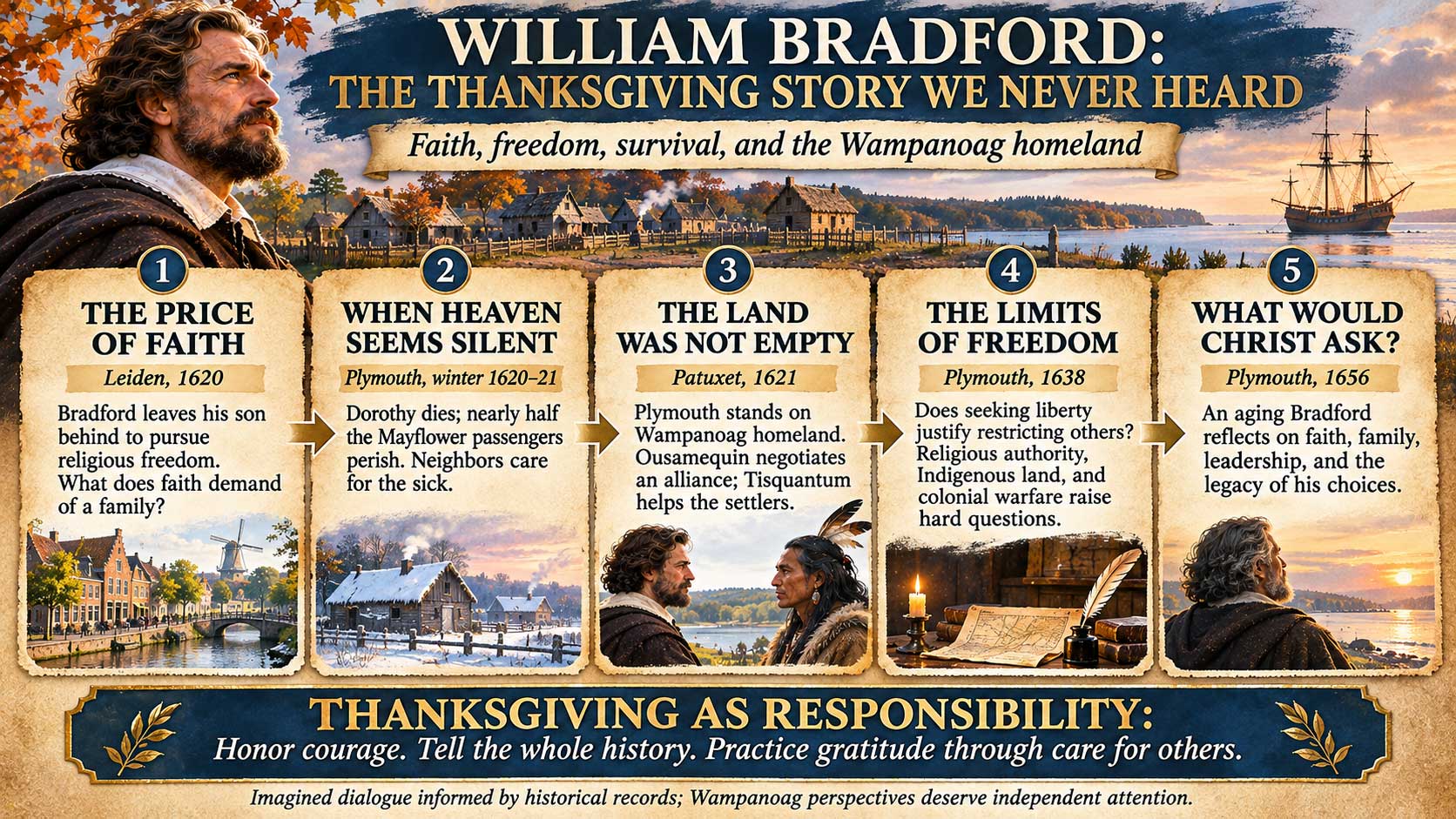
Short Bios:
Leave a Reply