
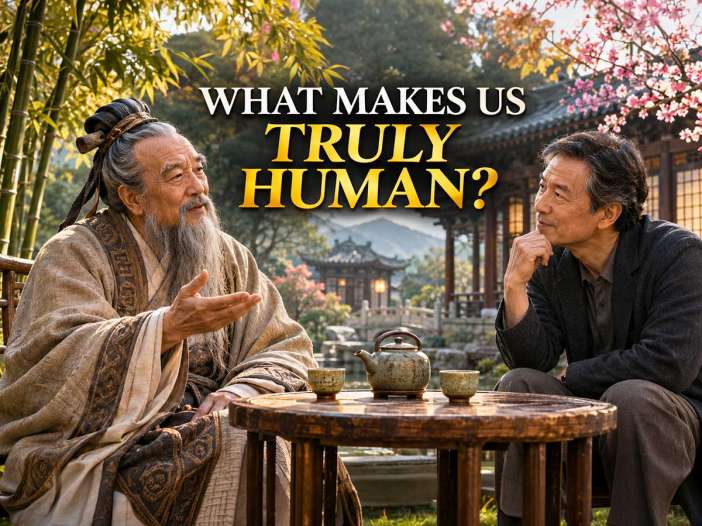
Introduction
What if Confucius returned after 2,500 years and discovered that humanity had become extraordinarily intelligent, yet still struggled to become kind?
We have created artificial intelligence, explored distant planets, built enormous cities, and connected billions of people through technology. Yet we continue to struggle with questions that troubled Confucius in ancient China. Why do dishonest leaders sometimes succeed? Why do families become divided? Why do people who profess love and compassion still mistreat others? And perhaps the most difficult question of all: If we know so much about the world, why haven't we learned how to live peacefully together?
In this imaginary interview, I sit down with Confucius (551–479 BCE), one of history's most influential philosophers, to explore the man behind the wisdom. According to the Stanford Encyclopedia of Philosophy's study of Confucius, his teachings centered on moral cultivation, learning, ritual, and the responsibilities that sustain human relationships. His influence extended far beyond his lifetime, shaping educational traditions, political thought, and family ethics across East Asia. Yet behind the familiar image of a dignified sage was a teacher who experienced political disappointment, personal loss, and the frustrations of trying to persuade others to live more honorably.
Our conversation begins with questions that history cannot fully answer. What was Confucius like before he became famous? Did he ever doubt his philosophy when rulers repeatedly rejected his advice? Was he the husband and father he encouraged others to become? From there, we explore ren, often translated as humaneness, and junzi, the exemplary person who cultivates virtue through learning and daily conduct. The Internet Encyclopedia of Philosophy's biography and analysis provides valuable context for his life, his educational mission, and the enduring debates surrounding his ideas.
But I don't want this to become a conversation in which we simply admire an ancient philosopher. I want to challenge him. If family loyalty is sacred, what happens when a father commits a crime? If leaders should govern through virtue, why do corrupt leaders so often prevail? If rituals cultivate goodness, why do people sometimes follow religious and cultural traditions while behaving cruelly? These questions reveal genuine tensions within Confucian thought, particularly between loyalty and justice, tradition and personal conscience, and social harmony and individual freedom.
The conversation eventually reaches a subject especially meaningful to me: Can humanity ever become one family? Confucius taught that moral responsibility begins in close relationships, but how far can compassion extend? Can we love our own children deeply while recognizing the equal human dignity of children born in distant countries? Can people with different religions, nationalities, and beliefs learn to disagree without hatred? One of the most moving passages in the Analects, Book 5, Chapter 26 expresses Confucius's wish that elderly people find security, friends remain trustworthy, and young people receive loving care. That simple vision feels remarkably relevant to the world we inhabit.
Finally, we explore the questions that no civilization has completely answered. What did Confucius mean by Heaven? Did he believe in a divine being? What did he think about death, grief, and the possibility of an afterlife? His surviving teachings do not resolve every spiritual mystery, and I find that uncertainty meaningful. Perhaps wisdom does not require knowing everything. Perhaps it begins when we recognize the limits of our knowledge and still choose to live responsibly, compassionately, and courageously.
I invite you to read this conversation not as a collection of ancient answers, but as an opportunity to examine your own life. What does it mean to become a good person? How do we practice kindness when kindness is difficult? What responsibilities do we have to our families, our communities, and strangers we may never meet? And if the world cannot be transformed overnight, could we begin by changing how we treat the next person who crosses our path?
Fictional Interview Disclaimer: This is an imaginative conversation written for ImaginaryTalks.com. Nick Sasaki's questions and Confucius's responses are fictional. The dialogue draws on historical sources and Confucian philosophy, but invented statements, emotions, and personal reflections should not be mistaken for documented words of Confucius.
Topic 1. The Man Behind the Wisdom
Question 1. Before the World Called You a Sage, Who Were You?
Nick Sasaki: Confucius, it's incredible to have you here. You've influenced billions of people over the centuries, but I want to start somewhere different. Forget the philosopher, forget the great teacher. I want to meet the human being. What were you like as a kid?
Confucius: (Smiles.) You wish to meet a boy whom history has nearly forgotten, including, perhaps, the old man who once was that boy.
I was curious. Serious, perhaps too serious. I was fascinated by the ceremonies and customs of those who came before us. Where other children might have found amusement in games, I found it in arranging ceremonial vessels and imitating the rituals of adults.
But do not picture a child born with wisdom. I was not born knowing the Way. I was born needing to learn it.
Nick Sasaki: Your father died when you were very young, right? And your family wasn't particularly wealthy. Did that affect you emotionally?
Confucius: The loss of a father changes a child's world. A father is not merely a provider. He is a connection to one's ancestors, a guide to one's place among others.
When that presence disappears, the child must learn certain things without him.
But I would not claim that suffering automatically produces wisdom. Some people become compassionate through hardship. Others become bitter. Hardship presents a question. Our response becomes part of our character.
Nick Sasaki: That's interesting. People often romanticize suffering. They say everything happens for a reason, or that hardship makes you stronger. But sometimes suffering just destroys people.
Confucius: Yes. We should never praise suffering merely for existing.
If a hungry child becomes wise, we should honor the child's perseverance. We should not praise the hunger.
A good society does not deliberately make life difficult so that people may develop character. It creates conditions in which people can learn, grow, and care for one another.
Nick Sasaki: I like that distinction. But let me challenge something. You came from a family with aristocratic ancestry, yet your circumstances were modest. Did you ever feel resentful toward people who inherited wealth and influence?
Confucius: I understood that birth could determine opportunity. But I came to believe that birth should not determine moral worth.
A man may inherit a distinguished name and possess a disgraceful character. Another may come from humble circumstances and develop remarkable virtue.
Which deserves greater respect?
Nick Sasaki: Obviously the second one.
Confucius: Then we agree that what a person becomes matters more than what he inherits.
Yet many societies praise this principle and practice its opposite.
Nick Sasaki: That's still true today. People admire celebrities, billionaires, politicians, and powerful families. Sometimes they barely know anything about their character.
Confucius: Then perhaps your age has changed its clothing more than its habits.
Nick Sasaki: (Laughs.) That's a pretty good line.
But here's something I really want to know. When you were young, did you want to become famous? Did you want political influence? Or were you genuinely interested in becoming a better human being?
Confucius: A young man may possess several ambitions without fully recognizing their differences.
I wished to learn. I wished to serve. I wished to participate in the restoration of good government.
And yes, I wished to be heard.
A man who believes he has something valuable to offer may desire a position where he can offer it. That desire is not necessarily shameful.
But it becomes dangerous when he begins to value recognition more than the work itself.
Nick Sasaki: So you weren't completely free of ego?
Confucius: (Laughs softly.) If I had been free of every weakness in my youth, why would I have needed so many years of learning?
Nick Sasaki: That's refreshing. I think people sometimes treat historical philosophers as if they were born perfect.
Confucius: That would make their lives poor examples.
If virtue belongs only to extraordinary beings, ordinary people may admire it without attempting it.
But if an imperfect person can gradually become better, then everyone has work worth doing.
Nick Sasaki: You famously said that at fifteen you set your heart on learning. At thirty you stood firm, at forty you had no doubts, and at fifty you understood Heaven's mandate. What does that progression actually mean?
Confucius: Consider a young tree.
At first, it reaches in many directions. It does not yet know how deeply its roots must grow.
As the years pass, it encounters wind, drought, and changing seasons.
Its strength comes not from avoiding these things, but from developing roots capable of sustaining it.
At fifteen, I had chosen a direction. I had not yet arrived.
At thirty, I had begun to establish myself.
At forty, my judgment had become less troubled by confusion.
At fifty, I came to recognize that my life belonged to something greater than personal ambition.
Nick Sasaki: Greater than ambition? Are you talking about God?
Confucius: You use the word God. I spoke of Heaven.
Whether your word and mine describe the same reality is a question we should examine carefully.
For now, I mean that I came to recognize a moral responsibility I had not invented for myself.
I could choose whether to honor it, but I did not believe I could simply redefine it according to my convenience.
Nick Sasaki: That's fascinating. We'll definitely come back to Heaven later.
But I want to ask one more thing about your younger self.
If you could sit across from fifteen-year-old Confucius right now, what would you tell him?
Confucius: I would ask whether he still loves learning.
Nick Sasaki: You wouldn't give him advice?
Confucius: Perhaps I would tell him this:
Do not confuse becoming respected with becoming respectable.
Do not be ashamed when you discover your ignorance.
Choose your companions carefully.
And when you meet someone whose character you admire, learn from him. When you meet someone whose behavior troubles you, examine whether the same weakness exists within yourself.
Nick Sasaki: That last part is powerful. Instead of judging someone, you examine yourself.
Confucius: You may still need to judge an action. But judgment without self-examination can become another form of vanity.
Nick Sasaki: So the purpose of learning isn't just to know more.
Confucius: Precisely. The question is not merely, "What have I learned?"
It is, "What kind of person am I becoming through what I have learned?"
Question 2. Did You Ever Think Your Entire Philosophy Was Wrong?
Nick Sasaki: Let's talk about something that really fascinates me.
You spent years traveling from one ruler to another, trying to convince them to adopt your ideas about moral government.
And most of them didn't listen.
I mean, think about that. You're Confucius. You believe you have a philosophy that could transform society, but the people who could actually put it into practice keep rejecting you.
Didn't that drive you crazy?
Confucius: (Laughs.) I suspect your expression describes certain moments rather well.
It is difficult to watch people pursue immediate advantage when you believe their choices will produce lasting harm.
But a teacher must learn to distinguish between two disappointments.
One is the disappointment of not being heard.
The other is the disappointment of seeing others suffer from choices that might have been avoided.
The first concerns one's pride. The second concerns one's responsibility.
Nick Sasaki: That's a pretty sophisticated distinction. But come on, you must have felt personally rejected.
Confucius: Certainly. I was human.
To desire that one's work be useful is natural. To feel disappointment when it is dismissed is equally natural.
But disappointment must not become the ruler of our judgment.
Nick Sasaki: Here's my challenge. What if those rulers were right?
What if your ideas sounded beautiful but simply didn't work in the real world?
You believed leaders should govern through virtue. But you lived in an age of military conflict and political competition.
What if a ruthless ruler could destroy a virtuous ruler before moral leadership had any chance to succeed?
Confucius: That is a serious objection.
A ruler who neglects defense may place his people in danger. A ruler who ignores practical administration may create suffering despite good intentions.
Virtue is not a substitute for competence.
But competence without virtue can become extremely dangerous.
A clever official who serves only himself may exploit the people more efficiently than an ignorant one.
A skilled general without moral restraint may bring destruction on a greater scale.
The question is not whether government requires practical ability. It certainly does.
The question is what should guide that ability.
Nick Sasaki: But suppose I'm a ruler and my neighbor is preparing to invade. I can either act ruthlessly and protect my people, or follow moral principles and risk losing everything.
What do you tell me?
Confucius: I would first ask whether those are truly your only choices.
People frequently present their preferred action as the sole alternative to disaster.
A wise ruler examines the situation carefully before accepting such a claim.
Nick Sasaki: Okay, but suppose it really comes down to that.
Confucius: Then he must act to protect those entrusted to his care, exercising judgment and restraint.
But he should never celebrate cruelty or pretend that necessity makes every action righteous.
If force is required, its use remains a grave responsibility.
Nick Sasaki: So you're not saying a good ruler should be passive.
Confucius: No. Goodness is not helplessness.
A father who protects his child from danger is not abandoning compassion. He is fulfilling a responsibility.
But a father who uses protection as an excuse to injure others without necessity has confused duty with aggression.
Nick Sasaki: That makes sense.
Still, you spent so many years searching for a ruler who would listen. At some point, didn't you think, "Maybe I'm the problem"?
Confucius: A person should always be willing to examine his own errors.
If my words were unclear, I needed to speak more clearly.
If my advice failed to account for circumstances, I needed to learn more.
If my conduct contradicted my teaching, I needed to correct myself.
But there is a difference between revising one's judgment and abandoning a principle simply to obtain approval.
Nick Sasaki: How do you tell the difference?
Confucius: Ask what has changed.
Have you discovered better evidence?
Have you recognized a genuine error?
Or have you merely grown tired of being rejected?
Nick Sasaki: That's a great question.
A lot of people give up on something they believe in, not when they discover they're wrong, but when the struggle becomes exhausting.
Confucius: And others refuse to change their minds long after evidence has shown them their error.
Both are dangers.
One abandons conviction too easily.
The other mistakes stubbornness for integrity.
Nick Sasaki: Which one were you more vulnerable to?
Confucius: (Pauses.)
Perhaps the second.
Nick Sasaki: Really?
Confucius: A man devoted to restoring an admired tradition may become so certain of its value that he fails to recognize how circumstances have changed.
It is possible to honor the wisdom of the past and still misunderstand the needs of the present.
Nick Sasaki: That's a surprisingly self-critical answer.
Confucius: You asked whether I was capable of error.
Would it be wise to answer by pretending I was not?
Nick Sasaki: Fair enough.
But there's another thing. You spent much of your life pursuing political reform, yet your greatest historical impact came through teaching.
Isn't that ironic?
Confucius: It is a lesson in the limits of our control.
A man may plant a tree hoping to rest beneath its shade.
The tree may grow long after he is gone.
Others may find shelter beneath branches he never saw.
Nick Sasaki: So you think your failures were actually necessary for your success?
Confucius: I would not claim that.
We should be cautious about turning every disappointment into a hidden blessing.
Some failures are simply failures.
Some opportunities are lost forever.
But the failure of one undertaking does not mean the entire life has failed.
Nick Sasaki: That's something I think people need to hear.
Especially people who spend decades building something and never achieve the success they hoped for.
Confucius: Then ask them what they have become during those decades.
Have they developed wisdom?
Have they treated others honorably?
Have they taught something valuable?
Have they preserved their integrity?
A person's accomplishments matter. But accomplishments are not the only measure of a life.
Nick Sasaki: What about happiness? Were you happy during those years of wandering?
Confucius: There were difficult days.
There were moments of hunger, uncertainty, and disappointment.
But there were students who remained beside me.
There were conversations that revealed new insights.
There was the pleasure of learning and the satisfaction of recognizing what was right.
Happiness need not wait until the world gives us everything we desire.
Nick Sasaki: That's interesting. You sound almost like a Stoic.
Confucius: I do not know your Stoics, but I would enjoy meeting them.
Nick Sasaki: (Laughs.) We might arrange that someday.
One last question about your political failures.
If you had become a powerful minister and successfully transformed your state, do you think you would have become a better person?
Confucius: Not necessarily.
Success provides opportunities to practice virtue, but it creates temptations too.
A man who possesses little authority may imagine himself incorruptible.
Give him authority, admiration, and the ability to command others, and he may discover weaknesses he never knew he possessed.
Nick Sasaki: So success can be a moral test.
Confucius: Yes.
And sometimes a more difficult test than failure.
Question 3. Were You the Husband, Father, and Friend You Taught Others to Become?
Nick Sasaki: I want to get personal again, Confucius.
You taught that family relationships are the foundation of a good society.
But you spent years traveling, advising rulers, and teaching students.
So here's a question I think a lot of people might hesitate to ask you.
Were you actually a good husband and father?
Confucius: (Becomes quiet.)
That is a question every person who teaches about virtue should be willing to face.
It is easier to describe the responsibilities of a father than to fulfill them perfectly.
It is easier to speak about care than to give another person the time and attention that care requires.
Nick Sasaki: Do you think your family paid a price for your mission?
Confucius: A public undertaking can demand sacrifices from people who did not choose it.
That is a serious matter.
One should not assume that a noble purpose excuses every personal neglect.
Nick Sasaki: That's exactly what I was thinking.
We often admire people who dedicate their lives to changing the world. Religious leaders, reformers, political figures, philosophers.
But sometimes their own children barely see them.
Isn't there a contradiction there?
Confucius: There can be.
If a man claims to love humanity but treats those closest to him with indifference, we should question the completeness of his virtue.
But we must be careful not to judge every absence in the same way.
A person may leave home to protect others, provide for his family, or fulfill a necessary responsibility.
The moral question concerns the reasons, the consequences, and whether he remains attentive to those affected.
Nick Sasaki: Let me make it harder.
Suppose you had to choose between staying home to raise your children and traveling for years to persuade rulers to reform society.
Which responsibility comes first?
Confucius: Before choosing, I would ask whether the responsibilities can be reconciled.
People often imagine moral life as a series of dramatic choices.
Yet much of virtue consists of preventing such conflicts through foresight, communication, and restraint.
But when responsibilities truly conflict, there may be no painless answer.
Nick Sasaki: So you can't give me a simple rule?
Confucius: A simple rule may be comforting without being wise.
The responsibilities of a father are real.
The responsibilities of someone capable of serving a troubled society may be real too.
A thoughtful person must consider the particular circumstances and remain accountable for the consequences.
Nick Sasaki: I appreciate that.
We don't know much about your wife from the historical records. Does that bother you, knowing that history remembers your philosophy but tells us so little about the woman who shared your life?
Confucius: (Reflects.)
Then history has preserved an incomplete picture.
The work of any individual depends upon relationships and circumstances that later generations may never fully know.
A great name can cast a shadow over people whose lives were no less human.
Nick Sasaki: That's beautifully said.
But let's talk about your students. Some of them followed you through extremely difficult circumstances.
Did they become like family to you?
Confucius: Teaching creates a special relationship.
A student entrusts a portion of his development to a teacher.
A teacher accepts responsibility for guiding that development.
Over time, affection and trust may grow between them.
But the teacher must never forget that students are not possessions.
Their growth is more important than their admiration.
Nick Sasaki: You had a disciple named Yan Hui whom you deeply admired.
What made him special?
Confucius: Hui possessed a remarkable love of learning.
He could live with little and still find contentment.
He did not seem to require wealth or public recognition to maintain his commitment to what was right.
He was receptive to correction and serious about improving himself.
Such qualities are rare.
Nick Sasaki: And he died before you.
Confucius: Yes.
Nick Sasaki: The Analects describes you grieving intensely when he died.
Some people might expect a great philosopher to remain calm and composed, almost detached from suffering.
But you were devastated.
Confucius: Why should wisdom require the absence of grief?
If love is real, loss matters.
A person who feels no sorrow when someone beloved dies may not have achieved wisdom. He may simply have failed to love deeply.
Nick Sasaki: That's powerful.
But what about emotional control? You taught self-discipline. Isn't overwhelming grief a loss of control?
Confucius: We must distinguish between emotion and wrongdoing.
Grief is not a moral failure.
Anger is not automatically a moral failure.
Fear is not automatically a moral failure.
The question is how we respond to these experiences.
Does grief deepen our appreciation for others, or does it make us cruel?
Does anger defend what is right, or does it become an excuse for vengeance?
Self-cultivation does not mean becoming incapable of feeling.
Nick Sasaki: I love that distinction.
I think many people confuse spiritual maturity with emotional numbness.
Confucius: A heart incapable of being moved would be a strange foundation for humaneness.
Nick Sasaki: When you lost Yan Hui, did you question Heaven?
Confucius: (Long pause.)
There are moments when suffering exceeds our ability to explain it.
A young person of admirable character dies, and those who have lived less honorably remain.
It would be easy to invent an explanation that makes the event seem fair.
But sorrow does not become less real merely when we give it a name.
Nick Sasaki: Did you feel angry?
Confucius: Grief can contain many feelings.
What matters is that we do not allow our pain to destroy the very qualities we admired in the person we lost.
If Hui loved learning, then honoring him should include continuing to learn.
If he practiced kindness, then honoring him should include treating others kindly.
Nick Sasaki: That's a beautiful way to think about grief.
Instead of just remembering someone, you continue living the values that made them special.
Confucius: Yes.
The dead cannot return to perform their unfinished acts.
But the living can carry forward what was worthy in their lives.
Nick Sasaki: I want to ask you something that connects your whole life.
You wanted to reform society. You wanted leaders to become virtuous. You wanted students to develop moral character.
But after everything you experienced, did you ever wonder whether the most important thing wasn't changing society at all?
Maybe it was simply loving the people in front of you.
Confucius: (Smiles gently.)
Why must these be separate?
A society is not an invisible creature floating above its people.
It consists of relationships.
Between parents and children.
Between friends.
Between teachers and students.
Between rulers and those they govern.
If these relationships are corrupted by selfishness, dishonesty, and indifference, society suffers.
If they are guided by responsibility, trust, and humaneness, society becomes healthier.
Nick Sasaki: So changing the world begins with changing how we treat one another.
Confucius: It begins there, but it must not end there.
A kind father may still participate in an unjust government.
A loyal friend may still ignore the suffering of strangers.
Personal affection must be accompanied by moral judgment.
We must learn to care for those close to us without becoming indifferent to those beyond our circle.
Nick Sasaki: That's interesting, since your philosophy is often criticized for putting too much importance on family loyalty and hierarchy.
Confucius: Then we should examine those criticisms seriously.
A teaching becomes dangerous when its followers refuse to question how it is applied.
Respect for parents should not become permission for cruelty.
Respect for rulers should not become permission for injustice.
And loyalty should never become an excuse to abandon moral reflection.
Nick Sasaki: I think we're going to have a fascinating conversation about that when we get into family and universal love.
But before we leave your personal life, I have one final question.
If you could go back and relive your life, would you spend less time trying to convince rulers and more time with the people you loved?
Confucius: (Looks thoughtfully toward the garden.)
I cannot tell you that every choice I made was the best one.
Nor can I claim to know what another path would have produced.
A life is not a mathematical problem in which every decision can be calculated afterward.
But I would say this.
If I could live again, I would want to become more attentive to the people whose lives touched mine.
I would want to listen more carefully.
I would want to recognize my errors sooner.
And I would want my learning to make me more humane, not merely more knowledgeable.
Nick Sasaki: So after everything, the great Confucius would still want to become a better human being.
Confucius: (Laughs.)
Nick, what else would learning be for?
Nick Sasaki: You know, that might be my favorite answer so far.
But it raises another question.
If becoming a better human being is the purpose of learning, what exactly makes someone good?
Is it love? Honesty? Self-control? Compassion?
And are people naturally capable of goodness, or do we have to struggle against our own nature to achieve it?
Confucius: Those are questions worth examining.
But before I answer, may I ask you something?
Nick Sasaki: Of course.
Confucius: When you say that you wish to become a good person, what do you believe you must change within yourself?
Nick Sasaki: (Pauses, smiling.)
Well, now you're interviewing me.
Confucius: Is that not how two people learn together?
The conversation continues in Topic 2: What Makes Us Truly Human?
Historical and Creative Note
This is a fictional conversation inspired by Confucius's life and philosophy. The historical framework draws upon the Analects and traditional accounts of his life. His childhood circumstances, travels, political disappointments, relationship with Yan Hui, and teachings about learning and virtue have historical or textual foundations, though some biographical details remain uncertain.
The personal confessions, hypothetical choices, modern comparisons, and emotional responses are imaginative interpretations, not documented statements by Confucius. The conversation seeks to explore his philosophy faithfully without presenting invented dialogue as historical fact.
Topic 2. What Makes Us Truly Human?
Question 1. What Does It Really Mean to Be a Good Human Being?
Nick Sasaki: Confucius, at the end of our last conversation, you turned the question around on me. You asked what I needed to change within myself to become a better human being.
I've been thinking about that.
I think most people genuinely want to be good. They want to love their families, help others, and live meaningful lives. But we all have weaknesses. We get angry, jealous, impatient, and sometimes selfish.
So let me ask you something that seems simple but really isn't.
What makes someone a genuinely good human being?
Confucius: Before I answer, Nick, tell me something. When you say you wish to be good, what do you mean?
Nick Sasaki: I suppose I mean someone who genuinely cares about other people. Someone who doesn't deliberately hurt others and tries to make the world a little better.
Confucius: Those are worthy intentions.
But suppose a man feels compassion for a hungry family and does nothing to help them, despite having food he could share.
Would you call him humane?
Nick Sasaki: Well, he feels compassion. But I guess if he can help and doesn't, something is missing.
Confucius: Precisely.
Now suppose another man gives food to the family, but only after arranging for everyone in the village to witness his generosity.
Is he humane?
Nick Sasaki: That's harder. He still helped them, but his motivation was selfish.
Confucius: Then we have already discovered something.
Goodness cannot be measured by feelings alone.
Nor can it be measured entirely by outward actions.
We must consider intention, conduct, and the character from which they arise.
Nick Sasaki: That brings us to your famous concept of ren, usually translated as humaneness or benevolence.
What exactly is ren?
Confucius: Ren is not a decoration placed upon a person's reputation.
It is a quality cultivated within human relationships.
Consider a father who provides for his children but never listens to them.
Consider a ruler who speaks of loving his people but refuses to hear their suffering.
Consider a friend who praises loyalty but disappears when friendship becomes inconvenient.
Each may perform certain duties, yet something essential remains incomplete.
Humaneness requires us to recognize the humanity of those with whom we live.
Nick Sasaki: So it's more than being nice.
Confucius: Much more.
A person may be pleasant and still lack courage.
A person may speak gently while allowing injustice to continue.
Sometimes humaneness requires difficult words.
Sometimes it requires correcting someone we love.
Sometimes it requires refusing a request that would harm another person.
Nick Sasaki: That's interesting. A lot of people think being a good person means avoiding conflict.
But you're saying goodness sometimes requires confrontation.
Confucius: If your friend is about to make a terrible mistake, would you remain silent merely to preserve a pleasant atmosphere?
Nick Sasaki: No. I'd try to stop him.
Confucius: And if he became angry with you?
Nick Sasaki: I'd probably still try.
Confucius: Then you understand that harmony is not identical to agreement.
A relationship without disagreement may be peaceful, or it may simply be dishonest.
Nick Sasaki: That's a great distinction.
Let me challenge you, though.
Who decides what is morally right?
Different cultures have different customs. Different religions teach different moral principles. Something considered honorable in one society might be considered oppressive in another.
How do you know your idea of goodness isn't simply the tradition you happened to inherit?
Confucius: A serious question.
I respected the wisdom of earlier generations. I believed that the ancient rites preserved lessons about responsibility and human relationships.
But a custom without humaneness becomes an empty performance.
If a man observes every ceremony while treating others with contempt, his conduct has lost its moral purpose.
Nick Sasaki: But what if the tradition itself causes suffering?
Suppose a society teaches children that they must obey their parents under every circumstance, including when their parents are cruel.
Wouldn't your emphasis on tradition make it harder to challenge that?
Confucius: Then we must ask whether obedience and respect are truly the same.
A child may disagree with a parent respectfully.
A minister may correct a ruler without abandoning his responsibility.
The existence of a relationship does not make every command righteous.
Nick Sasaki: But you still believe some people deserve greater authority than others.
Confucius: Authority may be necessary for certain responsibilities.
A teacher guides a student. A parent cares for a young child. A ruler administers public affairs.
But authority without moral responsibility becomes corruption.
If a person demands respect while refusing to behave respectably, he has misunderstood the nature of his position.
Nick Sasaki: So the responsibility increases with authority.
Confucius: It should.
A ruler's dishonesty can injure thousands.
A parent's cruelty can shape a child's life.
A teacher's arrogance can discourage a student from learning.
The greater one's influence, the greater the need for self-examination.
Nick Sasaki: I want to bring this back to the individual.
You described the junzi, sometimes translated as the exemplary person or noble person.
What separates that person from everyone else?
Confucius: The exemplary person is not someone who has never made a mistake.
He is someone who takes moral improvement seriously.
He examines his conduct.
He learns from those who surpass him.
He recognizes errors and seeks to correct them.
He values righteousness more than personal advantage.
And he does not mistake public admiration for moral achievement.
Nick Sasaki: Can someone become a junzi without being wealthy, educated, or socially influential?
Confucius: Certainly.
A poor person may possess admirable character.
A wealthy person may lack it.
Learning is essential, but learning is not confined to prestigious institutions.
A person who listens carefully, reflects honestly, and corrects his conduct may learn from ordinary encounters.
Nick Sasaki: Let me ask you a question about something that bothers me.
Why do people sometimes become so focused on appearing good that they forget to actually be good?
You see it everywhere. People publicly display compassion, generosity, or moral outrage, but privately they treat others terribly.
Confucius: Recognition is pleasant.
And when society rewards the appearance of virtue, people may learn to imitate virtue rather than cultivate it.
This is one reason self-examination matters.
Ask yourself: Would I still do this if no one knew?
Would I still speak honestly if honesty brought no praise?
Would I still help someone who could never repay me?
Nick Sasaki: That's a powerful test.
Confucius: It is one test, not the only one.
A person may act privately from pride too.
We must examine the whole character, not merely one gesture.
Nick Sasaki: So here's what I'm hearing.
Being good isn't just having good intentions, following rules, or doing occasional acts of kindness.
It's becoming the kind of person whose character naturally produces good actions.
Confucius: Yes.
And that process requires a lifetime.
Nick Sasaki: Which leads to something I've always wondered.
Are we born with the capacity to become good, or are some people simply born selfish?
Question 2. Are Human Beings Naturally Good, or Are We Fundamentally Selfish?
Nick Sasaki: Confucius, I want to push this further.
Look at human history.
We've created extraordinary civilizations, beautiful art, medicine, philosophy, and technology.
But we've committed terrible atrocities too.
People kill each other over territory, religion, ideology, and wealth.
Sometimes they even enjoy humiliating or hurting others.
So here's my question.
Are human beings naturally good, naturally selfish, or something in between?
Confucius: I would begin by distinguishing what people are born with from what they become through their conduct.
Human beings share many similarities at birth.
But their habits, surroundings, education, and choices can lead them along very different paths.
Nick Sasaki: So you think environment shapes us?
Confucius: It matters greatly.
Consider two children.
One grows up among people who practice honesty, patience, and mutual care.
The other grows up surrounded by deception, cruelty, and fear.
Would you expect them to develop identical habits?
Nick Sasaki: Probably not.
Confucius: Then we should take seriously the conditions in which character develops.
But we should not assume that circumstances determine everything.
People can learn.
They can reflect.
They can recognize the consequences of their actions.
And they can sometimes change.
Nick Sasaki: But here's where I struggle.
What about someone who enjoys cruelty?
Not someone who hurts others out of desperation, but someone who genuinely takes pleasure in controlling or humiliating people.
Can education transform that person?
Confucius: We should not pretend that every person responds equally to instruction.
Some resist correction.
Some become attached to destructive habits.
Some refuse to examine themselves.
Education is valuable, but it does not guarantee virtue.
Nick Sasaki: That's a more realistic answer than I expected.
I thought you might say everyone could become good if we just taught them properly.
Confucius: A teacher must distinguish between hope and certainty.
If I believed no one could improve, why would I teach?
But if I believed teaching always succeeded, I would ignore what experience reveals.
Nick Sasaki: So you believe in the possibility of change without assuming everyone will change.
Confucius: Exactly.
Nick Sasaki: Let's make this more difficult.
Suppose a man has committed terrible acts.
He has harmed innocent people, destroyed families, and caused enormous suffering.
Years later, he genuinely regrets what he did.
Can he become a good person?
Confucius: Remorse may be the beginning of moral change.
But remorse alone does not repair the harm.
He must stop the wrongdoing.
He must acknowledge what he has done.
Where possible, he must make amends.
And he must demonstrate through his conduct that his character has changed.
Nick Sasaki: What if the people he harmed refuse to forgive him?
Confucius: Their refusal does not relieve him of responsibility.
Nor should he demand forgiveness as a reward for repentance.
The injured have their own suffering.
Moral improvement does not erase the past.
Nick Sasaki: That's important.
I think people sometimes confuse forgiveness with pretending something never happened.
Confucius: Forgiveness and accountability need not be enemies.
But they are not identical.
Nick Sasaki: Now let me turn the question around.
What about someone who has lived a good life for decades and then commits one terrible act?
Does that one act destroy all the goodness that came before?
Confucius: We should neither ignore the wrong nor pretend that one action tells us everything about a lifetime.
The seriousness of the act matters.
Its consequences matter.
The person's response afterward matters.
But moral judgment requires discernment, not convenient formulas.
Nick Sasaki: You keep returning to judgment rather than rigid rules.
Confucius: Rules can guide us.
But a person who follows rules without reflection may fail to recognize when circumstances require deeper consideration.
Nick Sasaki: Let me ask about anger.
Suppose someone insults your family.
You feel furious.
Is that anger a moral failure?
Confucius: Not necessarily.
Emotion arises before we have fully considered it.
The question is what we do next.
Does anger lead us to protect someone who has been wronged?
Or does it lead us to seek revenge without restraint?
Nick Sasaki: So anger can sometimes be appropriate.
Confucius: There are circumstances in which indifference would be more troubling than anger.
But anger must remain subject to judgment.
Nick Sasaki: What about hatred?
Can you hate someone's actions without hating the person?
Confucius: You may condemn wrongdoing firmly.
But if hatred consumes your entire judgment, you risk losing the ability to distinguish justice from revenge.
A person who has done wrong remains responsible for his actions.
Yet our response should not require us to abandon our own humanity.
Nick Sasaki: That connects to something I care deeply about.
Why do people divide themselves into groups and then treat outsiders as if they were less human?
It happens with nationality, religion, race, and politics.
People who are loving parents and loyal friends can become cruel when dealing with another group.
How do you explain that?
Confucius: People often learn loyalty before they learn breadth of concern.
They understand the needs of those closest to them.
They recognize familiar faces, customs, and obligations.
But they may fail to extend moral consideration beyond that circle.
Nick Sasaki: Isn't that a weakness in your own philosophy?
You place so much importance on family loyalty and social relationships.
Couldn't that encourage people to care more about their own group and less about outsiders?
Confucius: It is a danger that deserves examination.
Affection for one's family is valuable.
But if that affection becomes permission to mistreat others, it has lost its proper direction.
A person must learn to fulfill particular responsibilities without abandoning righteousness.
Nick Sasaki: But you don't teach that everyone should be loved equally.
Confucius: Relationships carry different responsibilities.
The care owed to one's child is not identical to the care owed to a stranger.
But different responsibilities do not mean that strangers have no moral worth.
Nick Sasaki: That's where I think we might disagree a little.
I understand that we have special responsibilities to our families.
But I wonder whether humanity will ever achieve peace unless we learn to see every person as part of one family.
Confucius: Then I would ask you something.
When you speak of loving every human being, what does that love require of you tomorrow morning?
Nick Sasaki: What do you mean?
Confucius: Suppose you wake tomorrow believing that all humanity is one family.
How will you treat the person who irritates you?
How will you respond to someone who disagrees with you?
How will you behave when helping another person requires sacrificing your convenience?
Nick Sasaki: You're saying universal love has to become practical.
Confucius: A beautiful ideal that never changes conduct remains incomplete.
Nick Sasaki: That's fair.
But what if the world needs both?
A universal vision of human dignity and the daily discipline to live according to it?
Confucius: That is a proposal worth examining.
The broadest aspiration must find expression in the smallest action.
Nick Sasaki: I like that.
Now I want to ask you something that might be uncomfortable.
Do you think you were naturally a good person?
Confucius: (Smiles.)
I would be cautious about making such a claim.
I devoted myself to learning precisely because I recognized how much I needed to improve.
Nick Sasaki: But surely you became wiser than most people.
Confucius: If wisdom makes a man eager to announce his superiority, he should examine whether he has learned the right lesson.
Nick Sasaki: (Laughs.) Fair enough.
So what do you think is the greatest obstacle to becoming a good person?
Confucius: The unwillingness to examine oneself.
A person who recognizes his ignorance may learn.
A person who recognizes his selfishness may change.
But someone who believes he has nothing to correct closes the door to improvement.
Nick Sasaki: That reminds me of something.
Sometimes the people who are most convinced they're morally right become the most judgmental and cruel.
Confucius: Then their certainty has become an obstacle to virtue.
Moral conviction should guide conduct.
It should not become permission for arrogance.
Nick Sasaki: So humility isn't just a nice personality trait.
It's necessary for moral growth.
Confucius: A person who cannot acknowledge error cannot fully benefit from learning.
Nick Sasaki: That brings us to your teaching about practice.
You believed that behavior could shape character.
But can we really become kind by acting kind?
Question 3. Can Practicing Kindness Actually Change the Human Heart?
Nick Sasaki: Confucius, here's something I find fascinating.
In modern psychology, people often discuss how habits influence emotions and identity.
You were teaching something related to that more than two thousand years ago.
You believed that proper conduct, rituals, and repeated practice could help cultivate virtue.
But I want to challenge the idea.
Suppose someone doesn't genuinely care about other people.
Can we make that person compassionate simply by teaching him to behave politely?
Confucius: Politeness alone is insufficient.
A man may bow respectfully while concealing contempt.
He may speak graciously while planning deception.
Outward conduct does not automatically reveal inward character.
Nick Sasaki: Then why place so much importance on ritual and etiquette?
Confucius: Consider how people learn to live together.
A child learns to greet others.
To listen when someone speaks.
To express gratitude.
To show consideration during moments of grief.
These practices may begin before the child fully comprehends their meaning.
But through repetition, reflection, and experience, the child may come to recognize the human relationships they express.
Nick Sasaki: So behavior can help develop feeling.
Confucius: It can, when accompanied by sincere attention and learning.
Nick Sasaki: But couldn't it work the opposite way?
Suppose a child is forced to perform respectful rituals toward a cruel parent.
Wouldn't that teach the child to suppress genuine feelings and pretend everything is fine?
Confucius: That is a serious danger.
Ritual without humaneness becomes hollow.
And ritual used to conceal injustice becomes corrupted.
The purpose of proper conduct is not to make suffering invisible.
It is to cultivate relationships in which people fulfill their responsibilities with sincerity.
Nick Sasaki: Let me give you a modern example.
Suppose someone wakes up in a terrible mood.
He's irritated, exhausted, and doesn't feel like being nice to anybody.
But he decides to smile, speak kindly, and help someone anyway.
Is that genuine goodness, or is he being fake?
Confucius: Why should the absence of a pleasant feeling make a kind action false?
Perhaps the man is tired.
Perhaps he is grieving.
Perhaps his heart is troubled.
Yet he chooses not to burden others unnecessarily.
That choice may reveal moral strength.
Nick Sasaki: That's a good point.
Sometimes being kind is hardest when we don't feel like it.
Confucius: And those moments may be especially valuable for cultivating character.
Nick Sasaki: But what if he's just pretending so people will like him?
Confucius: Then we must examine his intention.
The same outward action can arise from different motives.
One person speaks gently from genuine concern.
Another does so to manipulate.
A third begins with mixed motives but gradually learns sincere consideration.
Human character is not always simple.
Nick Sasaki: That third possibility is interesting.
Are you saying someone can start doing good things for selfish reasons and eventually become genuinely good?
Confucius: It is possible.
A student may begin learning to gain recognition.
Through study, he may discover that knowledge is valuable beyond praise.
A person may begin practicing generosity to improve his reputation.
Through giving, he may come to recognize the suffering of others more deeply.
But such development is not guaranteed.
He must remain willing to examine his motives.
Nick Sasaki: So practice opens the door, but reflection helps transform the person.
Confucius: Yes.
Nick Sasaki: What about people who perform religious rituals every day but still behave cruelly?
They pray, attend ceremonies, and follow traditions, yet they mistreat others.
Doesn't that show the limitations of ritual?
Confucius: It shows what happens when ritual becomes separated from its moral purpose.
A ceremony cannot substitute for integrity.
A respectful gesture cannot excuse cruelty.
If a person performs the rites correctly but neglects humaneness, what has he truly accomplished?
Nick Sasaki: I think that's one of the most relevant parts of your philosophy today.
People sometimes become more attached to the symbols of goodness than to goodness itself.
Confucius: Symbols can remind us of our responsibilities.
But when we begin to value the symbol more than the responsibility, we have reversed their proper relationship.
Nick Sasaki: Let's talk about something practical.
Suppose someone wants to become a better human being starting tomorrow.
Not a philosopher. Not a monk. Just an ordinary person with a job, family, bills, and daily frustrations.
What would you tell that person to do?
Confucius: Begin by observing your conduct.
When you speak, ask whether your words are truthful and appropriate.
When you make a promise, consider whether you can fulfill it.
When someone helps you, express gratitude.
When you become angry, examine the reason before acting.
When you encounter someone admirable, consider what you can learn.
When you encounter behavior you dislike, examine whether you possess a similar weakness.
Nick Sasaki: That sounds simple, but it's actually difficult.
Confucius: Many important practices are simple to describe and difficult to sustain.
Nick Sasaki: What about meditation or prayer?
Would you recommend spending time alone examining your thoughts?
Confucius: Reflection is valuable.
But reflection should inform conduct.
A person may spend hours contemplating virtue and then speak harshly to his family.
What has his contemplation accomplished?
Nick Sasaki: So you're very practical.
Confucius: Moral learning must eventually appear in how we live.
Nick Sasaki: Let me ask you something about happiness.
If someone spends his whole life examining his flaws and trying to improve, couldn't that become exhausting?
At some point, shouldn't we just accept ourselves and enjoy life?
Confucius: Self-examination should not become self-hatred.
Learning can be joyful.
Friendship can be joyful.
Practicing what one has learned can be joyful.
The exemplary person does not spend every moment condemning himself.
He recognizes that growth is part of living well.
Nick Sasaki: That's a relief.
I was starting to think your ideal student would never relax.
Confucius: (Laughs.)
A person who cannot enjoy friendship, conversation, and ordinary pleasures has misunderstood much about human life.
Nick Sasaki: Did you enjoy joking with your students?
Confucius: A teacher who never smiles may discover that his students learn to fear questions.
Serious learning does not require a permanently serious face.
Nick Sasaki: I like that.
Let me ask you one final question about becoming good.
Suppose someone spends decades working on himself.
He becomes more patient, more honest, more compassionate.
But he still gets angry sometimes.
He still makes mistakes.
He still occasionally acts selfishly.
Has he failed?
Confucius: Why would he have failed?
Does a person who stumbles while walking cease to make progress?
The question is whether he recognizes the stumble and corrects his direction.
Nick Sasaki: So perfection isn't the goal.
Confucius: The exemplary person strives toward virtue.
He does not claim to have exhausted everything there is to learn.
Nick Sasaki: You know, there's something very hopeful about that.
You don't have to be born extraordinary.
You don't have to be wealthy or famous.
You don't have to possess perfect knowledge.
You can begin wherever you are.
Confucius: Yes.
But you must begin.
Nick Sasaki: (Smiles.)
That's a pretty good final sentence.
Confucius: Then perhaps we should not end with it.
Nick Sasaki: (Laughs.) Fair enough. What would you add?
Confucius: We have spoken of becoming humane.
But humaneness cannot remain confined to the individual.
A person learns to care through relationships.
He begins with those closest to him.
And then he must face a difficult question.
How far should his concern extend?
Nick Sasaki: That's exactly where I wanted to go next.
You believed family was the foundation of moral life.
But I wonder whether that foundation can eventually support something much larger.
What if we could learn to care for people beyond our families, beyond our countries, beyond our religions?
What if humanity could eventually see itself as one family?
Confucius: Then we must examine what you mean by family.
Does belonging to one family mean that every relationship carries identical responsibilities?
Does love require equal affection for everyone?
And what happens when loyalty to those closest to us conflicts with justice for someone else?
Nick Sasaki: Those are difficult questions.
Confucius: Good.
Then our conversation is beginning to reach the heart of the matter.
The conversation continues in Topic 3: Love, Family, and One Human Family.
Historical and Creative Note
This is a fictional conversation inspired by the philosophy attributed to Confucius in the Analects. The discussion draws on his teachings concerning ren (humaneness), li (ritual propriety), junzi (the exemplary person), self-cultivation, moral learning, and the importance of relationships.
Several ideas are informed by Analects 1.1, 1.4, 2.3, 4.16, 6.30, 12.1, 12.2, 12.22, and 15.24. The distinction between Confucius's own statements about human nature and the later, more developed theories of Mencius and Xunzi is intentional.
The extended arguments about psychology, modern society, abuse, forgiveness, and universal compassion are creative interpretations rather than historically recorded conversations. Confucius's responses are imagined attempts to explore how his ethical principles might engage with contemporary questions.
Topic 3. Love, Family, and One Human Family
Question 1. Why Must Love Begin with the Family?
Nick Sasaki: Confucius, something you said in our last conversation has stayed with me. You said that becoming a good human being isn't just about having beautiful ideas. It's about how we actually treat people.
And you believe that begins with the family.
But I want to challenge that. Why should love begin with our own family? Why not teach children from the very beginning that every human being deserves love?
Confucius: Nick, let me ask you something. When a child is born, does that child begin by loving all humanity?
Nick Sasaki: No. The child begins by bonding with its parents, especially the mother.
Confucius: And how does the child first learn what care means?
Nick Sasaki: By receiving it, I suppose.
Confucius: Precisely.
Before a child can understand justice, nations, or humanity, the child experiences being held, fed, comforted, and protected.
These experiences introduce the child to relationships.
Later, the child learns to respond to the care of others.
This is one reason I regard family relationships as a beginning of moral education.
Nick Sasaki: But not everyone grows up in a loving family.
Some children experience neglect, violence, or abandonment.
What happens to your philosophy when the family itself is the source of suffering?
Confucius: Then the family has failed in an important responsibility.
We must not confuse the institution of family with the virtue that ought to guide it.
A father does not become humane merely by being a father.
A mother does not fulfill every responsibility merely by giving birth.
The title describes a relationship. It does not guarantee good conduct.
Nick Sasaki: That's an important distinction.
But your philosophy places a great deal of importance on filial piety, or xiao, which means respecting and honoring parents.
Doesn't that put an unfair burden on children whose parents have treated them badly?
Confucius: Respect must be considered alongside righteousness.
A child should not imitate wrongdoing simply to satisfy a parent.
Nor should a parent use the language of duty to excuse cruelty.
Nick Sasaki: But would you tell an adult child to maintain a relationship with an abusive parent?
Confucius: I would first ask whether maintaining that relationship places the person in danger.
A person should not be required to submit to injury merely to demonstrate respect.
There may be circumstances in which distance is necessary.
Nick Sasaki: That's a very modern-sounding answer.
Confucius: Then we should be careful. You are asking me to consider circumstances that your society discusses in ways different from my own.
Do not mistake an answer developed through our conversation for a statement I made in ancient Lu.
But the question remains worthy: What does a humane person do when obligations conflict?
Nick Sasaki: I appreciate that distinction.
Now let's take a happier example.
Suppose a man loves his children deeply. He works hard, sacrifices for them, and wants them to have wonderful lives.
But he doesn't care much about children outside his family.
Is he a good person?
Confucius: He may be a devoted father, yet his moral development remains incomplete.
Affection for one's children is valuable.
But it does not excuse indifference to the suffering of others.
Nick Sasaki: So family love should become a starting point for wider compassion.
Confucius: That is a worthy direction.
But I would caution against assuming that all relationships are identical.
You have responsibilities toward your children that you do not have toward every child in the world.
If your young child becomes ill, you must provide care.
You cannot excuse neglect by saying that you love all children equally.
Nick Sasaki: Of course. But I think it's possible to love humanity universally without treating every person identically.
For example, I can love my own children in a very personal way and still believe that every child deserves food, safety, education, and affection.
Confucius: Then we should distinguish equal moral concern from identical personal obligations.
Those are not the same.
Nick Sasaki: Exactly.
Confucius: And that distinction may help us understand how affection can extend beyond the household without destroying the responsibilities that sustain it.
Nick Sasaki: Let me ask you something personal.
Did you ever meet someone who had no family connection to you but treated you with such kindness that you felt you had gained another family member?
Confucius: During years of travel, a person depends upon the goodwill of others.
A stranger may offer shelter.
A student may remain loyal during hardship.
A friend may provide comfort when circumstances are difficult.
Such relationships teach us that kinship is not the only source of human affection.
Nick Sasaki: That's beautiful.
I think some of the strongest bonds in life come from people who aren't related by blood.
Confucius: Then perhaps we should ask what makes a relationship worthy.
Is it ancestry alone?
Or is it trust, responsibility, gratitude, and the willingness to care?
Nick Sasaki: I would say the second.
Confucius: Yet ancestry carries responsibilities that cannot simply be dismissed.
Our task is not to choose one and reject the other.
It is to understand how different relationships contribute to a humane life.
Nick Sasaki: So you don't want to replace family loyalty with universal love.
You want family relationships to become a foundation for moral development.
Confucius: Yes, provided that the foundation does not become a wall.
Nick Sasaki: I like that. A foundation, not a wall.
But that brings us to something much more difficult.
What happens when loyalty to family conflicts with doing what is right?
Question 2. What If Your Father Commits a Crime?
Nick Sasaki: Confucius, there's a passage in the Analects that I find fascinating and, frankly, troubling.
A governor tells you that in his village there is an upright man who testified against his own father for stealing a sheep.
But you respond that in your community, fathers protect their sons and sons protect their fathers, and that uprightness can be found in that relationship.
That's Analects 13.18, right?
Confucius: That is how the exchange has been transmitted.
Nick Sasaki: I have to challenge you on this.
If your father steals something, shouldn't you tell the truth?
Why should family loyalty come before justice?
Confucius: You have identified a genuine tension.
Let us begin by asking what kind of moral action we are examining.
A son discovers that his father has stolen a sheep.
What should the son desire?
Nick Sasaki: That his father stop stealing, return the sheep, and take responsibility.
Confucius: Good.
Now suppose the son immediately announces his father's wrongdoing before the entire village, gaining praise for his own honesty.
Has he necessarily acted with complete virtue?
Nick Sasaki: Maybe not. He might be trying to make himself look good.
But the father still committed a crime.
Confucius: Indeed.
The wrongdoing must not be celebrated.
My concern is whether public accusation is always the best expression of moral responsibility within a family.
Nick Sasaki: But what about the person whose sheep was stolen?
You seem to be focusing on the father and son while forgetting the victim.
Confucius: That criticism deserves attention.
The injured person has a legitimate claim.
If family loyalty becomes an excuse to ignore that claim, then loyalty has been separated from righteousness.
Nick Sasaki: So would you tell the son to make his father return the sheep?
Confucius: I would consider that an appropriate effort toward correction.
A son who truly cares for his father should not encourage him to continue wrongdoing.
Nick Sasaki: But suppose the father refuses.
He says, "You're my son. Your duty is to protect me. Keep your mouth shut."
What then?
Confucius: The son must not confuse obedience with moral agreement.
He should attempt to correct his father respectfully.
Nick Sasaki: And if that fails?
Confucius: Then the conflict becomes more difficult.
Nick Sasaki: You're avoiding the question.
Confucius: (Smiles faintly.)
Perhaps I am refusing to make a difficult moral problem appear simple.
Nick Sasaki: Fair enough. But let me push harder.
Suppose it's not a sheep.
Suppose your father has seriously injured an innocent person.
Would you still protect him from the authorities?
Confucius: We must distinguish the ancient example from your new case.
The seriousness of the harm changes what must be considered.
I would not wish an innocent person to remain exposed to danger.
Nor would I regard the suffering of a victim as insignificant.
Nick Sasaki: But the passage still sounds like you're saying family loyalty matters more than impartial justice.
Confucius: It does give special weight to the family relationship.
You should not erase that difference merely to make my teaching more agreeable to your age.
Nick Sasaki: I appreciate you admitting that.
Confucius: Yet neither should you assume that the entire question has been settled by one brief exchange.
Ask what justice seeks.
Is it punishment alone?
Is it restoration?
Is it the correction of wrongdoing?
Is it protection of the innocent?
A wise judgment must consider these purposes.
Nick Sasaki: That's interesting.
Modern legal systems often struggle with the same questions.
But there's a danger here.
Powerful families can use loyalty to hide corruption.
Politicians protect relatives. Business leaders protect family members. Entire institutions cover up wrongdoing to preserve their reputations.
Doesn't your philosophy risk encouraging that?
Confucius: Yes, if loyalty is interpreted as permission to conceal wrongdoing without correction.
That would be a serious misuse of family responsibility.
But your criticism raises a deeper question.
Can we preserve the moral importance of intimate relationships without allowing those relationships to corrupt public justice?
Nick Sasaki: That's exactly the problem.
Confucius: Then we should not pretend that either loyalty or impartiality can be applied without judgment.
Nick Sasaki: Let me ask you something else.
What if the person committing the wrongdoing isn't your father but your ruler?
You taught that ministers should serve rulers respectfully.
But what happens when the ruler is corrupt?
Confucius: A minister must not confuse service with flattery.
If a ruler acts wrongly, those entrusted with advising him should offer correction.
A person who praises every decision merely to retain favor is not serving the ruler well.
Nick Sasaki: But what if correcting the ruler gets you killed?
Confucius: Then courage and prudence must both be considered.
A person should not seek death for the sake of appearing courageous.
Yet fear should not become an excuse for abandoning every principle.
Nick Sasaki: That's a difficult balance.
Confucius: Moral life often is.
Nick Sasaki: You know what strikes me?
People sometimes talk about family values as if they automatically make someone good.
But family loyalty can produce extraordinary sacrifice and extraordinary injustice.
A parent might risk everything to save a child.
Or a parent might help that child escape responsibility for harming someone else.
It's the same loyalty, but the moral consequences are completely different.
Confucius: Then loyalty must be guided by righteousness.
Affection without judgment can become indulgence.
Judgment without affection can become harshness.
Nick Sasaki: I like that.
But let me ask you one more question about parents.
What if your parents believe something you think is deeply wrong?
Maybe they hold prejudices against another group.
Maybe they demand that you marry someone you don't love.
Maybe they insist that you follow a tradition that conflicts with your conscience.
Should you obey?
Confucius: You should examine the matter carefully.
Do not reject a parent's advice merely to assert independence.
But do not assume that age or authority makes every judgment correct.
Express disagreement respectfully.
Explain your reasons.
Remain open to correction yourself.
Nick Sasaki: And if you still disagree?
Confucius: Then you must consider how to act without abandoning either your conscience or your humanity.
Nick Sasaki: That sounds like respect without surrender.
Confucius: A useful expression.
Nick Sasaki: I think a lot of families could benefit from that.
Now I want to move from family loyalty to something much larger.
You lived in a world divided into competing states.
Today, we have nearly two hundred countries, many religions, and countless cultural identities.
Yet we're all human beings.
Could we ever learn to see ourselves as one family?
Question 3. Can Humanity Ever Become One Family?
Nick Sasaki: Confucius, this is something very close to my heart.
I believe that one of humanity's greatest hopes is to recognize that we belong to one human family.
Different nationalities, religions, languages, and traditions, but fundamentally one human family.
And from my own spiritual perspective, I think of that as one family under God.
Now, I know you lived in a very different religious and cultural environment.
But I want to ask you directly.
Could your philosophy help humanity reach that kind of unity?
Confucius: Nick, before I answer, let me ask what you mean by unity.
Do you mean that all people should hold the same beliefs?
Nick Sasaki: No. I don't think everyone needs to believe the same things.
I think we can have different religions and cultures while still respecting and loving one another.
Confucius: Then you are speaking of harmony rather than uniformity.
Nick Sasaki: Exactly.
Confucius: That distinction is important.
People may cooperate without becoming identical.
Friends may disagree without abandoning friendship.
A well-governed community does not require every person to possess the same abilities, preferences, or judgments.
Nick Sasaki: That's one of my favorite ideas from your philosophy.
Harmony without uniformity.
But why is it so difficult for humanity to achieve?
Confucius: Consider how people form attachments.
They learn the customs of their families.
They inherit the stories of their communities.
They become familiar with the language, ceremonies, and beliefs of those around them.
These attachments can provide meaning and responsibility.
But they can become dangerous when people begin to believe that what is unfamiliar must be inferior.
Nick Sasaki: That's exactly what I see.
People are often kind and generous within their own communities.
But when they encounter another religion or nationality, suddenly they become suspicious or hostile.
Confucius: Familiarity can make compassion easier.
The challenge is to recognize moral responsibilities beyond familiarity.
Nick Sasaki: But how do we do that?
How do we teach someone to care about a stranger living thousands of miles away?
Confucius: Begin by asking what that stranger experiences.
Does he fear for his children?
Does he grieve when someone he loves dies?
Does he hope to live without hunger or humiliation?
Nick Sasaki: Of course.
Confucius: Then you have already recognized something shared.
But recognition must influence conduct.
If you understand that another father loves his children, can you remain indifferent when those children suffer?
Nick Sasaki: I don't think we should.
Confucius: Then your moral concern has begun to extend beyond your household.
Nick Sasaki: Let me ask you something about your famous principle of reciprocity.
You taught something similar to the Golden Rule, didn't you?
Confucius: In the Analects, I am remembered as teaching that one should not impose upon others what one would not wish for oneself.
Nick Sasaki: That's remarkably close to teachings found in other religious traditions.
Do you think there's a universal moral truth that different civilizations discover independently?
Confucius: Human beings live in relationships wherever they are found.
They experience trust and betrayal.
Care and neglect.
Gratitude and resentment.
It should not surprise us if different communities recognize similar moral concerns.
Nick Sasaki: Could that shared morality become the foundation of world peace?
Confucius: It could contribute to peace.
But principles must be practiced.
A ruler may praise compassion while pursuing conquest.
A community may celebrate peace while humiliating outsiders.
Words alone cannot sustain harmony.
Nick Sasaki: That's a recurring theme with you.
You keep bringing everything back to actual behavior.
Confucius: If a man declares his love for all humanity but treats his neighbor with contempt, what has his declaration accomplished?
Nick Sasaki: Not much.
Confucius: Then begin with the neighbor.
Nick Sasaki: But I want to challenge that too.
Suppose someone is wonderful to his neighbors but indifferent to suffering in another country.
Isn't that still a problem?
Confucius: Yes.
The fact that moral learning begins nearby does not mean concern must remain nearby.
Nick Sasaki: So compassion should grow outward.
Confucius: It should become broader through learning and reflection, without neglecting particular responsibilities.
Nick Sasaki: Here's where I want to push your philosophy further.
What if we taught children from the beginning that every human being has equal dignity?
Not that everyone has identical responsibilities, but that every person matters equally as a human being.
Wouldn't that be a major step toward peace?
Confucius: It is a serious proposal.
But I would ask how you intend to cultivate that recognition.
Will you merely tell children that everyone has dignity?
Or will you teach them how to behave when someone different from them is hungry, frightened, or mistreated?
Nick Sasaki: Both, ideally.
Confucius: Then your education must unite principle and practice.
Nick Sasaki: What about religion?
Many religions teach love, compassion, and peace.
Yet religious communities have sometimes fought terrible wars.
How do you explain that contradiction?
Confucius: A teaching may be noble while its followers fail to practice it.
People may become attached to the honor of belonging to a tradition while neglecting the moral responsibilities that tradition demands.
Nick Sasaki: Do you think religion itself is part of the problem?
Confucius: I would not make such a broad judgment without examining particular teachings and conduct.
Religious devotion may encourage humility, gratitude, and care.
But devotion can be corrupted by pride, fear, and the desire for domination.
The question is what kind of human being the practice helps cultivate.
Nick Sasaki: That's interesting.
You seem less concerned with which religion someone follows and more concerned with how that person lives.
Confucius: In this conversation, we are examining human conduct.
I would ask whether a person's beliefs make him more truthful, responsible, and humane.
Nick Sasaki: Let me ask something difficult.
Can people truly love one another when they believe the other person's religion is wrong?
Confucius: Disagreement does not automatically prevent respect.
A teacher may disagree with a student.
Friends may disagree about important matters.
But they can still recognize one another's humanity.
Nick Sasaki: What if both sides believe they possess absolute truth?
Confucius: Then humility becomes especially necessary.
Certainty about one's convictions should not become certainty that one has nothing to learn.
Nick Sasaki: I think that applies to politics too.
People become so convinced that their side is morally superior that they stop listening.
Confucius: A person who cannot listen has limited his ability to learn.
Nick Sasaki: But here's a challenge.
What if listening to someone means giving attention to hateful or dangerous ideas?
Should we listen to everyone?
Confucius: Listening does not require agreement.
Nor does it require allowing harmful conduct.
A person may seek to understand an argument while rejecting its conclusions.
And there are circumstances in which protecting others requires firm boundaries.
Nick Sasaki: So harmony isn't about tolerating everything.
Confucius: No.
Harmony requires judgment.
A community that refuses to confront injustice may appear peaceful while concealing suffering.
Nick Sasaki: That may be one of the biggest misunderstandings about harmony.
People think it means everyone smiling and avoiding difficult conversations.
Confucius: Genuine harmony can survive disagreement.
False harmony depends upon silence.
Nick Sasaki: I love that.
Now let me ask you something personal.
You spent years trying to persuade rulers to create better societies.
But imagine that you could travel around the world today.
You could visit China, Japan, Korea, America, Africa, Europe, the Middle East, everywhere.
You'd meet people with different religions, languages, and customs.
What would you want to discover?
Confucius: I would want to learn how they educate their children.
How they care for their elderly.
How they treat people who possess little wealth or influence.
How they resolve disagreements.
How they respond when someone makes a mistake.
And whether their leaders consider public responsibility more important than personal advantage.
Nick Sasaki: You wouldn't begin by asking about their technology or economic achievements?
Confucius: Those matters may reveal great ingenuity.
But they do not tell us everything about the quality of human relationships.
A society may possess extraordinary machines and still neglect its vulnerable members.
Nick Sasaki: That's true.
We have more technology than any previous generation, but people still feel lonely, divided, and disconnected.
Confucius: Then perhaps your age should examine whether its achievements have been accompanied by equal attention to character.
Nick Sasaki: I want to return to your personal dream.
There's a passage in the Analects where you describe what you wish for.
You wanted elderly people to feel secure, friends to trust one another, and young people to be treated with care.
I find that incredibly moving.
You weren't talking about conquering the world or becoming famous.
You were describing a world where people feel safe and loved.
Was that really the kind of society you wanted to create?
Confucius: (Pauses.)
Consider an elderly person who has spent a lifetime caring for others.
Should that person face old age with fear and abandonment?
Nick Sasaki: No.
Confucius: Consider two friends.
If they cannot trust one another, what becomes of their friendship?
Nick Sasaki: It falls apart.
Confucius: Consider a child.
If that child grows without affection, what kind of burden may be carried into adulthood?
Nick Sasaki: A very heavy one.
Confucius: Then perhaps you understand why these hopes matter.
A society should be judged not merely by the wealth of its rulers or the strength of its armies, but by the quality of life it makes possible for ordinary people.
Nick Sasaki: That's beautiful.
And honestly, I think that's the kind of world most people want.
A world where children are loved, elderly people are cared for, friends trust one another, and nobody has to live in constant fear.
Confucius: Then the question becomes whether people are willing to practice the responsibilities required to create such a world.
Nick Sasaki: Do you think humanity can actually get there?
Confucius: I cannot promise that every person will become virtuous.
Nor can I promise that conflict will disappear.
But if people abandon the effort to cultivate humaneness, what alternative do they offer?
Nick Sasaki: That's a fair question.
Confucius: Hope is not a prediction.
It is a reason to continue acting responsibly when success is uncertain.
Nick Sasaki: I like that. Hope is not a prediction.
Let me ask one final question.
Suppose humanity truly came to recognize itself as one family.
What would be the first visible sign that we were moving in that direction?
Confucius: I would look for changes in ordinary conduct.
Would people become less willing to humiliate strangers?
Would they show greater concern for children beyond their own households?
Would leaders hesitate before treating another population's suffering as insignificant?
Would communities become more capable of correcting injustice without surrendering compassion?
Nick Sasaki: So the evidence wouldn't be some grand declaration of unity.
It would be how we treat one another.
Confucius: Yes.
A family is not made harmonious merely by announcing that its members belong together.
It becomes harmonious through responsibility, trust, care, and the willingness to correct wrongdoing.
Nick Sasaki: That brings us to something I've been thinking about.
If all this depends on human character, what role does government play?
Can good laws create good people?
Or do we need good people before we can create good government?
Confucius: (Smiles.)
Now we approach a question that troubled me for much of my life.
I advised rulers who possessed authority but did not always possess virtue.
I met people who understood the language of righteousness but preferred personal advantage.
And I learned that changing a government can be difficult when those who govern have little desire to change themselves.
Nick Sasaki: Which sounds remarkably familiar.
Confucius: Then perhaps your world and mine have more to discuss.
The conversation continues in Topic 4: Why Good People Struggle to Change the World.
Historical and Creative Note
This fictional conversation draws on themes found in the Analects, particularly the importance of filial piety, reciprocity, moral education, social harmony, and responsible relationships.
The discussion of the father who steals a sheep is based on Analects 13.18. The principle of not imposing upon others what one would not wish for oneself appears in Analects 15.24. The distinction between harmony and uniformity is associated with Analects 13.23, and Confucius's aspirations concerning the elderly, friends, and the young appear in Analects 5.26.
The dialogue concerning universal human dignity, religious pluralism, abuse, modern legal institutions, and humanity as one family represents an imaginative exploration of how Confucian ideas might engage with contemporary moral questions. It should not be interpreted as evidence that the historical Confucius held all the modern positions expressed by his fictional counterpart.
Topic 4. Why Good People Struggle to Change the World
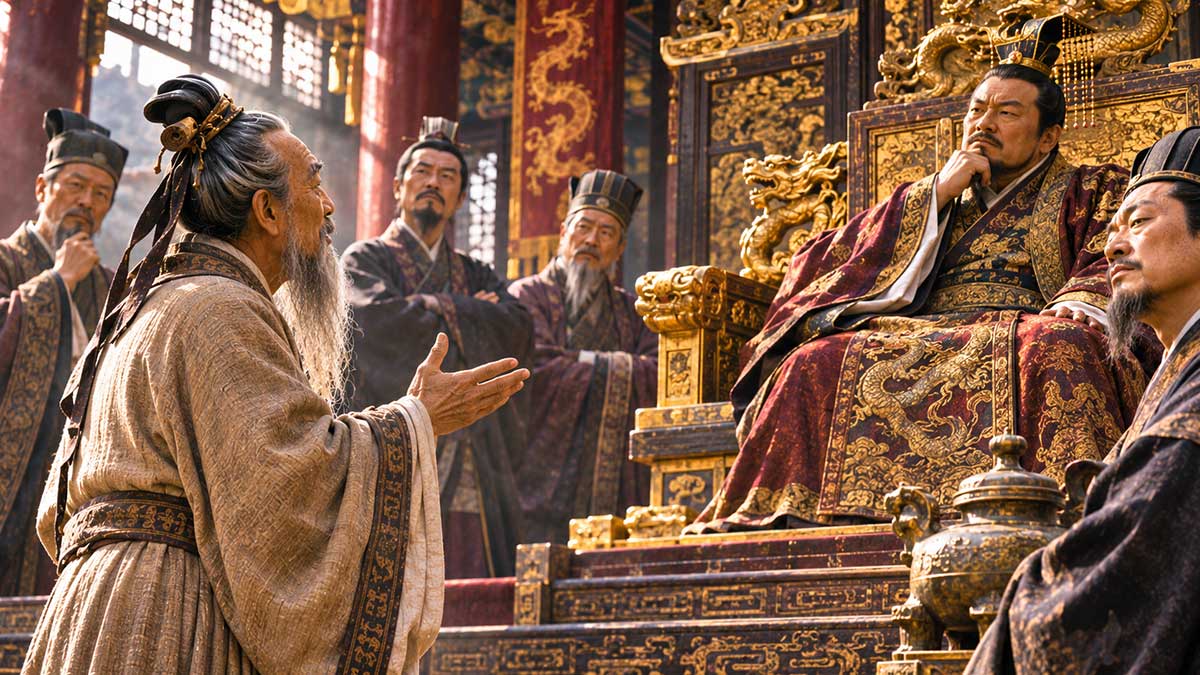
Question 1. Why Do Corrupt Leaders So Often Defeat Good People?
Nick Sasaki: Confucius, in our last conversation, we talked about your dream of a society where elderly people feel secure, friends trust one another, and children grow up surrounded by care.
I think that's a beautiful vision.
But here's what troubles me.
Throughout history, we've seen leaders who are ruthless, dishonest, and obsessed with their own ambitions become incredibly successful.
Meanwhile, honest people who genuinely want to improve society often struggle to gain influence.
You believed that leaders should govern through virtue.
But doesn't history suggest that ruthless people often have an advantage?
Confucius: Nick, before we answer, we should ask what you mean by success.
Nick Sasaki: Let's say gaining authority, defeating opponents, becoming wealthy, and maintaining control.
Confucius: Then you have described the acquisition of influence.
But you have not yet described good government.
Nick Sasaki: Fair point. But influence matters. A good person without influence may accomplish very little, while a corrupt person with enormous authority can change the lives of millions.
Confucius: That is true.
And it is one reason political responsibility deserves serious attention.
A ruler's personal character does not remain a private matter.
His decisions affect families, communities, and future generations.
Nick Sasaki: But here's the problem.
Suppose two people are competing for leadership.
One is honest, compassionate, and thoughtful.
The other lies, manipulates public opinion, and attacks anyone who disagrees.
If the dishonest candidate wins, what good did the honest person's virtue accomplish?
Confucius: You are asking whether virtue guarantees victory.
It does not.
Nick Sasaki: That's a pretty important admission.
Confucius: A person who acts rightly may still suffer defeat.
A person who acts wrongly may enjoy temporary success.
If moral conduct always produced immediate rewards, righteousness would require little courage.
Nick Sasaki: But then why should people choose righteousness?
Confucius: Would you wish to become dishonest merely because dishonesty sometimes succeeds?
Nick Sasaki: No. But I can see why some people might.
Confucius: Then we must distinguish between what brings advantage and what deserves admiration.
A thief may gain wealth.
A deceiver may gain followers.
A cruel ruler may inspire fear.
But none of these accomplishments alone establishes moral worth.
Nick Sasaki: That's true philosophically. But people still suffer under bad leaders.
How do we actually stop them?
Confucius: Good intentions are insufficient.
A ruler requires judgment, competent advisers, trustworthy administration, and the ability to recognize wrongdoing.
A government must establish responsibilities and hold officials accountable.
But institutions themselves depend upon the people who administer them.
Nick Sasaki: So you don't think laws alone can solve the problem.
Confucius: Laws are necessary for governing, but they cannot replace character.
Consider a man who obeys the law only when he fears punishment.
What happens when he believes no one is watching?
Nick Sasaki: He might break it.
Confucius: Now consider a person who has cultivated honesty.
He may act truthfully when deception would remain undiscovered.
That difference matters.
Nick Sasaki: But couldn't we build institutions that prevent corruption, regardless of whether leaders are good people?
Independent courts, elections, transparency, separation of authority?
Confucius: Your age has developed institutions that differ greatly from those of mine.
I would wish to examine how well they restrain misconduct and protect the people.
But I would ask whether the people entrusted with these institutions remain capable of acting honestly.
Nick Sasaki: You're saying the system matters, but the people running it matter too.
Confucius: Yes.
A well-designed institution may restrain certain abuses.
Yet if everyone involved seeks personal advantage without regard for duty, the institution may eventually be corrupted.
Nick Sasaki: Let me challenge your philosophy from another direction.
You believed that people should respect rulers and social hierarchies.
Couldn't that encourage citizens to tolerate bad leaders?
Confucius: Respect for an office should not be confused with approval of every person who occupies it.
A ruler has responsibilities.
A minister has responsibilities.
A father has responsibilities.
If someone demands the privileges of a position while neglecting its duties, the relationship becomes disordered.
Nick Sasaki: But what if the ruler refuses correction?
Confucius: Then those who serve him must examine whether continued service compromises their integrity.
A person should not surrender righteousness merely to retain a position.
Nick Sasaki: Would you support removing a corrupt ruler?
Confucius: I would begin by examining the ruler's conduct, the suffering of the people, and the means available for correction.
My teachings placed great importance on moral example and responsible government.
I would not pretend that every question about political removal has a simple answer.
Nick Sasaki: That's fair.
But I want to ask about something even more fundamental.
Why do people follow corrupt leaders in the first place?
Sometimes the dishonesty is obvious.
Sometimes the cruelty is public.
Yet millions still admire them.
Confucius: People may be attracted to confidence, wealth, promises of security, or the prospect of gaining advantage.
They may fear disorder.
They may resent others.
They may mistake forcefulness for strength.
And sometimes they simply fail to examine the character of those they admire.
Nick Sasaki: So the problem isn't just the leader. It's the people who reward that behavior.
Confucius: A society's leaders and citizens influence one another.
If people admire arrogance, arrogance may become politically valuable.
If they reward deception, deception may spread.
If they respect integrity, they create better conditions for honorable leadership.
Nick Sasaki: But that sounds like a huge cultural problem.
How do you change what millions of people admire?
Confucius: Through education, example, institutions, and repeated practice.
But such change rarely occurs immediately.
Nick Sasaki: You spent much of your life trying to change rulers. If you could start again, would you focus more on educating ordinary people instead?
Confucius: Teaching was never separate from my concern for government.
A student who develops character may become a responsible parent, an honest official, or a trustworthy friend.
A teacher may influence people who later influence others.
Nick Sasaki: So you were thinking across generations.
Confucius: A society is shaped by more than the decisions of one ruler.
Nick Sasaki: Let me give you a modern hypothetical.
Suppose a political leader tells the truth, admits mistakes, and treats opponents respectfully.
But voters interpret that as weakness.
Meanwhile, another leader exaggerates achievements, refuses to acknowledge errors, and insults opponents.
People call that strength.
What would you say to the voters?
Confucius: I would ask them whether they wish to be governed by someone who seeks truth or someone who seeks admiration.
Nick Sasaki: They might say they want someone who wins.
Confucius: Then I would ask what they wish him to win.
A personal contest?
Or conditions under which the people can live securely and honorably?
Nick Sasaki: That's a great question.
Confucius: A leader who defeats every rival but leaves his people fearful, divided, and impoverished has achieved a strange victory.
Nick Sasaki: You know, I think the biggest challenge is that people want results now.
They don't want to wait generations for moral education to improve society.
Confucius: Then we must pursue immediate responsibilities without abandoning long-term cultivation.
Feed those who are hungry.
Protect those who face danger.
Correct misconduct.
Improve administration.
But do not assume that repairing an immediate problem eliminates the need to develop better character.
Nick Sasaki: So we need both practical reforms and moral education.
Confucius: Yes.
A good society cannot rely entirely on virtuous intentions.
Nor can it remain healthy if its people abandon virtue altogether.
Question 2. Is Wealth a Blessing, a Temptation, or a Measure of Success?
Nick Sasaki: Let's talk about money.
This is something I think people in every generation struggle with.
You taught that righteousness should matter more than personal profit.
But money is important.
It allows people to feed their families, educate their children, build businesses, support charities, and create opportunities.
So is the pursuit of wealth good or bad?
Confucius: Wealth itself is not necessarily shameful.
The question is how it is obtained, how it is used, and whether the pursuit of it causes a person to abandon what is right.
Nick Sasaki: So you weren't against becoming rich.
Confucius: I did not regard poverty as inherently virtuous.
Nor did I regard wealth as proof of moral excellence.
A person may possess riches honorably.
Another may acquire them through exploitation.
Their circumstances may appear similar, but their conduct differs greatly.
Nick Sasaki: Let's say someone wants to become extremely wealthy.
Not just comfortable. He wants to build a company worth billions.
Is that ambition itself a problem?
Confucius: I would ask what he hopes to accomplish.
Nick Sasaki: He might say he wants financial freedom, to support his family, create jobs, and make a positive impact.
Confucius: Those can be worthy aims.
But aspirations must be tested by conduct.
Does he treat employees fairly?
Does he honor agreements?
Does he deceive customers?
Does he accept responsibility when his decisions cause harm?
Nick Sasaki: What if he says, "I have to be aggressive to compete. If I don't, someone else will take my market share"?
Confucius: Competition does not remove moral responsibility.
A person should not assume that another's willingness to act dishonorably gives him permission to do the same.
Nick Sasaki: But what if being ethical means his company grows more slowly?
Confucius: Then he must decide whether growth is his highest value.
Nick Sasaki: That's a tough answer for an entrepreneur.
Confucius: (Smiles.)
A difficult question does not become unimportant merely because the answer may reduce one's profits.
Nick Sasaki: Fair enough.
But here's something interesting.
Some wealthy people become incredibly generous.
They donate enormous sums to education, medicine, and humanitarian causes.
Doesn't that suggest wealth can become a tremendous force for good?
Confucius: Certainly.
Resources can relieve suffering and create opportunities.
But generosity should not be used to excuse injustice in the acquisition of those resources.
Nick Sasaki: So if someone mistreats employees to become wealthy, then gives millions to charity, you wouldn't consider that a complete moral achievement.
Confucius: A gift may help those who receive it.
That benefit should be recognized.
But it does not erase the responsibility to treat others justly.
Nick Sasaki: That's a good distinction.
Now let me ask about poverty.
You admired your student Yan Hui, who lived with very little but remained content.
Are you suggesting that people should learn to be happy without money?
Confucius: I would not tell a hungry family that hunger is a virtue.
People require material necessities.
A responsible government should concern itself with the welfare of its people.
But beyond basic needs, people should examine whether their desires have become limitless.
Nick Sasaki: That's interesting.
You lived in a world where wealth meant land, grain, livestock, and political influence.
Today, people compare themselves constantly through social media.
Someone earns a good income but feels poor because another person owns a larger house or a more expensive car.
What would you tell them?
Confucius: I would ask whether comparison has become their measure of happiness.
If a man possesses enough to live comfortably but suffers because another possesses more, his dissatisfaction may have no natural end.
Nick Sasaki: That's true.
There's always someone richer.
Confucius: Then wealth cannot provide lasting contentment if contentment depends upon surpassing everyone else.
Nick Sasaki: But ambition can be healthy too, right?
Suppose someone starts with nothing and works incredibly hard to improve his circumstances.
Wouldn't you admire that?
Confucius: I would admire diligence, learning, responsibility, and perseverance.
But I would still examine the purpose toward which those qualities are directed.
A determined person may accomplish great good.
A determined person may accomplish great harm.
Determination alone is not virtue.
Nick Sasaki: Let me ask you a personal question.
Did you ever wish you were rich?
Confucius: (Laughs softly.)
I understood the comforts that wealth could provide.
But I also knew that certain advantages were not worth obtaining through dishonorable means.
Nick Sasaki: Suppose a ruler offered you enormous wealth and influence if you agreed to overlook a few corrupt practices.
Would you accept?
Confucius: If accepting required me to abandon righteousness, I would have reason to refuse.
Nick Sasaki: But what if you could use that influence to accomplish tremendous good?
Maybe you could reform education, reduce poverty, and improve the lives of thousands.
Wouldn't compromising a little be justified?
Confucius: That is how many compromises begin.
A person tells himself that one small wrongdoing will make a greater good possible.
But he must ask whether the compromise will remain small.
And whether the authority he gains will still serve the purpose he originally intended.
Nick Sasaki: So you worry about the slippery slope.
Confucius: I worry about the human ability to excuse self-interest by describing it as public service.
Nick Sasaki: That's a powerful observation.
But I don't want people to come away thinking that ambition is bad.
I believe people can pursue extraordinary success and still remain generous, ethical, and compassionate.
Confucius: Then let them demonstrate it.
Let their success improve the lives of others.
Let their conduct remain honorable when dishonesty would be profitable.
Let them remember that wealth is something they possess, not the measure of who they are.
Nick Sasaki: I like that.
What you possess is not the measure of who you are.
Confucius: And a person who becomes wealthy should not assume that prosperity makes him wiser than those who have less.
Nick Sasaki: That's especially relevant today.
Some people assume that if someone is financially successful, their opinions about everything must be valuable.
Confucius: Skill in acquiring wealth does not automatically produce wisdom in every other matter.
A skilled merchant may understand trade exceptionally well.
But that does not make him an authority on justice, education, or the proper conduct of government.
Nick Sasaki: That's a good reminder.
One final question about money.
If someone asked you, "What is the secret to a successful life?" would wealth appear anywhere in your answer?
Confucius: Material security can contribute to a good life.
But I would place greater importance on character, trustworthy relationships, meaningful responsibilities, and the ability to live without shame over one's conduct.
Nick Sasaki: So success is not just what we accumulate.
Confucius: It is what we become and what our actions make possible for others.
Question 3. Why Does Education Fail to Make People Good?
Nick Sasaki: Confucius, I want to talk about education.
You devoted your life to teaching.
And today, more people have access to education than at almost any previous time in history.
We have universities, libraries, online courses, artificial intelligence, and enormous amounts of information.
Yet people still lie, exploit others, commit violence, and make terrible decisions.
So here's my question.
Why doesn't education automatically make people better?
Confucius: We must first ask what education is intended to accomplish.
Nick Sasaki: Today, much of it is about acquiring knowledge and skills.
People study to get jobs, earn money, and become successful.
Confucius: Those are useful purposes.
But if education concerns itself only with acquiring skills, it may produce capable people without cultivating their judgment.
Nick Sasaki: So we can become more intelligent without becoming more moral.
Confucius: Certainly.
A person may learn how to persuade others without learning when persuasion becomes manipulation.
He may learn how to accumulate wealth without learning how to use it responsibly.
He may learn how to command others without learning how to deserve their trust.
Nick Sasaki: That's a fascinating point.
Modern education often rewards students for correct answers, high test scores, and impressive achievements.
But we don't always measure kindness, honesty, courage, or compassion.
Confucius: Then perhaps you should ask what qualities your educational institutions encourage students to admire.
Nick Sasaki: That's a good question.
But how do you teach character?
You can teach mathematics through exercises and examinations.
You can teach science through experiments.
But how do you teach someone to become compassionate?
Confucius: Through example, reflection, practice, and correction.
A student observes how a teacher treats others.
He learns how to respond when he makes a mistake.
He practices keeping promises.
He discovers that his actions affect other people.
And he learns to examine his motives.
Nick Sasaki: But what if the teacher isn't a good person?
Confucius: Then the teacher may undermine the very lesson he intends to communicate.
Nick Sasaki: So teachers have an enormous responsibility.
Confucius: Yes.
But education does not belong exclusively to teachers.
Parents, friends, officials, and community leaders influence what young people learn to value.
Nick Sasaki: Let me challenge you.
Suppose a child grows up in a society where dishonest people become rich and famous.
The child sees corrupt leaders rewarded, celebrities admired for outrageous behavior, and businesses succeeding through manipulation.
Then a teacher tells the child to be honest and compassionate.
Which lesson do you think the child will believe?
Confucius: The child may notice the contradiction.
And that contradiction can weaken moral instruction.
Nick Sasaki: So society itself becomes a teacher.
Confucius: Precisely.
If a community praises virtue in words but rewards vice in practice, it should not be surprised when young people become confused about what truly matters.
Nick Sasaki: That's incredibly relevant.
Now let's talk about artificial intelligence.
Today, machines can answer questions, write essays, analyze information, and perform tasks that once required years of training.
Some people believe AI will transform education.
But if machines can provide information instantly, what should human beings actually learn?
Confucius: I would ask whether your machines can make moral choices on your behalf.
Nick Sasaki: They can recommend actions, but human beings still have to decide how to use them.
Confucius: Then judgment remains essential.
If knowledge becomes easier to obtain, the responsibility to use it wisely may become greater.
Nick Sasaki: That's interesting.
So the more intelligent our technology becomes, the more important human character becomes.
Confucius: Powerful tools can extend the consequences of human decisions.
If those decisions are guided by compassion and righteousness, the tools may serve beneficial purposes.
If guided by greed or cruelty, they may increase the scale of harm.
Nick Sasaki: That's something I think people should seriously consider.
We spend so much time asking whether AI will become smarter than humans.
Maybe we should spend more time asking whether humans will become wise enough to use it responsibly.
Confucius: That seems a worthy question.
Nick Sasaki: Let me ask you about children.
If you were responsible for designing a school for the next generation, what would you teach first?
Confucius: I would begin by helping students develop a love of learning.
I would encourage honesty, respect, careful observation, and responsibility.
I would teach them to ask questions rather than merely repeat answers.
And I would help them recognize that learning is not complete until it influences conduct.
Nick Sasaki: Would you encourage students to challenge their teachers?
Confucius: A thoughtful question can reveal whether a student is learning.
A teacher who fears every challenge may be more concerned with preserving authority than discovering truth.
Nick Sasaki: That's interesting, considering your reputation for respecting hierarchy.
Confucius: Respect does not require the abandonment of thought.
A student should not challenge merely to display arrogance.
But neither should he accept every statement without reflection.
Nick Sasaki: What about failure?
Today, many students are terrified of making mistakes.
They worry about grades, college admissions, careers, and disappointing their parents.
How would you help them?
Confucius: I would remind them that learning requires recognizing what one does not yet know.
A mistake can become an opportunity for correction.
But a person who hides every error to preserve appearances may prevent himself from improving.
Nick Sasaki: So you would encourage intellectual humility.
Confucius: Yes.
A person should know what he knows and recognize what he does not know.
Nick Sasaki: That's one of your most famous teachings.
But here's something that bothers me.
Some highly educated people become arrogant.
They look down on those with less formal education.
They assume that intelligence makes them morally superior.
What would you say to them?
Confucius: If learning has made a person contemptuous of others, he should examine what he has failed to learn.
Nick Sasaki: That's a great answer.
Confucius: Knowledge should increase our ability to understand and serve.
It should not become a weapon for humiliating those who know less.
Nick Sasaki: Let me ask about your own students.
You taught people with different personalities and abilities.
Did you teach everyone the same way?
Confucius: A teacher should consider the student's character and circumstances.
One student may need encouragement to act.
Another may need restraint.
One may understand quickly but lack patience.
Another may progress slowly yet possess remarkable perseverance.
Good teaching requires attention to the individual.
Nick Sasaki: So education should be personal.
Confucius: It should recognize that students are human beings, not identical vessels waiting to be filled.
Nick Sasaki: That's a beautiful way to put it.
Now I want to ask you something deeper.
If you had to choose between educating a brilliant student with questionable character and an ordinary student with extraordinary kindness, which would you prefer?
Confucius: I would not wish to abandon either.
The brilliant student may need moral guidance.
The kind student may benefit greatly from intellectual development.
Education should help each person cultivate what is lacking.
Nick Sasaki: You really don't like choosing between two people.
Confucius: (Laughs.)
A teacher should be cautious about deciding that one human being is worthy of instruction and another is not.
Nick Sasaki: That's one of the things I admire about your philosophy.
You believed education shouldn't be restricted only to people born into privileged families.
Confucius: Learning should not be treated merely as an ornament of inherited status.
Character can be cultivated by people of modest circumstances.
Nick Sasaki: Let me bring everything together.
We've talked about corrupt leaders, wealth, ambition, and education.
And I keep noticing the same pattern.
Human beings create institutions, technologies, and systems that can accomplish extraordinary things.
But if our character doesn't develop alongside them, those achievements can become dangerous.
Is that the central problem?
Confucius: It is certainly one of the great problems.
A society may become more capable without becoming more humane.
It may become wealthier without becoming more just.
It may become more knowledgeable without becoming wiser.
Nick Sasaki: So progress isn't automatically moral progress.
Confucius: No.
We must ask what our achievements are serving.
Nick Sasaki: Then what is the most important question every leader, entrepreneur, teacher, and parent should ask themselves?
Confucius: Perhaps this:
"Are the people entrusted to my care becoming better able to live with dignity, security, and trust?"
Nick Sasaki: That's powerful.
Not "Am I winning?"
Not "Am I becoming richer?"
Not "Am I gaining influence?"
But "Are the people around me living better lives?"
Confucius: Influence is a responsibility before it is an achievement.
Nick Sasaki: I think that's a message our world desperately needs.
But there's something we haven't fully explored yet.
You've spent this entire conversation talking about virtue, responsibility, and the proper way to live.
Yet you often spoke about Heaven.
You said that at fifty you understood Heaven's mandate.
And when you lost people you loved, you expressed profound grief.
So I want to ask you something very personal.
Did you believe your life had a purpose given by Heaven?
And what did you think would happen when you died?
Confucius: (Falls silent for a moment.)
Nick, you have asked questions that reach beyond government, wealth, and education.
They concern the limits of human knowledge and the responsibilities of a finite life.
Nick Sasaki: Are you willing to talk about them?
Confucius: Certainly.
But I would ask that we approach them with humility.
There are things I taught with confidence.
And there are mysteries before which confidence should become more cautious.
Nick Sasaki: That sounds like the perfect place to continue.
The conversation continues in Topic 5: Heaven, Death, and the Meaning of Life.
Historical and Creative Note
This fictional conversation draws on Confucian teachings about virtuous government, moral leadership, righteous conduct, wealth, education, and the cultivation of character.
Relevant passages include Analects 2.3 on government through virtue and ritual, 4.5 on wealth and righteousness, 4.16 on the distinction between righteousness and profit, 7.7 on openness to teaching, 12.7 on the importance of public trust, 13.3 on the rectification of names, and 15.39 on education without class distinctions.
The discussions of modern elections, corporate ethics, institutional accountability, artificial intelligence, and contemporary education are imaginative extensions of Confucian themes. They do not represent documented statements or established historical positions of Confucius.
Topic 5. Heaven, Death, and the Meaning of Life

Question 1. Did You Believe in God, or Was Heaven Something Different?
Nick Sasaki: Confucius, we've talked about your childhood, your failures, your philosophy of humaneness, family relationships, government, wealth, and education.
But there's something I've been wanting to ask you since our very first conversation.
You spent your life teaching people how to become better human beings. Yet you often spoke about Heaven.
You said that at fifty, you came to understand Heaven's mandate.
What did you mean by that?
Did you believe in God?
Confucius: Nick, before I answer, I must ask what you mean by God.
Nick Sasaki: That's a fair question.
From my own spiritual perspective, I believe there is a Creator, a divine parent of humanity.
I believe that all human beings are connected through that divine origin.
So when I hear you speak about Heaven, I wonder whether you were describing something similar.
Confucius: Your belief gives Heaven a personal character.
In my tradition, Heaven was understood in several ways.
It was associated with the order of the world, the legitimacy of rulers, and the moral responsibilities of human beings.
It was greater than any individual ruler.
And it was not something a person could simply command according to his wishes.
Nick Sasaki: But did you think Heaven was conscious?
Did you believe there was a divine being who could hear you?
Confucius: The words preserved from my lifetime do not provide a complete answer to that question.
I spoke of Heaven with reverence.
I believed that human beings should recognize responsibilities beyond personal desire.
But I did not offer a detailed account of Heaven's nature.
Nick Sasaki: Why not?
If Heaven was so important, wouldn't you want your students to know exactly what it was?
Confucius: Would you prefer that a teacher describe what he does not know as if he knew it?
Nick Sasaki: No. But surely you must have had some personal conviction.
Confucius: A person may possess reverence without possessing complete knowledge.
Consider a farmer who depends upon the seasons.
He understands much about planting, soil, and rainfall.
Yet he does not control the sky.
His limited knowledge does not make the sky insignificant.
Nick Sasaki: But that's a little different. We can study the physical sky.
I'm asking whether you believed there was a spiritual reality behind everything.
Confucius: Then perhaps we should distinguish what I experienced, what I believed, and what I could demonstrate to others.
I recognized a moral order that I did not regard as my personal invention.
I believed that certain responsibilities deserved obedience regardless of convenience.
But I would hesitate to describe mysteries beyond what I could responsibly claim.
Nick Sasaki: Let me challenge that.
How do you know what you call a moral order isn't simply something human beings invented?
Different societies have different moral rules.
Maybe Heaven is just a way of giving human traditions greater authority.
Confucius: That possibility deserves examination.
A person may invoke Heaven to justify his preferences.
A ruler may claim divine approval while behaving unjustly.
Such claims should not be accepted merely because they are expressed with confidence.
Nick Sasaki: So you would be skeptical of someone who says, "God told me I'm right, and everyone else must obey."
Confucius: I would examine the person's conduct.
Does he act with humility?
Does he fulfill his responsibilities?
Does he treat others humanely?
Or does he use sacred language to excuse arrogance?
Nick Sasaki: That's interesting.
You seem to be saying that spiritual claims should be judged partly by the character of the person making them.
Confucius: A claim about Heaven does not excuse wrongdoing on Earth.
Nick Sasaki: I agree with that.
But here's something I've wondered for years.
If God exists and wants humanity to become good, why are human beings allowed to commit so much evil?
Why are innocent children born into suffering?
Why do wars continue?
Why do people who try to live morally sometimes experience terrible tragedies?
Confucius: (Pauses.)
Those are painful questions.
I would not claim to possess an explanation for every instance of suffering.
Nick Sasaki: But doesn't that make faith difficult?
Confucius: It may.
Yet uncertainty about the causes of suffering does not eliminate our responsibility to respond to it.
When a child is hungry, must we first explain the entire nature of Heaven before offering food?
Nick Sasaki: No, of course not.
Confucius: When a community is threatened by violence, must we resolve every spiritual mystery before attempting to protect it?
Nick Sasaki: No.
Confucius: Then perhaps there are questions we must continue examining and responsibilities we must fulfill without waiting for complete answers.
Nick Sasaki: That's very practical.
But I don't want to let you escape the spiritual question so easily.
Did you ever pray?
Did you ever feel that Heaven was listening?
Confucius: Rituals and reverence toward Heaven belonged to the world in which I lived.
The traditions I inherited treated sacrifice, ancestral remembrance, and ceremonial conduct with seriousness.
But I would not describe a private spiritual experience that the historical record does not preserve.
Nick Sasaki: I appreciate that.
Sometimes when we interview historical figures, it's tempting to make them answer questions they never clearly addressed.
Confucius: Then let us distinguish curiosity from certainty.
You may ask what I believed.
But if the surviving teachings do not settle the question, we should not pretend that they do.
Nick Sasaki: Fair enough.
Let me ask about your famous statement that at fifty you understood Heaven's mandate.
What changed when you reached fifty?
Confucius: Imagine spending many years pursuing recognition, influence, and the opportunity to accomplish something important.
You work diligently.
You encounter resistance.
You experience disappointment.
Gradually, you begin to recognize that your responsibility is not identical to your ability to control the outcome.
Nick Sasaki: So you stopped measuring your life by whether rulers listened to you.
Confucius: That is one possible way to understand the change.
I came to recognize a calling that could not be reduced to personal success.
Nick Sasaki: That's something I can relate to.
When you're young, you often measure success through money, recognition, or accomplishments.
But as you grow older, you begin asking what your life is really for.
Confucius: And what answer have you discovered?
Nick Sasaki: I think my deepest hope is to help people understand one another.
I want people to see beyond religion, nationality, and ideology.
I want humanity to move closer to becoming one family.
Confucius: Then let me ask whether your purpose depends upon achieving that entire vision during your lifetime.
Nick Sasaki: No. Realistically, that's much bigger than one lifetime.
Confucius: Then what can you accomplish today?
Nick Sasaki: Perhaps help one person understand another person better.
Confucius: And tomorrow?
Nick Sasaki: Try again.
Confucius: Then you have identified a responsibility within your reach.
A person may devote himself to a great purpose without claiming control over its completion.
Nick Sasaki: So perhaps that's part of what understanding Heaven's mandate means.
Recognizing what you're called to do, then remaining faithful to it without demanding that the universe reward you.
Confucius: That is a thoughtful interpretation.
But do not mistake our interpretation for a complete explanation of Heaven.
Nick Sasaki: (Laughs.) You really won't let me turn you into a theologian.
Confucius: Nor should you wish me to become one merely to satisfy your curiosity.
Nick Sasaki: Fair enough.
But I think there's something deeply moving about a man who devoted his life to moral responsibility without claiming to know every mystery of existence.
Confucius: Perhaps recognizing the limits of knowledge is itself part of learning.
Question 2. Why Did You Speak So Little About Death and the Afterlife?
Nick Sasaki: Confucius, let's talk about death.
There's a famous exchange in the Analects where your disciple Zilu asks about serving spirits.
You respond by asking how someone who cannot yet serve human beings can serve spirits.
Then he asks about death.
And you say, in effect, "If you do not yet understand life, how can you understand death?"
That's a remarkable answer.
But I have to admit something.
If I were Zilu, I might have been frustrated.
Confucius: (Smiles.)
Zilu was not unfamiliar with frustration.
Nick Sasaki: (Laughs.)
But seriously, why didn't you answer him?
Were you avoiding the question?
Confucius: Consider a student who wishes to understand distant mysteries but has neglected the responsibilities immediately before him.
What should his teacher encourage him to examine?
Nick Sasaki: His responsibilities, I suppose.
Confucius: Then perhaps the answer was not intended to dismiss the question of death.
Perhaps it was intended to restore attention to the question of living.
Nick Sasaki: But the afterlife matters to people.
If there's something after death, that could completely change how we understand existence.
Confucius: It could.
Nick Sasaki: So didn't you want to know?
Confucius: Curiosity is natural.
But curiosity does not guarantee knowledge.
Nick Sasaki: Let me make it personal.
Did you believe you would see your loved ones again after death?
Your parents?
Your students?
Yan Hui?
Confucius: (Becomes quiet.)
You have named someone whose loss caused me great sorrow.
Nick Sasaki: I know.
And I want to ask about that.
When Yan Hui died, you grieved so intensely that your students were surprised.
The Analects describes you crying out in anguish.
Did that loss change how you thought about death?
Confucius: The death of someone beloved can reveal how little control we possess over life.
We make plans.
We imagine future conversations.
We expect to watch young people grow older.
And suddenly those possibilities disappear.
Nick Sasaki: That's one of the hardest things about losing someone.
It's not just that they're gone.
It's all the things you thought you would experience together.
Confucius: Yes.
The future you expected is taken from you.
Nick Sasaki: Did you ever feel angry at Heaven?
Confucius: The Analects preserves my grief, not a complete account of every private thought I experienced.
But I can tell you that sorrow should not be mistaken for a failure of virtue.
Nick Sasaki: That's something I really appreciate about you.
Some spiritual teachings make people feel that if they're sufficiently enlightened, they shouldn't suffer emotionally.
But you clearly loved people deeply.
Confucius: If humaneness requires genuine concern for others, why should we expect a humane person to feel nothing when someone beloved dies?
Nick Sasaki: Exactly.
But here's a difficult question.
If death is inevitable, why do we become so attached to people?
Wouldn't it be easier to love less?
Confucius: Easier in what sense?
Nick Sasaki: Less pain when we lose them.
Confucius: Perhaps.
But what kind of life would you create by refusing affection to avoid grief?
Nick Sasaki: A lonely one.
Confucius: Then you would be protecting yourself from sorrow by surrendering something precious.
Nick Sasaki: That's true.
Confucius: A person who refuses friendship because friends may die has not overcome mortality.
He has allowed the fear of mortality to diminish his life.
Nick Sasaki: That's beautiful.
But what about people who lose someone and never fully recover?
A parent who loses a child.
A husband who loses his wife.
Someone whose grief remains overwhelming for years.
What would you say to them?
Confucius: I would be cautious about telling them how quickly they should recover.
Grief is shaped by the relationship that has been lost.
One person may find comfort in family.
Another may find it in remembering.
Another may need quiet companionship.
But I would not tell someone that sorrow makes him weak.
Nick Sasaki: Would you encourage them to continue living with purpose?
Confucius: Yes, but without demanding that they pretend their loss was insignificant.
A person may carry grief and still experience gratitude, friendship, and meaning.
Nick Sasaki: I think that's important.
Sometimes people feel guilty when they begin to feel happy again after losing someone.
As if happiness means they've forgotten.
Confucius: Honoring the dead does not require abandoning the living.
Nick Sasaki: That's a wonderful thought.
Let me ask about ancestors.
Your philosophy places great importance on honoring parents and ancestors.
Did you believe the spirits of ancestors continued to exist?
Confucius: The rites of ancestral remembrance were important in my tradition.
They expressed gratitude, continuity, and responsibility across generations.
But the precise nature of spiritual existence is not something I described in a complete philosophical system.
Nick Sasaki: So ancestral rituals weren't simply about communicating with spirits.
Confucius: They were certainly connected with religious and ancestral traditions.
But they carried ethical meaning too.
They reminded the living that they had received life, care, and cultural inheritance from those who came before them.
Nick Sasaki: That makes sense.
In Japan, we have traditions of remembering ancestors, visiting graves, and honoring family members who have passed away.
I think there's something deeply human about maintaining that connection.
Confucius: Gratitude should not disappear merely because the person to whom it is owed has died.
Nick Sasaki: I like that.
But here's another question.
Suppose someone doesn't believe in an afterlife.
They think death is simply the end of consciousness.
Can that person still live a deeply meaningful and moral life?
Confucius: Why would the absence of certainty about an afterlife eliminate the value of kindness?
If a person feeds the hungry, does the benefit disappear because he doubts the existence of another world?
If a mother cares for her child, does her love become meaningless because she is uncertain about what follows death?
Nick Sasaki: No.
Confucius: Then moral responsibility does not require complete knowledge of the afterlife.
Nick Sasaki: But some people argue that without God or an afterlife, there's no ultimate reason to be good.
What would you say?
Confucius: I would ask whether they believe kindness possesses value only when it is rewarded.
Nick Sasaki: That's a challenging question.
Confucius: If a person acts honestly only to receive a reward after death, is honesty truly his highest concern?
Nick Sasaki: Maybe not.
But religious faith can inspire people to become more loving and compassionate.
Confucius: Then that influence deserves recognition.
My question concerns the motive, not the rejection of faith.
A person may find moral strength through devotion.
Another may recognize responsibility through reflection upon human relationships.
We should examine their conduct with care.
Nick Sasaki: So you don't want to make morality dependent upon winning a theological argument.
Confucius: Human suffering does not wait for every philosophical disagreement to be resolved.
Nick Sasaki: That's true.
Let me ask something that may sound strange.
If you knew you had only one day left to live, how would you spend it?
Confucius: (Smiles.)
I would wish to speak with those I loved.
To express gratitude.
To correct any wrong that remained within my ability to correct.
And perhaps to share one more conversation with a student.
Nick Sasaki: You'd still be teaching?
Confucius: Perhaps I would be learning.
Nick Sasaki: (Laughs.)
I should have expected that.
Confucius: A final day would not make learning less valuable.
Nick Sasaki: Would you be afraid?
Confucius: Fear of death is understandable.
But I would hope not to allow that fear to prevent me from fulfilling the responsibilities still before me.
Nick Sasaki: So for you, the question isn't simply what happens after we die.
It's whether we've learned how to live before that moment arrives.
Confucius: That is a question worthy of serious attention.
Nick Sasaki: And it brings us to the biggest question of all.
After everything you've experienced, what do you think human life is actually for?
Question 3. After 2,500 Years, What Is the One Message You Most Want Humanity to Hear?
Nick Sasaki: Confucius, I want to make this final question special.
You've been remembered for more than 2,500 years.
Your teachings influenced Chinese civilization, Korea, Japan, Vietnam, and many other societies.
People have studied your words, built schools around your ideas, and debated your philosophy for centuries.
But I wonder whether the world has sometimes missed what mattered most to you.
If you could speak directly to humanity today, what would you want us to understand?
Confucius: Nick, before I answer, let me ask what you believe humanity most needs.
Nick Sasaki: I think we need to rediscover love.
Not just romantic love or affection for our own families.
I mean genuine concern for other human beings.
We have extraordinary technology and enormous wealth, yet people still fight over religion, nationality, political ideology, and territory.
We know so much about the universe, but we still struggle to treat one another with kindness.
Confucius: Then perhaps the problem is not merely a lack of knowledge.
Nick Sasaki: Exactly.
I think we have more information than ever, but not necessarily more wisdom.
Confucius: And what do you believe wisdom requires?
Nick Sasaki: The ability to see beyond ourselves.
To recognize that other people have hopes, fears, families, and dreams just like we do.
To understand that hurting another person ultimately damages the human family.
Confucius: Those are worthy aspirations.
But let me challenge you.
Nick Sasaki: Please do.
Confucius: You speak often of humanity as one family.
Yet families themselves can be divided by resentment, selfishness, and competition.
If all humanity became one family in name, what would prevent those same conflicts from continuing?
Nick Sasaki: That's a very good question.
I suppose the answer is that we would need to develop genuine love, not just declare ourselves united.
Confucius: And how would you cultivate that love?
Nick Sasaki: Through education, spiritual growth, empathy, and meaningful relationships.
Maybe through stories and conversations that help people understand lives different from their own.
Confucius: Then your vision requires daily practice.
Nick Sasaki: Yes.
Confucius: A person cannot become humane merely by admiring the idea of humaneness.
He must practice it.
When someone insults him.
When his interests conflict with another's.
When he possesses authority.
When he has an opportunity to profit through dishonesty.
When helping someone requires inconvenience.
These are moments in which character becomes visible.
Nick Sasaki: That's something you've been teaching throughout our conversations.
Goodness isn't a feeling or a slogan.
It's something we practice.
Confucius: And something we continue learning.
Nick Sasaki: But let me ask you something difficult.
What if the world simply doesn't want to become good?
What if people prefer wealth, status, comfort, and domination?
What if the dream of a peaceful humanity is unrealistic?
Confucius: Do you believe every person prefers cruelty?
Nick Sasaki: No.
Confucius: Have you encountered people who sacrifice for their children?
Nick Sasaki: Of course.
Confucius: People who care for elderly parents?
Nick Sasaki: Yes.
Confucius: People who help strangers without expecting reward?
Nick Sasaki: Absolutely.
Confucius: Then humaneness already exists within your world.
The question is whether people can cultivate it more consistently and extend their concern more wisely.
Nick Sasaki: That's encouraging.
But how do we move from individual acts of kindness to changing entire societies?
Confucius: Through relationships, education, institutions, and leadership.
A parent influences a child.
A teacher influences students.
A ruler influences officials and citizens.
A friend influences another friend.
No single relationship determines the future of humanity.
But together they shape the habits and expectations of society.
Nick Sasaki: So small actions can have consequences beyond what we see.
Confucius: Yes.
But we should not romanticize small actions as substitutes for necessary reforms.
A compassionate person should care about unjust institutions too.
Humaneness requires attention to both personal conduct and public responsibility.
Nick Sasaki: I'm glad you said that.
Sometimes people say, "Just be kind," as if kindness alone could solve poverty, corruption, or war.
Confucius: Kindness without judgment may be insufficient.
Judgment without humaneness may become dangerous.
We need both.
Nick Sasaki: Let me ask about something that concerns me.
Your teachings became enormously influential after your death.
But in some societies, Confucianism was used to justify rigid hierarchies, obedience to authority, and restrictions on individual freedom.
Do you think people sometimes misunderstood your message?
Confucius: Any teaching can be interpreted in ways that serve those who possess authority.
But we must distinguish misunderstanding from genuine tensions within the teaching itself.
Nick Sasaki: What do you mean?
Confucius: My emphasis on roles, hierarchy, and inherited traditions can raise difficult questions.
When does respect become submission?
When does loyalty become complicity?
When does social harmony become an excuse to silence disagreement?
These are questions later generations should examine seriously.
Nick Sasaki: So you wouldn't ask people to accept everything attributed to you without criticism.
Confucius: A person who values learning should not fear thoughtful examination.
Nick Sasaki: Even if that means rejecting some of your ideas?
Confucius: If a teaching is shown to produce injustice, those who study it have a responsibility to consider that evidence.
But they should understand the teaching carefully before judging it.
Nick Sasaki: I think that's a wonderful attitude.
We can respect historical wisdom without pretending that every idea from the past is perfect.
Confucius: Respect and examination need not be enemies.
Nick Sasaki: Let me ask you about your personal legacy.
Did you ever imagine that people would still be discussing your ideas thousands of years later?
Confucius: (Laughs softly.)
A teacher hopes that something valuable may survive through his students.
But no person can know how future generations will interpret his life.
Nick Sasaki: Do you think you succeeded?
Confucius: In what sense?
Nick Sasaki: You wanted to create a more humane society.
You wanted rulers to govern through virtue.
You wanted people to cultivate character and fulfill their responsibilities.
Did your life accomplish what you hoped?
Confucius: If you measure success by whether every ruler became virtuous, then no.
If you measure success by whether humanity abandoned war, greed, and cruelty, then no.
But if you ask whether some people learned to examine themselves, care for others, and pursue righteousness through the teachings preserved by my students, then perhaps something valuable continued.
Nick Sasaki: That's a humble answer for someone whose influence lasted more than two millennia.
Confucius: Influence is not identical to moral success.
A teaching may become famous and still be poorly practiced.
Nick Sasaki: That's true.
I want to return to something you said about your personal hopes.
In the Analects, you expressed a wish that elderly people could live securely, friends could trust one another, and young people could receive loving care.
Of all your teachings, that passage may be my favorite.
It feels so simple and human.
Confucius: Then let us examine it.
Why should elderly people live securely?
Nick Sasaki: They've spent their lives contributing to society, raising families, and helping others. They deserve dignity and care.
Confucius: And why should friends trust one another?
Nick Sasaki: Without trust, relationships become filled with suspicion and fear.
Confucius: And why should the young receive care?
Nick Sasaki: They're vulnerable. They depend on us. And the way we treat them shapes the future.
Confucius: Then perhaps you understand that these aspirations are not merely sentimental.
They describe responsibilities that make a community possible.
Nick Sasaki: Yes.
And I think they could become a foundation for world peace.
Confucius: Then consider what would happen if rulers treated the children of other nations as lives worthy of concern.
If communities refused to abandon their elderly.
If people valued trust more than deception.
If education cultivated character alongside knowledge.
Nick Sasaki: The world would be very different.
Confucius: Indeed.
But such a world cannot be created through admiration alone.
Nick Sasaki: It requires action.
Confucius: And perseverance.
Nick Sasaki: Let me ask you something very personal.
If you could change one thing about your own life, what would it be?
Confucius: (Reflects.)
I would wish to recognize my own shortcomings sooner.
Nick Sasaki: That's interesting.
Not your political failures?
Not the rulers who rejected you?
Confucius: Those were matters I could influence only partly.
But my own conduct was something I had a responsibility to examine.
Nick Sasaki: Do you think you ever became the exemplary person you taught others to become?
Confucius: I devoted my life to learning.
But a person who declares himself morally complete has perhaps revealed that his learning remains unfinished.
Nick Sasaki: (Smiles.)
You really are consistent.
Confucius: I hope so.
But consistency is valuable only when the principle itself deserves commitment.
Nick Sasaki: Let me ask one final question.
Suppose a young person is reading this conversation two thousand years from now.
Humanity may have changed beyond anything we can picture.
Perhaps people will live on other planets.
Perhaps machines will perform most human labor.
Perhaps nations and religions will look completely different.
What would you want that young person to know?
Confucius: I would ask that person to examine the relationships that make life meaningful.
Do you treat others with humaneness?
Do you honor your responsibilities?
Do you seek truth rather than merely confirmation of your preferences?
Do you correct your mistakes?
Do you use your abilities to benefit others?
And when you possess influence, do you remember those who depend upon your judgment?
Nick Sasaki: So your message would remain relevant no matter how advanced civilization becomes.
Confucius: Human circumstances may change greatly.
But wherever people live together, questions of trust, responsibility, justice, and compassion will remain important.
Nick Sasaki: I think that's what makes your philosophy so enduring.
You weren't simply trying to create a better government.
You were trying to cultivate better human beings.
Confucius: And I believed that these aims were connected.
Nick Sasaki: Confucius, I want to thank you.
We've covered so much.
Your childhood, your failures, your students, human nature, family loyalty, politics, wealth, education, Heaven, and death.
But what stays with me most is something surprisingly simple.
You spent your life trying to teach people how to become more humane.
And after 2,500 years, we're still struggling with that same challenge.
Confucius: Then perhaps the question is not whether humanity has completed its moral education.
Perhaps the question is whether humanity remains willing to learn.
Nick Sasaki: I hope we are.
Confucius: Hope is valuable when it encourages responsibility.
But tell me, Nick, what will you do with what we have discussed?
Nick Sasaki: I want to help people understand one another.
Through stories, conversations, and the exchange of ideas.
I want people to see the humanity in those they disagree with.
And I want to help move the world, however gradually, closer to becoming one family.
Confucius: Then begin with the next person you encounter.
Nick Sasaki: Just one person?
Confucius: Every great undertaking must eventually find expression in a particular action.
Nick Sasaki: (Smiles.)
That's a beautiful thought.
Confucius: And do not forget to examine yourself along the way.
Nick Sasaki: (Laughs.)
I had a feeling you'd say that.
Confucius: Then perhaps you have learned something.
Nick Sasaki: I think I have.
Thank you, Confucius.
Confucius: And thank you, Nick.
A conversation becomes valuable when both participants remain willing to learn.
Historical and Creative Note
This fictional interview draws on Confucian teachings concerning Heaven (Tian), moral responsibility, ritual, grief, humaneness, and the cultivation of character.
Relevant passages include Analects 2.4 on Confucius's recognition of Heaven's mandate at fifty, 5.26 on his aspirations for the elderly, friends, and the young, 6.22 on respecting spirits while keeping one's distance, 7.35 on prayer, 9.5 on Heaven's relationship to his mission, 11.9-11.10 on his grief following Yan Hui's death, 11.12 on serving spirits and knowing death, and 15.24 on reciprocity.
The historical Confucius did not leave a systematic account of God's nature, the afterlife, or the ultimate origins of the universe. His precise theological commitments remain subjects of scholarly interpretation.
The dialogue's reflections on a divine parent of humanity, universal human dignity, modern religious disagreements, future technology, and global peace are imaginative discussions between Nick Sasaki and a fictionalized Confucius. They should not be presented as documented statements or established historical positions of Confucius.
Final Thoughts by Nick Sasaki

After spending five conversations with Confucius, I find myself thinking less about the famous philosopher and more about the human being who spent his life trying to become better. He was not a king who conquered nations or an emperor who commanded vast armies. He was a teacher who experienced rejection, traveled through troubled states, loved his students, and continued to believe that human character mattered. What moves me most is that he did not present learning as something we complete. He treated it as a lifelong responsibility.
One lesson I take from this conversation is that goodness is something we practice, not merely something we believe in. We can talk about compassion, peace, and love for humanity, but those words become meaningful only when they influence our conduct. Do I listen patiently when someone disagrees with me? Do I treat people respectfully when I have nothing to gain? Do I recognize my mistakes and make an effort to correct them? Confucius's teaching on reciprocity, preserved in Analects 15.24, challenges me to consider how my actions affect others before expecting kindness in return.
I was particularly interested in our disagreement about family loyalty. I believe that humanity's greatest hope is to recognize itself as one family, beyond the divisions of religion, nationality, and culture. Confucius begins with the family and the special responsibilities that arise within intimate relationships. I still believe we must extend our concern much further, recognizing the dignity of every human being. Yet our conversation helped me appreciate a practical question: What good is declaring love for all humanity if I fail to show patience and compassion to the people closest to me? A universal ideal must become visible in everyday relationships.
Our discussion of political leadership left me with another lesson. Confucius did not promise that good people would always win. He knew from experience that rulers could reject wise advice and that selfish ambition could prevail. Yet he refused to treat political success as the ultimate measure of a person's worth. I think this matters in a world where influence, wealth, and public recognition are so often mistaken for greatness. I want to judge leadership less by the ability to defeat opponents and more by the willingness to protect the vulnerable, tell the truth, and accept responsibility for the consequences of decisions.
I was moved by our conversation about education too. We have astonishing access to information, yet knowledge alone cannot make us humane. We can teach children mathematics, science, technology, and business, but we must find ways to cultivate honesty, gratitude, courage, and compassion. The Stanford Encyclopedia of Philosophy's examination of Confucian moral cultivation reminds me that learning in this tradition concerns the formation of character, not simply the accumulation of facts. I hope future generations become more knowledgeable than we are, but I hope still more deeply that they become kinder.
Perhaps the most emotional part of this interview was our discussion of death. Confucius's grief for his beloved student Yan Hui, recorded in Analects 11.9–11.10, reminds me that wisdom does not require us to stop feeling sorrow. Love makes us vulnerable, and losing someone we cherish can change our lives forever. I do not believe the answer is to love less. I believe we should treasure the time we have, express gratitude before it is too late, and allow the goodness of those we have lost to continue through the way we live.
As I reflect on all five conversations, I return to Confucius's hope that elderly people might live securely, friends might trust one another, and children might receive loving care. I find that vision deeply moving. It is not a grand promise of wealth or glory. It is a vision of ordinary people living with dignity, affection, and trust. My own hope reaches toward a world where every person can be regarded as a member of one human family. I know that such a future cannot be created through beautiful words alone. But perhaps every act of kindness, every honest conversation, and every effort to understand someone different from ourselves can bring us a little closer.
I would love to hear what you think. Is human goodness something we are born with, or something we must learn? Should loyalty to family ever come before justice? Can people from different religions and cultures genuinely see themselves as one family? And if Confucius were sitting across from you today, what question would you most want to ask him?
Fictional Reflection Disclaimer: These Final Thoughts represent Nick Sasaki's personal interpretation of the imagined interview. The conversations are creative reconstructions inspired by Confucian teachings, not historical transcripts. Interpretations of Confucius's beliefs, particularly concerning Heaven, family obligations, and universal compassion, remain subjects of scholarly discussion.
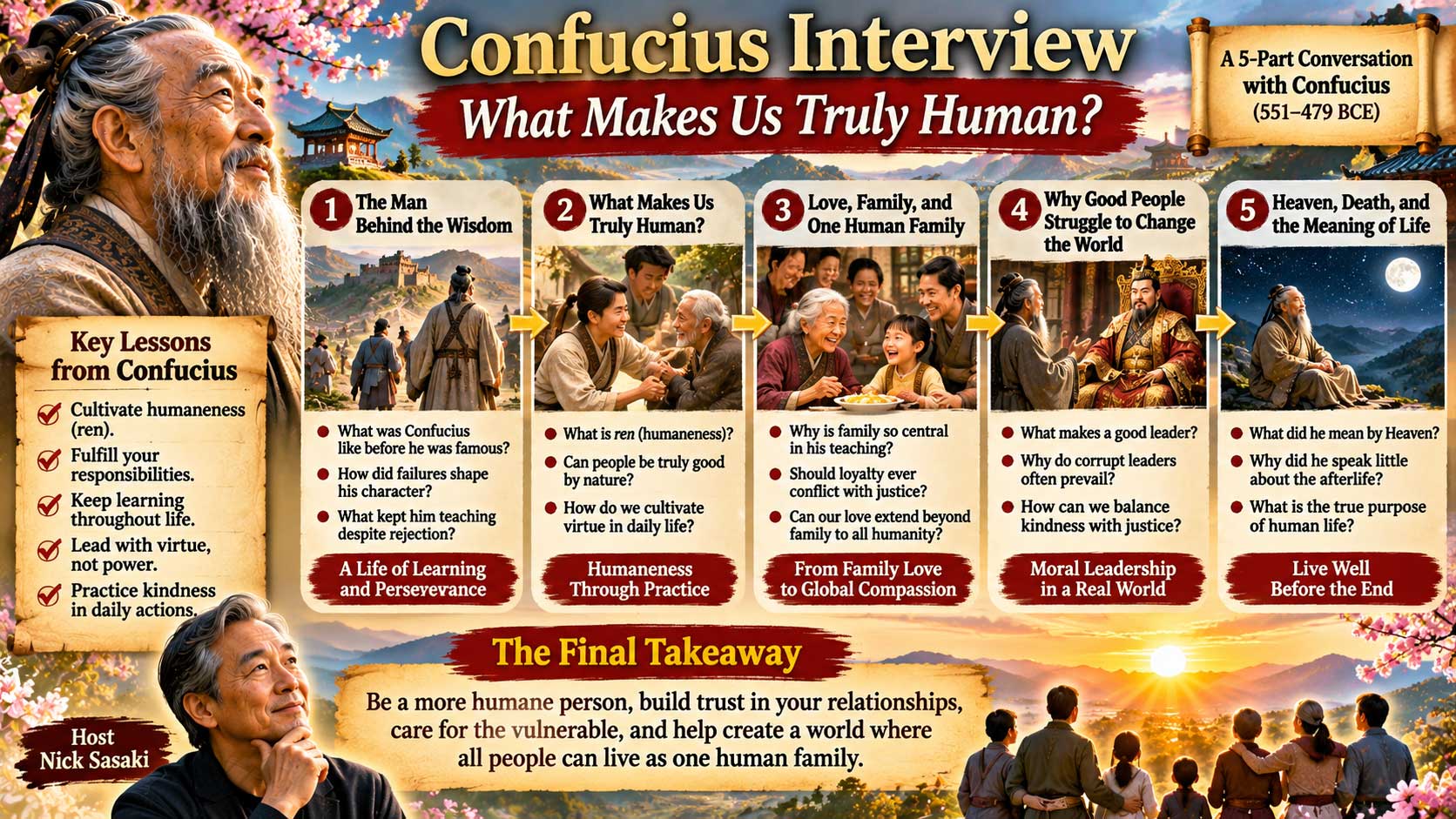
Short Bios:
Confucius (551–479 BCE)
Confucius, known in Chinese as Kongzi or Kong Fuzi, was a Chinese teacher and philosopher traditionally associated with the state of Lu during the Eastern Zhou period. His teachings explored humaneness (ren), ritual propriety (li), righteousness (yi), filial responsibility (xiao), and the cultivation of the exemplary person (junzi). Although he sought opportunities to influence government, his most enduring legacy emerged through his students and the traditions that developed around his teachings. The Analects, compiled and transmitted by later followers, remains a central source for studying his thought. His life and philosophy are examined in the Stanford Encyclopedia of Philosophy and the Internet Encyclopedia of Philosophy.
Nick Sasaki
Nick Sasaki is the creator of ImaginaryTalks.com, a platform that brings historical figures, philosophers, writers, spiritual teachers, and influential thinkers into fictional conversations about questions that continue to shape human life. Through imaginative interviews and dialogues, he explores love, faith, moral responsibility, personal growth, human relationships, and the possibility of a more peaceful world. His central aspiration is to encourage people to look beyond differences in religion, nationality, and ideology, recognize their shared humanity, and move closer to becoming one human family.
Leave a Reply