
Introduction
What would you ask someone who claimed to have met you somewhere you had never been? You might begin with the place, the time, and what you supposedly said. Then a detail might catch your attention. A familiar gesture. A message you had been meaning to deliver. Something the person could describe that you had never expected to hear.
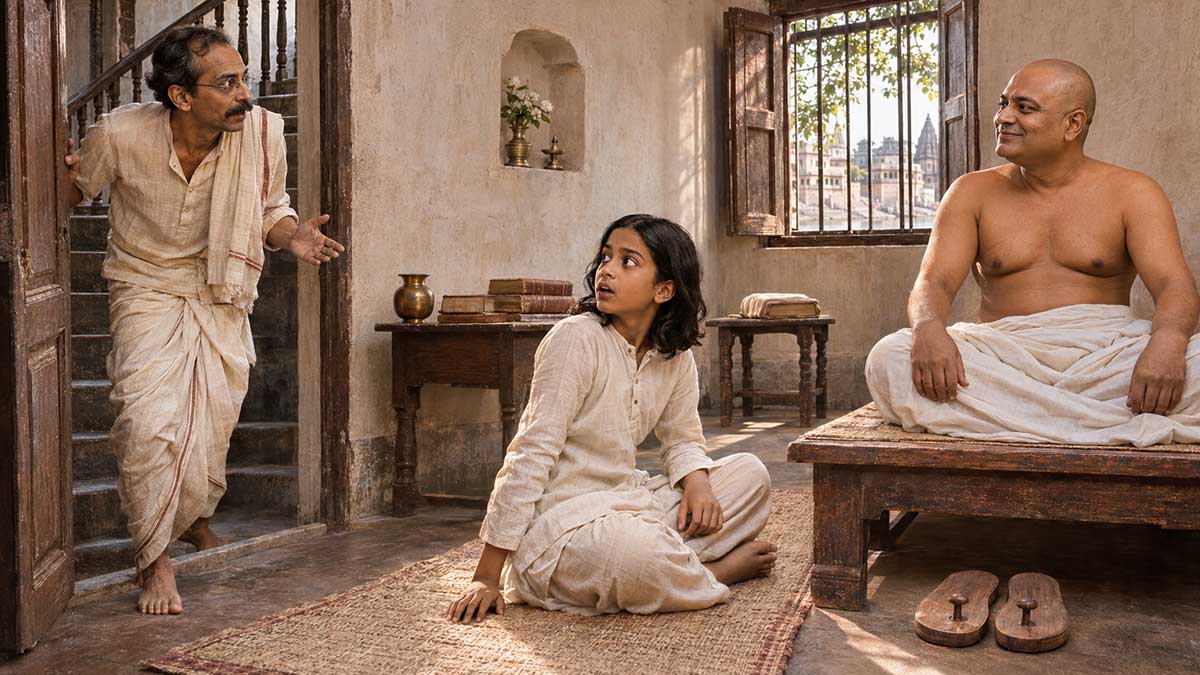
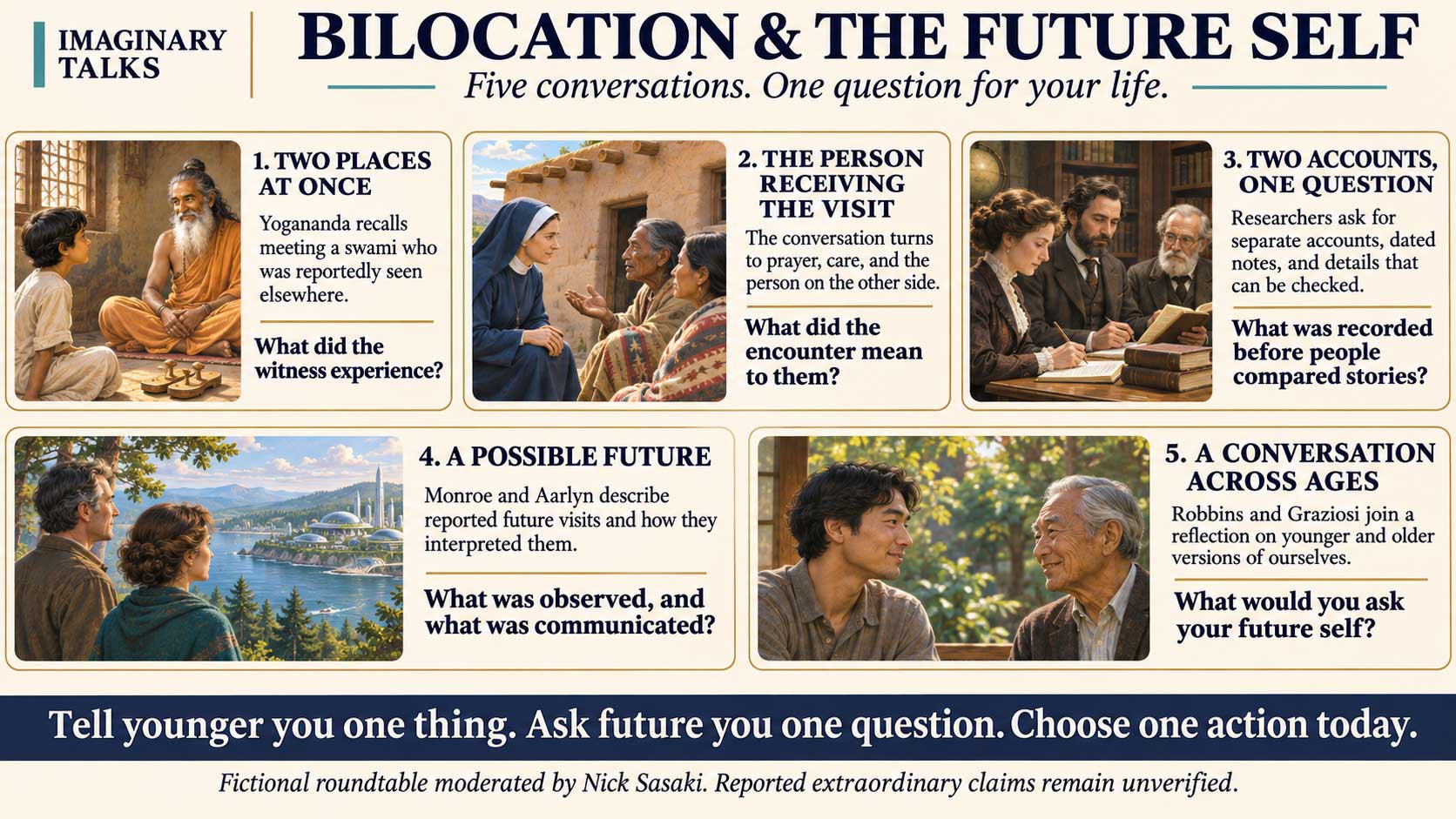
In Autobiography of a Yogi, Paramahansa Yogananda recounts visiting Swami Pranabananda in Benares as a boy. A man arrives who says he has just encountered the swami elsewhere. Yogananda, who has been sitting with Pranabananda, begins asking questions about the meeting. The visitor recognizes the wooden sandals nearby, and an ordinary errand becomes an extraordinary account. Read Yogananda’s chapter.
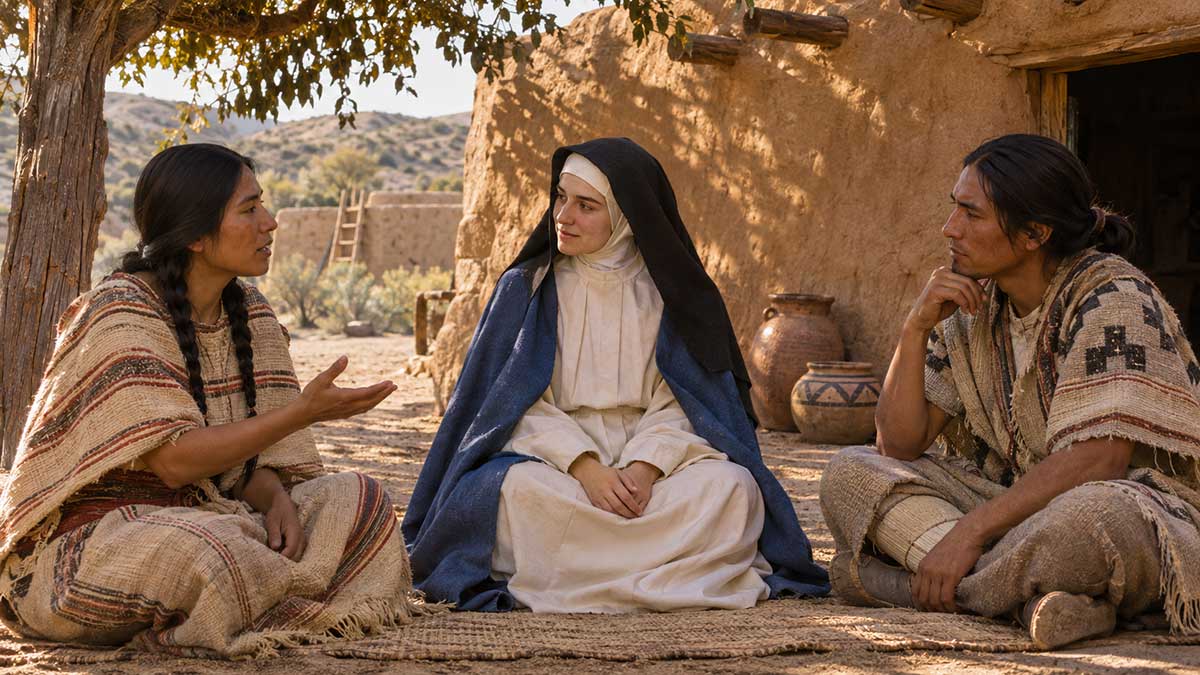
That room gives our fictional conversation its starting point. Yogananda and Pranabananda meet María de Jesús de Ágreda and Padre Pio, whose Catholic traditions include accounts of bilocation. They bring different convictions about spiritual life, prayer, and the meaning of an encounter. María’s association with the Lady in Blue turns our attention to the Indigenous people reportedly visited. What did they experience, and whose words have carried their story to us? Explore the historical account.
Edmund Gurney, Frederic W. H. Myers, and Frank Podmore help us examine the testimony. These early psychical researchers collected accounts of apparitions in Phantasms of the Living. At our table, they ask when a detail was recorded, what another witness independently reported, and whether ordinary explanations have been examined. Podmore’s notebook gives the conversation a useful place to pause. Read about their research.
Robert Monroe and Pamela Aaralyn carry the discussion into possible futures. Monroe’s writings describe out-of-body experiences, including a setting he understood to be a possible Earth beyond 3000. Aaralyn describes encounters with people she believes live in future timelines. We ask what they perceived, what they were told, and how a date became attached to the experience. Learn about Monroe’s work. Explore Aaralyn’s reported experiences.
A future description can affect the person hearing it long before its date arrives. I notice that response in myself. Once someone names a year, I begin wondering whether I should prepare for something. Our guests explore what would allow a prediction to be examined later, including the parts that fail to correspond. Pamela’s account of meeting a future self then brings another question into the room. Who helped that person become who she was?
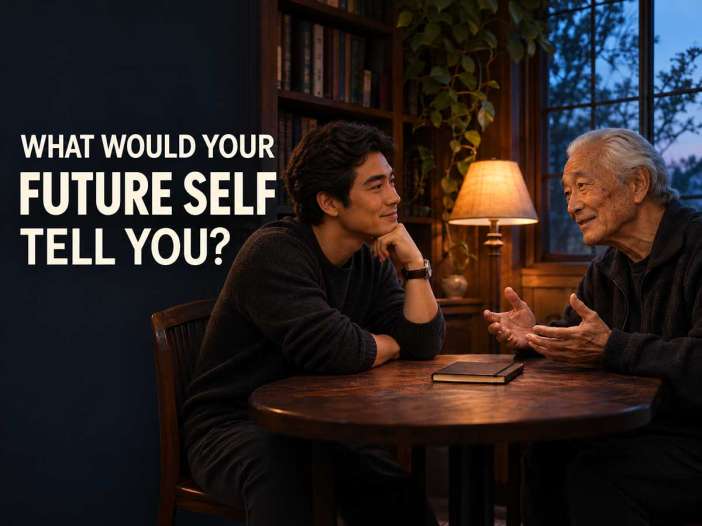
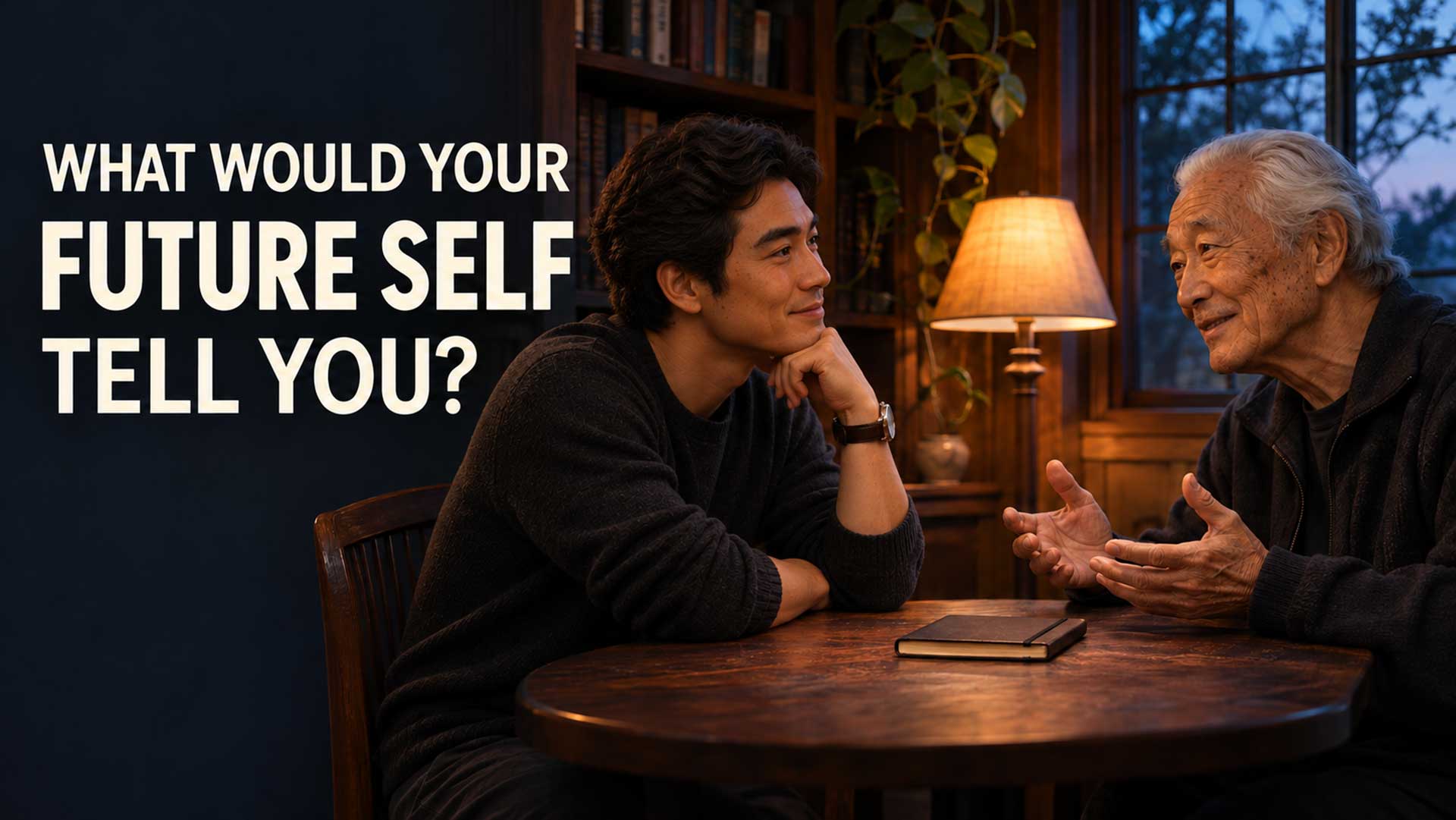
Tony Robbins and Dean Graziosi join the final topic to explore younger and future selves through reflection. I bring a memory of attending one of their events, where an exercise involving different ages of myself affected me deeply. Tony’s published work includes the Dickens Pattern, which asks participants to consider the future consequences of limiting beliefs. The precise exercise I attended remains unconfirmed, and the visualization in this article was created for our fictional conversation. See Robbins’s published workbook.
Across five topics, Nick’s table moves from a reported appearance in Benares to a question each reader can ask today. What would you want to know from an older version of yourself? What might a younger version want you to hear? There is room here for curiosity, careful inquiry, humor, and a few answers that take longer than expected.
Fictional Conversation Disclaimer
This article presents a fictional roundtable with invented dialogue and a reconstructed setting. Published historical accounts and personal experiences inform the discussion, with bilocation, future visits, and related extraordinary claims remaining unverified here. The guests’ responses and the original visualization are creative reconstructions, distinct from authentic quotations, confirmed historical encounters, or endorsement by the people portrayed.
Topic 1: The Man Who Was Seen in Two Places
Opening
A pair of wooden sandals rests beside the low platform.
Yogananda notices them before he sits. Across from him, Swami Pranabananda is smiling at the others gathering around the table. Padre Pio settles into his chair. María de Jesús de Ágreda folds her hands in her lap. Pamela Aaralyn looks from the sandals to Nick.
Pamela Aaralyn: Are we starting with those?
Nick Sasaki: I think we have to. By the time I finished reading the story, I wanted to ask the man who made them.
Pranabananda laughs.
Nick Sasaki: Yogananda, you were a boy visiting Benares, carrying a letter from your father. You went to see the swami, expecting him to help you find someone.
Paramahansa Yogananda: Yes. My father wanted me to locate his friend, Kedar Nath Babu. I had a practical errand. I arrived with that errand and a great deal of curiosity.
Nick Sasaki: And the errand became a story people would read for generations.
Paramahansa Yogananda: The boy carrying the letter had no idea of that. He was becoming rather impatient.
Question 1: What Happened When the Visitor Arrived?
Nick Sasaki: Take us back to the room. What happened when you learned that someone had just spoken with the swami sitting beside you?
Paramahansa Yogananda: Let me begin with the waiting. I had been welcomed warmly. Then Swami Pranabananda became very still. I was sitting with someone who seemed to have forgotten my errand, yet I had nowhere else to go.
He glances at Pranabananda.
Paramahansa Yogananda: A young visitor can find a silent room very long.
Swami Pranabananda: Particularly when he has questions ready.
Paramahansa Yogananda: And I had many. Eventually he told me the man would arrive in half an hour. I watched the time. Then there were footsteps, and I went to meet the visitor on the stairs.
Kedar Nath said he had met the swami after bathing in the Ganges. They had walked together. The swami had told him that my father’s son was waiting at his residence.
Nick Sasaki: He knew you were there before you introduced yourself.
Paramahansa Yogananda: Yes. From my perspective, the swami had remained in the room. Kedar Nath described an encounter elsewhere. We returned together, and he recognized the sandals.
Nick looks down at them.
Nick Sasaki: That detail catches me. If someone described a radiant presence, I’d have questions. If he pointed to the sandals beside me and said, “He was wearing those,” I think I’d look straight at the man’s feet.
Pamela Aaralyn: I would too. It gives you something particular to follow. What did he notice about them? Had he seen them before?
Paramahansa Yogananda: I asked about touch and sound. Had he held the swami’s hand? Had he heard his footsteps? I was trying to discover what sort of encounter he meant.
Nick Sasaki: Your questions almost offended him.
Paramahansa Yogananda: He had told me what had happened to him. I was responding as though he might have failed to notice whether a man had stood beside him.
María de Jesús de Ágreda: The listener is astonished, and the person speaking may suddenly feel that his honesty has become the question.
Padre Pio: A startled boy and an offended visitor. The swami had quite a reception waiting for him.
Pranabananda smiles.
Swami Pranabananda: They both had something to tell me.
Nick Sasaki: Swami, what strikes you about hearing the boy’s side?
Swami Pranabananda: How much was happening in his mind during a quiet visit.
Paramahansa Yogananda: Quite a lot.
Swami Pranabananda: And how quickly a visitor who wants an answer can become a visitor who needs reassurance.
Nick Sasaki: Yogananda, you wrote about fear. Readers might expect you to be thrilled.
Paramahansa Yogananda: Excitement came with disquiet. I wanted to know who was before me. Something I had assumed was simple had become uncertain. A boy can long for spiritual wonders and then feel alarmed when an experience challenges the familiar world around him.
Pamela Aaralyn: I recognize that feeling. I speak easily about my experiences now, but some frightened me. Curiosity doesn’t remove that response.
Nick Sasaki: What helped you remain there, Yogananda?
Paramahansa Yogananda: The swami spoke about his guru, Lahiri Mahasaya, and the years he had devoted to seeking God. My attention moved to the life of the man before me. I could hear him again.
Question 2: What Makes an Encounter Feel Like a Visit?
Nick Sasaki: Kedar Nath described meeting someone he recognized, hearing him, and walking with him. What makes an encounter feel like a visit from the person himself?
Pamela Aaralyn: Interaction. In what I call bilocation, I experience participating. I can have a conversation, encounter something unexpected, and feel that the other person has a life continuing beyond my visit.
Food has been part of that for me. So has the awkwardness of being somewhere unfamiliar. Those details make the experience feel tangible.
Nick Sasaki: The awkwardness interests me. What do you mean?
Pamela Aaralyn: You don’t always know what to do. Someone offers you something you don’t want. You misunderstand something. The experience has moments I wouldn’t have chosen.
Paramahansa Yogananda: An unexpected response can leave a strong impression.
Pamela Aaralyn: Yes. I can come away thinking about a small exchange long afterward.
Nick Sasaki: And then someone hearing the story asks how you know another person experienced it.
Pamela Aaralyn: That becomes a separate question. I know what I experienced. If I want someone else to examine it, I need to offer them something they can examine. Finding people I believe I encountered has mattered to me for that reason.
Paramahansa Yogananda: In the Benares account, Kedar Nath’s arrival was central. I could hear what he said and compare it with my own time in the room.
Padre Pio: A person who believes he received a visit may begin with the words he heard. A short sentence may stay with him more clearly than the appearance of the room.
Nick Sasaki: Suppose he says he felt comforted. How would you receive that?
Padre Pio: I would ask what troubled him and what he remembers. There may be something he has wanted to tell someone for a long time.
María de Jesús de Ágreda: I would want him to use his own language. If he describes a presence, ask what he means by presence. If he describes someone standing before him, let him say where and what followed.
Nick Sasaki: That matters in the accounts associated with you, María. Many readers encounter them through later retellings.
María de Jesús de Ágreda: And through a language of marvels. For me, such experiences belonged within prayer, obedience, and the examination of conscience. Those were the concerns of my religious life.
I would want the people said to have received the Lady in Blue to have their own place in the account. What did they say? Who heard them? What became of their words as the story traveled?
Pamela Aaralyn: Someone can repeat an account with a certainty the speaker never gave it. Then another person responds to that version.
Swami Pranabananda: There are already several people at the table before the person being discussed is invited to speak.
Nick Sasaki: The experiencer, the witness, the person retelling it.
Swami Pranabananda: And the listener who has decided what he hopes to hear.
Nick Sasaki: I suspect I’ve been that listener.
Paramahansa Yogananda: We bring expectations. My own eagerness was part of the chapter. So was my fear. A faithful account has room for the person doing the observing.
Nick Sasaki: Would you say the ordinary details help us stay close to that person?
Paramahansa Yogananda: They help us ask a better next question. A sandal cannot answer every question about consciousness. It can bring us back to what someone says he saw.
Padre Pio: And the speaker can tell you when you have misunderstood him.
Question 3: When Does Someone Learn That Another Person Experienced Their Presence?
Nick Sasaki: In Benares, the visitor arrived almost immediately. Other accounts become known much later. When does someone discover that another person has experienced their presence elsewhere?
Pamela Aaralyn: Sometimes a later conversation is what surprises me most. I have an experience, return, and try to sort out what happened. Then I speak with someone who seems connected to it.
I can be excited. I want to tell them everything.
Nick Sasaki: When you say you have found people you believe you encountered, what happens once you’re speaking in the present?
Pamela Aaralyn: They have their own questions. Someone may be receptive. Someone else may be skeptical. I have to talk with the person who is actually there.
María de Jesús de Ágreda: Including an answer you did not expect.
Pamela Aaralyn: Yes. Someone may recognize part of what I describe and have no connection with another part.
Nick Sasaki: Swami, your story includes an errand accomplished. Kedar Nath came to the house. How much attention would you want us to give the reason for the encounter?
Swami Pranabananda: Enough to notice that there was another person involved. The boy wished to find his father’s friend. The friend came. A conversation could take place.
Paramahansa Yogananda: I gave the episode its place in my book through the astonishment of the boy I had been. The errand can almost disappear when the story is remembered.
Swami Pranabananda: Yet the letter still needed delivering.
The table laughs.
Padre Pio: That I like. Everyone is discussing two bodies, and someone is still waiting for his letter.
Nick Sasaki: It brings the whole thing back down to the stairs.
Padre Pio: There is often someone on the stairs. Someone arriving, someone waiting, someone with a question that matters to him.
María turns toward Pamela.
María de Jesús de Ágreda: When people ask you about these experiences, do they begin with questions about time, or with something happening in their own lives?
Pamela Aaralyn: Both. Someone might ask about a distant year. Then the conversation becomes about their children, a loss, or a decision they don’t know how to make.
María de Jesús de Ágreda: The question can grow more particular as the person speaks.
Pamela Aaralyn: Very particular. They may have begun with the future, but they’re worried about tomorrow morning.
Nick Sasaki: That changes what they’re asking of the person answering.
Padre Pio: It asks for care. A frightened person can remember your answer for years.
Pamela nods.
Pamela Aaralyn: I think about that.
Paramahansa Yogananda: It returns me to the years of meditation Pranabananda described. Readers may recall the two bodies first. That day, he spoke of seeking God alongside his duties at the railroad.
Nick Sasaki: A whole life around an episode we can tell in a few minutes.
Paramahansa Yogananda: He had a teacher. He had work. He had longing. The boy heard about those things that day too.
Nick Sasaki: What would have been lost if you had left as soon as you heard Kedar Nath’s account?
Yogananda looks at Pranabananda.
Paramahansa Yogananda: I would have left frightened, with a remarkable story. I would have missed the conversation in which I came to know him better.
Pranabananda inclines his head.
Closing
Nick leans forward and looks once more at the sandals.
Nick Sasaki: Kedar Nath came up the stairs thinking he was responding to a request from someone he knew. He had no reason to expect the reception waiting for him.
Swami Pranabananda: Two very surprised people.
Nick Sasaki: And one rather calm host.
Swami Pranabananda: I had been expecting him.
María smiles.
Nick Sasaki: María, you asked what became of people’s words as a story traveled. I want to follow that into the Lady in Blue accounts. Before the visitor entered the story, those people had lives and concerns of their own.
María unfolds her hands.
María de Jesús de Ágreda: Then let us begin with what they wished to say.
Topic 2: What Draws You to Someone Far Away?
Opening
María has begun to answer when Robert Monroe draws his chair closer to the table.
Robert Monroe: I caught the part about the person receiving the visit.
Nick Sasaki: We’re turning to the Lady in Blue accounts associated with María. She asked what became of people’s words as the story traveled.
Robert Monroe: I’d like to hear that.
María considers him for a moment.
María de Jesús de Ágreda: You have spent much of your life asking where a person might go.
Robert Monroe: Yes.
María de Jesús de Ágreda: Then perhaps you will help us ask what it means to arrive.
Monroe rests his hands on the table.
Robert Monroe: That may be the harder question.
Beside him, Padre Pio moves his cup farther from the edge. Yogananda waits for María to continue.
Nick Sasaki: In Benares, we had a boy waiting in a room and a man coming up the stairs. Here, we have an ocean between the places described, different languages, and encounters that reach us through religious reports.
He turns to María.
Nick Sasaki: Let’s begin with the people whose lives were already there.
Question 4: What Would You Ask the People Who Reportedly Received the Visitor?
María de Jesús de Ágreda: I would ask what they wished to say.
My religious life gave me a language for speaking about these experiences. I understood them through Christ, the Church, and the desire that souls receive the Gospel. That was my conviction.
But if you ask about the people described in those reports, they must have room to answer from their own lives.
Nick Sasaki: The accounts describe people seeking missionaries after reported encounters with a woman in blue. What would you want to ask those people directly?
María de Jesús de Ágreda: What they believed had happened. What they had asked of the visitor. What they hoped would follow when they sought a missionary.
Robert Monroe: That last question opens things up. A visitor can leave believing he has accomplished something. The person receiving him may have a very different idea of what should happen next.
Paramahansa Yogananda: Each brings expectations to the meeting.
María de Jesús de Ágreda: Certainly. I would have wished to speak of Christ. It would be false to give me a different purpose merely to make this table comfortable.
Nick Sasaki: I want that conviction in the conversation. And I want to know what the people receiving the message thought they were being offered.
María de Jesús de Ágreda: Those questions belong together.
Padre Pio: A person can hear a sermon and leave with his question unanswered.
María looks at him.
Padre Pio: We should admit that possibility.
María de Jesús de Ágreda: We should.
Nick Sasaki: There is something I catch myself doing with a story like this. I focus on the woman who reportedly crossed the distance. The people she encountered become the ones who confirm her story. I want to give them more room than that.
Robert Monroe: Ask what they were doing before she arrived.
Nick Sasaki: And what they did after she left.
Robert Monroe: Yes. The encounter happened within their lives.
Paramahansa Yogananda: Think again of Kedar Nath. He had finished his bath and was going about his day. In my book he enters a remarkable episode. He had a day before that episode and a day afterward.
Nick Sasaki: María, much of what reaches us was recorded by missionaries and religious officials. That shapes whose questions survive.
María de Jesús de Ágreda: Then you must attend to who is speaking in each account. My words cannot supply what another person would have said.
Robert Monroe: Nor can our sympathy for the story.
For a moment, María studies her folded hands.
María de Jesús de Ágreda: If one of those people were sitting here, I would have to receive an answer I could never prepare for him.
Question 5: Can Concern for Someone Shape What You Experience When That Person Is Far Away?
Nick Sasaki: Someone you love is far away. You worry about them. You pray for them or hold them in your thoughts. Where do affection and intention fit into the experiences you describe?
Padre Pio: Someone asks for prayer. His wife is ill. His son has gone away. He is afraid of what tomorrow may bring.
He does not always need a long conversation about prayer. He needs someone to pray with him.
Nick Sasaki: Would you see that concern as the beginning of a connection?
Padre Pio: I would place the person before God. What God does with the prayer belongs to Him.
María de Jesús de Ágreda: That is close to how I would speak. The desire to help can be sincere, but prayer requires surrender. Another person’s life cannot become something I believe my wishes entitle me to direct.
Robert Monroe: I would approach it through attention. What is the person focusing on? What happens when the usual physical surroundings recede from awareness?
Concern adds another question. If I’m frightened for someone, how much of what I experience comes from the fear I brought with me?
Nick Sasaki: You could feel you had reached the person and still be experiencing your own worry about them.
Robert Monroe: That possibility deserves examination. The feeling gives me something to investigate.
Swami Pranabananda: Affection can steady attention. Anxiety can make it restless.
Robert Monroe: Someone may say he is concentrating intensely, yet his attention is moving between a dozen feared outcomes.
Paramahansa Yogananda: In prayer for another person, I would seek calmness and turn the heart to God. Repeating every feared outcome can become its own occupation.
Nick Sasaki: How would you recognize the difference?
Paramahansa Yogananda: Consider a letter from someone who cares for you. One letter leaves you feeling that you must hurry to reassure the writer. Another gives you room to describe your situation honestly.
Padre Pio: The writer of the second letter may have to bear a difficult answer.
María de Jesús de Ágreda: That is part of caring for someone. We may learn something we cannot immediately put right.
Robert Monroe: And our own uncertainty may continue. We should notice when we’re asking the other person to remove it for us.
Nick rests his hands on the table.
Nick Sasaki: Suppose someone reading this has been thinking about a distant loved one and feels an urge to contact them. What would you want that person to do?
Padre Pio: Call them.
Monroe smiles.
Robert Monroe: I was about to say that.
Padre Pio: Then we have reached agreement quickly.
Paramahansa Yogananda: Pray, if that is your practice. Attend to the means already available to you.
María de Jesús de Ágreda: And consider the hour where they are.
Robert Monroe: A valuable detail in any discussion of distant communication.
Laughter moves around the table.
Swami Pranabananda: When they answer, allow them to tell you how they are.
Nick Sasaki: Relief can make us talk very quickly.
Robert Monroe: So can the excitement of thinking our impression was correct. We may start explaining what we experienced before asking what happened to them.
Padre Pio: They might simply have been asleep.
Robert Monroe: In which case they may have a few observations about the hour.
Question 6: What Might Stay With Someone After a Brief Encounter?
Nick Sasaki: We’ve talked about the person making contact. What might remain with the person who received it?
Padre Pio: Perhaps a sentence. Perhaps the fact that he was able to say something he had concealed.
María de Jesús de Ágreda: Or a question he had been afraid to ask.
Robert Monroe: I would want to hear what happened afterward. Did the person make a decision? Speak to someone? Become curious about something that had frightened them?
Nick Sasaki: What if the person is still uncertain about the encounter itself?
Robert Monroe: Then the uncertainty belongs in the conversation. I know what it is to search for language for an unfamiliar experience. An explanation offered too quickly can make it harder to describe the part that doesn’t fit.
Paramahansa Yogananda: I recall the boy I was in Benares. I had questions I could scarcely form. I needed time in the room.
Swami Pranabananda: You had arrived expecting a monk to read a letter.
Paramahansa Yogananda: A modest expectation.
Pranabananda smiles.
María de Jesús de Ágreda: Robert asked what the person does afterward. In my faith, I would ask whether an experience led to greater charity, humility, and faithfulness to one’s duties.
Someone may begin longing for another extraordinary experience and grow impatient with the person asking for help at the door.
Padre Pio: The person at the door can be very inconvenient.
María de Jesús de Ágreda: Yes.
Padre Pio: He arrives when you are tired. He repeats himself. He wants more time than you planned to give.
Robert Monroe: He has a remarkable talent for interrupting your spiritual development.
Yogananda laughs. Padre Pio looks at Monroe with amusement.
Padre Pio: You have met him.
Robert Monroe: Several times.
Nick Sasaki: What would you ask yourself after he left?
Robert Monroe: Whether I heard what he came to tell me.
Swami Pranabananda: You may discover that you had been preparing your answer throughout his visit.
Nick Sasaki: I’ve done that. I can finish a conversation and recall what I said more clearly than what the other person asked.
Padre Pio: Then you have something to ask when you meet again.
María looks toward Monroe.
María de Jesús de Ágreda: And what would you ask of the experience itself? You have spoken about changes in daily life.
Robert Monroe: I would keep asking what happened. A change in someone’s life is worth hearing about. There are still questions about the encounter that produced it.
Paramahansa Yogananda: Those questions may continue for years.
Robert Monroe: They may. The person may have no wish to discuss them immediately.
Nick Sasaki: Or may want to discuss nothing else.
Robert Monroe: I have met that person too.
María de Jesús de Ágreda: What would you do then?
Robert Monroe: Suggest a notebook. Ask for the account in their own words. Something they could return to after the first excitement had passed.
Nick Sasaki: That gives them a place to leave the experience without having to finish explaining it.
Robert Monroe: And gives us something to discuss the next time we meet.
Closing
Nick looks toward the notebooks at the far end of the table.
Nick Sasaki: We have several kinds of account here. A person who says she visited. Someone who reportedly saw a visitor. Someone recording what was said afterward.
María de Jesús de Ágreda: Each has something the others cannot supply.
Nick Sasaki: And each may recall the event differently.
He turns to Yogananda.
Nick Sasaki: You could question Kedar Nath that day. With other accounts, the person collecting them arrives much later.
Paramahansa Yogananda: Then much depends on what has happened to the story in between.
Nick Sasaki: Robert, what would you ask first?
Monroe considers the question.
Robert Monroe: “What do you remember?”
He glances toward the closed notebook beside the next chair.
Robert Monroe: I suspect our investigators have a few questions after that.
Topic 3: What Did the Other Person See?
Opening
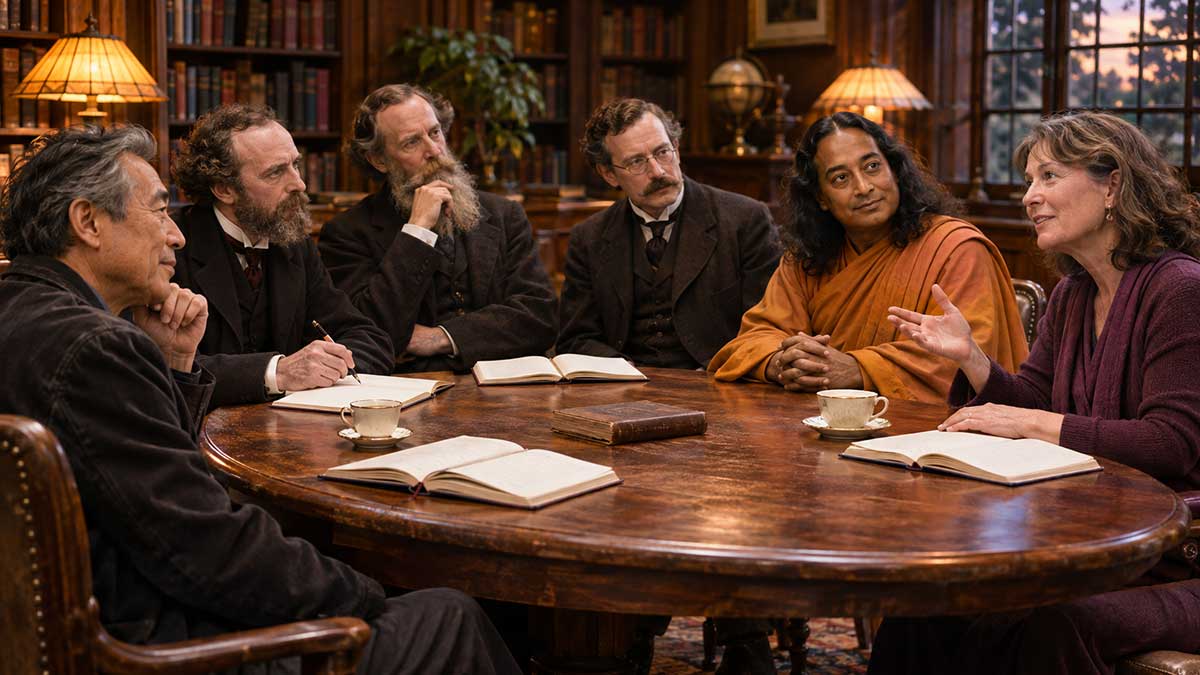
Frank Podmore places a notebook on the table and leaves it closed.
Nick Sasaki: Robert suggested we begin with what the person remembers. I suspect you have a question about that.
Frank Podmore: When did they first write it down?
Pamela Aaralyn: You got there quickly.
Frank Podmore: A delayed question can sometimes become an unanswerable one.
Beside him, Edmund Gurney draws his chair forward. Frederic Myers turns toward Yogananda.
Frederic W. H. Myers: Your question about Kedar Nath holding the swami’s hand interested me.
Paramahansa Yogananda: I wanted to know what he meant when he said they had met.
Edmund Gurney: A useful place to begin. “I saw someone” can describe several experiences.
Nick Sasaki: Pamela, you’ve described finding people in the present whom you believe you encountered in future settings. I’d like to put your account beside Yogananda’s and ask what we could learn from the other people involved.
Pamela Aaralyn: That’s something I want people to look at. The experience can be very clear to me, and then I have to work out how to communicate it.
Podmore opens his notebook.
Frank Podmore: Clarity of experience and clarity of evidence can require different questions.
Nick Sasaki: Then let’s give each enough room.
Question 7: What Would You Ask Each Person First?
Nick Sasaki: Suppose the person who says they visited and the person who reports seeing them each came to you privately. What would you ask before they heard one another’s account?
Edmund Gurney: I would ask for a description from the beginning. Where were you? What were you doing? What first caught your attention?
I would avoid placing an explanation inside the question.
Pamela Aaralyn: Give me an example.
Edmund Gurney: If I ask, “When did you realize Pamela had visited you?” I have already supplied a visitor and a visit.
If I ask, “What happened that evening?” the person has greater freedom to describe the experience.
Pamela Aaralyn: They might say they dreamed about me.
Edmund Gurney: Yes. Or heard a voice. Or experienced nothing unusual.
Frank Podmore: That last answer needs a page too.
Nick Sasaki: Alongside the answers that seem to correspond.
Frank Podmore: Certainly. Otherwise, the notebook gradually becomes a record of our preferences.
Pamela looks at the open page.
Pamela Aaralyn: If something seems to match, that’s where I want to keep asking questions.
Frederic W. H. Myers: A promising detail deserves attention. We can follow it and preserve the rest of the account.
My particular interest would be whether the two descriptions contain information that neither person could have supplied through an ordinary exchange.
Nick Sasaki: Something they each recorded before speaking.
Frederic W. H. Myers: That would make the sequence easier to establish.
Paramahansa Yogananda: In Benares, Kedar Nath and I began speaking almost immediately. His account surprised me. My questions came from that surprise.
Frank Podmore: Which makes those questions part of the history we would need.
Paramahansa Yogananda: I could scarcely pretend I had prepared an investigation.
Edmund Gurney: Nor should we expect a startled boy to arrive with a questionnaire.
Paramahansa Yogananda: I had brought a letter. That was the extent of my preparation.
Nick Sasaki: What would you ask the person who believed they had traveled?
Edmund Gurney: Much the same at first. Describe the experience. What did you perceive? What did you do? What led you to identify the place and the people?
Frederic W. H. Myers: Then we could compare the accounts. Perhaps the visitor describes a conversation and the witness recalls a silent figure. The difference may be as interesting as an agreement.
Pamela Aaralyn: You would want the descriptions kept apart long enough to see that.
Frank Podmore: Yes. Once people exchange accounts, they may struggle to recall which details they originally supplied.
Nick Sasaki: I can see how quickly that could happen. Someone says, “You were wearing blue,” and I start searching my memory for the blue shirt.
Edmund Gurney: And the next time you tell the story, the shirt may seem more firmly established than it was during that first conversation.
Question 8: What Was Known Before the Person Was Found?
Nick Sasaki: Pamela, you’ve described encountering a cultural anthropologist, then finding a person in the present whom you believed corresponded to that encounter. What led you to her?
Pamela Aaralyn: I described her name, her work, and a connection with Columbia University. I became curious, looked her up, and reached out.
Frank Podmore: My first question would concern earlier contact with that information. Had the name appeared in an article, a lecture, or a passing reference? A person can forget learning something and later experience it as unfamiliar.
Pamela Aaralyn: You’d want to trace how I could have encountered the name before.
Frank Podmore: Yes. Before accepting information from a future setting, I would examine the available routes by which it might have reached you here.
Frederic W. H. Myers: The earliest record would help us do that. We could see how specific the name was before the search and which details were added afterward.
Nick Sasaki: I can feel myself wanting the match to count. That makes me want to check when each detail first appeared.
He turns to Podmore.
Nick Sasaki: What would you need to examine the sequence?
Frank Podmore: Whatever contemporary material exists. Notes, correspondence, a recording. Then an account of the search. Which details were used? How many candidates appeared? What led to choosing this person?
Edmund Gurney: We would want to establish what became available once the person was found. A biography can contain a great deal that later becomes difficult to separate from the original impression.
Pamela Aaralyn: So the record has to show what belonged to the experience and what came from looking her up.
Edmund Gurney: As clearly as possible.
Nick Sasaki: Finding someone who fits a description raises one question. Having that person independently report seeing you would raise another.
Frederic W. H. Myers: Quite so. We might investigate how information was acquired without having a corresponding report of an appearance.
Frank Podmore: A real person at the end of a search does not establish how the search began.
Pamela considers the sentence.
Pamela Aaralyn: I can tell someone why the encounter felt significant to me. You would still need the sequence before reaching a conclusion.
Frank Podmore: Precisely.
Nick Sasaki: Yogananda, Kedar Nath supplied an account of meeting the swami. For us, that account reaches the reader through your book.
Paramahansa Yogananda: Yes. I tell what he said and what I experienced.
Frank Podmore: I would have wished to speak with him separately. Your recollection gives me questions for him. It cannot give me his answers to those questions.
Paramahansa Yogananda: You might have asked something the boy never thought to ask.
Edmund Gurney: Or obtained a detail that changed how we interpreted the encounter.
Nick Sasaki: Such as?
Edmund Gurney: We cannot supply it for him. That is why we would want to ask.
Nick pauses, then smiles.
Nick Sasaki: I nearly invited you to fill the empty chair with a plausible answer.
Frederic W. H. Myers: An empty chair is useful if we continue to notice that it is empty.
Question 9: What Could an Unexpected Match Tell Us?
Nick Sasaki: Let’s try a hypothetical case. Two people make dated records before speaking. One describes visiting a friend and seeing an unusual object on her table. The friend records seeing that person and remembers the same object. What would make you sit up?
Frank Podmore: The object.
Nick Sasaki: Which object?
Frank Podmore: Exactly.
Laughter moves around the table.
Frank Podmore: A book on a table offers many opportunities for agreement. A particular object with an unusual feature may give us more to examine.
Edmund Gurney: We would compare the original wording. Perhaps one person wrote “something red” and the other wrote “a red ribbon.” A later account might turn that into complete agreement.
Pamela Aaralyn: Once they’ve talked, they could both start saying “the red ribbon.”
Edmund Gurney: Yes. The earlier descriptions allow us to follow that change.
Frederic W. H. Myers: Suppose the correspondence remained striking after those questions. Then we would have a particular occurrence to investigate.
One possibility considered in psychical research is that information might reach a witness’s mind and take the form of an appearance. Another concerns consciousness operating beyond the body. We would need to ask what features of the case each explanation could account for.
Paramahansa Yogananda: The witness might say, “I held his hand,” and you would still have a question about what occurred.
Edmund Gurney: Yes. Touch belongs in the description. We must still ask how to explain the experience.
Frank Podmore: And we would examine coincidence, errors of recollection, prior knowledge, and opportunities for communication. A surprising detail can survive some questions and fail at another.
Nick Sasaki: Would you consider the case stronger if those ordinary possibilities became difficult to sustain?
Frank Podmore: Stronger, certainly. The conclusion would depend on how thoroughly they had been examined and what remained.
Pamela Aaralyn: From inside an experience, I might feel certain I had been somewhere. You’re asking what someone outside it could establish.
Frederic W. H. Myers: Yes. Your certainty is something to hear about. We would want to learn what produced it and whether any part of it can be independently examined.
Paramahansa Yogananda: There is room for the person describing an experience and the person investigating it to remain in conversation.
Frank Podmore: Provided a question can remain unanswered.
Pamela Aaralyn: That can be uncomfortable.
Frank Podmore: It frequently is.
Nick Sasaki: What do we do with the details that fail to match?
Edmund Gurney: Preserve them. They may show where an interpretation entered, where recollection changed, or how broad the opportunity for coincidence was.
Frederic W. H. Myers: They may lead to a better question than the one we began with.
Paramahansa Yogananda: Would you bring the witnesses together afterward?
Edmund Gurney: Once their separate statements had been secured, a conversation could clarify differences.
Pamela Aaralyn: I would want to hear what the other person had experienced that I knew nothing about.
Frank Podmore: Then the records have served a useful purpose. The later conversation can contain something new.
Closing
Nick looks at Podmore’s notebook. A few short entries now occupy the page.
Nick Sasaki: We’ve given the moment before people compare accounts much more attention than I expected.
Edmund Gurney: Much can be preserved there.
Pamela Aaralyn: And it gives me something concrete to think about when describing a future session. What I perceived, what I inferred, and what I learned afterward.
Frederic W. H. Myers: A date would be particularly interesting. How did it become part of the account?
Nick Sasaki: Robert describes a setting he understood to be beyond the year 3000. Pamela has described particular years much closer to us.
He turns toward her.
Nick Sasaki: Before anyone tells you the year, what is in front of you?
Pamela rests her hands on the table.
Pamela Aaralyn: That’s where we should start.
Topic 4: How Would You Know You Were in the Future?
Opening
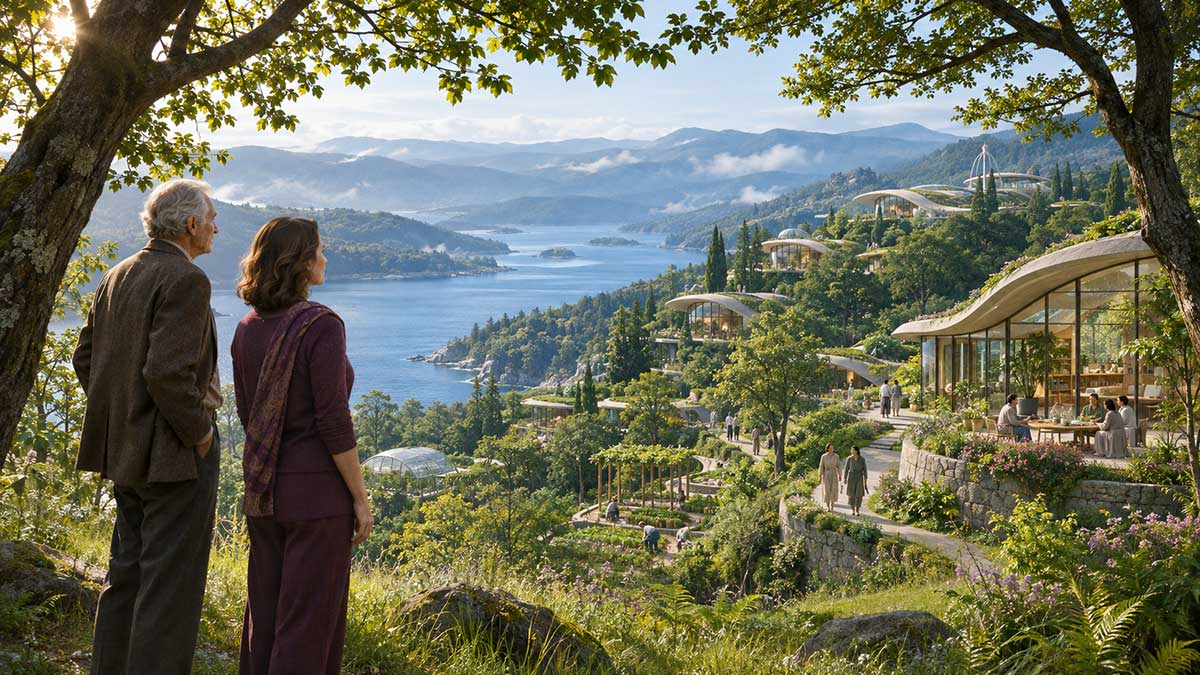
Robert Monroe takes the seat beside Pamela. Swami Pranabananda remains across from them, with Myers and Gurney nearby.
Nick has a copy of Far Journeys open before him. He keeps a finger between the pages.
Nick Sasaki: Robert, there’s a moment in your account where you ask what year it is. After everything you describe, that question feels reassuringly familiar.
Robert Monroe: I wanted to know where I stood.
Pamela Aaralyn: I ask for things that help me orient myself too. A place, something different, someone I recognize.
Nick Sasaki: When the year is unclear, what happens?
Pamela Aaralyn: I ask again. Sometimes I’m interpreting what I perceive as I go.
Edmund Gurney: Then the uncertainty belongs to the experience. It helps us follow how a date becomes attached to a setting.
Nick closes the book gently.
Nick Sasaki: Let’s begin before the calendar enters. Robert, you have a landscape. Pamela, you often describe a person waiting somewhere. What first catches your attention?
Question 10: What First Made You Think You Had Arrived in Another Time?
Robert Monroe: In the account you’re referring to, the future was introduced before the visit. I was told I would be shown a possible Earth beyond the year 3000. That shaped my expectations from the beginning.
Nick Sasaki: You already had a way to interpret what followed.
Robert Monroe: Yes. Later, I recognized terrain associated with Virginia, with substantial changes. Familiar land helped me locate myself. The explanation of its time came through the encounter.
Pamela Aaralyn: I usually begin with an intention too. If I’m trying to meet someone in 2032, that year is already part of what I’m doing.
Frederic W. H. Myers: Then we can ask how the experience develops from that expectation. What confirms it? What makes the visitor question it?
Nick Sasaki: Pamela, in your account of 3300, what seemed most different about the people?
Pamela Aaralyn: The choices available to them. I described three orders, with different preferences about technology, spirituality, and government. What moved me was the feeling that they could choose how to live.
Nick Sasaki: You sounded relieved by that.
Pamela Aaralyn: I was. I hear many conversations about everyone being forced into one future. In what I experienced, there were different ways of living.
Robert Monroe: My account has different arrangements. It would be interesting to examine how each description developed without assuming that two distant-future accounts must belong to the same setting.
Nick Sasaki: Stay with Pamela’s relief for a moment. Did anything in your experience speak to a concern you had brought from home?
Robert Monroe: Certainly. You arrive with your own questions. What seems remarkable may reveal something about the world you have left and what you find difficult about it.
Swami Pranabananda: A traveler notices what his attention is prepared to notice.
Robert Monroe: And may overlook something the inhabitants consider obvious.
Nick Sasaki: Like asking where the roads are before asking how people get around.
Pamela Aaralyn: Or asking about their government and discovering they organize themselves in ways you hadn’t considered.
Edmund Gurney: Those surprises belong in a careful account. So do the expectations that preceded them.
Nick Sasaki: Swami, what do you make of beginning with an intended year?
Swami Pranabananda: The mind has been given something to hold. A person seeking a friend brings a name to his meditation. A person seeking a future brings a date. I would ask each how he recognizes what he believes he has reached.
Pamela Aaralyn: For me, the date is like a destination.
Swami Pranabananda: Then the recognition of arrival deserves as much attention as the departure.
Robert Monroe: That question could have kept me busy for quite some time.
Edmund Gurney: It may keep all of us busy.
Question 11: What Did You Observe, and What Were You Told?
Nick Sasaki: Robert, you recognized a place and asked about the year. What answer did you receive?
Robert Monroe: I recount being told that people had stopped using that form of time measurement sometime after 3000. That gave me a broad placement. I came away without a precise calendar year.
Nick Sasaki: Pamela, you give particular years. How do those reach you?
Pamela Aaralyn: I begin with an intended year and seek details within the experience. Often I’m speaking with someone I believe lives there. I ask questions, perceive responses, and put those into words.
Edmund Gurney: There are several moments we could examine. The intention, the perception, the response, and the words used to describe it.
Pamela Aaralyn: They can happen quickly. Slowing them down afterward is a different task.
Frederic W. H. Myers: Take one example. You have described damaged buildings in New York. What did you perceive, and how did you arrive at an explanation for the damage?
Pamela Aaralyn: I described seeing damage and rebuilding. I attributed the explanation about a storm to the person I believed I was speaking with.
Nick Sasaki: That distinction changes how I receive the account. A damaged building is one observation. Its cause and the date are further information.
Pamela Aaralyn: Yes. In conversation, I can move between them quickly.
Robert Monroe: Writing brings that problem into focus. An experience may seem to arrive as a whole. Then you try to put it into sentences and find yourself deciding which part happened first.
Swami Pranabananda: The listener receives a sequence even when the speaker experienced something less orderly.
Frederic W. H. Myers: Which gives us a reason to preserve the first account. A later version may read more smoothly and reveal less about how the experience unfolded.
Nick Sasaki: I have another reaction when a date appears. Once you say 2032, I start wondering whether I should prepare for something. The date makes a demand on my attention.
Edmund Gurney: Then we should ask how firmly that date was established within the experience. Was it supplied at the beginning? Read somewhere? Repeated by a person? Inferred from other details?
Pamela Aaralyn: Those questions could help me describe it more clearly.
Nick Sasaki: What about recognizing a person? Suppose you encounter someone familiar, older than when you last saw them. Would that carry more force than a date?
Pamela’s expression softens.
Pamela Aaralyn: It could feel much more convincing.
Robert Monroe: Recognition can be immediate and difficult to put into words.
Frederic W. H. Myers: We would want to hear what made it immediate. A face, a voice, something said, or a feeling of familiarity?
Swami Pranabananda: A person may answer, “I knew her,” and feel he has told you the whole experience.
Nick Sasaki: Yet another person still needs to know what that recognition involved.
Robert Monroe: Yes. The most certain part for the experiencer can be the part that takes longest to explain.
Question 12: How Could We Revisit a Possible Future Together?
Nick Sasaki: Pamela, you describe a future that can change. Suppose you bring something back and want us to examine it a year later. How would you phrase it?
Pamela Aaralyn: I would describe what I experienced, the year I intended to visit, and what I believed I was being shown. I would explain that I consider it a possible timeline.
Edmund Gurney: Then I would ask for as much precision as the experience permits. Where would the event occur? During what period? What would someone there be able to observe?
Nick Sasaki: And when that period passes?
Edmund Gurney: We return to the original description and compare it with what occurred. We include the differences.
Pamela Aaralyn: I believe choices can change a timeline.
Frederic W. H. Myers: That leaves us with a difficult question. If every outcome can be accommodated by a change in timeline, what outcome would give us reason to question the original interpretation?
Pamela sits with the question.
Pamela Aaralyn: From inside my experience, a shifting timeline explains why something might change. I can hear why that becomes difficult for someone trying to examine a prediction.
Robert Monroe: The person examining it needs a way to learn from what happens afterward.
Nick Sasaki: Would you keep an unfulfilled prediction in the record, alongside one that appeared to correspond?
Pamela Aaralyn: Yes. It should remain there.
Edmund Gurney: Then we have a starting point. We can examine the prediction as it was made, without requiring agreement about what caused the experience.
Frederic W. H. Myers: And a striking correspondence would deserve the same care. We would ask how specific it was, what could reasonably have been anticipated, and what the record actually said.
Nick Sasaki: Robert, how would you want someone to carry your possible-future account into daily life?
Robert Monroe: With curiosity about what people might become. Then I would ask what they intended to do with that curiosity. Reading about a possible future can set your mind working. You still have to conduct your life.
Swami Pranabananda: The return deserves attention. What has happened to your patience? Your conduct? Your willingness to perform the work before you?
Nick Sasaki: You would ask how the traveler lives afterward.
Swami Pranabananda: Yes. He may have described a thousand years. He still has this afternoon.
Monroe smiles.
Robert Monroe: A surprisingly demanding unit of time.
Pamela Aaralyn: That brings me to the future encounter that mattered most personally. I described meeting myself about ten years ahead. She could move freely in ways I struggle with now.
Nick Sasaki: What made that encounter so affecting?
Pamela Aaralyn: It felt close. I was looking at a life I wanted to be able to live.
Robert Monroe: And then you returned to the day you were in.
Pamela Aaralyn: Yes. With the same practical things to manage. Some days are hard.
Swami Pranabananda: Then the woman living those days deserves your kindness too.
Pamela looks toward him.
Pamela Aaralyn: I need that.
Nick Sasaki: When we picture a future self, we tend to see the result. We may have very little sense of the life between here and there.
Robert Monroe: Including the people involved.
Pamela Aaralyn: Yes. I was focused on what she had done.
Frederic W. H. Myers: There may be a great deal to learn from asking about an ordinary day in that life. What still required effort? What had become easier? What remained unresolved?
Nick Sasaki: A future self with a day to get through.
Robert Monroe: Presumably an afternoon too.
Closing
Nick leaves the book closed.
Nick Sasaki: Pamela, you’ve described meeting a future self. Before we leave that experience, what would you want to ask her now?
Pamela takes a moment.
Pamela Aaralyn: Who helped her get there.
Nick Sasaki: I’d like us to carry that question into the next conversation.
Robert Monroe: She may have quite a list.
Pamela Aaralyn: I hope I would recognize the names.
Topic 5: What Would You Say to Your Younger Self?
Opening
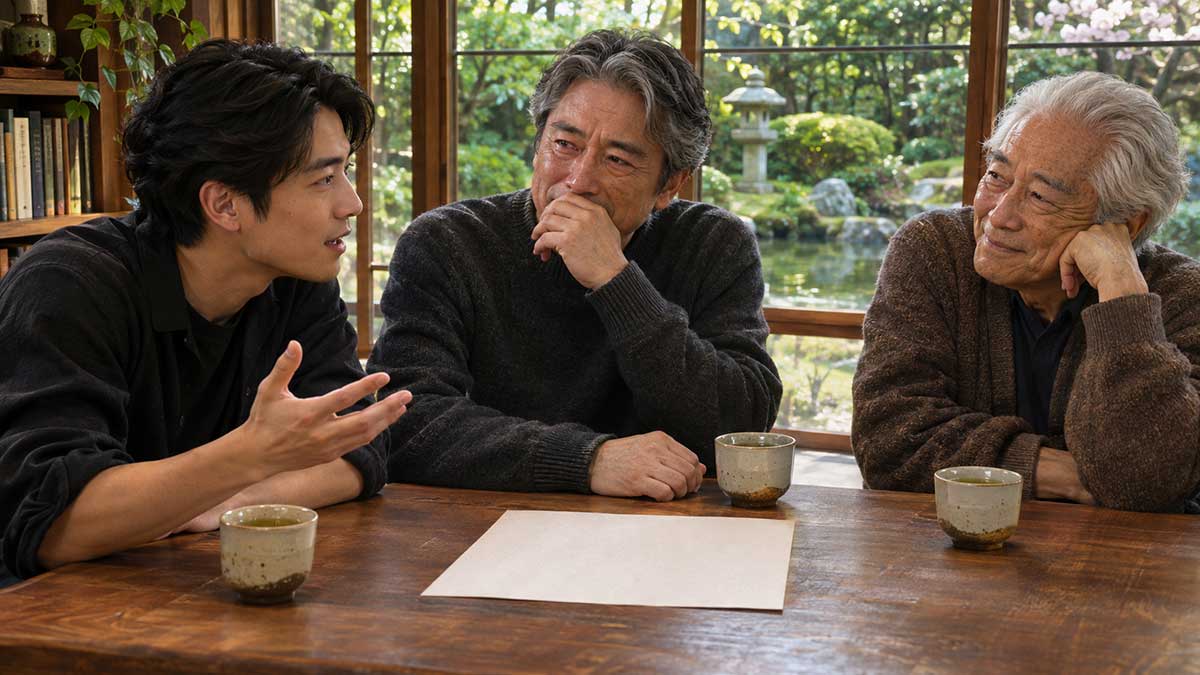
Tony Robbins leans forward as Pamela finishes. Dean Graziosi draws his chair closer to the table.
Tony Robbins: Who helped her get there. That’s a question worth taking some time with.
Dean Graziosi: There may be someone she hasn’t called yet.
Pamela smiles.
Nick Sasaki: Tony, Dean, I attended one of your events once. There was an exercise involving a younger self and a future self. I don’t recall the exact sequence, but I recall how deeply it hit me.
Dean Graziosi: What stayed with you?
Nick Sasaki: The feeling of seeing my life from another age. I could think about years I’d revisited many times, and suddenly they felt different.
Tony nods, then shifts forward in his chair.
Tony Robbins: You’ve got the same history. But now you’re meeting the person who lived it. That can change the questions very quickly.
Nick Sasaki: We’ve spent time asking how someone might recognize another place or time. I want to turn to what happened for me in that room. I left with feelings I hadn’t expected from a guided exercise.
Robert Monroe: Then we have a different experience to examine.
Paramahansa Yogananda: And a person at another age waiting to be heard.
Question 13: Why Can Seeing Your Life From Another Age Make Something Familiar Feel New?
Nick Sasaki: Tony and Dean, why can an exercise like that reach someone so deeply? What changes when we picture ourselves younger or older?
Tony Robbins: Look at how you usually describe your younger self. “I should have known better.” You can say that in a second. You’ve repeated it for years. It’s a pattern.
Now picture the actual person. How old was he? What was happening around him? What did he know that day?
Tony raises a hand, holding the moment.
Tony Robbins: Stay there. You’ve had decades to think about the decision. How much time did he have?
Dean Graziosi: Sometimes twenty minutes. Sometimes someone was waiting for an answer.
Nick Sasaki: And I’m judging him with everything I learned afterward.
Tony Robbins: Exactly. Give him a chance to explain what he was trying to do. You may still wish he had chosen differently. But now you have a person in front of you, and you’re going to have to talk to him.
Robert Monroe: You’ve changed the position from which you examine the memory.
Tony Robbins: Yes. Your focus changes. Your questions change. Your state can change with them. Something you’ve described coldly for years can suddenly become immediate.
Paramahansa Yogananda: You might discover how differently you would speak to another young person.
Nick Sasaki: What would you ask that person?
Paramahansa Yogananda: What he feared. What he hoped would happen. Whether he had anyone to consult.
Dean Graziosi: That last question matters. We can look back and say, “Why didn’t I ask for advice?” Maybe younger you didn’t know anyone he trusted with the problem.
Or he thought asking would expose him. He was trying to look capable.
Pamela Aaralyn: That can stay with you long after you’re young.
Dean Graziosi: It can follow you into every room. You start a business, raise children, take on responsibility, and keep thinking you’re supposed to know already.
Tony Robbins: So ask what that younger person needed. Make it specific. What would have helped him through that afternoon?
Nick Sasaki: Someone who let him ask the embarrassing question.
Dean Graziosi: There’s a sentence you could give him.
Robert Monroe: I would want to ask what surprises you when you look back. Perhaps the younger person had something you now miss.
Nick Sasaki: Such as?
Robert Monroe: Curiosity. The willingness to spend an afternoon pursuing a question without knowing what it would produce.
Paramahansa Yogananda: Or a directness in prayer.
Tony turns toward Yogananda.
Tony Robbins: That makes this a two-way conversation. Older you arrives ready to give a speech. Younger you asks, “What happened to the thing we cared about?”
Dean lets out a small breath.
Dean Graziosi: That question can follow you home.
Question 14: What Did the Encounter With Your Future Self Give You on an Ordinary Day?
Nick Sasaki: Pamela, we left you with the question of who helped your future self. What does that question bring up now?
Pamela Aaralyn: The fact that I was focused on her condition. What she could do. I wanted to know how she had reached that point.
Asking who helped her gives me something else to look at.
Tony Robbins: Good. Give that future woman an actual life. Who did she trust? What did she do when she was discouraged? What did she ask someone else to handle?
Pamela Aaralyn: I would want to hear those answers.
Dean Graziosi: And which answer could help you make a decision today?
Pamela Aaralyn: Perhaps learning what she stopped trying to manage alone.
Nick Sasaki: When you return from an experience like that, does the hope ever become pressure?
Pamela considers the question.
Pamela Aaralyn: It could. I can want the outcome so much that an ordinary difficult day feels discouraging.
Paramahansa Yogananda: Then attend to how you receive yourself on that day.
Tony Robbins: Yes. Pay attention to the meaning you give it. “Today hurts” describes something you’re experiencing. From there, you can ask what would help you through the next hour.
Robert Monroe: A question with a manageable distance.
Dean Graziosi: That’s the distance I’d work with. People hear a big idea and immediately give themselves a five-year assignment. Then they don’t know where to begin.
What would take one thing off your shoulders this week?
Pamela Aaralyn: Telling someone what I need when they ask how I’m doing.
Dean Graziosi: Who?
Pamela smiles at his directness.
Pamela Aaralyn: Someone close to me.
Dean Graziosi: And what would you ask for?
Pamela Aaralyn: Something practical. Something I might usually insist on doing myself.
Nick Sasaki: That takes me back to the question of what we think makes us capable. Sometimes I can recognize that another person needs support and still feel uncomfortable asking for it myself.
Robert Monroe: You have granted everyone else a permission you haven’t quite accepted.
Paramahansa Yogananda: Receiving asks something of us too. We allow another person to see a need we might prefer to conceal.
Tony Robbins: And then we find out what actually happens. You make the request. You give the person a chance to answer. That’s a pattern you can begin practicing.
He looks toward Pamela.
Tony Robbins: Your future self may have had to practice it too.
Pamela nods slowly.
Pamela Aaralyn: I’d like to ask her how awkward she was at the beginning.
Dean Graziosi: That’s the part people leave out of the success story.
Robert Monroe: Often my favorite part.
Question 15: What Would You Tell Your Younger Self, and What Would You Ask Your Future Self?
Nick Sasaki: Tony, guide us through a short exercise for this conversation. Give us a moment with both.
Tony places his feet firmly on the floor.
Tony Robbins: Find a comfortable position. Make whatever small adjustment is available to you. Let yourself breathe easily. You can keep your eyes open.
Choose an ordinary memory you’re comfortable revisiting. Bring to mind a younger version of yourself who was trying to find his way.
Where is that person? What is he wearing? What is taking up so much space in his thoughts?
Tony pauses.
Tony Robbins: Look at how young he is.
Before you tell him what he should do, ask what he needs you to know.
Now consider what you could say honestly. Something you know now. Something he did that deserves credit. Something you’ve been holding against him for a long time.
Give him one sentence.
The room grows still.
Tony Robbins: Now picture an older version of yourself. Choose an age that means something to you.
Give that person an ordinary day. Where do they live? Who gets their attention? What do they make time for?
Ask one question about the life you’re living today.
Let an answer take shape, or leave the question open. When you’re ready, bring your attention back to this room.
Dean waits until Pamela lifts her head.
Dean Graziosi: Before we turn the sentences into something polished, who wants to share what came?
Robert Monroe: I wanted to tell the younger man to keep his questions. Some of the experiences that unsettled him became the subject of his work.
Nick Sasaki: What would you ask the older man?
Robert Monroe: “Which question did you wish you had spent more time on?”
Paramahansa Yogananda: I would tell the boy to continue his search and be patient with the people who loved him.
Nick Sasaki: His family?
Paramahansa Yogananda: Yes. The longing he felt was real. So were their concerns.
Dean Graziosi: And your question for your future self?
Paramahansa Yogananda: “Have you given people the same patient attention you asked them to give you?”
Tony nods.
Tony Robbins: I’d tell younger me to notice who stood beside him. When you’re focused on getting through something, you can miss what another person is giving.
For older me, I’d ask, “Who needs more of your time now?”
Dean lets his hands rest on the table.
Dean Graziosi: I’d tell younger me to stop waiting until he felt completely ready to be seen. He was going to have to learn some things where people could watch.
For older me, “What did you keep postponing that would have mattered to someone you love?”
Pamela Aaralyn: I would tell younger me that she could say when something hurt.
Her voice becomes quieter.
Pamela Aaralyn: And I’d ask future me how she learned to accept help without feeling she had failed.
Nick Sasaki: I’d tell younger me to stay curious about the people closest to him. Living beside someone can make you think you know everything you need to know.
I’d ask older me, “Which conversation are you glad you made time for?”
Dean looks around the table.
Dean Graziosi: Now give one of those questions a place in your calendar.
Robert Monroe: An appointment?
Dean Graziosi: A small one. If you want to pursue a question, set aside time to write it down. If someone needs your attention, make the call. Choose something you can finish.
Pamela Aaralyn: I could make the request we talked about.
Dean Graziosi: When would you make it?
Pamela Aaralyn: The next time someone close to me asks how I’m doing.
Nick Sasaki: I can call someone and leave enough time for an answer I haven’t heard before.
Paramahansa Yogananda: I would carry my question into prayer.
Tony Robbins: Good. Now you’ve given the reflection somewhere to go. You can return to the feeling later. Today, you have a step.
Closing
Nick looks around the table, letting his eyes rest briefly on each guest.
Nick Sasaki: We began with someone coming up the stairs in Benares. He carried a message and a story that startled the boy waiting for him.
We’ve heard accounts of distant places and possible futures. And now we have questions that can stay with us after we leave this room.
He turns to Pamela.
Nick Sasaki: What are you taking with you?
Pamela Aaralyn: The request. I want to hear myself say it.
Robert Monroe: I want to write my question down before I decide I’ll recall it later.
Dean reaches for a sheet of paper and passes it to him.
Yogananda smiles.
Paramahansa Yogananda: You have received very practical assistance already.
Monroe takes the paper.
Robert Monroe: I’m trying to learn to accept it.
The laughter is gentle.
Nick Sasaki: Thank you, all of you. And for anyone reading, take a moment before you leave the table. What is the one sentence you would say to younger you? What would you ask the person you hope to become?
Write them down. Give yourself a chance to return to them.
Final Thoughts by Nick Sasaki
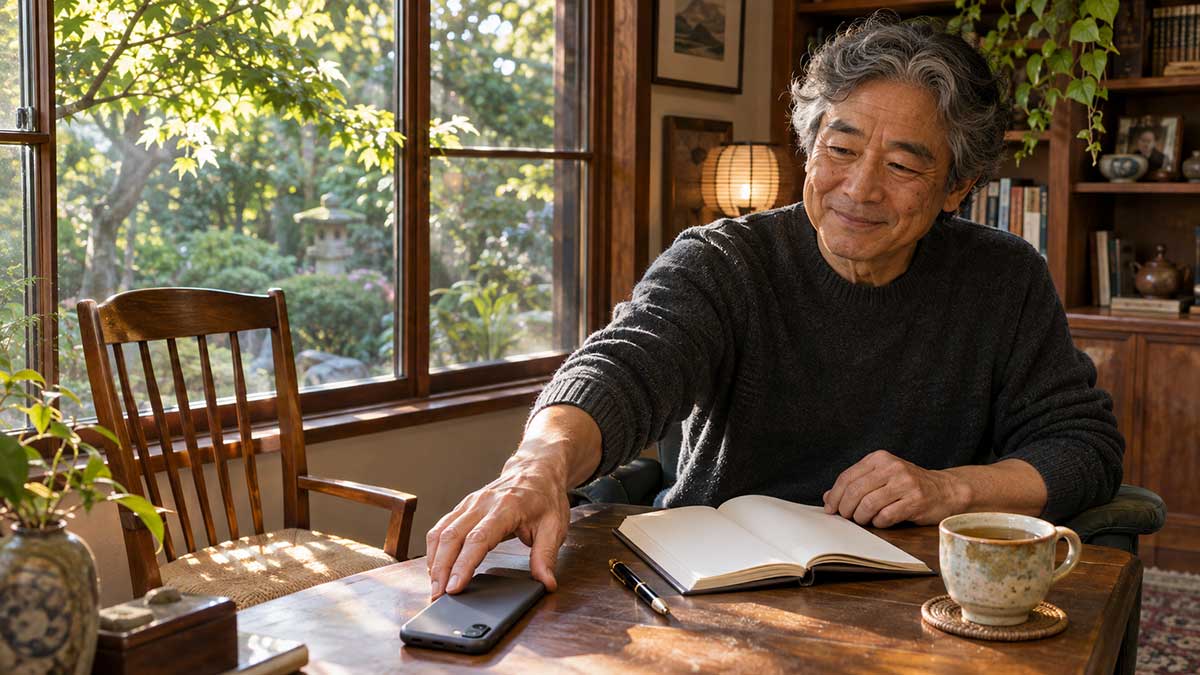
The wooden sandals stayed in my mind throughout this conversation. They belonged to a scene with a waiting boy, an arriving visitor, and a letter that still needed delivering. That small detail helped keep the people visible inside an extraordinary account.
María brought us to the people on the receiving end of a reported visit. They had lives before the encounter and expectations afterward. Her question made me consider how easily someone can become a witness in another person’s story without receiving much room to speak for themselves.
The researchers asked us to preserve that room carefully. A separate account, an early note, and a detail that fails to match can each teach us something. Podmore’s questions made the inquiry more demanding. Myers and Gurney helped us see what a striking correspondence might invite us to investigate next.
I recognized my own eagerness in those exchanges. When an account becomes intriguing, I can start hoping the next detail will confirm it. I want to notice that impulse sooner. It is a reason to return to what was actually said and when it entered the story.
The possible-future accounts raised another question about how a listener responds. A specific year can make a description feel urgent. Before allowing that urgency to shape a decision, I want to ask how the date was established and what could be checked when the time arrives. An unfulfilled prediction belongs in that later conversation too.
Pamela’s question about who helped her future self gave the final topic its emotional center. It opened a life that had first appeared through its outcome. There were people to ask about, requests that might have felt awkward, and difficult days that still needed living. The question brought the discussion close enough to act on.
Tony and Dean then asked us to give reflection a place in the day ahead. I found that invitation useful. A sentence to younger me can lead to a different question now. A question for older me can reveal a conversation I keep postponing. Writing it down gives me something I can return to after the feeling of the exercise has passed.
The question I want to keep is the one I offered at the table. Which conversation will I someday be glad I made time for? I can think of people I would like to hear more from. I can make the call, allow enough time, and ask something whose answer I have yet to learn.
Fictional Conversation Disclaimer
The dialogue, shared encounters, emotional responses, and reflective exercise in this article are fictional creations informed by published accounts, the supplied interview, and Nick’s personal recollection. They should be distinguished from authentic historical quotations, independently verified events, professional guidance, and statements endorsed by the participants. The origins and meaning of the extraordinary experiences discussed remain open questions within this article.
Short Bios:
Nick Sasaki
Nick Sasaki is the creator of ImaginaryTalks.com and the moderator of this fictional roundtable. His questions connect the guests’ accounts with the reader’s relationships, choices, and hopes for the future. Imaginary Talks
Paramahansa Yogananda
Paramahansa Yogananda was an Indian spiritual teacher and the author of Autobiography of a Yogi. His account of meeting Swami Pranabananda supplies the opening episode and a young observer’s questions about an extraordinary experience. Self-Realization Fellowship
Swami Pranabananda
Swami Pranabananda was a disciple of Lahiri Mahasaya. Yogananda portrays him in “The Saint With Two Bodies,” recounting a reported appearance elsewhere during their meeting in Benares. Read the chapter
María de Jesús de Ágreda
María de Jesús de Ágreda was a seventeenth-century Spanish Franciscan nun and religious writer. Historical accounts associate her with the Lady in Blue reportedly encountered by Indigenous people in the American Southwest. Her fictional portrayal retains her Catholic convictions. National Park Service
Padre Pio
Padre Pio was an Italian Capuchin friar and Catholic saint whose life centered on prayer, confession, and service. Accounts associated with him include reported bilocation. His fictional contribution focuses on the concerns of people seeking prayer and care. Vatican biography
Pamela Aaralyn
Pamela Aaralyn is a spiritual teacher and trance channel who describes experiences of remote viewing and bilocation. Her claims of interacting with “humans from the future” inform her fictional contributions about possible timelines and meeting a future self. Official website
Robert A. Monroe
Robert A. Monroe was an author and explorer of reported out-of-body experiences. His books include Journeys Out of the Body and Far Journeys. His work led to the development of the Monroe Institute. Monroe Institute history
Edmund Gurney
Edmund Gurney was a British psychical researcher and a principal author of Phantasms of the Living. His fictional role centers on hearing witnesses in their own words and examining the circumstances of reported experiences. Society for Psychical Research
Frederic W. H. Myers
Frederic W. H. Myers was a British psychical researcher and coauthor of Phantasms of the Living. At this table, he explores what corresponding accounts might suggest about consciousness and what further investigation they require. Cambridge University Press
Frank Podmore
Frank Podmore was a British psychical researcher and coauthor of Phantasms of the Living. His increasingly skeptical approach examined ordinary explanations closely, alongside his continued interest in telepathy. His fictional portrayal brings that scrutiny to the guests’ accounts. Society for Psychical Research biography
Tony Robbins
Tony Robbins is an author, speaker, and personal development coach. His teaching includes attention to emotional state, physiology, and recurring patterns. In this fictional conversation, he leads an original visualization involving younger and future selves. Robbins’s published workbook
Dean Graziosi
Dean Graziosi is an entrepreneur, author, and personal development educator who has collaborated with Tony Robbins. His fictional contribution helps the guests connect reflection with a specific action they can take in their present lives. Official biography
Leave a Reply