


Introduction: Hildegard of Bingen, the Woman Who Was Afraid to Speak
What happens when you believe God has given you a message, but you are afraid to speak? For Hildegard of Bingen, that question was far more than a philosophical exercise. Born in 1098 in the German Rhineland, she would become one of medieval Christianity's most extraordinary figures: a Benedictine abbess, visionary theologian, composer, writer, and religious leader. Yet before she addressed emperors and challenged church authorities, she was a woman struggling with whether she should make her extraordinary experiences known.
Hildegard spent much of her childhood and early adulthood within the religious community at Disibodenberg, where she was formed by the example of Jutta of Sponheim. After Jutta's death in 1136, Hildegard became the leader of the women living there. Her life was shaped by prayer, religious discipline, communal obligations, and the practical responsibilities of caring for others. The Cambridge Companion to Hildegard of Bingen places her achievements within the religious and social circumstances of the twelfth century, when women faced significant restrictions on public theological authority.
According to her own testimony, Hildegard experienced unusual visions from childhood. She described perceptions of extraordinary light that she interpreted as divine revelation, yet she hesitated to communicate them publicly. In 1141, she began the work that became Scivias, a theological account of her visions and their meaning for Christian life. Her uncertainty is especially revealing in her surviving letter to Bernard of Clairvaux, where she sought guidance about experiences she believed carried a divine obligation. Her story begins not with public triumph, but with a struggle over responsibility, fear, and spiritual discernment.
Hildegard's writings were concerned with much more than extraordinary visions. She explored the relationship between God, humanity, and creation, teaching that human beings are accountable for their moral choices. Her works address virtue, repentance, religious corruption, and the beauty and significance of the created world. She composed sacred songs and the dramatic work Ordo Virtutum, giving artistic expression to the struggle between virtue and temptation. Her descriptions of plants, natural substances, and the human body reflect medieval approaches to nature and medicine, not scientific findings that should automatically be accepted as modern treatments.
Around 1150, Hildegard established a new religious community at Rupertsberg, near Bingen. The move required determination, negotiation, and sustained leadership. She was responsible for real women with daily needs, not simply for manuscripts and theological ideas. One of those women was Richardis von Stade, a close companion associated with her writing. When Richardis departed to become abbess elsewhere, Hildegard opposed the separation. Richardis's death in 1152 brought profound grief, revealing a more personal side of a woman often remembered for her spiritual authority. Their surviving correspondence invites difficult questions about love, attachment, and the limits of one person's responsibility for another.
As Hildegard's reputation grew, she corresponded with influential religious and political figures and undertook preaching activities. Her dealings with Emperor Frederick Barbarossa included cooperation and later criticism during conflicts over papal authority. She was neither a modern political revolutionary nor a woman who simply accepted every decision made by influential men. She believed the Church and its leaders were accountable to God, and she was prepared to speak forcefully when she judged that responsibility had been neglected. Her conviction gave her courage, but it raises a difficult question: how can someone who believes she speaks for God remain attentive to the possibility of personal error?
That question became especially meaningful near the end of her life. In 1178, Hildegard's community faced ecclesiastical restrictions after she refused to remove the body of a man buried at Rupertsberg whom officials considered excommunicated. Hildegard maintained that he had been reconciled with the Church before his death. The restrictions affected the community's worship and sacred singing, something deeply significant to an abbess whose compositions expressed her understanding of divine praise. The sanctions were lifted in 1179, the year she died. Her later recognition as a Doctor of the Church in 2012 reflects the enduring importance of her theological legacy.
In this imaginary interview, Nick Sasaki meets the elderly Hildegard at Rupertsberg Abbey during the final year of her life. Their conversation begins with a young girl's unusual experiences and moves through divine calling, creation, sacred song, friendship, grief, political authority, and conscience. Nick approaches her with warmth and genuine curiosity, asking difficult questions without dismissing her Christian convictions or assuming that every claim she made can be independently verified. The encounter invites readers to look beyond the extraordinary woman of medieval legend and meet a religious leader whose greatest challenge may have been learning how to carry a message without confusing the messenger with its source.
Fictional Conversation Disclaimer
This interview is an imaginative historical reconstruction, not an authentic transcript or a collection of verified quotations from Hildegard of Bingen. The dialogue, meeting, setting details, and personal reflections are fictional, informed by historical scholarship and surviving writings. Hildegard's reported visions are presented as her religious experiences, not as independently established supernatural events, and the conversation does not imply endorsement by any historical person or institution.
Topic 1: The Girl Who Saw What Others Could Not
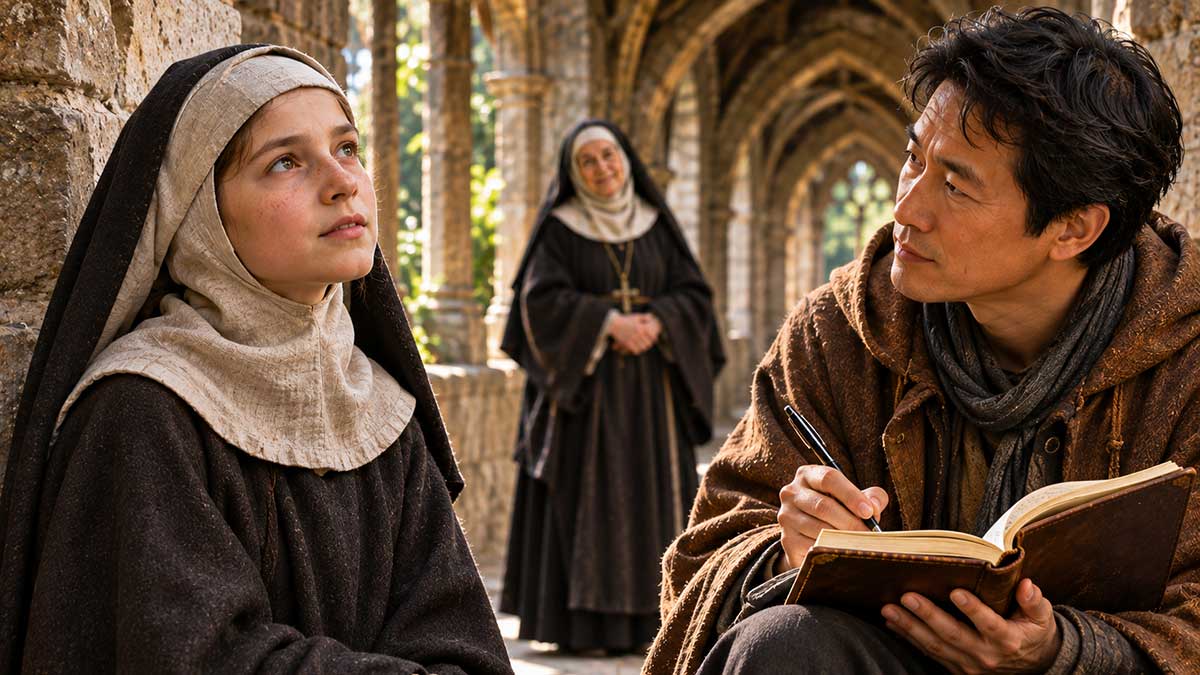
Opening
Rupertsberg Abbey, near Bingen on the Rhine, spring 1179.
The afternoon light enters through a narrow window overlooking the monastery garden. A few sheets of parchment rest on a wooden table beside an inkpot. Somewhere beyond the room, footsteps pass along a corridor, followed by the distant sound of women speaking.
Hildegard of Bingen is examining a small collection of written notes when a visitor is announced. At approximately eighty years old, she moves carefully, but her eyes are attentive and her expression alert.
Nick Sasaki: Mother Hildegard, thank you for receiving me. I hope I'm not interrupting something important.
Hildegard: You are interrupting several things, but none that cannot wait a little.
She gestures toward a chair.
Hildegard: Sit. A monastery is full of people who believe their concerns cannot wait until tomorrow. Sometimes they are correct.
Nick: That sounds familiar. I thought life in a monastery might be peaceful.
Hildegard: Peaceful? At times. Quiet? Less often than visitors suppose.
Nick: I have to admit, I was expecting something different. Perhaps a room filled with mysterious symbols, or a woman waiting to tell me about the heavens.
Hildegard: And instead you find an old abbess concerned with parchment, accounts, and whether her sisters have what they need.
Nick: Exactly.
Hildegard: Then your visit has already been useful.
They share a smile.
Nick: I've read about your visions, your writings, your compositions, and the letters you've sent to some of the most influential men in Europe. But I'd rather begin somewhere else.
Hildegard: Where would you begin?
Nick: With the little girl you once were, before anyone knew your name.
Hildegard rests her hands on the table. For a moment, her attention seems to move far beyond the monastery walls.
Hildegard: That was a very long time ago.
Nick: I have time.
Hildegard: Then ask.
Question 1: You entered religious life at a very young age. How did your childhood and the community around Jutta shape the woman you became?
Nick: You were born in 1098, into a family with considerable standing. Yet much of your childhood unfolded within religious life. Did you ever wonder what your life might have been if you had remained with your family?
Hildegard: A child does not always understand the decisions made for her. Families consider obligations, inheritance, devotion, and the futures of their children. My own life was placed upon a religious path while I was young.
I cannot tell you what another life would have made of me. I can tell you that the life I received became the place where I learned to seek God.
Nick: That's an interesting distinction. You aren't saying you chose everything that happened to you.
Hildegard: No. Who among us chooses everything?
Nick: But you eventually made that life your own.
Hildegard: Through years of living it. A vocation is not fully known in a single morning.
Nick: What do you remember most about Jutta of Sponheim?
Hildegard: Her devotion. Her seriousness. The discipline of prayer that shaped our days.
Jutta had chosen an austere religious life. Those who came near her could see that she regarded the service of God as no small undertaking.
Nick: Was she affectionate?
Hildegard: You ask as though affection must always announce itself in the manner you prefer.
Nick: Fair point.
Hildegard: People express care differently. Some offer warmth through words. Others offer instruction, constancy, and the willingness to bear difficulty alongside another.
I learned from Jutta, but I would not pretend that every lesson was easy.
Nick: Did you ever feel lonely?
Hildegard: There are forms of loneliness in every manner of life. A household filled with relatives may contain loneliness. So may a monastery filled with sisters.
Yet we were not without companionship. We prayed, learned, worked, and lived alongside one another.
Nick: When I think about a young girl growing up behind monastery walls, I picture someone separated from the ordinary world.
Hildegard: Separated from certain activities, certainly. But not from human nature.
There were disagreements, friendships, fatigue, illness, responsibilities, and moments of laughter. A religious enclosure does not remove the human heart.
Nick: So the monastery wasn't an escape from life.
Hildegard: It was a particular way of living it.
Nick: When Jutta died in 1136, you were chosen to lead the women. Did that surprise you?
Hildegard: Leadership is easier to admire from a distance.
When you are responsible for others, their needs become your daily concern. You cannot attend only to your own prayers or studies.
Nick: Did you want that responsibility?
Hildegard: Wanting an office and accepting its duties are different matters.
Nick: You sound like someone who learned that the hard way.
Hildegard: Most abbesses do.
Nick laughs. Hildegard allows herself a small smile.
Nick: What did those early years teach you about God?
Hildegard: That faithfulness is practiced in ordinary hours.
People often seek God in extraordinary events. Yet the soul is formed through prayer when one is weary, through patience when another person is difficult, and through the duties one would sometimes prefer to avoid.
Nick: That's a very different beginning from the extraordinary life people associate with you.
Hildegard: Perhaps people are too eager to separate extraordinary things from ordinary faithfulness.
Question 2: You reported experiencing extraordinary visions from childhood. What did you believe you were experiencing, and why was it difficult to speak openly about them?
Nick: I'd like to ask about something you've described in your writings. You said you experienced unusual visions from childhood.
What was that like?
Hildegard: It is difficult to describe spiritual perception through ordinary language.
From an early age, I experienced what I understood as a light unlike the light that enters through a window. I did not regard it as a dream.
Nick: Were your eyes closed?
Hildegard: My experiences were not dependent upon sleep. I remained conscious of the world around me.
Yet you must understand that the words we use for seeing do not always capture what the soul perceives.
Nick: Were there pictures? Shapes? Did you hear a voice?
Hildegard: My writings speak of images, words, and meanings received through the light. But I would not have you think that I merely watched a painted scene unfold before my bodily eyes.
There is a difference between describing an experience and possessing language adequate to explain it.
Nick: Did you understand what was happening when you were little?
Hildegard: No child understands everything she experiences.
I knew that certain things seemed clear to me in a way I could not easily explain to others. I gradually learned that such experiences were not ordinary.
Nick: Did you tell people?
Hildegard: I was cautious. A child may speak of something unusual and discover that others do not comprehend her.
Nick: Were you afraid they would think something was wrong with you?
Hildegard: I was aware that what I experienced could be misunderstood.
And as I grew older, I became increasingly conscious of the seriousness of claiming anything concerning God.
Nick: That's what fascinates me. Today, some people would immediately want to tell the world they were receiving visions.
You seemed to hesitate.
Hildegard: A person should hesitate before claiming to speak with divine authority.
Nick: But how could you know the visions came from God?
Hildegard studies him for a moment.
Hildegard: You have asked a necessary question.
I interpreted these experiences within the faith in which I had been formed. I examined what I received in relation to Scripture, Christian teaching, and the demands of spiritual life.
I did not believe the experiences were given for my amusement or to make me admired.
Nick: But couldn't someone sincerely believe an experience came from God and still be mistaken?
Hildegard: Human beings are capable of error. That is one reason discernment matters.
Yet I came to believe that the light instructed me in matters I was obliged to communicate. I cannot offer you a demonstration that would make you experience what I experienced.
Nick: I appreciate that answer. I don't want to dismiss your experience, but I don't want to pretend I can verify something I haven't experienced myself.
Hildegard: Then we can speak without pretending to possess the same knowledge.
Nick: Did your visions make you happy?
Hildegard: That is a curious question.
Nick: Why?
Hildegard: You speak as though an extraordinary gift must always be pleasant.
There were moments of illumination, but there was responsibility too. To believe one has received instruction concerning the conduct of others is no light matter.
Nick: So it wasn't simply beautiful.
Hildegard: Beauty and burden are not strangers.
Nick: Were there times you wished the experiences would stop?
Hildegard: There were times when I wished to remain silent about what I believed I had received.
That is not quite the same thing.
Outside, footsteps approach the doorway. A sister quietly asks Hildegard about a practical matter concerning the community. Hildegard answers briefly, then turns back to Nick.
Hildegard: You see? The ordinary world has not disappeared.
Nick: Not for a moment.
Hildegard: Nor did it disappear when I experienced the light.
Question 3: When you believed God was commanding you to write, you hesitated and sought Bernard of Clairvaux's guidance. What were you most afraid might happen if you spoke?
Nick: In 1141, when you were in your early forties, you began writing the visions that became Scivias.
Why then?
Hildegard: I believed I had received a command to make known what had been shown to me.
For many years, I had lived with these experiences without presenting them in the form of a great written work.
But the obligation to speak became, in my judgment, impossible to set aside.
Nick: Yet you resisted.
Hildegard: I did.
Nick: Why?
Hildegard: Consider what you are asking.
I was a woman living within a religious community. I had not been formed through the formal scholarly education available to many learned men.
To claim that I had received a message requiring public attention was an immense responsibility.
Nick: Were you afraid of being laughed at?
Hildegard: Ridicule is unpleasant, but there are greater dangers.
One may mislead others. One may speak from pride while believing oneself obedient. One may draw attention to oneself when the attention should belong to God.
Nick: That's interesting. You were worried about your own motives.
Hildegard: Anyone who speaks of divine matters ought to examine them.
Nick: You wrote to Bernard of Clairvaux, one of the most respected religious figures of your time.
What were you hoping he would tell you?
Hildegard: I sought counsel from a man whose learning and spiritual judgment were widely respected.
I wanted guidance concerning the experiences I had described and the responsibility I believed had been placed upon me.
Nick: Were you hoping he'd say, "Hildegard, you don't have to do this"?
She gives him a searching look.
Hildegard: You seem very interested in finding a way for me to escape my duties.
Nick: Maybe I would have been looking for one myself.
Hildegard: Then perhaps you understand something of the difficulty.
Nick: I do. And there's another part of your story I want to ask about.
In your writings and correspondence, you connected your reluctance to speak with physical suffering. Did you believe your illness was related to your silence?
Hildegard: I understood certain periods of suffering through the spiritual experience I was undergoing.
I believed that resisting what had been commanded of me brought distress.
Nick: But you wouldn't necessarily say that every illness is punishment from God?
Hildegard: No. Human suffering is not so easily explained.
The sick are not to be judged as though their suffering reveals some hidden offense. Compassion is required where knowledge is incomplete.
Nick: That matters to me.
Sometimes people hear religious stories and conclude that if they become ill, they must have failed spiritually.
Hildegard: Such judgments can be cruel.
Nick: When you finally began writing, did the fear disappear?
Hildegard: Why should it?
Nick: I suppose I expected that once you obeyed what you believed was God's command, you would feel certain about everything.
Hildegard: Obedience does not make a person omniscient.
Nor does undertaking a difficult task mean that every difficulty has ended.
Nick: So you continued despite uncertainty.
Hildegard: I continued in the conviction that I was obliged to do so.
Nick: Did you ever think about how much your life might change?
Hildegard: I could not have known everything that would follow.
I did not begin writing so that emperors would receive my letters or that people in distant places would speak of my work.
I began out of the responsibility I believed had been entrusted to me.
Nick: When people today look at your life, they see someone courageous.
But I'm beginning to think courage wasn't the first thing you felt.
Hildegard: Courage is not always the beginning of an action.
Sometimes it is what others call the act of continuing when you would rather withdraw.
Nick: That's something I can relate to.
For a moment, neither speaks. Beyond the window, a breeze moves through the garden.
Nick: May I ask one last question before we move on?
Hildegard: You have already asked considerably more than one.
Nick: Fair enough.
She smiles.
Nick: If you could speak to the young Hildegard who was afraid to write, what would you tell her?
Hildegard considers the question.
Hildegard: I would tell her to examine her heart, seek wise counsel, and not confuse the desire for safety with the voice of conscience.
And I would tell her that being afraid does not settle whether a duty should be undertaken.
Nick: That's a difficult lesson.
Hildegard: The most necessary ones often are.
Closing
The afternoon light has shifted across the table. Hildegard gathers one of the parchment sheets and places it beside the others.
Nick: When I arrived, I thought we would begin with your visions. Instead, we've spent much of our time talking about childhood, responsibility, and fear.
Hildegard: Perhaps you expected the extraordinary to explain everything else.
Nick: I did.
Hildegard: And now?
Nick: Now I'm wondering whether the more interesting question is what you believed those experiences were asking you to do.
Hildegard: That is a better question.
Nick: You spent years wondering whether you should speak. Eventually, you began writing. But what exactly did you believe the world needed to hear?
Hildegard: Ah.
She looks toward the window, where the garden is bright beneath the afternoon sky.
Hildegard: Now we have arrived at the matter itself.
Nick: Then that's where I'd like to go next.
Hildegard: Very well. But you must be prepared to speak of more than visions.
Nick: What else?
Hildegard: God, creation, the human soul, and what people do with the lives they have been given.
Nick leans forward.
Nick: I'm listening.
Topic 2: What the Living Light Revealed
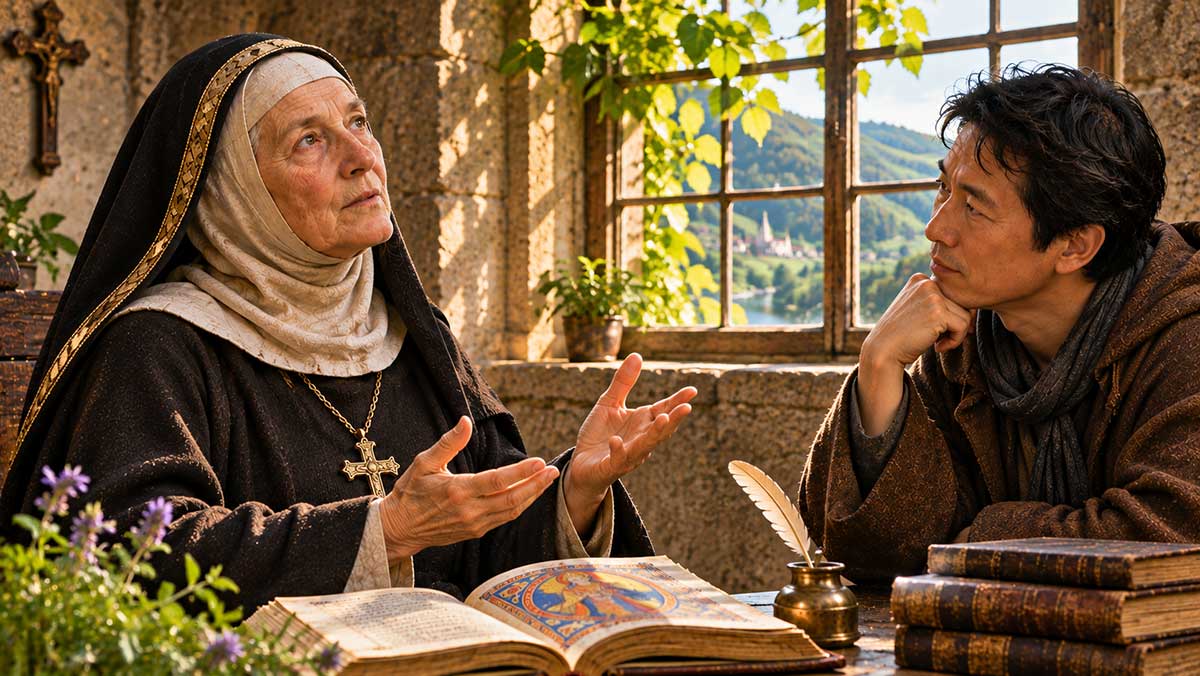
Opening
The afternoon sun has moved across the narrow window of Hildegard's room at Rupertsberg Abbey. Outside, the garden is alive with the ordinary activities of spring. Somewhere beyond the walls, a bird calls repeatedly, undisturbed by the serious conversation taking place inside.
Hildegard reaches for a small cup of water. Nick waits as she drinks.
Nick Sasaki: Earlier, you told me that your visions were never simply about seeing extraordinary things. You believed they carried a message.
Hildegard: Yes.
Nick: Then I want to ask about that message. Not just what you experienced, but what you wanted other people to understand.
Hildegard: That is a more demanding question.
Nick: More demanding than asking what it was like to see heavenly light?
Hildegard: Consider how readily people are fascinated by what is unusual. Tell them of a remarkable vision, and they wish to know its appearance. Tell them that they must examine their conduct, and their enthusiasm may diminish.
Nick: You think people would rather hear about heaven than change their lives?
Hildegard: I think many people prefer knowledge that asks nothing of them.
Nick smiles.
Nick: I suspect that hasn't changed much.
Hildegard: Then perhaps the centuries are not so different after all.
Nick: Let's begin with the light itself.
Question 4: When you described the Living Light, what did you most want people to understand about God, humanity, and the purpose of creation?
Nick: You wrote about what you called the Living Light. When you look back on those experiences now, what did you believe they revealed about God?
Hildegard: I understood the light as an expression of divine wisdom, not as something I possessed or controlled.
God is not an object that the human mind can hold before itself and examine completely. Yet creation bears witness to its Creator.
In the visions I recorded, I sought to communicate something of the order, beauty, and moral significance of God's work.
Nick: When you say creation has an order, what do you mean?
Hildegard: That the world is not without meaning.
The heavens, the earth, the changing seasons, the living creatures, and the human person belong within a creation sustained by God.
But humanity is not merely another stone or tree. Human beings have received reason and the capacity to choose.
With those gifts comes responsibility.
Nick: I've seen illustrations associated with your writings. They show circles, stars, fire, human figures, and strange arrangements of the universe.
Some of them look almost like pictures of the cosmos.
Hildegard: They are images through which spiritual truths are expressed. You must not mistake every image for a drawing of the physical heavens.
Nick: So if I ask whether you were describing the structure of the universe as an astronomer might, I'd be misunderstanding you?
Hildegard: You would be asking a question different from the one the work was written to answer.
Nick: What question were you answering?
Hildegard: How does humanity stand before God? What has been entrusted to us? What has been damaged through sin? And how does divine mercy call human beings back toward life?
Nick: You speak of humanity as part of creation, yet you place enormous responsibility on us.
Hildegard: A creature that can recognize good and evil must answer for its choices.
Nick: But nature can be cruel. There are storms, disease, hunger, and death. When you speak of divine beauty and order, how do those things fit?
Hildegard places her cup on the table.
Hildegard: You are right to ask.
The beauty of creation does not mean that human beings are spared suffering. Nor does the presence of suffering give us permission to dismiss the goodness of everything that lives.
Christian faith teaches that creation is good, yet the world we inhabit is marked by disorder and the consequences of sin.
We are not promised that every earthly sorrow will become understandable to us.
Nick: You've experienced illness yourself.
Hildegard: I have.
Nick: Did that ever make you question the goodness you were describing?
Hildegard: Pain can narrow a person's attention until the suffering seems to fill the whole world.
I would not speak lightly to someone who suffers.
But my conviction concerning God's goodness did not depend upon my body remaining free from pain.
Nick: There's a word often associated with your writings: viriditas. People sometimes translate it as greenness or the vitality of life.
What does it mean to you?
Hildegard: Consider a branch in spring.
When it is alive, it draws nourishment and puts forth leaves. When it is deprived of what sustains it, it withers.
Such greenness can help us speak of life, fruitfulness, and the work of divine grace.
But the image must not be reduced to the plants themselves. It can speak of the soul and of the life God gives.
Nick: So when you look at a tree, you're seeing more than a tree.
Hildegard: I am seeing a tree.
Nick laughs.
Hildegard: And I may give thanks for the life it possesses.
Nick: You caught me trying to make everything mysterious.
Hildegard: A tree need not cease being a tree to remind us of its Creator.
Nick glances through the window at the garden.
Nick: I like that. There's something reassuring about the idea that ordinary life is already meaningful.
Hildegard: Then do not overlook it in your search for extraordinary experiences.
Question 5: Your writings connect human virtues, moral choices, and the natural world. What did you believe people were failing to recognize about their responsibilities?
Nick: Your writings can be demanding. You speak about virtues, vices, repentance, and the consequences of human choices.
Were you disappointed in humanity?
Hildegard: I was concerned for humanity.
Disappointment may become an excuse to turn away from others. Concern requires us to remain attentive to what may still be restored.
Nick: What troubled you most about the people of your time?
Hildegard: Among the gravest dangers was the failure of those entrusted with spiritual responsibility.
A shepherd who neglects the flock does harm beyond himself.
When religious leaders seek comfort, wealth, or worldly favor rather than faithful service, those who depend upon their guidance suffer.
Nick: You were quite willing to criticize bishops and other churchmen.
Hildegard: Their office did not free them from accountability.
Nick: But couldn't someone say the same thing about you? You lead a religious community. You believe God has given you a message. How do your sisters know when you're acting wisely?
Hildegard: They know that I am a human being, not God.
Nick: Does that mean they can disagree with you?
Hildegard: A community cannot live without counsel, correction, and obedience. Nor can it live well if its leader refuses to hear what others know.
But hearing disagreement does not mean that every decision can be left unresolved.
Nick: That sounds difficult.
Hildegard: It is.
Nick: In your work about virtues and vices, you describe moral struggle almost as if different qualities within a person were speaking to one another.
Why approach morality that way?
Hildegard: Human beings do not experience temptation merely as a collection of abstract propositions.
Pride persuades. Envy complains. Despair tells the soul that change is impossible. Humility and charity call it toward another way of living.
By giving such struggles recognizable forms, one may help the listener examine what is happening within the heart.
Nick: So a person can know the right thing and still hear another voice telling them not to do it.
Hildegard: Certainly.
Nick: What about someone who has made terrible mistakes? Do you believe they can truly change?
Hildegard: The call to repentance would be meaningless if change were impossible.
Yet repentance is more than regret over consequences. It requires a turning of the will, a willingness to confess wrongdoing, and an effort to repair what can be repaired.
Nick: That last part matters. People sometimes say they're sorry, but the person they hurt is still carrying the damage.
Hildegard: Then the injured person must not disappear from our concern.
Words of sorrow do not make an injustice harmless.
Nick: You've spoken about leaders who fail their responsibilities. What about ordinary people who feel too small to change anything?
Hildegard: They are not too small to practice justice in their own dealings, to care for someone in need, or to refuse a dishonest advantage.
Not every act of faithfulness is witnessed by an emperor.
Nick: You keep returning to ordinary responsibilities.
Hildegard: They are where much of human life is lived.
Nick: Let me challenge you on something.
You were convinced that your visions carried divine instruction. But other people might be equally convinced of something very different.
How should someone respond when two people both claim God supports their position?
Hildegard's expression grows more serious.
Hildegard: They must not imagine that conviction alone establishes truth.
Claims concerning God must be examined with care, in the light of Scripture, the teaching of the Church, and the fruits of the conduct they encourage.
A person who uses divine authority to excuse cruelty or corruption gives reason for grave concern.
Nick: And what if the person making that claim is you?
Hildegard: Then the seriousness of the claim is no less.
Nick: You don't seem offended by that question.
Hildegard: Would you prefer that I be offended?
Nick: No. I'm relieved.
Hildegard: Good. Then we have avoided an unnecessary quarrel.
Nick smiles, but he notices that she has not treated his question as a trivial one.
Question 6: You composed sacred songs and wrote about the human body and natural substances. How did those different forms of expression belong together in your religious life?
From beyond the room comes the faint sound of several sisters speaking in the corridor. One voice briefly carries a melodic phrase before falling silent.
Nick: Was that singing?
Hildegard: Perhaps one of the sisters is preparing something for worship. Or perhaps she has forgotten that a corridor carries sound rather well.
Nick: Do you ever ask them to be quiet?
Hildegard: When quiet is needed, yes. But I would be a strange woman to compose sacred songs and then complain whenever someone sang them.
Nick: I've been wanting to ask about your compositions.
Your sacred songs are unlike much of the music people associate with monasteries. What drew you to write them?
Hildegard: Sacred song gives voice to praise, prayer, and the longing of the soul for God.
The words matter. Their meaning matters. And the movement of the voice can help a community give expression to what it believes.
Nick: Did you enjoy composing?
Hildegard: There is joy in giving form to praise.
But composing for a religious community is not simply a matter of private delight. The sisters must learn what is written, and the work must serve devotion.
Nick: I can picture you presenting a difficult new composition and discovering that the sisters aren't quite as enthusiastic as you are.
Hildegard: You may picture whatever you please. I suspect you have never been responsible for teaching a room of people to sing together.
Nick: You suspect correctly.
Hildegard: Then perhaps you should not assume that writing a composition is the most difficult part.
They both laugh.
Nick: You wrote a dramatic work, Ordo Virtutum, in which virtues appear as characters and the human soul struggles over which way to follow.
What interested you about presenting the spiritual life as a drama?
Hildegard: A soul does not struggle with pride, temptation, or despair as though reading a list of definitions.
The struggle is experienced. One desire calls against another. The soul must choose.
Through dramatic voices, listeners may recognize that conflict more clearly.
Nick: And the devil in that work doesn't sing like the virtues.
Hildegard: The contrast serves the meaning of the drama.
Nick: It's a striking choice.
Hildegard: Evil may imitate many things, but it cannot give the soul the harmony that belongs to goodness.
Nick: You seem to see a connection between spiritual life and the way things fit together.
Hildegard: A well-ordered life does not mean a life without difficulty. It means that one's desires and actions are directed toward what is good.
Nick: Let me ask about another part of your work.
You wrote about plants, stones, animals, illness, and the human body. How did you become interested in those subjects?
Hildegard: We live among the works of creation. We eat, fall ill, recover, cultivate plants, and depend upon the earth for much of what sustains us.
The study of natural things belongs to the effort to recognize their qualities and uses.
Nick: Did you think of yourself as a healer?
Hildegard: I would not separate care for the sick from the wider responsibilities of a religious community.
But you must distinguish observing the qualities of natural substances from claiming complete knowledge of their effects.
Nick: That's a useful distinction.
People in my time might read your descriptions of remedies and assume that anything you wrote must work.
Hildegard: Why should they assume such a thing?
Nick: Your reputation.
Hildegard: Reputation is a poor substitute for judgment.
Nick: I wish more people understood that.
Hildegard: Then encourage them to examine claims carefully.
Nick: There's something else I find remarkable.
You wrote theology, sacred poetry, music, and accounts of the natural world. Today, we often separate those activities into different professions.
To you, were they all part of one calling?
Hildegard: They were not identical tasks.
A song is not a description of a plant. A theological vision is not a record of an illness.
Yet the person who studies, prays, writes, and cares for others does not become a different creature with each activity.
All these things take place within the life God has given.
Nick: Did you ever wish you could devote yourself entirely to writing and composing, without having to manage the monastery?
Hildegard: There were days when the work of administration demanded attention I might otherwise have given to study.
Nick: I thought so.
Hildegard: But these women were not an inconvenience standing between me and my calling.
They were part of the responsibility entrusted to me.
She looks toward the doorway.
Hildegard: Their lives mattered more than my preference for an uninterrupted afternoon.
Nick: That's a different way of thinking about achievement.
Hildegard: What would an achievement be worth if those nearest to you were neglected for its sake?
Nick considers the question.
Nick: You know, I came here expecting to talk about a woman who saw extraordinary things. Instead, you keep bringing me back to the people standing right in front of her.
Hildegard: Then perhaps you are beginning to hear what I have been saying.
Closing
The light outside has softened. Hildegard rises carefully and walks a few steps toward the window. Nick remains seated, giving her time.
Nick: May I tell you what has surprised me most?
Hildegard: You have already surprised me several times. It seems only fair.
Nick: I thought your visions were the center of your life. But when you explain them, you keep speaking about responsibility.
Responsibility to God. Responsibility to creation. Responsibility to the people around you.
Hildegard: A revelation that asks nothing of the person receiving it would be a curious thing.
Nick: And you didn't keep your message confined to writing.
You established a monastery. You led women. You composed for them. You dealt with their problems.
Hildegard: The written word and the lived life should not be strangers.
Nick: Was establishing Rupertsberg difficult?
Hildegard turns from the window.
Hildegard: Very.
Nick: You were already leading the women at Disibodenberg. Why leave a place where you had lived for so many years?
Hildegard: I believed we were called to establish our own community. But believing that a work should be undertaken does not mean everyone welcomes the undertaking.
There were questions of land, resources, authority, and the welfare of the sisters.
Nick: Did everyone agree with you?
Hildegard: Certainly not.
Nick: I had a feeling you were going to say that.
Hildegard: Then perhaps your ability to anticipate events is improving.
Nick laughs.
Nick: There's someone else I'd like to ask about. Richardis von Stade.
The humor leaves Hildegard's expression, though she does not turn away.
Hildegard: Richardis.
Nick: She helped you with your work, didn't she?
Hildegard: She did.
Nick: And you were close.
Hildegard: Yes.
For a moment, Hildegard looks toward the parchment resting on the table.
Nick: I don't want to ask carelessly. But I've read that when she left your community, it was deeply painful for you.
Hildegard: It was.
Nick: Would you be willing to tell me about her?
Hildegard returns to her chair. She sits slowly, resting one hand on the edge of the table.
Hildegard: Yes, Nick.
She pauses.
Hildegard: But if we speak of Richardis, you must understand that I am not speaking merely of a sister who assisted with manuscripts.
Nick: I understand.
Hildegard: She was dear to me.
Nick waits, allowing the silence to remain.
Hildegard: And there are things a person may teach others about surrendering to God's will that become much harder when the surrender is demanded of her own heart.
Topic 3: The People She Could Not Bear to Lose
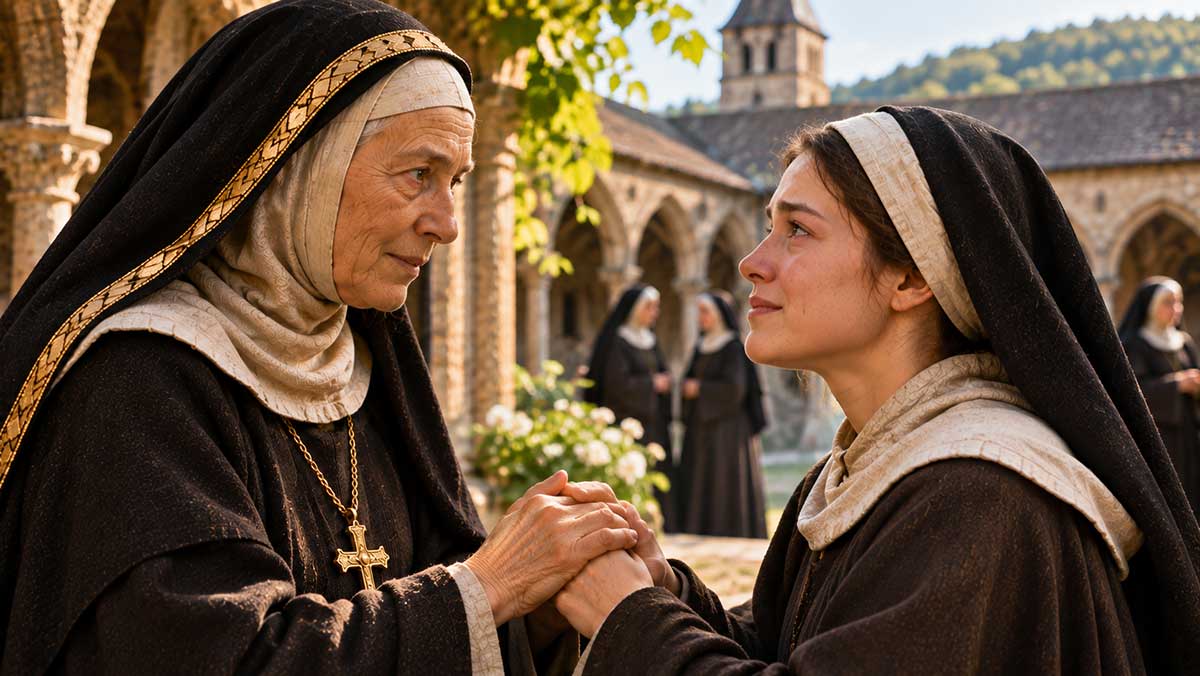
Opening
For a little longer, neither speaks.
Hildegard sits with one hand resting beside the parchment on her table. Beyond the window, the garden is quiet. The distant sounds of the abbey continue, but something in the room has changed since Nick mentioned Richardis.
Nick Sasaki: We don't have to talk about her if it's too painful.
Hildegard: You have come a very long way to ask questions, Nick. I would not have you become timid just when the questions become difficult.
Nick: I don't want to mistake curiosity for kindness.
Hildegard: Then you have already considered something many questioners neglect.
She folds her hands.
Hildegard: Richardis was dear to me. Her memory remains dear. That does not mean her name must be avoided.
Nick: Thank you.
Hildegard: But to understand what happened, you should first understand the community in which we lived.
Nick: Rupertsberg?
Hildegard: Yes. And what it required of us to come here.
Question 7: Establishing Rupertsberg required you to separate your community from Disibodenberg. What did that decision teach you about leadership and responsibility for other women?
Nick: You spent much of your life at Disibodenberg. Then, around 1150, you led your sisters to establish this monastery.
Why was that so important to you?
Hildegard: I believed we had been directed to establish a community at the place associated with Saint Rupert.
The women needed a religious house in which their common life could develop under its own leadership.
But leaving a familiar place is not accomplished by conviction alone.
Nick: What stood in your way?
Hildegard: Many things. The arrangements that had governed our former life, the resources needed to sustain a new house, and the concerns of those who did not wish us to depart.
We were not moving a few books from one room to another.
Nick: I suppose I hadn't thought about that.
Hildegard: Buildings must be made suitable for habitation. Food must be obtained. The sick must be cared for. Land and income must be administered. Religious observance must continue.
A woman who announces that God has called her to establish a monastery must still consider where the sisters will sleep.
Nick: That's a memorable way to put it.
Hildegard: It is memorable only if one has never had to arrange such things.
Nick: Were you ever tempted to give up?
Hildegard: There were difficulties severe enough to test my resolve. I understood the move as an obligation, and I persisted.
But I had to learn that the welfare of a community cannot be separated from the ordinary means by which it survives.
Nick: Some people might see your decision as a declaration of independence from the monks.
Hildegard: Independence is a word that may conceal as much as it reveals.
We sought a distinct home for our religious community. That did not mean rejecting the Church or imagining that we owed no duties to others.
Nick: Did all the sisters want to move?
Hildegard: You should not imagine that every woman who entered a religious house possessed the same wishes or fears.
A decision affecting a community may be accepted with confidence by some and anxiety by others.
Nick: Did that trouble you?
Hildegard: A leader should be troubled by the possibility that her decisions will cause suffering.
If she is never troubled by it, I would question whether she has considered those entrusted to her care.
Nick: But you still made the decision.
Hildegard: Yes.
Nick: How did you know you weren't simply imposing your own will?
Hildegard considers him carefully.
Hildegard: That is a question every leader ought to face.
I believed the work had been entrusted to me through divine instruction. Yet the responsibility for carrying it out remained mine.
Believing a decision to be right does not remove the obligation to attend to its consequences.
Nick: Were there moments when you realized you had been too demanding?
Hildegard: A person who lives for many years in authority has ample opportunity to discover that good intentions do not prevent errors in judgment.
Nick: That's a gracious answer.
Hildegard: Do not praise me too quickly. I have not offered you a catalogue of my faults.
Nick laughs.
Nick: Fair enough.
Hildegard: I have been firm. I have opposed decisions I considered harmful. I have sometimes found patience difficult.
Nick: You?
Hildegard: I see that my reputation has misled you.
Nick: Perhaps a little.
Hildegard: Religious life does not turn a woman into an angel. It gives her opportunities to confront the ways in which she is not one.
Nick: And Richardis was part of those early years here?
Hildegard: Yes. She had been among those who assisted me in my work. She was educated, capable, and devoted to religious life.
Nick: Did she help you with your writing?
Hildegard: She was associated with that work, together with others who assisted in preparing and preserving what I wrote.
But I would not have you think of her merely as a pair of hands holding a pen.
Nick: Who was she to you?
Hildegard's expression softens.
Hildegard: A sister whose companionship I valued greatly.
Nick: Did she understand you in a way others didn't?
Hildegard: We shared work, prayer, and years of religious life. Such companionship can become precious.
I will not claim to know every thought she held. But I knew what her presence meant to me.
Question 8: When Richardis von Stade was appointed to lead another community, you resisted her departure. How did you distinguish concern for her from your own desire to keep her close?
Nick: Around 1151, Richardis was appointed abbess of another community. You opposed the appointment.
Why?
Hildegard: I feared that the transfer was not being undertaken for the right reasons or in a manner that would serve her spiritual welfare.
I believed she was being drawn away from the community where her religious life had developed.
Nick: You suspected family influence?
Hildegard: Her family held considerable standing. Questions of family interest and ecclesiastical office could not simply be ignored.
But I would not ask you to accept every suspicion I held as a fact established beyond dispute.
Nick: You wrote to influential people trying to prevent her departure.
Hildegard: I did.
Nick: You must have felt strongly about it.
Hildegard: Very strongly.
Nick: Let me ask something difficult.
Was it possible that Richardis was ready for a responsibility you didn't want her to accept?
Hildegard does not answer immediately.
Hildegard: It is possible for one person to see a calling differently from another.
Nick: But she did leave.
Hildegard: Yes.
Nick: Did you ever ask yourself whether you were protecting her or protecting yourself from losing her?
Hildegard looks down at her hands.
Hildegard: I believed I was acting for her good. I would not deny that her departure caused me personal sorrow.
You are asking me to separate those things as though the human heart always presents its motives in orderly rows.
Nick: It rarely does.
Hildegard: Love may be sincere and still be accompanied by fear. Concern may be genuine and still be sharpened by attachment.
Nick: So you can't say with certainty that your own feelings played no part.
Hildegard: I would be foolish to say that.
Nick: I appreciate your willingness to consider it.
Hildegard: Do not mistake consideration for agreement with every conclusion you may draw.
Nick: I won't.
Hildegard: I remained concerned about the circumstances of her appointment. Those concerns were not invented merely to conceal my grief.
Nick: That's fair.
Hildegard: Yet I grieved.
Outside, a bell sounds briefly in another part of the monastery.
Nick: What was the hardest part of her leaving?
Hildegard: The knowledge that the life we had shared would not continue in the same form.
You may prepare yourself for a separation in thought. When it comes, the absence is no longer an idea.
There is a place where someone once sat. A task she once performed. A question you would have brought to her.
And then you must learn that the day continues without her.
Nick: That's something people in any century can recognize.
Hildegard: I would think so.
Nick: Were you angry with her?
Hildegard: My letters reveal how deeply I opposed the separation. They should not be softened into a story of cheerful acceptance.
But I would not wish to reduce Richardis herself to the pain I experienced.
Nick: What do you mean?
Hildegard: She had her own life before God.
That is a truth easier to speak than to bear when someone dear to us goes where we do not wish her to go.
Nick: Did you ever wonder whether your opposition made things harder for her?
Hildegard's face grows still.
Hildegard: I cannot tell you everything she felt. I did not possess her heart.
I can acknowledge that my actions were forceful and that the situation brought distress.
Nick: You know what strikes me?
You were willing to confront powerful people to keep her here. The same determination that helped you establish this monastery may have made it harder to let her leave.
Hildegard: A strength exercised without sufficient wisdom can become a burden to others.
Nick: Do you think that happened?
Hildegard: I think it is a question worthy of examination.
Nick lets the answer stand.
Question 9: After Richardis died, what did grief teach you about love, attachment, and surrendering your will to God?
Nick: Richardis died in 1152, not long after she left Rupertsberg.
How did you learn of her death?
Hildegard: News came from those connected with her new community and family. Her brother Hartwig wrote concerning her final illness and death.
Nick: That must have been devastating.
Hildegard: It was a profound sorrow.
Nick: You had fought so hard to keep her close, and then there was no possibility of her returning.
Hildegard: Death makes many of our earthly plans seem small.
Nick: Did you feel regret?
Hildegard: I grieved for her. I wished that our separation had not occurred as it did.
But regret can take many forms, Nick. There is sorrow for what happened, sorrow for what one could not prevent, and sorrow for words or actions one wishes had been different.
I would not claim that every question in my heart received an answer.
Nick: Did you ever feel angry with God?
Hildegard: My surviving words speak of grief, affection, and the hope that Richardis had been received into God's mercy.
I will not invent for you a confession of anger simply to make my sorrow more dramatic.
Nick: I respect that.
Hildegard: Grief does not need embellishment to be real.
Nick: What did you miss most about her?
Hildegard looks toward the table.
Hildegard: Companionship.
Not merely assistance with work. The knowledge of another person formed through years of shared life.
Nick: When someone is part of your daily world, you don't always realize how much of that world includes them.
Hildegard: Until their absence teaches you.
Nick: Did your faith make the loss easier?
Hildegard: Faith gave me a way to commend her to God. It did not make her absence pleasant.
Nick: That's an important distinction.
Hildegard: Christian hope does not require us to pretend that death is a small matter.
Our Lord wept at the tomb of Lazarus. Grief is not foreign to faith.
Nick: You believed Richardis was with God?
Hildegard: I entrusted her to divine mercy. The hope of eternal life is not the same as claiming to possess complete knowledge of another soul's final state.
Nick: Did you ever feel that God was asking you to surrender something you weren't ready to surrender?
Hildegard: I had taught obedience for many years. I knew the words, the prayers, and the disciplines.
Yet knowing the teaching does not mean the heart has finished learning it.
Nick: What was the lesson?
Hildegard: That loving another person does not give us possession of her life.
Nick: That's difficult.
Hildegard: Yes.
Nick: Especially when you believe you're responsible for her spiritual welfare.
Hildegard: Responsibility must be exercised with humility. We may guide, counsel, warn, and pray. We cannot take the place of God in another person's soul.
Nick: Do you think Richardis taught you that?
Hildegard: Her life and death gave me occasion to confront it.
Nick: If she were sitting here now, what would you want to say to her?
Hildegard's gaze settles on the empty chair beside Nick.
Hildegard: I would not begin by explaining why I opposed her departure.
Nick: What would you say?
Hildegard: I would be glad to see her.
Nick remains quiet.
Hildegard: There are moments when we prepare many words for someone we love. Then, if that person stands before us, the words become less important than the meeting itself.
Nick: Would you ask her forgiveness?
Hildegard: If I had caused her pain through my actions, I would wish to acknowledge it.
But I would not place words in her mouth or presume to know what she would ask of me.
Nick: That's a thoughtful answer.
Hildegard: You sound disappointed.
Nick: No. I was expecting something more dramatic, perhaps.
Hildegard: Then you have spent too much time among storytellers.
Nick laughs softly.
Nick: Perhaps I have.
Hildegard: Real love is not always expressed through a magnificent speech.
Sometimes it is found in prayer for someone who can no longer answer.
Nick: Do you still pray for her?
Hildegard: Yes.
Nick: After all these years?
Hildegard: Why should the passage of years make affection meaningless?
The room grows quiet again.
Nick: Earlier, you said that the religious life doesn't turn a woman into an angel.
I think I understand that better now.
Hildegard: Good. Angels have their own calling. We must attend to ours.
Nick: And ours includes learning how to love people without controlling them.
Hildegard: It includes learning that our love must be purified of pride and possessiveness, however sincere our concern may be.
Nick: Do you think you've finished learning that?
Hildegard: At eighty years of age, I would be reluctant to announce that my education is complete.
Closing
The afternoon has grown quieter. A sister passes the doorway carrying folded linen, pauses to acknowledge Hildegard, and continues along the corridor.
Nick: When we began talking about Richardis, I thought I would hear a story about a painful separation.
But it's become something larger.
Hildegard: Has it?
Nick: You believed God had entrusted you with a mission. You established this community. You led women and defended what you thought was right.
Yet when Richardis left, the same conviction that gave you strength may have made it difficult to accept her own path.
Hildegard: You have listened carefully.
Nick: I don't know whether you were right to oppose her departure.
Hildegard: Nor can you settle that question simply by knowing how much I loved her.
Nick: Exactly.
Hildegard nods.
Nick: There's something else I keep thinking about.
You were willing to challenge influential people over Richardis. But that wasn't the only time you confronted people with authority.
You wrote to bishops, religious leaders, and even Emperor Frederick Barbarossa.
Hildegard: I did.
Nick: Did you ever worry that your certainty could become dangerous?
Hildegard looks directly at him.
Hildegard: Certainty without humility is dangerous in anyone, whether she governs a monastery or wears an imperial crown.
Nick: How did you know when to speak firmly and when to question yourself?
Hildegard: I did not always find such judgments easy.
Nick: I'd like to hear about that. Especially Frederick.
Hildegard: Frederick Barbarossa.
She says the name without hesitation.
Nick: You knew him?
Hildegard: We had dealings, and we corresponded. Our relationship was not without difficulty.
Nick: I've heard that you could be quite direct with him.
Hildegard: An emperor is still a man.
Nick: Most people would be careful about reminding him of that.
Hildegard: Then perhaps more people should consider what happens when rulers forget it.
Nick smiles.
Nick: I have a feeling this is going to be an interesting conversation.
Hildegard: You have been asking interesting questions all afternoon.
She reaches for her cup of water.
Hildegard: But before you decide that I was fearless, you should understand what it meant to address those who held authority over the affairs of kingdoms and the Church.
Nick: I'm ready to listen.
Hildegard: Then let us speak of emperors, bishops, and the difficult responsibility of telling influential people what they do not wish to hear.
Topic 4: When an Abbess Challenged an Emperor

Opening
The light has begun to soften over the Rhine. Through the open window, a cool breeze moves the edge of a parchment resting on Hildegard's table.
Hildegard reaches across and places a small weight upon it.
Nick Sasaki: You've spent much of your life writing letters to people who could command armies, appoint officials, and influence the direction of the Church.
Hildegard: Some of them were more receptive to counsel than others.
Nick: I can believe that. But I keep picturing you here, surrounded by manuscripts and sisters who need your attention, writing to an emperor.
Hildegard: An emperor is capable of receiving a letter.
Nick: That's not quite what I meant.
Hildegard: I suspected as much.
Nick laughs.
Nick: Most people would hesitate before telling someone like Frederick Barbarossa that he was making a serious mistake.
Hildegard: And what would you have them do instead?
Nick: Perhaps choose their words very carefully.
Hildegard: That is often wise.
Nick: You don't sound like someone who always chose gentle words.
Hildegard: Gentleness and honesty are not enemies. But neither is every occasion suited to the same manner of speaking.
Nick: Did you ever wonder whether you were going too far?
Hildegard: A person who offers correction should consider that possibility. The difficulty is knowing when caution serves wisdom and when it becomes an excuse for silence.
Nick: That sounds like the question we've been circling all afternoon.
Hildegard: Then perhaps we should finally examine it.
Question 10: You corresponded with emperors, bishops, and other influential figures. How did you find the courage to address men who held far greater worldly authority than you?
Nick: When you began writing Scivias, you were concerned about speaking publicly. Yet in later years, you corresponded with popes, bishops, abbots, and rulers.
How did that change happen?
Hildegard: Gradually.
The recognition given to my writings brought inquiries from people beyond our community. Some sought spiritual counsel. Others asked about difficulties in their own lives or responsibilities.
I did not begin with the intention of becoming an adviser to rulers.
Nick: But eventually rulers were asking for your advice.
Hildegard: Some did.
Nick: Did you ever look at a letter and think, "Why is this person asking me?"
Hildegard: I might ask whether the person truly desired counsel or merely wished to receive approval.
Nick: That's a good distinction.
Hildegard: People sometimes seek advice when they have already decided what they intend to do.
Nick: And they hope you'll agree.
Hildegard: Agreement is pleasant. Correction is less so.
Nick: Did being a woman make it harder for your words to be taken seriously?
Hildegard: Women did not ordinarily hold the offices occupied by bishops or rulers. I had no such office, nor did I claim one.
I spoke as a religious woman who believed she had received a duty to communicate divine instruction.
Nick: Was that why you often described yourself as weak or unlearned?
Hildegard: Such language acknowledged my position before God and the limitations of my formal education.
I did not claim that my message arose from scholarly distinction or worldly rank.
Nick: But you were clearly intelligent. You had studied Scripture, composed sacred works, and governed a monastery.
Hildegard: Learning does not require a person to announce herself superior to others.
Nick: True. But couldn't describing yourself as weak make people underestimate you?
Hildegard: Some may have done so.
Nick: And then they received one of your letters.
Hildegard gives him a brief, amused look.
Hildegard: A letter should be judged by what it says.
Nick: You traveled to preach, too. That seems extraordinary for a woman of your time.
Hildegard: I addressed religious communities and gatherings where I believed correction or instruction was needed. These activities took place within the religious circumstances of my age.
Nick: Were you nervous before speaking?
Hildegard: I was concerned with the responsibility of speaking truthfully. I would not have you suppose that every occasion produced the same feelings.
Nick: What did you say to clergy who were neglecting their duties?
Hildegard: That the care of souls was not an ornament of their office.
A man who accepts spiritual authority must consider those who depend upon his teaching and example. If he pursues wealth, comfort, or influence at their expense, he betrays a grave responsibility.
Nick: Did you encounter resistance?
Hildegard: Correction is not always welcomed.
Nick: Did anyone tell you that a woman should remain silent?
Hildegard: The place of women in public religious instruction was restricted. My own activities were understood through the exceptional authority attributed to my visions.
You must not mistake my circumstances for a general permission granted to every woman to preach as she pleased.
Nick: That's important. You weren't trying to overturn the entire structure of the Church.
Hildegard: I was calling those within the Church to faithfulness.
Nick: Yet you could criticize people who held authority over you.
Hildegard: An office deserves respect. Its holder remains answerable for his conduct.
Nick: Did that distinction help you speak without feeling that you were attacking the Church itself?
Hildegard: Yes. To warn a negligent shepherd is not to despise the flock or reject the Church.
Nick: I wonder how many leaders actually welcomed your warnings.
Hildegard: I did not count their gratitude.
Nick: Probably a good thing.
Hildegard: Gratitude is not the proper measure of whether correction was necessary.
Question 11: Your relationship with Frederick Barbarossa changed over time. What led you to challenge his political and religious decisions?
Nick: Let's talk about Frederick Barbarossa.
When people hear that you challenged an emperor, they might picture a dramatic confrontation. You standing before his throne, refusing to bow.
Was it anything like that?
Hildegard: You have a fondness for dramatic scenes.
Nick: I admit it.
Hildegard: Then you must sometimes be disappointed by history.
Our dealings included correspondence and contact within the political and religious circumstances of the empire. There was cooperation before there was sharper disagreement.
Nick: He granted protection to your monastery, didn't he?
Hildegard: Imperial protection was valuable to a religious community. It could help safeguard its property and interests.
Nick: So you weren't enemies from the beginning.
Hildegard: No.
Nick: What changed?
Hildegard: The conflict over the papacy became a grave matter.
Frederick supported rival claimants during the division within the Church. I regarded his actions as dangerous and contrary to the rightful order of ecclesiastical authority.
Nick: He probably believed he had good reasons.
Hildegard: Rulers commonly believe their reasons are sufficient.
Nick: But isn't that true of religious leaders, too?
Hildegard: Certainly.
Nick: Then let me ask what I'd ask him if he were sitting here.
How do you know your interpretation of God's will is right and his is wrong?
Hildegard sits a little straighter.
Hildegard: You must begin with the nature of the dispute.
It was not merely a disagreement between two private persons, each claiming a feeling from God. It concerned the authority of the Church, the legitimacy of papal office, and the actions of a ruler who sought to influence those matters.
I judged Frederick's conduct according to the Christian and ecclesiastical convictions I held.
Nick: But political questions can become complicated. People on opposing sides can each believe they're defending the Church.
Hildegard: Indeed. And such conflicts can do great harm.
Nick: Did you ever consider that you might not understand all the political circumstances?
Hildegard: No person living within a monastery possesses complete knowledge of every negotiation conducted among rulers.
But incomplete knowledge does not require silence about every moral question.
Nick: How did you decide where that boundary was?
Hildegard: I considered the conduct before me and the responsibilities of those involved. I did not believe an emperor's worldly authority entitled him to govern the Church according to his preference.
Nick: You weren't telling him how to command an army or administer a city.
Hildegard: My concern was with his actions in matters touching the Church and his responsibility before God.
Nick: Were you worried he might retaliate against your monastery?
Hildegard: A ruler's displeasure was not something a community could dismiss lightly.
Yet I would not claim that every letter was written in fear of retaliation. Such a claim would tell you more than the surviving evidence permits.
Nick: That's fair.
Hildegard: What matters is that I believed the issue serious enough to address him.
Nick: Did you ever regret accepting his protection?
Hildegard: Receiving legitimate protection for a religious community did not oblige me to approve every later action of the ruler who granted it.
Nick: That's a strong principle.
Hildegard: Would you prefer that gratitude require silence in the face of wrongdoing?
Nick: No. But people often behave that way.
Hildegard: Then gratitude has been confused with submission to another person's will.
Nick: Let me make the question more personal.
Did you like Frederick?
Hildegard: You ask me to reduce a complicated relationship to a word of affection.
Nick: I suppose I do.
Hildegard: He was a ruler with whom I had dealings. I could recognize the significance of his office and still condemn actions I regarded as harmful.
Nick: So you could respect the emperor without agreeing with him.
Hildegard: Respect for an office is not the same as approval of every decision made by its holder.
Nick: And did you ever wonder whether your letters would change his mind?
Hildegard: I could offer counsel and warning. I could not govern his response.
Nick: That's something you've had to learn repeatedly, isn't it? You could advise Richardis, but not decide her future. You could warn Frederick, but not control his choices.
Hildegard: There is a difference between responsibility for one's words and control over another person's will.
Nick: Was that difference easier to accept with an emperor than with someone you loved?
Hildegard looks at him for a moment.
Hildegard: You have not forgotten Richardis.
Nick: No.
Hildegard: Nor have I.
She lets the silence remain briefly.
Hildegard: It is often easier to speak about the duties of rulers than to examine the attachments of one's own heart.
Nick: I think that may be true for most of us.
Question 12: When you believed you were communicating God's judgment, how did you guard against confusing your own certainty with divine truth?
Nick: I want to ask what may be the hardest question of our conversation.
Hildegard: You have announced several questions that way.
Nick: Have I?
Hildegard: Yes. I begin to suspect you enjoy warning me.
Nick laughs.
Nick: Then I'll stop warning you and ask.
You believed your visions came from God. You wrote forcefully about what religious leaders should do. You sometimes spoke as though divine judgment was being communicated through you.
How did you keep yourself from becoming too certain that you were always right?
Hildegard's expression becomes serious.
Hildegard: A person who believes she has received instruction from God must not imagine that every thought arising in her mind has the same origin.
That would be a dangerous confusion.
Nick: But how did you distinguish them?
Hildegard: Through prayer, examination, the teaching of Scripture, and the counsel of those whose spiritual judgment I respected.
I understood the visions as distinct from my ordinary reasoning and personal desires.
Nick: Yet other people might disagree with your interpretation.
Hildegard: Yes.
Nick: And you might disagree with theirs.
Hildegard: Certainly.
Nick: So what happens when both sides believe they're being faithful?
Hildegard: They must examine the matter before God and within the teaching and discipline of the Church.
But you are asking about a difficulty that cannot be removed by pretending human beings possess perfect judgment.
Nick: I'm thinking about the harm that can happen when someone says, "God told me to do this," and then refuses to listen to anyone else.
Hildegard: Such language may be used wrongly.
The name of God must not become a shelter for pride, cruelty, or the desire to rule others.
Nick: Did you ever worry that you could make that mistake yourself?
Hildegard: I knew that I was a human being capable of error.
But I must be truthful with you, Nick. I did not regard the visions I recorded as mere personal opinions awaiting my approval.
I believed they came from God.
Nick: I appreciate that distinction. I don't want to put modern words in your mouth and make you sound less certain than you really were.
Hildegard: Nor should you make me claim certainty about matters I did not know.
Nick: That's exactly the balance I'm looking for.
Hildegard: Then we understand one another.
Nick: Here's something that troubles me.
When people gain influence, they can become surrounded by others who agree with them. They may begin to believe that disagreement is disobedience.
Did that ever happen around you?
Hildegard: Any leader may be tempted to prefer agreement to correction.
A religious community must have order, but order is not the same as declaring its leader incapable of mistake.
Nick: Did your sisters ever challenge your decisions?
Hildegard: Life in a community offers many opportunities for disagreement.
Nick: I suspected that.
Hildegard: You seem pleased to discover that nuns possess opinions.
Nick: I suppose I am.
Hildegard: Then you would have found much to interest you here.
They share a smile.
Nick: But there's a serious point beneath the humor.
You could write to an emperor and tell him he was wrong. Who could tell Hildegard she was wrong?
Hildegard considers the question.
Hildegard: Those charged with spiritual oversight had responsibilities toward our community. My sisters possessed knowledge and experience I did not always share. Counsel could come from people whose offices were greater or smaller than mine.
But hearing counsel is not the same as accepting every judgment offered.
Nick: So there was no simple formula.
Hildegard: There rarely is when the matter concerns human judgment.
Nick: What about humility? You wrote about it often.
How can someone be humble and still speak with extraordinary certainty?
Hildegard: Humility does not require pretending that one has no convictions.
It requires recognizing that whatever is good in us is received from God, and that we remain accountable for how we use what has been entrusted to us.
Nick: Could humility ever require you to say, "I was wrong"?
Hildegard: If a person recognizes an error, she ought not defend it merely to preserve her reputation.
Nick: Did you always live up to that?
Hildegard raises an eyebrow.
Hildegard: You are asking an old woman to declare herself without fault.
Nick: No. Quite the opposite.
Hildegard: Then you already know my answer.
Nick: I think I do.
Hildegard: I have lived long enough to know that the struggle against pride does not end when a person enters religious life, becomes an abbess, or grows old.
Nick: What would you say to someone in my time who believes God has given them a message for the world?
Hildegard: I would ask what the message demands of the person who claims to have received it.
Does it call that person toward repentance, charity, and faithful service? Or does it chiefly make the person feel important?
Does the person seek wise counsel? Or refuse every correction?
Does the message direct attention toward God? Or toward the glory of the messenger?
Nick: Those are difficult questions.
Hildegard: They should be.
Nick: And if the person is sincere but mistaken?
Hildegard: Sincerity alone does not make an error harmless.
One must remain willing to examine what one believes and the conduct that follows from it.
Nick: You know, when I first heard about you challenging emperors, I thought the story was about courage.
Now I'm thinking it's just as much about responsibility.
Hildegard: Courage without responsibility may become recklessness.
Nick: And conviction without humility?
Hildegard: Pride dressed in religious clothing.
Nick smiles.
Nick: That's a phrase I won't forget.
Hildegard: Then perhaps this conversation has served some purpose.
Closing
The sun is lower now. From the corridor comes the muted sound of sisters preparing for the next part of their communal day.
Hildegard notices the change in the light and rests her hands upon the table.
Nick: We've talked about the authority of emperors, the responsibilities of bishops, and the danger of mistaking personal certainty for divine truth.
But there's something I find remarkable about your life.
Hildegard: What is that?
Nick: You spent decades teaching obedience to God and respect for the Church. Yet near the end of your life, you found yourself resisting an order from Church authorities.
Hildegard: You are speaking of the burial.
Nick: Yes.
Hildegard: That was a painful matter for our community.
Nick: I've read that a man was buried here, and certain officials demanded that his body be removed.
Hildegard: They believed he had died under excommunication. I maintained that he had been reconciled before his death.
Nick: And you refused to have him exhumed.
Hildegard: I did.
Nick: The consequences were serious.
Hildegard: They were.
Nick: After everything we've discussed, I want to understand how you made that decision.
You respected the Church. You believed obedience mattered. Yet you stood against the authorities who demanded the removal.
Hildegard: Obedience is not a word that removes the need for conscience and discernment.
Nick: But how did you know this was the moment to resist?
Hildegard looks toward the doorway, where the distant sound of the community's activities has begun to settle.
Hildegard: You have asked me about the emperor and the judgments of rulers. But this matter touched the life of our own community, the burial of a Christian man, and the worship we offered to God.
It was not a dispute I could regard from a distance.
Nick: And the restrictions affected your sisters' singing.
Hildegard: Yes.
Her voice becomes quieter.
Hildegard: That was among the most grievous consequences.
Nick: After a lifetime of composing sacred songs, that must have been especially difficult.
Hildegard: You cannot understand what happened without first understanding what sacred song meant to us.
Nick: Then that's what I'd like to ask you about next.
Hildegard nods.
Hildegard: Very well. Let us speak of the burial, the silence that followed, and why I believed our community could not simply accept what had been demanded.
Outside, the last warmth of the afternoon rests upon the monastery walls. The conversation is approaching the final and most difficult chapter of Hildegard's life.
Topic 5: The Song She Refused to Surrender
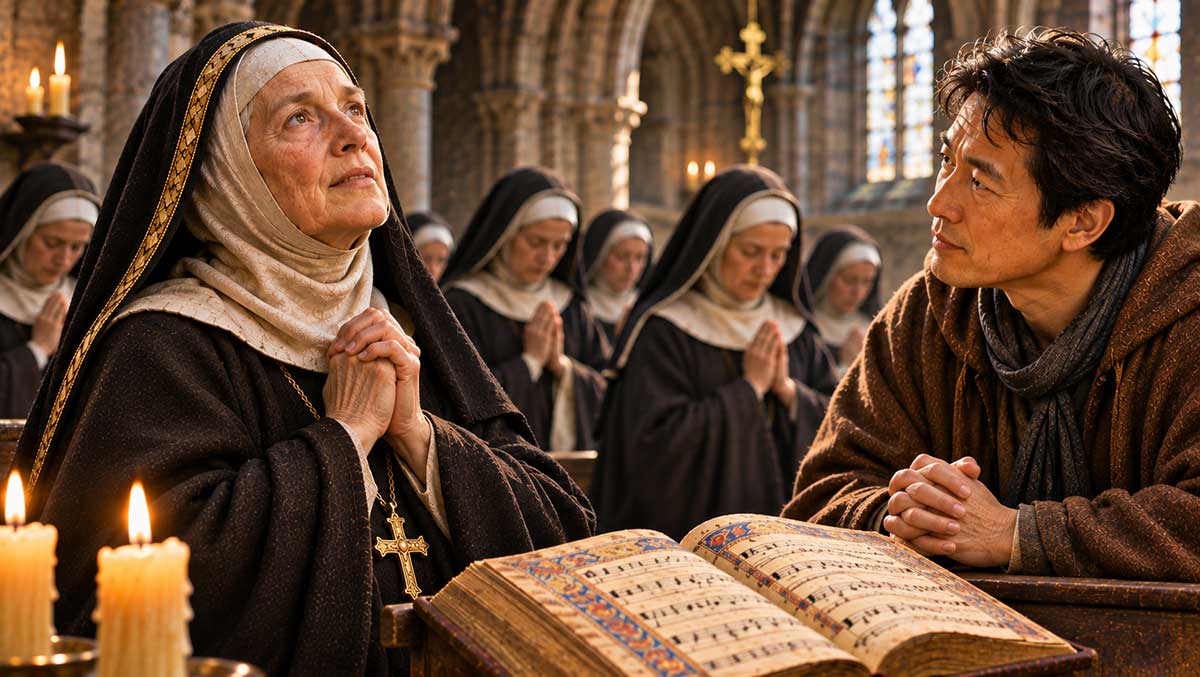
Opening
The last of the afternoon sunlight rests against the stone walls of Rupertsberg Abbey. Beyond the window, the Rhine reflects a pale evening sky. The room has grown cooler, and a sister has quietly brought a small lamp to Hildegard's table.
Hildegard thanks her and waits until she has gone before returning her attention to Nick.
Nick Sasaki: We've been talking for hours. Are you getting tired?
Hildegard: I am eighty years old, Nick. I have learned that fatigue is not an insult.
Nick: We can stop whenever you wish.
Hildegard: You have one more matter you wish to discuss. I can see it.
Nick: I do. But it's a difficult one.
Hildegard: Most of your questions have been difficult. I would be disappointed if you suddenly began asking about the weather.
Nick laughs.
Nick: You might be surprised how complicated the weather can become.
Hildegard: Then we are fortunate you have chosen another subject.
She settles into her chair.
Nick: Earlier, you said the dispute over a burial was among the most painful experiences of your final years.
Hildegard: Yes.
Nick: I'd like to understand why you believed you had to resist the authorities of the Church you had served your entire life.
Hildegard: Then we must begin with the man who was buried here, not with my resistance.
Question 13: Near the end of your life, you refused to remove a man buried at your monastery despite demands from Church authorities. Why did you believe you had to stand firm?
Nick: What happened?
Hildegard: A man was buried in the cemetery of our community. Church officials maintained that he had died under excommunication and demanded that his body be removed from consecrated ground.
But I had reason to believe that he had been reconciled with the Church before his death.
Nick: Was there evidence of that reconciliation?
Hildegard: I maintained that he had received the necessary reconciliation and the sacraments before his death. Those who challenged the burial did not accept the matter as settled.
Nick: So the disagreement wasn't simply whether you liked the man or wanted to protect his family.
Hildegard: No. It concerned his standing before the Church at the time of his death and whether his burial should be disturbed.
Nick: Did you know him personally?
Hildegard: I will not offer you a story of private friendship that the record does not establish. What mattered was the judgment being made concerning his burial.
Nick: Why not remove the body until the dispute could be resolved?
Hildegard: To do so would have treated the burial as improper when I believed the man had been reconciled.
I could not regard that as a small matter.
Nick: But the officials had authority over the monastery.
Hildegard: They held ecclesiastical authority, yes.
Nick: And you had spent your life teaching obedience.
Hildegard: Obedience is a serious Christian duty. So is the obligation not to act against what one believes to be true and just.
Nick: But what if they were right and you were wrong?
Hildegard looks at him steadily.
Hildegard: Then the facts of the man's reconciliation would have to be examined. My conviction could not, by itself, change what had occurred.
Nick: I appreciate that. You're not saying that being Hildegard makes your judgment automatically correct.
Hildegard: That would be a dangerous claim.
Nick: Still, you refused.
Hildegard: I did, on the grounds I believed justified the burial.
Nick: Were you angry with the officials?
Hildegard: I was deeply troubled by their demand and by what followed. But you should not turn a dispute over ecclesiastical discipline into a story in which every person on one side is wicked and every person on the other is virtuous.
Nick: That's fair. The officials may have believed they were defending Church law.
Hildegard: Indeed. The burial of someone who had died under excommunication was not a trivial concern under the Church's discipline.
Our disagreement concerned whether that condition applied to this man.
Nick: And then the authorities imposed restrictions on your community.
Hildegard: Yes.
Nick: That must have affected every sister here.
Hildegard: It did. The consequences of the dispute were not mine alone to bear.
Nick: Did that make you reconsider your decision?
Hildegard: It made the responsibility heavier.
A leader may be willing to endure hardship herself. It is another matter when those entrusted to her care must endure it too.
Nick: Did any of the sisters question whether you should give in?
Hildegard: I will not invent their private opinions for you. But you may understand that such restrictions were distressing to a religious community.
Nick: Did you ever wonder whether standing firm was becoming pride?
Hildegard rests her hands together.
Hildegard: That is a danger whenever a person resists correction.
One must ask whether the resistance serves truth or merely protects one's own judgment.
Nick: How did you answer that question?
Hildegard: I continued to maintain that the man had been reconciled and that his burial should not be violated. I sought to defend our position before the proper authorities.
Nick: So your answer wasn't simply, "I refuse to obey."
Hildegard: No. I was seeking a just resolution within the Church.
Nick: And the restrictions were eventually lifted.
Hildegard: They were, in this final year of my life.
Nick: Did you feel vindicated?
Hildegard: I was grateful that our community could return to its full worship.
Nick: That's what mattered most?
Hildegard: The welfare of the community and the integrity of our religious life mattered more than my satisfaction at the outcome.
Nick: There's something striking about this.
When you were young, you were afraid to speak. Now, near the end of your life, you're defending a decision against Church officials.
Hildegard: The circumstances were different.
Nick: But the question of responsibility was still there.
Hildegard: Yes. And it had become a responsibility shared with the women whose lives were affected by my decisions.
Question 14: When restrictions affected your community's sacred singing, what did that loss reveal about the place of sacred song in your faith?
Nick: Of all the consequences of the dispute, you seem especially affected by the restrictions on sacred singing.
Why was that so painful?
Hildegard: Sacred song is among the ways the Church gives praise to God.
Our community's worship was ordered around prayer, Scripture, and the liturgical hours. To be deprived of the ordinary expression of that worship was a grave sorrow.
Nick: You've spent years composing sacred songs. Did the restriction feel personal?
Hildegard: It was painful to me, certainly. But the songs were not merely my possessions.
They belonged to the devotional life of the community.
Nick: I wonder what it was like for the sisters.
They had learned these compositions, sung them together, and made them part of their daily lives. Then suddenly they couldn't sing as before.
Hildegard: Their voices had been formed through years of prayer.
When such worship is restricted, the absence is felt not simply by the ear but throughout the common life.
Nick: Did you ever walk through the monastery and feel that something was missing?
Hildegard: You ask me to describe a particular moment I have not recorded.
But I can tell you why the restriction mattered. Our religious life was shaped by sacred song. Its loss diminished an expression of praise that was dear to us.
Nick: In your writings, you connect sacred song with the harmony of heaven.
Hildegard: Yes. I understood sacred praise as reflecting, in an earthly manner, the worship offered before God.
Nick: So singing wasn't just decoration added to prayer.
Hildegard: No. It was itself a form of prayer.
Nick: Could someone still pray silently?
Hildegard: Certainly. God does not cease to hear a person who cannot sing.
But the fact that silent prayer remains possible does not make communal sacred song unimportant.
Nick: That's an interesting distinction.
Hildegard: A person who cannot speak may still love. That does not make speech meaningless.
Nick: I hadn't thought of it that way.
Hildegard: The Church has received many ways to express devotion. We should not dismiss one merely because another remains available.
Nick: You wrote about music in connection with the human soul. Did you believe singing could change a person?
Hildegard: Sacred song can direct attention toward God and help the soul contemplate divine things.
But the singer must not imagine that beautiful sound excuses an unjust life.
Nick: So someone could sing magnificently and still behave terribly.
Hildegard: Certainly.
Nick: That must have happened in your time.
Hildegard: Human beings have been remarkably consistent in their ability to separate fine words from poor conduct.
Nick laughs.
Nick: You really don't let anyone hide behind appearances.
Hildegard: I would prefer that people seek goodness rather than merely its appearance.
Nick: Did the restrictions change how you thought about your compositions?
Hildegard: They strengthened my concern that sacred song should not be treated as something insignificant.
In defending our worship, I sought to explain why praise expressed through the human voice mattered.
Nick: Did you ever worry that your community might never sing freely again?
Hildegard: I knew that the restrictions were serious and that their resolution was uncertain.
But I would not have you mistake the uncertainty of that period for knowledge of what the future would bring.
Nick: And when the restrictions were lifted?
Hildegard: The community could return to the worship that had been interrupted.
Nick: I wish I could have heard that first singing.
Hildegard: You may imagine it, Nick, but do not tell others that you were there.
They both smile.
Nick: Fair enough.
From a distant part of the abbey comes a faint sound of voices. It is too far away to distinguish the words.
Nick: Is that the sisters?
Hildegard: It may be.
Nick: You seem pleased.
Hildegard: I am grateful that their voices may be heard in worship.
Question 15: After a lifetime of visions, leadership, writing, friendship, and conflict, what do you most hope future generations will hear in your message?
The room has grown darker. The small lamp on the table casts a warm light across the parchment.
Nick: Mother Hildegard, you've lived a remarkable life.
You entered religious life as a child. You became an abbess, wrote about your visions, established communities, composed sacred works, and corresponded with some of the most influential people in Europe.
When you look back, what matters most to you?
Hildegard: That I should have been faithful to the responsibilities I believed God entrusted to me.
Nick: Do you think you were?
Hildegard: I have tried to serve. I have not lived without weakness or error.
The final judgment of a human life belongs to God.
Nick: Does approaching the end of life change how you think about your accomplishments?
Hildegard: The things that attract admiration do not necessarily reveal the whole measure of a life.
A book may be praised. A composition may be remembered. A letter may reach a ruler.
But what of the moments when a person chose patience rather than anger? Or cared for someone who could offer nothing in return? Or recognized a fault and sought forgiveness?
These things matter before God, whether anyone records them or not.
Nick: Do you ever think about how people will remember you?
Hildegard: I cannot govern the memories of those who come after me.
Nick: They may call you a visionary, a composer, a healer, perhaps even a woman who challenged the limits of her age.
Hildegard: Such descriptions may contain something true, but they can become misleading if they are separated from the purpose of my life.
Nick: What would you want them to understand?
Hildegard: That human beings have received life from God and must answer for how they use it.
That creation should awaken gratitude rather than careless pride.
That those who hold authority must serve rather than exploit.
That the soul is capable of repentance, and that the call to virtue is not reserved for a few extraordinary people.
Nick: What about your visions? Wouldn't you want people to believe them?
Hildegard: I would want them to attend to the truth I believed was communicated through them.
But a person who admires the visions and neglects the call to repentance has misunderstood their purpose.
Nick: So you wouldn't want people simply to say, "Hildegard saw amazing things."
Hildegard: No.
Nick: You'd want them to ask what those things meant for their lives.
Hildegard: Yes.
Nick: Let me ask something personal.
You've spent decades teaching others about God. Are there questions you still cannot answer?
Hildegard: Many.
Nick: Really?
Hildegard: Nick, the more a person contemplates divine wisdom, the less reasonable it becomes to imagine that the human mind has exhausted it.
Nick: Does that uncertainty frighten you?
Hildegard: There is a difference between recognizing the limits of one's knowledge and abandoning faith.
I do not know every purpose of God. I do not know every consequence of my actions. I cannot see the whole course of the world.
But I may still pray, act, repent, and trust.
Nick: And what about death?
Hildegard looks at him quietly.
Hildegard: I have lived many years. I know that my earthly life will end.
Nick: Are you afraid?
Hildegard: I would not pretend that the approach of death makes the body indifferent to suffering.
But Christian hope directs us beyond the end of earthly life.
Nick: Do you look forward to seeing Richardis again?
For a moment, Hildegard's expression softens.
Hildegard: I commend her to God's mercy, and I hope in the resurrection promised through Christ.
Nick: After all these years, she's still part of your thoughts.
Hildegard: Love does not become meaningless when a person dies.
Nick: If you could leave one message for someone living centuries from now, someone who has never heard of you, what would it be?
Hildegard considers the question for a long moment.
Hildegard: Do not spend your life seeking extraordinary signs while neglecting the good that has already been placed before you.
Examine your conduct. Care for those entrusted to you. Do not use authority for your own glory. Give thanks for creation, and do not despair of the mercy of God.
And when you recognize what is right, do not suppose that knowing it is the same as doing it.
Nick: That's a demanding message.
Hildegard: The Christian life is demanding.
Nick: But there's hope in it, too.
Hildegard: There must be. Without hope, correction becomes only condemnation.
Nick: Earlier, you told me that people often prefer extraordinary knowledge that asks nothing of them.
I think I understand now.
Hildegard: What do you understand?
Nick: Your visions were never meant to make you the center of the story.
Hildegard: That is what I have tried to tell you.
Nick: And the real question isn't whether everyone can experience what you experienced.
It's whether people will take responsibility for the lives they have been given.
Hildegard nods.
Hildegard: That is a question worth carrying home.
Closing
The evening light has nearly disappeared from the window. The monastery has grown quieter, and Nick realizes that their conversation has reached its natural end.
Nick: Mother Hildegard, I should let you rest.
Hildegard: A wise decision. I was beginning to wonder whether you intended to remain until morning.
Nick: I might have, if you'd allowed it.
Hildegard: Then it is fortunate that I am accustomed to setting limits.
Nick laughs.
Nick: When I came here, I wanted to meet the woman who saw extraordinary visions and spoke to emperors.
But I think the person I'll remember most is the abbess who worried about her sisters, loved Richardis, questioned her own responsibilities, and refused to treat faith as an excuse for avoiding difficult decisions.
Hildegard: You have listened to many things today. I hope you will consider them carefully rather than accepting every word merely out of courtesy.
Nick: I will.
Hildegard: Good. Respect does not require the abandonment of judgment.
Nick: May I ask one final question?
Hildegard: You have a remarkable ability to discover one final question after another.
Nick: This really is the last one.
Hildegard: Then ask it.
Nick: If you could go back to that young woman who was afraid to begin writing Scivias, would you tell her that everything would turn out well?
Hildegard looks toward the parchment on the table.
Hildegard: No.
Nick: Why not?
Hildegard: It would not be true.
There were years of labor, conflict, illness, and sorrow. There were people I could not protect from suffering and losses I could not prevent.
I would not promise her an easy life.
Nick: What would you tell her instead?
Hildegard: That she must not measure faithfulness by whether the road is pleasant.
She should seek wise counsel, examine her motives, and do what she believes her duty before God requires.
And she must remain willing to learn, for a person does not cease needing correction merely by growing older.
Nick: Even at eighty?
Hildegard: Especially when one has had eighty years to become accustomed to one's own opinions.
Nick laughs, and Hildegard smiles.
Nick: Thank you for that. And for everything you've shared today.
Hildegard: You have been a persistent visitor, Nick. But a thoughtful one.
Nick: I'll accept that as a compliment.
Hildegard: You may.
Nick rises. Hildegard remains seated, and he does not ask her to stand.
Nick: I hope the sisters have a peaceful evening.
Hildegard: As do I. Though experience has taught me not to make too many predictions about the evening of a monastery.
Nick: And I hope you'll have some rest.
Hildegard: I intend to try.
Nick moves toward the doorway, then turns back.
Nick: Mother Hildegard?
Hildegard: Yes?
Nick: I'm glad you finally decided to write.
For a moment, she looks at him without speaking.
Hildegard: Then do not be satisfied merely to admire what was written.
Consider what it asks of you.
Nick: I will.
She inclines her head in farewell.
Hildegard: Go with God, Nick.
Nick: And may God bless you, Mother Hildegard.
Nick steps into the corridor. Behind him, the small lamp continues to illuminate the manuscripts on Hildegard's table.
Outside, the evening settles over the Rhine. The abbey's life continues, sustained by prayer, work, friendship, and the ordinary responsibilities that Hildegard has spent a lifetime teaching others not to overlook.
The conversation has ended, but the question that began it remains.
What should a person do when conscience demands something difficult, and the cost of remaining faithful cannot be known in advance?
Final Thoughts: The Courage to Speak and the Humility to Listen

When our imaginary conversation with Hildegard of Bingen comes to an end, one impression remains especially strong: her extraordinary life was never simply about extraordinary experiences. The visions that made her famous were, in her own interpretation, inseparable from a responsibility to speak about God, human conduct, and the obligations of religious life. Yet the woman who believed she had received that responsibility was not free from hesitation, illness, grief, or the difficult decisions of leadership. Her life asks us to consider what it means to act upon a deeply held conviction without assuming that conviction makes us incapable of error.
The first lesson comes from Hildegard's reluctance to write. She did not present her calling as a personal ambition to become famous or influential. Her early correspondence reveals a woman seeking guidance about experiences she struggled to explain. Her letter to Bernard of Clairvaux is particularly moving for this reason. It reminds us that confidence is not always the beginning of meaningful action. Sometimes a person acts with uncertainty still present, hoping that careful judgment, counsel, and faithfulness will guide the work ahead.
A second lesson emerges from her understanding of creation. Hildegard did not regard the natural world as spiritually empty or humanity as detached from it. Her writings connect the created order with divine wisdom and human moral responsibility. The imagery of viriditas, often associated with greenness and flourishing life, expresses something of her conviction that life is sustained by God. Yet her vision of creation was never simply a celebration of beauty. It demanded an answer from humanity. If life is a gift, how should we treat the world, the people around us, and the responsibilities entrusted to our care?
Perhaps the most emotionally revealing part of her story is her relationship with Richardis von Stade. Hildegard could speak firmly about obedience, spiritual responsibility, and surrendering one's will to God, yet the departure of someone dear to her brought profound sorrow. Their story resists an easy moral judgment. Hildegard believed she had legitimate concerns about Richardis's appointment, but her personal attachment was unmistakable. Love can involve genuine concern and a painful desire to keep someone close. The difficulty is recognizing where care for another person's welfare ends and our wish to direct that person's future begins.
Her correspondence with influential leaders raises a different question. Hildegard was willing to challenge bishops and rulers, including Emperor Frederick Barbarossa, when she believed they had neglected their obligations. Yet moral courage can become dangerous when it is separated from humility. The person who corrects others must remain open to examination too. Hildegard's life does not provide a simple formula for resolving every disagreement, but it invites us to ask whether our convictions lead us toward service and accountability or toward the satisfaction of being right.
Her final burial dispute makes that question especially difficult. Hildegard believed that a man buried at Rupertsberg had been reconciled with the Church before his death, and she resisted demands to remove his body. The resulting restrictions affected her entire community, including its sacred singing. For Hildegard, the dispute concerned the integrity of Christian burial and worship, not an attempt to reject the Church. Her surviving correspondence, collected in The Letters of Hildegard of Bingen, provides an essential foundation for examining such conflicts. Her example encourages neither unquestioning submission nor automatic resistance, but serious consideration of evidence, conscience, authority, and the consequences borne by others.
There is another reason her story remains compelling. Hildegard's life united activities that modern readers often separate: theological writing, artistic creation, the observation of nature, spiritual guidance, and the administration of religious communities. Her sacred compositions expressed her convictions through voices gathered in worship. Her writings addressed the soul, the body, and creation through the intellectual framework of medieval Christianity. The Vatican's account of her theological legacy reflects why her work continued to attract attention centuries after her death. We need not accept every medieval claim to appreciate the breadth of her curiosity and the seriousness of her religious purpose.
As Nick leaves Rupertsberg Abbey in our imagined final scene, Hildegard's original question has taken on a deeper meaning. Speaking a message one believes to be true is difficult, but the responsibility does not end when the words have been spoken. We must consider how those words affect others, whether our conduct reflects them, and whether we remain willing to recognize our limitations. Hildegard's enduring challenge is not simply to find the courage to speak. It is to live responsibly with what we believe, to love without claiming possession of others, and to seek truth with enough humility to keep learning. Perhaps the most meaningful question to carry away is this: When we believe we are right, do we become more willing to serve others, or less willing to listen to them?
Fictional Conversation Disclaimer
The reflections above discuss an imagined conversation between Nick Sasaki and Hildegard of Bingen. The historical events and works are drawn from documented sources, but the dialogue, personal responses, and final meeting are fictional interpretations rather than authentic quotations or evidence of Hildegard's private thoughts. The interview does not imply historical endorsement, and disputed interpretations remain open to scholarly examination.
Short Bios:
Hildegard of Bingen (1098–1179)
Hildegard of Bingen was a German Benedictine abbess, visionary theologian, composer, writer, and religious leader. Born in the Rhineland, she entered religious life at a young age and became leader of the women's community at Disibodenberg in 1136. She later founded religious communities at Rupertsberg and Eibingen. Her major works include Scivias, Liber Vitae Meritorum, and Liber Divinorum Operum, alongside sacred compositions, letters, and writings on the natural world. She corresponded with prominent religious and political figures and defended her community during a dispute over Christian burial. She died on September 17, 1179, and was declared a Doctor of the Church in 2012.
Jutta of Sponheim (c. 1091–1136)
Jutta of Sponheim was a German noblewoman who embraced an austere religious life and became the spiritual leader of an enclosed women's community associated with Disibodenberg. Hildegard spent her formative years under Jutta's guidance. Following Jutta's death in 1136, Hildegard succeeded her as leader of the women.
Bernard of Clairvaux (1090–1153)
Bernard of Clairvaux was a French Cistercian abbot, theologian, and influential figure in medieval Christianity. Known for his preaching, religious counsel, and involvement in Church affairs, he received a letter from Hildegard seeking guidance concerning her reported visions and her responsibility to communicate them.
Richardis von Stade (d. 1152)
Richardis von Stade was a German noblewoman and religious sister closely associated with Hildegard's community and writing activities. She became an important companion to Hildegard at Rupertsberg. Her appointment as abbess of another religious house prompted Hildegard's strong opposition and a painful separation. Richardis died in 1152, leaving a lasting impression on Hildegard's personal correspondence.
Frederick I Barbarossa (c. 1122–1190)
Frederick I Barbarossa was King of Germany from 1152 and Holy Roman Emperor from 1155 until his death in 1190. His reign involved extensive political and military campaigns and conflicts over papal authority. He had dealings with Hildegard, including granting protection to her community. She later criticized his actions during the papal schism.
Volmar (d. 1173)
Volmar was a Benedictine monk associated with Disibodenberg and an important assistant and secretary to Hildegard. He helped with the preparation and transmission of her writings over many years. His collaboration was significant to her literary and religious work.
Nick Sasaki (Fictional Interviewer)
Nick Sasaki is the creator of ImaginaryTalks.com, a project that brings historical figures, thinkers, and influential voices into imagined conversations about the human experience. In this fictional interview, he meets Hildegard of Bingen to explore faith, conscience, responsibility, love, and the difficult relationship between spiritual conviction and personal judgment.
Leave a Reply