
Introduction: Francis of Assisi, What Happens When You Take Jesus Seriously?
What would happen if you stopped merely admiring the teachings of Jesus and began living them? What if loving your neighbor meant approaching someone you had spent years avoiding? What if following Christ required you to question your ambitions, your possessions, your relationships, and your desire for recognition? These are not comfortable questions. Yet more than eight centuries ago, a young man from the Italian town of Assisi began answering them through choices that would transform his life and inspire one of Christianity's most influential religious movements.
Born around 1181 or 1182, Francis of Assisi was the son of a prosperous cloth merchant. He enjoyed fine clothing, celebrations, friendship, and dreams of military glory. He wanted to become a knight, a man whose achievements would earn admiration and honor. His early life hardly suggested the future saint celebrated for poverty and humility. War with neighboring Perugia, imprisonment, illness, and a series of spiritual experiences gradually disrupted his ambitions. As the Franciscan historical chronology shows, his transformation unfolded over several years rather than through one simple moment of conversion.
One of the most revealing turning points came when Francis began serving people suffering from leprosy. These were individuals he had previously found deeply uncomfortable to approach. In his own account of his conversion, Francis placed this experience near the beginning of his new life. It was a profound change in how he encountered human suffering. His faith was no longer limited to prayer or religious aspiration. It required him to approach people whom society often kept at a distance. The young man who had dreamed of recognition began discovering a different measure of human worth.
His commitment brought painful consequences. Francis's rejection of his family's wealth and expectations created a serious conflict with his father, Pietro di Bernardone. Yet his life did not become one of complete isolation. Companions joined him, and together they sought to follow Jesus through poverty, prayer, work, preaching, and service. Their brotherhood grew, eventually receiving formal recognition from the Catholic Church. The writings of Francis of Assisi reveal a deeply Christian vision centered on repentance, obedience, humility, and the practical demands of the Gospel.
Francis's influence reached far beyond the men who joined his brotherhood. Clare of Assisi, a young woman from a prominent family, embraced her own demanding religious vocation and became a major spiritual leader. In 1219, during the Fifth Crusade, Francis traveled to Egypt and met Sultan al-Kamil, a Muslim ruler whose forces were fighting Christian armies. Francis approached him as a Christian missionary seeking to proclaim his faith. The meeting remains remarkable for bringing two men of different religious convictions face-to-face during a violent conflict, yet its precise dialogue and the Sultan's private reactions remain uncertain.
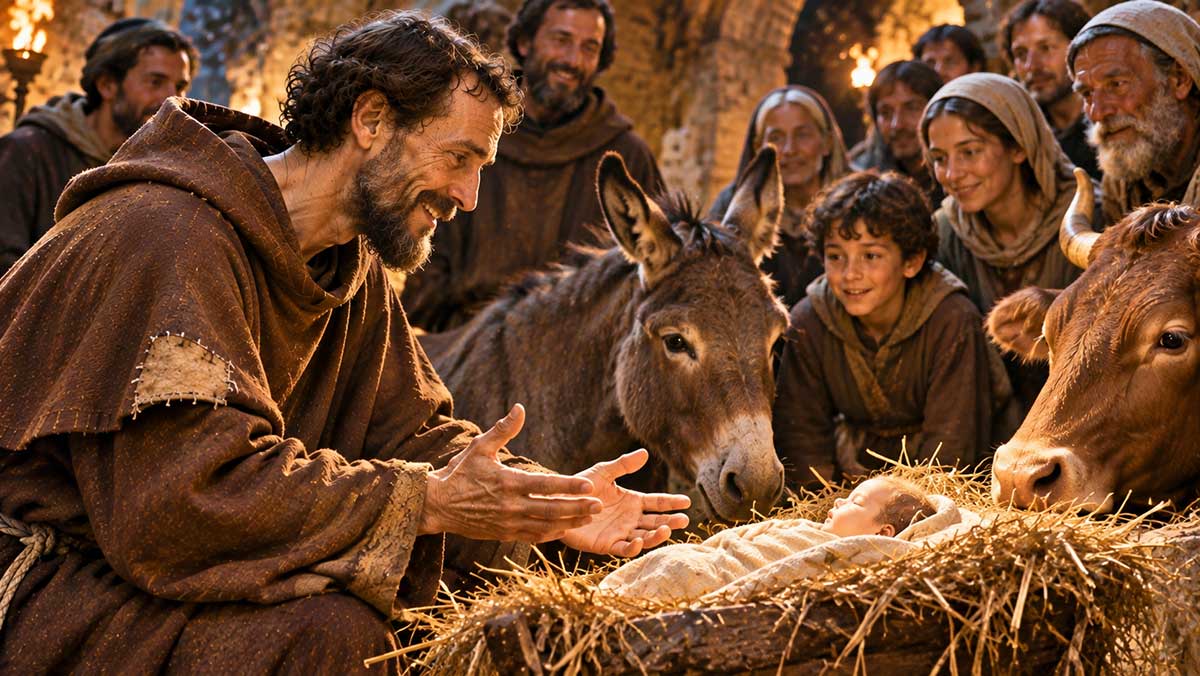
Success brought new difficulties. The growing Franciscan movement needed rules, ministers, organization, and decisions about how its members should live. Francis had to confront the tension between the simplicity of the first brotherhood and the responsibilities of a much larger religious order. At Greccio in 1223, he helped arrange a Christmas celebration using a manger, hay, and living animals to direct attention to the humility of Christ's birth. In his final years, weakened by illness and deteriorating eyesight, he composed the Canticle of the Creatures, praising God through the beauty of creation, forgiveness, and bodily death. The Order of Friars Minor's account of his life places these events within the final years before his death in 1226.
In this imaginary interview, Nick Sasaki meets Francis near the Portiuncula chapel outside Assisi during the final year of his life. Their conversation unfolds across five topics, beginning with Francis's youthful ambitions and continuing through his conversion, his relationships, the practical challenges of poverty, his meeting with the Sultan, the growth of his brotherhood, and his final reflections on suffering and mortality. Nick approaches him with admiration but asks difficult questions. Was every sacrifice wise? How did his decisions affect his family? Could poverty become another source of pride? How could a man proclaim his Christian faith without treating those who disagreed with him as enemies?
The result is a conversation about a saint who was once an ambitious young man, a spiritual leader who struggled with the responsibilities of leadership, and a believer whose devotion to Jesus demanded far more than beautiful words. Francis's life invites us to examine the distance between what we profess and what we practice. If we say we follow Jesus, what should change in the way we treat other people? And perhaps the most challenging question of all is this: What might happen if we began taking His teachings seriously in our own ordinary lives?
Fictional Conversation Disclaimer
This interview is an original work of historical fiction. The meeting, dialogue, and personal reflections attributed to Francis of Assisi are imagined, not authenticated quotations or endorsements. Historical events are informed by Francis's writings and scholarly sources; reported miracles, undocumented private thoughts, and reconstructed conversations should not be confused with independently verified historical facts.
Topic 1: The Young Man Who Wanted to Be Somebody
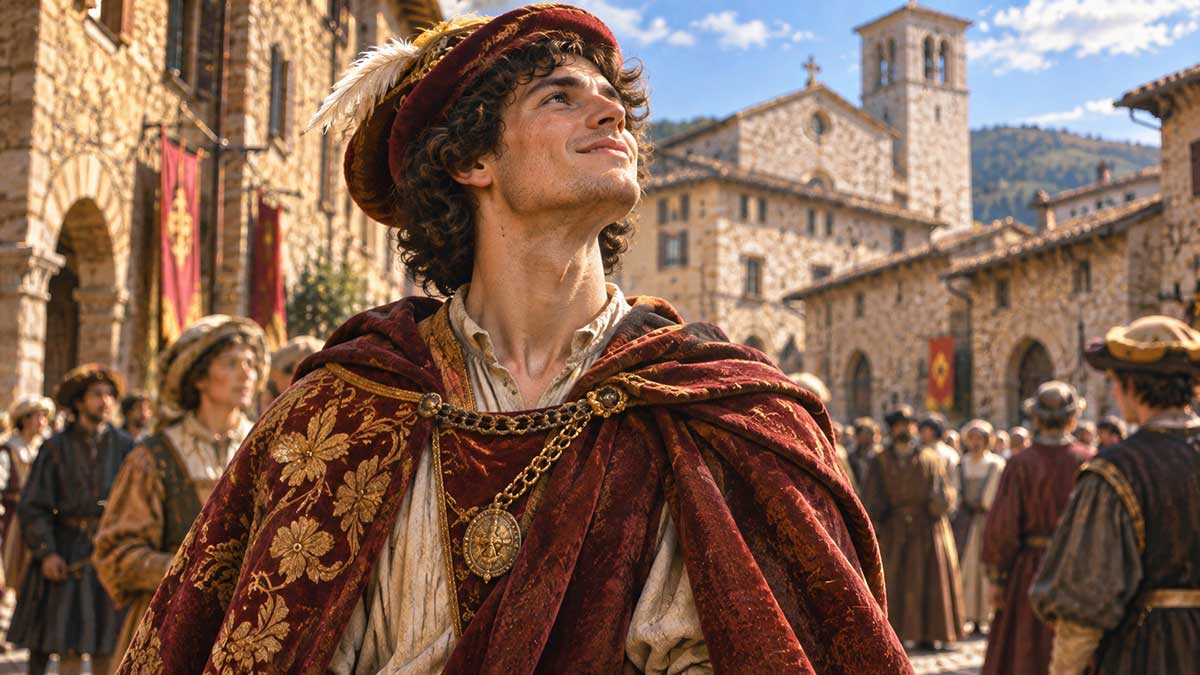
Opening
Near the Portiuncula, outside Assisi, Italy, 1226.
The afternoon sunlight falls gently across the small chapel of Santa Maria degli Angeli. Olive trees move in the breeze, and somewhere beyond the stone walls, a brother is working in the garden.
Francis sits on a simple wooden bench beneath the shade of a tree. His brown habit is worn and patched. At forty-four, he looks older than his years. Illness has weakened his body, and his eyesight has deteriorated, but there is an unmistakable warmth in his expression.
Nick approaches slowly.
Nick: Brother Francis?
Francis: Yes, brother. Come, sit beside me. The shade is good here.
Nick: Thank you. I've wanted to meet you for a long time.
Francis: Then I hope you have not traveled too far. I would hate to disappoint a man who has made such an effort.
Nick: (Laughing.) Somehow, I don't think that will happen.
Francis: You cannot know that yet. You have only just arrived.
Nick laughs again and takes a seat.
For a moment, they watch a young friar carrying a bundle of firewood across the courtyard.
Nick: I have to admit something. When I pictured meeting Saint Francis of Assisi, I expected someone a little more solemn.
Francis: Saint Francis?
He smiles.
Francis: You must be thinking of another man. I am Francis, a brother who has been given far more mercy than he deserves.
Nick: Fair enough. Francis it is.
Francis: Good. Now we can speak like brothers.
Nick notices the rough fabric of Francis's habit.
Nick: You know, I read that when you were young, you loved beautiful clothes.
Francis glances down at his patched sleeve.
Francis: Then you can see how greatly my taste has changed.
Nick: (Laughing.) Quite a change.
Francis: My father would have been horrified to see such cloth in his shop.
His smile lingers, but he says nothing more about his father.
Nick senses that beneath the humor is a story worth hearing.
Question 1: Francis, before people began calling you a saint, what kind of life did you dream of having?
Nick: Let's go back to the beginning. Before the brothers, before the preaching, before all of this. What kind of young man were you?
Francis: A young man who enjoyed being young, I think.
I liked fine clothing, good company, celebrations. I enjoyed the streets of Assisi when there was laughter in them. I wanted to be admired.
My father was a merchant. He knew the value of cloth, the importance of trade, the respect that comes from prosperity. There was a place for me in that life.
But I wanted something more splendid.
Nick: More splendid than becoming a successful merchant?
Francis: Oh, certainly. A merchant may become wealthy, but a knight becomes the subject of stories.
Nick: So you wanted to be a hero?
Francis: I wanted the honor of one. Whether I understood what true courage required is another matter.
Nick: That's interesting. You weren't simply chasing money. You wanted recognition.
Francis: Recognition is a strange hunger. A man may eat a full meal and be satisfied until tomorrow. But praise can leave him hungry before the speaker has finished.
Nick: That's still true where I come from. People spend years trying to become successful, respected, admired. Sometimes they don't even know why anymore.
Francis: Then perhaps your people and mine are not so different.
Nick: Did you enjoy that life?
Francis: There was real enjoyment in it. I will not pretend that every feast was miserable or that every friendship was false.
There is nothing gained by condemning laughter simply to make one's conversion sound more impressive.
But enjoyment and peace are not the same thing.
Nick: When did you recognize the difference?
Francis: Not at once.
When I was young, I could mistake a lively evening for a full heart. I could think that a handsome garment made the man inside it more worthy.
And I was drawn to the honor of knighthood.
It took time for those things to lose their hold on me.
Nick: You sound almost affectionate when you talk about that younger Francis.
Francis: I can remember him without wishing to become him again.
Nick: That's a beautiful distinction.
Francis: Perhaps. But do not make him too beautiful. He was quite pleased with himself.
They both laugh.
Nick: If that young Francis could see you sitting here today, wearing a patched habit and living without possessions, what do you think he'd say?
Francis looks down at his hands.
Francis: I cannot know. Perhaps he would wonder what terrible misfortune had befallen me.
Nick: And what would you tell him?
Francis: I would ask him to come and meet the brothers. To share their bread. To see how little a man may possess and still have reason to give thanks.
Then I would let him judge whether I had lost everything.
Nick: You wouldn't lecture him?
Francis: He might not listen.
Nick: (Smiling.) You know yourself pretty well.
Francis: Better than I did then, I hope.
The two men sit quietly for a moment.
Nick looks across the courtyard at the brothers working together.
Nick: It's striking. You once wanted people to look at you and see someone important. Now you're surrounded by men who call themselves the Lesser Brothers.
Francis: That name is a reminder, not an achievement.
A brother may call himself lesser and still secretly desire to be the greatest of the lesser brothers.
Nick: (Laughing.) That's a very human problem.
Francis: Yes. And it does not disappear simply when a man puts on a poor habit.
Question 2: You fought in a war, were captured, and became seriously ill. How did those experiences change the way you saw your future?
A breeze moves through the olive branches. Francis adjusts his position on the bench, and Nick waits until he is comfortable.
Nick: You were still a young man when Assisi went to war against Perugia.
Francis: Yes.
Nick: You wanted to become a knight. But instead of glory, you experienced defeat and imprisonment.
What was that like?
Francis looks beyond the chapel.
Francis: War is a poor teacher of the glory young men expect from it.
Before battle, one may think of banners, courage, honor, and the stories that will be told afterward.
But men are wounded. Friends disappear. Those who survive discover that courage does not guarantee victory.
Nick: Were you frightened?
Francis: Would it surprise you if I were?
Nick: No. It would surprise me if you weren't.
Francis: Then you have answered wisely.
Nick: You were held prisoner in Perugia for about a year.
Francis: That is how the time is remembered.
Nick: A year is a long time when you're young.
Francis: Especially when you have imagined a very different future.
Nick: Did you begin questioning your ambitions in prison?
Francis: I would not say that everything became clear there.
Suffering does not automatically make a man wise. Some become bitter. Some become afraid. Some return to their old ways as soon as they are able.
I returned home, and the old desires had not entirely left me.
Nick: That's something I appreciate about your story. You didn't have one terrible experience and suddenly become a completely different person.
Francis: No. The Lord was patient with me.
Nick: You became ill after your imprisonment, and later you attempted another military expedition.
Francis: Yes. I had not abandoned the hope of knighthood.
Nick: So even after everything you experienced, part of you still wanted that old dream.
Francis: The heart can hold tightly to a familiar desire, particularly when a man has spent years believing it will give meaning to his life.
Nick: And then you turned back at Spoleto.
Francis: I came to believe that I was being called to serve a different master.
Nick: The early accounts describe a dream or spiritual experience that changed your direction.
Francis: Those who tell my story have described that time in their own ways.
What I can tell you is that I came to see that the honor I sought was not the honor I needed.
Nick: What was different about the honor you needed?
Francis: I had wanted to serve someone great so that I might become great.
But Christ had humbled Himself.
He had come among the poor. He had accepted suffering. He had washed the feet of His disciples.
I had spent much of my youth looking upward, hoping to stand above other men.
The Gospel was asking me to look downward, to those I had scarcely noticed.
Nick: That's a tremendous reversal.
Francis: It was not an easy one.
Nick: Did you feel that your life had been wasted up to that point?
Francis: I would not speak of it that way.
God can work with what a man has been.
A young man's courage need not disappear. His generosity need not disappear. His desire to give himself to something greater need not disappear.
But those desires must be directed rightly.
Nick: So you didn't stop wanting to be courageous. You began to see courage differently.
Francis: Yes.
A man may ride into battle hoping to win honor. But there is another kind of courage in approaching someone whom others fear, in serving without recognition, in accepting humiliation rather than returning an injury.
I had much to learn about that courage.
Nick: And the lessons didn't all come at once.
Francis: No, brother. The Lord did not finish with me in Perugia, or at Spoleto, or even when I first put on this habit.
He has been patient for many years.
Nick smiles.
Nick: I suspect most of us need that kind of patience.
Francis: Then we should be grateful that God has more of it than we do.
Question 3: When did you begin to recognize that the life you had been pursuing was no longer enough?
Nick: Francis, I want to ask something a little more personal.
There are people who spend their entire lives pursuing something they believe will make them happy.
Money, success, recognition, a certain position in society.
And sometimes they achieve it, only to discover that something is still missing.
Did you experience anything like that?
Francis: I knew what it was to desire things that could not satisfy the heart for long.
But I must be careful here, Nick.
I did not simply exchange one way of seeking happiness for another.
My life changed when the Lord began to teach me to live differently.
Nick: What did that teaching look like?
Francis: At first, not like the things I had expected.
I had imagined service in noble company. But the Lord brought me among people suffering from leprosy.
Nick: People you had once avoided.
Francis: Yes.
Nick: That must have been difficult.
Francis pauses.
Francis: In my Testament, I spoke of how bitter it had been for me to see them.
I do not say that proudly.
I had been unwilling to approach people whose suffering frightened and repelled me.
Yet when I began to show them mercy, something changed.
What had seemed bitter became sweet to me.
Nick: That's extraordinary.
Francis: It was mercy, brother. Not my achievement.
Nick: I want to spend more time on that experience, if you're willing.
Francis: We may speak of it.
Nick: But first, something strikes me.
When you were young, you wanted to be admired by people who were important.
And the turning point in your life involved people whom society often pushed aside.
Francis: That is a fair observation.
Nick: It's almost the opposite of everything you had been pursuing.
Francis: The Gospel often overturns what we have learned to admire.
Nick: Was that when you knew you had to leave your old life?
Francis: My change was not accomplished in a single day.
I prayed. I struggled to discern what was being asked of me. I began serving those I had avoided. I spent time repairing churches and seeking a different way of living.
I was still learning.
Nick: And your father was watching all of this.
Francis grows quiet.
Francis: Yes.
Nick: He had expectations for you.
Francis: He had given me a place in his household and his work. He understood the life of a merchant, and he had reason to expect his son to continue in it.
Nick: And you were moving away from that future.
Francis: I was.
Nick: I can see why that would be painful for a father.
Francis: You are right to consider his position.
It is easy to tell the story of a man leaving wealth behind and forget that other people had hopes bound up in that wealth.
Nick: That's something I want to talk about. Following a calling may be right, but it doesn't mean nobody gets hurt.
Francis: No. Nor does calling oneself a servant of God excuse a man from examining his own conduct.
Nick: Did you ever wonder whether you were making a terrible mistake?
Francis: Discernment requires prayer, humility, and patience. A man must not mistake every strong desire for the voice of God.
I cannot tell you that I understood everything from the beginning.
But I came to trust that Christ was calling me to follow Him in poverty and service.
Nick: You know what surprises me most?
Francis: Tell me.
Nick: You didn't begin by trying to change the world.
You began by changing how you treated the people directly in front of you.
Francis: I would say that the Lord began by changing me.
And He did so in a place I had once been unwilling to enter.
Nick: That's quite a beginning.
Francis: It was the beginning of a life I could not have planned for myself.
The conversation pauses as a friar approaches with a small cup of water.
Francis thanks him, and the young brother returns to his work.
Nick: One last question before we move on.
When you think about the young Francis who wanted to become a knight, do you feel that he finally became the man he was meant to be?
Francis holds the cup between his hands.
Francis: I would rather not pronounce judgment on myself.
I know that I have received mercy. I know that I have often needed forgiveness. And I know that the Lord has given me brothers with whom to seek His way.
Whether I have been faithful is something I leave to God.
Nick: You won't even give yourself a little credit?
Francis smiles.
Francis: If I begin taking credit, brother, you may have to find me another patched habit.
Nick laughs.
Nick: Fair enough.
Closing
The afternoon has grown quieter around the Portiuncula.
Nick looks at Francis, trying to reconcile the young man who dreamed of knighthood with the frail brother sitting beside him.
The contrast is striking, but the conversation has revealed something more subtle than a simple rejection of ambition.
Francis did not cease to value courage, loyalty, or the desire to serve something greater than himself. His Christian calling gave those aspirations a different direction.
Nick: Francis, when I arrived, I thought we'd begin with the famous moment when you gave up your wealth.
But now I see that something had already been changing long before that.
Francis: Yes. A man may surrender his possessions and still carry pride in his heart.
Nick: And he may wear beautiful clothes while struggling with questions nobody else can see.
Francis: Indeed.
Nick: I think I understand your younger self a little better now.
Francis: Then perhaps you will be kinder to him than he sometimes was to others.
Nick: (Smiling.) I'll try.
Francis glances toward the chapel.
Francis: You asked when I began to see that my old life was no longer enough.
I have told you something of my ambitions and the disappointments that followed.
But the change I most want you to understand began when I learned to approach people I had once avoided.
Nick: The people suffering from leprosy.
Francis: Yes.
Nick leans forward.
Nick: Then that's where I'd like to go next.
Francis nods.
Francis: Good, brother. That is where my Testament begins.
The two men remain beneath the olive tree as the conversation turns from the young man's search for honor to the encounter that transformed his life.
Topic 2: The Person He Could No Longer Walk Past
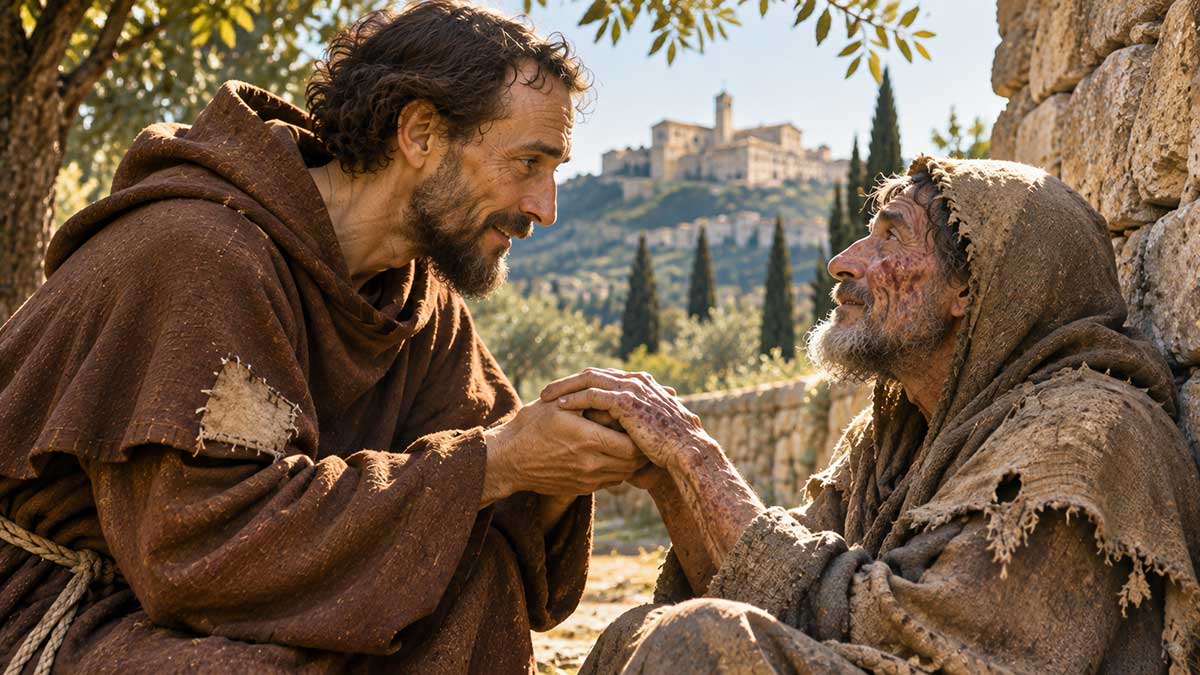
Opening
Near the Portiuncula, outside Assisi, Italy, 1226.
The afternoon sun has shifted behind the olive trees. Francis remains seated beside Nick, his hands resting on the rough fabric of his habit.
A brother passes carrying a basket of bread. Francis thanks him and watches him disappear around the corner of the chapel.
Nick: Francis, at the end of our last conversation, you said something I've been thinking about.
Francis: I hope it was something sensible.
Nick: (Laughing.) I think it was.
You said that when you wanted to become a knight, you looked for people who could make you important. But when your life began changing, you found yourself approaching people you had once avoided.
Francis: Yes.
Nick: And in your Testament, when you look back on your conversion, you don't begin with the day you gave up your possessions. You begin with people suffering from leprosy.
Francis: That is where I begin, brother.
Nick: Why?
Francis is quiet for a moment.
Francis: When I was young, I knew how to be generous to people whose company pleased me. I could give money, arrange a celebration, or help a friend.
But there were people whose suffering I did not wish to see.
People suffering from leprosy were among them.
Nick: You were afraid of them?
Francis: Their condition repelled me. I would rather have kept my distance.
Nick: That's difficult to admit.
Francis: It would be worse to pretend otherwise.
Nick turns toward him.
Nick: Then I'd like to begin there. Not with the saint everyone admires, but with the young man who struggled to approach someone who was suffering.
Francis nods.
Francis: Then we will begin where the Lord began teaching me.
Question 4: You wrote that you once found it difficult even to be near people suffering from leprosy. What changed when you began serving them?
Nick: Francis, help me picture what life was like for someone suffering from leprosy in your time.
Francis: Many lived apart from the ordinary life of the town. They needed food, shelter, clothing, and care. Yet people often feared approaching them.
Their suffering was not confined to their bodies.
Nick: They were isolated.
Francis: Often, yes. A person can suffer greatly when others cease to see him as a neighbor.
Nick: And you were one of those who kept their distance.
Francis: I was.
Nick: What changed?
Francis: The Lord led me among them, and I began to show them mercy.
In my Testament, I wrote that what had once seemed bitter to me was changed into sweetness.
Nick: I've read those words. They're beautiful. But I want to ask about the actual experience.
Was it difficult the first time you approached someone?
Francis: You must understand that I had not suddenly become a fearless man.
A habit of avoidance does not vanish simply when one recognizes that it is wrong.
Nick: So you still had to act.
Francis: Yes. And in serving them, I began to see differently.
Nick: Differently how?
Francis: I had been occupied with what their condition stirred in me. My discomfort. My reluctance.
But a person who is hungry needs food. A person who is ill may need assistance. A person who has been avoided may welcome someone willing to remain beside him.
When I began to serve, my attention could turn from myself to the person before me.
Nick: That's a remarkable change.
Francis: It was a mercy given to me.
Nick: The early stories describe you embracing and kissing a person suffering from leprosy.
Francis: The brothers have told many stories about those days.
What I wanted to leave them in my Testament was the change the Lord worked in me through serving such people.
Nick: So the central point isn't whether everyone remembers every detail of a particular encounter.
Francis: The important thing is that I had once turned away, and then I began to show mercy.
Nick: There's something that troubles me about this story.
Francis: Tell me.
Nick: People sometimes celebrate the courage of the person who approaches someone suffering. But the person receiving that attention can become almost a character in someone else's spiritual transformation.
We talk about what Francis learned, and forget about the person who was already suffering.
Francis listens carefully.
Francis: Then we should not forget him.
Nick: What do you mean?
Francis: A person in need is not placed before us merely to provide an occasion for our virtue.
If I give food to a hungry man, he must be fed. If I care for someone who is ill, his needs must matter more than the satisfaction I take in having helped him.
Nick: That's an important distinction.
Francis: We must beware of taking pride in our own mercy.
Nick: You know, Francis, I think that may be harder than it sounds.
Sometimes we help someone, and afterward we feel good about ourselves. We tell people what we did. We begin to admire our own generosity.
Francis: Then we have found another opportunity to practice humility.
Nick: (Laughing.) You don't make this easy.
Francis: I have not found it easy myself.
Nick: Let me ask you something else.
Did you come to believe that Christ was present in the people you served?
Francis: Our Lord taught that what is done for the least of His brothers is done for Him.
I had heard the Gospel before. But hearing the words and allowing them to govern one's actions are different matters.
Nick: So you already knew what Jesus had taught.
Francis: I knew the words.
Nick: But knowing wasn't enough.
Francis: A man may know that his neighbor is hungry and still leave him without bread.
Nick: That is painfully simple.
Francis: The Gospel often is.
Nick sits back, considering the answer.
Nick: There's something else I want to understand.
You said that what had once been bitter became sweet. Does that mean you began enjoying the suffering you witnessed?
Francis: No, brother. Suffering is not made good simply when someone learns from it.
The sweetness I spoke of belonged to the change in my heart, not to another person's illness.
Nick: I'm glad you said that.
Francis: The sick still needed care. The hungry still needed food.
My change did not remove their suffering.
Nick: But it changed what you were willing to do about it.
Francis: Yes.
A silence settles between them.
Somewhere nearby, a bird calls from the branches.
Nick: Francis, I wonder how many people we pass every day without truly seeing them.
Francis: I cannot tell you how many, Nick.
But perhaps the more useful question is whether there is someone you already know you have been avoiding.
Nick looks at him.
Nick: That's a much more uncomfortable question.
Francis smiles gently.
Francis: It was uncomfortable for me, too.
Question 5: Your decision to follow Christ brought you into painful conflict with your father. How did you reconcile your spiritual calling with your obligations as a son?
The conversation pauses as a brother approaches to ask whether Francis needs anything.
Francis requests a little water and thanks him.
Nick waits until they are alone again.
Nick: Francis, I'd like to ask about your father.
Francis: Pietro.
Nick: Yes. Pietro di Bernardone.
You grew up in his household, learned about his business, and enjoyed the security his work provided.
Then your life began changing.
Francis: It did.
Nick: I can understand why your father might have been confused.
He had probably imagined a future for you.
Francis: My father had worked to establish his household. He knew his trade, and he expected me to take my place in it.
Nick: And then you began giving things away, repairing churches, and spending time with people he might never have expected you to associate with.
Francis: My conduct brought us into conflict.
Nick: There's a part of the story that troubles me.
Francis: Go on.
Nick: You sold goods from your father's business to obtain money for the church at San Damiano.
I understand why you wanted to repair the church. But those goods weren't simply yours to give away, were they?
Francis does not answer immediately.
Francis: A man who desires to serve God must still examine whether his actions are just.
Nick: That's what I'm asking.
Can a good intention excuse taking control of something that belongs to another person?
Francis: A good intention does not make every action right.
The dispute with my father was serious. I will not ask you to regard every action of my younger self as wise simply on account of what followed.
Nick: I appreciate that.
Sometimes we tell stories about saints as though every decision they made must have been perfect.
Francis: Then we risk forgetting how much the saints themselves needed God's mercy.
Nick: Eventually, the conflict came before the bishop of Assisi.
Francis: Yes.
Nick: And according to the early accounts, you gave up your claim to your father's property and even returned your clothing.
Francis lowers his eyes.
Francis: I wished to leave behind the possessions and claims that bound me to the life I had known.
Nick: That's an extraordinary decision.
But let me ask you something difficult.
Did following Christ require you to stop being a son?
Francis: No man ceases to owe honor to his parents simply when he enters religious life.
Nick: Yet your decision must have hurt your father.
Francis: I cannot speak for everything he felt.
But our separation was real, and the conflict was not a small matter.
Nick: Did you ever wish he could understand what you were doing?
Francis pauses.
Francis: A son and father may see the same event very differently.
I believed I was being called to follow Christ in poverty. My father saw his son abandoning the life prepared for him.
I cannot make those two experiences identical.
Nick: That's a very fair way to describe it.
Francis: It would be easy to make my father a villain so that my own choice appears heroic.
But a man's disagreement with me does not make him wicked.
Nick: I think readers need to hear that.
There's a tendency to celebrate someone who breaks away from family expectations without considering the people left behind.
Francis: A Christian must take care not to turn obedience to God into an excuse for contempt toward others.
Nick: How did you distinguish God's calling from your own desire to escape your father's expectations?
Francis: Through prayer, through the Gospel, and through the life I believed Christ was asking me to embrace.
I sought a life of poverty and service, not a life of independence for its own sake.
Nick: That's an interesting distinction.
You weren't saying, "I want to do whatever I please."
Francis: No. I was seeking to place myself under a different obedience.
Nick: The obedience of Christ.
Francis: Yes, and within the Church.
Nick: But here's another question.
What if someone today hears your story and decides to abandon a spouse, children, or elderly parents, saying, "Francis gave up everything, so I should, too"?
Francis looks at Nick steadily.
Francis: Then I would ask whether that person has considered the duties already entrusted to him.
Not every person is called to the same form of life.
A husband, a wife, a parent, and a brother in religious life do not have identical responsibilities.
Nick: So your choice wasn't a universal instruction to leave one's family.
Francis: The call to follow Christ is for all Christians. The manner in which each person lives that calling requires discernment.
Nick: That matters.
Francis: And it requires honesty.
A man should not call his impatience a vocation, nor his desire to escape difficulty an act of holiness.
Nick: (Smiling.) You're making me think that following Jesus may require more responsibility, not less.
Francis: Love does not free us from responsibility toward our neighbor.
Nick considers that for a moment.
Nick: Francis, do you think you and your father ever fully understood each other?
Francis gazes toward the chapel.
Francis: I would not claim that.
There are matters between people that only God knows completely.
Nick: That's a difficult answer, but perhaps the most truthful one.
Francis: Not every earthly conflict receives the ending we would wish to give it.
Nick: You know, that makes your story more human to me.
You followed a conviction that changed your life, but you couldn't make everyone understand it.
Francis: Nor should a man expect everyone to praise him for following what he believes to be right.
Nick: Especially when his decisions affect other people.
Francis: Especially then.
Question 6: When you gave up your possessions, what did you discover that you had never experienced when you had money and status?
The brother returns with water. Francis drinks slowly, then sets the cup beside him.
Nick glances at the patched habit Francis is wearing.
Nick: Francis, I want to return to something you said earlier.
When you were young, your father sold beautiful cloth, and you enjoyed wearing it.
Now you live with almost nothing.
Did you discover something in poverty that you hadn't experienced when you were wealthy?
Francis: I discovered how much I had depended upon things I believed belonged to me.
Nick: Such as?
Francis: Clothing that made me appear important. Money that allowed me to obtain what I desired. The security of knowing that my father's household could provide for me.
These things can become so familiar that a man scarcely notices how much he relies upon them.
Nick: And when they were gone?
Francis: I had to learn another way of living.
Nick: Wasn't it frightening?
Francis: There were practical difficulties. A brother must eat. He needs shelter from the weather. When he is ill, he may need someone to care for him.
Poverty does not remove these needs.
Nick: That's what interests me.
People sometimes romanticize poverty. They speak of it as though having nothing automatically makes life peaceful.
But hunger isn't romantic.
Francis: No.
Nick: And neither is being cold or sick.
Francis: No, brother.
We must distinguish the poverty freely embraced by a religious brother from the hardship of someone who lacks what is necessary to live.
Nick: So you weren't telling hungry people that they should be grateful for having nothing.
Francis: A hungry person needs bread.
If we have bread, we should consider whether we ought to share it.
Nick: That's refreshingly practical.
Francis: The brothers must live in the world, Nick. They cannot eat beautiful ideas.
Nick laughs.
Nick: I suspect you've had to explain that to a few of them.
Francis: A man can speak very confidently about poverty after he has eaten.
Nick: (Laughing.) That's true.
Francis: But when he is hungry, he discovers whether he is willing to receive help with gratitude.
Nick: Is that part of what poverty taught you? How to receive?
Francis: Yes. A man who has always been able to purchase what he needs may find it difficult to accept that he depends upon others.
Our brothers were to work when able. And when necessity required, they could ask for alms.
Neither work nor receiving help should be an occasion for pride.
Nick: I can understand the humility in that.
But I want to challenge you on something.
Suppose someone is wealthy, treats employees fairly, provides for a family, gives generously to the poor, and uses money responsibly.
Must that person give everything away to follow Christ?
Francis: I would not presume that every Christian must enter the life of the Friars Minor.
Nick: So wealth itself doesn't automatically make someone a bad Christian?
Francis: The question is how a person lives before God and treats others.
Our Lord warned of the dangers of riches. A man may possess much and become unwilling to part with anything, even when his neighbor is in need.
But a poor man may be proud, envious, or greedy in his heart.
Nick: So simply having less doesn't make someone holy.
Francis: No. A brother may own nothing and still desire to possess everything.
Nick: That's a striking thought.
Francis: Poverty is not a performance by which we prove ourselves better than other people.
For us, it is a way of following the poor Christ.
Nick: What do you mean by "the poor Christ"?
Francis: Christ was born in humility. He lived among ordinary people. He had no need to display earthly greatness. He accepted suffering and gave Himself for others.
I wanted my brothers to remember the life of the Lord they professed to follow.
Nick: So your poverty was deeply connected to your love for Jesus.
Francis: Yes.
Nick: Not simply a rejection of material things.
Francis: Material things are God's gifts when rightly used. Bread is good. Water is good. A cloak that protects someone from the cold is good.
But we must not make possessions our masters.
Nick: Let me ask you something about your brothers.
When the first men joined you, were you surprised?
Francis: I was grateful.
Nick: Here you were, wearing rough clothing, repairing churches, living without the comforts you'd once enjoyed.
And other men looked at you and said, "That seems like the life for me."
Francis smiles.
Francis: When you describe it that way, brother, it does sound rather unusual.
Nick: (Laughing.) Doesn't it?
Francis: Yet they came.
Nick: What did you want them to find?
Francis: A life in which we could seek the Lord together.
We were to pray, work, preach repentance, serve others, and live as brothers.
Nick: Was friendship important?
Francis: Very.
A brother does not live for himself alone.
Nick: Did you enjoy being together?
Francis: Of course. We shared our work and our difficulties. We had reason to give thanks together.
But living closely with others teaches a man things he might prefer not to learn about himself.
Nick: Such as?
Francis: That he is not always patient. That he likes his own opinions. That he can become irritated when another brother does something differently.
Nick: (Laughing.) That sounds familiar.
Francis: Then perhaps you have lived among brothers, too.
Nick: I've lived in a family. I think that qualifies.
Francis laughs softly.
Francis: Then you know that love must be practiced repeatedly.
Nick: Francis, I think I'm beginning to see something.
When you gave up your possessions, you didn't simply exchange a comfortable life for a difficult one.
You began building a different kind of community.
Francis: The Lord gave me brothers.
Nick: And that became a new form of wealth.
Francis considers Nick's words.
Francis: I would call it a gift.
Nick: Fair enough.
Francis: A gift that asks much of those who receive it.
Nick: You never make this too easy, do you?
Francis: (Smiling.) If I did, you might leave believing that putting on a patched habit would solve all your troubles.
Nick: I was just beginning to consider it.
Francis: Then perhaps we should find you a needle and some cloth.
They laugh together.
Closing
The light has softened around the Portiuncula. A few brothers are gathering near the chapel, preparing for the evening's prayers.
Nick remains seated beside Francis, reflecting on the three stories they have explored.
A young man who once avoided people suffering from leprosy began serving them.
A merchant's son relinquished the life his father had prepared for him, creating a conflict that cannot be reduced to a simple story of heroism.
And a man who had enjoyed wealth and recognition discovered a religious community built around prayer, work, poverty, and brotherhood.
Nick: Francis, when people hear your story, I think they often focus on the moment you gave everything away.
But after talking with you, that doesn't seem like the whole story.
Francis: No.
Nick: You weren't simply trying to own less.
You were learning to live differently with other people.
Francis: I was learning to follow Christ, brother. And He did not lead me away from people.
He led me among them.
Nick: Including people you once feared.
Francis: Yes.
Nick: And eventually, people who chose to share your life.
Francis: The Lord gave me brothers. I had not planned such a thing.
Nick: That's remarkable. You didn't begin with a plan to establish a great religious order.
Francis: I wanted to live according to the Gospel.
Nick: Yet other people saw what you were doing and wanted to join you.
Francis looks toward the friars gathering near the chapel.
Francis: And each brought his own gifts, difficulties, and hopes.
Nick: I suspect that made life more interesting.
Francis: (Smiling.) It certainly gave us many opportunities to practice patience.
Nick laughs.
Then his expression becomes thoughtful.
Nick: There's something I'd like to ask you next.
Living this way among a few friends is one thing. But your brotherhood grew, and people from very different backgrounds began looking to you for guidance.
You met Clare, whose commitment helped establish a community of women.
And then you traveled into the middle of a war to meet a Muslim ruler.
Francis: Yes.
Nick: How did you take this deeply personal calling and live it in a world where people had different beliefs, different responsibilities, and sometimes stood on opposite sides of a battlefield?
Francis looks at Nick with quiet attention.
Francis: That is a question worth asking.
Nick: Then let's talk about it.
Francis rises carefully, accepting Nick's offered hand for support.
Francis: First, brother, let us walk a little. Sitting for so long is not always kind to this body.
Nick: Of course.
They begin moving slowly along the path beside the chapel.
Francis: And perhaps, as we walk, I can tell you something about the brothers who came to join us.
Nick: I'd like that.
Their conversation continues along the quiet path, turning from Francis's personal transformation to the challenges of living his faith among others.
Topic 3: Living the Gospel in a World That Resists It
Opening
Near the Portiuncula, outside Assisi, Italy, 1226.
The narrow path beside the chapel is warm beneath the afternoon sun. Francis walks slowly, his steps careful but unhurried. Nick stays beside him, matching his pace.
Beyond a low stone wall, the Umbrian countryside stretches toward the distant hills. A breeze moves through the olive trees, carrying the dry scent of earth and grass.
Two brothers approach from the fields, one carrying a bundle of firewood and the other a basket containing vegetables.
They greet Francis affectionately.
Brother: Peace and good, Brother Francis.
Francis: May the Lord give you peace, brothers.
He notices the younger brother struggling to balance the firewood.
Francis: That bundle seems determined to walk in a different direction from its owner.
The young friar laughs and shifts the wood onto his shoulder.
Brother: It has been a stubborn companion today.
Francis: Then perhaps you have both been learning patience.
The brothers continue toward the chapel.
Nick smiles.
Nick: You seem to know how to make people feel comfortable.
Francis: A brother should not make another man's burden heavier merely by speaking to him.
Nick: I like that.
They walk a little farther before Nick speaks again.
Nick: Francis, in our last conversation, you told me how your life changed when you began serving people suffering from leprosy. You left behind your father's business, your possessions, and the future you once imagined.
But then something unexpected happened.
Other people began following you.
Francis: The Lord gave me brothers.
Nick: And not just one or two. Your little brotherhood eventually spread far beyond Assisi.
Francis: More widely than I could have anticipated.
Nick: Here's what interests me. It's one thing to decide that you want to live without possessions.
It's another thing to ask a group of men to live that way together.
People still need food. Someone gets sick. Someone disagrees. Someone doesn't do his share of the work.
Francis smiles.
Francis: You have already discovered several difficulties of religious life without putting on the habit.
Nick: (Laughing.) I have a family. I know how complicated people can be.
Francis: Then perhaps you are better prepared to understand the brothers than you think.
They reach a shaded place near the chapel wall. Francis rests his hand briefly against the stone.
Nick: Would you like to sit again?
Francis: For a little while, yes.
They settle on a low wooden bench.
Nick: I'd like to understand how your vision worked in ordinary life, and what happened when you carried it beyond the familiar streets of Assisi.
Francis: Then let us begin with ordinary life. It is there that a brother's promises are tested.
Question 7: You asked your brothers to live without personal wealth. How did that actually work when someone needed food, shelter, or care?
Nick: Francis, when people hear that your brothers lived in poverty, they may picture men wandering around with nothing, hoping someone would feed them.
Was that really the life you wanted?
Francis: We wished to follow the poor Christ. But that did not mean we should become idle men waiting for others to provide everything.
Those who were able to work were to work faithfully.
Nick: What kind of work?
Francis: Whatever honest labor was suitable for them. A brother might work with his hands, assist someone in need, or perform a useful service.
We were not to seek wealth or rank through our labor.
Nick: But you still needed to eat.
Francis: Certainly.
Nick: So how did that work?
Francis: We could receive what was necessary for life. When work did not provide enough, the brothers could ask for alms.
But receiving something should not make a man proud, nor should needing help make him ashamed.
Nick: I think that's difficult for many people.
We like to believe we're independent.
Francis: Yet no man is entirely independent.
The farmer depends upon rain and soil. The merchant depends upon those who produce and purchase his goods. The sick depend upon those who care for them.
We receive far more than we sometimes acknowledge.
Nick: That's true. But let me challenge you.
Suppose a brother becomes seriously ill. He can't work. He needs food, rest, and perhaps medicine.
Wouldn't it be better for the brotherhood to have money saved for emergencies?
Francis listens.
Francis: A sick brother must be cared for.
Our way of life does not permit us to neglect him.
Nick: But without property or savings, isn't that difficult?
Francis: It can be.
Poverty asks us to trust God and to live without claiming possessions as our security. Yet it does not excuse indifference to a brother's suffering.
The brothers must care for one another as they would wish to be cared for themselves.
Nick: So if someone says, "We have taken a vow of poverty, therefore we cannot help our sick brother," that misses the point?
Francis: Entirely.
Nick: Good. I was hoping you'd say that.
Francis smiles.
Francis: You seem relieved.
Nick: I am. I was beginning to wonder whether your brothers had to be poor, hungry, and miserable all the time.
Francis: Misery is not our vocation.
Nick: (Laughing.) That's good to hear.
Francis: We were called to live the Gospel with joy and humility. But joy is not the same as comfort, and poverty is not a contest to see who can suffer most.
Nick: Did the brothers ever disagree about these things?
Francis: Brothers are men, Nick.
Nick: I'll take that as a yes.
Francis: (Smiling.) You may.
Some found it easier to live with little. Others struggled with habits they had brought from their former lives.
A man who once possessed much may continue to desire fine things. Another who has never owned much may become proud of his austerity.
Nick: Proud of having nothing?
Francis: Pride is remarkably resourceful.
A man may boast of his wealth. Another may boast of his poverty.
Both may be thinking too much of themselves.
Nick: That's almost funny.
Francis: It would be funnier if it were less common.
Nick laughs.
Nick: Let me ask about something deeper.
You could have lived alone as a hermit. You could have prayed, worked, and avoided the difficulties of leading other people.
Why did brotherhood matter so much?
Francis: The Lord gave me companions, and we sought to follow Christ together.
A brother must learn to love another brother not merely when he is agreeable, but when he is tired, mistaken, impatient, or difficult.
Nick: That's when love becomes real.
Francis: It is certainly when love becomes demanding.
Nick: Did you ever find yourself irritated with the brothers?
Francis raises an eyebrow.
Francis: Have you ever lived with another person?
Nick: (Laughing.) Yes.
Francis: Then you know the answer.
Nick: Fair enough.
Francis: The question is what we do with our irritation.
Do we seek to humiliate the brother? Do we insist upon our own importance? Or do we remember that he, too, is seeking the Lord?
Nick: That sounds like a difficult daily discipline.
Francis: It is.
Nick: So perhaps the real test of poverty wasn't simply giving up money.
It was giving up the desire to control everything.
Francis: That is a useful way of putting it, provided we do not forget that our poverty was undertaken for the sake of following Christ.
Nick: Right. It wasn't simply a method for becoming less stressed.
Francis: No. A man can have very few possessions and still be troubled by a thousand desires.
Nick looks toward the brothers returning from their work.
Nick: Francis, I think many people would admire your simplicity but hesitate to live it.
Francis: Admiration is easy when it asks nothing of us.
Nick: And following Christ asks something.
Francis: It asks us to love God and our neighbor in the life actually given to us.
For the brothers, that included poverty, prayer, work, and obedience.
For others, it may require faithfulness in responsibilities different from ours.
Nick: So the question isn't necessarily whether everyone should become a friar.
Francis: No.
Nick: It's whether the Gospel changes how they live.
Francis: Yes, brother.
Question 8: Clare chose a demanding religious life of her own. What did her commitment teach you about the courage required to follow Christ?
A small group of birds settles briefly on the chapel roof.
Nick watches them before turning back to Francis.
Nick: Francis, I'd like to ask about someone very important to the history of your movement.
Clare of Assisi.
Francis's expression brightens.
Francis: Sister Clare.
Nick: She came from a prominent family, didn't she?
Francis: Yes.
Nick: And she chose to leave the life expected of her to follow Christ in poverty.
In some ways, that sounds similar to your own story.
Francis: Clare had her own calling, and she answered it with great determination.
Nick: What impressed you about her?
Francis: Her devotion to Christ and her willingness to embrace a demanding life.
She did not seek an easy path.
Nick: I think people sometimes describe Clare as though she simply followed you.
But she made extraordinary decisions of her own.
Francis: She was not without judgment or resolve.
Nick: In fact, the community of women associated with her eventually became an important part of the Franciscan movement.
Francis: Clare and her sisters sought to live in poverty and prayer.
Their form of life differed from that of the brothers who traveled and preached, but they shared a devotion to the poor Christ.
Nick: Let me ask something that might sound strange.
Were you surprised that a woman from a wealthy family would choose such a difficult life?
Francis: The Lord calls people whom the world may not expect.
We should not measure a person's devotion by wealth, birth, or standing.
Nick: Yet Clare faced pressures that were different from yours.
A young woman in her society did not have the same freedom to travel or choose her future as a young man.
Francis: Her circumstances were different, yes.
Nick: Did that make her courage different?
Francis: Courage must be judged in the circumstances in which it is required.
One person faces opposition from family. Another faces illness. Another must remain faithful when the way ahead is uncertain.
Clare's commitment was her own.
Nick: I appreciate that.
Sometimes we admire great historical figures so much that we overlook the people around them.
And I don't want to do that with Clare.
Francis: Then you should learn about her life from those who knew her and from the sisters who lived with her.
Nick: That's fair.
Let me ask you something else.
Your brothers traveled, worked, and preached. Clare and her sisters lived a more enclosed life of prayer.
Why were these different forms of service both important?
Francis: The Church contains different callings.
Some are sent to preach. Some devote themselves to prayer. Some serve God through the responsibilities of family and ordinary labor.
No single person performs every work.
Nick: But wouldn't it have been tempting for you to think that your way was the best way?
Francis: A man should be faithful to the vocation he has received without claiming that every other faithful life is worthless.
Nick: That's a difficult balance.
You believed very strongly in your own calling.
Francis: Yes.
Nick: Yet you didn't want everyone to become exactly like you.
Francis: The Lord did not make every person Francis.
Nick: (Laughing.) The world might be a strange place if He had.
Francis: It would certainly require a great many patched garments.
Nick laughs.
Nick: Francis, there's another thing I admire about Clare.
She didn't simply embrace poverty for a few years and then abandon it when life became difficult.
Her commitment continued.
Francis: Perseverance is a great gift.
Nick: Do you think perseverance is harder than the first dramatic decision?
Francis considers the question.
Francis: The first decision may require great courage.
But a person must rise the following morning and live according to that decision.
And then the next morning.
A promise made in a moment must be practiced through many ordinary days.
Nick: That's something people don't always see.
We celebrate the moment someone changes direction. We don't see the thousands of small choices afterward.
Francis: Yet those choices are part of the life.
Nick: So Clare's example reminds us that faithfulness isn't simply one courageous act.
Francis: Yes. It is a life offered to God.
Nick: And she had to make that offering herself.
Francis: No one can live another person's vocation in his place.
Nick sits quietly for a moment.
Nick: Francis, I think that's one reason I wanted to ask about her.
Your life has become so famous that it would be easy for everyone else to disappear into your story.
Francis: Then let them be seen, brother.
Nick: I will.
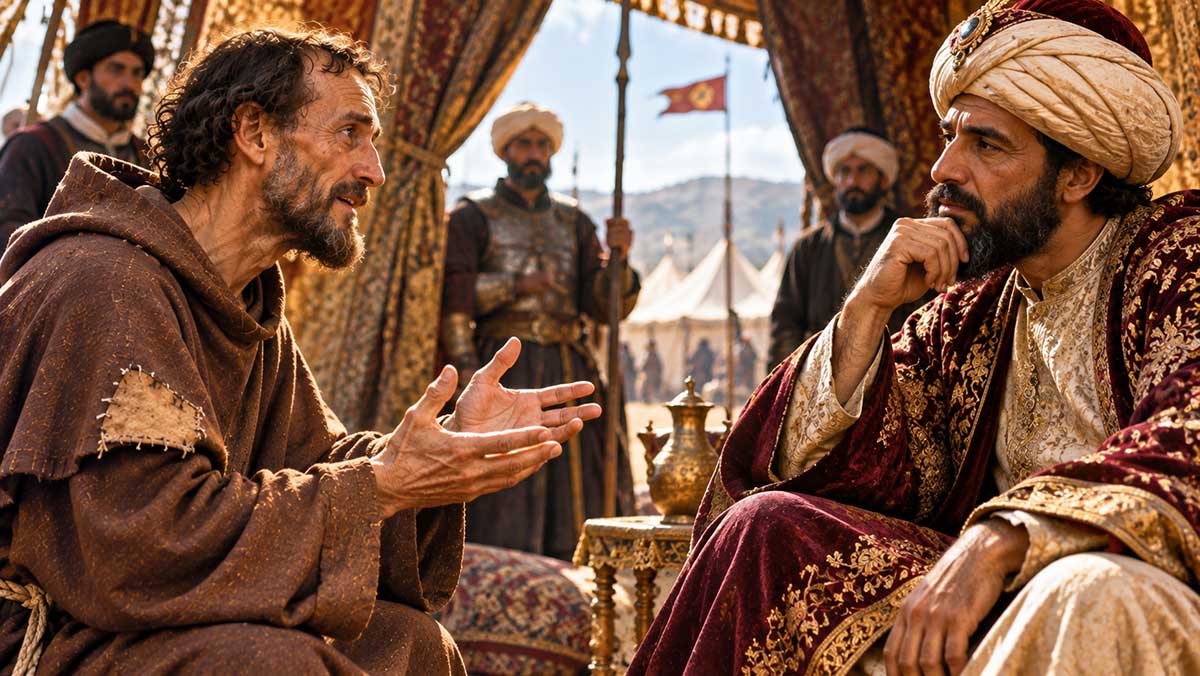
Question 9: During the Fifth Crusade, you crossed into Muslim territory and met Sultan al-Kamil. What were you hoping to accomplish, and how did you approach a man whose faith differed from yours?
The chapel bell sounds in the distance.
Francis listens until it falls silent.
Nick: Francis, now I'd like to talk about one of the most extraordinary episodes of your life.
In 1219, during the Fifth Crusade, you traveled to Egypt.
Francis: Yes.
Nick: Christian armies were fighting Muslim forces near Damietta.
And you crossed from the crusader camp to meet Sultan al-Kamil.
Francis: I went among the Muslims, yes.
Nick: Why?
Francis: I desired to bear witness to Christ.
Nick: You wanted the Sultan to become a Christian?
Francis: I wished him to hear the Gospel.
Nick: I appreciate your clarity.
Some people today describe your meeting as though you went there simply to tell the Sultan that every religion teaches the same thing.
Francis: That was not my purpose.
Nick: You believed Jesus Christ was the Son of God.
Francis: I did, and I do.
Nick: And the Sultan was a Muslim ruler who did not share that belief.
Francis: Yes.
Nick: So how did you approach him?
Francis pauses.
Francis: A brother who goes among people of another faith must not begin with quarrelling or contempt.
We were to live humbly and acknowledge that we were Christians.
When it was fitting, we could proclaim the word of God.
Nick: That's close to what you taught in the Earlier Rule.
Francis: It is the way I wished the brothers to conduct themselves.
Nick: But the circumstances were extraordinary.
There was a war going on.
You were crossing into the territory of an opposing army.
Weren't you afraid you might be killed?
Francis: The danger was real.
Nick: Did you believe God would protect you?
Francis: I trusted in God. But trusting Him does not mean that a man can demand that every danger be removed.
Nick: So you knew you might not return.
Francis: I could not know what would happen.
Nick: What did you hope the Sultan would see in you?
Francis: I hoped he would hear the message of Christ.
Nick: And what happened?
Francis: I was brought before him, and I spoke of my faith.
Nick: Did he listen?
Francis: He received me and heard what I had come to say.
Nick: Was he hostile?
Francis: He did not have me killed.
Nick: That's a rather understated answer.
Francis smiles.
Francis: It is a significant thing when a man in such circumstances is permitted to leave alive.
Nick: Fair point.
Francis: You must remember, Nick, that the Sultan had his own responsibilities and convictions.
He was not a character placed in my story merely to agree with me.
Nick: That's important.
He was a ruler, a military leader, and a Muslim.
Francis: Yes.
Nick: Do you think you changed his mind?
Francis: I cannot claim to know what remained in his heart after our meeting.
Nick: The early accounts differ about what you said to each other.
Some later stories describe dramatic challenges and miracles.
Francis: Men who remember an event may tell it for different purposes.
Nick: Then perhaps we should be careful not to pretend we know every word.
Francis: That would be wise.
Nick leans forward.
Nick: Francis, here's what fascinates me.
You lived during a time when Christians and Muslims were fighting one another.
Yet you were willing to meet a Muslim ruler face-to-face.
How did you see him?
Francis: As a man before whom I could bear witness to Christ.
Nick: Not simply as an enemy?
Francis: A man's religion and his position in a war do not relieve a Christian of the duty to conduct himself without hatred.
Nick: That's a strong statement.
Francis: A brother must not be governed by pride or the desire to humiliate another.
Nick: But you still believed the Sultan was mistaken about Christ.
Francis: Yes.
Nick: So you could disagree profoundly with him and still treat him with dignity.
Francis: Disagreement does not require contempt.
Nick: I think that's something people struggle with today.
We often assume that if someone disagrees with us about something important, we must either defeat that person or avoid him entirely.
Francis: Then perhaps you should ask whether your desire is to speak truthfully or merely to triumph.
Nick: That's uncomfortable.
Francis: You have said that before.
Nick: (Laughing.) You keep giving me reasons.
Francis smiles.
Nick: Let me ask you a harder question.
You were a Christian living during the Crusades.
Did you believe Christians should fight Muslims?
Francis becomes serious.
Francis: The war was being fought under the authority of Christian rulers and with the support of the Church.
I went there as a brother seeking to proclaim Christ.
I did not go to command an army.
Nick: But did you believe violence was justified?
Francis: I will not pretend that every question concerning war can be answered by describing my meeting with the Sultan.
What I can tell you is how I wished my brothers to live.
They were not to seek quarrels. They were to conduct themselves humbly among others and bear witness to their faith.
Nick: So you weren't writing a political plan for ending the Crusades.
Francis: No.
Nick: You were trying to live your calling within a world already at war.
Francis: Yes.
Nick: Did the meeting change the way you thought about Muslims?
Francis considers the question.
Francis: I cannot give you a grand account of every thought I carried away.
But I had gone to speak with a man whose faith differed from mine, and I was received.
That is part of what happened.
Nick: Sometimes the truth is less dramatic than the stories people want to tell.
Francis: And sometimes it is enough.
Nick: Francis, I want to ask one final thing about the Sultan.
Suppose someone says, "I respect you, but I believe your religion is wrong."
Would you consider that respect genuine?
Francis: I would consider how he treated me.
Did he speak truthfully? Did he listen? Did he threaten me simply for disagreeing? Did he regard me as a person rather than an object of hatred?
Respect does not require a man to abandon what he believes.
Nick: And neither does faith require him to despise someone who believes differently.
Francis: A Christian should remember whose example he claims to follow.
Nick nods slowly.
Nick: Jesus.
Francis: Yes.
A long silence follows.
The distant voices of the brothers drift across the courtyard.
Nick: Francis, I think this may be one of the most important parts of your story.
You weren't asking the Sultan to pretend your beliefs were the same.
You were willing to approach him without treating him as less than human.
Francis: I wished to bear witness to Christ, brother.
If you remember that, you will better understand why I went.
Closing
The afternoon light has begun to turn golden.
Nick and Francis remain seated beside the chapel wall, watching the brothers move between their work and preparations for prayer.
The conversation has traveled far beyond the small courtyard.
They have spoken of poverty as a practical form of religious life, of Clare's determined commitment, and of a dangerous encounter between a Christian friar and a Muslim ruler during the Fifth Crusade.
Nick: Francis, when we began talking today, I thought the greatest challenge of your life might have been giving up your possessions.
Now I'm not so sure.
Francis: What do you think was more difficult?
Nick: Living with other people.
Francis laughs.
Francis: That is certainly not an easy task.
Nick: You had to learn how to share food, work, responsibility, and disagreements.
You had to recognize that Clare's calling was her own.
And when you met the Sultan, you had to stand before someone who believed differently from you without surrendering your own faith.
Francis: Each of those circumstances required something of us.
Nick: And none of them could be solved simply by wearing a poor habit.
Francis: No, brother.
Nick: I think I'm beginning to understand why you called yourselves the Lesser Brothers.
It wasn't simply about having less money.
It was about refusing to make yourselves more important than everyone else.
Francis: We wished to follow the humility of Christ.
Nick: But you were still human.
Francis: Very much so.
Nick: You disagreed, struggled, and sometimes probably got on each other's nerves.
Francis: You have already discovered that much.
They laugh.
Then Nick glances toward the chapel, where more brothers are gathering.
Nick: Francis, there's something I've been wondering.
When your movement was small, you could know the brothers personally. You could work beside them and share their daily lives.
But as the movement grew, you couldn't be everywhere.
Francis: No.
Nick: And eventually, you needed more formal rules, leaders, and decisions.
Francis: Yes.
Nick: Was that difficult for you?
Francis watches the brothers entering the chapel.
Francis: A brotherhood must learn how to live faithfully as it grows.
And growth brings questions that do not arise when only a few men are gathered together.
Nick: Did you ever worry that the movement might become something different from what you had hoped?
Francis is silent for a moment.
Francis: We should speak carefully about that, Nick.
There were real difficulties, and there were brothers who carried responsibilities I could not carry alone.
Nick: Then I'd like to hear about them.
Not simply the disagreements, but what it was like to watch something you loved become larger than you could personally guide.
Francis nods.
Francis: Very well.
The chapel bell sounds again, calling the brothers to prayer.
Francis begins to rise, and Nick offers his hand.
Francis: First, brother, let us join them.
Nick: Of course.
They walk slowly toward the chapel entrance.
Francis: And afterward, we may speak of rules, ministers, and the difficulties of keeping brothers together.
Nick: That sounds like quite a conversation.
Francis glances at him with a small smile.
Francis: Perhaps you will discover that leading a brotherhood can be more troublesome than repairing a church.
Nick laughs as they enter the chapel.
The conversation continues, turning from the freedom of a small brotherhood to the responsibilities and tensions of a growing religious order.
Topic 4: When a Simple Brotherhood Became an Institution
Opening
Near the Portiuncula, outside Assisi, Italy, 1226.
The brothers' prayers have ended. Outside the chapel, the late-afternoon light stretches across the courtyard, casting long shadows from the olive trees onto the worn earth.
Francis emerges slowly from the doorway, one hand resting against the stone wall. Nick waits nearby, watching several friars gather around a brother who appears to be explaining something.
A younger friar gestures toward a bundle of cloth. Another shakes his head. Their voices remain low, but the discussion is clearly earnest.
Francis notices Nick watching them.
Francis: You seem interested in our brothers.
Nick: I'm trying to figure out what they're discussing.
Francis: Perhaps something important.
Nick: It looks like they're disagreeing about the cloth.
Francis listens briefly.
Francis: Then I suspect they are discussing something very important indeed.
Nick: (Laughing.) Cloth?
Francis: A brother may surrender a comfortable home, fine clothing, and the hope of riches. Yet he may still have a very firm opinion about how a piece of cloth should be used.
Nick laughs.
Nick: I suppose people don't stop being people just when they join a religious order.
Francis: No, brother. The habit does not remove every weakness of the man who wears it.
They begin walking toward the shaded bench where their conversation started earlier.
Nick: Francis, you've told me about your first companions. I can picture a few friends traveling together, working, praying, and trying to live the Gospel.
But your brotherhood didn't remain small.
Francis: No.
Nick: Men began joining from different towns and regions. Some had been wealthy. Some were educated. Others came from very ordinary circumstances.
They couldn't all have agreed about everything.
Francis: They did not.
Nick: And you were the man who had brought them together.
Francis settles onto the bench.
Francis: The Lord gave me brothers. But keeping a brotherhood faithful to its calling requires more than gathering men who admire the same ideal.
Nick: That's what I want to explore.
You wanted to follow Jesus in poverty and humility. Then the movement grew, and suddenly there were decisions about leadership, rules, property, and authority.
How did you preserve a simple vision when the community itself was becoming so complicated?
Francis folds his hands.
Francis: Let us speak of it. But do not expect that every difficulty was resolved simply by reminding the brothers to love one another.
Nick: (Smiling.) I wouldn't expect that from you anymore.
Question 10: When you first gathered a handful of brothers, did you anticipate how large the movement would become?
Nick: Francis, take me back to the earliest days.
Bernard of Quintavalle, Peter Catanii, Giles, and the others began joining you.
Did you have any idea what this brotherhood would become?
Francis: I had no plan for the great number of brothers who would eventually come.
When the first companions joined me, we sought to learn how to live according to the Gospel.
Nick: You weren't sitting around drawing plans for monasteries across Europe?
Francis: (Smiling.) We had more immediate concerns.
Nick: Such as?
Francis: Where we would work. How we would obtain what was necessary for the day. Where we would pray. How we would live together without seeking possessions or honors.
Nick: Very practical problems.
Francis: A brother must eat before he can complain that his supper is insufficient.
Nick: (Laughing.) You've had some experience with complaints, haven't you?
Francis: I have had experience with brothers.
Nick laughs again.
Nick: But there must have been something wonderful about those early years.
A small group of men, all choosing to live differently from the world around them.
Francis: We were grateful for the companionship. We prayed together and encouraged one another.
Yet we were not angels.
Nick: What do you mean?
Francis: We brought our former habits with us.
One man might be accustomed to giving instructions. Another might find obedience difficult. One might speak too quickly. Another might become offended too easily.
A brotherhood gives men many opportunities to discover how much humility they still lack.
Nick: I can see that.
Francis: We had to learn patience with one another.
Nick: And then more men came.
Francis: Yes.
Nick: At some point, you must have realized this wasn't going to remain a small community in Assisi.
Francis: The brothers began traveling and preaching in different places. More men wished to join us.
As their number increased, the needs of the fraternity increased with it.
Nick: What kinds of needs?
Francis: Brothers needed instruction. They needed guidance in observing our way of life. They needed to know how to conduct themselves when traveling, working, preaching, or living among people who did not know us.
Some were entrusted with responsibility for others.
Nick: In other words, organization.
Francis: Yes.
Nick: Did you enjoy organizing people?
Francis looks at Nick.
Francis: Would you enjoy organizing a great number of men who had all renounced worldly ambition but had not necessarily renounced their own opinions?
Nick bursts into laughter.
Nick: When you put it that way, perhaps not.
Francis smiles.
Francis: Yet the brothers needed care and guidance.
Nick: Did you ever wish things could go back to the beginning, when there were only a few of you?
Francis takes time before answering.
Francis: I remembered the simplicity of our first days.
But I could not ask the Lord to take away brothers merely so that my responsibilities would become easier.
Nick: That's a beautiful answer.
Francis: More brothers meant more people seeking to follow Christ.
It meant more opportunities for preaching, prayer, and service.
But it required us to consider how they could live faithfully together.
Nick: You know, there's a paradox here.
You wanted to be one of the least.
Yet thousands of people began looking to you as their spiritual father.
Francis: A man must be careful when others begin to admire him.
Nick: Why?
Francis: He may begin to believe that the good accomplished through him belongs to him.
Nick: Did that concern you?
Francis: I wished the brothers to give thanks to God for whatever good they received.
If they followed me only out of admiration for Francis, they would have misunderstood the purpose of our life.
Nick: But people need examples.
Francis: Yes. An example can help someone begin.
But the example must direct him beyond the person he admires.
Nick: Toward Christ.
Francis: Yes.
Nick: So your greatest success could become a temptation.
The more people admired you, the more important it became not to make yourself the center.
Francis: That is a danger for anyone who receives praise.
Nick: Even someone wearing a patched habit.
Francis: Especially if he begins to take pride in how beautifully patched it is.
Nick laughs.
Nick: I think you would have been difficult to flatter.
Francis: Do not be too certain, brother. Vanity can find its way into the smallest dwelling.
Nick: Including a religious brotherhood?
Francis: Including my own heart.
Nick studies Francis for a moment.
Nick: There's something I admire about that answer.
You don't speak as though becoming a religious leader made you immune to the weaknesses you saw in other people.
Francis: A man who teaches humility must be especially careful not to imagine that he has mastered it.
Question 11: As the brotherhood grew, it needed rules and leaders. What was hardest about preserving your original vision?
The courtyard has grown quieter.
Francis adjusts his habit around his knees. Nick notices the effort and gives him a moment to settle.
Nick: Francis, I'd like to ask about a difficult period.
Around 1220, you stepped away from much of the daily administration of the order.
Other brothers took on greater responsibility.
Why?
Francis: The fraternity had grown, and its responsibilities had become considerable.
There were brothers better suited to certain duties of administration and governance.
Nick: Was it difficult to let them take those responsibilities?
Francis: The work belonged to the fraternity, not to me alone.
Nick: I understand that in principle.
But this was something you had devoted your life to.
You had gathered the first brothers, traveled with them, and helped establish their way of living.
Then other men began making decisions that affected everyone.
Didn't that create tension?
Francis: There were disagreements and difficulties.
As the fraternity grew, questions arose that had not been so pressing when we were few.
Nick: Questions about poverty?
Francis: Poverty, obedience, the reception of brothers, preaching, and the responsibilities of those entrusted with leadership.
Nick: And the Rule.
Francis: Yes.
Nick: You developed an earlier form of the Rule, and then in 1223 Pope Honorius III approved the shorter Rule that would govern the order.
Francis: That is so.
Nick: Let me ask something that might sound disrespectful.
If the Gospel was your guide, why did you need so many additional rules?
Francis smiles faintly.
Francis: It is not disrespectful to ask.
The Gospel tells us how we are to follow Christ. But brothers living together must still know how to conduct themselves in particular circumstances.
Who may receive a new brother? What is required of him? How should the ministers serve those entrusted to them? How should brothers work, travel, and preach?
Nick: So the Rule was meant to help people live the Gospel together.
Francis: Yes.
Nick: But couldn't rules become a substitute for the very life they were meant to protect?
Francis looks toward the chapel.
Francis: A man may observe an outward requirement and still neglect the charity and humility that should guide him.
Nick: That's what worries me about institutions.
They begin with a purpose. Then, over time, people become occupied with procedures, titles, and authority.
Eventually, protecting the institution can become more important than the reason it was created.
Francis: That is a danger worth guarding against.
Nick: Did you see signs of it among your brothers?
Francis: I saw the need to remind them of the life they had promised.
We were to live without personal property, remain obedient, and serve one another humbly.
I did not want the brothers to seek positions of honor or use authority to make themselves greater than others.
Nick: But you believed in obedience.
Strongly.
Francis: Yes.
Nick: Here's where I find your position difficult.
Suppose a leader tells a brother to do something that seems contrary to the Gospel.
Should the brother obey?
Francis: Obedience is not permission to commit sin.
A brother must not act against God merely to satisfy the will of another man.
Nick: So obedience has limits.
Francis: It must remain obedience within the service of God.
Nick: Yet you expected the brothers to obey their ministers.
Francis: Those entrusted with leadership have responsibilities, and the brothers must not treat every personal preference as a reason for disobedience.
Nick: That's a delicate balance.
Francis: It requires humility from both the one who leads and the one who obeys.
Nick: And humility is not always easy to find.
Francis: No.
Nick smiles.
Nick: You keep returning to that.
Francis: Perhaps it is a lesson I have needed often.
Nick: Francis, can I ask you something more personal?
Francis: Certainly.
Nick: When the order became larger, did you ever feel that you were losing control of something you loved?
Francis remains silent for a while.
Francis: I would not describe the fraternity as something I possessed.
The brothers were not mine to control.
Nick: I understand. But you had a vision for their way of life.
Francis: I did.
Nick: And other people sometimes interpreted that vision differently.
Francis: Yes.
Nick: Was that painful?
Francis looks down at his hands.
Francis: Disagreement among brothers is never something to welcome lightly.
But I must be careful not to make my own wishes the measure of every brother's faithfulness.
Nick: That's an interesting answer.
You had to hold firmly to your convictions without treating every disagreement as a personal betrayal.
Francis: A brother must examine whether he is defending the Gospel or merely defending his own will.
Nick: That might be one of the hardest questions a leader can ask.
Francis: It is not an easy question for any man.
Nick: Your Testament, written near the end of your life, is very firm about preserving the way of life you believed God had given you.
Francis: I wanted the brothers to remain faithful to what we had promised.
Nick: Some later generations would struggle over how your Testament should relate to the approved Rule.
Francis: I cannot speak of disputes that lie beyond my lifetime.
Nick: Fair enough. Let me ask it another way.
What would you want a brother to do if he found himself caught between the simplicity of your early example and the practical demands of a large religious order?
Francis: He should return to the Gospel and the Rule he has promised to observe.
He should seek counsel humbly, avoid quarrelling for the sake of pride, and remember that the brothers are not enemies merely when they disagree.
Nick: So you wouldn't want him to abandon the fraternity at the first sign of difficulty.
Francis: No.
Nick: Nor would you want him to surrender his conscience simply to avoid conflict.
Francis: A brother must remain faithful to God.
Nick: I think that's an important distinction.
There are times when staying and working through disagreement may require more courage than leaving.
Francis: And there are times when a man must speak truthfully, though doing so brings difficulty.
Nick: Did you learn anything about leadership from stepping away from direct administration?
Francis considers the question.
Francis: A brother may serve the fraternity without holding its highest office.
He may encourage, pray, correct when necessary, and offer an example.
The value of his service does not depend upon the title he carries.
Nick: So leadership and importance aren't the same thing.
Francis: A title can give a man responsibility. It cannot give him holiness.
Nick laughs softly.
Nick: I wish more leaders understood that.
Francis: Then pray for them, brother.
Nick: You won't let me simply complain about them?
Francis: You may complain if you wish. But prayer may do them more good.
Nick shakes his head, smiling.
Nick: You're a difficult man to argue with.
Francis: I hope I am not making you regret your visit.
Nick: Quite the opposite.
Question 12: At Greccio, you helped people contemplate the birth of Jesus through a manger and living animals. What did you hope they would see that ordinary words might not communicate?
A cool breeze passes through the courtyard.
The younger brothers have finished their discussion about the cloth. One gathers the bundle, and the others begin carrying it toward a nearby building.
Nick watches them for a moment.
Nick: Francis, we've spent a lot of time talking about the difficulties of leading a growing order.
I'd like to turn to something very different.
Christmas at Greccio.
Francis's face softens.
Francis: Ah, Greccio.
Nick: In 1223, you arranged a celebration of the birth of Jesus using a manger, hay, and living animals.
Francis: Yes.
Nick: Why?
Francis: I wished people to remember the poverty and humility of the Lord's birth.
Nick: But people already knew the Christmas story.
Francis: They knew the words.
Nick: So what was missing?
Francis: A man may hear of the child laid in a manger and think only of a beautiful story.
But consider what it means.
The Son of God entered the world without the splendor men associate with earthly greatness.
He was laid where animals were fed.
Nick: You wanted people to see the simplicity of it.
Francis: To contemplate it more closely.
Nick: Why use real animals?
Francis: A manger belongs to the ordinary world of animals, hay, and labor.
The humility of Christ's birth is not something remote from such things.
Nick: So you wanted the scene to feel real.
Francis: I wanted those gathered to consider the circumstances of His coming.
Nick: Did you worry that people would focus on the spectacle instead of the meaning?
Francis: Any outward sign can be misunderstood.
But a sign may help turn the heart toward what it represents.
Nick: That's interesting.
You were a preacher, yet you recognized that words alone sometimes aren't enough.
Francis: Words are gifts, brother. But people learn through what they see and do, too.
Nick: You must have been a very creative communicator.
Francis smiles.
Francis: I was a brother who loved the humility of Christ.
Nick: You really don't like compliments, do you?
Francis: I prefer that you remember the child in the manger rather than the man who arranged the hay.
Nick laughs.
Nick: Fair enough.
Let me ask you something.
When people picture Jesus, they often think of His miracles, His teaching, His authority.
But you seemed especially moved by His poverty and vulnerability.
Why?
Francis's expression becomes thoughtful.
Francis: The Lord whom we worship did not come into the world demanding the honors of a king.
He accepted the weakness of infancy.
He lived among those who labored and suffered.
And He gave Himself for us.
Nick: So for you, the manger and the Cross were connected.
Francis: They both reveal the humility and love of Christ.
Nick: That's profound.
Francis: It is the mystery of our faith.
Nick: You know, Francis, I think there's something here that connects to our earlier conversation about the order.
Francis: What is that?
Nick: You were worried about brothers becoming attached to titles, property, and status.
Then at Greccio, you brought them back to a baby lying in a manger.
Almost as though you were saying, "Look at the One we're supposed to be following."
Francis nods.
Francis: The brothers must never forget whom they follow.
Nick: And Jesus didn't begin His earthly life surrounded by wealth or honor.
Francis: No.
Nick: I can see why that mattered so much to you.
But here's something else I wonder.
Did you enjoy Christmas?
Francis looks surprised.
Francis: Enjoy it?
Nick: Yes. I mean, you were serious about poverty and humility, but I hope you found joy in celebrating the birth of Jesus.
Francis smiles broadly.
Francis: Brother, how could we celebrate the coming of our Savior without joy?
Nick: Good. I was beginning to worry you might consider celebration another form of luxury.
Francis: There is a difference between rejoicing in God's gifts and seeking excess for its own sake.
Nick: So the brothers could celebrate.
Francis: They had every reason to give thanks.
Nick: And perhaps laugh a little?
Francis: I would be concerned for a brother who had forgotten how to rejoice.
Nick laughs.
Nick: That's reassuring.
Francis: Yet joy need not depend upon fine food or splendid clothing.
It can arise from gratitude, prayer, and companionship.
Nick: Did the celebration at Greccio bring people together?
Francis: The people gathered to remember the birth of Christ, and the brothers shared in the celebration.
Nick: It must have been a memorable night.
Francis: It was a time of devotion and thanksgiving.
Nick: I think I understand why the story has endured.
You helped people see something familiar with new eyes.
Francis: If they saw more clearly the humility of the Lord, then the effort was worthwhile.
Nick sits quietly, picturing the scene.
Nick: Francis, there's something beautiful about this.
Your brotherhood was becoming larger and more complicated.
Yet one of the things you are remembered for is helping people gather around something very simple.
A manger.
Some hay.
A child.
Francis: And the love of God made known through Him.
Nick: Yes.
Francis: Do not leave Him out, brother.
Nick smiles.
Nick: I won't.
Closing
The sun has begun descending behind the hills, and the courtyard is filled with the quiet activity of brothers preparing for evening.
Francis rests against the bench, visibly tired but attentive.
Nick reflects on the afternoon's conversation.
The brotherhood that began with a handful of companions had grown into an order requiring ministers, rules, and difficult decisions.
Francis had learned that an ideal could inspire people without resolving every practical problem they faced.
And at Greccio, amid the growing responsibilities of the fraternity, he had directed people's attention to the humility of Christ's birth.
Nick: Francis, I think I came into this conversation with a rather simple picture of leadership.
A great leader has a vision, gathers followers, and changes the world.
Francis: That is one way people speak of leadership.
Nick: But your experience seems more complicated.
You gathered brothers who wanted to follow the Gospel.
Then they disagreed, needed guidance, and developed responsibilities you couldn't manage alone.
Francis: Yes.
Nick: And you had to accept that the fraternity wasn't something you could personally control forever.
Francis: It was never mine to possess.
Nick: I think that's the part I find most striking.
You gave up material possessions early in your life.
But later, you faced a different kind of attachment.
The temptation to regard the movement itself as something belonging to you.
Francis considers the thought.
Francis: A man may become attached to his own work as readily as to his property.
He must remember that every good gift comes from God.
Nick: So perhaps poverty becomes more difficult when there's something you deeply love.
Francis: Love and possession are not the same thing, brother.
Nick: That's worth thinking about.
Francis looks toward the chapel.
Francis: We must love the brothers. We must serve them faithfully.
But we must not seek to make them instruments of our own importance.
Nick: And when you wanted to remind them what mattered most, you brought them back to Jesus.
Francis: To the Gospel, yes.
Nick: Even through something as simple as a manger at Christmas.
Francis smiles.
Francis: Sometimes the smallest things help us remember the greatest gifts.
A gentle silence follows.
Nick notices that Francis has grown tired.
Nick: Francis, we've been talking for a long time.
Would you like to rest?
Francis: A little rest would be welcome.
Nick: Of course.
Nick reaches for the cup beside the bench and offers it to him.
Francis drinks and thanks him.
Nick: There's one final part of your life I'd like to explore when you're ready.
Francis: Tell me.
Nick: Your last years.
The retreat at La Verna. The reports of the wounds associated with Christ's suffering. Your illness. The Canticle of the Creatures.
And something I find difficult to understand.
How could a man whose body was failing still speak with such gratitude about the sun, the moon, water, fire, and even death?
Francis looks toward the fading light.
Francis: The Lord's gifts do not cease to be gifts when our strength diminishes.
Nick: I want to understand that more deeply.
Not just as a beautiful idea, but as something you actually lived.
Francis: Then we may speak of it.
Nick: After you've rested.
Francis smiles.
Francis: You are learning to care for an old brother.
Nick: You're only forty-four, Francis.
Francis: Then perhaps my body has forgotten to count the years properly.
Nick laughs.
Nick: We'll give it some time to catch up.
Francis closes his eyes briefly, resting beneath the olive tree.
Nick remains beside him, watching the last sunlight move across the chapel wall.
The conversation pauses before its final chapter, where Francis's devotion to Christ will meet the suffering, gratitude, and approaching mortality of his final years.
Topic 5: Finding Joy When the Body Is Failing
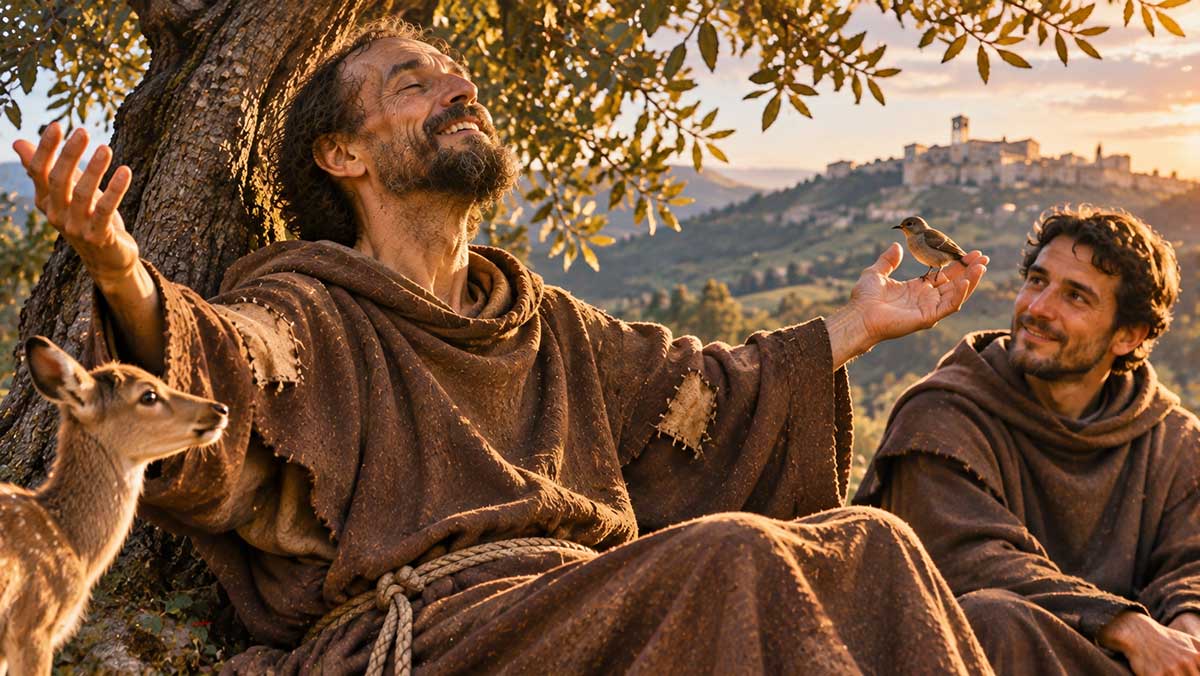
Opening
Near the Portiuncula, outside Assisi, Italy, 1226.
The evening light has turned the distant hills a soft gold. Shadows stretch across the courtyard, and the air has grown cooler beneath the olive trees.
Francis rests on the wooden bench where he and Nick began their conversation hours earlier. A brother has brought him a folded cloth to support his back and a cup of water. His breathing is quiet, and his eyes remain partly closed.
Nick sits nearby, reluctant to disturb him.
After a few minutes, Francis opens his eyes.
Francis: You have become very quiet, brother.
Nick: I didn't want to interrupt your rest.
Francis: Then you have shown me a kindness.
Nick: Are you feeling any better?
Francis: Rest is welcome. The body has its limits, and mine has been reminding me of them.
Nick: We can stop for today.
Francis turns toward him.
Francis: You have another question, do you not?
Nick: I have several.
Francis: Then perhaps we should hear one before deciding whether you must carry the others home unanswered.
Nick smiles.
Nick: You're a difficult man to persuade.
Francis: I have been told that before.
A bell sounds from the chapel. Beyond the courtyard, the brothers are finishing their evening tasks.
Nick studies Francis's face.
The man sitting beside him has spoken of youthful ambition, war, imprisonment, family conflict, service among people suffering from leprosy, and the difficulties of leading a growing religious order.
But now, in the final years of his life, Francis faces a different kind of struggle.
His eyesight has deteriorated. His body is weakened by illness. The brotherhood he helped establish has become larger than any one person can guide.
Yet during this period of suffering, he has composed some of his most memorable words of praise.
Nick: Francis, there's something I find extraordinary about your final years.
You've endured serious illness. Your eyesight has become poor. You can no longer do many of the things you once did.
And yet you've written a song praising God through the beauty of creation.
How is that possible?
Francis looks toward the fading light.
Francis: Perhaps we should begin with the suffering, brother. Otherwise, you may think that praise comes easily to a man whose body is failing.
Nick: That's exactly what I want to understand.
Question 13: Your final years have brought serious physical suffering. How has your devotion to Christ shaped the way you face it?
Nick: Francis, you've lived a demanding life.
You've traveled, preached, worked, fasted, and endured considerable hardship.
Now you're only about forty-four years old, yet your health has deteriorated badly.
Do you ever wish you had taken better care of yourself?
Francis considers the question.
Francis: A brother should not despise the body God has given him.
It is through this body that he works, prays, serves, and embraces his brothers.
Nick: But you practiced severe austerity.
Francis: I did.
Nick: And some of your early companions believed you had been too harsh with yourself.
Francis lowers his gaze.
Francis: I have learned that zeal must be guided by wisdom.
A man may desire to discipline himself and yet fail to recognize his own weakness.
Nick: That's something I want to explore.
People admire your sacrifices. But I'm not certain every sacrifice was necessarily wise.
Francis: You need not praise every hardship I endured.
Nick: I'm glad you said that.
Sometimes religious people speak as though suffering is automatically holy.
But pain can simply be pain.
Francis: Yes.
Nick: And illness can prevent someone from serving others.
Francis: It can.
Nick: So where do you draw the line between spiritual discipline and harming yourself?
Francis pauses before answering.
Francis: Discipline should help a person turn away from selfish desires and become more faithful to God.
But a brother who is ill needs care.
He should not refuse necessary help merely to appear more holy.
Nick: That sounds more compassionate than the severe image people sometimes have of medieval ascetics.
Francis: A man can become proud of his suffering just as he can become proud of his possessions.
Nick: Proud of suffering?
Francis: He may begin to think himself superior to others on account of how much hardship he can endure.
Then the very practice intended to teach humility becomes another occasion for pride.
Nick: That's a dangerous trap.
Francis: It is.
Nick: Did you ever fall into it?
Francis looks at him thoughtfully.
Francis: I have needed correction and mercy throughout my life.
I would not have you believe that I have always judged wisely.
Nick: That's a remarkably honest answer.
Francis: It would be a poor use of my remaining strength to pretend otherwise.
Nick smiles gently.
Nick: Francis, may I ask about La Verna?
Francis: Yes.
Nick: In 1224, you spent time in prayer and retreat there.
The early accounts describe an extraordinary experience associated with the suffering of Christ.
And afterward, reports circulated that you bore marks resembling the wounds of the Crucifixion.
Francis becomes quiet.
Francis: The Passion of our Lord has long been dear to my heart.
Nick: What drew you so deeply to Christ's suffering?
Francis: The love revealed through it.
Our Lord accepted humiliation, rejection, and death.
He did not suffer for the sake of winning the admiration of men.
He gave Himself for us.
Nick: So when you contemplated the Cross, you were thinking about love.
Francis: The love of Christ, yes.
Nick: Not simply pain.
Francis: Pain alone does not explain the Cross.
Nick: That's an important distinction.
Some people might look at your life and think Christianity is about seeking suffering.
Francis: A Christian is called to follow Christ.
He must not seek cruelty, nor should he neglect someone who suffers.
But he may be called to remain faithful when doing so brings hardship.
Nick: What about the wounds reported after La Verna?
Did you understand them as something you were meant to show the world?
Francis rests his hands beneath the folds of his habit.
Francis: I did not wish my life to become a spectacle.
Nick: Yet those reports became an important part of how people remembered you.
Francis: Then I would ask them to look beyond Francis to the Lord whom he sought to follow.
Nick: You keep bringing me back to Jesus.
Francis smiles faintly.
Francis: You have come to ask what happens when a man takes His teachings seriously.
I would be a poor companion if I allowed you to leave thinking the answer was simply to admire me.
Nick nods.
Nick: Fair enough.
Let me ask something more personal.
When you're in pain, do you always feel close to God?
Francis takes a slow breath.
Francis: I would not tell you that bodily suffering is pleasant, nor that prayer always removes weariness.
Nick: So faith doesn't make pain disappear.
Francis: No.
Nick: Does it change how you endure it?
Francis: It gives me reason to turn toward Christ rather than regard suffering as the whole of my existence.
And the brothers help me.
Nick: The brothers?
Francis: Yes.
One brings water. Another helps me rest. Another offers companionship.
I have spoken much about serving others, Nick.
But now I must receive their service.
Nick: Is that difficult for you?
Francis looks toward the cup beside him.
Francis: It is humbling to need help with things one once did without thinking.
Nick: I can understand that.
Francis: Yet if I have taught the brothers to care for one another, I must not deny them the opportunity to care for me.
Nick is silent for a moment.
Nick: That's something I hadn't considered.
For years, you were the one helping people.
Now you have to allow other people to help you.
Francis: Yes.
Nick: Perhaps accepting love can be as difficult as giving it.
Francis: For a proud man, it may be more difficult.
Nick: (Smiling.) Are you calling yourself proud?
Francis: I am saying that Brother Francis has not exhausted his need to learn humility.
Nick laughs softly.
Nick: Then perhaps the lessons continue until the very end.
Francis: I pray that they do.
Question 14: You praised God through the sun, moon, water, and even death. How did you come to see creation and mortality in that way?
The last sunlight touches the upper stones of the chapel.
A bird settles briefly on a nearby branch, then disappears into the olive grove.
Nick: Francis, I'd like to talk about your Canticle of the Creatures.
You composed much of it during a period of serious illness.
Francis: Yes.
Nick: And yet it's filled with gratitude.
You praise God through Brother Sun, Sister Moon, the stars, wind, water, fire, and Mother Earth.
Why speak of creation as brothers and sisters?
Francis looks toward the open countryside.
Francis: All these things come from the generosity of the Creator.
The sun gives light. Water refreshes and sustains life. The earth brings forth what living creatures need.
We do not make these gifts ourselves.
Nick: But why call them family?
Francis: We share the condition of creatures who depend upon God.
The sun does not belong to me. Nor does the earth exist merely to satisfy my desires.
Nick: So your affection for nature came from your relationship with God.
Francis: Yes.
Nick: You weren't worshipping the sun or the earth.
Francis: No, brother. We praise the Creator through His creation.
Nick: That's an important distinction.
Today, many people admire you for your love of animals and nature.
Some think of you almost as an early environmentalist.
Francis looks puzzled.
Francis: I do not know that word.
Nick: It means someone concerned about protecting the natural world.
Francis: Then I understand the concern, though not the name.
Nick: But I suspect your way of thinking was different from ours.
Francis: Tell me how your people think of creation.
Nick: We often treat it as something we own.
Forests become timber. Rivers become sources of water for industry. Animals become products. Land becomes property.
Of course, people need resources to live. But we can forget that the natural world has value beyond what we can take from it.
Francis listens.
Francis: A man may use the gifts of creation with gratitude, or he may become greedy and forget the Giver.
Nick: So you weren't opposed to people using wood, water, or the land.
Francis: We need such things.
But need is not the same as endless desire.
Nick: That's a useful distinction.
You know, Francis, people love the stories about you preaching to birds.
Francis: The brothers have remembered many things about the creatures we encountered.
Nick: Do you think animals can teach us something?
Francis: They can remind us of the generosity of God.
A bird does not seek the honor of a king. It lives according to the nature given to it.
Nick: Yet birds still have to find food, avoid danger, and survive.
Francis: Certainly.
Nick: So their lives aren't free from struggle.
Francis: No creature in this world is untouched by hardship.
Nick: Then how do you see beauty without ignoring suffering?
Francis takes time to answer.
Francis: The beauty of creation does not require us to deny that living creatures suffer.
A field may be beautiful, yet the farmer must labor. Water refreshes us, yet storms may destroy what men have built.
We give thanks for God's gifts without pretending that earthly life contains no sorrow.
Nick: That makes your Canticle even more interesting.
It isn't simply a song written by someone enjoying a beautiful spring day.
You were ill.
Francis: Yes.
Nick: Your eyesight was failing.
Francis: Yes.
Nick: And still you praised God for light.
Francis smiles.
Francis: The sun did not cease to shine when my eyes became weak.
Nick falls silent.
For several moments, the only sounds are the breeze moving through the branches and the distant voices of the brothers.
Nick: Francis, that may be one of the most moving things you've said today.
The sun didn't stop shining just when you could no longer see it clearly.
Francis: God's goodness is not measured solely by what I can presently enjoy.
Nick: I think people need to hear that.
When we're suffering, it's easy to feel that the whole world has become dark.
Francis: Suffering can make our world seem very small.
Nick: Yes.
Francis: Then the kindness of a brother, a cup of water, or a little warmth may become especially precious.
Nick: You don't speak of gratitude as pretending everything is wonderful.
Francis: No.
Nick: You speak of recognizing what remains good, even when life is difficult.
Francis: And giving thanks to God for it.
Nick nods.
Nick: There's another part of your Canticle I find surprising.
You eventually added words about forgiveness.
Why place forgiveness in a song about the sun, moon, and earth?
Francis: The peace of God must be lived among people.
It is not enough to praise Him for the beauty of creation and then refuse mercy to a brother.
Nick: So the Canticle isn't only about nature.
Francis: It is praise of God, and it calls us to live in a manner worthy of that praise.
Nick: And then there's the final addition.
Sister Bodily Death.
Francis grows still.
Francis: Yes.
Nick: I have to admit, that one is difficult for me.
I can understand calling the sun your brother and water your sister.
But death?
Why would you call death your sister?
Francis looks toward the chapel.
Francis: Death comes to every living person.
The wealthy cannot purchase freedom from it. The strong cannot command it to remain away forever.
Nick: That's true.
Francis: We must prepare to meet God.
Nick: But aren't you afraid?
Francis pauses.
Francis: I do not claim that dying is easy.
The body resists suffering. We love those who remain with us.
Yet for a Christian, death is not the final measure of life.
Our hope rests in Christ.
Nick: So calling death your sister wasn't a way of saying death is harmless.
Francis: No.
It was a way of acknowledging that bodily death belongs to the condition we must all face.
Nick: And that you wanted to face it with faith.
Francis: Yes.
Nick: You know, Francis, there's something remarkable about the progression of your Canticle.
You begin with the sun, the moon, and the beauty of creation.
Then you speak about forgiveness.
And finally, death.
It's almost as though the song moves from the world around us to the deepest challenges within human life.
Francis: A man may praise God when the sun warms his face.
But he must learn to praise Him when he is called to forgive, and when his own life draws near its end.
Nick looks down at his hands.
Nick: That's a much more demanding kind of gratitude.
Francis: It is not something we accomplish through our own strength alone.
Nick: You mean grace.
Francis: Yes, brother. Grace.
Question 15: When future generations speak of Francis of Assisi, what do you most hope they will understand about following Jesus?
The evening is approaching.
The chapel's small windows reflect the last light, and a brother begins lighting a lamp near the doorway.
Nick turns toward Francis.
Nick: Francis, we've spoken for a long time today.
I want to thank you for being so open with me.
Francis: You have asked many questions, brother.
Nick: Too many?
Francis: (Smiling.) Perhaps enough to keep a younger man occupied for several days.
Nick laughs.
Nick: I promise this is the last one.
Francis: Then I must listen carefully.
Nick: You've lived an extraordinary life.
You were born into a prosperous family. You dreamed of becoming a knight.
You experienced war and imprisonment, then began serving people you once avoided.
You gave up your possessions, gathered brothers, helped inspire Clare's religious community, and traveled to meet a Muslim ruler during a war.
Your movement grew beyond anything you could have planned.
And now, as your health fails, you're still trying to live according to the Gospel.
Francis listens quietly.
Nick: People will remember you for centuries.
They'll build churches in your name. They'll tell stories about you. They'll admire your poverty, your love of animals, and your devotion to peace.
But I wonder whether all that admiration might distract them from what you were actually trying to teach.
What do you most want people to understand?
Francis remains silent for a long moment.
Francis: I would want them to remember our Lord Jesus Christ.
Nick: Not Francis of Assisi?
Francis: What would they gain by remembering Francis and forgetting Christ?
Nick: That's a fair question.
Francis: I did not gather brothers so that men might praise my name.
I wanted us to live according to the Holy Gospel.
Nick: What does that mean in practice?
Francis: To turn toward God in repentance.
To pray.
To live humbly.
To show mercy.
To work faithfully and share what we have received.
To forgive those who have wronged us.
And to love our brothers and sisters without seeking to become greater than them.
Nick: Those sound simple when you say them.
Francis: The words may be simple.
Living them requires the whole person.
Nick: I think that's the heart of what we've been discussing.
A person can believe in Jesus, admire His teachings, attend church, and speak about love.
But when someone difficult stands in front of him, the question becomes whether he'll actually practice what he believes.
Francis: Yes.
Nick: And you learned that among people suffering from leprosy.
Francis: That was where the Lord began to change my heart.
Nick: I keep returning to that moment.
Before the order, before the famous stories, before the churches that will bear your name.
There was a young man who had to learn to approach someone he had been avoiding.
Francis: And he needed the mercy of God to do it.
Nick: Francis, let me ask something about the people who will admire you.
Suppose someone says, "Saint Francis was extraordinary. I could never live like him."
What would you tell that person?
Francis: I would not ask him to begin by becoming Francis.
Nick: What would you ask?
Francis: I would ask him to listen to Christ.
Nick: And then?
Francis: To consider what obedience to the Gospel requires of him.
Nick: In his own life.
Francis: Yes.
Nick: So a merchant might have to examine how he conducts his business.
Francis: Certainly.
Nick: A father might have to examine how he treats his children.
Francis: Yes.
Nick: A person who has been holding a grudge might have to consider forgiveness.
Francis: Yes.
Nick: And someone who sees another person suffering might have to stop walking past.
Francis turns toward him.
Francis: Yes, brother.
Nick pauses.
Nick: You know, I think that last one may be the hardest.
Francis: It was difficult for me.
Nick: I appreciate that you keep admitting it.
You don't speak as though you were born knowing how to love everyone.
Francis: I was a sinner who received mercy.
Nick: And spent the rest of his life trying to respond to it.
Francis: I have tried, brother.
Nick: Let me ask one final question.
If you could speak directly to someone who loves Jesus but feels that his faith has become mostly words, what would you say?
Francis looks toward the chapel, where the lamp is now glowing.
Francis: I would tell him not to despair.
The Lord has not ceased to call him.
Let him pray. Let him repent of what he knows is wrong. Let him seek to make peace where he has caused harm.
And let him begin with the person who needs his love today.
Nick: Not with some enormous plan to change the world?
Francis: If the Lord gives him a great work, let him receive it humbly.
But he should not neglect the small work already before him.
Nick: Such as?
Francis: A hungry neighbor.
A brother who needs forgiveness.
A person who is alone.
A duty he has been avoiding.
Nick: That sounds almost too ordinary.
Francis: The Lord entered our ordinary world, Nick.
He was born among us. He walked our roads. He ate with people. He touched the sick.
Why should we expect to follow Him without entering the ordinary needs of others?
Nick looks at Francis for a long moment.
Nick: I think I finally understand why your life has affected so many people.
You didn't simply tell people to love.
You tried to live in a way that made love visible.
Francis shakes his head gently.
Francis: Do not forget how often I have needed mercy myself.
Nick: I won't.
Francis: And do not let admiration for my life become an excuse for neglecting your own.
Nick smiles.
Nick: That's quite a farewell instruction.
Francis: Then perhaps you will remember it.
Nick: I think I will.
Closing
The sun has disappeared beyond the hills.
A soft evening breeze moves through the olive trees, and the chapel lamp casts a warm glow across the stone doorway.
Francis appears tired. Nick can see that the long conversation has required considerable effort from him.
Nick: Francis, I think it's time I let you rest.
Francis: You have been a patient companion.
Nick: I should be thanking you.
I came here wanting to understand what happens when someone takes Jesus seriously.
I thought we'd talk about poverty, miracles, and the extraordinary things you've done.
And we did.
But what stays with me most is something much simpler.
You learned to stop walking past people who needed you.
Francis looks at him with quiet affection.
Francis: The Lord was merciful to me.
Nick: You keep saying that.
Francis: Then perhaps it is something I hope you will remember.
Nick smiles.
Nick: I will.
A brother approaches the bench.
Brother: Brother Francis, shall I help you inside?
Francis: Yes, brother. Thank you.
Nick rises and offers his hand.
Francis accepts it, slowly coming to his feet.
For a moment, they stand together beneath the olive tree.
Nick: Francis, there's something I want to tell you.
Francis: I am listening.
Nick: You may not know what future generations will say about you.
But your life will continue to encourage people long after this conversation.
Some will admire your poverty. Others will love your stories about animals.
But I hope they'll discover the deeper message we've talked about today.
Francis: Then tell them of Christ, brother.
Nick: I will.
Francis places a hand gently on Nick's arm.
Francis: And remember to seek Him among those who need your mercy.
Nick nods.
Nick: Thank you, Francis.
Francis: May the Lord give you peace.
Nick: And you, too.
Francis begins walking toward the chapel with the brother beside him.
Nick remains beneath the olive tree, watching until they reach the doorway.
Just before entering, Francis turns.
Francis: Brother Nick?
Nick: Yes?
Francis: You have traveled a long way to speak with me.
Nick: I have.
Francis smiles.
Francis: Then I hope you will not return home merely with a good story.
Nick laughs softly.
Nick: I'll try not to.
Francis: Good.
He raises a hand in farewell and disappears into the warm light of the chapel.
Nick stands alone for a few moments.
The courtyard is quiet now. The brothers' voices have faded, and the first stars are appearing above the hills.
He thinks about the young man who once dreamed of becoming a knight.
The son who disappointed his father.
The brother who served people others avoided.
The preacher who crossed into an enemy camp.
The founder who had to accept that his movement could not remain under his personal direction.
And the sick man who praised God for the beauty of creation even as his own strength diminished.
Francis's life had been extraordinary.
Yet the question he leaves behind is not whether ordinary people can imitate every sacrifice he made.
It is whether they are willing to let the teachings of Jesus change the way they live.
Nick takes one last look at the little chapel.
Then he turns toward the path leading away from the Portiuncula.
The conversation ends, but the question remains: What happens when we stop merely admiring the teachings of Jesus and begin living them?
Final Thoughts: The Difference Between Admiring Jesus and Following Him
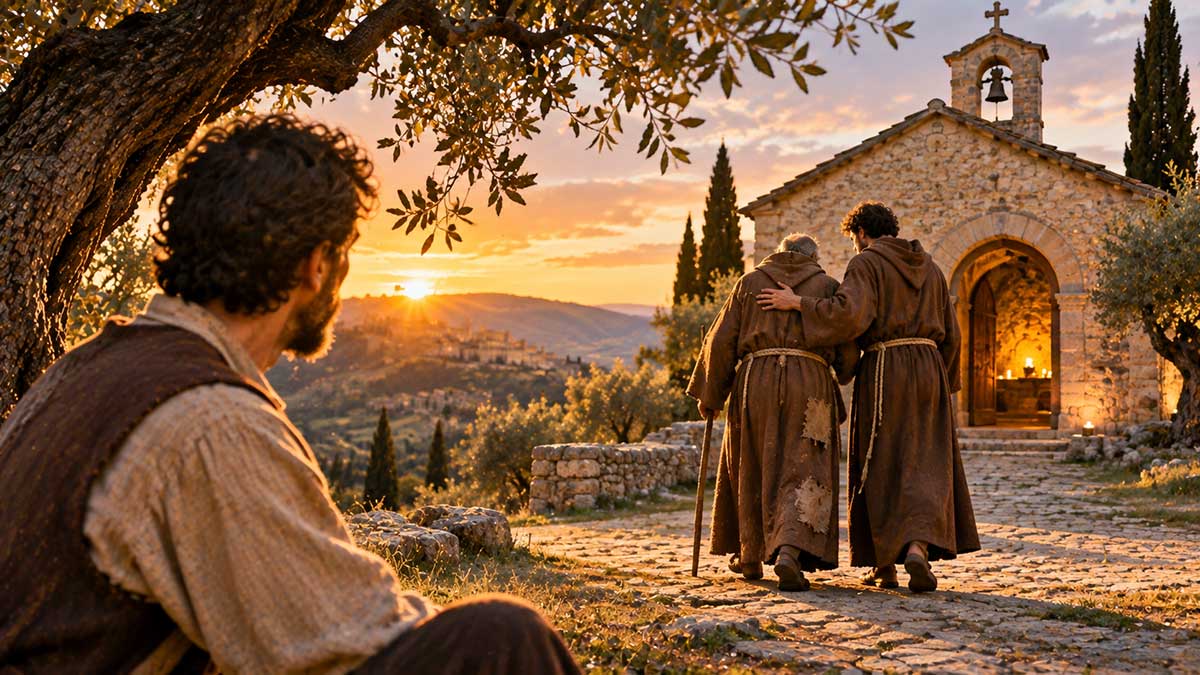
When Nick first met Francis of Assisi beneath the olive trees near the Portiuncula, he expected to encounter one of Christianity's most celebrated saints. Instead, their conversation revealed a man whose spiritual life had developed through disappointment, uncertainty, conflict, friendship, and repeated acts of commitment. Francis had once dreamed of becoming a knight and earning the admiration of others. His transformation did not erase his humanity. It redirected his ambitions, gradually changing what he considered valuable and whom he was willing to serve.
Perhaps the most revealing moment in Francis's story is his encounter with people suffering from leprosy. He did not begin by establishing a great religious organization or developing a theory about compassion. He began approaching individuals he had previously avoided. His own account of his conversion identifies this experience as central to the change in his life. The lesson is uncomfortable precisely since it is so personal. We can speak eloquently about loving humanity and still fail to show kindness to the person standing before us. Francis challenges us to ask whether our convictions have changed our actual behavior.
His embrace of poverty raises another difficult question. Francis rejected the wealth and status that had shaped his early ambitions, but his decisions created genuine tension with his father. Later, as companions joined him, he discovered that living without personal possessions did not remove the need for food, shelter, medical care, and responsible leadership. Poverty did not automatically produce humility. Men could become proud of their sacrifices just as readily as others became proud of their wealth. The brothers still had to work, cooperate, forgive, and care for one another. Their experience suggests that spiritual sincerity must be tested in ordinary responsibilities rather than measured solely by dramatic acts of renunciation.
The meeting between Francis and Sultan al-Kamil during the Fifth Crusade offers a different challenge. Francis did not travel to Egypt to declare that Christianity and Islam were interchangeable. He was a committed Catholic missionary who wanted to bear witness to Christ. Yet he entered Muslim-controlled territory and met a ruler whose convictions differed profoundly from his own. The historical chronology of Francis's life confirms the encounter in 1219, though the precise exchange remains uncertain. The lesson is not that sincere convictions should be abandoned. It is that disagreement does not have to become contempt, and faith need not prevent a person from recognizing another's humanity.
As the Franciscan brotherhood grew, Francis faced a challenge familiar to anyone responsible for an organization, community, or family. A compelling vision can bring people together, but it cannot eliminate disagreement or the need for structure. Rules became necessary. Leadership responsibilities had to be shared. Different brothers interpreted their commitments in different ways. Francis could not personally direct every decision, and the movement's growth required him to distinguish between serving a community and possessing it. His experience raises a question that extends far beyond religious life: Can we remain faithful to our deepest principles when our responsibilities become larger than our ability to control them?
The final years of Francis's life bring the conversation to its most intimate questions. His eyesight deteriorated, his body weakened, and the activities that had defined much of his earlier life became increasingly difficult. Yet during this period, he composed the Canticle of the Creatures, praising God through sunlight, water, earth, and the shared existence of living things. His gratitude was not a denial of suffering. It reflected his conviction that creation remained a gift when his own ability to enjoy it was diminished. The Franciscan account of his final years connects his physical decline with the composition of this remarkable work of praise. His example invites us to consider whether gratitude can remain meaningful when circumstances are painful and uncertain.
One striking feature of the imaginary conversation is Francis's repeated insistence that the story should not end with admiration for him. He does not ask Nick to reproduce every detail of his medieval religious life. He directs attention toward Jesus Christ, whose humility, mercy, and self-giving love shaped his understanding of discipleship. This distinction matters. Francis was not merely promoting simplicity, kindness, or appreciation for nature as independent ideals. These were expressions of a specifically Christian calling. To separate his actions entirely from his devotion to Christ would leave out the conviction that gave his life its direction.
What happens when you take Jesus seriously? Francis's life does not provide an easy answer or a promise that faithfulness will remove hardship. It offers something more demanding: an invitation to examine whether belief has become action. Perhaps the beginning is not a dramatic renunciation but a neglected responsibility, a needed apology, an act of generosity, or a person we have been unwilling to approach. Francis became famous for what he surrendered, but his enduring challenge lies in what he practiced. The question he leaves with us is not whether we could become another Francis of Assisi. It is whether we are willing to become more faithful in the lives we have already been given.
Fictional Conversation Disclaimer
The preceding interview and its closing encounter are fictional reconstructions intended for historical reflection. The dialogue does not constitute Francis of Assisi's authentic words or endorsement of modern interpretations. Documented events, plausible historical interpretations, devotional traditions, and invented dramatic details should be distinguished when evaluating the narrative.
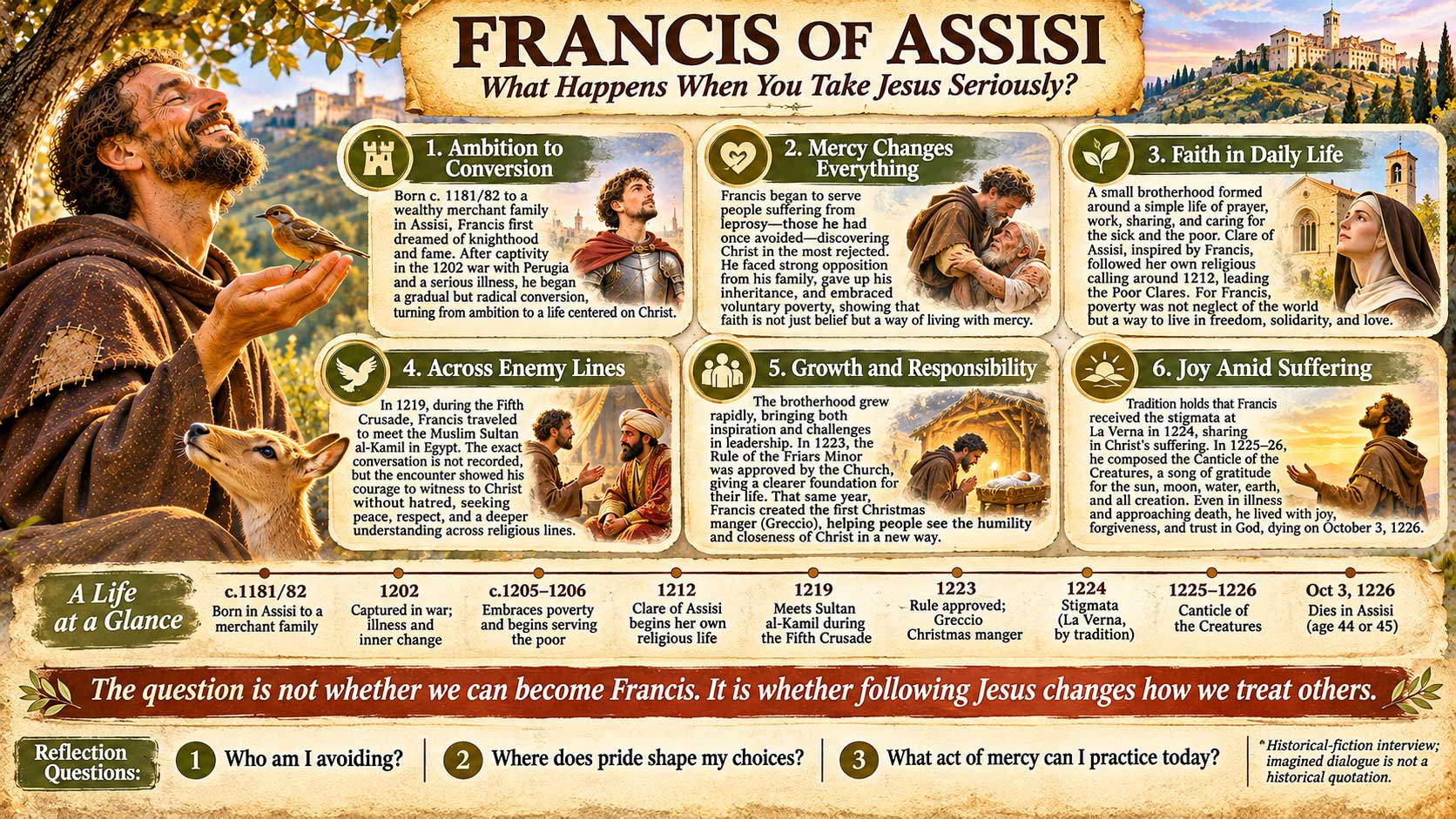
Francis of Assisi (c. 1181/1182–1226)
Francis of Assisi was an Italian Catholic friar, preacher, and founder of the Order of Friars Minor. Born into a prosperous merchant family, he experienced a gradual conversion that led him to embrace poverty, humility, prayer, and service. His brotherhood received formal papal approval of its Rule in 1223. Francis is remembered for serving people suffering from leprosy, meeting Sultan al-Kamil in Egypt, and inspiring the Christmas celebration at Greccio. Reports of his receiving the stigmata at La Verna in 1224 became central to Franciscan devotion. He died on October 3, 1226, and was canonized in 1228.
Further reading: Saint Francis, Order of Friars Minor.
Clare of Assisi (1193/1194–1253)
Clare of Assisi was an Italian Catholic religious leader who embraced a life of poverty and prayer in 1212, with Francis's support. She became the leader of the women's community at San Damiano and defended its commitment to evangelical poverty. Clare exercised independent spiritual leadership, and her own Rule received papal approval shortly before her death. She was canonized in 1255.
Further reading: The Franciscan historical account.
Sultan al-Kamil (c. 1177–1238)
Al-Kamil Muhammad al-Malik was an Ayyubid ruler of Egypt and later held authority in Syria. During the Fifth Crusade, he led Muslim forces opposing the crusading armies near Damietta. In 1219, he received Francis of Assisi, who had crossed into Muslim-controlled territory to proclaim his Christian faith. The encounter is historically attested, but its precise dialogue and the Sultan's personal response cannot be established with certainty.
Further reading: Franciscan chronology, 1219 encounter.
Pope Honorius III (c. 1150–1227)
Honorius III served as pope from 1216 to 1227. His pontificate included the continuation of the Fifth Crusade and the formal development of several religious orders. On November 29, 1223, he approved the Later Rule of the Friars Minor through the papal bull Solet annuere, an important milestone in the institutional development of the Franciscan movement.
Further reading: Francis's writings and approved Rule.
Nick Sasaki (Imaginary Interviewer)
Nick Sasaki is the creator of ImaginaryTalks.com, a historical storytelling project that brings influential figures into fictional conversations exploring enduring questions about human life, faith, history, philosophy, and society.
In this interview, Nick explores the human experiences and Christian convictions of Francis of Assisi, examining the difference between admiring the teachings of Jesus and putting them into practice.
Leave a Reply