
Introduction
What if one of the greatest scientific minds in history invited you into his home for an afternoon? What would you ask him about the mysteries of nature, the meaning of love, and his relationship with God? And what might you discover about the man behind the mathematical equations that helped transform modern civilization?
James Clerk Maxwell accomplished something extraordinary. He demonstrated that electricity, magnetism, and light were intimately related physical phenomena. His electromagnetic theory laid the scientific foundations for technologies that would eventually include radio, television, radar, and wireless communications. Albert Einstein's later work would draw upon the intellectual foundations Maxwell helped establish. The James Clerk Maxwell Foundation preserves the history of his remarkable scientific contributions.
Yet Maxwell was much more than a mathematical genius. He was once a little Scottish boy who persistently asked, “Show me how it doos.” He wanted to know what happened inside locks, how mechanical devices operated, and why ordinary objects behaved as they did. At fourteen, he produced his first mathematical paper. His childhood curiosity would eventually carry him from the mechanisms of everyday objects to the rings of Saturn and the invisible processes occurring throughout nature.
There was another Maxwell whom scientific textbooks rarely introduce. He enjoyed horseback riding, wrote humorous poetry, loved the company of dogs, and took pleasure in reading literature aloud to his wife, Katherine. Their marriage included shared Christian convictions, scientific activities, and mutual care during illness. The recollections collected by Lewis Campbell and William Garnett in The Life of James Clerk Maxwell, available through the Internet Archive, reveal a personality far richer than his scientific reputation alone might suggest.
Perhaps the most intriguing aspect of Maxwell's life was his Christian faith. He regarded the investigation of nature and his relationship with God as meaningful parts of the same existence. His scientific conclusions depended upon mathematics and experimental evidence, yet his Christian convictions informed his personal responsibilities and appreciation of creation. The biblical inscription associated with the original Cavendish Laboratory at Cambridge expresses something of that relationship: “Great are the works of the Lord, sought out of all them that have pleasure therein.”
For this fictional interview, I have chosen to visit Maxwell at Glenlair, his beloved Scottish country home, in late August 1876. He is forty-five years old, still actively investigating nature, teaching at Cambridge, and looking forward to future discoveries. Our conversation begins in his study, continues over afternoon tea, and eventually takes us along the countryside beside the Water of Urr.
Across five conversations, we explore his childhood, his greatest scientific discoveries, his marriage to Katherine, his relationship with Christ, and the questions he still hopes to answer. Rather than presenting Maxwell solely as a celebrated historical figure, I wanted to spend an afternoon with him as a person, experiencing his humor, intellectual generosity, affection, and curiosity.
What happens when a man capable of discovering hidden relationships within the physical universe turns his attention to the deeper questions of human existence? Perhaps the answer begins with the same simple question that occupied him as a little boy: How does it work?
Fictional Conversation Disclaimer
This interview is a fictional reconstruction inspired by the documented life, scientific writings, correspondence, Christian convictions, and historical circumstances of James Clerk Maxwell. The meeting at Glenlair, conversations, demonstrations, personal reflections, and humorous exchanges are invented for educational and creative purposes. Except for explicitly identified historical quotations, the dialogue should not be interpreted as Maxwell's authentic words or as an endorsement of the interview's interpretations.
Topic 1: The Boy Who Wanted to Know How
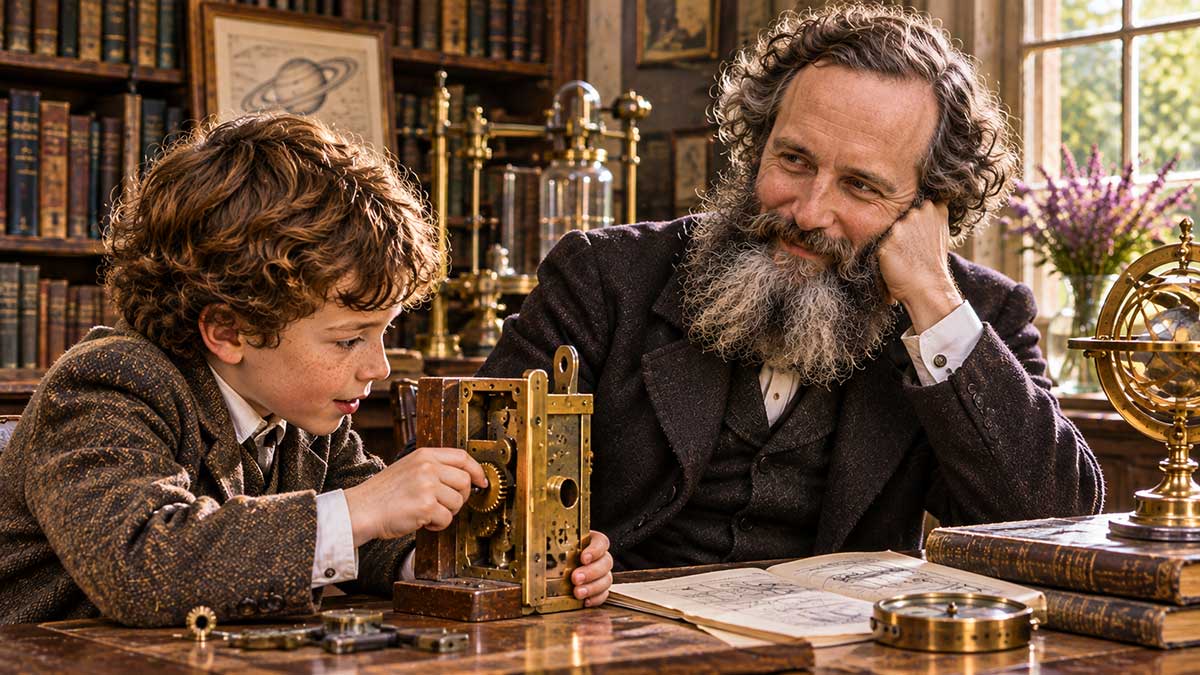
It was late August 1876, and the Scottish countryside of Kirkcudbrightshire was still dressed in the green of summer. Beyond the stone walls and scattered farmhouses, the Water of Urr flowed through a quiet valley. A horse-drawn carriage carried me along a country road leading to Glenlair, the family estate where James Clerk Maxwell had spent much of his childhood.
Britain was experiencing an extraordinary period of scientific and industrial development. Steam engines carried passengers across the country, telegraph wires transmitted messages over great distances, and scientists were investigating phenomena that previous generations could scarcely have conceived. Yet here, far from the crowded streets of London and the lecture halls of Cambridge, lived a man whose mathematical discoveries had revealed an unexpected relationship between electricity, magnetism, and light.
Maxwell was forty-five years old. His dark, abundant beard framed a face that appeared more approachable than the solemn expressions preserved in his photographs. Inside his home were books, scientific papers, geometrical drawings, and the familiar possessions of a Scottish country gentleman. This afternoon, however, there would be no formal lecture.
Opening
Nick Sasaki: Professor Maxwell, thank you for inviting me to Glenlair. What a beautiful place to grow up.
James Clerk Maxwell: You're very welcome. And since you've come all this way, I think we can dispense with the professor. James will do perfectly well.
Nick: Then please call me Nick.
Maxwell: Very good, Nick. Did you have a comfortable ride?
Nick: Comfortable enough. I spent most of it looking out at the countryside.
Maxwell: That's a respectable occupation. Much better than spending the entire ride wondering whether you've taken the wrong road.
A dog appeared from the passage and approached me with considerable interest, inspecting my shoes before settling near Maxwell.
Nick: I see you have someone responsible for examining visitors.
Maxwell: An investigator of considerable persistence, though his conclusions are chiefly concerned with food.
Nick: Does he understand any mathematics?
Maxwell: He understands subtraction remarkably well. Leave two biscuits within his reach and you'll soon have none.
We both laughed.
Maxwell led me into his study, where several sheets of paper lay beside a collection of books. Near the window stood a small assortment of objects that appeared to have been assembled for scientific investigations.
I had come to meet the man who had transformed our knowledge of light. Within minutes, however, I found myself more interested in the little boy who had once run through these rooms.
Question 1: James, when you were a little boy growing up here at Glenlair, you apparently wanted to know how everything worked. What do you remember about those early years?
Maxwell: There was a great deal to occupy a boy here. Water running through the fields, animals behaving in peculiar ways, people working with tools, doors that opened and shut by arrangements one couldn't immediately see.
Everything presented a difficulty of some sort.
Nick: A difficulty?
Maxwell: Something requiring explanation. A perfectly satisfactory door to most people might be a very unsatisfactory door to a child who doesn't know what happens inside its lock.
Nick: I've read that one of your favorite expressions as a small child was, “Show me how it doos.”
Maxwell smiled.
Maxwell: Ah, the family has preserved evidence against me.
Nick: You were not yet three years old.
Maxwell: Then I can hardly be held responsible for the grammar.
Nick: But the question itself has remained with you.
Maxwell: It has, I suppose. There is a considerable difference between being told what a thing is and discovering what it does.
A child asks about a bell. You tell him that it is a bell. He asks why it rings. You explain that someone has pulled a cord. Then he wishes to know what the cord moves, what strikes the bell, and how the sound reaches his ears.
Before long, you've exhausted the patience of everyone in the household.
Nick: Were your parents patient with those questions?
Maxwell: My father was particularly interested in practical contrivances. He liked machinery, construction, and improvements of various kinds. A question about a mechanism was quite likely to interest him personally.
He was capable of becoming nearly as occupied with a difficulty as the child who had brought it to his attention.
Nick: That sounds like a wonderful environment for a curious boy.
Maxwell: It was certainly an interesting one. There were people here who knew how to accomplish things that I could not accomplish myself.
A carpenter, for instance, possesses knowledge that becomes evident when you watch his hands. A man who has worked with horses for years knows things about their behavior that cannot easily be communicated in a few sentences.
One learns a great deal by attending to people at their work.
Nick: Did you ever take things apart?
Maxwell: The difficulty with taking things apart is that one is expected to put them together again.
Nick: Were you successful?
Maxwell: Success varied according to the object and the patience of its owner.
He rose from his chair and walked over to the door.
Maxwell: Consider this latch, Nick.
He pressed the handle, causing the small metal tongue to withdraw.
Maxwell: What has happened?
Nick: You've moved the handle, and the latch has pulled back.
Maxwell: Quite. But your hand has moved in one direction, and the latch has moved in another. Somewhere inside this arrangement, one kind of motion has been converted into another.
And when I release the handle?
The latch returned to its original position.
Nick: A spring?
Maxwell: Most likely. Now, without opening the mechanism, could you draw an arrangement that would produce those movements?
Nick: I could try.
Maxwell: Excellent. You might devise several arrangements that would work equally well. But which one is actually inside the door?
Nick: We'd have to open it.
Maxwell: That would settle the matter rather nicely.
He returned to his chair.
Maxwell: Nature is less accommodating than a door. We cannot always open the object of our investigation and examine its contents. Sometimes we must devise possible arrangements and discover which of them agrees with what we can observe.
Nick: So even a door latch contains the beginning of a scientific investigation.
Maxwell: Certainly. Though I wouldn't recommend publishing a paper on every door you encounter.
Nick: Were you conscious, as a child, of wanting to become a scientist?
Maxwell: No. I wanted to find things out. The occupation came later.
A child has the advantage of not yet knowing which questions belong to mathematics, which belong to natural philosophy, and which are considered unsuitable for either.
He simply asks.
Nick: Do adults lose some of that freedom?
Maxwell: They acquire responsibilities, which is perfectly proper. But they acquire habits of thought, too. Those are sometimes more difficult to alter than responsibilities.
Tell me, Nick, what interested you when you were a boy?
Nick: I was fascinated by the things adults knew that I didn't. I often wanted to understand why people believed certain things or behaved in certain ways.
Maxwell: Then your difficulties concerned people rather than machinery.
Nick: Perhaps people are more difficult to figure out.
Maxwell: Infinitely more difficult. A spring seldom changes its opinion halfway through an experiment.
We laughed again.
Nick: Looking around Glenlair, I can see why you enjoyed being here. There must have been something new to investigate every day.
Maxwell: There still is. The objects have become somewhat more familiar, but that is no guarantee that I know everything about them.
Question 2: You lost your mother when you were only eight. What do you remember about her, and what did your father give you that no university could have taught you?
Maxwell's expression became quieter. He looked briefly toward the window, where the afternoon light rested on the trees outside.
Maxwell: My mother undertook much of my earliest instruction. I was fortunate to have had that time with her, though it was shorter than anyone would have wished.
She died in 1839.
I was eight years old, as you say. One possesses memories at that age, but one has scarcely begun to comprehend the lives of one's parents.
Nick: There must be things you wish you could ask her now.
Maxwell: Naturally. A man discovers, as he grows older, that his parents were people with histories of their own. They had friendships, difficulties, hopes, and experiences long before he appeared.
A child sees his mother chiefly in relation to himself. It takes years to recognize the extent of the person he knew only as Mother.
Nick: That's a beautiful observation.
Maxwell: There are questions I could ask her now that would never have occurred to me at eight.
Nick: Your father must have faced a considerable responsibility after she died.
Maxwell: He did. He took a very active interest in my affairs. My relatives were kind to me, too.
My father and I corresponded frequently when I was away from home. He wished to know what I was doing, how I was progressing, what interested me, and occasionally what expenses I had incurred.
Nick: The last question sounds familiar to every parent with a child away at university.
Maxwell: Indeed. Mathematical ability does not necessarily produce an economical undergraduate.
Nick: What sort of man was your father?
Maxwell: He was interested in useful things. He enjoyed examining practical arrangements and considering how they might be improved.
Glenlair itself occupied a considerable portion of his attention. There were buildings to maintain, land to manage, and people whose work required his consideration.
His interests were not confined to books.
Nick: Did that influence your scientific approach?
Maxwell: I think it would be difficult to separate one's earliest experiences from one's later habits.
I had opportunities to observe things being constructed and repaired. I became familiar with the fact that an arrangement which appears satisfactory on paper may present unexpected difficulties when somebody attempts to construct it.
That is a valuable acquaintance to make early in life.
Nick: Some children grow up with parents who have very definite expectations about what they should become. Was your father like that?
Maxwell: He certainly cared about my education and my prospects. I would not suggest that he had no anxieties concerning them.
But he took an interest in the things that interested me. That was a considerable kindness.
Nick: There's a difference between wanting your child to succeed and wanting to discover who your child actually is.
Maxwell: Yes. Though I suspect parents are often obliged to do both at once.
Nick: Did your father understand the mathematics you eventually pursued?
Maxwell: Not every part of it. But he was interested in its applications and in my progress.
One needn't possess the same accomplishments as another person to take pleasure in his accomplishments.
Nick: That's something I can appreciate as a father.
Maxwell: Do your children pursue the same interests as yourself?
Nick: Some interests we share, but each of them has developed a personality and direction of their own.
Maxwell: Then you have the pleasure of discovering several people whom you might otherwise never have encountered.
Nick: That's an interesting way of looking at parenthood.
Maxwell: I should think it would be rather dull if children were merely imperfect reproductions of their parents.
We smiled.
Nick: Your father died in 1856, the year you became a professor in Aberdeen.
Maxwell: Yes. I was twenty-four when he died.
He had followed my education for so many years. I would have liked him to have seen more of what came afterward.
Nick: Your work on Saturn, your marriage to Katherine, your discoveries concerning light.
Maxwell: And the alterations to this house.
He glanced around the room.
Maxwell: Some of the plans for enlarging Glenlair originated with him. I was able to carry forward a number of those arrangements after his death.
Nick: So when you walk through this house, part of what you see is something the two of you created across different periods of your lives.
Maxwell: That's a pleasant way of expressing it.
There are certain things about a house that remain associated with the people who once occupied it. A room may be altered considerably and yet retain something of its earlier character.
Nick: Do you still feel close to your father here?
Maxwell: His interests are certainly present in many of the things surrounding us.
And occasionally I encounter some practical difficulty which makes me wish I could consult him.
He smiled.
Maxwell: I cannot promise that we would agree on the solution.
Nick: But you'd enjoy discussing it.
Maxwell: Very much.
For a moment, neither of us spoke. Glenlair had begun to feel less like the residence of a celebrated physicist and more like the home of a son who had inherited unfinished conversations with his father.
Question 3: Your schoolmates called you “Dafty,” yet at fourteen you had already written a scientific paper. Did you ever feel that being different was something you needed to change?
Maxwell: The name was not intended as a distinction of academic merit.
Nick: I suspected as much.
Maxwell: I arrived at Edinburgh Academy from the country in 1841. My appearance and manner were sufficiently unusual to attract attention.
Schoolboys possess a remarkable ability to identify anything in another boy that differs from their own arrangements.
Nick: What did you do when they teased you?
Maxwell: I continued attending school. There was little alternative.
Nick: Did it hurt?
Maxwell: A boy does not necessarily enjoy being made ridiculous. But there were other boys at the Academy with whom I formed very good friendships.
Lewis Campbell and Peter Guthrie Tait, for example, became important companions.
It would be quite misleading to describe my schooldays entirely in terms of being teased.
Nick: What did you and your friends enjoy doing together?
Maxwell: We discussed things. We read. We disputed questions of various kinds. Tait had a considerable mathematical ability, which made him an excellent companion for such occupations.
A good friend can be a very useful disturbance to one's thinking.
Nick: A disturbance?
Maxwell: Yes. Left entirely to oneself, one may become rather satisfied with one's own reasoning. A friend discovers the weak point and takes great pleasure in drawing attention to it.
Nick: Did you enjoy being corrected?
Maxwell: Not invariably at the instant of correction.
Nick: That's reassuring.
Maxwell: But it is preferable to being corrected publicly several months afterward.
Nick: Tell me about your first scientific paper. You were fourteen when you investigated methods of drawing oval curves. What led you to that problem?
Maxwell reached for a sheet of paper and a pencil.
Maxwell: Are you familiar with the method of drawing an ellipse using two fixed points and a thread?
Nick: I've seen it demonstrated.
He drew two small dots on the paper.
Maxwell: If you arrange a thread around two fixed points and keep it stretched with the pencil, you can produce an ellipse. The sum of the distances from the pencil to the two points remains constant.
But one can ask whether other arrangements of threads and fixed points will produce other interesting curves.
He added several lines to his drawing.
Maxwell: The geometrical properties of a curve become connected with the practical method by which it is drawn.
Nick: So the mathematics begins with something you can actually do with your hands.
Maxwell: Precisely. And then the mathematical question may carry you considerably beyond the original construction.
Nick: Were you aware that you were doing something unusual for a fourteen-year-old?
Maxwell: I was aware that the problem interested me. Professor James David Forbes took an interest in the work, and it was communicated to the Royal Society of Edinburgh.
Nick: You weren't the one who presented it to the Society?
Maxwell: No. Forbes communicated it.
Nick: What did that recognition mean to you?
Maxwell: It was gratifying to discover that something which had occupied my attention might be of interest to other people.
There is a particular pleasure in finding someone who wishes to discuss a question that has been occupying one's mind.
Nick: Did your schoolmates begin treating you differently?
Maxwell: Academic success alters certain opinions. It does not necessarily improve one's appearance or make one's jokes more intelligible.
Nick: You seem quite comfortable with the fact that you were an unusual person.
Maxwell: It would have required considerable effort to become an entirely different one.
Nick: Did you ever try?
Maxwell: There were certainly things I needed to learn. I wouldn't recommend preserving every fault of one's childhood merely on the grounds that it constitutes individuality.
One must learn to communicate, to attend to other people, and to distinguish a genuinely interesting question from one that merely inconveniences everybody.
Nick: Did university help you develop those qualities?
Maxwell: Edinburgh gave me opportunities to pursue several interests. I studied mathematics and natural philosophy, but I was interested in other subjects, too.
At Cambridge, the mathematical training was much more concentrated.
There was considerable value in that discipline. You were expected to work accurately, to recognize methods of solution, and to become proficient in their use.
Nick: You graduated as Second Wrangler.
Maxwell: Yes, in 1854. Edward Routh came first.
Nick: Were you disappointed not to finish first?
Maxwell: Routh was an exceptionally able mathematician. His achievement was thoroughly deserved.
Cambridge examinations test important abilities, but the natural world has not undertaken to arrange its questions according to the Cambridge examination papers.
Nick: Meaning that being good at solving an examination problem is different from discovering a problem nobody has thought to ask?
Maxwell: Very different occupations.
In an examination, someone has usually established that the problem possesses a solution. In scientific investigation, one may spend a considerable time discovering that one has asked the question badly.
Nick: That must be frustrating.
Maxwell: It can be. It can be amusing, too, particularly when the error becomes apparent and one wonders how it escaped notice for so long.
Nick: Do you think schools sometimes discourage unusual questions?
Maxwell: A teacher has practical difficulties. He must instruct many pupils, each with different abilities and interests, within a limited period.
I have experienced those difficulties myself.
But there is a pleasure peculiar to teaching when a pupil asks something you had not anticipated.
Nick: What if you don't know the answer?
Maxwell: Then the pupil has performed a useful service.
Nick: You would admit it?
Maxwell: Certainly. Though I might ask him to return the following day, so that I could have the pleasure of investigating it myself.
Nick: I wish more teachers responded that way.
Maxwell: A teacher who has ceased to be a student will eventually have very little fresh material with which to occupy his pupils.
Nick: James, listening to you, I get the impression that mathematics was never merely a subject you studied. It was something you played with.
Maxwell: There is considerable pleasure in it.
The difficulty is that people sometimes encounter mathematics chiefly through exercises whose purpose they cannot perceive. They are required to perform an operation correctly, but they have no particular desire to discover its result.
Give a person a question that genuinely interests him, and the operations acquire a different character.
Nick: Did you ever become so absorbed in a problem that you forgot everything else?
Maxwell: Frequently enough to inconvenience people who expected me to appear at a particular time.
Nick: I suspect Katherine has something to say about that.
Maxwell: Katherine possesses a much more dependable acquaintance with the passage of ordinary time than I sometimes exhibit.
He looked down at the geometrical drawing between us.
Maxwell: A mathematician may spend an hour investigating the properties of time and still arrive late for dinner.
Closing
The dog had settled beneath the window, apparently satisfied that our conversation presented no immediate opportunities for obtaining food.
Maxwell gathered the loose sheets of paper and placed his drawing beside a stack of scientific notes. The afternoon sun had moved across the study, illuminating a portion of the desk that had previously remained in shadow.
Nick: James, I find it fascinating that the same boy who wanted to know what happened inside a door latch eventually became interested in what was happening around Saturn.
Those seem like such different questions.
Maxwell: They differ considerably in scale.
Nick: But perhaps not in the kind of curiosity involved?
Maxwell: There is one rather significant inconvenience concerning Saturn.
Nick: What's that?
Maxwell: You cannot take it apart.
Nick: So you had to find another way.
Maxwell: Exactly.
He reached for a fresh sheet of paper and began drawing a large circle surrounded by a series of smaller marks.
Maxwell: Tell me, Nick. When you look at the rings of Saturn through a telescope, what do you suppose you are actually seeing?
I studied his drawing.
Nick: Something solid, perhaps? An enormous ring surrounding the planet?
Maxwell looked pleased.
Maxwell: A perfectly reasonable suggestion. Now let us see what difficulties it presents.
He pulled his chair closer to mine and continued drawing.
The little boy who had once demanded to know how everything worked was still very much present in the man sitting beside me. Only now, instead of examining a door latch at Glenlair, he was inviting me to investigate the structure of a distant planet.
Topic 2: Discovering the Hidden Unity of Nature
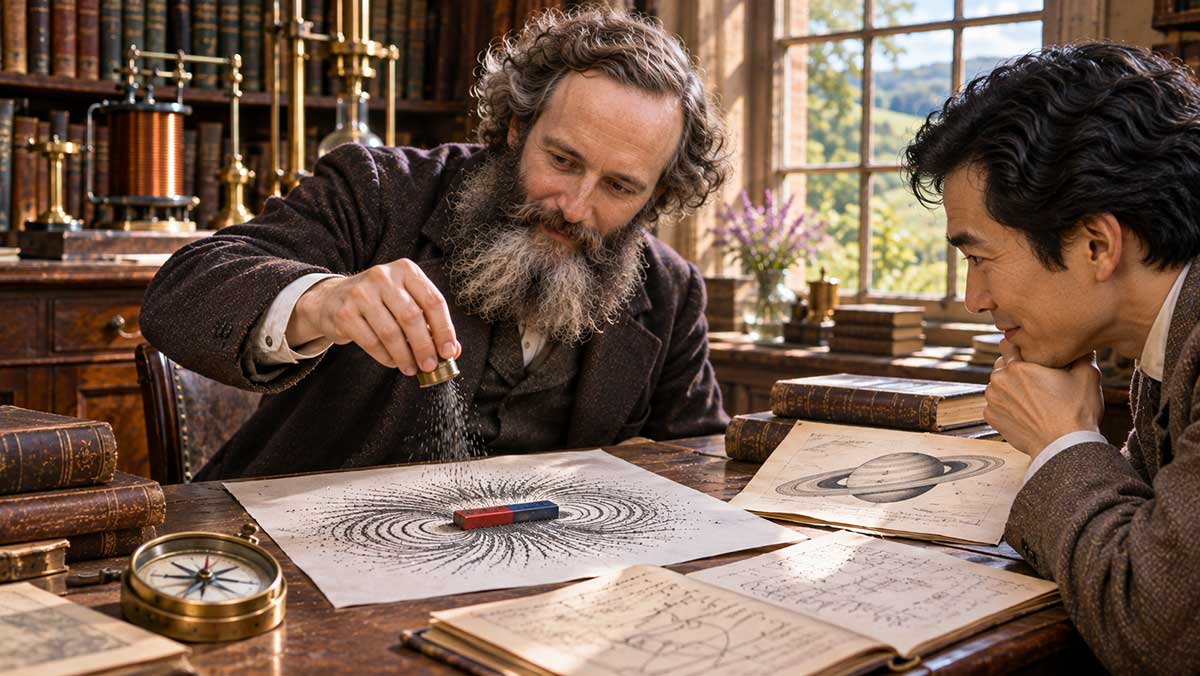
The afternoon light had grown brighter inside Maxwell's study. On the desk between us lay a drawing of Saturn, surrounded by several concentric circles. What had begun as a conversation about childhood curiosity had developed into an investigation of one of the most beautiful objects visible through a telescope.
By 1876, astronomers had been studying Saturn's mysterious rings for more than two centuries. Yet their physical structure had remained a difficult scientific problem until Maxwell applied mathematical reasoning to their stability. His investigation was one of several remarkable achievements that had established his reputation long before his electromagnetic theory appeared.
Around us were the ordinary instruments of nineteenth-century scientific inquiry: magnets, glass vessels, wire, paper, pencils, and books. There were no electronic calculators or computers to assist with complicated calculations. Scientific discoveries depended upon careful observation, mathematical ingenuity, patient experimentation, and an extraordinary capacity to reason about things that could not be seen directly.
Opening
Nick Sasaki: James, before you explain Saturn's rings, I have to ask you something. How does a person become interested in a problem like this in the first place?
James Clerk Maxwell: Cambridge offered a prize for its investigation. That provided a certain encouragement.
Nick: So there was a financial incentive?
Maxwell: There was an intellectual difficulty with a financial accompaniment.
Nick: Which interested you more?
Maxwell: The difficulty occupied considerably more of my time.
He smiled and turned the drawing so that I could see it more clearly.
Maxwell: The question was whether the rings of Saturn could maintain their arrangement under the ordinary laws of gravitation and motion.
Nick: Something that looks so peaceful through a telescope might actually be quite unstable?
Maxwell: Precisely. A telescope presents us with an appearance. It does not necessarily reveal the conditions required to maintain that appearance.
He placed the point of his pencil near the outermost circle.
Maxwell: Let us suppose, as you suggested, that this is a solid ring. What difficulties might follow?
Question 4: You investigated Saturn's rings without ever getting anywhere near Saturn. How can mathematics reveal something about nature that nobody has been able to observe directly?
Maxwell: We begin with what is known. Saturn possesses a considerable mass. Its gravitational attraction acts upon the material surrounding it. The rings occupy a particular region and exhibit certain observable characteristics.
Any proposed arrangement must satisfy those conditions.
Nick: What were the possible arrangements?
Maxwell: One might suppose the rings to be solid structures, continuous fluid masses, or collections of separate particles.
Each supposition produces different mathematical consequences.
Nick: Which possibility did you initially favor?
Maxwell: It was necessary to examine the difficulties belonging to each.
A solid ring, for example, cannot permit its various portions to move independently. Its parts must maintain their relationship to one another.
Yet the gravitational circumstances of those parts are not necessarily identical.
He drew another circle, this time placing Saturn slightly away from its center.
Maxwell: Consider what might happen if the ring were disturbed from its original position.
Nick: Saturn would attract the nearer part more strongly?
Maxwell: Quite so. We must determine whether the resulting motions would restore the arrangement or increase the disturbance.
That distinction is of considerable importance.
Nick: So the problem isn't merely whether you can construct a ring that could exist for a moment. It's whether it could continue existing.
Maxwell: Exactly.
An arrangement may satisfy certain conditions at a particular instant and yet possess no satisfactory means of preserving itself.
My investigations indicated that the solid and continuous fluid arrangements presented serious difficulties. A system consisting of numerous separate particles offered a much more satisfactory explanation.
Nick: Thousands of little objects orbiting Saturn independently?
Maxwell: There may be very many indeed. Their precise number and dimensions are another matter.
Nick: But through a telescope, they appear to form something continuous.
Maxwell: That is quite possible when the individual objects are too small or too distant to be distinguished.
He pointed through the window.
Maxwell: Look at those trees beyond the field. Can you distinguish every leaf?
Nick: Not from here.
Maxwell: Yet you have little difficulty recognizing the tree. Its appearance at this distance is produced by numerous objects whose individual details are unavailable to you.
Saturn presents us with a somewhat more considerable difficulty of distance.
Nick: I would say so.
Maxwell: Mathematics permits us to examine the consequences of arrangements that our instruments cannot yet distinguish.
But we must be careful about what has actually been established. I have not counted the particles of Saturn's rings, nor have I examined one in my hand.
Nick: You demonstrated which arrangement was physically plausible.
Maxwell: Under the conditions investigated, yes.
Nick: That must have been an exciting realization.
Maxwell: It was certainly gratifying when the calculations began to yield a coherent result. But there was a considerable amount of labor before that point.
Scientific investigations are often described afterward in a manner that makes them appear much more agreeable than they were during their execution.
Nick: You mean we hear about the discovery but not the months spent making mistakes?
Maxwell: Or the afternoon spent discovering that an error made three weeks earlier has been enjoying an uninterrupted existence in one's calculations.
Nick: How do you respond when that happens?
Maxwell: One corrects it.
Nick: Without getting angry?
Maxwell: I did not say that.
We both laughed.
Nick: Your work with gases involved a similar difficulty, didn't it? You were trying to describe the behavior of molecules that nobody could observe individually.
Maxwell: Yes, though the nature of the mathematical problem was rather different.
Suppose we have a vessel containing gas. We attribute certain properties of the gas to the motions of its molecules.
But the number of molecules is so considerable that an attempt to follow the history of each separately would be quite impracticable.
Nick: So what do you do instead?
Maxwell: We investigate the distribution of their motions.
Some molecules move more swiftly than others. Their velocities change through encounters. Yet a large collection may exhibit statistical regularities.
Nick: Individual molecules behave unpredictably, but the gas as a whole behaves in a way you can describe?
Maxwell: Unpredictably to us, under ordinary circumstances. That qualification is necessary.
We may lack the information required to calculate a particular molecular motion without concluding that the molecule itself is exempt from physical laws.
Nick: That's an interesting distinction.
Maxwell: It becomes particularly interesting when we consider temperature.
We can measure the temperature of a gas without possessing a record of the velocity of every molecule within it.
The measurable condition of the whole is related to the motions of its constituent parts.
Nick: And not every molecule has the same speed?
Maxwell: Certainly not.
He drew a horizontal line and then a curved figure rising from it before descending gradually.
Maxwell: We may represent the relative numbers of molecules possessing different speeds by a distribution of this general character.
Nick: So instead of describing every individual molecule, you're describing the pattern formed by all of them.
Maxwell: Precisely.
Nick: Is it difficult for a mathematician to accept that some things must be described statistically?
Maxwell: It would be rather inconvenient if we refused.
The difficulty is not always in the physical laws. Sometimes it lies in the amount of information available to the investigator.
Nick: Does that mean there are things about nature that we may never be able to know completely?
Maxwell: There are certainly things that we cannot know completely at present. I should be reluctant to make too many declarations concerning what future investigators may or may not accomplish.
Nick: You seem quite comfortable with uncertainty.
Maxwell: I would prefer to have an answer. But an uncertain answer ought not to be promoted to certainty merely for the comfort of the person giving it.
He examined the curve he had drawn and added another small mark.
Maxwell: There is considerable pleasure in obtaining a reliable result without possessing all the information one might initially have thought necessary.
Nick: Saturn's rings and the molecules of a gas. One is unimaginably distant, and the other is too small for us to see.
Maxwell: And both present opportunities for mathematics.
Nick: Did you ever feel limited by the fact that you couldn't actually see what you were investigating?
Maxwell: Frequently. But that is precisely what makes the development of new experimental methods so desirable.
Mathematics may suggest what we ought to look for. Experiment may then oblige us to reconsider what we have written.
Nick: Which brings me to Michael Faraday.
Maxwell put down his pencil.
Maxwell: Ah, Faraday. Now there is a man well worth discussing.
Question 5: Michael Faraday approached electricity and magnetism very differently from you. What did you recognize in his work that made you want to develop his ideas mathematically?
Maxwell: Faraday possessed an extraordinary ability to perceive physical relationships through experiment.
He could arrange an investigation in such a manner that a previously obscure phenomenon became remarkably intelligible.
His writings repay very careful attention.
Nick: You were trained in advanced mathematics. Faraday didn't have that same mathematical education. Did you initially find his explanations difficult to follow?
Maxwell: They differed considerably from the mathematical treatments with which I was familiar.
But the difference was instructive.
In studying his researches, I became increasingly persuaded that his conception of lines of force possessed a significance that deserved mathematical investigation.
Nick: Could you show me what he meant?
Maxwell: Certainly.
He opened a drawer and removed a small bar magnet. From another container, he took a quantity of iron filings.
He placed the magnet beneath a sheet of stiff paper and scattered some of the filings across its surface.
Maxwell: What do you expect will happen if I disturb the paper slightly?
Nick: The filings will move closer to the magnet?
Maxwell: Let us see.
He tapped the paper gently. The scattered filings began to arrange themselves into curved patterns extending between the regions above the magnet's poles.
I leaned forward.
Nick: That's remarkable. They appear to be following invisible paths.
Maxwell: They arrange themselves in relation to the magnetic conditions surrounding the magnet.
Faraday attached considerable importance to the lines of force represented by such patterns.
Nick: Are those lines actually there?
Maxwell: That depends upon what you mean by a line.
The particular curves produced by these filings are not material threads extending through the surrounding space.
They provide a representation of the direction of magnetic action at different positions.
Nick: So the filings make something visible that would otherwise remain invisible.
Maxwell: They furnish us with evidence of the magnetic conditions in their vicinity.
Nick: Before Faraday, how did scientists think about magnetic attraction?
Maxwell: Many mathematical treatments concentrated upon the forces exerted between bodies separated by a distance.
Faraday directed considerable attention to the physical conditions of the intervening space.
That difference in approach interested me greatly.
Nick: Rather than thinking exclusively about what the magnet does to another object, he was interested in what exists around the magnet itself?
Maxwell: A reasonable description of the distinction.
Consider this small compass.
He placed it near one end of the magnet. Its needle turned.
He moved it to another position, and the needle assumed a different direction.
Maxwell: The compass provides information concerning the magnetic condition at the place it occupies.
By examining different positions, we may investigate the field.
Nick: And Faraday was thinking in terms of the entire field rather than simply the two objects interacting?
Maxwell: Yes. His manner of thinking directed attention to the intervening region and the physical processes that might occur within it.
The mathematical representation of those conditions became a matter of considerable interest to me.
Nick: Did other mathematicians take him seriously?
Maxwell: His experimental achievements commanded great respect. His manner of representing physical phenomena was not equally familiar or acceptable to everyone.
There was a difficulty of language, in a sense.
Faraday expressed certain physical ideas in a manner quite different from the customary mathematical forms.
Nick: Yet you saw something valuable in that difference.
Maxwell: It seemed to me that his conception contained mathematical relationships which could be expressed without sacrificing the physical character of his reasoning.
Nick: You weren't simply correcting Faraday's work?
Maxwell: Certainly not.
I was attempting to develop ideas from which I had learned a great deal.
A mathematical treatment may reveal consequences that were not immediately apparent in the original conception. That does not diminish the importance of the conception itself.
Nick: Did you correspond with him about your research?
Maxwell: Yes. He was exceedingly kind in his correspondence.
He took an interest in the mathematical development of his ideas, though he did not always find the mathematical language accessible.
Nick: That must have been quite an experience for you, communicating with the man whose work had inspired so much of your own.
Maxwell: It was a considerable pleasure.
Faraday had a particular interest in whether mathematical conclusions could be communicated in ordinary language. That was a very reasonable request.
If a mathematical investigation concerns a physical phenomenon, one ought to make some effort to explain what has been established concerning that phenomenon.
Nick: Have you ever wondered whether Faraday might have discovered your electromagnetic theory himself if he'd received the same mathematical training you did?
Maxwell: That is a difficult question.
Had he received an education different from the one he actually received, his scientific habits might have developed differently.
We cannot alter one circumstance in a man's life and confidently preserve all the others.
Nick: That's fair.
Maxwell: Faraday accomplished things that very accomplished mathematicians had not accomplished.
I should hesitate to prescribe improvements to the circumstances that produced Michael Faraday.
Nick: I like that answer.
Maxwell moved the compass farther from the magnet. The needle gradually returned toward its original direction.
Nick: You know, James, what strikes me is that Faraday was able to see possibilities that people with more formal mathematical training might have missed.
Maxwell: He was attentive to certain physical circumstances that other investigators represented differently.
Different methods may disclose different features of a problem.
Nick: Did you ever disagree with him?
Maxwell: Scientific agreement need not extend to every supposition entertained by two investigators.
One may accept the value of a man's discoveries without accepting every physical interpretation he proposes.
Nick: What do you think was Faraday's greatest gift?
Maxwell: I would be reluctant to select only one.
But his capacity to devise experiments that addressed fundamental physical questions was exceptional.
His discovery of electromagnetic induction, for instance, disclosed a relationship of enormous scientific importance.
Nick: Could you explain that relationship?
Maxwell: Consider a coil of wire connected to an instrument capable of indicating an electric current.
If a magnet is moved appropriately in relation to the coil, an electric current may be produced.
If the arrangement remains stationary under otherwise unchanged conditions, that induced current does not continue.
Nick: So a changing magnetic condition can produce an electrical effect.
Maxwell: Exactly.
Nick: And electricity can produce magnetic effects?
Maxwell: That relationship had been established through earlier investigations, particularly those following Ørsted's discovery.
The question then becomes how these electrical and magnetic phenomena are related in a more comprehensive physical theory.
Nick: Is that where you began?
Maxwell: It was one of the places from which I began. There were many experimental results to examine, and many mathematical difficulties to resolve.
Nick: Did you ever have a moment when you realized that Faraday's ideas might lead somewhere far beyond magnetism?
Maxwell: The mathematical investigation certainly disclosed consequences of considerable interest.
But the development occupied several years.
It would be rather misleading to describe it as though I had been sitting quietly one evening and suddenly discovered the entire electromagnetic theory before supper.
Nick: That would make a wonderful story, though.
Maxwell: It would make a very convenient story for the biographer.
Unfortunately, the calculations were less convenient.
We laughed.
He carefully returned the iron filings to their container.
Nick: Faraday died in 1867, didn't he?
Maxwell: Yes.
Nick: Just a few years after your major electromagnetic paper appeared.
Maxwell: Quite so.
Nick: Do you miss having him available to discuss these things?
Maxwell: His writings remain a source of instruction. I frequently find occasion to return to them.
There are investigators whose work continues to suggest new questions long after their own investigations have ceased.
Faraday was certainly one of them.
He placed the magnet beside his papers.
Maxwell: One of the most interesting consequences of the mathematical theory concerns a phenomenon with which you have been familiar since childhood.
Nick: What's that?
Maxwell gestured toward the window.
Maxwell: Light.
Question 6: When your calculations suggested that light itself was an electromagnetic phenomenon, what convinced you that you had discovered a genuine relationship rather than a beautiful mathematical coincidence?
Maxwell: The numerical agreement was particularly striking.
In developing the electromagnetic theory, I found that disturbances of an electromagnetic character could be propagated through a medium with a finite velocity.
The value obtained from electrical measurements was remarkably close to the known velocity of light.
Nick: How close?
Maxwell: The values available from different investigations were not identical. Measurements of such quantities are attended by considerable difficulties.
But the agreement was sufficiently close to suggest that we were dealing with phenomena of the same physical character.
Nick: Help me understand what that means. You were investigating electricity and magnetism, and your mathematics produced something close to the speed of light?
Maxwell: Yes.
Nick: Yet you weren't conducting an experiment involving light at that moment?
Maxwell: The velocity arose from the electromagnetic relations under investigation.
That was precisely what made the result so interesting.
He drew two short lines on a sheet of paper.
Maxwell: Suppose that an electromagnetic disturbance occurs in a particular region. According to the theory, its effects need not be confined to that region.
The disturbance may be propagated through the surrounding medium.
Nick: Like a disturbance traveling across the surface of water?
Maxwell: There are certain useful similarities, though we must not carry the comparison too far.
A wave upon water involves motions of the water itself. The physical constitution of the medium concerned in the propagation of light presents difficulties of a different character.
Nick: But the idea is that something happening in one place can produce a disturbance that travels outward.
Maxwell: Precisely.
Nick: And you found that an electromagnetic disturbance would travel at approximately the same speed as light?
Maxwell: According to the theory and the electrical measurements available to us, yes.
Nick: That must have been astonishing.
Maxwell: It was a result of very considerable interest.
There were further reasons for associating the two phenomena. The theory permitted transverse disturbances, which was consistent with important properties already established in the study of light.
The agreement was not confined to a single numerical curiosity.
Nick: So light behaves in a manner that agrees with your electromagnetic theory?
Maxwell: In significant respects, yes.
Nick: Then electricity, magnetism, and light are not three completely separate things.
Maxwell: They are intimately related physical phenomena.
Nick: That's extraordinary.
I turned toward the window. The sunlight entering the study illuminated the books, the desk, and the magnet lying between us.
Nick: I've been looking at sunlight my entire life. Yet I never would have thought that it had anything to do with the magnet sitting on your desk.
Maxwell: Their relationship is not necessarily apparent in ordinary experience.
That is one of the agreeable features of physical investigation. A familiar phenomenon may acquire a very different character when its relations with other phenomena become evident.
Nick: Can you remember how you felt when the connection became clear?
Maxwell considered the question for a moment.
Maxwell: I would say that it gave me considerable satisfaction. But the scientific interest of the result immediately suggested further work.
A theory that brings several phenomena together must still account for their particular properties.
There were questions concerning propagation, the constitution of the medium, electrical action, and the relations between different experimental quantities.
Nick: You weren't ready to declare the mystery solved?
Maxwell: No. We had acquired a new means of investigating it.
Nick: In your earlier work, you proposed mechanical models to explain electromagnetic phenomena. Were you convinced those models represented what was actually happening?
Maxwell: They were useful in developing certain physical and mathematical relationships.
But one must distinguish the machinery employed in constructing a theory from the relationships the theory establishes.
A mechanical representation may assist the investigator without being a literal description of the constitution of nature.
Nick: So you could use a model to reach a correct result without every part of the model being correct?
Maxwell: Certainly.
A map may provide useful information concerning the position of a river without telling us the composition of the water.
Different representations serve different purposes.
Nick: How do you prevent yourself from becoming too attached to a beautiful model?
Maxwell: By attending to the consequences it produces.
If those consequences disagree with established experimental results, the beauty of the arrangement is insufficient compensation.
Nick: Have you ever been particularly fond of an idea that turned out to be mistaken?
Maxwell: I have entertained various arrangements that did not survive further investigation.
It would be rather tiresome to enumerate them all.
Nick: Perhaps we could devote an entire afternoon to your unsuccessful ideas.
Maxwell: I fear you would require a longer visit.
We laughed again.
Nick: James, could electromagnetic disturbances exist that human eyes cannot detect?
Maxwell: The theory does not require every electromagnetic disturbance to possess the particular periods of vibration associated with visible light.
The eye is sensitive to a certain range of optical phenomena.
It would be unreasonable to suppose that the physical possibilities of nature are confined to the capabilities of that organ.
Nick: So there could be electromagnetic waves around us that we cannot see?
Maxwell: The theory permits disturbances beyond those ordinarily perceived as light.
Their experimental production and detection present interesting questions.
Nick: Could someone eventually develop an instrument that detects them?
Maxwell: That is certainly a possibility worth investigating.
One would need to consider the conditions required to produce such disturbances and the means by which their effects might be observed.
Nick: What would you do if someone came to Glenlair tomorrow and told you they had succeeded?
Maxwell: I should ask to examine the apparatus.
Nick: Before congratulating them?
Maxwell: I might congratulate them on the way to examining it.
Nick: You really would want to see it for yourself.
Maxwell: Naturally. An experiment of that character would be exceedingly interesting.
And there would immediately be questions concerning the properties of the disturbances produced.
Nick: Their speed, for example?
Maxwell: Their propagation, reflection, and other physical characteristics.
One would wish to determine whether they exhibited the relationships anticipated by the theory.
Nick: Could such discoveries eventually have practical applications?
Maxwell: Possibly. The history of electrical investigation has already produced applications that would have surprised earlier investigators.
But it is difficult to predict the particular uses of a phenomenon before its properties have been adequately examined.
Nick: You wouldn't want to speculate?
Maxwell: Speculation is quite agreeable when one recognizes it as speculation.
The difficulty begins when a conjecture acquires the reputation of an established result.
He leaned back in his chair.
Maxwell: Now, Nick, since we are discussing light, I should like to ask you a question.
Nick: Go ahead.
Maxwell: When you look at a yellow flower, what do you suppose determines your perception of its color?
Nick: The light reflected by the flower?
Maxwell: That is part of the matter. But there is another participant in the investigation.
Nick: My eyes?
Maxwell: Precisely.
My investigations of color have been concerned with the relationship between physical light and the sensations it produces.
Different arrangements of light may produce remarkably similar sensations of color.
He took a small circular disc from among the objects on his desk. Its surface contained sections of different colors.
Maxwell: When such colored surfaces are rotated sufficiently quickly, their separate appearances may become combined in the resulting visual sensation.
He set the disc spinning.
The individual colored sections became difficult to distinguish, producing a much more uniform appearance.
Nick: That's fascinating. The colors seem to disappear into one another.
Maxwell: Your visual system is receiving successive impressions sufficiently quickly that you no longer distinguish them separately in the same manner.
Experiments of this character permit us to compare and measure relationships between color sensations.
Nick: Is that connected with your photographic demonstration in London?
Maxwell: Yes. In 1861, during a lecture at the Royal Institution, we demonstrated a method of combining three photographic images to produce a representation in color.
Mr. Thomas Sutton made the photographs.
We employed different colored filters in obtaining the separate images and corresponding colored light in their projection.
Nick: And what did you photograph?
Maxwell: A piece of tartan ribbon.
Nick: A particularly Scottish choice.
Maxwell: It possessed the advantage of presenting several colors in a small and conveniently arranged object.
Its nationality was not a necessary condition of the experiment.
Nick: Did the demonstration work perfectly?
Maxwell: No. The photographic materials available to us presented considerable difficulties, particularly in their unequal sensitivity to different portions of the spectrum.
The experiment demonstrated a principle rather than furnishing a completely satisfactory photographic process.
Nick: But you could produce the appearance of color by combining three separate images?
Maxwell: Yes, within the limitations of the apparatus and photographic materials.
Nick: That's remarkable. You've investigated light both as a physical phenomenon and as something experienced by the human eye.
Maxwell: They are related investigations, though they concern different questions.
The physical constitution of light is one matter. The physiological conditions through which we perceive color are another.
Nick: So the world we experience visually depends partly on what's outside us and partly on how we're equipped to receive it.
Maxwell: Quite so.
We should not confuse the physical characteristics of the radiation with the sensation experienced by the observer.
Nick: Does that ever make you wonder how much exists around us that we're simply incapable of perceiving?
Maxwell: Scientific instruments already permit us to investigate phenomena unavailable to our unaided senses.
The thermometer, the galvanometer, and the telescope extend our acquaintance with nature in different ways.
Mathematical investigation provides another means of proceeding beyond ordinary observation.
Nick: Yet every instrument has limitations.
Maxwell: Certainly. And the improvement of instruments frequently alters the questions we are capable of investigating.
Nick: There must be enormous possibilities waiting for people who develop better instruments.
Maxwell: I expect there will be many interesting occupations for them.
Nick: James, of all your scientific investigations, is there one that has given you a particular sense of wonder?
Maxwell: The relationship between light and electromagnetic phenomena has certainly occupied much of my attention.
But I have experienced considerable pleasure in investigations of quite modest appearance.
There is something exceedingly agreeable about an experiment that behaves in an unexpected manner and then permits you to discover the reason.
Nick: So the size of the discovery isn't necessarily what determines the pleasure you experience?
Maxwell: No. A small difficulty satisfactorily resolved may provide a very pleasant afternoon.
Nick: And a large difficulty?
Maxwell: That may provide several less pleasant years.
We both laughed.
Nick: Listening to you, I find myself looking at this room differently. The light coming through the window, the magnet, the air we're breathing. All of them contain physical processes that ordinarily escape our attention.
Maxwell: And the interesting circumstance is that we are able to investigate some of those processes.
There are relations in nature which would remain quite unsuspected if we relied entirely upon their immediate appearance.
Nick: Do you think there are many more connections waiting to be discovered?
Maxwell: I should be very surprised if we had exhausted them.
Closing
Maxwell gathered the colored disc, compass, and magnet and returned them to their places. The papers between us now contained sketches of planetary rings, molecular distributions, magnetic fields, and the propagation of electromagnetic disturbances.
I looked at the collection of drawings with a mixture of admiration and amusement.
Nick: We've traveled from Saturn to the molecules of a gas, from Faraday's experiments to the nature of light, without leaving your study.
Maxwell: A considerable economy in traveling expenses.
Nick: And I think I've finally discovered why you were so interested in the mechanism of a door latch when you were a boy.
Maxwell: Have you?
Nick: You seem to enjoy discovering what happens between the things we can observe.
Maxwell: That is often a very interesting region of investigation.
A sound came from elsewhere in the house, followed by the familiar movement of the dog near the doorway.
Maxwell looked toward the passage.
Maxwell: I believe we have arrived at a phenomenon requiring rather less mathematical investigation.
Nick: What's that?
Maxwell: Tea.
Nick: An important Scottish scientific principle?
Maxwell: Its regular occurrence is certainly desirable.
He stood and straightened his waistcoat.
Maxwell: Come, Nick. We have been giving a great deal of attention to things that cannot be seen. There are some very satisfactory things in the next room which can be seen, smelled, and tasted.
Nick: I take it you're an experimental investigator in those matters, too.
Maxwell: With considerable practical experience.
We left the study together.
For the past hour, I had been sitting beside a man who could reason about the structure of distant planets, the motions of invisible molecules, and the physical nature of sunlight.
Yet what had impressed me just as much was the pleasure he seemed to take in sharing those discoveries. He had never made me feel embarrassed by the questions I asked. Instead, he had handed me a compass, invited me to examine his drawings, and allowed me to participate in the investigation.
Now, as we made our way toward the sitting room, I found myself curious about an entirely different aspect of his life.
What brought happiness to James Clerk Maxwell when the mathematical papers were put away?
And who was the woman with whom he had shared nearly eighteen years of his remarkable life?
There was another side of James I had yet to discover.
Topic 3: The Man Behind the Equations
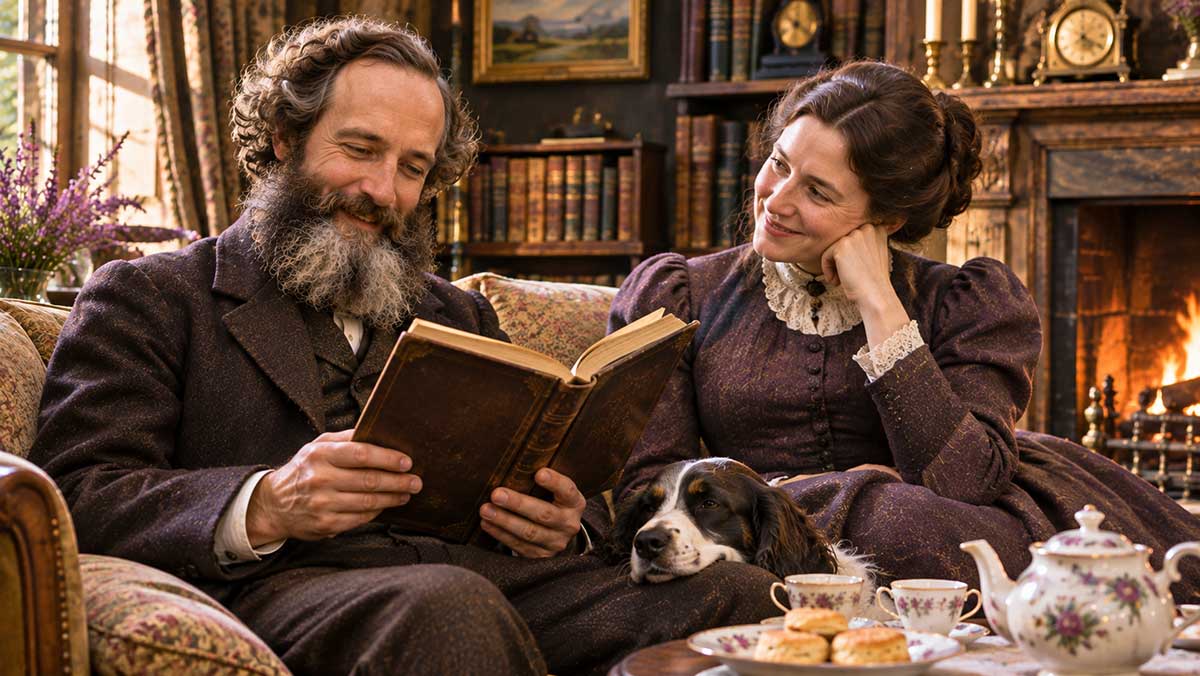
We left the study and entered a comfortable sitting room overlooking the grounds of Glenlair. A pot of tea, cups and saucers, bread, butter, and small cakes had been arranged on the table. Books occupied several shelves, and a fireplace stood ready for the colder Scottish evenings that would arrive before long.
For a Victorian household, afternoon tea offered an opportunity to withdraw briefly from the responsibilities of the day. At Glenlair, those responsibilities extended from scientific investigations and correspondence to the management of farmland, buildings, and the affairs of a country estate.
James and Katherine had been married for eighteen years. Their life together had taken them from Aberdeen to London, back to Glenlair, and eventually to Cambridge. Yet it was here, in the familiar surroundings of his childhood home, that I hoped to discover something about Maxwell that could never be expressed through his equations.
Opening
Nick Sasaki: James, I think my brain could use a little rest after that discussion of electromagnetic waves.
James Clerk Maxwell: Then we must administer the appropriate treatment.
He poured the tea.
Nick: Is this your prescription?
Maxwell: Tea, a comfortable chair, and the temporary suspension of differential equations.
Nick: How long does the treatment usually last?
Maxwell: That depends upon whether the patient introduces another mathematical question.
Nick: I promise to behave myself.
The dog entered the room and settled beside Maxwell's chair.
Maxwell: You see, our companion has abandoned his scientific investigations entirely.
Nick: He seems rather interested in those cakes.
Maxwell: His investigations have merely changed their object.
We laughed.
I noticed several books resting on a small table beside the window.
Nick: Do you read much literature when you're here?
Maxwell: Katherine and I have spent many agreeable evenings reading. There is considerable pleasure in hearing a good book read aloud.
Nick: Do you read to her?
Maxwell: Frequently.
Nick: Mathematics?
Maxwell: I should think she would object to that as an evening's entertainment.
Nick: What does she prefer?
Maxwell: Something with characters who behave rather more interestingly than mathematical quantities.
He passed me a cup of tea.
Nick: James, we've talked about your childhood, your father, your education, and your scientific discoveries. But there's someone who has been part of your life throughout much of your greatest work.
Maxwell: Katherine.
Nick: Yes. I'd love to hear about her.
His expression softened.
Question 7: When you met Katherine, what drew you to her, and what kind of marriage did you hope the two of you would create?
Maxwell: I became acquainted with Katherine during my time in Aberdeen. Her father, Daniel Dewar, was the principal of Marischal College, where I had been appointed professor of natural philosophy.
I had gone there in 1856. We were married two years afterward.
Nick: You were still quite young.
Maxwell: Twenty-six when we married. I attained twenty-seven shortly afterward.
Nick: Katherine was older than you, wasn't she?
Maxwell: By several years, yes.
Nick: Did that matter to you?
Maxwell: I found her company agreeable. The arithmetic of our respective ages did not present a difficulty requiring investigation.
Nick: That's a surprisingly unmathematical answer.
Maxwell: Mathematics is a valuable instrument, Nick, but one must exercise some judgment concerning its application.
Nick: What interested you about Katherine as a person?
Maxwell: We could speak about matters that were important to us. Our religious convictions, our responsibilities, the kind of life we hoped to share.
There is considerable satisfaction in discovering that another person wishes to discuss things which you yourself have been considering privately.
Nick: So your attraction wasn't simply romantic?
Maxwell: I should be reluctant to separate affection from the other circumstances that give it meaning.
One may enjoy another person's company, admire certain qualities in that person, and gradually discover a desire to share one's life with her.
Those experiences need not occur independently.
Nick: I've read some of the correspondence from the period of your engagement. You wrote to Katherine about Christ and the work you hoped to undertake together.
I found that quite moving.
Maxwell: Those matters were important to both of us.
Marriage introduces two people into a relationship involving responsibilities that neither possesses in quite the same manner beforehand.
We wished our Christian convictions to have some bearing upon the way we undertook those responsibilities.
Nick: What did you mean by sharing Christ's work?
Maxwell: I did not suppose that marriage would remove us from the ordinary duties of life. Quite the reverse.
There would be occasions for patience, kindness, assistance, and consideration that might not otherwise arise.
Our religious life ought to have some connection with the manner in which we treated one another.
Nick: Did you have a particular vision of the life you wanted to build together?
Maxwell: I had scientific occupations which I expected to continue. Katherine had interests and responsibilities of her own.
We could scarcely anticipate every circumstance in which we would find ourselves.
There is a difference between agreeing upon the character of a life and knowing all the events that will occur within it.
Nick: And quite a few unexpected events followed.
Maxwell: Indeed.
Our circumstances in Aberdeen changed when the colleges were united. I subsequently accepted the appointment at King's College in London. We spent several years there before returning to Glenlair.
Then Cambridge presented another alteration in our arrangements.
Nick: Did you enjoy London?
Maxwell: It provided excellent scientific opportunities. There were investigators with whom I could communicate, institutions with valuable apparatus, and numerous occasions for scientific discussion.
But London and Glenlair offer rather different pleasures.
Nick: Which do you prefer?
Maxwell: For certain investigations, London possessed considerable advantages.
For taking a horse out into the countryside, its arrangements were distinctly inferior.
Nick: I think I can guess which place Katherine would find you more relaxed.
Maxwell: You would have to consult Katherine on that question.
He smiled and took another sip of tea.
Nick: Fair enough. I shouldn't ask you to speak for her.
Maxwell: A husband who claims an entirely accurate acquaintance with his wife's opinions may occasionally receive information to the contrary.
Nick: That's something I've learned in my own marriage.
Maxwell: Then we have both benefited from instruction.
Nick: James, when you were working on your scientific theories in London, was Katherine involved in that part of your life?
Maxwell: She assisted me on occasions when experimental work required another pair of hands. Certain investigations are considerably more convenient when two people can attend to different parts of the apparatus.
Nick: Particularly your experiments with gases?
Maxwell: Yes. Some of those arrangements required careful attention to observations and the conditions under which they were made.
Experimental work often contains occupations that appear quite unremarkable to someone unfamiliar with their purpose.
Yet the reliability of the result may depend upon their proper execution.
Nick: People often think of scientific discovery as something a genius accomplishes alone.
Maxwell: That is a very incomplete account of scientific work.
There are instrument makers, assistants, previous investigators, and people who undertake numerous practical responsibilities.
The published result may occupy a few pages. The circumstances that made it possible are rather more extensive.
Nick: Did you enjoy sharing that part of your life with Katherine?
Maxwell: Yes. But I would not wish to give the impression that our marriage consisted principally of scientific investigations.
There were many other matters with which we occupied ourselves.
Nick: Did you ever find it difficult to leave your work behind?
Maxwell: On occasions.
A mathematical difficulty does not necessarily disappear when one closes a book. It may continue to occupy one's thoughts at inconvenient moments.
Nick: During dinner?
Maxwell: Among other occasions.
Nick: What happens when Katherine is speaking to you and you're still thinking about an equation?
Maxwell: I discover that I have failed to attend to something considerably more immediate than the equation.
Nick: And how do you recover from that?
Maxwell: By attending to it.
Nick: No mathematical solution?
Maxwell: None that I have found satisfactory.
We both laughed.
Nick: After eighteen years of marriage, what has surprised you most about sharing your life with another person?
Maxwell considered the question.
Maxwell: I suppose one discovers how frequently one's own arrangements depend upon the consideration of another person.
There are numerous kindnesses in married life that attract little attention individually.
Their significance becomes apparent through their continued occurrence.
Nick: Small things?
Maxwell: Very often.
A person notices that you are tired. Something has been prepared for your convenience. A difficulty which might have occupied you has already received attention.
Such things are easily overlooked if one becomes excessively occupied with one's own affairs.
Nick: Do you think love becomes different after many years together?
Maxwell: The circumstances become different. One acquires a greater acquaintance with the other person's habits, preferences, and difficulties.
There are experiences which belong to both of you and which neither could have possessed independently.
That gives affection a history of its own.
Nick: That's something a young couple couldn't possibly have when they first marry.
Maxwell: No. They must acquire it.
He glanced around the sitting room.
Maxwell: And the acquisition takes rather longer than the wedding ceremony.
Question 8: People know you for your equations, but what does an ordinary happy day with Katherine here at Glenlair look like?
Maxwell: It depends considerably upon the weather.
Nick: That's a very Scottish answer.
Maxwell: A necessary consideration in Scotland.
On a satisfactory morning, there may be an opportunity to go outdoors. There are affairs concerning the estate which require attention. I may have correspondence to answer or scientific work to undertake.
Katherine and I have our meals together. There may be reading in the evening.
It is not a particularly extraordinary account of a day.
Nick: That's precisely why I'm interested.
When people read about James Clerk Maxwell, they encounter Saturn, electromagnetic fields, and mathematical physics. They rarely encounter a man sitting beside his wife reading a novel.
Maxwell: A regrettable omission from the scientific literature, perhaps.
Nick: What sort of literature do you enjoy?
Maxwell: I have a considerable affection for English and Scottish poetry. Scott has provided me with a great deal of pleasure over the years.
There are passages in good literature which become more agreeable through repeated acquaintance.
Nick: Do you and Katherine discuss what you're reading?
Maxwell: Naturally. A book may introduce circumstances and characters concerning which two readers form quite different opinions.
That is part of the pleasure.
Nick: Do you argue about the characters?
Maxwell: Discussion is perhaps the more charitable expression.
Nick: Who usually has the better argument?
Maxwell: You are attempting to obtain information that might prove hazardous to the remainder of my afternoon.
I laughed so suddenly that I nearly spilled my tea.
Maxwell: Careful, Nick. We have already established the usefulness of gravity. There is no necessity to demonstrate it upon the carpet.
Nick: I wasn't expecting you to be this funny.
Maxwell: Then you have enjoyed the advantage of low expectations.
The dog raised his head at the sound of our laughter, looked at us briefly, and returned to his resting position.
Nick: I understand you enjoy horseback riding.
Maxwell: Very much.
A horse introduces a number of physical questions which become rather immediate when one is sitting upon it.
Balance, motion, the disposition of one's weight, and the consequences of an unexpected alteration in velocity.
Nick: Do you think about physics when you're riding?
Maxwell: Sometimes. But the horse has interests of its own which require more immediate consideration.
Nick: Were you a good rider when you were young?
Maxwell: I became fairly accustomed to horses through living here.
There is great pleasure in moving through the countryside on horseback. One sees familiar places from a different position and encounters things that would escape notice from a carriage.
Nick: Did you ever perform tricks on horseback?
Maxwell: I have occasionally attempted arrangements that were unnecessary for the ordinary purpose of transportation.
Nick: That sounds suspiciously like an admission.
Maxwell: I prefer to leave the matter in that form.
Nick: I can picture the children around Glenlair watching you.
Maxwell: Children are generally appreciative of an exhibition that contains the possibility of an adult making himself ridiculous.
Nick: Did you ever fall?
Maxwell: I have sufficient respect for gravitation to avoid making extravagant claims concerning my riding.
We laughed again.
Nick: What about the dogs? Have you always enjoyed their company?
Maxwell: Yes. They provide excellent companionship outdoors.
They have an agreeable interest in the immediate circumstances of life.
A dog does not appear greatly troubled by the question of whether his accomplishments will be appreciated by future generations.
Nick: He's interested in whether you're going to give him something from the table.
Maxwell: An investigation for which he has collected considerable evidence.
Maxwell broke off a small piece of bread and offered it to him.
Nick: He's just confirmed his theory.
Maxwell: Temporarily. He will require repeated confirmation.
The dog accepted the bread and settled down again.
Nick: James, do you find that being here helps you think differently from the way you think at Cambridge?
Maxwell: The occupations are arranged differently.
At Cambridge, there are students, lectures, laboratory affairs, and numerous matters requiring attention at particular times.
Here, I may have a greater opportunity to pursue an investigation without interruption.
But there are responsibilities at Glenlair which do not exist at Cambridge.
Nick: Such as managing the estate?
Maxwell: Yes. A country property does not maintain itself.
Buildings require repair. Land must be attended to. There are arrangements concerning the people who live and work here.
One cannot conduct every occupation according to the convenience of a mathematical investigation.
Nick: Do you enjoy those practical responsibilities?
Maxwell: Some of them are interesting. Others are necessary.
I would not pretend that every necessary occupation is agreeable merely on the grounds that it takes place in beautiful surroundings.
Nick: That's refreshing.
Maxwell: A leaking roof remains a leaking roof, regardless of the attractiveness of the view.
Nick: Did returning to Glenlair in 1865 give you more time with Katherine?
Maxwell: It altered the distribution of our time considerably.
I was no longer required to attend to the regular duties of my London appointment. I could devote more attention to scientific writing and investigations here.
We had the advantages of country life and the opportunity to arrange many of our occupations ourselves.
Nick: Was that a particularly happy period for you?
Maxwell: There were many agreeable circumstances belonging to it.
There were difficulties, too. I experienced a serious illness not long after leaving London.
Nick: Katherine cared for you during that time?
Maxwell: With great devotion.
Her attention to me during illness was a kindness for which I had considerable reason to be grateful.
Nick: What do you remember most about being cared for by someone you love?
Maxwell lowered his cup.
Maxwell: One becomes acquainted with one's dependence upon other people in a manner that is less apparent during good health.
There are things which ordinarily require little effort and which suddenly become difficult.
The presence of someone willing to undertake those things for you is a considerable comfort.
Nick: It must have been difficult for someone accustomed to solving problems to encounter a situation he couldn't simply solve himself.
Maxwell: Illness is not particularly respectful of one's intellectual accomplishments.
A mathematical reputation is of very little assistance when one requires someone to bring a glass of water.
Nick: And when Katherine has been unwell?
Maxwell: Then there are responsibilities of a corresponding character.
One wishes to provide whatever assistance is possible and to relieve difficulties where one can.
Nick: Does it trouble you when you can't make someone you love feel better?
Maxwell: Naturally.
But the inability to remove a difficulty entirely does not relieve one of the opportunity to offer some assistance.
There may be something quite modest that one can do.
Nick: Such as reading aloud?
Maxwell: Reading, companionship, attending to ordinary necessities.
Sometimes the occupation consists simply in remaining available.
We were quiet for a moment.
Outside, the branches of a tree moved gently in the afternoon breeze.
Nick: James, you and Katherine have never had children. I hope you don't mind my asking whether that has influenced the life you've shared.
Maxwell: We have had no children, as you say.
Our household has acquired its own arrangements and occupations.
I have had considerable opportunities to enjoy the company of younger people through teaching, family acquaintances, and our associations here.
But I should not pretend that every circumstance of married life can be adequately discussed in a few words.
Nick: Of course. I appreciate your willingness to speak about it.
Maxwell: There are matters belonging to a marriage which are properly shared between the people concerned.
His manner was gentle rather than defensive, and I felt no desire to press the question further.
Nick: What I find interesting is how much enjoyment you seem to discover in ordinary things.
Maxwell: Ordinary things constitute a considerable portion of one's existence.
It would be inconvenient if they possessed no agreeable qualities.
Nick: Do you need much to be happy?
Maxwell: I require a certain amount of food, some sleep, agreeable company, useful occupations, and a reasonable supply of questions that I have not yet answered.
Nick: That's quite a modest list.
Maxwell: The last item has proved exceedingly abundant.
Question 9: Your friends knew you as someone who enjoyed poetry, jokes, and rather unusual intellectual games. Where does that playful side of you come from?
Maxwell: I should have thought you might have discovered by now that scientific occupations contain numerous opportunities for amusement.
Nick: They do when you're explaining them.
But poetry seems like quite a different activity from mathematical physics.
Maxwell: There are differences, certainly. Yet both require some attention to the relations between things.
A word may possess several meanings. A mathematical expression may disclose a relationship that was not apparent in its earlier form.
There is pleasure in discovering unexpected possibilities in either occupation.
Nick: When did you begin writing poetry?
Maxwell: I amused myself with verse when I was young. Some of the results were communicated to friends and relatives, who displayed varying degrees of indulgence.
Nick: Did you take your poetry seriously?
Maxwell: Some verses were written with serious intentions. Others were produced for amusement.
It would be unjust to the latter to require them to possess the virtues of the former.
Nick: Do you ever combine poetry with mathematics?
Maxwell: On occasions.
Nick: How does that work?
Maxwell: Not always to the advantage of poetry.
He stood and went to a nearby shelf, where he examined several books and papers.
Maxwell: Have you ever encountered a mathematical description of affection?
Nick: I'm not sure I'd want to.
Maxwell: A prudent response.
He returned to his chair.
Maxwell: Some years ago, I amused myself by writing verses in which the language of dynamics was applied to the attractions and difficulties of a romantic attachment.
Nick: You turned romance into a problem in mechanics?
Maxwell: The attempt provided certain opportunities for absurdity.
Nick: I'd love to hear some of it.
Maxwell recited the opening lines of his humorous poem, A Problem in Dynamics.
Maxwell:
An inextensible heavy chain
Lies on a smooth horizontal plane,
An impulsive force is applied at A,
Required the initial motion of K.
Nick: That sounds like an examination question.
Maxwell: It is intended to.
Nick: Where does the romance come in?
Maxwell: In the rather unfortunate circumstances of a gentleman who attempts to occupy himself with the mathematical problem when his affections are directed elsewhere.
Nick: So the poor man is trying to solve an equation when he would rather be thinking about a woman?
Maxwell: His mathematical concentration encounters considerable opposition.
Nick: Was the gentleman James Clerk Maxwell?
Maxwell: The identification of literary characters with their authors is an occupation attended by certain dangers.
Nick: That's not a denial.
Maxwell: Nor is it a mathematical demonstration.
Nick: Did Katherine appreciate your scientific poetry?
Maxwell: I have never required her to approve every production of my pen.
Nick: Probably a wise decision.
Maxwell: A household ought to permit a reasonable degree of literary independence.
We laughed.
Nick: Did your scientific colleagues appreciate your humor?
Maxwell: Some of them possessed considerable abilities in that direction themselves.
Tait, for instance, has provided me with many opportunities for agreeable correspondence.
William Thomson is another person with whom scientific questions may be discussed in a variety of forms.
Nick: Do scientists make jokes that ordinary people wouldn't understand?
Maxwell: Frequently. Though I suspect ordinary people make jokes that scientists fail to understand.
Nick: What would be an example of a scientific joke?
Maxwell: Much depends upon the unfortunate person to whom it is addressed.
A joke concerning a mathematical difficulty is considerably more effective when the listener has recently experienced that difficulty.
Nick: So I need to study more mathematics before I can appreciate your best jokes?
Maxwell: I would not impose so severe a condition upon our friendship.
Nick: Thank goodness.
Maxwell: We must preserve certain pleasures for people who have escaped the Cambridge examinations.
Nick: Did you ever use humor in your lectures?
Maxwell: A lecture provides opportunities for a change in the manner of presenting a subject.
There are occasions when a student becomes excessively occupied with the formal expression of a difficulty and loses sight of the physical circumstances concerned.
A rather unexpected example may restore his attention.
Nick: Does laughter help?
Maxwell: It may indicate that attention has been restored.
It may equally indicate that the lecturer has made an error.
One must examine the circumstances.
Nick: I suppose teaching students requires a different kind of intelligence from solving equations.
Maxwell: Certainly.
You may possess a very satisfactory acquaintance with a subject and yet fail to discover what difficulty another person is experiencing in approaching it.
Teaching requires attention to the condition of the pupil's knowledge, not merely to the extent of one's own.
Nick: Is that something you learned through experience?
Maxwell: Repeatedly.
There have been occasions when an explanation which appeared perfectly satisfactory to me produced very little improvement in the condition of the person receiving it.
Nick: What did you do?
Maxwell: I attempted another explanation.
Nick: Until something worked?
Maxwell: Or until the appointed hour for the lecture had expired.
Nick: James, I get the impression that you don't regard intelligence as a particularly solemn business.
Maxwell: Some questions require considerable seriousness. There are responsibilities in scientific work which must not be treated lightly.
But I see no necessity for maintaining a solemn expression throughout their investigation.
Nick: Can being playful actually help someone make a scientific discovery?
Maxwell: It may assist a person in considering possibilities that would otherwise escape attention.
One can construct a hypothetical arrangement, alter its conditions, and examine what follows.
The arrangement may be exceedingly improbable as a practical undertaking and yet disclose something interesting concerning a physical principle.
Nick: So a seemingly ridiculous question can sometimes lead somewhere useful?
Maxwell: Certainly. Though some ridiculous questions remain remarkably faithful to their original character.
Nick: Have you ever asked yourself a scientific question simply for amusement and then discovered that it was more interesting than you expected?
Maxwell: Yes. There are difficulties concerning the molecular constitution of bodies which have provided me with considerable amusement of that character.
I have entertained the supposition of a very small being possessing abilities of observation which are unavailable to us.
Nick: A very small being?
Maxwell: One capable of attending to individual molecules.
Nick: What would it do?
Maxwell: That is a question which might occupy us for some time.
Nick: You've made me curious now.
Maxwell: Then I have succeeded in creating a difficulty without yet providing you with its solution.
Nick: You're going to leave me wondering?
Maxwell: Only until we have finished our tea.
He smiled.
Nick: James, have you always enjoyed making people curious?
Maxwell: There is considerable pleasure in discovering that another person has become interested in something which interests oneself.
Nick: I think that's one of the reasons I've enjoyed this afternoon so much.
You haven't simply told me what you know. You've made me want to discover things for myself.
Maxwell: Then I have been reasonably successful in my occupation as your host.
Nick: Do you ever find that your reputation gets in the way of friendship?
Maxwell: Occasionally, people approach a scientific investigator with a degree of formality that is unnecessary for the discussion of the matter at hand.
But familiarity with a man's published work is not the same thing as acquaintance with the man himself.
Nick: That's certainly true in your case.
Before coming here, I knew about your equations. I knew what you had discovered about light.
I didn't know you enjoyed reading aloud, riding horses, writing humorous poetry, and making jokes about your dog's mathematical abilities.
Maxwell: The dog's accomplishments have received insufficient attention from the learned societies.
Nick: Perhaps we should write a paper about him.
Maxwell: I fear his principal objection would concern the absence of refreshments at the reading of it.
Our laughter filled the sitting room.
Closing
The tea had grown cold, and the cakes had nearly disappeared. Maxwell rose and walked toward the window, looking out across the grounds.
The afternoon was still pleasant. Beyond the house, the trees and fields stretched toward the Water of Urr, offering a quiet contrast to the mathematical drawings we had left in the study.
Nick: James, there's something I've been thinking about since you told me about your engagement letters to Katherine.
Maxwell: What is that?
Nick: You spoke about marriage in relation to Christ. You described caring for one another, reading Scripture together, and sharing responsibilities.
It seems that Christianity is present in many parts of your life that people wouldn't ordinarily associate with a scientist.
Maxwell: I should hope that one's Christian convictions would have some connection with the manner in which one conducts one's affairs.
Nick: Was that something you learned from your parents, or something you discovered for yourself?
Maxwell considered my question.
Maxwell: There are matters which one receives through early instruction and which acquire a different significance through subsequent experience.
Religious convictions are among them.
Nick: I'd like to hear more about that.
Maxwell: Certainly.
He looked outside again.
Maxwell: But we have spent a considerable portion of this afternoon sitting indoors. Would you care to walk a little?
Nick: I'd enjoy that very much.
Maxwell: Good. The weather appears willing to cooperate, and in Scotland one ought to acknowledge such an opportunity.
We collected our coats and made our way toward the entrance.
The dog, who had shown little enthusiasm for mathematical physics, suddenly displayed an energetic interest in our proposed activity.
Nick: I think someone would like to join us.
Maxwell: His religious and philosophical opinions remain somewhat obscure, but his views concerning an afternoon walk are perfectly definite.
We stepped outside together.
The air was fresh, and the countryside opened before us. Somewhere beyond the trees, the river continued its course through the valley.
I had discovered a Maxwell who loved literature, enjoyed the company of animals, appreciated the kindness of his wife, and found amusement in the peculiarities of human behavior.
Now I wanted to explore something that appeared to run quietly through all these experiences.
What did God mean to James Clerk Maxwell, and how did a man who had devoted his life to investigating nature experience his relationship with its Creator?
As we followed the path away from the house, I turned to him.
Nick: James, when you speak about Christ, I sense that you're speaking about someone very real to you.
Maxwell walked a few steps before responding.
Maxwell: Yes, Nick. That is a matter concerning which I would be glad to speak.
Topic 4: Finding God in a Scientific Life
We followed a path leading away from Glenlair House, passing through the grounds where Maxwell had spent countless hours since childhood. The late August sunlight fell across the fields, and a gentle breeze moved through the trees. Beyond the woodland, the Water of Urr continued its course through the Scottish countryside.
The relationship between Christianity and scientific inquiry had become a subject of considerable public discussion in Victorian Britain. Charles Darwin's On the Origin of Species, published in 1859, had challenged established ideas about the development of living organisms. Advances in geology had raised questions about the age of the Earth, and new discoveries in physics were changing scientific descriptions of the material universe.
James Clerk Maxwell belonged to this generation of investigators. Yet his Christian convictions remained an active part of his personal life. Walking beside him through the countryside, I wanted to discover what those convictions meant to the man himself, away from scientific institutions and public religious controversies.
Opening
Nick Sasaki: James, do you often walk along here?
James Clerk Maxwell: Whenever my occupations and the weather permit it. There are several agreeable paths around Glenlair.
Nick: Do you come out here to think about scientific problems?
Maxwell: Sometimes I bring a problem with me. Occasionally, I return with an entirely different one.
Nick: Does Katherine enjoy these walks, too?
Maxwell: We have had many pleasant occasions outdoors together.
There is something agreeable about returning to familiar places at different seasons. One discovers that familiarity does not prevent a place from presenting new appearances.
The dog ran ahead of us, disappearing briefly behind a tree before returning to investigate something beside the path.
Nick: Our companion seems to be conducting another experiment.
Maxwell: His investigations are rather more extensive than ours at present.
Nick: And probably less concerned with theology.
Maxwell: I have received very little information concerning his theological opinions.
We continued walking.
Nick: James, when we were discussing your marriage, you spoke about Christ in a very natural way. It didn't sound like something you felt obliged to mention.
Maxwell: I should find it rather difficult to discuss certain matters of personal significance without reference to my Christian convictions.
Nick: Was Christianity always that personal for you?
Maxwell: Its significance has developed through different periods of my life.
One receives religious instruction as a child. But there comes a time when the matters concerning which one has received instruction must become subjects of personal attention.
Nick: I'd like to hear about that.
Question 10: James, when I read your personal letters, your relationship with Christ seems to be something much deeper than religious tradition. What does following Christ mean to you in your everyday life?
Maxwell: Christianity was part of the life of our household when I was young. I received instruction in Scripture, and religious matters were treated with seriousness.
But receiving instruction and possessing a conviction are not quite the same thing.
Nick: When did you begin making that distinction?
Maxwell: During my education, particularly as I encountered people whose religious opinions and experiences differed from those with which I had been familiar.
At Cambridge, there were many opportunities for conversation concerning matters of faith.
One could no longer suppose that every Christian had arrived at his convictions through precisely the same circumstances.
Nick: Did meeting people with different beliefs trouble you?
Maxwell: It gave me much to consider.
There is a considerable difference between examining another person's religious opinions and becoming acquainted with the person who holds them.
One may discover sincerity, devotion, and kindness in someone whose manner of expressing his convictions differs from one's own.
Nick: You attended different Christian churches during your life, didn't you?
Maxwell: Yes. My circumstances have brought me into association with Christians belonging to different congregations and traditions.
I have found much that is worthy of affection and respect in those associations.
Nick: Did you ever feel that one denomination possessed everything a Christian needed?
Maxwell: I would be reluctant to make the Christian life depend entirely upon the particular ecclesiastical arrangements with which a person is familiar.
Such arrangements have their significance, certainly. But the Christian must attend to Christ himself.
Nick: What does that mean to you personally?
Maxwell slowed his pace.
Maxwell: It means, among other things, that I cannot regard my life as something belonging exclusively to myself.
There are duties which arise from my relationship with other people. There are circumstances in which my own convenience is not the principal matter requiring attention.
The teachings of Christ give those responsibilities a significance beyond mere social obligation.
Nick: So Christianity affects how you treat people?
Maxwell: It ought to.
The difficulty, of course, is that one's conduct does not invariably correspond to one's convictions.
Nick: Do you find that difficult to accept about yourself?
Maxwell: It would be rather more difficult to maintain that I had no deficiencies requiring attention.
Nick: Scientists spend much of their time examining mistakes. Do you approach your Christian life in a similar way?
Maxwell: There is some resemblance in the necessity of recognizing error.
But I would not wish to reduce the Christian life to an examination of one's moral performance.
There is a relationship with God which involves trust, dependence, gratitude, and the reception of grace.
Those are not adequately described as achievements of the individual.
Nick: Grace is an interesting word coming from someone who has accomplished so much through his own intellectual effort.
Maxwell: Intellectual effort is necessary in many occupations. But there are things of great significance which a man has not produced through his own exertions.
His existence, the faculties with which he has been endowed, the kindness of others, and the circumstances which have afforded him opportunities.
A proper recognition of those things ought to prevent him from becoming excessively impressed with himself.
Nick: Do you regard your scientific abilities as something God has given you?
Maxwell: I regard the faculties of man as belonging to the creation of God.
Their possession introduces responsibilities concerning their employment.
Nick: Did you ever pray about your scientific work?
Maxwell: I have prayed concerning the occupations and responsibilities of my life.
But I would not expect prayer to dispense with the necessity of performing an investigation properly.
Nick: You wouldn't pray for an equation to reveal its answer?
Maxwell: I might pray for patience in attending to it, for honesty concerning the result, and for a proper disposition in the employment of whatever knowledge was obtained.
The calculation itself would still require attention.
Nick: That's a very practical approach to prayer.
Maxwell: Prayer is not an arrangement by which we transfer our ordinary responsibilities to God.
Nick: What about when you're facing something that you cannot resolve through your own efforts?
Maxwell: Such circumstances occur frequently enough in human life.
There are difficulties which cannot be removed by intellectual exertion. There are illnesses, losses, and uncertainties concerning people for whom one has affection.
Christian faith does not promise that those circumstances will be absent.
It does provide a ground for trust which does not depend entirely upon our ability to arrange events according to our wishes.
Nick: Has that been meaningful to you in your marriage?
Maxwell: Very much so.
Katherine and I have regarded Scripture and prayer as important parts of our life together.
During our engagement, we corresponded concerning our religious convictions. We wished our marriage to be connected with the service of Christ.
Nick: Eighteen years later, has that intention changed?
Maxwell: The circumstances in which we seek to fulfill it have changed.
Marriage presents responsibilities that are not fully apparent beforehand. Some of them are agreeable. Others require patience and considerable attention.
One learns what certain Christian duties mean through the circumstances in which one is required to perform them.
Nick: Can you give me an example?
Maxwell: Consider the instruction to love one's neighbor.
It is quite possible to approve of that instruction in a general manner without attending adequately to the person immediately beside oneself.
The Christian has opportunities for its practice in his household, his employment, and his relations with people whose circumstances differ from his own.
Nick: So love becomes something very specific.
Maxwell: It must have some particular object if it is to have any practical consequence.
A man may entertain exceedingly benevolent opinions concerning humanity and yet prove rather inconsiderate to the people with whom he lives.
Nick: That's a distinction I find personally meaningful.
Maxwell: It is one which requires attention from all of us.
We approached a wooden gate. Maxwell opened it and waited for me to pass before securing it again.
Nick: James, do you ever feel that your relationship with God has become more real as you've grown older?
Maxwell: Certain passages of Scripture acquire a different significance through experience.
One may read the same words at twenty and at forty and discover that one's acquaintance with their subject has altered.
The words remain. The reader has undergone changes.
Nick: Is there something about Christ that you find particularly meaningful?
Maxwell: His relationship with those who came to him in their difficulties.
The Gospels present people of very different circumstances. Some possessed considerable religious knowledge. Others were burdened by illness, poverty, or the consequences of their own conduct.
Christ's attention to them cannot be explained merely by their position or accomplishments.
Nick: You find comfort in that?
Maxwell: Yes.
A man whose occupations involve intellectual accomplishments may occasionally require the reminder that his standing before God is not determined by his mathematical proficiency.
Nick: Then the greatest scientist and the simplest farmer have something in common before God?
Maxwell: Both are dependent upon Him.
Their occupations differ. Their responsibilities may differ. But neither has grounds for supposing that his own accomplishments constitute the foundation of God's grace.
Nick: That's a remarkable thing to hear from someone of your scientific stature.
Maxwell: Scientific distinctions are useful within their proper circumstances. It would be a mistake to suppose that they possess equal significance in every other matter.
We continued along the path. The sound of running water became more distinct as we approached the river.
Question 11: When you discover an unexpected mathematical relationship within nature, do you feel that you have learned something about God, or something about His creation?
Maxwell looked across the fields before answering.
Maxwell: In a scientific investigation, what I have established concerns the physical phenomena under examination.
If I discover a mathematical relationship between electrical and magnetic quantities, I have obtained knowledge concerning those quantities and their relations.
I must be careful not to claim that the investigation has established something beyond its proper subject.
Nick: But as a Christian, you regard those physical phenomena as part of God's creation.
Maxwell: Certainly.
My religious convictions affect the significance which I attach to the existence of nature and to our capacity for investigating it.
That is distinct from the mathematical demonstration itself.
Nick: Let me ask you something that occurred to me in your study.
When you realized that light and electromagnetic phenomena were connected, did that discovery give you a greater appreciation of creation?
Maxwell: I find the existence of such relationships exceedingly interesting.
There is a pleasure in discovering that phenomena which have been investigated separately possess common physical characteristics.
As a Christian, I have reason for gratitude that the creation affords such opportunities for inquiry.
But I should not claim that the numerical agreement between the velocity of light and that obtained from electrical measurements constitutes a demonstration of a religious doctrine.
Nick: You distinguish the scientific discovery from the spiritual meaning it may have for you.
Maxwell: Yes.
A person who does not share my religious convictions may examine the same calculations and arrive at the same physical conclusion.
The validity of that conclusion must not depend upon his adoption of my Christianity.
Nick: That's something I admire about your approach.
Maxwell: It is necessary if scientific investigation is to be conducted properly.
We cannot require an investigator to accept a particular theological opinion before permitting him to examine an experimental result.
Nick: But doesn't the existence of mathematical order itself make you wonder?
Maxwell: Certainly.
It is remarkable that the relations of physical phenomena can, in so many circumstances, be expressed mathematically.
It is equally interesting that the human mind possesses faculties through which those relations may be investigated.
Nick: Why should the universe be intelligible to us at all?
Maxwell: That is a question extending beyond the particular investigations of mathematical physics.
We may discover that a mathematical expression describes certain physical relations with great accuracy. The more general question of why such relations exist is of another character.
Nick: Do you have a personal answer?
Maxwell: My Christian convictions lead me to regard the existence of the world and the faculties of man in relation to God.
But I cannot claim to possess a complete account of the purposes of the Creator.
There is a considerable difference between believing that creation has its origin in God and supposing that one knows all that God intends through it.
Nick: Does the fact that you don't know everything make creation more interesting to you?
Maxwell: It certainly provides me with occupations.
He smiled.
Maxwell: Though I should prefer that certain particular mysteries were somewhat less persistent.
Nick: Such as the nature of the medium through which light travels?
Maxwell: That would be an exceedingly agreeable difficulty to resolve.
Nick: Do you think God intends human beings to discover these things?
Maxwell: We possess faculties which permit us to investigate them. Scripture gives us reason to regard the works of God as worthy of attention.
I find no religious objection to the diligent exercise of those faculties.
Nick: Could scientific research itself become a form of devotion?
Maxwell: Any legitimate occupation may be undertaken in a Christian disposition.
But the disposition of the investigator matters.
A man may pursue scientific work from a desire for distinction, from curiosity, from a wish to be useful, or from several motives operating together.
The scientific character of the occupation does not automatically establish the religious character of the man undertaking it.
Nick: So studying nature doesn't necessarily bring someone closer to God?
Maxwell: Scientific knowledge and Christian faith are not interchangeable possessions.
One may acquire considerable knowledge of physical phenomena without acquiring a corresponding acquaintance with Christian life.
Nick: And someone who knows very little about science may have a profound relationship with God.
Maxwell: Certainly.
There is no reason to suppose that proficiency in mathematical physics is a condition of Christian faith.
A person may possess a remarkably generous and faithful character without being capable of following a single page of my electromagnetic treatise.
Nick: I suspect that includes a great many people.
Maxwell: Including some exceedingly intelligent ones.
We laughed.
Nick: I want to share something with you, James.
I've often felt that discovering relationships within nature can help us appreciate the unity of creation. Things that appear separate may belong to something much greater than we can perceive.
Your scientific discoveries seem to provide a particularly beautiful example of that.
Maxwell: They provide an example of the relations existing between particular physical phenomena.
The broader significance which you attach to those relations belongs to your philosophical and religious reflections.
Nick: You would be careful about extending a scientific principle beyond the area in which it has been established?
Maxwell: Very careful.
An investigator may discover that two phenomena possess a common mathematical description. That does not entitle him to conclude that every distinction in nature is merely apparent.
We must examine the particular circumstances.
Nick: I appreciate that distinction. I wouldn't want to use your scientific discoveries to establish something they haven't established.
Maxwell: Then we are in agreement concerning the proper employment of the discoveries.
He stopped beside a tree overlooking the river.
Maxwell: Tell me, Nick. When you speak of the unity of creation, what is it that you find most significant?
Nick: That human beings may have more in common than we recognize. That our differences don't necessarily prevent us from belonging to the same human family.
Maxwell: That is a matter concerning which the Christian has considerable reason for reflection.
Our duties to other people cannot properly be restricted to those whose circumstances and opinions resemble our own.
Nick: And science can sometimes help people appreciate a shared reality.
Maxwell: It certainly affords opportunities for cooperation between people of different nations and religious convictions.
The properties of a physical phenomenon are not altered by the nationality of the person investigating it.
Nick: An experiment conducted in Scotland should produce the same result in France or Germany, provided the conditions are the same.
Maxwell: Precisely.
That is one of the agreeable circumstances of scientific correspondence.
Nick: Science gives people something they can investigate together.
Maxwell: Yes. And there is considerable pleasure in receiving information from an investigator who has approached a familiar problem through methods different from one's own.
Nick: Perhaps that is one reason your relationship with Faraday was so fruitful.
Maxwell: His work afforded me opportunities for investigation which my own education alone might not have suggested.
We stood quietly for a moment.
The river moved around several stones near the bank. Small ripples appeared, changed their form, and disappeared farther downstream.
Nick: James, when you look at something like this river, do you immediately begin thinking about its physical properties?
Maxwell: Not invariably.
Nick: Sometimes you simply enjoy looking at it?
Maxwell: Certainly.
A scientific acquaintance with water does not deprive a river of its agreeable appearance.
Nick: Knowing how something works doesn't take away its beauty?
Maxwell: I have not found that it does.
There are circumstances in which knowledge permits one to appreciate features that previously escaped attention.
But one need not undertake a calculation on every occasion upon which one encounters something beautiful.
Nick: That's good news for the rest of our walk.
Maxwell: Indeed. I have brought neither sufficient paper nor an adequate supply of pencils.
Question 12: You chose the words of Psalm 111 for the Cavendish Laboratory. Why did you believe those words belonged at the entrance to a place devoted to scientific investigation?
Maxwell: The passage has a particular appropriateness to the occupations of such an institution.
In our English Bible, it reads:
Great are the works of the Lord, sought out of all them that have pleasure therein.
Nick: Psalm 111, verse two.
Maxwell: Yes. The inscription at the laboratory is in Latin.
Nick: What I find fascinating is the expression about taking pleasure in seeking out the works of God.
It seems to describe much of your life.
Maxwell: There is certainly considerable pleasure to be obtained through the investigation of nature.
The passage recognizes the works of God as worthy of attention. It does not suggest that the Christian ought to remain ignorant of them.
Nick: Was that the message you wanted students entering the laboratory to encounter?
Maxwell: I considered the words particularly suitable for a place in which the physical properties of nature were to be investigated.
There is something agreeable in associating the occupation of inquiry with the pleasure expressed in the Psalm.
Nick: Some people might find it unusual to see a biblical passage at the entrance to a physics laboratory.
Maxwell: They might.
Nick: Did you intend the laboratory to become a Christian scientific institution?
Maxwell: Its occupation is experimental physics.
The investigations conducted there must be judged according to the character of the experimental work and the reliability of the conclusions.
The inscription expresses a religious appreciation of the works of God. It does not prescribe the results which an investigator is expected to obtain.
Nick: That's a distinction worth making.
What if one of your students conducts an experiment and discovers something that appears to contradict a commonly accepted interpretation of Scripture?
Maxwell: We should examine what has actually been discovered.
Has the experiment been properly conducted? Is the conclusion justified by the observations? What is the precise character of the supposed disagreement?
We should then examine whether the interpretation of Scripture under consideration is one which the passage necessarily requires.
Nick: You would examine both?
Maxwell: Certainly.
There may be a difficulty in the scientific reasoning. There may be a difficulty in the interpretation of the biblical passage. Or the supposed disagreement may arise from an inadequate description of the relation between them.
Nick: Would you be willing to change your interpretation of Scripture if the scientific evidence required you to reconsider it?
Maxwell: I would not regard my own interpretation as possessing the authority of Scripture itself.
That distinction ought to be maintained.
Nick: So a Christian can admit that he has misunderstood a biblical passage without abandoning his faith?
Maxwell: Christians have differed concerning the interpretation of many passages.
It would be difficult to maintain that every individual Christian's interpretation possesses an equal claim to certainty.
Nick: Do you think there is a danger in trying to make the Bible agree with every new scientific theory?
Maxwell: A considerable danger may arise from attaching a particular interpretation of Scripture too closely to a physical hypothesis.
Scientific hypotheses undergo examination and alteration.
If a theological interpretation has been constructed principally to accommodate a particular scientific theory, difficulties may follow when that theory is modified or abandoned.
Nick: Then Christians might find themselves defending a scientific theory for religious reasons.
Maxwell: That would introduce an unfortunate circumstance into both occupations.
A physical theory ought to receive support from the evidence concerning physical phenomena.
Scripture ought not to be made dependent upon the continued success of every scientific arrangement which a particular generation finds satisfactory.
Nick: Darwin's book has certainly produced a great deal of discussion about these questions.
Maxwell: It has.
Nick: Do you think the investigation of the development of living organisms threatens Christianity?
Maxwell: The investigation of the physical circumstances associated with living organisms is a legitimate scientific occupation.
The conclusions proposed concerning those circumstances require examination according to the evidence.
But I should distinguish a scientific account of physical processes from the philosophical or theological conclusions which people may attempt to derive from it.
Nick: You wouldn't dismiss a scientific question merely on religious grounds?
Maxwell: I would wish to discover whether it was a properly constituted scientific question.
There are matters upon which I have not conducted the investigations necessary to pronounce a satisfactory scientific judgment.
The development of living organisms is not my principal occupation.
Nick: You wouldn't pretend to be an authority simply since you're an accomplished physicist?
Maxwell: An acquaintance with electromagnetic phenomena does not confer an immediate acquaintance with every other department of natural history.
Nick: I wish that attitude were more common.
Maxwell: It would certainly reduce the quantity of information which some of us are occasionally tempted to communicate.
He smiled, then bent to pick up a small stone from the riverbank.
Maxwell: There is another difficulty which arises in discussions of this character.
People sometimes expect a physical investigation to settle questions which have not been formulated as physical questions.
Nick: Such as whether human life has a purpose?
Maxwell: Yes.
One may investigate the physical constitution of a living body, its motions, its temperature, and numerous other properties.
But the question of the purpose for which a man ought to employ his life is not settled merely by describing those properties.
Nick: Science can describe what happens, but it doesn't necessarily tell us what we ought to do.
Maxwell: That is a reasonable distinction.
Scientific knowledge may be exceedingly valuable in determining the consequences of an action. Those consequences may be highly relevant to a moral judgment.
But the moral obligation itself requires consideration of matters beyond the physical description.
Nick: And Christianity helps you address those matters?
Maxwell: My Christian convictions have considerable significance in determining what I regard as my responsibilities.
Nick: What would you say to a young Christian who wants to become a scientist but has been told that asking too many questions might weaken his faith?
Maxwell: I would wish to know the character of his questions.
If he wishes to investigate the physical properties of nature, I see no reason for discouraging him from doing so diligently.
He ought to acquire the knowledge and discipline necessary for such investigations.
And he ought to be truthful concerning what he discovers.
Nick: What if his discoveries lead him somewhere unexpected?
Maxwell: Then he must attend to them.
It would be a poor employment of the faculties with which God has endowed him to conceal the results of their honest exercise merely from apprehension concerning their reception.
Nick: That requires courage.
Maxwell: It requires honesty, certainly.
And some patience with those whose opinions may differ from his own.
Nick: What would you say to a scientist who has concluded that Christianity is incompatible with intellectual freedom?
Maxwell: I should wish to hear the grounds upon which he had formed that conclusion.
He may have encountered religious opinions or practices which have given him considerable difficulty.
It would be unprofitable to answer his objections before becoming acquainted with them.
Nick: You would listen to him first?
Maxwell: I should hope to.
A man who is attempting to communicate a serious difficulty deserves something more than an answer prepared before he has stated it.
Nick: Would you try to persuade him to become a Christian?
Maxwell: I would not conceal my own convictions.
But religious conviction is a matter of greater significance than obtaining agreement in an argument.
One may defeat an objection without having brought another person into a living relationship with Christ.
Nick: So faith isn't simply winning an intellectual debate.
Maxwell: No.
There are intellectual questions deserving serious attention. Christianity need not be defended through indifference to them.
Yet the Christian life involves more than the acceptance of a series of propositions.
Nick: It involves the person himself.
Maxwell: Precisely.
He placed the stone back near the water.
Nick: James, what are you most grateful to God for?
The question seemed to catch him slightly by surprise.
He looked across the river, then back toward the direction of Glenlair House.
Maxwell: There are many things for which I have reason to be grateful.
The kindness I received in my early life. The affection of my wife. The friendships I have enjoyed. The opportunities afforded me for useful occupations.
And, beyond those particular circumstances, the grace of God of which the Christian has continual need.
Nick: Your scientific discoveries aren't the first things you mention.
Maxwell: They are certainly among the circumstances for which I have reason to be thankful.
But a man is not constituted entirely by his published investigations.
Nick: I've discovered that this afternoon.
Maxwell: Then our conversation has not been entirely without scientific result.
Nick: What would you call that result?
Maxwell: A correction of an insufficiently comprehensive description of the object under investigation.
I laughed.
Nick: The object being James Clerk Maxwell?
Maxwell: An object which has occupied rather more of your afternoon than might reasonably have been anticipated.
Nick: I've enjoyed every minute of it.
Maxwell: As have I, Nick.
Closing
We continued beside the Water of Urr, where the afternoon sunlight appeared intermittently between the branches of the trees. The dog had wandered farther ahead, occasionally turning back to check whether we were still following.
I had expected Maxwell's scientific achievements to provide the most remarkable part of our conversation. Yet I was beginning to appreciate the distinction he maintained between what scientific investigation could establish and what his Christian convictions meant to him personally.
He did not require his mathematics to demonstrate the existence of God. Nor did he expect his faith to provide answers to physical questions that required experimental investigation.
His Christianity and his scientific occupations belonged to the same life, without either being required to perform the work of the other.
Nick: James, do you ever wish you could see what scientists will discover a hundred years from now?
Maxwell: Very much.
Though I suspect I should require a considerable amount of instruction before being able to appreciate some of their discoveries.
Nick: You think they might develop ideas that would surprise you?
Maxwell: I should be disappointed if they did not.
Nick: And perhaps some of the things you believe today will turn out to be mistaken.
Maxwell: That is entirely possible.
There are physical questions concerning which our present knowledge is exceedingly incomplete.
Nick: Would that trouble you?
Maxwell: I would prefer that my conclusions survived proper examination. But I would be more interested in discovering what was actually the case than in preserving an arrangement merely on the grounds that I had proposed it.
Nick: Do you think we've discovered only a small portion of what nature contains?
Maxwell: We have discovered enough to become acquainted with a considerable number of difficulties.
I should hesitate to estimate the proportion of the whole which has been investigated.
We possess no satisfactory means of measuring the extent of our ignorance.
Nick: That's a rather wonderful problem to have.
Maxwell: It provides a reasonable prospect of employment for future investigators.
He looked down at the flowing water.
Maxwell: Do you recall the small being I mentioned during tea?
Nick: The one capable of observing individual molecules?
Maxwell: Precisely.
Nick: I've been waiting for you to explain what it does.
Maxwell: Then perhaps we ought to give the creature some attention.
He searched the ground for a small twig and found one near the path.
Maxwell: Let us suppose that we have two vessels containing gas, separated by a partition.
He began drawing in a patch of bare earth beside the river.
Nick: Are we about to return to mathematical physics?
Maxwell: Not immediately. We must first provide suitable employment for our little being.
I crouched beside him to examine the drawing.
The conversation had moved from childhood to science, from marriage to faith, and now back to the mysteries of the physical universe.
There was still much that James wanted to investigate.
And I was beginning to suspect that the questions he had not answered might reveal just as much about him as the discoveries for which he was already celebrated.
Topic 5: The Questions We Leave Unanswered
The afternoon was beginning to soften into evening beside the Water of Urr. Sunlight rested upon the distant fields, and the shadows beneath the trees had grown longer. Maxwell crouched beside the path, drawing two adjoining compartments in the earth with a small twig. His dog watched this unusual activity with evident interest.
In 1876, physics still contained mysteries that would occupy scientists for generations. The molecular constitution of matter remained a subject of investigation. The physical nature of the medium through which light was believed to travel had not been satisfactorily established. Maxwell's electromagnetic theory had opened new possibilities, many of which still awaited experimental examination.
At Cambridge, the Cavendish Laboratory had been operating for only two years. Maxwell was occupied with its development, the education of students, and the examination of unpublished electrical investigations conducted by Henry Cavendish nearly a century earlier. His scientific life was filled with unfinished work, and he spoke about the future with the enthusiasm of a man who expected to participate in its discoveries.
Opening
Nick Sasaki: James, I must admit that I wasn't expecting to find myself crouching beside a Scottish river, discussing the behavior of invisible molecules.
James Clerk Maxwell: The surroundings are perhaps more agreeable than those of an examination room.
Nick: And I don't have to worry about receiving a grade.
Maxwell: That depends upon the quality of your answers.
He smiled and pointed to the drawing.
Maxwell: Here we have two compartments containing gas. Between them is a partition with a small opening that may be closed or opened.
Nick: And somewhere in this arrangement is the little creature you mentioned earlier?
Maxwell: Yes. We must provide him with a position beside the opening.
Nick: How small is he?
Maxwell: Sufficiently small, or sufficiently well endowed with faculties of observation, to distinguish the motions of individual molecules.
Nick: Something neither of us can do.
Maxwell: Precisely. We have granted him an advantage over the ordinary experimental investigator.
Nick: Does he have a name?
Maxwell: I have referred to him as a finite being. Thomson has employed a rather more alarming designation.
Nick: What designation?
Maxwell: A demon.
Nick: You've introduced a demon into mathematical physics?
Maxwell: A remarkably industrious one. His theological character need not concern us.
I laughed.
Nick: What exactly have you employed him to do?
Maxwell: To create a difficulty for a familiar physical principle.
Question 13: After everything you have discovered, what questions about nature still keep your mind occupied long after the day's work is finished?
Maxwell: There are several difficulties concerning the molecular constitution of bodies which I find particularly interesting.
This little arrangement illustrates one of them.
Let us suppose that the gas in these two compartments is initially at the same temperature.
The molecules are moving in various directions and with various velocities. Some move more swiftly than others.
Our little being observes their motions and controls the opening between the compartments.
Nick: He decides which molecules are allowed through?
Maxwell: Exactly.
Suppose he permits the swifter molecules to pass from the first compartment into the second, and the slower molecules to pass in the opposite direction.
What would you expect to happen?
I examined his drawing.
Nick: One compartment would gradually contain more of the fast-moving molecules, and the other more of the slow-moving ones.
Maxwell: Very good. And what would follow concerning their temperatures?
Nick: The compartment containing the faster molecules would become warmer?
Maxwell: Yes, under the conditions we have supposed.
Nick: And the other would become cooler.
Maxwell: Precisely.
Nick: But you've separated the warmer and cooler gas without heating one compartment or cooling the other in the ordinary way.
Maxwell: That is the interesting circumstance.
We have supposed that our little being can perform this selection without the expenditure of work ordinarily required to produce such a difference in temperature.
Nick: Is that possible?
Maxwell: We have introduced a hypothetical being with faculties that we do not possess. Whether such an arrangement could actually be constructed is a separate question.
The purpose of the supposition is to examine the character of the physical principle involved.
Nick: Which principle?
Maxwell: The second law of thermodynamics.
Under ordinary circumstances, heat passes from a warmer body to a colder one. We do not ordinarily observe the reverse process occurring spontaneously.
Yet our hypothetical arrangement suggests a difficulty concerning the relation between that law and the motions of individual molecules.
Nick: Are you trying to prove that the law is wrong?
Maxwell: No. I am interested in discovering the circumstances under which it applies.
A law concerning the behavior of enormous collections of molecules may possess a different character from a law describing the motion of an individual molecule.
Nick: So your little creature is helping you investigate that difference.
Maxwell: Precisely.
Nick: I have another question.
Maxwell: Excellent.
Nick: Doesn't the creature have to do something to open and close the door? Wouldn't that require some effort?
Maxwell looked at me with interest.
Maxwell: A very proper objection.
In constructing the supposition, we have attempted to remove the ordinary expenditure of work associated with the operation. But the physical constitution and abilities of the being would themselves require examination if we wished to turn the supposition into an actual machine.
Nick: Then perhaps the creature introduces more problems than it solves.
Maxwell: He has proved a very economical means of producing scientific questions.
Nick: And you don't have to pay him.
Maxwell: A further advantage over certain experimental arrangements.
We laughed.
Nick: James, how did you come up with something like this?
Maxwell: I was considering the relation between the mechanical behavior of molecules and the laws which describe the behavior of bodies containing very large numbers of them.
One can occasionally learn something about a physical principle by supposing circumstances rather different from those ordinarily encountered.
Nick: You create a situation that might never exist and then examine what would happen.
Maxwell: Yes. Provided we are attentive to the assumptions we have introduced.
The difficulty with hypothetical arrangements is that one may inadvertently grant oneself precisely the thing one is attempting to establish.
Nick: That's a rather dangerous habit.
Maxwell: It is particularly agreeable when one fails to notice it.
Nick: Until someone else points it out.
Maxwell: Then its agreeable character diminishes considerably.
He drew several small marks representing molecules on either side of the partition.
Nick: Do you think future scientists will eventually be able to observe individual molecules?
Maxwell: I would be exceedingly interested in such an accomplishment.
At present, much of our acquaintance with molecules is obtained through the measurable properties of bodies and the mathematical consequences of various molecular hypotheses.
There remain difficulties concerning their constitution, their interactions, and the circumstances of their motions.
Nick: You believe molecules are real, but you don't yet know exactly what they are?
Maxwell: The molecular theory provides a remarkably useful account of numerous physical phenomena.
But the question of the ultimate constitution of matter presents difficulties that cannot be removed merely by employing the word molecule.
We must distinguish the properties attributed to a body in our investigations from a complete account of its constitution.
Nick: Could molecules themselves contain smaller structures?
Maxwell: There are reasons for considering the internal arrangements of molecules. Their behavior in various physical and chemical circumstances provides much material for inquiry.
But I should hesitate to offer a complete description of arrangements that remain subjects of investigation.
Nick: It seems that every time you discover something fundamental, another question appears beneath it.
Maxwell: That has frequently been my experience.
Nick: Does that frustrate you?
Maxwell: Occasionally. Particularly when I have undertaken to complete a particular piece of work by a particular date.
But the existence of further questions is otherwise a very agreeable circumstance.
Nick: Would you be disappointed if someone discovered the final explanation of everything?
Maxwell: I should be interested in examining his evidence.
Nick: You wouldn't immediately believe him?
Maxwell: A gentleman making so extensive a claim would require a rather extensive appointment.
I laughed.
Maxwell stood and brushed a little earth from his trousers.
Nick: Apart from molecules, what else would you most like to investigate?
Maxwell: The physical circumstances associated with electromagnetic phenomena remain exceedingly interesting.
We possess mathematical relations which describe important features of their behavior. Yet questions concerning the physical constitution of the medium remain.
Nick: The medium through which you believe light travels?
Maxwell: Yes. The ether, as it is commonly designated.
The propagation of light and electromagnetic disturbances presents difficulties concerning the properties which such a medium must possess.
Nick: Is it possible that some of your assumptions about the ether might eventually prove mistaken?
Maxwell: Certainly.
The history of physical inquiry provides numerous examples of representations that have been modified when further knowledge became available.
We should distinguish the relationships established by investigation from particular suppositions concerning their mechanical explanation.
Nick: So a future scientist might preserve some of your equations and discard some of your explanations.
Maxwell: That would depend upon the character of his discoveries.
I should hope he would have satisfactory reasons for both operations.
Nick: Would you enjoy meeting such a person?
Maxwell: Very much. Though I should probably occupy a considerable portion of his time with questions.
Nick: What would you ask him first?
Maxwell: I should wish to know what experiments he had performed.
Nick: Of course.
Maxwell: And what difficulties remained after their performance.
Nick: You wouldn't simply ask him what he had discovered?
Maxwell: His difficulties might be equally instructive.
A scientific discovery is often accompanied by a more precise acquaintance with the things one has not discovered.
Nick: You seem to have made peace with the fact that you may never answer all your questions.
Maxwell: I have made arrangements to investigate some of them tomorrow. That is sufficient for the present.
He tossed the twig beside the path.
Maxwell: Come, Nick. Our little being has occupied himself with the molecules for long enough. We must attend to our own locomotion.
We began walking back in the direction of Glenlair House.
Question 14: You could have devoted your time entirely to your own discoveries. Why have you invested so much of your life in teaching, recovering earlier scientific work, and creating opportunities for future researchers?
Maxwell: Scientific work is rather less solitary than it sometimes appears.
Even when a man is sitting alone with his papers, he is frequently occupied with questions, methods, and results obtained through the labors of other people.
My own investigations would have been very different without the work of earlier mathematicians and experimental philosophers.
Nick: Faraday being an obvious example.
Maxwell: Certainly. But there are many others.
The scientific literature contains a remarkable accumulation of human effort. We are continually receiving assistance from people whom we have never met.
Nick: Is that part of what interests you about Henry Cavendish?
Maxwell: Very much.
Cavendish conducted electrical investigations of considerable interest during the last century. A number of his researches were never published.
I have been occupied with examining his manuscripts and attempting to establish the character and significance of the work contained in them.
Nick: You're studying experiments performed nearly a hundred years ago?
Maxwell: Yes.
There are difficulties concerning the interpretation of his notes, the apparatus employed, and the methods by which he obtained particular results.
One must become acquainted with the circumstances of the investigations rather than merely transcribe the conclusions.
Nick: Have you discovered anything surprising?
Maxwell: His manuscripts contain evidence of remarkably careful electrical investigations.
He examined relationships concerning electrical capacity and the behavior of electrified bodies with considerable ingenuity.
Some of the questions he investigated have subsequently received attention from other physicists who were unaware of his earlier work.
Nick: So someone can make a discovery, leave it unpublished, and another person can independently discover the same thing decades later?
Maxwell: Precisely.
The second investigator may have conducted his work with complete originality in relation to the information available to him.
The earlier investigator's unpublished achievement remains a matter of historical and scientific interest.
Nick: Does that create difficulties concerning who deserves credit?
Maxwell: It requires attention to the circumstances.
There is a distinction between discovering something and communicating the discovery in a manner that permits other investigators to make use of it.
Both are significant occupations.
Nick: Why didn't Cavendish publish more of his work?
Maxwell: His habits were peculiar in several respects. He appears to have derived considerable satisfaction from conducting investigations without necessarily communicating all their results.
I would hesitate to offer a complete explanation of his motives.
His manuscripts provide rather better evidence concerning his electrical experiments than concerning every circumstance of his private character.
Nick: Do you feel a connection with him when you're reading those papers?
Maxwell: There are occasions when one becomes particularly interested in the reasoning of the investigator.
He encounters a difficulty. He alters his apparatus. He introduces a different method of measurement.
One begins to recognize the question that occupied him.
Nick: Almost like sitting beside him?
Maxwell: In a limited sense.
Though I should occasionally find it convenient to ask him what he intended by a particular mark upon the manuscript.
Nick: And he isn't available to explain it.
Maxwell: A regrettable circumstance for the editor.
Nick: What do you do when you can't decipher something?
Maxwell: Examine the surrounding material, consider the physical circumstances, and refrain from introducing certainty where the evidence does not warrant it.
Nick: You seem to be doing something for a man who can no longer do it for himself.
Maxwell: I hope to make his investigations available to people who may find them useful.
That is a sufficient reason for undertaking the work.
Nick: You could have spent those hours pursuing another discovery of your own.
Maxwell: Yes. And perhaps some of the information contained in his manuscripts will assist other people in making discoveries of their own.
The two occupations are not necessarily opposed.
Nick: There's something rather beautiful about that. You're bringing an earlier scientist's work into the present, and at the same time you're building a laboratory for future scientists.
Maxwell: The Cavendish Laboratory certainly provides opportunities of a different character.
Nick: When Cambridge appointed you as its first professor of experimental physics in 1871, what did you find yourself responsible for?
Maxwell: A considerable number of practical arrangements.
There was a building to be provided, apparatus to be obtained, and provision to be made for instruction and experimental investigation.
It was necessary to consider what facilities would be useful to students possessing different degrees of experience.
Nick: Did you enjoy that process?
Maxwell: Some portions of it were exceedingly interesting.
Others involved correspondence, expenditure, and difficulties concerning the proper arrangement of rooms.
A scientific institution has a surprising number of requirements that cannot be satisfied by mathematical reasoning alone.
Nick: I suppose someone has to decide where the tables go.
Maxwell: And whether the tables are suitable for the experiments that are to be performed upon them.
A badly arranged room may introduce difficulties that remain with its occupants for many years.
Nick: Were you involved in those decisions personally?
Maxwell: I took a considerable interest in the arrangements of the laboratory.
An institution devoted to experimental physics ought to permit investigations that would be difficult to undertake under less satisfactory conditions.
The physical arrangements of the building have some bearing upon that purpose.
Nick: What did you want students to experience when they entered the laboratory?
Maxwell: I wished them to acquire a practical acquaintance with physical investigation.
A student may become familiar with mathematical descriptions of phenomena without possessing much experience of the difficulties associated with their measurement.
Experimental work introduces him to those difficulties.
Nick: Such as discovering that the instruments aren't quite as accurate as he expected?
Maxwell: Exactly.
He must consider what the instrument measures, how its indications are affected by various circumstances, and what degree of confidence may properly be attached to the result.
These matters become rather more intelligible when he has attempted an actual measurement himself.
Nick: Is there a danger in teaching science entirely from books?
Maxwell: Books are exceedingly valuable. But certain kinds of knowledge are acquired through practical occupation.
One may read a satisfactory description of an experimental method and yet discover considerable difficulty in carrying it into execution.
Nick: Like reading a book about horseback riding.
Maxwell: A very suitable example.
The horse may introduce objections that were insufficiently considered by the author.
We laughed.
Nick: Do you enjoy watching a student discover something for himself?
Maxwell: Very much.
There is a particular satisfaction in observing the moment when a difficulty that has occupied a pupil becomes intelligible to him.
His subsequent questions frequently become more interesting.
Nick: What if a student eventually becomes a better scientist than you?
Maxwell: That would be a very satisfactory result of his education.
Nick: You wouldn't feel threatened?
Maxwell: I should be interested in learning from him.
It would be rather unfortunate if the principal object of instruction were to prevent the pupil from acquiring greater knowledge than his instructor.
Nick: Some teachers might secretly want to remain the most knowledgeable person in the room.
Maxwell: Then they must exercise considerable caution in selecting their pupils.
Nick: You'd prefer to have someone who challenges you?
Maxwell: Provided his objections are sufficiently interesting.
A pupil may notice something which familiarity has prevented his instructor from noticing.
That is one of the advantages of associating with people who are approaching a subject for the first time.
Nick: Do you have any particular student in mind when you think about the future of the laboratory?
Maxwell: There are several people whose investigations I follow with interest.
But I would prefer not to assign their future occupations to them before they have had the opportunity to discover those occupations themselves.
Nick: You want them to find their own questions.
Maxwell: Yes. Instruction should provide them with means of inquiry. The particular employment of those means may develop through circumstances that neither they nor their instructors can presently anticipate.
We reached a place where the house became visible again through the trees.
Nick: James, have you ever thought about what the Cavendish Laboratory might become fifty or a hundred years from now?
Maxwell: I hope it will continue to provide satisfactory opportunities for physical investigation.
Its particular occupations will depend upon the questions which arise and the methods available for examining them.
Nick: It might become the birthplace of discoveries you can't presently conceive.
Maxwell: That would be a most agreeable circumstance.
Nick: And people might benefit from those discoveries without knowing anything about the man who helped establish the laboratory.
Maxwell: Their benefit would not be diminished by that omission.
Nick: You really wouldn't mind?
Maxwell: I should prefer that the laboratory were useful rather than that its occupants were continually occupied with commemorating its first professor.
Nick: You'd rather have them working.
Maxwell: Considerably rather.
Question 15: When you think about generations who will live long after us, what do you hope they will discover about nature and what it means to be human?
Maxwell stopped near a low stone wall overlooking the fields.
For a moment, he seemed more interested in the distant countryside than in finding an immediate answer.
Maxwell: Those are two exceedingly extensive questions, Nick.
Nick: I thought you enjoyed difficult questions.
Maxwell: I do. But you have provided enough material for several departments of a university.
Nick: Then let's begin with nature.
What do you hope future generations will discover?
Maxwell: I hope they will acquire a more satisfactory acquaintance with the constitution of matter and the physical processes associated with light and electricity.
There are numerous difficulties concerning the relations between different physical phenomena which may receive more satisfactory treatment when improved methods of investigation become available.
I should be particularly interested in the experimental methods they devise.
Nick: More than the answers themselves?
Maxwell: The answers would certainly interest me. But the means by which they were obtained might permit further investigations of an equally interesting character.
A new experimental method may alter the entire condition of a subject.
Nick: Like the telescope opening new possibilities for astronomy?
Maxwell: Precisely.
The development of an instrument may disclose phenomena that were previously unsuspected.
The investigator then finds himself confronted with questions that could scarcely have been formulated beforehand.
Nick: Do you think future generations will look back at some of our present scientific ideas and wonder how we could have believed them?
Maxwell: Very probably.
We occasionally entertain similar opinions concerning earlier investigators.
Though a careful examination of their circumstances frequently reveals that their reasoning was rather more satisfactory than we had initially supposed.
Nick: We have the advantage of knowing things they couldn't know.
Maxwell: Yes. And future investigators may possess a corresponding advantage over us.
Nick: Does that make scientific progress a rather humbling experience?
Maxwell: It ought to prevent us from attributing every improvement in our knowledge exclusively to the superiority of our own faculties.
We have inherited a considerable collection of methods, observations, instruments, and mathematical results.
Without them, our occupations would be very different.
Nick: So what would you hope future scientists preserve from your generation?
Maxwell: Whatever has been established satisfactorily.
And I hope they will examine the circumstances under which it was established.
A result may remain useful long after the particular question which originally occasioned its discovery has ceased to occupy investigators.
Nick: What if they discover that something you've written is mistaken?
Maxwell: Then I hope they will correct it.
Nick: Without being too concerned about your reputation?
Maxwell: My reputation would derive little legitimate advantage from the preservation of an error.
Nick: James, you've spent your life investigating the physical universe. Do you believe that acquiring more scientific knowledge will make human beings better people?
Maxwell: Not necessarily.
Scientific knowledge provides us with means of accomplishing things that would otherwise be unavailable to us.
The character of those accomplishments depends partly upon the purposes for which the knowledge is employed.
Nick: So greater knowledge doesn't automatically produce greater kindness.
Maxwell: No.
A person may become more proficient in an occupation without becoming more considerate in his relations with other people.
The two improvements are not identical.
Nick: What do you think humanity needs, then, beyond scientific advancement?
Maxwell: There are responsibilities which arise from the very circumstances of human life.
We are dependent upon other people in numerous ways. Our actions affect people whose circumstances we may scarcely know.
An improvement in our means of acting upon the physical world may increase the significance of those responsibilities.
Nick: The more we can accomplish, the more carefully we must decide what we ought to accomplish.
Maxwell: Yes.
Scientific knowledge may assist us in determining what is possible. It does not relieve us of the necessity of considering what is desirable or right.
Nick: And for you, Christianity helps determine that direction.
Maxwell: Certainly.
The Christian has reason to consider the employment of his faculties in relation to the duties which he owes to God and to other people.
Nick: Would you hope that future scientists retain some sense of reverence for what they're investigating?
Maxwell: I should hope they retain a genuine interest in it.
There is a danger that the acquisition of proficiency in a subject may become separated from the pleasure which originally attracted a person to its investigation.
He becomes occupied with the accomplishment of particular tasks and may cease to attend to the interesting character of the phenomena themselves.
Nick: Have you ever experienced that?
Maxwell: On occasions when administrative arrangements have occupied more of my attention than I should have preferred.
Nick: What brings you back to that original feeling?
Maxwell: An interesting experiment. A mathematical difficulty. A conversation with someone who has noticed something that escaped my attention.
Sometimes a very modest circumstance is sufficient.
Nick: Like a child asking how a door latch works.
Maxwell: Exactly.
Though the child may have the advantage of asking the question before acquiring several erroneous opinions concerning its answer.
Nick: James, what would you say to a young person who loves science but doesn't believe they're intelligent enough to make an important discovery?
Maxwell: I should wish to know what interests him.
Nick: You wouldn't begin by assessing his mathematical abilities?
Maxwell: Not necessarily.
Different investigations require different abilities. Some require considerable mathematical proficiency. Others depend upon experimental ingenuity, careful observation, or the construction of suitable apparatus.
The young person may possess capacities whose particular usefulness has not yet become apparent.
Nick: So you wouldn't encourage everyone to become a mathematician.
Maxwell: Certainly not. I have a considerable respect for people who can accomplish things which mathematicians cannot.
Nick: What if they never become famous?
Maxwell: Fame is a very uncertain measure of the usefulness or interest of an occupation.
A person may conduct an exceedingly satisfactory investigation without attracting the attention of the general public.
Nick: What would you want them to experience instead?
Maxwell: The pleasure of acquiring knowledge which they did not previously possess.
The satisfaction of performing an occupation properly.
And the agreeable circumstances that arise when their work becomes useful to other people.
Nick: That sounds like a rather good life.
Maxwell: It contains several agreeable possibilities.
We resumed walking.
Nick: James, there's something I've noticed throughout our conversation.
You have an extraordinary respect for what you don't know.
Maxwell: There is a considerable quantity of it deserving attention.
Nick: But it doesn't seem to make you feel inadequate.
Maxwell: It occasionally makes me feel inadequate to the particular problem upon which I am engaged.
That is a circumstance which may require further instruction.
Nick: You don't regard ignorance as something shameful?
Maxwell: Ignorance concerning a particular matter may be remedied, provided one has recognized its existence.
The difficulty is rather greater when one is ignorant of one's ignorance.
Nick: I suppose that's true outside science, too.
Maxwell: I expect so.
Nick: What do you think is the most remarkable thing about human beings?
Maxwell looked at me.
Maxwell: You have returned to your second extensive question.
Nick: I was hoping you wouldn't notice.
Maxwell: It would be difficult to select one circumstance.
But our capacity to acquire knowledge from people who lived before us is exceedingly interesting.
A child may become acquainted with the results of investigations that occupied generations of earlier thinkers.
Through language, writing, instruction, and experiment, he may begin his own occupations with advantages unavailable to the people who first investigated those questions.
Nick: And then he can contribute something of his own.
Maxwell: Yes.
His contribution may subsequently become part of the knowledge available to another person.
That is a remarkable circumstance of human life.
Nick: Do you see a spiritual significance in that?
Maxwell: As a Christian, I have reason to be grateful for the faculties through which we are able to receive instruction and offer assistance to one another.
But I would not restrict the significance of human life to intellectual accomplishments.
There are forms of kindness and faithfulness which possess great importance without producing additions to scientific knowledge.
Nick: Like Katherine bringing you a glass of water when you were ill.
Maxwell: Exactly.
The circumstance may be of little interest to a scientific society and of considerable importance to the person receiving the kindness.
I smiled.
Nick: James, I think you've answered my question.
Maxwell: Have I? Then you have been rather generous in your assessment of the answer.
Nick: I came here expecting to discover how one of the greatest scientific minds in history worked.
Instead, I've discovered someone who enjoys a good book, loves his wife, laughs at his own peculiarities, takes his Christian faith seriously, and still gets excited about a question he can't answer.
Maxwell: That is a somewhat more extensive description than the one with which you arrived.
Nick: Much more extensive.
Maxwell: And considerably less suitable for inclusion in a mathematical treatise.
Closing
By the time we reached Glenlair House, the sunlight had taken on a warmer color. The dog ran ahead of us, evidently pleased to have returned to a place where the prospects of obtaining food were more favorable.
Maxwell and I stopped near the entrance.
Inside, the books, papers, and scientific instruments awaited his return. Somewhere within the house were the familiar arrangements of the life he shared with Katherine.
There was no sense that his work was approaching completion. If anything, our afternoon together had revealed how many questions remained before him.
Nick: James, before I leave, there's one last thing I'd like to ask.
Maxwell: We have sufficient time for one more difficulty.
Nick: If you could wake up tomorrow morning and discover the answer to one scientific question, which would you choose?
Maxwell considered this.
Maxwell: I should be exceedingly pleased to obtain a more satisfactory experimental acquaintance with electromagnetic disturbances.
There are consequences of the theory which deserve examination through methods not yet available to us in a sufficiently satisfactory form.
Nick: So you'd like to see someone produce and detect the invisible waves we discussed earlier?
Maxwell: Yes. And then investigate their properties.
Nick: Would that be enough to satisfy you?
Maxwell: For a portion of the morning, perhaps.
I laughed.
Nick: What would you do in the afternoon?
Maxwell: Examine the difficulties arising from the morning's discovery.
Nick: Of course you would.
He smiled.
Maxwell: And Katherine would probably expect me to appear for dinner at the appointed hour.
Nick: Which might be your most difficult scientific problem of the day.
Maxwell: One for which I have received considerable experimental instruction.
We both laughed again.
The carriage was waiting nearby.
Nick: Thank you, James. I've enjoyed this afternoon more than I can tell you.
Maxwell: It has been a great pleasure, Nick. You have provided me with several interesting questions.
Nick: And you've given me quite a few that I hadn't thought to ask.
Maxwell: Then our conversation has been satisfactory to both parties.
We shook hands.
Nick: I hope we can do this again sometime.
Maxwell: I should be very glad of it.
And perhaps on your next visit we may have obtained a little more information concerning some of the matters we have discussed.
Nick: Or discovered that we've been asking the wrong questions.
Maxwell: An equally interesting possibility.
I climbed into the carriage.
As we began moving away from the house, Maxwell raised his hand in farewell. The dog stood beside him, momentarily distracted by something moving in the grass.
Then James turned and walked back inside.
I looked once more at Glenlair as the carriage followed the country road. Somewhere behind those stone walls, a man was probably returning to his books, speaking with his wife, or examining a calculation he had left unfinished earlier in the day.
He had no knowledge of the remarkable discoveries that future generations would make through the foundations he had helped establish.
He had his own questions, his own responsibilities, and the familiar pleasures of an ordinary evening at home.
And tomorrow, there would be something else to investigate.
For James Clerk Maxwell, that was a very good reason to look forward to tomorrow.
Final Thoughts

As I left Glenlair that afternoon, I found myself thinking less about Maxwell's extraordinary mathematical abilities than about the pleasure he seemed to take in being alive. Here was a man capable of investigating the structure of distant planets and the invisible motions of molecules, yet he could find amusement in a dog's behavior, enjoy an afternoon walk, and appreciate the simple kindness of someone bringing him a glass of water.
Our first conversation reminded me how much begins with childhood curiosity. Maxwell's early interest in mechanical objects was not so different from the questions children ask every day. What distinguished his later achievements was his ability to pursue those questions through years of disciplined investigation. His research into Saturn's rings and molecular motion demonstrated how mathematics could reveal physical relationships beyond the reach of ordinary observation.
His relationship with Michael Faraday left a particularly strong impression on me. Two men with remarkably different educational backgrounds contributed to a shared scientific achievement. Faraday's experimental intuition and Maxwell's mathematical reasoning complemented each other. Maxwell's 1865 paper, A Dynamical Theory of the Electromagnetic Field, remains a historical record of what became one of the most consequential developments in physics.
Yet I found our conversation about Katherine equally memorable. Behind the scientific publications were eighteen years of marriage, shared reading, religious devotion, companionship, and mutual care. Maxwell's accomplishments did not make him independent of other people. His life reminds me that the kindnesses exchanged within a household may possess a significance that no scientific publication could adequately record.
Our walk beside the Water of Urr brought me to the question I had most wanted to explore. What did God mean to James Clerk Maxwell? His documented Christian convictions offer a compelling historical example of a scientist who took both faith and physical evidence seriously. He did not need to turn an electromagnetic equation into a theological argument. Nor did his Christianity prevent him from investigating nature through disciplined scientific inquiry. I came away appreciating the possibility that discovering how creation works can deepen one's gratitude for its existence.
Maxwell died on November 5, 1879, at the age of forty-eight. He did not live to witness Heinrich Hertz's experimental demonstration of electromagnetic waves or the extraordinary technological developments that followed. His scientific biography at the University of St Andrews provides a fuller account of his achievements and their historical significance. Today, billions of people communicate through technologies whose scientific foundations owe much to his investigations, often without knowing his name.
His commitment to future investigators has continued through the Cavendish Laboratory, where generations of researchers have pursued discoveries that Maxwell could scarcely have anticipated. The Nobel Prize website records many of the subsequent achievements in physics that grew from the scientific foundations established during his century. His life illustrates how knowledge can become a gift passed from one generation to another, reaching people its original discoverer will never meet.
Of all the moments in our fictional afternoon, I keep returning to the final question. What would Maxwell do after discovering the answer to one of his greatest scientific mysteries? His imagined response was wonderfully consistent with the curious boy we met at the beginning: he would investigate the new questions arising from that discovery. Perhaps that is what I most want to carry away from Glenlair. Whatever we have learned, whatever we have accomplished, and however old we have become, there may still be something wonderful waiting for us to discover tomorrow.
Fictional Conversation Disclaimer
The afternoon described in this interview and the personal impressions arising from it belong to a fictional encounter. Maxwell's documented achievements, Christian faith, family history, and scientific legacy provide its historical foundation, but the imagined dialogue and its philosophical interpretations are not authenticated statements of his beliefs or intentions.
Short Bios:
James Clerk Maxwell (1831-1879)
James Clerk Maxwell was a Scottish mathematical physicist whose discoveries transformed scientific knowledge of electricity, magnetism, light, and matter. Born in Edinburgh on June 13, 1831, he spent much of his childhood at Glenlair, his family's country estate in Kirkcudbrightshire.
He studied at the University of Edinburgh and the University of Cambridge before holding academic appointments at Marischal College in Aberdeen, King's College London, and Cambridge. In 1871, he became Cambridge's first Cavendish Professor of Experimental Physics and helped establish the Cavendish Laboratory, which opened in 1874.
Maxwell's electromagnetic theory demonstrated the physical relationship between electricity, magnetism, and light, laying foundations for modern telecommunications and later developments in theoretical physics. His other achievements included mathematical research into the stability of Saturn's rings, the statistical description of molecular velocities, pioneering color vision experiments, and the 1861 color photographic demonstration conducted with Thomas Sutton.
His 1873 work, A Treatise on Electricity and Magnetism, became one of the most influential scientific publications of the nineteenth century.
Beyond physics, Maxwell was a devoted Christian, a lover of literature, an enthusiastic horseman, and a writer of humorous poetry. He married Katherine Mary Dewar in 1858, and their marriage continued until his death in Cambridge on November 5, 1879, at the age of forty-eight.
Nick Sasaki
Nick Sasaki is the creator of ImaginaryTalks.com, a platform presenting fictional conversations with historical figures, scientists, philosophers, spiritual leaders, authors, and contemporary thinkers.
His interviews explore human nature, scientific discovery, faith, personal growth, relationships, and the possibilities of a more compassionate society.
Through historically informed fictional encounters, Nick seeks to introduce readers to the personalities, experiences, and convictions behind influential ideas. His approach combines intellectual curiosity with personal reflection, inviting readers to encounter familiar historical figures from a more intimate human perspective.
In this fictional interview with James Clerk Maxwell, Nick explores the relationship between scientific curiosity, married life, Christian faith, intellectual humility, and the enduring pleasure of discovering something new.
Leave a Reply