
Introduction
What does it take to stop causing harm that you have learned to overlook? Mahavira’s life makes that question difficult to leave at the level of good intentions. In an early Jain account, people set dogs on him during his years of wandering. The text remembers him relinquishing the use of a stick against living beings. His discipline had reached a creature that could hurt him.
Mahavira is revered as Jainism’s 24th Tirthankara, a teacher who makes the path to liberation available to others. The traditional accounts place him in the world of ancient northeastern India, leaving a prominent household to undertake years of ascetic practice. His precise dates and parts of his early biography remain disputed, as the accounts of Mahavira’s life make clear.
This fictional interview brings Nick Sasaki to Pavapuri during Mahavira’s final rainy-season stay. Rainwater crosses the entrance to a plain shelter. Nick waits before stepping inside, and Mahavira makes room on the dry ground. The visit unfolds in three conversations as the rain stops and people begin crossing the courtyard again.
The opening exchange follows the road through Ladha. Nick asks about the dogs, then brings a harder hypothetical. What changes when a child depends on someone for protection? Later, the conversation turns to hunger and seeking food. The Acaranga Sutra gives us the remembered hardships. The fictional exchange asks what restraint could mean within them and on the road afterward.
The second conversation follows Mahavira from renunciation into the purpose of his discipline. Giving up a household leaves a person with fewer possessions, but expectations, pride, and the desire for respect can remain. Jain teaching connects those passions with karmic bondage of the soul. To follow Mahavira’s account of freedom, the reader needs room to hear what he means by soul, karma, and complete knowledge.
The final conversation begins with a person going home. Mahavira’s community included householders alongside monks and nuns, with vows of differing scope. A trader’s purchase gives Nick a way to ask how harm can reach beyond what the buyer sees. The distinction between the vows of householders and mendicants gives that question its religious setting and practical demands.
Before leaving, Nick asks about Gautama, the disciple who had spent years beside Mahavira. What can a teacher give someone who must eventually continue without him? By then the question of renunciation has reached something much closer than a possession. The conversation ends with what a devoted disciple might still have to release.
Fictional Conversation Disclaimer
The visit to Pavapuri, its setting, and the dialogue are fictional reconstructions informed by Jain texts and historical scholarship. Mahavira’s replies are original imagined dialogue, distinct from authentic scriptural quotations, and imply no endorsement by Jain institutions, scholars, or communities.
Topic 1. The Road Through Ladha
Opening
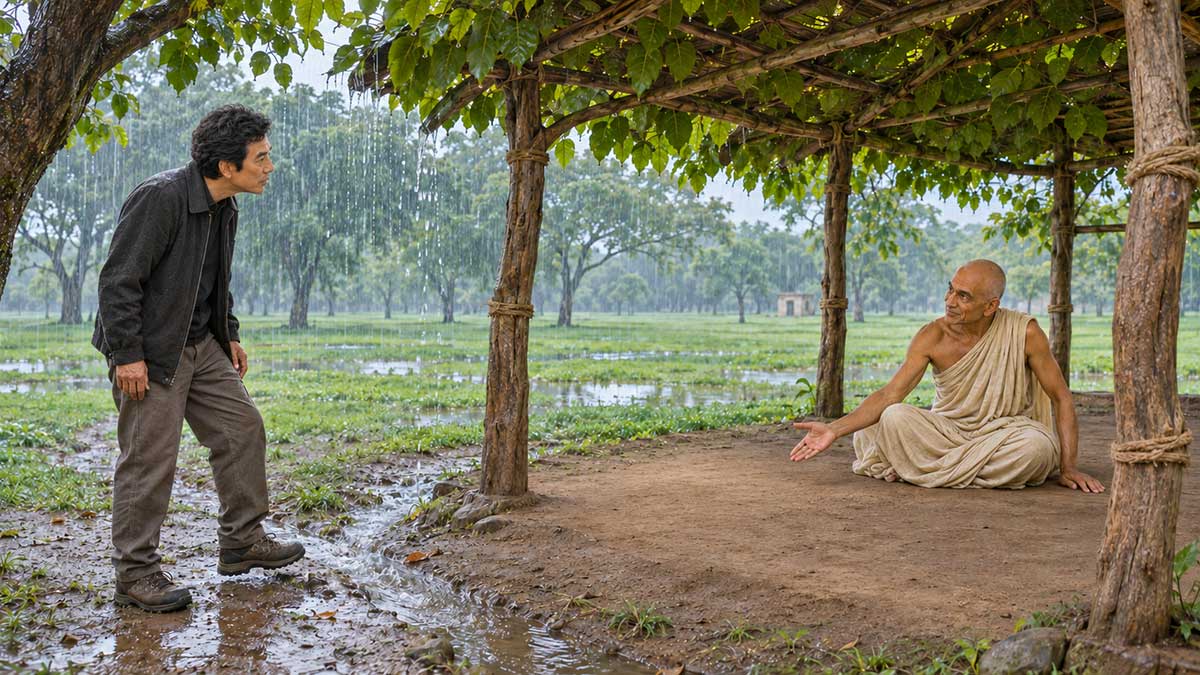
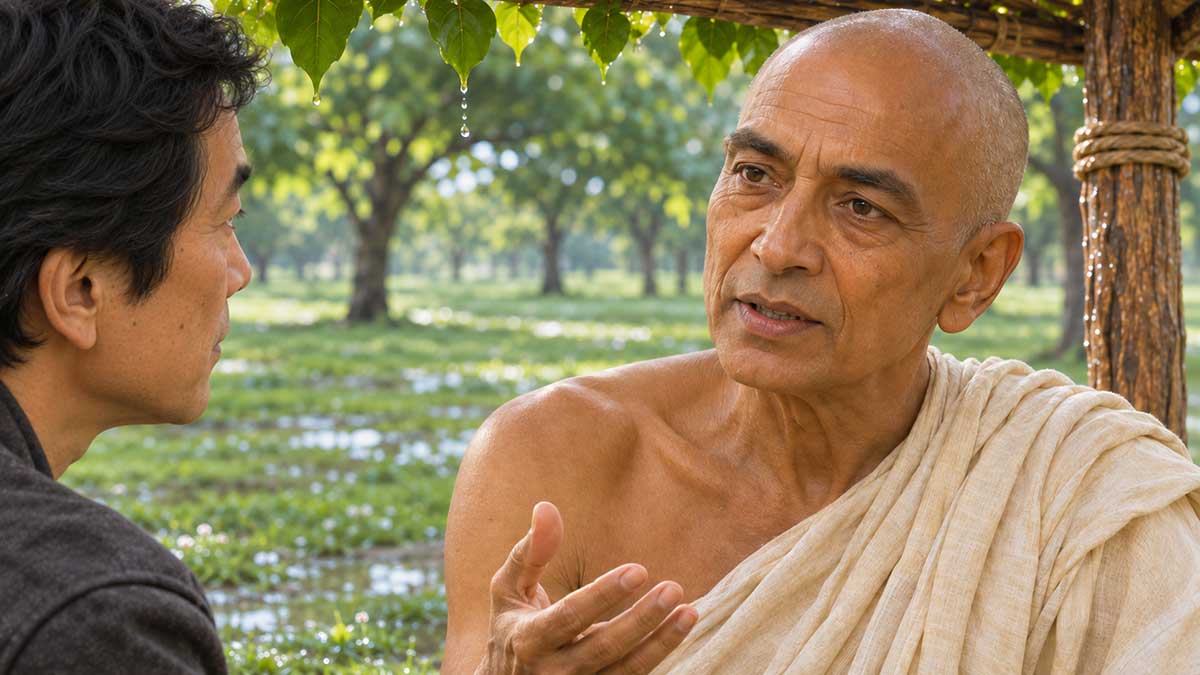
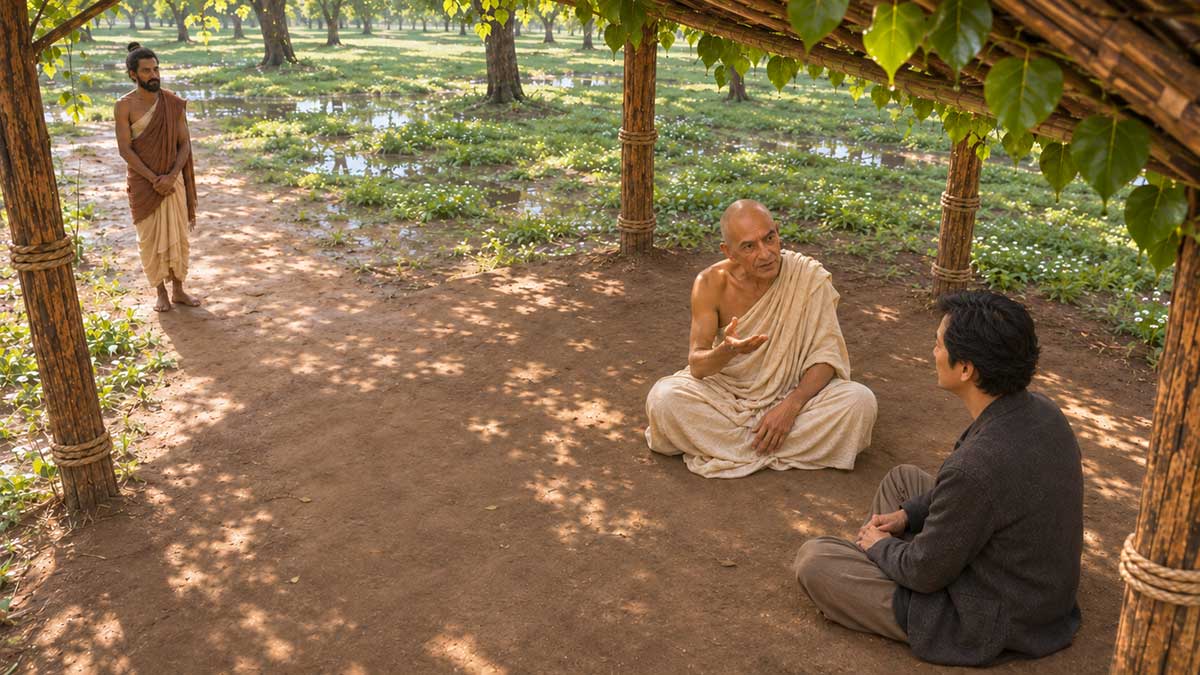
Rain ran from the roof in a narrow stream just where Nick had meant to step. He stopped at the edge of the covered space and looked for firmer ground. Beyond it, the courtyard at Pavapuri was almost empty, its shallow depressions filling with water.
Mahavira sat a little way inside. He moved enough to leave a dry place near the opening and waited as Nick stepped around the runoff. Nick lowered himself to the ground. For a few moments, the rain was loud enough that neither tried to speak.
Then the heavier fall eased. Somewhere across the courtyard, a door opened and closed. Nick looked at the hands resting quietly in Mahavira’s lap and thought of the account he had read about a stick, a stretch of difficult road, and dogs.
Nick: There’s an account of your travels I’d like to ask you about. It says people set dogs on you in Ladha.
Mahavira: What did you wish to ask?
Nick: How someone gets through that and continues walking the same way afterward.
Mahavira: The walking afterward is worth asking about. The dogs may be behind you. What happened can still decide how you meet the next person.
Question 1. What could you choose when you were being attacked?
Nick: The account says you gave up using a stick against living beings. When you had reason to reach for one, what did you believe you could still choose?
Mahavira: The creature before me wished to live. Its teeth did not take that wish away. My vow reached that creature, too. It would have been easy to make an exception for every being that troubled my body. By the end of the road, there would have been very little left of the vow.
Nick: Did you see the dog and the person setting it on you differently?
Mahavira: They were different beings, acting differently. The person could make an animal dangerous to another person and remain some distance from the pain. He still participated in the injury. A hand can be kept clean and its owner remain responsible for what he arranged.
Nick: What did your discipline ask of you toward that person?
Mahavira: To refrain from making his cruelty the rule for my own conduct. He might have wanted me to strike the animal. He might have wanted to see me run or become angry. Whatever he wished, I had undertaken responsibility for my actions. I could not give him that responsibility merely by saying he had provoked me.
Rainwater began to drip from one corner of the roof. Mahavira glanced toward it before continuing.
Mahavira: An injury ends at some point. The wish to return it can be carried much farther. A person can travel to another village still arguing with someone who stayed behind. He finds a stranger in his way and gives the stranger the anger he has brought with him.
Nick: Is that why you spoke about the walking afterward?
Mahavira: Yes. Restraint has to reach the next encounter. Otherwise the person who harmed you has acquired a great deal of influence over people he has never met.
Question 2. What changes when another life depends on you?
Nick: You chose what you were prepared to endure. What would you ask of someone with a child beside him who depended on him for protection?
Mahavira looked directly at him. Nick waited for the whole question to be considered.
Mahavira: The child is a living being whose safety has been entrusted to him. He must attend to that responsibility. He should seek a way to bring the child out of danger and cause the least injury he can. In danger, the mind can narrow so quickly that the first means it sees begins to look like the only one.
Nick: And he may have very little time.
Mahavira: He may. That is one reason to practice carefulness before danger comes. The person who has spent years allowing anger to make his decisions will call upon the habits he has practiced. So will the person who has learned to pause before acting. Each brings a life of preparation into a brief moment.
Nick: Are you asking that parent to take the same vow you took?
Mahavira: A householder has accepted duties that a mendicant has relinquished. The vows have different scope. When I undertook my discipline, I undertook its demands upon myself. A parent must consider the person who depends on him. There is still a question about what he intends, what he causes, and what injury he could have avoided.
Nick: How does he examine that after the danger has passed?
Mahavira: He can ask when protection became the wish to punish. Perhaps he brought the child to safety and then went looking for someone to blame. Perhaps another person offered a way out and he was too angry to hear it. He should examine what actually happened. The child’s need deserves his full attention. His pride may try to claim some of it.
Nick: That could be hard to admit.
Mahavira: Admission is work he can do now. The moment has passed, and he has time to look. If he uses that time only to defend his account, the habit that carried him through the first encounter will be waiting at the next.
A person appeared at the far side of the courtyard, stood under the roof there, and looked at the rain. After a moment, he went back inside.
Nick: You give the person something to practice before the emergency and something to examine afterward.
Mahavira: Much of a life is lived in those hours. People remember the emergency. Their conduct is being formed on the days they scarcely remember.
Question 3. What did hunger teach you to notice?
Nick: The same text remembers hungry crows, a cat, and a dog along your path when you went for food. What did you have to learn to notice when you were hungry yourself?
Mahavira: Hunger says that food must be found. Then a person may begin to see everything between himself and the food as an obstruction. A waiting animal becomes something to drive off. Someone standing at a doorway becomes someone to hurry. The need is real. Look at what is being done in its name.
Nick: What did that require during an alms round?
Mahavira: To look before approaching and before accepting. Who was already there? What was being disturbed by my arrival? What would someone have to do to provide what I sought? A person offering food could mean to show respect and still cause injury in preparing something especially for me. I had to be careful about what my presence encouraged.
Nick: So you considered what someone might do on your behalf.
Mahavira: Accepting has consequences. So does asking. If a person knows you will praise a particular gift, he may go to great lengths to obtain it. You should know something about those lengths before you make him eager to please you.
Nick: How far can that attention go? There are lives a person hardly notices at all.
Mahavira: Begin where you have failed to look. The small creature moves away when you approach. It has its own purpose in moving. You are passing through a place where lives are already being lived. Watch the ground before you take the next step. Hear what happens when you demand to be served quickly. Carefulness gives you occasions to learn.
Nick: Does the hunger become easier?
Mahavira: Hunger comes and goes. Practice concerns what you allow it to command. If I found food, I could receive what was suitable. If I did not, I still had my conduct to attend to. An empty stomach gave me no right to make another life worthless.
Closing
The stream at the entrance had narrowed to a series of drops. Nick could see the place where he had first intended to step. A thin trail of water still crossed it, carrying a little earth toward the courtyard.
Nick: Before those years on the road, you had lived in a household. There would have been a place to sleep and people who knew what you needed. What happened when you first left that behind?
Mahavira turned slightly toward the opening. Across the yard, the door opened again, and this time the person came out.
Topic 2. What Does It Take to Be Free?
Opening
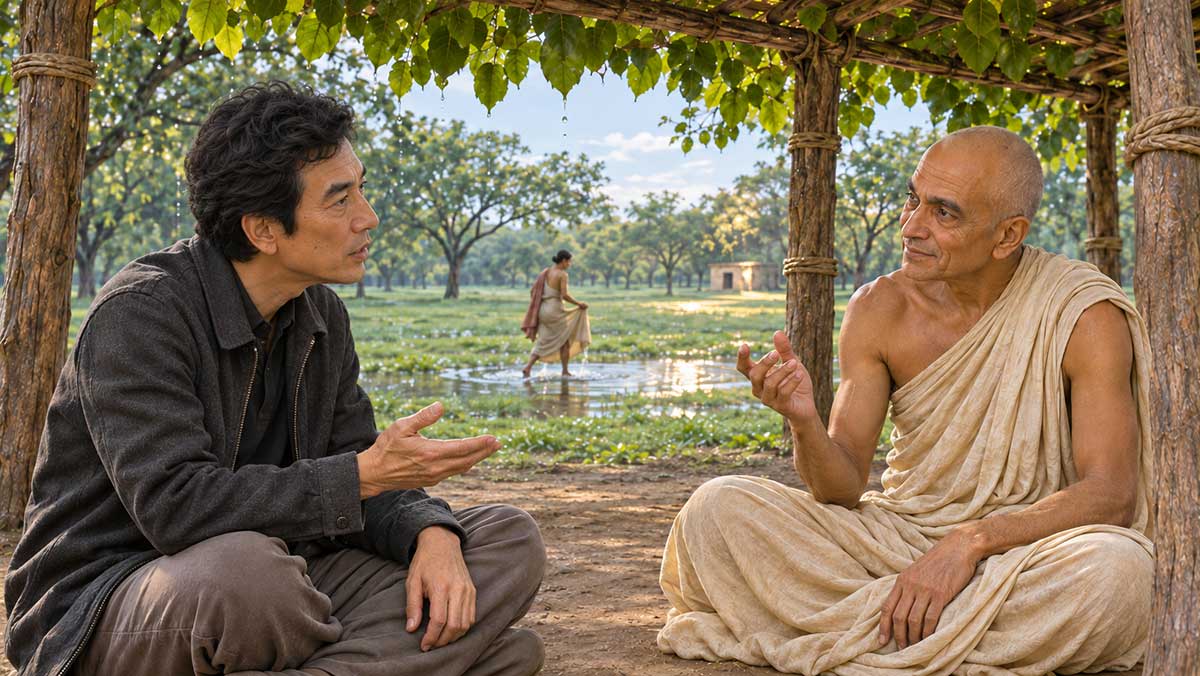
The person who had come out of the doorway crossed the courtyard slowly, lifting the hem of a garment above the wet ground. Rain had stopped falling beyond the shelter. Water still dropped from the roof, sometimes two drops close together, then a pause long enough for Nick to hear footsteps on the other side.
A patch of light reached a shallow pool near the wall. The person crossing the yard stepped around it and disappeared through an opening. Mahavira watched until the footsteps faded, then turned back to the question Nick had asked.
The place where Nick sat was dry. He could feel the difference between the cool ground beneath him and the damp air at the opening. He looked out at the path the visitor had taken before asking about the life Mahavira had left.
Nick: You had lived in a household before those years on the road. Food, shelter, people who knew you. What changed when you set out?
Mahavira: I could leave the house in a morning. The expectations I had learned there required longer attention.
Question 1. What did leaving home change?
Nick: What did you discover you could no longer expect another person to provide?
Mahavira: A place kept ready for me. Food obtained in the expectation that I would eat it. Someone to explain who I was when I arrived. A mendicant approaches a house where other lives are already being lived. There may be food he can accept. There may be none. His former standing gives him no claim upon it.
Nick: What could remain difficult after the possessions were gone?
Mahavira: The demand to be received well. You can give up a house and still carry the wish that every house should welcome you. You can have no wealth and still notice who is greeted before you. Possession reaches into what you believe is owed to you.
Nick: How would that show itself?
Mahavira: Someone refuses an offering, or speaks without respect. The body can go hungry for a time. Pride begins asking why this particular person should be permitted to refuse. Then a person who has renounced his household starts looking for a witness who will agree he has been treated poorly. He has found something new to gather.
Nick: Can a person be attached to the respect given to someone who has renounced?
Mahavira: Certainly. He may expect more respect after renouncing than he received before. He has given people something they can admire. If he begins to count their admiration, he will be busy wherever he goes.
A drop fell close to the entrance. Nick drew his knee back a little.
Mahavira: A vow gives that movement of the mind something to answer to. It reaches into the hour when there is no witness to impress. If I refuse what is unsuitable, I must attend to the refusal as carefully as I attend to accepting. There can be pride in having refused.
Nick: What does a person do when he notices that pride?
Mahavira: Acknowledge it without making another display of himself. He has something to relinquish. The fact that it was found during a good action does not make it less binding.
Question 2. What did years of discipline change in the soul?
Nick: You endured years of severe practice. How did you judge whether it was loosening attachment or giving you another reason to be proud?
Mahavira: Look at what happens to anger, pride, deceit, and greed. A person can go without food and remain eager to defeat somebody in an argument. He may speak of restraint and conceal a small fault so his reputation survives. The austerity must reach those passions. Otherwise he will have endured hunger and kept much of what bound him.
Nick: What do you mean when you say those things bind the soul?
Mahavira: The soul is living and conscious. Its capacity to know is obscured through its association with karma. Action brings consequences that extend beyond what another person can see. Passion helps bind karmic matter to the soul. Injury done in anger affects the injured being. It binds the one acting, too.
Nick: So karma has a more literal meaning in your teaching than the memory of an action.
Mahavira: It is a real bondage. Consider how a person lives when greed directs him. He reaches for what he lacks, protects what he has acquired, and fears what may be taken. That conduct is visible. The bondage of the soul extends beyond the single life in which you watch him do it.
Nick: What can discipline change?
Mahavira: Restraint checks what brings fresh bondage. Austerity and the purification of conduct bear upon karma already accumulated. Both require attention. You may draw water out of a vessel for a long time and make little progress if you continue pouring more into it.
Nick: How does someone tell whether he is still pouring more in?
Mahavira: Watch what he does when his practice is disturbed. He may have chosen a period of fasting. Somebody comes with a question at an inconvenient time. Does he make the questioner pay for the difficulty of his fast? His treatment of that person will tell him something his count of days cannot.
Nick: What would you say to someone who believed his course was already fixed, whatever effort he made?
Mahavira: He still makes choices when he speaks, takes food, or reaches for something he wants. If he says effort changes nothing, ask what he will do when the next desire arises. Will he follow it? Will he restrain it? Those actions bear consequences. A teaching must account for the conduct through which people continue to bind themselves.
The light on the pool widened. The roof had almost stopped dripping.
Nick: What keeps a person going through years of that work?
Mahavira: Right vision of the path, knowledge of what must be relinquished, and conduct that follows it. A person can hear the teaching and find it convincing. He has to live through the next desire. That is where conviction has work to do.
Question 3. What remained to do after complete knowledge?
Nick: The tradition says you attained complete knowledge beneath a sal tree. What could you then give to someone who was still at the beginning?
Mahavira: An account of bondage and the way beyond it. Complete knowledge is unobstructed knowledge. The obscuring karmas have been destroyed. The seeker who comes with a question does not yet see in that way. He can still be taught what conduct sustains bondage and what practice bears upon it.
Nick: Does hearing the answer begin to free him?
Mahavira: It can give him direction. He may leave knowing why his anger deserves attention. Before he reaches home, someone may delay him, contradict him, or ask him for something he had planned to keep. The teaching has reached a place in his life where he can act upon it.
Nick: What did it mean to know completely and still have years of bodily life ahead?
Mahavira: The body continues for the remainder of its life. There is food to receive and a place to remain during the rains. Complete knowledge and the final release from embodied existence are distinct. The karmas that obscure knowledge and sustain delusion can be destroyed before the remaining conditions of bodily life reach their end.
Nick: And people could still come to you with their questions.
Mahavira: Yes. A person may ask whether his anger has already determined his future. He can be told that restraint matters. Another may be ready to undertake vows and need guidance about their demands. Teaching gives them access to a path they must practice themselves.
Nick: What would you hope someone could say after hearing you?
Mahavira: That he knew where to begin and had reason to begin. He may have spent years saying he could do nothing about a habit. Let him examine the next occasion carefully. If he restrains an action, he has done something with the teaching. He can examine the following occasion in its turn.
Closing
Voices rose near the entrance to the courtyard. Two people had stopped there to speak. One stayed beneath the roof, listening, and the other stepped out into the clearing light.
Nick watched the second visitor go. The man paused to adjust what he was carrying before continuing toward the road.
Nick: Someone can hear you here and still have a household waiting for him. What did you ask of the person who wanted to follow your teaching and had a family to feed?
Topic 3. What Can You Carry Home?
Opening
The visitor who had paused to adjust his bundle continued toward the road. His companion stayed near the entrance, speaking quietly to someone beneath the roof. Across the courtyard, a person stepped into the patch of sunlight and spread a damp cloth over a low wall.
Nick could see where the light had reached when he first arrived. The ground there was dark with water, and a narrow strip of shade now covered the place where he had waited before entering. The afternoon had moved on as they spoke.
Mahavira had followed the departing visitor with his eyes. Nick waited until he turned back. The question was still between them: what he asked of someone who heard the teaching and returned to a family that needed to eat.
Mahavira: He has people depending on his conduct already. He need not travel far to find where to begin.
Question 1. Where does a householder begin?
Nick: What did you ask of someone who wanted to follow your teaching and still had a family to feed?
Mahavira: To examine what he undertakes to provide for them. A household needs food, clothing, and shelter. Desire can add many things to that account and call them necessary. He can begin by setting a limit to what he seeks. Then he has a measure against which to recognize the next demand he makes.
Nick: A limit chosen in advance?
Mahavira: Yes. Otherwise the thing before him will be allowed to set the limit each time. He has enough, and then he sees what his neighbor has. The household has grown in his thoughts before anybody has been born into it.
Nick: How did the vows apply to him?
Mahavira: He undertook them within the scope of household life. He could restrain deliberate injury, speak truthfully, take only what was given, practice fidelity and sexual restraint, and limit his possessions. A mendicant undertakes a far more comprehensive discipline. The householder has commitments he must learn to carry carefully. A limited vow still asks to be kept.
Nick: What happens when he breaks it?
Mahavira: He examines the fault, acknowledges it, and renews his effort to restrain it. He should ask what led him there. If he merely repeats that he is weak, he may overlook a decision he could change. Perhaps he promised more than he could give. Perhaps he wanted something and arranged to know very little about how it was obtained.
Nick: Your community included nuns and monks, laywomen and laymen. The tradition names Chandana as a leader of the nuns. What did people guiding others have to give?
Mahavira: Knowledge of the discipline and care in practicing it. Someone who guides others must be willing to attend to the small fault before it grows. A person may be ready to confess something and uncertain how to say it. The one hearing him must listen carefully enough to distinguish an excuse from a difficulty that requires instruction.
Nick: Could people living very different lives help each other practice?
Mahavira: They did. The mendicant receives support and teaches the discipline. The householder learns from conduct he can observe and gives within the limits he has undertaken. Both should examine the relationship. Respect for a teacher can make somebody generous. It can lead him to obtain a gift carelessly, too. Each has responsibility for what he encourages in the other.
Question 2. What should someone examine in a livelihood?
Nick: Suppose someone earns his living through work that harms other living beings. What would you ask him to examine first?
Mahavira: What work does he do?
Nick: He trades in goods. He buys them elsewhere and brings them into town. People depend on what he brings, and his household depends on what he earns.
Mahavira: Then begin with what he buys and what he asks others to obtain. He may know the price of every item and have scarcely asked what is done to produce it. The person making the purchase participates in a chain of actions. Distance from an injury can make it easier to leave the injury out of his account.
Nick: He might say the goods will be made whether he buys them or not.
Mahavira: He has been asked about his purchase. Let him answer for that. If he continues to buy, he continues to give someone a reason to supply him. He can examine what he chooses to encourage.
The person at the wall lifted the damp cloth and turned it. Water fell onto the earth beneath it.
Nick: How does the trader begin if changing everything would leave the family without an income?
Mahavira: Examine the trades he is willing to undertake, the unnecessary demands he makes, and the limits he can set. He may find an injury he has continued only for a little more profit. He may discover that his household could live with less. A vow gives him a boundary before the next profitable offer arrives.
Nick: And where injury continues?
Mahavira: He should acknowledge it. The fact that he has reduced one harm gives him no reason to close his eyes to the others. Household life has its limits. He can recognize them and practice within them sincerely. Further renunciation remains a real step, with real demands, if he becomes prepared to undertake it.
Nick: What prevents examination from becoming an endless excuse to postpone a choice?
Mahavira: Set the limit. Keep the commitment that can be kept today. Examine the next fault when it occurs. He can spend a great deal of time discussing how difficult restraint is and still have an offer before him that he knows he ought to refuse. That offer will tell him more about his practice than another evening of discussion.
Question 3. What must a good disciple still release?
Nick: Gautama has spent years beside you. What would you hope he could do when you were no longer there to answer him?
Mahavira looked toward the entrance. The visitor who had stayed there had come inside to wait.
Mahavira: Attend to the discipline he has learned. A question can arise when the teacher is absent. The disciple has knowledge to examine it with and conduct through which to test his judgment. Years of instruction should give him something he can take responsibility for.
Nick: How can devotion to a teacher become an attachment?
Mahavira: The disciple begins to need the teacher’s presence in the way he once needed another possession. He wants a place near him, a word directed especially to him, the assurance that he is remembered. The teaching may have asked him to relinquish many things. He can still gather those moments and fear their loss.
Nick: How would you help him see it?
Mahavira: Ask what he is afraid he will lose. He may say the teaching. Then let him speak what he has learned and examine how he practices it. He may find the fear concerns something else: who he believes himself to be when he is the person standing nearest the teacher.
Nick: That could be painful for a devoted disciple to hear.
Mahavira: He has given much of his life to freedom. He deserves care when something still binds him. If the teacher is the object of that attachment, the teacher has reason to speak.
Nick: What would a good disciple still have to let go of, even after years beside you?
Mahavira: His claim upon those years. They have given him occasions to learn. He cannot possess the teacher through having served him, and the teacher cannot possess the disciple through having taught him. Let him keep the vows and attend to what still binds him. His practice can continue when his accustomed place beside the teacher is empty.
Closing
Nick looked toward the visitor waiting inside the entrance. There was room now to pass without stepping through the runoff.
Nick: Thank you for giving me this time.
Mahavira acknowledged him, and Nick rose. He stepped into the courtyard, found the firm ground, and turned once before continuing toward the road. The visitor had taken the place he had left.
Historical Note
Jain tradition places Indrabhuti Gautama’s attainment of complete knowledge after Mahavira’s death, when his attachment to his teacher fell away. That later account informs the final exchange in this fictional visit.
Final Thoughts
The dogs make the first question difficult. The alms round makes it harder to set aside afterward. A person who is hungry has an immediate reason to hurry toward food. The creature in his path has a life of its own. In the interview, Mahavira keeps returning to the conduct available before the next step, the next request, or the next acceptance of an offering.
That attention has a spiritual purpose in his account. Jain teaching understands the soul as bound by karma and places restraint, knowledge, and disciplined conduct on the path to liberation. The interview gives those Jain beliefs about bondage and release room to explain why he undertook such demanding practice. Mahavira’s concern with another being’s life reaches into what the person acting is doing to his own soul.
The exchange about renunciation asks what survives after possessions are gone. A person can still want recognition, a place near the teacher, or an audience willing to admire his discipline. Those demands may be harder to see when they accompany conduct others praise. Mahavira’s question is what happens to anger, pride, deceit, and greed as the practice continues.
The householder carries a different set of commitments. Someone waiting at home depends on food being earned and brought back. The Jain vows recognize differences in scope between household and mendicant practice. In the conversation, those differences give a person concrete work to undertake. A limit on possessions has to mean something when a profitable offer arrives.
The trader can know every price and remain incurious about what obtaining the goods requires. Mahavira asks him to look farther into his purchase. The question reaches the work he encourages and the demands he makes on others. There may be a change within reach that he has postponed simply to earn a little more.
Gautama brings the question of attachment into the relationship with the teacher himself. Jain tradition remembers his attainment of complete knowledge after Mahavira’s death, an event commemorated in the Jain Diwali festival period. In the fictional encounter, Mahavira speaks from before that event. His concern is whether the disciple can carry responsibility for the practice when his familiar place beside the teacher is empty.
At the end of the visit, another person is waiting to speak. Nick gets up, finds the firm ground, and leaves room for him. The conversation has given him questions that will need attention beyond the shelter. The rain has stopped. There is a road to walk, and other lives are already being lived along it.
Fictional Conversation Disclaimer
The dialogue and closing scene are original fiction informed by Jain tradition. Teachings and episodes referenced here come through texts transmitted and interpreted over time. The fictional replies are distinct from Mahavira’s authenticated words and imply no endorsement by any Jain authority or community.
Short Bios:
Mahavira, traditionally named Vardhamana, is revered as the 24th Tirthankara of the present age in Jain tradition. A near-contemporary of the Buddha, he undertook years of ascetic practice and taught a path of non-harming, restraint, knowledge, and liberation from karmic bondage. Jain accounts place his final liberation at Pavapuri in present-day Bihar. His precise dates and aspects of his biography remain disputed. Read more about Mahavira and the Jain accounts of his life.
Nick Sasaki is the creator of ImaginaryTalks. His fictional interviews draw on a guest’s life, writings, and religious or historical context to explore what that person most wanted to convey. Read more about Nick and ImaginaryTalks.
Leave a Reply