
What if The Brothers Karamazov is less about answering questions than teaching us how to live with them?
What if the strongest argument against God in modern literature was written by a deeply religious novelist?
Fyodor Dostoevsky’s The Brothers Karamazov has remained alive for nearly 150 years since it refuses to offer readers easy moral comfort.
The novel contains murder, family rivalry, religious faith, intellectual rebellion, courtroom drama, psychological collapse, and the suffering of children. Yet its deepest concern is not merely what happened to the Karamazov family.
It asks what human beings become when freedom, desire, belief, resentment, and responsibility collide.
Ivan Karamazov refuses to accept a world in which innocent children suffer and future harmony is offered as compensation.
Alyosha does not defeat Ivan through a superior argument.
Father Zosima does not explain evil through a tidy theological system.
Dmitri does not become innocent merely since he did not commit the murder.
Smerdyakov does not become blameless merely since he was humiliated and neglected.
Every character forces the reader to hold more than one truth at once.
That is one reason the novel continues to attract scholars from literature, theology, philosophy, psychology, ethics, translation studies, and cultural history.
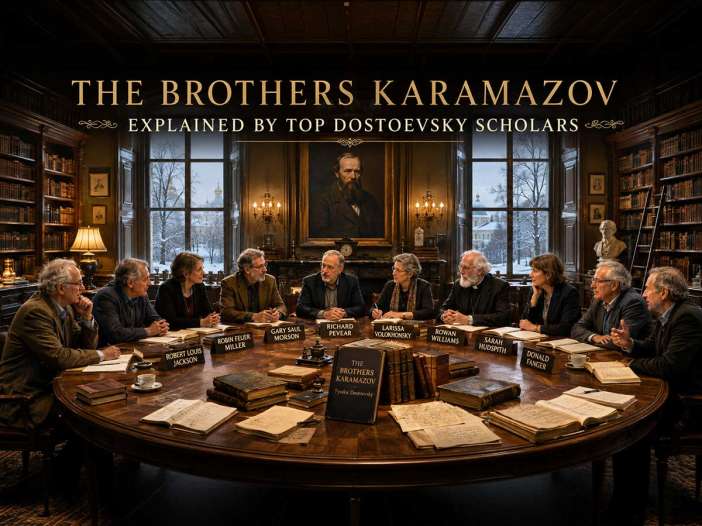
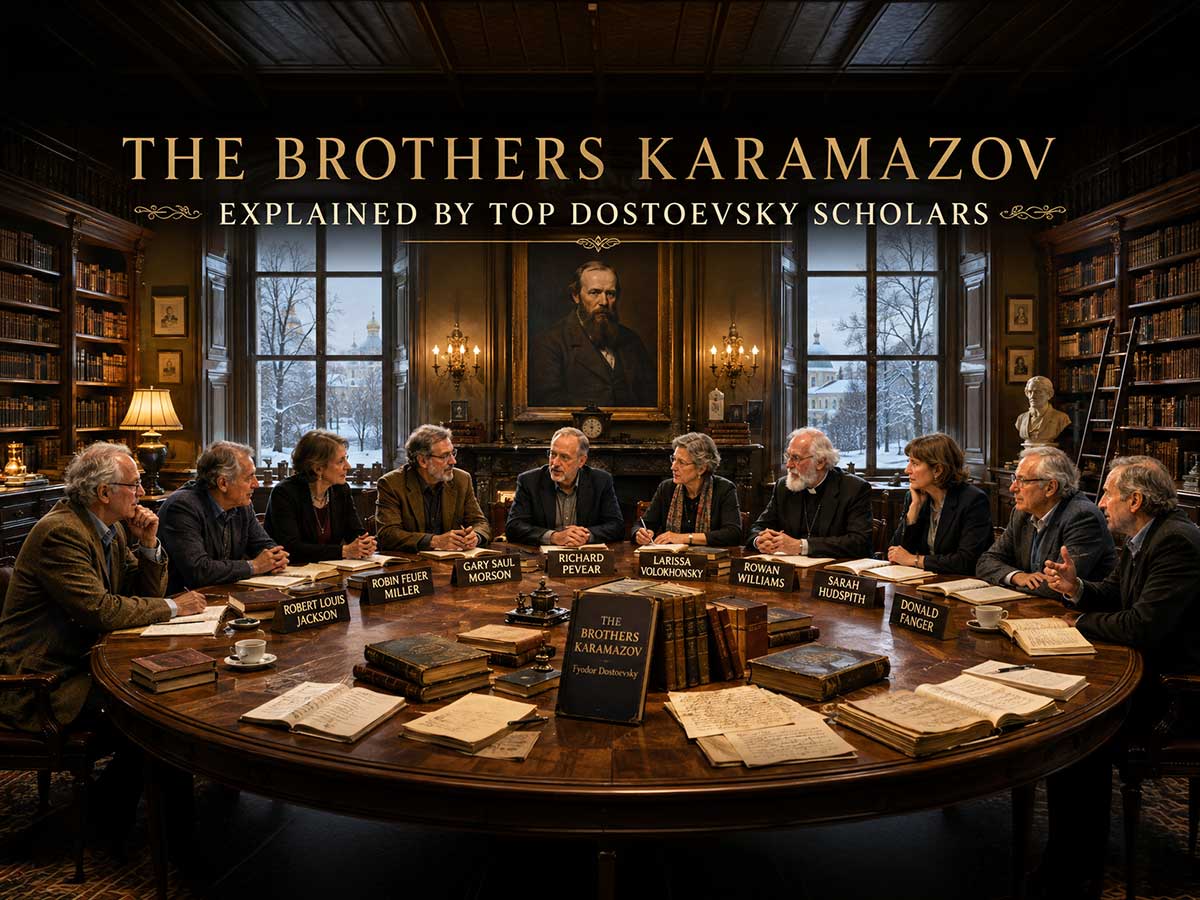
In this imaginary conversation, ten major Dostoevsky scholars gather to examine the questions readers ask most often about The Brothers Karamazov.
They ask:
Did Dostoevsky answer Ivan’s rebellion against God?
What does “The Grand Inquisitor” really mean?
Why is this novel considered one of the greatest ever written?
What does Dostoevsky believe about freedom, responsibility, and human nature?
What final hope remains after murder, failed justice, family breakdown, doubt, and death?
The panel includes Joseph Frank, Robert Louis Jackson, Robin Feuer Miller, Gary Saul Morson, Richard Pevear, Larissa Volokhonsky, Rowan Williams, Sarah Hudspith, Donald Fanger, and René Girard.
Each approaches the novel from a different direction.
Joseph Frank provides historical and biographical depth.
Robin Feuer Miller explores narrative ambiguity and psychological contradiction.
Gary Saul Morson examines freedom, contingency, and moral responsibility.
Richard Pevear and Larissa Volokhonsky focus on the language, rhythms, and tonal tensions of the Russian text.
Rowan Williams studies Dostoevsky’s Christian vision without reducing it to simple doctrine.
Sarah Hudspith brings ethical and cultural context.
Donald Fanger places the novel within literary history.
René Girard interprets rivalry, imitation, violence, and scapegoating.
Together, they do not attempt to produce one final interpretation.
They reveal why the book resists being reduced to one.
Ivan’s rebellion remains intellectually powerful.
“The Grand Inquisitor” remains a warning against every institution that treats control as compassion.
The murder trial remains a study of how a convincing story can become more persuasive than truth.
The Karamazov family remains a picture of how neglected wounds can become rivalry, violence, self-deception, and inherited damage.
The ending remains fragile.
No miracle restores the family.
No argument erases doubt.
No verdict delivers perfect justice.
A child dies.
An innocent man is convicted.
The murderer takes his own life.
Ivan collapses.
Yet Dostoevsky does not end in total despair.
He turns from the failed father to a group of boys deciding what they will remember.
That movement contains the novel’s final hope.
A good memory cannot erase the past.
It may help prevent the past from repeating itself.
This scholarly conversation does not ask readers to choose Ivan or Alyosha, faith or doubt, justice or mercy.
It asks whether we can remain morally serious enough to hear all of them.
(Note: This is an imaginary conversation, a creative exploration of an idea, and not a real speech or event.)
Topic 1 — Did Dostoevsky Answer Ivan's Rebellion Against God?
The auditorium at St. Vladimir's Seminary had grown unusually quiet.
A single round table sat beneath warm lights. Around it were ten of the world's most respected Dostoevsky scholars. There were no podiums, no prepared lectures, and no debate moderator determined to declare a winner.
Instead, they had gathered for one question that readers have argued about for nearly 150 years.
Did Dostoevsky actually answer Ivan Karamazov's rebellion against God?
Before anyone spoke, a large screen behind them displayed one sentence from the novel:
"I most respectfully return Him the ticket."
The audience remained silent.
Joseph Frank looked around the table.
Joseph Frank: I think we should begin with something that often surprises readers.
Ivan is not presented as a villain.
In many ways, Dostoevsky gives the strongest moral argument in the novel to the man struggling most deeply with faith.
Several scholars nodded.
Robin Feuer Miller: Exactly.
Students often arrive expecting Ivan to represent cold atheism.
Instead they discover someone who cannot tolerate innocent suffering.
That difference matters enormously.
Ivan is not emotionally detached.
He's morally wounded.
Gary Saul Morson: I would go even further.
Ivan may be the most morally serious person in the novel.
His refusal to justify a child's suffering is not cynicism.
It is compassion refusing compromise.
The audience became noticeably quieter.
Is Ivan really arguing against God—or against explanations that excuse suffering?
Rowan Williams: That's where many readers misunderstand him.
Ivan never says suffering doesn't exist.
He never argues morality is meaningless.
His complaint is much more radical.
He refuses any theological explanation that asks innocent children to pay the price for someone else's future harmony.
That isn't hatred of goodness.
It's love for goodness.
Sarah Hudspith: Which is why modern readers immediately trust him.
Most of us have encountered shallow religious explanations.
"Everything happens for a reason."
"God needed another angel."
"This suffering will make sense one day."
Ivan hears language like that and says—
"No."
He refuses consolation purchased at someone else's expense.
Donald Fanger: And Dostoevsky deliberately makes that refusal persuasive.
A weaker novelist would make Ivan easier to dismiss.
Dostoevsky does exactly the opposite.
He allows Ivan to become almost irresistible intellectually.
Richard Pevear: Even the language reflects that.
Ivan isn't speaking as a philosopher trying to win.
He's speaking almost like a prosecutor introducing evidence.
Each story of abused children accumulates emotional force.
The Russian becomes increasingly concrete.
Increasingly unbearable.
Larissa Volokhonsky nodded.
Larissa Volokhonsky: Yes.
Many English translations soften the rhythm.
In Russian, the stories become almost impossible to escape.
Readers don't merely understand Ivan.
They experience him.
Why do so many readers sympathize with Ivan more than Alyosha?
Joseph Frank smiled.
Joseph Frank: Let me ask everyone something.
When university students first read The Brothers Karamazov...
Who usually becomes their favorite character?
Nearly everyone smiled.
Robin Feuer Miller: Ivan.
Without question.
Especially younger readers.
Gary Saul Morson: Absolutely.
Students often tell me—
"I wish Alyosha would actually answer him."
Laughter spread across the room.
Gary Saul Morson: They expect a philosophical debate.
Instead Alyosha kisses Ivan.
Many readers initially feel disappointed.
Rowan Williams: Which says something fascinating.
Modern culture trusts arguments more than persons.
We assume truth should arrive through logical victory.
Dostoevsky keeps refusing that expectation.
Donald Fanger: Yet we should be careful.
That doesn't mean Dostoevsky is anti-intellectual.
Ivan's arguments are intellectually serious.
The novel simply refuses to pretend that logical certainty heals existential suffering.
René Girard: I think we're already making Alyosha too comfortable.
Several heads turned toward Girard.
Girard: Ivan deserves even more credit.
His refusal to accept innocent suffering protects something sacred.
Without Ivan...
religious systems become extremely dangerous.
The room grew still.
Girard: History proves him right.
Whenever institutions justify victims for the sake of harmony...
they create scapegoats.
The innocent become necessary sacrifices.
Ivan rejects the entire mechanism.
That is morally magnificent.
Is Ivan defending morality more passionately than many believers?
Sarah Hudspith: That's exactly why readers hesitate to call him an atheist.
His outrage assumes children possess infinite worth.
Without that conviction...
his rebellion loses force.
Joseph Frank: An excellent observation.
Ivan behaves as though objective moral value already exists.
His rebellion depends upon it.
Gary Saul Morson: Which creates one of literature's greatest paradoxes.
Ivan attacks God...
using moral standards many philosophers argue require God.
The audience leaned forward.
Morson: He's standing on moral ground while questioning the source of that ground.
Robin Feuer Miller: But perhaps that's the wrong way to describe him.
Ivan isn't constructing a philosophical system.
He's refusing betrayal.
Every explanation sounds like betrayal.
That's psychologically different.
Richard Pevear: The Russian reflects that emotional intensity.
Readers sometimes translate Ivan into a philosopher.
He's actually speaking as someone grieving.
Larissa Volokhonsky: Yes.
There's tremendous sorrow beneath the brilliance.
That's often missed.
Does Dostoevsky actually answer Ivan?
Joseph Frank looked around the table.
Joseph Frank: Let me ask the difficult question.
Does Dostoevsky answer Ivan?
Silence.
Several scholars exchanged uncertain smiles.
Finally Donald Fanger spoke.
Donald Fanger: Not in the way readers expect.
Rowan Williams: Agreed.
Robin Feuer Miller: Definitely not.
Gary Saul Morson: The novel never explains why children suffer.
Nor should it.
Joseph Frank: Then what exactly is Alyosha doing?
Rowan Williams answered slowly.
Rowan Williams: Alyosha refuses to justify suffering.
That distinction changes everything.
He never tells Ivan—
"The children suffered for a greater purpose."
He refuses that argument entirely.
Instead...
he asks a different question.
How should one live after recognizing such suffering?
The audience remained silent.
Sarah Hudspith: Which frustrates readers.
Ivan asks—
"Why?"
Alyosha answers—
"What now?"
Those are different conversations.
Donald Fanger: Exactly.
Readers often think Alyosha changes the subject.
Perhaps Dostoevsky changes the subject intentionally.
Gary Saul Morson: Life forces that change.
If someone loses a child...
you cannot begin with metaphysics.
You begin with presence.
Then responsibility.
Then love.
Perhaps explanation comes last—
if ever.
Is Alyosha refusing philosophy—or refusing false certainty?
René Girard leaned forward.
Girard: I want to challenge Rowan slightly.
Rowan smiled.
Rowan Williams: Please do.
Girard: We keep saying Alyosha answers through love.
True.
But we shouldn't make that sentimental.
Active love is extraordinarily demanding.
It interrupts cycles of violence.
It refuses revenge.
It refuses scapegoating.
It refuses imitation of the aggressor.
That's harder than constructing arguments.
Rowan Williams: I agree completely.
Christianity, in Dostoevsky, is not primarily an explanation of evil.
It is God's refusal to remain outside human suffering.
That isn't philosophical surrender.
It's a different category altogether.
Joseph Frank: Which explains something many readers miss.
Dostoevsky doesn't ask—
"Who wins?"
He asks—
"Who becomes capable of loving after hearing Ivan?"
The audience grew noticeably quieter.
Has Ivan already changed the reader?
Robin Feuer Miller looked thoughtfully toward the audience.
Robin Feuer Miller: May I suggest something?
Perhaps Ivan succeeds.
Several scholars looked surprised.
Miller: Every compassionate reader now refuses shallow religious answers.
Every thoughtful reader becomes suspicious whenever suffering is explained too easily.
Ivan changes us.
Rowan Williams nodded slowly.
Williams: Yes.
And perhaps that is precisely why Dostoevsky wrote him.
Not to destroy faith.
To purify it.
Sarah Hudspith: That's beautifully said.
Faith after Ivan can no longer hide behind clichés.
It must become honest.
Donald Fanger: Which may explain why believers and skeptics both love this novel.
Neither side receives easy confirmation.
If Ivan is never defeated, what becomes Dostoevsky's answer?
Joseph Frank smiled gently.
Joseph Frank: Suppose a student asks me after class—
"So...
who wins?"
How would each of you answer?
Gary Saul Morson: Neither.
The better question is—
Who keeps reading differently afterward?
Robin Feuer Miller: Ivan wins the argument he intended to make.
Alyosha refuses to play the same game.
Richard Pevear: The novel protects Ivan's questions.
It never edits them away.
Larissa Volokhonsky: Which is why readers continue returning to the book throughout their lives.
Different ages hear different brothers.
Sarah Hudspith: Young readers often begin with Ivan.
Older readers sometimes find themselves returning to Alyosha.
Donald Fanger: Or discovering they need both.
René Girard: Absolutely both.
Ivan protects us from false religion.
Alyosha protects us from despair.
One without the other becomes dangerous.
Closing Reflections
Joseph Frank folded his notes but never looked at them.
Joseph Frank: I sometimes think readers ask the wrong question.
They ask—
"Did Dostoevsky answer Ivan?"
Perhaps the better question is—
"What kind of faith remains possible after Ivan?"
The room became completely silent.
Rowan Williams spoke softly.
Rowan Williams: A faith that has never listened to Ivan becomes sentimental.
A faith that listens only to Ivan risks becoming hopeless.
Dostoevsky asks us to live long enough to hear both brothers.
Gary Saul Morson looked around the table one last time.
Gary Saul Morson: Perhaps that's why The Brothers Karamazov remains alive.
Not since it settles the greatest questions.
Since it refuses to let us settle for smaller ones.
No one spoke.
For several moments, even the audience remained motionless.
Behind the scholars, Ivan's sentence still filled the screen.
"I most respectfully return Him the ticket."
Slowly, another sentence appeared beneath it.
Not as an answer.
As an invitation.
"How will you live after hearing him?"
Topic 2 — What Does “The Grand Inquisitor” Really Mean?
The screen behind the scholars changed.
Ivan’s words disappeared.
In their place appeared a dark painting of a prison cell in sixteenth-century Seville.
A silent Christ stood before an elderly cardinal.
Outside the imagined cell, fires burned in the public square.
Joseph Frank waited until the image settled over the room.
Joseph Frank: We now come to the chapter many readers remember long after they forget the details of the murder.
“The Grand Inquisitor.”
Some read it as an attack on the Catholic Church.
Some see a warning against dictatorship.
Others believe it is a prophecy about modern mass society.
What is Ivan’s poem really about?
Donald Fanger: Perhaps we should begin by saying what it is not.
It is not a simple historical argument about Spain.
It is a parable about the permanent temptation to relieve human beings of freedom.
Gary Saul Morson: Yes.
The Inquisitor does not claim that Christ was evil.
He claims Christ expected too much from humanity.
That is what makes the argument so disturbing.
Robin Feuer Miller: He presents himself as more compassionate than Christ.
He looks at ordinary people and says:
“They are weak. They are hungry. They are frightened. They cannot endure the burden of moral freedom.”
He believes control is mercy.
Sarah Hudspith: Which remains one of the most dangerous political ideas ever expressed.
The ruler says:
“I know you are not capable of choosing wisely, so I will choose for you.”
The loss of freedom is then presented as protection.
Why does the Inquisitor accuse Christ of loving humanity too much?
Joseph Frank: Rowan, perhaps you can begin here.
Why does the Inquisitor think Christ failed?
Rowan Williams: He believes Christ respected human freedom beyond human capacity.
In the wilderness temptations, Christ refuses to turn stones into bread as proof of divine authority.
He refuses spectacle.
He refuses political domination.
The Inquisitor interprets each refusal as a mistake.
He says people need bread before freedom, miracle before faith, and authority before conscience.
Richard Pevear: The language is important.
The Inquisitor does not speak like a cartoon tyrant.
He speaks like a tired administrator who believes he has studied humanity realistically.
Larissa Volokhonsky: He considers Christ naïve.
In his view, Christ loved an ideal human being who barely exists.
The Church, as the Inquisitor describes it, has learned to govern actual human beings.
Weak human beings.
Contradictory human beings.
Hungry human beings.
René Girard: Yet the Inquisitor’s apparent realism hides contempt.
He says he loves the people, but he does not believe they can become responsible persons.
He loves them as a shepherd loves animals under management.
Gary Saul Morson: Exactly.
The Inquisitor confuses compassion with reduction.
He sees human weakness clearly, but human possibility hardly at all.
Is the chapter mainly criticizing religion?
Sarah Hudspith: Many readers encounter the chapter as an indictment of institutional Christianity.
That reading is justified.
The Inquisitor’s Church has taken Christ’s name while reversing Christ’s method.
Donald Fanger: Yet Dostoevsky’s target is wider.
Any institution can become inquisitorial once it believes people must surrender conscience for order.
A church.
A government.
A political movement.
A corporation.
A family.
Robin Feuer Miller: That last word matters.
The Karamazov family itself contains small inquisitors.
Fyodor manipulates affection and money.
Katerina turns sacrifice into moral pressure.
Dmitri sometimes treats passion as a claim upon another person.
Ivan’s intellectual superiority can make other people feel morally insignificant.
The poem is not sealed away from the family plot.
Joseph Frank: So the Inquisitor is not merely an institution.
He is a pattern.
Miller: Yes.
He appears wherever one person says:
“I know what is good for you, and your refusal proves why you should not be free.”
Rowan Williams: Religious authority becomes inquisitorial when it seeks obedience rather than spiritual maturity.
A faithful teacher should help another person become responsible.
The Inquisitor wants dependence to continue forever.
Is bread more important than freedom?
Joseph Frank: Let us face the strongest part of the argument.
A hungry person may care very little about freedom.
Does the Inquisitor understand something Christ does not?
Gary Saul Morson: He understands that moral choice is affected by material conditions.
That is true.
Poverty, fear, hunger, and social isolation make freedom harder to exercise.
The mistake is concluding that people should then be deprived of freedom permanently.
Sarah Hudspith: We should resist a comfortable reading in which privileged people praise freedom to those who lack food.
The Inquisitor’s question has force since bread matters.
Physical suffering is not a philosophical inconvenience.
Rowan Williams: Christianity cannot answer hunger by praising freedom from a distance.
Bread must be given.
The question is whether bread is offered as care or used as leverage.
René Girard: Bread becomes dangerous when the giver says:
“I fed you, so now your conscience belongs to me.”
Donald Fanger: That is why the chapter remains politically alive.
Systems of control often begin with a genuine human need.
Security.
Economic stability.
Protection from violence.
Relief from chaos.
The need may be real.
The bargain hidden inside the relief is the issue.
Robin Feuer Miller: The Inquisitor is persuasive since he does not offer nothing.
He offers food, certainty, order, belonging, and forgiveness.
He asks people to surrender the burden of choosing.
Gary Saul Morson: Which means the temptation is rarely freedom versus obvious misery.
It is often freedom versus relief.
That is much harder.
What are miracle, mystery, and authority?
Joseph Frank: Ivan gives the Inquisitor three methods of rule:
Miracle, mystery, and authority.
How should modern readers hear those words?
Richard Pevear: Miracle means proof that removes the need for faith.
People do not need to trust freely if truth arrives through overwhelming spectacle.
Larissa Volokhonsky: Mystery means knowledge controlled by a small group.
The rulers claim access to truths ordinary people cannot judge.
Sarah Hudspith: Authority then completes the structure.
People no longer need to decide.
They are told what is true, what is good, whom to fear, and whom to obey.
Donald Fanger: The three work together.
Spectacle captures attention.
Secrecy protects leadership.
Authority prevents challenge.
Robin Feuer Miller: We should notice how psychologically attractive this is.
Uncertainty is exhausting.
People often prefer an answer that is confidently wrong to a question that remains open.
Gary Saul Morson: Dostoevsky repeatedly defends the unfinished nature of human life.
The Inquisitor cannot tolerate unfinished people.
He wants predictable behavior.
A managed future.
No surprise.
No repentance that was not scheduled.
No genuine moral change.
René Girard: The Inquisitor wants peace without conversion.
That peace requires hidden victims.
Every system that promises perfect unity must decide what to do with those who refuse it.
Did Dostoevsky foresee totalitarianism?
Joseph Frank leaned back.
Joseph Frank: Some later readers have treated this chapter as a prophecy of twentieth-century totalitarianism.
Is that fair?
Donald Fanger: With care, yes.
Dostoevsky did not predict particular regimes in detail.
He understood the spiritual logic that many authoritarian systems would later use.
Sarah Hudspith: Give up freedom, and we will give you equality.
Give up dissent, and we will give you unity.
Give up uncertainty, and we will give you historical purpose.
Give up private conscience, and we will create a better humanity.
Gary Saul Morson: Utopian systems often begin by claiming that human beings cannot be trusted as they are.
They must be remade.
The future goal then permits present coercion.
René Girard: It permits victims too.
A society promises universal peace, then identifies a group allegedly preventing it.
The victim is expelled or destroyed so everyone else can feel united.
The Inquisitor’s world depends on controlled sacrifice.
Rowan Williams: The poem warns against every politics that seeks salvation through domination.
Yet religious communities should not use that warning only against secular governments.
Churches can behave in the same way.
They can make belonging conditional upon silence.
They can punish doubt.
They can call submission faithfulness.
Joseph Frank: Dostoevsky feared both revolutionary authoritarianism and religious authoritarianism.
Rowan Williams: Yes.
His Christian commitment did not make him blind to corruption committed under Christian language.
Does the Inquisitor truly love humanity?
Robin Feuer Miller: This may be the emotional center of the poem.
The Inquisitor claims that he and his fellow rulers have sacrificed themselves for humanity.
They carry the knowledge that the system is built upon deception.
They allow ordinary people to live peacefully.
They accept the burden of guilt.
Is that sacrifice genuine?
Gary Saul Morson: It may be subjectively genuine.
That is what makes him frightening.
He may sincerely believe he suffers for the people.
Sarah Hudspith: Sincerity cannot turn domination into love.
A controlling parent may sincerely believe a child cannot survive independent choice.
A controlling institution may sincerely believe criticism threatens everyone.
René Girard: The Inquisitor’s love requires inequality.
He must remain the one who knows.
The people must remain the ones who obey.
Without that division, his identity collapses.
Rowan Williams: Love desires the growth of the other person.
The Inquisitor desires permanent dependence.
That is not love, however emotionally costly it may feel.
Richard Pevear: His speech carries fatigue, sorrow, and pride at once.
He does not sound delighted by domination.
He sounds convinced that domination is the tragic duty of intelligent men.
Larissa Volokhonsky: Which lets readers hear the danger from inside his own self-justification.
He does not say, “I am evil.”
He says, “I alone have accepted reality.”
Is the Inquisitor partly right about human beings?
Joseph Frank: Let us make the discussion uncomfortable.
Is he partly right?
Gary Saul Morson: Of course.
People do fear freedom.
They do seek authorities who will remove responsibility.
They do trade independent judgment for belonging.
They do prefer certainty.
Robin Feuer Miller: They sometimes punish the person who refuses to decide for them.
Freedom can feel like abandonment when no community supports it.
Sarah Hudspith: People need guidance, institutions, traditions, and shared standards.
A society cannot function through isolated individual choice alone.
Donald Fanger: The false choice is between absolute control and complete atomization.
The Inquisitor presents only two possibilities:
Domination or chaos.
Rowan Williams: Christ represents another possibility.
Communion without coercion.
Authority that serves.
Tradition that forms conscience rather than replacing it.
Bread given without ownership.
René Girard: Yet such communities are fragile.
They require people to resist the desire for scapegoats, certainty, and superiority.
The Inquisitor offers a much easier system.
Gary Saul Morson: Easy systems usually become brutal precisely when human beings refuse to fit them.
Why does Christ remain silent?
The screen behind the panel changed again.
Now it showed only Christ and the Inquisitor facing one another in the cell.
Joseph Frank: We come to the most famous silence in the novel.
Christ offers no verbal defense.
Why?
Richard Pevear: Partly, the silence preserves the dramatic form.
A spoken theological rebuttal would turn the poem into a debate transcript.
Larissa Volokhonsky: It would likely weaken the chapter.
The Inquisitor has created a system of language in which every answer can be absorbed.
Robin Feuer Miller: Yes.
He has already decided what Christ means.
Any defense would become further evidence of Christ’s impractical idealism.
Rowan Williams: Christ refuses to compete for domination.
The Inquisitor demands an answer that defeats him.
Christ does not offer another controlling system.
Gary Saul Morson: Silence protects freedom.
A conclusive answer might compel.
Dostoevsky repeatedly distrusts truths imposed so completely that no response remains possible.
Donald Fanger: Yet many readers still find the silence evasive.
We should admit that.
Sarah Hudspith: They may ask whether silence is enough when institutions are harming people.
Presence without resistance can become passivity.
Rowan Williams: True.
The kiss should not be used to excuse inaction.
Christ’s life outside this scene includes confrontation, judgment, service, and sacrifice.
The silence is not the whole Christian response.
It is the response to a man who has sealed himself inside a theory of necessary control.
What does the kiss mean?
Joseph Frank: Then why the kiss?
René Girard: It breaks the logic of rivalry.
The Inquisitor expects opposition.
If Christ argues, the two become competitors for authority.
If Christ condemns him, the Inquisitor can call himself a martyr for humanity.
The kiss refuses both roles.
Robin Feuer Miller: It sees the person beneath the office.
That does not approve the system.
It prevents the Inquisitor from disappearing completely into it.
Gary Saul Morson: The kiss offers him a free response.
He can repent.
He can continue.
Nothing forces him.
Sarah Hudspith: He opens the door, but he does not abandon his position.
That matters.
Love affects him without instantly transforming him.
Rowan Williams: The kiss reveals the difference between love and control.
The Inquisitor claims to love humanity by controlling it.
Christ loves the Inquisitor without controlling his response.
Donald Fanger: Which is beautiful and frustrating.
The prison system remains.
The people remain under authority.
The scene offers no institutional reform program.
Rowan Williams: No.
It gives a moral and spiritual standard by which every reform must be judged.
Does it treat people as persons capable of response?
Or as material to be organized?
Is the kiss an answer—or another question?
Joseph Frank: Would each of you call the kiss an answer?
Richard Pevear: A poetic answer.
Not a philosophical one.
Larissa Volokhonsky: A gesture that cannot be reduced without losing something.
Sarah Hudspith: A warning that affection without structural change is insufficient.
Gary Saul Morson: A defense of possibility.
The Inquisitor is not forced to remain what he has become.
Donald Fanger: A literary refusal to close the argument.
Robin Feuer Miller: An act that reveals character more deeply than another speech would.
René Girard: A refusal of reciprocal violence.
Rowan Williams: A sign that divine authority does not operate through humiliation.
Joseph Frank looked toward the audience.
Joseph Frank: Perhaps the kiss does not silence the Inquisitor.
It prevents his speech from becoming the final word.
What does the chapter ask of modern readers?
Sarah Hudspith: We should bring this back to the reader.
The temptation of the Inquisitor is not confined to rulers.
Ordinary people participate in it.
We ask others to surrender judgment when their questions make us uncomfortable.
We prefer agreement to freedom.
We sometimes give help in ways that create dependence.
Robin Feuer Miller: Parents can become inquisitors.
Teachers can.
Partners can.
Online communities can.
Anyone who confuses loyalty with obedience can enter the pattern.
Gary Saul Morson: Readers should ask:
Where do I want someone else to choose for me?
Where do I want to choose for others?
René Girard: And:
Who pays the price for the unity I enjoy?
Every peaceful group should ask which excluded person helped create its peace.
Donald Fanger: The chapter remains modern since mass society constantly offers exchanges.
Privacy for convenience.
Dissent for belonging.
Uncertainty for ideology.
Freedom for safety.
Rowan Williams: The answer cannot be that every authority is evil.
The question is what kind of authority helps persons grow in truth and responsibility.
Sarah Hudspith: One sign is whether authority permits honest questions.
Gary Saul Morson: Another is whether it can admit error.
Robin Feuer Miller: Whether it wants mature persons or permanent dependents.
René Girard: Whether it needs enemies to maintain unity.
Rowan Williams: Whether it gives bread without demanding the soul.
Closing Reflections
The image of the prison cell faded.
The screen became black.
Joseph Frank looked around the table.
Joseph Frank: So what does “The Grand Inquisitor” really mean?
It is not merely an attack on one church.
Not merely a prophecy about one political system.
Not merely an argument about free will.
It is a warning about compassion corrupted by contempt.
Gary Saul Morson: The Inquisitor sees human weakness and loses faith in human possibility.
Sarah Hudspith: He responds to suffering by removing the sufferer’s voice.
Robin Feuer Miller: He gives certainty, but he cannot give dignity.
Donald Fanger: He offers peace, but only after closing the future.
René Girard: He promises unity while preserving the machinery of victims.
Rowan Williams: Christ answers by refusing to make love another form of rule.
A final sentence appeared on the screen.
Would we still choose freedom if someone promised to remove its pain?
No one answered immediately.
Joseph Frank looked at the scholars, then at the audience.
Joseph Frank: That question leads us beyond one chapter.
It leads to Dostoevsky’s entire vision of freedom, responsibility, and human nature.
And perhaps to the reason this novel became one of the greatest works ever written.
Topic 3 — Why Is The Brothers Karamazov Considered One of the Greatest Novels Ever Written?
The screen behind the scholars remained dark.
No quotation appeared this time.
No portrait of Dostoevsky.
No image of the Karamazov brothers.
Only the title of the novel, centered in plain white letters:
The Brothers Karamazov
Joseph Frank looked at it for several seconds.
Joseph Frank: We have spent two conversations discussing Ivan’s rebellion and “The Grand Inquisitor.”
Both could stand alone as major works of philosophy.
Yet neither explains why the entire novel is so often called one of the greatest ever written.
What makes this book more than a collection of extraordinary ideas?
Robin Feuer Miller: The first answer is simple.
The ideas live inside people.
Ivan’s rebellion is inseparable from his pride, compassion, resentment, illness, and love for Alyosha.
Dmitri’s guilt is inseparable from his body, debts, desires, humiliation, and hope.
Dostoevsky never permits an idea to remain cleanly abstract.
Every belief enters a wounded human life.
Gary Saul Morson: And every human life remains unfinished.
That is central.
The characters are never reduced to what they have already done.
Each one may still surprise us.
Dmitri may become better.
Ivan may recover or collapse.
Alyosha may mature or fail.
Even after hundreds of pages, their futures remain open.
Donald Fanger: That openness gives the novel unusual vitality.
Many novels explain their characters gradually until the reader feels they have been fully understood.
Dostoevsky does the reverse.
The more we learn, the less final our judgment becomes.
Is the novel great for its philosophy or for its characters?
Joseph Frank: Let us begin with the most common division.
Some readers approach the novel for philosophy.
Others for character and drama.
Which side matters more?
Richard Pevear: The division is artificial.
Dostoevsky’s philosophy is dramatic.
His drama is philosophical.
A character does not pause the story to present an idea.
The idea alters relationships, decisions, and guilt.
Larissa Volokhonsky: The Russian voices are sharply distinct.
Dmitri’s speech rushes.
Ivan’s speech tightens and analyzes.
Alyosha often speaks less, but his attention changes the person before him.
Fyodor Pavlovich turns language into mockery and performance.
Smerdyakov speaks with restraint, yet his restraint carries threat.
The thought of the novel comes through these differences in voice.
Robin Feuer Miller: Which is why summaries can misrepresent the book.
A summary may say:
“Ivan doubts God. Alyosha believes. Dmitri is passionate.”
That makes them sound like symbolic types.
In the novel, each one repeatedly violates the category assigned to him.
Ivan longs for connection.
Alyosha experiences doubt.
Dmitri can be unexpectedly perceptive.
Smerdyakov is both victim and perpetrator.
Rowan Williams: Dostoevsky does not create representatives of ideas.
He creates persons whose ideas expose their spiritual condition.
That distinction is one reason the book remains alive.
René Girard: I would sharpen that further.
The characters do not merely possess ideas.
They desire through one another.
Dmitri and Fyodor want Grushenka partly since the other wants her.
Katerina’s devotion intensifies through humiliation.
Ivan’s relation to Smerdyakov becomes distorted through superiority and imitation.
The novel sees human desire as relational before modern psychology gave us a full vocabulary for it.
Why does the family structure matter so much?
Joseph Frank: Why place these questions inside one damaged family?
Why not write a philosophical dialogue among strangers?
René Girard: Since families reveal imitation at its most intimate.
The sons inherit more than blood.
They inherit ways of desiring, competing, humiliating, and seeking recognition.
Fyodor Pavlovich does not merely neglect them.
He creates a structure in which affection, money, sexuality, and status become rivalrous.
Sarah Hudspith: The family turns every large question into something immediate.
Is freedom good?
That becomes:
Can Dmitri resist his rage?
Can Ivan intervene?
Can Smerdyakov choose differently?
Does love redeem?
That becomes:
Can these people stop using one another?
Gary Saul Morson: The family is where responsibility becomes difficult to calculate.
No one caused everything.
No one is uninvolved.
That resembles moral life more closely than stories with one innocent hero and one pure villain.
Donald Fanger: The murder plot gives physical form to years of emotional and ethical damage.
Fyodor’s death is a single act.
The novel makes us see that the conditions of the act were created gradually.
Robin Feuer Miller: Which does not excuse Smerdyakov.
That balance is part of the novel’s achievement.
It can explain a person without absolving him.
It can judge an act without pretending the actor emerged from nowhere.
Why does the novel feel psychologically modern?
The screen changed to a series of names:
Freud.
Jung.
Camus.
Sartre.
Kafka.
Frankl.
Joseph Frank glanced toward Donald Fanger.
Joseph Frank: Later thinkers repeatedly recognized themselves in Dostoevsky.
Why does this nineteenth-century novel feel psychologically modern?
Donald Fanger: Dostoevsky understands divided consciousness.
His characters rarely know one motive at a time.
A person may help another from generosity, vanity, guilt, desire, and self-punishment simultaneously.
That mixture feels modern since it resists simple moral labeling.
Robin Feuer Miller: Katerina is a perfect example.
She may genuinely love Dmitri.
She may want to rescue him.
She may need him to remain beneath her sacrifice.
She may punish him for refusing the identity her love assigned to him.
All of those motives can coexist.
Gary Saul Morson: Dostoevsky understands that people often discover their reasons after acting.
We tell stories about ourselves.
Then we mistake the story for the cause.
Richard Pevear: His syntax often preserves that instability.
Characters interrupt themselves.
Correct themselves.
Make grand declarations, then weaken them.
The language reveals thought being formed in real time.
Larissa Volokhonsky: Some translations polish those irregularities.
Yet the irregularities matter.
Dostoevsky’s people do not speak like completed essays.
They speak like human beings overtaken by their own consciousness.
René Girard: Freud admired the novel, but Dostoevsky often goes beyond individual psychology.
Desire is social.
Guilt is social.
Violence is contagious.
The mind is not sealed inside one person.
It is formed in relationships.
Is the novel a murder mystery?
Joseph Frank: Readers sometimes forget that the book contains a remarkably effective crime story.
How important is the murder mystery?
Sarah Hudspith: Very important.
The mystery gives movement to a long philosophical novel.
Readers want to know who killed Fyodor.
They gather evidence.
They judge Dmitri.
They reinterpret earlier scenes.
Donald Fanger: Yet Dostoevsky shifts the meaning of the mystery.
At first the question is:
Who committed the murder?
Later it becomes:
Who desired it?
Who permitted it?
Who created the circumstances?
Who refused to act?
Gary Saul Morson: The legal system needs a single defendant.
The novel reveals a wider field of responsibility.
That does not mean everyone is equally guilty.
It means causal and moral responsibility cannot always be contained within a verdict.
Robin Feuer Miller: The courtroom section is especially powerful since the prosecution and defense both create convincing but incomplete stories.
Each side organizes facts into a coherent interpretation.
The reader sees how narrative can become evidence.
Richard Pevear: Language itself goes on trial.
Letters, threats, gestures, overheard statements, and memories are turned into a story of guilt.
Larissa Volokhonsky: The wrong story becomes persuasive since it explains almost everything.
That should disturb us.
A false conclusion may be supported by many true details.
Does Dostoevsky control the novel—or release control?
Joseph Frank: Some readers find the book structurally chaotic.
Stories interrupt stories.
Characters speak at great length.
Comic scenes sit beside theological crises.
Is that a flaw?
Robin Feuer Miller: The apparent disorder is part of the form.
Dostoevsky creates a world where no single voice can fully organize reality.
The narrator is present, yet not absolute.
Characters resist the roles the narrator gives them.
Gary Saul Morson: This relates to contingency.
Life does not unfold as though every event were necessary from the beginning.
Small choices matter.
Conversations might have gone differently.
A person might have arrived earlier.
Ivan might have remained.
Dmitri might have controlled himself.
Smerdyakov might have confessed sooner.
The novel preserves these unrealized possibilities.
Donald Fanger: That is very different from tragedy built around fate.
Dostoevsky’s tragedy grows from freedom, misunderstanding, delay, and accumulated choice.
Rowan Williams: Which makes the theological problem more painful.
The novel’s world is not mechanically determined.
People possess real agency.
Yet their freedom is wounded by history, family, poverty, pride, and fear.
René Girard: The disorder mirrors social contagion.
One person’s desire alters another’s.
One humiliation creates a new rivalry.
The plot spreads through imitation rather than through a neat chain of isolated decisions.
Why are comedy and ugliness so important?
Joseph Frank smiled.
Joseph Frank: We have spoken solemnly for some time.
Readers may forget how funny the novel can be.
Why does Dostoevsky place comedy beside murder, faith, and suffering?
Richard Pevear: Fyodor Pavlovich is grotesquely comic.
He turns serious situations into spectacle.
He performs shamelessness.
His humor is entertaining and morally corrosive.
Larissa Volokhonsky: The shifts in tone are abrupt in Russian.
A sacred conversation can become ridiculous within a sentence.
That instability prevents reverence from becoming artificial.
Robin Feuer Miller: Comedy exposes self-deception.
Characters present themselves grandly.
Then some physical detail, interruption, or social embarrassment reveals the performance.
Gary Saul Morson: Dostoevsky distrusts moral systems that cannot laugh at themselves.
A person who treats every thought as historically significant becomes dangerous.
Sarah Hudspith: The comedy makes the suffering more human.
Real families do not experience tragedy in one uninterrupted tone.
Someone says the wrong thing.
A meal continues.
Money must be discussed.
People behave absurdly during grief.
Donald Fanger: The mixture keeps the book from becoming a philosophical monument.
It remains crowded, embarrassing, bodily, and alive.
Why do readers return to different characters at different ages?
Joseph Frank: Larissa said earlier that readers hear different brothers at different stages of life.
Can we explore that?
Larissa Volokhonsky: Younger readers often identify with Ivan’s moral and intellectual refusal.
He will not accept inherited answers.
His anger feels honest.
Richard Pevear: Dmitri may become more recognizable after readers have experienced consequences.
He knows what it means to act against one’s better judgment and then search desperately for transformation.
Robin Feuer Miller: Katerina may become clearer after readers have seen how sacrifice can conceal pride.
Grushenka becomes more interesting when they understand that wounded people may test love by trying to destroy it.
Gary Saul Morson: Alyosha often grows in importance later.
Young readers may find him passive.
Older readers sometimes recognize how difficult it is to remain available, truthful, and compassionate without becoming controlling.
Rowan Williams: Father Zosima may sound idealistic at first.
Then one encounters the daily difficulty of active love.
Loving humanity in theory is easy.
Remaining patient with one difficult person over years is another matter.
Sarah Hudspith: Smerdyakov may become more disturbing with age too.
Readers become less satisfied with calling him evil and moving on.
They begin asking how humiliation, class, family secrecy, and contempt helped form him.
René Girard: Yet mature reading must resist converting explanation into innocence.
The novel repeatedly asks us to hold compassion and judgment together.
Did Dostoevsky invent the modern existential novel?
Donald Fanger: I would argue that much twentieth-century literature is already present here.
The alienated intellectual.
The crisis of faith.
The unreliable self.
The absurdity of institutions.
The fear that freedom may have no stable foundation.
Joseph Frank: Camus admired Ivan deeply.
Donald Fanger: Yes.
Ivan’s rebellion anticipates modern existential protest.
Yet Dostoevsky places that protest beside a religious answer that never becomes intellectually easy.
Later writers often took one side of the conflict.
Dostoevsky contains both.
Gary Saul Morson: He anticipates existentialism, but he does not celebrate isolated autonomy.
Freedom without responsibility becomes destructive.
Rowan Williams: Nor does he offer belief as escape from freedom.
Faith increases responsibility.
Zosima’s vision does not say:
“God exists, so relax.”
It says:
“You are responsible for all.”
Sarah Hudspith: That may be harder than secular individualism.
René Girard: Dostoevsky sees that the isolated self is partly an illusion.
We become ourselves through imitation, rivalry, forgiveness, and relation.
Why does the novel resist final interpretation?
Joseph Frank: Every generation seems to create a new Brothers Karamazov.
Theological.
Psychoanalytic.
Political.
Existential.
Narratological.
Why does the novel support so many interpretations?
Robin Feuer Miller: Since Dostoevsky does not flatten contradiction.
He permits incompatible truths to remain active.
Ivan may be morally magnificent and dangerously irresponsible.
Alyosha may represent love and still fail to act.
Dmitri may be legally innocent and spiritually guilty.
Smerdyakov may be oppressed and murderous.
Gary Saul Morson: Closed systems eliminate alternative possibilities.
This novel preserves them.
Interpretation remains alive since the characters remain alive.
Richard Pevear: The language contains tonal uncertainty.
A sentence may be sincere, theatrical, comic, self-deceiving, and prophetic at once.
Larissa Volokhonsky: Russian readers hear cultural and religious echoes that cannot always be transferred directly.
Biblical language.
Folklore.
Legal speech.
Monastic speech.
Popular sayings.
Foreign phrases.
The text contains many social languages.
Donald Fanger: Great works often seem larger than the intention of their creators.
Dostoevsky had strong convictions.
Yet the novel exceeds any simple statement of those convictions.
Rowan Williams: That does not mean it has no moral center.
Its center is relational rather than systematic.
How do we see another person?
What do we owe them?
What do our beliefs permit us to do?
Does Ivan dominate the novel too much?
Joseph Frank: Some critics argue that Ivan receives the strongest chapters and Alyosha never fully recovers the novel from him.
Does that weaken Dostoevsky’s intended message?
Donald Fanger: It may weaken a simple apologetic message.
It strengthens the novel.
Robin Feuer Miller: Dostoevsky’s artistic honesty prevents him from making Alyosha rhetorically superior.
Ivan’s brilliance remains.
The reader must live with it.
Rowan Williams: Faith that survives only after its opponent has been made foolish is not much faith.
Dostoevsky grants Ivan dignity.
Gary Saul Morson: Alyosha’s strength belongs to another scale.
Ivan produces unforgettable arguments.
Alyosha produces effects in lives.
Those effects are quieter and slower.
René Girard: Yet readers should not idealize Alyosha.
His love is still developing.
He misses dangers.
He does not save Smerdyakov.
He cannot prevent the trial.
The novel’s hope is intentionally vulnerable.
Sarah Hudspith: That vulnerability may be what keeps it credible.
Is Father Zosima too idealized?
Joseph Frank: A related question.
Some readers find Zosima less convincing than Ivan.
Why?
Gary Saul Morson: Since goodness is harder to represent than evil without becoming abstract.
Evil creates drama quickly.
Goodness often works through repetition, patience, and small action.
Robin Feuer Miller: Zosima is not free from complexity.
His body’s rapid decay after death scandalizes those who expected holiness to produce a miracle.
The novel refuses to protect his reputation through supernatural spectacle.
Rowan Williams: That episode is central.
Faith cannot depend on the holy body smelling pleasant.
Dostoevsky takes away the expected miracle.
Alyosha must pass through humiliation.
Richard Pevear: The language around the body becomes physical and uncomfortable.
The sacred is not protected from decay.
Larissa Volokhonsky: That matters greatly in Orthodox culture, where expectations surrounding holy persons and relics would have been emotionally charged.
Donald Fanger: Zosima’s teaching must survive without theatrical proof.
That links him directly to the rejection of miracle in “The Grand Inquisitor.”
Why does the novel contain so many stories within stories?
Joseph Frank: Ivan’s poem.
Zosima’s recollections.
Dmitri’s confessions.
The stories of children.
The courtroom narratives.
Why so many embedded stories?
Robin Feuer Miller: Each character interprets life by narrating it.
Stories are not decorations.
They are moral acts.
They can reveal, conceal, accuse, rescue, or condemn.
Gary Saul Morson: The trial demonstrates how a story can close the future.
Once Dmitri is placed inside the narrative of the jealous parricide, every fact confirms it.
Sarah Hudspith: Ivan’s stories of suffering children force moral attention.
They refuse abstraction.
René Girard: The community’s story about Dmitri creates a scapegoat.
His real violence makes the false accusation believable.
Society gains coherence by placing the whole crime upon one man.
Donald Fanger: The novel asks readers to notice which stories they accept and why.
A persuasive narrative may still be unjust.
Is the book still contemporary?
The screen behind the panel shifted again.
This time it showed a modern city at night, filled with apartment windows, phone screens, court buildings, churches, and crowded streets.
Joseph Frank: What makes the novel speak so directly to the present?
Sarah Hudspith: Family abandonment.
Economic conflict.
Religious distrust.
Political certainty.
Male rage.
Loneliness.
Public trials shaped by storytelling.
Children carrying adult failures.
None has disappeared.
Gary Saul Morson: We live among systems that promise to predict behavior.
Dostoevsky reminds us that human beings remain capable of surprise, repentance, and terrible choice.
Donald Fanger: Modern readers recognize Ivan’s intellectual isolation.
They recognize the search for moral certainty after the decline of shared belief.
Rowan Williams: They recognize religious institutions tempted by authority.
They recognize faith damaged by shallow explanations of suffering.
René Girard: They recognize contagious rivalry.
Public outrage spreads through imitation.
Groups form unity through common enemies.
Desire is intensified by what others display.
Robin Feuer Miller: They recognize fragmented selves.
People construct identities, perform them publicly, and become trapped inside them.
Richard Pevear: The language may be nineteenth-century, but the emotional speed feels contemporary.
Characters move from confession to mockery to rage to tenderness very quickly.
Larissa Volokhonsky: They sound like people whose minds contain several voices at once.
What does the novel know that other novels do not?
Joseph Frank leaned forward.
Joseph Frank: Let us make the question more demanding.
What does The Brothers Karamazov know that very few novels know?
There was a pause.
Robin Feuer Miller: It knows that people may sincerely believe opposite things about themselves at the same time.
Gary Saul Morson: It knows that the future remains open until action closes it.
Richard Pevear: It knows that voice reveals what argument conceals.
Larissa Volokhonsky: It knows that spiritual language can be holy, comic, manipulative, and wounded.
Sarah Hudspith: It knows that social injustice enters private emotion.
Donald Fanger: It knows that the novel can think without becoming a treatise.
René Girard: It knows that people borrow desires and then call those desires their deepest selves.
Rowan Williams: It knows that love without freedom becomes domination, and freedom without love becomes abandonment.
Joseph Frank waited before speaking.
Joseph Frank: I would say it knows that ideas have biographies.
They arise from history, wounds, hopes, relationships, and choices.
No idea in Dostoevsky remains separate from the person living it.
Is greatness the same as perfection?
Sarah Hudspith: We should say that calling it great does not require calling it flawless.
Joseph Frank: What weaknesses should readers recognize?
Hudspith: Some female characters receive less interior freedom than the brothers.
Certain national and religious views reflect Dostoevsky’s historical prejudices.
The novel can become repetitive.
Its emotional intensity may exhaust readers.
Donald Fanger: The structure sometimes strains.
The planned continuation centered on Alyosha was never written.
We possess a novel that was meant to open into another future.
Robin Feuer Miller: Yet incompleteness may contribute to its force.
Alyosha’s development is not concluded.
Dmitri’s fate remains uncertain.
Ivan’s condition remains uncertain.
The book closes before moral life closes.
Gary Saul Morson: Perfection can imply that every element has been sealed into place.
Dostoevsky’s greatness may depend on refusing that seal.
Richard Pevear: Even the roughness carries energy.
A perfectly polished Brothers Karamazov might be a lesser book.
Why do people call it a novel for an entire lifetime?
The modern city faded from the screen.
In its place appeared a worn book with handwritten notes along its margins.
Joseph Frank: Readers often say this is not a book one reads only once.
Why?
Larissa Volokhonsky: The reader changes.
The text waits.
Robin Feuer Miller: At one age, the question is whether God exists.
At another, it is whether one has failed a child.
Later, it may be whether forgiveness remains possible inside a family.
Gary Saul Morson: A first reading follows ideas and plot.
A later reading notices missed opportunities.
Who could have acted differently?
Where might disaster have been interrupted?
Sarah Hudspith: Readers may first judge the characters.
Later they recognize themselves within the mixtures.
René Girard: They may discover that the rivalry they once condemned has appeared in their own relationships.
Rowan Williams: They may discover that active love sounds simple only before attempting it.
Donald Fanger: Great books do not merely retain meaning.
They generate new meaning as the reader acquires a history.
Closing Reflections
Joseph Frank looked once more at the title on the screen.
Joseph Frank: Why is The Brothers Karamazov considered one of the greatest novels ever written?
Not since it answers every question.
Not since every page is perfect.
Not since Dostoevsky constructs a complete philosophy.
It is great since it places the largest human questions inside lives too complicated to become examples.
Robin Feuer Miller: Its characters remain greater than our interpretations of them.
Gary Saul Morson: Its future remains open after the final page.
Richard Pevear: Its voices continue arguing inside the reader.
Larissa Volokhonsky: Its language preserves the instability of living thought.
Sarah Hudspith: Its moral vision joins personal responsibility with social conditions.
Donald Fanger: Its form permits fiction to think at the highest level without ceasing to be fiction.
René Girard: It reveals how rivalry creates victims and how love may interrupt the pattern.
Rowan Williams: It refuses faith without doubt, freedom without responsibility, justice without mercy, or love without truth.
The title disappeared.
A final question replaced it:
What if a great novel is not one that tells us what to think, but one that changes what we are capable of seeing?
Joseph Frank read the sentence silently.
Joseph Frank: That leads us to Dostoevsky’s deepest view of the human person.
Are we free?
Are we responsible only for our own actions?
And what did Ivan’s dangerous phrase—“everything is permitted”—actually mean?
The screen went dark again.
Topic 4 — What Does Dostoevsky Believe About Freedom, Responsibility, and Human Nature?
The screen behind the scholars lit again.
This time, it showed no face and no scene from the novel.
Only three words appeared:
Freedom. Responsibility. Permission.
Beneath them came a sentence often linked with Ivan Karamazov:
“If God does not exist, everything is permitted.”
Joseph Frank studied the line.
Joseph Frank: We should begin with a correction.
Many readers quote this as though Ivan delivers it as a clear declaration.
The novel is far less simple.
Richard Pevear: Yes.
The exact phrase, in the familiar form repeated today, does not appear as one clean sentence spoken by Ivan.
It emerges through paraphrase, interpretation, and Smerdyakov’s use of Ivan’s ideas.
Larissa Volokhonsky: That distinction matters.
The phrase has become more orderly outside the novel than it ever was within it.
Inside the novel, it belongs to a chain of troubled conversations.
Robin Feuer Miller: And to a moral disaster.
The question is not merely whether Ivan believes everything is permitted.
The question is what happens when an unfinished idea enters another person’s resentment.
Gary Saul Morson: Which brings us to one of Dostoevsky’s deepest concerns.
Ideas never remain only ideas.
They become possibilities inside human lives.
Does “everything is permitted” mean atheists cannot be moral?
Joseph Frank: Let us address the most common misunderstanding.
Is Dostoevsky claiming that unbelievers cannot be good?
Rowan Williams: No serious reading should reduce the novel to that.
Ivan is morally outraged by suffering.
He cares intensely about justice.
His doubt does not make him indifferent.
Sarah Hudspith: Nor are all believers in the novel morally admirable.
Fyodor Pavlovich lives within a religious culture and behaves monstrously.
Religious language does not purify him.
Donald Fanger: Dostoevsky is asking something deeper.
Can moral obligation possess lasting authority if human beings see it only as a temporary agreement?
Gary Saul Morson: And what happens when desire collides with that agreement?
People may behave morally without religious belief.
The novel does not deny that.
It asks what moral ground remains when self-interest becomes extreme.
René Girard: Yet even that framing may be too abstract.
Smerdyakov does not commit murder after completing a philosophical proof.
He already possesses resentment, humiliation, envy, and rage.
The idea becomes useful after the desire already exists.
Robin Feuer Miller: Precisely.
He does not receive Ivan’s thought as a neutral student.
He receives it as a wounded man searching for moral permission.
Is Ivan responsible for Smerdyakov’s crime?
The screen changed.
Now it showed Ivan and Smerdyakov speaking in a dim room.
One sat upright.
The other watched closely.
Joseph Frank: How much responsibility does Ivan carry?
Gary Saul Morson: Not the same responsibility as Smerdyakov.
That must remain clear.
Smerdyakov chooses the act.
He plans it.
He carries it out.
He conceals it.
Sarah Hudspith: Yet Ivan suspects danger and leaves.
He allows ambiguity to do what a direct command would have made morally unbearable.
Robin Feuer Miller: Ivan wants two things at once.
He wants his father gone.
He wants to remain innocent.
Smerdyakov offers him that division.
Richard Pevear: Their conversations depend upon implication.
Nothing must be stated plainly.
Each man protects himself through incomplete speech.
Larissa Volokhonsky: The Russian carries shades of suggestion, evasion, and shared awareness.
The silence between sentences matters almost as much as the sentences.
Rowan Williams: Ivan’s guilt lies partly in treating Smerdyakov as an intellect he can stimulate rather than a person for whom he bears responsibility.
René Girard: And Smerdyakov’s revenge is brilliant in its cruelty.
He commits the murder, then places the act inside Ivan’s conscience.
He forces Ivan to carry the meaning of it.
Donald Fanger: That may be why Ivan collapses.
The external crime reveals his inward division.
Can a person be guilty without committing the act?
Joseph Frank: This returns us to the difference between legal and moral guilt.
Gary Saul Morson: Legal systems need categories.
Who did the act?
Who intended it?
Who assisted?
Who knew?
Moral life is less tidy.
A person may contribute through silence, encouragement, neglect, contempt, or failure to intervene.
Sarah Hudspith: Yet shared responsibility can become dangerous language too.
“We are all guilty” may blur the fact that one person performed the crime.
Rowan Williams: Yes.
Universal responsibility must never erase particular responsibility.
Smerdyakov remains the murderer.
Ivan remains morally implicated.
Dmitri remains legally innocent of murder, though violent in intention.
These truths must stand together.
Robin Feuer Miller: The novel resists the comfort of equal guilt.
Everyone is involved.
No one is involved in the same way.
René Girard: The courtroom cannot contain that distinction.
It requires one body upon which the entire violence may be placed.
Dmitri becomes the socially acceptable culprit.
Donald Fanger: His character makes the false story convincing.
He has threatened murder.
He has behaved violently.
He appears like the sort of man who would do it.
The court mistakes narrative plausibility for truth.
What does Dostoevsky mean by freedom?
Joseph Frank: We have spoken of responsibility.
What is freedom in this novel?
Gary Saul Morson: Freedom is not simply choosing whatever one wants.
That would be appetite.
Dostoevsky’s freedom includes the capacity to become other than one’s past.
Robin Feuer Miller: It is linked with unpredictability.
Characters cannot be completely explained through psychology, class, heredity, or ideology.
They remain capable of a new act.
Sarah Hudspith: Yet their freedom is never untouched by circumstance.
Poverty matters.
Family history matters.
Humiliation matters.
Gender matters.
Social rank matters.
Rowan Williams: Freedom in Dostoevsky is wounded, constrained, and relational.
A person chooses from within a history, not from an empty space.
Donald Fanger: That helps explain why his characters feel so modern.
They are shaped without being fully determined.
René Girard: They are shaped by the desires of others too.
Dmitri does not desire Grushenka in isolation.
His father’s desire intensifies his own.
Katerina’s self-image develops through Dmitri’s humiliation.
Ivan’s superiority takes form through Smerdyakov’s admiration.
Freedom must struggle through imitation.
Is freedom worth the suffering it permits?
The room grew quieter.
Joseph Frank glanced toward Rowan Williams.
Joseph Frank: Ivan’s deepest objection returns here.
If freedom permits murder, abuse, betrayal, and suffering, why defend it?
Rowan Williams: Since love without freedom becomes control.
Yet saying that does not remove the cost.
Gary Saul Morson: Nor should freedom become an excuse.
People sometimes defend freedom only after others suffer from its misuse.
Dostoevsky knows that.
Sarah Hudspith: The victim may hear “freedom” as a privilege enjoyed by the person who caused the harm.
That moral discomfort must remain present.
Donald Fanger: The Grand Inquisitor exploits precisely this discomfort.
He promises to reduce suffering by reducing freedom.
René Girard: Then he concentrates violence in the institution.
Private violence may decline.
Sacred or political violence grows.
Robin Feuer Miller: Dostoevsky seems to reject both extremes.
Unrestrained appetite is not freedom.
Total control is not salvation.
Gary Saul Morson: True freedom requires moral formation.
A person must learn to choose in relation to others.
Joseph Frank: Which is where Father Zosima enters.
Why does Zosima say everyone is responsible for everyone?
A portrait of Father Zosima appeared on the screen.
Rowan Williams: Zosima’s claim sounds impossible at first.
How can I be responsible for every person?
He does not mean that every crime is equally mine.
He means that no life is fully isolated.
My indifference shapes the moral climate another person inhabits.
Sarah Hudspith: That vision opposes modern individual innocence.
We prefer to say:
“I did not do it.”
“I did not know.”
“It was not my role.”
Zosima asks what our presence, silence, and habits made possible.
Gary Saul Morson: It is a call to attention.
Could I have acted sooner?
Could I have noticed?
Could I have treated another person as morally real?
René Girard: It is an answer to scapegoating.
A community protects itself by placing guilt outside itself.
Zosima reverses the movement.
He asks each person to bring responsibility inward.
Donald Fanger: Yet it must not become pathological self-blame.
Rowan Williams: Correct.
Zosima’s teaching is not self-hatred.
It is readiness to respond.
Robin Feuer Miller: That is a key distinction.
Dmitri sometimes wants to claim all guilt dramatically.
Ivan sometimes wants to bear the whole murder as punishment.
Both can turn guilt into self-centered theater.
Gary Saul Morson: Exact responsibility is humbler.
It asks for one’s true portion.
No less.
No more.
Is suffering redemptive?
Joseph Frank: Dmitri believes suffering may purify him.
Does Dostoevsky agree?
Sarah Hudspith: Not automatically.
The novel gives many examples of suffering producing resentment, cruelty, pride, and distortion.
Robin Feuer Miller: Smerdyakov suffers and becomes murderous.
Katerina suffers and becomes controlling.
Ivan suffers and becomes divided.
Dmitri may suffer and change, but nothing guarantees it.
Rowan Williams: Suffering has no magical moral value.
Its meaning depends upon how it is lived, how others respond, and whether truth enters it.
Gary Saul Morson: Dmitri’s danger is romanticizing punishment.
He may prefer a grand suffering to ordinary moral discipline.
Donald Fanger: A dramatic sentence can feel more meaningful than daily change.
René Girard: This is another sacrificial temptation.
A person imagines that pain itself will wash away guilt.
The novel is far more skeptical.
Joseph Frank: Then redemption is not being punished enough.
Rowan Williams: No.
It is learning to live differently in relation to others.
What is active love?
Joseph Frank: We now reach the phrase often offered as Dostoevsky’s practical answer.
Active love.
What does it mean?
Rowan Williams: Love in dreams is grand.
Active love is repetitive, inconvenient, and unspectacular.
It tells the truth.
Keeps promises.
Protects the weak.
Repairs damage.
Accepts limits.
Sarah Hudspith: It may include leaving a harmful situation.
It may include restraint.
It may include public testimony.
Love is not passive niceness.
Robin Feuer Miller: Alyosha’s growth depends on learning that listening is not always enough.
Compassion without intervention may become avoidance.
Gary Saul Morson: Active love accepts uncertainty.
You may help and still fail.
You may forgive and still not reconcile.
You may act rightly without receiving proof that it mattered.
Donald Fanger: That is artistically less dramatic than Ivan’s rebellion.
Yet it may be morally harder.
René Girard: Active love interrupts imitation.
Someone insults me.
I do not return the insult.
Someone seeks rivalry.
I refuse the assigned role.
Someone becomes a scapegoat.
I stand beside them.
Richard Pevear: Dostoevsky’s language around active love is concrete.
It is not merely warmth.
It is labor.
Larissa Volokhonsky: And patience.
The Russian spiritual tradition behind Zosima values repeated acts over emotional display.
Does Dostoevsky think human beings are good or evil?
Joseph Frank: Readers often ask for a simple answer.
Is Dostoevsky optimistic or pessimistic about human nature?
Donald Fanger: Both terms are too small.
Robin Feuer Miller: His characters are capable of tenderness and cruelty within the same hour.
That is not optimism or pessimism.
It is moral realism.
Gary Saul Morson: He believes people can change.
That is hopeful.
He believes they can knowingly choose destruction.
That is severe.
Sarah Hudspith: He understands that social conditions wound people.
He still refuses to erase agency.
René Girard: Human beings imitate violence easily.
They imitate mercy too.
The question is which pattern becomes dominant.
Rowan Williams: Dostoevsky’s Christian vision sees each person as damaged, free, relational, and never fully reducible to the worst act.
Joseph Frank: Even Smerdyakov?
Rowan Williams: Human worth does not erase judgment.
A person may require restraint and still remain human.
That tension is central.
Why is self-knowledge so difficult?
The screen showed Katerina holding Dmitri’s letter at the trial.
Robin Feuer Miller: Dostoevsky’s people rarely lie in a simple way.
They often tell partial truths they have arranged into flattering stories.
Gary Saul Morson: Katerina believes sacrifice proves love.
Dmitri believes passion proves sincerity.
Ivan believes intellectual honesty frees him from emotional responsibility.
Alyosha may believe kindness alone can heal.
Each sees something true and builds a false whole from it.
Sarah Hudspith: Self-deception is strongest when it contains moral language.
“I am helping.”
“I am being honest.”
“I am sacrificing.”
“I am defending truth.”
Donald Fanger: Dostoevsky repeatedly asks readers to examine the pleasure hidden inside virtue.
Do I need gratitude?
Do I enjoy superiority?
Do I want the other person dependent?
René Girard: We hide rivalry beneath noble motives.
That is one of his sharpest insights.
Rowan Williams: Confession, then, is not merely listing wrong actions.
It is learning to see the false story by which I justified them.
Can systems understand human responsibility?
Joseph Frank: The trial suggests that institutions struggle with moral complexity.
Does Dostoevsky distrust systems in general?
Gary Saul Morson: He distrusts systems that claim complete explanation.
Legal systems are necessary.
Political systems are necessary.
Theological systems may be useful.
The danger begins when a system treats the person as fully knowable.
Sarah Hudspith: Institutions must classify.
Yet classification can become reduction.
Dmitri becomes “the jealous son.”
Smerdyakov becomes “the servant.”
Grushenka becomes “the seductress.”
Katerina becomes “the noble woman.”
Each label hides contradiction.
Robin Feuer Miller: The novel restores what the categories remove.
Donald Fanger: That may be one reason fiction matters.
A court asks what happened.
A novel asks what it felt like, what nearly happened, what was misunderstood, and what might still change.
René Girard: Systems seek closure.
Persons remain unfinished.
Does freedom mean we can always change?
Joseph Frank: We should be cautious here.
Can everyone change at any time?
Gary Saul Morson: No.
Freedom does not mean unlimited capacity.
Habit hardens.
Trauma narrows possibility.
Institutions constrain.
Time runs out.
Sarah Hudspith: Smerdyakov’s death shows that some possibilities close.
Fyodor’s murder closes others.
Dmitri’s conviction alters every future choice.
Rowan Williams: Hope must not become denial of damage.
A person may still possess dignity after possibilities have been lost.
Robin Feuer Miller: Dostoevsky’s characters are free, but never untouched by consequence.
Donald Fanger: That makes freedom tragic.
Every choice creates a world in which certain later choices become easier, harder, or impossible.
Gary Saul Morson: Small decisions matter for this reason.
Ivan’s departure.
A conversation delayed.
A warning dismissed.
A visit not made.
The catastrophe grows through ordinary omissions.
What is the opposite of “everything is permitted”?
Joseph Frank leaned forward.
Joseph Frank: Let us end with one direct question.
What is the opposite of “everything is permitted”?
Rowan Williams: Not “everything is forbidden.”
Sarah Hudspith: Not obedience without conscience.
Gary Saul Morson: “Every choice matters.”
Robin Feuer Miller: “Every person exceeds the story told about them.”
Donald Fanger: “No idea releases us from responsibility for its effects.”
Richard Pevear: “Words enter lives.”
Larissa Volokhonsky: “Freedom must answer to the person before us.”
René Girard: “No one may be sacrificed to preserve our innocence.”
Joseph Frank let the answers remain separate for a moment.
Joseph Frank: I would add one more.
Nothing is merely permitted once another human life becomes real to us.
The screen went dark.
Closing Reflections
Joseph Frank: Dostoevsky does not present human beings as naturally pure.
Nor does he present them as helpless machines.
We are formed by family, class, history, desire, and injury.
Yet we remain responsible for what we do with what formed us.
Gary Saul Morson: Freedom is not independence from influence.
It is the difficult possibility of responding differently.
Sarah Hudspith: Responsibility is not carrying every guilt.
It is refusing the comfort of false innocence.
Robin Feuer Miller: Self-knowledge begins when we stop turning one partial truth into the whole story.
Donald Fanger: Institutions need judgments.
Literature reminds them what judgment leaves out.
René Girard: Violence spreads through imitation.
Mercy can interrupt it.
Rowan Williams: Active love is freedom made responsible.
A final line appeared on the screen:
We are shaped by what happened to us, but we are judged by what we help happen next.
Joseph Frank read it once.
Then he looked back at the panel.
Joseph Frank: That brings us to the final question.
After murder, failed judgment, doubt, rivalry, and suffering, what hope does Dostoevsky leave?
And why does the novel end with children?
Topic 5 — What Is the Final Hope of The Brothers Karamazov?
The screen remained dark longer than before.
The panel had spent hours discussing rebellion, authority, freedom, guilt, and the possibility that human beings may turn almost every good thing into a weapon.
Now only one question remained.
What hope does Dostoevsky leave?
At last, a winter graveyard appeared on the screen.
A group of schoolboys stood beside Alyosha near Ilyusha’s stone.
Joseph Frank looked toward the image.
Joseph Frank: Dostoevsky could have ended with the murder trial.
He could have ended with Ivan’s collapse, Smerdyakov’s death, or Dmitri’s sentence.
Instead, he ends with children.
Why?
Robin Feuer Miller: Since the final movement of the novel is not backward.
It is forward.
The Karamazov family has inherited damage from one generation to the next.
The boys represent the question of whether that inheritance must continue.
Gary Saul Morson: They represent possibility.
The adults have already closed many paths through habit, pride, violence, and delay.
The children have begun making mistakes, yet their futures remain more open.
Sarah Hudspith: That does not mean Dostoevsky idealizes childhood.
The boys have mocked Ilyusha.
They have participated in cruelty.
The final scene is hopeful precisely since they are not innocent in a sentimental sense.
They have already learned that groups can wound.
Now they may learn that groups can repair.
Why does the novel end with Ilyusha rather than Dmitri?
Joseph Frank: Dmitri is the legal center of the final books.
Why move away from him?
Donald Fanger: The trial closes one public story and exposes its failure.
The scene with the boys opens a smaller moral future.
The court produces a verdict.
Alyosha tries to form a memory.
Rowan Williams: That contrast is central.
Institutions often ask:
Who is guilty?
Alyosha asks:
What kind of people will we become after harm has occurred?
René Girard: The boys had created a small scapegoating community around Ilyusha.
His difference, anger, and family shame made him a target.
By the end, the group gathers around the person it once excluded.
That is a reversal of the sacrificial pattern.
Robin Feuer Miller: Yet the reversal does not save Ilyusha from death.
Dostoevsky refuses a cheap miracle.
The boys’ reconciliation matters, but it does not erase the loss.
Is Alyosha’s speech sentimental?
The final speech appeared in shortened form on the screen:
Let us remember how we buried the poor boy, how we were once good together.
Joseph Frank: Some readers find this scene moving.
Others find it overly sentimental.
How should we read it?
Robin Feuer Miller: The risk of sentimentality is real.
Dostoevsky often works close to emotional excess.
Yet the speech is grounded in death, guilt, and remembered cruelty.
It is not a celebration of untouched innocence.
Gary Saul Morson: The boys are being asked to remember one concrete event.
Not an ideology.
Not a permanent identity.
A memory.
That modesty protects the scene.
Sarah Hudspith: Alyosha does not tell them they are good forever.
He says a good memory may stop a person later from doing something terrible.
That is psychologically plausible.
Donald Fanger: The scene values moral interruption rather than moral perfection.
A remembered act of loyalty may reappear at the moment of temptation.
Rowan Williams: Christian hope here is not confidence that everything will proceed well.
It is the belief that no truthful act of love is entirely lost.
Can one good memory really save a person?
Joseph Frank: Is that claim credible?
Gary Saul Morson: Sometimes.
Human beings do not live by principles alone.
We act from stories, examples, habits, and remembered faces.
A memory may become part of conscience.
Richard Pevear: The wording matters.
Alyosha does not offer a mechanical promise.
He speaks of what may happen.
The uncertainty remains.
Larissa Volokhonsky: In Russian, the emotional force comes from shared remembrance.
The boys are not told merely to preserve Ilyusha as an individual image.
They are asked to remember who they became together around him.
René Girard: The memory may interrupt future imitation.
A boy enters a group ready to mock someone weaker.
Then he remembers what happened to Ilyusha.
For one instant, the group’s pressure is no longer absolute.
Sarah Hudspith: Memory can serve harm too.
Families preserve grudges.
Nations preserve humiliations.
Religious communities preserve persecution stories.
The question is what kind of memory is formed.
Rowan Williams: Alyosha offers memory without revenge.
That is rare.
What does Father Zosima contribute to the ending?
A portrait of Zosima appeared beside the graveyard.
Joseph Frank: Zosima dies long before the final page.
How does his teaching remain present?
Rowan Williams: Through Alyosha’s movement into the world.
Zosima does not train him to remain protected inside the monastery.
He sends him into family conflict, public shame, grief, and responsibility.
Robin Feuer Miller: Alyosha’s role with the boys is not accidental.
He is practicing active love outside religious enclosure.
Gary Saul Morson: Zosima’s teaching that everyone is responsible for everyone becomes concrete.
The boys cannot undo Ilyusha’s suffering.
They can take responsibility for how they remember him and how they treat the next vulnerable child.
Sarah Hudspith: This is where the universal language becomes credible.
Responsibility for all begins with one person in front of you.
René Girard: It begins with refusing the victim-making process before the victim is isolated.
Donald Fanger: Zosima’s influence survives without spectacle.
His body decays.
His reputation is mocked.
His ideas continue through altered relationships.
Is Alyosha Dostoevsky’s final answer?
Joseph Frank: Is Alyosha the answer to Ivan?
Rowan Williams: He is part of the answer.
Not an argument that cancels Ivan.
A life placed beside Ivan’s protest.
Gary Saul Morson: Alyosha demonstrates that uncertainty need not produce paralysis.
He does not know why children suffer.
He still acts on behalf of children.
Robin Feuer Miller: Yet he should not be idealized into perfection.
He misses dangers.
He cannot save his family.
He cannot save Ilyusha.
His goodness is developing.
Sarah Hudspith: That matters for modern readers.
Alyosha is useful only if active love is possible for flawed people.
René Girard: He differs from the Grand Inquisitor since he does not seek to control those he helps.
He gathers the boys, but he does not own their future.
Donald Fanger: His final speech gives them a shared moral image, then releases them back into life.
Is redemption possible for Dmitri?
Joseph Frank: We cannot leave Dmitri behind.
Does the novel offer him real hope?
Gary Saul Morson: It offers possibility, not completion.
Dmitri speaks of becoming a new man.
The novel does not prove that he succeeds.
Robin Feuer Miller: He remains vulnerable to theatrical repentance.
He loves grand declarations.
He may confuse suffering with transformation.
Sarah Hudspith: His wrongful conviction gives him a morally dangerous position.
He may use injustice to avoid responsibility for his actual violence.
Rowan Williams: Yet he has begun distinguishing the crime he did not commit from the hatred he did cultivate.
That distinction may become the start of repentance.
Donald Fanger: The unfinished quality is vital.
A completed redemption would be less honest.
René Girard: His future with Grushenka may become another rivalry or a different form of relation.
Nothing is secured.
Is Ivan beyond hope?
The screen changed to Ivan’s fevered face.
Joseph Frank: What about Ivan?
Robin Feuer Miller: Ivan’s collapse is not simply punishment for doubt.
That interpretation would be morally crude.
His breakdown emerges from guilt, division, exhaustion, and the return of what he tried to keep intellectual.
Gary Saul Morson: His future remains open too.
The novel does not pronounce him spiritually dead.
Rowan Williams: Ivan’s compassion is real.
His error lies partly in his inability to translate moral outrage into sustained responsibility.
That can still change.
Sarah Hudspith: We should resist the reading that faith is healthy and doubt is madness.
Alyosha’s faith passes through crisis.
Ivan’s illness does not disprove his questions.
René Girard: Ivan is haunted by a double of himself.
Smerdyakov enacts one possible consequence of his thought.
The devil embodies another divided voice.
His crisis may become destruction or self-knowledge.
Donald Fanger: The unwritten continuation matters here.
Dostoevsky planned more for Alyosha and the surviving family.
We should not mistake an interrupted design for a final sentence on Ivan.
What hope remains for Smerdyakov?
The room became quieter.
Joseph Frank: Smerdyakov is dead.
Can the novel offer hope for him?
Sarah Hudspith: It offers recognition, which is not the same as rescue.
He must be judged as the murderer.
He must be seen as the abandoned and humiliated child of the household too.
René Girard: He is the family’s excluded member and the figure upon whom hidden desires are displaced.
That does not erase agency.
It reveals the violence of the system that formed him.
Rowan Williams: Christian hope refuses to say that we know the full truth of a soul at death.
Yet that hope cannot be used to soften what he did.
Robin Feuer Miller: Artistically, his death leaves an absence no one can repair.
The family never truly seated him at the table.
That absence becomes part of the judgment upon them.
Gary Saul Morson: His story strengthens the novel’s urgency.
Some opportunities are lost.
Love delayed may arrive too late.
Hope is not permission to postpone action.
Does the novel believe families can be healed?
Joseph Frank: The Karamazov family is shattered.
Does Dostoevsky believe families like this can be restored?
Rowan Williams: Restored may be the wrong word.
The old family structure should not be restored.
It was built upon neglect, rivalry, money, shame, and appetite.
Sarah Hudspith: Healing may require creating a new form of relationship rather than returning to the old one.
Robin Feuer Miller: Dmitri, Ivan, and Alyosha cannot become the brothers they might have been as children.
They may still become brothers differently.
Gary Saul Morson: Repair does not mean recovering an untouched past.
It means making a different future from damaged materials.
René Girard: The key is whether desire remains rivalrous.
Can one brother value another without needing superiority, possession, or defeat?
Donald Fanger: The novel does not answer.
It leaves the question alive.
Why are small acts more important than grand systems?
Joseph Frank: We have moved from God, freedom, and history to boys sharing a memory.
Is Dostoevsky shrinking the scale?
Gary Saul Morson: He is changing the scale at which moral life becomes real.
Grand systems promise total solutions.
Human beings usually change through repeated local choices.
Sarah Hudspith: Feed one person.
Protect one child.
Correct one lie.
Refuse one humiliation.
These acts do not solve history.
They alter what happens next.
Rowan Williams: Active love distrusts abstraction when abstraction becomes an excuse for neglect.
A person may love humanity and mistreat the household.
René Girard: Large movements often preserve unity through enemies.
Small acts can interrupt the creation of an enemy before the mechanism grows.
Donald Fanger: The novel’s greatness lies in joining cosmic questions with tiny decisions.
The question of God becomes the question of whether Ivan leaves town.
The question of love becomes whether the boys return to Ilyusha.
Is hope possible without certainty?
Joseph Frank: Dostoevsky’s ending offers no guarantee.
Can hope survive without one?
Rowan Williams: Hope is meaningful only where the future is not secured.
Certainty describes possession.
Hope describes trust amid openness.
Gary Saul Morson: The novel’s form supports that.
The future remains unwritten.
Each person may still act differently.
Robin Feuer Miller: Hope here is not optimism.
Optimism predicts improvement.
Hope remains faithful without prediction.
Sarah Hudspith: That distinction matters in situations of grief and injustice.
Telling people that everything will work out may be cruel.
Hope may mean that their next act still matters.
Donald Fanger: Dostoevsky leaves tracks rather than a destination.
René Girard: A new pattern begins when one person refuses repetition.
That is fragile, yet real.
Does Christianity win at the end?
Joseph Frank looked toward Rowan Williams.
Joseph Frank: Some readers see the ending as Dostoevsky’s Christian victory.
Is that accurate?
Rowan Williams: Christianity does not win as one ideology defeating another.
Ivan’s questions remain.
The child still dies.
The innocent man is convicted.
The murderer takes his own life.
The family remains broken.
Sarah Hudspith: Any claim of victory must account for those facts.
Rowan Williams: What remains is a Christian practice of memory, shared responsibility, forgiveness, and hope.
The faith is visible in what Alyosha does, not in the elimination of contradiction.
Gary Saul Morson: The ending refuses triumphalism.
No one can say, “The problem is solved.”
Robin Feuer Miller: The boys shout that they will remember.
Their enthusiasm is moving and unstable.
They may forget.
That possibility remains.
Donald Fanger: The scene is hopeful since it risks failure.
Why does Dostoevsky pair memory with resurrection?
Joseph Frank: Alyosha speaks of reunion and resurrection.
How should skeptical readers approach that?
Rowan Williams: For the believer, resurrection means that death does not possess the final meaning of a person.
Ilyusha is more than the child who died.
Sarah Hudspith: A secular reader may still recognize the ethical force.
To remember someone truthfully is to resist reducing them to the manner of their suffering or death.
Richard Pevear: The language joins personal memory with eschatological hope.
The boys remember now and hope for recognition later.
Larissa Volokhonsky: The religious vocabulary is not ornamental.
It gives the scene its full horizon.
Yet the immediate duty remains human and concrete.
Remember the boy.
Remember your conduct.
Do not repeat the cruelty.
René Girard: Resurrection also opposes scapegoating.
The victim whom the group tried to expel returns at the center of the group’s moral identity.
What should modern readers carry from the novel?
The graveyard image faded.
The screen now showed an empty chair at a family table.
Joseph Frank: Let us make the ending practical.
What should a reader carry into ordinary life?
Sarah Hudspith: Notice the person being excluded before exclusion hardens into cruelty.
Gary Saul Morson: Treat small decisions as morally significant.
Catastrophes are often prepared by ordinary omissions.
Robin Feuer Miller: Distrust the flattering story you tell about your own motives.
Richard Pevear: Listen to how people speak, not merely to the positions they claim.
Larissa Volokhonsky: Preserve the difficult texture of another person rather than reducing them to one label.
Donald Fanger: Let literature complicate your judgment before you pass sentence.
René Girard: Ask whether your group’s peace depends upon a common enemy.
Rowan Williams: Practice love in forms that do not demand ownership, gratitude, or surrender of conscience.
Joseph Frank: And perhaps remember that ideas become moral only when they enter relationships responsibly.
What is the final hope of the novel?
Joseph Frank looked around the table.
Joseph Frank: One final answer from each of you.
What is the final hope of The Brothers Karamazov?
Robin Feuer Miller: That people are more than the roles tragedy assigns them.
Gary Saul Morson: That the future remains open enough for a different act.
Richard Pevear: That honest language may still reach another person.
Larissa Volokhonsky: That shared memory may preserve human closeness across loss.
Sarah Hudspith: That inherited harm can be interrupted before it becomes another generation’s fate.
Donald Fanger: That art can keep opposing truths alive without surrendering moral seriousness.
René Girard: That the cycle of rivalry and sacrifice can be broken when someone stands beside the victim.
Rowan Williams: That love may remain meaningful without controlling the outcome.
Joseph Frank waited.
Joseph Frank: My answer would be this:
The novel hopes that seeing more truthfully may help us act more responsibly.
Not perfectly.
Not without failure.
Responsibly.
Closing Reflections
The screen returned to the image of Alyosha and the boys.
Joseph Frank: The novel begins with a failed father and ends with young people deciding what they will remember.
That movement is not accidental.
Fyodor Pavlovich gives his sons a legacy of rivalry, neglect, and shame.
Alyosha tries to give the boys a legacy of memory, responsibility, and fellowship.
Gary Saul Morson: One generation does not control the next.
It influences it.
The difference leaves room for freedom.
Sarah Hudspith: The boys are not rescued from future wrongdoing.
They are given one resource against it.
Robin Feuer Miller: A memory of having once chosen loyalty over cruelty.
René Girard: A memory of gathering around the victim rather than against him.
Rowan Williams: A memory of love that did not demand possession.
A final sentence appeared beneath the graveyard scene:
A good memory does not erase the past. It may keep the past from repeating itself.
The panel remained silent.
Then Joseph Frank closed the discussion.
Joseph Frank: Dostoevsky does not leave us with an answer large enough to explain every suffering.
He leaves us with a responsibility small enough to begin today.
The screen faded to black.
Final Thoughts
After five conversations, one conclusion becomes clear.
The Brothers Karamazov is great since it refuses to simplify the human person.
Ivan can be morally courageous and morally evasive.
Alyosha can be compassionate and insufficiently confrontational.
Dmitri can be innocent of murder and guilty of hatred.
Smerdyakov can be deeply mistreated and fully responsible for killing.
Katerina can be loving and controlling.
Grushenka can be manipulative and capable of profound change.
Fyodor Pavlovich can be ridiculous, cruel, frightened, and destructive at once.
Dostoevsky does not ask readers to stop judging.
He asks them to judge without reducing.
This difference shapes the entire novel.
Ivan’s Rebellion Remains
The scholars do not conclude that Ivan was intellectually defeated.
His protest against the suffering of children remains one of the most powerful moral challenges in literature.
He refuses any explanation that turns a child’s agony into part of a greater design.
That refusal protects something sacred.
Ivan’s strength lies in his unwillingness to make peace with cruelty.
His danger lies elsewhere.
He struggles to turn moral outrage into sustained responsibility.
He sees suffering clearly but sometimes withdraws from the relationships in which action is required.
His departure leaves Smerdyakov free to act.
His intellectual superiority prevents him from seeing Smerdyakov as a full moral equal.
His ideas do not cause the murder by themselves.
His failure to recognize what those ideas were becoming inside another person contributes to the catastrophe.
The novel does not punish Ivan for questioning God.
It exposes the gap between moral thought and moral presence.
Alyosha Does Not Win Through Argument
Alyosha’s importance does not come from defeating Ivan in debate.
He rarely tries.
His response is active love.
That phrase sounds gentle until one understands what it demands.
Active love is not vague kindness.
It names wrongdoing.
It protects the vulnerable.
It tells the truth before resentment hardens.
It apologizes without demanding forgiveness.
It gives bread without demanding obedience.
It remains present without claiming ownership of the result.
It accepts that love may fail to save someone.
It still refuses indifference.
Alyosha’s answer to suffering is not an explanation.
It is a way of standing beside the sufferer.
Readers may find that intellectually incomplete.
Dostoevsky appears to know that.
The incompleteness is part of the honesty.
“The Grand Inquisitor” Is a Permanent Warning
The Grand Inquisitor believes Christ asked too much from humanity.
People want food, certainty, authority, and relief from moral choice.
The Inquisitor offers all of these.
His system appears compassionate.
Its hidden foundation is contempt.
He does not believe ordinary people can become responsible.
He wishes to manage them permanently.
This is why the chapter reaches far beyond one church or one historical period.
The inquisitorial temptation appears wherever authority says:
“You are too weak to decide.”
“Your questions endanger everyone.”
“Obedience will make you safe.”
“Give us your freedom, and we will remove your fear.”
Dostoevsky does not reject authority, law, community, or tradition.
He asks whether authority helps people mature or keeps them dependent.
He asks whether bread is given freely or used to purchase the conscience.
He asks whether unity depends upon silencing dissent or excluding a victim.
The Inquisitor offers peace by closing the future.
Christ’s silence and kiss preserve the possibility of another response.
Freedom Is Not Permission
The phrase “everything is permitted” is often treated as a simple summary of Ivan’s atheism.
The novel presents something more complicated.
Smerdyakov already possesses resentment before he encounters Ivan’s ideas.
The ideas become useful since they appear to release him from moral limits.
Dostoevsky’s concern is not that every unbeliever becomes immoral.
Ivan himself proves otherwise.
The deeper concern is what happens when people detach freedom from responsibility and ideas from relationships.
Freedom does not mean appetite without limits.
It means the possibility of responding differently from habit, injury, social pressure, or inherited violence.
That possibility is real, yet never unlimited.
Human beings are shaped by family, class, humiliation, desire, poverty, culture, and history.
They remain responsible for what they help happen next.
That sentence may express the novel’s moral vision better than any abstract rule.
We are shaped by what happened to us.
We are judged by what we pass forward.
Responsibility Is Shared but Not Equal
Zosima’s teaching that everyone is responsible for everyone can sound excessive.
The scholarly discussion clarifies that shared responsibility does not mean equal guilt.
Smerdyakov commits the murder.
Ivan does not.
Dmitri does not.
Fyodor Pavlovich does not kill himself.
Yet each person helps create the moral environment surrounding the act.
Fyodor poisons the family through neglect, rivalry, mockery, money, and appetite.
Dmitri cultivates violent hatred.
Ivan suspects danger and leaves.
Alyosha sees pain but sometimes mistakes compassion for sufficient intervention.
The household treats Smerdyakov as useful but never fully welcome.
This wider responsibility does not absolve the murderer.
It explains why moral life is larger than legal judgment.
The law asks who performed the act.
The novel asks who desired it, who permitted it, who failed to intervene, who created the conditions, and who later accepted a false story since it felt persuasive.
Suffering Does Not Automatically Redeem
Dmitri dreams of suffering as purification.
Dostoevsky remains more cautious.
Pain can produce humility.
It can produce bitterness.
It can deepen compassion.
It can deepen self-absorption.
It can open the heart.
It can harden it.
Suffering gains no automatic moral value simply from being painful.
Redemption begins when a person stops treating pain as proof of nobility and starts changing how he treats others.
Dmitri’s future remains uncertain for that reason.
He may grow.
He may perform repentance without practicing it.
The unwritten future matters.
Dostoevsky leaves him free enough to fail.
The Novel’s Greatness Comes From Its Form
The scholars repeatedly return to the fact that Dostoevsky’s ideas live through voices rather than systems.
Ivan does not merely represent doubt.
His doubt grows from grief, pride, compassion, alienation, and family injury.
Alyosha does not merely represent faith.
His faith must survive humiliation, limitation, and failure.
Dmitri does not merely represent passion.
His passion contains generosity, violence, shame, and the longing to change.
The court creates a coherent story from true details and reaches a false conclusion.
This is one of the novel’s sharpest warnings.
A story can explain almost everything and still be wrong.
Fiction becomes morally valuable here.
It restores what categories remove.
It allows a person to remain larger than the charge, diagnosis, role, ideology, or reputation placed upon them.
The Final Hope Is Small
Dostoevsky does not end with a restored family or a solved theology.
He ends with children remembering Ilyusha.
The boys once mocked him.
They later gather around him.
He still dies.
Their love does not reverse death.
It changes what death becomes inside their memory.
Alyosha asks them to remember one moment when they were good together.
That request is modest.
It contains no guarantee.
A memory may interrupt a future act of cruelty.
A boy may remember Ilyusha before joining another group against another vulnerable child.
The possibility is enough for hope.
Not optimism.
Not certainty.
Hope.
A good memory does not remove guilt.
It can become a resource against repetition.
This is why the novel begins with a failed father and ends with a new generation.
Inheritance is influential.
It is not absolute.
The future may continue the old pattern.
It may interrupt it.
What Readers May Carry Forward
The scholars offer no single final doctrine.
They leave readers with a moral practice.
Do not explain suffering too quickly.
Do not confuse sincerity with innocence.
Do not use ideas to avoid responsibility.
Do not mistake control for care.
Do not assume a persuasive narrative is true.
Do not romanticize pain.
Do not reduce a person to one act, one label, or one wound.
Notice who has been excluded from the table.
Ask whether your group’s unity depends upon a shared enemy.
Give bread without demanding the soul.
Tell the truth without humiliation.
Protect freedom without abandoning people to isolation.
Remember that another person’s life is affected by the meaning your words create inside them.
Dostoevsky offers no certainty that we will succeed.
He gives us responsibility for beginning.
Short Bios:
Fyodor Dostoevsky was a Russian novelist, essayist, and journalist born in 1821. He was arrested in 1849 for participating in a discussion group associated with political and social reform. After facing a staged execution, he spent years in Siberian imprisonment and military exile.
His experiences with suffering, faith, radical politics, illness, poverty, addiction, and moral conflict shaped his major works. His best-known novels include Crime and Punishment, The Idiot, Demons, and The Brothers Karamazov.
He completed The Brothers Karamazov in 1880 and died in 1881.
Joseph Frank was a leading American scholar of Dostoevsky and the author of a monumental multivolume biography of the novelist.
His work placed Dostoevsky’s fiction within the political, religious, philosophical, and cultural conflicts of nineteenth-century Russia.
Frank is widely regarded as one of the most influential modern interpreters of Dostoevsky’s life and intellectual development.
Robert Louis Jackson was a distinguished scholar of Russian literature and one of the foremost interpreters of Dostoevsky.
His work focused on Dostoevsky’s moral vision, symbolism, narrative art, and relationship to European literary traditions.
He helped establish Dostoevsky studies as a major field within American literary scholarship.
Robin Feuer Miller is a prominent scholar of Russian literature known for her work on Dostoevsky, narrative form, character, irony, and moral psychology.
Her studies examine how Dostoevsky’s novels resist simple interpretation and how their characters remain larger than the ideas they appear to represent.
Gary Saul Morson is a scholar of Russian literature whose work explores freedom, contingency, ethics, narrative time, and moral responsibility.
His readings of Dostoevsky stress that human beings remain unfinished and that small choices may alter futures that are never fully predetermined.
Richard Pevear is a translator and essayist known for his English translations of Russian literature created with Larissa Volokhonsky.
Their translation of The Brothers Karamazov is widely read and noted for preserving Dostoevsky’s abrupt tonal shifts, verbal energy, humor, and conflicting voices.
Larissa Volokhonsky is a Russian-born translator who works with Richard Pevear.
Her knowledge of Russian language, idiom, religion, cultural reference, and literary tone has helped bring new attention to the texture of Dostoevsky’s original prose.
Rowan Williams is a theologian, writer, and former Archbishop of Canterbury.
His work on Dostoevsky examines freedom, Christian faith, forgiveness, personhood, violence, and the dangers of religious authority.
He interprets Dostoevsky’s Christianity as a practice of relationship and freedom rather than a closed ideological system.
Sarah Hudspith is a scholar of Russian literature whose work explores Dostoevsky, ethics, violence, suffering, culture, and moral responsibility.
Her approach places the novels within their Russian historical setting while connecting them to wider questions about society and human behavior.
Donald Fanger was a literary critic and scholar of Russian and European literature.
His work helped explain Dostoevsky’s artistic innovations, urban imagination, psychological depth, and major influence on the development of the modern novel.
René Girard was a French literary theorist, historian, and philosopher known for his theory of mimetic desire.
He argued that human beings often learn what to desire by imitating others and that rivalry can lead communities to create scapegoats.
His ideas offer a powerful way to interpret the rivalry, violence, exclusion, and sacrifice within the Karamazov family.
Leave a Reply