

Introduction
Matt Haig’s The Midnight Library is often described as a novel about regret, alternate lives, depression, and learning to appreciate the life we already have.
But once Matt Haig himself is placed in conversation with psychologists, philosophers, literary critics, and decision researchers, a harder question appears:
What if the novel’s message is true—but incomplete?
Nora Seed enters the Midnight Library convinced that different choices would have produced a better existence.
The scholars challenge that assumption from several directions.
A counterfactual-thinking researcher asks whether regret sometimes pretends to know futures that were never actually lived.
A clinical psychologist questions whether Nora’s transformation risks making depression look too responsive to insight.
A philosopher asks whether Nora truly chooses freely inside a Library designed to change her perspective.
A literary critic questions whether Matt sometimes gives Nora—and the reader—too many answers.
And a decision scientist brings the novel into the present, where social media, dating platforms, endless career possibilities, and AI increasingly allow us to compare our actual lives against simulated alternatives.
Matt becomes more than the author defending his book.
He becomes part of the question.
How much of Nora’s guilt emerged from his own experience?
Did he give Nora the kind of proof and perspective he once wished a suffering person could receive?
Would he write her return to her original life in exactly the same way today?
And has modern life itself begun to resemble the Midnight Library?
What begins as literary criticism eventually becomes a much larger discussion about how human beings choose a life when certainty is impossible.
(Note: This is an imaginary conversation, a creative exploration of an idea, and not a real speech or event.)
Topic 1 — Matt, How Much of Nora Was Really You?
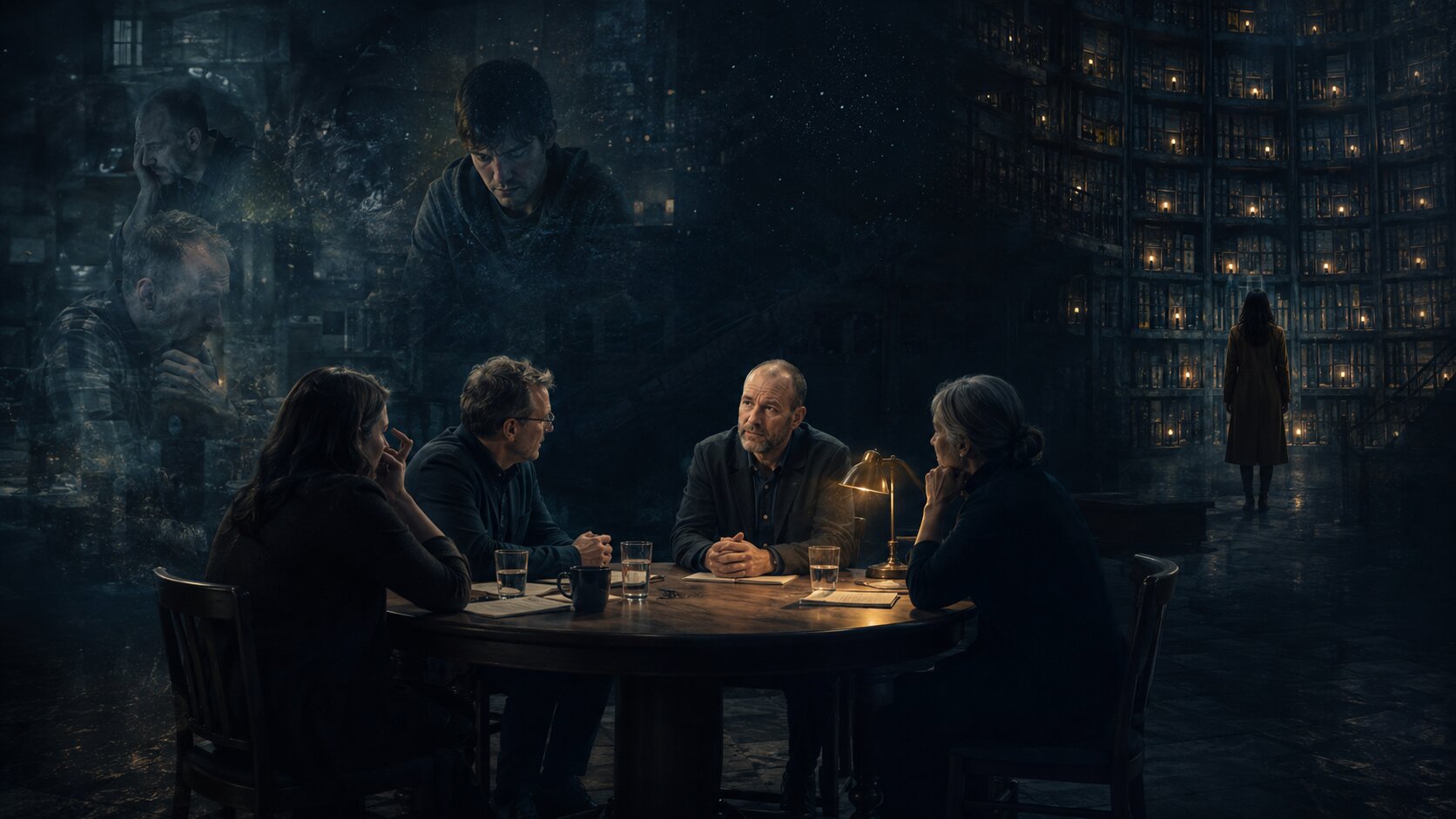
The room was smaller than anyone expected.
No enchanted shelves.
No impossible clock.
No glowing green books waiting to be opened.
Just a seminar room with tall windows, a long wooden table, coffee that had gone cold, and six people who had already read the same novel too many times.
Matt Haig sat near the middle.
For the first few minutes, the conversation stayed safely literary.
Matt: I suppose Nora needed to be someone who had accumulated enough regret that the Library would feel necessary rather than decorative.
Literary Critic: Necessary to Nora?
Matt: Necessary to the story.
Counterfactual Researcher: Those may not be the same thing.
Matt smiled.
Matt: I suspected it wouldn't take long.
Clinical Psychologist: You did agree to sit with psychologists.
Matt: Which was my first mistake.
A few people laughed.
The atmosphere loosened.
Then the counterfactual researcher leaned forward.
Counterfactual Researcher: When Nora says, in effect, that other people's lives might have been better if she had made different choices, do you see that primarily as depression speaking?
Matt thought for a moment.
Matt: Partly. Depression has a way of making you feel like a negative presence. You don't simply think you're unhappy. You can start thinking your existence itself has become a problem for other people.
The psychologist watched him carefully.
Clinical Psychologist: You said “you.”
Matt noticed.
Matt: Yes.
A pause.
Clinical Psychologist: Not “Nora.”
Matt gave a small nod.
Matt: No.
The literary critic looked down at her notes but did not write anything.
Counterfactual Researcher: That's where I wanted to begin.
Not with the mechanics of the Library.
With the possibility that Nora's deepest logic did not begin as a literary invention.
Matt sat back.
Matt: There's certainly autobiography in the emotional weather.
Not in the particulars.
I was never an Olympic swimmer.
That would have been alarming.
Literary Critic: Disappointing news.
Matt: Sorry.
But the feeling of having disappointed people, yes.
The sense that perhaps other people had paid a price for being close to you.
That's real.
Clinical Psychologist: How real?
Matt looked at her.
The question was gentle enough that he could have avoided it.
He didn't.
Matt: When I was very ill in my twenties, Andrea was there through all of it.
And there were times later when I looked back and thought about what those years must have been like for her.
She was young too.
She could have been doing other things.
Living differently.
Not carrying someone through panic and depression.
The room went quiet.
Clinical Psychologist: Did you ever think she would have had a better life without you?
Matt stared at the table for a moment.
Matt: Yes.
Not every day.
But yes.
Counterfactual Researcher: That's Nora.
Matt nodded slowly.
Matt: Yes.
Counterfactual Researcher: And it's interesting psychologically because the thought sounds self-effacing.
“I'm a burden.”
“I'm not important.”
“Other people would have been better without me.”
Yet hidden inside it is a very large claim about causality.
Matt looked up.
Matt: Meaning?
Counterfactual Researcher: You have to assume you know the life Andrea would have lived without you.
Who she would have met.
What she would have wanted.
What difficulties she would have encountered.
What joys she would have had.
You have to imagine an entire counterfactual life and then compare it with the one she actually lived.
Matt was silent.
The researcher continued.
Counterfactual Researcher: Nora does this constantly.
She thinks she's making herself small.
But she is simultaneously placing herself at the center of enormous chains of cause and effect.
Matt: That's uncomfortable.
Literary Critic: Good start.
Matt laughed.
Matt: Thank you.
Clinical Psychologist: There's a contradiction common in depressive thinking.
“I am worthless.”
Alongside:
“I am responsible for everyone's suffering.”
Those two beliefs don't logically fit together.
Yet emotionally they can coexist very comfortably.
Matt: Yes.
That feels true.
Counterfactual Researcher: Were you aware of that contradiction when you wrote Nora?
Matt thought longer this time.
Matt: Not in those terms.
I knew the feeling.
I knew how irrational guilt can expand.
But I don't think I sat down and thought, “Here is the paradox of low self-worth combined with exaggerated causal agency.”
Literary Critic: Which raises a useful question.
Can readers discover something in Nora that you didn't consciously put there?
Matt: Of course.
I hope so.
Otherwise we'd only need authors' notes and could do away with novels entirely.
Literary Critic: Authors might enjoy that more than critics.
Matt: Considerably.
The counterfactual researcher smiled.
Counterfactual Researcher: Then perhaps Nora understands something about you that you did not yet have language for.
Matt turned toward him.
Matt: That's possible.
Counterfactual Researcher: She punishes herself by imagining better versions of everyone else's lives.
Joe happier.
Dan happier.
Izzy happier.
Her father prouder.
It's almost as though guilt gives her a peculiar form of control.
Matt: Control?
Counterfactual Researcher: If everything went wrong because Nora chose badly, then there was once a correct set of choices available to her.
Matt's face changed.
Counterfactual Researcher: That's painful.
But it is less frightening than admitting that life contains chance, illness, timing, other people's choices, accidents, temperament, and things nobody controls.
Matt: Yes.
The answer came quickly.
Matt: That I recognize.
Clinical Psychologist: From Nora?
Matt shook his head.
Matt: From myself.
Nobody interrupted him.
Matt: When you're very anxious, control becomes almost theological.
You want an explanation for everything.
If you can identify the mistake, then perhaps you can prevent the next catastrophe.
Even self-blame can feel preferable to randomness.
The psychologist nodded.
Clinical Psychologist: Guilt can be terrible, but uncertainty can be more frightening.
Matt: Exactly.
He looked toward the window.
Matt: If it's my fault, at least there's a story.
Literary Critic: And writers like stories.
Matt smiled, but only briefly.
Matt: That's the dangerous part, isn't it?
Literary Critic: Possibly.
A writer is professionally trained to turn chaos into causality.
Beginning, middle, end.
Motivation.
Meaning.
Transformation.
Real suffering often refuses that shape.
Matt tapped one finger against the table.
Matt: So you're suggesting I gave Nora a Library because I wanted causality?
Literary Critic: I'm asking whether the Library makes the universe more narratively merciful than life usually is.
Nora gets to test her regrets.
Most people don't.
She gets evidence.
Matt: She also gets disappointment.
Literary Critic: Yes, but even disappointment becomes useful.
Nearly everything teaches.
The structure converts alternate lives into meaning.
Matt leaned forward.
Matt: That's what novels do.
Literary Critic: Sometimes.
Other novels leave the wound unconverted.
Matt looked at her.
There was no hostility.
The conversation had finally become serious.
Matt: I wanted the book to be readable by someone who might actually be in pain.
I didn't want to create a beautifully ambiguous machine that left a desperate reader feeling even more alone.
Clinical Psychologist: That's important.
Literary Critic: It is.
And it may have artistic consequences.
Both can be true.
Matt nodded.
Matt: Fair.
The counterfactual researcher looked at him.
Counterfactual Researcher: Can I return to Andrea?
Matt's expression tightened slightly.
Matt: All right.
Counterfactual Researcher: When you imagined that she might have had a better life without those difficult years, did you ever ask whether that was actually her judgment?
Matt did not answer immediately.
Matt: Not enough.
Counterfactual Researcher: That's very close to Nora's mistake.
Matt smiled faintly.
Matt: You're enjoying this.
Counterfactual Researcher: Professionally.
Matt: I see.
Then his expression softened.
Matt: Yes.
I think there were times when guilt became a way of speaking for someone else.
That's not fair.
You can regret causing pain without deciding what another person's entire life means.
Clinical Psychologist: That's a subtle distinction.
Matt: And a hard one.
If someone loves you through something terrible, you can become grateful and guilty at the same time.
Then guilt says, “Look what they sacrificed.”
Love says, “They chose to stay.”
And you don't quite know which story to believe.
Clinical Psychologist: Perhaps both contain truth.
Matt: Yes.
Counterfactual Researcher: But only one of them turns Andrea into a passive character in Matt's story.
Matt looked at him sharply.
Then nodded.
Matt: That's good.
Painful, but good.
The literary critic leaned in.
Literary Critic: And isn't that exactly what Nora does to nearly everyone?
She turns them into evidence.
Joe becomes evidence of failure.
Dan becomes evidence of a road not taken.
Izzy becomes evidence of cowardice.
Her father becomes evidence of disappointment.
Matt: Yes.
Literary Critic: They're people, but regret flattens them into verdicts.
Matt: Which is probably why the alternate lives have to disappoint her.
She has to rediscover that the other people remain people.
They don't become perfectly arranged simply because Nora changes one variable.
Counterfactual Researcher: That's one of the psychologically strongest parts of the premise.
Counterfactual fantasies simplify.
Real alternate outcomes would not.
Matt nodded.
Matt: Exactly.
Clinical Psychologist: Yet there's another question.
If Nora's guilt partly resembles yours, did you write her toward the conclusion you needed for yourself?
Matt's eyes narrowed slightly.
Not defensively.
More like someone recognizing a question he'd avoided.
Matt: Probably.
Literary Critic: That's a surprisingly quick answer.
Matt: I'm getting tired.
They laughed.
Then he continued.
Matt: I think most writers write toward something they need.
Not necessarily an answer.
Sometimes permission.
Sometimes a shape.
Sometimes a sentence that makes surviving an experience slightly more possible.
Clinical Psychologist: What permission did you need?
Matt looked down.
The room became very still.
Matt: Perhaps permission not to treat the worst period of my life as proof that I had ruined the whole thing.
No one spoke for several seconds.
Matt: And perhaps permission to believe that people could love me without that love automatically becoming evidence of what I owed them.
The psychologist's expression softened.
Clinical Psychologist: That's very close to Nora's movement.
Matt: Yes.
Counterfactual Researcher: Then the novel may not simply be asking, “What if your regrets are wrong?”
It may be asking, “What if guilt has been pretending to be love?”
Matt looked at him.
Matt: Explain.
Counterfactual Researcher: Nora cares deeply about people.
But she converts that care into self-punishment.
“I loved Joe, so his suffering must be my responsibility.”
“I loved my father, so his disappointment proves I failed.”
“I loved Dan, so leaving him becomes a crime against the life we might have had.”
Love becomes evidence for prosecution.
Matt sat very still.
Matt: That's an excellent way of putting it.
Literary Critic: And it raises another possibility.
Maybe Nora doesn't initially know how to love people without making herself responsible for their entire emotional weather.
Clinical Psychologist: Which can happen in people who are already highly self-critical.
Other people's disappointment becomes unbearable.
Matt nodded.
Matt: Yes.
Clinical Psychologist: Not merely because they dislike conflict.
Because disappointment confirms something already feared:
“I am harmful.”
Matt inhaled slowly.
Matt: That's very familiar.
The shift was obvious now.
He was no longer analyzing a protagonist.
Clinical Psychologist: Did success remove that?
Matt laughed softly.
Matt: Absolutely not.
Literary Critic: Interesting.
Matt: Success is very bad at curing anything it wasn't designed to cure.
You publish a book and think perhaps now you'll feel secure.
Then you want another book.
Then you want it to sell.
Then you want it to sell more.
The measurement changes, but the mind can remain exactly the same.
Counterfactual Researcher: Another alternate-life machine.
Matt looked at him.
Counterfactual Researcher: “If this book succeeds, then I'll feel enough.”
Then success happens and the counterfactual moves.
“If the next one succeeds more…”
Matt smiled ruefully.
Matt: Yes.
Literary Critic: So Nora's library isn't only about regret over the past.
It's compatible with ambition about the future.
Matt: That's interesting.
Literary Critic: The structure is identical.
Somewhere else there is a version of me who finally has enough.
Enough success.
Enough love.
Enough certainty.
Enough approval.
Matt leaned back.
Matt: And the problem is that “enough” keeps changing.
Counterfactual Researcher: Precisely.
The imagined superior self stays one shelf away.
Matt looked toward the empty chair at the end of the table.
Matt: That's depressing.
Clinical Psychologist: It doesn't have to be.
Matt: Spoken like a psychologist.
Clinical Psychologist: Occupational hazard.
A small laugh.
Then she continued.
Clinical Psychologist: It may mean the problem is not ambition, regret, love, or choice individually.
The problem may be using another possible self as a permanent accusation against the current one.
Matt nodded slowly.
Matt: Yes.
That feels central.
The literary critic turned a page in her notebook.
Literary Critic: I want to ask a different kind of question.
When you made Nora a woman rather than a fictionalized version of yourself, did that create distance?
Matt considered it.
Matt: Certainly.
Literary Critic: Useful distance?
Matt: Necessary distance.
If I'd written someone too visibly like myself, I might have become preoccupied with factual accuracy.
Did this happen?
Did I say this?
Was this really me?
Nora gave me freedom.
Literary Critic: To fictionalize the pain.
Matt: To understand it differently.
Counterfactual Researcher: So fiction itself becomes a counterfactual.
Matt looked at him.
Counterfactual Researcher: “What would this emotional pattern look like if it belonged to another person?”
Matt: That's interesting.
Yes.
Literary Critic: Which means perhaps Nora is not Matt in disguise.
She's a thought experiment Matt used to make certain feelings visible.
Matt: I'd prefer that.
Clinical Psychologist: But emotional distance can do two opposite things.
It can help someone understand pain.
It can make pain safer than it actually was.
Matt nodded.
Matt: Yes.
Clinical Psychologist: Do you think the novel makes your own experience safer in retrospect?
The question stayed in the air.
Matt didn't answer immediately.
Matt: Probably.
The psychologist waited.
Matt: You survive something.
Then years pass.
Then you narrate it.
And the narrative acquires shape.
The danger is forgetting that at the time there was no shape.
There was just terror.
No message.
No arc.
No certainty you'd come through it.
His voice had changed.
Quieter.
Matt: I know now that I survived.
The person I was then didn't.
Not yet.
The literary critic stopped writing.
Matt: Perhaps that's one thing books inevitably falsify.
Even if you write honestly, the existence of the book proves the writer reached the other side far enough to write it.
The suffering inside the story doesn't know that.
But the author does.
Clinical Psychologist: That's important.
A memoir or novel about survival is written from a future the suffering person could not see.
Matt: Exactly.
Counterfactual Researcher: Which makes the final message almost unavoidable.
You know there was a tomorrow.
Nora doesn't.
Matt looked at him.
Matt: Yes.
Counterfactual Researcher: So perhaps one of the deepest asymmetries in the novel is that the author knows life continues.
The protagonist doesn't.
Matt: That's true of most novels.
Literary Critic: But here it is thematically central.
Matt nodded.
The psychologist folded her hands.
Clinical Psychologist: Then let me ask something difficult.
If Nora partly inherited your guilt...
If she inherited the tendency to imagine that others would have been better without her...
If she inherited your need to discover that a terrible period had not invalidated an entire life...
Did she inherit your way out too?
Matt was completely still.
No joke this time.
No literary answer.
Matt: I don't know.
Clinical Psychologist: Think about it.
Matt looked toward the window.
Outside, ordinary traffic moved along an ordinary street.
Matt: I had people.
Time.
Love.
Writing.
Medication at points.
Different things.
There wasn't one Library.
There wasn't one revelation.
Clinical Psychologist: Yet Nora gets something much cleaner.
Matt: Yes.
Literary Critic: A machine for perspective.
Matt: Yes.
Counterfactual Researcher: Which means the personal question becomes the artistic one.
Did you give Nora the experience you wished someone could have given you?
Matt looked around the table.
He smiled, but there was sadness in it.
Matt: Maybe.
A long pause.
Matt: Maybe the Midnight Library is what you invent when you wish someone in the worst moment could be shown—not told, shown—that their interpretation of their life is incomplete.
Nobody challenged him.
Not yet.
Then the clinical psychologist said quietly:
Clinical Psychologist: And what happens to the person who cannot be shown?
Matt's face changed.
That question opened a door none of them could close again.
Topic 2 — Does The Midnight Library Understand Depression, or Does It Make Recovery Too Neat?

The question remained in the room.
Clinical Psychologist: What happens to the person who cannot be shown?
Matt looked at her.
Matt: Shown what?
Clinical Psychologist: That their interpretation is incomplete.
That they matter.
That another life would not necessarily have been better.
That despair is narrowing the field of vision.
Nora gets proof.
Most people don't.
Matt nodded slowly.
Matt: No. They don't.
Clinical Psychologist: That's where I begin to worry about the novel.
The literary critic shifted in her chair.
Literary Critic: Worry how?
Clinical Psychologist: Nora's despair is not just ordinary regret.
She attempts suicide.
That's a very different level of suffering.
Yet the central mechanism of her recovery is experiential correction.
She believes certain things.
The Library shows her those beliefs are incomplete.
She changes.
Matt: Not instantly.
Clinical Psychologist: No.
But substantially.
And that's important, because a severely depressed person can understand perfectly well that some of their thoughts are distorted and still remain severely depressed.
Matt leaned forward.
Matt: I agree with that.
Clinical Psychologist: Then is the book suggesting that insight is enough?
Matt: No.
Clinical Psychologist: Does the story make that sufficiently clear?
Matt paused.
Matt: That's a different question.
Literary Critic: And a better one.
Matt glanced toward her.
Matt: I knew you'd enjoy this topic.
Literary Critic: Immensely.
The psychologist continued.
Clinical Psychologist: Let me be careful here.
I don't think a novel owes readers a treatment plan.
I don't want Nora leaving the Library with a discharge summary, six referrals, and a medication schedule.
Matt smiled.
Matt: Thank you.
Clinical Psychologist: But narrative creates causality whether we intend it or not.
The reader sees:
Nora is suicidal.
Nora experiences alternate lives.
Nora changes how she understands herself.
Nora chooses life.
That sequence tells us something.
Matt: It tells us something about Nora.
Clinical Psychologist: Readers often hear something about themselves.
Silence.
Matt nodded.
Matt: That's true.
Literary Critic: Is that the author's responsibility?
Clinical Psychologist: Partly.
Matt: How much?
Clinical Psychologist: I don't know.
But if a book enters the territory of suicide, it cannot pretend the emotional implications stop at the edge of fiction.
Matt looked down at his hands.
Matt: I never thought they did.
Clinical Psychologist: I know.
That's why this is more complicated.
If you had written this from ignorance, the criticism would be easy.
You didn't.
You know severe depression personally.
So the harder question is whether lived experience can create another kind of blind spot.
Matt: Meaning I universalized my own recovery?
Clinical Psychologist: Possibly.
Or perhaps not your recovery exactly.
Your emotional understanding of what made survival possible.
Matt considered that.
Matt: There's a temptation, after you survive something, to reverse-engineer it.
You ask:
What saved me?
Love?
Time?
Perspective?
Writing?
Medication?
Family?
Fear?
Luck?
And the truth is probably some tangled mixture.
Clinical Psychologist: Exactly.
Matt: But fiction needs shape.
Literary Critic: There it is again.
Matt smiled faintly.
Matt: I knew you'd catch that.
Literary Critic: You're making my job easy.
Matt: Fiction needs shape.
Not because reality has one.
Because a novel has to move.
Nora can't spend four years in the Midnight Library gradually improving through sleep, treatment, social support, setbacks, routine, medication adjustments, therapy, relapse, exercise, grief, ordinary boredom—
Clinical Psychologist: Why not?
Matt laughed.
Matt: Because you'd need a much larger book.
Literary Critic: Some novelists would accept the challenge.
Matt: They're welcome to.
The room relaxed for a moment.
Then the psychologist spoke again.
Clinical Psychologist: But here's what concerns me.
A reader in deep depression may already believe:
“If I could just understand what is wrong with my thinking, I could fix myself.”
Then the book gives Nora an extraordinary corrective experience.
What happens if the reader understands the message and still feels terrible?
Matt's expression changed.
Matt: They might feel they've failed at that too.
Clinical Psychologist: Yes.
The sentence landed heavily.
Matt: That's not what I would ever want.
Clinical Psychologist: I know.
But intention doesn't erase reception.
Literary Critic: Nor does reception automatically prove a flaw in the work.
Clinical Psychologist: Agreed.
I'm not putting the novel on trial.
I'm asking what kind of hope it offers.
Matt looked toward the window.
Matt: Hope has to simplify something.
Literary Critic: That's a dangerous sentence.
Matt: Let me finish.
If you tell someone in the worst moment every possible complication—
“You may recover slowly.”
“You may relapse.”
“Some things won't improve.”
“You may need years of treatment.”
“You may never become the person you were.”
All of that may be true.
But truth isn't only the full statistical distribution of outcomes.
Sometimes the truth someone needs is:
“This moment isn't the whole future.”
The psychologist nodded.
Clinical Psychologist: I agree.
Matt: Then what's the problem?
Clinical Psychologist: The problem begins when “this moment isn't the whole future” becomes “your suffering will make sense once you see life correctly.”
Matt went quiet.
Clinical Psychologist: Those are different claims.
Matt: Yes.
Clinical Psychologist: Depression is not simply pessimism with bad evidence.
A person can have people who love them.
Understand that intellectually.
Believe life has value in principle.
Know their family would be devastated by their death.
And still be very ill.
Matt: Absolutely.
Clinical Psychologist: Then Nora's cognitive transformation should not be confused with a complete model of recovery.
Matt: It isn't meant to be.
Literary Critic: But do novels control what they're confused with?
Matt: Apparently not.
The counterfactual researcher, quiet until now, leaned forward.
Counterfactual Researcher: Could I complicate this further?
Matt: Please don't.
Counterfactual Researcher: Regret itself changes under depression.
People often talk about counterfactual thinking as though it were neutral:
“If I'd done X, Y might have happened.”
But mood affects which alternatives the mind generates.
A depressed mind does not sample possibilities fairly.
It may repeatedly produce upward counterfactuals.
Better career.
Better relationship.
Better self.
Better life.
Clinical Psychologist: Exactly.
Counterfactual Researcher: So the Midnight Library is doing something psychologically interesting.
It is not merely showing Nora alternate lives.
It is correcting the sampling bias.
Matt looked at him.
Matt: That's a useful way to think about it.
Counterfactual Researcher: Her mind has been generating idealized alternatives.
The Library introduces costs, randomness, tradeoffs, and unintended consequences.
It makes the counterfactual world more realistic.
Clinical Psychologist: Which is psychologically elegant.
Counterfactual Researcher: Very.
But then the clinician's criticism remains.
A more accurate counterfactual model may reduce regret without curing depression.
Matt: Yes.
Counterfactual Researcher: Nora's story fuses those processes.
Matt sat back.
Matt: Because they're fused for her.
Clinical Psychologist: That is probably the strongest defense.
Matt: Nora isn't meant to represent everyone with depression.
Her depression, regret, isolation, bereavement, family conflict, career disappointment—they're entangled.
You cannot neatly separate them.
Clinical Psychologist: No.
And that's clinically plausible.
People don't arrive as diagnostic categories.
Matt: Exactly.
Clinical Psychologist: But then perhaps we should say something uncomfortable.
Matt: We've established that's the purpose of the day.
Clinical Psychologist: The book may understand one experience of depression extremely well and still be a poor template for another person's depression.
Matt nodded immediately.
Matt: I would agree with that.
Literary Critic: Does that bother you?
Matt: No.
It would bother me if people thought it claimed otherwise.
Literary Critic: Do you think the book invites that reading?
Matt paused.
Matt: Possibly.
Literary Critic: Why?
Matt: Because clarity is seductive.
When you write a line that feels true, you want to give it weight.
And a novel like this has a strong parable structure.
A person moves through experiences.
The experiences accumulate.
A conclusion emerges.
Parables tend to make conclusions feel transferable.
Literary Critic: There.
That is precisely the tension.
Matt looked at her.
Literary Critic: You wrote a psychologically specific story in a form that feels universal.
Matt: That's a fair criticism.
Counterfactual Researcher: Or a fair description of why it reached so many people.
Literary Critic: Those can be the same thing.
The psychologist nodded.
Clinical Psychologist: Yes.
Accessibility creates reach.
Reach creates responsibility.
Responsibility can create pressure toward careful qualification.
Too much qualification can destroy the emotional force that made the book accessible.
Matt smiled.
Matt: Excellent. We've built an impossible assignment.
Literary Critic: Welcome to writing.
They laughed.
Then the psychologist's tone changed.
Clinical Psychologist: I want to ask about the suicide attempt itself.
Matt became still.
Clinical Psychologist: Why did Nora have to reach that point?
Matt: Because the Library exists between life and death.
Narratively, that threshold creates the premise.
Clinical Psychologist: That's the structural answer.
Matt: Yes.
Clinical Psychologist: What's the emotional one?
Matt thought.
Matt: Because I wanted the book to begin where possibility feels absent.
Not merely where Nora is dissatisfied.
Where she believes the story is finished.
Clinical Psychologist: So the Library reintroduces possibility.
Matt: Yes.
Literary Critic: Through infinite possibility.
Matt: Initially.
Counterfactual Researcher: Which later becomes a problem in itself.
Matt: Exactly.
Clinical Psychologist: Did you worry about making a suicide attempt the gateway to an extraordinary, meaningful experience?
Matt's face tightened.
Matt: Of course.
Clinical Psychologist: That's one ethical concern.
The threshold produces wonder.
The attempt leads into the Library.
For some readers, that can create a dangerous symbolic structure even if the book's intention is life-affirming.
Matt nodded slowly.
Matt: I understand that concern.
I don't think the Library is a reward.
Clinical Psychologist: Neither do I.
But narrative symbols aren't always controlled by intention.
Literary Critic: The Library is certainly beautiful.
Matt: It also becomes frightening.
Literary Critic: Yes.
But first it seduces.
Matt looked at her.
Literary Critic: Endless lives.
Endless second chances.
A librarian from childhood.
A chance to undo regret.
It's a fantasy of rescue.
Matt: Yes.
Literary Critic: Did you need that fantasy?
Matt looked down.
A long pause.
Matt: Probably.
Clinical Psychologist: Say more.
Matt: When you've been in that state, one of the most painful things is that nobody can enter your head and rearrange the perspective.
People can love you.
Tell you things.
Sit beside you.
But they cannot make you feel what they feel about you.
They can't hand you their certainty that your life still has possibility.
The room quieted.
Matt: The Library can.
That's the fantasy.
It doesn't just tell Nora she matters.
It constructs situations in which she experiences the incompleteness of what she believed.
Counterfactual Researcher: Evidence instead of reassurance.
Matt: Yes.
Clinical Psychologist: And perhaps that's exactly what makes it emotionally powerful and clinically impossible.
Matt looked at her.
Matt: Yes.
No defensiveness now.
Matt: That's probably right.
Literary Critic: Then the Library is not a model of therapy.
Matt: No.
Literary Critic: It's a fantasy of perfect therapeutic access.
The psychologist's eyes brightened.
Clinical Psychologist: That's interesting.
Matt: What do you mean?
Literary Critic: Imagine the ideal impossible therapist.
They know every regret.
Every road not taken.
Every relationship.
Every false belief.
They can produce experiential evidence tailored precisely to the patient.
They can show consequences rather than merely discuss them.
They know when to challenge.
When to wait.
When to let the patient choose.
That's Mrs. Elm and the Library.
Matt laughed softly.
Matt: That's much more expensive than therapy.
Clinical Psychologist: Insurance definitely won't cover it.
The laughter helped.
Then the psychologist leaned back.
Clinical Psychologist: But that actually improves my reading of the book.
Not as “depression is cured by changing your perspective.”
More like:
“What if a person in despair could temporarily see beyond the narrowness despair creates?”
Matt: Yes.
That is much closer to what I wanted.
Clinical Psychologist: Then I would still add:
Seeing beyond it once does not guarantee staying beyond it.
Matt: Agreed.
Clinical Psychologist: Nora would still need a life after the final page.
Matt: Absolutely.
Literary Critic: Which the novel declines to give us in detail.
Matt: Because the point is that it remains unwritten.
Literary Critic: Convenient.
Matt: Deliberate.
The critic smiled.
Literary Critic: We will return to that word.
Matt: I feared you might.
The counterfactual researcher spoke.
Counterfactual Researcher: There is another interesting issue.
Nora discovers many of her regrets were built on false assumptions.
Her cat.
Joe.
Dan.
Her father.
Her alternate careers.
That provides corrective information.
But some depressed beliefs are not factually testable.
“I am unlovable.”
“My future is empty.”
“I am a burden.”
Those are not simple propositions.
Clinical Psychologist: Right.
Counterfactual Researcher: The Library answers them indirectly.
Not by proving “Nora is lovable” as a proposition.
By placing her inside relationships and consequences.
Matt nodded.
Matt: Stories are better at that than arguments.
Literary Critic: There's the novelist again.
Matt: I can't help it.
Clinical Psychologist: And that's an important strength.
You can't always reason someone out of existential pain.
Sometimes another experience changes the relationship to the thought.
Matt: Exactly.
Clinical Psychologist: But then we must be very careful with the word “understand.”
Does The Midnight Library understand depression?
I would say it understands certain features with considerable emotional accuracy:
burdensomeness,
global self-condemnation,
narrowed future imagination,
counterfactual obsession,
disconnection,
the difficulty of receiving other people's love.
Matt listened.
Clinical Psychologist: What it does not give us is the long, often non-linear aftermath of surviving.
Matt nodded.
Matt: That's fair.
Clinical Psychologist: And perhaps it doesn't need to.
But readers should not mistake the final page for a complete recovery.
Matt: I wouldn't want them to.
Literary Critic: Yet the emotional architecture wants closure.
Matt turned.
Matt: A novel has to end somewhere.
Literary Critic: Yes.
But an ending is never neutral.
You chose Nora's renewed desire for life as the emotional resolution.
Matt: I did.
Literary Critic: Why not end earlier?
With uncertainty?
With Nora not knowing whether she wanted to live but taking one more step anyway?
Matt looked at her.
Matt: Because I wanted hope.
Simple as that.
The critic did not answer immediately.
Matt: I know hope can become sentimental.
I know writers can manufacture it cheaply.
But cynicism isn't automatically more truthful.
Ambiguity isn't automatically more profound.
Sometimes a person surviving the night is the truth.
The clinician nodded.
Clinical Psychologist: I agree with that.
Literary Critic: So do I.
Matt looked surprised.
Literary Critic: I am not arguing against hope.
I'm asking what kind.
Matt: Fair.
Literary Critic: Hope that says:
“Everything will be okay”?
Or hope that says:
“You cannot see enough of the future to declare it over”?
Matt's eyes softened.
Matt: The second.
Counterfactual Researcher: That's a very different claim.
Matt: Yes.
Clinical Psychologist: And a psychologically safer one.
It doesn't promise happiness.
It challenges finality.
Matt nodded.
Matt: Exactly.
Clinical Psychologist: Then perhaps the strongest reading of Nora's transformation is not “She discovers life is good.”
Matt: No.
Clinical Psychologist: It's “She discovers she does not possess enough information to conclude that life has no future worth entering.”
The counterfactual researcher smiled.
Counterfactual Researcher: Epistemic humility as suicide prevention.
Matt gave him a look.
Matt: That's not going on the paperback.
Literary Critic: Shame.
A little laughter.
Then the psychologist grew serious again.
Clinical Psychologist: There's one thing I don't want us to lose.
People in suicidal crisis sometimes feel enormous shame about not responding to reasons others think should be enough.
Children.
Partners.
Career.
Faith.
Beauty.
Opportunity.
“You have so much to live for.”
That phrase can hurt when a person already knows all of it and still feels unable to continue.
Matt nodded.
Matt: Yes.
Clinical Psychologist: So if we say Nora rediscovers reasons to live, we should not imply that someone who cannot feel those reasons is morally failing.
Matt: Completely agree.
Clinical Psychologist: The illness can obstruct access to meaning without eliminating meaning.
Matt looked at her.
Matt: That's beautifully put.
Clinical Psychologist: And that may be where the Library works best as metaphor.
It temporarily restores access.
Not worth.
Access to worth.
Matt sat back.
Matt: I like that.
Literary Critic: Authors always like interpretations that improve their books.
Matt: Obviously.
Literary Critic: Our work is done.
The room laughed again.
Then she closed her notebook.
Literary Critic: Except it isn't.
Matt sighed.
Matt: Naturally.
Literary Critic: We've defended the Library as metaphor.
We've defended hope.
We've distinguished Nora's recovery from universal treatment.
But we haven't answered the artistic question.
Matt looked at her.
Literary Critic: Once you decided Nora needed hope, how much did that decision control the Library?
Matt: I'm not sure I understand.
Literary Critic: Does Nora discover the meaning of her life?
Or did you construct a universe designed to make her discover the meaning you wanted her to find?
Matt's expression changed.
The philosopher, who had listened silently through most of the conversation, finally spoke.
Philosopher: And if the Library itself is designed to lead her somewhere—
everyone turned—
Philosopher: how free is Nora's choice inside it?
Matt looked at him.
Matt: Ah.
The philosopher smiled.
Philosopher: Now we can talk about the machinery.
Matt glanced toward the literary critic.
Matt: I suppose this is where Mrs. Elm goes on trial.
Literary Critic: Not Mrs. Elm.
She smiled.
Literary Critic: You.
Topic 3 — Did Matt Give Nora Too Many Answers?

The philosopher leaned back in his chair.
Philosopher: Let’s begin with the simplest question.
Why a library?
Matt smiled.
Matt: Because books contain lives.
Literary Critic: That’s the elegant answer.
Matt: You don’t like elegant answers?
Literary Critic: I distrust answers that arrive too quickly.
Matt: Fair enough.
He looked around the room.
Matt: A library gave me several things at once.
Possibility.
Memory.
Choice.
Stories.
The idea that lives can be entered.
The sense that there is always another volume nearby.
And Mrs. Elm already belonged emotionally to Nora’s childhood, so the place could feel strange and familiar at the same time.
Philosopher: It also gives you extraordinary control.
Matt looked at him.
Matt: All novelists have extraordinary control.
Philosopher: Usually they hide it better.
The literary critic smiled.
Matt: Go on.
Philosopher: Nora enters a universe specifically constructed around her regrets.
Every book is relevant to her.
Every experience is interpretable.
Mrs. Elm knows the rules.
The Library gives Nora exactly the sort of evidence she needs.
Is that discovery?
Or instruction disguised as freedom?
Matt folded his arms.
Matt: She can reject lives.
She can choose what to explore.
Philosopher: Inside a system whose architecture you created.
Matt: That's true of every fictional character.
Literary Critic: Yes, but most characters do not live inside such an obvious machine.
The Midnight Library announces its machinery.
It says:
Here are your possibilities.
Here are the rules.
Here is your guide.
Here are your regrets.
Now discover something.
Matt: You make it sound like an escape room.
Literary Critic: In some ways it is.
Matt laughed.
Literary Critic: Except the puzzle Nora is trying to solve is herself.
The philosopher leaned forward.
Philosopher: And that's where free will becomes interesting.
Suppose Nora chooses her original life.
Did she freely choose it?
Or did the Library progressively eliminate the attractiveness of alternatives until that conclusion became psychologically inevitable?
Matt paused.
Matt: I wouldn't say inevitable.
Philosopher: What would have counted as a legitimate alternative ending?
Matt thought.
Matt: She could have stayed in another life.
Philosopher: Could she?
Matt: Within the rules, yes.
Philosopher: Narratively?
Matt smiled.
Matt: Ah.
Literary Critic: Exactly.
Would you really have ended the novel with Nora saying, “Actually, the Ash life is better. I'll stay here”?
Matt laughed.
Matt: Probably not.
Philosopher: Then perhaps the Library offers metaphysical freedom but not narrative freedom.
Matt looked amused.
Matt: You're accusing fiction of having a plot.
Philosopher: I'm accusing the plot of pretending not to know where it's going.
That produced a longer laugh.
Even Matt joined in.
Then the critic spoke.
Literary Critic: The problem isn't that the story has direction.
The question is whether the direction becomes too visible.
Readers begin to understand the mechanism.
Nora tries a life.
It appears promising.
Then she discovers what she failed to imagine.
She learns something.
She returns.
Next book.
The repetition has thematic power.
It resembles rumination.
But it can also begin to feel instructional.
Matt: I was aware of that risk.
Literary Critic: Did you ever consider breaking the pattern more violently?
Matt: In what way?
Literary Critic: A life that refuses to teach her anything.
A life that is simply better.
A life she leaves and later realizes she perhaps should have stayed in.
A life whose meaning remains completely unclear.
Matt frowned slightly.
Matt: The Ash life comes closest.
Literary Critic: Yes.
And unsurprisingly, it is one of the most interesting.
Philosopher: Precisely because the lesson becomes unstable.
Nora cannot say, “This life was secretly terrible.”
Matt: No.
Philosopher: She has to confront a more difficult proposition.
A life can be good without becoming hers.
Matt: Yes.
Literary Critic: Which raises my larger question.
Did the novel become strongest whenever it stopped proving its thesis?
Matt looked at her.
That one landed.
Matt: Possibly.
Literary Critic: Molly does more philosophical work than almost anyone precisely because she does not speak philosophy.
Matt nodded slowly.
Literary Critic: A child exists.
Nora loves her.
She leaves.
No aphorism resolves it.
No argument makes the grief disappear.
That is much harder than discovering Dan wasn't the solution.
Matt: Yes.
Philosopher: Molly introduces irreducible loss.
Matt: Exactly.
Philosopher: And perhaps the Library is least comfortable with irreducible loss.
Matt looked at him.
Matt: Why?
Philosopher: Because the Library is fundamentally explanatory.
It says:
Look again.
Your assumptions were incomplete.
Your regrets were oversimplified.
Your imagined lives had hidden costs.
All valuable.
But some human losses remain losses even after perfect understanding.
Clinical Psychologist: That's true clinically too.
Insight does not erase grief.
Matt: I don't think the book says it does.
Literary Critic: No.
But its machinery tends toward integration.
The experiences accumulate into a coherent realization.
Life is worth living.
Perfect lives do not exist.
Regrets are unreliable.
Possibility remains.
Matt: You make coherence sound suspicious.
Literary Critic: Sometimes it is.
Matt smiled.
Matt: You critics really dislike anyone leaving a room feeling better.
Literary Critic: Not at all.
We simply want to know what had to be simplified to get them there.
The room quieted.
Matt leaned back.
Matt: All storytelling simplifies.
Literary Critic: Yes.
Matt: You select.
You compress.
You assign significance.
You move things next to one another that in life might have happened years apart.
Even the messiest novel is an arrangement.
Literary Critic: Agreed.
Matt: Then perhaps the question is whether the simplification reveals something or distorts it beyond usefulness.
Literary Critic: Exactly.
Matt: I would argue the Library reveals.
Philosopher: Let's test that with Mrs. Elm.
Matt sighed theatrically.
Matt: Poor Mrs. Elm.
Clinical Psychologist: She has had a good run.
The philosopher smiled.
Philosopher: What is she?
Matt: A librarian.
Literary Critic: Very helpful.
Matt: A guide.
A remembered figure of safety.
Someone associated with a moment in Nora's youth when she still had possibility in front of her.
Philosopher: Does she know the answer?
Matt: Which answer?
Philosopher: That Nora should return to life.
Matt hesitated.
Matt: I think she knows Nora has not exhausted possibility.
Philosopher: That's not quite what I asked.
Matt: No.
Philosopher: Does Mrs. Elm want Nora to choose life?
Matt: Yes.
Philosopher: Then she isn't neutral.
Matt: Of course she isn't neutral.
Philosopher: Good.
Because sometimes readers treat her like wisdom itself.
But she has an agenda.
Matt nodded.
Clinical Psychologist: A benevolent one.
Philosopher: Benevolent agendas are still agendas.
The psychologist smiled.
Clinical Psychologist: You philosophers are exhausting.
Philosopher: Also an occupational hazard.
He turned back to Matt.
Philosopher: Mrs. Elm gives Nora room to choose, but she structures the terms.
She explains rules.
She withholds information.
She responds selectively.
She sometimes redirects Nora's interpretation.
Is she perhaps the author inside the book?
Matt laughed.
Matt: I knew this was coming.
Literary Critic: She does sound suspiciously like one.
Matt: All wise fictional characters are eventually accused of being the author.
Literary Critic: Not all of them run a building where every room is another plot.
Matt shook his head, smiling.
Matt: Fine.
There is obviously an authorial function in her.
She has to help Nora and the reader understand the conceit.
Literary Critic: More than that.
She often knows when not to answer.
That is an authorial power too.
Matt: Yes.
Philosopher: So perhaps the most important thing Mrs. Elm teaches is not any particular doctrine.
It's controlled withholding.
Matt looked interested.
Matt: Explain.
Philosopher: She can tell Nora things.
But often she does not.
She knows that information must become experience.
That resembles your own distinction between telling a suffering person they matter and somehow allowing them to feel it.
Matt: Yes.
Philosopher: Which creates an irony.
The book argues that wisdom cannot simply be handed over—
Literary Critic: Yet sometimes hands it over quite directly.
Matt laughed loudly.
Matt: There it is.
Literary Critic: You knew that was coming too?
Matt: I could feel the knife being sharpened.
Literary Critic: Mrs. Elm sometimes says the kind of sentence readers underline.
The novel occasionally moves from dramatization into aphorism.
Did you worry about that?
Matt: Yes.
But I like sentences people can carry with them.
Literary Critic: Why?
Matt: Because books don't only exist while you're reading them.
A sentence can follow you into a bad day.
It can become something you remember in a hospital corridor or at three in the morning.
I don't think that's artistically shameful.
The clinician nodded.
Clinical Psychologist: It isn't.
Literary Critic: I don't think it is either.
But an aphorism compresses complexity.
Matt: So does a poem.
Literary Critic: True.
Matt: So does therapy sometimes.
Clinical Psychologist: Much to our embarrassment.
Matt: So does ordinary conversation.
We live through complexity and then remember one sentence.
I'm interested in those sentences.
The critic considered this.
Literary Critic: Then perhaps the issue isn't that the novel gives answers.
It's whether readers confuse memorable answers with complete ones.
Matt: That's closer to my concern.
Philosopher: But authors help create that confusion.
Matt turned.
Philosopher: If you frame a sentence beautifully, place it at the emotional climax, and give it to the wisest character, you are not merely offering one thought among many.
You are weighting it.
Matt: Of course.
Philosopher: Then authorial responsibility returns.
Matt: You're determined to make sure I don't escape today.
Philosopher: You built the Library. There are no exits.
That earned another laugh.
Then the literary critic became serious.
Literary Critic: Let me ask the harder version.
Did you give Nora too many answers because you loved her?
Matt looked at her.
Matt: That's an odd question.
Literary Critic: Is it?
Writers can be cruel to characters.
They can expose them.
Abandon them.
Refuse to rescue them.
You created Nora at the edge of death.
Did some part of you feel protective?
Matt did not answer immediately.
Matt: Yes.
Literary Critic: Enough to shape the philosophy?
Matt looked at the table.
Matt: Probably.
Clinical Psychologist: There's nothing inherently wrong with that.
Literary Critic: No.
But it matters.
Matt nodded.
Matt: I didn't want to torture her for literary credibility.
I didn't want the book to prove seriousness through despair.
I'd had enough of the idea that darkness is automatically profound.
Literary Critic: Good.
Matt: And I knew readers might come to the book carrying very real pain.
I wanted to make something that could sit beside them rather than admire their suffering from a distance.
The psychologist's expression softened.
Clinical Psychologist: That's a very different artistic ambition from diagnostic realism.
Matt: Exactly.
Literary Critic: But there is still a question.
When compassion shapes a story, can the writer become too eager to rescue?
Matt looked at her.
Matt: Yes.
Literary Critic: Do you think you did?
He paused.
Matt: Sometimes.
No one spoke.
Matt: There are places where, if I were writing it now, I might trust the scene longer.
Explain less.
Let the contradiction remain.
The critic leaned forward.
Literary Critic: Such as?
Matt smiled.
Matt: Nice try.
Literary Critic: We're in an imaginary conversation. You can be brave.
Matt laughed.
Matt: Fine.
I think writers change.
You become more comfortable with readers not understanding exactly what you intended.
At least theoretically.
Literary Critic: Theoretically.
Matt: Very theoretically.
But yes, I might leave more air around certain conclusions now.
Philosopher: Why?
Matt: Because an answer can close something too early.
That silenced the table.
Literary Critic: There.
Matt looked at her.
Literary Critic: That's the question we've been moving toward.
What does a novel owe the reader?
A conclusion?
Or a disturbance that continues after the book ends?
Matt: Both, ideally.
Literary Critic: Can they conflict?
Matt: Yes.
Philosopher: And The Midnight Library chooses conclusion more often than disturbance.
Matt thought.
Matt: Perhaps.
Clinical Psychologist: Yet many readers may have needed conclusion.
Literary Critic: Absolutely.
Philosopher: Which raises a fascinating problem.
Could the same feature be artistically limiting and emotionally useful?
Matt: Yes.
Why not?
Literary Critic: That's probably the fair answer.
The clinician nodded.
Clinical Psychologist: A frightened person may need a handrail.
A critic may later complain that the staircase was too obvious.
Matt: Exactly.
Literary Critic: I accept the rebuke.
Clinical Psychologist: It wasn't a rebuke.
Literary Critic: I accept it anyway.
Matt smiled.
Then the philosopher spoke again.
Philosopher: I want to return to Nora's freedom.
Suppose Mrs. Elm is a kind of authorial proxy.
Suppose the Library is built to widen Nora's perspective.
Suppose each alternate life gradually destabilizes her original belief that she ruined everything.
At what point does persuasion become manipulation?
Matt: In fiction?
Philosopher: In the metaphysics of the story.
Nora believes she is choosing.
But the Library curates experience.
Matt: It doesn't invent those lives solely to teach her lessons.
They are possible lives.
Philosopher: According to the system you invented.
Matt smiled.
Matt: We're going in circles.
Philosopher: Deliberately.
Because the novel itself circles one question:
Can we choose freely when our choices are shaped by experiences we did not choose?
The psychologist leaned in.
Clinical Psychologist: That's not just fictional.
Philosopher: Exactly.
Parents.
Trauma.
Culture.
Education.
Illness.
Chance.
All curate the options we perceive.
Nora's Library simply makes that visible.
Matt nodded.
Philosopher: Perhaps the Library isn't uniquely manipulative.
Perhaps life is.
Matt: I like that better.
Literary Critic: Of course you do.
Matt: I'm allowed one favorable interpretation.
Philosopher: But then Nora's freedom may not require being untouched by influence.
It may mean eventually taking responsibility for a choice after influence has done its work.
Matt: Yes.
Clinical Psychologist: Which fits recovery too.
Nobody becomes well in isolation from influence.
People help.
Treatment influences.
Love influences.
Books influence.
That does not make the eventual decision unreal.
Literary Critic: So Mrs. Elm doesn't need to be neutral.
She needs to avoid replacing Nora's agency entirely.
Matt: Exactly.
Philosopher: Does she?
Matt looked at him.
Matt: I think so.
Philosopher: Mostly.
Matt: I'll take mostly.
A brief silence.
Then the critic looked at Matt.
Literary Critic: You said something earlier.
You wanted readers to leave with something they could hold.
Matt: Yes.
Literary Critic: What if the most truthful thing was something they could not hold?
Matt frowned.
Matt: Meaning?
Literary Critic: What if Nora reached the end and still did not know whether her original life was the right one?
What if Molly remained an unbearable loss?
What if some alternate life genuinely might have been better?
What if regret remained partly justified?
What if she chose life not because she had solved those questions but because she accepted that they would remain unsolved?
Matt stared at her.
The philosopher nodded slowly.
Philosopher: That would be a different book.
Literary Critic: Yes.
I'm asking whether it would be a truer one.
Matt took a long breath.
Matt: Not necessarily.
Literary Critic: Why?
Matt: Uncertainty isn't always more truthful just because it's harder.
People do reach realizations.
People do change.
Sometimes things become clear.
I don't want us to fetishize ambiguity.
The critic smiled faintly.
Literary Critic: Good answer.
Matt: Thank you.
Literary Critic: But—
Matt: There it is.
Literary Critic: —clarity can also become seductive to a writer who wants emotional resolution.
Matt nodded.
Matt: Yes.
Both are risks.
Clinical Psychologist: Maybe the real test is whether the clarity remains open enough to survive future experience.
Matt looked at her.
Clinical Psychologist: If Nora's realization is:
“Everything is good now,”
it will collapse the next time something terrible happens.
If the realization is:
“I don't know enough to declare my life finished,”
that can coexist with future pain.
Matt nodded slowly.
Matt: That's much closer to what I hope survives.
Philosopher: Which is less an answer than a rule for uncertainty.
Matt: Yes.
Literary Critic: Interesting.
Perhaps the novel's best answer is the one that refuses to answer the original question.
Matt: Which life is best?
Literary Critic: Exactly.
Matt: There isn't one answer.
Philosopher: Yet Nora does return to one life.
Matt: Because eventually philosophy has to become a Tuesday morning.
The room went quiet.
The critic smiled.
Literary Critic: That's annoyingly good.
Matt: Finally.
Clinical Psychologist: Explain it.
Matt: You can discuss possible worlds forever.
But eventually you wake up somewhere.
There are people.
There is work.
There is a body.
There are consequences.
There are phone calls you have avoided.
There is breakfast.
A life isn't only a proposition.
At some point you have to inhabit one.
The philosopher nodded.
Philosopher: That's perhaps your strongest defense of the ending.
Not that Nora's original life is objectively best.
That it is the only life in which she can resume authorship from the point where she actually stands.
Matt looked at him.
Matt: Yes.
Literary Critic: But now I have to ask the question you've been avoiding.
Matt laughed softly.
Matt: I know.
Literary Critic: Would you write the ending exactly the same way today?
Nobody moved.
Matt looked toward the cold coffee in front of him.
Then toward the window.
Matt: I—
He stopped.
The critic waited.
Matt: I think the answer is complicated.
Philosopher: Good.
Matt: Don't sound so pleased.
Literary Critic: Complicated is where we live.
Matt looked back at them.
Matt: I still believe deeply in what Nora learns.
That we should be suspicious of the fantasy that some perfect unlived life would have rescued us.
That life contains possibilities we cannot see from our lowest point.
That our value is not measured by the number of expectations we fulfilled.
I still believe all of that.
Literary Critic: But?
Matt smiled faintly.
Matt: But I think now I would ask what she does after accepting it.
The decision scientist, silent until now, looked up.
Matt continued.
Matt: Acceptance can be liberating.
But it can also become another place to hide.
The room changed.
Decision Scientist: Now we're somewhere interesting.
Matt looked at him.
Matt: I thought we already were.
Decision Scientist: You spent three topics defending a novel about accepting an imperfect life.
Matt nodded.
Decision Scientist: What happens when the life actually needs changing?
No one spoke.
Matt looked back at the critic.
She did not need to say anything.
The question about the ending had opened much more than an ending.
Topic 4 — Six Years Later, Are You Arguing With Your Own Book?

The decision scientist waited.
Decision Scientist: What happens when the life actually needs changing?
Matt did not answer immediately.
He looked tired now.
Not defensive.
More like someone who had been asked to revisit a conclusion he once needed very badly.
Matt: Then acceptance isn't enough.
Literary Critic: That's a significant sentence.
Matt: It shouldn't be.
Philosopher: For this book, it is.
Matt looked at him.
Philosopher: A great many readers came away with something like:
Stop imagining another life would have been perfect.
Stop torturing yourself with regret.
Appreciate the life you're in.
Matt: That's not wrong.
Philosopher: No.
But it's incomplete.
Matt nodded.
Decision Scientist: Incomplete in a dangerous way sometimes.
Imagine someone in a destructive marriage.
A career that is hollowing them out.
A family system built around abuse.
A city where they are isolated.
A dream they've postponed for twenty years because they were told to be grateful.
Does “the grass isn't greener” help them?
Matt shook his head.
Matt: Not necessarily.
Decision Scientist: It might keep them there.
Matt: Yes.
The room quieted.
Literary Critic: So how do we distinguish acceptance from resignation?
Matt smiled faintly.
Matt: If I had a perfect answer, I'd probably be writing a much more annoying book.
Philosopher: Try anyway.
Matt leaned back.
Matt: Acceptance, at its best, says:
“This is reality. I will stop demanding that reality be different before I can respond to it.”
Resignation says:
“This is reality. Nothing I do matters.”
The philosopher nodded.
Matt: They're not the same.
Decision Scientist: Good.
Now add regret.
Matt frowned slightly.
Decision Scientist: Suppose regret says:
“I should have left this job five years ago.”
Your earlier framework warns against turning that into:
“My whole life would have been better if I had.”
Fair.
But regret might still contain information.
It may be telling you the job is wrong now.
Matt nodded.
Decision Scientist: So regret is not only about the past.
It can be a signal for action in the present.
Matt: Yes.
Counterfactual Researcher: That's important.
Upward counterfactual thinking can hurt, but it can also produce behavioral correction.
“If I had acted differently” can become “Next time I will.”
The problem is when the mind never reaches the second sentence.
Clinical Psychologist: Or reaches it as self-punishment.
“I must completely reinvent myself or I've learned nothing.”
Matt: Which becomes another form of optimization.
Decision Scientist: Exactly.
The literary critic looked toward Matt.
Literary Critic: This is where your later thinking gets interesting.
You have spoken about being uneasy with how The Midnight Library was sometimes reduced to simple acceptance.
And now your newer work seems more interested in another question:
If time is limited, what should we actually change?
Matt nodded.
Matt: Yes.
Literary Critic: Is that you arguing with your younger self?
Matt smiled.
Matt: Writers spend most of their careers arguing with previous versions of themselves.
Philosopher: That's a very convenient definition of development.
Matt: I'm keeping it.
A few people laughed.
Then Matt's expression became serious.
Matt: I don't think I reject what I believed when I wrote The Midnight Library.
I think I distrust any idea once it becomes a slogan.
Literary Critic: Such as?
Matt: “No life is perfect.”
True.
But somebody can use that sentence to stay in a terrible relationship.
“Be grateful for what you have.”
True in one context.
Cruel in another.
“You don't know whether the other path would have been better.”
Also true.
But that shouldn't become:
“Never change direction.”
Clinical Psychologist: That's psychologically important.
Sometimes acceptance reduces suffering enough for action to become possible.
Matt: Exactly.
Clinical Psychologist: A person in severe depression may first need to stop treating existence itself as a failed project.
Only then can they ask what needs changing.
Matt: Yes.
Philosopher: So perhaps the apparent contradiction is developmental.
At one stage:
Stop condemning the whole life.
At another:
Now examine the parts that should change.
Matt looked at him.
Matt: I like that.
Literary Critic: Naturally.
Matt: You're enjoying yourself far too much.
Literary Critic: Immensely.
The decision scientist leaned forward.
Decision Scientist: But sequence matters.
If you tell someone “change your life” while they're psychologically overwhelmed, every decision becomes another test they can fail.
If you tell someone “accept your life” after they've stabilized, they may use acceptance to avoid difficult action.
Matt: Yes.
Decision Scientist: Same words.
Different timing.
Different effect.
Clinical Psychologist: Which is why universal life advice is usually suspicious.
Matt: That's going on a mug.
Literary Critic: Mrs. Elm merchandise.
Matt laughed.
Then the philosopher spoke.
Philosopher: Let's make this more uncomfortable.
Suppose Nora comes back from the Library.
She survives.
She understands that her life was not a mistake.
Now what?
Does she stay in Bedford?
Keep the same work?
Repair old relationships?
Change careers?
Move?
Fall in love?
None of that is solved by choosing life.
Matt: No.
Philosopher: Then the ending gives her existential permission but not practical direction.
Matt: Correct.
Literary Critic: Did you intend that?
Matt: Yes.
Literary Critic: Completely?
Matt hesitated.
Matt: Mostly.
Literary Critic: There it is again.
Matt smiled.
Matt: Fine.
I wanted the future to remain open.
But I also think I was more focused on the immediate question:
Will Nora stay alive?
Not:
What will Nora optimize next quarter?
Decision Scientist: Good instinct.
Matt: Thank you.
Decision Scientist: But now we can ask the second question.
What should she change once survival is no longer the only goal?
Matt looked down at the table.
Matt: That's harder.
Philosopher: Why?
Matt: Because “choose life” is morally clear.
“Choose this job.”
“Leave this relationship.”
“Move here.”
“Forgive this person.”
Those are not.
Literary Critic: So the novel ends where certainty ends.
Matt nodded.
Matt: Perhaps.
Literary Critic: And your newer thinking begins there.
Matt looked at her.
Matt: Possibly.
Philosopher: Then maybe you didn't write the wrong ending.
You wrote the ending appropriate to the problem you were asking then.
Matt sat with that.
Matt: That's generous.
Philosopher: Don't get comfortable.
Matt laughed.
Philosopher: The problem is that readers often turn endings into philosophies.
Nora returns to life.
That can become:
“Your existing life is the right one.”
But the novel only proves something narrower.
Matt: Which is?
Philosopher: That Nora's existing life had not exhausted its possibilities.
Matt nodded slowly.
Philosopher: That is very different from saying every current circumstance should remain unchanged.
Matt: Yes.
Decision Scientist: That's a crucial distinction.
Your life can be worth continuing and still need radical revision.
Matt looked toward him.
Decision Scientist: Those two ideas are not enemies.
They may depend on each other.
Clinical Psychologist: A person can say:
“My life is worth living.”
And immediately after:
“This part of it cannot continue.”
Matt nodded.
Matt: That's probably where I am now.
The critic noticed the wording.
Literary Critic: You said “I.”
Matt smiled.
Matt: We've apparently trained me out of saying “Nora.”
Clinical Psychologist: Progress.
Matt: Or coercion.
Philosopher: The Library again.
They laughed.
Then Matt grew reflective.
Matt: I think age changes the problem.
When you're younger and in crisis, possibility itself is precious.
You need to know there are futures.
Later, time becomes more visible.
You start asking not only, “Can things change?”
but:
“How many times am I going to postpone changing them?”
No one interrupted.
Matt: That's a different emotional question.
Literary Critic: Because mortality enters.
Matt: Yes.
Not dramatically.
Ordinarily.
You notice decades.
You notice how quickly years turn into biography.
You realize that “someday” has been doing a lot of unpaid work.
The decision scientist smiled.
Decision Scientist: That's excellent.
Matt: Don't encourage me.
Decision Scientist: Too late.
Philosopher: So your earlier philosophy protected possibility.
Your later philosophy protects time.
Matt looked at him.
Matt: That's interesting.
Philosopher: Nora needs to learn:
“The future is not closed.”
An older character may need to learn:
“The future is not infinite.”
Matt sat very still.
Matt: Yes.
That is exactly the tension.
The room quieted again.
Literary Critic: Then regret changes too.
For Nora, regret says:
“You ruined everything.”
Later in life, regret may say:
“You keep postponing what you already know matters.”
Matt: Yes.
Counterfactual Researcher: Those are psychologically different forms.
One is global condemnation.
The other can be information.
Clinical Psychologist: Though it can still become cruel.
Counterfactual Researcher: Certainly.
Decision Scientist: But if we sterilize regret entirely, we lose one of its functions.
It can identify misalignment.
Matt: Agreed.
Decision Scientist: So perhaps the mature question is not:
“How do I eliminate regret?”
It's:
“What kind of regret is asking me to punish myself, and what kind is asking me to act?”
Matt looked at him.
Matt: That's good.
The philosopher leaned back.
Philosopher: Let's test it.
A man has spent twenty years building a career he never wanted.
He is financially comfortable.
His family depends on him.
He dreams of doing something else.
What does The Midnight Library tell him?
Matt frowned.
Matt: Hopefully not to quit tomorrow because another life looks more exciting.
Decision Scientist: Good.
Matt: But hopefully not to say, “Every career has problems, so I should stop wanting anything different.”
Philosopher: Then what?
Matt thought.
Matt: Examine the desire.
Is it fantasy?
Escape?
A genuine value?
A temporary reaction?
What does change cost?
Who else is affected?
What can be tested without burning everything down?
Decision Scientist: Now you sound like decision science.
Matt: Terrifying.
Clinical Psychologist: And psychologically healthier than either extreme.
Philosopher: Interesting.
So the answer is not “accept” or “change.”
It's investigate.
Matt: Yes.
Then choose.
And take responsibility.
The decision scientist nodded.
Decision Scientist: There it is.
Matt: What?
Decision Scientist: Responsibility is the bridge.
Acceptance without responsibility can become resignation.
Change without responsibility can become impulsive escape.
Matt looked thoughtful.
Literary Critic: That would complicate Nora nicely.
She has spent the entire novel asking which life is best.
Perhaps the better question after the Library is:
“What am I now responsible for changing?”
Matt nodded.
Matt: Yes.
Literary Critic: Would you add that question if you rewrote the ending?
Matt smiled faintly.
Matt: Maybe.
Philosopher: Only maybe?
Matt: Writers are allowed cowardice too.
The critic laughed.
Matt: I think I would make clearer that returning isn't an endorsement of the status quo.
It's an endorsement of authorship.
The room became still.
Literary Critic: Say more.
Matt: Nora returns not because Bedford is objectively correct.
Not because her previous career was correct.
Not because every relationship should remain as it was.
She returns to the point where her actual agency exists.
She cannot change an alternate life she never built.
She can change this one.
Decision Scientist: That is much stronger than “be grateful.”
Matt: Yes.
Philosopher: Then the original life is not the answer.
It is the workspace.
Matt smiled.
Matt: Exactly.
Literary Critic: That's very good.
Matt: Finally some positive feedback.
Literary Critic: Don't get used to it.
The clinical psychologist spoke quietly.
Clinical Psychologist: There's something beautiful in that clinically too.
Recovery isn't returning to the person you were before suffering.
Sometimes you return to your life and discover parts of it must be rebuilt.
Matt: Yes.
Clinical Psychologist: Survival gives you a future.
It doesn't dictate its architecture.
Matt looked toward her.
Matt: I wish I'd phrased it like that.
Literary Critic: Again, critics improving the book.
Matt: I'm regretting this entire discussion.
Counterfactual Researcher: Careful.
The room laughed.
Then the decision scientist pushed his chair back slightly.
Decision Scientist: I want to bring in success.
You mentioned earlier that success does not cure what it wasn't designed to cure.
Matt: Yes.
Decision Scientist: You achieve one thing.
Then the target moves.
One book.
Then sales.
Then lists.
Then staying on the list.
Then another book.
Matt: That can happen.
Decision Scientist: Isn't that structurally identical to Nora's Library?
Matt looked at him.
Decision Scientist: Every achievement opens another shelf.
Matt: Yes.
Decision Scientist: Then your own life after The Midnight Library may have recreated its premise in another form.
Not alternate lives.
Alternate levels of success.
Matt: That's uncomfortable.
Literary Critic: We promised discomfort.
Matt: You certainly delivered.
He thought for a while.
Matt: Yes.
There is a form of ambition where every arrival becomes evidence that you should have arrived somewhere else.
The room went quiet.
Matt: You don't inhabit success.
You convert it into the next comparison.
Decision Scientist: Exactly.
Matt: That's very Midnight Library.
Philosopher: Which suggests the novel's deepest enemy may not be regret.
Matt: What then?
Philosopher: Optimization.
The word sat there.
Decision Scientist: I agree.
Matt: Explain.
Decision Scientist: Optimization treats life as though there is a maximizable objective.
Best career.
Best partner.
Best city.
Best body.
Best routine.
Best use of time.
Best version of yourself.
Regret looks backward and says:
“You failed to optimize.”
Ambition looks forward and says:
“You haven't optimized yet.”
Matt listened closely.
Decision Scientist: Same machine.
Different direction.
Counterfactual Researcher: One generates superior pasts.
The other generates superior futures.
Clinical Psychologist: Both can make the present feel perpetually inadequate.
Matt slowly nodded.
Matt: Then the Library isn't just a place of regret.
It's an optimization engine.
Decision Scientist: Exactly.
Literary Critic: And perhaps that's why it became more relevant after publication rather than less.
Matt frowned.
Literary Critic: Modern life keeps expanding the shelves.
More careers visible.
More relationships visible.
More lifestyles visible.
More versions of success.
More ways to compare.
Matt: Social media.
Decision Scientist: Dating platforms.
Counterfactual Researcher: Remote work.
Clinical Psychologist: Wellness culture.
Philosopher: Digital identities.
The decision scientist looked at Matt.
Decision Scientist: And now AI.
Matt's expression changed.
Matt: Yes.
Decision Scientist: We can increasingly ask systems:
Which career should I choose?
Which city?
Which investment?
Which partner is compatible?
Which path minimizes regret?
Which version of my future is statistically best?
Philosopher: A technological Midnight Library.
Matt sat forward.
Matt: Except you don't get to live the alternatives.
Decision Scientist: Not yet.
Matt: Cheerful.
Decision Scientist: We can simulate enough to change the psychology.
That's all we need.
More imagined futures.
More comparisons.
More reasons to delay.
The literary critic looked around the table.
Literary Critic: Then perhaps we've finally reached the place where your novel stops being only about Nora.
Matt looked at her.
Literary Critic: What if the Midnight Library is becoming ordinary life?
The room went quiet.
Matt looked toward the empty chair again.
Matt: That's more frightening than the book.
Philosopher: Good.
Matt: You really do like discomfort.
Philosopher: It keeps philosophy employed.
The decision scientist smiled.
Decision Scientist: Then let's ask the modern question.
If Nora's problem was too many imagined lives—
he looked around the room—
Decision Scientist: what happens when an entire culture is taught to keep every possible life open for as long as possible?
Matt did not answer.
This time, none of them did.
The argument had finally left the novel.
It was waiting outside.
Topic 5 — Have We Built a Real Midnight Library?

For a while, nobody spoke.
The seminar room suddenly felt too ordinary for the question.
Phones lay face down on the table.
Laptops were open.
A tablet displayed notes from the discussion.
Outside the window, someone crossed the street while looking at a screen.
The decision scientist glanced toward it.
Decision Scientist: There.
Matt followed his gaze.
Matt: What?
Decision Scientist: The Library.
Matt smiled faintly.
Matt: That's just a phone.
Decision Scientist: Exactly.
The philosopher leaned back.
Philosopher: Dangerous opening.
Decision Scientist: I'm serious.
Nora had to enter a supernatural place to see lives she wasn't living.
We carry versions of that place in our pockets.
Matt: Not actual alternate lives.
Decision Scientist: No.
Something psychologically potent enough.
Careers we could have chosen.
Cities we could move to.
People we could date.
Houses we could buy.
Bodies we could have.
Businesses we could start.
Children we could raise differently.
People we used to know.
People we've never met.
Every few seconds, another shelf.
The counterfactual researcher nodded.
Counterfactual Researcher: And the mind does the rest.
A photograph isn't an alternate life.
But give the mind an image and very little context and it constructs one.
“That could have been me.”
“If I'd moved there…”
“If I'd stayed with her…”
“If I'd taken that job…”
Clinical Psychologist: Usually without showing the argument they had before the photograph.
Literary Critic: Or the debt.
Matt: Or the bowel problems.
Everyone looked at him.
Matt: I'm trying to restore realism.
The psychologist laughed.
Clinical Psychologist: Thank you.
Decision Scientist: That's exactly the problem.
We receive selected outcomes without the hidden costs.
Nora's original regrets worked the same way.
She imagined the pub.
Not the marriage as it would actually have unfolded.
She imagined fame.
Not everything surrounding fame.
She imagined Australia.
Not a random Tuesday in Australia when she's lonely and the washing machine breaks.
Matt: That would have improved the novel.
Literary Critic: The Midnight Laundromat.
Matt nodded.
Matt: Sequel.
A small laugh moved around the table.
Then the philosopher spoke.
Philosopher: But there's a difference.
Nora's Library ultimately corrects fantasy.
Our technological library often intensifies it.
Decision Scientist: Exactly.
The algorithm doesn't say:
“Here is the full life.”
It says:
“Here is another attractive possibility.”
Counterfactual Researcher: And another.
Decision Scientist: And another.
Clinical Psychologist: Which can make dissatisfaction feel rational.
Matt looked at her.
Clinical Psychologist: If you are repeatedly exposed to curated alternatives, the question “Why isn't my life like that?” can begin to feel like objective assessment rather than comparison.
Matt: So the Book of Regrets writes itself.
Counterfactual Researcher: Continuously.
Matt sat back.
Matt: That's bleak.
Literary Critic: It's only bleak if we stop there.
Decision Scientist: We won't.
He looked at Matt.
Decision Scientist: Let me ask you something.
When you wrote The Midnight Library, Nora had to imagine most of her unlived futures.
If you wrote her now, she could ask AI to simulate them.
Matt's expression sharpened.
Matt: Not truly simulate.
Decision Scientist: Agreed.
But imagine Nora at twenty-five.
She says:
“I could stay in Bedford, go to Australia, pursue music, return to swimming, become a researcher.”
She feeds an AI everything it knows about her.
Financial situation.
Personality.
Skills.
Health.
Relationships.
Location.
Then asks:
“Which path gives me the highest probability of happiness?”
The philosopher smiled grimly.
Philosopher: The Library becomes statistical.
Matt: And probably much less beautiful.
Decision Scientist: Perhaps more persuasive.
That is the danger.
Matt frowned.
Decision Scientist: The original Midnight Library is obviously magical.
You know you are inside a metaphor.
A predictive system can appear empirical.
“Based on your traits…”
“People like you tend to…”
“This career has higher expected satisfaction…”
“This city better matches your preferences…”
Now optimization can wear the costume of objectivity.
Counterfactual Researcher: And probability can be mistaken for destiny.
Clinical Psychologist: Especially by someone already desperate for certainty.
Matt nodded slowly.
Matt: That's uncomfortable.
Philosopher: Good.
Matt laughed.
Matt: You've all learned that word from each other.
Decision Scientist: Suppose an AI tells Nora:
“Given the available data, Australia offers a 14 percent higher likelihood of reported life satisfaction.”
Matt: Please never write fiction.
Decision Scientist: I won't.
But what happens psychologically?
Nora stays in England.
Five years later she is unhappy.
What does she think?
Matt already knew.
Matt: I ignored the answer.
Decision Scientist: Exactly.
Regret now comes with a percentage.
The room went still.
Counterfactual Researcher: That's powerful.
Clinical Psychologist: And dangerous.
Philosopher: It transforms uncertainty into apparent disobedience.
Instead of:
“I wonder whether Australia would have been better.”
It becomes:
“I was told Australia was better and failed to choose it.”
Matt: Which could make regret worse, not better.
Decision Scientist: Much worse.
Literary Critic: Then perhaps the modern Mrs. Elm should sometimes refuse to answer.
Everyone looked toward her.
Matt: That's interesting.
Literary Critic: A wise system might know when prediction itself would harm agency.
Decision Scientist: That's not how most optimization systems are designed.
Philosopher: Yet perhaps it is how guidance should be designed.
Matt leaned forward.
Matt: That feels connected to Mrs. Elm.
She doesn't simply say:
“This is the life.”
Philosopher: Correct.
She preserves the burden of choice.
Clinical Psychologist: Which may be one of the most humane things anyone can do for another person.
Matt: Not decide for them?
Clinical Psychologist: Help them think without stealing authorship.
Matt became quiet.
That phrase seemed to stay with him.
Matt: Stealing authorship.
Literary Critic: Your metaphor has returned.
Matt: Yes.
The philosopher looked at the decision scientist.
Philosopher: You keep using the word optimization.
What exactly is wrong with optimizing?
If I can make a better decision, why shouldn't I?
Decision Scientist: Nothing.
Optimization is wonderful when the objective is clear.
Fastest route.
Lowest shipping cost.
Fuel efficiency.
Inventory.
Philosopher: And life?
Decision Scientist: What's the objective function?
Nobody answered.
Decision Scientist: Happiness?
Whose definition?
Meaning?
Freedom?
Security?
Love?
Status?
Adventure?
Health?
Longevity?
Family?
Peace?
Contribution?
You cannot maximize all of them simultaneously.
Matt: That's the Library again.
Decision Scientist: Exactly.
Every life weights values differently.
The mistake is imagining there's a single scoreboard.
Counterfactual Researcher: Which is why regret often cheats.
It evaluates the chosen life on every dimension simultaneously but evaluates the rejected life on the dimension that currently hurts.
Matt looked toward him.
Matt: Say that again.
Counterfactual Researcher: Suppose Nora feels lonely.
She imagines the married life and evaluates it on companionship.
She doesn't simultaneously evaluate it on freedom, conflict, responsibility, money, or everything else.
Then if she feels trapped, she imagines Australia and evaluates it on freedom.
Regret selects the alternate life best suited to prosecute the present pain.
The literary critic smiled.
Literary Critic: Regret as a lawyer.
Counterfactual Researcher: A very selective one.
Matt: And it always has another witness.
Clinical Psychologist: Especially now.
The decision scientist nodded.
Decision Scientist: Modern life gives the prosecution endless exhibits.
Matt looked at his phone.
He turned it over.
Matt: That's unsettlingly effective.
Philosopher: Yet there is another side.
Surely expanded possibilities have liberated millions of people.
Someone once trapped by geography can leave.
Someone in the wrong profession can retrain.
Someone isolated can find community.
Someone in a terrible relationship can see that other forms of life exist.
We shouldn't romanticize closed options.
Decision Scientist: Completely agree.
More options can mean genuine freedom.
Clinical Psychologist: Especially for people whose environments told them only one life was permissible.
Matt: So the shelves are not the enemy.
Decision Scientist: No.
Our relationship to the shelves may be.
Philosopher: Then we're back to choice.
Decision Scientist: And commitment.
The philosopher nodded.
Philosopher: Let's make that uncomfortable too.
Why should commitment be good?
Matt: Here we go.
Philosopher: We keep talking as though closing doors creates meaning.
But closed doors can create prisons.
Marriage.
Career.
Nationality.
Religion.
Family obligation.
People have been told for centuries that loyalty is virtuous when what they needed was an exit.
Clinical Psychologist: Yes.
Decision Scientist: Absolutely.
Philosopher: So when does closing possibility create identity, and when does it destroy freedom?
Nobody answered quickly.
Matt looked thoughtful.
Matt: Maybe the difference is whether the door can still be reopened.
Philosopher: Some cannot.
Parenthood, for example.
Matt: True.
Clinical Psychologist: And even reversible choices create irreversible time.
You can leave a career at fifty.
You cannot return the twenty years.
The room grew quieter.
Decision Scientist: That's why commitment has weight.
Not because permanence is always morally superior.
Because time makes every choice partly irreversible.
Matt: That's closer to what I was feeling earlier.
The future isn't closed.
But it isn't infinite either.
Philosopher: So meaningful choice requires two recognitions at once:
I can change.
And I cannot live everything.
Matt nodded.
Matt: Yes.
Literary Critic: That might be the mature Midnight Library.
Not endless shelves.
A library with closing hours.
Matt smiled.
Matt: That's rather beautiful.
Literary Critic: Thank you.
Decision Scientist: And terrifying.
Clinical Psychologist: Those often travel together.
The counterfactual researcher tapped his pen.
Counterfactual Researcher: Perhaps we should distinguish three kinds of openness.
Everyone looked toward him.
Counterfactual Researcher: First, psychological openness:
“My life is not finished.”
Essential for Nora.
Second, practical openness:
“I can still change some things.”
Essential for agency.
Third, compulsive openness:
“I must keep every option available in case something better appears.”
That's Hugo.
Matt: That's excellent.
Counterfactual Researcher: The first two expand life.
The third can prevent one from entering it.
The philosopher considered this.
Philosopher: Then commitment isn't worshipping closed doors.
It's accepting necessary closure in service of something chosen.
Decision Scientist: Exactly.
Clinical Psychologist: And retaining enough flexibility to leave when staying becomes destructive.
Matt: Which sounds annoyingly balanced.
Literary Critic: Reality often ruins slogans.
Matt smiled.
Matt: That's probably our recurring theme.
The decision scientist opened his laptop.
Decision Scientist: Let's make it more concrete.
He turned the screen toward the group.
There was no complicated dashboard.
Just a blank document.
At the top he typed:
WHICH LIFE SHOULD I CHOOSE?
Matt laughed.
Matt: You're really doing this.
Decision Scientist: Yes.
Suppose someone asks an AI this exact question.
What should the system do?
Matt: Ask more questions.
Clinical Psychologist: Good.
Philosopher: Which ones?
Matt thought.
Matt: What are you afraid of?
What are you hoping the choice will solve?
What values are actually yours?
Who else is affected?
Which parts can be tested?
Which parts are reversible?
What would you regret not trying?
The decision scientist typed.
Counterfactual Researcher: Ask what assumptions they're making about the alternatives.
Clinical Psychologist: Ask whether they're making the decision while acutely distressed.
Philosopher: Ask whether the request for advice is actually a request to transfer responsibility.
That stopped everyone.
Matt: That's the one.
Decision Scientist: Why?
Matt: Because sometimes when we say, “Tell me what to do,” what we really mean is:
“Please become the person I can blame if this hurts.”
The room went silent.
The psychologist nodded slowly.
Clinical Psychologist: Yes.
Counterfactual Researcher: Outsourced regret.
Matt: Exactly.
If someone else chooses, maybe you don't have to own the uncertainty.
Philosopher: But then neither do you fully own the life.
Matt looked at him.
Matt: That's our Noah story all over again.
He caught himself.
The literary critic smiled.
Literary Critic: Your imagination is leaking across projects.
Matt laughed.
Then he became serious again.
Matt: But that's the modern problem, isn't it?
Advice is useful.
Expertise is useful.
Data is useful.
AI can be useful.
The danger begins when guidance becomes authorship.
Decision Scientist: So what should the AI answer?
Matt looked at the blank screen.
Matt: Maybe:
“I can help you understand the choice.
I cannot make it yours.”
No one spoke for a moment.
Philosopher: That's rather good.
Literary Critic: Annoyingly.
Matt smiled.
Decision Scientist: Then the ethical design principle is not maximum predictive accuracy.
It's preserving agency.
Clinical Psychologist: In high-stakes personal decisions, yes.
Counterfactual Researcher: And preserving uncertainty honestly.
Matt: That's important.
Don't tell people uncertainty has disappeared when it hasn't.
Philosopher: Which means a wise system might sometimes say:
“The evidence favors this, but the evidence cannot tell you what kind of person you want to become.”
Decision Scientist: Exactly.
Literary Critic: Now we've reached something literature has always known.
Facts can inform a life.
They cannot fully interpret it for you.
Matt smiled.
Matt: You had to get literature back on top somehow.
Literary Critic: Naturally.
The philosopher looked toward Matt.
Philosopher: Let's turn this back on your book.
Perhaps Mrs. Elm's deepest wisdom is not the answers she gives.
It's the answer she refuses to give.
Matt: Which life Nora should choose.
Philosopher: Yes.
Mrs. Elm can show.
Ask.
Challenge.
But if she says:
“Take this book. This is the optimal Nora.”
the Library becomes monstrous.
Matt nodded.
Matt: Absolutely.
Decision Scientist: Which means the entire novel depends on a boundary between guidance and control.
Clinical Psychologist: As does therapy.
Counterfactual Researcher: Education.
Philosopher: Parenting.
Literary Critic: Criticism.
Matt raised an eyebrow.
Literary Critic: Occasionally.
They laughed.
Matt looked down at the table.
Matt: There's something strange about all this.
Clinical Psychologist: What?
Matt: When I wrote the book, the fantasy was being able to see other lives.
Now the fantasy may be becoming:
not having to choose one ourselves.
The decision scientist closed the laptop.
Decision Scientist: Yes.
That is the shift.
The problem used to be lack of information.
Increasingly, the problem may be what we do with too much of it.
Philosopher: And whether knowledge becomes a substitute for courage.
Matt looked at him.
Matt: That's harsh.
Philosopher: Is it wrong?
Matt thought.
Matt: No.
The philosopher continued.
Philosopher: A person researches another career for six years.
Reads every comparison.
Asks every expert.
Runs every scenario.
Knows salary distributions, job satisfaction, relocation costs, retirement implications.
At some point, more information is no longer informing the decision.
It's postponing exposure to uncertainty.
Decision Scientist: Precisely.
Clinical Psychologist: Anxiety can disguise avoidance as preparation.
Matt: And the modern world rewards preparation.
Decision Scientist: Especially measurable preparation.
Matt leaned back.
Matt: So someone can spend years appearing extremely responsible while never actually choosing.
Counterfactual Researcher: Hugo with spreadsheets.
Matt: Horrifying.
Literary Critic: Very contemporary.
The philosopher smiled.
Philosopher: Then perhaps there are two ways to waste a life.
Choose without thought.
Or think forever without choosing.
Matt looked toward the window.
Outside, traffic had thickened.
People were heading home.
Somewhere, dinners would happen.
Arguments.
Baths.
Deadlines.
Phone calls.
Nothing optimized.
Everything lived.
Matt: Where does acceptance fit now?
The psychologist answered first.
Clinical Psychologist: Acceptance is accepting that no decision will remove vulnerability.
Decision Scientist: And no amount of information will remove tradeoffs.
Counterfactual Researcher: And no chosen life will erase imaginable alternatives.
Philosopher: And no freedom can preserve every freedom indefinitely.
The literary critic looked at Matt.
Literary Critic: That's considerably less comforting than your novel.
Matt smiled.
Matt: Maybe older books need older conversations.
The room softened.
Then the decision scientist asked:
Decision Scientist: Matt, if Nora walked into this room now and asked you which life she should choose, what would you tell her?
Matt looked at him.
The question seemed familiar.
Perhaps inevitable.
He took his time.
Matt: I don't think I'd tell her.
Decision Scientist: Why?
Matt: Because I've spent the last few hours being persuaded that's exactly what I shouldn't do.
A quiet laugh.
Then he continued.
Matt: I'd ask what she's trying to escape.
What she's moving toward.
What she knows.
What she's pretending to know.
Which expectations belong to other people.
What she values enough to lose other possibilities for.
What she can repair.
What she needs to change.
And what she may simply need to grieve.
The psychologist nodded.
Matt: Then I'd probably ask her what she wants to do.
Philosopher: Suppose she says, “I don't know.”
Matt: Then we keep talking.
Literary Critic: Suppose eventually she says, “Just tell me.”
Matt looked toward the empty chair.
Matt: I'd ask why she still believes someone else should answer.
Silence.
The clinical psychologist leaned forward.
Clinical Psychologist: And if she says:
“Because I'm terrified of getting it wrong”?
Matt's smile disappeared.
He looked around the table.
At the psychologist.
The philosopher.
The researcher.
The critic.
The decision scientist.
People who had spent hours discussing regret, depression, possible worlds, freedom, optimization, and the ethical weight of advice.
Then Matt looked toward the blank document on the laptop.
Matt: I'd tell her I understand.
The psychologist waited.
Matt: And I'd tell her that fear may not disappear before the decision.
No one interrupted.
Matt: Some choices only become ours when we make them without knowing whether we'll someday wish we had chosen differently.
The philosopher nodded.
Matt: That's not failure.
That's the condition.
The literary critic looked at him.
Literary Critic: So after all of this, your answer is uncertainty.
Matt: Not exactly.
Literary Critic: What then?
Matt looked toward her.
Matt: Responsibility inside uncertainty.
The room became very still.
Decision Scientist: Meaning?
Matt: Ask.
Listen.
Use evidence.
Get help.
Change your mind when you should.
Don't romanticize suffering.
Don't worship commitment.
Don't worship options either.
Then, at some point—
he gestured toward the closed laptop—
Matt: choose something you are willing to become responsible for.
The philosopher smiled faintly.
Philosopher: And if it goes wrong?
Matt breathed out.
Matt: Repair what you can.
Leave what you must.
Learn what is actually yours to learn.
And resist inventing a perfect universe just to punish yourself with it.
Nobody spoke.
The literary critic closed her notebook.
Literary Critic: I have one last question.
Matt laughed quietly.
Matt: Of course you do.
Literary Critic: After everything we've said today, do you still believe The Midnight Library has the answer?
Matt looked surprised.
Then amused.
Then thoughtful.
Matt: No.
Literary Critic: Does that bother you?
Matt: Not anymore.
Literary Critic: Why?
Matt looked toward the empty chair again.
Matt: Because maybe the book was never supposed to answer which life to live.
Maybe it was supposed to keep someone alive long enough to ask the question differently.
The psychologist's face softened.
The decision scientist looked down.
The philosopher said nothing.
Then the critic asked:
Literary Critic: And can a reader understand something about your book that you didn't understand when you wrote it?
Matt smiled.
Matt: I should hope so.
Literary Critic: Even something you disagree with?
Matt: Unfortunately.
A little laughter.
Then silence again.
Literary Critic: So you don't own everything the book became.
Matt looked at her.
Matt: No.
Literary Critic: Even though you wrote it.
Matt: Especially because I wrote it.
She raised an eyebrow.
Matt: Once you publish a book, other people bring their lives into it.
Their grief.
Their diagnoses.
Their marriages.
Their regrets.
Their beliefs.
Their arguments.
Their survival.
You can't stand at the door checking whether they're reading it correctly.
The critic nodded.
Matt: The best you can do is keep thinking too.
Philosopher: Even if that means arguing with your younger self.
Matt: Especially then.
Outside, the light had changed.
The day was ending.
The books on the table were still there.
No shelves disappeared.
No magical clock stopped.
No alternate life opened.
Just six people sitting inside the only afternoon they had.
The literary critic gathered her notes.
Then paused.
Literary Critic: Matt?
Matt: Yes?
Literary Critic: If the book cannot remove Nora's fear of choosing wrong, does that mean it failed?
Matt looked toward her.
He answered without hesitation.
Matt: No.
Literary Critic: Why not?
Matt smiled.
Matt: Because perhaps courage isn't choosing without fear.
Perhaps it's finally accepting that fear doesn't get the deciding vote.
No one added anything after that.
There was nothing left to optimize.
Final Thoughts

The Midnight Library begins with regret, but the scholar discussion reveals a much larger problem.
Nora assumes that another choice might have created a better life. Yet regret often compares a real life, with all its pain and complexity, against an imagined life whose hidden costs we cannot see.
The psychologists add another warning: depression is not simply a mistaken belief that can be corrected with enough evidence. Nora’s Library works beautifully as a metaphor, but real recovery can be slower, messier, and less certain.
Matt Haig’s presence makes the discussion even more interesting. The question becomes not only what the novel means, but whether its message about accepting an imperfect life is complete.
Acceptance can heal us.
But acceptance can also become resignation if something genuinely needs to change.
That leads to perhaps the strongest idea from the discussion:
Your current life does not have to be the perfect life. It only has to be the place from which you can still act.
And modern life makes this question even harder. Social media, endless choices, and AI can show us more possible futures than ever before.
Advice can help.
Data can help.
AI can help.
But none of them can live the consequences for us.
Perhaps that is where The Midnight Library finally leaves us:
Learn as much as you can. Listen carefully. Accept uncertainty. Then choose something you are willing to become responsible for.
The goal is not to eliminate regret.
It is to stop letting imagined lives become evidence that the life we are actually living has already failed.
Short Bios:
Matt Haig
British novelist and essayist and author of The Midnight Library. His writing frequently explores depression, anxiety, regret, time, identity, mortality, and the difficulty of remaining present inside ordinary life.
Clinical Psychologist
Represents the psychological and clinical perspective in the discussion, examining depressive cognition, suicidal despair, recovery, burdensomeness, and the limits of treating insight as a substitute for longer-term mental-health care.
Counterfactual-Thinking Researcher
Examines how people mentally construct “what if” alternatives, why regret can be adaptive, and how imagined alternatives become destructive when they are treated as certain knowledge about lives never lived.
Philosopher
Explores possible worlds, personal identity, free will, responsibility, commitment, and whether Nora remains the same person across alternate lives containing different memories and relationships.
Literary Critic
Examines The Midnight Library as a constructed work of fiction: its use of the library metaphor, Mrs. Elm’s authorial function, the tension between consolation and ambiguity, and the limits of authorial intention.
Decision Scientist
Examines choice overload, optimization, uncertainty, tradeoffs, and the modern problem of having increasingly large numbers of visible life options.
Nora Seed
Although not physically part of the scholar panel, Nora remains at the center of every disagreement. Her journey provides the test case through which the experts debate regret, depression, identity, freedom, and what it means to choose one life without knowing whether another might have been better.
Leave a Reply