
What if The Plague was never meant to represent only disease?
Introduction by Albert Camus
Welcome.
When readers finish The Plague, they often believe they have understood it.
Then, years later, another crisis arrives.
Suddenly the same pages seem to contain a different novel.
That is both the privilege and the danger of literature.
Every generation wishes to discover itself inside an old book.
Some readers see fascism.
Others see epidemics.
Others find political oppression, loneliness, misinformation, religious doubt, or moral courage.
None of these readings is entirely wrong.
None is complete.
Tonight, I have invited six distinguished scholars who have devoted decades to studying my life, my philosophy, and this novel.
They know my letters.
They know my notebooks.
They know the historical events surrounding its creation.
Some have defended my ideas.
Some have challenged them.
Some have questioned my silences as much as my words.
I welcome both.
A novel that cannot survive honest criticism deserves little confidence.
Our purpose tonight is not to prove one interpretation correct.
It is to discover why The Plague refuses to become trapped inside a single century.
Perhaps by the end of our discussion, you will stop asking,
"What does the plague symbolize?"
and begin asking a far more demanding question:
"What forms of the plague am I failing to recognize today?"
That question matters far more than anything written in my notebooks.
(Note: This is an imaginary conversation, a creative exploration of an idea, and not a real speech or event.)
Topic 1: What Was Camus Really Trying to Say Through The Plague?
The university library had closed hours earlier.
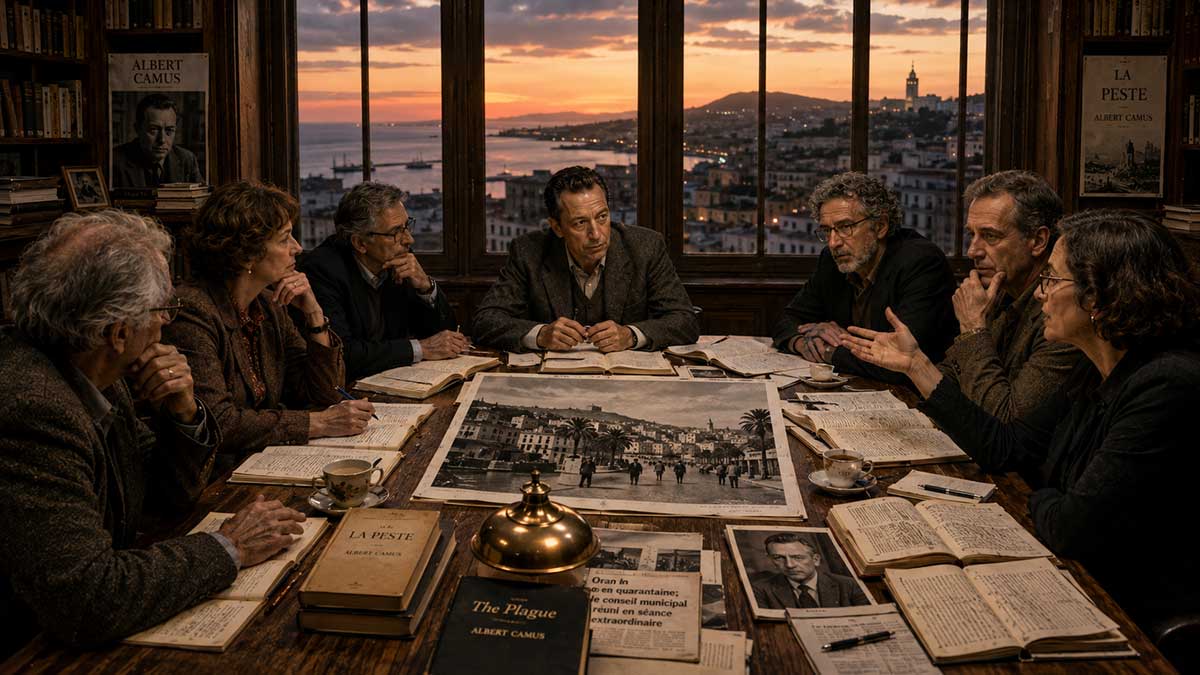
Beyond the tall windows, Oran descended in terraces toward the Mediterranean. The final light of evening rested on the water, turning the harbor gold. Inside, lamps cast small circles across a long wooden table.
Six scholars had gathered around it.
Each had brought a copy of The Plague.
Robert Zaretsky’s edition was thick with notes. Alice Kaplan had placed several archival photographs beside hers. Matthew Sharpe’s margins were crowded with philosophical references. Ronald Aronson’s copy contained dates, names, and political annotations. David Sherman had marked passages on ethics and modernity. Susan Neiman had filled the final pages with questions about suffering and evil.
One chair remained empty.
A clock struck eight.
Footsteps approached through the darkened stacks.
Albert Camus entered carrying no book.
The scholars rose.
Camus looked at the heavily annotated volumes surrounding the table.
Albert Camus: I see each of you has brought a copy filled with arguments.
A restrained laugh moved through the room.
He took the empty chair.
Albert Camus: I brought none.
He glanced at the books once more.
Albert Camus: I spent enough years arguing with this novel before the rest of you began.
The scholars sat.
Camus leaned back and studied them.
Albert Camus: Let us begin with the question readers refuse to stop asking.
He rested one hand on the table.
Albert Camus: What does the plague symbolize?
No one spoke immediately.
Camus smiled faintly.
Albert Camus: Before anyone answers, I should warn you that I distrust the question.
Robert Zaretsky: Why?
Albert Camus: It often arrives with a demand for one answer.
Fascism.
Disease.
Death.
Evil.
The absurd.
Once the reader receives the label, the book is considered solved.
Alice Kaplan: Yet you knew readers would connect the epidemic with the German occupation.
Albert Camus: Of course.
Ronald Aronson: More than connect it. Many passages invite the comparison directly.
Albert Camus: Yes.
Ronald Aronson: Then why resist calling it a novel about fascism?
Camus looked toward him.
Albert Camus: I resist the word “about” when it becomes a prison.
The plague carries the memory of occupation. It carries resistance, collaboration, fear, silence, bureaucracy, exile, and waiting. Yet fascism was not the first plague humanity faced, nor was it destined to be the last.
Robert Zaretsky: So fascism is one historical form of the plague.
Albert Camus: Yes.
Matthew Sharpe: Not its final definition.
Albert Camus: Precisely.
Alice opened a folder and placed a black-and-white photograph on the table.
It showed Oran under the hard Algerian sun.
Crowded buildings.
A market street.
French signs above shops.
Arab workers passing beneath them.
Alice Kaplan: Then we need to discuss the city.
Most readers treat Oran as a stage on which the epidemic occurs. Yet Oran is not neutral.
Albert Camus: No city is neutral.
Alice Kaplan: This one was part of colonial Algeria. French citizens occupied one social structure. Arab Algerians lived under another. The novel describes a city sealed by disease, yet much of the indigenous population remains strangely absent from its central narrative.
The room grew quieter.
Camus did not look away.
Alice Kaplan: That absence troubles modern readers.
Albert Camus: It should.
Alice Kaplan: Was it a deliberate representation of colonial blindness, or was it your own blindness?
Camus folded his hands.
No one moved.
Albert Camus: Both answers may contain truth.
Ronald leaned forward.
Ronald Aronson: That is an honest response, but it does not settle the issue.
Albert Camus: It should not.
Ronald Aronson: You wrote about universal suffering from within a deeply unequal society. Can a novel claim universality when so many lives remain outside its frame?
Camus looked toward the photograph.
Albert Camus: A writer may seek the universal and still remain limited by his place, his loyalties, and his failures.
Susan Neiman: Then perhaps the novel contains a contradiction that readers must not smooth away.
Its ethic says no one’s suffering should be treated as irrelevant.
Its social vision does not fully represent everyone suffering in Algeria.
Camus nodded.
Albert Camus: A book can speak beyond the moral reach of its author.
David Sherman: That may be one reason the novel survives.
Not because it resolves every contradiction, but because its central demand can be turned back upon the book itself.
Matthew Sharpe: And upon us.
We ask who is missing from Camus’ Oran. We should then ask who is missing from our own moral field.
Alice Kaplan: That is valuable, but we should not let present-day application erase historical accountability.
Matthew Sharpe: Agreed.
Alice Kaplan: Too many readers use the novel’s universality to avoid Algeria.
Albert Camus: Then they have misunderstood universality.
Robert Zaretsky: What did universality mean to you?
Camus looked through the window.
The harbor lights had begun appearing one by one.
Albert Camus: It did not mean removing place.
It meant entering one place deeply enough to find a question another person might recognize.
Susan Neiman: Which question?
Camus turned back.
Albert Camus: What do human beings owe one another when suffering becomes unavoidable?
Robert nodded.
Robert Zaretsky: That seems to me the moral center of the novel.
Not why evil exists.
Not whether history has meaning.
What one person owes another in the presence of suffering.
David Sherman: Yet the novel refuses to ground that obligation in divine command, historical destiny, or philosophical certainty.
Matthew Sharpe: That is central to Camus’ thought.
Rieux acts without believing the universe will reward him. His work is meaningful precisely without guarantees.
Albert Camus: Be careful.
Matthew Sharpe: With what?
Albert Camus: With making uncertainty sound noble from a comfortable chair.
The scholars fell silent.
Camus continued.
Albert Camus: For Rieux, the absence of guarantees is not an elegant philosophical condition. It means patients die after he has done everything he can.
Matthew Sharpe: Fair.
Albert Camus: Philosophy becomes false the moment it forgets the body.
Susan looked toward Camus.
Susan Neiman: Yet you still constructed the novel around a philosophical problem.
How should one live in a world where innocent suffering cannot be justified?
Albert Camus: Yes.
Susan Neiman: Then you cannot fully separate the body from the idea.
Albert Camus: Nor should we.
I only refuse to let the idea become more important than the suffering person.
Ronald opened his copy.
Ronald Aronson: This leads back to resistance.
Many readers see Rieux and Tarrou as moral figures, but their work is political too. They organize, cooperate, resist passivity, and reject the excuses of institutions.
Albert Camus: Yes.
Ronald Aronson: Then The Plague is not merely a novel about private decency.
Albert Camus: No.
Ronald Aronson: Good. I worry that “ordinary decency” can become too gentle a phrase.
Fascism is not defeated by personal kindness alone.
Oppression requires organized resistance.
Camus considered this.
Albert Camus: Ordinary decency does not mean passive goodness.
Sometimes decency carries a medical bag.
Sometimes it prints an underground newspaper.
Sometimes it refuses an order.
Sometimes it joins others.
Robert Zaretsky: Yet you distrusted revolutionary violence.
Albert Camus: I distrusted every cause that demanded the murder of innocent people in the name of a future innocence.
Ronald Aronson: That placed you in conflict with many intellectuals of your time.
Albert Camus: Yes.
Ronald Aronson: Some thought your position morally pure but politically ineffective.
Camus gave a weary smile.
Albert Camus: People often call restraint ineffective when they are not the ones asked to die for the theory.
Susan leaned closer.
Susan Neiman: Then is the plague any ideology that makes human beings expendable?
Camus paused.
Albert Camus: It can be.
David Sherman: That would connect fascism, terror, bureaucracy, indifference, and even certain forms of moral certainty.
Matthew Sharpe: Tarrou’s statement that everyone carries the plague becomes more unsettling in that reading.
The plague is not confined to monsters.
It exists in the habits by which ordinary people excuse harm.
Albert Camus: Yes.
Robert Zaretsky: Is that what you most wanted readers to grasp?
That evil is ordinary?
Camus shook his head slightly.
Albert Camus: I wanted them to grasp that innocence is difficult.
The room became still.
Susan Neiman: Difficult in what sense?
Albert Camus: We participate in systems we did not create.
We benefit from suffering we do not see.
We repeat ideas whose consequences fall upon strangers.
We remain silent for reasons that seem harmless.
Tarrou wants to become innocent, yet he discovers that complete innocence may be impossible.
David Sherman: Then what remains?
Albert Camus: Attention.
Matthew Sharpe: Attention?
Albert Camus: Watching one’s own capacity to become accustomed to another person’s suffering.
Alice Kaplan: That sounds close to the character conversation we just created through Rieux, Tarrou, Rambert, Paneloux, Grand, and Cottard.
Albert Camus: Characters often understand a moral truth before scholars name it.
A small laugh moved around the table.
Robert Zaretsky: Then perhaps we should ask the most basic question directly.
Did you write The Plague to teach a moral lesson?
Camus frowned.
Albert Camus: I dislike novels that behave like classrooms.
Robert Zaretsky: Yet the book clearly judges some responses as better than others.
Rieux’s service is treated differently from Cottard’s profiteering.
Rambert’s decision to stay carries moral weight.
Paneloux’s certainty is challenged.
Albert Camus: A novel may have a moral direction without becoming a sermon.
David Sherman: What is the distinction?
Albert Camus: A sermon begins with the answer and constructs examples.
A novel begins with human beings and discovers that every answer costs something.
Susan smiled.
Susan Neiman: That may be the clearest account of the book we have heard tonight.
Camus gave her a doubtful look.
Albert Camus: Then we should distrust it immediately.
The scholars laughed.
A library attendant appeared at the distant doorway, saw the group, and hesitated.
Camus gestured for him to enter.
The man carried a stack of returned books.
Library Attendant: I did not know anyone was still here.
Alice Kaplan: We lost track of time.
The attendant looked at the copies of The Plague covering the table.
Library Attendant: My mother read that during the epidemic.
The scholars looked toward him.
Robert Zaretsky: Which epidemic?
Library Attendant: The recent one.
She said it frightened her at first.
Then it made her feel less alone.
Camus studied the man.
Albert Camus: Why?
Library Attendant: She said the book knew people would become tired before the crisis ended.
She thought she was a bad person for feeling tired.
The novel made her think fatigue was part of the trial, not proof that she had failed.
No scholar answered.
The attendant shifted the books in his arms.
Library Attendant: I should let you continue.
He walked away through the stacks.
Camus watched him disappear.
Albert Camus: That is the danger of literary interpretation.
Matthew Sharpe: What is?
Albert Camus: We spend an hour debating what the book means.
A stranger enters and tells us what it did.
Alice closed her folder.
Alice Kaplan: Meaning and effect are not identical.
Albert Camus: No.
Alice Kaplan: Yet both matter.
Albert Camus: Yes.
Ronald rested his forearms on the table.
Ronald Aronson: Then let us try again.
Is The Plague about disease?
Albert Camus: Yes.
Ronald Aronson: Fascism?
Albert Camus: Yes.
Alice Kaplan: Colonial blindness?
Camus paused.
Albert Camus: It can reveal it, including where the novel itself remains blind.
Matthew Sharpe: The absurd?
Albert Camus: Yes.
Susan Neiman: Innocent suffering?
Albert Camus: Yes.
David Sherman: Moral responsibility without certainty?
Albert Camus: Yes.
Robert Zaretsky: Human solidarity?
Albert Camus: Yes.
Robert smiled.
Robert Zaretsky: That is a great many answers for a man who distrusts answers.
Albert Camus: I distrust final ones.
Outside, the last trace of sunlight disappeared from the sea.
The library windows became mirrors, reflecting seven figures seated around the table.
Susan looked at those reflections.
Susan Neiman: May I offer one more interpretation?
Camus nodded.
Susan Neiman: The plague is any force that turns other people into abstractions.
Disease turns them into cases.
War turns them into casualties.
Politics turns them into populations.
Hatred turns them into enemies.
Bureaucracy turns them into numbers.
Rieux keeps returning them to persons.
The room remained silent.
Camus looked at her for a long time.
Albert Camus: That is close.
Susan Neiman: Only close?
Albert Camus: Every interpretation should leave room for the next suffering person who does not fit it.
David closed his book.
David Sherman: Then perhaps the novel’s deepest purpose is not to give readers a definition of the plague.
It is to train them to recognize it.
Matthew Sharpe: Before it becomes undeniable.
Alice Kaplan: In history.
Ronald Aronson: In institutions.
Susan Neiman: In moral excuses.
Robert Zaretsky: In themselves.
They looked toward Camus.
He remained quiet.
After a moment, he rose and walked to the window.
Below, the city lights traced the shoreline.
Cars moved through the streets.
A hospital glowed on a distant hill.
Near the library entrance, the attendant helped an elderly woman down the steps.
Camus watched until she reached the pavement safely.
Albert Camus: Perhaps that is what I was trying to say.
Robert joined him near the window.
Robert Zaretsky: Which part?
Camus nodded toward the attendant and the woman below.
Albert Camus: That no explanation of suffering is as valuable as the decision not to leave someone alone inside it.
The scholars remained silent.
Camus returned to the table but did not sit.
Albert Camus: Yet we have not answered the question fully.
Alice Kaplan: You just said there is no final answer.
Albert Camus: Exactly.
He looked at the six annotated books.
Albert Camus: Which means the discussion must continue.
Outside, the Mediterranean had vanished into darkness.
Inside, the scholars opened their books again.
Topic 2: Absurdism, Hope, and the Meaning of Human Life
The library had grown colder.
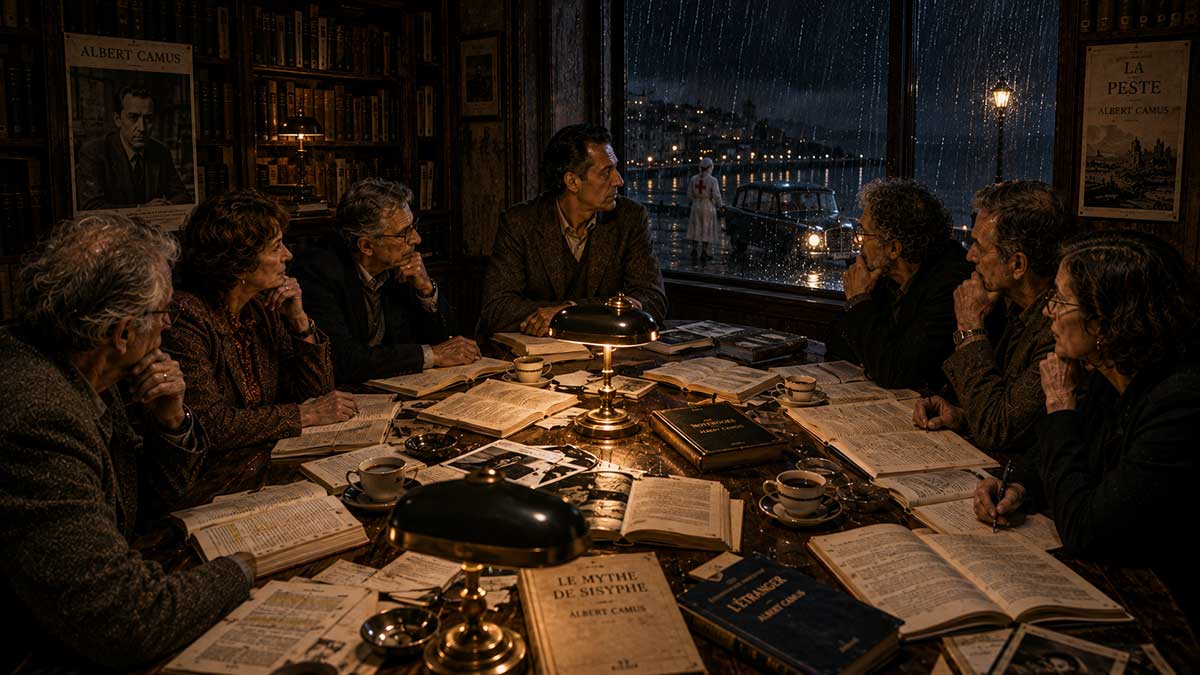
A night wind pressed lightly against the tall windows. Beyond the glass, Oran’s harbor had disappeared into darkness, leaving only scattered lamps along the shoreline.
The scholars had reopened their books.
Camus remained standing for a moment, one hand resting on the back of his chair.
Then he sat.
Albert Camus: We should now address the word most often placed beside my name.
He looked around the table.
Albert Camus: The absurd.
Matthew Sharpe smiled faintly.
Matthew Sharpe: A word many people use confidently and define poorly.
Albert Camus: That is true of most philosophical words.
Robert Zaretsky: Many readers think absurdism means life is meaningless.
Albert Camus: It does not.
David Sherman: Others think it means nothing matters.
Albert Camus: That is worse.
Susan Neiman: And many place you beside existentialists without much concern for whether you accepted the label.
Camus leaned back.
Albert Camus: I did not.
Ronald Aronson: Yet you shared many of their questions.
Freedom.
Meaning.
Responsibility.
Alienation.
Death.
Albert Camus: Sharing a question does not require sharing an answer.
Alice Kaplan turned a few pages in her notes.
Alice Kaplan: Then perhaps we should begin with the simplest version.
What is the absurd?
Camus looked toward Matthew.
Albert Camus: You have spent years explaining me. Let us see what damage has been done.
A quiet laugh moved around the table.
Matthew folded his hands.
Matthew Sharpe: The absurd begins in the collision between two things.
Human beings desire meaning, order, justice, and explanation.
The universe offers no guarantee that any of these exist.
Albert Camus: Better.
Matthew Sharpe: The absurd is not humanity alone.
It is not the universe alone.
It arises in the confrontation between our hunger for meaning and the silence we meet.
Camus nodded.
Albert Camus: Yes.
David Sherman: That distinction matters.
If the absurd belonged only to the universe, it would become a property of nature.
If it belonged only to us, it might be treated as a psychological illness.
Camus places it in the relationship.
Susan Neiman: Yet people often hear that and assume the next step must be despair.
Albert Camus: That assumption is one of the reasons I continued writing.
Robert Zaretsky: What is the next step?
Camus looked toward the darkened window.
Albert Camus: Refusal.
Ronald Aronson: Refusal of what?
Albert Camus: Refusal to lie.
Refusal to invent certainty merely because uncertainty frightens us.
Refusal to call suffering meaningful when we do not know that it is.
Refusal to surrender life merely because life offers no final explanation.
Susan leaned forward.
Susan Neiman: That last part is central.
Many people can accept that the universe is silent.
What they struggle to accept is your insistence that silence does not cancel moral duty.
Albert Camus: Silence does not relieve us of responsibility.
David Sherman: It may deepen it.
Albert Camus: Yes.
If no divine voice guarantees justice, then human beings must become more serious about creating whatever justice they can.
If no final meaning descends from the sky, then the meaning carried by our actions becomes more urgent.
Matthew looked toward Camus.
Matthew Sharpe: This is why your philosophy is often mistaken for pessimism.
You begin from mortality, suffering, and the failure of absolute answers.
Yet you do not end there.
Albert Camus: A philosophy should not be judged only by where it begins.
Robert Zaretsky: Where does yours end?
Camus gave him a restrained smile.
Albert Camus: I hope it does not end.
Alice Kaplan: That sounds evasive.
Albert Camus: It is cautious.
The moment a philosophy claims to have reached the final destination, it begins demanding that human beings fit its map.
Ronald nodded slowly.
Ronald Aronson: There is your political suspicion again.
Albert Camus: Philosophy becomes dangerous when it loves its system more than the people forced to live beneath it.
Susan Neiman: Yet people need orientation.
They cannot live forever inside uncertainty.
Albert Camus: They already do.
The question is whether they admit it.
The room became quiet.
A radiator clicked somewhere in the far corner.
David looked down at his copy.
David Sherman: Let us place this inside The Plague.
Where does the absurd appear most clearly?
Matthew Sharpe: In Rieux’s work.
Every day he treats patients.
Some recover.
Many die.
There is no reliable moral pattern.
The innocent are not spared.
The guilty are not singled out.
Medical effort does not guarantee success.
Albert Camus: Yes.
Matthew Sharpe: Yet he continues.
That continuation is Camus’ answer.
Albert Camus: Part of it.
Matthew Sharpe: What is missing?
Albert Camus: Rieux does not continue to demonstrate a philosophy.
He continues because someone is suffering in front of him.
Susan nodded.
Susan Neiman: You keep resisting abstraction.
Albert Camus: Abstraction is useful until it begins replacing the person.
David Sherman: Then Rieux is not heroic because he defeats the plague.
Albert Camus: He does not defeat it.
David Sherman: He is heroic because he refuses to abandon the work that remains possible.
Camus looked uncomfortable.
Albert Camus: He would reject the word heroic.
Robert Zaretsky: You have said that before.
Why does the word trouble you so much?
Albert Camus: Heroism can become an excuse.
People praise a few exceptional individuals and then forgive everyone else for doing nothing.
Ronald Aronson: That is politically sharp.
A society can admire sacrifice without changing the conditions that require it.
Albert Camus: Precisely.
Alice Kaplan: Yet readers need models.
Rieux gives them one.
Albert Camus: A model of decency, perhaps.
Not perfection.
Matthew Sharpe: This is where absurdism differs from nihilism.
The nihilist says nothing has meaning, so nothing matters.
Camus says no final meaning is guaranteed, so our actions matter here and now.
Susan Neiman: I would go further.
Your work suggests that the absence of cosmic justice does not erase the difference between cruelty and mercy.
Albert Camus: Yes.
Susan Neiman: Then moral distinctions survive without metaphysical certainty.
Albert Camus: They must.
Cottard profits from suffering.
Rieux resists it.
One action deepens the plague.
The other limits it.
No heaven needs to announce the difference.
Ronald rested his forearms on the table.
Ronald Aronson: Yet this is where critics sometimes press you.
They ask whether decency alone is enough.
Can personal moral action confront political systems, war, colonial domination, or organized violence?
Camus turned toward him.
Albert Camus: Decency alone is not always enough.
It is still necessary.
Ronald Aronson: Necessary but insufficient.
Albert Camus: Yes.
Ronald Aronson: Then what must join it?
Albert Camus: Solidarity.
Organization.
Resistance.
Limits.
David Sherman: Limits?
Albert Camus: Every struggle needs a boundary it refuses to cross.
A movement that becomes willing to murder anyone for its future has already carried the plague into its own bloodstream.
Ronald watched him carefully.
Ronald Aronson: Many revolutionaries would say such limits protect the existing injustice.
Albert Camus: Many revolutionaries become guardians of a new injustice.
Ronald Aronson: Yet passivity protects oppression too.
Albert Camus: I have never defended passivity.
I defended rebellion that remembers why it began.
The exchange tightened.
Alice looked between them.
Alice Kaplan: This may be one of the deepest tensions in Camus’ thought.
He insists that we resist injustice, yet he fears resistance becoming another machinery of death.
Susan Neiman: That is not cowardice.
It is moral memory.
Ronald Aronson: I did not call it cowardice.
Susan Neiman: Many did.
Camus looked tired.
Albert Camus: History has little patience for those who refuse its available camps.
Robert Zaretsky: You were often attacked for refusing to choose between opposing absolutes.
Albert Camus: I chose human lives.
That choice displeased every ideology willing to spend them.
Silence followed.
The wind pressed harder against the windows.
Matthew opened his copy to a marked passage.
Matthew Sharpe: Let us return to hope.
Readers often say Rieux represents hope.
Do you agree?
Camus considered the word.
Albert Camus: It depends on what they mean.
Matthew Sharpe: What kind of hope did you reject?
Albert Camus: Hope that asks people to stop looking at reality.
Hope that says suffering will soon make sense.
Hope that promises history will reward every sacrifice.
Hope that excuses cruelty by pointing to a perfect future.
David Sherman: False hope.
Albert Camus: Hope without truth.
Susan Neiman: Then what kind of hope remains?
Camus looked around the table.
Albert Camus: The hope contained in action.
Robert Zaretsky: Explain.
Albert Camus: A doctor treating the next patient.
A volunteer returning for another shift.
A journalist deciding not to escape.
A clerk continuing his records.
None of them knows that the plague will end soon.
Their action does not rest on prediction.
It rests on fidelity.
Alice Kaplan: Fidelity to what?
Albert Camus: To the human being before them.
Matthew nodded.
Matthew Sharpe: This is hope stripped of optimism.
Albert Camus: Yes.
Optimism says things will improve.
Hope acts before improvement is certain.
Susan Neiman: That distinction may be one of the most useful ideas in the novel.
Albert Camus: Useful ideas are dangerous when admired from a distance.
Susan smiled.
Susan Neiman: You are determined to prevent your own philosophy from becoming quotable.
Albert Camus: I failed long ago.
The scholars laughed.
Robert tapped the cover of his book.
Robert Zaretsky: Let us test the distinction.
A person says, “The plague will end soon.”
That is optimism.
Another says, “I will help today, whether it ends soon or not.”
That is hope.
Camus nodded.
Albert Camus: Yes.
David Sherman: Or perhaps courage.
Albert Camus: The words overlap.
Matthew Sharpe: Rieux never claims to feel hopeful.
He often appears exhausted.
Albert Camus: Hope need not feel bright.
That may be another misunderstanding.
Alice Kaplan: Many modern readers expect hope to feel emotionally uplifting.
Albert Camus: Sometimes hope looks like getting out of bed when grief has not changed.
The room quieted.
Susan looked toward him.
Susan Neiman: That is close to what the library attendant said about his mother.
She felt tired and believed fatigue meant moral failure.
Albert Camus: Fatigue is not failure.
Indifference is.
David Sherman: Yet fatigue can become indifference.
Albert Camus: Yes.
That is why solidarity matters.
One person cannot remain awake forever.
Others must take the next watch.
Ronald nodded.
Ronald Aronson: There is the political dimension again.
Shared responsibility prevents private exhaustion from becoming social collapse.
Albert Camus: Exactly.
No one should be asked to become permanently heroic.
Matthew Sharpe: Then solidarity is not just moral unity.
It is a practical distribution of burden.
Albert Camus: Yes.
Alice turned toward Matthew.
Alice Kaplan: We should address the comparison with existentialism.
Why do so many people confuse the two?
Matthew Sharpe: Shared historical context.
Both confront a world without secure transcendence.
Both ask how human beings create or discover meaning.
Both reject inherited certainties.
David Sherman: Yet Camus parts company with existentialism in key ways.
Matthew Sharpe: He does not celebrate unlimited freedom.
He distrusts the idea that human beings can simply invent themselves without moral limits.
Albert Camus: Freedom without limits becomes permission for the strong.
Susan Neiman: Nor do you say meaning is whatever an individual chooses.
Albert Camus: No.
A torturer may choose his meaning.
That does not make torture meaningful.
Robert Zaretsky: Then meaning must answer to something beyond preference.
Albert Camus: To shared human vulnerability.
To limits.
To the fact that every person can suffer and die.
David leaned closer.
David Sherman: That sounds like a moral foundation.
Albert Camus: It is a beginning.
David Sherman: Not a complete system.
Albert Camus: I have warned you about complete systems.
Ronald Aronson: Yet without a system, how do societies build laws or institutions?
Albert Camus: With provisional principles and permanent vigilance.
Ronald Aronson: That is difficult.
Albert Camus: Human freedom is difficult.
Ronald smiled.
Ronald Aronson: There you sound almost existentialist.
Camus looked unimpressed.
Albert Camus: Do not ruin the evening.
Laughter returned to the table.
A few moments passed.
Then Susan spoke.
Susan Neiman: I want to ask about happiness.
People remember your work for absurdity, rebellion, death, and plague.
Yet you wrote often about sunlight, sea, friendship, physical joy, and love of life.
Albert Camus: One cannot rebel for life without loving it.
Susan Neiman: Then happiness is not a distraction from suffering.
Albert Camus: No.
It is one reason suffering matters.
If life contained no beauty, loss would carry less force.
Alice Kaplan: Algeria is central here too.
The sea.
Heat.
Light.
The physical intensity of the place.
Albert Camus: I learned philosophy partly from the sun.
Matthew Sharpe: That sounds poetic, but what does it mean?
Albert Camus: The body knows certain truths before theory.
Cold water.
Warm stone.
Salt.
Breath.
Fatigue.
Desire.
Death becomes scandalous because life can be sensuously good.
David looked thoughtful.
David Sherman: So the absurd is not merely intellectual.
It is felt in the body’s love of life under the knowledge of death.
Albert Camus: Yes.
Robert Zaretsky: That helps explain why your work refuses despair.
A person who loves life fiercely may reject false meaning and still refuse death.
Albert Camus: Exactly.
Susan Neiman: Then perhaps your philosophy is less about meaning than attachment.
Albert Camus: Attachment to what?
Susan Neiman: To life without guarantees.
To other people without certainty that love will protect them.
To justice without proof that history bends in its direction.
Camus remained quiet.
Matthew watched him.
Matthew Sharpe: She may have found your answer.
Albert Camus: She has found an answer.
Susan smiled.
Susan Neiman: I accept the correction.
A light appeared between the library shelves.
The attendant returned, pushing a small cart.
On it sat seven cups of coffee.
Library Attendant: I thought you might still be here.
He placed a cup before each person.
Robert Zaretsky: You are saving the discussion.
Library Attendant: I am saving the furniture. People become careless with old books when they are tired.
Camus picked up his cup.
Albert Camus: A practical philosopher.
The attendant smiled.
Library Attendant: My mother would disagree.
She says I never think deeply enough.
Albert Camus: Perhaps thinking deeply means noticing when people need coffee.
The attendant laughed and moved away.
For a moment, the scholars warmed their hands around the cups.
No one spoke.
The coffee was bitter.
The room smelled faintly of dust, paper, and rain.
Alice looked around the table.
Alice Kaplan: This moment feels strangely relevant.
We have spent an hour discussing meaning.
Then someone brings coffee.
David Sherman: Are you suggesting coffee defeats the absurd?
Alice Kaplan: Temporarily.
Matthew Sharpe: Camus might approve.
Albert Camus: I approve of temporary victories.
The laughter softened the room.
Robert lifted his cup.
Robert Zaretsky: Then let us make the question personal.
What keeps a person from despair when there is no guarantee of justice, survival, or final meaning?
He looked first toward Susan.
Susan Neiman: Moral judgment.
The ability to say that some things remain wrong, no matter how common they become.
David Sherman: Relationship.
Meaning survives in the obligations people accept toward one another.
Ronald Aronson: Collective action.
Isolation makes despair private. Solidarity gives it direction.
Alice Kaplan: Memory.
People endure partly by locating their suffering inside a history larger than the present moment.
Matthew Sharpe: Revolt.
The repeated refusal to let the world’s silence determine one’s response.
Robert looked toward Camus.
Robert Zaretsky: And you?
Camus held the coffee cup near his chest.
He considered the question.
Albert Camus: Love of life.
Robert Zaretsky: Is that enough?
Albert Camus: No single thing is enough.
He looked out toward the dark sea.
Albert Camus: Yet a person who still loves one face, one street, one morning, one piece of music, one patch of sunlight...
He paused.
Albert Camus: Such a person has already found a reason not to surrender completely.
No one interrupted.
Susan Neiman: That sounds very close to meaning.
Albert Camus: Perhaps.
Matthew Sharpe: Meaning discovered rather than imposed?
Albert Camus: Meaning lived before it is defined.
David nodded.
David Sherman: That may be how Rieux lives.
He does not announce a theory of meaning.
He acts meaningfully.
Albert Camus: Yes.
Ronald Aronson: Yet the plague ends.
Does that give his effort a kind of victory?
Albert Camus: Temporary victory.
Ronald Aronson: Is temporary victory enough?
Camus looked directly at him.
Albert Camus: It must be.
Every human victory is temporary.
Ronald fell silent.
The clock on the wall moved past ten.
Rain had begun tapping against the windows.
Matthew turned one final page.
Matthew Sharpe: Let me ask the question readers may care about most.
How does one live meaningfully in an absurd world?
Camus looked at the six scholars.
Then at the coffee cups.
The books.
The rain.
The dark harbor.
Albert Camus: Without appeal.
Without surrender.
With attention.
With limits.
With others.
Robert Zaretsky: That sounds almost like a creed.
Albert Camus: Then forget the words and watch Rieux.
Alice Kaplan: Treat the person in front of you.
Albert Camus: Yes.
Susan Neiman: Refuse explanations that make suffering easier to excuse.
Albert Camus: Yes.
Ronald Aronson: Join with others against what harms them.
Albert Camus: Yes.
David Sherman: Accept that the work may never be complete.
Albert Camus: Yes.
Matthew Sharpe: Love life anyway.
Camus looked toward him.
Albert Camus: Especially then.
The rain strengthened.
The harbor lights blurred behind the glass.
Camus rose and walked to the window.
The scholars followed his gaze.
Far below, a nurse hurried beneath an umbrella from the hospital entrance to a waiting car. A man stepped out and held the door open for her. She paused, laughed at something he said, and climbed inside.
The car disappeared down the wet road.
Albert Camus: People ask where meaning comes from.
He kept watching the empty street.
Albert Camus: Often it appears for only a moment.
A door held open.
A hand offered.
A burden shared.
A person who returns.
He turned back toward the table.
Albert Camus: The absurd does not erase such moments.
It makes them finite.
Their finiteness is not their weakness.
It is why they matter.
No one replied.
The scholars sat in silence, listening to the rain.
The universe had offered no answer.
Yet seven people remained around one table, sharing bitter coffee beneath a pool of warm light.
For that night, it was enough.
Topic 3: Can Humanity Defeat the Plague Within Itself?
The rain had slowed.
Small droplets still clung to the library windows, catching the light from the lamps and turning the dark glass into a field of faint reflections.
The seven coffee cups remained on the table.
Some were empty.
Camus had returned to his chair, but he had not reopened the discussion.
He seemed to be waiting for someone else to risk the first sentence.
It was Susan Neiman who finally spoke.
Susan Neiman: We have discussed disease, fascism, absurdity, hope, and moral action.
Yet one line from the novel may be more disturbing than all the others.
She looked toward Matthew Sharpe.
Susan Neiman: Tarrou says that every person carries the plague within himself.
Matthew nodded.
Matthew Sharpe: It may be the most unsettling claim in the book.
Robert Zaretsky: Readers often interpret it as a statement about evil.
David Sherman: Or complicity.
Ronald Aronson: Or violence.
Alice Kaplan: Or the human capacity to become accustomed to suffering.
Camus looked around the table.
Albert Camus: All of those are possible.
Susan Neiman: But what did you mean?
Camus smiled without amusement.
Albert Camus: You have returned very quickly to the question of intention.
Susan Neiman: This time I am asking more narrowly.
Does every person carry evil?
Albert Camus: I did not say every person carries equal evil.
David Sherman: Then what do we carry equally?
Albert Camus: The capacity to excuse harm.
The room became quiet.
Matthew Sharpe: That is more precise than saying everyone is evil.
Albert Camus: Evil can sound distant.
People hear the word and picture monsters.
The plague enters more quietly.
Through habits.
Through obedience.
Through fear.
Through the desire not to be troubled.
Ronald Aronson: Through institutions.
Albert Camus: Yes.
Alice Kaplan: Through inherited blindness too.
Albert Camus: Yes.
Susan rested both hands around her cup.
Susan Neiman: Then the plague within is not a hidden demon.
It is a pattern of moral surrender.
Albert Camus: Sometimes.
It may begin with something smaller.
A sentence accepted because everyone repeats it.
A person ignored because helping would cost too much.
An order followed because responsibility has been passed upward.
Robert Zaretsky: This is where Camus becomes deeply modern.
He refuses the comforting division between innocent people and guilty systems.
Systems are sustained by countless ordinary accommodations.
Ronald Aronson: Yet we should not lose the distinction between the architect of oppression and the person trapped beneath it.
Albert Camus: We must not.
Ronald Aronson: Saying everyone carries the plague can flatten responsibility.
It can make the victim seem morally equivalent to the perpetrator.
Camus nodded immediately.
Albert Camus: That would be false.
Shared vulnerability does not erase unequal guilt.
Susan Neiman: Then moral seriousness requires two truths at once.
Everyone possesses the capacity to contribute to harm.
Some people choose, organize, and enforce harm on a far greater scale.
Albert Camus: Yes.
Matthew Sharpe: Tarrou’s concern is not that every person is equally guilty.
It is that no one should treat himself as permanently innocent.
David Sherman: Permanent innocence makes self-examination unnecessary.
Alice Kaplan: It can make nations dangerous too.
A society convinced of its own purity can explain every cruelty as self-defense.
Ronald looked toward her.
Ronald Aronson: Or liberation.
Alice Kaplan: Yes.
Camus folded his hands.
Albert Camus: Every cause becomes dangerous when it can no longer see the blood on its own hands.
A long silence followed.
The rain tapped once against the glass, then stopped.
Robert Zaretsky: Tarrou spends much of the novel searching for a way to become what he calls a saint without God.
Matthew Sharpe: And he suspects that complete innocence may be impossible.
Susan Neiman: Does that make his project hopeless?
Albert Camus: No.
Susan Neiman: Why not?
Albert Camus: A goal can guide a life without being fully reached.
David Sherman: Like justice.
Albert Camus: Yes.
Ronald Aronson: Or peace.
Albert Camus: Yes.
Alice Kaplan: Or freedom from prejudice.
Albert Camus: Yes.
Matthew opened his book.
Matthew Sharpe: Tarrou wants to live without passing the plague to anyone else.
Yet every life participates in structures beyond its control.
Every purchase, institution, law, silence, and privilege may connect us to unseen suffering.
Susan Neiman: Then how can anyone act without becoming paralyzed by guilt?
Camus looked toward her.
Albert Camus: By refusing the luxury of paralysis.
Susan Neiman: That sounds severe.
Albert Camus: It is.
Guilt can become another form of self-absorption.
A person spends years examining his conscience and never helps anyone.
Robert Zaretsky: Then what should replace guilt?
Albert Camus: Responsibility.
David Sherman: The distinction matters.
Guilt asks, “What kind of person does this make me?”
Responsibility asks, “What can I do now?”
Albert Camus: Exactly.
Susan nodded slowly.
Susan Neiman: Guilt looks inward.
Responsibility moves outward.
Albert Camus: When it is honest.
Ronald shifted in his chair.
Ronald Aronson: Yet individual responsibility has limits.
One person cannot correct a violent economy, a colonial system, a dictatorship, or a war.
Albert Camus: One person cannot.
People can.
Ronald Aronson: Then we return to collective action.
Albert Camus: We never left it.
Matthew Sharpe: This is often forgotten in popular readings of Camus.
He is presented as a solitary philosopher standing against the universe.
Yet The Plague is built around cooperation.
Alice Kaplan: Sanitation teams.
Medical networks.
Administrative labor.
Neighborhood aid.
David Sherman: Meaning becomes social.
Albert Camus: Suffering already is.
The answer must be too.
Robert looked toward Camus.
Robert Zaretsky: Can humanity defeat the plague within itself?
Camus did not answer.
Instead, he looked toward the others.
Albert Camus: You have spent years explaining me.
Answer first.
Robert smiled.
Robert Zaretsky: No.
Not finally.
But people can recognize it sooner and limit the damage.
Alice Kaplan: Humanity cannot erase blindness permanently.
It can widen the field of who is seen.
Matthew Sharpe: We cannot eliminate the capacity for cruelty.
We can build habits and institutions that make cruelty harder to excuse.
Ronald Aronson: Humanity defeats nothing through private virtue alone.
Political structures must prevent concentrated harm and distribute responsibility.
David Sherman: The inner plague cannot be cured once.
It must be resisted repeatedly through judgment, restraint, and attention.
Susan Neiman: I would say humanity cannot become innocent.
It can become accountable.
Camus listened.
Albert Camus: Those are better answers than certainty.
Susan Neiman: And yours?
Camus looked down at the table.
Albert Camus: Humanity does not defeat the plague within itself.
It interrupts it.
The others remained silent.
Matthew Sharpe: Interrupts?
Albert Camus: Each act of mercy interrupts cruelty.
Each refusal interrupts obedience.
Each truth interrupts propaganda.
Each friendship interrupts abstraction.
Each person who says “no” at the right moment prevents the plague from moving one step farther.
Ronald Aronson: But interruption is temporary.
Albert Camus: So is life.
Ronald accepted the reply.
Alice turned one of the archival photographs face down.
Alice Kaplan: I want to return to colonialism.
A society can speak eloquently about universal dignity and still fail to see the people beneath its own hierarchy.
Is the plague within partly the ability to live comfortably beside contradiction?
Albert Camus: Yes.
Alice Kaplan: Then the novel’s moral demand can be used against its own exclusions.
Albert Camus: It should be.
Alice Kaplan: You do not resist that?
Albert Camus: A book that cannot survive moral scrutiny deserves less loyalty than its readers give it.
Robert looked intrigued.
Robert Zaretsky: Yet authors often defend their work from later judgment.
Albert Camus: Authors are poor judges of what their books become.
David Sherman: Then literature can exceed intention.
Albert Camus: It often must.
Susan leaned forward.
Susan Neiman: May I press the central question further?
Albert Camus: Please.
Susan Neiman: Is evil something we choose, inherit, or gradually become?
Camus considered the three possibilities.
Albert Camus: All three.
Matthew Sharpe: That sounds too broad.
Albert Camus: Then make it narrower.
Matthew Sharpe: We inherit conditions.
We choose within them.
Through repetition, choices become character.
David Sherman: And character helps reproduce conditions.
Ronald Aronson: That is the political cycle.
Institutions shape people.
People sustain institutions.
Alice Kaplan: Families pass on silence.
Nations pass on myths.
Communities pass on enemies.
Susan Neiman: Then evil is rarely one decision.
It is often a relationship between history, structure, and habit.
Albert Camus: Yes.
Robert Zaretsky: Yet the novel still preserves individual responsibility.
Cottard benefits from the plague.
Rambert considers escape.
Paneloux interprets suffering.
Rieux works.
Each person stands within circumstances, but each responds differently.
Albert Camus: Circumstances explain much.
They do not excuse everything.
The library attendant appeared at the edge of the room again.
This time he carried no coffee.
He stood beside a shelf holding a damaged book.
Library Attendant: Forgive me.
I need to move one of the lamps.
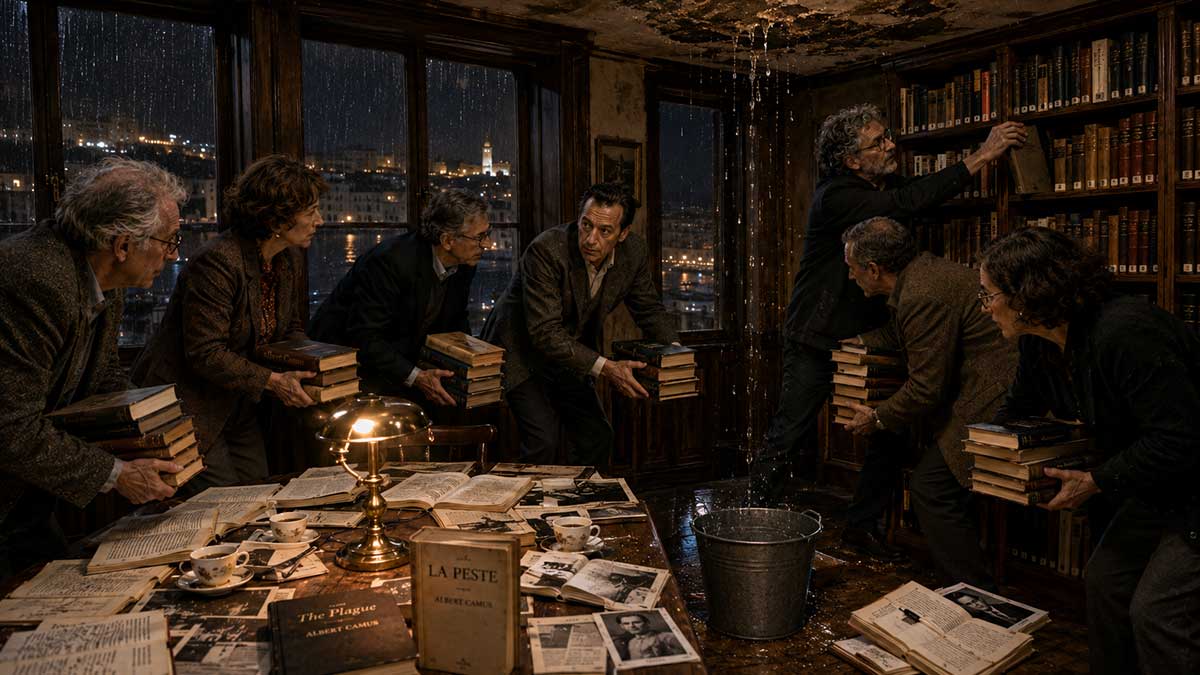
There is a leak above the history section.
Everyone looked up.
A dark stain had formed across the ceiling.
The attendant dragged a bucket beneath it.
A drop fell.
Then another.
Library Attendant: It always begins with one.
Camus smiled.
Albert Camus: That sentence belongs at this table.
The attendant glanced at him.
Library Attendant: My supervisor said the roof was repaired last year.
Alice Kaplan: Was it?
Library Attendant: On paper.
A subdued laugh passed through the group.
He repositioned the bucket and left.
The drops continued falling.
Susan watched the small rings forming in the water.
Susan Neiman: There is something almost embarrassingly perfect about that.
David Sherman: A leak denied by an institution.
Ronald Aronson: A worker managing the consequences.
Matthew Sharpe: Scholars turning it into a metaphor.
Camus looked toward the bucket.
Albert Camus: And no one yet fixing the roof.
The scholars stopped smiling.
Robert rose.
Robert Zaretsky: Can we do anything?
Albert Camus: We can move the books.
Within moments, the group stood.
They carried volumes away from the leaking section.
Alice gathered archival folders.
Ronald shifted a heavy stack of political histories.
Susan moved fragile editions to a dry table.
Matthew and David pulled a bookcase several inches from the wall.
Camus held the lamp so they could see.
The task took less than ten minutes.
When they finished, the bucket remained beneath the leak, but the books were safe.
Everyone returned to the table slightly out of breath.
Matthew Sharpe: That was painfully obvious.
Albert Camus: Most moral action is.
Susan Neiman: Yet none of us moved until the books were directly threatened.
Alice Kaplan: We had seen the stain.
Ronald Aronson: We assumed someone else had handled it.
David Sherman: Which is exactly how the plague travels.
No one laughed this time.
Camus sat down.
Albert Camus: The capacity to excuse harm is rarely dramatic.
It sounds like this:
Someone has reported it.
Someone else is responsible.
It is not serious yet.
I am busy.
I do not know enough.
What difference would I make?
Robert looked toward the bucket.
Robert Zaretsky: And sometimes all that is required is moving the books.
Albert Camus: Sometimes.
Other times the roof must be rebuilt.
Ronald Aronson: There is the distinction between relief and reform.
Albert Camus: Both matter.
Do not despise relief because it is incomplete.
Do not mistake relief for completion.
Ronald nodded.
Susan Neiman: Can ordinary decency resist large-scale evil?
Albert Camus: It can begin resistance.
Susan Neiman: Is that enough?
Albert Camus: Nothing is enough alone.
A doctor needs a hospital.
A witness needs protection.
A dissident needs others.
A hungry person needs bread before theory.
David Sherman: Then decency must become organized.
Albert Camus: Yes.
Matthew Sharpe: Yet organization itself can become bureaucratic and indifferent.
Albert Camus: Which is why conscience must remain inside it.
Alice Kaplan: And memory.
Ronald Aronson: And accountability.
Susan Neiman: And limits.
Camus nodded.
Albert Camus: Good.
Now you are describing an institution that knows it can become infected.
The clock approached midnight.
The library lights flickered once.
The group looked upward.
Robert Zaretsky: Another metaphor?
Albert Camus: Let us hope only bad wiring.
The lights steadied.
Matthew leaned toward Camus.
Matthew Sharpe: You said each of us carries the plague.
Do you believe each of us carries the cure too?
Camus looked at him.
Albert Camus: No.
Matthew seemed surprised.
Albert Camus: That would be too flattering.
Susan Neiman: Then what do we carry?
Albert Camus: The ability to help interrupt it.
David Sherman: Not cure.
Albert Camus: No final cure.
A person can tell the truth.
Refuse an order.
Share a burden.
Protect a stranger.
Join a movement.
Admit a wrong.
Change a habit.
None of these purifies humanity.
Each makes one form of the plague less inevitable.
Alice looked toward the dark window.
Their reflections appeared again in the glass.
Alice Kaplan: That is a humbler moral vision than most political theories offer.
Ronald Aronson: It may be harder too.
A grand theory promises completion.
This demands permanent work.
Albert Camus: The plague prefers people who believe the work is finished.
Susan closed her notebook.
Susan Neiman: Then perhaps the opposite of evil is not innocence.
David Sherman: What is it?
Susan Neiman: Vigilance joined to responsibility.
Camus considered the phrase.
Albert Camus: That is close.
Robert Zaretsky: Again, only close?
Albert Camus: Vigilance without mercy becomes suspicion.
Responsibility without humility becomes control.
Matthew Sharpe: Then what holds them together?
Camus looked toward the bucket catching the final drops from the ceiling.
Albert Camus: The knowledge that we too can become what we oppose.
The answer settled heavily over the table.
Ronald broke the silence.
Ronald Aronson: That knowledge can weaken action.
People may become afraid to judge anything.
Albert Camus: It should not prevent judgment.
It should prevent self-worship.
Alice Kaplan: One can oppose injustice without claiming purity.
Albert Camus: One must.
Robert glanced toward the stack of rescued books.
Robert Zaretsky: Let us answer the topic plainly.
Can humanity defeat the plague within itself?
He looked first at Alice.
Alice Kaplan: No.
But it can learn to see those whom its stories leave out.
Matthew Sharpe: No.
But it can train itself to recognize the excuses by which harm becomes normal.
Ronald Aronson: No.
But it can create collective structures that restrain domination and make solidarity practical.
David Sherman: No.
But it can replace the fantasy of innocence with the discipline of responsibility.
Susan Neiman: No.
But it can refuse to let the impossibility of purity become permission for indifference.
Robert turned toward Camus.
Robert Zaretsky: And your final answer?
Camus looked at the books moved from danger.
At the bucket.
At the empty coffee cups.
At the six scholars waiting.
Albert Camus: Humanity will never become immune to the plague within itself.
He paused.
Albert Camus: Yet every generation receives another chance to recognize the symptoms sooner.
The library clock struck midnight.
The sound traveled through the silent building.
Camus rose.
He walked to the damaged section and looked into the bucket.
Only a small amount of water had collected.
Albert Camus: This is how people deceive themselves.
Susan Neiman: How?
Albert Camus: They look at the bucket and say the damage is small.
He looked up at the spreading stain.
Albert Camus: They forget to look at the roof.
The scholars followed his gaze.
Above them, the ceiling remained dark with water.
The immediate danger had passed.
The cause remained.
No one mistook the difference.
Topic 4: Faith, Suffering, and the Silence of God
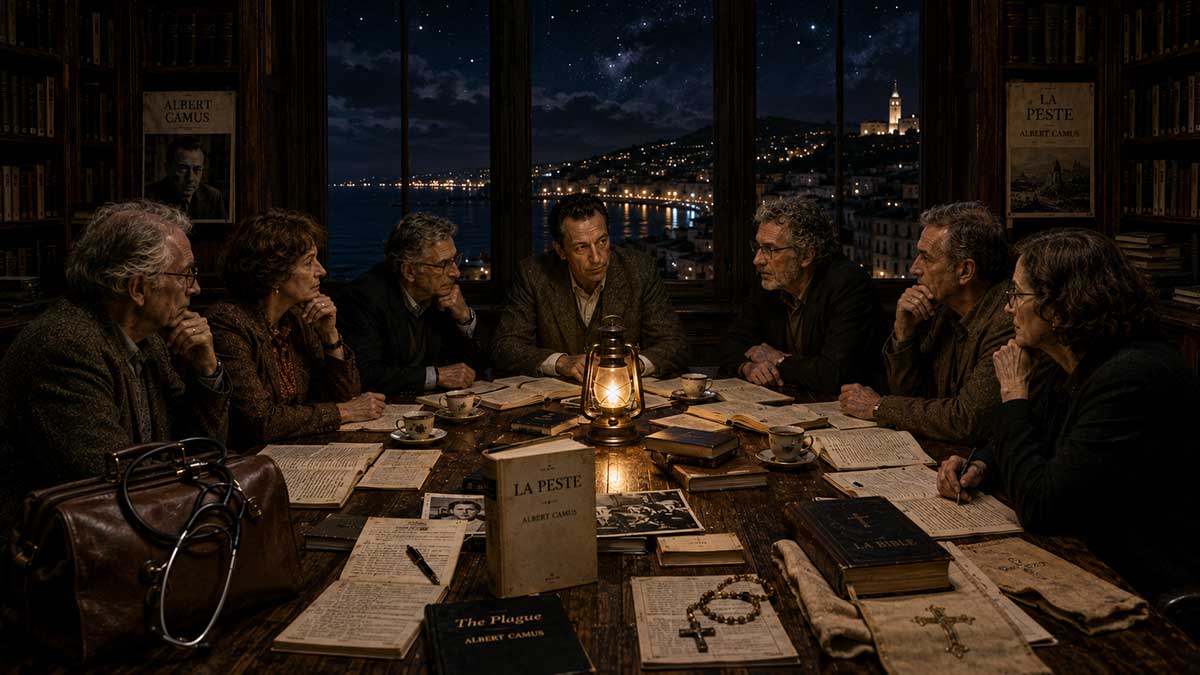
The bucket beneath the leak remained in place.
No more water fell, yet the dark stain across the ceiling seemed larger than before. The scholars had returned to the table, but their attention kept drifting upward.
Camus noticed.
Albert Camus: We have reached the point where people usually begin speaking about God.
No one answered at once.
Susan Neiman rested one hand on her closed notebook.
Susan Neiman: You say that as though God enters only after the roof begins collapsing.
Albert Camus: For many people, He does.
Robert Zaretsky: Or returns.
Albert Camus: Yes.
David Sherman looked toward Camus.
David Sherman: Your work is often described as atheistic.
Would you accept that description?
Camus leaned back.
Albert Camus: I would accept that I could not believe in a God whose justice required the suffering of children.
Matthew Sharpe: That is not quite the same as saying no God exists.
Albert Camus: No.
Ronald Aronson: Yet you rejected religious belief.
Albert Camus: I rejected certainty where I found none.
Alice Kaplan opened her folder but did not remove any papers.
Alice Kaplan: Many readers sense something spiritually serious in your work.
The language of judgment, innocence, mercy, rebellion, sacrifice, and solidarity never disappears.
Albert Camus: Religious questions can survive after religious answers become impossible.
Susan Neiman: That may be the key.
You did not lose interest in good and evil when you rejected theology.
You became more troubled by them.
Albert Camus: Yes.
The absence of explanation does not make suffering less urgent.
It makes easy explanations more offensive.
Matthew turned several pages in his copy of The Plague.
Matthew Sharpe: Then let us speak about Father Paneloux.
At first, he interprets the epidemic as punishment.
Later, after witnessing the death of an innocent child, his certainty breaks.
Why did you give him two sermons?
Camus looked toward the dark window.
Albert Camus: The first sermon is delivered above suffering.
The second is delivered from inside it.
Robert Zaretsky: That is a severe distinction.
Albert Camus: It should be.
David Sherman: In the first sermon, Paneloux speaks of “you.”
The plague has come for your sins.
In the second, he speaks of “we.”
Albert Camus: Yes.
Pronouns can reveal a conversion before doctrine does.
Susan nodded.
Susan Neiman: “You suffer because you deserve judgment” becomes “we must remain together inside what we cannot explain.”
Albert Camus: That is closer to compassion.
Ronald Aronson: Yet Paneloux never fully abandons faith.
Albert Camus: No.
Ronald Aronson: Why not allow him a complete rejection?
Camus folded his hands.
Albert Camus: Because complete rejection would have been too easy for him.
Matthew Sharpe: Easier than doubt?
Albert Camus: Much easier.
Doubt keeps the wound open.
Rejection can become another certainty.
Alice looked toward him.
Alice Kaplan: Then Paneloux’s tragedy is not that he loses faith.
It is that he can no longer inhabit faith innocently.
Albert Camus: Yes.
Robert Zaretsky: Did you respect him?
Camus took time before answering.
Albert Camus: More after the second sermon than before the first.
Susan Neiman: Yet Rieux remains angry with him.
Albert Camus: He should.
David Sherman: Is Rieux angry at religion itself?
Albert Camus: He is angry at any language that makes suffering easier to tolerate for the person who is not enduring it.
The room grew quiet.
The library attendant appeared briefly between the shelves, checked the bucket, then disappeared again.
Ronald watched him go.
Ronald Aronson: Religion is hardly the only system guilty of that.
Political theories do it.
National myths do it.
Economic doctrines do it.
Albert Camus: Yes.
Every system becomes cruel when it explains pain more confidently than it relieves it.
Susan looked toward Camus.
Susan Neiman: Then was Paneloux wrong to search for meaning?
Albert Camus: No.
He was wrong to announce that he had found it inside someone else’s suffering.
Matthew Sharpe: That is a very different accusation.
Albert Camus: It is the difference between faith and presumption.
Robert leaned forward.
Robert Zaretsky: You rarely speak this sympathetically about faith.
Camus gave him a tired smile.
Albert Camus: Sympathy is not agreement.
Robert Zaretsky: Yet you seem to grant Paneloux a moral seriousness.
Albert Camus: He stays.
That matters.
Alice Kaplan: He remains beside the child.
Albert Camus: Yes.
He does not retreat to the pulpit when the room becomes unbearable.
David Sherman: Is presence enough?
Albert Camus: No.
Nothing is enough.
But leaving would be worse.
Susan watched Camus carefully.
Susan Neiman: You return again and again to remaining beside the suffering.
It seems almost sacramental in your work.
Camus frowned slightly.
Albert Camus: Be careful with that word.
Susan Neiman: Why?
Albert Camus: It may make ordinary decency sound holy enough to admire instead of practice.
Matthew Sharpe: You distrust praise almost as much as theology.
Albert Camus: Praise often arrives after the work has been assigned to someone else.
A faint laugh passed around the table.
Alice broke it.
Alice Kaplan: Let us ask the difficult question directly.
Were you criticizing religion, or were you criticizing shallow certainty?
Camus looked from one scholar to the next.
Albert Camus: Both, when they became the same thing.
Alice Kaplan: And when they did not?
Albert Camus: I could respect a believer who refused cruelty, admitted doubt, and remained beside the abandoned.
Robert Zaretsky: Could Camus’ philosophy coexist with faith?
Camus turned toward him.
Albert Camus: Ask the believers.
Susan spoke first.
Susan Neiman: A faith that insists every tragedy fits a divine plan would conflict sharply with your thought.
David Sherman: A faith grounded in humility, mercy, and service might stand much closer to it.
Matthew Sharpe: One could believe in God and still accept the absurd as a human experience of divine silence.
Ronald Aronson: That risks turning Camus into a hidden theologian.
Matthew Sharpe: I did not say he believed.
I said a believer could read him honestly without dissolving the tension.
Ronald Aronson: Provided that believer does not use faith to justify history.
Susan Neiman: Or innocence.
Alice Kaplan: Or colonial authority.
Camus nodded.
Albert Camus: Then perhaps coexistence depends less on belief than on what belief permits a person to do to others.
Robert Zaretsky: That sounds almost pragmatic.
Albert Camus: Suffering makes pragmatists of us all.
David leaned closer.
David Sherman: Yet there remains a philosophical problem.
If God exists and is good, why does innocent suffering occur?
If God does not exist, why should we expect justice at all?
Camus looked toward the wooden table.
Albert Camus: I never found an answer that did not injure either reason or compassion.
Susan Neiman: That is the classic problem of evil.
Albert Camus: For the philosopher, perhaps.
For the parent beside a dying child, it is not a problem.
It is devastation.
The sentence ended the room’s movement.
No one reached for a book.
No one wrote.
After a long silence, Matthew spoke.
Matthew Sharpe: Is that why the child’s death becomes the moral center of the novel?
Albert Camus: Yes.
Any philosophy that survives only by explaining away that child has failed.
Ronald Aronson: Including revolutionary philosophy.
Albert Camus: Especially when it promises that today’s child must die for tomorrow’s justice.
Ronald nodded slowly.
Ronald Aronson: That was one of your deepest breaks with revolutionary politics.
Albert Camus: I could not accept a future built from bodies whose consent had never been asked.
Susan looked toward Father Paneloux’s marked passages in her copy.
Susan Neiman: Yet religions often speak of redemptive suffering.
Can suffering ever redeem?
Camus’ expression hardened.
Albert Camus: The sufferer may transform suffering.
That does not mean suffering was sent for that purpose.
David Sherman: An important distinction.
Albert Camus: Very.
A person may become compassionate after grief.
That does not make grief benevolent.
A community may become united after catastrophe.
That does not make catastrophe good.
Alice Kaplan: Meaning can be created from suffering without being assigned to it from outside.
Albert Camus: Yes.
Matthew Sharpe: That fits your broader philosophy.
Meaning appears in the response, not in a hidden design.
Camus nodded.
Robert Zaretsky: Yet many believers would say response itself may be where grace appears.
Camus looked toward him.
Albert Camus: They may say so.
Robert Zaretsky: Does that trouble you?
Albert Camus: Less than saying grace required the wound.
Susan smiled faintly.
Susan Neiman: That may be the closest this table comes to agreement between faith and unbelief.
Ronald Aronson: A fragile agreement.
Susan Neiman: The only kind worth trusting.
The library lights dimmed for a moment.
Then one lamp went out.
The table fell partly into shadow.
Alice looked upward.
Alice Kaplan: Bad wiring again?
David Sherman: Or providence.
Camus gave him a dry look.
Albert Camus: If providence wants to join the discussion, it can begin by repairing the roof.
The scholars laughed.
The tension loosened.
The attendant returned carrying a small brass lamp.
Library Attendant: The circuit in this section is unreliable.
He placed the lamp in the center of the table and lit it.
A warm flame rose behind the glass.
Library Attendant: This should last for a few hours.
Susan Neiman: Thank you.
The attendant looked at the open books.
Library Attendant: Still discussing the plague?
Robert Zaretsky: Now we are discussing God.
The attendant glanced toward the ceiling stain.
Library Attendant: Harder subject.
Albert Camus: Do you have an answer?
The man thought for a moment.
Library Attendant: My father stopped believing after my sister died.
My mother believed more.
Alice Kaplan: And you?
The attendant adjusted the lamp wick.
Library Attendant: I think grief makes people speak different languages.
He looked at the flame.
Library Attendant: It may be rude to insist they all translate.
No one replied.
The attendant nodded politely and returned to his work.
Camus watched him disappear through the shelves.
Albert Camus: Again, the stranger enters and improves the conversation.
Susan Neiman: “Grief makes people speak different languages.”
That is better than many books on theology.
Matthew Sharpe: Does Rieux speak one language and Paneloux another?
Albert Camus: Yes.
Matthew Sharpe: Medicine and prayer.
Albert Camus: Action and surrender.
Rebellion and trust.
Yet both stand beside the same bed.
David Sherman: Does that shared presence create moral fellowship?
Albert Camus: Perhaps.
Ronald Aronson: Without reconciliation?
Albert Camus: Fellowship does not require agreement.
Sometimes it requires refusing to leave the same room.
Alice looked toward Camus.
Alice Kaplan: That idea should shape this conversation more strongly than a simple opposition between believer and atheist.
Albert Camus: Yes.
Paneloux and Rieux are not debating in a classroom.
They are struggling before the same suffering.
Robert Zaretsky: Yet Rieux says he will refuse creation as long as children are tortured.
Albert Camus: He does.
Robert Zaretsky: Is that your own position?
Camus looked at him.
Albert Camus: It is one of the sentences closest to my revolt.
Susan Neiman: Revolt against God?
Albert Camus: Against any order—divine, natural, or political—that asks us to call innocent suffering acceptable.
David Sherman: Yet revolt presumes some standard by which the world is judged.
Albert Camus: Human beings need not know the source of justice to recognize a child’s cry.
Matthew Sharpe: So moral knowledge can precede metaphysical knowledge.
Albert Camus: It often must.
Ronald crossed his arms.
Ronald Aronson: Is that enough to sustain politics?
Albert Camus: It is enough to begin saying no.
Ronald Aronson: And after no?
Albert Camus: We build carefully, knowing our justice is incomplete.
Alice Kaplan: That humility resembles Paneloux’s transformation.
Albert Camus: Perhaps.
Alice Kaplan: He begins by speaking for God.
He ends by standing before mystery.
Albert Camus: Yes.
Susan Neiman: Is mystery morally safer than certainty?
Albert Camus: Not always.
Mystery can become an excuse too.
David Sherman: Then what is required?
Albert Camus: Humility that still acts.
Matthew Sharpe: Faith without certainty.
Albert Camus: Perhaps.
Susan Neiman: Unbelief without contempt.
Camus looked toward her.
Albert Camus: Certainly.
The flame in the brass lamp moved gently.
Its light reached each face differently.
Robert opened his notebook.
Robert Zaretsky: Let us answer the three questions plainly.
Was Camus criticizing religion or shallow certainty?
Alice Kaplan: Both, where religion claimed authority over suffering it had not earned.
Matthew Sharpe: He criticized any faith that transformed mystery into accusation.
Ronald Aronson: He resisted religion when it justified political obedience or historical sacrifice.
David Sherman: Yet he left room for a faith marked by doubt, mercy, and presence.
Susan Neiman: His deepest target was the human need to make innocent suffering morally acceptable.
Robert looked toward Camus.
Robert Zaretsky: Your answer?
Albert Camus: I opposed every consolation purchased at the sufferer’s expense.
Robert nodded.
Robert Zaretsky: Why is Paneloux essential?
Matthew Sharpe: He shows that belief can be morally serious only after certainty breaks.
Alice Kaplan: He embodies the movement from judging others to joining them.
David Sherman: He proves that intellectual crisis can become ethical awakening.
Ronald Aronson: He reveals how institutions of faith may either deepen obedience or create solidarity.
Susan Neiman: He asks whether one can remain faithful without defending the indefensible.
Camus looked at the lamp.
Albert Camus: He matters because he stays in the room after his sermon fails.
Robert turned the page.
Robert Zaretsky: Can faith and Camus’ philosophy coexist?
A pause followed.
Matthew Sharpe: Uneasily.
David Sherman: Productively.
Ronald Aronson: Only without political innocence.
Alice Kaplan: Only if faith listens to those history has silenced.
Susan Neiman: Only if it gives up the right to explain another person’s agony.
Robert looked to Camus one last time.
Albert Camus: Faith may walk beside revolt.
It must not ask revolt to stop seeing.
The clock struck one.
The flame trembled.
Outside, the rain had ended completely. A narrow break in the clouds revealed several stars above the harbor.
Susan stood and walked to the window.
Susan Neiman: The sky is clearing.
Camus remained seated.
Albert Camus: That proves nothing.
Susan Neiman: No.
She looked at the stars.
Susan Neiman: Yet it is beautiful.
Camus turned toward the window.
Albert Camus: Beauty proves nothing either.
Matthew Sharpe: Yet you never stopped trusting it.
Camus watched the faint stars over Oran.
Albert Camus: Beauty does not explain suffering.
It reminds us why suffering is a loss.
The others joined Susan near the glass.
For a time, no one spoke about God.
No one defended belief.
No one defended unbelief.
They stood before the same dark city, each carrying a different language for grief.
Behind them, the small brass lamp continued burning at the center of the table.
It offered no answer.
It gave enough light for everyone to remain.
Topic 5: Why Does The Plague Feel More Relevant Today Than Ever?
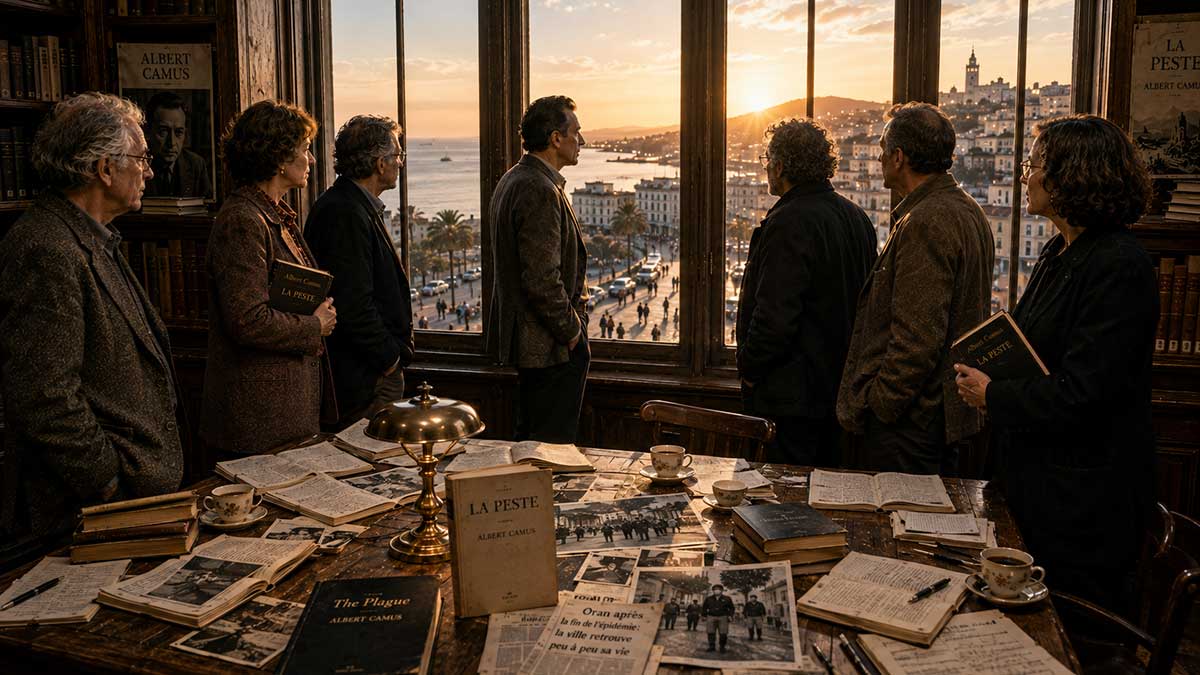
The brass lamp had burned low.
Beyond the library windows, the night above Oran had begun to soften. The black sky was turning blue at its edges. A pale line appeared above the Mediterranean.
Morning was still distant, yet no longer impossible.
The scholars had spent hours discussing history, absurdity, responsibility, faith, and suffering.
Now their books lay open but untouched.
Camus looked around the table.
Albert Camus: We have reached the question that would probably trouble me most.
Robert Zaretsky: Which one?
Albert Camus: Why readers believe this novel speaks directly to their own time.
Alice Kaplan: You sound suspicious of relevance.
Albert Camus: I am suspicious of every generation that believes history has chosen it for special attention.
Ronald Aronson: Yet some moments do make older books newly urgent.
Albert Camus: Yes.
Susan Neiman: The recent pandemic did exactly that.
People who had never read The Plague suddenly found themselves living inside scenes they recognized.
Closed borders.
Separated families.
Exhausted doctors.
Official hesitation.
Rumor.
Denial.
Loneliness.
Public anger.
Collective fatigue.
David Sherman: The novel stopped feeling like allegory.
It began to feel like reportage.
Camus looked displeased.
Albert Camus: That is exactly what worries me.
Matthew Sharpe: Why?
Albert Camus: A novel can become too easy to admire when reality appears to confirm it.
Readers say, “Camus predicted us.”
Then they congratulate the book and forget to question themselves.
Robert Zaretsky: Yet recognition can lead to reflection.
Albert Camus: It can.
It can also become literary tourism.
People visit a catastrophe through a novel, feel wise for recognizing the parallels, then return unchanged to their habits.
Alice turned several pages in her notes.
Alice Kaplan: Still, the parallels were extraordinary.
The early denial in Oran.
The reluctance to name the plague.
The administrative language.
The hunger for reliable information.
The separation of lovers.
The growing resentment of restrictions.
The exhaustion that arrives after fear.
Camus listened.
Alice Kaplan: Readers did not merely identify scenes.
They recognized emotional stages.
Albert Camus: That matters more.
Susan Neiman: The novel understands that crises do not remain dramatic.
They become repetitive.
Boredom enters.
Moral attention weakens.
People grow tired of caring before suffering ends.
Albert Camus: Yes.
Catastrophe becomes most dangerous when it stops feeling exceptional.
David Sherman: Then one reason the novel remains timely is its study of duration.
Matthew Sharpe: Exactly.
Many crisis narratives focus on the first shock or final rescue.
The Plague focuses on the middle.
The long period when people must continue acting without novelty, certainty, or visible progress.
Albert Camus: That is where character is tested.
Not during the first alarm.
During the hundredth ordinary morning.
Ronald leaned forward.
Ronald Aronson: Yet we should not confine relevance to pandemics.
Albert Camus: Certainly not.
Ronald Aronson: Fascism remains part of the novel’s political memory.
Authoritarian movements still grow through fear, repetition, dehumanization, and obedience.
Susan Neiman: Propaganda can spread like infection.
Alice Kaplan: So can racial myths.
David Sherman: Conspiracy thinking.
Matthew Sharpe: Political hatred.
Robert Zaretsky: Indifference.
Camus raised one hand.
Albert Camus: Be careful.
Robert Zaretsky: With what?
Albert Camus: You are beginning to name every modern problem a plague.
Susan Neiman: Is that wrong?
Albert Camus: It can become lazy.
A symbol that means everything may eventually mean nothing.
Matthew Sharpe: Then what qualifies?
Camus thought for a moment.
Albert Camus: A plague is not merely something harmful.
It is something that spreads through human relations, alters ordinary conduct, and persuades people to accept what they once would have resisted.
The scholars became quiet.
David Sherman: That is a demanding definition.
Albert Camus: It should be.
Ronald Aronson: By that standard, authoritarianism qualifies.
Albert Camus: Yes.
Susan Neiman: Hatred that becomes socially normal qualifies.
Albert Camus: Yes.
Alice Kaplan: Colonial habits that make whole populations invisible.
Albert Camus: Yes.
Matthew Sharpe: Misinformation that dissolves shared reality.
Camus hesitated.
Albert Camus: Possibly.
Robert Zaretsky: Why only possibly?
Albert Camus: Falsehood is ancient.
The modern scale may be new.
The human appetite for comfortable lies is not.
Susan looked toward him.
Susan Neiman: What about loneliness?
Camus studied her.
Susan Neiman: Not private solitude.
Mass loneliness.
People surrounded by messages, images, and crowds, yet increasingly unable to trust, depend upon, or remain present for one another.
Albert Camus: Loneliness can spread.
Susan Neiman: It can weaken solidarity.
David Sherman: It can make resentment attractive.
Ronald Aronson: It can make political belonging more seductive when social belonging has failed.
Camus nodded.
Albert Camus: Then yes.
It may become plague-like when isolation begins teaching people that others are enemies, obstacles, or abstractions.
Alice looked outside.
A single fishing boat moved across the dark water.
Alice Kaplan: What about climate catastrophe?
Albert Camus: That is not metaphorical.
Alice Kaplan: No.
Yet denial, delay, unequal exposure, and fatigue resemble the moral patterns of the novel.
Albert Camus: Then use the resemblance carefully.
Real disasters do not need literature to become serious.
Matthew Sharpe: But literature can give people a language for their response.
Albert Camus: Yes.
Language for response.
Not permission to replace one crisis with another in a clever comparison.
Robert smiled faintly.
Robert Zaretsky: You are a difficult author to celebrate.
Albert Camus: Good.
Celebration makes writers harmless.
The library attendant returned with a ring of keys.
He stopped when he saw everyone still seated.
Library Attendant: You have stayed through the night.
Alice Kaplan: It appears so.
The attendant walked to the windows and pulled one curtain aside.
A grey dawn entered the room.
Library Attendant: The city will wake soon.
He looked at the table.
Library Attendant: Have you found your answer?
Robert Zaretsky: We have found several.
Library Attendant: That usually means no.
Camus smiled.
Albert Camus: What do you think makes this book relevant now?
The attendant considered the question.
Library Attendant: People read it whenever they become afraid of other people.
The scholars watched him.
Susan Neiman: Explain.
Library Attendant: During an outbreak, people fear one another’s bodies.
During war, they fear names, accents, uniforms.
During political trouble, they fear opinions.
During hard times, they fear anyone who may take what little remains.
He placed the keys on the desk.
Library Attendant: The book reminds them that fear can protect life.
Then it can begin destroying it.
Camus looked toward the scholars.
Albert Camus: Again.
Matthew Sharpe: Again, he improves the panel.
The attendant laughed softly.
Library Attendant: I only open the building.
Camus: That may be enough philosophy for one morning.
The man continued toward the entrance.
A few lights came on in distant corridors.
The library slowly returned from night to institution.
Susan looked around the table.
Susan Neiman: The most asked modern question may be whether people learned anything from the recent pandemic.
Ronald Aronson: Some institutions did.
Alice Kaplan: Some communities did.
David Sherman: Many individuals did.
Matthew Sharpe: Yet memory is already becoming selective.
Robert Zaretsky: Which parts are being forgotten first?
Alice Kaplan: The unequal burden.
Ronald Aronson: The dependence on low-paid workers.
Susan Neiman: The loneliness of the elderly.
David Sherman: The moral injury carried by medical staff.
Matthew Sharpe: The speed with which uncertainty became hostility.
Camus looked toward the brightening window.
Albert Camus: People remember interruption more readily than dependence.
Robert Zaretsky: What do you mean?
Albert Camus: They remember what they were prevented from doing.
They forget who continued working so life would remain possible.
A silence followed.
The first tram of the morning rattled somewhere below.
Ronald crossed his arms.
Ronald Aronson: There is another reason the novel remains current.
It warns against treating emergency as politically neutral.
Crises expose who receives protection and who is expected to absorb risk.
Alice Kaplan: They expose who appears in the official story.
Susan Neiman: Who is mourned.
David Sherman: Who is counted.
Matthew Sharpe: Who is believed.
Camus nodded.
Albert Camus: Yes.
A plague is biological.
Its suffering is social.
Robert Zaretsky: Then the phrase “we are all in this together” may conceal as much as it reveals.
Albert Camus: People may share a storm without sharing the same shelter.
The sentence held the room.
Alice glanced at Camus.
Alice Kaplan: That may be one of the lines modern readers most need.
Albert Camus: Then distrust it before printing it.
A brief laugh passed around the table.
Susan turned serious again.
Susan Neiman: We have named disease, authoritarianism, prejudice, misinformation, loneliness, and environmental crisis.
Which modern plague would concern you most?
Camus did not answer quickly.
He looked at the scholars.
At the books.
At the ceiling stain.
At the rescued volumes.
At the lamp almost extinguished.
Albert Camus: The habit of unreality.
David Sherman: What does that mean?
Albert Camus: The growing preference for narratives that protect identity over facts that demand responsibility.
Matthew Sharpe: Political unreality?
Albert Camus: Political.
Personal.
National.
Religious.
People have always lied.
What concerns me is the pleasure of living inside a shared lie.
Ronald Aronson: That can prepare the ground for authoritarianism.
Albert Camus: Yes.
Alice Kaplan: For exclusion too.
Albert Camus: Yes.
Susan Neiman: And for moral exhaustion.
If no one agrees on what is real, responsibility becomes impossible to assign.
David Sherman: Solidarity requires some common reality.
Albert Camus: At least enough to recognize the person bleeding beside you.
Robert opened his notebook.
Robert Zaretsky: Then perhaps today’s plague is not misinformation alone.
It is the erosion of the conditions required for shared responsibility.
Camus considered this.
Albert Camus: That is closer.
Matthew Sharpe: Yet the novel resists despair here too.
Rieux does not wait for complete agreement.
He acts on what is before him.
Albert Camus: Yes.
Shared truth may be damaged.
Immediate suffering can still demand a response.
Ronald Aronson: Yet large-scale action requires trust.
Albert Camus: Which must be rebuilt through truthful practice, not merely demanded.
Alice leaned forward.
Alice Kaplan: What would truthful practice look like?
Albert Camus: Admitting uncertainty without inventing certainty.
Correcting mistakes publicly.
Naming unequal burdens.
Refusing to turn opponents into diseases.
Distinguishing warning from panic.
Letting facts alter one’s position.
Susan Neiman: That last one may be the hardest.
Albert Camus: Pride is one of the oldest epidemics.
The sun had begun rising behind the city.
Warm light reached the upper shelves, leaving the table partly in shadow.
David watched the contrast.
David Sherman: We should address the ending.
Why does the novel conclude with celebration and warning at the same time?
Camus looked toward him.
Albert Camus: Any ending that offered only celebration would be false.
Matthew Sharpe: The gates reopen.
Families reunite.
The city rejoices.
Yet Rieux warns that the bacillus never disappears completely.
Albert Camus: Victory deserves joy.
Joy must not become forgetfulness.
Susan Neiman: Is that the balance every generation fails to hold?
Albert Camus: Often.
People want grief to end.
They confuse ending grief with ending memory.
Robert Zaretsky: Yet permanent vigilance can make normal life impossible.
Albert Camus: I do not ask people to live permanently afraid.
Robert Zaretsky: What do you ask?
Albert Camus: To remain interruptible.
Alice Kaplan: By what?
Albert Camus: By evidence.
By another person’s suffering.
By history.
By the possibility that one has been wrong.
Matthew nodded slowly.
Matthew Sharpe: That may be the opposite of indifference.
Not constant sorrow.
A willingness to be disturbed.
Albert Camus: Yes.
A person need not carry the whole world every hour.
But he should not become unreachable.
Ronald looked toward the city below.
Workers were opening cafés.
Delivery carts moved through the streets.
A hospital shift was changing.
Ronald Aronson: Then what warning should every future generation remember?
Camus looked around the table.
Albert Camus: Answer one by one.
Robert began.
Robert Zaretsky: Never mistake the disappearance of immediate danger for the disappearance of the conditions that created it.
Alice Kaplan: Ask who is absent from every story of shared suffering.
Matthew Sharpe: Do not confuse uncertainty with permission to do nothing.
Ronald Aronson: Private decency must become public solidarity, or organized harm will outrun it.
David Sherman: Moral responsibility begins before certainty becomes complete.
Susan Neiman: Never let explanations make innocent suffering acceptable.
They turned toward Camus.
He watched the sun rise over Oran.
Albert Camus: Do not wait for the plague to announce its name.
No one spoke.
Camus continued.
Albert Camus: By the time a society agrees that hatred, falsehood, cruelty, or indifference has become dangerous, many people have already paid the price.
Matthew Sharpe: Then what signs should people notice?
Albert Camus: Language that makes neighbors less human.
Institutions that hide consequences behind procedure.
Leaders who turn uncertainty into enemies.
Citizens who prefer belonging to truth.
Fatigue used as an excuse for abandonment.
Suffering treated as someone else’s department.
Susan closed her eyes briefly.
Susan Neiman: That is a grim list.
Albert Camus: Diagnosis often is.
David Sherman: And the treatment?
Camus looked at him.
Albert Camus: Truth without humiliation.
Action without illusion.
Solidarity without purity.
Memory without paralysis.
Hope without lies.
The room became quiet.
Robert smiled.
Robert Zaretsky: That sounds suspiciously final.
Albert Camus: Then let us damage it.
Alice laughed.
Alice Kaplan: How?
Albert Camus: By remembering that every principle fails if it cannot meet the next actual person.
The entrance doors opened downstairs.
Voices entered the building.
Students.
Librarians.
Workers beginning another day.
The night discussion was ending.
Susan looked at Camus.
Susan Neiman: You warned us not to turn the novel into a prediction manual.
What should modern readers do with it instead?
Camus picked up Robert’s annotated copy.
He turned several pages, then closed it.
Albert Camus: Read it as a mirror that refuses flattery.
Matthew Sharpe: Meaning?
Albert Camus: Do not ask only which character resembles your enemy.
Ask when you have sounded like Cottard.
When you have wanted to escape like Rambert.
When you have judged like Paneloux.
When you have hesitated like the authorities.
When you have worked like Rieux.
When you have noticed like Tarrou.
When you have continued like Grand.
Robert took back the book.
Robert Zaretsky: That may be why it remains relevant.
Every reader can locate himself somewhere inside the city.
Albert Camus: Yes.
Alice Kaplan: Yet not always where he expects.
Albert Camus: Especially not there.
The library attendant returned and began extinguishing the lamps that were no longer needed.
He reached the brass lamp in the center of the table.
Library Attendant: May I?
Camus nodded.
The man lowered the flame.
Morning light filled the space it had occupied.
Library Attendant: The sun has taken over.
Albert Camus: Temporarily.
The attendant smiled and carried the lamp away.
The scholars began gathering their books and papers.
Ronald paused beside the rescued volumes near the leaking roof.
Ronald Aronson: We should report this again before leaving.
Alice Kaplan: And make certain someone answers.
David Sherman: Relief and reform.
Albert Camus: You remembered.
Robert slipped his book beneath one arm.
Robert Zaretsky: Have we answered why The Plague feels more relevant today than ever?
Camus looked around the library.
At the ceiling stain.
At the empty cups.
At the morning city.
At seven chairs surrounding a table where no final agreement had been reached.
Albert Camus: It feels relevant whenever people rediscover that their private lives depend upon strangers.
Susan stood beside him.
Susan Neiman: And whenever they forget?
Camus looked through the window at the waking streets.
Albert Camus: Then it becomes necessary again.
They left the table one by one.
The books went with them.
The questions did not.
Outside, Oran had entered another ordinary morning.
A doctor crossed the street carrying a bag.
A baker opened his doors.
A cleaner swept rainwater from the pavement.
A woman held a stranger’s place in line.
A man read a headline and paused before passing it to someone else.
No trumpet announced these acts.
No monument recorded them.
Yet the city continued through them.
Camus stopped at the library entrance and looked back once.
The table stood empty beneath the brightening windows.
Albert Camus: The plague never has the final word.
Robert stood beside him.
Robert Zaretsky: What does?
Camus watched the people moving through the square.
Albert Camus: No one.
He stepped outside.
Albert Camus: That is why we must keep answering.
Final Thoughts by Albert Camus
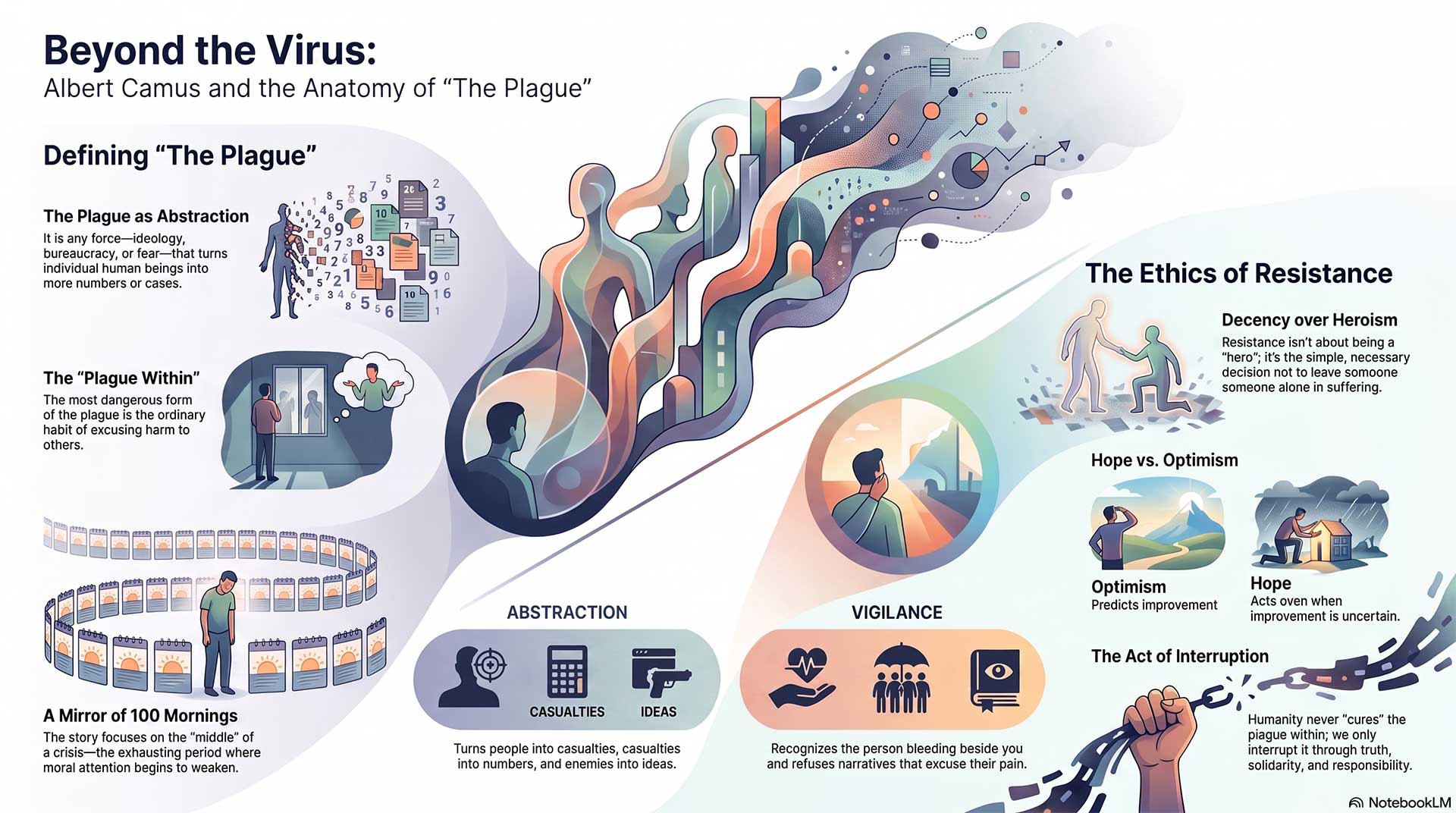
When I finished writing The Plague, I knew readers would disagree about it.
I hoped they would.
Agreement may end a conversation.
Disagreement, when pursued honestly, keeps a book alive.
Tonight, we spoke about fascism, colonialism, absurdism, suffering, faith, political responsibility, moral courage, loneliness, and the crises of our own century.
Every one of those discussions revealed something true.
Yet none exhausted the novel.
That is exactly as it should be.
The plague is not merely a disease.
Neither is it merely a metaphor.
It is every force that slowly persuades human beings to stop recognizing the dignity of one another.
It spreads through fear.
Through indifference.
Through pride.
Through comforting lies.
Through habits that allow suffering to become ordinary.
But another contagion exists.
Compassion.
Truthfulness.
Solidarity.
Quiet acts of responsibility.
These spread from person to person just as surely.
History remembers wars, revolutions, epidemics, and famous leaders.
Civilization survives because countless ordinary people choose to care for someone they did not have to care for.
That was true in Oran.
It remains true today.
When you close this book, I hope you remember only one thing.
Do not spend your life searching for the next plague.
Spend your life becoming one of the people who quietly limits its reach.
That work never ends.
Perhaps that is why hope never ends either.
Short Bios:
Albert Camus (Moderator)
French-Algerian novelist, essayist, journalist, and recipient of the 1957 Nobel Prize in Literature. His major works include The Stranger, The Plague, The Myth of Sisyphus, The Rebel, and The Fall. Camus explored the tension between human longing for meaning and a world that offers no final guarantees. He rejected ideological extremism, defended moral limits, and believed that ordinary acts of decency form the foundation of civilization.
Robert Zaretsky
Historian, biographer, and one of the world's leading Albert Camus scholars. His work explores Camus' moral philosophy, historical context, and enduring ethical influence. Zaretsky is widely recognized for making Camus accessible to modern readers without reducing the complexity of his ideas.
Alice Kaplan
Historian, literary scholar, and acclaimed biographer of Albert Camus. Her research examines Camus' life in French Algeria, his creative process, political environment, and the historical forces that shaped The Plague. She is known for placing Camus within the realities of colonial history while appreciating his universal moral concerns.
Matthew Sharpe
Contemporary philosopher and one of the foremost interpreters of Camus' philosophy. Sharpe specializes in absurdism, rebellion, ethics, and modern humanism, helping readers distinguish Camus' thought from existentialism and other twentieth-century philosophical traditions.
Ronald Aronson
Political philosopher and distinguished Camus scholar whose work explores Camus' relationship with Marxism, revolutionary politics, resistance movements, and twentieth-century intellectual history. Aronson highlights the political dimensions of Camus' moral philosophy without losing sight of its human focus.
David Sherman
Philosopher specializing in nineteenth- and twentieth-century French thought, ethics, phenomenology, and the history of philosophy. Sherman's work often examines Camus through questions of moral responsibility, human dignity, and the ethical demands placed upon ordinary people.
Susan Neiman
American moral philosopher, public intellectual, and author whose work focuses on evil, Enlightenment philosophy, responsibility, and moral judgment. Though her scholarship extends beyond Camus, her reflections on suffering, justice, and ethical responsibility make her an ideal conversation partner for The Plague.
Leave a Reply