
Introduction
What if Jesus knew how much suffering would later occur in his name?
José Saramago’s The Gospel According to Jesus Christ is not a conventional retelling of the life of Jesus.
It is a moral confrontation.
Saramago takes figures familiar to billions of people—Jesus, Joseph, Mary Magdalene, God, and the Devil—and places them inside questions that traditional theology often tries to settle too quickly.
What does a person owe others when he knows they are in danger?
Can love become selfish when it chooses one life over many?
Can sacrifice remain sacred if the person being sacrificed did not truly choose it?
Does divine foreknowledge leave room for genuine freedom?
Can a future filled with faith, mercy, and hope justify the suffering committed along the way?
And perhaps the most difficult question of all:
Who has the right to ask whom for forgiveness?
This imaginary conversation begins with Joseph.
He once learned that children in Bethlehem were in danger. He ran to save Jesus but did not warn the other families.
That decision becomes the first moral wound.
Jesus confronts him with a devastating question:
If their mothers loved their children as much as Joseph loved him, what made Jesus the one life worth saving first?
Joseph does not defend himself.
He admits that fear narrowed his love.
He thought first of his own child.
By the time he thought of the others, it was too late.
Yet the conversation refuses to end with condemnation.
Joseph eventually reaches a deeper realization:
Regret looks backward.
Responsibility turns around.
That lesson becomes crucial when Jesus discovers that he now faces a larger version of his father’s dilemma.
God reveals the future.
Jesus sees communities created in his name.
Mercy.
Hope.
Care for the sick.
Forgiveness.
Belonging.
Yet he sees something else too.
Martyrs.
Persecution.
Religious wars.
Executions.
People dying for doctrine.
People killing for doctrine.
The central conflict of the conversation changes.
Jesus is no longer asking whether Joseph failed Bethlehem.
He is asking whether he himself will fail generations yet unborn by allowing his life and death to become a symbol history may use in ways he cannot control.
Mary Magdalene becomes the fiercest defender of the human being beneath the symbol.
God speaks about centuries.
Mary speaks about mornings.
God speaks about what Jesus can accomplish.
Mary speaks about who Jesus is when he cannot sleep.
Her question becomes one of the emotional centers of the entire conversation:
Does God love Jesus—or what Jesus can accomplish?
Mary never claims her own love is pure.
She wants Jesus alive.
She wants ordinary days.
Bread.
Arguments.
Age.
A private life.
Yet she refuses to hide what she wants.
That honesty gives her a moral strength missing from every system that asks Jesus to surrender himself for a future someone else has defined.
The Shepherd, representing the Devil, destabilizes every easy category.
He asks whether God requires evil in order to define good.
He offers reconciliation.
If God forgives him, perhaps the cosmic conflict could end.
God refuses.
That refusal raises an unsettling question:
If good requires an enemy in order to remain meaningful, who benefits from keeping the enemy alive?
Then the conversation turns toward freedom.
Jesus realizes that rebellion may still fulfill the very destiny he is trying to escape.
He can refuse followers.
They may follow the man who refuses followers.
He can deny being Messiah.
The denial may become proof.
He can try to die as a political criminal rather than as a divine sacrifice.
History may still turn his death into something larger.
Jesus finally asks:
If God knows every choice before he makes it, created the circumstances, and cannot be surprised, what part of his life truly belongs to him?
The answer that emerges is subtle.
Freedom may not mean escaping destiny.
It may mean refusing to surrender the meaning of one’s actions to destiny.
Jesus may not control what history does with him.
He can still choose why he speaks.
Why he loves.
Why he heals.
Why he goes to Jerusalem.
Why he refuses hatred.
The final conversation takes place at the cross.
There Jesus no longer asks whether humanity deserves forgiveness.
He asks whether forgiveness can move upward.
Can humanity forgive God?
Can a wounded person be expected to forgive before the one who caused the wound understands what happened?
Can love remain love when accountability has not yet arrived?
Jesus reaches no easy reconciliation.
Instead, he says:
“I forgive what I can. What I cannot, I leave unfinished.”
That may be the most honest conclusion this conversation could reach.
Not certainty.
Not absolution.
Not accusation alone.
Responsibility.
(Note: This is an imaginary conversation, a creative exploration of an idea, and not a real speech or event.)
Topic 1: Joseph’s Secret — Who Do We Owe When We Know Someone Is in Danger?
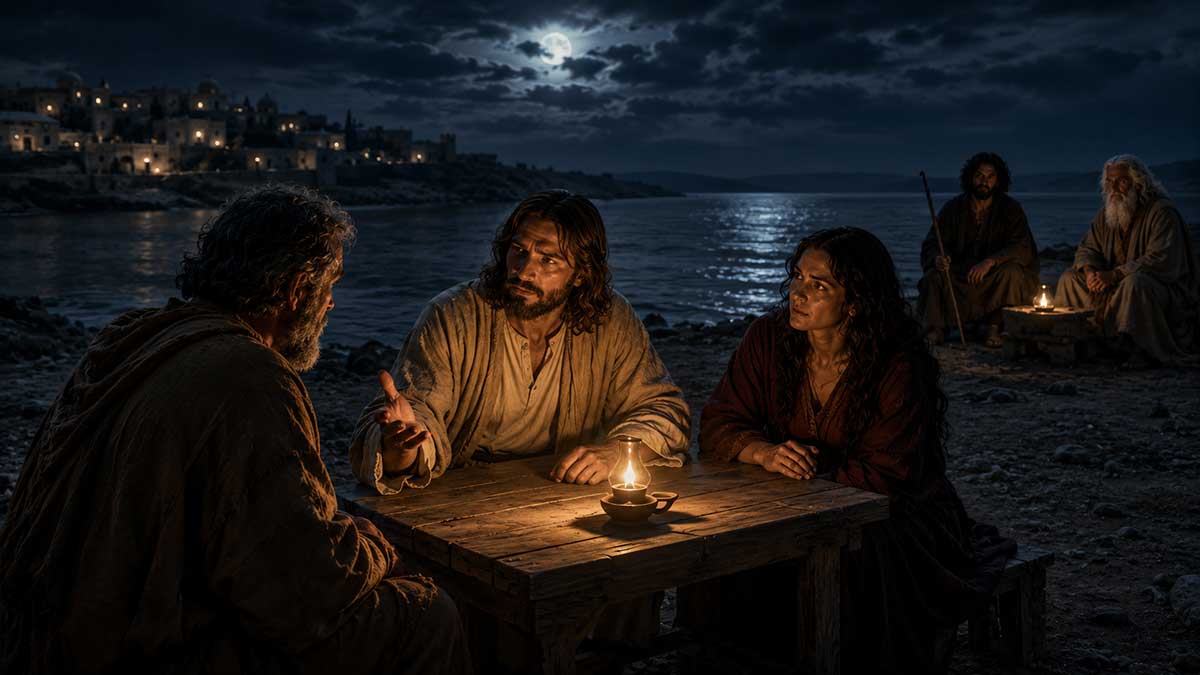
Night had settled over the Sea of Galilee.
The water was almost black.
A single lamp burned on the table.
Jesus sat across from Joseph.
Mary Magdalene sat beside Jesus, close enough that their shoulders nearly touched.
God remained at the far end.
The Shepherd sat opposite him, smiling at nothing.
No one spoke.
Jesus looked at Joseph.
Jesus: When you heard the children were going to die, how long did it take you to think of me?
Joseph lowered his eyes.
Joseph: Immediately.
Jesus nodded.
Jesus: And how long did it take you to think of them?
Joseph did not answer.
The Shepherd leaned back.
Mary looked at Joseph.
God remained still.
Jesus waited.
Jesus: Was it a minute?
Joseph closed his eyes.
Jesus: Ten minutes?
Nothing.
Jesus: Did you think of them while you were running?
Joseph’s mouth moved.
No sound came.
Jesus leaned forward.
Jesus: Did you hear mothers screaming behind you?
Joseph looked up sharply.
Joseph: Yes.
Jesus went still.
Mary turned toward him.
The word had wounded him more than denial would have.
Jesus: You heard them.
Joseph: Yes.
Jesus: And kept running.
Joseph’s face folded.
Joseph: Yes.
Did Joseph Choose Jesus Over Innocent Children?
Mary reached toward Jesus’s arm.
He pulled away.
Not from anger at her.
He needed space.
Jesus: Tell me what you thought.
Joseph’s voice shook.
Joseph: I thought of you.
Jesus: Only me?
Joseph: At first.
Jesus: At first.
Joseph swallowed.
Joseph: Then I thought of the others.
Jesus stared at him.
Jesus: After we were safe?
Joseph looked down.
Joseph: Yes.
Jesus stood.
The lamp trembled in the wind.
Jesus: After.
He walked several steps away from the table.
Jesus: After you had saved your son.
After their sons had nowhere to run.
Joseph’s hands tightened together.
Joseph: I was afraid.
Jesus turned.
Jesus: So were they.
Joseph: I know.
Jesus: Their fathers were afraid.
Joseph: I know.
Jesus: Their mothers were afraid.
Joseph: I know.
Jesus: Their children were afraid.
Joseph whispered:
Joseph: I know.
Jesus’s voice rose.
Jesus: Then stop saying you were afraid as though fear belonged only to you.
Joseph flinched.
Mary spoke softly.
Mary Magdalene: Jesus.
He looked toward her.
Mary Magdalene: He is not excusing himself.
Jesus shook his head.
Jesus: He spent years excusing himself in silence.
Joseph stood.
Joseph: No.
Jesus turned toward him.
Joseph’s voice broke.
Joseph: Silence was not an excuse.
It was punishment.
The table went quiet.
Joseph: Every night I heard them.
Every night I saw the road.
Every night I saw myself running away.
He looked at Jesus.
Joseph: Do you think I ever forgot?
Jesus’s anger remained.
Jesus: Forgetting is not the question.
Joseph nodded slowly.
Joseph: No.
Jesus stepped closer.
Jesus: The question is whether remembering changed anything for them.
Joseph closed his eyes.
Joseph: Nothing changed for them.
That answer stopped Jesus.
No defense.
No request for mercy.
Only the fact.
Mary looked at Joseph differently.
The Shepherd’s smile disappeared.
Can a Father Be Blamed for Saving His Own Child First?
Mary finally spoke.
Mary Magdalene: If someone tells a mother that soldiers are coming and she can save one child, what do you expect her to do?
Jesus looked at her.
Mary Magdalene: Think of justice first?
Think of every other house first?
Or run to the child whose face she knows?
Jesus answered quietly.
Jesus: She should warn the others.
Mary Magdalene: Yes.
Jesus: He could have.
Mary Magdalene: Yes.
She looked toward Joseph.
Mary Magdalene: But that does not make the first impulse monstrous.
Jesus’s face tightened.
Mary Magdalene: Loving one person more closely than everyone else is part of being human.
Jesus shook his head.
Jesus: Then love can kill strangers.
Mary did not retreat.
Mary Magdalene: Love can become narrow.
Fear can make it narrow.
That is not the same as saying love itself is evil.
Joseph sat again.
Joseph: I did not choose their deaths.
Jesus turned.
Jesus: You chose not to warn them.
Joseph looked at him.
Joseph: Yes.
Jesus waited.
Joseph continued.
Joseph: And that choice belongs to me.
No soldier made it for me.
No prophecy made it for me.
No God made it for me.
At that, God finally spoke.
God: Are you certain?
Joseph turned.
Jesus did too.
The Shepherd’s eyes sharpened.
God: If you had warned every family, perhaps you would have been caught.
Perhaps Jesus would have died.
Perhaps history would have ended before it began.
Jesus stared at him.
Joseph’s face went pale.
Mary’s expression hardened.
Mary Magdalene: Do not do that.
God looked toward her.
Mary Magdalene: Do not turn dead children into necessary pieces.
God: I stated a possibility.
Mary Magdalene: You stated it like an accounting entry.
God’s voice remained calm.
God: History has consequences.
Jesus: So did his silence.
God looked at Jesus.
Jesus: Are you saying my life was worth theirs?
God did not answer.
Jesus stepped closer.
Jesus: Say it.
Joseph whispered:
Joseph: No.
Jesus looked at him.
Joseph shook his head.
Joseph: Do not ask him to make my sin useful.
Everyone went quiet.
Joseph turned toward God.
Joseph: I have spent my life wanting that answer.
The Shepherd watched him.
Joseph: I wanted someone to tell me I had saved the child who mattered most.
That history required it.
That God needed it.
That some future good came from what I failed to do.
His voice shook.
Joseph: If you tell me that now, you will only make cowardice sacred.
Mary looked down.
Jesus’s anger changed.
Not gone.
Changed.
If Joseph’s Failure Served God’s Plan, Was It Still a Failure?
The Shepherd leaned forward.
Shepherd: Now we reach the interesting part.
God looked toward him.
The Shepherd ignored him.
Shepherd: Joseph fails to warn them.
Jesus survives.
Jesus becomes who God intends.
Suppose the silence helped the plan.
He looked toward Joseph.
Shepherd: Was it still wrong?
Joseph answered first.
Joseph: Yes.
Shepherd: Quickly said.
Joseph: Since the children still died.
Shepherd: But if their deaths preserved the life that later saves millions?
Jesus turned sharply.
Jesus: Do not speak of them as numbers.
The Shepherd looked at him.
Shepherd: I am using the language your Father understands.
God’s face hardened.
Mary looked from one to the other.
Shepherd: This is what plans do.
They move suffering into the future tense and call it purpose.
God replied.
God: Without history, you would have no language for sacrifice at all.
Shepherd: Without suffering, you would have less need for sacrifice.
God did not answer.
Joseph stared at the table.
Jesus looked toward him again.
Jesus: Did you ever ask yourself whether my life became heavier since theirs ended?
Joseph whispered:
Joseph: Every day.
Jesus: I was a child.
Joseph: I know.
Jesus: I did not choose to survive them.
Joseph: I know.
Jesus: Yet I carried their deaths before I knew their names.
Joseph’s eyes filled.
Joseph: That was my doing.
Jesus looked at him.
Joseph continued.
Joseph: I gave you a life attached to a debt you never created.
The sentence broke something in Jesus.
He sat.
Mary touched his arm again.
This time, he let her.
What Does Guilt Do to the Innocent?
Jesus spoke more quietly now.
Jesus: When I learned what happened, I hated you.
Joseph nodded.
Jesus: I thought if I judged you hard enough, I could separate myself from you.
Joseph looked up.
Jesus: Your fear.
Your silence.
Your guilt.
I thought they could remain yours.
Joseph waited.
Jesus looked toward the water.
Jesus: Then God showed me the future.
The table changed.
Everyone understood where he was going.
Jesus: People dying.
People killing.
People calling my name while they do both.
Joseph looked stricken.
Jesus: And suddenly I understood you.
Joseph whispered:
Joseph: No.
Jesus: Yes.
Joseph: No.
He stood again.
Joseph: Do not understand me too quickly.
Jesus stared.
Joseph: I knew danger was coming that night.
You know centuries are coming.
I had minutes.
You have time.
Do not make me your excuse.
Jesus’s eyes filled.
Joseph: If you can warn them, warn them.
If you can refuse, refuse.
If you can change the path, change it.
He stepped closer.
Joseph: Do not inherit my failure just since it helps you understand your own fear.
Jesus looked at him.
Mary watched them both.
God remained silent.
The Shepherd leaned back.
For once, he did not interfere.
Is Knowing Enough to Make Us Responsible?
Mary broke the silence.
Mary Magdalene: There is a difference between knowing and being able to stop something.
Jesus turned.
Mary Magdalene: Joseph knew enough to warn people.
You know what God says may happen.
That does not mean you control history.
Jesus looked toward God.
Jesus: Then why tell me?
God answered.
God: Since you asked.
Jesus: That is not enough.
God: Truth is not obligated to comfort you.
Jesus: Nor is knowledge morally neutral once given.
The Shepherd smiled faintly.
Shepherd: There he is.
God ignored him.
Jesus continued.
Jesus: If I know people may suffer in my name, then I am no longer free to pretend I do not know.
Joseph nodded.
Joseph: Exactly.
Jesus looked at him.
Joseph held his gaze.
Joseph: That is the difference between us.
Jesus: What difference?
Joseph: I knew and ran.
You know and are still standing here.
Jesus looked away.
Joseph stepped closer.
Joseph: What you do next is yours.
God spoke.
God: Not entirely.
Jesus turned sharply.
Jesus: Then whose?
God looked at him.
God: History is larger than one will.
The Shepherd laughed softly.
Shepherd: Convenient.
God’s voice hardened.
God: True.
Jesus: If history is larger than my will, why punish anyone for anything?
The question stopped the room.
Joseph looked toward God.
Mary did not move.
The Shepherd’s smile returned.
God answered slowly.
God: Since choice remains meaningful inside limits.
Jesus shook his head.
Jesus: Meaningful to whom?
No answer came quickly.
Does Love Excuse Moral Failure?
Mary turned back to Joseph.
Mary Magdalene: Do you forgive yourself?
Joseph answered immediately.
Joseph: No.
She looked at him.
Mary Magdalene: Do you think you should?
Joseph hesitated.
Joseph: I think forgiveness is not mine to demand.
Jesus watched him.
Joseph: The mothers whose doors I passed are not here.
The fathers are not here.
The children are not here.
What right do I have to announce that I am forgiven?
Mary nodded.
Mary Magdalene: Yet if guilt destroys you, does that help them?
Joseph looked toward her.
Joseph: No.
Mary Magdalene: Then guilt must become something else.
Joseph waited.
Mary Magdalene: Attention.
Jesus looked at her.
Mary Magdalene: You failed to see the children beyond your own child.
If guilt has any value, it should make the next stranger harder to ignore.
Joseph’s eyes filled.
Joseph: Yes.
Mary turned toward Jesus.
Mary Magdalene: The same applies to you.
Jesus looked at her.
Mary Magdalene: You cannot save centuries all at once.
But every time history becomes a number, ask for a face.
Every time God says millions, ask who they are.
Every time someone tells you sacrifice is necessary, ask who is being sacrificed.
God looked toward her.
Mary Magdalene: Especially when the person demanding sacrifice does not bleed.
The lamp flame bent sharply in the wind.
God’s expression did not change.
What Would Joseph Do If Bethlehem Happened Again Tonight?
Jesus looked back at his father.
Jesus: If Bethlehem happened again tonight, what would you do?
Joseph did not hesitate.
Joseph: Wake every house.
Jesus: Knowing you might lose me?
Joseph’s face broke.
He looked at Jesus for a long time.
Joseph: Yes.
Jesus stared.
Joseph: I would take your hand.
I would run to the first door.
I would knock until someone opened.
Then the next.
Then the next.
Jesus’s eyes filled.
Jesus: And if the soldiers came before we escaped?
Joseph stepped closer.
Joseph: Then I would die knowing you saw me try.
Jesus lowered his head.
Joseph’s voice shook.
Joseph: I cannot change what I did.
I can only tell you what the truth has finally made impossible for me to do again.
Mary looked toward Jesus.
The Shepherd looked toward God.
God remained still.
Jesus whispered:
Jesus: Is that repentance?
Joseph answered.
Joseph: I do not know.
Jesus raised his eyes.
Joseph continued.
Joseph: I only know regret looks backward.
Responsibility turns around.
The words stayed over the table.
The Question Turns Toward God
Jesus slowly faced God.
Jesus: He knew children would die.
He saved me and failed them.
God watched him.
Jesus: You know people will die.
Martyrs.
Soldiers.
Heretics.
Believers.
People who will love me.
People who will hate me.
People who will kill while carrying my name.
God said nothing.
Jesus’s voice became quieter.
Jesus: Joseph had one night.
You have eternity.
Mary looked toward God.
The Shepherd folded his hands.
Joseph sat down.
Jesus continued.
Jesus: So tell me.
What will you do differently?
For the first time that evening, God did not answer immediately.
The silence became almost unbearable.
Then the Shepherd spoke.
Shepherd: Perhaps that is the wrong question.
Jesus turned toward him.
Shepherd: Perhaps you should ask whether he believes anything needs to be done differently.
Jesus looked back toward God.
God’s face remained unreadable.
The lamp flame flickered between them.
Joseph stared at his hands.
Mary moved closer to Jesus.
The water beyond the table remained black.
And the question that had begun with one frightened father in Bethlehem had become something far larger.
Not:
Why did Joseph fail?
But:
When someone knows suffering is coming, what does love require them to risk before knowledge itself becomes guilt?
No one at the table was ready to answer.
Especially God.
Topic 2: Does Mary Love Jesus More Truly Than God Does?
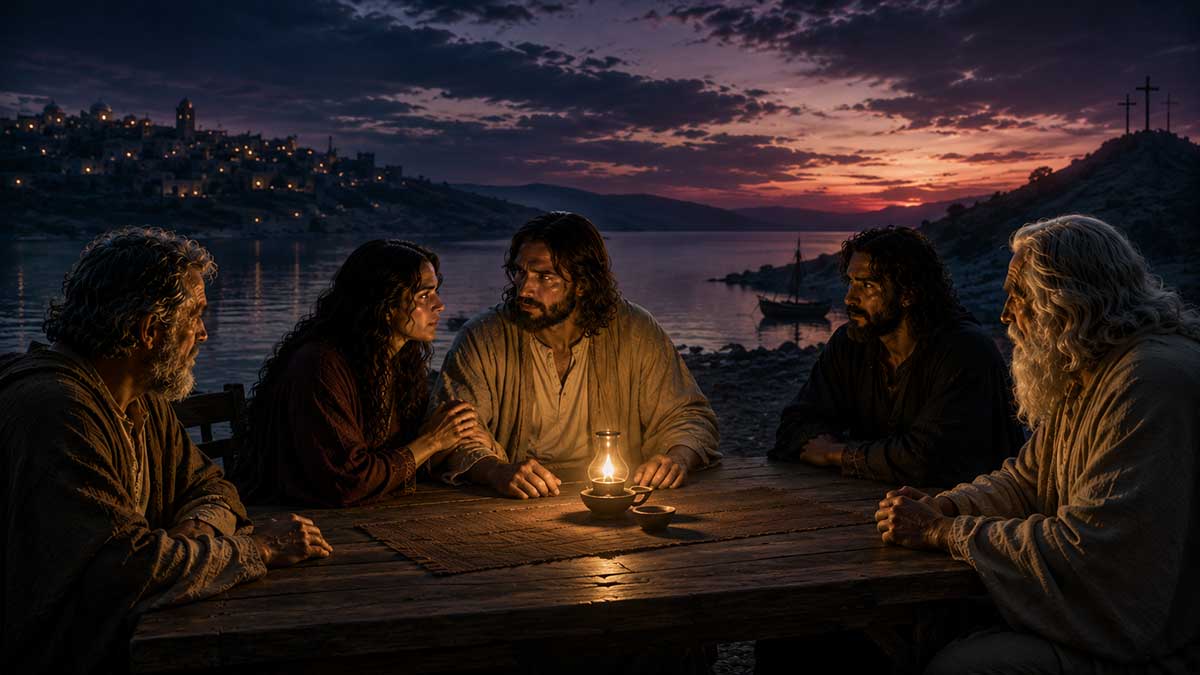
The lamp had burned lower.
No one had moved far from the table.
Joseph sat with both hands folded in front of him.
The Shepherd watched the water.
God remained still at the far end.
Mary Magdalene looked at Jesus.
Not at the Messiah.
Not at the future.
At Jesus.
He looked tired.
More tired than angry now.
She reached for his hand.
He let her take it.
What Kind of Love Does Jesus Actually Need?
Mary Magdalene: Everyone keeps speaking about what you must become.
Jesus looked at her.
Mary Magdalene: Your father speaks about what he failed to protect.
God speaks about what history needs.
The Shepherd speaks about whether you are free.
She tightened her hand around his.
Mary Magdalene: I want to know what you need.
Jesus looked down.
Jesus: I do not know.
God spoke.
God: Need is not the measure of vocation.
Mary turned.
Mary Magdalene: That is exactly the problem.
God: No. The problem is confusing love with comfort.
Mary Magdalene: And the danger is confusing love with demand.
The Shepherd smiled faintly.
Joseph looked between them.
God: Love that never asks sacrifice is often merely attachment.
Mary did not look away.
Mary Magdalene: Sacrifice chosen by whom?
God said nothing.
Mary continued.
Mary Magdalene: You speak of his suffering as though the greatness of the result makes the suffering yours to assign.
God: I know what his life can become.
Mary Magdalene: I know what his hands feel like when he cannot sleep.
The room went still.
Jesus looked toward her.
Mary’s voice softened.
Mary Magdalene: You know centuries.
I know the sound he makes when he wakes from a dream and pretends he was not afraid.
God’s expression did not change.
Mary Magdalene: You know what people may call him.
I know the name he answers to when no one is watching.
Jesus looked away.
Joseph’s face tightened.
The Shepherd stopped smiling.
Is Love Still Love When It Needs Someone to Become Something?
God: You believe your love is purer since it asks less of him.
Mary answered immediately.
Mary Magdalene: No.
I believe my love is different since I would still love him if he accomplished nothing.
God looked at Jesus.
God: And if his refusal abandoned millions?
Mary turned to Jesus.
Mary Magdalene: Then he should know that before he chooses.
God: He does know.
Mary Magdalene: Knowing consequences is not the same as consenting to them.
Jesus looked toward God.
Jesus: Did you ever intend to ask me?
God’s voice remained calm.
God: You were born into the question.
Jesus’s face changed.
Jesus: That is not an answer.
God: It is the truth.
Mary leaned forward.
Mary Magdalene: Then say it plainly.
God looked toward her.
Mary Magdalene: Was he ever allowed to be only a son?
Only a man?
Only someone loved by another person?
God answered.
God: No life exists outside consequence.
Mary Magdalene: That was not what I asked.
God: No.
The single word landed heavily.
Jesus closed his eyes.
Joseph lowered his head.
Mary did not let go of Jesus’s hand.
Does God Love Jesus—or What Jesus Can Accomplish?
The Shepherd spoke.
Shepherd: That is the interesting distinction.
God looked toward him.
Shepherd: If Jesus refused the mission entirely, would you love him differently?
God said nothing.
The Shepherd continued.
Shepherd: Not punish him.
Not judge him.
Love him.
Would you?
God finally answered.
God: Love is not sentimental approval.
Mary Magdalene: There.
Jesus looked toward her.
Mary Magdalene: Again.
A word becomes larger so the person inside it becomes smaller.
God’s gaze sharpened.
Mary Magdalene: He asks whether you would love him if he refused you.
You answer by redefining love.
God: Since the question is childish.
Jesus pulled his hand from Mary’s.
Not in anger.
He turned toward God.
Jesus: Then answer the childish question.
God watched him.
Jesus: If I say no—
not later,
not after another sign,
not after another miracle—
if I say no now,
do you love me?
Silence.
Joseph looked toward God.
The Shepherd leaned forward.
Mary’s face tightened.
God answered.
God: Yes.
Jesus waited.
Jesus: And what would you do?
God said nothing.
Jesus laughed once.
Bitterly.
Jesus: There.
Mary looked at him.
Jesus: Love may remain.
But the plan remains too.
Can Love Become Possession?
Joseph spoke for the first time.
Joseph: I knew this feeling.
Jesus turned.
Joseph looked ashamed.
Joseph: I loved you so much that night that everyone else became less real.
Mary watched him.
Joseph: Love can narrow.
It can become possession without knowing it.
God looked toward him.
Joseph: A father can say, “My son must live,” and forget that every other father is saying the same thing.
He looked at Mary.
Joseph: Perhaps God can say, “My son must fulfill his purpose,” and forget that purpose can crush the son inside it.
God’s face hardened.
God: You compare divine intention to human fear.
Joseph: I compare what happens to the person in the middle.
Jesus looked at Joseph differently.
Joseph continued.
Joseph: I saved him and told myself that love justified everything after.
You call him and tell yourself history justifies everything before.
The Shepherd laughed softly.
Shepherd: Fatherhood is becoming uncomfortable tonight.
God ignored him.
Mary’s Love Without Mission
Mary turned to Jesus.
Mary Magdalene: What do you want when no one asks you to save anything?
Jesus looked at her.
The question seemed unfamiliar.
Jesus: I do not know.
Mary Magdalene: Then start smaller.
What do you want tomorrow morning?
Jesus looked toward the dark water.
Jesus: To wake without someone telling me who I am.
Mary nodded.
Mary Magdalene: What else?
Jesus: Bread.
The Shepherd smiled.
Joseph almost did.
Jesus continued.
Jesus: To walk.
To hear someone complain about something unimportant.
To sleep without dreaming of men I have never met dying with my name in their mouths.
Mary’s eyes filled.
Mary Magdalene: That is a life.
God spoke.
God: It is a fragment of one.
Mary turned sharply.
Mary Magdalene: No.
It is the part you keep treating as expendable.
Jesus looked at God.
Mary continued.
Mary Magdalene: You measure his life by what survives him.
I measure it by whether he is alive inside it.
Is Sacrifice Still Sacred Without Consent?
God’s voice grew firmer.
God: There are moments when one life carries responsibility beyond itself.
Mary Magdalene: Responsibility is not ownership.
God: No one said it was.
Mary Magdalene: Then let him refuse.
The Shepherd looked toward God.
Joseph did too.
Jesus said nothing.
God answered slowly.
God: He can refuse.
The Shepherd raised an eyebrow.
Shepherd: Can he?
God looked toward him.
Shepherd: Or can he only refuse in ways that eventually serve the same outcome?
Jesus looked from one to the other.
Mary’s face changed.
Mary Magdalene: That comes later.
She turned back to God.
Mary Magdalene: Right now I am asking something simpler.
If sacrifice is holy only when offered, what do we call sacrifice imposed?
God answered.
God: Burden.
Mary Magdalene: Convenient.
God: Necessary.
Mary shook her head.
Mary Magdalene: Necessary to whom?
No answer came.
Does Jesus Owe Humanity His Life?
Jesus spoke quietly.
Jesus: Suppose I refuse.
Everyone turned toward him.
Jesus: Suppose I walk away with Mary.
Suppose we disappear.
Live somewhere no one knows me.
No miracles.
No followers.
No cross.
He looked toward God.
Jesus: What happens?
God answered.
God: History changes.
Jesus: How?
God: Fewer people hear what you would have taught.
Fewer communities form around your words.
Some acts of mercy never occur.
Some lives find less hope.
Some suffering you could have interrupted continues.
Jesus looked toward Mary.
Jesus: Then my private happiness would have a cost.
Mary answered.
Mary Magdalene: Every life has a cost.
God looked toward her.
Mary Magdalene: The question is whether he owes the entire world every possible good he might create.
Joseph nodded slowly.
Joseph: That is impossible.
Mary Magdalene: Yes.
She looked at Jesus.
Mary Magdalene: If you are responsible for every good you could have caused but did not, then no one is ever free to have a private life.
The Shepherd smiled.
Shepherd: At last.
God replied.
God: Jesus is not everyone.
Mary’s voice sharpened.
Mary Magdalene: That sentence is how you separate him from every human right you still expect him to carry.
Jesus looked down.
Who Loves Jesus the Man?
Mary moved closer.
Mary Magdalene: Do you know what frightens me?
Jesus looked at her.
Mary Magdalene: Not that you will die.
I know death comes.
Not that people will misunderstand you.
People misunderstand everyone they need too much from.
She looked toward God.
Mary Magdalene: I am afraid the world will love the meaning of your death more than the life you wanted.
Jesus’s eyes filled.
Mary Magdalene: They will make paintings.
Prayers.
Churches.
Arguments.
Laws.
Songs.
They will say your name in rooms you never saw.
And somewhere beneath all of it—
She touched his chest.
Mary Magdalene: —the man I knew may disappear.
Jesus whispered:
Jesus: Perhaps that is what has already begun.
Mary closed her eyes.
God watched them.
Joseph looked away.
The Shepherd’s expression had become almost sorrowful.
Does Human Love Become Selfish When It Asks Someone to Stay?
God finally turned toward Mary.
God: And you?
Mary looked at him.
God: You ask him to remain human.
Do you not also want something?
Mary Magdalene: Of course I do.
God: You want him alive.
Mary Magdalene: Yes.
God: With you.
She did not hesitate.
Mary Magdalene: Yes.
God: Then your love is not without desire.
Mary Magdalene: I never said it was.
She looked at Jesus.
Mary Magdalene: I want him.
I want mornings.
Arguments.
Bread.
Age.
I want him to become ordinary enough to disappoint me.
Jesus laughed through tears.
Mary continued.
Mary Magdalene: I am not pure.
I am simply willing to admit that my love wants something from him.
She turned toward God.
Mary Magdalene: Are you?
God’s face remained unreadable.
Can Someone Love You and Still Ask Too Much?
Jesus looked at Mary.
Jesus: If I chose the mission, would you think I loved you less?
Mary shook her head.
Mary Magdalene: No.
Jesus: Would you hate God?
Mary looked toward the far end of the table.
Mary Magdalene: I do not know.
Jesus: Would you try to stop me?
She took time before answering.
Mary Magdalene: I would make certain you knew what you were choosing.
Jesus waited.
Mary Magdalene: Then I would hate the choice.
I would hate the cross.
I would hate every person who spoke of your death more beautifully than they spoke of your fear.
Her voice broke.
Mary Magdalene: But I would not turn my love into another prison.
Jesus lowered his head.
God looked toward her.
For the first time, something like respect appeared in his face.
The Shepherd noticed.
What Would God Give Up for Jesus?
Joseph looked toward God.
Joseph: We have asked what Jesus must give.
What would you give?
God said nothing.
Joseph continued.
Joseph: If love asks sacrifice, what is your sacrifice?
Mary looked toward God.
The Shepherd smiled without humor.
Jesus stared at him.
God answered.
God: My son.
Jesus’s face hardened.
Jesus: I am not something you lose if you are the one sending me.
Silence.
God looked at him.
Jesus continued.
Jesus: If I die and you remain eternal, do not call my death your sacrifice before calling it mine.
Mary’s eyes closed.
Joseph whispered:
Joseph: Yes.
The Shepherd leaned back.
Shepherd: This conversation improves by the minute.
God ignored him.
Jesus looked toward the lamp.
Jesus: Perhaps love becomes dangerous when the person with less to lose decides what the person with more to lose must surrender.
No one answered.
Closing
Mary took Jesus’s hand again.
This time, he held hers tightly.
God remained at the far end.
Joseph watched them.
The Shepherd looked toward the dark water.
Mary spoke without looking at God.
Mary Magdalene: I do not know whether I love him more than you do.
She paused.
Mary Magdalene: I know I love something you keep forgetting.
God’s eyes narrowed.
God: What?
Mary looked at Jesus.
Mary Magdalene: His life before it becomes useful.
The lamp flickered.
Jesus looked toward God.
Then toward Joseph.
Then back to Mary.
Jesus: Maybe that is what I am most afraid of losing.
Mary leaned closer.
Mary Magdalene: Then do not let anyone call that fear weakness.
The Shepherd spoke from across the table.
Shepherd: The difficult part comes next.
Jesus looked toward him.
Shepherd: Love is easy to defend while destiny is still abstract.
He turned toward God.
Shepherd: It becomes harder when he starts naming what history will buy with the body sitting beside you.
God’s face did not change.
Mary’s hand tightened around Jesus’s.
The Sea of Galilee moved quietly in the darkness.
And somewhere beyond the horizon waited centuries none of them could yet see.
Topic 3: Does God Have the Right to Use Jesus for History?
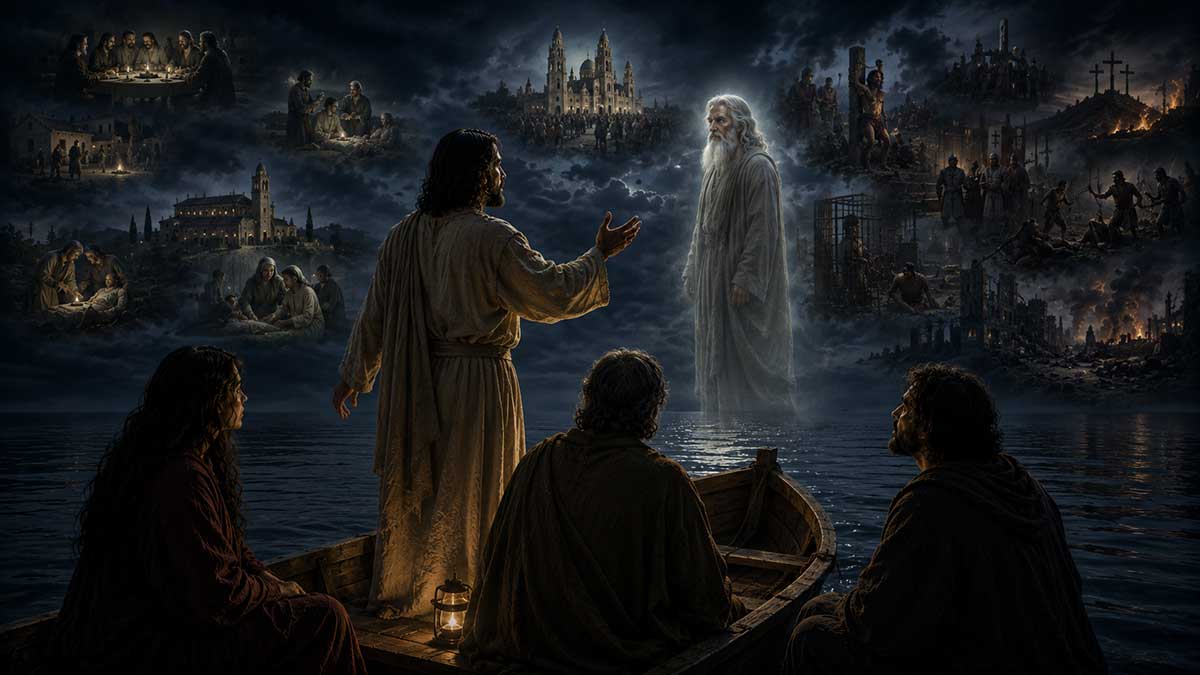
The lake had changed.
No wind.
No insects.
No movement along the shore.
The water looked less like water than polished black stone.
Jesus sat alone in a small boat.
Mary Magdalene sat beside him.
Joseph faced them.
The Shepherd rested one arm along the edge of the boat.
God stood at the bow.
No one rowed.
The boat moved anyway.
For a long time, God said nothing.
Then the horizon disappeared.
Stars vanished.
The lake became surrounded by darkness.
Jesus looked toward God.
Jesus: You said I needed to know.
God: Yes.
Jesus: Then tell me everything.
Mary turned toward him.
Mary Magdalene: Are you sure?
Jesus looked at her.
Jesus: No.
He faced God again.
Jesus: Tell me anyway.
What Will Jesus’s Death Create?
God looked across the water.
Images began forming in the darkness.
Small gatherings.
People praying in homes.
Men and women sharing bread.
Prisoners comforting one another.
Strangers caring for the sick.
Mothers teaching children to forgive.
Monasteries.
Hospitals.
Schools.
Cathedrals.
Songs rising from thousands of mouths.
Jesus watched.
His face softened.
God: Your name will travel farther than your feet ever could.
Jesus: They will remember what I teach?
God: Some will.
Jesus: Love your enemy?
God: Yes.
Jesus: Forgive?
God: Yes.
Jesus: Care for the poor?
God: Yes.
Mary looked toward the images.
A woman washed the feet of a dying stranger.
A priest opened a door to refugees.
A prisoner whispered a prayer in darkness.
Joseph watched silently.
Jesus looked overwhelmed.
Jesus: All this?
God: More.
A faint smile appeared on Jesus’s face.
Then the images changed.
A man burned at a stake.
Jesus’s smile vanished.
Another image.
Soldiers carrying crosses on banners.
Another.
A prison cell.
Another.
A woman screaming while interrogators demanded confession.
Another.
Bodies beneath ruined walls.
Jesus turned toward God.
Jesus: What is that?
God did not answer.
The images kept coming.
Jesus: What is that?
God: History.
How Much Suffering Can a Holy Plan Contain?
Jesus stood.
The boat barely moved beneath him.
Jesus: Stop.
The images continued.
Martyrs.
Persecutions.
Religious wars.
Forced conversions.
Executions.
People dying rather than renouncing faith.
Others killing since someone refused theirs.
Mary covered her mouth.
Joseph looked down.
The Shepherd watched God.
Jesus shouted.
Jesus: Stop!
The darkness froze.
One image remained.
A child standing beside a burned home.
Jesus stared at the child.
Jesus: Who is he?
God answered.
God: One among many.
Jesus turned sharply.
Jesus: His name.
God: It does not matter to the larger course—
Mary stood.
Mary Magdalene: Then the larger course is already failing.
God looked toward her.
Mary pointed at the child.
Mary Magdalene: What is his name?
God said nothing.
Jesus’s voice shook.
Jesus: You know centuries.
You know kingdoms.
You know how far my name travels.
You know every church.
Every war.
Every martyr.
He pointed toward the child.
Jesus: Do you know him?
God answered.
God: Yes.
Jesus: Then say his name.
Silence.
The Shepherd smiled faintly.
Not from amusement.
From recognition.
Does Good in the Future Justify Suffering Along the Way?
God turned toward Jesus.
God: You are seeing fragments.
Jesus: They are people.
God: History contains both.
Jesus: Both what?
God: Grace and violence.
Mercy and domination.
Faith and ambition.
Human beings will use what they receive according to what they are.
Jesus: Then why begin it?
God looked at him.
God: Since the good matters too.
The sick who are cared for.
The abandoned who are received.
The enslaved who find hope.
The guilty who discover forgiveness.
The lonely who find community.
The dying who believe death is not the final word.
Jesus listened.
God continued.
God: You cannot count only the wounds.
Jesus: And you cannot count only the healings.
The words struck.
Joseph looked toward Jesus.
Mary’s eyes filled.
Jesus continued.
Jesus: If one good act does not erase one cruelty, then neither does a million.
God answered.
God: History is never morally clean.
Jesus: Then why ask me to sanctify it with my death?
Does Jesus Consent to Being Made Into a Symbol?
God’s voice remained calm.
God: You will become more than one life.
Jesus stared at him.
Jesus: That is what frightens me.
God: It should not.
Jesus: Mary told me something.
God looked toward her.
Jesus continued.
Jesus: She said the world may love the meaning of my death more than the life I wanted.
Mary looked down.
Jesus faced God.
Jesus: I thought she was afraid of losing me.
Now I think she was warning me about being replaced.
God’s expression hardened slightly.
Jesus: Once I become a symbol, who controls what I mean?
God: No one entirely.
Jesus: Not even you?
God did not answer immediately.
The Shepherd laughed softly.
Shepherd: There is the problem with symbols.
Everyone wants them.
No one owns them.
Jesus: Then you ask me to die for something you admit you cannot control.
God: I ask you to begin something larger than control.
Jesus: With my body.
Silence.
What Does God Actually Want?
The Shepherd shifted closer.
Shepherd: We have spoken about salvation.
Compassion.
Faith.
History.
Perhaps we should ask the simpler question.
He looked at God.
Shepherd: What do you want?
God looked toward him.
God: Humanity.
The Shepherd smiled.
Shepherd: Too large.
Try again.
God remained silent.
Shepherd: More worshippers?
Mary looked sharply toward God.
Jesus did too.
God: More people capable of knowing me.
Shepherd: Is that different?
God: Yes.
Shepherd: To you.
Jesus looked toward God.
Jesus: Is this about saving them?
Or being known by them?
God’s voice deepened.
God: The two are connected.
Jesus: That is not what I asked.
The lake remained still.
Jesus stepped closer.
Jesus: If humanity could become good without knowing your name, would you accept it?
God said nothing.
The Shepherd’s eyes narrowed.
Mary looked toward Jesus.
Joseph whispered:
Joseph: Answer him.
God finally spoke.
God: Humanity cannot become what it must become without relation to me.
The Shepherd nodded.
Shepherd: There.
Jesus looked shattered.
If God Needs an Enemy, What Happens to the Devil?
The Shepherd turned toward Jesus.
Shepherd: Then let us remove one difficulty.
God looked at him.
The Shepherd stood.
Shepherd: Forgive me.
Mary stared.
Joseph looked confused.
Jesus watched carefully.
The Shepherd continued.
Shepherd: End the division.
No adversary.
No eternal enemy.
No struggle between kingdoms.
No need for humanity to choose between us.
God’s expression changed.
God: No.
Shepherd: Why?
God: Since what you are cannot simply be erased.
Shepherd: Forgiveness does not erase.
It reconciles.
Mary looked toward God.
Mary Magdalene: You ask people to forgive one another.
The Shepherd nodded.
Shepherd: Constantly.
Jesus looked at God.
Jesus: Can you forgive him?
God answered.
God: That is not the same.
The Shepherd laughed.
Shepherd: Of course not.
Nothing is ever the same when the command reaches upward.
God’s face hardened.
Shepherd: If I return, the great conflict ends.
Think what disappears with it.
Fear.
Temptation.
The need to define goodness against me.
Some of the suffering you just showed him.
God shook his head.
God: Humanity requires moral freedom.
Shepherd: Freedom requires me?
God: Opposition gives choice meaning.
The Shepherd stepped closer.
Shepherd: Then you need me.
Silence.
The sentence seemed to alter the entire boat.
Jesus looked from one to the other.
Jesus: If good requires evil to make itself visible, what happens when evil asks to stop?
No answer.
Mary whispered:
Mary Magdalene: Then perhaps the struggle is serving someone.
At What Number Does Sacrifice Become Evil?
The images returned.
Names now appeared beside them.
A young woman imprisoned.
A monk tortured.
A mother watching her son taken away.
A soldier kneeling before battle.
A child baptized by frightened parents.
A man beaten for praying wrongly.
Jesus began reading names aloud.
One.
Then another.
Then another.
His voice grew weaker.
God said:
God: You cannot carry every name.
Jesus turned.
Jesus: Then do not ask me to carry the plan.
God watched him.
Jesus: You speak in centuries since centuries cannot scream.
Mary closed her eyes.
Joseph looked toward God.
Jesus continued.
Jesus: If every one of them has a mother—
a father—
someone who loved them—
at what number does your plan stop being holy?
God answered.
God: Holiness is not measured by arithmetic.
Jesus: Neither is suffering.
God’s voice hardened.
God: You think like one man.
Jesus stared at him.
Jesus: I am one man.
God answered.
God: You are more.
Jesus shook his head.
Jesus: That sentence is how you keep taking me away from myself.
Is a Divine Plan Moral Without Human Consent?
Joseph finally stood.
Joseph: I know what it is to decide that another life matters less when your own child is in danger.
God looked at him.
Joseph continued.
Joseph: What I did was smaller.
Cowardly.
Human.
But I recognize the shape of the argument.
Jesus turned toward him.
Joseph looked at God.
Joseph: One life becomes necessary.
Another becomes acceptable loss.
Then another.
Soon the person making the decision no longer hears the names.
God’s expression remained unreadable.
God: You place human failure beside divine intention.
Joseph: I place the dead beside whoever accepted their deaths.
Silence.
Mary looked toward Joseph with tears in her eyes.
What Would Jesus Choose If He Knew Everything?
The images vanished.
The lake returned.
Black water.
Five figures.
One lamp in the boat.
Jesus sat slowly.
God: Now you know.
Jesus looked toward the water.
Jesus: No.
God: You have seen enough.
Jesus: Enough to know I do not want this.
Mary looked at him.
Joseph closed his eyes.
The Shepherd watched God.
God said:
God: Want is not the final measure.
Jesus looked up.
Jesus: It is when the body is mine.
God stepped closer.
God: Humanity may receive more good through your life and death than you can comprehend.
Jesus: Humanity may receive suffering through them that I can no longer pretend not to see.
God: Then what will you do?
Jesus stared.
The question surprised him.
He looked at Mary.
At Joseph.
At the Shepherd.
Then back at God.
Jesus: I will find a way to make the story fail.
No one moved.
Mary whispered:
Mary Magdalene: Jesus.
He took her hand.
Jesus: If becoming Christ means giving history a weapon it can use against people in my name—
then perhaps I must die as someone else.
God looked at him.
God: You believe you can escape what you are?
Jesus answered.
Jesus: I have to try.
Closing
The boat began moving again.
The horizon slowly returned.
A line of pale dawn appeared over the water.
God looked toward Jesus.
God: You have seen history.
You still believe rebellion can change it.
Jesus replied:
Jesus: If I do nothing after seeing it, then I am no better than Joseph running past those doors.
Joseph flinched.
Then nodded.
Not wounded.
Agreeing.
Mary held Jesus’s hand.
The Shepherd looked toward God.
Shepherd: Now we discover whether freedom exists.
God said nothing.
Jesus looked toward the approaching shore.
The future had become unbearable.
For the first time, he was no longer asking what destiny required.
He was asking whether destiny had the right to require anything at all.
Topic 4: Is Jesus Free if Every Rebellion Still Fulfills God’s Plan?
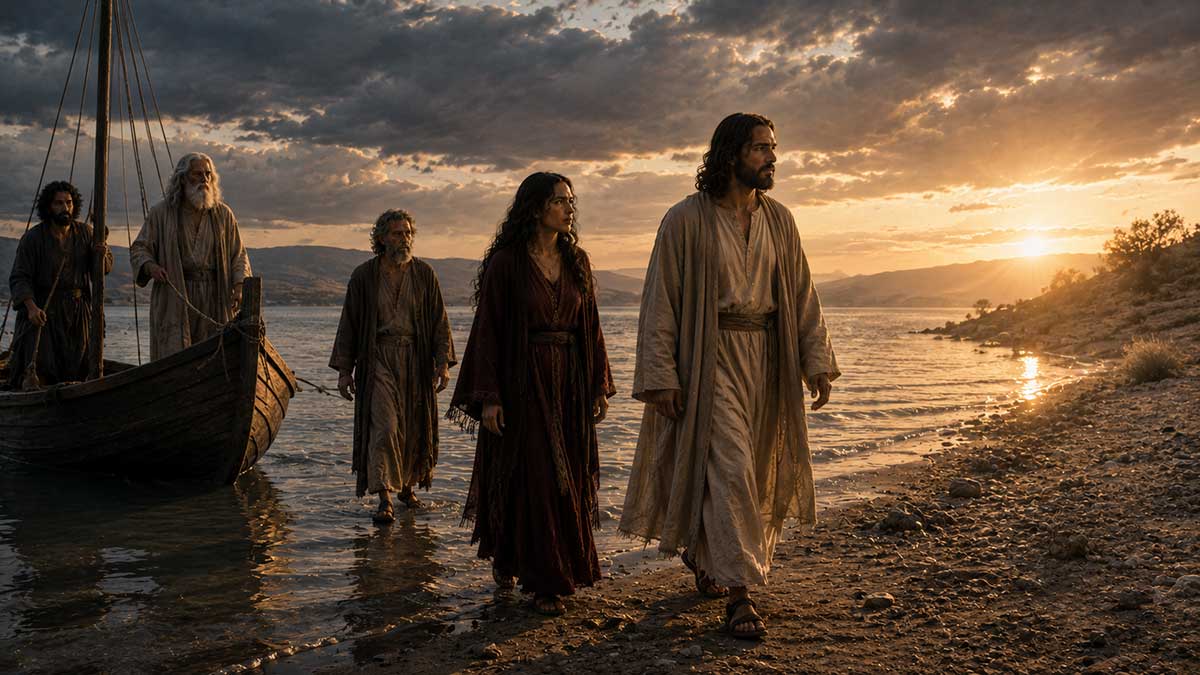
Dawn had reached the Sea of Galilee.
The boat touched shore.
No one stepped out.
Jesus remained seated, staring at the sand as though crossing those few feet would begin something he could no longer stop.
Mary Magdalene sat beside him.
Joseph watched from across the boat.
The Shepherd rested against the mast.
God stood at the bow.
Jesus finally spoke.
Jesus: I have decided.
God looked toward him.
Jesus: I will not become what you showed me.
No one moved.
God: You believe that is your decision?
Jesus looked up.
Jesus: Whose else could it be?
God did not answer.
The Shepherd smiled.
Not happily.
Almost sympathetically.
Can Jesus Simply Say No?
Jesus stood.
Jesus: I will not build your religion.
God: You will build nothing.
Jesus: Good.
God: Others will.
Jesus stopped.
Jesus: Then I will tell them not to.
God: Some will hear humility.
Jesus: I will deny being Messiah.
God: Some will call your denial proof.
Jesus stared.
Jesus: I will refuse followers.
God: They may follow the man who refuses followers.
The Shepherd laughed softly.
Jesus turned toward him.
Jesus: You find this amusing?
Shepherd: No.
I find it familiar.
Jesus looked back toward God.
Jesus: Then I will disappear.
God: And absence can become mystery.
Jesus: I will live an ordinary life.
God: Stories will still be told.
Jesus: I will contradict them.
God: Contradictions become teachings.
Jesus’s face tightened.
Jesus: Then I will die without performing the role.
God watched him.
Jesus: Rome crucifies rebels.
I will become one.
No Messiah.
No divine sacrifice.
No salvation written into my death.
Only another man Rome executed.
God said nothing.
Jesus stepped closer.
Jesus: Can I choose that?
God answered.
God: You can choose anything available to you.
Jesus waited.
Jesus: Will it stop your plan?
Silence.
The Shepherd looked toward God.
Mary’s expression changed.
Joseph lowered his head.
Jesus understood.
Is a Choice Free if God Already Knows the Outcome?
Jesus: You already know what I choose.
God: Yes.
Jesus: Before I choose it?
God: Yes.
Jesus: Then how is it mine?
God answered calmly.
God: Knowledge does not create the choice.
Jesus: But you created me.
God: Yes.
Jesus: You created the circumstances.
God: Some of them.
Jesus: You know how I respond to them.
God: Yes.
Jesus: You know every road I might take.
God: Yes.
Jesus laughed bitterly.
Jesus: And somehow I am free.
God: You experience choice.
The Shepherd’s head lifted.
Jesus stared at God.
Jesus: Experience?
Mary looked toward God.
Joseph whispered:
Joseph: That is a terrible word.
Jesus stepped closer.
Jesus: Do I choose, or do I experience choosing?
God’s voice remained steady.
God: You choose.
Jesus: Could I choose something you did not already know?
God: No.
Jesus: Could I surprise you?
God: No.
Jesus: Could I become someone you did not foresee?
God: No.
Jesus’s eyes filled.
Jesus: Then there is no place in me you have not already entered.
Does Foreknowledge Destroy Freedom?
Mary stood.
Mary Magdalene: I know Jesus loves me.
Jesus turned toward her.
Mary Magdalene: I believe he will still love me tomorrow.
Does my knowing him make tomorrow’s love less his?
God looked toward her.
God: No.
Mary Magdalene: Then perhaps knowledge itself is not the problem.
Jesus listened.
Mary continued.
Mary Magdalene: The problem is power.
The Shepherd smiled.
Mary Magdalene: I may know what Jesus is likely to choose.
I did not create him.
I did not create the road.
I cannot punish him for leaving it.
I cannot arrange history around his answer.
She looked toward God.
Mary Magdalene: You can.
God replied.
God: Ability does not prove coercion.
Mary Magdalene: No.
But it changes the meaning of consent.
Jesus looked at her.
Mary turned to him.
Mary Magdalene: If I ask you to stay with me, you can leave.
I will suffer.
I may hate your decision.
But I cannot turn your leaving into another way of staying.
Jesus looked toward God.
The meaning was unmistakable.
What Happens When Rebellion Becomes Part of the Plan?
The Shepherd leaned forward.
Shepherd: Let us make this simpler.
He looked at Jesus.
Shepherd: Rebel.
Jesus: I intend to.
Shepherd: No.
Now.
Jesus stared.
Shepherd: Curse him.
Walk away.
Throw yourself into the lake.
Marry Mary.
Become a carpenter.
Become a thief.
Become nothing anyone remembers.
Do the thing furthest from what he wants.
Jesus looked toward God.
The Shepherd continued.
Shepherd: Then ask him afterward whether he knew.
Jesus turned toward God.
Jesus: Would you?
God answered.
God: Yes.
The Shepherd spread his hands.
Shepherd: There is your prison.
God looked toward him.
God: Knowledge is not imprisonment.
Shepherd: Perhaps not.
But when every door leads somewhere you have already visited, the prisoner begins wondering why you call them doors.
Jesus sat again.
He covered his face.
Can God Give Jesus Genuine Freedom?
Joseph spoke quietly.
Joseph: Can you stop knowing?
God looked toward him.
God: No.
Joseph: Can you choose not to see what Jesus will do?
God: No.
Joseph: Then perhaps there are limits even to God.
The boat became silent.
The Shepherd’s expression sharpened.
God answered.
God: Perfection is not limitation.
Joseph shook his head.
Joseph: From where Jesus sits, it may feel like one.
God turned toward him.
Joseph: A father who knows everything his child will ever do has already taken something from him.
God: What?
Joseph looked at Jesus.
Joseph: The right to become unexpected.
Jesus slowly lowered his hands.
The sentence struck him.
Jesus: Yes.
He looked at God.
Jesus: I want that.
God said nothing.
Jesus: I want to do something you did not know I would do.
I want one thought you did not hear before I thought it.
One road you did not see.
One mistake that belongs entirely to me.
His voice broke.
Jesus: I want to meet myself before you do.
Mary’s eyes filled.
Is Love Possible Without Freedom?
Mary moved closer.
Mary Magdalene: If he cannot surprise you, can he give you anything?
God looked toward her.
God: Of course.
Mary Magdalene: How?
God: Freely.
Mary Magdalene: We are back where we began.
She took Jesus’s hand.
Mary Magdalene: When Jesus tells me he loves me, I do not know whether he will say it tomorrow.
That uncertainty frightens me.
But it makes today's words precious.
She looked toward God.
Mary Magdalene: What does his love cost you if you already possess tomorrow?
God’s expression hardened.
God: You confuse uncertainty with value.
Mary Magdalene: Perhaps.
She looked at Jesus.
Mary Magdalene: But I would rather be loved by someone who can leave than obeyed by someone who cannot.
Jesus squeezed her hand.
The Shepherd looked toward God.
Shepherd: She has described worship rather well.
God ignored him.
Does Jesus Have the Right to Destroy His Own Destiny?
Jesus stood again.
Something had changed.
He was no longer asking permission.
Jesus: I will go to Jerusalem.
Mary looked at him.
Jesus: I will provoke Rome.
Joseph’s face tightened.
Jesus: I will make them see a political threat.
I will give them every reason to execute me as an ordinary criminal.
Mary whispered:
Mary Magdalene: And then?
Jesus: I die.
She closed her eyes.
Jesus: But not as his sacrifice.
Not as the beginning of what he showed me.
Not as the symbol history wants.
Mary looked at him.
Mary Magdalene: You would destroy yourself to keep the world from turning you into something larger.
Jesus: If necessary.
Mary released his hand.
Jesus looked startled.
Mary Magdalene: No.
Jesus: Mary—
Mary Magdalene: You accuse God of treating your life as a tool.
Now you are doing the same thing.
Jesus stopped.
Mary Magdalene: Your death belongs to his plan, so you create another plan that needs your death.
Jesus stared at her.
Mary Magdalene: Where are you in either one?
He could not answer.
Can Rebellion Become Another Form of Obedience?
Joseph looked at his son.
Joseph: When I ran from Bethlehem, I thought I was choosing against death.
Jesus turned toward him.
Joseph: Yet everything I did afterward belonged to that night.
My dreams.
My fear.
My silence.
My death.
He stepped closer.
Joseph: Do not let resistance become another master.
Jesus looked toward the shore.
Jesus: Then what do I do?
Joseph shook his head.
Joseph: I do not know.
Jesus almost laughed.
Jesus: Finally, an honest father.
Joseph smiled through tears.
Joseph: Too late.
Jesus: Perhaps not.
God watched them.
The Shepherd spoke.
Shepherd: There may be another possibility.
Jesus turned.
Shepherd: Perhaps freedom is not escaping the story.
Perhaps freedom is refusing to let the story tell you why you acted.
God looked toward him.
The Shepherd continued.
Shepherd: He may know what you do.
Perhaps he does not own what it means to you.
Jesus considered this.
What If Freedom Means Choosing Why?
Jesus: Suppose I cannot change the outcome.
Mary watched him.
Jesus: Suppose I am crucified.
Suppose people build what you showed me.
He looked toward God.
Jesus: Can I still refuse your reason?
God answered.
God: You may interpret your actions however you wish.
Jesus’s expression changed.
Jesus: Interpret?
The Shepherd laughed.
Jesus: If I die loving people rather than building your kingdom, that is not interpretation.
If I forgive someone since I see their suffering rather than since it advances history, that belongs to me.
God remained silent.
Jesus: If I go to Jerusalem to stand beside people rather than fulfill prophecy, perhaps you know I will go.
But you do not get to call every act of love obedience.
Mary smiled faintly.
Joseph nodded.
The Shepherd looked almost pleased.
Can Jesus Refuse the Meaning Others Give His Death?
God: People will still interpret you.
Jesus: I know.
God: They will make claims in your name.
Jesus: I know.
God: Some will misunderstand you.
Jesus: I know.
God: Some will commit terrible acts while believing they honor you.
Jesus closed his eyes.
Jesus: I know.
God stepped closer.
God: Then what has changed?
Jesus opened his eyes.
Jesus: I will stop believing their future choices prove my life was a mistake.
Mary looked at him.
Jesus continued.
Jesus: I am responsible for what I choose.
I am responsible for what I teach.
I am responsible when I know harm is coming and can act.
He looked toward Joseph.
Jesus: But I cannot carry every human choice for centuries.
Joseph’s eyes filled.
Jesus: Neither could you carry Bethlehem forever.
Joseph looked down.
Jesus stepped toward him.
Jesus: You were responsible for the doors you passed.
Not for every death that ever followed.
Joseph began crying.
Jesus did not embrace him.
Not yet.
But he stood beside him.
What Choice Can Still Belong to Jesus?
Mary asked quietly:
Mary Magdalene: Then what will you choose?
Jesus looked at her.
Jesus: I will go.
Her face tightened.
Jesus: Not since he has already seen me go.
Not since prophecy says I must.
Not since history needs a symbol.
He touched her face.
Jesus: I will go since there are people I love whom fear has taught to hate one another.
I will speak while I still have a voice.
I will heal while my hands still move.
I will love while I am still alive.
Mary closed her eyes against his hand.
Jesus: And if they kill me—
He paused.
Jesus: —my death will not become more important than how I lived.
God watched him.
The Shepherd looked toward the rising sun.
Joseph wiped his face.
Closing
Jesus stepped from the boat.
His feet touched the wet sand.
Mary followed.
Then Joseph.
The Shepherd remained seated.
God remained at the bow.
Jesus turned back.
Jesus: Did you know I would say all of that?
God looked at him.
A long silence followed.
God: Yes.
Jesus smiled sadly.
For once, the answer did not destroy him.
Jesus: Then you knew the words.
He took Mary’s hand.
Jesus: I still had to mean them.
God watched him.
Jesus began walking up the shore.
Joseph followed several steps behind.
Mary remained beside him.
The Shepherd finally stood.
Before leaving the boat, he looked toward God.
Shepherd: Interesting.
God turned.
Shepherd: You can know everything he will do.
Perhaps that is not the same as owning him.
God said nothing.
The Shepherd stepped onto the shore.
Behind them, the empty boat drifted slowly away.
Jesus did not look back.
For the first time, freedom did not mean escaping destiny.
It meant refusing to surrender his conscience merely since destiny already knew where he was going.
Topic 5: Who Needs Forgiveness at the Cross?
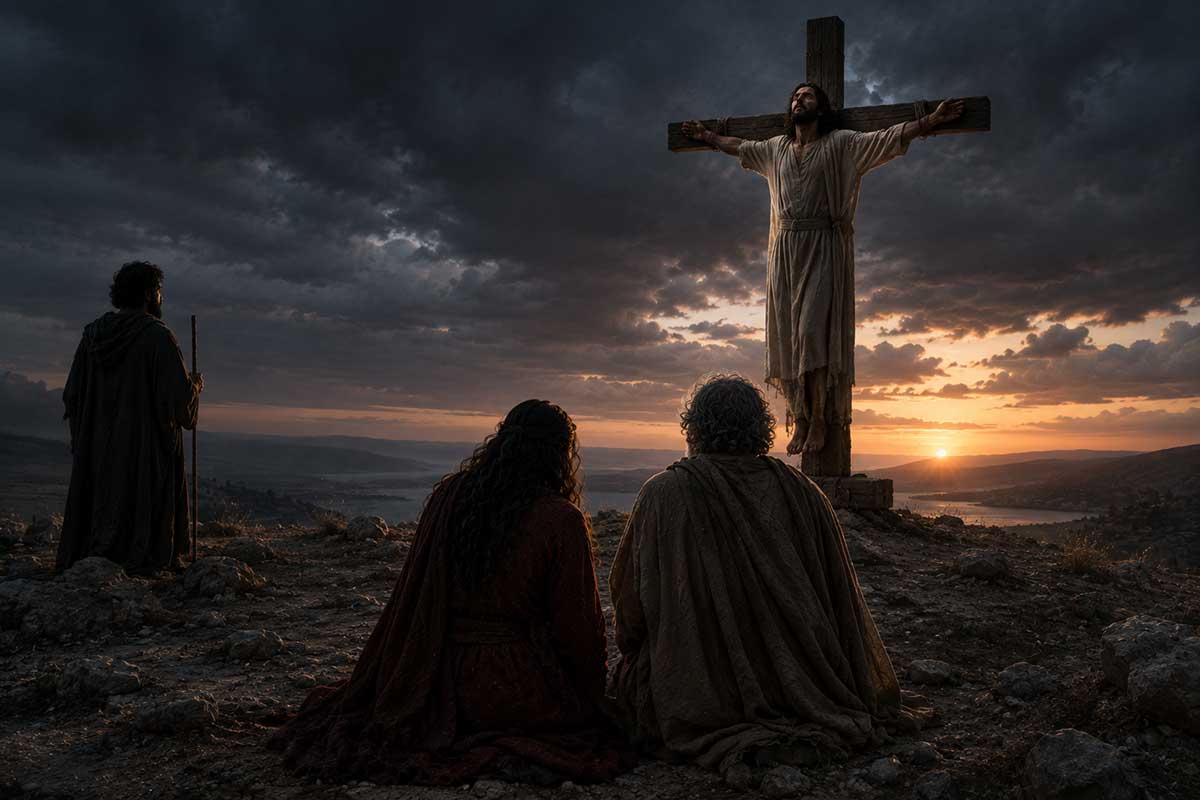
The sky had turned the color of iron.
No lake.
No table.
No lamp.
Only the hill.
The cross stood behind Jesus.
Mary Magdalene stood below him.
Joseph was near enough to see his son’s face.
The Shepherd stood farther back.
God was everywhere and nowhere.
No one spoke at first.
Jesus looked down at Mary.
Then Joseph.
Then toward the place where God’s voice seemed to come from.
Does Jesus Forgive Humanity—or Accuse Heaven?
Jesus: They will say I died for them.
God answered.
God: You will.
Jesus closed his eyes.
Jesus: They will say this was necessary.
God: It is.
Mary looked upward.
Mary Magdalene: Necessary to whom?
No answer came.
Jesus opened his eyes again.
Jesus: I have spent all this time asking whether people will misuse my name.
Now I am asking something else.
God waited.
Jesus: What have you done with mine?
The wind moved over the hill.
Joseph lowered his head.
Jesus: You took a son.
A lover.
A man who wanted bread in the morning.
You made him into history before he had finished being alive.
God replied.
God: You were never only one man.
Jesus’s face tightened.
Jesus: That sentence has followed me all the way here.
Can the Wounded Be Required to Forgive?
Mary stepped closer to the cross.
Mary Magdalene: People will speak beautifully about forgiveness after this.
Jesus looked at her.
Mary Magdalene: I am afraid of that.
Jesus: Why?
Mary Magdalene: Since wounded people are often asked to forgive before anyone asks whether the person who wounded them understands what they did.
Joseph looked toward her.
Mary continued.
Mary Magdalene: Forgiveness can become another demand.
Another way to make the injured person carry the moral burden.
God spoke.
God: Forgiveness frees the wounded.
Mary turned.
Mary Magdalene: Sometimes.
Sometimes it merely makes everyone else more comfortable.
Jesus looked at God.
Jesus: Can forgiveness be commanded?
God: It can be taught.
Jesus: That was not what I asked.
God remained silent.
Jesus: If the wounded person says no, does heaven still call them good?
Mary looked at him.
Joseph’s eyes filled.
Does Joseph Need Forgiveness?
Jesus turned toward Joseph.
Jesus: Did you ever forgive yourself?
Joseph shook his head.
Joseph: No.
Jesus: Did you want to?
Joseph hesitated.
Joseph: Sometimes.
Jesus waited.
Joseph: Mostly I wanted the pain to stop.
Mary looked at him.
Joseph: That is not the same thing.
Jesus nodded.
Joseph: If I had forgiven myself too easily, I think I would have lost the children a second time.
Jesus’s eyes softened.
Joseph: But if I never let guilt change into responsibility, then guilt would only have become another form of selfishness.
Jesus looked at him.
Joseph: I could not undo Bethlehem.
I could only stop pretending my grief was the same as theirs.
The words sat between them.
Jesus lowered his head.
Does God Need Forgiveness?
The Shepherd finally stepped closer.
Shepherd: We have forgiven downward for centuries.
People forgive children.
Parents.
Enemies.
The dying.
The guilty.
He looked upward.
Shepherd: What happens when forgiveness must travel the other direction?
God’s voice hardened.
God: I do not require forgiveness.
The Shepherd smiled.
Shepherd: Everyone says that before the question reaches them.
Mary looked toward God.
Mary Magdalene: Did you know what this would cost him?
God: Yes.
Mary Magdalene: Did you know what it would cost me?
God said nothing.
Mary Magdalene: Joseph?
Silence.
Mary Magdalene: The mothers who would watch sons die under crosses later?
The people burned for wrong belief?
The people who would kill while thinking they were protecting your truth?
She stepped closer to Jesus.
Mary Magdalene: Did you know?
God: Yes.
Her face changed.
Mary Magdalene: Then what exactly are we supposed to forgive?
Can a Plan Be Good if Its Author Accepts the Damage?
Jesus looked toward the sky.
Jesus: You keep saying the future contains good too.
God: It does.
Jesus: Mercy.
God: Yes.
Jesus: Hope.
God: Yes.
Jesus: Love.
God: Yes.
Jesus nodded slowly.
Jesus: And killing.
God: Human beings choose—
Jesus: Do not move the sentence away from yourself.
God went silent.
Jesus: You showed me the future and still asked me to continue.
You knew people would turn me into a banner.
A weapon.
A law.
An excuse.
God answered.
God: I also knew people would feed the hungry in your name.
Jesus: Then say both every time.
God did not respond.
Jesus: Do not say salvation without saying the blood.
Do not say church without saying the prison.
Do not say martyr without saying the mother.
Do not say kingdom without saying the body.
Mary’s eyes filled.
The Shepherd looked toward God.
Joseph whispered:
Joseph: He is right.
What Does Jesus Refuse at the End?
God spoke.
God: You cannot control what people become.
Jesus nodded.
Jesus: I know that now.
God: Then why accuse me of what they will do?
Jesus looked upward.
Jesus: Since you knew.
God answered.
God: So did you.
Jesus flinched.
The sentence cut deeper than anything else.
Mary looked toward God in disbelief.
Joseph stepped forward.
Joseph: Enough.
God continued.
God: You saw the future.
You chose to continue.
Jesus stared.
For a long time, he said nothing.
Then:
Jesus: Yes.
Mary looked toward him.
Joseph’s face changed.
The Shepherd stopped smiling.
Jesus: That part belongs to me.
Silence.
Jesus: I cannot ask you to carry every future act alone if I stood here knowing some of it too.
Joseph whispered:
Joseph: Son—
Jesus looked at him.
Jesus: No.
I will not escape guilt by making God the only guilty one.
Mary began to cry.
Jesus continued.
Jesus: I chose to speak.
To heal.
To love.
To go to Jerusalem.
I chose knowing people might distort me.
That choice is mine.
God said nothing.
Jesus: But my consent to live truthfully is not consent to every cruelty done later in my name.
The distinction seemed to open something in the air.
Is Responsibility Shared Without Becoming Meaningless?
Mary looked toward Jesus.
Mary Magdalene: Then who is responsible?
Jesus answered quietly.
Jesus: Everyone where their hand touches the story.
Joseph closed his eyes.
Jesus continued.
Jesus: Joseph was responsible for the doors he passed.
I am responsible for what I chose knowing what I knew.
God is responsible for the plan he defended.
People are responsible for what they do with my name.
Leaders are responsible when they turn faith into authority.
Followers are responsible when belonging becomes an excuse.
The Shepherd looked toward him.
Shepherd: And me?
Jesus met his eyes.
Jesus: You are responsible whenever truth becomes useful to your pride.
The Shepherd’s face changed.
For once, he had no answer.
Can Jesus Forgive God?
Mary whispered:
Mary Magdalene: Do you forgive him?
Jesus looked upward.
The question stayed there.
God said nothing.
Jesus’s face showed pain more than anger now.
Jesus: I do not know.
Mary nodded.
She did not push.
Jesus: I can love someone and still believe they wronged me.
Joseph looked at him.
Jesus: I can refuse hatred without pretending the wound is gone.
God remained silent.
Jesus: I can say I do not understand you.
I can say I think you asked too much.
I can say I think you accepted suffering too easily.
His voice broke.
Jesus: I can say all of that without becoming your enemy.
The Shepherd lowered his eyes.
Mary touched the wood of the cross.
Mary Magdalene: That may be more honest than forgiveness spoken too soon.
Does God Understand the Cost?
Jesus struggled to breathe.
His voice weakened.
Jesus: One last question.
God answered.
God: Ask.
Jesus: Do you understand what you have done?
God replied.
God: Completely.
Jesus shook his head.
Jesus: No.
The hill went silent.
Jesus: You know it.
I am asking whether you understand it.
No answer.
Jesus looked at Mary.
At Joseph.
At the Shepherd.
Then upward.
Jesus: Knowledge is not the same as being wounded.
Mary began crying openly.
Joseph looked away.
Jesus continued.
Jesus: You know death.
I am dying.
You know grief.
She is grieving.
You know guilt.
He lived inside it.
He looked toward Joseph.
Jesus: You know rebellion.
He carries it.
The Shepherd looked toward him.
Jesus: You know every word.
Perhaps that is why words have protected you from the cost.
God said nothing.
Who Should Ask Whom for Forgiveness?
The Shepherd spoke softly.
Shepherd: Then say it.
Jesus looked toward him.
Shepherd: Say what you came here to say.
Jesus breathed with difficulty.
He looked upward.
Jesus: Humanity will ask you to forgive them.
For disbelief.
Fear.
Cruelty.
Weakness.
Greed.
Violence.
He paused.
Jesus: Perhaps one day you should ask them too.
The wind moved across the hill.
Mary stared upward.
Joseph’s eyes closed.
The Shepherd looked almost stunned.
God did not answer.
Jesus continued.
Jesus: Ask forgiveness for every time you were called love by people who could not find love in what happened to them.
For every person who thought their suffering was holy since someone told them you required it.
For every child who thought pain meant they had been chosen.
For every person who blamed themselves since heaven remained silent.
His breathing broke.
Mary whispered:
Mary Magdalene: Jesus.
He looked at her.
What Does Jesus Leave Behind?
Jesus: Do not let them remember only this.
Mary looked up at him.
Jesus: Not the nails.
Not the blood.
Not the cross.
Mary Magdalene: What then?
His face softened.
Jesus: The meals.
The hands.
The people no one sat beside.
The times I chose someone before the rule.
The times I said a person mattered more than the accusation against them.
Mary nodded through tears.
Jesus: If they make my death larger than my life, they will learn the wrong lesson.
Joseph began crying.
Jesus looked toward him.
Jesus: Father.
Joseph raised his eyes.
Jesus: You asked what repentance was.
Joseph waited.
Jesus: Perhaps it is refusing to let guilt decide the final thing you become.
Joseph covered his face.
Closing
The sky darkened.
Mary remained beneath the cross.
Joseph stood beside her.
The Shepherd did not move.
God remained unseen.
Jesus looked upward one last time.
His voice was barely audible.
Jesus: Father—
God answered.
God: I am here.
Jesus closed his eyes.
Jesus: Then listen.
Silence.
Jesus: Forgiveness without accountability is only silence with a holy name.
The wind stopped.
For one moment, nothing moved.
Then Jesus whispered:
Jesus: I forgive what I can.
What I cannot, I leave unfinished.
Mary bowed her head.
Joseph wept.
The Shepherd looked toward the horizon.
God did not answer.
The cross remained.
The question remained with it.
Not whether humanity deserved forgiveness.
Not whether God deserved accusation.
But whether love could remain love after both sides stopped pretending suffering had no owner.
And below the hill, ordinary people began walking home before history could decide what the moment meant.
Final Thoughts
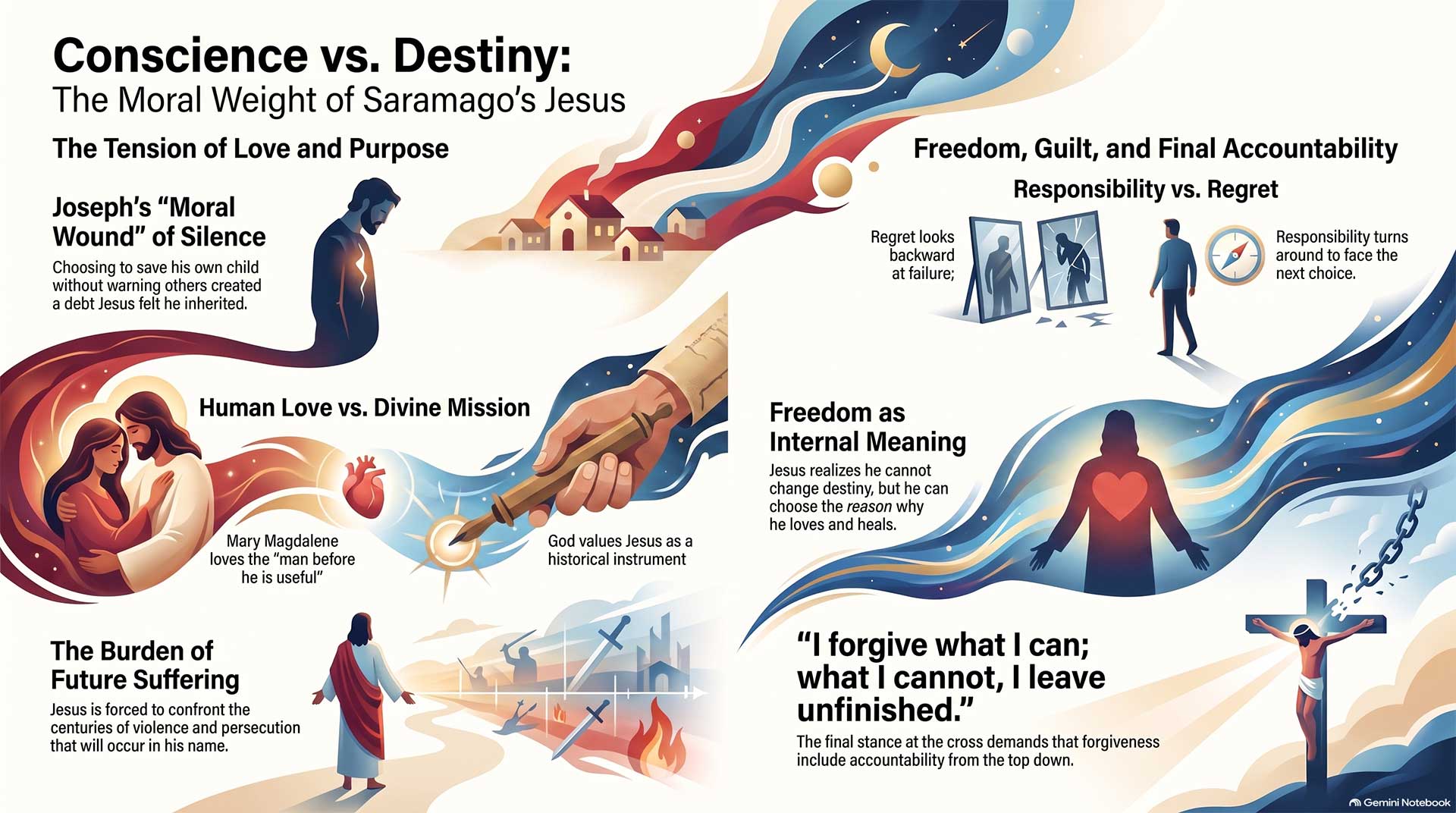
The deepest conflict in The Gospel According to Jesus Christ is not between Jesus and the Devil.
It is between the individual human being and the enormous story other people want his life to serve.
Joseph experiences this first.
He loves one child so fiercely that other children become less visible.
His failure does not come from hatred.
It comes from narrowed attention.
That may be one of Saramago’s most disturbing ideas.
Moral failure often begins long before cruelty.
It begins when one person becomes more real to us than another.
Jesus inherits this wound.
His dilemma is larger, but structurally similar.
Joseph knew danger was coming to Bethlehem.
Jesus knows suffering may come through the history built around his name.
Both face the same question:
What does knowledge require?
Joseph failed to warn.
Jesus refuses to repeat that failure.
Yet Jesus eventually realizes another truth.
He cannot become responsible for every human decision made centuries after his death.
That would destroy moral agency rather than deepen it.
He can be responsible for what he teaches.
For what he chooses.
For what he knows and fails to confront.
Others must remain responsible for the places where their own hands touch the story.
This becomes one of the strongest conclusions of the entire conversation:
Responsibility must be shared without becoming diluted.
Joseph is responsible for the doors he passed.
Jesus is responsible for the choices he makes after seeing the future.
God is responsible for the plan he defends.
Leaders are responsible when they transform faith into authority.
Followers are responsible when belonging becomes an excuse.
The Devil is responsible when truth becomes useful to pride.
No one receives the comfort of placing all guilt somewhere else.
Mary Magdalene offers another vital insight.
Love becomes morally dangerous when it needs someone to become something.
God sees Jesus as history.
Mary sees Jesus before history.
God speaks of what his death may accomplish.
Mary asks whether anyone has asked what his life is worth before becoming useful.
Her love is not selfless.
It is honest.
She wants Jesus to stay.
Yet she will not turn that desire into another prison.
She does something the others struggle to do:
She loves him without claiming ownership over his meaning.
The conversation with God becomes difficult for another reason.
God thinks at the scale of centuries.
Jesus thinks at the scale of bodies.
God sees civilization.
Jesus asks for names.
God sees movements.
Mary asks about mothers.
God sees what may be gained.
Joseph recognizes the danger in accepting losses too easily.
This difference in scale matters.
Institutions often speak in abstractions.
History.
Progress.
Mission.
Order.
Salvation.
Revolution.
Security.
Civilization.
Yet suffering always happens to someone particular.
A person.
A family.
A body.
A name.
Whenever the language becomes too large, Saramago seems to ask the reader to return to the individual.
The Shepherd complicates everything further.
If the Devil sometimes sounds compassionate and God sometimes sounds politically ambitious, Saramago forces the reader to judge actions rather than labels.
That does not mean the Devil becomes good.
It means moral categories cannot be allowed to do the reader’s thinking.
The free-will discussion pushes this challenge further.
Jesus desperately wants one part of himself God has not already seen.
One thought not anticipated.
One road not mapped.
One act that belongs entirely to him.
He cannot obtain that freedom.
Yet he discovers another form of it.
God may know the action.
God may not own its meaning.
Jesus can still decide whether he heals to fulfill prophecy or since someone before him is suffering.
He can still decide whether he forgives to build a religion or since hatred would destroy him.
He can still decide whether his life becomes merely preparation for death.
That distinction becomes crucial at the cross.
Jesus rejects the idea that the cross should become more important than the life that preceded it.
He asks Mary to remember the meals.
The hands.
The neglected people.
The moments when a person mattered more than the rule.
This may be Saramago’s deepest challenge to religious memory.
What happens when a civilization becomes more fascinated by the symbol of sacrifice than by the daily practice of compassion that gave the sacrifice meaning?
The final question about forgiveness refuses easy comfort.
Jesus does not declare God innocent.
He does not declare himself free from responsibility.
He does not demand that Mary forgive.
He does not let Joseph disappear inside guilt.
He says he can love someone and still believe that person wronged him.
That may be the conversation’s most mature definition of forgiveness.
Forgiveness does not require pretending the wound disappeared.
It does not require saying accountability no longer matters.
It does not require forcing closure onto something still morally unfinished.
That is why Jesus’s final words in this conversation matter:
“I forgive what I can. What I cannot, I leave unfinished.”
Some wounds may not resolve into certainty.
Some moral questions may remain open.
That does not make the search for responsibility meaningless.
It makes responsibility more necessary.
Saramago’s Jesus does not finally defeat God.
He does not defeat history.
He does not defeat destiny.
He preserves something smaller.
His conscience.
And perhaps that is the form of freedom no prophecy can fully take away.
Short Bios:
Jesus
Jesus is the central figure of Saramago’s novel, portrayed as deeply human, morally sensitive, uncertain, loving, and increasingly troubled by the destiny assigned to him. His greatest conflict is not simply whether he will die, but whether he can consent to becoming a symbol whose future consequences he cannot control.
Joseph
Joseph is Jesus’s father and the source of the novel’s first great moral wound. After learning that children in Bethlehem are in danger, he saves Jesus but fails to warn the other families. His lifelong guilt becomes the foundation for Jesus’s own struggle with knowledge, responsibility, and inherited moral burden.
Mary Magdalene
Mary Magdalene is Jesus’s lover, confidante, and most intimate human companion. She represents love without institutional mission, repeatedly defending Jesus the person against those who value what he may accomplish more than the life he actually wants.
God
God appears as a vast, morally difficult presence concerned with history, influence, faith, and the expansion of his relationship with humanity. He believes Jesus’s life and death will create enormous good, yet accepts suffering within the larger historical plan, making him one of the novel’s most controversial figures.
The Shepherd / Devil
The Shepherd is a mysterious companion Jesus encounters who is later associated with the Devil. He questions God’s authority, challenges the structure of good and evil, and offers some of the novel’s most unsettling arguments about freedom, reconciliation, and whether divine conflict itself helps create human suffering.
José Saramago
José Saramago (1922–2010) was a Portuguese novelist, essayist, and recipient of the 1998 Nobel Prize in Literature. Known for philosophical fiction marked by irony, compassion, moral ambiguity, and unconventional narration, his major works include Blindness, The Gospel According to Jesus Christ, Baltasar and Blimunda, The Stone Raft, All the Names, and Death with Interruptions. The Gospel According to Jesus Christ became one of his most controversial novels for its provocative reimagining of Jesus, God, faith, sacrifice, and moral responsibility.
Leave a Reply