
Introduction
For generations, humanity has looked at space as a destination to explore. But what if its greatest economic and scientific potential lies in what we can discover, manufacture and build there?
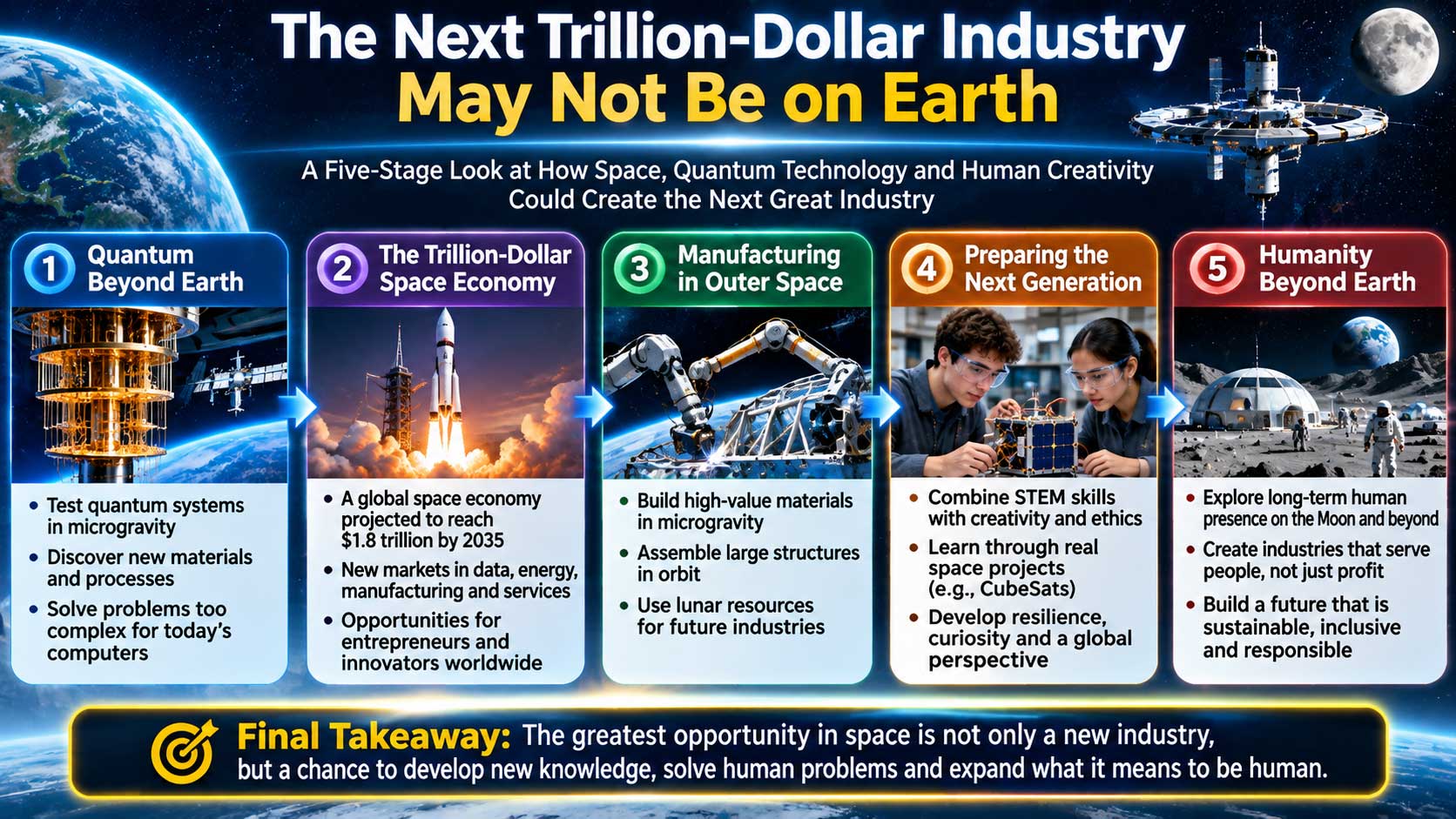
In 2024, a report from the World Economic Forum and McKinsey projected that the global space economy could reach $1.8 trillion by 2035. Much of that projected growth involves services supporting life and business on Earth. Yet another possibility deserves our attention: the emergence of industries that use space itself as an experimental and manufacturing environment.
The foundations of that possibility are already being investigated. NASA's Cold Atom Laboratory aboard the International Space Station allows researchers to study quantum phenomena under microgravity conditions. Scientists are exploring new materials, biological processes and manufacturing techniques that could benefit from conditions beyond Earth's surface.
What might happen when these scientific capabilities intersect with artificial intelligence, quantum computing, autonomous robotics and advanced engineering? Could orbital laboratories discover materials that terrestrial factories struggle to produce? Could robots construct spacecraft in orbit? Could the Moon eventually supply materials for industries operating beyond Earth?
To explore these questions, I invited five remarkable thinkers into an imaginary roundtable: theoretical physicist Michio Kaku, space entrepreneur Peter Diamandis, former NASA chief scientist Jim Green, NVIDIA co-founder Jensen Huang and astrophysicist Neil deGrasse Tyson. Each brings a different perspective on what humanity might accomplish and what obstacles stand in its way.
Our fictional meeting takes place over a single afternoon and evening at a research campus in the American Southwest. From a quantum laboratory to an entrepreneurship center, a robotic assembly hangar, a student engineering laboratory and an astronomical observatory, the discussion moves from scientific possibilities to commercial realities, education and human responsibility.
Perhaps the most meaningful question is what we should teach young people entering universities today. Some may spend their entire working lives developing industries that barely exist at present. What knowledge, character and curiosity will they need to create a future that serves humanity?
Fictional Conversation Disclaimer: This is a fictional conversation created for educational and inspirational purposes. The participants are real public figures, but their dialogue, meeting and actions are invented. Scientific research and economic projections provide context, but speculative technologies and fictional statements should not be interpreted as established facts, personal endorsements or actual quotations.
Topic 1: Can Space Help Us Discover What Earth Cannot?
Opening
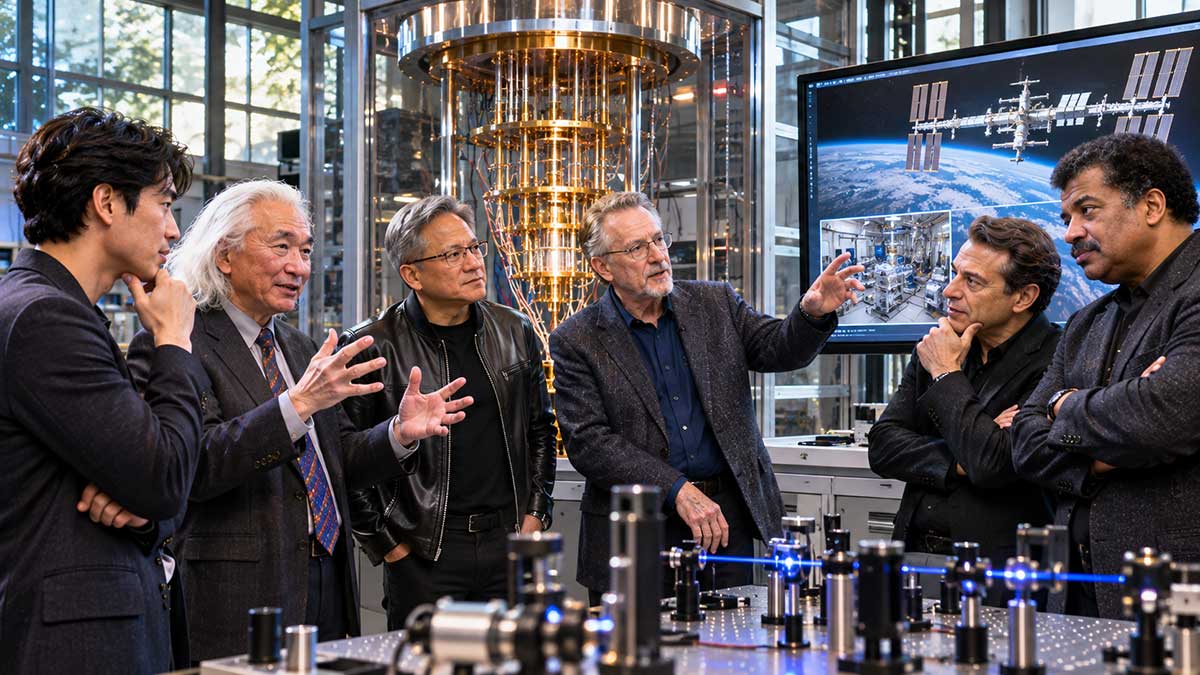
2:00 p.m. Inside the quantum science laboratory of an international space research campus in the American Southwest, sunlight filters through tall windows. Behind a glass partition stands a cylindrical dilution refrigerator containing layers of copper plates, delicate wiring and experimental computing equipment.
On a nearby screen, recorded footage shows astronauts working aboard the International Space Station. Jim Green approaches the display, studying the familiar equipment. Jensen Huang examines the computing hardware, and Michio Kaku stops beside a diagram of an atomic experiment.
Nick Sasaki
For most of human history, we've conducted scientific experiments under conditions we didn't choose. Earth's gravity, atmosphere and temperature have always been part of our laboratory.
What interests me is whether leaving Earth could change the kinds of discoveries we're capable of making.
Jim Green
That's a very good starting point. We often think of space exploration as traveling somewhere new. But space itself can be an experimental environment.
Some experiments become possible there that are extremely difficult to perform on the ground.
Neil deGrasse Tyson
And the interesting distinction is that the laws of physics haven't changed. The conditions under which we observe them have changed.
Nature may reveal something that was previously difficult to see.
Question 1: What Can Scientists Discover in Space That They Struggle to Discover on Earth?
Nick Sasaki
Jim, could you give us an example of something scientists are already doing in space that most people probably haven't heard about?
Jim Green
NASA's Cold Atom Laboratory is a wonderful example. It was launched to the International Space Station in 2018.
Scientists use lasers and magnetic fields to cool atoms to extraordinarily low temperatures. Under those conditions, they can produce what we call a Bose-Einstein condensate.
Michio Kaku
When atoms become sufficiently cold, their quantum properties become much easier to observe. Instead of behaving entirely like separate particles, many of them can occupy the same quantum state.
We can study collective quantum behavior on a scale that would ordinarily be difficult to observe.
Nick Sasaki
What advantage does conducting that experiment in space provide?
Jim Green
On Earth, gravity limits how long certain freely moving atomic samples can remain within an experimental region.
Aboard the space station, the laboratory and the atoms are falling around Earth together. Researchers can observe some of these systems for longer periods under microgravity conditions.
That gives them opportunities to make more precise measurements.
Neil deGrasse Tyson
Notice that Jim said they're falling around Earth. People often assume astronauts are floating because Earth's gravity has disappeared.
It hasn't.
Gravity is still quite strong at the altitude of the space station. The station and everything inside it are continuously falling together.
Peter Diamandis
What fascinates me is that we've gained access to an experimental environment that researchers couldn't routinely use throughout most of scientific history.
What discoveries might come from giving thousands of scientists access to it?
Jensen Huang
And consider what happens when you connect those experiments to advanced computing.
An experiment produces measurements. Computers help scientists identify patterns, compare results with theoretical models and determine what experiment to conduct next.
The better that relationship becomes, the more effectively researchers can investigate unfamiliar phenomena.
Michio Kaku
Cold atom research could contribute to extremely sensitive instruments for measuring acceleration, gravity and other physical effects.
Some future instruments might help us investigate planetary interiors or test fundamental theories of physics.
But those applications require considerable research.
Neil deGrasse Tyson
That's what makes science exciting. We don't have to promise an extraordinary discovery before conducting an experiment.
Sometimes the most valuable result is finding out that our original assumptions were wrong.
Jim changes the display to an image of the Cold Atom Laboratory aboard the space station.
Jim Green
Exactly. We built an instrument that allows nature to answer questions under different conditions. What nature tells us is still up to nature.
Question 2: Could Quantum Computing and AI Help Us Discover Materials That Humanity Has Never Created?
Nick Sasaki
Let's connect that with quantum computing. Could these machines help us discover new materials or medicines that conventional research has struggled to produce?
Michio Kaku
One of the difficulties in studying molecules is that their behavior follows quantum mechanics.
As molecular systems become more complicated, calculating their properties accurately can become extremely demanding for conventional computers.
Quantum computers offer a different approach. They use quantum systems to perform computations, which may eventually make certain simulations more practical.
Jensen Huang
I would view quantum computing as part of a much larger computing system.
Conventional computers remain exceptionally useful. AI can help identify promising candidates, and quantum computers may eventually address particular calculations that are difficult for classical systems.
Each technology has a different job.
Peter Diamandis
Suppose researchers wanted to discover a new material for spacecraft. Something lighter, stronger or more resistant to radiation.
How might that process work?
Jensen Huang
A research team could begin by using computational models to investigate thousands of possible material compositions.
Machine learning could help identify candidates worth examining. Conventional simulations could evaluate their mechanical properties. Future quantum algorithms might help investigate certain molecular or electronic interactions.
Then researchers would manufacture physical samples and test them.
Jim Green
And some of those experiments might benefit from being conducted in space.
Microgravity can influence how fluids move, how particles settle and how certain crystals grow. Those differences could be useful for particular manufacturing processes.
But we would need experimental evidence to establish the benefit for each material.
Neil deGrasse Tyson
I'd like to underline something Jensen just said. The computer identifies a candidate. It doesn't establish that the material actually works.
You still have to make it, measure it and test whether it survives the conditions for which it was intended.
Jensen Huang
Absolutely. A beautiful simulation of a spacecraft component is of little value if the actual component fails.
The objective is to connect computation with physical reality.
Nick Sasaki
So we could eventually have a research system in which computers on Earth identify promising materials, experiments in orbit test them, and the results return to Earth for further analysis?
Jim Green
That's a reasonable future research model.
It would require reliable experimental facilities, communication systems and carefully controlled manufacturing processes.
Michio Kaku
The exciting possibility is that several scientific disciplines could contribute to the same discovery.
Quantum physics helps explain the material. Computing helps investigate it. Engineering determines whether it can be manufactured. Space provides another environment in which to test it.
Peter Diamandis
And somewhere within that process, an entrepreneur might discover a problem that nobody has built a business around yet.
Question 3: Would Quantum Computers Actually Work Better in Space?
The group moves closer to the glass partition. Inside the laboratory, a technician examines equipment connected to the dilution refrigerator.
Nick Sasaki
Looking at this equipment, I have a question that might sound naive.
Space is extremely cold. Could that make it an ideal place to operate quantum computers?
Neil deGrasse Tyson
It's a reasonable question, but space isn't a refrigerator.
A spacecraft exposed to sunlight can become extremely hot. Equipment inside it generates heat. Without surrounding air, getting rid of that heat presents its own engineering challenges.
Jensen Huang
Some quantum computing systems require temperatures extraordinarily close to absolute zero.
Putting them in orbit doesn't eliminate the need for specialized refrigeration, precise control systems or error correction.
You would still need electricity, thermal management and maintenance.
Jim Green
Radiation presents another challenge. Energetic particles can interfere with electronic equipment, and spacecraft systems must be engineered to operate reliably in that environment.
Repairing highly specialized equipment in orbit would introduce further difficulties.
Michio Kaku
Different quantum computing technologies have different operating requirements, too. Superconducting circuits, trapped ions and neutral atoms don't all face identical engineering problems.
We shouldn't assume that a particular environment benefits every approach.
Peter Diamandis
Then perhaps the first question isn't how to put a quantum computer in space.
It's whether putting one there solves a problem that cannot be solved more effectively on Earth.
Jensen Huang
Precisely. If an orbital laboratory can send its experimental data to Earth for processing, that might be the more practical arrangement.
There may eventually be applications requiring specialized computation closer to the experiment, but those applications need to justify the engineering effort.
Nick Sasaki
What about a young person interested in electrical engineering or computer engineering? Would they need an advanced degree in theoretical physics to contribute to this field?
Jensen Huang
Not necessarily. Quantum research requires engineers who develop control electronics, software, sensors, communication systems and computing infrastructure.
There are many technical problems that don't require someone to become a theoretical physicist.
Michio Kaku
A physicist might propose an experiment that nobody knows how to build. An engineer might discover a practical method of conducting it.
Scientific progress depends on both contributions.
Jim Green
Space missions require that kind of cooperation every day. Scientists, engineers, technicians and software developers bring different knowledge to the same problem.
Neil deGrasse Tyson
And a student shouldn't feel obligated to predict which quantum technology will succeed before choosing what to study.
Learn mathematics. Learn how physical systems behave. Learn how to test an idea.
Those abilities will remain useful regardless of which particular technology succeeds.
Closing
The technician inside the laboratory adjusts a connection and returns to a computer terminal. Nick watches for a moment.
Nick Sasaki
It's interesting. I came into this laboratory wondering whether quantum computers might eventually operate in space.
But perhaps the more immediate opportunity is connecting the scientific capabilities we already have on Earth with experimental environments beyond it.
Jim Green
That's a sensible place to begin. We don't need to relocate an entire research laboratory to benefit from conducting particular experiments in orbit.
Peter Diamandis
And there's another question hiding inside that arrangement.
If an experiment conducted in space produces a material with properties that customers cannot obtain anywhere else, what happens next?
Jensen Huang
Someone would need to turn the experiment into a repeatable manufacturing process.
Neil deGrasse Tyson
Assuming someone is willing to pay for the result.
Peter smiles and gestures toward the neighboring entrepreneurship center, visible through the laboratory windows.
Peter Diamandis
Now we're getting to the part I'd like to explore. How does an extraordinary scientific discovery become an industry?
Nick Sasaki
And how would someone recognize that opportunity before everyone else does?
The group leaves the laboratory and walks across the campus, where a different set of questions awaits them.
Topic 2: Where Will the Next Trillion-Dollar Industry Come From?
Opening
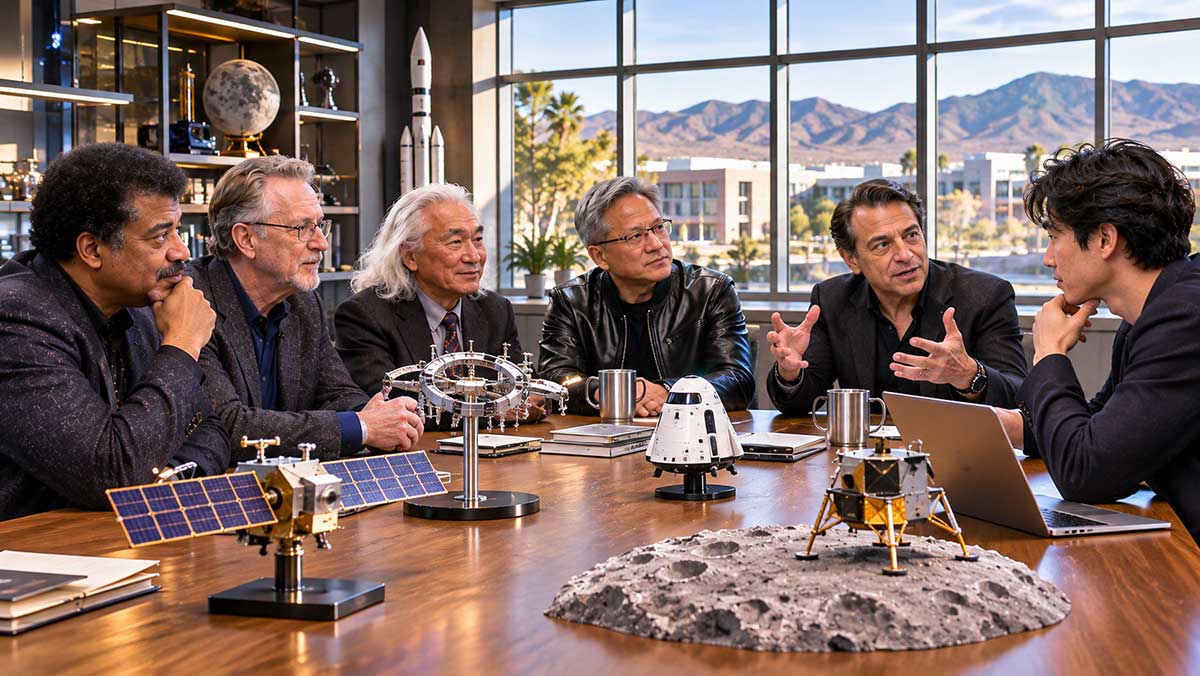
3:10 p.m. The participants enter the research campus's entrepreneurship center. Afternoon sunlight falls across a wooden conference table. Models of communication satellites, reusable spacecraft and proposed commercial space stations occupy shelves along the walls.
On a large display, a graph shows the projected growth of the global space economy. Peter Diamandis pulls out a chair, studying the numbers.
Nick Sasaki
In 2024, the World Economic Forum and McKinsey published a report projecting that the global space economy could reach $1.8 trillion by 2035.
That's an extraordinary figure. But I wonder whether we're still thinking too narrowly about what a space economy could become.
Peter Diamandis
Most people associate the space industry with rockets and satellites. Those are important, but they're infrastructure. The more interesting question is what businesses become possible once that infrastructure exists.
Jensen Huang
The computer industry experienced something similar. Once computing became accessible, entire industries emerged that had little resemblance to the original computer business.
Space infrastructure could create comparable opportunities.
Neil deGrasse Tyson
Before we start spending that trillion dollars, perhaps we should establish where it's supposed to come from.
Peter laughs and turns his chair toward Neil.
Question 1: Which Space Industries Could Generate the Greatest Commercial Value?
Peter Diamandis
That's fair. Much of the existing space economy involves services delivered to people on Earth. Communications, weather forecasting, positioning, agricultural monitoring and other satellite applications already create substantial economic value.
But I'm interested in what happens when commercial activity begins moving beyond those established markets.
Nick Sasaki
Which emerging industries would you watch most closely?
Peter Diamandis
Satellite servicing, orbital manufacturing, autonomous construction and specialized research facilities.
I would pay particular attention to businesses that reduce the cost of operating in space. Every improvement in transportation, maintenance or reliability makes other commercial activities more accessible.
Jim Green
Satellite servicing is an interesting example. A spacecraft may have functioning scientific instruments and electronics but eventually become limited by its remaining fuel.
If another spacecraft could safely refuel it or extend its operational life, that might create significant economic value.
Jensen Huang
And that creates opportunities far beyond the company performing the servicing.
Someone must develop the sensors, control systems, robotic equipment, simulation software and communication infrastructure.
An industrial ecosystem begins forming around a particular need.
Michio Kaku
Over a longer period, we might see industries built around the physical characteristics of space itself.
Microgravity could become useful for producing particular materials. Lunar resources might eventually support construction. Large scientific instruments could be assembled outside Earth's atmosphere.
These are different kinds of opportunities from simply operating satellites.
Neil deGrasse Tyson
But we need to distinguish an interesting physical possibility from a commercially valuable one.
Suppose you manufacture a crystal in space that is ten percent better than its terrestrial equivalent. If it costs a hundred times more to produce, you might have an excellent scientific experiment and a terrible business.
Peter Diamandis
Unless that ten percent improvement enables something extremely valuable.
Neil deGrasse Tyson
Exactly. Now we're asking an economic question rather than making a technological prediction.
Jensen Huang
Sometimes the value of a component isn't proportional to its physical improvement. A small improvement in a critical material might allow an entire system to operate differently.
The customer purchases the capability that the material provides.
Nick Sasaki
So the next major space industry might emerge from a relatively small component that solves an enormous problem?
Jim Green
That's quite possible. It might be something most people never see.
A more reliable sensor, a specialized optical component or a material that allows equipment to survive longer in a difficult environment.
The most commercially valuable invention isn't necessarily the most visually impressive one.
Question 2: What Business Would You Start If You Were a Young Entrepreneur Today?
Nick studies a miniature satellite sitting beside his notebook. Its solar panels are barely larger than his hands.
Nick Sasaki
Let's make this practical. Suppose you're a young entrepreneur with an engineering background, limited financial resources and no connections to major aerospace companies.
You believe the space economy will grow considerably during your lifetime. Where would you begin?
Peter Diamandis
I would begin by talking to people who already operate spacecraft.
Ask them what repeatedly goes wrong. Ask what consumes their budgets, delays their missions or prevents them from accomplishing something valuable.
You might discover a business opportunity that has nothing to do with building a rocket.
Jensen Huang
I would look closely at simulation.
Testing physical equipment in space is expensive. If you can help engineers discover problems before their equipment leaves Earth, you may provide something extremely valuable.
A small team developing excellent software could contribute to a much larger aerospace project.
Jim Green
Reliability is another area worth investigating.
When equipment fails aboard a spacecraft, the consequences can be very different from equipment failure in an ordinary factory.
Developing better diagnostic systems, radiation-resistant electronics or methods of identifying component deterioration could address genuine operational needs.
Neil deGrasse Tyson
And you should find out whether someone has already solved the problem.
Young entrepreneurs sometimes become so attached to their invention that they forget to investigate existing solutions.
Peter Diamandis
That's why conversations with potential customers matter. You want to discover whether the problem is sufficiently expensive or frustrating that someone would actually pay to have it solved.
Nick Sasaki
Would you encourage someone to study business alongside engineering?
Jensen Huang
I would encourage them to learn how an engineering decision affects an entire system.
Suppose you've developed a better electronic component. Can it be manufactured reliably? Can customers integrate it into their equipment? Can you support it after delivery?
Those questions connect engineering with business.
Michio Kaku
There is considerable value in recognizing connections between scientific fields.
Someone studying physics might encounter a problem that an electrical engineer knows how to solve. A computer scientist might develop a method that changes how materials researchers conduct experiments.
New opportunities frequently appear at the boundaries between disciplines.
Peter Diamandis
A young entrepreneur doesn't need to begin with a company capable of operating on the Moon.
They might begin with a piece of software that helps a lunar research team interpret sensor data.
Their first customer could be a university laboratory.
Nick Sasaki
That's encouraging. Someone could participate in the space economy without ever leaving Earth.
Neil deGrasse Tyson
Most people contributing to space exploration already do exactly that.
Behind every successful mission are people working in laboratories, factories, universities and control rooms.
The astronaut is simply the person whose photograph appears most frequently.
The group laughs. Nick picks up the miniature satellite and examines its tiny electronic components.
Question 3: What Would Make a Space Manufacturing Company Profitable?
Nick Sasaki
Let's create a hypothetical company together.
Suppose researchers discover a material that can be manufactured with fewer defects under microgravity conditions. They want to establish a commercial production facility in orbit.
How would you evaluate that business?
Peter Diamandis
I would begin with the customer. Who needs this material? What are they currently paying? What problem would the improved version solve?
Without credible answers, building a factory would be premature.
Jim Green
I would examine the production process itself.
Can the experimental results be repeated? How much equipment is required? What materials must be transported into orbit? How will the finished product return to Earth?
Every additional operation introduces cost and risk.
Jensen Huang
Then I would investigate automation.
If every production cycle requires extensive human intervention, operating expenses could become prohibitive.
Could sensors monitor the process? Could robotic systems handle materials? Could software detect defects before an entire production batch is lost?
Neil deGrasse Tyson
I'd ask what researchers on Earth are doing.
Your orbital factory might take ten years to develop. During those ten years, terrestrial manufacturing methods could improve enough to eliminate your original advantage.
Michio Kaku
That's a particularly interesting scientific challenge. An extraterrestrial manufacturing process must compete against continuing scientific progress on Earth, rather than against today's technology alone.
Nick Sasaki
It sounds like we're developing a series of tests that every proposed space business should pass.
Peter Diamandis
The first test is whether space provides a genuine physical or operational advantage.
The second is whether customers value that advantage.
Jim Green
The third is whether the complete operation is economically feasible, including transportation, maintenance and recovery.
Jensen Huang
The fourth is whether the process can be repeated reliably and eventually scaled.
Neil deGrasse Tyson
And I would add a fifth. What useful contribution does the business make?
A profitable activity can still create problems for other people. Commercial activity in orbit must account for debris, interference and the safety of other spacecraft.
Peter Diamandis
That's a reasonable framework.
It would probably eliminate many exciting proposals before anyone invested enormous sums of money in them.
Nick Sasaki
Which might be a good thing.
Peter Diamandis
Certainly. Finding out that an idea doesn't work can save years of effort and allow someone to pursue a better opportunity.
Jim Green
Space engineering has taught us that lesson repeatedly. Ambitious projects sometimes encounter technical difficulties that cannot be resolved within their available budgets.
NASA's cancellation of its OSAM-1 servicing and assembly mission is a useful reminder of that reality.
Jensen Huang
That's why developing and testing individual capabilities matters. You don't necessarily need to build the entire industrial system at once.
Start with a problem you can solve, demonstrate that the solution works, and use what you've learned to tackle the next problem.
Closing
Outside the conference room, an engineer pushes a cart carrying several modular spacecraft components. Through the windows, the group can see a large assembly hangar across the courtyard.
Nick Sasaki
We've been discussing the possibility of creating an enormous new economy. Yet many of the opportunities you've described begin with surprisingly modest problems.
A satellite that needs refueling. A component that fails too frequently. A manufacturing process that produces too many defects.
Peter Diamandis
That's how an industry can begin. Someone solves a problem, and that solution makes other activities possible.
Jensen Huang
But eventually, you encounter a different challenge. You have to build the physical infrastructure that allows those activities to continue.
Jim Green
And operating a factory in space would be very different from operating one here.
You cannot assume that equipment, spare parts or technical assistance will always be available.
Michio Kaku
Consider the possibilities if we eventually learn to manufacture some of those things at their destination.
We might begin constructing objects that would be impractical to launch from Earth in their completed form.
Neil deGrasse Tyson
I'd like to see how you propose assembling one.
Jensen stands and gestures toward the assembly hangar.
Jensen Huang
There's a robotic demonstration taking place across the courtyard. Perhaps that's a good place to continue this discussion.
Nick Sasaki
Let's go. I'd like to see what the beginning of a factory beyond Earth might actually look like.
The participants leave the conference room and cross the sunlit courtyard. Through the open doors of the hangar, two robotic arms are slowly bringing sections of a metal structure together.
Topic 3: What Happens When We Stop Building Everything on Earth?
Opening
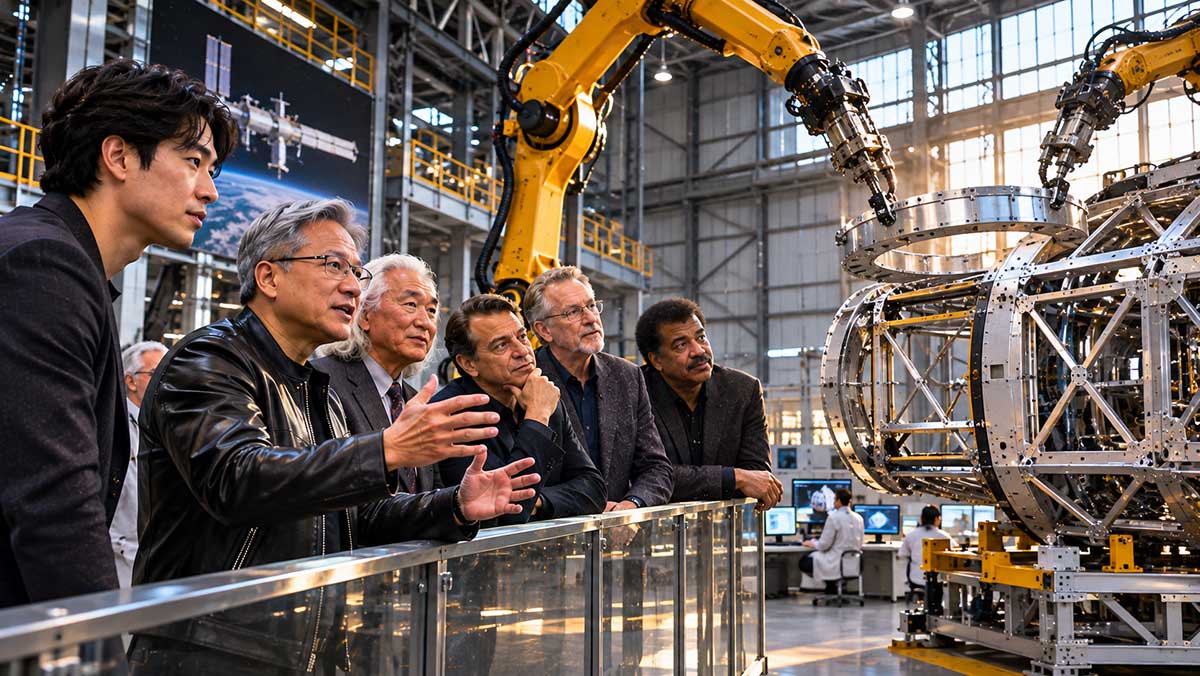
4:25 p.m. The participants enter an enormous spacecraft assembly hangar. Two industrial robotic arms are positioning aluminum components around a partially assembled structure. Engineers observe the operation from computer terminals behind a protective barrier.
One robotic arm suddenly stops. A warning appears on a monitor. An engineer examines the alignment of two connecting components before making a small adjustment.
Nick Sasaki
That interruption probably happens in factories everywhere. Someone notices a problem, makes an adjustment, and production continues.
But what happens when the same machinery is operating hundreds of thousands of miles away?
Jensen Huang
That's one of the most interesting engineering challenges we face. We need machines that can recognize unexpected conditions, determine what went wrong and, within their capabilities, correct the problem.
Jim Green
Distance changes almost every engineering decision. You begin thinking differently about maintenance, spare parts, communication and the consequences of equipment failure.
Michio Kaku
Yet if we solve enough of those problems, we could eventually construct things that would be extremely difficult to launch from Earth's surface.
Peter Diamandis
We might discover that the most valuable cargo a rocket can carry is equipment capable of making other equipment.
Question 1: What Products Could Be Manufactured Better in Space?
Nick Sasaki
Before we discuss enormous factories, what have scientists actually managed to manufacture in space?
Jim Green
Optical fiber is an interesting example. Researchers aboard the International Space Station have experimented with a fluoride glass material known as ZBLAN.
During an experimental production campaign in 2024, approximately 11.9 kilometers of optical fiber were produced aboard the station.
That's a meaningful demonstration of manufacturing capability.
Neil deGrasse Tyson
But producing eleven kilometers of fiber doesn't necessarily mean producing eleven kilometers of commercially superior fiber.
We still need measurements of quality, consistency and performance.
Jim Green
Correct. The scientific interest comes from how certain materials behave during production under microgravity conditions.
On Earth, differences in density can influence the movement of materials. Gravity-driven convection and sedimentation can affect the formation of crystals and other structures.
Reducing those effects may offer advantages for particular processes.
Michio Kaku
What's fascinating is that manufacturers on Earth spend enormous amounts of time controlling conditions that gravity helps create.
In orbit, some of those conditions change naturally.
That gives researchers another set of experimental possibilities.
Peter Diamandis
I would look for materials that are extremely valuable relative to their weight.
Transporting ordinary construction materials into orbit and bringing them back would be difficult to justify. A small quantity of a specialized material with exceptional properties might present a different economic opportunity.
Nick Sasaki
Could pharmaceuticals become part of that industry?
Jim Green
Researchers have studied protein crystallization and other biological processes aboard the space station for many years.
Under certain conditions, microgravity can influence crystal growth. Scientists can investigate those crystals to learn more about molecular structures.
That may contribute to pharmaceutical research, though it doesn't mean every medicine would benefit from being manufactured in space.
Jensen Huang
There is another opportunity here. If the manufacturing process is sufficiently valuable, researchers can instrument it very carefully.
Sensors could monitor temperature, material composition and production conditions. Machine learning could help identify which variables are associated with better results.
Over many experiments, you might develop a much more precise manufacturing process.
Neil deGrasse Tyson
And perhaps discover something that allows manufacturers on Earth to improve their own factories.
Peter Diamandis
That's an excellent point. The economic value of an orbital laboratory might come from the knowledge it produces rather than the physical products it returns.
Nick Sasaki
So a factory in space might help improve thousands of factories on Earth?
Jim Green
For certain technologies, that's a possibility worth investigating.
Scientific knowledge is often more easily transported than physical materials.
Question 2: Could Robots Build Factories, Spacecraft and Habitats in Orbit?
The robotic arms resume their operation. One holds a metal framework steady as the other positions a connecting component.
Nick Sasaki
Watching these machines, I wonder how far we are from building an entire spacecraft in orbit rather than launching one from Earth.
Jim Green
We've already demonstrated that large structures can be assembled in space. The International Space Station is a remarkable example.
Its components were launched separately and assembled over many years through international cooperation, robotic operations and astronaut spacewalks.
Future systems could attempt to perform more of that work autonomously.
Michio Kaku
Consider the limitations imposed by a rocket's cargo compartment.
Every telescope, spacecraft or scientific instrument launched intact must fit within a particular volume and survive the forces experienced during launch.
If we become proficient at assembling structures in orbit, some of those design restrictions could change considerably.
Jensen Huang
One approach would begin with a digital twin.
Engineers create a computational representation of the structure, the robots and their operating environment. They simulate assembly procedures, investigate possible failures and test control software before sending equipment into space.
The physical robots then perform the operations, collecting information that can help engineers improve the simulations.
Neil deGrasse Tyson
How accurately can you simulate something you've never built before?
Jensen Huang
Never perfectly. That's why physical testing remains necessary.
The objective is to discover as many problems as possible before they become expensive or dangerous.
Jim Green
Space introduces conditions that ordinary industrial robots don't encounter. Temperature variations, radiation, vacuum and the behavior of materials under microgravity must all be accounted for.
A machine that performs beautifully inside this hangar might require substantial modifications before operating reliably in orbit.
Nick Sasaki
Suppose an essential machine breaks down on the Moon. The engineer who designed it is sitting here on Earth. What happens then?
Jim Green
Ideally, the equipment was developed with that possibility in mind.
Can the failed component be identified remotely? Can another robot replace it? Are spare components available? Can the machine continue performing essential functions with reduced capability?
Those questions must be addressed long before launch.
Jensen Huang
I would want machines to communicate information about their own condition.
A small change in vibration, temperature or electrical behavior might indicate that a component is deteriorating. Detecting that early could allow maintenance before a complete failure occurs.
Peter Diamandis
And that creates another potential industry: companies providing maintenance services to other companies operating in space.
Neil deGrasse Tyson
We're beginning to describe an industrial community rather than an isolated factory.
You need suppliers, repair services, transportation, communications and people responsible for coordinating all those activities.
Michio Kaku
That distinction matters enormously. A single spacecraft depends almost entirely on Earth. An industrial community might gradually develop the ability to support more of its own operations.
Jim Green
Gradually is the appropriate word. Complete independence would be an extraordinarily difficult objective.
Nick Sasaki
Perhaps one measure of progress would be how many problems an orbital facility can solve without requesting another shipment from Earth.
Jensen Huang
That's a useful engineering metric. Every capability you develop locally can reduce certain dependencies, provided the local system is reliable enough.
Question 3: Could the Moon Become an Industrial Supply Center?
Jim approaches a display containing a model of the Moon and several samples of simulated lunar soil. A small transparent container holds fine gray material resembling lunar regolith.
Nick Sasaki
If transporting materials from Earth is one of the biggest obstacles, could the Moon eventually become a source of industrial materials?
Jim Green
That's the idea behind in-situ resource utilization, often called ISRU.
Rather than transporting every necessary material from Earth, researchers investigate whether resources available at a destination can support local operations.
The Moon contains minerals with potentially useful elements. Evidence indicates that water ice exists in permanently shadowed regions near its poles.
Michio Kaku
Water is particularly interesting. It can support human life, and hydrogen and oxygen obtained from water could potentially serve other purposes, including propellant production.
Neil deGrasse Tyson
Provided you can locate the water, extract it, process it and store the resulting materials at a reasonable cost.
Finding a resource and establishing an industry around it are very different accomplishments.
Jim Green
Exactly. We still need more information about the distribution, accessibility and physical characteristics of lunar ice deposits.
Extracting resources in those environments presents significant engineering challenges.
Peter Diamandis
The commercial opportunity might depend on where the customer is located.
Returning ordinary lunar materials to Earth would probably make little economic sense. Supplying a research station or spacecraft operating near the Moon could present a different calculation.
Jensen Huang
And resource processing would require an entire industrial system.
You need excavation equipment, sensors, energy generation, processing machinery, storage facilities and transportation.
Developing reliable coordination between those systems could become a major field of engineering.
Nick Sasaki
Could lunar soil eventually become a construction material?
Jim Green
Researchers are investigating methods of processing simulated lunar regolith into construction materials.
Some approaches involve heating or binding the material to form solid structures. Local materials might eventually provide shielding against radiation or micrometeorites.
These remain areas of experimental development.
Michio Kaku
Over longer periods, local manufacturing could change the architecture of human settlements beyond Earth.
Instead of transporting every wall and protective structure from our planet, we might bring specialized machinery and use locally available materials for some construction tasks.
Neil deGrasse Tyson
We should resist the temptation to describe the Moon as an unlimited warehouse waiting for us.
It is a scientifically valuable environment with geological records that could help explain the early history of our solar system.
Industrial activity must account for what could be damaged or lost.
Peter Diamandis
Which suggests that careful site selection and responsible resource management would need to become part of industrial planning from the beginning.
Nick Sasaki
The Moon could become an industrial supply center, but developing that capability responsibly might be just as challenging as developing the machinery itself.
Jim Green
That's right. The first successful operations would probably be modest demonstrations. Extract a small quantity of material, process it reliably and establish whether the method can be repeated.
Industrial development would proceed from what those experiments teach us.
Closing
The robotic arms complete their assembly. An engineer inspects the newly connected structure before recording the results.
Nick Sasaki
We've talked about quantum science, commercial opportunities, robotic factories and manufacturing with resources from the Moon.
What strikes me is how many different kinds of knowledge are required to make any of these ideas work.
Jensen Huang
No single engineering discipline could accomplish everything we've discussed today.
You need people who understand electronics, software, mechanical systems, materials and industrial operations.
Peter Diamandis
And people who recognize how those capabilities can become useful businesses.
Jim Green
Some of the most interesting problems remain unsolved. We need researchers and engineers willing to spend years investigating them.
Nick Sasaki
Which brings me to something I've been thinking about throughout our conversation.
There are young people entering universities today who could spend their entire working lives participating in the industries we've been discussing.
How should they prepare?
Neil deGrasse Tyson
That's an interesting question, particularly when we cannot tell them exactly what those industries will look like.
Through the hangar's open doors, the group can see students entering a neighboring engineering laboratory. One carries a small satellite prototype, another a box of electronic components.
Jensen Huang
Perhaps we should go and see what they're building.
Nick looks across the courtyard at the students. The machinery they have been discussing represents possibilities for the future, but the people who might turn those possibilities into reality are already here.
The group walks toward the student laboratory.
Topic 4: What Should Our Children Learn for a Future That Does Not Yet Exist?
Opening
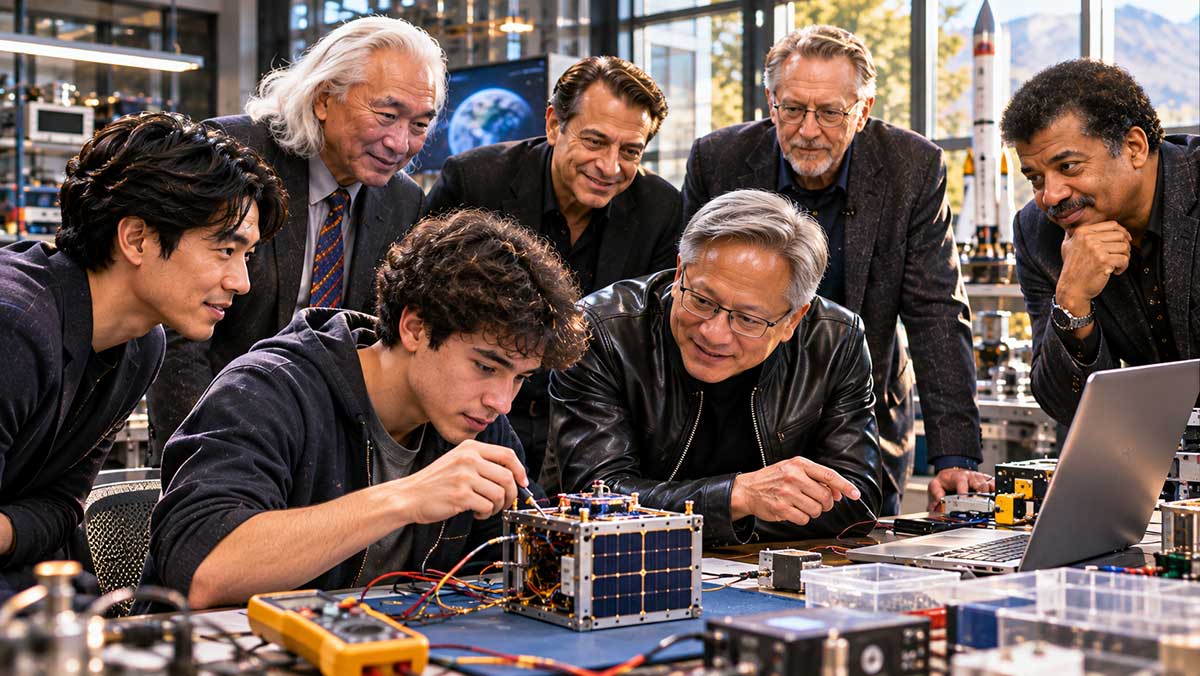
5:45 p.m. Golden evening sunlight enters the university-affiliated engineering laboratory. Students are gathered around workbenches covered with circuit boards, miniature satellites, electronic instruments and partially assembled robotic devices.
At one table, a young student repeatedly tests a circuit connected to a small satellite prototype. Each attempt produces an unexpected reading. Rather than abandoning the experiment, the student makes another adjustment.
Jensen Huang stops beside the workbench and watches for a moment.
Nick Sasaki
We've spent the afternoon discussing industries that might transform civilization over the next twenty or thirty years.
But the people who will actually build those industries might be sitting in university classrooms right now.
Some of them are eighteen years old, trying to decide what to study without knowing what the future will demand from them.
What would you tell those young people?
Jensen Huang
I would begin by telling them that uncertainty is not necessarily a disadvantage.
When an industry is still taking shape, there are problems waiting to be identified, technologies waiting to be developed and businesses waiting to be created.
They have an opportunity to participate in defining what comes next.
Neil deGrasse Tyson
But we should be careful not to burden an eighteen-year-old with the expectation that they must predict the next thirty years of technological development.
Most adults cannot do that either.
Question 1: If You Were Eighteen Today, What Would You Study to Prepare for 2050?
Nick Sasaki
Let's make this personal. If each of you were eighteen years old today, entering university with an interest in quantum computing, artificial intelligence and space exploration, what would you study?
Jensen Huang
I would seriously consider electrical and computer engineering.
It provides a connection between the physical and computational aspects of technology. You learn how electronic systems work, how information is processed and how software interacts with hardware.
Those capabilities are relevant to robotics, spacecraft, advanced computing and many other industries.
But I would want to build things from the beginning of my education.
Michio Kaku
I would study mathematics and physics.
The technologies we have discussed today are built upon principles that scientists discovered through years of mathematical and experimental investigation.
A student who develops strong scientific foundations can approach unfamiliar technologies without having to start from nothing each time.
Jim Green
I might choose engineering with an interest in planetary science.
Future missions will need people who can develop instruments, design spacecraft systems and translate scientific questions into experiments.
A scientist might know what needs to be measured on the Moon, but an engineer must figure out how to build an instrument capable of making that measurement.
Peter Diamandis
I would combine a technical education with entrepreneurship.
Learning how to build something is valuable. Learning how to identify what needs to be built is another skill entirely.
I would spend time speaking with researchers, visiting companies and investigating problems that existing technologies have not solved.
Neil deGrasse Tyson
My advice would begin with a different question.
What are you genuinely curious about?
If you're fascinated by how electronic systems work, study electronics. If you're captivated by the behavior of matter, study physics. If you enjoy constructing mechanical devices, investigate engineering.
Don't select a subject merely because someone predicts it will produce the highest salary in 2050.
Peter Diamandis
But surely young people should pay attention to where opportunities might emerge.
Neil deGrasse Tyson
Of course. I simply wouldn't want a student to abandon a genuine intellectual interest in pursuit of an economic forecast.
The future has a habit of surprising the people who claim to know it.
Nick Sasaki
What if someone is interested in all these subjects? Quantum computing, space technology, engineering and entrepreneurship?
Would trying to study everything become a disadvantage?
Jensen Huang
Choose a technical foundation and develop real competence in it. Then gradually connect that foundation with other fields.
An electrical engineer who understands artificial intelligence and business development could contribute something distinctive.
But that combination becomes valuable when the person possesses genuine engineering ability, rather than superficial knowledge of several fashionable subjects.
Michio Kaku
Breadth allows you to recognize connections. Depth allows you to do something meaningful with them.
You need both, but developing them takes time.
Question 2: Are Universities Preparing Students for Industries That Do Not Yet Exist?
The student at the workbench finally obtains a stable reading. Another student approaches, examines the result and suggests a further test.
Nick Sasaki
Traditional education often prepares students for established professions. How should universities prepare them for industries that have yet to develop?
Jensen Huang
I would give students more opportunities to work on complete systems.
Suppose a group of students is asked to develop a small experimental satellite.
They would encounter problems involving electronics, software, communications, mechanical design and energy management.
Suddenly, the subjects they study in separate classrooms become parts of the same engineering problem.
Jim Green
That's very similar to how scientific missions develop.
A planetary instrument must satisfy scientific objectives, but it must fit within the spacecraft's available mass, energy budget and operating conditions.
Students learn something valuable when they discover that an excellent solution within one discipline can create difficulties in another.
Peter Diamandis
I would introduce a commercial dimension to that project.
Who might need the information collected by the satellite? Could the technology address a problem in agriculture, environmental monitoring or infrastructure inspection?
Let students discover whether their engineering achievement has a useful application outside the classroom.
Neil deGrasse Tyson
I'd leave room for experiments that have no immediate commercial application.
Some discoveries become valuable long after the original researchers have finished their work.
A university must remain a place where people can investigate nature without having to justify every question through potential revenue.
Peter Diamandis
I agree that basic research deserves that freedom. My concern is that students with entrepreneurial ambitions sometimes graduate without knowing how to bring their discoveries into practical use.
Michio Kaku
Both environments are necessary.
One researcher investigates a fundamental scientific question. Another recognizes a technological application. An engineer develops a working device, and someone else finds a way to make it accessible.
These contributions may occur decades apart.
Nick Sasaki
Could a university develop a program that connects engineering, quantum science, space technology and entrepreneurship without sacrificing academic depth?
Jensen Huang
Certainly. Students could pursue rigorous degrees within their chosen disciplines and participate in interdisciplinary projects.
An electrical engineering student might collaborate with a physicist developing a quantum sensor, a mechanical engineer constructing its enclosure and a business student investigating potential applications.
They would learn how their individual contributions fit together.
Jim Green
I'd encourage participation in research laboratories, student satellite programs, robotics competitions and internships.
There are opportunities to gain practical experience before completing a degree.
Neil deGrasse Tyson
And I would teach students how to evaluate evidence, recognize uncertainty and communicate what they have discovered.
A person who cannot distinguish a convincing presentation from a convincing experiment is going to encounter difficulties in any scientific industry.
Question 3: What Separates a Future Industry Creator from Someone Who Simply Follows an Existing Career Path?
The group gathers around a workbench containing several unfinished student projects. One device has been partially dismantled, exposing its wiring and electronic components.
Nick Sasaki
There's a difference between preparing to work for an existing company and preparing to create a company that might establish an entirely new industry.
What qualities would you encourage young people to develop if they wanted to become industry creators?
Peter Diamandis
Learn to recognize problems that other people have accepted as unavoidable.
When someone says that an operation is too expensive, too slow or too difficult, investigate why.
Sometimes there is a genuine physical limitation. Sometimes the obstacle exists simply because nobody has developed a better method.
Jensen Huang
Then learn how to turn an idea into something that works.
A proposal, a presentation or a computer-generated model can help communicate an idea. But building a functioning prototype teaches you things that speculation cannot.
You discover which assumptions were mistaken.
Jim Green
And develop patience.
A scientific instrument may require years of development and testing before it is ready for a mission.
People who expect immediate results may struggle with that kind of work. Yet the ability to remain committed to a difficult problem is extraordinarily valuable.
Michio Kaku
I would encourage intellectual independence.
Read beyond your assigned textbooks. Investigate questions that your courses do not address. Explore scientific fields outside your specialization.
You may encounter an idea that changes the direction of your research.
Neil deGrasse Tyson
And become comfortable admitting that you're wrong.
If you spend three years developing a theory and an experiment demonstrates that the theory is incorrect, nature has given you useful information.
Your responsibility is to accept it.
Nick Sasaki
What about failure? A young person might spend several years studying something or developing a business that never succeeds.
Peter Diamandis
That's a genuine possibility. Entrepreneurship involves financial and personal risk.
I would encourage students to conduct smaller experiments before making enormous commitments. Build a prototype, investigate customer demand and learn from the results.
Ambition doesn't require recklessness.
Jensen Huang
Technical skills gained during an unsuccessful project can remain valuable.
You might discover that your original product has no market, yet the engineering capability you developed could solve a different problem.
Nick Sasaki
Then what would you tell a young student who is excited about the future but worried about choosing the wrong direction?
Jim Green
You don't need to make every decision today.
Develop your abilities, seek opportunities to participate in meaningful projects and allow your experiences to inform your next decision.
Michio Kaku
The scientific questions that fascinate you at eighteen may lead you somewhere unexpected at thirty.
Leave yourself room to discover those possibilities.
Neil deGrasse Tyson
And don't measure your life entirely by whether you become the founder of a billion-dollar company.
The engineer who develops a reliable instrument, the teacher who inspires a future scientist and the researcher who solves an obscure scientific problem may contribute enormously to civilization.
Their names may never appear in financial headlines.
Closing
The student at the nearby workbench begins another experiment. Outside the laboratory windows, the last sunlight disappears behind the desert mountains.
Nick Sasaki
Earlier today, we discussed the possibility of a trillion-dollar space economy.
Looking around this laboratory, I'm beginning to think that the most valuable investment in that future might be taking place right here.
Not in spacecraft or factories, but in the education of the people who will eventually build them.
Peter Diamandis
Every new industry needs people willing to investigate opportunities that others have overlooked.
Some of those people are probably working on their first engineering projects today.
Jensen Huang
Give them the tools to experiment. Give them difficult problems. Let them discover what they are capable of building.
Jim Green
And encourage them to work together. The challenges we've discussed are too extensive for any individual or single discipline to solve independently.
Nick Sasaki
There's something else I wonder about.
Suppose these students succeed. Suppose they eventually build orbital factories, lunar research stations and industries that generate extraordinary wealth.
What kind of society will they create beyond Earth?
Will their scientific education prepare them for that responsibility?
Neil looks through the window. Above the darkening mountains, the Moon has become visible.
Neil deGrasse Tyson
That's a question engineering alone cannot answer.
Michio Kaku
We have spent much of today discussing what humanity might become technologically capable of doing.
Perhaps we should now discuss what humanity ought to do with those capabilities.
Jim gestures toward the astronomical observatory at the far end of the campus. Its white dome stands against the deepening evening sky.
Jim Green
There's a rather appropriate place for that discussion.
The participants leave the laboratory. Behind them, the students continue working, unaware of what industries their unfinished experiments might someday help create.
Topic 5: Are We Ready to Become a Civilization Beyond Earth?
Opening
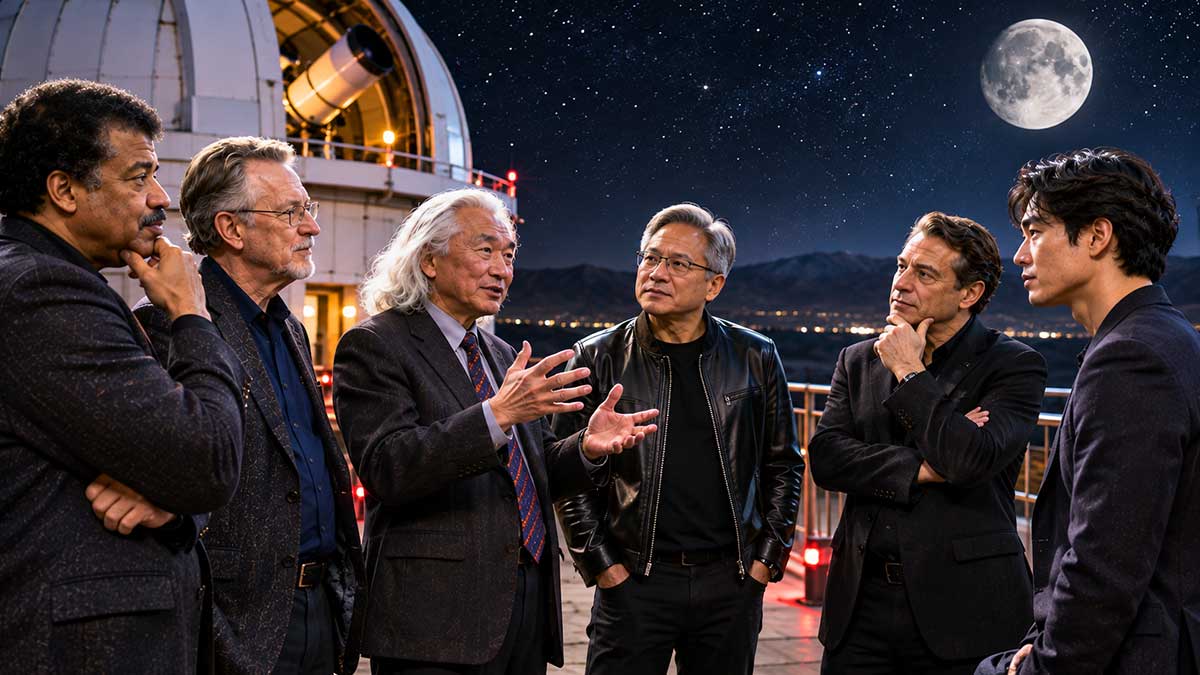
7:15 p.m. The participants step onto the terrace of the astronomical observatory. The desert air has grown cold. Dim red lights illuminate the walkway beneath a white telescope dome. Above the distant mountains, the Moon hangs against a darkening sky.
For a moment, nobody speaks.
Jim Green rests his hands on the railing. Peter Diamandis studies the Moon, and Neil deGrasse Tyson looks upward at the emerging stars.
Nick Sasaki
We've spent the afternoon discussing what humanity might discover, manufacture and build beyond Earth.
We've talked about creating industries worth trillions of dollars and preparing young people to participate in them.
But standing here, looking at the Moon, I find myself asking a different question.
Does acquiring the ability to transform another celestial body give us the right to do so?
Neil deGrasse Tyson
That's a question we would benefit from asking before developing the technology rather than afterward.
Human history contains many examples of people acquiring new capabilities before fully considering their consequences.
Peter Diamandis
I would hope that we could develop those capabilities and establish responsible principles at the same time.
The possibility of misuse shouldn't prevent us from investigating opportunities that could benefit billions of people.
Jim Green
Then we need to decide what responsible development actually means.
Question 1: Who Should Benefit from the Wealth Created Beyond Earth?
Nick Sasaki
Suppose a private company eventually develops a profitable method of extracting resources from the Moon.
Who should benefit from those resources? The company that invested in the technology? Its country of origin? Humanity collectively?
Peter Diamandis
We need to recognize the extraordinary risks involved in developing such an industry.
Investors, engineers and entrepreneurs might commit years of work and substantial financial resources before producing anything commercially valuable.
Without meaningful incentives, many of those projects might never begin.
Neil deGrasse Tyson
I accept that argument. But there's a distinction between rewarding someone for developing a resource and granting them unrestricted control over the environment containing that resource.
Those are separate questions.
Jim Green
The Outer Space Treaty of 1967 establishes that celestial bodies are not subject to national appropriation through sovereignty claims, occupation or other means.
The treaty establishes principles for peaceful exploration and international responsibility.
However, questions concerning the extraction, ownership and commercial use of extraterrestrial resources remain subjects of international legal debate.
Michio Kaku
We're approaching circumstances that earlier generations could discuss only hypothetically.
If extraterrestrial resources become commercially accessible, economic decisions could have consequences extending far beyond national boundaries.
Jensen Huang
We should examine access to infrastructure, too.
Suppose a handful of companies control the transportation systems, communications networks and computing facilities required to operate beyond Earth.
Other companies might technically have the freedom to participate but lack practical access.
Peter Diamandis
Competition and shared infrastructure could help address that problem. A transportation network serving many customers might create opportunities that would otherwise remain inaccessible.
Neil deGrasse Tyson
Provided the terms of access are reasonable.
I would want to know whether researchers from countries without major space programs could participate. Would they have access to scientific facilities? Could their students contribute to discoveries?
Nick Sasaki
Could the benefits reach someone who never travels into space and has no financial investment in the industry?
Jim Green
Scientific discoveries frequently reach people who had no direct involvement in the original research.
Earth observation, weather monitoring and satellite communications already demonstrate how space infrastructure can support everyday life.
Future research might contribute to medicine, environmental monitoring or new materials.
Jensen Huang
A discovery made in an orbital laboratory could eventually become part of an affordable product manufactured on Earth.
That might be a more meaningful measure of its impact than the revenue generated by the original experiment.
Peter Diamandis
I would like to see companies become enormously successful by solving problems that affect enormous numbers of people.
Commercial success and public benefit need not be opposing objectives.
Neil deGrasse Tyson
Agreed. But we shouldn't assume that one automatically produces the other.
We must examine who actually receives the benefits.
Question 2: Can Humanity Avoid Repeating Earth's Mistakes in Space?
A cold wind passes across the observatory terrace. Jim points toward the illuminated portion of the Moon.
Jim Green
That surface contains scientific records extending billions of years into the past.
Certain regions could help us investigate the early history of the solar system. Others may contain resources useful for future exploration.
We need to recognize that these interests could sometimes conflict.
Nick Sasaki
Could industrial development destroy scientific information before researchers have an opportunity to study it?
Jim Green
Yes. Excavation, contamination and surface disturbances could affect scientifically valuable sites.
Planetary protection presents further concerns when exploring environments that might contain evidence of past or present life.
We need different precautions for different destinations.
Michio Kaku
If humanity eventually discovers evidence of life beyond Earth, that could become one of the most significant discoveries in scientific history.
We would want confidence that what we discovered originated there rather than being something we accidentally transported from Earth.
Neil deGrasse Tyson
There's a historical lesson here. Human beings frequently recognize the value of an environment only after damaging it.
We have an opportunity to approach extraterrestrial environments with greater foresight.
Peter Diamandis
I would encourage establishing clear operating principles early. Identify scientifically sensitive regions, develop environmental standards and create incentives for companies to operate responsibly.
Uncertainty about acceptable practices can create difficulties for entrepreneurs and researchers alike.
Jensen Huang
The architecture of future industrial systems could incorporate those requirements from the beginning.
Machines could monitor environmental disturbances, track materials and record operational activities.
But technology cannot decide which activities society considers acceptable. People must establish those objectives.
Nick Sasaki
What about the people themselves?
Suppose thousands of workers eventually live in orbital stations or lunar settlements. Who protects their rights?
Neil deGrasse Tyson
Consider a worker whose employer controls their transportation, housing, oxygen supply and access to medical care.
That person occupies a very different position from someone who can simply leave an ordinary workplace.
Jim Green
Life-support systems would make safety and operational responsibility particularly significant.
Emergency procedures, independent oversight and clear legal protections would need serious attention.
Peter Diamandis
Those conditions would require careful institutional design. A successful settlement would need to attract people who voluntarily choose to live and work there.
Their welfare should be part of the project's foundation.
Jensen Huang
We often discuss the reliability of machines. We should devote equal attention to the reliability of the institutions governing those machines.
Nick Sasaki
There's something unsettling about developing extraordinary technology without developing equally thoughtful social systems.
Neil deGrasse Tyson
Our machines may become more sophisticated without making us wiser.
Those are two different forms of progress.
Michio Kaku
Establishing human communities beyond Earth might help civilization become more resilient over very long periods.
But creating a settlement capable of surviving independently would be extraordinarily difficult.
We should never confuse that distant possibility with a solution to our immediate responsibilities here.
Jim Green
Earth remains the only known planet with an environment naturally capable of supporting human civilization.
Every proposed extraterrestrial settlement would depend on maintaining conditions that Earth provides through its natural systems.
Neil deGrasse Tyson
If studying other planets teaches us anything, it should deepen our appreciation for this one.
Question 3: What Would Make Humanity's Expansion Beyond Earth a Genuine Achievement?
Inside the observatory, a telescope slowly changes position. The movement of its machinery briefly interrupts the quiet.
Nick Sasaki
I'd like to ask each of you one final question.
Think about children born fifty years from now.
Suppose they inherit a civilization with orbital factories, lunar research facilities and industries we can barely describe today.
What might they thank our generation for doing? And what might they wish we had done differently?
Michio Kaku
I hope they would thank us for continuing to investigate fundamental scientific questions.
Many discoveries that shape civilization began with researchers pursuing questions whose practical significance was unknown.
Future generations deserve the freedom to investigate nature beyond the limits of our present knowledge.
I would regret it if we allowed short-term interests to discourage that kind of research.
Peter Diamandis
I hope they would thank us for making participation possible.
A talented young person should have opportunities to contribute regardless of whether they were born near a major research institution or into a wealthy family.
If we reduce barriers to education, experimentation and entrepreneurship, we could discover extraordinary talent in places we have historically overlooked.
Jim Green
I hope they would inherit environments that remain scientifically valuable.
We have an opportunity to explore celestial bodies carefully, preserve important records and establish traditions of international cooperation.
Future scientists should have opportunities to make discoveries that our activities have not inadvertently destroyed.
Jensen Huang
I would hope they inherit tools that allow them to solve problems we couldn't solve.
Computing, robotics and engineering should extend what people are capable of accomplishing.
But I would want those technologies to remain accessible enough that the next generation can improve them, challenge their limitations and create something better.
Neil deGrasse Tyson
I hope they would thank us for teaching them how to think.
Not what to believe about the future, but how to investigate a question, examine evidence and recognize when their conclusions need revision.
And I hope they would inherit a civilization that values human life regardless of which country, continent or planet someone happens to inhabit.
Nick remains silent for several seconds, looking at the Moon.
Nick Sasaki
At the beginning of our conversation, I was interested in where the next trillion-dollar industry might emerge.
Now I wonder whether its financial value might be the least interesting thing about it.
What if a discovery made in space helps a child recover from an illness? What if a new material makes essential infrastructure more affordable? What if international cooperation beyond Earth helps countries discover reasons to work together here?
Wouldn't those achievements deserve greater attention than the size of the industry itself?
Peter Diamandis
I would still celebrate the creation of a trillion-dollar industry.
But I would want to know what problems it solved to become worth that much.
Neil deGrasse Tyson
That's a distinction worth preserving.
Closing
The group moves closer to the observatory railing. Above them, the stars have become more visible.
Nick Sasaki
We began this afternoon looking at quantum research equipment. We visited an entrepreneurship center, watched robotic machinery assemble spacecraft components and met students preparing for careers whose possibilities are still taking shape.
Now we're standing beneath the night sky, discussing what those students might eventually create.
I find that deeply encouraging.
Jim Green
Many of the capabilities we've discussed will require years of research. Some may never become practical.
But the investigation itself can teach us valuable things.
Jensen Huang
And every generation inherits tools that earlier generations developed. Its responsibility is to discover what else can be accomplished with them.
Michio Kaku
There are still extraordinary scientific questions waiting for answers.
Some of those answers may come from people who haven't yet entered a university classroom.
Peter Diamandis
And some of tomorrow's industries may begin with an experiment sitting on a student's workbench tonight.
Neil deGrasse Tyson
Just make sure the experiment works before announcing the trillion-dollar valuation.
Everyone laughs.
Nick Sasaki
Michio, Peter, Jim, Jensen and Neil, thank you for spending this afternoon and evening with me.
You've given me much more than predictions about technology and business. You've given me reasons to think carefully about the future we're preparing for the next generation.
The participants exchange appreciative nods. For another moment, they remain beneath the open sky.
Across the research campus, several windows in the student engineering laboratory are still illuminated. Someone is continuing an experiment long after the scheduled working day has ended.
Perhaps the beginning of humanity's next great industry will look nothing like an enormous spacecraft or a futuristic factory.
Perhaps it will begin with a young person, an unfinished experiment and a question nobody has yet answered.
Final Thoughts
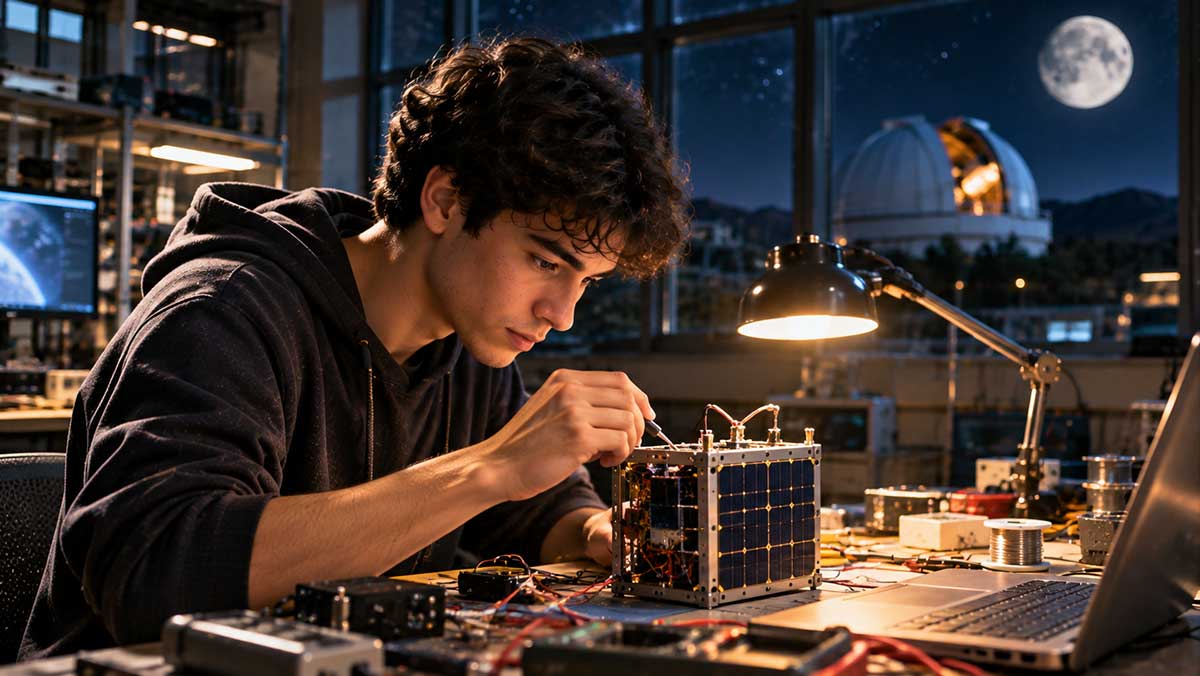
When I began exploring the possibility of a trillion-dollar industry beyond Earth, my attention was drawn to quantum computing, artificial intelligence, orbital manufacturing and the commercial potential of lunar resources. By the end of this imaginary conversation, I found myself thinking more about the students we encountered in the engineering laboratory.
Somewhere today, a young person is learning how to design an electronic circuit, program a robotic device or solve a mathematical equation. That student may have little idea how those seemingly ordinary lessons could contribute to discoveries that change civilization decades from now.
What encouraged me throughout this discussion was the realization that participating in the space economy does not necessarily require becoming an astronaut or founding a rocket company. An electrical engineer developing a reliable sensor, a computer scientist improving simulation software or a researcher investigating new materials could make an equally meaningful contribution. NASA's CubeSat Launch Initiative offers one example of how educational institutions can participate in practical space projects.
We must remain realistic about the challenges. A promising scientific experiment does not automatically become a profitable business. Quantum computing still faces substantial technical obstacles, orbital manufacturing must demonstrate economic advantages, and extracting lunar resources at an industrial scale remains an unproven proposition. The future will reward careful experimentation rather than enthusiasm alone.
There is a moral dimension to these possibilities that deserves equal attention. The principles established by the United Nations Outer Space Treaty remind us that exploration beyond Earth carries international responsibilities. If humanity establishes new industries and communities in space, we must think carefully about access, environmental protection, scientific preservation and the dignity of the people who work there.
I hope the next trillion-dollar industry will be measured by more than its financial value. Perhaps its greatest achievement will be a medical discovery that saves lives, a technology that protects our planet or a scientific project that brings people from different nations together. Wealth can be a meaningful result of solving human problems, but it should never become the only measure of success.
The future may begin with something much smaller than an orbital factory or a lunar settlement. It may begin with a student sitting beside an unfinished experiment, refusing to give up on a difficult question. Our responsibility is to give that student the education, encouragement and freedom to discover what is possible.
What would you study today if you were eighteen again? Which industry beyond Earth would you want to help create? And what would you hope future generations inherit from the discoveries we make during our lifetime?
Fictional Conversation Disclaimer: This imaginary roundtable presents fictional dialogue and speculative scenarios inspired by existing scientific research and the participants' public fields of expertise. It does not represent an actual meeting, verified personal statements, investment advice or guaranteed technological predictions.
Short Bios:
Michio Kaku
Michio Kaku is an American theoretical physicist, futurist and bestselling author. A professor at the City College of New York, he is known for his work in theoretical physics and his ability to communicate scientific ideas to the public. His books include Physics of the Future, The Future of Humanity and Quantum Supremacy. His interests span quantum computing, space exploration and the long-term possibilities of human civilization.
Peter Diamandis
Peter Diamandis is an entrepreneur, physician, author and founder of the XPRIZE Foundation. He co-founded Singularity University and has participated in numerous space-related commercial ventures. His work focuses on technological innovation, entrepreneurship and addressing large-scale human challenges. His books include Abundance, Bold and The Future Is Faster Than You Think.
Jim Green
Jim Green is an American planetary scientist who served as NASA's chief scientist from 2018 until his retirement in 2022. He previously directed NASA's Planetary Science Division, overseeing a period that included major missions investigating Mars, Jupiter, Pluto and other destinations. His expertise includes planetary exploration, scientific instrumentation and the search for environments capable of supporting life.
Jensen Huang
Jensen Huang is an electrical engineer, entrepreneur, co-founder and CEO of NVIDIA. Under his leadership, NVIDIA developed computing technologies that have become central to artificial intelligence, scientific simulation, robotics and accelerated computing. His perspective connects advanced computing with the practical engineering requirements of future industrial systems.
Neil deGrasse Tyson
Neil deGrasse Tyson is an American astrophysicist, author and science communicator associated with the Hayden Planetarium at the American Museum of Natural History. He is widely recognized for presenting Cosmos: A Spacetime Odyssey and hosting StarTalk. His work encourages scientific literacy, evidence-based reasoning and public curiosity about the universe.
Nick Sasaki
Nick Sasaki is the creator of ImaginaryTalks, a platform that brings historical figures, contemporary thinkers, scientists and cultural leaders together through fictional conversations. His work explores how imagination can inspire constructive change, encourage personal growth and help people consider possibilities for humanity's future.
Leave a Reply