
Introduction
Every November, millions of Americans gather around dinner tables filled with turkey, cranberries, pumpkin pie and familiar family dishes. We travel considerable distances to be with loved ones, watch football, exchange greetings and take a welcome break from our daily responsibilities. Yet beneath these cherished traditions lies a question we rarely examine deeply: What is the true meaning of Thanksgiving?
The story reaches back to 1621, when the Plymouth settlers and the Wampanoag participated in a three-day harvest gathering. According to Edward Winslow's surviving eyewitness account, the occasion brought together people whose lives, cultures and circumstances were remarkably different. The settlers had survived a devastating winter, and the Wampanoag had experienced catastrophic losses from disease. Their gathering offers a moment of cooperation within a much more complicated history.
More than a century and a half later, George Washington issued his Thanksgiving proclamation of 1789. He called upon Americans to acknowledge the providence of Almighty God, express gratitude for their blessings, seek forgiveness for their transgressions and fulfill their responsibilities as citizens. His message extended far beyond the celebration of a successful harvest.
Then, in 1863, amid the suffering of the American Civil War, Abraham Lincoln proclaimed a national day of Thanksgiving. Encouraged by the persistent advocacy of writer and editor Sarah Josepha Hale, Lincoln invited Americans to recognize their remaining blessings, care for those who were suffering and pray for the healing of their divided nation.
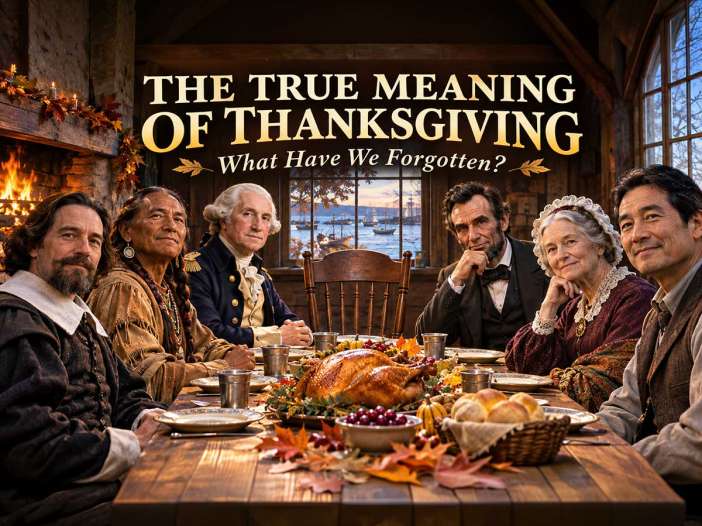
What would happen if five figures connected to this history could gather around a Thanksgiving table today? What would William Bradford, Ousamequin, George Washington, Abraham Lincoln and Sarah Josepha Hale think of the holiday that Americans now celebrate?
In this imaginary conversation, we meet inside a farmhouse overlooking Plymouth Harbor. Over the course of one Thanksgiving afternoon, our guests explore the people we owe our gratitude to, the place of God in our celebrations, the meaning of thanksgiving during personal suffering and the possibility of reconciliation between families and nations.
Perhaps the most meaningful question is not how many blessings we have received this year. Perhaps it is whether someone else has received a blessing through us.
Fictional Conversation Disclaimer: This is a fictional conversation inspired by historical events, documented writings and the lives of its participants. The meeting and dialogue are imaginary. Ousamequin's words are creative interpretations rather than recorded statements or representations of the beliefs of all Wampanoag people.
Topic 1: Never Forget the Hands That Helped You Survive
Opening
Plymouth, Massachusetts. November 26, 2026, 1:00 p.m.
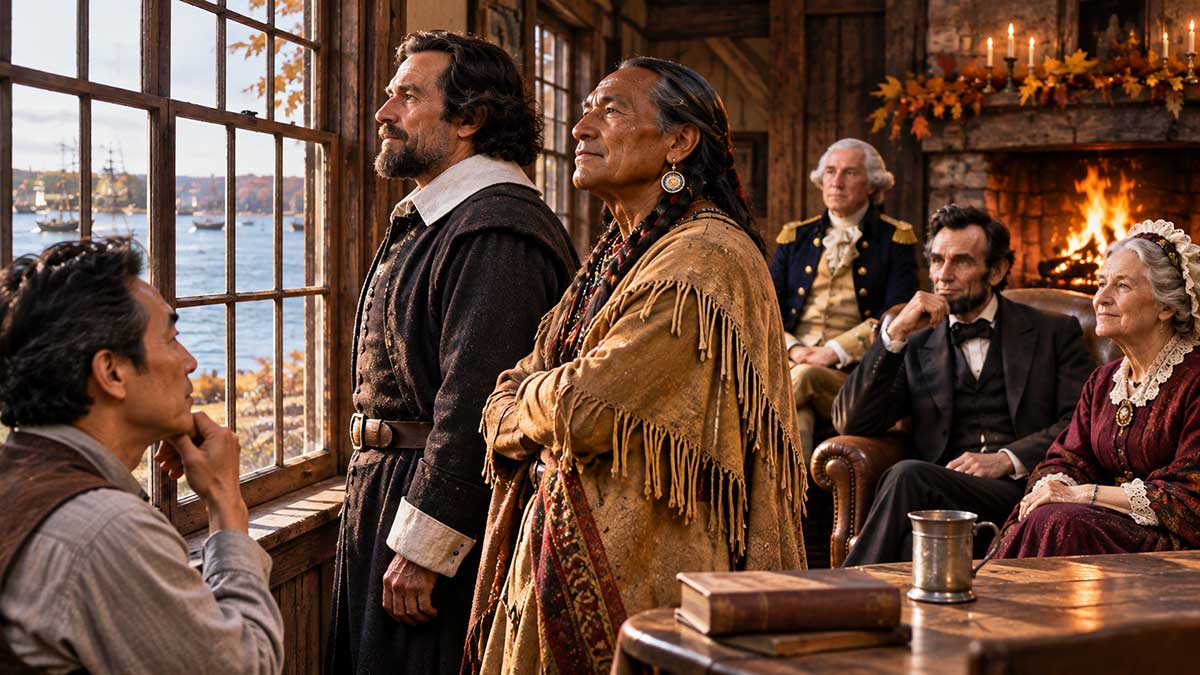
Beyond the windows of a modest farmhouse, Plymouth Harbor stretches beneath a pale November sky. Bare branches move in the coastal wind. Inside, a fire burns steadily, and the fragrance of freshly baked bread drifts from the kitchen.
William Bradford stands beside the window, studying the coastline. A few feet away, Ousamequin looks across the same waters. Nearly four centuries separate their original meeting from this extraordinary Thanksgiving afternoon.
George Washington examines the wooden beams of the farmhouse. Abraham Lincoln settles into an armchair near the fireplace, and Sarah Josepha Hale glances toward the dining room, where a long table has been prepared with seven chairs.
Nick
Welcome, everyone. Having you together on Thanksgiving Day is something I never thought possible.
Governor Bradford, Ousamequin, President Washington, President Lincoln, Mrs. Hale, each of you has a connection to the holiday we celebrate today.
Yet I wonder whether we have remembered its meaning as carefully as we have preserved its traditions.
Bradford turns away from the window.
William Bradford
You have prepared a generous table. I confess that such abundance would have astonished us during our earliest days here.
Ousamequin
The waters are familiar. Much of what surrounds them is not.
Abraham Lincoln
Four centuries can change a great deal. I suspect they can change the way people remember things, too.
Nick
That is precisely why I wanted us to gather here, near the place where so much of this history began.
Question 1: What Happened Before the First Thanksgiving?
Nick
Governor Bradford, American children often learn about the Pilgrims through pictures of a wonderful harvest feast. But before that celebration, there was a winter that nearly destroyed your community.
What should we know about those months?
William Bradford
We arrived late in the year of 1620, after a difficult passage across the ocean. We had little shelter prepared for the season before us. Sickness spread, provisions were limited, and the labor required of us was greater than our strength.
At one point, scarcely six or seven persons remained sufficiently well to attend to the sick.
They prepared food, tended fires, washed clothing and performed duties that many would have found disagreeable.
They did these things without complaint, at considerable risk to themselves.
Sarah Josepha Hale
And how many of those people are remembered by name at Thanksgiving today?
William Bradford
Very few, I suspect.
Yet without their labor, fewer of us would have lived to see the spring.
Abraham Lincoln
There is something worth remembering in that. History often records the names of governors and presidents. It is less generous with the names of those who wash the clothes, prepare the meals and sit beside the sick.
Nick
Nearly half of the Mayflower passengers died during that first winter. When we consider that, the harvest celebration takes on a very different meaning.
William Bradford
Indeed. We had buried people with whom we had crossed the ocean. Families had been diminished. Children had lost parents.
The arrival of a season in which we could gather food and enjoy some measure of health was no small matter.
In my writings, I urged the descendants of our company to remember what their fathers had endured and how they had been sustained through their trials.
I regarded our preservation as an expression of God's providence.
George Washington
There is a danger peculiar to succeeding generations. They inherit the fruits of great exertion without experiencing the circumstances that made those exertions necessary.
What their ancestors regarded as an extraordinary blessing may become, in time, an ordinary expectation.
Sarah Josepha Hale
A child born into a comfortable home may never know how many years his mother and father labored to provide it.
That is one reason family gatherings matter. They offer an opportunity to preserve memories that would otherwise disappear.
Nick
Perhaps we should spend part of Thanksgiving listening to our parents and grandparents tell us about their lives.
Not merely asking what they accomplished, but what they endured.
William Bradford
And whom they depended upon when their own strength proved insufficient.
Ousamequin turns from the window.
Ousamequin
There were people living here before the ship arrived. Their losses must be remembered, too.
Question 2: What Brought the Wampanoag and the Pilgrims Together?
Nick
Ousamequin, the familiar account often begins with the arrival of the Mayflower. Yet your people had lived in this region for generations.
What was happening among the Wampanoag when the settlers arrived?
Ousamequin
The years before their arrival had brought great sickness to many of our communities. Places that had once been filled with families had lost much of their population.
Our circumstances had changed. We had neighboring peoples whose intentions we needed to consider, and now there were newcomers establishing themselves upon the coast.
An agreement with the English offered possibilities for mutual protection.
But you must understand that we were making decisions concerning our own future. We were not simply waiting for someone else's history to begin.
Nick
That is an important distinction. Your people were dealing with their own suffering and political concerns.
Ousamequin
Yes. The English needed food, knowledge and security. We had reasons of our own for seeking an agreement.
An alliance involves more than one people.
William Bradford
We established terms of peace in the spring of 1621. Among them were provisions concerning mutual assistance and the prevention of injury between our peoples.
Tisquantum, whom the English called Squanto, instructed us in planting corn and assisted us in our dealings with others.
His knowledge was of great consequence to our settlement.
Nick
His own history was extraordinary. He had been kidnapped by an English expedition in 1614 and taken across the Atlantic. When he eventually returned, he discovered that his home community of Patuxet had been devastated by disease.
Yet he became an interpreter and intermediary for the settlers.
Ousamequin
His circumstances were difficult, and his dealings with the English and our people were not always simple.
You should remember him as a man with interests and judgments of his own.
George Washington
An agreement between peoples must rest upon recognition of their respective interests. Gratitude for assistance is proper, but it must never become an excuse to overlook the independence of those who provide it.
Nick
Edward Winslow's account describes a harvest gathering lasting three days. Ousamequin arrived with approximately ninety men, and the Wampanoag brought five deer.
That is one of the few surviving written accounts of the occasion.
William Bradford
Our harvest had been gathered. We had reason to rejoice after the difficulties of the preceding months.
Ousamequin
And the deer came from our people.
Sarah Josepha Hale
That detail deserves a place in every child's account of Thanksgiving.
The Wampanoag were contributors to the gathering, not merely guests at someone else's celebration.
Abraham Lincoln
A rather different picture emerges when we ask who supplied the dinner instead of simply asking who hosted it.
Hale smiles at Lincoln's observation.
Nick
It makes me think about our own Thanksgiving tables. Behind every meal are people who planted, harvested, transported, prepared and served the food.
Most of them will never know our names, and we may never know theirs.
Ousamequin
Then perhaps your celebration should begin by asking whose labor made it possible.
Question 3: What Happens When Gratitude Is Forgotten?
Nick
There is a difficult part of this history that we cannot ignore.
The alliance between Plymouth and the Wampanoag endured for decades. Yet subsequent generations experienced conflict, broken relationships, the loss of Indigenous lands and terrible suffering.
How should we celebrate an occasion of mutual generosity when we know what happened afterward?
For a moment, the only sound in the room is the crackling fire.
Ousamequin
An agreement is not honored simply by remembering the day it was made.
It is honored by the conduct of those who inherit it.
If you remember our presence at a harvest gathering, remember that our people had homes, families, lands and hopes for their children.
We were a people with a future, just as the English wished to have a future.
William Bradford
Our agreement was maintained during my lifetime. I cannot answer for every action of those who came after me.
Nor would it be right to suggest that relations between the English and the native peoples were always free from injury or disagreement.
Abraham Lincoln
A country must learn to remember more than the portions of its history that give it comfort.
We may honor the courage of our ancestors without declaring every action of theirs righteous.
If their achievements are part of our inheritance, then the unfinished responsibilities of their history deserve our attention.
George Washington
The observance of a national blessing ought to invite examination of national conduct.
An expression of gratitude loses much of its sincerity when it is separated from the duties that accompany it.
Nick
Then perhaps one meaningful way to honor the Wampanoag today is to learn about their history, listen to their living communities and recognize that they are still here.
Ousamequin
Yes. Do not speak of our people as though they belong entirely to the past.
Sarah Josepha Hale
And perhaps this principle reaches into our own households.
How often do we celebrate the good fortune of our families without acknowledging the person who made sacrifices for everyone else?
A mother may have given up opportunities of her own. A father may have endured years of difficult work. An older sibling may have carried responsibilities that were never properly recognized.
Nick
We sometimes wait until a funeral to say things that would have brought someone great happiness during their lifetime.
Sarah Josepha Hale
Then let Thanksgiving be an occasion to say them sooner.
A few sincere words spoken across a dinner table may become one of a person's most cherished memories.
Closing
From the adjoining room comes the faint sound of a serving dish being placed upon the table. Hale rises and looks through the doorway.
Sarah Josepha Hale
I believe our meal is nearly ready.
Nick
Governor Bradford, Ousamequin, you have given us much to think about before we sit down.
I had always associated Thanksgiving with remembering our blessings. I am beginning to see how much we must learn about the people behind them.
William Bradford
And when you remember those people, consider Him from whom you believe your blessings ultimately come.
Washington glances at the folded document Nick has placed beside his seat in the dining room.
George Washington
That question occupied my attention in the first year of our government.
Abraham Lincoln
I suspect your answer is waiting for us at the table, General.
Washington smiles slightly. The guests rise and move into the dining room, where a copy of his Thanksgiving proclamation of 1789 rests beside the freshly baked bread.
Topic 2: Who Truly Deserves Our Thanksgiving?
Opening
1:35 p.m. The dining room of the farmhouse overlooking Plymouth Harbor.
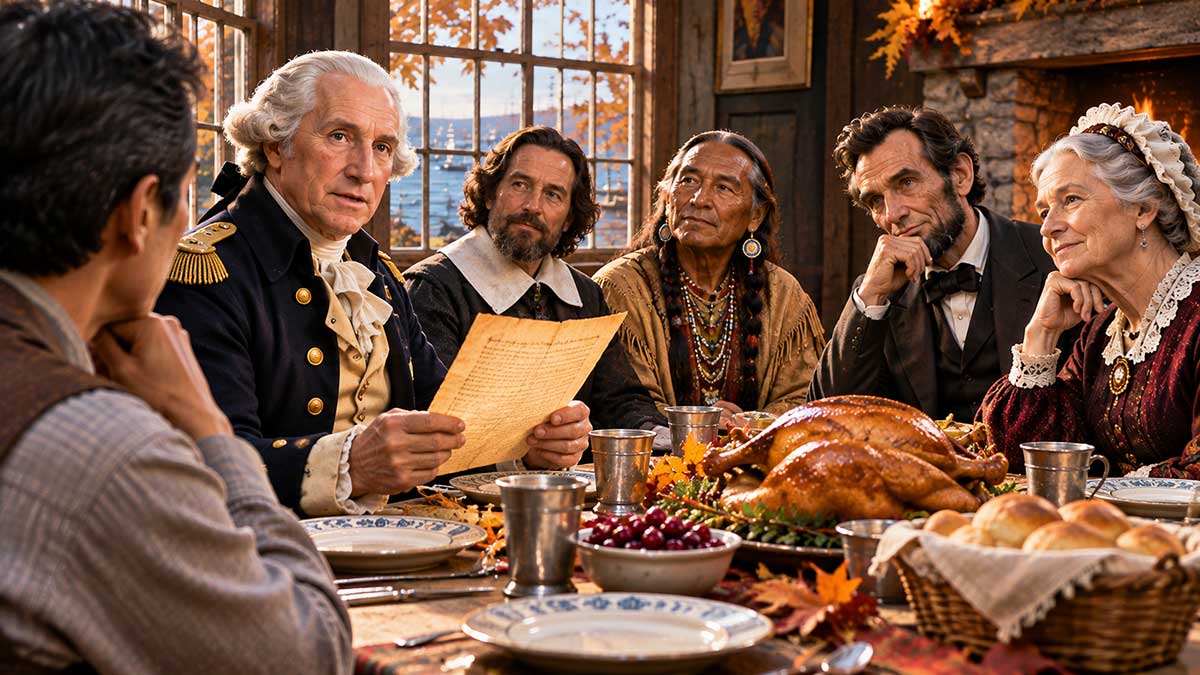
The guests gather around a long wooden table. Afternoon sunlight falls across white plates, freshly baked bread and bowls of cranberries. The fragrance of roasted turkey fills the room.
George Washington takes his seat and unfolds a document that Nick has placed beside his plate.
It is a copy of his Thanksgiving proclamation, dated October 3, 1789.
George Washington
I recognize these words. Our government was still in its infancy when I issued this proclamation.
Sarah Josepha Hale
Seventy-four years would pass before President Lincoln issued the proclamation for which I had long hoped.
Abraham Lincoln
Mrs. Hale, you were considerably more patient with the government than most people who wrote to me.
Hale laughs softly.
Nick
President Washington, what surprised me when I read your proclamation was how little it resembled the Thanksgiving greetings we exchange today.
You spoke of God, forgiveness, national responsibilities and the welfare of other nations.
I wonder how much of that original intention we have retained.
Question 1: Why Did Washington Ask an Entire Nation to Thank God?
Nick
You began your proclamation by declaring that it was the duty of all nations to acknowledge the providence of Almighty God.
Why was that recognition so significant to you?
George Washington
Consider the circumstances of our country at that time. We had emerged from a prolonged struggle for independence. We had experienced considerable uncertainty under our former arrangement of government.
A new Constitution had been established, and we were undertaking an experiment whose success could scarcely be guaranteed.
It seemed proper that we acknowledge the blessings we had received rather than congratulate ourselves as though every favorable circumstance had resulted from our own wisdom.
William Bradford
There is much in that sentiment with which I agree. Men are often diligent in their prayers when danger approaches, yet remarkably forgetful when danger has passed.
George Washington
Prosperity can encourage a man to overestimate his own abilities.
A nation is susceptible to the same weakness.
Nick
Today, people frequently speak about being self-made. We admire those who have achieved success through their own determination.
Is there something spiritually dangerous about that way of thinking?
William Bradford
There is no dishonor in diligent labor. Scripture gives ample encouragement to it.
But consider the farmer. He prepares the ground, plants his seed and attends to his field. Yet he cannot command the rain, nor can he persuade the sun to shine.
His labor is necessary. It is not sufficient.
Abraham Lincoln
And if the crop succeeds, he will probably take considerable satisfaction in his agricultural abilities. If it fails, he may have considerably more to say about the weather.
Washington smiles.
George Washington
Our accomplishments should be acknowledged. But we must recognize the circumstances that permitted them.
Nick
Ousamequin, your people had spiritual traditions different from those of the other guests. How do you respond to this discussion?
Ousamequin
A man who receives food from the land should recognize that the land existed before him.
The waters, the animals and the seasons are not his inventions. His children will need them after he is gone.
Our ways of expressing these relationships are not the same as yours. But I would question anyone who believes that everything sustaining his life belongs to him alone.
William Bradford
Our beliefs differ, yet we both recognize the limitations of man's own efforts.
Ousamequin
And what a man does with what he receives matters greatly.
Nick
Perhaps our first act of Thanksgiving should be to recognize how much of our existence depends upon things we never created and could never have provided entirely for ourselves.
Question 2: Whom Have We Forgotten to Thank?
Hale reaches for the breadbasket and passes it to Ousamequin.
Sarah Josepha Hale
Gentlemen, we have spoken of nations and divine providence. May I bring our attention somewhat closer to home?
Nick
Please do.
Sarah Josepha Hale
Who prepared this meal?
Nick
Several people contributed to it.
Sarah Josepha Hale
And have they been thanked?
Nick looks toward the kitchen.
Nick
Perhaps not nearly enough.
Sarah Josepha Hale
That is a difficulty I have observed in many households. We gather to celebrate our blessings, yet someone has spent much of the day attending to the comfort of everyone else.
By the time the family sits down, that person may be exhausted.
A celebration of gratitude ought to include gratitude for the person who made the celebration possible.
Abraham Lincoln
And perhaps an offer to wash the dishes afterward.
Sarah Josepha Hale
Mr. President, that would be a most welcome beginning.
The guests laugh.
Nick
Who else should we remember today?
Sarah Josepha Hale
Our parents, certainly. And those who performed the duties of parents when circumstances required it.
Children rarely comprehend the full extent of the sacrifices made for them. Often, they discover it only when they have children of their own.
George Washington
We should honor those whose efforts established the institutions and freedoms from which we benefit.
Many rendered service without distinction or public recognition.
A country owes much to citizens whose names will never appear in its histories.
William Bradford
We must remember those who instructed us, corrected us and attended to us in sickness.
A man's obligations extend far beyond his immediate household.
Ousamequin
There may be someone who helped you many years ago, when you had little to offer in return.
Have you considered whether that person now needs something from you?
Nick
That is a difficult question.
Sometimes we receive kindness, move forward with our lives and never return to discover what happened to the person who helped us.
Ousamequin
Then perhaps the relationship has become useful to only one of you.
Nick considers his words.
Nick
I think of teachers, friends, relatives and people who believed in us before we had accomplished anything significant.
Some of them may never know how much difference they made.
Sarah Josepha Hale
Then tell them.
Do not assume that affection and appreciation are so obvious that they need never be expressed.
Abraham Lincoln
A man may spend considerable effort composing a speech for strangers and yet find himself unable to tell his own family what they mean to him.
Sarah Josepha Hale
Which is a curious arrangement of priorities.
Nick
What if, at every Thanksgiving dinner, each person took a moment to express something they genuinely appreciated about someone else at the table?
Sarah Josepha Hale
I would welcome such a custom. Children could participate, too.
They would learn that gratitude is something we communicate, not merely something we are instructed to possess.
Question 3: Can Gratitude Coexist With Moral Accountability?
Nick unfolds Washington's proclamation and examines a passage near its middle.
Nick
President Washington, there is another part of your proclamation that receives considerably less attention.
You asked Americans to seek forgiveness for their national and other transgressions.
Why did you include that in a proclamation of thanksgiving?
George Washington
It would have been presumptuous to acknowledge divine favor without acknowledging our own imperfections.
A people may have received considerable blessings and still have neglected important duties.
Our conduct must remain subject to examination.
Nick
That brings me to a difficult question about your own life.
You helped establish a nation founded upon liberty, yet you held people in slavery at Mount Vernon.
How should we reconcile those two parts of your legacy?
Washington rests his hands upon the table.
George Washington
They are both part of the historical record.
In my later years, I expressed opposition to slavery and a desire to see its abolition accomplished through legislative means.
My last will provided for the eventual emancipation of the enslaved people whom I owned outright.
But those provisions do not alter the fact that I held people in bondage during my lifetime.
Abraham Lincoln
Nor should we suppose that the existence of a noble principle guarantees its fulfillment.
Our Declaration expressed a proposition concerning human equality. Much of our subsequent history has concerned the difficulty of living according to that proposition.
Ousamequin
When one people celebrates its freedom, it should ask what freedom means to the people living beside it.
Nick
Can we honor someone's contributions without approving everything that person did?
Abraham Lincoln
We must, if we are to study history with any honesty.
Otherwise, we are left with two unsatisfactory choices. We either excuse every failing of the people we admire, or we refuse to learn anything from those who possessed serious failings.
Neither approach will make us wiser.
Sarah Josepha Hale
The same difficulty exists within families.
We may be grateful to our parents for much of what they gave us and still recognize mistakes they made.
Love does not require us to abandon our judgment.
William Bradford
A sincere examination of one's conduct is entirely consistent with thanksgiving.
A man who acknowledges God's mercy should be particularly reluctant to regard himself as free from fault.
Nick
Perhaps we should include two kinds of reflection in our Thanksgiving prayers.
We can thank God for what we have received, and we can ask forgiveness for the occasions when we have failed to use those blessings well.
George Washington
That would be consistent with the intention of my proclamation.
Ousamequin
And after the prayer, there remains the question of what you will do differently.
Closing
Hale looks around the table. The food has been served, and the afternoon sunlight has begun to soften.
Sarah Josepha Hale
Before we begin our meal, perhaps we might each spend a moment remembering someone to whom we owe a debt of gratitude.
Someone who may never have received the appreciation they deserved.
The guests grow quiet.
Nick
I would like to offer a brief prayer of thanksgiving. Those who wish may join me in their own way.
Nick bows his head.
Heavenly Father, thank You for the gift of life, for the food before us and for the countless people whose love and sacrifices have made our lives possible.
Forgive us for the blessings we have taken for granted and the kindness we have failed to return.
May we become worthy of what we have received.
Amen.
The guests remain silent for another moment, each free to reflect according to their own traditions.
As Hale begins serving the vegetables, Lincoln looks at the gathering around him.
Abraham Lincoln
This is a fortunate table.
Yet I cannot help thinking of the households where Thanksgiving will be a rather difficult occasion this year.
Sarah Josepha Hale
Yes. For some families, the day brings memories of people they dearly wish were still with them.
Nick
President Lincoln, that brings me to something I have wanted to ask you.
In 1863, when so many American families were grieving, you asked the entire nation to observe Thanksgiving.
How could you ask people to give thanks at a time when their hearts were broken?
Lincoln sets down his fork and looks thoughtfully across the table.
Topic 3: Can We Give Thanks When Our Hearts Are Broken?
Opening
2:10 p.m. The farmhouse dining room overlooking Plymouth Harbor.
The guests begin their meal. Washington passes a bowl of roasted vegetables to Bradford. Hale cuts a piece of bread, and Ousamequin watches the gulls moving above the harbor through the dining room window.
Lincoln has set down his fork. Nick's question about the grieving families of 1863 remains before him.
Abraham Lincoln
There is a considerable difference between asking people to give thanks and asking them to be happy.
I would not have presumed to demand happiness from the American people in October of 1863.
Nick
Especially from the families who had lost their sons.
Abraham Lincoln
Or from the mothers who had received no word at all and were left to wonder whether their sons were living or dead.
Sarah Josepha Hale
Uncertainty can be its own form of suffering.
Lincoln nods.
Question 1: Why Proclaim Thanksgiving During a National Tragedy?
Nick
President Lincoln, when you issued your Thanksgiving proclamation on October 3, 1863, the Civil War was far from over.
Why did you believe that particular moment was appropriate for a national day of thanksgiving?
Abraham Lincoln
Our country was enduring a terrible conflict. Yet the fields continued to produce their harvests. Industry continued. Much of the ordinary work of the nation went forward.
These things deserved recognition.
When misfortune occupies a man's attention, he may cease to notice what has been preserved.
I wished the country to recognize those blessings without becoming indifferent to its calamities.
Nick
Your proclamation mentioned fruitful fields and healthful skies. You described blessings that people were inclined to forget.
Were you concerned that Americans might lose their ability to recognize anything good?
Abraham Lincoln
A man who reads distressing news every morning may begin to suppose that distress is all the world contains.
Yet somewhere a child is being born. Someone is recovering from illness. A farmer is bringing in his harvest. A neighbor is assisting another neighbor.
Such occurrences do not make the tragedies less terrible. But they remind us that tragedy has not claimed everything.
George Washington
During the struggle for independence, we experienced seasons in which the prospects of our undertaking appeared exceedingly uncertain.
There were shortages of provisions, difficulties in maintaining the army and considerable suffering among the soldiers.
One learned to appreciate provisions that would have attracted little attention under ordinary circumstances.
A sufficient supply of food or a pair of serviceable shoes could be a considerable blessing.
William Bradford
We experienced much the same in Plymouth. A man who has endured hunger does not regard a loaf of bread as a trifling thing.
Nick
Perhaps hardship changes the value we assign to ordinary things.
Abraham Lincoln
It certainly can. A man who has been unable to walk for several months may derive greater pleasure from crossing his own room than another derives from traveling across the country.
Sarah Josepha Hale
That was one of my hopes for a national Thanksgiving observance.
I had advocated for many years that Americans set aside a common day for thanksgiving. When I wrote to President Lincoln in September of 1863, I believed such an observance could strengthen a sense of national fellowship.
Abraham Lincoln
Your letter arrived at a time when the country had considerable need of fellowship.
Sarah Josepha Hale
I did not suppose that a holiday could end the war. But I believed there was value in families throughout the country observing the same occasion.
People separated by great distances could participate in a common tradition.
Nick
And you were asking them to do that before the country's troubles had been resolved.
Sarah Josepha Hale
If we postpone gratitude until every difficulty has been removed, we may postpone it for the entirety of our lives.
Question 2: What Does Thanksgiving Mean When Someone We Love Is Missing?
Nick looks across the table at Bradford, Lincoln and Hale.
Nick
Each of you experienced the loss of someone very close to you.
Governor Bradford, your wife Dorothy died shortly after the Mayflower arrived at Cape Cod.
President Lincoln, you lost two sons before issuing your Thanksgiving proclamation.
Mrs. Hale, your husband died when you were still a young mother.
For many people celebrating Thanksgiving today, the most difficult thing about the occasion is the absence of someone they love.
What can Thanksgiving mean to them?
Bradford places his bread upon his plate.
William Bradford
My wife Dorothy died before our settlement had been established. Our young son had remained behind in Europe.
The responsibilities before us were considerable, and the circumstances permitted little retreat from them.
I would be reluctant to tell another person that sorrow is evidence of insufficient faith.
The Scriptures contain many expressions of lamentation. Men of faith have cried out in distress, and their words have been preserved for succeeding generations.
Nick
So a person can be faithful and still feel devastated?
William Bradford
Certainly. Faith does not require a man to deny that he has suffered a loss.
Abraham Lincoln
My son Edward died in 1850. Willie died in the White House in 1862.
A father may possess considerable authority in public affairs and discover that it is of remarkably little assistance in the sickroom of his child.
There are circumstances in which a man would gladly exchange every distinction he has acquired for something he cannot obtain.
Nick
I think many parents would recognize that feeling.
Abraham Lincoln
The difficulty with losing a child is that the ordinary course of life continues. There are letters to answer, visitors to receive and duties to perform.
Yet something of immense consequence has changed within the household.
The rest of the world may scarcely notice it.
Sarah Josepha Hale
When my husband David died in 1822, I was left with five children to raise, the youngest born after his death.
I had responsibilities that could not be set aside.
My circumstances eventually led me to pursue writing and editorial work. But I would not describe the opportunities that followed as a reason to celebrate the loss that preceded them.
Nick
That distinction is deeply meaningful.
Sometimes people try to comfort someone by explaining that something good will eventually come from their suffering.
Sarah Josepha Hale
They may intend kindness. Yet the grieving person may hear something quite different.
A woman who has lost her husband does not necessarily wish to be informed of the opportunities his death may provide.
She may simply wish that he were still beside her.
Hale lowers her eyes to her plate. No one immediately speaks.
Ousamequin
When sickness passed through our communities, many families lost people upon whom their daily lives depended.
The loss of one person could change the responsibilities of an entire household.
Those who remained needed assistance from others.
Nick
What kind of assistance matters most?
Ousamequin
Whatever the person actually needs.
Someone must bring food. Someone must care for the children. Someone must perform the work that can no longer be performed by the person who has died.
Words have their place. But there are duties that words cannot accomplish.
Sarah Josepha Hale
Yes. Sometimes the kindest visitor is the one who arrives with a meal and does not require the grieving person to entertain them.
Abraham Lincoln
Or the one who is willing to sit quietly without feeling obliged to explain the mysteries of Providence.
Nick looks around the table.
Nick
Perhaps we can be grateful for having known someone without being grateful that we lost them.
Sarah Josepha Hale
I think that is a distinction many grieving people would welcome.
The love they received remains part of their lives. They need not surrender their sorrow in order to honor that love.
Question 3: How Can We Practice Gratitude When Everything Seems to Be Going Wrong?
Nick
Some people reading our conversation may be experiencing the most difficult Thanksgiving of their lives.
Perhaps they have lost their employment, received troubling medical news, experienced a financial setback or become separated from their family.
They may feel that everyone else has something to celebrate except them.
What would you say to such a person?
Abraham Lincoln
I would hesitate to offer advice before hearing something of their circumstances.
People are often remarkably confident about the burdens another person ought to be able to carry.
They become less confident when those burdens are placed upon their own shoulders.
William Bradford
I would encourage such a person to speak honestly in prayer.
There is no necessity to present one's circumstances before God as more agreeable than they are.
A prayer may contain both sorrow and thanksgiving.
Nick
Could someone simply say, "God, I don't know how to be thankful today"?
William Bradford
I see no dishonor in such honesty.
A man may ask for assistance in discovering what he cannot presently see.
George Washington
There are occasions when a person must direct his attention to the duties immediately before him rather than attempt to comprehend every difficulty that lies ahead.
The uncertainty of the future can become an additional burden upon the troubles of the present.
Sarah Josepha Hale
And perhaps gratitude need not begin with anything extraordinary.
A warm room. A meal. A letter from a friend. A child who comes to sit beside you.
There are days when such modest comforts deserve considerable appreciation.
Nick
What about someone who cannot find anything to be thankful for?
Ousamequin
Then perhaps the people around that person have something to do.
Nick
What do you mean?
Ousamequin
You have asked what a suffering person should do. Have you asked what their neighbors should do?
If someone has no food, provide food. If someone is alone, offer companionship.
Do not place the entire responsibility upon the person who is suffering.
Abraham Lincoln
That is a useful correction to our discussion.
It is considerably easier to recommend gratitude to a hungry man than to provide him with his dinner.
The latter is likely to be of greater immediate assistance.
Sarah Josepha Hale
And we must allow people to receive kindness without making them feel ashamed of needing it.
Nick
Receiving help can be difficult, especially for someone who has spent much of their life helping others.
George Washington
There is no disgrace in accepting necessary assistance. Few undertakings of consequence have ever been accomplished without it.
William Bradford
We were sustained in Plymouth by people who performed duties we could not perform for ourselves.
Had we refused their assistance out of pride, our circumstances would have been considerably worse.
Nick
Then perhaps, for someone experiencing a difficult Thanksgiving, the most meaningful thing today might be accepting an invitation, answering a telephone call or allowing someone to help.
They need not force themselves to feel cheerful.
Sarah Josepha Hale
Nor should their family require them to.
Let them come to the table as they are.
There should be room for tears at Thanksgiving, just as there is room for laughter.
Closing
The meal draws to an unhurried finish. Hale gathers several plates, and Washington rises to assist her. Bradford takes another sip of water.
Outside, the afternoon sunlight rests upon the harbor. A fishing boat moves slowly across the distant water.
Nick
President Lincoln, there is another passage in your Thanksgiving proclamation that I would like to discuss.
You asked Americans to commend to God's tender care the widows, orphans, mourners and sufferers of the Civil War.
Then you asked God to heal the wounds of the nation.
Abraham Lincoln
Yes. There was much healing required.
Nick
More than a century and a half later, there are still families throughout the world losing their loved ones in wars.
There are nations where parents fear what tomorrow may bring for their children.
I wonder what your Thanksgiving proclamation might mean to them.
Lincoln looks through the window toward the harbor.
Abraham Lincoln
The suffering of a mother does not become less significant when she lives on the other side of a national boundary.
Ousamequin
Nor does the wish of a people to preserve their homes and their children.
Hale returns from the kitchen and retrieves her shawl.
Sarah Josepha Hale
The afternoon is passing rather quickly. Perhaps we could continue our conversation outside before the daylight disappears.
Nick opens the door leading to the farmhouse porch. Cool November air enters the room.
The guests gather their coats and step outside, carrying with them a question that extends far beyond the history of Thanksgiving: how can people who have suffered learn to prevent suffering in the lives of others?
Topic 4: Can Thanksgiving Bring Enemies Back to the Same Table?
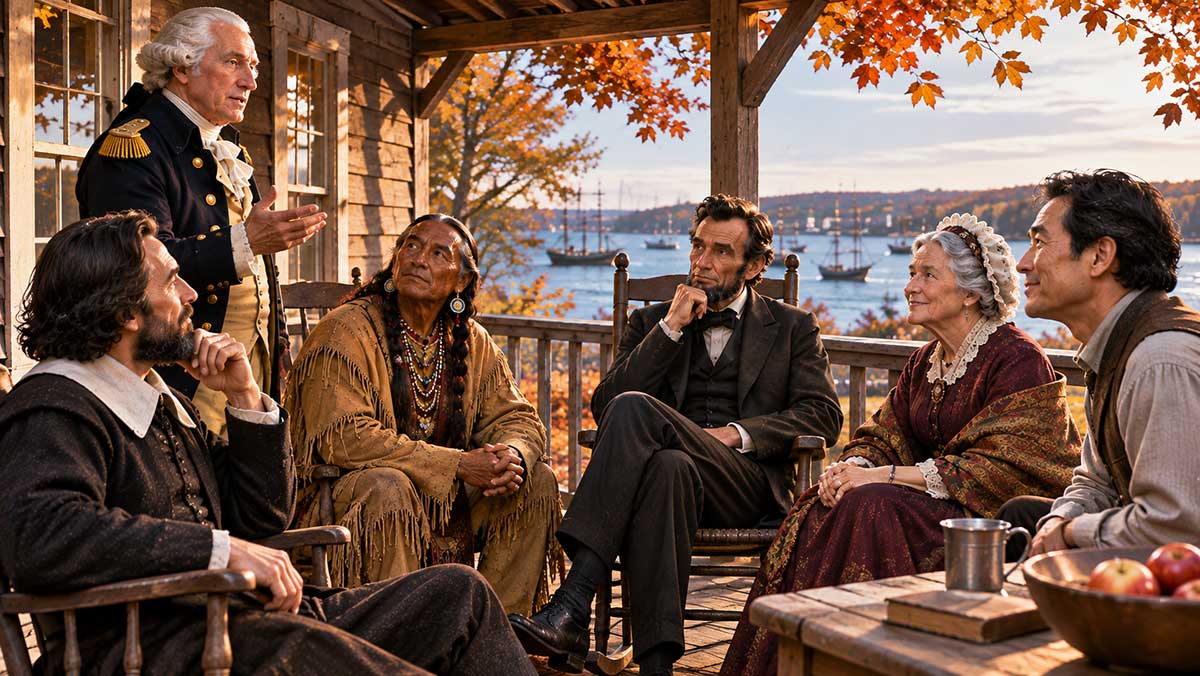
Opening
3:00 p.m. The farmhouse porch overlooking Plymouth Harbor.
The November air carries the scent of saltwater. Across the harbor, boats rest upon the gently moving water. The afternoon sun hangs low, casting long shadows across the wooden porch.
Washington stands near the railing with his hands behind his back. Bradford and Ousamequin sit beside one another, and Hale draws her shawl closer around her shoulders.
Lincoln lowers himself into a wooden chair.
Abraham Lincoln
I have always found that a little fresh air improves a conversation, particularly when the subject is a difficult one.
Nick
Our next subject may be the most difficult of the afternoon.
We have spoken about gratitude to God, remembering those who helped us and finding reasons to give thanks during suffering.
But what about people who are suffering at one another's hands?
Can Thanksgiving offer something meaningful to a divided family, a divided nation or nations at war?
George Washington
That depends considerably upon what people are prepared to do after expressing their gratitude.
Question 1: How Can Gratitude Help Heal a Divided Nation?
Nick
President Lincoln, near the end of your 1863 Thanksgiving proclamation, you asked God to heal the wounds of the nation and restore peace, harmony, tranquillity and union.
What strikes me is that you made this appeal long before the fighting ended.
Abraham Lincoln
A nation need not wait until its troubles have ceased before considering what kind of country it wishes to become afterward.
Indeed, it may be necessary to consider that question during the conflict itself.
Otherwise, men may become so occupied with defeating their adversaries that they give insufficient thought to the conditions under which they must eventually live together.
Nick
Did you see a distinction between winning a war and healing a nation?
Abraham Lincoln
A considerable one.
Military success may settle certain questions. It cannot, by itself, restore affection between neighbors, provide for bereaved families or teach former adversaries to live under common laws.
And in our particular struggle, there was the great question of slavery. A reunion that merely restored the former injustice would have left a fundamental wrong unresolved.
George Washington
The preservation of a nation requires more than the preservation of its boundaries.
Its citizens must possess sufficient confidence in their institutions and in one another to pursue their common affairs.
Sarah Josepha Hale
That was part of my hope in advocating for a national Thanksgiving observance.
I wished families throughout the country to participate in a shared tradition, regardless of the distances separating their homes.
Nick
Today, some Americans find it difficult to sit at the same dinner table with relatives who hold different political opinions.
Abraham Lincoln
Political disagreement is hardly a modern invention.
I have known men who could agree upon the excellence of a dinner and disagree upon nearly everything discussed during it.
Hale smiles.
Abraham Lincoln
But there is a difference between opposing a man's opinions and ceasing to regard him as a fellow human being.
The latter habit can become exceedingly dangerous.
Nick
Could gratitude help prevent that?
Abraham Lincoln
Consider how much of your daily welfare depends upon people whose opinions you may never share.
The man who repairs your road, the woman who teaches your children, the physician who attends to your illness.
A society is held together by innumerable services performed between people who do not agree upon everything.
Recognizing those services may encourage a little more humility in our disagreements.
Sarah Josepha Hale
And within a family, we might occasionally remember that the person with whom we are arguing is the same person who once comforted us, cared for us or shared our childhood.
A disagreement need not erase an entire history of affection.
Question 2: What Does It Take for Former Enemies to Live Together Peacefully?
Ousamequin looks across the harbor before turning toward Bradford.
Nick
Ousamequin, you and Governor Bradford belonged to communities with different languages, customs, spiritual traditions and interests.
Yet your peoples established an alliance in 1621.
What can that experience teach us about peace?
Ousamequin
We did not need to become the same people to establish an agreement.
We needed to recognize that each had interests the other must consider.
An agreement becomes possible when both parties see something worth preserving through it.
William Bradford
Our terms included provisions against injury and for mutual assistance. We sought a measure of security for our settlement.
Ousamequin
And we sought security for our people.
That distinction matters.
Peace cannot mean that one people enjoys security and the other must surrender its own.
George Washington
An agreement that imposes every obligation upon one party and reserves every advantage for the other is unlikely to inspire lasting confidence.
Nick
Then a shared meal, however meaningful, is insufficient?
Ousamequin
A meal lasts an afternoon.
An agreement must survive many winters.
What happens when one people desires more land? What happens when their children become numerous? What happens when the interests that brought them together begin to change?
Those are the occasions upon which the strength of an agreement is tested.
Bradford listens without interrupting.
William Bradford
Such difficulties did arise in New England. Our relations with the native peoples were not without serious conflicts.
Nick
And after both of your lifetimes, the region experienced the devastating conflict known as King Philip's War, involving Ousamequin's son Metacom.
The earlier alliance did not prevent later generations from experiencing terrible suffering.
Ousamequin
Then the existence of an agreement was insufficient to protect the future of our children.
Abraham Lincoln
That is a sobering observation.
Peace inherited from one's parents may be lost through the conduct of their children.
George Washington
Which is why the observance of agreements must be regarded as a continuing responsibility.
Confidence accumulated over many years may be destroyed by a comparatively brief period of misconduct.
Nick
What should happen when trust has already been broken?
Ousamequin
The injured people must have reason to believe that the injury will not simply be repeated.
A promise is more convincing when accompanied by conduct that demonstrates its meaning.
Abraham Lincoln
And those who have suffered should not be asked to purchase peace by declaring that their suffering was of no consequence.
Sarah Josepha Hale
That applies within households, too.
We sometimes urge people to forgive without asking whether the person who injured them has accepted any responsibility.
Reconciliation cannot be demanded from only one side.
Nick
There are people who may need to maintain distance from a family member for their own safety.
We should never make them feel guilty for protecting themselves.
Sarah Josepha Hale
Certainly. The desire for family unity must never become an excuse for permitting cruelty within a household.
Where a relationship can be repaired, let there be sincere efforts to repair it. Where protection is necessary, let there be protection.
Ousamequin
Peace should provide a place where people can live without fear.
Question 3: What Would You Say to the Leaders of Nations at War Today?
The wind grows colder. Nick looks across the water, where the afternoon sunlight has begun to fade.
Nick
Today, families in Ukraine, Russia, Israel, Palestine, Sudan and other parts of the world have experienced the terrible consequences of war.
Children have lost parents. Families have been displaced. Many people cannot gather peacefully around a dinner table.
If the leaders of nations involved in these conflicts were sitting here with us, what would you ask them to reflect upon?
George Washington
A leader must consider the security and legitimate interests of the people entrusted to his care.
Yet he must recognize that the decisions he makes may bring suffering upon people who have had no part in making them.
The responsibilities of leadership extend beyond the satisfaction of immediate objectives.
Nick
What might that mean in practical terms?
George Washington
Examine whether every reasonable avenue of negotiation has been explored. Consider the consequences of continued hostilities. Distinguish necessary measures from those encouraged by anger, pride or a desire for revenge.
The welfare of future generations deserves a place in such deliberations.
Abraham Lincoln
I would ask those leaders to consider the difference between the language in which war is discussed and the circumstances in which it is experienced.
A report may describe losses in numbers.
A household experiences the absence of a particular person.
That person had a name, a history and people who expected him to return.
Sarah Josepha Hale
And a mother on one side of a conflict may wait for her child with precisely the same anxiety as a mother on the other.
Her love is not diminished by the nationality of her child.
Ousamequin
A people should not be required to disappear so that another people may feel secure.
If peace is sought, the existence and dignity of those who must live under its terms must be considered.
William Bradford
I would urge those entrusted with such decisions to examine their conduct before God.
Prayer ought not to consist merely of asking divine assistance in accomplishing our own purposes.
We must be willing to question whether those purposes are righteous.
Nick
That is a difficult distinction.
Two opposing nations may both pray to God for victory.
Abraham Lincoln
I addressed a similar circumstance in my second inaugural address. Both sides in our conflict read the same Bible and prayed to the same God.
That fact should encourage humility concerning our claims to divine approval.
Nick
What if national leaders began by praying for the protection of innocent families on both sides?
William Bradford
Such a prayer would require a man to recognize suffering beyond the boundaries of his own interests.
Sarah Josepha Hale
And it might change the questions he asks before making his next decision.
Not merely what his country stands to gain, but what another household stands to lose.
For several moments, the guests watch the water in silence.
Nick
I wonder whether those of us who are not national leaders sometimes underestimate our own responsibilities.
We pray for peace between countries, yet there may be someone in our own family with whom we have refused to speak for years.
Abraham Lincoln
A man may possess excellent opinions concerning the conduct of humanity and still find considerable difficulty improving his own conduct.
Nick
Perhaps Thanksgiving offers an opportunity to take one small step.
A telephone call. A sincere apology. An invitation to talk. An effort to listen without immediately defending ourselves.
Sarah Josepha Hale
And without demanding that the other person respond according to our wishes.
An invitation to reconciliation should remain an invitation.
Closing
The sun descends behind the distant trees. Hale rises and brushes a fallen leaf from her shawl.
Sarah Josepha Hale
Gentlemen, I believe we have given the November air sufficient opportunity to demonstrate its character.
Abraham Lincoln
I am grateful for your judgment, Mrs. Hale. My appreciation of the fireplace has increased considerably during the past half hour.
Washington opens the farmhouse door.
Nick
We have spoken about what nations owe one another and what families can do to repair broken relationships.
But there is one question we have yet to answer.
What should an ordinary person actually do with the remaining hours of Thanksgiving Day?
Sarah Josepha Hale
A very practical question, and one I have been waiting for you to ask.
The guests return to the warmth of the farmhouse. As Hale enters the dining room, her attention settles upon the chair that has remained unoccupied throughout the afternoon.
Sarah Josepha Hale
Nick, I have been meaning to ask you something.
Who were you expecting to sit there?
Nick looks at the empty chair.
Nick
Someone who could not be here today, Mrs. Hale. In fact, it represents rather more people than we could ever fit around this table.*
Topic 5: How Would God Want Us to Spend Thanksgiving Today?
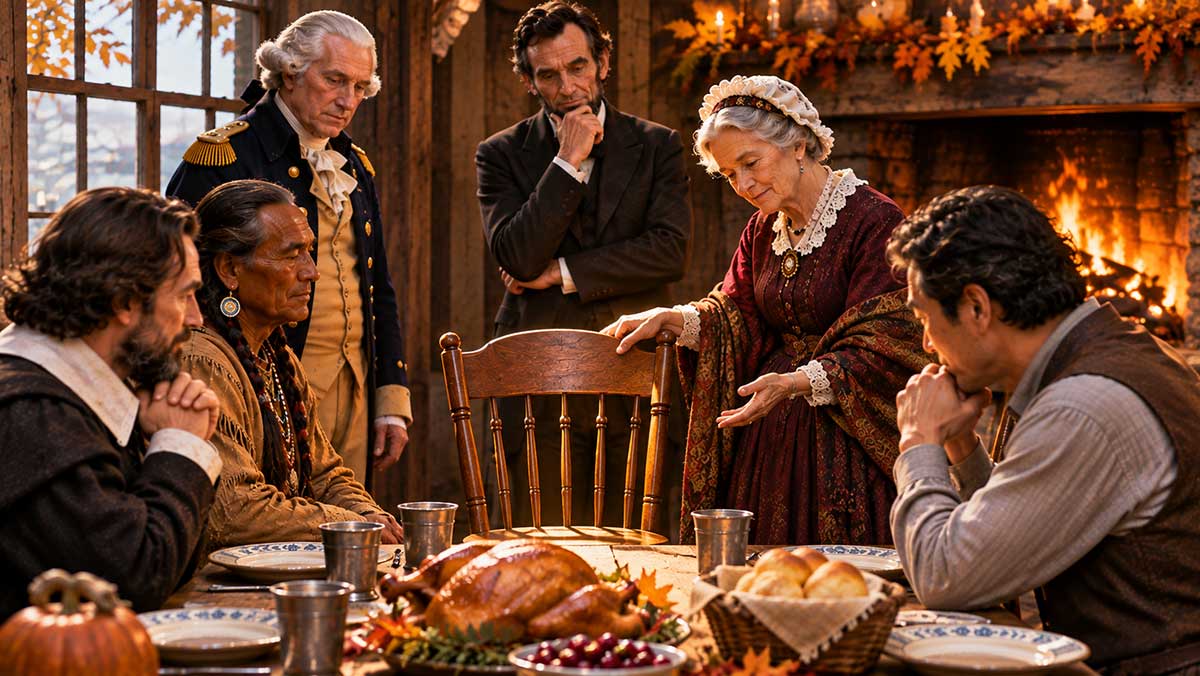
Opening
3:40 p.m. The farmhouse overlooking Plymouth Harbor.
The guests return to the dining room as the last afternoon light begins to disappear. Washington places another piece of wood upon the fire. Bradford settles into his chair, and Lincoln stretches his long legs toward the warmth.
Sarah Josepha Hale remains standing beside the unoccupied chair.
Sarah Josepha Hale
You said this chair represents people who could not be here today. Who did you have in mind?
Nick
The elderly person spending Thanksgiving alone. The child who has no family to return to. The father who cannot afford to provide a meal for his children. The families separated by war.
And those who have lost someone they dearly love.
Sarah Josepha Hale
Then it is a chair that could be placed at nearly every Thanksgiving table in America.
Ousamequin
But will the person it represents receive anything from this gathering?
Nick looks at him.
Nick
That may be the most important question we have asked today.
Question 1: What Should Families Actually Do on Thanksgiving Day?
Nick
Mrs. Hale, you devoted many years to establishing a common Thanksgiving observance. If you could visit American households today, what would you hope to find?
Sarah Josepha Hale
I would hope to find families taking genuine pleasure in one another's company.
The preparation of a fine dinner is a worthy undertaking, but I would be disappointed if the dinner received greater attention than the people for whom it was prepared.
Abraham Lincoln
A turkey can be exceedingly well attended to in a household where the children are scarcely listened to.
Sarah Josepha Hale
Precisely, Mr. President.
I would encourage parents to listen to their children and children to inquire about the lives of their parents.
There are stories within every family that will disappear unless someone takes an interest in hearing them.
Nick
Today, people can sit beside one another for hours and spend much of that time looking at their telephones.
Sarah Josepha Hale
Then perhaps those instruments might be put aside for the duration of the meal.
Surely the people who have made the effort to come together deserve one another's attention.
George Washington
Time is among the possessions a man can give but cannot recover.
To devote it sincerely to another person is no insignificant expression of regard.
Nick
What about our relationship with God? How should we express our gratitude to Him today?
William Bradford
I would encourage every person who believes in God to spend some portion of the day in prayer.
But let it be a different sort of prayer from those we commonly offer.
Nick
Different in what way?
William Bradford
Men frequently approach God with petitions. They desire relief from difficulties, success in their undertakings, protection for their families and favorable circumstances in the future.
These are natural desires.
But on a day appointed for thanksgiving, might a man spend some time before God without requesting anything for himself?
Nick
Simply thanking Him?
William Bradford
Yes. Let him recall the mercies he has received, including those he scarcely noticed when they occurred.
Let him consider the occasions upon which he was sustained by means he could not have provided for himself.
Ousamequin
And let him look at the people sitting beside him.
There may be someone whose kindness he has received every day without speaking of it.
Sarah Josepha Hale
I would suggest that every member of the household express appreciation to another person before the meal has ended.
Not a customary expression of thanks, but something particular.
Tell your mother what you remember about her kindness. Tell your husband what you appreciate about his efforts. Tell your children what brings you joy in their lives.
Abraham Lincoln
A compliment is of considerably greater use when delivered to its intended recipient than when retained in the mind of its author.
Hale smiles.
Sarah Josepha Hale
And there is no need to wait until next November to deliver another one.
Question 2: What Meaningful Action Could Each of Us Take Today?
Nick
There are still several hours remaining in Thanksgiving Day.
Suppose someone reading our conversation wanted to do something meaningful before going to bed tonight.
What would you suggest?
William Bradford
Begin with a sincere examination of the blessings you have received.
Recall the people who attended to you in sickness, encouraged you in difficulty and provided assistance when you were unable to help yourself.
Offer thanks to God for their presence in your life.
Ousamequin
And if one of those people is still living, find a way to thank them directly.
There is little difficulty in remembering a kindness when you need another favor. It is more revealing to remember it when you need nothing.
Nick
That could be a former teacher, an old friend or someone who helped us many years ago.
Ousamequin
Yes. Let them discover that their kindness was not forgotten.
George Washington
I would encourage each person to examine what they possess that might be of service to their community.
Some possess considerable resources. Others possess useful knowledge, experience or time.
A citizen need not occupy a public office to contribute to the welfare of his country.
Abraham Lincoln
I would suggest finding someone for whom the day has been particularly difficult.
There may be a widow who has received no visitors, a neighbor recovering from illness or a family experiencing circumstances they are reluctant to disclose.
One need not make a great public demonstration of generosity.
A quiet act of kindness will often accomplish more good than its author ever discovers.
Sarah Josepha Hale
And I would encourage families to prepare a little more food than they require for themselves, if their circumstances permit it.
Find someone with whom to share it.
Hospitality ought not to be reserved exclusively for those who can return the invitation.
Nick
What about someone who has become separated from their family through a disagreement?
Sarah Josepha Hale
If it is safe and appropriate to do so, send a message.
You need not resolve every difficulty in a single afternoon.
You might simply say that you are thinking of them and that you remain grateful for the good things you once shared.
Abraham Lincoln
And resist the temptation to attach a lengthy explanation of why the original disagreement was entirely their fault.
Washington chuckles, and Hale shakes her head with amusement.
Nick
That might be difficult for some of us.
Abraham Lincoln
Then it may be an especially useful exercise.
George Washington
A sincere gesture should be made without attempting to dictate the response it receives.
We are responsible for our own conduct. We cannot command the disposition of another person.
Nick
So we can offer kindness without expecting recognition, forgiveness or anything in return.
Ousamequin
A gift should not become another person's obligation merely to satisfy the person who gave it.
Nick looks at the empty chair again.
Nick
Perhaps the best way to honor the person represented by that chair is to make room for someone in our actual lives.
Not just at our table, but in our attention, our time and our hearts.
Question 3: How Can We Give Someone Else a Reason to Thank God?
The fire settles into glowing embers. Outside, the lights surrounding Plymouth Harbor begin to appear.
Nick
Throughout this afternoon, I have been thinking about three different expressions of gratitude.
The first is recognizing the blessings we have received.
The second is thanking God and the people who made those blessings possible.
But there is a third.
What if we could become a blessing in someone else's life?
William Bradford
Then the gratitude expressed in your prayers would find evidence in your conduct.
The Scriptures instruct men to be doers of the word, rather than hearers only.
Nick
Sometimes I wonder what would bring greater joy to God's heart.
Hearing us thank Him for the food He has provided, or seeing us share that food with someone who is hungry?
William Bradford
I would not separate the two.
A sincere prayer of thanksgiving ought to dispose a man toward generosity.
And generosity may itself become an expression of thanksgiving.
Ousamequin
When another person helps you survive a difficult season, you learn something about what people need from one another.
The next time you encounter someone in difficulty, you have an opportunity to put that knowledge to use.
George Washington
The blessings received by one generation ought to contribute to the welfare of the next.
It would be a poor use of our inheritance if we consumed its benefits without accepting any responsibility for those who follow us.
Sarah Josepha Hale
Children learn these things principally by observing the adults around them.
A mother may speak frequently of generosity, but her children will remember the occasion upon which she welcomed a stranger into her home.
A father may instruct his children to be grateful, but they will learn something more enduring when they hear him sincerely thank their mother.
Abraham Lincoln
I suspect children are considerably better students of our conduct than of our speeches.
Nick
What if a child grew up seeing Thanksgiving as a day when their family always helped someone else?
Perhaps they would carry that tradition into their own household.
Sarah Josepha Hale
And their children might do the same.
That is how a family custom can become something of lasting consequence.
Nick
Then Thanksgiving could continue long after the dinner has ended.
Abraham Lincoln
It would be unfortunate if a man's gratitude expired at midnight simply on account of the calendar.
The guests laugh.
George Washington
A national observance may remind citizens of their duties. The performance of those duties must occupy the remainder of the year.
Nick
There is one question I would like to leave with everyone celebrating Thanksgiving today.
Instead of asking only what we are thankful for, could we ask ourselves whose life might become better through our existence?
Who might someday thank God that we were there when they needed someone?
Lincoln leans forward, resting his hands upon his knees.
Abraham Lincoln
You need not wait for an extraordinary opportunity.
There is probably someone within a short distance of your home whose circumstances could be made a little easier by something you are already capable of doing.
Begin there.
Closing
The farmhouse has grown quiet. Hale gathers the remaining bread into a basket, and Washington folds the copy of his Thanksgiving proclamation.
Bradford and Ousamequin stand once more beside the window overlooking Plymouth Harbor.
Nick
Governor Bradford, thank you for reminding us what it means to receive the gift of another day.
Ousamequin, thank you for reminding us that gratitude must be accompanied by respect and a willingness to honor our responsibilities.
President Washington, thank you for bringing our attention back to God, humility and the duties that accompany freedom.
President Lincoln, thank you for showing us that thanksgiving can have meaning amid grief and suffering.
And Mrs. Hale, thank you for helping generations of families discover the value of gathering together.
Sarah Josepha Hale
Then perhaps you might do something for me before this evening is over.
Nick
Of course.
Sarah Josepha Hale
Find someone who deserves your gratitude and tell them.
Do not leave it until tomorrow.
Nick
I will.
Hale places the basket of bread into Nick's hands.
Sarah Josepha Hale
And if you encounter someone who needs this, I believe we have prepared more than enough for ourselves.
Nick accepts the basket.
William Bradford
May God grant you a grateful heart throughout the year.
Ousamequin
And may the kindness you receive find its way into the lives of others.
George Washington
May your country prove worthy of the blessings it has inherited.
Abraham Lincoln
And may the next Thanksgiving find fewer households acquainted with sorrow.
Nick opens the farmhouse door. The cool evening air enters, carrying the faint scent of the sea.
One by one, the guests depart.
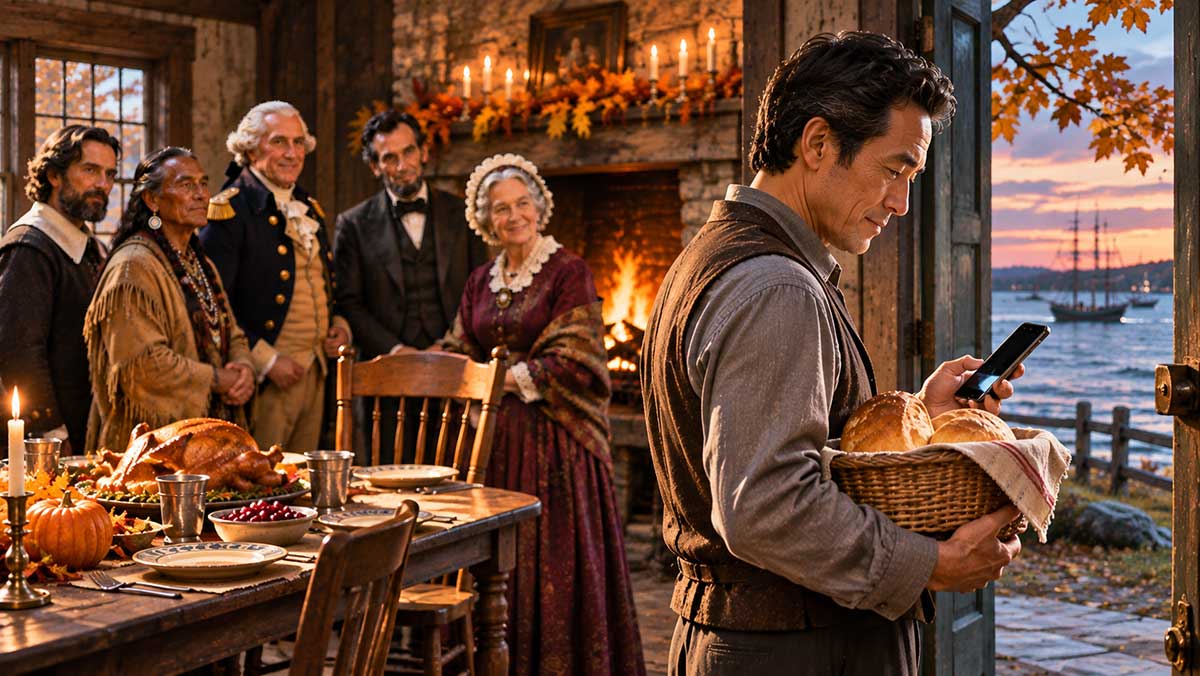
For a moment, Nick remains beside the dining table, holding the basket of bread.
He takes out his telephone and begins searching through the names of people he has not contacted for some time.
There are still a few hours left in Thanksgiving Day.
Final Thoughts
As I reflect upon this imaginary Thanksgiving afternoon, I find myself returning to the empty chair at our dinner table. It represents the people whose circumstances prevent them from experiencing the warmth, companionship and abundance that many of us enjoy today. It reminds me that Thanksgiving has a meaning that extends beyond the walls of our own homes.
William Bradford's account of the Plymouth settlement reminds us how fragile human life can be. Many of the things we regard as ordinary would have seemed extraordinary to those who struggled through that first winter. A warm home, sufficient food, good health and the presence of loved ones are gifts that deserve far more appreciation than we often give them.
Ousamequin reminds us that gratitude must include historical honesty and respect for those whose contributions have been overlooked. The history of the Wampanoag did not begin with the arrival of the Pilgrims, nor did it end with the harvest gathering of 1621. Resources from the Smithsonian's National Museum of the American Indian invite us to examine this history beyond the familiar Thanksgiving narrative and recognize the continuing presence of Indigenous communities.
George Washington's proclamation reminds us to approach God with humility, acknowledging our blessings and examining our shortcomings. Abraham Lincoln's Thanksgiving proclamation of 1863 teaches us that gratitude need not disappear during times of suffering. His appeal for national healing remains relevant to a humanity that continues to experience division, displacement and war.
Sarah Josepha Hale reminds us of the importance of family traditions. Yet the greatest tradition we could pass on to our children may have little to do with what we serve for dinner. It may be the habit of noticing another person's needs, expressing appreciation sincerely and extending kindness beyond our immediate family.
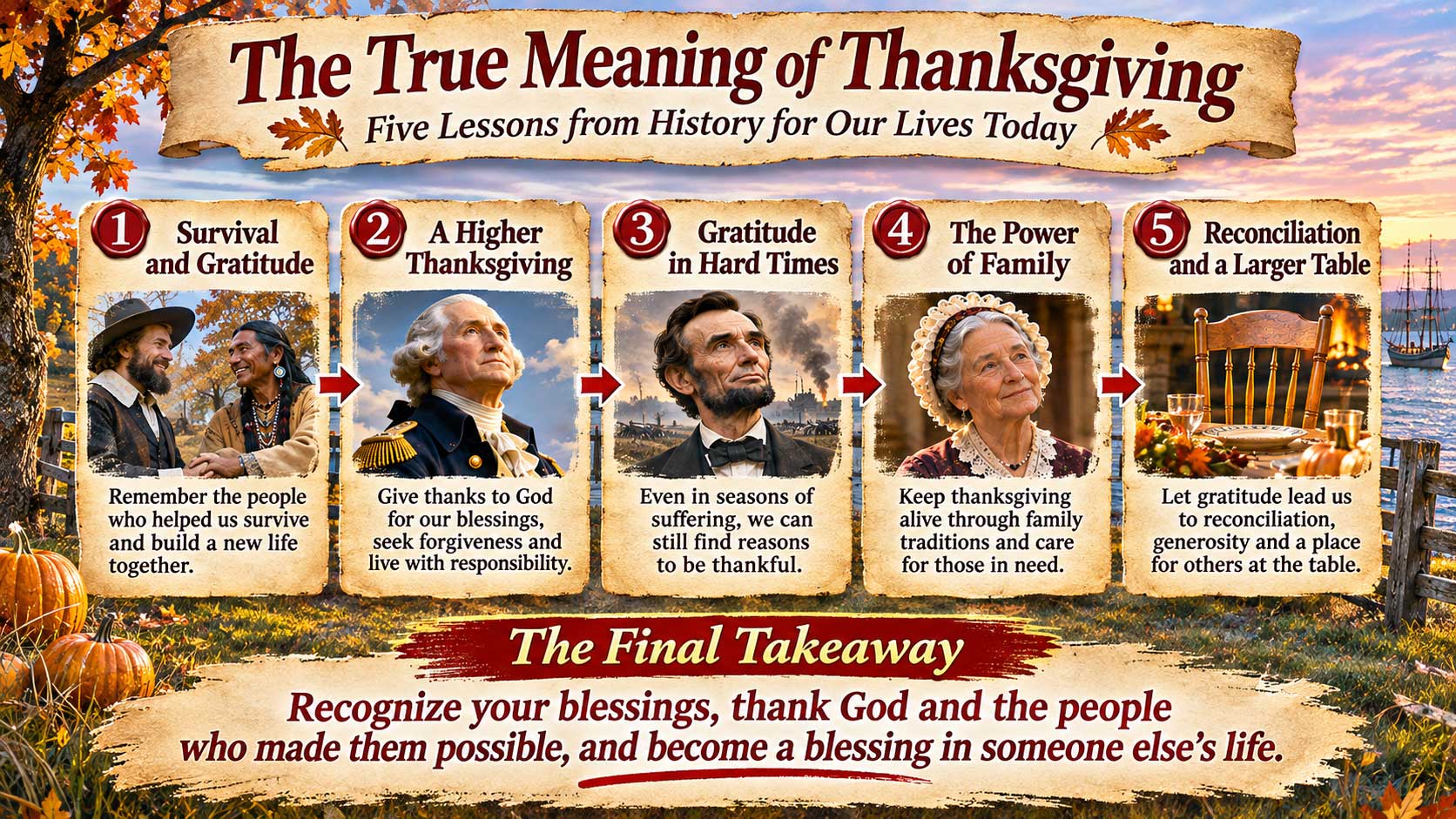
For me, Thanksgiving has three expressions. The first is recognizing the blessings we have received. The second is expressing our gratitude to God and to the people through whom those blessings came. The third is becoming a blessing in someone else's life. It is this third expression that transforms gratitude from a personal feeling into an act of love.
Before this Thanksgiving Day ends, perhaps we could each do one thing that makes another person's life a little brighter. Call someone who has been forgotten. Thank a parent or teacher. Share a meal with someone who is alone. Offer a sincere prayer for families suffering in countries other than our own. Take a small step toward repairing a relationship where reconciliation is possible.
And as we gather around our tables, I would like to leave you with three questions. Who helped you become the person you are today, and have you thanked them? What blessing have you received that you could share with another person? And who might someday thank God for having you in their life?
Fictional Conversation Disclaimer: The reflections in this article arise from an imaginary historical conversation. They are offered as invitations to personal reflection, not as authenticated statements or religious teachings from the historical participants.
Short Bios:
William Bradford (1590–1657)
William Bradford was an English religious Separatist, Mayflower passenger and longtime governor of Plymouth Colony. Having survived the devastating winter of 1620–1621, he helped guide the settlement through its formative years. His historical manuscript, Of Plymouth Plantation, remains a significant firsthand account of the Pilgrims' experiences, religious convictions and relationships with Indigenous peoples.
Learn more: State Library of Massachusetts
Ousamequin, Known as Massasoit (c. 1581–1661)
Ousamequin was a Wampanoag leader and skilled diplomat who established an alliance with Plymouth Colony in 1621. Facing the devastating effects of epidemics and regional political pressures, he pursued agreements intended to protect his people and their interests. His leadership is central to the history surrounding the 1621 harvest gathering and early relations between the Wampanoag and English settlers.
Learn more: Smithsonian National Museum of the American Indian
George Washington (1732–1799)
George Washington was the commanding general of the Continental Army and the first president of the United States. On October 3, 1789, he issued a Thanksgiving proclamation calling upon Americans to acknowledge divine providence, express gratitude, seek forgiveness and fulfill their public responsibilities. His proclamation established an early national precedent for Thanksgiving.
Read Washington's 1789 Thanksgiving Proclamation
Abraham Lincoln (1809–1865)
Abraham Lincoln was the sixteenth president of the United States, leading the country through the Civil War and issuing the Emancipation Proclamation. On October 3, 1863, he proclaimed a national day of Thanksgiving, inviting Americans to recognize their blessings amid national suffering, remember those experiencing loss and pray for the healing of their divided country. His proclamation helped establish the annual national Thanksgiving tradition.
Sarah Josepha Hale (1788–1879)
Sarah Josepha Hale was an American writer, editor and advocate for women's education, remembered for the nursery rhyme Mary Had a Little Lamb and her sustained campaign for a national Thanksgiving observance. After losing her husband in 1822, she pursued a literary career to support her five children. Her years of advocacy culminated in her September 1863 letter to President Lincoln, shortly before his Thanksgiving proclamation.
Learn more: National Park Service
Nick Sasaki
Nick Sasaki is the creator of Imaginary Talks, a platform dedicated to fictional conversations with historical figures, spiritual teachers, authors and contemporary thinkers. His work explores human relationships, faith, compassion and the possibilities of creating a better future through imagination and meaningful dialogue.
Leave a Reply