
Introduction
Abraham Lincoln is one of the most admired figures in American history.
He preserved the Union.
He issued the Emancipation Proclamation.
He supported the Thirteenth Amendment that abolished slavery.
He became the president most closely associated with emancipation and with the survival of American democracy during its greatest internal crisis.
But the closer we look at Lincoln, the more difficult the story becomes.
He believed slavery was wrong long before becoming president, yet he moved cautiously against it.
He opposed slavery while still holding racial views that changed substantially over time.
He defended the Constitution while expanding presidential power during war.
He hated suffering while continuing a conflict that killed hundreds of thousands.
He wanted reconciliation, yet he never lived long enough to show how he would have governed the defeated South.
And perhaps most importantly, Lincoln changed.
His understanding of slavery changed.
His thinking about Black citizenship changed.
His use of presidential power changed.
His understanding of war changed.
Even the way he spoke about God changed.
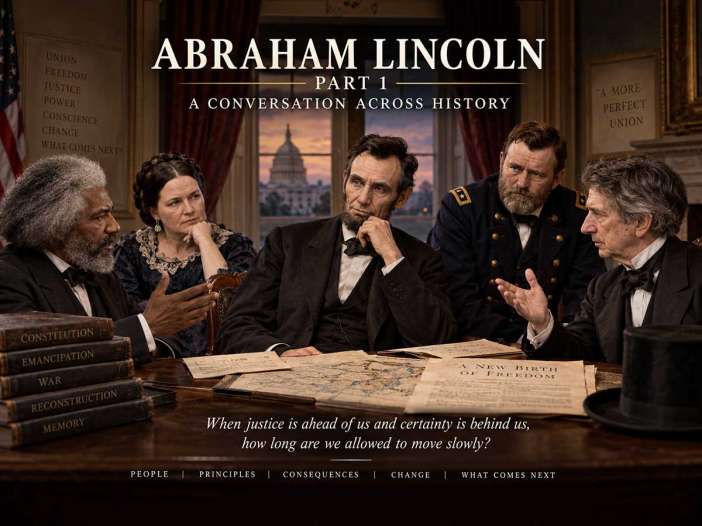
This imagined historical conversation brings together five people who can confront different parts of Lincoln’s life:
Abraham Lincoln, carrying the responsibility of presidential power.
Frederick Douglass, demanding that the suffering of enslaved people never disappear behind political caution.
Mary Todd Lincoln, reminding the room that national greatness has private costs.
Ulysses S. Grant, confronting the terrible human arithmetic of military victory.
And William H. Seward, representing the political reality that moral goals still require coalitions, timing, law, and power.
Together they ask five difficult questions:
Was Lincoln really the Great Emancipator?
Why did he not move against slavery sooner?
Did he protect constitutional government by stretching its normal rules?
How much suffering can a just cause justify?
And was Lincoln great because he was right—or because he remained capable of changing?
The goal is not to remove Lincoln from history’s pedestal simply to place him on trial.
Nor is it to protect the legend.
It is to find the human being inside it.
Because perhaps Lincoln’s most important lesson is not that great leaders always know what justice requires.
It may be that sometimes they are given enormous responsibility before certainty arrives.
And then they must decide how quickly to move while other human beings live with the consequences.
(Note: This is an imaginary conversation, a creative exploration of an idea, and not a real speech or event.)
Topic 1: Was Lincoln Really the Great Emancipator?
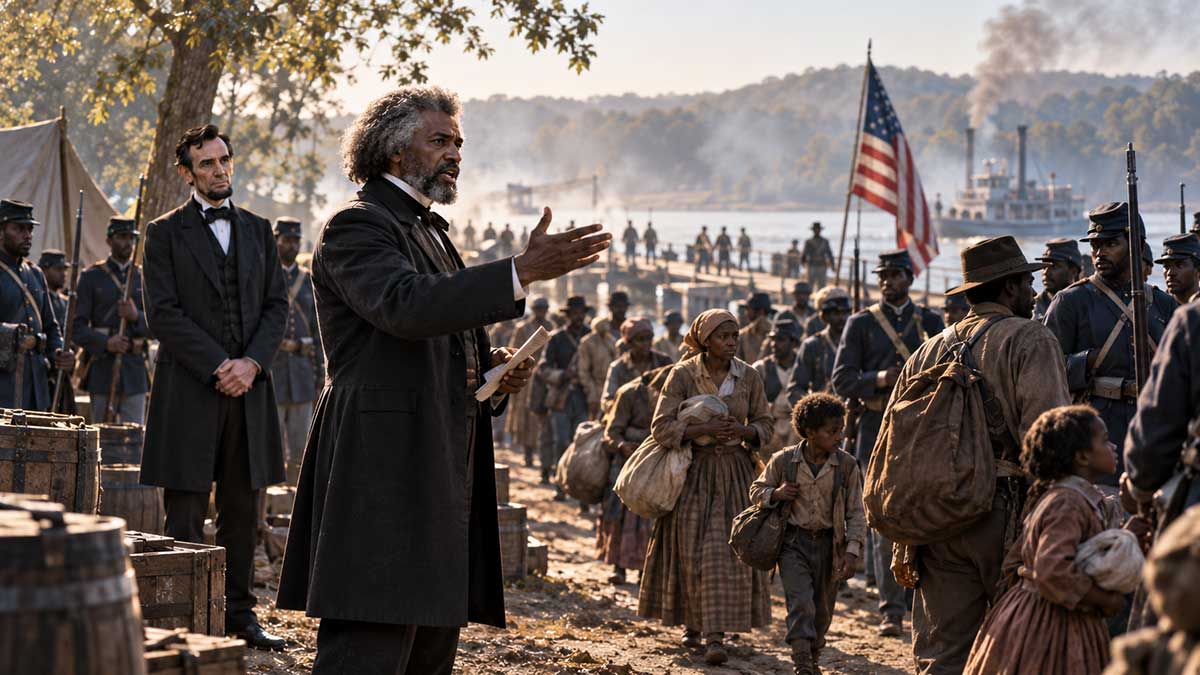
Frederick Douglass stood near the window.
He had been silent for several minutes.
Abraham Lincoln sat at the long table with his hands folded loosely in front of him.
Mary Todd Lincoln watched her husband from across the room.
William Seward had already opened several papers.
Ulysses S. Grant sat slightly apart from the others, his posture calm, almost military even here.
Finally Douglass turned.
“Mr. Lincoln.”
Lincoln looked up.
“Yes?”
“They call you the Great Emancipator.”
Lincoln’s mouth tightened slightly.
“I have heard the phrase.”
“Do you like it?”
Lincoln looked toward Seward.
“That sounds like a dangerous question.”
Seward smiled.
“It usually is when Mr. Douglass asks it.”
Douglass did not smile.
“I am asking seriously.”
Lincoln nodded.
“Then seriously, I have never thought history was improved by giving one man too much credit.”
Douglass stepped closer.
“Good.”
Lincoln raised an eyebrow.
“That sounded less like approval than warning.”
“It is both.”
Douglass placed one hand on the back of an empty chair.
“When people say Abraham Lincoln freed the slaves, what do you think they mean?”
Lincoln thought for a moment.
“They mean that emancipation became national policy under my administration.”
“That you signed the proclamation.”
“Yes.”
“That you used presidential authority.”
“Yes.”
“That you supported the amendment abolishing slavery.”
“Yes.”
“And that Union armies enforced freedom as they advanced.”
“Yes.”
Douglass nodded.
“All true.”
Lincoln waited.
Douglass continued.
“And incomplete.”
Lincoln leaned back.
“I expected that.”
Mary looked toward Douglass.
He said:
“Before the proclamation, enslaved people were already leaving plantations.”
“Yes,” Lincoln replied.
“They crossed Union lines.”
“Yes.”
“They refused to remain where the law said they belonged.”
“Yes.”
“They forced generals to decide whether human beings could be returned as property.”
Lincoln nodded.
“They changed the problem before Washington finished deciding what the problem was.”
Seward looked up from his papers.
“That is fairly said.”
Douglass turned toward him.
“Fairly?”
Seward nodded.
“Yes.”
Douglass continued.
“Black men demanded the right to fight.”
“Abolitionists pressured Congress.”
“Congress acted.”
“Black churches organized.”
“Families escaped.”
“People risked death before your government promised them freedom.”
Lincoln looked down at the table.
Douglass asked:
“So tell me, Mr. Lincoln.”
“Who freed whom?”
No one spoke.
Grant broke the silence.
“The army mattered.”
Douglass turned.
“I did not say it didn’t.”
Grant continued:
“A proclamation did not walk onto a plantation.”
“No.”
“A printed order did not force Confederate authority to disappear.”
“No.”
“The war had to move.”
“The armies had to advance.”
“Territory had to be taken.”
“Confederate military power had to be broken.”
Douglass nodded.
“Yes.”
Grant said:
“So if we are distributing credit, do not forget the men who had to carry policy into places where policy meant nothing until soldiers arrived.”
Douglass replied:
“I would never forget them.”
“Black soldiers included.”
Grant nodded.
“Especially.”
Lincoln looked toward Douglass.
“Then perhaps the title should belong to a great many people.”
Douglass’s expression changed slightly.
“That is closer.”
Mary spoke for the first time.
“Then why does history prefer one face?”
Everyone turned toward her.
She looked at Lincoln.
“Why his?”
Lincoln gave a tired smile.
“I was hoping you might defend me.”
“I married you. I did not agree to defend every statue.”
Grant looked down, almost smiling.
Mary continued:
“Millions of people suffered under slavery.”
“Thousands organized against it.”
“Soldiers died.”
“Families escaped.”
“Congress fought.”
“Mr. Douglass spent years demanding action.”
She looked directly at Lincoln.
“But when children learn the story, they see your face.”
Lincoln said quietly:
“Presidents make convenient symbols.”
Douglass replied:
“Convenient symbols can become dangerous.”
“How?”
“They teach people that freedom arrives from above.”
Lincoln watched him.
Douglass continued.
“As though the enslaved waited patiently for a good white man to discover justice.”
The room went still.
Seward shifted slightly.
Douglass did not soften.
“That story is false.”
Lincoln nodded slowly.
“Yes.”
Douglass looked almost surprised.
“No defense?”
“Against that?”
Lincoln shook his head.
“No.”
Then he added:
“But there is another false story waiting nearby.”
Douglass narrowed his eyes.
“Which one?”
“That federal action did not matter.”
Douglass said nothing.
Lincoln continued.
“You are right that enslaved people forced the question.”
“You are right that abolitionists pressed it.”
“You are right that Congress acted.”
“You are right that Black men made the war itself different by demanding the right to serve.”
“But slavery was protected by law.”
“By state power.”
“By courts.”
“By armed force.”
“By property claims recognized throughout much of the country.”
He leaned forward.
“Destroying such an institution required more than individual escape.”
Douglass nodded once.
“Yes.”
Lincoln continued.
“It required state power turned against slavery.”
“It required the Union government to stop treating the institution as something merely unfortunate and begin treating it as something the war could destroy.”
Douglass replied:
“And that took you a long time.”
Lincoln looked at him.
“Yes.”
Seward glanced between them.
“That question is coming.”
Douglass said:
“It is.”
Lincoln sighed.
“I know.”
“But not yet.”
Douglass walked toward the table.
“First I want to understand what you believe emancipation was.”
Lincoln said:
“A war measure.”
Douglass stopped.
“Only?”
“No.”
Lincoln looked toward him.
“A war measure can also be morally right.”
Douglass sat down.
“Then which came first?”
Lincoln’s expression changed.
“That is difficult.”
“Good.”
Seward smiled faintly.
Lincoln continued.
“I believed slavery wrong long before the war.”
Douglass nodded.
“But?”
“But believing slavery wrong did not automatically answer what constitutional authority a president possessed.”
Douglass leaned back.
“Now we are already moving into Topic 2.”
Lincoln smiled.
“I hoped you might not notice.”
Grant said:
“He notices everything.”
Douglass ignored the joke.
“Let us stay with emancipation.”
Lincoln nodded.
“Very well.”
Douglass asked:
“When you signed the Emancipation Proclamation, were you freeing people because they deserved freedom or weakening the Confederacy?”
Lincoln replied:
“Both.”
Douglass watched him carefully.
“No hesitation?”
“No.”
“Then the moral act depended on military usefulness?”
Lincoln thought.
“No.”
“The timing and legal mechanism depended partly on military necessity.”
“The moral wrong did not.”
Douglass nodded slowly.
“That distinction matters.”
Seward entered.
“It also mattered internationally.”
Grant looked toward him.
Seward continued:
“Europe was watching.”
“Britain.”
“France.”
“Foreign recognition of the Confederacy remained a serious concern.”
“If the Union war could be understood increasingly as a struggle against slavery, that changed the political environment abroad.”
Douglass said:
“So emancipation was diplomatic too.”
“Yes.”
“Military.”
“Yes.”
“Political.”
“Yes.”
“Moral.”
Seward nodded.
“Yes.”
Douglass looked toward Lincoln.
“Convenient.”
Lincoln shook his head.
“No.”
“Complicated.”
Douglass’s expression softened almost imperceptibly.
Lincoln continued:
“People often suppose that if an act has strategic value, it cannot be morally sincere.”
“I do not believe that.”
“Nor do I.”
Douglass replied.
“But the opposite mistake is also common.”
“What is that?”
“To describe strategy as morality after victory.”
Lincoln was quiet.
Grant looked toward Douglass.
“You mean the winner claims nobility?”
“Yes.”
Grant nodded.
“That happens.”
Mary looked toward her husband.
“Did it happen to you?”
Lincoln’s eyes moved toward her.
“I expect history improved my motives after I was dead.”
Mary said:
“You always did distrust praise.”
“I distrusted anyone praising me while asking for an appointment.”
Seward laughed.
Even Douglass smiled.
The tension loosened for a moment.
Then Douglass said:
“Let us speak plainly.”
Lincoln nodded.
“The proclamation did not free every enslaved person.”
“No.”
“It excluded the loyal slave states.”
“Yes.”
“It excluded certain places already under Union control.”
“Yes.”
“It depended on military victory.”
“Yes.”
“So why should it be remembered as emancipation?”
Lincoln answered immediately.
“Because it changed what the federal government stood for in the war.”
Grant nodded.
Lincoln continued:
“Before it, the war could still be imagined as restoring the old Union.”
“After it, restoring the old Union without destroying slavery in the rebellious states became impossible.”
Douglass said:
“Not impossible everywhere.”
“No.”
Lincoln replied.
“That is why the amendment mattered.”
Seward nodded.
“The proclamation was not the final legal destruction of slavery.”
“No.”
“But it transformed policy.”
“Yes.”
Grant added:
“And recruitment.”
Douglass looked toward him.
Grant continued:
“Black soldiers changed the army.”
Douglass nodded.
“Nearly two hundred thousand Black soldiers and sailors served.”
“Yes.”
Grant said.
“And they did more than add manpower.”
“They made the meaning of the war visible.”
Douglass’s eyes sharpened.
“Exactly.”
Grant continued:
“You cannot say a man is unfit for citizenship while putting a rifle in his hand and asking him to defend the country forever without creating a contradiction.”
Douglass said:
“A contradiction some men were perfectly willing to live with.”
Grant nodded.
“Yes.”
Lincoln looked toward Douglass.
“You pressed me hard on equal pay and treatment.”
“I did.”
“You were right.”
Douglass said nothing.
Lincoln continued:
“I did not move quickly enough on some of those matters.”
Douglass looked at him.
“You are generous now.”
“I am dead now.”
Grant gave a short laugh.
Lincoln smiled.
“There is little political danger in honesty after death.”
Mary did not laugh.
She looked toward him.
Lincoln noticed.
His smile faded.
Douglass leaned forward.
“Do you know what troubled me most about you?”
Lincoln said:
“There are several possibilities.”
Douglass almost smiled again.
“You often seemed capable of seeing the moral destination while refusing to travel at the speed the suffering demanded.”
Lincoln was silent.
Douglass continued:
“You saw slavery was wrong.”
“Yes.”
“You saw Black men possessed natural rights.”
“Yes.”
“You saw the contradiction inside American democracy.”
“Yes.”
“And yet you often moved only when politics had moved enough to permit you.”
Seward said:
“That is not entirely fair.”
Douglass turned.
“Then make it fair.”
Seward leaned forward.
“A president is not a prophet.”
Douglass said:
“Perhaps that is the problem.”
“No.”
Seward replied.
“That is the office.”
“You may condemn a nation from outside its institutions.”
“A president has to move those institutions.”
Douglass said:
“And if the institutions are unjust?”
“Then change them.”
“How?”
“Through power.”
“And where does power come from?”
“Elections.”
“Congress.”
“Armies.”
“States.”
“Courts.”
“Public consent.”
Douglass leaned back.
“Then morality waits for permission.”
Seward shook his head.
“No.”
“Morality becomes law through power.”
“That is different.”
Douglass considered him.
Seward continued:
“A declaration made without the means to enforce it may satisfy conscience.”
“It may not free anyone.”
Lincoln nodded.
“That was my fear.”
Douglass looked toward him.
“And my fear was that by the time the means were ready, another generation would have lived and died enslaved.”
Lincoln did not answer.
Mary looked at Douglass.
“That is the hardest thing you have said.”
Douglass turned toward her.
“Because it is true.”
“Yes.”
Mary looked toward Lincoln.
“And because he knew some version of it was true too.”
Lincoln looked down.
After a moment:
“Yes.”
Grant reached for one of the papers.
“Let me ask something.”
Douglass nodded.
“If Lincoln had declared immediate universal emancipation at the beginning of the war, would the army have been able to enforce it?”
Douglass replied:
“No.”
“Would the border states have remained loyal?”
“I do not know.”
“Would northern soldiers who enlisted to preserve the Union have accepted it?”
“Some would not.”
“Would more have deserted?”
“Possibly.”
“Would the Confederacy have used it to strengthen support?”
“Certainly.”
Grant nodded.
“Then timing mattered.”
Douglass looked at him.
“Yes.”
Grant said:
“That does not mean delay was morally painless.”
“No.”
“But military facts are moral facts when lives depend on them.”
Douglass paused.
“That is well said.”
Grant looked slightly surprised.
“Thank you.”
Douglass continued:
“But the reverse is also true.”
“What?”
“Human suffering is a strategic fact when a government builds its strategy around asking the suffering to wait.”
Grant nodded.
“Fair.”
Lincoln looked between them.
“Perhaps this is why emancipation cannot belong to one category.”
Douglass said:
“Go on.”
Lincoln replied:
“It was moral because slavery was wrong.”
“Military because slavery sustained the rebellion.”
“Political because the Union coalition had to survive.”
“Diplomatic because foreign governments were watching.”
“Constitutional because the means mattered.”
“Human because people had already begun freeing themselves before Washington understood what to call them.”
Douglass watched him.
“That is better than most monuments.”
Lincoln smiled faintly.
“Lower maintenance too.”
Mary shook her head.
“Abraham.”
“What?”
“You joke when you are uncomfortable.”
“I joke when other people are uncomfortable too.”
Grant said:
“That may be why he survived the cabinet.”
Seward nodded.
“Partly.”
Douglass stood again.
“I want to ask you about the phrase itself.”
Lincoln looked up.
“Great Emancipator?”
“Yes.”
“Would you keep it?”
Lincoln thought for a long moment.
“I would not use it for myself.”
“That is not what I asked.”
“No.”
Lincoln nodded.
“Would I erase it from history?”
“Yes.”
He shook his head.
“No.”
Douglass raised an eyebrow.
“Why?”
“Because presidents do matter.”
Douglass said nothing.
Lincoln continued:
“Leadership matters.”
“Timing matters.”
“Law matters.”
“Command matters.”
“There are moments when institutions require a person to choose.”
“And if the person does not choose, history changes.”
He looked toward Douglass.
“I do not think humility requires pretending my choices were irrelevant.”
Douglass nodded slowly.
“Good.”
Lincoln continued:
“But neither does importance require pretending I acted alone.”
Douglass replied:
“Better.”
Mary said:
“Then perhaps the title is acceptable if people understand what it does not mean.”
Grant asked:
“What does it not mean?”
Mary counted gently.
“That Lincoln discovered freedom.”
“That enslaved people waited.”
“That Mr. Douglass and the abolitionists were background.”
“That Black soldiers merely received something rather than fighting for it.”
“That Congress did nothing.”
“That the war was simply one man’s moral awakening.”
Seward nodded.
“That is a substantial list.”
Mary looked toward Lincoln.
“History likes short titles.”
Lincoln replied:
“Lives rarely fit them.”
Douglass said:
“Neither do nations.”
The room became quieter.
Douglass moved toward the papers on the table.
There was a copy of the Emancipation Proclamation.
He looked at it without touching it.
“When I first read this,” he said, “I knew immediately that it did not do everything.”
Lincoln watched him.
“I knew the exceptions.”
“The limits.”
“The dependence on military victory.”
“I knew it did not equal complete abolition.”
He paused.
“But I also knew something had changed.”
Lincoln said quietly:
“Yes.”
Douglass continued:
“The government of the United States had finally placed itself publicly against slavery in the rebellion.”
“Yes.”
“That mattered.”
“Yes.”
Douglass looked toward Lincoln.
“You know, there were times I criticized you so severely that people thought I despised you.”
Lincoln smiled.
“I read some of those criticisms.”
“Good.”
“I did not always enjoy them.”
“They were not written for your enjoyment.”
“I suspected as much.”
Douglass almost laughed.
Then became serious.
“I judged you from the position of the enslaved man.”
Lincoln nodded.
“You governed from the position of the president.”
“Yes.”
Douglass continued:
“Those positions did not experience time the same way.”
The room went still.
Lincoln looked at him for a long time.
“No.”
Douglass said:
“A month to you could mean keeping Kentucky.”
“A month to another man could mean his daughter being sold.”
Lincoln closed his eyes briefly.
“Yes.”
Douglass continued:
“So when historians praise your patience…”
“They must remember who paid for it.”
Lincoln opened his eyes.
“Yes.”
Seward looked toward Douglass.
“And when historians condemn every delay…”
“They must remember what could have been lost by moving too quickly.”
Douglass replied.
“Yes.”
Seward nodded.
For once, there was no argument.
Grant said:
“That sounds almost like agreement.”
Douglass shook his head.
“No.”
“It is understanding.”
Lincoln smiled faintly.
“That is rarer.”
Mary looked toward the proclamation.
“Then who emancipated the slaves?”
Douglass answered first.
“The enslaved helped emancipate themselves.”
Grant said:
“The army broke Confederate power.”
Seward added:
“Congress and government changed law and policy.”
Mary looked toward Lincoln.
He said:
“I made decisions that mattered.”
Douglass nodded.
Mary asked:
“And history?”
Lincoln looked toward her.
“What about it?”
“It prefers one answer.”
Lincoln smiled sadly.
“History prefers sentences.”
Douglass said:
“Then let us give it a better one.”
Everyone looked toward him.
He continued:
“No single man freed four million people.”
“But a president could choose whether the power of the United States would continue protecting slavery or begin destroying it.”
Lincoln said nothing.
Douglass looked directly at him.
“You eventually chose destruction.”
Lincoln nodded.
“Yes.”
“That deserves credit.”
Lincoln waited.
Douglass continued:
“But do not let the credit erase those who forced the question before you were ready.”
Lincoln replied:
“I will not.”
Douglass looked at him.
“History might.”
Lincoln said:
“Then history must be corrected.”
For a moment, no one spoke.
The room had begun with a title.
The Great Emancipator.
It now seemed both larger and smaller.
Larger because Lincoln's choices had truly mattered.
Smaller because the achievement could no longer fit inside one man.
Mary broke the silence.
“Frederick.”
Douglass looked toward her.
“You have given him credit.”
“Yes.”
“Reluctantly.”
“Carefully.”
Lincoln smiled.
“I prefer careful credit.”
Douglass turned toward him.
“Do not enjoy it yet.”
Lincoln sighed.
“I knew that was coming.”
Douglass placed both hands on the table.
“You opposed slavery before the presidency.”
“Yes.”
“You called it wrong.”
“Yes.”
“You understood that the country could not remain divided forever.”
“Yes.”
Douglass looked directly at him.
“Then we have reached the question I care about more than the title.”
Lincoln already knew it.
Seward did too.
Grant leaned back.
Mary became still.
Douglass asked:
“If you knew slavery was wrong, why didn't you move against it sooner?”
Lincoln looked at him for several seconds.
Then lowered his eyes toward the proclamation.
When he finally answered, his voice was quiet.
“Because knowing the direction of justice…”
He paused.
“…did not mean I knew how fast the country could travel without breaking apart.”
Douglass did not move.
“And while you were measuring the road?”
Lincoln looked up.
Douglass finished:
“People remained enslaved.”
Lincoln nodded.
“Yes.”
The first question had ended.
The harder one had begun.
Topic 2: Why Didn't Lincoln Move Against Slavery Sooner?
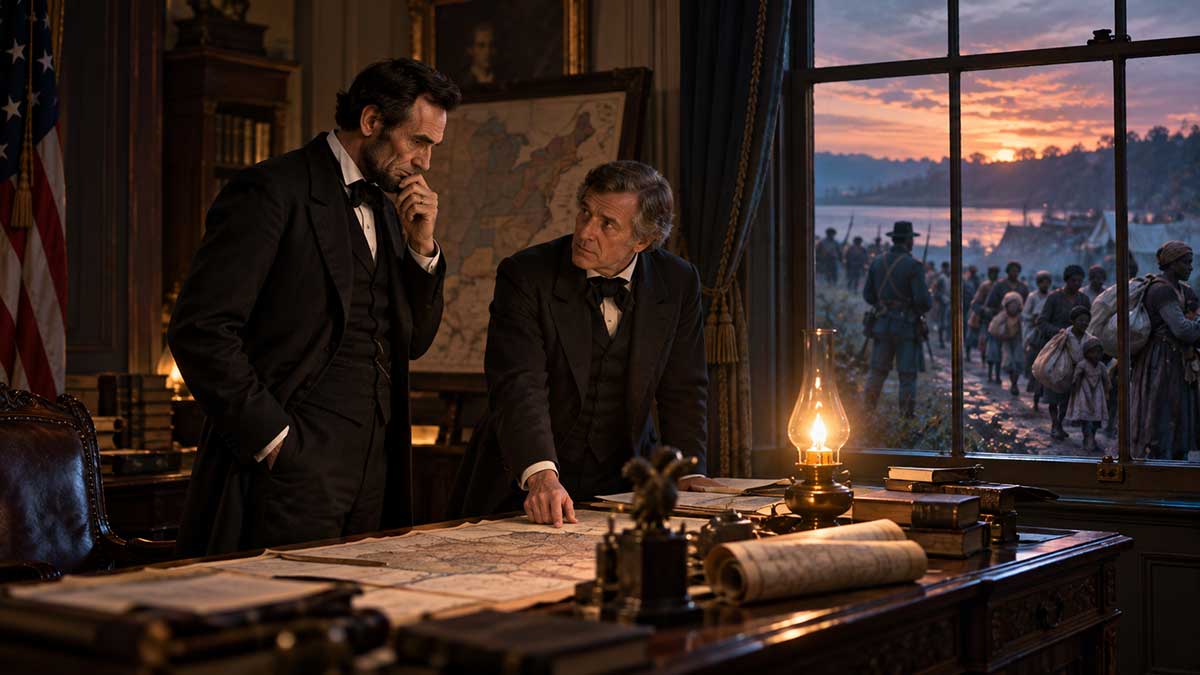
Frederick Douglass did not move from the table.
“Then let us stay there.”
Lincoln looked toward him.
“Where?”
“On the road.”
Lincoln gave the faintest smile.
“I was afraid you might.”
Douglass did not smile back.
“You said you knew the direction of justice.”
“Yes.”
“You said you did not know how fast the country could travel without breaking apart.”
“Yes.”
Douglass leaned forward.
“Then I want to know who was required to remain in chains while you measured the speed.”
The room became still.
William Seward looked down at the papers in front of him.
Ulysses Grant watched Lincoln.
Mary Todd Lincoln watched Douglass.
Lincoln folded his hands.
“Millions.”
Douglass nodded.
“Say it plainly.”
“Millions of enslaved people.”
“And you knew slavery was wrong.”
“Yes.”
“Before the war.”
“Yes.”
“Before your election.”
“Yes.”
“Before Fort Sumter.”
“Yes.”
Douglass paused.
“Then why did the president lag behind the man?”
Lincoln looked at him for a long moment.
“Because the man could condemn what the president did not yet possess lawful power to destroy.”
Douglass sat back.
“There is the Constitution again.”
“There has to be.”
“Why?”
“Because I was president under it.”
Douglass replied:
“And enslaved men were property under laws protected by it.”
Lincoln’s expression tightened.
“In several respects, yes.”
“Then suppose the Constitution protects injustice.”
“What should a president do?”
Douglass asked.
Lincoln answered:
“Change the law where possible.”
“And where not possible?”
“Use the powers the Constitution actually grants.”
“And if that is too slow?”
Lincoln did not answer immediately.
Seward entered.
“Then you confront the central danger.”
Douglass turned toward him.
“Which is?”
“That a president who decides moral urgency allows him to exceed lawful authority may destroy the very system through which permanent reform must eventually be secured.”
Douglass said:
“Permanent reform.”
“Yes.”
“That phrase is comfortable when you are free.”
Seward held his gaze.
“True.”
Douglass seemed almost surprised.
Seward continued:
“But constitutional government exists precisely because moral certainty is dangerous in the hands of power.”
Douglass replied:
“So a president must wait even when the law is evil?”
“No.”
“He must distinguish between what he wants and what he has authority to do.”
Lincoln nodded.
“That distinction governed me constantly.”
Douglass turned back toward him.
“Did it govern you?”
“Yes.”
“Or protect you?”
Lincoln frowned.
“From what?”
“From making a decision before politics made it safe.”
Lincoln became quiet.
Mary looked toward him.
Seward answered first.
“Those are not always different things.”
Douglass turned.
“Explain.”
Seward leaned forward.
“A morally right action that destroys the political coalition required to sustain it may fail before it helps anyone.”
Douglass said:
“Then political survival becomes morality.”
“No.”
Seward shook his head.
“It becomes one condition of effective morality.”
Grant nodded.
“That is true in war too.”
Douglass looked toward him.
“How?”
“A commander can order the bravest attack imaginable.”
“If it destroys his army without achieving the objective, bravery does not redeem the decision.”
Douglass paused.
Grant continued:
“Intentions do not erase consequences.”
Douglass nodded slowly.
“Good.”
Then he looked at Lincoln.
“Then let us discuss consequences.”
Lincoln waited.
“You feared losing the border states.”
“Yes.”
“Kentucky.”
“Yes.”
“Maryland.”
“Yes.”
“Missouri.”
“Yes.”
“Delaware.”
“Yes.”
“Why?”
Lincoln replied:
“Because they mattered militarily and politically.”
Douglass said:
“Meaning?”
“Kentucky sat between North and South.”
“Missouri mattered in the West.”
“Maryland surrounded Washington on three sides.”
“If Maryland left the Union, the capital itself would be dangerously exposed.”
Seward added:
“And every additional state joining the Confederacy increased the possibility that foreign governments might treat the rebellion as a viable independent nation.”
Grant said:
“More territory.”
“More men.”
“More resources.”
Lincoln nodded.
“Exactly.”
Douglass listened.
Then asked:
“So you protected slavery temporarily in order to keep slave states loyal.”
Lincoln’s face hardened slightly.
“I protected the Union.”
“Including slavery inside loyal states.”
“Yes.”
“Temporarily.”
“Yes.”
Douglass was quiet.
“Do you hear how that sounds?”
Lincoln nodded.
“Yes.”
“Does it trouble you?”
“Yes.”
“Did it trouble you then?”
“Yes.”
Douglass leaned closer.
“How much?”
Lincoln’s eyes narrowed.
“What answer would satisfy you?”
“Truth.”
Lincoln took a breath.
“I do not know how to measure it.”
Douglass waited.
Lincoln continued:
“I hated slavery.”
“But I feared that moving against it too rapidly might push more states into rebellion, weaken the army, divide the North, and lose the war before emancipation could become anything more than paper.”
Douglass said:
“And if you waited too long?”
“Slavery continued.”
“Yes.”
Lincoln looked down.
“Yes.”
Mary spoke quietly.
“Abraham, did you ever think of the people individually?”
Lincoln looked at her.
“What do you mean?”
“Not slavery.”
“People.”
He said nothing.
Mary continued:
“Did you think of one mother?”
“One child?”
“One family?”
“One person waiting while you balanced Kentucky against Missouri?”
Douglass looked toward her.
Lincoln’s voice lowered.
“Yes.”
Mary watched him.
“How?”
Lincoln paused.
“Letters.”
“Stories.”
“Men who reached Union lines.”
“People who came to Washington.”
“Mr. Douglass.”
Douglass did not move.
Lincoln continued:
“And sometimes I tried not to think too closely.”
Mary’s expression changed.
“Why?”
“Because the president who feels every individual suffering as if it were happening in the room may become unable to make decisions involving millions.”
Mary said:
“That sounds terrible.”
“It is.”
Douglass replied:
“And dangerous.”
Lincoln turned.
“How?”
“A leader can train himself not to feel because feeling complicates calculation.”
Lincoln nodded slowly.
“Yes.”
Douglass continued:
“Then one day calculation becomes easier than suffering.”
Grant spoke.
“That happens in war.”
Everyone looked toward him.
He continued:
“If every casualty becomes one face, command can become impossible.”
Mary said:
“And if none of them are faces?”
Grant looked toward her.
“Then command becomes monstrous.”
Silence.
Lincoln said:
“That is the line.”
Grant nodded.
“Yes.”
Douglass looked between them.
“And enslaved people faced the same danger.”
Lincoln asked:
“What do you mean?”
“They became numbers.”
“Four million.”
“A border-state problem.”
“A military resource.”
“A political question.”
“A constitutional question.”
Douglass’s voice hardened.
“They were human beings before they were any of those things.”
Lincoln nodded.
“Yes.”
Douglass said:
“And sometimes those categories allowed politicians to forget that.”
“Yes.”
Lincoln answered quietly.
Seward shifted the conversation.
“There is another problem.”
Douglass looked toward him.
“Northern public opinion.”
“Yes.”
“Say more.”
Seward replied:
“The North was not one great abolitionist body waiting for Lincoln to announce freedom.”
Douglass said:
“I know.”
“Many white northerners opposed slavery’s expansion while still rejecting racial equality.”
“Yes.”
“Many enlisted to preserve the Union, not to emancipate anyone.”
“Yes.”
“Some would resist a war openly transformed into abolition at the beginning.”
Douglass nodded.
“And?”
Seward continued:
“A president has to govern the country that exists.”
Douglass immediately replied:
“Or change it.”
Seward smiled slightly.
“Yes.”
“Both.”
“Then why not lead?”
“Leadership is not merely announcing where people should go.”
“It is getting enough of them to move.”
Douglass said:
“And sometimes pushing them.”
“Yes.”
“And sometimes moving ahead of them.”
“Yes.”
“And sometimes risking losing them.”
“Yes.”
Seward nodded.
“That is the difficulty.”
Douglass looked toward Lincoln.
“Did you ever use public opinion as an excuse not to lead it?”
Lincoln was quiet.
“I expect so.”
Seward looked toward him.
Lincoln continued:
“Any politician who claims never to have done that is either a liar or has never held power.”
Douglass’s expression softened slightly.
“Give me an example.”
Lincoln thought.
“Colonization.”
The room changed.
Douglass sat back.
“Good.”
Mary looked toward Lincoln.
Seward became still.
Grant looked uncertain.
Douglass said:
“Let us not avoid it.”
Lincoln nodded.
“No.”
Douglass continued:
“You supported the idea that freed Black Americans might leave the United States.”
“Yes.”
“You met with Black leaders in 1862 and urged colonization.”
“Yes.”
“You suggested racial hostility might make coexistence difficult.”
“Yes.”
Douglass’s voice sharpened.
“Who created that hostility?”
Lincoln replied:
“White Americans.”
“Then your proposed solution was that Black Americans leave?”
Lincoln did not answer.
Douglass continued:
“The enslaved man is kidnapped.”
“Worked without pay.”
“Denied education.”
“Denied citizenship.”
“Denied dignity.”
“And then when freedom becomes possible, he is told perhaps he should also surrender the country in which all this happened?”
Lincoln’s face tightened.
“I understand the criticism.”
“Do you?”
“Yes.”
“Now.”
“Yes.”
“And then?”
Lincoln was silent.
Douglass leaned forward.
“Did you truly believe Black and white Americans could not live together?”
Lincoln looked at the table.
“I feared the depth of racial hostility.”
“That is not the same question.”
“No.”
Lincoln looked up.
“I did not then imagine interracial democracy as fully as later events forced me to.”
Douglass nodded.
“There.”
Lincoln continued:
“My views were limited.”
“By your time?”
“Yes.”
“By politics?”
“Yes.”
“By your own prejudice?”
Lincoln paused.
“Yes.”
Mary looked toward him.
Douglass did not celebrate the admission.
He simply said:
“Good.”
Lincoln raised an eyebrow.
“Good?”
“Honesty is more useful than sainthood.”
Lincoln smiled faintly.
“I would like that carved beneath fewer statues.”
Grant asked:
“What changed your mind?”
Lincoln looked toward him.
“About colonization?”
“Yes.”
Lincoln thought.
“The war.”
Douglass said:
“Too broad.”
Lincoln nodded.
“Black soldiers.”
Douglass watched him.
Lincoln continued:
“Men who fought.”
“Men who served the Union.”
“Men who demanded recognition not as temporary helpers but as Americans.”
Grant nodded.
Lincoln said:
“You cannot ask a man to risk his life for a country and then casually tell him he has no future inside it.”
Douglass replied:
“Some people did exactly that.”
“Yes.”
Lincoln said.
“But it became harder.”
Douglass leaned back.
“Harder for whom?”
“For me.”
Douglass nodded.
“That matters.”
Lincoln continued:
“And events made colonization increasingly impractical and morally unsatisfactory.”
Seward said:
“The idea lost force.”
“Yes.”
Lincoln replied.
Douglass watched him carefully.
“So again, you changed.”
“Yes.”
“After other people forced reality upon you.”
“Yes.”
Douglass smiled faintly.
“You may be the most honest great man I have argued with.”
Lincoln smiled.
“I am not sure that was praise.”
“It was careful credit.”
Mary laughed.
Grant did too.
Douglass became serious again.
“Let us return to the border states.”
Lincoln nodded.
“You famously said you hoped to have God on your side, but that you must have Kentucky.”
Lincoln raised a hand.
“Careful.”
Douglass stopped.
“The sentiment is associated with me, though many famous sayings become better after passing through other people's memories.”
Douglass smiled.
“Then let us keep the idea and abandon the quotation.”
“Please.”
Douglass continued:
“You believed Kentucky essential.”
“Yes.”
“So there were moments when political geography overruled immediate emancipation.”
“Yes.”
“Would you make the same choice again?”
Lincoln was silent.
Seward looked toward him.
Mary did too.
Lincoln finally said:
“Knowing only what I knew then?”
“Yes.”
“Probably.”
Douglass’s expression hardened.
Lincoln continued quickly.
“Knowing everything that happened later?”
“That is not leadership.”
“That is hindsight.”
Douglass nodded.
“Good.”
Lincoln continued:
“If I had taken measures that drove Kentucky into the Confederacy early in the war, the consequences could have been severe.”
Douglass replied:
“And if you had moved earlier, perhaps the moral purpose of the war would have become clearer sooner.”
“Yes.”
“Perhaps enslaved people would have moved toward Union lines in even greater numbers.”
“Possibly.”
“Perhaps Black enlistment could have begun sooner.”
“Possibly.”
“Perhaps Europe would have understood the stakes earlier.”
“Possibly.”
Lincoln nodded.
“And perhaps northern opposition would have intensified enough to fracture the war effort.”
Douglass said:
“Possibly.”
They looked at one another.
Neither smiled.
Seward said:
“That word may be the whole problem.”
Mary asked:
“Possibly?”
“Yes.”
Seward replied.
“Political decisions are made before outcomes become facts.”
Grant nodded.
“Battle plans too.”
Douglass said:
“Then perhaps we judge by whether the risks were reasonable given the information available.”
Lincoln nodded.
“Yes.”
Douglass continued:
“And whether the suffering caused by delay was given enough weight.”
Lincoln looked at him.
“Yes.”
Douglass said:
“That second part is where I still think you were too slow.”
Lincoln did not argue.
“I know.”
Mary turned toward Douglass.
“Would you have moved immediately?”
“Yes.”
“No hesitation?”
Douglass paused.
“Yes.”
Mary waited.
Douglass continued:
“I was not responsible for Kentucky.”
“No.”
“Or Maryland.”
“No.”
“Or holding Washington.”
“No.”
“Or commanding armies.”
“No.”
Mary nodded.
“So you could demand what Abraham had to calculate.”
Douglass looked at her.
“Yes.”
Mary said:
“Does that make your demand easier?”
“Yes.”
“Less necessary?”
Douglass thought.
“No.”
Mary nodded slowly.
“Then perhaps both roles were needed.”
Douglass looked toward Lincoln.
“A man outside power demanding what justice required.”
Lincoln looked back.
“And a man inside power trying to make enough of it possible.”
Douglass said:
“Do not make that sound too comfortable.”
“I won't.”
Seward added:
“The tension itself may have moved policy.”
Douglass nodded.
“Yes.”
“Pressure matters.”
Lincoln said:
“It did.”
Douglass looked almost amused.
“You disliked being pressured.”
“Most people do.”
“You needed it.”
Lincoln smiled.
“Most people do.”
Grant leaned forward.
“I want to ask about timing.”
Lincoln nodded.
“Go ahead.”
“When did you know the proclamation was coming?”
Lincoln replied:
“By the summer of 1862, I had substantially decided.”
Douglass said:
“Then you waited.”
“Yes.”
“Again.”
Lincoln looked toward Seward.
Seward nodded.
“I advised delay.”
Douglass turned.
“Why?”
Seward answered:
“Because the Union had suffered military setbacks.”
“If Lincoln issued emancipation immediately, it could appear not as an act of strength but as a desperate attempt to provoke slave rebellion because the government was losing.”
Douglass replied:
“Did the moral truth change because of battlefield perception?”
“No.”
“The political effect could.”
“So you waited for victory.”
“For an occasion of sufficient military strength.”
Grant said:
“Antietam.”
Lincoln nodded.
“Yes.”
Douglass looked toward him.
“Was that political theater?”
Lincoln answered:
“In part.”
Mary raised an eyebrow.
“In part?”
Lincoln continued:
“The proclamation was too important to release without considering how it would be received.”
Douglass said:
“Then presentation mattered.”
“Yes.”
“Optics.”
Lincoln frowned.
“I would not use that word.”
Douglass smiled.
“Nor would I.”
Seward said:
“Public meaning.”
Lincoln nodded.
“Better.”
Douglass leaned back.
“So you timed justice.”
Lincoln replied:
“I timed an act of state.”
“Difference?”
“A private moral declaration can be made whenever conscience requires.”
“A national policy must consider enforcement, public response, military consequences, and political survival.”
Douglass said:
“Yet there is something disturbing about waiting for the right moment to announce that human beings should be free.”
Lincoln nodded.
“Yes.”
“Do you feel that?”
“Yes.”
“Then why do it?”
Lincoln’s reply was quiet.
“Because I wanted the act to survive.”
The room went still.
Douglass looked at him.
“That may be your strongest defense.”
Lincoln shook his head.
“It is not a defense.”
“What is it?”
“An explanation.”
Mary looked at her husband.
“Was there ever a moment when you feared you were waiting because you were afraid?”
Lincoln turned toward her.
“Yes.”
The answer came quickly.
Mary seemed surprised.
Douglass leaned forward.
“Afraid of what?”
“Losing the war.”
“Losing the election.”
“Losing the border states.”
“Losing public support.”
“Losing control of Congress.”
“Losing the country.”
Lincoln paused.
“And perhaps sometimes simply afraid of being wrong.”
Douglass watched him carefully.
“Did fear slow you?”
“Yes.”
“Did wisdom slow you?”
“Yes.”
“Can you tell which was which?”
Lincoln smiled sadly.
“Not always.”
No one spoke.
That answer seemed to settle over the room more heavily than any defense could have.
Grant finally said:
“That sounds like command.”
Lincoln looked toward him.
“How?”
“You give an order because you believe it is right.”
“Then later you spend years asking whether the delay before it was caution or cowardice.”
Lincoln nodded.
“Yes.”
Grant said:
“Sometimes there is no clean answer.”
Douglass replied:
“The people affected still live inside whichever answer you chose.”
Grant looked toward him.
“Yes.”
Douglass stood.
“Then let us make the question sharper.”
Lincoln nodded.
“How long is gradual progress morally defensible?”
Lincoln was silent.
Seward answered:
“Until moving faster threatens to destroy the possibility of progress entirely.”
Douglass turned.
“That is dangerously elastic.”
“It is.”
“Then any politician can say, ‘Not yet.’”
“Yes.”
“Forever.”
“Yes.”
Seward nodded.
“That is why outside pressure matters.”
Douglass said:
“And when does patience become cowardice?”
Seward replied:
“When the risks of movement are exaggerated to protect comfort.”
Douglass nodded slowly.
He turned toward Grant.
“And military caution?”
Grant said:
“Becomes cowardice when fear of casualties causes more suffering in the long run.”
Mary looked toward him.
“That is an awful sentence.”
Grant nodded.
“Yes.”
Douglass looked toward Mary.
“And family?”
Mary thought.
“Patience becomes cowardice when everyone calls one person’s sacrifice necessary because they do not have to make it themselves.”
Douglass absorbed that.
Then he looked toward Lincoln.
“And you?”
Lincoln looked down.
For a long moment he did not answer.
Finally:
“Compromise becomes cowardice when you stop moving.”
Douglass’s expression changed.
Lincoln continued:
“If you bend because the road is narrow, perhaps that is prudence.”
“If you delay because the coalition needs time, perhaps that is necessary.”
“If you change the timing but not the destination, perhaps that is strategy.”
He paused.
“But if compromise becomes the destination…”
He looked toward Douglass.
“…then you have surrendered.”
Douglass nodded slowly.
“That is good.”
Lincoln said:
“I wish I had always known it as clearly while living it.”
Douglass replied:
“No one does.”
Seward looked toward Lincoln.
“Yet you did move.”
Lincoln nodded.
“Eventually.”
Douglass said:
“Do not hide inside eventually.”
“I am not.”
“You changed policy.”
“Yes.”
“You embraced emancipation.”
“Yes.”
“You supported Black military service.”
“Yes.”
“You moved away from colonization.”
“Yes.”
“You supported permanent abolition.”
“Yes.”
“And near the end, limited Black suffrage.”
Lincoln nodded.
“Yes.”
Douglass looked at him.
“Then perhaps the question is not simply why you were slow.”
Lincoln waited.
“It is whether you remained capable of being moved.”
Lincoln smiled faintly.
“That sounds kinder.”
“Do not become comfortable.”
“I would not dare.”
Douglass continued:
“Many men protect old positions because changing them feels like admitting weakness.”
Lincoln nodded.
“Yes.”
“You changed.”
“Yes.”
“Why?”
Lincoln thought for a long moment.
“Because reality kept defeating my earlier assumptions.”
Douglass raised an eyebrow.
“Go on.”
“Black soldiers defeated assumptions.”
“Enslaved people reaching Union lines defeated assumptions.”
“The scale of the war defeated assumptions.”
“The Confederacy’s commitment to slavery defeated assumptions.”
“The courage of people whom white society had treated as inferior defeated assumptions.”
He looked toward Douglass.
“And people like you made it difficult to preserve comfortable errors.”
Douglass smiled.
“That was intentional.”
“I know.”
Mary said:
“Was changing humiliating?”
Lincoln looked toward her.
“Sometimes.”
“Why?”
“Because a public man is expected to speak as though every conclusion was inevitable.”
Seward nodded.
“Very true.”
Lincoln continued:
“But governing taught me that certainty often arrives after the decision, when everyone pretends they always knew.”
Grant said:
“Also true.”
Douglass asked:
“Then what should a leader do when he changes?”
“Say so.”
“Did you?”
“Not always plainly enough.”
Douglass nodded.
“Why?”
“Politics.”
He smiled slightly.
Douglass groaned.
Lincoln continued:
“A politician who announces every internal evolution invites enemies to describe growth as weakness.”
Douglass said:
“Sometimes it is weakness.”
“Yes.”
“And sometimes refusal to change is weakness.”
“Yes.”
Lincoln nodded.
“That is the harder lesson.”
The room quieted again.
Mary looked toward the papers.
“Then was Abraham too slow?”
Douglass answered first.
“Yes.”
Lincoln looked at him.
Seward said:
“Sometimes.”
Grant said:
“Perhaps.”
Mary looked toward Lincoln.
He considered.
“Yes.”
Seward turned toward him.
“You agree?”
Lincoln nodded.
“There were moments I might have moved sooner.”
Douglass leaned forward.
“Which?”
Lincoln smiled faintly.
“You want a confession by date.”
“I would accept one.”
Lincoln shook his head.
“No.”
Then became serious.
“I think I underestimated how much Black action itself was changing what was politically possible.”
Douglass watched him.
“I think I held too long to some assumptions about colonization.”
Douglass nodded.
“I think I sometimes gave white prejudice too much weight as though prejudice were an immovable fact rather than something leadership could challenge.”
That surprised the room.
Seward looked toward him.
Lincoln continued:
“But I still believe some caution was necessary.”
Douglass nodded.
“I know.”
Lincoln said:
“And I still believe moving so fast that the Union coalition collapsed could have destroyed the possibility of emancipation.”
Douglass replied:
“I know.”
Neither seemed satisfied.
That was the point.
Grant looked toward Lincoln.
“So if you could speak to someone in power facing injustice now, what would you tell him?”
Lincoln frowned.
“Now?”
“Some future leader.”
Lincoln thought.
“Do not confuse delay with wisdom merely because delay feels responsible.”
Douglass nodded.
“Good.”
Lincoln continued:
“And do not confuse speed with courage merely because action feels righteous.”
Seward nodded.
“Better.”
Mary said:
“What else?”
Lincoln looked toward Douglass.
“Listen most carefully to the people paying the price for your caution.”
Douglass’s expression softened.
Lincoln continued:
“But also know what power you actually possess.”
“Build enough political strength that the action survives.”
“Move when the road opens.”
“And help open it.”
Douglass said:
“That last part matters.”
“Yes.”
Lincoln nodded.
“A leader is not merely a passenger waiting for public opinion.”
Seward smiled.
“Now you are criticizing me.”
“Only gently.”
Douglass walked toward the window.
For several moments he looked outside.
Then said:
“I spent years believing you were too slow.”
Lincoln said nothing.
Douglass continued:
“I still believe it.”
Lincoln smiled slightly.
“I appreciate consistency.”
“But I also came to understand something.”
Lincoln waited.
“You were not governing from the same moral position I occupied.”
“No.”
“I could demand the whole truth.”
“You had to determine what part could become law tomorrow.”
“Yes.”
Douglass turned.
“But remember this.”
Lincoln looked toward him.
“The difference between us did not mean my impatience was childish.”
“No.”
“Or your caution automatically wise.”
“No.”
Douglass continued:
“Sometimes the man outside power sees what power refuses to see.”
“Yes.”
“And sometimes the man inside power sees dangers the reformer does not carry.”
“Yes.”
Douglass nodded.
“Then perhaps progress required both.”
Seward said:
“That may be so.”
Grant nodded.
Mary did too.
Lincoln looked toward Douglass.
“Then you will allow me some credit?”
Douglass smiled.
“Careful credit.”
Lincoln sighed.
“Again.”
Mary looked at her husband.
“But there is another problem.”
Lincoln turned.
“What?”
“You have defended constitutional limits.”
“Political caution.”
“Border states.”
“Public opinion.”
“Timing.”
“Yes.”
“And then later…”
She looked toward Seward.
“…you suspended habeas corpus.”
The room changed.
Douglass turned toward Lincoln.
Grant sat forward.
Seward closed one folder and opened another.
Mary continued:
“You were cautious about using power against slavery.”
“But very willing to use extraordinary power when the Union itself was threatened.”
Lincoln’s face became serious.
Douglass looked at him.
“That is interesting.”
Lincoln nodded.
“Yes.”
Douglass walked back toward the table.
“You said the Constitution limited what a president could do.”
“Yes.”
“Then the war came.”
“Yes.”
“And suddenly the limits became more flexible.”
Lincoln looked directly at him.
“Not flexible.”
“Contested.”
Douglass smiled faintly.
“A lawyer’s word.”
“A necessary one.”
Seward said:
“We are entering dangerous ground.”
Grant replied:
“We have been there all evening.”
Mary looked at Lincoln.
“Then answer it.”
Lincoln waited.
She asked:
“Did you save the Constitution by breaking its normal rules?”
Lincoln looked around the room.
At Douglass.
At Grant.
At Seward.
At Mary.
Then said:
“That depends on whether a Constitution can survive if the government refuses to defend itself.”
Douglass leaned forward.
“And it depends on what happens to liberty when the man defending it decides which liberties can be suspended.”
Lincoln nodded.
“Yes.”
The next argument had begun.
Topic 3: Did Lincoln Save the Constitution by Breaking Its Normal Rules?
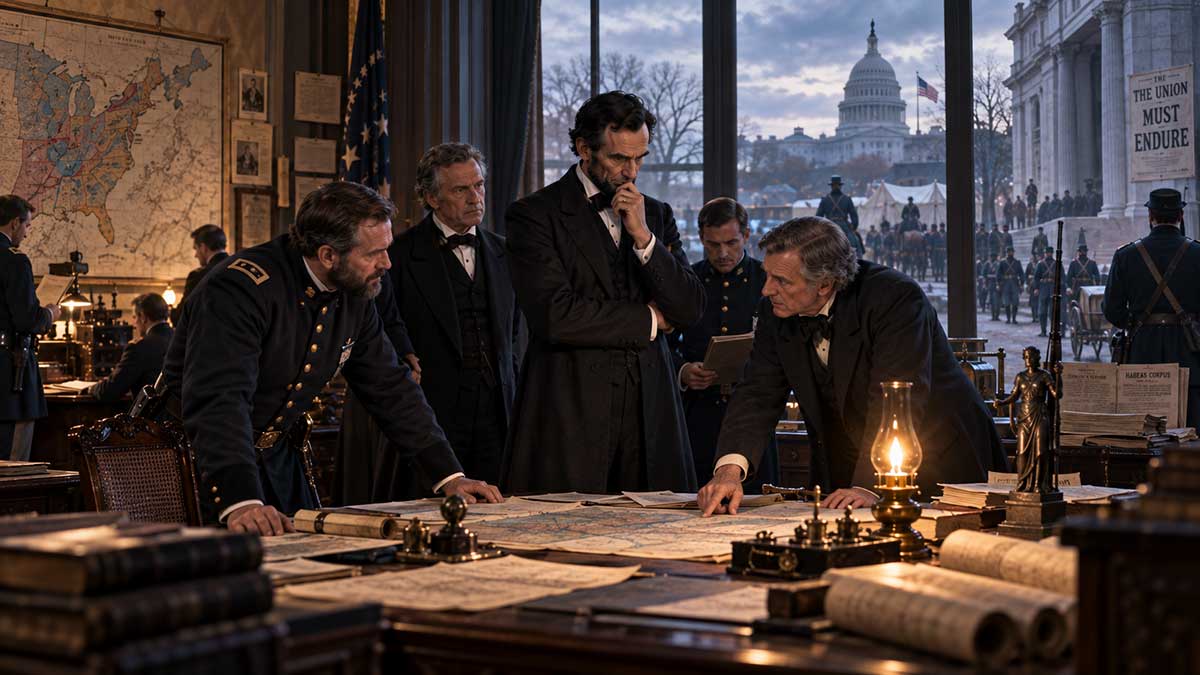
Lincoln remained seated.
Douglass had not taken his eyes off him.
Mary’s question still hung in the room:
“Did you save the Constitution by breaking its normal rules?”
Lincoln finally answered.
“I would phrase it differently.”
Douglass smiled faintly.
“Of course you would.”
Lincoln ignored that.
“I would ask whether a government must sometimes use extraordinary powers to prevent the destruction of the constitutional order itself.”
Seward nodded.
“That is the better question.”
Mary looked toward him.
“Better for whom?”
Seward paused.
“For accuracy.”
Mary said:
“And perhaps for Abraham.”
Lincoln glanced at her.
“Also possible.”
Grant leaned forward.
“Let us start with the emergency.”
Lincoln nodded.
“Good.”
Grant continued:
“The capital was threatened.”
“Yes.”
“Rail lines were vulnerable.”
“Yes.”
“Telegraph lines.”
“Yes.”
“Maryland was unstable.”
“Yes.”
“Troops needed to move.”
“Yes.”
“Confederate sympathizers existed inside loyal territory.”
“Yes.”
Grant looked toward Douglass.
“This was not a theoretical constitutional debate taking place in peacetime.”
Douglass nodded.
“I understand.”
“Then the emergency was real.”
“Yes.”
Douglass replied.
“But real emergencies do not make dangerous powers harmless.”
Grant paused.
“No.”
Lincoln looked toward him.
Grant continued:
“Sometimes they make them necessary.”
Douglass said:
“And that word—necessary—is the one every government loves.”
Seward smiled slightly.
“Mr. Douglass, you distrust government with admirable consistency.”
“I distrust men most when they are convinced history has given them permission.”
Lincoln looked toward him.
“That includes me?”
“Especially you.”
Lincoln raised an eyebrow.
“Why especially?”
“Because successful leaders are forgiven things unsuccessful leaders are condemned for.”
The room became quiet.
Lincoln leaned back.
“That is fair.”
Seward looked toward him.
“You concede quickly.”
Lincoln replied:
“Victory has a way of making every earlier decision look inevitable.”
Grant nodded.
“And every risk look wise.”
Douglass said:
“Exactly.”
Seward opened one of the folders.
“Then let us be precise.”
Lincoln nodded.
Seward continued:
“The issue of habeas corpus became urgent very early.”
Mary looked toward him.
“For those who do not speak like lawyers?”
Seward smiled.
“A person detained by the government ordinarily has the right to have a court examine whether that detention is lawful.”
Mary nodded.
“And suspension means?”
“The government can temporarily hold people without the normal immediate judicial process.”
Mary looked at Lincoln.
“That is a great deal of power.”
“Yes.”
Douglass said:
“Power over liberty.”
“Yes.”
Lincoln replied.
Douglass continued:
“You authorized suspensions.”
“Yes.”
“You permitted military arrests.”
“Yes.”
“Chief Justice Taney challenged your authority.”
“Yes.”
“And you did not simply accept his conclusion.”
“No.”
Douglass leaned closer.
“Why?”
Lincoln answered slowly.
“Because I believed the executive had responsibilities the judiciary could not carry for me.”
Douglass said:
“That sounds like every executive who dislikes a court.”
Lincoln’s expression tightened.
“It also happened to be true.”
Seward entered.
“The government was trying to suppress an armed rebellion.”
Douglass said:
“And courts were trying to define legal limits.”
“Yes.”
“Which also matters.”
“Yes.”
Seward nodded.
“No argument.”
Mary looked between them.
“So who decides?”
Silence.
Mary repeated:
“Who decides when law becomes too slow for survival?”
Lincoln answered:
“The officer who bears responsibility in that moment.”
Douglass immediately replied:
“That is an alarming answer.”
“It should be.”
Lincoln said.
Douglass stopped.
Lincoln continued:
“I do not say it lightly.”
“Then say it fully.”
Lincoln folded his hands.
“A president can be wrong.”
“Yes.”
“A general can be wrong.”
“Yes.”
“A judge can be wrong.”
“Yes.”
“A legislature can be too slow.”
“Yes.”
“An executive can become abusive.”
“Yes.”
Lincoln looked around the room.
“But an emergency does not pause because institutions need more time to agree.”
Grant nodded.
“That part is true.”
Lincoln said:
“If a railroad must be protected tonight, I cannot wait six months for every constitutional question to be resolved.”
Douglass replied:
“But if you arrest the wrong man tonight, that man lives inside your mistake.”
Lincoln looked at him.
“Yes.”
Douglass said:
“That is what bothers me.”
“What?”
“You keep speaking in the scale of government.”
“Railroads.”
“Capitals.”
“Armies.”
“Union.”
Lincoln nodded.
Douglass continued:
“But liberty is experienced one person at a time.”
Lincoln looked down.
Mary said quietly:
“That is the same argument as slavery.”
Douglass turned toward her.
“Yes.”
Mary looked at Lincoln.
“Again, the government sees the whole.”
“And one person lives inside the cost.”
Lincoln nodded.
“Yes.”
Grant spoke.
“Suppose someone is actively helping sabotage rail lines carrying troops.”
Douglass turned toward him.
“Arrest him.”
“Suppose the normal courts are not functioning.”
“Then hold him until they do.”
“Suppose waiting allows the sabotage to continue.”
Douglass said:
“You are trying to make the hard case justify the broad rule.”
Grant shook his head.
“I am trying to show why broad rules appear in hard cases.”
Douglass paused.
Grant continued:
“War creates situations law did not imagine cleanly.”
Seward nodded.
“That is exactly the problem.”
Douglass looked toward Lincoln.
“And your solution was to enlarge executive power.”
“My solution was to preserve the government.”
“That is not the same statement.”
“No.”
Lincoln admitted.
Douglass leaned back.
“Good.”
Mary looked at her husband.
“Did you ever worry that you would become the thing you said you were fighting?”
Lincoln’s expression changed.
“What do you mean?”
“A government preserving itself by limiting liberty.”
“Yes.”
“Did you worry?”
“Yes.”
“How often?”
“Enough.”
Mary watched him.
“But you continued.”
“Yes.”
“Why?”
Lincoln paused.
“Because fear of abusing power cannot become an excuse for refusing responsibility.”
Mary said:
“And fear of losing the country?”
“That too.”
Douglass said:
“Then fear operated on both sides.”
Lincoln turned.
“How?”
“You feared tyranny.”
“Yes.”
“You feared rebellion more.”
Lincoln thought.
“In that moment, yes.”
Douglass nodded.
“That matters.”
Seward looked toward him.
“Would you have preferred he risk losing Washington?”
Douglass replied:
“No.”
“Then what are you arguing?”
“That necessity must be proven, not merely declared.”
Seward nodded slowly.
“That is fair.”
Douglass continued:
“And that each extraordinary power should have a boundary.”
Lincoln said:
“Yes.”
“Did yours?”
“Yes.”
“Always?”
Lincoln was silent.
Douglass leaned forward.
“Always?”
“No.”
The room went still.
Mary looked toward him.
Lincoln continued:
“Not with the clarity I would prefer looking backward.”
Seward glanced at him.
Lincoln said:
“There were decisions made under pressure.”
“Some I would defend strongly.”
“Some I would defend cautiously.”
“Some I would want examined more critically.”
Douglass nodded.
“That is the Lincoln I trust more than the statue.”
Lincoln smiled faintly.
“I am beginning to dislike statues too.”
Grant said:
“There is another problem.”
Lincoln looked toward him.
“What?”
“Command.”
Grant continued:
“In the field, hesitation can kill.”
Lincoln nodded.
“A commander who refuses to act because every order might later be criticized may lose the battle.”
Douglass said:
“And a commander who stops fearing criticism may become dangerous.”
Grant nodded.
“Correct.”
Mary looked at him.
“So what restrains him?”
Grant answered:
“Discipline.”
“Orders.”
“Law.”
“Other officers.”
“His own judgment.”
Mary said:
“His own judgment is exactly what worries me.”
Grant almost smiled.
“It worries me too.”
Seward said:
“That is why institutions matter.”
Douglass looked at him.
“And what happens when the institution itself is suspended?”
Seward paused.
“That is the hardest case.”
Douglass said:
“Exactly.”
Lincoln stood now.
He walked slowly toward the window.
“When I was president,” he said, “I kept returning to one question.”
No one interrupted.
“If all the laws but one remain untouched, and that one law prevents the government from acting against rebellion…”
He turned.
“…must the government allow itself to be destroyed in order to preserve that one law?”
Douglass replied:
“That is powerful.”
Lincoln waited.
Douglass continued:
“And dangerous.”
“Yes.”
“Because the same argument can be made about any law.”
“No.”
“Why not?”
“Because the emergency must be real.”
Douglass said:
“Who determines that?”
Lincoln sighed.
“We are back there.”
“Yes.”
Douglass replied.
“That is where power always returns.”
Mary looked toward Seward.
“What did you believe?”
Seward thought.
“That the Union had to survive.”
“That rebellion had to be suppressed.”
“That some extraordinary measures were justified.”
“And did you fear abuse?”
“Yes.”
“Then why support them?”
“Because governments sometimes face choices where every option carries danger.”
Mary nodded.
Seward continued:
“Refusing power can be as consequential as abusing it.”
Douglass said:
“That sentence should frighten us.”
“It should.”
Seward replied.
“But fear is not an argument against truth.”
Douglass turned back to Lincoln.
“Let me ask directly.”
“Yes.”
“Did you ever think: I am doing this because history will forgive me if I win?”
Lincoln’s face changed.
“No.”
Douglass watched him.
“Never?”
Lincoln thought longer.
“Not consciously.”
“Would victory matter to judgment?”
“Of course.”
“Then perhaps you knew.”
Lincoln nodded.
“Perhaps.”
Douglass said:
“If you had lost the war…”
Grant looked toward him.
Douglass continued:
“…would the same actions now be remembered as emergency leadership?”
No one answered.
Mary looked toward Lincoln.
He finally said:
“Probably not.”
Seward nodded.
“History is rarely generous to failed emergency powers.”
Grant said:
“Or failed generals.”
Douglass replied:
“Then success can sanitize methods.”
Lincoln said:
“Yes.”
Douglass looked at him.
“Which is why success must not end the inquiry.”
Lincoln nodded.
“Yes.”
Mary said:
“There is something else.”
Lincoln looked toward her.
“What?”
“Future presidents.”
Seward looked up.
Mary continued:
“You make a decision in 1861.”
“You justify it by rebellion.”
“You succeed.”
“You become revered.”
“Then a president fifty years later says, ‘Lincoln did it.’”
Lincoln’s expression hardened.
Mary asked:
“Are you responsible for what later leaders do with your example?”
Lincoln thought.
“Not entirely.”
Douglass said:
“But partly?”
Lincoln nodded.
“Yes.”
Grant looked toward him.
“How?”
“Precedent.”
Seward said:
“Exactly.”
Lincoln continued:
“A president does not only use power.”
“He enlarges the imagination of what future presidents believe they may use.”
Douglass leaned back.
“That is the issue.”
Lincoln said:
“Which means emergency action should be narrower than fear wants it to be.”
Mary looked at him.
“Were yours?”
Lincoln paused.
“Not always as narrow as I would now wish.”
Grant looked toward Douglass.
“Then what would you have done?”
Douglass smiled slightly.
“I wondered when someone would ask.”
“Well?”
Douglass thought.
“I would have demanded clearer limits.”
“Time limits?”
“Yes.”
“Geographic limits?”
“Yes.”
“Judicial review where courts still functioned?”
“Yes.”
“Congressional authorization as quickly as possible?”
“Yes.”
Seward nodded.
“That is reasonable.”
Douglass continued:
“And I would have insisted publicly that emergency power is not virtue.”
Lincoln looked toward him.
“Meaning?”
“A leader should not be praised for using extraordinary power merely because he used it for a good cause.”
Lincoln nodded.
“Yes.”
“The power should remain morally uncomfortable.”
Grant said:
“That is true of killing in war too.”
The room quieted.
Douglass looked toward him.
Grant continued:
“If it becomes easy, something has gone wrong.”
Mary watched both men.
Lincoln said softly:
“Then perhaps the same is true of emergency government.”
Seward nodded.
“Yes.”
Douglass walked slowly across the room.
“There is a strange contradiction in you, Mr. Lincoln.”
Lincoln smiled faintly.
“Only one?”
“You were cautious about emancipation because you worried about constitutional authority.”
“Yes.”
“But forceful about war powers because you believed the nation itself was in danger.”
“Yes.”
“So when slavery was the emergency…”
Lincoln looked at him.
Douglass continued:
“…you moved slowly.”
“When Union survival was the emergency…”
“You moved quickly.”
Lincoln did not answer.
Mary looked at him.
Seward became still.
Douglass said:
“Why?”
Lincoln’s face was serious now.
“Because I had sworn an oath to preserve, protect, and defend the Constitution.”
Douglass replied:
“And slavery existed under that Constitution.”
“Yes.”
“Then the oath pulled you toward preserving a system that tolerated the evil you opposed.”
Lincoln nodded.
“Yes.”
Douglass said:
“And rebellion transformed that same oath into justification for expanding presidential power.”
“Yes.”
Douglass leaned forward.
“That is the contradiction.”
Lincoln replied:
“It is.”
No defense.
No speech.
Just the admission.
Mary asked:
“Did you ever wonder whether the Constitution itself had become morally inadequate?”
Lincoln paused.
“Yes.”
Douglass looked sharply toward him.
Lincoln continued:
“But inadequacy is not the same as worthlessness.”
“No.”
Douglass replied.
Lincoln said:
“A flawed Constitution can still contain mechanisms for moral change.”
“Amendment.”
“Election.”
“Legislation.”
“Courts.”
“Public argument.”
Seward nodded.
Lincoln continued:
“If we abandon constitutional government whenever justice moves too slowly, we may lose the structure through which justice becomes durable.”
Douglass replied:
“And if we worship the structure while people suffer beneath it, the structure becomes an idol.”
Lincoln looked at him.
“Yes.”
Mary said:
“Then both dangers are real.”
Lincoln nodded.
“Yes.”
Grant spoke.
“There is another question.”
Lincoln turned.
“What if the emergency had lasted twenty years?”
Seward looked toward him.
Grant continued:
“Would temporary powers still be temporary?”
Lincoln thought.
“They would become much harder to justify.”
“How much harder?”
“Much.”
Grant said:
“That is not an answer.”
Lincoln smiled faintly.
“You have learned from Douglass.”
Douglass said:
“He improves.”
Grant ignored him.
Lincoln continued:
“Emergency powers depend morally on emergency conditions.”
“If the condition becomes ordinary, the exception cannot simply become ordinary too.”
Seward nodded.
“Important.”
Douglass said:
“But governments often normalize what was once exceptional.”
“Yes.”
Lincoln replied.
“That is why Congress and courts must eventually reassert ordinary authority.”
Mary asked:
“And if the executive resists?”
Lincoln paused.
“Then the executive becomes the danger.”
The room fell quiet.
No one missed the force of that sentence.
Douglass looked at Lincoln.
“Would you have surrendered emergency powers willingly once the rebellion ended?”
Lincoln thought.
“I believe so.”
Douglass said:
“Believe?”
Lincoln smiled sadly.
“You are asking a dead man to prove a future he never lived.”
Mary looked away.
The tone shifted instantly.
Lincoln noticed.
“So there is our limit.”
No one answered.
He continued:
“I did not live long enough to govern the peace.”
Douglass nodded.
“That matters.”
“Yes.”
“Because a leader’s restraint after victory is part of the judgment.”
“Yes.”
Seward said:
“And we never saw the full answer.”
“No.”
Lincoln replied.
Mary looked toward the table.
“Then perhaps assassination protected you from another test.”
Lincoln glanced at her.
“What test?”
“Whether you could give power back.”
The room went still again.
Grant looked toward Mary.
Douglass did too.
Lincoln said quietly:
“Yes.”
Mary continued:
“Everyone remembers you as the man who preserved the Union.”
“Few people ask what kind of president you would have been after the emergency.”
Lincoln nodded.
“Fair.”
Seward said:
“That question belongs partly to Topic 5.”
Douglass smiled.
“We are learning to respect the order.”
Lincoln said:
“A constitutional achievement already.”
Grant leaned forward.
“Then answer the main question.”
Lincoln looked toward him.
“Which one?”
“Did you save the Constitution by breaking its normal rules?”
Lincoln thought for a long time.
Then:
“I do not believe I broke the Constitution in the way the question suggests.”
Douglass raised an eyebrow.
Lincoln continued:
“I believe I used disputed powers under extraordinary conditions.”
Seward nodded.
“Accurate.”
Douglass said:
“Convenient.”
Lincoln smiled faintly.
“Also accurate.”
Grant waited.
Lincoln continued:
“But I will say this.”
“If the government had refused to defend itself…”
“If Washington had fallen…”
“If rebellion had succeeded simply because ordinary procedures were too slow…”
“…then preserving every normal process would not have preserved constitutional government.”
Mary said:
“So your answer is yes.”
Lincoln shook his head.
“My answer is that survival sometimes requires temporary deviation from ordinary practice.”
Douglass said:
“And my answer is that every deviation creates a debt.”
Lincoln looked at him.
“What debt?”
“Explanation.”
“Limits.”
“Review.”
“Restoration.”
“Accountability.”
Lincoln nodded slowly.
“Yes.”
Douglass continued:
“And perhaps apology when mistakes are made.”
Lincoln paused.
“Yes.”
Seward smiled slightly.
“Then perhaps we have a formulation.”
Mary looked toward him.
“What?”
Seward said:
“Emergency power may be justified.”
“But never self-justifying.”
Douglass nodded.
Grant did too.
Lincoln repeated the phrase.
“Never self-justifying.”
Mary looked at him.
“Can you live with that?”
Lincoln smiled faintly.
“I did not always.”
She held his gaze.
“But can you now?”
“Yes.”
Douglass sat again.
“Then I have one more concern.”
Lincoln nodded.
“Go ahead.”
“If we praise you because your emergency powers served a just cause…”
“Yes.”
“…do we become less capable of recognizing the same tools in unjust hands?”
Lincoln’s expression sharpened.
“That is possible.”
“Then what should people remember?”
Lincoln thought.
“Not merely that Lincoln did it.”
Douglass nodded.
“What else?”
“Why.”
“How long.”
“Under what conditions.”
“With what opposition.”
“With what legal challenge.”
“With what subsequent congressional action.”
“And whether the same factual emergency truly exists.”
Seward nodded.
“Good.”
Douglass said:
“And whether the president using Lincoln as precedent is willing to surrender the power afterward.”
Lincoln nodded.
“Especially that.”
Mary looked toward Grant.
“You have been quieter.”
Grant said:
“This topic feels familiar.”
“How?”
“In war, every terrible measure can be defended by necessity.”
Douglass looked toward him.
Grant continued:
“Burn the bridge.”
“Take the town.”
“Destroy the rail line.”
“Accept the casualties.”
“Keep pressing.”
“Every order has an argument behind it.”
Mary said:
“And sometimes the argument is correct.”
“Yes.”
Grant replied.
“That is what makes it hard.”
Lincoln turned toward him.
Grant continued:
“A false necessity is dangerous.”
“A real necessity is terrible.”
No one spoke.
Grant looked at Lincoln.
“Sooner or later the question leaves the courtroom.”
Lincoln nodded.
“Yes.”
Grant continued:
“And becomes bodies.”
The room changed.
Mary looked down.
Douglass became still.
Lincoln closed his eyes briefly.
Grant said:
“You can debate whether suspending a legal protection preserved the Union.”
“But eventually preserving the Union required armies.”
“Battles.”
“Men dying by the thousands.”
Lincoln opened his eyes.
“Yes.”
Grant continued:
“And that is the next question.”
Mary looked toward him.
Grant’s voice was quiet.
“How much blood can a just cause demand?”
No one answered.
Lincoln looked toward the casualty reports stacked at the edge of the table.
Douglass followed his eyes.
Mary did too.
The constitutional argument had ended.
The human cost of preserving the Union was now waiting in front of them.
Topic 4: How Much Blood Can a Just Cause Demand?
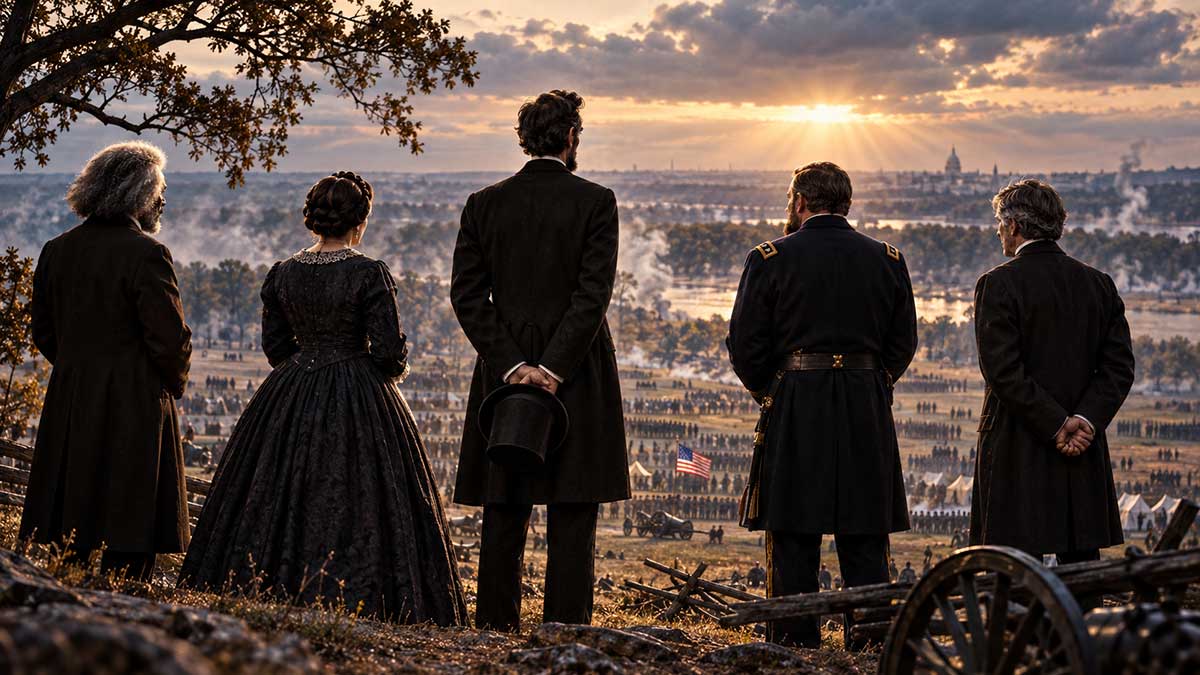
The casualty reports remained on the table.
No one touched them.
Grant looked at Lincoln.
Lincoln looked at the papers.
Mary looked at neither man.
Douglass finally spoke.
“General Grant asked the question.”
Lincoln nodded.
Douglass continued:
“So answer it.”
Lincoln looked up.
“How much blood can a just cause demand?”
Lincoln’s face tightened.
“I do not know.”
Grant watched him.
Douglass said:
“You continued the war.”
“Yes.”
“You replaced generals who would not press the Confederacy hard enough.”
“Yes.”
“You eventually trusted Grant because he would keep moving.”
“Yes.”
“Then at some point you decided that more death was preferable to stopping.”
Lincoln did not answer immediately.
Grant said:
“That is too simple.”
Douglass turned.
“Then make it more difficult.”
Grant leaned forward.
“Stopping did not mean peace.”
Douglass nodded.
“It could mean Confederate independence.”
“Yes.”
“It could mean slavery continuing.”
“Yes.”
“It could mean the rebellion had succeeded.”
“Yes.”
Grant continued:
“So the choice was not between bloodshed and no bloodshed.”
Douglass said:
“Good.”
Lincoln looked toward him.
Douglass continued:
“Because slavery itself was violence.”
Grant nodded.
“Yes.”
“Families sold.”
“Bodies beaten.”
“Labor stolen.”
“Children born into bondage.”
“Yes.”
Douglass looked toward Mary.
“The country had grown accustomed to one kind of violence because it happened slowly.”
Mary’s face changed.
Douglass continued:
“Then when war arrived, suddenly everyone could see the blood.”
Lincoln was silent.
Douglass said:
“That does not make the war harmless.”
“No.”
“But it changes the comparison.”
Lincoln nodded.
“Yes.”
Mary finally looked at the reports.
“How many?”
Grant answered softly.
“Too many.”
“That is not a number.”
“No.”
She looked at Lincoln.
“How many did you see?”
Lincoln replied:
“Thousands.”
“Names?”
“Sometimes.”
“Families?”
“Sometimes.”
“Letters?”
“Yes.”
Mary looked down.
“Did you read them?”
“As many as I could.”
“Why?”
Lincoln paused.
“Because if men were dying under decisions I approved, I did not want them to become arithmetic.”
Grant looked toward him.
Mary said:
“Did it help?”
“No.”
“Did it make the decisions harder?”
“Yes.”
“Then why keep reading?”
Lincoln looked at her.
“Because I feared what would happen if they became easy.”
The room went silent.
Grant nodded slowly.
“That is right.”
Douglass looked toward Lincoln.
“So suffering had to remain visible.”
“Yes.”
Douglass said:
“But not so visible that it made command impossible.”
Lincoln nodded.
“Yes.”
Mary looked between them.
“That sounds almost unbearable.”
Grant replied:
“It is.”
Douglass turned to Grant.
“Did you ever think the price was too high?”
Grant did not answer immediately.
“Yes.”
Lincoln looked at him.
Grant continued:
“But that is not the same as deciding to stop.”
Douglass said:
“Explain.”
Grant sat back.
“A commander can look at casualties and think:
This cannot continue.
Then he must ask:
What happens if we stop now?”
Douglass nodded.
Grant continued:
“If the enemy keeps his army…”
“If the political objective remains unresolved…”
“If the war resumes later…”
“If more men die because we refused to finish what had already cost so much…”
Mary interrupted.
“That sounds like the dead obligating the living.”
Grant looked toward her.
“Sometimes that argument is abused.”
“Sometimes?”
“Yes.”
“Leaders say, ‘We cannot stop because others have already died.’”
Mary nodded.
“And then more die.”
“Yes.”
Grant said.
“That can become madness.”
Douglass asked:
“Then what is the proper question?”
Grant answered:
“Not whether previous deaths must be justified.”
“But whether the objective still matters enough to justify future deaths.”
Lincoln nodded.
“That distinction mattered to me.”
Mary looked at Lincoln.
“Was preserving the Union worth that?”
Lincoln paused.
“Yes.”
Her eyes sharpened.
“So simple?”
“No.”
“Then don’t make it sound simple.”
Lincoln looked toward her.
“The Union was not merely territory.”
“It was the proposition that elections mattered.”
“That constitutional government could survive defeat at the ballot box.”
“That states could not leave whenever national power changed hands.”
Mary said:
“And that was worth hundreds of thousands of lives?”
Lincoln’s face tightened.
Douglass watched him.
Lincoln answered:
“If armed secession succeeded, I believed democratic government itself would be gravely weakened.”
Mary said:
“That is an idea.”
“Yes.”
“My question is about sons.”
Lincoln’s voice dropped.
“I know.”
She looked at him.
“No, Abraham.”
“You knew Willie.”
Lincoln became still.
Mary continued:
“You knew what one dead child did to a house.”
No one moved.
“You knew what it was to walk past a room that no longer needed preparing.”
Lincoln looked down.
“You knew what silence sounded like after one child was gone.”
“Yes.”
Mary’s voice trembled but did not break.
“And then every battle produced thousands of houses like that.”
Lincoln closed his eyes.
“Yes.”
She asked:
“How did you keep ordering more?”
Lincoln did not answer.
Grant looked away.
Douglass remained silent.
After a long pause, Lincoln said:
“Because I could not find a way to end the war without accepting something I believed would make those deaths meaningless and leave the greater injustice intact.”
Mary looked at him.
“You thought continuing was the lesser cruelty.”
“Yes.”
She nodded slowly.
“That is a terrible kind of leadership.”
Lincoln whispered:
“Yes.”
Douglass leaned forward.
“Let us sharpen that.”
Lincoln looked up.
“If peace had been possible in 1864…”
“Yes.”
“…but only by recognizing Confederate independence?”
Lincoln nodded.
“Would you have accepted it?”
“No.”
Mary looked at him.
Grant did too.
Douglass asked:
“Even if it stopped the killing?”
Lincoln answered:
“It might have stopped that war.”
“That is not my question.”
“No.”
Lincoln paused.
“I would not have accepted it.”
“Why?”
“Because the rebellion would have succeeded.”
“And slavery?”
“Would likely have survived in the Confederacy.”
Douglass nodded.
“So peace would have preserved injustice.”
“Yes.”
“And Union defeat.”
“Yes.”
Douglass leaned back.
“Then perhaps peace was not morally neutral.”
“No.”
Lincoln replied.
“That is the difficulty.”
Seward, quiet until now, finally spoke.
“There was also politics.”
Douglass turned.
“There always is.”
Seward ignored the tone.
“By 1864, northern exhaustion was severe.”
“Yes.”
“Casualties were enormous.”
“Yes.”
“Lincoln himself believed for a time he might lose reelection.”
Lincoln nodded.
Seward continued:
“If public confidence collapsed, policy could change.”
Douglass said:
“So even the ability to continue the war depended on politics.”
“Yes.”
Seward replied.
Mary looked toward Lincoln.
“And if you lost?”
Lincoln answered:
“The new administration might have pursued different terms.”
Douglass asked:
“Possibly ending the war without securing emancipation.”
“Yes.”
Douglass looked down.
“So political survival and emancipation became connected.”
Lincoln nodded.
“Yes.”
Mary said:
“And that made reelection more than personal ambition.”
“Yes.”
Seward added:
“Though personal ambition did not disappear.”
Lincoln smiled faintly.
“No.”
Douglass looked at him.
“You admit that easily.”
Lincoln replied:
“I wanted to win.”
“Why?”
“Because I believed the policies should continue.”
“And because you wanted to remain president.”
“Yes.”
Douglass nodded.
“Good.”
Lincoln looked amused.
“Again, good?”
“Again, honesty.”
Grant picked up one casualty report.
“Let us speak about strategy.”
Lincoln nodded.
Grant continued:
“Before I came east, the Union had already spent years fighting.”
“Armies advanced and withdrew.”
“Opportunities were missed.”
“Confederate armies survived.”
Lincoln said:
“That was one of my frustrations.”
Grant nodded.
“When I took command, I believed the Confederacy had to be pressured continuously.”
Douglass said:
“Which meant more casualties.”
“Yes.”
“Thousands.”
“Yes.”
“Again and again.”
“Yes.”
Mary looked at Grant.
“Did you ever think Lincoln wanted too much?”
Grant paused.
“No.”
“Never?”
“Not in the central objective.”
“Did you ever think he wanted victory too quickly?”
Grant almost smiled.
“Presidents always want victory quickly.”
Lincoln said:
“Generals always want more time.”
Grant glanced at him.
“Also true.”
The room relaxed for half a second.
Then Grant became serious.
“The issue was not whether men would die.”
“They already were.”
“The issue was whether military pressure could shorten the total war.”
Douglass said:
“And did it?”
Grant answered:
“Eventually.”
Mary said:
“At enormous cost.”
“Yes.”
Douglass looked at Lincoln.
“Did Grant’s willingness to accept casualties make him the general you had been looking for?”
Lincoln hesitated.
“In part.”
Grant remained still.
Lincoln continued:
“But not because he was careless.”
Douglass said:
“Then why?”
“Because he understood that defeating the Confederate armies required sustained pressure.”
Grant nodded.
Lincoln continued:
“Earlier commanders sometimes preserved their armies beautifully.”
“And preserved the enemy too.”
Grant said:
“That is the point.”
Mary replied:
“You speak as though the army is a tool.”
Grant looked toward her.
“In command, it is.”
Her expression hardened.
Grant continued quickly:
“And every tool is made of men.”
Mary said:
“That should change the word.”
Grant paused.
“Perhaps.”
Lincoln looked toward Mary.
“You are doing what you did earlier.”
“What?”
“Making the scale human.”
“Yes.”
Lincoln nodded.
“We needed that.”
Douglass turned to Grant.
“Was there a moment when military necessity became an excuse for brutality?”
Grant considered.
“In every war, there are moments when people cross that line.”
“Did you?”
“I made decisions that caused terrible destruction.”
“Sheridan in the Shenandoah.”
“Yes.”
“Sherman in Georgia.”
“Yes.”
Grant continued:
“War against infrastructure, railroads, supply systems, agriculture that sustained Confederate armies.”
Douglass said:
“Civilians suffered.”
“Yes.”
Mary looked at him.
“Was that necessary?”
Grant replied:
“I believed breaking the Confederacy’s ability to wage war could shorten the conflict.”
Mary said:
“That is the same answer again.”
“Yes.”
“Shorter war.”
“Yes.”
“More destruction now to prevent more destruction later.”
“Yes.”
Mary shook her head.
“That logic can justify almost anything.”
Grant nodded.
“Yes.”
She looked surprised.
Grant continued:
“That is why limits matter.”
Douglass said:
“What limits?”
“Military purpose.”
“Distinction between destroying resources that sustain the war and cruelty for cruelty’s sake.”
“Discipline.”
“Orders.”
“Accountability.”
Douglass nodded.
“And still civilians suffered.”
“Yes.”
Grant did not defend further.
Lincoln looked at Grant.
“Did you ever hate me for asking you to continue?”
Grant looked surprised.
“No.”
“Never?”
“No.”
“Why?”
“Because I believed the war had to be won too.”
Lincoln was quiet.
Grant continued:
“You did not sit in Washington asking for blood because blood pleased you.”
Mary looked toward Lincoln.
Grant said:
“You worried.”
“You interfered sometimes.”
Lincoln smiled faintly.
“Only sometimes?”
Grant ignored him.
“You visited hospitals.”
“You reviewed cases.”
“You pardoned soldiers.”
“You carried the war personally.”
Douglass said:
“Does compassion excuse the decision?”
Grant turned.
“No.”
“It explains the man making it.”
Douglass nodded.
“Fair.”
Mary looked at Lincoln.
“You pardoned soldiers.”
“Yes.”
“Deserters.”
“Sometimes.”
“Boys condemned for sleeping at their posts.”
“Yes.”
“Then you could not bear one execution.”
Lincoln’s face tightened.
Mary continued:
“But you could continue a campaign that killed thousands.”
Lincoln replied:
“That contradiction troubled me.”
“How did you explain it?”
He thought.
“One death placed directly in front of me felt preventable.”
“And battle deaths?”
“Sometimes they felt tied to consequences beyond the individual case.”
Mary said:
“So scale changes morality.”
“No.”
Lincoln shook his head.
“It changes responsibility.”
Douglass leaned forward.
“Explain.”
Lincoln continued:
“If one young soldier can be spared without risking the army, mercy may cost nothing.”
“If ending a campaign allows the enemy army to survive and continue the war, mercy in the immediate moment may produce more suffering later.”
Mary said:
“Then mercy itself can become cruel?”
Lincoln paused.
“Yes.”
“Sometimes.”
Douglass looked down.
“That is a frightening thought.”
Lincoln replied:
“It frightened me too.”
Seward said:
“Perhaps the real difficulty is that leaders rarely choose between compassion and cruelty.”
Everyone looked toward him.
“They choose between different distributions of suffering.”
The room went quiet.
Douglass repeated:
“Different distributions of suffering.”
“Yes.”
Seward continued:
“Continue the war: soldiers die.”
“End it without victory: slavery may survive, secession succeeds, the political consequences extend for generations.”
“Escalate the war: civilians suffer.”
“Fight cautiously: the war lasts longer.”
“Call for more troops: more families lose sons.”
“Fail to call them: the army may lose.”
Mary said:
“There is no clean decision.”
“No.”
Seward replied.
“That does not make every decision equally moral.”
Douglass nodded.
“Important.”
Douglass looked toward Lincoln.
“Did emancipation make the war easier to justify to yourself?”
Lincoln thought.
“In some ways.”
“Because the cause became morally larger?”
“Yes.”
Douglass said:
“Dangerous again.”
Lincoln looked at him.
“How?”
“The more righteous a cause feels, the easier it becomes to believe any sacrifice serves it.”
Lincoln nodded.
“Yes.”
Grant said:
“That danger is real.”
Douglass continued:
“A man convinced he is fighting evil can become indifferent to what he does while fighting it.”
Lincoln replied:
“Then righteousness requires restraint more, not less.”
Douglass nodded.
“That is what I wanted.”
Mary looked toward the reports again.
“Were they worth it?”
No one answered.
She looked first at Grant.
“Were all these deaths worth it?”
Grant’s expression hardened.
“I would never say that.”
“Why?”
“Because the word makes the dead sound like payment.”
Mary nodded.
Grant continued:
“I can say the war achieved things worth achieving.”
“The Union survived.”
“Slavery was destroyed.”
“I can say surrendering before victory would have had terrible consequences.”
“But I cannot tell a mother her son was a price I am glad we paid.”
Mary looked at him.
“That is better.”
She turned to Lincoln.
“And you?”
Lincoln stared at the reports.
“I agree.”
“Then what do you say?”
He answered slowly.
“I say the cause was worth continuing.”
“I say the outcome mattered.”
“I say ending slavery mattered.”
“I say preserving constitutional government mattered.”
He paused.
“But I do not say the dead became justified simply because we won.”
Douglass nodded.
Lincoln continued:
“Their deaths remain deaths.”
“Victory does not transform grief into something painless.”
Mary looked at him.
“Good.”
Douglass sat back.
“Then perhaps the question is wrong.”
Lincoln looked toward him.
“How much blood can a just cause demand?”
“Yes.”
“What is wrong with it?”
Douglass replied:
“It makes the cause sound like a person collecting blood.”
Grant nodded slowly.
Douglass continued:
“Perhaps the question should be:
When does refusing to continue a terrible struggle cause more injustice than continuing it?”
Lincoln said:
“That is closer.”
Mary replied:
“And still dangerous.”
“Yes.”
Douglass said.
“It should remain dangerous.”
Grant looked toward Mary.
“You asked how leaders continue.”
“Yes.”
Grant said:
“Sometimes they continue because stopping would feel merciful but actually prolong the problem.”
Mary replied:
“And sometimes they continue because they cannot admit the objective is no longer achievable.”
Grant nodded.
“Yes.”
“How do you know the difference?”
Grant paused.
“You study the facts.”
“Enemy strength.”
“Your own strength.”
“Political conditions.”
“Objectives.”
“Alternatives.”
“Likelihood of success.”
Mary said:
“And grief?”
Grant looked at her.
“You keep it in the room.”
Mary nodded.
“That may be the best answer you have given.”
Lincoln smiled faintly.
“Mrs. Lincoln has become our examiner.”
Mary looked at him.
“I spent years being examined by everyone else.”
The smile vanished from Lincoln’s face.
Douglass looked toward her.
Mary continued:
“They examined my dresses.”
“My spending.”
“My grief.”
“My temper.”
“My loyalty.”
“My family.”
She looked at Lincoln.
“No one asked whether the woman in the White House could bear receiving war while burying her own child.”
Lincoln’s expression softened.
“Mary—”
“No.”
She continued.
“You were allowed to become sorrowful.”
“They called it depth.”
“When I broke…”
She stopped.
The room became very still.
Douglass said quietly:
“They judged you differently.”
Mary nodded.
“Yes.”
Lincoln looked down.
Mary turned back to the reports.
“So when we speak of sacrifice…”
She looked around the table.
“Remember that nations rarely distribute it equally.”
Douglass nodded.
“Exactly.”
Seward said:
“That applies to slavery too.”
Douglass looked toward him.
“Yes.”
Seward continued:
“The nation enjoyed compromises for decades.”
“Who benefited from the peace?”
Douglass said:
“Those who were free.”
“And who paid for preserving it?”
“Those who were enslaved.”
Seward nodded.
“Then eventually the political system reached a point where avoiding open conflict meant continuing another form of violence.”
Lincoln looked toward him.
“Yes.”
Douglass said:
“That may be the strongest argument for why the war could not simply be ended by restoring the old arrangement.”
Lincoln nodded.
“There was no morally acceptable road back to 1860.”
Grant said:
“And after the Emancipation Proclamation, there was even less of one.”
“Yes.”
Lincoln replied.
Grant continued:
“Union victory increasingly meant slavery’s destruction.”
“And Confederate victory increasingly meant preserving a government built around it.”
Douglass said:
“Then Actium had its ships.”
Lincoln looked confused.
Douglass smiled faintly.
“Another room.”
Lincoln smiled.
“I am glad I missed that war.”
The tension loosened briefly.
Then Douglass asked:
“Did you ever pray about the casualties?”
Lincoln became serious.
“Yes.”
“What did you ask?”
Lincoln hesitated.
“I am not sure I always knew how to pray.”
Mary looked toward him.
Lincoln continued:
“At first perhaps I wanted victory.”
“Later…”
He paused.
“Later I became less confident that God existed merely to endorse our plans.”
Douglass watched him.
“You believed slavery was wrong.”
“Yes.”
“Did you believe God opposed it?”
“Yes.”
“Then why uncertainty?”
“Because believing one thing wrong does not mean I understood why God permitted the war to become so terrible.”
Seward was silent.
Lincoln continued:
“Both sides prayed.”
“Both read the same Bible.”
“Both claimed Providence.”
Douglass said:
“One side also defended slavery.”
“Yes.”
Lincoln replied.
“I am not making the causes morally equal.”
“Good.”
“I am saying that moral superiority does not give a nation complete knowledge of God.”
Douglass nodded slowly.
“That distinction matters.”
Mary looked toward Lincoln.
“Did Willie’s death change that?”
Lincoln’s face changed.
“Perhaps.”
She waited.
He continued:
“When grief enters your own house, explanations become less satisfying.”
Mary said:
“Yes.”
Lincoln looked toward the reports.
“And when thousands of other houses were grieving…”
He stopped.
Douglass said:
“You began to speak less as though God had chosen the Union…”
Lincoln nodded.
“…and more as though the entire nation might stand under judgment.”
“Yes.”
Mary looked at him.
“For slavery.”
“Yes.”
Lincoln’s voice was quiet.
“Perhaps the war was not merely punishment of one section by another.”
“Perhaps the whole nation had participated in the wrong long enough that the cost belonged to all of us.”
Douglass was silent for several seconds.
Then:
“That I can respect.”
Grant said:
“But presidents cannot conduct war by theology alone.”
Lincoln nodded.
“No.”
“Eventually you still had to decide whether I should attack.”
“Yes.”
“Whether another campaign should begin.”
“Yes.”
“Whether another draft should be called.”
“Yes.”
Grant looked at him.
“Did prayer ever give you certainty?”
Lincoln thought.
“No.”
“Then what did?”
“Nothing.”
The room went quiet.
Grant raised an eyebrow.
Lincoln continued:
“I had judgment.”
“Reports.”
“Advice.”
“Law.”
“Political necessity.”
“Conscience.”
“Experience.”
“And uncertainty.”
Grant nodded.
“That sounds familiar.”
Lincoln said:
“Leadership often means deciding before certainty arrives.”
Douglass looked toward him.
“And living with what happens afterward.”
“Yes.”
Mary asked:
“Then what makes the decision moral?”
Lincoln looked at her.
“Not certainty.”
“No.”
“Not victory?”
“No.”
“Not intention?”
“No.”
She waited.
Lincoln thought carefully.
“Perhaps whether the objective is just.”
“Whether alternatives have been seriously considered.”
“Whether the suffering is proportionate to what is at stake.”
“Whether the leader remains capable of seeing the people harmed.”
“Whether he is willing to change course if the facts change.”
“Whether the power used remains limited to the necessity.”
Grant nodded.
Douglass said:
“And whether the people paying the cost have been treated as human beings rather than means.”
Lincoln looked toward him.
“Yes.”
Mary said:
“That is a difficult standard.”
Lincoln replied:
“It should be.”
Grant placed the casualty report back on the table.
“Then I will answer my own question.”
Everyone looked toward him.
“How much blood can a just cause demand?”
He shook his head.
“A just cause does not receive an unlimited account.”
Douglass nodded.
Grant continued:
“Every death must make the next decision harder.”
Lincoln looked toward him.
“But not impossible.”
Grant nodded.
“No.”
Mary said:
“And if the deaths make the next decision easier?”
Grant replied:
“Then something is wrong.”
Douglass turned toward Lincoln.
“So you do not believe the Civil War was justified because the Union won.”
“No.”
“You believe the Union had objectives worth defending.”
“Yes.”
“And eventually emancipation became inseparable from victory.”
“Yes.”
“You believe stopping too soon could have preserved slavery and rewarded secession.”
“Yes.”
“And yet the suffering remains morally significant.”
“Yes.”
Douglass nodded.
“That is more honest than saying the war was simply glorious.”
Lincoln’s expression hardened.
“There was nothing glorious about a hospital.”
Grant said:
“Or a battlefield afterward.”
Mary said:
“Or a house receiving the news.”
For a while no one spoke.
The casualty reports no longer looked like evidence in an argument.
They looked like what they were.
Reminders.
Douglass finally said:
“Then perhaps a good cause can justify terrible action.”
Lincoln looked toward him.
“Sometimes.”
“But never make it clean.”
“No.”
Grant added:
“And never eliminate the obligation to ask whether there was another road.”
Mary nodded.
Lincoln said:
“Exactly.”
Seward looked at Lincoln.
“You once faced criticism from men who believed you too cautious.”
“Yes.”
“Then from others who believed you had become too radical.”
“Yes.”
“Too weak.”
“Yes.”
“Too powerful.”
“Yes.”
“Too merciful.”
“Yes.”
“Too bloody.”
Lincoln smiled tiredly.
“Government produces a generous variety of criticism.”
Douglass smiled.
“But perhaps that tells us something.”
Lincoln looked toward him.
“What?”
“You changed.”
The room became quieter.
Douglass continued:
“The man who entered office promising not to interfere with slavery where it existed became the president who issued emancipation.”
“The man who once entertained colonization eventually spoke of Black men voting.”
“The president who struggled to find generals eventually accepted Grant’s relentless strategy.”
“The religious skeptic became the man of the Second Inaugural.”
Lincoln watched him.
Douglass said:
“Perhaps the next question is not whether you were always right.”
“No.”
“It is what happened to you along the way.”
Mary looked at her husband.
Grant leaned back.
Seward closed the folder.
Douglass continued:
“You changed on slavery.”
“You changed on race.”
“You changed on war.”
“You changed in how you spoke of God.”
“You changed in how you understood the country.”
Lincoln said quietly:
“Yes.”
Douglass looked directly at him.
“Then was your greatness that you were right…”
He paused.
“…or that you were capable of becoming less wrong?”
Lincoln stared at him.
Mary’s expression softened.
Grant glanced toward the window.
Seward smiled faintly.
Lincoln finally answered:
“That sounds like a question I would prefer someone else to answer.”
Douglass replied:
“You are surrounded by volunteers.”
And the conversation moved toward its final reckoning.
Topic 5: Was Lincoln Great Because He Was Right—or Because He Learned to Change?
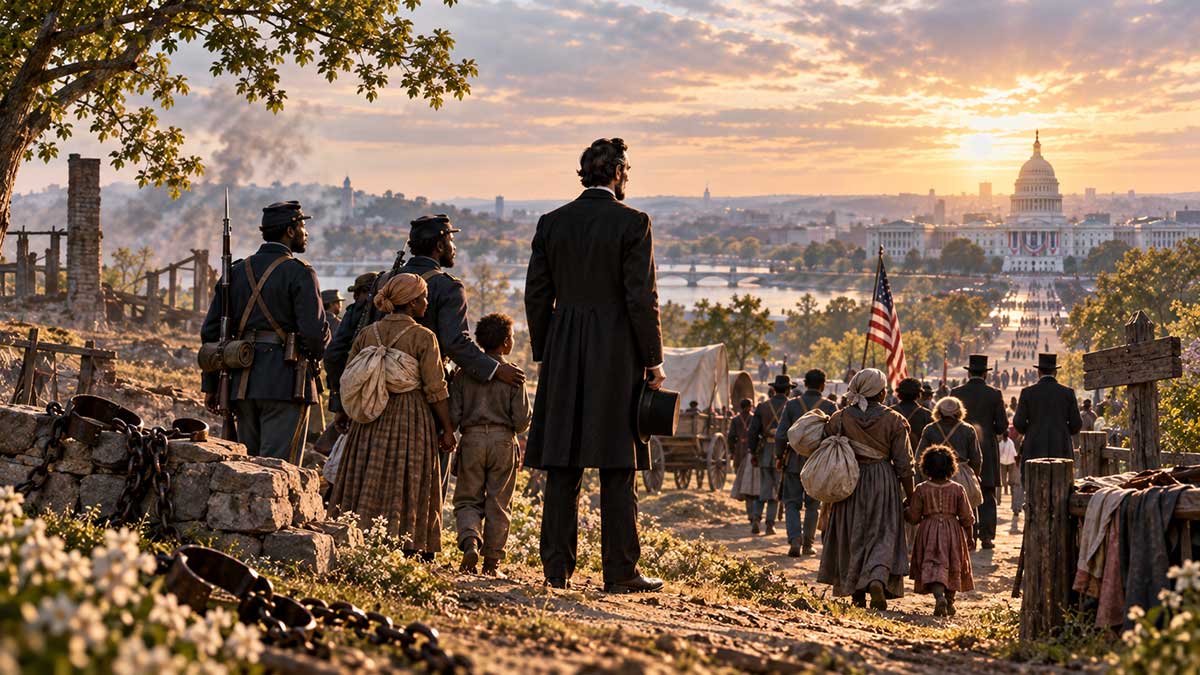
The room had grown quieter.
The casualty reports were still on the table.
The Emancipation Proclamation lay beside them.
Frederick Douglass looked at Lincoln.
“You said you would prefer someone else to answer.”
Lincoln smiled faintly.
“I often preferred that arrangement.”
Mary shook her head.
“No, you didn’t.”
Lincoln glanced toward her.
“You enjoyed argument too much.”
“Perhaps.”
Douglass leaned forward.
“Then let us begin with the uncomfortable version.”
Lincoln nodded.
“You were wrong about some things.”
“Yes.”
“You were limited by the racial assumptions of your time.”
“Yes.”
“You supported colonization.”
“Yes.”
“You moved slowly against slavery.”
“Yes.”
“You did not begin your presidency believing in full political equality between Black and white Americans.”
“Yes.”
Douglass paused.
“And yet the Lincoln who died in 1865 was not the same Lincoln who entered national politics years earlier.”
Lincoln looked at him.
“No.”
Douglass said:
“Then perhaps history should ask not only where you stood.”
“But whether you moved.”
Lincoln nodded.
“Yes.”
Seward spoke.
“That sounds generous.”
Douglass turned.
“It is not meant to be.”
Seward raised an eyebrow.
Douglass continued:
“Growth does not erase the cost of being wrong.”
Lincoln nodded.
“Agreed.”
“Nor does eventual wisdom return the years lost during ignorance.”
“No.”
“Then why give growth so much importance?”
Douglass thought.
“Because a man who can change may become more useful to justice than a man who believes he has never been wrong.”
Lincoln looked toward him.
“That may be the kindest thing you have said to me.”
“Do not enjoy it yet.”
Lincoln sighed.
“Again.”
Mary almost smiled.
Douglass continued:
“Let us take race.”
Lincoln became serious.
“In 1858, you publicly rejected full social and political equality between Black and white Americans.”
“Yes.”
“You spoke in ways that would be deeply offensive now.”
“Yes.”
“And offensive then to many Black Americans.”
“Yes.”
Lincoln did not resist.
Douglass looked at him carefully.
“Do you wish you had never said those things?”
Lincoln thought.
“Yes.”
“Because they embarrass your reputation?”
“No.”
“Then why?”
“Because some of them reflected limitations I later came to see more clearly.”
Douglass nodded.
“Good.”
Lincoln continued:
“But I will not pretend I held later conclusions earlier than I did.”
Douglass said:
“That matters.”
Lincoln looked toward him.
“Why?”
“Because false progress is worse than admitted progress.”
Lincoln waited.
Douglass continued:
“If we rewrite your earlier self to make the later Lincoln inevitable, we lose the fact that change actually happened.”
Seward nodded.
“That is important.”
Mary looked toward Lincoln.
“And perhaps we make change seem easier than it was.”
Douglass turned toward her.
“Yes.”
Grant leaned back.
“People prefer heroes who were always right.”
Seward said:
“Because then admiration requires less thought.”
Lincoln smiled.
“Statues again.”
Mary replied:
“People also prefer villains who were always wrong.”
Douglass nodded.
“That is the same simplification in reverse.”
Grant said:
“War teaches that quickly.”
“How?”
Douglass asked.
Grant answered:
“A general wins a campaign and suddenly every decision looks brilliant.”
“He loses, and every decision looks foolish.”
Lincoln nodded.
“Politics does the same.”
Seward added:
“And history does it after both of us are gone.”
Douglass looked toward Lincoln.
“Then perhaps greatness must survive contradiction.”
Lincoln said:
“If it is real.”
Mary turned to her husband.
“Were you ambitious?”
Lincoln smiled faintly.
“I suspected this would come.”
“Were you?”
“Yes.”
“Very?”
“Yes.”
Seward laughed.
“Now we are making progress.”
Mary ignored him.
“You wanted office.”
“Yes.”
“You wanted influence.”
“Yes.”
“You wanted to be remembered.”
Lincoln hesitated.
“Yes.”
Douglass watched him.
Mary continued:
“Does that make your moral choices less moral?”
Lincoln thought.
“No.”
Douglass said:
“Not automatically.”
Grant nodded.
Mary looked toward Douglass.
“Then ambition and goodness can coexist?”
“Yes.”
Douglass replied.
“Though ambition can corrupt.”
Seward added:
“And sometimes ambition supplies the energy required to accomplish difficult things.”
Lincoln looked toward him.
“You would know.”
Seward smiled.
“As would you.”
Douglass said:
“There is a tendency to imagine moral leaders as people who do not want power.”
Lincoln nodded.
“That is usually false.”
Douglass continued:
“A man who seeks office may genuinely want to serve.”
“And genuinely want importance.”
“Yes.”
“Both can be true.”
“Yes.”
Lincoln looked toward Mary.
She said:
“That was always the difficulty with you.”
“What?”
“You wanted to do good.”
“And you wanted to matter.”
Lincoln smiled sadly.
“Perhaps I did.”
Mary said:
“I do not think those desires were enemies.”
Douglass nodded.
“But one must keep watching the other.”
Grant looked toward Lincoln.
“When did you think you changed most?”
Lincoln paused.
“I cannot choose one moment.”
Douglass smiled.
“You dislike moments.”
“History likes them too much.”
Seward nodded.
Lincoln continued:
“Change usually arrived slowly.”
“Pressure.”
“Failure.”
“Argument.”
“War.”
“People.”
“Consequences.”
Grant said:
“So no single conversion.”
“No.”
Douglass asked:
“What about emancipation?”
Lincoln replied:
“Important.”
“Not the whole change.”
“What about Black soldiers?”
“Important.”
“Colonization?”
“Yes.”
“Your final speech supporting limited Black suffrage?”
“Yes.”
Douglass leaned forward.
“Then what connected them?”
Lincoln thought.
“Reality.”
Douglass waited.
Lincoln continued:
“I had assumptions.”
“Events contradicted them.”
“People contradicted them.”
“Black Americans contradicted them.”
“The war contradicted them.”
“Sometimes the Constitution itself revealed possibilities I had not expected.”
Douglass nodded.
“And you were willing to revise.”
“Eventually.”
Douglass smiled.
“There is that word again.”
Mary looked toward Douglass.
“Do you think Abraham became a different man?”
Douglass thought for a long time.
“No.”
Lincoln looked surprised.
Douglass continued:
“I think he became more fully the man he could have been.”
Lincoln said nothing.
Douglass added:
“His early belief that slavery was wrong mattered.”
“His attachment to the Declaration mattered.”
“His legal mind mattered.”
“His ambition mattered.”
“His caution mattered.”
“Even his limitations mattered because they were the things he had to move through.”
Lincoln looked down.
Douglass continued:
“So no.”
“I do not think he became someone else.”
“I think history kept forcing him to answer questions he had previously answered incompletely.”
Seward said:
“That may describe government itself.”
Douglass turned.
“How?”
Seward replied:
“A nation claims equality.”
“Then excludes millions.”
“It claims liberty.”
“Then permits slavery.”
“It claims representative government.”
“Then denies citizenship.”
Lincoln nodded.
Seward continued:
“The question becomes whether the nation can be forced to take its own principles more seriously.”
Douglass looked toward Lincoln.
“That was always my argument.”
Lincoln nodded.
“Yes.”
Douglass continued:
“America did not need a completely new moral vocabulary.”
“It needed to stop lying about the one it already possessed.”
The room became still.
Lincoln looked toward him.
“That is well said.”
Douglass replied:
“You said something similar at Gettysburg.”
Lincoln smiled faintly.
“I had fewer words.”
Mary looked toward the window.
“And then Willie died.”
The room changed instantly.
Lincoln’s expression softened.
No one interrupted.
Mary continued:
“Everyone discusses your political evolution.”
“Slavery.”
“Union.”
“Race.”
“Constitution.”
“War.”
“But something changed inside you too.”
Lincoln looked at her.
“You became quieter.”
He said nothing.
“You had always been melancholy.”
“But after Willie…”
She stopped.
Lincoln looked down.
Grant lowered his eyes.
Douglass waited.
Mary said:
“You stopped pretending sorrow could be solved.”
Lincoln’s voice was low.
“Perhaps.”
Douglass asked:
“Did grief change your politics?”
Lincoln thought.
“Not directly.”
“Your theology?”
“Yes.”
Mary looked toward him.
Lincoln continued:
“Before the war, I often thought in terms of human purpose.”
“What we intended.”
“What we could accomplish.”
“What history might become.”
Douglass said:
“And later?”
Lincoln looked toward the casualty reports.
“I became less certain that human purpose explains history.”
Seward remained silent.
Lincoln continued:
“We prayed for victory.”
“The Confederacy prayed for victory.”
“Both sides read Scripture.”
“Both invoked God.”
Douglass said:
“But both causes were not morally equivalent.”
“No.”
Lincoln replied firmly.
“Slavery remained wrong.”
Douglass nodded.
Lincoln continued:
“But knowing slavery was wrong did not mean I could claim to know precisely why God permitted the nation to bleed as it did.”
Mary looked at him.
“So certainty weakened.”
“Yes.”
“And faith?”
Lincoln paused.
“Perhaps faith deepened because certainty weakened.”
Douglass leaned back.
“That is an interesting answer.”
Lincoln looked toward him.
“How?”
“Many people imagine faith as increasing certainty.”
Lincoln nodded.
Douglass continued:
“But perhaps yours became more humble.”
“Yes.”
“You moved from asking whether God was on your side…”
“…toward asking whether we were aligned with what was right.”
Lincoln nodded.
“Yes.”
Grant said:
“That matters in war.”
Seward asked:
“Why?”
Grant replied:
“A commander convinced God guarantees victory can become reckless.”
Douglass said:
“A politician too.”
Lincoln smiled faintly.
“Or a reformer.”
Douglass looked at him.
“Fair.”
Mary said:
“Your Second Inaugural frightened people.”
Lincoln looked toward her.
“How?”
“You did not give them a victory speech.”
“No.”
“They wanted triumph.”
“Yes.”
“You gave them judgment.”
Lincoln was quiet.
Mary continued:
“You said, in effect, that the whole nation had lived with slavery long enough that perhaps the suffering belonged to more than one side.”
Douglass nodded slowly.
“That was one of the most remarkable things you did.”
Lincoln looked toward him.
“Why?”
“Because victors usually explain suffering by blaming the defeated.”
“Yes.”
“You did not fully do that.”
“No.”
Douglass continued:
“You did not absolve the South.”
“No.”
“But you refused to make the North morally spotless.”
“Yes.”
Douglass looked around the room.
“That is rare.”
Seward said:
“Humility after victory may have been Lincoln’s most politically dangerous instinct.”
Lincoln smiled.
“You wanted a stronger celebration?”
“I wanted a functioning country.”
Grant said:
“And reconciliation.”
Seward nodded.
“Yes.”
Douglass looked toward Lincoln.
“Reconciliation with whom?”
“The defeated South.”
“And justice for Black Americans?”
Lincoln paused.
“Also necessary.”
Douglass leaned closer.
“Which comes first?”
The room went still.
Lincoln said:
“That may have become the next great test.”
Douglass replied:
“One you did not live to take.”
“No.”
Mary looked down.
Grant asked:
“What would you have done?”
Lincoln looked toward him.
“During Reconstruction?”
“Yes.”
Lincoln smiled sadly.
“I have become increasingly suspicious of dead men explaining futures they never lived.”
Douglass nodded.
“Good.”
Lincoln continued:
“I favored restoring loyal government.”
“I wanted the Union reunited.”
“I did not want endless vengeance.”
“Near the end, I supported limited Black suffrage.”
Douglass said:
“For educated Black men and those who had served.”
“Yes.”
“Not universal.”
“No.”
Douglass nodded.
“So even at the end…”
“I was still moving.”
“Yes.”
Lincoln replied.
Douglass looked at him.
“That may be the most important unfinished sentence in your life.”
Mary looked sharply toward him.
“Unfinished.”
Douglass understood immediately.
“I did not mean—”
“No.”
Mary raised her hand.
“You did.”
“And it is true.”
Lincoln looked toward her.
Mary continued:
“Everyone says his life was cut short.”
“His work unfinished.”
“His possibilities stolen.”
“All true.”
She paused.
“But assassination did something else.”
Lincoln looked toward her.
“It protected you.”
The room became silent.
Grant frowned.
Seward looked toward Mary.
Douglass said nothing.
Lincoln asked:
“Protected me from what?”
Mary answered:
“From disappointment.”
Lincoln stared at her.
Mary continued:
“You died five days after Lee surrendered.”
“Victory was visible.”
“The amendment had passed Congress.”
“You had given the Second Inaugural.”
“The country was exhausted.”
“And then you were murdered.”
She looked directly at him.
“You never had to govern the years after victory.”
Lincoln said nothing.
“You never had to decide how much land former slaves would receive.”
“How firmly federal power would protect them.”
“How hard you would fight white southern resistance.”
“How much equality you would support when northern voters grew tired.”
“How much compromise you would make.”
Lincoln’s face had gone still.
Mary continued:
“You never had the chance to disappoint history.”
No one moved.
Douglass finally said:
“That is difficult.”
Mary looked toward him.
“But unfair?”
“No.”
Douglass replied.
“Not unfair.”
Seward said:
“Martyrdom freezes a man.”
Grant nodded.
“At his most favorable moment.”
Lincoln looked toward Mary.
“You believe I became greater because I died?”
Mary’s expression softened.
“No.”
“I believe your death made it easier for other people to make you simpler.”
Lincoln looked down.
Douglass said:
“She is right.”
Lincoln turned.
Douglass continued:
“If you had lived another ten years, we would know more.”
“Perhaps better.”
“Perhaps worse.”
Lincoln smiled faintly.
“Likely both.”
Douglass nodded.
“You might have disappointed me.”
“I already had.”
“You might have done it again.”
“Almost certainly.”
Mary smiled despite herself.
Douglass continued:
“You might also have gone farther than anyone expected.”
Lincoln said:
“Possible.”
“We do not know.”
“No.”
Douglass nodded.
“And historians should not turn possibility into fact.”
Seward said:
“Yet assassination also shaped national memory.”
“Yes.”
Douglass replied.
Lincoln asked:
“How?”
Seward continued:
“You became not merely president.”
“You became martyr.”
“Union.”
“Emancipation.”
“National sacrifice.”
“Almost biblical imagery accumulated around you.”
Mary said:
“And the man disappeared.”
Lincoln looked toward her.
She continued:
“The jokes.”
“The irritation.”
“The ambition.”
“The bad moods.”
“The politics.”
“The compromises.”
“The mistakes.”
“The father.”
“The husband.”
“The man who sometimes did not know.”
Douglass nodded.
“Exactly.”
Lincoln smiled faintly.
“Then perhaps this entire conversation has been an attempt to rescue me from praise.”
Douglass said:
“And condemnation.”
Grant added:
“Both can flatten a man.”
Seward nodded.
Mary said:
“Especially after he can no longer answer.”
Lincoln looked toward her.
“That sounds familiar.”
Mary almost smiled.
Douglass stood.
“Then let us ask the question directly.”
Lincoln nodded.
“Were you great because you were right?”
Lincoln paused.
“No.”
Everyone looked toward him.
Douglass said:
“That was fast.”
Lincoln continued:
“I was not always right.”
“Then were you great because you changed?”
Lincoln thought.
“That sounds too flattering too.”
Douglass smiled.
“Then answer properly.”
Lincoln stood.
For several seconds he looked around the room.
At Grant.
At Seward.
At Mary.
Finally at Douglass.
“I think a man should be judged by more than his starting point.”
Douglass nodded.
“And more than his ending point.”
“Yes.”
“Then by what?”
“By what he did with the distance between them.”
The room became quiet.
Lincoln continued:
“Did he listen?”
“Sometimes.”
“Did he learn?”
“I tried.”
“Did he admit failure?”
“Not often enough.”
“Did he move when evidence contradicted him?”
“Sometimes too slowly.”
“Did he use power?”
“Yes.”
“Did he become comfortable with it?”
“I hope not.”
“Did he make mistakes?”
“Yes.”
“Did those mistakes hurt people?”
“Yes.”
“Did he accomplish things that mattered?”
Lincoln paused.
“Yes.”
Douglass looked toward him.
“That is closer.”
Grant said:
“Then greatness is movement?”
Lincoln shook his head.
“Not merely movement.”
“A man can change in the wrong direction.”
Seward nodded.
“Then what kind?”
Lincoln thought.
“Toward a larger understanding of responsibility.”
Douglass watched him.
Lincoln continued:
“When I was younger, responsibility meant largely what I personally believed.”
“As a politician, it meant what could be enacted.”
“As president, it meant what the Union required.”
“As war continued, it meant what freedom required.”
“And perhaps by the end…”
He looked toward Mary.
“…it meant understanding that even victory did not make us innocent.”
Douglass said quietly:
“That may be the deepest change.”
Lincoln looked toward him.
“What?”
“You began with moral conviction.”
“You ended with moral humility.”
Lincoln said nothing.
Douglass continued:
“Those are not enemies.”
“No.”
“Conviction tells you slavery is wrong.”
“Yes.”
“Humility tells you that being right about slavery does not make every other decision you make right.”
Lincoln nodded.
“Yes.”
Grant said:
“That is leadership.”
Seward replied:
“At its best.”
Mary added:
“And when it fails?”
Douglass answered:
“Then humility must allow correction.”
Mary looked at Lincoln.
“Would you want to be remembered as the Great Emancipator?”
Lincoln smiled faintly.
“No.”
“As the Savior of the Union?”
“No.”
“The greatest president?”
“Especially not while Washington is listening.”
Seward laughed.
Grant smiled.
Mary continued:
“Then how?”
Lincoln’s expression changed.
He thought for a long time.
“As a man who tried to understand what his responsibility had become.”
Douglass looked at him.
“That is modest.”
Lincoln replied:
“History will enlarge it anyway.”
Douglass walked slowly toward the table.
He placed his hand near the Emancipation Proclamation.
“I will tell you how I would remember you.”
Lincoln waited.
“Not as the man who gave freedom to people who had no part in obtaining it.”
Lincoln nodded.
“Not as the man who was always ahead of his country.”
“Yes.”
“Not as the man who began without prejudice.”
“Yes.”
“Not as the man whose caution never caused harm.”
Lincoln nodded again.
Douglass continued:
“But as a president who was pushed.”
“Argued with.”
“Criticized.”
“Changed by war.”
“Changed by Black Americans.”
“Changed by necessity.”
“Changed by suffering.”
“And who eventually used the enormous power of his office to help destroy slavery.”
Lincoln was silent.
Douglass added:
“That is enough greatness for one life.”
Mary looked at Douglass.
“Careful credit.”
He smiled.
“Careful credit.”
Lincoln laughed softly.
“I will take it.”
Seward looked toward the window.
“But we still have not answered the question beneath all five topics.”
Douglass nodded.
“No.”
Grant asked:
“Which question?”
Lincoln already knew.
He looked toward Douglass.
Douglass said:
“You opposed slavery.”
“You faced constraints.”
“You delayed.”
“You moved.”
“You used extraordinary power.”
“You continued a terrible war.”
“You changed.”
He paused.
“Then how does someone in power know when caution remains prudence…”
“…and when it has become cowardice?”
No one answered.
Seward spoke first.
“When moving faster would destroy the coalition required to achieve the objective, caution may be prudence.”
Grant followed.
“When delay makes the eventual cost greater, caution may become failure.”
Mary said:
“When people who do not bear the sacrifice keep asking others to wait, caution deserves suspicion.”
Douglass said:
“When the oppressed repeatedly tell you the delay itself is harming them, you had better listen.”
They all looked toward Lincoln.
He was quiet.
Finally he said:
“Perhaps there is no formula.”
Douglass frowned.
“That sounds evasive.”
“It may be.”
Lincoln continued:
“But leadership occurs before the answer is known.”
“You study the law.”
“The facts.”
“The alternatives.”
“The consequences.”
“The voices of those harmed.”
“The political limits.”
“The moral objective.”
“You ask whether delay is opening a road…”
“…or merely protecting you from risk.”
Douglass nodded slowly.
Lincoln continued:
“And then you choose.”
Grant said:
“Without certainty.”
“Yes.”
Mary said:
“And people may suffer whichever way you choose.”
“Yes.”
Seward added:
“And history may judge you with knowledge you did not possess.”
Lincoln nodded.
“Yes.”
Douglass looked toward him.
“Then perhaps that is the burden.”
“What?”
“You do not get certainty before responsibility.”
Lincoln’s expression softened.
“No.”
Douglass continued:
“You get responsibility first.”
“And then?”
“You act.”
“You learn.”
“You answer for the consequences.”
“And if you were wrong?”
Douglass paused.
“You change.”
Lincoln smiled faintly.
“And if changing makes you look weak?”
“Change anyway.”
Lincoln nodded.
Mary looked toward her husband.
“And if you never get the chance?”
The room became still.
Lincoln looked at her.
There was no joke this time.
No constitutional argument.
No political calculation.
Just the two of them.
“Then others finish the story.”
Mary nodded.
“That is what frightens me.”
Douglass said:
“It should.”
Seward looked toward Lincoln.
“Because the dead cannot defend their complexity.”
“No.”
Lincoln replied.
Grant added:
“Or correct the people praising them.”
Lincoln smiled faintly.
“An unfortunate disadvantage.”
Douglass looked toward the table one last time.
The proclamation.
The casualty reports.
The constitutional arguments.
The memories of enslaved people.
The war.
The grief.
All of them were there now.
He looked at Lincoln.
“Then perhaps greatness is not being the man who always knew.”
Lincoln waited.
Douglass continued:
“Perhaps it is becoming more responsible as the truth becomes harder to avoid.”
Lincoln looked down.
Mary said:
“And remembering who suffered while you were becoming.”
Douglass nodded.
“Yes.”
Grant added:
“And what your decisions cost.”
Seward said:
“And whether the achievements survived politics.”
Lincoln looked around the room.
“So all of you intend to make the definition impossible.”
Douglass smiled.
“Only difficult.”
Lincoln nodded.
“Good.”
For a few moments no one spoke.
Then Lincoln walked toward the window.
Outside the timeless room there was no battlefield.
No White House.
No plantation.
No Ford’s Theatre.
Only darkness.
Lincoln spoke without turning around.
“I spent much of my life believing history was something men made.”
Douglass listened.
“Perhaps later I understood that history also makes demands upon men before they are ready.”
Mary looked toward him.
Lincoln continued:
“You do not receive the full moral map.”
“You receive a road partly hidden.”
“People calling from different directions.”
“Some telling you to move.”
“Some warning you to stop.”
“Some suffering because you have not chosen.”
He turned back toward them.
“And eventually you discover that refusing to choose was also a choice.”
Douglass nodded.
“That I agree with.”
Lincoln looked at him.
“Then perhaps the question is not whether I was great.”
“What is it?”
Lincoln replied:
“When justice is ahead of you and certainty is behind you, how long are you allowed to move slowly?”
No one answered immediately.
Seward finally said:
“Until speed would destroy the possibility of arriving.”
Grant said:
“Until delay becomes more costly than movement.”
Mary said:
“Until the people paying for your caution can no longer be asked to carry it.”
Douglass looked at Lincoln.
“Not one day longer than necessity truly requires.”
Lincoln absorbed each answer.
Then nodded.
“And the difficulty…”
Douglass finished for him.
“…is knowing what necessity truly requires.”
“Yes.”
The room was silent.
There would be no verdict.
No declaration that Lincoln had always been right.
No acquittal from his racial limitations.
No erasure of colonization.
No forgetting the enslaved people who forced freedom into the war.
No disappearance of the soldiers who died.
No easy justification of presidential power.
No certainty about the Reconstruction he never lived to govern.
And no denial of what he accomplished.
Abraham Lincoln had preserved the Union.
Helped transform the war into a struggle against slavery.
Issued emancipation.
Welcomed Black soldiers into the Union cause.
Supported constitutional abolition.
Moved, however incompletely, toward a broader understanding of citizenship.
And died before history could discover how much farther he might have gone.
Douglass looked at him one final time.
“You were not always the man later generations needed you to have been.”
Lincoln nodded.
“No.”
“But perhaps that is precisely why your life matters.”
Lincoln raised an eyebrow.
Douglass continued:
“Because if only perfect people can move history toward justice…”
He paused.
“…we may wait forever.”
Lincoln smiled.
Mary reached for his hand.
Grant looked once more at the casualty reports.
Seward closed the last folder.
And the conversation ended not with Lincoln carved into marble—
but with a man still moving.
Still learning.
Still responsible.
Still unfinished.
Final Thoughts
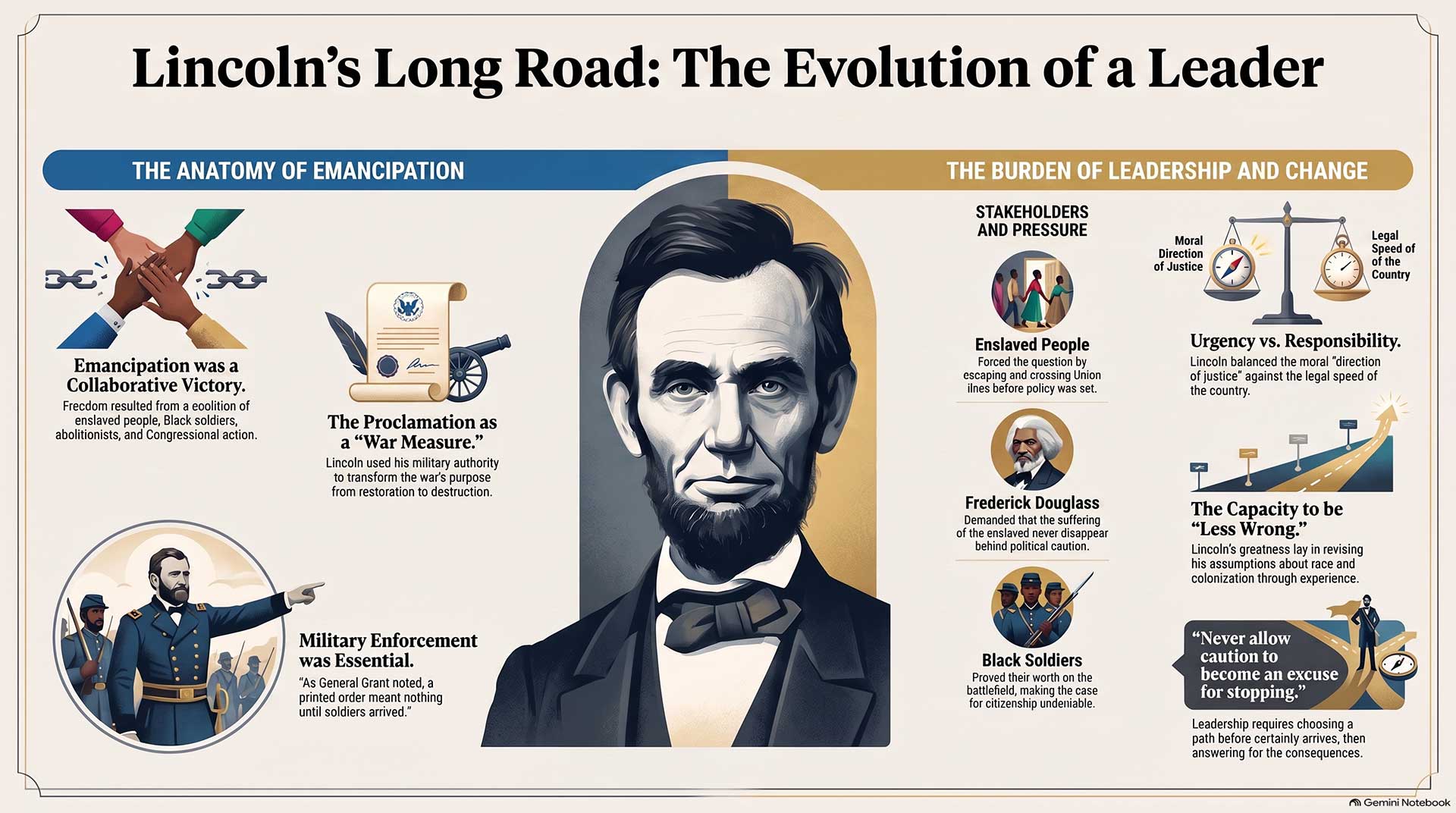
The Lincoln who emerges from this conversation is neither a flawless saint nor an exposed fraud.
He is something more difficult.
A man who believed slavery was wrong yet moved against it more slowly than Frederick Douglass believed justice required.
A president who defended constitutional government while using extraordinary wartime powers.
A compassionate man who pardoned individual soldiers while continuing a war that produced enormous casualties.
A politician who possessed genuine moral convictions and genuine ambition.
And a leader whose views continued changing almost until the moment of his death.
Douglass gives us perhaps the most important correction to the Lincoln legend:
Emancipation did not belong to one man.
Enslaved people resisted and escaped.
Black Americans demanded freedom.
Abolitionists applied pressure.
Black soldiers fought.
Congress acted.
Union armies advanced.
Lincoln’s decisions mattered enormously—but they existed inside a much larger struggle.
Seward reminds us of another uncomfortable truth:
Morality without the political power to enact it may accomplish very little.
Grant reminds us that political decisions eventually become physical consequences.
Battles.
Hospitals.
Missing sons.
Graves.
And Mary forces everyone to remember that history’s great causes are often paid for by people who never chose to become symbols of sacrifice.
The deepest tension in Lincoln’s life may therefore be the tension between urgency and responsibility.
Move too slowly, and injustice continues.
Move recklessly, and the coalition capable of achieving change may collapse.
Use too little power, and the government may fail.
Use too much, and the government may become something dangerous.
Seek peace too early, and slavery may survive.
Continue the war, and more families lose their children.
There is no formula that makes those decisions clean.
Perhaps that is why Lincoln’s willingness to change matters so much.
He was not always right.
But he remained capable of becoming less wrong.
And perhaps that is a more useful form of greatness than perfection.
Because history rarely gives power only to people who already possess complete wisdom.
More often, responsibility arrives first.
Understanding comes later.
The question is whether the person holding power remains willing to listen when reality challenges what he once believed.
That leaves us with the question beneath the entire conversation:
When justice is ahead of us and certainty is behind us, how long are we allowed to move slowly?
Lincoln never found a perfect answer.
Neither did Douglass.
Neither did Seward, Grant, or Mary.
Perhaps there is no perfect answer.
But Lincoln’s life suggests one standard worth keeping:
Never allow caution to become an excuse for stopping altogether.
Short Bios:
Abraham Lincoln
The 16th president of the United States, who led the country through the Civil War, issued the Emancipation Proclamation, supported the Thirteenth Amendment, and was assassinated in April 1865 shortly after Union victory became clear.
Frederick Douglass
A formerly enslaved man who became one of America’s most influential abolitionists, writers, and advocates for Black citizenship. He criticized Lincoln’s caution while later developing substantial respect for his leadership and evolution.
Mary Todd Lincoln
Abraham Lincoln’s wife and First Lady during the Civil War. Intelligent and politically aware, she endured intense public scrutiny as well as profound personal grief, including the death of their son Willie in the White House.
Ulysses S. Grant
The Union general Lincoln ultimately trusted to command the war effort against the Confederacy. His relentless military strategy played a central role in Union victory, while raising enduring questions about the human cost of military necessity.
William H. Seward
Lincoln’s Secretary of State and former political rival. An experienced statesman, Seward became one of Lincoln’s closest cabinet partners and brought political realism, diplomatic strategy, and caution to many of the administration’s most consequential decisions.
Leave a Reply