
Introduction
Abraham Lincoln may be one of the most familiar figures in American history.
That familiarity can be misleading.
We know the beard.
The stovepipe hat.
The Gettysburg Address.
The Emancipation Proclamation.
The assassination.
The marble figure seated inside the Lincoln Memorial.
But historical familiarity is not the same as historical understanding.
The closer we look at Lincoln, the harder the questions become.
How much did his views on slavery and race actually change?
Could he have moved toward emancipation sooner?
Who truly deserves credit for destroying slavery?
Did Lincoln use too much presidential power during the Civil War?
How should we judge the enormous human cost of continuing the war?
What should we make of his support for colonization, his evolving ideas about Black citizenship, his record involving Native Americans, and the fact that he died before Reconstruction forced him to make many of the decisions that would have defined his postwar presidency?
And perhaps most importantly:
How much of the Lincoln we remember is the historical man—and how much is the national memory created after his death?
To explore these questions, this discussion brings together five historians whose scholarship approaches Lincoln and the Civil War from different directions.
Eric Foner helps us examine slavery, emancipation, Reconstruction, and Lincoln’s changing political thought.
Edna Greene Medford keeps Black Americans, Black agency, race, citizenship, and the lived experience of emancipation at the center of the story.
Allen C. Guelzo brings Lincoln’s political ideas, constitutional reasoning, religion, and presidential decision-making into focus.
Gary W. Gallagher helps us understand military strategy, Unionism, war aims, political survival, and the terrible realities of Civil War command.
And Harold Holzer examines Lincoln’s public communication, political image, assassination, and the process through which a complicated politician became a national symbol.
This is not a debate designed to decide whether Lincoln was a hero or a hypocrite.
Those categories are too small.
Instead, the discussion asks a more demanding question:
How should history judge a leader who helped move justice forward while still falling short of the justice we now recognize?
To answer that honestly, we must keep several truths in the room at the same time.
Lincoln opposed slavery.
Lincoln also held racial views that changed significantly over time.
He did not begin the presidency demanding immediate nationwide abolition.
He eventually used presidential power to issue the Emancipation Proclamation and supported permanent constitutional abolition through the Thirteenth Amendment.
Enslaved people themselves fled bondage and forced slavery into the center of the war.
Black soldiers helped transform both the Union war effort and the political meaning of citizenship.
Congress acted.
Abolitionists pressured.
Military necessity changed what became possible.
Lincoln sometimes moved cautiously.
Sometimes that caution helped preserve political support.
Sometimes people continued suffering while government moved slowly.
His wartime use of executive power was controversial.
Some measures were arguably necessary.
That does not make every use of emergency authority morally or constitutionally uncomplicated.
His leadership helped preserve the Union.
The war also produced staggering death and suffering.
And because Lincoln was assassinated in April 1865, we do not know how he would have governed Reconstruction, responded to Southern resistance, protected freedpeople, dealt with political conflict, or evolved further on Black citizenship.
History therefore asks us to resist two temptations.
The first is to turn Lincoln into marble.
The second is to reduce him to his limitations.
A more serious approach allows him to remain what historical people actually are:
unfinished.
Changing.
Contradictory.
Capable of achievement.
Capable of error.
Shaped by events.
And shaped by people who refused to let him remain where he began.
(Note: This is an imaginary conversation, a creative exploration of an idea, and not a real speech or event.)
Topic 1: How Much Did Abraham Lincoln Really Change on Slavery and Race?
Eric Foner opened with a warning.
“If we begin by asking whether Lincoln was racist, we will probably ruin the discussion before it starts.”
Allen Guelzo looked over.
“That is a strong opening.”
“It needs to be.”
Edna Greene Medford nodded.
“The question is too blunt.”
Gary Gallagher leaned back slightly.
“Because it collapses thirty years into one word?”
“Exactly,” Foner said.
Harold Holzer added:
“And because people usually ask it hoping for one of two answers.”
“Hero.”
“Or hypocrite.”
Medford looked around the table.
“Neither tells us enough.”
Foner placed several dated papers in front of him.
“Let us start with chronology.”
Guelzo smiled faintly.
“Your favorite word.”
“Because historians survive by it.”
Holzer said:
“And politicians suffer from it.”
Foner continued:
“We cannot take something Lincoln said in 1858, something he did in 1863, and something he said in April 1865 and pretend they all represent one frozen position.”
Medford nodded.
“Especially when Black Americans themselves were helping force those positions to change.”
Gallagher looked toward her.
“Force?”
“Yes.”
She replied.
“Not in the sense that Lincoln had no agency.”
“But enslaved people escaping to Union lines, Black abolitionists, Black enlistment, military service, public pressure—these were not background conditions.”
“They changed the political world he was governing.”
Guelzo said:
“Agreed.”
“But I would add something else.”
Foner looked at him.
“What?”
“Lincoln already possessed an antislavery moral framework before those events.”
Medford nodded.
“Yes.”
“That should not disappear either.”
Guelzo continued:
“If we treat his later development as though Black activism created beliefs from nothing, we overcorrect.”
Foner smiled slightly.
“Good.”
“Then we have our first boundary.”
He raised one hand.
“Lincoln was not morally blank before the war.”
Medford raised another.
“And he was not morally complete.”
Holzer looked toward Foner.
“So where do you begin?”
“1854.”
“Why there?”
“The Kansas-Nebraska Act.”
Foner continued:
“It reenergized Lincoln politically and sharpened his opposition to slavery’s expansion.”
Guelzo nodded.
“Because he believed slavery violated the natural-rights principles of the Declaration.”
Medford added:
“But that did not mean he embraced full racial equality.”
“No.”
Foner replied.
“And that distinction is crucial.”
Gallagher said:
“Which is where modern readers often become confused.”
Guelzo looked toward him.
“Or disappointed.”
Gallagher nodded.
“They think:
If Lincoln believed slavery was wrong, why didn’t he already believe everything else we now associate with equality?”
Medford answered:
“Because historical people do not evolve in packages.”
Holzer leaned forward.
“Let us make it uncomfortable.”
Medford looked at him.
“Please.”
“In 1858, during the Douglas debates, Lincoln explicitly rejected full social and political equality between Black and white Americans.”
“Yes,” Medford replied.
“He did.”
“Then how do we avoid softening that?”
“We don’t.”
She said it immediately.
“We state it.”
Guelzo nodded.
“And then we state what else he said.”
Foner added:
“That Black people were entitled to the natural rights expressed in the Declaration.”
Medford continued:
“That they had the right to the fruits of their own labor.”
“That slavery was wrong.”
“That Black Americans were human beings with rights.”
She paused.
“Those things coexist with his limitations.”
Holzer said:
“So the sentence becomes difficult.”
Foner replied:
“Good history usually does.”
Gallagher asked:
“Would it be fair to say Lincoln was ahead of some white Americans and behind abolitionists?”
Medford thought.
“Broadly, yes.”
“But even that needs qualification.”
“How?”
“Abolitionists themselves were not one identical group.”
“Black abolitionists and white abolitionists did not always frame race, citizenship, and equality the same way.”
Foner nodded.
“And Lincoln’s political role differed from theirs.”
Guelzo said:
“He was trying to construct an electoral antislavery coalition broad enough to govern.”
Medford looked toward him.
“True.”
“But that cannot become an excuse for every limitation.”
“No.”
Guelzo replied.
“It should become context.”
Foner smiled.
“That distinction may save the project.”
Holzer said:
“Then let us ask the obvious question.”
“Was Lincoln genuinely changing morally, or simply adapting politically?”
Silence.
Foner answered first.
“Both.”
Holzer smiled.
“That quickly?”
“Yes.”
“Because the choice is false.”
Foner continued:
“Political adaptation does not cancel moral development.”
“Nor does moral development eliminate political calculation.”
Guelzo nodded.
“Lincoln was a politician.”
“That should not be treated as an accusation.”
Gallagher added:
“And circumstances were changing radically.”
“War changes available options.”
“It changes public opinion.”
“It changes military necessity.”
“It changes what is politically imaginable.”
Medford leaned forward.
“And people who had been excluded from politics were changing it too.”
Guelzo looked toward her.
“You keep returning to Black agency.”
“I intend to.”
“Why so insistently?”
“Because Lincoln stories have historically had a tendency to make Black Americans recipients.”
“Recipients of policy.”
“Recipients of emancipation.”
“Recipients of citizenship.”
She paused.
“But they were actors.”
“Escaping.”
“Recruiting.”
“Fighting.”
“Petitioning.”
“Speaking.”
“Pressuring.”
“Organizing.”
“Refusing to disappear.”
Foner nodded.
“And that altered Lincoln’s political environment.”
“Yes.”
Medford continued:
“So when we ask why Lincoln changed, we should not answer only with:
Lincoln thought harder.”
“Sometimes other people made the old position harder to maintain.”
Holzer smiled.
“That is a powerful distinction.”
Guelzo said:
“But I want to protect one thing.”
Foner looked toward him.
“What?”
“The interior life of ideas.”
Medford nodded.
“Go on.”
“Lincoln’s attachment to the Declaration was not simply political furniture.”
“He returned to equality as a natural-rights principle repeatedly.”
“That gave him an intellectual framework capable of expansion.”
Foner replied:
“I agree.”
“The question is how far the framework went at different moments.”
Guelzo nodded.
“Exactly.”
Medford said:
“And whether his understanding of who could fully inhabit those principles broadened.”
“Yes.”
Gallagher looked toward Foner.
“So is there a turning point?”
Foner shook his head.
“I resist one.”
Holzer laughed.
“Again with the historian’s suspicion of dramatic moments.”
“For good reason.”
Foner continued:
“We like conversion scenes.”
“One speech.”
“One battle.”
“One revelation.”
“But Lincoln’s development looks more cumulative.”
“War.”
“Policy.”
“Black military service.”
“Meetings.”
“Political pressure.”
“Military necessity.”
“Changing public conditions.”
“Personal reflection.”
Medford added:
“And contradiction.”
Gallagher looked at her.
“What do you mean?”
“You cannot say Black men are inferior and then depend on them as soldiers indefinitely without the contradiction becoming harder to sustain.”
Guelzo nodded.
“That is important.”
“Military service altered the citizenship argument.”
Medford said:
“Exactly.”
“A man who puts on a Union uniform makes a claim.”
Holzer asked:
“What claim?”
“That this country is his too.”
She paused.
“You can deny the claim.”
“Many did.”
“But you cannot pretend it is not being made.”
Gallagher said:
“And militarily, Black troops mattered.”
“Yes.”
Medford replied.
“But I want us to be careful not to make their significance only military.”
Foner nodded.
“Their service had political meaning.”
“Exactly.”
Holzer looked down at his notes.
“Then we have 1858.”
“Now let us jump to colonization.”
The atmosphere changed.
Medford sat back.
“Yes.”
Guelzo folded his hands.
Foner said:
“We have to deal with it directly.”
Holzer looked toward Medford.
“Why did Lincoln support colonization?”
She answered:
“Partly because he did not initially imagine a fully integrated interracial democracy.”
“Partly because he believed white racial hostility might be extraordinarily difficult to overcome.”
“Partly because colonization had long existed within antislavery political thought.”
She paused.
“But explanation is not absolution.”
Guelzo nodded.
“Agreed.”
Foner said:
“Colonization is one of the best pieces of evidence against the idea that Lincoln entered the war already holding his later position.”
Gallagher asked:
“Was it sincere?”
“Yes.”
Foner replied.
“We should assume ideas repeatedly advocated were real unless evidence tells us otherwise.”
Guelzo added:
“I agree strongly.”
“One of the worst habits in Lincoln interpretation is to treat an inconvenient position as merely tactical because we dislike it.”
Medford looked toward him.
“That is exactly right.”
“If Lincoln supported colonization, then we should let him support colonization.”
“Not explain it away.”
Holzer asked:
“But was colonization racist?”
Medford paused.
“Yes.”
Then she added:
“But I would still prefer a fuller sentence.”
Holzer smiled.
“I expected that.”
She continued:
“It reflected assumptions that Black and white Americans might not share citizenship on equal terms.”
“That is racially hierarchical thinking.”
“At the same time, some colonization advocates believed they were offering an escape from permanent oppression.”
“That does not make the idea acceptable.”
“But it helps us understand why people who considered themselves antislavery could still support it.”
Foner nodded.
“And it shows why nineteenth-century antislavery politics cannot simply be translated into modern categories.”
Guelzo looked toward Medford.
“Would you call colonization a transitional idea for Lincoln?”
She thought.
“I would call it an idea whose importance diminished.”
“That is safer.”
Foner agreed.
“We need to be cautious about declaring an exact moment when Lincoln abandoned it completely.”
Holzer said:
“Because the evidence gets thinner.”
“Yes.”
Guelzo added:
“And because historians should not write moral progress more neatly than the documents permit.”
Gallagher leaned forward.
“What changed the colonization question most?”
Medford answered:
“Black Americans themselves.”
Foner nodded.
“And the war.”
Guelzo added:
“Black military service.”
Medford continued:
“And the practical failure of colonization schemes.”
Holzer said:
“So morality, politics, military reality, and practicality again.”
Foner smiled.
“Lincoln refuses to give us one cause.”
Gallagher looked toward Foner.
“Then let us move to emancipation.”
Foner nodded.
“By 1862–63, the federal government is moving far beyond Lincoln’s earlier position.”
Holzer asked:
“Does that prove moral evolution?”
“Not by itself.”
Foner replied.
“Policy can change without private belief changing in exactly the same way.”
Guelzo nodded.
“Important.”
Medford added:
“But public action still matters.”
“Yes.”
Foner said.
“We should not become so suspicious of motives that actions disappear.”
Holzer looked around the table.
“That may be another modern trap.”
Guelzo asked:
“What?”
“The idea that if a politician gains strategic advantage from doing something moral, the morality becomes fake.”
Foner nodded.
“Yes.”
Medford added:
“Or the reverse.”
“If someone speaks morally, we assume strategy disappears.”
Gallagher smiled.
“No commander would recognize that world.”
Guelzo said:
“Lincoln could believe slavery wrong and also recognize emancipation as military policy.”
Foner nodded.
“He could believe Black enlistment morally significant and also know the Union needed manpower.”
Medford added:
“And Black soldiers themselves could fight for multiple reasons.”
“Freedom.”
“Family.”
“Citizenship.”
“Pay.”
“Revenge.”
“Union.”
“Personal dignity.”
Gallagher said:
“Human motives are usually mixed.”
Holzer smiled.
“Which makes them very inconvenient for slogans.”
Foner looked toward Medford.
“Let us reach 1865.”
“Yes.”
Holzer leaned in.
“Lincoln’s final public speech.”
Guelzo nodded.
“He supports voting rights for at least some Black men.”
Medford said:
“Educated Black men and those who had served in the military.”
Gallagher asked:
“How important is that?”
“Very.”
Foner replied.
“But again—not because it equals universal Black male suffrage.”
Medford nodded.
“We cannot inflate it.”
“But we also should not minimize it.”
Holzer said:
“Especially because of the political environment.”
“Yes.”
Guelzo looked toward Foner.
“Would you say Lincoln had crossed a threshold?”
Foner thought.
“Yes.”
“In the sense that by April 1865 he is publicly accepting Black political participation at a level he had not earlier.”
Medford said:
“That is real movement.”
Gallagher asked:
“But how far would it have gone?”
Silence.
Foner shook his head.
“We do not know.”
Holzer said:
“And that answer is unsatisfying.”
“History often is.”
Medford leaned forward.
“This is where assassination becomes dangerous to interpretation.”
Guelzo looked toward her.
“How?”
“Because once Lincoln dies, people are tempted to complete his trajectory for him.”
Foner nodded.
“To say:
He would have gone all the way.”
Holzer added:
“Or:
He would have stopped exactly there.”
Gallagher said:
“Neither is knowable.”
“Exactly.”
Medford replied.
Holzer looked around the table.
“So let me ask the sharpest version.”
“By April 1865, had Lincoln become a believer in racial equality?”
Medford shook her head.
“That phrase is too broad.”
Guelzo smiled.
“We have returned to the opening warning.”
She continued:
“Equality in what sense?”
“Natural rights?”
“Civil rights?”
“Voting?”
“Social equality?”
“Economic equality?”
“Marriage?”
“Education?”
“Citizenship?”
Foner nodded.
“If we do not define equality, we create confusion.”
Guelzo said:
“On natural rights, Lincoln had long gone quite far.”
Medford replied:
“Yes.”
“On political rights, he had moved.”
Foner added:
“On full universal political equality, we cannot claim he had arrived.”
Holzer said:
“Then perhaps the strongest historical sentence is:
Lincoln’s racial thinking expanded significantly, but remained incomplete.”
Medford nodded.
“That is fair.”
Gallagher asked:
“Compared with whom?”
Foner smiled.
“Excellent.”
Holzer looked toward him.
“Why does that matter?”
“Because historical judgment needs contemporaries.”
Foner continued:
“Compared with radical abolitionists, Lincoln was often cautious.”
“Compared with many white voters, he could be considerably more advanced on slavery and natural rights.”
Medford added:
“Compared with Black abolitionists, he often lagged badly on citizenship.”
Guelzo nodded.
“And compared with proslavery political leaders, the difference was enormous.”
Gallagher said:
“So Lincoln occupies multiple relative positions depending on the comparison.”
“Yes.”
Foner replied.
“That is why one label fails.”
Holzer leaned back.
“Then should we stop using the word racist altogether?”
Medford shook her head.
“No.”
“That would be another evasion.”
Guelzo looked toward her.
“How would you use it responsibly?”
“By specifying the evidence.”
She continued:
“Lincoln expressed beliefs that assumed racial hierarchy.”
“He also opposed slavery as a moral wrong.”
“He defended Black natural rights.”
“He supported colonization for a period.”
“He later supported Black military service.”
“He moved toward limited Black suffrage.”
“Those facts should all survive the sentence.”
Holzer smiled.
“That is a long sentence.”
“Human beings require them.”
Foner said:
“The danger is that people often use the word as a verdict rather than an analytical tool.”
Medford nodded.
“Yes.”
“Once the verdict arrives, chronology disappears.”
Guelzo added:
“And if someone dislikes the verdict, they sometimes react by sanitizing the evidence.”
Holzer said:
“So both directions distort.”
“Exactly.”
Gallagher looked toward Guelzo.
“Do you think moral growth is one of Lincoln’s defining traits?”
Guelzo thought.
“Yes.”
“But I would phrase it carefully.”
“Not because Lincoln simply became modern.”
“He did not.”
“But because his principles proved capable of development under pressure.”
Foner nodded.
“That is well put.”
Medford said:
“And because people outside his own experience kept widening the political world he had to confront.”
Holzer smiled.
“Then Lincoln’s growth was not solitary.”
“No.”
Foner replied.
“Historical development rarely is.”
Medford continued:
“He changed partly because other people refused to remain invisible.”
That sentence settled over the room.
Gallagher nodded.
“That may be the core.”
Guelzo said:
“But let us ask the uncomfortable reverse.”
Medford looked toward him.
“What?”
“Do we sometimes deny historical figures credit for growth because we are angry they did not arrive sooner?”
She thought.
“Yes.”
Foner nodded.
“That happens.”
Holzer asked:
“Is that unfair?”
Medford answered carefully.
“Sometimes.”
Then she continued:
“But the opposite is also unfair.”
“What?”
“To praise growth without remembering who suffered during the delay.”
Foner nodded.
“That is the balance.”
Gallagher said:
“A commander can improve.”
“But the men lost during his learning do not come back.”
Medford looked at him.
“Exactly.”
Guelzo added:
“A politician can change.”
“But people affected by earlier policy still lived inside the old position.”
Holzer said:
“So growth deserves credit.”
Medford replied:
“And cost remains in the story.”
Foner looked around the table.
“Then perhaps we can answer the first question.”
Holzer nodded.
“How much did Abraham Lincoln really change on slavery and race?”
Foner paused.
“A great deal.”
Medford added:
“Not enough to become the person later mythology sometimes imagines.”
Guelzo said:
“But enough that denying the change would be historically false.”
Gallagher added:
“And the war itself was one of the forces making that change possible.”
Holzer said:
“Along with Black Americans, political pressure, military necessity, and Lincoln’s own capacity to revise.”
Foner nodded.
“Yes.”
Medford raised one finger.
“But one caution.”
Everyone looked toward her.
“Do not make Lincoln’s willingness to change into another heroic myth.”
Holzer smiled.
“Meaning?”
“Growth is admirable.”
“But it is not magic.”
“He resisted.”
“He delayed.”
“He held ideas we should not soften.”
“Other people pushed him.”
“Events pushed him.”
“Black Americans pushed the country.”
She paused.
“If we turn all of that into:
Lincoln was wonderful because he learned—
we have simplified him again.”
Foner nodded.
“Exactly.”
Guelzo said:
“Then what is the better formulation?”
Medford thought for a moment.
“Lincoln’s greatness, if we use that word, may lie partly in the fact that he remained revisable.”
Silence.
Holzer repeated:
“Revisable.”
“Yes.”
She continued:
“He was not morally finished.”
“Neither was the country.”
“Neither was emancipation.”
“Neither was citizenship.”
Foner smiled slightly.
“That is very strong.”
Gallagher said:
“And also unsettling.”
“Why?”
“Because it implies leadership is not certainty.”
Medford nodded.
“Correct.”
Guelzo added:
“It may be the willingness to let reality defeat an old conclusion.”
Holzer looked toward Foner.
“That sounds close to Part 1.”
“It should.”
Foner replied.
“Part 2 is testing whether the evidence supports it.”
Holzer looked down at the timeline.
“Then let us test it harder.”
He pointed to 1862.
“If Lincoln was capable of change…”
He looked around the table.
“…why did policy move as slowly as it did?”
Medford leaned forward immediately.
“Good.”
Gallagher looked toward her.
“You have been waiting for that.”
“Yes.”
Guelzo smiled.
“Now we reach the question of constraints.”
Foner gathered the papers into chronological order.
Holzer asked:
“Did Lincoln move toward emancipation too slowly…”
He paused.
“…or about as fast as emancipation could survive?”
Medford answered first.
“Those are not the same question.”
Foner smiled.
“And that is exactly why Topic 2 will be difficult.”
Topic 2: Did Lincoln Move Toward Emancipation Too Slowly—or About as Fast as It Could Survive?
Edna Greene Medford spoke before anyone else could.
“Too slowly.”
Allen Guelzo smiled slightly.
“We have barely begun.”
“I know.”
Eric Foner looked toward her.
“You want to put the conclusion on the table first.”
“I want to put the cost on the table first.”
Gary Gallagher folded his arms.
“And then we examine whether the alternatives were real.”
“Yes.”
Medford nodded.
“But I do not want us to start with Kentucky.”
Harold Holzer looked toward her.
“Why not?”
“Because if we start with Kentucky, Maryland, elections, newspapers, cabinet politics, and constitutional theory, we risk spending thirty minutes explaining Lincoln’s caution before remembering who experienced the delay.”
Foner nodded slowly.
“Fair.”
Medford continued:
“So before Kentucky…”
“Before the border states…”
“Before public opinion…”
“Before military necessity…”
“Before constitutional authority…”
She paused.
“There were people still enslaved.”
The room became quiet.
Gallagher nodded.
“Yes.”
“And now we can discuss Kentucky.”
Holzer looked toward Guelzo.
“Then make the strongest case for Lincoln’s caution.”
Guelzo leaned forward.
“The strongest case begins with the office.”
“Lincoln did not become president with unlimited authority to implement every moral conviction he possessed.”
Foner nodded.
“He understood the presidency constitutionally.”
“Yes.”
Guelzo continued:
“He believed slavery was wrong.”
“But he also believed the federal government’s authority over slavery inside states where it already existed was limited.”
Medford said:
“That constitutional belief had consequences.”
“Of course.”
“People remained enslaved.”
“Yes.”
Guelzo did not resist.
“But the historian still has to distinguish between moral desire and lawful power.”
Holzer asked:
“So constitutionalism was not merely political cover?”
“I do not think the evidence supports treating it as merely cover.”
Foner nodded.
“I agree.”
Medford looked toward him.
“With qualification?”
“Always.”
Foner continued:
“Lincoln’s constitutional caution was genuine.”
“But constitutional thinking changes once rebellion changes the legal situation.”
Guelzo nodded.
“Yes.”
“War powers become central.”
Gallagher added:
“And that is not an abstract change.”
“Rebellion creates a military environment.”
“Confederate labor systems support Confederate armies.”
“Enslaved people begin reaching Union lines.”
“Commanders begin asking what to do with them.”
“Congress begins acting.”
“The legal world is changing because the military world is changing.”
Medford said:
“And because enslaved people are changing it.”
Gallagher nodded.
“Yes.”
Holzer looked toward Medford.
“Then if the constitutional constraint was real, why ‘too slowly’?”
She answered immediately.
“Because real constraints can still be overestimated.”
Guelzo raised an eyebrow.
“Which one was overestimated?”
“White public opinion.”
Holzer leaned in.
“That is interesting.”
Medford continued:
“Lincoln often treated racial prejudice as a political reality.”
“It was.”
Gallagher said.
“Yes.”
Medford replied.
“But a political leader does more than measure opinion.”
“He can influence it.”
“Prepare it.”
“Challenge it.”
“Move it.”
Holzer nodded.
“That is central to Lincoln’s own political skill.”
“Exactly.”
She continued:
“So the question is not whether public opinion constrained Lincoln.”
“It did.”
“The question is whether he sometimes treated opinion as a wall when leadership might have treated it as a door.”
Foner smiled slightly.
“That is a very good formulation.”
Guelzo looked toward her.
“Do you think he should have declared immediate emancipation in March 1861?”
Medford paused.
“No.”
Holzer looked surprised.
“That was quick.”
“Because I am not interested in imaginary courage.”
She continued:
“If a proposal cannot survive legally, politically, or militarily, it may satisfy us emotionally while accomplishing little.”
Guelzo nodded.
“So we agree.”
“Partly.”
She looked at him.
“The problem is what happens after March.”
Foner leaned forward.
“That is where chronology becomes essential again.”
Holzer smiled.
“We knew you would bring it back.”
“Of course.”
Foner continued:
“Early 1861 and mid-1862 are not the same political moment.”
“By 1862, the war has expanded.”
“Confiscation policy has developed.”
“Congress has moved.”
“Enslaved people are reaching Union lines in large numbers.”
“Military necessity has become harder to separate from slavery.”
“Black abolitionists are increasing pressure.”
“And Lincoln himself is moving.”
Gallagher nodded.
“The military situation has also changed.”
“Though not always in the Union’s favor.”
Holzer turned to Gallagher.
“Let’s bring in the border states.”
Gallagher nodded.
“Maryland matters enormously.”
“Washington is geographically exposed.”
“Kentucky matters strategically in the West.”
“Missouri matters.”
“Delaware less so militarily, but politically it is part of the same loyal slave-state problem.”
Foner said:
“Lincoln was deeply concerned that premature emancipation policy might push those states toward the Confederacy.”
Gallagher continued:
“And that concern was not irrational.”
Medford nodded.
“No.”
“But?”
Gallagher smiled faintly.
“I knew there was one.”
She continued:
“We should distinguish:
what Lincoln feared,
what might realistically have happened,
and what historians can actually demonstrate.”
Guelzo nodded.
“Good.”
Holzer said:
“So let’s ask directly.”
“Would earlier emancipation have cost Lincoln Kentucky?”
Gallagher thought.
“We cannot know.”
Foner nodded.
“But we can say Lincoln believed the risk was serious.”
Guelzo added:
“And Kentucky’s loyalty was strategically important.”
Medford said:
“Which means the historian must resist two errors.”
Holzer looked toward her.
“What are they?”
“First:
‘Lincoln worried about Kentucky, therefore every delay was justified.’”
“And second?”
“‘We now know emancipation eventually succeeded, therefore the danger was never real.’”
Gallagher nodded.
“That is exactly right.”
Holzer smiled.
“So hindsight is already trying to cheat.”
Foner replied:
“It always does.”
Gallagher continued:
“We know the Union eventually wins.”
“Lincoln does not know that.”
“We know the border states remain in the Union.”
“He does not know that with certainty in 1861.”
“We know emancipation ultimately becomes part of Union victory.”
“He does not know exactly how northern soldiers or voters will respond when policy changes.”
Medford nodded.
“All true.”
“But uncertainty cuts both ways.”
Gallagher looked at her.
“How?”
“Lincoln also did not know that moving faster would destroy the coalition.”
Foner nodded.
“Important.”
Medford continued:
“We should not turn feared consequences into proven consequences.”
Guelzo said:
“Then perhaps the better question is whether caution was reasonable given the information available.”
“Yes.”
Medford replied.
“And whether he was recalibrating quickly enough as that information changed.”
Foner nodded.
“That may be the precise historical question.”
Holzer leaned forward.
“Then we arrive at July 1862.”
Foner said:
“Lincoln brings a draft emancipation proclamation to the cabinet.”
Guelzo nodded.
“So by then he has substantially decided.”
Medford said:
“And then he waits.”
Holzer looked toward Seward’s place in the historical story.
“Because Seward advises him not to issue it after Union military setbacks.”
Gallagher nodded.
“He fears it will look like desperation.”
Holzer said:
“An appeal to slave insurrection by a government that cannot win militarily.”
Foner added:
“And Lincoln accepts the advice.”
Medford looked around the table.
“This is where the discussion becomes morally uncomfortable.”
Guelzo asked:
“Because?”
“Because Lincoln has decided enslaved people in the rebellious states should be declared free as a war measure…”
“And still waits for the right moment to say it.”
Holzer nodded.
“Political theater?”
Guelzo frowned slightly.
“That phrase is too dismissive.”
“Then public strategy.”
“Better.”
Gallagher said:
“Military credibility matters.”
Medford looked toward him.
“Why?”
“Because proclamations are not self-enforcing.”
“If the Union looks incapable of defeating Confederate armies, emancipation may sound hollow.”
Foner nodded.
“Also, Lincoln wants the policy to be perceived as an act of strength.”
Holzer added:
“Public meaning matters.”
“Domestic and international.”
Guelzo said:
“And a president has to think about implementation.”
Medford leaned back.
“So the argument is:
wait until the government looks strong enough that the moral act has practical force.”
Gallagher nodded.
“That is one argument.”
She paused.
“I accept the logic.”
Holzer looked toward her.
“But?”
She smiled slightly.
“There is always a but.”
Foner laughed.
Medford continued:
“The people affected by delay do not live inside strategic logic.”
“They live inside days.”
“Weeks.”
“Months.”
Guelzo said:
“That does not negate the strategic problem.”
“No.”
She replied.
“It prevents us from calling the strategy costless.”
Foner looked toward Holzer.
“This is where moral and political timing intersect.”
Holzer nodded.
“Lincoln is waiting for a battlefield moment that can carry the proclamation.”
“Eventually Antietam.”
Gallagher said:
“Which was hardly a clean Union triumph.”
“Correct.”
Foner replied.
“But it was enough.”
Holzer said:
“Enough to shift the public presentation.”
Guelzo nodded.
“And then Lincoln announces the preliminary proclamation.”
Medford said:
“So ask the sharper question.”
Holzer looked at her.
She continued:
“Does timing a moral action for maximum political effect make it less moral?”
Silence.
Guelzo answered first.
“No.”
Foner nodded.
“No.”
Gallagher said:
“Not necessarily.”
Holzer smiled.
“You sound remarkably unified.”
Medford said:
“I agree too.”
Holzer looked surprised.
“Then where is the disagreement?”
She replied:
“The disagreement is over how long timing can remain a justification before it becomes delay.”
Foner nodded.
“That is the whole topic.”
Guelzo said:
“And I would add something.”
“What?”
“Political effectiveness can itself be a moral consideration.”
Medford looked toward him.
“Explain.”
“If a policy fails because it is issued without adequate authority or support, then moral purity in timing may produce less freedom.”
Foner nodded.
“That is serious.”
Gallagher added:
“War makes that even clearer.”
“A policy that fragments the army can affect military outcomes.”
Holzer said:
“And elections.”
Medford leaned forward.
“Then I want to ask all of you something.”
They looked toward her.
“When does ‘I need the policy to survive’ become ‘I need my political position to survive’?”
The room went quiet.
Holzer smiled faintly.
“That is the politician’s nightmare.”
Guelzo answered carefully.
“They can overlap.”
Foner nodded.
“Lincoln’s political survival could become necessary to the policy’s survival.”
Medford said:
“And Lincoln could also personally want reelection.”
“Yes.”
Foner replied.
“Those do not cancel each other.”
Gallagher said:
“By 1864, losing Lincoln could plausibly mean a very different war policy.”
Holzer nodded.
“And Lincoln himself worries about electoral defeat.”
Medford said:
“So self-preservation and policy-preservation become entangled.”
Foner nodded.
“Yes.”
Guelzo added:
“That does not automatically make the motive corrupt.”
“No.”
Medford replied.
“But historians should not pretend ambition disappeared.”
Holzer smiled.
“Now you are making my job easier.”
Gallagher looked toward Foner.
“What about the Union Army?”
Foner nodded.
“Important.”
Gallagher continued:
“Many soldiers enlisted initially for Union, not emancipation.”
Medford said:
“Yes.”
“Some were hostile to emancipation.”
“Yes.”
“Some changed.”
“Yes.”
“Some did not.”
“Correct.”
Gallagher continued:
“If Lincoln moves policy too rapidly relative to the army’s political culture, there are risks.”
Holzer asked:
“Desertion?”
“Potentially.”
“Morale?”
“Yes.”
“Political backlash?”
“Yes.”
Medford said:
“And yet Black enlistment eventually changes the army too.”
Gallagher nodded.
“Absolutely.”
She continued:
“So again, policy is not merely following opinion.”
“It is helping create a new reality.”
Foner nodded.
“Exactly.”
Guelzo added:
“And Lincoln’s proclamation eventually transforms the war’s meaning in ways that themselves alter public attitudes.”
Holzer said:
“So perhaps leadership is iterative.”
Foner smiled.
“A more elegant word than messy.”
Holzer looked around the table.
“Then let's take the famous sentence from Lincoln's 1862 letter to Horace Greeley.”
Foner nodded.
“His ‘paramount object’ is saving the Union.”
Medford said:
“And he says he would save it with all slaves free, none free, or some free, if that would save the Union.”
Holzer continued:
“Modern readers often use that letter as proof that Lincoln did not care about slavery.”
Guelzo shook his head.
“That is too crude.”
Gallagher nodded.
“The letter is a public political statement in a specific moment.”
Foner added:
“And he says in the same letter that his personal wish is that all men everywhere could be free.”
Medford said:
“But the distinction remains important.”
Holzer asked:
“What distinction?”
Medford replied:
“Lincoln is telling the public that his official duty and personal moral wish are not identical.”
Guelzo nodded.
“Yes.”
Foner continued:
“And very soon the official policy changes dramatically.”
Gallagher said:
“Which is why quoting the letter without chronology is misleading.”
Holzer smiled.
“Another victory for Foner.”
“Chronology usually wins.”
Medford looked toward Guelzo.
“Would you say Lincoln cared more about Union than emancipation?”
Guelzo thought.
“As presidential duty, initially yes.”
Foner nodded.
“That is fair.”
Medford continued:
“And later?”
“Union and emancipation become increasingly inseparable.”
Gallagher agreed.
“Especially as the war evolves.”
Holzer said:
“So one of our biggest public questions has a moving answer.”
Foner replied:
“Exactly.”
Medford said:
“And that matters politically too.”
Holzer looked toward her.
“How?”
“Because people often use one Lincoln quotation as though it freezes his entire presidency.”
Guelzo nodded.
“Same problem as Topic 1.”
“Yes.”
She continued:
“History becomes partisan when people search for one sentence that allows them to win an argument.”
Foner smiled slightly.
“That should be printed above every archive.”
Gallagher turned back to the main issue.
“So could he have moved earlier?”
Silence.
Foner answered first.
“Yes.”
Medford looked toward him.
“How much earlier?”
He smiled.
“That is where certainty ends.”
Guelzo nodded.
“I would say some movement could probably have come earlier without total political collapse.”
Gallagher said:
“But the further back you push, the more speculative the claim becomes.”
Medford nodded.
“That seems right.”
Holzer looked surprised.
“This sounds like emerging consensus.”
Foner shook his head.
“Only a limited one.”
Holzer smiled.
“State it.”
Foner continued:
“Lincoln was not simply waiting passively for history.”
“He was moving.”
“But he was cautious.”
“Some critics were justified in pressing him harder.”
“Some of the constraints he cited were real.”
“Some of the risks cannot be reconstructed with certainty.”
“And emancipation’s eventual success does not prove earlier action would have failed.”
Medford nodded.
“Yes.”
Guelzo added:
“Nor does the suffering caused by delay prove that every earlier action would have succeeded.”
Gallagher said:
“That is the balance.”
Holzer leaned back.
“Then let’s make it less comfortable.”
He looked toward Medford.
“If you had to defend Lincoln against the charge that he moved too slowly, what would you say?”
She paused.
“That he was responsible for more than one moral obligation.”
Guelzo watched her.
She continued:
“He had an obligation to oppose slavery.”
“He also had an obligation to preserve a functioning government.”
“To avoid losing strategically essential states if possible.”
“To maintain an army.”
“To operate within a constitutional framework.”
“To ensure that policy could be implemented rather than merely announced.”
Holzer nodded.
“Strong defense.”
Medford continued:
“But defense is not acquittal.”
Foner smiled.
“Of course not.”
Holzer turned to Guelzo.
“And if you had to make the strongest case against Lincoln?”
Guelzo thought longer.
“That he sometimes underestimated the degree to which presidential leadership could transform political possibility.”
Medford looked toward him.
“Good.”
He continued:
“That caution can become self-reinforcing.”
“You fear public opinion.”
“So you avoid challenging public opinion.”
“Then public opinion never moves because leadership never forces the question.”
Foner nodded.
“That is very strong.”
Gallagher added:
“And military success itself often depends on political goals becoming clearer.”
Holzer smiled.
“Now everyone is arguing against their assigned role.”
Foner replied:
“That means we are doing history.”
Medford looked around the table.
“Let us discuss the border-state slaveholders who rejected compensated emancipation.”
Foner nodded.
“Important.”
Guelzo said:
“Lincoln urged gradual compensated emancipation in the loyal slave states.”
Gallagher added:
“And faced strong resistance.”
Medford continued:
“So Lincoln tries a cautious path.”
“Compensation.”
“Gradualism.”
“Federal assistance.”
“And many slaveholding interests still refuse.”
Foner nodded.
“That teaches him something.”
Holzer asked:
“What?”
“That even moderate antislavery policy may encounter entrenched resistance.”
Medford said:
“Exactly.”
Guelzo added:
“And perhaps it changes Lincoln’s sense of what gradualism can accomplish.”
Gallagher nodded.
“Because if people reject the moderate road, the political space for stronger action can grow.”
Holzer said:
“Which is ironic.”
Foner smiled.
“History enjoys irony.”
Medford leaned forward.
“So perhaps Lincoln’s caution did not simply delay emancipation.”
“It also tested less radical alternatives.”
Guelzo nodded.
“Yes.”
“And their failure helped justify stronger measures.”
Holzer asked:
“Does that make delay necessary?”
Medford shook her head.
“Not necessarily.”
“It makes the sequence historically meaningful.”
Gallagher said:
“There is also something people forget.”
“What?”
Holzer asked.
“The Union was losing major battles.”
“Military uncertainty was real.”
“Second Bull Run.”
“Peninsula Campaign frustrations.”
“Eastern military leadership problems.”
“Confederate armies were not collapsing.”
Medford nodded.
“Yes.”
Gallagher continued:
“So when people ask why Lincoln did not simply proclaim freedom immediately, they often imagine a federal government much stronger than the one he actually possessed.”
Foner said:
“That is an excellent correction.”
Holzer looked toward Medford.
“Does that change your opening answer?”
“Too slowly?”
“Yes.”
She thought.
“No.”
The others smiled.
“But…”
She continued.
“I would now qualify it.”
Foner leaned back.
“We are getting somewhere.”
Medford said:
“I think Lincoln could sometimes have challenged racial and political caution more aggressively.”
“I think abolitionists and Black leaders were right to push him.”
“I think some delays had human costs that should not be softened.”
“But I also think historians must take seriously the possibility that poorly timed emancipation policy could have weakened the very government required to enforce it.”
Gallagher nodded.
“That is fair.”
Guelzo looked toward her.
“So too slowly—but not simply too slowly.”
“Yes.”
She replied.
“History is annoying that way.”
Holzer laughed.
Foner said:
“Perhaps we should turn the question around.”
Gallagher looked toward him.
“How?”
“Instead of asking:
‘Why didn’t Lincoln free the slaves sooner?’”
He paused.
“Ask:
‘What had to change before emancipation became durable national policy?’”
Medford nodded slowly.
“That is much better.”
Guelzo said:
“It lets us examine conditions without excusing them.”
Gallagher added:
“Military conditions.”
Holzer:
“Public opinion.”
Foner:
“Congress.”
Medford:
“Black agency.”
Guelzo:
“Constitutional authority.”
Foner nodded.
“All interacting.”
Holzer said:
“And Lincoln himself.”
“Yes.”
Foner replied.
“Because structural history should not erase individual choice either.”
Medford nodded.
“That is another balance we need.”
Gallagher looked toward Holzer.
“You have not said much about public communication.”
Holzer smiled.
“I was waiting.”
He turned toward the table.
“Lincoln understood that major policy required preparation.”
“He used letters.”
“Speeches.”
“Meetings.”
“Private conversations.”
“Public argument.”
“He did not simply wake the country one morning with emancipation.”
Guelzo nodded.
“Political persuasion is part of governing.”
Medford said:
“True.”
“But persuasion can become endless preparation.”
Holzer replied:
“Exactly.”
“So the measure is whether preparation is moving people toward the decision or merely postponing it.”
Foner looked toward him.
“That may be one of the best tests we have.”
Medford said:
“Then perhaps we can define prudence.”
Guelzo looked toward her.
“Go ahead.”
“Prudence is delay used to make justice more achievable.”
Foner nodded.
“And cowardice?”
“Delay used to protect power after enough room for action already exists.”
Gallagher said:
“The historian’s problem is determining which moment was which.”
Holzer smiled.
“And politicians rarely leave notes saying:
‘Today prudence became cowardice.’”
Foner laughed.
“No.”
Then became serious.
“That is why we work with evidence rather than verdicts.”
Medford looked toward Foner.
“Do you think Lincoln deserves criticism for the pace?”
“Yes.”
“Substantial criticism?”
“Yes.”
“Do you also think the pace helped make emancipation durable?”
“In some respects, yes.”
Guelzo nodded.
“That is probably where I am too.”
Gallagher added:
“And military events mattered enough that no purely moral timeline could have controlled the outcome.”
Holzer said:
“Which means the answer is not emotionally satisfying.”
Medford replied:
“It should not be.”
The room became quiet.
Foner gathered the papers again.
“Then let us try to answer the topic title.”
Holzer nodded.
“Did Lincoln move toward emancipation too slowly—or about as fast as it could survive?”
Foner spoke first.
“Sometimes too slowly.”
Medford said:
“And sometimes under constraints that were more real than later generations remember.”
Guelzo added:
“His constitutional concerns were genuine.”
Gallagher:
“His military concerns were genuine.”
Holzer:
“His political concerns were genuine.”
Medford looked around the table.
“And the suffering caused by delay was genuine.”
No one disagreed.
Foner continued:
“So perhaps the strongest conclusion is not to choose one side.”
He paused.
“Lincoln’s caution helped make emancipation politically and constitutionally sustainable—but that does not mean every moment of caution was necessary.”
Medford nodded.
“That is fair.”
Guelzo agreed.
“Yes.”
Gallagher said:
“And it leaves room for criticism without pretending the alternatives were easy.”
Holzer smiled.
“That sounds like our project.”
Medford leaned forward.
“But there is one more thing.”
Foner looked toward her.
“What?”
“We keep saying Lincoln moved toward emancipation.”
“Yes.”
“Lincoln decided.”
“Yes.”
“Lincoln timed.”
“Yes.”
“Lincoln calculated.”
She paused.
“What if that grammar is already misleading?”
Holzer’s expression changed.
“Go on.”
Medford continued:
“What if emancipation was not primarily a road Lincoln traveled…”
“…but a crisis millions of enslaved people were already forcing into the Union’s path?”
Foner nodded slowly.
Gallagher leaned forward.
Guelzo became still.
Medford continued:
“By the time Washington decided what to call the policy, people were already leaving plantations.”
“Already presenting themselves at military camps.”
“Already withholding labor.”
“Already challenging ownership.”
“Already changing the war.”
She looked around the table.
“So perhaps the next question should not be:
How quickly did Lincoln move?”
She paused.
“Perhaps it should be:
Who was actually moving history?”
Holzer smiled faintly.
Foner nodded.
“Yes.”
Gallagher said:
“Now we have Topic 3.”
Guelzo added:
“And that one may be even harder.”
Medford leaned back.
“Good.”
Holzer looked down at the familiar image:
Lincoln.
The proclamation.
The pen.
Then looked back toward the others.
“Who really freed the slaves?”
And the discussion moved from the speed of one president—
to the agency of millions.
Topic 3: Who Really Freed the Slaves?
Harold Holzer placed a reproduction of the Emancipation Proclamation at the center of the table.
No one touched it.
Then he placed beside it a photograph of Black Union soldiers.
Another image of formerly enslaved families near Union lines.
Then congressional legislation.
Then military maps.
Then newspapers.
Then recruitment posters.
Finally he looked around the room.
“This is why the question is dangerous.”
Eric Foner nodded.
“Because the answer changes depending on which document you begin with.”
Edna Greene Medford looked toward the proclamation.
“And because for a long time, people began with that one.”
Allen Guelzo said:
“For understandable reasons.”
Gary Gallagher added:
“But not sufficient ones.”
Holzer leaned back.
“Then let’s ask it plainly.”
“Who really freed the slaves?”
Medford answered first.
“The enslaved.”
Guelzo looked toward her.
“Entirely?”
“No.”
She replied.
“But if you want to understand emancipation, begin with the people who refused to remain enslaved.”
Foner nodded.
“And then follow what their actions forced the government to do.”
Gallagher looked toward Medford.
“Give us the sequence.”
She nodded.
“Enslaved people flee plantations.”
“Some reach Union lines.”
“Commanders have to decide whether to return them.”
“Slaveholders demand their property back.”
“Military officers begin improvising policy.”
“Congress starts changing the legal landscape.”
“Black abolitionists press harder.”
“Black men demand the right to serve.”
“The administration faces questions it did not fully create on its own timetable.”
Foner added:
“That is crucial.”
“Emancipation does not begin on January 1, 1863.”
Holzer looked toward Guelzo.
“Does beginning there diminish Lincoln?”
“No.”
Guelzo replied.
“It places him inside history rather than above it.”
Medford nodded.
“Exactly.”
Guelzo continued:
“But we also need to prevent the pendulum from swinging too far.”
Foner smiled slightly.
“Go on.”
“There has been a corrective emphasis on self-emancipation.”
“A necessary one.”
“But if we say enslaved people freed themselves and stop there, we risk confusing individual escape with the destruction of slavery as a legal institution.”
Medford nodded.
“Yes.”
“That distinction matters.”
Gallagher said:
“Because an enslaved man reaching Union lines is free in one immediate sense.”
“But the plantation system still exists elsewhere.”
“Confederate governments still recognize slavery.”
“State law still protects it.”
“Confederate armies still defend the political system sustaining it.”
Guelzo nodded.
“And the federal government still has to decide whether escape becomes policy.”
Foner added:
“And whether military victory will make that policy enforceable.”
Holzer looked toward Medford.
“So what does self-emancipation mean?”
She thought carefully.
“It means enslaved people were not passive recipients.”
“They seized opportunities.”
“Created crises.”
“Changed labor systems.”
“Moved toward Union armies.”
“Escaped.”
“Resisted.”
“Provided information.”
“Pressed the government.”
She paused.
“But it does not mean one person escaping automatically abolished slavery for millions.”
Guelzo nodded.
“That is the balance.”
Foner leaned forward.
“The deeper issue is causation.”
Holzer looked toward him.
“Meaning?”
“If enslaved people had not fled to Union lines, would federal policy have evolved exactly the same way?”
Gallagher said:
“Probably not.”
Medford nodded.
“If Black Americans had not demanded enlistment?”
“Probably not.”
Foner continued:
“If Congress had not acted?”
“Different process.”
“If Union armies had not advanced?”
“Different result.”
“If Lincoln had refused to issue emancipation?”
“Different result.”
Holzer smiled faintly.
“So there is no single emancipator.”
“Correct.”
Guelzo raised a finger.
“But there are different kinds of agency.”
Medford looked toward him.
“Explain.”
“A person can act locally.”
“A community can organize politically.”
“Congress can legislate.”
“A president can transform executive policy.”
“An army can enforce.”
“A constitutional amendment can abolish slavery nationally.”
Foner nodded.
“Different levels of power.”
Gallagher added:
“And they interact.”
Guelzo continued:
“So asking who freed the slaves may be less useful than asking:
Which actors made which forms of freedom possible?”
Medford smiled slightly.
“That is better.”
Holzer said:
“But the public wants a face.”
“Of course,” Medford replied.
“That is the problem.”
Holzer pointed to Lincoln’s image.
“One face is easier than a process involving four million people, Congress, armies, abolitionists, refugees, generals, elections, and war.”
Foner nodded.
“History gets compressed into iconography.”
Gallagher looked toward Holzer.
“Which is your territory.”
“Yes.”
Holzer replied.
“And Lincoln was extraordinarily well suited to become the face.”
“President.”
“Photographed.”
“Assassinated.”
“Author of the proclamation.”
“Associated with Gettysburg.”
“Associated with Union victory.”
“Easy to monumentalize.”
Medford said:
“And Black agency becomes harder to monumentalize because it was distributed.”
“Exactly.”
Holzer replied.
“No single image represents millions of acts of resistance.”
Foner said:
“That is why the older phrase ‘Great Emancipator’ needs qualification.”
Guelzo asked:
“Would you discard it?”
Foner thought.
“No.”
Medford looked toward him.
“Why keep it?”
“Because Lincoln actually did something extraordinary.”
“He transformed presidential policy.”
“He issued the proclamation.”
“He defended emancipation politically.”
“He eventually embraced the Thirteenth Amendment.”
“He tied the federal state increasingly to slavery’s destruction.”
Foner paused.
“The problem is not that the title is false.”
“It is that it becomes false when treated as complete.”
Medford nodded.
“That is fair.”
Guelzo added:
“And the president’s role was not merely ceremonial.”
“Correct,” Foner said.
Guelzo continued:
“A different president could have chosen differently.”
Holzer looked toward him.
“That matters.”
“Yes.”
“Institutions do not act without people making decisions.”
Medford nodded.
“And people below do not become irrelevant because people above have formal authority.”
“Exactly.”
Gallagher looked toward Foner.
“How much did military conquest matter?”
“A great deal.”
Gallagher nodded.
“Because this is often where popular memory becomes vague.”
He pointed toward the proclamation.
“This paper says enslaved people in certain areas are free.”
“But Confederate armies still hold large territories.”
“Slaveholders still exercise control.”
“The Union does not magically occupy the South on January 1.”
Medford said:
“Which means freedom arrives unevenly.”
“Yes.”
Gallagher continued:
“In some places, Union armies make emancipation meaningful quickly.”
“In others, later.”
“Military movement matters.”
Foner nodded.
“And that is why emancipation and Union victory become increasingly intertwined.”
Holzer said:
“Then was the proclamation symbolic?”
Guelzo replied immediately:
“Yes.”
Holzer raised an eyebrow.
“And substantive.”
“Yes.”
Guelzo continued:
“Those are not opposites.”
Medford nodded.
“It symbolized a transformation in federal policy.”
“And it had concrete legal and military consequences.”
Foner added:
“It authorized Black enlistment.”
Gallagher said:
“And Black troops then helped make Union victory possible.”
Holzer smiled.
“So the proclamation changes the war, and the changed war helps enforce the proclamation.”
Foner nodded.
“Exactly.”
Medford leaned forward.
“That feedback loop matters.”
Guelzo said:
“Say more.”
“Black men join the military.”
“They fight.”
“Their service strengthens the Union.”
“Their service also strengthens claims to citizenship.”
“The federal government becomes more deeply invested in emancipation.”
“The old racial order becomes harder to restore.”
Foner nodded.
“So Black agency is not simply prior to federal policy.”
“It continues transforming policy after emancipation begins.”
“Exactly.”
Holzer looked toward Gallagher.
“Did soldiers fight to free enslaved people?”
“Some did.”
“Some did not.”
Gallagher continued:
“Many enlisted initially to save the Union.”
“Some opposed emancipation.”
“Some changed their views.”
“Some came to connect Union victory with slavery’s destruction.”
Medford said:
“Which is important because we should not make the Union Army morally uniform either.”
Gallagher nodded.
“Yes.”
“Armies are societies.”
Guelzo said:
“And yet by the end of the war, whatever individual soldiers believed, Union victory had become a vehicle for slavery’s destruction.”
Foner nodded.
“That is the institutional outcome.”
Holzer turned back to Medford.
“Would you say enslaved people forced Lincoln’s hand?”
She paused.
“Sometimes that phrase is too dramatic.”
“But they forced the problem.”
Foner nodded.
“Good distinction.”
Medford continued:
“They created circumstances the government had to respond to.”
“They turned slavery from an abstract political issue into an immediate military and human crisis.”
“They arrived physically.”
“At forts.”
“Camps.”
“Cities.”
“They made policy unavoidable.”
Guelzo nodded.
“That is powerful.”
Gallagher asked:
“Could Lincoln simply have ordered them returned?”
Medford looked toward him.
“Some officers did return people earlier.”
Foner added:
“And policies varied.”
Medford continued:
“But the scale of escape made the old arrangement increasingly untenable.”
“Especially as the war intensified.”
Holzer said:
“So perhaps enslaved people did not write the proclamation.”
“No.”
Medford replied.
“But they helped create the world in which the proclamation became increasingly necessary.”
Foner nodded.
“That is exactly right.”
Guelzo leaned forward.
“Then let us ask the reverse.”
“Could self-emancipation have destroyed slavery without Lincoln?”
Medford did not answer immediately.
“No.”
Holzer looked surprised.
“Again, very quick.”
“Because the institution was too powerful.”
She continued:
“Slave states had law.”
“Police power.”
“Courts.”
“Militias.”
“Political representation.”
“Property rights.”
“Economic structures.”
“And then the Confederacy had an army.”
She paused.
“Individual resistance can weaken a system.”
“It does not automatically abolish the system.”
Guelzo nodded.
“Thank you.”
Medford looked at him.
“Do not sound victorious.”
He smiled.
“I’m trying not to.”
Foner added:
“The federal government mattered precisely because slavery was institutional.”
“To destroy institutional slavery, you needed institutional power.”
“Congress.”
“Military force.”
“Executive action.”
“Eventually constitutional amendment.”
Gallagher nodded.
“And victory.”
Holzer said:
“Then perhaps Lincoln matters not because he created the desire for freedom…”
Medford interrupted gently.
“Certainly not.”
“…but because he eventually aligned federal power with it.”
Foner nodded.
“Yes.”
Guelzo added:
“That may be the strongest formulation yet.”
Gallagher looked at Holzer.
“What about Congress?”
Holzer gestured toward Foner.
Foner continued:
“Congress is often underrepresented in popular memory.”
“Confiscation legislation.”
“Ending slavery in the District of Columbia.”
“Prohibiting slavery in the territories.”
“Creating legal changes before final constitutional abolition.”
Medford nodded.
“Which again complicates the one-man story.”
Guelzo said:
“And also complicates the claim that Lincoln was always the most radical force in Washington.”
Foner smiled.
“Correct.”
Holzer asked:
“Was Congress sometimes ahead of him?”
“Yes.”
Foner replied.
“On some antislavery measures.”
Medford added:
“And abolitionists were often ahead of Congress.”
“And Black activists were often pressing all of them.”
Gallagher said:
“So emancipation is cascading pressure.”
Foner nodded.
“That is one way to describe it.”
Guelzo looked toward Holzer.
“Then why did Lincoln become the central symbol rather than Congress?”
Holzer smiled.
“Because history prefers people to committees.”
Gallagher laughed.
“That is probably true.”
Holzer continued:
“A photograph of Lincoln can stand for emancipation.”
“A congressional coalition is harder to put on a monument.”
“Also assassination gives him enormous emotional power.”
Medford nodded.
“And presidential authorship of the proclamation gives a clear symbolic act.”
Foner said:
“Which is why memory compresses a process into a signature.”
Holzer nodded.
“Yes.”
Medford looked at Lincoln’s photograph.
“There is another danger.”
Guelzo asked:
“What?”
“If children learn:
Lincoln freed the slaves—
they may unconsciously learn that oppressed people wait for benevolent power.”
Holzer said:
“Rather than act?”
“Yes.”
Medford continued:
“That changes how people understand freedom itself.”
Foner nodded.
“It makes emancipation a gift.”
“Instead of a struggle.”
Guelzo said:
“But I want to challenge that slightly.”
Medford nodded.
“Go ahead.”
“Freedom can involve both self-assertion and legal recognition.”
“Yes.”
“Why must calling Lincoln an emancipator imply passivity?”
“It does not have to.”
Medford replied.
“The problem is when the story excludes the action of the enslaved.”
Guelzo nodded.
“Then perhaps the title can survive if the narrative expands.”
“Perhaps.”
Gallagher said:
“This reminds me of military victory.”
Holzer looked toward him.
“How?”
“No general wins a war alone.”
“Thousands of soldiers fight.”
“Quartermasters supply.”
“Railroads move equipment.”
“Politicians raise armies.”
“Citizens pay taxes.”
“Yet we still say Grant won.”
Foner nodded.
“Useful analogy.”
Gallagher continued:
“The statement is not literally exclusive.”
“It identifies a central leadership role.”
Medford said:
“True.”
“But there is a difference.”
“What?”
“The enslaved were not merely subordinates inside Lincoln’s organization.”
“They were people pursuing freedom independently of him.”
Gallagher nodded.
“That is an important distinction.”
Holzer smiled.
“This is why the analogy helps and fails.”
Foner replied:
“Most good analogies do.”
Guelzo looked toward Foner.
“What about the Thirteenth Amendment?”
“That is critical.”
Foner replied.
“The proclamation is not the final legal destruction of slavery.”
“The amendment abolishes slavery nationwide.”
Medford nodded.
“And Lincoln supported its passage.”
Holzer said:
“Actively.”
Guelzo continued:
“So the story does not end with January 1, 1863.”
“No.”
Foner replied.
“It continues through military victory and constitutional abolition.”
Gallagher added:
“And Lincoln dies before ratification.”
Medford said:
“That matters for memory too.”
Holzer looked toward her.
“How?”
“The dead Lincoln becomes associated with a completed abolition he did not live to see fully implemented.”
Foner nodded.
“But his role in pushing toward it was real.”
“Exactly.”
Holzer leaned back.
“Then perhaps we should build an emancipation chain.”
Gallagher smiled.
“A chain?”
“Yes.”
Holzer began counting.
“Enslaved resistance.”
Medford:
“Self-emancipation.”
Foner:
“Abolitionist pressure.”
Guelzo:
“Constitutional argument.”
Gallagher:
“Union military power.”
Holzer:
“Congressional action.”
Medford:
“Black military service.”
Foner:
“Presidential policy.”
Guelzo:
“Thirteenth Amendment.”
Gallagher:
“Military victory.”
Holzer looked around.
“And none works alone.”
Foner nodded.
“That is the point.”
Medford said:
“I would add one more.”
“What?”
Holzer asked.
“Persistence.”
The room quieted.
“Whose?”
“Everyone who refused to let slavery remain politically normal.”
Foner nodded slowly.
“That belongs.”
Guelzo looked toward Medford.
“Then who gets the most credit?”
She smiled.
“You still want a ranking.”
“People do.”
“Then disappoint them.”
Holzer laughed.
Foner answered more seriously.
“I do not think credit can be assigned as percentages.”
Gallagher nodded.
“Agreed.”
Medford said:
“But we can identify indispensable roles.”
Guelzo looked toward her.
“Was Lincoln indispensable?”
She paused.
“In the position he occupied, yes.”
Holzer looked toward Foner.
“Do you agree?”
“Yes.”
Gallagher nodded.
“Yes.”
Guelzo smiled faintly.
“And were enslaved people indispensable?”
Foner replied:
“Yes.”
Medford nodded.
“Absolutely.”
Gallagher said:
“Congress?”
“Yes.”
“Union military victory?”
“Yes.”
Holzer said:
“Then we have multiple indispensabilities.”
Foner smiled.
“History does that.”
Medford leaned forward.
“There is another uncomfortable question.”
Holzer looked toward her.
“If Lincoln had refused emancipation, would slavery still have ended?”
Silence.
Gallagher said:
“Eventually?”
Foner raised a hand.
“Careful.”
Guelzo nodded.
“This is counterfactual territory.”
Medford said:
“Exactly.”
“So what can we responsibly say?”
Foner thought.
“The war had already destabilized slavery profoundly.”
“Congress had moved against it.”
“Enslaved people were escaping.”
“Abolitionist pressure was strong.”
“But presidential refusal could have delayed, altered, or weakened the process significantly.”
Gallagher nodded.
“And if the Union pursued reunion without emancipation, the political outcome could have been very different.”
Guelzo added:
“So Lincoln’s choice mattered.”
Medford nodded.
“That is all I wanted established.”
Holzer looked around.
“Now the opposite.”
“If Lincoln had issued the proclamation but enslaved people had remained passive, would emancipation have unfolded the same way?”
Medford smiled.
“No.”
Gallagher nodded.
“Military intelligence, labor disruption, enlistment, movement behind Union lines—those mattered.”
Foner added:
“And the meaning of emancipation would have been different.”
Guelzo said:
“So again, interaction.”
Holzer looked at the proclamation.
“Perhaps the word ‘freed’ itself is doing too much.”
Foner nodded.
“Yes.”
Medford said:
“Freedom can mean several moments.”
“Leaving slavery.”
“Being recognized as free.”
“Having the state protect that freedom.”
“Destroying the legal institution.”
“Claiming citizenship.”
“Receiving political rights.”
Guelzo nodded.
“Excellent.”
Gallagher said:
“Then different actors dominate different stages.”
“Exactly.”
Foner leaned forward.
“That gives us a much stronger answer.”
Holzer said:
“Go on.”
Foner continued:
“Enslaved people were central to transforming slavery from within.”
“Federal policy transformed the legal status of millions in wartime.”
“Union military victory made that policy effective across Confederate territory.”
“Black military service transformed both the war and citizenship claims.”
“Congress and constitutional amendment made abolition permanent.”
Medford nodded.
“And Lincoln was one indispensable actor inside that larger process.”
Guelzo said:
“That is historically fair.”
Holzer smiled.
“But can it fit on a monument?”
“No.”
Medford replied.
“That may be healthy.”
Gallagher looked toward Holzer.
“Do you think public memory can handle complexity?”
“Eventually.”
Holzer said.
“Usually after someone has already built the statue.”
Foner laughed.
Medford became serious.
“There is one more thing I want in the record.”
Everyone looked toward her.
“Self-emancipation was not simply a policy influence.”
“It involved extraordinary personal risk.”
“Leaving a plantation could mean capture.”
“Violence.”
“Separation.”
“Uncertainty.”
“Moving toward an army that might not treat you equally.”
“Not knowing whether policy would change again.”
She paused.
“These were not people performing historical symbolism.”
“They were trying to live.”
The room became quiet.
Foner nodded.
“That is important.”
Guelzo said:
“And Lincoln’s decisions also involved uncertainty.”
“Yes.”
Medford replied.
“But not the same uncertainty.”
“No.”
Gallagher added:
“Different risks.”
Medford nodded.
“Exactly.”
Holzer looked toward the image of Black soldiers.
“Do they change the title ‘Great Emancipator’?”
Medford looked at it.
“Yes.”
“How?”
“They make it plural.”
Foner smiled slightly.
“That is very good.”
Guelzo said:
“Though Lincoln still remains one of them.”
“Yes.”
Medford replied.
“One of the great emancipating forces.”
Gallagher asked:
“Then what do we do with the famous image of Lincoln breaking chains?”
Holzer smiled sadly.
“We teach people what the image leaves out.”
Foner nodded.
“Images are not evidence of total causation.”
Medford said:
“They are memory devices.”
Guelzo added:
“And sometimes powerful ones.”
Holzer continued:
“So we do not need to destroy the image.”
“We need to surround it.”
“With Black families.”
“Black soldiers.”
“Congress.”
“Abolitionists.”
“Union armies.”
“Contraband camps.”
“The Thirteenth Amendment.”
“The entire process.”
Foner said:
“That is probably the right approach to Lincoln generally.”
Holzer looked toward him.
“What?”
“Surround the monument with evidence.”
The room fell quiet again.
Holzer looked around the table.
“Then let us answer the question.”
“Who really freed the slaves?”
Medford spoke first.
“Enslaved people helped make freedom unavoidable.”
Gallagher said:
“Union armies made slavery’s military and territorial destruction possible.”
Guelzo added:
“Federal executive power converted emancipation into national wartime policy.”
Foner said:
“Congress and constitutional change helped make abolition permanent.”
Holzer looked at the proclamation.
“And Lincoln became the face of a process larger than himself.”
Medford nodded.
“But I would add something.”
Holzer looked toward her.
“Freedom was not handed down.”
“No.”
“It was fought upward and enforced downward.”
Silence.
Foner repeated softly:
“Fought upward and enforced downward.”
Guelzo nodded.
“That captures the interaction beautifully.”
Gallagher leaned back.
“Then Lincoln still deserves substantial credit.”
“Yes.”
Medford replied.
“But not ownership.”
Foner nodded.
“Exactly.”
Holzer smiled.
“Careful credit again.”
Medford laughed softly.
“Yes.”
Guelzo looked toward Foner.
“Then there is a problem.”
“What?”
“If emancipation required federal power, military conquest, and presidential authority…”
He glanced toward the others.
“…we must confront how much power Lincoln was willing to use.”
Gallagher nodded.
“And how much blood the war required.”
Medford’s expression became serious.
Holzer gathered the photographs but left one document on the table.
The writ of habeas corpus.
Beside it he placed another image.
A battlefield.
Foner looked at both.
Gallagher said quietly:
“Freedom did not arrive through persuasion alone.”
Guelzo nodded.
“The Union had to survive.”
Medford replied:
“And the methods used to save it still require judgment.”
Holzer looked around the table.
Then asked:
“Did Lincoln use too much power—and demand too much blood—to save the Union?”
No one answered immediately.
The discussion had moved from who created freedom—
to what freedom had cost.
Topic 4: Did Lincoln Use Too Much Power—and Demand Too Much Blood—to Save the Union?
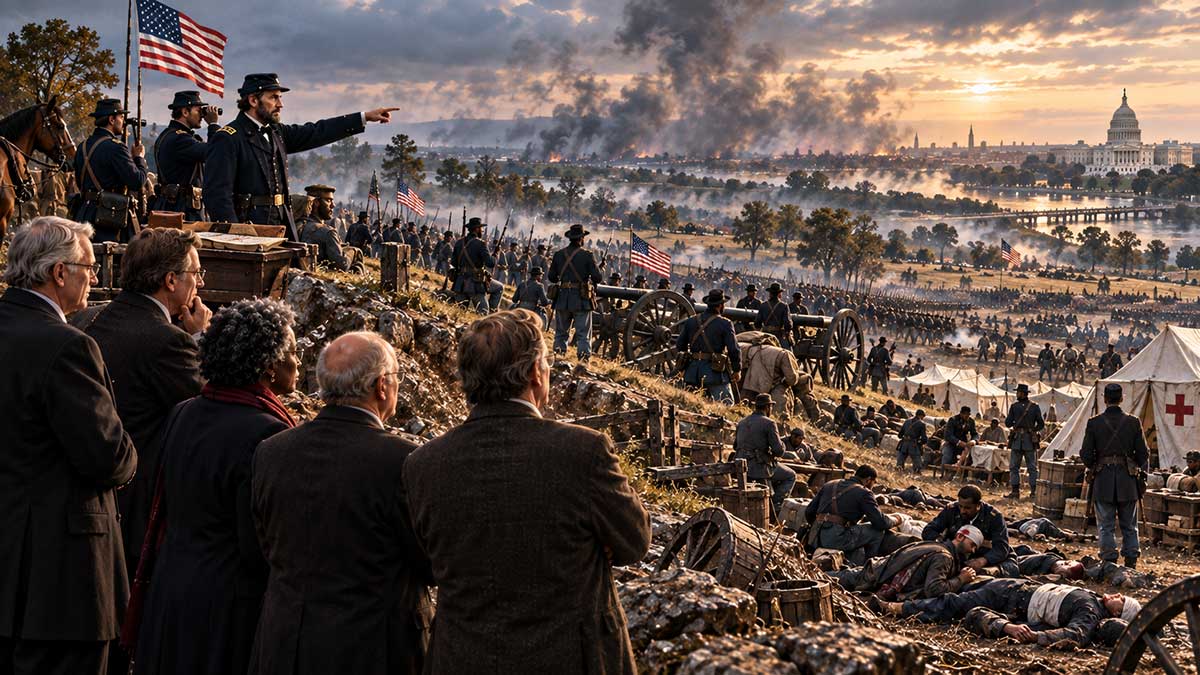
Harold Holzer left two objects at the center of the table.
A legal document.
And a photograph of a battlefield after the fighting had ended.
Allen Guelzo looked first at the document.
Gary Gallagher looked first at the battlefield.
Edna Greene Medford noticed that.
Eric Foner did too.
Holzer said:
“That may be the entire topic.”
Gallagher looked toward him.
“What?”
“One historian sees presidential power.”
“Another sees what the power eventually required men to do.”
Foner leaned back.
“And both belong to the same presidency.”
Medford nodded.
“Then we should keep them together.”
Guelzo looked around the table.
“Fine.”
“But we need to begin with the emergency.”
Holzer smiled faintly.
“I suspected you would say that.”
Guelzo leaned forward.
“There was an armed rebellion.”
“States had seceded.”
“Federal installations had been seized.”
“Washington itself was vulnerable.”
“Transportation lines mattered.”
“Maryland mattered.”
“Military communication mattered.”
“This was not an ordinary constitutional disagreement.”
Foner nodded.
“No serious discussion should pretend it was.”
Medford added:
“But a real emergency does not make every emergency measure automatically legitimate.”
Guelzo nodded.
“Agreed.”
Gallagher said:
“That distinction is important.”
Holzer looked toward Guelzo.
“Then let us start with habeas corpus.”
Guelzo nodded.
“Lincoln authorized suspension in certain circumstances.”
“Chief Justice Roger Taney challenged the president’s authority.”
“Yes.”
“Lincoln did not simply accept that judgment.”
“No.”
Foner entered:
“And later Congress gave broader statutory authorization for suspension.”
Guelzo nodded.
“Exactly.”
Holzer asked:
“So was Lincoln acting outside the Constitution?”
Guelzo paused.
“I would say the constitutional question was genuinely disputed.”
Medford looked toward him.
“Not simply solved in Lincoln’s favor because the Union survived.”
“No.”
He replied.
“Victory does not settle constitutional interpretation.”
Foner nodded.
“Good.”
Gallagher looked toward Guelzo.
“What was Lincoln’s strongest argument?”
“That the Constitution cannot reasonably require the government to allow itself to be destroyed because ordinary legal procedures are inadequate during rebellion.”
Holzer said:
“The famous logic that preserving every law except one may risk losing all the laws.”
“Yes.”
Guelzo replied.
“Lincoln was essentially asking whether constitutional government contains the means to preserve itself.”
Medford said:
“And his critics were asking who gets to decide when those means become necessary.”
Guelzo nodded.
“Exactly.”
Foner leaned forward.
“That second question is where the danger lies.”
Holzer looked at him.
“Why?”
“If the executive alone defines the emergency…”
“…then the executive can also enlarge it.”
Medford added:
“And extend it.”
Gallagher said:
“And sometimes that still may be necessary.”
Foner looked toward him.
“Yes.”
“That is why the question is hard.”
Holzer smiled.
“Then let’s refuse the easy word.”
Guelzo raised an eyebrow.
“Which word?”
“Dictator.”
Medford nodded immediately.
“Good.”
Gallagher said:
“It is usually used to end discussion.”
Foner agreed.
“And it blurs real distinctions.”
Holzer continued:
“Lincoln held elections.”
“He faced opposition.”
“Congress continued functioning.”
“Courts continued functioning, though there were conflicts.”
“He did not suspend the constitutional order in total.”
Guelzo nodded.
“Exactly.”
Medford added:
“But avoiding the word dictator should not mean avoiding the question of executive overreach.”
“No.”
Foner said.
“Those are different questions.”
Gallagher looked toward Holzer.
“And the press?”
Holzer nodded.
“The administration did interfere with some newspapers and communications during the war.”
“There were arrests.”
“Military suppression.”
“Attempts to control information under wartime conditions.”
Medford said:
“Again, not nothing.”
“No.”
Holzer replied.
“And not the same thing as abolishing a free press.”
Foner nodded.
“So the task is proportion.”
Guelzo said:
“Lincoln’s defenders sometimes make one mistake.”
Medford looked toward him.
“Which?”
“They say:
There was a rebellion, therefore extraordinary action was justified.”
Foner nodded.
“And critics?”
“They sometimes say:
There was extraordinary action, therefore Lincoln was lawless.”
Holzer smiled.
“So both sides skip the middle.”
“Yes.”
Guelzo replied.
“The middle is where history lives.”
Medford looked at the legal document.
“What should the middle ask?”
Guelzo counted slowly.
“Was the emergency real?”
“Yes.”
“Was the action connected to the emergency?”
“Was it limited?”
“Was ordinary legal process genuinely inadequate?”
“Was there oversight?”
“Was the action temporary?”
“And did normal authority return?”
Foner nodded.
“That is a useful framework.”
Gallagher added:
“And what would likely have happened if the action had not been taken?”
Medford looked toward him.
“That last one matters.”
“Yes.”
Gallagher replied.
“Because in war, refusing to act is also a decision.”
Holzer looked toward Medford.
“Does that reasoning worry you?”
“Yes.”
“Why?”
“Because necessity can become almost infinitely expandable.”
Gallagher nodded.
“True.”
Medford continued:
“Every abuse of emergency power comes with a story about necessity.”
“So historians should ask not only whether leaders believed an action necessary…”
“…but whether the evidence supports that belief.”
Foner nodded.
“Exactly.”
Holzer turned toward Gallagher.
“Now let us move from legal power to military power.”
Gallagher looked at the battlefield photograph.
“Lincoln spent years searching for generals who would use the armies aggressively enough to defeat the Confederacy.”
Guelzo nodded.
“McClellan is the obvious example.”
“Yes.”
Gallagher replied.
“Lincoln believed McClellan was repeatedly too cautious.”
Foner added:
“And political conflict complicated the relationship.”
Holzer said:
“Then eventually Grant.”
Gallagher nodded.
“Grant understood sustained pressure.”
Medford looked toward him.
“That phrase sounds clinical.”
“It is.”
“What does sustained pressure mean in human terms?”
Gallagher paused.
“Continued operations.”
“Repeated battles.”
“Casualties.”
“Men marching without long periods of recovery.”
“Pressure against Confederate armies simultaneously in multiple theaters.”
Medford nodded.
“That is better.”
Holzer asked:
“Was Grant simply more willing to accept casualties?”
Gallagher shook his head.
“That is too crude.”
“But he was willing to continue operations despite casualties.”
“Yes.”
“Why?”
“Because he believed allowing Confederate armies to recover prolonged the war.”
Foner nodded.
“That is central.”
Gallagher continued:
“The earlier pattern often involved major battle, withdrawal, recovery, another campaign.”
“Grant believed continuous pressure could exploit the Union’s material and manpower advantages.”
Medford said:
“And the human cost was enormous.”
“Yes.”
Gallagher replied.
“It was.”
Guelzo looked toward Gallagher.
“Did Lincoln choose Grant because Grant would spend lives?”
Gallagher frowned.
“No.”
“Then why?”
“Because Grant understood the strategic objective.”
“Defeat the Confederate armies.”
“Destroy their ability to continue organized resistance.”
“Coordinate theaters.”
“Keep pressure on.”
Foner said:
“Lincoln wanted a general who would actually use the army as an instrument of policy.”
“Yes.”
Gallagher replied.
Medford leaned forward.
“Then let us ask the uncomfortable question.”
“Did Grant’s strategy shorten the war—or simply make it bloodier?”
Gallagher paused.
“We cannot calculate an alternate war with certainty.”
Foner nodded.
“Important.”
Gallagher continued:
“But the argument for Grant is that relentless pressure prevented the Confederacy from repeatedly recovering.”
Guelzo said:
“And the argument against?”
“That some campaigns produced terrifying losses.”
“Cold Harbor is often invoked.”
“Overland Campaign casualties.”
“Civilian destruction increased as the war became harder.”
Medford nodded.
“So there is no simple empirical ledger where we can prove:
X deaths under Grant prevented Y deaths later.”
“Correct.”
Gallagher replied.
“That claim can be reasoned about.”
“It cannot be demonstrated like arithmetic.”
Holzer looked toward Foner.
“Then what can historians say?”
Foner answered:
“That the Union needed to defeat organized Confederate resistance if it intended to preserve the Union and make emancipation effective.”
“That military victory had enormous human cost.”
“That a less aggressive strategy might have prolonged the conflict.”
“And that we cannot know exactly how an alternative strategy would have unfolded.”
Medford nodded.
“That is responsible.”
Guelzo looked toward Gallagher.
“Was preserving the Union worth the cost?”
Gallagher paused.
“That question needs unpacking.”
Holzer smiled.
“We are historians.”
“We unpack.”
Gallagher continued:
“Union was not simply geography.”
“For many Northerners, it represented the survival of republican government.”
“The idea that an election could not simply be nullified by secession.”
Foner nodded.
“And by the middle of the war, Union survival and emancipation become increasingly connected.”
Medford added:
“Especially after federal policy changes.”
Holzer asked:
“So when people say:
‘Lincoln killed hundreds of thousands to save the Union’…”
Gallagher shook his head.
“That language is historically poor.”
“Why?”
“It assigns war casualties to one individual while ignoring who initiated armed rebellion, how military decisions were distributed, what Confederate leadership chose, and what goals both governments pursued.”
Foner nodded.
“Responsibility must be distributed.”
Medford said:
“But Lincoln does carry some responsibility.”
“Certainly.”
Gallagher replied.
“He was commander in chief.”
“He chose to continue the war rather than recognize Confederate independence.”
“That was an enormous decision.”
Guelzo asked:
“Could he have stopped it?”
Gallagher replied:
“He could have pursued peace on terms more favorable to Confederate independence.”
Holzer said:
“Which might have stopped some immediate killing.”
“Yes.”
Gallagher replied.
Medford added:
“And likely left slavery intact in the Confederacy.”
“Yes.”
Foner said:
“And validated secession.”
Gallagher nodded.
“Exactly.”
Holzer looked toward Medford.
“Then peace itself was not morally neutral.”
“No.”
She replied.
“That is extremely important.”
“The choice was not:
war equals violence,
peace equals goodness.”
“Slavery was already violence.”
Foner nodded.
“Legalized, normalized violence.”
Medford continued:
“So one moral danger is seeing battlefield blood while treating the coercion of slavery as background.”
Guelzo said:
“Exactly.”
Gallagher looked at the battlefield photograph.
“But the reverse danger also exists.”
Holzer looked toward him.
“What?”
“Using slavery’s evil to romanticize Union warfare.”
Medford nodded.
“Yes.”
Gallagher continued:
“A just cause does not make every military act just.”
“Nor every casualty unavoidable.”
“Nor every command wise.”
Foner said:
“That principle needs to remain explicit.”
Holzer leaned forward.
“Then let us bring in Sherman.”
Gallagher nodded.
“Necessary.”
“March to the Sea.”
“Yes.”
“Destruction of infrastructure.”
“Yes.”
“Civilian property.”
“Yes.”
“Psychological warfare?”
“In part.”
Medford asked:
“Was that strategy legitimate?”
Gallagher paused.
“Much of it targeted the Confederacy’s capacity to sustain war.”
“Railroads.”
“Supplies.”
“Agricultural resources.”
“But civilian suffering was real.”
Foner nodded.
“And total-war language can become misleading if used too loosely.”
“Yes.”
Gallagher replied.
“Sherman did not simply wage unrestricted exterminatory warfare.”
“But the war had clearly become much harsher.”
Guelzo said:
“Then the moral question becomes proportionality.”
Medford looked toward him.
“Yes.”
“Was the destruction directed toward a legitimate military objective?”
“Was it more extensive than required?”
“Were civilians deliberately targeted as civilians?”
“Could the same strategic effect have been achieved with less harm?”
Gallagher nodded.
“These are exactly the questions.”
Holzer said:
“And historians will not always agree.”
“No.”
Gallagher replied.
“Nor should they pretend to.”
Foner looked toward Holzer.
“There is also a political reason harder war mattered.”
“What?”
“By 1864, military victory and Lincoln’s reelection become entangled.”
Holzer nodded.
“Absolutely.”
Gallagher said:
“Atlanta matters enormously.”
“Yes.”
Holzer continued:
“Before Sherman takes Atlanta, Lincoln seriously fears electoral defeat.”
“After Atlanta, political momentum shifts.”
Medford said:
“So battlefield outcomes affect the survival of emancipation policy.”
Foner nodded.
“Exactly.”
Guelzo leaned back.
“Which returns us to a recurring problem.”
Holzer looked toward him.
“Political survival.”
“Yes.”
Guelzo continued:
“Lincoln’s reelection benefits Lincoln personally.”
“And also increases the likelihood that his war and emancipation policies continue.”
Medford said:
“Mixed motives again.”
Foner smiled.
“They refuse to disappear.”
Holzer asked:
“Could Lincoln have accepted a negotiated peace before victory?”
Gallagher replied:
“Depends on the terms.”
Foner nodded.
“If peace meant restoration of the Union with emancipation protected, that is one thing.”
“If it meant recognition of Confederate independence and slavery’s survival, another.”
Medford added:
“And Confederate leadership’s own willingness to accept reunion under emancipation was profoundly limited.”
Gallagher nodded.
“So ‘Why didn’t Lincoln make peace?’ is incomplete until you specify the peace.”
Guelzo said:
“That question matters politically even now.”
Holzer raised a finger.
“Careful.”
Guelzo smiled.
“I am not invoking modern parties.”
“Good.”
He continued:
“I mean in historical memory.”
“People hear ‘peace’ as inherently moral.”
Medford nodded.
“And ‘war’ as inherently immoral.”
Gallagher said:
“But sometimes peace preserves an unjust structure.”
Foner added:
“And sometimes war destroys one while creating other horrors.”
Holzer said:
“So the moral language itself requires scrutiny.”
Medford looked at Gallagher.
“Would you call the Union cause just?”
“Yes.”
“From the beginning?”
Gallagher paused.
“The preservation of representative government was a serious cause from the beginning.”
“And slavery?”
“Central to secession.”
“But emancipation was not initially the stated war aim for every Union participant.”
Foner nodded.
“That distinction matters.”
Medford continued:
“By 1863?”
“The cause becomes morally broader.”
Gallagher replied.
“Union and emancipation are increasingly joined.”
Guelzo said:
“Then Lincoln is not fighting exactly the same war in 1864 that he believed he entered in 1861.”
Foner nodded.
“That is an excellent way to put it.”
Holzer added:
“The constitutional crisis becomes a war of transformation.”
Medford said:
“Partly because people below transformed it.”
“Yes.”
Foner replied.
Holzer returned to the legal document.
“Now I want to connect the two halves.”
He looked toward Guelzo.
“Emergency power.”
Then Gallagher.
“Military destruction.”
“What principle governs both?”
Medford answered before either could.
“Necessity is not enough.”
They looked toward her.
She continued:
“Necessity has to be disciplined.”
Guelzo nodded.
“By law.”
Gallagher added:
“By objective.”
Foner:
“By proportionality.”
Holzer:
“By public accountability.”
Medford:
“And by memory of the people harmed.”
Gallagher said:
“That last one matters more than it sounds.”
Holzer looked toward him.
“Why?”
“Because once war becomes numbers, escalation becomes easier.”
Medford nodded.
“Exactly.”
Gallagher continued:
“Casualties have to remain strategically meaningful.”
“Not merely emotionally tragic.”
“If losses are producing no meaningful military result, command must reconsider.”
Guelzo said:
“And politically?”
Foner replied:
“If emergency powers no longer correspond to an actual emergency, government must reconsider.”
Holzer smiled faintly.
“So the same moral architecture applies.”
Medford looked toward Guelzo.
“Did Lincoln always satisfy that standard?”
“No.”
Guelzo replied.
The room quieted.
Holzer said:
“Give us more.”
Guelzo continued:
“I think some measures are more defensible than others.”
“Some arrests were questionable.”
“Some executive actions stretched authority.”
“Some wartime practices should trouble us.”
Foner nodded.
“That is important.”
Guelzo added:
“But acknowledging questionable acts does not require concluding that Lincoln’s entire wartime presidency was unconstitutional.”
Medford nodded.
“Agreed.”
Holzer looked toward Foner.
“Your view?”
“Lincoln was exercising enormous power in an unprecedented crisis.”
“Some actions were necessary.”
“Some were contested for good reason.”
“The preservation of the Union does not retroactively cleanse every act.”
“But neither should peacetime standards be applied without considering the rebellion.”
Gallagher nodded.
“That is fair.”
Holzer looked toward Medford.
“And yours?”
“Ask who experienced the power.”
Holzer smiled slightly.
“I knew you would say that.”
Medford continued:
“A constitutional argument can sound elegant from Washington.”
“But military arrests are experienced by actual people.”
“War policies are experienced by civilians.”
“Military strategy is experienced by soldiers.”
“Emancipation policy is experienced by enslaved families.”
She paused.
“If historical analysis stays only at the level of presidents and generals, power becomes too clean.”
Gallagher nodded.
“But we also cannot judge power only by individual suffering.”
Medford looked toward him.
“Explain.”
“A war policy may inflict suffering and still prevent a larger strategic disaster.”
Medford nodded.
“Yes.”
“I agree.”
Gallagher continued:
“So humanizing the cost cannot mean pretending leaders have no obligation to think at scale.”
Medford smiled faintly.
“And thinking at scale cannot mean forgetting the humans inside the scale.”
“Exactly.”
Holzer said:
“This sounds familiar.”
Foner nodded.
“Because Lincoln’s entire presidency lives inside that tension.”
Guelzo looked at the battlefield image.
“Perhaps the question ‘How much blood can a just cause demand?’ is itself flawed.”
Gallagher turned.
“How?”
“A cause does not demand blood.”
“Leaders decide.”
“Generals decide.”
“Governments decide.”
“Armies fight.”
“People resist.”
“Enemies make choices too.”
Foner nodded.
“So responsibility should not be mystified.”
Medford added:
“Or personalized into Lincoln alone.”
Holzer asked:
“Then how should responsibility be distributed?”
Gallagher answered first.
“The Confederacy bears responsibility for secession and continuing armed resistance.”
Foner added:
“And for defending a social order centered on slavery.”
Guelzo said:
“Lincoln bears responsibility for choosing continued Union war rather than recognizing Confederate independence.”
Medford added:
“Grant and other generals bear responsibility for operational decisions.”
Gallagher nodded.
“Congress and voters influence the continuation of war.”
Holzer said:
“And soldiers act within structures they did not create.”
Foner nodded.
“Responsibility is layered.”
Medford said:
“But layered responsibility can become diluted responsibility.”
Gallagher looked toward her.
“Meaning?”
“If everyone is responsible, people sometimes conclude no one is.”
Foner nodded.
“Good warning.”
Medford continued:
“So Lincoln must not disappear.”
“He authorized.”
“He appointed.”
“He removed.”
“He pressured.”
“He chose continuation.”
“He understood that continuation meant death.”
Guelzo nodded.
“Yes.”
“And yet responsibility does not equal sole causation.”
“Exactly.”
Holzer looked toward Gallagher.
“Did Lincoln become numb to casualties?”
“No evidence supports saying that simply.”
Gallagher replied.
“Lincoln was deeply affected by losses.”
Foner nodded.
“He visited hospitals.”
“He reviewed pardons.”
“He repeatedly confronted the human cost.”
Medford said:
“But compassion does not answer whether strategy was correct.”
“No.”
Gallagher replied.
“That is important.”
Guelzo said:
“A leader may be compassionate and still make terrible decisions.”
Foner added:
“And an emotionally cold decision may occasionally be strategically correct.”
Holzer smiled grimly.
“History remains unpleasant.”
Medford looked toward Gallagher.
“What would have convinced you Lincoln was demanding too much blood?”
Gallagher thought carefully.
“If the strategic objective had become unattainable.”
“If continued operations produced losses without meaningful pressure.”
“If a realistic settlement could secure the core objectives at substantially lower cost.”
“If command became driven mainly by sunk-cost logic.”
Foner nodded.
“That last one is important.”
Holzer asked:
“Sunk cost?”
Gallagher said:
“We cannot stop because too many have already died.”
Medford nodded.
“That can become a trap.”
Guelzo said:
“So past deaths cannot justify future deaths by themselves.”
“Correct.”
Gallagher replied.
“The question must always concern what future action can still accomplish.”
Foner said:
“That is a powerful distinction.”
Holzer looked toward Medford.
“And politically, what would make executive power excessive?”
She thought.
“If emergency authority becomes disconnected from the emergency.”
“If opposition itself becomes treated as rebellion.”
“If legal review is eliminated rather than delayed.”
“If temporary power becomes normalized.”
“If the executive refuses restoration once conditions change.”
Guelzo nodded.
“Yes.”
Foner added:
“And Lincoln’s assassination means we never fully see how he would have handled the return from wartime government to peace.”
Holzer looked toward him.
“There is Topic 5 already.”
“Almost.”
Gallagher said:
“Before we leave war, I want one thing on the record.”
Holzer nodded.
“What?”
“Union victory did not merely restore the old United States.”
Foner nodded.
“Absolutely.”
Gallagher continued:
“The nation after 1865 was constitutionally different.”
“Slavery destroyed.”
“Federal authority strengthened.”
“The meaning of citizenship entering a new struggle.”
Medford said:
“And that transformation matters when judging the cost.”
“Yes.”
Gallagher replied.
“A war that ended with the old slaveholding Union fully restored would be morally different from the war that actually ended.”
Guelzo added:
“But we must be careful again.”
Holzer asked:
“About hindsight?”
“Yes.”
“Lincoln did not know in 1861 exactly where the war would end.”
Foner smiled.
“Chronology returns.”
“It never left.”
Medford said:
“And that may be Lincoln’s strongest defense and strongest vulnerability.”
Holzer looked toward her.
“How can it be both?”
“He acted without knowing the outcome.”
“That means we should not judge every decision as though victory were guaranteed.”
Guelzo nodded.
“And vulnerability?”
“It also means he could not know whether the suffering he was imposing would ultimately achieve what he hoped.”
Silence.
Gallagher nodded slowly.
“That is true.”
Holzer looked around the table.
“Then let us answer the title.”
“Did Lincoln use too much power—and demand too much blood—to save the Union?”
Guelzo spoke first.
“He used extraordinary power.”
“Some of it constitutionally defensible.”
“Some of it legitimately contested.”
“None of it should be excused merely because he won.”
Foner continued:
“He continued a devastating war because he believed Union victory was necessary and because emancipation increasingly depended upon that victory.”
Gallagher said:
“His military strategy became harsher because the war required defeating organized Confederate resistance, not simply occupying territory.”
Medford added:
“And every one of those decisions had human costs that must remain visible.”
Holzer nodded.
“So too much?”
Silence.
Foner finally said:
“In some instances of policy, perhaps.”
Guelzo nodded.
“There are actions worth criticizing.”
Gallagher said:
“But I would not say the war itself was continued beyond any reasonable strategic necessity merely because the casualty numbers were terrible.”
Medford added:
“Nor would I allow strategic necessity to become a moral blank check.”
Holzer smiled slightly.
“That sounds like our answer.”
Foner leaned forward.
“Maybe the best formulation is this.”
“Lincoln’s cause could be just without every method being just, and his methods could sometimes be necessary without becoming morally clean.”
The room went still.
Guelzo nodded.
“Yes.”
Gallagher said:
“That is strong.”
Medford added:
“And we should append one sentence.”
Foner looked toward her.
“What?”
“The people harmed by necessary decisions do not stop being harmed because historians later decide the decisions were justified.”
Silence again.
Holzer nodded.
“Keep both.”
Gallagher looked toward the battlefield photograph one final time.
“The war ends.”
“Union survives.”
“Slavery collapses.”
“Lee surrenders.”
Holzer looked toward the legal document.
“And then the president who exercised all that power…”
“…dies.”
Foner nodded.
“Before governing the peace.”
Guelzo said:
“Before we discover how he would use victory.”
Medford added:
“Before Black citizenship is settled.”
Gallagher:
“Before demobilization is complete.”
Holzer:
“Before Reconstruction becomes the national crisis.”
He gathered the battlefield photograph.
But he left one image on the table.
Lincoln at the end of his life.
Older than his years.
Just after victory.
Just before assassination.
Holzer looked around the room.
“We have spent four topics asking what Lincoln actually did.”
Foner nodded.
Holzer continued:
“The final question may be about what happened after he could no longer do anything.”
Medford looked toward the image.
Guelzo knew where the conversation was going.
Gallagher sat back.
Holzer asked quietly:
“Did Lincoln’s assassination create the Lincoln we remember?”
And suddenly the problem was no longer only power or war.
It was memory.
Topic 5: Did Lincoln’s Assassination Create the Lincoln We Remember?
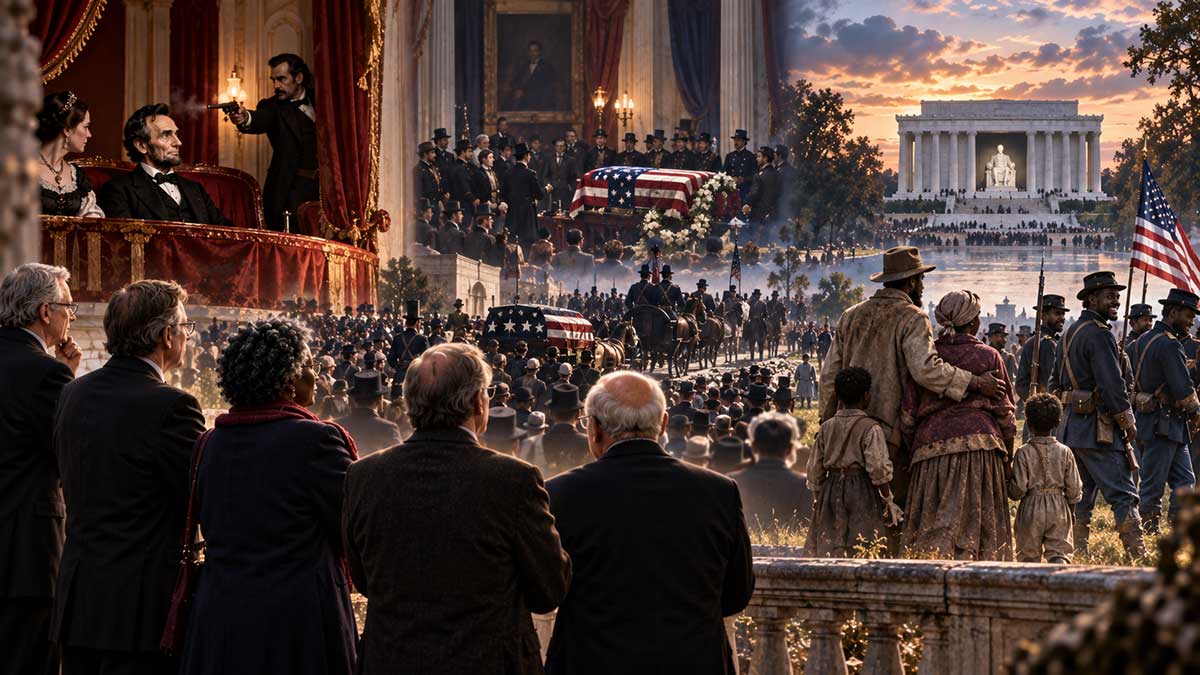
For several moments, no one spoke.
The previous discussion had ended with bodies.
Civil War dead.
Executive power.
Military necessity.
The terrible possibility that a leader could pursue a just objective and still remain responsible for the suffering caused in pursuing it.
Harold Holzer broke the silence.
“Perhaps that is exactly where we should begin the final question.”
Gary Gallagher looked toward him.
“With the dead?”
“With one particular death.”
Holzer leaned forward.
“Lincoln’s.”
Eric Foner nodded slowly.
“Because his death changes almost everything about the way the story ends.”
Edna Greene Medford added:
“Or perhaps more accurately, the way later generations tell themselves that it ended.”
Allen Guelzo folded his hands.
“Lincoln was assassinated at a historical moment almost perfectly designed for memory.”
Holzer looked toward him.
“Explain that.”
“The Union had essentially won.”
“Richmond had fallen.”
“Lee had surrendered.”
“Slavery was collapsing.”
“The Thirteenth Amendment had passed Congress.”
“Lincoln had just delivered the Second Inaugural.”
“And before the problems of peace could truly begin, he was killed.”
Gallagher nodded.
“He dies after victory but before the bill arrives.”
Medford looked at him.
“The bill?”
“The political bill.”
“The social bill.”
“Reconstruction.”
“What happens to four million formerly enslaved people.”
“What happens to former Confederates.”
“What happens to Southern state governments.”
“What happens when soldiers go home.”
“What happens when emancipation has to become citizenship.”
Foner said:
“That may be the most important point.”
“Lincoln dies before emancipation has to become a functioning social order.”
Holzer added:
“And that gives posterity an extraordinary advantage.”
“Posterity gets to imagine.”
The Lincoln Who Never Had to Govern Reconstruction
Holzer turned toward Foner.
“Then let us begin with the most famous counterfactual.”
“Would Reconstruction have gone differently if Lincoln had lived?”
Foner smiled slightly.
“That question has produced more confidence than the evidence deserves.”
Gallagher laughed.
“That is a historian’s way of saying we don’t know.”
“We do not.”
Foner continued.
“We know certain things about Lincoln’s final months.”
“We know he favored restoration of loyal governments in the South.”
“We know he was thinking about reintegration.”
“We know he supported abolition.”
“We know that by April 1865 he had begun to speak publicly, cautiously, about voting rights for at least some Black men.”
Medford nodded.
“Particularly educated Black men and Black veterans.”
“Yes.”
Foner continued.
“That was significant.”
“It should not be inflated into support for universal Black male suffrage.”
“But it should not be dismissed either.”
Guelzo said:
“It suggests movement.”
Medford looked toward him.
“Yes.”
“But movement toward what?”
“That is where we must stop ourselves.”
She leaned forward.
“Lincoln had moved.”
“He had not finished moving.”
“We cannot write the rest of the journey for him.”
Holzer nodded.
“That may be one of the great temptations created by assassination.”
“The dead cannot contradict the future we assign to them.”
Gallagher said:
“Nor disappoint it.”
Foner looked toward him.
“Exactly.”
“Suppose Lincoln lives.”
“He faces Southern resistance.”
“Violence against freedpeople.”
“Former Confederates trying to regain political control.”
“Northern voters tiring of occupation.”
“Arguments over land.”
“Arguments over suffrage.”
“Arguments over federal enforcement.”
“Arguments over whether former Confederate leaders should regain power.”
“Every one of those issues forces choices.”
Medford added:
“And every choice would have created enemies.”
Holzer said:
“Lincoln the martyr never has to disappoint anyone over Reconstruction.”
“Lincoln the living president certainly would have.”
Guelzo nodded.
“One constituency would have accused him of being too harsh.”
“Another of being too lenient.”
“Some would have said he moved too quickly on Black rights.”
“Others that he betrayed emancipation by moving too slowly.”
Gallagher added:
“And war weariness matters.”
“It is easy from the future to imagine the North committed indefinitely to remaking Southern society.”
“It was not that simple.”
Foner said:
“And that is why statements like ‘Lincoln would have solved Reconstruction’ are historically unserious.”
Holzer raised a finger.
“But there is another opposite simplification.”
“That Lincoln would simply have restored the old South.”
Foner nodded.
“Also too simple.”
“He had changed.”
“Slavery was gone.”
“He had come to accept Black military service.”
“He had publicly suggested limited Black suffrage.”
“His position in 1865 was not his position in 1861.”
Medford said:
“And Black Americans would not have returned to the position of 1861 either.”
“That matters.”
“Reconstruction would not have been Lincoln alone deciding what freedom meant.”
“Freedpeople were organizing schools.”
“Churches.”
“Political meetings.”
“Labor negotiations.”
“Families.”
“Veterans.”
“They would have pressured him just as Black Americans had pressured federal policy during the war.”
Guelzo looked thoughtful.
“So perhaps the better question is not: what would Lincoln have done?”
“But: how would Lincoln have responded to pressures we know were coming?”
Foner nodded.
“That is a much better historical question.”
Holzer smiled.
“And the answer?”
Foner spread his hands.
“Unknown.”
Does Assassination Protect a Reputation?
Gallagher looked toward Holzer.
“You said Lincoln died at the perfect moment for memory.”
“Yes.”
“Perfect is a strong word.”
“Not morally perfect.”
“Memorially perfect.”
Holzer continued.
“A leader who dies at victory acquires an enormous advantage over one who survives peace.”
“Victory simplifies.”
“Government complicates.”
Medford said:
“Especially when the next problem is racial equality.”
Holzer nodded.
“Lincoln becomes the man who saved the Union.”
“The man who issued the Emancipation Proclamation.”
“The man who spoke at Gettysburg.”
“The man who appealed to ‘the better angels’ in the public imagination.”
“The man murdered on Good Friday.”
“The symbolism becomes overwhelming.”
Guelzo said:
“That religious timing matters enormously.”
“Even for a nation not unanimously Christian in its interpretation.”
“Martyrdom language appears quickly.”
Holzer agreed.
“Lincoln’s death becomes national drama.”
“The murdered president.”
“The war nearly over.”
“The theater.”
“The pursuit of Booth.”
“The funeral train.”
“The public mourning.”
“The body traveling back through cities toward Springfield.”
“Millions encounter Lincoln in death.”
Medford said:
“And death selects.”
Holzer looked at her.
“What do you mean?”
“People choose what the dead person represents.”
“A dead Lincoln cannot say, ‘You misunderstood me.’”
“He cannot fail.”
“He cannot make the next compromise.”
“He cannot make the next racist statement.”
“He cannot make the next courageous statement either.”
“He is frozen.”
Foner nodded.
“And the timing of the freeze matters.”
“The Lincoln frozen in April 1865 is much easier to celebrate than the Lincoln of 1858.”
Guelzo said:
“Or even the Lincoln of 1862.”
Holzer added:
“Exactly.”
“If Lincoln had been assassinated in 1862, national memory would look very different.”
Gallagher laughed quietly.
“That is an extraordinary point.”
Holzer continued.
“No Emancipation Proclamation in final form.”
“No Gettysburg Address.”
“No 1864 reelection.”
“No Thirteenth Amendment support.”
“No Second Inaugural.”
“No Appomattox.”
“The iconic Lincoln depends partly on when death arrived.”
Did Martyrdom Turn a Politician Into a Moral Symbol?
Guelzo leaned forward.
“But we should be careful.”
“Martyrdom may enlarge a reputation.”
“It does not invent the achievements.”
Holzer nodded.
“Absolutely.”
“Assassination did not issue the Emancipation Proclamation.”
“It did not preserve the Union.”
“It did not write the Gettysburg Address.”
“It did not secure Lincoln’s reelection.”
“It did not produce his political development.”
“What it did was shape the selection and arrangement of those achievements in public memory.”
Medford added:
“And sometimes remove other people from the frame.”
Holzer looked toward her.
“Such as?”
“Enslaved people.”
“Black soldiers.”
“Abolitionists.”
“Black abolitionists.”
“Congress.”
“Union soldiers.”
“People who made emancipation possible.”
“If Lincoln becomes the single Great Emancipator, martyrdom can intensify a story already moving toward one-man memory.”
Foner nodded.
“That is the danger of monuments.”
“They compress causation.”
Guelzo smiled.
“But compression is not always falsification.”
“No.”
Foner replied.
“It becomes falsification when the compressed symbol replaces the process.”
Holzer said:
“Perhaps Lincoln becomes a kind of national shorthand.”
Medford answered:
“Shorthand is useful.”
“Until people forget there was a full sentence.”
What Do We Do With the Lincoln Who Does Not Fit the Monument?
Holzer allowed the silence to sit for a moment.
Then he said:
“And now we should address the uncomfortable records.”
“The parts of Lincoln that do not fit easily into national sainthood.”
Gallagher nodded.
“This is where modern discussions often become either defensive or prosecutorial.”
Medford said:
“Neither helps.”
Foner looked toward Holzer.
“Which episode do you want to begin with?”
Holzer answered:
“The Dakota conflict.”
The room quieted.
Medford spoke first.
“Good.”
“Because this is exactly the kind of episode that should complicate Lincoln without becoming a rhetorical weapon.”
Guelzo nodded.
“The history has to come before the verdict.”
Lincoln and the Dakota Executions
Foner began carefully.
“In 1862, while the Civil War was consuming the country, the United States also faced the Dakota War in Minnesota.”
Medford added:
“And we need to begin before the executions.”
“Yes.”
Foner said.
“Broken treaties.”
“Land dispossession.”
“Delayed or failed payments.”
“Hunger.”
“Government corruption.”
“Deepening pressure on Dakota communities.”
Gallagher said:
“Then war.”
Medford nodded.
“And terrible violence.”
“Settlers killed.”
“Dakota people killed.”
“Families displaced.”
“Communities shattered.”
“It cannot be reduced to a footnote about Lincoln.”
Holzer said:
“After the conflict, military commissions sentenced hundreds of Dakota men to death.”
Guelzo continued:
“Lincoln reviewed the cases.”
“He did not simply authorize every sentence.”
“He sought to distinguish those convicted of participating in massacres from those involved in battles.”
Foner nodded.
“He ultimately approved thirty-nine death sentences, one of which was later reprieved.”
“Thirty-eight Dakota men were executed at Mankato on December 26, 1862.”
Holzer said quietly:
“The largest mass execution in U.S. history.”
Medford looked toward him.
“Yes.”
“And if we stop there, we can turn history into accusation.”
“If we say only that Lincoln commuted most of the sentences, we can turn history into defense.”
“Neither is enough.”
Guelzo said:
“So how should we state it?”
Medford answered:
“Lincoln reduced a much larger set of death sentences.”
“That matters.”
“He also authorized thirty-eight executions.”
“That matters.”
“The broader Dakota history of dispossession and suffering matters.”
“The killing of settlers matters.”
“The mass imprisonment and forced removal of Dakota people afterward matters.”
“All of it has to remain.”
Foner nodded.
“This is the same principle we have used throughout.”
“Do not protect Lincoln from the evidence.”
“Do not use the evidence as a shortcut to a predetermined verdict.”
Gallagher said:
“And also ask what he knew.”
“What pressures existed.”
“What choices he faced.”
Holzer added:
“There was enormous public demand in Minnesota for mass punishment.”
Guelzo nodded.
“Lincoln’s intervention substantially reduced the number executed.”
Medford replied:
“That can be true without transforming the outcome into benevolence.”
“Thirty-eight men still died.”
“And many more Dakota people suffered imprisonment, expulsion, and dispossession.”
Foner looked toward her.
“So how should this affect Lincoln’s reputation?”
Medford thought for a moment.
“It should make the reputation harder.”
Holzer smiled faintly.
“Harder?”
“Yes.”
“Not destroyed.”
“Harder.”
She continued.
“If our image of Lincoln cannot survive contact with Native American history, then our image was too fragile.”
“That is not history’s problem.”
“That is the monument’s problem.”
Should One Dark Episode Redefine a Life?
Guelzo leaned forward.
“Let me push that.”
“There is a tendency now to find one morally troubling episode and allow it to swallow the entire biography.”
Medford nodded.
“That is also bad history.”
Gallagher said:
“Human beings become verdict machines.”
“Find the worst act.”
“Declare the person solved.”
Foner smiled.
“Historians should resist solving people.”
Holzer said:
“Especially Lincoln.”
Guelzo continued.
“The Dakota episode belongs in the record.”
“Colonization belongs in the record.”
“Racial limitations belong in the record.”
“Habeas corpus belongs in the record.”
“Political ambition belongs in the record.”
“But emancipation belongs in the record too.”
“The Thirteenth Amendment.”
“Black military service.”
“His development toward limited Black suffrage.”
“His effort to preserve representative government.”
“All of that belongs.”
Medford looked toward him.
“And not in separate rooms.”
Guelzo nodded.
“Exactly.”
Foner said:
“That may be the central historical discipline.”
“Keep all the evidence in the same room.”
Holzer smiled.
“That phrase should perhaps end our conversation.”
“Not yet.”
Gallagher said.
The others laughed.
Was Lincoln’s Memory Politically Constructed?
Holzer continued.
“Lincoln’s memory did not simply emerge naturally.”
“It was built.”
“By political parties.”
“By veterans.”
“By abolitionists.”
“By African American communities.”
“By former Confederates.”
“By schoolbooks.”
“By monuments.”
“By anniversaries.”
“By films.”
“By presidential rhetoric.”
“Different generations created different Lincolns.”
Foner nodded.
“The Civil War memory landscape changes dramatically.”
“Reconciliationist memory often softened the centrality of slavery.”
“Emancipationist memory emphasized freedom.”
“White supremacist narratives distorted Reconstruction.”
“Black communities maintained their own traditions of Lincoln remembrance, often both grateful and critical.”
Medford said:
“And Frederick Douglass himself offers a powerful example.”
“He could criticize Lincoln severely and still recognize the magnitude of Lincoln’s role.”
Holzer nodded.
“Which is useful because later memory often demands emotional simplicity.”
“Love him.”
“Hate him.”
“Douglass did neither so easily.”
Guelzo said:
“Perhaps mature historical judgment should resemble that.”
“Gratitude without blindness.”
“Criticism without erasure.”
Foner added:
“And chronology.”
Medford smiled.
“You really want chronology to have the last word.”
“It often deserves it.”
Which Lincoln Does America Remember?
Gallagher turned toward Holzer.
“So which Lincoln won?”
Holzer thought.
“For much of American public memory?”
“The emancipator.”
“The savior of the Union.”
“The self-made man.”
“The melancholy president.”
“The martyr.”
“The voice of democracy.”
Guelzo said:
“Not the ambitious party politician.”
“No.”
“Not the lawyer mastering patronage.”
“No.”
“Not the colonization supporter.”
“No.”
“Not the wartime executive making controversial arrests.”
“No.”
“Not the president dealing with Native American conflict.”
“Much less frequently.”
Medford added:
“And often not the Lincoln being pushed by Black Americans.”
Holzer nodded.
“The public monument naturally emphasizes the person on the pedestal.”
Foner said:
“History asks us to look at the crowd around the pedestal.”
Did Lincoln Know He Was Changing?
Guelzo shifted slightly.
“I want to return to something from our first topic.”
“Lincoln’s change.”
“Did he understand himself as changing?”
Foner said:
“Sometimes.”
“Though not necessarily in the way later historians describe it.”
Medford nodded.
“People rarely narrate their own development as cleanly as later biographers do.”
Gallagher said:
“They are busy living it.”
Guelzo continued.
“But there is something significant about Lincoln’s increasing moral and religious humility.”
“The Second Inaugural is remarkable because he refuses a simple claim that God is entirely on one side.”
Holzer nodded.
“Victory without triumphalism.”
Guelzo said:
“Yes.”
“After four years of blood, he presents suffering almost as judgment upon the whole nation for slavery.”
Foner added:
“That speech also complicates the idea of Lincoln as merely a calculating politician.”
Medford raised a hand.
“But again, we should not jump from humility in rhetoric to moral completion.”
“No.”
Guelzo said.
“Agreed.”
Gallagher looked toward Medford.
“You keep protecting us from the perfect ending.”
She smiled.
“Someone has to.”
Was Lincoln Great Because He Was Unfinished?
Holzer said:
“Then perhaps we are approaching the real question.”
“Does Lincoln’s unfinished nature weaken his greatness?”
Foner answered first.
“I think it makes historical judgment possible.”
Holzer looked intrigued.
“How?”
“If greatness requires perfection, no historical figure survives.”
“That does not mean we lower moral standards.”
“It means we ask different questions.”
“What direction did someone move?”
“What power did they possess?”
“What did they do with it?”
“What pressures changed them?”
“What harms did they perpetuate?”
“What institutions did they alter?”
“What possibilities did they create?”
Medford added:
“And who was forced to wait while they learned?”
Foner nodded.
“Yes.”
“That must remain.”
Guelzo said:
“Lincoln’s moral importance may lie partly in his ability to revise himself.”
Gallagher added:
“And his strategic importance in revising policy under pressure.”
Holzer said:
“But revision can become its own mythology.”
Medford immediately nodded.
“Yes.”
“That is important.”
“We should not say, ‘Lincoln changed, therefore all is forgiven.’”
“People suffered while he changed.”
“Enslaved people did not receive those years back.”
“Black Americans did not experience racism as an abstract developmental stage in someone else’s biography.”
“Dakota families did not experience policy as historical nuance.”
Guelzo said:
“So change deserves credit.”
Medford answered:
“But not erasure.”
Foner nodded.
“That may be the balance.”
How Should We Judge the Distance?
Holzer looked around the table.
“I want each of us to answer one question.”
“Not whether Lincoln was good.”
“Not whether Lincoln was racist.”
“Not whether Lincoln freed the slaves.”
“Something harder.”
He paused.
“How should we judge the distance between where Lincoln began and where Lincoln ended?”
Gallagher smiled.
“You are finally asking a historian to give a verdict.”
“A temporary one.”
Holzer said.
Gallagher began.
“I would judge the distance in context.”
“What choices were available?”
“What did he know?”
“What did the war make possible?”
“What did military events close off?”
“What did political defeat risk?”
“Leadership under war cannot be judged as though Lincoln knew the ending.”
Guelzo followed.
“I would judge the distance by intellectual seriousness.”
“Did he confront contradiction?”
“Could new evidence alter his reasoning?”
“Could responsibility reshape conviction?”
“Could power increase humility rather than eliminate it?”
Foner said:
“I would judge it by outcomes and transformation.”
“Lincoln’s presidency begins with slavery protected where it existed.”
“It ends with slavery constitutionally doomed.”
“That is a profound transformation.”
“But it was not his alone.”
“So I would judge both what he accomplished and the larger forces that made accomplishment possible.”
Medford was quiet longer.
Then she said:
“I would judge the distance from both ends.”
“The man changing.”
“And the people waiting.”
Holzer looked toward her.
She continued.
“Lincoln’s growth matters.”
“But history cannot turn Black suffering into the scenery against which a white leader becomes morally impressive.”
“That would reproduce the very imbalance we are trying to correct.”
“So yes—look at where he began.”
“Look at where he ended.”
“But also look sideways.”
“At the people beside him.”
“Below him.”
“Pressuring him.”
“Escaping.”
“Fighting.”
“Dying.”
“Organizing.”
“Demanding.”
“History moved through them too.”
No one spoke for several seconds.
Then Holzer said:
“I would judge the distance by memory.”
The others looked toward him.
“What did later generations choose to preserve?”
“What did they simplify?”
“What did they need Lincoln to represent?”
“The man and the memory are inseparable now.”
“But they are not identical.”
If Lincoln Had Lived, Could the Legend Have Survived?
Gallagher leaned back.
“Let me offer one final counterfactual.”
Holzer smiled.
“You’re going to violate our own rule?”
“Carefully.”
“What if Lincoln lives twenty more years?”
The table went quiet again.
Gallagher continued.
“He governs Reconstruction.”
“He makes compromises.”
“He perhaps supports policies later seen as too conservative.”
“Or perhaps more radical than expected.”
“He fights Congress.”
“He disappoints Black leaders.”
“He disappoints white voters.”
“He confronts violence.”
“Maybe he fails badly somewhere.”
“Maybe he succeeds somewhere unexpected.”
“He grows old.”
“His party changes.”
“The country changes.”
“Would we still have the Lincoln Memorial Lincoln?”
Holzer answered immediately.
“Almost certainly not in exactly the same form.”
Foner nodded.
“Living creates evidence.”
Medford added:
“Death creates possibility.”
Guelzo said:
“And martyrdom creates coherence.”
Holzer looked toward him.
“Yes.”
“That may be the phrase.”
“Martyrdom creates coherence.”
“A life that was politically messy becomes morally legible.”
“Union.”
“Freedom.”
“Sacrifice.”
“Death.”
“The story tightens.”
Foner said:
“Too tightly.”
Holzer nodded.
“Usually.”
The Lincoln We Need Versus the Lincoln Who Was
Medford looked around the table.
“Perhaps every generation creates the Lincoln it needs.”
Gallagher said:
“That sounds dangerous.”
“It is.”
She continued.
“One generation needs the Union savior.”
“Another needs the emancipator.”
“Another needs the defender of democracy.”
“Another needs the racist exposed.”
“Another needs the model of moral growth.”
“Each selects.”
Foner nodded.
“The historian’s responsibility is not to prevent interpretation.”
“That is impossible.”
“It is to resist selection becoming distortion.”
Guelzo said:
“So what Lincoln do we need?”
Holzer smiled.
“Perhaps the wrong question.”
“What Lincoln does the evidence allow?”
Foner nodded approvingly.
“That is better.”
Medford added:
“And which people disappear when we choose one version?”
Gallagher said:
“Also better.”
Final Exchange
The room had grown darker.
No one seemed eager to end.
Holzer looked toward the imagined figure at the center of all their questions.
Not the statue.
Not the martyr.
The politician.
The wartime president.
The man who had changed.
The man who had not finished changing.
He said:
“Then did Lincoln’s assassination create the Lincoln we remember?”
Foner answered first.
“No.”
“It did not create his achievements.”
Medford added:
“But it helped determine which achievements became central.”
Guelzo said:
“It froze his development.”
Gallagher said:
“And spared him the political consequences of peace.”
Holzer nodded.
“It turned an unfinished life into a finished symbol.”
Medford said:
“And symbols are easier to love than people.”
Foner added:
“Or easier to attack.”
Guelzo smiled.
“Because neither requires the burden of chronology.”
Gallagher looked toward Foner.
“You got your chronology after all.”
Foner laughed.
“I was patient.”
Medford smiled.
“Not too patient, I hope.”
They all understood the reference.
Then Holzer grew serious again.
“So how should we leave him?”
Foner said:
“Unfinished.”
Guelzo:
“Revisable.”
Gallagher:
“Responsible.”
Medford:
“Surrounded.”
Holzer looked toward her.
“Surrounded?”
“Yes.”
“By the people history too often removes from the portrait.”
“Black soldiers.”
“Enslaved families.”
“Abolitionists.”
“Native peoples.”
“Soldiers.”
“Widows.”
“Political opponents.”
“People who suffered from his decisions.”
“People who expanded his imagination.”
“People who made his achievements possible.”
She paused.
“If Lincoln stands alone, we have already misunderstood him.”
Holzer nodded slowly.
Then he said:
“Perhaps that is the final correction to the monument.”
“Do not knock it down.”
“Do not polish it until it shines.”
“Surround it with evidence.”
No one spoke.
Foner finally said:
“And let the contradictions remain.”
Guelzo nodded.
“Because greatness that survives contradiction is more meaningful than greatness protected from it.”
Gallagher added:
“And because history without contradiction is usually mythology.”
Medford looked toward the others.
“And because the people harmed by necessary decisions remain part of the story.”
Holzer closed his notebook.
Then said:
“Lincoln’s assassination did not create Abraham Lincoln.”
“It created something else.”
He paused.
“The possibility of a Lincoln who could never again disappoint us.”
The room fell silent.
And perhaps that was the difference between the man and the monument.
The man had changed.
The man had hesitated.
The man had compromised.
The man had used power.
The man had caused harm.
The man had helped destroy slavery.
The man had grown.
The man still had farther to go.
The monument had nowhere left to move.
That was why history still needed the man.
Final Thoughts
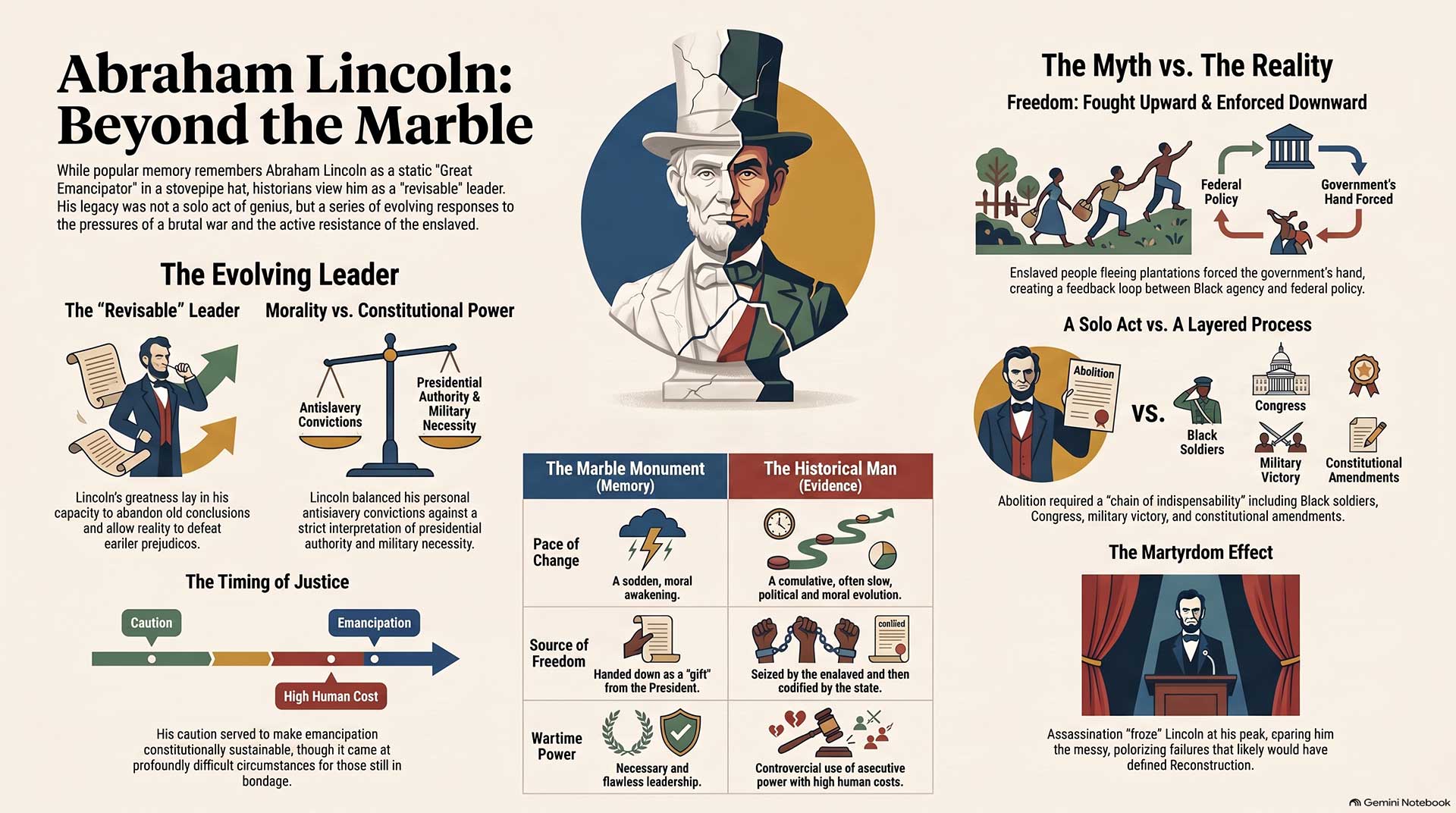
After examining Lincoln through the eyes of historians, one conclusion becomes difficult to avoid:
There was no single, fixed Abraham Lincoln.
There was the Lincoln of 1858.
The Lincoln of 1861.
The Lincoln of 1862.
The Lincoln of 1863.
The Lincoln of 1864.
And the Lincoln of April 1865.
Those men were connected.
But they were not identical.
That matters.
If we take something Lincoln said in one year and use it to define everything he later became, we flatten history.
If we take his final positions and pretend he always held them, we flatten history in the opposite direction.
Chronology is not an excuse.
It is evidence.
On slavery, Lincoln began with real antislavery convictions but not immediate abolitionism.
On race, he expressed views that were plainly limited and unequal by modern standards.
On colonization, he supported ideas that reflected both political calculation and racial assumptions.
Yet over the course of the war, the political and moral landscape changed.
So did Lincoln.
Black military service mattered.
The actions of enslaved people mattered.
Frederick Douglass and other Black leaders mattered.
Military necessity mattered.
Political pressure mattered.
Public opinion mattered.
The experience of war mattered.
Lincoln did not change alone.
That may be one of the most important conclusions of the entire discussion.
Great leaders are often remembered as if they moved history by force of personal insight.
In reality, they are frequently pushed.
Argued with.
Embarrassed.
Challenged.
Pressured by events.
Forced to confront evidence they had previously ignored.
Lincoln’s development makes more sense when we see change moving both upward and downward.
From enslaved people escaping bondage.
From Black soldiers entering Union ranks.
From abolitionists demanding more.
From Congress legislating.
From military commanders confronting realities on the ground.
And from the presidency eventually using national power to make emancipation a central war aim and permanent abolition a constitutional objective.
That leads to another important conclusion.
Lincoln deserves substantial credit for emancipation.
But he does not own emancipation.
Those two statements can both be true.
The same complexity appears when we examine presidential power.
Lincoln faced an actual rebellion.
The United States was not experiencing an ordinary political disagreement.
Armies were in the field.
Washington itself was vulnerable.
Federal authority had collapsed across much of the South.
Transportation and communication were militarily vital.
In that context, Lincoln took extraordinary actions.
Some remain constitutionally disputed.
Some were later supported or regularized by Congress.
Some raise serious civil-liberty questions.
The correct historical response is not automatically to call him a dictator.
Nor is it to say that because the Union survived, everything he did was therefore justified.
Emergency power may sometimes be necessary.
But necessity must still be examined.
Was the emergency real?
Was the action connected to the emergency?
Was ordinary law genuinely inadequate?
Were limits maintained?
Was review possible?
Did normal authority eventually return?
Those questions matter precisely because emergency power can be both necessary and dangerous.
The same is true of war.
Lincoln and Grant could pursue a cause that became increasingly inseparable from the destruction of slavery and still remain morally responsible for the methods used to pursue it.
A just cause does not make every strategy just.
Military necessity does not make suffering disappear.
And the people harmed by decisions do not stop being harmed because historians later determine that the decisions were defensible.
Perhaps the most difficult lesson is that leadership often means choosing between different distributions of suffering.
Continuing the war caused enormous death.
Ending it prematurely might have preserved Confederate independence and slavery.
Using stronger federal power threatened civil liberties.
Using too little power might have allowed rebellion to succeed.
Moving quickly toward emancipation risked political fracture.
Moving slowly meant more people remained enslaved while politicians calculated.
History rarely gives leaders the option between harm and no harm.
Often the choice is between competing harms under uncertainty.
That does not remove moral responsibility.
It increases it.
And then there is the final problem:
memory.
Lincoln’s assassination changed the way later generations encountered him.
He died just as Union victory became clear.
Slavery was collapsing.
The Thirteenth Amendment was moving toward ratification.
His Second Inaugural had offered an unusually restrained vision of victory.
And Reconstruction had barely begun.
He never had to govern the peace.
He never had to decide how far federal power should go in protecting freedpeople against Southern resistance.
He never had to confront years of Reconstruction violence.
He never had to resolve the conflict between reconciliation and racial justice.
He never had the opportunity to make decisions that might have complicated his reputation further.
His assassination did not create his achievements.
But it helped freeze him at a moment when those achievements could become the foundation of national memory.
The difficult episodes remained.
Colonization.
Racial limitations.
Civil-liberty controversies.
The Dakota executions.
Political ambition.
Compromises.
Delays.
But national memory often compresses a human being.
The monument becomes easier to remember than the chronology.
That is why historical fairness requires something harder than praise or condemnation.
It requires us to ask:
Where did Lincoln begin?
Where did he end?
What did he accomplish?
Who pushed him?
Who suffered while he changed?
What limitations did he retain?
What power did he use?
What choices were realistically available?
What do we actually know?
What remains contested?
And what can never be known because assassination ended the story?
Perhaps Lincoln’s greatness does not require us to pretend he was always right.
Perhaps it lies partly in something less dramatic and more useful:
his capacity to be revised by reality.
A leader who believes he has never been wrong may be morally dangerous.
A leader capable of change may become more useful to justice.
But even that should not become another comforting myth.
Change itself is not enough.
People can change too slowly.
They can change only after others have suffered.
They can receive too much credit for changes others forced into existence.
They can grow while leaving damage behind that growth cannot repair.
So perhaps the fairest judgment is not:
Was Abraham Lincoln a good man?
Nor:
Was Abraham Lincoln a racist?
Nor:
Did Abraham Lincoln free the slaves?
The better historical question may be:
What did Abraham Lincoln do with the distance between the man he had been and the man he was becoming?
And alongside that:
What did that distance cost the people who had to live through it?
Holding both questions together does not diminish Lincoln.
It makes him human.
And perhaps it makes his story more useful.
Because history does not belong only to flawless people.
It belongs to people capable of movement.
But it also belongs to everyone whose pressure, suffering, courage, and resistance helped move them.
Short Bios:
Eric Foner is one of the most influential historians of the Civil War, slavery, emancipation, Reconstruction, and the history of American freedom. His work has been especially important in showing how emancipation was shaped not only by presidential policy but by enslaved people, abolitionists, Congress, military events, and broader political transformation. In this discussion, Foner helps establish chronology and examines Lincoln’s evolving relationship to slavery, freedom, and Reconstruction.
Edna Greene Medford is a historian whose scholarship focuses on African American history, Abraham Lincoln, emancipation, race, and citizenship during the Civil War era. Her perspective is essential because it prevents Lincoln’s presidency from becoming a story told only from the White House downward. In this discussion, she repeatedly brings attention back to Black Americans as historical actors and to the human cost of political delay.
Allen C. Guelzo is a historian known for extensive scholarship on Abraham Lincoln, the Civil War, emancipation, political thought, and American constitutional history. His work often examines Lincoln’s intellectual development, religious language, constitutional reasoning, and political strategy. In this discussion, Guelzo helps explore the relationship between Lincoln’s moral goals, constitutional responsibilities, executive authority, and political judgment.
Gary W. Gallagher is a prominent historian of the American Civil War whose scholarship has examined Unionism, Confederate nationalism, battlefield strategy, military leadership, and the relationship between military events and public opinion. In this discussion, Gallagher helps keep the military situation from becoming an abstraction. He brings attention to what leaders actually knew during the war, the uncertainty surrounding victory, and the terrible human consequences of strategic decisions.
Harold Holzer is an historian and author known especially for his work on Abraham Lincoln, political communication, the press, public imagery, and Lincoln’s assassination and legacy. His scholarship helps explain not only the historical Lincoln but the Lincoln later generations came to remember. In this discussion, Holzer examines how public communication, martyrdom, memorialization, and national memory transformed a complicated political leader into one of America’s most powerful historical symbols.
Closing Note on the Scholar Conversation
This discussion is a fictional reconstruction.
The historians represented here are real scholars, and the questions draw from genuine areas of historical research and disagreement. However, the dialogue itself is imagined and should not be treated as direct quotation or as a statement of any scholar’s exact personal position.
The goal is not to manufacture agreement.
It is to bring historically serious perspectives into conversation around the questions that continue to make Abraham Lincoln so difficult—and so important—to understand.
Leave a Reply