
Introduction
Madeline Miller’s Circe is often described as a feminist retelling of Greek mythology. But that description raises harder questions.
How much of Miller’s Circe comes from Homer and other ancient sources? How much comes from modern psychology? Does explaining Circe’s wounds make readers too willing to forgive what she does to Scylla? Does Miller unfairly darken Odysseus, or reveal tensions already present in the heroic tradition? Why does motherhood change Circe so deeply? And why would an immortal goddess choose aging and death?
In this imaginary conversation, Madeline Miller joins classicists Emily Wilson, Natalie Haynes, and Mary Beard, together with psychiatrist and myth scholar Jean Shinoda Bolen.
They disagree about what it means to “give Circe a voice,” whether modern retellings recover ancient women or partly recreate them in our own image, and whether psychological explanation can quietly become moral excuse.
Their discussion moves from Homer to feminism, from Scylla to Odysseus, from motherhood to mortality.
At the center is one larger question:
When we rewrite an ancient myth, are we discovering something about the Greeks—or discovering something about ourselves?
(This is an imagined conversation. The participants did not actually take part in this discussion. Their perspectives are creatively constructed from their publicly known work and areas of expertise.)
Topic 1 — Ancient Circe vs. Madeline Miller’s Circe
Madeline Miller: Perhaps I should begin by confessing something.
I never thought I was discovering the real Circe.
Emily Wilson: Good.
Natalie Haynes: We have survived the first thirty seconds.
Mary Beard: Give us time.
Miller laughed.
Madeline Miller: What I mean is that I never imagined there was one complete woman hidden behind Homer whom I could excavate and present to modern readers.
There isn't a secret biography of Circe waiting somewhere.
There are stories.
Fragments.
Contradictions.
Different traditions.
And then there are enormous silences.
Emily Wilson: I agree with almost all of that.
The word that makes me nervous is "silences."
Madeline Miller: Why?
Emily Wilson: Because modern readers often treat silence as evidence that something has been suppressed.
Sometimes a text simply isn't interested in the question we're asking.
Those are different things.
Natalie Haynes: That's an important distinction.
But surely those spaces are precisely what make retelling possible.
Emily Wilson: Absolutely.
I'm not objecting to retelling.
I'm objecting to the idea that the retelling necessarily reveals what was secretly there all along.
Mary Beard: Yes.
We have developed a rather seductive vocabulary around these books.
"Giving women back their voices."
"Recovering forgotten women."
"Finally telling her story."
All perfectly understandable.
But occasionally I want to say: which woman?
Where exactly is this fully formed ancient Circe whose authentic voice we supposedly lost?
Madeline Miller: I would agree.
I wasn't trying to recover a transcript.
I was asking a novelist's question.
What would it mean to experience these events from inside Circe rather than encountering her when Odysseus arrives?
Jean Shinoda Bolen: And the moment you ask that, something psychologically interesting happens.
Circe stops being a function in somebody else's development.
She becomes the subject of her own.
Emily Wilson: Yes, but there's our first complication.
"Development" itself can be a modern expectation.
We want characters to develop.
We expect childhood to explain adulthood.
We expect wounds to generate behavior.
We expect insight to produce transformation.
Ancient epic does not necessarily organize character in that way.
Madeline Miller: No.
Emily Wilson: Your Circe has an emotional biography.
Homer's Circe has a narrative function.
Those are radically different things.
Natalie Haynes: But "narrative function" can make ancient women sound rather bloodless.
Homer's Circe is fascinating.
She is dangerous.
Sexual.
Magical.
Knowledgeable.
She turns Odysseus's men into pigs.
Then she becomes enormously helpful.
She tells him what he needs to do.
She helps move him through the story.
She's hardly nothing.
Mary Beard: Precisely.
And that is why I dislike the simplified claim that Miller takes a voiceless woman and gives her a voice.
Circe was never exactly voiceless.
Madeline Miller: No.
Mary Beard: What she lacked was something different.
Centrality.
We don't remain with her.
Odysseus arrives, and Circe becomes part of the geography of his return.
Your novel reverses the camera.
Madeline Miller: That's much closer to how I thought about it.
What happens if Odysseus is an episode in Circe's story?
Natalie Haynes: Which is wonderfully cheeky.
Emily Wilson: And revealing.
Odysseus spends thousands of years being the gravitational center.
Then suddenly he's someone's complicated boyfriend.
Everyone laughed.
Madeline Miller: I suspect Odysseus would object to that description.
Mary Beard: Odysseus objects to many things.
Natalie Haynes: Usually before finding a clever way out of them.
Jean Shinoda Bolen: Yet that reversal does something psychologically significant.
If Circe exists mainly within Odysseus's journey, we encounter her at a moment of tremendous competence.
She's powerful.
She has magic.
She has authority over her island.
Madeline asks another question:
What might have happened before a woman becomes that person?
Emily Wilson: And that's exactly where I become interested and cautious simultaneously.
Madeline Miller: Because I give her a childhood?
Emily Wilson: Not merely that.
You give her an explanatory childhood.
The mocked voice.
The distant father.
The beautiful siblings.
The hunger for approval.
Glaucos.
Rejection.
Jealousy.
Suddenly the witch has a psychological genealogy.
Modern readers recognize that immediately.
We think, Ah. Now I understand why she became this way.
But an ancient listener may not have needed that explanation at all.
Jean Shinoda Bolen: Yet psychological truth does not require historical equivalence.
Emily Wilson: Certainly.
But we should know which kind of truth we're discussing.
Jean Shinoda Bolen: Fair.
Mary Beard: This may be the distinction we need to preserve throughout this conversation.
A modern retelling can be psychologically compelling without being evidence about what an ancient Greek thought Circe "really felt."
Madeline Miller: Completely.
Natalie Haynes: And mythology itself gives us considerable permission.
People sometimes talk about Greek myth as though someone wrote the official version and everyone afterward began tampering with it.
That simply isn't how these stories worked.
Mary Beard: Quite.
Natalie Haynes: They changed.
Different poets emphasized different relationships.
Local traditions differed.
Genealogies shifted.
Characters behaved differently from one source to another.
Contradictions aren't accidents sitting outside Greek mythology.
They're part of Greek mythology.
Emily Wilson: Yes.
But I want to protect one distinction.
Ancient variation does not mean every modern interpretation is ancient.
Natalie Haynes: Agreed.
Emily Wilson: Sometimes I hear an argument like, "Myths always changed, so this contemporary interpretation is just as ancient as anything else."
No.
It is legitimate as a modern retelling.
That does not make its assumptions ancient.
Madeline Miller: Nor should it.
I am a modern novelist.
I wrote for modern readers.
Mary Beard: Good. Then perhaps we can ask the impolite question early.
Madeline Miller: Please.
Mary Beard: How much of your Circe is Greek, and how much is us?
Miller paused.
Madeline Miller: A great deal is us.
It has to be.
Mary Beard: That answer will disappoint people who want authenticity.
Madeline Miller: I'm interested in something different from authenticity.
I'm interested in conversation.
The ancient material speaks.
We answer.
The answer reveals our moment too.
Natalie Haynes: Exactly.
And that isn't a defect.
Jean Shinoda Bolen: It may explain why Circe feels so immediate to contemporary readers.
Her emotional problem is recognizable.
She begins in a family system where she experiences herself as deficient.
Her voice is wrong.
Her appearance is wrong.
She isn't sufficiently impressive.
She learns to locate value outside herself.
Then someone notices her.
Suddenly she experiences recognition almost as existence.
That psychological movement is intensely familiar.
Emily Wilson: Familiar to us.
Jean Shinoda Bolen: Yes.
And I don't apologize for that.
Emily Wilson: I'm not asking you to.
I'm asking that we notice it.
There is a difference between saying, "This story helps us think about psychological development," and saying, "This is what Circe always meant."
Jean Shinoda Bolen: Then we agree.
Natalie Haynes: This is becoming disappointingly civilized.
Mary Beard: Don't worry. We haven't reached feminism yet.
They laughed.
Then Miller leaned forward.
Madeline Miller: There was something that haunted me about Circe long before I wrote the novel.
When I first encountered her, she had extraordinary power.
Yet her story still belonged to someone else.
That contradiction stayed with me.
Mary Beard: But here I want to push you.
Why do you say her story "belonged" to someone else?
Madeline Miller: Because we encounter her through Odysseus's journey.
Mary Beard: Yes, structurally.
But modern readers can turn that structural fact into a moral accusation against Homer.
As though Homer had a room filled with rich female autobiographies and deliberately threw them away.
That's too easy.
Madeline Miller: I don't think that.
Mary Beard: I know you don't.
But the cultural conversation around retellings sometimes drifts there.
We begin judging an ancient epic for failing to be the contemporary novel we wish it had been.
Emily Wilson: That's very important.
The Odyssey isn't a failed version of Circe.
Natalie Haynes: And Circe isn't a corrected Odyssey.
Madeline Miller: Exactly.
Emily Wilson: They are doing different things.
Jean Shinoda Bolen: Yet modern readers may discover something through the reversal that they could not see from the original angle.
Mary Beard: Certainly.
Perspective matters.
Jean Shinoda Bolen: Consider Circe's transformation of men into pigs.
If you meet her through Odysseus's men, she is terrifying.
If you live with her before those men arrive, the act enters a history.
That changes our response.
Emily Wilson: Yes.
And introduces a danger.
Jean Shinoda Bolen: Sympathy?
Emily Wilson: Explanation.
Modern fiction is extremely good at making explanation feel like exoneration.
Give us enough childhood pain and we begin forgiving almost anything.
Miller's expression became serious.
Madeline Miller: That's why Scylla matters so much.
Haynes nodded immediately.
Natalie Haynes: Yes.
Mary Beard: We will have to come back to her.
Madeline Miller: We absolutely should.
I did not want Circe's suffering to make her morally pure.
She is capable of terrible harm.
Jean Shinoda Bolen: Which is psychologically important.
A wounded person does not automatically become compassionate.
Sometimes wounds increase sensitivity to other people's pain.
Sometimes they make a person inflict pain.
Emily Wilson: And now we are very far from Homer.
Jean Shinoda Bolen: Historically, yes.
Humanly?
Perhaps not so far.
Wilson smiled.
Emily Wilson: I will accept that distinction.
Natalie Haynes: Can we return to something basic?
What exactly is Homer's Circe?
Because people who encounter Miller first can come away assuming the ancient Circe was simply an evil witch whom Miller rehabilitated.
That isn't right.
Emily Wilson: No.
Homer's Circe is much stranger.
She initially threatens Odysseus's men through transformation.
Odysseus confronts her with divine assistance.
Then the relationship changes dramatically.
She becomes hospitable.
She provides knowledge.
She tells Odysseus how to continue his journey.
She warns him about dangers ahead.
She's dangerous and helpful.
Mary Beard: Which ancient myth is very comfortable with.
Modern storytelling often wants the label.
Hero.
Villain.
Victim.
Abuser.
Ancient stories can be remarkably uninterested in making those categories stable.
Natalie Haynes: Circe can turn men into pigs and later save them from worse disasters.
Both.
Jean Shinoda Bolen: Which may be why she remains psychologically fertile.
Contradictory figures invite projection.
Mary Beard: That's an interesting word.
Projection.
Perhaps modern Circe tells us quite a lot about what we currently want from ancient women.
Madeline Miller: What do you think we want?
Mary Beard: Interior life.
Agency.
A history that explains behavior.
Sexual experience described from her perspective.
Anger we can comprehend.
A movement from dependence to autonomy.
In other words, many things contemporary culture considers essential to personhood.
Natalie Haynes: None of which is bad.
Mary Beard: I didn't say it was.
I'm asking us to notice ourselves standing beside Circe.
We aren't invisible readers.
Emily Wilson: Exactly.
Translation has the same problem.
People sometimes imagine the translator disappears and Homer simply walks through untouched.
Impossible.
Every choice reveals something.
Madeline Miller: Retelling makes that intervention much more visible.
Emily Wilson: Yes.
You're allowed to invent conversations, childhood scenes, motives.
A translator has a different contract.
Natalie Haynes: And a novelist can ask questions a translator cannot answer inside the translation.
What did Circe think after Odysseus left?
What did centuries feel like?
What does immortality do to boredom?
What happens when a woman famous for encountering a hero becomes a mother?
Jean Shinoda Bolen: What does exile become when the person stops experiencing it as punishment?
Madeline Miller: That was enormously important to me.
At first Aiaia is something done to Circe.
Later it becomes hers.
Mary Beard: That is a very modern idea of freedom.
Miller looked toward her.
Madeline Miller: Say more.
Mary Beard: The movement from externally assigned identity to self-authored identity.
"My family says I am this."
"Society says I am this."
"My lover says I am this."
Then finally:
"I decide who I am."
That is immensely compelling to contemporary readers.
But it carries a very particular modern concept of the self.
Jean Shinoda Bolen: True.
Mary Beard: Ancient identity was often far more relational.
Family.
City.
Status.
Gods.
Household.
Duty.
The ideal of stripping those away until one discovers the authentic autonomous self would not necessarily have made sense in the same way.
Madeline Miller: Yet Circe does not end completely autonomous.
Mary Beard: No, and that makes your ending more interesting.
Jean Shinoda Bolen: She moves from dependence through isolation toward relationship.
That is different from simply saying, "I need nobody."
Natalie Haynes: Which is one reason I resist describing Circe as a straightforward empowerment story.
Emily Wilson: Yes.
If empowerment were the destination, becoming an extraordinarily strong immortal witch would solve the book rather early.
Madeline Miller: And it doesn't.
Natalie Haynes: Magic cannot solve her central problem.
Jean Shinoda Bolen: That's psychologically beautiful.
She gains external capacity before internal freedom.
She can transform other bodies before she fully transforms her relationship with herself.
Mary Beard: There is a line worth pursuing.
Does Circe become herself through strength, or through accepting vulnerability?
Miller considered it.
Madeline Miller: Both, but I think the second becomes more important.
Power protects her.
It gives her room.
It lets her survive.
But eventually she has to decide what the protected life is for.
Emily Wilson: Which leads toward mortality.
Madeline Miller: Yes.
Natalie Haynes: We're not allowed there yet.
Mary Beard: Natalie is guarding the structure.
Natalie Haynes: Someone must.
They laughed.
Then Wilson turned back to Miller.
Emily Wilson: Let me ask the question from the beginning more directly.
If Homer encountered your Circe, would he recognize her?
Miller thought for several seconds.
Madeline Miller: I hope he would recognize pieces.
The intelligence.
The danger.
The hospitality.
The knowledge.
The capacity to help and harm.
But the interior architecture?
No.
That belongs to my novel.
Emily Wilson: I think that's the right answer.
Mary Beard: Rather disappointingly sensible.
Natalie Haynes: We can make it harder.
Madeline Miller: Please do.
Natalie Haynes: Suppose an eighteen-year-old reads Circe before ever reading the Odyssey.
Your Circe becomes their Circe.
Then they read Homer and feel he has reduced her.
Does that trouble you?
Miller went quiet.
Madeline Miller: A little.
Yes.
Emily Wilson: Interesting.
Madeline Miller: I would hope they become curious about the difference rather than deciding one version invalidates the other.
Natalie Haynes: But emotionally, your version may win.
Madeline Miller: Perhaps.
Mary Beard: Novels have an enormous advantage there.
Once someone has lived inside a character's consciousness for hundreds of pages, it's difficult to return to a shorter ancient appearance without feeling something has been removed.
Emily Wilson: Yet nothing was removed.
It wasn't there.
Mary Beard: Precisely.
That is the illusion.
Jean Shinoda Bolen: Perhaps that illusion itself tells us something.
Once we experience someone as fully human, encountering a version in which their interiority is unavailable can feel like a diminishment.
Emily Wilson: Yes, but that's our experience.
Jean Shinoda Bolen: Of course.
Emily Wilson: I keep repeating that because it matters.
Natalie Haynes: It does.
Mary Beard: Then perhaps we should ask the dangerous version.
What if modern retellings don't recover ancient women's voices at all?
What if they give ancient women our voices?
Silence.
Miller leaned back.
Bolen looked toward Beard.
Haynes smiled slightly, but did not interrupt.
Mary Beard: Our language of trauma.
Our ideas of autonomy.
Our expectations about consent.
Our suspicion of patriarchal authority.
Our understanding of motherhood.
Our therapeutic language.
Our desire for self-definition.
What if we look at Circe and congratulate ourselves for finally hearing her, when much of what we're hearing is the twenty-first century speaking through an ancient mask?
Madeline Miller: Then I would say—
She stopped.
Madeline Miller: Yes.
Of course we are.
Wilson looked toward her.
Madeline Miller: But I don't think that makes the conversation false.
Mary Beard: Why not?
Madeline Miller: Because that's what living stories do.
We don't approach myth empty-handed.
No generation ever has.
We bring our fears.
Our moral assumptions.
Our questions.
The ancient story resists some of them and absorbs others.
Something new happens between the two.
Natalie Haynes: Exactly.
The alternative would be treating mythology like an archaeological object behind glass.
Do not touch.
Do not reinterpret.
Do not ask it questions the Greeks didn't ask.
That would kill much of what made mythology survive.
Emily Wilson: I agree, provided we keep the distinction visible.
Madeline Miller: Between conversation and recovery.
Emily Wilson: Yes.
You are not saying, "Here is what Homer secretly meant."
You're saying, "Here is what happens when a contemporary novelist remains with this figure and asks different questions."
Jean Shinoda Bolen: And perhaps the ancient character becomes a mirror.
Mary Beard: Mirrors worry me.
Jean Shinoda Bolen: Why?
Mary Beard: Because if the past only reflects us, we stop encountering anything genuinely foreign.
That foreignness matters.
Ancient Greece should occasionally disturb our assumptions rather than merely validate them.
Wilson nodded.
Emily Wilson: Very much so.
Natalie Haynes: Then perhaps the best retellings need both recognition and resistance.
Madeline Miller: Explain.
Natalie Haynes: We recognize something.
Jealousy.
Loneliness.
Desire.
Humiliation.
Fear for a child.
Then we hit something that refuses to fit comfortably into our categories.
That prevents the ancient world from becoming modern people wearing robes.
Mary Beard: Thank you.
Jean Shinoda Bolen: Psychologically, that resistance may matter too.
A myth loses something if every disturbing element is explained away.
Emily Wilson: Which brings us inevitably to Scylla.
Miller's expression changed.
Madeline Miller: Yes.
Emily Wilson: Because if we are going to praise the novel for giving Circe psychological depth, we have to ask what that depth does to our judgment of her.
Natalie Haynes: The moment we understand her jealousy, do we become too forgiving?
Mary Beard: More uncomfortable than that.
Why are readers so eager to forgive a protagonist once they identify with her pain?
Bolen nodded slowly.
Jean Shinoda Bolen: Identification can become morally dangerous.
Madeline Miller: I agree.
Mary Beard: Good.
Then I think our next question should be much less comfortable than whether Miller's Circe is faithful to Homer.
She looked directly at Miller.
Mary Beard: When you transform Circe from frightening witch into wounded young woman, do you risk making the reader care so deeply about the person who causes harm that the person she harms disappears?
Miller did not answer immediately.
Madeline Miller: Yes.
That risk is real.
Emily Wilson: Then Scylla cannot remain a footnote.
Madeline Miller: No.
She can't.
Natalie Haynes: Especially if we're going to call this a feminist reclamation.
Mary Beard: Exactly.
Because a feminism interested only in the heroine's suffering and not in the suffering she inflicts on another woman would be a rather convenient feminism.
Miller nodded.
Madeline Miller: Then let's talk about Scylla.
And the conversation, which had begun by asking whether an ancient woman could be given a modern voice, moved into the far more difficult question of what happens when that voice finally has to confess what it did to someone else.
Topic 2 — Feminist Reclamation, Trauma, and the Problem of Scylla
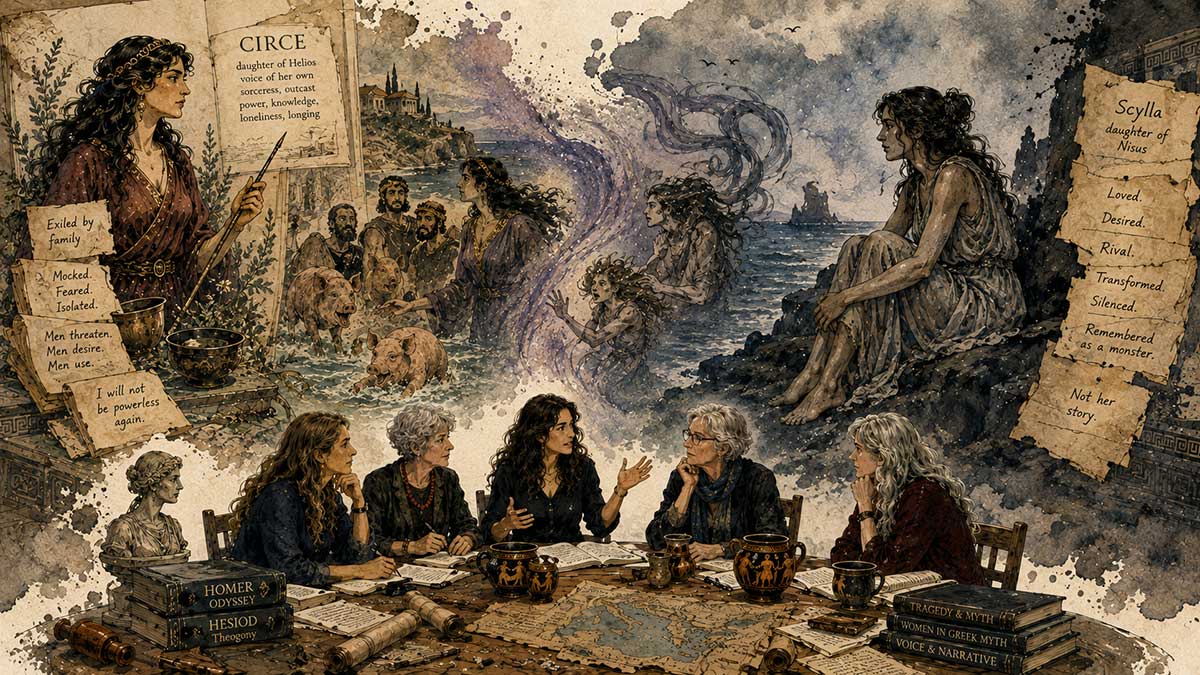
Madeline Miller: Scylla was never optional.
Mary Beard: Yet she could have been.
Madeline Miller: What do you mean?
Mary Beard: You could have made Circe cleaner.
A great many retellings do.
Take a frightening female figure from mythology. Explain that she was misunderstood. Give her suffering. Give her oppressive relatives. Give her abusive men. Reinterpret the frightening things she did as self-defense.
The monster becomes innocent.
It's emotionally satisfying.
Natalie Haynes: And sometimes historically ridiculous.
Emily Wilson: Or simply less interesting.
Mary Beard: Quite.
But you didn't do that with Scylla.
Circe really does something terrible.
Madeline Miller: Yes.
Jean Shinoda Bolen: And she does it before she has developed the emotional capacity to understand what she is doing to herself through another person.
Emily Wilson: There.
That's the language I want us to examine.
"What she is doing to herself through another person."
It is psychologically interesting.
But Scylla is not primarily an event in Circe's psychological development.
Something happens to Scylla.
Jean Shinoda Bolen: You're right.
Emily Wilson: I think this is a recurring danger when we give enormous interiority to one character.
Everyone around the protagonist can become material for that person's growth.
Natalie Haynes: Which is rather ironic in a novel created partly by reversing exactly that problem.
Circe stops being material for Odysseus's story.
But then we have to ask whether Scylla becomes material for Circe's.
Miller nodded.
Madeline Miller: That's fair.
Mary Beard: And this is where the phrase "giving women voices" becomes complicated.
Which woman?
Madeline Miller: Yes.
Mary Beard: We give Circe hundreds of pages.
Scylla gets considerably less.
Natalie Haynes: Poor Scylla has had an absolutely dreadful literary career.
Emily Wilson: Literally turned into a monster and then remembered primarily as geography.
Natalie Haynes: Exactly.
She's the thing sailors must get past.
Mary Beard: Which makes our conversation from the first topic relevant again.
Who gets interiority?
Who gets to become a person?
Who remains an obstacle?
Madeline Miller: I don't think any novel can give equal interiority to everyone.
Mary Beard: Of course not.
That's not my criticism.
I'm asking what moral responsibility comes with choosing whose consciousness the reader inhabits.
Miller considered that.
Madeline Miller: A great deal.
And I wanted Circe's act against Scylla to remain indefensible.
Not misunderstood.
Not secretly justified.
Indefensible.
Jean Shinoda Bolen: Which is psychologically essential.
If Circe's development is going to mean anything, she must eventually confront something more difficult than what others did to her.
She must confront what she did.
Natalie Haynes: Good.
Then perhaps we should state plainly what happens emotionally.
Circe wants Glaucos.
Glaucos wants Scylla.
Circe directs her rage at Scylla.
That pattern has survived rather well.
Mary Beard: Tragically well.
Emily Wilson: And it raises an uncomfortable question about some forms of supposedly empowering storytelling.
Why is the other woman so often easier to hate than the man whose choice actually caused the rejection?
Jean Shinoda Bolen: Because the rival can become an external representation of what the rejected person believes she lacks.
Beauty.
Desirability.
Status.
Youth.
Whatever the wound attaches itself to.
Scylla becomes more than Scylla in Circe's mind.
She becomes evidence.
Madeline Miller: Evidence that Circe wasn't enough.
Jean Shinoda Bolen: Exactly.
Destroy the evidence, and perhaps the shame disappears.
But shame does not work that way.
Mary Beard: And Scylla has the unfortunate experience of discovering this on Circe's behalf.
Bolen nodded.
Jean Shinoda Bolen: Which is why psychological explanation cannot become moral absolution.
Emily Wilson: I want to stay with that.
We use the word "trauma" very freely now.
Sometimes helpfully.
Sometimes so freely that it begins doing moral work it shouldn't do.
Natalie Haynes: Meaning?
Emily Wilson: We learn that someone was harmed.
Then when they cause harm, we instinctively place the second act inside the first.
"They did this because they were wounded."
That may be true.
But causation is not innocence.
Madeline Miller: Absolutely.
Mary Beard: And sometimes the person being harmed has a trauma too.
We simply aren't reading their novel.
Silence.
Natalie Haynes: That's the sentence.
Mary Beard: Think about it.
Every protagonist is surrounded by people who could become protagonists if the camera moved slightly.
Emily Wilson: Yes.
Mary Beard: We know Circe's humiliations because we inhabit them.
If someone wrote Scylla, perhaps Circe would enter halfway through as the terrifying woman who destroys her body over a man.
Madeline Miller: Yes.
Mary Beard: And readers might hate Circe.
Madeline Miller: They might.
Natalie Haynes: Which tells us something important about moral judgment and narrative perspective.
We think we judge characters according to what they do.
Often we judge them according to how long we have been allowed to understand them.
Emily Wilson: Precisely.
Jean Shinoda Bolen: Empathy follows attention.
Mary Beard: And attention is distributed by the storyteller.
Miller sat with that.
Madeline Miller: That's one of the frightening privileges of writing fiction.
Mary Beard: Privilege and manipulation.
Madeline Miller: Yes.
You can make readers forgive someone simply by staying with them long enough.
Emily Wilson: Which raises the question I asked before.
Does your novel make Circe too easy to forgive?
Miller paused.
Madeline Miller: Some readers probably forgive her more readily than I intended.
Natalie Haynes: Do you forgive her?
Miller smiled faintly.
Madeline Miller: I'm not sure that's my decision.
Mary Beard: Very authorial answer.
Madeline Miller: It's true.
Mary Beard: Try again.
They laughed.
Miller thought.
Madeline Miller: I believe she changes.
I believe she becomes capable of seeing what she did more clearly.
I believe remorse matters.
But if you're asking whether sufficient remorse cancels the act—
No.
Jean Shinoda Bolen: Nor should it.
Madeline Miller: I don't think moral growth means arriving at a place where the past no longer counts.
Emily Wilson: That's interesting.
Madeline Miller: Circe cannot return Scylla to the person she was.
There is no spell that makes the moral universe clean again.
Natalie Haynes: Which is wonderfully inconvenient in a book about a witch.
Madeline Miller: Yes.
Magic can transform bodies.
It cannot make responsibility disappear.
Mary Beard: Now we're getting somewhere.
Because there's a popular fantasy hidden inside many redemption stories.
The idea that becoming a better person somehow alters what happened to the people you hurt.
It doesn't.
Jean Shinoda Bolen: Yet the opposite position can become destructive too.
Emily Wilson: Meaning permanent condemnation?
Jean Shinoda Bolen: Yes.
If a person is forever identical to the worst act they committed, transformation becomes conceptually impossible.
Then why change?
Mary Beard: Moral responsibility without permanent identity.
Jean Shinoda Bolen: Exactly.
"I did something terrible" is different from "I am eternally nothing but terrible."
The first permits responsibility.
The second can become narcissistic despair.
Natalie Haynes: Narcissistic?
Jean Shinoda Bolen: Certainly.
Self-hatred can look morally serious, but it can keep attention fixed on the offender.
"I am horrible."
"I am unforgivable."
"I cannot live with myself."
Notice who remains at the center.
The self.
Emily Wilson: The victim disappears again.
Jean Shinoda Bolen: Yes.
Sometimes mature remorse means tolerating the fact that you cannot repair your own image.
You do what repair is possible.
You change.
You accept that forgiveness may never arrive.
Madeline Miller: That feels very close to Circe's eventual relationship with what she did.
Mary Beard: Yet we should be careful again.
We are now giving her a rather sophisticated therapeutic vocabulary.
Jean Shinoda Bolen: I knew you'd say that.
Mary Beard: Someone has to.
They laughed.
Mary Beard: I don't object to the psychology.
I object when contemporary readers forget that we're performing contemporary psychology.
Natalie Haynes: Then let me approach it through myth rather than psychology.
Greek mythology is filled with transformations that externalize violence.
Someone becomes a tree.
A bird.
A monster.
A constellation.
A flower.
Bodies carry stories.
Scylla's monstrous body becomes the permanent record of an act.
Emily Wilson: Yes.
And bodily transformation in ancient myth is rarely merely cosmetic.
It changes what kind of being someone can be.
Natalie Haynes: Exactly.
So when Circe transforms Scylla, she isn't simply hurting her.
She rewrites the terms of Scylla's existence.
Madeline Miller: Which is why Circe cannot dismiss it later as youthful jealousy.
Mary Beard: There's another gender question here.
Circe's emerging strength is celebrated in much of the novel.
Her witchcraft becomes associated with independence.
But the same capacity that liberates her can destroy someone else.
Jean Shinoda Bolen: Power itself does not heal the wound that acquires it.
Mary Beard: Precisely.
That's worth saying again.
Jean Shinoda Bolen: Power does not automatically heal the wound that acquires it.
A powerless person can gain enormous capacity and remain psychologically organized around humiliation.
Then the new strength simply gives the old wound greater reach.
Miller nodded.
Madeline Miller: That's Circe and Scylla.
Jean Shinoda Bolen: Yes.
She discovers what she can do before she understands why she wants to do it.
Emily Wilson: Which complicates the empowerment reading nicely.
Natalie Haynes: Very nicely.
Because "she found her strength" sounds wonderful until we ask what she does five minutes later.
Mary Beard: Modern culture has occasionally confused agency with virtue.
Emily Wilson: Absolutely.
Mary Beard: A woman making her own choices is exercising agency.
That doesn't mean the choices are morally good.
Natalie Haynes: Women are entitled to be ethically dreadful too.
Mary Beard: Equality at last.
Everyone laughed.
Madeline Miller: I actually think that's important.
Sometimes supposedly feminist storytelling creates women who are allowed to be strong but not truly morally compromised.
Their apparent wrongdoing is eventually explained as misunderstanding, manipulation, coercion, self-defense.
I wanted Circe to have genuine culpability.
Emily Wilson: Why?
Madeline Miller: Because otherwise she's not fully human.
Mary Beard: Interesting answer.
Madeline Miller: Men in literature have been permitted enormous moral range.
They can be heroic and cruel.
Brilliant and selfish.
Loving and destructive.
Women have often been pushed into narrower symbolic roles.
The good woman.
The dangerous woman.
The faithful wife.
The witch.
The seductress.
The victim.
I didn't want Circe merely transferred from "dangerous woman" to "good misunderstood woman."
Natalie Haynes: Yes.
That's just moving her into another cage.
Madeline Miller: Exactly.
Emily Wilson: Then perhaps the feminist achievement isn't that Circe becomes innocent.
It's that she becomes morally complicated.
Madeline Miller: That's closer to what interests me.
Mary Beard: I like that much more than "reclaiming her voice."
Natalie Haynes: Mary has officially approved the novel.
Mary Beard: Don't be absurd.
We have three topics remaining.
They laughed.
Then Wilson became serious.
Emily Wilson: But there's another part of the novel we need to confront if we're talking about gender and trauma.
The sailors.
Miller nodded.
Emily Wilson: Circe encounters men who recognize that she is a woman alone.
The situation becomes violent.
Later, men become pigs.
For modern readers, those events are causally connected in a very powerful way.
Jean Shinoda Bolen: Her magic becomes defensive.
Emily Wilson: Yes.
And that changes how readers interpret the famous Homeric episode.
Natalie Haynes: Dramatically.
Emily Wilson: In Homer, we encounter men transformed by Circe.
Miller gives modern readers a history that makes the transformation comprehensible as a response to male violence.
Mary Beard: And here we must ask whether comprehensible becomes justified.
Madeline Miller: Sometimes it is self-defense.
Sometimes her response becomes broader than the immediate threat.
That distinction matters.
Jean Shinoda Bolen: Trauma generalizes.
A particular danger can become a category.
One man harms you.
Eventually the nervous system learns:
Men are dangerous.
Mary Beard: Again, psychologically comprehensible.
But socially dangerous.
Jean Shinoda Bolen: Very.
Emily Wilson: Because once categories replace individuals, moral judgment changes.
Natalie Haynes: Which connects directly to transformation.
If you have already decided someone is a pig, turning him into one becomes easier.
Mary Beard: That's rather good.
Natalie Haynes: Thank you.
Mary Beard: Don't become accustomed to it.
Haynes laughed.
Madeline Miller: One of the things that interested me about transformation was the idea that magic could reveal rather than merely change.
But that idea has to be handled carefully.
If Circe transforms threatening men into pigs and readers think, "They were pigs already," we risk dehumanizing them in exactly the way violence often works.
Emily Wilson: Yes.
And ancient mythology repeatedly warns us about unstable boundaries between human and animal.
Jean Shinoda Bolen: Psychologically, calling someone an animal is one of the oldest ways of making cruelty easier.
Mary Beard: Which gives the pigs a darker contemporary resonance.
Not simply female revenge.
The moral danger of deciding that another person has forfeited humanity.
Miller nodded.
Madeline Miller: That is why I would resist celebrating those scenes simply as revenge fantasy.
Natalie Haynes: Yet readers do.
Madeline Miller: I know.
Natalie Haynes: Why do you think they find it satisfying?
Miller thought.
Madeline Miller: Because many people know what it feels like to be physically vulnerable.
To calculate whether a room is safe.
Whether a person is safe.
Whether saying no will be respected.
There is fantasy in suddenly possessing overwhelming control in a situation where you once had none.
Jean Shinoda Bolen: The fantasy is not necessarily "I want to hurt."
It may be "I never want to be helpless again."
Mary Beard: But those can become dangerously close.
Jean Shinoda Bolen: Exactly.
That is the psychological problem.
Emily Wilson: And perhaps one of the novel's strongest ideas.
Circe's development cannot end with gaining enough strength that nobody can hurt her.
Madeline Miller: No.
Emily Wilson: She must learn what strength is for.
Madeline Miller: Yes.
Natalie Haynes: Which returns us to Scylla.
Scylla is what happens when strength arrives before wisdom.
Miller was silent for a moment.
Madeline Miller: Yes.
I think that's fair.
Mary Beard: Then let's return to the word "feminist."
Is Circe a feminist novel?
Miller smiled.
Madeline Miller: I knew we'd get there.
Natalie Haynes: You wrote a novel about a woman marginalized by powerful gods, sexually threatened by men, discovering her own abilities, questioning patriarchal structures, refusing to remain a supporting character in a male hero's narrative—
Mary Beard: Natalie has prepared the prosecution.
Natalie Haynes: I thought I was defending it.
Mary Beard: Same skill set.
Madeline Miller: Yes, I consider feminism deeply relevant to the book.
Mary Beard: But is that the whole book?
Madeline Miller: No.
Jean Shinoda Bolen: It becomes reductive if every relationship is interpreted only through domination.
Emily Wilson: And historically problematic if we flatten ancient gender systems into contemporary slogans.
Natalie Haynes: Yet equally problematic to become so frightened of anachronism that we pretend gender is irrelevant.
Emily Wilson: Completely agreed.
Mary Beard: Good. There is a middle ground somewhere and apparently we are condemned to find it.
Madeline Miller: Perhaps the question isn't whether Circe is feminist.
Perhaps it's what kind of feminism the novel permits.
Mary Beard: Go on.
Madeline Miller: If feminism means Circe becomes strong, defeats oppressive men, and discovers she doesn't need anyone, then that's not the arc I wanted.
Jean Shinoda Bolen: Because she eventually chooses relationship.
Madeline Miller: Relationship, vulnerability, motherhood, mortality.
She doesn't become free by needing nobody.
She becomes freer by learning that needing people does not require surrendering herself.
Bolen nodded.
Jean Shinoda Bolen: That's psychologically much richer.
Dependence and independence are often treated as opposites.
Maturity may involve interdependence.
I can love you.
Need you.
Grieve you.
Be changed by you.
Yet you do not determine whether I exist.
Mary Beard: That sounds very modern.
Jean Shinoda Bolen: It is very human too.
Mary Beard: I'll allow it provisionally.
Natalie Haynes: High praise.
Then Beard leaned toward Miller.
Mary Beard: I have one last uncomfortable question about Scylla.
Madeline Miller: Go ahead.
Mary Beard: Suppose Scylla were sitting here.
Not symbolic Scylla.
Not Scylla as a lesson in Circe's growth.
Scylla herself.
And she heard us spend an hour explaining Circe's childhood, her humiliation, her family, her psychology, her trauma.
What might she say?
Nobody answered immediately.
Miller looked down.
Wilson watched her.
Bolen became very still.
Finally Haynes spoke.
Natalie Haynes: Perhaps:
"Why does the woman who destroyed me get the explanation?"
Silence.
Emily Wilson: Yes.
Mary Beard: And that is a question every story of redemption should fear.
Miller looked up.
Madeline Miller: I think Scylla would be entitled to reject every explanation.
Jean Shinoda Bolen: She does not need to understand Circe to make Circe's remorse legitimate.
Madeline Miller: No.
Emily Wilson: Nor forgive her.
Madeline Miller: No.
Mary Beard: Nor participate in her redemption.
Madeline Miller: No.
Natalie Haynes: That's significant.
The victim is not responsible for completing the offender's transformation.
Jean Shinoda Bolen: Exactly.
Madeline Miller: Circe has to become different without demanding that Scylla certify the difference.
Beard nodded.
Mary Beard: Now that is a moral development I can believe in.
Wilson looked toward Miller.
Emily Wilson: And perhaps that's where the feminist question becomes deeper too.
Not:
"Was Circe justified because she suffered?"
But:
"Can we take a woman's suffering seriously without making her morally innocent?"
Natalie Haynes: And can we take her agency seriously enough to hold her responsible for what she does with it?
Jean Shinoda Bolen: Compassion without absolution.
Mary Beard: Responsibility without dehumanization.
Miller nodded.
Madeline Miller: And change without pretending the past changed with you.
They sat quietly with that.
Then Haynes looked toward Wilson.
Natalie Haynes: There's someone we've been strangely gentle with.
Wilson smiled.
Emily Wilson: I was wondering when we'd notice.
Mary Beard: The famous man?
Natalie Haynes: The very famous man.
Madeline Miller: Odysseus.
Natalie Haynes: We have examined Circe's moral failures in extraordinary detail.
Perhaps fairness requires that we turn the same scrutiny toward the hero whose reputation has survived for nearly three thousand years.
Emily Wilson: Good.
But I want one condition.
Mary Beard: Which?
Emily Wilson: We do not turn Odysseus into a modern villain simply because modern readers are suspicious of ancient heroes.
Madeline Miller: Agreed.
Natalie Haynes: Then the harder question is better anyway.
Jean Shinoda Bolen: Which question?
Wilson leaned forward.
Emily Wilson: How can the same qualities that make someone extraordinary in an epic make that person extraordinarily difficult to love?
And suddenly the conversation had moved from the woman once called a monster to the man history called a hero.
Topic 3 — Odysseus and the Cost of Heroism
Emily Wilson: Let’s begin by refusing the easy version.
Odysseus is not secretly a villain.
Natalie Haynes: Nor is he simply the noble hero later readers polished him into.
Mary Beard: Good. We have eliminated both posters.
Madeline Miller: That was important to me. I did not want to write, “Actually, Odysseus was awful.” That would be dull.
Jean Shinoda Bolen: And psychologically false. People who cause deep pain are often not uniformly cruel.
Emily Wilson: Exactly. Homer’s Odysseus is already complicated. He is brilliant, manipulative, resourceful, loving, deceptive, patient, ruthless, loyal in some ways, faithless in others.
Natalie Haynes: Which is why I always find it strange when people say modern retellings “darken” him, as though Homer gave us a cheerful family man.
Mary Beard: Homer gave us a man who survives.
That is not the same thing as a man who is easy to live with.
Madeline Miller: That difference interested me enormously.
Emily Wilson: Survival is central to him.
He improvises.
He lies.
He reads danger quickly.
He performs different versions of himself when needed.
Those traits are magnificent in a hostile environment.
Jean Shinoda Bolen: And potentially destructive in intimacy.
Emily Wilson: Yes.
Mary Beard: There is our question.
What happens when the skills that save you in war enter the household?
Natalie Haynes: Suspicion.
Control.
Testing.
Strategic speech.
Always looking for leverage.
Madeline Miller: The inability to stop anticipating danger.
Jean Shinoda Bolen: Trauma can preserve behaviors long after the environment that created them has changed.
A person may return home physically and remain psychologically organized around threat.
Mary Beard: We should be careful again with the clinical language.
Jean Shinoda Bolen: Of course.
I am not diagnosing Odysseus.
I am saying the pattern is recognizable.
Emily Wilson: And some of it is already present in the epic.
He does not simply return home, announce himself, embrace Penelope, and resume domestic life.
He tests.
Conceals.
Plans.
Assesses.
Natalie Haynes: Which makes perfect sense in the situation he returns to.
Emily Wilson: Yes.
That part matters.
The household is dangerous.
The suitors are real.
The threat is not imaginary.
Mary Beard: Yet a habit can be justified in one moment and corrosive in another.
Madeline Miller: That was very much my interest.
Odysseus has become exceptionally good at surviving situations where trust is dangerous.
But marriage requires trust.
Parenthood requires it too.
Jean Shinoda Bolen: Intimacy requires surrendering some strategic advantage.
Mary Beard: And Odysseus is not naturally enthusiastic about surrendering advantage.
They laughed.
Natalie Haynes: He would prefer to win the marriage.
Emily Wilson: Which is an excellent way to lose one.
Madeline Miller: Exactly.
Mary Beard: There is another point.
Ancient heroism is built around public action.
What can you do?
Whom can you defeat?
What can you endure?
What will people remember?
Domestic life rewards a different set of capacities.
Jean Shinoda Bolen: Listening.
Repair.
Patience.
Emotional exposure.
Mary Beard: None of which earns a poem very easily.
Natalie Haynes: “Odysseus sat quietly and apologized without explaining himself.”
Emily Wilson: Six thousand lines.
Mary Beard: Lost masterpiece.
They laughed.
Then Wilson became serious again.
Emily Wilson: The difficulty is that modern readers can judge the heroic code from outside it.
For the ancient audience, kleos—lasting fame, glory, being remembered—matters profoundly.
Madeline Miller: Yes.
Emily Wilson: So when we criticize Odysseus for caring about reputation, we should remember that this is not merely personal vanity in the modern sense.
It belongs to a whole moral system.
Mary Beard: A system built in part around male public recognition.
Emily Wilson: Certainly.
Natalie Haynes: Which already means the cost is distributed unevenly.
The person pursuing glory leaves.
Someone else remains.
Madeline Miller: That became central in my treatment of Penelope.
Mary Beard: Let’s talk about her.
History loves to call her faithful.
Natalie Haynes: Which sounds complimentary until you notice how much of her life gets compressed into that adjective.
Emily Wilson: Yes.
“Faithful Penelope.”
Twenty years disappear.
Mary Beard: A woman manages a household under enormous pressure, protects her son, negotiates predatory suitors, preserves political stability, and what survives?
She waited.
Jean Shinoda Bolen: That is psychologically significant too.
When one partner becomes the publicly meaningful person, the other can become a supporting function.
Madeline Miller: And that is exactly what I wanted to resist.
Natalie Haynes: Yet there is a danger here too.
We can become so eager to recover Penelope that we flatten her into the wise wife who sees through the narcissistic hero.
Emily Wilson: Yes.
Homer’s Penelope is much more interesting than that.
She is clever herself.
She withholds.
Tests.
Strategizes.
Mary Beard: Which is why she and Odysseus belong together so powerfully.
They recognize each other’s intelligence.
Emily Wilson: Exactly.
The marriage is not simply “patient woman survives difficult man.”
It is a meeting of two extraordinary minds.
Madeline Miller: I agree.
That made the darker domestic implications more interesting, not less.
Jean Shinoda Bolen: Because similarity can create attraction and conflict.
Two highly intelligent, strategic people may understand one another deeply and still wound each other.
Mary Beard: There is something else modern readers often do.
We compare public greatness and private goodness as though one invalidates the other.
Natalie Haynes: Meaning?
Mary Beard: Suppose Odysseus is brilliant in war and difficult at home.
Some readers say, “Then he was never a hero.”
Others say, “He was a hero, so complaints about his private conduct are petty.”
Both are crude.
Emily Wilson: Yes.
Heroic excellence is domain-specific.
Jean Shinoda Bolen: That matters psychologically too.
Competence in one area does not transfer automatically.
A person can lead thousands and fail one child.
Madeline Miller: Or save a city and damage a marriage.
Natalie Haynes: Which is one of the most modern-feeling questions in the novel.
How much private harm are we willing to overlook when someone is publicly exceptional?
Mary Beard: That is hardly only modern.
Courts have been asking versions of it forever.
Emily Wilson: But our current culture is very alert to it.
Public achievement no longer guarantees moral authority in every part of life.
Madeline Miller: Nor should it.
Jean Shinoda Bolen: Yet we should resist another fantasy.
That private goodness must look gentle.
Some people love in ways shaped by danger, duty, ambition, and fear.
Their love may be real and still be difficult to receive.
Natalie Haynes: That’s Odysseus.
Jean Shinoda Bolen: Very much.
Mary Beard: Let’s make this sharper.
Was Miller unfair to him?
Wilson looked toward Miller.
Emily Wilson: I was going to ask that.
Madeline Miller: Please do.
Emily Wilson: Some readers feel your Odysseus is darker, more damaged, more dangerous after returning home than the Odysseus they remember.
Did you tilt him to serve Circe’s arc?
Miller paused.
Madeline Miller: I interpreted qualities already present.
I did not want to falsify him.
But I was interested in what prolonged war, loss, deception, and survival might leave behind.
Emily Wilson: So yes, in a sense you extrapolated.
Madeline Miller: Absolutely.
Mary Beard: Which returns us to Topic 1.
A modern psychological continuation.
Madeline Miller: Yes.
Natalie Haynes: But there is textual permission for darkness.
Odysseus is capable of tremendous violence.
Emily Wilson: Of course.
We should not sanitize the epic.
The killing of the suitors is not a tea party.
Mary Beard: Nor is the treatment of the enslaved women.
Natalie Haynes: Precisely.
Modern audiences sometimes remember the clever horse, the Cyclops, the sirens, and forget just how brutal these stories can be.
Jean Shinoda Bolen: Which raises another question.
Do readers prefer a clean hero partly because we need admiration to feel safe?
Mary Beard: Explain.
Jean Shinoda Bolen: Ambivalent heroes are unsettling.
If someone is admirable and harmful, we cannot rely on a simple category.
We have to judge action by action.
Relationship by relationship.
That is harder.
Emily Wilson: And more faithful to much ancient literature.
Natalie Haynes: Greek myth does not care much for moral hygiene.
Mary Beard: Thankfully.
Madeline Miller: I think that is one reason Odysseus remains so alive.
If he were only admirable, he would be less interesting.
Emily Wilson: Or only condemnable.
Madeline Miller: Yes.
Mary Beard: Now, Telemachus.
Natalie Haynes: The son of the legend.
Jean Shinoda Bolen: Which may be the more painful position.
Madeline Miller: He interested me partly because he has to build an identity beneath someone else’s fame.
Emily Wilson: And that is already central to the Odyssey.
Telemachus begins in a house dominated by absence.
He is the son of a man everyone knows.
Yet he barely knows him.
Mary Beard: That is an extraordinary psychological condition.
Everyone tells you what your father means before you know what he means to you.
Jean Shinoda Bolen: The child inherits an image before a relationship.
Natalie Haynes: And the image is impossible to compete with.
How do you become yourself if the standard is Odysseus?
Madeline Miller: That became one of the reasons I was drawn to Telemachus as a contrast.
He does not need to become a second Odysseus.
Emily Wilson: Which is a very modern and very compelling choice.
Mary Beard: There is our modernity again.
The child rejecting inherited destiny.
Jean Shinoda Bolen: Yet psychologically recognizable.
Mary Beard: I’ll allow that phrase.
Jean Shinoda Bolen: Thank you.
Natalie Haynes: We should put that on a certificate.
They laughed.
Then Wilson turned toward Miller.
Emily Wilson: Your Telemachus also changes the meaning of masculinity.
Madeline Miller: Yes.
Emily Wilson: Odysseus represents adaptive brilliance, action, risk, cunning, survival.
Telemachus can represent refusal.
Quiet.
A different relation to glory.
Mary Beard: Which brings us to kleos again.
Odysseus becomes immortal through memory.
Telemachus does not seem to want that kind of immortality.
Jean Shinoda Bolen: That may be one of the deepest father-son tensions in the book.
Parents often confuse inheritance with repetition.
“I give you what made my life meaningful, so it should make yours meaningful too.”
Madeline Miller: Exactly.
Natalie Haynes: And children keep ruining this very efficient plan by becoming themselves.
Mary Beard: Appalling behavior.
Emily Wilson: Mythology would collapse without it.
They smiled.
Then Haynes leaned forward.
Natalie Haynes: I want to ask something uncomfortable about modern readers.
Why are we so ready now to distrust heroes?
Mary Beard: Historical experience.
Emily Wilson: Cultural change.
Jean Shinoda Bolen: Disillusionment with authority.
Madeline Miller: Greater attention to people who bear the cost of someone else’s greatness.
Natalie Haynes: Yes.
But do we sometimes overcorrect?
Do we turn every exceptional figure into a case study in hidden harm?
Mary Beard: Certainly.
Suspicion can become as lazy as worship.
Emily Wilson: Exactly.
If older readings romanticized Odysseus, newer readings can pathologize him.
Neither is enough.
Jean Shinoda Bolen: The mature position is ambivalence.
Mary Beard: That is a word people hate.
Jean Shinoda Bolen: Which is why it matters.
To love someone and see the harm.
To admire someone and reject part of what they did.
To recognize courage without converting it into moral perfection.
Madeline Miller: That is very close to what I wanted with Odysseus.
Emily Wilson: Then let me ask the strongest version.
Can someone be a hero and a wound at the same time?
Mary Beard: Of course.
Natalie Haynes: Yes.
Jean Shinoda Bolen: Easily.
Miller nodded.
Madeline Miller: Yes.
Emily Wilson: Then why does that answer still feel difficult?
Mary Beard: Because “hero” is often used as a total moral category.
Once we call someone a hero, we want the word to bless the whole person.
Natalie Haynes: And “abuser,” “villain,” “monster” can function the same way in reverse.
Jean Shinoda Bolen: Totalizing labels protect us from contradiction.
Madeline Miller: But contradiction is where people actually live.
Emily Wilson: Ancient literature knew this rather well.
Mary Beard: Better than some modern social media discussions, certainly.
Natalie Haynes: Low bar.
They laughed.
Then Bolen became quiet.
Jean Shinoda Bolen: I want to return to one thing Mary said.
A person can save a city and fail one child.
There is something devastating about that.
Madeline Miller: Yes.
Jean Shinoda Bolen: Public life rewards scale.
How many people did you lead?
How much did you win?
How far did you travel?
Private life can turn on one neglected conversation.
One absence.
One child who keeps wondering whether he mattered.
Mary Beard: History is terrible at measuring that.
Emily Wilson: Epic is too.
Not because epic is defective.
It measures something else.
Natalie Haynes: Which is why retellings exist.
To change the scale.
Madeline Miller: Exactly.
If the epic asks, “How does Odysseus get home?”
The novel can ask, “What does home experience when he arrives?”
Mary Beard: That may be the sharpest distinction we’ve had.
Emily Wilson: Yes.
Jean Shinoda Bolen: And the home may discover that return is not the same as repair.
Silence.
Madeline Miller: That mattered deeply to me.
People often think reunion solves absence.
It doesn’t.
Reunion begins another problem.
Who are we now?
Who did we become without each other?
Can the relationship survive the difference?
Mary Beard: Which makes Penelope’s position extraordinarily difficult.
She waited for a man who could not possibly return unchanged.
Natalie Haynes: Nor was she unchanged.
Emily Wilson: Precisely.
The romantic fantasy says, “He came home.”
The more interesting question is, “Who came home to whom?”
Jean Shinoda Bolen: That is beautiful.
Mary Beard: Don’t encourage her.
They smiled.
Then Beard turned toward Miller.
Mary Beard: Let me press you one last time.
Suppose a reader finishes your book saying, “Odysseus was a terrible husband and father.”
Would you consider that a successful reading?
Miller thought.
Madeline Miller: Incomplete.
Mary Beard: Why?
Madeline Miller: Because it reduces him again.
I would rather the reader say:
“He was capable of extraordinary courage and extraordinary damage.”
“He loved people and wounded them.”
“He survived things that changed him.”
“He was responsible for some of what followed.”
“He was shaped by a heroic culture and still made choices within it.”
That is harder.
Emily Wilson: Much harder.
Natalie Haynes: And less satisfying if what you want is a verdict.
Jean Shinoda Bolen: But more useful if what you want is recognition.
Mary Beard: Recognition of what?
Bolen paused.
Jean Shinoda Bolen: That the qualities we admire in someone can be the same qualities that make intimacy with them painful.
Silence followed.
Miller looked toward Wilson.
Madeline Miller: Cunning becomes manipulation.
Emily Wilson: Courage becomes recklessness.
Natalie Haynes: Ambition becomes restlessness.
Mary Beard: Authority becomes control.
Jean Shinoda Bolen: Self-reliance becomes emotional distance.
Madeline Miller: Survival becomes an inability to stop fighting.
No one spoke for a moment.
Then Haynes said quietly:
Natalie Haynes: Perhaps that is why heroism becomes dangerous when we make it an identity rather than an act.
Emily Wilson: Explain.
Natalie Haynes: A heroic act may be admirable.
A person who begins needing to be “the hero” may start requiring danger, dependence, admiration, or enemies.
Mary Beard: That is good.
Madeline Miller: And ordinary life can feel intolerably small.
Jean Shinoda Bolen: Which may explain why peace is so difficult for some people who have built themselves around crisis.
Emily Wilson: There we reach something very important.
The epic ends with return.
But psychologically, return may be the beginning of the hardest task.
Mary Beard: Learning how to be unnecessary.
That stopped everyone.
Madeline Miller: Say that again.
Mary Beard: Learning how to be unnecessary.
The hero is necessary in crisis.
The kingdom needs him.
The soldiers need him.
The journey needs his cleverness.
Then he comes home.
Dinner does not require a hero.
A child may need a father, but not a legend.
A spouse may need presence, not strategy.
Jean Shinoda Bolen: That transition can be terrifying.
Natalie Haynes: Especially if being needed became the proof that you mattered.
Miller nodded slowly.
Madeline Miller: Which brings us strangely close to Circe.
Emily Wilson: Yes.
She begins by asking others to prove her worth.
Odysseus may spend his life asking danger to prove his.
Mary Beard: Very different lives.
Similar hunger.
Jean Shinoda Bolen: To know that one matters.
Natalie Haynes: Then Telemachus offers the opposite possibility.
A life that does not need to become legendary to be meaningful.
Miller looked toward her.
Madeline Miller: Exactly.
Emily Wilson: Which raises the next question naturally.
If Telemachus does not want his father’s model of greatness, what does he want?
Jean Shinoda Bolen: Perhaps something Circe wants too.
Relationship without possession.
Love without destiny.
A life small enough to inhabit.
Mary Beard: And that brings us dangerously near motherhood.
Natalie Haynes: More dangerous than Troy.
Mary Beard: Almost certainly.
Miller smiled.
Madeline Miller: Then perhaps that is where we should go next.
Because Circe can survive gods, monsters, exile, and men.
But motherhood gives her a problem her magic cannot solve:
how to protect someone she loves without preventing him from becoming someone she cannot control.
Topic 4 — Motherhood, Protection, and Psychological Transformation
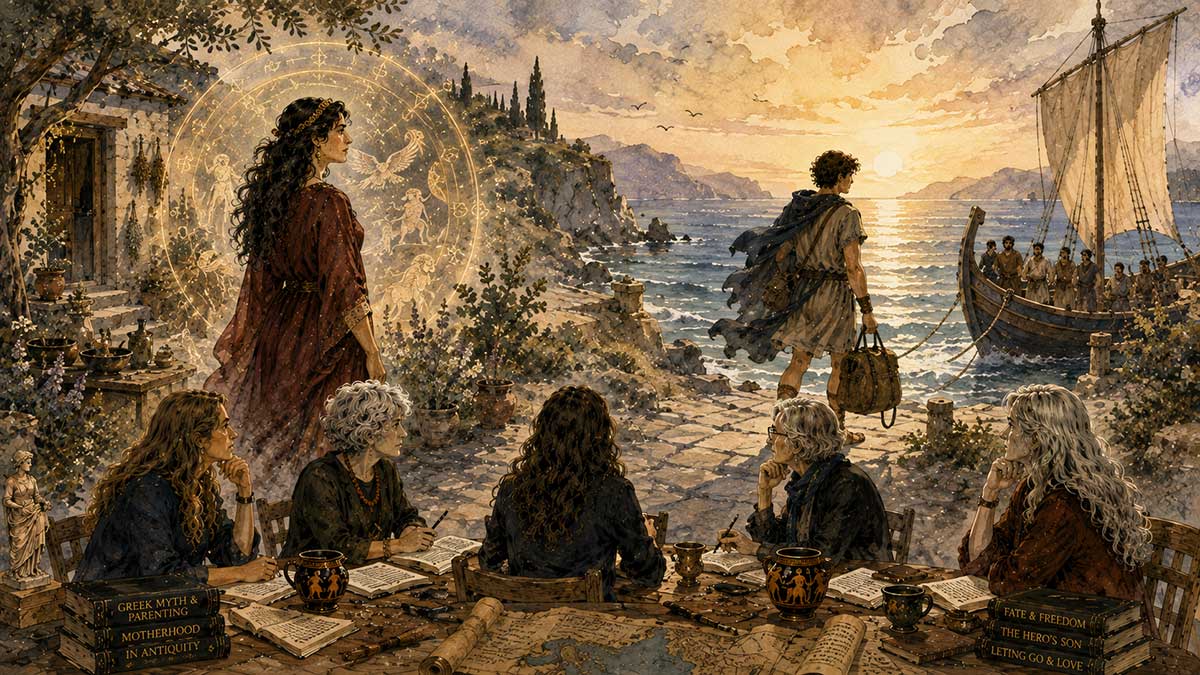
Jean Shinoda Bolen: Motherhood changes the structure of Circe’s fear.
Before Telegonus, much of her fear concerns what others can do to her.
After Telegonus, the question becomes what the world can do to someone she loves more than herself.
Madeline Miller: Yes. That was one of the great shifts I wanted.
Mary Beard: And one of the places where modern readers may feel immediate recognition.
A powerful woman becomes frightened by the vulnerability of a child.
Emily Wilson: Yet we should be careful not to make motherhood the final proof of Circe’s humanity.
Natalie Haynes: Good.
Emily Wilson: Women in literature have been told for a very long time that they become complete through motherhood.
That would be too simple here.
Madeline Miller: I agree.
Motherhood does not complete Circe.
It exposes her.
Jean Shinoda Bolen: Exactly.
It opens a part of her that strength alone could not reach.
Mary Beard: Explain that distinction.
Jean Shinoda Bolen: Circe has already learned to defend herself.
She has magic.
She has knowledge.
She has survived isolation.
She can transform danger.
Then she has a child.
Suddenly she confronts something intolerable:
her strength has limits.
Natalie Haynes: She can fight gods.
She cannot guarantee that her son will never suffer.
Jean Shinoda Bolen: Yes.
That is psychologically enormous.
A parent may feel responsibility without having control.
Those two experiences are constantly confused.
Madeline Miller: Circe confuses them too.
Mary Beard: Most parents do.
Emily Wilson: And perhaps gods more than most.
Miller smiled.
Madeline Miller: Certainly Circe.
Natalie Haynes: There is something almost cruel in giving an immortal mother a mortal child.
Madeline Miller: Very much so.
Jean Shinoda Bolen: Because mortality becomes intimate.
Before Telegonus, death belongs largely to others.
After him, mortality has a face.
Mary Beard: Her son's face.
Jean Shinoda Bolen: Yes.
And that makes every ordinary parental fear larger.
Illness.
Accident.
Danger.
Separation.
For Circe, those fears exist beside literal divine threats.
Emily Wilson: Athena is not a metaphor.
Madeline Miller: Exactly.
That mattered.
Circe is not merely catastrophizing.
There really is danger.
Mary Beard: Which makes the moral question harder.
If the danger were imaginary, we could simply say, “She is overprotective.”
But what happens when the danger is real?
Natalie Haynes: That is the question many parents would recognize.
Jean Shinoda Bolen: Real danger can still become the justification for unlimited control.
Emily Wilson: There.
That is where I think the novel becomes interesting.
The fact that Circe is right about danger does not mean every act of protection becomes right.
Madeline Miller: Yes.
Mary Beard: That distinction matters far beyond the novel.
Fear says, “Something terrible could happen.”
Control answers, “Then I must decide everything for you.”
Jean Shinoda Bolen: And the child eventually asks, “When do I become responsible for my own risk?”
Natalie Haynes: Telegonus has to leave.
Madeline Miller: He does.
Natalie Haynes: And Circe knows what may happen.
Madeline Miller: Or at least she knows enough to be terrified.
Jean Shinoda Bolen: Which makes letting him go a greater act of development than defeating an enemy.
Mary Beard: That is an interesting claim.
Greater than magic?
Jean Shinoda Bolen: Psychologically, yes.
Defeating an enemy confirms control.
Letting a child leave requires surrendering it.
Emily Wilson: But should we romanticize that surrender?
Jean Shinoda Bolen: No.
Emily Wilson: I ask because modern parenting discourse can become sentimental about “letting go.”
Ancient families were not organized around the same ideals of individual self-realization.
Mary Beard: Quite.
Children were embedded in household continuity, inheritance, obligation, status.
Madeline Miller: True.
Natalie Haynes: Yet Telegonus’s desire to know his father feels almost mythically inevitable.
Emily Wilson: Yes.
Parentage matters profoundly in ancient literature.
Who is your father?
Who is your mother?
What line do you belong to?
These are not private psychological curiosities.
They locate you in the social and heroic order.
Mary Beard: So Telegonus wanting Odysseus is not merely a modern child wanting emotional closure.
Emily Wilson: Exactly.
There are multiple layers.
Genealogy.
Identity.
Status.
Story.
Origin.
Jean Shinoda Bolen: Yet psychologically, the absent parent can become enormous precisely through absence.
Madeline Miller: That interested me very much.
Telegonus knows Circe intimately.
Odysseus is largely imagination.
Mary Beard: Which gives the absent father a remarkable advantage.
Natalie Haynes: He never has to leave his sandals in the wrong place.
Emily Wilson: Or disappoint the child through ordinary proximity.
They laughed.
Jean Shinoda Bolen: The imagined parent can become perfect, terrifying, glorious, shameful, or all four.
The child fills the absence with meaning.
Madeline Miller: And Circe knows that.
She knows she cannot simply erase his father from him.
Mary Beard: Yet part of her wants to.
Madeline Miller: Yes.
Natalie Haynes: Because Odysseus belongs to her own history too.
Madeline Miller: Exactly.
Telegonus’s curiosity reaches into a part of Circe’s life she does not fully control.
Jean Shinoda Bolen: That is where parental fear can become personal.
The parent says, “I am protecting you.”
But part of what is being protected may be the parent’s own emotional equilibrium.
Mary Beard: Which is a rather uncomfortable thought.
Jean Shinoda Bolen: It should be.
Parents do things for children and for themselves at the same time.
Love is rarely chemically pure.
Emily Wilson: Nor should we expect it to be.
Natalie Haynes: But that complicates sacrifice.
Mary Beard: Yes.
Sacrifice can become moral currency.
Madeline Miller: Meaning?
Mary Beard: “After everything I have done for you.”
That sentence has remarkable force.
Jean Shinoda Bolen: It converts care into debt.
Natalie Haynes: And the child may feel that independence is betrayal.
Madeline Miller: That is very close to Circe’s fear.
If Telegonus leaves, some part of her experiences it as loss.
Perhaps even rejection.
Jean Shinoda Bolen: Which returns us to the beginning of the novel.
Circe has spent years learning that another person leaving does not mean she ceases to exist.
Then motherhood forces her to learn the lesson again at a deeper level.
Mary Beard: That is useful.
Her old wound reappears in a new relationship.
Emily Wilson: Yet the relationship itself is different.
A child genuinely depends upon the parent.
Jean Shinoda Bolen: Precisely.
That is why old wounds can hide so easily inside legitimate care.
A parent with abandonment wounds can say, “My child needs me.”
And for years, the child does.
Then one day the statement becomes less true.
The parent has to change too.
Natalie Haynes: Children grow out of the arrangement that made parenthood possible.
Mary Beard: Rather inconsiderate of them.
Madeline Miller: Very.
They smiled.
Then Bolen leaned forward.
Jean Shinoda Bolen: There is another reason motherhood changes Circe.
Her love for Telegonus is not primarily based on being chosen.
Madeline Miller: Yes.
Jean Shinoda Bolen: That matters.
Glaucos chooses or rejects her.
Odysseus arrives and leaves.
Her family judges her.
These relationships continually activate the question, “What am I worth to you?”
A baby cannot answer that question in the same way.
Mary Beard: Though babies are excellent at making one feel necessary.
Jean Shinoda Bolen: Exactly.
And that creates a different danger.
Being needed can become intoxicating.
Emily Wilson: Particularly for someone who spent her early life feeling unnecessary.
Miller looked toward Wilson.
Madeline Miller: Yes.
That was important.
Jean Shinoda Bolen: Telegonus gives Circe an experience she has almost never had.
Someone needs her completely.
Natalie Haynes: Which could feel like healing.
Jean Shinoda Bolen: And become another trap.
Mary Beard: There we are.
Madeline Miller: Because eventually he should not need her completely.
Jean Shinoda Bolen: Yes.
Healthy development reduces dependence.
That can feel like success to the child and loss to the parent.
Emily Wilson: There is something almost tragic in that.
Good parenting creates the conditions under which the child can leave.
Natalie Haynes: Which means success can feel like abandonment.
Jean Shinoda Bolen: Exactly.
Mary Beard: And now I understand why this section affects readers so strongly.
The mother who has done everything right may still have to lose the version of the relationship she loved.
Madeline Miller: Yes.
Emily Wilson: But what does “everything right” mean here?
Circe is intensely protective.
Is she a good mother?
Madeline Miller: I think she is a loving mother.
That is not exactly the same question.
Mary Beard: Good answer.
Jean Shinoda Bolen: Love and healthy behavior are not identical.
Natalie Haynes: People dislike that.
Jean Shinoda Bolen: Very much.
We want sincere love to guarantee good outcomes.
It does not.
A parent can love deeply and become intrusive.
A spouse can love deeply and become possessive.
A child can love deeply and become manipulative.
Love describes the attachment.
It does not automatically describe the quality of every action.
Emily Wilson: Then perhaps the question is not, “Did Circe love Telegonus?”
She obviously did.
Mary Beard: The question is, “What did her love permit her to do?”
Madeline Miller: Yes.
Natalie Haynes: And what did it require her eventually to stop doing?
Silence.
Jean Shinoda Bolen: Protecting him from every possible consequence.
Madeline Miller: Exactly.
Mary Beard: That is difficult.
Jean Shinoda Bolen: Very.
Parents often want to prevent pain.
But some forms of pain belong to development.
Disappointment.
Failure.
Heartbreak.
Regret.
Wrong decisions.
The parent cannot remove all of them without removing experience.
Emily Wilson: Yet Telegonus’s consequences are not trivial.
Jean Shinoda Bolen: No.
And that is why this story refuses an easy parenting lesson.
He leaves.
Tragedy follows.
Natalie Haynes: Odysseus dies.
Madeline Miller: Yes.
Mary Beard: So the frightening parent can say, “You see? I was right.”
Miller went quiet.
Jean Shinoda Bolen: And this is where the novel becomes unusually mature.
A terrible outcome does not prove that permanent control would have been morally right.
Emily Wilson: That is a strong distinction.
Jean Shinoda Bolen: Freedom contains the possibility of catastrophe.
We dislike saying that.
We prefer the fantasy that correct choices guarantee safety.
Mary Beard: Especially in parenting.
Jean Shinoda Bolen: Yes.
If I make every correct decision, my child will be safe.
If something terrible happens, someone must have failed.
That belief gives us an illusion of control over randomness, fate, other people, and mortality.
Natalie Haynes: Greek myth would laugh at that illusion.
Emily Wilson: Loudly.
Mary Beard: The Greeks have rather a lot to say about human beings discovering that control was never theirs.
Madeline Miller: Which made mythology such a natural place for this story.
Emily Wilson: Fate, divine intervention, inherited consequences, accidents—ancient myth constantly reminds mortals that intention and outcome are not perfectly aligned.
Jean Shinoda Bolen: Parenthood teaches the same lesson in intimate form.
You can love perfectly and still fail to prevent suffering.
Mary Beard: “Love perfectly” may be asking too much.
Jean Shinoda Bolen: Fair.
Love sincerely.
Natalie Haynes: Better.
Madeline Miller: And Circe has to face something worse than her own suffering.
The possibility that Telegonus may suffer after making a choice she allowed.
Jean Shinoda Bolen: Which can tempt the parent toward retrospective control.
“I should never have let you go.”
Emily Wilson: But the alternative is what?
Keep him on Aiaia forever?
Madeline Miller: Exactly.
Mary Beard: Then protection becomes imprisonment.
Natalie Haynes: Which is particularly striking given that Circe herself began in exile.
Madeline Miller: Yes.
Natalie Haynes: She knows what it means to have someone else determine the boundaries of your life.
Then motherhood tempts her to recreate the same structure out of love.
Miller nodded slowly.
Madeline Miller: That is very important.
Jean Shinoda Bolen: Trauma often repeats by changing moral clothing.
A parent may reject the cruelty they experienced yet reproduce the underlying structure.
“My parents controlled me because they did not respect me.”
“I control you because I love you.”
The emotional justification changes.
The child still experiences limited freedom.
Mary Beard: That is severe.
Jean Shinoda Bolen: It is.
Emily Wilson: But Circe does something different eventually.
Madeline Miller: She lets him leave.
Natalie Haynes: Which is why the act matters.
Not because leaving guarantees happiness.
It clearly does not.
It matters because Telegonus becomes a person whose life cannot remain an extension of hers.
Mary Beard: There is the modern individual again.
Emily Wilson: Yes, but here the ancient and modern can speak interestingly to one another.
A son seeking his father is perfectly mythic.
A mother unable to dictate fate is perfectly mythic.
The modern novel adds interior struggle around autonomy.
Madeline Miller: That seems right.
Jean Shinoda Bolen: And something else happens.
Circe has to distinguish between being loved and being kept.
Mary Beard: Explain.
Jean Shinoda Bolen: Early in life, Circe experiences love as something she wants another person to give her.
Later, as a mother, she risks experiencing love as something she can preserve by keeping the beloved close.
Both models make proximity proof of love.
Telegonus leaving forces another possibility:
someone can love you and still leave.
Madeline Miller: Yes.
That is one of the most painful things she learns.
Natalie Haynes: And one of the most adult.
Emily Wilson: Perhaps one of the most Homeric too.
People are always leaving.
Ships depart.
Children grow.
War separates families.
Homecoming itself is structured by absence.
Mary Beard: Yet modern readers may hear this through a very contemporary emotional vocabulary.
Jean Shinoda Bolen: That does not make the experience less real.
Mary Beard: Agreed.
Then Beard turned toward Miller.
Mary Beard: There is one question I want to challenge you on.
Does motherhood make Circe better?
Miller paused.
Madeline Miller: It makes her different.
Mary Beard: Avoidance.
Madeline Miller: Perhaps.
Let me try again.
It expands her moral world.
Before Telegonus, she has relationships, certainly. But motherhood forces her into sustained care for someone whose needs cannot be reduced to her own.
That changes her.
Emily Wilson: Yet women without children are not morally smaller.
Madeline Miller: Of course not.
Mary Beard: Good. I wanted that stated.
Natalie Haynes: The danger of literary motherhood is that it can become a purification device.
Difficult woman has baby, discovers tenderness, becomes acceptable.
Madeline Miller: I did not want that.
Jean Shinoda Bolen: Nor does Circe become harmless.
Motherhood does not erase aggression or fear.
It gives them new stakes.
Emily Wilson: And new forms.
Jean Shinoda Bolen: Yes.
The instinct to protect can become ferocious.
Mary Beard: Which ancient mythology understands very well.
Mothers in Greek myth are hardly decorative.
Natalie Haynes: Demeter nearly reorganizes the cosmos over her daughter.
Emily Wilson: Clytemnestra’s motherhood becomes politically and violently consequential.
Mary Beard: Medea gives us the darkest possible reversal.
Madeline Miller: Exactly.
Motherhood in myth can create tenderness, rage, vengeance, grief, cosmic disorder.
It is not sentimental.
Jean Shinoda Bolen: That is one reason Circe fits so well within the tradition.
Her motherhood reveals forces larger than domestic sweetness.
Natalie Haynes: Fear of loss.
Emily Wilson: Lineage.
Mary Beard: Control.
Madeline Miller: Mortality.
Jean Shinoda Bolen: Identity.
Bolen paused.
Jean Shinoda Bolen: And perhaps the hardest one: separateness.
Mary Beard: Meaning the child is not the mother.
Jean Shinoda Bolen: Yes.
It sounds obvious.
Psychologically, it can take years to accept.
The child has different desires.
Different loyalties.
Different risks.
Different relationships.
Different destiny.
Natalie Haynes: Telegonus wants Odysseus.
Circe cannot choose that desire for him.
Madeline Miller: Nor should she.
Jean Shinoda Bolen: And his longing for his father does not mean Circe failed as a mother.
Mary Beard: That seems important.
Jean Shinoda Bolen: Very.
Parents can interpret a child’s need for something outside the family as criticism.
“If I had been enough, you would not need this.”
That is a dangerous equation.
Madeline Miller: It returns directly to Circe’s old wound.
Enough.
Jean Shinoda Bolen: Yes.
She once asked whether she was enough for Glaucos.
Now she could ask whether she is enough for her son.
Different relationship.
Same vulnerable question.
Emily Wilson: And the answer has to be that no person is meant to be enough for another person’s entire life.
Mary Beard: Very sensible.
Natalie Haynes: Annoyingly sensible.
Madeline Miller: Telegonus needing his father does not diminish what Circe gave him.
Jean Shinoda Bolen: Exactly.
Love is not a zero-sum economy.
Mary Beard: Tell that to Greek mythology.
Natalie Haynes: We would lose half the stories.
They laughed.
Then Wilson became thoughtful.
Emily Wilson: There is another dimension.
Telemachus and Telegonus both live under Odysseus’s shadow, but from opposite directions.
One grows up with the burden of his father’s fame.
The other with the hunger created by his absence.
Madeline Miller: Yes.
Emily Wilson: That makes parenthood in the novel partly about stories parents leave children.
Mary Beard: Ah.
Natalie Haynes: Go on.
Emily Wilson: A parent does not give a child only food, protection, property, or genes.
They give narratives.
“This is who our family is.”
“This is what your father was.”
“This is what you owe.”
“This is what happened.”
“This is what we do not discuss.”
Jean Shinoda Bolen: And children organize identity around those narratives before they can evaluate them.
Madeline Miller: Circe controls Telegonus’s access to Odysseus partly through story.
Mary Beard: As Penelope must shape Telemachus’s understanding of the absent Odysseus.
Natalie Haynes: Which means both mothers are parenting in the presence of the same absent man.
Madeline Miller: Yes.
Jean Shinoda Bolen: And both eventually have to allow their sons to develop a relationship to the father that is not identical to the mothers’ relationship to him.
Mary Beard: That is extremely difficult.
Emily Wilson: And perhaps why the two women become so interesting together.
Natalie Haynes: They could have been written as rivals.
Madeline Miller: I had no interest in that.
Mary Beard: Thank goodness.
Natalie Haynes: Instead they possess different knowledge of the same man.
Jean Shinoda Bolen: And different forms of maternal experience.
Madeline Miller: Yes.
Penelope understands things Circe does not.
Circe understands things Penelope does not.
Neither woman needs to erase the other.
Mary Beard: Which may be another feminist element more interesting than simple empowerment.
Women refusing to turn one another into rivals over a man.
Natalie Haynes: Especially after Scylla.
Miller looked toward her.
Natalie Haynes: Circe’s early life contains the catastrophic version of female rivalry.
Later, her relationship with Penelope offers something else.
Madeline Miller: That's a beautiful connection.
Jean Shinoda Bolen: Psychological development often appears not when a person stops having old wounds, but when the old wound no longer dictates the same behavior.
Emily Wilson: So Circe does not need to become a woman who never feels jealousy, fear, or abandonment.
Jean Shinoda Bolen: Correct.
She needs more choices available when those feelings arise.
Mary Beard: That may be the best definition of growth we've had.
Not purity.
More choices.
Madeline Miller: I like that.
Natalie Haynes: And motherhood forces those choices repeatedly.
Protect.
Release.
Speak.
Remain silent.
Intervene.
Trust.
Hold.
Let go.
Emily Wilson: Which brings us to the strange fact that Circe, who spent so much of the novel learning agency, eventually has to practice restraint.
Mary Beard: That is excellent.
Jean Shinoda Bolen: Mature agency includes choosing not to act.
Power says, “I can stop you.”
Love may say, “I will not.”
Miller went quiet.
Madeline Miller: Yes.
That is Telegonus leaving.
Natalie Haynes: Which means one of Circe’s greatest uses of power is refusing to use it.
Emily Wilson: That is a striking reversal.
Mary Beard: And far more interesting than simply becoming stronger.
Silence settled briefly over the group.
Then Bolen spoke.
Jean Shinoda Bolen: I think motherhood prepares Circe for mortality.
Miller looked toward her.
Madeline Miller: I agree, but say why.
Jean Shinoda Bolen: Before Telegonus, immortality can remain abstract.
She herself continues.
After Telegonus, she loves someone time can take.
That introduces a new form of meaning.
She cannot possess him forever.
She cannot guarantee his safety.
She cannot freeze his childhood.
She cannot stop separation.
Love becomes inseparable from loss.
Mary Beard: Which sounds rather grim.
Jean Shinoda Bolen: It is.
And beautiful.
Emily Wilson: Careful.
Jean Shinoda Bolen: Fair.
Let me say it differently.
Mortality makes love vulnerable to time.
Once Circe experiences that vulnerability intimately, immortality begins to look different.
Natalie Haynes: Not simply endless life.
Endless distance from the condition of the people she loves.
Madeline Miller: Yes.
Mary Beard: Then the final question is already arriving.
Why would someone who possesses what humans have always desired choose to surrender it?
Emily Wilson: And what does that choice have to do with Greek ideas of glory, memory, and mortality?
Natalie Haynes: We have moved from parenting straight into death.
Mary Beard: A very Greek transition.
Jean Shinoda Bolen: And perhaps the necessary one.
Miller looked around the table.
Madeline Miller: Circe spends much of her life trying to become less vulnerable.
Motherhood teaches her that love makes complete invulnerability impossible.
Emily Wilson: Then mortality may no longer look like failure.
Madeline Miller: Exactly.
Mary Beard: It may look like participation.
Miller turned toward her.
Madeline Miller: Yes.
Participation in the same condition as the people she loves.
Jean Shinoda Bolen: Aging with them.
Losing them.
Being lost by them.
Natalie Haynes: Which sounds terrible when said plainly.
Mary Beard: Most worthwhile things do at first.
Wilson smiled.
Emily Wilson: Then perhaps our last topic should begin with the question humans have been asking gods for millennia.
If you could escape death, why wouldn't you?
Miller nodded.
Madeline Miller: And Circe’s answer may be the strangest thing in the entire novel.
She has spent centuries becoming powerful enough that almost no one can dictate her life.
Then, at the end, she chooses the one condition no mortal can control at all:
that life will end.
Topic 5 — Why an Immortal Goddess Chooses Mortality
Emily Wilson: If you could escape death, why wouldn’t you?
Madeline Miller: That is the question.
Natalie Haynes: And on the surface, Circe’s answer seems almost absurd.
Humans have spent centuries imagining immortality as the great prize.
Mary Beard: Which makes her rejection of it interesting.
She is offered what mortals cannot have and decides she no longer wants it.
Jean Shinoda Bolen: Psychologically, that choice is less about death than commitment.
Emily Wilson: Explain.
Jean Shinoda Bolen: Immortality preserves possibility.
You can always become something else later.
Love someone else later.
Repair something later.
Begin again later.
Mortality closes doors.
It forces selection.
Madeline Miller: That mattered enormously to me.
A finite life has shape.
Mary Beard: Shape created by ending.
Madeline Miller: Yes.
Natalie Haynes: Which is uncomfortable, because modern culture often treats more as automatically better.
More years.
More choices.
More youth.
More experiences.
More opportunity.
Mary Beard: We are not particularly talented at asking when enough becomes enough.
Emily Wilson: Ancient Greek literature is deeply interested in that problem.
Mortals envy gods.
Gods can envy aspects of mortal life.
Heroes chase lasting fame precisely because the body will not last.
Madeline Miller: That tension fascinated me.
Odysseus seeks one kind of immortality.
Circe gives up another.
Emily Wilson: Yes.
And this is where kleos becomes extremely useful.
For a mortal hero, lasting fame can become a way of defeating death symbolically.
The body dies.
The name survives.
Mary Beard: Odysseus’s solution is remembrance.
Natalie Haynes: Circe’s solution is almost the reverse.
She eventually accepts disappearance.
Jean Shinoda Bolen: Which is psychologically radical.
Mary Beard: Or psychologically terrifying.
Jean Shinoda Bolen: Both.
Emily Wilson: We should be careful with the word “solution,” though.
Greek literature does not solve mortality.
Madeline Miller: Nor does the novel.
Emily Wilson: Good.
Death remains death.
Loss remains loss.
Natalie Haynes: Yet the ending changes the question.
At first, one might ask:
“How can I avoid losing what I love?”
By the end, the question becomes:
“How do I love knowing loss is unavoidable?”
Bolen nodded.
Jean Shinoda Bolen: That is the movement.
Mary Beard: Which sounds almost suspiciously wise.
Natalie Haynes: We can ruin it shortly.
They smiled.
Madeline Miller: I never wanted Circe to conclude that death itself is beautiful.
Emily Wilson: Good distinction.
Madeline Miller: Death can be terrible.
Aging can be terrible.
Illness can be terrible.
Grief can be terrible.
But endless existence has its own cost.
Mary Beard: Particularly in your divine world.
The gods barely change.
Madeline Miller: Exactly.
Jean Shinoda Bolen: Their immortality protects them from one of the great pressures that forces psychological development.
Consequence over limited time.
Emily Wilson: Yet ancient gods can certainly suffer consequences.
Jean Shinoda Bolen: Of course.
I mean something narrower.
If time is effectively endless, urgency changes.
There is always another century.
Mary Beard: And if your body remains magnificent forever, decay never interrupts your fantasy of permanence.
Natalie Haynes: Which sounds attractive.
Mary Beard: Until you spend eternity with relatives you dislike.
Everyone laughed.
Madeline Miller: That may be the strongest argument for mortality.
Emily Wilson: Greek mythology certainly supplies the relatives.
Jean Shinoda Bolen: But the deeper issue is stagnation.
Circe’s family repeats patterns.
Cruelty.
Vanity.
Competition.
Humiliation.
They possess endless duration without necessarily possessing development.
Mary Beard: Which gives us a distinctly modern contrast.
Growth versus permanence.
Madeline Miller: Yes.
Emily Wilson: But there is an ancient parallel.
Mortality gives human action weight.
The mortal cannot simply remain untouched by time.
Natalie Haynes: Achilles is the obvious comparison.
Emily Wilson: Yes.
He faces a choice involving life and glory.
Live longer without the same fame, or die young and gain enduring renown.
Mary Beard: Heroic mortality becomes a bargain with memory.
Madeline Miller: Circe eventually refuses the bargain entirely.
She does not seek divine permanence.
She does not seek heroic fame.
She wants to live.
Natalie Haynes: Which sounds almost embarrassingly modest after gods and monsters.
Madeline Miller: That modesty is the point.
Jean Shinoda Bolen: The ordinary becomes profound once spectacle loses its authority.
Mary Beard: I want to challenge that.
Why are modern readers so eager to romanticize ordinary life?
Natalie Haynes: Because many of us are exhausted?
Mary Beard: Possible.
Emily Wilson: There may be something culturally specific here.
Modern societies place tremendous pressure on optimization, achievement, visibility, productivity.
A heroine choosing a finite, domestic, embodied life can feel almost rebellious.
Madeline Miller: Yes.
Mary Beard: But we should ask whether we are turning “ordinary life” into another fantasy.
Gardens.
Meals.
People you love nearby.
Beautiful aging.
Meaningful mortality.
Actual ordinary life includes boredom, resentment, illness, money, irritation, repetition.
Natalie Haynes: Laundry.
Mary Beard: Quite a lot of laundry.
Jean Shinoda Bolen: That does not weaken the argument.
It may strengthen it.
Meaning that survives boredom is more interesting than meaning dependent on spectacle.
Madeline Miller: Exactly.
Circe has already had spectacle.
Gods.
Magic.
Monsters.
Warriors.
Prophecy.
Odysseus.
If she still chooses a mortal life afterward, we cannot say she simply lacked access to grandeur.
Emily Wilson: That is important.
She is not romanticizing what she has never known.
She has seen the alternative.
Natalie Haynes: And it bored her.
Madeline Miller: Eventually, yes.
Mary Beard: Let’s talk about boredom.
Immortality and boredom belong together surprisingly often.
Emily Wilson: Understandably.
If nothing ends, repetition changes meaning.
Jean Shinoda Bolen: Psychological attention often depends on scarcity.
A thing becomes precious partly because it can be lost.
Mary Beard: That is a dangerous sentence.
People use scarcity to romanticize suffering.
Jean Shinoda Bolen: I am not saying suffering is good.
I am saying limitation can intensify attention.
A final conversation matters in a way an infinitely repeatable conversation may not.
Emily Wilson: Yes.
The finite does not become good because it ends.
Its ending changes how we value it.
Madeline Miller: That is very close to how I thought about Circe.
She begins to want mornings that cannot be repeated forever.
Natalie Haynes: Seasons that actually pass.
Madeline Miller: A body that changes.
Mary Beard: That one still sounds less attractive.
Madeline Miller: It should.
She is afraid of it.
Jean Shinoda Bolen: Fear matters here.
If Circe chose mortality casually, the choice would mean very little.
She understands that she is surrendering safety.
Emily Wilson: And status.
Natalie Haynes: Divine identity.
Mary Beard: Permanence.
Madeline Miller: Certainty.
Jean Shinoda Bolen: She chooses vulnerability knowingly.
That is very different from weakness.
Mary Beard: We should be cautious with the heroic language there.
Choosing mortality could become another kind of grand gesture.
Madeline Miller: True.
But I do not think she chooses it to prove courage.
She chooses it because she wants participation in mortal life.
Emily Wilson: That word again.
Participation.
Madeline Miller: Yes.
She has watched mortals from outside for centuries.
Loved them.
Lost them.
Had a mortal child.
Eventually remaining exempt begins to feel like distance.
Jean Shinoda Bolen: She wants to enter the same condition as the people she loves.
Natalie Haynes: Which is fascinating when we remember that she once felt inferior to the gods.
Madeline Miller: Exactly.
At the beginning, divinity seems like superiority.
By the end, exemption no longer looks superior.
Mary Beard: It looks lonely.
Madeline Miller: Yes.
Emily Wilson: There is something almost theological in that reversal.
The divine figure choosing mortality.
Mary Beard: Careful.
Emily Wilson: I said almost.
Natalie Haynes: We are safely back in trouble.
They laughed.
Jean Shinoda Bolen: There is a psychological reversal too.
Early Circe wants to become more than she is so someone will value her.
Later she chooses less status and more finitude without needing that choice validated.
Madeline Miller: Yes.
That is probably the deepest transformation.
Mary Beard: So the ending is not simply “Circe becomes mortal.”
It is “Circe stops organizing her life around superiority.”
Madeline Miller: I like that.
Emily Wilson: And perhaps around comparison.
God versus mortal.
Beautiful versus ugly.
Chosen versus rejected.
Powerful versus powerless.
Jean Shinoda Bolen: Those binaries governed her early life.
Natalie Haynes: Mortality places her inside a different question.
Not “Am I greater?”
But “How will I live?”
Mary Beard: That may be why the ending feels more adult than triumphant.
Madeline Miller: I hoped so.
Emily Wilson: Let’s complicate it with Greek fame again.
If Odysseus seeks remembrance and Circe accepts disappearance, are we supposed to see her choice as morally superior?
Madeline Miller: No.
Emily Wilson: Good.
Madeline Miller: I do not think wanting to be remembered is inherently shallow.
Humans want continuity.
We want our lives to matter after us.
Art, children, memory, institutions, stories—these are all ways of reaching beyond individual death.
Mary Beard: Then why contrast her with Odysseus so strongly?
Madeline Miller: Because his relationship with legacy helps reveal her changing values.
He is oriented outward.
Who remembers me?
What did I accomplish?
What remains?
Circe eventually becomes oriented more toward lived experience.
Did I choose this?
Did I love well?
Did I become responsible for what I did?
Did I inhabit my life?
Jean Shinoda Bolen: One seeks continuation through witness.
The other seeks presence without requiring witness.
Natalie Haynes: That is beautiful.
Mary Beard: Suspiciously beautiful again.
Emily Wilson: Yet accurate.
Mary Beard: Fine.
Natalie Haynes: Historic moment.
They laughed.
Then Beard looked toward Miller.
Mary Beard: I want to ask the uncomfortable modern question.
Are we too quick to celebrate Circe giving up immortality because most readers have no actual option to do so?
Madeline Miller: Meaning mortality is easy to praise when unavoidable?
Mary Beard: Exactly.
It is rather convenient to declare the thing we cannot escape spiritually meaningful.
Emily Wilson: That is a serious challenge.
Jean Shinoda Bolen: Yes.
Humans often create meaning around unavoidable conditions.
That does not automatically make the meaning false.
Mary Beard: Nor true.
Jean Shinoda Bolen: Agreed.
Natalie Haynes: Ancient people did the same.
Stories help humans live with what cannot be changed.
Emily Wilson: And Greek literature does not consistently tell us death is wonderful.
Quite the opposite.
The dead often cling to life.
Mary Beard: Precisely.
We should not turn Greek mortality into a motivational poster.
Madeline Miller: I would never want that.
Circe’s choice is hers.
It is not an argument that everyone should embrace suffering cheerfully.
Jean Shinoda Bolen: Nor that death is good.
It is an argument about ownership of life.
Emily Wilson: Say more.
Jean Shinoda Bolen: Circe was born immortal.
She did not choose it.
Her family gave her an identity.
The gods gave her a hierarchy.
Exile gave her a location.
Men gave her judgments.
For much of her life, she reacts to conditions chosen by others.
Her final act involves choosing the basic condition of her existence.
Mary Beard: By choosing something everyone else is forced to accept.
Jean Shinoda Bolen: Exactly.
Which makes it paradoxical.
Mortality is universal compulsion for humans.
For Circe, it becomes an act of agency.
Madeline Miller: That paradox was central.
Natalie Haynes: So what is freedom here?
Maximum options?
Madeline Miller: No.
Jean Shinoda Bolen: Freedom may require giving options up.
Mary Beard: Now we are getting somewhere difficult.
Emily Wilson: Modern culture often defines freedom as keeping possibilities open.
Natalie Haynes: Never close the door.
Never settle too early.
Never become trapped.
Jean Shinoda Bolen: But commitment closes doors.
Marriage does.
Parenthood does.
A vocation does.
A place does.
Mortality certainly does.
Madeline Miller: Circe eventually wants a life with shape.
Mary Beard: Which requires exclusion.
If you choose one life, you do not live all the others.
Madeline Miller: Yes.
Emily Wilson: Odysseus resists that in interesting ways.
He is always moving through possible identities.
Warrior.
Beggar.
King.
Stranger.
Husband.
Liar.
Guest.
Survivor.
Natalie Haynes: Circe eventually stops needing endless identities.
Jean Shinoda Bolen: Commitment becomes psychologically meaningful precisely because it ends alternatives.
Mary Beard: There is a cost to every genuine yes.
Madeline Miller: Exactly.
Emily Wilson: And mortality gives every yes a final horizon.
Silence settled over them.
Then Haynes spoke.
Natalie Haynes: I think readers often cry at the ending for a reason they cannot quite name.
Mary Beard: Go on.
Natalie Haynes: It is not merely that Circe may die.
It is that after spending the whole novel among gods, the book suddenly makes ordinary human life feel strange.
Aging.
Eating.
Growing things.
Watching someone else age.
Knowing a season will not return.
The things readers usually call mundane become almost miraculous when seen from the perspective of someone who did not have to lose them.
Emily Wilson: Yes.
The immortal makes mortality visible.
Jean Shinoda Bolen: And the outsider makes ordinary life visible.
Madeline Miller: That was exactly what I hoped.
Mary Beard: Then perhaps the novel is doing something myths often do very well.
Making familiar human conditions strange enough that we can see them again.
Natalie Haynes: That may be why we keep rewriting myths.
Emily Wilson: We are nearing our original question.
Madeline Miller: Which one?
Emily Wilson: Whether modern retellings teach us about the ancient world or about ourselves.
Mary Beard: The answer is annoyingly both.
Natalie Haynes: You sound disappointed.
Mary Beard: I prefer sharper conclusions.
Jean Shinoda Bolen: Human beings rarely cooperate.
Mary Beard: Indeed.
Miller smiled.
Madeline Miller: Maybe the novel works only if both remain present.
The ancient material gives resistance.
The modern reader gives new questions.
Emily Wilson: Yes.
If we erase the ancient difference, Circe becomes contemporary fiction in Greek costume.
If we refuse contemporary questions, the myth becomes untouchable.
Natalie Haynes: And untouchable myths die.
Mary Beard: Or become homework.
Madeline Miller: Possibly worse.
They laughed.
Then Beard leaned back.
Mary Beard: Let me return to the opening question.
Would Homer recognize your Circe?
Miller smiled.
Madeline Miller: Parts of her.
Emily Wilson: And parts would be completely foreign.
Natalie Haynes: Which may be exactly right.
Jean Shinoda Bolen: The foreign parts may tell us who we have become.
Mary Beard: And the recognizable parts may tell us something about how little we have changed.
That quieted the table.
Emily Wilson: Jealousy.
Natalie Haynes: Desire.
Jean Shinoda Bolen: Fear of abandonment.
Mary Beard: Ambition.
Madeline Miller: Love.
Emily Wilson: Grief.
Natalie Haynes: The wish to be remembered.
Jean Shinoda Bolen: The wish to belong.
Mary Beard: And apparently the inability of families to behave sensibly.
Natalie Haynes: The truly eternal theme.
They laughed once more.
Then Miller looked down for a moment before speaking.
Madeline Miller: I think there is one question I would want readers to leave with.
Not whether Circe made the correct choice.
Not whether mortality is better than immortality.
Not whether ordinary life is morally superior to greatness.
Emily Wilson: Then what?
Madeline Miller: Whether they are living a life they have actually chosen.
No one answered immediately.
Mary Beard: That is very modern.
Madeline Miller: Yes.
Mary Beard: And very difficult.
Madeline Miller: Yes.
Jean Shinoda Bolen: Because sometimes the life we did not consciously choose has already become ours.
Natalie Haynes: Family.
Country.
Expectations.
Roles.
Habits.
Fear.
Emily Wilson: Stories inherited before we knew we were inside them.
Mary Beard: Which brings us back to myth.
Miller nodded.
Madeline Miller: Exactly.
Circe begins inside stories other people have already written about what gods are, what women are, what daughters are, what witches are, what lovers are.
Her freedom does not come from escaping every story.
It comes from becoming conscious enough to choose which ones she will continue.
Bolen leaned forward.
Jean Shinoda Bolen: And which pain she will refuse to continue.
Miller looked toward her.
Madeline Miller: Yes.
Emily Wilson: That may matter more than mortality itself.
Natalie Haynes: Which pain ends with me?
The room became quiet.
Mary Beard: Now that is a question ancient myth understands perfectly well.
Inherited violence.
Family curses.
Revenge.
Children paying for parents.
Parents paying through children.
Emily Wilson: Yes.
Greek myth is filled with the terror of repetition.
Jean Shinoda Bolen: Then Circe’s final transformation may not be from goddess to mortal.
It may be from repetition to choice.
Miller sat very still.
Madeline Miller: I think that is right.
Natalie Haynes: Which makes Scylla essential again.
Circe cannot choose her future meaningfully without remembering what happened when she once passed pain forward.
Mary Beard: Nor can motherhood simply purify her.
Emily Wilson: Nor can love erase responsibility.
Jean Shinoda Bolen: Nor can responsibility require endless self-destruction.
Madeline Miller: She has to carry the past without becoming only the past.
Silence.
Then Beard smiled slightly.
Mary Beard: That is rather a good place to stop.
Natalie Haynes: Are you sure?
Mary Beard: No. But unlike Circe, we do not have eternity.
Haynes laughed.
Wilson shook her head.
Miller smiled.
And the conversation ended where the novel itself had quietly led them:
not with a goddess conquering death,
not with a hero securing eternal fame,
not with a perfect woman freed from every contradiction,
but with a finite human question.
What will you choose, knowing you cannot choose forever?
Final Thoughts
Perhaps Circe becomes most interesting when we stop asking whether Madeline Miller has given us the “real” Circe.
There may never have been one fixed Circe to recover.
Greek mythology changed across poets, places, and centuries. Miller enters that long tradition, but she does so as a modern novelist carrying modern questions about trauma, autonomy, gender, motherhood, responsibility, and identity.
That creates both the novel’s strength and its risk.
Miller gives Circe a rich interior life. We understand her humiliation, loneliness, fear, anger, and longing to be valued.
Yet Scylla forces the reader to remember that being wounded does not make someone morally innocent.
Circe suffers.
Circe causes suffering.
Both truths must remain visible.
Odysseus creates another kind of contradiction. The traits that make him extraordinary in epic—cunning, adaptability, courage, persistence—can become much less admirable inside intimate relationships.
A person may save a kingdom and still fail a child.
Public greatness and private goodness are not the same skill.
Motherhood then pushes Circe into a problem magic cannot solve. She can protect Telegonus, but she cannot control fate. She eventually has to accept that loving a child means allowing him to become a person whose choices, risks, and future do not belong to her.
Her greatest use of strength may therefore be restraint.
And then comes mortality.
Odysseus seeks a kind of immortality through kleos—lasting fame and remembrance.
Circe moves in the opposite direction.
She gives permanence up.
Her choice does not mean death is good or suffering is beautiful. It means that a finite life can acquire shape precisely because one cannot live every possible life.
A real choice closes doors.
A real love can be lost.
A child leaves.
A body ages.
A season ends.
That fragility gives ordinary moments a different weight.
Perhaps Circe’s final transformation is therefore not simply from goddess to mortal.
It is from repetition to choice.
She begins inside identities assigned by family, gods, lovers, and inherited stories.
She ends asking which stories she wants to continue—and which pain will stop with her.
That may explain why an ancient myth still feels alive thousands of years later.
We do not return to these stories only to find out what ancient people believed.
We return because their characters keep handing us questions we have not finished answering.
What have we inherited?
What will we repeat?
What will we refuse to pass forward?
And what kind of life will we choose, knowing we cannot choose forever?
Short Bios:
Madeline Miller — American novelist and classicist best known for The Song of Achilles and Circe. Her fiction reinterprets ancient Greek stories through intimate psychological and emotional perspectives.
Emily Wilson — Classicist, professor, and translator known for acclaimed English translations of Homer’s Odyssey and Iliad. Her work closely examines language, gender, heroism, and ancient literary culture.
Natalie Haynes — Writer, broadcaster, classicist, and author of works that revisit women in Greek mythology, including Pandora’s Jar. She is known for bringing ancient myth into conversation with modern questions.
Mary Beard — Classicist, historian, and author whose work examines ancient Rome and Greece, public voice, gender, classical reception, and the ways later cultures reinterpret the ancient world.
Jean Shinoda Bolen — Psychiatrist and author known for exploring Greek gods and goddesses as psychological archetypes, with particular attention to identity, relationships, inner development, and women’s lives.
Leave a Reply