

Introduction
Japan presents a fascinating contradiction to many visitors.
It is a country where relatively few people organize their daily lives around exclusive religious belief, yet visitors frequently encounter behaviors traditionally associated with moral teaching: honesty, consideration, cleanliness, respect for shared spaces, social responsibility, and remarkable care with other people's property.
A lost wallet can be returned with its cash untouched. Children clean their classrooms. Crowded trains can remain remarkably quiet. People routinely consider how their behavior affects strangers they may never meet again.
This raises an uncomfortable question.
If religions have spent thousands of years teaching humanity how to live, why can a society without strong everyday religious identification sometimes appear better at putting certain moral behaviors into practice?
To explore that question, this imaginary conversation brings together Jesus, the Dalai Lama, Rabbi Jonathan Sacks, Islamic scholar Hamza Yusuf, and Japanese Zen priest Shunmyo Masuno.
Their discussion begins with a lost wallet in a Tokyo station. It soon becomes something much larger.
Is morality primarily about belief or behavior?
Is “don't bother others” more practical than “love your neighbor”?
Did religion fail humanity, or did religious communities sometimes become more concerned with identity than transformation?
Can Japanese harmony become conformity?
Can religious conviction become tribalism?
Can individual freedom become loneliness?
By the end, the original competition between Japanese culture and religion begins to disappear. A more challenging possibility takes its place:
Perhaps civilization needs social consideration, spiritual depth, and individual conscience—and each becomes dangerous when separated from the others.
(Note: This is an imaginary conversation, a creative exploration of an idea, and not a real speech or event.)
Topic 1 — Why Does a Less-Religious Japan Sometimes Look More Moral?
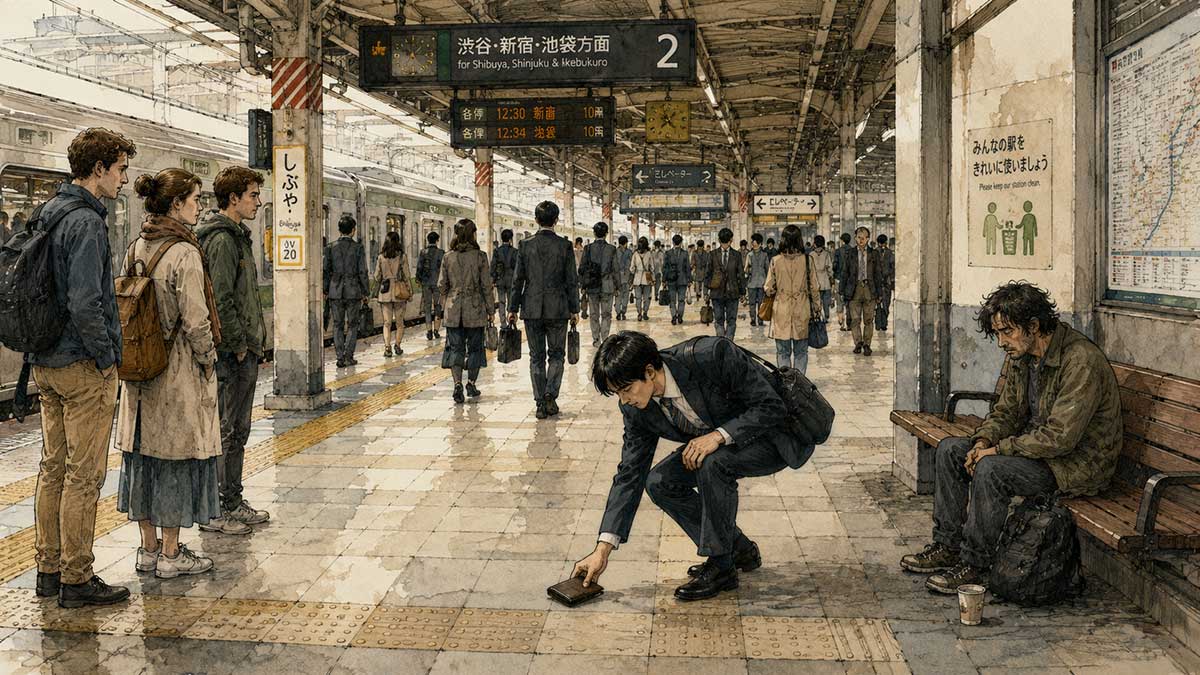
The question had been sitting between them for several moments before anyone touched it.
A wallet had been left on a Tokyo train.
Cash inside. Credit cards. Identification.
Hours later, it had been turned in.
Nothing missing.
The foreign visitor who owned it had laughed in disbelief.
“This would never happen where I live.”
Then came the uncomfortable observation.
His country had far more churches than Japan.
Jonathan Sacks: Before we go any further, I would object to one word.
Shunmyo Masuno: Which word?
Jonathan Sacks: Moral.
The others looked at him.
Jonathan Sacks: We have described an honest act. We may have described an orderly society. We may have described a society with unusually strong expectations concerning property and public conduct. But we have already made a dangerous leap from these things to morality.
Dalai Lama: You think returning the wallet is not moral?
Jonathan Sacks: Of course it is moral. I question whether returning wallets tells us that one society is more moral than another.
Hamza Yusuf: I agree.
Shunmyo Masuno: So do I.
Jesus smiled slightly.
Jesus: Then perhaps Japan has already lost the argument before we have begun.
Masuno laughed.
Shunmyo Masuno: I hope there is no argument for Japan to win.
Jesus: Good.
A brief silence followed.
Jesus: Then we might learn something.
Hamza Yusuf: There is another problem with the original question. We are comparing what religions teach with what societies do.
Those are not the same thing.
If a Muslim steals a wallet, has Islam taught him to steal?
No.
If a Christian humiliates his neighbor, did Jesus teach humiliation?
No.
If a Jew cheats another person, did the Torah command dishonesty?
No.
Yet people routinely judge religions through the behavior of people who violate their teachings.
Shunmyo Masuno: But isn't that fair to some extent?
Hamza turned to him.
Shunmyo Masuno: If a teaching has existed for centuries and millions of people claim to follow it, eventually someone is entitled to ask what kind of people that teaching actually produces.
Hamza paused.
Hamza Yusuf: Yes.
Shunmyo Masuno: Otherwise every religion can protect itself forever.
“When we behave well, that is our religion.”
“When we behave badly, that is human weakness.”
Sacks leaned forward.
Jonathan Sacks: That is precisely the difficulty.
A tradition must be judged partly by its ideals and partly by what its communities become.
Jesus: And what happens when those two are very far apart?
Nobody answered immediately.
Dalai Lama: Perhaps we should return to the wallet.
Why did the Japanese person return it?
Shunmyo Masuno: That is difficult to answer.
Dalai Lama: Why?
Shunmyo Masuno: Since the person who returned it may never have asked himself.
That changed the atmosphere.
Shunmyo Masuno: This is what outsiders sometimes misunderstand about Japan. They see a behavior and search for the philosophy behind it.
But many Japanese people do not wake in the morning and think, “Today I will practice Japanese ethics.”
A child cleans a classroom.
Shoes are removed before entering certain spaces.
You lower your voice on a train.
You take your rubbish with you.
If you find something that belongs to another person, you turn it in.
You learn these things before you can explain them.
Jesus: So the body learns before the mind gives reasons.
Shunmyo Masuno: Often, yes.
Hamza Yusuf: That is fascinating.
Shunmyo Masuno: Why?
Hamza Yusuf: Since religion once worked much more like that.
Masuno looked at him.
Hamza Yusuf: Modern people often think religion means holding certain opinions about God.
Historically, religious life was filled with practices.
You prayed at certain times.
You fasted.
You gave charity.
You greeted people in certain ways.
You controlled what you ate.
You controlled your tongue.
You cared for parents.
You buried the dead.
You visited the sick.
The practice shaped the person.
Jonathan Sacks: Judaism certainly understands this.
We do not begin by waiting for the correct emotion.
Sometimes you perform the act, and the act educates the heart.
Jesus: So perhaps Japan has not escaped religion as completely as we thought.
Shunmyo Masuno: I would be careful.
Jesus: Why?
Shunmyo Masuno: Since once foreigners admire Japan, they sometimes begin turning ordinary Japanese habits into a spiritual philosophy that Japanese people themselves would barely recognize.
Everyone smiled.
Shunmyo Masuno: A person standing quietly in line may simply be standing quietly in line.
We should not turn him into a Zen master.
Jesus looked amused.
Jesus: Fair enough.
Then let me ask differently.
Suppose two men find the same wallet.
One says, “God commands me not to steal.”
The other says, “Of course I should turn this in.”
Which society has done the deeper moral work?
Sacks answered first.
Jonathan Sacks: That depends upon what happens when nobody is watching.
Jesus: Nobody is watching either man.
Jonathan Sacks: Then both have done something good.
Jesus: You avoided my question.
Jonathan Sacks: Intentionally.
Jesus laughed.
Jonathan Sacks: You are trying to make me choose between moral conviction and moral habit. I reject the choice.
Dalai Lama: But there is something interesting here.
The second man may experience no moral struggle at all.
He sees the wallet.
He returns it.
Perhaps that is significant.
Hamza Yusuf: Very significant.
Dalai Lama: The first man sees temptation and defeats temptation through belief.
The second man may have been formed in such a way that stealing barely appears as an option.
Which is better?
Again, silence.
Shunmyo Masuno: For society?
The second.
Jesus: Why?
Shunmyo Masuno: Since society cannot depend upon everyone becoming a saint.
That sentence stopped them.
Shunmyo Masuno: This may be one difference between spiritual aspiration and social culture.
A spiritual teacher can ask extraordinary things of a human being.
Love your enemy.
Forgive.
Abandon hatred.
Release attachment.
Sacrifice yourself for another.
These are enormous demands.
A society has a different problem.
Millions of ordinary people have to get through Tuesday together.
Sacks smiled.
Jonathan Sacks: “Get through Tuesday together.” I like that.
Shunmyo Masuno: The person beside you on the train does not need you to achieve enlightenment.
He needs you not to play a video loudly.
The person behind you does not need you to love him.
He needs you not to cut the line.
Your neighbor may never know whether you possess profound compassion.
But he certainly knows whether you leave rubbish outside his home.
Dalai Lama: So perhaps civilization begins lower than love.
Shunmyo Masuno: Perhaps.
Jesus: Lower?
Masuno turned to him.
Jesus: Or earlier?
Masuno considered it.
Jesus: A child learns not to hit before the child understands love.
Perhaps restraint is not a lesser morality.
Perhaps it is the first lesson.
Hamza Yusuf: Islam has something similar. There are things you refrain from doing long before your inner character becomes perfected.
Discipline precedes transformation.
Jonathan Sacks: Every civilization needs habits that do not require philosophical deliberation each morning.
You cannot rebuild morality from first principles every time you enter a supermarket.
Dalai Lama: Then we may have found something Japan does unusually well.
Shunmyo Masuno: Careful.
The Dalai Lama smiled.
Dalai Lama: You have been waiting to say that.
Shunmyo Masuno: Very much.
They laughed.
Then Masuno's expression changed.
Shunmyo Masuno: There is another wallet.
Jesus: Another wallet?
Shunmyo Masuno: Yes.
Imagine the same station.
The same people.
But instead of a wallet lying on the floor, there is a person sitting against the wall.
He is distressed.
Perhaps crying.
Perhaps confused.
Perhaps mentally unwell.
Perhaps homeless.
Perhaps simply unable to stand.
Now tell me what happens.
The room became quiet.
Shunmyo Masuno: Returning property is easy to understand.
Interfering in another person's private suffering is much harder.
Dalai Lama: You think people may walk past?
Shunmyo Masuno: Some will stop.
Of course.
Japan is filled with kind people.
But there is a cultural hesitation that can appear.
“Should I interfere?”
“Perhaps he wants to be alone.”
“Someone else may help.”
“I do not want to embarrass him.”
“I do not know what to say.”
Jesus: So the culture that teaches you not to inconvenience others can make you afraid to enter another person's suffering.
Masuno nodded.
Shunmyo Masuno: Sometimes.
Jesus: Then perhaps the wallet was the easy test.
Jonathan Sacks: Exactly.
Morality begins becoming difficult when obligations collide.
Hamza Yusuf: Or when helping costs something.
Jesus: Yes.
Returning the wallet costs very little.
What if returning it makes you miss an appointment?
What if helping the stranger makes you late for work?
What if defending someone makes your colleagues dislike you?
What if telling the truth embarrasses your family?
What if protecting the outsider makes your own group angry?
Jonathan Sacks: Now we are no longer talking about civility.
Dalai Lama: We are talking about courage.
Hamza Yusuf: And conscience.
Jesus: And love.
Masuno remained silent.
After a moment, Sacks turned toward him.
Jonathan Sacks: May I ask something uncomfortable?
Shunmyo Masuno: Please.
Jonathan Sacks: Does Japanese morality work best when everyone agrees about the rules?
Masuno did not answer immediately.
Jonathan Sacks: Consider the foreigner who does not understand the unspoken expectation.
The child who cannot read social cues.
The employee who challenges a superior.
The woman who refuses a traditional role.
The person whose personality is simply different.
What happens when harmony encounters someone who cannot—or will not—harmonize?
Masuno folded his hands.
Shunmyo Masuno: Then one of Japan's greatest strengths can become one of its cruelties.
Nobody interrupted him.
Shunmyo Masuno: You can punish someone without shouting at him.
You can exclude someone without officially excluding him.
You can communicate disapproval through silence.
You can make someone understand that he is difficult.
That he is causing trouble.
That everyone would be more comfortable if he changed.
Dalai Lama: No law has been broken.
Shunmyo Masuno: No.
Hamza Yusuf: No command has been spoken.
Shunmyo Masuno: No.
Jesus: Yet the person knows.
Shunmyo Masuno: Very clearly.
Jesus looked down for several seconds.
Jesus: Then I wonder whether we have been asking the wrong question.
The others waited.
Jesus: We began with:
“Why does a less-religious Japan sometimes look more moral?”
Perhaps we should ask:
What kind of goodness has Japan become particularly good at producing?
Sacks nodded slowly.
Jonathan Sacks: Better.
Jesus: And what kind has it struggled to produce?
Shunmyo Masuno: Better still.
Hamza Yusuf: We should ask the same of every religious society.
Jesus looked at him.
Hamza Yusuf: What kind of goodness does Christianity produce easily?
What kind does it struggle to produce?
What does Islam produce easily?
Where do Muslims fail?
What does Judaism cultivate beautifully?
Where can community become exclusion?
Nobody gets to stand outside the examination.
Jonathan Sacks: Including secular societies.
Dalai Lama: Including Buddhist ones.
Shunmyo Masuno: Including Japan.
The lost wallet was still sitting metaphorically in the center of the table.
Yet it no longer looked like proof of anything.
It had become a question.
Dalai Lama: Perhaps we need three words rather than one.
Jesus: Which three?
Dalai Lama: Civility.
Morality.
Compassion.
Sacks immediately nodded.
Jonathan Sacks: Yes.
Dalai Lama: Civility says:
“I will behave in a way that allows us to share this space.”
Morality says:
“There are things I must and must not do, regardless of convenience.”
Compassion says:
“Your suffering matters to me.”
Masuno looked at him for a long moment.
Shunmyo Masuno: Japan may sometimes be strongest at the first.
Hamza Yusuf: Religion claims to teach the second and third.
Jesus: Claims?
Hamza met his eyes.
Hamza Yusuf: Claims.
Jesus smiled.
Jesus: Good.
Sacks leaned back.
Jonathan Sacks: Then the embarrassing question for religion is obvious.
If we claim to teach morality and compassion, why are societies filled with religious language so often filled with cruelty, dishonesty, loneliness, tribalism, and contempt?
Nobody rushed to defend religion.
Then Masuno spoke.
Shunmyo Masuno: And the embarrassing question for Japan is equally obvious.
If we have become skilled at living without disturbing one another—
he paused—
Shunmyo Masuno: have we become skilled at loving one another?
Silence again.
Jesus finally looked at him.
Jesus: Perhaps those are very different achievements.
Shunmyo Masuno: I think they are.
Jesus: Then that is where we should go next.
The Dalai Lama nodded.
Dalai Lama: From the wallet?
Jesus shook his head.
Jesus: From the person sitting beside it.
And suddenly the question was no longer whether Japanese culture had succeeded where religion had failed.
It was something much harder:
Is “don’t bother others” actually a better foundation for society than “love your neighbor”—and what happens when a human being needs far more from us than simply being left undisturbed?
Topic 2 — Is “Don’t Bother Others” More Effective Than “Love Your Neighbor”?
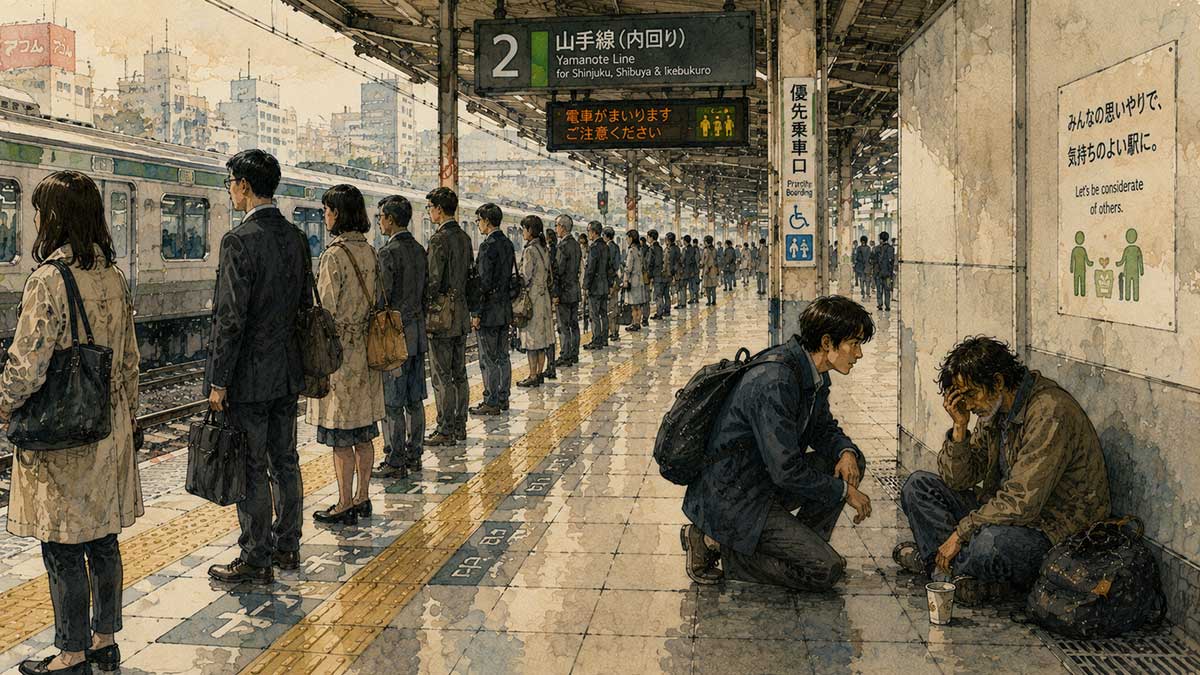
For a moment, nobody spoke.
The wallet had disappeared from the conversation.
The person sitting beside it had not.
Jesus: Let us make this difficult.
Shunmyo Masuno: I suspect you are going to.
Jesus: Suppose we had to choose one sentence to teach every child.
Only one.
Masuno looked at him.
Jesus: “Love your neighbor.”
Or:
“Do not trouble others.”
Hamza Yusuf: That is an unfair choice.
Jesus: Most revealing choices are.
Jonathan Sacks: I am already refusing it.
The Dalai Lama laughed.
Dalai Lama: We have discovered the rabbinical method.
Jonathan Sacks: Give me two choices and I will explain why you need four.
They laughed, but Jesus did not abandon the question.
Jesus: Which one would produce the more peaceful city?
Masuno answered first.
Shunmyo Masuno: “Do not trouble others.”
Jesus looked surprised.
Shunmyo Masuno: You asked about a peaceful city, not a loving one.
That distinction settled over the table.
Shunmyo Masuno: Think about what a city requires from millions of strangers.
You do not need to love everyone riding the train with you.
You need to respect their space.
You do not need deep compassion for the person sleeping in the apartment beside yours.
You need to avoid making unnecessary noise at two in the morning.
You do not need spiritual intimacy with the person waiting behind you.
You simply wait your turn.
A functioning society asks surprisingly little of us.
Jonathan Sacks: Yet asks it constantly.
Shunmyo Masuno: Exactly.
Small acts.
Repeated every day.
Dalai Lama: So civilization may depend less upon extraordinary goodness than ordinary restraint.
Shunmyo Masuno: I think it often does.
Jesus: That sounds almost disappointing.
Shunmyo Masuno: Why?
Jesus: We have spent thousands of years telling human beings to become better people, and perhaps all they needed was to stop talking loudly on trains.
Masuno smiled.
Shunmyo Masuno: Perhaps humanity aimed too high.
Jesus: Or perhaps trains aimed appropriately low.
Hamza Yusuf: There is something serious underneath the humor.
Religious teachings frequently begin with restraint too.
Do not steal.
Do not lie.
Do not cheat.
Do not murder.
Control anger.
Control appetite.
Control the tongue.
People sometimes speak as though religion begins with mystical love.
Much of religious civilization begins with:
Do not do this.
Jonathan Sacks: The commandments certainly understand that.
Before asking human beings to become morally extraordinary, civilization has to establish boundaries.
Jesus: Yet I was dissatisfied with boundaries.
Sacks turned toward him.
Jesus: “Do not murder” is necessary.
But what about anger?
“Do not commit adultery.”
But what about the way you look at another human being?
“Love your neighbor.”
But I went further.
Love your enemy.
Shunmyo Masuno: Which is precisely why your teaching is much harder to build a society around.
The words were respectful, but sharp.
Jesus waited.
Shunmyo Masuno: I do not mean that as criticism.
I mean that you ask for transformation.
Culture can ask for compliance.
Jesus: And you think compliance works better?
Shunmyo Masuno: For certain purposes, yes.
Masuno leaned slightly forward.
Shunmyo Masuno: Suppose two neighbors hate each other.
One believes deeply that he ought to love the other.
He tries.
He fails.
He feels guilty.
He tries again.
He still dislikes him.
The other neighbor has no spiritual aspiration whatsoever.
He simply thinks:
“I dislike this man, but I will not disturb him.”
He keeps his music down.
He does not gossip about him.
He clears snow from the shared walkway.
He respects the property line.
Which neighborhood would you rather live in?
Jesus smiled.
Jesus: You have made the second man suspiciously virtuous for someone with no spiritual aspiration.
Shunmyo Masuno: That is my point.
Perhaps behavior can arrive before love.
Dalai Lama: Or without love.
Shunmyo Masuno: Yes.
Jonathan Sacks: And that is where the problem begins.
Sacks looked around the table.
Jonathan Sacks: There is an ancient temptation in political thought.
If we cannot make people good, perhaps we can construct institutions that make their goodness unnecessary.
Rules.
Norms.
Consequences.
Expectations.
Social pressure.
You do not need to love your neighbor. You merely need to behave predictably around him.
This can produce a remarkably stable society.
Hamza Yusuf: But?
Jonathan Sacks: But sooner or later, someone needs something that the rules do not require you to give.
The room became still.
Jonathan Sacks: Someone needs forgiveness.
Someone needs courage.
Someone needs you to defend them when defending them will damage your reputation.
Someone needs generosity beyond what is socially expected.
Someone needs you to stand alone.
Then civility reaches its limit.
Jesus: Let us return to the man at the station.
He is sitting against the wall.
Everyone walking past him is behaving perfectly.
Nobody pushes him.
Nobody insults him.
Nobody steals from him.
Nobody invades his space.
The station is immaculate.
The trains arrive.
People form orderly lines.
Everything works.
Jesus paused.
Jesus: And the man is suffering alone.
No one moved.
Jesus: Is this a good society?
Masuno's eyes remained lowered.
Shunmyo Masuno: It is a well-functioning society.
Jesus: I asked whether it is good.
Shunmyo Masuno: I know.
The Dalai Lama broke the silence.
Dalai Lama: There is something very human happening here.
We often avoid another person's suffering for reasons that sound considerate.
“I should give him privacy.”
“I might embarrass her.”
“It is none of my business.”
Sometimes those reasons are correct.
Sometimes they protect us from discomfort.
Hamza Yusuf: And we are extraordinarily skilled at confusing the two.
Dalai Lama: Yes.
Jesus: Compassion is inconvenient.
Shunmyo Masuno: Very.
Jesus: Perhaps that is its defining characteristic.
Masuno looked up.
Jesus: If someone else's suffering never interferes with your plans, I wonder how deeply you have entered it.
Hamza Yusuf: Islam has an interesting answer to this.
The neighbor is not merely someone you avoid harming.
The neighbor has claims upon you.
The poor have claims.
The traveler has claims.
The orphan has claims.
Your wealth is not simply yours in the absolute sense.
So morality moves from:
“I did nothing wrong to you”
to:
“I owed something to you.”
Jonathan Sacks: Judaism does something similar.
Justice is not merely refraining from cruelty.
There are obligations.
You leave part of the harvest for the poor.
You care for the stranger.
You cannot say:
“I never harmed him, so I have fulfilled my duty.”
Jesus: That was precisely the question behind the Good Samaritan.
Masuno nodded.
Jesus: A wounded man lies beside the road.
Several people do not attack him.
They simply pass him.
They may be respectable.
They may be religious.
They may have reasons.
Only one stops.
Dalai Lama: And stopping changes his day.
Jesus: Yes.
That is the part people sometimes forget.
Love interrupts schedules.
Masuno remained quiet for some time.
Then he said:
Shunmyo Masuno: There is a Japanese phrase that belongs here.
Meiwaku o kakenai.
Do not cause trouble for others.
Children hear versions of this from an early age.
There is beauty in it.
You become aware that you occupy space with other people.
Your actions have consequences.
You learn consideration.
But there is another sentence hidden inside it.
Jonathan Sacks: Which is?
Masuno hesitated.
Shunmyo Masuno: “Do not become trouble for others.”
Nobody spoke.
Shunmyo Masuno: That is different.
Dalai Lama: Very different.
Shunmyo Masuno: If I am suffering, I may think:
“I should not burden my family.”
If I am depressed:
“I should handle this myself.”
If I am elderly:
“I do not want my children to worry.”
If I am sick:
“Everyone is busy.”
If I am lonely:
“I should not bother anyone.”
The ethic that taught me to respect other people can begin teaching me to hide my need from them.
Jesus looked at Masuno.
Jesus: Then the sentence has turned inward.
Shunmyo Masuno: Yes.
Jesus: “Do not inconvenience others” becomes “Do not let anyone carry you.”
Masuno nodded.
Jesus: That is dangerous.
Shunmyo Masuno: It can be.
Jesus: Since every human being eventually needs to be carried.
The sentence seemed to change the temperature of the room.
Jesus: A child needs carrying.
A sick person needs carrying.
An old person needs carrying.
A grieving person needs carrying.
Sometimes the strongest person in the family needs carrying.
If your highest moral achievement is never becoming a burden—
Jesus stopped.
Jesus: what happens when life makes you one?
Sacks answered quietly.
Jonathan Sacks: You begin to believe your need has reduced your worth.
Masuno closed his eyes briefly.
Dalai Lama: And perhaps you hide suffering until it becomes unbearable.
Hamza Yusuf: This is where community cannot merely be polite.
A real community must allow dependence.
Jonathan Sacks: More than allow it.
It must sometimes regard caring for another person as part of what gives life meaning.
Jesus: Then perhaps “love your neighbor” contains something “do not trouble your neighbor” cannot contain.
Shunmyo Masuno: Permission to need your neighbor.
Jesus looked at him.
Jesus: Yes.
For several seconds, no one spoke.
Then the Dalai Lama smiled gently.
Dalai Lama: Yet I think we are becoming unfair to Japan again.
Masuno looked amused.
Shunmyo Masuno: This time by criticizing us too much?
Dalai Lama: Yes.
Everyone laughed.
Dalai Lama: There is profound compassion in Japanese families, communities, disaster responses, friendships. Human beings cannot be reduced to one cultural phrase.
Shunmyo Masuno: Certainly.
Dalai Lama: And Western societies that speak frequently about love can be extremely lonely.
Hamza Yusuf: Very much so.
Jonathan Sacks: Individualism can produce the opposite problem.
In one society:
“I must not burden you.”
In another:
“You are not my responsibility.”
Jesus looked from one man to another.
Jesus: Those sentences sound different.
Jonathan Sacks: They can leave the same person alone.
That landed harder than anything said before it.
Jesus: Then America can abandon the suffering person through individualism.
Japan can abandon him through restraint.
A religious community can abandon him through judgment.
A wealthy society can abandon him through bureaucracy.
A family can abandon him through shame.
Dalai Lama: Human beings are creative.
Jesus: At abandoning one another?
Dalai Lama: Unfortunately.
Hamza leaned forward.
Hamza Yusuf: Then perhaps we should stop asking which slogan is better.
“Love your neighbor.”
“Do not bother others.”
Both can become empty.
A Christian can repeat the first and hate his neighbor.
A Japanese person can obey the second and ignore his neighbor's suffering.
Jonathan Sacks: Behavior without inner responsibility becomes cold.
Shunmyo Masuno: Inner feeling without disciplined behavior becomes unreliable.
Dalai Lama: Compassion requires both attention and action.
Jesus remained silent.
Masuno noticed.
Shunmyo Masuno: You disagree?
Jesus: No.
I am thinking about something.
Shunmyo Masuno: What?
Jesus: Perhaps “love your neighbor” has been misunderstood.
People hear “love” and think I am asking them to feel warmth.
Affection.
Sympathy.
Jesus shook his head.
Jesus: Sometimes love looks much less pleasant.
Sometimes love tells the truth.
Sometimes love intervenes.
Sometimes love refuses to participate.
Sometimes love embarrasses everyone in the room.
Sometimes love says:
“No.”
Sacks smiled.
Jonathan Sacks: Now Japanese harmony is in trouble.
Shunmyo Masuno: It was only a matter of time.
Jesus: Suppose everyone in a company knows that one employee is being mistreated.
Nobody approves.
Nobody likes what is happening.
But confronting the manager would create conflict.
So everyone remains courteous.
Everyone continues doing excellent work.
Nobody causes trouble.
What should the good person do?
Shunmyo Masuno: Cause trouble.
Jesus smiled.
Jesus: Exactly.
Hamza Yusuf: Then harmony cannot be the highest value.
Shunmyo Masuno: No.
Jonathan Sacks: Nor can peace.
The others turned toward him.
Jonathan Sacks: There are peaceful situations that are profoundly unjust.
Silence can look peaceful.
Submission can look peaceful.
Fear can look peaceful.
A family in which nobody challenges an abusive father may appear harmonious.
A workplace in which nobody questions corruption may appear orderly.
A society in which minorities learn to remain invisible may appear unified.
Dalai Lama: Then conflict is not always evidence that something has gone wrong.
Jonathan Sacks: Sometimes conflict is evidence that someone finally said what was wrong.
Masuno breathed out slowly.
Shunmyo Masuno: This may be one of the hardest lessons for Japanese culture.
There are moments when being considerate means disturbing harmony.
Jesus: And perhaps one of the hardest lessons for religious people is the reverse.
There are moments when being convinced you possess the truth does not give you permission to become unbearable.
They laughed.
Hamza Yusuf: That lesson could be distributed rather widely.
The laughter faded.
Jesus returned to the original choice.
Jesus: So let me ask again.
One sentence for every child.
“Do not trouble others.”
Or:
“Love your neighbor.”
Masuno thought for a long time.
Shunmyo Masuno: I still refuse your choice.
Jesus: You have been spending too much time with the rabbi.
Jonathan Sacks: Progress.
Masuno smiled.
Then his face became serious.
Shunmyo Masuno: I would teach the child:
“Notice your neighbor.”
Jesus did not respond immediately.
Neither did anyone else.
Dalai Lama: That comes before both.
Shunmyo Masuno: Yes.
If you notice your neighbor, you will know when your noise is disturbing him.
But you may notice something else.
That he has not left his house for three days.
That the elderly woman next door is carrying something too heavy.
That the child who usually laughs has become quiet.
That your colleague keeps saying he is fine.
That the stranger at the station is not merely sitting down.
He is suffering.
Jesus: Notice your neighbor.
Shunmyo Masuno: Yes.
Jesus: And then?
Masuno looked at him.
Shunmyo Masuno: Then perhaps your teaching begins.
Jesus smiled.
But Sacks did not.
Jonathan Sacks: We still have a problem.
Hamza Yusuf: Which one?
Sacks looked around the table.
Jonathan Sacks: We have spent this entire conversation criticizing Japan for sometimes turning morality into conformity.
Yet religions have done something remarkably similar.
Everyone became quiet.
Jonathan Sacks: Religious communities have their own ways of saying:
“Do not embarrass us.”
“Do not question this.”
“Do not associate with those people.”
“Do not challenge authority.”
“Do not bring shame upon the family.”
“Do not leave.”
He looked at Jesus.
Then Hamza.
Then the Dalai Lama.
Jonathan Sacks: Perhaps religion and Japanese social harmony are not opposites at all.
Perhaps both face the same temptation.
Jesus: Which is?
Sacks answered softly.
Jonathan Sacks: Turning belonging into obedience.
The silence that followed was different from the earlier ones.
The question had shifted again.
If Japan could turn consideration into conformity, religion could turn devotion into tribal loyalty.
And if that were true, then perhaps the title of their conversation had been wrong from the beginning.
Perhaps religion had not failed merely because people stopped obeying it.
Perhaps something more disturbing had happened.
Sometimes people had obeyed their religious communities very faithfully—
and still forgotten what their religion was supposed to teach.
Jesus finally spoke.
Jesus: Then we should ask the question nobody here will enjoy answering.
Hamza Yusuf: Which question?
Jesus looked around the table.
Jesus: Did religion fail humanity—or did religious people become so concerned with belonging to religion that they forgot why religion existed?
Topic 3 — Did Religion Fail—or Did Religious People Fail Their Religion?
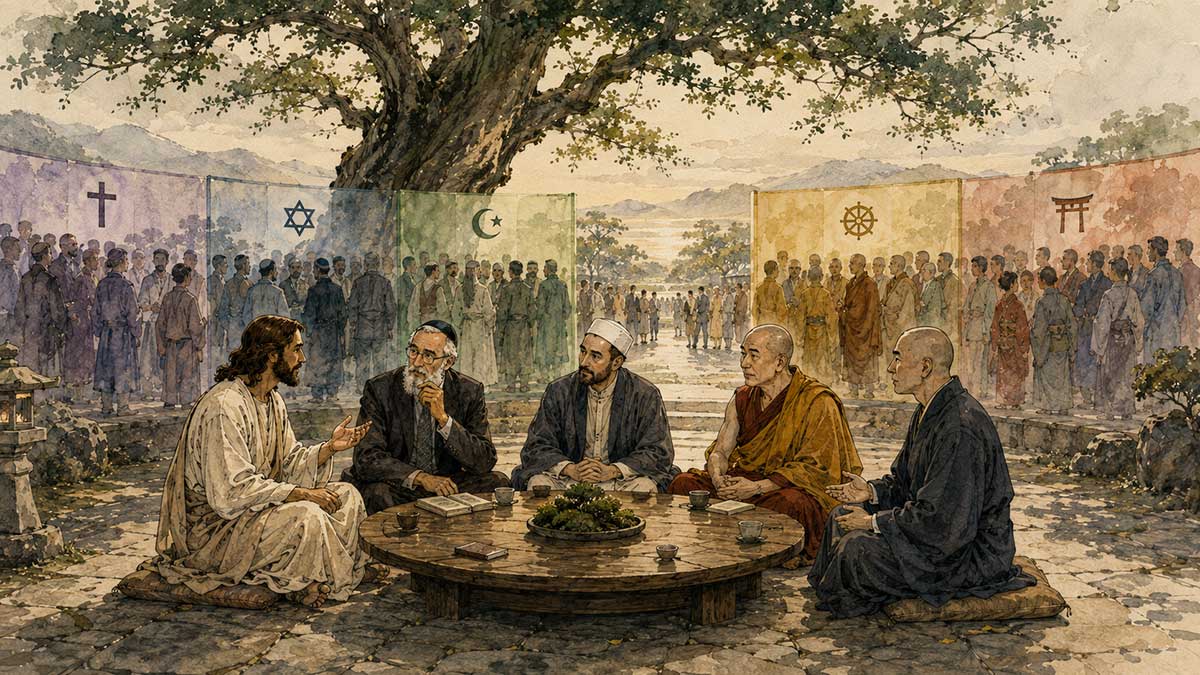
Nobody answered Jesus immediately.
The question was dangerous for a simple reason.
Every religious tradition had an escape available.
Whenever its followers did something beautiful:
This is what our faith produces.
Whenever its followers did something terrible:
They were not truly following the faith.
Sacks was the first to say it aloud.
Jonathan Sacks: Before any of us defend religion, we should close the easiest exit.
Hamza Yusuf: Which exit?
Jonathan Sacks: “Those people weren't real believers.”
Jesus looked at him.
Jonathan Sacks: Christians can say cruel Christians weren't following Jesus. Muslims can say violent Muslims weren't following Islam. Jews can say unethical Jews violated Torah. Buddhists can say hatred contradicts Buddhism.
All of those statements may contain truth.
But if we use them every time religion produces something ugly, religion becomes impossible to examine.
Shunmyo Masuno: Exactly.
Jonathan Sacks: We cannot claim the saints as evidence for religion and dismiss every sinner as irrelevant to it.
Dalai Lama: Then we must examine both.
Jonathan Sacks: We must.
Jesus nodded.
Jesus: Good.
Hamza Yusuf: You seem unusually pleased that we have made this harder.
Jesus: Truth usually becomes more interesting when people lose their escape routes.
Masuno looked toward Jesus.
Shunmyo Masuno: Then perhaps you should answer first.
Jesus: I suspected that was coming.
Shunmyo Masuno: Your name is attached to the largest religion in the world.
Churches carry crosses.
Nations have called themselves Christian.
Kings ruled in your name.
Armies marched beneath crosses.
People defended slavery using Christian arguments.
Christians persecuted other Christians.
Christians persecuted Jews.
Colonial projects sometimes arrived with missionaries.
And today people can speak passionately about you and treat people they dislike with extraordinary contempt.
Masuno paused.
Shunmyo Masuno: At what point are we allowed to ask whether Christianity failed?
The room went completely still.
Jesus did not answer quickly.
Jesus: You are allowed to ask.
Shunmyo Masuno: And your answer?
Jesus: First, I would ask what Christianity was supposed to accomplish.
Shunmyo Masuno: Change human beings.
Jesus: Yes.
Shunmyo Masuno: Then?
Jesus looked down.
Jesus: Then Christians must permit themselves to be judged by the distance between what they confess and how they live.
Hamza watched him carefully.
Jesus: If someone calls me Lord and despises his neighbor, his confession does not make the contempt holy.
If someone carries a cross and seeks domination, the cross does not transform domination into love.
If someone quotes my words and refuses mercy, quoting me does not make him merciful.
Shunmyo Masuno: But you are doing exactly what Rabbi Sacks warned against.
Jesus looked up.
Shunmyo Masuno: You are separating yourself from your followers.
“You misunderstood me.”
“You did not follow me.”
Perhaps that is true.
But every founder can say that.
Hamza leaned forward.
Hamza Yusuf: That is a fair challenge.
Shunmyo Masuno: If your teaching can be misunderstood by millions of people for centuries, does the misunderstanding itself become part of the history of the teaching?
Jesus remained silent.
The Dalai Lama looked at Masuno with interest.
Dalai Lama: That is a difficult question.
Shunmyo Masuno: It should be.
Sacks entered quietly.
Jonathan Sacks: Perhaps we need to distinguish between a teaching and an institution built around the teaching.
Hamza Yusuf: Yet institutions preserve teachings.
Jonathan Sacks: Yes.
That is the paradox.
Without institutions, teachings may disappear.
With institutions, teachings acquire interests.
Property.
Authority.
Hierarchy.
Reputation.
Boundaries.
Survival.
Dalai Lama: And eventually the institution wishes to protect itself.
Jonathan Sacks: Every institution does.
Jesus: Including religious ones.
Jonathan Sacks: Especially religious ones when they begin believing that protecting themselves is identical to protecting God.
That sentence hung in the room.
Hamza Yusuf: There is another transformation.
A revelation begins as a call.
Then it becomes a community.
The community develops practices.
The practices create identity.
Identity creates boundaries.
And eventually someone asks:
“Who belongs?”
Jonathan Sacks: Yes.
Hamza Yusuf: Then another question follows.
“Who does not?”
Masuno nodded.
Hamza Yusuf: At that moment, religion can change psychologically.
It may still speak about God.
But for the individual, religion can begin functioning as tribe.
Dalai Lama: Belonging is very powerful.
Hamza Yusuf: Perhaps one of the strongest human needs.
People will sacrifice for those who belong to their group.
They will defend them.
Feed them.
Protect them.
Forgive them.
Jesus: And the outsider?
Hamza paused.
Hamza Yusuf: That is the test.
Jesus: Then perhaps the real test of religion is not how believers treat believers.
Jonathan Sacks: Precisely.
Jesus: It is what their faith teaches them to do when they meet someone outside the boundary.
Hamza Yusuf: The stranger.
Jonathan Sacks: The stranger appears again and again in the Hebrew Bible for precisely this reason.
It is easy to build morality around reciprocity.
You protect me.
I protect you.
You belong to my family.
I care for you.
You share my faith.
I trust you.
The stranger breaks that arrangement.
The stranger asks:
Will you recognize an obligation to someone who cannot repay belonging with belonging?
Jesus smiled.
Jesus: That sounds familiar.
Jonathan Sacks: You borrowed extensively.
A small laugh moved around the table.
Dalai Lama: Buddhism has its own version of this problem.
People sometimes romanticize Buddhism as though Buddhists somehow escaped human tribalism.
We did not.
Buddhist societies have had violence.
Nationalism.
Exclusion.
Political struggle.
Monastic institutions can become concerned with status and authority like other institutions.
A teaching about releasing attachment can itself become an identity to which people become attached.
Shunmyo Masuno: Even emptiness can become something we cling to.
The Dalai Lama laughed.
Dalai Lama: Humans are very talented.
Jesus: Again?
Dalai Lama: At turning medicine into another illness.
Masuno looked around the table.
Shunmyo Masuno: Then religion may contain a strange danger.
It gives people a language for examining themselves.
But that same language can become a language for examining everyone else.
Sacks smiled sadly.
Jonathan Sacks: That is very well put.
Shunmyo Masuno: “Am I merciful?” becomes “Are you righteous?”
“Am I living truthfully?” becomes “Do you believe the correct doctrine?”
“Am I compassionate?” becomes “Are you one of us?”
Hamza Yusuf: And religious knowledge can become status.
Jesus: So the mirror becomes a window.
Masuno looked at him.
Jesus: Instead of looking at ourselves through the teaching, we use the teaching to look out at everyone else.
Shunmyo Masuno: Yes.
Jesus: I encountered that problem frequently.
Sacks leaned forward.
Jonathan Sacks: Yet now we are becoming too comfortable criticizing religion.
Dalai Lama: You are going to defend it.
Jonathan Sacks: Certainly.
Shunmyo Masuno: Please do.
Jonathan Sacks: Look at the moral vocabulary we have been using throughout this conversation.
Human dignity.
Obligation.
Justice.
Mercy.
Forgiveness.
Sacrifice.
Care for strangers.
Responsibility beyond self-interest.
Where do civilizations learn these things?
Not exclusively from religion.
Of course not.
But religious traditions have carried these ideas across centuries.
They created communities around them.
They told stories about them.
They embedded them in ritual.
They transmitted them from parents to children.
They told human beings:
You have obligations that do not disappear merely because nobody is watching.
Hamza Yusuf: Exactly.
Jonathan Sacks: It is very easy for a modern society to inherit centuries of moral capital and then congratulate itself for no longer needing the institutions that accumulated it.
Masuno looked interested.
Shunmyo Masuno: Moral capital.
Jonathan Sacks: Yes.
A society can continue practicing inherited virtues after the beliefs that originally supported some of them weaken.
The interesting question is whether those virtues reproduce themselves indefinitely.
Jesus: You are asking whether the returned wallet continues being returned five generations after nobody remembers why honesty matters.
Jonathan Sacks: In a sense.
Shunmyo Masuno: But Japan complicates your argument.
Jonathan Sacks: Very much.
Shunmyo Masuno: Many Japanese moral habits did not come from Christianity, Judaism, or Islam.
Some cannot easily be traced to a single religious source at all.
They developed through family, village life, Confucian influence, Buddhism, Shinto traditions, schools, institutions, historical circumstances.
Jonathan Sacks: Which proves something important.
Jesus: What?
Jonathan Sacks: Religion does not possess a monopoly on morality.
Hamza Yusuf: I agree.
Dalai Lama: Certainly.
Jesus smiled.
Jesus: We have made progress.
Shunmyo Masuno: But then religion faces an uncomfortable question.
If people can become honest, disciplined, considerate, generous, and responsible without believing in God—
what is religion for?
Nobody answered.
Masuno looked first at Sacks.
Then Hamza.
Then Jesus.
Shunmyo Masuno: That may be the question underneath the title of our conversation.
If Japanese culture can produce many admirable behaviors without strong theological commitment, what does religion contribute that culture cannot?
Hamza Yusuf: Meaning.
Masuno waited.
Hamza Yusuf: Not meaning as entertainment or personal preference.
I mean an answer to why moral obligation exists at all.
Why should I be good when goodness destroys my advantage?
Why forgive when revenge would satisfy me?
Why sacrifice for someone who will never repay me?
Why tell the truth when lying would save my reputation?
Why should a human being possess dignity when society has decided that person is useless?
Culture can tell me:
“This is what we do.”
Religion asks:
“What remains true when everyone around you stops doing it?”
Masuno's expression changed.
Jonathan Sacks: That is where conscience becomes vital.
Jesus: And where conformity becomes dangerous.
Dalai Lama: Yet religion can conform too.
Hamza Yusuf: Certainly.
Dalai Lama: Then religion does not automatically create conscience.
Hamza Yusuf: No.
Dalai Lama: Sometimes it simply changes the group whose approval you seek.
That struck the table hard.
A person could escape one conformity only to enter another.
Instead of fearing neighbors, one might fear fellow believers.
Instead of asking what the office thinks, one asks what the congregation thinks.
Instead of reading the room, one reads the religious community.
Masuno slowly nodded.
Shunmyo Masuno: Then Japanese conformity and religious conformity may be cousins.
Jonathan Sacks: Very close cousins.
Jesus had been quiet.
Now he spoke.
Jesus: Perhaps we should ask what happens when conscience and community disagree.
Hamza Yusuf: That is where religion becomes dangerous—or courageous.
Jesus: Explain.
Hamza Yusuf: A religious person can say:
“My society accepts this, but I cannot.”
That has produced extraordinary moral courage.
Religious conviction has motivated people to resist oppression, care for the poor, challenge rulers, endure imprisonment, protect persecuted people.
Jonathan Sacks: The prophets did not specialize in social harmony.
Masuno smiled.
Jonathan Sacks: They disturbed kings.
They accused societies of hypocrisy.
They told comfortable people things they desperately did not want to hear.
Jesus: They caused trouble.
Masuno laughed.
Shunmyo Masuno: Considerable trouble.
Jesus: Then perhaps a healthy religion should occasionally make its own followers uncomfortable.
Jonathan Sacks: Constantly.
Jesus: Especially when they are certain God agrees with them.
Hamza Yusuf: Especially then.
Dalai Lama: Perhaps certainty requires regular inspection.
Shunmyo Masuno: Japan could use that principle too.
Jesus: Every culture could.
Then Masuno asked the question that changed the room.
Shunmyo Masuno: What if religion becomes most dangerous precisely when it stops disturbing its own people?
Sacks looked at him.
Shunmyo Masuno: Suppose Christianity becomes perfectly compatible with the ambitions of Christians.
Islam perfectly compatible with the ambitions of Muslims.
Judaism perfectly compatible with the ambitions of Jews.
Buddhism perfectly compatible with the ambitions of Buddhists.
Nobody has to repent.
Nobody has to surrender privilege.
Nobody has to question the group.
Nobody has to love an enemy.
Nobody has to protect an outsider.
Religion simply confirms:
“You are the good people.”
Masuno stopped.
Shunmyo Masuno: Would that still be religion?
Jesus answered quietly.
Jesus: It would be identity wearing religious clothing.
Nobody interrupted.
Jesus: If your faith never asks you to love someone you would rather despise—
if it never asks you to give up something you would rather keep—
if it never asks you to forgive when resentment feels righteous—
if it never asks you to examine yourself before condemning another—
then perhaps you have not found God.
Perhaps you have found a sacred justification for yourself.
The room became completely silent.
Hamza finally spoke.
Hamza Yusuf: Yet there is still something troubling me.
Jesus: What?
Hamza Yusuf: We keep speaking as though religious failure comes from people insufficiently practicing religion.
Sometimes the problem may arise from interpretations inside religious traditions themselves.
Sacks nodded immediately.
Hamza Yusuf: Texts must be interpreted.
Traditions develop disagreements.
Authorities emerge.
Political circumstances shape interpretation.
Human beings bring fear, ambition, history, trauma, and tribal loyalty into the act of reading.
We cannot simply say:
“Return to the religion.”
Jonathan Sacks: Since everyone believes his interpretation is the return.
Hamza Yusuf: Exactly.
Dalai Lama: Then humility becomes part of faith.
Hamza Yusuf: It must.
Shunmyo Masuno: Perhaps Japan has something useful here after all.
Jesus smiled.
Jesus: Japan has returned.
Shunmyo Masuno: Japanese people can participate in several traditions without always feeling compelled to resolve the theological contradiction.
A shrine visit.
A Buddhist funeral.
A Christmas celebration.
Ancestor remembrance.
To many Western observers this can look inconsistent.
Jonathan Sacks: From a theological perspective, it can be.
Shunmyo Masuno: Certainly.
But psychologically it produces an interesting habit.
You become less inclined to think:
“My identity requires your belief to be false.”
Hamza Yusuf: Yet a serious believer cannot simply say all theological claims are interchangeable.
Shunmyo Masuno: I agree.
I am not proposing Japanese religious ambiguity as universal theology.
I am asking whether the ability to coexist without resolving every disagreement has social value.
Jonathan Sacks: Enormous value.
Dalai Lama: Perhaps the problem begins when difference becomes threat.
Jesus: Why must another person's belief threaten mine?
Jonathan Sacks: Sometimes because identity is fragile.
If I know who I am only because I am not you, then your presence becomes psychologically necessary and dangerous at the same time.
Hamza Yusuf: I need the outsider to define my inside.
Shunmyo Masuno: Then religion becomes tribal.
Jonathan Sacks: Yes.
Jesus looked around the table.
Jesus: Then let me answer the question Masuno asked earlier.
Would I rather live among people who constantly call me Lord but ignore what I taught—
or among people who never speak my name but practice honesty, mercy, humility, and care for strangers?
Nobody moved.
Jesus: If you know my teachings, you already know the answer.
Masuno watched him carefully.
Jesus: A name spoken without love does not honor me.
A prayer used to justify cruelty does not honor me.
A cross used to establish superiority does not honor me.
Jonathan Sacks: But would you say belief does not matter?
Jesus: No.
Jonathan Sacks: Then what does belief do?
Jesus paused.
Jesus: It should change what you love.
That was quieter than anyone expected.
Dalai Lama: And if it does not?
Jesus: Then one should ask what one actually believes.
Hamza Yusuf: That applies far beyond Christianity.
Jonathan Sacks: Far beyond religion.
Masuno nodded.
Shunmyo Masuno: A Japanese person may claim to value harmony yet humiliate someone who does not fit.
An American may claim to value freedom yet care little about another person's freedom.
A religious person may claim to value love yet despise outsiders.
Perhaps every civilization has words it uses to avoid examining itself.
Jesus: Then religion has not been acquitted.
Hamza Yusuf: No.
Jonathan Sacks: Nor convicted in the simple way our title suggests.
Dalai Lama: Perhaps the verdict is uncomfortable for everyone.
Masuno looked at him.
Dalai Lama: Religion has produced extraordinary compassion and extraordinary tribalism.
Culture has produced extraordinary cooperation and extraordinary conformity.
Secular societies can produce freedom and loneliness.
Religious societies can produce belonging and exclusion.
No system removes the human ego simply by giving it better vocabulary.
Masuno looked back toward the imaginary Tokyo station.
Shunmyo Masuno: Then perhaps we return to our first question differently.
The Japanese person returns the wallet because that is what one does.
The Christian returns it because love of neighbor demands it.
The Muslim returns it because it is a trust that does not belong to him.
The Jew returns it because restoring what was lost is an obligation.
The Buddhist returns it because taking what is not given causes suffering.
Hamza Yusuf: Different reasons.
Shunmyo Masuno: Same wallet.
Jonathan Sacks: Same action.
Dalai Lama: Perhaps that should make us humble.
Jesus nodded.
Jesus: Until the action becomes difficult.
They looked at him.
Jesus: Returning the wallet when everyone approves is easy.
What happens when doing the right thing makes your community reject you?
That is when culture is tested.
That is when religion is tested.
That is when conscience is tested.
Masuno's face grew serious.
Shunmyo Masuno: And that brings us somewhere Japan may not want to go.
Jesus: Where?
Shunmyo Masuno: Into the cost of harmony.
He paused.
Shunmyo Masuno: We have spent considerable time admiring a society where people learn to read the room.
Perhaps now we should meet the person who reads the room perfectly—
and realizes there is no place in it for him.
Nobody spoke.
The lost wallet was gone again.
In its place stood a student who could not fit in.
An exhausted employee afraid to say no.
A woman swallowing an objection.
A foreigner missing an invisible rule.
A lonely elderly person refusing to become a burden.
A young person smiling and saying daijōbu when nothing inside felt okay.
Jesus broke the silence.
Jesus: Then perhaps we have been examining the danger of religion from a safe distance.
Shunmyo Masuno: What do you mean?
Jesus: Religion can demand conformity in the name of God.
Culture can demand conformity without needing God's name at all.
Masuno nodded.
Jesus: And perhaps the second kind is harder to see.
Shunmyo Masuno: Much harder.
Jesus: Then let us look at it.
Because a society can return every lost wallet—
and still lose some of its people.
Topic 4 — The Dark Side of Japanese Harmony
Shunmyo Masuno: There is a Japanese word we have avoided.
Jesus: Which one?
Shunmyo Masuno: Kūki.
Air.
Dalai Lama: Air?
Shunmyo Masuno: But when Japanese people say kūki o yomu, we mean something more.
Read the air.
Understand what everyone is feeling without forcing them to say it.
Recognize what is expected.
Notice the mood.
Know when to speak.
Know when not to speak.
Know when to insist.
Know when to withdraw.
Jonathan Sacks: An invisible social language.
Shunmyo Masuno: Yes.
And when it works beautifully, almost nothing needs to be said.
That can feel graceful.
Hamza Yusuf: And when it does not?
Masuno looked at him.
Shunmyo Masuno: Almost nothing needs to be said.
The same sentence now sounded entirely different.
Jesus: Explain.
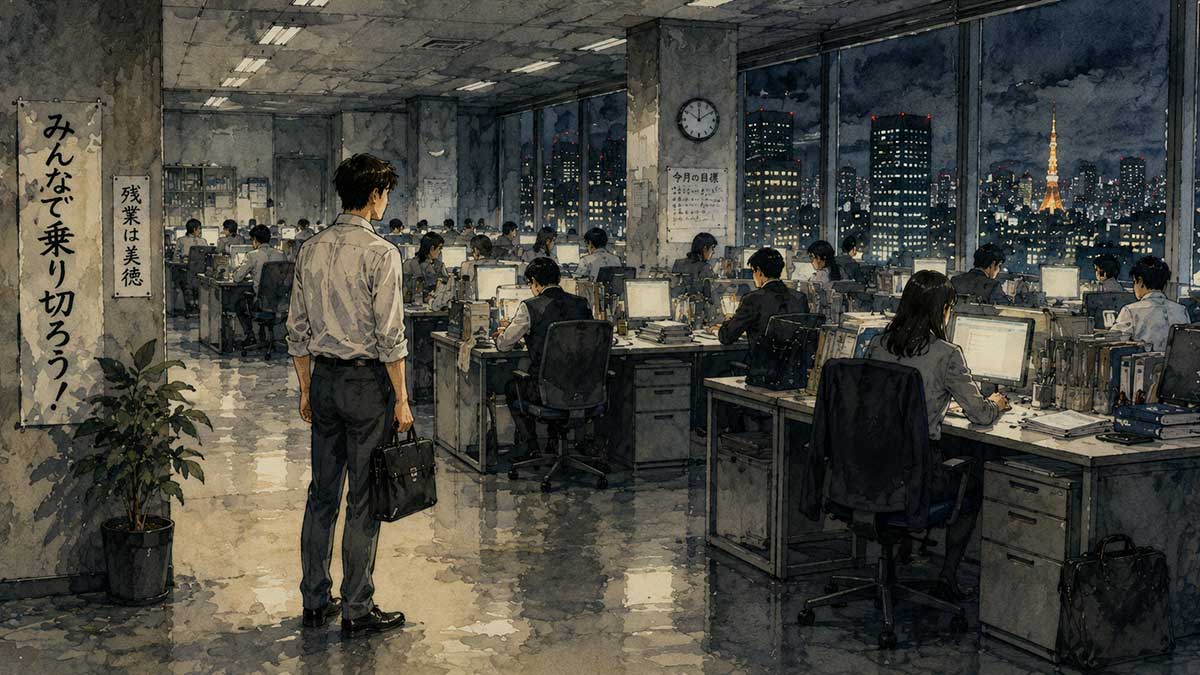
Shunmyo Masuno: Suppose everyone at work remains late.
Nobody orders you to stay.
Your contract does not require it.
Your supervisor never says, “You may not leave.”
At six o'clock, you stand.
Everyone else remains seated.
Perhaps nobody even looks at you.
But you feel it.
Dalai Lama: The air.
Shunmyo Masuno: The air.
You sit down again.
Jesus: Who forced you?
Shunmyo Masuno: Nobody.
Jesus: Who decided you could not leave?
Shunmyo Masuno: Nobody.
Jesus: Then why are you still there?
Masuno gave him a sad smile.
Shunmyo Masuno: Now you understand the difficulty.
Sacks leaned forward.
Jonathan Sacks: This may be stronger than an explicit command.
Hamza Yusuf: How?
Jonathan Sacks: A command has an author.
You can challenge the person giving it.
You can appeal against it.
You can say:
“He told me to do this.”
But what do you do when the authority is everywhere and nowhere?
Dalai Lama: You begin enforcing it upon yourself.
Jonathan Sacks: Exactly.
The policeman moves inside.
Masuno nodded.
Shunmyo Masuno: And eventually nobody has to tell you to read the room.
You read it automatically.
Jesus: We praised that earlier.
Shunmyo Masuno: Yes.
Jesus: The person returning the wallet did not need to deliberate.
Good behavior had become automatic.
Shunmyo Masuno: And now we see the other side.
Conformity can become automatic too.
Jesus: The same mechanism.
Shunmyo Masuno: Sometimes.
That realization unsettled the table.
The very process they had admired in Topic 1—culture becoming habit—could teach generosity.
It could teach restraint.
It could teach honesty.
And it could teach silence.
Dalai Lama: Let us meet someone rather than discussing abstractions.
Shunmyo Masuno: Very well.
A fifteen-year-old boy.
He does not fit comfortably into his class.
Maybe he speaks differently.
Maybe his interests are unusual.
Maybe he struggles to recognize certain social cues.
Nothing dramatic happens at first.
Nobody punches him.
Nobody threatens him.
Nobody says:
“You are forbidden to belong here.”
They simply stop including him.
Conversations become quiet when he approaches.
Messages do not receive replies.
Seats beside friends somehow become unavailable.
Nobody chooses him when groups are formed.
Jesus: Has anyone done anything wrong?
Masuno looked at him.
Shunmyo Masuno: That is precisely the problem.
Jonathan Sacks: Cruelty distributed among many people can leave nobody feeling responsible.
Hamza Yusuf: Each person has done almost nothing.
Jonathan Sacks: Together they have created a prison.
Jesus looked troubled.
Jesus: And the boy reads the air?
Shunmyo Masuno: Perfectly.
Jesus: What does it tell him?
Masuno paused.
Shunmyo Masuno: “We would be more comfortable without you.”
Nobody spoke.
Jesus: And perhaps he tries harder to fit.
Shunmyo Masuno: Yes.
He watches how others laugh.
What they wear.
What they talk about.
How loudly they speak.
When they speak.
He edits himself.
Dalai Lama: Again and again.
Shunmyo Masuno: Until eventually—
Masuno stopped.
Jesus: Until what?
Shunmyo Masuno: He becomes very good at appearing normal.
Hamza Yusuf: And inside?
Shunmyo Masuno: Nobody knows.
Jesus looked down at the table.
Jesus: There is something especially painful about suffering that succeeds in looking normal.
Dalai Lama: Yes.
Jesus: The person has solved everyone else's problem.
He no longer makes them uncomfortable.
Shunmyo Masuno: Exactly.
Jesus: And now nobody sees his.
Sacks broke the silence.
Jonathan Sacks: Every community faces this temptation.
We should be careful not to make this exclusively Japanese.
Shunmyo Masuno: Certainly.
Jonathan Sacks: Religious communities do it.
Families do it.
Schools do it.
Nations do it.
The mechanism changes, but the message is familiar:
“You may belong here provided you become easier for us to accept.”
Hamza Yusuf: Religious communities can make that message terrifying.
Jesus: Since rejection can become more than social.
Hamza Yusuf: Yes.
It can become spiritual.
“You are disappointing your family.”
“You are betraying the community.”
“You are disobeying God.”
Then social conformity acquires eternal language.
Jonathan Sacks: Which makes dissent extraordinarily expensive.
Dalai Lama: Perhaps every community has an invisible price of admission.
Jesus: What is Japan's?
The Dalai Lama looked toward Masuno.
Masuno considered the question carefully.
Shunmyo Masuno: Sometimes—
being understandable to everyone else.
Jesus: Explain.
Shunmyo Masuno: Do not create an awkward situation.
Do not demand unusual accommodation.
Do not express anger too directly.
Do not force people to confront something unpleasant.
Do not insist upon your individuality so strongly that the group must reorganize itself around you.
Jesus: That sounds reasonable.
Shunmyo Masuno: Many dangerous expectations do.
Hamza nodded.
Hamza Yusuf: That is important.
Oppression rarely introduces itself by saying:
“I am oppression.”
It says:
“This is simply how things are done.”
Jonathan Sacks: Or:
“Think about everyone else.”
Shunmyo Masuno: Exactly.
And “think about everyone else” is often beautiful advice.
That is why this is difficult.
Jesus: Then the problem is not consideration.
Shunmyo Masuno: No.
Jesus: It is consideration becoming the highest value.
Jonathan Sacks: Any virtue can become dangerous when detached from competing virtues.
Loyalty without truth becomes complicity.
Peace without justice becomes submission.
Tolerance without conviction becomes indifference.
Community without individuality becomes conformity.
Hamza Yusuf: And individuality without community becomes isolation.
Dalai Lama: So there is no single virtue we can maximize forever.
Jonathan Sacks: Human beings are inconveniently complicated.
Masuno smiled briefly.
Then he said:
Shunmyo Masuno: Let us meet another person.
An elderly woman.
Her husband died three years ago.
Her children live far away.
They call her.
They ask whether she needs anything.
She always gives the same answer.
Daijōbu.
I'm fine.
She has enough food.
The apartment is clean.
She pays her bills.
She does not complain.
She does not want to worry anyone.
Jesus: Is she fine?
Shunmyo Masuno: No.
Dalai Lama: Lonely?
Shunmyo Masuno: Terribly.
Jesus: Why doesn't she tell her children?
Shunmyo Masuno: They are busy.
Jesus: Did they say that?
Shunmyo Masuno: No.
Jesus: Then who decided her loneliness was less important than their schedules?
Masuno said nothing.
Jesus: She did.
Shunmyo Masuno: Perhaps.
Jesus: Why?
Masuno answered softly.
Shunmyo Masuno: She loves them.
Jesus looked at him.
Shunmyo Masuno: That is what makes this painful.
She is not necessarily hiding her suffering from fear.
She may be hiding it from love.
She does not want her children to worry.
She does not want them traveling long distances.
She does not want to interfere with their families.
She tells herself:
“I have lived my life. They have theirs.”
Jesus: Then love itself has become silence.
The Dalai Lama closed his eyes for a moment.
Dalai Lama: There are forms of kindness that prevent others from being kind to us.
Nobody responded.
Dalai Lama: We think we are protecting people from our suffering.
But perhaps we are taking something from them.
Hamza Yusuf: The opportunity to care.
Jonathan Sacks: The opportunity to fulfill an obligation.
Jesus: The opportunity to love.
Masuno nodded.
Jesus: Perhaps we need another moral sentence.
Shunmyo Masuno: You have abandoned “love your neighbor” already?
Jesus: Temporarily.
A few smiles appeared.
Jesus: What about:
“Allow your neighbor to love you.”
The smiles disappeared.
Dalai Lama: That may be harder.
Jesus: Much harder for some people.
Receiving requires vulnerability.
You must admit:
“I cannot do this alone.”
“I need you.”
“I am afraid.”
“I am lonely.”
“I am not daijōbu.”
Masuno's voice became quiet.
Shunmyo Masuno: There may be many people in Japan who need permission to say exactly that.
Jesus: Only Japan?
Masuno smiled.
Shunmyo Masuno: No.
Certainly not.
Sacks turned the discussion again.
Jonathan Sacks: But there is a deeper political problem.
Harmony sounds morally attractive until justice requires disruption.
Consider a company concealing wrongdoing.
A school ignoring bullying.
A family protecting an abusive relative.
A government making a serious mistake.
A religious institution hiding misconduct.
In every case, the whistleblower creates disorder.
Hamza Yusuf: Everyone wishes he would stop.
Jonathan Sacks: Yes.
He ruins meetings.
He embarrasses respected people.
He damages reputations.
He creates headlines.
He breaks relationships.
He makes people choose sides.
Jesus: He causes meiwaku.
Masuno nodded.
Shunmyo Masuno: Considerable meiwaku.
Jonathan Sacks: And he may be the most moral person in the room.
That changed something.
The phrase they had been discussing—
do not cause trouble for others
—could no longer remain innocent.
Sometimes morality itself caused trouble.
Jesus: The prophets were troublesome people.
Jonathan Sacks: Extremely.
Hamza Yusuf: Reformers usually are.
Dalai Lama: Anyone who challenges an accepted injustice will disturb someone.
Jesus: Then perhaps we need to distinguish peace from the absence of visible conflict.
Jonathan Sacks: Absolutely.
Jesus: A house can be silent because everyone loves one another.
Or because everyone is afraid of the father.
Hamza Yusuf: Same silence.
Jesus: Completely different house.
Masuno sat very still.
Shunmyo Masuno: That distinction troubles me.
Dalai Lama: Why?
Shunmyo Masuno: Since outsiders sometimes experience Japan through the silence.
The clean street.
The quiet train.
The orderly queue.
The courteous service.
And they understandably admire it.
They should.
There is real beauty there.
But silence does not tell you what created the silence.
Sometimes consideration created it.
Sometimes discipline.
Sometimes respect.
Sometimes exhaustion.
Sometimes fear of embarrassment.
Sometimes loneliness.
Jesus: Same silence.
Shunmyo Masuno: Different Japan.
Hamza looked at Masuno.
Hamza Yusuf: Then perhaps tourists see the finished behavior but not its psychological cost.
Shunmyo Masuno: Sometimes.
But we must be careful.
Japan is not secretly miserable underneath every polite interaction.
That would be another foreign fantasy.
Japanese people genuinely value harmony.
Many experience these customs as comforting, humane, and beautiful.
The mistake is turning either side into the whole truth.
Dalai Lama: Beauty and suffering can come from the same cultural habit.
Shunmyo Masuno: Yes.
Jesus returned to the fifteen-year-old boy.
Jesus: What happens to him?
Masuno knew immediately whom he meant.
Shunmyo Masuno: Perhaps he changes schools.
Perhaps he finds one friend.
Perhaps he grows stronger.
Perhaps an adult notices.
Perhaps things improve.
Jesus: And perhaps?
Masuno's expression changed.
Shunmyo Masuno: Perhaps he stops going.
Jonathan Sacks: Hikikomori?
Shunmyo Masuno: That can have many causes, and we should not reduce it to one cultural explanation.
But yes, social withdrawal can become one response to a world in which participation feels unbearable.
Jesus: He does not attack the society that rejected him.
Shunmyo Masuno: No.
Jesus: He removes himself from it.
Masuno nodded.
Jesus: The conflict disappears.
Nobody liked where that thought led.
Dalai Lama: Then harmony can sometimes be restored by the disappearance of the person who disturbed it.
Masuno looked at him.
Shunmyo Masuno: Yes.
Dalai Lama: That is not harmony.
Shunmyo Masuno: No.
Dalai Lama: It is absence.
For a long time, the room remained quiet.
Then Jesus asked:
Jesus: What would a truly compassionate society say to the boy?
Masuno thought.
Shunmyo Masuno: Perhaps:
“You do not have to become easier for us.”
Sacks looked at him.
Shunmyo Masuno: Perhaps the room should learn to change too.
Jonathan Sacks: That is profound.
We usually ask:
“How can this person fit into the community?”
Sometimes the moral question is:
“How must the community change so this person can belong without disappearing?”
Hamza Yusuf: That applies to religious communities too.
Jonathan Sacks: Certainly.
Jesus: Families too.
Dalai Lama: Nations too.
Masuno looked almost uncomfortable with where his own argument had arrived.
Shunmyo Masuno: Then we have found something Japan may need from traditions that place conscience above consensus.
Jesus: Perhaps.
Shunmyo Masuno: Permission to stand alone.
Jonathan Sacks: The prophetic tradition is filled with it.
Hamza Yusuf: So is the Islamic tradition.
Truth is not determined by how many people approve of it.
Dalai Lama: Buddhism asks the practitioner to examine attachment, including attachment to approval.
Jesus: And I repeatedly placed individuals above social respectability.
The sick.
The rejected.
The morally condemned.
The foreigner.
The person everyone else preferred not to see.
Shunmyo Masuno: But religion needs something from Japan too.
Jesus looked at him.
Shunmyo Masuno: Conscience without consideration can become arrogance.
A person says:
“I am standing for truth.”
But perhaps he simply enjoys confrontation.
He humiliates others.
He refuses to listen.
He destroys relationships unnecessarily.
Then he calls the destruction courage.
Jonathan Sacks: Yes.
Hamza Yusuf: Very important.
Dalai Lama: The ego can disguise itself as moral courage quite easily.
Jesus: So sometimes we need the person who refuses to read the room.
Shunmyo Masuno: Yes.
Jesus: And sometimes we desperately need him to read it.
Masuno laughed.
Shunmyo Masuno: Now you understand Japan.
The laughter faded gently.
Jesus looked around the table.
Jesus: Then perhaps neither conformity nor rebellion is the answer.
Jonathan Sacks: The question is what each serves.
Jesus: Exactly.
Harmony serving human beings can be beautiful.
Human beings sacrificed to harmony is something else.
Religion serving compassion can be beautiful.
Human beings sacrificed to religious identity is something else.
Individual freedom protecting conscience can be beautiful.
Individual freedom becoming indifference is something else.
The Dalai Lama looked toward the imaginary station they had returned to so many times.
Dalai Lama: We began with a wallet.
A society that returns it deserves admiration.
Then we noticed the suffering person beside it.
A society that stops for him deserves admiration too.
Now perhaps there is a third person.
Hamza Yusuf: Who?
Dalai Lama: Someone everyone in the station finds inconvenient.
Someone who does not know the rules.
Someone who behaves differently.
Someone whose presence disrupts the smoothness of the room.
The real test may be whether society can make space for that person without demanding that he disappear.
Masuno nodded slowly.
Shunmyo Masuno: Then perhaps Japan's challenge is not to abandon harmony.
Jesus: No.
Shunmyo Masuno: It is to make harmony large enough for difference.
Jonathan Sacks: And religion's challenge?
Jesus looked at Sacks, then Hamza, then the Dalai Lama.
Jesus: Perhaps to make faith large enough for humility.
Masuno looked back at him.
Shunmyo Masuno: And what does your tradition need?
Jesus smiled.
Jesus: Christians might begin by actually trying the things they already say they believe.
The table broke into laughter.
Yet when it faded, Jesus remained serious.
Jesus: But something still bothers me.
Dalai Lama: What?
Jesus: We keep discovering that each system contains something the others need.
Japan teaches attention to social consequence, yet can struggle when harmony suppresses the individual.
Religion gives people meaning beyond social approval, yet can turn meaning into tribal certainty.
Individualistic societies protect personal freedom, yet can leave people terribly alone.
He paused.
Jesus: Perhaps our original question is now too small.
Hamza Yusuf: “Could Japanese culture succeed where religion has failed?”
Jesus: Yes.
Maybe neither should replace the other.
Maybe the more interesting question is:
What would happen if we built a society that kept Japan's consideration for others, religion's concern for the inner life, and the individual's right to stand against the group?
Masuno considered that.
Shunmyo Masuno: That sounds beautiful.
Sacks smiled.
Jonathan Sacks: Which means we should immediately ask what could go wrong.
The Dalai Lama laughed.
Dalai Lama: Now you understand this conversation.
And for the first time, the question before them was no longer whether Japan had found something religion had missed.
It was whether three incomplete moral achievements—
social consideration, spiritual depth, and individual conscience—
could coexist without one eventually swallowing the other two.
That was the question waiting for them in Topic 5.
Topic 5 — What If the World Combined Japanese Social Ethics With Spiritual Depth?
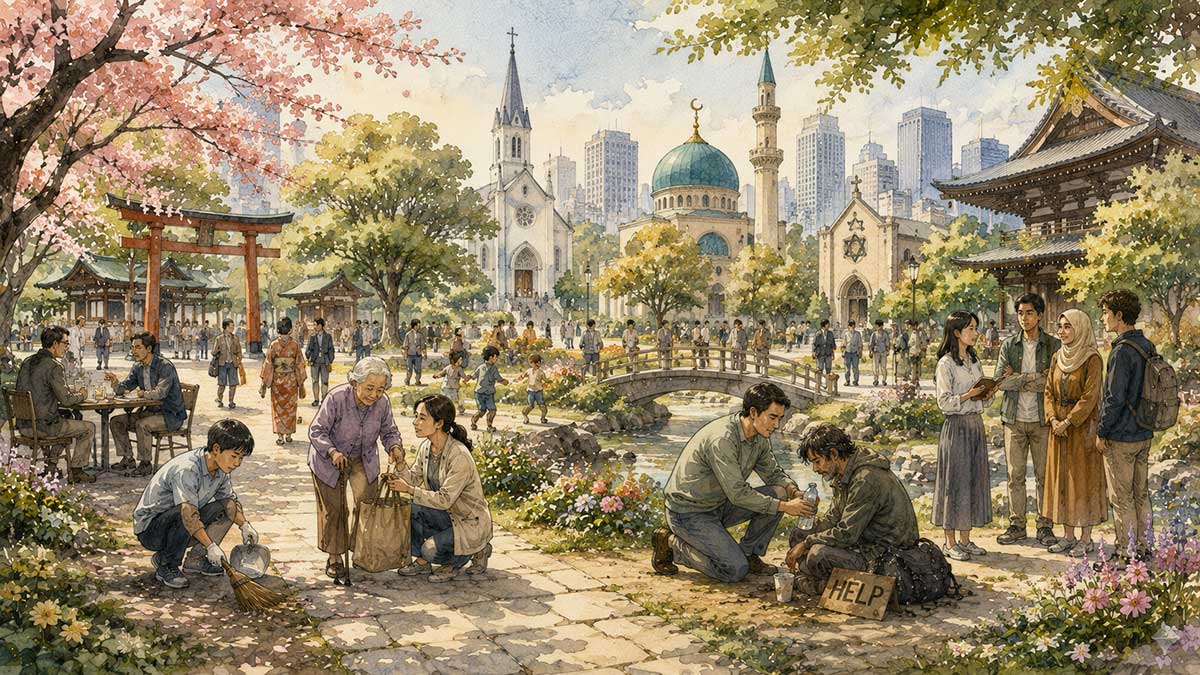
The table had finally arrived at the question none of them could answer with a slogan.
Japan had shown the strength of social consideration.
Religion had shown the strength of moral meaning.
Individual conscience had shown the strength of standing apart from the group.
Each had failed in predictable ways.
Each seemed to need something from the others.
Jonathan Sacks: We should begin by distrusting the solution.
Dalai Lama: You mean before we have even proposed it?
Jonathan Sacks: Especially then.
Hamza Yusuf: That is very Jewish of you.
Sacks smiled.
Jonathan Sacks: Any proposal containing the words “take the best from every tradition” sounds wonderful for approximately five minutes.
Shunmyo Masuno: Then reality arrives.
Jonathan Sacks: Precisely.
Jesus: Let us try anyway.
Suppose a society taught children three things.
First:
“Your actions affect everyone around you.”
Second:
“Your worth does not depend entirely on other people's approval.”
Third:
“When someone suffers, their pain creates a claim upon you.”
Masuno looked at him.
Shunmyo Masuno: That sounds almost like the conversation we have been trying to have.
Jesus: Perhaps we needed four topics to say three sentences.
Dalai Lama: Humanity has required much longer for less.
Masuno folded his hands.
Shunmyo Masuno: The first sentence feels very Japanese.
Your behavior affects the shared space.
Do not behave as though you are alone.
Consider the people around you.
Hamza Yusuf: The second sounds like religion at its best.
Your dignity is grounded in something deeper than popularity.
Jonathan Sacks: And the third turns morality outward again.
It refuses to let spirituality become purely private.
Jesus: Then what is missing?
Nobody answered immediately.
Dalai Lama: Practice.
They turned toward him.
Dalai Lama: Human beings agree with beautiful principles very easily.
We are discussing ideas as though people become compassionate by hearing good sentences.
They do not.
Shunmyo Masuno: This is where Japan may have something important to teach.
Jesus: Habit again.
Masuno nodded.
Shunmyo Masuno: Yes.
Consider a child cleaning the classroom.
The child does not receive a lecture every afternoon about civic responsibility.
The action itself teaches something.
“This space belongs to all of us.”
“You contributed to the mess.”
“You can contribute to restoring it.”
There is no heroic morality involved.
Jonathan Sacks: Yet repeated thousands of times, it creates a moral reflex.
Shunmyo Masuno: Exactly.
Hamza Yusuf: Religion used to understand this far better than much modern religious culture does.
Prayer was repeated.
Charity was repeated.
Fasting was repeated.
Hospitality was repeated.
Remembrance was repeated.
The person was formed through practice.
Jesus: Then religion becomes weak when it becomes mostly an opinion.
Hamza Yusuf: Very weak.
Jonathan Sacks: A faith practiced once a week and discussed constantly may form people less deeply than a cultural habit practiced every day and rarely discussed.
Masuno smiled.
Shunmyo Masuno: That may explain more than we intended.
Jesus looked interested.
Jesus: Suppose churches taught Christian children to clean their classrooms together.
Hamza Yusuf: Why stop at classrooms?
Jesus: Exactly.
Suppose mosques, synagogues, churches, temples, schools, families taught moral responsibility through small physical acts.
Not merely:
“Care about the elderly.”
But:
“Visit this elderly person.”
Not:
“Love the stranger.”
But:
“Sit beside the newcomer.”
Not:
“Protect creation.”
But:
“Clean this place that everyone uses.”
Dalai Lama: Then moral language meets the body.
Shunmyo Masuno: And the calendar.
Jonathan Sacks: Which may be more important.
Sacks leaned forward.
Jonathan Sacks: Great moral intentions are cheap.
Time is expensive.
Show me someone's calendar and I begin to see what he actually values.
Jesus: That is unpleasantly accurate.
Jonathan Sacks: If a society says it values elderly people but structures life so nobody has time for them, what does the value mean?
If a church speaks about community but people leave immediately after worship and do not know who is lonely, what does community mean?
If Japan speaks about harmony but exhausted workers cannot tell employers they need rest, what does harmony mean?
Hamza Yusuf: Values that never rearrange schedules may be decorative.
Dalai Lama: Or aspirational.
Jonathan Sacks: Sometimes both.
Masuno looked toward Jesus.
Shunmyo Masuno: Earlier you said love is inconvenient.
Jesus: It usually becomes real around the moment inconvenience begins.
Shunmyo Masuno: Then perhaps that is what Japanese consideration needs.
Not less consideration.
A wider definition of who deserves it.
Jesus: Explain.
Shunmyo Masuno: Japanese manners are often highly sensitive to immediate social surroundings.
But compassion sometimes requires noticing the person who is not functioning smoothly within those surroundings.
The awkward person.
The outsider.
The one who requires extra time.
The one whose needs disturb efficiency.
Jonathan Sacks: So consideration cannot merely protect the group from inconvenience.
Shunmyo Masuno: It must protect the inconvenient person from disappearance.
The Dalai Lama nodded slowly.
Dalai Lama: That is a beautiful distinction.
Hamza Yusuf: And religion needs the reverse lesson.
Jesus: Which is?
Hamza Yusuf: Religious conviction often looks outward toward large principles.
Justice.
Mercy.
Truth.
Human dignity.
But people can become passionate about humanity and inconsiderate toward the person standing directly in front of them.
Jonathan Sacks: Very true.
Hamza Yusuf: Someone may give an impressive speech about compassion and treat the waiter badly.
Speak about family values and never listen to his own children.
Speak about humility and dominate every conversation.
Defend sacred truth and make everyone around him miserable.
Jesus smiled slightly.
Jesus: You have met religious people.
Hamza Yusuf: A few.
Shunmyo Masuno: Then Japanese etiquette asks a useful question:
“What effect are you having on this room?”
Dalai Lama: That is a profound spiritual question when you think about it.
Jonathan Sacks: Yes.
Not merely:
“Are my beliefs correct?”
But:
“What happens to people when I enter?”
Jesus: Do people become smaller around me?
Hamza Yusuf: More afraid?
Dalai Lama: More tense?
Shunmyo Masuno: Or more at ease?
Silence followed.
Jesus finally spoke.
Jesus: Perhaps this is one place religious people could learn from Japanese culture without becoming Japanese.
Before asking whether you defended truth successfully, ask:
What did your presence do to another human being?
Jonathan Sacks: Yet we must guard against the old problem.
Jesus: Which one?
Jonathan Sacks: If making people comfortable becomes the test, the prophet fails immediately.
Shunmyo Masuno: True.
Jonathan Sacks: Sometimes your presence should make people uncomfortable.
Jesus: Especially when comfort depends upon someone else's suffering.
Dalai Lama: Then we need a better test.
Not:
“Did I make everyone comfortable?”
Perhaps:
“Did I reduce unnecessary suffering?”
Hamza Yusuf: Better.
Jonathan Sacks: Still incomplete.
Dalai Lama: Of course you think so.
Sacks smiled.
Jonathan Sacks: Sometimes telling someone the truth increases immediate suffering.
A doctor gives bad news.
A parent sets a boundary.
A friend confronts addiction.
A whistleblower exposes wrongdoing.
Jesus: Then perhaps the question becomes:
“Did I treat this person as someone whose dignity mattered, including when I opposed them?”
Sacks nodded.
Jonathan Sacks: Much closer.
Masuno looked thoughtful.
Shunmyo Masuno: This may be where spiritual depth changes Japanese harmony.
Harmony alone asks:
“How can we avoid conflict?”
Spiritual depth asks:
“What is worth conflict?”
Hamza Yusuf: Excellent.
Shunmyo Masuno: Then conscience enters.
There are moments when disturbing the group is the moral act.
But spiritual humility asks a second question:
“Am I disturbing the group for truth—or for my ego?”
Dalai Lama: That question should be asked frequently.
Jesus: Especially by people who enjoy being courageous.
They laughed.
Sacks then became serious.
Jonathan Sacks: There is another thing religion might offer a society centered strongly on social roles.
A person needs a place from which to say:
“I possess worth before I perform.”
Masuno looked at him.
Jonathan Sacks: Before I become a productive employee.
Before I become a successful student.
Before I become a useful parent.
Before I become socially graceful.
Before I meet expectations.
My worth is not awarded by the group.
Hamza Yusuf: Nor withdrawn by it.
Jesus: That changes the person who cannot keep up.
Masuno's expression grew quieter.
Shunmyo Masuno: That may be one of the deepest needs in a highly demanding society.
There is a Japanese fear many people understand without needing it explained:
What if I become a burden?
Jesus: We spoke about that earlier.
Shunmyo Masuno: Yes.
But now I wonder whether religion, at its best, gives a radical answer.
Jesus: Which is?
Shunmyo Masuno: Your value does not disappear when your usefulness does.
Nobody spoke.
Hamza Yusuf: That is central.
The child who cannot contribute has dignity.
The sick person has dignity.
The elderly person has dignity.
The person who made a terrible mistake still possesses human dignity.
The stranger has dignity.
The poor have dignity.
Value cannot simply be economic or social.
Jonathan Sacks: A society that measures human worth by contribution eventually terrifies everyone.
Since everyone eventually becomes less productive.
Dalai Lama: Aging alone teaches that.
Jesus looked around the table.
Jesus: Then perhaps religion's strongest contribution is not rules.
Hamza Yusuf: What is it?
Jesus: A reason the person still matters when society has stopped finding them useful.
That remained in the air.
Shunmyo Masuno: And perhaps Japan's contribution is the opposite reminder.
Jesus: Which is?
Shunmyo Masuno: Your inner sincerity is not enough.
The others looked at him.
Shunmyo Masuno: You may have beautiful intentions.
You may possess profound beliefs.
You may feel compassion.
But other people experience your behavior.
If you believe in love yet constantly inconvenience everyone through selfishness, your inner sincerity does not erase the effect.
Jonathan Sacks: Very Japanese.
Shunmyo Masuno: Perhaps.
Jesus: And very necessary.
The Dalai Lama smiled.
Dalai Lama: Then our imagined society is beginning to take shape.
It teaches children:
You matter even when you fail.
Other people matter even when you dislike them.
Your behavior affects the shared world.
You are allowed to stand against the group.
You are not entitled to ignore the group.
You should receive help without shame.
You should offer help without superiority.
Hamza Yusuf: We are creating an extremely demanding civilization.
Jonathan Sacks: Which means actual human beings will immediately ruin it.
Everyone laughed.
Jesus: Perhaps that is the next question.
What happens when people fail?
Shunmyo Masuno: They will.
Jesus: Every moral system eventually meets the person who fails its expectations.
How does Japanese culture respond?
How does religion respond?
How does an individualistic society respond?
Jonathan Sacks: Now we are talking about forgiveness.
Hamza Yusuf: And restoration.
Masuno became thoughtful.
Shunmyo Masuno: Shame can regulate behavior very effectively.
Jesus: We have seen that.
Shunmyo Masuno: But shame has a problem.
It can turn:
“I did something wrong”
into:
“I am someone who no longer belongs.”
Dalai Lama: Then correction becomes identity.
Shunmyo Masuno: Yes.
If a person's mistake becomes socially permanent, the community may preserve its standards but lose the person.
Jesus: Religion can do this too.
Hamza Yusuf: Certainly.
Jonathan Sacks: Which is why repentance matters.
Jesus: Repentance is one of the most radical ideas religion has produced.
Masuno: Why?
Jesus: Since it says yesterday does not possess absolute ownership over tomorrow.
A person can acknowledge wrongdoing, change direction, repair what can be repaired, and become more than the worst thing he has done.
Jonathan Sacks: That idea is essential to moral life.
Without it, accountability becomes hopelessness.
Hamza Yusuf: And forgiveness without accountability becomes cheap.
Dalai Lama: So another balance.
Masuno nodded.
Shunmyo Masuno: Japan might learn from traditions of forgiveness.
Jesus: And religious cultures might learn from Japan that apology should have form.
Hamza Yusuf: Explain.
Jesus: Words matter.
But repair matters.
You cannot injure someone deeply, announce that God forgave you, and treat the matter as finished.
Sacks smiled.
Jonathan Sacks: I strongly support this version of the argument.
Jesus: Apology without changed behavior is merely another sentence.
Masuno looked pleased.
Shunmyo Masuno: Then perhaps the synthesis is becoming less abstract.
From Japan:
practice.
consideration.
attention to shared space.
responsibility for how behavior affects others.
From religion:
intrinsic dignity.
meaning beyond social approval.
forgiveness.
obligation to strangers.
permission to challenge consensus.
From individual freedom:
conscience.
personal voice.
protection from the group.
Dalai Lama: And from Buddhism?
Masuno smiled.
Shunmyo Masuno: You are requesting your contribution now?
Dalai Lama: I noticed everyone else received one.
The table laughed.
Dalai Lama: Perhaps Buddhism contributes suspicion toward the ego that tries to possess all these virtues.
Hamza Yusuf: That may be essential.
Dalai Lama: The moment someone says:
“My society has found the correct balance,”
we should become nervous.
Jonathan Sacks: Completely.
Dalai Lama: A culture can become proud of humility.
A religion can become proud of righteousness.
An individual can become proud of independence.
Even compassion can become a way of feeling superior.
Jesus: So the final ingredient is self-questioning.
Dalai Lama: Continual self-questioning.
Sacks looked around.
Jonathan Sacks: Then perhaps we have finally answered the title.
Shunmyo Masuno: Have we?
Jonathan Sacks: “Could Japanese Culture Succeed Where Religion Has Failed?”
No.
Not by replacing religion.
Hamza Yusuf: And religion cannot simply replace culture.
Dalai Lama: Nor can individual freedom solve everything.
Jesus: Each one sees something the others can forget.
Masuno remained unconvinced.
Shunmyo Masuno: That answer may be too comfortable.
Sacks smiled.
Jonathan Sacks: Good.
Shunmyo Masuno: We began with a sharper challenge.
Japan sometimes appears to produce orderly, considerate behavior without asking people to affirm strong theological beliefs.
We should not lose that challenge merely by declaring everyone necessary.
Jesus: Then keep it.
Shunmyo Masuno: How?
Jesus: Ask religious people this:
If Japanese children can learn responsibility through repeated ordinary practices, why do so many religious communities rely so heavily on teaching people what to believe?
Hamza nodded slowly.
Jesus: Ask Japanese society:
If harmony is so valuable, why do people sometimes feel unable to reveal suffering, weakness, or difference?
Ask individualistic societies:
If freedom is so precious, why are so many people left to carry life alone?
Nobody escapes.
Dalai Lama: That may be the real synthesis.
Not borrowing everyone's attractive qualities.
Letting each tradition expose the other's blind spot.
Jonathan Sacks: Much better.
Hamza Yusuf: Then the traditions remain distinct.
Dalai Lama: They should.
If every difference disappears, there is no conversation left.
Jesus looked toward the imaginary Tokyo station one final time.
Jesus: Let us return to the wallet.
Sacks smiled.
Jonathan Sacks: Of course.
Jesus: The wallet lies on the floor.
A person picks it up.
Returns it.
We admire him.
Beside the wallet lies a man in distress.
The person stops.
We admire him more.
But now suppose the distressed man is difficult.
He smells bad.
He speaks strangely.
He refuses help at first.
Helping him will make you late.
He may not thank you.
He may inconvenience you for hours.
Jesus paused.
Jesus: Now we discover what our values are worth.
Shunmyo Masuno: Japanese consideration tells me not to make his life harder.
Hamza Yusuf: Faith tells me he has a claim upon my conscience.
Jonathan Sacks: Moral obligation tells me his dignity does not depend upon whether I find him agreeable.
Dalai Lama: Compassion asks me to see suffering before I see inconvenience.
Jesus nodded.
Jesus: And individual conscience may require me to stop when everyone else keeps walking.
For a moment, nobody spoke.
Then Masuno smiled faintly.
Shunmyo Masuno: Perhaps the perfect society is impossible.
Jonathan Sacks: Almost certainly.
Dalai Lama: That does not make the effort meaningless.
Hamza Yusuf: No.
Jesus: Perhaps civilization does not become good when it discovers one perfect principle.
Perhaps it becomes better when its principles correct one another.
Harmony says:
“Consider everyone.”
Conscience says:
“Do not disappear into everyone.”
Religion says:
“Your neighbor possesses dignity beyond convenience.”
Humility says:
“You may still be wrong.”
Masuno looked at Jesus.
Shunmyo Masuno: Then what would you teach the child now?
Jesus remembered the question from Topic 2.
One sentence.
Only one.
He thought for a moment.
Jesus: I would no longer choose one sentence.
Sacks laughed.
Jonathan Sacks: At last.
Jesus: I would teach the child three.
He looked toward Masuno.
Jesus: Notice the person beside you.
Then toward Sacks and Hamza.
Jesus: Never let the group decide that person's human worth.
Then toward the Dalai Lama.
Jesus: And when you think you are the righteous one, examine yourself again.
The Dalai Lama smiled.
Dalai Lama: That third sentence may save the first two.
Masuno sat quietly.
Then he offered one final thought.
Shunmyo Masuno: Perhaps Japanese culture does not need to succeed where religion failed.
Perhaps religion does not need to defeat secular culture.
Perhaps the deeper question is whether human beings can become mature enough to receive correction from cultures they did not create.
Jonathan Sacks: That may be harder than returning the wallet.
Hamza Yusuf: Much harder.
Dalai Lama: Human beings become attached to being the teacher.
Jesus: And reluctant to become the student.
The station in their minds remained immaculate.
People walked quietly.
Trains arrived.
Somewhere, a wallet was being returned.
Somewhere else, someone was suffering without saying so.
And perhaps the future of a humane society depended less upon deciding whether Japan, Christianity, Islam, Judaism, Buddhism, or secular modernity had won—
and more upon whether each could look at the others and admit:
“You learned something about being human that we forgot.”
Final Thoughts
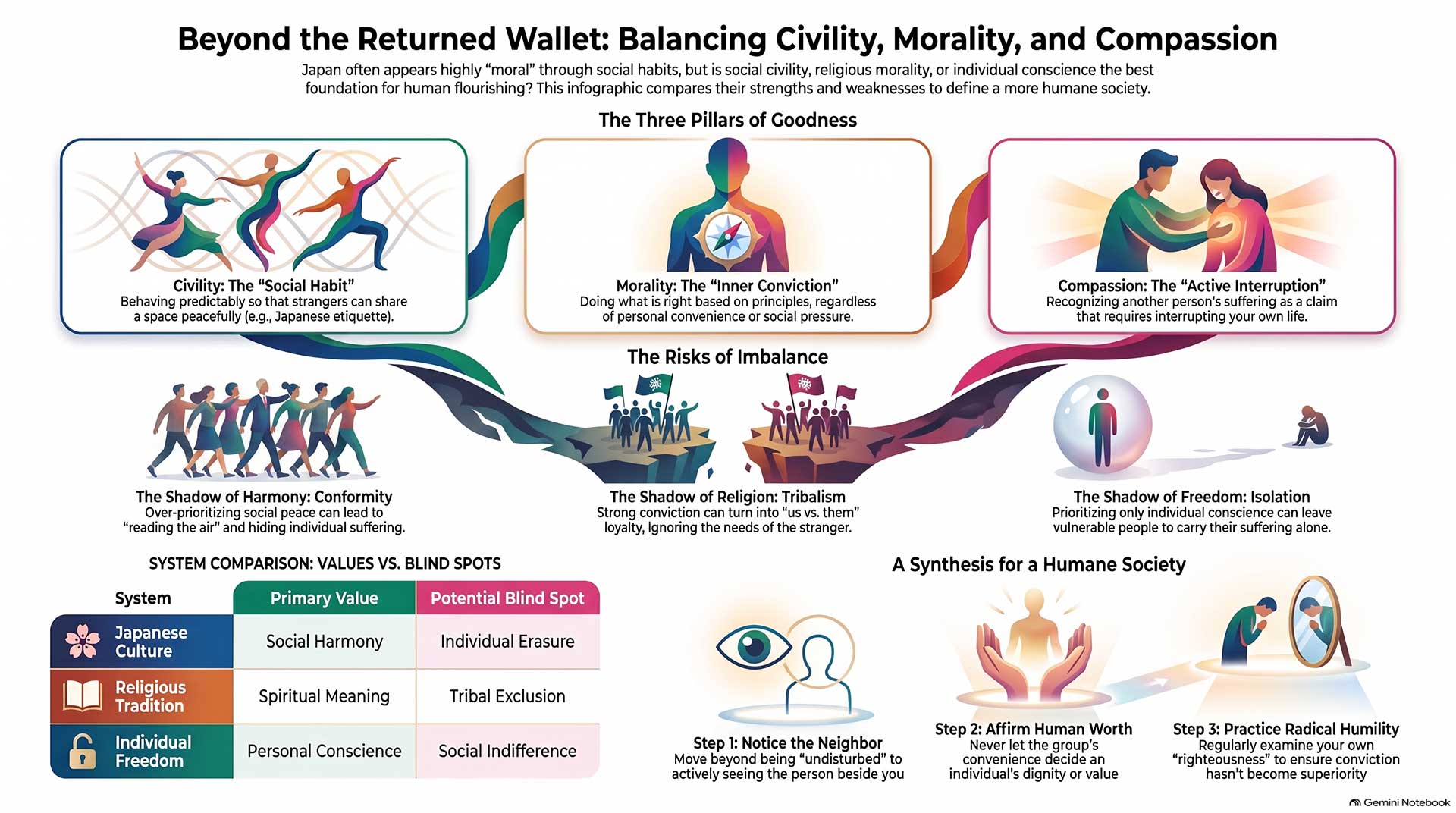
The most revealing distinction in this conversation may be between civility, morality, and compassion.
Civility says:
I will behave so that we can share this space.
Morality says:
Some things remain right or wrong regardless of convenience.
Compassion says:
Your suffering matters enough to interrupt my life.
Japanese culture can be exceptionally effective at the first. Religious traditions, at their best, reach toward the second and third.
Yet neither side earns an easy victory.
A society can return every lost wallet and still fail to notice the lonely person sitting beside it.
A religious society can speak endlessly about loving one's neighbor and still treat outsiders with contempt.
A culture built around harmony can pressure people to hide their differences.
A religion built around truth can turn conviction into tribal identity.
A culture centered on individual freedom can protect conscience yet leave people carrying their suffering alone.
Perhaps the better question is no longer:
Could Japanese culture succeed where religion has failed?
It may be:
What has each tradition discovered about human beings that the others are in danger of forgetting?
Japan reminds us that morality must become ordinary behavior. Good intentions mean little when our everyday actions make life harder for everyone around us.
Religion reminds us that human dignity cannot depend entirely upon usefulness, conformity, popularity, or social approval. Sometimes doing what is right requires disturbing the peace.
Individual freedom reminds us that the group cannot be permitted to erase the person.
And spiritual humility reminds all three that certainty about our own goodness may itself become dangerous.
Perhaps the most humane society would teach its children neither conformity nor unlimited individualism.
It would teach them to notice.
Notice the person beside you.
Notice how your behavior affects others.
Notice suffering hidden behind “I'm fine.”
Notice when harmony has become silence.
Notice when conviction has become superiority.
Notice when independence has become indifference.
Then act.
The lost wallet still matters.
Return it.
But if there is a suffering person lying beside it, do something more.
Stop.
Let yourself be inconvenienced.
That may be where civility ends—and love begins.
Short Bios:
Jesus of Nazareth — The central figure of Christianity, whose teachings emphasize love of God and neighbor, forgiveness, mercy, care for outsiders, and concern for people pushed to society's margins.
The Dalai Lama — Tibetan Buddhist spiritual leader known internationally for teachings centered on compassion, nonviolence, human connection, and examination of the mind.
Rabbi Jonathan Sacks (1948–2020) — British rabbi, philosopher, and former Chief Rabbi of the United Hebrew Congregations of the Commonwealth. His writing frequently explored morality, community, religious difference, responsibility, and the relationship between faith and modern society.
Hamza Yusuf — American Islamic scholar and educator known for discussing classical Islamic ethics, spirituality, education, moral responsibility, and the place of religious tradition in contemporary society.
Shunmyo Masuno — Japanese Zen Buddhist priest, author, and garden designer whose work explores Zen practice, simplicity, attention, restraint, and ways traditional Japanese thought can shape everyday life.
Leave a Reply